
 | The Evolving situation between Russia, Belarus and Azerbaijan | The Oil Drum | Is Peak Oil Already Here? Is that why GS Reweighted? |  |
The Upside of Down: Catastrophe, Creativity and the Renewal of Civilization
Posted by Stoneleigh on January 10, 2007 - 11:30am in The Oil Drum: Canada
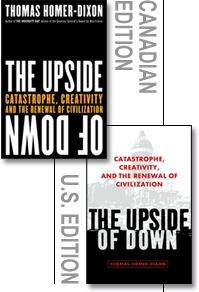
Thomas Homer-Dixon has written an interdisciplinary tour-de-force integrating the many challenges facing industrial civilization into an elegant conceptual framework. That framework – catagenesis – applies an understanding of natural cycles of growth, breakdown and renewal to the present and the future of our global society. Our prevailing complacency is based on trust in our science to give us the knowledge, our markets to give us the incentives, our democracy to give us the social resources and our brains to give us the ingenuity necessary to solve our increasingly complex problems. However, that blind trust may be misplaced given the array of tectonic stresses facing our civilization and raising the risk of synchronous failure.

The Thermodynamics of Empire
The thermodynamics of empire is an underlying theme in Homer-Dixon’s discourse, particularly in relation to ancient Rome, although parallels are drawn with the present day. Homer-Dixon has a talent for vividly illustrating his descriptions of Rome’s dominance and subsequent decline with examples from his own travels and experiences – from calculating the land required to support the building of the colosseum to observing the deteriorating quality of the limestone deposits lining a Roman aqueduct in southern Gaul, to discussing the large error margins built into Roman engineering and their consequences for resilience.
Rome’s success depended on its ability to extract energy surpluses, in the form of food, from the imperial territories and concentrate them at the centre, where they enabled the development of a tremendous degree of organizational complexity. However, the EROI of imperial energy tributes declined over time to the point where the complexity of the centre could no longer be maintained without drastic action being taken. That action – an elaborate, highly intrusive and draconian regime of taxation in kind - was taken during the rule of the emperor Diocletian, but its rejuvenation of the empire’s fortunes proved to be temporary as stressors continued to build against an empire declining in resilience as it burned through its own capital – productive farmland and peasantry. Eventually, “the empire could no longer afford the problem of its own existence”. Homer-Dixon argues that industrial civilization may be approaching the exhaustion of its means of supporting its current level of complexity, and that we too may be faced with making adjustments comparable to those made in the fourth century. However, these measures could represent merely a temporary reprieve unless we conceive of different organizational principles addressing our own stressors.
Stressors, Multipliers and Negative Synergy
Homer-Dixon identifies, and discusses at length, five major tectonic stresses – population growth, energy depletion and declining EROI, environmental degradation, climate change and financial instability. In addition, he discusses the effect of two multipliers – the escalating destructive power of small groups and the rising speed and connectivity of our socioeconomic system – and the potential for negative synergy between them. Our management approach to dealing with the problems facing us adds additional layers of complexity to what is arguably already a cumbersome, rigid and dysfunctional governance system declining in resilience. Homer-Dixon argues that delusional optimism and passivity should be replaced with a prospective mind prepared to engage aggressively with a world of risk and uncertainty, in other words that passengers should become drivers.
Connectivity and speed are critical attributes of complex systems and consistent themes throughout The Upside of Down. Both positive and negative effects are demonstrable, although the positive effects have been given far more attention in the media as they have formed a major justification for globalization.
Together, greater connectivity and speed often make economies and societies more resilient to shock because they can respond faster and draw from their larger networks a wider range of skills, resources, capital and goods and services.
The downside to connectivity and speed - neglected in the popular discourse – is well explored here, where it is a key to understanding the potential for synchronous failure. Homer-Dixon illustrates his point dramatically with a near-miss personal experience of traffic moving at high speed and closely enough together for there to be effective connections between the various elements. Failure of one element in such a tightly coupled system can quickly lead to a cascading failure, such as a major highway accident at speed or cascading financial contagion. Where systems are intimately linked, disturbances can propagate over great distances and have potentially devastating impacts that would not have been possible had the components remained isolated. Connectivity can therefore lead to systems which are less resilient instead of better able to tolerate disturbances. Moreover, tight coupling can lead to unanticipated emergent properties, such as feedback loops, requiring complex new management systems with their own attendant costs.
Negative synergy, which Homer-Dixon discusses with reference to an extremely intense fire near San Bernardino, involves a confluence of factors compounding each other’s negative effects. In the case of the fire, people had moved into an edge zone, dead plant material had built up over time as all fires had been suppressed, and a drought had occurred simultaneously with a beetle infestation that had killed many trees. The result was an intense conflagration far larger than would normally be expected – an event much more difficult for an ecosystem to recover from. Homer-Dixon is concerned that we may be facing a confluence of stressors and multipliers capable of triggering a deep collapse event, which we also may have difficulty recovering from.
The Nature of Networks
The nature of networks can have a significant impact on their vulnerability to disruption. Random networks like the US interstate system have loosely connected nodes each with relatively few links, but scale-free networks - the air traffic network, the internet, food distribution systems, electrical grids - have critical hubs linking to many nodes. Damage to an ordinary node usually has little effect, but damage to a hub can cripple a network. Homer-Dixon points out that as scale-free networks develop greater connectivity, new nodes link preferentially to hubs, making them even more dominant and making the network more vulnerable to intentional disruption. Where networks are tightly linked, as in a modern just-in-time economy, failures can jump system boundaries.
Tightly Coupled Socioeconomic Systems and Financial Risk
Homer-Dixon quotes George Soros to say that civilizations fall due to a morbid intensification of their own first principles. In the case of global capitalism, the growth imperative is becoming all-consuming in order to maintain demand as production increases.
Since the 1930s, generations of economic policy makers, especially central bankers, have been acutely aware of the dangers of inadequate demand. The grim lesson of the Great Depression has been seared into their minds: a chronic demand shortfall – and the frightening price deflation that accompanies it – can cripple economies, cause unemployment to skyrocket, and catalyze political extremism.
However, the growth imperative conflicts with the imperative to conserve resources and prevent degradation of the environment. Homer-Dixon argues that economic growth, resource use and environmental damage remain tightly coupled, although economic globalization has helped to conceal the consequences of the growth imperative for rich countries.
The stabilizing negative feedback loops of classical economic theory are, in practice, increasingly giving way to destabilizing positive feedback loops as modern communications technologies have increased the ease and pace of transactions and eliminated distance as a factor. Crises can now spiral out of control before policy makers can respond.
Conventional economic theory suggests that capitalist economies will gravitate toward equilibrium….as changing prices for goods and services balance supply with demand. In actual fact, though, like any complex system a capitalist economy can sometimes exhibit unbalanced and capricious behaviour. Instead of acting like a smoothly functioning and predictable machine… it can act more like the planet’s climate with its synergies, feedbacks, multiple equilibriums and threshold effects. This is what happened in East Asia in mid-1997, when a self-reinforcing feedback of investment, profit, consumption and more investment flipped overnight to a vicious circle of falling investment, failing banks and crashing consumer demand.
Diminishing Marginal Returns to Complexity
According to Tainter, whom Homer-Dixon interviewed for The Upside of Down, people do not stop choosing to institute complex solutions once they hit diminishing marginal returns to complexity because the problems those solutions are designed to address do not go away. They simply become ever more expensive to solve, until merely maintaining the status quo, amid a series of concatenating problems reinforcing each other in unanticipated ways, consumes a greater and greater percentage of a society’s resources. Complex solutions are chosen for their short-term effects without consideration of the longer-term consequences, even when the long-term costs of entrenched solutions can be very high. As more wealth is devoted to old problems, little is left to address new ones, which can lead to generalized dissatisfaction and a loss of legitimacy for the organizing principles of society.
Panarchy
Homer-Dixon’s catagenesis – collapse and renewal – builds on the panarchy theory of ecologist Crawford Holling, who was also interviewed extensively for The Upside of Down. Panarchy - named after Pan, the Greek god of nature – describes adaptive cycles of growth, collapse, regeneration and growth again observed by Holling in his work on forest ecosystems. During the growth phase natural capital is accumulated and growing connectedness helps to maintain stability.
This growth phase can’t go on indefinitely. Holling implies – very much as Tainter argues in his theory – that the forest’s ever-greater connectedness and efficiency eventually produce diminishing returns by reducing its capacity to cope with severe outside shocks. Essentially, the ecosystem becomes less resilient. The forest’s interdependent trees, worms, beetles and the like become so well adapted to a specific range of circumstances – and so well organized as an efficient and productive system - that when a shock pushes the forest far outside that range, it can’t cope. Also, the forest’s high interconnectedness helps any shock travel faster across the ecosystem. And finally, the forest’s high efficiency makes it harder for it to realize its rising potential for novelty. For instance, the extra nutrients that the forest system has accumulated aren’t easily available to new species and ecosystem processes because they’re fully expropriated and controlled by existing plants and animals. Overall, then, the forest ecosystem becomes rigid and brittle. It becomes, as Holling says, “an accident waiting to happen.”
The parallels with social systems are obvious. James Kunstler has described efficiency as “the straightest path to hell” precisely because when resources are used as efficiently as possible, there is no spare capacity to absorb shocks to the system.
Somehow we have to find the middle ground between between dangerous rigidity and catastrophic collapse. In our organizations, social and political systems, and individual lives, we need to create the possibility for what computer programmers and disaster planners call ‘graceful failure’. When a system fails gracefully, damage is limited, and options for recovery are preserved. Also, the part of the system that has been damaged recovers by drawing resources and information from undamaged parts.
According to Holling, adaptive cycles occur at different scales temporally and spatially – from the stream to the forest to the region – and interact each other hierarchically. If cycles at different scales are in different phases, they are able to compensate for each other to some extent and prevent collapse becoming catastrophic. Higher level, slower moving cycles provide stability and resources that can buffer the forest and allow it to recover from collapse more rapidly, while lower level, faster cycles represent a source of novelty and experimentation. The long-term effect of localized collapse – part of the normal process of adaptation and evolution - can be positive as new ecological solutions may evolve and thrive.
Put simply, the catastrophe of collapse allows for the birth of something new. And this cycle of growth, collapse, reorganization, and rebirth allows the forest to adapt over the long term to a constantly changing environment. “The adaptive cycle,” Holling writes, “embraces two opposites: growth and stability on one hand, change and variety on the other.” It’s at once conserving and creative – a characteristic of all highly adaptive systems.
However, where adaptive cycles have become tightly coupled, they can become synchronized – trapped in an extended growth phase together for longer than normal, so that they all peak together and reinforce each other’s eventual collapse. Recovery from the resulting deep collapse can take much longer, or may not be possible at all. The concept is reminiscent of Tainter’s description of group polities evolving together, which effectively enable each other to grow in synchrony for longer than would normally be possible, then collapse simultaneously. Tainter, in his classic work The Collapse of Complex Societies, wrote that the globalized economy of nation states potentially represented just such a system.
Catagenesis
Although acknowledging the possibility of deep collapse, Homer-Dixon holds out hope for catagenesis – renewal through breakdown to a simpler form, followed by the emergence of a novel form of society. He argues that in order to achieve this, we much act to attenuate the tectonic stresses we face in advance so that they will be less likely to result in synchronous failure. We must also loosen the connectivity that binds us into a tightly coupled system in order to build resilience of critical systems like food and energy. There is however, a sharp contrast between resilient systems and efficient systems, in that resilient systems maintain safety margins that look like inefficiency, an example being power grids as they used to be run by engineers as compared with deregulated power grids run by accountants anxious to eliminate all unnecessary spending. Homer-Dixon makes a strong case for the reintroduction of relative self-sufficiency – an important aspect of resilience which has been comprehensively replaced as a guiding philosophy by comparative advantage. However, he expects resistance from vested interests.
Then there are social causes of denial. Probably the most important is the self-interest of powerful groups – corporations, government agencies, lobbyists, religious institutions, unions, non-governmental organizations, and the like – that have vested interests in a particular way of doing things or viewing the world. If outside evidence doesn’t fit their worldview, these groups can cajole, co-opt, or coerce other people to deny this evidence. Some groups, of course, will be much more effective in the effort than others, owing to their enormous political and economic power.
The difficulty is that resilience represents an additional cost, which no one appears prepared to bear, especially as it would place them at a disadvantage in relation to others who took no action. In essence, the problem becomes a tragedy of the commons where resilience - a long-term public good - cannot be maintained in the face of short-term self interest in the exploitation of resources at the maximum rate, whether at the level of the individual, the corporation or the nation state.
And because our leaders hardly ever think about resilience, we keep doing things that make our lives progressively less resilient – we pile on more debt, build tract housing over our finest crop land, develop addictions to distant sources of energy, become so specialized that we can’t take care of ourselves when everyday technologies fail, and fill every nook and cranny of our days with so much junk information and pointless running around that we don’t have time to reflect on what we’re doing or where we’re going.
Recommendation
The Upside of Down is an essential read for anyone interested in understanding the converging stresses of the twenty-first century and the potential implications for our current way of life. Homer-Dixon possesses a rare ability to connect disparate fields of enquiry in a clear, concise and profound manner, and to bring the resulting discussion to life. There are too few books which take a truly interdisciplinary approach and place current issues in their complex context – this is one of the best available.
The Upside of Down: Catastrophe, Creativity and the Renewal of Civilization
PDF version
125 comments
The Upside of Down: Catastrophe, Creativity and the Renewal of Civilization
PDF version
125 comments
Personnel
Archives
- December 2008 (1)
- October 2008 (1)
- July 2008 (2)
- June 2008 (2)
- May 2008 (6)
- January 2008 (2)
- December 2007 (8)
- November 2007 (9)
- October 2007 (11)
- September 2007 (14)
- August 2007 (14)
- July 2007 (10)
- June 2007 (9)
- May 2007 (11)
- April 2007 (9)
- March 2007 (11)
- February 2007 (11)
- January 2007 (11)
- December 2006 (12)
- November 2006 (16)
- October 2006 (13)
License

This work is licensed under a Creative Commons Attribution-Share Alike 3.0 United States License.
I'm happy you are talking about Thomas Homer-Dixon. I've read his book Ingenuity Gap two years ago, it was one of the best book I've read on a rarely studied and difficult subject. Truly, a great Canadian intellectual.
This book really is a superb accomplishment. It's so rare to find anyone doing interdisciplinary study at this level, even though the big picture is exactly what we need. Anyone who appreciates Tainter or Diamond will find this a very worthy contribution to the debate.
Thanks for the great review, I'll definitely add it to my wish list..
Cheers,
Gary
I read the book fairly quickly but, honestly, the "upside" is pretty much lost on me. THD has a book review and a rebuttle to that review on his book website. To the extent that he talks about an upside, it just seems unlikely and insignificant. He asserts in his rebuttle that the book isn't a "how-to" guide but, really, why use the word upside then?
I like the guy (saw his presentation in Ottawa last month) and think his book is a great analysis of why we might all be in a lot of trouble. I just wonder, cynically, whether "upside" was used to sell the book.
I just looked at the first chapter. It starts with the description of an unusual, if not completely unique aircraft accident. The man uses it as a show piece. To him the deaths of 111 people are nothing but a clincher to get you reading. Because once you do, he has sold the book in the store. It does not matter what he writes on the remaining 300 pages. He made the money, already.
Truly a great intellectual? Or just a damn smart publisher and a third rate author of books that will collect dust in two years because they have about as much substance as "Get Paid What You are Worth"?
:-)
If you cannot make a constructive contribution to the discussion, please do not contribute at all. Ill-informed mockery does not cast you in a good light.
Mockery of an obviously not very good book that was written for commercial success is simply a form of critique. If you can't stand critique, please don't read my posts. Mr. Homer-Dixon won't care. He's got your money already. He surely won't get mine.
Stoneleigh has posted a thorough and lengthy review, detailing many of the book's concepts. Your breezy dismissal of the book based on one storytelling device doesn't constitute a critique.
I for one would rather see your refutation of the arguments presented in the review (since you don't want to buy the book) than your "mockery", which is of very little value.
Hi Stoneleigh.
Having InfinitePossibillities repsond to one's comment is like stepping in dog poop: You really don't want it there, but you're obliged to deal with it.
I can't read IP's comments without concluding he doesn't comment in good faith. I read his comments as disrupting, misdirecting and discrediting the discourse at TOD, especially to new visitors. I can't figure out why the editors don't ban him, and similar trolls.
Leannan, where are you? You banned OILCEO recently for foul language, and mc about 18 months ago for persistent antisemitic remarks. What about it?
Stoneleigh,
Do you have some previoius relationship with IP?
He was making a constructive contribution. One of the best, since it was so early.
You need to lighten up. You will never last taking that stance. Look at me. I've had cannonballs pass through my abdomen. Ever wonder how I do that?
Mmmmmmn them Columbian sweeties. That is what I'm saying, dude. It is simply not my fault you made those decisions. I like snow. I like the drifts. And I'll hide your shit. I just don't have time to hide mine. I wanna sneak off and drink some rum with my baby. I'm always on the run. Dick Cheney.
If you can't read past the first chapter why do you even post this dribble?
I looked at the first chapter which is the online teaser. After reading that I wouldn't expect to find a serious analysis of anything to follow. If I had seen the book in the store last week and read that chapter, I would have put it down with a smile and walked to the fiction section to see if they have an English translation of Ransmayr's "The Last World". Now that is truly great fiction... (In reality I ended up buying a copy of Mark Twain's "Saint Joan of Arc" which promises a lot of entertainment and insight).
I guess I am simply too much of an engineer with science background to enjoy anything (allegedly) non-fictional that does not burst with data, models and falsifiable/verifiable math. As such I am much more interested in hybrid-sales and solar revenue growth as indicators of changes in consumer behaviour than sociological "analysis" of what is "wrong" with the world. As far as we know nothing is "wrong" with the world in the first place. It simply follows the laws of nature and the reactions we get from it are consequences of our own actions. The reactions are often predictable. The actions are often stupid. So the result of a sociological analysis would have to be that man continues to act stupid. There is nothing new about that. Mark Twain wrote two dozen books on that topic... I bet he would be very amused about PO and GW. And he certainly would write better about it than most anyone does today.
The real question I have (and no doomer has any answers to that) is WHEN will man be FORCED to act rationally by nature? We know that this is inevitable because people can only take so much punishment before they learn and the lessons we are facing will be hard ones. So while doomerism acknowledges that man is stupid, something I will never deny, it neglects that man can also learn. And the fact that we are here at all is my main witness for my case.
I am, by the way, not the first one to criticize the man, as this article shows:
http://www.homerdixon.com/download/Response_to_Gleditsch.pdf
Looks like to me that by the time these masters of sociology will be done with their debates about who made bigger mistakes describing the world, Toyota will have sold approx. 25 million hybrids and the world will get 5% of its energy from solar cells. The OLPC project will have distributed hundreds of millions of Linux devices to children in the developing world and many of these children will know more about computer science than most high school students in the US. What a beautiful world this will be... what a glorious time to be free. Not in Iraq, of course where we will celebrate five million deadths from the raging civil war...
"WHEN will man be FORCED to act rationally by nature?"
I can't imagine why Kipling's poem, "The Gods of the Copybook Headings," hasn't been mentioned on this site before.
I do not fully agree with it, but it is worth having in your brain anyway.
http://www.fourmilab.ch/etexts/www/kipling/gods_copybook_headings/
Chris
Re: why do you even post this dribble?
That would be drivel, not "dribble". When commenting as you have, I believe it is important to get the words right but, on the other hand, "dribble" is indeed close to what you meant ie. as a noun:
As a verb,
However, I do appreciate your intention.
IP,
I am fascinated by the book review. Anything relating thermodynamics to social systems is a hook for me. But to give you a chance to recommend more enlightened alternatives I would be interested in your top ten recommended books.
Please forgive this physicist, but I like to use thermodynamics for what it really was invented for: to predict the properties of thermodynamic systems. It is really great for calculating ICE efficiency and the state of the interior of stars or transport of electrons in semiconductors, but it has absolutely nothing to say about how people behave... unless you can tell me what the free energy of a gas made of people at any given temperature is, of course... Or maybe you would prefer to define the Entropy of the inhabitants of Mexico City (hint: units are J/K)? And what happens to them when the temperature approaches 0K? Hint: the entropy of any system at the zero point of the absolute temperature scale is 0 - it's the third law. But what does that mean? That there is no more social conflict because everyone is frozen stiff and dead? And how comes the system is not reversible once you raise the temperature again to 300K? Dead people stay dead but thermodynamics would expect that the system resumes the same state it had before you cooled it down... that is not how a gas behaves... And anyway, what is the critical exponent of a phase transition, e.g. during a revolution? What is the relevant order parameter? Flying bullets/m^3?
Don't get me wrong, but there has been so much abuse of physical terms by people in other disciplines who did not even take the time to read a simple introductory textbook on the stuff they were abusing that the stack of paper would go from here to the moon and back. Much of what has been written sounds great but the intellectual value of it is less than just questionable. Most of it is pure rubbish.
If you want to learn something about thermodynamics and complexity, you will have to read Haken and Prigogine. And while these gentlemen only talk about lasers, boiling water/oil, surface waves and the likes, at least they derive equations of motion which are formally correct and predict things like laser threshold, mode locking and chaos that is in good agreement with experiments. The other books I would put on my reading list are:
Misner, Thorne, Wheeler: Gravitation.
Weinberg: Gravitation and Cosmology.
Jackson: Electromagnetics.
Kittel: Introduction to Solid State Physics.
Feynman: Lectures.
Landau-Lifshitz: all volumes.
Numerical Recipes in C (Fortran, if you really need to torture yourself).
Any book on Classical Thermodynamics and Statistical Mechanics (they all suck in my opinnion).
Further reading:
ANY book you see in the science section of the university library that you feel like reading.
Regular browsing of Phys. Rev., Phys. Rev. Letters and Rev. Mod. Phys. and any other journal you like.
Once you are done with this stuff, you too will laugh about any attempts to use physics terminology on anything but physics problems.
Now your a physicist , before an engineer, now a expert on aircraft crashes, then an expert on 1930's farming livestyles, and so on.
I still want to see those credentials that I asked for earlier. Not that I will believe them but at least you will be on record with SOMETHING concrete.
Ok. I get your lesson for today. If the temp goes to 0 kelvin then people freeze. Gotcha. I now know thermodynamics. Where is my sheepskin? Whats next on the agenda oh wise guru?
Heres something you can pass along. If you go out on the highway and all you can see is stalled cars and lots of hand waving you can bet that PO has arrived. It doesn't need a formula to figger out.
If you make it to WalMart and the greeter is not there and no flashing lights then you can also be assured that PO has arrived. Again no thermometers or calorimeters are required to measure the heat loss or gain of the dead bodies lying on the floor.
Its not rocket science. Its black sticky stuff in the ground and
when we can't pull it out anymore for whatever reason we are in trouble and yes,,,PO has arrived. For the engineerphyscistagronomistaircraftinspector , you just ran out of time. Your dead.
I am an experimental physicist who works as an engineer. That is so unusual that probably 80% of my fellow experimental physicists do the same. Or is it more like 90%?
I am not an aircraft expert but in my recollection the survivors of Flight 232 had an incredible amount of luck that the aircraft had lost almost all control BUT the engine power steering, that the pilot figured out that he could control the attitude of the aircraft BEFORE it went into an unrecoverable aerodynamic state and that the enormously talented crew managed to use whatever control they had left to land the plane in a somewhat controlled manner. As far as I know this kind of accident typically ends in a call for help and then a crash which takes the lives of all passengers and crew. But what does this accident which claimed the lives of 111 people have to do with ingenuity? And why does what follows in the contents of "The Ingenuity Gap" sound so much like a self-help book? I quote:
"How Are We Changing Our Relationship to the World?
* Careening Into the Future
* Our New World
* The Big I
Two: Do We Need More Ingenuity to Solve the Problems of the Future?
* Complexities
* An Angry Beast
* Glimpsing the Abyss
* Unknown Unknowns
Three: Can We Supply the Ingenuity We Need?
* Brains and Ingenuity
* Ingenuity and Wealth
* Techno-Hubris
* White-Hot Landscapes
Four: What Does the Ingenuity Gap Mean for Our Future?
* Vegas
* Patna"
Does that sound like a book I HAVE to read? Not to me... I am sorry.
"I still want to see those credentials that I asked for earlier. "
PhD in experimental particle physics. That is as much as I will give you. You can believe it or not. It does not matter to either me or reality because I don't have to lie about who I am. I also don't have to tell more. You can judge me by my writing. That is better than to judge me by a piece of paper from a university that sits in one of my folders at home and collects dust.
"Ok. I get your lesson for today. If the temp goes to 0 kelvin then people freeze. Gotcha. I now know thermodynamics. "
It looks like you didn't get it. The problem with applying thermodynamics to anything but thermodynamic systems (of which there are fewer than you think) is that you need something like physical temperature, pressure, magnetic field etc.. These have to be differentiable variables. Then you need a system that has a state that uniquely depends on some of these variables and which, again, is characterized by differentiable functions. In more theoretical terms, the system needs to have a description that is a locally differentiable manifold in a higher dimensional space. Thermodynamic properties are then derived from moving along this manifold, looking at differential forms and non-integrable variables (like entropy). To use terms from classical thermodynamics makes NO SENSE whatsoever if you are missing these ingredients.
"If you go out on the highway and all you can see is stalled cars and lots of hand waving you can bet that PO has arrived."
It does take formulas to figure out how to make engines with higher efficiency to avoid that situation. It does take formulas to build wind turbines and solar cells. Formulas are very helpful if you are trying to figure out how much energy we can use per person in a world with 10 billion people and limited GW. I am sorry, but there is nothing wrong with applying sound science to problem solving. It's actually quite fun.
"Its not rocket science. Its black sticky stuff in the ground and
when we can't pull it out anymore for whatever reason we are in trouble..."
Why do you need to jump to these conclusions? Why can't you say that
"Currently we depend on hydrocarbons too much and we know that we can't do that forever. We need to find other ways to power our cars and other infrastructure. The problem is to find those ways. It is not about running around like headless chickens."
What is wrong with that? Is it too hard to figure out? Is running around like a headless chicken easier? Does it look more attractive? Not in my world.
IP said:
"It looks like you didn't get it."
No it looks like YOU did't get it.
My whole post was a putdown. It was sarcasm. It was lampoon.
The reason I replied in that vein was that I was hoping you would become angry and just not reply to any posts I make in the future.
I really don't need the science lesson either.
Running around like poulet sans tete may be the only thing a scientifically illiterate and innumerate populace is equipped to do by itself. Whether they'll take leadership from a cadre of engineers and physicists (who'll make them feel stupid even while trying to save their bacon) or some variety of demagogue (who'll play on their emotions) is the crucial question.
As a side comment about how lucky Flight 232 was - 'It turned out that one of the passengers on board flight 232 was Dennis Fitch, a United training and check pilot with over 3,000 hours on the DC-10.' Generally, passenger flights do not have expert pilots on hand as a back-up. http://www.airdisaster.com/special/special-ua232.shtml
On the other hand, it is quite customary for the flight crew to ask for any help in an emergency, since when you are about to crash, any possibility to avert it is worth taking.
IP
You are misrepresenting Prigogine.
Prigogine who won the Nobel Prize in chemistry for his work on nonequilibrium cyclic chemical reactions and their bifurcations into new states is also noted for his "universal law of evolution" He had grand ideas connecting life to thermodynamics. You seem to be limited in understanding the possibilities in applying thermodyamic theory.
Good on you, Stoneleigh. This book was on my Christmas wish list, and Santa did not fail me. Nor did Homer-Dixon.
You know, I only found this story because my hand was drawn to the "wrong" tag in a story ("peak oil" tag at the top).
I'd suggest that TOD "push down" TOD:USA and make it a peer of the other groups, and then do a front page with smaller excerps across all sub-categories. Make it more newspaper like.
Arts and Letters Daily has alway been the champ at getting many stories on a page, but maybe you don't need to go to that extreme.
.. but the real reason I post is to add a link, in case anyone missed it, to the Homer-Dixon interview at worldchanging. I think it's pretty good
http://www.worldchanging.com/archives/005131.html
I appreciate there that he does mention limits to prediction:
odo, whose great-grandfather was a streetcar conductor in Victoria, BC
Interestingly, in the interview, he appears to confuse geothermal energy with ground source heatpumps (or 'geoexchange' as the US now calls them).
Of cours GSHPs are a great idea, but they are *not* freedom from the electricity grid (he implies that by not requiring gas, they free the householder from dependence on a centralised system).
A relation in Collingwood has a GSHP and they are great (particularly with the hot summers they have been having) but they are not 'grid independent'.
I often find with the gurus that they get the wrong end of the stick on the detail. Examples include James Lovelock on nuclear/ wind.
IMO anyone who has a heat pump should have a back up - either for the heat or for the electricity required to run the pump. I have a heat pump, although I don't rely on it as it's an older, not very efficient variety that just happened to come with the house. It comsumes an enormous amount of electricity to run - enough that I couldn't run it off my renewable energy system and would therefore not have it during outages. Newer, more efficient ones could probably be run by a renewable energy system, especially if they were heating a modest-sized, well insulated house. However, the most cost-effective back-up IMO would be a good wood stove.
Do you keep a backup for your wood stove, too? I mean... just in case... it could break just when you need it. How about some cow dung? And the backup for that could be to sleep in the stables next to the animals...
Troll.
Inf...
Your comment misses the point. Most people have backup heating, namely fireplaces. If you are using heatpumps (as I now do), you can find yourself going cold in the event of a power outage if you don't have a good backup system, and the power requirements of the heatpumps are high enough that the little honda generator from the tv commercial just isn't going to meet the requirements. You need something with a little more muscle to it.
We put our heatpumps in because the events of the last 18 months have called into question the seemingly unending supply of heating oil. Katrina alone is enough to question reliance on oil/gas, and the concentration of remaining resources in the hands of a few whose trustworthiness is questionable doesn't help matters. Does that make me a doomer? No, I'm just doing a little risk management.
Stoneleigh is correct that if you use a heatpump system, you will almost certainly want to insure you can run it. This isn't rocket science, and it isn't getting back to nature. I've been searching for something to meet this need, and thanks to TOD, I think I've found something that will do it for us.
I am not challenging the wisdom of putting in a backup heating system per se. I am challenging the possibility to provide safety and reliability for all situations in life. My post was humorous in nature but addresses a key issue with doomerism: the failure to trust that some things in society better work or else... and thus are (hopefully) made to work just fine by the utilities. By the time you get down to the problem that you don't have heating and the neighbor does not have heating AND there is no way that the technician can come out and get the thing to work, you are likely to be in more trouble than you ever want to be or that could be mitigated with a wood stove. Because now you are also not likely to have electricity and communications, either. Worse, still, you don't have clean water and the toilet does not flush. If that happens to you on the farm, good for you because you still have a few options left. But if it happens to you in suburbia, or god forbid, in lower Manhattan, you are running into deadly trouble within hours, days at most.
I do understand the need for independence but in a society of 300 million people, half of which live in the city, at least 290 million people will have to depend on ALL services running almost ALL the time and then some. There is no other way. You can ask the people who do simulations of disease control after breakdown of public infrastructure. They will tell you that there is very, very little that can be done to stop disease once an area lacks fresh water and electricity. The best you can do is to send the police in and evacuate. So it does not matter if I have a wood stove or a fireplace because if there is a major problem in my area, I am gone.
I am not talking about home improvement here but about the general problem of what it takes to keep cities running. The professionals know that first responder education and well maintained services are the only things that matter. Self-help is very limited in its scope. I live in an earthquake zone and of course I have the water, food, flash light, gas stove and other utensils at hand. But these are feelgood measures, at best. They won't help because thousands of dying people will be trapped in buildings and I might be on of them. The gas lines will set the city on fire, despite the shut-off valves and there will be little if any water to extinguish the fires. What would help is much tougher building codes to make sure that less buildings collapse and few if any people get killed. But that is so expensive that we won't see it happening until the next event.
Take Katrina as an example. What would have been more effective? To give every citizen a life-boat and vest or to fix the levies? What would have been cheaper?
Sorry, but I am simply not a firm believer in private preparation for catastrophies. Of course, if I had lived in the US all my life, I might not be a firm believer in federal and state solutions, either.
IP,
Anyone who can make the statement:
"I am challenging the possibility to provide safety and reliability for all situations in life."
has the maturity of a 12 year old. Aside from being a straw man, it indicates that you have little experience with the real world where no one, no where has every possible contingency covered even under the present circumstances.
One of the hallmarks of an adult is the ability to recognize that life entails risk. For example, I live a very rural area. If I have a heart attack, I will probably die before any one can reach me. Further, if I am snowed in (and I have been for up to a few weeks), it is unlikely that anyone will even try.
As someone who is a realist, I have spent a lot of time (obviously more than you) considering how the future might unfold. In the process I have also spent a lot of money to manage impacts that could adversly affect my life. Having done this, I know far more than you about the limitations of preparedness.
Why don't you take a few years off from TOD to mature.
Todd; a Realist
You are making my point. Part of being mature is to acknowledge that there are risks in living. When I hear people on TOD discussing the wood burning stove, yet again, I have to ask myself: wouldn't they be better off joining a blog about "Better Living Grandpa Style"? What could even be remotely interesting about a wood burning stove when we are discussing how to get a hundred million people to work every day on half or one third the energy budget? How will wood burning stoves help to accomplish that?
And just in case, how would all these people who talk about "contingency" live on after seeing a hundred million people die in front of their eyes? Are you ready to dig the mass graves? Or isn't all of this talk just a different form of waiting for the Rapture? I don't know. You tell me.
"As someone who is a realist, I have spent a lot of time (obviously more than you) considering how the future might unfold."
I guess rather than to play out all "possible" scenarios, I am spending time on trying to figure out how I want the future to unfold and what I can do to help make it that way. That I won't exactly get what I want does not matter, as long as I get something sufficiently similar to what I want. That is called engineering. You never know exactly what the final design will look like, but you know that it will fly when it is supposed to.
"Why don't you take a few years off from TOD to mature."
I did not know that TOD stood for "Waiting for the world to collapse blog". Did someone here change the topic while I was away?
Listen to some of the doomers comments: My ex-wife. My kids have disowned me. They don't listen to me at work anymore. My neighbours avoid me.
I tried to talk to my extended family at christmas but...
These cancers of society have worn out their welcome and they find the internet mailing lists and forums to be their last domains. Nobody can turn them off. Unfortunate.
Every day we see groundless claims espoused to be authoritative. But the vast majority of their future scenarios are groundless.
These are very depressed souls. In the old days they wouldn't chat about waiting about with their rifles and nato-whatevers and murdering the jealous hordes when the end comes. They just shot themselves. Here at TOD, they have found refuge instead of doing the dreadful. Pity them...
Funny, people at work mention that we ought to "tax the fuck out of oil" in any related conversation.
My family gets it too. Maybe I keep (and was born into) smarter company than some people. ;-)
'Cancers of society'? Unlike ExxonMobil, who pays for 'objective' research into climate change because profit is now, and the future is later?
Be insulting as you wish, but at least recognize that cancer is essentially unchecked growth leading to the death of the organism in which it occurs. Many people think that is a more accurate description of an unfettered society devoted to unfettered growth, whether capitalist (Wall Street) or communist (Soviet Union) or fascist (Third Reich).
"What's interesting about a wood-burning stove?", he asks....
Well, I'll tell you.
A wood-burning stove slashes your natural gas consumption, and converts at least part of your heating requirement to renewable energy. Add a Stirling engine to that wood stove, and it becomes a net producer of both heat and electricity. If enough heat goes through the Stirling, you're bound to exceed home electric demand during the cold period; the excess electricity can go into things like the batteries of a plug-in hybrid car.
Voila, you've both heated the house and effectively created a wood-fueled car without doing more than plug it in. I find this sort of thing intensely interesting.
I'm always interested in home systems.
Can you give us a little more info, if not proprietary?
Actually on heating oil, my sense is there will always be heating oil as long as there are other petroleum products-- it's practically the bottom of the refinery 'stack' and so it is produced along with jet fuel distallate, gasoline etc.
What price you will pay for it is another matter.
(a similar argument to my mind applies to forms of bottled gas: LPG etc.)
Verily I say unto people: 'insulate, buy a very efficient car (hybrid or diesel), install a heat pump but above all insulate)' ;-).
PS of course the ultimate backup (besides a woodlot that *you* own) is coal-- there is a lot of coal in the world, and North America in particular is full of it. But in a world of global warming, I hate to advocate that people build an alternate energy system on the world's messiest CO2 fuel.
(I feel even worse about peat: biodestruction at its worst).
I'm blogging about my change-over to renewable systems, but I haven't uploaded the information on the GSHP as yet. Keep checking back.
thank you!
Indeed and my rellie who has a GSHP uses her wood fireplace as the backup (sealed fireplace, not open)-- and she sits on top of the Niagara Escarpment. Her original payback calc'n was 10 years, but given what has happened to energy prices I am sure it is more like 5-6 now.
It might well be worth your while to look into replacing your GSHP-- electricity rates are headed only upwards, it seems! And HVAC is one area where there have been remarkable increases in efficiency in the last 20 years. An AC unit now uses 40% less energy than a 20 year old one, a fridge uses 1/4 the energy of a 25 year old one.
It's quite common in fact to have an oil furnace as a backup to a GSHP-- you probably only need a refill once or twice a heating season. Most people who have connections to gas mains don't find a GSHP has a reasonable payback against a modern gas furnace (although the air conditioning benefits are nice).
I've never heard of an Air Source HP in Canada, but they are big in the US. I think the key issue there is they won't work well much below 0 degrees centigrade. Obviously the cost of installation is vastly lower.
(all of this is irrelevant if proper insulation is not installed, as that as a far far faster payback)
Good point that some kind of renewable power might be useful for driving a GSHP. I don't think that is what Homer-Dixon was driving at.
He has confused geothermal power with Geoexchange Heat Pump (which is what the Yanks call it, these days). I find those sorts of obvious technical errors disconcerting: it is emphatically *not* the case that we can all get our power from geothermal electricity!
I'd really like to upgrade my GSHP, but there's a limit to how much redundancy I can afford unfortunately, nice as it is to have several ways of achieving the same thing. My farmhouse is primarily heated using an outdoor wood furnace, the benefit of which is that I can heat several farm buildings with a single unit (the furnace heats water which travels through insulated piping to each building). I also have a good wood stove indoors as a back up, and a 1928 wood range in the kitchen that I could cook on if necessary (it's an old house and the range came with it).
The circulating pump for the wood furnace and the circulating fan for the wood stove both run off my renewable energy system all the time, so I would still have them during outage conditions. However, the main furnace fan for the house is too big a draw for the system, so I'm planning to install a few strategically placed radiators instead.
The battery bank in the basement, which runs all the essential loads, can be charged using the solar array, my generator or the mains. Less essential loads can be run directly from the generator.
I've never priced a replacement GSHP but such a big fraction of the total cost is digging the borehole, that you might find the payback from improved efficiency is really worthwhile. Depends how much you use it I guess.
http://www.eere.energy.gov/femp/procurement/eep_groundsource_heatpumps.cfm
gives an idea of the efficiencies now available (I couldn't find historic comparisons).
(at least in Ontario, the price of electric power is past due to skyrocket. Bad for GSHP v. gas, but certainly a strong argument for upgrading HVAC equipment with the latest models).
I was stunned when I looked into the kinds of increased efficiencies that have occurred, particularly in air conditioning, over the last 20 years.
As one scientist said: most people probably don't realise that the old fridge they keep in the back as a beer cooler, is costing them more per month than the full size unit in their kitchen which looks after the household. Just unplugging the one in the back could save them $10 (or more) a month!
It is true that new air conditioners are more efficient. Our decision to go to GSHP was motivated by wanting both heating and cooling from sources that were not predominantly fossil fuel based (and more importantly not from imports). Now, however, I'm struggling with the power bill (overall, costs are less) and the fact that the peak power generation is from fossil fuels. Insuring the system can run independently from the grid is my next hurdle. This looks to be solved, but it still will require some fossil fuel input.
I have heard ground source heat pumps called "low grade geothermal" by some quite good authorities - one of my best high school friends made a good business out of that technology in the 1980s. I think it is true, the reason why it stays a decent 50 degrees or whatever underground is largely for the same reason that in some places it gets hot enough to melt rock. Not that it is very practical to generate electricity from this sort of low grade geothermal reservoir.
I wonder, do they make GSHP driven by propane or heating oil? Why not GSHP driven by coal or a wood fire? The waste heat from the engine can be piped into the living space, along with the heat generated by the heat pump. A heat pump ought to be able to increase the efficiency with which one can heat with wood. I've seen some mighty fancy big wood furnaces, so I know that wood and high tech are not mutually exclusive.
This is the direction I'm going: a GSHP driven by a propane cogen unit including preheating of the ground water by the excess heat of the generator.
The reason it stays a relatively constant temperature at shallow underground depths (it isn't always 50°) is because heat diffuses slowly and groundwater adds both thermal mass and a fluid to transfer heat by convection. The typical ground temperature is the average annual temperature. Exceptions are where you have real geothermal activity.
goinggreen should dump the engine cooling and exhaust heat indoors instead of using it as a second heating for the ground-loop fluid. Just pumping less heat will increase the efficiency.
Yeah, I should do many things.
Excellent synopsis. It sounds right up my alley. I was planning to read this book anyway, but it's definitely moving up the list now.
If he's right, those chanting the "efficiency" mantra are really barking up the wrong tree.
"If he's right, those chanting the "efficiency" mantra are really barking up the wrong tree."
Sadly, he is simply wrong. Europe and Japan prove it. So does the US, by the way. CA residents use half the electricity of the average US citizen. Yet, here we are - we live and we live quite well. We even have wide screen TVs. And now we are even proposing to implement universal health care! Schocking! Truly UNAMERICAN!
"CA residents use half the electricity of the average US citizen. Yet, here we are - we live and we live quite well.'
Of course some of the gap is lower summer AC demand---but yes---us Californians are generally more efficient.
One thing which surprised me was a recent flight I took. One intermediate stop was in Phoenix. As I flew over the sprawl I had expected to see a fair number of solar panels on homes and businesses, given the climate and necessity for AC. Despite circling for a while, I don't think I saw ONE SINGLE SOLAR PANEL. IN PHOENIX. Of course I'm sure I missed some, but if it had been as much as 0.1% I think I would have seen dozens. Coming into San Diego, of course the fraction was pretty small on an absolute level, but definitely much more than Phoenix.
What's up with that?
(This is why I think that nuclear power is the only realistic way to preclude massive, climate wrecking, coal use.)
Hello Mbkennel,
I hope I can help you understand why Phx has so few PVs and solar water heaters. It is a very long, ugly story that leaves a bad taste in a Peaknik's mouth.
Basically, it revolves around the AZ power utilities [Hell, the whole Asphalt Wonderland's Iron Triangle for that matter], not wanting anyone to go solar because of the muti-billion$$$$$$$ already invested in our huge infrastructure of huge dams, canals, nuke plants, coal mines, transmission towers, etc, etc. They need us dependent upon 'ancient sunshine' till these items are payed off, then they hope to get us to be dependent upon them for 'daily sunshine' if the legislation and economics can be structured to become favorable to these companies. Such is Life.
In short: The Iron Triangle DOES NOT WANT US TO OWN THE SUN. Google CAP, Palo Verde Nuclear Generation, Colorado River Dams, Kayenta Coal, Salt River Project, Arizona Public Service.
It would make more sense to start writing off these detritus investments as Kunstler suggests, but it is the mentality of recouping prior investments that help keep Arizona from becoming a Biosolar Habitat. These firms would quickly go bankrupt, along with many others, if there was a huge wholesale shift to off-grid electricity.
John F. Long, a huge real estate developer here in Phx, now retired, tried building a small PV community in west Phoenix. Notice this is now an old story. Here is a starting link:
http://www.jflong.com/technology.htm
Here is a better link:
http://www.azsolarcenter.com/technology/tech-4.html
--------------------------------------------------
Arizona’s other photovoltaic central power plant is not utility-operated. It belongs to a 24-home subdivision in Glendale, Arizona called “Solar One.” The first-of-its-kind subdivision was constructed by John F Long Homes, with a photovoltaic field along its south side. The 2600-panel system provides 192 kilowatts of electricity at peak output and provides much of the electricity used by homeowners during daylight hours. The utility company provides nighttime power and purchases any excess produced by the PV system. Until rates changed in 1991, some Solar One homeowners actually received refund checks from the utility company.
---------------------------------------------------
The 2600 solar panels were in a walled off area, but even with this protection, the kids found it great fun to lob rocks or paint-filled water ballons over the high block fence. It got very expensive replacing the PVs, and the power utility [Salt River Project or SRP] conspired to run the project into the ground even though the homeowners wanted it! I believe the area where the PVs once produced energy is now a strip mall.
Here is the best link I could find [Huge 350 page PDF WARNING-----------------> "People,Politics, and the Struggle for a SolarEconomy"]:
http://www.chelseagreen.com/images/whoownsthesun.pdf
--------------------------------------------------------
Developer John F. Long—a contractor who has built an astounding forty thousand homes since 1947—decided to develop and supply an entire neighborhood of twenty houses from renewable-energy sources. Taking advantage of federal tax credits before they ran out in 1985, John F. Long Properties spent a whopping $1.6 million on the installations.
Solar One’s photovoltaic array is tied into the electrical grid owned by the Salt River Project, a federally owned irrigation and power network governed by an elected board of large agricultural growers. Long’s firm promised “free electricity” to Solar One home buyers, a promise, however, that was never put in writing. The solar hot water heaters in each house have “worked out great” so long as the owners use a water softener to prevent the systems from plugging up. There have been few technical problems with the PV modules and with the inverters that convert the raw DC to AC to conform with the existing electric grid (and with most appliances).
The biggest design mistake in the project was to locate all of the PV modules on the equivalent of two building lots at the entrance to the development. Not only were two building lots wasted, and expenses incurred building a wall around the lot, but the modules have been repeatedly vandalized by rock-throwers who have smashed equipment worth tens of thousands of dollars. The photovoltaic panels themselves generate 280,000 kilowatthours per year. The excess power is sold to the Salt River Project. Magnus Jolayemi, an agricultural engineer and head of the Solar One Homeowners Association (SOHA), has said that he and others were originally attracted to the project by the developer’s verbal promise of 500 to 1,200 kilowatt-hours per month of “free electricity,” a promise that was largely kept until late in 1990, when Long sold the PV array to the homeowners
association for a nominal fee of $100.
Without the wealthy builder’s powerful advocacy, the relationship with the Salt River Project began to sour. According to Rosemarie Williams, who volunteered to read meters for the homeowners association:“This thing works, but I think Salt River is trying to shut it down.” As the volunteer monthly meter-reader, Williams noted great discrepancies between the amount of electrical power generated by the PV array and the amount Salt River Project paid for electricity bought back from the system.
But the most expensive problem has been in the Salt River Project
electric bills themselves: Rosemarie Williams’ bill jumped from -$24.12 (the utility paid her money!) in April 1990 to +$1.71 in April 1991, and from -$18.18 in July 1988 to $57.76 in July 1990, even though Solar One, now owned collectively by SOHA, produced as much electricity each year as it consumed.
The basic reason for the gyrating bills was the Salt River utility’s
strict observance of that hoary business principle: “Buy low and sell
high.” Rather than simply allowing Solar One homeowners to run their
meters backwards, the entire solar array and each house were equipped
with a very expensive system that separately monitored both incoming
and outgoing current according to time-of-use (TOU). Then the rates
were rigged in favor of the Salt River Project (see table 7–1), so that dur-ing sweltering Phoenix summers, when the Salt River Project should have been grateful for the extra peak-levelling power, the owners of the neighborhood photovoltaic facility were paying a whopping 7-cent spread: they were buying power from the utility for 9.5 cents and getting paid only 2.4 cents for their power!
There were further disputes over exactly how much electricity was
actually being produced by the Solar One PV array: in August 1991, the
array reportedly produced 25,560 kilowatt-hours but was credited with
producing only 6,300 kilowatt-hours (at an average of 2.7 cents per kilowatt-hour) by the utility. In the same month, the twenty homeowners bought 24,660 kilowatt-hours from the utility at an average price of 7.7 cents per kilowatt-hour. No wonder the Solar One homeowners were furious. Although their solar array had produced 900 kilowatt-hours more than they had consumed during hot afternoon peaks in August 1991, they still ended up paying $1,908.89 to the utility.
The problems of the Solar One Homeowners Association show the
lengths to which a utility will go to sabotage a project it doesn’t understand or wants to destroy. Originally part of a visionary scheme by John F. Long Associates to create an entire solar town in the sunny desert outside Phoenix, Solar One was thrown together rather quickly to take advantage of federal tax credits that were about to lapse. The decision to build a centralized photovoltaic array on two building lots was a marketing decision. Long Associates believed, mistakenly, that people would not appreciate the aesthetics of on-site photovoltaics, whereas most homeowners are proud of their PV systems and love to show them off.
The larger Phoenix project was scratched, not because of technical considerations, but because the housing market collapsed and federal tax incentives for clean energy ended in 1985. Once again, as in the case of solar hot water heating in California, the technology itself was the least of the problems.
“The panels work fine,” says Rosemarie Williams, “the problem is getting the Salt River Project to stop screwing us.” Despite its reputation as the nation’s sunniest state, and its history as the site of the first functioning solar water pump, Arizona corporate leaders have been hostile or indifferent to solar.
Source: Rosemarie Williams, Solar One Homeowners Association.
----------------------------------------------------
I hope this help explains why you see so few solar water heaters, and PVs in Phx. Also many Homeowner Associations ban them because they disrupt the views. Years ago, when I lived in a townhouse: the CCRs were explicit in expressly forbidding them.
I have not checked lately to see how much the laws have changed regarding PV ownership, but things may be changing, see this link:
http://perfectpowernetwork.com/c_press_releases.asp?Action=View&ID=8
But I agree with you--AZ should be the national leader in installed PVs-- the sun is always shining here! Hopefully, PVs continue coming down in costs so WE CAN ALL OWN THE SUN. Time will tell.
Bob Shaw in Phx,Az Are Humans Smarter than Yeast?
Come on, be at least consistent in your critique. It's you who keeps saying that the US will have lesser problems than Europe and Japan - because they waste less, i.e. are more efficient.
You have to distinguish between input/output efficiency (which is what we're usually talking about here on TOD) and redundancy/system efficiency.
He's talking about reduction of redundancy and reserves, not I/O efficiency.
I don't think there's really a difference, at least as far as his theory is concerned.
This is something that we've often discussed here. Which is better off when TSHTF, a society that is profligate or one that is already pushing efficiency to the max? Some people say that, contrary to what might be expected, the wasteful society is better off, because they have more room to cut back.
One technical error.
The internet architecture was originally designed for military use, specifically to allow the maximum possible communication after a nuclear war. "Poking holes" in the internet degrades it but does not collapse it (text can get through as bandwidth narrows, but not video).
Likewise, cell phone use clogged the degraded system in New Orleans, but most (not all) text messages still got through into most areas. That, and couriers, was all that Mayor Nagin and the Police Chief had to communicate with for several days.
So he may have some interesting points, but the review (at least) shows that he does not grasp the concept of degraded but still operational systems.
Best Hopes,
Alan
I know that was the theory, but in practice, it's a lot messier. When WTC-7 went down, I lost Internet access for a week. And I don't think the inventors of the Internet ever envisioned worm-created botnets launching DNS attacks that could take down the likes of Amazon.com. (Talk about connectivity gone bad!)
Just recently, an earthquake damaged an undersea fiber optic line in Asia, causing massive disruptions. The Internet was designed to be robust and resilient, but has become fragile and vulnerable.
Another little correction. The internet is not designed by its operators to be robust and resilient. It is designed to be profitable. Nobody puts in redundant connections by design that could withstand major earthquakes, hurricanes and meteorite impacts. What for? Once your telecom line is down for good, your electricity and water is most likely, too. In which case you have more important problems than to surf for internet porn or go online shopping.
If you want to see what real fault tolerance looks like, you will have to look at aerospace designs and probably the railway system. Those are probably the few areas where engineers are explicitely designing for fault tolerance. In most other cases they are at best designing for minimal downtime, which is a totally different animal, one that is less than half as expensive in terms of hardware and probably close to one tenth as expensive in terms of engineering cost.
I wasn't going to, but this again is too much -
'Nobody puts in redundant connections by design that could withstand major earthquakes, hurricanes and meteorite impacts.'
You really don't know too much about military systems, do you? Which is the background of TCP/IP, which is the 'Internet' at its core - a way for various systems to communicate with each other, using routing to replace simple point to point communication.
'Once your telecom line is down for good, your electricity and water is most likely, too. In which case you have more important problems than to surf for internet porn or go online shopping.'
That was the basis for the Internet - once things in 75% of the nation were no longer in existence, how could the remaining 25% be used effectively, at least in terms of command and control?
For someone with your tag and your perspectives, detailing how easily the 'Internet' can break down is a touch strange - personally, I would think a wireless mesh network using laptops and batteries to reach functional locations and to exchange such none trivial information as weather data will be cobbled together fairly quickly. I know it would be trivial to do in this region of Southern Germany, which is swimming with PV systems, and where wireless systems are part of all the cheap computer offers from Aldi, Plus, Lidl for the last three or four years.
I was going to continue about how absurd it was to suggest that railroads are real fault tolerant, as they certainly can't withstand earthquakes, hurricanes, and meteorite impacts, unlike the military side of the Internet, which very few recent Internet users are aware of, since generally, those TCP/IP networks have no contact at all with the Internet you are referring to - but when a real problem occurs, whatever is left of the Internet you are talking about will be subsumed by the parallel one, which definitely dates back to the era when megaton airbursts were seen as the starting point of the engineering challenges to be mastered in keeping a communication system functioning.
There is a lot more going on that what you seem to focus on, an opinion from someone who first used the Internet when any commercial information was not allowed at all. And yes, they did know who you were at that time - dogs were not allowed in the buildings, as surfing at home was not yet a real option - only later did dogs get to roam the Internet without anyone knowing it. If this helps date me - my father called it ARPANET, while I called it Darpanet (which my father finds amusing - it was never officially known by that name) - but he had been working with computers since the late 1950s, for no such agency, which has nothing to do with me, as I was pretty much uninterested in green phosphor screens and printouts, except for printing hex patterns for various strategy games. I probably saw my first ASCII art at around 8 years old, in DC - seemed like a lot of work to me at the time.
The idea that the Net was developed to withstand nuclear attack is a myth. It was developed by scientists working on defense matters to share precious computer time in the 60s. TCP/IP was long up and running before the idea of distributed networks withstanding nuclear attacks was developed. A good history of the Net is here:
http://www.isoc.org/internet/history/brief.shtml
a good paragraph:
The military industrial complex, as opaque as the oil industry, but even better propaganda.
Actually, I should correct that, as distributed voice was parallel.
You are correct - the 'Internet' as such was a pioneering project to simply allow computers to network to each other, a truly bizarre idea at that time.
However, the challenge of keeping communications functioning during a nuclear war was profound, and any tool which would serve was used. ELF for communication with submarines was also part of that effort, along with cryptography, and a number of other topics (quantum computing/communications is probably much more developed than publicly acknowledged, for example). Your point about parallel voice circuits is also part of this - at least in the past, one reason Omaha had such a fantastic telecommunications system was due to a certain three letter organization headquartered in the neighborhood - a lot of redundancy was built into the system. Another example - why was America so intensely served by passenger aircraft, especially in the past, with larger planes with longer ranges? Generally, you hear things like distance, convenience, etc., but another reason was how do you think 100,000-500,000 soldiers were supposed to arrive in Europe in a short period of time? If the Cold War had warmed up, America's 'commercial' airliners would have become what they were always strategically considered - an air transport reserve of immense flexibility and capacity. Our world is not as straightforward as presented in the media, because the Hollywood fantasies are so much more attractive than the gritty details, which are easily lost in a swirl of information. The military industrial complex is not opaque, it is essentially what America has become.
What I tried to get across briefly, and incorrectly, was that the people designing the communications systems connecting silos, command and control facilities, air fields, ships, submarines, etc. started with the assumption that such systems would be disrupted by challenges a bit greater than normal hurricanes or earthquakes. TCP/IP simply allowed for flexibility in routing information, solving one of their largest problems, which was the disappearance of various facilities during a nuclear exchange, in the middle of passing along information.
Just a quick link, especially remembering how long it took for my father and I to actually understand what we were talking about it when I said that Darpanet was the basis of the Internet, while he kept talking about ARPANET - http://searchnetworking.techtarget.com/sDefinition/0,,sid7_gci213782,00....
Take note of this line - 'In the 1980s, ARPANET was handed over to a separate new military network, the Defense Data Network, and NSFNET, a network of scientific and academic computers funded by the National Science Foundation.'
I am pretty sure you won't find all that much information about that 'separate new military network' on the Internet you are talking about - and if you go searching hard enough, expect the occasional visitor to knock on your door, who may be polite enough to display identification before asking some very pointed questions about your information retrieval hobby.
Just guessing, by the way - it isn't something that has anything to do with me. Though I do have a great uranium hexaflouride telephone story from ca. 2000. And there is a fascinating rumor concerning Clancy and his Hunt For Red October, and how he spent a few days away from public view while detailing how he managed to write such an interesting techno-thriller. (Though like all good rumors, it includes the tidbit that if Clancy confirms this, he will again spend some time away from public view, which is why this is just an unconfirmed rumor instead of an amusing tale showing how seriously the American government defends the freedom of its citizens from any threat posed by the written word.)
Railroad command and control systems are definitely not fault tolerant in any way that will do the name justice. What they do typically have is a backup operations - failing from computerized central control to manual central control to pencil-and-paper/voice dispatching. Railroad systems are most vulnerable at the edges - i.e. controlling those remote power switches and signals, and for the most part comprises a whole bunch of single point failures cascaded together.
The internet is vulnerable at the edges as well (e.g. to your house over a phone line or Leanan's WTC7 issue)- but the core internet is extremely robust. Redundant and alternate routing algorithms continually "heal" the internet as it's topology changes minute by minute. The DNS (address lookup) part of the internet is perhaps the vulnerable spot, but even here the DNS tables are replicated on widely distributed computeres to avoid a single point of failure.
Alan, that (conventional) description of the origins of the Internet turns out to be myth ie that it was designed to resist nuclear war (I know this, as I've repeated that story 100 times, wrongly).
I'll have to dig out the reference but it was in a book about the early history of the Internet, a very authoritative one. I think it is Metcalfe himself who made the point.
It was always designed to be an academic system.
Blackberries worked on 9-11, because they used the paging network bandwidth (true in NYC but not in Europe, I think).
On 7-7 (London Tube bombings) the text messaging system just collapsed along with the mobile phone system-- you couldn't send messages, and ones that did get out never arrived. The email was barely working and a lot of the land lines didn't work. I spent a few very anxious hours.
Although the reason that text messaging "failed" on 7-7 was that the networks closed it down for the exclusive use of the emergency services. I got a couple of messages through that morning before further messages were rejected, not with "network busy", but "access denied".
In the event of an emergency presumed to be associated with an "attack," the response protocol calls for cell phone facilities to be denied to the public. The goal is to deny this mode of communications to the presumed attackers. The deeper concern is that this network may be used to transmit signals triggering remote explosive devices.
I believe that has been denied by the emergency services.
I am not sure who would confirm it.
What is interesting is that if you review the history of "events" which may be attributed to hostile action you will find a sudden and unexplained termination of public communications services. This goes back to the Kennedy assassination.
Note that you need to draw a distinction between events which are known to be due to natural events and those which may be due to hostile action.
The rumour that the emergency services had shut down the phones, to prevent a Madrid-like situation (where the bombs were detonated by mobile phone) emerged on the day.
The Emergency Services and the phone companies have denied it. Now it is a strong thing for a public entity to *lie* as opposed to not answering the question. Not saying they don't do it, but they have denied it, I believe.
I think this is one of those classic 'urban legends' that has gained in strength because it fits the paranoid conspiracy theory school of history.
The reality is, of course, the eff up school of history is much closer to the truth.
Interested to see your data on the Kennedy assassination. No event in modern history (that I can think of) has attracted more theories around it, of a conspiratorial nature.
PS I have certainly had 'access denied' as a network message, when the network was simply busy (or my SIM card was jittery).
Cattle sent out to graze for themselves: Looking Up from the Downside.
Well, kind of the same thing that a grass-roots-and-up analysis has to do with a top-down analysis. It's a different way of looking at things.
Once we set our funnel visions on the grand schemes of things, on "Global" Empire and its macroeconomic complexities and dysfunctions, we can easily lose sight of the stuff that happens in the trenches, on the microeconmic side. And that can sneak up from behind to bite us on our blind spot (on our behinds).
The Empire is eroding away and falling apart from corrosion on both sides of its Imperial coin. It is deteriorating from the top-down as discussed up top, but it is also being eaten away from the bottom-up in the sense that individuals at the poverty line, families at the poverty line, start silently slipping off the edge and into the grasps of the abyss.
And hardly anybody notices. On occasion, Lou Dobbs (CNN USA) notices when he speaks of the demise of the American middle class family and how both husband and wife (and kids next) must go to work just to barely keep their heads above water. At first it's just a few here and a couple there and it's easy to blame the victims for their unfortunate choices. But then the cliff starts giving way and more fall over the edge. Then it turns into a major mudslide, carrying major parts of the herd down with it. But by then, it is too late.
A lasse-faire rancher sends his cattle out into the field to fend for themselves. If they find good grassy spots and thrive, then good for everybody. But if the grassy spots grow thin and infrequent, then things get ugly down in the trenches. The lasse-faire rancher, with his dreams of ranch and empire, hardly ever notices; until half the herd is gone.
Step Back
Would you not care to venture that the modern(atomic) family has had some very bad destructive aspects then? That it had its own built-in destruct mechanism possibly?
That when the wife joins the husband in the workplace means that eventually that every family would be forced(middle class) to do the same just to maintain the same standard of living and that in effect nothing was gained and perhaps lost in the rearing and nuturing of the offspring?
That many of our ills are self inflicted due to our demands of greed , instead of being complacent with a more slower paced , less energy dependent lifestyle? Much more like say Italy or France? Not sure if those are good examples but they seem to be better models of a good lifestyle that what we Murkans are enjoying.
Would you venture to say that?
In reality the good farmer who is raising cattle looks over his herd each and every day. He can tell by their bawling what is happening. He observes them closely for signs of illiness and that they are feeding well. He takes very good care of them and they come first before he sits down to breakfast. He might have a springing heifer or cow that needs help with birthing else he loses a calf and then he has spent two years feed for nought and might even lose the cow/heifer as well as the calf.
The shiftless lazy cattleman lets his fields go to weeds. Checks his cattle only rarely. Raises trash cattle and never makes a profit or showing. They get pinkeye due to weedseed, blackleg and the calves are colicky. He is a waste of human flesh. Same with the family. Same with our society.
A good analogy.
BTW he also carries a Ruger Ranch Rifle in .30 cal out to shoot any stray dogs or coyotes that might kill or ravage some of his herd. A calving cow is very vulernable and always choses and icestorm to deliver in and at night. The farmer is always ready to care for his animals.
airdale,
That's why I included the qualifier: "lasse-faire" rancher.
Do you know any "lasse-faire" ranchers?
How about the one that is illegally squating in the White House?
The "lasse-faire" rancher lets the externalities of the marketplace or wilderness determine the winners and losers --or so he says.
Like you, I don't consider a "lasse-faire" rancher to be a good shepherd.
http://en.wikipedia.org/wiki/Laissez-faire
Thanks for the spelling correction.
(I did not take French in school.)
Your right it was a stupid reply and after reading it I found that I had created a IP type response and have been kicking myself ever since.
But I do know lots of stupid farmers. If you don't do row cropping then the only thing left to do with your land, other than renting to the big boys , is turn some animals out on it.
An ag agent once told me..Your not a cattleman. Your a grass farmer and the cattle are just the way to take it to market for you.
Nice one.
Someday in the future I can see a similar thing being said to a Midwestern corn or switchgrass farmer:
You're not a biofuel farmer, you're a top soil eroder. And the biofuel angle is just an efficient way to move those soil nutrients out of the ground and off to the marketplace.
Oh Lordy! Another doomer has written a book. Troves of people with psychological problems will buy it. The man becomes rich. Meanwhile... life goes on. The Rapture does not happen. The heavenly gates do not open and the gates of hell will stay shut for another eternity, somebody forgot to tell the devil that it is impolite to keep people waiting. If you had a lousy, boring job and a mortgage yesterday, well my friend, guess what? You are going to have both tomorrow, as well. And if your wife doesn't want to have sex with you, there are no Mad Max hordes to have a shotgun battle with to distract you from your frustration. Maybe you should ask the cute waitress from the diner out, after all? And the gasoline prices will be rising steadily while you figure out for the hundredandfourteenth time that you can't really afford to keep that SUV to tow the boat AND send the kids to college... but at least you can be sure that a man named Homer-Dixon will have plenty of money to buy that Porsche you always dreamed off.
;-)
InfinitePostings:
Read the book, then make your judgements. In this case, your ignorant prejudice leaves you wide of the mark. But then, what's new in that?
Here is what the man has to say about his research:
"I conduct my research at the intersection of political science, economics, ecology, geography, cognitive science, social psychology, and complex systems theory."
He forgot to throw in the kitchen sink. Anyone who has a real science education usually either shudders or has a giant laugh when they hear about the "interdisciplinary" approach. Interdisciplinary usually means that you are not good enough in either discipline to have much of an academic career, so you have to sit between chairs to get anywhere. Don't take my word for it (seriously... you should never take ONE mans word for anything and always cross check)... ask a real academic. You will see some great frowns. The man has a great looking website, though. Too bad it ends in .com rather than .edu... at least he does not cheat you about where his interests are (think .COM!).
You are truly a fool.
NO, a troll, most likely "sponsored" to disseminate FUD about Peak Oil by throwing a mix of denial, pseudo-solutions and "well meaning" suggestions.
Or else the poor thing really doesn't have anything else to do.
I guess I must be the only troll on the internet who actually puts some effort into his calculations. So far I haven't been challenged on them, yet. I like the one best where I show that the energy content of one gallon of gas could feed a dozen people for a day and that given the low EROEI of bio-ethanol, burning a gallon's worth of ethanol really amounts to starving three dozen people. Very troll like of me to bring these things up, really. And so utterly unamerican! I guess I must have bought into all the crap Al Gore invented. Like the internet. Or global warming. Or PO... or logical thinking and the laws of nature.
:-)
Oh, I see, interdisciplinary is bad.
I guess it was a bad idea for those in my field of evolutionary phylogenetics to look at the advances in the field of genetics and the technology known as PCR to perform DNA sequencing.
Those folks in genetics were stupid to look into the fields of biochemistry, allowing them to make PCR possible.
And those PCR folks shouldn't have gotten into electronics and computer control systems in order to automate the process of PCR so that now it is cheap and widely applicable.
I see your point.
So does the National Science Foundation. That's why they haven't developed a program called biocomplexity, which aims to integrate natural, physical and social sciences.
Wait a second? I may be using a bit of irony there. Better to go check with the National Science Foundation, don't take my word for it.
You are exactly wrong, IP.
One of our greatest contemporary problems, IMO, is the lack of intelligent 'generalists' who are able to see beyond narrow disciplinary boundaries and synthesize information from a variety of disciplines.
Just because there is no department in the university for generalists doesn't mean this work is not crucially important. In fact, it is precisely because knowledge is so specialized and segmented in the academy that we have these problems.
Ditto on that one.
I often find it difficult to get the point across to others that:
Mother Nature does not divide herself into disciplines.
Specialists tend to be so specialized that they can't see past their hammer heads long enough to realize that all the world is not a nail and that their area of expertise is not always "the" answer.
IP wrote:
but at least you can be sure that a man named Homer-Dixon will have plenty of money to buy that Porsche you always dreamed off.
Well, he already has a very nice necktie. :-)
That's funny! I noticed the cheap suit that he's wearing and hope that he spends some of his royalties on a nice tailor-made one.
Clothes may or may not make the man, but as a single gentleman on the loose, let me affirm the importance of cool threads.
Infinite: Your rant is both entertaining and insightful. Our western society is partly cooperative and conducive to group action, but it is mostly competitive. The underlying religion is "success" which means more of whatever the individual wants, whether it is money,sex from diner girls or more SUVs. The downslope will in no way change this, as the way to measure "success" is to compare oneself to your peers (if they slide more than me, I win).
I don't really mind people making money, especially if they make it with a real product. I also don't mind poking fun at people who I see making money with fear.
But I venture to say that the joke is really on those who are afraid and spend money on fueling their own fears. It is both a bad habit and probably an addiction.
I have to admit that reading pseudo-science nonsense about an unpredictable world is certainly MUCH easier than to read real textbooks and to form a coherent worldview. People (myself included) take the easy way out when possible and that leads some to believe in New Age, Creationism, The Rapture or... a collapse of capitalism and technocracy and the re-birth of the kind of agrarian society that never existed in the first place. Interestingly enough one could see similar tendencies in the 17th century when aristocrats re-created shepherd scenes for their own entertainment while (of course) refusing to EVER ask themselves what the life of a real shepherd looked like and what kind of real misery their own lifestyles created for the less fortunate they were imitating. Anyway...
Meanwhile, in Asia, of course, two billion people are taking the next step on the civilization ladder by sending their kids to the best schools they can afford, so they can become engineers and scientists and business leaders. And today the newspaper reports that members of Next-Gen are mostly interested in fame and fortune. Let's hope for them the dream will not turn sour while they are selling Chinese made jeans at TheGap...
"I have to admit that reading pseudo-science nonsense about an unpredictable world is certainly MUCH easier than to read real textbooks and to form a coherent worldview."
How do you do that without being "interdisciplinary"?
I'm also a physicist, and I dislike people erroneously turning to physical laws and phenomenon as justification or explanation (as opposed to analogy) for some social or economic phenomenon.
But this book does not sound so trite.
Knowing the inside of innovation---the practice of doing some thing with science---you must understand the human factors which are usually the limiting ones.
And in the end, only if people actually do something for real, rather than BSing about it, does all the scientific knowledge do jack squat for the 99% of humanity.
Scientists work on the "surplus energy" (in a metaphorical, not literal sense) of boring jobs.
People (myself included) take the easy way out when possible
Would that be why, instead of attempting to refute the areguments put forth, you slap the "doomer" label on, then whine about how the dommers are wrong?
a collapse of capitalism
When you can point to some actual pure capitalism, lets us all know so we can not watch in collapse.
re-birth of the kind of agrarian society that never existed in the first place.
What are you talking about? A society where the primary input is photons then expressed as food/heat/other material goods?
IP
A man with an intellect as wide as the Mississippi yet with depth the span of a mosquito's left eyelash. And about as promising as a mule fart.
Twould steal the shine outen a dead deer's eye.
Liken a young robin. All mouth and ass.
I've run out of superlatives.
But honest enough not to rip you off with a cheap paperback filled with pseudo-science crap. I have my principles and only sell products that will actually do something for you.
;-)
Didn't know there was a big market for bullshit. Cowhocky perhaps.
Whats yer brand name for this product?
I too read the first chapter. Very good. I intend to buy the book.
I enjoyed reading this very much. Complexity is driving me nuts. Our local government here in Aberdeen is now dismantling itself - the architects of part of the complexity are self destructing - leaving the complexity behind with no obvious way of removing it.
The boom bust sydrome of the 80s also has a certain appeal. 12 odd years of unbroken growth (according to government lies) doesn't look quite such a good idea right now. Nothing like a system with checks and balances to retain a semblance of equilibrium.
Thanks for the piece, Stoneleigh. Very useful.
Thanks for that review. Now I won’t feel I have to read it. Buy it. Whatever.
A little while ago I was going to buy the book, but then decided (based on excerpts available) that it might be a bit "lite".
Stoneleigh's review has pushed me into the undecided column.
I really hope Homer-Dixon provides some really hard data on growing fragility and lack of resilience. Not just handwaving.
To me, the world system's capacity to react to crisis and catastrophe and to rebuild seems incredibly strong. As Tainter pointed out, these days you really aren't allowed to collapse.
Based on our experiences last century, it would even seem you can completely trash Europe a couple of times per 100 years without huge longterm effects!
That was written half in jest.
However, the US economy has grown 2 - 3% on average for 2 centuries now. As much as I'm sympathetic to peak oil concerns etc etc, the burdern of proof still lies on the pessimists.
A.
Thanks for the review, Stoneleigh. Looks interesting. I've followed Homer-Dixon a bit, but that was mostly in the past. I remember a remark he made about a future world in which the affluent rode in stretch limousines, watching the poor struggle to survive outside.
I will say this: many of the comments on this thread plainly demonstrate why we need moderation or a change in policy or something else at The Oil Drum. Somebody makes an outrageous remark. Others respond. There is a riposte. Few other than Stoneleigh have actually read the book, but they have much to say. It goes on and on.
I depend on reasonable, perhaps even influential, readers of TOD to read the posts, not the comments. But, I am not optimistic.
We could use a moderator. I'm all for moderated comments.
Protect us from ourselves and the quality will go higher.
Asebius.
Sadly, I have to agree. Maybe something like dKos/Slashdot's user rating system. I know there are flaws with it, but, like democracy, it may be the best we can do.
Galileo, Einstein and Ghandi would never have made ‘ratings’ that would have allowed them a voice on a DKos type forum.
Innovators, scientific or social, have always had to battle mainstream opinion, by definition.
Having a ‘vote’ system inevitably leads to a flood of mainstream crap or to ‘group think.’
Moderators however are another story; they may put their personal stamp on things, and they may be excellent. Or not.
I know, oh, I know.
Like I said, I consider it the lesser of two evils.
I'll tell you, I'm a mod on another forum. I only look at what interests me but the other mods go through hell trying to decide how to deal with posts...and the posters...because they look at everything. Further, it takes a while to see a person's posting history. Mods are far more likely to let a few blow ups go by on a senior member than someone who is new. Mods try to be even handed but it's like pushing a string.
On the other forum, we've gone to a point system of reprimands. That just adds complexity but people expect sort of a democracy on forums. I will say that without some sort of rules, I would have banned Hothgar after the first week of his/her posts and IP would have been gone a long time ago too.
I'll tell you, TOD doesn't want to get into this. If TOD members would just stop feeding the beast, we'd save a lot of bandwidth...but then there are those who argue that BS must be rsponded to so it can't be used to discredit TOD. Ugh!
Todd
That is why I favor a rating system. It's not perfect, but the whole mod thing...they do that at PeakOil.com, and it takes a lot more time and energy than the ordinary user ever realizes. It's a whole 'nother layer of complexity. And it doesn't scale. As a site grows bigger, it gets harder and harder to moderate. You need more and more man-hours to moderate it.
User ratings, OTOH, scale well. The more users, the better, even.
don't feed the beast, plus, a motto: LET THE OTHER GUY HAVE THE LAST WORD, then move on.
there's too much to read here.
That's what I do. Unfortunately, a lot of people can't resist replying to trolls.
Maybe an "ignore" function would help.
I would like to second the ignore button rather than an appointed site moderator.
I appreciate the comments of IP and also those of the young man who got into a wrangle with Westexas over some of his assumptions. My appreciation derives from the fact that these posters challenge my assumptions and force me to a second evaluation of the facts from an alternate perspective.
The comments that proclaim "TROLL" and the like are nothing more than labels from those who do not wish to challenge their own positions and these labels add nothing of value. I would like to be able to ignore persons engaged in such labelling and allow the range of alternate perspectives to continue to bubble up.
Part of the debate appears to be a conflict between comments which exhibit "technical depth" and those which exhibit "social range." The technically minded seem to wish to exclude the "social range." I appreciate both modes and am glad to see comment from those in Europe and other locales which exhibit and alternate mindset. I also appreciate those who pop up and describe methods for "hunting humans." I think it worthwile to be reminded of the fragility of our social structures and of the wide range of beliefs accomodated therein.
It's not so much the content of the comments that I find tiresome (though I wish people would cut back on the personal attacks). It's the sheer repetiveness. That, IMO, is what makes it trollish.
The comment feature is now an embarrassment to the site and ought to be nuked entirely. We do not need to be policed so much as taken outside and (in the virtual sense) shot en masse.
I don't think they want to do that. It's the comments that drew me to this site...but I'm coming to agree with you. We can't be everything to everyone. This is not a message board. And why should it be, when there are perfectly good, moderated message boards at other peak oil sites? I fear we are going to have to choose between quality and freedom of speech, and if so, I would come down on the quality side, if only because freedom of speech seems to be winning at the other peak oil sites.
Leanan,
I'll try to make this a 2fer or 3fer. TOD isn't what it was as more people have chosen to make comments. I was attracted by the knowledgeable comments and expertise and was content not to post.
To a degree, what is happening to TOD happened to the Yahoo Energy Resources Group - it became a wide ranging forum that diverged for its "charter." The choice is to either review all comments as I believe Tom Robertson does there or to be a free-for-all. But, the reality is Tom only keeps out the worst (I assume) of the worst.
Part of the problem is that there are so many issues that revolve around "energy and resources." Where do you draw the line regarding comments? A ranking system has its merits but it also inherently limits information if it fails to spark responses and fades into oblivion. The dreaded post "graveyard."
My suggestion would be for posters to post an "*" rather than responding such as "-10*", indicating the post was, how shall I say, off topic or off base.
It might be a simple start.
Todd
So where do we go with this?
A ratings bar at the bottom of every comment like this:
Parent | Reply | New thread | Rate me: -5...-1 [0] +1...+5
Tom R. is an example of a great mod. I suppose he weeds out a tremendous no of posts. Still. Right. Doesn't solve all problems.
I would definitely appreciate an ignore button or equivalent that allows me to block certain posters. I don't read them much but it wastes time scanning through their drivel and the equally dreary responses.
People will always reply to provocative comments, no matter how foolish so the easier it is to bypass those threads, the better.
And since I don't post often, thanks for all the efforts you make every day Leanan. As well as making a lot of thoughtful, interesting posts, your efforts on behalf of drumbeat are definitely appreciated.
Lindsay
Most of the interesting issues come out in the questions and other conversation after the main post. Without that, TOD wouldn't be worth reading. There are a several energy sites I don't bother to read because they don't have comments and the value they bring.
I'll have to agree with this...the one infinite poster ruined the thread for me. Liked the book review, extremely valuable, and plan to pick it up (unlike some, I've actually read Tainter).
A link to Homer-Dixon's piece in the New York Times a little while back in case anybody's interested.
http://www.nytimes.com/2006/11/29/opinion/29homerdixon.html?ex=132245640...
Hello TODers,
Full disclosure: have not read the book yet, but hope to-- if it will give me more wild & crazy ideas to help Optimize our Detritus Decline and Biosolar Powerup. =)
Stoneleigh's quote:
"Homer-Dixon argues that industrial civilization may be approaching the exhaustion of its means of supporting its current level of complexity, and that we too may be faced with making adjustments comparable to those made in the fourth century. However, these measures could represent merely a temporary reprieve unless we conceive of DIFFERENT organizational principles addressing our own stressors."
I would hope my ideas toward maximizing PO + GW Outreach, Foundation planning of predictive collapse and directed decline, spiderwebriding on the 'ribs' to reach the RR & Mass-transit 'spine' for effective relocalization, the sequential building of large biosolar habitats, 150 million wheelbarrows & bicycles with baskets for efficient permaculture, Earthmarines for specie protection, the conversion of natgas into fertilizer stockpiles, ...and so on...
...as expressed in my numerous postings will act as a counterforce to help reduce complexity and increase resilency. Just trying to do my part to reduce the risk of "synchronous failure" from the ever-building "systemic stressors".
IMO: synchronous failure = fast-crash!
Stoneleigh again:
"That framework – catagenesis – applies an understanding of natural cycles of growth, breakdown and renewal to the present and the future of our global society."
Asimov's Foundation understood this principle. The use of predictive collapse and directed decline was designed to fasttrack those forces that quickly breakdown non-sustainable systems and enhance those forces leading to rapid renewal towards sustainability. This optimizes the passage through the Bottleneck FOR ALL SPECIES.
Paraphrasing a quote I read earlier: "We can't predict precisely, but we sure can outline reasonable boundaries."
Pure WAG: perhaps this might be happening in Zimbabwe?--lots of people dying, but very little MSM coverage. As mentioned before by me, why would the IMF cash Zimbabwe loan repayment cheques knowing the conditions inside this country? Maybe a testrun of a Controlled Thermo-Gene Collision?
Stoneleigh again:
"Homer-Dixon is concerned that we may be facing a confluence of stressors and multipliers capable of triggering a deep collapse event, which we also may have difficulty recovering from."
A deep collapse or Greer's Catabolic Collapse grinds the habitat down to mere dust. A preplanned decline by proper Foundation strategies might lead to a optimal catagenesis.
Stoneleigh again:
"Homer-Dixon identifies, and discusses at length, five major tectonic stresses – population growth, energy depletion and declining EROI, environmental degradation, climate change and financial instability."
Gee, sounds positively Zimbabwean to me. Foundation emphasizes 'riding the tiger' instead of 'fighting the tiger'.
Stoneleigh again:
"Where systems are intimately linked, disturbances can propagate over great distances and have potentially devastating impacts that would not have been possible had the components remained isolated."
Thus the huge migration of Zimbabweans to South Africa, Zambia, and elsewhere. Since most are very poor, very few can migrate to the First World as compared to a fast-collapse in Mexico or the Ukraine. The 'devastating impacts' are basically isolated to the African ontinent [Home of Olduvai Gorge].
IMO, just another example of the 'Porridge Principle of Metered Decline': not too hot, not too cold, but just right to fly under the radar of general awareness.
Something to believe in, or just another one of my wild & crazy ideas?
Bob Shaw in Phx,Az Are Humans Smarter than Yeast?
I found it a tremendously valuable book. Its value for me was in a very small portion of its content, as personal value usually is. This was my first introduction to the notion of adaptive cycles, panarchy and resilience. This proved to be an enlightening acquaintance that has significantly modified how I think of collapse and my perception of what useful things we should be doing in the face of an impending descent down the back of our adaptive loop.
Specifically it has focused my thinking not on trying to prevent the decline or ensuring that as much of "our" civilization as possible remains viable following the descent; rather I'm now thinking about how to ensure that a wide cross-section of people and skills survive in order to rebuild a new sort of civilization within whatever resource constraints our current growth makes inevitable. In an odd way it has made me much less pessimistic, because it made it possible to focus on the renewal portion of the cycle rather just than stopping with the collapse.
So long as you approach his book looking for understanding rather than solutions, it will reward your attention.