
 | Will OPEC increase supply in the 2nd half of 2007? Or has Ghawar peaked? | The Oil Drum: Europe | The Anglo Disease - an introduction |  |
Carbon emissions: China no longer has any excuse to wait
Posted by Jerome a Paris on June 22, 2007 - 2:00am in The Oil Drum: Europe
In today's (20/06/07) review of the news over at the European Tribune, we have the following story: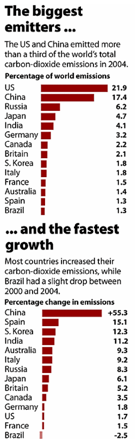
China passes US as world's biggest CO2 emitter (Guardian)
[A]ccording to figures released yesterday by the Netherlands Environmental Assessment Agency, which advises the Dutch government, soaring demand for coal to generate electricity and a surge in cement production have helped to push China's recorded emissions for 2006 beyond those of the US.
The agency said China produced 6,200m tonnes of CO2 last year, compared with 5,800m tonnes from the US. Britain produced about 600m tonnes. But per head of population, China's pollution remains relatively low, about a quarter of that in the US and half that of the UK.
(Note: their report only takes into account carbon emissions from fossil fuel burning and cement manufacturing. The graph on the right comes from a separate article in the Christian Science Monitor - courtesy of Magnifico )
That "relatively low per capita level of emissions" was a very real argument when Kyoto was first drafted, as we were talking about a different order of magnitude in individual emissions, and China had a point when they said that it would be unfair to 'penalize' their development (ignoring right now, of course, the fundamental debate about whether it would actually have 'penalised' them to take a lead over the West in sustainable development) by curbing their emissions - in essence, their argument was to let the first world tackle the problem, which it substantially created, first, before China did anything.
But now, we see that Chinese per capita emissions are equal to half the British ones, and two thirds of the French ones, and are set to overtake the latter before the end of this decade. On current trends, they will catch up with US per capita emissions before 2020. And current trends in that respect are largely driven by regulatory and investment decisions already made or made in the next few years - as regards power production, as regards environmental standards for cars, as regards construction standards and their enforcement - so they no longer have the luxury to wait and see.
The following graph (from Global and regional drivers of accelerating CO2 emissions) shows the relative weight of various countries in terms of historical emissions, current ones, and overall growth of annual emissions.

China's emissions are now significant both on an absolute and on a per capita basis, and China's emissions growth is by far the largest contributor to ongoing increases in emissions, something we now know must urgently be slowed down, stopped and, ideally, reversed. This will not happen without China participating fully in this effort.
Harping about the past and how much we've contributed to past emission with our development is true, but fundamentally irrelevant. The point is the Western way of life (underpinned, in many ways, by the rape of nature - and of other countries) is not sustainable. Why does China want to join us? They should, for their own good, and as a great way to take leadership of the world, do things differently. In fact, if they follow the Western route, they will be the first to pay the consequences. We had the luxury of dumping our externalities on the whole planet for a while. Now nobody has that luxury anymore, because the garbage bin is overflowing.
We can't change the past, but we can still choose how the future can be. And so can the Chinese. In fact, so must the Chinese. It's time to tell the Chinese that their 'per capita' argument is no longer meaningful. And maybe point them to the fact that current trends are unsustainable and driving them towards a major crash (see China's coal production to peak in a couple of years).

It's possible, but unprovable, that resource constraints will make carbon emissions a less urgent problem; the more we (or the Chinese) spew out in the short term, the more untractable the atmospheric consequences are likely to be. It's also pretty unlikely that supply limitations are going to bring about orderly changes in our economic activity and reductions in emissions. The good news, so to speak, is that the solution to both problems (carbon emissions and resource constraints) is the same: lower use of fossil fuels, and the earlier we organise that trend, the more chances we have of it not taking place on a brutal, imposed way.
Personnel
Editors
Contributors
Peak Oil Primers
Archives
- November 2010 (3)
- October 2010 (6)
- September 2010 (4)
- August 2010 (7)
- July 2010 (6)
- June 2010 (7)
- May 2010 (2)
- April 2010 (8)
- March 2010 (4)
- February 2010 (6)
- January 2010 (3)
- December 2009 (5)
- November 2009 (8)
- October 2009 (12)
- September 2009 (6)
- August 2009 (5)
- July 2009 (11)
- June 2009 (8)
- May 2009 (16)
- April 2009 (10)
- March 2009 (7)
- February 2009 (10)
- January 2009 (15)
- December 2008 (9)
- November 2008 (9)
- October 2008 (9)
- September 2008 (13)
- August 2008 (10)
- July 2008 (14)
- June 2008 (23)
- May 2008 (16)
- April 2008 (12)
- March 2008 (16)
- February 2008 (9)
- January 2008 (13)
- December 2007 (13)
- November 2007 (16)
- October 2007 (22)
- September 2007 (8)
- August 2007 (9)
- July 2007 (16)
- June 2007 (8)
- May 2007 (7)
- April 2007 (7)
- March 2007 (10)
- February 2007 (10)
- January 2007 (12)
- December 2006 (9)
- November 2006 (15)
- October 2006 (4)
- September 2006 (5)
- August 2006 (5)
- July 2006 (9)
- June 2006 (5)
- May 2006 (10)
- April 2006 (9)
- March 2006 (13)
Vital Trivia
License

This work is licensed under a Creative Commons Attribution-Share Alike 3.0 United States License.
The industrialized countries, about 20% of world population, are responsible for almost 80% of cumulative emissions, and 60% of current emissions. It is our mess, we are the ones that profited from that, and we are the rich ones, we have the resources.
We should be scrambling to fix the problem, not trying to stall, that would be effectively unloading it on others.
Their collaboration will be very welcome, and at some moment necessary, and beneficial for them. But it should not be a prerequisite for our actions.
This would be like John Travolta, with his five planes, asking me to reduce emissions.
Oh I agree. This is the kind of effort that will be beneficial to those that actually undertake them, and we should still clean house first.
But they are sounding like the guy that has 5 planes who says that it does't matter because the other guy has had his 5 planes for longer. The past is what it is, but we (and, more to the point here, the Chinese, too) have to look at the present and the future too.
This is all the wrong way around! China's consumption is still pretty minimal, the emissions per head are not allocated correctly. The CO2 may come from China burning fossil fuels, but where do the products go?... US, EU, et al. We are being hypocrites, we want 'them' to stop polluting, but still want our cheap DVD players, shoes, LCD TVs, bikes, kid's toys, etc. Allocate CO2 emissions to final consumption, that will show the true picture... we in the west are still the major source of climate change. It is just that we are getting China to do the dirty work for us, so we can look innocent and say "hey, it ain't us doin it!"
I do have SOME sympathy with the argument that we are depending on them to produce our consumer goods and by doing so, burn fuel and emit CO2. Certainly in UK, most polluting heavy industry is long gone and even a lot of light manufacturing too - we have outsourced production together with the fossil fuel use and CO2 emission that inevitably goes with it. Of course one reason - apart from cheap labour - that goods from China, etc., are so cheap is the lack of anti-pollution legislation, also the factories and systems are built quickly and often in inefficient ways so that they can start producing as soon as possible.
There is also the factor that they are DEVELOPING rather than already developed. The construction of factories, housing and infrastructure in itself uses a lot of energy and concrete. Close to half the concrete in the world is used in China.
Arguing that they must address their CO2 output in light of these facts, is as difficult as getting western governments to take notice of the peak oil argument. The reason is the same - while most of us on this forum agree that fossil fuel depletion will soon cause a crash unless we change our direction of development soon, this is not an argument that business and governments want to hear.
In short, I fear that China will continue to use the "we are still developing, we are producing your goods" argument, until fossil fuel prices soar and drive western economies to recession.
Economic theory says that who actually pays the tax and who bears the burden of the tax are not necessarily the same entity.
Assume, for sake of the arguement, you could assign carbon charges to a single manufacturing process. Say a plastic doll made in China and shipped to the US.
Carbon contributions could in theory be assigned to the producer of the raw materials, which could be the Middle East, the manufacturer of the product, China, or the consumer, US.
In any case, the final product will cost more and those further up stream will have to adjust margins to compensate. It is hard to punish the consumer and spare the manufacturer.
One of the ways that Europe has managed to hold dowm CO2 emissions whilst having economic growth is by off-shoring those emissions. We must accept our responsibilities. For example, the graph at the top of the post has the UK contributing 2.1% of global CO2 emissions. But if you take into account the UK's indirect emissions (those that have been off-shored) then it is around 4 to 5 times as much. The UK population are major polluters (as are other EU member states). If we want to see emissions reductions in China or India then we must reduce our use of the products and services they provide us. And we can only replace them with products and services (from home or elsewhere) that have minimal CO2 emissions. In general this means reducing our level of consumption. As you say, not something our political leaders will opt for, but something that peak oil will enforce.
That's a good point.
But pricing in the carbon in our imports (directly via taxes or indirectely via the requirement for better health and social regulation) is unfortunately seen as an attack on "free trade".
It's a whole mindset we need to change.
And who deliberately drives this process by pegging the Yuan at some 40% below its market value?
Western producers may have higher labor costs, but they may also be more GHG-efficient. We should force China to allow the Yuan to float as a first step toward moving production to where it has the least ecological cost.
How would we go about 'Forcing' China to do this?
Relationships are becoming strained at the merest prompts by the west for them to re-evaluate the yuan.
I think it is true that they are unlikely to retaliate with an immediate dollar dump as they know where their bread is buttered. Also on our part embargoes hurt the little man too.
Maybe if America and the UK hadn't spent $500,000,000,000 on a phoney war we would not be moaning so much about balance of trade defecits. Russia and China are sitting back laughing at our futile actions, investing, making new ties around the world. I digress.
Interesting last point. I think the least ecological cost would be for local production! Sorry if I am stating the obvious.
Marco.
40% tariff on their goods in lieu of a floating currency. There is already talk of a WTO complaint that the fixed peg is an unfair trading practice.
Beijing has also refused to intervene to halt the genocide in Darfur, which is at least partly due to its cozy relationship with the government. Good relations with Beijing ought to drop on our list of priorities; the Communist Party bosses should get a message in one voice from the West telling them that these things are not optional, and if idling the docks in Shanghai turns out to be essential to keeping the world from burning up, we'll do it.
I don't expect such a message to be possible while Bush is in office, however.
Let us look at what China is doing for a cleaner energy future and at the currency and economy.
China has partially floated its currency. It is now appreciating by about 5% per year.
China may allow the RMB to strengthen by 7.5% per year
At 7.5% per year, the 40% reduction is handled in about 5 years.
btw: the US $ sank 60% against the Euro over the last seven years and almost as much against the Canadian $. How much pressure is there on the USA to stop deflating its currency ?
This trend would mean that China would pass the USA in overall economy in about 2020
Here is an indicator on the financial pressure on the RMB to appreciate (created by Milken Institute and Xinhua Finance
RMB pressure Indicator
China is adding a lot of cleaner hydroelectric power and some nuclear and natural gas.
http://advancednano.blogspot.com/2007/05/beyond-three-gorges-dam-more-hy...
The dams also help them move more freight by river instead of truck (river 10-20 times cleaner) or rail (river 2-4 times cleaner)
China has some 64 nuclear plants in the pipeline. Currently completing about 2-4 per year.
There is talk of 300+ nuclear plants by 2050
http://advancednano.blogspot.com/2007/05/washington-post-reports-china-m...
By 2020, China should hve 42% non-coal energy versus about 20% now.
According to government statistics, more than 50% of world mass urban rail construction projects will be under implementation in China in 2006. Right now, there are more than 30 cities in China that have been building or plan to build their own urban rail systems. China will need investments over USD $25 billion worth of railway lines during the eleventh ¡°five year plan¡±. Before 2010, the total length of urban railway line in Beijing, Shanghai, Guangzhou three cities will reach 1000 kilometers in comparison with 300 kilometers now.
http://www.allconferences.com/conferences/20070315212714/
China is closing the smallest and dirtiest coal plants and is making somewhat cleaner bigger coal plants. Not ideal but has the US shutdown any of its dirtiest coal plants ? No. They have grandfathered protections in to let them continue to pollute.
China is making electric cars. like the flybo
http://www.edmunds.com/insideline/do/News/articleId=120129
Tianjin Qingyuan Electric Vehicle Co. Ltd. (QYEV) is building a 165 million yuan (US$21 million) factory capable of producing 20,000 electric powered vehicles a year in the northern port city of Tianjin. The plant will produce cars powered by battery, hybrid power and fuel cells. It is expected to be completed at the end of 2007.
In 2006, Chinese bought 16 million to 18 million electric bicycles.
===
what is the US doing ?
trying to pass 35mpg CAFE.
Making biofuels.
Might get 28 nuclear plants by 2020. First might get done 2015.
Might clean up some coal pollution emissions (mostly not CO2 but at least saving some lives if it passes)
Coal usage likely to go up as a percentage.
As noted $287 billion of what China makes goes to the USA. $182 billion goes to the EU.
=============
http://advancednano.blogspot.com
Btw: based on my June 22 11:23 am post about what china is already doing about cleaner energy. What specific proposals do people suggest for China to further improve or to improve at a faster rate its environmental performance ?
I could suggest that they tax cars more similar to what is done in Singapore, that would give the government more money and might shape some buying habits.
But the level of effort and expense that china is putting into new clean energy is beyond what the USA is doing.
Also, for the currency critics. Based on the economic related postings I made. Do you still hold that position that China should implement a 40% shock adjustment ? Do you think if that is demanded as some US politicians are doing that China will listen ? Or do you think that China will adjust based on its own reaction to actual internal and external financial pressures ? also do you think that trade balance will adjust or as in the EU counter case it did not ?
===========
http://advancednano.blogspot.com
Against a depreciating dollar. This is an excuse, not progress.
If China allows it. Float it and it would happen at once.
And the 58% will be far larger than the 80% is today. Even growing at just 3%/year, China's use of coal would climb roughly 6%; at 5%/year, it would climb 37%. China's claimed growth has been on the order of 8%/year, which would increase its coal use by 97% by 2020 (1.08^13*.58/.80).
China is already emitting more CO2 than any other nation on earth. The whole world needs to start those curves going down, NOW.
The key word being "somewhat". Not only are they unscrubbed powdered-coal combustion plants instead of IGCC which would be simpler to sequester, China is building a new one every week.
We have a climate emergency brewing. Construction of all coal-fired plants should be suspended worldwide. TXU's cancellation of most of its proposed coal-fired additions needs to be followed by the rest. If there's a need for peak power to serve A/C demand, let's build solar-powered A/C. Texas has more than enough sun.
Said plants have been fought by the EPA and their neighbors for years, and only kept open by skullduggery on the part of the utilities. Closing them should be among the first things we do, along with mandatory DSM for loads like A/C to keep demand in line with supply.
>Against a depreciating dollar. This is an excuse, not progress.
I don't understand. The USA is the only country allowed to manipulate its currency ? They manipulate with the permitted means of printing money (expanding money supply) and running deficits in budgets and trade.
United States coal rush
http://www.washingtonpost.com/wp-dyn/content/article/2007/03/09/AR200703...
First new coal plant (to go with the 600 the US already has)
So in spite of some people with good intentions and complaining about it the reality is that the US is adding a lot of coal power again and it is pretty much all pulverized coal, no sequestering and no IGCC.
Yes, China will add 300GW of coal by 2020 on top of the 480GW it has now and China has 4 times the US population.
China should look at ways to reduce that coal addition even more, but for the US to say it has any moral authority in any clean energy matter is BS.
==currency again
The currency game is also one where the US has gamed the system in the past as well. Went off gold standard when France kept cashing in for gold in the 70s. Now the US borrows trillions around the world (a lot of it from China) and tries to devalue its debt. Notice both China and Japan (big debt holders) have both devalued currency to prevent their debt from being devalued.
Why don't I borrow 1 trillion British pounds from you and pay you back with US dollars ? What you won't take it ? Float your currency you swindler so I can make you take the 40-50% haircut.
Yes, China will let the currency appreciate slowly but not because people in the USA are whining about it but because of a longer term plan to deal with their own financial adjustments.
For coal, if some country takes the lead and buys the earliest tech for cleaning up coal, eating the early costs and learning curve then it will be easier for others to follow.
====If the world collectively screws up the CO2 situation then we will just have to make fake volcanoes and dump a bunch of sulphur or crushed earth to lower the temperature.
====
http://advancednano.blogspot.com
Apparently you have absorbed a lot of mis– or dis–information about exchange markets. It isn't worth my time to try to educate you (nobody else is reading this by now), so I'll just say that this is how the markets are SUPPOSED to work: nations which run deficits should see their currencies fall. This makes their imports more expensive and their exports cheaper, re-balancing the system.
China's manipulations are engineered to create and maintain an imbalance. So were Japan's (along with all kinds of non-tariff barriers). They made their beds.
A dozen plants in 5 years is 2.4 per year. This is about 1/20 of China's rate of one per week.
5% as much isn't "a lot".
Which is why I said the US should close all our old, dirty plants and put a moratorium on PCC plant construction, effective immediately.
The US clearly has a weak dollar policy. Plenty of economists who get exchange markets say so. I understand that they are following the weak dollar policy within the "rules of the market game", but a weak dollar policy is a weak dollar policy. I understand the SEMANTICS of how the currency game is supposed to work. Also, most of the US trade deficit is with middle eastern countries for oil imports.
http://econ161.berkeley.edu/movable_type/2003_archives/002294.html
http://www.americaneconomicalert.org/view_art.asp?Prod_ID=835
http://www.globalpolicy.org/socecon/crisis/2003/0924strongweakdollar.htm
http://www.atimes.com/atimes/Global_Economy/EH14Dj02.html
Coal US v China
USA
A dozen more are under construction to be completed within 5 years.
37GW of new coal within 5 years
40 others are likely to start up within five years completed by 2017.
4.5 plants per year over the next ten years.
Then accelerating to about 8 per year.
The US plants will be bigger.
So it looks like about 100GW of new coal power by 2020 versus 313 GW of new coal power for china by 2020. So the US will be adding more like 30%.
150 total from 2007 to 2030
http://archive.mailtribune.com/archive/2007/0312/biz/stories/11mar_coalr...
The US has less energy growth now.
Existing 2005 generation
http://www.eia.doe.gov/cneaf/electricity/epa/epat2p2.html
From 2009 onwards it is mostly coal that the US is adding
http://www.eia.doe.gov/cneaf/electricity/epa/epat2p4.html
Clearly the US cannot add 200% coal versus total energy added. But what they will be adding is mostly coal from now to 2020 and into 2030.
China
313 GW of coal 2007-2020.
50% of new power is coal from 2007-2020
We are both agreed that the US and China should both get off of coal and stop adding more.
I am just saying that the USA needs to do more before it has the moral authority to say "china stop adding so much coal and get off coal...just look at what we/USA are doing as an example of leadership".
Right now the US can say "China stop adding so much coal and get off coal...don't look at what we/USA are doing which is adding mostly coal and using mostly coal" although the US can say for awhile we were adding natural gas. China don't you have pipelines with natural gas too ?
===============
http://advancednano.blogspot.com
http://www.washingtonpost.com/wp-dyn/content/article/2005/09/27/AR200509...
http://opencrs.cdt.org/document/RS22658
The IMF Articles of Agreement prohibit countries from manipulating their currency for the purpose of gaining unfair trade advantage, but the IMF lacks effective means for enforcing that rule. The WTO has rules against export subsidies, but these are very narrow and specific and do not seem to encompass currency manipulation.
http://worldtradelaw.typepad.com/ielpblog/2007/03/currency_manipu.html
Currency manipulation . . . is [one of ] the new devil's workshop of trade policy but the Doha Round agenda is silent on these issues. Instead negotiations are locked in a tussle over farm subsidies . . . Regarding exchange rates, the WTO defers to the IMF but the IMF has no power to act. Currency manipulation is not on the Doha Round agenda.
It looks like the US can live with the currency situation, negotiate something or start a trade war over it.
======
http://advancednano.blogspot.com
Also, lots and lots of those city motorscooters are electric in China, if my 2-week Chengdu experience is anything to go by. Where are those in Europe? All we have is the horrible cacaphony of 2-stroke gasoline buzz-engines, after the kids take the mufflers off.
So when are we going to understand that we have to ban those things (all 2-stroke engines, no exceptions)?
ciao,
Bruce
The thing the west doesn't get about Confucianism is that its far more important to look good to those who you are closer to and more intimate with than to look good to those who are further away. In the west is the opposite. Thus, the political forces inside China have a much stronger influence on the leaders than international bodies or foreign countries no matter how esteemed and righteous they may seem. It's much easier for them to ignore external diplomatic pressure.
btw: an interesting economic point.
The chinese yuan has depreciated by over 50% against the Euro. More than against the USD.
http://economistsview.typepad.com/economistsview/2007/05/focus_on_yuan_m...
There is also some discussion of sterilized vs non-sterilized intervention.
==========
http://advancednano.blogspot.com
It's hard to say who is trying to stall (excpept for Bush, who obviously is). Everyone is trying to get the system to work to their greatest benefit or to match their preexisting political viewpoint.
The claim that the world should assign a per capita limit that is equal for all people may have some theoretic appeal as "just", but is obviously a deal killer. However, if yyou can convince Singapore, I'll go along.
The objective is a framework that can be agreed on, not that is right or wrong in the eyes of this or that ideology. It is going to come out looking like a compromise. Clearly the US and Europe are going to be able to emit more than poor countries with large populations, say Bangladesh.
In theory I am not opposed to a large-scale income redistribution, but I don't think we can allow it to highjack progress on climate change.
What about using CO2 emissions per GDP instead? How are these changing for China, IIRC they have been decreasing in the U.S. and probably in the EU too. Reducing those would help slow the increase of CO2 without interfering as much with China's "right" to continue its growth.
This is the argument George Bush tried to put forward and it is outrageous. It is saying because we are richer than you we demand the right to foul up the planet more than you. It is the mindset that continuous growth in GDP is inviolate that is the biggest psychological barrier to taking the steps needed to avert catastrophe.
Sorry, it's the other way around: those who can make something while fouling the planet the least, have the best claim to the right to make it.
The trouble is that much of the GDP of the USA and Europe does not involve making anything. Financial services account for about 10% of UK GDP and rising. Advertising, intellectual property and software are also major contributors.To claim the right to pollute the planet on the basis of bundling and reselling dubious mortgages is the sort of hypocrisy that will discourage China and India from taking the steps that are vital.
It should be per land area. Those who overpopulate shouldn't get a free pass either.
I'm surprised by the first graph in the text. I knew Spain did not succeed in reducing its CO2 emissions, but this one claims, that every european country has increased its emissions. Even more strikingly, every single one has larger increases than the US, where the federal government still refuses to do anything about greenhouse gas emissions. Does anyone know, if this data is correct?
Good question. My impression was that overall the European record was mixed, but better than the US. I did think that some individual European countries lagged the US.
I read an exchange in the Financial Times recently where an American claimed the US had done better than Europe, which was then refuted by a European who claimed every European country was ahead of the US in reducing emissions growth. To some degree this seemed to be two PR types with different calculations.
How did Brazil fall 2.5%. Did the period of measurement include a recession?
My intuition is that in the 2000-2004 period, the US was in full cry with two energy-reducing trends :
* outsourcing manufacturing to Mexico, China and elsewhere
* productivity gains in the whole economy through IT
The US was ahead of the curve in these two areas, the rest of the world, Europe in particular, is now catching up.
No country was able to fullfill Kyoto until now. Some almost staled growth, but I didn't hear about any one that decreased emissions.
Brazil has decreased emission from a few ears to now. So, that data may be only 2 or 3 years old. But still increased from 2000 to now.
Most Brazilian emissions are due to burns, and so losely coupled with GDP (in fact, less emissions usualy means more GDP). There are some emissions also due to cars and trucks, but much lower, and very tiny emission from eletricity generation (mainly because Brazil started to diversify its electricity generation, creating a few natural gas powered stations since 2001).
Is there a reliable source on CO2 emissions? A short google search brought to light for example this result: emission reduction by 2.3% in Germany in 2005
As well, we are told by the media, that in Germany reduction is making progress, just not to the amount that it promised in Kyoto.
There is a recently released report of 2005 emissions from the European Environment Agency
http://www.eea.europa.eu/pressroom/newsreleases/eu-greenhouse-gas-emissi...
The previous years report has better graphics
http://www.eea.europa.eu/pressroom/newsreleases/GHG2006-en
What is a very good question. There is a official measurement of CO2 emissions, but I don't know how reliable that is. I've just made a quick search, and couldn't find any reference on how that number is calculated.
I always saw Brazil using satelites to calculate its emissions, and ever assumed that it was a direct measurement. But, as I said earlier, most of brazilian emissions are due to burns, so the images may be used just to calculate their size.
Arthur Robey
I Refer you to the "Report to the Club of Rome."
Pollution will get them.
There is no need to preach.
Zulu saying: "iZulu leDuma iQuiniso!"
"Heaven thunders the truth!"
Arthur Robey
I Refer you to the "Report to the Club of Rome."
Pollution will get them.
There is no need to preach.
Zulu saying: "iZulu leDuma iQuiniso!"
"Heaven thunders the truth!"
The debate ends here. Without our consumption and offloading of manufacture to the east from the western world, their emmsions would still be paltry an a per capita basis and per fraction global emmisions.
capitalists and pseudo-capitalists arguing about who has the "right" to polute. are we not seeing the end of capitalism (as we know it) ?
In a semi-perfect world there would be an international carbon cap. Manufactured exports from a country deemed noncompliant would face a punitive tariff upon arrival in the importing country. Make it say a flat 20% regardless of actual carbon content ie both cement and software services. That way any remaining price advantage would be due to low labour cost not the cheap energy input.
I'd also like to pre-carbon tax Australia's coal exports to China but that's way ahead of current thinking.
yes, capitalism and slavery.
imo, the us is no longer a capitalist country. more like a debtist country. (debt = capital anti-matter)
Yes, but we're the debtists with 10,000 nukes.
Current U.S. National Debt:
When will the amount of interest paid on the national debt exceed tax payments, if ever?
How much will they want to charge us for electricity CO2 credits to pay for govt. environmentalists to study the affect of CO2 emissions in the U.S. on the melting polar caps of Mars?
Actually, the interest on the national debt is not bad these days. It is listed as the net interest in Table 3.1 in
http://www.whitehouse.gov/omb/budget/fy2008/pdf/hist.pdf
This gives the historial tables back to 1940. Net interest was 1.7% of GDP in 2006. The peak was 3.3% of GDP in 1991.
I bet a significant fraction of the coal burned in China is being used on products exported to American consumers. So in some sense, we are the cause of this higher coal use. Perhaps this coal use should really be charged to American consumers.
Thats a double whammy. Not only are American consumers responsible for 25% of all oil useage. They could well also be responsible for a not so small fraction of the rest! Ditto for coal. I'd never thought about it that way.
Marco.
So I guess Americans deserved to be punished by their corporate overlords eliminating their jobs and then taxing them on the outsourced products made by the people who had their jobs.
China keeps the factories and keeps the goods it produces for itself?
China might eventually go for that plan.
o I guess Americans deserved to be punished by their corporate overlords eliminating their jobs and then taxing them on the outsourced products made by the people who had their jobs.
No, for overpopulation and overconsumption.
ciao,
Bruce
So I guess Americans deserved to be punished by their corporate overlords eliminating their jobs and then taxing them on the outsourced products made by the people who now have their jobs.
China keeps the factories and keeps the goods it produces for itself?
China might eventually go for that plan.
That quite overstates the situation. China's most energy intensive sectors--iron & steel and cement--are going full blast to build a country's worth of infrastructure and to urbanize another 300 million people. Making clothes for export or plastic furniture requires just a fraction compared to what they use themselves. Here's how coal is used in China, in million tonnes:
If united states has a right to emit carbon
dioxide then China has four times as much right,
because, its population is four times that of
united states (1200 million vs 300 million. If
united states cuts emission by say 10% today
China should be expected to do so only after 60
years as China has only started industralization
while united states is industralized since
atleast the end of WWII. That is if chinese are
considered as much humans as americans.
Don't you think the old communist system in
china was better than today's greedy
heavily-polluting force-fed capitalism as far as
habitat-saving is concerned? Why not apply the
same in united stated and other developed
countries??
Don't you think the old communist system in
china was better than today's greedy
heavily-polluting force-fed capitalism as far as
habitat-saving is concerned?
Usually Communist countries were ecological disasters.
Certainly East Germany was horrible versus West. Communist ideology was certainly about massive physical development and grandiose industrial projects---the difference being that they often destroyed wealth rather than created it.
What's up with Spain??? Almost double it's closest EU partner at 15.1% increase??? I thought the only economic activity there was the massive construction trade; does residential construction really increase emissions that much?
China has a tiger by the tail. They have used the growing wealthy class as a way to buy support for their autocratic regime. Those doing the best economically are those least likely to want to rock the political boat.
This economic bribery means that the government can't impose restrictions which will alienate the nouveau riche nor can it slow done the rise of those moving into the middle class.
There are an estimated 80,000 protests a year among the peasant classes who are objecting to the mistreatment they are receiving from the government officially as well as from corrupt local officials. These people are mostly powerless and thus can be fairly easily controlled. The same wouldn't be true if the discontent spread to those with financial power.
Expecting the Chinese government to "do the right thing" is unrealistic, just like it is with the industrialized countries. We are all on the excess consumption merry-go-round and don't know how to get off.
This is a heartbreaking situation for me.
Unlike a lot of people on this website, whom I suspect want the non-rich non-white mass of humanity to die off from Peak Oil, I want to see a radical redistribution of wealth to try to save as many lives as we can. I think that the capitalists won the Cold War by selling the myth of infinite growth. The Soviet bureaucracy couldn't compete with the energy unleashed by greed, but at some point capitalism must be judged for what it delivered, which was one hell of a lot of carbon dioxide, and very little poverty relief.
So now China, the only large area to move significant numbers of its people out of extreme poverty under the Reagan Empire, stands accused of ecocide for its success. And the foreign capitalists who exploited China to screw their own working classes and inflate the value of their stocks will wash their hands of the whole thing and switch back to the Cold War paradigm, with its eternal war and guaranteed defense contracts. The media will only tell us about carbon dioxide crimes from the countries that got rich by defying us, and cover up the crimes of the countries that stayed poor by signing indenture treaties like NAFTA and the Iraqi Oil Law.
This is messed up. We don't have to do it this way. But it means making deals with China based on what China thinks it deserves, not what the Wall Street Journal thinks it deserves.
China wants access to the world car market. It can make nasty cars that pollute. It can make cheap batteries. It lacks a guaranteed market for electric cars that would cause the cars and batteries to be combined. European engineers are working on lightweight cars that can pass crash tests, but their labor is too expensive to build them. Americans claim to require heavy V8 SUVs because nothing less is safe, then whine about $3 gas.
Seems to me that there's a way to work this out. Yes, it's a gross violation of capitalist norms, but it's less gross than World War III or a permanent depression.
Europe designs the cars. America designs the batteries.
China builds them, or at least their motors and batteries.
The world's automakers specify the features they want, and complete and sell the cars to meet global carbon quotas.
By treaty, signatory governments agree to coordinate their EV tax credits and subsidies, to restrict internal combustion cars from the most polluted cities, and to raise gas prices to a similar high level by taxation - to be offset by other tax cuts if the politicians want to survive.
Here's the kicker: China must agree to do all those things, and accept caps on its export growth. It is in its interest to give up its most primitive exports for this rare chance to move quickly into the lucrative US automotive sector, because that guarantees future earnings from making the spare parts. At the same time all these guarantees make the cars cheap enough that China can ban further production of IC cars. You heard me. Stop making them now before you become too hooked to stop. If you could ban all cats and dogs in Beijing, which China did, then you ought to be able to ban gas engines.
Now this shifts the C02 problem to electricity generation. A similar treaty will have to be made guaranteeing China a global market for its cheap windmills and solar-thermal units in exchange for China phasing out its own coal industry.
I know all this can be shot to pieces on the details. I'm just trying to show that the sheer size of the global warming and peak oil problems can't be solved without the kind of big-picture solutions which humans have reserved for the most serious matter: the political resolutions of major wars. The Congress of Vienna, the Treaty of Versailles, and the international acts sponsored by the US in 1944-45 rearranged borders, toppled political systems, and picked winners. Yet they were less disruptive than the wars that necessitated them. This time we're stuck having to voluntarily do all the disruptive things first to head off a mass destruction greater than the world wars. We can't do it without making huge concessions to the actors who have the power to do huge things. America has frittered away that power to special interests and a cult of privatization, until all we have left is our ability to create debt. We transferred the ability to make real things to China, with the accompanying waste. We will need a lot of real things built to replace our current energy system - but that means creating more CO2 in the short run. China will either generate that CO2 making crap for Wal-Mart, or making weapons to defend itself from future neocon schemes to control world oil, or making windmills and solar furnaces. We all know we can only survive one of these three outcomes.
Has anyone looked at Algae blooms driven by
Iron seeding of the ocean? The Algae absorbs
the CO2 and falls to the bottom of the ocean,
in theory. This idea was proposed first by
Dr. John Martin, a respected marine biologist.
His most famous quote: "Give me a shipload of iron,
and I'll give you another ice age."
reference: http://earthobservatory.nasa.gov/Library/Giants/Martin/
Martin's theory was that iron was the limiting
micronutrient to Algae growth, and this idea
was later proven by experiments, according to
the reference above.
I am not an expert in this field but
it looks interesting, given that C02 emissions
are out of control.
There were a few comments in yesterday's Drumbeat.
... for the convenience of TV, you can only be one of two kinds of human beings, either a liberal or a conservative. -- Kurt Vonnegut
Thanks, I didn't see that -- posted a comment there.
Worrying about carbon emissions and arguing over who emits the most or even trying to curb emissions is a waist of time. It doesn't matter. Does anyone seriously think the world will leave any amount of fossil fuels unburnt (or sequester any reasonable amount of carbon) in a post peak energy age? Get real... We will burn it all eventually and relative to the age of the world in a very small number of years. So get over it, it doesn't matter because it's too late to leave it in the ground and our population too large to not burn it all.
The world will certainly burn all the oil and gas---it's just too valuable.
We can actually do without the coal, if we switch immediately to as much of everything else as possible---which will at present be mostly uranium.
The world will certainly burn all the oil and gas---it's just too valuable.
We can actually do without the burning up all the coal---the real climate killer---if we switch immediately to as much of everything else as possible---which will at present be mostly uranium.
Exactly my opinion. The oil and gas is so valuable we will use it, no matter what. The coal is really just an option for weak-kneed politicians to avoid talking about nuclear.
Thanks, Jerome. It looks like the finger-pointing will go on forever. It is up to us, as individuals, to each do everything we can to make the world situation better. No only in the area of energy consumption, but also global warming, war, population control and environmental degradation. We must solve all these problems or we solve none of them. Think of a world where we have solved all the problems but war. The situation would still be untenable. We need, as individuals, to solve ALL these problems. Time to get to work.