
 | The Energy and Environment Round-Up: November 21st 2007 | The Oil Drum: Canada | The Earth and Energy Round-Up: November 28th 2007 |  |
The Finance Round-Up: November 23rd 2007
Posted by ilargi on November 24, 2007 - 11:00am in The Oil Drum: Canada
People increasingly ask us what they should do in face of the financial quicksand we’re in. Unfortunately, as with all of today’s global riddles, there are no easy answers. The views we quote here vary from inflation to deflation, from buying gold to buying goats. The writers we link to often make their living tracking markets, and still there is nothing remotely resembling consensus.
I think it’s best to focus on what we can foresee with a reasonable degree of certainty, and take it from there. Don’t buy real estate with a mortgage is a good one (unless you plan to sell next week). Get out of debt as much as you can is good. Prepare to lose your job, be as ready as you can in case you do. Learn practical skills, grow food, get closer to your neighbors and family.
Above all, don’t be alone, have people around you to share with, both the gains and the losses. Man is a social animal. Get less stuff and more connections. Be human. A man, a woman, and two kids is not a family, in most parts of the world, and for good reasons.
And get informed, make up your own mind, don’t let others do it for you. Stoneleigh and I do the Finance Round-Ups as a news compilation, not an opinion soap-box. They’re here so you don’t have to read 1001 sources, we do that, and try to choose the best. But even we don’t agree on everything, it’s a dialogue, always. And that’s probably what it needs to be, between all of us, perhaps that’s the biggest gain any of us get from this.
Our mass media, in finance as in energy matters, can no longer be trusted to provide adequate information. TV and newspaper coverage borders on criminal negligence. So we use the Web to learn. We read 10 articles on a topic, not just one. We don’t trust that single one, and we are by no means alone in that. That’s why you are here, too, a gnawing feeling that things, as they are presented in media, politics, high-schools and universities, don’t add up. If they did, there would be no reason for an Oil Drum, or a Finance Round-Up.
Want an opinion after all? Here goes: We don’t see how this finance pyramid can be left upright for much longer. We realize there’s players out there with plenty of clout to squeeze some more out of it. Still, it’s an ex-pyramid. It’s not just sleeping. It’s a goner.
Keyword until New Year’s: Freeze. ABCP in Canada, covered bonds in Europe, teaser rates in California, bank loans in China, they’re all as frozen as the turkey.
And, happy Black Friday to you too.
All of a sudden, it just fell off a cliff
Redfern at Thomason Autogroup said he expects sales to continue slipping for the next six to eight months. But, like many area businesspeople, he's convinced Fairfield will pull through tough times and that its long-term prospects are bright.
"You would think there would be more depression and despair," he said, noting that his own house has lost about $140,000 in appraised value in a year. "But in this market here, there's still some strange optimism. People haven't thrown in the towel. ... People are still moving into this market. We remain optimistic."
Mish says: We cannot possibly bottom as long as people remain optimistic. A necessary but not sufficient ingredient of a lasting bottom is despair.
My advice over the last two years has not changed. Raise cash, be prepared for a layoff, and cut back on needless purchases. Unemployment has bottomed with only one way to go and that way is up. Be prepared for it.
Forecast: U.S. dollar could plunge 90 percent
A financial crisis will likely send the U.S. dollar into a free fall of as much as 90 percent and gold soaring to $2,000 an ounce, a trends researcher said. "We are going to see economic times the likes of which no living person has seen," Trends Research Institute Director Gerald Celente said, forecasting a "Panic of 2008." "The bigger they are, the harder they'll fall," he said in an interview with New York's Hudson Valley Business Journal.
Celente -- who forecast the subprime mortgage financial crisis and the dollar's decline a year ago and gold's current rise in May -- told the newspaper the subprime mortgage meltdown was just the first "small, high-risk segment of the market" to collapse. Derivative dealers, hedge funds, buyout firms and other market players will also unravel, he said.
Massive corporate losses, such as those recently posted by Citigroup Inc. and General Motors Corp., will also be fairly common "for some time to come," he said. He said he would not "be surprised if giants tumble to their deaths," Celente said. The Panic of 2008 will lead to a lower U.S. standard of living, he said.
A result will be a drop in holiday spending a year from now, followed by a permanent end of the "retail holiday frenzy" that has driven the U.S. economy since the 1940s, he said.
Shiller: Global crash imminent
A sharp downward correction is due in the global markets as real estate, stocks and energy soar to record highs, warned a leading expert on the opening day at this year's Dubai International Financial Centre (DIFC) Week.
Even as emerging markets like China, India and Brazil careen ahead at voracious growth rates, the speculative "bubbles" arising in the markets could cause a major global recession, cautioned Robert Shiller, the Stanley B. Resor Professor of Economics at Yale University, at yesterday's event.
"Perhaps we have gotten a little too confident in the global economic growth," said Shiller. "The problem is high oil, stock and real estate prices. I believe that a substantial part is speculative bubble thinking. We have gotten too confident of the prices in these markets," he said.
Credit "heart attack" engulfs China and Korea
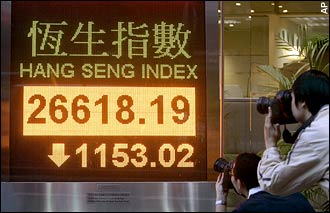
The global credit crisis has hit Asia with a vengeance for the first time, triggering a massive flight to safety as investors across the region pull out of risky assets. Yields on three-month deposits in China and Korea have plummeted to near 1pc in a spectacular fall over recent days, caused by panic withdrawls from money market funds and credit derivatives.
"This is a severe warning sign," said Hans Redeker, currency chief at BNP Paribas. "Asia ignored the credit crunch in August but now we're seeing the poison beginning to paralyse the whole global economy," he said.
Mr Redeker said the flight from risk has led to a sudden unwinding of the $1,200bn yen "carry trade" as hedge funds and Japanese investors close risky positions. The yen has snapped back violently from yen118 to yen108 against the dollar since early October, with similar moves against other Anglo-Saxon currencies.
"We're seeing a liquidation of the carry trade. For years it created liquidity for global equities in an upward spiral, but this has now turned into a downward spiral. Base metal prices are falling, which that tells us that Asia may not be as strong as we thought," he said.
Jerry Lou, China analyst for Morgan Stanley, said the Shanghai bourse -- already down 15pc -- was now the world's "biggest valuation bubble". "Lessons from Japan in the late 1980s show that once the stock market starts to head down, earnings and multiple contraction can together crush the market like a market rolling downhill," he said.
Lombard Street Research: credit crunch grinding ever finer
The opaque black hole of losses at the heart of the dollar markets can not be penetrated by the outsider’s gaze, but the signs are that conditions are worsening fast. While the publicly quoted financial institutions have gone quite a long way down the road of acknowledging mortgage derivative losses, not a squeak has been heard from hedge funds, though they have massive exposure.
Hedge fund investors know that the devil will take the hindermost: to the extent they can cash out before the hedge funds have disclosed their losses on CDOs, etc., they may escape their share of them – leaving their share of the losses to the guys left holding the baby. Meanwhile, hedge funds are no doubt sliding out of as much exposure as possible – and selling anything else they can get value for.
The most toxic of the BBB-minus abx indices was 07-1 (with prices from January) and that is now off more than 80%; at which level it seems to have settled for the past two weeks, after a rocky early October in which it fell by a third. The AA 07-2 issue (starting July) also fell by a third during that period, from 90 to 60, but has carried on down by another third to below 40 now. As this started life after the late-June Bear Stearns fiasco, for supposedly AA prices to take such a beating is extraordinary.
Are we heading into 1982 – the worst recession since the war – or the revivalist, highly leveraged boom-bust of 1988- 91?
The deflationary alternative looks more probable.

Europe Suspends Mortgage Bond Trading Between Banks
European banks agreed to suspend trading in the $2.8 trillion market for mortgage debt known as covered bonds to halt a slump that has closed the region's main source of financing for home lenders.
The European Covered Bond Council, an industry group that represents securities firms and borrowers, recommended banks withdraw from trades for the first time in its three-year history until Nov. 26. Banks are still obliged to provide prices to investors, according to the statement today.
Banks including Barclays Capital, HSBC Holdings Plc and UniCredit SpA took the step as investors shun bank debt on concern lenders face more mortgage-related losses than the $50 billion disclosed. Abbey National Plc, the U.K. lender owned by Banco Santander SA, became the third financial company to cancel a sale of covered bonds in a week as investors demanded banks pay the highest interest premiums on covered bonds in five years.
"We are in a deteriorating situation,'' Patrick Amat, chairman of the Brussels-based ECBC and chief financial officer of mortgage lender Credit Immobilier de France, said in a telephone interview. "A single sale can be like a hot potato. If repeated, this can lead to an unacceptable spread widening and you end up with an absurd situation.''
Mish:
Renewed credit turmoil and volatility led the European Covered Bond Council (ECBC) on Wednesday to suspend inter-bank market-making in covered bonds until Monday, Nov. 26. The move is a sign of the stress in the covered bond market, which is dominated by German institutions that have almost a trillion euros of covered bonds outstanding.This is a very serious step. No, it's not priced in.
"Quite a substantial part of the recent spread widening, particularly in the last three to four days, was driven by the mechanics of the inter-dealer market making obligation," he said. "There is even some evidence that those bonds that are of high liquidity have been more heavily penalised than those which are less liquid."
Penalized is not the right word for it. Institutions are short on cash. The only way to raise cash is to sell something that has value. Perhaps what is not selling simply has little value.
"Covered bonds are securities backed by mortgages or loans to public sector institutions. The notes offer more protection to bondholders than asset-backed debt because the issuing bank is liable for repayments. They typically have the highest credit ratings."
$2 trillion lending crunch seen
The mortgage wipeout could result in a $2 trillion cutback in lending and have dramatic implications for the U.S. economy, according to Wall Street investment bank Goldman Sachs.
The housing slump is expected to end up costing banks, hedge funds and other lenders an estimated $400 billion as defaults on home loans rise, according to Goldman economist Jan Hatzius. A $400 billion loss is equal to just about 2.5 percent of U.S. stock market capitalization - or a bad day on Wall Street, he wrote in a commentary on Thursday.
But most stock investors don't react aggressively to capital losses the way banks and other lenders do. A bank that aims to maintain a capital ratio of 10 percent would need to shrink its balance sheet by $10 for every $1 in credit losses, the note said.
That means that if lenders end up suffering just half of the $400 billion in potential credit losses, they could be forced to reduce the amount they loan by $2 trillion. Such a drastic credit crunch could have dire consequences for the economy.
Public School Funds Hit by SIV Debts Hidden in Investment Pools
When the subprime debt market blew up in August, investors stopped buying SIV commercial paper. As a result, in September and October, SIVs didn't have the cash to pay debt holders of more than $8 billion of their paper.
The banks had also peddled SIV paper to their clients, including state officials who oversee pools of taxpayer funds like Florida's. The $27 billion Florida pool, the largest in the U.S., has invested $2 billion in SIVs and other subprime-tainted debt, state records show. About $725 million of these holdings have already defaulted.
State pool losses may hit taxpayers in places like Jefferson County in the form of reduced services or higher taxes. Jefferson County's Wilson says he still trusts the Florida pool managers and will keep the school's money in the fund. ''I really hope this isn't any worse than we know today,'' he said after the Nov. 14 meeting. ''If something happened to that investment, our county would be devastated.''
State officials have no business putting taxpayer money into debt investments that have baffled even the most seasoned Wall Street executives, says Joseph Mason, finance professor at Drexel University in Philadelphia and a former economist at the U.S. Treasury Department.
''Municipalities shouldn't be playing like they're expert investors, squeezing the last penny out of SIVs,'' Mason says. ''They're making a giant jump into a new product area which has unknown, unforeseen risks.''
SIV Debts A Disaster For Public School Funds- Mish
The Asset Backed Commercial Paper parade just keeps on rolling as Public School Funds across the country are Hit by SIV Debts Hidden in Investment Pools.
Thousands of school, fire, water and other local districts across the U.S. keep their cash in state- and county-run pools. These public accounts, modeled after private money market funds, are supposed to invest in safe, liquid, short-term debt such as U.S. Treasuries and certificates of deposit.
The people managing those pools absolutely had no idea what they were buying. No doubt they all thought they were geniuses too even as every single one of the blindly bought anything top top rated as if there was no risk to the extra yield they were receiving.
Norway: Townships caught up in international credit crisis
Several small townships in northern Norway went along with a securities firm's advice and invested as much as NOK 4 billion in complicated American commercial paper sold by Citibank. They now risk losing it all.
The township politicians are both embarrassed and angry at the financial advisers who they now claim led them astray. "They think we're a bunch of small-town fools," one local mayor told newspaper Dagens Næringsliv. The politicians remain ultimately reponsible, though, and voters aren't particularly happy as news emerges about what's become of a large chunk of their public funds.
Officials in four northern Norwegian townships (Narvik, Rana, Hemnes and Hattfjelldal) went along with an alleged recommendation by Terra Securities to invest a total of NOK 451 million in what they're now calling "high-risk structured products" offered by Citibank and sold for Citibank by Terra.
The American commercial paper was also tied to bonds issued by local governments in the US, and Norwegian Broadcasting (NRK) reported that hedge funds were involved. To boost returns, the Norwegian townships also borrowed NOK 3.5 billion to invest in Citibank's products, which later lost as much as 50 percent of their value because of the US credit crunch.
News started leaking out about the troubled investments when the townships were ordered to pay in millions more, to satisfy guarantee requirements. Mayor Asgeir Almås in Hattfjelldal feels cheated.
New era of defaults on horizon as CDO cuts mount
A wave of recent ratings cuts may mark the start of nearly half a trillion dollars in losses for banks and pension funds , as complex securities bring the U.S. subprime mortgage crisis crashing back to Wall Street.
Derivatives once heralded for spreading risk and underpinning the resilience of financial institutions are rapidly deteriorating, threatening to choke lending and driving up the risk of a U.S. recession.
The latest concerns come from collateralized debt obligations, essentially giant bonds that can be backed by subprime mortgages, which are now seeing a trickle of technical defaults.
In the past two weeks ago, more than a dozen such CDOs have suffered a technical default, triggered when the underlying collateral pool falls below a certain ratio, according rating agencies. Now there's increasing worry that default notices may lead to liquidations, pushing down prices of underlying assets and unleashing a cascade of losses.
The figures alone are staggering, and increasingly hard to track. Losses to banks and investors from the subprime mortgage crisis may rise to $480 billion in coming years from souring mortgages, according to UBS AG.
Shadow Mortgage Bailout Already in Progress
Securities were key sources of money during the housing boom. Now that investors have stopped buying, many institutions have been forced to seek out alternative sources of mortgage funding. A number of banks have turned to the Federal Home Loan Bank (FHLB) system. The 12 FHLBs are cooperatives first created during the Great Depression to boost mortgage lending and revive the struggling housing market.
In August and September, lenders borrowed an unprecedented amount of money. During September alone, loans made to banks from the FHLB system increased nearly 30 percent since the beginning of this year. In order to meet the demand from lenders who were teetering on the edge of financial ruin, the FHLBs sold $143 million worth of short term debt, pushing outstanding debt up to $1.15 trillion--half of which comes due before the end of 2008.
The concern is that the FHLBs are taking on too much debt in their attempt to bail out lenders. If investors lose confidence and begin to get rid of FHLB debt (in the same way they dumped mortgage securities), one or more banks could collapse and leave taxpayers with the financial burden.
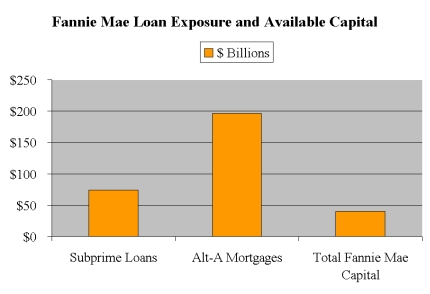
As of September 30, Fannie Mae had $40 billion in capital. The company also had exposure to $196 billion in Alt-A loans and $74 billion in subprime loans (loans with a FICO score under 620). Altogether, Fannie holds $2.7 trillion worth of mortgages. If a high percentage of the risky loans go bad - and there is no reason to think they won't - Fannie Mae could quickly lose the capital they have and be left without a financial leg to stand on.
Although neither Fannie Mae nor Freddie Mac are technically government agencies, it is a given that the government (i.e. taxpayers) would bail out both companies out if necessary. The potential cost could range into the hundreds of billions of dollars according to a recent Senate report.
Central banks weigh up dollar problem
The sliding dollar has presented custodians of the world's massive foreign exchange reserves with a conundrum.
Countries such as China and those in the Gulf, which peg their currencies to the dollar, risk inflationary pressure that has the potential to trigger serious economic and social problems. But any move to cut their links to the dollar could spark a run on the currency that would undermine the value of their reserves.
Global currency reserves have soared from $2,000bn in the second quarter of 2002 to $5,700bn (€3,885bn, £2,780bn) in the corresponding period this year, according to the International Monetary Fund. Furthermore, two-thirds of the world's reserves are in the hands of six countries: China, Japan, Taiwan, South Korea, Russia and Singapore.
But China tops the league, with the latest official figures showing the value of its reserves at $1,443.6bn in July. Many of China's trading partners argue that this stockpile - which grew at $40bn-$50bn a month in the first half of the year - has been caused by what they believe to be an undervalued renminbi.
Most analysts say that the country's reserves have accumulated rapidly since July and that this explains the growing concern about the dollar expressed by Chinese officials.
Dollar to fade, not fly, from scene as Gulf reforms
While it should be no surprise that the curtain is coming down on U.S. currency's reign over Gulf economies and investments, that is a long-term shift linked more to the rise of Asia than the diminishing stature of the United States.
The Kuwait Investment Authority, which said it had at least $213 billion in assets on March 31, decided in 2005 to double its allocation for Asia to 20 percent of its portfolio. The $650 billion Abu Dhabi Investment Authority is seeking to invest more in emerging markets to get higher returns than from its European and U.S. assets, according to HSBC.
Qatar's $60 billion sovereign wealth fund, the Qatar Investment Authority, has cut its exposure to the dollar by more than half to around 40 percent of its portfolio. Qatar says it wants to invest in the customers of its energy exports.
"The U.S. is still the largest consumer of oil but the relative importance of the U.S. is declining because China and other emerging countries are creating new demand," said Giyas Gokkent, head of research at National Bank of Abu Dhabi.
"Eventually the status of the U.S. dollar as a reserve currency will be called into question."
Fear of more huge losses hits markets
Fears that Citigroup and UBS will have to make writedowns of billions of pounds and a credit crunch-related hit from Swiss Re, the world's largest reinsurer, of $1.1bn (£524m) pushed the Dow Jones industrial average down 218 points.
In London fears of contagion pushed the FTSE 100 back below the level it began the year, down 170.4 points to 6120.8. The FTSE 250 slumped 361.7 points to a 12-month low of 10404. European markets also fell, with the DAX in Germany and the CAC index in France down 100 and 91 points respectively.
Citigroup fell more than 5pc on Wall Street after a Goldman Sachs analyst estimated the investment bank will make a $15bn (£7.3bn) writedown and the research firm CreditSights said UBS could take a further $9bn in writedowns. The heads of Germany's biggest banks, Deutsche Bank and Commerzbank, added to the gloomy sentiment with warnings that the US sub-prime crisis was far from over.
General Motors was the biggest faller on the Dow Jones index, shedding 6.7pc to an 18-month low of $27.32, over concerns about credit issues at its financing arm, GMAC.
17 reasons America needs a recession
To begin with, recession may be an understatement. Jeremy Grantham's GMO firm manages $150 billion. In his midyear report before the credit crisis hit he predicted: "In 5 years I expect that at least one major 'bank' (broadly defined) will have failed and that up to half the hedge funds and a substantial percentage of the private-equity firms in existence today will have simply ceased to exist." He was "watching a very slow motion train wreck." By October, it was accelerating: "Train hits end of track at full speed."
Also back in August, The Economist took a hard look at the then emerging subprime/credit crisis: "The policy dilemma facing the Fed may not be a choice of recession or no recession. It may be between a mild recession now, and a nastier one later."
However, the publication did admit that "even if a recession were in America's long-term economic interest, it would be political suicide" for Fed Chairman Ben Bernanke and Treasury Secretary Henry Paulson to suggest it. Then The Economist posed the big question: Yes, "central banks must stop recessions from turning into deep depressions. But it may be wrong to prevent them altogether."
Wrong to prevent a recession? Why? Because recessions are a natural and necessary part of the business cycle. Remember legendary economist Joseph Schumpeter, champion of innovation and entrepreneurship? Economists love Schumpeter's "creative destruction:" Obsolete firms get destroyed and capital released, making way for new technologies, new businesses, like Google. And yet, nobody's willing to apply Schumpeter's theory to the entire economy ... and admit recessions are a natural part of the business cycle.
iTulip comments on 17 reasons America needs a recession
8/ Force the energy and auto industries to get serious about emission standards and reducing oil dependency.
Recession will have the opposite result unless Farrell is expecting, as we are, that the dollar will fall even faster than oil demand. That means the U.S. may find itself with 2/3 of pre-recession oil import demand but each unit of demand will be inflated by another 50% reduction in the value of the monetary unit, the dollar.As energy prices rise and the energy purchasing power of income falls, cars will get a whole lot smaller. The same result is achieved in Europe via taxation; dollar depreciation acts as a politically expedient regressive domestic tax on energy consumption.
[..]
A major recession that follows on the heels of widespread financial system abuses, preferential taxation, and lack of enforcement of regulations inevitably causes the political system to gear up to throw the baby out with the bathwater.The U.S. economy has built up not only historic wealth inequality since 2001 but massive disparities of liquid net worth and debt. In a recession, these will create a political nightmare as unemployment rises and credit tightens. A recession will be bad for the rich and middle class, but will hammer the poor and push segments of the middle class into the ranks of the poor.
We've long expected a political reflex to these circumstances in our Ka-Poom Theory. If the U.S. ever gets a populist, socialistic president it will follow from of the kind of recession Farrell is hoping for.
[..]"Did you guys know, the bankrupcy laws changed? You cannot declare bankruptcy anymore. In the near future, we may have debtors prisons. When we have a war with Iran, Syria, Russia, and China, you know who will be recruited. They will give you a choice, pay off your debts or we will throw you in prison. If you don't want to go to jail, you join the military for 8 years."
British government bailout for Northern Rock may continue forever
British taxpayers face the prospect of propping up Northern Rock for months to come amid signs that the Government has caved in to pressure from the ailing mortgage bank and its advisers.
The Sunday Telegraph has learned that advisers to Alistair Darling, the Chancellor, are working on plans that would allow all or part of the L25 billion lifeline that has already been extended to Northern Rock by the Bank of England to continue indefinitely.
Although European Union rules block the bank from receiving state aid beyond February 17, lawyers are drafting documents that could change the status of the funding to "restructuring aid." This would allow the Bank of England to continue providing funding to Northern Rock -- and aid any takeover of the bank.
Darling is expected to lay out a "statement of principles" detailing the Government's views on the future of Northern Rock in the next 10 days.
Northern Rock has also been investigating the possibility of using loans from the European Central Bank to refinance its borrowings from the Bank of England -- a move which would be hugely embarassing to the Chancellor, who has already come under fire over his role in the crisis.
Libor soars as credit crunch returns
The credit crunch is returning in a virulent form to money markets, experts warned, after City banks raised their wholesale lending rates to the highest level in two months.
Morgan Stanley said that the recent jump in the benchmark London Interbank Offered Rate, which yesterday rose to just under 6.45pc, was not merely a seasonal blip but a major warning sign of pain ahead.
It came amid further jitters in the banking sector, where many smaller, more indebted banks are struggling to find lenders to keep them afloat.
Libor rates, which indicate how willing banks are to lend to each other, have risen sharply during the past week, after spending almost two months close to the 6.3pc level - a worrying sign since it was Libor's increase in August that signalled the initial impact of the credit crunch.
Goldman on Citi - SELL before the next $15bn hits
The golden child of the banking world has turned on the prodigal son.
Goldman Sachs - which will not, repeat not, be making significant write-downs - has had it with the cult of the disappearing dollars elsewhere on Wall Street. The bank’s analysts have slapped a sell order on Citigroup, downgraded their estimates, and lowered their target price to $33. US futures fell on the back of the note. Citi were down 2.6 per cent at $33.11 a share in premarket trading.
Citi’s down 40 per cent this year, and 28 per cent over the past three months, but the team at Goldman believe that the rudderless banking behemoth has further to fall.
We see four factors driving underperformance: (1) additional write-offs on its remaining $43 billion of CDO exposure, (2) pressure on the firm to shore up Tier-1 capital ratios which may need to come from an equity infusion, asset sales, or a reduction in the dividend, (3) deteriorating consumer credit trends and higher corresponding provisions and charge-offs, and (4) no clear leadership at the firm.
Goldman Sachs Rakes In Profit in Credit Crisis
For more than three months, as turmoil in the credit market has swept wildly through Wall Street, one mighty investment bank after another has been brought to its knees, leveled by multibillion-dollar blows to their bottom lines.
And then there is Goldman Sachs.
Rarely on Wall Street, where money travels in herds, has one firm gotten it so right when nearly everyone else was getting it so wrong. So far, three banking chief executives have been forced to resign after the debacle, and the pay for nearly all the survivors is expected to be cut deeply.
But for Goldman’s chief executive, Lloyd C. Blankfein, this is turning out to be a very good year. He will surely earn more than the $54.3 million he made last year. If he gets a 20 percent raise — in line with the growth of Goldman’s compensation pool — he will take home at least $65 million. Some expect his pay, which is directly tied to the firm’s performance, to climb as high as $75 million.
Goldman’s good fortune cannot be explained by luck alone. Late last year, as the markets roared along, David A. Viniar, Goldman’s chief financial officer, called a “mortgage risk" meeting in his meticulous 30th-floor office in Lower Manhattan.
At that point, the holdings of Goldman’s mortgage desk were down somewhat, but the notoriously nervous Mr. Viniar was worried about bigger problems. After reviewing the full portfolio with other executives, his message was clear: the bank should reduce its stockpile of mortgages and mortgage-related securities and buy expensive insurance as protection against further losses, a person briefed on the meeting said.
MBIA, Ambac shares sink on further write-down fears
The shares of MBIA and Ambac dropped on Monday amid concerns the two largest stand-alone bond insurers would have to write down assets further after Swiss Re, the world's biggest reinsurer, wrote down similar assets to zero.
MBIA Inc and Ambac Financial Group Inc have recorded considerably lower declines in the value of similar securities -- repackaged consumer debt known as collateralized debt obligations.
"Every time you get a write-down to a new level, people's concerns about the bond insurers' exposure get renewed," said Geoffrey Dunn, an analyst at Keefe, Bruyette & Woods in Hartford, which rates the bond insurers "outperform."
MBIA shares fell 7.3 percent to close at $34.49, while Ambac declined by 7 percent to $25.53 on the New York Stock Exchange. Swiss Re said it was writing down collateralized debt obligations supported by asset-backed securities to zero.
In contrast, MBIA said last month it recorded unrealized losses of $342 million on its synthetic collateralized debt obligations, or about a 1 percent write-down of its multi- sector CDOs.
$2 billion loss at Freddie Mac rattles housing industry
Turmoil in the U.S. housing sector reverberated across the industry Tuesday, reinforcing the mood among investors that the downturn has not yet reached bottom.
Freddie Mac, the big mortgage finance company, posted a $2 billion loss for the third quarter and warned that it might not have enough capital on hand to cover the mandatory reserves for its mortgage commitments. It had a $715 million loss a year earlier.
The company has been battered by a rising wave of foreclosures tied to subprime mortgage defaults and is now "seriously considering" cutting its stock dividend.
Freddie Mac's misfortune is particularly rattling because the company is considered to be protected by an implied government guarantee. There was no mention in Tuesday's earnings report about an infusion of government capital, though the company said that it would seek counsel from Goldman Sachs and Lehman Brothers for its short-term efforts to shore up its reserves.
Shares of the company had plummeted $12.37, or 33 percent, in afternoon trading Tuesday to $25.13, its lowest level in 11 years. Shares of its sister firm, Fannie Mae, had dropped $9.48, or 25 percent, at $28.10.
Freddie Mac's subprime losses may hit $5 billion
Freddie Mac may report a loss of between $1 billion to $5 billion on its subprime AAA portfolio, Credit Suisse said on Monday, sending shares in the second-largest U.S. mortgage finance company sharply lower.
"While Freddie's AAA subprime securities likely have substantial subordination, if the recent credit spread widening does not reverse over the coming quarters, we believe that Freddie could recognize an other-than-temporary impairment of between $1-5 billion," the brokerage said in a research note.
The losses may force Freddie to sell some of its portfolio holdings or raise capital by issuing preferred stock, the note added.
With a generalized credit crunch threatening, it's suddenly essential to search for signs of it in such arcana as interest rate spreads between risky and less risky securities. Trouble broke out in mid-August when investment banks began to report losses on mortgage-backed securities. The markets appeared to be healing in September and most of October, but they've abruptly worsened since.
Market insiders are alarmed by evidence that banks don't trust each other. The London interbank offered rate (Libor) for dollars, which is for short-term loans between big, healthy banks, usually perks along at less than one-tenth of a percent above the risk-free interest rate. But the gap widened abruptly to seven-tenths of a percent in mid-August and, after briefly narrowing, stands at around six-tenths, according to broker Tullett Prebon. Says Lena Komileva, Tullett Prebon's G7 market economist: "The crisis never went away. It just got concealed."
What's so scary about a credit crunch is that everyone—from banks to corporations to households— retrenches simultaneously, and an excess of caution kills growth. That hasn't happened yet, but there are hints we could be near a tipping point. The Federal Reserve reported on Nov. 5 that banks said they tightened lending standards in October, and equally unsettling, demand for loans from both business and consumers has decreased.
Chief financial officers' gloominess is the worst since surveying began during the 2001 recession, according to Duke University's Fuqua School of Business and CFO magazine. Pessimists outnumbered optimists by about 4 to 1 in September. And consumer spending, the longtime engine of U.S. economic growth, might be flattening. The Conference Board's index of consumer confidence dropped sharply from nearly 112 in July to less than 96 in October.
It's been a glorious run for the consumer. In the past 25 years, Americans have kept shopping through good times and bad. In every quarter except one since 1981, consumer spending rose over the previous year, adjusted for inflation. The exception was the first quarter of 1991, and even then the decrease was a mild 0.4% dip.
The main fuel for the spending was easy access to credit. Banks and other financial institutions were willing to lend households ever increasing amounts of money. Any particular individual might default, but in the aggregate, loans to consumers were viewed as low-risk and profitable.
The subprime crisis, however, marks the beginning of the end for the long consumer borrow-and-buy boom. The financial sector, wrestling with hundreds of billions in losses, can no longer treat consumers as a safe bet. Already, standards for real estate lending have been raised, including those for jumbo mortgages for high-end houses. Credit cards are still widely available, but it may only be a matter of time before issuers get tougher.
What comes next could be scary—the largest pullback in consumer spending in decades, perhaps as much as $200 billion to $300 billion, or 2%-3% of personal income. Reduced access to credit will combine with falling real estate values to hit poor and rich alike.
[..]
Not everyone thinks American shoppers are tapped out. Consumers have about $4 trillion in unused borrowing capacity on their credit cards, enough to keep spending afloat, points out Stuart A. Feldstein, president of SMR Research in Hackettstown, N.J., which studies consumer loan markets.Ilargi says: We find that last statement both mind-warping and re-assuring. Re-assuring, because it confirms that there is no longer a taboo in the US on admitting that there is no money left. The difference between the money you make and what you borrow has faded and gone. All you have to do to pretend you are a player is pay 15%+ in interest. Mind-warping, because, well, we know where this inevitably goes.
China voices alarm at dollar weakness
China on Monday expressed concern at the decline in the dollar, joining a growing chorus of global policymakers alarmed by the weakness in the world’s main reserve currency.
Wen Jiabao, the premier, told a business audience in Singapore it was becoming difficult to manage China’s $1,430bn foreign exchange reserves, saying their value was under unprecedented pressure. “We have never been experiencing such big pressure," Mr Wen said, according to Reuters. “We are worried about how to preserve the value of our reserves."
China keeps the currency composition of its reserves a state secret, but some analysts believe that more than two-thirds are probably still held in dollars.
The dollar has dropped 16 per cent this year against a basket of major currencies.
The alarm bells begin to ring in China
Who will buy all this stuff? Who will buy the plastic garden furniture, the fridges, the toys, the wall of household junk that is thundering out of shiny new factories in China?
Between January and October, China’s statistical bureau recorded $1.2 trillion (£580 billion) of industrial spending. During the same period, lenders in America were slamming the door on their customers, cancelling credit cards, demanding the keys to homes, apartments and trailers. The message from the banks is clear: the party is over. Still, China’s factory floorspace continues to grow. You have to ask the question: who will buy the stuff?
The Pollyanna economists think it is all different now, a view espoused by the World Bank in its most recent report on East Asian economic growth. China is creating its own demand, “decoupling" from the US economy, it says.
China Freezes Lending to Curb Investing Frenzy
Curbing lending by raising interest rates, as China already has done four times this year, would be more in keeping with Beijing's increasingly market-oriented approach to business. But the lending freeze shows how the slowing U.S. economy may be complicating Chinese policy making. Lower interest rates in the U.S. give Beijing less room to push up rates without creating a ripple effect.
By raising rates further China could risk boosting the value of its currency, the yuan, too much for the comfort of its exporters, a critical part of the Chinese economy. A stronger yuan would make Chinese exports less competitive in world markets.
Bankers say they will honor the lending edict, partly because it comes with threats of financial penalties for noncompliance. "Which commercial bank would dare not obey this?" says Liu Haibin, chairman of the supervisory committee of Shanghai Pudong Development Bank Co.
A Bank of China Ltd. official in Suzhou said over the weekend his branch is pushing big corporate loans into next year. An official of the same bank in central Henan province said the new measure in effect extends existing lending controls on property developers and power producers across the board to all banking clients. The measure could pose a particular challenge for the Chinese units of foreign banks, which have less flexibility than their larger local peers.
The fatal crash for Canadian ABCP investors came from an unexpected angle – the collapse in the U.S. housing market. Through a kind of financial alchemy, investors all around the globe owned chunks of the risk posed by foreclosures and defaults on U.S. subprime home loans to dodgy borrowers.
Banks that made the loans had packaged them into bonds, and some of the bonds were the basis of derivatives contracts like those used by the newest style of ABCP trusts.
As the housing bust made bigger and bigger headlines, Coventree's principals tried to head off any problem. The firm sent out a bulletin in mid-March and held investor meetings to explain that Coventree's trusts had just 7 per cent of their assets invested in subprime-related securities and derivatives.
The housing problem only got worse as summer began, and investors were getting increasingly jittery. Coventree made another attempt to head off a blowup. On July 24, Judi Dalton, a Coventree executive, sent a note to the banks that sold Coventree ABCP in order to update the market on the amount of subprime mortgages backing Coventree's $16-billion of trusts. The total: 4 per cent.
“At Coventree we are committed to furnishing our investors and dealer partners with the information they need to continue to support us through market cycles," Ms. Dalton wrote. “Many thanks for your continued support."
Instead of soothing nerves, the missive had the opposite effect. Nobody wanted to see any subprime at all. That wasn't the only problem. Some dealers felt they were in an awkward situation – Coventree had told them something that the world at large didn't know. Sources said at least two of the banks, RBC and Scotiabank, pushed to have the details made more widely known, perhaps via a press release.
When that didn't happen, RBC went further. On Friday, July 27, representatives of the bank, including RBC's head of fixed income and currencies for Canada, Peter Dymott, called David Allan to say the bank was giving Coventree the required 30 days' notice to resign as a seller of its paper.
National Bank to Take C$365 Million Debt Writedown
National Bank of Canada, the country's sixth-largest bank, plans to take a C$365 million ($374 million) writedown in the fourth quarter for its investments in Canadian asset-backed commercial paper.
The charge is about C$575 million pretax and before compensation adjustments, the Montreal-based lender said today in a statement. National Bank bought back C$2.1 billion of commercial paper in the quarter ended Oct. 31, mainly from its mutual fund clients.
National Bank's writedown is the largest for any Canadian bank, and is higher than the lender's net income last quarter. The other lenders, including Royal Bank of Canada, had combined writedowns of C$807 million on commercial paper and debt tied to the U.S. subprime mortgage market.
''It seems on the high side,'' said CIBC World Markets analyst Darko Mihelic, who expected a pretax charge of about C$300 million from National Bank. ''It either implies they're being conservative or they have a lot of really junky stuff, or a combo of the two.''
Canada's Dollar Falls as Dodge Raises Possibility of Rate Cuts
Canada's dollar fell to an almost six-week low after Bank of Canada Governor David Dodge said an interest rate cut is possible because of ''risks'' to economic growth.
Dodge said growing threats to the global economy and volatility in financial markets may affect the country's benchmark lending rates. Interest-rate futures suggest traders have increased bets the central bank will cut the borrowing cost from 4.5 percent early next year.
''The central bank has started to take note of the downside risk coming from the trade side,'' said David Watt, a senior currency strategist at RBC Capital Markets in Toronto. ''The days of easy gains in the Canadian dollar are gone.''
Canada's dollar weakened 1.1 percent to 98.43 cents per U.S. dollar in Toronto at 4:14 p.m. One Canadian dollar buys $1.0159. The Canadian dollar reached 98.88 Canadian cents per U.S. dollar on Nov. 16, its weakest since Oct. 9.
Canada's trade surplus narrowed more than forecast in September to a nine-year low, as the country's currency soared to parity with the U.S. dollar and hurt exports of machinery and industrial goods, a government report said on Nov. 9.
"Suppose you put US$500,000 into a money market account earning 4% a year back on November 7, 2002. Compounded daily, you'd have US$610,694.69 as of yesterday."
"But wait! Over that same five years, the dollar has lost another 28% of its purchasing power. So, what one dollar bought in 2002, will only buy US$0.72 worth of goods and services today."
"So that US$610,694.69 in savings that you accumulated and thought you protected so wisely in a money market fund? Well it will only purchase US$439,700 worth of goods and services - 28% less than you thought!"
It's a frightening Twilight Zone moment when you realize that you started with US$500,000 in buying power, and you ended up with, after waiting five long years, with only US$439,700 in buying power! That's US$60,300 LESS than what you started with!
And that is before you pay the capital gains/income taxes on the phantom "gains" on that additional US$110,694.69 in account value, turning your total real loss in buying power into a bigger, much bigger net loss! Hahahaha!
Mogambo sez: Everyone has lost their minds in their desperation to keep the markets up until at least December 31, so that taxes are fixed in amount, bonuses are paid, money is made, and end-of-year account statements do not tell a shocking tale of horrifying loss and financial terror to trusting investors.
Chrysler Loan Sale Likely Postponed
The most recent bout of credit-market turmoil will likely claim another victim.
The $4 billion sale of loans connected to Cerberus Capital’s August purchase of Chrysler that was to take place this week will likely be postponed, a person briefed on the matter tells Deal Journal. Orders for the paper were due today, and so far, demand has been sluggish. (The underwriters are J.P. Morgan Chase, Citigroup, Goldman Sachs Group, Morgan Stanley and Bear Stearns.)
This person cautions that a final decision won’t be made until Tuesday morning and that a small portion of the loan sale is a possibility this week. Still, even that is looking increasingly unlikely as the Thanksgiving holiday approaches.
How times have changed. The successful sale of $6 billion of loans tied to Chrysler’s finance arm in late July signaled that the high-yield market was on the mend after investor demand plummeted starting in June. Now the credit market has gone into reverse and the auto industry isn’t faring much better. Chrysler, for example, is grappling with tepid U.S. sales as the housing market sinks and fuel prices soar.
Chrysler’s woes are the latest setback for Cerberus, which went on a buying binge early in the year when the credit markets were booming. Now it faces a rough road at Chrysler and the GMAC auto-finance business it bought from General Motors last year, not to mention its effort to walk away from its pending buyout of United Rentals.
Auto sales could hit 15-year low
Three top investors in the automotive industry painted a grim picture on Sunday for the sector in 2008, with one executive predicting a possible slump in U.S. sales to levels not seen in 15 years.
The weakest forecast is for a possible 9.4 percent decline. But all three -- Jerry York, an adviser to billionaire investor Kirk Kerkorian; financier Wilbur Ross; and Thomas Stallkamp, a former Chrysler president -- were more pessimistic than many in the battered industry.
"While I am very negative on the autos sector over the next 12 to 18 months, I'm just not sure how bad it could be," York, a former board member of General Motors Corp and chief financial officer of Chrysler, said at the Reuters Autos Summit in Detroit. "We all know housing is a debacle."
U.S. light auto sales could slip to 15.5 million or less next year, York said. That would be down from near 16 million this year, a drop of 3 percent to mark the second consecutive annual decline and the lowest tally since 1998.
Alarm at rising US car loan defaults
US car loan delinquencies have climbed markedly, raising another potential red flag for financial institutions and the automotive industry.
“We are beginning to see deterioration in auto asset-backed securities (ABS) credit conditions," Lehman Brothers said in a report on Monday, drawing on data from two of the US’s biggest car finance companies – GMAC, 49 per cent owned by General Motors, and Ford Credit.
Delinquency rates on two GMAC ABS issues from this year reached about 0.75 per cent and 0.6 per cent in September and October, far above the rates on similar securities issued in earlier years.
Tom Webb, chief economist at Manheim Auctions, added that the number of repossessed vehicles at the company’s used-car auctions had risen, reflecting an uptick in delinquencies and a larger number of contracts.
In Europe, weak dollar wrecks Americans' dreams
Those who rely on dollars now need to keep a close eye on their wallets and are finding they might not be able to live so comfortably.
"My grants have basically been cut in half with the dollar-euro exchange rate," said assistant professor Mara Leichtman, who is renting a friend's apartment in Berlin -- and not shopping for clothes -- to cut down costs.
Adding to Americans' woes are laws passed last year which raised the amount some pay in U.S. tax. Monique Luegger, a Berlin-based tax adviser with American clients, said that while the new tax laws mainly affect those in the higher income bracket, the ailing dollar is hurting people who worked in the U.S. but chose to retire in Europe.
"The exchange rate is really hurting pensioners who are trying to live in Europe on a dollar income. Not a week goes by when someone asks me what they can do about the exchange rate. But of course there is nothing I can do."
Spectacular Trial' Is Seen in Case of Liberty Dollar
The monetary gadfly behind the Liberty Dollar, Bernard von NotHaus, declared over the weekend that he expects to be criminally charged over his currency and is vowing "a spectacular trial" that will "put this country's monetary system on trial."
Mr. von NotHaus was interviewed by The New York Sun via telephone on Saturday following disclosures that the Liberty Dollar, a gold- and silver-based currency marketed by anti-government activists as an alternative to the greenback, drew the federal government's scrutiny because the coins resembled official currency produced by the U.S. Mint.
After a two-year undercover investigation of the currency, federal agents last week raided the Idaho mint where the Liberty Dollar was produced and the Indiana offices that served as its marketing headquarters. Tens of thousands of gold, silver, and copper coins were seized, including a special edition bearing the image of a Republican presidential candidate, Rep. Ron Paul, a supporter of the gold standard. It is the standard edition of the Liberty Dollar, which features a profile of a crowned Lady Liberty as well as the lettering USA and "Trust In God," which federal authorities say is illegal.
Fed Forecasts Slower Growth and More Out of Work Next Year
The housing collapse and credit crisis will slow economic growth and nudge up unemployment next year, the Federal Reserve said Tuesday in a first-of-its-kind forecast that some economists believe will lead to interest rate cuts early in 2008.
Don't count on a cut in rates at the Fed's December meeting, however, analysts say. The Fed called its rate reduction in late October a "close call" and hinted that its two cuts this year may be sufficient to energize the economy, according to minutes of the Oct. 31 closed-door meeting made public Tuesday.
Policymakers raised concerns at that meeting that inflation might flare up again in the short term, especially in the face of rising energy prices. But with the Fed's longer-term forecast calling for moderating inflation next year and beyond, economists believe the central bank will have leeway to reduce rates next year.
Black Friday: why this one is especially dark
On Friday, millions of shoppers will descend on malls and box stores where the bells and whistles of credit card transactions will reverberate every few seconds, non-stop for perhaps seventy-two hours.
Those bills will come due for those shoppers in a post-holiday hangover of dollar plummeting hysteria, monumental levels of debt, foreclosure, bankruptcy, unemployment, energy depletion, skyrocketing gas and food prices, illnesses treated without health insurance coverage-or just not treated, unprecedented levels of homelessness, and by all indications, within a few months into 2008, America will be well on the road to a re-run of 1929-or something inconceivably worse.
Personnel
Archives
- December 2008 (1)
- October 2008 (1)
- July 2008 (2)
- June 2008 (2)
- May 2008 (6)
- January 2008 (2)
- December 2007 (8)
- November 2007 (9)
- October 2007 (11)
- September 2007 (14)
- August 2007 (14)
- July 2007 (10)
- June 2007 (9)
- May 2007 (11)
- April 2007 (9)
- March 2007 (11)
- February 2007 (11)
- January 2007 (11)
- December 2006 (12)
- November 2006 (16)
- October 2006 (13)
License

This work is licensed under a Creative Commons Attribution-Share Alike 3.0 United States License.
I want to thank you both ilargi and Stoneleigh. Great job folks. The reason you are doing this IS justified. We ARE being Lied to.
I also read 10 articles on a subject just to make sure I got a better handle on it.
JOhn Carr
...I want to thank you both ilargi and Stoneleigh. Great job folks. The reason you are doing this IS justified...
Yes, I definitely agree. Excellant Roundup. Keep up the great work.
I too offer my sincere gratitude to ilargi and Stoneleigh, you have been very helpful in my economic education.
PLAN, PLANt, PLANet
Errol in Miami
Out here in the wildlands of Kentucky, we sometimes still trade furs down on the river banks, I want to applaud the efforts of the two mentioned above for bringing the news here to this poor farmboy.
I have a question which I will ask further down thread...
I was not out and about on Black Friday. So I can't tell what is happening here in the heartland of the US of A and so I have no clue as to what occurred? Did the many run out to buy the latest fads toys? Or did a lot stay home boiling down turnips outen the garden like I did and frying up corn pones and sipping Wild Turkey stead o eating it baked?
Hard to get a read out when one has no TV(thank goodness for that) so I hew onto the net for my news.
'Pears its always bad new on the Roundup.
Thanks for that anyway. Tell it like it is...is my motto.
Thanks again boyz,
airdale
This
You're welcome :)
(Although actually only one of the two of us is male.)
So, who is male and who is female?
It took me ages to realise Leanan was female ... 'though I don't know why ... most of the really efficient people I have come across are female!
Thanks to you all for your amazing efforts, it makes my daily education so much easier.
Xeroid.
Thanks for the kind words :)
I am female.
Well that makes sense.
"If you want to fix the budget, put a housewife with 3 kids in charge" CM
Great work-you are on my regular reading list.
D
Well, I went out because my mother did and she wanted some company. She was trying to get a laptop for herself for $300 from Circuit City. Big laugh, because even though we got there at 4:00AM, an hour before the store opened, we were #126 in line and they had 10 laptops (and seemingly everyone was there for them). Last year, apparently, there were only 15 or so people ahead of them in line. Most of the people in the front of the line got there between 1:00AM and 2:00AM, and the man in front got there at 9:30 the previous evening. It's getting absolutely insane, and I don't think anyone in my family is going to do it anymore.
Usually the specs on the deeply discounted laptops are very poor. You can get some of the best deals HERE all year long. Depending on where you live, no sales tax.
Good company, I buy computer components from them cheaper then from local wholesalers.
The Real News aka Independent World Television--
http://www.therealnews.com/web/index.php is a new news outlet.
I encourage readers of the Oil Drum to demand they cover the peak oil issue.
The musical version.
Following links, more fun:
http://versusplus.com./dollar.html
Thanks!
I really hesitate to ask this question, but here goes anyway:
If one buys gold to protect themselves against the dollar losing value and in fact the dollar does plummet and the banking “industry” collapses. What then. I have gold but don't know how to use it.
Suppose I wished to go to a local store to buy some items. What do I do? Take a lump of gold with me and have the shopkeeper chisel off a quantity to complete the exchange. How do we agree on how much gold is a fair price. How does the shopkeeper, or anyone for that matter, know that the gold is genuine?
I've traveled a lot and always had to exchange money whenever I arrived in the new location. At those times the exchange rate meant little to me since I was pretty flush and some level of control over how the money exchangers operated was probably in place. So I didn't worry too much about being fleeced.
It seems likely to me that should we enter into a really hectic time period that communications – internet, newspapers, Sirus radio, TV and the like will be interrupted too and if one is poorly informed they are at a disadvantage.
So for me, the advice to buy gold is only a partial answer. What do I do with it once I have it?
mOOse, in my case, I view gold as an inflation hedge for the dollar. In other other words, when the time comes I expect to exchange a Krand for 250,000 Zimbabwean (oops, I meant US) dollars and buy whatever it is I need to buy. Maybe I'm being unrealistic, but I no more expect to pay for purchases with chips of a Krand than I would with chips off one of my Certificates of Deposit.
That said, my safe deposit box is also burdened with circulated US 90% silver coins (so called "junk silver") just in case I need "small change".
PLAN, PLANt, PLANet
Errol in Miami
They were called 'bits', not 'chips', and in days past it was common practice to clip 'two bits worth' from a silver dollar or half dollar. Even bits from gold coins were clipped for larger purchases.
Remember the old school cheer, two bits, four bits, six bits, a dollar, all for _______ stand up and holler!
I think junk silver is a great store of wealth.
Thanks I and S for the great TOD financial roundup.
The "bit" comes from the Spanish "pieces of eight" - a Spanish dollar was cut into 8 pieces. A "bit" is an eighth of a dollar, so two bits is a quarter dollar.
delete. dup of pieces of eight.
In the past, gold has functioned as a store of value and as money. Currently it is not money, and will be money again over the dead bodies of the central banks. It has proven to be an excellent store of value though (up 30% this year alone).
At the moment, you can still sell your gold to coin and bullion dealers at market rates to get "money". It is likely that this will be made illegal at some point soon in an effort to force people to continue using fiat money.
If society breaks down, you may be able to barter your gold for stuff, but dont count on this. In a really severe situation, food, liquor and sigarettes will be of much higher value than gold. Better to have alternate plans for this situation.
Last time we had a financial crises (1933) holding gold for Americans was made illegal for almost 40 years. This may or may not happen again, but you have to be prepared to hold your gold for a very long time before reaping the benefits.
Bottom line: I recommend gold as a store of value for excess wealth after you have taken care of essentials. Do not count on it to be short term liquid in a severe economic or societal crises.
http://www.kitco.com/charts/popup/au1825nyb.html
Francois.
I would essentially agree with this. Gold isn't a hedge against the deflation I am expecting, but it is a long-term insurance policy against economic disruption for those who can afford it after the essentials are addressed. Of course all the practical difficulties mentioned elsewhere in this comment thread are very real and must be taken into consideration when making such decisions. I would think gold would make less sense in rural areas.
I concur with Francois and Stoneleigh. Do not view gold as something that saves you during a crash. View gold as a store of value that can be translated back into whatever the next currency might be after the crash. Do not view gold as an investment. It's not. It's a vessel intended to cross the financial abyss as one currency dies and eventually another currency takes its place. Before you worry about making that transition, you have to be able to make that transition and that takes other preparation. So look to the other issues first and only after you think you are going to make it through, then place some fraction of the remainder of your assets in precious metals.
"The greatest shortcoming of the human race is our inability to understand the exponential function." -- Dr. Albert Bartlett
Into the Grey Zone
A nitpick I suppose but an asset that functions as a store of value during tumultuous times sounds exactly like an investment to me. I think what you intend to convey is that gold may not be a practical choice as a currency - and I agree with that wholeheartedly. It's volatile and subject to large premiums depending on how you buy and sell it. It's also subject to government intervention though I have a hard time believing they will make it illegal to own since it is NOT money. What next? Platinum? Rhodium? Silver? At the time of FDR gold was the basis of money. It remained the basis of money even after FDR made private ownership illegal. As soon as the gold standard was discarded gold again became legal to own. Another important point is that one could always buy and own gold jewelry even when gold coin was illegal.
I'm betting that I'll be able to buy as much or more with the proceeds of selling one ounce of gold five years from now than I can today. That's including the cost of the transaction. I strongly doubt a dollar five years from today will purchase as much of what we need for day to day living. Of course I'm probably dead wrong. Wouldn't be the first time.
Another attractive aspect of gold is that it is portable, venerable and universal. The old saw about it being no one's liability has some merit in that gold is a laissez faire value token. It came into use by consensus that it had the properties of a good money substance. Governments used gold as a basis for currency in order to convey legitimacy to their coinage and not the other way round.
Unless you use that gold to buy some jokers farm to grow rutabagas on and he goes off to the city with the gold to live high hog on the breadline. Large intended future purchases are where holding gold has value in uncertain times.
Ye olde english $ song.
Financial street musicians. Bearish.
How about Clean Tech?
http://versusplus.com./sanjose.html
Some of the political ones are also quite good.
If you like them, you like FIORE
Funny enough to make a conservative laugh.
TOD live v2.0??
Stoneleigh,
...but it is a long-term insurance policy against economic disruption for those who can afford it after the essentials are addressed.
This gold against the law, "confiscation" and such. I don't think it will mean much to average street/rural person.
Right now all drugs can be confiscated by the authorities. But inspite of being illegal, someone could find whatever they wanted easily. I agree with quarts of Liquear, cigerettes, ammo, and drugs will be things of barter.
Gold/Silver will be used whether the gov wants it or not.
In Zimbabwe today, is gold something good to have?
Yes, we may see deflation in many classes(and inflation in others), but, BUT BUT...
There are ONLY so many million oz's for sale at anyone time, what would happen if say, 300 million chinese suddenly decide that they should really at least own 1 oz of gold? Now throw in India and others, what if even a small percentage of the world's population suddenly (because of collapse) to just own ONE ounce of Gold and 10 of Silver?
Different ideas. Remember population sizes now when considering a panic situation.
I think the US will go into default with the $USD, Something like the AMERO will be proposed by the "World Community". Those new currencies WILL be transferable into gold.
Most people, especially rural people, will buy gold either over the internet, with a credit card, check or wire transfer.
They can be found with the click of a mouse if the government wants to.
"and will be money again over the dead bodies of the central banks. "
There is no guarantee over this, except financial speculation (hedge) based on cultoro-historical historicism.
Gold offers today no _true_ intrinsic value above it's industrial use.
Anything else is purely illusory, just as with fiat money.
Again, that illusion may turn out to be more longer lasting than that of toilet paper (USD), but illusion it is nevertheless.
BTW, this is not investment advice. Everybody does what they feel like it and I'm not saying I don't have gold :)
It's intrinsic value is in it's immutability and portability. Or we could collect cowrie shells I guess. Also glad to hear you might have gold ... where did you say you lived? Maybe I'll come up and see you some time bright eyes:)
SamuM, if you will bear with me thru a longish exposition, I will reveal why gold was desired across cultures and across centuries. The reason is seated in some of the deepest (and so least talked-about) motivations of humans.
H sapiens males tend to run contemporary society because they are risk takers in pursuit of dominance. They are competitive with other males, seeking to dominate them. This instinct was designed to allow the dominant males in a tribe to monopolize access to the most desireable females. In contemporary society this is somewhat abstracted and sublimated - channeled by advertisers into support for your sports team dominating a rival team, into accumulating way more money than you could ever spend, etc. Human males act just like Bower Birds; they strive to produce a nice nest (McMansion), clear the area around it (green, close cropped yard), adorn it with shiny trinkets (car, jet skis, etc), and ward away competing males with noise and symbolic violence (that noisy riding mower with that big, swinging....blade) in order to impress females with their reproductive fitness.
Throughout history, when other symbols of status in society are in turmoil or disrepute, nothing says status like gold crowns, chains of office, signet rings, symbolic maces, etc. Gold is soft enough to be easy worked into intricate designs, has a pleasing warm color, doesn't turn your skin green when you sweat, has a satisfying heft to it, and is so incorruptable and immutable that it shouts "permanance" when everything around them is turning to quicksand.
These qualities make gold adornments not just a nice conspicuous status symbol, but make fine gifts for the desireable females mentioned above. They just love how it looks against their tanned skin, and they love how jealous it makes other women.
None of the above is meant to be derogatory to men or women; we are just the products of a long process of selection - most of us are descended from dominant males and desireable females.
Sorry this was kind of long, but I don't have a sound byte to explain the ancient and enduring lust for gold. Or maybe I do: it's mostly about lust.
PLAN, PLANt, PLANet
Errol in Miami
I don't think silver will hold it's value nearly as well as it's an industrial metal. It does seem to correlate a bit w/ gold but I think it has generally been in oversupply since film begin to go away. I sold all my coins on ebay a few mos. when it $15/oz. Pretty sure I got out near the top. I still think ammo is better store of value than either one for truly bad times. Useful, Industrial goods in general should hold their value quite well, but guns and ammo will be the "gold standard.".
Matt
Francois sed:
"In a really severe situation, food, liquor and sigarettes will be of much higher value than gold. Better to have alternate plans for this situation."
In Kaintuck , we grow the baccer(tobacco), we made the whiskey and bourbon, and we got lots of gold in Fort Knox.
Yet its hard to live on any of those. Barter maybe. I will go with turnips, blackeyed peas and canned tomatoes(here its 'maters').
Tonite I am baking some sweet taters, boiling down some turnips, and making a skillet of corn bread.
I got no gold, got some storebrought whiskey, and need to think about planting some tobacco next spring.
I smoke a pipe. Cigarettes here are about $16 per carton. A pound of pipe tobacco is about $8.
Airdale- I don't inhale..it suffuses thru your blood though.
At $16 per carton I would still be smoking.
My friends in Arkansas call the good home made stuff "spring water".
Yes and I forgot liquor. YOu will be able trade a bottle of good hooch for almost anything. A gun will probably cost you a few. I definitely would like to learn to distill.
Matt
If one defines "money" purely as a "currency" (i.e., a system of money in general use) it is largely true that as a *practical* or common form of money gold is not readily money.
Yet, despite this contemporary lack of common usage as a means of exchange, which is what fiat currencies are for, it is still very much a valued unique form of money. What makes it unique is the combination of its long history as a monetary means of exchange/store of wealth, uncompromising durability, and its scarcity (relative to fiat currencies). And despite the efforts to portray these features as worthless by governments peddling fiat, gold has never lost its luster as such a valuable form of money even as its worth to fiat fluctuated (mostly downward) in nominal terms.
However, of late the value of gold has begun to steadily mount, *primarily* as a means of store of worth against all the debasements of the main fiat currencies and the threats looming in the entire financial system borne of our fiat fiascos and other political uncertainties. Based on the wide array of fiscal evidence as compiled here week after week, gold's value and unique properties of monetary worth are largely going to only get a lot stronger and continue to rise in the immediate future.
Despite all the negativism and doubt cast upon gold as money, it continues to behave as it has most always done -- which is to say another, albeit unique, form of money!
As LJR notes: "Governments used gold as a basis for currency in order to convey legitimacy to their coinage and not the other way round." Very true, and it's also worth noting that there are a fair number of governments which are no longer selling their gold and instead are now holding onto or otherwise increasing their reserves of this "barbarous relic." Stored no less in vaults, just like money! Hmmm... while one may not be able to readily exchange gold for goods it still looks like a duck, smells like a duck, and acts like a duck to a lot of people. I guess it just depends upon one's definition of a duck!
In any event, like others have advised above, it may work best as a store of value for any *excess* fiat savings that one hopes to salvage in the fiat based financial train wreck coming that we all are aboard. No one knows exactly what denouement is in store, nor what new arrangement may arise from the wreckage and how gold (& silver) may be revalued in it, but I see no reason not to believe, particularly as an interim measure of hedging one's *excess* asset bound fiscal bets, gold & silver are as good, if not better, as any other.
For everyone without any excess currency, I wouldn't sweat this gold issue. Between PO, Climate Chaos, geo-political shit, over-population and ecological decline, worrying over saving money for a future whose prospects are this dire is wasted intellectual and emotional energy. Far better to get on with one's practical hard-daze-a-coming arrangements as best one can, while enjoying life too. If things get as bad as they might well get, not having any gold will be the least of one's worries.
Still, there's no harm in lining up a few ducks if one can and worrying about how to use them later. ;-)
I have gold but don't know how to use it.
Suppose I wished to go to a local store to buy some items.
You are looking at a little off.
If you hold Oz's or Bars, think of them as $1000+/- Treasury bond or $1000 bill. You would take a $1000 bill to a store for a cup of coffee. You would have broken down a few of your large bills (ie oz's/bars) into 1/10 oz gold coins or Silver Coins.
Every other street corner will be a person who will trade bills of "The day" from gold coins. It happened in the 1070-80 period. Coin dealers, Pawnshop type places.
Gold is "Large Bills" so to speak. You would break one down, not carry it to buy small stuff.
I tend to agree that the liquidity of gold may be a problem in many scenarios. On the other hand, that may be even more true of much other stuff... particularly if you get uprooted.
I see that various governments including canada and the USA are now selling 1/10 oz gold coins. You pay a premium for them versus 1 oz coins, but they really might be more useful for transactions. (actually, I think I've even seen 1/20 oz coins advertised but they must be microscopic). The canadian ones are .9999 gold so would be bendable, which might provide proof it's real; while the US coins are legal US tender (albeit at ridiculously low face values), so it's hard to see how they could be made illegal. Yeah, I know it's happened before.
The other comment which occurs about the 1/10 oz coins is that they seem to be about dime-sized or smaller. If you actually had to carry a roll of them "out of sight" (ahem), I think the smaller diameter would be appreciated.
You do not use gold to buy small items at a store any
more than you would use the deed to a house, or the title
to a car, for that purpose. Gold is a MAJOR ASSET. Other
stuff serves the small-change role, like folding paper
money, clad coins, nickels (75% copper, 25% nickel),
junk silver dimes, quarters, halves, and (worst case)
direct consummables for barter: alcohol, cigs, canned
food, .22 ammo, etc.
Be careful assuming gold is any kind of asset in the USA.
E-gold & 1mdc, electronic gold brokers, were forced out of business by the US government last year. Any American who did business with Neteller.com was shut down too. Now "Liberty Dollars" ...
If you're American and you want to invest in an alternative currency a basket of EUR, CNY & AUD looks like a good bet. If those go wortheless I believe un-milled flax seed will keep indefinitely at room temperature ...
Let me tell you a little tale of what things were like when gold was being used.
My great grandfather was a major contractor to the building of the old Aswan Dam before the First World War. Here is a satellite Picture
The story goes that each pay day the masons (they were Italians and a pasta-making plant had to be built to keep them fed) would be paid in gold sovereigns. The person entrusted with the accounts and with the gold was my great grandmother. She would always keep one coin for herself each pay day. A search would be instituted for the "missing" gold coin when the discrepancy was found. Naturally, no one could voice the possibility that this lady may have had something to do with it. This went on for years and became almost a ritual. Later, she bought a good bit of agricultural land with the proceeds.
Effectively, she made sure that some of her husband's revenues were invested long-term.
As you can see, gold was used to pay foreigners their salaries and to buy land. Anyone who thinks gold is about to go out of fashion needs to have their heads examined.
...would be paid in gold sovereigns.
If you want to hear a neat story, this guy paid his employees with Gold Coins, using their Face value of $50 on their pay stubs so that their employees hardly paid ANY income tax.
A good documented testimony to the dual currency in use in the US. And the worthlessness of fiat money(ie FRNs). Read what the court's rulings were.
Good as Gold
http://www.liberty-watch.com/volume03/issue08/coverstory.php
Holy cow. So what you are saying is that the poor citizens who have contributed to their pension funds religiously, had accumulated NOK 451 Million over the decades, some clever fellow suggests they invest it all AND BORROW 8 times as much to 'boost' it. - And they did..
Now half the 3.5 billion is down the tubes and the remainder is unsaleable.
This is a simple & sad example of what has happened to the WHOLE finance story.
Stoneleigh & Ilargi - Cannot thank you guys enough for this collection of information.
Jenks,
Yes, that's what the Norwegians did. Not only did they fall for the sales pitch, they fell for the “sales plus gamble” one too. And when I see things like that, I no longer wish to hear anyone profess innocence. People who do the gamble bit (500% and more) are just that: gamblers, driven by greed. They’re not innocently deceived.
These things invariably occur typically when people are custodians of other people's money. And that's how you know that the Norway story is nothing but a first one in a long long tragic series of crazy tales to come. Norway may be the most open society, and therefore the first to reveal the damage. The US public school funds stories in today’s Round-Up paint the same picture.
In Canada, $40 billion in non-bank ABCP trade was frozen in August, and hasn’t moved since. The main loser will be the Quebec Caisse pension fund. The managers there had a competition going with the other big fund, the Ontario Teachers. I am better than you, with other people's money, that sort of thinking. You just know this went on all over the globe. Play golf on the same greens, bragging rights, yada yada.
And this has happened all over the world, in money funds, pension funds, hedge funds, you name it. Schoolboards, fire departments, municipalities, banks, private companies, anyone who had money that needed to be parked somewhere short term, has bought this stuff. It had the best return. In Canada, the postal service is in for hundreds of millions, airlines are as well, and that's just the ones who've come -partly- clean.
It’s simple: how many school boards are there in the US? Municipalities? Water departments? Take all public services that have money coming in that needs a temporary home, and you start to get an idea of the potential headache. A few thousand times a few million, it adds up.
Most “victims” spend their time these days trying to hide what's in their portfolio's. That's why I said in the intro that FREEZE is the keyword these days. EU banks froze covered mortgage bond trade, for a good reason. As did Canada's ABCP dealers, and all the others that have, and/or will, do the same. The upcoming Wall Street SIV Superfund serves the same purpose. They freeze the paper, and the trade in it, with the lame excuse that the drop in value is temporary. While attention is diverted by this, they scramble to get some kind of value back for the stuff, which gets pennies on the dollar today.
But the parrot is dead, ‘e ain’t merely resting.
And they didn't just invest, they borrowed heavily to get more and more. That's the very definition of leverage, and leverage is the very definition of what’s so horribly wrong in today’s money markets.
It’s not just the conservative Norwegians, most everyone did it. We just can't prove that yet, they haven't been forced to expose the paper to the market's daylight. But in the end things are always worth only what you can sell them for. Now that ratings agencies are under severe pressure to review their ratings of much of the commercial paper shebang, hundreds of funds will find that the paper in their vaults can no longer be hidden.
The reason is that it will lose the AAA rating, and a majority of public fund entities are forbidden by law, or their own statutes, to hold anything less than AAA. So it will have to be taken out into the light, and be sold. But there will be no buyers. And if there are, they will offer 5% or less of the nominal value.
Trillions of dollars will vanish, just like that, in the next year or so. Which, by the way, is the best argument ever against inflation.
The best paid people in finance today are the ones who know how to hide the true value of the bonds and other paper that lie in a thousand large vaults.
Holding worthless paper is not a problem, as long as no-one asks questions. And most of it so far has been valued and rated by either those who issued it, the ones who bought it, or Tony Soprano’s Ratings’R’Us. They’ll scratch each other backs. Still, once the dance starts, everyone will be obliged to move to the beat, for fear there won’t be any chairs left to sit on in the end.
And that will lead to scores of unemployed, scores of happily rich lawyers, millions of people who will never see a penny in pensions, fast deteriorating infrastructure, water, roads, power grid, in other words, a gutted society.
All for the prospect of a few basis points more in investment returns.
But a lot of this is not just employees' pension funds, it is this year's tax receipts, i.e. this year's operating capital. what will happen in these municipalities, counties, states, etc. when they can't provide the services people paid their taxes to receive, when they have to lay off police or firefighters or can't pick up the garbage?
And while the argument against inflation is good (when trillions evaporate), much of that money is "insured" by a federal government (look at Fannie Mae, FDIC, etc.) that controls the printing presses. Does Fannie Mae just fold or does it pay off its trillions in covered loans by having the government bail it out? Is the end result of evaporating asset values but printing presses running flat out to cover the guarantees deflation, inflation, or stagflation?
One might like to ponder what happens when the Social Security EFTS stop. As they likely will.
Then the real SHTF. As por folk can no longer purchase anything.
Around here many live on that check,eft,whatever. Many live on food stamps as well.
As for me I expect my pension from my retirement to belly up rather fast. As the financial chaos starts to rage,,the pesnions have to die off rapidly , one thinks.
This is the beginning of the end then IMO. There will be hell to pay and it won't be a cake walk and doll hair(as I heard one vet tell a young woman watching him show farmers how to castrate a bull the right way at a farm meeting in Versailles, Ky).
airdale
Could you clarify EFTS?you refering to the check that keeps my sainted grandmother and several million like her fed?
Electronic Funds Transfer? Perhaps EFT's was what was originally meant.
While I agree that we are about to undergo a massive loss of investment valuation and with it see ignited a deflationary asset & credit contraction within the private sector, all of which is something the Fed (and banks) in general may find difficult to overcome by themselves. But what I think gets overlooked in this situation is that the government (at the federal & state level) can and will do all they can through an increase of public work projects (and even war) to spur on economic activity and employment.
How successful they will prove at this endeavor is anyone's guess, but it would remain an inflationary (and dollar debasing) influence even in the face of the counter trend of private asset & credit deflation. To expect anything less of government after the 20th century depression experience and supposed lessons learned is highly improbable, especially in the face of populous suffering and ensuing potential of political rebellion.
Of course this is what we may end up with no matter what (leading to a strong arm type political figure/party with promises to lead us and fix things and/or federal break-up?) but IMHO the government will never think to just allow deflation to run its course without attempting to damn the inflationary torpedoes of increased deficit spending on liquidity priming public works projects first and foremost.
Ultimately we'll just have to wait and see what transpires but that's one way I'm guessing it could readily go.
Or are those millions and billions just pinin' for the fjords?
This has been the big news story in Norway this week. The way I understand it what was invested was earnings from municipality-owned hydropower stations, future earnings I have heard mentioned.. in total it affects 8 municipalities so far, the 4 mentioned had a clause stating that they needed to put up more money if the value of the "investment" fell sufficiently, wich it did ofcourse. The company Terra securities is now bankrupt after having their licence revoked by the government. Seeing how this works out (or not) over the holidays will be interesting, Narvik has had to borrow money to pay wages already. The finance minister (of the socialist left party) wants the owners of Terra to take responsibility. The prime minister (labour) puts the blame on the municipalities.
J'accuse.
How deflation of FR notes and hyperinflation of electronic $ can co exist.
And why recent vintage FR notes may not be such a bad deal.
I read this when it first came out, and did not really understand it enough to pay attention. Reading it again, I think it is a MUST UNDERSTAND for anyone following what is happening in the financial world.
Prof. Fekete has unreproachable credentials, and writes often on fiat money systems. I think that very few mainstream economists know what he is describing here - i.e. how falling T-Bill rates signifies the losing battle against inflation.
It is worth working through this, and his other writings, to understand our money system.
Francois.
I had lunch with a friend today who works for a law firm dealing in commercial real estate. She said the business her firm was doing has dropped off to practically nothing because in the past, commercial mortgage loans were securitized and sold. Now there is very little market for this securitized debt. Has anyone else run into this?
My only personal experience is that friends that work in commercial construction say that once their current job is finished they have nothing lined up. This is unheard of for them. Consensus among people that know RE well is that many CRE loans will default in the near future.
Lots of knowledgeable and well connected RE people hang out here.
musashi,
That site you linked is great, it's entertainment value alone is priceless!
The following quote I read over there gave me one of the best laughs of the weekend....
"But the problems are worse for homes in the $400,000-to-$450,000 range because many speculators bought in those neighborhoods, some families moved up beyond their means, and the recent credit crunch has made getting mortgages for more than $400,000 tougher. . . .
!!!!!!!!!!!!!!!!!!!!!!!!!!!!!!!!!!!!!!!!!!!!!!!!!!!!!!!!!!!!!!!!!!!!!!!!!!!!!!!!!!!!!!!!!!
WHAT KIND OF FREAKIN IDIOT BUYS A $400,000 HOME IF THEY HAVE TO GET A MORTGAGE TO PAY FOR IT!!!!!
This whole "subprime" thing is so fvckin weird it makes the X-files and the Twilight Zone look conservative!! :-)
RC
WHAT KIND OF FREAKIN IDIOT BUYS A $400,000 HOME IF THEY HAVE TO GET A MORTGAGE TO PAY FOR IT!!!!!
Me. I sold my $450,000 duplex and got a $400,000 house with a yard and a dog run. 5.125% 30 year fixed.
RobertInTucson
I haven't escaped from reality. I have a daypass.
The average house price in the US is near $240,000 right now even after the declines that have happened. Just 3 years ago, the average home price topped $264000 in October, 2004. Office of Federal Housing Enterpise Oversight has a document from 2005 that showed that housing prices have been rising astronomically for 30 years and in the last 5 years the top areas increased by more than 100%. Worse, even the slowest rising areas were in the 15%-20% range. Consequently, since the average house price was a quarter of a million dollars, houses in the $300,000 to $400,000 range were actually quite common because there were also lots of houses in the $100,000 range. You understand averages, Roger? How an average is calculated, how that works? Or is that yet another bit of math that is too hard for you to grasp?
P.S. Your childish attempt to avoid profanity filters by misspelling curse words is viewed, at least by me, as completely spineless. Grow a pair, Roger, or don't use such language at all.
"The greatest shortcoming of the human race is our inability to understand the exponential function." -- Dr. Albert Bartlett
Into the Grey Zone
GreyZone said,
"Consequently, since the average house price was a quarter of a million dollars, houses in the $300,000 to $400,000 range were actually quite common because there were also lots of houses in the $100,000 range.
Exactly correct, "there were also lots of houses in the $100,000 range."
The one thing I have learned in my over year and half time coming to TOD is that most of you folks are much, much wealthier than I am. Here in my neck of the woods, the difference between a $100,000 outlay and a $400,000 dollar outlay is still viewed as considerable. All the more so if it is borrowed money...(your the math wiz, so go ahead and figure the difference in monthly outlay on a $100,000 mortgage and $400,000 mortgage....)
I have to stand by my point on this one. If I cannot afford the better part of a $400,000 home out of pocket, I should be looking at those $100,000 homes that we both agree are out there, by your calculation of averages.
On your other point,
"P.S. Your childish attempt to avoid profanity filters by misspelling curse words is viewed, at least by me, as completely spineless. Grow a pair, Roger, or don't use such language at all."
I will concede you the point on that one, and apologize in general...as I generally do not use even "quasi profanity" at all....it was below me, I admit, but I again must tell you that the whole story I was replying to simply caused me to feel a need to express some sort of outrage it was so wacky!
The whole "round up" in fact I think threw me off, as it was depicting a reality so abstract and removed from reality as to be finally annoying.
What is even more uncanny is that most folks here at TOD seem to accept a $400,000 mortgage as pretty much normal (!!!!).
I am more understanding now of why so many folks here panic at almost ANY rumor! If I was hung out on a limb like that, I would be scared of my own shadow too....:-(
RC
Roger--
If you own your house free and clear, congratulations: you are one of the few. Most people buy their houses with a mortgage. Most people expect their income to increase and are willing to start out house-poor while anticipating being comfortable a few years down the line. Most want to be in neighborhoods with good schools for their kids, and most think of their neighborhood as a status symbol for which they will go into debt. And if the market is rising, the house will probably be the best opportunity they have of accumulating a decent chunk of wealth. (Or so goes the common thinking which never believes the market can collapse or house values go down.) But a 450K house in areas like San Diego are not uncommon or particularly exorbitant.
You still don't get it, do you? The average price and the median price are not far apart, Roger. That means that half of all homes in the US are above $200K. Are you arguing that 100% of the people should buy the 50% of the houses below $200K? Do you even understand what that means in an open market? Just because you are out of touch with the economy today, because you grew up with dime sodas and $1895 VWs, does not mean that this is the common situation today. And before you blame anyone, blame your beloved Federal Reserve, which has destroyed 95% of the dollars value since 1913 when the Federal Reserve was created. That's right, a dollar today would buy 5 cents worth of goods in 1913. Or to put it another way, a dollar in 1913 would buy over $20 worth of goods today. That's inflation, not price increases, but inflation in the classic sense of monetary inflation, destruction of the currency by never ending printing of more and more and more. Consequently the prices of everything, including houses, go up relentlessly so long as the Federal Reserve is allowed to continue this criminal act. And then people like you do not even understand that no, Roger, 100% of the people cannot buy the 50% of the houses in the lower price ranges. Think, for god's sakes, man!
The national median single family home price in August this year was $223,800. Median price. That means half of all homes were priced above that. 50%, Roger. What are you proposing that people buy if they don't buy that 50% above $223,800???
"The greatest shortcoming of the human race is our inability to understand the exponential function." -- Dr. Albert Bartlett
Into the Grey Zone
Federal Reserve Bank of Minneapolis - Consumer Price Index Calculator
http://woodrow.mpls.frb.fed.us/research/data/us/calc/
Actual inflation/deflation is a monetary phenomenon and can only be calculate by reference to money & credit, not by its effect on commodities or consumer prices which are themselves variable. The FED’s former M3 measure looked at both currency and credit money. Some people still calculate M3, so it is possible to compare actual dollar amount of M3 over decades. I looked back to early 1960s and the amount of total cash and credit monetary inflation was in the 1000s of percent.
Also know as the hidden tax.
GreyZone,
After about three readings of your post, and an attempt to digest anything from it, I can only seem to extract one thing....and that seems to be to attempt to convince that buying houses above $200,000, and buy them on credit makes all the sense in the world....
Sorry, I still ain't buying. First, the orignal post that started all this was when I said in no uncertain terms that if your going to buy a home for above $400,000 on a mortgage was sheer idiocy. Now of course you have attempted to change that number down to $200,000 in an attempt to make your argument make sense. To repeat, here in my part of the country, the difference between a $200,000 mortgage and $400,000 mortgage would still be considerable, but then again, we're poor folks.
Now to your point...
"That means that half of all homes in the US are above $200K. Are you arguing that 100% of the people should buy the 50% of the houses below $200K? Do you even understand what that means in an open market?
So you would make the case that if there are fewer people who can or are able to buy a $200,000 home, then it would be impossible to build homes that cost $100,000, or to buy already built homes that are far below $200,000? I don't think there is any shortage of homes in that range, and there sure wouldn't be if that's all people were willing to buy. Would you make the arguement that it costs anywhere near $200,000 to build a decent home in the U.S. Again, some of the sales people may catch some suckers with that argument, but I am not fool enough to buy it FOR ONE SECOND.
In the U.S. South, a fairly sizable area of the country, I can tell you that a $200,000 home is considered pretty high end. But, there seems to be enough folks willing to pay outragous prices to keep the high end market running....for awhile, but who's shaking in their boots now, the guy who bought a 20 year old frame house in a decent nieghborhood (not status but decent) or the dumb swine who bought a $400,000 home in a status nieghborhood.
So, then in an effort cloud things up even more, we fall back on this old saw,
"And before you blame anyone, blame your beloved Federal Reserve, which has destroyed 95% of the dollars value since 1913 when the Federal Reserve was created. That's right, a dollar today would buy 5 cents worth of goods in 1913.
Gee you mean I could have gotten my $100,000 home with central air and heat in 1913 for 5,000 bucks....OH, that's right, they didn't HAVE houses with central heat and air in 1913!
You mean I could have gotten my $20.000 car with air conditioning, cruise control, antil lock brakes and 6 airbags in 1913 for $1000....ohhh, SILLY ME...
The problem with most of these back to 1913 arguments is that they do not take into consideration any quality change and technical improvement in the product, they simply count in terms of quantity...tell me, at that $5,000 house price in 1913, what was the percentage of home ownership in the U.S.?
They were so cheap, everyone should have owned one, right? How come they didn't? And do you know how many homes in America in those days were built by the home owner and family assisting, because there was no easy access to credit in those days? Before the 1930's and '40's, when Federal loan assistanc and bank and S&L protections came in, most folks were expected to put 40% down, and a long mortgage was 10 years. It was a great way to keep the riff raff out...that is your standard for prosperity, 1913?
Back to our main point, you said,
"The national median single family home price in August this year was $223,800. Median price. That means half of all homes were priced above that. 50%, Roger. What are you proposing that people buy if they don't buy that 50% above $223,800???
The homes were that price not because that is what is needed for a decent home, but because that is what the banks wanted to lend on, and what the public seemed willing to pay. Willing, perhaps, but just not able.
I have seen it here even in Kentucky. Young couple goes to bank, says we are looking just to set up housekeeping together, maybe a $60,000 or $70,000 house, I saw a nice frame one the other day, asking $55,000....
Banker says, NOOOOO, don't be silly, first that's an old place, I dont' even think we can loan on that one, but here, let me show you, we have these BRAND NEW, over in this new development....and at only $170,000, but look we can give you good terms on it, for the first 4 years, the mortgage will be nearly nothing, how can you lose, and for a little bit extra, we can tack in a pool, won't that be fun to invite friends over for pool parties, and when you have kids, and I see the little lady likes the optional counters in the kitchen and bathroom, you know what a lot of our customers go for for the wife is the optional dressing room with lighted mirrors, and look, we're barely over $200,000, and won't the other little wives who are living in them little $60,000 FHA shacks be impressed....you only live once, right.....
"What are you proposing that people buy if they don't buy that 50% above $223,800???"
I'm suggesting they buy what they can afford. It's out there, and guess what, how long is that 223 grand medium going to hold now?
But as I said, you guys are richer than me. If someone shows me or any of the friends I know a $223,000 house, we turn and walk away, NO DISCUSSION. It ain't gonna happen, because we know w can't afford it. We will have to build our own before that (and make no mistake, it CAN be done, I have friends who have built them and did not regret it, some very nice ones too....
I know, it's part of that "dime sodas and $1895 VWs" thinking.
Like I said, you guys are richer...but who' the sucker now, heh? By the way, you may have a mortgage table there handy....what is the monthly mortgage payment on $400,000? How many people in the country make enough to carry that? Sure not in my part of the country....we can afford a used double wide trailer though.....hey, it's a roof over the head until things get better...but it may not impress the other young and up and coming set who live "upmarket". THAT'S the real world for much of the country...."Think, for god's sakes, man! Or at least, look around you!! Who do you think live in those 30 and 40 year old frame houses, in the thousands and thousands of trailer parks in America, man, LOOK, for god's sake, LOOK!
RC
Greyzone
I propose they live within their means and maybe build their own houses, that would keep them small and sensible like they used to be.(the houses that is, people will always be overblown and self important) Do you remember starter homes? Now with no kids in sight the couple is buying into 5 bedrooms with hot tub loggias terraces bancos mudrooms and inglenooks, not to mention the all important car closet. (no shize, that is straight out of the book and no I have no idea what a banco is [unless it is derived from the work banquet] but this cabin has one... it is an architectural book titled 'cabins' that I am looking at. Roger may think he is ragged but he is right.
http://www3.clearlight.com/~acsa/introjs.htm?/~acsa/songfile/RAGGEDBU.HTM
'Big electric fan keeps me cool while I sleep...etc'.
BTW I used the real word shize, German, in order not to use the English one ----. This prevents the site from being punished by by searchbots otherwise I would go for for the English. Naughty words are so like horse stale in the mudroom, they have an aroma all their own, dont't you know:)
Exactly right CrystalRadio...
As one of my friends recently joked after we visited another friends home..."damm, I could live in that guys garage, it's nicer than what I grew up in!"
I have another friend, built a wood frame car garage, and above it, a medium sized apartment right over the car garage, the whole thing was comfy and homey for two, and cost about $20,000, minus the lot it was on...he took a lot close to railroad tracks, and got it cheap, said he got used to the trains...which I know you can, because I grew up in a apartment next to the L&N railroad, after awhile, I never noticed them!
He doesn't intend to live there for life, but can save money to build what he wants later....not a bad plan....
RC
20K about covers the permit cost in the NW.
It is insane what houses cost around here. Some wages match but I think that has changed.
The south is (mostly) less expensive, that is a fact.
I look at the economic aftermath of hurricanes, and tornadoes. Long term, repetitive disasters, cannot be good for any area economically. I would live in either a small high ground fortress, or a house of straw, nothing in between.
Great point on the improvement factors that are often overlooked in comparing toady vs. 1930 ish prices. I have said the same thing for years- having driven old (1965) cars for a long time. Same goes for housing insulation. Can't say the same for the waferboard plywood they use now.
Good article in RD about being rich- NOT spending money as a means of (freedom) to choose.
My wife always says - If they are trying to convince you that they have it - they don't. It the quiet, conservative non flashy types that have real wealth.
:)
D
For much of my life, I lived in Kensington and Chelsea, in London. According to this BBC link, the average price of a terraced house in the area is £2,487,208 - $5 million.
The price of the average, crummy, apartment is £781,994 - $1.6 million!
Big chunks of Kensington and Chelsea were ghettos during my student days and I would certainly never wish to live there today or to send my kids to school there.
IMHO, whatever is happening to property in the USA is going to hit us here to the power of 2.
You can laugh all you want, but quite a few people bought houses worth much more then that, no down, lived in them free for 5 years and walked away with 1/2m tax free capital gains. Over and over. Of course they didn't snort the capital gains or maxed out credit cards like some others.
Sub Prime is a phenomenon that developed due to political decisions.
Like the old saying goes, both bulls and bears can get rich, but pigs never do.
Look, I am sorry if I offended anyone, but....but....but....NO, I can't make myself think any differently on this, I tried.
If I buy a $400,000 plus property, then I should be rich enough to pay for it without going hat in hand down to the bank and beg for a mortgage like some white collar mid level clerk. In my area I actually would set the line at much lower, and feel that anyone buying a home at over $150,000 should be able to pay for it out of pocket, or at least most of it. A house at that level in this area is not so much a dwelliing but a stutus/luxury item. I would also recommend against going to the bank to try to borrow the money for a Ferrari or an S class Mercedes. They are, like a half million dollar home, status items, not "shelter" or "transportation". And they completely lose their status if I have to get a mortgage to buy them.
I'm sorry. A person has to draw the line somewhere! In most regions there are certainly single family houses that a person can put up with for less than $400,000. It may not be 4000 square feet, and it may not have a pool or a garden fountain or marble counter tops.
(If your talking multi unit housing, which will generate income, that's a bit different, but at those prices, what do you think the odds are of ever making money on them, if your carrrying interest on a loan at the same time?)
And again, I apologize if I offended anyone, but I have to stick to my guns on this one.
RC
My wife inherited some funds. Me and our financial advisor had to talk her out of paying off our 5 and eighth, thirty year fixed, tax deductable mortgage.
I didn't get an average USA house. I got a California house. We have to pay for the weather. 2000 square feet. No pool. No fountain. Granite counter tops. The coming inflation is a good reason to invest in real estate. If I can figure out when the bottom is. And take out loans you can pay back.
I figure I'm a guest of TOD. As is everyone else except the people whose hard work make this site possible. No one is required to agree with me.
RobertInTucson
I haven't escaped from reality. I have a daypass.
The question isn't whether something is a status symbol or not. The question is whether it is an appreciating asset or not.
To pay financing costs on a depreciating asset is the road to becoming a slave, but to pay the same on an appreciating asset is the cost of doing business. If the capital gains are much higher then the costs and tax deductible, then it is a very good business.
If the man leaves a door open for the little guy to make a buck you go for it, when the door closes you go and ride the bike, take a nap or play on the computer. :-)
As far as living in the big boxes, not if you gave them to me, way too much work to keep up. I much rather live in a little log cabin and let the deer mow the lawn.
Hey musashi,
Just looking at a book of cabins right now and I am afraid you are out of luck. There is a log cabin but it is really three largish log cabins which have been spliced together with breezeways, along with an added 'outdoor room'.
Would you settle for a miners cottage? We still have a few of them here and some are still in their original form of about 250 to 300 sq ft. A family with 3, 4 or more kids lived in them while the mine was operating (closed in the fifties, l950's I mean.). Most are gone now but some have been added on to till they are nearly impossible to recognize. I don't think the deer ran over their lawns much then as there were to many hungry kids to feed.
Tell me about it. Back home in MT some of those little cabins that used to be about 30K in the 70's were selling for over 600K a couple of years ago, and with a lot less land. Rich people used to tear them down and build the big new ones. Then they locked themselves in the bath room because they were afraid of mountain lions and bears. LOL.
I can do 250 sq ft just fine, no problem.
Mmusashi! musashi! please I know you too well, give you 250 sg ft and in the middle of the night you would be taking the back porch off of your neighbours house to build yourself a sitting room to puff a big stogy in:)
LOL.
Sounds like work.
Update CRE
And then of course, there is the other side of the coin....
I am watching the morning edition of "U.S. Farm Report"....and the farmers are in glee, grain farmers in particular. For the first time, in decades, they are actually making money on grain, driven up by the ethanol boom and by drought in certain farm areas, long story short, if you got rain, you made money....downside, eggs and meat prices have inflated, meaning bad news for the customer, but good news for the producer....
On credit...I note in one of the links above that the FICO score is seen as the "measuring stick". Of course, everyone needs, I mean NEEDS to check their FICO scores NOW. I MEAN NOW.
The FICO system is currupt in every way, and FICO reports are chock full of inaccuracies. I recently attempted a small used car loan and found that a cable television bill by Adelphia that one of my relatives had not paid out when they cut off cable service was listed as an "uncollectable" debt on MY credit report. Thus, until it is "fixed" the bank cannot make the loan. Adelphia is out of business, so I had to backtrack through TransUnion (who would offer no assistance) to find the credit reporting agency that reported the debt in the wrong name, and stuck me with the black eye. It's an outrage that the credit reporting agencies have almost monopoly power over your ability to buy, and are so frequently inaccurate in every way.
As far as debt, at a personal level, I can tell people of no better economic "trick" than to get off credit cards COMPLETELY AND NOW.
I have reduced my credit card debt by two thirds, and intend to have them gone by first qarter of next year. It is in doing this that I have seen first hand the amount of financial bleeding that credit cards do. The banks will scream and cry, but trust me, they will do alright in the end. The way in which credit card debt is calculated is not like anything that is taught as "interest" in your business and finance classes. It is a world apart from anything that can be called professional or decent.
You can change your driving to reduce fuel consumption, fine, you can scrimp on your daily expenses, fine, you can reduce your luxury expenses fine....but if you are like most North Americans, NONE OF THESE will have nearly the effect as reducing and then liquidating credit card expense. The improvement in your financial situation will be IMMEDIATE and BIG.
Let's get back to the basics: The United States still has as many acres as it did last year (except some beach erosion), it has more homes than it did, and more commercial property. It has an infrastruture that is being aped by the Chinese, who envy it's flexibility and ability to move goods and people. We are as, if not more efficient as we have been in decades, and with technology coming online fast, are bracing for an efficiency leap forward unparalled in modern history.
My point: What we are seeing is the last ditch attempt by the financial community to bleed as much wealth as possible out of the productivity and efficiency gains made by the masses of American workers and thinkers. If you reduce your debt to minimal levels, and invest in only the safest places, you should not suffer greatly. The financial houses are simply attempting to whip up hysteria in an attempt to get you to bail out of all wealth protection and generation.
Example: The mortgage and bond insurers. As the price tumbles, owners of shares will, as they have already done, panic and run. They are being told (both here on TOD and elsewhere) that virtually every mortgage is bad. The truth is, even after the last rise in mortgage defaults, the number was given as 1 default in 197 mortgages (!!!) This is what is going to cause the end of the Western World!? Get serious.
And soon, when the prices are cheap enough, in will step the Warren Buffet's, the hedge funds, the Blackstones, who will pick off houses, commercial property, hotels, railroads, and the wealth that it took millions of Americans working hard to create, and they will pick it off at pennies on the dollar.
This is a bleeding operation, pure and simple. And what do you want to bet that these same vultures will not, when the price is right, begin buying American dollars, and get billions in wealth from hysterics who sold, and are trying to eat gold somewhere in the back corner of Canada and America....
Gold. Remember, if you buy gold, you are marrying yourself to only one possibility. IT MUST go up in price. Gold does not earn interest. It's only value is in it's trading or sale. You are betting on an ever ascending price, which as we know, if history is any guide, does not happen. I had silver at 15 bucks an ounce in the 1970's. The money that could have been earnign 12% or 14% COMPOUNDED on CD's was tied up in silver. Five years later, silver was 5 bucks per ounce. With precious metals, you not only can lose what you hoped to gain, but can easily lose your principle as well. Precious metals are o.k., for the EXPERIENCED AND SEASONED TRADER. It is not the place to be for most North Americans.
DEBT REDUCTION. DEBT REDUCTION. DEBT REDUCTION. You will make more risk free money there than anywhere else. It is hard. I have done without in bringing mine down. But it is the single best investment you make. Once your debt free, then worry about "investing".
Thank you.
Roger Conner Jr.
Hello Roger,
I think you are sending mixed messages. You say to get out of credit card debt, but seem to find mortgages not to be a matter for concern. You say you should not have held silver when you did, but advise others to hold on to investments.
I would suggest to anyone who can to get out of ALL debt. Foreclosures may not be common now, but they soon will be, and the downward spiral will drag down many who are presently having no trouble. Why hold an asset when there is every reason to think it will go down in price (particularly if you had to borrow the money to pay for it in the first place and may soon end up owing more on it than it's worth as is likely to be the case with real estate)? The housing market peaked in 2005, and as unemployment inevitably rises (now that the housing ATM has broken down), more and more people will get into difficulties and foreclosures will drag down the price of whole neighbourhoods. We are nowhere near a bottom in real estate IMO.
I think there are many other investments that will fall substantially in value as well, as many people try to sell in order to pay off debts over the next few years, while buyers will be few and far between. That is a recipe for plummeting asset values, as happened during the Great Depression. Cash is king in a deflation while debt drags you down, margin call after margin call.
Holding on to investments that are set to fall (IMO) would replicate your previous experience with silver. Selling now, while there are still many buyers to be found, and valuations are arguably still exceptionally high, is not a panic move that only allows large players to defraud you - it is taking your money off the table in order to wait for buying opportunities when there are actually bargains to be found. Of course if you opt for liquidity, it is necessary to take into account the profound challenges looming for the banking system in deciding just how to keep your powder dry for later, so to speak.
For those of us less financially sophisticated, what are the best instruments for preservation of one's purchasing power at the moment? I've seen arguments for and against gold, and for and against US dollars and other currencies. Thanks.
Others are more formally educated on the subject, but IMO no one can really give you a good answer because there are so many variables in each individuals situation.
My way would be to cover several possibilities while maintaining total liquidity and focusing on survivability and preservation rather then gain. The strategy would vary with location.
The problem I have with gold and even more with foreign currencies is that they are easily regulated with the stroke of a pen and there really isn't enough street supply or knowledge for a black market to develop quickly. Maybe in NYC?
In Russia and Argentina there was a immediate black market, but the difference is that even during the good times there always was a black market, anyone above medium smarts knew how to play it and it was pretty businesslike. Only place like that here is Chinatown, but they are not going to deal with someone they don't know.
Odds are the dollar will take a big hit and then come back, and that gold may come down significantly before taking off to the moon, but the trick is to nail the timing. On that your guess is as good as anyones.
As of now, I'm almost entirely in US$ and invested a bit in gold, euro, and swiss franc etfs as a hedge. I'll see how it goes with US banks in the near future, and I'm not planning to withdraw anytime soon (unless some major bank failures occur, etc.). I got out of the stock market (for good possibly) a little while ago, and am surprised it's still holding up pretty well.
The way things are going, kicking back and watching is probably the best place to be.
The whole thing has a manufactured feel to it, almost like for some reason they are trying to squeeze all the liquidity from the people.
Yeah, there definitely seems to be some collusion among the banks in the stock market to raise cash. They seem to be selling into every rally, and raking in cash from Cramer-followers etc. who are eager to get into stocks at what they think are bargain prices.
Hi rage,
Seeing the Dow down 10 % since Oct 8 is not making those still in the market think that it could be considered as holding up pretty well. The dot com looked pretty slow motion, at the time, but eventually hitting 50% or more in losses for many.
Pity those now with large taxable gains and redemption fees looking at that 10 % drop and wondering if they should do do-do or go blind. I was there once but not this time, much better to pay the taxes and sleep at night. Well, sleep as well as one can knowing where a lot of those taxes are going:)
About the future of the market, we are an immature species and do not know how to share either the goods or the workload very well, so unfortunately it will always exist in one form or another.
The plain truth is there is no *best instrument* for "preserving purchasing power at the moment."
Every instrument has its faults & risks and there is no getting around this.
Some folks would advise TIPS, or government treasury notes which are inflation protected. However, I think two questions are in order with respect to TIPS:
1) Are you in favor of supporting the government with more of your money than it already has of yours and all that it is doing with this money?
2) Do you trust the government's ability to calculate inflation in your favor?
For me the answer to both of these simple questions is NO. Hence I refuse to buy into such a government instrument of purchasing power preservation. It's an oxymoron of an idea! The only thing the government is interested in preserving is its purchasing power right now! And if you don't like what they are doing with your money as it is and how badly they are at protecting one's purchasing power now, why in the world would you trust them to do any better holding and protecting your money for tomorrow!
Gold and silver are not without risks too, but check out goldmoney as an option to consider if one thinks to make this sort of excess savings hedge for the future. It's really a personal matter. So long as inflation is the main game of our fiat fiascos gold should do just fine retaining value, although deflation may follow, and moving back to whatever the acceptable or new currency is might make sense then. So much is unknown about how things will pan out. TEOTWAWKI armageddeon could arrive too and none of this will matter.
All I do know for sure after reading what I do here everyday is that no one is in control of anything they think they are, and we're all just pissing in the wind hoping not to get rained on ourselves. It's terribly funny and so being able to laugh at our scrambling around hoping for some semblance of safety in this FUBARed world is priceless. In this is true wealth and happinesss!
Stoneleigh said,
"I think you are sending mixed messages. You say to get out of credit card debt, but seem to find mortgages not to be a matter for concern. You say you should not have held silver when you did, but advise others to hold on to investments."
First, Stoneleigh, let me thank you for your interesting thoughts and the interesting roundup of financial news.
Now, in my defense :-)
I made a point of mentioning and staying on the topic of credit cards simply because I feel the damage they do is absolutely horrendous, the way they calculate debt is criminal and non professional, and the way they treat the customer borders on human rights violation....I hope I cleared the air on that one....it's my view that we halt the bleeding where the cut is first, then work to other ailments after....
On mortgage debt, OF COURSE if you can get out of it, do it. But that is normally a larger amount of money (often the largest amount) that a household owes, and so is not practical for everyone to get out of quickly.
And here's the rub....many households can carry the mortgage debt, if it was made for a sensible sized home that matched the owners income, if they did not have the credit card debt to carry every month! Remember that it you intend to live in the house and not sell it, and don't use it for collateral for any other debts, you really don't care if it "goes down" in value on paper!
I grew up in nieghborhoods where no one really payed attention to the "value" of their house, because they never intended to sell it, and the idea of using "home equity" loans was considered idiotic....who would tie up their home for other debt....folks who did that were considered reckless in my community....it was a different world, only a few years ago.
You said "Holding on to investments that are set to fall (IMO) would replicate your previous experience with silver."
My discussion was concerning precious metals. The problem is, you get nothing unless they go up in price, and you get nothing while you hold them (they must be sold to make money)
I am more and more becoming prone to the idea that I want to get paid while I wait. My problem with silver the last time around was that I got nothing while I waited, and since I mis-judged the price appreciation, I got nothing when I sold.
I am prone now to very safe U.S. Bonds, TIPS Bonds, and TVA bonds that are non-callable, so even if the bonds do not go up in price, they at least will be paying some income to wait.
Now I know there are folks here who are predicting the end of the Federal system, the death of the dollar, on and on. Of course, if that were to happen, it frankly don't matter what your invested in, does it. And for most aging baby boomers, many of whom are in need of medical care on a semi constant basis, they are not, despite these wild fantasies, going back to the farm, and learning to travel by horse and buggy. It just ain't gonna happen....
And I cannot get over the way in which folks here seem to believe that "Peak Oil" means NO OIL, and how only America will be wiped out! Go EURO, they scream, go YEN they scream! Japan imports EVERY DROP of it's oil and every foot of it's natural gas!! Europe is married to Russia whether it likes it or not and will be importing ever rising amounts of oil as the North Sea production plummets. The U.S. still produces easily over a third of it's oil and over 85% of it's natural gas. The new world holds at least as much possibility for new production as the rest of the world does, excluding OPEC.
But is the U.S. that is DOOMED! The whole thing smacks of a national self hatred, a self loathing of almost national psychosis level.
Soon, we will change administrations. Folks will realize that the land is still here. The houses are still here. The PEOPLE are still here. In the old language, we will "re-syndicate" much of the debt and the asset prices to a more realistic set of numbers.
And, there will come a point, we don't know exactly when, asset prices have hit rock bottem. At that time, you are so correct that cash will be king!
You will want to be ready to re-enter the market about a half day before the Buffet's, the Blackstones, the Carlyle groups....who will have been sitting on the sideline, waiting, BUT, getting paid while they wait, you can be sure (even if only a couple of percent, but GET PAID WHILE YOU WAIT!). That's why cash will be KING. On the day you are ready to go back into equities, you should be (a) getting them for GIVEAWAY prices, and (b) be ready with CASH.
As an example, think 1982. The greatest bulk of the money was made in the first half year after it came out of the hole....of course more would be made, but to be there on that first year or so :-), well, to put it straight, most of the folks who were do not now worry about a mortgage now! :-)
And if you can time it that well, your a better man than I....:-)
RC
If I could have only one perfectly excellent market-timing experience in my life, it would be to short the market the day before it crashes. In exchange, I'd be happy to forego many, many months of the recovery if/when it happens.
I come here and other sites on the net and I get a very US centric view of what's going on. So naturally its all doom and gloom at the moment as you are so far ahead of the the rest of the world in setting up your society based on free energy (with practically no tax buffer to hide you from the underlying asset increase). OK I'm not saying that the rest of the world is not going to be badly affected if the US slips into a serious recession but I think the US is down from 20% to nearer 10% of global GDP so you are not the centre of the world any more...
My point is I feel there is a need for a more balanced view, OK the US may slip into recession, suburbia dies off a bit, but will Chindia and the Middle East be soaring? What about Brazil? How will the end of US hegomony affect the other 95% of people on the planet? How will a Global demand driven oil crunch differ from a supply driven one?
Nick.
Hi Nick,
We try hard to cover finance from a global perspective, as finance is inherently global. What happens to asset prices in one jurisdiction inevitably affects valuations of similar assets held elsewhere, which is one reason it will be so difficult for central bankers to take meaningful actions. A firesale of assets is coming once the current icejam breaks, and it could be precipitated almost anywhere.
Ilargi and I have specifically covered problems with French, German Italian, Swiss, British and Canadian banks over the last few months (if memory serves), as well as general issues in Asia (eg the yen carry trade) and emerging markets. Our coverage of the on going Northern Rock debacle has been particularly extensive. In the past we brought you the news that eastern Europeans were taking out mortgages denominated in yen (and thereby taking on a substantial currency risk in addition to the risk of a bear market in real estate). In this post above we looked at the difficulties faced by Norwegian municipalities with leveraged investments in toxic debt instruments. We have every intention of continuing to cover financial issues from a global perspective.
You are in the UK are you not (feel free to correct me if I'm wrong)? The UK is actually in a worse position than the US by almost every measure I can think of, which is why I no longer live there. Real estate is far more overvalued and the debt problem much worse. Manufacturing is on life-support, and the two main sources of income - the North Sea and the City of London - are both set to take a huge hit over the next few years. IMO Britain will be very hard pushed to provide the essentials to its population in the future.
Stoneleigh,
I joined the exodus of British natives for the same reasons, and now work in Holland in the oil and gas industry, for Euros, with our family home in rural Brittany. The value of sterling has recently dived relative to the Euro, as reality on the waning prospects for the consumer credit, finance, and oil oriented economy, are reflected in anticipated interest rate cuts.
Whilst we intend to pay family and friends a visit over Christmas, even this maybe jeopardised by the precarious UK energy situation (if there's a cold snap, the chances of the crippled nuclear power,
http://www.guardian.co.uk/nuclear/article/0,,2197499,00.html
and limited gas supplies
http://www.nationalgrid.com/uk/Gas/Data/dsr/
taking up the slack look slim) and then there's the threatened fuel protests. Speaking of Britain providing the essentials for its population in the future. Did you notice that the UK population forecast has now been increased to 70 million
http://www.telegraph.co.uk/news/main.jhtml?xml=/news/2007/10/23/npopulat...
(nominally around 62 million now), via the lunacy of open door immigration policy. We bought a second hand encyclopedia for our children recently, it must be around 25 years vintage. It carries the following summary for the UK: "Abut 56 million people live in the United Kingdom. Few other countries are so crowded. Four out of five people live in cities such as Belfast, Glasgow, and London.. Great Britain grows half of the food she needs. Her mines and factories help to pay for the food that is bought from abroad." I fear the future of the UK will be bleak, given the population, exports, and energy policy have generally been driven in the wrong direction by successive governments that have long since lost any grip on reality, favoring instead the mirage of wealth created by the 'City'.
Records
On the financial side the UK consumer spending driven economy, is likely to leave the rails in more spectacular fashion than the US, with the housing ATM machine definitely out-of service, default levels rising with rates, and the negative equity trap closing.
http://business.timesonline.co.uk/tol/business/money/investment/article2...
http://business.timesonline.co.uk/tol/business/money/property_and_mortga...
Records
As a Brit, I had been thinking that the UK was probably one of the better places to be in that people would be much more likely to actually change when it becomes impossible not to see upcoming problems. (I have visions that both America and France, for example, would have problems because the vast majority of both populations believe that their current lifestyle was their inalienable right, just disagreeing about what that "ordained" lifestyle was.) I know the UK is too small for everyone to go homesteading, but do people expect things to be significantly better in continental Europe? It's quoted that Holland has a higher population density than the UK, for example.
In particular, I'm genuinely interested if anyone has good reasons why a particular (emigratable) country would be a good place to be if there's a steep energy and resource decline.
How will the UK earn the money in the future to import everything it will need just to feed so many people? Even some self sufficiency would be awfully difficult, if not impossible, for most people I know there.
We came to Canada and bought a farm in 2000 for less than our house in town in England was worth. (We lived near Stoneleigh if anyone is wondering where my TOD handle came from.) Here we have 40 acres, a well and septic system, solar power and energy storage, solar domestic hot water, a geothermal heat pump, a wood furnace, a wood-fired kitchen range, plans for a heated greenhouse etc. None of that would have been possible in the UK. We might have managed a vegetable patch there, but nothing else.
Damn, sounds like you're well prepared.
I have a friend in the UK in an outlying town from Manchester (Leigh), who is trying to make provisions for the future. He has applied for an allotment (from the council), however the waiting list is three years. The price and availability of land prevents the population 'digging for victory'.
The Hague is my work location, and is as densely populated as the UK, but a lot less dependent on road transport. Feeding the populous would be difficult, though I'd say a higher proportion of the land is suitable/used for crops.
The central area of Brittany, where we have settled in an agricularural community has lower population density than its historical level pre-oil. With small field farms and markets. The area is famed for its draught horses, (which it sells to Japan where they better serve hill farming), so its in a good position to revert to sustainable farming practices, in the event of of oil shortages.
I have spoken to the Marie (Mayor of our 1000 person village commune), over the coming problems he is aware and concerned.
We bought a place in 2003 for less than the receipts on our three bedroomed detached in the UK.
We have a well, a stream, geothermal heat pump, wood stove, 5000m2 (just over an acre of partially wooded land), sceptic tank.
Two greenhouses ordered.
The hangar with 500m2 interior space and half an acre for 25000 Euros asking price, is next in line after Christmas.
We have the incubators, feeders, feed etc in anticipation of chicken, rabbit and goats.
On the shopping list
Further land, the bgoing rate is 2000Euros per acre, without planning permission.
We have quotations for a large conservatory for passive solar, solar thermal water heating, and then Solar PV.
NEWSFLASH
The British government are apparently going to change their projection of UK population. Not content with their previous projection of 70 million, at least 3 times carrying capacity, they now believe a figure of 90 million by 2056 better reflects the upper range, based on birth rates of Pakistani and other large family immigrants.
http://www.telegraph.co.uk/news/main.jhtml;jsessionid=ECILYG0JFNROVQFIQM...
Good luck to Britain.
holly macaroni ! Who will be served first?
The article is too long to post in its entirety, but I do recommend it highly. Ambrose Evans-Pritchard is a interesting economy writer.
Nick,
I don't think we are US centric, after all, we're in Canada, not the US. Plus, I'm European, and Stoneleigh is kind of half British, and spent a lot of time there.
Wall Street is the world financial center, at least in the sense that it could be called the CEO of world finance, and London's City the CFO. That leads to today's turmoil playing out first in the US, and spreading with a time lag to the rest of the world. If globalization has one undisputed characteristic, it must be that: money lost reaches everywhere, much more so than money gained.
And it's not just the US slipping away into uncharted recessionary swampland.
China is a huge bubble economy, Japan is about to blow up now the yen appreciates like crazy and the carry trade is dead, the EU in 2007 has seen banks saved by government intervention (Germany, UK), the ECB has just announced another round of credit pumping, and real estate markets are plummeting in Ireland, the UK, Spain, France and the countries affectionally called Club Med. All other EU states will soon follow. Eastern Europe has a mortgage industry with close ties to the yen carry trade.
We do post on these issues as well here, and have done so for a long time.
The main thing, apart from the fact that we are limited to news written in English, is, in my view, that the US has the biggest market, and the earliest breakdown. But a good example of the reach of the collapse is the article above about funds in Norway that are set to lose much of their capital because it was invested in US mortgage securities. There is no doubt that all other countries with a dime to spare have some degree of exposure to the same poison, and quite a few to a large degree, simply because this was the paper that paid the highest return for the past years.
I'll post two EU pieces momentarily that came in after the deadline for this Round-Up.
In fact, TOD:Canada is staffed almost entirely by European expats. As Ilargi says, I am British and have spent much of my life in the UK, although I've also been a Canadian citizen for over 30 years.
We restrict ourselves to quoting English media sources, which does perhaps confer somewhat of an Anglo bias. Although we would be capable of delivering coverage in a number of other languages, this would be a lot more work for limited gain to the readership.
Stoneleigh,
Thanks, for the many informative links. I would be happy to see any French news you happen to find, en Francais. Particularly since the French are decades ahead of the rest of us on the transition to nuclear and electric transportation. Ditto for German news on solar installations. It would give me a chance to practice my high-school French/German, and there's alway Babelfish.
Hello half full,
This French site often has some interesting information. They discuss peak oil, climate change and financial crisis, and have been known to link to TOD:C articles.
As you say Wall St and the City are the CEO and CFO of the global financial system.
While the losses will be global there is no question that the seed of the debacle was engineered by the CEO and CFO. Other parties may be guilty of greed or misplaced trust but they are victims to some extent.
It is way too early to say what unintended consequences will develop, but they will not be minor.
I see that Ilargi or Stoneleigh probably removed the spam from the company that promises to defy physics. Hey, it was funny for a Saturday afternoon! But yeah, probably not appropriate for a reality based forum. I do wonder though how many investors he'll snag who are devoid of basic knowledge of physics...
"The greatest shortcoming of the human race is our inability to understand the exponential function." -- Dr. Albert Bartlett
Into the Grey Zone
I removed it.
I was just about to say perpetual motion crap be banished lol....
Too slow it was already removed.
I saw it, but had not noticed what thread it
was in and came looking for it again.
Glad to see you disclosed the removal - which I agree was appropriate per the site mission statement.
As this site values transparency, so do I.
Flaws in EM Theory
Your link points to a paper entitled "Flaws in Classical EM theory". The Classical got left out.
Maxwell's theory of EM (1873) has been updated to include quantum mechanics. Nobody doubts refinements later added by Dirac, Feynmann, Wheeler, General Relativity and other 20th century physics. We still believe energy is always conserved. It wasn't necessary to take into account special relativity because Maxwell was relativistically invariant as formulated. In fact Einstein formulated relativity because Gallilian mechanics is incompatible with Maxwell.
RobertInTucson
I haven't escaped from reality. I have a daypass.
Kucinich on Peak Oil:
http://www.youtube.com/watch?v=FHpnLV1gUZY
A minute ore two into it...
Actually the more interesting part of the interview came from his wife, when asked about a possibility of running as a mate to Ron Paul and leaving the door open.
Paul-Kucinich certainly would be a new approach.
A bit of a chart for you all today, in response to yesterday's discussion on how much of the price of oil was a dollar problem:

*"Basket" means the 12 currencies tracked on http://www.ecb.int/
In troubled times like these, we can all take solace in knowing that the invisible hand and the best economists in the world will rush in to save the day. Do not despair, have faith.
Ya' gotta love it....
http://news.yahoo.com/s/nm/20071124/bs_nm/airbus_dollar_dc_2
RC
Ok I have a comment, or more like an observation to make.
Setup: The news here on the Roundup is always pretty bad financially. The news about Climate Change is always bad. Ditto Peak Oil and so forth.
The credit crisis and the housing blowback is really off the charts.
So my question: Just when do we see 'real hard' evidence of actual catastrophes occurring on a personal level?
Or will we ever see that? In the MSM? On the Net? In our own lives?
Here in the outback everyone is going about the holidays just like always. Maybe a bit less driving, a bit less shopping sprees. Maybe only one turkey instead of two.
But I have yet to read or hear of a real honest to goodness blowout.......except for ONE..
My wife's cousin obtained a degree in Industrial Engineering( or so I thought) and made fairly rapid progress business wise. He soon was pretty much managing high level plant positions.
Just some time ago they picked him to go to some city in Ohio. He moved there and found he didn't like the area so he made up a resume and sent it around on the sly.
The corporation found out and came to face him and fired him on the spot. Bang!
He had a big McMansion in St.Louis at around $400,000, a lake house at about $300,000 and brought (via mortgage) a house for his son in college elsewhere.
Now he is in shit city. He told his son to get out and tried to sell that house. He tried to sell the other two houses. He was meanwhile living in a very small house in Ohio.
So he was 'on the bench' , and no job prospects. He was bleeding huge amounts of money very fast.
He sold all property but took a beating. He got another job but far less in salary. He never spoke of it to the family but he was barely hanging on.
There must be a lot of stories like this that never get told or one never hears about. He tried to keep this one covered up but failed to.
When is this going to become far far more common?
Right now here in the USA it seems like no one is bleeding as yet or its not getting around.
Surely bad things are occurring but here we are in all this crisis mode and really it seems that nothing much has changed.
When will all the financial people get a pink slip? When will the reality be told? Who is pigeonholing all this?
airdale
airdale,
The good think about Kentucky is that while we never seem to get to cash in on the boom times, we also don't get smacked down as bad as many areas on the downside. :-)
Two years ago, at this very time of year, I was facing near bankruptcy. I had not yet been made full time at my job, so I had no insurance, no full time standing....when business slowed down, I simply gave up the hours, and when I needed medical help, I payed out of pocket.
In November of that year, I had a blood pressure spike, "hypertension crisis" as the doctors called it, and my BP went off the charts.
It cost me over $600 out of pocket, plus the cost of monthly medicine. And to top it all off, we had a particularly bad out of cycle season, which reduced my hours to nearly nothing.
Needless to say, I got behind on the two major credit cards I had, so the interest rates were raised to astronomical levels. I was hurting bad.
It's now two year later: I am now full time at my job (now for over a year and half), and thus my income became reliable. My insurance covers my medical cost and most of the cost of medication.
About a year ago, I set on the goal of reducing my credit card debt. I have already brought it down by two thirds. The savings in interest money paid has been nothing short of ASTOUNDING. I actually set down and worked this out on a budget....with the money that has been freed up by the reduction in interest paid, I could pay up to $8.00 per gallon for Diesel to make my commute to work and pay it out of the money I was paying the banks (!!!!)
This has been a revealation to me. I frankly had not payed enough attention to the amount I was paying in interest. It was incredible, purely incredible, given that the balances did not seem all that large.
So, I am in much better shape now than I was two years ago, much better.
And I am not yet finished. I am hoping to pay off the remaining credit card debt by the first quarter of this year. The amount of yearly savings, even though my income is not great, will be a complete change in my lifestyle.
So, is the collapse affecting people down at street level? Of course. Folks like your wife's cousin, as you described his situation, who were out on a limb to begin with may be in very poor shape.
I have a friend who bought a luxury condo on the coast, said hey, I can use it to impress the mistress, and in a few years, sell it back to the folks that sold it to me for 3 times the money! ouch, it may not work out that way now....
The old house I live in has about had it though....getting in rough shape. It is heated with natural gas, and has central air, which I seldom use. I have talked to some friends about building a house, and we are thinking of design that would have an attached greenhouse, with plenty of roof for solar if I can do it later, and backed into a berm, or putting a garage down the lenth of the northside....we can probably do the whole thing for under $35,000, and it would be the house I would spend the rest of my life in.....who knows....either way, there is never any predicting things, but this period just seems so much like the 1970's, doesn't it, with the whipped up hysteria.....the only thing that has surprised me has been the stock market....given the way the media has carried on about this "MASSIVE MORTGAGE COLLAPSE" (in real numbers, Yahoo Finance gave it as 1 foreclosure per 197 mortgages, even after the recent climb....1 in 197, and down comes the Western World!!! :-), I am amazed we have not seen about a 20% decline in the stock market.
We'll see....one thing that is starting to happen is the Chinese bubble is getting ready to come crashing down with a thud. The Chinese had no advantage on us other than they could use their near slave labor to sell us poison on the cheap....not a world class competitor yet, but they were trying to bootstrap everything together until after the Olympics....I don't think they are going to make it.....by the time of the Olympics, they will be in a massive recession....and their fuel consumption will drop like a sack of.....
By the way, did you notice my other link on Airbus....they claim the declining dollar is an "existential threat" to their existance! Other Euro companies are in panic....it seems it hurts them worse not to be able to sell here than it hurts us not to be able to buy from them, we just switch to Lincolns instead of BMW's and California wine instead of French, and apparently, the world just switches to Boeing.....:-) The other day I saw a car road test comparison. It was going to be of three $40,000 cars, a Cadillac STS, a Nissan (mostly built in the U.S.) and a BMW. However, the BMW was put out of the competition before it even began because due to the currency rate, it has soared to over $60,000. So Caddy and the Japanese didn't even have to worry about them....my, how the worm will turn....:-)
Happy holidays,
RC
I don't live in Kentucky.
Congratulations on paying down your credit cards, buying a house you can afford and putting sweat equity into it.
A prestige address around here is a million bucks. This is a bedroom community for people who can't afford to live in Santa Barbara or Santa Ynez Valley. My wife is on disability and I had open heart surgery. A six hundred dollar medical bill is like a typical week around here.
First, I hope you will accept my best wishes for you and yor wife. Health issues are what scare me much more than "peak" per se. I know that for so many of us, we simply need the "advanced" medical system that we have built up, but the expense of it is so fantastic now...
I really don't know how you all bear the costs in California, it is just not sensible to expect that average people can pay what it would take a movie stars income to be able to live there.
Something just don't make sense about it, but I keep having that feeling about this whole thing (the mortgage collapse, the hedge funds buying up public companies, the "Chinese miracle" that fuels completely idiotic commodities prices, the "peak everything" theory in which we run out of tin, iron, gold, silver, oil, gas, bauxite, all at the exact same time (?)
The whole thing smacks of a set up.
good luck to you and happy holidays :-)
RC
Q: Why do people buy $400,000 dollar homes they can't afford?
A: Because they don't have $800,000.
California's Central Valley is perhaps ground zero of toxic mortgages. Silicon Valley's teachers, cops, nurses, and just about everyone else who didn't get stock options or IPO stock don't have the million bucks it takes to buy a nice house in silicon valley. So they get a piece of land around Stockton-Tracy, get up at 4 am every morning and make the 150 mile drive to work every day. Now we get to watch the whole pyramid collapse.
I sold my townhouse in Silicon Valley for $450,000. Got three offers above list the first week.
Work has went from 50-60hrs a week....to whatever...like 30.I am a struc. steel inspector,with all the major licences.My mexican wife and I had a hard financial time 3 years ago..from then on,NO credit cards...we pay cash.or dont buy.We now owe less than 70,000 on our place,any extra money goes to pay that.Small savings...like a month...the rest of the cash goes for trees,plants,fence,building material{a few sheets of good plywood and a bit of fir for the dreamboats} but all cash,all as we go...no debt.total budget for house is about $1500 we both live frugal and get a kick out of developing what we feel true wealth...a small orchard/farm.True,we are on the edge,and illness,or misfortune could nail us ,but we have made serious lifestyle choices that most won't.We drive 20y old cars,eat lotsa beans rice and cabbage,and stay home a lot.I count my net access as one of my main entertainments,and would be hard pressed to get a suit together.
Soooo ,lets see how Mr&Mrs60k car,w/the latest toys,and well stuffed 401k,and so on does this next year or 2.I think I am as secure as anyone @ this point.
airdale:
Until it happens in NYC, or maybe DC or LA, it isn't happening, as far as the MSM and TPTB are concerned.
I too wish to express my gratitude to the both of you for your efforts. Your coverage has directly assisted in my ability to stear friends and family away from the rocks.
Just my opinion on the gold/silver issue;
TURNING LEAD INTO GOLD
Lead bullets retain value, 'specially 22LR and shotgun loads. Hunting.
Lead batteries will continue to store and crank out elect. for years (talk about a store of asset/value), and could be easily turned into bullets after.
IMO you will not be hurt with these investements.
If you have scadds of scratch to invest and do not have room for physical build up, well then SCREW YOU! why do you think you need so GD much money. What did you think it would get you, love? security? happyness? If you want to figure out an investment strategy that will retain your HOPE for those things after TSHTF you will not find it.
Oh yes, stock up on Sarconol too.
Lead will never go down in price unless everything does.
P.S. perhaps gold bullets? Gold batteries?
There you go - to heck with Silver Bullets, what we really need now are GOLD Bullets!
;-)
According to the affidavit, the FBI has managed to sign three undercover employees to sign up as Liberty Dollar agents.
Yea, damn agents and the tax payers $250 to become a LdA.
the FBI alleges that "a multi-level marketing scheme" was in place whose main purpose is to enrich those involved in distributing the coins.
Well, hopefully the Feds will release the bookkeeping at trial so we can all know.
The heart of that charge is that Liberty Dollars are sold for slightly more than the value of the silver and gold inside of the coin.
And when the mint sells for WAY more than spot?
I wonder why none of the reporting mentions
http://www.libertydollar.org/ld/peacedollar
As opposed to slicing ABCS into CDOs. Whose main purpose is to enrich those involved with pushing the paper.
Since when is distributing coins from a private mint illegal? If the coins all look like the ones in the peacedollar link, they'll have a hard time getting a charge of counterfeiting to stick. Fraud would require that the idea that buying these coins will shorten the war in Iraq to be remotely believable.
I ought to amend my comments. Taxes need to be paid on bartered goods and services. That's what they mean by not supporting the war. I'm not required to believe Washington does anything useful with my money but I pay my taxes. Counterfeiting and fraud seem like a stretch but if like Al Capone they go down for tax evasion, what difference does it make.
Krugman has a good point about revisionist history:
Excuses, excuses
Alan Greenspan, now:
The collapse of the U.S. subprime market “was a shocker because no one expected it,'’ Greenspan said.
The New York Times, September 2006:
… analysts and officials have been ringing warning bells about exotic mortgages for months and fresh housing data has indicated that the risks are rising …
It's a pretty biased compilation, though, which makes it in many ways effectively an opinion soap-box. Flipping through the linked news stories, they all seemed to have been carefully chosen for their unrelenting gloom.
It took all of three seconds with Google to find this story, from one of the websites you've sourced stories from above, that says (of the US):
Is that the final word on the matter? No, of course not. But if you're trying to provide information so people can make up their own minds, it's important to provide (credible) balance, not just things that say what you believe. If you only look at evidence that supports your existing belief, you get confirmation bias, one of the best examples of which is the "Iraq WMD" fiasco.
If nothing else, the Iraq invasion should be good for showing us how important it is to allow our beliefs to be challenged.
That pseudo news is cover extensively each day on CNBC, FNN, and TV, Stoneleigh, ilargi posts the REAL news. Those stats that you note, 120,000 jobs etc are completely BS, Birth/Death calcs, with a plugged number put in. Do you really believe those job numbers?
Exports have grown steadly of what Cluster Bombs?
My MFG company closed 5 plants in North America since 2000. Moving them to China and Eastern Europe. What the heck MFG are you talking about.
Visit www.shadowstats.com for how the numbers REALLY look. If you really believe the stats the Gov. puts out, then there is not much you will find here that you would believe.
My beliefs about Iraq didn't change since the war, It has unfolded exactly like I thought it would. If anything the whole affair has vindicated EXACTLY what I thought Bush/Cheney were capable of back in 2000.
We are the balance you seek. And that's the entire issue. That balance is missing from the main media. Completely.
The other views are prominently over-represented in print and TV news. It's sad enough we have to do this, simply because media, education and politics are all stuck in full-fledged propaganda cheerleading mode.
Still, we cover Bloomberg, Financial TImes and Wall Street Journal too. The problem there is that, though the journalists are often real good, they are not allowed to draw the obvious conclusions that emanate from their research. For that you have to turn to the internet, to Mish, Calculated Risk etc. And us. But if you prefer the one-sided version of reality, be my guest.
The Bloomberg article you quote, I'm sorry, is nonsense.
The BLS has been playing around with stats on inflation, GDP and unemployment so much that today it is no more than a joke.
And what to think of "The declines in home equity have taken back only 20% of what was gained in the last 12 months"?
Home equity gains have been MIA in the past year, home equity has come down with a vengeance.
120.000 jobs only sounds nice till you read the background of the stats, which is when you will learn that the US needs to create more than 200.000 jobs a month just to play even.
Thank you. Yes, You DO offer a balance to the MSM stuff.
also,
http://www.prudentbear.com/
http://www.safehaven.com/
http://www.financialsense.com/
http://www.321gold.com/archives/archives_date.php
http://ml-implode.com/
http://calculatedrisk.blogspot.com/
http://www.nakedcapitalism.com/
http://www.minyanville.com/
http://globaleconomicanalysis.blogspot.com/
http://www.rgemonitor.com/blog/roubini
http://www.bullnotbull.com/bull/
http://webpages.charter.net/eyeballs/
Read this one from Nouriel yesterday.
Been reading him for a couple years, DEAD ON.
Liquidity and Credit Crunch in Financial Markets is Back to Summer Peaks, Only Much Worse and More Dangerous
Nouriel Roubini | Nov 25, 2007
http://www.rgemonitor.com/blog/roubini
Pitt: Are you even aware what actual 5.4% real GDP growth represents for an economy the size of the USA? You might as well say 15.4%-seems just as realistic an estimate.
I am new around here; Pitt says something I have been thinking. I am seeing a gathering of some of the gloomiest reports.
That is OK, but not necessarily a true indication of reality.
At the LATOC website are the gloomiest reports headlined. Also, over there, the headlines are gloomy sentences taken out of reports and often don't indicate the real mood of the work. They are often completely taken out of context. Also slightly disturbing for me is that doomer products seem to be promoted. So to me, it is possibly just another business opportunity.
I am not really seeing that here, but there are a preponderance of negative reports. That is fine, and this is not a complaint, I am just sharing my thoughts. These reports might or might not reflect reality. Of course there are specific audiences for optimistic things and pessimistic things. Some of us may have a tendency to believe the worst, or even want it to happen.
Hard to know what will happen even in the near future. What we really need is some good leadership. The rest of us might be better off living one day at a time.
I'm a cup half empty kind of guy, myself.
That means that when surprises happen, they are usually good.
Leanan quoted some stats once that said that something like 3/4 of people surveyed thought they were better drivers and smarter than the average citizen. Unless the study only dealt with good, smart drivers, chances are that the premise of the study - that most people are naturally optimistic - is true, regardless of whether they should be or not.
Don't wait for leadership to solve this problem. Build a life raft (but call it a house boat, if anyone asks).
I motion we use Roberts Rules of Order around this joint too, do I have a second from you Mr. Pitt?
I think the only thing that the Iraq shows is the lack of information the general public in America had. As far as I saw it as did the UN general assembly (not the bullied security council) was that the US was out of line with a Bush full of misinformation.
About that Bloomberg article, I am afraid you will have to walk me around this gem from that author: So homeowners can still borrow to supplement their current income even though it may be more difficult and somewhat more expensive. More important by far is that their incomes are still rising smartly.
Are these consumers the next supplement for the slaughter?
For the rest it would IMO be a good idea to dissect the rest of that article here. For instance are incomes still rising smartly and is that an 'across the board current happening' or merely an indication of a select few overeating in the past?
Hi Again Pitt,
About those sharply rising incomes, if you are interested go here:
http://www.terrybacker.com/Peak%20oil%20and%20Natural%20Gas%20Report%20f...
See page 20 headed:
Town of Stratford Residents Income/Expenses
This from a PO Report to Connecticut Legislators
Hi, I've found very few sites on the internet with good quality analysis on the current financial crisis.
Apart from TOD, www.financialsense.com is very good too. Some sparse worthy comment can be found at reuters.com or financialtimes.com.
For those who want to pool good articles together I've created a yahoo group to share views. The link is
http://finance.groups.yahoo.com/group/subprime_cc/
You are welcome to contribute.
Rgds,
vocn