
 | What is your environmental footprint? | The Oil Drum: Local | Bogota Part 2: Transmilenio Bus Rapid Transit |  |
Tar Sands vs. Asphalt: Round 1
Posted by Prof. Goose on February 2, 2008 - 11:00am in The Oil Drum: Local
This is a guest post by Hans Noeldner.
OK, Oil Drummers, it's quiz question time.
Would it make sense to extract crude oil from asphalt? The process for extracting it from tar sands is, after all, very energy- and capital-intensive, not to mention the horrific environmental impact. Meanwhile Earth would be much improved if we-the-people replaced many of our biologically dead highways and parking lots with useful things like forests, wetlands, farms, gardens, and user-friendly habitation for homo pedestrianus. This would give us a lot of torn-up asphalt from which we could harvest energy…
Anyway, here are the quiz questions:
(1) On average, how many barrels of petroleum are there in a ton of asphalt? (Apparently there is about one barrel of oil in two tons of tar sands.)
(2) How many barrels of petroleum are used to asphalt binder per year in the USA? What about other binders like black liquor from papermaking?
(3) Considering highways and parking lots only, what is the total amount of asphalt binder in the USA?
(4) Is a significant percentage of this binder lost (via leaching and evaporation) as asphalt breaks down?
(5) Can the binders used in asphalt be cracked (or whatever) to make the usual range of refined petroleum products – particularly gasoline and diesel?
Personnel
Classic posts
Archives
- November 2008 (1)
- August 2008 (1)
- July 2008 (4)
- June 2008 (4)
- May 2008 (3)
- April 2008 (1)
- March 2008 (1)
- February 2008 (2)
- January 2008 (2)
- December 2007 (4)
- November 2007 (4)
- October 2007 (6)
The Oil Drum: New York City archives
- September 2007 (3)
- August 2007 (2)
- July 2007 (3)
- June 2007 (8)
- May 2007 (1)
- April 2007 (8)
- March 2007 (2)
- February 2007 (3)
- January 2007 (5)
- December 2006 (5)
- November 2006 (12)
- October 2006 (10)
- September 2006 (9)
- August 2006 (14)
- July 2006 (15)
- June 2006 (11)
- May 2006 (18)
- April 2006 (35)
- March 2006 (14)
- February 2006 (13)
- January 2006 (12)
- December 2005 (17)
- November 2005 (13)
- October 2005 (25)
- September 2005 (36)
License

This work is licensed under a Creative Commons Attribution-Share Alike 3.0 United States License.
Around here the stuff is ground up and reused, either with additional binder or without. Given the ongoing need for roads and paths, even if only for bicycles and pedestrians, it seems highly unlikely to be worth the extra expense to refine recycled asphalt into fuel.
parking lots and even the old buildings around here are ground up and you can see big huge piles that are just reused on the same spot as a base.
I'm afraid I can't answer these questions without guessing, but I am all for an immediate ceasation of the insane and irresponsible destruction of our landscape to accomodate Happy Motoring Utopia. That would mean not building or expanding any more roads except possibly in rare exceptional cirumstances. But isn't it exactly that Happy Motoring Utopia that requires a large part of the oil anyway? The idea of extracting oil from highways and parking lots is a paradoxical in that sense. In the relatively distant future, it seems like it might be a good idea but I have to wonder... what would the EROI of this process be? I don't have a good idea. Would it be more of something to do in a real emergency?
For now, though, I think it would be best to concentrate on using less oil via the following, in order of importance:
1. Live, work, and grow food more locally, the food growing being done increasingly organically
2. (The above facilitates) Less personal car usage, more bicycle usage and walking (BONUS: better health!)
3. The amount of longer-distance transportation should decrease, but that which remains should be increasingly done by rail, specifically electric.
With the above, we can start to lessen our requirements for roads and parking lots. With less required, there will also be less maintenance required. We can start to shut down lanes and use the space currently wasted by parking spaces (which even today often seem to be too large anyway) to help make development more dense. After that is done, as you said, we can possibly extract the oil for our needs - but we should definitely concentrate on using less now. I just can't see how anyone could look at the future prospects for oil, and energy in general for that matter, and conclude anything less.
Transitioning the infrastructure is an excellent idea. Goals to work toward are lifestyles that are as carfree as possible. City development or restructuring in the future could follow the pedestrian and light rail oriented designs by J. H. Crawford;
Individual districts could look like the following;

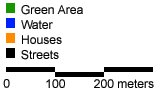
I'm quite skeptical of planned cities. They tend to miss the boat on mixed-use development -- retail on the first floor, residential above. That's a very successful urban form, and one used along avenues in most old streetcar suburbs.
Intentionally non-gridiron, non-rectilinear streets also seem ill-advised. Non-straight streets seem to increase the amount of walking required and the amount of pavement needed.
By an amazing coincidence, that's exactly what is suggested in the plan.
If interested in such things, you should visit carfree.com. It may astound you, but people can't give their entire plan for reorganising cities and societies in a comment on an article on a website. They need at least a few pages.:)
As much of the foot travel is to and from the center of the district, a radial pattern is more desireable. Absolutely straight streets everywhere can take a bit of human scale away from an urban design, and the wedges of a radial shape are so narrow at the center as to reduce efficiency of space.
Curved or otherwise non-straight avenues can create more of a sense of 'here', and intrigue one as to the view around the corner.
From the Carfree Cities Design Elements page.
Elegant design and concept. Almost utopian, really. But a few practical issues:
1. This would be highly unpleasant if the rail was above ground.
2. How do people get into and out of the city? Does another rail line run through the central hub?
3. How is residential and commercial divided?
4. How do people have access to the green space? Is it completely cordoned off for wildlife or can it be used for agriculture, recreation, etc?
5. Where are you going to build it? The Amazon? Siberia? Mars? Most development has already happened worldwide so the infrastructure is already there. Are you going to level existing cities in order to build it? At what cost to people and resources?
6. Air travel?
7. No personal vehicles of any sort?
8. Doesn't seem to allow much variety and options for homes and public spaces.
Each of the lobes has at least one district that can connect to external road or rail networks, for moving people and cargo (good, produce, etc).
Retail is on the first floor, with the largest retail near the center of each district. Commercial would tend to be located near the center of each district. Residential can be throughout the district, nominally above the first floor, especially near the center of the district.
This can be up to the city's preference. Obviously, with 80% open space, there will be plenty of parks, sports fields, gardens, wildlife areas, and so forth. Note that the interior of each city block, without the need for car parking, can look like the following picture;
While some countries might be pressed to find land to start such a project, other countries are creating new cities from scratch, such as Dubai and China;
Dubai Carbon Free City


China's new carbon free city

An airport could be located nearby, but such an investment would make little sense in a peak oil world.
Inside each district, there could be bikes, segways, and motorized transport for those with physical challenges. For transport outside the city, 3 districts in each lobe could have car parking, for both private cars and for car-share cars.
Any number of architectural themes can be realized. Suburbia-influenced yard layouts are not considered appropriate for this design theme, for all the obvious reasons.
There can be quite a bit of architectural diversity even within one city block;
I encourage you to visit the website Carfree.com to gain a greater sense of the way such a city would be designed, built, and lived-in.
I think the plan is very practical in a post oil world but unfortunately we probably won't have the energy resources to rebuild our cities from scratch. I wrote an undergrad thesis on the same topic back in the early 80's and a few aspects are worth expounding on.
1. The size of the subcity is both a function of the practical distance to walk to public transportation, farmland and open space (considered by some to be 7 minutes in todays society) and the appropriate scale of political entities for a local democratic government (some say 7000 is the maximum). Its interesting to note that even when preindustrial New York City exceeded a million people most of its food was grown within a seven mile radius.
2. The plan only describes uses as housing but I would assume that the blocks are mixed use, with the lower level as commercial functions, particularly in the center. The hieght of the blocks is not discribed but I would assume about a 5 story maximum to maintain a human scale and efficiency. The thickness of a building is also similar to preindustrial blocks where lighting and ventilation where from natural, not mechanical means. In this case the street and squares become defined spaces. The space between buildings become as important and defined as the buildings themselves. I explored the idea of building blocks as solar envelopes, where the intent was not to have buildings shade one another for maximum solar gain. This results in a diamond pattern of pyramids but sacrificies the strong sence of defined space between buildings.
3. The shape of the blocks in this case is a result of organic (accretive) growth, similar to most preindustrial cities but with a underlying masterplan much like Amsterdam. In Amsterdam an efficient transportation system of canals for boat traffic radiated outward as the city grew. In this case a highly efficient, quiet and above grade rail network will provides transportation beyond walking. I suspect that air travel in twenty or thirty years will become extrodinarily expensive and large airliners will become dinosaurs. Large airports will become few and far apart. Trains are the future.
If you agree with James Kunstler, and I do, the US is probably screwed. The huge investment in the spralling suburban built enviroment will become the new ghetto. Will the lawn become a permaculture garden? Can we cover roofs with solar panels cost effectively? Will we get mass transit up and running at the scale necessary? Unfortunately the energy required to maintain this infrastrucure as it wares out will probably be not be viable. Can we recycle much of it? Maybe, maybe not. Calculations posted below indicate its probably not worth recycling asphalt into energy. Can you recycle a tract home and strip mall? Hummm?
I've seen strip malls, at least the blocks of the buildings, parking lots and foundations ground up into huge piles. most of the steel and pipes are probably recycled because the volumes are so big.
now tract homes, not a whole lot will probably recycled unless the cost of the basic materials is expensive as it should be in a post-peak world. there already is a new trend of increased copper stealing. I have heard of slow demolition where a lot of the building is torn down piece by piece. aren't construction materials like sheet rock and 2X4s not recycled a lot? we can probably make progress in recycling construction debris.
we don't know if suburbia is the new ghetto. suppose we radically increase MPG or car pool more? suppose the unemployed living in suburbs gets jobs busing suburbanites to their jobs in the city? I would think that raised beds would help suburbs that had their good top soil scrapped away. the costs for solar seem to be going down while the cost for power is trending up. there are also other options. solar windows, solar paint, geothermal, wind and other things. the suburbs usually have more money so they could adapt. they could sell the SUV if they had to!
I am very glad to see people discussing the demand side situation relative to carbon fuels, the application of new urbanist city planning principles.
The biggest challenge is the entropic suburban developments that have sprung up in the age of the automobile and cheap oil. These communities need to be retrofitted, with the major change being the building of community centers for economic and cultural activities. WE need to bring the goods and services to the neighborhoods rather than all this willy nilly wasteful driving around to get the things we need and want.
Such will not occur unless we accept the maxim of a Planned Economy. The trick will be changing the way that resources are allocated to and within communities. We need to look beyond the tyranny of the bottom line in development projects, and allocate resources incorporating environmental (i.e. sustainability and equity) externalities. Even if we as a reactionary economic culture can accept the need for Ecological Socialist Planning (ESP ;-) ), we will still be faced with the huge problem related to the incredibly inflated real estate prices and costs of Capital. We may have to figure some way of writing off these costs.
The following is something that I wrote previously.
Policy Paper #7 – Energy, Agriculture, and Waste Issues
Mike Morin
Are they proceeding with tar sands removal and processing?
Such would be unfortunate in "light" of the gluttony of our times and relative to future needs, and to other concerns of the "natural" environment, public health (such as water and air quality and availability), wildlife (which does not threaten domestic life), and recreation.
Similar concerns have of course been stated for coal, oil, natural gas, uranium, water, and other resources.
Among the many problems associated with the agricultural sector are those regarding runoff from manures, pesticides, herbicides, and of soil. It is my considered opinion that Americans could consume much less meat. Shifting agricultural practices towards less meat and dairy production and consumption would help assuage the non-human animal manure problem. Some may argue that such manure could be a valuable fertilizer source though I would argue that I would not want such a job. Less meat, dairy, and egg consumption would also be healthier for people and would allow more people to realize healthy diets.
Currently blood meal from slaughterhouses is a source of nitrogen fertilizer. Again, such as the other jobs in that sectors would be very unpleasant and should be highly compensated. Evolution to a less meat regimen and more humane treatment of animals would be in order.
We need to put more resources into composting efforts and other practices and technologies associated with ecological food systems.
I have previously addressed in other forums the opportunity costs associated with cropping for tobacco, alcohol, soft drinks, sugar in lieu of food crops, ethanol, and biofuels.
Also, the active encouragement and support of more localized food systems (i.e. going toward self-sufficiency in all regions) would go a long way towards improving the quality of life in our communities. We need to put in place development control policies which stop once and for all the loss of productive farmland (and stop the sprawl that engenders and perpetuates energy intensive lifestyles) and work with growers and other farm workers to develop a production system in which they control the means of production and distribution (In such a scheme, I would consider people who work in distribution and transport a "farm" worker). Packaging should be minimized, advertising (in all sectors) eliminated and concurrently restaurant establishments should be scaled back considerably, if not minimized. Doing these things would greatly help the trash disposal problems that are with us now. Additionally, we need to actively support the reinstitution of source separation of wastes.
To the extent that sewer systems exist, humanure can and is captured. The production of algae for energy production may very well be an endeavor worthy of pursuit. Biosolids are a major problem and perhaps the construction of tankers and barges to haul and dump such to the deep ocean could mitigate this problem and create many high skilled jobs and community economic development and ownership opportunities.
However, like a national highway program (the so-called free freeways of the so-called free market system), the notion that these could be developed as a marketable products strikes me as absurd, but not nearly absurd as the plethora of extraneous and ill-conceived products that currently sit on shelves or the mountains of trash which plague our
hinterlands.
Policy Paper #2 – Equity and Sustainability Mike Morin
>Unfortunately, most Americans led by one certain heinous VP and his non-elected boss, have been inured with the notion that our energy consumption patterns are not negotiable.
This is undoubtedly one of the biggest challenges we face and the one that we must work relentlessly to correct.
We must form an equity union to implement community redevelopment and relocalization strategies towards the realization of walkable communities and the significant reduction on the dependence of the automobile and the airplane. Perhaps a desirable goal would be the reduction of automobile use by 80% in the next 20 years. With regards to what would remain of the automobile industry it is necessary to implement strong CAFE standards, which would probably be best done by the capitalization of a retooling effort (imagine something like the Yugo or a quality Aveo as a hybrid). TOD and car sharing are very worthwhile ideas.
Concurrent with the former would be a program of road narrowing which would reclaim the livability of many once desirable and potentially reclaimable properties.
There would be problems associated with peak and non-peak use of automotive vehicles. For example, here in Oregon, many folks would want to use cars in the summer months to get to hiking destinations (assuming there will be any left given the current and projected policies and practices consistent with the rapacious concept of supply side economics). If one does not have a car, the current alternative is to rent one. I did this once, and the insurance costs are prohibitive. If we had an insurance pool, and the "users" owned the vehicles instead of rented, it may be a better arrangement.
I concur that bio-fuels are a limited alternative and only within the context of a much less energy intensive civilization, and much better if we could produce it with byproducts and waste products. And there are opportunity costs associated with liquors and soft drinks. Dealing directly with such issues would also go a long way toward reducing health and waste problems. And there are the opportunity costs associated with food (and byproduct) production relative to the tobacco industry. Converting liquor and soft drinks to ethanol, and tobacco resources to food resources May both be great ideas. Though a more thorough discussion about the use of biofuels May be in order.
But neither is sufficient without radical demand side management and more relocalization of food production and the production and distribution of other (necessary) goods.
Supply side economics has been a disaster and we can no longer rely on "the invisible hand" to DICTATE an anarchist (though the Capitalists prefer the term Libertarian) world headed toward certain disaster.
Sustainability and equity, equity and sustainability need to be our guiding principles.
Imagine the money we could reinvest in our communities and economy if we weren't spending it on the tremendously costly (also in terms of lives, injuries, and other miseries) wars in Iraq and Afghanistan.
Imagine the money that could be saved by drastically downsizing government: Federal, State, County, and Municipal.
Major savings realized by reducing or eliminating or in some cases reorganizing the current redundant, legalistic, bureaucratic, inefficient, and oppressive "democracies" which represent the interests of the monied elite coupled with an economic reorganization, a transition to an economic democracy, a planned economy, is fundamentally necessary for world peace, sustainability, equity, and survival.
You May want to look at the following also:
www.culturechange.org/Morin.html
Workin' for peace and cooperation,
Mike Morin
katerimarie@netzero.net
When gasoline prices climb to a much higher level, very few people will buy an SUV at any price. They become un-sellable, but they make great driveway ornaments and storage sheds.
.
Gilbert.
http://www.angelfire.com/in/Gilbert1/tt.html
I'm just guessing, but I suspect the EROEI is roughly the same as tar sands: 1.5. That is, for every 2 barrels spent, 3 returned. With tar sands, we get vast environmental destruction that pretty much makes that "gain" a loss. Now ripping up roads, that may be much more productive! We already have the equipment to do it and the environmental damage has already been done. Would the energy gained pay for new concrete roads? Probably not. But hey, there are a lot of roads we won't be needing....
The EROEI of tar sands is much higher than that - this end-is-nigh article estimates 4:1, and this anti-tar-sands article estimates 6:1.
If you want to estimate from first principles, consider that official estimates by Canada's National Energy Board are that natural gas represents the main energy input to tar sands facilities, and that current methods use an average of 0.8Mcf of natural gas per barrel (p.16-17). At 1.05GJ/Mcf for natural gas and 6.1GJ/bbl of oil, we get a ratio of about 7.3:1.
Energy other than natural gas (e.g., diesel for mining equipment) will lower that ratio some, but not particularly moreso than in similar surface-mining operations. Accordingly, estimating from first principles supports an EROEI of about 6:1. Any estimate which is less than half of that is almost certainly due to wishful thinking; I've certainly never seen a shred of support for the claims of sub-2:1 EROEI, despite following the supporting links in, for example, this story. The available data simply doesn't support those claims.
Last week I attended a meeting that the county had set up - they are in the process of developing a county-wide map of bikable roads, and they were looking for input from cyclists from all over the county about routes and paths that they might not know about - thus we were marking up some large maps with all of the ways that we have for getting around.
I was chatting with one of the county guys who said that there was a brief time last year where asphalt became more expensive than concrete, which surprised me. Typically concrete is more expensive, but is regarded as being more durable.
Awesome; good for you. Out of curiosity, where?
Fairfax County, VA. The county now has a full-time bicycle programs coordinator, and this map is one of his initiatives. That isn't to say that things are perfect here, but the map is partly so we can see where things are today, as this makes it easier to figure out what areas need more attention.
Arlington County is really far ahead of us - anyone who has biked here can say that. At the meeting they noted that in Arlington County, there are roads that were 4 lanes with parking on the side, and they were reducing them to 2 lanes with parking and bike lanes. Mainly as a traffic calming measure - the local residents were strongly in favor as they were tired of people speeding through the neighborhoods, and the traffic patterns were such that 4 lanes weren't really needed. Fairfax County is working on doing the same thing to similar areas.
They are also looking at other roads that are wide enough that they can simply be re-striped to accommodate bike lanes. The advantage of doing this is that it is quite inexpensive, the disadvantage is that it doesn't work everywhere. Some of these things need to wait until the roads are resurfaced.
The other thing that is interesting is that the general public needs to be behind these ideas. The outer portions of the county are still very exurb like, and many of these folks don't view bike lanes the same way we do. The areas that are closer in and adjacent to Arlington and Alexandria are the areas where bike lanes are going to be more popular.
There was one HOA that fought tooth-and-nail to prevent bike lanes on a nearby road (which makes no sense as they had bike trails also going behind their neighborhood). No idea what that was about. There as a fight some years back in Vienna VA where opponents were fearful of their neighborhoods being overrun by "perverts in spandex".
>I was chatting with one of the county guys who said that there was a brief time last year where asphalt became more expensive than concrete<
In Post Carbon Cities: Planning for Energy and Climate Uncertainty I briefly discuss how recent spikes in asphalt prices are just one example of the many unexpected price increases we're already facing as we approach peak oil (or, as some prefer, "coast through currently undulating plateau of world oil production").
Those price spikes make for an interesting case study IMO because the effects they had on local street repair and construction activities --and the repercussions for local economies-- hold some lessons for how we might respond to peak oil in general.
The discussion in the book (p 25-26) is available as an excerpt at:
http://postcarboncities.net/pcc-excerpts
Daniel Lerch
Looking a little further down the black asphalt road to where we will sit roasting animal bits on piles of asphalt, tires and assorted petroleum products while they burn and melt producing the liquid used in our oil lamps at night. Still an easier way of life than chasing damn whales about.
Great questions -- obviously the answers will depend on local factors, but thought provoking.
I was wondering why we should confine the recycling efforts to asphalt? The world contains at least 6.5 billion people, of whom only 2.04 billion could be call "necessary". (That would be the Christians, and arguably, some of the Jews.) How many barrels of biodiesel can be extracted from 4 billion unneeded people?
Now now, LNG, that sounds like a silly dark medieval question along the line of th e current one in Iraq of "how many oil barrels can dance on the head of a hand grenade pin".
A great candidate for moderator intervention.
That's a ridiculous thing to say. How is anyone "necessary" for the world? It seems pretty clear to me that the world got along fine for a very long time before we started fucking things up, and that happened before we numbered 2.04 billion. How'd you come to such a precise number anyway?
The comment about Christians and some Jews being necessary is even more asinine. I hope you're joking, but even if that was a (sick) joke, it wasn't funny.
Hopefully NeverLNG was writing in the style of Jonathan Swift and his 1729 "A Modest Proposal (For Preventing The Children of Poor People in Ireland
From Being Aburden to Their Parents or Country, and
For Making Them Beneficial to The Public)", in which he proposed that the solution to the poor Irish people was for them to eat their children. I would not assume, however, that NeverLNG was thinking of satire until he clarifies.
Sorry, poor taste on my part. I am not a Christian, and do not presume to be "necessary" for the Earth.
I am simply following what appears to be the guiding principal of the Neo-Con establishment. If you can't buy anything, you are unnecessary and will be hidden in plain sight by the media while you slowly starve. If you are Muslim, you are more likely than not to be a terrorist (never directly stated, always implied.) If you are pagan or Atheist -- you are beneath contempt.
Once again, sorry -- nothing to do with oil. But the basic principal is that if there were fewer people there would be less environmental degradation and less consumption. Short of catastrophic war, famine or epidemic, that seems unlikely to happen.
I guess it would depend on what part of the world they were from. Though this might give you a rough idea.
http://www.upi.com/NewsTrack/Quirks/2006/12/06/liposuctioned_fat_could_b...
I guess it's hard to outdo reality even with the tasteless jokes. What's next?
Asphalt is commonly recycled. The earth under most roads has no reclaimable dirt, it has all been scraped away. The best use for asphalt is asphalt.
A good lesson from history is the fate of the paved Roman roads, especially in Britan. Once the paved roads were no longer needed ( the Roman army had left) and could no longer be protected and maintained (the Roman army had left) the locals gradually used the pavement stone for other purposes. I don't think there was any plan to do so, it just evolved as the stone was an easy source for whatever purposes it was required. The transportation legacy was the well built, graded and drained road beds under the pavement. These still form the basis for many roads in Europe. This will be the same legacy for many of our roads and the main benefit will be the all weather road beds beneath the pavement although it is likely that a lot of that aggregate will be mined as well for local use. If we have specific "good" ideas for the use of asphalt we should leave a note for our grand kids and great grand kids. My personal favorite is that they will find a way to melt the asphalt out of the matrix and use it for waterproofing and maybe wood preservation. Short term there will likely be sufficient liquid fossil fuels for those who can afford it and I suspect we will be too busy with other problems.
As a digression, this network of well engineered road beds may make it less likely that the railway system will be rebuilt to its former glory in North America. Most railways here were developed before the road system and were successful in competition with water transport and the rough almost impassible old military and pioneer trails. It may be cheaper to carry freight on these roads rather than rebuild railways, even if the time of travel increases. The big problems with roads here will be the bridges and snow blockage in winter. But the Australian outback is a good model. Truck trains, probably moving a lot slower then the cowboyed ones I remember on the Alice - Darwin track, and eventually fords and overflows in the stream beds might replace expensive bridges. As with the wet in the Australian NT we may hve to become seasonal or at least weather sensitive. In the Canadian north we already do that with ice roads. This won't happen in my lifetime but I suspect that our decendents will walk a little less proud upon the land.
Silly Haniboi,
All of your questions can be answered on a asphalt recyclers website. Now you have to consider how many roads today are being build with concrete. Ripping up the roads is a bad idea, to much energy used to rip them up. Expanding road systems is a bad idea too, plus wasting energy on creating new ones is a bad idea. Capitalist will break down and allow most energy efficient autos on the road to allow for the coming fuel short falls, but 10-25% will not be enough, 60-70% is the target they must hit.
As for tar sands capitalist will use 2-3 barrels to make 1 barrel of oil to keep us shopping, wasteful true.
There is enough oil in the world to keep us going shopping for a long time. Screw third world countries, our empire comes first, people must keep going shopping. Capitalist will and must keep it going at all cost, hey tax breaks for everyone.
Just think every time you go shopping where does that stuff you buy come from? it's not just about buying local, but what the tools used to make those products, hey now the third world countries don't look so bad now, when you don't have anything how much lower can you.
Now think about that every time you fill up at the pump or go shopping at the store, you just screwed another third world country.
happy motoring
cheers
Jon
Jon WhoEverYouAre:
> every time you fill up at the pump or go shopping at the store, you just screwed another third world country <
There it is, the big ethical elephant in the room. We pull up to the pump, flip the lever on the voting machine, fill the tank in our tank, and pay the K-street lobbyists who do everything possible to keep oil addiction alive in Amerka. And then we pretend it is the fault of government, oil companies, car companies, and those bad people who have larger vehicles than our own. Or we pretend oil consumption is not a problem at all.
That's why you are more far more likely to see me pedaling on the road than pedal-to-the-metal inside a motorized exoskeleton. I don't say it to brag; it's what I can do with my life.
And before you reply with, "Well, it's just not practical for ___ to bike..." let me say this.
No, all of the people can't bicycle some of the time, and some of the people can't bicycle any of the time. But a hell of a lot more of us could bicycle a hell of a lot more than we do!!
Hans Noeldner
I've been lurking here at TOD since its 3rd month or so, and this is my first comment, for what it's worth.
The idea of recycling asphalt to extract petroleum strikes me as the equivalent of burning the furniture to keep warm. The simple fact that doing so is being considered seriously here is a symptom of how far gone our whole system is. Roads are basic infrastructure. If we're willing to gobble them up to keep an ever-smaller, ever-more-hopeless system running on the fumes of its former glory, I think it's safe to "stick a fork in it", 'cause it's done.
The historical parallel of the recycling of Roman infrastructure is quite appropriate. It should be noted that it was a Roman Emperor intent on re-conquest of lost ground (not a barbarian raider) who ordered the removal of all the metal supports holding the old buildings together in Rome. These anchors, nails and support beams were re-used to make weapons, armor & other desperately needed kit for the army.
Haven't we been hearing of the US military's efforts to "go renewable"? Aside from asphalt to fuel vehicles, what other portions of current infrastructure could be recycled for military purposes? Most of it, I suspect, necessity being the mother of invention... The low-hanging fruit for raw materials will no longer be ores in the ground, but stuff lying around.
everything was reused or recycled until about the end of WWII when the whole consumption machine went into hyperdrive.
A German friend tells me that in her days when a pig was slaughtered, everything was used except the squeal. I don't see any reason why civilization can't get back to a more reasonable approach to the limits of the material world.
It may be "burning the furniture," but the better question is how much do we gain (or lose) overall by doing it. Less pavement means better rainwater capture for aquifers, reduced heat island effect, more room for agriculture or uncontrolled nature. It's yet another of those matters of "externalities." How do you reward (or punish) the indirect economic impacts of an action? Recovering fuel (or a resource in general; might be useful for plastics, but then that's a whole 'nother problem) is only a part of the equation.
I would like to turn the question on its head: why don't we use tar sands directly for paving roads and crack the residue of crude oil refining into diesel or bunker fuel? Would this change of course be more environmentally friendly than cracking tarsands into gasoline and using the crude oil residue for paving?
We should
1. make parking lots smaller
2. find ways to extend use of a barrel of oil
http://www.msnbc.msn.com/id/22444063/
Now, imagine you're an outdoor mall and or a big box retailer. this is a good way to reduce costs and maintenance. we can also sell the power back to people to charge their EVs.
I'm a newbie but this stuff is really cool so here goes...
Here a site that says that the amount of recycled asphaltic concrete in the US in 2005 was 41 million metric tons and about 7-10% of the mix is bitumen. About 80% of asphalt road materials is 'reused in some manner'.
So that would be something like 5000000 tons of bitumen.
http://www.tfhrc.gov/pubrds/05jan/02.htm
I think you get about .86 barrel of syncrude for a barrel of bitumen, and 7.33 barrels is a ton leaving 31000000 barrels of 'oil' if it were all used for fuel instead of road material.
I think virgin asphalt comes mainly from refinery coke which could be made into gasoline by gasification at the rate of 2 barrels per ton of bitumen.
I don't know how many highways there are in the USA but the government says that the National Highway System contains 35 million metric tons of asphalt.
http://pubs.usgs.gov/fs/2006/3127/2006-3127.pdf
Asphalt binder is applied as a mix of bitumen and naphtha and I've seen the figure of 35% is assumed to end up evaporated over time(US EPA).
asphalt's bitumen binder doesn't come from coke. Asphalt is crude oil residuum often air blown to get the right temperature/meltingpoint relationships.
You take the same resid and feed it into a coker. Coke is more like coal. Very little hydrogen left. Mostly carbon.
From some previous environmental consulting work, I happen to know that asphalt in roads is about 5% by weight [to check the asphalt content, a coredrill is used to cut a plug out of the road, and a sample is taken to a lab, where the sample is weighed, then the asphalt is dissolved out and the remaining aggregate is weighed again to determine the asphalt content. This asphalt is dissolved out using chlorinated solvents, which is where I come in 8^) ]. Here's a reference - look at page 4:
http://www.asphaltisbest.com/PDFs/Design%20Manual/CHAPTER2.PDF
According to the Wikipedia tar sands page:
http://en.wikipedia.org/wiki/Tar_sands
...two tons of tar sands make about 1/8 ton of oil, but, only 75% of the bitumen is recoverable. Assuming no input of light hydrocarbons, that means the original bitumen was about 8.3% of the weight of the raw material:
[(1/8 ton)/(2 tons)]/(0.75) = 8.3%
So, my point is, recovering oil from paving materials would be even more energy-intensive than recovering it from tar sands - an even bigger relative EROEI loser than tar sands.
Now there's a good answer.
But I'll continue with my half-assed one anyhow.
I reckon asphalt can be burned, and will be, as parking lots are reclaimed for ag in the future. I'd expect that being in the hot sun for years, old asphalt will have fewer volatiles left.
I've been in an asphalt parking lot - a relatively new one - to observe what happens when molten lava erupts in the middle of it... that is, a 7-meter lava cone with lava pouring out of it down onto the neat yellow lines. That's no small amount of heat, but aside from some minimal blackish smoke, there was no real burning of the asphalt. There was also a 2-foot chasm that opened in the parking lot which had orange flowing lava in it, and as I had to jump over it to get to the main firepit I can note that it was damn hot, but the asphalt was entirely unaffected.... well maybe slightly chewier but not inclined to burn. As it was night, any flames would have been apparent; the methane sprites were certainly popping up everywhere like blue fairies.
It's not that uncommon to have lava go over asphalt on the big isle, most often 'chain of craters road'. I take from my observations there that asphalt is not high on the list of burnable stuff, though I suppose if you chucked it into a furnace it would give up some heat calories. Bloody few volatiles left in the old stuff though I'd reckon.
Now, getting rid of parking lots for aesthetic reasons and to farm the land - there's where the energy benefit might be found. Perhaps in the future asphalt will be burned, but in those relatively depopulated times wood and weeds will probably still be the fuel of choice, and concrete will be mined for rebar... tough job there.
It's almost certainly not worth recovering asphalt from roads and processing it into synfuels, not only as due to it's low bitument content, but also from the fact that it would be very difficult to achieve the required "economy-of-scale" in the industrial plant. The cost of a grassroots plant only increases as the 2/3 power of its throughput. That's why you'll never see a "5,000 bpd upgrading plant" ever being planned and built. About 50,000 bpd appears to be the "minimum economic size" and hardly enough asphalt could be recovered from even a large city to accomplish this.
Since it could be reasonably argued that there is (will be) far more asphalted areas than is needed in a city, it does make sense to try and determine if it could be removed and what should be done with it. Also, by "not" doing it, you would leave people to their own divices as to its use, which could include "burning it to keep warm" which would result in an environmental catastrophe.
Having said that, you would first try to use what's there "in place" by building necessary infrastructure over it. Second, if it is deemed necessary to remove it, that it should be done in an orderly and useful fashion, rather than simply "ripping it up". Perhaps a (laser?) device could be devised to cut through it like a cake, and the pieces harvested as (20 lb?) bricks.
The bricks could be hauled out of town, perhaps on a narrow gauge rail build for that purpose, to build aqueducts or who knows what else. I think the bricks could be stacked on the perifery of a geodesic dome as supports, especially if this were to start from below grade (2-6 ft). Any other ideas as how these "bricks" could be used?
Thanks Brother for one of the most germane responses to my post thus far.
Indeed the EROEI for oil recovery from asphalt might be somewhat lower than that for tar sands, but consider the enormously different environmental impacts. Removing asphalt would restore aquifers, provide additional space for CO2-sequestering plant growth, expand habitat for wildlife, etc. And replacing asphalt pavement with buildings would be far, far better than greenfield development.
Anecdotally, I removed several hundred pounds of broken-up asphalt from an abandoned cowyard a few years ago (so I could shovel the soil, break up the hardpan below, and plant a garden.) I piled the material up in a burn-pile and it made a VERY hot fire which burned for a long time. And as it burned, copious amounts of melted tar flowed out of it.
Obviously it makes far more sense to recycle asphalt - IF we choose to maintain or increase the amount of pavement on Earth. But a major shift away from Happy Motoring could reverse this - and leave us with a major surplus of the stuff. If this happens, if richer sources of oil are exhausted, and to the extent that we still need modest amounts of oil, why not use it?
For rural areas, it might make sense to burn it, but you would have to support the transportation costs out of the city. What I oppose is for the city dwellers to start ripping up streets to be used as a fuel to stay warm.
In the city, I guess you could recover some tar by using a rotating calciner like they use to extract oil from rubber tires, with the broken-up asphalt being fed into the "high end" while feeding in combustion gas from the "low end", routing the gas coming out of the high end to a scrubber before incineration, from which some heat could be recovered. It would require a considerable amount of horsepower to "rotate" the calciners, however.
Still, the tar coming out would not be suitable feed for an upgrader because it would be thermally degraded and somewhat oxygenated--not good for upgraders because it consumes additional hydrogen. The tar could be fed to a "fluid-bed" combustor to raise steam to heat an apartment complex, for example, but the off gas would still need to be scrubbed of its sulfur content, unless it could be captured in the FBC. You would need to truck in limestone to capture the sulfur in the FBC, if you wanted to reduce scrubbing requirements.
IMO it would be better to produce gas for local use by investing the money in an anaerobic digestion unit at the sewage treatment plant. I'm not sure why this is not done more extensively.
There are a lot of good things that could be done with the areas from which the pavement is removed, so discussing what to do with the asphalt is a useful exercise. Not all streets will still be needed to support vehicular traffic.
Even if extremely hard times were to arrive, it would be impossible to move "everybody" out to rural areas, since there simply wouldn't be enough money and resources to rebuild housing "out there". People left in the city would have to figure out a way of surviving with the resources that remain, and growing food and managing rainfall will be some of the most needed activities.
Shouldn't we let the roads remain, and only build permeable concrete (does this exist?) or stone paver roads? Nothing lasts forever, even the great wall and mayan/egyptian pyramids became broken down without human intervention through maintenance.
I view most roads as a waste of space, we should build commuter rail where it makes sense, put in BRT lanes, free public transit for everyone and shuttles to/from train stations so we can all get out of our miserable carts on four wheels...
And, let the rest of the lanes be public open space, bike lanes, organic gardens... copy the touristy yet organically developed piazzas of Venice, Munich, Innsbruck...
On Broadway in oakland where i live, there are four lanes each way at one point, which is a total waste of space... no need for anyone to drive!
"no need for anyone to drive!
no need for a lot of things, suppose I want to drive though?
Suppose I want to blow my cigar smoke in your face?
Suppose I want to shoot cans in my backyard, with the thin wooden fence adjoining yours?
Suppose I want to have a party with big-arsed speakers pumping out music at 3am on one of your workdays?
In general, in a civilised society we restrain ourselves or are restrained from things we don't need to do, only want to do, if they might harm others or make their lives unpleasant.
Climate change, and burning up all the fossil fuels, will harm people and make their lives unpleasant. So people should restrain themselves or be restrained from doing that.
so nobody can drive cars anymore? good luck getting that passed.
Some Answers to points made above...
Asphalt is 100% recyclable. And the statistic that 80% of it is, is quite impressive, as measured by tons, Asphalt is the most recycled material in the country. Even past the other petroleum product of plastic.
In NY, There is approximately 16,000,000 tons of Asphalt produced each year, usually about 4,000,000 for the state system. An increasing number of producers are recycling at a rate of 15%.
However, the bigger concerns come from the amount of fuel used to heat one ton of asphalt. Approximately 3 gallons. That's 48 million gallons or 1.1 million barrells of fuel equivilant per year. I guess in the scheme of things thats not a very large piece of the pie. But a lot of fuel for what you get. Then another 1/2 a gallon on average to transport, place and roll each ton.
Some better options for asphalt include recycling in place, this can be done cold utilizing some specialized equipment. To date, we cannot leave a recycled surface for traffic, but a thin (1" - 1.5") asphalt overlay is all that is required over 4" of recycled material. That is far better than ripping out and replacing 5"-5.5" with new stuff. The performance is excellent on moderate to low volume roads.
Permeable concrete... Yes, there is both permeable concrete and permeable asphalt, they are designed as a system to prevent runoff and are used primarily in parking lots. To date, no one has placed a permeable pavement on a roadway because high speed traffic would cause ravelling (the stones to come out of the surface).
In my experience, when roadways are milled and replaced, the millings torn from the road are always utilized in some fashion, as shoulder backup material (instead of using mined gravel), sent to the plant to be recycled, or sold to locals for driveways and parking lots. It is not the most desirable surface. Point is, there is never a concern of getting rid of milled asphalt.
The larger concern for the near term, is the supply of asphalt binder, as more of it is being diverted to the cokers and turned into transportation fuels, now causing enormous price spikes in asphalt.
Oddly, (and coincidentally) this was the next article I looked at:
Porous Streets Work--Even in Rainy Oregon
http://www.worldchanging.com/archives/007813.html
The volatile oils in asphalt evaporate and what's left after a few years is mostly aggregate. Grinding up the asphalt in place and mixing it with new asphalt makes good sense. That's already done.
Presumably the asphalt to be rendered would be old asphalt. Why would we scrape up stuff we just put down a year ago?
how much longer does concrete last versus asphalt in a road?
Concrete does not last much longer than asphalt, generally both remain in place for about 50 years. Some going on more now. Each one is rehabilited at about 20 years, then again at 35 years. For Concrete, a rehab is either repairs or bury it with Asphalt. Asphalt is generally patched and buried with more asphalt. Or Patched, some milled off and a thicker section placed due to increased traffic.
Well, that depends a lot on the climate and traffic. Where I live, in Massachusetts, concrete fares very poorly, due to freeze/thaw cycles and the excessive use of road salt during the winter (salt promotes decay of concrete but has little effect on asphalt). In a hot, dry climate, concrete will last practically forever - problems only develop due to settlement of the roadbed and differential stress from traffic. In a very hot climate, asphalt will warp and rut much easier, requiring more maintenance. So in general, highway departments will weigh the greater up front cost of concrete against its (usually) better durability.
Lots of new highways in Germany are being made with concrete instead of asphalt, according to a friend from Germany. Apparently, most of the weathering problems have been sorted out in new varieties of concrete over the last 5-10 years.
Here's an extremely rough calculation.
Asphalt contains roughly 3 to 10 percent of oil distillate. If a barrel of oil weighs .136 tons, and there is 1 barrel of oil in 2 tons of tar sands, then that means tar sands contain about 7 percent oil.
So it might be just as efficient to process asphalt as tar sands.
rough, extemely rough. oil that weighs 0.136 ton/bbl would have an api gravity of 50.6 deg. however, i dunno what gravity is appropriate for your calculation because bitumen is not oil, certainly not in situ.
I'm embarrassed to say that this has to be the most crackpot idea I've seen on theoildrum in the past two years that I've been a loyal reader. I refer my friends here to learn about the coming oil crisis and then I see this article. Where, exactly, are all these unused highways? Have you thought this through at all? How will anyone get to these farms and gardens WITHOUT roads? How are you going to get city, state, and national governments to remove ANY roads? This idea is DOA out of the gate. How many thousands of miles of roads would we have to remove to create any meaningful amount of oil? Sure, there are some empty parking lots, but not enough to matter on any significant scale. It makes far more sense to recycle them for use in new roads. Usually the ideas suggested here have serious merit. I look forward to seeing them again soon. Sorry to be so blunt. I expected someone else would have said this by now.
If your expectation is that Americans will continue to drive two and three ton exoskeltons everywhere we go - and then park for free in surface lots - then of course the prospects for harvesting energy from asphalt are DOA. My expectations are quite different, and, fool that I am, I hope we will make more enlightened arrangements for transportation proactively rather than waiting to be forced by scarcity and the bloody costs of maintaining Amerkan empire everywhere there are fossil fuels to be wrung from Earth's crust. Oddly enough, I have this quaint expectation that humans are capable of more than merely reacting to the price of motor fuel at the filling station. Enlightenment, perhaps.
Regarding our "need" for asphalt, this series of photos cuts to the chase:
http://www.unep.org/geo/geo4/media/graphics/Zoom/2.06.jpg
When we-the-people shift to spatially modest modes of travel, and when we cease to demand our own 10-foot by 20-foot patch of lifeless Earth at our every destination, a very different world becomes possible.
How much pavement is there in the United States? An area roughly equal to 2/3ds of the state of Ohio:
http://www.sciencenews.org/articles/20040904/bob8.asp
About half is streets, roads, and highways; the other is parking lots.
So if we make our streets and roads and highways narrower again (costs of maintaining four, six, eight lanes will become too high), get rid of many space-gobbling access roads, and pull up, say, half or more of our parking lots, then we have a lot of material to work with!
I have a different idea. suppose we turn those roads and parking lots to little power plants?
http://www.msnbc.msn.com/id/22444063/
lemonade.
You're absolutely right. Apparently most people who have commented favorably on tearing up roads have never lived in a place like Afghanistan or don't even drive on gravel very often. Road infrastructure is an integral part of prosperity. No roads, no prosperity.
There is a valid reason for tearing up asphalt, however, when state gas tax revenue is so low that a system of paved roads can no longer be maintained. Minnesota is in this situation now. Governor Pawlenty has twice vetoed a gas tax increase and prefers borrowing money to repair roads. There isn't enough money from a gas tax that has not been raised since 1988 to maintain the existing road and bridge system.
North Dakota, which never had much money, relies primarily on gravel roads. Only about 12% of the road system is paved. The rest is gravel or dirt (and there is a huge difference between the two). Gravel roads are cheaper to build and maintain than pavement.
When I was a kid, I lived on a farm and we had a gravel road in front of the house. The construction costs were definitely lower. They do need to be maintained - a grader would come through on a regular basis to even out the surface. Without that you would end up with big ruts in the road.
One downside is that a gravel road is really dusty, and the dust gets all over the car.
Contrary to a lot of advertising on TV, you don't need an FUV to drive on a gravel road. An ordinary car does just fine. The handling is a little different, but is quickly learned.
See, I didn't actually take this proposal seriously. I considered it more of a "modest proposal" type of thing. Kind of making a point but I don't think anyone expects people to rip out asphalt to make oil!!
Forget about replacing asphalt with concrete, cement manufacture is an extremely energy intensive process that requires heating limestone to very high temps to drive off the water molecule from the CaCO+H2O. You will use far more energy than you get out of it. Better off to use the methane directly as feed stock in synthetic fuel plant.
So if you are going to dig up the asphalt don't plan on putting cement based stuff in its place.
Calcining limestone does not boil out water. Limestone is CaCO3. Heating releases CO2 which constitutes 44% of the limestone by mass. CaCO3+heat= CaCO+CO2. The CO2 released may be even older than that released from fossil fuel.
Before we race off into some "Mad Max" fantasy so beloved by folks at TOD, let's look a chart that appeared just the other day in a post by Gail the Actuary on the subject of oil consumption by sector:
http://www.theoildrum.com/files/Petroleum%20products.png
That's right folks, a whopping 2% goes to asphalt production! So before we begin to root up the roadways of America like a hog rooting in the mud for truffles, consider the actual amount of oil used for asphalt, and recall that this was in one of the busier periods for road and bridge construction (I am sure that in some recession years, it would not even be 1%, but that would be hard to prove).
Now even if I take the worst of the shock models, the export crisises, and M. King Hubbert in spades, I and no one posting on this board will live long enough to see the last two percent of the oil gone.
I am an admitted fan of the automobile, and have long been a historian of the internal combustion engine. So as much as I hate to have to admit it, the bulk of the oil we use goes out one place: The tailpipe. Take note of the amount of petroleum used in gasoline production and distillate production. All the chemicals, pharmaceuticals, plastic bobble head dolls, and the oil used in the construction of the suburban pseudo mansions and junk plastic yard gear so hated by Kunstler and crowd do not in fact hold a candle to what is poured through the gasoline, Diesel and gas turbine engines of the land.
And neither does asphalt. It's a piss in the sea.
RC
I'd like to just note that by the time we get desperate enough to start extracting energy from asphalt, that the energy infrastructure needed to start squeezing oil out of asphalt would likely be gone or not in the quantity's necessary. Also I'd think there is a fundamental flaw in comparing asphalt and tar sands. The amount of asphalt in o say a square mile is no way in hell economically comparable to the amount of tar sands in a square mile. Tar sands EROEI is negative at the moment from what I understand. So I can only imagine what asphalt would be like. The only reason it would be good idea to start getting rid of asphalt is to recycle for other road use or land reclamation. Asphalt energy is a bit mad maxish to me in the moment. I would hate for the theoildrum to lose credibility and start being compared to LATOC or something. Silly idea to me, foolish and desperate at best. The day we start using asphalt for energy is when people start burning it to stay warm in the winter. sounds like something Kunstler would say.
G'night
-Crews
I'm glad you posted this. I think the first serious problems from peak oil will occur in the marginal markets not in the areas we seem to focus on like US gas and oil inventories. By the time the US is having trouble getting oil we will be in deep shit.
Marginal markets I've identified are.
1.) Bunker Fuel ( Shipping )
2.) Asphalt
3.) Third world propane diesel markets ( Water pumps cooking etc )
4.) Fuel oil
5.) Diesel/Fuel Oil electrical generators ( Alaska etc )
6.) US Gasoline imports (the big one)
We have seen endless reports of stress in these markets and when we have price charts in general prices have increased strongly.
Finally back to the US the weak link is gasoline imports I'm aware of one refinery being built in Spain that will only create diesel from petroleum and vegetable oils no gasoline production. I think we will find in time that Europe may well start decreasing its excess gasoline production as oil becomes scarce and increase its diesel production. I think we will also see this sort of shift worldwide. Diesel is what runs productive uses of oil ( farming, transport etc ) not gasoline which is pretty much only used for private cars. So the US will eventually not be able to import all the gasoline it wants at a cheap price.
Like I said I know of one refinery thats going to be 100% diesel I suspect that over the next few years we will see a major push in Europe to focus on diesel production at the cost of gasoline production as it becomes effectively unprofitable to ship gasoline to the US. Right now for all intents and purposes Europeans are subsidizing US gasoline usage and this won't last forever.
On the other side of the pond expect Korea to increasingly ship to the growing Chinese market at the expense of the US.
Sorry this post has wandered slightly off topic but I think that the marginal petroleum product markets will server as a leading indicator of where the main markets are going right now they seem to be leading by 1-2 years over the US gasoline market.
Good grief.
Another example of a little education being dangerous. And of a man convinced against his will is of the same opinion still.
You keep harping on bunkers. Bit silly.
Bunkers will be available long after gasoline is done. It's far cheaper to make; the worst crudes make lots of it; and the efficiency of moving products long distance by ship makes it possible for shipping to bid what it takes for the hydrocarbon assuming there is any international trade. Once cars are shifted to electricity, bunkers will be real easy to get as the remaining crude is left without the current suck of gasoline/diesel engines creating rapacious demand.
Please provide a link to a Spanish refinery that is only making diesel from crude oil. If it is only being fed vegetable oils, that makes some sense. RVO-->biodiesel is logical but it's not a refinery really. Raw crude oil has a big gasoline fraction which is a pig to polymerize into diesel sized molecules. No way anyone is wasting time doing that when gasoline export markets to the USA are so easy to tap.
European refineries have been focusing on diesel for decades (since the 80's spike). It's true their gasoline surplus heads to us, especially the US East Coast.
Propane/cooking gas will only disappear from the markets for 3rd world citizens if they can find an alternative. If there is no wood, they'll find a way to pay or do without cooked food which is unlikely. The price they can pay for a small bit of cooking fuel is enough to drive cars off their roads and probably ours too.
There are very few diesel generators out there. Typically only in places with very small demand such that coal or nuke just doesn't make sense. I already pay 41 cts/kwhr. It's cheap compared to washing clothes by hand. I'd cut way back on driving long before I gave up electricity.
Fuel oil electricity generation is dying off already. About the only place left in the US that uses it is FL. With the price of Nat gas so low, they'll expand capacity to FL. And then solar/wind/other will take over. And again, people will quickly learn to reduce transportation demand to keep the lights on if that's the economic trade off they have to make. Not much need to drive to a job if there is no electricity there for computers etc.
The only sensible point in your list is cheap imported gasoline will be harder and harder to come by.
In Addition, I hope as we slide down the other side of the peak, and the ridiculous amount of transportation we do now comes to a grinding halt, and we are forced to move to bicycles, horses, or even our own two feet, I believe and I hope that we are still using oil, only responsibly. If we used oil for all the other things but transportation fuel, we will keep a better standard of living than before the oil age, while also not burning it, which once burnt, is not recyclable, is never useful again, and contributes to global warming.
I also hope that asphalt is never "mined" for energy, because the best carbon sequestration program is to leave the damn carbon in the ground in the first place.
If we don't burn it, I can see still having a petroleum industry very different than today though.
This whole "asphalt from roads" thread seems to have run out of steam, so let's take it a new direction: How much asphalt could we reclaim by tearing off the asphalt roofing and roofing shingles on all the homes and buildings in America? Uh huh, forgot that one didn't ya'? Grab the crowbars boys, we're gonna' have a "roof party"! :-)
RC
If it gets cold enough in winter and people are cold, then it will get burnt - a great consolation for you city folk in northern climes...
As with roads, I think that the most volatile components will have long ago evaporated by the time a roof is ready for replacement.
Hell, lets burn the studs too. everybody build a sod house.........
My guess is that you will not get very much in the way of useful products out of asphalt. The key difference between asphalt and things like the tar sands is that asphalt is exposed to the air and sun. So, the volatiles disappear quickly (this is why asphalt only smells like asphalt for a few months). And the sun causes the polymer chains in the non-volatiles to break down over time; this is why asphalt eventually unravels.