
 | Another Reason to Love Sheryl Crow: She Might Be Peak Oil Aware... | The Oil Drum | DrumBeat: February 10, 2008 |  |
| Tar Sands vs. Asphalt: Round 1 | The Oil Drum: Local | David Paterson: First Openly Peak Oil Aware Governor | |
Bogota Part 2: Transmilenio Bus Rapid Transit
Posted by Glenn on February 9, 2008 - 12:30pm in The Oil Drum: Local
In part 2 of "what the rest of the world could learn from Bogota, Colombia", here is a good video that gives an overview of how their bus rapid transit system works. In part 1 we looked Ciclovia, a weekly auto-free Sunday on main streets and boulevards opens them to cycling, skating and all sorts of public events. (much more discussion under the fold...)
This system bring mass transit access to almost every corner of a major sprawling city. It also serves to create transit oriented development along the major corridors instead of auto-centric development.
If a major city in the Developed or Developing is looking to quickly develop a mass transit system, but does not have the capital to invest in new heavy or light rail, bus rapid transit offers another option.
There are over 100 BRT projects in operation or in development all around the world. You can see a complete list at Go BRT.
Here a description of the Orange Line in Los Angeles:
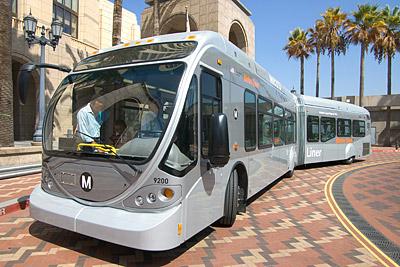
The Metro Orange Line, operated by the Los Angeles County Metropolitan Transportation Authority (Metro), is dedicated bus transitway located along an unused rail right-of-way. The Orange Line provides a rapid transit extension from the Metro Red Line and improves connectivity to the Metro Rapid bus system for San Fernando Valley transit riders. The system is also intended to reduce congestion on US 101, a major freeway that runs parallel to the Orange Line. The Orange Line debuted in October 2005.Construction of the busway was briefly halted in 2004 following a court finding that Metro had not considered multiple Metro Rapid bus routes as an alterative to the busway. Following additional analysis, a revised Final Environmental Impact Report indicated that the Orange Line busway was still the preferred alternative since:
- The busway generated the greatest number of transit riders of all the alternatives--this would offset higher capital costs, making the busway alternative the most cost effective on a per passenger basis.
- Operating costs were anticipated to be lower than the Rapid Bus network alternative.
- The busway supported the city's land use plans to locate a mass transit project along the former railroad right-of-way and was consistent with local land use plans.
- The Orange Line would offer the most improved travel time, since the dedicated busway would not be impacted by increased traffic congestion.
The Orange Line's debut on the last weekend of October, 2005 drew about 83,000 riders who tried out the new system free-of-charge. Eleven additional buses were required to meet passenger demand. Regular fare service began the following Monday.
Ridership on the Metro Orange was expected to grow steadily, building to 22,000 average weekday boarding passengers by the year 2020. Initial ridership during the first year was predicted to be between 5,000-7,000 daily riders. However, the line has proven immensely popular - ridership soared to more than 21,000 daily riders within the first six months of opening.
A January 2006 rider survey found that riders overwhelming approve of Orange Line features and time-savings: 95% indicated that they like the Orange Line Metroliner vehicle, 91% like the pre-paid boarding system. 92% normally have a seat for the trip. Additional findings were that:
- More than 50% of riders previously took a Metro Bus before the Orange Line opened.
- More than 1/3 of riders had a car available for the survey trip.
- 17% of all riders are new riders to Metro. 14% had been riding for less than a year.
- About half of respondents said they would connect to a Metro Bus or Rail line to complete their trip.
- 85% of respondents who made the same trip prior to the Orange Line indicated that the Orange Line has reduced their travel time.
- 18% of respondents had previously either driven alone or carpooled, with 79% previously using the 101 Freeway. Of the former 101 Freeway drivers, 68% indicated that their trip time had been reduced.
Information for this summary was gathered from the Metro website, federal documents (US Department of Transportation, Federal Transportation Administration) and news stories.
Personnel
Classic posts
Archives
- November 2008 (1)
- August 2008 (1)
- July 2008 (4)
- June 2008 (4)
- May 2008 (3)
- April 2008 (1)
- March 2008 (1)
- February 2008 (2)
- January 2008 (2)
- December 2007 (4)
- November 2007 (4)
- October 2007 (6)
The Oil Drum: New York City archives
- September 2007 (3)
- August 2007 (2)
- July 2007 (3)
- June 2007 (8)
- May 2007 (1)
- April 2007 (8)
- March 2007 (2)
- February 2007 (3)
- January 2007 (5)
- December 2006 (5)
- November 2006 (12)
- October 2006 (10)
- September 2006 (9)
- August 2006 (14)
- July 2006 (15)
- June 2006 (11)
- May 2006 (18)
- April 2006 (35)
- March 2006 (14)
- February 2006 (13)
- January 2006 (12)
- December 2005 (17)
- November 2005 (13)
- October 2005 (25)
- September 2005 (36)
License

This work is licensed under a Creative Commons Attribution-Share Alike 3.0 United States License.
You must have a time portal - this was posted on March 2nd 2008, yet the date where I am is only Feb 3rd :-).
This BRT thing baffles me in a way. I am in the Northern Virginia area, and we just had a big subway expansion shot down by the Feds. The BRT people are always running around - they promise that BRT works just as well as even even heavy rail, only cheaper. To me this just says that some of the advocates of BRT just aren't grounded in reality. And some of the backers of BRT are small-government types and tax-haters who just don't want to spend on heavy rail.
I view BRT as an realistic alternative to light rail, not heavy rail. And if you need to build a dedicated roadbed, then why not just put down steel instead of asphalt, and have light rail instead of stinky diesel buses. My own gut was that BRT as proposed here is really just "designed to fail" in that if you do something on the cheap without proper planning, not many people will ride it, eventually the thing will be discontinued, and then the roadbed will be available for use by cars, and the road-builders can then use this as ammunition for trying to shoot down other transit projects.
Plus, people just don't like stinky diesel buses. I mentioned this to one BRT advocate, and they started talking about CNG or even fuel cells. Oh, please. Let's keep this grounded in reality. And in the long term, we really need to get off of fossil fuels completely, and these buses not only consume diesel (or CNG - not really any better), but they need tires, and roadbed maintenance as well.
First of all, there's nothing unreal about CNG, in fact the Orange Line buses in LA are CNG articulated buses. NYC has a fleet of hybrid buses, and I've even seen a fuel cell bus in service, though I think it was a unique example. The problems with Orange Line style BRT amount to the inability to provide crossing gates, the slowness of the buses, and the generally cramped interior of buses and lack of MU ability. Basically, what this amounts to is that service is considerably slower than a light rail line would have been (by at least 50%), and buses get more crowded. Another important issue is the narrowness of the busway, which has two lanes and no shoulder, with oncoming buses passing at 55 mph. It would have been safer with rails.
A side issue is that this is primarily a feeder service for the heavy rail Red Line, but the bus service has to run at half the headway, leading to bunching and a service of two buses every 10 minutes instead of one every five. Oh, and some sections of the pavement had to be replaced after something like 8 months, though I think they replaced asphalt with concrete in curves, so I think it should last a while longer this time around.
Nothing unreal, but anyone who reads this site is surely aware that natural gas isn't any kind of panacea.
I'm not partial to diesel, either. I don't know about fuel cells but electric buses work well all over the world.
These ones don't even need overhead wires:
http://www.tecnobus.it/home/en/prodotti.html
BRT done right can incorporate dual powered (hybrid) buses that run on electricity from catenary where it works but transition off or around it with battery power, charged by an engine of some type. The efficiencies on that would be phenomenal.
Consider the abject failure of the Shirley Busway (in DC area) versus the later Blue Line of DC Metro. Both servicing the same corridor.
http://www.lightrailnow.org/facts/fa_00004.htm
Alan
"Plus, people just don't like stinky diesel buses. I mentioned this to one BRT advocate, and they started talking about CNG or even fuel cells. Oh, please."
Then the Electric BRT in Quito, Ecuador would be more to your liking. It is similar to Bogota in many ways, including very high ridership throughout the day, but quieter and cleaner, with a surprisingly smooth ride and great acceleration. Go there ... Quito is a nice city.
Trams in Quito would still have cheaper lifecycle costs and higher ridership.
Alan
Bogata's inspiration on this is Curitiba Brazil. They came up with this concept even earlier and implemented it to a similar level of success.
Good for them.
Obviously there are differences between the customer experience on a bus vs. a train car. Rail cars are smoother and less bouncy, and if electric do not generate local exhaust.
However, is it worth it, if you can haul four times as many people on a subway-like bus system as on a subway system that has the same cost?
The point Ericy makes about the system needing to be designed to succeed is key. It is easier to fail than to succeed.
For any but minimal traffic loads, lifecycle costs for buses are significantly HIGHER than any form of trains (streetcar, tram/Light Rail, Rapid/HeavyRail/subway).
There is NO WAY a busway can equal the capacity of a subway ! Headways (times between trains or buses), dwell (boarding) times, acceleration & deceleration, capacity/train or bus, etc. Lexington Avenue subway in NYC carries over 600,000/weekday.
The energy costs of rubber tires are multiples of steel rolling on steel. Buses only last 12 to 15 years, and they tear up roads (from memory road damage is proportional to either the 4th or 5th power of the axle load).
Buses attract significantly fewer people. (See my link elsewhere on this thread to Shirley busway vs. later Blue Line for apple to apple comparison).
And buses do not generate Transit Orientated Development. Quite frankly, people do not like riding on them.
And buses are MUCH inferior for handicap access. The photo of the wheelchair guy boarding appeared to be staged. Pulling a bus up to the edge of a platform 100+ times/day (without damage) means a gap wider than 1 inch most of the time. Also the Bogota stations appeared nearly impossible to access by wheelchair, and quite frankly, people do not like being in the middle of heavy traffic (fumes & noise and vibration).
Best Hopes for no more BRT, just some improved bus service,
Alan
I enjoyed your comments here and below.
In Portland I have recently enjoyed taking the bus to work more than the MAX. Something about the smaller scale means that people are less strange. There is less acting out. Partly it has to do with where the MAX is going or coming from versus where the #12 Sandy Blvd. is going or coming from... but I think that the light rail system somehow attracts louder and angrier people. Not sure why, but it is a reality in Portland. Having a bus driver in front to yell at people if necessary creates a different riding experience than a driver in a cab with no contact with the local ruffians and good citizens forced to mix in the back.
Recently concern with crime on the MAX reached a head and local politicians claim to be increasing fare inspections (they were pretty much nonexistent) and tasking police officers to ride trains (I'll believe it when I see it... not holding my breath.) If you look at the advantages that light rail offers... move more people with just one driver... it is also a disadvantage for safety. You need to add inspectors and police, or the system becomes a magnet for out of control and threatening people... obviating one of its purported efficiencies. In contrast the inefficiency of limited bus size is actually an advantage for safety and security, with fewer people per driver, and the inefficiency of manual fare collection is also an advantage for safety... the driver looks each person in the eye as they board, just as greeters do when you walk into the GAP, knowing that you are less likely to shoplift if you've been looked in the eye. I'm just sayin'.
---
I think one of the advantages of capital intensive rail systems is that anti mass transit efforts can't undermine them because of all the sunk costs and the political capital invested in creating the system. So just on that ground, a light rail system or trolley system is more durable and reliable. You can invest in a building along the route and believe that the rail system can't be moved. Invest in a building on a bus route with minimal capital intensive fixtures and someone can undermine the value of your property by lobbying city hall to change the route. But that's not strictly a technological feature of BRT... it's a political feature that could be fought with political will.
I do wonder whether, counter to all conventional thinking, it might be economical to create a very different kind of bus interior.... slightly higher fare, but with much bigger seats and legroom.... wifi access... a real commuter system that didn't involve quite as much close human contact? I hear that there are busses taken by Wall Street executives from Pennsylvania and New Jersey every day into the city... they pay a price and work for the duration of the commute. I'm thinking of something like that but for intra-urban commuting instead of suburb to city commuting... not quite for that high end market... something that maybe just had 3 across seating... reduce seats by 1/4, increase fares proportionately...
The #12 Sandy Blvd., Portland Oregon, morning commute:

Sealing up the drivers is a management decision (supported by the unions typically) that I disagree with.
I very much enjoy the interactions with the streetcar operators (each has their own character, and they display much more character than do the bus drivers.
Once, streetcars had a conductor on-board, but that has been lost to efficiency.
Open operators would certainly help the lead car, but the trailing ones less so.
IS the solution a wider section of people on-board ? Open cabs for operators ? Roving conductors ?
I do know that I HATED the "St. Charles Bus" post-Katrina.
Best Hopes,
Alan
The Oil Independent Oakland task force is recommending that Oakland develop a Public Transit Master Plan to be added to the Land Use and Transportation Element (LUTE) of Oakland's general plan. (See the link below for our top recommendations.) The LUTE has Bike and Pedestrian Master Plans - it needs a transit master plan. Beyond that, we strongly recommended:
that Oakland work with AC Transit, public transit entrepreneurs, and the public to investigate the development of a municipal streetcar system or if sufficient interest exists, an East Bay streetcar system. AC Transit’s plans for dedicated Bus Rapid Transit (BRT) lanes could possibly be a first step towards streetcars. To the extent such a streetcar system for Oakland is electrified or could be electrified in the future with relative ease, it would make Oakland much less vulnerable to oil shortages and price shocks, and thereby more resilient. It is our understanding that AC Transit’s current plans do not include a streetcar system in Oakland. AC transit did, however, consider an Oakland-Berkeley streetcar system in the early 1990s and whatever plans and materials that were developed may prove useful to this effort. In its investigation, Oakland should also evaluate whether the alignment of the former Key Route System - that provided mass transit in Oakland, Berkeley, Emeryville, Piedmont, San Leandro, Richmond, Albany and El Cerrito from 1903 until 1958 - could guide feasible transit alignments to support the Urban Village transition.
http://aviewfromthepeak.com/2007/12/21/oil-independent-oakland-task-forc...
The most wonderful thing would be of course if AC Transit restored the most important part of the Key System network: the Transbay route. I imagine that it would be cheaper than building a new BART tunnel, and given that the current one is already at capacity, something will have to be done about it sooner or later. A streetcar system, especially with a transbay route, could be very beneficial for Oakland, especially if the city agrees to greatly increase density along the lines and reduce car-dependent uses, for example by allowing supermarkets and other stores with minimal parking. It could provide a nice relief and make Oakland the most affordable and pleasant place to live in the Bay Area.
Or, how about a bike lane across the Bay Bridge? At least in Marin I can ride to the City across the GG.
The OIO task force is enamored with BRT. I'm not sure they will have much luck carving out 4 lanes for a Bogota-style BRT system down Telegraph or any other major street in Oakland. Oakland is not going to become Oil Independent by buying more oil powered buses. Ironic.
You must be talking about a different OIO task force than the one I was on. The OIO task force is hardly enamored with BRT. One could say that it was (when it existed) enamored with the possibility of a municipal or East Bay streetcar system. The reference to BRT in the final draft suggested that BRT could be a first step towards streetcars:
GWB Loves BRT, I do not
BRT does not promote Transit Orientated Development (at least in developed nations).
The rolling stock lasts only 12 to 15 years.
Wear and tear on the infrastructure is high.
Ridership is significantly lower than with rail.
Unless electric trolley buses are used, they still use oil (or natural gas/propane) and a fair amount of it.
Several BRT projects in the USA have been dismal failures. In every case, IMO, Urban Rail would have been a better choice than BRT on a separate ROW.
Often times "BRT" projects could be better described as "Enhanced Bus". Different colored buses that skip 2/3rds of the stops, etc. I have no problem with Enhanced Bus as long as people do not see it as a true solution.
The French have announced plans to build 1,500 km (900 miles) of new tram lines in the next decade (finished and open by 2020). France has about 1/6th the USA population, a 36 hour work week and they take all of August off for vacation.
Replicating that is what the USA needs !
Best Hopes for no more BRT,
Alan
PS: my most unpleasant shock (ever) in riding public transit was going to the southern terminus of the Miami Metrorail and transferring to their BRT (exclusive busway built on old RR ROW).
I noted that *ALL* of the apparently middle class riders had exited at earlier stops or walked towards the Park & Ride lots. I exited a quite nice, fast smooth train and waited for the bus.
I ended up crammed nose to underarm swaying in a bus with overworked air conditioning.
EVERY BRT supporter should make that transition in Miami !
Buses move in multiple directions at once, which makes it more difficult to brace one self, engine vibrations, wheelchair access is MUCH more problematic, ergonomics of entering and exiting are typically much worse.
And, quite frankly, there is a cultural cache. I saw New Orleans only billionaire on an 80 year old un-air conditioned streetcar several times as he commuted to work. You would have NEVER seen Pat Taylor on a public bus !
Best Hopes for Buses as Feeders to Urban Rail,
Alan
Add to that list one of the most important problems with anything "bus": transience. Any Transit Oriented Development will represent a huge fixed investment. The French word for real estate, "immeuble", exists for a reason. Busses of any kind are the exact opposite - here this morning, potentially rerouted by this afternoon. That's simply not a sound basis for real-estate investment. The rail modes, OTOH, require a sense of commitment. That's both their curse and their blessing.
I'm a long time resident of the Los Angeles area, and have watched the light rail vs BRT wars for years. I'll have to admit I find parts of each argument compelling. I've really yet to form an opinion... and I normally form opinions pretty quickly.
The Orange Line for instance does seem successful by ridership numbers and cost per passenger mile and satisfaction of riders. However, some of the surveys would seem to indicate that it mainly is pulling ridership from people that would otherwise be using normal bus routes... hence the BRT would be a quality upgrade. However, it does get some people out of cars that would never consider taking the normal very slow routes.
I know they've had to slow the Orange Line down a bit due to some crossing safety issues, and as mentioned by someone there may be bunching problems. Why can't crossing gates be employed just like they are for grade crossings with light rail? Can't GPS and control systems help time lights and prevent bunching?
At one time they were considering BRT for the new Expo line, which has now been decided in favor of light rail. One of the rationales for BRT had to do with two different proposed routes. The first sticks on the old rail ROW but in doing so bypasses an important housing/commercial area. The other route serving that area involves major hassles with having a light rail make tight turns and some residents have complained about potential noise issues with wheel on steel passing by their front doors. It would seem there is validity to the flexibility the BRT would bring. Large articulated buses could stick to the ROW, while non articulated buses could service the alternate route.
It would seem that combining a trolley bus system with overhead power on the ROW areas with batteries to allow deviations to dense areas might be a very functional, cost effective method of doing fossil fuel free transit introduction. Obviously California is in a much better position than most of the country for reduced carbon electricity.
Calgary has an excellent light rail system known as the CTrain which passes through the downtown business district and extends out to the suburbs. It is quiet, fast and much more comfortable than buses for long commutes.
http://en.wikipedia.org/wiki/Ctrain
Under a program called "Ride the Wind", energy for the CTrain is produced by wind power:
http://www.calgarytransit.com/environment/ride_d_wind.html
Hey, Calgarydude. Some crosswinds with respect to that old LRT. Sure, its great but is it expandable? It's a tiny system. Both as to volume of passengers and service into suburbs that now reach way into farmland and foothills. Is there a plan to expand? Are there practical limits? Adequate rights of way? Bigger rolling stock? Is there budget or is Vancouver going to pass Calgary again? Our bus system is pretty woeful, even in peak hours, isn't it?
With population growth way over the top, the highway/road system itself is completely inadequate. Increased urban residential density seems a poor cousin, maybe even a curiousity, compared to McMansion Acres. The CTrain is way over peak capacity. Rush hour platforms overflow with would-be riders. At 40 below C, it's cold comfort that the winter wind is driving a dozen windmills.
Just like oilfields, gotta keep the capital flowing or entropy sets in. Or is US-style free rider capitalism gutting city budgets like it is in the USA? Use tax cuts for the richest (drivers) among us to pass cutbacks down the service chain until local communities are forced to choose among services they now cannot afford, like roads and transit. Who gets the lion's share of subsidies? Vroom, vroom.
For an otherwise hardworking city, Calgary has an unusually high sense of entitlement - along with a blind eye to subsidies - with respect to road transportation. This is coupled with an alarmingly sanguine view of performance in essential services like mass transit as we strain to supply our neighbour to the South with bitumen. By way of comparision, Columbia is a developing country. Cities like Calgary should be ashamed of themselves...or at least aware.
What do we do? We close down 16th Avenue for three or four months in 2007 to decorate the centre path of the boulevard for the benefit of drivers rather than even try to put in a couple of new CTrain stations? Yee haw!
Why can't crossing gates be employed just like they are for grade crossings with light rail?
They can but its more cost in infrastructure - if you have been to the valley at night the lighting/signing scheme is a major change from the old railroad line. It can be confusing if you are not aware that the buses are running, and thy have to stop at times for the cross traffic.
Not covered in the video
from Wikipedia on Bogota, Section 6.2.3
http://en.wikipedia.org/wiki/Bogot%C3%A1
Alan
Well that's the crux of it, innit'?
If you can repurpose preexisting roadways (as with HOV lanes) - BRT is much more expensive over time, and very cheap to put in place. When you factor in as much infrastructure as Bogota did into the system (which looks quite good), it would be much easier to just use rail. But there's no guaranteeing that the political will to build an entirely new rail network existed - while slowly expanding bus coverage over preexisting infrastructure was much easier to do incrementally.
Coming to Heathrow next year, the rest of the world shortly after:
http://www.ultraprt.com/heathrow.htm
Door to door service, no intermediate stops, personal private compartment, electric powered, infrastructure much lighter and cheaper than even light rail.
Leave trains for what they are good at; moving large numbers of people over medium distances of 10 to 200 miles.
As for buses, cabs, trams and trolley buses; history.
"As for buses, cabs, trams and trolley buses; history."
That seems a little hyperbolic. No, it seems a lot hyperbolic. That thing in the pix looks like a little cousin to the Tokyo Monorail, or a less little cousin to the monorail pods at Newark Airport. It should change tracks more easily than a monorail, but then monorail was always a dumb idea.
It runs on a track ("guideway" being the fancy name used to market it as "advanced") and it stops at stations, that's perfectly clear from the pix. No liability insurer in the world would insure a fully automated vehicle that stopped just anywhere like a cab, not yet anyway. So it's just another podbahn on a track, a one-car train, that's all, zzzzz. And from the look of it, 3cm of snow or 1mm of ice will bring it to a complete halt. As if the UK wasn't already a laughingstock for perpetually having the wrong kind of snow or leaves on the line.
So as a one-car train, it's only "door to door" if you use a very specialized definition of "door". On that definition, Paris Metro Line 14 is also door to door - as you can see in the picture, there are doors on the station platforms.
So when will this podbahn be coming to your door or my door, which is what most of us mean by "door to door", and what you need to mean if you expect it to replace cabs? Maybe by 2200? Maybe never?
Another gadgetbahn. Operate it, and a half dozen more, for a decade in all sorts of climates. And then release the operating costs and other operating issues, life expectancy of the rolling stock and infrastructure and I will consider it then.
Hint: I do not expect a half dozen more to be built.
Alan
BTW, PRT pods always seemed to be a cheaper alternative than hotel rooms by the hour for "working girls" and their Johns. They might leave a mess behind.
Alan,
People who leave a mess in a rental car are charged for it. The would be true from PRT. The operating costs for PRT can be dramatically reduced by using maglev instead of rolling wheels.
Sadly, people don't use light rail becuase the average speed is so slow. Given the lower cost of infrastructure from PRT due to the small car design, you can build more infrastructure and at the same time increase the average speed by avoiding stops to pick up other passengers.
PRT has the same architecture as a car. Light Rail and BRT are based on an older architecture that made sense in the 19th century. Having ridden the NY subways for ten years, I can say that forcing people in sardine cans will only happen as a last resort. We can do better with good design principles.
Morgantown, WV shows that you can run a fully automated transit system for 30 years with ZERO injuries. While it is not technically PRT, since it has 20 passengers instead of 2, taking the next step is actually quite small.
Despite the claims of PRT supporters, the real world results are overwhelmingly negative. Morgantown and Miami PRT have extraordinarily high costs/pax-mile.
Theory, theory, theory by supporters and advocates show "cheaper" because the theory is flawed. Real world experience shows high costs and low volumes and many years to get semi-reliable service (about ten for Morgantown).
And unless pays with a credit card AND has an employee inspection, the working girl cannot be charged the expense of cleaning up.
Best Hopes for ALL PRT experiments to be in the EU & Japan (they have enough Urban Rail to afford a failed experiment),
Alan
Alan,
There is no PRT in Miami that I'm aware of. The Miami monorail project uses large multi-ton vehicles similar to a train.
Morgantown was the first project of its kind so it had many startup costs that could be reduced with large scale up. Heating the track did add cost, but that problem can be overcome by either maglev or a different wheel design. Vectus has demonstrated their system in snow-covered Sweden without heaters.
Employee inspection of each pod is not required. You just allow customers to reject cars if they are not clean. They can be routed automatically to a cleaning depot and the previous customer is charged. A cash based transit pass could replace credit cards and only require a single id check when the pass is first purchased.
There is a complete description of PRT in wikipedia.
Miami MetroMover was the Westinghouse competitor to Boeing's Morgantown PRT fiasco (a second was never built of either system).
For most years the Miami MetroMover lead the APTA statistics for most expensive "guideway" system (Urban Rail + BRT + gadgetbahn) per pax-mile.
Originally touted for using "off-the-shelf" light truck parts and rubber tires.
Quoting
http://web.presby.edu/~jtbell/transit/Miami/Metromover/
The source of this picture
I agree that Miami's people mover is a white elephant, but it is not PRT. For a clear definition of PRT, see http://en.wikipedia.org/wiki/Personal_rapid_transit.
According to the NY Times June 11, 2007, Morgantown was quite a workhorse and deserves a second look.
According to the page you cite ,each car carries 20 people, and is not considered PRT.
It's used for getting around the WVU campus - an environment where, as I posted below, ANY well designed transit system works well - you only have a few dozen(if that) distinct destinations which are high-volume, and parking/traffic are serious externalities when you have 10 minutes to get to class.
Dr. John Bell has decided to substitute a picture of Alfred E. Neumann for the linked photo of his that I included in my post. A shame because he has the best portfolio of MetroMover photos.
An inferior photo, with Metrorail above and MetroMover below, but from a different source
Alan
Advocates of PRT fail to take note of a real world situation where this technology has been in use for 50+ years: Ski areas. Anyone who has been at a crowded ski area can tell you when there are too many people you wait in line to get on the chair. Any kind of PRT development that went beyond a novelty would result in lines at rush hour that would make the people yearn for the good old days of traffic jams. I was just skiing today at Willamette Pass near Eugene, Oregon. We don't get huge crowds there but at times you still need to wait a few minutes to get on the chair. Go to a Lake Tahoe ski area on a Week-end and you may wait for an hour to get on. Sometimes someone will mess up and the whole chair lift will stop. This is as if there is highway accident and instead of just blocking one lane and slowing down traffic the whole highway shuts down. One reason why there is little wait at the local ski area is because the lift can fit six people per chair. Likewise big ski areas in the US and Europe have found a way to more efficiently move people up the hills in crowed ski areas: With Gondolas. You get 20-50 people into a car instead of few on a chair. Then your system is more like a rail system than PRT.
The laboratory of ski areas makes it clear that PRT is another techno geek dream that is out of touch with reality.
All trains have door to door service. Buses don't even need doors to stop.
"Much cheaper" remains to be seen. How is this not light rail with 6 person cars?
Private? Plenty of trains have cabins this size.
The "innovation" of PRT is always contingent on ridiculously inexpensive tracks carpetting the world, and rights of way just as pervasive as building the entire road system over. It can (and does) work well in privately owned property like airports, but that's about it - so does any other transport mechanism if it's well-designed.
I have just read 23 comments about this BRT post and I must admit that I was expecting a more positive overall response. Comments like BRT's are crowded, inefficient, involve dirty diesel fumes, cost too much and so on. Maybe it just goes to show that just because BRT was an overall success in Bogata, Columbia, that does not mean it will necessarily be a success in the USA. And maybe this is a sign as to why the USA is in for a difficult time in the future, because we still think we can afford the best of everything. Some of the comments felt electric trolleys and/or subways or heavy rail would be better. The truth is there is no perfect system, but BRT is the least expensive in a pinch and the world and the USA is in a pinch. I thought the Bogata BRT system was brilliantly innovative. No charge for feeder buses, free bike parking, subway like payment systems with subway like entry platforms with front and rear entrances for efficient loading. And they were able to scrap plans for a highway system in and around the city, which saved them a fortune. Man are you guys ever spoilt and you've now run out of time and money! Best of luck in the future with an attitude like that.
I'm an urban planner by training and have lived in or visited major urban areas in Europe, Asia and Latin America. Things that make BRT work outside the US just dont translate as well over here.
The two most significant US-specific criticism (stupid behavioral mindset aside of the avg citizen aside) is:
* Decentralized, spread out urban development pattern that precludes concentrated corridors of use and lack of common destination points.
* Higher (relative) labor costs.
For most metro areas, the same things that limit transit use still apply. Too many people live too far removed from each other and their regular destinations. BRT could probably penetrate more suburban reaches but not everywhere. Heck probably not even 10%. Look at the Bogata and Curitaba BRT service map and you'll see the well used system serves a high density corridor which is only a portion of the larger metro area. THis is significant hurdle. Until we stop perpetuating our current land use patterns, BRT wont help us out much in areas developed after WWII. Some relatively dense metro areas may still make it work though.
Labor costs are the forgotten component. One train with a single driver/operator can carry hundreds, perhaps a thousand or more with real large trains. To move the same number of people, you need 4-6 buses with 4-6 drivers. You also need a corresponding number of mechanics, service crew and admin to support the operation. In Brazil, Columbia and other developing countries, labor is a relatively small expense. In an urban metro in the US or Europe it is not. Places in the US where BRT would be heavily used, the extra upfront investment on rail would be offset by lower labor costs later by simply adding more cars when needed.
I am not against these as a concept. We just have to be realistic on the technology's potential to work given real significant land use and labor hurdles.
Yes, I agree.
We a transport system that is:
1) fully automated to give people freedom to live while commuting. (a car is a very small prison)
2) low emissions (500-1000 mpg)
3) reduces congestion without widening highways
4) has no schedule
5) is fast
6) encourages Transit Oriented Development
7) does not require parking spaces
8) costs less than 20 cents per mile (total cost)
Can we all at least agree on the requirements?
No
Alan
Ok, then please propose a set of requirements for transportation or modifications to the above list.
Post-Peak Oil we need
1) High Efficiency electrical or non-FF transportation
2) Elasticity of Supply, ridership can be doubled or more with minimum effort and expensive, such as buying more rolling stock and upgrading power supplies. (PRT fails this miserably, quite capacity limited) as our Oil Transportation System fails.
3) Durable with all major components good for 30, 40, 50 and 100+ year service lives. In a stressed post-Peak Oil environment, this will be a crucial factor.
4) Proven with a minimum century of experience in all sorts of climate, operating environments and all problems solved. We do not have the luxury of experimenting, saying "OOPS" and starting over again.
Walking meets these criteria (although shoes fail the long service life test, even with resoling & repairs I rarely get more than a dozen years out of a pair of walking shoes)
Bicycling meets these criteria
Urban Rail meets these criteria
Electrified Inter-City Rail meets these criteria
The French Non-Oil Transportation system and my proposed USA Non-Oil Transportation system meet all of these criteria and use the four proven components,
I agree with most of your points and would offer a few modifications:
1) High Efficiency electrical or non-FF transportation (agreed)
I reworded this to get to the core requirement without talking about the solution:
2a) Low cost infrastructure (< $15m per mile) to allow the system to grow.
2b) Able to carry passengers at 7,200 pph hour
2c) 20 cents per mile user cost without subsidies
3) Durable with all major components good for 30, 40, 50 and 100+ year service lives. (agreed)
I have removed the forth requirement because we didn't have computers 100 years ago and I think we should allow systems that contain computer systems. Why limit ourselves to 19th century technology? Pilot projects will weed out the bad apples.
I've added
4) on-demand non-stop service (average speed 40 mph, 3 minute wait at stations)
Even in Paris, there are air choking cars everywhere because people do not want to ride slow transit systems. On demand service has been proven by automotive industry for over 100 years. Most people will not lower their quality of life to reduce emissions, so we need to come up with a transportation system that provides service that they are used to. Perhaps we cannot meet that requirement completely, but I think it is important to state it up front and try to come as close as we can.
5) Can be built in urban areas with minimum disruption.
We need a system that can be scaled quickly due to the climate crisis.
I forgot to add "Meet ADA legal requirements".
How do you evacuate a wheelchair patron stranded in mid-air with, say, a small electrical fire from an overheated motor ?
Without that, you cannot legally build it in the USA (The Bogota BRT would also be illegal in the USA due to ADA requirements).
Fanciful calculations, not grounded in long term real world experience !
I assume that 7,200 pph is people in peak direction/hour. 120 people per minute. Six people per pod (Odd, they are supposed to be private and individually programmed) so 20 pods per minute or ONE POD (ALL 6 SEATS OCCUPIED) EVERY THREE SECONDS !
If 7.200 is bidirectional (equal peak flow both directions) that NEVER exists in the real world. And it still requires a fanciful pod every 6 seconds!
Those imaginary capacities are not adequate in many corridors AND require pod headways of a few seconds and every pod to be full. To safely do this is quite "problematic", I would say impossible. Certainly not something to bet our future on !!
5) Can be built in urban areas with minimum disruption
Ugly guideways everywhere, pylons interfering with sidewalks and overhead electrical and cable service. PRT fails.
I view reducing sidewalk capacity as a greater issue than reducing road capacity. Certain widths were engineered for capacity requirements.
Beautiful streetcars, sometimes sharing ROW with rubber tires, sometimes in grassed medians, are what I live with in New Orleans.
Why limit ourselves to 19th century technology? Pilot projects will weed out the bad apples.
We built 5 different pilot projects in the 1970s. *ALL* failed, at least on economics.
Were we in the second Carter Administration, and new Urban Rail systems were underway in 30 American cities, I could agree with diverting limited resources to some additional experiments. We would have time to debug them, figure out what works, build some additional prototype systems in different climates and operating requirements. Perhaps have something ready for widespread use by 1996 or 2000 or so.
But we are long past the second Carter Administration. If Europe or Japan can create, debug and perfect a new technology, I am in favor of buying it when ready (>> or >2023). They can afford to experiment, we in the USA simply cannot ! Determining in service durability simply requires decades of operating experience in a wide variety of environments.
BTW, with computers, the Moscow subway can get 90 second headways. The USA cannot get below 150 seconds.
http://engl.mosmetro.ru/pages/page_0.php?id_page=2
Best Hopes for REAL Solutions,
Alan
7200 per hour is 2 per second. 0.5 second spacing is possible, if you have a lightweight pod. I'm sure you can find 0.5 second spacing on LA freeways today. We computers controlling the pods, we can make a system that is 10x safer than cars. Are you aware that 800 people die per week in car crashes. That is two 747s every week! Not a hard target to beat.
Your safety standard for PRT is no worse than the 40,000 or so that we kill every year in cars, with the hundreds of thousands of life altering injuries ?
May I suggest a safety standard equal to domestic scheduled jet aviation instead. Anything significantly lower than this will scare away passengers.
If any entity could be sued for the auto & SUV deaths and injuries, the resources of the US Gov't would not be adequate to pay the judgments.
Let me see a half dozen PRTs in operation for a dozen years in the EU & Japan (or elsewhere overseas), with half second headways and with no more than a couple of fatalities and I will change my mind. Until then, your proposed headways are insane !
If PRT depends upon half second headways, then let us not waste any more time even discussing them !
Best Hopes for no PRT in the USA before 2023,
Alan
BTW, you cannot build PRT in the USA unless you meet the provisions of the ADA. How do you plan to quickly and safely evacuate a wheelchair patron ?
I agree with your safety standard. It seems quite achievable on a fixed guideway that is 20 feet away from pedestrians, bikes, animals and SUVs.
I'm not sure why you don't like 0.5 second spacing. With maglev, a computer and active radar, a pod can safely decelerate from 60 to 0 at 6 Gs and have plenty of room to spare. Do you trust air bags to deploy in a car? Those are automated.
ADA-compliant stations add $1m per mile by adding elevators to some stations. ADA pods would not have seats and would be specially designed.
6 Gs deceleration is COMPLETELY unacceptable for public transit.
From memory, injuries start happening at 1.25 Gs standing (little old people most at risk) and 1.4 Gs sitting (small children most at risk). As G forces increase (and emergency stops do exert stronger forces) the injuries increase dramatically. Osteoporosis fractures first, then regular bones, etc.
Do you trust air bags to deploy in a car?
No. I was injured in an airbag deployment in a fender bender when they were completely unneeded (I was belted). A lack of airbags (just very good belts) in my old Mercedes :-)
Elevators are one step required for ADA, but they do NOT solve the ADA problem of evacuation of a wheelchair patron from a stranded pod.
I'm not sure why you don't like 0.5 second spacing. With maglev, a computer and active radar...
And the costs for
1) elevators
2) maglev (High capital and high energy cost)
3) 6 sigma reliability radar in each pod !
4) Ultra bug free software and
5) multiple redundant control systemS
is going to cost less than 20 cents per pax mile (capital + operating) ????
Not in the world with which I am familiar.
Let me tell you the story of my only Las Vegas monorail ride. I bought my old Mercedes on eBay from a little old lady in Whittier CA. Flew out and drove back with detour for Death Valley and Las Vegas. Walked through casino (no $) to LV monorail. Found crowd waiting for half hour plus for monorail. Waited another 20 minutes and one came, too full, waited for second one.
I found out delay was caused by 1) someone lit a cigarette inside a car 2) This set off fire alarm and fire routine (car proceeded to next station, opened all doors and "froze" (cut power to avoid feeding fire) 3) This in turn blocked all other cars. 4) Employee came and did manual over-ride but could not reset to normal operation, he had to take car to barn for that 5) Whenever a car goes to manual override, this freezes cars in automatic (to avoid auto end to end collision with manual car). Fortunately no frozen car was between manually operated car & barn (else even bigger snafu) because each car in-between would have had to be manually moved as well.
THIS is real world transit automation !
From a more realistic POV, one pod each direction every 20 seconds (electric motor on rail), 1.2 people per pod, gives a real world maximum capacity of 216 people per hour in the peak direction. And I am being generous with 20 second headways.
No maglev ($$$$$$), no on board radar, just good old block signals (more sophisticated signals are expensive, problematic and highly labor intensive (expensive /hr people required for maintenance).
The EU is trying to create a common on-board control system so German trains can operate on Italian rails, French trains on Swiss Rails, etc. It has been a decade long, expensive cluster-f&&K !
So your magic bug free ALWAYS reliable software AND multiple redundant control systemS are going to market before, say, 2020 ? When the Euros cannot get a common on-board control system working well enough for regular and high speed trains ? (HINT acceptable failure rates for train controls are EXTREMELY low !).
And you did not address the issue of PRT pylons taking capacity away from sidewalks.
Best Hopes for Realistic Planning,
Alan
I agree with your safety standard. It seems quite achievable on a fixed guideway that is 20 feet away from pedestrians, bikes, animals and SUVs.
The safety issue is not people jumping in the way (you will, unfortunately, ALWAYS get a few suicides). The safety issue is end to end collisions between pods and single pod failures (fires, derailments, etc.)
Alan
Suburban sprawl can't be easily fixed by any mechanism. Not unless everyone rides a bicycle, but people are too fat and lazy for that, I think.
Transit-oriented-development is what I consider to be the most desirable option, but even once you get the heavy rail in place, it will take 20-30 years for things to really fill out the way the planners really envision.
In our area, they recently shot down a heavy rail expansion, and now there are numerous politicians coming out of the woodwork pushing BRT. It may or may not help with some of the congestion that we have today, but forget transit-oriented development. It just isn't going to happen with BRT.
The speed of TOD "varies". In Dallas they are getting significant TOD before the lines even open (this is rare today).
Local zoning is a major variable, and one that can be controlled (you want 90% federal funding, then here is what is required @ zoning).
In a post-Peak Oil world, TOD should speed up dramatically.
But you are right, BRT is a waste for TOD and overall energy savings.
Alan
BRT in the USA is a scam used by the right wing to abort cost-effective Urban Rail plans and preserve our Oil Based Transportation system. BRT has a number of dismal failures in the USA#. No Urban Rail system has a comparable failure## This deceptive### video is very much part of that effort.
I have detailed a large number of "on-the-shelf" Urban Rail projects that could start physical construction in 12 to 36 months. Estimated cost $135 to $175 billion.
http://www.lightrailnow.org/features/f_lrt_2007-04a.htm
# Los Angeles spent a half billion dollars on the Harbor BRT and could not get riderhip much above 10,000 (often below). Meanwhile the parallel Blue Line Light Rail Line (2 to 3 miles to East of Harbor BRT) surged to over 100,000 and is the busiest Light RailLine in the USA. I remember that the Shirley Busway has been discontinued/abandoned.
## The population of Buffalo dropped by half by the time they finished the first third of their planned first line. This rump line has had disappointing ridership, but enough to avoid abandinment. San Jose is poorly operated and badly designed downtown section (politicians overrode transit planners) with (I heard) 4 mph average speeds in that area. Still better than several BRT projects (I dare say the median USA BRT).
### I believe the video is deceptive. It claims "easy wheel chair access" with a shot of one guy. There does not appear to be any means for a wheelchair patron to get to the mid-road stations. Stairs (certainly not 1/12 slope ramps with rest areas every 2.5' up as per ADA). And there is no way that a bus driver can pull up to within an inch (ADA maximum gap is less than that) EVERY time for easy entry & exit from bus. So I think the "easy wheelchair access" is a lie.
I also noted poor soul trying to walk narrow median with blocks ahead at 1:17. No sidewalks apparently.
Best Hopes for No More BRT,
Alan
The truth is there is no perfect system, but BRT is the least expensive in a pinch
FALSE !
The lifecycle cost for Urban Rail is cheaper, this means that it is sustainable. BRT is only cheaper in upfront costs, the operating, maintenance and replacement costs will hurt it post-Peak Oil.
Trams have been a uniform success in France. Why don't you do a video on the TWENTY Plus French cities with new trams and their success.
France has announced plans to build 1,500 km (900 miles) of new tram lines in a decade. France has about 1/6th the population of the USA (and the French have 36 hour workweeks and take all of August off). Perhaps the USA could build 5,400 miles of Light Rail in a decade ?
Best Hopes for Urban Rail,
Alan
Slightly off-topic -- Alan, I'm interested in working to help improve Austin's transportation/sustainability position (I'm from the area and love the city), and I'm graduating this year from a small school in Pasadena, CA. Do you know anyone at TXDOT or the City of Austin that is working toward a more progressive transportation alternative than our current deluge of toll-roads? Thanks.
The Light Rail Now is web published from Austin. The forum@bicycleaustin.info for bicycling issues.
For a caustic POV
http://austinist.com/2008/02/08/box_and_horn_mi.php
Other stuff on the site as well.
Hope that Helps :-)
Alan
PS: IMHO, Austin had a good chance to be the "second Portland" or at least second Sacramento and they blew it.
Thank you for the suggestions!
As for Austin blowing it,
Best hopes for ceasing the hole digging we're doing. :-)
Awfully funny stuff. It sure doesn't surprise me that my benighted city in Texas has come up with a BRT plan...I think "better than nothing" is the standard we're dealing with here locally. "Pathetic" would be my characterization.
Gee, Alan, only seven of 31 comments generated so far are yours. People might begin to think you don't like bus rapid transit. Seriously, I don't think much of BRT myself and would prefer light rail in most applications. However, I do think more of PRT than you. Let's see what happens at Heathrow and see if more applications can be found.
There is an ongoing competition for:
(1) limited financial capital;
(2) public attention and goodwill;
amongst all sorts of proposals.
From what Alan has written I gather that he believes BRT siphons off (1) and also sets bad precedents for public transportation (thus affecting (2)).
Personally I much prefer rail for my own travel, but also because rail is a long term positive. Long term meaning that the benefits continue to be enjoyed not just for decades but even for a century.
My suspicions for the preference of BRT among part of the political party infrastructures has more to do with supporting the bus makers (and their suppliers, including the fuel source, tires, and perhaps even the unions who will represent the drivers, etc.) rather than overarching conspiracy against rail by the "right wing".
Actually it is a "vast right wing conspiracy against rail". it is based on ideology and reflex IMHO.
1) BRT is cheaper (first cost) and first cost is all that matters (we can cut the transit operating budget later and demand that they be more efficient (despite denying them the more efficient mode) and "operate like a business").
2) Only the poor ride public transit (buses) and the poor do not vote Republican. This limits the support for public transit to "the food stamp crowd" (actual term used once). Rail creates a new and dangerous group of supporters for public services.
3) A good Urban Rail system is a daily reminder that "Government works". DC Metro has been a disaster in that regard. Hence killing the VERY justified DC Metro extension to Tysons Corner and Dulles Airport.
4) Urban Rail creates TOD. TOD fills up with non-Republican upper middle income voters who are made more dependent on gov't services than good R suburbanites. I have also heard the argument that TOD residents are "made more dependent on Gov't and so will vote for more Gov't".
I think they really mean that "social isolation breeds Republicans, knowing your neighbors and walking creates Democrats".
5) BRT can be used by private cars. First we say "Look at all the empty space" and allow HOV-3 cars off-peak, Then we cut service and this frees up more space and HOV-3 at peak, HOV-2 the rest of the time. Then we eliminate BRT and turn it bit by bit into an HOV lane (took 30 years for Shirley Busway from memory). Then add "Lexus Lanes" for single occupied cars & SUVs. HOV lanes at least do not use socialized vehicles.
Best Hopes for Politics that do not depend upon social isolation,
Alan
Hmm, in the photo at the top of this story I see that four or five buses are waiting behind the one that is stopped, and there is one bus just leaving ahead of it. If that kind of congestion is typical, it would be a strong argument against BRT, I'm thinking.
As a Colombian, I can thank TOD enough for these two stories that show our country in a different light and demonstrate the tremendous progress we have made over the past decade. The Ciclovia is perhaps more important to our ability to transcend the violence that has engulfed Colombia for far too long. By making the public spaces open to all on a regular weekly basis, we have seen an increase in citizen participation at all levels. People now are now volunteering at historic levels. Furthermore, while Colombia has always been a bike-crazed country (Colombians do quite well in the Tour de France, though no Colombian has ever won it they often are King of the Mountains), cities throughout Colombia had dramatically expanded dedicated bike paths. There over 300 km of bike paths some of which resemble mini-highways. The Ciclovias now held in over 30 Colombian cities every Sunday and Holidays take untold number of vehicles off the road and of course have substantial health benefits for the public not just exercise but also cleaner air.
The TransMilenio BRT is but a first step in Bogota's long-term transportation plans. A subway on the western side of the city is slated to start construction in 2009. Bogota is Latin America's fourth largest city with some 8 million people. It is an extremely long city, about 45 miles end to end but only 15 across. Only Medellin has a light rail system though Cali is building one now.
I was MOST impressed by the Ciclovia ! (And you are right, it should encourage community) and the bike paths are both impressive and useful.
Good to here about the subway. BRT may have a role as a stop gap measure.
IMHO, an ideal system would be a subway combined with largely private ROW streetcars on the surface and Light Rail feeders from lower density areas and electric trolley buses from even lower density areas.
Best Hopes for Columbia !
Alan