
 | Oilwatch Monthly - February 2008 | The Oil Drum | Energy For a Changing World: A Credible European Energy Strategy for the 21st Century |  |
| Australia and the Export Land Model | The Oil Drum: Australia/New Zealand | The Bullroarer - Monday 25 February 2008 | |
Tapping The Source: The Power Of The Oceans
Posted by Big Gav on February 24, 2008 - 1:00pm in The Oil Drum: Australia/New Zealand
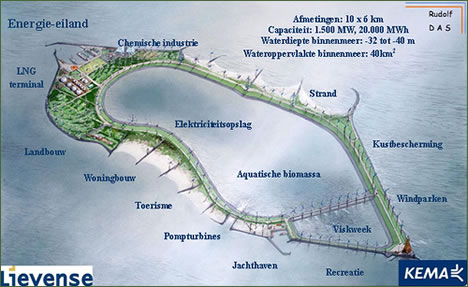
Last year I came across the story of Dutch company Kema and their energy island idea - basically a variant on the usual pumped hydro energy storage concept where water is pumped out of a space below sea level then allowed to flow back in, generating power as it does. The "island" uses wind power to pump water out of the enclosed area. An obvious extension to this idea would be to harness ocean energy as well - letting wave and/or tidal power supplement the output of the wind turbines. An attraction of this concept is that it potentially allows a large amount of new energy storage to be brought online - and this storage would be along the world's coastlines, where most of the population lives.
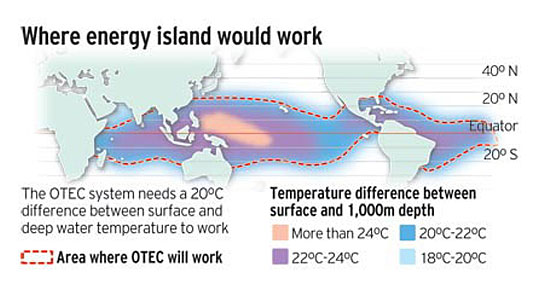
Another form of energy island has been in the news recently, this one a substantially more ambitious proposal which envisions artificial islands to collect wind, wave, ocean current and solar power in the tropics, along with a more unusual energy source - harnessing the difference in water temperatures between the warm surface and the cold depths using a technique called OTEC (Ocean Thermal Energy Conversion).
These islands are being proposed by architects Dominic Michaelis and his son Alex Michaelin as a response to Richard Branson’s Virgin Earth Challenge, which offers $25 million in prizes for innovative solutions for combating global warming.
While the practicality of these particular proposals has yet to be put to the test, the various forms of ocean power are probably the most overlooked of the big 6 renewable energy sources (along with solar, wind, geothermal, biomass and hydro).
Other forms of renewable energy are sometimes criticised for being more intermittent and less predictable than traditional power generation, however ocean energy is much more reliable - steady ocean currents could provide good baseload power, as could OTEC, tidal power is diurnal and highly predictable and waves are predictable days in advance.
In this post I'll have a look at the amount of energy that could potentially be harvested from these sources and the various projects underway to try and make this a reality.
Tidal and Ocean Current Power
Tidal power stations usually take the form of a dam (or barrage) built across a narrow bay or river mouth. As the tide flows in or out, it creates uneven water levels on either side of the barrier. The water flows through the barrier, turning turbines to generate electricity.
Benefits of tidal barrage power generation include :
* Predictable source of clean energy
* No dependence on foreign fuel sources
* Flood protection
* Transport links for road and/or rail
* Better shipping and boating conditions behind the barrier
Disadvantages include :
* The timing of the tides doesn't often correlate with peak demand times (less of a problem if there are good energy storage options available)
* Existing ecosystems behind the barrage tend to be heavily altered
* Likely to stimulate silting in some areas and coastal erosion in others
* Enhance flood risk on the seaward side
* Shipping would have to navigate locks
* Industrial discharges behind the barrage are less likely to be dispersed out to sea
Variations on this theme include offshore tidal lagoons, which use a water impoundment structure and low-head hydroelectric generating equipment on shallow tidal flats, and tidal fences, which are composed of a number of individual vertical axis turbines mounted within the fence structure, known as a caisson.
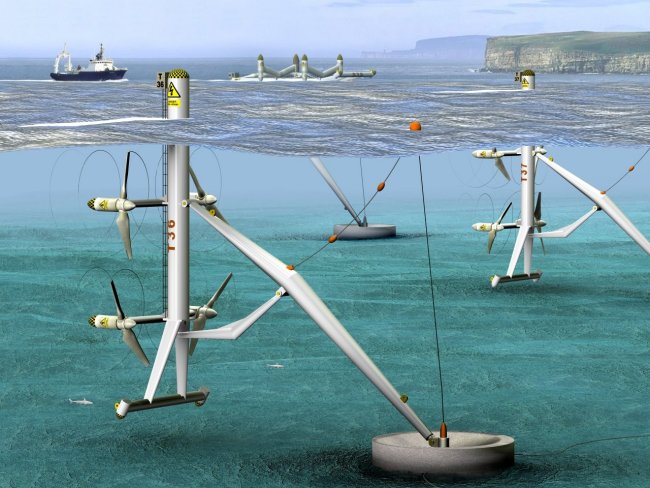
Underwater turbines can also be used to harness both tidal power and ocean current power. The turbines (sometimes called aquanators) are similar to wind turbines. In water moving between 6 and 9 km per hour, a 15 m diameter water turbine could generate as much energy as a 60 m diameter wind turbine. Given the smaller amount of infrastructure required and the larger range of possible sites that this technology could be deployed to, it seems likely that underwater turbines will become much more widespread than tidal barrage style generation.
World tidal energy resources have been estimated at around 3000 GW, however less than 3% of this is located in areas considered suitable for power generation (these figures probably don't include ocean current power, which doesn't seem to be well studied).
A 240 MW tidal-barrage power plant has been operating at La Rance in Brittany since 1966. Other operational barrage sites are at Annapolis Royal in Nova Scotia (18 MW), the Bay of Kislaya near Murmansk and at Jangxia Creek in the East China Sea.
 The largest tides in the world are found in Canada's Bay of Fundy, which has been earmarked to become a 4-berth test site for tidal power generation next year.
On the west coast of Canada, Marine Current Turbine and BC Tidal Energy Corporation plan to install at least three 1.2 MW tidal energy turbines in Vancouver Island's Campbell River by 2009. This the first step in a plan to develop larger tidal farms off British Columbia's coast, which the company says have a tidal energy potential of up to 4,000 MW.
In the United States, at the southern end of the Bay of Fundy, lies Passamaquoddy Bay, which has long been a target for a tidal power development - first initiated in 1935 by the Public Works Administration under the Roosevelt administration, then halted by Congress a year later. John F Kennedy revived the 550 MW project in 1963, however the plan died with him (spawning one of the stranger JFK assassination conspiracy theories I have come across).
Further south, in the Martha's Vineyard area, two underwater turbine projects are trying to get started - one a 300 MW proposal from Oceana Energy Company and the other from Natural Currents Energy Services. Other projects are being considered in the Cape Cod and New Bedford areas - part of a "gold rush" for good tidal power sites (the most desirable ones usually have hourglass figures, to get maximum force in the incoming tide) which has seen the FERC issue 47 preliminary permits for ocean energy projects (and generated mainstream news coverage on the NBC network).
New York's East River is the location of one of the more high profile tidal power experiments currently underway, with Verdant Power experimenting with underwater turbines there. The first attempt eventually ended in failure, with the strong tides breaking the devices.
The Gulf Stream has also caught the eye of hopeful ocean energy companies, particularly in Florida, with the 30 mile wide current pushing 8.5 billion gallons of water along per second and prompting some observers to consider the prospect of "Infinite Underwater Energy".
Californian utility PG&E is also investigating tapping tidal power in San Francsico Bay, with some observers talking about a plant of up to 400 MW in size.
Another bay famous for its tides is the Severn river estuary in Britain, with a tidal range of 14 metres. Plans for damming the Severn estuary or Bristol channel have existed since the 19th century (with tidal power generation being just one proposed application). The UK government recently proposed a new barrage design, which could produce 5% of the UK's electricity requirements, with a peak rate of 8.6 GW. A feasibility study is expected to be complete by 2010. An alternative proposal, by Tidal Electric, involves a series of lagoons, the first of which would be built in Swansea Bay. Some observers have noted underwater turbines may be more appropriate than a barrage.
 Pentland Firth in Scotland is another UK location that is considered to have a large amount of tidal power potential - a DTI study in 1993 indicated that if all potential sites were developed, the total UK tidal stream resource could be about 60 TWh. Of this, almost half (28 TWh) could come from the Pentland Firth. The water depth is 60m or more, making potential energy capture huge but technically difficult - 63% of the tidal stream resource is estimated to be in waters deeper than 40m.
Marine Current Turbines launched the world's first underwater turbine project off north Devon in 2003. MCT also began installing a 1.2 MW "SeaGen" tidal current turbine in Northern Ireland's Strangford Lough in 2007, with the company planning to scale up to build a 10MW tidal power farm off Anglesey in North Wales, and to have 500MW of tidal capacity by 2015. Also in Wales, Lunar Energy and Eon are hoping to build an underwater tidal project off Pembrokeshire.
Another UK tidal power proposal is part of a plan by Metrotidal to build a tunnel under the Thames, currently under fire from environmental groups. There is also talk about regions like the Isle Of Wight and the Humber estuary harnessing tidal power as part of initiatives to become energy self-sufficient (like other "Transition Towns").
Norway has also begun investigating the use of tidal power, with an experimental facility opening in Hammerfest in 2003. The company that developed that technology, Hammerfest Strøm, is working with Scottish Power to develop a project near the Orkney Islands (the islands have also been a test site for another venture by Lunar Energy and Rotech).
There has been no tidal power development in Australia thus far, though the Kimberly region has long been a target for would be developers of tidal power projects, due to its enormous potential (a tidal range of 11 metres). Thus far all of the proposed projects have been stymied by the remoteness of the location from the Western Australian and national electricity grids and by environmental concerns. A number of possible sites have been identified, including Secure Bay, Walcott Inlet, George Water and St. George's Basin.
Liberal backbencher Wilson "Ironbar" Tuckey has been the most vocal supporter of a Kimberly tidal project, pointing out if a link was built to the eastern states grid it would obviate the need for any consideration of nuclear power. Some Kimberly tidal power advocates have also tried to base the idea of a "hydrogen economy" on the resource, though this seems a lot more far-fetched than a grid link (the grid link could also potentially include large scale CSP solar in the western australian deserts, which are one of the best solar resources in the world) .
The Bass Strait area is also considered to have significant potential for tidal / ocean current power generation (one estimate claiming there is potential for 3000 MW of generation in the channel between King Island and Cape Otway).

New Zealand is another country with large tidal resources but without any existing tidal energy generation. According to TVNZ, there are at least 24 wave and tidal power projects currently under development. Trying to get a handle on who might be behind these projects isn't easy - there is an NZ wave and tidal power association, but it doesn't list members or projects - according to their latest newsletter they have 59 members. Crest Energy seems to be the most prominent local company, with a plan for a 200 MW plant in Kaipara Harbour using underwater turbines. Other potential locations include Manukau and Hokianga Harbours, and Tory Strait and French Pass in the Marlborough Sounds. The harbours produce 5 to 6-knot currents and tidal flows of 100,000 cu m a second from the flood and ebb tides, with tidal volumes 12 times greater than the flow in the largest local rivers.
The Phillipines is another potential location for tidal power, with a 2.2GW tidal fence proposed for the Dalupiri Passage using the Davis turbine, from the Blue Energy company and an estimated cost of $US 2.8 Billion is unfortunately on hold due to political instability.

South Korea also has ambitions to generate power from ocean currents, with pilot underwater turbines being installed at Uldolmok, in the country's south-west. Researchers at the Korea Ocean Research and Development Institute (KORDI) chose the site because it has flows up to 12 knots, believed to be among the fastest in Asia. The strong currents have resulted in a number of accidents, hampering progress. KORDI is also trying to improve the efficiency of more conventional barrage-type tidal power plants. The primary project involves building a power plant with a capacity of 250 MW at Lake Sihwa, with another plant up to 520 MW being considered for Garolim Bay.

Taiwan is another Asian nation considering the the possibility of large-scale ocean current power generation. There have been discussions about using the strong Kuroshio current off the east coast of Taiwan to generate up to 1.68 trillion kilowatt-hours per year (compared to Taiwan's current annual demand of electricity of around 98 billion kilowatt-hours).
Wave Power
Surface waves and pressure variations below the ocean's surface can be used by floating buoys or submerged platforms to generate intermittent power. Wave energy sources are widely available, are relatively consistent and predictable and (According to analysts Frost and Sullivan) have the highest energy density among all renewable energy sources. The best resource is found between 40-60 degrees of latitude where the available resource is 30 to 70 kW/m, with peaks of 100 kW/m. The potential global wave power potential has been estimated to be around 8,000-80,000TWh/y (1-10TW), which is the same order of magnitude as world electrical energy consumption.
The UK, for example, is estimated to possess the capacity to generate approximately 87 TWh of wave power per year - equivalent to almost 25 per cent of current UK demand. There are two main research centres in Europe focusing on the development and commercialisation of ocean energy technologies. The first is the European Marine Energy Centre located in Orkney, Scotland, which provides developers with sites to test their prototypes. The other is the Wave Energy Centre in Portugal.
Wave energy ideas are plentiful but real world examples are still rare - there are around 1000 patents for wave energy converters currently on the market and no consensus has emerged yet on which technologies will succeed.
 Australian company Oceanlinx (previously known as Energetech) has had a 450 kilowatt wave power unit running at Port Kembla in NSW for a number of years, and plans to connect to the commercial power grid in early 2008. Oceanlinx is also at the advanced permitting stage for a project in Portland, Victoria which would deploy eighteen 1.5MW units for a total capacity of 27MW, which the company claims will be the largest wave energy project in the world.
The company has other projects planned in Rhode Island, Hawaii and Namibia, and intends to participate in the South West of England Regional Development Agency's "Cornwall Wave Hub" in the UK.
The Cornwall Wave Hub aims to create the world's first large scale wave energy farm by constructing a wave hub, or "socket", on the seabed. Oceanlinx is participating along with Ocean Power Technologies, Fred Olsen Renewables and WestWave. Ireland is looking to build a similar grid connected test facility on the Mullet Peninsula in Ireland's County Mayo. While the marine renewables industry in the UK seems to be quite vibrant, government programs to fund the sector have been criticised for not spending the money they have been allocated.
 Another Australian company, Carnegie Corp has installed a small array of its CETO II units off Fremantle in WA, and is looking to set up a 50 MW facility in South Australia to desalinate seawater for the Adelaide market and the mining industry. The CETO technology was devised in the 1970s by Carnegie's chairman Alan Burns, a well-known Perth oil man who also founded Hardman Resources. It operates mostly underwater rather than on the surface like many buoy based alternatives, which the company believes will result in a much lower likelihood of damage from storms and rough conditions.
Another Australian company exploring wave (and tidal) power is Sydney based BioPowerSystems, which is trying to is commercialise "biomimetic ocean energy conversion technologies" (an example of "biomimicry", which I'll be doing a post on at a later date). BioPower has been awarded a $5 million grant under the Australian Government's AusIndustry Renewable Energy Development Initiative to test prototypes of the wave energy device (most likely at King Island) and the tidal energy device (at Flinders Island), with each generating around 250 kW.
 Pelamis Wave power is a Scottish company that is constructing a 3 MW wave farm off the coast of the Orkney Islands. The company is also involved in the construction of a 2.25 MW plant in Portugal at Aguçadoura, which will soon be expanded to 20 MW, and is providing the technology for the WestWave project in Cornwall. The Pelamis design is a distinctive device resembling a 150m long red snake.
The Scottish government is considering building a connection linking the north and west coasts of Scotland with England, Norway, Germany and the Netherlands by 2020 which could be connected to the proposed European Supergrid, with the aim of harvesting up to 10 GW of wind and wave power.
Spain is also dipping a toe into the waters of wave generation, with a 300 kW "breakwater wave energy plant" being constructed on the north coast, using Wavegen (now owned by Siemens) equipment.
In the US, the wave energy company getting the most attention has been Finavera, which has received preliminary approval to build a 100 MW facility off northern California (and has signed a power purchase agreement with PG&E for part of this). At hasn't all been plain sailing for Finavera however, with a test AquaBuoy device sinking off Oregon late last year.
The Electric Power Research Institute (EPRI) estimated that waves off the Washington, Oregon and California coasts could produce from 250 to 500 terawatt-hours per year - around 12% of US energy demand. Finavera also has approval for a project in Washington state, along with others in South Africa and Canada.
Another US based company is Ocean Power Technologies, which is looking at developing projects in Hawaii, New Jersey and Spain.
OTEC
Ocean Thermal Energy Conversion is not a new idea, it has been around for more than a century. OTEC uses the temperature difference between warm surface water and cold deep water to drive a power-producing cycle. For this to be practical, the temperature difference needs to be at least 20 degrees C, which tends to limit potential application to the tropics. The potential of this energy source has been estimated to be about 10 TW, according to some experts.
The economics of energy production today have delayed the financing of a permanent, continuously operating OTEC plant. However, OTEC is promising as an alternative energy resource for tropical island communities that rely heavily on imported fuel. OTEC plants in these markets could provide islands with power and desalinated water. Other applications that have been considered are aquaculture and mineral extraction.
OTEC plants have been trialled in Nauru and India (along with extensive research in Hawaii). There are also plans to build plants for the US military base on Diego Garcia, and in the Marianas Islands.
One unusual apparent application of this energy source that I came across recently is a robotic "thermal glider" which, at the least, seems like a very interesting tool for environmental monitoring.
Regular news updates on OTEC can be found at OTEC News.
Energy Island Ideas
The thinking behind harnessing ocean power has traditionally focussed on systems built on or near the shoreline. The amount of power available is large, however we are still at the very early stages of learning to harness it, and it is unlikely that ocean power will provide a significant proportion of our energy needs in the next decade or two.
The Energy Island concepts that I began the post with show that people are now beginning to consider harnessing ocean power out at sea as well, which vastly increases the amount of energy that could be tapped.
(The term "energy island" is an overloaded one unfortunately - the Danish island of Samso, for example, calls itself Energy Island as it is completely self-sufficient. There is also a "solar island" being developed off Dubai known as Ras Al Khaima.)
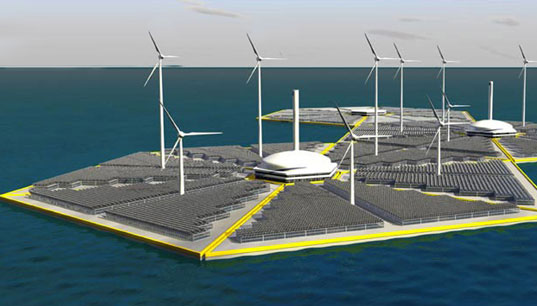
Dominic Michaelis' energy islands are by far the most ambitious plan I've seen for harnessing ocean power in the open seas. These hexagonal islands, are designed to generate electricity using wave, ocean current, OTEC, wind and solar sources. The group estimates that each island complex could produce around 250 MW of power. 50,000 energy islands could meet the world’s energy requirements - ands provide two tons of fresh water per person per day for the entire world population as a byproduct of the OTEC process.
The island design also supports farming seafood in small pens below deck and growing vegetables in shaded areas on the platform. The group is planning to conduct a pilot in the waters off the British Virgin Islands or in the Indian Ocean over the coming year.
Most observers consider the likelihood of energy islands appearing in the near term as remote, however the ideas are thought provoking and put into context just how much energy could be obtained out at sea.
One of the main issues with generating power offshore is how to store or transfer the energy (assuming that the islands don't simply become mobile aquatic arcologies of the sort science fiction writers used to dream about). One possible way of storing the energy would be to produce hydrogen, and to use the islands as refuelling stations for ships that use hydrogen fuel cells. Alternatively, the energy could be used to process raw materials, or to produce materials like ammonia.
Crossposted from Peak Energy.
Contact
- anz at theoildrum dot com
License

This work is licensed under a Creative Commons Attribution-Share Alike 3.0 United States License.
Archives
- November 2010 (2)
- October 2010 (5)
- September 2010 (4)
- August 2010 (8)
- July 2010 (2)
- June 2010 (2)
- May 2010 (6)
- April 2010 (7)
- March 2010 (12)
- February 2010 (11)
- January 2010 (7)
- December 2009 (10)
- November 2009 (6)
- October 2009 (7)
- September 2009 (10)
- August 2009 (10)
- July 2009 (3)
- June 2009 (14)
- May 2009 (10)
- April 2009 (15)
- March 2009 (16)
- February 2009 (16)
- January 2009 (15)
- December 2008 (15)
- November 2008 (23)
- October 2008 (25)
- September 2008 (24)
- August 2008 (30)
- July 2008 (44)
- June 2008 (38)
- May 2008 (48)
- April 2008 (43)
- March 2008 (29)
- February 2008 (32)
- January 2008 (30)
- December 2007 (26)
- November 2007 (32)
- October 2007 (11)
Some time ago, there was some noise about another energy island project using a variation of OTEC, Biomass and Solar Energy:
http://www.mareinitiative.com/
not much detail known so far
" The first attempt eventually ended in failure, with the strong tides breaking the devices."
failure is relative. they just found out the hard way that they have more power available to them than they thought.
When I see a wave break I wonder how much power was just wasted because we didn't capture it. wave and tidal are very interesting because so much of the population is near the coasts.
Sure - failure is relative - like the Korean problems, these are teething problems - harnessing the tides and currents is likely to be a lot more difficult than harnessing the wind has been. We'll see plenty more failures over the years...
oh you doomers.
Great Article!
Minor point of editing.
The project in BC, Canada is noted as "three 1.2 MW tidal energy turbines in Vancouver Island's Campbell River by 2009."
Which makes it sound like it's in a river. It should say"
"Three 1.2 MW tidal energy turbines in Seymour Narrows near the City of Campbell River, on Vancouver Island."
Seymour Narrows is quite famous around these parts, both for its deadly whirlpools swallowing fishing boats and the rocks, known as "Ripple Rocks" that used to sit right in the middle of the Narrows and were noted for their danger by Captain Vancouver himself in the 1700s and claimed many lives.... a tunnel was dug across the narrows and up underneath... packed with 1375lbs of dynamite, and blown up in 1958. Largest civilian explosion in the world that i know of.
The Rocks are gone.. but the incredibly strong currents remain. A perfect place for tidal energy.
Really interesting link, but a minor point, it was 1375 tons of dynamite!
lol. yes. sorry, that is of course what i meant. Here I am correcting people.... :)
I wish I coulda been there to see it!
Must have been quite a bang. Where was YouTube when we needed it.
Thanks for the additional info.
Never fear, YouTube was there!. I suspect an application for regulatory approval for a similar project today wouldn't get far.
Ripple Rock was blown up because it was a hazard to navigation. A tidal power scheme at the same site would have to be pretty neatly designed to forestall the same calls for removal.
Awesome :-)
Thanks for digging that one up.
How deep is the channel ? A lot of the underwater turbine schemes talk about avoiding blocking channels so that shipping can still get through...
The depth over the remains of Ripple Rock is 13-15 m at low tide. Ripple Rock sits just about in the middle of Seymour Narrows. On either side the bottom drops away to over 55 m. The channel is just 750 m wide and about 3.2 km long. The tidal current reaches 7.7 m/sec, and Ripple Rock results in very strong local upwelling.
The Alaska cruise ships pass through Seymour Narrows, clearing what's left of Ripple Rock with only a few metres to spare.
Just a minor editing note:
I've heard of spontaneous combustion, but that must have been SOME fart!!
Ah... I love irony.
;)
Cheers
While tides and ocean currents can doubtless be used safely on relatively small scales, I'm concerned about the effects on weather and climate if we start to drain energy out of ocean circulation on a large scale. I have some of the same concerns about atmospheric circulation as well. Do we have any idea how much energy we can drain before we upset cirulation patterns? I don't think so.
Energy is not "wasted" just because we have not tapped it for electricity. The earth is a dynamic system, and we understand very little how about tapping natural energy will affect it. It would be exquisitely ironic if, after building hundreds of thousands of underwater turbines, we find that we have altered oceanic circulation, and those turbines now stand idle in stagnant sections of ocean.
Hmmm...let's say we covered 1% of the earth's surface (land and oceans) with CSP plants...wouldn't that mean that the sunlight energy striking that 1% would go towards heating up the oil in the CSP plants, which would go towards driving the oil and steam loops and producing electricity in those plants, INSTEAD of heating up the ocean? Wouldn't that effectively reduce the average solar flux from 1365 W/m^2 to 1350 W/m^2, which would theoretically offset increased heat retention from GHG?
Only if you don't use (or waste) the eletricity. If you don't stockpile it, it'll be converted into heat. Alied to that, the CSP plant has a lower reflectance than the original surface, so you'll increase global warming.
But a nice way to stockpile energy would be converting CO2 into coal :)
What is the albedo of a CSP plant? Of the water it would replace? What increase in global warming can be assigned to any 30-35% efficient thermal plant regardless of the GHGs they might produce?
You mean, like making bio-char and holding it as a reserve?
Very low; the whole point of a CSP plant is to capture solar radiation as heat. Once it's heat, it's got to escape via radiation.
IIRC the albedo of open water is around 0.1.
Given that we only need one tenthousandth of the solar energy at the earths surface to replace ALL of our FF usage, I'm not particularly worried about the change of albedo from CSP (or PV). We are decreasing the earths albedo substantially, via the loss of snow and ice cover from global warming. That effect is orders of magnitude higher than albedo changes due to solar power. Of course if we expand our energy usage a hundredfold, it would be an issue.
I don't have numbers to offer here, but the amounts we could, practically speaking, harness are quite small in percentage terms. In contrast, there has been a credible case made that CO2 venting from FF use could shut down the gulf stream entirely. The risk of using tides and currents - and wind, which is even less likely to pose a problem - seems orders of magnitudes less.
Your points are well-motivated and well-made though, and would be worrisome if we could tap a significant percent of the power. We won't.
If we could build these out AND declare war on coal, the planet would be better off...
I don't think we ought to assume that small percentages don't matter. The research into the effects is never done, probably because it seems laughable that anything humans could do would be so small to matter. I think many still use that argument to deny anthropogenic global warming.
I don't assume that. Many times that assumption has been made and it has been wrong. CFC's, phosphate runoffs... hell, hundreds of things. I agree with you. However, I was speaking about having a sense of proportionality versus the greenhouse effect of coal-burning which is the default otherwise and which is reliably predicted to mess up the entire planet, probably including changing the ocean currents and definitely altering the winds.
It would be a shame for a misplaced precautionary principle to prevent our substituting wind and water power for coal, because the already-occurring fluctuations are probably orders of magnitude greater than what humans would affect by tapping into it, and I've never seen a mechanism proposed, nor can I think of one, by which the large-scale dynamics would be disproportionately affected. Of course, living communities of animals are often exquisitely in tune with tidal effects and they'd be locally optimized for ocean currents, but my statement stands as a pretty educated guess.
Oh, I wouldn't want us to abandon the idea of removing fossil fuel energy sources and using potentially renewable sources. But what I'd like us to do is accept the earth's limits, try to determine what is a sustainable level of resource use (including as much of the impacts as we can) and then plan to live within those limits. I think the acceptance must come first as proposals for energy would then be predicated by what is sustainable.
But it seems vast technology proposals are now emerging and, as far as I can tell, all assume that we actually need to power our societies to continuous economic growth, indefinitely.
No argument, sofistek, I'd like to see that happen too. If it were up to me we'd seal the coal mines tomorrow and draw lots to voluntarily reduce the human population to a billion before christmas. That won't happen, though, and your notion of "acceptance (of reasonable limits) coming first" is unfortunately also unlikely.
We don't need to power our societies 24/7, we don't need to drive around, we don't need to sustain a 6+ billion population, we don't need "growth", etc etc. However, being stuck as a member of a delusional race of pyromaniac apes, I'd settle for wind and tide energy about now.
"But it seems vast technology proposals are now emerging and, as far as I can tell, all assume that we actually need to power our societies to continuous economic growth, indefinitely."
New technology (or use of it) should be pursued, but I tend to agree with you. Preservation of current standards seems to be the underlying theme...
I can't help but notice the double standard here, when similar arguments are applied against nuclear power.
The infinitesimally small probability of nuclear accident that could affect the environment in any significant way is used to deny this energy source, while the fact that it is the biggest non fossil fuel source of energy, which can be readily scaled up is simply ignored. The precautionary principle obviously can be applied selectively.
On the other hand tidal barges or river dams have very real (not just theoretical) impacts on the local ecosystems, but this is again ignored... what is important is labeling something "renewable" and this makes it the synonym to clean. Clean like renewable ethanol from corn for example. It would have been funny if it was not that sad.
You talkin' to me about double standards, fella/m'am? This seems to be a reply to my post.
I don't recall having made any such arguments against nukes. Are you just speculating that I might have a double standard, or what?
In fact, to the extent they'd be used to displace coal - and to that extent only - I think nukes should be pursued. I also think that after catabolic system collapse of human society, a number of the pools of stored fuel rods will likely dry out and go chernobyl, and you may take that as an index of how much I dislike the prospect of burning coal.
On the other hand, as I've said, I can't imagine a mechanism whereby using a bit of wind or tidal energy would mess things up much by comparison.
No doubt Levin will speak for himself, but to my eye this did not read as a critique either of yourself or big Gav, who wrote the article, but was more of a general comment on how nuclear and renewable energy proposals are often presented and evaluated.
My own particular frustration, and again it is not, in my case anyway, a comment in any way on your or Gav's standpoint, is that many do not realise how long it would take to develop and deploy in great numbers technology as immature as this.
Capital cost issues are also important, as it is clear that in a post peak world there won't be money to throw around, but we should certainly investigate this and other renewable technologies and use them whenever it is possible and not grossly uneconomic to do so.
Thank you - I think that is a fair assessment of the situation.
I'm certainly not suggesting ocean power is ready for a large scale build out just yet - and the costs of doing this are still very unclear.
At this point CSP solar and wind are the renewable technologies that can clearly provide energy at a reasonable price and can be quickly scaled up. They will need energy storage as well to be used beyond a certain point. Most of the other promising options still have quite a way to go before they can provide a large scale alternative source of energy.
Obviously there is scope for increases in hydro and (traditional style) geothermal power, but they aren't game changers.
Biogas may also be able to provide a significant amount of energy - but I haven't researched this well enough to be sure of the scale of the opportunity.
As regards affordable costs Gav, interestingly enough I have (provisionally) come to conclusions which are almost a mirror image of yours!
To take them in reverse order, from the (limited) information which I have, it appears to be economic, unlike ethanol from corn.
How it will scale I don't know, as it can be used in a relatively small way to make biogas from municipal waste and sewage, or at a lager scale from waste from crops or the crops themselves.
Care would have to be taken that the same problems do not arise as with ethanol, with agricultural areas diverting too much of the food supply. but the information I have to hand seems to indicate that it is much more efficient than ethanol.
I don't know how accurate the information I have is, but here are some links - biogas is very important in Sweden, and Germany expects it to play a big role, but they have not got all of their legislation in place to develop it to best advantage:
http://biopact.com/2008/01/report-biogas-can-replace-all-eu.html
JoSmith in comments on the following link kindly provided a complete translation of the report:
http://thefraserdomain.typepad.com/energy/2008/01/all-eu-natural.html#co...
Here is a link which compares the energy you get out of different biofuels - according to this, at any rate, biogas looks good:
http://biopact.com/2007/12/biomethane-presented-as-most-efficient.html
I'll put in another post a bit later some comments on costs of CSP and wind, briefly they both look pretty pricey, depending on location for wind, but so far at any rate CSP is dear - more later - dinnertime!
I'm sorry you took this against yourself.
It was directed in general towards the criticism against nuclear power, which for the most part I'm finding baseless and full of nitpicking and biased preconceptions. I assumed the fact you were not talking nuclear here would be a hint I was not arguing you, and in fact I was continuing your own argument in a different context. But now I realise I used the word "here" in my first sentence, which was misleading... sorry again.
OK, no harm done. There's something about the contemplating the possibility of runaway global warming that just puts me in a testy mood, seemingly. Those pools of spent fuel rods will come back to haunt us, though. The way things could be done versus the way they have been done provides quite a contrast, and since I think civilization will collapse to far simpler forms, I like energy systems which decay gracefully.
I am familiar with this argument, but I don't accept it... I think I have quite a cynical view of human nature, but in my view a collapsing civilization would be the worst environmental nightmare ever - I see us eating or burning through every bit of natural resource left on this planet as a result. I think human species were never in some dreamed of ecological equilibrium with the nature, and have been overhunting an overharvesting even in prehistoric times - they won't be doing it neither on the way down, nor when they reach the supposed bottom. Just think about it - after FFs are gone the easiest to access and harness energy source using even low tech is... wood. How will 7-9bln.people harvest wood sustainably? What will happen after all forests go?
The bottom line - our civilization has just one way to go technologically - and this is up, even in a scaled down and less consumption oriented version, but it still has to be up. The alternative is simply too horrible to even contemplate. Like we shouldn't live as though we would die tomorrow we shouldn't plan with such idea in mind either.
But let's not hijack this thread, I already did enough harm :)
Talk about a Pollyanna moment! Problem is, history teaches otherwise. Yes, eventually recovery and advance will occur, but it often involves a very serious decline or total collapse first. This isn't doomer sophistry, that's simple history.
It's important to keep in mind we are not talking about a single nation collapsing, which in the wider view wouldn't mean much to humanity, we are talking about possible Dark Ages stuff, globally.
Then again, can't achieve a goal if you don't have one...
Cheers
I doubt it.
Fission products include such important and scarce elements as iridium; in a mere 30 years those fuel rods are going to be better than a gold mine, they'll be a platinum mine.
Off by one row. For iridium read rhodium. No platinum.
Not sure fission-generated light PGMs will ever be worthwhile, but fission-generated xenon is good nonradioactive xenon, and xenon is otherwise hard to get.
How shall the car gain nuclear cachet?
Rhodium price currently is upward of $9100/oz. 4 times as platinum. AFAIK it is irreplaceable in auto catalytic converters and in a broad range of chemical processes. Obviously a precious thing.
I guess future generations will indeed mine and reprocess the spent fuel in Yucca (if it ever gets built). Obviously the current class of corrupted political morons has to expire before some sense of reality gets some hold.
And there has to be a massive change in public opinion, which is very unlikely to happen...
I don't think it is correct to give up on doing what is right because of some folks prejudices.
It seems to me that the balance of opinion is slowly changing, as costs and the problems of generating power by fossil fuels become clearer, and the true vast costs of the small amount of power (other than hydroelectric) we get from renewables sink in.
Many of the more reasonable critics are coming over, however reluctantly, and in general I doubt that as a political force that the anti nuclear movement will last much beyond peak oil and the first power cuts.
However, that they can do considerable damage in the interim is undoubtedly true, and it is ironic that a way of thinking which purports to be about saving the planet should contribute so greatly to GW and the destruction of it.
It was wholly reasonable after TMI and Chernobyl to pause and reflect, and the concerns of people about safety need answering.
Most of the alleged other 'issues' such as wastes and shortage of fuel and so on are red herrings, with the flimsiest basis.
If we want to do something about GW it seems IMHO bordering on the criminal to lightly cast aside the only proven means of running our society and mitigating carbon emissions greatly.
We have wasted 30 years in tackling them, and further hesitation in the light of the information we now have available is ridiculous.
I have no doubt that some of the most strident of nuclear power will declare their intention of not being bound by the decision of the majority, and avow their intention to throw their toys completely out of the pram, regardless of how many might suffer form hypothermia due to their actions, but it seems to me that this needs taking on, not surrendering to.
Reasonable doubt needs reasonable answer, but some of the attitudes and prejudices go way beyond that.
Please list the 400 - 1000 sites in the US where nuclear plants could be built.
Please list the many thousands of other sites where they might be built.
Please list where the 3 billion+ per plant comes from in a resource and financially constrained world comes from that is also paying for AGW, etc.
Please explain how a near- or even mid-term peak is helped by construction processes that will stretch decades.
I don't think constantly harping on nuclear as the answer to PO or anything else is very productive if you cannot provide answers to the above.
Wheat from the chaff.
Cheers
I am not familiar enough with the US to answer your questions on that country.
In the UK however we can use old coal plants for the 50 or so sites needed, as most would be in a double reactor configuration, and coal generation sites would already have much of the needed infrastructure and transmission capabilities.
Here is a list of sites which are under current consideration for the first build:
http://www.berr.gov.uk/files/file39030.pdf
file39030.pdf
These just use existing nuclear sites.
This would not answer your question fully, as we would be trying to replace current gas supplies too, but before we get to that stage we would have many years to allocate sites.
The US with it's vastly greater land mass is presumably at least as well situated.
And please note that I am by no means trying to argue that nuclear will do the whole job everywhere, it seems likely to me that, for instance, solar power will make a huge contribution, as might wind power in some locations.
Heat pumps, insulation and so on are also extremely important, so I am just seeking to argue that it is silly to discard help from nuclear, so IMHO that hardly qualifies as an obsession.
As for the cost, at £66 bn for 33GW of nameplate capacity in the UK, actual energy flow around 10-11GW, that appears to be roughly twice the price of the same power from nuclear, so if we can't afford that we certainly can't afford the alternative.
Again, please note that whenever it is reasonably economic to do so, such as in the plains of America, very possibly, I have nothing at all against using renewable resources.
If you are talking about building massive grids to shunt the power round absolutely everywhere though, that is when the cost goes through the roof.
Whatever we do we are not going to halt GW gasses instantly, any realistic program is going to take decades and must be combined with measures to try to take up the ones we have already emitted, such as agrichar, and incidentally it should be noted that GW gasses are already at a substantially higher level than they would have been with a larger nuclear build.
So IOW it is incorrect to feel that I am against renewables - I want to use all the options wherever they are most appropriate.
I hope you find this a responsive answer.
I do in part. Perhaps the biggest issue is that you are looking at a local solution but we are talking about a global problem. I'm not sure I see the utility of discussing PO or GW in those terms. At least not on this board. There are TOD Local boards, though.
Second, your piece is full of assumptions about locations existing. The need for safety and the need for water are limiting problems. You can't just put the reactors anywhere. Some limits are socio-political in nature and might be overcome, but I'd be surprised in most cases. Nuclear doesn't really solve our problem. It's a solution for the wealthy, basically. When you add in the problems with waste and cost, you end up with a solution that creates more problems in the end.
There may be resource issues with renewables, too, given a large enough global population, but at least I can grow trees to build windmills out of and grow straw to build homes out of, etc.
Considering the money nuclear would take from other, more sustainable solutions and the time it will take to get them all built - time in which further developments of renewables will almost certainly occur - I don't think the value is there but for those locations where other solutions don't exist or are significantly inferior.
Cheers
Well, I hope you appreciate that it is a tleast an attempt to answer any genuine question.
I really feel it is most useful to separate the, as you put it, socio-political angle from the technical, as if you can't physically do it then there is no point in getting involved in the politics, and if you can, politics can change.
I suspect that the first cold snap without sufficient gas supplies will effectively end the power of the anti-nuclear movement, in Britain at least, and although, as I said, I have a far easier case to make then Gav as I am fully prepared to make use of renewables whenever that is the best option, but in addition to being prepared to use all the resources he is can call on nuclear power in addition.
So in fact, to make my case in the dispute in this thread, that it would be silly to write off nuclear power, I would only have to demonstrate that nuclear could make a contribution, and since it currently supplies around 20% of Britain's total nuclear capacity and more of it's baseload just re-developing those sites with modern nuclear reactors would be a significant amount of power and a large upgrade, and the same would apply in the US, so in effect there is no case to answer.
Just the same I have no wish to evade the question, but the problem in discussing issues inthe US or still more in the world at large is really one of scale, and also I obviously have no detailed knowledge of the areas.
In many ways in the US it is often more helpful to discuss on a state by state basis, as for instance water resources will be far more of a problem in Nevada than New York.
Just the same, since I live in a small and very crowded island, perhaps if it seems reasonable that we can provide enough sites here, then the US should be fine.
Actually, I am somewhat surprised that you should consider it a problem, as certainly in the UK there are many, many places with access to all the requirements that I am aware of for a nuclear site, and can only really conclude that you are in fact implying a possible shortage by reference to your 'socio-political' criteria -IOW, it has not got a great deal to do with technical issues.
To illustrate what I mean, perhaps I could trouble you to go to Google Earth, and Bristol,in England, which is where I live.
If you go a few miles north and west of the city, on the Severn estuary, you will come to Hinckley point, by the bridge, one of the sites under early consideration for a dual reactor.
So if you take that criteria as the needed distance form a major city, and look along the coasts of the whole of the South-West of England, and the whole of Wales, that is the only reactor until you get to North Wales.
As far as I can see it looks like you would have ample locations for the whole of a British reactor build to power the whole country just within this small part of the country.
Of course this is not going to happen, and of course they like to be where there are already power connections and proximity to population centres, but still, I feel it is pretty clear that there is no technical problem at all in siting all the reactors we would need-plenty of coastal points with plenty of water.
I have great hopes for renewables too, but at present costs are very high, and it seems only prudent to proceed as rapidly as possible with a nuclear build then see how renewables pan out.
If you really want to screw up, all you need to do is follow a theory! - and basing a substantial amount of the power for our society on renewables is still a theory - I can point to a minimum of 75% of electricity from nuclear at reasonable power rates in France.
I don't doubt that.
I believe that is a mistake, but I studied psychology and am a teacher, so... This is a question of dichotomy. In most dichotomies the flow is bi-directional. Not wise to inore half the flow.
I think I have arued clearly that nuclear has some utility, but not as a major part of the answer. France built their nuclear grid durin a time of relative plenty for Western nations. The future decades, should Climate Change, PO and Chaos fully assert themselves, will not provide the stable environment, the time frames or the money to build out infrastructure on that scale.
Cost is cost and time is time. You don't seem to be addressing this. We seem to disaree on fundamentals, so have probably taken this as far as we can. My key limiting factor: time. On that basis alone, nuclear fails as a major answer to the challenges ahead.
To repeat, I think this is the proper approach for any and all areas. Solutions will be localized in the short term, probably the medium term (if I'm right about time), and will go global only in the long term. Essentially, during recovery. In fact, that might be one of the ways in which economies rebuild. Personally, I'd like to see the world remain localized in practice, but remain a "small world" in terms of communications, knowledge sharin, etc.
I'll defer to your greater knowledge here, but isn't water one of the great limitin factors for nuclear? It's expected to get quite scarce over great swathes of the US. Even the Great Lakes are falling rapidly.
Again, time.
Cheers
We could be in the middle of a major nuclear build by 2020, and it seems to me unlikely that any alternative is going to have huge effect before then - there are major issues such as power storage, intermittency and transmission with renewables which have less effect on nuclear, and so it is unclear why they should have a major impact any faster.
We both agree that conservation is important in any scenario.
On water issues it is clear that in the UK at least all the build could be done on the coast very comfortably, and since you have the whole of the east and west coasts and the great lakes to play with in the US it seems improbable that water shortages there would be a major hindrance other than locally.
As for the scale of the problem, the latest post on the Olduvai Gorge makes it clear that the numbers needed for the nuclear option are really very small, and that is based on 1GW plants, not the modern 1.6GW.
So for Britain we might need 1 reactor a year at peak, and for America perhaps 10 - why not worry about not having any more room for them when we run into problems?
It seems very unlikely we will.
In any case all these figures will be reduced by whatever the solar and wind build does, so the problem really seems very modest.
So time does not seem more against nuclear build than renewables - and in fact we are much further along in knowing how to run a society built on it - France's nuclear build was substantially completed in 17 years.
Cheers
Dichotomies have nothing to do with natural law. Seriously, the effort of the fuzzy-studies departments to turn everything into a dialectic or "other ways of knowing" is one of the most damaging bits of P.C. indoctrination in the university system. It renders people unable to analyze, think and understand, and is responsible for the collapse of biology in the Soviet Union under Stalin (Lysenkoism). Nature is what nature is, and human society (including politics) ignores nature at its peril.
One could apply this argument equally for e.g. geographically-dispersed networks of wind farms and their associated transmission systems. It appears more apathetic than useful.
It was also a time of steeply rising oil prices, and the USA did roughly the same thing: replaced oil-fired electricity with nuclear. We should have continued and replaced most coal-fired electricity as well, but the environmental movement made a serious mistake and got on the wrong side of that issue.
If the heat production of nuclear fuel can be increased 50% using annular fuel pellets, US nuclear electric generation might be increased as much as 45 GW (~10% of US consumption) before the first Gen III reactor goes on line. I'm all for wind and solar, but large-scale wind requires geographic separation and transmission on a much larger scale than nuclear. We're going to need, and wind up using, all of this.
The post itself notes the issues with tidal barrages, and suggests that tidal lagoons or underwater turbines would have much less environmental impact.
Wave energy and OTEC don't present any obvious environmental hazards.
Nuclear is a legacy technology - the oceans could potentially provide more energy than we get from all sources currently. The sun could provide more than 10,000 times our current energy usage.
Nuclear is too unpopular and has too many side effects to warrant the cost and effort involved in a massive build out - which would still only be a medium term solution anyway.
There are many sources of energy that "could" provide many times more than we need. Ocean currents, methane hydrates, tabletop fusion, solar power - you name it. The ultimate size of the resource has never been an issue - it has always been about the "taps" we are using to harness it. Even oil would be virtually unlimited for the foreseeable future if we could include lower grade oil sources like tar sands, oil shale and CTL. But - we are living in a world with physical constraints and it is unrealistic we can harness all that energy out there, and PO is about those constraints, not only about natural constraints.
The distinct advantage of nuclear, which will make it the energy source of the 21st century is that it is the most concentrated energy source known to humans. You don't need a 10 miles long barge trapping cubic miles of water to get the energy - you need a reactor 6 meters in diameter. It takes orders of magnitude less physical resources to harness such energy source, it is so much easier to maintain and control it - and this will become even more critical in the close future when PO unfolds. Remember that energy concentration was the primary reason we picked oil a century ago... things have not changed that much from back then. Calling nuclear "legacy" won't change this and I'd advise anyone interested to get prepared for a nuclear future... by all indications this is the only feasible outcome (besides civilization collapse of course).
Levink
Along with that concentration of nuclear comes the problems associated with the concentration like the intensely damaging effect on any biological processes if that concentration is not safely handled. The issue that the nuclear opponents have is that we are not confident in the ability of humankind to handle such concentration over the timescales necessary. As simple as that!!!
Even the argument about orders of magnitude less physical resources for harnessing nuclear gets less convincing when the issues with mining, defending, storing reactants etc. are all taken into consideration. It is my claim for example that over the same timescales as nuclear, 1 kg of raw silicon ore will outperform the same kg of uranium, thorium or whatever you care to use when recycling of the silicon becomes accepted practice. Same for wind, the steel tower can be reused indefinitely etc. etc.
One question. How do you absolutely guarantee that in some future war over whatever resource you care to imagine that ubiquitous nuclear plants will not be attacked, damaged and relieved of some or all of its radioactive inventory to the general biosphere. The only way that a claim can be made for an infinitesimal probability of release is if a scenario as described above be next to guaranteed impossible. We all know that such a guarantee is not possible.
Simple.
This has the extra benefit of allowing reactors to be sited below cities, which permits use of the waste heat for space heat during the winter and hot water and industrial process heat year-round. A 200 MWe reactor would produce on the order of 300-400 MW of waste heat; this is 1-1.3 billion BTU/hr.
The Fort St. Vrain high temperature, gas-cooled reactor near Denver had similar construction. A large cast concrete pressure vessel with a steel liner and inner heat shield.
Current pebble bed designs use shop-fabricated steel vessels in underground concrete silos with passive air cooling.
In a war, everything of value or utility is fair game. The question is what is the most vulnerable factors in the enemy's industrial or social base where the risk/reward for an attack is most favorable.
In WWII, strategic bombing tried a number of specific targeting strateges. First ball bearings, then worker morale, etc. What really worked was attacks on petroleum, both in Germany and in Japan. We didn't really understand that until after the war.
It would be much easier in a future war to knockout the whole grid. Remember the electric bombs in Iraq that used conductive strips across power lines. Substations are easy targets for smart bombs and widely scattered.
If the USA is faced with an enemy which can bomb power lines and substations with impunity, it won't be a nation which can build nuclear plants and the point is moot.
A similar argument could be made prior 9/11 for an aircraft attack. Substations and high-voltage transmission lines are indeed very easy targets. It would take just a box of dynamite to leave New York without power. Luckily the harm would be more psychological than real.
Exactly - and silicon and steel are materials we know how to use and are adept at using - we are better off just leaving the uranium in the ground and forgetting about it.
The claim that nuclear power is the only way to avoid the collapse of civilisation is laughable - surely you aren't serious levink ?
Since the world began using electricity, the majority of generation has been from sources which can be scheduled to meet requirements.
We may be able to run a civilization entirely on intermittent flows from solar and wind, but putting all our eggs in that basket is somewhere between risky and batshit crazy. Nuclear is an insurance policy in case the RE engineers (or the politicians who decide what the engineers are allowed to do) get something wrong.
We can revisit the issue of nuclear in 50 years. In the mean time, wind and solar are going to grow like crazy and reveal any problems now kept under wraps by differences in scale. They're all carbon-free, so no worries there.
Sure - I don't have any problem with the idea of nuclear as a backup option.
Just out of curiosity - assuming construction of large scale energy storage to go with the solar / wind build out - and a smart grid with plenty of demand management built in - do you foresee a day where the grid *could* be 100% renewable power ?
Personally I quite like the idea of lots of Kena style energy "islands" built along the coasts with wind, tidal, wave and possibly solar all bundled together - you'd effectively have dispatchable renewable power, everywhere :-)
The issue that the nuclear opponents have is that we are not confident in the ability of humankind to handle such concentration over the timescales necessary. As simple as that!!!
This has always been the underlying reasoning, isn't it? It has never been truly about the risk of accidents or the waste, which history has shown to be manageable problems if addressed correctly (which developed countries do, despite minor hiccups). What it has always been about is the fear of giving the humankind a powerful and potentially destructive energy source; the idea we shouldn't give the kids play with the matches. This begs the question: what if the kid is grown up enough to make its own matches or bombs? Is it prudent to forbid something you know s/he will do, even more that his/her survival or well-being may depend on it? Second: what gives you the right to treat humanity as kids, and what is the point of planning for geological timescales? If people start thinking "what if" they will stop living. If your parents thought "what if my child has a birth defect" maybe you wouldn't be here.
Even the argument about orders of magnitude less physical resources for harnessing nuclear gets less convincing when the issues with mining, defending, storing reactants etc. are all taken into consideration.
This is a myth. These reactants are less dangerous and far less as a volume than you imagine and the fuel spent for a year of plant operation would fit in the back of a truck. And they are not that dangerous - half a centimeter of steel sheet would stop all radiation. Yes if you unshield them and hold for a while you can get sick or even die, but so can you if you drink gasoline or breath its vapors.
It is my claim for example that over the same timescales as nuclear, 1 kg of raw silicon ore will outperform the same kg of uranium, thorium or whatever you care to use when recycling of the silicon becomes accepted practice.
First there is no such thing as "silicon ore". Second I doubt you grasp the scale of the energies involved. One kg of unenriched Uranium yields 554,400 MJ. To get the same energy in an excellent solar location (7kWh/day/m2) using 15% efficient solar cell would take a square meter of solar panels over 400 years!
How do you absolutely guarantee that in some future war over whatever resource you care to imagine that ubiquitous nuclear plants will not be attacked, damaged and relieved of some or all of its radioactive inventory to the general biosphere.
The only thing I can absolutely guarantee is that you and me one day will die. There is no such thing as absolute guarantees and life involves millions of tradeoffs of risks vs benefits. The risk you cite pales in comparison to the risk of the context you put it in (an all out war), but this is not a problem to imply that a radioactive release is the absolute worst evil that could happen ever... just look at Chernobyl - this same "absolute worst evil" did not result in desert ecosystems and millions dying didn't it?
A half-inch of steel does not stop Sr-90 gammas; that's why the casks for transport and storage have so much concrete in them.
As long as we're being pedantic here, Sr-90 isn't a direct gamma emitter. Some X-rays are generated by the bremmalstrung radiation from the betas.
Well, Gav, we certainly differ here.
The reasons why are basically the same as you outline in your article.
I know that you accept that it is far too early to rely on wave energy and OTEC, and it must be realised that sometimes things just don't pan out.
However, it is also clear that we presently can't run out society on wind or solar energy - they can make a contribution, sure, and hopefully it will be an increasing contribution, but they are just not ready to run our whole society and articles like Stuart's on running the whole world on solar energy or recently in Scientific American on running the whole of North America really just make plain that we need massive progress and perhaps even breakthrough technology to be able to do so.
In contrast, only the most modest development on from current engineering is needed to have enough power from nuclear means to run the whole society.
Your objection that it could only be a medium term solution is presumably based on estimates of resources from the Limits to Growth guys, and rely on a once through fuel cycle, little discovery of other resources( we haven't been looking much recently), no use of breeder reactors, and no development of more fuel efficient reactors.
Those interested in a fuller discussion of these issues can take a look here:
http://nucleargreen.blogspot.com/2008/02/will-uranium-run-out.html
For the moment though, and for the purposes of this debate, it is sufficient to note that thorium reserves are about 4 times greater than uranium, and we already have the reactors which can use it.
The interest anyway is mainly in the medium term, as we have to do something until solar, wind, wave and ocean resources can really do the job of running things.
On the issue of nuclear's unpopularity, it seems to me that if it is the best way of getting our carbon emissions under control then the matter must be tackled.
In that connection we might ask whether our decision not to press ahead with nuclear rapidly 30 years ago was correct in retrospect.
I had lots of doubts myself after TMI and Chernobyl, but short of building reactors with no containment at all as at Chernobyl, it is difficult to see major accidents causing widespread fatalities in a modern design.
Just as a thought. exercise, supposing we had went ahead with a major build 30 years ago, and did then with the Chernobyl design and the same ludicrous safety standards, so one blew up every year.
Greenpeace estimates the fatality bill as 60,000. although others like the World Health Organisation say about 100 - quite a difference, and due to what the risk of very low doses is reckoned to be - Greenpeace is saying radiation causes a lot of damage at very low doses, which everyone used to think, but majority medical opinion is now that mortality rates don't measurably increase up to very high doses, and that is how risks are assessed mow by the medical profession for things like x-rays.
Just the same, lets go along with Greenpeace's estimate, so for the last 30 years 60,000 would have died a year, so for the 30 years you would come out at 1.8 million people.
The point of this exercise is that you would undoubtedly save a lot of Greenhouse gasses, and I would have thought that a rise of, say 3 degrees is going to kill an awful lot more people than that- an anyway, our continuing to burn coal over this period has killed people in numbers of similar magnitude.
IOW, making the very extreme risk assumptions nuclear would still have been the best option, and we would now be in a much stronger position on GW.
If we had been in a position to supply off-the- shelf reactors at reasonable cost as we had continued to vigorously advance the technology and moved to mass production, it seems unlikely that China and India would now be engaged in a massive build of coal-fired power.
I would seek to argue that retrospectively that failure to proceed with a very large nuclear build was clearly a mistake.
What does that have to do with the situation today?
Well, in the 60's very few people were concerned with GW, and not many with peak oil.
We now know how very dangerous the situation is, the risks are clear.
At the same time at present although solar and wind power can certainly make a contribution is some areas of the world, it is not realistically possible to come up with a game plan to power the whole of society by these means - we are reliant on hypothetical cost reductions, managing a huge grid which no-one has experience of, much better storage and so on.
We know how to run a nuclear economy, France has been doing this for years, and we have vast experience.
Only modest technological progress is needed to provide power for everyone by nuclear means.
We should, I would argue, proceed as rapidly as possible with a massive nuclear build.
At minimum this would provide a breathing space for further development of renewables, so they can realistically take up the slack, so it doesn't really matter if as some argue uranium is too short to run society for very long in this way,
In my view this is clearly mistaken anyway, but it does not affect the basic argument.
It is clear that urgent action needs taking on GW, and equally clear how high-risk it would be to rule out the nuclear option at this stage - if in 2025 or so than renewables have developed sufficiently to play a much bigger part then great, but with the knowledge we now have it seems to me that we would be making a far bigger mistake now in turning down the nuclear alternative than in the 60's.
Sorry - only got time for a brief reply but I don't agree that we couldn't run the whole planet off solar (CSP and PV) and wind using present day technology if we so choose. No new breakthroughs required (though obviously I expect technology to keep improving in both areas). The available resource is plenty large enough, the technology is already proven.
What would be required to support it would be a large renewal and expansion of the electrical grids, plenty of energy storage built in and various forms of demand management.
This would not be an "optimal" solution, but I don't see any technical barriers to it being practical.
There are a whole lot of other things to do to shift to a completely clean energy based economy, but thats another (much larger) subject...
These technologies are very immature indeed, and unproven on anything like the scale you suggest. And you are prepared to bet the planet on them?
Every detailed scheme I have seen for powering the planet with renewables rely on massive increases in capability (Stuart's on this blog), huge and vastly expensive transmission grids (Scientific American), storage capability we either do not know how to do, or which rely on massive back up by fossil fuels (natural gas in the Sci Am scheme to heat compressed air)
Not only would you need to build an enormous grid to transport energy from desert areas to where it is needed for CSP, but the realistic state of play can be sensed in this comment by steve, a professional in the field of solar thermal:
http://thefraserdomain.typepad.com/energy/2008/02/fyi-abengoa-to.html
This is not the description of a mature technology which we can confidently rely upon to power a major proportion of our needs, nor anything like it.
As for PV, and in particular recent claims from Nanosolar for power at $1 watt, here is more expert comment from SW on those claims:
http://anz.theoildrum.com/node/3477#comment-287663
As for wind, it is now confirmed that the estimate for the 33GW nameplate of off-shore wind in the UK is now £66bn, and you would only get around 10-11GW of actual energy flow from that as a capacity of 30% as estimated by the Government.
To provide just the 75GW of UK electric power, it would cost around half a trillion pounds on those figures, or with an allowance of 50% for all other needs (currently the UK uses the energy equivalent of 250-300GW in total) you would be spending a cool trillion pounds.
And that is without allowing anything at all for transmission lines, as you would need far better connections to the European grid, storage, or back-up.
In fact though the trillion estimate is far too low, as you would be forced to site in far deeper water than current proposals to find somewhere to put them.
Britain has a far better wind resource than most of the countries in Europe.
In contrast to these utterly untested schemes, one country, France already obtains the vast majority of it's electric from nuclear power, no breakthroughs are required just modest incremental improvement.
Here is just one amongst a host of such improvements, doughnut shaped fuel:
http://mit.edu/canes/publications/abstracts/nfc/nfc-095.html
IOW the use of this fuel would increase the power output of reactors by a massive 50% whilst increasing safety, and can be used on existing reactors, knocking the price of nuclear power way down.
Or here the Fuji molten salt reactor:
http://nextbigfuture.com/search/label/thorium
The US had a molten salt reactor running in the sixties.
IMHO it would be the height of folly to reject the nuclear option in favour of utterly unproven, and currently very expensive technology.
Just supposing you are wrong?
We already suffer from vastly higher levels of greenhouse gasses than would have been the case had we vigorously expanded nuclear power 30 years ago.
We should not continue to make the same mistake in pursuit of an idealised option which may not be practicably realisable for many years.
Abandoning or restricting the growth of the fall-back option is surely plain crazy.
Nuclear is dead on arrival as a major solution for two very simple reasons: time and scale. We cannot build enough of them in a short enough time to significantly help. What's the estimate? 400 - 1000 for the US alone? Forget it, except in localized solution milieus.
Wind, on the other hand, is doable now. Every household in the U.S. in a windy enough area could use wind effectively for all or part of their solution. And, yes, affordably.
http://online.wsj.com/article/SB119742696302722641.html
http://www.scoraigwind.com/
And, yes, screw the local zoning laws and officials. Communities need to band together to change what needs changing.)
Passive solar is doable now, and can be done using scrap materials in many cases. (Got big windows and old trash cans?) Retrofitting will be an option for some. Etc.
For the more upscale solutions: http://www.treehugger.com/files/2006/10/infinia_plans_s.php
(I kid you not: I designed just such an engine two weeks ago, but in a radically different configuration. I went looking on the internet to see if the idea existed and found the above. Grrrr... Still, mine might be different enough to be done also. Mine you might consider a triple hybrid, as opposed to Infinia's hybrid. Any engineers want to see what I sketched out, let me know... Second time in my life I designed something that ended up on the market. Believe it or not, a group of us as kids playing "war" with dirt clods brainstormed the idea for paintball... if only we had called Mattel...)
Tie it all into the grid, and, voila!
These are just a few simple examples to get you people to stop thinking only in terms of massive solutions. I guarantee you a very large portion of the solutions we choose are going to come from the grassroots doing it themselves. So, stop assuming you need to account for every kilowatt currently being produced. You don't. A significant fraction (30%? 40%? 60%?) will come from DIYers, etc.
Assuming I can finagle the land and cost, I plan to build an off-grid home with, likely, a self-made windmill as part of the solution. Looking at solar initiated power for the rest, though not necessarily solar panels.
Cheers
I think you will be amazed at the speed it will pickup once fossil fuel prices go through the roof, and even more after shortages become chronic. For 17 years France went from 2% nuclear to 80% nuclear powered grid. Maybe not by 2020 but by 2030-40 we will have done pretty much the same, we have no other practical choices.
And was this during a period of economic depression (falling GDPs), multi-trillion dollar deficits, energy shortages, Climate Change-induced chaos, etc.?
I am impressed by the time span for France, or will be after you tell me how many power plants that was...
We can't stop GW dead in it's tracks, true, but even if you take the lowest case scenario given by the IPCC it is based on emissions being high at the back end of the present century.
China alone plans to have the capability to build 10 new nuclear reactors a year by 2020, and if needed, as fossil fuel shortages alone will likely ensure they are needed, should be able to ramp that to maybe 25-30 a year by 2030.
Since the generating equipment, power transmission lines and cooling would already exist on site it should also be possible to take over existing coal power plants, something that could not be done with solar or wind.
To fill the gap before we can ramp up to build a large number of plants, I too suggested that conservation has a major part to play.
For reasonably detailed proposals in this respect, see my blog:
http://energy-futures.blogspot.com/2008/02/conservationour-best-route-to...
Please excuse the comment about intermittency of wind being a very major issue - I now understand from a later report that the problem whilst real is rather smaller than I indicated there. OTOH I had the cost of off-shore wind at £45bn - now it is apparently going to be £66bn!!
Conservation also suffers from Jevons' paradox, and we would need to ensure that tax raised prices steeply to mitigate this.
The real issue though is simply that we can't realistically rely solely on a 'cunning plan' ( Baldrick in Blackadder, for non-UK readers) to get us out of trouble.
The only fully developed means we have available to reduce carbon is the use of Nuclear power.
If one of the other ways works out, swell, but it would be folly to rely absolutely on completely untested ideas.
If something like, for instance, my own personal favourite, high altitude wind works out, fine, but we will not be totally in an untenable position if renewables do not work to the extent of providing all the power for our civilisation as we would if we don't get on and start a nuclear build.
Many here are fond of talking about 'the precautionary principle', well, in this instance it certainly involves a nuclear build.
Taking over an existing coal power plant is an interesting idea - maybe half of the cost and much greater part of the construction time are spent in site preparation and equipment which is common between thermal power plants.
It would be interesting what Joseph Somsel has to say about this - is it possible/feasible?
Here is a discussion by Bill Hannaghan on converting coal plants to pebble bed nuclear:
http://www.nuclearcoal.com/index.html#Converting_a_coal_power_plant_to_n...
And the US actually built a facility to mass-produce floating nuclear plants:
http://www.nuclearcoal.com/energy_facts.htm
So once we get going, nuclear in fact could be rapidly ramped up.
Thanks. PBR is a fascinating concept as a scalable and modular design, and not the last because it can provide peaking power, not only baseload. China plans to have half of its new capacity after 2020 met by PBRs and I think they are serious about it. I'm off to learn Chinese.
This is the only way that the present vast build of coal plants in China is going to get converted to a low-carbon heat source - they aren't about to build the plants and scrap them 10 years later, so there is no chance at all of them being replaced by solar or wind turbines.
Once again, nuclear is the only reasonable answer, and failure to rapidly advance it must lead to disaster on GW.
I had no read much about PBR's though - I thought the fuel burn was relatively low, and so focussed more on designs like the Fuji with it's 50% fuel burn.
Have you got a comment or links on this?
On your other point, using PBR's for peak power, I thought that most reactor designs could do this, but did not for financial reasons rather than technical?
I am not really too worried about nuclear mainly being good at base-load power, as electric cars should go some way to levelling the load, and possibly we would want to make some synthetic fuels too.
France has some experience in operating their nukes in load-following mode, but IIRC they had issues with fracturing fuel and discontinued it - now they balance via exporting the surplus electricity which is much more economic too. Load following in conventional reactors is hard because of Xenon poisoning, but PBRs somehow overcome this problem - I have used only Wikipedia to research them and it's not specific how this is achieved.
Of course we can always overbuild nukes and use the excess to generate hydrogen and/or liquid fuels as the marginal cost of kwh of nuke electricity is incredibly low.
And yet wind is growing faster than nuclear, right now.
And people seem far, far more interested in building solar than they do nuclear.
I'm not sure why Dave brought in the thin film solar red herring above - I was talking about CSP and regular silicon PV, and made it clear I was talking about technology available today.
You 2 guys might have boundless enthusiasm for nuclear power, but few people share it...
I did not realise that you were only referring to silicon PV, hence the reason I brought in thin film.
Regardless of who is enthusiastic about what, if present costs are vast and actually being able to run our society on it is no more than a glint in someone's eye, then putting your hopes in that rather than a proven alternative seems odd, to say the least.
The reason for the large build of wind power is simple - since it presently forms a small part of total generation it has been possible to fiddle the figures and disguise the true costs from the public - far better than taking the flak for a nuclear build.
In certain areas like the plains in America then wind power might be a good option.
The idea that we can run our whole society on it is simply absurd.
If you don't like thin film, just look at the present price of silicon PV, and the thought that a substantial part of our power can be generated from it at the moment quickly vanishes.
I am very hopeful that costs will drop quickly and we will be able to get a lot of our power from it.
Again though the idea that we can get our power from it at any affordable cost on a cold winter's night in New Hampshire is currently and for the foreseeable future a fantasy.
I am 'enthusiastic' for any solution that works, and if someone comes up with a cheap and efficient way of making energy from renewables will be enthusiastic about that, just as I am about residential solar thermal, air heat pumps and nuclear at the moment.
People are presumably 'enthusiastic' about ethanol from corn, as they are producing a lot of it, and hope for more.
It is still a dumb idea, as it is in my view to place all our hopes in technologies not remotely ready to carry our society.
Before this thread ends up as more conflictual than is needed though, I note in another post you said that you had no problems with the idea of nuclear for back-up, which differed rather from the impression I had of other postings of yours.
So in reality what we have is different emphasis rather than a fundamental disagreement.
I am very happy for renewables to be used wherever and whenever it is reasonably economic to do so, and in fact at the moment think we should be hoping to use them, for instance solar power in the South-west of the US looks like a good bet fairly soon for peak load power.
That is one heck of a long way from powering our whole society by it though, and I prefer to believe it pretty much when it happens, or at any rate not to just project to that extent.
Instead of merely 'back-up', I would argue that we now have a duty to proceed as rapidly as possible with a nuclear build as it is already proven that it can do the job, until as and when it is clear that the same ends, ie powering our society can be done with equally low carbon emissions by alternative means.
If we want to do something about GW, for goodness sakes lets get on with it.
As for never winning the debate, I note that in the UK at least all the major political parties now favour a nuclear build, so perhaps it is becoming the case that opposition to nuclear power is now the odd man out.
When the actual cost of renewables becomes clearer, it would seem likely that few people will share much enthusiasm for them.
It just seems a shame that we have heated up our planet so much already because of previous opposition to nuclear energy, and some seem perfectly prepared to let that continue.
By "back up" I mean a fall back option.
I disagree that the cost of renewables would be "vast" - the cost is dropping rapidly, and in the case of the "breakthrough" technologies you mention, these are at the very early stages of development and no doubt the successful ones will see large drops in costs over time.
As for silicon, costs are dropping as manufacturing capacity starts catching up to demand and manufacturing processes are becoming more efficient all the time.
You may not agree with public opinion, but poll after poll shows people (not necessarily the leadership of political parties) don't want nuclear power.
As there is an alternative, I suggest we pursue it instead of arguing endlessly about uclear power...
Opposition to nuclear power in the UK seems to be softening considerably.
http://news.bbc.co.uk/1/hi/sci/tech/4619204.stm
Similar surveys elsewhere have come up with similar mixed results, depending on the questions exact wording.
It seems that you do not agree with most people who feel nuclear energy should be used for new stations in the UK, so your claimed solidarity with majority opinion is perhaps doubtful.
Most people seem have survived the anti nuclear propaganda barrage remarkably well.
As for your assertion that there is a realistic alternative, I note that you choose woolly terms like -'is dropping rapidly', and are apparently quite happy to bet the farm on it all panning out.
In contrast I have used specific figures, for instance wind power off-shore in the UK costing £66bn, or at least double the likely cost of a similar nuclear build.
Where I have projected cost drops for nuclear, such as the use of annular fuel, I again have been quite specific on the technology which is already at a late stage of testing.
Everyone who has tried to come up with a way of running everything everywhere with renewables has come up against massive costs and have had to vastly extrapolate current technology - see the Scientific American and Stuart's attempts.
If you can do better in a costed way and based on technologies which we have a good grasp of and experience, go right ahead and specify how - and this is not just producing a bit of power somewhere but powering our whole society.
What you are doing so far is merely making entirely unsubstantiated claims, and seem prepared to bet the planet on them.
This is, in the words of Engineer-Poet, bat-shit crazy.
I repeat, stopping the nuclear build 30 years ago has clearly done immense damage, and I note that you have not acknowledged this, and a failure to re-commence a rapid build will do further grave damage and inflict huge costs.
Please note again that I am fine with renewables, but just want them to be used and applied rationally.
If I had all day to write enormous comments that are totally off-topic to the subject of the post, I would use actual numbers.
Alas, I only have a few seconds here and there to respond to your endless nuclear advocacy.
However, I'll write a post on the topic of the economics of renewables at some point, and contrast this with the economics of nuclear.
In the meantime I'd appreciate it if my alternative energy posts that don't mention nuclear in any way aren't used as a soap box to promote nuclear power.
Actually, I was responding to your own comments on the subject.
If you want to argue that society can be powered by renewables exclusively, it seems reasonable to ask how, and to offer a contrary perspective.
Extraordinary claims require extraordinary proof, and you have given none, but instead seem to feel insulted that people are not just prepared to take your word for it, and risk the planet on your say-so.
In short, you don't like being asked if you know what you are talking about. The answer seems clear to me. Some very intelligent people have put years of effort into seeking to show how we could run society exclusively on renewables, and in order to make any kind of fist of it they have had to hypothesise vast increases in performance and the use of truly astonishing amounts of capital.
Apparently when you get five minutes you intend to work out on the back of an envelope how to carry out the far more difficult problem of showing that society could be run at reasonable cost with more or less current technology, everywhere and all the time.
In this exercise you intend to prove your case so conclusively that it would be sensible for us to discard alternatives that we know for a fact will work, when if you happen to be mistaken we would be sure to incur massive additional global warming.
This is fantasy.
It is also clear that since you are not basing your claims on previous literature and have not got a written down argument yourself now, that you are in fact basing your claims on being able to run the whole society on renewables on a guess at this point in time, and clear that you intend to use any data to support your thesis since your end is already determined before you set out - a sure recipe for bad science.
It is apparent that you have based your claim of renewables being able to do the whole job on nothing more than a wild surmise.
Endless and inappropriate advocacy of renewables everywhere and anywhere without the data to back up the argument is also pretty tiresome.
I await some real argumentation from yourself with considerable interest, as no-one else has ever managed to put the numbers together to show what you seek to assert, one can't really say argue, since you have not backed your comments up with anything measurable at all.
You may be happy to risk all our futures on some vague hypothesis you hold, but the rest of us are entitled to treat your claims with considerable scepticism, or more accurately think that you are entirely out of touch with reality, and have done and apparently intend to continue to do considerable damage by utterly unrealistic proposals which masquerade as solutions.
No - LevinK introduced a red herring about nuclear which had nothing to do with the subject of the post, which you two enthusiastically then batted around and filled half of the comments thread for a post on ocean power with your nuclear prattle.
I unfortunately couldn't resist trying to dispel some of your misconceptions - I will do this at more length in a future post.
Frankly, I'm more than a little annoyed about your behaviour - in future you will confine yourself to the topic of the post. If you want to have a little chat about the pros and cons on nuclear power you can do it on a relevant post or on a daily Drumbeat or Bullroarer thread.
And by the way - your comments above are simply rude - any more off-topic or offensive comments from you on my posts will be deleted without further discussion.
On another note, I'd just like to thank you for a terrific article, lots of hard work there for people's benefit, and to say that I share you enthusiasm for energy from the ocean, although it is as you say a long term prospect.
And yet wind is growing faster than nuclear, right now
Can you provide the numbers? In MWh generated please, not in MW installed. I won't even ask for a cost estimate how much is being invested in nuclear and wind at this time.
Here are the numbers for USA:
Nuclear generation:
2001 - 769 TWh
2002 - 780 TWh
2003 - 764 TWh
2004 - 789 TWh
2005 - 782 TWh
2006 - 787 TWh
Wind generation:
2001 - 6.7 TWh
2002 - 10.3 TWh
2003 - 11.2 TWh
2004 - 14.1 TWh
2005 - 17.8 TWh
2006 - 26.6 TWh
Growth (nuclear): 18 TWh
Growth (wind): 18.9 TWh
Without adding even a single new unit nuclear has added about the same as wind in the past few years.
In the meantime the growth of NG is 174 TWh and coal is 90TWh.
Great - so even with no new nuclear plants you can keep increasing output.
Clearly there isn't a problem - nuclear power will save us even if we just leave the existing stock in place.
Or perhaps you are using misleading statistics. One or the other...
"I don' thing tha' word mens wha you thing it mens." - Spanish dude, Princess Bride
What is untested? Solar works. Wind works. How are they "untested?" All the more so since a lare portion of future power is oin to come from individual production since complex systems and overnments are oin to be unreliable. Hell, an unedacated African kid can build his own windmill.
Cheers
Thank you - I'm glad someone understands the abject stupidity of what Davemart and LevinK are advocating...
I'm not saying we shouldn't use ocean currents, tides, & wave actions. I think they make sense, especially on a local scale. My concern is ANY energy source that scales up to meet the world's energy demands. If it is profitable, it's growth will be exponential. A planet of 6.5 billion people, hungry for energy, and growing ANYTHING exponentially is going to have issues.
The problem is exponential growth. My main point is that we have to assume that anything we use likely will cause problems when scaled exponentially.
nevermind
how could someone look all around the globe and ocean for energy yet still miss one of the greatest concentration of available energy on earth? the wind power in that area alone amounts to hundreds of TW not to mention the greatest ocean current on earth.
http://www.energy.iastate.edu/Renewable/ammonia/ammonia/2007/Wang2_NH3.pdf
Errr - the post was on ocean energy - I've covered wind energy before.
The point wasn't that ocean energy is the largest source of renewable energy - solar is by far the largest - just that it is a little studied and exploited source of energy, compared to others.
Mind you, I was going to put this link in as well, but ran out of time. It talks about offshore wind - one guy in the comments mentions an idea of putting wind turbines on long lived icebergs in the southern ocean - which doesn't seem very practical, but apparently would be a way of harnessing some of the strongest winds around.
http://www.worldchanging.com/archives/002770.html
ACC is one of the greatest ocean current (130+Sv.) on earth with fronts flowing at 40-50cm/s.
Antarctic Circumpolar Current
http://www.parks.tas.gov.au/fahan_mi_shipwrecks/infohut/acc.htm
http://www.aad.gov.au/default.asp?casid=4267
Looks a little tricky to put devices into :-)
"Ocean Thermal Energy Conversion is not a new idea, it has been around for more than a century."
It's amazing all the "new" JIT tech things that "they" will bestow upon us are really old technologies that have been around for in some cases a hundred years. nobody has developed them because nobody has had to. now they do and peak oil will bring them on.
"OTEC power stations suggest the creation of such islands, mainly for power generation, but possibly also for many other complementary applications, whence the concept of the Energy Island."
I think the future of power plants is not to produce one kind of power but to produce as much power and any other by product of producing that power per acre.
on the ground, under the ground and above the ground.
It's hard to judge the scale of the energy island, but it appears the the windmills are very close together. This will not work since they will interfere with each other. On the wind farms around here in North Iowa, the rule of thumb is 40 acres per wind turbine. This allows enough space so that wind from any direction will not rob another turbine. I fail to see why the wind turbines need even be on the energy island. They should be spaced out at sea or along the coast. Electricity does not have to be used where it is produced and is easily transportable. Other than that the concept looks very promising to me.
Agreed about the wind turbines (put it down to artistic licence presumably).
I think its fair to have turbines on the island - the idea is to generate as much energy per square metre as possible...
Spooky, I was just reading up on the Energy Island last night, and various pumped storage schemes. Wonder if anyone has considered using pluvial lakes for storage?
This is very, very well done - are you willing to crosspost it further?
Sure - where do you have in mind ?
Front page of Stranded Wind and if no one has carried this onto DailyKos I'd be happy to help.
No problem - you are welcome to propagate it to both (just include a link back to here and/or peak energy).
Tasmania is more an Asian nation than Taiwan.
I resemble that remark.
If it was, I'd move back there ...
Friends of the Earth have been proposing tidal lagoons as a more flexible alternative to tidal barrages for a long time:
http://www.foe.co.uk/resource/briefings/severn_barrage_lagoons.pdf
The main advantage I remember is the scalability and flexibility of location. People have been pontificating large barrages for centuries, but tidal lagoons can be gradually developed and widespread and are therefore far more practical.
I suspect they have been less popular with the big money backers because there is not one monopoly system but many lagoons - so one capitalist does not 'get all the pies'..
One idea I had is if you focused the sun’s rays below the sea, maybe using a column of glass or something more durable, then could you not use the rising hot water to generate energy? I know that some projects capture the energy of the sun using steam. So I should imagine this could also work in a similar fashion to geothermal, maybe providing a method of supplying drinking as well.
I like the idea of draining the sea from an enclosed area, to store energy. So would it be possible to use the sun's energy to focuse and evaporate drinking water, while at the same time storing the energy from the sun? Though I think a solar pump would would work faster, seems like evaperation, is a little inefficient.
I'm always ready to entertain novel energy production solutions. However, having worked on some large construction project in an 'earlier life', I'm ultra conscious of a couple of up front conditions. It's the lens I look at new, 'improved' energy salvation solutions thru.
First, assuming proto-types work, the financing of such endeavors is front and center. The current melt-down in global credit will severely effect 'novel pie-in-the sky' energy generation financing. The feasiblity of a good return on an idea like 'energy islands', with no proven track record, is about zero in today's credit market. Where's the beef? It's an intriguing notion, archipelagos of energy production, offshore (in international waters? You'll need some treaties and tax attorneys to start with.)
I wonder if they would produce pirates who would raid them? Hi-tech Golly Rogers.
Second, assuming you can get enough investors to stick their necks out, the oil companies are having trouble enough building oil drilling rigs, both from a finance and a raw resource standpoint. Is the world ready to sink enormous amounts of fossil fuel resources into 'energy islands'? A Spanish Armada of steel (stainless steel?) platforms to sally forth and subdue the Peak Oil Dragon?
The tension between 'efficient' and 'reliable' in today's 'just in time' manufacturing mentality would also have to be addressed. The Blue Water Ocean is a damn tough place. These Energy Islands had better be built Very tough, and with redundant backup systems. 'Efficent' in modern times, usually means Not reliable but fast with a high return, i.e. disposable.
And thirdly, are 'energy islands' just another centralized, command and control, asset of International Uber-corporations or nation/states, who, if possible, would force everyone (with strings attached) who wants a piece of their action to dance their tune? Kinda like what Russia is about to give the EU a lesson in? Grovel or freeze.
Centralized power production proposals such as Energy Islands always ends in political machinations, with subordinate entities pleading for their portion of the energy pie. I see not an iota of decentralized power generation in this energy island scheme. Just more giant, lumbering, knuckle dragging Monoliths, corporate or sovereign, crushing the little players in the same old game of TPD (Total Power Domination). Energy Islands don't sound like local power solutions on any scale.
Aside from these three concerns, sounds like a great idea to pursue, at least on paper.
"I see not an iota of decentralized power generation in this energy island scheme. Just more giant, lumbering, knuckle dragging Monoliths, corporate or sovereign, crushing the little players in the same old game of TPD"
Sadly...
The Energy Islands require lots of capital, but I think there is scope for local community scale wave power and possibly ocean current / tidal power using turbines. OTEC too, perhaps, for those in the tropics.
In an ideal world you'll be able to choose - if a big utility can provide you cheap, clean energy (or products that need energy to be manufactured), do you really care - so long as you have the ability to swap them out if their demands become onerous ?
"The Energy Islands require lots of capital"
and there are many large corporations and sovreign wealth funds out there that have it. china will have $2 trillion soon.
Maybe I'm just too obtuse to appreciate the whole idea of an 'energy island', but I have a hard time undestanding what extraordinary benefits there would be to putting all this stuff on an island that would even begin to offset the extreme difficult and enormous cost of building and maintaining a truly gargantuan artificial island capable of surviving something like Category 4 or 5 hurricane. I don't get it, unless this is just somebody's technical fantasy.
While OTEC systems work best in warmer climes, where there is a bigger temperature differential between surface and deep water, the exact opposite is generally true of wind and wave power which tend to be better in the higher latitudes. So, there is an inherent design conflict in that regard.
There also seems to be this notion afoot that you can stick an underwater turbine practically anywhere in the ocean and extract power from ocean currents. The fact of the matter is that the suitability of ocean current power is an extremely location-specific thing, and most areas of the ocean just don't have a sufficiently strong and/or steady current to make such an attempt worthwhile.
I don't want to sound too negative here, as for a number of years now I have had a keen interest in wave power and even toyed with a few ideas of my own. While there is obviously a tremendous amount of energy in ocean waves, extracting that energy is hardly easy, and the challenge is to design systems that are efficient, reliable, robust enough to survive severe storms, yet not prohibitively expensive. The Pelamis people seem to have gotten off to a good start, and I wish them success.
Wonderful post, brilliant ideas. Undersea cities anyone?
I love the Energy Island idea. Looks like it would need to be smewhere around Townsville, not far from the Great Barrier Reef? Where do I sign up? :)
It seems inescapeable to me that tapping any energy flows from the biosphere on a large scale *will* cause changes. This includes wind, ocean currents, thermal gradients in the ocean, etc. How large these changes would be at what scale of use is a subject that deserves serious attention *before* we start tapping such sources at will. It would be as short sighted to jump into such an approach to the looming energy crisis as the current prolifigate use of fossil fuels is.
A few minutes search on the possible downsides yielded two references worthy of note:
http://pesn.com/2005/06/03/9600105_Thermal_Gradiant_warming/
This discusses the potiential down side of useing thermal potientials/ currents in the ocean and lakes.
http://www.theglobeandmail.com/servlet/Page/document/v5/content/subscrib...
Since the above is a pretty ugly link, and one that wants you to purchase the whole article, here's the teaser gist found at the above:
Wind power not all pleasant breezes
STEPHEN STRAUSS
A cool if not quite cold wind is blowing over the ballyhooed environmental
benefits of a big shift to wind power. A group of Canadian and U.S. scientists
reported Tuesday that computer simulations show that a large-scale use of wind
farms to generate electrical power could create a significant temperature
change over Earth's land masses.
Now it's likely we will have to use some of these biosphere energy flows as part of an overall strategy, but I strongly suspect none of them can be used as 'The' solution for energy in the future. We need to take a serious look at the potiential downsides before jumping into large scale use.
Wind power is not likely to be used on such a grand scale, unless a viable electricity storage solution is found. I don't think with current technology it will ever reach more than 15-20% of the electricity in any large enough isolated grid, and even that would be hard to do... And since even a 100% wind powered civilization would take just a fraction of the total wind resource I don't think such worries are warranted at this time.
Well said, but let's consider the context. Hopefully, these technologies are to be put in place instead of coal-burning. If so, that alters the equation quite a bit, since coal-burning will acidify the oceans and push them toward an anoxic phase, cause the amazon to turn into a desert, and generally kill off most specialized species as well as wiping out most or all of the humans. It would be bloody incredible if systems to extract electricity from kinetic energy had anything like those effects.... "not destroying the world" is a pretty low standard to have to beat. I worry some about the less-apparent effects of OTEC and am not that sanguine about it, but wind, tidal, wave etc power are probably pretty darn benign by comparison, particularly at the low level they are likely to be built out before our extractive infrastructure collapses to a lower level of complexity.
Of course, if this stuff is to be done IN ADDITION to burning coal as fast as we can, the heck with it.
"It seems inescapeable to me that tapping any energy flows from the biosphere on a large scale *will* cause changes."
True but we have already changed the face of the planet.
It used to be covered in forests. Now much of that original forest is gone under a vast ocean of monoculture and some of that has already turned to desert.
The genie has been out of the bottle for several thousand years. We learn to tame the Earth or the Earth will wipe us out.
Gaia's revenge or Gaia domesticated.
If thats the case shall we just forget about it and freeze in the dark?. I think we will take the risk.
Big Gav - there is an error on the link to the Spanish 300 kW experiment - it dead ends with the main page for the oil drum. I removed this and am working on the crossposting at DailyKos.com. The article is already up on http://strandedwind.org
-SCT
Big Gav,
I'm getting detailed questions I can't answer - specifically environmental and operational concerns about the system. Can you take a look and respond, or send me what your responses would be?
http://www.dailykos.com/story/2008/2/25/105613/374/75/463687
-SCT
I had a look and the questions all seemed to be answered - let me know if there is anything in particular outstanding...
There was a concern over maintenance - are we going to see a lot of trouble like they have with zebra mussels in the Great Lakes? Oh, and the one about environmental changes was addressed - the answer is yes, there will be significant changes.
Thanks - I enjoyed seeing it posted there - I like the enthusiasm you get from people who don't spend a lot of time on peak oil / energy sites.
Good work, Big Gav.
The following link is a good primer on the same lines to what you have done. http://www.oceansatlas.org/unatlas/-ATLAS-/chapter8f.html
I came across it while researching tidal barrages. There are ideas for some real "mega-projects" (multi GW) on Russia's east coast and lots of other interesting stuff, though I cannot attest to its accuracy.
Ah - thanks - I'd forgotten about the Russian scheme - I've posted about that before at PE.
It was linked in a with a "energy highway" concept across the Bering Strait as I recall - electric transmission and gas.
Apparently there is a lot of interest in Argentina too, but I couldn't find anything useful on a quick search - the post is more of a rough sketch of the current state of the art rather than an exhaustive listing of every project going.
http://www.bloomberg.com/apps/news?pid=20670001&sid=a0bsMii8oKXw
Don't know where the 400 MW figure came from for San Francisco Bay tidal development.
Last I heard locally it was the City of San Francisco developing MAYBE 40 MW in the Golden Gate.
Why this would get an environmental permit and other projects involving San Francisco Bay are blocked is beyond me. Case in point is adding runways at SFO (the airport.)
Even 40 MW would be peak. The actual delivered capacity factor would be much lower as anyone who has sailed SF Bay can tell you. Not only are there lunar and solar tidal schedules but fresh water flows through the Carquinez Strait peak with Sierra snowpack melting, just like almost all of the state's hydroelectric production. How that will break down will need to be carefully calculated.
Still, it might work out as another niche supply and I'd be OK with it. The biggest risk is that tidal power comes to offer another false hope, a hope that one can avoid more difficult decisions on energy.
I did say "some observers talking about a plant of up to 400 MW in size" - which was what the link I pointed to said.
But most observers do seem to think the 40 MW number more likely.
Tidal will always be a niche because of the geographical requirements and contention with other ocean uses.
Ocean current and particularly wave energy seem more likely to become reasonably large power sources (eventually).
I doubt anyone would say we can all relax now and we'll get all the energy we need from the oceans though (not in my lifetime anyway).
Some comments on tidal power:
1) The 3000 GW figure on the available tidal energy "resource" is not meaningful. Globally the tides dissipate energy at a rate of about 3800 GW (3.8 TW). Most of this (about 70%) is lost to bottom fiction over the continental shelves, the remainder dissipates in the deep ocean. One would have to capture essentially all of the dissipation over the shelves to recover 3 TW of power. This is, to say the least, infeasible. Capturing even 1 percent would be a major accomplishment.
2) Analytical and modelling approaches are being developed to estimate the extractable power, but they have not yet been widely applied. All sorts of figures are thrown around casually, but they may not be very meaningful.
3) One area where a rigourous estimate has been made is Johnstone Strait/Discovery Channel near Campbell River, BC. It appears that about 1.3 (0.4) GW is the theoretical maximum extractable power for Johnstone Strait (Discovery Channel).(http://www.ingentaconnect.com/content/pep/jpe/2007/00000221/00000002/art...) This figure neglects turbine losses and losses to the supporting structures. It also requires that turbines occupy the entire passage. This could never happen because the channel is an important passage for ships, as well as fish (salmon) and marine mammals (killer whales). How much could be practically recovered is an open question. I would guess it is on the order of 100 megawatts.
4) A single turbine was deployed in 2006 as a pilot project in the waters of Juan de Fuca Strait at Race Rocks, near Victoria, BC. It provided power to replace diesel generators at a nearby marine ecological reserve. My understanding is that it went down after some time (6 months?). I don't know if it is back up now. More info and pictures are available here:
http://www.racerocks.com/racerock/energy/tidalenergy/tidalenergy2.htm
The post was also discussed at Daily Kos - http://www.dailykos.com/story/2008/2/25/105613/374/75/463687
One Kossack asked about Alaska and I came up with these links, which are worth reading...
http://www.petroleumnews.com/pntruncate/651701080.shtml
http://carolynelefant1.typepad.com/renewablesoffshore/2007/02/mapping_al...
Another link about NZ tidal energy (via frogblog - http://blog.greens.org.nz/index.php/2008/02/25/tapping-the-source-the-po...)
http://www.solventrescue.co.nz/neptunehome.html