
 | DrumBeat: August 15, 2008 | The Oil Drum | Charlie Hall: How much oil and gas will increased drilling provide? Geology's Answer: Not Much. |  |
| The Bullroarer - Friday 15th August 2008 | The Oil Drum: Australia/New Zealand | The Bullroarer - Sunday 17 August 2008 | |
High-Tech Hitchhiking
Posted by Phil Hart on August 15, 2008 - 10:10am in The Oil Drum: Australia/New Zealand
Have you ever stood at the bus stop watching hundreds of cars go by and wondered just how many of those cars are headed to the same place you want to go? Wouldn't it be great if you could just stick out your thumb and get a quick ride rather than waiting 10 minutes for the old bus?

Imagining the Future
Imagine if, instead of congested lanes of large cars with one person on board, we had a stream of traffic picking up and setting down passengers to help them get to their destination - a truly 'rapid transit' service in action on every street.
Can you picture this future where every car is instead a mini-bus? Or are you turned off instantly by the modern day stigma associated with 'hitchhiking'?
Hitching a ride used to be quite socially acceptable. Nowadays (at least in the 'civilised' west) somebody sticking out their thumb on the side of the road is seen as a much less than desirable passenger. Equally, were you to decide to try your hand for ride, you might not be all that comfortable with the first person who stops for you - after all, what sort of creep would pick up a stranger off the side of the road?!
Hitchhiking into the Future
It doesn't matter whether it's hydrogen, batteries or gasoline under the hood - if it's two tonnes of metal carrying one person then it is grossly inefficient. Clearly, we have the roads and spare seats in the vehicles to get us where we want to be. In our more frugal future, we're going to need to make better use of those spare seats.
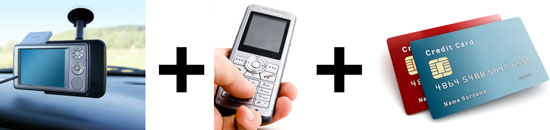
For those of us standing on the side of the road waiting for a ride, what we lack is a means of connecting us to a driver who doesn't know we need them. But the technological solution to this problem is already close at hand - it is simply a matter of integrating three common functions:
- A mobile (cell) phone to inform the world of our current location and where we want to go.
- GPS units to work out where we are standing and which drivers are coming our way.
- A means of paying the driver a small fee for the ride.
Introducing the 'iHitch'
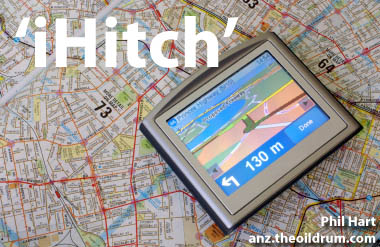
Let's call this new device the 'iHitch' - a phone, GPS and payment system all in one - a simple challenge for the likes of Nokia, Apple or Garmin. The next step is equipping a critical mass of passengers and vehicles for it to be a practical option. And finally we will need some software which, when told where the drivers are going and where the passengers want to be, can make the optimum connections between the two. Seems simple really!
Of course, depending on your destination, it might take more than one 'ride' to get you from 'A to B'. With public transport, a journey that requires multiple connections with long waits in between can quickly become tedious and very time-consuming. But if at each change you're only waiting a minute or two for the next driver in the sequence to keep you moving then much more complex trip patterns suddenly become a lot more viable. This is especially true since the speed of travel in one small vehicle will be faster than in the big old bus which has to stop every few hundred metres to pick up and set down more passengers.
The incentive for the passengers are pretty obvious, and as fuel prices start to bite and the affordability of the next tank of fuel becomes a serious question, the benefit for the driver of being able to share the costs of running their vehicle becomes pretty compelling too. When oil was cheap, it was easy to choose the privacy and comfort of having a vehicle all to oneself. But that equation is shifting quickly, and some old and well ingrained habits may be ready for change.
Breaking down Barriers the eBay Way
Technology is the easy part - the far more challenging problems are those we have created for ourselves. To make our hitchhiking future happen we're going to need help overcoming the significant social and cultural barriers. But the answers are out there - in this case we need only look at other models of social interaction over the internet.
Consider how the eBay model of 'rating' buyers and sellers could be applied:
- If you smell, talk dirty or are otherwise poor company in a confined space, your 'passenger' or 'driver' rating will quickly plummet.
- If things work smoothly and your rating is high, you won't have to wait long for a friendly driver to pick you up and get you on your way. High rated drivers may also be able to charge a little more for their services.
On a busy route in the middle of the day, you might be happy to offer a ride to a B-rated passenger but if you're looking for a ride home at 3am in the morning you might prefer to wait a little longer to get a AAA-rated driver. These personal preferences would be adjusted in your 'iHitch' and the software makes the matches according to your criteria. The more stringent you are, the longer you'll have to wait!
Every Car is a Mini-Bus
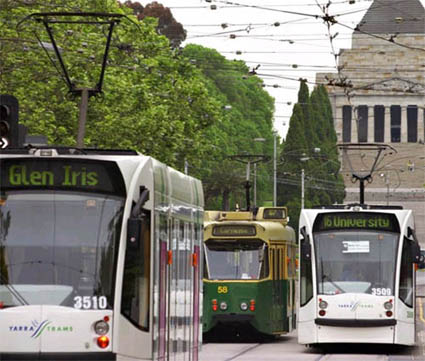
In my case, instead of a bus stop it's actually a tram that I end up waiting for at all hours of the day and night. I hope it won't be long before I can stand there, plug a destination into my 'iHitch' and have a driver pull up moments later, long before the tram would have arrived. Instead of every oil consuming vehicle being the problem, they become part of the solution in the form of a mini-bus.
As the scheme becomes widely adopted, the number of vehicles on the roads will drop as more drivers leave their car at home, choosing the new speed and convenience of riding as an 'iHitch' passenger instead. Not everybody can be a passenger (even a real bus needs a driver!) but a substantial reduction in traffic and oil consumption is readily achievable.
In a crunch, one can envisage the same system being pushed to its limits with each vehicle 'saturated' with passengers and only the bare minimum number of drivers taking their cars out on any given day. In an 'oil shock' scenario, I can see it being possible for a city to keep functioning and successfully moving people around on essential journeys using a small fraction of their previous total oil use. The extra time involved in picking up and setting down passengers may even be won back through less congested roads so the speed of individual travel may not drop.
But the key here is preparation - if the crunch hits first and you don't have the tools in place then it's very hard to co-ordinate the drivers and passengers and chaos (and doom) rule instead.
So getting an 'iHitch' scheme up and running in your town could be a valuable insurance policy, even aside from the direct benefits. And unlike other major infrastructure responses to peak oil which will take several decades, the 'iHitch' solution can be rolled out as fast as you can manufacture mobile phones.
So, will technology cut our future fuel bill in half? Sure, and that high-tech future might be a whole lot closer than you think.
With thanks to the Beyond Zero Emissions discussion group in Melbourne (amongst others) for part of the inspiration behind this story and the impetus to put pen to paper.
Contact
- anz at theoildrum dot com
License

This work is licensed under a Creative Commons Attribution-Share Alike 3.0 United States License.
Archives
- November 2010 (2)
- October 2010 (5)
- September 2010 (4)
- August 2010 (8)
- July 2010 (2)
- June 2010 (2)
- May 2010 (6)
- April 2010 (7)
- March 2010 (12)
- February 2010 (11)
- January 2010 (7)
- December 2009 (10)
- November 2009 (6)
- October 2009 (7)
- September 2009 (10)
- August 2009 (10)
- July 2009 (3)
- June 2009 (14)
- May 2009 (10)
- April 2009 (15)
- March 2009 (16)
- February 2009 (16)
- January 2009 (15)
- December 2008 (15)
- November 2008 (23)
- October 2008 (25)
- September 2008 (24)
- August 2008 (30)
- July 2008 (44)
- June 2008 (38)
- May 2008 (48)
- April 2008 (43)
- March 2008 (29)
- February 2008 (32)
- January 2008 (30)
- December 2007 (26)
- November 2007 (32)
- October 2007 (11)
Phil,
This is similar to a scheme I have been thinking about where there are fixed routes from designated stops. The riders simpoly line up at the "going to town stop" and passsing drivers know that they will drop them off at another designated stop. Bit less flexible but doesn't rely on hi-tech.
I'm actually quite impressed with your system and think you should register the trademark immediatley!
One of the hurdles is the legal restrictions on running either a taxi service or bus service which your service may fall under. You might get away with it as long as there is no formal payment beween drivers and passengers. If a passenger was to drop a handful of change on the floor and accidentally leave it there when they alighted well that might just be good fortune for the driver of course and would be very hard to police. The tax office would be interested in drivers who receive payments too so I really think you have to do this on the honour system and a cash in hand basis.
I really like the idea of rating passengers and drivers.
I could be accused of being naive here, but I would like to think that in the interests of solving the oil crisis that Governments can find a way around the bureaucratic hurdles.
As long as the drivers are not making a profession out of picking up passengers, the tax office won't mind. It will be treated as a 'hobby' (like selling stamps on eBay) unless you start to earn so much from it that you're actually exceeding the costs of owning and running the car.
There may well be some restrictions on 'running a taxi service' so I hope that Governments can find us a way around that. It would be a shame (but not necessarily surprising) for a good solution to our oil crisis to be blocked by a little piece of bureaucratic red tape!
Thanks for your support:
http://www.reddit.com/comments/6wacy/the_ihitch_high_tech_hitchiking/
http://digg.com/environment/The_iHitch_High_tech_hitchiking
You've identified the first political problem you'll have to face. The existing taxi industry will scream very loudly about this as it effectively destroys the value of their business and industry overnight. Many of them have spent hundreds of thousands of dollars to obtain a taxi plate and a mass carpool system like this would be seen as a huge threat. Who are the pollies going to protect? The GST and income tax paying taxi industry or the upstart car pool business?
I think it's a great idea and one that the various groups looking at solutions need to work on. But I do believe that to implement something like this you have to make it attack proof from the law and that means the communication aspect of it and the way people pay eachother has to go underground so as to avoid any confrontation with the authoritys. I'm sure there are plenty of ways to do it if we think about it long enough.
The taxi industry needs to have the cleaners put through it anyway. The fact that the licence plates are worth all that money shows that there is a lot of potential to make monopoly rents at present. (In fact, both the passengers and the drivers are exploited by the existing system, and the transport service provided leaves a *lot* to be desired...)
I think the system would need to be government mandated/regulated, and open standards applied to the technologies. Otherwise, there could be a segmentation of the market as in myspace/facebook/bebo etc. (as this may not be patentable). Eventually a dominant player would emerge, and they would be able to increase prices, and reap imense profits from the scheme.
If governments receive a small 'hitch tax' from every lift. This could offset the losses from taxi taxes (and could therefore counter the lobbying effort), and would be simple to do if an electronic payment system was involved.
Many insurance companies and the government are interested in fitting vehicles with GPS trackers (improved calculation of premiums), and this would provide an added incentive for people to take it up, on which they could capitalise. I'm not sure I actually approve of the 'big brother' aspect of this, but it's a commercial consideration.
If the government/police had access to each vehicle tracker data, any crime might be reduced, as it would be easier to catch people.
I don't like where my thoughts are taking me though! I'd prefer a simpler solution.
I think this is a brilliant idea. I also think it would probably be considered illegal in most parts of U.S. now.
Taxis are licensed and regulated. "Jitney cabs," while efficient and potentially providing a great service to low income people in lower density areas, are generally illegal. Your idea would probably be illegal under the same laws that ban jitneys, though you are proposing something that would be a giant leap forward over any jitney system.
Which US states have made hitch-hiking illegal? | Answerbag.com
This list is far from complete, Washington state also banned hitchhikers (on the Interstates, and elsewhere?) in the wake of the Home of the Green River Killer's activities. We've quite a series of legal hurdles to overcome in the states.
In addition to resistance from cab/MT companies, consider that of the automotive sales/maintenance industry, and of fuel retailers. As irrational as it may seem now. Of course this would be swept aside in a real crisis situation, but never underestimate institutionalized greed.
Like your plan nonetheless.
No problem with the Taxi industry, just compensate for the old license system and start with something new different.
One issue with the new system is persons and background checks.
If Jack the ripper, some child molester or persons intent on murder is on the "service" you would have problems. Because this scheme would be one easy way of getting someone in a car and taking them somewhere else.
Here in the Washington, DC area, it's called "slugging". It started in 1971. It's free (the benefit now is to single drivers who pick up one or two passengers which then allows them to use the High Occupancy Vehicle (HOV) lanes). See:
http://www.slug-lines.com/Slugging/About_slugging.asp
-- Philip B. / Washington, DC
http://www.communitysolution.org/rideshare.html
Great idea Phil !
I don't think you need a new device to do this though - you could build an iPhone application to do it right now (and presumably an Android one, once devices using it appear on the market).
On a related (but less ambitious) note, Tech Review has an article today on carpool web sites:
In Israel it is called sherut and it have been in use since Israels foundation.Between cities and in cities,usually the same rounds busses are going. Fram 7 seaters to 10 or 15 seater minibusses and it is working just fine.You just stop the taxi or minibus and pay about the same fare as the bus would cost.You can get off wherever you want.
I've seen, and occasionally used, this sort of operation in action in a lot of countries in Africa and Asia too - works great (although not always as safe or comfortable as a regular bus service).
Ah, it seems you're nigh on two years late Phil: High-tech Hitchhiking — Sightline Daily (formerly Tidepool)
Posted Dec. 11, 2006.
Check the story out for links and more info. Covers all manner of approaches.
I've used a similar service in Thailand, where you flag down the "bus" (converted pickup truck) and tell them where you want to go - if your destination isn't in the opposite direction to the current passengers they will take you right to your destination, altering the route as they go to get the shortest route between all of the destinations.
It was great.
How do you cope with the jostling to get a window seat so you can take pot shots at the no-such-people-as-the-Palestinian/terrorists as you speed to your settlement ?
I think a key aspect of this might be vetting the membership. A clean record and a recomendation from a current member needed to become a member I think would give people a good feeling about who is stopping to give them a lift. Also you could limit it to people who own cars by making it a "pay it forward" system where each time you give a member of the club a ride you get a credit for a ride yourself. I don't know how the tax man would handle the "pay it forward" system where only once you are clearly a dead beat are you kicked out. No money would be changing hands for the service and there wouldn't even be a non monetary trade involved.
I was thinking about this last night after reading the article.
Actually, it doesn't really need anything high-tech, and can be implemented as a sequence of fairly easy-to-organise steps.
So Leichardt council might choose something stripy like the Italian flag, to reflect the Italian heritage in the area. Hills area might do something with orange spots (because it used to be an orange-growing area before it became suburbia). That forces councils in between to do a slightly-stripy, slightly-spotty flag.
This will consume vast amounts of time, lots of inter-council bickering and lots of chargeable hours to graphic artists. It will also give the local papers something to write up about (and they're quite clearly short of worthwhile material to cover).
After all the time, effort, newsprint and debates are through, everyone will know what their local flags are. Rates notices will get printed with it because the council will need to get their value for money out of the design work. It will be up at the local library, council chambers and who knows where else.
Payment is essentially the same as for buskers -- you just rely on people being appropriately generous. It's more compensation than you would have got if you hadn't given someone a lift.
The total cost of the system is therefore only a few dollars per person (the cost of printing up a laminated book), can grow incrementally and requires no new technology to learn.
This sorts out the matching problem reasonably well, I think. The only aspect I haven't addressed is a rating system for drivers and passengers. Any low-tech solutions for that?
Great idea! But don't wait or rely on councils to do it. Lets just do it.
We need to invent our own flags or maybe just a hitch hiking logo and print the names of the suburbs in English in large letters (saves all the arguments). It is easy enough to distribute the template on the web and individuals can get their own hitching booklets printed, laminated and bound at Officeworks. Most individuals would only need a few locations in their book for use when driving or hitching.
Of course there needs to be a protocol which all the participants understand but I think with a bit of thought we could all come up with something that is workable this weekend. POST HERE.
Well, why not just have the book of council area names written in really big letters instead? You could skip the learning the flags part.
Phil
Good Idea, A good "disruptive" technology. When you consider public transport the model hasn't changed in at least 100 years, the last great invention was the omnibus.
On a similar vein I'd like commuter buses to change to a "group charter" model, currently a rushhour bus service maxes out at 25% capacity (start empty, fill on way to destination, returns to start empty). If however you registered on a website and the bus picked up its total load at maybe 2 points and went straight to the general destination then the utilization would double to 50% (Full one way, empty the other).
Of course the problem with all these schemes is as the utilization increases, the costs drop and you are encouraged to travel further, i.e. in the long run they are self defeating of the purpose to use less energy.
Neven
First - let me congratulate you for the great idea; I have been thinking about something like that for a long time.
A similar system has been successfully running in big cities in European countries for years: designated taxi shuttles going through fixed routes, picking up and dropping passengers on request. Besides being much simpler, this one has the advantage that a van can accommodate up to 10-12 people, while most cars can comfortably seat 2 or 3 extra passengers max. It could be greatly enhanced if passengers are given mobile devices calculating the fastest way from A to B.
In US I suspect the biggest problems with either of these schemes will not be technical, but... legal. I imagine the lawsuits if an accident happens with a taxi and the passengers get hurt. Another problem I see is that a big chunk of intown driving in US is on highway which makes stopping and picking up problematic.
Both problems are not idea killers, just something to have in mind.
Great idea!
Now, who's going to rate the drivers?
Stinky car.
Bad music.
Dangerous driving.
Pulling a gun on the passenger.
I'd think twice about climbing into a stranger's car.
Think twice about picking up strangers too. I knew a man who got killed giving a hitchhiker a ride.
But there may be a way for neighborhoods of people to do this with an orderly registration system...you could prearrange the carpools for more locally familiar people going to the same general locations, and your name and address etc would be known in advance in a central database...a bit more structured to prevent dangerous situations perhaps.
This is a wonderful idea. All one needs is a towel. And be wary of Vogons. ;o)
Thanks for the nice exploration of what appears to be a viable Silver BB.
-best,
Wolf in YVR BC
I have thought this so many times!!!
If we could just have some semblance of good leadership, this plan could be done and make the biggest bite in oil consumption we've ever seen.
Phil,
Bright minds think alike . Roughly around the end of September SmartCarpooling.com should begin an eerily similar service to what you proposed, if you were hanging out around Austin, TX's coffee houses about 2 months ago, you should know that its rude to eavesdrop. ;-)
Our development team has gone home for the day, but I will try to get a form up below our current joke image ASAP so that anybody interested in being an alpha tester of the service, the iPhone app, mobile app, or the FB app can do so as soon as they become available. Sorry for the plug in, but it seems like you've been overhearing the conversations behind SmartCarpooling.com and many of your readers seem like the people that will benefit the most by our service.
See you guys soon and as always very interesting posts,
Mario Pulido
mario(at)SmartCarpooling.com
It seems to me that with iHitch, we are talking about adding an additional level of complexity to solve a problem of resource scarcity. In many ways, it would be better to use a less complex system. If nothing else, complex systems are likely to be expensive, especially for smaller cities. They also will not work if there are power outages, and these are likely to be more frequent in the years ahead.
I believe that in Cuba, Castro made it illegal to pass a hitch-hiker and not pick him up, if there was space in the car. I don't think people in this country would be willing to live with such a solution, even if it were fairly safe because of all the other riders.
Right Gail, it's a solution that goes down the wrong path. Essentially predicated on business-as-usual, on maintaining current thinking about "security" and even how to pay the company. This scheme introduces additional complexity that depends on a 99.999 available infrastructure. Plus the individual transactions are starting to sound expensive - ratings, payments, etc....
And for those of us who refuse to carry cell-phones because of the wiretapping? As if I'm I going to carry a GPS, right. I don't want people knowing where I am; that's no one else's business. I suspect this would instantly turn into a checkpoint system; you'd have to have a background check to drive or ride. That's socially destructive in that it moves people more and more into the authoritarian mindset. Castro's solution, on the other hand, is a community building solution. I've not heard of lots of crime hitchhiking in Cuba. Is there? But we can't let facts get in the way of our cultural myths can we? And our own cultural myths might well make crime more likely - at least in US.
cfm in Gray, ME
Need to figure out how iHitch.com gets paid. How about transactions getting handled electronically through a "Paypal" type system.
Ride negotiation and payment terms are handled prior to rider entering vehicle. A driver and rider are "vetted" via each's criteria list.
Drivers and riders are not introduced to each other by the system unless they match each other's criteria.
If they do and the donation is close to the requested donation, the driver and rider are introduced via quick pix.
Only after both have agreed to terms will their GPS units reveal whereabouts for convergence.
Payment will be handled automatically when the GPS units of both driver and rider show they are both in the driver's car.
Payment can be handled either as a fixed fee per ride or fixed fee per mile travelled. If miles travelled the correct amount will be transacted at the termination of the ride.
This probably will have to be a commercial and paying business simply because it will be coming up against monied interests such as taxicabs. Having it run as a business eliminates many of the bureaucratic issues because it will become a taxible business and fit into the normal commercial structure of things. The riders and drivers are independent contracters very similar to their role on eBay. iHitch will not take any responsibility past ensuring that riders and drivers match each others criteria. iHitch is a commissioned matchmaker and trusted payment service that brings together riders and drivers in a realtime market.
The rating idea can be embellished with a web of trust. If I pick up a rider and it works well for both of us, we can add each other to a list of trusted agents. If the six degrees of separation business has any validity it would allow a driver to place high value on a rider who was given a ride by a friend or acquaintance.
Employer trust groups could also be set up so people who work for a common employer can set a high trust value on other employees. The sophistication of selection schemes seems truly endless.
I like the possibility of using an iPhone. If the iPhone gets GPS (it may have it for all I know) then the manufacturing end of things has been taken care of. The other hot part is that iPhone people are Apple fanatics and this gives them a bit of rapport prior to meeting. No manufacturing costs - everything is software and Web 2.0. Sounds like a great idea to me.
When the driver and rider are within a few hundred yards they use the iPhone as a walkie talkie to make final arrangements for meeting.
Since every transaction is fully archived the safety of a system like this should make it much less dangerous than public transit.
Good thinking, Phil.
This is really a great idea. I wouldn't be surprised to see something like this running in the next 5 years. Already I search craigslist for passengers/rides to split gas costs on any long trip. I think some system of registering and rating riders/drivers would be critical to the system from a liability and safety standpoint though. As for the issue of laws against unregistered taxis, yeah it is a problem but probably something many municipalities would work around or not bother to police. In parts of Los Angeles there are unregistered taxis which have been running for years and the de-facto governement policy is to look the other way.
The iPhone does have GPS (and can triangulate location from cell phone towers if it can't "see" the GPS satellites).
It really is just a software (and marketing) job to build something like this.
GPS resolution should be fine enough that you can get within 10 metres guided by the devices - no need for a call really.
Agreed. I'm surprised people have been raising the safety aspect so much - the interactions here are fully recorded - it wouldn't necessarily be 100% safe but its no more dangerous than a taxi or bus with a nut behind the wheel. Its not like traditional hitching where driver and hitcher are basically anonymous.
The Blackberry (at least some models) also has GPS but in my experience it chews up the power. I would expect to see GPS becoming more widespread over the next few years in the same way that colour screens and cameras have.
It might be worth sending your idea to the mobile network operators, if they see a way to make some money or keep up with the competition then they might jump start it.
Gail,
Regarding complexity. I'm punishing myself during retirement by studying Organic Chemistry and Molecular Biology. No, I'm not very good at, sad to say. But I come away with a clear sense that the one thing we can say about life is that it's not simple. There is nothing simple about it. But it is stable. And that's what really counts. Stability, not simplicity. I believe it is possible to engineer hyper complex software systems that are robust, low power and stable. I'm not so sure about the low-power end of this but look at Google. When was the last time you Googled for something and got an announcement that Google was "down for maintenance," or "temporarily offline due to an undiagnosed failure?"
One thing that will come of a system like iHitch is that many people who have similar travel habits will become acquainted and continue to rideshare after the initial introduction. I see iHitch as a wonderful enabling technology in that sense. I see it as an introduction and matchmaking service as well as a great alternative to public transit for the occasional ride.
I don't see it as a step in a fundamentally wrong direction because it accomplishes what amounts to a miracle. Remember Paul Simon's classic line in "Cars are Cars?" "We roll up our windows and pretend we're immune." Anything that starts to break down the psychosocial isolation of the automobile is, in my opinion, good by definition. The dominant transportation space starts becoming a social space as well. That's wonderful, wouldn't you agree?
It really does not need to be that complex, here in DC we have had slugs http://www.slug-lines.com/ as part of the culture forever. It is a change in mindset more than technology.
There is nothing wrong with complexity just so long as it is reliable and useful. Do you think a cell phone is simple? NOT! But when was the last time you were in range of a cell tower and couldn't make a call?
I'm for as many possible alternatives as possible, simple and complex.
You may have had slug-lines.com as a part of the culture "forever" but that doesn't mean it's the only thing that should be tried.
I tend to believe that a system that actually entices people to open up their personal car space is going to be extremely complicated because it is dealing in an area that people tend to defend as private space. I, for instance, would not willingly put up with a flap-jaw rider. One of my criteria would be that any rider will keep his mouth shut and his music low. I want to think my thoughts when I drive and not engage in mindless discourse.
On the other hand, if the the rider wanted to talk about biology or ecology or, better yet, let me hold forth on these subjects!!!, I'd consider that positive.
Explain to me how a "simple" system can achieve the complicated requirements of bringing a complete stranger into a private space?
See "Etiquette and Rules":
http://www.slug-lines.com/Slugging/Etiquette.asp
-- PB / WDC
Personal Rapid Transit.
http://en.wikipedia.org/wiki/Personal_Rapid_Transit
In Italy we are experimenting with a "low tech" hitchhiking scheme, named "Jungo".
http://www.jungo.it (in Italian, sorry).
The idea is to provide both hitchhikers and drivers with a ID card, that can be quickly tested using a SMS. You can give feedback (positive or negative) to the issuing organization, and the hiker pays a small kilometric fee, to encourage drivers to join. The SMS itself enables tracking, and discourages potentially offensive behaviors.
It has been tested in a "Jungo cradle", in Trento, and waiting times dropped to 20% in a couple of weeks. The main problem with hitchhiking, as it can be seen in comments here, is confidence, and this is boosted if some third party can guarantee the reliability of the hiker/driver.
I am used to urban hitchhiking, and I seldom met potentially dangerous situations, here in Italy. Nothing that can't be handled with a "OK, I am arrived here" and a strongly negative feedback. Extraurban hiking is more difficult, I agree, I am male, and Italy is not a violent place. Somehwere else may be not so easy.
Here's a translation link that works for the Jungo home page, plus click-thru to associated pages.
http://translate.google.com.au/translate?hl=en&sl=it&u=http://www.jungo....
Gasoline Rationing
For this to work you need a complete change of the car (my personal living room, not a means of transport) culture ( my personal way to freedom) mind.
You could attain this culture change by gasoline rationing. Gasoline is only provided to drivers who manage a 50 or 60% occupancy rate of their car seats.
Every transport service one provides counts for the gasoline account, and gasoline can´t be payed for in cash.
A brilliant idea that should be encouraged as a way to save fuel and the enviornment.
The big problem is that there would be numerous legal hurdles. Does the driver have car insurance that covers paying passengers? Think of the fun lawyers would have after accidents. Unless governments pass legistlation that protects all parties the scheme would be too much of a risk for most motorists to consider.
If it does get up it would promote a better society through increased social interactions.
Quote from above article: "if it's two tonnes of metal carrying one person then it is grossly inefficient."
[i]And this is where efficiency can be improved the most![/i]
How often is only one or two persons sitting in a car? How often do you see like 10 or less persons in coach/bus? That's 1000-2000kg per person.
I think bikes have the future. Whether it is pedalbike, scooter or motorbike. The energy consumption per person carried is way less.
You still are in control of your own vehicle (don't forget, freedom in transport is very important to people) no annoying passengers, no waiting times, no standing still in traffic jams, no parking problems.
... and you look cool! (guess what sort of tranportation I use) :P
Actually, goloco.org does almost everything described.. you have to put down the destination that you want to go to and the time and it matches you with others going that way...
i agree that its not exactly the same vision but then again its probably the closest alternative available...
check it out...
You might rather call it something like 'iShare' instead of 'iHitch' to avoid problematic associations.
I've been thinking about this for years. I strongly believe that America's survival greatly depends on its ability to turn disadvantage (lack of mass transit) into advantage. With a computer network and a GPS, the cluster**** we have can instantly be transformed into a mass transit network. It would never be too terribly efficient because it relies on far too many drivers. But it would at least prevent an immediate economic catastrophe.
The system I envisioned was a website where you sign in as a Driver and a map pops up and you draw onto the map the route you plan on taking. And thats it. They will text you or mark it on your map where to pick someone up if they need a ride.
Or, if you need a ride then you sign in as a Rider and draw onto the map where you are and where you need to go. And the system would come back with a list of potential rides. Lets say one at 2pm, one at 2:30, and one at 4:15. So you pick the one at 2:30 and viola. They are informed that they have a passenger, and you wait to be picked up. The beauty of it is that no one would be going out of their way. (Although I guess you could configure your account so that you could pick people up out of your way, for an extra charge.)
There are a host of small companies that are doing this already. But their services are crude to say the least. The map interface needs a minimal $10 million investment. And obviously this whole thing would rely on promotions. That's the biggest issue. Their business models are all wrong, because they are charging fees right off the bat. It has to be free to get the business to grow. Free first 30 rides, free first 6 months, etc. This would cost millions because someone would have to pay all these drivers until this thing really got off the ground. But once it did... whooo the potential for profit is sky high. We're talking about a 100 billion dollar market in 10 years. For a business with relatively low overhead. I wanted to start my own company along these lines but I really dont care who gets rich off this because if someone doesnt find a way to do it then we're all screwed because this is the only way for the US economy to maintain the liquidity provided by all these personal vehicles under a context of rising fuel costs. Like I said, its about turning disadvantage into advantage.
After WWII, there was a lot of hitchhiking. It continued well into the 70's. But, the increasing incidence of violence led to the public service announcements, and parents teaching their kids - Never Pick Up A Hitchhiker!!
Article about a month ago in the OKC Daily Oklahoman. 60 year old man picks up 2 guys hitchhiking with a gas can. They force him to drive to a park, anal rape and sodomize him multiple times, tie him to a tree and leave with his car. He is found the next morning. COUNT ME OUT - and if you are smart do the same yourselves.
Safety is one of the main reasons why hitchhiking is not very common. If there was a legal entity named "iHitch", they would likely be liable in suits involving carjacking. A legal framework would have to be laid out. This would require a large amount of legal resources. I've given a lot of thought to this because lawsuit is going to be the first word that comes to mind when thinking of words like "iHitch".
There are many ways to ensure safety today with a 21st century carpooling network. For one thing, you'd have to register to gain access to the network. And by using the system you would open yourself up to being tracked and traced (while being an active Rider or Driver).
Another way to ensure safety would be to use confirmation codes. When you've picked up your passenger and are on your way, it could be standard procedure to send a text message with your confirmation code. You'd send one code if everything was ok, or a different code if something went wrong. If you send the distress code, your location would immediately be linked in to the police GPS system and they would dispatch an interceptor right away.
There are many many other ways to ensure safety. It is the first few criminal attempts that would be the most critical. Public image is important. By ensuring that the first few attempts at carjacking fail with the system's security, it would send a powerful message of deterrence. That is yet one more reason why I say something like this requires a serious investment. $10 million for the mapping system, $10 million in promotional miles. $10 million in legal services. $10 million in the security network. etc etc. The legal repercussions of a halfass implementation of iHitch would be disastrous.
Phil,
I'm not sure if all this is needed. You are proposing a technological solution for a problem that is non-technical.
If people want to hitch-hike, they can do so today. Even in Europe, where gas is close to US$10/gallon, this does not happen much anymore.
It appears that some of what has been discussed above has been implemented already:
www.pickuppal.com/
pick up pal [pik-uhp-pal] - noun
a global eco-friendly transportation revolution that connects drivers, passengers, and packages with the places they need to go
And there is this, too: www.carpoolworld.com/
-- PB / WDC
Car insurance in most of the US is way more than the cost of fuel even at these prices. In the event of an accident and injury to a passenger and it is discovered you received compensation for the ride then that would be considered commercial use of the vehicle which could invalidate the policy. In the US there are commercial driver regulations that would apply to this scheme. Drivers would need to pass a Department of Transportation physical and drug screening. Just the use of certain medications including one used to stop smoking could be grounds for flunking the physical. Leave out the part where riders pay for a ride and the insurance and governmental regulations disappear. You just happen to be helping out a neighbor.
Hi guys!
I had an idea almost exactly like this about a year ago, and I looked into patenting it. Turns out there's already patents out there on cell-phone driven hitch-hiking. :( Maybe in Australia you could implement it, since our patents here probably only hold in the U.S.
People had some negative things to say about the system being too complex but I disagree. I think that with some open-source cell phone technology, such as google's Android, anyone could write an app to do this hitch-hiking thing. I don't know much about phone's ability to locate themselves accurately but I'd assume it's decent.
Anyway I hope that hitch-hiking becomes cool/safe again in the U.S., one way or another. I've always wanted to do it, but as a lone girl it's just too stupid of a risk to take.
I think the described idea is unfortunately not practical in short terms.
I am a long time mobile developer, also I participated also with projects involving GPS and other methods for location of the position of the user.
There are two main reasons this is not practical.
First - in the next few years the majority of the phones will be without GPS, because only the high-end models get GPS. I doubt there will be even 10% of the new mobile phones in the next 3 years will be sold with GPS.
Second - even if you have GPS the quality of the GPS hardware built in the mobile phones is quite bad. Just some clouds and the you don't get any location anymore on your mobile. This will be hardly acceptable for the system described in the article.
A lower level technology solutions involving web and/or sms interface have a better chance simply because they can provide some value now. I see a GPS solution possible only as nice extra feature on the basis of people arranging their routes through the web.
This is a great idea. A really really great idea.
Problem is it's not likely to happen barring a real crisis.
Car sharing of this type would be a huge threat to the taxi industry and other entrenched players and those industries cannot be expected to just sit back and let this happen. They will do everything in their power to stop this kind of thing from happening and do everything conceivable to undermine it should it start. We should not underestimate their power. I do not think this kind of thing will be allowed (legally) unless there is a real sense of crisis (environmental or oil supply).
Car sharing involving money is illegal in almost all of the United States. Very illegal and vigorously prosecuted. If you accept money you are considered a cab and if you do not have a medallion you are arrested.
Hitchhiking is illegal in most places.
You cannot get insurance in my state for a car that will be shared on a regular basis with non family members (even if no money is involved). They will not sell it to you at any cost. I asked about this when I was thinking about another idea. It's *state law*. I suspect that most states have this same restriction. This alone pretty much puts the kibosh on this kind of car sharing given that you cannot drive *at all* in my state without car insurance!
Car sharing has been seriously limited, made illegal or discouraged for decades. In my city (Chicago) jitneys were outlawed in the mid 60's. There is a state law against hitchhiking. In Chicago IL this whole idea is a non starter without serious changes to the law. And not just one law but a bunch.
The taxi industry where I live takes this stuff very seriously. "Gypsy" cabs are fought like mad. Certain seemingly minor offenses are felonies. They feel their livelihood is at stake and clearly they would be threatened by High-Tech Hitchhiking and will fight tooth and nail against this.
So don't expect high tech hitchhiking to be legally allowed barring a major crisis.
This idea could save the planet in one move.
It can never happen because the vested interests cannot gain any profit from it.
A simple law that anybody putting out his thumb has to be picked up and a small fee paid (Open to abuse)
But implement the death penalty for any harm coming to a passenger and a large flogging for anybody corrupting the appropriate fee and it can be made to work
Add a small surcharge to all fees which are immediately transferred into a local politicians bank account an the results are guaranteed.
Graham
I had this thought a couple of months ago, too.
As mentioned upthread, there is the issue of vetting passengers and drivers. There would also need to be a way to verify the identity of the passenger and driver. You could do this using biometrics or a password when a passenger requests a ride through the service or when a driver accepts a passenger request.
The driver and the passenger should use the centralized service to prevent unwanted sharing of personal information. The service should provide anonymized email addresses and an 800 number. Drivers and passengers should be able to blacklist each other.
The service should track the planned destination of the driver and the passenger, and attempt to contact both the driver and passenger if the car veers too far off-course, or stops in a secluded area.
The passenger application should have a way to quickly specify a destination: "Home", "Work", "The Grocery Store". Only the driver needs a fancy GPS cell phone with a version of this app, BTW. The passenger only needs an ID card and a web application.
An idea like this could work even without making it a private taxi service or hitch-hiking application, it could also suggest potential carpooling partners based on patterns of telemetry - that might be a better beachhead because people would be less afraid of picking up hitchhikers if they had a trusted companion in the car with them.
Great post. Carpooling is the transport system of the future! It only makes sense, there is plenty of 'rolling stock' out there, we just need to use it more effectively.
Look at http://www.hoverport.org or http://flexiblecarpooling.org for our take on how this should work (check out the animation on hoverport.org).
It has some similarities to the sluglines/casual carpooling, but adds some valuable features like origin end parking, membership with prescreening, technology to track participation (but importantly NOT for prearranging a ride), and 'ride credits' for sharing the benefits.
It is not easy to bring a new idea like this into being. Anyone with avenues to public or equity money that would like to join the ride, please use the contact details from the websites.
We've developed the technologies and software and the system is pretty well ready to go. The real challenges are transportation officials support, and funding. The main reasons for lack of support: they are not convinced it will work so don't want to be first, and they are afraid if it does work it will take people off the buses (and you know about the theology of buses).
Hi,
great idea ihitch. Getting around the tax laws is simple. Don't charge anyone. The govt. can't stop generosity .
Tim