


A Long Term Solution to Our Financial Crisis: The Other Forms of Capital
Posted by nate hagens on October 14, 2008 - 10:09am
As the world slowly awakens to the concept that all wealth perhaps can't be measured by digits in the bank, the global economic and political elite have been meeting to potentially form a "new Bretton Woods," kick started by global guarantees of banking deposits, direct government investment in banks, and global rate cuts. Though the markets have so far reacted with glee (or short covering), pumping fiat money into the system with no biophysical linkage to the real economy has (at least) two major problems. First, it accelerates the growing gap between financial capital and real capital, and second, it tacitly acknowledges our current "ends" as acceptable, and that all forms of capital can and should continue to be directed towards the positional consumption of "stuff" that our culture currently advocates (perhaps via momentum alone). In crisis times such as these, our leaders would do well to recognize that the human economy is a subset of a larger, finite system, and is subject to the natural laws forthwith. Furthermore, a plethora of new economic, psycholgic, and neuroscience research also suggests that "more" does not equate with "better".
Below the fold is a guest commentary explaining these themes written by my thesis co-advisor, Robert Costanza, director of the Gund Institute for Ecological Economics at the University of Vermont.
The current financial meltdown is the result of under-regulated markets built on an ideology of free market capitalism and unlimited economic growth. The fundamental problem is that the underlying assumptions of this ideology are not consistent with what we now know about the real state of the world. The financial world is, in essence, a set of markers for goods, services, and risks in the real world and when those markers are allowed to deviate too far from reality, “adjustments” must ultimately follow and crisis and panic can ensue. To solve this and future financial crisis requires that we reconnect the markers with reality. What are our real assets and how valuable are they? To do this requires both a new vision of what the economy is and what it is for, proper and comprehensive accounting of real assets, and new institutions that use the market in its proper role of servant rather than master.
The mainstream vision of the economy is based on a number of assumptions that were created during a period when the world was still relatively empty of humans and their built infrastructure. In this “empty world” context, built capital was the limiting factor, while natural capital and social capital were abundant. It made sense, in that context, not to worry too much about environmental and social “externalities” since they could be assumed to be relatively small and ultimately solvable. It made sense to focus on the growth of the market economy, as measured by GDP, as a primary means to improve human welfare. It made sense, in that context, to think of the economy as only marketed goods and services and to think of the goal as increasing the amount of these goods and services produced and consumed.
But the world has changed dramatically. We now live in a world relatively full of humans and their built capital infrastructure. In this new context, we have to reconceptualize what the economy is and what it is for. We have to first remember that the goal of the economy is to sustainably improve human well-being and quality of life. We have to remember that material consumption and GDP are merely means to that end, not ends in themselves. We have to recognize, as both ancient wisdom and new psychological research tell us, that material consumption beyond real need can actually reduce our well-being. We have to better understand what really does contribute to sustainable human well-being, and recognize the substantial contributions of natural and social capital, which are now the limiting factors in many countries. We have to be able to distinguish between real poverty in terms of low quality of life, and merely low monetary income. Ultimately we have to create a new model of the economy and development that acknowledges this new full world context and vision.
This new model of development would be based clearly on the goal of sustainable human well-being. It would use measures of progress that clearly acknowledge this goal. It would acknowledge the importance of ecological sustainability, social fairness, and real economic efficiency. Ecological sustainability implies recognizing that natural and social capital are not infinitely substitutable for built and human capital, and that real biophysical limits exist to the expansion of the market economy.
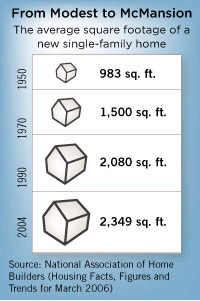
Social fairness implies recognizing that the distribution of wealth is an important determinant of social capital and quality of life. The conventional model has bought into the assumption that the best way to improve welfare is through growth in marketed consumption as measured by GDP. This focus on growth has not improved overall societal welfare and explicit attention to distribution issues is sorely needed. As Robert Frank has argued in his latest book: Falling Behind: How Rising Inequality Harms the Middle Class, economic growth beyond a certain point sets up a “positional arms race” that changes the consumption context and forces everyone to consume too much of positional goods (like houses and cars) at the expense of non-marketed, non-positional goods and services from natural and social capital. Fore example, this drive to consume more positional goods leads people to reach beyond their means to purchase ever larger and more expensive houses, fueling the housing bubble. It also fuels increasing inequality of income which actually reduces overall societal well-being, not just for the poor, but across the income spectrum.
Real economic efficiency implies including all resources that affect sustainable human well-being in the allocation system, not just marketed goods and services. Our current market allocation system excludes most non-marketed natural and social capital assets and services that are huge contributors to human well-being. The current economic model ignores this and therefore does not achieve real economic efficiency. A new, sustainable ecological economic model would measure and include the contributions of natural and social capital and could better approximate real economic efficiency.
The new model would also acknowledge that a complex range of property rights regimes are necessary to adequately manage the full range of resources that contribute to human well-being. For example, most natural and social capital assets are public goods. Making them private property does not work well. On the other hand, leaving them as open access resources (with no property rights) does not work well either. What is needed is a third way to propertize these resources without privatizing them. Several new (and old) common property rights systems have been proposed to achieve this goal, including various forms of common property trusts.
The role of government also needs to be reinvented. In addition to government’s role in regulating and policing the private market economy, it has a significant role to play in expanding the “commons sector”, that can propertize and manage non-marketed natural and social capital assets. It also has a major role to play as facilitator of societal development of a shared vision of what a sustainable and desirable future would look like. As Tom Prugh, myself, and Herman Daly have argued in our book “The Local Politics of Global Sustainability,” strong democracy based on developing a shared vision is an essential prerequisite to building a sustainable and desirable future.
CONCLUSION
The long term solution to the financial crisis is therefore to move beyond the "growth at all costs" economic model to a model that recognizes the real costs and benefits of growth. We can break our addiction to fossil fuels, over-consumption, and the current economic model and create a more sustainable and desirable future that focuses on quality of life rather than merely quantity of consumption. It will not be easy; it will require a new vision, new measures, and new institutions. It will require a redesign of our entire society. But it is not a sacrifice of quality of life to break this addiction. Quite the contrary, it is a sacrifice not to.

Dr. Robert Costanza
Gund Institute for Ecological Economics
Rubenstein School of Environment and Natural Resources
The University of Vermont
email: Robert.Costanza@uvm.edu
http://www.uvm.edu/giee
Contact
- Content: editors at theoildrum dot com
- Tech support: support at theoildrum dot com
License

This work is licensed under a Creative Commons Attribution-Share Alike 3.0 United States License.
Today government protects polluters from lawsuits by those offended because government sets the levels of pollution that are acceptable and supposedly punishes those who exceed these levels. Government installed the debt based monetary system by granting banks the privilege of creating new debt money and loaning into existence; this is the root of the current economic meltdown, because debt is not money. When government intervenes in economic activity other than to punish theft and fraud, it creates advantage for some, usually the few, and disadvantage for others, usually the many resulting a skewed distribution of wealth.
Historically, the periods of greatest economic advance, technological advance, and more normal distribution of wealth have been periods of freedom, while periods of slavery have produced human suffering, skewed distribution of wealth and economic stagnation.
What we need is freedom, not slavery and things will work out as well as possible given the constraints of depleted energy. The proposal for "fairness" or further government involvement is just a proposal for slavery and the attendant greater human suffering.
Henry - Well done.
So are you saying that gov SHOULD punish polluters and SHOULD reconsider '...granting banks the privilege of creating new debt money and loaning into existence...'??
If thats what you think, I could find a lot to agree with in that - but it doesn't sound like freedom it sounds like useful regulation??
But Henry, debt IS money, and vice versa. When I work and get paid, the money I receive is just a symbol of debt that is owed to me. I can call in that debt by handing the money over to a merchant in exchange for goods, or in numerous other ways. Money is just a symbol of debt, and works in BOTH directions... sort of like "accounts payable" and "accounts receivable."
I do agree with your observations on the value of freedom, its superior track record, and the undue suffering caused by its absence... but freedom is a slippery word. The slave buyers, sellers and users might complain that government preventing them from buying and selling people is an undue restraint of a free market and infringes their freedom to earn a living. That was the view of many Southerners in the run-up to the American Civil War, and they were often highly educated people who considered themselves to be (and often were) of otherwise high honor and integrity.
Yes, government has frequently screwed things up, but isn't that what Nate is actually saying in his essay? ... that if we are going to make it through the coming hard times we've got to accomplish profound improvements in the way we govern?
Re: debt IS money, and vice versa
preface: I'm neither an economist nor a money expert. I'm just bothered by this phrase.
I understand that the promise of future payment is exchanged for immediate cash and that it is by this mechanism that money enters our economy. That promise to pay is not actual cash, anymore than apples growing on trees are cash -- debt and apples can be exchanged for cash, but neither is cash. In healthy markets, promises of future payments can be bought and sold with cash, but that also doesn't make the debt turn into cash.
Further, a promise that is broken leaves nothing behind. If a promise was cash, there would be some residue of its prior existence -- even vaporized in a nuclear blast, the molecules that were once cash will be floating around in one form or another. A promise is not tangible and aside from the record of its creation (the contract), there is nothing to it.
Hmmm... I suppose the same could be said for fiat money ... perhaps I'll just post anyway and read the comments rather than do the hard thinking.The problem we are having in our current market is that promises are easily broken, and the realization that many are breaking promises has made people reluctant to exchange cash for those promises.
Don't waste your breath on junkies, they cannot see that DEBT IS EVIL, and like most junkies they will go to their graves with the fit hanging out of a vein.
Speaking of junkies, 8000 on the dow was a good floor but no, they need their adrenaline fix (don't glorify them as dopamine junkies Nate, they like the rough dirty stuff).
Well I dunno about that, wouldn't going through life neither owing or being owed anything by anyone be a rather sad life. Maybe you mean that the misuse of debt is evil?
Well I dunno about that, what about going through life doing what was needed doing without discriminating between self and other as benefactor. Just eliminate debt altogether ... of course along with that we would eliminate all of the drama and comedy of life. I think God would get bored stupid and have to start chucking in snakes or something.
D.Benton_Smith wrote:
Sorry but that's simply not true.
Debt by definition must involve a debtor and a debtee. Meanwhile, when people start using cigarettes or soybeans as a medium of exchange, the result is a form of money and yet no debtors or debtees need be involved.
If debt really was money then the US would be the richest nation on the planet. I agree instead with Martenson that debt is a claim on money.
PS- All or most of what DBS writes further down is correct though.
Debt (credit) gets treated like money in good economic times. In hard economic times, credit (debt) may not be extended any longer but money you already have remains yours.
I agree with you, RobinPC. And the original poster seems confused as to the difference between credit (debt) and money.
No debt = freedom
The more debt relative to income, the more cornered people are.
Musashi I think they also become more edgy.
Hi there, anagama,
I think the word that might be hanging you up is "cash" (I didn't use it my post, but you used it in yours.)
Cash is frequently thought of as a tangible item, like a dollar bill, silver coin, or the like. Since such items have physical existence we can easily slip into the idea that they have some intrinsic value, when in fact they usually have almost none. Like all other forms of money (personal checks, electronic bank records, IOU's and Treasury Bills) 'cash' derives its value from belief, trust and agreement. We agree, believe and trust that this physical (but symbolic) item will be honored by others as a medium of exchange for REAL things.
It's so easy to exchange money for the actual things we need or want that most people slip into thinking that they want money itself... but to want money itself is of course quite psychotic. What we actually need or want are the REAL things that money enables us to acquire (food, shelter, clothing, and cooperation or dominance over the actions of others.)
That's one of the essential points of Nate's essay. Whereas money is abstract and can exist in infinitely large quantities, REAL things are finite and can exist only in limited amounts.
But that's not the only problem. One of the other problems is how we control (or fail to control) the relationship between the abstract things (various forms of money) and the real things (the things we require for life.)
Unfortunately, it is possible to have symbols of symbols and that's where the serious trouble starts. We put cash in a bank and the bank gives us a statement that we have that much money on account. That statement is a symbol for the cash. The cash itself is long gone, as a mortgaged house loan (for example) and the bank has only a signed contract (the mortgage) that the loan will be repaid with interest.
That mortgage contract is thus a symbol of a symbol of a symbol.
Well, you can see that this all gets pretty complicated pretty quickly, and if the bank sells the mortgage contract (or bunches of them) you can see that things can start to get out of hand.
By the time the ownership chain of symbols is eight or ten layers deep, electronic computers become necessary just to keep records of the mess. That records exist, however, is neither guarantee nor proof that anyone understands them.
Indeed, no one does. The symbolized money in today's financial world is so multi-layered and recursive that no human mind is capable of comprehending it.
We're all guessing.
That's an interesting answer. About halfway through my own post even I started to doubt what I was saying when I got to comparing the qualities of post-apocalyptic contracts to bank notes. Plus, I was sort of hoping that the whole "cash" thing would kinda slide through. *smirk*
Anyway --- Cash or Money, whether physical or "in the bank", is worth something because we all agree to exchange goods or services for it. A promissory note is worth something because one person has agreed to provide periodic money transfers to another entity.
One of the qualities of money is that every unit should be fungible, that is, I only care that I get a twenty if I go to the ATM and ask for 20 bucks. I'm not looking for a specific bill because any twenty dollar bill is as good as the next (aside from oddball numismatically interesting bills).
In contrast, a promissory note does not have a set value -- the amount of the loan is a fixed value set when the debt and the money were made. However, the value of the note itself can fluctuate greatly depending on how reliable the debtor is or how desirable the collateral is -- in other words, a $100k loan secured with an acre of Santa Barbara beach front as collateral, is far more valuable than a $100k loan on 79 Winnebago with a blown engine. Because the value of each $100k note might vary, every $100k note is not equivalent. If every unit of money must be equivalent, then it follows that debts are not money because the value of debt is variable.
The value of cash is variable too, on the timescales you are talking about. Extremely variable. Inflation, international trade balances and exchange rates, the cost of energy, etc. all affect it. Indeed it may be more variable than your mortgage in many ways. If the bank wasn't stupid enough to loan $300K on a $100K house, the collateral may be more stable than the money. After all, it provides housing for one family whether it costs $1 or $1000 for a loaf of bread. Thus, the human value of the house is relatively constant but the money isn't. Wiemar republic Deutsch marks had so little value that they were burned for heat. But even the house has risk of value change. A flood can wipe it out. There can be no energy to get people from the house to work. A factory can close. Etc.
The problem was, people were so enamored with the intrinsic value of a house, and worse with bogus promise of appreciation, that they let the paper value be inflated over the intrinsic value. Meanwhile, the houses themselves, even the new ones, had sustainability problems - too far from work, too energy inefficient, too large.
First of all, your money debt instrument will be 'intrinsically' valuable provided that your yield (return on accumulated money) exceeds the liability represented by its issue. Unfortunately, we are in a very low yield environment and the liability is increasing geometrically. If the liability exceeds a certain subjective threshold, the liability will rocket into meaninglessness. Your money will be worthless because nobody will accept it. Its 'implied obligation' would be infinite and would exceed any possible yield.
On the other hand, the increase in yield relative to a stable liability will mean (borrowed/loaned) money will be harder and harder to obtain. This is where we are now. Banks can get 7% lending to other banks overnight. That's a pretty good yield! Lending to you is risky compared to lending to a bank since your chance of default is theoretically higher than the insured bank.
"Further, a promise that is broken leaves nothing behind."
Depends ... who makes the promise.
If you make the promise (to a bank) and walk away, the bank will go to court and obtain a judgement against you. Your wages will be garnisheed or your car reposessed or ... your house forclosed upon and you put onto the street.
Alternatively, you can petition the bankruptcy court to discharge all your debts. In that case, the debts are forgiven. These hassles involved keep people from simply walking away. That, and the appearance that some are clever and hard- working enough to claim a small part of success ... a 'win' in the gambling casino called the US economy. Some people have to be allowed to win, otherwise nobody would gamble.
Nobody is winning so nobody is playing.
It is also besides the point of the inherent liability of lent money, since the obligation is yours individually as the borrower of the money, not of the money itself.
YOUR bankruptcy would not increase the liability inherent in the money ... but millions of bankruptcies would. This is also where we are, now.
As to the promises ... again. The Federal Reserve is doing the best it can to borrow for all of us citizens. Unfortunately, there is no 'bankruptcy' for the world's largest deadbeat. The government is required to keep its promises. Unlike a hedgee fund or investment bank or commercial business, it can't cheat or 'bend' the rules. It has to always 'play it straight', even if it is doing something completely idiotic. As a result of both sets of circumstances, the Fed has become the 'fool in the market', who buys high and sells low, who buys at the top and sells at the bottom, who winds up holding all the 'bad bets' the other casino gamblers want to unload.
Since the Fed (and the Treasury) are well- known fools, any organization that anything to do with them is either another fool or a churlish knave, taking advantage of the handicapped. The more the Fed 'tries to help' by lending, the more damage it causes.
You mean, like this?
http://online.wsj.com/article/SB122394360912831019.html?mod=todays_us_op...
Reading what are the chairman's priorities is enlightening. He is interested in, "repairing and reforming our financial system, and thereby restoring prosperity to our economy ... to encourage private capital to further support the reinvigoration of financial markets."
Not a word about the people, it's all process, for the chairman.
"As in all past crises, at the root of the problem is a loss of confidence by investors and the public in the strength of key financial institutions and markets. "
Throwing money at our financial institutions will magically solve everything, eh?
This is where we are here and now. The captain of the Titanic now has all the administrative tools in place to right the ship, so to speak. Doncha feel confident, already?
The real problem is how to we get from the boat deck to where we need to go ... without hitting the bottom of the Atlantic, first? Yowza, that's a problem. Rapid economic transitions have historically required revolutions or conquests and even so, there is little relevant 'economic history' to serve as a guide. The Soviet Union emerged from a crony- capitalist autocracy but required Imperial Germany as a midwife. Socialism snuck up on France, Germany and England for political, rather than economic reasons, as all were dependent on the US for capital in the ten years post WWII.
Japan maintained its centralized banking and finance structure even though Douglas McArthur completely re-wrote the Japanese constitution (and outlawed military expenditures at great economic benefit to the Japanese). In the post-war, post- modern NOW, the changes have tended toward the 'born-again US-style capitalism' that has transformed the Indian and Chinese economies and is making headway in Africa. The countries that have made the most progress toward a more reasonable relationship to natural resources have been Denmark and ... ??? Denmark follows a social - democratic semi-welfare state approach that is similar to Germany's. Their economy has been experiencing some turmoil as they are in the Eurozone and their banks undoubtedly issued and bought bad loans. Unlike Iceland, they did not over-leverage their reserves nor did they have a housing bubble.
The question is whether Denmark's approach is a model at all, other than the manifestation of a form national conservatism and caution that inherent to Denmark. Adjusting the knobs on our economy will not be enough to pay off or settle all debts, reduce to small level consumption, build a level of savings, and invest in a resource- sensitive (capital-conserving) infrastructure ... all roughly simultaneously.
The most important message that Mr Bernanke has to offer us is this, "Americans can be confident that every resource is being brought to bear: historical understanding, technical expertise, economic analysis and political leadership."
The Fed and its contemporaries have shot their wad. Let the games begin!
I do not agree that debt is money. Debt is a claim against someone who has issued the debt. The debtor is a counter party and you rely upon his ability to pay to give value to the debt. You will find this out when your bank does not honor your checking account, or if it does you can buy very little with the depreciated value of what is denominated in. Circulating the debt instruments does not make it money, but does make it circulating evidence of debt. It is a second rate medium of exchange subject to depreciation and default.
Gold and silver have intrinsic value, and do not require a counter party to ultimately be called upon to pay. History has shown that gold and silver are superior money for these reasons, and for other traits like durability, easy divisibility, high value per quantity, and difficulty in expanding the supply.
When you work and accept something in exchange, you are using a medium of exchange. It is only of value because you recognizes it as having value in exchange. It is not a symbol of a debt owed to you for you work. Rather, under our monetary system, you have accepted a third party's debt as a settlement of the debt owed to you for your work by your employer, and only accept it because you think you can use it in exchange with others. You don't call in the debt when you exchange the money to a merchant, but rather you pass on the medium of exchange to him; you cannot call the debt of the third party, the bank, other than by accepting debt of a different form, perhaps as you cash a check at your bank and get debt of the Federal Reserve bank in exchange (Federal Reserve Notes). If you really called in the debt by passing it on to a merchant, then the debt would be canceled instead of being further passed on by the merchant to other. So in effect we just circulate hot potatoes and the rate at which we circulate them, the velocity has an effect on the value we can exchange them for, as does the total volume of the hot potatoes in circulation.
My point is that debt is not money but debt; there is no money, only circulating debt. If banks can issue their own debts as money and loan them out to you as interest, you do not have money circulating, but you have bank debt circulating. It can be expanded as easily as banks can make loans. It depreciates in value as the supply increases. It can be defaulted upon. The loans made to the population can be defaulted upon. The interest on the loaned debt money enriches banks at the expense of the population.
Money (i.e. the right to print money) is at the moment monopolized on a national level. Meaning the garantee for your "promisory notes" in your pocket comes from the govnt and not from a bank. Yes, every bank "could" print (digitalize, etc..) money. Nat. govnt would then have to crack down on it, because according to not only the US constitution, the nat. govnt has the sole right to print money.
But you are right. Money is not directly debt - just almost. As a promisory note (read your dollar, please) it is "backed". It is a securitized value. Way back when, the value behind it was theoretically gold. Factually it is a securitization of next year's (or that in 20 years?) tax income. That is, btw, the reason all governments want "growth". Then they have more future earnings which can be securitized and therefore more money can be printed..
Right now, now that the layers of debt based on this securitization have become somewhat surreal - expecially in regards to the global expectations of growth and therefore the ability to cover the compound debt - trust in the security behind the promisory note is failing. The securitized "junk mortgages" have busted and the reason they are threatening to bring the system down is that our national currencies (not only the USDollar!) reflect the "junk" security factually behind it. There are real reasons that trust is seriously being strained.
Now back to growth, the subject of the essay. Everything Nate and Robert wrote are right in a sense.
My objection is only that they are tackling the problem (as is the case on any sustainability site) much too deep. For as long as the right to print money remains on the national level, any deeper issues can hardly be addressed. We need to wrest those rights away from the nations in order to create a more objective sort of money. A money which does not depend on growth...
Cheers, Dom
If we listen to economist currency, checking accounts, savings accounts, certificates of deposit, and the like are included in their M2 measure of money. All of these are circulating debts of banks.
Back in 1933 the M2 "money" supply was $32.2 billion in the USA. It is now $7,712.9 billion, an increase of 239.5 times. The currency component (federal reserve notes which are the things we carry around in our pockets, wallets and purses) did not go up 239.5 times, however.
Checking accounts are created by bookkeeping entry out of thin air by local banks and loaned out at interest. You simply sign a note payable to the bank for a loan and they create a checking account for you in an equal amount. The bank's assets and liabilities increase as a result in equal amounts. The checking account may circulated from bank to bank, clearing against the reserves banks keep for such clearing, or it may be converted to currency as when you cash a check, but the money supply stays at the increased amount until you repay the loan and interest thereon, at which time the loan is canceled along with the checking account balance as you write a check to pay the loan. So banks do create debt based "money" out of thin air.
Likewise, the federal reserve notes are liabilities carried on the books of the federal reserve bank. They may be printed by the US treasury, but they are issued by the federal reserve bank by loaning them out, frequently to member banks to put into their vaults to cover check cashing. So again banks do create debt based "money" out of thin air.
Notice that all this "money" is debt of banks. It can be expanded as easily as making a new loan. It is predatory because the borrower pays interest to the banks on something created out of nothing. It is a privilege granted to banks by the government which transfers wealth out of the hands of the many into the hands of the few; however, were you printed up your own bills of credit and loaned them into existence you could go to jail for counterfeiting.
Because this "money" is debt, it is subject to counter party (the bank) default such as when banks become insolvent or get a bank holiday.
If we want money that does not have counter party default risk, then we should use gold and silver. It is a stable money that does not depend on growth. It can be carried in coin form or placed in warehouses against which receipts (paper or electronic) can be issued for convenience in transactions, so long as each receipt is 100% backed with the proper amount of actual metal in the warehouse. This takes away the risk of default such as is being experienced in the current panic. This makes inflation of the money supply extremely difficult so price fluctuations in the economy would depend on supply of goods and services, and the velocity of circulation (psychological attitudes).
Debt is not money. Money is:
1. A medium of exchange.
2. A store of value.
#2 is not valid for the current paper debt pieces. It is NOT money.
"What we need is freedom, not slavery"
+1 for that.
Freedom is an ambiguous yet highly romanticized term (one of the reason political hacks like Bush love it). What freedom(s) are you calling for?
We have the freedom to give mortgages to people who can't afford them as well as the freedom to label instruments that contain these "sub-prime" mortgages as AAA rated, and the freedom to claim that in the case of default they will be covered by insurance. We have the freedom to amplify the inherent risk in reserve based banking with leverage via exotic financial products (derivatives and the like). Should we continue these freedoms? Did you call for Paulsen and his ilk to let the free market play out with regard to AIG and the rest?
We had the freedom to dump toxic waste into streams and all the other things that business people will do if left unchecked. Should we return to the freedom of no environmental regulations and just rely on trust and the good will of our CEOs and their minions?
We had the freedom to give massive bribes (aka campaign contributions) to our politicians but now we have limited those bribes. Should we return to the freedom of unlimited bribery?
Should we have the freedom to own whatever firepower we want? Should we be free to carry bazookas and machine guns to the grocery store in case of a traffic dispute?
We have the freedom to zone commercial in one area and let residential areas sprawl ever outwards from that. People are free to buy a V8 truck and commute 50 miles each way to their job as a shipping and receiving clerk. People are even free to commute over 100 miles to their jobs in the vehicle of their choosing despite the fact that they use far far more oil than the average person on earth. Would it be slavery to tax (and therefore discourage) these outlandish uses of an exhaustible resource?
In terms of of income disparity nothing distorts it more than the freedom to pay CEOs whatever their friends on the board (in many cases fellow CEOs looking for higher comparables) think sounds good and the freedom to hire workers from among the millions upon never ending millions of immigrants coming into the labor force surpressing wages and creating a perpetual "buyers market" for labor.
If your use of "slavery" implies that you are concerned with the common worker, an end to immigration and world population growth would be the greatest thing that ever happened to workers. If by slavery you mean "having to take orders from the government" or "having things run by the government" then I hope you are a Libertarian. Because as much as the Republicans preach "limited government" they currently increase it more than Democrats since they finance it with the initially less painful borrowing rather than taxes. Case in point is the 4 or 5 trillion in debt that Bush has amassed. And, despite spouting phrases that include "states rights" during their campaigns, they are quick to overturn/outlaw any state law (as in take away that state's freedom) that doesn't meet their approval like assisted suicide or medical marijuana.
One of the icons of the "freedom-loving" financial community is Microsoft. The financial media was standing and cheering as the government repeatedly gave them only a slap on the wrist after finding them guilty of using their their monopoly position to surpress competition in other software areas. Is that part of the freedom you are advocating - freedom to use monopoly power to dominate and create disparity in the marketplace?
You have freedom when you're easy in your harness. - Robert Frost
There are two freedoms - the false, where a man is free to do what he likes; the true, where he is free to do what he ought. - Charles Kingsley
It is good to have the freedom to conduct this discourse. Thanks to TOD.
The liberty of speaking and writing guards our other liberties - Thomas Jefferson
Seems to me you mock the idea of freedom.
Freedom is self ownership and the attendant rights. The opposite is ownership by others, slavery, and the attendant burdens. Of course freedom is not license to do anything, but it is license to do anything that does not involve an act of aggression against another. A free person can enter or leave a market place as he chooses, but he cannot pass on his costs to others by dumping pollution into the commons. When you own yourself, you can dispose of yourself as you see fit, including doing things that might be bad for your health, like eating sugar, smoking tobacco or other substances, and gaining assistance in suicide. When you own yourself you keep the fruits of your labor if you so choose, so rigged markets are destructive of this right of yours and you have the right to defend yourself against this destructiveness either individually via lawsuits or as a group via laws to punish monopoly collusion and fraud in market transactions.
As an owner of yourself, you have a natural right to protect yourself, which includes the right to own and use the best means for doing so, i.e., arms. Government does not grant this natural right, but often attempts to infringe upon it. So yes you do have a right to carry a gun, but you only have a right to use it to defend yourself, not to attack another in road rage.
So much of what government does today is destructive of freedom, and the majority suffer as a consequence. The black hand of government and collusion with corporate and other special interests is the cause of much of our economic ill. The solution is not to blame freedom and free markets. The solution is to eliminate most government involvement. A good place to start would to eliminate the creation of these artificial entities we call corporations, which could not exist without the government grant of incorporation. Another would be to eliminate government licensing of professions and businesses. Another would be to eliminate the grant of privilege to banks to create money out of thin air and loan it into existence (interestingly the US Constitution prohibits states from making anything but gold and silver coins legal tender in commerce, but this is ignored as bills of credit issued by the Federal Reserve circulate with the illegal designation "legal tender for all debts public or private").
I suppose that after decades of indoctrination in government owned or government controlled private schools that the concept of freedom has become cloudy in some minds, but in reality it is not difficult to grasp. It is just that those who want to be taken care of in life and lack the drive for independence wish to impose upon others the burden of their own existence. Somehow the right to life, liberty and the pursuit of happiness has been distorted into the right to a good life provided free of charge by big daddy in Washington DC.
Your definition of freedom is narrow. You have confused freedom for a reasonable amount of freedom balanced with other's freedom. I.E. you defined about the right amount of freedom but not what freedom is.
Being able to mow people down with an AK-47 is freedom. So is being able to go about your business without someone mowing you down with an AK-47. Ultimately, one persons "freedom from" requires reasonable limitations on another's "freedom to" and vice versa. By defining freedom as narrowly as you have, one cannot discuss the freedoms that people have to give up in order for others to also be free.
You are redefining freedom to mean something other than what it actually is. What you are defining should be called something else, like "just freedom" (as in justice, not as in mere). Because it mixes justice and freedom as well as balancing freedoms. Or balanced freedom.
This sort of freedomist fundamentalism is just as warped an ideology as any other and is a peculiarly US response to all that ails you.
If you wnat freedom then just quit your job, abandon your family and community, live in the moment and help yourself to whatever you too can also withdraw from the natural capital.
Historically, the greatest periods of economic advance, technologial advance and more "normal??" distributions of wealth have been in times of abundnat energy supplies, which have transfered the role of slave to the coal, oil, gas or ox and horse, freeing up the humans to concentrate on other pursuits. The energy however came well before the freedom that you speak of.
I believe there are more instances of the abridgment of the freedom of the people by gradual and silent encroachments of those in power than by violent and sudden usurpations. ~James Madison, speech, Virginia Convention, 1788
The very few in this world, want freedom. Or truly know what it is. What the Human longs for, is safety. ~C_A
We anarchists do not want to emancipate the people; we want the people to emancipate themselves. ~Errico Malatesta, l'Agitazione, 18 June 1897
"In crisis times such as these, our leaders would do well to recognize..."
I think it's amusing that when one wishes the government was more righteous, they refer to them as "leaders", as if they were stately elders of our clan who were out for our best interest. The truth is that they are "politicians", and they can't get rich on a complex system if they fundamentally change it.
In modern society, politician=leader, for better or worse.
Just my own take on sematics Nate: leaders = those followed. Politicians = controllers. How many of the current political system would use choose to follow? I doubt your list is any longer than mine. I may be forced to follow the rule of law as designed by our politicians but that doesn't make me a follower or them leaders.
Being a minority almost always sucks. As you say: for better or worse we're stuck with the choices of the majority.
I have to say that for all it's flaws, America and most of the OECD countries have excellent systems of Government, Judiciary, Organization and Infrastructure when compared with the rest of the world e.g. Africa, China, India. From an outsider who now lives in Australia, the West has allowed their citizens to prosper and even the poorest Australian or American can expect a higher standard of living than the poorest of Africans, Chinese, Indians etc.
There are a lot of things that people here take for granted that I first find astonishing, things such as well paved roads, traffic lights that work, pavements on all roads, the level of cleanliness, Ambulance services, Fire brigades, running electricity and water through out the year, the quality of University education. These are luxuries back in Africa even for the richest amongst us.
Please send your politicians and bankers to Africa, we'd be glad to have them, today the average OECD citizen worries about his/ her pension, 401k, social security(super annuation), healthcare while there are many countries in the world where the avg. citizen is worried where there next meal will come from!!
OECD govt's for all their flaws have created, instilled and institutionalized the tools for such a prosperous society. Although peak oil will hamper the OECD and development in other countries, I still believe that America will lead the world out of the darkness of peak oil.
VK; Those political leaders and institutions you applaud and invite to come to Africa, are by and large, responsible for the conditions you find such a burden to carry.
Those political leaders send ambasadors in the form of corporations to Africa, and these ambasadors loot, pillage, rape, Africa of its wealth. They are hosted and fawned over by African political leaders, who accept tokens of gratitude, in return for their corrupt allegiance, the tokens of gratitude are sometimes as great as equipment for an entire army or as miniscule as a gold watch.
Nephilim, I used to believe what you say and to some extent it is partially true. But Africans are a victim of their own mentality and their inability to choose better leaders. Earlier this year I watched in horror as my country exploded with ethnic rage resulting from fraudulent elections, tribe against tribe, neighbor against neighbor. The simmering tension that lay underneath was exposed and ignited for the world to see. Did any western leader incite it? Did any western corporation incite it? NO, it was us, our own fault, our own stupidity,folly and hatred.
If one looks at any disaster, any crisis across the world, any sort of calamity, which countries extend their hand of friendship first? Do you see Arab nations? NO do you see Asian nations? No Do you see South American nations? Nope. It's first and foremost America followed by Europe and the UN. For all their flaws, at times of world crisis, who steps up to the plate? In 1963 Kenya and South Korea had the same GDP per capita, we are both countries with poor natural resources. But with good systems of governance and intelligent leadership and support from America they are now a First world country, where did Kenya go?
Singapore and Hong Kong are today world class cities but 70 years ago?
As an African I am tired of seeing my continent beg, I am tired of our same old leadership, the big Man mentality of Africa, shocking to see that south africa has taken the big man path with Zuma as well. The grand corruption and litany of ills, where there is no accountability.
And most of all I am tired of blaming the West for all our ills. It is our own bad choices that have led us down this path. Western nations have long showed the path to prosperity through free markets, rule of law, investing in people and technology, we are just to divided along ethnic and tribal lines to see it effectively though, I do see promising signs of change for the future but only time will tell.
Wow. Thanks, VK. I'm not sure I agree but your comments are very thought-provoking.
VK -
although your comments are theoretically right, I think it boils down to a completely different problem:
Africa (as well as other "poorer" regions of the world) is a *power* sink. It does not help that it is on the perifery of the world's (i.e. Western) economic system. Therefore it has little chance to establish an effective bottoms-up organization or a top-down one that for instance Russia, China, Brasil (and partially India) are doing. The base does not work while Western capital is sent to extract resources. This capital tends to corrupt the top layer instead of helping it become prudent...
It seems to me entirely the opposite. The poorer regions of the world are power sources, "empower" sources to use Odum's terms. That is why they are poor, because the richer nations suck low entropy resources from them and return very little of wealth. (Dollars not being real wealth and what they can purchase with dollars often being worth far, far, far less than the natural resources they export for those dollars. Remember, nature never gets paid, only the humans cutting the trees or pumping the oil, not nature itself for all the work creating the resource.) All of our technology (social, legal, machine) acts to devalue their natural wealth; we partner with their ruling elite, ship them military hardware in return for their natural wealth, etc... as you point out.
cfm in Gray, ME
ehh, right.
No, not right.
What was stripped from Kenia, so that it became poor?? Nothing!!
There was nothing to strip. (Nor in S. Korea) And the West was not the stripper. And Kenia was not "raped" by the West. So why doesn't Kenia "work" like S. Korea works?!?! Sorry, but I agree partially with VK. He just leaves out a systems component (just like yourself) that has nothing to do with perpetrator/victim. He thinks it's mentality. I think mentality plays a very secondary role.
Cheers, Dom
I think mentality is everything. If all you can worry about is how rich you and/or your cousins can get off any particular deal, it's hard to do the right thing for your country. And that's still how sub-saharan African runs.
Of course a couple of hundred years of getting screwed over by everyone else plays a big part too. At some point, though, you have to take responsibility for your own future.
Do you really think that the developed world operates any differently than this? I see absolutely no evidence that the people of US or Europe are trying to do the 'right thing' for our collective future. We are just trying to get personally rich in the present.
Actually, sometimes nature does get paid (to use your distorted terminology). Thousands of years ago, humans domesticated plants. Or was it the other way around? Did (some) plant's domesticate us? We provide seed distribution, tillage to improve seed yields, fertilization, soil conservation, and irrigation. Better on some farms than others.
Not all of our actions are purely exploitative of the environment. In some cases, it is synergistic. When we do things in a sustainable manner, we do pay. An animal eats fruit, which a plant has evolved to entice animals, and deposits the seed somewhere else where it doesn't compete with the parent plant along with a dollop of fertilizer. If we practice sustainable agriculture, we play a similar role. Perhaps better than some species such as the more virulent locusts.
Also, nature is pretty flexible and may have different ideas of what constitutes payment. We could pollute the world enormously and new species would evolve that see that pollution as a resource. Long ago, anerobic organisms polluted the planet so badly that they could not thrive or in many cases even survive. The deadly toxin was oxygen, now used by large numbers of species, and this is called the "oxygen catastrophe". If we pollute the planet with mercury, lead, antimony, arsenic, etc. who is to say future species might not thrive on that?
We upset the balance of nature but nature finds a new equilibrium - one that may not include us. "Extinction, though, is usually a natural phenomenon; it is estimated that 99.9% of all species that have ever lived are now extinct". The earth has had mass extinctions before; there have been 5 mass extinctions that wiped out over 50% of all species in just the last 540 million years.
It really isn't about paying nature - it is about preserving the future value to us. If we cut down all the trees, nature isn't the one that goes bankrupt for lack of "payment" - we are. We are effectively "eating the seed corn" or spending our future, today. The grasses will be happy to see the light hogging trees gone, and they will make short work of our asphalt and concrete within a few decades.
Totally agree, at some point you have to take responsibility and too few African governments have done enough to help themselves. Often it is regulations, paperwork and bribes that can stifle an economy. Slash the paperwork to set up a business and the economy could be set free in many counries. At the moment there is very little in the way of manufactured goods that the rest of the World wants from Africa, they have to trade amongst themselves to build a base to grow on.
Yes western corporations want resources and they will try to get them as cheaply as possible. The Chinese are doing the same while dumping their textiles putting Africans out of work.
As for corrupt leaders, shame them, publishing their Swiss bank account balances would be a good start.
In addition, it may be caused by simply living too close to the equator.
Has not caused Singapore a problem!
http://en.wikipedia.org/wiki/Hans_R._Herren
Incidentally, my co-author of a paper under peer review ATM.
Best Hopes,
Alan
Excellent.
I will read your paper with great interest.
Please keep us informed.
I was reading and quoting Dr Herren and his work at ICIPE in a paper I wrote 1998.
best hopes indeed
phil
Send me an eMail (in my profile, but not in yours) and I will send you a copy for "professional review".
The paper is strongly suggestive that the best energy policy is the best environmental policy and best economic policy.
Best Hopes,
Alan
Yes, and we intend to keep them that way. That's why we're vigilant, want accountability and are always seeking ways to improve them.
I am with Nate on this one. Leaders need not be good leaders and those that are followed can be followed for a variety of reasons, including not letting the followers any choice but to follow.
I once attended a seminar on leadership. One of the exercises was to define the characteristics of a good leader vs a bad leader. Over reliance on control and lack of care for the followers opinions and well-being were part of bad leadership while good leaders had characteristics that made them easy to follow willfully. But both good and bad leaders were undoubtedly leaders.
We do not have rights, we have owners.
Politicians and media are the voice of the owners.
And the biggest owners are trying to juggle things so they can run off with what is left of the loot.
You know, Eastex, I saw that quote and asked myself how could Nate Hagens write such a thing?
To Nate: I'm betting that Jay would have something to say about that sort of wishful thinking. ;)
Actually, Jay would recommend to first define precisely what the terms meant, so that people weren't talking past eachother.
All I meant was that you and I are not leading the show right now. If we make a 'decision' it cannot be implemented. A politician CAN make a decision and help it to be implemented.
We are all leaders in our own way, but the current socio-political system is about power - and the politicians, lobbyists and corporations have the majority of it, so other erstwhile leaders get quashed - perhaps 'drowned-out' is more fitting, as the media harp on our 'leaders' and few outside conventional thinking get a voice.
And as you know, Jay thinks I'm wasting my time here, but as I've told you in the past - a 1% chance of change is infinitely more than 0%.
After eight leadership programs during eight years as an elected official, my favorite definition of leadership is the ability to "create a compelling vision and make it happen." None of us can make anything happen alone. If you want change then you have to support change. You cannot expect someone to go out on thin ice with unconventional views, turn around, and see everyone else standing on shore to see if the "leader" falls through the ice. Support good people. They ARE out there.
Hear hear!!
Excellent definition, thanks.
Permit me to add. Most folks can sit around in a group and together come up with compelling ideas. The leader in the room is the one who has the courage, skill and will to motivate, to stimulate action and see it through. And the action may be risky. If it isn't, then the cause is a small one. Leaders do not have to be elected, rich or powerful but they do have to have a cause, build a consensus and act. Lincoln, Crazy Horse, Ghandi, MLK, Al Gore (like him or not he has balls), Mandala, on and on. When the going gets tough, and it is not tough yet here in western capitalism land, the leaders will rise with the tide. Hopefully before.
What ever happened to the term "Public servant"?
Is that only used when a politician is running for office, never to be mentioned again, after being elected?
I personally have had several occasions to remind realtors or lawyers or others I employed, that they work for me, not I for them. I was abrupt and stated clearly "In legal terms of master / servant, I am the master in this relationship." Not one enjoyed the reprimand, none ever quit my employ.
I suspect not one politician would enjoy the reprimand and none would quit either.
I skimmed through and probably will fully read & ponder this some more this afternoon, but can you provide some examples? To me, it seems that institutions such as public libraries would fall under the "common property" of this type of new system.
Would this be fair to say?
No. -1
Public libraries are an excellent example of common property, that helps build social capital. Public parks, community gardens, the grand public buildings and open spaces all help define the common good and help direct socail capital in ways that produce a set of common values of respect and care for that sense of belonging.
Our built environemnt has been trashed in the pursuit of financial capital to such an extent that we now have littel in the physical public realm to bind us in the esoteric social realm. Until we understand this deeper human need, we will keep electing bozo's whose only focus is to increase the financial at the exepense of the natural, human and socail capital.
This is a good piece, and I agree with a good bit of it. I do think, however, that the title is a bit misleading - I'm not sure there is a long term solution to our financial crisis, in the sense that I think our financial crisis is something we have to go through to find any other alternative. If the financial crisis is, at this point, a necessary price of adaptation, I don't think it can be said to be solved by any particular approach - eventually, it will probably burn itself out, and with luck, some of us may have some power to put something better into place.
Sharon
We must remove the fear factor.
As long as people understand that money is the determinant for who lives and who dies we can expect them to act in their self interest in order to survive.
Even a wealthy man feels he could loose it all and die a horrible death, cold and alone so there is never enough (greed?)
If our social structure guaranteed none will suffer we would solve many of societies ills, even the biggie – population.
We must remove the profit element from the basics of life.
I know, I know, its all just KUMBAYA but I can dream.
I'm curious, how would a social structure that minimizes suffering also minimize population?
Are you thinking in 3d world terms where people need enough kids to help on the farm ('not tonight ma, I just got a new tractor today'). That much I can see -- but how would that work in the first world?
I suppose I am talking about more than minimizing suffering. I an talking about eliminating fear. Fear of hunger, cold, health, education, that kind a thing.
So population in 1st world? I guess thats where education kicks in.
Do that and 25% of the population will never work again. They'll just smoke and drink and have babies and bankrupt everyone else. It's been tried. Doesn't work. A lot of people are just plain lazy and stupid.
Where has it been tried? Certainly not in the Soviet Union or communist China which were both ruled by terror and extreme fear.
Also freeing people from fear does not mean freeing them from the obligation to work. It means guaranteeing that they will have useful work to do independent of whether some private investment banker decides to extend credit to manufacturers of electronic toys. And it mean guaranteeing that the reward for useful work is a decent quality of life now and in the future.
Pretty good cartoon about the "rescue plan" here:
Sinfest
Thats interesting because by direct implication the bail out will only work if we starting gorging on more debt and finance ie. start spending more money we don't have!! I think I just had a Eureka moment (I don't profess to be an econo-guru!)
Marco.
You got it!
I think the fed and Treasury have given Americans the template for how this should work.
Just use your credit card to pay your mortgage then borrow somey money to pay your CC bill. Got it! Good.
I have to say I am gald I did not do my study of economics at University of Vermont!
Dr Costanza is so wrong headed it is hard to know where to begin.
In the first paragraph he talks about under regulated markets. As any student of economics knows markets fail and there is a role for regulation - but it has to be well thought out. The current credit crisis is a consequence of poorly thought out regulation not under regulation. Just look at the response to those who tried for years to bring better regulation to FRE and FNM. His new visions smells like the old marxist crap that has failed everywhere its has been tried.
So what assumptions is he talking about in paragraph 2. I bet those underlying the theory of perfect competition. For people like Dr Costanza, they never get beyond the most simple case. Anyone who knows economics realizes the immense amount of work that has been done to understand imperfect information, assymmmetric information, etc, etc, ect. It is like a critic of physics pointing to the problems on newtonian physics without ever understanding how far the profession has come since then.
Create a new model. What is he talking about. Economic theory was built up from observing the real world and how people interact in it. Economics theory is an effort to explain what we observe. Notice how Prof. Costanza wants to impose his view of what is right. Do I smell a hint of fascism here? The progressive left has always been about telling people what to do and how to behave.
In paragraph 4 the professor claims he knows the right social wealth function and hence lays claim to knowing whats fair. Typical. I would bet the prof has no idea the complexities behind trying to create a socuila welfare function. It is a classic indexing problem.
Real vs unreal economic efficiency! What a hoot. Of course many "goods" are non-marketable, which is why there are no markets for them. Wow what an insight. At least he touches on the notion of property rights! I suggest those who are interested read Coase's "Theory of Social Costs" to get a little background.
Of course there are public goods and thee is a role for government to bring about a "better" allocation of resources when markets fail. Market failure comes in 3 general categories - externalities, public goods, and monopoly power. Actually I would argue the assigning property rights goes a long way to bringing about "efficiency" The prof is totally out to lunch here. Again, read Coase or any other entry level public finance text.
Look at his conclusion! Move beyond "growth at all cost." What does that mean? Since markets do not produce "growth at all costs" Markets produce goods that individuals desire the most and do it in a way that minimizes the use scarce resources. What the prof wants to do is reinvent the wheel and make it square. Given his total confusioon about the most simple economic concepts he is about the last person i would want trying to "redesign" our society. Anyone who think his commentary makes any sense should spend a bit of time understanding basic economics.
I disagree with Bob about many things, but we agree on about 90% of first principles. However, I disagree with EVERYTHING you wrote.
Thats the core of the problem. There are no biophysical laws underpinning economics. Economic growth has been an observable correlation with energy. With surplus energy, division of labor and capital has been effective in promoting efficiency and everyone in the system 'believes' he/she can get to the top of the pyramid. The entire foundations of economics will crumble without energy surplus, except perhaps comparative advantage, which will still work, but with less distance.
Wow. I suggest you are the one that is out to lunch. There is NO such thing as financial capital. Period. It is just a marker for the 4 real capitals (built, natural, social and human). The only reason fiat money has value is because it is convenient and we agree to use it as a form of exchange - other than that it is just an abstract social construct. I have an MBA from the University of Chicago, and with exception of some of international economics (comparative advantage) and all my statistics, regression classes, the rest of the curriculum will soon be subsumed by biology and ecology (especially thermodynamics and population dynamics). Finance, in the conventional sense, is passe. Energy is what we have to spend. Money is just who has the energy.
I think I'll stop and let others step in here and comment - there is a great deal of research and reference on this site if you dig.
I leave you with one question. You have stated you are a hedge fund manager. Isn't it your objective to make tons of money and eventually retire? I.e. turn the financial 'capital' into real stuff (like vacation home, yacht, free time, beautiful woods, solar powered home, parties with friends, playing with dogs in a field, going kayaking on a lake, learning new skills like beer-making or archery, etc.) All of us are on a trajectory to turn fake capital into real capital - most do it (or plan to) near the end of their lives. Resource depletion in general, and peak oil in particular, are going to accelerate the timing.
By the way, Bob is an ecologist, not an economist.
Thanks for this extra comparative advantage.
PO aware hegdefund managers for christ sake!
But money has always served as a means to exchange energy.
I feel the comment above Nate's was a caricature instead of someone's true thoughts, but it was effective nonetheless in illustrating the very problems we are seeking to ameliorate.
Well said Nate.
And yet
A new, sustainable ecological economic model would measure and include the contributions of natural and social capital and could better approximate real economic efficiency.
still seems no less quixotic. Whoever gets to assign the coefficients by which these intangible, disparate, subjective apples and oranges are weighted against each other to measure, i.e. judge, "fairness" and "real" efficiency - IOW whoever gets to define operationally such vague concepts as "fair" and "real" ex cathedra - gets to Boss The World.
Of course, for Marxists this is very attractive, since they know that they and they alone, having been ordained since before time began to Boss The World, know best how to assign the coefficients. For others, who might see things differently and might resent being bossed around, the conundrum of who decides may be more than just a caricature.
Fairness can be measured, and there have been quite a few studies on this. See, for example, this one which suggests a genetic basis (and, of course, that it's not unique to humans).
You're right that having a group of humans as "fairness deciders" would be problematic, but it's neither suggested nor necessary. Fundamentally, our concept of fairness is wired into our brains via cultural and genetic factors. Objectively measure and understand those factors, and you objectively measure and understand fairness.
I think this is your key mistake. "Judge" is most certainly not a synonym for "measure" in any remotely scientific context. You don't "judge" the mass of an electron, you measure it.
Accordingly, when the article says we should "measure and include the contributions of natural and social capital", it's not unreasonable to suppose that it means actual measurement, rather than the straw man of "The Commies" that you immediately leapt to.
The article is vague, certainly, but that's no reason to pretend it says things it doesn't.
There are also those things we can't know and measure well that can come back to haunt us. For example, who knew that the ozone could be destroyed by chlorofluorocarbons when they were invented? Much of the same problem exists with climate change.
Instead of seeing these uncertainties as "caution" signs, meaning we should slow down, our society just plows through because of short term interests and the structural need for growth. In "fairness" to future generations (hell, even my children) I'd personally be willing to sacrifice a whole heap of present day comfort and titillation to feel more secure about the viability of the planet going forward.
Still waiting for leadership and institutions to take the long view and not keep propping up all this phoniness, this miserably hollow, vapid, mirage-like, hyper-consumptive "way of life."
Way of death, more like it.
Well, yes, and we could just paralyze ourselves with a hyperabundance of caution and precaution, frightened of our own shadows to the point where we wreck the prospects of future generations by plunging everyone into dire poverty. Where is it written that life is absolutely 100% free of risk?
Ah, now we get down to brass tacks. As seems usual with this sort of discussion, the real issue isn't so much chloroflourocarbons as it is an idiosyncratic personal judgment call about a "way of life". Perhaps there are many others who don't feel hollow at all. So when you call for "leadership", are you really calling for anything more than "the use of governmental force to impose my personal judgment calls upon others"? And with all the wonders available to you that were unavailable even to kings a century ago, how is one to make any kind of sense of your judgment call in the first place?
I'm just seeking some sort of balance. I am radically moderate.
Fairness doesn't need to be totally defined operationally. It's the sort of thing that can be hashed out in town hall among peers - not by a handful of fat-cats acting on behalf of us mice.
Measure, judgement, justice and fairness are all tied together:
From Easton's 1897 Bible Dictionary [easton]:

  Measure
     Several words are so rendered in the Authorized Version. (1.)
     Those which are indefinite. (a) Hok, Isa. 5:14, elsewhere
     "statute." (b) Mad, Job 11:9; Jer. 13:25, elsewhere "garment."
     (c) Middah, the word most frequently thus translated, Ex. 26:2,
     8, etc. (d) Mesurah, Lev. 19:35; 1 Chr. 23:29. (e) Mishpat, Jer.
     30:11, elsewhere "judgment." (f) Mithkoneth and token, Ezek.
     45:11. (g) In New Testament metron, the usual Greek word thus
     rendered (Matt. 7:2; 23:32; Mark 4:24).

  Measure \Meas"ure\, v. t. [imp. & p. p. {Measured}; p. pr. & vb.
     n. {Measuring}.] [F. mesurer, L. mensurare. See {Measure},
     n.]
     1. To ascertain by use of a measuring instrument; to compute
        or ascertain the extent, quantity, dimensions, or capacity
        of, by a certain rule or standard; to take the dimensions
        of; hence, to estimate; to judge of; to value; to
        appraise.
        [1913 Webster]

              Great are thy works, Jehovah, infinite
              Thy power! what thought can measure thee? --Milton.
        [1913 Webster]
cfm in Gray, ME
It's still mumbo jumbo and pseudo science, and you sir are fractally wrong and it doesn't take a Phd in economics to see that the system has failed. Just walk outside and look around.
I posted this link the other day I think it is even more appropriate in response to your post.
http://www.sciam.com/article.cfm?id=the-economist-has-no-clothes
You beat me to it. Anyone who says this:
has already failed as a student. The only usefulness of economics that I can divine is in describing what has happened. Even then it doesn't do well with the why of things. The important issues in economics are known to any ten year old:
If you spend your allowance each week on candy and a movie, you will have no money for that shiny new bike you want. If you save most of your money, you can buy that bike. Then you can get a paper route so you can someday buy a car. The car can help you get a job. The job, if you keep saving, can help you save for retirement... when you can finally rest.
Or you can buy the candy and go see the movie and end up a fat tub of lard with no car, no job, no home of your own, and eating cat food when you are old. Or can end up deeply in debt and never able to retire.
What more do you need to know?
(Yes, this is very over-simplified, but it's essentially accurate.)
Cheers
I'm glad I'm not "any student of economics" who "knows" all the things that most students of economics "know" because their bankrupt discipline teaches that their assumptions are absolute truths.
The truth is that part of our problem stems from the attempts of economists to make the world conform to what they "know" to be true that isn't.
Sharon
jewishfarmer -
I agree.
I have long ago come to the conclusion that economics (at least the theoretical macro side of it), is one of those fields heavily based on what I'd describe as 'reverse empiricism.' By that I mean a process whereby one starts out with a particular ideology and/or agenda of one's chosing, and then collects data and constructs models in support of that ideology or agenda. That partly explains why you have different 'schools' of economics (e.g. U of Chicago, Austrian, Keynsian, etc.) Forget about a successful academic career in economics if your own views run counter to those of your academic institution's 'school'.
And perhaps that is why whenever I hear people arguing about economics, to me it tends to sound more like a theological rather than a scientific debate. Theological arguments are bad enough, but when they're disguised as science, they become insufferable.
I've never liked engineering all that much, but at least it's comforting to know that the science of say heat transfer or fluid dynamics is pretty much the same whether you are at the University of Chicago or in Austria, or anywhere else for that matter.
Institutional economics in an obscure little subfield of econ that most people ignore, but it highlights how the "rules" of markets- their creation, maintenance, and occasional destruction- are highly important for anyone who wants to say something meaningful about a market. I took a class with Dan Bromley and highly recommend his book on the subject:
http://www.amazon.com/gp/product/0691124191/qid=1142185482/sr=2-1/
Austrians reject empiricism. According to Mises, economics is the science of Human Action -
http://en.wikipedia.org/wiki/Praxeology
Well said, joule.
Have economists taken the place at the policy table that used to be filled by clergymen?
Don't get me wrong. I don't want to live a life without spirituality, or without spiritual leaders. Nor do I want to live a life without some economic philsophy, or economic guidance. But as you point out, economics and religion do seem to suffer from a common vulnerability.
Because both lack a test of truth, entirely too often we see them both used in the service of power. The quest for truth is supplanted by a political ambition.
'Because both lack a test of truth,'
Good Point..
It kind of makes the 'In God we Trust' printed on our currency seem a bit like a wink and a nudge, eh?
Markets produce goods that individuals desire the most and do it in a way that minimizes the use of scarce resources
you must be kidding right? mass production of goods at low cost which is the norm now is incredibly wasteful.
>>Markets produce goods that individuals desire the most and do it in a way that minimizes the use of scarce resources
>you must be kidding right? mass production of goods at low cost which is the norm now is incredibly wasteful.
I think it means "minimizes the use of scarce resources (per item so produced)," which is true.
However it also maximizes the number of items so produced, which has the effect of using more total scarce resources.
But "scarcity" is defined on the margin, today!
Therefore, you can have products that weight 2 grams packaged in reams of paper and plastic so it looks good on the shelf.
Hardly efficient from the perspective of someone who thinks about next year even.
Yeah, that's true. My comment was in response to a claim that industrialization can leverage economy of scale to consume less resources per item. Sure it can, but it increasingly doesn't. And since it makes more total items, more resources are wasted.
I'd also point out that goods can be produced, then desire spurred by advertising.
Adults don't really desire the ubiquitous small plastic toys that we see everywhere. They are produced because the production costs are lowest, and they are sold for as much as the marketers can persuade people to part with.
With no institutionalised advertising, consumption, wealth and hapiness would be very different.
Riskyvalue,
I think you're being rather harsh on the prof. Your comments seem arrogant and you bascially call him a fool, compared to you, who apparently have studied economics and have a profound and far highly understanding of this field than the prof. This kind of attitude, is, usually, an indication of the exact opposite.
You seem mostly to be criticizing him on the micro-economic level, whereas his criticisms of the current economic paradigm, are aimed at the macro-economic level. So, in way, your talking across each other.
Economics isn't primarily about observing what one sees in the world and developing theories based on observable facts, that's the bourgeois, propaganda version of economics. It works fine, as long as one accepts a vast number of assumptions about power relationships in society which have developed over centuries.
I don't believe 'free markets' exist, never have, never will. Markets are controlled and managed, and in their very essence profoundly unjust, not just unfair. Capitalist economics is a psuedo-science designed to 'explain' and justify, and disguise, a system which is fundamentally based on creating inequality and transfering wealth from the majority to the controlling minority. In way it's like a technological version of fuedalism.
You lash out at poor, old, dead, Marx; yet his theories probably saved capitalism from itself, if anyone saw clearly how capitalism really functioned, without ideological blinkers, it was him. If bourgeois economists hadn't read Marx and applied his ideas to the United States during the Great Depression, I imagine we'd still be mired in it today.
There's a fundamental problem with growth captialism, which I believe is non-ideological. I, for example, do fabulously well out of globalized capitalism, but that doesn't mean I think it's a just or even sensible system for producing and distributing weath, goods and services.
My main criticism of capitalism is that it's extraordinarily destructive, ath the same time that it's amazingly productive. How do we maintain 'growth captialism' on planet that isn't growing, that's finite? There are clearly limits to growth, we are rapidly reaching the end of the era of 'frontier captalism' which has characterized the Western epoch and especially the US variant for the last couple of centuries. How we adjust and organize the transition to another, alternative, economic model, is going to be a real challenge for our civilization.
Perhaps if you tone down your style, you may come across better, as I think you raise some interesting points.
In particular, I find the idea that creating a perfect society is just a question of finding the right blueprint rather fanciful. The current system wasn't chosen from a selection ("I want the Infinite Growth system, please"), it evolved. An ecologist should appreciate that.
I also find it slightly audacious when ecologists try to "fix" economics etc, ecology is not a hard and fast science, and many ecological principles are still not well understood. This is inevitable when studying complex evolved systems - the rules are arbitrary. I doubt ecologists will have no better luck trying to engineer perfect ecosystems than economists trying to engineer perfect finance systems.
I'm sure you are quite right. An ecologist, who is by necessity a biologist and therefore a scientist, despite your claim to the contrary, might also appreciate the fact that that which evolves might become extinct when the conditions that allowed it to flourish suddenly cease to exist. ;-)
Good point. Nature has had 4 billion years to solve the problem of a chaotic environment, and has not been able to prevent species becoming extinct. Is there even a better solution? Is extinction actually part of Nature's solution? Can we really engineer the universe to avoid our own extinction?
This represents the fundamental dilemma of mankind. If we design a planned society, then a lot of people not in a position of power will be unhappy. A planned society will be limited to the rules we know, and still be susceptible to chaotic effects in the environment, climate change, new diseases etc. If we let the society evolve, it may be more adaptable but we will have to put up with the fact it will go in undesired directions, and in the ultimate case fail completely.
No matter how much we try to design a fair, stable and long lasting society, chaos is part of the system. We cannot and never will have an ideal society. We are subject to forces beyond our control, and those we can control are considered out of bounds, since liberty and freedom are preferred. It is not a question of finding the "best" blueprint and adopting it. The best we could do is prepare for inevitable change and be adaptable.
Chaos is inherent in the system.
You know, it's impossible to have a meaningful conversation. If the dude isn't in favor of free markets, he's a Marxist. Mention the word "regulation" and you're a Marxist. What planet does that logic come from? Well yay for me, I think I'm a Marxist even though I understand almost nothing about the theory of Marxism! Well, if Marx was in favor of regulated markets and government controlling the system so that unrepentant robber-baron capitalists can't get away with poisoning our environment and destroying our planet in the name of their own profits, I'm all for it. Am I going to be hauled before the house committee on unAmerican activities for writing this post? I CONFESS, I'M A MARXIST!!!!
"The progressive left has always been about telling people what to do and how to behave."
You are mis-characterising a desire to encourage education and understanding as totalitarian brainwashing.
Left-wing politics is primarily about raising up the skills, status and happiness of the less-educated, less priviledged classes. Given a mandate from the people, any govt is morally justified in taxing society as required to fund the policies it declared before election.
The role of any western governemnt is to create legislation. If this is not telling people what to do and how to behave, then what is it? This is not a "progressive left" function, it's a leadership role. Leaders tell people what to do, and governments should be free to setup laws to inhibit socially destructive behaviour. Like shooting people.
In contrast to Bob's vision above, here is an excerpt from this mornings press release from the Federal Reserve
Actually the housing chart situation is worse than you imply--I would suggest you look at it in terms of space per person. Since 1950 household size has gotten significantly smaller.
There were 3.27 persons per household in 1950; this dropped to 2.03 persons per household in 2000.
See this chart:
http://www.cambridgema.gov/~CDD/data/demo/city/hhsize_2000.html
Good point. I didn't know that.
PastTense: Very good point
My dad was of urban homes for part of his life & I used to ask him why no one would build smaller homes. His reply was that no one would buy them, especially in the suburbs.
We also used to talk about the property tax system & how your taxes were based on your home's value, rather than the density of the neighborhood. He said that the cost to maintain streets & communities that had a low density was far more expensive than urban building BUT those people often paid the same .... or less.
This "bigger for less" thing also extends into kitchens. People want a large kitchen..yet..most of society can't cook. I've visited homes where people have no cooking skills but their kitchen is beautiful.
We like to blame developers for our woes, but ..... we as citizens make this decision. And it's very difficult to find a good, new inner city urban row house ( I speak from experience).
Yes but the average person is a lot bigger.LOL
"Americans Getting Taller, Bigger, Fatter, Says CDC
Average weight for adult males soars to 191 pounds"
http://usgovinfo.about.com/od/healthcare/a/tallbutfat.htm
I bring this up every time somebody says we need more housing. No, we need more people sharing the already massively overbuilt housing stock we currently have. There have never been so many housing square feet per person available in the United States.
On top of that, we now have a massive personal mini-storage industry so for only a few hundred dollars per year you can periodically revisit your old set of golf clubs, childhood baseball card collection, grandma's lamps, and the lava lamp you first made out next to.
More Kool-Aid anyone?
Walter Bagehot 'Lombard Street'
I am getting the idea that the central banks have already conceded and are simply looking to help their commercial friends to liquidate their positions more profitably than circumstances would otherwise allow. No other theory makes any sense at all.
I really don't think I'm a 'Marxist', though I have read lots of Marx. A lot of it was heavy going. First he was writing in that nineteenth century style, second it was translated from German, most of it. A lot of it was extremely interesting and is still relevant, in my opinion.
To call Marx 'crap' is pithy, but not particularly profound. If Marx had one really big fault, and this is somewhat ironic, it's that he didn't appreciate the collosal affect his work would have on the remedies, strategies and theories, employed by bourgeois economists to save capitalism from itself. But then he wasn't really a prophet and couldn't see into the future with such a degree of accuracy.
I think one can argue that the current attempts to 'bailout' capitalism are part of the biggest transfer of wealth from one class to another in history. Unfortunatley that sounds very Marxist, yet it's important to realize that Marx didn't invent the concept of class. Everyone used it then, like they used the concept of race.
What seems to be happening is that the 'financial aristocracy' the real rulers of our world are looting the treasury in order to maintain their position as the guardians of the global market place. The assumption here is that we simply cannot do without them and their extraordinary abilities, this is why we pay them tens of millions of dollars. Because they are better than the rest of us. Having met these people privately, I can assure you this is just not true. They are no different than most other people and their vast fortunes are absolutely not justified. We can do without them, and we are about to find this out.
I think you're absolutely right, Steve. I've read a lot of BS statements in my time, but this one just...reeks. It smells of fear.
From WSJ article today (I don't have link):
Who defines 'bad' in this situation?
Dr. Costanza's multiple use of the word sustainable is encouraging since contributors at TOD are often abused for the effort. I would like to think that Homo sapiens will survive long enough as a species to achieve an existence that operates within the natural system and its resource limitations as a willing and non-destructive participant. With that acheivement, we may actually have the opportunity to evolve. A scenario I most fear is one where not only do our human societies collapse and disappear but we drag a majority of the other species down with us.
The essay above reads a bit anthropocentric. Dr. Costanza says:
Do his theories see Homo sapiens' economies existing within, dependant upon, for the mutual benefit of, and taking lessons from natural systems? What natural capital and ancient wisdom does he find compelling?
Guys,
This is just me speculating and sticking my neck way out. How will the world look after the current crisis ends? I think we are witnessing the beginning of the end of the Western hyper-consumer model of capitalism, so we have to imagine capitalism without the massive consumer boom that's occured since, at least, the second world war. I think that model is bust. The era of cheap money is over, more or less definitively, for always.
Now, whether this is a positive thing or not, is open to debate, and the implications of the end of 'cosumerism' are vast and profound. There are those that argue that this'll be 'good' for the environment, global warming; I'm not so sure. It could, and probably will, lead to substantially more inequality and social instability, which could lead anywhere. I'm not particularly enamoured with the prospect of totalitarianism of the left or the right. Capitalism without abundance is going to be an interesting spectacle to observe from a save distance.
This may be the end of CONSUMERISM but not the end of consumption unless there is a total human die-off.
It takes only maybe about 30% of the current population to produce everything we NEED. What are we going to do with the rest of the people?
Hello Hankf,
I would expect the vast majority of us to have postPeak shopping expeditions such as this:
http://www.theoildrum.com/node/4097/355725
full credit to TODer BillP
If by 30% of the population, you mean 30% of human productive capacity, then how about stretching that work-requirement across the entire population? Instead of an 8 hour day, everybody gets to work a 2.4 hour day, and the rest of our time is leisure.
Now, if we could just iron out the problems related to social complexity, environmental complexity, climate change, government, and growth ...
art, science and research?
"...this new context, we have to reconceptualize what the economy is and what it is for. We have to first remember that the goal of the economy is to sustainably improve human well-being and quality of life."
Whose definition of economy is this?
I would have to say that I disagree - I believe the economy is a tool. How we use this tool will determine whether humanity has improved well-being and quality of life.
Al
This is the goal of existing Stone Age economies, but it is not the goal of ours. Our economy's goal is to concentrate political power by converting the natural world into waste.
It is the Book of Mormon definition of economics. There is a speech given by a character named Benjamin who said that we should not seek for riches before we have obtained a hope in Christ. Once we have that hope in our heart then we would seek riches in order to meet the basic needs of our neighbors (social capital). He who turns away the beggar by saying that the beggar brought his troubles down on himself has great need to repent for we are all beggars before God for the very breath of life (natural capital).
The Bible in both the Old and New Testaments calls us to love our neighbors as we do ourselves. Jesus expanded the definition of neighbor to include those we are enculturated to detest.
Something's wrong here. My house is 14 Sq Metres, with 3 bedrooms and 5 people. Apparently 14 Sq Metres is 150 square feet, which is less than 1/6th of the 1970 house price shown. I've seen pictures of houses in the USA, so is my ~10 conversion factor wrong or is something else messed up here?
14 sq meters = 42x42=1764 sf?
14 sq. meters = 150.694 sq. feet
http://www.metric-conversions.org/area/square-meters-to-square-feet.htm
wow, you guys are amazing.
No wonder why the world thinks the US is going to crash without mandatory metrics..
14m2 is 2m(6.5ft) x 7m(23ft). ca. 150ft2
Do you have to go to a conversion site to figure that out??
That is the same size as our tiny extension with a small bath (shower) and foyer. It's probably the size of one of the 3 bedrooms. (Master bedroom?)
Cheers, Dom
Wait, isn't that the secret to life squared?!
Or are you thinking of barrels of oil again. (and is that why it's the secret to life? ...He just meant barrels of oil!)
I suspect that a 3 bedroom house will be bigger than 7m x 2m (14m^2).
It is probable that the units were supposed to be the non-si units "squares" (or ~9.3 square meters), for a house size of 8m x 16.3m (plausable for a 3 bedroom house, and similar in size to the house I live in)
Another comment on squares
Is your house 14 square meters? Or perhaps 14 meters by 14 meters?
FreakWent,
do you live in a traditional African village? Then with 14 m² (155 sqft) you should be fine (rural indigineous people in Africa or America occupy on an average 2 m² (22 sqft) per person).
Otherwise I suppose you live in a compact mobile home - or simply did the maths wrong. When I was a student I lived in a room of this size - there was only space for a bed, a chair and a table.
"so is my ~10 conversion factor wrong or is something else messed up here?" I have assumed you are in the US since you are looking at the US prices. How about your measuring being messed up?? Let's make it easy for you by not using those complicated metric measurements:-)
For example, a room of 15 feet by 10 feet is 15 x 10 = 150 sq feet. It seems difficult to believe you have 3 bedrooms (plus I suppose some other rooms) in this 15 x 10 space.
Now back to metres, a house measuring 14 metres by 14 metres = 196 sq metres, which is roughly 2,100 sq feet. To my mind this sounds more like the houses I have seen in the US.
Re: The graphic showing the housing sizes.
We are supposed to be talking eneergy here, right. Well it probably took more energy to heat those poorly insulated (or no insulated?) 983 sq ft houses in 1950 than it takes to heat a well insulated modern 2349 sq ft house built in 2004. So, just maybe the people living in the bigger houise are using a whole lot less energy to heat their houses.
We need to focus on having the government help insulate those old drafty poorly insulated 983 sq ft houses rather than just keep trying the help pay the large heating bill every year for the (poor) owners?
If someone wants to build and live in a 5000 sq ft super-insulated McMansion that uses only solar energy to heat and cool it, why does anyone care how big it is?
I wager that the people in the bigger house are using more energy for heat, because they refuse to wear a sweater or nightcap indoors at wintertime.
I don't know if the term McMansion originated with Kuntsler, but he uses it as a pejorative frequently as do his proponents. Since he was mainly talking about Peak Oil and not Peak Fossil Fuels, I always thought that the objection was related to population density and commute length. Presumably McMansions are being built on larger lots at the outskirts of the metropolitan area (where the land is cheaper) and the result being longer commutes. But now that you bring it up, if they build small new houses (and we have to build more of some kind of housing due to a constant stream of immigrants) they also would normally be built on the undeveloped land at the outskirts and they wouldn't necessarily be built on smaller lots - or - McMansions could be 3 story houses on the same size lot that you would build a one story McMansion Jr. So, assuming he wants everyone to live near the commercial area where they work, and those commercial areas are concentrated rather than distributed, then he should really be using "house" as a pejorative and advocating people live in high rise condominiums (although that is something he probably doesn't do as he says he lives in a "typical small town" or something like that).
In this paper which I've linked before, Robert Frank discusses what Bob mentions above- 'positional' demand (which has it's roots in biologic relative fitness though he does not mention that). He performs a survey where people are asked whether they would prefer a 4,000 sf house in a neighborhood of 6,000 sf houses or a 3,000 sf house in a neighborhood of 2,000 sf houses. The vast majority chose the latter. There are many other similar studies that show we care about 'keeping up with the Joneses' irrespective of Jones' absolute level, (as long as basic needs are met).
As such, if we are driven to just have more than our neighbor (even slightly more), isn't that a recipe for monumental overshoot when the top of the human hierarchy (in terms of financial wealth) consume billions? Doesn't it imply a social structure directing what we compete for away from conspicuous consumption would be more consistent with our evolutionary wiring AND result in lower energy/environmental footprints?
I know my own 'drive' slowed dramatically when I left New York City..and slowed even more when I moved to the rural Midwest. How do 'we' collectively change what we compete for? Even a 2,000 sf house would be more than I really need....
It is entirely possible to build a human scale, high efficiency city (and sizes from 10,000 to millions).
New Orleans was tied with New York City for fewest miles driven by residents pre-K. A TOTALLY different solution, very human scale, with equal results.
Walkable communities do imply mixing commercial and even industrial with residential (a good thing. Bakery "air pollution" is desirable :-)
Best Hopes for TOD,
Alan
Hi FiniteQuantity,
You are right on the mark. We all use the shorthand "McMansions" or "SUV's" because they are symbols of waste, high consumption.
In Sydney outer suburbs "McMansions" are being built on smaller lots than mid distance suburbs. The inner city lots are really small because they were built in the age of trams or walking, but the terrace houses can be quite large.
The houses built in 1950-1970 are small but on large lots and often have poor insulation and probably use more energy than "McMansions".
We cannot re-build large cities over the next 10 years therefore we need solutions that can adapt to what infrastructure we have now.
One solution is to upgrade insulation, install heat-pumps, in ALL houses. This will reduce NG, electricity consumption, and reduce CO2e.
To solve the real pressing "peak oil" problem in next 10years we need to REPLACE existing ICE vehicles with EV or PHEV, and have ICE owners use their vehicles much less by using mass-transit more OR traveling less.
Re-designing cities to have high density living, mass transit, parks and ICE free open spaces is great but we do NOT have 60 years to re-build what we built in the last 60 years. In any case, its going to be a lot cheaper to replace vehicles that have an average life of 10-15 years than replace houses that should last 100-200 years.
do NOT have 60 years to re-build
It only took twenty years to trash virtually all prime commercial property (called "downtowns") and turn inner city neighborhoods into slums (often with lower density). And this was just with gov't incentives, no basic driving force like Peak Oil.
Perhaps we can do the bulk of reverse in 15 years with gov't incentives AND Peak Oil.
replace houses that should last 100-200 years
Modern construction (at least in the USA) is designed to last just 20 years before major repairs (down from 30 years a dozen+ years ago). Why put on a new roof, replace the window sills, etc. on an far Suburban house that is now "uneconomic".
Alan
AlanfromBigEasy,
I respect your ideas about trams(streetcars) as a low-cost mass transit system suitable for short to medium distance city travel.
While it's one thing to replace a few sq miles of downtown it's a much bigger job to replace thousands of sq miles of suburbs. Most people love the suburbs, I have lived in a 100 year old large down town terrace house but now in a smaller 60 year old house in the suburbs, where I am awoken by bird calls rather than traffic noises. I have replaced wiping exhaust soot off windows with wiping off spider webs. Neither houses have had their tile roofs replaced, but as far as I remember, ash felt shingle roofs have always only lasted 20-30 years. Clay roof tiles, used in Southern Australia, and in many warm climates can last hundreds if not thousands of years, but may not be hurricane proof. What happens to window sills in 20 years, don't you use paint in US anymore??
Whatever post peak oil solutions are found they have to be acceptable to the population. Most people prefer suburban living, its cheaper even with gasoline at $10 a gallon, houses can be just as energy efficient and you have room to grow a garden, flowers and grass now but those skills could be put to growing vegetables if needed. The big downside is the extra time commuting to work by either private cars or especially using mass transit. Then if we couldn't tolerate traffic we wouldn't live in large cities.
I will be lining up to buy a Chevy Volt PHEV, or something similar, when available in Australia, even if electricity is ten times more expensive by then.
Hoping that someone hasn't bulldozed by house and forcibly relocated me into a chicken coupe high rise.
Several counterpoints.
The current US construction standards (I am ignorant of Aussie standards, but y'all do tend to follow our lead) were NOT in force in 1958 (60 years ago). Plastic water lines, compressed sawdust for structural walls and window sills, etc. would have made any self respecting contractor of that era gag.
Tile roofs are largely passe' today (too expensive), except where required by code (certain fire prone areas).
I dispute that "most people want to live in suburbs". Already about 30% of Americans want to live in Transit Orientated Development. Meet that unmeet demand, and more will follow (there are SO few examples of TOD, it is remarkable that 30% already want it).
Depopulate Suburbia, and lower property values and leave a quarter of homes empty and abandoned, and the herd will charge out of Suburbia, as they once did from the inner cities.
And let Suburbia bear the cost of their more extensive, and expensive, infrastructure. An additional burden.
As for birds and greenery, they are common in the Lower Garden District of New Orleans. We have a noisy group of green parrots in a palm tree a block away. And pollution (soot on the window sills) is caused by ... cars ! Not much evidence of that here.
Best Hopes,
Alan
I dispute that "most people want to live in suburbs". Already about 30% of Americans want to live in Transit Orientated Development.
Wouldn't that mean that 70% don't want to live in a city? Does Transit Oriented Development mean you have to live in a city? Presumably an electric train, light rail and buses could run through a suburb as well. For most people, particularly those with children, trees, a backyard and transit beats concrete, a balcony and transit. One of the nice things about the suburbs as well is that they usually leave them alone once they have developed every square inch of land - houses can get torn down for high rises, but not in most areas. A bunch of housing developments will stay a bunch of housing developments. In cities everywhere they just start to go higher and higher. So suburban density can peak, whereas urban density tends to proceed towards infinity despite the fact that no one wants urban density to proceed towards infinity.
And let Suburbia bear the cost of their more extensive, and expensive, infrastructure. An additional burden.
Why does New York City require a city income tax if a city infrastructure is cheaper?
There is no getting around the fact that cities are much noiser and dirtier than suburbs. Even five stories up you get the street noise as it bounces around all the concrete and glass. Crime is worse in cities.
Wouldn't that mean that 70% don't want to live in a city?
No ! Between 1% and 2% of the population lives in TOD, about 25% live in cities. There are many non-TOD urban neighborhoods that people are quite content to live in.
And since TOD is so rare, most of the remaining 70% are not even aware of what TOD neighborhoods look like. So 30% Yes, 70% Don't know is close to reality.
Right now, I wish I had a blog to post pictures of my neighborhood. We are at Manhattan levels of VMT, yet we have trees, flowers, birds, low levels (basically none) of pollution, a quite beautiful cityscape.
From a tourist months after Katrina
http://www.asergeev.com/php/searchph/search.php?keywords=Lower+Garden+Di...
He did not take any photos of the 3 parks we have.
Boston type suburbs are viable; walkable communities (fairly dense) of 10,000 or so clustered with large parts within long walking distance of the rail station. NOT modern cul-de-sac McMansion Suburbia !
People think TOD = Manhattan. New Orleans has equal VMT but a VERY different, MUCH more human scale TOD.
Quite frankly, post-Peak Oil, modern American Suburbia will not survive intact (fragments will survive in modified form as fragments of inner cities survived gov't policies promoting Suburbia).
Think "inner cities" pre and post-WW II and apply to Suburbia pre and post-Peak Oil.
Best Hopes for moving to TOD,
Alan
No ! Between 1% and 2% of the population lives in TOD, about 25% live in cities. There are many non-TOD urban neighborhoods that people are quite content to live in.
If 25% of the country lives in cities, then does that not mean that the original posters comment that people prefer the suburbs is correct? Cities are always willing to get larger - there wouldn't be a situation where people are in the suburbs because there's no room for them in the city. Builders and planning commissions have wet dreams about accomodating people who want to move to a city.
Quite frankly, post-Peak Oil, modern American Suburbia will not survive intact (fragments will survive in modified form as fragments of inner cities survived gov't policies promoting Suburbia).
That's Kuntsler's theme, but in 1970 we had 200 million people. Several years ago we hit 300 million and it is climbing by several million each year. Metropolitan areas can sprawl, but they also fill in. Much of that 100 million increase has gone to filling in the suburbs to a density that would have been formerly called a city. The suburbs surrounding cities are typically wall to wall development, even if much of it is housing. It wouldn't take much to put a bus line within walking distance of those people and in most areas they probably already have one. In the future, the suburban buses would just run more frequently to accomodate more people. Not to mention these built-up suburbs have super markets and shopping centers within walking distance of people. Only the most distant suburbs have large gaps between houses and shopping centers and bus lines, and as we continue to take in 2 million people a year those gaps will be filled in over time. I think there needs to be a distinction between the historical suburb of the Leave It To Beaver 1950's, and the modern suburb where undeveloped land is scarce and getting scarcer.
A large home implies low density.
Low density means higher energy use/capita for roads (asphalt is just diesel that needs some upgrading), more feet of water and sewer lines (and the energy to pump both), more energy for police and fire, UPS and US Mail deliveries, plumbers, etc.
Large also means more materials to build and later maintain (how many shingles on 987 sq ft simple roof vs. 5,000 sq ft McMansion ?)
An article "Can a 4,000 sq ft home be green ?"
http://www.oasisdesign.net/faq/green4000ft2home.htm
Hint: No !
Alan
You are correct, sort of. Per house, yes. Per person, no. Household energy use per capita since 1970 is essentially flat since 1970 (there was a big increase between 1950 and 1970, though). Since the number of people per house is smaller, the energy use has gone down. Since 1970. Since 1950, not as much. Since WWII, air conditioning has become common and houses got bigger. Between 1950 and 1970, household energy use went from 40MBtu/capita to 70MBtu/capita. So, a house uses 58% of the energy it used in 1950. But ultimately, the household energy use per person has increased by 75%. These are averages and don't reflect the average new house in those years. Occupancy didn't change much between 1950 and 1970 but the size of the house and the sqft/capita increased by around 50%.
But we aren't getting as much out of the technology as we should be.
In the old days (way before 1970), houses were designed for specific climates to conserve energy even with the leaky walls. Particularly with regard to cooling. You had things like roof overhangs to shade the windows, very tall windows so you could have an opening near the floor on the upwind side of the house and one near the ceiling on the downwind side. We still have lots of houses that don't get the concept of south facing windows for heat in the winter. And old houses often had whole house fans. Townhouses and apartments share walls, reducing consumption. And we could use significantly more insulation.
Our household energy consumption per capita is seven times higher than Africa, South America, and Asia and several times that of Europe.
http://epb.lbl.gov/homepages/Rick_Diamond/LBNL55011-trends.pdf
http://www.un.org/esa/sustdev/publications/esa99dp6.pdf
Your analysis overlooks improved appliance efficiency.
Refrigerators today use about 1/4th the electricity of those in 1970. This savings applies regardless of the age of the house.
There were no CFL lights in 1970. Today they are $1 each on sale.
Air conditioners today are about as twice as efficient as those in 1970. New washing machines can use use between a half and a third of the energy of those before.
Take a 1930 home, install modern appliances, and watch energy consumption drop.
Best Hopes for Improved Appliance Efficiency,
Alan
Let's incourage every one to use as much energy as they want. Let's just make it the right energy so we can quit talking about conservation. I still think this is being sold to Joe six the wrong way. New energy means jobs, Joe six pack like jobs!
http://oilenergystockvideos.blogspot.com
http://rays-stock-world.blogspot.com
Hello TODers,
IMO, reducing the risk of habitat destruction and extinction rates, plus reducing the financial risk to farming and relocalized permaculture is the best method for "The Long Term Solution to Our Financial Crisis: The Other Forms of Capital".
http://webstar.postbulletin.com/agrinews/292907674102428.bsp
------------------------
Erickson expects P and K costs to soar
Fertilizer costs are still trending higher, but not as much for nitrogen as for phosphorus and potassium, says Bruce Erickson, Purdue University agricultural economist.
Erickson anticipates a 32 percent increase for ammonia, a 79 percent increase for phosphate and an 83 percent increase for potash.
Nitrogen, while still increasing in price, appears to be leveling off, Erickson said, more than phosphorus and potassium.
---------------------------
If this agronomist is not including the potential for another energy pricing spike upward: this I-NPK forecast might be on the low side.
Please read this entire next link, not just the teaser segment below:
http://www.cattlenetwork.com/Content.asp?ContentID=260277
---------------------
Farm Earnings Improve But Risk Worsens
..Some bankers find themselves financing their farm customer's old crop, new crop and next crop all within the same year. Prepaying for inputs at record high prices, months in advance, is a tough decision to make. Farmers now must worry about the liquidity and solvency of their input suppliers...
---------------------
Recall my earlier posts on the I/O-NPK supply chain as being a 'pull system' versus a 'push system'. Being a biosolar investor with a farmer to help him multi-year stockpile the seeds, NPK, and other inputs he needs not only reduces the farmer/gardener risk profile, but also adds greater resiliency to this entire input supply chain plus the subsequent downstream food supply chain.
An older link well worth revisiting IMO:
http://seekingalpha.com/article/97722-rising-food-demand-and-supply-cons...
----------------------------
Rising Food Demand and Supply Constraints to Sustain High Fertilizer Prices
..The significant increase in fertilizer prices is to some extent driven by cartelization of the industry due to lenient laws in US and Canada. All three major potash companies in Canada jointly market their products through Cantopex which grants them undue advantage while negotiating prices with customers. Cantopex in collaboration with other major potash producers based in Russia and Belarus has been able to negotiate approximately 230% increase in contract prices with Indian and Chinese fertilizer procuring agencies for potash delivery in FY 2008. The increase in fertilizer prices has been criticized by representatives of fertilizer consuming economies as unfair and unjustifiable as demand for fertilizer has increased only moderately as compared to huge increase in prices. (Dr.U.S. Awasthi, MD, Indian Farmers Fertilizer Co-operative Limited & J.S Sharma, Secretary, Fertilizer, Department of Fertilizer (India))...
-------------------------------------
GM, Ford, and Chrysler going bankrupt would be small potatoes compared to a collapse of the NPK industry. The international cartels' collaboration legally allowed by the Webb-Pomerene Act, plus other countries similar legal measures, may be our best defense for the global food supply. I would expect them to quickly curtail any buildup of excessive inventory if the overall economic system compells them to continue the practice of BAU & JIT.
But, IMO, I think if the NPK topdogs ever become Peak Aware: they would greatly prefer that every country builds 'Federal Reserve Banks of I-NPK' plus starts ramping O-NPK recycling. Replicating Haiti everywhere does no good to any lifeform.
Bob Shaw in Phx,Az Are Humans Smarter than Yeast?
Oh by the way Nate, Richard Feynmann was one of the doods that developed the thermonuclear warhead, your choice of idols is rather absurd I feel, given your academic direction.
Great post, Nate - thank you! And a lot of great comments, too.
(1) But it ain't the size of the house that matters, it's the number of people who share it.
(2) Same with SUVs. As much as I hate to say it, a Caddilac Escalade with six carpoolers in it beats the hell out of six self-righteous Prius drivers driving alone.
(3) The simplest way to densify our community is to invite others to live with us.
(4) And with the Long Emergency looking a lot more real post Wall-Street, many of us will not have a choice but to "densify at home"!
But for now we are a culture that prefers to externalize problems to things and fetishes. As long as we treat responsibilty as though it were fungible, we will not get out of our messes.
"Civilization is the presence of enlightened self-restraint."
Professor Costanza makes a number of interesting points, but he does not mention two issues which, in my eyes, are essential to creating an ecologically sane system of economic production. The first point is that capital markets have to be eliminated rather than merely regulated and/or moderated by quality of life and ecosystem health measurements. Capital markets require growth for proper functioning, and economic sanity requires that we abandon composite growth of the overall economy as a goal. Lest anyone accuse me of wanting to freeze the economy in its current state or of desiring it to decay into stone age technology, let me hasten to point out that I recognize that we need growth in certain sectors of the economy: e.g. energy efficient housing, renewable energy, energy efficient/water efficient/soil preserving/nutrient recycling food production etc. But if, in fact, we need to collapse other wasteful forms of economic production in order to produce this vital infrastructure, then we ought to do so regardless of what happens to the net volume of dollar transactions in our economy. Encouraging people to go on buying Blackberries, MP3 players, home theater systems etc. is doing nothing to secure our long term material welfare.
Of course many people believe that the only alternative to capital markets is a highly inefficient, centrally planned command economy. Although I am not opposed to some forms of public enterprise a la the Army Core of Engineers, I do not see why the demise of capital markets necessarily entails the demise of private enterprise and of exchange markets in a more general sense. What we need is public or community finance. Financing should be done by public entities using tax money as reserves. The purpose of public finance would not be to increase shareholder value as rapidly as possible and to line the pockets of financiers in the process. The purpose would to ensure that production enterprises that are truly vital to the well being of the community can come into existence and operative effectively on an ongoing basis.
I do not see why public finance has to imply the end of private enterprise or a great loss of efficiency. If you only finance a single national tractor factory then you cannot allow it to fail. But if you finance multiple producers the inefficient ones can be allowed to fail just as in the current market system. Community financiers, who would be public servants, would not need to charge interest and would therefore not require growth be successful. Furthermore, such community financiers could also refuse financing on some other grounds that the risk of short term loss. An enterprise which might be profitable in the short term but which provides inessential products and depletes vital resources should not be allowed to come into existence. We simply cannot allow the desire of money to make money in the short term to continue to be the driving force behind manufacturing infrastructure investment.
The other issue which is not addressed is that of the long term material security of individuals and families. Professor Costanza does emphasize the importance of a fair distribution of wealth in a resource limited world, which I agree is of vital importance. Nevertheless it is easy to imagine a society with a very flat income distribution which is nevertheless collectively and rapidly depleting resources vital to its long term future. As long as the security of the individual and the nuclear family is dependent on storing up value on a private basis, a strong motivation to emphasize economic growth will exist. Ideally your income represents the economic value you have produced. If you do not exchange that income for its full value in terms of the economic output of other people then factories close down and people lose their jobs. One person's savings is another person's consumption. Therefore a desire to save up as much money as possible in order to gain security against future economic misfortune is really a desire to increase consumption and production as much as possible. I know that this assertion seems contradictory, but it is nevertheless an accurate description of our current economic reality. If you are eager for your 401K to recover from it current lowly state of contraction, then you want a return of 'consumer confidence' which will induce people to buy lots of toys and luxuries that they do not really need.
Our long term security should not be based on saving but on community support, much like today's system of social security. The people who are working support the people the people who are retired or disabled. Such community support is an actual physical reality whether we admit or not. If we do not have to save in order to secure our future, then we do not need to persuade our neighbors to buy stuff that they do not really need in order to secure our own future comfort. We do not really need private savings. We need ongoing infrastructure investment to keep our productive power from decaying away. If public investment using tax money becomes the norm then the need for private savings goes away.
"The current financial meltdown is the result of under-regulated markets built on an ideology of free market capitalism and unlimited economic growth."
Sorry I don't totally buy the under-regulated" bit.
From the Coyote Blog with permission.
Government and Regulation
One argument about regulation that seems to be gaining traction through the recent financial crisis is "See, private action and enterprise is not infallible. They can make mistakes that have costs for everyone. Therefore they need to be regulated."
I don't have time for the full refutation of this, but a few thoughts:
• No one ever said that private actors in the economy are infallible or even universally honest. However, no one has ever been able to make the case that government employees are any more infallible or honest.
• There are a couple of reasons government regulators are going to be demonstrably worse than the marketplace in making decisions. The first is information -- a few actors in Washington can never have the same access to information as thousands of actors across the country or around the world. The second is incentives -- while regulatory hawks cite private greed as a bad incentive in the marketplace, bureaucratic incentives can be at least as problematic.
• Governments are subject to all sorts of rent-seeking initiatives, not to mention regulatory capture, that undermine regulatory effectiveness. Just look at the bailout bill. Wooden arrows?
For some reason, the argument "private actors screwed up" seems sufficient justification for regulation. The burden of proof should instead be "the government could have done better."
Here is a nice example of how regulation really works, from an interview with Warren Buffett:
QUICK: If you imagine where things will go with Fannie and Freddie, and you think about the regulators, where were the regulators for what was happening, and can something like this be prevented from happening again?
Mr. BUFFETT: Well, it's really an incredible case study in regulation
because something called OFHEO was set up in 1992 by Congress, and the sole job of OFHEO was to watch over Fannie and Freddie, someone to watch over them. And they were there to evaluate the soundness and the accounting and all of that. Two companies were all they had to regulate. OFHEO has over 200 employees now. They have a budget now that's $65 million a year, and all they have to do is look at two companies. I mean, you know, I look at more than two companies.
QUICK: Mm-hmm.
Mr. BUFFETT: And they sat there, made reports to the Congress, you can get them on the Internet, every year. And, in fact, they reported to Sarbanes and Oxley every year. And they went--wrote 100 page reports, and they said, 'We've looked at these people and their standards are fine and their directors are fine and everything was fine.' And then all of a sudden you had two of the greatest accounting misstatements in history. You had all kinds of management malfeasance, and it all came out. And, of course, the classic thing was that after it all came out, OFHEO wrote a 350--340 page report examining what went wrong, and they blamed the management, they blamed the directors, they blamed the audit committee. They didn't have a word in there about themselves, and they're the ones that 200 people were going to work every day with just two companies to think about. It just shows the problems of regulation.
The problem, of course, is that Fannie and Freddie were doing exactly what Congress wanted them to do -- systematically lowering mortgage underwriting standards. They won't put it that way now, but that is what spreading home ownership to lower income families really amounted to.
http://www.coyoteblog.com/coyote_blog/2008/10/government-and.html
There are two issues of current concern and they are being conflated.
The first is that of the basic capitalist model, borrow money (via debt or selling shares) to finance a new enterprise. Then exploit the natural environment to create a profit which is then partially returned to the investors. Continue to expand the business in order to provide continuing returns to the investors. Capitalism is a method of financing.
The second is the issue of governance. We, in the industrialized west, claim to prefer a democratic form of governance - at least as far as our government is concerned. The people get to set policy and their representatives implement it. If things get too far out of whack then the people replace their representatives.
Modern, large organizations are not democratically managed. Stockholders, the nominal owners, do not actually get to set policy and have almost no ability to replace the management when things go awry. The boards of directors and the CEO's are self-selecting and self-perpetuating. This is true for the majority of non-profits as well.
Talk of increased market regulation is an attempt to impose some better governance on non-democratic firms. It is a blunt tool which avoids dealing with the fundamental issue. That is that the democratic process has become too weak as money now votes instead of people.
The cure for this is more democracy. Practically this means electoral reform so that candidates do not need to sell their votes to big business in order to get enough money to run for office. There is little talk of meaningful electoral reform, however. In fact this cycle will be the most costly ever - over $1 billion.
The first issue that Costanza and Daly discuss has to do with the need for a capitalist economic model to require continual growth. I've been writing about this for some time on my web site. A sample:
Capitalism Must Die!
Planning For a Steady State (No Growth) Society
I've been asking for ideas on what a post-capitalist economic system might look like, but criticizing the present system is apparently easier than envisioning a replacement. Much as I like the ecological economists, they too have failed to come up with solid ideas.
"Practically this means electoral reform so that candidates do not need to sell their votes to big business in order to get enough money to run for office. There is little talk of meaningful electoral reform, however."
I've never understood why businesses are even allowed to donate to political parties. It creates such a clear conflict of interest, and a recipe for corruption. You can't properly regulate something if you are funded by it.
In the US, corporations are persons; 14th amendment. Money is considered a form of free speech (Bellotti case) and because the corporation has personal, constitutional rights, etc.... Google "corporate personhood" for more than you want to learn about that little disaster.
cfm in Gray, ME
I hate, fear , loath, the fiat money system, as much or more than the next person. But I don't blame every ill on just that.
I feel, the most severe harm to mans modern economic systems, is mans inability to comprehend cost, worth, value, and draw lines between these concepts. TOD adherents seem to have a great advantage over the worlds population on this matter.
"Knowing the cost of everything, and the value of nothing" is a oft repeated saw.
Iam heartened to see this community has seen the worth
of calculating the cost and recognising the value of the topic as it pertains to mans freedoms individually and collectively.
that people prefer the suburbs is correct?
No, it is the consequence of a series of gov't subsidies for the suburbs, and the herd mentality (real estate agents constantly talk about the "hot areas" and think one should buy there since that is where one should buy, implying maximum investment returns).
One the herd starts leaving particular suburbs, it will be a stampede.
And 30% already show a preference for something that barely exists (perhaps 25x demand to supply). Fill that unmeet market demand and the herd will follow.
What suburbs have the density of cities ? Very few that I can think of (Houston has developed multiple downtowns I would agree).
But Phoenix is a sprawl of almost uniform, and low, density. I have observed very little of this hypothesized density. Just where are you talking about ?
Unfortunately, bus only mass transit is not viable post-Peak Oil. Small buses that feed Urban Rail can work, and electrified trolley buses kind of work (5x the electricity used by streetcars) but ETBs are for dense i.e. urban routes.
Alan
Alan
Good point Alan. Houston may also be something of a model of the transformation from suburban to urban. Over the last 10 years there has already been a steady demand for upscale urban housing which has revitalized most of the downtown neighborhoods. And the motivation wasn't gas prices. It was time: the Houston sprawl had gotten so bad that 4 hour round trips from the burbs to d/t were not uncommon. Folks decided than settling for a 1200 sf home was a fair trade for the 3500 sf burb house if it gave them back 15 to 20 hours of their life each week.
But there's not much d/t expansion capability left. It will be interesting to see if energy issues cause this inner most ring to expand outward.
I rode the one and only Houston Light Rail line (downtown to 8 miles south from memory) shortly after it opened. There seemed to be considerable development opportunities at several stations, especially the more southerly ones.
Would have been nice to have elevated it through the Medical Center (not enough $) for faster speed.
Yes, it will interesting to see how things develop in Houston, because no zoning means that a medium or high rise condo can go anyplace deed restrictions do not prohibit it.
And Houston has several "downtowns".
As an aside, Houston should have a series of elevated "subway" type service between the different centers (the real downtown, Galleria, Greenspoint(?), Medical Center, etc.) with Light rail feeding these Rapid Rail nodes# and streetcars circulating around each "downtown"
# Example might be take two curb lanes from Westheimer, run Light Rail down to the Galleria and then give pax the choice of either xfer to Rapid Rail for quick ride to downtown or continue on Light Rail to down town.
Best Hopes,
Alan
The biggest problem with Houston's Light Rail, including expnasion plans, is the lack of good connections. I grew up in New Orleans too so I know how good the mass transit system is (or at least was 30 years ago) there. Unless you're right on the LR system it could take a 20 block walk and a hour bus ride (counting the wait) to travel just a few miles to connect up with the LR. It's basicly a show poney. The LR system carries no more riders than the buses that used to make the same route. And, as you pointed out, not any faster since it's at ground level. The only real positive has been for the auto body shops....folks here seem to have a difficult time sharing the streets with a train.
folks here seem to have a difficult time sharing the streets with a train
New Orleans RTA did an analysis of license plates of cars that run into our streetcars (hard for streetcars to run into automobiles since they are on steel rails). Almost half (48% ?) had Texas plates.
St. Charles Streetcar line runs in the street in the CBD but in it's own neutral ground the other 5.5 miles. Canal is neutral ground running except on it's 1 mile Carrollton spur.
Best Hopes for Paying Attention,
Alan
PS: Locally, I have heard the phrase "Driving like a Texan" several times. It was not a compliment.
A "Texas Stop" blocks the crosswalk for pedestrians. (No offense meant to you).
No, it is the consequence of a series of gov't subsidies for the suburbs, and the herd mentality (real estate agents constantly talk about the "hot areas" and think one should buy there since that is where one should buy, implying maximum investment returns).
Face it. People prefer the suburbs despite the fact that you prefer a city and want everyone else to do as well. Most especially people with children. The government does plenty of subsidizing in the cities. The vast majority of people aren't gonna buy a house in the suburbs when they really prefer a condo in the city because some real estate agent talked them into it. And even in the unlikely event of that they would have years and years to change reverse their decision. But they don't normally, even when their kids leave the nest. All those people with I Love New York bumperstickers and shirts USED to live in New York or only visit New York. They like a backyard where they can garden and read the paper in relative quiet. It's tough to move from a peaceful area into the grime and noise of a city. But it is something immigrants can transition to very easily they have fled places that are even noiser and even grimier.
One the herd starts leaving particular suburbs, it will be a stampede.
If people leave the suburbs it won't be because their neighbor left, it will be because the price of gas no longer makes a long commute palatable. But rather than moving everyone into some dirty noisy city, the CEOs of these companies should have a revelation and move their operations to a suburb that people can live AND WORK in.
What suburbs have the density of cities ? Very few that I can think of (Houston has developed multiple downtowns I would agree).
I didn't say suburbs have the density of cities. I said suburbs of today have the density of cities of yesterday. They have gotten rid of any undeveloped land. Supermarkets are close by as are shopping centers. The only thing that hurts suburbs is the powers that be have centralized jobs rather than distributed them. The suburbs that you and Kuntzler grew to hate have already been destroyed - by a population increase of over a 100 million people in less than 40 years. Drive from 1 hour south of downtown LA to 1 hour north of downtown LA on non-freeway streets and tell me what you saw in those two hours - was it a suburb or a city? Drive from out on Long Island through NYC and go west for an hour into New Jersey. Suburb or city? Used to be an hour from a downtown would have to be a suburb. Is it still?
Such a myriad of misplaced concepts.
Let me tackle a few of them.
You confuse building density with people density. Modern suburbs (new builds) often devote about half of the land area to the automobile. Retail space/capita in the USA is 10x what it was in 1950 (and 5x to 8x EU #s). Add massive houses with yards and 2.3 people/house and they may be "built out", but have no where near as many people per acre/square mile as cities of, say, 1950.
Cul-de-sacs and limited entrances to subdivisions increase the effective distances from A to B, and make too many Suburbanites "Drive or Starve". They cannot even put food on the table without driving.
Suburbs have become progressively more dysfunctional over time. I live in an 1840s Suburb, and they did a superb job !
1950s Suburbs were certainly worse than the 1840s versions, but significantly better than the 1970s Suburbs. Downhill to 1980s, then 1990s and now 21st Century Suburbs ! I have spoken well of the Boston Rail suburbs (Long Island may be the same).
We have become progressively more socially isolated (my two Suburbanite brothers know their neighbors by the cars they drive) and devoted ever larger fractions to the automobile and become ever more hostile to people (Scottsdale AZ police slowed down and gave me the eye for the cultural misdemeanor of WALKING 1.2 miles to a store. I have since seen only one other "transportation" pedestrian there. Jogging to nowhere is OK though).
Suburbanites are herd animals. One proof is "How many people, of their own free and independent judgment and taste, would chose to buy burnt orange shag carpeting and avocado colored appliances ?"
Yet the herd once dictated that scheme (HORRIBLY ugly), and most people put in Avocado or Harvest Gold appliances and ugly shag carpeting.
Once the herd starts to leave, a stampede will start, as it did from the inner cities.
What would suburbs be with two lane farm roads going to them ? And septic tanks and private wells ? In addition, early VA loans could not be used to buy an existing home in an established neighborhood, but only a newly build Suburban home. etc. etc.
And white flight from integration (another gov't program) was the single largest force in developing Modern Suburbia. It was not what Suburbia had, but what it did not have; colored people.
Employers cannot find the diversity of people that they need in a single Suburb, and transportation between Suburbs is usually poor (by design). So some Suburban office parks will develop, but it will almost always be a high energy, inefficient solution.
Alan
You confuse building density with people density. Modern suburbs (new builds) often devote about half of the land area to the automobile. Retail space/capita in the USA is 10x what it was in 1950 (and 5x to 8x EU #s). Add massive houses with yards and 2.3 people/house and they may be "built out", but have no where near as many people per acre/square mile as cities of, say, 1950.
The suburbs may have more retail space than a city in 1950 but they don't have anywhere near the amount of commercial and industrial that a city of that time did. That is the big flaw of suburbs - the people that built them zoned mostly residential and then retail leaving people having to commute. To fix it, add some commercial and industrial. Then you have work close by and a house with a backyard. The ideal for most people, especially those with children.
Suburbanites are herd animals. One proof is "How many people, of their own free and independent judgment and taste, would chose to buy burnt orange shag carpeting and avocado colored appliances ?"
Yet the herd once dictated that scheme (HORRIBLY ugly), and most people put in Avocado or Harvest Gold appliances and ugly shag carpeting.
Once the herd starts to leave, a stampede will start, as it did from the inner cities.
However "herd-like" suburbanites are, they are less so than city dwellers who prefer to live in a much more dense herd, with herd members above and below them in the same dwelling. And more herd members shoulder to shoulder with them wherever they go.
Cul-de-sacs and limited entrances to subdivisions increase the effective distances from A to B, and make too many Suburbanites "Drive or Starve". They cannot even put food on the table without driving.
Suburbs have become progressively more dysfunctional over time. I live in an 1840s Suburb, and they did a superb job !
So you live in a suburb and advocate cities? For the people that live within 60 miles of NYC or 60 miles of LA, how far do you think they have to drive to get to a supermarket? At one point, in your or Kuntzler's youth, there would have been farms and forests and vacant fields in those areas. That's gone. They are packed to the gills now. And that means supermarkets are a trivial distance away.The amount of gas consumed, were it necessary to drive it, would be minimal. The only problems is the lack of jobs in some suburbs since industrial and commercial areas are centralized rather than distributed.
We have become progressively more socially isolated (my two Suburbanite brothers know their neighbors by the cars they drive) and devoted ever larger fractions to the automobile and become ever more hostile to people (Scottsdale AZ police slowed down and gave me the eye for the cultural misdemeanor of WALKING 1.2 miles to a store. I have since seen only one other "transportation" pedestrian there. Jogging to nowhere is OK though).
We have a tremendous problem that gets swept under the rug continously - we have a massive foreign ever-increasing immigration. You often cannot communicate in any meaningful way with the cashier, or vice versa. This massive immigration that Teddy Kennedy started in 1965 has caused people to be more isolated just because there are so many people you can't relate to.
What would suburbs be with two lane farm roads going to them ? And septic tanks and private wells ? In addition, early VA loans could not be used to buy an existing home in an established neighborhood, but only a newly build Suburban home. etc. etc.
Increases in population cause more roads to be built or more public transportation (with its total inability to come close to paying for itself) and more sewers to be built. Growth in a city doesn't come for free and can be much more expensive due to the higher density that must be worked around. New York City is an old city - and it has an income tax.
And white flight from integration (another gov't program) was the single largest force in developing Modern Suburbia. It was not what Suburbia had, but what it did not have; colored people.
The single largest force in developing modern suburbia was population growth:
132 million in 1940
151 million in 1950
179 million in 1960
203 million in 1970
226 million in 1980
248 million in 1990
281 million in 2000
305 million in 2008
Population growth causes overcrowding which puts a premium on the quite and space of a suburb. But ultimately it robs suburbs of much of their quiet and space as well.
Employers cannot find the diversity of people that they need in a single Suburb, and transportation between Suburbs is usually poor (by design). So some Suburban office parks will develop, but it will almost always be a high energy, inefficient solution.
Then how did Intel start a large base up in Hillsboro, Oregon - rather than expanding further in Santa Clara, CA (which is itself a densely packed suburb). How did Hewlett Packard put facilities in McMinnville Oregon, and the unincorporated portion of Vancouver, Washington? People move and not just native Americans. The 2 million immigrants who storm the country each year are very open to setting wherever jobs are.
Then how did Intel start a large base up in Hillsboro, Oregon
http://www.intel.com/jobs/usa/sites/hillsboro/vicinity.htm
More upon my return from a city planning session.
Alan
Located 30 minutes from downtown Portland ...
How far do you think suburbs are from cities, on average? And that would not be 30 minutes during rush hour.
Hillsboro's growing ethnically diverse community offers many cultural and social opportunities for everyone, including outstanding public art, dozens of urban parks and green spaces, bike paths and a world-class transportation system featuring one of the nation's most rider-friendly light rail systems.
Are you proposing that it would be impossible for another suburb to have parks and "green spaces", allow their local employer to hire gobs of foreigners and have a light rail system and use hyperbole about their "public art"? Nice to see you now promoting the lack of density of a suburb with parks and "green spaces" as a positive. I'm sure Hillsboro has plenty of cul-de-sacs as well.
Several times I have pointed out that Boston suburbs on the "T" are examples of rail suburbs that could do well post-Peak Oil. Walkable communities of, say, 8,000 to 25,000 with some retail and perhaps industry clustered around the rail station and drawing upon the surrounding farmland. Fairly dense, these suburbs bear little resemblance to modern (post-WW II and particularly post-1960s) American Suburbia.
Portland, with limited success, is promoting these types of rail suburbs.
But apparently you missed those posts.
And it is clear from your posts that a primary attraction of Suburbia is not what Suburbia has, but what it does not have, colored people and people unlike you.
Alan
Several times I have pointed out that Boston suburbs on the "T" are examples of rail suburbs that could do well post-Peak Oil. Walkable communities of, say, 8,000 to 25,000 with some retail and perhaps industry clustered around the rail station and drawing upon the surrounding farmland. Fairly dense, these suburbs bear little resemblance to modern (post-WW II and particularly post-1960s) American Suburbia.
That description of modern suburbs sounds familiar.
Portland, with limited success, is promoting these types of rail suburbs.
Portland, while promoting itself as a green city, has a master plan to increase its population by something on the order of a million residents over the coming years. Population growth being the least green thing you can do makes Portland a terrible example for city planners around the country, even though they did build an east/west light rail that runs frequently and has two extensions, one of which runs right to the airport.
But apparently you missed those posts.
You also made posts about "the herd" stampeding out of the suburbs, implying that the suburbs were hopeless without any qualifications like "unless they develop light rail and move jobs there". I argued against the unqualified assertion.
And it is clear from your posts that a primary attraction of Suburbia is not what Suburbia has, but what it does not have, colored people and people unlike you.
I didn't express a personal preference for suburbia. I argued against your assertion that people prefer cities. And I live in California where suburbia, if it exists at all in any traditional sense, is full of people "unlike me". You have a bad habit of deciding what other people's rationale is when they don't share your opinion.
My experience is that new immigrants are generally friendlier than whites (probably because of an inverse correlation between the privilege that one is born with and being friendly and not spoiled).
If the only issue is the language, then laziness is a poor excuse. 2 languages (considered the bare minimum in most of the developed world for an educated person) is not that hard to learn in the grand scheme of things, and that should cover 80%+ of people in nearly all neighborhoods (in my area, English + Spanish are good for an easy 85%, and it's a very diverse area).
My belief is that what is causing the rifts in our society are primarily the effects of very long work hours (job + commute + shopping mainly) and a corrosive atmosphere of greed and distrust that is openly supported by the top castes of society.
My experience is that new immigrants are generally friendlier than whites (probably because of an inverse correlation between the privilege that one is born with and being friendly and not spoiled).
I am in California. When I got here is was mostly native Americans and they were friendly. After an enourmous immigration over 3 decades people are less friendly because of cultural differences and higher density. Similarity promotes friendliness, as does low density. Diffences promote stanoffishness as does high density.
If the only issue is the language, then laziness is a poor excuse. 2 languages (considered the bare minimum in most of the developed world for an educated person) is not that hard to learn in the grand scheme of things, and that should cover 80%+ of people in nearly all neighborhoods (in my area, English + Spanish are good for an easy 85%, and it's a very diverse area).
That's a great sentiment - you must learn the languages of the people flooding into your country or else you are lazy. Teddy Kennedy (the father of the current immigration wave) would be beaming if he read that. Communication is dependent on more than knowing the same language (and knowing the language would of course include the slang that is difficult to pick up). The accents of many of the immigrants make them very difficult or tiresome to understand and the cultural differences focus conversation on things like "how hot it is".
Wouldn't it be wonderful if we could decide on a county or state basis whether we wanted an endless stream of immigrants? That would allow those such as yourself to have an extra plentiful bounty of immigrants and myself to live in the same land I grew up in. It would be a win win.
My belief is that what is causing the rifts in our society are primarily the effects of very long work hours (job + commute + shopping mainly) and a corrosive atmosphere of greed and distrust that is openly supported by the top castes of society.
The long work hours are a product of the competition that comes from having to compete for a job with a stream of immigrants, and also having jobs shipped overseas. Commutes are longer because of the population growth that results from a never ending stream of immigrants and a city planning model that promotes centralized jobs. Shopping is also made worse by a never ending stream of immigrants - the current development model causes population increases to take place in primarily the same places people already live (we have no Brasilia's being built) - increasing density in those areas. Dense areas have higher rents. Stores must be more crowded in higher rent areas than in lower rent areas or they go out of business.
Here is a short term solution to the financial crisis. Have accountants and the firms they audit tell lies.
The more complex, the easier it is to hide reality from the public. The various derivative contracts such as "credit default swaps" are an example of such complexity. Even more complex is how corporations account for these transactions in their financial statements.
The Financial Accounting Standards Board which sets the rules for accountants on how to account for certain items had issued FASB 157 which has in it what is known as the "mark to market" rule. In financial reports the reporting entity is required to present financial assets it owns at the fair market value, and if necessary to write down the value of these assets to that value if the asset was previously carried at a higher value. This of course would result in a loss if the value was lower at the financial statement date than it had been previously on the books of the reporting entity.
Many of these reporting financial institutions were facing the prospect of huge write-downs so US Representative Barney Frank, as chairman of a House Committee, wrote to the FASB and asked them to change the accounting rules. This was effectively asking them to commit fraud upon the public since Certified Public Accountants around the country rely upon the FASB rules to issue reports on the fairness of financial statements.
On October 2, 2008, Mr. Robert Denham of the FASB responded to Representative Frank stating that the public relied upon financial statements and the rules could not be suspended.
But then on October 10, 2008 the FASB issued FSP FAS 157-3 which "clarified" the rules for determining the fair value of financial assets when the market for that asset is not active. Essentially what FSP FAS 157-3 did was allow accountants and the companies they audit to go through calculations that effectively get around the "mark to market" rules. Instead of writing down these worthless assets on the books when there is no market, they came up with a way to say these worthless assets were really not worthless. Barney Frank got his way, and the financial statements of countless financial institutions will henceforth we unreliable. They will look like the did not lose as much as they did, and the public will be deceived. Certified Public Accountants, like in the Enron fraud, will look the other way and participate, along with the FASB, the SEC, and the companies issuing now fraudulent reports.
When you get into the details, the reality seems to get lost in the complexity of this all. How many people understand these toxic transactions that financial institutions cooked up? How many people understand how to account for these toxic transactions on the financial institutions' books? Out of the complexity, it is so easy to pull the wool over our eyes.
Certainly, you cannot now rely upon what the financial institutions and their "Certified" reports tell us are their earnings. Maybe some state's Attorney General will prosecute Certified Public Accountants licensed in their state for their roles in this fraud, since they are within their jurisdictions, but I doubt it. None the less, I plan to write to the Attorney General in the state where I reside and ask him to do his job.
I fully expect to see investor lawsuits against accounting firms as the fall out from this fraudulent accounting wrecks further havoc upon the public.
If you are inclined to suffer through the details, check out http://www.fasb.org/ to see some of the information they released on this topic.