


The Future of (Natural) Gas from the Western Canada Sedimentary Basin?
Posted by Paul Sears on January 25, 2007 - 1:35pm in The Oil Drum: Canada
The Western Canada Sedimentary Basin (WCSB) is one of the major gas-producing areas of North America. It supplies about a quarter of all gas used by the US and Canada, and 98% of Canadian production. Current production is 450 million cubic metres a day. To put this into perspective, this volume is close to half a cubic kilometre, and the mass of this much gas is 330,000 tonnes.
The National Energy Board issues reports on various aspects of Canadian energy production and use. This is the main entry point for natural gas reports on its web site, and this is the entry point for more general energy reports that include sections on natural gas. It is instructive to study the evolution of scenarios put forward for the future of gas supply from the Western Canada Sedimentary Basin.
Click for larger image
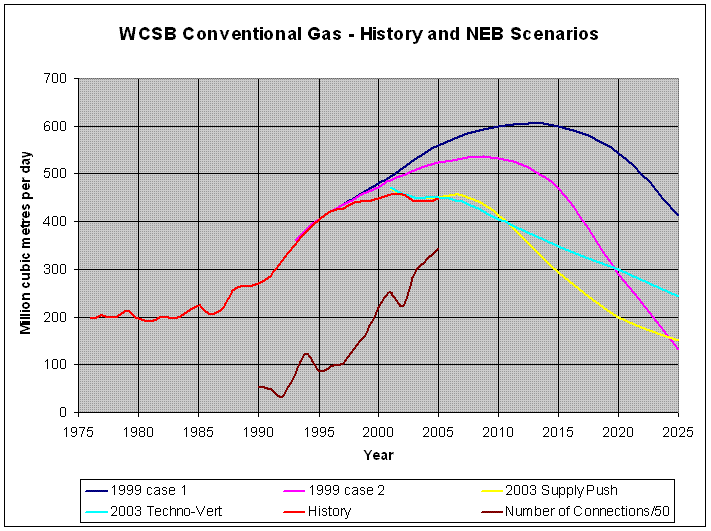
In the figure, the red line shows the history of conventional gas output from the basin. This information comes from NEB gas reports for 1976 to 1990 and Statistics Canada information for 1991 on, with coal bed methane production subtracted out for the last three years. Coal bed methane production rose from zero to about 11 million cubic metres per day over those three years. The dark blue and purple lines show the future scenarios envisaged in the 1999 report (Figure 5.4). The light blue and yellow lines show scenarios from the 2003 report (Figures 5.21 and 5.23). The brown line shows the number of new conventional gas "connections" made in each year in the WCSB, divided by 50. This information is taken from the gas short-term deliverability reports. A "connection" refers to the connection of a gas well to a gas reservoir. Since some wells connect to more than one reservoir, the number is generally somewhat higher (by about 10%) than the number of successful wells.
It can be seen that while 6000 or fewer new connections per year were sufficient to get the supply up to 400 million cubic metres per day in 1995, getting to 450 million cubic metres per day in 2001 and 2002 required something like 12000 per year, and that maintaining close to that production over the last few years has required an increase to 17000 new connections per year. Two factors are at play here: the size of new gas deposits being accessed has been decreasing, and the early depletion rates for new connections have increased. This means that the initial production from a new connection tends now to fall more rapidly than in the past. This is at least in part a matter of choice - the "fracturing" of the rock around new connections makes it easier to obtain high initial gas flow rates, which reduces the number of new connections required to achieve a given total output, but at the cost of requiring more connections in future years, because the output of new connections, and thus total output, falls more quickly. The initial depletion rate for new connections now seems to have stabilised at about 40% for the first year, the decline slowing considerably thereafter, but the size of new deposits continues to decline.
This picture is very different from that envisaged in 1999:
WCSB conventional production peaks at 21.6 billion cubic feet per day (Bcf/d) (612 million m3/d) in 2013 for Case 1 and 18.9 Bcf/d (535 million m3/d) in 2008 for Case 2 (Figure 5.4).
More startlingly:
Successful conventional gas well completions in the WCSB rise to 7700 by 2013 in Case 1. The Case 2 completions peak at about 6000 in 2011, reflecting the lower resources assumption (Figure 5.5). The number of wells drilled will be higher because dry holes will increase the count; however, this will be partially offset by multiple completions in the same well. Based on an average success rate of 70 percent, the total wells drilled would peak at about 10000 and 8000 for Case 1 and Case 2 respectively.
This is startling for two reasons - not only does it mean that we are now drilling holes at well over twice the rate expected at higher and later peak production, but also that the drilling rate was already higher than predicted for peak in the year these scenarios were contemplated.
In the longer term, the basin's conventional resources (including undiscovered) were seen as nearing exhaustion by 2025:
In both cases, about 95 percent of the established reserves are produced by 2025. In Case 1, 82 percent of the undiscovered resources is produced, whereas in Case 2, 95 percent is produced.
The 2003 report
shows two scenarios, called "Supply Push" and
"Techno-Vert". The bases of these scenarios are described thus:
The Supply Push scenario represents a world in which technology advances gradually and Canadians take limited action with respect to the environment. The main theme of this scenario is security of continental energy supply and the push to develop known conventional sources of energy.
The Techno-Vert scenario represents a world in which technology advances rapidly and Canadians take broad action with respect to the environment and the accompanying preference for environmentally-friendly products and cleaner-burning fuels.
Possible impact of the Kyoto protocol is not considered in either.
The report is somewhat equivocal on the likely size of the "resource base"
Through exploration drilling and development, industry’s knowledge of the WCSB has improved and resource estimates have generally increased. Continuous development of technology further enhances the ability to identify and exploit pools. At the same time, improved information leads to a narrower range of estimates.
However, as with other basins, opinions still vary on the actual size of the WCSB resource base. As technology improves and exploration increases in both scenarios, perhaps new geological concepts can be proved that would enable further increases to natural gas resource estimates. However, recent drilling and production data suggests that the WCSB may be maturing; and changes in natural gas resource estimates may be warranted for some areas.
The basis of the gas production in "Supply Push" is described thus:
Some resources in the WCSB are located in isolated areas or in small pools that may not be economical to develop at natural gas prices consistent with either scenario. Consequently, 64 Tcf (1,813 billion m3) or 90 percent of the available undiscovered resources in the WCSB was utilized for determining deliverability in SP.
While for "Techno-Vert", the basis is:
In TV, better economics through improved technology and higher natural gas prices, enable 92 Tcf (2,606 billion m3) or 95 percent of the available undiscovered resources to be used for determining deliverability. The larger resource base in TV also allows deliverability from the WCSB to be maintained longer than in SP.
From comparison of the graphs above, it seems that the estimates of the "Resource Base" underwent a very significant contraction between 1999 and 2003. The amount of drilling required (in either 2003 scenario) is described as follows:
The supply profile for the WCSB assumes that drilling levels similar to those experienced in 2001 are maintained until about 75 percent of available resources have been produced. At this point, the size of the remaining resource begins to limit prospective drilling locations and constrains production. Both scenarios also assume that the producing characteristic of new wells would be similar to current wells in the same area.
One can see that drilling levels well above the 2001 numbers are now being used to achieve something like the output anticipated. It seems that the last assumption is not holding up very well. Decline rates remain stable, but the output (initial and total) of new connections has continued to fall, after briefly stabilising in 2001-2. The following figure, taken from the October 2006 short-term deliverability report, shows the output of an average connection for each of the years1998-2005. Note that this graph shows a plot of production rate vs. cumulative production, not time.
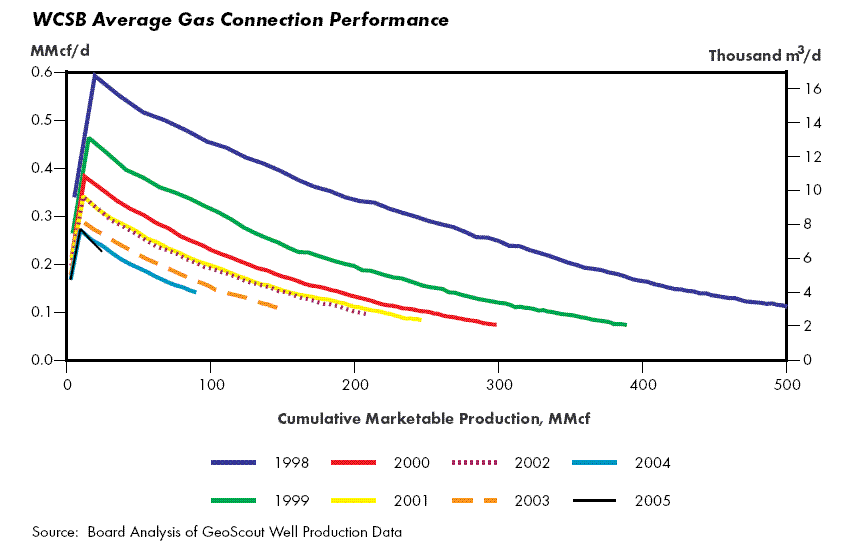
Click for larger image.
It would appear that output of conventional gas from the basin may not achieve that contemplated in either of the 2003 scenarios. If this happens, output by 2025 could be well under half of present output.
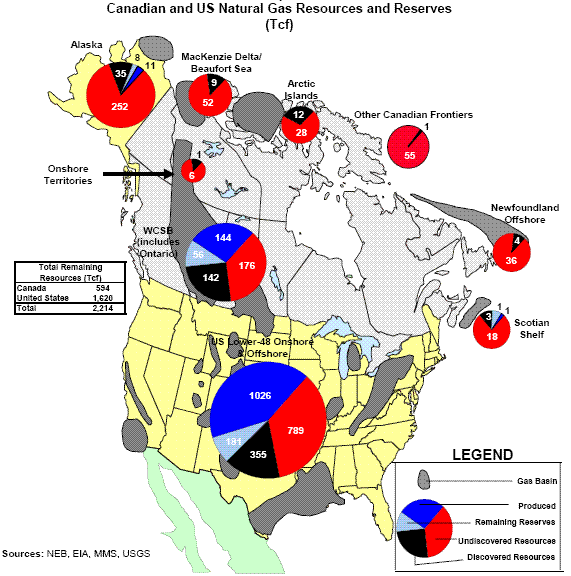
Estimates of remaining reserves and resources for natural gas in North America may be found on the web site of Natural Resources Canada.
Click for larger image
Figures like this lead to headlines about Canada having enough gas for 80 years (divide total claimed by current production), so one might wonder how the beginning of a considerable decline in WCSB production would square with this information. The numbers for the WCSB in this figure total 374 Tcf (10600 Bcm), but include in the "Undiscovered Resources" 80 Tcf (2300 Bcm) of coal bed methane, leaving 294 Tcf (8300 Bcm) of conventional gas. A steady decline in production from 5.8 Tcf/year (164 Bcm/year) in 2005 to half that in 2025 (roughly consistent with the NEB 2003 "Techno-Vert" scenario) would result in 87 Tcf (2450 Bcm) being used in that period. If we were to assume that the supply would continue to decline by a factor of two for each subsequent 20-year period, the total conventional gas extracted (over infinite time) would be about 174 Tcf (4900 Bcm). This is less than the "Reserves + Discovered Resources" sub-total, let alone the total including "Undiscovered Resources". Given that this estimate is based on a scenario that now seems improbable when one looks at recent drilling and output numbers, perhaps a further review of WCSB conventional resource estimates is overdue.
There are many variables that will affect conventional gas output from the WCSB. A simple "number of connections" indicator does not show whether those connections are from shallow low-output wells or riskier, deeper higher-output wells. A change in approach, perhaps in response to economic events, could result in better average new connection output. It does seem unlikely, though, that this will have a major effect at what is a relatively late stage in the game for this basin. The methods used to predict future flows assume that the output of existing wells will not be affected by drilling new ones in the same area. If gas production rates are kept up by drilling multiple wells into the same gas deposit, this assumption will break down and more rapid declines may ensue. This may well have happened with the Ladyfern deposit, for which a 70% decline in output occurred in the first year, after a huge drilling effort. Coal Bed Methane production is still at a very early stage. How well it will be able to make up for the decline in conventional production remains to be seen.
The remaining gas estimates above for the rest of Canada total 226
Tcf (6400 Bcm). By far the greater part of it is as yet in the
"Undiscovered" category, and most of it is a long way (sometimes thousands of kilometres) from existing
pipes. The only area other than the WCSB that is now producing
gas is the "Scotian Shelf", and both its output and the estimated size
of the resource are tiny by comparison. The MacKenzie Delta
will probably begin to produce gas at some time in the next few years,
but this will entail a huge engineering project that will eventually
deliver about 55 million cubic metres per day. Getting gas from
the Arctic islands, the Newfoundland offshore or some other frontier
areas may well prove even more challenging than from the MacKenzie. For
more details of Canadian gas resources see another NEB report from April 2004.
WCSB conventional gas and coal bed methane will provide the bulk of Canadian production for the foreseeable future, so a very significant decline in total supply looks probable. A glance at the U.S. numbers in the figure above shows that gas situation in the lower 48 states is no less "mature" than that in the WCSB, and the likely future of production in North America as a whole is implied somewhat starkly in Jean Laherrere's work, which also shows an estimate of future Canadian CBM production - about 1 Tcf/year or 75 million cubic metres per day in 2025. It seems highly improbable that imports of LNG will make up for more than a fraction of the overall decline, so get ready to use a lot less gas a decade from now.
Personnel
Archives
- December 2008 (1)
- October 2008 (1)
- July 2008 (2)
- June 2008 (2)
- May 2008 (6)
- January 2008 (2)
- December 2007 (8)
- November 2007 (9)
- October 2007 (11)
- September 2007 (14)
- August 2007 (14)
- July 2007 (10)
- June 2007 (9)
- May 2007 (11)
- April 2007 (9)
- March 2007 (11)
- February 2007 (11)
- January 2007 (11)
- December 2006 (12)
- November 2006 (16)
- October 2006 (13)
License

This work is licensed under a Creative Commons Attribution-Share Alike 3.0 United States License.
Note the new reddit and digg counters! just click on them and hit the up arrow/digg button to help out!
Don't forget del.icio.us or your other favorite link farms, such as metafilter, stumbleupon, slashdot, fark, boingboing, furl, or any of the others.
I can assure you that the authors appreciate your efforts to get them more readers.
The December 2006 ASPO Newsletter has a similarly depressing graph of future production on page 5.
https://aspo-ireland.org/newsletter/en/pdf/Newsletter72.pdf
It looks like we should get ready to use more blankets, and to expect summer electrical outages.
Why electric outages in summer? There is plenty of solar electricity to be had in summer to compensate.
In principal this sounds great. Here is some actual data for Canada PV potentials:
https://glfc.cfsnet.nfis.org/mapserver/pv/pvmapper.phtml?LAYERS=2700,270...
Perhaps you can show me how I can run even a severely limited household load off this input? I'm 2 hrs north of Toronto, ON.
Oh - what will I do with the system for the 6 months of the year that it is virtually useless? The capital costs will remain through these "dark" months. ROI looks pretty poor.
I wish you were correct, I hope you can demonstrate the error in my calculations . . .
P
Last I checked, Ontario is less than 10% gas fired electricity on a terrawatt hour basis.
Nuclear is about 40% I think, hydro another 30%.
Of course at Peak Load, the mix shifts.
There is programmed to be considerable growth in gas (eg that 550MW station being built in Toronto Harbour) *but* a lot depends on the fate of Nanticoke (largest or 2nd largest coal fired station in N. America). From what I have read, the government has deferred that decision?
Obviously, the highest generation potential for solar energy on the North American continent lies in the Southwest of the US and in Mexico. That potential is so abundant that more energy can be produced there than will be used. The rest can be transmitted over sufficiently built out grids to areas up north which do not have enough insolation to be fully self-sufficient. That extends to Canada, of course. And the potential of Mexico should really not be discounted. Free trade would allow to invest American (and Canadian?) money in ideal locations in Mexico and give all participating countries an enormous economic potential. One can only hope that this kind of continental collaboration will happen in the future.
I looked at the map and it seems to me that the southern parts of Alberta, Saskatshewan, Manitoba and Ontario are still useful sites for PV and solar thermal applications.
For comparison: in California (where I live) annual average insolation is 5.5kWh/m^2/day, which is plenty. Your map shows 4.2-5kWh/m^2/day for the mentioned Canadian provinces. My site, which is typical for much of CA, has an approximately 30% advantage over the Canadian South which goes away completely if you consider the difference between fixed flat plate panels mounted at latitude and a two axis tracking flat plate. In that case the US/Canadian border receives over 6kWh/m^2/day of useful insolation, more than what I am getting with fixed panels. Again, for comparison, the US/Mexican border receives 6-10kWh/m^2/day. The complete maps are here:
http://rredc.nrel.gov/solar/old_data/nsrdb/redbook/atlas/Table.html
It is obvious that between ideal Mexican locations and useful Canadian locations technology has to bridge a gap of a factor of 2.5-3. More advanced tracking solar systems can make up for part of the difference. Energy imports from the US, and even Mexico are absolutely in the cards for Canada.
For now the US imports most of its energy from Canada and Mexico. As solar generation picks up in the future, we will see a shift of that relationship to the South.
But solar is only one part of the equation, of course. Canada has wind energy resources:
http://www.windatlas.ca/en/maps.php?field=E1&height=80
And I would think that with such an enormous land area it should be able to partially cover its energy needs from biological sources.
And given the fact that Canada only has one tenth of the population of the US and that most of its population lives within a couple hundred miles from the US border should make Canada's energy problem very similar to that of the northern US.
I don't see Canada as a particularly hard case to deal with since we have to solve a much harder problem in the US, already. We will. So will Canada.
Yes, Canada has all the hydro, wind and bio electric generation potential a country could ever want, however, due to CAN/US grid integration -your problem is our problem- as evidenced by the infamous Ohio tree branch of 04'.
They make switches, you know. Even for a GW or two. All you have to do is to push the button...
:-)
Here in the northeast, we've been having summer electrical outages for years.
But leanan, how can that Possibly be ?!?!?
"There is plenty of solar electricity to be had in summer to compensate." All you have to do is wish upon a star and imagine anyone of iNfinITe POSsibILitiezzz ....
"But leanan, how can that Possibly be ?!?!?"
It is called "mismanaged infrastructure". They simply did not invest enough in their power grid, hoping that the tooth fairy will fix overload problems.
Now, "sendoilplease", didn't you chose your name to impress the tooth fairy, yourself? It sounds like change is something that does not appeal to you. You want your status quo and cheap, don't you? But may I suggest a change of name?
"sittingonafatasswaitingforamiracle"
is a good name, too, because it completely describes the mindset.
Or do you prefer
"ificantsolveitneithercanyou"
for your next pseudonym? Because that is really all you are saying in your post. But I will be glad to discuss the numerical facts of solar energy with you. If you really care, that is. Which I kind of doubt, right now. So surprise me!
If this is a typical natural gas scenario, it looks like I need to be able to heat my home with half the natural gas in 2020, right?
Hmmmm... let's see: 2020 is 13 years from now. That means I have to reduce consumption by 5.15% per year on average. Sounds like a mild PO scenario.
I guess I better get those windows fixed and better curtains on, some more insulation for the walls and maybe a solar heater or a heat pump... :-)
You have forgotten, to name two things, (1) the increase in population requiring heat, and (2) the increase in electricity production, presumably by natural gas generators. Then, we could begin talking about the ongoing demand destruction in industrial usage...Peak NG isn't going to be mild at all.
Actually, reducing ones NG consumption by 5% year over year is not that easy, but it is still better than having to reduce it by 7%. To me it looks like the NG generator scenario is basically a non-starter. Utilities which continue to lock themselves into that hell-hole probably belong there. I feel sorry for their customers, already. On the other hand, enormously rising electricity price for areas which are suffering from such mismanagement will fuel adoption of wind and solar energy which will become far more competitive just when NG prices will go through the roof, again.
yes, those clever suburbanites they have figured out how to insulate a home. but then they build a 4000 sf vinyl sided mcmansion(far from work so they can drive the suv's in a rat race up and down the freeway to nowhere - two income "family" i might add) but they have better schools and better parenting out there in the wasteland.
... and what happens when everyone in your street, town, city or country has the same idea?
Is there enough insulation material etc in existence?
And how about the skills to fit heat pumps etc?
And what about the poor or those in rented properties?
"Is there enough insulation material etc in existence?"
Mineral wool? Sure. It's made from silicates. Most of Earth's crust is made from silicates. How about EROEI?
"According to a 1996 report on the energy, environmental and economic benefits of fiber glass, rock wool and slag wool insulations, conducted jointly by the Alliance to Save Energy and Energy Conservation Management, insulation produced each year saves about 400 trillion Btu annually, or more than 12 times the energy used to manufacture insulation."
http://www.naima.org/pages/resources/faq/faq_mineral.html
"And how about the skills to fit heat pumps etc?"
That is easy: it's called "education"! Anyone can do it. It's just like going to school.
"And what about the poor or those in rented properties?"
We can force the property owners to take care of that. It's called "laws and regulations". Write to your representative.
Geez, IP, I don't know how you see to write with your head so firmly stuck up your ass. I doubt that you even own the condo your in much less a house much less an income property. But, I am a landlord. So consider your response:
Oh yea, you're going to "force"me to take action. Now I happen to have been cncerned about energy for probably longer than you've been alive so my rental is highly insluated with double pane windows. But it does have an obsolete propane furnace (I'm in the boondocks.) use because they heat using the wood heater.
But, let's suppose your "laws and regulations" require me to install the most efficient heat source available. Well, I can't install a ground source heat pump because the electrical system won't handle it so I guess I'm "forced" to put in a new propane furnace. And, let's assume the replacement is estimated to cost $10k. What's my reaction? Screw it. I'll pull out the furnace entirely and they can just heat with wood. But they have to have a funace. OK.
So, you are forcing me to spend $10K. Numerero uno, the rent goes up based upon the real rate of inflation to cover my capital costs. I'm losing $1k per year so to keep it simple, my minimum increase is $100 per month because that's what I'm losing on the $10k (Yea, it's rounded but landlords work that way.). BTW, the $1k is lost interest.
NOw I've got to pay for the furnace. Well, the IRS won't let me deduct the expense in a few years. No, they want me to deduct it over probably 15 years. I figure five years is reasonable so I tack on an additional $170 per month (remember, landlords round things off to the next highest number). So my lucky tenants are now paying $270 a month more. Can they afford it? I don't care. I'm perfetcly willing to close it up since I own it outright and my guess is someone will pay the higher rent...but they are unlikely to use the fancy furnace.
Am I going to take back these rent increases once I've recouped my money? Of course not. Now, other landlords might have other considerations so I can't speak for them. However, I'm willing to be t they aren't much different than I.
By the way, why don't you tell us all of your experience installing heat pumps.
Todd; a Realist
Todd certainly talks like a landlord. In my experience, landlords are parasites who find death adders in their pockets when they're asked to shell out for maintenance. If they even think something will happen to cut into the profits they make from owning somebody else's home, you get a long sob story about how it'll all come out of the tenants' pockets.
The most significant thing in Todd's post is the information that his rental property is in the boondocks. When Peak Oil starts biting, virtually the only people wanting to live there will be people with a job on site (like farmers). Instead, people will be willing to live in a shoebox if it means they can cut their travel costs down to manageable levels.
What does this mean for Todd's property? It means he'll lose his tenants as they either leave for a saner location or have their pick of properties after the rest of the population leaves. Prices will be so low that, if they stay, they may even buy a place and stop providing any landlord with their pocket money.
Todd will be lucky if he can get out without taking a huge loss. And I'll be saving my sympathy for:
(a) Outer suburban homeowners with mortgages far higher than their homes will be worth and petrol bills screaming for them to sell up and move; and
(b) Inner-city tenants who will be faced with the choice of staying put and paying triple the rent, or moving into a shoebox and paying 50% more.
I love sweeping generalizations from people who don't know what they are talking about. You're a case in point. First, if you knew anything about business, you'd know that no one, not even landlords can operate at a loss. If a law were passed that sitpulated that I had to spend $10k for a new furnace, I'm not going to just give the money away. And, it isn't that I abhor spending money. When I replaced the roof a couple of years ago, I added insulation to bring it up to R-30. It was an R-20. No rent change.
Second, take a huge loss? Naw. As I said I own it outright. Loss of income? I can survive quite well without it. In any case, there are few properties like this with power, phone, water and views to die for so re-renting it even at a higher monthly amount wouldn't be a hinderence. Why don't I ask more now you might ask? We have wondeful tenants and the current rent is about what they can afford. I'm not greedy. They been there seven years or so.
But, there's more to it than money or a place to live. As I've said many times, I'm a doomer and I want tenants that share this belief; who understand what may happen in the future. They know what action will be taken, and their part in it, to keep going if things get tough. This includes knowing that I won't throw them out if they can't pay the rent because of loss of income.
However, mandate that I spend money on a funace, then I have to raise the rent to recoupe my expenses.
One final thing. I was born at the end of the Depression so I had contact with all the family members invovled. My dad's father lost his business, his home, everything. He went from lower upper class to dead poor. My mom's parents took in relatives who couldn't afford any rent. They lived in the basement. My folks often had very little food. Unlike the Depression, people today have the option of making choices as to how they view the future. There will be winners and losser.
Todd; a Realist
On re-reading this later I see I forgot to mention the rental is on 17 acres. Yup, besides a lot of land, they get mountain, valley and views of the Pacific Ocean from a private road. Not that it makes a difference but it's worth noting I suppose.
Hello,
well, Mr. Infinite has some experience with how other places do things - like Germany. For example, you write 'my rental is highly insulated with double pane windows' which means you are just about par for the course for Germany, 1980 or so - you know, years after the first oil shock. Highly insulated in Germany these days are triple pane windows (vacuum or inert gas filled) - and yes, they do cost a bit of money. As does the solar water heater - but generally, the PV installation pays for itself in a few years, if you have the capital to install one.
You may want to read more about what is fairly common in Germany at http://clvweb.cord.edu/prweb/press/biohaus/journal_jan.asp - they are attempting to build something in the U.S. which is not considered all that extraordinary here in Germany.
I do think at times IP goes off the wall, but in part (though how large a part remains open) it is because he is trying to describe things which other people in other places consider absolutely normal, while being told this is not how people are. Or how it won't work, even though he knows it does in other places.
In a way, his reactions are a good indication of how the world often views today's America - with utter incomprehension.
And since most of the world isn't comprised of Americans, his points aren't actually all that irrelevant, even if in a purely American context, they seem strange.
If Americans keep insisting that they can't actually meet the challenges that other people consider utterly routine, the point will come (if it hasn't, actually), where America will sit isolated while the rest of the world goes along, dealing with life, ignoring the 2 year old's tantrum in the corner - except baby has the Bomb, which is a real cause for concern. But blowing things up is not actually all that useful - how is oil production in Iraq going these days, by the way?
rental properties are subject to supply and demand like most everything else and there are good renters out there (although relatively rare). and even when there was a glut of rentals on the market, good renters were out there, but to attract good renters your property has to be competetive with the market (and that would include the cost of heating the shack). another big factor is whether the landlord owns the property outright (and not just working to make money for the mortgage holder). if the landlord has to keep the place rented to make the payments, they may be more inclined to accept less than desirable renters. now, if you own the property, having it sit unrented for awhile will hurt, maybe hurt a lot, but it wont mean that you loose the property. * (from slumlordin' 101 by elwoodelmore)
Expat,
I really love your posts but regarding energy efficiency what were you doing 25+ years ago? Were you as concerned then as you are now? You talk about what the Germans are doing today. Ok. Do they all use air-to-air heat exchangers? Do they all use heat exchangers on their sinks/tubs to reclaim the hot water? The list of things that can be done is endless. And, it's not just what they are doing today. Is everything being retorfitted with the most up to date stuff regardless of its age (For all I know it might be.). Is Germany mandating SIP consrtuction? Are they mandating PV/wind systems for individual homes (My PV system is 3.6kW. What's the size of your system?)? What about active solar heating/cooling systems? They're certainly proven. How about Trombe' walls?
As a landlord, you denigrated the double pane windows I installed. Yet, I did this over 25 years ago when no one cared about energy efficiency. Hell, when I designed my house about the same time with insulation that grossly exceed the standards at that time (and currently) and used solar insolation for 30% of the heat, the county building department thought it was funny - they actually asked why I was doing this.
But in the case of my rental, I offered to install friction-fit, removable interior storm windows to make them triple glazed like I installed on my own house. My tenants declined. They certainly aren't fancy but they work for me.
I and my tenants are essentially carbon neutral for heating since we heat with wood. Mine comes from my property and theirs could too but they have physical limitations so they buy it. As an old fart, I can't cut enough for both of us. How many Germans are carbon neutral when it comes to heating (and in my case, cooling)? My guess is zip.
My point to all of this is that there are many paths to energy efficiency and one can't generalize. The US is clearly an energy hog. As I said above, some will win and some will lose.
Todd; a Realist
Actually from memory 25 years ago (or 30) people were much more concerned about energy efficiency than now.
The price of oil and electricity, relative to incomes, was much higher then than now.
However building technology has improved a lot since then. And some jurisdictions (California, notably) require much higher standards of insulation etc.
I agree with you that as a landlord, you are only going to install new technology as and when you have to, and that will be reflected in higher rents. And so it goes for a propane boiler.
My own take is that we can incentivise people to install heat pumps (and we should) but we shouldn't be in a position of mandating that sort of technology. Insulation is a low cost/high return proposition, heat pumps are a high cost/high return proposition.
It may also be reflected in lower costs for the tenant.
"I doubt that you even own the condo your in much less a house much less an income property."
It's OK... we own four properties on three continents. The largest property happens to be my own. I know what the heating bill looks like because I am paying it. :-)
"Oh yea, you're going to "force" me to take action."
I am not. The lawmakers are. They are doing that already. For one thing, there are safety regulations. You can't have people live in an unsafe house. If you do, you are breaking the law. Are you breaking the law, Todd?
Since you are already regulated, what are you getting upset about? You will be regulated some more. Big deal. Actually, you might just be penalized by energy prices to the point where you won't find people to rent your place. If you don't like the business, sell your income property and invest your money otherwise.
As for the rest of your argument: yes, rents will go up. The poor are screwed. They poor are always screwed. It does not take PO to screw them. How do I know? My parents were poor when I was a kid. Man, were we screwed, and gas was cheaper than water is today!
I did not need PO to be screwed as a poor kid, Todd. I really didn't. And that is just the short version: how screwed the poor are is mostly a function of politics. Therefor the poor in the US are double screwed. The poor in Europe, on the other hand, are only half screwed.
"By the way, why don't you tell us all of your experience installing heat pumps."
I don't have any, yet. I keep asking my parents, if they want one, but they rather pay the heating bill as it is, right now. I could push them harder to do it, but why bother? A year or two down the road they will reconsider, anyway. My Mom is good with numbers. She will figure out how much money she can save once the NG in their neighborhood gets really pricy.
IP,
You know, I've allowed myself to be sucked into thread hijacking and I should have never responded to your initial post. I'm a Mod on another forum and I should have known better.
If you want to continue along this line, repost it on DrunBeat.
Todd
the poor in the rented properties will just have to get a no money down e/z pay loan (garanteed by the govt.) to buy and fix up a hovel of their own. then they can become wizzards of the financial world (use the hovel as an atm)
A detailed update on Alberta WCSB resources was published in 2005 jointly by the Alberta EUB and the NEB as "EUB/NEB Report 2005-A: Alberta’s Ultimate Potential for Conventional Natural Gas".
It shows an ultimate potential for marketable conventional gas at 223 Tcf, of which 122 Tcf has been produced, with remaining discovered reserves at 39 Tcf, and undiscovered "reserves" at 62 Tcf. Average discovery rate in the 4 years preceding the report was 3.8 Tcf with annual Alberta production at 4.8 Tcf. The report anticipates that the rate of discovery will decline.
possibilities:
- keep producing the gas for oil sands production
to sell synthetic crude to the Americans
- keep selling the gas in the export market to the Americans
- honour Kyoto Accords by sequestering CO2 or reducing exports to zero
while keeping in mind the reduction in glacial runoff and reduced
snow pack due to AGW
and the possibility of increased drought on the Prairies...
hmm Peak gas and Peak water
seems we have hit the RESET button on our planetary life support
system.... and we don't have a Plan "B"
It's likely they will build a nuclear reactor for steam for the tar sands.
If only because of the global warming issues associated with tar sands development.
Building a nuclear reactor in Fort McMurray, though, will be no mean feat (200 miles north of Edmonton, population 30,000, they are paying McDonald's workers $30k a year labour is so short).
And if I read the press release correctly, they talking about displacing a measly .6% of current NatGas usage levels with said reactor. .6! Again I ask... What's the point?
and they probably still give lousy service
Libelle, very good post. The links are great.
Did you pick the 1999 report on purpose? Was it their most optimistic report or were earlier ones more optimistic? Also, do you have any sense of when they realized that a change in their outlook for nat gas production was required? Was it all-of-a-sudden or gradual over the 4 years?
Thanks. The 1999 report is the earliest for which a web version is available. There is a paper one from 1994, but I don't have it and it only runs as far as 2010.
As for when the change occurred and how, I don't know for sure, but from reading the short-term reports, I suspect it was gradual.
A much appreciated and timely update. Natural Gas doesn't get enough attention.
If conventional NG projections keep getting trimmed back and LNG projections keep being pushed into the future we may be in for one heck of a gap.
I understand that NG pipelines operate under very high pressure. If the base supply of natural gas isn't sufficient to maintain pressure, will coal bed methane be able to fill the gap for long? In other words, once there isn't sufficient natural gas from conventional wells, will the much smaller supply of CBM become stranded?
Part of the pipeline system is big compressors that maintain line pressure throughout the system, powered by natural gas, naturally.
great job Libelle
if we were having a cold winter, you might have hundreds of thousands of people reading your work. as it is, nat gas prices (though spiking the last few days) are still near the lows for the past 18 months. No need to worry -the market doesnt agree with your analysis. (the market is discounted by its own discount rate as well as the steep discount rates of all the humans it reflects).
In your research did you come across any quotes or intentions that once the decline rates start to get too large, that Canada keep her gas for herself rather than piping it south in exchange for dollars?
Great keypost, Libelle!
We need to be mandating by law that some significant % of NA natgas is converted to fertilizer. This stockpiling will force prices much higher causing widespread conservation and efficiency improvements in home heating and electricity usage. The fertilizer stockpile will help us bridge food supplies until relocalized permaculture predominates. Mankind can live without heat, A/C, and electricity, in fact, our ancestors took this for granted--but we cannot live very long without food.
Even if the 3 NA powers did something like this proposal on a small scale: you would get your hundred of thousands of readers. Natgas is most valuable as a chemical for growing plants and creating medical supplies, not powering a videogame console or heating a suntanning parlor.
Bob Shaw in Phx,Az Are Humans Smarter than Yeast?
I totally disagree. If you want to push up the price of natural gas, just increase the taxes on its production or its use. (Unlike oil, taxing NG production actually works because NG is a much more local product.)
The half-baked idea you propose would push down the price of fertilizer, which at first seems like a great idea, but when you factor in the environmental costs and the long-term damage to cropland it becomes obvious it isn't.
Besides, in my experience, the most effective fertilizer is legume seed and animal manure.
Hello Markincalgary,
Thxs for responding. Respectfully disagree that stockpiling fertilizer will push down fertilizer price. If this fertilizer is mandated by law not to be on the market, and guarded accordingly, it won't effect current prices downward, but drive prices gradually up.
It may 30 years or more to successfully transition to natural organic permaculture-- the idea is to store and sparingly use the FF-fertilizer to help bridge across this transition thus promoting faster growth of the required infrastructure, and livestock regrowth to fully recycle animal manure. This program will also create market forces to reduce the burning of natgas--which is the worst application of this declining resource. Recall the quote that appears in the box on the upper right, goes something like: burning natgas is like burning a Picasso painting when one considers the other better uses for it.
Taxing natgas should be the second choice, but considerable care has to be taken to absolutely insure the collected funds are used to drive towards relocalized permaculture. I would not rely upon politicans to be totally honest in this regard. The problem with just taxing natgas is that the wealthy will outbid the farmer to burn the natgas now. The farmer, and those who want to jumpstart permaculture, do not have the financial resources to outbid, then stockpile for years the FF-fertilizer to help bridge their gradual transition to organic methods. Stockpiling fertilizer forward time shifts the eventual usage to a specific, directed task; i.e. it will make no sense to reconvert it back to a form where it can just be ignited to provide temporary heat.
Bob Shaw in Phx,Az Are Humans Smarter than Yeast?
I'm not arguing the need to push up the price of natural gas use. It should definitely be priced much higher than the current market price. I'm also not arguing that building a stockpile of fertilizer will push down prices, quite the opposite and that's good. The problem comes when the reserve is tapped and fertilizer prices are pushed down. I am arguing that the creation of a "federal fertilizer reserve" is not a good investment of resources and energy compared to just taxing natural gas use of any kind, even if the money raised by the tax were spent on nothing but ruling-party ad campaigns. (Half-kidding on that last point.)
Transitioning to an agricultural system with drastically reduced fertilizer inputs is not as painful as it is often made out to be. From a consumer's stand-point, it's not like agriculture will just stop and everybody will starve if the price of fertilizer doubles. There will still be production, the product will just cost more and be less plentiful while producers adapt. Fortunately, unlike fusion, the alternative technologies and practices are in place and have been proven on a commercial scale. I can imagine a one or two year struggle while the market shifts to produce more legume seed and less corn, but that's honestly the biggest hurdle I see. Assuming that natural gas prices experience a sudden rise, first-world production would drop, but not precipitously. If natural gas prices don't rise suddenly, the transition can progress more ponderously. If we start taxing natural gas now, we can dampen any sudden rise by adjusting the tax rate.
From the farmer's perspective, the transition to drastically reduced or completely eliminated fertilizer use can take zero to as many years as you want. The process hinges on moving to a crop rotation that incorporates a legume. Typically, one season is all it would take. An initial reduction in production is normal. (The issue of transition is made out to be a big problem because it can take as many as seven years to be certified organic. But the transition to the methods is basically done in a season.)
I don't see farmers being outbid for natural gas as a problem (and if it is, than your idea has an issue while the fertilizer reserve is built). Rather, I see that as being a desirable characteristic of markets. It's an incentive to adopt more sustainable agricultural methods. With a natural gas tax, we can see this incentive appear at the announcement of the intention of the tax. What you are suggesting would be a disincentive to the same, and the tax payer would be footing the bill while making the problem worse.
There's also the question of how to properly manage the reserve. This is a massive problem. My mind boggles at the opportunity for bungling. Picking the right time to tap the reserve is basically impossible to do without a looking-glass. It is also very possible that it's already too late to build a reserve.
Your average farmer is incredibly conservative and incredibly conformist. Many only pay attention to market signals when they are on, or just past, the brink of bankruptcy. A huge signal will be much more effective at getting the whole community in motion. If there's a way that change can be avoided for another year, it will be.
But don't listen to me. I'm just a nuts-and-bolts wannabe farmer with massive bias: My farm system uses no nitrogen fertilizer (but some phosphorous, potassium, and temporarily, lime) right now. I'm already more profitable than the average (ie. profitable before subsidies) and stand to make out like a bandit if fertilizer prices sky-rocket. From a business stand-point, I don't want the blow cushioned in any way. Seriously Bob (no, not seriously) don't make me get my pitch-fork.
I'm much more worried about how agriculture will make out if diesel prices take an express no-return trip skyward. My farm system is immune to this issue as well (and there's always the draft horses I'm playing with), but there really isn't much for alternatives to the diesel powered combine. The best I can think of, and it's not all that good, is a return of the Victory Garden.
Hello Markincalgary,
Thxs for the reply. Glad to hear that you are a farmer--your expertise on this issue probably outweighs mine. I think it would be interesting for you to present both proposals to your fellow farmers to see what they would prefer going forward. Maybe someone has a better idea than even ours.
I echo your worries on diesel. Running tractors and pumping water have got to be huge concerns going forward. The cotton farmers outside Phx have the largest tractors I have ever seen, and the harvesting equipment is 'cotton picken huge'. Lots of the pumps have a 12-inch outlet diameter or bigger--gobs of required energy-- I just wonder how long that can last postPeak.
Bob Shaw in Phx,Az Are Humans smarter than Yeast?
. . .that Canada keep her gas for herself rather than piping it south in exchange for dollars?
Two Barriers to this at present:
1 NAFTA Agreement would have to be shelved/renegotiated
2 There is insufficient pipeline infrastructure to move the gas to Canada's largest consumers (population centers) in Ontario. The pipelines are all USA centric except for one. See Trans Canada Pipeline site: http://www.transcanada.com/.
The future is not bright in Ontario.
..ish
Ontario has biomass (aka trees).
And much could be done with domestic gas heating by switching to heat pumps.
And Ontario has a big nuclear capacity. And a plan to get more wind power (although the wind isn't really regular enough that side of the Lakes and there is local opposition).
And there are huge improvements which can be made with energy efficiency.
I wouldn't say Ontario is in perfect shape, but of major north eastern regional entities it has a big nuclear sector and substantial hydro resources (plus North America's biggest or second biggest coal fired plant).
There is a lot of work to repair the damage of the last 15 years of mismanagement, but it is a problem Ontario can solve.
Ontario in general perhaps, but TO is a totally different story. Of all the cities to find yourself in post peak... a freezing cold (winter) and conversely hot/humid (summer), car dependent city of millions (Toronto) is not one of them.
Oddly I lived in Toronto for a quarter century without a car-- never missed it (although I could borrow one when I needed it).
Among North American cities, it has a relatively dense residential core, and relatively good public transport. (GTA is another matter ;-).
Agree about the climate, but my mother grew up there with coal heat. People could, and did. Summer is more of a problem these days-- is it only me who doesn't remember these 6 week heat waves? When I was a kid, I remember (I think) that you would usually get one week on-- one week off. Repeated pattern from 1st July to about Labour Day.
A bigger and very real problem is the dependence of Ontario on the automotive industry. *that* would hurt.
I am a big fan of Canadians. Pragmatic, not loud, work out solutions to problems. Americans without the noise ;-).
Natural Resources Canada seems to think exports will decline:
do you have a spreadsheet and/or 05-10 data? hard to read the graph. and, did ca exports decline in 06, as the graph seems to say? tia
Canada is predicting a 1 bcf/day decrease in exports this year. NG isn't doing well and the low prices are discouraging E&P. The tar sands have created a "gold rush" in Alberta making labour, in particular, a premium commodity.
Funny how standards change. Today's prices would have been considered outrageously high just 3-4 yrs ago when prices were expected to range between $2.74 and 4.06 through 2020 (EIA 2002 annual energy outlook). Now it seems anything below US $8.00 gets called "low."
Precisely. I was also puzzled by that repeated claim that we currently have "low NG prices", especially since my last monthly bill turned out to be 30% higher (the price per therm had went up some 20%).
It is worth noting that current NG prices are approaching oil prices on BTU basis - $8 equals $50/barrel in energy equivelent. In this context the statement "lower prices have been discouraging investments" speaks volumes. The prices are lower only compared to previous temporary spikes, but are quite high on historic basis. If the producers find them "low" this means production costs are rising fast. And this very likely means... exploration becoming costlier and less successful... equipment prices rising... etc. etc. whatever they start explaining it with, it will be known as "Peak Natural Gas in North America" in the books.
back in the olden days ( that would be "the nineties") we were struggling to get $ 1/mmbtu in the rockies.
The data are for five-year increments so can't be used to infer the 2006 exports. I don't know how to post tables here without destroying the column format, so here's an image.
Just saw this at intelligencepress.com
Canadian Exports, Revenues from Gas Sales to the U.S. Show Declines
Breaking News from NGI's Daily Gas Price Index posted Jan 26, 10:01 AM
With increased demand at home, Canada had less natural gas to export to the U.S. during the gas contract year that ended last Oct. 31, a final tally by the National Energy Board (NEB) showed. Canadian exports to the United States shrank by 4.8% during the contract year, the NEB said. Total contract year pipeline deliveries to all U.S. destinations were 3.55 Tcf, down from 3.73 Tcf in the 12 months that ended Oct. 31, 2005
Subscription required to read whole article.
Canadians (in the West) are always at an advantage v. Americans in buying the gas, (or at least should be), due to lower pipeline tariffs.
The situation is harder for Ontario, competing against the Midwest for gas.
The EIA also seems to expect a decline in Canadian exports. See figure 41 on page 42 of: http://www.eia.doe.gov/oiaf/ieo/pdf/nat_gas.pdf . They predict a decline by a factor of two between now and 2020. Mysteriously, they predict a slight rise after that.
As far as I know we are still at the "Let the market decide." stage. I don't know how a national decision to cut exports would be implemented - it would probably be a constitutional can of worms because natural resources are under provincial jurisdiction.
Officialdom still seems to rely on the resources numbers "enough for 80 years", in spite of the evident problems. I saw yesterday a Conference Board of Canada report that was still bullish on Canada's future as a supplier of energy, recognised that LNG imports would be necessary and expressed some reservations about where they would come from. Talk about mixed messages!
Unfortunately, the URL I had for that seems to have been a temporary one that has ceased to function.
"I don't know how a national decision to cut exports would be implemented - it would probably be a constitutional can of worms because natural resources are under provincial jurisdiction."
Extra-provincial trade falls within federal jurisdiction, hence the National Energy Board. The problem lies within NAFTA rules.
Thanks Libelle, very informative.
I have often said that I expect the NG issue to hit an order of magnitude harder than PO. Several reasons:
1) NG is far more essential than oil. It is simply not that exposed to the public. I can lower my oil usage by 90% overnight - by simply taking the bus instead of the car. But I can hardly imagine doing the same with natural gas - natural gas is responsible for 100% of my heating, 30% of the electricity (almost irreplacable for meeting peak demand), not to mention its usage for fertilizers for the food we consume. Any idea how to reduce 90% of these?
2) The consequences of PO proceeding PNG. If PO comes before PNG (which it looks like will be the the case on a global scale), there will be an intermediate period where the most immediate and politically acceptable alternative to oil will be developed - and NG looks like the best choice. Increased development is going to lead to increase dependance to NG and increased depletion rates... Thus the eventual hit will be much harder.
3) The nature of the NG reservoirs is leading to much higher decline rates relative to oil. Furthermore NG is far more "just in time" system than oil - leading to significant price fluctuations. The result - we will hardly notice the NG crisis before it is upon us, the way it happened in California. This coupled with 1) and 2) is the source of my pessimism.
As for Canada, I truly hope the public opinion turns on the question of nuclear power, before it gets too late. Usually northern countries (for good reasons) have much more pragmatical view on this issue and the continuing contreversity on it in Canada I find quite puzzling. Compared to other, Canadian nuclear industry has envieable safety record and the CANDU reactor design has a lot of potential - especially if we go for mass producing it for poorer countries, significantly reducing proliferation, safety and waste problems.
CANDU was a financial disaster of the first order.
Ontario's taxpayers have $32bn of stranded CANDU costs (about $2000/kw of capacity installed) and not all of the reactors even yet have been rehabilitated.
Canada is a big uranium producer, and it is a big enough country to find somewhere to dump the waste.
But in practice, only Ontario is going to pursue nuclear (pace a nuclear reactor in the tar sands, which is a real possibility). The existing 14 (from memory) units will have to be replaced, beginning in about 2020.
From memory: 8 at Pickering (A and B)
8 at Bruce (A and B)
2 at Darlington - the Darlington units cost $10bn
Can't remember which ones are permanently mothballed, without checking. All were 750MW units or thereabouts.
(my claim to fame, such as it is, is that a close relation picked the site for one of the above)
BC, Quebec, Manitoba have hydro power and biomass. The Maritime provinces are really too small for nukes (although New Brunswick has the Gentilly plant). I would expect the Maritimes to use LNG (the terminals are being built to export landed LNG to the US). Alberta has coal.
I think in practice the Argentinians and the Indians did figure out how to use the Candu fuel cycle to make bomb material. I'm vague on the details, but we sold the Indians their nuclear reactor technology.
I wonder... how is it possible that the Darlington Nuclear Power Station costs to reach 14.4 bln. CAD a unit, while the other 25 units of the same type in Canada, China, South Korea, Romania etc. costed in the vicinity of 4-5bln.CAD? The reactors are similar, even the company that built them was the same. Obviously there is nothing inherent in CANDU that causes cost overruns, it is obviously stupid humans doing stupid things like suspending construction wherever they feel "green".
Also, according to Wikipedia, you are wrong about the India's nuclear prolifeteration source:
I'm quite interested in proliferation. I'll have to go back at some point and search around. I certainly had the impression (perhaps incorrectly) that India used the Canadian fuel cycle to create their first bomb.
Thank you.
Darlington was originally estimated to cost 3.9 $bn but the final cost came to 14.4 $bn (CAD), in 1993 dollars!
what did halliburton build that one too ?
And now the truth about Darlington:
Now let's get things straight:
1) $5bln. was the cost estimate for all 4 units in 1977 dollars
2) $14.4 was the final bill for all 4 units in 1993 dollars
3) Most of the cost overrun were due to accumulated interests. Interest for which you need to say thanks to the policy of your beloved governments.
4) Obviously the whole $28bln. Ontario Hydro debt can not be attributed to the overrun of one nuclear project by $9 bln. I know nuclear is an easy targetm, but maybe you have to take a deeper look at how money is spent in this company.
My only conclusion from the points above is - if you canadians don't want to freeze in the dark, better put your public policies in order. Nuclear is just a technology, and technology is like a hammer - you can build a house or you can break your head with it.
I agree with you a big part of the problem with Darlington was political meddling.
I had forgotten Darlington was 4 units, for some reason I thought it was 2.
There was also some very serious overoptimism about costs and schedules. It was at one time the largest construction project in North America, and this led to significant cost inflation.
The real political nightmare was when a guy called Maurice Strong was parachuted in to run Ontario Hydro-- he was one of these international high flyers. He cut the maintenance budgets, and *that* was what led to the serious problems at Pickering and Bruce, costing the taxpayer billions. But there were management issues as well: a lead blanket was left in one of the reactors during maintenance, and the lead ions completed coated the inside of the reactor. I don't think that reactor has ever been recovered.
Ontario Hydro no longer exists as such.
Ontario's experience of nuclear power was seering. Whether they are prepared to go back there again, I don't know.
"Whether they are prepared to go back there again, I don't know."
Yes, they are
It looks that despite cost overruns Darlington is considered a success, providing 17% of the province electricity.
One of the virtues of the collapse of the complete deregulation and privatisation of the Ontario Power Market (farewell premier Mike Harris and his 'common sense revolution') is that Ontario still has a degree of vertical integration in electricity.
(the generation, transmission and distribution entities are separate, but all government controlled)
As a result OPG can take the financial risk of building this plant, because the market will lend it the money to do so. They can see that there is a buyer, and that the IESO (Independent Electricity System Operator) will pass on the cost to the consumer.
It's much harder, dare I say impossible?, for some of the fully deregulated North American markets to build new nuclear power plants because of this.
This is the situation we are in in the UK, where it is fully privatised, deregulated, and the utilities aren't even British controlled.
Nukes are just a tad costlier than coal power plants. I don't believe a private utility that can spare $1-1.5bln. would have problem raising $2-2.5bln.
The problem is security of investment - changing government policies, long licensing processes and fiddling around with the waste issue are scaring off utilities and their financial partners. This situation can be easily alleviated simply by changing the government policy. China is building nukes for 4-5 years from the decision to the start and I don't see why this can not be done in UK with proper policies in place.
On the other side, coal industry feels secure. They are OK with the danger of being charged with carbon taxes, because it will affect their current revenue, not the safety of the initial investment. Even the boldest environmentalists are not defending dismantling existing coal power stations, though it might be argued it is not such a bad idea.
My basic understanding is private capital markets will *not* fund nuclear utilities for new build.
Without clear government guarantees on Pool Price a la the per unit subsidy Bush granted nuclear stations in the 2005 Energy Act.
This may not be fair, but it reflects the difficult cost history of nuclear power stations (300-400% over budget) and the sensitivity to falls in the Pool Price (or equivalent in more regulated markets). British Energy, for example, has only recently come out of a restructuring in which the government rescued it by diluting the shareholders by 90%.
The value of the coal plant will be hit, if the future cost of running it is increased by the carbon tax.
Either they believe:
1. carbon taxes will never happen or not be onerous. So far, US politics has killed the idea stone dead
2. when there are auctioned permits, they will be 'grandfathered' in based on their historic emissions, so offsetting the cost of carbon permits will be the valuable asset of free carbon permits. This is what has happened in Europe.
I think by building new coal plants now, US utilities are hedging their bets, as above.
Note that AES has applied for permission to build 2 IGCCs, from the state regulators. *they* obviously think carbon regulation or taxation is coming.
However Southern Company and TXU are going hell-for-leather for new coal fired plants.
To which I say: let's encourage TXU to build new nukes, even if it costs the taxpayer. When we have a viable carbon sequestration technology and system for coal, *then* we can let them build new coal plants. In the meantime, we are just locking in trouble, for all of us.
Trivial correction: Gentilly is in Quebec. The nuclear plant in New Brunswick is Point(e) Lepreau. Valuethinker is entirely correct on the substantive points, AFAIK.
Oops.
Mixing my Canadien French and my Acadien French ;-).
(for the non Canadians amongst us: Acadien is the dialect of French spoken in New Brunswick, and is quite different from Quebecois French)
A study of reported reserve growth in the years leading up to the peak would be interesting. I am wondering if you would see the same misleading financial reporting constrained growth reporting.
The 1993, 2003 curves looks like the NEB followed linear projections to arrive at a distant peak much in the same way as financial reporting motivated oil reserve growth indicates linear growth.
Just a comment from an Ontario perspective.
The Ontario Power Authority forecasts a 1/6th dependency on gas fired electricity in 2015 (31 Twhr/ 168 total consumption pa). p15 below.
In addition there would be a substantial dependency on gas for home heating (from memory, about half of Ontario homes are heated with natural gas-- rural homes are much more likely to be heated with bottled gas (propane) or wood).
http://www.powerauthority.on.ca/Storage/32/2736_DP7_Summary.pdf
From the numbers presented in this paper, Ontario's plan may be optimistic.
The flex in the plan is when to shut down Nanticoke, North America's largest (or second largest?) coal fired power station (3000MW capacity ie about 1/12th of total system capacity) and currently about 15TWhrs of production (ie 1/11th of demand).
I live in SW Ontario and this is one reason I installed a 5kW grid-tied PV system with battery backup last summer. The most important reason was that I wanted to be part of the solution, rather than part of the problem. However, having said that, I am not as optimistic as Infinite Possibilities seems to be earlier in this thread about the ability of solar or wind to gently wean us off gas fired generation. One of the other reasons I installed the system was to use it as a conversation starting point on energy issues, but the most frequent question I get asked is either "How much did this cost?" or "How long is the payback time?". Even when electricity rates start going up more radically, I think the uptake on wind and solar will still be slower than what is needed.
I think we need to be realistic: neither wind nor solar energy are a solution to our current (!) levels of demand (and I am talking about the US here). But then, per capita the US uses twice the energy of Europe. Europeans are doing just fine on their current levels and are rapidly building renewables capacity.
The US has at least ten to fifteen years of technologically very simple conservation measures to go before it faces the same situation that Europe has to deal with now because it has done its easy conservation homework already. Having said that, the US, Mexico and Canada have enormous natural resources for renewables that Europe simply lacks.
The answers to the questions "How much does it cost?" and "What is the payback time?" are a function of time. Today you might want to answer "Too much!" and "Too long!". Tomorrow you will simply say: "What does it matter? I have electricity and a warm living room.". I think you will be very convincing.
The US is close to having the largest installed wind capacity in the world.
With the new California rules, I could see it becoming the largest wind source in the world.
Granted, it is also a relatively intensive user of energy. But it has land, and land that the farmers welcome the rentals from windmills-- far less of a NIMBY problem than Europe. And it has some of the best (on shore) wind resource on the planet. Much depends on Congress' actions re renewing the wind subsidy (without a carbon tax, new nuclear and wind power require a 1.7 c/kwhr subsidy to be competitive).
And it is Texas, of all places, the home of big energy, that is leading the way.
Does anyone know where one can find a graph of natural gas production for a country that has peaked some time ago (Iran perhaps?). I am interested to see what such a curve might look like. I know that production should fall off steeply for a given field, but I am interested to see how it might look for an entire country.
Off the top of my head some of Matt Simmons presentations on the Simmons & Co. website have gas depletion charts-- I don't know if for countries.