


CO2 Capture and Storage: The Energy Costs
Posted by Rembrandt on July 5, 2007 - 9:32am in The Oil Drum: Europe
Capturing carbon dioxide from coal (and gas) fired electricity plants. Subsequently transporting the carbon dioxide from the plant and storing it underground in (abandoned) oil/gas fields, in other geological formations or on the ocean floor. It seems like an excellent solution for continued fossil fuel use in the coming decades.
The European Union wants to have 12 large CO2 capture and storage demonstration projects in place by 2015, requiring an investment of 5 billion euro. The expectation is that this development will cause significant cost reductions, making the technology affordable by 2020. There are however two large drawbacks, it will keep costing large sums of money and the process is quite energy intensive. In this post the impact of the extra energy cost of the process on coal depletion is quantified, the economics will follow in a later article.
A short overview of carbon capture and storage
To create a nearly pure stream of carbon dioxide at the power plant for storage there are three distinct possibilities.
Post combustion, in which the mixture of CO2 and flue gases after combustion is separated by using a liquid solvent.
Pre combustion, where the fuel is processed prior to combustion resulting in a mixture of mainly CO2 and hydrogen. Both gas streams are subsequently separated, so that the hydrogen can be combusted for electricity production and the CO2 for storage.
Oxyfuel combustion, using pure oxygen instead of air when combusting resulting in flue gas that contains mainly water vapour and CO2. Both streams can easily be separated and treated further if necessary.
All three processes are already applied in several industries on smaller scales but not for storage purposes. No attempt has been made to date to capture CO2 at large power plants. The choice for the system is highly dependent on the type of power plant. For instance in a gasification coal power plant pre combustion already occurs to a large extent so this option is much cheaper for such a plant. Most coal power plants built so far do not rely on gasification. For these post combustion is the best option.
Transport can be done either by pipeline or ship towards a preferred storage site. A significant amount of depleted oil and gas fields, saline formations (porous reservoir rocks saturated with brackish water or brine) and possibly coal seams are well suited for storage. In addition, carbon dioxide injection into mature oil fields can provide enhanced oil recovery by a process called miscible gas flood.
There are approximately one hundred carbon storage demonstration projects in various scales running at the moment. Of these only three are of the scale to be somewhat representative for future large scale storage systems of a large power plant. Weyburn in Canada, an enhanced oil recovery project. There 3000 to 5000 tons of carbon dioxide have been injected since 2000 in the Weyburn oilfield on a daily basis to produce more oil. Sleipner in Norway, a saline formation 800 meters below sealevel. 3000 tons of carbon dioxide per day have been injected from the nearby Sleipner West natural gas field since 1996. The reason being strict Norwegian carbon dioxide emission taxes of 45 euros per ton of emitted CO2, making it cheaper to inject than to emit. In Salah in Algeria, were 3000 to 4000 tons of carbon dioxide have been re-injected per day the In Salah gas field since 2004. A coal power plant of 800 megawatt emits around 13700 tons of carbon per day.
The energy costs of carbon capture
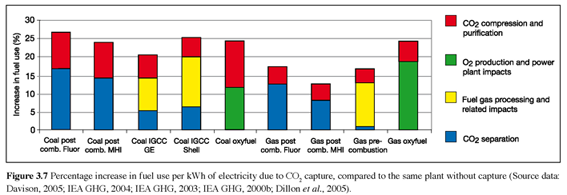
Creating a nearly pure carbon dioxide stream at a power plant is unfortunately quite energy intensive. The energy costs result from several processes. Firstly the added heat needed to create temperatures of 100 to 140 degrees celsius to regenerate the solvent that captures the CO2 out of the flue gas/CO2 stream. Secondly the energy to create steam that acts as a stripping gas to remove the CO2 from the solvent. Thirdly the electricity to operate the flue gas fan and pump the CO2 to its destination were it can be compressed. Fourthly the energy costs of compression of the CO2 to make it transportable towards it’s final destination were it can be stored.
Overall such processes raise the energy costs to produce the same amount of electricity in a cleaner way with 24-40% for new (supercritical) conventional coal plants using post combustion and 14% to 25% for coal based Integrated Gasification Combined Cycle (IGCC) systems using pre combustion. These systems are already initially different, conventional coal plants being more efficient then IGCC systems, which explains some of the difference.
To look at the impacts of wide scale application of CO2 capture and storage, the additional energy costs of one “carbon wedge” is taken. The carbon wedge is a concept from the University of Princeton. Telling us that if we want to stop the current growth path of CO2 emissions, we need to introduce technologies that can counter growth of annual emissions from 7 Gigatons now to 14 Gigatons by 2055. If CO2 capture and storage would count for 1 Giga ton of avoided annual emissions by 2055 or one “wedge”, this technology needs to be implemented at approximately 855 coal power plants of 1000 megawatts in the coming decades.
This figure of 855 coal plants was derived by the following calculation: A 1000 megawatt coal power plant emits 5.5 Megatons of carbon dioxide per year. Converting this to carbon emissions (from CO2 to C) results in 1.37 Megatons of carbon per year. CO2 capture and storage efficiency is approximately 85%, so per power plant around 1.17 Megatons of carbon emissions per year would be reduced. Dividing 1 Gigatons of emissions by 1.17 Megatons gives 855 coal power plants.
An average 1000 megawatt coal power plant consumes 2,000,000 tons of oil equivalent fuel per year. Assuming that 25% more fuel would be needed, the additional fuel would come down to 425 million tons of fuel in oil equivalents per year to implement CO2 storage and capture at 855 coal power plants of 1000 megawatts. In 2006 coal consumption was 3090 million tons of oil equivalent per year according to the BP Statistical Review.
The effects of increased energy costs on coal depletion
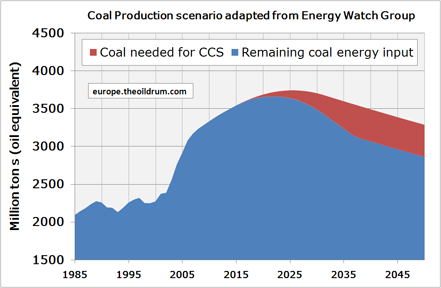
If we process the 425 million tons into coal production forecasts, the effects on available energy from coal become clearer. For this I have taken the coal production scenario from the German Energy Watch Group (pdf), released a few months ago. In this scenario peak coal production is expected around 2020-2030 with at slow declining slope. When carbon dioxide capture and storage (CCS) is added the peak in energy provided shifts forward five years to 2015-2025. Furthermore the decline is much faster after the peak. The effects on more optimistic coal production scenarios would be different, because CCS would be introduced earlier before the peak that is expected later. That implies that the net energy peak would occur relatively earlier but the net energy slope after the peak will be less sharp.
Personnel
Editors
Contributors
Peak Oil Primers
Archives
- November 2010 (3)
- October 2010 (6)
- September 2010 (4)
- August 2010 (7)
- July 2010 (6)
- June 2010 (7)
- May 2010 (2)
- April 2010 (8)
- March 2010 (4)
- February 2010 (6)
- January 2010 (3)
- December 2009 (5)
- November 2009 (8)
- October 2009 (12)
- September 2009 (6)
- August 2009 (5)
- July 2009 (11)
- June 2009 (8)
- May 2009 (16)
- April 2009 (10)
- March 2009 (7)
- February 2009 (10)
- January 2009 (15)
- December 2008 (9)
- November 2008 (9)
- October 2008 (9)
- September 2008 (13)
- August 2008 (10)
- July 2008 (14)
- June 2008 (23)
- May 2008 (16)
- April 2008 (12)
- March 2008 (16)
- February 2008 (9)
- January 2008 (13)
- December 2007 (13)
- November 2007 (16)
- October 2007 (22)
- September 2007 (8)
- August 2007 (9)
- July 2007 (16)
- June 2007 (8)
- May 2007 (7)
- April 2007 (7)
- March 2007 (10)
- February 2007 (10)
- January 2007 (12)
- December 2006 (9)
- November 2006 (15)
- October 2006 (4)
- September 2006 (5)
- August 2006 (5)
- July 2006 (9)
- June 2006 (5)
- May 2006 (10)
- April 2006 (9)
- March 2006 (13)
Vital Trivia
License

This work is licensed under a Creative Commons Attribution-Share Alike 3.0 United States License.
Saying that 'some' CO2 can be injected underground for oil recovery is like saying that used vegetable oil is a good source of fuel. It may be true, but the amounts involved are limited. What do we do with the CO2 left after the oil injection? One suggestion is to run the trains on it. A 21st century version of the steam pressure design, but instead of filling up with water and coal, you drop dry ice in the 'water tank' The CO2 sublimates driving the train, and eliminating the fossil fuel required. To chill CO2 to dry ice you could use off peak tidal or whatever..
The mass of co2 injected can be quite high.
however using sublimation of co2 is retarded. the work one can extract from exanding gasses, which draw in heat is near nothing. it is for sure an energy losing process.
co2 is a "dead" molecule, no more energy can be extracted from it.
sheesh.
/thanks for the laugh tho. storing energy as sublimated co2.
//and what about the heavier than air vapours?
///everyone following such a vehicle would probably hyperventalate and pass out, maybe die if the conc. gets high enough
Hi - Gilgamesh , you say:
(I know what U mean ... BUT)
CO2 - is the most important thing actually ... and I therefor disagree 111%
for one -CO2 is "food" for all the green suff around , included algae .. hocus-pocus- there we have meat and fish
-secondly - the byproduct from the photosynthesis in "our dear" oxygen
CO2 is not dead at all - "what is dead though, are the braincells inside the US governmentals heads - or maybe they are throughoutly boneheads over there (?)", I dont know really.
=> this message hereinafter is mentally beamed to the US Senate - and not for TODers, because U are among us nice thinkers :)
I must say quite frankly- that I am very fed up and provocated over the US attitude on climate - and also over the idea of not embedding politics concerning peak-oil and beyond (today)
Remember- you 4% of world population grab and burn 25% of the oil- goods and U flash wars over it and threatens all over the place - it really scares me , and it should also scare the am_voters!
Let history be history - the overwhelming content in the IPCC-report is only understood,acknowledged and "approved" recently by most UN countries -
BUT the US...Australia and a few other "bad" parties does not comply - WHAT do you say ... ? .... You will find YOUR OWN SOULUTIONS ... HAAhhhh? I bet you will, as YOU roll out new SUVs and take the "bio-hal-lelujahs"...and the more "cartoonish hydrogen-hal-lelujah "...
Can americans be re-programmed to skip the idea of car ?
( or at f**** least go fore small tiny-cars. Fro starters..)
Chart 2 appears to be based on CCS starting ~10 years from now and being phased in over 20 years, is that correct?
correct
Do you really believe that could be an accurate forcast?
As shown I feel that chart is totally unrealistic as a prediction. Declining oil production will cause more than enough turmoil. No way will carbon sequestration be phased in if coal is also peaking.
With oil and possible gas production also declining any politician foolish enough to propose sacrificing 20-25% of the remaining energy available from coal and natural gas on the alter of global warming would rightfully get thrown out in the next election if not before.
I have trouble keeping up with all the posts on PO. What has happened to Dave Rutledge post about linking PO to declining CO2 driving term for global warming? I thought he showed that there really isn't a global warming problem because fossil fuel production decline will happen first in about 2070, as I recall. Or did I miss a post that demolished his argument?
Given the feedback effects already becoming apparent, we do not have the luxury of waiting until 2070; we may be in trouble because we sat on our hands until 2007.
It's surprising that biological carbon capture, using algae etc., hasn't got more attention yet. I'm not aware of any planned projects in the works, but some tests have been done in the U.S. On the surface of it it seems more scaleable and manageable than geosequestration.
Silly question, but if separating the CO2 from the flue stream is such an expense, has anyone looked at a method of emission capture that just takes everything? Obviously the volumes would be massive, but if you could hold a large volume somewhere, and CO2 being a heavier gas was left to drift to the bottom, you could then release the top portion every so often. Talking completely out of my field of expertise here, but I have to ask!
Most biological organisms will eventually decay and release their CO2 to atmosphere.
Unless their corpses are sent deep underground or undersea where no aerobic bacteria can digest them, and that's difficult to impossible.
I think it's much easer to avoid generating CO2 in the first place---nuclear is better, and we should keep the carbon geologically sequestered as permanently unmined coal.
Well the current plans revolve around using the organisms as a source of fuel, but obviously you'd still have the problem of capturing the left over carbon from that process.
Obviously it's in principle easier to avoid mining the coal in the first place, but even a crash program to replace the world's current fossil-fuel powered plants with nuclear ones would still generate a hellavu lot of CO2.
I hate nukes, but I think you are right.
I hope that Fusion, (IEC Polywell) can play a role. P-B11 fusion is so much cleaner than nukes, and can burn the fission waste.
Dr. Bussards IEC Fusion program... the cure for peak oil ?
http://www.dailykos.com/story/2007/4/27/213841/746
Even if it was perfected tomorrow, it wouldn't make a dint in the immediate problem of peak oil, a liquid fuels crisis.
However this thread is about CCS, a 'cure' for global warming. Fusion (of any sort) would definitely be a big help there...providing we could actually get it working within the next few decades. I'm not holding my breath.
Carbon capture is needed but problematic, and I agree with the prior comment that there is an advantage to not creating the C02 in the first place. So anything that can partially replace liquid fuels... over time.. say the next 20-30 years, is really good. Unless I miss the mark, generating electricty by solar, wind maybe fusion can play a part in replacing most liquid fuels by ... say.. 2050.
Average US driver drives 30 miles a day.. right ? So there is a portion of liquid fueled vehicles that can easily be replaced by electric. Given time... -sigh-
The P-B11 fusion thing is theoretically very attractive, but I believe there is a problem in keeping the plasma dense enough to make it go. A conceptual problem - like particle physicists doing the math and needing to put two pounds of beans into a one pound bag to make it fly ...
Decay is a biological process. If the dead algae biomass is sterile, it will not decay. How keep it sterile? Store it amongst the canisters of spent nuclear fuel in a nuclear spent fuel storage site. That's a pretty deadly environment, I think. ;-)
Micro-organisms are hardly little things. And yes, some even live in nuclear reactor waste tanks, oddly enough.
Plus check out this guy:
http://en.wikipedia.org/wiki/Deinococcus_radiodurans
"You can never solve a problem on the level on which it was created."
Albert Einstein
Sorry, there's no way to mix two gasses and then have the heavier one "fall to the bottom". They are all perpetually mixed, each having it's own partial pressure. If that weren't so, we'd all be breathing pure 100% oxygen, since O2 molecule is heavier that N2...
Hmm, fair enough - but surely the CO2 *tends* to be more concentrated towards the bottom? Some sort of iterative process then comes to mind (sorry, just thinking like a programmer!).
That's only true to a (very good) approximation.
Uranium is enriched using gas centrifuges. You're right that it'll never work as a CO2 separation technique for the (energy limited) purposes of carbon sequestration through.
Altough still not viable, CO2 separation by centrifuges is much less energy intensive than separation of U isotopes. There are other methods of separating gases, that won't work for uranium, but work very well when you have a biger mass difference.
Also, altough the GP is partialy right, that you can't really separate gases once they are mixed, he's also partialy wrong because those gases will have different concentrations at top and botton of the recipient. That may be usefull on some way.
The problem is that flue gases of conventional CPP contain a lot of Nitrogen and Oxygen and then CO2 etc. You can NOT carbon capture this mix - because if your try to liquify it you would need very low temperatures and high pressures (courtesy to the Nitrogen content). After heated under the ground or sea-bed the liquid air will turn into high-pressure gas which will soon escape through the rocks pores.
The same problem does not apply to pure CO2 - it is liquified relaitvely easily and will stay liquid under moderate pressure underground or underwater.
Capturing flue gases in gaseous form is clearly out of questions - the exhaust gases of conventional CPPs have in the order of 10,000 times the volume of fuel burnt; we will run out of underground storage before making even a minor dent in carbon emissions.
Fair enough, I figured if it were that simple someone would have already proposed it.
So is there really no "passive" form of CO2 capture? No possibility of some sort of membrane that allows nitrogen and oxygen through but not CO2?
Slow pyrolysis of farm and forestry waste produces gaseous and liquid fuels as well as solid charcoal. When mixed with soil the charcoal will remain stable for thousands of years. There is an additional benefit that by using the gaseous and liquid fuels some fossil fuel use is avoided.
Thats what I was saying. Research is being conducted. What will it look like. Will the harvester be fueled by the plants it is carbonizing ? Send all possible fuels to one refinery ? Before we used oil chemicals were derived from wood like methanol which is used in production of biodiesel.
Plant a crop in a field to put carbon into soil, every diferent plant is going to give a diferent result. The source of this method is tropical rainforest using hardwood charcoal. Japan has used chared rice hull in controling golden apple snail in rice production, the rice char is also used to make a light weight soil for roof top gardening.
Depending on what it was, how it is processed and the amount of time it is in the ground, charcoal can have negative and positive effects for agriculture.
Rembrandt - thanks vey much for this post, which if correct, suggests to me that Carbon Capture has zero future. If your chart showing peak coal at 2025 is correct then no way will global society / economy be able to bare 20% of the energy produced from coal going into burying the CO2. And what would be the point?
I mentioned to you before that BP had plans to build the UK's first major CO2 capture project at Peterhead which is just up the road from where I live. Nat gas was to be conveted to H and CO2. The H burned in the existing powerplant and the CO2 injected into the offshore Miller Field - which produced sour gas and already had a high garde steel pipleine leading to it.
The project I understand has now been abandoned because of governemnt prevarication over subsidies. In other words the project was not economic with current CO2 prices.
http://www.bp.com/genericarticle.do?categoryId=2012968&contentId=7006999
http://www.bp.com/genericarticle.do?categoryId=97&contentId=7006978
Your choice isn't going to be between CCS and non-fossil fuels. Your choice is going to be between regular old coal power plants and CCS. You either make a future for CCS by requiring it or you learn to swim.
If coal production peaks in 2025 you certainly won't have to worry about swimming.
On April 5th, Vattenfall started a "CO2-free" test coal power plant in Jänschwalde, Germany.
Vattenfall bet on the oxyfuel process.
They are now building a 30 MW pilot plant that is planned to go online in 2008.
http://www.vattenfall.com/www/co2_en/co2_en/index.jsp
The economic success depends on CO2 prices, which have to go up.
However, it is also true that coal plants are very unpopular because of the CO2 emissions, so they might just try to soothe the public.
I don't understand how that could ever happen? The only applications for CO2 that result in it being sequestered are limited.
The only way I can see it being implemented is if USA and China make CCS mandatory, and they have already said they won't do anything to harm their economy.
Sadly I am of the opinion that CO2 release and subsequent GW is inevitable. Unlike PO, there is no economic or political desire to reduce CO2 emissions.
I think, China will introduce the CO2 trading in a couple of years, so will the US.
Germany will negotiate with some US states so that they can join the EU CO2 trading, according to the German magazine "Der Spiegel".
http://www.spiegel.de/wirtschaft/0,1518,492476,00.html (German)
The German government will also auction 10% of the emission certificates instead of giving them away for free.
Meanwhile, the EU is forcing governments to reduce the number of C02 certificates significantly.
So, the prices should go up.
And who will pay? Based on what real wealth? An energy-constrained future means a wealth-constrained future. I expect that under conditions of a faltering economy there will be no enforcement of sequestration.
Look around the world now, there are electrical power outages in many countries, and endless talk about an "energy crisis". I can't imagine that the political arena would give priority to climate change while people are rioting because they are sitting in the dark while their food is rotting in the refrigerators. Natural gas supply is running low in many industrialized countries, and many new coal plants are being built as fast as possible. Who will give up 25% of the capacity for CCS? Not to mention the capital investment.
The concept of using less electricity has thus far failed to get much traction with the general public in most places, even when and where it is clear that the choice is to use less or suffer immediate rolling blackouts. Everybody hopes their neighbors will conserve. The tragedy of the commons.
The power grid is still very, very reliable in continental Europe. Here in Berlin I have not had a single blackout for five years.
The big four utilities plan to invest €80 billion into grid and new power plants, the renewable captains say €150 billion until 2015.
The funding is still available, E.ON alone has huge cash reserves, they wanted to aquire Endesa with cash.
Merkel is very focused on this. That's the bit of leadership required to get things started. And without CCS, Germany will never achieve the CO2 target of -40% until 2020 compared to 1990.
Also keep in mind that Germans still have a healthy saving rate. We have no housing bubble, no account deficit. The public budgets are getting balanced, so I think, all of this is quite doable.
And who will pay? Based on what real wealth? ...
I can't imagine that the political arena would give priority to climate change while people are rioting because they are sitting in the dark while their food is rotting in the refrigerators.
I fully agree. It is thoughts like this coupled to demographic momentum that make me a doomer.
ciao,
Bruce
links for charcoal mixed into soil a possible way of fixing carbon into earth.
http://www.dpi.nsw.gov.au/research/updates/issues/may-2007/soils-offer-n...
http://www.iaiconference.org/presentationsattendees.html
55 million years ago a plant ate all the co2 after the poles melted.
sunnyhenry
That was the Eocene period, and the formations from that period are one of the chief sources of lignite in Texas, and also an excellent producing oil and gas formation.
Nature had a number of methods to sequester CO2. Plants, which are the source of most oil and gas, and animals, their shells are limestone. The animals-coral and oysters-use the CO2 dissolved in seawater to make their shells, which are calcium carbonate.
We've been pretty heedless of the consequences of our releasing this CO2, and this post makes it obvious that CO2 sequestration isn't going to happen on a scale big enough to matter. I haven't seen the energy economics for charcoal, but I'm sure they are cost prohibitive.
Bob Ebersole
Hi Bob,
How about strapping this sucker on the back of your dune buggy, or maybe even power that air conditioner of yours and best of all you can use the charcoal to grow plants in your jardin de joie, just save me a toke, okay? BTW thanks for the Joe Stalin ref, took me right back to the Retinal Circus in Vancouver circa 1968 and the old favorite Fish tune 'Please don't drop that A bomb on me'
Actually I find the use of charcoal in soil really interesting as it might be possible to really make a dent in industrial fertilizers, as well as slow their progress to that Gulf fishing hole of yours?
Good fishing,
cr
BTW the image is from wiki 'wood gas'
Hi crystalradio,
The wood gasification does work, the Germans used it in WWII, but probably never in anything much heavier than a Volkswagon. I get tired just thinking about cutting that much wood. I'm in favor of people trying charcoal as a soil additive, but I have doubts about the ability of the biosphere to produce enough wood to make a difference in the CO2 concentration, and the energy economics of cutting biomass, heating it, then taking it to a field and plowing it in seem terrible-maybe even negative. The "dead zone" at the mouth of the Mississippi keeps expanding, all the nitrogen and phosphorus fertilisers keep the algae blooming, ethanol sure isn't helping.
By the way, I heard a new Country Joe war protest song the other day on KPFT in Houston. Not as catchy as the "Feel Like I'm Fixing to Die Rag", but pretty good. I love anti-war rallies because they feel like old hippy homecoming events. I see people that I haven't seen since the last war. Bob Ebersole
Another Shade of Green
Wood Chip-Burning Car Races at Green Grand Prix
June 2, 2006 was a historical day in racing and Casella was a part of it-thanks to Larry Shilling and Chip Beam. The two built and entered one of the 35 hybrid and alternative fueled vehicles (AFVs) for the Watkins Glen Green Grand Prix.
Larry Shilling, Casella Waste Systems’ western region landfill district manager and his neighbor, Chip Beam, a local architectural CAD operator teamed up to convert a 1988 Isuzu SUV into a wood chip-burning AFV. It only took them two hours to make the conversion and Chip raced it in the rally.
“It burns about a pound of wood chips per mile,” said Chip while prepping the car for the 78-mile course that wrapped around the edge of Seneca Lake in upstate New York. This is the Green Grand Prix’s second year and it is the first official SCCA (Sports Car Club of America) road rally for alternative fueled vehicles. Naturally, energy independence, greenhouse gas reduction and education about alternative fuels were major themes of the day.
Larry added, “Having a road rally with hybrids and vehicles that operate on alternative fuels, such as methanol, ethanol, compressed natural gas or electricity proves that these environmentally-friendly options exist and can be used without compromising performance.”
Also the carbon under discussion is in the form of CO2 from a coal or gas fired generation plant. Agrichar is a process to use *crop waste* as a fuel and sequester the remaining carbon.
Agrichar is a feel-good story and will be useful when the world returns to the living standard of the Mayans.
Oh hoity toity, the carbon under discussion is in the form of CO2 from a coal or gas fired generation plant.
I was talking to my pal Bob about his point about Charcoal but if you would like me to tie that to the main heading, let's try out offsetting that coal or gas fired generation plant with enough trees to capture or if you like sequester carbon, take these trees, and give them a pyrolysis fizz and voila you have that CO2 sequestering in the form of Agrichar. (Who thinks up these Starbuck latte-ridden feelgood cognomens? I would wish to know that.)You would also have some energy left over, how much, I don't know but enough to drive a kraut VW if not a Yankee SUV.;)
World wide standard of the Mayans sounds good to me, way lot of people running well below that.
I like your charcoal idea.
What would happen if carbon was made the currency standard?
Hopefully people would emit less CO2, because it would literally be burning money. Bank vaults around the world would accumulate blocks of carbon.
Oh my goodness, what a happy plethora of Bobs in my neighbourhood, thank you Bob and I like the idea of a carbon currency especially one that was based on the economy of the natural world. That along with a suitable population and a chicken in every pot.
BTW I think I've mentioned my friend Bob Bob before? I am getting older and tend to the repetitious, but anyway his full name was Robert Roberts and it got that way at the beginning of WWII. His original name, lost in the mist of history, was of German derivation and his parent fearing approbation at large, in their haste, mistook this child of their loins for a potted palm, which he does bear some resemblance to, and changed their name to the more anglicized one of Roberts.:)
there is a company that manufactures a material from coal dust and calls it CFOAM, touchstone research laboratory.
I have just been saying "coal is bad" and "biomass is good"
I was just e-mailed a statement of a posibility of using coal for energy three times less eficently and having coke
as the byproduct saying this is solid carbon and can be used for building material, industrial feedstock, or simply burried. idea by JIM fournier. Can't just stop coal.
I realy don't like the type and amount of waste from the process called "clean coal"
You pour water on ashes and you get lye. there is probuly something toxic in the charcoal and the coke.
a garbage incenerator eletric generator was closed down and with 20 million dollars spent is to be reopened as a wood incenerator eletric generator in robbins outside of chicago. As for nucular power I have one name "Hanford".
There was specific discuss on this topic last month
my idea is to prevent co2 in atmosphere from reaching the critical level while produceing fertilizer, chemicals and fuel from plants grown in the ground and in the sea.
Research has not been able to reproduce what the Mayans are aleged to have done.
eric blair on June 5, 2007 - 3:07pm | Permalink | Subthread
On the idea of locking of atmospheric CO2 as Terra Perta
Via Tom Miles
When you do your personal calculations you'll find anything from 8-15 tpy CO2 emissions, at 0.3 tC/tCO2 (~3.33 tCO2/tC) that's 2.4-6 tpy. That was the purpose of my calculation of the area required for applying carbon. At 5-10 t/ha (2-4 t/a) that's about 1 acre (4 tC) per person per year.
It makes sense to invest in carbon sequestration through productive agriculture at the rate of 1 acre (4t) per person/year. At a US population of 302,011,659 (at 18:52 GMT (EST+5) Jun 05, 2007) that's 302 million acres per year or about 1.2 billion tons of charcoal per year. At 25% net yield of charcoal that's 4.8 million tons of biomass or more than 4 times what the USDOE says we have available for energy.
Comments can no longer be added to this story.
Todd on June 5, 2007 - 3:41pm | Permalink | Subthread
Eric,
Thanks a lot for the link! It a site I was unaware of. All the TOD terra preta nuts should check it out.
Todd
Comments can no longer be added to this story.
[new] Boof on June 5, 2007 - 10:01pm | Permalink | Subthread
I don't think those tonnages are achievable without a surge (that word again) of burning everything in sight. When farmland is blanketed in charcoal then what...the semidesert?
I'll bookmark the link.
Comments can no longer be added to this story.
[new] eric blair on June 6, 2007 - 4:18am | Permalink | Subthread
1) Burning everything in sight - I wonder what the air pollution level would be?
2) Semi desert. What will be the status of the old 'dust bowl' once the fossil water is no longer used for watering the plants?
Interestingly, work in the Sahara claims desert can be undone if one plants trees like Japhorta. Somehow I doubt the 'turn the corn fields to, say, nut trees, will happen. The land will dust bowl before the owners would "take the income hit" of going to trees.
Comments can no longer be added to this story.
[new] Engineer-Poet on June 6, 2007 - 5:44pm | Permalink | Subthread
That's only an issue if you're trying to keep up with the current rate of fossil emissions. If you use atmospheric CO2 removal in addition to slashing fossil emissions, you can get by with a lot less biomass. Even so, my 1.7 billion ton biomass estimate would only contain about 760 million tons of carbon.
You've also got your CO2 equivalence figure wrong. It's 3.67 T(CO2)/T(carbon), not 3.33.
Comments can no longer be added to this story.
A study of arctic climatology reported that azolla may have had a
significant role in reversing a greenhouse effect that occurred 55
million years ago that caused the region around the north pole to turn
into a hot tropical environment. This research conducted by the
Institute of Environmental Biology at Utrecht University claims that
large dense patches of azolla growing around freshwater lakes formed by
the climate change eventually consumed enough carbon dioxide for the
greenhouse effect to reverse.
I've thought about the potential for organic carbon burial and read about the value in improving soil. On the other side, the idea of "carbon offsets" by growing trees is nonsense in the long run if the trees end up burned or decayed eventually.
I've buried slow-decaying oak leaves and twigs under my garden periodically for years as an invisible composing. There does seem a very large potential since a season of leaves even concentrated in small areas compress to very thin layers when compacted and examined later.
I had a sort of vision comparison, like the old cities where roads slowly rose over time as garbage and waste accumulated and packed down, and also imagined the similar process happens in special conditions that deepen soil (that we're now (geologically) quickly eroding away). All you need is oxygen deficiency, which happens under water, but perhaps not far under soil as well.
Anyway, it made a lot of sense to me that the future of farming (as fossil fuels decline) must be a part of a process that will remove atmospheric CO2. I just can't imagine the rate of natural (or artificial) burial/accumulation can come close to the release of CO2 we're causing now.
At least I have tiny amount of optimism that using knowledge can help us with WITH natural/biological processes, and I'm sure we have to do better to survive as our fossil fuel driven economy evaporates.
It's all very amazing to think at all - how much (chemically unstable) free oxygen has been created by the biosphere and how low the concentration CO2 (chemically stable) is in comparison. Life plus solar energy drives chemical entropy backwards!
It may yet be true that natural negative feedback loops will take care of our "excess" CO2 problems in the long run (100,000 years or whatever), not that our continued success will be aided by that recover period.
I suppose I'm more scared of expanding desertification, like the irreversible destruction of the rainforests than atmospheric CO2 increases.
areas of brazil that are now rain forest are found to have man made earth formations when the land is cleared.
I heard Charles Mann talk about his book "1491"
Research plot for carbon in soil in georgia is in drought.
I wonder if there are efforts to recreate in brazil what is in brazil ?
I am interested in reversing desertification.
There is some work on catalysts that have lab size capacities for using off-peak power to separate water and CO2, recombining them with products of methane and oxygen.
bill.james@jpods.com
It costs less to move less
Links please?
Would be appreciated
Thanks!
Here is an email you can send questions to:
forrestking@comcast.net
I am interested in this as something to do with spare solar power during the peak of the day.
bill.james@jpods.com
It costs less to move less
I believe that Big Coal sees CCS as 90% a stalling tactic and 10% a gamble that might just work. It helps that federal govts in major coal using countries are playing along with the charade; notice how CCS is supposed to work by 2012 the same year that various carbon cap schemes will be introduced.
A couple more clues give the game away. I last heard the yet-to-be-started FutureGen project had been narrowed down to a site in Illinois or Texas. Some urgency. Also Big Coal tells us coalbed methane needs to be tapped as it will escape. Are those the same underground formations that are supposed to store the scrubbed CO2? Note that gas domes are marine sediments and coal beds are fossil swamps so the geology is usually some distance apart.
Fortunately several TOD articles have pointed to coal peaking early even without the extra 25% CCS throughput penalty. If we can get through the next 20 years without permanently destroying the planet we'll have to find alternatives to coal.
"Big Coal" isn't the only player - I've e-mailed some of the CSIRO guys working on it, and they're pretty keen and confident. I agree though that many industry players see it primarily as a chance to maintain business-as-usual for as long as possible.
Australia's coal production, in terms of our domestic supply needs, isn't going to peak for a very long time; same for gas. The risk is that because Australia has more than enough FF (other than oil) for our own use for at least another 100 or so years, we're going to be left behind in the race for new energy technologies. Best case scenario it means that in 70-80 years time we'll have to import all that technology from the rest of the world... worst case is that we're seen as some sort of pariah for hanging on to CO2-intensive industry.
I agree it's stalling. I don't think there is anything to 'work'. Coal companies are not charged with saving the world. Someone pays them to do research, so they research. Or they do it at their own expense, to avoid politicians slapping taxes etc.
No one has explained what we are to do with the CO2 that is captured - apart from gas injection in oil recovery, which is not reducing the CO2 emmissions. To till carbon in the soil is odd, - burn coal then waste the energy made to make more 'coal', then scatter it about to stop us from burning it again..??? How does that help us?
carbon (charcoal) is interesting because of Koc values. The ad/de-sorption coefficient tells weither a substance will become adsorbed to the surface of a molecule or be unimpeded.
higher values of Koc mean that everything is retained in the soil, (higher adsorption) specifically on the outside of the carbon, which is ideal for plant roots(breaking up stuff to get at the absorbed substances is energy intensive), so the roots can transport *whatever* (P, N, S, Mg) to maximize growth.
activated charcoal is used in breather apparatus for the same reason. large surface area + Koc values = large retention of particulates travelling through the filter.
Charcoal has some good uses, but it's basically pure carbon, and so is coal, so any scheme to turn coal into charcoal cannot yield net energy. Better to leave the coal in the ground. Perhaps one can create both charcoal and net energy with natural gas -- the energy source is the hydrogen in the NG.
the charcaol is made from plants wood, straw, rice hull. the charcoal is made by incompleat burning or pyrolisis that will produce smoke but if the plants are left in natural state they will decay and carbon will be released to atmosphere by making charcoal some of the carbon is permamently fixed
pondlife, I don't get your point. Why do you say this doesn't reduce CO2 emissions?
Because CO2 will leak out? Or because the well was originally used to produce oil?
Thanks for the reply,
If you are using co2 to get more oil than otherwise, then you are making more co2 than otherwise. Sure we can stuff some co2 under some impervious caps where oil or gas used to live, but its small beer. If you have to extract it from exhaust, pressurise it to x000 psi, pump it etc, then you are just wasting ever more energy.
I would put zero into capturing co2, instant effort into coalbed methane extraction + stopping flaring at oilwells. These are small beer 'free lunches'
My only solution is <=2 kids per couple, conservation efforts [insulation], and renewables. In the UK this means tidal lagoons, and some wind. In the US wind, geothermal, tidal.
The Netherlands are planning to offer their vast former natural gas fields to German utilities so that they can store their CO2. We have large brown coal strip mining close to the border, and because that is about the only national energy resource Germany has, and that can last some hundred years, our politicians support CCS.
It's probably also a stalling tactic, but it's a serious attempt as well.
"The Netherlands are planning to offer their vast former natural gas fields to German utilities so that they can store their CO2."
The Netherlands does not have vast former natural gas fields. The only field that is quite large is Slochteren, which can only be used for CO2 storage purposeses after 2040. Other fields are mainly small fields.
An article stating that the Netherlands want to become the CO2 hub of Europe was published in the German magazine "Der Spiegel", issue 24/2007, 11.06.2007.
I can give you some details later, but I remember that they mentioned CO2 pipelines from the German brown coal mining and power plants to the Netherlands.
The article mentioned above:
A working group of politicians, business and scientists led by Prof.dr.mr. Catrinus Jepma presnted the following plan:
CO2 from the Ruhrgebiet is transported with pipelines to the Netherlands. It is to be used in greenhouses and industry. The remaining CO2 is to be stored in empty NG fields in the North Sea and in the region around Groningen. About half of the European CO2 is emitted around and in the Netherlands, so the Netherlands are a good choice for such an infrastructure, says Jepma. The costs, several billion Euros, could be covered by CO2 trading.
This could also solve another problem: Because of the extraction of NG, the land, already under sea level, is sinking even further, the CO2 could stop this.
So far the article.
Jepma: http://www.onderzoekinformatie.nl/nl/oi/nod/onderzoeker/PRS1236374/
Boof-
Coalbed methane is already being tapped, its one of the "alternative" natural gas production methods. Methane is a worse greenhouse gas than CO2, I wonder why no one has focused on its release in coal mining which has to be substantial. As far as using marine sediments to dispose of CO2, it depends on the sandstone rather than its origin. Many natural gas fields already have a substantial CO2 content. For example Spindletop, the first major Gulf Coast oil field (1901) had a 25% CO2 content to the gas produced from its cap rock.
Bob Ebersole
I'm well aware of coal seam methane being used to replace NG, in the aluminium industry for example http://www.news.com.au/business/story/0,23636,22009178-31037,00.html
A major flaw in some carbon credit proposals is that methane burning earns a credit due to the reduced greenhouse effect. This is crazy since any assisted methane release should be penalised not rewarded. Another example is flaring minor stranded gas at oil wells. Strictly speaking the flare should be carbon taxed on CO2 which would be cheaper than taxes on unburnt gas with higher CO2 equivalent content of methane and other volatiles. The no tax option if possible would be to re-inject the gas underground. In other words no credits only debits.
The methane burning credit is just another example of the fuzzy thinking and dithering shown by our fearless political leaders. Was it 2020 when Congress says cars must average 35 mpg? Let's not make hasty decisions here. Because of our weak politicians it's obvious to me that global coal use will tend to accelerate even as climate woes continue. Early coal peakers like China will lean on late peakers like Australia to help them out which will bring on a more uniform global peak. Physical depletion and not human decision making could be what saves us.
Very little gas is flared at wells in the State of Texas, and is against Railroad Commission rules. It receives a premium price to unassociated gas because of the BTU content too, and in many fields is reinjected after stripping the condensate. The same is true nationwide.
Also, methane is a much worse greenhouse gas than CO2, therefore the tax credit. And, we have the best government that money can buy!
Bob Ebersole
I disagree. The 10% gambling chance is just way too high. They don't gamble at all they KNOW CS will never happen:
1) What kind of business will accept a 25% rise both in their capital and fuel costs just to payoff the energy costs for CSS?? Add the costs of CCS equipment and infrastructure and you will end up paying twice as much for producing the same power as without CS!!
2) Forget the old ones, how are the new coal power plants be located? Conventional logic says to build them near the coal mines and population centers that use the electricity. How many of these places are near underground cavities? Take for example Poland or Australia. Both have huge amounts of coal, but no significant oil or NG field to speak of. Where will they pump their CO2? Alternatively what will be the energy and capital costs of pumping CO2 hundreds of miles?
The CSS boondoggle is mostly a UK invention. UK has some depleted NG and oil fields that could use CO2 for EOR and it is easier to show the public that CSS could work. What portion of the rest of the world has conditions like that? How will you sell the idea to resource constrained countries like China and India? It simply ain't gonna happen.
LevinK, CO2 can be pumped into any formation with the permiability and porosity, it doesn't have to be an oil or NG field. If its a fresh water sand, maybe we could then produce carbonated water (just joking).
Old Natural gas fields already have wells drilled and cased, a substantial savings, while in old oil fields the CO2 can possibly be used for tertiary recovery. CO2 makes oil thinner so it can be produced more easily, plus provides more pressure to move oil through the rock, so additional recovery plus saving the expense of drilling disposal wells.
But, the economics suggest to me that it ain't gonna happen. These are just technical points.
Bob Ebersole
It will never, ever, be economic compared to straight coal steam plants. Nobody is going to justify CCS on that basis. It will take the threat of major catastrophe. Unfortunately, most of us think GW is that major.
If the injection area is close to the plant so that compression power is minimized CCS is still cheaper than existing operating nukes, however.
Where are your numbers? Already nuclear is cheaper than coal in countries like France, Canada, Japan etc. In US it is only slightly more expensive on average (3c/kWth vs 2.7c/kWth see tables here)
Just the 25% energy cost burden will make coal uncompetitive to almost every other electricity source (incl.wind), and you would have to add the equipment costs on top of those 25%. A total non-starter compared to the alternatives, even if we set the technical difficulties aside.
That's old, completely depreceated plants. Wait for the EPR built in Finland, then we'll know what the costs are now.
EPR is the first of the new, 3rd generation plants. As a new technology it will be a miracle if there are no problems, delays and cost overruns. I think a fair approach would be to wait at least for 2-3 of those to be built before giving a final assessment of the technology.
BTW older, but already proven designs are being built in China, Russia, Bulgaria etc. for $2000-$2500/kWt, which is quite competitive with coal ($1000-$1500).
PLEASE do not rate nuclear's cost prospects based on the EPR in Finland!!!!
We went head-to-head in competitive bidding for Fin 5 against the EPR and it is a very expensive and needlessly complicated design. The only reason the Finns awarded the job to the French was EU political horsetrading.
The French were pushing for a reduction in minister posts for the EU so that the big countries (like France) would dominate the EU. Finland lead a group of "small countries" for keeping the 30 or so "minister" posts and hence maintaining the power of smaller countries in EU governance.
I suspect that EPR was chosen based on politics and not on cost or technology - our bid was clearly superior for lower cost and less technical/schedule risk. Finland went on to get their big cabinet structure and to serve as rotating EU president. Actual construction in Finland of the EPR was harshly criticized by STUK, the Finnish nuclear safety bureau.
As much as I like "new and improved" technology, the Gen III reactor designs like EPR are not delivering many concrete advantages.
It will definitely make coal uncompetitive in the long run, but a limited amount of CCS will allow us to gradually wind down the amount of coal-fired energy we need while building up alternatives.
For the world to replace all of its coal-fired power plants with alternatives would take at least 50 years. If we do nothing to capture some of the CO2 emissions that will be inevitable in that period, the GW risks skyrocket.
At some point in the future I imagine we'll have to do CO2 atmospheric extraction and sequestration, just to keep the climate under control.
I'm not a geologist, but AFAIK there are not so many formations that fit this description. At least a similar problem was pointed out when I was researching the options for large scale compressed-air storage.
LevinK,
EngineerPoet was working on some research like that, if we could just wake him up he might have some figures about formation availability .
At any rate, pipelines are cheap, and can take the CO2 almost anywhere. But IMHO the energy cost is going to make this a non-starter, people won't stand for an extra 25%-50% tacked on their electric bills, renewables and nuclear are going to be the way to go.
Bob Ebersole
You seriously think energy bills are only going to go up by 25%? I'm expecting at least 100% within the next 10 years.
That's what Rembrandt posted above. But, who knows? Personally, I'm with you on 100% inflation in prices, but my tea-leaves are a little obscure on coal electric prices.Maybe I should try the I Ching...
Actually, I should clarify. I doubt the average household bill is going to up by 100% in 10 years, because higher prices and increased awareness/implementation of efficiency options will decrease usage, potentially by as much as 25%*. So 100% increase in per-unit costs, but maybe 75% in average increase of household bills. Of course a significiant recession could change those numbers considerably.
* I've love to say more, but I've been working pretty hard over the last year at bringing our usage down, and so far only managed 5%.
I'm awake, I'm just swamped with work this week and through the weekend (I had no time to enter this thread yesterday and came home around 9:30 to take a nap, not sure if I'm going back to work tonight or not).
I have no references on formation availability, though the requirements are supposed to be easily satisfied: deep aquifers (fresh or saline), unmineably deep coal seams, spent oil or gas fields (tertiary recovery possible from oil fields), and anything which can be mined cheaply, e.g. solution-mined salt deposits. I recall reading that coal swells up when it saturates with CO2, which is very promising; it suggests that coal seams will self-seal against escape of the gas. No idea what happens to the methane in the coal before.
Rembrandt,
This is a great post, thanks for writing it and making it available! It makes it pretty clear that conserving electricity is the least expensive method of CO2 sequestration, not releasing it through burning is the best and most cost effective measure.
Bob Ebersole
Two points. First, this whole business expends human energies on a scheme which only works until the coal is exhausted and/or the storage possibilities are filled. Then we are that much further behind. Second, it only works for those locations where there are places to put carbon away.
As boondoggles go, this has to rate right up there with the goofiest. Yet, our political and swivel servant group, being largely devoid of scientific training, will probably sign off on it. If you see large amounts of money going into these schemes, then it is definitely canary time.
Deployment of capital - human energies - must be directed to where we need to end up, not on stopgaps and patches. While the post is well done and interesting, it serves to illustrate why we should be looking elsewhere for places to deploy our efforts.
I used to think that necessity was the mother of invention and desperation was the mother of genius, but desperation can be the mother of futile flailing just as easily. By definition this qualifies as the latter.
Which, if you believe global climate change and peak oil are pressing dangers, gives you valuable additional time to transition away from our current infrastructure.
Why? If you want to go to the moon, you don't go outside and start jumping.
You start building, step by step, the infrastructure necessary to get you there. Much of it will look tangential or even irrelevant, but it'll get you there a whole lot faster than the "direct" route.
Your view is terribly myopic.
It is a question of alternatives. Which infrastructure should we invest our (limited) resources in:
1) A low-carbon economy: nuclear, renewables, biofuels etc.
2) Trying to patch the existing carbon economy with ccs
3) Some combination of the two
The whole purpose of the initial post was to show that the costs associated with 2) are greater than 1). Only the 25% energy burden will make coal uncompetitive with nuclear and will get it close to wind + energy storage.
In addition the point of the previous poster is valid - ccs will work only for a limited time in limited locations. What do we do after that, scrap the power plants and all the ccs infrastructure? It simply is way too stupid to invest all these resources for such a short term projects.
Keep in mind that the infrastructure inertia is enormous. How much will these billions of dollars, thousands of trained engeneers, pipelines, etc. be worth after 30 years if we need to stop CCS then?
The only prudent approach left would be number 3. We can apply CCS in some places where it is feasible, but to rely on it to cure our coal-related problems and continue business as usual, as our leaders suggest is plainly stupid.
Since it is highly probably that CCS will take the place of so called "clean coal" as the way to let the coal industry grow as it pleases, it is necessary to set a date soon whereby unsequestered coal is prohibited. Strategies need to be based upon the assumption that significant amounts of coal based electricity will not be available. Further, even with CCS, there will still be a significant amount of greenhouse gases associated with the inefficency of the process and all the greenhouse gases emitted from the mining and processing of coal before it gets to the plant.
Those politicians, like Obama, who are betting our future on "clean coal" or CCS are just trying to pacify the public through the next election cycle. The public, who will not be reading oil drum, will be easily pacified. After all, if one is determined to follow one's current chosen lifestyle, one will grasp at any straw or any empty promise.
The goal should be to get away from coal, or at the very least, unsequestered coal. Instead of heading straight from that goal, we, at best, will take the indirect route of carbon and/or cap and trade schemes. After putting these schemes in place, we will engage in a hope and a prayer that the market will work quickly and efficienctly enough to achieve the destired result.
Last week, one of the coal magnates opined that the democrats were out to destroy the coal industry because of global warming. Well, as long as they believe that, there is little to lose by going ahead and doing the job.
I think as GW advances there will be something like a ban like that... maybe by 2020 or 2030. The CS claptrap is essential for the coal industry to move this date as much further in time as possible.
And the exit strategy for the year of 2030 is simple as day - with 100% certainty, by that time almost every country will be plagued by shortages; keeping to the promises and closing down coal power stations at that time will be politically impossible. We may very well see people on the streets marching to protect their coal...
Overall CS is a very dangerous distraction, and I support every effort to debunk it. What most enviromentalists do not understand (out of lack of technical knowledge, not of anything else) is that wind, and to a greater extent solar currently play exactly the same role. At least solar has some "gambling chance", but how prudent is it to gamble the future of the planet? Think about it.
There's a God-awful lot of existing coal-burning power plants and the odds are that none of them are ever going to be shut down until they literally fall apart. Nobody is going to replace something that it already built with anything unless they absolutely have too, especially with resource constraints. If you don't make CCS work then the existing plants are more than enough to fry us.
Maybe you build wind-powered compressors. If there's no wind you let the CO2 escape to the atmosphere. You at least sequester some of it. Maybe you sequester at night during off-peak power. You only get half of the CO2, but it's better than none.
Or you store in a local reservoir, and pump to final storage when cheap power is available. This means your pipelines and pumps need to be bigger, but your cost of energy will be lower.
This could be another form of demand-side management; the pumping systems could be turned down or off when supplies lag demand, and cranked to the max when surpluses are available. The size of the local storage determines how much pumping demand can be deferred.
Or it becomes too expensive to run them.
The steam turbines (and perhaps the condensers) of a PCC plant can be re-used if it is converted to IGCC. The gas turbines will supply roughly 2x the output of the steam turbine, so the total plant output would increase about 170% after additional plant demand. The efficiency can rise; Wabash River saw its heat rate fall to 8900 BTU/kWh (38.3%) and the IPCC says it would still be 31-40% after carbon capture (table on p. 343). Other benefits include near-elimination of NOx, SOx and particulate emissions, and the potential to eliminate mercury as well (requires extra filtration of the fuel gas). When you add all the pluses together (and all the savings from pollution taxes, if we get sensible and start taxing them), the investment could make sense even for relatively new plants.
Many will not like what I'm going to say, but I really think this whole subject of CCS and GW will soon become academic due to the extremely pressing issues of Peak Oil (which according to the stats compiled by Khebab seems to have been 2 years ago), Peak Energy and Peak Food. So my view is that new coal-fired powerplants will be built with no CCS whatsoever.
Folks, if the electrical grid collapses then the whole societal order does. In that case, you don't care much about whether the sea level will be 3 m/10 ft higher in 100 years.
IMHO all the public fuss about GW is just a red herring to provide cover for taking measures that are really intended to mitigate the consequences of PO. Take biofuels. It's much more elegant to say "we need to start producing biodiesel in earnest in order to reduce CO2 emissions" than to say "we need to start producing biodiesel in earnest because oil production has peaked".
Carbon Dioxide Sequestration and Oil Recovery
Denbury Resources purchased a carbon dioxide reservoir in Mississippi and used the CO2 to recover oil from abandoned oil fields. The CO2 was injected at high pressure and formed a solution with the remaining oil causing an oil flow. The oil recovery process was commercially profitable. They have an agreement to buy industrial CO2 output to use in further recovery. After the CO2 was injected in an old field, they had to leave some of it in the ground after completing operations and recovered part to use in other areas. This CO2 immiscible flood process was used successfully in the Permian Basin of Texas as well.
rainsong
do you have a link to that website? I've seen a CO2 operation at Seminole, Gaines County, Texas. The CO2 was from gas, Occidental is the operator, but I have few details.
Bob Ebersole
Rembrandt,
a nice article ! Well done on the sources / accuracy !
I guess the key question raised in the article is whether we as a society should choose to pay for carbon carpture or not.
The key driver is obviously a need to reduce greenhouse gases CO2 et al. Dependant on the level of reductions we need to achieve, we may or may not need to go for CCS.
For example - stabilisation at a 450-500ppm level of CO2 in the atmosphere could be achieved with a 20% cut in CO2, world wide - Europe could deliver this through energy efficiency measures. US could too. China/India will not be able to. For Europe / US to achieve more we need to move up the creaming curve - which will mean that CCS becomes a competitive method for cutting CO2.
Therefore if we believe that we have to cut more, CO2 storage is an option. It competes against energy efficiency and renewables, however, coal + ccs / gas + ccs is likely to be beat renewables if subsidies are not included in the picture. Technical costs for both come is the same range especially if some cost reduction is considered in CCS technology - which is quite likely give maturity.
So then - is it affordable - well.......
imagine todays power prices - say €50/MWh, then add €15-20/MWh to these, this is the price we would have to pay. Now - we have actually paid these prices already - in fact every winter in some parts of Europe.
Given that CO2 quota costs are already passed though to consumers in Europe, I don't think this is actually going to be as big as suggested here - it can be done. Peak coal and peak gas will drive prices up anyway (just as peak oil will) but energy will remain affordable in both Europe and US, albeit more expensive than today - this is the price for our life styles - energy efficieny can change things here and I believe that this will result in probably offset energy bill increases, though there may be peaks as carbon prices feed through. It is true that the US will pay more for energy but perhaps this is overdue ?
The big issue will be china/india however - how will these guys afford cuts in emissions while still industrialise. I don't have an answer - it will be exceedingly difficult - however as CCS becomes more efficient - and it will - moving from the 20% losses to maybe 10% in 2020, it will also become more affordable.
Carbon taxes on goods made in China / India etc if correctly redistributed could allow/provide funds for CCS to be applied.
The is a bit of a blue eyed post - I am not sure that the world will go in this direction particularly given the Us and China's position as of today. However, CCS should not be painted as a hopeless technology yet - the odds are much better than 10/90 that something beneficial can be achieved. It is a question of time, research funding and patience. It is also a quesion of political courage to create a carbon market which actually results in net CO2 emissions reductions - this has not been demonstrated yet.
To switch to a pure renewables strategy now would be madness though, gas fired power + ccs will cost circa €50-60/MWh, whereas real expansion of wind etc will cost much more as we are way down the creaming curve for wind resource in many areas.
Our other alternative - bring on the nukes... :-/
Please provide evidence for this claim.
What I meant by this was that it would be more effective to replace fossil fueled power + CCS with renewables as they become cost competitive to deliver the volumes of power required rather than change to a full renewables strategy now.
Today it just isn't possible to build sufficient capacity in renewables (wind / wave / solar) and be competitive. This is what I meant by a creaming curve - we should expand low CO2 power sources in more or less in order of increasing cost - this will mean that for the time being fossil will remain part of the energy mix - but the cost of carbon emissions should be included more strongly.
Ref. for wind energy unit costs -
Onshore wind - €50/Mwh without any generation back-up
Offshore - €80/MWh "" ""
Royal Acedemy of Engineers (UK) report
Also see the Stern report
For abatement curves look at Stern report - page 220, page 10 of ch 9
With these costs it is assumed that the wind resource is good. In many countries (particularly Europe, Denmark, Germany) the 'good' resources have been used and less good areas are now being developed. Additionally, since this report was made, wind turbine costs have gone through the roof given global demand, so costs have gone up.
CCS costs - based on own project experience. Could look at IPCC numbers too though.
Can't we just pump all the CO2 into massive greenhouses, spanning multiple states, filled with publicly subsidized corn? *chuckle*
mbkennel & pondlife,
In http://video.google.com.au/videoplay?docid=286000425078890061 there is an idea to cause what seem to be anoxic events that do cause the carbone to fall to the ocean floor, using fertiliser run-off from rivers to fertilise the algal bloom.
(BTW I am NOT endorsing the other ideas - "artificial trees" ??? they've got to be kidding)
Rembrandt writes:
Per the IPCC report, this is exactly backwards. IGCC is more efficient than PCC (IGCC takes two whacks at converting the heat energy to work, PCC only gets one), and this advantage is still present after carbon capture (35% representative value for IGCC vs. 33% for PCC).
The IGCC plant has better prospects for improvement; you can use a solid-oxide fuel cell topping cycle with IGCC syngas, but not with coal powder.
With either system, if biomass-derived fuel is substituted for part of the coal the system can become carbon-neutral or even carbon-negative. This is where we need to go, pronto.
Thanks for this takedown of a stupid idea. The energetics of removing carbon dioxide are very poor from first principles and the projections on increased fuel use per unit output quantify that. Not noted is the increase in capital cost for the additional CO2 capturing and storage equipment - capital is just stored energy. Between additional fuel consumption and increase capital costs, carbon-free electricity from this route will be very expensive.
From some of the questions asked here, it is clear that few people really understand the basics and have seen behind the hype. I can say that power industry professionals have never had any hope of this working except as a new form of corporate welfare.
Thanks again for a very helpful posting.