
 | DrumBeat: November 1, 2007 | The Oil Drum | Savinar on C2C and a new ANZ Bullroarer...and some really cool site news. |  |
The World's Expected Carrying Capacity in a Post Industrial Agrarian Society
Posted by Euan Mearns on November 1, 2007 - 10:00am in The Oil Drum: Europe
This is a guest post by WisdomfromPakistan. Wisdom is a computer engineer living and working in Karachi, a cultured city of some 20 million people. He has been conducting his own research into human nutritional requirements and the Earth's carrying capacity which he now wants to share with The Oil Drum readership.
As peak oil approaches, shortly followed by peak gas and eventually peak energy, we have to retreat to agriculture as the prime energy producer in society. Post-peak agriculture will be radically different to modern agriculture. Today’s agriculture is more an energy consumer than an energy producer. In developed countries it takes ten calories worth of energy from fossil fuels put into a farm in the form of fertilizers, pesticides and transportation fuel, to get one calorie back in the form of food (see also here and here).
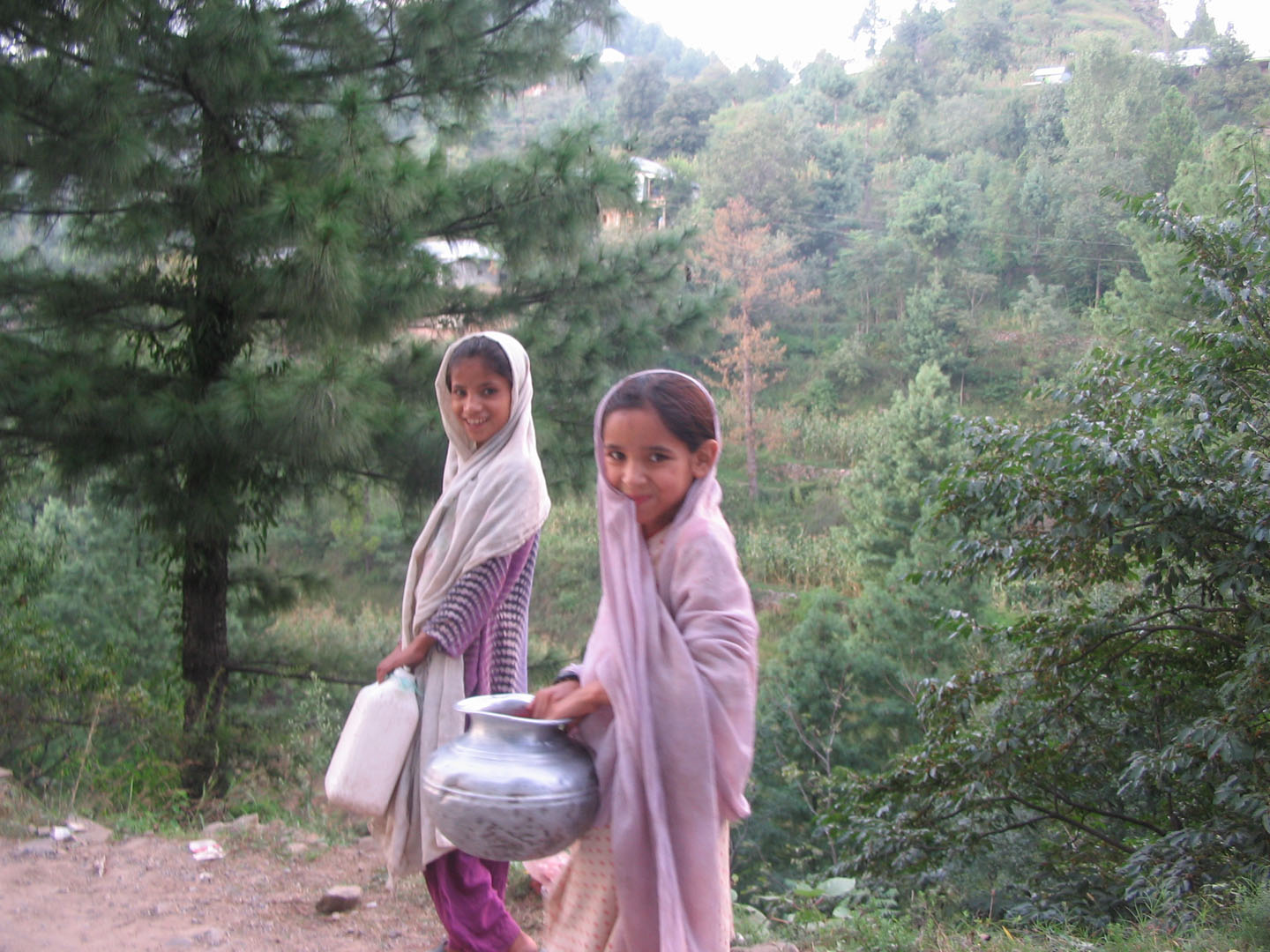
Happy children fetching water
Some of this input can be reduced by localization, which cuts considerable expenses in the form of transportation fuel, but other expenses like fertilizers and pesticides can’t be reduced without having a considerable reduction in food production. A detailed look on the situation, how we got here and an account of agricultural productivity before industralization is therefore necessary.
Up untill 1950 the World's agriculture was mostly run on organic lines with no artificial chemicals put into the soil. After the Second World War efforts were made to dump the large amount of chemicals made for military purposes into farm chemicals. In the 1960s, with the advent of the green revolution world agriculture slowly transitioned to an artificial fertilizer base. As a result, food production increased 2.5 times on average. This increase in productivity comes from higher nitrogen absorption, selective cropping and high grain-mass to plant-mass ratio.
Higher nitrogen absorption means more water use. This was supported with intensive dams construction along with canal systems to have enough water in winters to have two crops per year.
Higher grain-mass to plant-mass ratios mean less crop residue available for animals as a larger part of the plant is now eaten by people.
Selective cropping
Selective cropping means only high-yield varieties are grown. This reduces resistance against pests as miles and miles of the same crop variety is an easy target for pests. To compensate, a lot of pesticides are used. It also means reduction in crop-diversity. For example in China in 1949 about 10,000 varieties of rice were grown, in 1970 it reduced to 1000, in 2002 that further reduced to 300. The 14 leading varieties occupy more than 40% of chinese wheat fields now. India had 30,000 different types of wheat, now 90% of the wheat acreage is covered by 10 different but highly productive varieties (“Saving Crop Diversity Key to Winning War On Hunger”, Reuters, 7/3/01). Out of 700 crop species that have been domesticated by humans, only 30 species now provide 90% of the global food intake. (FAO, “The State of the World’s Plant Genetic Resource for Food and Agriculture”, Rome, 1997, p 14).
As in all systems, efficiency was gained at the cost of resilience, as low productive but more shock-absorbing components were taken out of the system.
World’s average wheat production used to be 400 kg per acre per year in 1950. By the 1970s this was boosted up to 2000 kg per acre per year in South Asia and 4000 kg per acre per year in Europe and the USA. That is one of the reasons the world was able to compensate for rapid increase in population. In 1950 world population was about 3 billion, it is more than double now, but world's agricultural land area is about the same. Also, the world's diet shifted from a mostly vegetarian diet to a more meat based diet. Now, there is no more increase in agricultural productivity that the green revolution can provide and the World population is still increasing. Not much unused agrarian land is available. As a result per capita agriculture production is starting to decline.
Energy needs and a balanced diet
The basic need of humans is food. We need food to have energy to perform vital body functions, to reproduce, to work and to have fun. The unit of energy used by dietitians is the Calorie (or kilocalorie), that is, 4200 joules of energy, enough to raise the temperature of one kg of water by one degree celsius.
The energy need of a typical adult is 2500 Calories per day. Children and elderly need less than that. That brings the average to 2000 Calories per day for all. The calculation can be done here.
The caloric values must come 55% - 60% from carbohydrates, 12% - 15% from proteins and 33% - 25% fats. The variation based on climate, culture and personal preferences. For our calculation we take the most recommended 60% from carbohydrates, 12% from protein and 28% from fats. It must be kept in mind that this is an attempt to summarize highly complex and variable data into a meaningful format. There are hundreds if not thousands of food items available for human use, which particular item one uses depends a lot on one’s religion, culture, climate, personal preference etc. Food productivity differs a lot on the basis of geographical location.
A scheme of balanced daily diet (link to Excel file):
| Kgs / year | |
|---|---|
| Grains & Cereals | 100 |
| Milk | 100 |
| Fruits | 100 |
| Vegetables | 25 |
| Meat (goat, horses, sheep) | 25 |
| Oil | 12.5 |
| Sugar | 12.5 |
| Dry Fruits / Eggs | 12.5 |
| Spices | 12.5 |
Average worldwide food output kg per acre per year before green revolution:
| kg per acre per year | |
|---|---|
| Grains & Cereals | 400 |
| Fruits & Vegetables | 800 |
| Milk | 200 |
| Meat (goat, camel, horse) | 50 |
| Meat (fish, chicken) | 100 |
| Oil | 200 |
| Sugar | 200 |
| Dry Fruits / Eggs | 200 |
| Spices | 200 |
Land needed per person in sq meteres:
| sq meteres per person | |
|---|---|
| Grains & Cereals | 1000 |
| Fruits & Vegetables | 500 |
| Oil | 250 |
| Sugar | 250 |
| Dry Fruits / Eggs | 250 |
| Spices | 250 |
| Pasture | 1000 |
| Cotton, tea, coffee, wool etc. | 500 |
Notes:
4000 sq metres = 0.4 hectares. 1 hectare = 2.47 acres. Therefore, land required per person is roughly 1 acre.
• It is estimated that egg production in kg would be at least twice than chicken meat per acre. That is because of the savings in energy when eggs are directly used in diet that would otherwise be used by the chicken in its life time, after it hatches out of the egg, grows up and gains weight up to age of a few weeks before being finally slaughtered.
• Land needed for vegetables is so little (25/ 800 * 4000 = 125 sq meter) that a side crop along with grains/cereals can be grown for that. That’s the traditional Chinese method of having a crop of vegetables along with rice. A nitrogen-fixing crop is needed anyways as a side crop on land where grains/cereals are grown to maintain soil fertility.
• A quarter acre dedicated to pasture grows 200 kg of fodder per year. The total fodder requirement for milk and meat is 400 kg. It is because 2 kg of fodder is needed to have 1 kg of milk and 8 kg of fodder is needed to have 1 kg of goat/camel/horse meat. The other 200 kg of fodder comes from crop-residue, leaves etc from grain/cereals, fruits and vegetables. 100 kg of grains/cereals leave 160 kg fodder, 100 kg fruits leave 200 kg fodder, 50 kg of miscellaneous (oil, sugar, spices and dry fruits) leaves 80 kg of fodder. Assuming it would have half of the caloric values left when finally consumed by animals that is equivalent of 200 kg of fodder.
A simplified division of land is as follows:
| Farm (for grains/cereals) | Quarter acre per person |
| Pasture (for growing fodder) | Quarter acre per person |
| Orchard (for growing fruits) | Half-Quarter acre per person |
| Farm (for tea, cotton, wool) | Half-Quarter acre per person |
| Oil (for veg oil) | Quarter-Quarter acre per person |
| Sugar (honey or sugarcane) | Quarter-Quarter acre per person |
| Dry fruits | Quarter-Quarter acre per person |
| Spices | Quarter-Quarter acre per person |
Water
Water is another important factor in farm productivity. A land rich in organic material and minerals is of no use without a supply of water. The primary source of water is rain falling directly on land. Secondary sources like canals are also used to increase productivity. Finally tertiary sources like wells and tube wells are used which to some degree recycles the water already used at the farm.
A 10 inch rain fall on one acre means 1000 tons of water. For a summer crop, at least in my part of world 80% of rain falls during the monsoon, right when the crop needs it. So 800 cubic meters of water directly from rain is enough (same Excel file as before) to grow the food per person per acre using these water requirements (see also here), assuming 20% loss of water at the farm due to evaporation and soil absorption before being used by plants. The calculation includes water needed for world average use of 3.5 kg cotton, 1.1 kg coffee and 0.5 kg tea per capita per year.
If canals are used an additional 800 meter cube of water (one acre ft with 33% loss between dam and farm because of soil absorption, evaporation etc) is available per acre to support two people per acre.

Carrying capacity
Lets try to estimate the World’s carrying capacity based on the above mentioned diet. The world land area is 150 million sq km that means about 37.5 billion acres. 10 percent of it can be used to grow grains. 10 percent as pasture land and another 20 percent as forests to raise animals on. Altogether 15 billion acres are useful for food production.
Those 15 billion acres can be used to grow food for total 15 billion people sustainably provided:
1) There are no other species than humans.
2) Human population is distributed in such a way that more people live where there is more arable land.
Out of 4 million species of plants and animals today, we are just one specie. There are many species of animals, birds, insects that we need for our survival. For example, some of them eat others to keep their numbers in check. Some like honey bees are needed for pollination without which food production would be very low etc.
Human population is not distributed on the basis of where arable land is. In Australia and Canada 20 million people live in 9 million sq km, about 2.5 people per sq km. In the Indian sub-continent at least 1.2 billion people live in just 4 million sq km, 300 people per sq km. So, at some places there is much less arable land available per person and vice versa in other places.
Today, out of total food production of this planet, humans consume 40%. That confirms that total life support on the planet is 15 billion people (or other animal, insect, bird species of same mass).
Assuming that we can sustainably use 40% of world's food production for our use leaving the rest for all other species, we can have food for 6 billion people on this planet if our population is distributed evenly. Since it is not, long term human population support on this planet ranges from 2 billion to 4 billion. Taking the average 3 billion, this is roughly the population of the world at the end of the second world war.
How to increase productivity
If crop-residue can be saved in a better way, so that most of its caloric values are retained, the need of pasture would be eliminated, saving a quarter of acre. Also, in a culture that use more rice than wheat more land can be saved as rice productivity is typically thrice that of wheat, without destroying the soil. Both of these together can reduce per capita land requirement to half an acre.
If two crops can be grown instead of one, by using excess water from canals and underground, productivity can be doubled.
In more fertile lands with crop output double than world’s pre-industrial average, half the land would be needed per capita. Looking at the large picture, the increase in productivity in more fertile land is mirrored by decrease in productivity in less fertile land. “The magic of big numbers”. So this is not a large scale solution.
In short per capita land requirement can fluctuate between 4 acres in feudal ages of middle Europe (where half the land was kept fallow and on other half output was half that of world’s average) to a quarter acre in a rice-eating vegetarian culture. For the world as a whole, it’s safe to assume the average to be 1 acre.
Conclusion
In the detailed discussion above we found out that long-term, average-diet, pre-industrial, per capita arable land requirement is 1 acre. We also found that using 40% of all food produced in the world (currently consumed by 4 million species of plants and animals) that 6 billion people can be supported on Earth. Since human population is not distributed on basis of availability of arable land, in reality only 2 billion to 4 billion people can be supported. An educated guess is 3 billion, the population of humanity after the Second World War and before the green revolution.
What will happen to the surplus population is a matter of mere speculation. Since fossil fuels will not decline in one day one can expect a gradual decline in population either right after peak energy or over a period of time.
How the population declines is also a matter of mere speculation. In a poorer world higher birth rates may be expected, as is observed in developing countries vs developed countries. So, the decline is more likely to come from reduction in health care with a reduction in life expectancy and an increase in infant mortality.
The World's Expected Carrying Capacity in a Post Industrial Agrarian Society
PDF version
248 comments
The World's Expected Carrying Capacity in a Post Industrial Agrarian Society
PDF version
248 comments
Personnel
Editors
Contributors
Peak Oil Primers
Archives
- November 2010 (3)
- October 2010 (6)
- September 2010 (4)
- August 2010 (7)
- July 2010 (6)
- June 2010 (7)
- May 2010 (2)
- April 2010 (8)
- March 2010 (4)
- February 2010 (6)
- January 2010 (3)
- December 2009 (5)
- November 2009 (8)
- October 2009 (12)
- September 2009 (6)
- August 2009 (5)
- July 2009 (11)
- June 2009 (8)
- May 2009 (16)
- April 2009 (10)
- March 2009 (7)
- February 2009 (10)
- January 2009 (15)
- December 2008 (9)
- November 2008 (9)
- October 2008 (9)
- September 2008 (13)
- August 2008 (10)
- July 2008 (14)
- June 2008 (23)
- May 2008 (16)
- April 2008 (12)
- March 2008 (16)
- February 2008 (9)
- January 2008 (13)
- December 2007 (13)
- November 2007 (16)
- October 2007 (22)
- September 2007 (8)
- August 2007 (9)
- July 2007 (16)
- June 2007 (8)
- May 2007 (7)
- April 2007 (7)
- March 2007 (10)
- February 2007 (10)
- January 2007 (12)
- December 2006 (9)
- November 2006 (15)
- October 2006 (4)
- September 2006 (5)
- August 2006 (5)
- July 2006 (9)
- June 2006 (5)
- May 2006 (10)
- April 2006 (9)
- March 2006 (13)
Vital Trivia
License

This work is licensed under a Creative Commons Attribution-Share Alike 3.0 United States License.
Surely the effects of Climate Change, floods/droughts and changing water availability is going to have (ing) a noticable impact on food production calculations, not to mention competition with biofuels as attempts are made to fill the fuel gap post Peak Oil, and thus, particularly CC, will have a large impact on actual carrying capacity.
"Surely the effects of Climate Change, floods/droughts and changing water availability is going to have (ing) a noticable impact on food production "
Don't think about this too much unless you want to don't want to sleep.
Some folks have been under the illusion that we can simply grow our temperate crops farther north as a result of global warming. For example, the papers are filled with stories about Vineyards in Ontario and England with the suggestion that Swedish Wines are next. There is a little problem with assuming that you can grow any crop when the temperature and water regieme is right. It assumes that the soil quality is the same.
And it's not.
Our last Glaciation period ended 10,000 years ago. One American benefit of the glaciers is that they pushed all of Canada's nice top soil into the upper Midwest, Plains States, Mid Atlantic states, and the Columbia River Valley. Canada wasn't left with much. If you try and grow crops north of say Lake Superior, you hit bedrock a few inches down. That's why farming never took root north of Lake Superior. It's cold and the soil is really thin. So the soil in the northern latitudes may not be very good for growing large quantities of cereals, vegetables and other things.
The second problem is that the soil in northern climes post glaciation that has been built up is from falling pine needles. This is called Podsol or spodsol. http://en.wikipedia.org/wiki/Spodosol
The needles don't breakdown nicely like decidous leaves do into a rich organic loam. Combined with the fact that conifers in general don't drop their needles, the ground stays cold and dark all year round. Thus, they don't decay quickly and they have the potential to preserve things with their tannins. Where do you think bogs come from? The point is the soil is really crappy and you need to put lots of fertilizers (phosphate, nitrogen, iron, calcium) to grow anything on it.
So, in conclusion, as the climate heats up, it will push the deserts in the Horse latitudes (30 degrees to 35 degrees) north and south. In Europe, this will push the mediterranean climate north and the temperate climate north into the poor soils. This has the potential to reduce agricultural production significantly.
Sleep tight.
Charles
And the length of sunlight, darkness etc. are not the same, and who knows if the temperature at night will "be right."
That's an excellent look at food and agriculture without fossil fuel inputs, and also a sensible analysis of carrying capacity with its nod to other species and population distributions.
Here's something else to consider regarding post-peak effects. It's probable that following peak energy there will be a dramatic decline in per-capita GDP in the developing world.
We know that the developing nations, characterized by low energy usage, are also the ones that have the highest TFR, well above replacement. That means that even as energy declines their populations will keep rising. In the case of Pakistan, the UN Medium Fertility Case projects that the population will rise from about 165 million today to 344 million by 2050 - a rise of 110%.
The research of Kummel and Ayres (as reported in David Strahan's excellent book "The Last Oil Shock") has indicated that every additional 1% growth in energy use results in approximately a 0.7% growth in GDP. If this same relationship holds in decline as well, total GDP will drop along with energy use post-peak.
In a recent speculative analysis (World Energy to 2050) I concluded the world total energy supply would decline to about 70% of its present value by 2050, for a 30% drop. Of course, that decline would vary from country to country depending on the mix of energy they consume. In a lucky coincidence I did a detailed calculation for Pakistan yesterday, and concluded that the decline there would be on the order of 45%.
If that happens, I'd expect the GDP of Pakistan to decline by 45% * 0.7 = 33% by 2050. The effect of combining such a drop with the projected rise in population is obvious: a drop of 66% in average per capita GDP. That implies a decline from an average of $2650/person today to a mere $884/person in 2050.
Given the inevitable rising cost and increasing scarcity of nitrogen fertilizer due to the loss of natural gas supplies, the unavoidable conclusion is that fertilizer use in the developing world will drop dramatically, cutting grain yields sharply just when greatly increased yields are needed.
The developing world faces a gloomy future as their ranks are swelled by their fertility as well as the impoverishment of many borderline nations, just as energy supplies start to decline and fertilizer costs begin to soar.
As you say, how populations will decline is a matter of sheer speculation, but when one takes regional and national disparities in energy and fertility into account along with the effects of climate change, aquifer depletion and soil fertility loss, some decline seems inevitable.
GliderGuider,
Firstly I think you need to ditch Fig3 in your analysis, it detracts from an otherwise good piece of work. Notwithstanding the value of the ELM, to extrapolate based on such a small data set is erronous and misleading IMO.
Having said that your analysis does give some hope and points to a future where conservation and efficiency are numero-uno considerations.
Personally I think we will see much much larger introduction of PV than you are predicting given the upcoming TF technologies and perhaps double your Wind rollout. Far from being dead-zones the Oceans will be bought to life effectively tripling usable area (actually its better than tripling as oceans are 'more 3D' -i.e. we don't just rely on 1 metre of topsoil but tens of metres of depth). Nuclear will undergo a renaiscence.
The thing I see scuppering survival is a potential collapse due to the shock of decline but surely once the cause of decline is widely recognised and the full extent of the problem grasped it will be full steam ahead on the solution?
Nick.
On reflection, I agree with your comment about my inclusion of net exports in this analysis. It really belongs in a yet-to-be-written chapter on geopolitical influences on the energy supply. Accordingly, I've dropped the entire discussion from the article.
As I say in the article, the speed and depth of penetration of wind and PV is fraught with unknowns. Worse, it will vary drastically from country to country - I would expect Germany to end up with a much higher amount and proportion of wind power than Indonesia, for instance. I'm content with my projections as they stand. In fact I think I've been uncomfortably optimistic. If developments prove them to have been pessimistic, so much the better for humanity.
How exactly are the oceans going to be brought back to life? The state of the oceans is among the most dire of any ecosystem on Earth right now. As Scripps oceanographer Jeremy Jackson is fond of hyperbolizing, we have eaten everything in the oceans over a meter long. All that's left seems to be jellyfish and plastic. I'm not sure how to revitalize an ecology that's been that badly damaged, especially within the next 40 years. But maybe that's just my doomer heart mourning.
Full steam ahead yes, but within tightening resource constraints and a closing ecological/environmental window. There's no advantage in denying the challenges.
Haha, I'd better not go in the sea then as I am over a metre long myself!
Seriously though the oceans do represent a great opportunity for humanity but it takes a bit of lateral thinking. The upwelling zones of the oceans are amongst the most productive areas -where deep sea nutrients enter the sunlit upper layers of the ocean plankton blooms cause huge amounts of life to be found. There's about 30+ metres of sunlit region so it represent a vertical stacked farm opportunity in theory.
Do some research on OTECs -Ocean Thermal Energy Conversion. A by-product of this energy conversion technolgy is deep sea, nutrient rich water by the kilo-ton...
Another by-product is fresh water. So we already have three major prodcuts that look to be in shorter supply: Energy, Water, Food and there are a lot more. I am one of the editors of www.otecnews.org -OK its currently just a fascinating bit of 'GreenTech' but given a fair wind...
Regards, Nick.
Another view on the oceans:
It really doesn't matter how deep you go fishing. The productivity of the oceans is dependent on the amount of solar energy that falls on the surface. All living things are, ultimately, solar powered via photosynthesis.
You've entirely neglected the ocean thermal vent ecologies powered by the endogenous heat energy of the Earth.
We could start eating these vent worms:

Doesn't that look tasty?
Some people even think that those thermal biosystems are the origin of life on earth and, gosh, they could amount to a tiny fraction of the bio-productivity of the ocean even today.
I am of course seriously joking.
"In the case of Pakistan, the UN Medium Fertility Case projects that the population will rise from about 165 million today to 344 million by 2050 - a rise of 110%."
"The effect of combining such a drop with the projected rise in population is obvious: a drop of 66% in average per capita GDP. "
Of course, there is one thing you seem not to have considered - one or both of these projected trends might impact the other. For example, medium sized families that are already struggling for cash might decide not to become large families. Alternatively or additionally, poverty induced by the second trend could lead to earlier death and so reduce the population rise. It seems to me the UN population projection shows what would happen if the resource base existed to support it, while the peak oil trend simply says that the resource base will not exist. As such, I don't think mapping it out 40 years and saying "it'll be a catastrophe" is useful - because before it becomes so it will be a trend with it's own negative feedback.
Of course I am assuming that the people of Pakistan would, on the whole, rather have fewer children than watch some of them starve. If they choose to do things differently, well, that really is their business.
The eventual thrust of the argument I'm starting to make here is that these trends are in fact antithetical. This initial positioning simply outlines the influences using some well-accepted (in the case of the UN projection), academic (in the case of Kummel and Ayres) and speculative (in the case of my energy analysis) trends and relationships.
There is obviously going to be feedback. The question is what the feedbacks paths are going to be. If an outcome is unsupportable, as this one may well be, there are several ways events could unfold. Energy inputs (and their derivatives, food and GDP) might be increased above the projection by redirecting discretionary expenditures to the energy sector. Population might fall below the projections, either voluntarily through fertility control or involuntarily through mortality increase. Efficiencies may be introduced to make better use of the existing energy. Some combination of all these (increased energy, decreased fertility, increased mortality and increased efficiency) is probable, but the relative contributions of each are quite speculative at this point. Which factors one believes will dominate depends at least as much on the mindset of the analyst as on the data.
What does not seem speculative is that in a country where energy availability is declining as population continues to rise, and the combination of those two slopes exceeds the rate at which efficiencies (or foreign aid) can be introduced, eventually something has to give.
An interesting analysis and its good to get a viewpoint from another region but I think it strives too far to analyse the detail without consider the wider possibilities.
Ever since someone said "why don't we use a machine to do this?" we have been running ahead of this Mathusian brick wall. That's 200 years of progress and I don't see any going back. I admit that if fossil fuels and technology where to dissapear very quickly then we would be looking at the Billions+ die off scenario but I think we have time to adapt and probably will.
Some notes:
1. You only consider land as capable of providing a base for agriculture, 2/3rds of this planet is covered in Ocean -suppose we boost the 'productivity' of this unused region? 95% of the ocean is currently the equivalent of a 'dessert'.
2. The majority of people now live in cities. This is not 'overpopulation', for Billions of individual reasons it 'just makes sense' to do so. We are awash with space -even coastline.
3. A work friend of mine uses seaweed as fertilizer: GOTO1
4. Aquaponics and vertical local farms continue the Malthusian beating tradition albeit at the expense of greater dependance on technology but do you really expect us to go back to plow and horse?
Regards, Nick.
Yeah, I think there's a flaw in pretty much all of the "what will agriculture look like post-peak" articles - they assume that it will be fundamentally the same, minus fossil fuel inputs. In other words, that we end up back with Jethro Tull's style of agriculture.
I'm pretty sure that many previous civilisations have had efficient and productive agricultural systems that were not built on the annual monoculture model, and they didn't have the benefits of a scientific understanding of ecology and plant nutrition. A permaculture approach based on perennial polyculutres, developed to fully leverage everything we know about plant ecology (and everything we could learn if we really put our minds to it) could be a very different proposition. Our agriculture really hasn't changed that fundamentally in the last 7,000 years or so - we've just thrown increasing amounts of energy and mechanisation at the problem, because that's what we had going spare.
I'd also like to see one of these articles as produced by someone with real, practical experience in organic agriculture. It seems that many people think that agriculture isn't a specialized discipline, and that any educated layman can just slap some numbers together based on a bunch of questionable assumptions. It's very much like when economists opine on reservoir engineering...
gregorach
We don't need to look much further than Egypt for a civilisation based on a garden culture rather than a monoculture. Although they had areas that their farmers could move to, the Egyptian culture was pretty much contained to the Nile River Valley. Yes, they had some conquests and trade, but the valley was a self-contained area isolated by hundreds of miles of deserts and an ocean, prosperous and a happy place to live. Until the growing commerce and greek pirates ended the middle kingdom, there was sveral thousand years with little instability and immense creativity.
You're also right about the amateurs with questionable assumptions about reservoir engineering backed up with credentials as economists. Just because a symetrical curve looks pretty it doesn't mean its true... More facts and less opinion! Its my worst flaw too, thats why I can see it.
Bob Ebersole
OMB (I like that.. you're not David Stockman in disguise are you? :))
Egypt provides an interesting data point. And perhaps modern Egypt could to some extent replicate the agriculture system they used 2000 years ago.
A couple of minor issues though. I believe that their population has grown a little bit so they will need to produce a greater amount of food in the valley. Unfortunately they have also built a few structures on that valley land in the intervening years. And, of course, there is the issue of the Aswan Dam. It seems to have stopped the yearly Nile flood that deposited vast amounts of nutrients across the valley floor (the old Law of Unintended Consequences issue). After the dam was built the soil quality quickly degraded and the use of large amounts of synthetic fertilizers has been required since.
While they had a sustainable system then, they are a better example now of a location that the proponents of an agricultural collapse would use as a cite.
Wyo
Nope, my real name is Bob Ebersole and I live in Galveston,Texas. I do like history and have read quite a bit of history and archeology all of my life-my father became an archeologist after he retired from the oil business.
The Aswan Dam is a huge mistake ecologicly. But now Sudan and Upper Egypt have 30 years of topsoil accumulated in the former Nile Valley, a real treasure when the dam is drained.
For the last 100 years, we have been replacing the people's purpose on the land with oil. Unfortunately, the real problem is that we have devalued people to a point where there is no going back without collapse. The increase in populations is equivalent to what the Fed has done to the dollar. People are no longer considered valuable, except in a commercial to sell something. The System thinks that wealth comes from oil wells, so that's where the system sends the people: to die for oil and to shovel dollar bills in New York.
The oceans' fertility is dependent upon the complete ecosystem of the ocean: predators and all. We've already eaten the top of the food chain, so the rest is in disarray. Seaweed included.
Whatever we go back to, we need to go back to individual people being valued as something other than for buying crap they don't need. That was what the Constitution was supposed to guarantee: individual rights against the bullies of churches, governments, mobs, and corporations.
If you want Change, keep it in your pocket. Especially if it's gold.
...then we shall rebuild the ecosystem from the ground up from its two major inputs: nutrient rich water and sunlight. Put these two together in sufficient quantities and you get the basis for the rest of the pyramid. The top of the food chain is us unless you consider the shark... ;o)
Nick.
Now who's being the Optimist, Nick?
Sure, it can be rebuilt from the bottom up. It was done before.
The problem is a temporal one. Most of humanity will be long gone by then.
Thanks, Wisdom! In regards to water, I just read today of one man's attempt to initiate rain water harvesting on his recently purchased plot of barren land: A Pond is Born. Recommended.
JN2, your link seems to be broken.
link working now.
nice read. just putting the finish on a dam myself.
tis a big, big job, but it was one of my last major P.O. projects that this year's drought brought home
it's importance[possible necessity in a po world.
wisdom
very nice work. i was aware rice was/is the biggest beneficiary of the green revolution. is it as productive w/o fossil fuel inputs? it does not store as well as wheat & many believe this factor crucial to ag civilization due to the resilence factor..
This 10:1 ratio thing I have seen quite a bit lately... where does this calculation come from?
at the discover magazine link
is this study up to date and seen as definitive?
Boris
London
I've seen quotes from others at 12:1 ratio.
But 10:1 seems "to be an accepted value"
The 10:1 is pretty close, but I have seen more recent analyses that suggest the ratio is a bit better than that, more like 8:1, at least in the U.S.. Then again, since those studies came out food miles have been increasing....This is all pretty tough stuff to get good data about, but see:
http://www.energyfarms.net/node/1389
cheers
Boris
London
The caloric values must come 55% - 60% from carbohydrates, 12% - 15% from proteins and 33% - 25% fats.
Now those is fightin' words!
Try 80%, 10%, 10%.
Protein intake required is only 5% and it's impossible to go that low if you're eating "whole foods" and getting enough calories. Fat intake is really just essential fatty acids, again about 5%, omega 3 and 6 and 3 is the really the one we're lacking as we're overloaded in 6 primarily because of factory farming (reduces omega 3 in eggs and meat and increases omega 6). Either way we seem to be able to survive that, but it is kind of neat how we, in the west, can get diseases of malnutrition while eating 50% more calories than we need. Thank processed foods for that.
In the part of the world where I live (where we get this thing called winter) I believe that the primary issue is simply getting enough food that can be stored thru the winter until crops grow again in the spring - tubers, beets and whatnot.
Of course one can fast for a month every year; while food is scarce. I think that fasting for a week would be a good thing; can't see doing the whole month bit though.
Also as much as I'm nearly vegan; when the manure hits the fan a diverse food supply helps ensure survival and cured meats and high fat foods are better than nothing at all.
80/10/10 is probably closer to what our ancestors ate for many thousands of years; it is closer to the diet that we as a species are adapted to eat, with the exception of those humans that live in extreme conditions like the Arctic. Of course, us rich Westerners can now eat all the things our ancestors craved but could not get enough of, like meat and other fatty foods as well as new things like purified sucrose and high fructose corn syrup. In addition, foods that require processing have higher profit margins (in general) so now we have the 'iron triangle' ensuring that Westerners think food with an extremely long shelf life and wrapped in plastic is safe and sanitary and that a person needs to eat lots of meat and milk products to stay healthy. We as a people like to eat these things, and want to believe! Peak Oil will change our minds.
Paleolithic diet has more proteins in it than 10 %. From Wikipedia article on Paleolithic diet:
Such diet would emulate the diet of hunter/gatherer people before the discovery of agriculture.
The amount of fat you list sounds correct but it is also the most important. it's the only way the human body gets certain vitamins and the fat it's self is needed to stimulate the intestine to make bile to absorb/ process other vitamins, for example turning beta carotene which is often substituted for vitamin A into said vitamin at a 6(beta carotene) to 1(vitamin A) ratio.
http://paleodiet.com/
Then again, this issue appears to be highly politicized. I highly recommend a Permaculture Design Certification (PDC) course to understand this issue more fully. The Propaganda says that meat production is more energy intensive than grain production. However, goats, rabbits, and chickens eat things humans simply can't. There is no stopping with farm animals either.
These issues can't be solved by adding up how many acres it takes to grow corn, then add the number of acres to grow beans, then for squash. In fact, if you grew all three together (and more), the yield for the same combined acres far exceeds monoculture production (See Fukuoka; Rodale Institute; etc). Note: soak the corn in a wood ash wash to get your niacin.
Think of it as building an ecosystem. The combined species on a given area of land should result in an ecosystem. This ecosystem negates the need for tilling, fertilizer, biocides, and weeding. Let nature do the work. Live there, a human ecosystem, and there is no transportation requirement either.
A true polyculture would not be vegetarian and could well include the hunter-gatherer diet that we have adapted over millions of years.
We grew/ate dry corn , beans , squash , figs , almonds
Corn was germinated
Instead of animal fats we made/ate olive oil
Perhaps many people don't realize about food production but to get you through winter versus a continual supply of greenhouse goodies grown and presented to you at your weekly shopping trip then most of it will have to be grown without commercial fertilizer. Otherwise it will rot. Which of course is a good food quality test. This would also be tempered by choosing different cultivars that boast longer storage qualities.
The miracle in miracle grow is that we can still live after consuming food grown with it.
To address the fertilizer problem this leads one to the realization of the necessity for animals to cycle nutrients for you. Cows, horses, chickens are great in a mix. But then you have to be able to make hay for winter for them and have fenced pasture for them in the summer. Again energy inputs.
and machinery that is in continual demand for parts and fuel.
And then this leads to the understanding that you have to do this at a continual funancial loss so you have to seek off farm work to subsidize your efforts as the market is fixed.
The bottleneck is designed to offer others the profit for your labour. Welcome to small time farming. If you don't want to be that small farmer then where will you get the manure that you need? Nightsoil? And when t.s.h.t.f. then the small farmers cease production because they can't afford to so this will squeeze the supply. Though I haven't figured out what becomes of the big guys? Any guesses?
A very good post, it's probaly worth remebering that there is a great variation in people dietary needs, depending on climate, genetics and ammout of physical work done.
So as oil declines and people need to do more physical work, they will also need more food.
People in cold climates who are currently kept warm by fossil fuel may need to move toward a diet with a higher energy density (less carbs more fat/protien) just to stay alive.
"What will happen to the surplus population is a matter of mere speculation."
Perhaps TOD should rename itself to "The Population Pulpit"
Isn't this what the article is all about? I think there are too many people, so let me make up some numbers to justify my belief.
I think there are too many people, so let me make up some numbers to justify my belief
I think that a Realistic look at the data presented and other sources makes that claim. It doesn't seem to be an I Believe type of thing.
Maybe someone's irrational or religous beliefs about carrying capacity would result in a much higher carrying capacity number though. As one example.
Just curious, what would you suppose the Post Peak Oil carrying capacity to be?
"I think that a Realistic look at the data presented and other sources makes that claim. It doesn't seem to be an I Believe type of thing. "
You really think this is a realistic look at data?
"Today, out of total food production of this planet, humans consume 40%. That confirms that total life support on the planet is 15 billion people (or other animal, insect, bird species of same mass)."
This assumes that the world is at peak food production, a totally unsupported statement.
"Not much unused agrarian land is available."
Unsupported statement
" As a result per capita agriculture production is starting to decline."
Unsupported staement.
"Those 15 billion acres can be used to grow food for total 15 billion people sustainably provided:
"1) There are no other species than humans."
This is just nonsense; in the assumed diet he includes meat.
2) Human population is distributed in such a way that more people live where there is more arable land."
This assumes people will not move and that food can't be moved.
"If canals are used an additional 800 meter cube of water (one acre ft with 33% loss between dam and farm because of soil absorption, evaporation etc) is available per acre to support two people per acre."
"Two people per acre" but then he goes back to one.
"Since human population is not distributed on basis of availability of arable land, in reality only 2 billion to 4 billion people can be supported. An educated guess is 3 billion, the population of humanity after the Second World War and before the green revolution."
Using his own assumptions he shows how the world can support 12 billion, but then "educated guesses" it back down to 3 billion. Like I said; just throwing out some numbers to justify beliefs.
"So, the decline is more likely to come from reduction in health care with a reduction in life expectancy and an increase in infant mortality"
Hmmm, but not from lack of food?
Other errors:
Not including food from the ocean
Assumes agriculture yields will be the same as before the green revolution
And the most fundamental error: The idea that we won't have energy for agriculture in the first place!
World food production can increase in only two ways:
(a) if food production area increase
(b) if production per area increase
Google for world area for food production and you would be amazed to find that that area is constant since 1950s. What increased was the production per area, and that was because of green revolution. Since 1980s none of the two increased whereas human population kept on increasing.
The term 'agrarian land' in article meant all land that is being used for food production either by humans or directly by nature. That already count for all rainforests all crop lands, orchard, pastures etc.
Do you claim that more than 40% of world's land area is available for food production? If yes, where it is? If you follow the link in article you will reach the cia website, which has the best access to data about these issues in the world and therefore have an authority to make such claims.
Perhaps you mean that we can bring more of forest land under cultivation that you might be thinking is currently being wasted. Remember that we need other species to maintain delicate balance of life on this planet, so we have to leave some part of world as wild life habitats. There are ofcourse many other benefits of forests which are needed for a sustainable agriculture.
The two people per acre thing is there if you have canal water as well as rain water year after year every year with no ups and downs. Obviously thats not how things work in real world. There are rain patters spread on years, natural cycles, so you have to have something in spare to fall upon to. After all there is a reason God gave us two eyes, two ears, two kidneys etc when we can get along with one.
As the "magic of big numbers" if you have sufficiently large data then extremes in one place is cancelled out by opposite extremes at other. In this case, there are ofcourse lands on planet which have a dependable amount of water supply both from canal and rain but at the same time there are places on planet which have access to only rain or only canal. In case of droughts such places would be able to grow very little amount of food that year. So thats why for the world as a whole in post industrial agriculture you can't take both canal and rain as dependable, you have to keep one thing in spare.
World can support 12 billion people sustainably only if human population is spread on basis of arable land and you can depend on both canal and rain. Since none of these are there so each of them reduce sustainable carrying capacity by a factor of two, resulting in 3 billion estimation.
Yes, not from food. Thats because food items like beef etc which requires large amount of land would get so expensive that little people would be able to afford it so world has to shift to more vegetarian, grainy diet. Ofcourse large amount of population, the poor, has to get along with less food, that result in long term health related issues.
In absence of modern health care, especially in areas of pregnancy, angina, diabetics, cancer etc life expectancy age go down.
Hunger-related diseases results in poorer quality of life, higher death rates etc.
There are also sanitation , access to fresh water issues that would result in higher death rates.
In short, I not think reduction in population would come from wars or genocides in any considerably large number. The bulk of population decrease would be from health related issues.
We can get food from oceans by manually operated boats run by fishermen but how are we supposed to transport it where the bulk of population is. Only sea food I can think of is meat whereas human diet need other essential ingredients as well, carbohydrates, fats, vitamins, minerals, fiber etc so we can't depend on sea food. Bulk of population has to live along the banks of rivers and lakes near food producing areas, a very little part of their diet can be get from sea food, provided you can find some way to transport it from sea coast to river banks.
I am kind of optimistic there assuming that the bad effects of industralization, global warming, habitat destruction and urbanization would take care of itself, so per unit area food production would be equal to levels of pre industrial era. In a more realistic tone, the advancement in those agrarian technology which we can still use post peak would be more than offset by bad effects of industralization, global warming, habitat destruction and urbanization.
Where are we supposed to get that energy from once we exhaust the fossil fuels?
You make many assumptions that all have to be true in order for your calculations to be correct.
SensibleEnergy, saying that assumptions have to be true in order for calculations to be correct is so self-evident that it's hardly worth saying, especially in an otherwise intelligent discussion. That's the nature of all calculations.
And anybody can nitpick an argument to death. But this isn't a problem that can be argued away. If you don't like the assumptions, then offer some different ones that we can discuss and compare, so we can continue to have an intelligent dialogue. Wisdom has offered some numbers and metrics which are very helpful to those of us who are doing serious planning for an argrarian lifestyle. All you have offered is an unhelpful harangue. Put up or shut up.
--C
Energy consultant, writer, blogger www.getreallist.com
Please
If those who are supposedly so concerned about population were really serious, they would take the time to do a legitimate study instead of just making assumptions to fit beliefs.
I visit this site because I am concerned about our energy supply, there are legimate challenges, but making the leap to the conclusion that due to a lack of energy we will only be able to support half the population that we do now is just absurd.
Will we spend a larger share of income on food and energy? Yes, and I can appreciate that many on this site are trying to convince people to change their wasteful habits, but articles like this are easily dismissed as fear mongering.
Your arguments are easily dismissed as being pure argumentation with a complete and utter lack of any data whatsoever.
--C
This post is SPECULATION about the FUTURE, hence the validity of the arguments rests on the assumptions.
Assumption: We won't have the energy for agriculture.
Assumption: We won't be able to ship food.
Assumption: We won't be able to use energy for irrigation
Assumption: We won't get any food from the ocean
Assumption: All the increase in crop yield is a result of energy
Assumption: Crop yields will be equal to those of 50 years ago.
I don't find any of these assumptions compelling, which is why I reject the article. If this was a serious article the author would have examined each of these areas. As these areas wern't examined, I can't take the article seriously.
SensibleEnergy, denigrating an analysis does not make the problem it analyzes go away. Wisdom from Pakistan's post is all about "energy and our future".
Here is a quote from a retired Pakistani Brigadier General:
"There is no future here, and we need to start over. So many people think this. Have you been to the villages of Pakistan, the interior? There is nothing but dire poverty and pain. The children have no education; there is nothing to look forward to. Go into the villages, see the poverty. There is no drinking water. Small children without shoes walk miles for a drink of water. I go to the villages and I want to cry. My children have no future. None of the children of Pakistan have a future. We are surrounded by nothing but war and suffering."
PLAN, PLANt, PLANet
Errol in Miami
WFP
Excellent post. I was kind of hoping that someone would start a thread on this topic following your earlier comments a couple of weeks ago.
I think your post is a good beginning to a very complicated topic and, if others will participate, over time we collectively could produce a fairly detailed look at the carrying capacity subject. I have reviewed a fair amount of the Googleable literature on this subject and have never found what I consider a comprehensive examination of the subject. There are so many parameters to consider that it is near impossible for one person to write a truly in depth article on the subject. Being a site devoted to energy issues TOD has much of the missing perspective as most of the authors who have examined this issue were somewhat uniformed about energy issues. There are many other parameters which will be equally important, Romanov's comment on the effects of Global Climate Change on food production is a prime example (an understanding of climate change is often lacking in TOD posts just as energy knowledge is often lacking in Blogs relating to climate change). Other parameters requiring inclusion are transportation issues (we have some good knowledge on those here - Alan, etc), population distribution and density, water issues (as you mentioned), soil fertility and how to increase it, reclaiming prime land from suburbia, how much time we have available to convert our agriculture systems to sustainable production giving the press of climate change and oil/natural gas depletion, and a host of others.
Integration of issues such as energy depletion, climate change, food production, transportation, carrying capacity, development with an emphasis on sustainability have been, on the whole, very inadequate and TOD could provide a valuable service by being one of the first centralized locations to work this issue in depth. If the users and moderators are so inclined of course.
I look forward to seeing if this develops. We have a great range of technical expert ice on this site and an in depth attempt at fleshing this out would, over time, draw in others who have much of the relevant knowledge that the regular TOD participants lack. Wyo
This is a very sobering assessment. However I predict that cornucopians will look the other way as we burn every ounce of fossil fuel to keep agriculture going as long as possible eg switching from gas to coal for Haber based fertiliser.
However in a rational world there are a number of eking-out techniques available. These include reduced meat consumption, using resilient plants (barley, cabbage, potatoes) as gut fillers, dual use of biowaste for fuel and fertiliser, turning urban sprawl back to farmland and synergistic arrangements such as aquaculture/hydroponics.
It's just that I don't see SUV driving party people making the transition. In Australia today someone was fatally bashed http://www.news.com.au/story/0,23599,22683996-421,00.html
because they were watering their lawn. Expect more of this as food shortages occur.
This the one of the worst articles I have ever read at TOD and I have read many. The first paragraph is so full of misstatements/lies that I don't know where to begin. Firstly, oil/fossil fuels are what is finite. Energy is not finite. A new supply arrives from the sun each day. It is impossible to "eventually have peak energy". The peak energy idea violates the laws of physics. It is like saying that mass can peak. Remember Einstein found that Energy is equal to mass times the speed of light squared. Energy can not peak. Fossil fuel forms of energy can peak and are peaking.
How does the author know that post peak agriculture will be radically different form modern agriculture? It seems to me that agriculture will be given priority over the remaining fuels supplies. The criticism that it takes 10 calories of agriculture inputs to produce 1 calorie of food is not supported by the links provided. The 10 to 1 ratio sounds to convenient to me to be for real. I assert that it is false and provide no links. Even if it were true, why does agriculture have to meet a standard that no other area of the economy has to meet. I assert that air travel consumes mega calories of energy and no calories of food are produced. Should air travel be banned? I think not. The same can be said for auto travel. Even the Internet consumes fossil fuel in large quantity with zero calories of food being produced. Should we ban the Internet?
The assertion that agriculture is largely a consumer of energy and not a producer is patently false. True, the gain is not on the order of magnitude of oil extraction, but there is still a large gain at least on my farmer here in North Iowa. Iowa will shortly become an energy exporter and it has no oil or gas production. If agriculture were an energy consumer, how can this be?
Dear Practical:
I am building a cold fusion reactor in the corner of my basement that will provide me and all my descendants energy "too cheap to meter". It is almost ready to go on line. I intend to make these plans available to everyone for free so that we will all have energy "too cheap to meter"
I am designing a special one to go in my Hummer.
I will tweak one for the agrindustrial sector to provide all the NKP and Roundup necessary to feed those hungry new genes.
So, don't worry about what these people say here. Relax, chill, go take a ride thru the fields on your tractor. It will all be okay. ;-)))
Hold on JT;
Practical is right. Iowa has just announced that they are tipping all their fields up, so that the Tractors will only have to roll downhill from now on.. so they won't need diesel imports anymore! .. and then in a brilliant stroke of genius, the heat generated from braking at the bottom of the hill will be used for all the refinery processes!
Practical.. consider changing your Handle to "Convenient" if you plan to keep posting unsupported assertions like these. It's really easy to think you're winning a debate if you don't have to prove anything.
Bob
If Iowa produces biodiesel then it doesn't need imports. Farming can easily be self fueled with new technology like biodiesel. The net energy exporter comment may include the wind power capacity of Iowa. If organic methods are used then not that much fuel is used.
Thomas,
I really hope so, combining wind and sun in Addition to Biodiesel.. but I'll really have to see it to believe it.. what I expect to actually see is that farming does get it's fuel subsidy, so we can keep the crops coming. I've felt the wind in Jefferson, IA at Christmastime, and know there's a lot that can be accomplished at that end, but the day that Iowa becomes a net-energy exporter is still not anywhere near at hand..
Bob Fiske
Energy is not finite. A new supply arrives from the sun each day
And yet that supply is of a knowable amount of photons.
If the amount is knowable, how can it be not finite?
Practical
You add no value with such a response. 95% of the people who start to read it will not read beyond the 2nd sentence before they think "here be a TROLL" and skip on to the next posting.
Everyone with a technical education (as Wisdom and you seem to have) understands the basic laws of physics and the difference between peak fossil fuel and "peak energy". Wisdom is from Pakistan and it is clear from his postings that he does not have a native level mastery of English.
Without being rude, it is very easy to point out how to correctly phrase the terminology to keep the discussion from becoming confused or inaccurate. Nuff said on that??
"How does the author know that post peak agriculture will be radically different form modern agriculture? It seems to me that agriculture will be given priority over the remaining fuels supplies."
There will be a host of competing demands for fuel supplies. Many of those demands will also be critical needs. No critical need will be completely neglected. Agriculture may have to do with a lesser amount of fossil energy than current industrial agriculture is using. This will, perhaps, force a departure from "modern agriculture"? Worth discussing in any case.
While the links provided regarding the 10:1 energy to food calorie ratio are not to scientific studies or standards they are enough for us to start with. One can point out that more data is required to prove this assertion. And I expect that we can find some if we look hard enough. On a common sense level we know that the ratio is certain to be significant. Worth investigating as it clearly impacts the conclusions.
"The assertion that agriculture is largely a consumer of energy and not a producer is patently false. True, the gain is not on the order of magnitude of oil extraction, but there is still a large gain at least on my farmer here in North Iowa. Iowa will shortly become an energy exporter and it has no oil or gas production. If agriculture were an energy consumer, how can this be?"
On the contrary. The assertion is patently true. Lets not forget those basic laws of physics we were so concerned about earlier. Once again we might want to perform a little wordsmithing in order to make it abundantly clear exactly what the author was trying to say.
Being both an engineer (2nd career) and farmer (3rd career), and having spent a fair amount of time delving into the discussions concerning the relative merits of using corn to make alcohol (extensively covered here at TOD and also on RR's blog), I can say with certainty that you are exaggerating the value of Iowa energy production. The farmer in me easily recognizes a welfare program and I know a number of folks who are happily partaking in it. The fiscal conservative in me is appalled.
Regards, Wyo
Practical has a good argument although I agree that no one should be calling others here liars. This article is valuable as a worst case analysis. But there is no reason to think we are facing peak energy. There will likely be a dip, possibly severe, as we transition to different energy sources but it is unlikely the world will revert to a pre-industrial state. The world has huge wind, solar and fission resources that we should be smart enough to harness to continue industrial society. It is possible, although not likely, that we will have a failure of will.
I was going to make a smartass comment that peak oil was two years ago, peak gas is soon, but peak energy isn't until we build a dyson sphere. My posts often disagree with someone else, being the optimist in the group, but there's no need to be rude. There's really no need to be that rude.
RobertInTucson
I haven't escaped from reality. I have a daypass.
History seems to paint a different picture on population, and the people in the past have one big advantage over us.
they were MUCH more experienced in the techniques our current generation will have to re-learn.
http://www.learner.org/jnorth/images/graphics/n-r/popu_GrowthChartWPB.gif
(link instead of img tags to save source's bandwidth, don't be a bandwidth theif.)
2-4 billion is about 2x higher then the most realistic optimistic case i have read which is about 1-2 billion. which also doesn't seem to take into account the damage we have done to the environment and soil loss since pre-mechanized farming, pre-green revolution. 1 billion would be the most realistic case imho.
since this is tod Europe i would also like to point out that Europe it's self is about 700 million in overshoot taking into the same factors.
Thank you Wisdom for taking the time to think through this issue and do the analysis. It actually makes me feel a bit hopeful (although I didn't see mention of the land that might be used for biofuels rather than food).
I'm also increasingly trying to eat a vegan diet, being a vegetarian primarily for environmental (and energy) reasons and also cutting out dairy and eggs strictly for health reasons. I wonder how much arable land is required to feed a typical mostly vegetarian/vegan in China or India? I have a tendency to believe that in a pinch we could squeeze the system even more (unless we start trying to make a massive shift to biofuels).
"It is impossible to "eventually have peak energy""
The concept of peak is not total amount used but the flow. No doubt the energy stored in sun is vast (not infinite) but the average flow of that energy per year is constant since millions of years. For other planets say mars where there are no organic substance to store sunlight in form of fossil fuels, the peak energy is already and its so since atleast a billion year.
"How does the author know that post peak agriculture will be radically different form modern agriculture?"
The difference is absence of fossil-fuel driven farm chemicals (fertilizers, pesticides), use of electricty to extract water from ground etc.
"The criticism that it takes 10 calories of agriculture inputs to produce 1 calorie of food is not supported by the links provided."
Look at the usda link, they say its 5 to 10 times for some crops and they are not counting energy costs of transportation, packaging etc. At the discover magazine link the claim is of 15 times when the count all energy costs.
"The assertion that agriculture is largely a consumer of energy and not a producer is patently false"
Before green revolution agriculture was the energy source of all societies but now in modern agriculture its an energy consumer. The analysis in the article is made for agriculture that not consume any fossil fuel and then it can only support less than half of world population today.
I think this is a very interesting (and good) article; but, I feel I need to throw out a word of caution. As one who has gardened for over 20 years I am wary of the acres needed per person. Sometimes growing is good, sometimes it's not. A)I've also noticed that some crops don't do well if the plot of ground was used for some other specific crops during the previous growing season. B)Occasionally, visiting insect pests can cause severe devastation of one crop before natural predators can establish themselves and begin to control the situation. C)Also, various rodents can totally devastate wide areas (best solution that I have seen is the outdoor common domestic cat, although I've heard that certain breeds of terriers are (?)better(?) at contolling rodents). D)Another factor, soil quality, IMO, can affect quantity of food production on a plot of land by (at least) a factor of four. E)Finally, weather.
The pre-Colonial Native Americans used to grow crops with a safety factor of three; according to stories that I have heard, they expected to eat only one-third of the crops they planted, with one-third going to animals, and one-third going to visiting family and friends.
Ignorant--I liked your last paragraph. There is something very comforting about the idea of planning for friends and family to drop in.
You're right, it is comforting.
Outstanding analysis. Thank you Wisdom. I did a much less detailed "back of the envelope" analysis about 5 years ago and came up with 4-5 billion people. I used to grow about 40% of my annual vegetable intake (family of 3) on about 1/6th of your estimated land using the "French intensive method". No pesticides and 3 cubic meters of manure every second year. I planted inverted 1 or 2 liter soda bottles on a regular grid in the garden, with the bottom cut out and holes in the sides, and watered through the necks of the bottles, thus cutting water use significantly, but I never measured my water use.
The Israelis have become very frugal in water use, and even the ancients used to collect water in coverd reservoirs and use covered quanats for distribution. I would still estimate carrying capacity on the high end of your range. Murray
I should add that I had land that faced south on about a 10 degree slope, moderately rocky not very rich starting soil, my plots levelled, and I composted everything handy, except excrement. (In a real pinch a "composting toilet" could be used). Had a dog to keep away rabbits etc, and kept moles out by planting thorny rose cuttings in their burrows. I also roteted the crops. I learned how to do this in one winter by reading books, and became a fairly expert gardener in about 3 years.
I suspect the people who find you optimistc have never tried.
WisdomfromPakistan, Euan,
Thanks for publishing this! I'm going to bookmark it and quote the piece extensively as a good authoritative refutation of the doomer/crash scenario.
A population of 3 billion people living sustainably and prosperously is a goal the world can all work for, and can be acheived without adding to climate change as well .
Going from 6.6 billion down to 3 billion within a couple of generations doesn't constitute a crash scenario for you? How do you define a crash?
A 1.15% population decline rate will get us to 3bn by 2075. Whilst dramatic and an incredible swing from the growing population we have today I don’t see it as a disastrous crash scenario. Russia, Ukraine and a few other former Soviet states are showing population decline rates of around 0.5% today.
I think the difficulty comes in turning around a 1.8% growth rate (Pakistan today) into a 0.5 or even 1% decline. That will be much harder than for Russia due to the current demographics in the high growth countries – lots of young girls who will become mothers in the coming decade or two.
I agree wholeheartedly. This points out the reason one always needs to improve the granularity of these scenarios at some point. Otherwise you can wind up in the situation of the man with one hand in a bucket of ice and the other in a bucket of boiling water, who is "on average" at a good temperature.
The problem we are facing is that the low-energy developing world has high population growth rates while the high-energy developed world is shrinking. Turning the developing world's demographic patterns around before a drop in energy supplies trashes their GDP and unmasks the existing ecological damage to their soil and water is going to be a monumental challenge.
Right, and the other 1% you need to get rid of in these best-case scenario places is not going to be very happy about it, let alone the 3% or so you need to get rid of in high growth rate places.
You guys ever leave the math lab?
Chris - I agree that this seems a target to work towards but I wonder how we get there?
The Human Race is obsessed with longevity and within the OECD we are seeing life expectancy stretching way out and an ageing population that is an increasing financial burden
It would seem that to achieve this reduction we would need a severe reduction in birth rate combined with a lowering of life expectancy. It's possible that the former can be achieved but how on Earth will we achieve the latter?
Euthanasia?
Do you know how the reductions in the FSU were achieved? Not by migration I hope.
Actually, I thought youth in Asia were the problem. (ka-dunk)
--C
hahahahahahahahahahah
Information easily found: http://www.worldbank.org/html/prddr/trans/so95/oct-ar1.htm
Birth rates down, death rates up.
Some people always scare monger about population reduction by immediately asking about euthanasia - one step away from Godwin's Rule. However, it is only necessary to reduce birth rates to achieve significant reduction. Of course, people desperate to propagate their genes at the expense of others don't like that idea either.
In several West Europe countries TFR is below replacement (excluding immigration), without death rates increasing.
It sounds so easy if you say it fast enough. How long will it take to reduce net births to 0? How do we do it when the aggregate of low-energy developing nations has a TFR of 3 and a very young population pyramid? Can it happen before we run so short of FF that our ability to keep everyone fed is compromised?
The OECD is no problem. We'll make it through with the inconvenience of a bad head cold. Heck, dropping fertility might make us all richer even in the face of declining energy supplies.
Euthanasia is a red herring, as you say. The only quasi-deliberate way we will ever reduce populations is warfare, not lethal injections. Mother Nature, on the other hand, has her own set of imperatives and doesn't share our sense of moral niceties.
GG
The only quasi-deliberate way we will ever reduce populations is warfare,
How many people do you figure need Medication every week/day to stay alive today?
Many of those will be gone.
I see bioweapons as the end all be all for some "Planners" to this problem. Do google on "gene specific bioweapons"
to see the holy grail on that subject. No damaged infrastructures, Resources, people just gone.
No, I am not in anyway applaud these thoughts in anyway, just being aware of the darkness that is at the heart of some "Planning" circles.
How about a few 3rd world countries using a GM crop by a BIG company that just happens to fall victim to a "New" plant virus that just happens to attack that monocrop?
No crops that year....
Yeah, I know about genetically targeted bioweapons, and about the Microbiologist Murders that hint at their development, too.
One thing that gives me the barfs and runs at 3:00 a.m. is the realization that if "all sides" (i.e. China, Russia and the US) are working on such weapons, the first one to succeed will use it immediately. They will have to, because the fact of their success means that it's possible and it's only a matter of time before the other side succeeds too. The result of hesitating too long would be a complete catastrophe for your nation/race, one that you as a designated protector will do anything to prevent. The only way to secure your own future is not to wait a nanosecond before depriving the other side of any possible opportunity (and their future in the bargain).
Oh, and the possibility that such a weapon might be possible means they are all working on it - by the reasoning above, they can't afford not to. The main reason I might want to believe in a god is to have someone to pray to that such a thing is not possible.
It's too horrible to think about, so I try not to. As a depopulation mechanism, it's about the only kind of warfare I can think of that would really work.
On the contrary RE: "...moral niceties..."
I suspect that Mother Nature has a far more subtle and atom-splittingly precise sense of morality.
We humans may snuff ourselves out precisely because we have not developed wisdom or moral maturity. Our huge mis-allocations of resources and glaring market failures and resource wars may be a result of our failure to evolve in this way -- or maybe we will evolve through this messy process...?
At any rate, our sense of morality related to death and dying seems to be pretty strange. Rich folks can afford great health care whether they are corporatist pirates or drug dealers -- or perhaps both.
Just as we suck up resources to build the equivalent of castles of ice in the desert, many people who might have a clue about how to live in a more positive relationship with a living planet are eradicated by our indifferent, sprawling, violent culture.
I've been wondering about this "morality" business quite a bit in relation to issues of population and resources, and still haven't got it figured out at all.
I do, however, wonder if there is not a morality that is larger and yet more subtle and precise than anything we've allowed to thrive as ethical thought in our rather tiny flash-in-the-pan of a culture.
The population issue sure brings out these more philosophical questions at TOD.
Glider--
It is really quite easy to have a zero, and often negative population growth-
just give women equal political and economic rights. It works every time, across cultures (just look at the cases where this is approaching parity, such as Western Europe).
Of course, religion will need to be abandoned as a institution, and patriarchal cultures will need to be reformed.
Well, after examination, it might be best to try something else.
Bob - your link says falling birth rates, rising death rates and massive migration - which at the very least may make it difficult to keep an accurate track of population.
And so like GliderGuider - how are you able to leap to the conclusion that this can be achieved by reducing birth rate alone?
And what is the cause of rising death rates - AIDS? Alcholism? poor health care?
I would have thought that falling birth rate with increasing longevity would trend towards a steady state with massive demographic imbalance - pretty much where we are at present.
In the UK, care for the elderly is pretty much being funded by house price inflation - do you think that is sustainable.
Euthanasia?
I see suicides going way up. Many many will look at the future as it comes clearer and decide, F*&k That, I'm outta here...
Many others will be "Helped" too.
That is a good question, one that hand-waving doomers never define properly either. The doomer poster child is the reindeer:
I agree, I call that a crash. But, if the population had levelled off at 3,000 (equivalent to 3 billion humans), is that a crash? Certainly a significant reduction from the peak, but starting from a population 29 it's a 100 fold increase.
If we can transition to a sustainable population of 3 billion, I really don't give two hoots whether that is called that a crash or not.
I'd say the crash has more to do with the speed and disruption of the change than the level where you end up. A population decline to 3 billion over a decade would probably constitute a crash, but a decline to that same 3 billion over 10 decades probably wouldn't.
The thing that makes us realists talk about crashes is that we are pretty sure the time scale is too short and the degree of change is too large for us to manage it without disruption.
The St. Matthew Island Reindeer herd is only one of many dieoffs that can be seen amongst mammals in even the recent past. And yes that is a crash. Ask any professional biologist, or is that too difficult for you? Even if the population had stabilized at 3000, that would still have been a drop of 50% in a couple generations time. That is a massive amount of death and suffering, or did you just disregard that little tidbit?
Let's assume a population of 7 billion that declines by 1.5% as Euan postulates. The first year that means we see a net loss of 105,000,000 people. But births do not cease. So the total number of deaths must equal total births plus 105 million to reach that goal. Now the last time I checked about 70 million people die per year right now. And about 160 million are born per year right now. Let's be real generous and imagine a (total fantasy) situation where births decline to, oh, 50, million per year that first year. This means that in that first year total deaths must equal 155 million human beings. This is more than 2.2 times as many deaths as currently occur. Who are you planning to kill to meet this goal, Bob Cousins? I asked you a question. Who dies to meet your goal of 1.5% decline? Who do you kill? Who do you murder in the name of the "greater good"? To whom do you cutoff water or food (via "market" mechanisms, of course, so you can rationalize that it was "fair")?
And worse, this kind of situation must persist for decades. Who dies next year? And the year after that?
Russia and other nations are showing population declines as much from emigration as from higher death rates and lower birth rates. In other words, lots of those people are going somewhere else. In your scenario, there is nowhere else to go and they must die instead. Who chooses who dies? What if someone decides that fighting for what someone else has is preferable to death? What if someone decides that you need to die, Bob, to serve the greater good? I assume you are fully prepared to accept that fate in the name of your peaceful decline of human population?
The insane notion that humans will peacefully lower the total global population at anything approaching a reasonable rate is a hallmark of the degree to which some persons will choose to believe anything rather than face what is coming. We are literally talking about more than twice as many deaths per year than the entirety of WWII every year for decades. Or to put it another way, we are talking about adding the WWII total deaths every year to the existing death rate, again, for decades. The utter insanity that blinds someone from seeing that this is a very gigantic human catastrophe just boggles my mind. "Oh but it didn't affect me! Out of sight, out of mind!" And worse, this is the most unlikely situation to occur! More likely is that large numbers of those people will fight to live, will refuse to die quietly, and will emigrate to other regions, bringing on further instabilities and ecological impacts.
People who believe that this will happen peacefully and without massive human suffering are, in my opinion, completely delusional.
"The greatest shortcoming of the human race is our inability to understand the exponential function." -- Dr. Albert Bartlett
Into the Grey Zone
Correct.
Is that OK with you?
One child per mother coercion worked in China. Television and social security noncoercion worked everywhere else, but only to one and a half children per mother.
Is one and a half children enough, or do we need to go to one child per mother?
The other critical factor is the number of generations per century - if mothers are 16 when they have their first child - that's 6 generations per century. If they are 30 - that's only 3 geneartions per century.
GreyZone, your analysis is overly simplistic. Since population is unevenly distributed over age, the ratio of births to deaths will change over time. Death rates in the industrial world will climb over the next few decades as the baby boomers exit from the world stage. Birth rates are rising today in those countries with large populations under 20 (many countries in the middle east). It would take a full demographic analysis to understand the evolution of population over the next century aside from all considerations of energy decline. It will take only the passage of time to ensure the death of billions. In fact, we can safely assume that more than 7 billion people will die over the next 100 year. That would be entirely normal. The real question is how many more will be born.
http://politics.reddit.com/info/5zlvw/comments/
thanks for your support...
Could someone please post an authoritative reference that shows population as a function of energy?
Not exactly what you are looking for - but a good a good place to start.
Here's another, from GliderGuider's May 7, 2007 post to TOD/Canada: Peak Oil, Carrying Capacity and Overshoot: Population, the Elephant in the Room
--C
Energy consultant, writer, blogger www.getreallist.com
I'd be careful about throwing that one up as evidence of causation, Chris, even though I presented it here as precisely that. It only shows a correlation, and a weak one at that. I've repudiated the purported demonstration of a causal link in my "Trends to 2100" article, and the same goes for this one as well.
I still firmly believe that energy use drives population growth, but I haven't found any really convincing evidence yet. I'm intrigued by the oil/population scatter graph that Euan posted, though. There might be something in there.
Sorry, I'm having a hard time understanding why you thought the scatter graph was more convincing. They look to me like they're saying the same thing. Can you elborate?
If there isn't a direct causation, then we have to explain what the cause is, if not energy...and I'm hard put to come up with something better.
--C
Energy consultant, writer, blogger www.getreallist.com
I take it back. I was seduced by the oil shock wiggles, but the actual population graph over that period is straight as a die, there's no evidence of wiggles, just a bit of drifting. I think we'll have to look for other evidence.
GG - its amazing isn't it? Given the enormous inequity in the distribution of oil consumption, the global per capita avearge oil consumption has been constant for over 20 years. Both myself and Khebab picked this up many months ago - don't know who was first. Khebab shows this as his poulation forecast on his various oil forecast charts. I need to re-do this for oil+gas+coal
So I'm guessing you guys don't have one, do you? Maybe, if you are so committed, you should do an acedemic study on the relationship between energy use and population on a regional basis.
Am I right in thinking that means there is a averaging out process taking place?
..no because the population growth rate in the third world is higher..?
it means the opposite doesn't it..?
excuse my boneheadedness
Boris
london
I see a big flaw here: population is not surplus!
There is a wording flaw as well. You pretty clearly mean no other species other than the ones we use in agriculture but you say no other species than man. Yet, you use less than half the land surface area, so what is the extermination program for the other land?
Now, let's get serious: We note that plants reject appoximately 80% of light that falls on them owing to the Sun being broadband and plants having color. Using an 80% efficient solar panel (about the theoretical limit) and using that to produce only wavelengths of light that plants use using 90% efficient LEDs yields can be increased four fold below the solar panel. Without even considering that panels can be used on land where crops are not traditionally grown, your carrying capacity estimate becomes 60 billion.
Conversely, 11 billion can be sustained while leaving plenty of room for other species. Our capacity for nuturing nature has not even begun to be tapped.
Chris
Now, let's get serious: .... Using an 80% efficient solar panel (about the theoretical limit) .... yields can be increased four fold below the solar panel
Errrr if we are 'serious' why a fake 80% panel?
Or ignoring the cost in materials for the panel, the transport of water to the plant, the material for the LED, the .....
How about just the clean water usage for making the panel and the LED?
And how well does this 'shaded plant' model work for growing, say, tomatoes?
Where in your plan is the analysis of how humans handle their waste stream? With what you have cited - panels with plants under them, how does the urine from the city come back out to the country to go back under the plants - as an example.
What is fake about 80%? 50% is in the cards owing to DARPA funding. Getting to 80% by the time the population reaches 11 billion seems pretty reasonable. Using a couple of dichroics you could skip the conversion of the plant used frequencies and just concentrate on tailoring the semiconductor to the others. At present, high pressure sodium lights are the most efficient commonly used lights. Tomatoes do fine with these. The sodium lights give about 125 lumens/Watt. Organic LEDs are expected to reach 400 or more. Generally, when plants are grown in a controlled environment, evaporation is controlled so that main loss of water is from the fruit leaving the growth environment. This leads to substantially less water use.
The water use for silicon fabrication is reducing all the time.
There may be some pyrrhic satisfaction in being a malthusian, but it is not a realistic position to hold.
Chris
Chris;
I see no indication of 80% being a reasonable expectation.. This is just as overambitious as the CERA promises of enhanced recovery and boosting reserve figures postponing the peak for decades, despite a lack of significant discoveries. While we're still only seeing 40% achieved in ~some~ lab situations, and as most installed PV owners accept the current 10-12% avgs, I think you have to be more careful with your evaluations of what will be plausible, mass-producible, economically viable on any kind of larger scale.
I'm totally pro PV.. but extreme promises don't help build support for them.
Bob
Agreed. As a solar consultant, I always tell my prospective clients not to wait for some vastly improved solar technology, but to get while the getting is good (mainly because efficiency creeps slowly while incentives fall much more quickly).
For how many decades have we heard breathless reports of some new record for cell efficiency in the lab, only to never see it come to commercial reality? If you're NASA and you can spend unlimited amounts of money on super high efficiency cells, that's one thing, but for mass deployment (which is what we're discussing here, are we not?) I don't think there's any justification for such a claim.
Now, I know that Chris V is also a knowlegeable solar guy, and his expectations may be well-placed. But I think it would take a matter of decades to radically increase solar cell efficiency to that extent. We've had a very robust worldwide industry going for some ten years now, with lots of research and investment, and the efficiency in the field has only slowly crept up from the mid-teens to the low twenties. Eighty is a helluva long way from there and requires new advancements in multiple junction, multiple layered cells made with unique and cutting-edge formulations of materials, for which we currently have hardly any (basically zero) production capacity. Let's keep it real here.
If there IS hope for some dramatic breakthrough in solar, I believe it will be in CSP designs, and in radically cutting the cost and increasing the production rate of low-efficiency PV, such as the thin film ambitions of Nanosolar--not in achieving some hugely higher efficiency.
And Chris, do you seriously think this little blue ball is ever going to support 11 billion people??
--C
Energy consultant, writer, blogger www.getreallist.com
I am thinking of when the population reaches 11 billion. I'm expecting 9 billion in 2050, maybe 11 billion sometime around 2090. So, I am not saying we'll see 80% efficiency tomorrow. But it only needs to increase by 0.5% a year to get there, and that is less than what its been doing.
Chris
I see. Well then we have radically different expectations for the next century. That explains it. I am of the opinion that in the year 2090, the world population will be close to 1 billion.
Also how do you square your 11 billion by 2090 prediction with what you said above?
So which is it? Are we going to see the population decline needed to get to a sustainable carrying capacity, or are we going to have BAU long enough to go to 11 billion and live like kings on 80% efficient solar cells?
--C
Energy consultant, writer, blogger www.getreallist.com
I don't think I said that. Looks like Chris Vernon. My name is also Chris so that might account for it. On population, I'm going with demographic work published in Science.
Thanks for the link mdsolar. The author you reference appears to be quite an expert as well as prolific. I see that much of his work is available for free at:
http://www.rockefeller.edu/labheads/cohenje/ACADPUBLall.php
Sorry, you are right, I got confused by all the Chrises.
--C
Energy consultant, writer, blogger www.getreallist.com
I am thinking of when the population reaches 11 billion.
And when I see:
Reasonable waste stream processing
All of the people having safety, temprature control, clean water, education (oh and food)
Then seeing an increase is the population would be a fine thing.
Now, I asked about the lack of closing the loop on waste streams. Where is your solution for the P in pee that does not make it back to the land?
Eric,
Your question was about fertilizer inputs rather than energy inputs. Because our diet is so heavy in meat, most urine is already excreted at the farm. Taking steps to avoid runoff are likely the most effective in retaining phosphorus and nitogen. Phosphorus in human urine has been exploited for military use in the past. It can be used in local gardening. A friend of mine in Georgia had a successful garden this year because he mixed urine impregnated charcoal in the soil to a depth of 1.5 feet. This amened soil held what rain they got this year and waste water was enough to allow good growth. Work he is doing with Danny Day may turn out to have the right scale for third world development that sequesters carbon while boosting crop yields and providing electricity.
Currently phosphorus is mined but natural ecosystems are very parsimonious with this element. The slow evolution from boreal forests to grasslands during intergalcials may be driven by phosphorous availability. Glaciation makes phosphorous available by grinding rocks. Forests retain it as best they can but eventually give way to plants with lower requirements.
Sorry not to answer earlier. Energy seems to be the crucial thing just now so I'm mainly thinking about that.
Chris
I totally agree. I don't get particularly excited by PV efficiency improvements. Maybe we'll double or triple it at most? But that isn't going to change the situation very much. As you say the exciting area is cutting the cost per peak watt. I would far rather have 3% efficient technology that is 100 times cheaper per peak watt than 50% efficient panels at similar same cost as today. None of the PV projects I've worked on have been significantly constrained by space, the cost is always the determining factor.
Chris,
Just a reminder. I am not talking about a dramatic breakthrough, just the expected evolution based on how the physics works. Increases in efficiency are incremental for the most part because it is hard work. But that hard work does have payoff so I think it will continue to be done.
I also agree that for power applications, current technology is more than good enough. I don't think that 3% efficient works in residential applications and it would likely be rejected in commercial rooftop applications because reducing cost on 10% of consumption probably is less attractive than stabilizing costs on 30% of consumption. Utility scale use where land is very cheap might be a good use for very low efficiency panels.
In my original post I was considering a completely different application: Shifting light from frequencies plants don't use to frequencies they do use. This is because the original article, rather arbitrarily, assumed reduced yields on available land to be able to use the phrase "surplus population." As Dickins has so eloquently pointed out, this is a soul killing phrase. My point is that by the time population stresses current yields, one can boost yields again. Malthusian thinking has a very low batting average. It turns out to be wrong on both ends. Populations don't increase exponentially once people feel secure and limits on food production are always removed through innovation. The innovation I suggested is at least as large as the effects of the green revolution so that we end up a factor of ten below "carrying capacity" presently. Population is expected to stabilize well below this level so the article's conclusions are not reliable.
It is worth noting that food is a renewable resource. The usual subject of TOD, oil, is not. Increased knowledge of oil extraction does not lead to sustained improvements. Increased knowledge of plant physiology does. Innovations on renewable resources have essentially infinite return on investment while innovations on depletable resources must have a finite return. A 1% reduction in cost for solar power is hugely more valuable than a new drilling method that increases URRs at a given price by 30%. We have put ourselves in a desperate situation by relying on depletable resources so heavily and, in our desperation, we may not immediately recognize this difference, but it is there. If the phrase "carrying capacity" is to have any use at all, it must be recognized that the Earth's carrying capacity based on depletable resources is effectively zero and its carrying capacity based on renewable resources is, so far, unfathomed.
Chris
mdsolar, I think you're treading dangerously close to the thinking that says Moore's Law applies to everything. I don't buy it for a minute. Moore's Law may have applied nicely for the computer age, but before (and after) that, I have serious doubts about it. This is why I'm not interested in reading Ray Kurzweil's stuff on the "singularity," despite its popularity among people I respect. I come down with Mitch Kapor on this one:
"Limits on food production are always removed through innovation"...until they're not. That very statement smacks of religious belief. The evidence cited previously on exploding and crashing populations of various groups of humans and animals is clear enough on that point.
I think you're attributing the successes of the green revolution too much to innovation, and not enough to basic fossil fuel energy inputs. I don't know if anyone has done a study to break out the various factors responsible for increased yields in recent decades, but I'm confident it would bear that out. We must also not forget that while GMO monocropping has been able to increase yields, it's also very possible that they haven't been around long enough for us to see their risks. I am quite worried about how our severely reduced numbers of genetic variants will fare once we are unable to pump the ag system full of fossil fuels. I think we have already taken a huge gamble against future resiliency, and we have yet to see that gamble resolved.
Don't get me wrong: I've been a fan of sci-fi all my life, gobbled up all the cyberpunk books and had my dreams about strange dystopian futures. But thanks to the peaking of ALL forms of energy, I now believe that all of those visions are just that--fiction--and will never be reality.
Let me cut to the chase here. I believe that the diminishing availability of energy beyond 2025 is going to put an end to all this techno-optimism. We will never be ruled by machines of our own making. We will never find some sort of cyborg immortality. Our population will never reach 11 billion. Future technological growth is going to be stopped in its tracks as the whole high-tech industry begins its fade to black. We will never see 80% efficient solar cells. The modern ag systems, being as dependent as they are on cheap abundant fuels, will die, including GMOs, commercial-scale farming, and everything else. We will not find some way to double again the production of food per unit of land. We're already maxed out on every count: land, water, fuel, fertilizer, everything.
The future will, very simply, be much like the past.
--C
Energy consultant, writer, blogger www.getreallist.com
I think Moore's law is a rather different situation. We know that panels can not achieve greater than 100% efficiency while the minimum scale for transistors is still not known (other than the width of a molecule as a hard limit in the absence of quantum computation).
Since Malthus wrote, I do not think there has been any case when he has been correct. Perhaps he is the perfect prophet like Jonah. And, like Jonah, doomers are upset as Nineveh is spared.
Now, tell me why, if the usable energy input in increased, yields will not also increase? Equatorial yields are higher than elsewhere....
Chris
Since Malthus wrote, I do not think there has been any case when he has been correct
Malthus’s contention was that human population always increases as fast as resources allow, so that no matter how much technology and production efficiency improve the poor fringe of society will be living a miserable subsistence life style. He was not attempting to predict the future but to describe the present. The primary use made of this hypothesis was the justification neglect of the poor and the acceptance of very large inequalities in wealth distribution as permanent feature of society. I think that this hypothesis is nonsense, but it has absolutely nothing to with the earth’s carrying capacity. Claiming that because resource limitation have not yet led to a massive die off of the earth’s human population that there is no reason to believe that they will ever do so is similar to someone in the 1980s claiming that because predictions of peaking global oil production had never come to pass there is no reason to believe that oil will ever peak in the future.
The two situations are quite different. With oil there is a finite resource. A prediction that it will run out is bound to be true. Food is a renewable resource. We replenish it season by season.
Chris
You have focused on a true but irrelevant fact. If the earth's population keeps increasing then we have to keep increasing our food supply, not just renew it. If your are going to switch ground on me now and say that you are asumming that the earth's population will stabilize, then why were discussing the Malthusian hypothesis in the first place?
I said Malthus was wrong on both sides. Population does not increase according to available resources. It responds to perceptions of security. This is why the Grameen Bank got the Peace Prize. Also, we have not seen a limit to food production. Particular methods do have limits, but new methods are still available. In fact older methods are better than currently used methods so there are proven ways to increase yields that we are not using because we are a bit infatuated with machines.
Chris
"we have not seen a limit to food production" because we have not seen a limit on fossil fuels. Give me the latter and I'll show you the former!
The ONLY situation in which you can say that food production is "renewable" is when you do it without any fossil fuel inputs! On that basis, I contend that our "renewable" food supply can support perhaps 1.5 billion people, possibly a bit more. You just can't do much more than that without fossil fuels.
--C
This seems a rather difficult thesis to support.

It is hard to see the fossil fuels in this picture.
People kept on eating for four years (except for Andersonville) while this guy was away.
You're not really saying what I think you are, are you? That using exclusively human and animal labor and natural soil building methods--no fossil fuels--can produce enough food to feed as many people as we have today, and more? Because if so, I think I'll have to just part ways with you on that.
--C
Energy consultant, writer, blogger www.getreallist.com
I am obviously relying on increased usable energy inputs to plants though no increase in available energy when I say that we can feed 60 billion. The point of the picture is that without fossil fuels it was possible to divert labor involved in agriculture to a huge war and still eat. Pouring oil on the ground is actually pretty bad for plants. Fossil fuels are used for their energy to make other inputs, they are not used directly and so substitution is not a big issue. Saying that fossil fuels are necessary is difficult to support. Agriculture predates their use and there is much more energy available that we use through fossil fuels.
Chris
So if I understand you correctly your contention is that if we were to meet a serious check in out ability to increase food supplies (I realize you do not believe this will happen any time soon) that birth rates would respond very rapidly because people would be reluctant to bring children into a world where there were not sure they could feed them. You might be right, but I suspect that the transition would be rocky.
Actually no. The rate of population increase is declining because people (especially women) are feeling more secure. Food security and education (identity security) lead to reduced fertility. Perhaps it would be better to say normal fertility though that is not quite right. There are a lot of social factors so saying what is normal is difficult. In Europe population did not rise all that rapidly with fairly large numbers of children reaching adulthood because inheritance tended to be restricted and there were social roles that did not lead to families such as monasticism. In some sense hunter-gatherers are normal because they follow ways that dominated the bulk of our evolution. There are very strong roles and taboos in these groups which function well only in a certain size. But, in the present world, after the reduction in infant mortality, a transition to repacement level or sub-repacement level fertility is seen to occur in societies with social security and high levels of education among women. When people are secure in their livelihood and their identity they seem to focus more on fewer children. Likely this is because we are evolved to be more than just breeders and when we are doing that "more," fulfilling social roles, things balance out.
Chris
But, in the present world, after the reduction in infant mortality, a transition to replacement level or sub-replacement level fertility is seen to occur in societies with social security and high levels of education among women. When people are secure in their livelihood and their identity they seem to focus more on fewer children.
Then if your optimistic assessment of the economic potential of renewable energy incorrect we are in big trouble. Without low cost sources of high quality energy the kind of social security that is needed to reduce birth rates in the underdeveloped world is not likely to become widespread. The risks of assuming that human technological cleverness can triumph over all resource limitations and over all ecosystem stresses being imposed by human economic activity are quite large. I am especially concerned about the intermittent nature of renewable energy sources. Although I know mitigating factors exist in some cases where load variations roughly follow insolation variations or seasonal variations of wind roughly complement seasonal variations of sunlight, it seems to be that the problems of delivering a regulated grid voltage 24 hours 365 days a year over a wide variety of geographical locations are very significant. Furthermore energy is not the only resource that is potentially facing a production peak. I am not worried about running out of silicon but heavy metals are another story. The conservative side of my nature tells me that we should be directing our technological cleverness over the next several decades toward decreasing the resource consumption and the ecological footprint of the OECD countries and leveraging these savings to help the underdeveloped world achieve the kind of security necessary for reducing birthrates. Encouraging people to believe that we can go on getting richer and tread more lightly on the planet at the same time for many decades or even centuries into the future is an extremely dangerous game.
I think that you are correct in saying that bringing greater security to the developing world should be a priority, but I don't think that you need worry about intermittancy with renewables in this application. Just a little electricity does a great deal. Water purification, for example, needs regular doses of electricity but does not need constant on electricity. A lamp run off a 12 volt battery allows time to study. We plan to direct 5% of our production towards these kinds of projects off the top, and we expect developing countries will be our aftermarket for our used panels. ODEC contries are in a very good position to include renewables in their grids up to about 20% per source without needing new storage. more sophisticated demand management likely keeps options open beyond this level as well. This is my schematic for how storage gets introduced.
In my opinion, energy will be getting cheaper as we shift to renewables but we may have a very high price to pay for the fossil fuels we have already consumed. We'll know more in the next decade or so.
Chris
I think that you are correct in saying that bringing greater security to the developing world should be a priority, but I don't think that you need worry about intermittancy with renewables in this application. Just a little electricity does a great deal. Water purification, for example, needs regular doses of electricity but does not need constant on electricity. A lamp run off a 12 volt battery allows time to study.
If solar electricity is cheaper than fossil fuel electricity and capable of supporting economic growth for many decades to come there is no reason why the whole human population of the earth should not enjoy the same standard of living that we do. If there are no resource limitations in the way of economic expansion why should Pakistanis be content with a portable water purifier and a night light run by a 12V battery? Why shouldn't they have refrigerators, washing machines, televisions, stereos, and automobiles just like we do? India and China are going down the consumer culture path and the rest of the underdeveloped world would like to follow. Do you believe that the earth's resources can support 11 billion at our material standards of living or don't you?
California has managed to cut per capita electricity consumption by 20% while remaining an attractive place to live. I expect they'll do another 20% at least. They are also getting going on substituting solar for gas which will reduce their fossil fuel use further. They are working on boosting miles per gallon in transportation and looking for ways to get zero emissions vehicles deployed. I expect they will get to an 80% reduction in fossil fuel use by 2050. In that context, what do the items you mention mean? Do they reduce or increase our environmental impact? I think that the case for refridgerators reducing impact could be pretty strong particularly if they are magnitocaloric by that time. Obviously, cooking technology that avoids use of biomass has a much lower imapact. China has not given up on scooters, a smart move considering issues with parking, and there is a considerable move to go to electric scooters. Once off coal, is this a good or bad thing?
Technology is evolving so rapidly that I hesitate to guess impacts of particular items but there is much room for reduced environmental impact.
Chris
I have no doubt that there is a lot of room for reduced environmental impact in the production of useful goods and services. The problem is that we do not just want to produce useful goods and services. We want to produce 'hot' new toys and sell them by the gazillions. The question is whether the stock market can go on rising for many decades to come while every African, Asian, South American etc rises to a standard of living in rough parity with ours within several decades. I assume that you are planning for this parity to occur. Constant percentage growth of the economy is exponential and can continue only as long as productivity increases exponentially. Are you another one of these people who believes that everlasting exponential increases in production efficiency are 'theoretically possible'? Guessing that the exponential increase in economic productivity is going to continue for many decades into the future is putting at risk the health and happiness of billions of people.
I am not quite sure what to make of this. Why would you expect exponential growth when markets are showing every sign of saturation? The whole thing seems to be about selling people who already have a TV an HD TV. We're basically in a marketing phase. There are people who don't have a TV at all and this might be a market but growth would depend on electrification. Satellite broadcast seems to be picking up in places where TVs have been rare.
I think there is room for exponential growth when one technology displaces another. Wind and solar are doing this, but I doubt that electric generation will grow exponentially, coal generation will reduce.
But, with the rate of population growth falling, it is hard to see anything other than saturation curves. There might be something as yet univented that turns out to be a new necessity that could grow exponentially for a while but I'm clueless to see what that might be. It would have to be something like electricity I think. Before its invention it was not needed, now it seems to be. Maybe computers are like this.
There are kinds of growth that are growth in depth rather than breadth, but these tend to have more to do with ideas than objects.
Chris
No, we do not replenish it.
In the normal cycle of life for, say, a mammal like a horse, the horse eats some plant matter, and drops waste on the ground. The waste becomes fertilizer for new plant matter, and the cycle continues. During the horse's life, he meets a filly, and they procreate, and a new generation starts. The horse and his mare eventually die, also returning nutrients to the soil for more plants for the next generation.
In the human world, our cycle doesn't follow that pattern.
First, our immediate bodily wastes are sequestered, are kept separate, from the fields in which we grow our food, usually in septic systems, or they are mixed with industrial toxic waste and made unfit for fertilizer. On a global scale, we don't fertilize our food with humanure, we use fossil fuels.
And when we die, again we do not return the nutrients and minerals in our bodies to the fields where we grow food, we instead store them deep in the ground in cemeteries, and again instead use fossil fuels.
This arrangement is deeply ingrained into society. We have extreme amounts of social conditioning regarding our bodily wastes and our mortality.
It is unfortunate that this arrangement is also not sustainable.
What's more, is that population changes unfold through systemically nonlinear processes in the real world, but we apply only linear thinking to the population projections.
If you think about the amount we eat compared to what we weigh, burial of our remains in a small part of the picture. Also, in some places that might surprise you composting is going on. Remember also that the US has, 100 million cattle and 60 million pigs. At a market weight of 1400 lbs and 230 lbs respectively, that is about 500 lb per person of livestock out their recirculating nutrients. Poultry adds in as well. But, you are right that we could do better.
Chris
All our food ultimately comes from plants, so if we follow the food cycle backward, the cattle, pigs, poultry, and fish all come from plants and algae.
All the food that we exploit for growth, their nutrients recycle, but once it enters our food chain, the nutrient recycling grinds to a halt.
I'm not surprised that some composting is going on. But I'd guess that it's not going on for at least 6.5 billion of us.
I keep being amazed that you people just ignore solar thermal, and keep harping on PV as the only solar power there is. Solar thermal is cheaper than PV right now, and I bet will be cheaper in the future. And it takes practically no silicon.
Right now, not tomorrow, NASA can show you a stirling engine with over 40% thermal efficiency. And if you take that very expensive NASA engine and put ordinary steels in it so as to get the price down below PV, you still have over 30% engine efficiency.
Sure, sure, you can't go to the store and buy one, but you can't go to the store and buy a 30% efficient PV either. It takes guts and money to put solar thermal in production, but not anything else- after all, it's just iron.
As for low efficiency PV, I can show you some really cheap low efficiency solar thermal designs right now. So what they have moving parts. So does my cheap 20 yr old fridge.
We need a contest. At such and such a date, all competing systems will start cranking out watts when the sun comes up, and the one that has put out the most kw-hrs/dollar at the end of the day wins. I will win.
I agree that in dollars/Watt concentrated solar thermal can be cheaper right now. PV is on a cost curve that will bring it well below the cost of concentated solar thermal within 15 years though. New consentrated solar thermal tends to compensate for this by including thermal storage so that it can be more flexible that PV. It thus competes against the cost of batteries as well as the cost of PV. Because it is thermal, the achivable efficiency is more limited but it is also deployed in a large scale. So, it might be used first to boost agricultural yields. The magenta dichoric filter curve here looks like it might work for a solar tower with plants growing under the reflectors. Because of the ease of storage, one might get a big boost just by using the power from the tower to extend the hours that the plants get light. Close to the equator, plants that are adapted to a short growing season but long daylight hours might be grown with five or six rotations per year.
Again, the point is that renewable energy is so abundant that just by redirecting it in simple ways we can see ways to feed many many more people than we currently have and with less impact on the environment.
Chris
Bob,
Currently produced silicon panels are around 19--23% efficient while 40% efficient panels are slated for production within three years. It is true that commercial sector panels, many CdTe, have lower efficency, but this happens to fit in that market. I certainly expect to see 50% effcient lab results in the next couple of years because DARPA is pushing very hard on this. Considering that detectors routinely achieve much better than 80% quantum efficiency, there is little reason to think that panels won't approach this. The point is, we are already much better than plants at converting light to usable energy, and we don't have to go beyond reasonable largely demostrated physics to get to the point where we can help plants along, on the same piece of ground. We could do it now using non-arable land to harvest energy as pointed out elsewhere in the thread.
I think your comparison with CERA is problematic. Even if we can recover a bit more oil or coal, we still run out so it does not really matter what they manage. Solar power technology still has a ways to go to reach its full potential though it is adequate now to support our current energy use. So, the way it looks in 2070 will be both much different and much better than today. CERA is at the end of its game, solar is just starting.
Chris
Mdsolar, I am a fan of PV solar myself, ok? And I see PV solar as one of the options that gets us out of this horrible, horrible cul de sac into which our species is charging. But because something is achievable in the lab does not mean that it will ever be economically achievable on a large scale. And if it is not available on a large scale then it is irrelevant. You are making gigantic leaps here that are not worthy of a solar PV discussion. Solar PV is definitely one of the best options in front of us but proclaiming numbers based on endless extrapolation of wished for trends does nothing except discredit your argument. Stick to the point that right now, large scale commercial PV cells are 5X more efficient than plants as it is. Or express it as a percent - 400% greater than plants at energy capture. That's a startling and fantastically useful number without ever having to delve into the realm of what-ifs at all. Then simply suggest that this may improve even further but build your arguments on what we can do right now.
If we are going to have a future that does not involve massive human suffering, it is going to involve PV in a large way. But because something is possible doesn't mean it automatically will occur. We have to make it occur and if we do not, then those horrible alternatives are what we will face instead. I'll get more optimistic when I see homo sapiens decide to start really addressing these problems instead of trying to pretend they will go away or trying to solve them via war.
"The greatest shortcoming of the human race is our inability to understand the exponential function." -- Dr. Albert Bartlett
Into the Grey Zone
I would say "Although we are going to have a future that involves massive human suffering, it is going to involve PV in a large way."
In fact, one of my burning questions is: given that I expect the peak of ALL forms of energy by 2020-2025, at what point will we be forced to power most, if not all of our activities, using ONLY renewable energy? How many renewable energy machines will we be able to produce after that point, using only renewable energy (include everything: mining ores, processing them, making the machines, maintaining the grid...everything)?
My SWAG is that whatever capacity we have by 2050 is about all we'll ever have. With all forms of energy at perhaps half their peak production by then, along with the attendant miseries throughout the world and perhaps 2/3 of the peak population, how many high-tech semiconductor manufacturing plants will still be running? (How many colleges will still be teaching engineering and high-tech?)How much of the grid will still be functional?
--C
Energy consultant, writer, blogger www.getreallist.com
The maximum efficiency of silicon in sunlight is 30%. Just because we are at 23% efficient today and efficiency is going up by half a percent a year doesn't mean we'll see 80% efficient cells in a century. We aren't limitted to silicon or even using one semiconductor. The most efficient cells today are a cascade of semiconductors each with a different bandgap. Thin films and CIGS have their strengths where weight and form factor is important. Nothing beats silicon for cost per watt and durability while just sitting on a rooftop and harvesting watts. Well, I don't know what technological breakthrough will or won't happen in the next 50 years but I'm not counting on one. Solar really needs to get their labor costs down, by mass production and more panel moving equipment. Not as sexy as breaking the efficiency record in a lab but that's what is going to get panels on houses.
RobertInTucson
I haven't escaped from reality. I have a daypass.
I haven't quite figured out what they are doing at U Delaware. In think they may be using prisms to direct different wavelengths to different semiconductors. I did find a nice writeup that includes this diagram:
For what I have in mind, just picking off the green and thermal light and sending them back as red would boost yields on plant growth.
Chris
One of the things about solar is that you pay for it first. So, when you get panels, you have to wait to see the full benefit. After you've used them for 30 years or so, they'll be recycled to make new panels for only about a third of the initial cost. You probably won't see much of that benefit. Also, getting in now, you'll have something that is 20% efficient, while waiting a bit might get you something that is 40% efficient. That is the way it goes with a rapidly improving renewable technology. But, as ChrisN points out, waiting could cost you, especially in New Jersey as John Macklin has pointed out. And, if current efficiency does the job you want, why worry?
But, I am concerned about biodiversity which is threatened by fossil fuel use. To a lesser extent it is also threatened by our agricultural practices. We have made some progress in preserving wilderness, but warming threatens to change habitats so quickly that whole ecosystems will collapse. So, I am interested in renewables as a way to end warming and in investigating them I find that they hold promise in many ways. First, as I said, you pay for them first so that they seem to lead to improved future prosperity because their cost in on a downward slope stretching out several generations. This implies controlled fertility since fertility decreases as security is achieved. Second, they allow reduced land use providing more room for wilderness. This is true even with projections of population stabilization at 11 billion people. Haber-Bosch appears to be replacable using a solar powered process and advances in solid state lighting make growing food indoors where water can be preserved, pests avoided, and runoff eliminated much more tractable.
I think I understand your objection to saying 80% efficient. You are worried that it will be taken as an outrageous claim. But, it is not. Quantum mechanics does not have the same rules of thumb that you are thinking of. It is ammenable to amazing levels of perfection. That we mass produce PV at all says that we will mass produce up to the achievable quantum efficiency. We already do for CCDs. At a retirement party, my former superintendent was given a disposable digital camera as a joke. He had overseen the development of such devices in multimillion dollar programs. Now he was being handed one cheap enough to throw away. That chip likely recorded 70% or more of all incoming photons. Now, PV is a little harder because you can't use a bias voltage to saturate defects since you end up with too much of a dark current, but it is not that much harder. My guess is that carbon based PV is going to end up with 80% efficiency the soonest but there is certainly much further to go with silicon beyond 40%.
Conservation, preserving biodiversity, increasing wilderness, these things require a very long term plan that puts people's real needs first. It is not possible, I think, to play the interests of one against the other even though they are ultimately one and the same. If people are not secure, then wilderness will be spoiled. Without wilderness, the path to the future is narrowed and perhaps cut off. It seems to me fortunate therefore that we have options that lead to ever increasing security and greater opportunities to let the wild evolve on its own without pressure from us.
Chris
But, I am concerned about biodiversity which is threatened by fossil fuel use.
VS the biodiversity loss that happens when human populations increase?
I did address that. Preserving wilderness is being accomplished though we could do better. Humans can live with much lower impact than at present but the cheif threat is rapid climate change because ecosystems are not evolved to this. In the past is has been the cause of mass extinctions.
Chris
Chris;
Apologies for the CERA comparison. It had a point, but was ultimately inflammatory.. The point was simply to say that their rosy claims seem to live on the promises of 'continued new developments and discoveries', which is the problem I have with your analysis of PV's future.
In either case, I do agree that PV will 'very likely' improve some more, and it is already an extremely useful technology as it stands today. Millions and Millions of Desk Calculators, Several thousand Road signs, a few dozen Satellites and a couple racks of Google Servers can't be all wrong!
I'm buying mine sort of piecemeal.. but they give me some degree of resilience and comfort!
Best..
Bob Fiske
50% is in the cards owing to DARPA funding.
Nothing can be 'in the cards' because of funding alone. NASA has been using fuel cells and high efficiency triple junction PV cells for decades, but neither of these technologies is providing significant amounts of energy to society at large because they are too expensive. Please give some details on what DARPA research has achieved with emphasis on what the manufacturing costs will be.
US soldiers have a problem in that they carry a lot of batteries which slows them down. These also need to be recharged which implies a logistics issue providing fuel for generators. You can reduce battery weight and the logistics issues if you can recharge more frequently (and quietly) in the field with solar power, but solar panels are bulky. So, DARPA wants to increase efficiency for solar panels. They've set a 50% efficiency challenge. Because DARPA works on rapid development cycles, they are also moving the current 43% efficient technology right into production. You can read more about that here.
Chris
Ha ha ha! You're doing a Stephen Colbert thing, right? Would really fill a comedy vacuum - a satirizing of technophiles! You should put it on Comedy Central. Should be a big hit. Keep up the good work.
Beaker is already a straight man.
While mdsolar might be a bit optimistic about the solar panel efficiencies, there are large tracts of land available in less desirable places, like the southwest USA, and other 'desert' areas that can provide the energy calories needed to support intensive agriculture. We can make fertilizer with electricity if necessary. Tractors can run on electricity. So can the majority of the transportation infrastructure. Yes, all of this will require time/energy/materials. Let us work together to make it happen.
And what kind of work is that?
Kind of the opposite of what your post is doing.
We have some very unprecedented opportunities here, having this moment-by-moment contact with people ( read: herd of cats ) all over the world. There are all sorts of ways we could be working with each other to look for policies, programs or plans that are succeeding, and start to develop them in our own locales. I'm sure that's waaay too utopic for you, but luckily, you aren't the only one reading this.
Like the ABC subway ad said.. 'Don't just sit there. Well, Ok, just sit there.' You'll see how much fun we're all having, you know, saving the world and stuff.. and you'll probably begrudgingly join in..
Best,
Bob
I've actually pointed out several times that farmers could 'make' all the fertilizer they could ever want, all powered by wind turbines on their land. Not that that tid bit of information can stop the doomer die off parade :P
OK, I'll bite. Please provide links to your mentioned posts of how farmers could do this. I must admit that I am skeptical at this point. Wyo
Say the windmills generate electricity to electrolyze water into hydrogen. The hydrogen contains most of the energy that making fertilyzer requires. Distilling air to get nitrogen (and oxygen) is trivial. Now the hydrogen is combined with nitrogen to make ammonia (Haber process) which is combined with something to make nitrates. The intermittancy of wind isn't an issue in this application. We make hydrogen whenever the wind blows.
RobertInTucson
I haven't escaped from reality. I have a daypass.
http://www.totse.com/en/technology/science_technology/166764.html
links. Here's a link on producing nitric acid from ammonia and oxygen.
http://en.wikipedia.org/wiki/Ammonium_nitrate
Here's a link on producing the fertilyzer and explosive ammonium nitrate from ammonia and nitric acid. Whatever NH4NO3 we don't need for the crops, we can level federal buildings with.
It looks like all the steps after making the hydrogen are exothermic, some violently so.
Ammonium nitrate is used in solid rocket boosters (not the shuttle's) to avoid the HCl produced from perchlorates. I wonder it NH4NO3 has a role in post FF transportation. Easy enough to produce on the farm and powerful enough to propel rockets.
RobertInTucson
I haven't escaped from reality. I have a daypass.
Hmm...I see. Technically feasible, but in practice? The devil is in the details isn't it.
Discounting, just for sake of argument, the potential safty and zoning issues (many farms today are fairly near populated areas), have you any information on the cost breakout of such a technology? It strikes me as not insubstantial. And the level of expertise required to operate what amounts to a small chemical factory? Energy inputs required beyond wind? How many hours of time per month to operate?
Thanks, Wyo
Safety and zoning issues? You mean after civilation has collapsed, half of humanity is starving to death, and the only law is guys driving pickup trucks with holding guns out the window. Like Mad Max without the stoopid Australian accent.
I dunno how much expertise and time it takes, but if my alternative is starving to death it will get my full attention. There will probably be a few explosions along the way. We bury the farmhand and rebuild.
The costs are more than working to Home Depot and picking up a bag of potting soil. That's why we don't do it now. What are we going to do when all the natural gas runs out?
No energy inputs except wind to electrolyze hydrogen and chill air. The rest is exothermic. Sometimes too exothermic.
RobertInTucson
I haven't escaped from reality. I have a daypass.
If you export food, you will need to import an equivalent amount of nutrients or you will run out.
Where do crops with high caloric density but low area cultivation requirements fit in, such as potatoes and sweet potatoes?
This post is important because it goes beyond the sweeping correlations used in previous population analyses on TOD that use a decline in fossil-fuels as a surrogate for a decline in carrying capacity. I don't find that a necessarily poor assumption, but it begs for mechanistic details of some sort.
I have been engaged in biointensive and permaculture techniques for a few years now and am scaling these beyond my own back yard to small farms. There's a huge learning curve! And it is indeed true that veggies take little area. I think most people are unaware of this and imagine they can feed themselves on backyard produce (whoa! look at all those tomatoes I grew) or their local organic farmer who shows up at the outdoor market can take care of them, whereas what matters is the area required for high calorie crops that can be stored and transported.
In my own research I have found that California farmers can achieve yields of 6000 lbs of wheat per acre, enough to feed 12 people per year assuming they get all their carbohydrate calories with wheat. When designing a low energy input method for growing wheat I anticipate more like 1000 lbs per acre. Turns out this was what yields were like around here historically, before WWII.
Jason:
I'd be very interested in the comments of you, Julian Darley, etc on Wisdom's piece, and in particular whether you buy his 2b-4b as the maximum global population that can be supported via agriculture without significant external energy inputs. I've tried and failed to find estimates of the kind he has performed in the past - do you know of other similar work?
Because if he's right, it means that we must save industrial civilization, or a large fraction of the population is doomed. He is in essence saying that there is no "Cuba option" for the globe as a whole (where basically everyone survives by turning into intensive organic gardeners). And people who are advocating going back to pre-GR forms of food production as a response to peak oil are advocating (or assuming inevitable) a return to pre-GR population levels also.
Say the maximum capacity without significant external inputs is 2-4bn. That factor alone doesn’t doom a large fraction of the population. It all depends on the timescales. If we end up with 3bn next week then billions meet an untimely death however if we reach 3bn in 2150 then all that is required is slightly modified birth & death rates which I wouldn’t call doom.
In the grand scheme of things a relatively small amount of society’s energy is used in agriculture, it would be possible to maintain the same energy inputs for many decades post peak – if only we can find a sensible way to allocate what resources are available. It is conceivable that during this period of declining global net energy and increasing agricultural share, the global population could fall in a “humane” way.
Chris - I asked the question somewhere on this thread about the global energy consumption by agriculture. Do you have any answer? Its pretty vital to know this, if it is as you say, small, then energy availability for agriculture will not be an issue for many decades.
However, cost of fertilizer is already lowering its use as pointed out by Seismobob in his post the other week, drought / climate change is lowering crop production and biofuels production is eating into food production aswell. I suspect famine is just around the corner.
I don’t have any definitive answer other than to look at where most of our energy comes from, and where it’s used and how that correlates with agriculture. This would be a good subject for a post – the data is reasonably easily available for the UK. For example I think I remember reading that the UK is currently approximately 60% self sufficient in food, and we can see that most of the country’s energy is not used in agriculture (just from counting the other way, taking off gas for home heating, oil for personal use, domestic and commercial electricity etc...) I expect we see that only a small fraction of our total national energy consumption is used in agriculture. Some allowance would have to be made of energy content of imported fertiliser…
This is my point about needing a sensible way to allocate what resources are available, I also remember reading somewhere that global fertiliser production only accounts for a tiny proportion of total natural gas consumption. It’s perfectly possible to maintain or even increase fertiliser productions for many decades, if only we’d stop burning the gas to generate electricity and heat large drafty houses to 28C.
The Earth Policy Institute has assembled some useful statistics on the US food system energy use which they published in the article Oil and Food: A Rising Security Challenge. They break out their stats on this page.
They found that the entire US food system, from farm to table uses about 10% (10 quad out of 100) of total US energy consumption. Farm production is only 21% of that 10% and fertilizer production is only 28% of that 21%.
The US food system, of course, cannot be used as a world model. It is likely that food production in non-industrialized countries, while probably less energy intensive, accounts for a higher proportion of total energy consumption.
I'm not sure that makes me feel any better actually. Eyeballing the chart, about 3/4 of the energy is from gas & oil. Does anybody really think we can increase food production without increasing fossil fuel use as well?
--C
Energy consultant, writer, blogger www.getreallist.com
Chris, Pitt has posted links at the end of the thread, pointing to fertilizer production accounting for 3% of global nat gas consumption. And someone else pointed out that much of this is wasted.
So my feeling is that industrial agriculture is likely sustainable for decades - that is not to say it is desirable.
The problems I fear lie else where - loss of agriculture to drought and bio-fuels. And the food distribution and processing networks failing due to power shortages - in the UK at any rate. And mounting problems with disease - related to intensity and climate change.
I think Wisdom's work is still very valuable in providing a benchmark for productivity and a balanced diet - applicable to certain situations.
Sharon Astyk
www.casaubonsbook.blogspot.com
I'm neither Jason nor Darley, of course, but I've been working on this question for some time for a book, and my own take on this is that Wisdom's numbers, while fascinating, run on the low side. My own best guess is that we could get the amount of land required per person down to less than 1/2 acre. And Wisdom's excellent work doesn't include all the bioproductive land on the earth, which expands carrying capacity (might want to look at Jim Merkel here on that subject). We can produce enough calories, using intensive methods (not excluding Ecology Action's model, but mixing it up, I think with other options, including intensive traditional polyculture and permaculture) to feed everyone, but that isn't the real problem
The larger issue is the rich world's long history of rationing everything by price and letting the poor starve. We have enough land to go around, and will for a long time even using organic agriculture. But this would require that great and terrifying thing - reallocation of wealth. The reality is that we already cannot carry our present capacity of rich people like you and me, and will be less able to do so in the future. In order to avoid die off, we would have to both change our agriculture, and also our central culture, valuing the good of everyone over the wealth of a few.
I was particularly struck then, by your construction, the idea that we must preserve industrial society. I don't think that's a given even in the terms you put it in - that is, you folks here would have to run the numbers, doing a serious analysis of whether the long term deaths from global warming would be fewer than the deaths from starvation. I think any way you figure it, our carrying capacity is simultaneously reduced and increased, the latter with diminishing returns, by industrial society. That is, the preservation of our present model of industrial society tends to increase basic inequity, ensuring that rich people have their chocolate while poor people starve. At the root of any discussion of carrying capacity is the real question - how much do we care about other people, a question I fear that even the impressive minds here at TOD may not actually be able to quantify in any useful sense.
Whether fossil fuels or phosphorus is, in the end, the limiting factor, the reality is that we all know there is and will be a limiting factor. My bet is that it will turn out to be our unwillingness to consider fair distribution, not our capacity, for example, to grow or move food around. I think it is notable that the farmers and intensive horticulturists in this discussion are generally optimistic about the food they can produce - I am too. My own observation suggests that my gravel driveway can produce enough potatoes to feed two families as a staple crop - much less my best soil. What I find much less likely is the notion that we might actually devote our energies to creating a culture and a set of policies that would enable us to be sure that the potatoes could get to the hungry people.
Sharon
As always Sharon, I enjoyed your comment.
I think you are quite right about the equity and distribution issue looming very large, and perhaps even larger than the production issue. Certainly in the 20th century famines have often been more about transportation and distribution than absolute food stocks.
I would propose however an "internet utopian" response, which gives some reason for optimism about this issue. I'm not sure I believe it myself, but I think it is worth considering. It does require that you believe that the electronically based knowledge and information transport system will persist in the face of general economic decline or collapse... a big assumption. But if we do understand that the free flow of information has the potential to make low energy society function we might take extraordinary efforts to preserve the internet and the capacity to transmit practical information at almost zero cost to any point on the planet.
IF we can do that it is possible to imagine that we can teach people to generate calories in their specific highly local bioregion.
IF we maintain a global communications system it is possible that we can alert each other to developing shortages and send wagon trains and sailing ships in sufficient time to relieve the shortage.
IF we can maintain the internet we may create a fundamentally different kind of low energy world to descend into from that which existed on the up slope of the energy production and consumption curve from the coal era through, say, 2005.
(To what extent can knowledge and communication substitute for less knowledgeable application of stored petrochemical energy or any energy resource? Can we substitute wisdom or information for energy? Of course telecom machines and computers include an embodied energy component that would properly be factored into that calculation!)
Is it absurd to imagine a world with an internet, but dependent on sailing ships? Maybe. But I see the universal availability of information via the internet as the greatest cognitive/cultural/intellectual revolution in human history. Maybe it would have some important role in managing the collapse of petrochemical based eating and distribution systems, and making life on earth possible.
That is undeniably an "internet utopian" vision... one that it is possible to pick holes in from many perspectives.... but it is part of my vision of how we might descend to a low energy state of existence, but retain the universal culture and scientific knowledge that a high energy society has helped us create.
Oregon7 / Miles Hochstein
I've been working over the past year on implementing bio-intensive gardening in the 1/4 acre plot I have access to. The claim by Jevvons is that 1 person can feed themselves in 4000 square feet. This is probably only possible for expert gardeners and the learning curve for bio-intensive gardening is quite steep. I'd say that bio-intesive gardening is on the level of difficulty of a sophisticated discipline like being an auto-mechanic almost. Not to mention that double digging is a lot of physical work. I'm not saying that people won't adjust to their new agricultural situation but certainly if one is serious about preparing for a peak oil future I would recommend getting started in one's understanding of bio-intensive gardening as soon as possible.
I've been at it about ten years on my 1/4 acre backyard plot.
It is more than a full time job if it is to be done right.
What is of particular concern to me was how quickly the organic content of my hard won soil was lost if not regularly supplemented with compost!
It is a particularly daunting task to grow all of ones compost crops as well.
Based on the rediscovery of TerraPreta, I have been incorporating biochar from a homemade pyrolysis device into my soil.
The beauty of making and adding biochar to soil is that carbon is extracted from the atmosphere and is locked up for geologic time.
I tip my hat to the folks working in and promoting solar.
But if we want to commit to keeping the Earth from becoming a hothouse again we have to recognize that solar does nothing in removing the excess carbon already there.
Give these two sites a look.
www.eprida.com
www.bestenergies.com
Thanks wisdom – I really appreciate your fresh perspective.
Purely anecdotal but I have been sourcing all my produce for my restaurant from local growers.
One grower was telling me how he is having a problem with the vegan ag students that come to work on the farm”. Says they have to eat almost continuously to keep energy up and still underperform next to omnivores. Some of them have been with the farm for years. ( I mentioned the soy issue discussed in yesterdays drumbeat).
Just saying…
Sharon Astyk
www.casaubonsbook.blogspot.com
This was a fascinating article - well thought out and rational, unlike a number of similar essays that have recently appeared on TOD.
There are a several other factors you might want to include in your analysis, most of which, I suspect, will result in slightly higher numbers for sustainable carrying capacity.
1. The focus on grains is probably wrong, if we're talking about a society with strong incentives to optimize production. For example, as recently as 1950, hand production of potatoes dramatically outyielded wheat and rice on a per-calorie basis. Root crops, particularly perennializable root crops in warm climates support the staple carb needs of millions of people already, with much higher potential yields than grains.
2. The fall in yields you anticipate due to organic agriculture is not at all necessary. Even on a field scale, there are a number of trials that demonstrate that organic agriculture need not result in a long term drop in yields, but Peter Rosset's paper "Small is Bountiful" demonstrates that small-scale organic agriculture is dramatically more productive *per acre* than present day conventional industrial agriculture. Jules Pretty has duplicated this data in 52 countries. The work of ecology action has demonstrated you can produce a nutritious human diet on less than 2000 square feet of garden.
3. You've left out the oceans, which, the way things are going, may even be the right choice, given the disaster of over-fishing. But an enormous amount of oil and protein can come from a sustainably managed ocean. We may not do this - we may simply rape the oceans to death. But we could up those numbers.
4. There is considerable controversy about the value of the Green Revolution. In many cases, the consensus is that while the Green Revolution gave us more grains, it reduced total food output - for example, pesticides in intensive chemical rice agriculture killed the fish and frogs that were a traditional part of the diet of paddy rice farmers. Monocultures destroyed traditional hedgerows and forest areas that provided food for wildlife and humans, and etc...etc... - there are agricultural scholars who argue that the Green Revolution represented a net total loss in calories available to the population - at best, it was probably a very minimal total gain. You might want to do your own analysis of this debate before you begin.
Again, a promising start.
Sharon
Hi Sharon,
I agree that grains should be cut back in favor of more root crops, and my friend John Jeavons often says this. I too don't know if this article incorporates potatoes.
What I am not sure about is the claim that organic, small-scale production of grains can achieve the same yields as the most intensive green revolution methods, at least in my locality.
For example, Ecology Action is very pleased to get a yield of 10 lbs of wheat per 100 sq ft (and there is much variation from year to year and plot to plot), and this includes hand watering and deep soil preparation. This works out to about 4000 lbs per acre (an acre is ca. 43,500 sq ft). Nowadays, a grain farmer in central California expects 6000 lbs per acre.
Take away hand watering and yields fall by half to say 5 lbs per 100 sq ft. Take away the micromanagement that occurs in a small plot and falls even further.
While Jeavons shows that theoretically people can grow enough food to feed themselves on 2000 sq ft, these are ideal conditions, i.e., equitable tropical or semi-tropical climate, outstanding soil, greenhouse, no water limitations, master gardener.
In this part of California he says figure a minimum of 6000 sq ft per person. And we are talking about a vegan diet and no margin for error. When you add space for infrastructure, paths and the like, this means about 1/4 acre per person. Just for food, vegan diet, no coffee, tea, flax, cotton, etc.
Really tough to sort out all this, isn't it. Any thoughts of yours appreciated.
Jason,
Where does the 6000lb/acre number come from? I just googled wheat yields and found the following report (published Sep 14) claiming that the anticipated U.S average wheat yield this year was 40.6 bushels per acre. At 60lbs/bushel that comes out to approximately 2400lbs/acre. I knew that the central valley was fertile but I did know that it was that good. Is this a long term average yield?
U.S. wheat yields 2007:
http://deltafarmpress.com/wheat/070914-US-wheat/
This is from University of California test plots as well as talking to the local grain dealers, such as Adams Grain.
For more info check out:
http://www.energyfarms.net/node/1399
I know it is a huge number, 6000lbs/acre. In California 80% of wheat is irrigated, I doubt this is true elsewhere.
jason
I trialed 500 sq' of barley this year (dry land) yielded about 1/18 of a bushel. guestemating 13 hours work. I'm so pleased with my self for trying thou. my beets however brought about 6$ a sq' at farmers markets this year.
good luck to you
ps make the reality report available as a podcast damit
Is there a difference between a podcast and a downloadable mp3?
I truly have no idea about this.
I was about to write much of what you have written here Sharon but you have done it much better. One thing we must do, is to stop using huge areas of potential arable land to fatten beef cattle, with fertilized grass and corn/cereal based feed. If there is one thing that's necessary to stop a post-peak oil die-off due to starvation, it's reduction of meat consumption. In UK, the Centre for Alternative Technology have produced a plan called Zero Carbon Britain (download from http://www.zerocarbonbritain.com - 4Mb pdf).
It's main aim is to reduce fossil fuel use to fight global warming but it's aware of peak oil too. Chapter 13 is on agriculture and includes "greatly reduced numbers of livestock and land dedicated to feeding them" and substantial shifts in the composition of diets" (p. 72), with arable land increasing from 6 to 10 M Ha. MOST people in MOST countries, need not starve if the proper policies are implemented.
Bio-Intensive Mini-Gardens--Recipe for Survival - I haven't a clue how reliable these claims are but it was a reputable source that sent me this link.
Sounds like a lot of work.
Double digging is a lot of work, but it is definitely worth it. Don't ever step on the bed after you've dug it and you never need to dig it again - just lift the soil with a broadfork each year.
Double digging...a European thing I believe..
But why is this proposed for everyone?
All soils are not alike..weather and environment vary..in my case silt loam...and I have placed organic debris on top of it ,,never spaded or dug it..and when the sun doesn't bake it and hte moisture is not evaporated ..then when you pull aside the mulch covering the soil is 'in case' and you can plunge your hand right up almost to the elbow...
Why this big thing about 'double digging' is beyond me..does it have a hardpan? A plow pan? What? I believe that advice in books on something like this is just foolish.
The TV gardening shows are even worse and designed to take you to the local hardware store and spend lots and lots of wasted money on fufu nonsense...
airdale
I have to agree with Airdale...double digging is not any kind of panacea. In my gardening experience, double digging works in some soils but in many others it either fails outright or fails to improve yields to any great degree. I have found that the Permaculture way of building soils from the top works very well and saves tremendous labor. Water loss is another area where raised beds can be a real liability.
The only place I do any digging is for bulb and root crops, as digging is unavoidable for harvest (I just finished putting in my garlic patch, three 50 X 3 ft. rows). Kill the top vegetation (I like using plastic) , pile on the compost and straw for weed control and organic matter, and just dig enough for the roots of the plant or seeds. Plants can break through concrete, with a top layer to preserve moisture loss they can also break through the toughest soils. In time the roots that penetrate the soil add organic matter to greater depths and break it up. This attracts worms (if there aren’t any introduce them - hello dirt, these are my friends the worms) which further break up the soil ant add more matter. I’ve planted 2000 plus nightcrawlers confiscated from the Chicago Park District and also purchased on line and I’m already finding them 100 feet away one year later.
Plants breaking through concrete? Naaahhhh, not unless you mean a big tree root lifting a slab. Growing up through cracks initiated by some other mechanism, sure (e.g. concrete shrinkage, freeze/thaw, . . .).
Whatever. Ever hear of a metaphor?
Sorry for my apparent confusion. I guess I've seen too many claims here about how our built environment will crumble virtually overnight PPO and interpreted this along those lines.
In my experience, on moderately rocky soil, the first year was the worst. At the age of 60, and with an office job (not overly fit), I could prepare 50 sq ft per day, with a real aching back for Monday morning. All dug/cultivated by hand. 4 weekends saw the garden ready, Subsequent years were easier.
My garden was in Europe, a little north of Geneva, so no benefit from tropical climate. Once planting was done there was very little work needed until the next preparation season. Hardwork for a short period, but nothing untenable. Root crops were amazingly productive, but I even grew a small crop of sweet corn. Intensive gardening works. Murray
In my experience, on moderately rocky soil, the first year was the worst. At the age of 60, and with an office job (not overly fit), I could prepare 50 sq ft per day, with a real aching back for Monday morning. All dug/cultivated by hand. 4 weekends saw the garden ready, Subsequent years were easier.
My garden was in Europe, a little north of Geneva, so no benefit from tropical climate. Once planting was done there was very little work needed until the next preparation season. Hardwork for a short period, but nothing untenable. Root crops were amazingly productive, but I even grew a small crop of sweet corn. Intensive gardening works. Murray
The article has a lot of good information. Jeavons has many successes, as you likely know. However, I do come away with the impression that he creates work. Things like "double digging" shouldn't be an on going requirement. I can see doing this under specific conditions for garden establishment, but not as a food "production" strategy.
The way I see it is that we want a stable ecosystem that people are a part of, not "produce food". To have a stable human ecosystem, there of course needs to be something for the human to eat. However, nature produces the food, not us. We just have to get the design right, so we can be a part of it.
Implied in this concept is that we don't disturb healthy ecosystems to apply our "designs". We've disturbed enough of nature that we can try to mimic what is left and hopefully still support us all.
I like this statement from the article "we must grow soil rather than crops". However, I don't like his suggestion of following practices of ancient civilizations (civilization defined as living in populations that exceed the carrying capacity of the land). I generally favor emulating the gardening style of various indigenous cultures. See David Holmgren's recent book "Permaculture: Principles and Pathways Beyond Sustainability".
Fred Schumacher
If subsistance agriculture requires 4 calories of input for 1 calorie of output, those farmers would all be dead by now, since subsistance agriculture is primarily dependent on human labor. There's something wrong with the numbers.
The USDA article states 5 to 10 calories in for 1 out, but it's talking about the energy needs for the entire food production/conversion/distribution process from a large spectrum of plant sources. Certainly lettuce, as mentioned above, which is mostly water, returns negligible calories.
Most corn ethanol studies show a return of 1.3 units of energy for 1 invested. Sugar cane is in the 10 to 1 range. University of Illinois biomass studies on miscanthus giganteus show a 50 to 1 return for unprocessed stalks.
Our primary food plants are weed species, annual grasses that produce highly digestible seeds in large quantities. Ditto for vegetables, except we eat the fruit, stalk or tuber. Weeds are disturbance species, so to grow them we have to disturb the soil. Whether it's done by a 60' air seeder or its done by a hoe, it's the same process.
I grew up in a refugee camp after WWII. We used every square meter of available land to grow food. We fed scraps to pigs; geese wandered freely to graze what they could find. Egg shells were saved to be given back to the chickens. We were peasants from the Balkans. We've always gardened, cooked from scratch and put up food for storage. Most people in modern urban society no longer have the ability or the opportunity to do so.
Wes Jackson has been trying to develop perennial food crops. I think he's been on the wrong track, since he's been trying to convert perennial triticeae, like the wheatgrasses, into large seed producers, the idea being to avoid disturbing the soil every year and thus reducing energy input. The problem is that perenniality and seed production are a zero-sum. As one goes up, the other goes down. There's only so much energy a grass plant can harvest and its carbohydrate reserves will either go into the ground or into seed but it can't increase both at the same time. (Trust me. I'm a retired North Dakota native grass seed producer. Just try to get seed production out of western wheatgrass (pascopyrum smithii). It doesn't want to do it.)
There is another way to get increased food production out of existing herbage. Cellulose is a polymer, a long chain of glucose molecules tightly bound. When we figure out how to do cellulosic ethanol, we will not only be producing feed stock for fermentation, we will be making available large quantities of the most digestible carbohydrate known.
As a North Dakota rancher once put it -- Grass is my crop; I use cows to harvest it. Well, we could harvest that grass directly for food. Perennial grasses are low fertility crops requiring very little input.
Soylent Green
SOYLENT GREEN IS PEOPLE!
I good point. I am sure the figure should be the other way round, i.e 4 calories harvested for each calorie expended. This is fairly typical of the mistakes found in popular articles. Even a hunter/gatherer achieves 2-3 calories per calorie expended.
Two factors always conflated in these discussions is return per calorie and return per acre. That 10 calories expended per calorie is the marginal return. Modern farming is not efficient in terms of EROEI but it is not intended to be, it is intended to maximise yield per acre. "Traditional" (non-FF) farming is efficient in terms of EROEI, but provides lower yield per acre.
So you might get 100 bushels per acre using traditional farming, at EROEI of 10:1. Adding large amounts of FF inputs may increase yield to 160 bushels per acre, but reversing the EROEI to 1:10.
So you have to be very careful when extrapolating from the marginal return achieved by FF methods, otherwise you end up with a meaningless figure.
I hope you understand that sentences like that don't help us realists shed our Capes of Doom. We will have lots and lots of people to feed in the developing world. If we have less FF to do it with, and yields fall as a result...
Ever heard of renewable energy sources?
The big question for me is the cost of hydrogen for making H-B ammonia for fertilizer. Yes, we can electrolyze water using windmills, or gasify coal for syngas but I remain skeptical that they can compete with hydrogen from methane on the basis of cost.
If hydrogen from these sources is more expensive, it will not fully constrain the rise in fertilizer prices that will be driven by declining NG supplies. And that is bad news for the farmers of Pakistan, Bangladesh, Africa, India etc.
The issue with Haber-Bosch is not the hyrogen but the energy and scale. It is done under high pressure so you want industrial scale and you need a big energy input. There are plenty of methane feedstock sources, but we are limited on concentrated energy sources as natural gas depletes. This low pressure solar method is more ammenable to using dispersed feedstocks since it does not require such a large scale. Methane from anaerobic digesters might be used, or just staight carbon from charcoal since water is what provides the hydrogen in any case.
Chris
Maybe they could raise insects on the grass instead of cows?
http://www.eatbug.com/
Many species of insects are lower in fat, higher in protein, and have a better feed to meat ratio than beef, lamb, pork, or chicken.
Raising insects is environmentally friendly. They require minimal space per pound of protein produced, have a better feed to meat ratio than any other animal you can raise, and are very low on the food chain. They are healthy, tasty, and have been utilized for the entire history of mankind (after all, it is easier to catch a grub than a mammoth).
This article does a calculation of carrying capacity based on how much food can be produced on land. How do the figures change if you include food from water? We eat fish too.
In this case peak oil if drives up prices fast enough may save our fisheries. Fishing boats are horrendously expensive to operate especially now since they have to go far offshore generally to catch fish with a lot of fishing in Antarctica for example. The profit margins are quite low. I'd suspect we are close or past the breaking point for a lot of modern fishing fleets and as stocks continue to collapse it will not be effective to fish using oil intensive methods.
Seafood will become very expensive this will have a big impact on diet forcing the use of more animal protein putting a lot of pressure on our already stressed cropland.
You can imagine the feedback from the collapse of modern fishing practice on other food sources.
And as far as fish farming goes most of the protein in the fish food is from harvesting small bait fish that are mixed into the feed. Small fish are even a fairly big ingredient of other animal feeds. For fish the rest of the feed is grains. The bait fish stocks are collapsing like the rest of the worlds fisheries and the move from fish to land protein will put a lot of pressure on grain supplies. So overall fish farming is not a answer. If it was then we would have moved to farmed fish a long time ago and not until after we exhausted the wild stocks.
I really think the collapse of the worlds fisheries coupled with peak oil will be the the event that causes the worlds agriculture system to unravel its the perfect storm thats being ignored.
Harvest the sea you say?
http://en.wikipedia.org/wiki/Zapata_Corporation
I have previously mentioned some Permaculture proponents claim high productivity. This study claims organic farming can be as productive as conventional intensive farming, but a professor of Agriculture disagrees:
This is more pessimistic than your analysis. I expect the economic problems and conflicts caused by oil depletion will prevent the efficient worldwide production and distribution of organic food. It is hard to estimate how much the shortfall will be, but perhaps enough food for 2.5 billion is a reasonable guess.
Right at this point your entire article strikes an iceberg and sinks....
Wisdom, at the ASPO conference in Houston, I spoke with David Hughes, and I believe he told me that 100 years ago the energy return on agriculture was around 1:1. If I understand correctly, we have now gone to an energy return of 1: 0.1 and have seen yields rise 2.5 times - a good example of the law of diminishing returns? And so very roughly speaking, if we go back to 1:1, food production may fall be 2.5 and this would provide a sustainable population of around 2.6 billion. But we can also gain by eating less meat - and so that number would converge on your figure of 3 billion.
I was wondering if you, or anyone else knows, how much energy is used in global agriculture today (ideally expressed as boe)? I think its safe to assume that when energy rationing is introduced, that agriculture will be last to be hit.
Its also worth noting that in agriculture we have been ready to tolerate a really lousy energy return - eroei of 0.1? I suspect this will be related to a relatively low % of global energy that is used in agriculture combined with the very special status that food has in hearts and minds (and stomachs).
Only by the continuation of agriculture, or specifically totalitarian agriculture. The way we grow food today isn't going to work. In fact, it really never worked, except temporarily.
see "Against the Grain" by Richard Manning
Over time, past and present agricultural practices amount to mining. Chinese night soil practices certainly allowed them to carry on this way for thousands of years. This would not and could not have continued forever, particularly with a constantly growing population (a population and food race). When the Yellow River runs clear, the Chinese will have discovered Permanent Agriculture.
In a polyculture, your calculations aren't true by any means.
Let's start with goats. Goats eat many things humans can't. The goat eats inedible vegetation, humans eat the goat; a system stacked trophically: plant -> goat -> human. Taken as a complex system of species - bacteria, fungi, protozoa, plant, animal - an ecology based agriculture would be far more productive, and compact. The more lairs of trophic dependence you have, the more stable and productive will be the land.
It's okay for humanity to be one of those trophic lairs (a return to the garden of eden). It's not okay for agriculture, as practiced today and for thousands of years, to be a part of the future.
Semaley - I am not the author of the piece, merely the messenger. I know for sure we will have efficiency gains in agriculture if we eat less meat. But that is not to say that meat production needs to be phased out altogether. As you point out, goats may forrage on otherwise "inedible" matter, and others will point to rough pasture only good for rearing animals. But the intensive rearing of livestock on grains produced from nat gas based fertilizer does not make much sense in an FF declining world.
I have a hunch you may have a positive contribution to make - but to make this you need to present data backed up by references.
I posted a link up the thread
http://europe.theoildrum.com/node/3090#comment-257666
would you care to comment on that and how applicable this type of bio-intensive agriculture might be on a Kansas prairie or the Russin steppe?
Sorry, didn't notice you weren't the author in time. I'll comment on your other link directly. I'm short on time, so I'm rushing through these posts. I'm a slow reader, so the noise ratio has been killing me.
We'll have efficiency gains if we eat less industrial meat. That is not the same as saying efficiency gains for eating less meat. Aquaculture alone can be 20-30 times more efficient (perhaps some of us don't consider fish and insects meat, but many aquatic plants also provide abundance). (Sorry for a lack of reference on this, but I'm sure it should be easy to corroborate.)
For this reason (20-30 times more abundance) you might consider excavation equipment in a Permaculture design. The idea will be to hold the rain onto the land as long as possible by using on-contour swales to fill ponds.
Look up P.A. Yeoman and his keyline concept.
We have to think multi-dimensionally (trophic levels) or the calculations of carrying capacity are bunk. Mono-culture limits thought to what people eat, not that which sustains an ecosystem which people participate. The multiple trophic levels also reduce labor, nutrient losses, and unwanted disturbance (weeds, insects, disease, etc). Let nature do the work.
http://en.wikipedia.org/wiki/Trophic_level
This is a conceptual issue, not one requiring references. Otherwise, try a PDC course or the Permaculture Design Manual by Bill Mollison.
Answering Noutram:
"Ever since someone said "why don't we use a machine to do this?" we have been running ahead of this Mathusian brick wall. That's 200 years of progress and I don't see any going back. I admit that if fossil fuels and technology where to dissapear very quickly then we would be looking at the Billions+ die off scenario but I think we have time to adapt and probably will."
Well, its not a coincident that the intensive use of fossil fuels especially coal started about 200 years ago when we started breaking the 'mathusian brick'. At the start of 18th century there was more capacity to support population than the number of people living on planet. Due to increased use of coal railway lines developed that brought modern medicines to far off places, decreasing infant mortality rate, thereby increasing population. The use of coal in ships brought far off crops, seeds etc and better techniques of food production to parts of world which didn't knew about it before, thereby increasing food production. Once we run out of these things, that level of transportation wouldn't be available any more.
"You only consider land as capable of providing a base for agriculture, 2/3rds of this planet is covered in Ocean -suppose we boost the 'productivity' of this unused region? 95% of the ocean is currently the equivalent of a 'dessert'"
The key issue here is transportation. Most sea ports in world are sandy and far from river or lake, so in absence of large quantity of water available there can't be much crops there and due to decline in transportation it can't be brought in large quantity from elsewhere. Post peak its wise to stay near the line of river flow or lake to utilize fertility of soil along the banks of river, rather than limiting yourself to a sea coast.
How far you can think a manual boat can go in sea, how much fish can a person catch in a day with his bare hands, what about the other food items needed for survival that can't be grown near a sea on large scale. With the main crop land far from sea ports in most of the world its not wise to rely on transportation of essential food items in a post peak world.
Answering creg:
"i was aware rice was/is the biggest beneficiary of the green revolution. is it as productive w/o fossil fuel inputs?"
The rule of thumb is that rice has thrice output per unit land than wheat. Thats why in middle ages, that is before modern agriculture, china used to be three times denser in population than europe.
You are right, there are storage issues but i didn't consider them in the article for simplicty having the assumption of an ideal world where every grain grown reached human mouth and where everybody is intelligent, understanding, co operative and have a community sense.
Answering mididoctor:
"This 10:1 ratio thing I have seen quite a bit lately... where does this calculation come from?
at the discover magazine link
As early as 1974, a study led by John Steinhart, then at the University of Wisconsin at Madison, concluded that the U.S. food system had quadrupled its energy use between 1940 and 1970. It now takes between 10 and 15 calories of energy to deliver one calorie of food to a U.S. consumer. A head of lettuce, for instance, requires 2,200 calories of energy to produce when it's grown in California and eaten in New York, yet it provides only 50 calories of energy. By contrast, subsistence societies use about four calories of energy to produce one calorie of food..
is this study up to date and seen as definitive?"
I didn't check but obviously the globalization (something not widely present in 1974), rise in world gdp since 1974 etc result in far more energy use than it was back in 1970s. That is also obvious from the increase of per capita diet both in quantity and quality (more meat).
Answering praetzel:
"Try 80%, 10%, 10"
Don't know from where you get your figures. Everywhere I read be it books or websites (including that of US Deptt of Agriculture) the recommended ratio of CH, Proteins and Fats are as discussed in article. Perhaps you are confused with non human species diet, Obviously some animals, especially the vegetarian ones, requires much less protein to be healthy than humans do. Ofcourse there are other species like lions that requires all its food to be meat.
"In the part of the world where I live (where we get this thing called winter) I believe that the primary issue is simply getting enough food that can be stored thru the winter until crops grow again in the spring - tubers, beets and whatnot."
I am not from sub-saharan africa so I sure know what winter is, some northern areas of pakistan which are near to siachin glacier has as much cold in winters (-50 degree celsius) as at antarctica.
Seems like per person arable land available in your locality is large so you are not considered by gross production of food and have the luxury to look at relatively minor problems of storage.
Answering Smokey:
"I'm also increasingly trying to eat a vegan diet"
Being a human you can't be 100-percent-vegetarian (one who avoid ALL animal products egg, milk, meat everything) because there is an essential food ingredient Vitamin B12 that can only be get from animal sources, a lack of it can create severe health issues. I have wrote an article on it too calculating minimum animal products we need, hope it be published soon. At a glance I made this diet recommendation about animal product, 15.625 gram fish, 15.625 gram chicken and 31.25 gram goat, cow, horse, camel etc meat. Remember we need to keep these animals to have milk and when they get old its wise to eat them, because that is meat you get free when you already gave the expenses for milk.
Answers to rest of questions and suggestions in a while.
""Being a human you can't be 100-percent-vegetarian (one who avoid ALL animal products egg, milk, meat everything) because there is an essential food ingredient Vitamin B12 that can only be get from animal sources, a lack of it can create severe health issues. ""
I guess I am dead then, because I have been a vegan for a quarter century. :)Many many people are vegan all their lives in other cultures, often for religious reasons. Don't believe the 'iron triangle' as they take lots of advertising money from the meat and dairy corporations.
However, this is sort of true, but only because Westerners do things like brush the bugs off of the plants they eat. A gorilla, with very roughly similar nutritional needs as a human, eats many bugs along with the huge amount of vegetation it eats. Gorillas, unlike many other primates, never eat meat yet are very strong. Fermented products may also contain all the B-12 necessary, but this Westerner eats a pill every month or so, when I remember. I have hand-dug a large garden last year and weigh what I did after graduating from high school. Being dead must not be all that bad. :)
In some places with iron-poor soil, a vegan diet can cause a lack of this mineral. Cast-iron cookware is useful to cure this, as are mineral supplements. Ancient peoples in the US Southwest often had iron-poor diets.
thanks for the reply & many thanks for your work wisdom. i am extremely busy right now or i would respond more.
editors, GG ,euan,jason,wop, ...
there is no topic more important than this.
thanks so much for this continued focus on TOD!
"Wisdom, at the ASPO conference in Houston, I spoke with David Hughes, and I believe he told me that 100 years ago the energy return on agriculture was around 1:1"
He must be talking about fuedal agriculture in middle ages europe. If world wide energy return on agriculture is 1:1 then before we started using fossil fuels each and every human would be living in village doing nothing but farming, there wouldn't ever be great civilizations borned, no pyramids constructed, no taj mahal made, no ancient trade routes.
The problem is not EROEI on agriculture, the problem is amount of arable land available per person. Today while we stand at a level of world energy usage humanity never saw before we have just enough food to feed everybody plus a little extra. We can't afford to have any decline in fossil fuels spend at farm because that means fall in agriculture productivity which means somebody has to go hungry.
Past civilizations had the advantage of high per capita arable land availability, so they be able to make wonders, have empires like rome expanded on three continents etc. Today we simply not have that.
In my opinion hunger-related diseases would results in reduction of body power against diseases, so epidemic spread would be frequent and long staying, infant mortality rates would be high, many peoples in modern world that depend on high tech medicines needing cold storage to survive (diabetics, angina etc patients) would not able to survive for long.
Suppose we give agriculture priority in usage of fossil fuels, especially natural gas, then we be able to produce as much food as we do while world energy production decline. But then after may be one, two or three decades there would come a point when those fossil fuels would be so less that food production would have to decline. That very large scale decline in population is something humanity has never seen, except middle ages plague in europe.
The land my homestead is on is classified by the USDA soil survey maps as being unsuitable for agriculture. But that doesn't mean that it wont grow anything. I imagine that the USDA land rating system has in mind farming using contemporary farming practices and estimated amounts needed to make a living. I'm not proposing that we implement a "Great Leap Forward" by having folks leave cities and take up small scale farming. But folks who already live out in the country may have more resources at hand than they realize. Developing a homestead and/or growing vegetables for local markets can be done on small plots of land using small equipment like walk-behind tractors and the like.
For anyone thinking of dusting on their copy of "Living the Good Life" though and emulating the Nearings be forewarned that you wont have a lot of spare time to go for those meetings with your life coach, botox treatments, and week-ends at your pied-a-terre down in NY City.
"Wisdom-from-Pakistan"
I find your claim of wisdom less than credible, given both the methodology and the conclusions of your article.
As a farmer and forester, working at around 1,000 ft at 52 degrees North about 40 miles from the eastern seaboard of the Atlantic Ocean,
it seems to me that you've assembled a host of local approximations
whose regional averages have then been reduced
to global generalizations so vague as to be wholly meaningless from my perspective.
Maybe there is some specific hillside somewhere where some subset of your yield data have actually once been evidenced,
but just how many factors have to be ignored for those yields to be seen as a predictable global outcome in future
is a matter of real concern.
Just two critical variables that you ignore are enough IMHO to wholly undermine your proposed post-fossil global "carrying capacity."
First, as a massive potential negative, food production
both for subsistence and for commodities' sale
is already being grievously hit by Climate Destabilization.
Yes, the latter is a very different animal to the soporific propaganda myth of "Climate Change."
And we are still pretty near the beginning of the awful curve of that destabilization.
Second, as a massive positive,
the tradition of Terra Preta offers a potential for three seminal changes, beside myriad peripheral benign outcomes.
.
Those three are:
1/. a sustained doubling or tripling of yields from soils enhanced with charcoal under the Terra Preta regimen;
.
2/. a sustained sequestration of gigatonnes of carbon per year in the charcoal in those soils which,
having been recovered by sustainable forestry from atmospheric CO2,
will further significantly reduce the latter's dangerous concentration;
.
3/. a massive new incentive for the restoration of much of the planet's forestry that has been eroded so wantonly,
providing a further massive sequestration of CO2,
thus further controlling Climate Destabilization.
In ignoring these two (pivotal but unpredictable) factors,
(let alone a host of other variables)
your proposed global "carrying capacity" cannot be more than mere conjecture.
Rather than encouraging mere intellectual speculation,
perhaps you might do better to invest your time in gaining practical skills by which you can help,
in practical terms,
to alleviate the growing difficulties of peoples' survival ?
Regards,
Backstop
To all TOD readers,
You believe on peak energy or not, the excel file (link above the first table in article) is there as a gift for you. You can use it to plan your diet in case you are worried about your weight, either want to gain more or lose some.
The rough rule is 40 calories per kg weight per day for average type of work, if you do more physical work then make it 50, for a typical desktop worker make it 30.
So suppose you are 80 kg and you want to be 70 kg then start taking 70 * 40 = 2800 calories per day, hopefully in a matter of 4 months you reach your desire weight. Same if you want to increase your weight.
You can use the excel file to plan how much of each food item you want to eat or drink, then multiply it by 8 to get a rough estimation of per week need or multiply it by 32 to get a rough estimatin of per month need.
Hi WisdomfromPakistan,
Looking at Rice, Grains and Cereals, it would seem to me that their main point, in use as food would be that they store well and are portable. Possibly better caloric and nutritional value of the land would be had with 'garden' vegetables and fruit which could, where necessary, be dried or better freeze dried for storage and portability. As far as red meat the only real need there, I think, is in providing farm work or milk and not grown purposely for meat.
BTW. I would not think the west would take kindly to the diet you are prescribing, I think they would go on a hunger strike first:)
Hi mdsolar,
Your 19-23% figure on PV panels, is that based on bi-facial panels?
I don't think the Sunpower SPR-315 (22% efficient cells) is bifacial. The Sanyo bifacial is 18.8% efficient with a boost after that from back illumination. With bifacial, you are collecting power from another area rather than just what falls on front side so you want to be careful how efficiency is defined.
Chris
Euan,
Thanks for the links regarding the 10 to 1 calorie ratio. It's one of the things that I have heard echoed many times since I first learned about peak oil and never really had any data to back it up if I used it to make a point about our dependency on fossil fuels for food production.
I see the debate rages on in these comments as to whether or not it's actually true. That's fine. But at least now I have some links saved for future references. Thanks again.
Bench - this is Wisdom's work. I too was amazed when I heard the 1:10 statistic - and asked Wisdom to find a few more links.
And like you I am now wholly uncertain as to our dependency upon FF for food production. Its a pretty darned important question.
I've no reason to doubt the claims made for "bio-intensive agriculture" but wonder to what extent this is scalable and universally applicable. There's a big difference between achieving great things on a small market garden with great soil in a sheltered spot and up-scaling this to the prairie.
It also seems clear that growing vegetables, and espeacilly root vegetables is preferable to growing cereals.
Euan,
From personal experience I would have to say that bio-intensive farming will not scale up to feed our present world population. If you are not using artificial fertilizers you have to put back what you take out from your soil. Selling produce means you have to import that amount of fertilizer back to your farm. Not using pesticides means a fair percentage of the crop will be lost; depending on the crop. When not using chemicals a natural balance of predation will assert itself; I have never experienced a total loss of crop, but it in NO way compares with yields and quality achieved when using chemicals, despite what certain organic "romantics" would have you believe. I say this as someone who wishes it were not true.
Indeed. My mistake. No offense intended toward Wisdom.
Wisdom,
The picture of children fetching water reminded me of this recount of a day of solar cooking (warning: 2MB PDF) in your neighbor country, India. Happy children to be found there as well. :-)
Also, from the same family, a large tasty-looking solar-cooked pizza (1MB PDF).
Recently there have been several posts on T.O.D. that say essentially the following:
1)The world’s pre-industrial population was around a billion;
2)We’ve been able to increase to 6.6 billion or more because of the use of cheap fossil fuels;
3)Therefore when the cheap fossils fuels run out, there will be a mass die-off back to 1 billion or less.
This argument neglects the following:
1)The possibility of renewable energy sources to satisfy our energy needs is not seriously taken into account. A cursory examination of wind, solar, geothermal, hydro-electrical, tidal, etc... potential shows that there is plenty of renewable energy available, although admittedly the energy will cost far more than fossil fuels, and will require long-range power transmission lines + large-scale stored pumping projects + other major investments.
2)The fact that only a small fraction of fossil fuels are currently used for basic necessities such as food production and distribution, water treatment and distribution, etc.. is not taken into account. Even if renewable energy is neglected and it is assumed that total energy use will decline drastically, shouldn’t one take into account that there is an hierarchy of needs and that in a densely populated energy-poor world most of the available energy would be used to satisfy essential needs such as the need for food and water? The energy used for basic needs will not be reduced in proportion to all other energy uses.
3)The potential of energy conservation is neglected. Energy consumption can be reduced considerably with a slight decline in living standards (for ex : by using public transit instead of cars, by living in well-insulated townhouses and apartment buildings instead of in badly-insulated detached houses, etc..). Suburban North Americans may grumble about living like urban Europeans, Japanese or even New-Yorkers, but it’s a lot better than dying off.
In my opinion, the real threat of a die-off does not come from the decline from the fossil-fuel peak, but rather from the threat of World War III if the notion of the inevitability of mass die-off takes hold and there is consequently a scramble among the world’s superpowers for the remaining fossil fuels.
Transforming our energy base to renewable will require tremendous international cooperation, as continental-scale power grids will be required to link together wind farms in Northern Europe and Russia, Solar plants in the Sahara & Southern Asia, geothermal plants in South-East Asia, Hydro-Electric plants in the Himalayas and Russia, Tidal plants in Northern Europe, etc..
What we need to motivate people is a vision of a future world where maybe 8 to 10 billion people can live quite comfortably using primarily renewable energy.
Indeed I’m convinced that my optimistic view of the future and the more pessimistic mass-die-off view that seems to be gaining currency are both self-fulfilling prophecies. The real question is which future would you choose?
I wouldn't get my hopes up:
"Renewables aren’t green because to reach the scale at which
they would contribute importantly to meeting global energy
demand, renewable sources of energy, such as wind, water and
biomass, cause serious environmental harm. It would take a wind
farm more than 475 square miles in size, for instance, to generate
the same amount of electrical power that a single 1,000-megawatt
nuclear plant would produce. Put another way, an area the size of
Texas would have to be covered with windmills running 24 hours
a day, along with the structures needed to store and transport the
energy, to generate enough power to meet the 2005 US electricity
demand. Biomass is even worse – chewing up three to 10 times
as much space as wind power. Hydro power? Nope. It would take
every drop of the yearly rainfall in Ontario, Canada – 680,000
billion liters – sitting behind a dam 200 feet high to provide 80%
of the power supplied by that country’s 25 nuclear plants. Then
what about solar? Again, no. The entire state of Connecticut
would have to be covered in solar cells and associated retrieval
and transport structures just to provide power to New York City."
Investor’s Business Daily, 30 Jul 07
This doesn't even account for the energy-intensive process required to make PV panels or wind turbines, and the inefficiency of storing intermittent energy. The good news, however, is that nuclear is sustainable. There is an essentially unlimited supply of fuel assuming breeder reactors.
You're correct, which is why we have to start building NOW.
Connecticut is the 48th largest state with 5,500 square miles.
Ten thousand square miles of desert covered with PV panels will supply all the electricity the United States uses.
Assuming PV panels in Connecticut are half as efficient as the same panel in Tucson, that would imply NYC uses a quarter of the electricity that of the USA. I don't believe it.
Realize that nobody would actually cover Connecticut with PV panels. They would cover 5,000 sq. miles of Arizona desert with PV panels and run an HVDC line to NYC.
The "energy intensive" process required to make PV panels is about three months of its output.
I'm not opposed to nuclear power. In fact I expect the future to be nuclear base line power and solar peaker plants.
RobertInTucson
I haven't escaped from reality. I have a daypass.
Despite all the work that clearly went into this article, I find that the total disregard of actual climate puts all of its' conclusions into doubt. "Suitable for agriculture" doesn't cut it. Vietnam and southern Alberta are both suitable for agriculture. But Vietnam can grow two crops of rice per year, year in and year out, while no estimate of global warming shows a second crop of anything out of Alberta.
It is particularly disappointing because Pakistan itself shows that kind of variation between river deltas and the mountains of the tribal areas.
Most of the comments here concerning permaculture and other labour-intensive food production (compared to current energy-intensive agriculture), don't mention one important aspect. That is, the huge increase in the number of people who will have to devote time and effort to growing food for themselves and others. At the UK Soil Association conference on peak oil earlier this year, Richard Heinberg stated Britain would need 10 million more farmers by 2030. Not all full-timers necessarily, but maybe a quarter of the able-bodied population putting a significant amount of time into the task of food production.
I dare say there are many millions of young people in western countries and also elsewhere, assuming they have a future of college followed by a well-paid job which principally involves sitting in a chair in an air-conditioned office in front of a PC for around 40 hours per week. It is not exactly going to be easy to tell them that many will be working outside in all seasons and weather, doing work that will often be physically hard and dirty. Also, getting hold of land to actually grow the food for families and small communities will require dramatic land use and ownership changes.
No doubt there will be plenty of pressure to try to maintain some sort of BAU scenario in the face of peak oil, etc. However, I'm optimistic that when it's clear that this isn't possible, people will choose not to starve and will instead make the effort.
I see the biggest issues as the policies to allow people to grow food on land near them (often owned by others) and training of millions to use effectively use sustainable fod production techniques.
DrBob - these are very good points. The government telling folks:
a) flying is to be rationed. no more vacations in The Canaries
b) retirement has been cancelled - every one to work until they die
c) one quarter of you have to move to the country and work as farm labourers - for shelter and rations only
It will certainly solve any unemployment problem.
Providing people with the option to acquire / build a small holding and to reconstruct our rural communities would seem to be the way to go. But I'd have thought there is virtually zero chance of the current land owners giving up what they own - or in the case of Scotland what they stole from us.
Sharon Astyk
www.casaubonsbook.blogspot.com
That is, the government would have to say to people "the constraints we've placed on the poor now apply to everyone." This, I suspect is unlikely - at least until people get hungry.
The reality is that in Cuba, the transition from large land holdings to small ones happened very rapidly - their agriculture was highly industrialized, and in a matter of 18 months, a great deal of land was redistributed. It was land that was already nationalized, of course, so that's one less step, but when people started starving, they got cranky.
I should note that while I admire the work of Ecology Action, I think the amount of weight in this discussion of double digging is disproportionate. My own test plots suggest that you can build soil up, and have long root crops do the loosening for you, or use animal tillage (not draft horses, but ducks or pigs, for example) to loosen up soil and get approximately the same results. Yes, some of this will be more labor intensive than the average yuppie is used to. But the simple truth is that most agrarian societies work *less* than we do, not more.
Sharon
This is a fundamental misunderstanding of Permaculture. Permaculture can involve a great deal of initial labor, including excavation equipment. However the mantra you will hear as you learn about it is "Least effort for maximum effect". If you find yourself too busy, you've got yourself a design flaw. You will find numerous examples in the Permaculture Design Manual of this new/old way of thinking.
Humanity can survive and all of us, but try to let go of your hopes of living in population densities that exceed the carrying capacity of the land we depend (Civilization). Our problems comes by continuing the food race (more people, so grow more food; more food, so more people; more people, so grow more food; .... yet those who actually starve have been excluded from the food economy).
http://www.ishmael.com/Education/Writings/kentstate.shtml
We will all need to become farmers/gardeners of sorts, but this isn't the hard labor you portray. Meeting our food and nutritional needs without having a food race requires such a role change.
This is a paradigm shift, so please take some time to think about this. I don't have enough time to explain as well as I'd like.
This is far too optimistic. A substantial portion of the potentially "arable land" in Europe was in fact covered by forests before coal came into widespread use as an industry and home fuel. These forests also satisfied much of the local requirement for timber before transport became so cheap it could be imported from, say, Finland. In a post-peak, low energy world, we will have to replant much of these forests. Also, in certain regions the soil is so depleted now, they will not be very productive without significant artifical fertilizer input, so the whole assumption is rather academic. The actual carrying capacity of the Earth will be determined by whatever circumstances we face, and they might be much more grim.
It is typical to boil down complex systems to a few numbers to enable manipulation. Food calories seem to be a good example of this. Humans are not machines and require more than calories to live. I believe many of today's illnesses in the West are related to malnutrition, even though they consume more than enough calories. Also convenient foods for industrialisation such as grains and dairy are in themselves unhealthy and shouldn't form the bulk or even part of a person's diet.
The Green Revolution was IMO a nutritional disaster which will likely end in tragedy. It both encouraged increased population growth while also degrading the population's health. Disease, pandemics and famine will likely be the end result. But I digress.
Organic produce 'better for you'
http://news.bbc.co.uk/2/hi/health/7067100.stm
What this means is that people need to eat ever increasing amounts of calories to maintain the same level of nutrition. No wonder obesity is turning into a global pandemic. It also means that a population eating the recommended calorie intake will be malnourished and susceptible to disease. Add to that the effects of environmental pollution, land & water degradation, Climate Change, GMOs, etc.
We've not only got ourselves in a position of overshoot, but also managed to degrade our carrying capacity to such a degree that it will no longer carry what it did prior to the Green Revolution.
A major consideration is that all operations of civilization entail the irreversible use of available natural bounty. This fact can be formalized as the Dependence on Nature Law, as I propose in 'What went wrong? The misdirection of civilization'. Some of this bounty,like water, naturally recycles so can be regarded as income. Others, like the fossil fuels, are exhaustible so should be regarded as natural bounty capital. Their use is not sustainable. Skills, know how and technology determine how worthwhile this use of natural bounty is to society. But they do not affect the principle what human activities are depleting and devastating the natural bounty. Future activities of society will only influence the rate of this depletion and devastation. The rate of fossil fuel usage can be expected to decline in the near future and this will have an impact on food production. The global population can also be expected to decline as a consequence. These factors will only slow down the rate of using the remaining natural bounty capital.
Denis Frith
Melbourne
Australia
denisaf2000@yahoo.com.au
‘What went wrong? The misdirection of civilization.’
http://users.bigpond.net.au/jaymz/download/Gaia_and_Us-Denis_Frith-jun07...
‘The Usufruct Delusion’
http://candobetter.org/node/204
‘The Dependence on Nature Law’
http://candobetter.org/StarkReality
Jason, WFP and others,
As I stated before I am a retired engineer who operates a small organic/sustainable vegetable farm. I sell via a CSA type program and via farmers markets in my area. I find the discussions about carrying capacity and the factors that impact it fascinating. I think that the concept of growing food for 6+ billion people in a sustainable fashion in the face of declining fossil energy, global climate change, shrinking water supplies, increasing pollution, desertification, suburban sprawl, etc is an easy order or two of magnitude more complicated of a problem to solve than any of the above factors listed above. Feeding people is fundamental. It comes first before all else or those hungry people will not allow any efforts towards solving the other problems to go forward. This is the fundamental dilemma we face and the subconscious driver of the die-off proponents.
"Sustainable" agriculture (this is not to be taken as a precise definition) implies that nothing comes on to the farm for farming purposes other than sunlight and rain. The farm itself generates all other required inputs to growing crops. In practical terms this means that basically there is no such thing as an actual sustainable farming operation which has the purpose of feeding people in excess of those operating the farm itself. And true sustainable living could only be conducted at a virtual subsistence level. This a rather stark statement, but what I mean by it is that for mankind to live sustainable existence over a very long time would require that we partake only sparingly of the worlds resources. There is no industrial activity that I am aware of that could meet this definition. And, currently, no conceivable way that large numbers of humans could exist if we lived by that criteria. I think almost everyone fundamentally understands this and that it is a large driver for those who are very skeptical of using organic/sustainable practices on a scale large enough to feed the world. The large industrial farming/fishing enterprises know deep in their bones that without them most of the people on earth would starve. Most of us probably agree with, in general terms, with that statement.
Thus we come to the crux of the problem, given peak fossil fuels, climate change, etc, how much of "industrial agriculture" can we replace with "sustainable agriculture" and still feed everyone (or close to everyone). This is the balance point of the system of civilization. Mankind's myriad of problems are very complex and many of the likely solutions require significant shares of that dwindling fossil energy supply to be solved. Some of the proposed solution show promise in that they could eventually work us out of the situation we find ourselves in, but they require time to execute. Many of the problems are acute and their solutions are critical to the long term viability of life as we sort of know it.
While it is quite possible for many people (though no where near a majority) to grow a reasonable percentage of their own food in their backyard so to speak. It is completely impractical for the worlds urban and suburban populations to feed themselves. They could, and indeed will have to in the future, make a significant contribution towards that goal, but the bulk of the work will fall to the agriculture community. So how much food can we grow in the future?
A number of the posters here have presented good and interesting data, but many have drifted away from the core intent of the original article. How much food can we grow in a reasonably sustainable fashion and what is our future carrying capacity?
So a few questions that need addressing:
1. What percentage of the worlds fossil energy can be reserved for agriculture uses? This includes industrial as well as "organic" and "sustainable" (more on this later if I don't forget:).
2. How much biodiesel can be manufactured for use by agriculture without doing more harm than good.
3. How many people does it take to most efficiently run large sustainable farming operations?
4. What kind of farming equipment is most efficient for large sustainable farming operations? For those who don't understand this question it is based upon the fact that, outside of your backyard garden, it is not possible to farm large acreage's without the use of significant amounts of non-human labor. Be it draft horses, two wheeled tractors or Mr. John Deere. Just as a data point: I am not aware of any large organic/sustainable farming operation that does not use significant amounts of fossil energy and lots of manmade mechanization. To any farmer this is obvious and is part of the basis for the opinion often expressed that "organic/sustainable" agriculture is in large part just a marketing slogan.
5. How far can we afford to ship food in the future given the issues we face with declining fossil energy. If we build Alan's electric rail infrastructure we can get one answer, but that is US dependent. How does this extrapolate to the rest of the world. And how what share of the fossil energy left does Alan get to realize his goal? I am presuming that long distance shipping of food will have to cease, with the exception of things like bulk grains. Flying food on airplanes should be outlawed.
6. What kinds of food do we grow where? This question delves into the incredibly complex world of local climates's, soil types, water availability, mineral content, topography, latitude. I would point out that those who advocate vegetarian diets for all of us do not understand the land and or feeding people. There is a large amount of the arable land in the world that is not suitable for cropping. It is, however, suitable for some level of animal husbandry and, done in a fashion that is just as sustainable as that used in "sustainable" vegetable growing, can add significantly to global food supplies. In addition, traditional sustainable farming operations almost always include small scale animal husbandry such as chickens, goats and pigs. In my area chickens and small goats are very viable. Except in the dead of winter the only feed that the chickens get is what they forage for (they love to eat those damn bugs that want my vegetables) and the goats love to eat weeds and thorn bushes. They also provide significant amounts of valuable fertilizer not to mention eggs, meat and milk.
7. Do we reconfigure where people live to make this future system more efficient? Much of the desert SW of the US for instance is not a viable place to live in terms of efficiency of resource use. It is too intensive of fossil fuel use and it is too far to ship food to. So do we abandon Vegas et. al. and how do we go about it? If not, that will impact how much food we can supply.
8. How much food can we harvest from the oceans in the future. We need to dramatically REDUCE the amount we are taking now in order not to completely collapse the fisheries and end up with nothing. This is a big fly in the ointment and will dramatically impact the number of people we can feed as the amount of seafood consumed worldwide is staggering. We could not replace it right now from land based agriculture if we had to. Big problem.
There are many other questions of course. But what I am driving at is that all of the analysis of carrying capacity I have seen are just first attempts to quantify this issue. If we just started with WFP's approach and modified it to analyze the different types of farming locations around the world and then aggregated the totals we would come up with much more rigorous numbers. Taking in all of the factors I listed above and the many more that I didn't would add further granularity and preciseness. Including the large number of feedback loops (mostly negative, but some positive) related to fossil and alternate energy use, climate change, etc would add more. At this time I believe that carrying capacity numbers are nothing more than WAGs. With some effort we can get to SWAG's and we might be surprised and what we find.
Well the sky is lightening and I do need to get to work daylight to dusk you know). There are so many other items to discuss I could be here for weeks, but I will provide a data point fro my operation.
I grew about 13,000 lbs of mixed vegetables an acre on my operation this year. Types were chard, lettuce (6 types), spinach, peas (3 types), beets, onions (3 types), scallions, radishes, peppers (7 types), cucumbers (3 types), tomatoes (7 types), summer squash (5 types), winter squash (8 types), corn (3 types), beans (3 types) and some spices. I have no idea how many calories of food this was so I have no idea exactly how many "yearly" diets equivalent I supplied. It is quite possible to grow a lot more per acre than I did and I know others who are. I intend to increase my yields by at least 50% next year. We'll see how that goes. My operation is "certified" and I try and be as sustainable as I can be, but I do bring onto the farm a large amount of compost, a number of bales of straw, various other "organic" supplements (like greensand, blood meal, peat moss, etc), seeds (real sustainability implies that you do your own seeds). I have the minimum amount of equipment I can get by with given my age (nothing sustainable about that I guess). And I did use a significant amount of fuel to deliver my produce to my markets.
I hope the above was valuable. I am sure that later, when I am fully awake, that I will think of 20 things I should have said or said better. Off to work. Wyo
Nicely done. I await your thoughts when you're fully awake.
Thanks
Wyoming, thanks for this very useful summary. As is often the case on TOD, one can end up more confused at the end that at the begining. I think Wisdom's post provides a useful baseline subject to the assumptions that he has made.
Double digging 1000 acres in Ohio I guess would be quite a lot of work.
Seismobob had a post the other week showing the fertilizer use was already in decline as a result of high price. And it will follow that industrial crop yields will start to fall. This, combined with drought / climate change (e.g. Australia) and use of land for biofuels is leading to world food stocks falling. My guess is that famine is just around the corner.
I doubt very much if millions of acres of industrial agricultural land will be given over to high yielding small holdings in the immediate future.
It would be interesting to know how many people you can feed from your own small holding if you ever manage to work it out. One last question. Are you happy doing what you do?
Euan,
Well the double digging issue is not quite as bad as that. If one is willing to use to machinery (I use walk-behind tractor equipment) then you buy an implement called a "spader". This implement is available in many sizes to suit the size tractor you choose to use. It consists of a rotating mechanism which powers penetrating wedges called 'spades". They are essentially PTO driven shovels (though much more stout). The spades penetrate the soil to significant depths (one of my neighboring organic farmers has one that penetrates 18 inches). The machine does NOT turn the soil over it works similar to a broadfork in that it penetrates and levers the soil to loosen and areate. Pretty slick. About $2000.
Regarding the application of industrial fertilizer per Seismobob: industrial farming practices waste most of the fertilizer that they apply. I have seen figures quotes as high as 90%, but am a little skeptical that it is really that high. There exists the opportunity to vastly increase the efficiency of fertilizer application in industrial operations without any loss in yields at all. Indeed if the average of 90% is true then this is perhaps the single largest opportunity for improvement (in the near term) in all of agriculture (with the exception of large scale bovine production - had to toss that in so my son doesn't wack me up side of the head). Think of the impact if we were 5 times more efficent in the use of fertilizers! An additional, and huge, benefit of such an improvement would be a drastic reduction in downstream pollution caused by excess nitrogen from farming. This would go a long way to restoring marine habitats and ultimately providing for a larger sustainable fish catch.
I don't know if millions of acres will be converted to intensive vegetable gardening but it had better be a substantial amount or we have a large problem with no solution. I see no weakness in the arguments that BAU will not stand and we need to be much more efficient in our production of food if we are going to make a sustainable world.
I will try to figure out how many yearlyt diet equivalents that I grow when I have time this winter. It is something that has puzzeled me and is worth figuring out.
Am I happy? A fair question. About the only thing that my father ever told me that I paid attention to (half joking) was to break your life into at least 3 different careeers. It keeps one enthusiastic and the mind challenged. This is my third. I grew up in Wyoming around the raching community and have always been interested in the lifestyle. Once my kids were done with college and the house was paid for I decided to retire from my engineering career and pursue this. I planned it out for some time and picked the rather ideal location where we live just for that purpose. I am secure financially and my wife has a good career and can commute to her employment. I still work the 10-12 hour days that I did previously but I no longer have 2 hrs of commuting, I no longer manage a 60 million a year budget and the lives of the people involved ergo I no longer wake up in the middle of the night 2-3 times a week having nightmares that I have turned it all into a disaster (it is a weakness of my personality that I take things seriously and hate to make mistakes that hurt others), I walk out of the house and I am at work, I breathe fresh air all day, I am a part of nature and not of a cubicle. I see the rythums of life all day. I have something meaningful to do (one of the single most important things that there is to be concerned about). I have the world by the tail so to speak. Life is pretty sweet. Wyo
Great post by someone who is actually "walking the walk". I hope to be able show similar results on my small acreage within a couple of years.
WFP:
Interesting post. I like your conclusion for a global carrying capacity of 3-4B instead of 0.5B that I see some people bandying about.
Might there be some things we can do to stretch that a little further?
Several have talked about recovering ocean fisheries through proper management to achieve maximum sustainable yields. The challenge is: 1) how to confine most of the fishermen and boats to port until the fish stocks recover, and then 2) send sufficient numbers of the best ones back out to harvest fisheries at sustainable yield.
Several have also talked about a reduction in the production of meat in general and beef in particular as being helpful. Beef is certainly the worst offender, both in terms of the amount of land and the amount of energy inputs required for its production. The mere substitution of dairy herds for beef cattle herds would achieve a huge immediate improvement in the productivity of livestock agriculture. Your analysis assumes that everyone eats some meat, but less than the beef-loving average American. Concentrating most of that meat on the most productive livestock - poultry - would help to make maximum efficient use of land and other inputs. Indeed, with appropriate changes in land use laws, it should be possible for every North American community (and indeed, for every community in the world) to become totally self-sufficient in their meat and egg consumption, just by raising chickens - a few for each household.
Greenhouses can allow some food (particularly vegetables, and perhaps some fruits) to be grown in places where the soil is otherwise not arable. Their enclosed environment can also conserve moisture, allowing food production in arid climates. Finally, greenhouses enable an extension of the growing season in non-tropical climates. They do not necessarilly have to be heated; incorporating heat sinks like stones or water into the interior of the greenhouses will enable solar heat captured into the day to be radiated into the interior of the greenhouse at night. This will not be enough to enable one to grow tomatoes in the middle of the winter at high latitudes (there isn't enough sunlight for that in any case), but such a system is quite adequate to assure a continuous supply of leafy green vegetables all winter long. I have seen such greenhouses, constructed inexpensively out of clear poly plastic sheets and pvc tubing; there is a retired missionary here in WNC that goes over the North Korea each year to build several of these over there to help them with their food production.
When one considers the situation in North America, and to a lesser extent in the other developed countries, an issue that has been discussed here extensively is that of residential lawns and other potentially arable land not presently being used for food production. I doubt that your analysis includes this land (as it is not generally counted in official statistics as being arable land), but it could make a considerable contribution. In an article by Dr. Francois Cellier a few months ago, it was mentioned that during WWII, the Swiss government required that all residential lawns be plowed up and they were planted with potatoes. Bringing this additional land into production yielded sufficient food to feed the entire population. What would happen if the lawns around every house and office building in North America were converted into vegetable gardens? Most likely, every community would be self sufficient in vegetables, allowing acreage presently dedicated to the production of vegetables for transport to North American markets to be reallocated to the production of foodstuffs for export to more hungry parts of the world.
This, in turn, brings me to another issue. You mention the mis-match between population concentrations and arable land. You conclude that - absent a massive redistribution of populations - this implies a lower practical carrying capacity than the theoretical maximum. However, this conclusion is apparently premised on the cessation of all long-distance transport. While it is indeed likely that the total amount of long-distance transport will decline along with oil supplies, I am not convinced that it is a foregone conclusion that it will dissapear altogether. It is likely than an airlift of fresh table grapes from Chile to North America each winter might indeed eventually become prohibitively expensive, and thus become a distant memory. However, maritime shipping is highly energy efficient. Goods were being shipped long distances thousands of years ago; it is not likely that shipping will ever totally go away. Even if we were to have to go back to sail, shipping would still be undertaken. I happen to think that shipping is a valuable enough activity, and its energy demands are sparce enough, that an allocation of a small amount of cropland to produce sufficient amounts of biodiesel to keep the ships running will happen. It is, of course, the high value cargo that will be most likely to continue to be shipped. Tea, coffee, cocoa, spices, etc. will continue to be financially attractive cargo for shippers, just as they have always been. Grains are a lower value bulk cargo; yet, even in Roman times there was long-distance shipping of grain, so it may still continue.
Thus, with appropriate changes to food production and consumption patterns, and with continued maritime shipping available, I believe that North America, at least, has the potential to continue to be sustainably self-sufficient in food production even at present population levels, and to probably be a large net food exporter. I suspect that the same could potentially be said for Russia and several of the FSR nations, certainly for NZ. Europe could achieve sustainable self-sufficiency in food, or at least come very close to it, at or near present population levels IF it adopted the same draconian production and consumption measures as the Swiss did during WWII. I am not intimately familiar with the Latin American situation; however, the Cuban experience in the 1990s suggests that sustainable food self-sufficiency throughout Latin America might be achievable at or near present population levels. Poor soils, fragile environments, water, and other issues present Latin America with special challenges, though.
This leaves Asia (including the Indian subcontinent and China, as well as Japan, Indonesia, etc.), Africa, and Australia as the big question marks for the future. Australia has the land, but will they have the water? If global climate change causes Austrailia to become even more arid than it is now, then this will effectively remove them as the net food exporter they are today. Even under the worst drought conditions, though, Australia should be able to continue to feed its present population. Asia and Africa, then, are the big challenges for the next century.
Africa is already suffering terribly. They are unlikely to get any more help from the rest of the world than what they already have gotten and are getting. As the help they have gotten is not enough to prevent or mitigate the suffering, we can conclude that their suffering will continue and probably worsen. There will still be people in Africa a century from now, but there will probably be far fewer of them, and their lives will probably be even worse on average than they are now. Africa will eventually become sustainably self-sufficient in food, as it once was; this will be at a much lower population level, as it also once was. Africa is the one place where the whole Malthusian population overshoot and collapse drama will pretty much play out according to the classic script.
No one seriously suggests that Japan can become sustainably self-sufficient in food given its present population; it was struggling before the petroleum age, with only a fraction of the present population. All of Asia is becoming more like Japan. As Asia is the largest concentration of the human population, it is likely that this is where most of the drama of population vs. food supply is likely to play out. Exported surpluses from North America and Russia might help a little bit. If the Chinese were to continue their one-child policy for another century, that would help quite a bit. The aging and gradual decline of the Japanese population will help a bit. One wonders how India, Pakistan, Indonesia, and SE Asia can possibly make it, though, without experiencing some major catastrophes along the way.
Asia will determine what the ultimate carrying capacity of the earth, and the ultimate sustainable human population level, really turns out to be.
The figure of 3 billion seems too optimistic. Long term, sustainable population would be more likely in the range of 500 million to 1 billion. The pre-industrial population was in this range. Due to the effects of global warming and other effects of environmental destruction the numbers may have to go even lower. If the post-carbon world is going to attempt to "grow" fuels such as ethenol and biofuels, in effect competing with the food and water supply, the sustainable population numbers would be impacted by this as well.
D. Draffen
I'm a city boy. I don't know enough to take a position but I wanted to thank Wisdom for taking the trouble to research and write this up.
RobertInTucson
I haven't escaped from reality. I have a daypass.
Thanks Wisdom,
I've done a variety of similar ecological footprint calculations and feel your calculations are close enough to the mark to show the concern humanity ought to have for its future. No matter how you slice it, a carrying capacity of 2-4 billion is the sustainable value. Once the renewable resources upon which a population depends has been exhausted, the subsequent dip below the sustainable level is inevitable and by its nature will be severe. I've seen values as low as 1 billion posted here on TOD, but from my understanding of population cycles, that number seems optimistic.
One really big problem I see with people exhausting a renewable or non-renewable resource is that we humans are smart enough to substitute some less suitable resource for the exhausted one. That becomes a problem for several reasons. First, we seldom let up the pressure on the initial resource so it can never recover, Second, the next most suitable resource often has even more environmental cost associated with it. Today, we are several levels down the resource substitution path in so many areas. That will make any population rebound after the crash a much much slower process. In animal populations a deep sustained population crash is less likely to happen simply because they are less able to substitute.
The depth of the population crash will likely be proportional to the degree of population overshoot beyond the sustainable level. I liken our use of non-renewable energy for food production to the guy that gets a really springy new vaulting pole: Once he is 6.6 billion feet in the air, it is a little late to say "Now What?". There may be no graceful way to fall back to sustainable levels, but we may be able to land a little less hard with cooperative planning.
It's worth noting that fertilizer production represents only 3% of world natural gas consumption[1], and pesticide production represents less than 0.1% of world oil consumption[2], so modern farming methods are by no means unusable in a post-peak world.
[1] Each ton of nitrogen fertilizer requires 37,100 cu ft of natural gas (src), and 80M tonnes (src) of nitrogen were used in 2001, representing 2,968,000,000,000 cu ft (3T cu ft) of natural gas, as compared to the 100T cu ft of natural gas produced in 2004 (src).
[2] Pesticide (including herbicide) use in 2000 was 5.4B pounds (src), or about 15M barrels, not all of which is derived from petroleum. World petroleum consumption in 2000 was roughly 30,000M barrels, or 2,000x as much.
Interesting.
But of course the fertilizer and the pesticide did not materialize of its own accord, nor fly itself to the fields where it was applied. There was energy consumed to make those products, package them, transport them, and apply them (using diesel-powered machinery) to the fields. And more diesel to cultivate and harvest the fields, more energy to transport the foods, process and refrigerate them, etc.
I think before we can say that industrial agriculture can be maintained, we have to account for these other energy inputs as well.
We also have to account for the cost and demand destruction in food. E.g., we know that ME is doing more downstream processing, and exporting more finished products as their crude exports begin to tail off. So as the US becomes more dependent on imported fertilizer, for example, which still has to be transported and applied, the cost continues to rise. Most farmers operate on very thin margins, suffering losses one year in hopes of making them up in the next. As the cost of their inputs rises, so will the cost of food, which at some point must produce its own demand destruction. At first we can absorb that shock by eating less cheese doodles and more homemade foods (a person can go a long way on a $0.79 pound of dry beans), but then I expect that the food production and transport system will start to break down as well. E.g., as fewer foodstuffs are shipped, trucking companies will be forced to cut back their fleets, some may go out of business, food warehousing facilities will struggle to stay full enough to keep the lights on, etc., etc. Minimum operating levels all the way across the system will be breached.
Personally, I like the simple observation that the carrying capacity after fossil fuels is probably not that different from the capacity before them.
--C
Energy consultant, writer, blogger www.getreallist.com
Chris N - I hope you may be proved right about how, as farmers input costs rise, so too will the [wholesale] price of food.
Writing as a farmer & forester, it just doesn't seem that simple - For a start we have no means of with-holding produce from the market, and so must accept the best offer when it's ready to leave the farm.
The buyer has no direct interest either in our raised costs or our continued individual production.
I'm not speaking figuratively here - due to Foot & Mouth disease escaping a Govt lab
(owing to yet another unprecedented rainfall event plus lousy drainage-maintenance)
and export-sales to mainland Europe being thus obstructed,
UK lamb prices are now around 67 pence per kg,
when they should be around £1.40p per kg at this time of year.
Just to uphold this market-price, Govt is buying ~ 0.5m lambs (at about 70p/kg) and will burn them to avoid their further flooding the market.
There are several points worth noting in all this.
1/. Raised input costs will raise food prices once still more of the traditional most highly skilled but least mechanized/chemically dependent/commercially competitive farms have gone out of business and stopped producing.
This is an ongoing process. Dairy in Britain has been cut by half since the '90s - while I and almost everyone I know is going out of beef (the uncompetitive trad slow maturing grass-fed beef that is). Upland sheep pastures are already being abandoned as foreign agribusiness supplies increasingly undercut the skilled traditional producer.
2/. As I tried to introduce to this thread earlier, beside the loss of skilled farmers to unsustainable competition, the impacts of climate destabilization are already affecting yields, and farmers' solvency, worldwide.
Notably, we are still near the beginning of the curve of those impacts' development.
3/. Again as I tried to highlight earlier, the Terra Preta option, with its doubling or trebling of farm yields, is an example of a positive GW mitigation effort with potentially seminal influence of global food production - given the will to co-operate internationally.
4/. The critical factor in the famous Reindeed Island data is not the mere scale of the crash,
it is the fact that the period of massive overpopulation so damaged the ecology that the new carrying capacity is well below the orignal level.
Thus Ecosystem Restoration, toward the original full burgeoning abundance, (NOT the fatuous guilt-trip of Preservation) looks likely to become a major requirement in future manpower allocations.
These four items to my mind are a few of the many variables whose compound potential impacts are such that there can be no prospect of a rational forecast of the scale of human population decline during this century.
To me the very discussion seems itself tendentious in its disfunction, as it cannot even begin to define the pivotal variables.
Had I the time, I'd try to contribute an alternative article on the scope for mitigation of out predicament, and the key activities to which we could and should be dedicating our lives.
All the best,
Backstop
Backstop and Wyoming,
Thanks for your sharing your firsthand knowledge of life in the fields. You've made excellent contributions to this discussion, and I hope you'll keep it coming. Your perspectives are no doubt worth far more than most of the armchair theorizing that goes on here (my own not excepted).
Regarding rising costs, you probably know better than I do, but it seems to me that if a farmer can't turn a profit on his production, then he will stop doing it, or switch to something else. In time, provided demand remains strong, this should have the net effect of raising the retail price of that which is still produced, until it rises above the production cost. I'm talking here about periods of several years, not from one year to the next.
As for the future of farming, I imagine a bell curve of development. From now until perhaps 5+ (? who knows) years past the oil peak, I think the situation will only get worse for small farmers who are trying to turn a profit at it, for all the reasons you mentioned. You will be squeezed mightily by the lower cost per unit of food delivered by Big Ag. Although I think there is an exception to be made for certain small communities that have an extremely pro-organic and localvore mentality built into their local culture. Those farmers might continue to get along even though their products cost more, simply because the local buyers aren't interested in Big Ag's products.
But then the tide will gradually turn: the loss of FF inputs, and their rising costs, and the loss of transport from faraway food sources will make it difficult for Big Ag to continue its BAU. Food relocalization will then commence in earnest. Local farmers, who can get by on far less FF than Big Ag, should find an eager market for their products, because the competition will be fading out of business.
And then it will probably take decades for small farmers to reclaim and restore the abandoned farmland that Big Ag once held.
--C
Energy consultant, writer, blogger www.getreallist.com
Backstop - if you find the time, then please prepare a guest article - my email is in my details.
Euan
Chris - I agree that the energy inputs along the chain must be factored in - not to mention the coal used to reduce the iron ore to make the steel to make the tractor and the truck.
One possible flaw in your reasoning however, which you and others need to think deeply about is that the world had actually reached "carrying capacity" in the pre-FF era.
I suspect that capacity had not been reached then - but don't know the answer.
Euan - I'm glad you mentioned that because I have been thinking about it too. That's why I phrased it as "I like the simple observation..." But is that observation true?
As Backstop noted just above, there are probably too many variables to really say. My gut feel says that between the positives and the negatives, it might be a wash, to wit:
Positive: Pre-FF, we didn't cover nearly the same area as we do now, particularly in America. Surely the under-exploited lands then would be able to support more people now, even under a regime of "sustainable" farming/ranching.
Positive: We have more productive and resilient breeds of foodstuffs now.
Positive: We (presumably) have more advanced knowledge of how to manipulate living systems today.
Positive: We have far-flung water delivery systems now, enabling food production from lands that would have been impossible to farm pre-FF.
Negative: Our lands are now extremely degraded compared to their state pre-FF. Enormous amounts of essential biota are gone, having been erased by industrial farming methods that treat the land as if it were an inert sponge that is alternately sterilized and injected full of fertilizer.
Negative: Ocean life is now extremely depleted compared to what it was then, and getting worse every day.
Negative: Thanks to climate change, our ability to predict weather cycles, and take advantage of them, is far less today. Rainfall isn't as frequent as we need in some places, and then falls in greater amounts than the local systems can absorb, causing further damage.
Negative: We have far fewer types of all foodstuffs today than we did 150 years ago, and many of them are dependent on/contaminated with modern tech, whereas we used to have many types of vegetables, fruits and animals that were better adapated to a local microsystem.
Negative: We have lost the hard-won knowledge of individual microsystems and how to best cultivate them. The people who had that knowledge are mostly gone, and the knowledge was not passed on. This problem extends far beyond farming, of course: How many of us could today build a log cabin or a chair; build an operate a smokehouse or a still; make our own soap; turn a bushy sheep into a sweater?
Surely there are many more factors that need to be taken into account. This is just an outline of a response.
--C
Energy consultant, writer, blogger www.getreallist.com
Of course; I'm simply pointing out that the argument "fertilizer and pesticides are made of fossil fuels and those are peaking so billions will starve in The Great Dieoff!!" is little more than a fairy tale, and gives a very misleading impression of the level of fossil fuels required to create the inputs to modern agriculture.
Most of the other issues you raise have been addressed elsewhere, and can be solved using machines that already exist and have been linked to from here - e.g., electrified rail, electric combines, sail-assisted shipping, etc. Moreover, they're largely to do with energy inputs to the process, rather than the chemical inputs, which is why I didn't address them - there's plenty of alternative ways to get energy.
Simple doesn't mean correct.
The available technology (physical and knowledge) is vastly different now than 100-200 years ago, so there's no logical reason to expect very different conditions to give an identical output.