
 | The financial crash has a simple cause and a simple solution | The Oil Drum: Europe | UK Natural Gas Prices, Already at Historically High levels, Set To Rise |  |
Andris Piebalgs on Bio Fuels
Posted by Euan Mearns on March 16, 2008 - 11:15pm in The Oil Drum: Europe
This week European Energy Commissioner, Andris Piebalgs, moves the debate onto the key issue of bio-fuels. The comment I left on his blog pursued the theme of EroEI and energy efficiency. If you feel strongly about bio-fuels then PLEASE call by Andris Piebalg's blog and leave him a polite, forceful, well documented message.
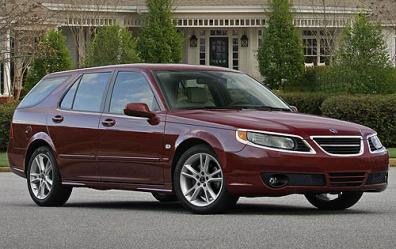
Andris Piebalgs drives a Saab 9-5 that runs on bio-ethanol. By my estimation, the energy efficiency of this vehicle is a meagre 5%. Andris no doubt believes he is doing the right thing and I believe he cares a great deal about European energy. And yet he is driving one of the least energy efficient vehicles ever produced - and he is a physicist. How on Earth have these totally bizarre circumstances come about?
So how have I determined the energy efficiency of a bio-fuel Saab to be 5%. The calculation is as follows:
I have assumed the ERoEI (energy return on energy invested) of tempearte latitude bio-ethanol is 1.2. Sources here and here. Hence the energy efficiency of fuel production is:
Assuming the internal combustion engine efficiency is 30% (combined urban cycle) yields an over all efficiency of 0.3 * 0.167 = 5%.
"And how have these bizarre circumstances come about?" - the answer to that I believe lies in an obsession with CO2 emissions that has lost sight of energy efficiency.
First of all, when biofuels replace fossil fuels, greenhouse emissions are almost always lower. Biofuels are produced from plants that absorb the CO2 they generate when they are burnt. This has to take into account the fertiliser used to produce the crops, the energy needed to convert them into liquid fuels and so on. On this basis, biofuels produced in Europe from rape seed, wheat and sugar beet, typically reduce emissions by 20-50% compared to the oil they replace. Biofuels from sugar cane, waste vegetable oil and second generation biofuels can save 75% or more. Under our proposal, all biofuels used for the EU target will have to save, at least, 35%.
I have to say that in this statement the claims made about CO2 conservation seem accurate - proving that the principals involved are understood by the EU Commission. It is just that the energy cost / energy efficiency has not been taken into account.

Variations in ERoEI with CO2 conserved assuming the energy input to bio fuel production is from fossil fuel.
Andris goes on to say:
And this is why biofuels are so important. Today, there are only three ways to reduce greenhouse emissions: the shift from polluting modes to more energy efficient ones (i.e. rail, short sea shipping, collective transport); the promotion of less consuming cars, by establishing CO2/km targets; and biofuels.
I'm sorry this is just not true. The middle of the three options is of course the most sensible - to concentrate upon energy efficient vehicles. But what about:
1. Electric cars running on renewable or nuclear electricity. This is the future of vehicular transportation - so why are the European Commission not sinking billions into this?
2. Pneumatic cars (which I know very little about) but which are reported to be a viable option.
3. Reducing the speed limits across Europe which will save fuel (the number one priority!) reduce pollution and save lives.
Andris, I would like to emphasise how much we appreciate the opportunity to present these arguments on your blog. In your first blog entry you said you were here to listen. I sincerely hope that is the case and that following the period of listening and analysis that there is a period of action.
Personnel
Editors
Contributors
Peak Oil Primers
Archives
- November 2010 (3)
- October 2010 (6)
- September 2010 (4)
- August 2010 (7)
- July 2010 (6)
- June 2010 (7)
- May 2010 (2)
- April 2010 (8)
- March 2010 (4)
- February 2010 (6)
- January 2010 (3)
- December 2009 (5)
- November 2009 (8)
- October 2009 (12)
- September 2009 (6)
- August 2009 (5)
- July 2009 (11)
- June 2009 (8)
- May 2009 (16)
- April 2009 (10)
- March 2009 (7)
- February 2009 (10)
- January 2009 (15)
- December 2008 (9)
- November 2008 (9)
- October 2008 (9)
- September 2008 (13)
- August 2008 (10)
- July 2008 (14)
- June 2008 (23)
- May 2008 (16)
- April 2008 (12)
- March 2008 (16)
- February 2008 (9)
- January 2008 (13)
- December 2007 (13)
- November 2007 (16)
- October 2007 (22)
- September 2007 (8)
- August 2007 (9)
- July 2007 (16)
- June 2007 (8)
- May 2007 (7)
- April 2007 (7)
- March 2007 (10)
- February 2007 (10)
- January 2007 (12)
- December 2006 (9)
- November 2006 (15)
- October 2006 (4)
- September 2006 (5)
- August 2006 (5)
- July 2006 (9)
- June 2006 (5)
- May 2006 (10)
- April 2006 (9)
- March 2006 (13)
Vital Trivia
License

This work is licensed under a Creative Commons Attribution-Share Alike 3.0 United States License.
Bio-ethanol what hype! Fossil fuels are the donut and ethanol is the hole, with a negative EROEI, and generating a lot of CO2 and nasty waste. Illusion and reality, take your pick.
Bio-ethanol what hype!
VS all that non-bio-ethanol?
nasty waste.
So, when did Ethyl Alcohol stop being the waste product of Yeast and stop being toxic?
Not to mention the question how this is worse than that evil electricity you've railed against.
Seems Andris has made a value judgment in favor of net CO2 emissions. These emissions may seem to be a greater threat to him than running an energy inefficient vehicle.
I do agree that your options, primarily electric vehicles, in my opinion are far more favorable than a bio-fuel driven car -- for a number of reasons not the least of which is a phenomenal efficiency.
As a Yankee, I wonder if competitive electric vehicles are available to the European market.
Cheers and good luck with Andris!
No, he's made a judgment in favour of net EU emissions.
Extra EU demand for biofuels will lead to decreased emissions in the EU, but increased emissions in developing countries as they clear their forests to grow the stuff. Of course, he may respond that EU policy will try to protect those forests, but how well has that worked for world demand for timber? They just dodge or corrupt the system.
Already 17.5% of greenhouse gas emissions come from deforestation. Biofuels will only make it worse. Of course, they'll make it worse outside the EU, so he probably doesn't care.
As I describe here, even if the whole world ate minimum rations of grain, ate no grainfed meat or dairy, consumed no fruit, sugar or vegetables or vegetable oil, and if all this was done with a Magical Energy Fairy so that producing the biofuels cost us no biofuels at all, we still only get a single barrel of biofuel per person annually. This compares to current crude consumption of 4.7bbl each, 3.2bbl of which goes on transport.
Developed nations use about 7-15bbl, developing 2-7bbl, and impoverished countries 0-2bbl. So the single barrel of biofuel ain't gonna do much.
On the other hand, a single barrel of biofuel each for the world's population could be about 6bbl for everyone in the US, EU and Japan, and zilch for the rest. Which is probably what our erstwhile EU commissioner has in mind. Rather colonial of him.
Or more likely he's just never sat down to do the arithmetic to figure out how much biofuels could be produced by the world, and compared it to how much fuel we consume today.
I commented, let's see if it passes through.
I think you're being mean. The Saab Biopower is a wonderful little car. It utilizes a variable-speed turbo which allows it to burn ethanol, or gasoline, at a much higher efficiency than it's peers.
It is also being improved upon. In it's new iteration it will be a hybrid, with di, and adjustable valve timing which will allow it to utilize a 1.4 liter engine which will get 37 mpg on ethanol. This in a mid-sized, comfortable car with Good Cross Country Performance. Details here:
http://www.greencarcongress.com/2008/03/gm-introduces-s.html
If he's using ethanol it's quite likely Brazilian Cane ethanol which can have between 6:1, and 8:1 EROEI. (They burn their bagasse for process heat.)
If he's running ethanol from Corn Plus, in Winnebago, Mn he would be using ethanol with approx 4:1 eroei (they burn their syrup for much of their energy,) and, if he's burning ethanol from one of Poet's new plants he would be burning ethanol with approx. 2.3:1 on a btu basis. Of course, if you consider that this engine burns ethanol much more efficiently than the average engine (it develops about 25% more hp on e85 than on gasoline) I think you have to adjust the eroei numbers up a bit.
Anyway, it's a European car, and he's a European politician; and, it seems to me that you've got to give him some kudos for trying to promote alternatives, even if they're not the exact same alternatives that you would advocate.
Anyway, thanks for posting the picture of a nice car, and have a Good Night.
p.s. I'm going to go back and drool over the car. I think it's a "looker." :)
If you must persist on promoting ethanol, then please be more accurate and talk of "energy return on FOSSIL energy input" instead of EROI. Simply because it must be distilled, no ethanol, sugarcane or otherwise, can get more than a 2 EROI without creative "crediting". That you chose to consider energy from bagasse or energy from other biomass source "non-energy" is physically and thermodynamically unsupported.
Ok. I'll go out on a limb and make a case sugarcane ethanol. Of course it is no panacea, no energy alternative at this point is one, but it can help bridge the gap and promote even raise levels of income on some desperately poor countries.
Sugarcane ethanol does have an EROEI of 8 (against 1.4 for corn). Anyone who has sunk their teeth on a cane stalk knows how much sugar it packs. Sugarcane is an amazing little engine for turning sunlight into sugar/energy. Also in sugar's case you process the WHOLE stalk, not the seeds, and the crushed stalk than can be burned to generate electricity. This biomass, when properly used, is often enough to cover for all the Mill’s needs and even sell electricity off to the grid. Also, on the newer mills, the trucks and machinery run on a mix of diesel and ethanol, and even the crop duster planes fly exclusively on ethanol. This eroei has even room to grow. In 2007, energy from bagasse actually generated amounted to around 3000 MW (including the energy saved at the mill). The association of Sugar Growers estimates that by changing existing boilers the capacity could easily reach 7,6 thousand MW, and by optimum utilization of bagasse and straw the sector predicts a generating capacity of 10 thousand MW by 2012/13.
Second, at least in the case of sugarcane and Brazil, ethanol production has not seriously impacted food production: Brazil produces about 4.8 billion gallons of ethanol from sugar cane in 6.3 million hectares. This is less than 2% of the area available for agriculture in Brazil (this calculation excludes the whole of the Amazon). This number is even more relevant when we consider that about 45% of the sugarcane produced in the country goes to make sugar, not ethanol. The government estimates that production could expand by a factor of 10, without seriously impacting other cultures or the Amazon.
Third. Sugarcane ethanol can have a positive environmental impact. The whole production cycle absorbs almost as much CO2 as it produces. The utilization of ethanol as a blend in gasoline (25%) coupled with the utilization of ethanol on flex-fuel vehicles in Brazil avoids the emission of around 4.3 tons of CO2 in the atmosphere per year.
Fourth. Sugarcane, a tropical plant, might be used to mitigate the effects of Peak Oil especially in the poorer countries, in Africa, Asia and Latin America. Of the 50 poorest countries in the world, 38 are net importers of oil, and 25 import all the oil they consume. It is clear that the situation can only get worse as the prices go higher. Many countries spend more on oil imports than on public health. In these very poor countries, famine and what oildrummers call die-offs are already a reality, and famine was widespread long before food prices went up. What keep the poor in the Third World from eating from eating is not a lack of food, but a lack of income. It is symptomatic that food prices went up mainly in the wake of the rise of China and India, as their incomes went up, they consumed more and better food. (more recently demand for corn ethanol also increased prices, but the phenomenon is older).
I do understand the risks that converting arable land to fuel vehicles presents. There is an enormous possibility for abuse, and it is possible (indeed it looks likely) that the US government might be sending the wrong signals by supporting corn ethanol to the extent it is, given its low eroei and immediate impact on food prices.
Still, ethanol (especialy from sugarcane) might deserve a chance. It will most probably not be the silver bullet some claim it would be, but it can help bridge the gap after PO, and in certain conditions really help poorer countries in the tropics not only lessen their oil bills, but also improve living conditions and income. To this end, developed countries with temperate climates might consider dropping clearly sub-optimal bets on corn (US) and /or sugar beets in the EU, and instead invest in better technology for cellulosic ethanol , as well as efficient mills in third world countries.
Cheers
So, onedip, what do you use to fertilize the soil if no part of the cane goes back into the soil?
Ammonia from natural gas, of course! We use fossil fuels to make biofuels!
No, wait, I mean... er... Well who cares anyway, Europe will get to say it's low carbon! Just like Italy boasts of being non-nuclear... while importing electricity from nuclear France. Ahem.
Oh please. Sugarcane is not corn and need far less fertilizer. You might know that sugarcane extracts nitrogen form the air. The nutrients from bagasse ashes are recycled too.
Se this PDF to educate yourself:
http://www.biofuelsnow.com/Ethanol%20From%20Sugar%20Cane.pdf
I guess these CSIRO guys don't know what they're doing, then.
Stupid scientists. There they are thinking that sugarcane requires nitrogen fertiliser, when according to Pholostan it actually adds nitrogen to the ground. They should listen to the random internet guy!
No commonly-used crop adds nitrogen to the soil. Legumes and some leafy vegetables have a fungus/bacteria on their roots which adds nitrogen; this is the reason for alternating wheat with beans in cropping, or introducing alfalfa and other manure crops.
Turning sugar cane into ethanol leaves behind a slurry which is typically disposed of in landfills. Bagasse ashes contain very little nitrogen, however are useful as potash (potassium, with nitrogen and phosophorous one of the three main artificial fertilisers in use around the world).
It's pretty simple, really. If you take something out of the soil, you need to put something back in, or there's less next year. Nowadays we decide to maximise production, taking a lot out, and putting it back in in the form of ammonia and the like. If those artificial inputs are absent, we'll have to put more back in by putting stalks back in the soil, manure crops and the like.
Using the entire crops for biofuels will mean we're taking more out than we put in. So either we use artificial fertilisers to make up for that, or we degrade the land and have to get new agricultural land by deforestation.
Hmm. Or learn how to make biofuels out of beans...
Where do I claim that? Please do tell. What I said was thet sugarcane need far less fertilizer compared to corn.
Corn needs about 160 lb/acre, sugarcane needs about 90 lb/acre. And in the case of sugarcane about 70% of this need can be fullfilled with biological nitrogen fixiation. If you actually read the pdf you would know this.
So,
philistinepholostan, if you use the whole plant, you are not recycling any part of it, and especially not "intensely recycling" it. Ergo, self-sufficiency in nutrients is not possible. I'm glad we agree. So in the end we need fossil fuel inputs, or other inputs, as that pdf document shows (nitrogen is only one input).It's only about 30 pounds per acre. You can easily source enough hydrogen gas from pyrolysis or gasification of a tiny fraction of the bagasse harvested from a field to produce this ammonia if you feel compelled to do so.
I thought that was obvious...
www.biofuelsnow.com
Ok, so with a fully organic approach, in areas of sufficient rainfall and heat, you can get some ethanol, after making place for this crop by clearing away other crops and wildlife reserves, forests etc (because that is what will happen in places like Africa, believe me, and I know because I am an exiled white African). Whoop de do. It leaves me cold. In Africa this crop will be used by the rulers or sold to the Bazungu (white men), and the peasantry will starve. So what's the point of your argument anyway? Is this the answer to peak oil? You make me laugh. Hah ha ha ha.
I have no argument against sustainable tropical sugar cane ethanol made for local consumption. Alarm bells begin to ring when folks start talking about fueling the whole world on this.
And, I would submit this is exactly the direction we're heading, Euan.
Look up what Renergie is doing. Small ten, or fifteen, mgpy plants fueled with sweet sorghum from local fields.
I contend that there are very few counties in the U.S. that could not produce thirty, or forty million gal/yr of ethanol. Obviously, some in the Midwest can easily deliver hundreds of millions. Those desert areas (S. Nevada) that can't, can trade copious amounts of Solar Electricity, or wind, or waste, or wave, etc.
I believe this model could be extrapolated out to the world. Of course, a country such as Brazil, which has at least 150 Million Acres of fertile land lying fallow, and a fairly small population will probably export some percentage of their production.
Those desert areas (S. Nevada) that can't, can trade copious amounts of Solar Electricity, or wind, or waste, or wave, etc.
I'm sure that White paper you are working on covers the costs of the metal used to conduct electrons from the desert to non-desert areas.
When you gonna get that White paper done VS posting on TOD?
Brazil produced more ethanol than anyone, yet its oil consumption has been rising.
There was less gas mileage with ethanol than with gasahol 80/20 gasoline to ethanol ratio.
Ethanol is not good enough to relieve Brazil of its need for oil. Brazil was one of the fastest growing oil producers in the world and had the second largest oil reserves in South America.
Should have written, "Brazil is one of the largest producers of ethanol."
I have made exactly that point several times, only the other way round: the fact that biofuels (any kind) cannot replace a significant part of fossil fuels GLOBALLY does not mean that they cannot (and will not) replace a significant part of fossil fuels in several countries with high biofuel production potential.
Specifically, Brazil, Argentina, Paraguay, etc. have much lower liquid fuel (and energy in general) usage per capita than OECD countries. Therefore if they maximize the allocation of THEIR agricultural potential into biodiesel production (plus sugar cane to ethanol) for THEIR own use, they will be able to keep running the most important parts of THEIR current economies in the face of a future decline of global oil production (and a much harder decline of global oil exports), and it is just not realistic to expect they will forego that possibility.
Have a look at per capita oil consumption. Brazil uses roughly the amount that Argentina, Turkey, and Romania do. I've not heard that people consider Argentina, Turkey and Romania to be eco-friendly countries. It also uses 1.8 billion cubic feet of natural gas daily, and an eighth of a tonne of coal per person annually, comparable to Mexico or the Phillipenes.
So it seems like when you add biofuels to a country, it keeps using fossil fuels and uses the biofuels as well. It's sort of like getting a rainwater tank, but drawing the same amount of mains water, just using the rainwater as well.
When you give people a new energy source they don't give up the old one. The old one will only be given up if it becomes inconvenient - with scarcity or heavy taxes raising the price far beyond that of the new energy source.
Anyone who has sunk their teeth on a cane stalk knows how much sugar it packs.
Ever chewed on a bit of sweet corn stalk?
You make the US government look honest. Didn't your mother teach you not to tell porkies?
they probably save some stalks for fertilizer.
Your EROEI figures are bogus, see numerous articles by Tad Patzek. Kudos for "alternatives" my fanny. All alternatives have negative EROEI, and when will the technicians on TOD get off the ideology about this and do some real policy analysis on ALL EI, instead of the cookbook off the shelf phony baloney EI on the energy put into aluminum for solar panels??
Could you say that again in English, please?
EROEI isn't English. It has become its own self-subjective language. The fun thing is it means different things for different people. If you read too much too seriously it quickly comes out as babble. But on the positive side, if you like to play with numbers, it can mean exactly what you want it to. Now that's nice, isn't it?
I understood the EROEI acronym, it was just all the other babble that confused me. Aluminium in photovoltaics? WTF?
I don't think the EROEI is an issue. If you just look, as I did, at how much biofuel can be produced, even with an infinite EROEI and basically dedicating all of agriculture aside from minimum rations to biofuels, we still only get 1bbl of biofuels each - compared to the 3.2bbl we use for transport, and 1.5bbl we use for other stuff today. Comparing then to the 7-15bbl used in developing countries, we immediately see that biofuels are not going to substitute for oil worldwide. Still less will they reduce global CO2e emissions, we'll just swap emissions from burning coal for emissions from artificial fertiliser and deforestation.
Biofuels may, however, substitute for oil for a wealthy elite in the EU, US and Japan, and reduce their local CO2e emissions. As an EU Commissioner is a member of a wealthy elite he probably thinks this is a fine thing. Notice how he boasts of his own biofuel-burning vehicle; he's focusing on himself and people like him, rather than considering the public and global good.
Even with an infinite EROEI biofuels look pretty shit. Talking about their EROEI is just redundant, it's like talking about the powder burns on your scalp when someone shoots you in the leg. Who cares?
I'm sorry. I was just trying to make a joke out of EROEI as everyone seems to argue over it.
I agree. I don't think biofuels will ever account for all fossil fuel consumption. But it can help. I don't know how much it helps with CO2. Seems marginal as well depending on the process.
Aluminum in PV is a dopant and is a very small fraction of the total amount of material. I believe phosphorus is the other dopant. The dopants basically determine which way the current flows.
CJ May also be talking about the Aluminum framing that is on most commercial PV product, but the NREL numbers that give PV a 3-4 year return on ALL their 'Embodied Energy' do include the Al superstructure.
Clif needs to bring in his own or some linked numbers for how these have such considerable uncounted inputs that undoes the 10:1 to 20:1 that PV is often credited with today. Even making the next generation of PV, after the oil has presumably declined will be aided significantly by the recyclability of both Aluminum and Silicon. If we see our population follow the energy curve, as I'm afraid we must, then the need for mining NEW mineral sources may be considerably less as well, as the scrap-piles and excesses that we've produced so far will be more available to recycle into more essential and durable products. That's a lot of old Aircraft Fuselages, Soda Cans, Pentium chips, Cars etc..
Bob
Aluminium in photovoltaics? WTF?
I see you own Ovionics style solar VS what everyone else does - put the PV under glass in an Al frame.
kdolliso said "I'm going to go back and drool over the car. I think it's a "looker." :)
Oh dear, Kdolliso seems to be one of that horrid breed, a fan of the automobile! :-O eeeck! They've infiltrated TOD!
Like kdolliso, I think the Saab is a pretty piece of work, though I am not a fan of the bio-fuel idea. Someone on US TOD said something very clever the other day, when they referred to bio-fuel as a way of converting natural gas to liquid fuel by using our food supply to do it!
The car could be reformed into something spectacular though...use the hybrid version, convert it to plug hybrid, with a very small piston or gas turbine engine using compressed natural gas, methane or propane as a range extender that kicks in only when needed...the efficiencies would be astounding! That is the path forward for automobile based technology, the Chevy Volt and the Saab could be the first two cases to prove the validity...but of course, to accept such an idea, you have to be willing to accept the continued existance of that hated device, the automobile!
RC
Wow. If you think the dollar's getting nuked, take a look at the Rand.
http://news.google.com/news/url?sa=t&ct=us/6-0&fp=47de064cbb05856c&ei=Dx...
What is the context for this quote?
He's probably talking about transport rather than everything ... but there are at least 4 options and one of those is to reduce our demand for travel! But that option seems unsayable. Do you really think that with the growing demand from China and India recently opening the Tata car factory that those 3 points will do the deal? Or are we just talking about Europe here? That in the future we can just continue popping down to the shops in our biofuelled or electric car for as long as we like?
And The Oil Drum is starting to amaze me at the moment - Euan, saying this
Really makes my jaw drop! Well, I for one absolutely don't want my portion of the billions going into nuclear for sure and to a lesser degree renewables for this purpose either. When our lamentable efforts in the UK at producing renewable energy begin to actually deliver, I would like it to be used for home use, for office computers and lighting and so on. How much extra capacity would have to be provided over and above the aforementioned to then keep us motoring too? And then not content with the unresolved issue of nuclear waste, the declining world supplies of uranium, the ever present possibility of a horrendous accident, the gargantuan expense, the need to supply continuous cool water to the system and the construction delays, nuclear is your idea of a power source for a reasonable electric travel proposal for the UK? So, not content with the government proposing nuclear power as the answer to meet our wasteful, excessive and ever growing electricity demands, they're now going to have to plan for even more of them to help provide "the future of vehicular transportation". And what if India and China buy up all the uranium to keep their cars on the road!! This doesn't even consider all of the energy and raw materials going into producing all these new electric vehicles. And as oil and gas decline further and further past peak, and renewables (and nuclear??!) have to attempt to take more of the gap between what we want(ed) and what we've got - for ever - are you suggesting that we continually expand our nuclear and renewable sector to allow cars to continue running for all time to the detriment of everything else we could use it for? If not, then let's stop kidding ourselves right now that this is any kind of sustainable travel future.
Post Peak Oil, If we're to have any kind travel future it will involve collective (public) transport, ships, maybe airships, animals, bicycles and walking. The idea of a switchover to a continued use of personal motorised transport is a plan with no long term future. When we've got guys on the Oil Drum too, drooling over the idea of big motor vehicles you can see the kind of mindset we still don't seem to be able to relinquish.
When will authors and commenters finally abandon their unrealistic car dreams? Whatever CO2 free or CO2 low energy is produced from now on will have to be used to REPLACE our EXISTING coal fired power plants (unless they can be retro-fitted with geo-sequestration of CO2)
NASA climatologist James Hansen:
"....Once the government really understands how serious the problem is these plants are going to have to go....."
http://www.youtube.com/watch?v=gMDS5kEA2ZM
Global warming is non-linear and we still have to expect 0.6 degrees warming just from current CO2 concentrations.
When the Arctic Sea ice disappears in the next years the climate on the Northern hemisphere will change dramatically. Whether and what type of cars we'll be driving will be the least of our worries when the Greenland ice sheet is surrounded by warming ocean waters and disintegration accelerates. And what will happpen when a big chunk of the West Antarctic Ice sheet breaks off?
From: http://neptune.gsfc.nasa.gov
It sits on rock below sea level, is therefore attacked by both warming waters and warming air.
KG - hope your jaw is OK. It seems like you are anti nuclear, which I am not. I'm also not against vehicular transportation.
But I do very strongly agree that there has to be a better way of organising our infrastructure than at present - where we live, where we work, source of food and goods etc. Where this conserves energy, improves the environment and quality of life for all, it has to be a good thing.
Electric vehicles running on renewable energy are potentially highly efficient. So my vote goes for 1) having vehicles and 2) having the most efficient vehicles possible.
You couldn't have said it better, or pointed to a more basic truth. As I'm always saying (probably annoying people in the process),
Don't worry about having to live in culturally isolated villages. We'll still have the internet to keep us in touch with all the ideas and cultures of Earth. It will just take a little longer when we want to actually visit them... which in itself is a good thing (in my opinion.)
This seems to me to be dead on:
Euan,
I'm not sure that your efficeincy calcualtion makes intuitive sense. I would say that if biofuels produced three times more energy than the fossil energy input, they would begin to compensate for the inefficiency of the ICE, but your equation would never go above 30% in the limit of infinite EROEI. With and EROEI equal to one, I think that you should get back the same efficiency set by the ICE.
Also, a portion of ethanol consumed in Europe is from Brazil (2.125 billion liters in the last three years). http://www.frost.com/prod/servlet/market-insight-top.pag?Src=RSS&docid=1...
European production was about 1.6 billion litres in 2006,
http://www.greencarcongress.com/2007/04/european_ethano.html
so you want to include a 30% fraction of higher EROEI product at least.
I think that Andris' statement on displacing CO2 emissions can be criticised for not taking into account the effect of displacing food crops, which appears to make ethanol a loser on the emissions front, but the efficiency arguments you are making needs more attention.
Chris
Chris - I ran my efficiency calculation past the whole TOD crew before posting - no one questioned it.
If we assume eroei of 3 and engine efficiency of 40% the end efficiency is 27% - when you consider the amount of food that is going up in smoke I don't think this is sustainable.
And why import ethanol from Brazil? What the hell is the point?
All that is being achieved here is the prolongation of the ICE and some point sooner rather than later the bullet will have to be bitten to go over to a new system - I used to love running around on electric trams in Oslo.
Euan,
The reason for the variable turbo is that it allows the Saab to burn ethanol at a high compression, thus raising it's efficiency up close to the 41% the EPA says it can achieve with E85.
What would the efficiency calculation be if you assumed the lower 6% figure for Brazilian Ethanol, and, say, 35% engine efficiency. I don't think this number is too far out of line (remember, the engine is producing about 25% more hp with e85 than with gasoline.)
Hi Euan,
I tend to think of efficiencies as energy conversions. In the case of the ICE, it is chemical to mechanical conversion. In the case of ethanol, it is largely chemical to chemical. So, if Eout=Ein then the conversion efficiency is 100%. You are calculating efficiency=((Eout-Ein)/Ein)/((Eout/Ein))=1-Ein/Eout
which only gets to 100% if there is no energy input. If EROEI is less than one, you would have a negative efficiency and I'm not clear on what the meaning of that would be. Does the car take you to work when you want to go home ;-)
I mention the Brazillian ethanol because it has an EROEI around 8 or so. Thus, your total mix is higher than 1.2.
I agree that electric is the way to go for the most part. Jet turbines will still need fuel, but that can also be produced renewably without resort to plants.
Chris
KD and Chris, I agree that tropical sugar cane has ERoEI around 8 - more sunshine better plants. And I'm happy to accept 40% efficiency for a turbo charged swedish drunk.
That results in over all efficiency of 35%. So if Saab want to target the Brazilian market good luck to them.
The reality in ever freezing temperate latitudes is that eroei is still closer to 1.2 and in urban driving you're unlikely to get that magic 40% from an ICE.
You have to deliberately try and disable your electric motor to drag the efficiency down that low.
I think that well-to-wheels you have pretty much of a wash if you are starting with oil. Oil generators are typically have 40% efficiency and with 7% transmission and distribution losses, a 77% efficient battery/motor set up will get about 28% efficiency. With biofuels and an EROEI of 1.2 and a 30% efficient ICE you get a 120% gain factor from the biofuels production so you get to go a little farther on the same oil at about 36% effective efficiency. The big gain comes from cutting the thermal portion out by using wind to generate the electricity. Then the electric car is running at 72% efficiency. Gas turbines go up to about 60% efficiency and often it is mostly gas rather than oil that is used to produce ethanol. In that case, a gas turbine plus an electric car gets 43% efficiency while passing through biofuels stays the same. When using the Brazilian ethanol, there is an 800% gain assuming natural gas is used rather than bagasse so the miles traveled per unit fossil fuel energy used with be higher than for the gas turbine/electric car set up by a factor of 5.6.
The thing that is missing here is that we don't count the renewable source as an energy input. So, the solar power that makes the wind blow and the cane grow is not counted. The main problem with biofuels is that it takes much more land to collect energy than it does for wind and solar. And, it takes land that we already use for growing food so we get a much larger environmental impact. I calculate here http://mdsolar.blogspot.com/2007/02/photosynthesis.html that corn gathers about 0.25 Watt per square meter compared to solar panels which get about 40 Watts per square meter on average. Corn takes 160 times more land to gather the same amount of energy without even looking at all the processing issues. Further, solar and wind don't need to use cropland and have minimal water use, though I think combining potable water use and solar can yield a solar PV EROEI above 80 in one configuration: http://mdsolar.blogspot.com/2008/03/lux-lucis-tepida.html
It seems to me that if we are going to use hydrocarbon fuels, we will do much better to make them directly from carbon dioxide and water than to use plants as intermediaries because we can gather both the energy needed and the carbon dioxide needed using much less and different land than if we use plants. For the most part, we don't need the hydrocarbon fuels, but in a transition, it may make sense to reuse current hydrocarbon fuel delivery infrastructure for a while. Having straight wind and solar power as our primary energy sources and using synthesized hydrocarbons as energy delivery modes makes more sense to me than attempting to gather solar power with plants and using ethanol or biodiesel as delivery modes.
Chris
"The big gain comes from cutting the thermal portion out by using wind to generate the electricity. Then the electric car is running at 72% efficiency."
If you're talking about well-to-wheel efficiency, don't suddenly take an unannounced excursion to wind-to-wheel efficiency and act like they are comparable.
What matters for wind is cost in terms of non-renewable resources, how easy it is to recycle and dependencies(storage/peak power plants). Who cares if available wind resource is used at 10% efficiency or 90% efficiency?
Jerome has addressed some of the cost issues involved in wind pretty well and it turns out that the mode of financing is pretty important. As Engineer-Poet points out pretty frequently, removing the thermal portion from the use of hydrocarbon fuels through the use of fuel cells can get comparable efficiency to the figure I gave for wind. Fuel cells are still under development so wind is a better example of this. Further, the wind example incorporates storage and so is not particularly sensitive to your additional stricture.
The comparison I gave actually announced the second paragraph which dealt with how efficiency impacts renewable sources. It is obviously not unimportant. Wind or solar can supply all of our energy needs, but biofuels are sufficiently inefficient that using that mode leads to unacceptable impacts on the enviroment through the link to food production. We are already seeing impacts when we try to supply less than 3% of our energy use in this manner.
There are good reasons not to include the efficiency of gathering renewble energy in calculations of end use efficiency, but this does need to be considered in the overall assesment of the viability of the particular mode. What Euan has done may point to a way to combine the two, but I am still not understanding it and have given some examples of how I think of efficiency (and gain) to see if he has any comment.
Chris
Chris, the logic behind my efficiency equation is this. If ERoEI = 1 then the efficiency of anything running on that power source would be zero. There is the specter here of a vast number of people and processes engaged in a fruitless activity of converting 1 liter of gasoline into 1 liter of gasoline.
When ERoEI is less than 1 - say 0.8 then the efficiency would be (0.8-1)/0.8 * 30% (ICE) = -7.5%, indicating that this is an energy wasting activity.
If the ERoEI is 2, the efficiency is (2-1)/2 * 0.3 = 15%.
If the ERoEI is 10, then the efficiency is (10-1)/10 * 0.3 = 27% = getting close to the efficiency of the ICE. Its not possible to have a system efficiency higher than the ICE as this would imply a fuel efficiency greater than 100%.
My main point is that we are combining two energy inefficient systems - bio fuel and ICE - and the end result is extraordinary inefficiency.
I know it seems that we are getting something for nothing from the solar energy that is gathered. However, that is not the case since their is an energy cost penalty involved in gathering that energy.
Its still a point worth debating though.
I agree with the land use environmental impact issues and it seems we are both agreed that bio fuels are a poor option.
One concern I have is that bio fuels are merely extending the life of ICE technology and rightly or wrongly my current view is that plug ins and plug in hybrids is the route we should be going and it is high time the EU started to facilitate the construction of this infrastructure.
I agree that electric vehicles running on FF electricity are a waste.
My next post will allow ample opportunity to debate this further.
Euan
Hi Euan,
Your efficiency is dimensionless, as it needs to be, but you didn't have to divide by EROEI to make it so since the original numbers were dimensionless. I don't think it can be combined with a standard efficiency (the 30% for the ICE) in the standard way. If EROEI is 1, the wheels still turn which would not be the case for zero efficiency. They still turn because the energy input is external. Suppose we believed that in order to use a gallon of gas we had to first dance a special dance. The "EROEI" of that process would be 1, taking one gallon into one gallon. The overall efficiency would be 30%. So, backing out the efficiency of the special dance, we get 100%. It was pointless, but it did not lose or gain energy.
There are processes that gain energy and so a efficiency of greater that 100% is OK. A fuel efficeincy of greater that 100% is not, but that is really a property of the end use, not the energy gathering portion of the system.
Chris
Hi Euan,
your calculations are clearly flawed.
For example, assume there exists a tiny device in which you can fill gasoline and you get out twice the amount of gasoline you fill in. (Clearly such a device will never exist, but assume it does for illustrative purposes.)
Now, such a device would have an EROEI of 2. (For each energy unit invested I get two times the amount of energy back.) Are we on par up to here?
Ok, now assume you build this tiny device into your Saab with 30% efficiency.
By your calculation this new car would have an efficiency of only (2-1)/2 * 30 % = 15%! This means by installing this magic energy producing device we would actually _reduce_ efficiency!
Clearly this is not the case - efficiency in fact increases two-fold to 60%, since we can now fill in one gallon of gas, turn it into two gallons (by our magic device) and from these two gallons we then use 30% of the inherent energy for moving the car (that is what 30% fuel efficiency means, after all - 70% of the energy stored in our fuel is lost while 30% is converted into car movement).
Efficiency only decreases if we first convert some energy by a process with an EROEI below 1.
Of course, one can still argue that the huge costs in deforestation, lost food harvest, etc. are too serious for a meager EROEI of 1.2 to make ethanol bio-fuels a good alternative. But anyways, wrong calculations don't really help to push this point.
Thanks, mdsolar, good work.
One thing, though; Let's say we don't use Corn Plus's claimed 4:1 EROEI on nat gas (they get about half of their process energy from burning their syrup - a process they're selling to several other refineries,) but we do use Poet's reputed 2.3:1. How far would a car go on the nat gas used in these processes compared to an electric car running on volts supplied from nat gas?
Thanks for the response.
A a factor of 2.3 gain with a 30% efficient ICE would mean a factor of 1.5 time farther I think: 2.3*0.3/0.46=1.5
In the US, natural gas generation is dominating new generation but 40% efficient coal has about 50% of current generation so implementing electric cars now does not help much with efficient energy use. What it does do is provide the storage capacity we need to stop using coal and get on to higher EROEI renewables where the thermal efficiency is not a big issue. I estimate that electric transportation provides 0.5 days of storage of total energy use through the reuse of batteries in stationary applications once they are no longer transportation grade: http://mdsolar.blogspot.com/2007/08/roof-pitch.html
Half a day of storage means that night time use of energy can be provided by solar power in large measure so coal becomes unneeded. So, electric transportation is an enabling technology while biofuels are an insufficient stopgap. Half a day of storage would also be very helpful for a wind based system.
Chris
I have a suggestion: no cars are environmentally or peak-oil friendly. Not one, ever. Simply the amount of materials and energy required to produce a car, before it is even used, whether it runs on corn, oil, electricity, pig shit, or anything else is considerable. This obsession with keeping all of the cars going - burning whatever food supply and squandering all resources necessary - is perhaps the worst thing we can do. And doesn't all this increased efficiency serve to mainly prolong our usage of them? When you consider that even the most knowledgeable of peak and climate aren't willing to let go of the obsession, it's really hard to escape the sense that we are doomed. I try to remain positive and be responsible, in hopes that at the very least my actions and influence will result in a little less doom. But the car-craziness is really bogging us down. Tell me, is the most effective long-term solution not to move away from cars? A bicycle uses about 1/100th of the material. I use it extensively, even it my current suburban area. I know that it can replace cars to a large degree. It's a major step in the right direction, as far as I'm concerned.
Sometimes, I just don't understand what people are thinking.
We have to do better.
"no cars are environmentally or peak-oil friendly. Not one, ever."
Absolute, Extreme statements are hardly a sign of clear thinking, either.
It's not the tool, it's the usage. Cars are not inherently bad, and neither are roads.. What's bad is how far out of proportion they and their materials have grown in this 'Cake' culture of excessive, cheap energy where they've ballooned so far out of balance.
Your reaction, though, is also 'misproportioned', and targeting a symptom not the real causes.
Respectfully,
Bob
KM****111's post may be a little extreme but it may also hold some truth. The world car fleet will soon approach a billion units most of which will be ICE powered. How much energy is used to produce a car tyre? something in the order of 30 litres.
I still have no answer as to how much lithium or nickel could be brought into circulation to replace this lot with batteries plus the cost of the electrical infrastructure to support it. I keep saying it, but I don't think the scale of the problem is widely appreciated
The level of shit is rising!
Cars have a place but their efficiency in urban transport is much less than 5%. The 5% number is based on the assumption we need to move a ton to move a person.
Kinetic Energy equals 1/2 mass times velocity squared. It is far to complicated to calculate the mass of every vehicle and the effects of congestion on a trip.
Parasitic Energy Consumption (PEC) is a simple ratio to indicate waste relative to moving people and cargo in a trip. PEC is an approximate ratio of power applied to make a trip.
PEC equals the moving mass divide by the mass of the cargo and passengers times the number of Start-Stops. Exponentials and constants cancel. You end with a relatively simple ratio of masses multiplied by the number of times power must be applied in a trip. Momentum losses in turns, etc... are ignored to create a ratio the average person can quickly calculate.
So "Beam me up Scotty" would be a perfect 1, no vehicle mass and 1 Start-Stop.
Bicycles, if you do not have to Start-stop, approach 1.
Cars and trains, massive vehicle to passenger ratios, are very wasteful.
Personal Rapid Transit (PRT), of which JPods is just one, have low vehicle mass and only 1 Start-Stop.
Remove the vehicle mass and remove the Start-Stops and we can radically increase efficiency. As an example, JPods require 200 watt-hours to travel a mile carrying up to 4 people or a pallet of cargo. Solar collectors 2 meters wide mounted over that rail gather 2.5 million watt-hours in a typical day; enough for 12,500 vehicle-miles. Similar systems are being opened at Heathrow and Uppsala Sweden.
I like your ideas, and one more way to show how wasteful it is to use cars for personal travel (especially single-occupancy), when I can and do use a vehicle that uses a tiny fraction of the material.
But how is the PECF higher for light reail than it is for cars? That doesn't seem intuituve, at least given my experience with my local light rail, which is the South Shore commuter line that runs between Chicago and South Bend, Indiana. The overall density of people per mass of vehicle certainly looks to be much higher than it is for cars, and my example is for a system over 100 years old. I would think that that PECF would be much higher than it is for cars, even by a magnitude.
Most light rail cars weigh about 50 tons. Divide the weight of the train times number of trips and divide by ridership you get about 3 tons per passenger. In many cases, trains are like giving everyone a Hummer, they just don't have to park it.
In this PEC ratio I think we counted 10 stops.
Ridership is on the rise so trains will get better.
A train a full capacity gets the vehicle weight down to about 800 pounds per passenger. A fully loaded JPods (4 passenger) the vehicle weight per passenger is about 100 pounds.
I believe for the next 5 years JPods will provide feeder networks to existing rail, further increasing rail ridership.
It's the scale. Do we have 10,000 times to many cars or miles of road, or 10 times to many cars or miles of road? What scale of car infrastructure is compatible with long term sustainability, controlling global warming, ending species loss? How badly are we out of balance?
I believe that we are many orders of magnitude out of balance. Sure a few thousand cars probably won't hurt the earth much. Maybe even 100,000. But somewhere between there and where we are, and probably closer to there than where we are, the equation for environmental destruction and road building turns very very negative.
OK, I admit that my statement may have been extreme and absolute. But it certainly is a lot more realistic than the mentality (or lack thereof) of the average "consumer" - that a car is "green" simply because it is a hybrid, or an electric, or fuel cell, or (probably worst of all) can run on corn ethanol. This is the pitch car makers are doling out, and it's complete bullshit. The fact that people are buying it only proves how much we've become an army of corporate-programmed turbo-consumer TV zombies, who really are not educated in reality - which also helps explain the ridiculous sulf-entitlement to cheap fossil fuels that every single person around me seems to have.
Carbonneutral.com.au, a company planting trees as carbon sinks in Australia, they have a carbon calculator on their website, one which looks at the embodied energy and thus emissions involved in house-building and vehicles. The background paper gives details and references, and he took a Ford Taurus as an example, with emissions coming out to 17.9kg CO2e per kg of vehicle.
By comparison, complete combustion of 1lt of petrol causes 2.8kg CO2e emissions; I don't know of calculations of its complete lifecycle (ie counting all the emissions from oil rigs, etc).
The average private vehicle in Australia does 14,700km annually, burning 1,250lt of petrol as it does so, thus 3,500kg CO2e. An average car can be taken as about a tonne, thus its construction caused 17,950kg CO2e. And so we see that it takes five years for the emissions from an average amount of driving and fuel efficiency to match the emissions of the manufacture of the vehicle.
It's something to consider when thinking of buying a new car solely for fuel efficiency. Suppose you could improve efficiency by 35%, the target Piebalgs is setting. Well, you would then save 1,225kg CO2e annually, assuming you drove the same amount. It'd take 15 years of average driving for this efficiency saving to come up to equalling the 17,950kg CO2e of emissions from its construction. By comparison, the average lifetime of a vehicle is 15 years - and people like EU Commissioners tend to replace vehicles every 2-5 years.
If your vehicle is dead already, then it's worth replacing it with something more efficient. But if it's working well, just inefficiently, buying a new vehicle will cause as much or more emissions than the old one would cause by its inefficiency.
Our Commissioner, like George Clooney or Matt Damon buying hybrids, is just showing off.
Great point. I think there's way too much emphasis on buying new "green" products - cars and otherwise - instead of using what we already have less. I think any hopes of a mass transition to more efficient cars is unrealistic, especially considering that people are struggling just to keep their homes in the US. So while Joe Blowe might be able to afford an extra US$20 per month continually in gas, he's not able to afford US$300+ per month for 5 years for a new car. Does anyone else think that we already have all the cars we will ever need? Jesus Christ there are a lot of fucking cars out there. The US is already too much of a car slum.
Well, that's the thing. There's all this talk of fancy new technology, and installing this and rebuilding that, and redesigning cities and - can't we just take what we've got and use it less and use it better?
A few days ago I had a friend around, he was visiting my new place, rented. He was saying, "well, that's the thing about renting, because people are renting they can't be energy-efficient?"
"No?"
"Not really," he explained. "I mean, you can't install insulation, or double-glazing, so your airconditioning will really have to work hard, and -"
"So you're saying that because I'm renting I can't spend $8,000 on things to keep the heat out and make sure my 4,600W aircon unit is on only for two hours a day instead of six?""
"Yes."
"Couldn't I just... put on shorts and shirt, get a cool drink, turn off the 4,600W aircon and turn on the 50W fan? And keep the eight grand for hookers and blow?"
He laughed and agreed.
The stuff that we can directly control, how we get and use our power at home, how we travel around, what we eat, how much rubbish we produce - all these things we can control directly contribute about half of total greenhouse gas emissions, and make up about half of all fossil fuel use. Beginning at average, we can drop it by 50-75% without any significant effort or brains, and while saving money. And all that multiplied across the whole population - well, that'd be more than the pissy little 20% reduction by 2020 some people are speaking of. And fossil fuels could all peak today and drop off, and we wouldn't even notice because we'd be using much less.
All the high tech and rebuilds and so on, they'd help, reducing the remaining 25-50% of total fossil fuel use and emissions. But the biggest drop can come from our own behaviour.
So long as we're not whiny pussies who expect to just buy our way out of trouble.
I couldn't agree more. I've been making do with much less for some time now, and I'm perfectly comfortable in my house in the winter at 61 degrees, though I set it a degree even colder than that in hopes that I will be able to further adapt. All I need to do for this is put on more clothes (which I already have), and it isn't so much to be at all unwiedly either. I even wear shorts, along with a t-shirt, longer socks, a long-sleeved shirt, and underwear. Unfortunately we're in a tiny minority in a nation of crybabies (referring to the US) conditioned to and expected to consume, I fear.
Your friend has a point in that many items are purchased by people who have no interest in how much energy they use over their lifetime. For example builders and landlords will often buy something based on the initial purchase price because that is what they pay not the running costs, same goes for consumers who often don't see beyond the initial cost.
We probably need to impose a purchase tax based on the excess amount of energy used over the lifetime of the product compared to the most efficient. That way builders and landlords will have every incentive to use the most efficient products, it would be crazy to pay more for a less efficient product. These taxes should be specifically used for fossil fuel reduction schemes.
Also products need to be built for much longer lives and to be easily repairable not thrown away. Reduce, reuse, repair then finally recycle.
Certainly we have all the cars we will ever need - and all of the concrete. It sickens me to consider the environmental consequences of all the paving we have done. The manufacture of concrete generates huge amounts of CO2 emissions.
Many of the newer roads are nothing but traffic sewers. They are good for nothing but driving on. They're too dangerous for walking along or biking on. And many places (like malls) are completely inaccessible by any other means.
Good morrning,
I've just done some pitty calculations, and as I would never trust my own math I'd be glad if somebody could check the following for any mistakes:
According to this source the EU produced 50 million MT of corn in the year 05/06. So if we use the conversion rate presented here we get:
50,000,000/0.0254 = 1,968,503,937
or roughly 2000 million bushels of corn harvest in the EU-25.
So if we can get 2,7 gallons of ethanol out of every bushel of corn the whole EU corn harvest of that year could be produced into:
2000 * 2.7 = 5400
5.4 billion gallons or 128.57 million barrels of ethanol.
The BP Statistical Review of World Energy 2007 states that the EU-25 consumed 14.865 million barrels of oil per day. If we assume that about 80% of the oil was used for transpoortation purposes (this number is dragged out of my memories and could be very wrong) the 129 million barrels of ethanol would cover demand for:
129/(14.9*0.8)= 10.8 days
So according to these calculations the whole corn harvest of the EU-25 would suffice to cover 3% of its yearly demand.
Is this correct?
Monkey,
although, you need to take into account for the fact that they would get 40% (800 Million Bushels) of the corn back in the form of distillers grains, corn gluten, etc. (depending on how the corn was processed,) your point is well taken.
Europe doesn't have a good biofuels crop. It seems likely that they will end up going the diesel/biodiesel - Hybrid route in the medium term, and diesel/hybrid route in the shorter term, but, in as much as they've shown very little interest in hybrids to this point we'll just have to wait and see.
Ok, let me do some more stupid calculations, now for Biodiesel.
According to this source (Beware! It's German!) the entire oil seed crop (rape seed, sunflowers and soybeans) of the EU-25 in the year 2006 was 20.2 Million tons.
Here it says that "Between 1300 and 1700 litres of biodiesel can be produced from an average yield of three to four tonnes of rape seed per hectare under cultivation."
So if we take the median we get an average of
1500/3.5=428.57
or about 430 litres of biodiesel per ton of rape seed.
As I don't know what amount can be processed out of soybeans and sunflowers, let's assume for a moment that it is 430 l/t as well.
So 20.2 million tons of oil seeds account for
[(20,200,000 x 430)/3,78]/42= 54,711,514
or roughly 55 million barrels of biodiesel.
Here we also get the following:
"...diesel consumption currently stands at around 30 million tonnes a year in Germany..."
So, if we take this conversion rate of ca. 1200 litres of Diesel per ton we get:
[(30,000,000 x 1200)/3,78]/42 = 226,757,369
or about 227 million barrels of Diesel consumption in Germany per year, which means that the oil seed crop of the EU-25 could cover
55/227=0,242
about 25% of Germanys Diesel demand.
Now let's get a little bit kinky.
We take the whole arable land of the EU-27 and use it for Biodiesel production. According to this source (pdf-alert) we have 120 million hectares of arable land in the EU-27.
So 120 million hectares can yield
120,000,000 X 3,5 = 420,000,000 tons of rape seed,
which can be processed into
[(420,000,000 X 430)/3,78]/42 = 1,137,566,137 barrels of Biodiesel
According to Financial Sense "Europe’s daily demand for diesel exceeds 6 million barrels". This looks ok, when you compare it with Figure 3 on page 6 Here which states that in 2001 the diesel consumption in the EU-15 was about 250 million tons or 5.17 mbd.
So accordingly, EU diesel demand is
6,000,000 X 365 = 2,190,000,000 barrel per year.
That means that planting the entire arable land of the EU with rape seed could cover
1140 / 2190 = 0,52
roughly 50% of the current EU diesel demand.
This sounds a little bit bleak.
And now, let's go forth and rape the Earth!
(Warning! I, myself, would never trust my own calculations, so I strongly recommend you not to quote any result without proofing its validity by verifying and recalculating everything.)
Monkeyman, there really aren't any good oil seed crops outside of the tropics (basically, palm oil, and the oil companies in Europe have effectively killed that.)
David W's algae oil just might make it. If it doesn't, Europe is going to be in a bind in a few years.
I recently posted a similar calculation for thr UK. Can't be bothered to do it again so here is a rough figure summary:
Total UK land area is 250,000 square km. Convert this to hectares and you get a big number.
According to the text books I have read and talking to people I know who grow the stuff, you can expect, at best, 2.5 tonnes per hectare. After some more big numbers, you find you get about 80% of the 60 million tonnes the UK requires each year, and thats assuming no energy is put into producing the final product.
So you have 80% of your transport fuel supply but not a square mm to live on and no land to grow food. Arguing about the subject won't change the facts. Time will tell who is right.
The level of shit is still rising.
Fall Out - I've not checked your sums, but if you mean 3% of transportation demand, then it wouldn't surprise me if you are roughly correct.
So the choice is eat or drive.
Welcome to the real world.
€
I don't know about Europe specifically, but globally about 2/3 of oil ends up as transportation fuel of one kind or another. Probably it's higher in the EU; the worldwide figure is lowered by all the countries like Cuba and Senegal that generate lots of their electricity from oil-fired generators.
67%, 80%, it doesn't change your overall figures very much. As I posted upthread, it's just not plausible that we'll ever produce in biofuels anywhere close to what we use today in oil.
Of course, that a rich elite could continue to drive around a lot using biofuels, while the poor masses have mass transit, cycling and walking, that's quite plausible. The single barrel of biofuels per person in the world could be six barrels per person in the EU, US or Japan, and zilch for the rest.
A 30% netback of distillery dregs with less value for livestock raising than the original corn does not justify taking all of Europe's corn to provide 10.8 days worth of motoring. One should also factor in the natural gas used to distill the fermented corn mash. That is to boil off the lighter alcohol and condense it in a condenser. There were other costs in making ethanol that detracted from its overall EROEI also including nitrogen that required natural gas for its production. Nitrogen fertilizer might also be produced using electricity, yet this is not the preferred method.
In the U.S. we got the Energy Policy Act of 2005 (EPAct). This required the production of 7.5 billion gallons of ethanol by 2012. This new ethanol in the United States was not from its being cheap or the most popular fuel choice, but because it is required by law and backed up by police force; rights to search and seizure.
7.5 billion gallons of ethanol a year is about 500,000 barrels of ethanol per day. The United States used more than 20 million barrels of oil per day. Planning to use about 25% of the United States grain harvest the government might have a way to provide about 2.5% of our oil needs and is scheduled to pay out large sums in the form of subsidies and grants to help get the job done. Not a good deal. Big government in Washington seems to be the culprit, not the corporations.
For the DOE booklet about the Energy Policy Act of 2005 see:
http://www.energy.gov/media/FINAL_8-14_DOE_booklet_copy_sep.pdf (pgs. 10-11)
Harvest of Shame
Some U.S. harvest estimates (rounded)
Corn Harvest 2007 = less than 14 billion bushels
Wheat Harvest 2007 = 2.145 billion bushels
Given a total grain harvest of roughly 16 billion bushels/yr and estimating wheat to be similar in BTU content to corn for the sake of a rough estimate, then 16 billion bushels times 2.7 gallons of ethanol per bushel (not including energy inputs required to produce ethanol), would be 43 billion gallons of ethanol production. Since there are 42 gallons per barrel, one gets a more than a billion barrels of ethanol with a huge amount of energy going into making the stuff extracted mainly from precious natural gas supplies. One billion barrels/365 = 2.74 million barrels per day of ethanol that burned by itself is the equivalent of 80% of the energy in gasoline. The United States used a little more than 20 million barrels of oil per day.
Using 100 percent of the world's largest corn exporter's grain will not eliminate the need to import oil, nor solve the associated famine dictated by conversion to ethanol.
That's why the EU will import biofuels, so other countries can go hungry and create more greenhouse gas emissions by poor (high artificial fertiliser use) farming techniques and deforestation.
Maybe they'll make sure that their biofuels don't come from recently deforested land; but then, the people growing biofuel crops won't have room to grow food, so less will be produced, the price will go up, and then the food-growers will clear forests instead.
Or maybe Piebalgs and his mates could just take the train. I guess that would be too great an imposition on him, though. He expects dark-skinned foreigners to stay out in the field with their hoes so he can zip around in his Saab.
First: The distillers grains are, actually, about 33% More Efficient at putting pounds on cattle (the primary use of field corn) than corn.
Second: In five years we will, after accounting for distillers grains (and, increased corn yields) be producing 15 Billion Gallons/Yr of ethanol; and, we will still have 95% of our present production of 13.1 Billion Bushels left over for traditional uses.
That would be about 12.4 Billion Bushels, or about 4.5 Billion Bushels MORE than we grew in 2006.
Also, at that time the amount of Nat Gas used in the refining of ethanol will have plunged, with some plants like Poet's Project Liberty plant, at Emmetsburg, Ia using virtually NO nat gas.
Times are a'changing, folks. Ya gotta keep up.
Repeating for the umpteenth time: EROEI is invalid unless it compares like and like. Ethanol and gasoline are different not alike. Gasoline is made from oil and once the oil is used up there will be no gasoline. Ethanol is replaceable albeit with the use of feed grain (not a human food for the most part). Nothing can validly be inferred from comparing things that are fundamentally different even if used for the same purpose. In order do deduce which is the better source of two sources of energy, they must be sufficiently alike that the only variable is the energy content. Ethanol and gasoline although used for the same purpose are NOT sufficiently alike so that one can determine which one is the better energy form by using EROEI. They are different and can not be compared especially without taking into account the critical function price plays in resource allocation.
This is evidently very hard for engineers and the numerate, but not too literate, to grasp. It is logic problem not a numbers problem. Tortured numbers like EROEI will tell you anything you want them to, however the basic logic is wrong. That is why the EROEI for electricity is ignored in this debate, even though larger amounts of natural gas are consumed in electricity production than in ethanol and the EROEI is less than ethanol. None of the EROEI believers are willing to take on electricity for some reason. Perhaps it's because the fallacy of EROEI is more obvious in comparing say natural gas inputs to electricity output. Just because inputs and outputs look similar and are used similarly in the case of fossil fuels and ethanol, the principle is the same. Logic rules! Unlike things can not be compared. In the case of electricity produced from natural gas, an increase in utility is achieved at the sacrifice of a cheaper input. In the case of ethanol an increase in the supply of liquid fuel is achieved at the sacrifice of cheaper grain and natural gas together with a lessor amount of liquid fossil fuels. Numbers matter only if there is sound reasoning behind them. If not, they are nonsense.
My favorite example of using EROEI concept in a different form is Metal Return on Metal Invested (MROMI). Suppose we take two different metals iron and gold and try to decide if one is a better metal based on comparing MROMI. Suppose a gold mine uses 10 pounds of iron for shaft supports and such for each pound of gold produced. Clearly no gold should be produced as MROMI is only .1. After all, the only thing that matters is how much metal in produced.
Such a conclusion is of course nonsense. There are other characteristics of gold that outweigh its value as a metal such as its price, its beauty and its use as a medium of exchange. Similarly ethanol has a characteristic far superior to gasoline. It is renewable. EROEI does not take this into account nor does it take into account that the lower energy content of ethanol is reflected to some extent in its lower price. Nor does it take into account the high cost of oil in the forms of dependence on foreigners and wars for energy security.
In conclusion EROEI is a fallacious concept which is pure bullshit nonsense unless used to compare like and like. I do not care if university professors, RR or the USDA falls into this logic trap. It is still nonsense.
x'cellent point, x (man, I can't believe I typed that:) )
One might look at this another way. If you converted 30,000 btus of nat gas into electricity, transported it 100 miles, and used it to charge the batter in a prius - How far could you go on the charge?
In that Saab Bio-X you could go 37 miles on 30,000 btus of natural gas (of course, if it was Brazilian ethanol you would be driving on Solar energy, and maybe, a teaspoon of nitrogen.
kdollisco,
Be warned!
I am not allowed to post at R^2's EROEI post anymore( which he said was INITIATED by his earlier exchanges with me!).
So I'm officially an 'energy troll' for discussing EROEI.
Watch what you say!
I agree, adding that sugarcane ethanol does not need natural gas input. (And BTW, in Brazil soybean biodiesel production uses sugarcane ethanol instead of methanol from natural gas.)
A specific problem with US corn ethanol is that natural gas is an absolutely exhaustible resource and will not be cheap for much longer.
And the problem with biofuels in general (except again with sugarcane ethanol, since nobody would grow sugarcane in prime land for grains or oilseeds) is that, as the crude oil price rises, the diversion of agricultural production out of food and into biofuels continues until reaching a temporary equilibrium state with LOWER food production volumes and consequent higher food prices so that the profitability of food production becomes again competitive with that of biofuel production. Now, the geology-driven dynamics of crude oil production guarantee that, in the absence of a worldwide voluntary reduction in crude oil demand in line with the future peaking and subsequent decline of its production, the prospects for the crude oil price are of a relentless rise. That, through the biofuels-food arbitraging mechanism based on profits per acre/hectare, will drive the world into successive new equilibrium states with higher biofuel production and lower food production. Obviously the process will eventually stop before 100% of the food gets turned into fuel. But along the way a large number of poor people wanting to eat will have been outbid by the rich and middle class wanting to fill their tanks.
And there is yet another important side of the biofuels issue that is overlooked most of the time (and that I posted to Piebalgs' blog but still does not appear, it should go after the post by Hans Nilsson): turning an ever greater share of US corn to ethanol (and then soybeans to biodiesel) will cause in a few years the halving of US agricultural exports in volume and their doubling at least in dollars (i.e. at least quadrupling agricultural prices). That will substantially reduce the US current account deficit and give the US a significant strategic advantage.
The US has certainly the right to follow that path. But they also have the duty to tell the world openly that they will do it. Like: "Along the coming years and decades our food exports will become progressively lower in volume, and the same will probably happen to total world food production. It is conceivable that they could be half their current volume in 10 years. People, and particularly poor people, should have it in mind when making procreation decisions."
Dropping a nuke on a city is not genocide if its dwellers are given a week's notice.
With a fifth of the United States grain harvest going to ethanol production and the United States importing more oil/products in the past four weeks than the same period last year (reported by the EIA last Wednesday); ethanol has not relieved us of our need for oil. While we might need more ethanol than ever with ethanol legislation requiring us to use the stuff, worldwide grain stocks are really low this year. United States wheat stocks were near 60 year lows, am not sure how long they have been keeping records. While the Aussies were expecting a bumper wheat crop, the Texas spring wheat fields were reported to be worse than normal, stunted by wet and cold weather.
I have not seen them pulling many stumps to plant corn in my neighborhood. This was all paved over decades ago. The fertile corn producing states were cleared many years ago for agriculture. The Everglades have been partially drained for vegetable and citrus production. There were some sugar cane fields down there, but the EPA will probably not let you drain the remaining wet lands as they were a source for groundwater recharge for south-central Florida during a time when coastal aquifers were being infiltrated by saltwater.
They might want to take the sugar many people get calories from and convert it to ethanol to put into their Lincoln Towncar black limos when they go to the hill to try to get more handouts for ethanol distilleries in trouble due to higher input prices. This is not helping to solve the energy problem but exacerbate it. Ethanol subsidies and requirements to force its use are wrong. There were other chemicals in use to reduce ozone.
Piebalgs seems to have edited his post since we first saw it. He took away his picture of his Saab, and said he was aware of the environmental and food security issues, and would address those in next week's post.
Now maybe if he were driving something like this I'd be a bit more impressed.
7,000 MPG car wins eco-marathon
http://green.yahoo.com/blog/ecogeek/361/7-000-mpg-car-wins-eco-marathon....
Interesting stuff. Still, whatever they're powered by, I hate cars. 1.2 million dead annually - fuck, wars only kill 200,000 - destruction of the landscape, making cities ugly and unpleasant to live in, etc. I'd hate cars even if they were powered by pretty girls' smiles and kisses.
The problem with all of these arguments against biofuels (apart from how thoroughly they serve the interests of Big Oil) is that the technology is advancing so rapidly that the numbers dont stay valid for very long.
At least half a dozen cellulosic ethanol plants are now under construction, each using a different technology. They consume no food, and no fertilizers, pesticides, or herbicides. While some fuel is used to bring them the waste biomass, they produce their own process energy on-site from renewable sources. Since most of the waste biomass these plants consume, including Municipal Solid Waste, Sewage Sludge, etc. would otherwise convert to Methane in the wild (20x more potent a GHG than CO2), they are substantially 'in the green', as it were.
But, these second generation biofuels systems are already obsolete. Algae Based Biofuels, fed CO2 from Atmospheric Carbon Capture units are practical NOW. Over the last 18 months, Algae systems have gone from 5,000 gallons of biofuel per acre/year to 15,000, to 100,000, to 180,000 gallons of biofuel per acre/year. Meanwhile, Hydroxide based carbon-capture has gone from 10 tones of CO2 per year from a one square meter panel, to a refrigerator sized unit which captues one ton of CO2 per day. Clearly, we are on the threshhold of practical "Biofuel Induction Out-of-Thin-Air" ("BIOTA"), which is best done on carbonless desert sand, with no inputs other than seawater, sunshine, and air.
The algae produce both oils and sugars at the same time, so you get both Biodiesel and Ethanol simultaneously; the residue consists of high protein solids, which can be pelletized to make excellent livestock feed, or even used as a bulk ingredient for human food. Since the algae reproduce - doubling in population - as fast as every 20 minutes, and since the protein solids are up to 20% by weight of the algae harvest, its apparent that algal biofuels will become an enormous source of food in the future.
It doesnt stop there, however. The hydroxides are produced from brine, which is separated from seawater by solar distillation, which both provides power to the electrolyzer, and generates large quantities of desalinated fresh water as a byproduct.
Food, water, and 180,000 gallons of biofuel per acre/year, using only atmospheric CO2 and sunlight, in the desert. It means that the government's entire quota of 36 Billion gallons/year could be met on just 200,000 acres of [otherwise useless] land - with no compensating loss of soil carbon. There are a number of individual private ranches out west larger than that.
[feedstock free] "Biofuel Induction Out-of-Thin-Air" is the near future of biofuels, whether Big Oil likes it, or not.
I don't see why the arguments against biofuels help "Big Oil". It's not either biofuels or oil. There are theses things called an "electric train" and "bicycles" you may have heard of them, invented a century or so ago. Invented a couple of million years before that was this thing called "the foot", I hear tell that the foot's able to do things other than hit the accelerator on a car.
Sure, biofuel science is advancing. So is nuclear, and fusion, and wave power, and soon we're supposed to have solar cells you can make with an inkjet printer, and electric cars, blah blah blah.
Let me know when they're for sale at some sane price. Going on what we have now, what we know works well and for a sane price, what we're looking at is electrified mass transit and freight, the electricity produced by hydroelectric, geothermal, tidal, solar thermal, photovoltaic, and wind as the best means of getting ourselves and our stuff around significant distances, and by foot and cycle for distances of under 15km or so.
If something better shows up, let us know. But let's see it actually implemented somewhere and working first. I mean, people are always promising big things from their favoured technology. After fifty years and around 1,000 nuclear power reactors ever built, we're still waiting for our power "too cheap to meter." I'm not inclined to believe excited claims of One Perfect Technology as the One Perfect Solution.
When it's up and working somewhere for some sane price, let us know. Until then, we should plan on the basis of what we know works.
Hi David,
can you please post a link to these Algae Based Biofuels.
In the Andris Piebalg blog mention was made of Fidel Castro's condemnation of biofuels. It was the first I'd heard of it, so I tracked down an article about it.
http://www.caribbeannetnews.com/news-826--5-5--.html
I'm impressed. I'm no fan of the dictatorship, but the old man has some points worth considering.
This is pretty much my view. The energy industries and the big energy economies will starve the bottom half of the world if that's what profits require. What US administration or European government will stand up to them?
Any person in public office has to deal with all sorts. On the one hand, you have the "Peak Oil is a myth, don't touch my SUV" camp, and on the other you have the "why aren't you riding a bicycle?" people.
Also, remember, as a high ranking official, a person has a certain responsibility to express "alpha male" characteristics, which today mean a nice car. If he rode on an electric scooter, that would be considered very noble by many, but a far greater number of people would conclude, subconsciously, that "he has a small willy." This can be problematic for someone in a leadership role.
Realistically, Europe already has excellent trains and other such public transport, and cities well suited to them, so that infrastructure will probably be a little more built out, while private cars become more of a luxury item, like a boat.
When private cars are a luxury item, they will probably tend to be even more wasteful, since that is the nature of luxury (unattainability). However, there will be far fewer of them, and people won't use them for daily transport.
If you don't drive them every day, you can own some very impractical cars. I'm thinking of a V12 BMW 851 myself, just as a garage decoration.
For those, like Åndris, who want to express both "eco friendliness" and "I'm the big dog," I would suggest BOTH a flashy, traditional car, with a few ornamental eco-features ("runs on biodiesel"), combined with some sort of alternative transport like an electric scooter. Thus, each serves its purpose well. You just can't turn 4000 lbs of metal into an energy efficient machine, nor can you impress certain people with a dinky bike made in China. Sort of "I understand where all of you are coming from." Good for a politician.
He could even be the Jay Leno of alternative transport, with everything from a Tesla electric rubber-burner to a pneumatic car to a Tata Nano to a skateboard. That would be best of all.
Sure, he pretty much has to have a flash car to keep his position.
But he doesn't have to boast about it. He wasn't presenting it as, "unfortunately it's a necessity, or else I won't have my job, you have to do some bad to some good." He was presenting it as, "look at me, I'm sooooo greeeeeeen!"
But you know, how much does this "alpha male" stuff really matter? Surely some train and cycle time would make an impression on others? He could court popularity with the masses by his green lifestyle so that nobody would dare remove him as a commissioner. And he could always just cycle around, do lots of pushups, get all buffed up like Putin, then if anyone makes fun of him he could establish alpha maleship the old-fashioned way.
"I ride bicycle to work. You think is funny?"
Further on "alpha male" status and driving a car, the US Ambassador to Denmark travels around the country on a bicycle. He has not reported his penis becoming smaller, nor is it apparent that US-Denmark relations have suffered because of a loss of their esteem for him.
Piebalgs, get on your bike, mate.
Makes me prefer the TwinTurbobioDiesel with plug-in battery pack model even more.
He's a politician first and a physicist second, Euan. And if that is still not registering with you as a "why" then you are still not understanding the real problem here.
Naivety or satire, that is the question?
The EC Joint Research Centre (JRC)report on biofuels is just out. http://ec.europa.eu/dgs/jrc/downloads/jrc_biofuels_report.pdf
Quote:
" Most types of biofuels can save GHG in the best circumstances. However, the only major biofuels which we can say are likely to save greenhouse gas (considering indirect effects) are bioethanol from sugar cane from Brazil, compressed biogas and second generation biofuels. For 1st generation biofuels made in EU it is clear that the overall indirect emissions are potentially much higher than the direct ones whilst they are unlikely to be much lower."