
 | DrumBeat: July 18, 2008 | The Oil Drum | Looking for answers, a slight cough, and thoughts on Boone's plan |  |
Gore sets goal of 100% carbon-free electricity by 2020
Posted by Jerome a Paris on July 18, 2008 - 9:55am in The Oil Drum: Europe
Al Gore has made a major speech in Washington this morning, setting out an ambitious goal for the USA to produce all of its electricity from carbon-free sources by 2020. I thought I'd comment on the technical feasibility of the plan, and the underlying economics of such an endeavour.

from the Department of Energy's recently published study about bringing wind power to 20% of total generation
The short answer is: while 100% is probably unrealistic, it's not unreasonable to expect to be able to get pretty close to that number (say, in the 50-90% range) in that timeframe, and it is very likely that it makes a LOT of sense economically.
Disclosure (or reminder): I am an investment banker for the energy sector. I do a lot of work with the wind sector, as the posts in my wind power series attest, but not only. Whether a pipeline or a wind farm, the job of a project financier is to ensure that the projects make sense for all interested parties (including the regulator) in the long run, and wind projects have to meet the same hurdles as other power plants or oil fields. Thus I'm supposed to remain level-headed when discussing wind projects!
Today, the USA generates roughly 4,000 TWh of electricity from close to 1,000 GW of installed capacity:


It is important to note right away that MWs of capacity and MWhs of generated electricity are by no means proportional. There is more gas-fired capacity than coal-fired capacity (440GW vs 330GW), but coal-fired plants generate two and a half times more power (2,000 TWh vs 800 TWh). It is useful to note in that respect that the capacity utilisation of non-hydro renewables are pretty close to that of the overall system (with 100 TWh generated from 26GW of capacity in 2006).
Today, a plan to be in a position to generate between 2,000 and 3,000 TWh of electricity from renewables (taking into account the 1,000 TWh per year provided by nuclear and hydro, which are expected to remain in place) will necessarily focus to a large extent on the large-scale development of wind farms, which is the only renewable technology which is already industrially tested and has a levelised generation cost in the same range as today's conventional power sources, in the single-digit cent-per-kilowatthour range. Solar is likely to play its part as well: it will keep on growing massively from its current low levels, but more effort is still required to bring its cost down from the current 20-30c/kWh range, something which is expected to happen in the next decade.

Source: McKinsey Global Institute
For the simplicity of this discussion, I will focus on wind, given that it presents a bigger challenge on the intermittency front (which the inclusion of solar can only help improve), and that it would drive the ecohnomics of such a plan given its larger scale deployment.
The main questions, of course are as follows:
1) is it technically feasible to build the requisite capacity within 12 years?
2) what will it cost, and what will it mean for power prices?
3) how can the intermittency issue be dealt with?
Technical feasibility
To get 2,000 TWh of electricity from wind, roughly 800GW of wind power capacity would be needed, considering that windfarms would get an annual production equivalent to 2,500 full hours (a pretty conservative estimate, given that the existing wind farms are closer to 3,000 hours today). 800GW is roughly equal to 30 times the currently installed capacity (which should reach about 23GW at the end of this year) and 100 times the capacity installed in 2008 (expected to be close to 8,000MW, after 5,000MW were installed in 2007).
To build 800 GW in 12 years would require a significant increase in annual installations - but actually not an unrealistic one.
The Department of Energy recently published a study about bringing wind power to 20% of total generation, which provides the following timeframe:

This is for a less ambitious plan: 300GW by 2030, so you'd roughly have to quadruple that to get to 800GW by 2020, but one might note that the DoE only expects 4GW to be built in 2008, ie less than the reality without any big plan to boost things up... A realistic target would be to have 80GW of installations, ie 10 times this year's level, within 5 years. That would give the time to ramp up production, by building factories, training workers, and ensuring that the supply chain follows suit. What would make this possible is for the industry to have the certainty that the investment are required.
What has hampered the development of the industry has been the regulatory uncertainty, in particular in the US with the long saga of the timely renewal (or not) of the PTC ("production tax credit", the federal 10-year tax credit equal to 2c/kWh for power from renewable sources), which caused demand to crash and then brutally rebound from one year to the other. This caused installed capacity to collapse several times in the past few years in the US, causing mayhem in the industry worldwide:
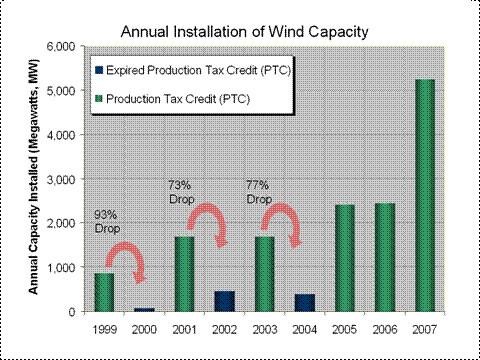
Source: AWEA
With predictable, guaranteed demand over the next decade, the industry could step up its investments across the supply chain in order to provide the requisite number of generators. The technology is understood, it calls upon industries that are much larger than the pure wind sector (mechanical engineering and civil works, mainly) and which have a large employment pool. Access to resources is tight today, as it across all industry, but we're not talking world-changing volumes either (for instance, if you count about 50 tons of steel per MW, you'd need 4 millon tons of steel per year, ie less than a percent of total world production). And again, a strategic plan with predictable production figures and guaranteed demand would allow to lock in supplies early on in the process, providing stability (and early cahsflows) to all suppliers down the chain.
In terms of wind resources, the USA has more than enough potential to find enough sites to install such capacity with wind resources providing cost competitive production , as noted in the DoE report (which alos notes that more than 1,000GW could be connected to the existing grid at low cost):

Altogether, the plan would require boosting investment in wind production capacity to about $100-150 billion per year, a significant number but hardly one that would require a complete retooling of the US economy. With a stable regulatory framework (presumably provided if this were made a national priority) and guaranteed demand (which could come via very simple mechanisms, like a feed-in tariffs, ie mandatory purchases by local utilities at regulated rates), there is absolutely no reason to doubt that this could be done.
I'll address the requirement to boost the grid separately below.
the economics of such a plan
Wind power economics are quite simple: most of the levelised production cost per MWh comes from the initial investment. It is thus naturally sensitive to investment costs, and even more so to financing costs, both of which are determined at the time of construction. Once a windfarm is built, its production costs are essentially set for the rest of its operating life, ie 20-25 years. The fixed nature of its cost base makes it a difficult bet in a deregulated universe, where prices can swing wildy (including to low prices that can be insufficient for the windfarm to service its debt burden, thus the requirement for feed-in tariffs or similar mechanisms to guarantee a floor to wind electricity). But such fixed prices make wind a great proposition at times of increasing oil&gas costs: wind power prices will NOT increase even if oil & gas or coal prices continue to go up, as is quite possible.
Thus wind power is a wonderful hedge against future energy prices. And given that today it already costs less than power from a ges-fired plant (the plants that typically drive the price of electricity on wholesale markets), it is both competitive and likely to remain so in the coming years.
And given the cost structure of wind, a very simple way for government to support wind at very little cost would be to provide funding for the sector at low interest rates. One big advantage of government is its ability to borrow at lower rates - indeed, government sets the lowest rates that are by the rest of the economy. By passing on its low cost of funding to wind developments, the final cost of wind power could be lowered significantly, and passed on to consumers (banks would still be required to hold onto operational and other risks linked to wind production, they would just get cheaper funding for that specific purpose, which the'd have to fully pass on to projects. Germany has successfully used such a mechanism for years).
Studies in Germany and Denmark show that wind power lowers wholesale prices by 30 to 70% when wind blows, and that the overall savings for consumers far outstrip the cost of guaranteeing to wind producers a regulated tariff. Ironically, the more wind power there is in the system, and the lower the wholesale marker price will be most of the time, which means that the regulated tariff remains a necessity to ensure that wind producers are able to pay off the debt linked to their initial investment. But that regulated tariff is known, is realtively low, and,again, will not need to increase over time, thus ensuring to consumers similarly stable retail prices.
If anything, wind is likely to stabilise prices, or even bring them down whatever the prices of oil, natural gas or coal. Also, as the DoE report notes, beyond the potential benefits of reducing greenhouse gas emissions, switching to wind would have massive advantages in terms of lower water use for the power sector.
The DoE study concluded that the cost of strengthening the grid would be around $20 billion in today's dollars. Given the larger scale of the Gore plan compared to the DoE plan, a cost of $100 billion for grid reinforcement seems a reasonable estimate, which would represent less than 5% of the total investment programme,and thus have a similarly minor impact on ultimate production costs.
Dealing with intermittency
Of course, the big question with such an ambitious plan is how to deal with the intrinsic intermittency of wind power, which may not be available when electricity is actually needed. Given that power is almost impossible to store (except where hydro is available on a large scale, and pending potential progress on batteries), this is a very real issue.
But there are actually several answers to that:
- one is that, provided that the network is able to shift electricity around, you can rely on the fact that the USA has several independent wind regimes, and thus that there will almost always be wind somewhere that can be carried around. Obviously, this does mean a serious effort to reinforce the network, and to connect the now mostly separate regional grids, but that's precisely where the federal government could have a decisive say within such a plan, and push a reinforcement and development of the grid on a coordinated national basis. As a good example coming from a territory which is much smaller than the USA, (but which also has at least 3 independent wind regions) I note that the French grid operator, RTE, long extremely wary of wind power and its unreliability, had this to say in its latest annual report (big PDF, in French, see p.49):
The second point is about wind's contribution to peak demand: despite wind's intermittency, wind farms reduce the need in thermal power plants to ensure the requisite level of supply security. One can speak of substituted capacity.
The capacity substitution rate (ratio of thermal capacity replaced to installed wind capacity) is close to the average capacity factor of wind farms in winter (around 30%) for a small proportion of wind in the system (a few GW). It goes down as that proportion increases, but remains above 20% with around 15GW of wind power.
Similarly, the UK network operator put up a report that noted that the expected intermittency of the national wind portfolio would not appear to pose a technical ceiling on the amount of wind generation that may be accommodated and adequately managed. The DoE, in its own study, hasidentified the improvements that would be require to the network to absorb more wind power and be able to use it around the country:
- the second answer is that spare capacity will be needed occasionally, and that this is actually not a big deal. As noted at the beginning of this post, gas-fired capacity is already used at much lower overall rates than coal-fired plants. They can be kept in place. With 440GW of gas-fired capacity, and taking into account the oil-based, nuclear and hydro capacity, demand can be assured at pretty much any point in the demand curve even without wind. The important thing to note is that keeping that capacity in place does not mean using it. MWH substitution does not require MW substitution to the same extent:
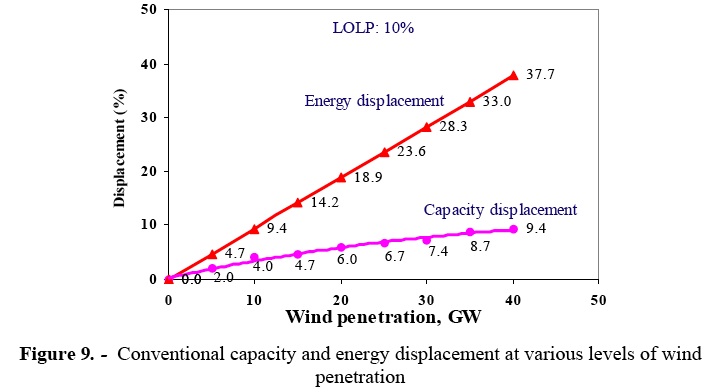
from the UK study linked to above - the third answer is that there are a number of small changes to electricity consumption patterns that can be used to reduce the requirement for peak capacity. Industry has long agreed to sign interruptible contracts, benefitting from lower prices for power in exchange for the right by the utilities or the network to cut them off at short notice; a lot of our power consumption is not time sensitive and could thus also be made to switch off in times of need. And this is an area where government could easily play a role, by mandating standards for all electricity consuming equipment, making them able to "talk" to the network and indicate their status (not interruptible, interruptible at identified times, interruptible at will).
Overall, network operators with actual wind experience seem confident that a combination of additional investment, smart grid management, and maintaining available (but not using much) a large gas-fired capacity can make it possible to cope with large amounts of wind power in the system.
While a goal of 100% of carbon-free electricity is probably unrealistic, it therefore seems possible to get pretty close to that, especially if nuclear and hydro are included in the mix. A plan that announced a specific goal of 40-50% of wind-generated electricity by 2020 and 10-20% of solar, with the appropriate feed-in mechanisms, demand guarantees for manufacturers and investment in the grid would therefore be realistic, make economic sense, and fulfill two major strategic goals: reduce carbon emissions, and lower fossil fuel demand.
Personnel
Editors
Contributors
Peak Oil Primers
Archives
- November 2010 (3)
- October 2010 (6)
- September 2010 (4)
- August 2010 (7)
- July 2010 (6)
- June 2010 (7)
- May 2010 (2)
- April 2010 (8)
- March 2010 (4)
- February 2010 (6)
- January 2010 (3)
- December 2009 (5)
- November 2009 (8)
- October 2009 (12)
- September 2009 (6)
- August 2009 (5)
- July 2009 (11)
- June 2009 (8)
- May 2009 (16)
- April 2009 (10)
- March 2009 (7)
- February 2009 (10)
- January 2009 (15)
- December 2008 (9)
- November 2008 (9)
- October 2008 (9)
- September 2008 (13)
- August 2008 (10)
- July 2008 (14)
- June 2008 (23)
- May 2008 (16)
- April 2008 (12)
- March 2008 (16)
- February 2008 (9)
- January 2008 (13)
- December 2007 (13)
- November 2007 (16)
- October 2007 (22)
- September 2007 (8)
- August 2007 (9)
- July 2007 (16)
- June 2007 (8)
- May 2007 (7)
- April 2007 (7)
- March 2007 (10)
- February 2007 (10)
- January 2007 (12)
- December 2006 (9)
- November 2006 (15)
- October 2006 (4)
- September 2006 (5)
- August 2006 (5)
- July 2006 (9)
- June 2006 (5)
- May 2006 (10)
- April 2006 (9)
- March 2006 (13)
Vital Trivia
License

This work is licensed under a Creative Commons Attribution-Share Alike 3.0 United States License.
Gore's speech is on youtube here:
http://www.youtube.com/watch?v=dt9wZloG97U
The css is gone again----
Ah yes, dynamic sites really suffer, but there is no other way to do it.
Good post and I am all in for wind, but then again I am from Denmark where 20% of electricy is generated by wind.
Robert
I just watched it. Damn, Al Gore should run for President one day... oh, uh, nevermind...
Hmm, and imagine the world today if his victory had been recognised, and the resources and energy of the United States had been directed to efforts such as these instead of wars around the world...
It's worth mentioning that Gore was the one who watered the Kyoto Protocol down for the sake of the US, then helped make sure the US didn't even sign the thing. Had he got in with the 2000 election, he might not have been the same man he is today. We might have avoided the two invasions, but crash programmes for wind farms we would not see.
After politics, he's had a swing towards liberalism, compassion and care for the environment. It's this strange Former Statesman Syndrome, happens a lot, dunno why.
They're outside of the system that doesn't care for such non-standard thinking. That frees them up a lot to talk about things they otherwise wouldn't. As long as you're involved in politics, especially at the national level, you're in something akin to corporate culture that is not all that flexible.
It's not worth mentioning. Gore was VP at the time and VPs are told what to say and do. You do the man an injustice.
He chose to be VP. And it's not as if there haven't been deputy leaders who expressed opinions contrary to their main people from time to time.
I think it should be called PPC Syndrome. Post-Power Conscience Syndrome.
Please tell us who the VPs were of the U.S. who expressed contrary opinions.
What about one Dick Chaney?
You should include in this syndrome the fact that Gore was very active on environmental issues before becoming VP. Saw this happen a number of times during the Vietnam War. Some of us against the war would be cheered when a person who seemed to know what was going on moved from outside the power circle to within it. But very soon that person would echo the party line. Then when the person left the power circle they would revert to their previous position. That is my memory of it but I can't dredge up specifics. Speaking of dredging up memories, on TOD there has been mention of Pres. Carter being accurate about our energy situation. But IIRC what he got congressional approval for was heavily weighted towards oil shale. The compromises made!
Yeah, completely accurate to the point of scaremongering everyone to believe we would reach peak oil in the mid-80s. What a flop!
Flop???
Forget about the spurious topic of global warming for one moment.
Watch this video and tell me exactly where M King Hubbert was wrong and why you think President Carter was pulling our chain?
http://www.youtube.com/watch?v=ImV1voi41YY
If you listen carefully he stated that the peak of conventional crude production would occur in 1995, BUT HOLD ON ONE SECOND PLEASE: Because "...It appears OPEC was curtailing their production - that would push the peak back by 10 years..."
That was not a lucky guess, and infact, it was a calculation based on hard data that turned out to be correct to the exact year.
The peak of conventional crude did infact occur in the year 2005.
Correct me if I'm wrong but 10 years added to 1995 would put us at the year 2005. Right?
Do not confuse NGL's with Conventional oil.
Again I say - CONVENTIONAL CRUDE peaked GLOBALLY in 2005.
Hubbert made that calculation in 1976 at the beginning of Carters term as President.
I do not ever recall a speach by Carter in which he stated we would reach the peak of oil extraction globally in the mid 80's.
However, M K Hubbert was spot on with his calculations and gave us invaluable information on the crisis that was occurring.
There may be a plethora of answers to the crisis - and not everyone will agree on exactly what should be done to alleviate this unprecedented threat to civilization - but the warning was clearly given.
It should be quite obvious to most that President Carter was well aware of the global energy situation by having access to data that is not readily available to the general public; and he was well aware of the work of M King Hubbert.
Mr. Carter was absolutely correct in stating we were in a crisis as early as the 70's.
But of course, in the financial world, 'Cassandra' will always be the whipping boy and Reaganomics came along to save the day. - Until now.
Forgive my crudity.....Cassandra is about to kick the financial world's ass.
It's also worth mentioning that Gore was warning us about global warming before the vast majority of people had a clue what it was. Gore was not the President, so I don't think his watering down the protocol had anything to do with his true feelings; it was a function of Clintonian political calculation.
He did not have a swing towards liberalism or care for the environment; he was just freed up to say and do anything he damn well pleased. I see nothing strange about this, especially as one who has been in the government and understands the constraints.
WHAT? I mean, I am no Al Gore fan, but to simply state lies like that is no help at all. Much before he was VP he did talk about the ozone layer and the Global Warming issue. Kyoto wasn't signed because Congress didn't allowed it, despite Gore's efforts into signing it.
I mean, how can you even come to get history completely backwards? It's not even funny. Research a little more before regurgitating trash.
It's not backwards at all. It's exactly as I said: he negotiated for the US, got it watered down to be the most piss-weak treaty imaginable, and then it didn't get passed in the US anyway.
This is not correct. Gore was very active on renewable energy in the late 1970s as a member of the U.S. House of Representatives Committee on Science and Technology. I worked for another Congressman who was on the same committee.--Tom Gray, American Wind Energy Association, www.awea.org, www.20percentwind.org
Thanks for sharing.
WOW! Just watched the speech. I wish we had an AlGore in Switzerland.
I wish America had an Al Gore in office.....
The Truth About Crude Oil
First Crude Oil is NOT from Dino the Dinosaur or his brothers. Logically speaking if the earth was covered with a dense primeval forest and there was a Dinosaur living in every five square mile area on the face of the earth, and all this was compressed into a sub surface space for tens of thousands of years, and produced a pool of Crude Oil, it WOULD ONLY FEED the needs of this world for the PAST twenty years, so WHAT FUELED the Industrial Age for the first EIGHTY YEARS???????????????????????????
Think about what is stated above! Science states that oil is the by product of the earths ENGINE as it rotates creating GRAVITY and super heating rock formations, that through this process release oil and this oil flows into cavities within the earth.
Now with this said, what is the reason for the excessive spike in Crude and Natural Gas prices? GREED.
In the 60’s gas sold for 35 cents a gallon, cars got 5 to 7 MPG so a 100 mile trip would take some 16 gallons at a cost of 5 dollars. Today cars get 30 miles to a gallon and that same trip would only take 3 gallons of gas at a cost of 12 dollars. Take into account the LOSS OF VALUE of the FRN and you will see that BIG OIL is KEEPING ITS bottom line HIGH as the efficiency of the engines increase.
There was a contrived oil crisis in the 70’s and there is one today. Why? It is the GREED of BIG OIL! It takes less than 20 dollars to get oil out of the ground and refined into its product and delivered. It takes from 6 months to a year for a well from the day the drill head starts the hole until it produce oil. The Russians can do it in three mounts. Today’s wells exceed 6000 barrels a day, and one off shore platform can have over 20 SLANT WELL HEADS producing oil 24 hours a day.
The United States of America is sitting on the worlds largest coal reserves; it also has more crude oil than the Middle East. Recent finds in Montana exceed what is found in Saudi Arabia, and Pennsylvania has over 3 trillion cubic feet of Natural Gas yet to be pumped into the system. Alaska has extensive reserves yet CONGRESS has for years REFUSED to allow the release of this oil, because of RED TAPE and that they are under the control of ENVIRONMENTALIST groups. These groups want all Americans to ride bikes and live as the settlers did in the 1800. Congress continues to LIE regarding the time it takes to drill a well and get the oil into the system. They state that it would be ten years before wells drilled today could produce oil. This is a BOLD FACE LIE. Congress has prohibited drilling for the past two decades, if what they say is true and if they allowed drilling decades ago we would NOT HAVE FOUR DOLLAR A GALLON GAS PRICES, and HOME HEATING OIL WOULD NOT BE OVER FOUR DOLLARS A GALLON, THAT WILL CAUSE A HEATING CRISIS THIS WINTER, and SOME AMERICAN MAY FREEZE TO DEATH FOR LACK OF HEAT. CONGRESS IS TO BLAME IF THIS OCCURS.
Today’s advances in drilling insure a protected environment. The WILD CAT wells of the early 1900 are a thing of the past.
Environmentalist claim that the exhaust of power plants create TONS of CO2, HOWEVER, CO2 is a GAS and is measured in cubic feet NOT TONS. The advance scrubbing of the exhausts prevent most hydrocarbons from being suspended in the atmosphere. Most ALL the reasons given by environmentalist are not science, but an agenda to deprive Americans of their standard of living.
For MORE INFORMATION of the Truth About Big Oil visit
http://www.ilm-efx.5u.com/photo4.html
You Will Be Amazed, and make sure you click on the link GLOBAL WARMING and read what the ENVIRONMENTALIST do not want you to know about NON GLOBAL WARMING BY MAN.
I expect as the oil crisis worsens there will be a lot more disinformation such as this posting (above) to distract the gullible with these blatantly erroneous figures.
The key question for the Peak Oil aware is how to mount a serious outreach effort to counter this sort of nonsense. The internet makes it very easy for this sort of psychological manipulation to spread very easy - who among the Peak Oil awareness efforts is gearing up for a major publicity effort to spread accurate information and the range of options that we face on the downslope?
Discussions among the choir are good, but they don't have much impact on the rest of society.
With renewables having an EROEI of between 5 and 12 so lets be generous and say its 10..
I figure that we would use 33.333 terrawatts of energy to install this capacity each and every year - this is I believe 29 million barrels of gasoline - as this is only a little over two weeks of fuel for the US MILITARY then its a great deal in energy terms.
On a war economy footing it could be easily done...
You mean Terajoules, I hope.
The renewables mentioned by Gore: wind and solar have higher EROEI than that: http://mdsolar.blogspot.com/2008/01/eroie.html
Solar comes in around 30 these days and wind is at least 20 http://www.infra.kth.se/fms/utbildning/lca/projects%202006/Group%2007%20(Wind%20turbine).pdf
This is not a big worry.
Chris
Chris, check out:
http://www.msnbc.msn.com/id/25703283/
33,000 solar panels going atop warehouse - Green Machines- msnbc.com
The cheapest so far, I believe.
David,
Thanks. I commented where you linked it below. I'd add that CSP might get lower than $0.20/kWh if the financing is done right. Gore has made the most important point in his speech:
We see this with FirstSolar right now. They aren't dependent on silicon so they have not been facing a shortage in supply. As they scale up, things get cheaper for them. Gore mentioned also that contract prices for silicon are beginning to fall now too. I expect about $10/kg in 2011 or 2012 in some deals.
This is why I keep on telling you that the UK will eventually have a lot of solar. It is going to be your cheapest form of generation. Not yet though. For now, concentrate on wind which can scale to meet your needs quickly enough. It is doubtful if anything else can if you gas supply is iffy.
Chris
Chris,
I don't think so:
http://www.withouthotair.com/
Sustainable Energy - Without the Hot Air (withouthotair.com)
I looked at the executive summary and it looks like your guy is blowing hot air.
http://www.bwea.com/offshore/info.html
Your guy says wind can only power a third while those who should know say there is nine times that much available. Basically, you don't have scaling problems with wind.
Chris
That withouthehotair document is some pretty strange reasoning. The guy keeps hammering on watt per area. If that's the decisive metric, then food production becomes the real bottleneck, not energy.
There are some nice thought experiments, but much of the rest is propaganda.
Under 20 cents (USD) is easy if you have standard utility power finance. IPP and PPA 30 year guarantee in a good location can get under 13 cents levelized cost for a 3000 per kWe plant. Depends on debt/equity though.
I've often wondered what would happen if all new housing was mandated to have solar panels on the roof & feed back into the electrical pool during the day?
A benefit of solar or wind power is that there isn't really a central point of failure. Rather than one point of failure (nuke plant), you have thousands of wind turbines...one fails, it's not big deal. And electricity could return to being produced more locally & regionally.
And if we took this route and went to hydrogen cars feasibly powered by renewable power, I suspect we'd push Peak Oil back by 100 years.
The question would be how to build enough housing that's affordable to service-sector workers in desirable areas - that is, in the areas where the rich live who generate many of the service-sector jobs. There are already many areas of the US where building an affordable house at prevailing working-class wages requires subsidies. If you added a solar-roof mandate, that would be either more subsidies to raise somewhere, or else doom the lower-income to live even father away from anyplace desirable - and then with peak oil how will they commute?
The single point failure mode for wind power is the same for nuke and coal. When the power line goes down, the television goes dark. It's much easier to lose a power line than a generating plant. Of course, it's much easier to repair a power line than a generating plant.
Short term power loss, there isn't much difference. Long term power loss makes wind and gas/hydro more reliable than coal or nuke.
Wind power does get points for no cooling requirements.
Dry cooling is easy. Just costs maybe 10-20 percent more per kWh. With new carbon foam and composites radiators this should be reduced to less than 10% cost penalty, especially if there's a substantial value placed on water.
Thermal powerplants near the sea can use cold ocean water for cooling. That means no fresh water cooling. With a diffusor pipe system there's very little thermal pollution either.
To put dry cooling in context, South Africa has lots of coal and not a lot of water. So we have built the world's largest dry cooled stations, each with 6 large coal PF units (Kendal @ 4,000 MW, Matimba @ 3,800 MW and Majuba @ 1,850 MW - it is half wet cooled) and we are now building two more dry cooled stations (Medupi @ 4,500 MW and "Bravo" @ 4,500 MW - not yet named but they are in construction). It reduces efficiency slightly (Majuba dry cooled units are 612MW(so) and the wet cooled units are 669MW(so) with the same boilers and turbines.
Hmm, that's better than I expected for the warm south africa climate. Dry cooling would probably incur greater efficiency penalty in the more arid western/northwestern part of South Africa. It also costs more for powerplants with lower thermal efficiency (eg saturated Rankine for nuclear LWR) as there's more waste heat to get rid of.
But it's definately worth the penalty.
Nice article.
In support of this, I'd add a useful article by Stanford's Cristina L. Archer and Mark Z. Jacobson:
Supplying Baseload Power and Reducing Transmission Requirements by Interconnecting Wind Farms, 2007.
"As more farms are connected in an array, wind correlation among sites decreases and so does the probability that all sites experience the same wind regime at the same time. The array consequently behaves more and more similarly to a single farm with steady wind speed and thus steady deliverable wind power....
It was found that an average of 33% and a maxim of 47% of yearly averaged wind power from interconnected farms can be used as reliable, baseload electric power."
Of course, charging batteries for BEV and PHEVs is a dandy use for the non-baseload power... although the US may be better off in this respect than Europe, given the geography differences.
I've heard Prof. Jacobson talk a few times and he's very sharp.
And tens of millions of micro systems tied in makes it all the more so. People ned to be careful about the future. If there is a high degree of descent, then those massive systems will break down as the individual entities responsile for them lose economic, then physical, viability.
The first, easiest, and fastest solution is to get those tebs of millions of micro systems going. (People won't build what they don't need.) You then can build what backbone you need, rather than build the micro needed to the backbone.
http://aperfectstormcometh.blogspot.com/2008/03/build-out-grid-vs-househ...
Did anybody else notice that the US map in this article showing the desired beefed-up electrical transmission system looks a heck of a lot like the map of the electrifed railroad system that Alan's post said could also include new transmission lines in the existing right-of-ways?
Sounds like an opportunity to do 2 good things simultaneously...
I realise that for the purpose of this discussion you have focused on wind however for this plan to get up wind cannot do it alone. This is often the technique that fossil fuel people use to marginalise renewables.
First and foremost in any future energy scheme is to generate negawatts. Too often we get obsessed by technology and forget the easiest and cheapest method of reducing CO2 emissions is not to have to generate the power in the first place. Here the government can play a role in setting much tighter energy efficiency standards and then helping business and households to meet them.
Second is upgrading the grid and HVDC links and storage nodes. The US grid is creaky at best and large scale renewable development on this scale would possibly be it's final death nell.
Thirdly with the upgraded grid ALL renewables solar, wind, geothermal, tidal, wave energy need to be hooked up together along with the remaining fossil fuel plants that can interact automatically with renewables like IGCC plants and gas turbines.
Finally PHEVS and BEVS need to be deployed on a wide scale with V2G capability to provide additional storage and reduce your dependance on foreign oil. Gore said that this administration has trouble with complex problems however by addressing the renewable energy problem and the oil shortage you can solve both with parts of the same solution. You need to regard transportation as part of the electricity grid.
Now all we need is for someone to break the Greenhouse Mafia's grip on Australian politics and we can see some of this here.
Aren't people still buying regular ICE cars in Australia, Canada, USA, UK, Europe, Asia, South America, everywhere? I don't even have an option of buying a hybrid where I live...
These are all good ideas and should be part of the plan. I don't think we really know what can be done. Most of the analysis that has been done to date has been by folks who have a strong prejudice toward business as usual.--Tom Gray, American Wind Energy Association, www.awea.org, www.20percentwind.org
Yeah, I know what you mean. Was delving through the IEA projections yesterday. Absurd, just an extrapolation of today's developments. If you want to have a good laugh, look at some of the older projections (80's) and see how much of it has come through. Ha!
There's no reason to trust any of their projections.
I suggest all these energy forecasting agencies to stop wasting precious time and energy with their 'projections' and start working on a set of solutions.
Ive seen sites like this....."sites where truths are told".....Sent down the memory hole.
Now I see its a hassle to get here from anywhere.
Just emagine for folks who have never been here before
and how many will miss out.
Call me paranoid all you want but, if you arent aware
then you havent been paying attention.
And paying attention is the only thing you can do
which doesnt cost you anything.....like paying for
a mistake....or paying the piper...or paying dues.
"Telling the truth when a government is spreading lies is dangerous...theres hundreds of millions of graves to prove it"
Of course if site traffic was miniscule then the
"MAN" wouldnt bother or care....its when site traffic
gets a certain momentum that you incur scrutiny.
Think Jesus Christ when he had 12 JACK KEROUAC's.
Wasnt till he took his show "On the Road" and packed
the house, then the fire marshall shows up and
closes down the show.
Of course you can believe in the "lone gunman" or
the "magic bullet" theory if it helps you sleep better.
That's perfectly natural paranoia, everyone in the Universe feels that. This does happen though, a good current example is wikileaks, a site intended for whistle blowers. I think it is hosted in the Caymon islands, and on various occasions it has effectively been shut down trough unscrupulous means by various organizations. What is usually done is that fans will mirror it to Freenet and then it will be restored from there.
You reminded me of Douglas Adams. Oh I miss that guy!
"Time is an illusion. Lunchtime doubly so."
"So long and thanks for all the fish!"
D. Adams (These quotes appeared on my HS senior yearbook page.)
While we're at it - toodle loo Mr. Carlin too.
"Think of how stupid the average person is, and realize half of them are stupider than that."
G. Carlsin
the lunch time quotes is one of my favorites. You missed the most important one though:
"DON'T PANIC"
One for the Doomers...
"Drink up, the world's about to end"
Ford Prefect in "The Hitchhikers Guide to the Galaxy"
Now to comment on the article..........
America cant even maintain its current electrical
grid system.
Power went out to 70 million Americans in 2003 I think
it was.
First thing America did was blame Canada!
Canada said...."Nope not our fault...we have power eh"
Turns out it was a cascade of sorts , started in
Ohio.
The GAO -goverment accountability office -says Americas
power grid is crumbling.
Rolling brown outs are common place.
New York city has had several black outs.
Iam not real hopefull that things get better before
they get much worse.
Cascading blackouts are common when a region lacks generation capacity. Grid issues tend to cause localized problems.
We've experienced both recently (2000 - 2001) at Brazil :(
Nephilim;
Thanks for joining the discussion.
"America cant even maintain its current electrical grid system."
There's an old saying.. 'It's not whether you fall down, but whether you get back up.' I don't deny that the grid might be inches from several collapses due to underinvestment in upgrades and maintenance, but I also don't doubt that, as with the 2003(?) Northeast Blackout, that all efforts go immediately into restoring that power. It's no way to run a sandwich shop, messy and inefficient, I'll grant you, but I'm not convinced that the grid will fall and we'll just leave it on the ground, (so to speak) and get used to cursing the darkness.
We'd jump into our legendary Hero mode, 'bucket brigades' and getting Timmy out of the Well.. to get that juice flowing again, whether broadly or locale by locale. Whether it's all just downright unsupportable or not, maybe on the 50 year timescale we'll get to see. But we're not going to let go of the electron that easy, it's just far too eclectic and supple a power source and communications medium.
Bob
"Adventure is just bad planning." —Roald Amundsen (1872—1928).
Always good to hear from VP Gore!
Obviously GW science is being ignored by the pols (though Obama came back nicely) and Gore
is giving us all some leadership.
Could renewable wind bankrupt the country? Seems unlikely as
there is no fuel to ever be purchased. But who knows..we could already be bankrupt!
As the post mentions we can forget intermittency with huge numbers of standby natural gas generators. One additional benefit would be the possibility of building large remote solar farms next to those same wind farms to provide more backup power--after all the sun rises almost every day! ;) Excess electricity could be used to make nitrogen fertilizers saving natural gas for its true role as backup fuel.
What a magnificent challenge for our country!
Good to hear, Majorian, that you think natural gas generation is an intermittency solution. I've just been thinking I'm naive talking about closed carbon cycle renewables. (Do what geology does, just faster.) Do you know if anyone has run calculations on the efficiency of such systems? With $1 per watt solar, which apparently is possible (thought not commercial) and 70% efficiency, solar and certainly wind compete quite well with nuclear?
On capital the nuke lovers would say no, that renewables can't complete. It takes 9 Kw of wind/solar to match 3 kw of thermal coal. Nuke capital costs are significantly
higher than coal, in fact nobody really knows how much more expensive as a life cycle cost because the price of both new reactors and decommisioning keeps accelerating. But then there is the continuing rise in the price of uranium and coal. If a 30 year coal plant costs $600 per Kwh and the price of coal is $50 a ton over 8000 hours per year that's $20/kw per year for capital but $200 per year for fuel: $600/30 years=$20 per year versus $50 x 8000 hr/2000 kwh/ton=$200 per year for fuel. In my view that means wind at $1000 per kw x 3 over 30 years=$100 per year, or even Stirling solar beats coal(SanDiego-project $400 million for 750 MW or $533 per KW).
I don't know any reason why natural gas generators which are emergency backup wouldn't work with wind. I know utility studies have been made that indicate that even the size of the backup can be reduced if you overbuild wind renewables. I think Jerome posted such a graph a while back.
It would be nice if financing would work that way. Hmm. I wonder if it would be possible to treat the capital cost of alternative energy as fuel costs... alternative energy would skyrocket with such financing.
What does this say about Al Gore's knowledge and interest in Peak Oil? He could have made a speech about Peak Oil, indicating that by 2020 the electric power grids in the U.S. and Europe could fail permanently. By 2020 it is doubtful that U.S. and Europe will be able to buy enough oil to maintain the highways that support the power grid, while they are using scarce oil resources for everything else. The highways in the U.S. are maintained by state governments which will be broke long before 2020 and will have extremely scarce funds with evaporated revenues for the highways from fuel taxes.
The U.S. and Europe are facing the collapse of the highways that depend on diesel trucks for maintenance of bridges, cleaning culverts to avoid road washouts, snow plowing, roadbed and surface repair. When the highways fail, so will the power grid, as highways carry the parts, transformers, steel for pylons, and high tension cables, all from far away. With the highways out, there will be no food coming in from "outside," and without the power grid virtually nothing works, including home heating, pumping of gasoline and diesel, airports, communications, and automated systems.
Matthew Simmons is apparently concerned that the decline in global oil production may be sooner that many scenarios indicate.
http://business.timesonline.co.uk/tol/business/industry_sectors/natural_...
Locally the highways are failing as the county can not collect enough taxes to maintain them. They tried to increase property taxes, but citizens took them to court and won. Now they are proposing abandoning even more local roads. The roads will still be there of course just not maintained especially in winter when snow removal in required.
This scared us some since one of the proposed abandonments goes by our place and is a mail delivery route which makes the proposal look like political infighting. This is all going on in the middle of the construction of a 100 turbine (1.5 megawatts each) wind farm costing probably $200 million plus.
The de facto solution appears to be that the private company building the wind farm which requires many miles of turbine access roads separate from the county road system has taken over the maintenance of the county roads. If they didn't do it the roads would deteriorate so much that the construction traffic would make them impassable.
My point here is that as governments fail to maintain roads, some private entities for whom certain abandoned roads are critical for survival will assume maintenance out of dire necessity. In our own case, our first thought was we had better prepare with snowmobiles, 4 wheel drive vehicles or tractors with snow blowers.
I expect the government to be nearly useless as Peak Oil really kicks in.
The vast highway network we have cannot be maintained as oil production declines, neither pubic nor private, nor any mix. Oil will be too costly and scarce and keeping people alive with heating oil will take presidence, but in the end, there will not be sufficient oil to maintain the highways. It is a mstter of time, and I conclude that it will be a lot sooner than many imagine.
Paved roads need petroleum. Rail roads do not. Good reason to strongly support re-railing America. As with house odds, you can't beat the Law of Physics.
Paved roads can be made on cement.
Care to explain that jump of logic?
What does oil have to do with electricity?
I tell you. 3%. 3% of electricity on USA is generated by burning oil.
Now if you please, explain to me how 3% is going to affect "permanently" 100%.
Don't mind to answer. I'm sure it will be in some kind of "but without oil, everything else just just goes AWAY" crap.
You cannot maintain the current electrical network without maintenance and spare parts. Since most resources will decline in production due to shortage of energy, it would badly affect the functioning of the Grid. So, without cheap energy, the Grid could fail.
Another point is that we need to continuously feed the Thermal Power plants with fresh doses of Coal. Without cheap truck transport, how would you transport the fuel necessary for electricity generation?
The way it's done now: rail. Even at $10/barrel, trucking coal was a distant second choice.
Thanks for falling into my caricature.
With expensive truck transport.
Until EV trucks are mainstream.
And no, I'm not cornucopian about this. UPS express mail trucks are in some countries fast developing and acquiring EV trucks for their service. It's only a matter of time until the big trucks get to be EV.
Sorry to say, but without oil, just about everything will go away. This is just one example below, but I have lot more.
According to energy investment banker Matthew Simmons, global oil production is now declining, from 85 million barrels per day to 60 million barrels per day by 2015. During the same time demand will increase 14%.
This is like a 45% drop in 7 years. No one can reverse this trend, nor can we conserve our way out of this catastrophe. Because the demand for oil is so high, it will always be higher than production; thus the depletion rate will continue until all recoverable oil is extracted.
Alternatives will not even begin to fill the gap. And most alternatives yield electric power, but we need liquid fuels for tractors/combines, 18 wheel trucks, trains, ships, and mining equipment.
We are facing the collapse of the highways that depend on diesel trucks for maintenance of bridges, cleaning culverts to avoid road washouts, snow plowing, roadbed and surface repair.
When the highways fail, so will the power grid, as highways carry the parts, transformers, steel for pylons, and high tension cables, all from far away. With the highways out, there will be no food coming in from "outside," and without the power grid virtually nothing works, including home heating, pumping of gasoline and diesel, airports, communications, and automated systems.
Good paper, pity it didn't talk about solar, PV, solar thermal, geothermal and tidal, too. Expecting any one power source to do it all for us is a bit much. For example, in Australia and the southern US, peak demand comes on hot summer afternoons - which is also the time of peak production for solar PV, nicely complementary those two.
But I guess the authour focused on the area he knew best, which is fair enough.
Kiashu, you might be interested in this:
http://www.guardian.co.uk/environment/2008/jul/17/waveandtidalpower.rene...
SeaGen tidal power marine turbine plugs into electricity grid | Environment | guardian.co.uk
Any idea of what the utilisation rate is for tidal power?
I could not seem to Google anything up.
Obviously it would peak twice a day, but I have no idea of what the fall off rate is, or how long the slack lasts.
BTW, this appears to be the cheapest solar so far:
http://www.msnbc.msn.com/id/25703283/
33,000 solar panels going atop warehouse - Green Machines- msnbc.com
As you know, I have reservations about renewables for baseload, particularly in areas of high annual incidence of solar variability - IOW those at high latitude!
But for peak power in hot climates such as Australia, this appears to be pretty well there for cost viability.
David,
Interesting that in your link they are claiming $3.50/W installed but $0.20/kWh rather that the $0.08/kWh we might expect in CA with a 20 year life. Either the power purchace agreement is short, say ten years, or the financing costs are higher than they should be. If it is in the financing, this is a drum that Jerome has beaten quite a lot.
Still, nice to see FirstSolar on track. I expect they'll shave another dollar off that soon.
Chris
I never trust levelised costs, Chris.
You pretty much feed in the assumptions you want, and come up with a figure, in which the assumptions are rarely made explicit.
I far prefer installation costs per MW, multiplied by the intermittency factor, although you have to recognise then that other factors such as speed of build and regulatory hassles are a major factor.
In my own mind, I allow around a factor of two for such issues, which 'Tennessee windage' may not be accurate, but may be about as well as we can do at the moment, with rapidly shifting costs.
Incidentally, you weren't keen on my suggested cost figures for nuclear, and you may have missed when I updated them with the highest figures I could find:
http://business.timesonline.co.uk/tol/business/industry_sectors/utilitie...
Nuclear reactors will cost twice estimate, says E.ON chief - Times Online
I always attempt to be as fair as possible, and any bias is unintentional.
It should be noted that rising steel costs impact wind power much more than nuclear.
Overall though, I am comfortable with the statement that peaking power in much of the world will shortly (2012-15) be most economically supplied by solar power - and that is a very major part of the market!
So rejoice! I reckon I am a pretty hard nut to convince, and now, as opposed to a few months to a year ago, it seems clear that this market is likely to be profitably supplied by solar energy!
Your aversion to looking at what people will actually have to pay for the electricity from a particular source is strange. For example, when First Solar sells a system, they include the cost of recycling the panels, while when you quote what are still likely to be underestimates of nuclear construction costs, you neglect the cost of decommisioning which appears to be quite high in the UK. This tends to bias your assesment of costs to such an extent that you end up preferring the most expensive option.
Chris
Trying to come up with some reason why decomissioning costs of nuclear plants are still a debate, and it occurs to me. THe reason is, it's almost never been done yet, even though some plants are approaching 50 yrs lifespan. Anyone here see any reason why we shouldn't expect currently operating nuclear gen. stations to remain active essentially forever? (obviously with refits etc.) Given the mandatory checkoffs being re-invested now to cover future de-commisioning costs, saying nuclear "is uneconomical due to decomissioning liabilities" looks like a huge stretch.
You don't seem to understand nuclear power very well. There is radiation involved so that plants have finite lifetimes.
The cost for decommisioning in the UK is about $12/Watt capacity, while construction will likely reach close to this level. That comes to $24/watt plus fuel and operating costs.
Chris
I am far from an expert on nuclear power, but according to the people who are, safety ("radiation") concerns are pretty far down the list of reasons to decommission a nuclear power plant.
http://www.eu-decom.be/faqs/faqs2.htm
--------------------------------------------------------------------------------
1.2. Why do nuclear power plants shut down permanently ?
--------------------------------------------------------------------------------
Nuclear power plants cease operations for a variety of reasons.
The Authorities (Regulators) grant a license for a period of 40 years. At the end of the license period, the licensee can seek to renew the operating license of the plant for another 20 years, or can cease operations and begin the decommissioning process. Some licensees choose to cease power operations before the 40-year licensing period has been completed.
Reasons for this decision are usually financial. For example, the plant may require upgrades or repairs that are not economically justifiable, or the licensee may find other sources of power that are less expensive than nuclear generation.
In addition to financial reasons for decommissioning, the Authorities can order the licensee to cease operations for safety reasons.
Many large and expensive parts of a nuclear power plant are subject to continuous, intense neutron bombardment. After 40 years, their physical properties have changed. One type of change is 'embrittlement'. They can develop very big cracks very suddenly. Maybe 40 years from now there will be engineering test and fixes for this. But maybe not.
Fast Neutron Embrittlement is a well understood phenomenon which only applies to the Reactor Pressure Vessel. Present generation reactors were qualified initially to 40 years operation and most US plants have now been qualified by the NRC to 60 years (no applications for extension have been turned down due to embrittlement concerns). There are techniques (mainly high temperature annealing) to extend lives of vessels if they have reached their normal embrittlement limit. New generation reactors have much better steel and as little as 1/5th the neutron dose per year to the Reactor Pressure Vessel as 1980's reactors. Therefore, given the current life of current reactors (at least 60 years), new build reactors could last at least 300 years before embrittlement could challenge its operation!
I wish I were totally confident in the technical judgment and integrity of my government.
This is conjecture. You can't just extrapolate some measurements. There's always going to be non-lineary degradation in thermodynamic systems. Oldest nukes are not 60 years old so it's a bit of a stretch to think the average future fleet lifetime will be 60. Might as well say that solar panels last a 100 years based on silicon degradation rates due to cosmic rays.
Rating the comment down doesn't disprove the argument. Discussions about energy are not a popularity contest.
Who suggested using a comment rating scale anyway? More subjectivity is exactly what this site doesn't need.
I concur with geek. The irradiated portions of the plant are high level waste and need to cool before they are disposed of. The main concern needs to be reducing worker exposure. That is best accomplished by not building the reactors in the first place.
Chris
Typically, nuclear kWhs have a 0.1 or 0.2 cents surcharge for decommissioning. This is for the average decommissioning cost so far, it is unclear if this is a very good assumption. Future decommissioning cost of ten times bigger than the current average may not be strange. This adds one to two cents per kWh.
Levelized cost calculations are indeed difficult, but better than dividing the capital costs by the capacity factor. You just can't do that - powergrids don't have 100% capacity factor so this method is dishonest. US has 1 TW producing 4 EWh. That's a capacity factor in the 40's percent. Clearly with 100% nuclear you'd have that 40's percent capacity factor. That's suboptimal if not technically impossible. 100% solar is also suboptimal. Dave is right, nuclear for baseload and solar for peaking is most cost effective, the way things are developing right now. However, we can, very cost-effectively 'tailor' the powergrid via DSM and smartgrids to reliably supply very large fractions of any combination of wind, solar, nuclear etc. so with the right strategical policy this will not be a serious concern for decades.
Some of these levelized cost estimates can be explained by the unique type of financing the power generating industry gets. That said there should always be a sensitivity analysis to determine risks. As a very rough rule of thumb, 4-5 cents per 1000 kWe with the right finance in the best locations. UK doesn't have best locations.
I don't like solar in the UK right now because globally it's a poor allocation of scarce resources. Of course the UK wants to reduce ghg and have secure energy supplies, but Negawatts have much lower oppertunity costs for this purpose. After that, nuclear and wind. Solar will be scarce for the forseeable future so massive UK government subsidies for solar cannot be justified, unless for exporting to more sunny places.
France seems to be doing quite well merci bien at 78% electrical power from nuclear. Certainly emitting a LOT less CO2 per capita than the Danish who already depend on neighbouring countries to level out their 20% wind generation and supply them with coal for the rest.
Agreed, a better mix than Frances is likely optimal, but they did what they could with the technology they had at the time. Ontario, Canada is currently at 50% nuclear, targeting zero coal shortly, which looks like an optimal ratio with the balance derived from whatever is locally available. Wind, hydro, solar, bio-mass.
One item to note about nuclear though, it is perfect for charging PHEV batteries overnight given a minor upgrade to grid intelligence to financially encourage off-peak charging, a cheap (compared to current oil prices) way to implement the switch off petroleum-fueled transport.
Agreed, solar in Britain may not make a lot of sense yet, but that's eventually going to change. Meantime, bridge tech is nuclear.
Not sure what the optimal mix is, it also depends on how different technologies develop as well as local physical geography. France has come a long way with nuclear but somehow they are unable to get the last bit of FF out of their system, despite hydro, exporting energy, and shutting the nuclear plants down during weekends. This suggests a clever solution for the remainder.
The easiest way would be to balance things on the demand side. You already mentioned plugin-charging, with time of use metering this works quite well to balance the demand (considering the plugin-charging would be a big part of the future electric use). Another is end use thermal storage. It's so easy. Ice or chilled water storage for summer AC, hot water storage for winter space heating. I think this should pretty much deal with the issue, so France could be close to 100% nuclear.
However, France is doing a great job in diversifying the portfolio by providing incentives to eg wind. Biomass, in particular biogas, seems well suited for flexible peaking assist.
I wouldn't use the France vs Denmark argument though in nuclear vs wind. Apples and oranges, and it's flawed thinking to pit these two sources against each other as if they were in competition with each other. Coal and oil are the real headsores. For Britain, nuclear and wind is low risk. More than that, Negawatts. Can't get anywhere without Negawatts.
There's not much info available about tidal, as it's not been used much - so much that when assessing which systems were both non-depleting and commercially-proven I almost didn't count tidal - the only installation of really significant size is the 300MW facility Rance River in France, it's been humming along since 1966 on a 28% load factor. The variation in generation is huge, from 0 to 100% twice a day - but it's predictable, so it can work well in tandem with a more gearable generation system like hydro, fossil fuel or biomass; as it produces more during the day you wind down the production from the other one.
Which is just another demonstration of the principle that no single generation method can do it all for us. But if you have a combination of methods then with good management all together they should work out alright.
Two different concepts here, La Rance is tidal range (barrage or lagoon), SeaGen is tidal stream. See info taken from 'Turning the Tide, Tidal Power in the UK', Sustainable Development Commission (UK) http://www.sd-commission.org.uk/publications.php?id=607
Marine Current Turbines Ltd. also have two JV project agreements in Canada, one of them being in the Bay of Fundy, the other in the Campbell River, BC
Dave,
This is edited from http://www.world-nuclear.org/info/inf10.html
The 3 projects mentioned are all from Marine Current Turbines Ltd, UK, the company in your Guardian report http://www.marineturbines.com/18/projects/
The low flow speeds of those underwater turbines would make them ideal for Tubercle Technology:
http://nextbigfuture.com/2008/03/uprating-wind-turbine-blades-and-more.html
Giddaye All!
Fascinating stuff and I wish Mr Gore all the best. But it's a pipedream... The general public, much less Big Business, just aren't thinking this way.
Back to back stories on this morning's news: Qantas axes 1500 jobs and cuts more routes; next, contrasting plans to expand Sydney's airport to cater for an estimated 68 million passengers a year by 2020; then, primary energy companies move to oppose the goverment's proposed Carbon Trading Scheme (or whatever they call it now) because it will cost them ten of billions.
Meanwhile, oil has dropped below $140 a barrel, so any urgency retreats again.
As I see it, unfortunately it'll be BAU for quite a while yet (I'm a fan of the long, slowly declining plateau to the inevitable cliff - rather than Hubbert's curve).
Regards, Matt B
Just racked up 100km on the new motorbike. Still alive and LOVING IT!
In my mind, it is only needed for oil to stay above $100. If it keeps up like this (or climbing) energy rev is unstoppable.
Excuse my stupidity, but what is energy rev?
sorry, meant "revolution". Too much sms like postings.
Oil prices are dropping because the U.S. economy is going into recession and thus dropping demand for oil. Unless the global economy follows us into recession increased demand elswhere will eventually drive up prices again. As long as you keep your job the cheaper gasoline is a fine thing, but if you become one of the newly unemployed you might not be so happy about the situation. We can certainly keep the price of oil low in the short to intermediate term by reducing demand, but the joy with which you hopped on you motor bike to enjoy the freedom provided by cheap gasoline shows the inherent contradiction of such an approach to controlling oil prices. If we want to keep oil cost low through demand reduction then we have to reduce our total use of the services provided by oil. You cannot eat your cake and have it too.
The bike is more of a mid-life thing for me at the moment, though I do fancy a world without petrol guzzlers (solar/electric golf carts and scooters, slow it all down).
Post Olympics, it will be interesting to see if China continues to feed our Australian economy with her purchase of our resources. No doubt, the US helps to feed theirs. Still, we have all that Uranium in the cupboard for all those reactors that'll be built in the coming decades. Just in case.
Here's to feeding the indulgences of an ever expanding human population (150,000+ extra souls each day).
Cheers! Matt B
hi Matt, regarding bikes and the 'mid-life thing' , try this one it's pure fun! http://www.quantya.com/PAGES/eng/eng_home.htm, rolf
Jerome,
Thanks for a great article. I think I know why the DOE is only proposing 300GW wind capacity; Off-peak loads are usually about 50% of peak so would expect only 350 GW minimum(most of coal and nuclear). When it is windy in most parts of US could be generating 47% of capacity so if install 800GW could be generating 375GW What happens to the extra 75GW?. This is assuming that you can shed nuclear. More trouble if the maximum exceeds 47% of wind capacity.
Replacing 20% by wind by 2020 is a big enough target, and by then solar may be able to take up any additional capacity. Solar and wind work much better together because off-peak lows are always at night. By 2020 may also have PHEV re-charging to prop up low demand.
The other issue is if you build up production capacity for 2014-2020 what happens to the wind market after the 800MW capacity is installed? Wouldn't it be better to maintain a lower build-up over a longer period?
I wouldn't worry about maintaining an even flow of building turbines too much, as the whole build is very unlikely to take place!
That is the nature of advocacy, and how it gets watered down on contact with the real world.
The bigger issues are how much natural gas such a system would need, as sometimes it just ain't very windy.
In practise every thing needs building out as fast as can be managed for quite a while.
The first response to intermittency is interesting, that there is sufficient independence among wind regions to provide for some damping of the whole reserve requirement.
I guess I'm skeptical about how much this can really offset the reserve requirement. Here in California we currently maintain 100% reserves against wind. If anticipated wind generation for a given hour is, say 300MW, we carry 300MW in thermal or hydro reserves to cover its potential loss. This reserve is capacity only; we don't actually generate unless the wind fails to deliver. We do this as well for any 'non-firm' resource.
Yes, as we build more wind generation, and as we do so in multiple wind regions and with better short-term forecasting, we will certainly be able to reduce that 100% requirement...but I don't know by how much, and I don't see us being able to redispatch generation across large geographical distances (to account for these wind regimes) very effectively...not under most future schemes I can imagine.
Wind plus solar will do better than each alone. With peak oil/gas/coal coming, saving "most" of the FF is better than saving "none". I'm not sure how well or quickly you can turn-down a nuke plant, but that might be an option as well.
Plus, once the wind/solar generation gets to over-build status (wind farms will peak at far beyond their design target during windy days, and solar has peak days in summer as well) or during low-demand off-peak periods, you could always use the power to pump water back upstream past a dam or uphill to a purpose-built water resorvoir. Such a mechanism can cost-effectively save off-peak power for peak use by doing hydro generation during peak needs and hydro storage off-peak.
I suppose you could use Alan's train solution and park a bunch of coal trains on the top of mountains during the night, and have them regenerate power into the grid at daytime peak as well.
Note that as the US moves to plug-in hybrids and then EVs the night-time off-peak will wane, and there may be options to use vehicle batteries for peak powering as well.
As I noted before, I believe that if the problem is you have burst of cheap power for sale at some times and are willing to pay high for power at other times, many solutions will come to market. Innovation can solve that sort of problem, I think.
I watched the presentation and I agree it is not only doable but needed and I'll go along with Pickens because he is doing something.
Al Gore: Somehow I keep going back to Schultz's Dogbert. "You can't save the planet, unless you are willing to make other people sacrifice."
Gore's carbon footprint is a hundred times bigger than mine. And tell me (without smiling) that carbon offset is not a scam. So lets start with a house in Tennessee and his lifestyle and compare it with a house in Crawford. Or one here in Reno. Or one in the high desert of Colorado.
Is doing something the best choice among all alternatives? The Lemmings did something.
Sorry bout that ... should have said doing something constructive, i.e. he has placed the largest order for wind generators GE has ever had. Don't get me wrong, IMHO he will make a bundle from it.
How Pickens' plan address the liquid fuels problem?
Pickens wants to use the NG saved by his wind programme being used to power vehicles instead of petroleum or diesel.
Can NG be converted to liquid fuels? Or is he thinking of NG powered vehicles which are basically non-existant?
Do you ever look before making such clownish statements?
"In May 2006, METRO introduced 13 new, natural gas
buses to their bus fleet.
The new CNG buses, built by ORION -- with engines
produced by John Deere, are air conditioned, produce low
emissions and cut down on noise pollution. The new
buses also help reduce American dependence on
imported oil. "
http://www.gpmetrobus.com/index.php?option=com_content&task=blogcategory...
~~~~~~~~~~~~~~~~~~~~~~~
TRAVEL ADVISORY; A Natural-Gas Bus Shuttles in Philadelphia
Published: February 19, 1995 <<-- NOTE THE DATE
A new environmentally friendly shuttle bus service has begun operating between popular sites in downtown Philadelphia. The service, called Phlash (pronounced Flash) Downtown Loop, travels along a continuous route in the Center City section. The buses are powered by compressed natural gas, which contains up to 95 percent less carbon monoxide than gasoline or diesel fuel.
http://query.nytimes.com/gst/fullpage.html?res=990CEEDB173EF93AA25751C0A...
There are similar Stories for NYC and LA as well.. no doubt many others.
Look before you leap.
Bob
These vehicles are basically non-existant, just as I said. 99%+ of the vehicles run on gas/diesel.
'It's inconceivable!'
'Senor, I don't think that word means what you think it means.'
Wow, that's really cool.. does that mean that when I ride the Portland Buses, that I'M basically non-existent, too? Do I become partially invisible? Do my debts still accrue interest?
It is a myth that lemmings follow each other over cliffs. This doesn't really happen.
Fitting, as most of the negativity above is also based in myth. Concentrating solar thermal looks to me right now as the one energy source we should be strongly encouraging. It does a far better job of replacing natural gas electricity generation than wind on a per-unit-investment ($ or resources) basis. And BTW, CS thermal is not necessarily restricted economically to western deserts, that's simply the first place to start with it.
"Al Gore's home, which has been undergoing renovations for months, now boasts a solar roof. When his neighborhood in Tennessee changed zoning laws earlier this year, Gore was able to go ahead with the solar panel installation. You can read about the details of the battle to get the solar panels installed here. Gore is now preparing to install a geothermal system that will drastically reduce the cost of heating in his home. Other renovations on the house are aimed at meeting the Leadership in Energy and Environmental Design, or LEED, standards established by the U.S. Green Building Council. He is upgrading windows and ductwork, installing more energy-efficient light bulbs and creating a rainwater collection system for irrigation and water management."
http://www.treehugger.com/files/2007/06/al_gore_gets_a.php
The Comments section is precious.. The guy makes box-office records with an Oscar winning Doc on Global Climate Change, reaching hundreds of millions of people.. and he's slammed as a hypocrite for being just about like every rich politician on the DC scene, while the Prez who has started an unprovoked and illegal war, equivocated on torture and openly defended wiretapping at will.. is teflon. What did Michele Obama say again?
Gore put up his personal solar electric system after reactionaries denounced him as a hypocrite after his infomercial (Inconvenient Truth) was released.
While I have no fondness toward the thieves in the White House, it was GWB, not Clinton/Gore, who put up solar PV at the White House (in 2003).
Too bad Gore and Clinton spent more time and energy on NAFTA, the WTO, energy deregulation (which gave us Enron's scams), more highways (1998 TEA-21 law), more oil drilling in NW Alaska, abolition of the strongest food safety laws (Delaney Clause) and many other set backs.
Nixon enacted 55 mph after the Saudi oil embargo. Clinton and Gore abolished federal requirements for a national speed limit and gave us SUVs, not more efficient cars. And Gore had the environmental portfolio in the Clinton administration, with the top environmental jobs given to Gore associates.
"Sentiment without action is the ruin of the soul."
-- Edward Abbey
http://www.oilempire.us/gore.html
Carbon offsetting is definately not a scam. Some of it is; planting individual trees for example (which is also a bit naive).
But mineral sequestration would be a form of offsetting, and it would be permanent (unless millions of years isn't considered permanent).
Amory Lovins and Al Gore need to team up and talk to both Obama and Mcain
Agreed!
And join the emc2 team too.
At least Gore doesn't have 8 houses like McCain. And Obama has come late to the party as he signed on to a resolution condemning anti global warming efforts in 1999. Obama is now talking the talk but I fear that he may not be deeply committed. But at least he has the capacity to learn, unlike Bush.
Our biggest energy problem is liquid fuel for transportation.
Al Gore would be a lot more credible if he acknowledged Peak Oil. Has he ever said we are close to a big decline in oil production?
Yes, Al Gore told Larry King.
--------------------------------------------------------
Archived Jun 14 2006
Al Gore: we're at or near peak oil
by Larry King Live
...
KING: Gas prices -- we've only got a minute left.
GORE: Yes.
KING: Gas prices going to go down?
GORE: Well, I've seen a number of -- over the last several decades I've seen this happen several times, where they spike and then they do come back down.
But each time they go to a higher plateau. We almost certainly are at or near what they call peak oil, defined as having recovered a majority of the oil reserves at a certain price, affordability range. And so with the new pressure on the consumption side from China and India, if they come back down, they won't stay down long.
http://www.energybulletin.net/node/17142
NOW, does he have credibility?
Thanks for that catch. It's a very realistic and correct assessment. He couldn't have said it better.
Almost... :)
But most of my friends would declare it as "Scaremongering".
Will you stop?
The guy makes an ambitious proposal, sure.. but your measure of his credibility is still unmet because he doesn't put the energy problem into the Peak Oil frame? Maybe that's YOUR job, FP. I think he's been doing alright. Getting the word out, pissing off Rush and O'Really. Tag, you're it.
I think he gets all this crap because he's basically a big geek. Kinda doofy. That's got to be the crime, I have to say. Our 'Dude' culture friggin hates that. It doesn't matter what he does right.. so many people out there are just going to point over there somewhere and say 'well what about that? Did he do that? No, right? What a loser!'
I maintain that the real rebels in High School were not the cool punks, but the geeks who decided to be themselves, no matter what the standards of acceptance were set up to be. (And of course, Vonnegut.. or was it Kobain? told us that "Life is High School")
Bob
Jerome,
The focus on wind is a little narrow given that wind in higher concentrations needs at least counterbalance from other generation sources if not from a completely dispatchable source like natural gas peakers or energy storage like flywheels or flow batteries.
The key technology to achieve Gore's vision is CSP (Concentrating Solar Power) with storage, which is just moderately expensive now. I will be proposing a feed in tariff for CSP baseload at around $.15/kWh which is competitive with new fossil and nuclear generation. CSP with storage is one of the most flexible and scalable of the renewable energy options that we have in the US.
You may have selected wind given that in your financier's role you are using current costs as the decisive variable. With a feed in tariff system such as that which the Spanish and now, the French, have, allows the development of renewable technologies that have great future promise but are not yet at the price of fossil generation and therefore are not considered ready for the energy market, that most synthetic of creatures.
I have created a support site for CSP with storage at www.solarsouthwest.org
I think that is going to be a useful site.
But, Jerome was trying to meet Gore's goal (he fudged to 2020) of a decade. That is not an easy goal and so he pretty much has to go with wind which is already the second largest contributer to new capacity after gas while solar, which is growing faster than wind, is still well behind in its ability to add capacity each year. So, Jerome's first pass estimate takes the correct approach. Can wind scale in a decade? Yes. Is Gore crazy? No.
I agree with you the CSP should have a pretty large role in the Southwest. But, you need decades as you say on your site and Gore wants only one.
One encouraging thing is that California seems to have as many interconnect requests for renewables as it has generation right now. Perhaps there is enough CSP in the mix to make it have a large share there.
One aspect of Gore's call is very interesting. If we get to 100% in a decade, we are going to have the manufacturing base to take the rest of the world to 100% in the following 15 years or so. That would be a lot faster than China's amazing development and would really up the ante on who gets most of the money from renewable energy.
Chris
This entire thing has one gaping problem: The goal.
Displacing burning of fossil fuels is good economically, but only depending on the fuel (and other uses of that oil). If you can displace petroleum very economically now, you may as well have won the lottery in a few years.
This plan, however, results in the replacement of coal. Why? This is Al Gore, the reason comes back to global warming. However, with only 5 more years at current price trends, this will all seem as ridiculous as Amory Lovins's arguments themselves.
The Pickens Plan (to convert natural gas to transportation fuel) makes sense only if you can figure out how to get wind to replace natural gas versus coal. The currently proposed plan it will not do that. However, with huge oversizing of the grid, you could simply replace natural gas with coal itself. The roles that each source plays are different, but can be fudged. But that's not what they're striving for here, and they're not proposing a grid optimized for that.
This proposes spending of 2,000 TWh * 80$ / MWh ~ 160$ billion abouts plus the grid investments. What would this buy us? A warm fuzzy feeling inside. What would doing 100% carbon-free energy get us? Nothing in particular. However much faith you put in the liberal voting block (sounds like Gore's speech here), the citizens will agree to scorch the Earth to stave off the pessimistic effects of peak oil if they are at their doorstep.
The motives are horribly misplaced in good will. So long as we live in a world with peak oil, people will turn on this and it will never happen.
What is your argument again?
Whether Pickens' big ol' windfarm gives someone a warm, fuzzy feeling or not, it also gives the Texas grid X number of KWH, produced with no ongoing addition of carbon dioxide, mercury etcetera. How do you conclude that this is not both moving the energy supply goal in the right direction, as well as the reduction of pollutants and GHG's that would have been tied to those KWH's from any other source?
Maybe you're tweaked by 'Goodwill motives' and the Liberals who vote for this technology, but how are you concluding that this amounts to nothing? Are you saying that it will just never get funded in the first place?
"..how to get wind to replace Natural Gas versus Coal.." - easy, be ready to be called a nimby when they propose any more coal plants in your state, and keep advocating for responsibly sited wind installations. Lots of people are already pushing in this direction. Liberals and Republicans, all of them looking both Peak Oil and Climate Change in the eye.
Given real information and high expectations (as we all try to do here), a great many people make the difficult and honorable choices. Sorry if that sounds impossibly idealistic, but I think the growing crowd who try to do something right will have more of an aggregate effect than those who don't know, don't much care, or are doing nothing in particular to help.
I'm trying to say that Pickens Plan is much better than this junk Al Gore is talking. It has a clear objective to reallocate energy resources to run our cars (though impractical, this is another discussion). That's the point, Pickens Plan is not just about a warm fuzzy feeling, like the plan for non-carbon sources is.
We get 50% of our energy from coal and the fuel is reasonably priced (compared to NG, new wind, new nuclear). Al Gore's plan replaces coal. Few, if any, new coal plants will be ordered in this country, largely for reasons you're mentioning, and I take that as an assumption. But to propose any plan for existing coal power other than business-as-usual depreciation is sacrificing the peak oil issue for the global warming issue. That will never fly.
Peak oil is a practical short term issue. Global warming is a long term goodwill issue. The former gets fixed first, that's how the world works. Coal doesn't have any good economic alternative uses (unless we liquefy it, etc, still rather pie-in-the-sky), it does not make sense to scale back the operating coal plants. Any plan that does is throwing away money. Al Gore would rather not look at it this way. He's also full of it, just like Amory Lovins.
That was stated a lot more clearly than before, thanks.
I'd still have to chew on it more to see if I agree or not.. but now I've got something to chew on.
Bob
It may very well be true that there will be no new coal fired electric generation plants. It that happens, the people who don't like Gore will say that it was because of nimby siting issues. The people who do like Gore will say it was because of Gore's vision.
This looks like DoE's baby but they let Gore run with it. So much for public service neutrality. Some issues;
construction bottlenecks
Instead of the current piecemeal approach labour and materials would need to be co-ordinated on a national scale. Additional workers will need training or skilled teams may have to move from State to State. The same people might work on turbines one place and transmission lines another. Requisite hardware would need to be ordered according to a multi-year schedule.
phased connections
A city currently wanting a new coal plant
should get priority windpower hookups even if several are required to get adequate capacity displacement.
capital demand
While this is a lot cheaper than a foreign war it could cause some capital shortages in needed areas. Tax credits or guarantees given to this project might take funds away from other industries.
continental heatwaves
After agreed interruptions national power output would have to cope with a minimum service level. The TV weather man might say 'Hot tomorrow everywhere with no wind. Factories will be closed due electricity cutbacks'.
fossil backup post 2020
Since most FFs will be well on the downslope by then some kind of strategic reserve until say 2050 may be needed for gas plant.
The co-ordination required would be like World War 2.
Gore mentioned electric transportation stabilizing the gid. In fact, transitioning to electric transportation should provide about 0.5 days of storage from the used batteries. So, there may be little need for other backup. http://mdsolar.blogspot.com/2007/08/roof-pitch.html
Chris
Solutions to intermittency and peak vs. base loads:
1) Co-site wind, solar, and natural gas-fired backup generators wherever possible.
2) Build out distributed solar (PV and small Stirling engine thermal) and wind in addition to large centralized plants in the wind and solar corridors.
3) Rebuild and improve the grid so that regional grids are more interconnected and can move power when needed; when it's not windy one place, it probably still is another.
4) Choose solar thermal technologies such as molten salt that can store *large* amounts of heat, so that plants can run below capacity and have plenty of stored heat for night-time generation - *or* for offsetting a drop in other inputs to the grid, such as the wind dying down over a sizeable region. Storage of heat in media such as molten salt appears to be far more effective than current battery technology, pressurized air, and possibly even pumping water uphill for future hydro, so as solar takes up a bigger share this could end up being the primary solution.
5) As we'll still need natural gas-fired plants for flexible load for some time, make that a virtue rather than a drawback of the system. If a given wind or solar site is generating more power than the grid currently needs or can even use, divert that power to synthesizing methane (or methanol, or other fuels) from water and atmospheric CO2 (or CO2 sequestered from burning something else) using the Fischer-Tropsch or Sabatier processes. Said gaseous or liquid fuel can then be used for electrical generation in another (hopefully co-sited to cut down on inefficiencies of transport)power plant, or even sold as transportation fuel. We know how to run vehicles on methane quite well, there's no reason such vehicles couldn't be plug-in hybrids as well, and methane is much, much easier both to store and to transport than is hydrogen. Best of all, as peak generation capacity continues to be built out beyond base or valley requirements, we can synthesize a higher percentage of our methane used for either purpose. obviating the need to take any out of the ground (unless we're sequestering the CO2 output, because then, hey, don't balk at another energy input). This is basically the same idea as the 'hydrogen economy', using a gas synthesized using electrical energy inputs from any source, except the 'methane economy' thus defined (not simply switching to natural gas when amount of reserves is truly unknown) is feasible now without any major advances in fuel cells, storage tanks, pipelines, etc.
6) Don't count out carbon sequestration to allow continued exploitation of coal, natural gas, even petroleum on a carbon-free basis.
7) Don't forget that geothermal is about as steady-source as you can get - to the extent that it forms a significant percentage of the mix, that alone stabilizes the grid as much as nukes.
8) Distributed storage in the form of batteries in plug-ins, electrics, and homes is great, but probably takes a longer time to have a significant impact on the grid than some of these others.
9) Another thought - since the Fischer-Tropsch and Sabatier processes primarily depend on heat as their input, one could skip a conversion step and take heat directly from concentrated solar power arrays and apply it to the synthesis of fuels from atmospheric gases and/or biomass. Not sure how much of the energy typically lost during conversion of heat to electricity using steam turbines we would stand to save, but it might make a big difference to the final cost of carbon-free fuels we already know how to burn in our vehicles and power plants...
Batteries have problems relating to needing to obtain scare materials like lithium and lead. Natural gas supply increases with price as we move into the huge low permeability shales of New York and Michigan instead of the high permeability conventional gas fields.
So Wind, Solar, Nuke, and Gas and Hydro to fill in for wind and solar when the wind isn't blowing and the sun isn't shining.
Batteries are a cost and a price that changes with demand, going up, not down, with increased demand.
Scare Lithium? Reference please.
The potential for Lithium scarcity in the face of huge lithium battery expansion has been debated a lot.
I'm not well read on the issue and as such don't hold a position.
However, for those interested, here are some links on the issue:
Peak Lithium or Lithium in Abundance?
http://www.evworld.com/article.cfm?storyid=1457
Lithium Reserve Rebuttal
http://www.evworld.com/article.cfm?storyid=1472
Revisiting Peak Lithium or Lithium in Abundance?
http://www.evworld.com/article.cfm?storyid=1480
USGS Lithium commodity summary (2008) - incl world production/reserve estimates
http://minerals.usgs.gov/minerals/pubs/commodity/lithium/mcs-2008-lithi.pdf
It is worth noting that even in 2007 batteries only accounted for 20% of lithium mineral use, although growing the fastest.
Apparently Lithium is not the only choice for batteries (zinc air, iron based phosphate, etc), but perhaps the one that could scale up the fastest and with best power density - as of now and not after ten years of additional research.
I think industrial mining engineers and esp. geologists who have studied the issue could chime in on this Lithium resource/depletion issue.
My guess is, we'll soon have fights over lithium flow rates, cumulative production models, discovery peaks, etc :)
Good links, thanks. Lithium has been previously discussed on TOD, although not recently. Lithium is similar to many other metals, including uranium, in that its availability should be largely a function of its price, because a continuum of low grade resources appear to be available. When extraction of lithium from brine was discovered to be far cheaper than from silicate (the mineral spodumene), the price fell, and silicate reserves (pegmatites) suddenly became resources, except for ceramic uses (which require much less processing).
Calculating reserves is meaningless unless you specify an assumed metal price and cost of mining. If demand for lithium batteries increases (a high-value use that presumably could allow for recycling), one can assume that the lithium price will also increase, and thus reserves will increase beyond what they are today, at today's extremely low prices (which, as you note, mainly involve consumption for other uses). The limit to price increases will be when other battery technologies (or fuel cells or flywheels or compressed air or whatever) turn out to be cost competitive for the intended use. Receding horizons (constantly increasing mining and processing costs) should affect all battery technologies, but not equally, and few mining technologies are as energy cheap as solar evaporation of brines. Lithium is also by far the lightest metal used in batteries (best power density, as you note). No reason to write it off, at least for the immediate future. I would just hope that a standard, low cost battery design could be widely accepted, rather than an abundance of high-cost designs specific to each auto maker.
As you implied under flow rate, the big question for lithium should probably not be reserves, but rather whether production can be ramped up fast enough to to satisfy potential demand. As with energy costs of mining, probably less of a problem for brines than for hard-rock mines.
Once brines were exhausted, conventional mining and acid leaching of lithium from extensive silicate resources (clays and spodumene) might prove necessary. Assuming rapidly increasing energy and acid costs, at that point lithium might no longer be viable, although competing battery materials might be in still worse shape. Long before then, most of us will probably be walking or biking anyway.
Hi Metalman,
Any chance of talking you into quantifying these ideas? Lithium seems to be *the* critical technology behind electric cars (near term). And since all the future generation sources are electrical, electric cars are critical. It would be really, really helpful to those of us trying to figure out the general shape of the future if we could get an estimate of how much lithium could really be produced and at what rough costs.
Right now lithium is a pretty expensive battery technology. How long before the brines are exhausted? How much more (roughly) would costs increase to extract silicate resources? Double? Quadruple? How much more would be available at that increased cost?
Sorry, I'm only a geologist. I'm not in the lithium industry, and I no longer have many contacts there. It's been roughly 30 years since I worked on lithium deposits, mainly of the silicate type (pegmatites). I have no reasonable way of estimating lithium prices or mining costs 20-30 years from now, and I doubt if anyone does. My impression is that the cost of lithium is presently an extremely minor component of the price of batteries - most costs lie in processing and high technology. Therefore the lithium price could increase greatly (thereby greatly increasing lithium reserves) without affecting the price of the end product much. Aside: the same has been said for the price of uranium as a component of the cost of nuclear power.
The discussions in the original links above mainly seemed to be academic hair-pulling and name-calling over which which authorities to believe. You really have to examine the original data and assumptions to make any progress (as many on TOD do so ably). Assuming a present-day pricing and cost structure, as is usually done by e.g., the USGS, seems certain to lead to long-term errors.
Also ignored in those discussions of "lithium reserves" was the fact that mine profitability is greatly affected by co-products and by-products. Thus from brines, while recovering lithium, you can also recover magnesium and potash (fertilizer), in addition to table salt and possibly calcium chloride. From lithium pegmatites you can also recover high-priced rare metals such as beryllium, tantalum, niobium, and tin, in addition to various gemstones, feldspar, and quartz. If one of your co-products is valuable enough, the lithium can be mined almost for free.
Lithium pegmatites have much sharper geologic boundaries and grade cut-offs than brine and clay deposits, making reserve calculation more straightforward and reliable (less price sensitive). The main problem is that most are too small to mine economically.
What I find interesting is that this year, for the first time since the 1970's, I'm getting inquiries about the lithium pegmatite deposits I worked on then. It appears that industry thinks they might again become economic to mine.
Thanks for your implied compliment, BTW.
Re 5)
Methane is definitely a good fuel. Chemistry Nobel Laureate George Olah had a book about the "methanol economy" as a more realistic alternative to the hydrogen economy. Methanol can easily be synthesized from methane, and is easier to transport.
Secondly, to the extent one wants biofuels, methane produced by anaerobic digestion has IIRC the best EROEI of any biofuel. I don't believe biofuels are a good large scale solution, but on the small scale, e.g. for getting rid of waste it can be nice.
Re 8)
Another solution that was mentioned in a paper (from the Netherlands IIRC) is to use refrigerated warehouses as a sort of energy storage. Just lowering the temperature a few degrees requires a lot of energy, but once the temperature is lowered the warehouse can coast along for a day or so. This can be used to match demand to production. Same goes for some industrial processes that require a lot of electricity, e.g. wood pulping.
RE: firming up wind somehow;
Has anyone noticed this new website/concept that just went live this week?
http://www.energysynergy.ca/index.html
Looks like a work in progress.
I just wonder why this idea hasn't been thought of before.
Early feedback from experts in field suggest that DME has many problems to overcome due to fugitive losses and consequent CO2 liability.
Re 5)
Methanol can also be synthesized from wood or switch grass using destructive distillation, which is a more rapid process than anaerobic digestion, as the first chemical process step.
Both FT and Sabaiter are exothermic reactions so they generate enough heat to sustain the reaction temperature. Where they require energy input is to get the hydrogen. So, one wants electrolysis to get the input energy. Here is an air mining outline: http://mdsolar.blogspot.com/2007/12/jet-fuel.html
Chris
Some good points.
I would add one; Dynamic Demand.
Design systems to be able to utilize power when it's available or cheapest, and to hunker down when conditions are less optimal. This could be in the form of 'end use storage', such as having fridges and freezers designed to store extra compressed refrigerant when power is cheap (or simply available), to ride through the stretches when it's not available or not cheap. This in a solar home, for example, would mean that the PV electricity used to run the fridge/freezer could be doing so when the sun shines, and not draw power at night from the batteries where you incur the losses of battery and charger inefficiencies.
Another way of expressing the idea of storage is that if you produce a product and this required energy, then that product and the various finished parts that it is comprised of, is itself a form of energy storage. What steps/processes can be designed to simply run parts of an assembly-line while an intermittent powersource like wind is available? Some repetitive cutting processes, heating processes etc, that can run automatically at a rate proportional to the power coming in, needing minimal oversight and the occasional stocking of source materials, removal of finished parts. This avoids paying the costs of 'baseload power' and storage of power for On-Demand usage (ie, Just-in-time Energy Delivery), and gets work done with the fullest use of that power source.
Bob
mdsolar,
The per capita electricity consumption in US is about 30KWh per day, so each person would need to provide 15KWh. The Chevy Volt will have 16KWh battery but only 8KWh usable, so more like 6h back-up if everyone has a car or 4h allowing for kids, and allowing for use of 100% battery capacity. Peak loads occur in late afternoon or early evenings just when PHEV either need to be fully charged or are at low charge. While I am optimistic that PHEV will be taken up at a very high rate its still going to be beyond 2020 before there is one PHEV per household.
There is nothing wrong with NG powered peak back-up, provided it's only used occasionally or for short peak periods.
The bigger problem with 800GW wind capacity is when most wind is at maximum capacity, usually for only a short time, that coincides with low demand (usually 1-5am). That's where PHEV capacity will help because will be needing to charge all of those batteries before heading out to work, and the low demand period is usually short.
You want to read the link, though it is long. If we assume that batteries from transportation have a useful life after they are no longer trasportation grade that is three times longer than their life as transportation grade (owing to the high spec for transportation grade), then we end up with a very large amount of stationary storage essentially for free. To me, it does not make a lot of sense to use the batteries for grid storage while they are still transportation grade though your point about potential for demand side management while charging is a good one.
Chris
Of course solar has its peak in the afternoon, and so is a natural peaking source.
There are many battery technologies that do not require lithium, and many that are cheap but have less power density. While density is critical for mobile apps, it isn't for grid (home) storage. A thousand pounds of almost any sort of battery in the corner of your garage wouldn't be bad, as long as it didn't emit dangerous gases. I think old Edison cells might even work.
I guess I would urge again reading the link. http://mdsolar.blogspot.com/2007/08/roof-pitch.html
Battery storage can be expensive and one might choose another form, such as pump storage of thermal storage, on cost grounds. Both of these are moving forward. In the US we already have 24 GW of pump storage generating capacity http://mdsolar.blogspot.com/2007/07/closets.html while CSP plants are begining to be built with thermal storage because that reduces turbine costs and boosts profits on electricity sales.
The point of the link is that we get batteries for free when we convert transportation because the batteries last longer as batteries than they do as transportation batteries. It is this aspect, essentially no cost, that make these batteries interesting. That, and the very large avaialable storage capacity.
Chris
>>capital demand
While this is a lot cheaper than a foreign war it could cause some capital shortages in needed areas. Tax credits or guarantees given to this project might take funds away from other industries...
One of the drivers behind the credit crisis was the huge amount of investment capital available from, amongst others, privatized welfare schemes (think pension funds and health care) looking for a secure home. This capital is still out there and it's not going to Fanny Mae. Wind turbines have nice earning potential fro relatively low capital investment. Getting these institutional investors to finance a new grid is more difficult however.
I wish Al had run for President again after he won the democratic vote but lost due to some arcane vote allocation scheme known as the "electoral college". And that includes this year. It's nice for him to call for that but I don't see that he has any power or authority. Hopefully, if Obama gets elected he will put him as the Energy Czar or something.
And I have heard that Al Gore has mentioned population growth in the past which is much to his credit. Because, to paraphrase Ted Patzek - talking about energy solutions without stopping population growth is like mopping the floor with the pipe still leaking.
I have noticed this article has not attracted the usual "doomer" group but in general most people are positive or like you just a bit wish-full.
Is this because those who are eagerly anticipating or fearfully anticipating the end of the world are early to bed early to rise?
Yes and no. People who are eagerly anticipating the end of the world hit the sack very early but are late to rise. While people fearfully anticipating the end of the world are late to bed and late to rise. It is actually the Pollyannas, who are blissfully awaiting a 2.5 billion increase in the world's population by 2050 who are early to bed and early to rise.
Whatever the reason, be happy :)
However, I don't think the CSS/graphics bug of TOD actually helps here. The page is a mess (in any browser, using any settings).
This happened to me two nights in a row, but not yesterday during the daytime when others were reporting it. It happened late last night on yahoo groups at the same time as here; connectivity to much of the internet was flaky for about an hour or hour and a half. 11:30 or so, Pacific Daylight Time.
This article was first posted on theoildrum: europe. The doomers mainly hang out on the main, US, site in the 'doombeat'
Albert Gore, Jr. has four children. The first three were girls. The fourth was named Albert Gore, III. It is sad they didn't assume that in the year 2030 a hypothetical Alice Gore would be able to continue the political dynasty.
Sexism is a primary cause of the population problem.
This study reflects the limited perspective of an economist. It is not the maintenance is constant power output which limits the amount of wind power. The greater challenge is maintaining constant frequency and limiting phase slippage. This is no simple task with a vast array of independent generators each producing variable power. The current grid maintains its stability due to the massive generators in the coal power plants providing an anchor for frequency and phase due to the large inductance of the windings and constantly monitored frequency. For a grid to remain stable without any FF power plants, an entire new system of flywheels, high power inverters, fluid coupled wind turbine transmission, and load shedding power storage stations would be required, adding an untold expense well beyond the cost of the wind and solar farms and the strengthening of the electrical grid itself.
I would argue that all the above is both possible and worthwhile, but big business does not favor complex expensive solutions anymore than water favors flowing uphill. While Al Gore is obsessed with CO2 pollution from coal and oil, the more immediate and tangible threat to the environment is actually sulfur dioxide, nitrous oxide, and mercury pollution. Given the complete lack of sufficient electrical storage technology for transportation, mining and agriculture, we will need CO2 injection projects to revitalize the oil industry, making coal power's CO2 production a valuable asset for enhanced oil recovery. Clean coal must not be ignored, while wind and solar are developed in parallel. The goal of 100% fossile fuel free power is a distant and worthy goal, but an over zealous pursuit of this idyllic nature would no only threaten the balance of the grid, but the global economy.
"Clean Coal" is nice words. Pretty music. Usually the kind that comes out of a baritone politician's mouth or from another orifice in his anatomy.
The stuff that is gouged out from the earth by strip mining or shaky column reclamation from underground mine shafts is anything but "clean".
It takes enormous energies to remove every last non-carbon atom out of that so-sung, "clean cola coal" before it can be burnt non-toxic style so as to unleash clean CO2 into the environment. Might as well pursue clean oil sands also.
As to your other point, nothing says we have to be married forever to George Westinghouse's choice of 60Hz AC power. Maybe Edison was right after all? Hmmm.
My Bumper Sticker Slogan for this is ..
CLEAN COAL! (if you buy that, you'll buy anything!)
I will buy 'clean coal' if an advocate eats half a pound of it in front of me.
Cleaner coal is certainly possible. Underground gassification or bacteria methanization of coal deposits. But it's not developed yet; prototypes today aren't much cleaner than modern supercritical coal plants with high grade pollution abatement equipment. Some people see it as a bridging technology, while in fact, it's long commercialization schedule, combined with the huge requirement for new infrastructure (CCS) and equipment and slow innovation cycle makes (for example) wind a far more plausible bridging technology.
Since it is very unlikely that we're going to be able to dispense with coal in the next couple of decades, I vote for "cleaner coal" even if "clean coal" is impossible. Thing is, it makes a heap of difference whether you burn coal in obsolete plants or new, high tech plants, especially integrated gasification combined cycle plants whose chemistry makes CO2 sequestration a lot cheaper.
Very interesting. This means the entire Grid would need complete overhaul and retrofitting to work properly.
The cell phone networks (and all communications networks) maintain a much higher degree of accuracy in timing than any part of the grid could ever need. Historically that was through the distribution of network timing from traceable timing source, but today it is readily done via GPS. Just network the windmills (wireless between towers, if nothing else) and coordinate phase and load-shedding dynamically using GPS as the centralized time reference.
I'm a comm engineer, not a power engineer, and I assume there is probably already an effective and proven mechanism for handling these synchronization issues. Rarely are there entirely new problems in this world, just old ones for which we've forgotten the answers. :)
Of course power shedding and load shedding both have downsides, so an effective storage mechanism is the better goal.
Making the required included transmission system an HVDC grid (I know, some development required but no technical impossibility), replaces your "large generators with inductive windings" with an equally large and much more capable set of inverters using the capacitance of the lines themselves as stabilizing power sources.
Next problem?
In the event of a disturbance, we can go from 3100MW to zero in less than 3 milliseconds. There is no appreciable energy storage in an HVDC system. Using the capacitance of the lines as an energy source falls into the tin-foil hat zone.
HVDC Light can provide reactance in the event of a power system disturbance, which might be what you were referring to, but it is an expensive technology (buried cables, limited voltage).
Thyristor controlled HVDC is very good at transmitting power long distances cheaply and relatively efficiently. But transmitting or recieving, thyristors are always lagging power factor, they generate harmonics that take a lot of filtering, and during a voltage sag on the AC system, the HVDC system will continue to transmit constant power, aggravating sytem stability. The constant power order is nice for load flow calculations, but drives our stability gurus nuts.
There are no HVDC systems that act to maintain long term system frequency, though HVDC light can help with disturbances.
Jeff Barton
HVDC Applications Engineer
Bonneville Power Administration
Individual wind turbines do frequency stabilization quite well - so well in fact that grid operators in Europe have now come around t osaying that windfarms actually improve grid stability substantially, especially in remote areas.
Jerome,
I believe those turbines that do frequency regulation are "doubly fed induction generators" that interactively can modulate their output based on the existing line frequency. This is a new or experimental technology not necessarily applicable to all wind farms. Better to do frequency regulation by adjoining a flywheel farm or flow battery to a wind farm and then doing frequency regulation with these storage devices. Ordinary wind turbines can charge up these devices, which can also do frequency regulation when the wind isn't blowing.
When reading proposals to tap large scale biosphere energy flows I often wonder if we really know enough about possible side effects. It may be as shortsighted to assume there will be no bad effects as our previous assumption that those gasses from our tailpipes and smokestacks wouldn't have any bad effects.
While I don't claim it's a sure thing the effects will be bad, shouldn't we study it a bit before going whole hog into something? While a master's thesis surely isn't the best support, the below link is to a paper modeling an offshore wind farm off the Netherlands. The model showed the frictional effects of the wind farm would trigger precipitation offshore resulting in a 57% decrease in rain onshore downwind from the wind farm.
http://www.ucalgary.ca/~keith/Misc/RooijmansMesoscale.pdf
Since the primary wind belt in the US is east of the rockies and the breadbasket agricultural land is east of there, it would surely be a pity to build mass wind there and then be faced with the choice between food or electricity.
Reduction in rainfall due to wind farms would be disastrous. People should focus more on studying the side-effects of this tech. I hope those engineers can complete the Fusion reactor quickly.
Forget fusion until "at least" 2050, if ever. (It's been "any decade now" for a LONG time already).
Hmm, maybe 2048. Fusion's always 40 years away...
Hi everybody,,,
I can't seem to get over the lack of reality people live in concerning energy, Mr gore should know and I think he does that wind and solor cannot replace the massive amounts of energy that we currently use here in the USA.
Everbody NOW knows oil and NG are soon to be to exspensive and unsastainable to use for electricity and transportation,,, youall convinced the people not to build atom power and nobody wanted coal anyway, SO
The answer to this mess is going to be exactly what youall don't want [ atom and coal ],,, consider how hard it's going to be to finance any new construction of anything. And just where are youall going to get the [ energy] to build these wind farms and solor farms that indeed must be built in the long term.
And at the same time we must have the energy needed to replace the vehicles we use to get from point a to point b.
I knew that as soon as the people realized what their real options are [ atom and coal ] or no electricity,,, that the environmentelist stranglehold against atom power would come to an abrupt end.
The error that youall have made is to burn up all the NG for electricity when millions of people depend on it for heat,, atom power is not suited for heat but it is suited for electricity in spades and youall know it.
When we had cheap energy nobody wanted to invest in low power solor and wind but cheap energy is over, what you people need to do now is create a sustainable model of self sufficent energy supply useing minimal amounts of FF,. As a goal.
Build it,,turn it on,,,debug it,,, And it seems there will be a need for thousands of these plants. ASAP. Unless youall like breathing coal smoke.
In some places geothermal power may be competive with atom and coal,,,we have lots of drill rigs,, a little busy at the moment but not forever. If i'm not mistaken there is a lot of heavy oil that would last a long time if we can stop burning it to get from point a to point b.
Nuf said nobody listens to me anyway.
peak doomer.
"..nobody listens to me anyway."
Your posts will get the once-over like anyone else's. It seems you make a lot of statements with "You all", as if everyone else were on the same page with each other. You might get a useful conversation going if you talk with the other people, not just at them.
I think your basic points are ones I agree with. Solar and Wind won't make nearly as much energy as we're used to today. We will have to figure out how to use a lot less, which I don't think is actually all that hard, we've just thrown cheap energy at so many of our chores that now, we have to figure out what they actually need, or if that task (garbage disposal in the kitchen sink?) even needs to be done that way at all.
No doomer ever has to be lonely at the Oil Drum!
Bob (Not a doomer, just very, very concerned..)
[OK, I don't agree with the nuclear part.. but you probably knew that already]
At least quote the whole thing (UK report)
And then he goes on
Simply put, this is nonsense. You need a certain amount of "stand by" to meet peak demand and that's all there is to it. And in fact, depending on the general demand requirement, I'm sure that additional wind replaces 0% of necessary stand-by at some point.
Or else we all just put up with an intermittent electricity supply (good luck with that).
Solar thermal with heat storage (e.g., via molten salt) may be one silver bullet for this particular problem, along with production of synfuels whenever production exceeds demand. Distributed PV also helps with reducing peak demand from the centralized grid, at least in sunnier climes where the peak is caused by demand for AC units. Passive solar heating and cooling in new buildings would also do quite a bit to reduce peaks and valleys of electrical demand from the grid.
1) If you are storing excess heat whenever the sun is brightest so that you can continue to run your steam turbines off that heat when the sun goes down, that's a rather large amount of energy storage that could also be used to offset unexpected peak demand.
2) If you produce synfuels (the simplest options being hydrogen and methane, although methanol and petroleum substitutes are certainly possible) using any excess electrical generation capacity, you can then offset peaks (i.e., provide standby power) using that fuel in co-sited (or pipeline-connected) conventional power plants, or sell the fuel for transportation purposes, providing another source of revenue for the utility. Provided you use atmospheric gases or biomass as the feedstock, this remains carbon-neutral. It may even be possible to capture and recycle CO2 using electrical energy inputs, making even utilization of FF carbon-neutral in that case, although of course the eventual goal is to be totally renewable.
3) Distributed PV and wind don't necessarily need to be synchronized with the grid; their output and the storage capacity of their batteries (possibly repurposed PHEV batteries) can be used to reduce draw from the grid directly on-site, smoothing out demand from the grid.
Though I agree with the technical assertions, I object to the included assumptions. Every realistic person I know of advocating dramatic increases in dependence on variable renewables is also advocating co-ordinated switching to PHEV/EV vehicles and the smart grid technology required to manage their charging periods to co-ordinate with electricity availability. These have long been technically feasible, but awaited the present more realistic pricing of petroleum to become economically feasible.
Dave Cohen writes:
Yes – I’ve often wondered why wind power fans have such a blind spot when it comes to the realities of peak demand. You don’t have to be an electrical engineer to ‘get it’. It’s probably due to wishful thinking --- some cornucopian residual that they can’t flush out of their brains. Like when they rave about the aesthetics of monstrous wind farms, as though they were as romantic as the windmills in a Dutch painting. No wonder they have a credibility problem.
There are some excellent articles on the intermittency problem to be found in the journal of the Optimum Population Trust (October 2007, April 2007):
http://www.optimumpopulation.org/opt.journal.html
"why wind power fans have such a blind spot when it comes to the realities of peak demand.."
Or maybe you have a deaf spot when Windpower advocates repeatedly address this point.
Personally, I don't see any of the alternatives as a 'baseload panacaea' - if we CAN get some recurring power from natural forces, we should do so. IF we can fill in the gaps with on-demand generation and keep some steady baseload or meet a peak, be it pumped storage or a bunch of Standby NG plants (probably both, plus other sources), great.. but why would that be the lynchpin for whether we choose to use these large sources of power that we know are out there, like wind? Is it not clear enough that there will not, in all likelihood, be enough power to meet current needs, and that we'd do well to be able to handle a variable supply, in case that becomes our only option?
If you as an energy consumer can be flexible enough to accept intermittency, you will have more resilience in an intermittent world. 'Demand' has a ring of the Imperative to it, but just because the consumer is stomping their collective foot, it doesn't bring more oil out of the wellhead, or cause the winds to blow.
We've been contorted into thinking that we can make demands from Nature.. good luck with that, and be ready for grabbing it wisely when it's around.
Bob
Bob,
In the medium and long term you are perfectly right --- of course the day will eventually come when it's intermittency or nothing, and half a loaf is better than no bread. Clearly, you belong to the sophisticated end of the windpower advocacy community, but my impression is that most of them are a pretty starry-eyed lot -- especially when it comes to comparing the potential of windpower with that of nuclear energy, the latter still being verboten for 'Big Wind' (as in 'Big Oil', 'Big Coal').
BTW did Al Gore mention nuclear energy anywhere in his speech (just to save myself the trouble of listening to it)?
To save you the trouble of thinking, it would not work to convert to nuclear power in a decade.
Chris
I haven't heard more than snippets myself, and I don't know what his position on Nuclear is. I am opposed to it as unsafe, over-centralized (monopolistic), financially and technically dependent on too many complex and oversized layers. Then the history of obscured accidents and abuses of power will make it a tough industry to ever trust. Problems from soup to nuts.
Big Wind.. yeah, there will be a power-base in mega wind-owners, and abuses will show up there, too. But I don't count the environmentalists who advocate for it in that 'Big Wind' label. The thing about renewables, and about our coming forced march away from Big Oil to alternatives, is that we will be able to do those technologies at the household scale as well as the industrial scale (and whatever other size one wishes). There will at least be the opportunity for people to become less dependent upon centralized power-brokers by investing in their own generating capacity, which I think will provide an opportunity for a more democratic hold on 'power', which has been so skewed by the impossibly large energy content and supply/ownership paths of Oil, Coal and Nuclear power.
Bob
With due respect, what part of the sentence "MWh substitution does not require MW substitution to the same extent", which is explicitly included in my post, do you not understand?
We need to replace most MWh, not MWs. We can keep the gas-fired plants (ie the capacity) but use them only when needed (ie quite rarely). You don't eliminate the ga-fired plants, but you do eliminate the majority of gas use and of emissions that way. Why is that so hard to understand?
I explicitly stated that reserve gas-fired capacity will be needed on a large scale. I am just saying that it does not matter as it will be used very little. And it already exists.
So what is nonsense, exactly??
I think Gore should be applauded for this effort--it's at least a step in the right direction.
One area the concerns me is the EROEI of wind and especially solar energy. I've yet to see an EROEI calculation for wind or solar that includes all the energy required to bring the generating capacity online. I don't want to digress into that discussion at this time, though: the issue I want to point out is that, regardless of the EROEI, the window of time over which we can realistically implement a plan like this is slowly closing. For the purpose of this discussion, let's assume that the true, inclusive EROEI of both wind and solar is 15. After all, if it's either 100 or 1 there's really no point in talking about it.
The issue with both Wind and Solar is that almost all the energy required to bring the generating capacity online is required up front--before you get any of the generated electricity. Right now we have plenty of surplus energy (albeit expensive energy) to build and install 1000GW of wind and solar in the US. IF you accept that we're reaching or passing peak energy, however, the length of time this will remain true is finite and uncertain. If we don't build out renewables now, there will be some point in the future where we simply no longer have the energy to build out a massive plan like this--at least not within a human-relevant time period. Do we have 5 or 5 years to put our energy into this project (or similar) before that window has closed? I don't know. The lower the true EROEI of wind and solar, the less we can count on part of that energy going to the process, so the shorter the window. If the true EROEI is 5, our window may be only a handful of years. If it's 30, we may have a couple of decades. Either way, I think this "EROEI-window" realization is a useful argument in mobilizing the political will to make this happen ASAP.
Jeff,
You may not be happy with LCA methods, but we do have the experience that we can poke along on EROEI=15 oil determined using a similar analytic approach. So, LCA methods give EROEI=30 for thin film solar in a typical US location and EROEI=20 for 3 MW wind turbines, but higher for larger turbines and better sites.
I would say that the ASAP aspect is really to get off of the low efficiency sources like coal and nuclear power because we'll have better power as a result. Your point about diminishing energy availability is a spur, but I'm not sure it is window since the renewable EROEI is adequate for bootstrap.
Chris
I agree that, if EROEI is 30+, then bootstrapping is no issue, and there's no real concern of an energy availability window to close. I'm not sure that continuing with EROEI=15 oil is comparable, though, because we have a great deal of oil coming from existing sources, and while there is great up-front energy cost to develop new and challenging finds, the majority of our oil continues to come from existing sources. However, with thin film and wind, I haven't seen any EROEI calculations that even come close to including all the energy required to produce the product. Calculations that I've seen completely ignore the energy required to mine and transport the raw materials, to build the plant and all associated equipment itself (not just operate it), to transport and install the end product, to support and motivate the human component at each point along the way, etc. I realize that some people argue that these aren't significant, but that seems hollow without a good study showing how much energy they actually require. When a calculation ignores all (or the vast majority) of these necessary energy inputs, and then reaches a conclusion like EROEI=30, it leads me to believe that the real figure is closer to 3. I don't have any hard data to back up my guess of "3," but when the available EROEI calculations ignore such a large percentage of necessary energy inputs, they aren't any better of a guess--all they really tell us is that the real EROEI figure is somewhere significantly lower than whatever they cite.
I'm not saying that accurate, inclusive studies of EROEI for solar and wind haven't been conducted, but just that I'm not aware of them. I've written a few EROEI posts, and followed all other EROEI posts on TOD, and haven't seen any reference to an EROEI calculation for solar or wind that includes the factors I mention above. I also want to point out that I'm not saying that high-EROEI solar or wind are impossible, but just that if we aren't measuring them accurately, and then using those accurate measurements to inform our design processes, we're unlikely to succeed at optimizing EROEI by chance alone...
Jeffvail writes:
Yes – I have a hunch that we may see a replay of the bioethanol EROEI debate once solar and wind begin to scale up. Indeed, given the huge quantities of metals and material that have to be extracted from the earth’s crust to build the equipment needed to harvest ‘free’ solar energy, one wonders whether the word ‘renewables’ is not itself misleading – a product of the fantasies of ‘steady-state’ utopians rather than a description of the realities of a finite world.
Georgescu-Roegen, of course, said it all:
http://www.eoearth.org/article/Energy_and_economic_myths_(historical)
Hi Jeff,
In terms of energy to mine and transport, I think that is usually included in embodied energy figures for steel. For silicon it is pretty tiny compared to the refining energy. Silicon is 200 times better than coal in terms of transportaion energy fraction.
In terms of the embodied energy in a manufacturing facility, consider a 500 MW/year solar plant that runs for 40 years, producing 20 GW of capacity. That capacity runs for 30 years producing 1000 TWh. A GW nuclear plant running 40 years produces only 280 TWh. Pretty clearly, the embodied energy in a nuclear plant is a lot more than in the solar manufacturing plant with all the shielding and containment and steamworks and all. Yet the solar plant produces much more power. So, if the plant energy cost has been neglected, is is because it makes a lot of sense to do so. You can make a similar comparison for a turbine factory.
Chris
I agree that I don't feel comfortable with EROI values that high. Coal is still cheaper than most renewables and the average for coal electricity was 9 EROI in the early 1980's when Cleveland and Hall published Energy Quality. The cost of renewable energy is not a fraction of the cost of (1/2 or 1/3) of coal generated electricity. Which makes me think we have left *something* important out of the equation. The gap gets closer when you examine interest rates, but does not close. You need very high interest rates to reverse a 1/3 cost advantage into a 4x cost disadvantage.
This worries me for several reasons:
1. Maximum rate of growth of an energy source that is low enough to actually deliver energy to the economy is controlled by build time and EROI. If wind has a 18 EROI and 1 year build time then the maximum growth rate is ~15%. If Nukes have a 14 EROI and 4 year build time, then maximum growth rate is ~4%. These growth rates are going to have a hard time matching depletion rates.
2. As the economy contracts, the money supply will need to contract to avoid inflation. This will drive up interest rates. High interest rates penalize "all up front" energy sources like wind, solar, and nuke.
3. As the EROI of our last fossil sources fall, the subsidy they provide to wind, solar, nuke will fade, and costs will start to jump. We can see it in the natural gas and oil sector. They are demanding far more steel, pushing up the prices of all projects.
4. As the economy contracts it is going to get harder and harder to "tax" the economy to divert energy into a WWII like alternative energy build out. People will demand taxes (or prices) be cut so they can make ends meet now.
Nothing is factored in for the need to convert the fossil fuel usage infrastructure to electrical power (cars, furnaces, etc).
We are still watching the higher EROEI methods out grow the lower EROEI methods in wind and solar. The reduction in price has to follow this. It is also the case that the current price is supporting the expansion of the industries, something that is not really occuring with coal.
It is worth remembering that WWII happened towards the end of a worldwide depression. That suggests that large efforts can be made even when the economy is considered to be down.
Chris
It's quite a task to disentangle the relationship between EROEI and economics of coal vs no fuel renewables, and I have no idea why you'd think there would be a universal strong relationship here. There are fundamental differences between coal and renewables.
Just one example: mining, handling and transporting coal requires large amounts of energy. Wind, solar, hydro don't have fuel to transport. No fuel renewables might often have much greater materials requirements, but the energy cost in total material cost varies greatly, and is in any case much lower than the lifecycle energy required for mining, handling, and transporting the coal. Plus, materials can mostly be recycled at lower energy cost than virgin materials. Not so for coal; once you burn it, it's really gone, and new coal will have to be hauled over continuously...
Another example: labor. Or labour if you're British. Wind has much higher per kWh labour costs than coal. In fact the per MW labor costs of wind are higher than per MW labor costs of coal and that's before taking into account the higher capacity factor of coal plants. Yet the energy per dollar cost of labor is low, so this distorts the economics vs EROEI relationship.
These kind of things allow wind to have much higher EROEI with a higher levelized cost than one would expect when looking at the relationship between coal levelized cost & EROEI
I am confused as to how someone who thinks that we need to get past the growth paradigm and who believes that centralized government inevitably leads to a growth orientation can regard this proposal as a step in the right direction. I would be a lot happier about this proposal if it was a accompanied with an admontition that we have to get over our expectation of constantly growing richer and that we are going to have to make economic sacrifices in order to build a sustainable infrastructure. Judging from Al Gore's movie he does not think about sustainability in this fashion. He claims that we do not have to choose between the economy (a code word for a constantly rising stock market) and saving the planet. Of course you can argue that no one could make a proposal to end economic growth and be taken seriously, and if we get started on building a renewable energy infrastructure we will at least have something to work with when the SHTF.
Just a temporary bout of pragmatism, it will pass...
If I thought there was a chance of our civilization voluntarily abandoning the growth paradigm, and that Gore's proposal stands as an obstacle to that, I would be dead set against it. But... I think we'll always (as a society) find a way to keep believing we'll solve the problem and can keep on growing forever. Gore's proposal may, if (unlikely) it's implemented, postpone the inevitable by a decade or two, and that would allow those who wish to establish an alternative to the growth-driven, hierarchal mode of society to establish themselves such that they could serve as a model going forward. That's unlikely, too, but I figure if the pragmatic political reality is that we can follow A) Gore's proposal, B) some alternative involving Coal-to-Liquid, but NOT C) move to a no-growth paradigm, then I pick A...
Adding a few major nuclear plants in key areas might make this a more workable proposal. The EROEI for Uranium is so good (and it is base-load power) that adding some would derisk much of the plan.
The EROEI of uranium? What an awkward statement. What is the EROEI of sunshine?
A kWh(electrical) of nuclear power typically requires a total of between 0.1 and 0.3 kWh(thermal) depending on a range of variables.
Even if you'd use high efficiency industrial heat pumps, that doesn't allow EROEI above 20 or so, optimistically. Similar to wind. New technology could improve EROEI substantially but that's unproven and Gore's timeline doesn't allow for nuclear innovation (major advancement definately takes more than a decade - nuclear innovation rate is relatively slow).
Wait. Is this the same Al Gore that created the Internet? Wow. What a guy. Now, he's bringing us carbon-free energy. He must be some kind of super genius, or super hero or something. Let's make a statue and declare an Al Gore day.
Why don't you ask him to show you his solar panels, his wind turbines, his green car, green airplane. Also, ask him how much energy his TN estate/compound consumes.
That myth that he claimed to have "created the internet" was just spin from his political opponents. What he actually said to a reporter during an informal interview on a plane trip during a campaign was that he had spearheaded the efforts to get through congress the funding bills which enabled the development of the internet. Investigation of that assertion proved that it is true, and it did take a LOT of guts and foresight to have taken up and stuck with that project with all the political risk it involved, at the time that he did.
Chances are good that without Gore's efforts in congress, you wouldn't have this medium you are using to slag him.
Look upthread, I did show his solar panels, his home efficiency projects, etc.
1. The DOE plan (pdf warning) gets us to 20% wind by 2030. That is probably realistic, presuming that we actually are willing to do what it takes. I'm not sure how realistic it would be to accelerate that to 2020 or to shoot for a higher figure, but I have my doubts. Overcoming the objections to the scenic impacts will be the biggest challenge, IMHO.
2. The US could increase the percentage of electricity coming from hydro if we would be willing to tap into HydroQuebec to a much greater extent than we are at present. They would have the potential to ramp up quite a bit.
3. Solar thermal is being much too neglected, IMHO. The widespread retrofitting of solar thermal water and space heating systems to businesses and residences has the potential to reduce the electric demand considerably, especially if combined with more building energy conservation retrofits. It will be easier to increase the percentage of electricity generated by renewables if the total amount of electricity needed is reduced.
4. Price carbon high enough, and coal will become expensive enough to make PVs cost-effective. A rapid, massive deployment of PVs is going to be necessary if we are to come anywhere close to reducing FF electricity to zero even by 2030.
5. If you want to get anywhere even remotely close to 0% FF electricity by anything close to 2020 or even 2030, then we are going to have to ramp up nuclear a lot. I doubt that we can build and deploy enough renewables to supply even 50% by 2030, and I doubt that we can build and deploy enough nukes to supply more than 50% by 2030, but the two together just might do it, presuming that demand is minimized through additional conservation and substitution of solar thermal.
When you start looking at individual states rather than the US as a whole, then the possibility of some states getting close to eliminating FF electricity within the next 10-20 years becomes more feasible. To take my own state of NC, for example: we already have some hydro, we have the best wind potential in the SE US, we've also got good solar and biomass potential, and we're already 30% nuclear with more plants on the way. I could see NC maybe being 40-60% nuclear, 20-30% wind, and 15-30% hydro/PV/biomass by 2030. There are probably another 15-25 states that are also well positioned to achieve similar results.
I have been thinking about this point. It is often made in passing just like you did but, I think it bears more emphasis. I have become acutely aware of this fact as I move to generate my own renewable electricity. I have decided to restrict my solar PV array to 1kW. I now have to ensure that my consumption does not exceed that capacity. How do I plan to do that?
Replace my old leaky fridge. Replace my 120W desktop computer and 80W CRT monitor with a new Intel Atom (4-8W) based "Netop" computer and LCD screen. This is important because my CPU is always on, logging temperature and wind speed data. The frame I'm using to mount the PV panels will have awning fabric stretched over the portion not covered by th PVs, to shade 90% of my concrete slab roof, reducing the inside temperatures and the need for fans or AC units. Part of the remaining 10% of my roof will have a solar hot water heater providing more shade.
I am currently using about 200kWh per month and at the latitude I'm located, (18 degrees N) I expect to generate 6-8kWh per day or 180-240kWh per month on average. This whole exercise has illustrated very vividly to me, the point you make. Since I have not started to execute my plans yet it is obvious to me that I will be able to reach my target quite easily.
Many posters here have suggested that the consumption of energy will decline as FF prices rise. As this decline takes place renewables will become a larger and larger slice of a shrinking pie. The market would take care of this nicely were it not for the fact that markets tend to react to events, introducing a time lag between the events and the desired reaction. I suppose futures markets could be seen as an attempt to correct for this flaw but in his case they don't really produce the long term, proactive steps needed to make things better than they would have otherwise been. That is why the noises being made by Boone Pickens and Al Gore are very important in terms of agitating for government policies to be more proactive. Of course, Robert Hirsch and most of us here think these steps should have been taken a decade ago.
Bob Shaw is right to ask "Are humans smarter than yeast?".
Alan from the islands
What happened to the plan to build waterturbines on the Mississippi? The last I heard it was still flowing 24/7.
To achieve the goal of 800 GW of wind capacity means building over 180 MW of capacity every day 7/365.25 for 12 years. I am assuming that when he mentions carbon free power he means fossil carbon. If there was a coordinated effort to collect and transport surplus biomass for use as a coal replacement via Alan's electric trains the goal could be achieved with probably much less capital investment. The billion tons of potential biomass fuel annually produced is not that far from the billion tons of coal our power plants burn every year. If IGCC technology is mandated for new power plants even more power could be generated per ton of fuel. Add in wind, CSP, geothermal, and the many decommisioned small scale hydro sites around the country and we could meet the goal.
Moving biomass around is lossy. Can be improved by detorrification (everyone here should be familiar with the Engineer-Poet's proposals).
One thing to keep in mind is to have effective nutrient management. After oxidation, leftover nutrients have to be returned in the same place the biomass was harvested. This could be done by processing the leftover nutrients into organic fertilizer.
I wrote this a few months back...
How Many Residential Solar Electric Systems could be Purchased for One Day, One Year, and the Total Appropriated Cost of the Iraq War
Based on today's daily cost of the Iraq War and the total appropriated cost of the Iraq War through Fiscal Year 2008, here's how many homes could be electrified with solar power in the United States:
For the daily cost of the Iraq War ($343,000,000 per day), 9,800 homes could be electrified with 4kW solar electric systems each day. For the yearly cost of the Iraq War ($125,000,000,000 per year), 3,557,000 homes could be electrified with 4kW solar electric systems each year. For the total appropriated cost of the Iraq War ($607,000,000,000 through FY08), 17,342,857 homes could have been electrified with 4kW solar electric systems. If homeowners paid for the solar electric systems on 15 year payment plans, millions and millions more could installed and we'd be so much closer to Energy Independence.
Sources and Calculations:
*Congressman Murtha on the daily cost of the War in Iraq: http://www.murtha.house.gov/index.php?option=com_content&task=view&id=393&Itemid=1
*Congressional Joint Economic Committee on the total appropriated cost of the War in Iraq: http://www.jec.senate.gov/Documents/Releases/11.13.07IraqReportRelease.pdf
Number of Residential Solar Electric (PV) Systems Installed
$8.75 per Watt Installed is the current cost of residential solar electric systems
4,000 Watt Solar Electric System installed is $35,000 ($8.75 x 4,000)
$343,000,000 / $35,000 = 9,800 Residential Solar Systems Installed Per Day
$125,000,000,000 / $35,000 = 3,577,000 Residential Solar Systems Installed Per Year
$607,000,000,000 / $35,000 = 17,342,857 Residential Solar Systems Installed through FY08
Calculating Total Solar Electric Power Production
Total System Size (kW) Installed per Day for $393 Million = 39,200 (4kW x 9,800 systems)
Total System Size (kW) Installed per Year for $1.25 Billion = 14,308,000 (4kW x 3,577,000 systems)
Total System Size (kW) Installed through FY08 for $607 Billion = 69,371,429 (4kW x 17,342,857 systems)
Hours of "Peak" Sunlight per Day = 4.47 (From NOAA Database)
Conversion Efficiency = 0.77 (Industry standard assumption)
kW-Hours (kWh) per Day Generated for $343 Million = 134,922 (kW Installed per Day x Peak Sun Hours per Day x Conversion Efficiency)
kWh Generated per Day for $125 Billion = 49,246,705 (kW Installed per Year x Peak Sun Hours per Day x Conversion Efficiency)
kWh Generated per Day for $607 Billion = 238,769,520 (Total kW Installed for $607 Billion x Peak Sun Hours per Day x Conversion Efficiency)
kWh Generated per Year for $607 Billion = 87,150,874,800 (kWh per Day Generated for $607 Billion x 365)
MW-Hours (MWh) Generated per Day for $343 Million = 135 (Total kWh Generated per Day for $343 Million/1000)
MWh Generated per Day for $125 Billion = 49,247 (Total kWh Generated per Day for $125 Billion/1000)
MWh Generated per Day for $607 Billion = 238,770 (Total kWh Generated per Day for $607 Billion/1000)
MWh Generated per Year for $607 Billion = 87,150,875 ((Total kWh Generated per Day for $607 Billion/1000) x 365)
Solar Electric Power produced over 30 Years
9,800 PV Installations in kWh/Year x 30 Years = 1,477,401,156 (kWh Generated per Day for $343 Million x 365 days x 30 years)
3,577,000 PV Installations in kWh/Year x 30 Years = 539,251,421,970 (kWh Generated per Day for $125 Billion x 365 days x 30 years)
17,342,857 PV Installations in kWh/Year x 30 Years = 2,614,526,244,000 (kWh Generated per Day for $607 Billion x 365 days x 30 years)
9,800 PV Installations in MWh/Year x 30 Years = 1,477,401 ((kWh Generated per Day for $343 Million x 365 days x 30 years)/1000)
3,577,000 PV Installations in MWh/Year x 30 Years = 539,251,422 ((kWh Generated per Day for $125 Billion x 365 days x 30 years)/1000)
17,342,857 PV Installations in MWh/Year x 30 Years = 2,614,526,244 ((kWh Generated per Day for $607 Billion x 365 days x 30 years)/1000)
* $8.75 per Watt is the current cost of a typical residential PV system. If the total market for residential PV was $125 Billion annually, the per system cost of PV would undoubtedly be reduced to 1/3rd of the current cost or less!
** At 1/3rd of the current PV system cost ($11,667), approximately 29,399 residential PV systems could be installed for the cost of one day of the Iraq War.
*** At 1/3rd of the current PV system cost ($11,667), approximately 10,731,000 residential PV systems could be installed for the cost of one year of the Iraq war.
**** At 1/3rd of the current PV system cost ($11,667), approximately 52,027,085 residential PV systems could have been installed for the appropriated cost of the Iraq war through FY08.
(Calculations and inspiration credits go to Standard Solar Inc. (www.StandardSolar.com), a solar electric system and solar hot water system installation company serving Maryland, Washington, D.C., and Northern Virginia.)
Promoting a massive build up of wind power with natural gas backup over next ten years does not seem like a good strategy. For one thing the consensus seems to be that North American supplies of natural gas will be in decline by 2020 if not before. Therefore building a wind system around natural gas backup does not seem like a good idea. Maybe the hope is that switching natural gas generation to a backup role only will free up enough supplies to make the system work for a while. But we had better be damned sure that the supplies are sufficient to make this stragegy work over the lifetime of the installed turbines before committing huge amounts of capital to this project.
Secondly, the current demand/supply situtation with respect to liquid hydrocarbon fuels creates a lot of uncertainty about both the cost of new wind capacity and the demand for it. Since wind power cannot easily be substituted for liquid fuels over this time frame we, cannot have confidence that wind power costs will not experience high inflation or that our total economic activity can continue at its current level.
When faced with the very real possibility of economic contraction, planning for the future becomes extremely difficult. The current demand for wind power is sufficient to spur technolgical innovation in this field. I do not think that a massive investment program of the type proposed without any clear knowledge of our economic future is well advised.
Of course we do not want to just twiddle our thumbs and do nothing. My feeling is that we should focus more on negawatts than megawatts. We should be creating energy efficient, long-lived buildings, energy efficient food production and distribution systems, and energy efficient transportation systems. I realize that in the long run we need non-fossil energy sources to run all these systems no matter how efficient they become, but before enaging in a massive buildup of new energy sources we need some kind of intelligent long term strategy about how we are going to deal with the issue of intermittency. I personally do not think that such a strategy can emerge until we formally divorce ourselves from the wealth increasing paradigm and embrace a wealth maintaining paradigm. It is clear that such an economic paradigm shift can occur only after a major economic upheaval due the failure of the current paradigm.
The gas backup capacity would be used at very low overall rates, thus lessening massively the need for gas.
In support of wind reliability, I'd like to suggest that in any wind farm of substantial size there will be many times when the farm is operating at less than full capacity because of lack of demand. During those times water can be electrolyzed and hydrogen stored to be used instead of NG. This, of course, would be done only when we have seriously depleted existing NG. And maybe not just hydrogen. The excess electricity can be used to make ammonia. There are a lot of chemical processes to play with. And it can all wait until the price of NG gets to be annoyingly high.
You wrote:
Based on this statement I calculate the current capacity factors for coal and natural gas as follows:
Coal Capacity Factor = 2000/(0.33*365*24) = 0.69
Natural Gas Capacity Factor = 800/(0.44*365*24) = 0.21
Presumably the reason that the natural gas generation plants are used at such low average capacity factor is because it is much more economical to use them to meet variable demand than it is to use coal fired plants. If we replace coal fired plants with wind plants the need for variable generation will rise. Given this fact can you present a quantitative argument that shows how much natural gas consumption will be replaced in your proposed wind power plan?
Yeah, the coal-fired ones take a while to fire up and get going. So they tend to use the coal-fired ones to cover the minimum demand of the day, and if there are any spikes in demand over an hour or so, they whack on the gas-fired plants. If the demand looks like lasting more than a couple of hours, they warm up the coal and then turn off the gas.
It's all about which is the cheapest way to meet the demand. Emissions aren't considered.
Only if it's a literal replacement - bulldoze the coal plant and put wind turbines there, in the traditional One Big Facility.
Whereas if you spread wind turbines and solar PV and solar thermal and geothermal and tidal and hydro across your country in the appropriate terrain for each, then the need for gearable generation actually drops.
I was addressing Jerome's specific claim that a massive build up of wind power over the next decade with primary dependence on natural gas backup for variability is a good plan, even though a very real prospect exists that North American natural gas supplies will be in serious decline ten years from now.
I find this statement questionable. First of all hydro and geothermal are gearable. They can be turned on and off at will, and, in fact, existing hydro generation is heavily used for meeting variable demand because of its cost superiority to coal for this purpose. If you have evidence that a distributed network of intermittent renewable sources such as wind, solar, and tidal will require less dispatchable generation that the current electric power system please present it or point me to a source where someone else has presented it.
The key question in my mind is whether hydro and geothermal be can expanded sufficiently to take over the role now supplied by natural gas? My understanding is that in the OECD countries the opportunities for expansion of hydro capacity are not that large. Africa and Southeast Asia are the areas of the world with the largest untapped potential in this respect. This fact may be good for the economic future of those regions of the world, but it does not do much to help the developed world replace gearable fossil fuel generating capacity. A large expansion of geothermal energy will require the use of hot dry rock technology. This technology is not commercially proven. It requires kilometers of drilling through hard rock and hydro fracturing of the thermal reservoir with substantial uncertainty about what kinds of flow rates can be achieved. No commercial facilities of this type are yet in existence as far as I know. I am in favor of continuing to develop the technology, but counting on it to provide a significant fraction of global electricity generation over the next decade or so strikes me as highly questionable.
Large head hydro is mostly maxed out in most OECD countries. However, this isn't always because of geophysics but often because of social restraints.
Micro hydro can solve most of those issues; it is a micro scale bottom-up approach that doesn't require big resevoirs. In fact, it opens up interesting options for community involvement.
http://hydropower.inl.gov/resourceassessment/pdfs/main_report_appendix_a...
Potentially 100GW although 30GW is more likely considering restraints, according to the report.
In combination with wind, it could allow larger peak capacity micro hydro systems. Not perfect, but this could cut natural gas use substantially. Biogas can substitute natural gas relatively easily, and is efficient to transport through pipelines, using mostly existing infrastructure.
Everyone knows that wind is variable, and that it blows more during some seasons of the year than others. A few years ago I read in a national business magazine that the Total Wind Power Output of the US was relatively constant. When it is blowing hard in Texas, it is calm in Maine. I thought well maybe the law of averages makes this a reasonably true statement, but I wanted to see for myself.
So I asked a friend to get me a couple years of hourly wind data from all of the reporting stations in the Continental US. I crunched the numbers, filtered out garbage data and smoothed the data temporally and spatially. Then I put wind turbines across the whole country spaced evenly every 1/3 mile in a large hexagonal grid. For modeling purposes I used a GE 2.5 MW turbine.
From this I was able to model the hourly wind output of the entire US for over a year. To better understand the data I sorted the turbines into 10 groups (deciles). Those turbines that consistently produced the highest average power over a year went into the top decile. The dividing line between turbines was determined in such a way that each decile produced the same annual power output. Thus the top decile contained the fewest 2602 turbines and the bottom decile the most 17842 turbines out of a total of 62735.
The image below shows a snapshot of the power generated for one hour sometime in March 2005. At the bottom is a series of periodic yet random multicolored lines. These lines represent the average power generated by each decile for any given hour during March of 2005. Red represents the top decile and violet the bottom decile.
Several things to notice, first of all, there is a strong diurnal variation in total power production. Second, it is not always the top decile that is the top producer on any given day. Third, the peak production on any given day can vary significantly.
All of this means that getting to 100% or even 50% wind power for our electricity will require massive short term (hours to days) energy storage systems such as Pumped Hydro. While it is true that wind production on average tends to follow electricity consumption, there is sufficient variability regionaly and within a day temporally that it cannot be counted upon.
Thus we most likely must rely on nuclear, solar, and various fossil fuels to fill in the gaps and help supply better match demand. Techniques to shift demand to where supply is in time can help somewhat also for those demands where flexibility is acceptable.
Getting to 20 or 30% of electricity from wind should be relatively straight forward. By then we should know enough to extend our solutions and reach for 50%. What other choice do we have.
Thanks for this! This is quite useful information. Mostly, sadly, because renewable advocates never use real numbers of refuse to provide them. Almost all the arguments people use for things like these are qualitative, and any argument that is only qualitative is full of it.
There has been release after release of purported "study" that just happens to find that wind is usable to a high degree of penetration. Much of this propaganda I've found goes far beyond the limits of believability and the claims get more and more wild. People constantly drive it in over and over again that grid interconnections will 'fix' the intermittency problems up to ridiculous things like 70%. I'm all for renewable power, but I'm against anti-education culture, which is what is being bred (Gore). I'm happy to see someone actually did the work and got an answer (whatever it may be). This has very clear consequences as to the need for power storage with wind.
Do you have a link to the details of this study?
Studies from Denmark and Northern Germany come from networks that have 25% electricity generation from wind. They provide data based on actual production and actual grid management processes. How is that "refusing to provide information"?
Unfortunately I mostly finished the study last year, but have not really had time to complete it and get it properly posted. When I do, I will let folks on TOD know.
J. H. Christ -- a real contribution to knowledge as opposed to the anecdotal titbits most of us (including myself) toss into the arena. Again, once one examines the data it all seems so obvious. But making the obvious seem obvious obviously requires quite a lot of high-level slogwork.
Thanks.
This is a very interesting analysis. This one snapshot makes it clear, that apart from energy storage, we will need a very strong grid for wind power to contribute significantly on a continental scale. I am not sure however that using a uniform grid of wind turbine locations will give optimum results. It might be better to choose a subset of locations which have relatively more consistent winds. That way you would end up with less total power, but also less variation in power. As for what other options we apart from a continent wide super grid and massive amounts of pumped hydro storage, there is always the option of using less energy than we do today. Not a very popular choice without a doubt, but if the cost of non-fossil alternatives turns out to be much higher than fossil fuels, then I expect that we will end up exploring this option whether we like it or not.
Roger,
As I see it the cost for fossil fuels will gradually increase over time to the point where they are excessive. This will happen for several reasons: 1. fossil is growing greatly in popularity just at a time when it is perhaps plateauing. 2. Over the course of the next decade the greenhouse gas signal will rise well above the background noise of "normal" weather. Once the impact of ghg emissisions becomes In Your Face obvious, the connection to the associated costs (whatever they may be) will begin to be made by the average joe. 3. Finally, the longer we put off building a serious solar and wind infrastructure, the more expensive it will be. Getting any energy source beyond the cradle requires some other bootstrap technology. For wind especially it is fossil fuels. We need ff to mine the coal and iron needed to make the steel for the turbine towers and to process the cement. It will be quite some time before wind produces enough energy to sustain its own expansion. In the mean time, the cost of wind rises and falls with the price of oil.
The embodied oil energy in a wind turbine (including transportation and installation) is very tiny. So "EROOI" is very high. (Energy Return on Oil Investment - just made that one up).
As for coal, reducing iron oxides is difficult so the easiest way is to 'sacrifice' some carbon. But this could be done by hydrogen or carbon monoxide. This would require clean electricity (such as from wind) to be really abundant though. A carbon atom scrapes off two oxygen atoms from the iron oxide, while hydrogen produced from electrolysis (from H2O) or photolysed carbon monoxide (from CO2) would only take one oxygen atom. Reducing the H2O and CO2 afterwards does not have 1:1 reaction fit. This makes the entropy balance rather unfavorable, and high exergy electricity is more expensive than carbon right now. Plus the equipment is expensive.
A more achievable alternative would be to use sustainably produced biomass as a carbon source for reducing agents.
Kevin,
I am skeptical that any energy infrastructure which requires the use fossil fuels for its creation is going to be sustainable in the long run. Non-fossil hydrocarbon energy sources have to be able to boot strap themselves up to a sustainable infrastructure. You can argue, of course, that the issue is a matter of making a smooth transition more than an issue of the inability of renewable resources power up an industrial society on their own. Just prior to the invention of the steam engine, water wheels were ubiquitous in many parts of Europe. Every major stream had water wheels installed for grinding grain, running tools, etc. This use of hydro power was the beginning of a renewable energy transformation of the economy which would surely have continued if fossil hydrocarbons had not existed. It seems unlikely that a renewables based industrial revolution could have matched the pace of the fossil hydrocarbon based revolution, but it is also hard to conceive that technological progress would have stood still. But now that our economic productivity and the earth's population have increased by such a huge amount, allowing renewable energy sources to seek out their own natural level of productivity may have disastrous consequences. I cannot deny the force of this argument, but renewable energy sources are not going to be able to maintain our current levels of productivity simply because we will them to do so. And do not forget that the depletion of high quality ores for many important industrial metals will mean that the productivity mountain that renewable energy has to climb will be higher that originally climbed by fossil hydrocarbons.
My guess is that rising fossil fuel prices will trigger economic contraction which will lower the demand for energy in the OECD nations. Infrastructure efforts will need to focus on greatly lowering the energy requirements of housing, food production, water management, and waste management. I certainly hope that wind and solar energy continue to be developed, but I have trouble foreseeing a continent spanning wind/solar supergrid coming into existence any time soon.
Kevin,
Thanks for showing this data. It would be useful to see the power curve for the 2601 turbines(for example how many hours/year at 0, 10% etc to 100% of capacity. I am assuming that the output of the 2601 turbine decile is the red line. What time does the peak usually occur?
A number of comments though; 1) its not really relevant that some of the lower decile groups produce more power some days as no one is going to use these sites and by definition all deciles produce the same average power, so would expect this result. 2)If the red line is from the 2601 turbines having a capacity of 6,000 Mw, it appears that they range from a daily peak of 1Mw to a max of 5.5Mw, or is this much lower.It was claimed on another post that with dispersed locations you rarely get more than 50% of capacity. The really important point is to know if any of the spikes are between 1am and 5am( the low demand periods) as this is when pumped storage in-put capacity has to absorb all of the excess power or shed it. Pumped storage connected to hydro can usually release a lot more energy for peak demand, where a hydro dam is involved because it may have a years supply of water, so as long as peaks are short can let a lot out in a few hours , and pump back over 1 to 10days when excess wind is available. Also peak NG gas turbines can generate a lot for a short time(limited by cost of NG). For example in Australia, hydro accounts for <7% electricity production but is 20% of capacity(8.5GW) using less than 1GW pumped storage capacity(at only a few sites) 3) are you using local time or EST as would expect both power peak and demand peaks to shift across the 4 time zones of US. 4) I would assume that the GE 2.5MW is designed for high wind locations, so its output in low wind locations is really picking up extreme weather events
Neil,
The 2601 turnbines were representative of turbines that could be placed in a particular geographic area. The actual usable density of turbines in a given area that a single representative turbine models ranges from 0 to 500 depending upon geographic, environmental and local zoning restrictions that may apply. The ultimate density would be 2601x500 turbines which works out to about 1 turbine every 1/3 mile in a hexagonal grid, or about 9 turbines per square mile.
The purpose of the study was not to say how much wind energy this country could produce, but to understand what the natural variability of wind energy production is, and how much that variability is reduced by spanning a larger geographic area for averaging of supply.
As far as time of day for production, production in any given area is heavily dominated by two factors, time of day (solar driven convection) and by passing weather systems. On most days the heating from sunshine provides the dominant diurnal cyclic pattern shown in the image. However, on any given day at any time of day, a passing weather system can totally overwhelm this cycle and produce power spikes for periods from an hour to a couple days.
Yes the GE model I used is intended for more high wind settings. As newer models come out from GE, Vestas, Suzlon and others, we should see an expansion of the area of the country where useful energy can be produced. However, I do not believe these improvements will change the fundamental variability issue and the need to store wind energy for of a day or so.
In addition to Pumped Hydro, Compressed Air and other possibilities exist or may be developed to meet the periodic need for temporal power shifting.
Kevin,
Thank you for taking the trouble to reply, I am in Sydney, so have time zone delay in responding.
Are you going to publish or present a power curve for at least the most favorable sites ( the 2602 locations)??. What is most important is the number and duration of low power and high power periods(very important for pumped return capacity) as this influences what pumped storage or NG capacity has to be expanded if for example coal base load is replaced by wind power. Since the power curve is skewed, the correlation of high power periods(approaching 100% of capacity) may be more important. One report saying that in US dispersed wind would not exceed 47% of capacity.
Australia has a lot of wind resource in SW of Western Australia, and then about 3,000 Km to the east on the SW coast of Australia mainland and Tasmania. All of these Southern regions 35-45 S latitude generally experience the same weather system but delayed by 48 to 96 h between West and Eastern Australia.
If this delay gives a low correlation between regions could use this to improve reliability of the wind resource. Australia doesn't have any nuclear base load but coal(55% base load capacity) with NG (25% capacity) and hydro(20%capacity but only 6.7% actual production). Some hydro pumped storage (800MW) is used but this could be massively expanded with very little cost.
The big problem is that all the hydro is in the east, and the eastern Australian grid is separated by about 2,000 Km of desert from the Western grid. This is about the same distance as the Canadian hydro resources are from SE USA.
Australia is planning to introduce a carbon permit system that is going to make coal generation much more expensive, and so if wind power is going to replace coal base-load would need interconnect the two grids and improve pumped storage capacity. Knowing the correlation between WA and Eastern Australia wind power would be critical.
It seems to me that the issue of intermittent production for wind is equivalent to the issue of nuclear waste storage for nuclear power.
Neil,
My seat of the pants guess is that since the major population and wind centers are dispersed along the south of the continent, a single corridor of large DC powerlines may do a good job of shifting supply between Perth and the Adelaide to Sydney area. An additional DC undersea powerline to Tasmania could also be tied in.
Within the US the situation is more complex because the population centers are spread along the east and west coasts with a significant portion scattered everywhere in between. So no single power corridor could be useful. Also, a major portion of our wind resource lies straight down the center of the country. This has two disadvantages. First it is far from the majority of the population, Second it tends to be hit all at once by weather systems traveling from west to east so the generation correlation is relatively high. On the bright side, distance from population centers reduces the amount of NIMBY that must be negotiated to construct wind farms.
The portion of my study that remains is understanding just how often an energy shortfall of a given magnitude occurs relative to the average amount of power a given set of turbine locations (say the 2602 from the top decile) produces.
A good analogy for intermittent Wind Power is to think of it much more like Hydro. If we achieve a high degree of wind capacity, on very windy days, we will be able to produce far more than we can use. As in the case of Hydro, that means we will be forced to spill the excess energy. This energy is spilt by feathering the blades so the turbines do not generate more than the grid and the transient storage can handle.
All of your questions have given me inspiration to get back to work on my study and finish it up in a couple of months.
Contrary to popular assertions, there is no 'hard' technical limit to wind power penetration. It just costs more to integrate. This has been investigated, and preliminary results show very manageable costs:
http://www.iea.org/textbase/papers/2005/variability.pdf
With very high wind penetrations, storage starts to get more economical, because of the declining cost effectiveness of wind due to the high cost of the alternative: forced curtailment of the output. V2G is an obvious solution and has been studied to some detail. We need electric traction anyway. Biomass is used neither effectively nor efficiently right now, so expect big help there. The potential to tailor the grid to specific power sources is also greatly overlooked and underestimated. Even then it's unlikely that very large amounts of wind (say 80%) will be competitive with alternatives such as nuclear and solar so we wouldn't have to worry about such extremely high penetrations anyway.
Hi Cyril,
I agree there are no hard technical limits to wind power penetration, and that 100% is possible given enough determination or if resource depletion makes all other alternatives unacceptable. However, part of the reason for doing my study of variability was because other studies such as the one done by IEA seem weak. From my observations of actual weather data, I find a very very strong statistical correlation between the wind energy production of sites as far as 1000 miles apart due to the sheer scale of weather systems that cross the US. I have not studied any weather systems in Europe and can only guess that the number of large seas and nearby oceans has a major impact upon the scale and correlation of weather patterns in Europe. The particular report you cited is a good report, but it doesn't go far enough to examine just how statisticaly independent geographically distant sites are.
This strong correlation is precisely why the actual production from any given decile is highly similar across the entire country and hence the smoothing expected from spanning a larger geographic area does not materialize to anywhere nearly the degree one would expect from true random statistics. Needless to say, I was surprised and disappointed to find that the results of my study were contrary to what I had read and believed to be true. Yet, the reason I love TOD is because this website is dedicated to examining the data and drawing conclusions, not selling a political agenda and filtering facts accordingly.
Well, I've read a study by DeCarolis (and, later, Keith) which analysed a model which is very similar to what you've done. You'll probably want to read it, it also discusses storage, backup and transmission issues etc in detail, and also uses real grid load data to model the load carrying capacity, so gives a more complete picture of what such a system would look like:
http://www.ucalgary.ca/~keith/Thesis/Decarolis_2004_Thesis.pdf
Notice Figure 3.5 – The average cost of electricity as a function of the fractional reduction in emissions from zero carbon tax. This shows the declining cost effectiveness of wind, but also the benefit of interconnecting several remote wind sites.
Even though the cost assumptions are aggressive, the shape of the curves is representative of declining cost effectiveness, but also shows that large amounts of wind can be facilitated while burning substantially less natural gas than we're doing right now, and most of the NG can be sustainably harvested biogas. Going over 80% wind looks problematic, but it's not necessary considering we've got alternative dispatchable or at least baseload power sources such as nuclear, biogas, hydro, geothermal, and perhaps even waves, that have characteristics that allow them to fill in the rest quite well. I doubt we'd need over 40-60 percent wind in the future, if that, and the future economics of wind look quite cost effective in those penetration levels, even if no breakthroughs occur in wind technology.
But it looks like there will be some breakthroughs. I think there's some interesting work being done on radical improvements of airfoils, like batwing and humpback whale bumbs biomimicry, which could greatly increase the energy harvested per turbine without adding much to the costs.
Anyways, the potential for ice storage (and other demand side managment) as well as V2G as discussed by EP and others looks very significant, and will develop rather simultaneously with wind, but were not taken into account in the DeCarolis study.
Thanks Cyril,
I'll be happy to look at that study in the next day or so.
One thing is for sure, we are not going to have 20%, 30%, 40% or 50% wind power in a year or two, so there is plenty of time to develop storage solutions to meet the supply-demand mismatch. Also, demand is likely to adapt somewhat to available supply. The interactions will be gradual and so will the solutions.
Excellent overview, Jerome.
I haven't been following your other blog(s), so forgive me if this if you've gone this over many times already, but the the whole scale approach of yours got me scribbling on a back of an envelope. My apologies for any errors if there still are some here, I did this quite hastily:
1. Electricity consumption for USA is estimated at 4500 TWh (AOE2008/EIA), almost all growth from coal. So the actual Gore challenge - taking EIA estimate at face value - is 3500 TWh substitute capacity to get all out of fossils and onto renewables plus nuclear. Going by your conservative numbers, this would mean roughly 1 400 GW of wind power nameplate capacity.
2. US invested $9 bn in wind power 2007 for 5.3GW of installed capacity. That's c. 1.7 bn/GW of installed capacity. Let's say this drops to an average of 1.3bn/GW during the 12 year investment burst (price/GW getting 5% cheaper each year). This would require a 1800 billion for 1400GW of capacity of wind power (not including back up power, grid upgrade or storage). That is 150 bn/year average, or c. 17 times the investments last year. Still a measly 1% of US GDP (2007) per year.
3. As for the technical challenge, pretty much all of OECD is under a similar situation. That is, they need massive investments in renewables, which for the next 12 years would mainly mean wind power as you note. Looking at IEA figures, US would be competing with a roughly same sized wind capacity orders from rest of the OECD (let's now put developing Asia aside for awhile). Is that feasible? In 12 years?
4. Now, let's consider Peak oil and ELM for a while. US imports c. 12.5 Mbpd. Let's assume efficiency gains cut a couple of million barrels out of that. Then we are left with a base consumption that is harder to cut, without economic cutting (hard sell) or substitution.
Let's consider electricity substitution and skip the assumed challenges of fleet-turnover rates, manufacturing capacity, grid sustainability and financing. Let's assume the fleet is there.
Now, say decline of available imports to USA hits a level of say 2% p.a. from a base level of c. 10 Mbpd. That's mean a cut of avg. 0.17 Mbpd p.a. for the first 10 years.
What is 0.17 Mbpd of crude oil?
Barrel of oil = 6119.32 MJ (source: eia.doe.gov)
0.17 * 10^6 barrels/d * 6119.32 MJ/barrel / (24h/d * 60min/h * 60sec/min) ~ 12 GJ per second. That is, c. 12 GW of power lost each year from oil import loss and needing substitution.
What is that equivalent to?
Roughly seven third generation 1.6GW modern power plants each year (ref. Olkiluoto-3) or alternatively another 500 GW of wind power capacity built over 12 years.
That is a lot of power lost, for a measly 2% net oil loss. And that's only for USA. With world decline rates from mature fields at 5.2% and declines very rapid from smaller fields in time, even that 2% might turn to be optimistic (I really don't know).
My point in all this?
If we put most of our efforts for replacing coal (and gas) with renewables, will we have any capacity left in renewables to substitute for lost oil? If not, what's the alternative? Nuclear? I'm not sure we can conserve that much in planned manner.
Again, I don't have no answers myself and I don't know which way to vote, even if I were forced to.
I wrote this, NOT because I'm against wind power (which I'm not) or because I say the above is folly (it's not, we should try achieving most of it), but to remind myself that the scale is gigantic. The chances are that we cannot make anywhere this size of a transition in 12 years, unless we all wake up sober tomorrow and start acting in unison.
Here's hoping for that moment of sobering up :)
I admit these are very back of the envelope crude calculations and don't take many systemic losses, conversions and efficiency gains into consideration. Regardless, as quick scale calculations I think they might be worth considering.
PS There was one really telling point in Gore's speech (which I think was good for the most part):
This is a 'trial balloon' of sorts. Claim something next to impossible. People will debate and get used to the idea. Once discussion has settled, the system can accept and achieve maybe 30-50% of that original target. Mission accomplished (for the balloon).
SamuM,
I think you are off on the calculations of the VALUE of the energy in oil. Gasoline is only used at 20% efficiency in most cars the way it is used in the ICE, while electricity is used at >90% efficiency. Secondly, because of the cost of Li battery storage, extra efforts are being taken to reduce drag coefficient and weight, so every KJ goes further in an electric car, and a lot of the energy is recovered during braking so overall, x10 more efficient in use of energy.
Neil,
I completely agree to that useful work is not considered properly (in my disclaimer above about systemic losses/gains).
However, as to how much those gains/losses are - I haven't seen a non-partisan peer-reviewed study on this, just figures thrown around by either oil or electricity advocates. I'm hesitant to calculate an average from those, but currently that's the best guesstimate I've been able to find, if I wanted to trust one number in interim calculations :)
I'd be really happy if I found a big systemic real world measurement study on this issue(not a lab theory, but real world empirical measurements).
EDIT
I went back to Ulf Bossel's calculations (2007), as he probably has forgotten more about these things than I have learned:
Show my very crude estimate above is at least an order of magnitude on the high side - compared to the hopefully much more realistic assessment by Ulf Bossel.
This would mean that Neil's 10x factor would be about right - or possibly even on the low side. That is, let's not consider further the oil to electricity (in transport) calculations I did above.
I have read before that once it went over 20% of total electricity production, energy from wind becomes problematic. Denmark is around 20% but no one is above this amount. And even Denmark is a special case - they use the hydro generation capabilities of Sweden and/or Norway to balance the variability of their wind energy output. Not everyone has the hydro capacity to balance out variable wind production. I don't think West Texas does. Nor does the rest of the midwest US corridor that has all the wind potential. So with no one above 20% energy from wind - talking about 100% in 12 years is extremely unrealistic. But it is nice to get the idea out there. But ultimately it seems like a massive nuclear power plant program is our best and maybe only hope to maintaining something close to our current standard of living. We could learn a lot from the French, both in their emphasis on nuclear power and their conversion to electrified trains. But since the US political right wing has such a problem with France, better to say "some European countries" when discussing such practices.
Beyond fossil fuels, wind and nuclear, there are also exist, using no depleting resources for fuel and currently commercially-proven on a large (100+MW) scale: hydroelectric, geothermal, solar photovoltaic, solar thermal, and tidal.
Yes, not everywhere has the right conditions for all of these. Mauritania could not do hydro very much, Sakhalin would be bad at solar. That just means that each area needs to make their decisions based on local conditions. Which is not a really bad thing.
Just a reminder to all of you that everything is going to take much longer than anyone can imagine, because no one seems to be thinking about the impact of NIMBYism in all this.
Pennsylvania is now trying to get an infant wind power program off the ground, and at the same time upgrade a network of transmission lines (including new construction) that are projected to be woefully insufficient to handle the increasing load requirements of the not-too-distant future. And at every turn, the public, including many local elected officials, is up in arms about the "adverse health, environmental, and aesthetic effects" of these "unnecessary upgrades," being touted and promulgated by the "greedy utility companies," wind power included.
I think that NIMBYism has to be taken into account in a serious way, and it's going to drag those optimistic timelines of Mr. Gore way out into the future.
Which simply means we need leadership with balls.
Just lay it out to people: you can have this generation method in your backyard, or that one, here are the choices. And of course you can have no power at all if you want. So it's one of these methods, or nothing. What's your choice?
I'm sorry to have to say that Gore's speech is a classical example of American Megalomania. And it conforms to some familiar patterns. 1. Famous people, celebrities, high-profile professionals from other fields, and politicians are given ample airtime, column inches, editorial space to assert their sadly misinformed ideas about energy. In Congress we have the Oil Shale Clowns, and their backers, who support the fantasy that oil from Rocky Mountain Shale is easily recoverable. Now we have Al Gore who is suddenly an expert on how to conduct the greatest engineering and infrastructure project in the history of the US. And he has a timeline of 10 years. 2. Serious people who have been looking at this issue for many years like Hirsch are completely unknown to the general public. 3. The culture is scattered like ants at war in the wake of every broad, loud pronouncement delivered by those grouped in category 1, while those in category 2 remain unheard. Meanwhile, relentless developments on the ground--reality--grind away.
Vinod Khosla talking corn ethanol in megalomaniacal terms in 2006. Penny stock pumpers, President Bush, and other publications like IBD talking oil from shale in 2008. Al Gore converting the entire grid in 10 years to renewables.
One example of the widespread denial: no one is facing up to the fact that we have to open up the OCS for new drilling--not because it will do anything for price (it won't) but because we need the cash flow to build the very grid Gore is talking about. The False Dilemma framing of Drilling in the OCS vs Price is again, typical American stuff. For example, California imo should drill big-time, and then take hefty royalties and devote all of them for light rail, commuter rail, high-speed rail and then solar installation in the desert(s) to create more generation. It's equally as embarrassing, intellectually, to hear the Left talk about Drilling as it is to hear the Right talk about Oil from Shale.
https://twitter.com/gregormacdonald/statuses/862727635
My country cannot be regarded now as serious. At least the PickensPlan utilizes more straightforward arbitrage of our domestic NG, as it proposes to liberate NG from the grid and supplant it with wind. I frankly regard any plan that does not utilize existing resources for Transition to be unserious.
Finally, I should say that would it not behoove the world to prevent Asia from building a new grid based on coal, first, rather than trying to convert exisiting grids from coal/NG? If one's goal is to reduce CO2 emissions, and one is less concerned with oil depletion, why wouldn't that be the priority?
Gregor
The Truth About Crude Oil
First Crude Oil is NOT from Dino the Dinosaur or his brothers. Logically speaking if the earth was covered with a dense primeval forest and there was a Dinosaur living in every five square mile area on the face of the earth, and all this was compressed into a sub surface space for tens of thousands of years, and produced a pool of Crude Oil, it WOULD ONLY FEED the needs of this world for the PAST twenty years, so WHAT FUELED the Industrial Age for the first EIGHTY YEARS???????????????????????????
Think about what is stated above! Science states that oil is the by product of the earths ENGINE as it rotates creating GRAVITY and super heating rock formations, that through this process release oil and this oil flows into cavities within the earth.
Now with this said, what is the reason for the excessive spike in Crude and Natural Gas prices? GREED.
In the 60’s gas sold for 35 cents a gallon, cars got 5 to 7 MPG so a 100 mile trip would take some 16 gallons at a cost of 5 dollars. Today cars get 30 miles to a gallon and that same trip would only take 3 gallons of gas at a cost of 12 dollars. Take into account the LOSS OF VALUE of the FRN and you will see that BIG OIL is KEEPING ITS bottom line HIGH as the efficiency of the engines increase.
There was a contrived oil crisis in the 70’s and there is one today. Why? It is the GREED of BIG OIL! It takes less than 20 dollars to get oil out of the ground and refined into its product and delivered. It takes from 6 months to a year for a well from the day the drill head starts the hole until it produce oil. The Russians can do it in three mounts. Today’s wells exceed 6000 barrels a day, and one off shore platform can have over 20 SLANT WELL HEADS producing oil 24 hours a day.
The United States of America is sitting on the worlds largest coal reserves; it also has more crude oil than the Middle East. Recent finds in Montana exceed what is found in Saudi Arabia, and Pennsylvania has over 3 trillion cubic feet of Natural Gas yet to be pumped into the system. Alaska has extensive reserves yet CONGRESS has for years REFUSED to allow the release of this oil, because of RED TAPE and that they are under the control of ENVIRONMENTALIST groups. These groups want all Americans to ride bikes and live as the settlers did in the 1800. Congress continues to LIE regarding the time it takes to drill a well and get the oil into the system. They state that it would be ten years before wells drilled today could produce oil. This is a BOLD FACE LIE. Congress has prohibited drilling for the past two decades, if what they say is true and if they allowed drilling decades ago we would NOT HAVE FOUR DOLLAR A GALLON GAS PRICES, and HOME HEATING OIL WOULD NOT BE OVER FOUR DOLLARS A GALLON, THAT WILL CAUSE A HEATING CRISIS THIS WINTER, and SOME AMERICAN MAY FREEZE TO DEATH FOR LACK OF HEAT. CONGRESS IS TO BLAME IF THIS OCCURS.
Today’s advances in drilling insure a protected environment. The WILD CAT wells of the early 1900 are a thing of the past.
Environmentalist claim that the exhaust of power plants create TONS of CO2, HOWEVER, CO2 is a GAS and is measured in cubic feet NOT TONS. The advance scrubbing of the exhausts prevent most hydrocarbons from being suspended in the atmosphere. Most ALL the reasons given by environmentalist are not science, but an agenda to deprive Americans of their standard of living.
For MORE INFORMATION of the Truth About Big Oil visit
http://www.ilm-efx.5u.com/photo4.html
You Will Be Amazed, and make sure you click on the link GLOBAL WARMING and read what the ENVIRONMENTALIST do not want you to know about NON GLOBAL WARMING BY MAN.
Dude, if you think that gravity is caused by the rotation of the Earth, why should we bother with anything else you have to say?
Because there were so many capital letters?
Please go visit a mental health practitioner. Really, this is not an attempt at an insult or a joke.
In their defence, AGW denialists often mention how they get attacked personally rather than based on content. Well, with this intellectual level of content, don't be surprised to get an ad homimem response.
You're new here, aren't you. ;)
This article fails to address the energy needed to build the solution -
Jerome a Paris seems to think if you have the MONEY to build a wind farm,
the fuel and refined materials will magically appear.
You are all too busy devising things to do with the extra electricity we are all
going to have -
cracking water into hydrogen to run our cars,
building a nationwide (US) electricity grid,
abolishing world poverty, etc.
None of you have grasped that in an energy-scarce/global-warming environment
you can't just go and build 800 GW of new wind farms,
which would take about 3,000 TW.h of energy/materials of various sorts.
First you have to buy up some pollution credits in a seller's market ...