


How Might We Be Fed? Part One
Posted by Gail the Actuary on March 10, 2009 - 9:48am
This is a guest post by Phil Harris, a plant scientist based near the Scottish border in the UK. He has worked for government agencies in such areas as food safety and plant quarantine. Since 1997, he has worked amid the agricultural results of system-collapse in ex-communist countries of Europe.
While there has never been more food around, modern production is not really a ‘success’ story. In the face of a long term decline in fossil energy, there is significant doubt whether production relying on nitrogen fertilizer can ramp-up to feed the expected world population, or can even maintain existing levels. Similarly, in almost wholly urbanized industrial countries, ‘Western’ production equates to mechanized farming, which requires very significant fossil fuel. Future problems are potentially exacerbated by the spread of the up-market ‘Western’, urban, dietary pattern. Already much of global primary calories and protein are diverted to the meat sector. In addition, this dietary pattern exacts a high price on health. In this post (part 1), I discuss these and related issues.
Through the years, most of the world has lived in village ecosystems, and produced most of its food locally through those ecosystems. An important part of this farming is recycling the nutrients and exporting only relatively little outside the system, unlike the demands made on farming by our urban world. In Part 2, I will talk more about village ecosystems, and will discuss approaches that might be used to overcome deficiencies of our current system.
Western food and the spread of cancer and cardiovascular disease
‘Western’ eating is bizarre in historical terms, and contrasts with remaining large agrarian populations that must rely on mostly vegetarian diets. By comparison, we appear embedded in an atherogenic (arterial plaque inducing) and carcinogenic system. We cannot just blame smoking.
The world database GLOBOCAN reveals startling differentials in incidence rates. For example, in countries such as Bangladesh or Sri Lanka, incidences of prostate and colorectal cancers (necessarily age-weighted for comparison) are very low. In many of the OECD countries, incidence is more than an order of magnitude higher. Colorectal cancer rate in Czech Republic is 34 per 100K males compared with 0.6 in Bangladesh. Modern ‘western eating’ has horrible downsides as well as a few advantages.
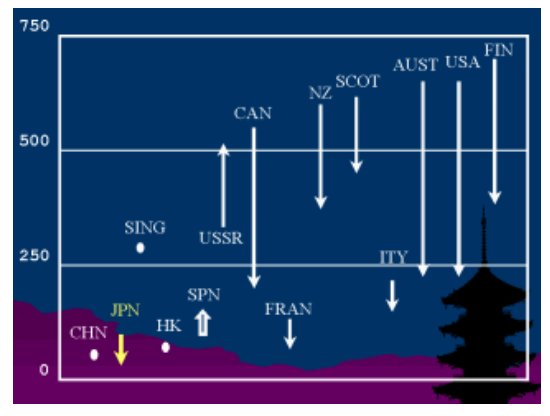
This presentation provides a review from the point of view of Japan of diet-related world cardiovascular morbidity. Death rates from heart disease are far lower in Japan, China, and Hong Kong than in much of the West. The big decline in death rates from heart disease is at least partly due to a reduction in smoking.
Modern agriculture depends on huge amounts of fertilizer, requires pesticides and in fully industrialized countries is almost wholly mechanized.
Modern agriculture as developed in the ‘West’ requires large amounts of fertilizer and other critical ‘system-ingredients’ including pesticides. Much of the rest of the world in recent decades has also significantly increased production using these inputs, and must rely on fertilizer, even in countries where the total requirement for fossil energy, fuel and fertilizer, and for example, herbicides, can be significantly lower than required for a Western farm.
Since the 1960s, new varieties of cereal have enabled much larger yields because they can use higher soil nitrogen N (NH4 and NO3 ions maintained in soil solution), and thereby make use of more synthetic N fertilizer. According to a publication of the International Fertilizer Industry Association, nitrogen fertilizer production requires perhaps 5% of world natural gas; 1.2% of total energy.
The energy budget for a fully mechanized crop is difficult to compute, but one example in Scotland suggests that N fertilizer accounts for 10 – 43% energy input into oil seed production on any one farm. A lot of energy is used directly by machinery. Farming in fully industrialized countries is almost wholly mechanized. In favorable locations high yield modern cereal crops require >200kg/ha N fertilizer. In the box, I provide more detail for particular crops.
Wheat
World record wheat yields, Scotland, Denmark, New Zealand are around 15t/ha. Average wheat yields in parts of Europe, e.g. France, UK, have reached more than 7 – 8t/ha, using high NPK fertilizer inputs from world sources: based on map from here.
Wheat however can also be grown economically in areas where yields are inherently limited, and fertilizer input correspondingly lower. Mechanization allows vast areas to be cultivated at a lower intensity, in much of the USA wheat lands (and in Australia). In parts of USA wheat is often optionally used as a forage crop for livestock.
The limiting factor for wheat yield is usually soil moisture, or the combination of higher temperature and lower moisture, not the input of fertilizer. Average 2007 US yields were ~40bu/acre, (2.6t/ha) and in Montana rarely reach a potential of 70 – 80bu/acre (5t/ha). In Nebraska an irrigated crop could use N at 150kg/ha, but dry-land crops mostly need <112kg/N. Similarly, for the other key fertilizer components. Although wheat responds to an increase in available phosphate (P) during early growth, US farmers often minimize inputs: “All soils are not phosphorus deficient for wheat, so good soil sampling and testing are necessary to minimize unnecessary phosphorus applications and to maximize profits, according to this University of Nebraska publication.
“Most Nebraska soils have enough potassium (K) for maximum wheat production, according to another University of Nebraska publication.
Corn
Corn, like sugar cane, is more photo synthetically efficient than other grains, and is a high yielding carbohydrate (‘energy’) crop with lower protein content. In the US ‘heartland’, fertilizer input and yields for high-yielding corn (maize) are comparable with high-end world standards. USA in 2007 averaged 148bu/ac, 9.9t/ha, with some Iowa yields >13t/ha comparable with 5 year averages for corn in highest yielding EU countries; Netherlands, France, Belgium (see previous link for EU).
This Iowa State Extension Service publication provides a readable description of nitrogen requirements for Iowa corn and the rather complex interaction of fertilizer, crop and soil nitrogen residues. About 180 lb/ac (~200kg/ha) fertilizer N per acre is required for a high 200bu/acre (13.4t/ha) yield. This document is also helpful for those interested in the issue of replacing the amounts of soil nutrients inevitably ‘exported’ off-farm. For instance, it looks at yields after a few years without N fertilizer. Yields continue, but at a much lower level, and in Iowa are down to a quarter.
Even when rotated with the soybean legume that self-fixes N, corn yields are half normal peak values. For P & K the fertilizer ‘budget’ this publication indicates the following: “Phosphorous and potassium varies from state to state or region to region. One bushel (27.2kg) of corn generally has about 0.4 lbs of P2O5 and 0.350 lbs of K2O [6.7kg and 5.8kg per metric tonne]. However fertilizer recommendations will not exactly follow these nutrient removal benchmarks. Proper soil testing along with fertilizer recommendations is necessary for proper fertilizer application.
Soybeans
In the United States, soybeans are most commonly grown in a crop rotation with corn. This can give a year’s break from fertilizer, but not pesticide applications, according to Agricultural Production Management: AREI, 2006 Edition.
“Soybean pesticide use (nearly all of which are herbicides) ranks second only to corn. Commercial fertilizer was applied to less than 40 percent of soybean acreage, a much lower rate than for most row crops (e.g., corn and cotton). Unlike other crops, soybeans can fix their own nitrogen and require minimal nitrogen fertilizer.
The globalizing Western food pattern requires a large amount of grain to be fed to livestock, making feeding the world’s human population more difficult.
Cereal grains are increasingly used for livestock feed. Most, for example, of the huge USA corn (maize) and soybeans crops goes for animal feed. When this use is combined with the increased demand for biofuels, it puts a serious strain on resources such as fertilizer that underpin grain supply. Asia—with 57% of the world’s population--is now attempting to adopt more of a Western style diet as well. This pattern is not sustainable, especially if oil and natural gas supplies are expected to decline over the long term.
According to Dyson 1999, World food trends and prospects to 2025:
…roughly half of the world’s cropland is devoted to growing cereals. If we combine their direct intake (e.g., as cooked rice or bread) with their indirect consumption, in the form of foods like meat and milk (about 40% of all grain is currently fed to livestock; ref. 3), then cereals account for approximately two-thirds of all human calorie intake. … “
“Although the U.S., Canada, and Australia together contain less than 6% of the world’s population, they currently produce about 20% of the global cereal harvest.” [This raises questions on how it is used, and future dependability.]
Current world cereals: Production and Trade
Current world cereals production approaches 2200Mt on a rising trend. Production varies significantly from year to year, as shown in the graph below. The rise in the last few years is essentially driven by the biofuels and meat sectors.

While population continues to grow, and food use by animals increases, there are likely to be regional shortages of affordable fertilizers, and increasing food scarcity.
The Western part of world food is especially dependent on fossil fuels for long distance transport as well as for highly mechanized production.
Most of the world, even now, produces food near where it is eaten. Much of Asia more than kept up with population, increasing per capita cereals production between 1970 and 2000. Only around 12% of total world major cereals (wheat, maize (corn), rice, barley) is internationally traded. The amounts traded vary greatly from product to product and location. In general, much more of the food generated by Western agriculture is traded internationally than is the case across the rest of the world. For example half of US wheat is exported. Similarly 43% of US soybeans and soy product are exported, mostly for livestock. The EU imports a very large 80% of non-cereal primary protein required for animal feed, e.g. soybeans. Production and consumption, however, of cereals in situ in much of the world remains relatively vast compared with international trade, and uses less fossil fuels.
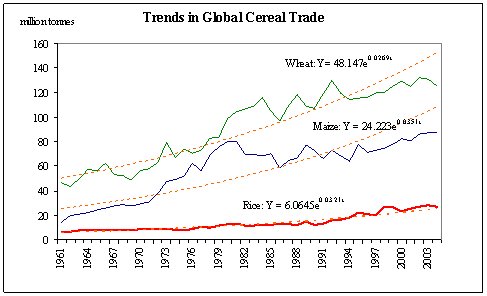
According to information published by the International Grains Council, since 2005, production of the major grains have ranged thus: wheat 598 – 687Mt; maize (corn), 696 – 787Mt; barley 134 – 156Mt; rice 424 – 429Mt. For these major grains, the amount internationally traded is little more than 258Mt or 12% of production (see also graph above). For wheat the proportion is around 17% and ~10% for maize. Rice is internationally traded at much lower percentages, although the trade has more than doubled in recent decades.
Fuel oil is vital especially for the Western food system. It is needed for transport of resources, for cultivation, harvest, drying/storage, as well as processing, packaging and refrigeration and transport to market of food products. There are some uses we don’t always think of. A farmer in England tells me that if his John Deere equipment breaks down the parts are flown the same day from Texas.
Fertilizer Production – all that natural gas
Industrialization requires competitive bulk transfers of commodities and economies of scale to minimize unit-costs. Natural gas - or coal-bed methane, or gasified coal – appears less than ‘fungible’. The regional nature of gas supplies (and cost structures) has exerted a major influence recently on N fertilizer production in for example both the USA and China.
US manufacture has been usefully reviewed already by Neal Rauhauser here, (including possible renewable energy for ammonia production). A recent USGS analysis of US nitrogen fertilizer supply can be found here. N fertilizer production in the USA has been reduced significantly over recent years in the face of imports.
In China, because of changes in cost-structures (‘marketization’), urea produced from coal has oscillated in competition with urea made from natural gas, in this case even within a single country, according to this article. “While natural gas is the major feedstock internationally, China has been using coal as feedstock for 70% of its urea production, due to the country's particular energy structure of coal-rich but gas-poor. Prioritization appears to have been difficult, (see oddball but fascinating fragment here), but China’s investment in manufacture of fertilizer in Mongolia near to gas supplies, and forward investment in possible coal-bed methane, speaks of strategic needs.
The attempts of China to secure P&K supplies - as well as soybeans - outside the country appear ongoing. Interestingly half the most recent growth of fertilizer use in China was for horticulture and fruit, according to a publication of the International Fertilizer Industry Association. Will we see a future reversion to austerity or ongoing development following an ‘American’ model?
What is ahead?
Perhaps we can get some insight regarding what is ahead by looking at Dyson’s forecast from 1999 and what has actually happened in recent years. Dyson focused on cereals because they provided two thirds of human calorie intake. His conclusion was cautiously optimistic and was based on region by region analysis including previous per capita increases achieved to 1999 across large parts of Asia. He estimated that 3 billion tons of grains could feed around 8 billion by 2025. He projected increasing cereals yield productivity in EU/Former Soviet Union and North America/Oceania and a broadly ‘adequate’ world production, relying on a doubling of total synthetic N fertilizer use.
His caveats included inter alia weather-induced harvest volatility in North America already observed by 1999, to which presumably we can now add similar worries over Australia and others. Dyson was pessimistic for Sub-Saharan Africa. He expected South Asia to remain largely vegetarian on a not necessarily adequate diet, and China to largely feed itself, but said of China, “… as everywhere, socio-political stability will be a crucial ingredient for continuing food security.”
Are Dyson’s projections bearing up? Total cereals are up if erratically ~16% in 10 years; latterly driven essentially by bio-ethanol and meat sectors, according to Outlook for World Fertilizer Demand, Supply, and Supply/Demand Balance by Patrick Heffer, Michel Prud’Homme of the International Fertilizer Industry Association.
EU cereals and USA corn and to certain extent soybeans yield/hectare continue to improve. Significant fertilizer is now used in fruit & horticulture: massively so in China recently (IFA 2008).
According to The Fertilizer Institute, world nitrogen demand grew by 17 percent, phosphate demand grew by 18 percent and potash demand grew by 23 percent from fiscal year 2000/2001 to 2006/2007. China, India and Brazil are the three largest contributors to the growth.
Thus, cereal grains are not rising as rapidly as Dyson predicted, but fertilizer use is still growing rapidly. With the growth in biofuels and meat, much of the additional grain does not proportionally feed more people.
Trends have been driven by profitability, and in the USA most of the monetary value of agriculture is ‘up-market’ in the livestock sector. Slightly over half is provided by livestock, slightly less than a quarter by horticultural crops and, less than a quarter by primary production, grain and oilseed crops (the remainder comes from cotton and other commodity crops).
Expanding the global ‘business as usual’ approach appears to guarantee poor success in the future.
Are there other other approaches that are more sustainable, that can be expected to provide adequate food on a hungry planet? In Part 2, I will examine some options that might lend themselves toward a long term strategy for food security.
Contact
- Content: editors at theoildrum dot com
- Tech support: support at theoildrum dot com
License

This work is licensed under a Creative Commons Attribution-Share Alike 3.0 United States License.
Great post here, really enjoyed it. By the way, I'm starting my master's in food & resource economics in fall 09. Any suggestions what I should read or study to feel prepared? thanks!
I'm chiming in a bit later than I hoped, (personal circumstances just now) but special thanks to Gail for her thoughts and support for this article. I'm not an economist, but I have found the historical approach of Geoff Cunfer (On the Great Plains) very useful for US farming and I will refer to his work in more detail in Part 2. For more general background,(I have not used it specifically in this article), but again from an historical 'systems' approach, I appreciated Bunker and Ciccantell's 2005 Globalization and the Race for Resources.
Good wishes for your studies.
Phil
Did not expect to get a reply from the author himself! Kindly appreciated and looking forward to part 2.
Chrisvariick wrote March 10 - 11:29 am
"I'm starting my master's in food & resource economics in fall 09. Any suggestions what I should read or study to feel prepared?"
You might find time to read a 'somewhat well referenced article' posted on THE OILDRUM, October 20, 2008, maintaining that economic and population growth were facilitated by the shift from hunter gathering to farming, and that this open-ended expansion of the total human enterprise has been responsible for the environmental destruction that has been escalating for the last 10,000 years. I think you will agree that IF my thesis, which is the culmination of my ~ 42 year investigation into the relationship between humans and their supporting ecosystems, is correct -- then the 'population bomb'-that continues to make natural resource management problematic-exploded a long, long time ago, see:
'Agriculture: Unsustainable Resource Depletion Began 10,000 Years Ago' at;
http://www.theoildrum.com/node/4628
My 'guesstimate' for sustainable human numbers in the 100s of millions, if true, suggests that the present global population has so far overshot the carrying capacity of its supporting ecosystems that most analyses of the relationship of excessive human numbers to SPECIFIC ASPECTS of environmental damage are simply indulgent academic exercises.
There are now (and have been for millennia) more people on the planet than it can sustainably support.
Many of us have concluded that even TWO CHILD FAMILIES -- that would only slowly stabilize the human population -- are not an adequate response to this problem; we require the adoption of NO or ONE CHILD PER FAMILY behaviour to orchestrate the Rapid Population DECLINE that is necessary now to halve the population (with an effective birth rate of about 0.5 - due to deaths before breeding age, and individuals who choose to remain childless) every generation.
Peter Salonius
Further to my reply to Chrisvarik yesterday -
- as I have read many of the posts replying to this article concerning NITROGEN in agricultural systems, It ocurrs to me that there is not much appreciation for the ferilizer element that is NOW closest to global exhaustion - PHOSPHORUS.
I copy below part of an email exchange re: PHOSPHORUS that was initiated by my mailing the same OILDRUM essay that I rerred to yesterday's posting:
-----------
From: Laird, David [mailto:David.Laird@ARS.USDA.GOV]
Sent: Thursday, January 01, 2009 14:59
To: Salonius, Peter
Subject: RE: Maybe there is hope for SOME cultivation agriculture
Peter,
I just read your internet article:
http://www.theoildrum.com/node/4628
Overall I agree with most of your analysis. Biochar is part of the answer and will make food production more sustainable. Mostly, I think it can buy time. For example, if we had global use of biochar on ag soils, perhaps we could make our PHOSPHORUS reserves last 300 to 500 years rather than 60.
David
======================================================================
From: Salonius, Peter
Sent: Wed 12/31/2008 10:42 AM
To: Laird, David
Subject: Maybe there is hope for SOME cultivation agriculture
Hello David A. Laird
Just read 'THE CHARCOAL VISION: A Win-Win ...... and Water Quality' Agron. Journal. 100(1): 178-181, 2008.
I have been suspicious about the role of charcoal in Chernozemic soils but your "guess" of 5 to 15% of the C in Midwestern prairie soils as a legacy of 10,000 years of prairie fires - is the first I have seen in print. So maybe there is a 'terra preta' aspect to the fertility of these soils. I went to agricultural college with a fellow who said that on their farm on the Canadian prairies (Vermillion) they had not needed to use fertilizer YET (early 1960s).
I have been tempted to get into the nuts and bolts of the "terra preta de indio" soils phenomenon for a couple of years -- especially after reading David Montgomery's recent book 'DIRT' which I am now reviewing for a forestry journal.
Peter Salonius
Just as a reality check, phosphorus is potentially renewable. Not only is phosphate rock being actively laid down in a few places around the world, anadromous fish such as salmon take up phosphorus from oceanic sources as they grow and bring it upstream when they return to their home streams to breed.
This is one more reason we should remove water diversions and other threats to salmon runs. They are far more important than this year's crops.
Like many I like the idea of giving wild salmon better odds every chance we get (I've netted a 'few' reds leaving the Bering Sea over the years myself). Just curious though, what percentage of the phosphorus salmon gather could be actually mined without tearing up the salmon habitat? A related second question, how much phosphorus would be the maximum anadromous fish could put into our system a year and how does that compare to what we take out? I wouldn't be surprised if most of those numbers are tough to find.
I'm guessing catching the fish and eating them doesn't help the phosphorus to build up either. The big runs are spectacular, but we are not going to just leave the fish alone even if by some miracle we start to manage a whole lot more of the world's waterways in ways which allow full wild runs to return. I have a feeling we will never manage fish for maximum phosphorus production, but I could be wrong.
I'm guessing phosphate rock isn't being laid down near as fast as we are tearing it up, but I could be wrong there too. Just a reality check.
A lot of the salmon already go to feed mammals and birds (both before and after spawning). Bears and such remove the nutrients from the streams and deposit them on land; they eventually wash back out again, but that's part of a loop, not a one-way traffic.
If we caught the fish, ate them and cycled the nutrients back to fields, we could build phosphorus stores on land. Our biggest problem at this time may be keeping the oceans productive enough to have the salmon return.
The health of the oceans is a huge concern, right now it looks pretty grim, but not hopeless. I'm all for the return loops you mention, the more the better that is for sure. What I was pointing up was that it is very unlikely we could use the sources you indicated to replace the accessible phosphorus stores at near the rate we are now depleting them.
Thanks to Phil for an interesting post! The continuation of food production is an area of interest to all of us.
Phil gives links to a lot of publications and presentations I have not run into. Many of these are very worth checking out.
One thing I had not been aware of was that nitrogen fertilizer can be made with coal, rather than natural gas. It can also be made with stranded wind.
Gail, can you say more about how to make fertilizer with stranded wind? Do you mean "put a power source (windmill) in a remote region where the (also stranded) natural gas is?"
Thanks for the great post, Phil.
Ammonia is a compound with the formula NH3.
It is my understanding that it can be made in a number of ways. The more usual process is the Haber Process, or Haber-Bosch process, which gets its hydrogen from natural gas.
The hydrogen used in the process can also be obtained using electrolysis, by passing an electric current through water. It is my understanding that this is the approach contemplated using wind. Neal Rauhauser, known on The Oil Drum as SacredCowTipper, writes a little about the subject in this post.
My background in chemistry is not very strong. I am sure others on this site can provide more information.
Actually gail, the reason why they use mostly natural gas or coal to produce hydrogen is because it is far more energy efficient than using electrolysis. I think 99% of actual hydrogen production for chemistry purpose (fertilyzers, hydrogenated oil and fats, other chemical compounds) comes from the Haber-Bosch process.
Living near many hydro electric dams producing electricity at very low cost (my own electricity bill is only 0,054 $/kWh) I think industrial producers of Nitrogen would have installed new factories if it would have been profitable.
My own guess is that before natural gas and coal will be less available for Nitrogen production, the whole agribusiness infrastructure will have allready been completly changed. The increase in the cost of different inputs, the scarcity of some other (like tires) and the reduced ability to obtain credits and the reduce in global demand (even by just a few percentage) will have bigger effects than the availability of nitrogen fertilizers.
Again, that's my 2 cents.
I don't think we'll ever see wind powered ammonia production. Even if electrolysis got technically inexpensive, you still have other high capital cost restrictions, such as the engineering requirement of pressures on the order of 100 atmospheres.
I do not understand this statement. High pressure is part of the Haber-Bosch process no matter what the source of the hydrogen may be. The key difference between wind based ammonia production and natural gas based production is the cost of the hydrogen: i.e. steam reforming of natural gas vs water electrolysis.
One can check rapidly the well known wikipedia for answers on subject they are not familiar with. Industrials and investors mainly do stuff because they can earn a profit. If something can be done cheaply with a new technology, competitions laws tells us that the lower cost way will win.
That is why most hydrogen, thus amonia, is made using natural gas with the Haber-Bosch process.
Links to the article :
http://en.wikipedia.org/wiki/Haber_process
Exerp from the article :
But you can follow the rest of the article wich states that (emphasis added):
After that, the articles goes on with the science, chemestry, and engigeering part of the process and then, almost at the end, a part on environment and economics :
I hope that this little incursion into scientific knowledge will led people to think more in a scientific way than in a magic in wonderland way.
If the available overall energy is going downward, so it will for any process, especialy if it require more energy than it is currently. So I dont know how on any twist of mind can someone think that future earth inhabitant will use energy better used at enabling movement or computing to produce a chemical reaction wich is not really efficient. I mean, those windmills and Hydro plant will be kept in place with great efforts because all the infrastructure would have gone bust.
As I said on my previous post, the amonia from natural gas (or coal) wont be the thing missing in the agri business and it will not be the cause of the failure of that system. Many other things will have a more greater impact.
That was my 5 cents.
Based on electrolysis plus compression to 100 atm, it would take ~8 kwh of electricity per pound of ammonia whereas ammonia generated from natural gas is around 20 scf per pound. So grid electric
ammonia would cost 80 cents per pound and at $1 per therm NG prices, NG ammonia would cost 20 cents a pound.
Also to replace 15.2 million tons of NG ammonia completely with wind ammonia would take ~100 Gwe of wind running 2400 hours per year. To date the US has installed
25 Gwe of wind.
Still it is certainly possible to do it.
Correct me if I am wrong, but I'd guess that one does not need "grid electric" to do hydrolysis. And I'd bet that spread of $.80 to $.20 is largely accounted for in the emergy difference between "grid quality" electricity and "run of the mill" electricity. Or to put it another way, an off-grid windmill making ammonia is going to be way cheaper than using a grid tied windmill with all the associated requirements to generate electricity to grid standards and then using that electricity to make ammonia. It's like feeding beef into the compost pile when grass will do. A "point of the flame" issue.
The whole impedance mismatch of windmills (solar), lifestyle and the grid is a fascinating subject. The "flip the switch and we'll be there" meme has to die. Uses have to be tied to the times when power is available. Like those tidal mills of old - rotating shifts that matched the tides. So it's not only an issue of LESS, or even MUCH LESS, but WHEN.
cfm in Gray, ME
Indeed not. Bulk electrolysis requires low-voltage DC at massive currents.
I'd take that bet. Once your wind system is purchased, your only costs are amortization and O&M. A given per-kWh cost isn't going to change much if you have a little hardware to interface to the grid, and you're certainly not going to get a 4:1 price cut. Connecting to the grid may make the chemical system cheaper, because lots of these systems do not like being cycled on and off.
Ammonia can be produced from water and nitrogen gas using technology derived from solid oxide fuel cells(essentially running in reverse as you're supplying electricity). NHthree llc is trying to develop and commercialize the technology and they believe they'll be able to get 7-8 kWh/kg(3-4 kWh/lb) at lower capital requirements than haber-bosch and electrolysis.
There's also work being done searching for better catalysts that require much milder conditions than Haber-bosch.
There's nothing preventing you from deriving hydrogen gas from gasification of biomass sufficient for agriculture(as long as you don't try to use ammonia or hydrogen gas from biomass as a transportation fuel).
Why? The electrolysis-based process is older than the gas-based one, and if we could afford electrolysis-based nitrogen fertilizer 100 years ago we will be able to afford it in the future too.
One of the biggest fertilizer companies in the world is the Norwegian Yara. It utilises the North sea gas as a feedstock. But the North sea gas industry is only 40 years old, while Norway has been a center for fertilizer manufacture for export for twice as long.
Guess what? Yara used to be part of the company Norsk Hydro, which recently sold its oil&gas segment to Statoil. Guess what powered their fertilizer process? Clue: it's part of the company name...
http://query.nytimes.com/mem/archive-free/pdf?_r=1&res=9E04E7DA1F30EE3AB...
Because back when people were electrolyzing water for hydrogen was before the transportation of natural gas was made a reality by the invention of seamless steel pipe(1920).
http://www.scienceclarified.com/Mu-Oi/Natural-Gas.html
Also until the North Sea was developed Norway didn't have natural gas.
Also natural gas has an advantage because CH4 + H20--> CO +3H2 releases more hydrogen than 2H20--> 2H2 +O2.
Electrolysis of water is quite possible as I said but its ammonia product will be more expensive.
It will be more expensive yes, but that was an expense we could readily afford 100 years ago, and today we are 10-15 times as rich as we were back then. So this is an utter non-problem.
I believe that the proponents are looking toward direct electrochemical synthesis of ammonia from nitrogen and water.
The synthesis cell operates at atmospheric pressure, but it may make more sense to pressurize the nitrogen so that the ammonia product can be condensed directly; water costs almost nothing to pump to the required pressure.
Where do we get our synthesized Nitrogen ?
I hear that a large % comes from Venezuela
The largest producer of ammonia in the world is Qatar, with large natural gas reserves. I don't know how much of their product comes to USA.
What is the difference between I-NPK and O-NPK ?
Don't we need to move towards O-NPK ?
Hello Jmygann,
You maybe sorry you asked for more clarification of my acronyms. :)
NPK = Elements: [N]itrogen, [P]hosphorus, Potassium [K].
NPK includes both types: I-NPK and O-NPK; also much easier than typing out every time 'industrial fertilizer' or 'organic fertilizer' respectively. My nomenclature I/O-NPK signifies both; basically the whole global industry of moving any and all forms to support life. There are literally hundreds of different choices.
NPK: The major quantity 'Big Three' for successful photosynthesis, but smaller quantities of other Elements may be topsoil required if soil sample testing warrants their addition to avoid a Liebig Minimum or controlling soil-PH. Sulfur, manganese, etc.
Also, NPK is a common certification ratio of these Elements [look at fertilizer bags next time you are at Home Depot or Lowes] 16-16-16, 16-16-8, plus many other ratios. For example: 21-0-0 printed on the bag for ammonium sulphate [basically a stabilized urea and sulfur chem-combo].
**I-NPK**: Industrial fertilizers such as Haber-Bosch [H-B] liquid anhydrous ammonia, urea, other chem-combos such as these common I-NPK types: DAP, MAP, UAN, TSP, MOP, etc. Prilled, pelletized, powder forms. Some forms are more highly purified: it is then suitable for adding to animal feed or for human consumption.
Miracle Gro, Vigoro, Bandini, Scotts, Bayer, etc, may be familiar retail brand names to you.
Sulfur now mostly sourced from sour crude & sour natgas. Nitrogen from natgas-sourced Haber-Bosch. P and K are mined, then beneficiated through huge factories. Huge quantities of sulfuric acid are needed to turn P-ores into water soluble ions suitable for plant absorption.
**O-NPK**: Organic fertilizers such as leaves, yard clippings, kitchen scraps, animal manures & humanures, urine, bird & bat guanos, other composted materials. Retail stuff such as sphagnum peat moss, steer manure, mulch-mix, woodbark chips, bone meal, etc. Legume crop rotation for soil N-fixation would be in this O-NPK category too.
To add even more to your confusion: you can even buy various types of O-NPK that has been further enriched by adding various amounts of I-NPK. This typically is bags of topsoil amendments and potting soils sold at retail outlets. Hope this helps you understand.
Yep, O-NPK for crops was the standard method until early chemists figured out that sylvinite and apatite ores and H-B could be harnessed to make many I-NPK products.
veganism?? well if lots of people went vegan even 5 days a week it would make a massive difference.
check out this link for some veganic growing ideas
http://essenes.net/index.php?option=com_content&task=view&id=569&Itemid=402
think jesus was part of the essenes but dont let that put you off...
Two points:
Incremental decrease in meat consumption would both improve public health and cut diversion of grain crops to animals. Fertilizers support cereal production that is diverted to animal 'farms', the waste from these farms is either put onto fields in a raw - that is, uncomposted condition - or allowed to drain directly into waterways. The final destination for the chemical - ie. Haber- Bosch fertilizer is thence the ocean, in forms that are poisonous to marine life forms.
http://www.youtube.com/watch?v=dMyJNR2DrfY&NR=1
This is from Michael Anderson's doncumentary, 'Eating'.
Conventional, livestock producing agriculture requires immanse amounts of water, both for the production of grains for animal feed as well as for the livestock production, itself. In many areas, livestock production is overconsuming and contaminating water supplies, particularly in the Midwest, where the 'Agricultural Breadbasket' is dependent on pumped sub- surface water:
http://www.waterencyclopedia.com/Oc-Po/Ogallala-Aquifer.html
The second point is that current meat production is potentially very hazardous to the meat- eaters' health. Livestock production is a source of most bacterial infections found in food products, amost all of which contain some meat or meat byproducts:
http://barfblog.foodsafety.ksu.edu/2008/12/articles/e-coli/bovine-supers...
http://aem.asm.org/cgi/content/abstract/73/5/1563?maxtoshow=&HITS=10&hit...
Confined livestock feeding methods of all kinds of livestock - chicken, swine, cattle - includes some large component of re- cycled animal protein from the rendering industry.
http://www.youtube.com/watch?v=JCGkwjz6WyM&feature=related
This is a schematic of the rendering process.
There are three primary components to the 'product stream'; water (which is generally recycled), fat, which is used in myriad products sucn as soap, cosmentics, lubricants, etc., and protein meal which is sometimes further refined into bone/blood meals and protein meal.
These meals are processed into pet food and animal feed. The hazard is that some percentage of these animals are stricken by prion- degenerative brain diseases such as Bovine Spongiform Encephalopathy (BSE or 'Mad Cow'), Scrapie (in sheep) and Chronic Wasting Disease, (CWD), an infection found in wild deer and elk. In rendering plants, all 'road kill' including deer and elk are fed into the grinders.
The human variant of BSE is Creutzfeldt-Jakob Disease (CJD). It causes dementia and is invariably fatal. It is caused by injesting BSE infected animal products such as hamburger which contain infectious prions which are forms of naturally occuring proteins. The infectious proteins do not 'fold' or function properly, but instead allow for the collection of plaques within brain tissues. A characteristic of this disease is the formation of small, sponge- like holes in tissue.
Could Mad Cow Disease Already be Killing Thousands of Americans Every Year?
by Michael Greger, M.D.
Infectious prions become concentrated through repeated passage through the food processing ladder, from protein meal to animal feed, to afflicted 'downer' animals, back to thence renderers thence to meal ... over and over. At various points in the process, material is sent out of the process as human food; broiled hamburgers and fried chicken. As in all self- reinforcing cycles, be they economic or biological, at some point the boundaries of control or margins that restrain the pathology of an organism or a process are overcome.
And these turn up from time to time:
http://www.fda.gov/bbs/topics/enforce/2007/ENF00996.html
The meat industry and the USDA/FDA insist that there are few, isolated and spontaneous cases of CJD in the US ... but this is clearly not true.
'Downer' cattle are rountinely sent to slaughterhouses:
http://www.youtube.com/watch?v=6OjhPVL48Ks
This incident resulted in a supplier of meat for US school lunch programs recalling 143 million poinds of meat:
The recall was rationalized as an animal abuse issue, but the downer cattle and the associated BSE risk in food processed at the facility was behind the recall.
http://madcowfeed.blogspot.com/2008/04/substances-prohibited-from-use-in...
Researchers are carefully dancing around the issue of the relationship between Alzheimer's Disease and malfunctioning prions, although the cat gets closer to being let out of the bag with this recent study:
http://www.nature.com/news/2009/090225/full/news.2009.121.html
This topic is very large and beyond the ability of one comment to concisely convey. There are numerous investigations of prion- caused diseases.
http://www.mad-cow.org/Alzheimer_cjd.html
Terry Singletary has accumulated a number of information sources in one spot;
http://betaamyloidcjd.blogspot.com/
Despite what is unknown and questionable, it is clear that modern livestock production in line with trends in other industries, overuses and pollutes water supplies and watersheds, overuses fertilizer and fossil fuel inputs and is a source of dangerous infectious diseases.
Mmmmmm, Jello
Steve from Va
Two things:
1. It's far from certain that a high proportion of meat in the diet leads to poor health. Next to impossible to find studies, controlling for carbs & sugars, that directly implicate meat.
2. Most of what you say has more to do with overpopulation and centralized mass production than with any inherent problems with meat consumption.
On a very small sample size (N=2), my husband and I eat little meat (we eat fish one or two times a week though). Neither of us have had any problems with high cholesterol or high blood pressure, or for that matter, most of the other things that ail middle aged people. If doctors had to live off of our business, they would go broke.
Gail, you have to look out for yourselves, the 'system' won't help you. The best thing my 'Ex' did twenty- five years ago was to convert me to vegetarianism. Since I can't afford to go to doctors, it probably has saved me ... at least money.
A friend of mine is a chef at a very nice restaurant in New York City and she tells me that getting good quality fish is getting harder; too much is wormy/parasites or mushy. The farmed fish is worse; fatty and tasteless. 'They' have already ruined tomatoes, what's next?
As for the 'grass fed' beef, who knows? Since nobody sees the farms or deals with the farmers directly, nobody knows whether the cattle are sent to the feedlot for six weeks prior to slaughter to 'fatten 'em up'.
I worry about my brother who is a certified 'Meat Man' who eats beef and pork every chance he gets.
If we had never starting eating meat none of these big current problems likely would have occurred, our vegetarian ancestors would have had a much more limited range at any given time as ranges of vegetation limit the ranges of those who solely use those types of vegetation for sustenance.
Once the ancestors started eating meat, meat was pretty much meat. They could live anywhere on the planet they could get meat--settling far and wide over a relatively short time frame was much easier to do. Times get real tough and meat eaters might have a leg up...if the garbage we get from the stores doesn't kill us first.
..still get excellent wild fish in Alaska by the way, though it does take a lot of fuel to get it to NY
One need not be able to prove something to know it is true. When we see the differences in certain kinds of diseases with differing diets, we can make some assumptions. When we further see those populations move to areas with different diets AND see their incidence of certain diseases become the same as the local population, we can be more sure of those assumptions.
Keep in mind E=MC2 wasn't proven mathematically till a year or two ago. Did the relationship simply not apply until it was proven?
Another example, we knew more than a hundred years ago climate would change as we added more CO2. We confirmed it something like 50 years ago. Some saying we can't *prove* the relationship exactly have left us all perched at the edge of a cliff.
It's only diet. Me? I'll take the correlations and reduce my red meat intake. You're welcome to spend your time trying to prove there is no causal relationship.
Or die trying.
;)
Cheers
Death rates from heart disease are far lower in Japan, China, and Hong Kong
How does this explain France, Spain and Italy having similarly low cardiac death rates? (from the posted graph)
The "Western diet" thing is a gross generalization. A typical Spanish or French diet is very different from a more central European diet, and typical diets in the US are off the charts in terms of calorie counts, fat content, and use of sweeteners (First time visitors to the US are uniformly surprised that such a large percentage of people are obese). A lot has been written about the Mediterranean diet, particularly with respect to red wine and olive oil consumption, but beyond that, Mediterranean diets include a lot of fresh fruits and vegetables, fish, and in Spain and the Levant at least, a lot of beans.
Beyond diet, there are lots of social differences in southern Europe that could account for better cardiac health, such as a lot more daily physical activity and very strong social networks.
It is actually the "Factory Food" and processed diet that is killing the bewildered herd.
I have watched as Euros look in disbelief when delivered an American Breakfast.
We need to reduce the population of Earth (of humans) by at least 5.5 billion, and lose grains as a food source, just for a start. The planet would be happier with a far fewer number.
Let's not kid ourselves, it's not just the US. I'm not saying you claimed it was, but a lot of people seem to make that generalization. Mexico and the UK are closing in fast with regards to obesity. Most of western Europe and parts of Asia are getting fatter by the year. I just got back from Ireland and I can safely say that their meal portions are the same or larger compared to what you get at most US restaurants. I agree though, it is the processed food and the sheer quantities. I rarely finish a meal at a restaurant. I am very curious why you say we need to lose grains as a food source though. If anything we need to stop eating meat.
If I had to make a wild guess, our friend here is probably a paleo-diet advocate.
What I find a bit disturbing with the statement is the apparent NEED for us as a species to reduce (kill?) our population by 5.5 billion people. I don't want to put words in his mouth, but to achieve said goals here, we must embark on a global and brutally imposed 'culling' (to keep with the euphemisms). Though I believe such a reduction in world population is eventually inevitable, I think it's something better left to 'Mother Nature'. Ultimately, regardless of whether the limits imposed on us come from GCC or PO, we will go through 'natural' decline. We therefore don't NEED to do much, if anything, except being responsible breeders and preparing for transition.
There are some things that are peculiar and relate specifically to the US as far as food is concerned.
High fructose corn syrup makes its way into almost every food we eat. Bread for example is sweetened with it.
Ill never forget the first time I ate American bread, I thought I was eating cake.
http://www.kingcorn.net/
It's also the type of wheat used for different baking products. They differ in their protein content as well as the texture of baked products.
http://www.cyberspaceag.com/kansascrops/wheat/typesofwheatflour.htm
The main wheat types are: hard red winter (bread), hard white (bread), soft red winter (cakes, pastries), soft white (pastry and pie crusts), durum (pasta).
http://en.wikipedia.org/wiki/Wheat
Quite how we reduce the population is a very difficult and controversial problem - but we need to at least start by getting society to actually acknowledge that it is a problem - at the current rate it is likely to increase by another couple of billion before it starts to decline.
pedrodelgado
It is really quite simple:
1. Get the "faithful" to stop thinking we are special (created in the "likeness of god") beings with a soul that has some kind of after life that is more important than this "valley of tears" existence. Get them to stop brainwashing their offspring in with this delusion.
2. Get corporations to stop thinking that "growth" is good for business.
3. Get political parties (and others) to stop growing thier ranks via childbirth.
4. Get the US govenment to aggressively support free contraception and family planning for all.
5. Insure every woman has an excellent education by providing free, high quality universal education.
6. Provide high quality universal free health care to insure that unwanted pregnancies can be dealt with at the earliest stages.
7. Cut the US military budget in half to pay for all this.
I just don't see why you think this is difficult or controversial?
Educating society isn't as difficult (although controversial to the "faithful" and those depending on high birth rate to pay for their pensions) - but isn't likely to happen soon enough - so the controversial part comes when the population needs to start reducing faster than the current death rate. :(
What is with this ridiculous argument?
"reduce (kill?) our population by 5.5 billion people"
Lets see, if there are no new children born, in 100 years the earth's population will be effectively zero. (Yes, if a few percent of the population lives to 100 then there will be a few million people hanging around for up to another 20 years.)
Is there any requirement for genocide, mass annihilation, draconian eugenics programs, global warfare, plague? No. Everyone alive today lives a totally normal, healthy lifestyle and dies of old age. (Again, with the disclaimer for the usual traffic deaths, overdoses, assaults, initial starvation, etc... And whether 115 year olds can still drive tractors and service oil pumps.)
The only 'abnormality' would be the complete lack of children in society.
Now let us have 1 in 100 couples reproduce and at the end of the century there will still be millions of people living in a society that at first glance would look the same as today. Once at a 'reasonable' level everyone can go back to 1 child each eg 2 per couple. Similar results would occur, but more slowly, if each couple had 1 child.
This is a trivial political issue - all we have to do is permit tiny numbers of people to procreate. And since this will never happen we are all truly (choose your option) doomed/screwed/soylent green.
So the odds are we will end up in massive internecine warfare with a specific goal of population destruction (eg Rwanda or Polynesia). But that's just human nature, aren't you proud?
@bryantheresa: I guess I wasn't clear when I wrote "reduce (kill?) our population by 5.5 billion people". I was merely reiterating what I understood as the implicit statement in the above post that "we need" to reduce our population by said number of people--as if we have any real control over that. I did perhaps read 'requirement' into that--my bad. I don't think anything can be done about the population issue because most of the world will be unwilling or unable to do so, especially when states start collapsing.
The Earth will impose its limits on us as a whole; the few of us who choose to be responsible breeders with low carbon footprints make no difference as to the outcome. And like you said, we will never implement the measures needed to curb population so civilization as we know it is doomed. Overshoot was inevitable, so are the limits to growth--we're in for a hell of a ride!
In the end, I imagine that the Four Horsemen will deal with the matter. Exactly when they start, and how long will they take doing it, who can say?
Antoinetta III
I'm confused as to why mass sterilisation of the entire globe is presented as fair and reasonable, but people of the West just consuming and wasting less is presented as insane and impossible.
If the total sustainable human population is in the hundreds of millions, the people of the West could disappear tomorrow and humanity would still face the same decision. Worse, actually, because Western populations are growing only by immigration from the rest of the world; if the non-West disappeared tomorrow, the remaining population would be on a path toward sustainable levels. Fast enough? Maybe, maybe not.
Wellll. Of course if you start with the premise that the earth can only support a few hundreds of millions of people, you are going to come up with some odd conclusions.
But posing "Western" vs "non-West" nicely elides the numbers we are talking about. Rounding a bit, there are about a billion in the West and nearly six billion in the non-West. So saying we could reach near sustainability if we got rid of the non-West versus the West and suggesting that such a thing is preferable amounts to saying one West life is about six non-West lives. Do you see any problems with such an equation?
If one were to ask instead which billion if "reduced" would most leave the rest with greatest increase in survivability, there can be no question that that would largely be the billion that make up the West (plus the elites in the non-West). This group uses up more of the worlds resources than all the other billions combined. (If you insisted on wiping out all but a billion, surely the best option for future survivability of humans and the living world would be to wipe out the billions at the top end of the consumption hierarchy, leaving those scattered remnants who still engage in subsistence ag, hunter-gathering...)
Of course, the same reduction in resource use could be achieved without such mass slaughter by a 75%+ reduction in resource use by the billion or so top users, and a more modest reduction by the next billion. As pointed out above and in many other places, such reductions in resource use could actually represent an increase in quality of life--less meat and dairy and more walking and biking leading to better health, longer lives and (from greater interactions as you walk...) greater happiness and sociability.
But if you like fantasies about wiping out billions of people of hues (mostly) other than pink, I guess that's yours business.
On population, a goal (preferably achieved by humane policies and incentives) of one child per couple max, and that much later in life than the current norm would bring down population rapidly, especially in the crucial early years, without the need for extra culling, whether natural or through human agency.
None of these will happen of course.
It was someone else's premise, I was just running with it. But unless we have an immediate crunch, it really doesn't matter what the absolute numbers are today; the trends are the most important factor.
No, that is incorrect. It is saying that a society that has a declining population is inherently better able to handle resource constraints than a society with a growing population.
I only have a problem with your leap of logic. The West is a relative resource hog, but has a declining population trend and both the technical ability and the ecological awareness to be able and willing to reduce its environmental footprint. Given the proven capability of Stone-age societies to destroy their ecological base of support, I do not subscribe to the "Noble savage" theory of ancient peoples nor the Politically Correct version for today's non-Westerners.
Then again, we could spend a whole 2% of our GDP/year to replace FF's and let the natural decline in birth rates bring back the population, slowly so we can retire at 60, and still have an economy.
That is an unacceptable proposition as it wouldn't let doomers engage in totalitarian masturbation.
We need to .........., and lose grains as a food source"
What are you replacing grains with ? 2000+- calories/day
From http://www.drmcdougall.com/alcohol.html:
This article is a bit old, evidently from the mid-1990's, but I mention it as a possible answer.
Keith
We Spaniards are NOT Mediterraneans, it would be as misleading as to call the Americans, Caribbeans. Some Spaniards live by the Mediterranean shore, most live inland or by the Atlantic, so there are some differences in food.
So: pig's feet, blood pudding, lamb chops, beef, fried potatoes and everything from the pig feature heavily in our food. Not what people think of as a Mediterranean diet, but it is true that fish is eaten in great quantities, pulses (chickpeas, beans, lentils) vegetables and rice, probably too much white bread, not enough milk products -the Spanish diet is lacking in vitamin D and children have lower bone density than in northern Europe (in the news, recently).
The average Spaniard doesn't have breakfast, at most black coffee with a finger of condensed milk at the bottom, and a large glass of brandy. Children may have have coffee with milk, and a bun. It used to be bread soaked in red wine, there's modernity now.
If you look at the graph, the Spanish arrow points upward. Heavy smoking, too much alcohol and a sedentary life contribute to that. I am sure that some of the increase is due to the epidemic of cocaine use specially among males 18-40 years old, A&E wards see many cases every weekend.
The common factor that may explain the low rates in Spain, France and Italy may be Socialized Medicine, more than diet.
Quizá porque mi niñez sigue jugando en tu playa
y escondido tras las cañas duerme mi primer amor
llevo tu luz y tu olor por donde quiera que vaya
y amontonado en tu arena guardo amor, juegos y penas.
....
But seriously, most of Spain (and Portugal) are classified as Mediterranean in climate and presumably it is the climate that largely determines diet and other stuff, like outdoor activity. OK, maybe you are Gallego, Asturiano or Catalan, then you are not Mediterranean, but it is still easy to import some nice peaches.
Ata logo
it would be as misleading as to call the Americans, Caribbeans
New Orleans calls itself the northern most Caribbean city. Trinis (from Trinidad) marvel at our house colors.
Best Hopes for Carnival/Mardi Gras,
Alan
Where's Stuart Staniford these days? TOD had a terrific series of posts - SS, Sharon Astyk, others on this theme of the future of industrial/ff agriculture last year.
Stuart has a full time job. He is Chief Scientist at Fireeye. According to the site:
I chuckled when I read that. It used to be fairly common. Nowadays, if one hear's that so-and-so has a full time job, it's: really? - I don't believe that - sure, maybe he leaves the house every morning to fool his wife, but ...
Matt Simmons also has a full-time job, but I think he has an in.
:)
One thing to bear in mind is that if food production becomes localized to any extent than so will diets. For example, my area of northern CA is great for running cattle on range but poor for grain production due to topography (It's in the mountains.). Therefore, we would consume a far higher animal protein diet than other areas.
In addition, many mid-western farms will likely go to mixed production of animals and grain crops to conserve nutrients. One of the best examples of this is the farm run by Dick and Sharon Thompson and family in Boone,Iowa. Tey have been written about on a lot sites.
Todd
All of the world's classic regional cuisines are localized diets. The recipes utilize the foodstuffs that are produced locally.
We have gotten used to being able to eat an ecclectic mix of foods and recipes from around the world. That is one of the things we are going to have to give up. As we increasingly localize our food supply, we are going to have to settle for a regional cuisine that is built upon that local food supply.
The new regional cuisines need not be rigidly limited to the traditional cuisines of the past. Plant varieties have been spread around the world, and most areas now have a larger set of crops that can be grown than was the case in the past. We also have all learned from each other's techniques. Stir-fry need no longer be the exclusive technique of Asian cuisines, for example.
Nevertheless, I suspect that we had all best be prepared to give up some foods and some dishes that might have been available to us in the past.
Phil - thanks very much for a fascinating post. Good to see that Russia has managed to knock Scotland off its perch as heart attack capital of the world. What on earth happened in Russia?
If you have command of this data, it would be really interesting to know about the following:
1) The shifting world of fertilizer production - comparison of present with the past - this is a vital issue in food security
2) The ERoEI of food - energy inputs v energy outputs
Food for thought:-)
Euan
Thanks for that.
I agree about the importance of both your points.
The impression I'm getting from data I looked at for this post is of a fast changing, perhaps oscillating situation. There seems though to have been a move to take N fertilizer production to the energy site, rather than the other way around.Also, on the food demand side, it seem unlikely to me that a roll-out of 'modernized' eating, for example, can be easily extended for decades.
There is even a hint from mainstream fertilizer people that economic crisis could change matters. We have certainly seen more 'food scarcity' in some places.
http://www.fertilizer.org/ifacontent/download/13122/189967/version/2/fil...
“With the decline in confidence and purchasing power, consumers might come back to more ‘basic’ diets, with more grain vs. meat, fish, fruits and vegetables. Such a reversal of trend would impact fertilizer demand."
Certainly changes in affordability of inputs will affect very large numbers of producers, but short term trends could go up and down.
On ERoEI the link I gave to the Scottish study of oil seed (for diesel) suggests output / input energy in a very favorable growing area of about 2.5:1, and very sensitive to nitrogen energy cost.
Phil
Thanks for the enlightenning post Phil,
anecdotally: The rapid decline of the Cook Inlet area gas fields caused Agrium to close its Kenai, Alaska (not many farms there) fertilzer plant in 2007. A coal gasification project to replace the exhausted natural gas feedstocks was found uneconomical and shelved. Now an instate pipeline to the stranded North Slope gas fields is being proposed, but major instate customers are needed, so Agrium's closed plant is in the news again.
I wouldn't be surprised if fertilizer production leaving areas of declining feedstocks and moving to places better supplied would have a great deal to do with the oscillation you noticed. Bob S indicate 56% N-product comes from Trinidad so it appears wage scales figure in with natural gas supplies.
Euan, could you please explain why EROEI of food is important?
It seems to me that even if the EROEI is well below 1:1, we'll still produce food.
Perhaps you are talking about
1. a comparison of (fossil) energy input : food Calorie output ratios for different farming methods?
or
2. some (educated) guesses as to how the fossil energy input demands of food production will change over the century, and the implications for availability of fossil energy for other uses.
The comparison would be important if we thought that fossil energy input would constrain food production. Heck, it'll be useful, even though the more likely constraints on food production are water (un)availability and loss of fertile land.
Item 2 is more TOD's 'thing', though. We already know that an ever-increasing fraction of industrial output will have to go into capital goods for energy exploration and production. If agriculture's slice of the cake is going to get bigger too, then we could reach a point where not enough new industrial plant is being made to make up for wear and tear - "yes I know this steel mill is worn out, but we can't make a new one, we're flat out making oil rigs and pipe. If we stop that, we won't have enough oil to bring ore to the iron smelter, so no more steel." (That's a gross oversimplification, of course.)
Am I on the right track?
I question this whole piece because of the tendentious sub-heading:
"Western food and the spread of cancer and cardiovascular disease"
The author immediately jumps from "differentials in incidence rates" to the spurious conclusion that "bizarre" "Western" diets is the cause. Just because the author sees "Western" diets as "bizarre" is no indication that there's a correlation.
A simple wiki search reveals many risk factors for cardiovascular disease:
Diabetes
TOBACCO SMOKING: 200% increased risk
High blood pressure
Advanced age
Male sex
Obesity
Sedentary lifestyle
Stress
On diet, it says, "The relation between dietary fat and atherosclerosis is a contentious field." Reading further, it seems consumption of trans fats (partially-hydrogenated vegetable oils) provides the only consensus of dietary influence.
But that's not what the headline above would have us believe.
On cancer:
Colo-rectal cancer also comes with a host of risk factors:
Age
Polyps
Heredity
SMOKING
Physical inactivity
DIET (some studies show risk of red meat consumption)
Virus
And a whole section on ALCOHOL CONSUMPTION.
There is NO support for the specious claim above: "we appear embedded in an atherogenic (arterial plaque inducing) and carcinogenic system."
I'm reminded of the joke, "Who are you gonna believe? Me or your lying eyes?"
I have a large family that has existed for decades on the "bizarre Western" diet the author excoriates, yet my Grandmothers lived into their nineties, my mother and father are both healthy and in their seventies, my brothers and sister have altogether 8 healthy, athletic children among them. Same with cousins, aunts, uncles--except for those that drank alcohol. Not one of these people that I'm aware of has gotten their food from anywhere but supermarkets.
All except for me, who farms "organically" (though I'm soon to repudiate this label) and therefore have a chronically bitchy disposition (correlation = causation, right?)
I've noticed that when addressing dietary matters, a super-abundance of commentators develop thinking habits more akin to ancient rabbinical practitioners than scientists--or even reasonable human beings.
Eh?
What a way to go!
You had to ask didn't you Bellistner...here I was, happy to imagine he simply meant people of the masculine gender.
As someone who has lived in Asia for a significant portion of my life, I see much of this as idealizing of another life style to make a story to fit this idealized view.
I eat a western diet, am 60, and just am ready to leave on a backpack trip. I eat mainly grass fed beef and fruit and vegetables, and wild caught seafood (I'm a former commercial fisherman). I'm slim and fit, and have watched my Thai dharma teachers die from diabetes and poor health.
My grandparents all lived into their 90's, and ate a western diet, but not the processed grains and other toxic agribusiness sludge.
MikeB - you make some good points, although I don't think your anecdote is particularly useful:
- I'm sure I could find you someone who is a smoker who could say the same thing, but that doesn't mean smoking isn't bad for you.
I'd say that Phil has made a strong prima facie case that colon cancer is connected primarily with Western diet, which reflects scientific consensus, and the burden of proof is on anyone who disagrees with this view to come up with convincing reasons for doubting it.
A review by the National Research Council nearly 30 years ago came to the conclusion that western diet is connected with several of the most common forms of cancer in the west. I haven't seen any new research to seriously contradict it. The recommendation to eat more veggies and less red meat has crept into a lot of mainstream organizations. The American Cancer Society, for example, puts "dietary change" at the top of their list of lifestyle-related factors for colon cancer, and red meat at the top of their list of dietary factors.
http://www.cancer.org/docroot/CRI/content/CRI_2_4_2X_What_are_the_risk_f...
Similar evidence exists for heart disease, diabetes, and other problems. See for the example the very mainstream American Dietetic Association's position paper on vegetarianism:
http://www.eatright.org/ada/files/vegnp.pdf
I don't think it's helpful to do a "wiki" search and then to attack advocates of a better diet as "rabbinical practitioners." The strategy seems to be to throw up a bunch of confusing studies and say, "well, we just don't know," and then to attack those who try to point to a better diet as being dogmatic.
Actually, he did no such thing. He came up with a blowsy abstraction, "Western diet," and ASSUMED a connection.
He made the claim. The burden of proof is on HIM. I'm saying there are a host of factors, and assuming every "Westerner" represented on the graph from one Japanese study on coronary heart disease became ill because of diet, isn't even close to scientific.
Uh, see my comments above. "Western diet" is a well established concept, high in fat, sugar, animal products, and refined foods. You're fighting the American Cancer Society, the American Dietetic Association, and most scientists.
Extremely interesting post. I'll be very interested to see what the alternatives are in part 2.
Hello Phil,
Thxs for this keypost, as I have posted much before on ferts. Glad to see more TODers getting interested in this topic. I don't have much time right now but for a few comments.
According to the USGS: the US net import reliance of N-product [ammonia & urea] is 48%, with most of that coming from Trinidad [56%], then Russia & Ukraine next. Let's hope nothing drastic happens Black Swan style, such as a tsunami wiping out Trinidad and Tobago, or Russia/Ukraine war decimating their natgas and H-B infrastructure.
Anything like this occurring would immediately send ammonia and urea [carbamide] pricing thru the roof with food pricing right behind. Another possibility might be Chavez's Venezuelan Navy or a terrorist group attacking Trinidad as this would make Venezuelan natgas and Orinoco oil extremely valuable for export.
Strategic Reserves, what I have called 'Federal Reserve Banks of I-NPK' could add much resiliency to our food security. I have posted weblinks before on how Pakistan & Indonesia have recently announced that they will be seeking to build their strategic reserves of N-products, but IMO, it will be easier said than done for them as they may have waited too long to undertake this project. We will see..
IMO, since I-NPK will suffer flowrate depletion along with FF flowrate depletion: it would behoove the planet to move to full-on O-NPK recycling ASAP to help extend the I-NPK as long as possible for Optimal Overshoot Decline. I have posted much on this O-NPK topic too. Have you hugged your bag of NPK today?
Bob Shaw in Phx,Az Are Humans Smarter than Yeast?
Thanks Bob. I have read your posts with interest. Agree strategic importance of affordable fertilizers and need for long term strategy.
Phil
Phil,
An interesting post but very misleading in some aspects
"The globalizing Western food pattern requires a large amount of grain to be fed to livestock, making feeding the world’s human population more difficult."
The reason more meat is being consumed in the world is because modern agriculture is so productive that the price or grains and legumes is low enough and incomes are high enough for "surplus" grains to be converted to animal protein. This makes feeding the world's population easier, if poor harvests or shortages of fertilizers, cause a grain shortage, prices rise, less grain goes to beef( the most inefficient) more to chicken and more grain is exported.
The transportation costs of grain from regions distant from water transport means that its much cheaper to export beef or pork than grain when grain prices are low.
If no grain was used for animals, prices would decline and less grain would be grown or grain would be used for ethanol production.
"Expanding the global ‘business as usual’ approach appears to guarantee poor success in the future."
BAU has been responsible for large increases in grain production, perhaps not as much as Dyson predicted but still increases. Not all of this may have gone to feed poor or to provide meat for poor, but in general less people starve now than 50 years ago. Two years ago India and Pakistan were exporting wheat, 50 years ago the US was dumping millions of tonnes of grain as food aid and famine was common. Future success in feeding poor will always depend on poor having income to purchase(or food aid) and a large supply of grain. BAU seems to promise at least the supply of grain.
The reason more meat is being consumed in the world is because there's money in it and because there's no concept of "limits" to growth in anything. Meanwhile billions are living on $1 or $2 a day and in danger of starvation. Soil on agricultural land is eroding at a rate 10 times faster than the natural rate of formation. We have a serious "scale" problem, as well as a "distribution" problem, and meat is contributing to both.
And then there is solar powered N fixation! Pollution free...with minimal embedded energy costs!
I am talking about biological N fixation of course. The single minded push for yields has simplified our agricultural systems so that they are dependent on fossil fuels. Basically, we have eliminated biodiversity and substitued inputs such as Haber Bosch N, other fertilizers, and pesticides. These imputs enabled the monocultures we have now.
In climates such as the midwestern US, with ample rainfall, biological N fixation could replace much of our N fertilizer. Such a move would have other environmental benefits. We could do quite a lot to reduce energy consumption by managing plant diversity.
Is that Organic Nitrogen in O-NPK ?
What is Organic P and K as opposed to Inorganic(I) P and K
Is the growing season in the midwest such that a nitrogen fixing crop can be grown either before or following a grain crop in the same year?
It is possible to grow something like clover in the winter where I live along the gulf coast, then grow a summer crop. It is also possible to grow a summer crop plus wheat or pasture grass in winter.
Yes, there are crop rotations that can incorporation N fixing crops. An example three-year rotation is corn-soybean-winter wheat/red clover. Red clover is frost seeded into wheat in late winter. After wheat is harvested the clover grows and serves as a green manure for the corn. Lots of organic cash grain farmers use this rotation.
Small mixed farming where animals build grass thereby sequestering carbon is the sustainable path. Feeding chickens blood meal from cows and then feeding that chicken (and pig) shit to cows is disgusting.
In a reduced energy future gaining the economies of mixed farming will be of great advantage. We need to understand how financial and regulatory subsidies (designed as barriers to entry usually offered under the specious rubric of health and safety) skew our understanding of productivity.
The greater diversity of mixed farming increases resiliency as organic matter levels in the soil are generally much higher (ie drought and unseasonal frosts). Calculating the health improvements from decreased meat consumption coupled with eating grass fed versus grain fed beef. The decreased costs would be because it takes longer to bring the cow to market hence increased price. The increased health benefits from increased consumption of conjugated linoleic acid and consuming meat that has a proper omega 3 to omega 6 e.f.a. ratio would decrease atherosclerosis and certain cancers. But as the economy is currently measured would decrease g.d.p.(apparently increased cancer rate is great for the economy)
The small mixed farm model would offer huge increases in employment opportunities and healthier relationships with nature. The supposed economies of scale of large agri-business are easily wiped out if sustainability, health of people and proper care of animals are considered, let alone yields.
I have birdsfoot trefoil seed I would like to transplant clumps into pasture.
Burping cows and sheep are being targeted by UK scientists to help bring down Britain's soaring levels of greenhouse gas pollution. Experts at the Institute of Grassland and Environmental Research in Aberystwyth say the diet of farmed animals can be changed to make them produce less methane, a more potent global warming gas than carbon dioxide. Farmed ruminant animals are thought to be responsible for up to a quarter of "man-made" methane emissions worldwide though, contrary to common belief, most gas emerges from their front, not rear, ends.
Mike Abberton, a scientist at the institute, said farmers could help tackle climate change by growing grass varieties bred to have high sugar levels, white clover and birdsfoot trefoil, a leafy legume, for their animals to eat. The altered diet changes the way that bacteria in the stomachs of the animals break down plant material into waste gas, he said. The institute has started a new government research programme, with the universities of Wales and Reading, to investigate how this process could be improved. A similar project in New Zealand suggested that dietary changes could reduce methane emissions from sheep by up to 50%.
arctic natural gas escaping into atmosphere due to global warming causing further global warming. better to burn it then let it escape.
find it bottle it turn it into ammonia. use it to fuel trucks trains.
Lincoln composites big big bottles.
wood made into charcoal renewable energy credits, electrical power, wood vinegar, bottled smoke. a pesticide that does not kill bees.
wood tar, high temperature fuel. biochar carbon credits mixed with soybean meal feed to swine, oder and waste management. want a charcoal pill control you gas emissions.
An overlooked option, edible trees on otherwise non-food producing land.
American chestnuts (near release of blight resistant variety after 50 years of breeding) once dominated Appalachian mountain ridges (poor crop land). In 1910, a mature chestnut forest yielded as much/acre as a 1910 wheat field. (Similar nutrition to wheat, chestnuts are low oil, etc.)
Icelandic forests are being planted with about 1% Swiss stone pine trees.(edible seeds). 50 years to sexual maturity & seed production in Iceland.
Up % to, say, 20% or more of trees planted. Much of Iceland is a man made desert, almost devoid of life.
Suburbia. Trees & bushes are likely the best use of available land (occupied or not). Fruit, nuts, berries depending upon location.
Sorry for late post,
Alan