


Ten Fundamental Principles of Net Energy
Posted by nate hagens on January 26, 2007 - 12:00pm
This is a guest post from Cutler Cleveland. Theoildrum.com previously highlighted Dr. Clevelands work on the Energy Return from Wind. Todays post is Professor Clevelands latest installment on net energy analysis at the Encyclopedia of Earth, which I have reformatted to theoildrum. The Encyclopedia of Earth, where Prof. Cleveland is an editor/director, has made amazing progress in its short history attempting to become an academic/content based web clearinghouse for information on earth and our environment. I encourage everyone to follow some of the hyperlinks in the below story and peruse that site.
Outside of taxes and profits, we are a society used to thinking in gross terms. But the net is what we get to use. Net energy is how much energy is left for productive purposes after the energy needed to find, concentrate and deliver its energy services are subtracted. Net energy analysis, (and its subset EROI) get alot of airtime in peak oil discussions. If the world is running on a certain total energy surplus, what are the implications for a decline in this surplus? Will the market, via dollars, anticipate or obviate a future constrained by biophysical limits? There seems to be much disagreement as to how best to use EROI and net energy principles, if at all, in tackling what we perceive on the horizon as a looming energy crisis. In this piece, Dr. Cleveland gives and overview of the central tenets of net energy analysis, in a broader perspective that we are used to on this site.

!Kung Hunter Gatherers- Figuring out net energy?
Introduction
Energy return on investment (EROI) is the ratio of the energy extracted or delivered by a process to the energy used directly and indirectly in that process. A common related term is energy surplus, which is the gross amount of energy extracted or delivered, minus the energy used directly and indirectly in that process. EROI is a dimensionless number, while energy surplus refers to an actual physical quantity of energy. Suppose an energy delivery system delivers 10 joules of energy, but in the process consumes 2 joules. The EROI for that process is 5 (10 divided by 2), while the energy surplus delivered is 8 joules (10 minus 2).
EROI is a tool of net energy analysis, a methodology that seeks to compare the amount of energy delivered to society by a technology to the total energy required to find, extract, process, deliver, and otherwise upgrade that energy to a socially useful form. Net energy analysis was developed in response to the emergence of energy as an important economic, technological and geopolitical force following the energy price increases of 1973-74 and 1980-81. Interest in net energy analysis was rekindled in recent years following another round of energy price increases, growing concern about energy's role in climate change, and the debate surrounding the remaining lifetime of conventional fossil fuels, especially crude oil.
The principles
1. Net energy and energy surplus are important driving forces in ecology and economic systems
The efficiency and effectiveness of energy capture is a central organizing principle in ecology. Living organisms must capture energy and allocate it among a number of life-sustaining tasks (growth, reproduction, energy storage, defense, competition). A larger surplus produced by a system of energy capture compared to competing strategies gives an organism a competitive advantage. Ecologists have used the principle of net energy to explain a wide range of phenomena, including habitat switching, long distance migration by birds, vertical migration by marine organisms, optimal foraging strategy, the pattern of the distribution and abundance of species, reproductive behavior in bats, and the effects of human disturbance on organisms.
Biologists such as Alred Lotka and Howard Odum elevated the concept to the driving force behind natural selection itself, where, in the struggle for existence, the advantage goes to those organisms whose energy-capturing devices are more effective in directing available energies into channels favorable to the preservation of the species.
Scholars from a number of disciplines have applied the same concept of net energy to social systems, with widely varying assumptions about the extent to which net energy influences the trajectory of the evolution of culture. The analogy to natural systems is straightforward: societies with access to energy sources with a higher EROI and a large net energy surplus have an economic and military advantage over societies that use lower quality energy sources. A low EROI means that more of a society’s productive resources must be devoted to energy delivery, and thus cannot be used to produce non-energy goods and services, support a powerful military, expand the arts, or be consumed as leisure time.
Net energy has been used to explain major energy transitions, including the industrial revolution and the emergence of the affluent society, the rise and fall of great civilizations, the pattern of resource depletion, and the impact of technological change on energy technologies. Net energy has been used as a methodological tool to assess and compare energy systems, as a tool to assess the climate impact of energy technologies, and it plays a central role in the longstanding debate on the viability of alternative energy technologies such as ethanol.
2. The size and rate of delivery of surplus energy is just as important as EROI
The net amount of energy delivered from the energy sector to the non-energy sectors is the energy available to generate non-energy goods and services. The size of that surplus sets broad but distinct limits on human economic aspirations. Falling water, for example, can deliver a large EROI in a specific location, but the total energy surplus available to a society from falling water is limited by the relatively sparse spatial distribution of the resource. The amount of energy surplus potentially available from diffuse energy sources such as solar and wind power is just as important as their EROI.
Contrary to popular belief, agriculture did not supplant hunting and gathering as the major food production technology because it had a higher EROI. Indeed, hunting and gathering often produced a very high EROI in specific locations and around specific resources. For example, the harvesting of energy-dense biomass in coastal whaling had an EROI in the neighborhood of 2000:1. Some hunting and gathering societies developed sophisticated social and civil institutions, and often consumed their energy surplus in the form of leisure time. But hunting and gathering ultimately is limited by the distribution of edible net primary production in the biosphere, which limits population densities to about one person per square < a href="http://www.eoearth.org/article/Meter">kilometer.
The advantage of agriculture derives from the large net energy surplus delivered per unit land area and per person compared to hunting and gathering. Agriculture thus erased the energetic limits to carrying capacity inherent in hunting and gathering, and released human labor and other productive resources from the farm. The latter was a necessary condition for the industrialization of society.
3. The unprecedented expansion of the human population, the global economy, and per capita living standards of the last 200 years was powered by high EROI, high energy surplus fossil fuels.
The penultimate position of fossil fuels in the energy hierarchy stems from the fact that they have a high EROI and a very large energy surplus. The largest oil and gas fields, which were found early in the exploration process due to their sheer physical size, delivered energy surpluses that dwarfed any previous source (and any source developed since then). That surplus, in combination with other attributes, is what makes conventional fossil fuels unique. The long run challenge society faces is to replace the current system with a combination of alternatives with similar attributes and a much lower carbon intensity.
4. The principal economic impact of a shift to a lower EROI energy system is the increased opportunity cost of energy delivery.
A shift to a lower EROI energy system means that more of society's productive resources are devoted--directly and indirectly-- to delivering the same amount of energy. That energy thus cannot be used for other purposes, notably consumption goods. Energy used to make a drilling rig or wind turbine cannot be used to manufacture iPods or provide medical care.
5. Energy quality matters
Net energy is only one attribute of an energy system that determines it usefulness to society. The usefulness of an energy system is determined by a complex combination of physical, technical, economic, and social attributes. These include gravimetric and volumetric energy density, power density, emissions, cost and efficiency of conversion, financial risk, amenability to storage, risk to human health, and ease of transport. These attributes combine to determine energy quality: differences in the ability of a unit of a fuel to perform useful services for people. No single metric of an energy system captures all such attributes, including EROI. It stands to reason, therefore, that a comprehensive and balanced comparison of energy technologies should employ a range of metrics, with their strengths and weaknesses duly noted.

Energy content per unit mass and per unit volume for various sources (click to Enlarge)
Since all forms of energy can be completely converted to heat, heat units (Btus, joules, calories, kilowatt-hours) provide an easy way to aggregate different forms of energy. For example, the world uses about 450x1015 Btu, or 450 "quads" of energy each year. That quantity is the aggregation of dozens of different energy types added together by multiplying their mass or volume used times their heat content per unit mass or volume. But this approach implicitly assumes that "all Btus are equal," i.e., that people value a heat unit of electricity the same as a heat unit of coal. Of course, this is not the case. Electricity performs important tasks that coal cannot, or it performs them more effectively. People are willing to pay 15 times more for a heat unit of electricity (in the U.S.) because of these differences. Accounting for differences in energy quality can dramatically alter the results of net energy analyses.
6. Market imperfections that distort prices and cost also affect EROI
Dollar-based assessments of energy systems are distorted by market imperfections such as externalities, subsidies, and government policies. The result is that the full social cost of energy is unaccounted for. However, EROI is plagued by many of the same problems. For example, there is no established methodology to incorporate the ecological and human health impacts of energy production and use in the calculation of EROI, so it too overstates benefits to society. In fact, economic analysis has better developed tools to estimate and aggregate external costs than energy analysis.
The calculation of indirect costs in energy analysis (e.g., the energy used to manufacture a wind turbine) often is based on economic data. Subsidies and other government policies affect decisions made in the market, and thus affect the economic data often used as inputs to energy analysis, including the pattern of capital investment. A good example of this was government regulation of the natural gas industry in the U.S. in the 1970s. Deep, new, and presumably lower EROI natural gas was assigned a higher price than shallow, old, and presumably higher EROI gas in an attempt to stimulate overall exploration. Any change in the overall EROI for gas extraction caused by this policy had little to do with “resource depletion” per se.
7. The methodologies to perform net energy analysis are well established
Conventional wisdom in the blogsphere and other Internet communities is that there are no guidelines for performing net energy analysis. In fact, there is a rich, well-established body of literature on the subject, most of which was developed in the first wave of energy research in the 1970s and 1980s. This body of work includes not only methodological detail, but also discussions about how to deal with intractable problems such as joint costs and outputs, the energy cost of human labor, choosing appropriate system boundaries, among many others. The record also has a rich history of debate about the virtues of net energy analysis, particularly in regards to what it adds, if anything, to a discussion that already includes a thorough economic assessment. The current discussion surrounding net energy analysis would be significantly enhanced if participants were better informed by previous work.
8. The relation between “peak oil” and the EROI for world oil production is unknown
This statement is true for two reasons. The first and most obvious reason is that we do not know when world oil production will peak, and won’t know definitively until sometime afterwards. Second, and more importantly, there is no comprehensive and reliable assessment of the historic EROI for world oil production. There is a distinct lack of reliable public data on the direct and indirect costs associated with oil production in many regions of the world.
The lower 48 U.S. is the only region for which we can compare the trends in EROI and oil production. There we see a remarkable convergence: crude oil production peaks in 1970 and then declines, and the EROI for that production peaks at about the same time. The timing of both peaks is consistent with a change in the underlying cost structure of the resource, when the cost-increasing effects of depletion began to outweigh the cost-decreasing effects of technological change. If such as connection holds at the global level, then the timing and impact of “peak oil” takes on added significance.
9. Technological change affects EROI just as it affects price and cost
There is a widely held assumption that the EROI for a nonrenewable energy resource such as crude oil or a renewable resource such as wind inexorably decline once the physical quality of the resource base begins to decline (e.g., smaller and deeper fields, or less windy sites). This is not necessarily the case. Technological change that lowers the dollar cost of extraction can also lower the energy cost of extraction. For example, developing the ability to drill multiple and directional wells from a single platform lowered the dollar cost per well, and it may well have lowered the indirect energy embodied in the materials required to extract oil. The well-documented technical improvements that have lowered the dollar cost of emerging technologies such as wind and solar undoubtedly exert at least some downward pressure on energy costs as well.
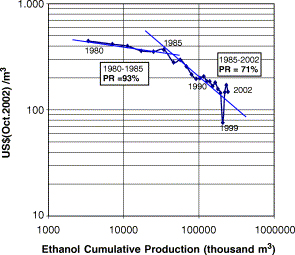
The decline in cost for ethanol fuel produced from sugarcane in Brazil (click to Enlarge)
Technological change exogenous to the energy industry also affects the EROI. For example, the development of more efficient combustion engines would, ceteris paribus, improve the EROI for oil extraction that relies on such engines to lift oil to the surface. Similarly, a decrease in the quantity of energy required to produce a kilogram of steel will, ceteris paribus, improve the EROI by reducing the energy embodied in oil field equipment.
10. Alternatives to the dominant energy and power systems show a wide range in EROI
Most alternatives to conventional liquid fuels have very low or unknown EROIs. The EROI for ethanol derived from corn grown in the U.S. is about 1.5:1, well below that for conventional motor gasoline. Ethanol from sugarcane grown in Brazil apparently has a higher EROI, perhaps as high as 8:1, due to higher yields of sugarcane compared to corn, the use of bagasse as an energy input, and significant cost reductions in ethanol production technology. Shale oil and coal liquefaction have low EROIs and high carbon intensities, although little work has been done in this area in more than 20 years. The Alberta oil sands remain an enigma from a net energy perspective. Anecdotal evidence suggests an EROI of 3:1, but these reports lack veracity. Certainly oil sands will have a lower EROI than conventional crude oil due to the more diffuse nature of the resource base and associated increase in direct and indirect processing energy costs.
On the power generation side, coal, and hydropower have the highest EROI among conventional power systems, although the latter has very limited potential for further expansion in most regions of the world. Nuclear power appears to have a lower EROI, but there are very few credible studies that are thorough and unbiased. We do not know what the EROI will be from the new generation of nuclear reactors that would be built if demand for them returns. Wind has a very favorable EROI in the right conditions, while solar thermal and photovoltaic systems have lower EROIs compared to coal and hydropower. As outlined above, a key issue is the size of the surplus that can realistically be delivered by those renewable power technologies.
A final point for consideration:
Carbon may trump EROI. The growing concern that climate change may impose swift and large costs on society may drive the next major energy transition. It is plausible that carbon intensity, as opposed to net energy, may be the principal attribute of future energy systems that determines the timing and pace of their adoption. Society may choose to forgo the benefits of a larger energy surplus to reduce its exposure to climate-related risks.
Further reading
Original posting of the article at the Encyclopedia of Earth here
Biopact. 2006. Brazilian ethanol is sustainable and has a very positive energy balance - IEA report
Bullard, Clark W., Peter S. Penner and David A. Pilati. 1978. Net energy analysis: Handbook for combining process and input-output analysis. Resources and Energy, 1978, vol. 1, issue 3, pages 267-313.
Cleveland, Cutler J. 2005. Net energy from oil and gas extraction in the United States, 1954-1997. Energy, 30: 769-782.
Cleveland, Cutler J., and Robert Herendeen. Solar Parabolic Troughs: Succeeding Generations Are Better Net Energy Producers. Energy Systems and Policy 13: 63-77 (1989)
Cleveland, Cutler J., Robert Costanza, Charles A.S. Hall, and Robert Kaufmann. Energy and the U.S. Economy: A Biophysical Perspective. Science 225: 890-897 (1984).
Farrell,, Alexander E. Richard J. Plevin, Brian T. Turner, Andrew D. Jones, Michael O’Hare, Daniel M. Kammen. Ethanol Can Contribute to Energy and Environmental Goals. 27 JANUARY 2006 VOL 311 SCIENCE
Gever, John, Robert Kaufmann, David Skole, Charles Vorosmarty. 1986. Beyond Oil: The Threat to Food and Fuel in the Coming Decades
Hall, C.A.S., J.A. Stanford and R. Hauer. 1992. The distribution and abundance of organisms as a consequence of energy balances along multiple environmental gradients. Oikos 65: 377-390.
Hall, Charles A.S., Cutler J. Cleveland, and Robert K. Kaufmann. Energy and Resource Quality: The Ecology of the Economic Process. (Wiley Interscience: New York, 1986). (Reprinted by the University of Colorado Press, Niwot, CO 1992).
Lenzen, M. and J. Munksgaard. 2002. Energy and CO2 life-cycle analyses of wind turbines-review and applications. Renewable Energy, 26: 3, pp. 339-362.
Odum, H. T., 1971. Environment, Power and Society. Wiley-Interscience, New York. ISBN 047165275X
Smil, V. 1991. General Energetics: Energy in the Biosphere and Civilization. John Wiley, New York. ISBN 0471629057
Spreng, Daniel T. 1988. Net Energy Analysis and the Energy Requirements of Energy Systems (Praeger). ISBN 0-275-92796-2
Tainter, Joseph A. (1990). The Collapse of Complex Societies (1st paperback ed.). Cambridge: Cambridge University Press. ISBN 0-521-38673-X.
Contact
- Content: editors at theoildrum dot com
- Tech support: support at theoildrum dot com
License

This work is licensed under a Creative Commons Attribution-Share Alike 3.0 United States License.
Note the new reddit and digg counters! just click on them and hit the up arrow/digg button to help out!
Don't forget del.icio.us or your other favorite link farms, such as metafilter, stumbleupon, slashdot, fark, boingboing, furl, or any of the others.
I can assure you that the authors appreciate your efforts to get them more readers.
Another long winded rant presenting one of the favorite red herring arguments here at TOD. At best net energy and EROEI might be relevant in the final stages of post peak oil decline. At the moment no business decisions are made on the basis of net energy or EROEI. If they were, we would have to shut down the electric utility industry for sure and probably most of the industrial economy. EROEI applies only to ethanol and is used by doomers to attack alternative fuel peak oil mitigation efforts. Energy is not a finite resource like fossil fuels. A fresh supply arrives each day from the sun. You can cover the earth with PV panels or you can capture solar energy with agriculture. Take your choice.
what a helpful and constructive comment. thank you for your participation.
Actually, Prof. Goose, he has a point. I found the IROWI (Information Return on Word Investment) of this article very low. It contained nothing new and very little substance. Since I expected more, I was very dissapointed. Maybe I should have expected less to spare me the feeling that I wasted twenty minutes of time reading it?
Practical also brought it to the point: unless we decide to go hardcore nuclear (breeders and ultimately fusion), our only choice to tap into an energy flow that will last for as long as human civilization will (and a lot longer) is solar energy. Alternatively you can slow the planet's rotation down, de-orbit the moon, drill geothermal to the core, capture asteroids or do a bunch of other wild stuff. Those SciFi solutions will work too... they are just a lot harder technically and more costly by orders of magnitude.
Feel free to discuss the physical details with me.
IP - I am posting Professor Clevelands response to "Practical" up here, because Practicals prominent post merits a prominent response- sorry for the gauche blog behavior
"At the moment no business decisions are made on the basis of net energy or EROEI."
Who ever said day-day business decisions are or should be made according to net energy criteria? No one I know of. EROI is a long run force that has shaped every major technological, economic, social, and environmental transformation we have gone through, and most certainly will drive the next one. It sets broad but immutable constraints on what is and is not possible. Investment undoubtedly will be driven to sources with the higher net energy gain, unless non-market forces interfere, because free market systems probaly try to mazimize power see (H.T. Odum).
"If they were, we would have to shut down the electric utility industry for sure and probably most of the industrial economy"
Did you read and understand the section on enegy quality? We trade 3 BTUs of low quality (coal) for 1 BTU of high quality energy (electricity) because that 1 BTU can do more economic work-produce more GDP-than those 3 BTUS of input fuel. An appropriately done EROI of a utlity reflects this reality.
practical - two questions:
1) if you cover the earth with PV panels or capture solar energy with agriculture, there is a cost associated with concentrating and delivering this energy. Do you know what that cost is? In dollar or energy terms?
2) did you actually read Dr. Clevelands post? he addresses many of the concerns in your short winded rant.
1) Today: 25 cents/kWh residential PV, 12-15 cents/kWh industrial PV and 8 cents/kWh thermal solar on the GW scale. Ten years from now: 30% less. 25 years from now: 60% less. I bet you can afford that.
2) No, he didn't. But he fooled you quite well with language that is fluffy and sweet, like cotton candy. And like cotton candy the article contained little that is actually nourishing.
1) You've neglected the cost for new (non-waste)silicon, additional storage, transmission lines, maintenence and labor of pv systems. The boundries for eroei analysis are greater than those for energy efficiency studies
2)Your analogy is lacking. Cotton candy is light and contains little caloric content but is full of embodied energy. She spinning machine and labor use a lot of energy
1) What I quoted was total cost of ownership divided by total energy produced. That is usually what you do for all other electrical sources, too. Transmission cost of PV is lower than that of conventional power sources because the generator can be on your roof rather than three hundred miles away. There is even an over-unity net gain because local generation causes smaller peak loads in summer and the reduction of I2R losses from the coal fired or nuclear or whatever power plant will show up as a greater than unity transmission efficiency for PV (all other things being equal). There is never a free lunch, but sometimes there is a win-win.
2) I meant to say that cotton candy has a lot of calories but you couldn't survive on it. A pure cotton candy diet leads to avitaminosis and lack of essential amino acids and fatty acids. Please don't ever try. No matter how much of that stuff you will eat, you will always get sick and ultimately die.
What we need here are essential facts, not BA kind of fluff!
Then you will have to incalculate that: either the panels are on the roofs, where people live, or they are in a place where there is more sunlight in a better angle, where they can be more efficient.
IP
I agree that an article should ultimately be judged by the quality of the data and argument, but when did good writing become a character flaw? Most scientific writing suffers from a terrible form of prose that follws the following sentence structure ad nauseum: preposition...preposistion...linking verb...preposition...preposition.
E.g.
The cost OF installation OF solar panels WITH the new technology invented BY our company IS less than the cost OF operating the older system WITH the inefficiencies inherit In the system.
or
The effect OF the medication ON systolic blood pressure IN the experimental group WAS greater than the effect ON the placebo group IN this study.
This latter sentence could be rendered:
The medication effectively reduced the experimental group's systolic blood pressure more than the placebo group's.
By avoiding all the prepositions and allowing an action verb to create some of the sentence's meaning, the point is made more clearly and is easier to read.
If you read a lot of scientific writing, like I do, pay attention as you read. You'll become aware of how repetitive and redundant this lazy form of writing is and how it detracts from the writing and makes the point less clear. And then you'll realise how refreshing it is to read something like Mr. Cleveland's essay.
Oh, and yes, the "repetitive and redundant" phrase was intentional.
While a lot of prepositions is possibly harder to read, it may ease the task of expressing a complex sentence/idea as exactly as possible.
A bit of nitpicking here, Your rendition of the medical phrase differs from the original (it seems to me that the "effect" in the original phrase is not quantified, it could be positive or negative, or chaotic?).
Yea, you're right. "effectively" is superfluous. I shouldn't criticize poor writing without taking the time to avoid other writing pitfalls!
I agree Nate. Various people have quoted figures like $0.25/kWH cost for PV energy, but my own real-world analysis puts it a closer to $0.40/kWH for the median insolation case. This is 'real-world' in the sense of getting an actual amortized cost of a system of a given size for residential installation. An additional point to note in this kind of amortization cost is that one is paying for this electricity whether or not one is using it. If, ideally, surplus is sold back to the utility at retail (they often pay only wholesale) even then, in my location I would be paying ~$0.32/kWH net for what I was selling back to the utility. Clearly, to me at least, unrealistic numbers are being used to make PV look better than it really is.
For large-scale centralized PV power generation, seldom have I seen a realistic assessment of the grid-penetration/storage problems. Usually you just get an arm-waving, 'we will simply use pumped water storage.' without any further analysis of the infrastructure and maintenance costs and how they would affect the EROI of an energy source that is already marginal.
In the section '5. Energy quality matters' the downside of PV energy is clearly that one gets essentially a trickle of power for the amount of capital investment.
I'm definitely in favor of intensive research on 'renewable' energy sources as well as research on how to change our lifestyles. But I'm really tired of rants like 'practical' makes or arm-waving claims of powering industrial civilization on the arm-waver's favorite pet energy source.
Many thanks to Dr. Cleveland for an excellent summary. I should read up more about the earlier work he cites on net-energy studies. So should others, especially the know-it-alls.
ET,
Could you give the details of the PV costs you found, so that I can reconcile them with the estimates I've seen?
If you could, I'd appreciate: total cost; installation cost; peak rated capacity; and projected # of kwhr's. I believe you used an interest rate of 6%.
A few thoughts: your rate of 8 cents is cheaper than average, and is much less than the actual cost of providing the peak power that solar provides: the fact that your power rates are averaged over the whole day subsidizes peak electrical consumption. Average cost in the US is about 10 cents, and peak power ranges very, very roughly from 15 to 35 cents.
Pumped storage is an old, proven and cost-effective method of storing electricity, not a vague hand waving kind of thing. It hasn't been used more because nat gas peaker plants have been so cheap. Nevertheless, there are many existing examples such as the Luddington MI installation that was paired with nuclear roughly 30 years ago, and is still in use. AlanFBE gives cost figures that amount to less than 1 penny per kwh stored, and of course only a fraction of the energy would require storage.
I have seen quoted:
~$33,000 for a grid-tied system that would deliver estimated average of 541/kWH/mo in a median case insolation zone, half way between worst and best cases. This price does not include installation, but I could possibly get a better price, so for the sake of being generous, assume it does include installation.
$33,000 @ 6% for 30 yrs = ~$197/mo payments
on top of this, my grid hookup basic maintenance cost is $12/mo.
I would conservatively estimate other routine maintenance at $5/mo
giving a total monthly outlay of ~ $214
($214/mo)/(541/kWH/mo) = ~$0.40/kWH
I'm just going by the insolation chart and I'm sure results will vary. As I pointed out, this $214/mo would be laid out regardless of electricity production or usage. I could use a smaller system, of course. It would be relatively easy to downsize my consumption to ~300kWH/mo but the cost per kWH would remain the same. For ~540kWH/mo my bill for grid power runs about $55/mo. and goes down if I use less.
To me, this is the 'reality check' that tells me the true story of cost as it is right now. Hopefully things will improve.
"Hopefully things will improve."
I would look pretty silly if I 'invested' in such a system today and paid $0.40/kWH for the next 30 years when PV proponents are telling me that costs are going to come down to $0.20kWH or less in the next 5 to 10 years.
Sure, it's probably a very good idea to wait for costs to go down. A lot of people are doing that - in effect they've been priced out by price supports in Germany.
And of course, if there are no subsidy programs to reimburse you for the external benefits (direct pollution, GW, security, etc) I wouldn't expect you to invest in something that doesn't pay for itself.
Funny you should mention that. I was just considering the fact that the electricity on the grid here is a larger percent hydro than anything else. A PV system would likely have come from a coal-fired electricity driven factory in Taiwan or ROC, putting plenty of crap into the biosphere.
And could you tell me how a grid-tied system helps security?
This was all basically a cheap shot.
Hydro is your cheapest source. PV will displace other things first.
Security: please note that I was discussing externalities, not direct user benefits. Increasing renewables will displace natural gas first, as it's most expensive. On the margin it's imported, and this will increasingly be from places like qatar, where the security of supply is very low. You may have noticed that we're currently spending $1.2T (and 10's of thousands of american casualties and Iraqi lives) on access for oil in that region.
I of course see cost as relevant to people deciding whether or not to buy a system, but I don't see how it relates to how good or bad PV is as a piece of the energy solution. For one thing, the PV system should be producing for 30-40 yrs or more, and to be fair one would have to compare the PV system to the alternatives available and their cost each year down the line while the PV is producing, not the cost today of suddenly burning a barrel of oil out of the ground, which is then gone forever.
The question really is whether the energy investment will pay off, not the dollar investment. I think there are added benefits - no greenhouse emissions, less stress on grid transmission, and for us, the knowledge that our PV system will supply almost all our annual electrical needs as long as we live in our home - price security in other words, and the option for us to put in battery backup in the future if we want.
Do you have the peak power rating? That's the traditional way of costing out the capital cost of PV. Of course, your capacity factor determines your cost/kwh, and the two are directly related.
I would suggest you get started with a much smaller system. How much are you willing to invest in going a little more carbon neutral this year? $3000? Why not buy two panels and an inverter? Next year you can buy another couple of panels, but hopefully cheaper (if the silicon crisis can be resolved). Ten years from now you can get the same capacity for maybe close to half the price. By hedging your investment you will have done yourself and the environment a great favor.
For a proper financial calculation of solar energy cost one has to do hedging, anyway. Since the solar industry is growing rapidly, the majority of the investment will be done late in the game, at the lowest price of the mature market. On average solar energy will cost close to the market price 25 years from now, not what it costs now.
And, like I said in another post... solar is growing as fast as it possibly can due to technical limits. Now we have to wait and see how long it will continue to grow and how much that buys us.
Alternatively, you can always buy green energy from your utility. It will cost something like $20/month and they will build a wind farm somewhere or give CFLs to people. The results are just the same, probably even better than if you try to go solar yourself. They get a price advantage of almost a factor of two which you don't. How do I know? I did inquire for quantities of concentrator solar cells a while ago. They company was happy to sell 500kW+ to me for $3.50/Watt but wouldn't budge to ask for $6 at the 1kW level. Needless to say... I had neither $1.75 million nor a place to put up the concentrators.
Even at 40cents/kWh you have a viable energy source. Once the oil wells are dry, you can't say that for oil. The argument "But it's too expensive!" does not hold much water on that background. Neither does it do much for you in comparison with nuclear, unless your county puts up a sign "Please build the next nuclear power plant HERE!".
"An additional point to note in this kind of amortization cost is that one is paying for this electricity whether or not one is using it."
Since your solar panels are connected to the grid, any energy you aren't using is being used by someone else. They happen to be paying for it.
"For large-scale centralized PV power generation, seldom have I seen a realistic assessment of the grid-penetration/storage problems."
There is no storage problem as long as you don't have to shut down ALL your other power plants, which won't happen for at least another 30-40 years in case of solar energy. You simply have net savings in coal/natural gas. I bet with you that ten years down the road you would love to have more cheap NG in winter to heat your living room! You will ask yourself... why, oh, why did we have to waste 60% of the BTUs in NG in our electrical plants? Couldn't we have put some more wind turbines and solar panels up back in the days when there still was NG?
And as for the power grid... I am already paying for the grid on my current electricity bill. It is a fraction of generation cost. With stronger grids that cost will go up. Is that a problem? The grid argument falls into the category... "But it is too expensive!".
"Clearly, to me at least, unrealistic numbers are being used to make PV look better than it really is."
You can discuss that with the 10+ billion dollar industry that is growing at 30% per year. I am sure all these people are just wasting their time. They will thank you for your advice not to invest in the world's next great growth industry.
For what it is worth, in Southern Connecticut where I live, given the state and federal rebates and the renewable energy certificates, solar power is cheaper than buying from CL&P, the local utility. Return on investment is between 5 and 10%. Current power costs are now $.18/kwh.
You apparently did not read item 5. (Energy quality matters), which includes:
Solar energy is free but dispersed and to compare it to concentrated and self-pumping petroleum is ridiculous.
Collecting solar is a lot like rounding up and collecting spilled packing peanuts on a windy day. It takes a lot of effort for little gain. To replace petroleum with solar would mean a lot more people would be employed making energy and not available doing other important stuff.
You said "At best net energy and EROEI might be relevant in the final stages of post peak oil." When is the 'final stage of post peak oil?' When do we start considering the declining energy content of our efforts. Why is not now the time to begin?
"Solar energy is free but dispersed and to compare it to concentrated and self-pumping petroleum is ridiculous."
I completely agree. To compare a resource that is, for all practical purposes, infinite (are you going to be here six billion years from now?) with a one time win in the geological lottery is ridiculous.
"When is the 'final stage of post peak oil?'"
It depends. For many of us it might be the day we buy our first EV that comes with a coupon for solar panels. I would say, some time around 2020-2025. Might be a bit earlier, might be a bit later. Certainly within my natural life time.
But you are right. The right time to act is NOW.
Is oil really self-pumping these days?
On solar E-ROI (which is what you're talking about), see my later posts in this article.
This is an excellent summary by Dr. Cleveland of his valuable research on concepts that are often bandied about on TOD. I'd like to say thank you for your hard work, and thank you for being open enough to share the work on a site often haunted by trolls like "practical".
I hope we can add this to some of the summaries of articles like the ones by Stuart. I don't think every article has to contain completely new facts or theories to be worthwhile to educate people, which is one of the main functions of TOD.
We have a huge number of indirect subsidies on many businesses in our society. The Bush Energy Plan and the democratic energy plan are both being currently debated in the United States, and they both are looking at subsidies for ideas of doubtful utility. I'm really glad TOD publishes this kind of article.
"and they both are looking at subsidies for ideas of doubtful utility"
To a certain degree this assertion is true, however, it is also misleading. Many ideas considered do indeed contain great promise.
"Many ideas considered do indeed contain great promise."
For investors in porking plans like Syntec, you mean? I am sure you are right about that. I just don't believe there are any promises in them for honest people who have to pay for the scam with their tax dollars.
More NOOB gems of wisdom.
As compared to a stock pusher advice? Too bad there is no spam filter on TOD.
You are making a very common error, equating "conversion efficiency" of electricity generation (always less than one--I'm sure you understand the second law of thermodynamics) with "energy return on investment". When conversion of energy forms are involved in an EROI analysis, you need to chain the results. Start with the primary energy form such as coal, with an EROI of 20-30, and multiply that by the conversion efficiency, say 33%. The resultant EROI is still quite positive.
The "industrial economy" has no EROI in and of itself. You appear to be mistaking energy intensity of production with EROI. EROI only applies to energy.
You're missing the point he is making. We are transforming an energy source from an unusable form, to one that is usable.
You started going down the thermal efficiency path, then took a right turn into EROEI.
EROEI is a f*ckin numbers nightmare that people can spin as they please by including or not including specific numbers, confusing people who don't have a good grasp on the subject even further.
For example, take your EROEI analysis of coal to electricity. You conveniently didn't include the coal burned to spin the turbines in your EROEI calculation, only the energy burned mining the coal. An ethanol lobbiest would love to apply this methodology to all of the natural gas they burn making their finished product, but unfortunately we can not do this because the feedstock can be used for many different purposes, therefore it isn't 'free'.
Again, as I've stated before, EROEI while useful if someone is comparing apples to apples, is repeatedly misused.
Excuse me? Exactly what is the 67% wasted heat in the example I just gave? The loss of burning coal for electricity generation. That's "conversion efficiency". It's included explicitly.
EROI certainly has problems, but tell me that the market doesnt! Id rather make long term decisions based on energy than based on dollars. The dollars will follow (or something of value will)
One of the things Im devoting my time and resources is to standardize and EROI methodology that can actually be used by policy makers to use our few bullets to their best advantage of turning fossil fuels into renewable infrastructure. The national scaling of corn ethanol MIGHT turn out if we have a cellulosic breakthrough but the ONLY reason its being scaled is due to subsidies and the money that people can make (from our taxes essentially). EROI aint perfect, but its looking a step down the road.
That's not what he said. EROEI is a numbers nightmare that rapidly boils down to nonsense. Net energy does NOT have the same problem. It can be easily understood, and the books aren't automatically cooked in the same way they are for EROEI. Net energy analysis is a fine thing to do, X barrels of oil becomes Y gallons of Gasoline, all things considered, that's fine. EROEI, I give you 8 apples and you give me back 10 vs. I give you 1 apple and you give me back 3, is there a difference here, the EROEIs are wildly different, but tell me that this matters in ANY way? It doesn't.
Nobody's claiming that things should be measured in dollars and cents, they're just wondering why you bring in the mathematically quesionable black magic of EROEI when there is no reason to do so. There are many reasonable ways to measure system efficiency, why rely on one that is by construction not reasonable?
Here's how it matters. You have an apple tree with 9 apples on it. In your first scenario, you can trade 8 for ten. You net 2 apples from your tree. You have 11 apples to use. And you're done trading up from your tree. In the second, you give away 1 for 3, 9 times. You net 18 apples from your tree. You have 27 apples to use. HUGE difference. EROEI matters because you've got to have energy in the first place to net whatever. If one barrel of oil can be used to find, pump, and process ten, you net nine to use for all we use it for, including finding, pumping and processing more. If one barrel of oil can only be used to find, pump and process 2 barrels, good luck running a civilization.
"At the moment no business decisions are made on the basis of net energy or EROEI. " Who ever said day-day business decisions are or should be made according to net energy criteria? No one I know of. EROI is a long run force that has shaped every major technological, economic, social, and environmental transformation we have gone through, and most certainly will drive the next one. It sets broad but immutable constraints on what is and is not possible. Investment undoubtedly will be driven to sources with the higher net energy gain, unless non-market forces interfere, because free market systems probaly try to mazimize power see (H.T. Odum). Hows that for a "business decision?"
"If they were, we would have to shut down the electric utility industry for sure and probably most of the industrial economy" Did you read and understand the section on enegy quality? We trade 3 BTUs of low quality (coal) for 1 BTU of high quality energy (electricity) becasue that 1 BTU can do more economic work-produce more GDP-than those 3 BTUS of input fuel. An appropriately done EROI of a utlity reflects this reality.
Cutler: First, just want to say thank you for a provocative and interesting article. I do have a query on the following statement:
The EROI calculation does not take into account the negative externality associated with the CO2 emissions of the 3 BTUs of input coal. Since those emissions are in excess of the natural clearing capacity of the environment (with a renewable fuel source the assumption is made that the next growth cycle would remove an amount of CO2 equivalent to that just emitted). Someone, at some point in time, must bear the associated costs. You are describing obtaining a present quality but in doing so you are transferring a disutility to someone in the future. Your comment?
The EU appears to be in the process of introducing some form of NEA and will be requiring that products sold in the EU list their carbon content. This would premit the consumer to discern between broccoli from Chile and broccoli from next door. Do you have any information on this use of NEA?
Cheers!
At the moment no business decisions are made on the basis of net energy or EROEI.
So....
At best net energy and EROEI might be relevant in the final stages of post peak oil decline.
If true, then that shows the economic system built to date will have to be re-thought.
Exactly how shall that be done in a nice way VS a not nice way?
You can cover the earth with PV panels or you can capture solar energy with agriculture.
Solar photons are also expressed as water evaporation subjected to daming and wind machines.
If the only choices are PV/hydro/wind/Ag then how shall the present economic model be maintained or even the present population?
deleted
When I introduced Cutler at our Peak Oil and Environment conference in DC last year, I said he had been doing energy analysis since I was watching Gilligans Island reruns in high school. He is unequivocally an authority on the topic of net energy, and energy and the environment in general and I think the piece above is an excellent, readable overview to net energy. And while I may have a comparative advantage in 70s TV shows, here are some of my comments about net energy and the above post. (Though a little long, I did all the work on the above formatting and Cutler is a friend and colleague so I feel entitled..;)
In general, I view net energy analysis as a critical tool in mitigating and adapting to the future decline in energy availability. My rationale is as follows: I believe and understand a)Peak Oil is on the horizon and b) people have steep discount rates and only react to things once they impinge on their daily routines. When you combine these two facts, analyzing things in energy terms instead of dollars makes sense. It's like looking ahead two cars in a traffic jam in bad driving conditions-looking ahead one car isnt enough to react in time. We know that the world will be comparatively limited by energy as opposed to dollars in the future. Using analysis that looks ahead and thinks in energy terms, keeps us ahead in an industrial world of long lead times.
This is amazing, true, and a bit frightening. It suggests that we are evolved to seek out high net energy. The implication is that as net energy declines, our evolutionary programming (as a species) will continue to seek it, and technology and more drilling may not be the method we use.
This is spot on. We need to know EROI, scalability, timing and environmental impact. EROI is important but doesn’t tell us the whole picture. Shooting a deer on my property with my bow and arrow has a 1000:1 EROI which is much better than oil. However, were other people to 'scale' this practice, the planetary average EROI for this practice would plummet and there would be environmental costs (no more deer)
Fossil fuel depletion presents us with both a demand and supply problem. The depletion itself concerns supply – what we replace it with has the opportunity to change demand -the danger of replacing high EROI fossil sources with high EROI renewables, is that the energy surplus still multiplies through the economy like a fractional banking system. If the energy is there, we might still spend it on other extractive industries and ‘stuff’. Carbon is not the only thing to worry about.
One of the assumptions in net energy analysis is that all other input factors (land, labor, water, etc) are held constant. In this theoretical case, what Dr. Cleveland says is true – a large scaling of corn ethanol to replace middle eastern oil would find many of us in the employ of Archer Daniels. However, it is possible to have a lower EROI technology that uses less of all other inputs-in this case, it wouldn’t necessarily take more energy away from non-energy producing society.
Absolutely. Our choices for what we ‘need’ dictate at what point on the efficiency spectrum we choose to stop in the energy upgrading process. Right now we need liquid fuels, so to refine ethanol over and over to get the last drops of water out loses more 'energy' thermodynamically than using the precursors earlier in the process (for heat or something else.) We choose to do this because we value the energy services of driving more than the extra BTUs. In a world of total abundance, net energy and efficiency don’t matter much – if a solar cell is only 2% efficient, but it is free, I really prefer it over one that is 5% efficient but has a cost. Net energy therefore IS important, because we live in a world of finite resources, and energy is a damn important one.
Yes, as much as net energy purists would like to think so, EROI calculations are almost impossible to do without involving economics. There is not a pure cutoff between biophysical and economic analyses. Furthermore, EROI only represents an energy payoff at a discrete snapshot in time – a wind turbine at 10:1 might drop to 8:1 if the manufacturer has to use a much less efficient way of getting his steel imported.
This may be true, but if so, this knowledge is largely sequestered in academic circles and writings. I know Life Cycle Assessment has replaced net energy analysis in much of the international energy literature, but policymakers were aware of the importance of net energy during the 70s energy crisis, but are largely unaware of this tool now (except for Roscoe Bartlett and a few forward thinkers). Hopefully this will change.
Yes, and possibly other things as well, like water, soil or land. Future policymakers might need to synthesize Energy Return on Investment (EROI), as well as how much energy they get from the water invested (EROWI), or soil, etc. It is hard to forsee what our planetary weakest link will be, though certainly climate change looms large. We live in a big interconnected global ecosystem.
In conclusion, thanks Cutler for continuing to work in this highly important, but little recognized and underfunded area of research. Net energy analysis does not give us the final answer, and needs to be used in conjunction with economic analyses and environmental assesment. But, after reading the work of Joseph Tainter, I believe decisionmakers need to include the net energy arrow in their quiver of peak oil policy tools.
Nate, thanks for your efforts on this file.
I find the following selection from your commentarty a little confusing and wonder if you might have another go at it:
"One of the assumptions in net energy analysis is that all other input factors (land, labor, water, etc) are held constant. In this theoretical case, what Dr. Cleveland says is true – a large scaling of corn ethanol to replace middle eastern oil would find many of us in the employ of Archer Daniels. However, it is possible to have a lower EROI technology that uses less of all other inputs-in this case, it wouldn’t necessarily take more energy away from non-energy producing society."
Imagine 2 energy technologies, both with EROIs of 5:1. The first uses alot of land, and water and soil and labor and infrastructure in addition to the energy inputs. So if we want to create 1 quad of energy more than we have today, in addition to a .2 quad energy input (to get the 5:1) we also have to scale up labor immensely, increase the amount of land we allocate to this scaling, etc. In effect, for every 5 units of new energy we need, we will need 1 new laborer, 1 unit of land, etc.
The second process only requires energy as an input - all the land and labor is not necessary -in this case we could input .2 quads of energy and output 1 quad - with no other inputs necessary, this type of technology could be very scalable, so much so that it could offset an even higher EROI technology that uses greater ancillary inputs.
The point being is that we typically compare and EROI of 3 as better than and EROI of 2, but there are other inputs that limit/expand the scalability of a process. I am working on a paper now to this effect.
the former energy technology uses (in your words) "alot of land and water and soil and labor and infrastructure." If the boundry of the eroei calculation were widened to include the cost to house, transport, clothe, and feed the laborer and the materials to maintain the infrastructure, then the net energy would be shown to be less. Then the latter (the second process) does show a greater net energy.
I agree, and would be taken from the productive food chain and so externalities must be considered.
No, I meant if the widest reasonable boundaries were used, and the EROIs were equal. They STILL might have different non-energy inputs. Its nearly impossible to reduce all inputs into energy terms, though some would like to.
If the first technology required 10 people to operate, and the second only 1, you would figure on all the costs to clothe, transport, and feed the laborers, etc, but you would still need 9 ADDITIONAL LABORERS as an input to the first technology.
So in theory at least, a black box energy machine with few non-energy inputs could keep us from an archer daniels midland path. But certainly corn-ethanol is not such a technology. It requires loads of non-energy inputs.
Why make this conversion at all? For an energy generating process, the energy it consumes is the one thing that you emphatically don't care about, why are you fixated on it? What you DO care about is how much non-energy stuff it takes to produce the net energy that it does produce. You know, 1 acre of land becomes X gallons of ethanol, or something like that. This is what really matters, because when we're trying to produce energy, unless we have some perpetual motion machine, the access to energy is never the problem, the other inputs are. The system itself is converting non-energy inputs into energy outputs, why are you outright ignoring the non-energy inputs, when they are the only ones that matter?
This is the problem with these analysis, why are you always trying to convert all resources into one number. People do it with human footprint too, so burning 10 pounds of coal is like plowing up X acres of land? Doesn't follow, it's a total logical jump that isn't supported by any sort of sound reasoning. We have many resources, we need many resources. Energy is one of the primary ones we need. The real issue is how to convert what we have to what we need, and in particular, given what we want, how much of the "raw materials" we have (land, water, coal seams, oil fields, etc...) does it take to make what we want? How can we minimize this, or trade out things that are valuable (land, lets say) for things that might not be as valuable, say blobs of black rock underground. If it takes 10x the stuff we have to make the stuff we want, then we clearly have a problem, and it has nothing to do with EROEI (which is, to put it simply, how much stuff we want does it take to make other stuff we want....who cares, just subtract them and use net numbers).
You have me confounded. How can you say
if it take more energy to make the ethanol than it contains?
this statement is not true. 1 acre of land does not become x gallons of ethanol. It is converted at great energy expense into x gallons. Possiblely a greater energy expense than is contained in the ethanol
Who is ignoring the non-energy inputs. Because ethanol production is so inefficient the issue of land scale and unintended consequences (loss of food, habitat, aquifer maintenance) become primary.
Energy is not a resource like tin or copper that you dig from the ground. It is a condition of the known universe that must be contained and converted into a useful state. If that specific act, the effort of containment, requires more of that same exact energy you are looking to produce, then you stop. you give up. it is a useless exercise. That is the ultimate value of this analysis
pete
Dude, come on. Read it over again and I'm sure it'll make perfect sense, hopefully.
1) If it takes more energy than it makes, it isn't an energy generating process.
2) Use NET energy. What it makes, minus what it consumes. Compare to all the OTHER inputs. X acres of land produces Y units of ethanol NET.
There is NO value to this analysis. Lets go through the SUPER simple example. Argue with this, as I think we'll have more success in the realm of fruit than of energy, people get too mystical with energy, even though it's equally simple.
If you have a process that takes 10 apples and produces 11, then you have a process that produces one appl. If you have a process that takes 2 apples and produces 3, then you have a process that produces one apple. If you have a process that produces one apple, then you have a process that produces one apple. If you have such a process, your supply of apples has NO bearing on anythin, at all, ever. If this is the process you have, then you will never be short of apples, end of story.
This is not the process we have. We have a process that takes 10 apples and one strawberry to make 11 apples, so we have a process that "converts" a strawberry into an apple. Our supply of apples is irrelevant, our supply of strawberries is all that matters.
The Apples Returned on Apples Invested (AROAI) for these processes are all wildly different, ranging from infinity to 1.1, but all th processes are really the same (except for the last one), so this number has NO relevance, NONE, AT ALL. What matters is the efficiency of converting strawberries into apples, which is (here) 1:1.
Now, replace "apple" above with "barrel of oil equivalent" and "strawberry" with "units of oil in the ground", and it should all be completely clear. See the insanity? See why actual scientists don't reason like this? Those who do are PhDs in Geography and economists. I have no idea why RR stoops to this level, he seems to be otherwise very intelligent.
send me an email and i will send you my two pending papers which address all your concerns (I think)
We are talking about replacing petroleum with another primary energy. How is it possible to describe "non-energy" inputs? Labor is energy input as food calories.
The Brazilians often promote sugar alchohol energy return 8:1. I question that because production uses 8 human laborers/hectar with associated housing, transport, clothes, food, etc. calories.
pete
"This is amazing, true, and a bit frightening. It suggests that we are evolved to seek out high net energy."
And like many ideas that sound great until you reflect about them, it is completely wrong. You might want to read a few books on evolutionary biology. Nothing evolves to do anything. Lifeforms which are better adapted to their environment than other life forms simply survive with a higher probability (that is the definition of better adapted, by the way: if your survival probability is higher than that of others). It has nothing to do with how much energy a species uses to do that or where that energy comes from. Some of the sturdiest forms of life use very little energy. They have made use of the fact that no life that uses more than they do can survive in their niche. In contrast, humans have adopted a strategy that is extremely wasteful but we can adapt to a lot more ecosystems by utilizing any little scrap we find. And I am not talking about energy, but ANYTHING.
Please ask a geneticist about the genome of modern plants. They will tell you that it is a lot more complex than that of humans. The generally accepted explanation is that a plant has no choice about its environment. It can not move into the shade when it is hot or dress up when it is cold. It can't walk to the water hole when the soil is dry. It is subject to many different forms of microbial attacks and it can't scratch it's bark to get rid of bugs. But what a plant can do is to synthesize incredibly complex organic compounds (many of which we use as drugs) to counter the environmental stresses it is subject to. And that is what plants do to survive: they live stationary lives of constant biochemical adjustment and warfare. We, on the other hand, are environmetally extremely fragile but make up for that with agility. But as biochemical synthesis machines, we totally suck. We depend on plants and other animals to provide for us.
That is how life works: by adjusting to wherever it is, not by maximising a single paramter that has nothing to do with the real forces that will kill you (like temperature, drought, predators etc.) and are driving evolution by selection.
Sorry to say it, but this is just one problem with the article. I could discuss more if I had to. But why bother?
I am a geneticist; please--don't bother.
Don't bother to do what? To ask you to point out to us where the energy seeking gene is? You bet, I won't bother. It's not there.
But be free to give us a link to it in
http://genome.ucsc.edu/cgi-bin/hgGateway
(or any other database of your choice) if you want to argue in favor of the idea that evolution is driven by energy seeking behaviour rather than natural selection.
And please keep in mind: I am just a physicist... so what do I know? You can easily beat the crap out of me on this one, right?
:-)
Hello IP,
I respectfully disagree. A lifeform's first and continuing function is to seek net energy--that is what drives natural selection. As a fertilized egg uses up its internal reserves from progressive cell division: it puts out roots and leaves in the case of a plant, and other lifeforms create an umbilical cord to the parent. Other examples abound.
Please consider this simple experiment: temporarily cover your nostrils & mouth with duct tape. I think in short order your DNA's evolutionary design will impell you to seek a sustainable energy basis again.
EDIT: added "and other lifeforms create" for clarification.
Bob Shaw in Phx,Az Are Humans Smarter than Yeast?
LOL but, well, that is true only if you consider 02 prime energy. What about nanoenergy and virtualenergy and just well, thinking really really hard about stuff?
pete
Hello ANewLand,
Thxs for responding. We can "think really, really hard about stuff" merely because we evolved residual stored reserves of surplus biochemical energy that allows this function. Now whether we think appropriately is another topic entirely--LOL. Viruses and other minimal lifeforms, that don't have these internal reserves, can only biochemically react to their environment. Their huge success is due to very efficient energy design-- they don't waste energy contemplating their 'navel'-- wherever that might be located on a virus. Lifeforms do not placidly accept entropy like a rock--their DNA forces them to have to seek energy; to 'rage against the machine'.
Reg Morrison has a really good discussion of this in a PDF article called, "Hydrogen: Humanity's Maker and Breaker" at this link:
http://www.regmorrison.id.au/
Bob Shaw in Phx,Az Are Humans Smarter than Yeast?
Bob - You do not have evolved stored internal reserves that permit thought. The brain is powered by glucose, a very basic sugar. Exhaust that store by running a short distance without any prior conditioning and you run into trouble.
Note that this is different from "conciousness" which is something else again.
Funny. I believe 30% of our blood supply (our sugar/glycogen transport system)goes to the cranium for thinking.
Viruses often travel to my lungs and die, while human don't usually put down roots in frozen Antarctica or the sandy Gobi Desert. Thus they live. Thinking can prevent dumb energy decisions.
What is nanoenergy and virtualenergy? I have not heard either used in serious physics. "Nanoenergy" seems to be becoming a great marketing term, though. :-)
"Virtual" phenomena like "virtual" particles are artefacts of the perturbation methods to calculate solutions in quantum field theory. They have real world consequences because the fields are self-interacting and (unlike linear classical fields) show many non-linear phenomena, but the virtual particles themselves can not be directly observed in physical experiments. The same could be said about the "virtual" energy terms associated with them. Well, at least that is my take on it. Not all physicists share the same beliefs about how the term "observable" connects with "physical reality". There is a great philosophical ghost hunt in there, if you dare to enter that maze. I've been there fifteen years ago and I came out with absolutely nothing in hand except the insight that my old physics teacher was right: if you can't measure it, it ain't exist!
"A lifeform's first and continuing function is to seek net energy--that is what drives natural selection."
I have to disagree with you, but the idea that life has a function or a purpose is anthropocentric. The idea itself serves the purpose to keep you warm at night. But beyond that it does not have anything to say much about life itself. In my world life simply "is". It "is" the same way as the planet Jupiter "is" or the dirt my shoes "is". Life, Jupiter and the dirt are not because of something (or someone, if you want to put it in religious terms), but because the physical conditions were just right for them to form from what was there before (a planet with the right temperature and atmosphere, a dense gas cloud in the early solar system, or a mountain that slowly erodes to dust). OK... that is MY existential philosophy in a few sentences. Yours can be different and we can waste a lifetime arguing about it.
Now, energy is the "stuff" that is required to make a physical state changes. Since life is a dynamic phenomenon, it requires energy. Yes, energy is necessary, but all by itself it is not sufficient. Here is why:
Imagine I put you into a box with perfectly reflecting walls. You get air and food. What will happen? Well, you will die and you will die rather quickly!
Why? Your body temperature will rise because the heat you generate is trapped inside the isolating box.
You need more than just energy to survive: you need a cold thermal bath to get rid of the entropy that your biochemical reactions "produce". So life needs both: an energy source and an "entropy sink". The latter is just as important as the former.
Would you now modify your statement and say "Lifeforms first and continuing function is to constantly look for an entropy sink!"? It makes just as much sense from a physics perspective. And for those of us who have to urgently go to the bathroom (another form of chemical entropy sink), it makes a whole lot more sense! And the urge to pee usually beats the crap out of the urge to eat. At least for me, it does.
Any kind of species which cannot gather enough energy to survive goes extinct. Food = energy.
Yes, evolution is built for energy, there is nothing wrong with the article at all.
A species that can use energy that other species cannot or not so efficiently will gain an advantage.
Example 1: Cats in Australia. They have no competitors and many small animals are not prepared to defend against them. Thus, cats can have access to a lot of energy, which they use to increase their population.
Example 2: Humans. We had no competitors in about the last 100000 years. We were able to harvest energy sources that other species did not have access to. Hunting and gathering culture could use a wide variety of plants and animals. This flexibility allowed us as a species to increase our population.
If a species fills a niche which is empty it will have access to a lot of energy and the species will be successful. If a species is competing for the same energy with many others, then the species which is the most efficient at it, will drive the others extinct.
Good example is the Galapagos islands birds. They are all descendants of one common species that reached the island. Unused energy on the island was abundant, so the species evolved to multiple species and all can fill in a niche.
If we were evolved in a reflective box, then we would not produce any excess heat.
I'm curious. How does your science account for the introduction of novel metabolic processes?
IP wrote:
Please bother. Give us the other holes you see in the piece.
You are definitely correct that claiming net energy is the driving force behind natural selection is quite preposterous and would be hooted down by most biologists. As you say, any advantage will do.
But why not relax on the polemical style?
Your points, sometimes quite excellent, will stand on their own without the attack-dog approach.
Seconded. Please continue IP.
To clarify one of your points:
I am not a geneticist or a biologist but my understanding is that there is some debate at what biological level evolution is taking place.
With regards to probability of survival in an environment one of the more interesting concepts is that of Disrupted Equilibrium. This describes a circumstance in which a variety of lifeforms populate an environment. Since there the environment is stable (in equilibrium) the lifeforms proceed to differentiate and over time come to occupy a wide variety of different ecological niches. There is no purpose, or direction to this differentiation (which may lead to speciation). It is not teleological.
At some point in time the environment undergoes wrenching change. Some of the varied species are able to survive in the new environment but many more are unable to survive in the new conditions and are subject to extinction.
The environment again stabilizes for an extended period which permits the survivor species to continue to adapt and variegate so that they can once again fill all the available ecological niches. Then the environment changes again.
The environmental change may be relatively minor - an increase or reduction in rainfall - or it may be catastrophic - replacement of an H2S atmosphere with one rich in oxygen.
"Since there the environment is stable (in equilibrium) the lifeforms proceed to differentiate and over time come to occupy a wide variety of different ecological niches. There is no purpose, or direction to this differentiation (which may lead to speciation). It is not teleological."
No ecological niche is ever completely stable as you point out (the planet is "fragile"). Any species which is too succesful, will alter its own niche and sometimes whipe itself out in a catastrophic way. Often the changes of a species will change the environment just a little, but not so much that the ecosystem collapses. Indeed, life and environment are a complex dynamic system where either component can take the lead.
I garee, unless there is a change of environment, things evolve into a local stable minimum and stay there except for genetic drift and other minimal changes that have little or no consequences for selection. Very boring, indeed. The interesting part about evolution is what happens when the environment changes. Mass extinctions are when things are really happening in evolution.
I don't think we are in disagreement here. Evolution is driven by external selection and the selection criteria can change. Sometimes it is food sources (energy), but sometimes it is not. It can be predators, disease, or asteroids. The last phenomenon clearly turned out to be quite important. It certainly brought a lot of energy to the planet... just not the right way.
I should correct my prior posting. The correct reference is Punctuated Equilibrium. Good introdcution is here --->
http://en.wikipedia.org/wiki/Punctuated_equilibrium
<--
Note the refernce to "evolution by jerks." This gives some hope for inimical TOD posters.
Your comment:
is of interest as there is evidence of species acting to shape its external environment in a way beneficial to that species. There is evidence that areas of the Amazon are not natural effects but the result of prior human modification of the environment. There is other work which supports this notion but I am not current in this area.
Also, with regards asteroids, there is growing evidence that past extinction events were not all associated with asteroid impacts but with a change in the dominant metabolic process. We survive due to an oxygenated atmosphere. Past atmospheres may have been H2S dominant and predominant lifeforms, primarily algae and bacteria, operated under different metabolic constraints. At some prior point in time these lifeforms were displaced by new lifeforms that exhausted O2 with the result that an O2 environment came to dominate causing the extinction of anaerobic lifeforms. Such lifeforms still exist at lower levels of the ocean and there is concern that global warming may create a circumstance leading to their resurgence. If this occurred, the outcome would be the extinction of all lifeforms dependent on CO2/O2 exchange.
"But why not relax on the polemical style?"
I find that some pieces earn it.
Look, I have seen a lot better on TOD. But every once in a while we see one of those people come along who like to reduce a complex problem to a single quantity. The world does not work that way. I like to point that out because multi-dimensional thinking is the key to the solution. I like to use EROEI myself. And I will also point it out when I think that a low EROEI solution that simply returns a lot of net energy makes sense. What I will not will do is to say that these are universal quantities and that everything plus the kitchen sink of evolution depends on them.
To seek unifying approaches to problems is human nature. If it is done right, it amounts to science. If it is pushed over the top, it amounts to religion and the explantion that meant to epxlain everything will explain nothing. There was a lot in the article that reminded me of a religious approach.
Let me give you another example of something that is completely wrong in this article:
"The advantage of agriculture derives from the large net energy surplus delivered per unit land area and per person compared to hunting and gathering."
This is technically simply not true. Most natural agricultural societies are susbsistent. At the end of the day/year they do not have much of a net surplus from the amount of land they cultivate and sometimes they have less than hunter/gatherers. The main advantage is that they don't have to move (so much).
You could say, why don't these people cultivate more land? Because the subsistence farmer works around the clock to make a living and feed his kids! He does not have any energy left to work on larger fields! And very often, the land does not have any energy left, either. Look at what happens in tropical rainforest which only supports people who use shifting cultivation techniques.
So where does the large net surplus in MODERN agriculture come from? The Haber-Bosch reaction for one thing. It seems that much of the nitrogen atoms in our bodies went through a Haber-Bosch reactor. We can check that against world ammonia production!
The world is producing roughly 100 million tons of ammonia a year, 10 percent of which are produced in the US. We import about as much as we produce and our consumption seems to be around 20 million tons a year.
3% of the weight of the human body is nitrogen (something like 4-5lbs). Daily urea excretion seems to be 300-350mmol. That's approx. 0.35mol*60g/mol=21g of urea and since there are two nitrogen atoms in one urea molecule (NH2)2CO, roughly 0.7mol*14g/mol=9.8g of daily nitrogen loss. So over the course of a year the human body loses 3.6kg of nitrogen which have to be replaced by eating protein. For 300 million people that is roughly a million tons of nitrogen.
Please someone correct me if I got this completely wrong. I think the order of magnitude is right, but I got my numbers off the internet, not from textbooks, so I can't claim to have done my homework quite right!
And since we seem to use roughly 20 million tons of ammonia in the US annually (and 80% of the molecular weight of ammonia is the nitrogen), we use some 15 times more nitrogen on growing plants and feeding animals as we need personally. I believe that makes sense to say that much of the nitrogen that is in animal feedstock came from a chemical plant and much of the animal's protein nitrogen did so, too.
See, I just winged it, but it should be obvious, that if you cut Haber-Bosch out, agriculture does not look very efficient any longer. Similar arguments can be made for phosporus etc.. And most of the hydrogen used in Haber-Bosch came from natural gas... but I think that has been discussed to death on TOD.
"Your points, sometimes quite excellent, will stand on their own without the attack-dog approach."
The better ones, the ones that have actual merit, will also stand despite the attack-dog approach.
I did bother. See my comments in another post about why agriculture all by itself is not efficient. Industrial agriculture is! I am sure I could find more and more problems with the article. But again, why bother? If I can find them, so can you!
Bull's-eye! I couldn't agree more. It is possible to make an intellectual argument without being an ass. With the ass-knob at eight or higher, few are going to notice anything of value in a comment. Turning the ass-knob down to four or five before commenting has the desirable affect of making a good point easy to digest. Often, turning the ass-knob down removes any point in commenting at all.
"Often, turning the ass-knob down removes any point in commenting at all."
In other words... you will leave nonsense stand and not try to educate the people who might fall for it?
I, on the other hand trust that you can understand that a correct point remains a correct point, no matter who makes it and how.
I could fake that I am a nice guy who does not like to ramble. It would be a lie. I am not a nice guy and I do like to ramble.
I do, however, prefer to ask you to try to underdstand the point I am trying to make before I turn the fake personae knob all the way up to ten.
So you are a reasonable jerk? You can make a good point couched in nasty language and some people will recoil. Hence 'jerk' :)
Plus the techtopian moniker in a finite world could render your ideas suspect to some. Not me of course. I would dismiss them purely on their own demerit.
pete
Well, first off, Ive done little else since 2003 - Ive read just about 35 books directly or peripherally related to evolutionary biology and I can assure you, the concept that organisms evolve to become optimal energy harvesters is robust. Howard Odum called it the Maximum power principle. Read stuff by Lotka or Cottrell. And no its not a conscious thing - an animal doesnt wake up in the morning and do net energy calculations - but its behaviours have been shaped (as have ours) to subconsciously pursue those activities that give high energy to expenditure ratios. I will cover this in depth in my next post. I look forward to your infinite criticisms. (well, not really)
And I never said that was the single parameter that life was organized around and Dr Cleveland certainly didnt. But if pressed, I would say that if there were ONE parameter that life was organized around, it would be energy. Sure there are lots -infinite possibilities even, but thats the biggest.
Life does work by adjusting to its environment - but its adjusting skills are tuned and refined through countless prior adjustments. Those of our ancestors who ate cotton candy are not our ancestors.
"the concept that organisms evolve to become optimal energy harvesters is robust"
How does it explain that the dinos are dead and the rats are alive? Or the cockroaches? Botch species, at least in my books, are not maximum energy harvesters in any sense but adaptations to get away with the least amount of the worst quality fuel. Other animals are conservationists, they collect and store and then reduce their demand as much as possible. I would collect the hibernating animals under that category. They, too, do live because they have managed to minimise energy use, not by maximising their food source by hunting or collecting in winter. Maybe Odum defines it differently. I will read up on that. I am still sure any biologist can find any number of counterexamples to the rule. That is usually the problem with "rules", nature keeps breaking them.
Moreover, most life is relying on other species to supply it with nutrients it can not produce itself. That is a much, much more important adaptation than maximum food energy collection because it allows them to shut down and eliminate complete biochemical synthesis pathways (which they had in the past!) and this conserves both energy and complexity. In return, they make themselves dependent on those other species.
Please don't be angry with me, but I live in a multi-dimensional world. I see the simplistic explanations usually on the cheap heap at the book store. I can live with complexity and the fact that different species have different strategies to deal with environmental stress.
"But if pressed, I would say that if there were ONE parameter that life was organized around, it would be energy."
Why do you feel the need to reduce everything to ONE parameter, even if it is obvious from observation that this is not a good model? There is no pressure to do that. Not from me, not from science and not from reality.
In cosmology angular momentum is just as important a parameter as energy. You will not find any sane cosmologist who will argue that they can explain the structure of galaxies with an energy argument alone. If physics does not do it this way, why should biology, which deals with way more complexity than physics, have to? I don't get it. I really don't.
Rats etc. have improved their EROEI by reducing their investment, rather than trying to increase their energy return. Or they sought out a niche where there was less competition, in fact reducing the need to invest much energy in competition. Relying on other species for nutrients is improving EROEI because it gives more energy to harvest the nutrients than to synthesize them in one's own body.
On the other hand, to say energy is the only parameter one should compare it with concepts in the same league, namely matter, time etc. There is also Liebig's law of the minimum, that says that any necessary element can be a bottleneck depending on the circumstances. We see that today where comfort is more sought after than energy, so we use very much energy to obtain a little comfort. This is a case where supply & demand works as promised.
Humans are organisms.
Humans have evolved to become optimal energy harvesters.
Human optimal energy harvest threatens the biosphere such that human organisms may be on an extinction path.
8.75 books a year may not be enough. The Holocene extinction waits for no man.
that was funny..;)
i was just being defensive because evolutionary biology happens to be one of my favorite subjects.
And reading 1000 books wouldnt change the world. But I like to read, so thats what I choose to do.
Nate - We are both up too late. I was a bit ticked about some assumption in your post but too tired to remember what it was now.
Somewhere I posted a link to Punctuated Equilibrium Wiki article which refers to "evolution by jerks." There is hope for us yet. Thanks for bringing Cutler to us. And I think you underestimate the power of the debate and interchange you create.
Thanks.
Yes the organism needs to "Survive", but as I understand it surivial of the individual is a "means", not an "end". The "end" i.e. the goal, is reproduction. So for example we have things like virus's which store only the small amount of energy necessary to penetrate the cell wall of their host cell. By most definitions they are not "alive", but they certainly reproduce... Or what about Prions, they don't even have to do that, just pass close by some other shaped protein of the same sort to warp it into their configuration...
We monkeys are users, or perhaps more acuratly, implimentations, of the "high energy" strategies, closer to shrews than sloths, and so I think that tends to bias our opinions, but there are lots of toads buried in the bottom of dried up desert ponds waiting for rain, lots of pine trees keeping their cones sealed tight until the next forest fire etc. etc...
"One of the assumptions in net energy analysis is that all other input factors (land, labor, water, etc) are held constant. In this theoretical case, what Dr. Cleveland says is true – a large scaling of corn ethanol to replace middle eastern oil would find many of us in the employ of Archer Daniels. However, it is possible to have a lower EROI technology that uses less of all other inputs-in this case, it wouldn’t necessarily take more energy away from non-energy producing society."
-Nate: this last sentence is not true. IF you use the same system boundaries AND IF you measure the same mix of energy inputs (fuel, materials, capital, labor, land, and ecosystem services), then a lower EROI system by definition has greater oppurtinity costs than a higher EROI system. That is, more energy is used directly and indirectly to produce a unit of energy, meaning less energy available to produce non-energy goods.
I agree with what you wrote, but I think where we disagree is in the following sense - I do not believe we can accurately parse down all other inputs into energy terms. If we could then your statement would be accurate. We could I suppose, but the results would be virtually meaningless. Therefore, without using boundaries of infinite regress, to use energy as an input and land as an input and water as an input might require different amounts and ratios of each. One unit of energy input might not require any land associated with it, and therefore would be much more scalable than an equal EROI technology that did.
Yes. So far you can't make arbitrary exchange for energy and labor. I can't turn 10 GW/hr into n workers on demand.
Hello TODers,
Big thxs to Prof Cleveland and Nate--I will go to REDDIT shortly. The last sentence of the keypost is crucial:
"Society may choose to forgo the benefits of a larger energy surplus to reduce its exposure to climate-related risks."
I sure hope so, otherwise many will be disappointed by what Nature's powers can do, not to mention the violence we can inflict upon each other.
Bob Shaw in Phx,Az Are Humans Smarter than Yeast?
It's a nice summary, thanks Nate!
I'm still struggling to understand why exactly the EROI concept is pertinent for the PO issue. Most economist would argue:
If you need an energy source A to produce an energy source B, the EROI is very low and below 1. However, there is a strong demand for energy B (ex: liquid fuel) and energy A is cheap an plentiful (ex: coal). Conclusion: low EROI does not really matter.
If the energy system has a low EROI, then strong demand will not exist. Demand is more than wanting something, it is a combination of desire, ability to pay, and willingness to pay.
What about the Fischer-Tropsch process that was very successful in South Africa, the EROI is around 0.6!
Fischer-Tropsch is not an energy capture process. It's an energy conversion process.
ie. it is transforming energy that society already has at it's disposal.
It would be fair however, to compair EROI of oil drilling + refining into gasoline with the process of coal mining + Fischer-Tropsch. ie. An energy capture process paired with an energy conversion process in both cases to produce useable energy.
If there is big difference in those EROI's, the implications are huge for those technologies (all other things being equal). And the implications are substantial for the societies that depend on them (all other things being equal).
The main point when comparing EROI's is to compare entire energy processes that result in useable energy, where each such process entails both energy capture and energy conversion subprocesses (if present).
Your comments speak to the energy quality issue. QUALITY corrected EROI is what we really care about.
But net energy also matters in the following two broader senses:
1) add up all of the energy used by humans on the planet. When we hit peak oil, we will also presumably hit peak net energy, if not before. If all the coal, nuclear, hydro, oil and gas usage at that point amounts to an average EROI of 10:1, and we suspect that oil, a big portion of it, is about to decline (meaning much lower EROI- eventually unity 1:1), then the average net energy of society will decline. Even if you scale up coal in a big way (with its negative climate implications) the high quality, low hanging energy fruit has been eaten, and the 10:1 will go to 9:1, 8:1 etc, (unless effectively replaced by wind, geothermal, etc). It is here that we must worry about resources being taken away from other areas of society to keep pace with the 10:1 that society has built its shopping centers, amusement parks, and hospital centers around.
2) given 1), we need some metric (other than dollars, which only care about the marginal barrel, marginal profit, marginal avocado) to compare alternatives to replace what we once had and is now set for decline. Net energy analysis is one tool (not the only one ) for doing this.
"QUALITY corrected EROI is what we really care about."
Do you have a NUMERICAL expression for "quality"? Without that, you are proposing a speculative quantity that can be interpreted many different ways.
Let me give you a real world example that leads to a ridiculously low "quality" of energy (and I am using my own naive interpretation here for purposes of the demonstration):
It takes 1J of energy to kill a human being. 1J is roughly what you get when you let a quarter pound weight fall from 3 feet. If that weight happens to be formed like a very sharp object that can penetrate your skull and destroy part of your brain, you will die shortly. Alternatively, you can easily make a 1J electric discharge that will stop your heart. Works just as well. To restart it, the defibrilator needs more like 100J, though. Which is a fact I always find fascinating...
Now, a typical nuclear weapon that is aimed to kill humans, has an energy release of 10^16J. Theoretically that could kill ten million BILLION people. In practice, such a device will only kill a few million, even if aimed at a very densely populated area. So what is the quality factor of such a device? One in ten to the nine? Pretty poor, indeed. I wonder why the military would employ such a low quality device rather than attach individual electrodes to the enemies heart or drop millions of well aimed weights on their heads?
The answer is: because those are not practical solutions to accomplish the task to kill a million enemies at once.
In reality quality does not matter if you need to get something done. Only cost does. A nuclear device happens to be the cheapest, fastest and most reliable way of getting the job done.
You can make less morbid examples for the same rule but in the end it all boils down to economics and the notion that cost matters. That, of course, includes anvironment: if you can do something for half the cost but the side effects will kill you, you might want to put that into the cost calculation: a dead person stops earning profits in the future, thus you have to discount your future earnings potential against the 50% savings. And that is a poor business proposition, indeed.
Hey IP, didn't you study physics? I always find thermodynamics a bit mysterious. And anyway it has been many years. But still...
If I have two pots of water, each a gallon, one cold and one hot, then somehow there is more energy in one than in the other. On the other hand, if I have two pots of water, each a gallon, both cold, but one downstairs and the other upstairs, then again there is more energy in one than in the other. The thing is, the heat energy in the hot gallon is all scrambled. If I want to extract some mechanical energy from the hot gallon, I can't get all that energy back.
So in thermodynamics there are all those different concepts, like energy, entropy, enthalpy, ... I've forgetten what little of this I ever knew. But surely the difference in the type of energy between the hot water and the upstairs water is well understood in thermodynamics!
I did study physics, a long time ago. You are asking a great question. But I am not sure I can give a great answer. Let me try.
"But surely the difference in the type of energy between the hot water and the upstairs water is well understood in thermodynamics!"
Let's say you have a pot with hot water which has an absolute heat energy content of 1J. And let's say you have another pot with a potential energy of 1J. How much energy can you get out of either, AT MOST?
In both cases the answer would be 1J. Surprised?
In case of the potential energy pot you have to lower it to the LOWEST point of the gravitational potential to get THE WHOLE energy out.
In case of the heat energy pot you have to be able to cool it down to the LOWEST point of the temperature scale i.e. 0K or -237.16 degrees Celsius to get THE WHOLE energy out.
Thermodynamics does not say that you can not get all the energy out of a thermal source in principle! It just says that you can only get the fraction of it out that corresponds to the lowest temperature bath you have access to. This is the fineprint you have to keep in mind when dealing with thermodynamics.
Now, compare that to the potential energy example. Where would you have to lower the pot to to get to the maximum amount of energy? The center of the earth, of course! But you can't! Why? Because there is stuff there, already. You would have to dig a hole which will take some energy. Therefor, you have to accept a loss of potential energy.
The thermodynamic example is analogous: in order for the pot to cool down, you have to transfer kinetic energy of its molecules to other molecules which will heat up and move faster. Something cools down, something else has to heat up. Unless you have an infinite amount of the coldest possible stuff, the resulting thermal equilibrium will always be at a finite temperature and the molecular kinetic energy associated with that is lost.
If you look at the details of the famous Carnot process, which gives us the maximum mechanical, electrical etc. work we can extract by transfering an amount of heat Q between a warm temperature bath at Th and a cold temperature bath at Tc WITH A CIRCULAR PROCESS, you will notice the fineprint "with a circular process", i.e. a process that can be repeated an infinite number of times, every time transfering THE SAME amount of heat by using a finite machine.
If you let go of that fineprint, the Carnot limit does not apply!
Usually around the page in the text book where the Carnot process is explained and calculated, the most trivial counterexample is also given: a volume of ideal gas that expands into a vacuum. And while that gas expands, it transfers ALL of the energy stored in its molecules (and the heat reservoir it is connected to) to the piston that kept it in the initial volume. Tgas = Treservoir goes to zero and all the mechanical energy is in the piston or whatever is connected to it. But you can only do this once and it requires an infinite machine and it would require an infinite amount of time.
In thermodynamics the fineprint really matters. It's like physics for lawyers. I never liked it much...
Not true. In order to get the maximum amount of energy you have to lower the pot to the surface of the Earth. As a matter of fact at the center of the Earth (assuming you can get there and survive) you will experience zero gravity!
Note that as you drill down towards the center, only the mass that is between your body and the center of the Earth will exert gravitational force on you. The mass that is above your body will exert no gravitational force on you. If you were to drill down to a distance that is equal to half the radius, you will experience gravitational force that is only 1/8th (assuming for the sake of simplicity that the Earth's density is uniform) of what you experience on the surface.
Suyog
"In order to get the maximum amount of energy you have to lower the pot to the surface of the Earth. As a matter of fact at the center of the Earth (assuming you can get there and survive) you will experience zero gravity!"
First semester physics question: (Yes, I did have to answer these in one of my very first lessons!)
If one drilled a hole to the center of the earth and let a body fall (in vaccum), what velocity would it reach at the center? If the hole went all the way through, what kind of motion would the body undergo? What would be the period of that motion?
Suyog, you are right about the gravity of the earth below the surface, but you are using that knowledge to come to the wrong conclusions. Please think about it again.
The potential energy of a body is defined relative to the minimum of that potential, at which you can set it to zero (in classical mechanics). The potential then becomes equal to the work (energy) you can extract from the system as a function of the position of the body by moving it back to the minimum.
The potential energy of a body on the surface of the earth is enormous. I let you calculate how much it is. If you don't know the answer already, you might be surprised. Zero it is not, for sure.
So, indeed, my 1J pot would be tiny. But please note that I did not specify the size of the pot because I wanted to make an easy to understand ANALOGOUS example to the absolute temperature scale. Physicists think a lot in analogies because it helps to conceptualize things like... gee, why is there a lowest possible temperature? Well, because heat is microscopic motion and when all the kinetic energy is gone, you can't get any deeper... the sum over the particle energies m_i*/2 happens to have a minimum which is 0 because it is a quadratic form and those can not be negative (for real particle velocities v)! The corresponding temperature is as deep as it gets. The relationship between temperature and heat energy (or it's differential, the specific heat) is complicated, of course. You would have to do some phonon theory for crystals and some QM to get that right for metals.
Similarly, the gravitational potential has a minimum. Once you are in there, it takes energy to go anywhere else. When you are at the South Pole, all directions go North!
BTU quantity is dealt with on the supply side. BTU quality is addressed on the demand side. Where they meet is the land of net energy analysis. A society that just needed heat but no liquid fuels could get by on a much lower global eroi source than one that requires airplanes. You really cant have a conclusive discussion on either quanitity or quality without the other.
But is quality also a term for convience? or automate-ability(new word!)? I burn (cut and split)wood to heat my house.
But wood heat does not have a thermostat and it is not automatic hence won't keep my pipes from freezing if I'm not there to feed the stove. The ability to have an automaticly adjustable energy source would add to it's "quality" in my opinion. (better qualities?)
Just a thought as to demand and why.
For a primer on energy quality, start here http://www.eoearth.org/article/Net_energy_analysis#Energy_Aggregation_an....
1) Net energy measures are not static but dynamic and delayed. As the net energy content of petroelum decreases so to does coal because of the cost of electricity. I believe tar sands are now subsidized by inexpensive monster trucks built when petroleum cost less.
7:1 eroei still has a energy profit of 600%. In economic terms that is very healthy. Even ethanol has a return of 33% (with an eroei of 1.3:1) When does poor eroei make a difference?
2)Ultimately (as returns becomes marginal) I believe it will be the only measure
This statement is incorrect.
We may have reached some high point with a specific energy utilization schema but it is likely that we will transition (or make the attempt to transition) to another energy utilization schema which results in a similar level of energy harvest.
Britain went through Peak Wood which resulted in a transition to solid fuel utilization, which lead to liquids and so on.
The earth contains much latent energy in both winds and oceans but we have not yet managed to develop means to harvest this. Fusion may be an expensive pipedream but substantial funds are being devoted to it.
well the statement is neither correct or incorrect- its more of a prediction, which is why i prefaced it by presumably. Gross energy per capita on the planet already peaked in 1979. Net energy of US oil peaked when oil peaked in 1970. I know oil to be the best, most useful energy form we've ever experienced - at the top of the cow dung/wood/coal/nat gas/oil ladder. It is of course possible that we can invent fusion or that there will be enough wind turbines around the planet to offset oil depletion. But not only are the existing wells depleting, but the new ones get further, deeper, and more sulfurous, etc.
I predict that the global peak in oil production will roughly coincide will roughly coincide with a peak in the net energy extracted in any year. Actually, since using bottlebrush extraction techniques are borrowing from the right side of a distribution, I believe net energy will peak before peak oil, and certainly before peak liquids.
As with much of this stuff, unfortunately Im writing on a topic that one has to connect various dots and make preliminary guesses and conclusions. Its not like stocks charts or GDP data - net energy of world oil production data just doesnt exist! But I feel its important nonetheless to keep discussing.
And yes we theoretically have quadrillions of quadrillion of latent energy - but the will, time, and ability to harness it is another story, one thats unfolding...
Agree with the above. But the energy we utilized in oil to heat conversion process still exists but in a high entropic form. This is the first or second law of thermodynamics.
IP has the background to speak to this set of issues better then I can but my understanding is that we have various lifeforms. Some perform a conversion process where they take highly entropic energy (diffuse energy) and concentrate it, and then we have other lifeforms (you and I) that take low entropic energy and diffuse it in the course of doing something that resembles useful work (listening to an iPod). This is one of the reasons I believe the upstream references to lifeforms evolving toward a specific energy utility strategy is incorrect. Life employs a wide diversity of strategies and this enables it to occupy a wide diversity of ecological niches.
Great set of debate taking place around this topic. Wish there was some way we could wiki it or return on a regular basis to the same set of issues until we generate a better shared understanding. A sort of TOD groundhog day.
Cheers!
"I know oil to be the best, most useful energy form we've ever experienced"
So you haven't seen ELECTRICITY, yet? Way better... I am telling you. Not a source, you say?
OK... how about sunlight? It has a temperature of approx. 5600K, about twice what you can get out of an oil flame. Thus, the thermodynamic efficiency of sunlight is roughly two times higher.
"Gross energy per capita on the planet already peaked in 1979."
I would call that
Gross waste per capita has peaked in 1979, since then we are getting ever more efficient at using energy right!
As for the latent energy story... if you had told someone in the 1890s about deep off-shore drilling technology, what would they have said? They might have punched you in the face for being a shameless liar. Edgar Allen Poe wrote a story about that called "The ThousandandSecond Tale of Scheherazade".
If I am telling you today about 60% efficient solar panels, what are you going to say? Are you going to punch me in the face?
Can you see the analogy? And I am actually in great shape with my prediction... I know exactly what kind of physics it will take to get to that 60%! I just don't know how to make it work reliably for a decent price. But then, I have 110 years to figure it out...
And, of course, important to keep in mind energy quality. If we were to switch to renewable electricity we'd automatically cut energy useage by 2/3 (because of heat engine inefficiency), and yet still have as much useful energy.
Hello Khebab,
My feeble two cents why EROI is important to PO:
Because the modern civilizational infrastructure, in its totality, is so hard to EROI quantify with all the time-lagged effects included--we can be caught hugely unaware of over-investing in energy sinks-- thus creating huge feedbacks that can setoff a fast-crash.
Consider the foolish gazelle that seeks the quick and easy meal by the brush where an unbeknown cheetah is hiding. The short term profit can instantly turn into a total loss because all externalities were not accounted for by the gazelle.
Here is a good link explaining this in a human scale:
http://www.news.com.au/perthnow/story/0,21598,21115680-2761,00.html
The humans never realized that they passed 'peak animals' because their hunting process created feedbacks that forced this megafauna to sink into extinction. I bet the aboriginal population shrunk at the same pace until they found net surplus food supplies again.
A modern Peakoil analogue might be the huge investment into the Yibal oilfield in anticipation of all the gushing oil to come--which never materialized-- it turned out to be an energy sink. If more awareness was possible-- it would have been smarter to turn all that embedded energy and steel in pipelines, GOSPs, etc, into wheelbarrows and bicycles instead.
Bob Shaw in Phx,Az Are Humans Smarter than Yeast?
One challenge with any of these analyses is to be clear on where the system boundary is drawn. If somehow we can think of "people on earth plus all their machinery and tanks and warehouses" as our system, then one big question is, where does this system get its energy input from? Once the energy enters the system, then there are all sorts of pathways by which it gets transformed & used. One thing that happens too is that energy leaves the system.
We can get energy from the sun's light, from the flows of wind and water, from geological deposits such as petroleum or coal or uranium ore. The system boundary gets a bit tricky when thinking about something like a forest. Probably we want to count a farm field as something like a big solar collector, so the farm field is inside the system and it's the sunlight that enters the system. But maybe a forest is outside the system and harvesting wood from forests is like mining coal? Anyway, to get a meaningful analysis, you somehow have to make consistent accounting rules for these sorts of puzzles.
So if we can harvest lots of energy A from outside the system, bringing that energy into the system, without needing to move a lot of energy back out of the system to perform that harvesting, then we are getting a good surplus from that A-type energy source. The fact that we convert it to B inside the system is irrelevant. It's only if we happen upon B outside the system that the EROEI and gross/net analysis becomes relevant to our use of B.
EROI is very pertinent to PO (and many other things) because of its implications and corollaries:
1. As noted here, what does work in the economy is the energy left over after energy is produced, or the net energy availability. For example, building a 1 GW nuclear plant to heat up oil shale is 1 GW of electricity that isn't turning a motor or lighting a hospital, or doing anything else except producing energy. As average EROI declines (as it has been doing), an increasing proportion of economic activity (and energy use) has to be devoted to producing energy, and not running the economy. An extreme example: if we had to run the entire economy on grain ethanol with a 1.2 EROI, then 87% of our economy/energy use would be devoted to producing energy, and only 13% would be left over to run industry, transport, building sector, agriculture, etc. Obviously, that's not possible. The US average EROI of energy supply I would estimate to be between 15-20, given the crude reflection of it found in the energy sector's proportion of GDP (which is a consumption measure). Hall, for one, posits that the minimum EROI for a complex industrial society would be perhaps 5 (i.e. 20% of the economy and resources devoted to energy production, and 80% for the rest of the economy).
2. EROI also tells you how much energy you will have to consume to produce a certain amount of energy. For example, we require about 900,000 b/d of oil energy to produce the 9.5 million b/d of gasoline we use in the US, for a total of about 10.4 mmb/d of total energy requirement to provide 9.5 mmb/d of transportation services. If we were to supplant that totally with grain ethanol (using an EROI of 1 for just the liquid fuel production--ignoring the energy credit of DDGS byproducts), then we would need to consume a total of 19 mmb/d of energy equivalent to get the 9.5 mmb/d of transport services from ethanol. So by moving to a lower EROI product, we have substantially increased total energy consumption. Right now, we are happily sucking up natural gas, and now coal, to do just that, but again, that natural gas is not heating homes, running a factory, or propelling a car, so it is now netted out of the energy society has available.
These are fairly simplistic examples, but they are insights to the energy limits we have that economic analysis can't provide. In economic analysis, for example, the input to ethanol production is dollars, but dollars are not energy.
So what? Theres opportunity cost in everything, thats not even wrong.
Its never been convincingly demonstrated that the average energy return has been declining, lot least because theres no standard for measuring it.
This is the wrong way to think about things, not least of which is automation and productivity. There is no demonstrated linear mapping between energy return and economic activity. You could have a phenomanally high energy return process that is very labor and capital intensive and likewise a rather low energy return process that runs itself...
The problem with this entire discussion is its attempting to do economics with only one commodity; First thats now how the world works, and second general economics is fraught with all sorts of conflicting models that at best ocassionly map to some real world situations some of the time.
I'm still struggling to understand why exactly the EROI concept is pertinent for the PO issue. Most economist would argue:
If you need an energy source A to produce an energy source B, the EROI is very low and below 1. However, there is a strong demand for energy B (ex: liquid fuel) and energy A is cheap an plentiful (ex: coal). Conclusion: low EROI does not really matter.
Khebab, you are one of the very few people here that I've seen understand EROEI correctly. What you understand is that it isn't totally clear, and is not used consistently. What is not clear is what to include and what not include in the process.
For example, a poster above calculated EROEI for Electricy using coal as the feedstock, and didn't include the coal burned in his calculation. He considered it 'free' and concluded that electricity is really conversion process. He then proceeded to morph the thermal efficiency argument into a EROEI calculation. In reality however, the finished products we use every day are ALL a result of conversion processes.
I do believe however, that EROEI can be a very useful tool in comparing similar end products. Furthermore, it is extremely important when measuring the return on inputs for inputs that are identical to the finished product.
I believe you hit the nail on the head with your example. IMO EROI will is not as pertinent as many in the peak oil believe, however what is pertinent is the scalability (or lack thereof) of these alternative conversion processes for liquid fuels.
Your "for example" is wrong. You don't appear to understand that "thermal conversion efficiency" of 33% explicitly includes the coal consumption and heat loss for power generation. What do you think it means? It's ok if you don't understand or care for EROI as used; it's not an exact science. It gives us plenty of insights into what will shape our energy future, however.
There are three issues:
1. The availability of energy to run civilization.
2. The availability of transportable energy to fuel transport.
3. The release of carbon dioxide into the atmosphere.
1. We are not (yet) at the point where we have to worry about point 1. We will have enough fuel for another 100-200 years if we use all known resources and technologies. Most of this will be coal (and perhaps) nuclear by mid to late century if things proceed along their current path.
2. We will run short (or be unable to pay for) transportable fuel sooner rather than later. The preferred fuel is oil-based, but we are starting to consider alternatives such as ethanol, hydrogen and electricity in batteries. If demand for these fuels continues to rise then the absolute energy efficiency of the alternatives will be less important than that they are available at all. So even if ethanol is a wash or uses more energy to pruduce than it yields, it is transportable whereas coal isn't.
3. Climate change is already being factored into the price we pay for this energy use. International groups are now meeting to discuss how to ameliorate the effects rather than how to prevent them. This is an acknowledgment that no viable plans to cut carbon dioxide emissions to a low enough level are in the works.
The only true solution is via conservation and a change in the way the industrialized world is organized. A consumerist/capitalist economy depends upon unlimited access to resources. The fact that these resources are limited has not yet seeped into public policy, so we can expect to see business as usual until things get so bad that a painless fix is impossible.
Katrina will be remembered as the beginning of the era when mother nature struck back. The western lifestyle is unsustainable. Our current use of militarism to support our wants has proven only marginally successful and will become even less so in the future.
2. is not a concern. To transport goods and people requires very little energy. What eats up all our transportation fuels in the US are the devices that try to increase penis size by surrounding the driver with one and a half metric tons of cheaply forged sheet metal. But Viagra is known to work better for a fraction of the energy investment.
3. Is simply not correct. There are no ways to undo the effects of carbon dioxide that anyone takes seriously. There will be no solar heat shields in orbit and no planetray refrigerators. Planting trees will only make up for the trees we have already cut down. It is a restoration effort, not a viable way to terra-form the planet. Carbon sequestration can be done at best at rates which are close to an order of magnitude below our current release. Carbon has to go. It is that simple.
This point is subject to debate. An atmosphere enriched wtih CO2 may promote plant growth and an increased uptake of CO2.
At a certain point however this effect fails. At higher temperatures trees will exhibit stress and commence to "shut down" and no longer uptake CO2. The same is true if the required rainfall is not available.
Much is made of "planting trees" as some solution to mitigate GHG emissions. The only true solution is to reduce GHG emissions. As IP stated, "carbon has to go."
"An atmosphere enriched wtih CO2 may promote plant"
Yep. Watch out... here comes the AGW spin... we are just fertilizing the planet! Sadly, it does not work that way. You are right. Trees will not get the job done all by themselves. Not even close. What the right kind of trees can do, though, is to reflect IR radiation on enormous areas and reduce the heat load. Aluminized plastic foil will be even better... but I would prefer endless forests over endless rolls of plastic foil.
The 21st century will see enormous efforts and expenditures to undo some of the harm of the 20th. Our kids and grandkids will pay dearly for what we, our parents and grandparents did.
I doubt it will be that expensive, and even if it is you have to set the discount rate damn low for it to be opportunity cost. That said, huge emissions reductions can be done for free by simply banning coal power for electricity production and fastracking nuclear.
Nuclear can't be expanded quickly, since nuclear engineers don't grow on trees. Unless you're willing to put former coal miners in the control room.
Nuclear engineers sort of 'design' the plant, and you can copy designs. As for the folks they stick in the control room, they might as well be former coal miners, its not that hard of a job.
In Springfield maybe ;)
"Hi, I'm Clint Maclure. You might remember from some of my other films, like NUCLEAR ENERGY: OUR MISUNDERSTOOD FRIEND"
There are plenty of nuclear engineers. The problem is, they all went into finance and software development after every politician for 5 decades swore up and down to kill the whole lot of em and make em unemployed. Presumably, if that sort of behavior were to be toned down a notch, the exodus would slow and maybe even some of them would come back. There are plenty of nuclear engineers, you can't swing a cat on wall street without hitting a whole slew of em.
Enough to operate six times as much plants as there are now? Safely?
Easily. Plant operations is a fairly simple chore.
First I have to question the energy returns of corn and sugar ethanol. The rosy 1.34 (not not 1.5-from Shapouri) is dependent on a credit for the feed byproduct. How many Micky D’s would we need to eat to absorb all that feed. Some (or most) becomes waste . The sugar figures were not peer-reviewed. But that is not my concern here.
What I would like to know is when does the economic effect of declining energy return becomes apparent?
With 100:1 eroei Oklahoma gushers drug us out of the Great Depression, won WWII, and built the interstate. ME 30:1 extended the party the rest of the world. If deep water or artic oil is only 7:1 does the $ profit for the oil companies merely decrease? Or does the very nature of our economic and social system change?
In economic terms 100:1 eroei is a 9900% profit. 30:1 is still a fantastic 2900%, and 3:1 a reputable 200% profit. Even miserable ethanol (1.3:1) shows a 34% profit.
When does declining eroei impact economic activity? How about economic viability? Is there a way to mathematically model this impact?
"Even miserable ethanol (1.3:1) shows a 34% profit."
That profit comes from my tax dollars. Corn ethanol is nothing but a proking device. Get used to it.
As for EROEI of 10:1 being great, I agree. You can get that from wind and solar and maybe a few minor other technologies. Oil really does not have an EROEI that matters. How do you make energy from something that won't be available in the future because you used it all? What oil does have is a one time energy value. It might be a lot of TJ but that is it, you can use those only once?
In financial terms: EROEI is like interest you get on your bank account. Energy from oil is like a winning lottery ticket. Once you spend the winnings, they are gone forever. Of course, nobody says you couldn't invest those winnings in a high interest CD... but that is not exactly what the world chose to do.
"The sugar figures were not peer-reviewed."
A review of assessments conducted on bio-ethanol as a transportation fuel from a net energy, greenhouse gas, and environmental life-cycle perspective. Blottnitz & Curran. http://www.ce.cmu.edu/~gdrg/archive.html
For the record, "peer-reviewed" does not mean simply that a researcher's peers reviewed his work.
Peer-review is a process that happens *before* publication in a journal ( in many cases the reviewers are anonymous ). Journals have reputations to maintain and they attempt to enforce strict quality control.
http://www-library.uow.edu.au/helptraining/tutorials/resedge/popup.html
Corporations, research groups, lobbyists of all flavors traffic in "research" of very dubious quality in order to bolster their aims. Most of this crap could never get itself published in a decent journal.
So, when somebody claims that research is peer-reviewed, the proper question is "by what publication".
It's usually a fairly easy thing at that point to find out what sort of standing the publication has in its field.
As usual, the problem of "who shall guard the guardians?" applies here also. Specifically, the reviewing scientists have acquired their position within a status quo and are somewhat committed to that cluster of ideas. It is said that a new paradigm in science only breaks through with the generation that grows up with it, and the death of the preceding one.
Hi ANewLand,
Thank you.
"When does declining eroei impact economic activity? How about economic viability? Is there a way to mathematically model this impact?"
Or, a way to: 1) analyze both, and then to 2) model w. math the parts that can be.
Aniya, thanks for replying but I sure wish you had an answer to the question :)
Let me put it another way. (We built this nation on Rock and Roll. Will we be able to run it on folk music?)
No. Really. We built this country and infrastructure with very cheap fossil fuels (30-100:1 eroei.) We've managed to maintain most of it (though the sorry state of our innner cities and highway system would belie that somewhat) with eroei of 15-30:1. Will this system continue at 5-10:1. What are the indicators of qualitative change and economic stress? How about at 2:1?
What happens to the economy? Is there a way to tie economic performance with energy return to predict changes?
pete
As documented elsewhere on this site, there have been a few (thoroughly discredited) studies that show that nuclear energy has a lower EROI than coal and hydro. But, if you are fair minded, it is pretty clear that fission fuel has a far higher EROI than any other and that there is an enormous available supply in the world (millions of years worth). For this reason, it seems inevitable that fission reactors will emerge in this century as the world's primary energy source both for electricity and for synthesizing transportation fuels and petrochemicals. It is amazing to me that so many people, even those who post on this site, do not see that.
I don't know whether the possibility remains open to humanity to steer off the path leading to a massive buildup of nuclear technology. I am reasonably certain that that path is disastrous, though.
1. Nuclear waste is essentially unmanageable. The fact that it has killed essentially noone is very weak evidence that it will never kill anyone. It's a curious puzzle, that Russian emigre who died recently of radioactive Polonium poising. It's possible that was not murder, but actually an industrial accident. Radioactive material really can be lethal! Perhaps somebody will figure out a cost-effective way to render the stuff harmless, but it hasn't happened yet, and it does seem rather unlikely.
2. Weapons proliferation is a real problem. There is no sharp boundary between nuclear power technology and nuclear weapons technology. The more that nuclear power technology is developed, the easier it will be for folks to build weapons.
Of course, one can be optimistic about these problems being solved. The more aware one is of the risks, the greater the motivation to address them. Optimism is actually somewhat self defeating!
I cannot tell whether
1) you just don't see the risks,
2) you are optimistic that they will be solved, or
3) you are merely sure that we will go down the path, whether or not the risks are successfully addressed.
You didn't address the parent's point. The worst nuclear power has EROEI at least as good as the best fossil power (except for a few outliers on the fossil side).
For instance: http://www.uic.com.au/nip57.htm
I understand if you don't like nuclear, but seriously, why is it that everyone always has to lie about it. Seriously, are you freaking kidding me, nuclear is likely worse than fossil. NOBODY with even the slightest sliver of technical education could actually believe that's true. It's like a climate scientist saying he doesn't see GW, you know immediately that he's either a hack or a liar, perhaps both.
It may have problems, but it's by far the best EROEI technology around, stop trying to pretend it's the worst. That's what the parent was saying, and he's exactly right.
I don't have to lie about it. I just keep asking questions.
1) Do we have a long term nuclear waste strategy?
2) Do we have political consensus?
3) How much will it cost? Can it compete with renewables on the same level of tax support?
I have yet to get positive answers to either question. Once I do, I will agree: build those power plants! But please, don't build them in my county! Or any county next to mine! Or next to that!
Of course there is no political consensus right now. We are still in the era of cheap oil. Renewables will not scale in the next century to challenge the potential of nuclear.
"Renewables will not scale in the next century to challenge the potential of nuclear."
Well, actually, they already have. Check page 8 of www.nei.org/documents/Energy%20Markets%20Report.pdf
keeping in mind that wind has less than a 2 year planning window, so only 2007 is reasonably accurate for wind.
You'll see that wind is already 47% of new generation in the US. No nuclear plants will be built in less than 10 years, and by then wind will have fallen further in cost, and solar production will likely be reaching where wind is now.
I said the POTENTIAL of nuclear. As long as we are in the era of cheap oil, the political opponents of fission will have the upper hand in the US. That situation will change very soon as the realities of our real energy options become evident to the wider population.
"I said the POTENTIAL of nuclear. "
I'm not sure what you mean by that clarification. The potential of nuclear is to provide all the power we need. My point is that wind and solar are at the point where they can provide all of the new and replacement electrical generation we need.
This presumes we need one. We don't. Concrete dry storage casks will last several centuries and after that it really doesnt matter, because we'll have either cracked them open for the (incredibly valuable in fission platenoids alone)
fission products and actindes or found a long term waste strategy. Or civilization will have collapsed and spent fuel will be the least of the troubles of the survivors.
This really doesnt matter. Where are you talking about? The US? France? Germany?
Entirely dependant on implementation. With lawsuits that tie up capital and one shot designs it can be hugely expensive, or you can have the french experience where its often less expensive than coal. And it can easily support with renewables. Hydropower is often cheaper but not scalable.
I suspect you wont ever find answers satisfactory...
Why? Its far safer living next to a nuclear plant than any other power production facility.
What do you think about the problem of nuclear proliferation?
Its a problem, but much of it is independant of nuclear power production.
And in any case its a red herring for most of the industrialized world. The places that need nuclear power the most allready have declared nuclear weapons production capacity.
The waste problem is not as bad as many think. It has been demonstrated that we can burn all the long lived wastes so that what remains has a half life in the few hundred of years. The volume of the waste is quite small because the fuel has such an enormous energy surplus.
The proliferation problem also has some partial technical solutions. Some fuel cycles produce products that include fissionable and non fissionable isotopes in proportions that the only way you could make a bomb out of it is through isotope separation, now done through centrifuge cascades. This is very expensive and difficult.
An enormous amount has been learned in the 60 years so far of the nuclear age and I am optimistic that there are no unsolvable or unmanageable problems. Anyway, all alternatives have problems. Consider coal.
But really, I think that the technology is irresistible. Many people seem to looking forward to the end of civilization. I have seen casual talk here of four billion people dying in 20 years (200 million/year). That is four times the deaths in World War II in every year for the next generation. Do you really think people are going to turn away from fission when faced with that kind of tragedy? When such an energy source as fission is so readily available?
1) You are positively crazy if you think the russian was killed by some sort of leak. It was an assassination clear and simple. All sorts of stuff can be lethal, mercury too! Truth is, nuclear waste is dangerous because it isn't reprocessed, and not really for any other reason. Unreprocessed, it's still around 95% nuclear fuel, this causes the primary problems associated with nuclear waste. If we were to reprocess and use the fuel, then the waste itself is much easier to handle, and becomes harmless in about 300 years, still a long time, but not the gazillion years the environmentalists claim. Here are the problems that the fuel causes.
a) Criticality, you can't pack it too close together or it'll start a nuclear reaction that can melt the containment. Even if it's pretty spread out, you still have some minor reactions going on.
b) Nuclear fuel lasts a really long time. If you think about it, the Uranium we have today hasn't decayed since the earth was formed some 4 billion years ago, chances are it isn't going to decay in the near future either. Fission products (the actual "waste" in nuclear waste) generally have MUCH shorter halflives, often in days or weeks.
c) Alpha radiation. Fuel emits alpha radiation, fission fragments generally do not. Alpha radiation forms helium gas within the substance itself, slowly disintegrating it and pressurizing whatever container it's in. This is a serious problem, but take out the fuel and *poof*, it's gone.
2) The US is a nuclear power, didn't you hear? You know what will cause Bangladesh to use nuclear power though, if the US uses up all the fossil fuels, that'll definitely do it. If however, the nuclear powers themselves (US, China, Russia, EU, India), having more than half the world's population, were to generate nuclear power and provide electricity to their neighbors, then the drive for them to develope nuclear on their own would be dramatically reduced.
To wrap it up:
a) The US is already a nuclear power, us using nukes has not proliferation risk at all.
b) If we reprocessed our nuclear waste, then the majority of the related problems go away, we have even more fuel (though there isn't a shortage anyway), and the amount of nuclear waste generated by the US each year would fit comfortably inside a small caravan of trucks, it's roughly 300 tons or so, give or take.
You are possibly referring to the series of Storm-Smith, Van Leeuwen studies. I agree that they are suspect in their premises, but I doubt if they got it as totally wrong as some have made out. However, simplistic assessments of nuclear energy net-energy simply based on the energy contained in a gram of enriched uranium tend to ignore the realities of the life-cycle of creating electricity from uranium ore. What makes the energy return less than spectacular are several things:
1. energy intensive capital infrastructure
2. Energy intensive mining and processing of the ore and this is an ongoing energy debit, as are the following.
3. Possibly energy intensive storage procedures
4. Possibly energy intensive decomissioning
5. Larger, possibly energy intensive issues such as security against weapons proliferation.
It is quite possible these problems can be solved to a degree that nuclear power will become as ubiquitous as some hope. I myself have become guardedly optimistic about nuclear energy, from being very much opposed to it a number of years ago. Once again, a reality check is always in order on these things.
My overall view is that we are going to be facing a broad mix of possibilies for energy in the future and,even so, be using quite a lot less than we are now. The biggest danger IMO is economic and social meltdown in from the stresses that will likely result if Peak Oil comes upon us as quickly as it might.
Oh please. Their 'reports' are a systematic stream of lies. All you have to do is look at their insistance of using the energy cost of gasseous diffusion enrichment as a large component of the energy cost when the world has moved on to centrifuge enrichment decades ago for fifty times the energy efficiency, to say nothing of CANDU reactors not requiring enrichment at all.
Responsible energy lifecycle analysis of nuclear power aren't nearly so naive:
http://www.nuclearinfo.net/Nuclearpower/WebHomeEnergyLifecycleOfNuclear_...
Please note, that according to the link, the EROEI for a typical large nuclear power plant, considering all inputs including construction, mining, enrichment, operations, waste disposal, and decommissioning is 93:1.
In point 8 above, Cutler Cleveland says that the relationship between EROI and oil peak is known only for the 48 states. Where can I learn more about this - perhap see graphs?
I tried the link for "Net Energy from Oil and Gas Extraction in the United States", but the web site did not yet seem to be completed with respect to this analysis (or I didn't look far enough).
Does anyone have other references on this issue?
Gail - the reference is Cutlers own analysis: "Net energy from oil and gas extraction in the United States, 1954-1997. Energy, 30: 769-782."
I dont know why the link doesnt work - I have the paper and will email it to you shortly. I think it can also be found somewhere on eroei.com but that site map has changed so i couldnt easily find it.
Thanks Gail and Nate,
I hope others will have a chance to expand on this, too. Perhaps post the paper somewhere?
This is a great article. IMHO deserves close study and reflection.
Thanks for the guest post from Cutler Cleveland. Of course, it is one of those posts I will have to reread (and re-reread!) to even begin to digest all the implications of, but it is the type of post that TOD does best, real information and thought...
The whole EROEI discussion is one of the most useful things I have extracted from TOD. While it is often, I think, misused (some folks seem to be able to move to a reduction ad infinitum in which they can use EROEI to prove that all human civilization has always been impossible, despite evidence to the contrary!), the consideration of EROEI can be a fundamental tool in helping us skip wasted steps and go for the most return on the effort/time/technology and know how we invest, leading one hopes to more securtiy/prosperity from a given imput of energy, not less.
An interesting point to me, but very complex, is what I call "EROEI enabling" technology. That is why I have recently been studying biofuels/bio-energy.
There seems to be something about taking the efforts of other living organizms efforts to achieve EROEI and "piggybacking" ours on with them, if it is possible in a clean and efficient way.
I think many, and this is a fault I was guilty of, see the ethanol debacle, and use it as ammo against all bio fuels, when the concept may have great things to offer, but the execution of the technology and the choice of beginning crops is what is at fault. The recent work in butanol, in bio-Diesel, in using other more efficient plants and in methane recapture, and in the confluence of solar into the bio fuel production system show great promise in restructuring the EROEI of liquid fuels. One thing we must admit: Sun and biological activity were going on well before we "civilized" types got here, and will be going on well after we are gone. All we have to do is scale our activity a bit closer to the natural clock. That's "all"? Easier said than done, isn't it?
But NEVER underestimate the EROEI of hard thought! :-)
Remember, we are only one cubic mile from freedom.
RC
Roger - well said! and concisely...:)
The ‘reduction ad infinitum’ you refer to is not so. Energy accounting is much like simple economic accounting, only recursive. It is true every entry on the energy-input side of the books can be disassembled to reveal past energy inputs but to little avail because you quickly discover that every analysis is finally reduce to the same cost-extractive and transport machinery and labor. These are present on both the credit and debit side and so cancel each other out.
All agriculture crops photosynthesize the same and there are no energy silver bullets. The cost to 'piggyback' on an ecosystem is environmental damage. There are no free rides.
ANewLand says,
"The cost to 'piggyback' on an ecosystem is environmental damage."
I ask, is that always true? For example, if I have a waste product, say rotting natural material in a swamp, it is going to make methane. Now we can let the methane escape in it's natural fashion (i.e. as a greenhouse gas) or capture it for use, and get something of a ride on it before it returns to nature.
I don't know that it can be called a "free ride" since some material in the form of a tank and methane digester would be needed and there would be at least some transport of the material (even if by shovel!) but still we would be capturing a natural process that was going to occur anyway.
Another example is cattle manures captured for methane. One can make the argument (true of course) that cattle always have an environmental impact, but we can also argue that as long as it is possible, people are going to eat meat, drink milk and wear leather. Thus, the cows will be fed, and the manure will be produced. Should we resist the temptation to try to capture the methane? Remember, that even if we returned to the utopian days pre settlement of the U.S., we are told the plains were dark with herds of buffalo.
We have to assume that these buffalo took a dump now and then, so nature has it's own environmental impact (by the way, why does no one ever try to figure the methane gas release, which we know is a powerful greenhouse gas, from all those now missing buffalo? :-)
With bio fuel extracted from yard waste, wood product, and agricultural waste, you are correct that we are not getting so much of a free ride as we are reforming the waste out of a system that to this point has wasted much more than we can know.
The tools to it seem to be mostly will and know how. I am not one to let the perfect be the enemy of the good. We can still make HUGE improvements without getting to perfection.
Remember, we are only one cubic mile from freedom.
RC
Call it a wetland and then the methane extraction infrastructure becomes a negative externality. The impact could also damage an aquifer recharge mechanism and hurt us. Besides, the cost to contain such ephemeral energy source like methane renders it pointless.
Much the same with cattle poop digesters. It is certainly true methane from municipal waste treatment plant could power the treatment plant itself. And this is not a trivial thing as I understand that waste-water treatment uses 33% of electricity in a region. (must check that figure out.)
But still, these energies will not drive mom and the kids to soccer practice.
ANewLand - jokuhl provided the following link to a methane extraction infrastructure in RR's post from yesterday--->
http://journeytoforever.org/biofuel_library/methane_pain.html
I found an additional URL on same topic ---->
http://www.permacultureactivist.net/PeterBane/Jean_Pain.html
<----
Excerpt follows:
Those sound like good numbers. Your comment?
Cheers!
I agree that in conjunction with a low-demand agrarian lifestyle small-scale biomass energy devices may be useful. But the question then arises how do we empty suburbia back to the land and what would the unintended consequences of such a change? We have already stripped most of America's forests to stubble upon gravel. Can they take more harvest?
Roger, I've often wondered about the methane from Buffalo. Not accounting for it seems another form of B.S..Thats a joke , you humorless SOB's.
At any rate, the real problem is that 6.5 billion primates seems a few too many to exist without upsetting the natural balance, but I'm not volunteering to kill myself to help restore the natural balance. Nature had a perfect method of storing carbon-we call it fossil fuels.
Lived across the river from Buffalo. They produced a lot of CO2, particularites, acid rain, and smog. Never wondered about the methane.
Regarding cattle and suspected environmental damage from them.
There are several aspects to cattle(or other herbivores) that may not be recognized when the environment is considered. Yes the methane issue is there but lets go beyond that for a bit.
First cattle can improve land. Their hooves make depressions in the soil and this serve as small basins to catch water and seed thereby assisting in the growth of vegetation. They also trample seed into the ground as well , thereby creating good soil to seed contact such that the seed can then germinate more readily and not just dry up and become nonproductive.
Its common practice, at least for me and others, to use a pto driven rear mounted cyclone seeder on the back of your tractor to scatter seed at just the correct time and turn the cattle or horses/mules into the field to trample it in. You might also have had them previously graze the vegetation down to a size such that new growth can compete more effectively.
When one has marginal land its worthwhile to graze animals on it rather than sow it down with row crops. This way you make better utilization of all your land. Cattle will however destroy woodlands so its better to fence them out of mostly wooded tracts. Some browsing is ok but eventually they are best kept out.
You then have a means of animal power and a source of protein on the hoof. Oxen were the animals of choice some time back. Trees were logged and fields plowed by oxen. In a society with no petrochemicals we will be forced to use animal power.
Cattle to not remove nutrients from fields. They add to it. If one just runs a chain harrow over the manure piles the sun will destroy parasite eggs therein and the manure will be more evenly distributed and of greater benefit. I used to do this constantly.
Animals are essential to mankinds survival. Once the real pollution is stopped then the methane from animal life will not matter.
I am not disagreeing with anything you stated in your post. I am just making the case for animals in a rural agrarian setting.
Leather. You can't make animal harnesses without leather. When you slaughter a beef for food you clean and tan the hide.
Good leather has grown quiet expensive BTW. I used to do a lot of leather work. Making horse tack is not that hard. Something we will surely be revisiting in the future. The mounted man , when there are no automobiles, will have many advantages. Just like in ye oldense dayse.
airdale
I too wish to thank Cutler for the guest post - one of the better ones I've read concerning energy inputs here at TOD.
RC, I applaud your recognition of the biofuel debate, however, please keep in mind that the 'ethanol debacle' to use your words, should also be qualified to reflect the various production paths and feedstocks associated with the renewable fuel in question.
I think that EROEI is an incredibly important topic for discussion--but I'd like to add a note on what I think is a complementary discussion to the 'evolutionary search for higher net energy'
That is the search for elegance, which I think is often neglected.
There is a common assumption that our quality of life is a direct function of our energy consumption, and that therefore a declininng EROEI of our energy use has dire consequences. I would like to suggest that our quality of life, as individuals and as a society, is a function of both our energy sources and the elegance of our design for the use of such energy. While it certainly seems probable to me that there are significant geological and thermodynamics-based limitations on EROEI, I am not convinced that the same is true with regards to the elegance of design in our use of energy.
That's a fancy way of saying what we are all aware of: some people and cultures seems happier, even 'better off' than 'us,' despite the fact that they use far less energy. I like to use the often idealized culture of the Tuscan countryside when relating this idea--it is especially effective with people who have lived or vacationed there--but there are countless other examples. I'm suggesting that this phenomenon occurs because the elegance of design for the energy that they do use is far greater than ours.
So while I think that an academic discussion on EROEI is valuable, even critical, I hope that we will couple that discussion with a (necessarily less scientific) discussion on how to most elegantly use the energy that we do have.
Here are a few longer takes on this topic:
http://www.jeffvail.net/2006/11/elegant-technology.html
http://www.jeffvail.net/2004/10/magazine-simplicity_27.html
http://www.jeffvail.net/2004/10/vernacular-zen_11.html
http://www.jeffvail.net/2006/05/valuing-elegance-annoyances-and.html
http://www.jeffvail.net/2004/10/conspicuous-simplicity.html
good points
EROI typically deals with the supply of an energy source/technology. But once that is given, how we use is equally if not more important.
The problem isnt the vision of being happier with less. The problem is creating a bridge, or at least the vision of a bridge, so that people can start to adopt that lifestyle. The momentum of our current lives, with cell phones, air travel to meet family, large bills to pay, etc is not conducive to a six-month transition to Tuscany.
But youre right - ultimately we care about HROI (Happiness return on Investment). Ill check out your links
While the concept of EROEI (or the apparently preferred shorter term, EROI) is extremely useful in analyzing the net benefits of various means of energy production, I've noticed that it is used by many people almost interchangeably with the term ENERGY EFFICIENCY. I think that is a mistake and probably a source of some of the confustion and contentious arguments over its value and applicability.
I maintain that the term EROEI should be restricted solely to 'primary enegy' sources, e.g., extracting oil or gas out of the ground, the mining of coal, or the growing and processing of crops for biofuels. Once we get downstream of the primary energy source, the ratio of energy out/energy in should not be referred to EROI, but rather as the ENERGY EFFICIENCY of whatever process or use we are analzying.
While this may seem like semantical nit-picking on my part, I think that making a distinction between the EROI of primary energy production and the ENERGY EFFICIENCY of processes and activities downstream of said primary energy production would help clear up some of this confusion.
For example, we should use the term EROI when talking about getting oil out of the ground and to a refinery, but once it's inside the refinery, then we should talk in terms of the energy efficiency of the refinery processes that convert that oil into useful products. Thus, it makes more sense to talk about a refinery energy conversion efficiency of say 0.90 rather than a refinery EROI of 0.90. Same number, but very different connotation.
Going further downstream from primary energy production, a coal-fired power plant may have an overall thermal efficiency of say 0.35, which if called EROI looks pretty bad and might make one wonder why even bother. This of course gets into the 'form value' of the energy, electricity having just about the highest form value there is. So, the electricity coming out of a power plant should not be viewed as an energy source but rather as an energy 'product', with a certain efficiency involved making that product.
Going much further downstream from the primary production of energy, it makes less and less sense to use the term EROI, largely because almost by definition, everything at this point has to have an EROI of less than unity (in many cases way less than unity). For example, is it meaningful to speak of the EROI of a heated swimming pool? No, because the EROI is zero - you put energy into the water, but you get no (useful) energy back out. On the other hand, you could meaningfully speak of the efficency of the water heater and the rate of heat losses off the surface of the pool, etc. and these would all make far more sense than using the blanket term EROI.
So, I propose the following convention: reserve the term EROI solely for primary energy production, and use the term ENERGY EFFICIENCY for everything downstream from that point.
This is a major critical issue. And I pretty much agree. Many people conflate energy efficiency with eroei or net energy. The former is a measure of energy lost at conversion while the latter is an industrial life-cycle analysis in the form of a credit/debit energy accounting.
However I don't agree that eroei is meaningless except as a measure of primary energy (petroleum, coal, uraniun, and renewables). There are folks who want to make biofuels into a primary energy when it is clearly suspect.
In this case eroei is a useful analystic tool as per Pimentel.
pete
"In this case eroei is a useful analystic tool as per Pimentel."
It most certainly is not.
Would you mind awfully much clarifying that?
Pimentel's net energy 'tools' are useless. The University of Michigan used them and discovered that gasoline had a negative return of 45%?!
I wonder how UoM misapplied Pimentel's methods?
Pimentel and Patzek use standard industrial life-cycle energy analysis to compare process inputs to the energy content of various vegetable liquids. This is straight forward analysis the same as the methods employed by Cleveland, Odum et.al and discussed in this entire discussion.
Maybe UoM tried and failed to count fertilizer and pesticide applications to petroleum reserves?
That would be wrong.
pete
"Pimentel and Patzek use standard industrial life-cycle energy analysis..."
No they don't.
These jokers and their methodology re: corn ethanol NEV, have been successfully challenged by 90% of the scientific community for decades - the most recent of which being undertaken by none other than the Gilbert Butler Professor of Environmental Studies - Department of Earth & Planetary Sciences at Harvard.
Before that you have:
Farrel et al.
Hill et al.
Kammen et al.
Blottnitz et al.
And on, and on, and on...
Hi Syntec,
Thanks and if you have time at some point, could you perhaps expand and explain a little for the benefit of the lesser-read? (i.e., me, for one?)
Sure thing Aniya.
Basically what you need to know is that ethanol can be made in a variety of ways (production paths) from a variety of different sources (feedstocks) such as corn, sugar cane, wood, garbage, etc.
Corn ethanol attracts the most attention (for a number of reasons) hence, the product and production thereof have subsequently been under the microscope of both those for and against corn ethanol for the better part of the last 40 years - give or take.
The decades of research collectively compiled by the US, Canadian & South African governments, the agencies and national labs attributed to them, the university commissioned studies, reports and peer-reviewd papers -essentially 90% of the scientific community- have all concluded... that today in 2006, corn ethanol is net energy positive.
In other words, corn ethanol has an EROEI of greater than 1.0
The irony of course, is that vis-a-vis Peak Oil (a liquid transportation fuels crisis), EROEI is NOT the most important question concerning ethanol or any other Peak mitiagtion strategy.
If somebody doesn't have the time or inclination to do heavy research into ethanol issues, I'd suggest what they need to know is:
(1) As with any business, there is a ton of deliberate misinformation and just plain sloppiness designed to help the business ( by confusing troubling issues), slurp up investor money and hurt competitors.
Anybody with financial links to it or to competitors cannot be trusted. So, investigate the connections of the person offering information.
(2) One thing you can do is watch the stock prices of pure-play ethanol companies, not on a day to day or even month to month basis, but quarter by quarter and year over year. In the past year, the big financial players have become much more astute on energy issues.
What about their methods do you question? Can you be more explicit? Pimentel and Patzek simply add up the cost of energy inputs to various steps in ethanol process and find them equal to or greater than the energy in the final product. This is standard procedure.
Without specific references to the study shortcoming I must assume this a gratuitous attack. Your language ("jokers and etc.") is not going to win anyone to your apparent investment scheme. If you must know.
This is what I do know. Several scientists have questioned the specifics and details in their most recent study (Ethanol Production Using Corn, Switchgrass, and Wood; Biodiesel Production Using Soybean and Sunflower) to challenge their final energy math. So Shapouri for instance claims a slightly better eroei because Shapouri considers protein animal-feed byproducts as a energy debit. Or Kammen and Hill challenge P&P's corn production figures.
These are minor details. The fact is the lousy energy returns (around 1:1) mean that the gigantic scale of the solution becomes an unsurmountable problem.
pete
Amen. Syntec's attacks on Pimental and Patzek are ill-considered and tiresome. He reminds me of the foul breathed sales clerk who spends more time dissing the competition than extolling his own product. A definite turn-off.
Syntec seems very defensive and regularly posts the same list of suspect studies in responses to any sleights against his precious biofuels. He seem unable to defend his chosen studies or intelligently critique P&P. He just ad hominems. Very nasty.
I am starting to believe the handle Syntec is a reference to his investor scam. Perhaps 'Synthetic Technologies'?
pete
When I say 'primary energy' source, I am including biofuels production, even though the energy inputs to biofuels production are themselves downstream of the fossil fuel inputs. The reason I do so is that biofuels are at least INTENDED to produce more energy than they consume.
To make my point another way: I maintain that if an activity has at least the potential for producing net available energy, then EROI is the appropriate term. But if, on the other hand, it is thermodynamically impossible for the activity in question to produce net available energy, then the term ENERGY EFFICIENCY is the more meaningful.
An ethanol plant has a certain EROI, whilst an oil refinery, a power plant, or heated swimming pool have their corresponding energy conversion efficiency, thermal efficiency, and heating efficiency, respectively.
I think that if we follow this little semantical convention, then a lot of the confusion and debate over EROI, while not fully elminated, will at least be put into a better perspective.
Thank you. Could you possibly expand on this a little, covering other examples for each category (esp. the EROI one) and the criteria for doing so? (i.e. is it always clear to you?)
The boundaries issue is all important-- as well as the quality issue-- especially when doing comparisons between different energy sources.
I tend to think that a more top-down approach will yield more realistic results. For example, crude oil EROI equals Energy brought to market by oil industry minus energy consumed by oil industry in all its processes. By this metric, solar PV would likely still be in the net-negative column by a long way, given the energy invested in infrastructure, R&D, etc. When and if it becomes net-energy positive may be a long while into the future.
Cleveland and Hall suggest solar has a postive return right now. This from the 1982 paper update
Solar
Power satellite 2.0
Power tower 4.2
Photovoltaics 1.7 to 10.0
I believe you misunderstand what I'm saying. The overwhelming majority of solar PV panels ever manufactured are probably less than 10 or 15 years old. The EROI calculations typically use the cumulative output of the expected lifespan of 30 years. So on an industry-wide basis, there is still a lot of R&D, infrastructure and manufacturing energy debit to pay off, which will presumably be gradually paid off over the coming years and, if R&D, manufacturing and infrastructure energy costs go down, as they should in a maturing industry, and if PV lifspan estimates are met or exceeded, PV will begin making a society-wide contribution to net energy. I just don't think it is there yet.
With current manufacturing efficiencies and losses, predicted life-span, and total electric production it is assumed the embodied energy in a panel can multiplied by those (above) numbers.
That is over its entire lifetime a panel will generate betwee 7 and 80 times the energy invested to make it.
For a panel manufactured today this number is firm. In the future these numbers can improve: with production efficiencies, increased lifespan, and better performance. But that is for panels not yet made. Does that address your issue?
pete
The crux is that energy, by itself, is useless. Nobody cares about he EROEI of a nuclear plant, because nobody needs that many BTU's at once, at the place of a nuclear plant. What does matter is the energy ROI of producing the energy AND making it available in a usable form, at an opportune time at an opportune place. It is consumption that ultimately matters, and therefore we have to measure the useful energy at consumption and nowhere else. The EROEI of energy sources should rather be defined as the relation between:
energy return: "energy used at the moment of consumption"
and
energy invested: "energy needed to make that energy available for consumption".
Energy efficiency is of course very important, but it happens numerous times between production and consumption. With the difference between primary and secundary production, conversion processes would sometimes be included in the EROEI, and sometimes not. Every step (making a drill, moving the drill, making the drill turn, etc.) of the production process requires energy conversion, right until the very moment it is used. Again: producing energy is pointless. What we DO with it is what matters.
Keeping that in mind is important to improve the EROEI. To do that there are three ways:
- production: choosing the right energy source
- conversion: converting more efficiently, possible by converting less
- consumption: choosing the right energy form for that particular form of consumption.
To plan efficiently, we must always start from the endpoint, consumption, and work backwards into the chain, and calculate EROEI of the total. For example, I want to be shaved and can use either an electrical apparatus or shave wet. The result, in both cases, is the same: energy is released to remove the hair from my face. The energy invested is very different.
The problem is "how much energy can we get?", the solution is "How little energy do we need?".
5. Energy quality matters
True, it isn't just the amount of energy because good quality energy allows us to harvest other energy with a lower EROEI. Witness Nigerian oil being used to service stripper wells in rural Kansas, or natural gas being used to process bitumen from the tar sands. Of course the latter might be seen as a market distortion as well. I have a question, why is it whenever the subject of solar energy is brought up I always hear the same old "cover the earth with solar panels" cliche? Solar panels are fine for many applications but the big solar farms of the future will probably collect and concentrate solar radiation in the form of heat, instead of trying to convert it directly with pv. This is the way the big boys will do it in the future for many reasons.
"why is it whenever the subject of solar energy is brought up I always hear the same old "cover the earth with solar panels" cliche?"
Yeah. Particularly because you'd only have to cover .1% of the earth (less than building roof area) to replace all current electrical consumption (calculations for U.S.).
Part of the answer to your question is the difference between supply side and demand side technology. Solar thermal is a utility approach, while PV is well suited for consumers. PV at the consumer end competes with retail prices, and is only inefficient now because the PV industry is very immature - it's essentially hand-made, retrofit installation, which will mostly be replaced by standardized, building-integrated systems best suited for new construction and roof replacement. When PV gets cheap enough (and that's certain), it will continue it's current growth rate of 40% per year even without subsidies.
Nick - Do you have an estimated cost differential if the PV panels form the actual roof exterior and therefore eliminate the need for shingles and all the rest?
Re-roofing costs are in the $1,500 to $3,000 range for shingle replacement. If the PV was designed to subsitute for the shingles then would not a big chunk of PV installation costs be made part of a five to 10 year shingle replacement cycle?
Cheers!
Yes, but... does your roof point south and have an angle that is equal to the lattitude of your location? Mine does not, so it will take a bit of mechanics to adjust that. And on the flat roof of my company building you can do whatever you like, anyway, nobody can see what it looks like, but it definitely needs an angle to be max. efficient. Alternatively one can just live with the losses and lay things flat (I have seen that, too). But the losses might be higher than the $1500-$3000 for the roof shingles at current prices.
I think there is a distinct cost difference beween retrofitting solar and building for solar. I am very positive about architects building houses for solar roofs (which could and should be regulated), but I am not so sure about overall cost impact of roof retrofits if they are averaged over all homes that are at all fit for solar panels. I might be wrong.
Nate,
I would note that Professor Cleveland is being very conservative about renewables (There's nothing wrong with that, as long as you know it).
For instance, he notes that solar E-ROI appears to be lower than coal and hydro. I believe he's relying on old analyses of thermal and PV that showed E-ROI of 5-10. PV E-ROI has greatly increased since then (by at least a factor of 2) as silicon wafers have become thinner and non-silicon has expanded. As far as I can tell, no one has done analyses lately because they feel it's a closed issue, i.e., that 5-10 was good enough especially when you took into account the difference in energy quality between PV manufacturing energy inputs and electrical outputs. It's perfectly normal, conservative methodology to rely on the only studies that have been published, but if the data is old that is worth noting.
I would note also that the description of renewables as more "diffuse" than FF's isn't really accurate. After all, how energy dense is oil-bearing rock? How centralized are the 500,000 oil wells, 500,000 current and abandoned gas wells, and 70,000 current and abandoned coal mines in the US?
Speaking of EROEI...
The fossiel fuel input ratio, GHG emission levels and EROEI of corn ethanol (as foretold by myself on numerous occasion and much to the chagrin of some) just seems to keep getting better and better!
Ethanol Plants May Increasingly Use Methane For Power http://tinyurl.com/2n9spp
Imagine that.
What makes you believe cow-fart methane is cheaper than natural gas? Proximitry is not the only measure of an energy source.
It remains very energy intensive to collect this gas. The energy cost to build an enclosed digester, and then repeatedly collect the poop and dispose of the solids takes energy and detracts from (and not supports) the miserable or non-existant energy return of ethanol.
pete
Switching from natural gas or coal to manure-derived methane doesn't change the EROI at all. The same amount of energy is still required in the plant for distillation, dehydration and all other processes. It does change the fossil-fuel input use, but the methane input is still energy. The article is quite misleading in citing "46 units out" for 1 unit it. He must be referring solely to fossil fuel input, not energy input.
Methane generation from manure has its own energy costs--it has to be collected, dewatered, and an infrastructure built. It's certainly better to do this than dispose of the manure, though. Of course, elsewhere, landfill methane is used to generate power for the economy, not to turn food into fuel.
Yes, this is quite true. Just because a renewable, such as methane from the anaerobic digestion of feedlot waste is used to power an ehtanol plant in no way changes the fundamental EROI of that ethanol plant.
The reason (which should be plainly obvious if one just stops to think about it) is that said methane could just as easily be used elsewhere for other beneficial purposes, such as heating homes or generating electricity. Using it in an ethanol plant represents what I beleive economists would generally call and 'opportunity cost' with respect to those other potential uses.
So then the question becomes: is this renewable feedlot methane best used to power an ethanol plant or for heating, electricitity, etc. Just because a given source of energy is renewable does not mean that it is automatically going to be used effectively.
Hang on...
Are you trying to tell me that the energy expended collecting manure on site for use in a closed-loop ethanol plant is equal to that of mined coal hauled in from Wyoming?
I'll bet no one is trying to foist that particular energy whoodoo on anyone.
What they are trying to tell you is that just because the methane is near the ethanol plant, and the methane is nice and environmentally friendly, it does not necessarily suggest the methane has no energy cost to procure. The methane is not "free."
If the methane were "free" and (as you suggest) does not add to the energy cost of the ethanol then why have the farmers not collected it before and why are they not runnnig their tractors with it presently?
Farmers are smart people too
Of course there's an energy cost using methane - I did not suggest otherwise. The purpose of the example is simply to investigate just how far down the EROEI rabbit hole we can go.
Your comments in general are not appreciated. This entire community and discussion considers eroei a valid and useful concept in no way suggestive of a Lewis Carrol fiction.
Specifically I will ask again, if readily available on-farm methane and ethanol is not now used by the farmer, how will be be of use to you, me, Babs, and the soccer team post peak?
pete
OMG... I'm sorry IP but this guy takes the NOOB crown hands down.
2 weeks in and ANewLand's talking as though this is the very first EROEI discussion we've ever had here - unbelievable!
As for your question - "What makes you believe cow-fart methane is cheaper than natural gas?"
Hmmm... where does one start with such idiocy? How about with the glaring obvious fact that I never said such a thing! Or maybe the glaring obvious fact that the methane captured is not from cow-farts!
"It remains very energy intensive to collect this gas."
Sure, if you're plan is to run around trying to put cow-fart collectors on your herd it certainly would be wouldn't it?
Don't waste our time NOOB.
Had this immediate vision of a new Khosala start-up.
Too bad CFC's already have another meaning. No Wait!! There lies the means to confabulate the potential investors!!
It's you who wastes our time, Syntec. ANewLand, on the other hand, is contributing logical, reasoned posts. He wasn't talking about cowfarts when he described the issues around the employment of a digester.
Why don't you put a checkered suit on and go sell used cars.
Actually I've been here much longer but lost my previous handle with the system change.
Having said that, I can't imagine what my assumed virginity has to do with your complete lack of manners and skill. The brain-farts you've released will not support this methane cogeneration scheme.
No, I am not.
Whenever I hear about methane being used to generate electricity it gives me a warm fuzzy. They just flare it off at our landfill. Cattle take a lot of input but it is better to capture what you can if you're going to raise cattle anyway.
thats because we value meat and milk as byproducts. If all we cared about was energy we'd throw the grass the cows eat AND the cows themselves into the biodigester.
Why not just use the methane as a transport fuel? We already have NG diesels. Why go to the trouble and expense of a further conversion step?
"Why not just use the methane as a transport fuel? We already have NG diesels. Why go to the trouble and expense of a further conversion step?"
Exactly correct on that one. That is also the weakness of the tar sand thing. You take clean natural gas that requires very little processing to use in a well designed engine, and convert it to an expensive dirty fuel that requires enormous amounts of processing. Such is the problem with many "synfuels", such as gas to liquid (GTL), tar sand oil, and of course, ethanol. The natural gas or residual propane from nat gas would be more efficiently used directly as a motor fuel. But, if you suggest that, everyone piles on with rhetorical assualts, "you want to use our last valuable clean natural gas in transportation! You Cossack!" Of course, they fail to notice that the nat gas is already being used in transportation through ethanol, and through the now hopeless attempt to clean Diesel fuel up (ULSD). Me, I am right now shopping about to bail out of my Diesel (which now consumes both crude oil and natural gas to fuel, and loud and dirty at that) and get into a propane (LPG) car, quite, clean, and at least uses only the byproduct from natural gas....
Remember, we are only one cubic mile from freedom.
RC
Volumetric energy density is one reason why liquids are better.
Many many others if you think about it.
Methane is so difficult to capture that it is questionable whether it is even reasonable as a power source for solid waste treatment facilities.
Existent anaerobic digesters at many (or most?) such facilities offer the perfect energy-production situation. The methane is already trapped (and flared) and the plants have great energy demands. Yet how many plants use their own methane this way. I would suggest very few
We can't even treat our own waste with its byproduct power. How can anyone expect it to drive mom and the kids for shopping excursion at the local mall?
Generating methane from waste is certainly a desirable thing to do. But let's not kid ourselves: even if carried out to the extreme limits of practicality, it will not make more than a tiny dent in our current energy needs.
The reason should be quite obvious: there is less waste material going out than there is coming in, and the energy value of that waste material is far less than the energy value of the material coming in. Otherwise, it wouldn't be waste material in the first place.
When you get right down to it: running a society on waste material is essentially equivalent to a perpetual motion machine.
So, let's capture all the energy we can from our waste material, but let's not fool ourselves that we can sustain ourselves off our own waste.
Right. When referring to biomass energy schemes (including wood waste, cellulose, and even corn ethanol)I always ask that very question: How can the entropic waste of an industrial agriculture system be called upon to power that system, much less drive the family to soccer practice? It does not make sense.
pete
Found a reference yesterday that LA sewage treatment plant runs 27 200hp engines off the methane captured from waste stream.
Of course Hollywood methane may be of better quality then the stuff produced in Idaho.
And we are also using captured methane in Ottawa, ON in our waste treatment plant:
"The cogeneration facility at the Pickard Centre converts 32 percent of the available energy in the digester gas to electrical energy (electricity) and 48 percent to thermal energy (heat). This electrical power and heat is used to operate the Pickard Centre." http://www.ottawa.ca/city_services/waterwaste/cogeneration_en.shtml
toilforoil,
Yes, there are facilities all over the world using methane recapture from waste for energy. It is tragic, and a humiliation to the United States that once more, things are being done NOW all over the world that are declared impossible in the United States. It makes one think of those stories we hear about newspapers that were still declaing heavier than air flight impossible several months after the Wright Brothers had already flown, and were already developing their second generation of aircraft!
Of couse, the other trick is put red herring words and straw man arguments into the mouths of others, and then spend time knocking down an argument that no one ever made. It is of course impossible to run a civilization on its own waste exclusively. That would be like a beetle that could eat only it's own dung. Each time through, the amount of waste would be reduced as some of the energy consumed would be used in heating and moving the beetle about. So output would decline, and the next meal for the beetle would be smaller, on into.....zilch, no more beetle!
In fact, that is the whole argument concernign EROEI isn't it? This was the argument made by RR some time ago about ethanol: If you used only ethanol to power the ethanol industry, would there be anytiing left over (i.e, if the crop had to be recycled for the fuel to drive the machines, the distilling, the fertilizing, etc, with no outside imput, wouldn't the industry have nothing to sell, and finally wind down to a stop? We know the ethanol industry is aware of it's own need for outside fuel input and lots of it. The corn lobby recently testified that without a cheap and reliable supply of natural gas, the ethanol industry could not be competitive with fossil fuels (!!!) Is it possible to be more ironic?
In the case of waste or methane recapture, the goal is not to "power society" however. It is simply to take the waste from processes which are going to continue to occur anyway, (timber, paper, agriculture, human waste, etc., and which give off harmful greenhouse gas emissions, and reduce the harm of some of those emissions by capturing some of the waste energy.
Again, this is not breakthrough technology. It is not radical. It has been done to various degrees for decades.
There is one other thought: Fuel cells. I have argued that the ONE PLACE that fuel cells seem to have a chance at being competitive is in the methane recapture, large stationary market. Several hotels, for example, have researched placing a large stationary fuel cell in the basement, and capturing waste from the customers crap, to produce electricity, and use by product heat to heat water, etc (some have actually done it). Think about it, can there be a better solution? Your going to have to deal with the customers crap anyway!
Another perfect solution is prisons! You have to feed the inmates, and handle their crap, you might as well get some EROEI instead of dead loss! The maxim is this: If your going to have to put up with the EI (energy invested) you might as well get some of the ER (energy returned)
Methane is a very clean source of hydrogen for fuel cells, and next to natural gas or propane it is hard to find anything that works better in them....and refusing to take advantage of waste we are having to dispose of anyway is just one more example of how the EROEI discussion can be perverted into a "nothing pays, nothing doesn't have costs" excuse to change nothing.
Remember, we are only one cubic mile from freedom.
RC
That about 5 Hummers, a half-dozen Range Rovers, and some Prius's thrown in for politically-correct measure.
What do they do with those 27 engines? Filter the smell? Send it to the Inland Empire?
pete
Partner, I happily support you upthread, but here I think you are being muleheaded. The sewage-methane fed cogeneration faciliy in Ottawa generates 2.4 megawatts of electricity and 2.9 megawatts of thermal energy. As RC above points out this is enough to run civilisation as we know it, but it does supply the wastewater treatment facility's energy needs. A valuable service is being efficiently performed and without subsidy. This technology may not be useful in every sewage treatment facility, but I'm sure Ottawa is far from the only locale where its use profits the community.
err... NOT enough to run...
Agreed that it is not enough to run civilization as we know it but it is a significant contribution. Scale the same process across the solid waste stream and you would likely double the numbers. Duplicate the same process across all urban centers world wide and the returns would substantial.
Isn't there something missing on that graph?
Fission fuel energy density is 8.2 x 10^7 MJ/kg, or
82,000,000 on the x-axis.
Remember, Diesel is 50. Liquid hydrogen, 130.
Given its density the performance would be better yet, on the y-axis.
Obviously it is very inconvenient to use since we don't exactly
drive Back-to-the-future DeLoreans, but the energy density can't be ignored.
And yet, not one peep about it on the most critical part of the story?
http://www.nuc.berkeley.edu/news/Vujic_IEEEMarch06.ppt
http://72.14.209.104/search?q=cache:vblclUJzwWgJ:www.nuc.berkeley.edu/ne...
EROEI and intermittent energy
I suggest the effective energy gain from a grid connected irregular source depends whether the system can accommodate it or needs backup. Windpower advocates sometimes cite an EROEI of 20. However if integration requires a fourfold backup from energy sources of say EROEI 10 then the system weighted EROEI seems to me to be 12 and the marginal value of windpower is nothing like 20.
coal vs nuclear
I think we have to assume that one day (possibly too late for GW) that coal plants will have to capture and bury CO2 with an energy penalty of up to 40%. This will lower coal's EROEI by how much I'm not sure on a lifecycle basis. Also don't coal plants required decommissioning? I'm sure they leave a lot of nasties behind but for some reason this doesn't get mentioned.
Well, this is a complex topic, which AlanFBE has discussed at length. Here are a few thoughts.
There was a recent study in Minnessota that found that a 20% market share for wind required very little backup.
Backup capacity can be extremely cheap if used very rarely: for instance, there are many nat gas peaker plants that were expected to operate only 20-40 hours per year.
Pumped storage is an old, proven and cost-effective method of storing electricity. It hasn't been used more because nat gas peaker plants have been so cheap up until now. Nevertheless, there are many existing examples such as the Luddington MI installation that was paired with nuclear roughly 30 years ago, and is still in use. AlanFBE gives cost figures that amount to less than 1 penny per kwh stored, and of course only a fraction of the energy would require storage.
Good points. However, the problem with wind has nothing to do with net energy, it's all about intermittency. As you point out, there are solutions, but they really are as much of the "wind" system as the wind turbines themselves. This needs to be accounted for.
Also, what is the endgame? Wind and solar guys never get this far, but here's the situtaion as I see it. Lets say wind and solar can run without backup for a combined 30% of our energy. Beyond that they require 50-50 backup, not an unreasonable assumption. Given that, what's your endgame? Where does the other 70% come from? If you answer wind and solar, then 35% at least must come from fossil fuel peaking plants, as they'll be providing that 70% half the time. It's also expensive, you have to not only buy the wind turbines, but also pay to maintain the fossil plants even though they won't be used too often. It gets worse though, natural gas really will run out in the very near future, and coal plants aren't nearly as good at peaking operation. This is the real problem with wind, and it's always glossed over.
In any case, an end situation where even 35% of our power must be fossil fuels is probably not viable long term, so where are you heading with this? Even pumped storage will struggle under this sort of load, there just aren't that many good spots where you can pump a few billion gallons of water to a dramatically higher elevation. Nuclear won't work well here because nuke plants can't change capacity rapidly, so they're a poor match for wind and solar. Wind and solar and nuclear will end up blocking each other and force the use of fossil fuels to plug the gaps. Also, the few examples of extensive wind we do have (mostly in Europe) showed the ugly side of this problem almost immediately. Heatwaves almost always have very little wind (and certainly no sunlight for at least half of every day), so wind is most likely to fail when the power is most needed.
So basically, all I want to hear is "what's the plan for the other 70%" from some wind and solar advocate. I'm not saying it isn't a good plan to build windmills, but there has to be something more to it...
My vision is 35% wind, 35% solar, 10% hydro, 20% biomass. You could add nuclear if you wish, though I wouldn't (primarily for weapons proliferation reasons).
Very large amounts of wind, distributed over a large geographic area, have a very low ratio of variance to mean output. It's the law of large numbers. There was a recent study in the UK that showed that it worked there: over a period of years there was no significant period without a reasonable amount of wind.
Solar is very closely correlated with demand: our day night cycles are adapted to it, and A/C is very closely correlated because there's a causal relationship. Actually, we'd have even less night time demand if it hadn't been shifted to meet the convenience of nuclear and coal plants.
I agree: there would be a cost to handling intermittency. There would likely be a somewhat higher ratio of peak capacity to average, and there would be storage that doesn't exist now. I would note that sites for pumped storage are not impossible to find: the upper peninsula of Michigan would be a great site to manage intermittency for a 1000 mile radius. Probably the best opportunity for storage is in EV's and PHEV's, where the batteries are needed anyway, and charging can be scheduled and managed.
I would expect a renewable grid to cost perhaps 35% more than a FF grid, or perhaps 13.5 cents on average, which is certainly very affordable.
I don't believe for an instant that the law of large numbers is going to apply here. If there's a study, then that'd be cool to see. It'd be nice to know that (for instance) the turbines spread over the continent will never (collectively) be below 10% capacity on aggregate or something, but this is not obvious. Weather covers HUGE swaths of terrirtory. Katarina and its related weather systems covered almost all of the eastern United States at one point, wind turbines are not independent random variables. If your turbine isn't working, then probably your neighbor's isn't either. Same goes for solar. In any case, a reasonable amount of wind is pretty subjective. If the turbines even drop to (on aggregate) 10% of capacity for any length of time the this would (in your system) wipe out more than 20% of total power generation, 10% isn't so different from zero that I think it deserves special mention.
I would expect a grid able to handle intermittency to be MUCH more expensive than that. We have to reshuffle power flows based on the weather, and store or release from storage many gigawatts with little notice. I imagine it might be viable, but probably not cheap. How many pumped storage facilities would it take to store 10 Terawatt hours of electricity and release or store it at the rate of 100 gigawatts? This is a tall order.
Since this is viable (as are other systems, I might add) I don't think we'll hit the mad max scenarios that the doomers suggest, but at the same time, if we go with wind then I think it's hard to imagine we won't be seeing the occasional $1,000 electricity bill.
I have recently read studies of the Danish wind power situation. It seems that their system is fairly dependent on sharing a grid with Norway and its high proportion of hydro power, which apparently makes an ideal base-load for intermittent sources.
I have also read studies of wind contradicting the notion that it averages out over large areas. I have also read a wind expert from Spain who says that in their fairly ideal class 6 wind sites they typically have a capacity factor in the low 20%s contrary to wind-optimists who claim much higher for class 3 or 4 areas.
I'm trying to imagine a PV installation in the arid regions where insolation is ideal, using pumped storage of.... of what?
I agree with slaphappy. It is still a pipedream to think of a grid with a majority of power coming from highly intermittent renewables.
Water is not such a big problem. Because you recycle the water you use in a pumped storage system.
Wind. Interested in your studies. At least in the UK, the reckoning is there is never a period (in the last 20 years) when the wind wasn't blowing somewhere. This is particularly true if you are assuming a significant portion of offshore wind (the wind blows a lot more constantly 10 miles offshore, than it does onshore).
One of the consequences of wind is that you have to have a bigger grid. Long distance DC power transmission is not an American thing, but it is widely used in other countries.
There will definitely have to be more aggressive demand management in a system with a large fraction of wind. But it would not be difficult to configure domestic appliances, air conditioning, etc. to shut off at peak periods, on control of the utility (Ontario is already doing it).
Getting to 20% wind will take us the next 15 or 20 years (in the US and UK). Getting beyond that is uncertain, but improvements in power storage are likely (I am thinking a network of neighbourhood fuel cells) which would increase the potential penetration.
We may (long term thinking) eventually back up a wind/solar grid with distributed, hydrogen fueled combined-heat-and-power units.
Wind doesn't compete with nuclear, by the way, as neither is 'immediately dispatchable' ie instantly responsive to power demand.
Mostly wind competes with gas turbines (which also complement it) as they are immediately dispatchable. To a lesser extent, it competes with coal (coal is dispatchable, but only on a multi-hour basis-- you can run a coal fired station in standby mode, but it isn't great for plant life).
Once a proper system of carbon taxation is in place (or a tradable permit scheme) the utilities will optimise to minimise their carbon emissions. That will drive markets for wind and nuclear power.
Without that, no one sensible would ever build anything other than a coal fired power plant, in most geographies. Gas, nuclear etc. are just not competitive. Damn the Greenhouse Effect, raise the steam Mr. Sulu!
Wind is like nuclear, you take the pain up front in building it, and then you reap the benefits over the very long term. To a greater or lesser extent, the call on wind is 'how much pain are we willing to take up front?'
"I agree with slaphappy. It is still a pipedream to think of a grid with a majority of power coming from highly intermittent renewables."
That's not what he said. He thought such a grid was perfectly doable, he just suspected it would be expensive. Given how cheap energy is now, that's not as big an objection as it might seem.
I'd also like to see your studies, as they don't seem to make much sense. It sounds like you've been reading some of the flakey anti-wind sites, or others who have.
"If there's a study, then that'd be cool to see. "
I'll try to track it down.
Sure, Katrina covered a wide area, but there were large variations within that area. Plus, there's no reason not to have a national grid - transmission losses over a 1,000 miles can be reduced well below 10%. There would be a cost, but even today there would also be savings from it.
Wind and solar appear to be slightly negatively correlated, so together they reduce intermittency.
Pumped storage costs less than $.50 per watt of power, and additional hours of capacity are pretty cheap in the right place.
The US already has about 20GW of pumped storage. Facilities can easily be 2GW (see Ludington, MI), so another 80GW would require 40 stations. You don't really need 4 days of storage: that's what the biomass would be for. The pumped storage would, I think, be mostly for daily variation.
OTOH, your configuration of pumped storage would cost less than a penny per kwh in overhead.
Remember, the cost of wind keeps dropping. I'd estimate it will stabilize at about 3.5 cents.
What's your guess at the premium for a renewable grid?
Not sure, but I pay more than $0.14/KWh for electricity that I know for a fact costs around $0.04/KWh to produce. Lets say an intermittent grid costs 3x as much as a normal grid and we've got $0.34/KWh for wind (only $0.04 of it coming from wind) vs. $0.15/KWh for some source that isn't intermittent. This is, I think a fairly generous allotment, and I can easily imagine it being much worse. The price isn't the issue, it's the reliability that adds almost all the cost.
But if you have wind generators all over a big area, some of them will run at any one time. This reduces the need for a backup system.
When there is excess energy, that can be stored by pumping water. Or if there is a break-through in battery technology, you could even use batteries.
This seems pretty handwavy. I like the stuff about Net Energy Analysis, but EROEI is totally meaningless, why pollute an otherwise good analysis with that? RR himself (yesterday) just restated the EROEI of oil in his sugarcane anyalysis by a factor of 2 or 3 by just moving some inputs inside the system. That's the problem with EROEI, it's not a real number, it's a boolean. Greater than 1 or less than 1, any two numbers greater than 1 are equivalent, as one can be converted to the other just by moving inputs into or out of the system.
Anyway, I digress....
The natural selection stuff looks off topic, irrelevant even if true. The distribution and concentration of energy is a good point, but where are you going with it? The correlation between societal power and net energy is probably more a consequence of the correlation between wealth an technology than anything else. Most of our energy goes to what, air conditioning, TVs, and lighting, hardly the things that make our society powerful or able to win a war.
Nuclear power with a low EROEI, LOL, and LOL again: http://www.uic.com.au/nip57.htm
Come on. Nuclear has some problems, but why take its strength and try to pretend its a weakness? Even with the worst of all possible situations, old reactors using diffusion and a once through fuel cycle, it's still better than all but a few outlier fossil fuel facilities. Of course he dropped Uranium from his energy density graph because it would badly distort the scale. Uranium would be a dot in the upper right hand corner, and the rest would be compressed to a dot in the lower left hand corner, even with logarithmic scales.
I actually kindof liked the article in many ways, except for a few fairly laughable assertions.
Really, since the guys's a PhD, I would expect a lot more numbers. Lets get down to business, less talk, more formulas. The connections between societal strength and "net energy" might be there, but it takes a lot more than correlation to show some sort of convincing relationship.
Just seemed underwhelming, though I don't feel my time reading it was wasted.
This was not an academic piece, but an entry in the earth portal. If you google 'energy quality' and cutler cleveland, you will find formulas that look like ancient greek hieroglaphs and make your head spin - try googling 'thermal divisia' and read his paper on that.
But Im glad you brought it up, because it begs the larger question of who is our audience at TOD, and what is our purpose? I cant speak for the other contributors, but this is supposed to be a site of empirically based content that is accessible to the layman. If I posted Dr Clevelands actual papers here, about 1% of readers would understand them, and those would not be the policymakers that need to forge a path away from our current predicament. If we just wrote with passion and no references, then everyone would understand the text, but there would be no backing it up in science.
We walk a difficult line of posting things of substance, but making them relevant, meaningful and accessible. Im sorry there werent enough formulas for you, but there are plenty if youd like to check the reference list.
Society is too conditioned to expect tomorrow to be like today - that is why I am disheartened at the lack of impact some of our writings are having from this site - I hope that some readers that may not make comments are taking away important nuggets that they add to the picture. What we need a sabre tooth tiger to attack society, anthropologically speaking. Otherwise its X-boxes and superbowl squares all around.
Hello Nate,
I would not get disheartened-- I think you should be filled with pride at what you and the other TopTODers have accomplished in a very short time. TOD is growing very fast: not only here but TOD/EUR, TOD/CAN, TOD/NYC too. Just wait until we get a TOD/China, TOD/Mideast, TOD/Russia! Super G must be Superman to stay ahead of what is becoming a flood.
We are climbing the search engine rankings, getting more DIGGS & REDDITS, getting lots of blog cross-linkings, getting more mentions in print and other mainstream media, etc. Hell, even CERA got us more eyeballs by their PR spin.
Bob Shaw in Phx,Az Are Humans Smarter than Yeast?
Hi slaphappy, and thanks, again Nate,
Well, today I'm here at least to learn, so...
1) "...but EROEI is totally meaningless, why pollute an otherwise good analysis with that? RR himself (yesterday) just restated the EROEI of oil in his sugarcane anyalysis by a factor of 2 or 3 by just moving some inputs inside the system. That's the problem with EROEI, it's not a real number, it's a boolean. Greater than 1 or less than 1, any two numbers greater than 1 are equivalent, as one can be converted to the other just by moving inputs into or out of the system."
Can you explain more? *Totally* (?) meaningless? Meaning...Not at all useful? Not even a little bit useful, ever?
Do others here concur?
What do you prefer as a way to appraoch thinking about the topic?
and 2) "Most of our energy goes to what, air conditioning, TVs, and lighting, hardly the things that make our society powerful or able to win a war."
Well, aren't all these currently in use in the present attempt to "win"? And, I don't know...what would one do to substantiate this? Take, for example, the entire military expenditures, (including AC, TV, and lighting)and compare to the amount spent on those items in a non-military context? Or, am I taking your statement too literally (probably).
Do you mean that electricity for say, computers *does* make society powerful? And TV (okay, willing to toss TV),...Well, I guess I'm wondering what you count as powerful?
(A sincere question, BTW)
I replied to cleveland below in great depth, but here's the basics of my problem with EROEI.
1)
EROEI = E_net / (E_self + E_purchased) (from cleveland's Figure 1)
Here's the problem. Let us imagine two entirely identical processes, except one has some sort of bypass that takes most of the E_self and passes it directly through to the output, where it is again diverted to E_self. It is easy to see here that E_self may then be made arbitrarily large without affecting any other aspects of the process, so EROEI may be driven to zero without making any substantive change to the process itself. This is, I think, the root of the problem.
Do others on this site agree, not that I can tell. Though at the same time they don't seem to technically disagree. That is, I never seem to see a good explanation of where I'm going wrong and why it really does work. Maybe Cleveland will clear this up, we'll see.
2) Kindof too literally, but also kindof not. I think the problem with the connection between societal power and energy use is, well let me use the words of Pauli: "It's not even wrong." Pauli was talking of a student's paper at the time, and what he meant was that it was just so ill defined that there isn't really much that can be said about it, and I feel the same way with this sort of connection.
If we're going to start talking about societal power and energy use, then we need some concept of societal power. For instance, the Ethiopian military today would defeat the army of the Roman empire (because they have guns), but I imagine that Ethiopia uses less energy total than the Roman Empire did in it's heyday. Is Ethiopia stronger than Rome ever was, or not? A more pathological example would be Cortez and his band of troops devastating the Aztecs with (relatively) modern weapons. Is there any chance at all that a boat full of spaniards used more energy than an entire civilization, yet they were able to defeat them militarily. The Aztecs certainly had more gold though, but after the battle this was reversed, it seems like the money followed "power" rather than the other way around. Is it even reasonable to make comparisons like this, is it like asking who would win in a wrestling match, Lincoln or Ghandi?
It seems like there is a very strong connection between the technology to efficiently produce energy in bulk and the use of large amounts of energy, but that's hardly unexpected. Even in modern times though (with roughly equivalent technology) some countries use much less energy for equivalent GDP, compare Japan to Canada, for instance.
That sort of analysis just seems so dubious.
A good illustration of the need for definition of concepts is that it took only 19 individuals to cause the last super power to engage in 2 military conflicts, commit to spending 2 to 3 trillion dollars, and ignore provisions of its own constitution.
If news reports are correct, those 19 were powered by pizza.
That, and a good understanding of the cowboy mentality.
Aniya asked,
"Do you mean that electricity for say, computers *does* make society powerful? And TV (okay, willing to toss TV),...Well, I guess I'm wondering what you count as powerful?
(A sincere question, BTW)
A sincere answer by the way...remember these words:
Command, Control, Communication, Coordination
This is why the TV's, the radios, the computers, the grid based system matters. If you asked me tomorrow which I rather do without, the liquid fuels, or the grid, I would say instantly that it is the grid that has to be maintained. Without the four C's listed above, the national economy, the nation state and the advance of technology would begin to grind to a halt. Universities would begin to lose easy communication with each other, statistics would begin to lapse, national business firms would begin to fracture. I am a believer in Distributed power and diversity, but it must be on a backbone that retains large organization communication and coordination.
That is where the POWER of a large organization comes from, whether it be General Motors, the U.S. governement or the Catholic Church. Long range coordinated communication and cotrol, with at least some semblence of a command structure. The GRID is based on these principles, and took the average American out of walking in mule stiit, and put his azz on airliners in less than a century. We all take it SO FOR GRANTED, DON'T WE.
Remember, we are only one cubic mile from freedom.
RC
Here you go, numbers man. I would like your opinion on the strengths and weaknesses of the Divisia index in EROI calculations: http://www.eoearth.org/article/Net_energy_analysis
If you think that the UIC study is authoritative on the EROI for nuclear, there is little basis for rational discourse on the subject. Do you know who pays the freight for the information posted on that sight?
There is plenty of quantitative work available-did you really think that is appropriate for the OD? If you are up on Granger causailty and cointergation in time series econometrics, or on computable general equilibrium energy models, I'd be happy to direct you to some of my other work.
Dr Cleveland,
The article you posted me to is interesting, and I think will really help me to make my point. Roughly the entireity of my problem with EROEI can be summed up by the equation you have for it in figure 1.
EROEI = E_net / (E_self + E_purchased)
Here's the problem. Let us imagine two entirely identical processes, except one has some sort of bypass that takes most of the E_self and passes it directly through to the output, where it is again diverted to E_self. It is easy to see here that E_self may then be made arbitrarily large without affecting any other aspects of the process, so EROEI may be driven to zero without making any substantive change to the process itself. This is, I think, the root of the problem.
Another good example would be the various proposed schemes for tar sands or oil shale extraction. If we spend lots of energy to dig it up, and then process it, it would seem that E_self might be very high, driving the EROEI down. If however you were to, for instance, force oxygen into the tar sands and combust some of the material to drive the rest to the surface, does the burned material that was never brought to the surface count against E_self? In this case, for instance, the EROEI might be substantially worse, but then again, the material you burned was never materially useful to you anyway if you had no other means to get to it. Perhaps this system is better than just (for instance) using detergent to leach the bitumen out but then having a very low recovery rate, even tough its EROEI is almost assuredly MUCH worse. Of course if you don't count the subterranean combustian as part of E_self, then perhaps the EROEI changes by orders of magnitude due to that accounting change alone. One of these processes (detergent leaching vs. partial combustian) may very well be much better than the other in terms of what it can recover, but it is not clear or even likely that this difference would be reflected in any way by the EROEIs of the various processes.
Net energy analysis is a very useful concept, but I think that it looses legitimacy once it is combined with EROEI which seems to be on very shaky mathematical (and even logical) footing. Obviously if you have a deposit of 100 joules of Bitumen and you are able to extract 90 joules by putting in 10 joules of work, then I don't think anyone can claim that the deposit isn't worth 80 joules to you. This of course immediately runs into the problem of accounting properly for inputs, but that's a problem also shared by EROEI. Of course this net energy number (80 joules) is about the only relevant factor as far as energy is concerned, if there was a process that could net 90 joules instead, I think everyone can agree that this process would be better.
To put this one more way, just to flog this dead horse for all it's worth....
If you're hungry, you might pay a dollar for an apple. If you're really hungry, you might pay two dollars. You will never pay two apples. However, if you pay 10 apples to get 11 apples (EROEI: 1.1) that doesn't really seem any different from paying 2 apples to get 3 (EROEI: 1.5) or even just getting an apple for nothing (EROEI: infinite).
As for the nuclear numbers, I think we can all agree that whatever its EROEI (which I'm not really interested in, see above), its energy balance is clearly positive. This can be seen by, among other things, noting that it is pretty much the cheapest form of energy around, in close competition with coal. If it did not have a positive energy return, it seems like it would be a real struggle to explain how you can take 2 units of coal, transform it through countless (highly expensive) steps into 1 unit of nuclear energy, and yet have the price of the nuclear energy be the same price as the price of 1 unit of coal. Clearly somebody would be losing money at a prodigious rate in this process. Since nuclear in the US is 20% of electrical production, and in other countries it is much more, this sort of situation would become glaringly obvious very rapidly as somebody racked up multi billion dollar losses year after year. Put another way, given the quantity of nuclear power in use, adding nuclear capacity should cause a substantial increase in global CO2 production, nuclear would have to ammount to something like 10% of the CO2 produced in the US if its net energy was anything even remotely approaching unity, and this effect should be (10%!!) easy to observe. To put it yet another way.... if the cost of nuclear fuel is only 5% of the cost of nuclear power, then clearly the fuel itself must have a positive net energy, so most of the CO2 would have to have been released during the construction of the plant, 40 years worth of 1GW CO2 emissions over a few short years should be glaringly obvious. Anyway, this has strayed pretty far from net energy analysis at this point. It seems like the claim that nuclear has EROEI less than (or even near) 1, to the extent that the term makes sense at all, would need extensive justification. This is every bit as handwavy as the stuff that I complain about, so I'll stop now.
I like the energy quality analysis, but why is it based on economic costs? That seems like a pretty radical departure from the rest of the system which is largely thermodynamic in nature. In particular, it seems like, since you already know net energy conversion efficiencies for most processes, it would be fairly straightforward to (in most cases) convert the outputs with the relevant efficiencies into the exact inputs required. For your oil extraction case, coal would be the tricky one, but it is likely that coal is mostly used in the form of electricity or chemical feedstock, both uses could easily be substituted (at least in principal) by one or more of the outputs of the process. Why was this type of accounting not used, as it seems to to bring in the economic aspect here returns you to the shaky market based footing that it is the entire point of this exercise to escape. Also, though the divisia index would correct for many of the swings in price over time for the inputs of a system, it does not address the fundamental fact that price for energy is a very poorly defined concept to begin with. Oil in Saudi Arabia has a very different price from oil in the US, coal in Montana is much cheaper than coal in Maine, and electricity in a random office building in New York City is certainly much more expensive than electricity at a power plant in Ohio. Correcting for time effects (however cleverly) in hindsight still doesn't seem like it would bring us to the real point of the analysis, which is to determine whether or not an investment is worth making today.
The exergy part I liked, and I think this is really going in the right direction, though dropping the use of EROEI would probably help. Even so, there is a real disconnect between a fuel's technical ability to do work and the work that realistically may be extracted from it. As a particularly pathological example, Uranium "burns" at millions of degrees, at least, to the extent that temperature is well defined for small collections of particles that are emphatically non-Boltzman distributed. However, all physical systems run in temperature ranges far below what this fuel is theoretically capable of, and will continue to do so until they are made out of something other than matter, so it seems like a major misaccounting might occur here. Also, though it is without a doubt the highest density energy source we have readily available, it's usefulness per unit energy is as close to zero as you're ever likely to see. Also, nuclear waste (if reprocessed) has less than 3% (IIRC) of the energy of the original fuel (giant wave of hand.....dubious to talk of enthalpies for nuclear processes), is this better or worse than an oil spill? How about a hydrogen leak? I'm not sure I should bemoan this point since even the researchers in this field seem to agree that using these numbers to measure pollution is beyond dubious, but then of course, why put it in?
Anyway, all of this would be avoided by just converting outputs to match inputs, subtracting the two, and considering any input that wasn't matched to be "fuel". Then you clearly have a conversion from some raw resource to some stream of finished products with all other energy input factored out. This is really what we want, as in most cases, it's the raw resource that is finite, so we would like to convert it with as much efficiency as possible. Obviously something that "returned less energy than is input" in this case (with respect to "non-fuel" inputs, here) would have a conversion efficiency of zero, as the outputs would be unable to cover the refined energy inputs.
Anyway, this is more than enough for one day. :-)
In your example you use energy that you DO NOT HAVE. It does not matter how much you use of it, it does not effect EROEI.
By the same argument you could argue that when calculating EROEI of solar power we need to also take into account the energy of the sun that was used. And in this case the process would have negative EROEI.
EROEI is about calculating the energy that YOU DO HAVE and that you could use for any other purpose, but instead you invest it into making energy. Energy that otherwise could not be used is obviously out of the equation.
What about a bypass though to take energy you do have and make it directly part of the output? Your comment does not in any way even touch upon the substantive core of my assertion.
I must also add, thanks for answering questions on this thread. I feel like a lot of the authors don't answer many questions. Thanks.
So you think that UIC payed for the Vattenfall study they referenced with hints to make the outcome a certain way?
Come on. There isn't any credible evidence that nuclear power has an energy payback worse than coal.
For links regarding the vattenfall study and energy analysis of nuclear:
http://www.nuclearinfo.net/Nuclearpower/WebHomeEnergyLifecycleOfNuclear_...
Or is the university of melbourne a tainted source also?
Carbon may trump EROI. There is a higher trump card.
And, to lay the new trump card on the table: Population Density may trump Carbon. In short, how much of the earth’s surface is required to support one human being at a specified level of comfort.
The project on which we have embarked is going to require a complex matrix for its solution.
Hi Stormy,
Yes, it's true there are always those. Do you mean pop. growth (as opposed to density)?
And then there's Jevon's (consumption overwhelm)(yes?). I like the idea of linking some specifics on each when we talk about what's feasible on the energy capture-and-use side of it.
Aniya,
Yes, your right, and it gets even more complicated...Stormy mentioned the problem of how much "Earth surface" for the comfort of a human, but why do we count only the Earth's surface? What is the impact of verticalization, multi story upward, and underground, to preserve the surface area of the planet?
This is not a human invention, by the way. Look at trees. Vertical up, vertical down! And they have done quite nicely for a few million years, thank you.
One of the most educational things I ever did (before reading TOD ;-), was composting. I thought that to make good topsoil type material took centuries. But in about 3 summers, I had more than I could easily use! How? I lived on about a 1/4 acre lot, so where was it all coming from?
Then I realized how much the "overhead" was contributing. Tree leaves, combined with grass clippings, and fallen limbs, kept me in this great growing medium (I once threw some rotten potatos in, and next year, had potatos to spare, no fertilizer, no fossil fuel, and no real labor to extract, just grab the vines and pull hard, no digging in loose compost medium!
So much of our thinking is limited by our cultural and educational preconceptions, we don't even see that very often our framework of what we think is possible, or "high tech" or "sustainable" is extremely limited.
In the 1970's energy crisis, an elderly tinker got tired of paying high gasoline prices to go to the store and the post office, and visit the local restuarant downtown. So he built a trike, a three wheel bicycle really, with a compressed air moter on it.....and a backyard windmill to compress the air. This was not one of the expensive, high fast three blade mills, but a low, multi vane type, salvaged from the water pumping days of the old West.
Surely that wouldn't work? For his purposes, it was perfect. The trike only needed about a five mile range, at about 30 miles per hour max, usually around 10mph was fast enough. The old gent was no longer in the shape to walk or peddle a bike, so the compressed air engine was his ticket to freedom. What was the conversion efficiency or "EROEI" of this whole thing?
Who knows, it wasn't designed for maximum efficiency, and most of the parts came from the salvage yard. It was appropriate for a task, elegant and sustainable. What works in practive vs. what works in theory are two widely different things.
Remember, we are only one cubic mile from freedom.
RC
Hi Roger,
Thanks - firsthand reports are always special.
I like the example, Roger, but it seems to me that this story is entirely about Eroei. Surely, the conversion efficiencies are likely to be quite poor. But since the wind input doesn't count as his 'energy investment', then all gained value rests solely on top of his collecting and assembling these materials, which sounds like a very high EROEI, in fact, if the combination works for a while without endless replacements/repairs.
I recognize the acronym gets overused, but it says to me, 'What's the system worth?' It isn't just economics, or Joules in/out. I've bought 200w of PV now that are still in the basement, gradually getting ready to see the Sun. I'm eager to get them up, but I bought them also as a hedge against 'A run on the PV Banks', in case of an Energy Event, with it's possible shortages or price surges.. and partly in a bet that their resale value will not diminish, and may grow, so they will pay off one way or another.
I'm not trying to squirrel out of there actually being an energy balance in the mix, however. I think in my own calculations, I would look at a choice like buying my currently shaded panels by including an energy assessment that includes the energies that I expect to avoid expending by virtue of having some diverse generation options immediately at hand, either for times of crisis, (Not running out to wait in lines for Home Depot's last Generators, or the 7/11's last gas during a big storm, and all the time, effort, gas and money that might involve) or even for situations where portable power supplies in remote situations are of a higher value than they would be 'in town'. Or in other words, having diversified my energy sources with ostensibly 'shock-proof' and self-managed alternatives, I'd be precluding the possible expense of large volumes of 'Emergency Situation' energies, and more expensive essentials.
The arguments about 'Higher Quality' energy make some sense to me, but I think I'm more focused on 'Conditional Valuation of Energy'.. where you pay a far different price per KWH for an AA battery than a KWH through the meter.
- Boy, sorry, lost my thread.. I'm up too late and have to leave it at that.. hope it made sense.
Hi Jokuhl/Bob,
I like your example as well. It seems you agree with Roger - ?
(even though you said "...but..."
"It isn't just economics, or Joules in/out." It seems like the "in/out" discussions might be useful for looking at how to replace aging systems and what to do with building new ones.
The idea of preparation on different levels, you're right...there's an "added value".
I wish you could expand on this (though it would be some work).
The corn ethanol EROI divide is really pretty simple.
1. The principle differences between the higher (Farrell) and lower (Pimentel) estiamtes are:
a. the lower folks include some energy inputs (irrigation water, crop drying costs, labor) that the higher folks do not (probably a good thing)
2. the lower EROI folks generally use older and thus higher energy intensities (BTU/kg) for energy inputs (NOT a good thing, for sure).
3. the lower EROI folks do not assign an energy output credit to the byproducts (good/bad depends on the question being asked)
Either way, presenting an EROI of 1.3 or 1.5 or 1.2 is absurb-it implies a degree of precision that does not exist. Regardless of whree you fall on 1-3 above, the uncertainties inherent in the data means that we cannot say whether the EROI from corn is above or below 1.0
And it is pointless given the ridiculous scale of the ethanol 'solution.'
At 1.34 eroei all US cropland (442 million acres--20 percent of the land area) planted in corn would supply us with 19% of our gasoline needs.
Givens:
1 bushel of corn yields 2.5 gallons of ethanol. (USDA)
1 acre yields 160 bushels. (All-time record in 2004.)
1 gallon net takes 3 to produce (EROEI 1.34 to 1)
Ethanol energy density 44.2/1.5 = 29.5 billion gallons net ethanol
total us gasoline consumption 144 billion gallons of gasoline per year.
"1 gallon net takes 3 to produce"
Is this correct then I get a EROEI of .33:1
Assume you have 3 gallons of ethanol. You want to make more ethanol.
So you use those 3 gallons to run the farm, fermenter, and distillery. You end up with 4 gallons. (see article: EROEI=Quantity of energy supplied/quantity of energy used in process. So EROEI=4/3=1.33) But once again you want to invest those 3 again. And so on.
So to extract 1 unit of corn energy out of the system for use in the society you had to farm 3 units of corn. That is the meaning of 1.33:1 translated into acreage.
REOEI may be very important?
http://www.prosefights.org/coal/northantelope/northantelope.htm
Senior thinking.
Hello Prof. Cleveland,
Super-Huge Kudos to you for answering questions on this thread!!!
We TODers are a bit disorganized, but never boring. But I believe, above all else, that we want to learn, discuss, and help make the best energy policy decisions we can going forward. Please join us anytime you can.
Bob Shaw in Phx,Az Are Humans Smarter than Yeast?
Just want to second Bob's comment and also state my appreciation of the work that goes into your web site.
Late as usual, anyway: assorted quotes:
This is amazing, true, and a bit frightening. It suggests that we are evolved to seek out high net energy.
That is how life works: by adjusting to wherever it is, not by maximising a single paramter that has nothing to do with the real forces that will kill you (like temperature, drought, predators etc.) and are driving evolution by selection.
A lifeform's first and continuing function is to seek net energy--that is what drives natural selection.
Life needs energy to sustain itself. That doesn’t imply that any organism is driven by ‘looking’ for net energy or that evolution favors seeking out high net energy.
Living organisms such as mammals have evolved to make them more creative and efficient, or just ‘adapted’ for - amongst others! - finding and consuming food. Others -plants- have slowly adapted to optimise their survival in fixed spots, or areas, in relatively stable conditions. Only humans, through analysis (brain work) have radically transformed the transfer process, and that not thru evolution of their own organic state (footnotes skipped), but by manipulating and diversifying their actions in and on the environment, such as drilling for oil and running machines, or planting seeds. They have changed that transfer process, by-passing evolution with cultural transmission, as it is usually called, eg. by constructing language, culture, science, concerted actions, etc.
(The transfer process occupies about 2/3 of discussion here.)
That is the reason why Social Darwinism is junk. And why the biologist’s and the geneticist’s considerations about evolution - interesting, vital, illuminating as they may be - can’t be directly applied to humans as they are living or dying today, as a group (isolated discoveries may be useful, e.g. in medical care.)
Nobody is asking about the EROEI of the Euphorbia cactus in my kitchen. For good reason - it doesn't do anything, as far as I have noticed.
PS. good head post.
Let's say the ERoEI of oil sands sucks. David Hughes who presented at ASPO Boston, said "some people say" they are like turning gold into lead. Huge upfront construction costs, huge users of NG, huge users of electricity and of course petroleum, to run the big trucks and other machines. So let's say that's true for the Alberta Oil Sands, which of course makes it also true for the Venezuela Oil Sands. In 2005 the Alberta Oil Sands production was a bit higher than 750,000 b/day. Production increased alot in 2006, from the Syncrude Project. Let's just say in 2007, Alberta Oil Sands production is pushing closer to 1 Mb/day. In Venezuela, production increases have been slow, as they are not developed yet. Chavez has slowed things down. For the sake of an example, let's just say the Canada and VZ oil sands production will track at 1 Mb/day in 2007. (I think that's conservative but it's not important to my point).
Now let's shut it all down. After all, the ERoEI of oil sands (according to C. Cleveland conjecture) may be no better, and even worse than Sugar Cane Ethanol in Brazil , which has been perfected over 20 years, as they have learned how to re-fertilize the soil with waste from the cane itself, thus lowering usage of fertilizer, and they have made myriad other little improvements that have boosted ERoEI of their Cane.
What happens to the global price of Oil, as you take 1 Mb/day off the market? (I note this 1 Mb/day is stable supply. Unlike Nigeria, VZ, Russia, etc.). You could argue that's not a problem, with OPEC trying to take a similar amount off the market right now. But that is shorter-term. My first point is that already global oil demand has driven us into marginally efficient oil supply.
Next question: if the USA proposes to ramp biofuel production, I assume most of that will occur in the Great Plains. Which are of course, near the flow points for much of the oil that comes, from Western Canada. I find that interesting.
Despite the fact that Vinod Khosla has been quite innacurate in his public presentations for corn ethanol, constantly laying off serious questions about EROEI onto notions like Moore's law, and using myriad straw man and false dillemma arguments, I do think his notion of the Trajectory is compelling. In his White Paper published on his site, he's a tad more responsible and allows more freely that corn ethanol is not the answer What he does propose is that the infrastructure buildout for corn ethanol will likely become, in my view, part of the installed base for future biofuels.
However, I'm not aware of current proposals to grow the higher EROEI plants in the USA. It's not clear mass scale Sugar Cane in the USA is possible, like they have in Brazil. Cellulosic, the other higher EROEI process, remains a question.
What this confirms for me is that severe global pressure is coming to bear, on energy. Any attempt to lay this pressure off, onto biofuels, creates all sorts of externalities. I also wonder that there is a maddening circularity in biofuel production, where ramping up biofuel production potentially hits fossil fuels with non-linear demand.
Gregor
EROI is pseudoscience
EROI is an attractive but highly misleading concept which is very popular in the energy debate. Those who use it are falling into the trap of thinking that a unit of energy is equally valuable regardless of the form it is in. Is a gigajoule (GJ) of coal of equal value to a gigajoule of a liquid transportation fuel like gasoline? With a little bit of work it is possible to convert the market prices into $/GJ.
Coal @ $9.90/ton costs $0.53/GJ (Source: EIA, 12/15/06 Wyoming PRB coal at mine)
US Natural Gas @ 6.92/MMBtu costs $7.3/GJ (01/26/07)
Wholesale Gasoline @ 1.48/gal costs $11.2/GJ (01/26/07)
Wholesale Ethanol @ 1.94/gal costs $23.7/GJ (feb 2007 future)
Wholesale Electricity @55.99/MWh costs $15.8/GJ (Source: Bloomberg 01/25/07 West Coast US)
The difference between coal and ethanol is something like a factor of 40. So the value of energy varies enormously depending on the form it is in.
Why should this be the case? Well, you can't run your computer on coal. You don't run your car on natural gas.
Once you understand that the value of an energy source doesn't solely depend on the amount of energy it contains you understand that EROI is a fatally flawed and useless concept. Net energy is only one of many driving forces in economic systems. The Professor's implication that EROI is the main driving force in economic systems is wrong. His first and third Principles of net energy, while not quite wrong, are very misleading.
I know the good Professor is going to say that he mentioned something about "energy quality." Well, introducing a concept of energy quality doesn't save EROI. "Energy quality " is itself a flawed concept.
The notion behind energy quality is that there are "good" fuels and "bad" fuels. So a "high quality" fuel like electricity is better than a "low quality" fuel like coal. That is true for running a computer or lighting a building. However, consider a case of driving a ship across the Pacific. There are electrically powered ships. They are called diesel submarines and when submerged they run on electricity stored in a battery. In this mode they have a range of a few tens of miles. Obviously electricity is completely useless for trying to cross a major ocean. On the other hand, coal was widely used for powering ships in the 19th and early 20th century. For shipping applications, coal is a much better energy source than electricity. This is an example of how a simple minded concept of "energy quality" can be very misleading.
One thing that the Professor gets right is that technological change affects EROI. However he misses a stunningly obvious example. Steam turbines, gas turbines and internal combustion engines are all heat engines. Their efficiency is the amount of mechanical energy produced divided by the amount of energy in the fuel used. The efficiency of all these types of engine has increased enormously over the decades. If I remember correctly, in 1900 power plant steam turbines were 5% efficient. Modern ones are 40% efficient. Given that over two thirds of our energy is used to drive heat engines of various types, understanding improvements in their efficiency is essential to this discussion.
I think the reason that this idea from ecology fails when applied to energy is that biological systems really only use one from of energy and that is sugar (glucose). That fuel is then fed to a biochemical machine, which I think is called the Krebs cycle, which is common to all lifeforms other than bacteria and viruses. This means that you can ignore the form that the energy is in. It's a long time since I did biology so I might be wrong on some of those details.
Yes. You are wrong on those details. You are also wrong on the big picture.
You apparently conflate energy efficiency (which measures losses during work or conversion) with eroei or 'net energy' (which is an industrial life-cycle analysis). Eroei attempts to measure all the efforts that go into procuring a primary energy.
Let's assume a factory on the edge of a coal pit and that coal is the only fossil fuel. Let also assume coal operations use only coal-powered steam shovels, trucks, and conveyors to dig and remove coal.
Okay it takes one-half ton of coal to dig a ton out of a seam. It takes one-half ton to drive that coal to a conveyor. It takes one-half ton to lift the coal to top of the pit where the coal may be used to make good things in the factory.
You should see there would be no coal to make good things in the factory. The energy returned from the coal pit is less than the energy required to get that coal. There is no coal left over for the factory. Why is this not valuable information? Why is this not worth studying?
This is a simple example because in truth coal pits use diesel, electricty from coal and hydro and nuclear, and perhaps natural gas. But the method is the same. You can compare the energy spent in each phase of energy procurement, conversion, and delivery with the final caloric content of the energy product delivered. The complexity is in the details, not the methods.
This is a new discipline, still in its infancy, and it is not surprising it is widely misunderstood.
pete
With all due respect, I feel you may have missed Schrodinger's key point.
Your "all coal" example does not represent the real world. In the real world, we have a range of different types of fuels, some more abundant than others, some more valuable than others. If you take an abundant (and not very valuable) fuel and turn it into a scarce (and very valuable) fuel, that could still be a very useful conversion to make even if the EROEI is low.
In my opinion EROEI has some interesting uses, but both its usefulness and discussion here at TOD are substantially overdone.
Ener Ji,
With abundant and nearly free petroleum (a pint of gasoline cost 1/8 a pint of ale) there has never been any need for such conversions. (with the exception of wartime Fischer-Tropf projects in Germany and South Africa). I don't consider electricity a primary energy like the sun, biomass, uranium, or fossil fuels.
As for its usefulness, I have found eroei specifically valuable debunking biofuel schemes. (See my numbers in a post above.) The low energy returns transform what would othewise be bothersome externality (loss of crop land) into a financial, social, ecological mess.
peter
This was a post on net energy analysis, not EROI. They are different. EROI compares different technologies and is part of broader net energy analysis. Net energy as a concept it critical. Think of our fossil fuels and renewable sources as our total bank account. We are currently living off an interest payment -some of that interest needs to go to pay the banker, lawyer, etc and some of it is left over. If the total amount left over becomes not enough to pay our bills, we have a problem, whether its in the form of coal, nuclear, hydro, oil, or whatever. Critics of EROI need not be critics of net energy analysis. Again, if you read Dr. Clevelands post closely, he does not unequivocally promote EROI analysis and admits it has many flaws. But the organization of energy will always be critical to human society - maybe never more so than the next few decades. It is such a difficult concept to get ones arms around. We are conditioned and taught to just think in dollars.
Nate, I do not understand your objections. It is clear Cleveland is talking about an industrial life-cycle analysis, a ‘cradle-to-hyperactive-teen’ study of the energy we need to run our lives and business. This is evinced by his two opening sentences (paragraphs 1 and 2 in the Introduction)
And this of the second:
The two definitions are descriptively identical. Neither lays out mathematical functions, an ommission in this article in my opinion. Those function are very simple--straight energy accounting in the form of a debit and credit colummns. Energy in on one side/energy out on the other and then divide debit by credit. The complexity is in the details, boundries, and depth of the analysis.
The first refers only to one process in a series of processes. But in fact, I suggest they are just really one thing because such steps are somewhat ‘recursive’—you can examine the inputs into each children step to find those in the parent step. So for example in ethanol production you must examine the energy cost to plant the seeds, but then you can examine the embodied energy in the tractor devoted specifically to planting those seeds, and then (only for example) the energy cost to feed the tractor-assembly-line workers, etc. Of course, this is meaningless and becomes mathematically apparent very quickly.
As Cleveland suggested this is a area of study and even the language seems to be in flux. I believe you are talking about PD (Peak Dispair) another issue entirely. That is when "installed nuclear, solar, wind, and hydro is not sufficient to maintain installed nuclear, solar, wind, and hydro.” (my quote thanks)
pete
I wasn't sure if anybody would see my post so I didn't check back for comments as soon as I should have.
You need to think more carefully about the coal pit example.
If I mine 8 tons of coal I feed 4 tons to the steam shovel and load 4 tons into the truck.
The truck uses 2 tons and dumps 2 tons onto the conveyor.
The conveyor uses 1 ton and delivers 1 ton to the factory.
EROI is 0.125 but the factory does run.
Obviously the delivered price of coal will be high. That price will reflect the capital and operating cost of all the machinery needed to deliver coal to the factory. That price tells you everything you need to know to assess the viability of the process.
In fact, you have produced a fabulous example of a situation where EROI is totally irrelevant. What matters in this mine is not the energy value of the coal dug from the seam but rather the cost of all those shovels and trucks.
There is a larger point here which is that this kind of calculation is very tricky to do well. Trying to find out how much fuel it takes to dig a ton of coal out of a strip mine in Wyoming is not easy. It will be different for each mine. Figuring out how much fuel it takes to produce the mining equipment that do the digging will be impossible to do accurately. The complexity of the calculations makes them hard to do correctly but very easy to fiddle for those whose real goal is producing propaganda for a political agenda.
You're also missing the point that usefulness of energy depends on the form it is in and also on what you need the energy for.
no it is not but yes the factory does run. The eroei is energy supplied/energy used=8/7=1.14:1.
you are talking about this as if it were an economic decision. It is not. This is an energy or a thermodynamic decision which trumps economic decisions.
Why bother to dig coal if every bit of the gathered coal just dug out must be used up for digging the next round of coal? You do not have anymore to sell. You go home. Is this so complicated? No. It is simple and you are trying your damnedest to complicate things.
I gave an example (not yours)in which the act of procuring coal required more energy (from coal) then is contained in the resulting coal. Therefor in my example I engaged in an worthless enterprise because I would have had no coal at the end of the day to sell. How could this simple mathematical exercise be irrelevant. you are simply stupid or putting me on.
Yes. Such life-cycle analyses can be tricky and time-consuming. But not impossible. It would appear there is need for systematic database of useful, replicable, and compatable energy assays to plug into such studies. It needs to be completed.
All science can be manipulated by creeps for morons.
pete
creeps for morons
Easy there Pete Newlander.
Typing fast and calling other posters names can easily push one over the edge of the Twilight of Irrationality Zone.
Before you get all emotional and start flinging monkey poo at another poster, let's go back to basics.
eROI is another way of saying:
(useful energy output by the system)/(energy input into the system)
And yes, one can arbitrarily draw different lines for determining where "the system" begins and where it ends.
Similarly in "economics" one can define the boundaries of a system so that it excludes an accounting for the pollution that 8 tons of coal puts into the air, or an accounting for the low life half-humans that die in the coal mines.
So please do not upset yourself. It's all in the system.
The contrast between the EROEI and economics was illuminating. The point made on system boundary definitions is an important one. The apparent intuitive "clarity" of the economic costing vs the energy costing demonstrates our cultural learning, or bias. Also blindness, as the externalities of the coal mine example are creating significant dis-utlities for some future generation.
I also note that the entire mine operation may operate at a negative EROEI. Suppose the final product was a rifle or cannon. The state seeking that end product would accept the negative EROEI in order to achieve the utility associated with the end product. I suspect the Manhatten project had a negative EROEI.
The EROEI system resides inside the encompassing economic system.
So let's say the bigger economic system dictates that elecricity shall be valued at $0.25/KWh. And let's say the EROEI from coal to electricity is a simple 33%.
Let's also assume the Electric Company wants to demonstrate year-to-year "growth" in revenues. Since the price per KWh is essentially fixed, the Electric Company needs to encourage its customers to use more electricity each year.
That is how the EROEI number mixes in with the economic "growth" factor.
Aren't the EROEI figures on all the fossil fuels falling ?
And those are the the ones that support all the other energy suppliers.
So if oil is 10:1 EROEI but is used to make the EROEI of coal ?????
ENTROPY trumps all
Well yes and no.
First off, coal is not a fossil fuel. It is just carbon. Fossil fuels are hydroacrbon molecules and the debate is ongoing as to how the hydrogen atoms got chemically affixed to the carbon chains. The overwhelming concensus is that it was done bioticaly (i.e. by plant and bacterial life forms). Extracting oil from deep offshore means using more input energy, higher costs and greater dangers for getting to the liquid gold.
Not necessarily so. We use gasoline and diesel to support the mining equipment because it is convenient, not because it is "necessary". One could use electricity that is generated from wind, PV or other "renewable" energy flows.
"coal is not a fossil fuel. "
hmmm. I would have thought that the definition of fossil would be
"2. (Paleon.) The remains of an animal or plant found in stratified rocks. Most fossils belong to extinct species, but many of the later ones belong to species still living." (http://www.dictionary.net/fossil)
and fossil fuel would be:
"incompletely oxidized and decayed animal and vegetable materials, specifically coal, peat, lignite, petroleum and natural gas" (http://vava.essortment.com/fossilfuelimpa_rhxu.htm).
Is being a hydrocarbon really part of the definition??
Nick, you are correct.
I retract that statement. --Shows how little I know.
Thanks
Oh, well. This is the fun of this stuff - learning new things. It's much more interesting to have someone prove you wrong and learn something new.
Progess is a series of mistakes. Edison took 1000 tries to find a lightbulb filament - he described each try as a successful experiment on the path to his goal.