


The EIA Graphs: Gas Stocks, Crude Stocks, and Other Requisite Information before the Start of Driving Season
Posted by Heading Out on May 3, 2007 - 11:15am
This is more for the historic record than much else, although it is true that every picture tells a story, and with the impact evident in the gas prices, here is the current state of the gasoline stocks in the US, according to the EIA Wednesday. The timing of the curve should capture the measure of this season’s drop in volume.
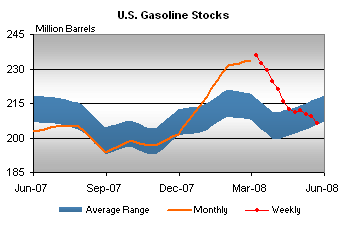
Robert has already discussed this on his own site but since there was some discussion of these figures, I thought it useful to post them so that the more general audience could see them. So all I want to do is insert the relevant states of the various plots that we usually put up at frequent intervals. (Though I will also pause to point that the curve is now turning up, as Robert predicted it would on Tuesday). Perhaps the most relevant (in regard to us not worrying) is the state of the crude stocks, since with those available, then we can produce more gasoline as it now becomes more in demand. It may not, however, turn around fast enough to avoid an all-time high in gas prices.

Demand itself has been up measurably over this time last year, but is now falling back to the same level of demand. Whether this will continue, as the driving season comes upon us will be a function of gas prices and the general state of the economy – about which I am not going to comment, except to say that there is no talk around our office about any impact from the current rise in prices.

Domestic production of gasoline has been running significantly above last year, but is now returning to those levels

While imports have been well below last year, although climbing at the same rate as they did about this time last year.

As far as the refineries go, they are processing about the same amount of crude as they did this time last year

But while imports have been about the same as last year

The amount that comes from domestic production, while it has been stable for almost a year, is now starting to dip down again.

It is this downward dip in domestic production, when tied with the problems that Mexico (typical of other South American countries) is now seeing, and the other issues about production around the world, that suggest that this could end up being a little more volatile summer than some of the other commentators would have us believe.
I note, for example, that both Peter Jackson and Michael Lynch spoke at the Canadian Energy Research Institute Oil Conference last week in Calgary the natural gas one being in March. Not having taken the time to drop by I am not quite sure how rosy they painted the picture, but it will be interesting to see how far off their predictions are this time, and what excuses will and will not be made.
The EIA Graphs: Gas Stocks, Crude Stocks, and Other Requisite Information before the Start of Driving Season
PDF version
143 comments
The EIA Graphs: Gas Stocks, Crude Stocks, and Other Requisite Information before the Start of Driving Season
PDF version
143 comments
Contact
- Content: editors at theoildrum dot com
- Tech support: support at theoildrum dot com
License

This work is licensed under a Creative Commons Attribution-Share Alike 3.0 United States License.
(Though I will also pause to point that the curve is now turning up, as Robert predicted it would on Tuesday).
To be clear though, my prediction from 2 weeks ago was that inventories would turn upwards within 2 weeks. I spelled out my reasons in a couple of recent blog postings. And while the rate of decline has dramatically slowed from a month ago, it was still a decline this week. So, as I stated on my blog, the limb that I went out on cracked - inventories did not turn upwards. The price is still too low given the current supply/demand picture.
Imports came to the rescue at this time last year. I don't know that this will be the case this year. And as I have noted, we find ourselves in an inventory situation that we have never been in going into summer driving season. I think it's too late to avoid record gasoline prices this summer.
''I think it's too late to avoid record gasoline prices this summer.''.
Well, maybe that is not such a bad thing and perhaps Americans will engage in a real debate about what is to be done.
Treat it as a prodrome.
Well, maybe that is not such a bad thing...
No, I am not complaining. It is a warning. Very high gasoline prices are coming. People need to prepare by changing their lifestyle to accomodate high prices as the new reality. Those who do will also help stretch our supplies a bit longer.
Even for those who state that Peak Oil is a myth (ExxonMobil, for instance), I don't think they can guarantee that gasoline supplies will be adequate. Refining capacity, while increasing each year, can't keep up with demand. I don't see this changing any time soon.
diesel runs the us economy
will refiners cut back on its production to increase gasoline production?
Depends on 2 things. First, can they do so and still meet their diesel contracts? Second, will they make more money by producing gasoline over diesel? If both answers are yes, then they will shift production to gasoline. And honestly, these kinds of shifts happen daily in refineries as they look at their economics.
daily? And then stockpiled not JIT or am I way off here?
It goes something like this. The refiners have forecasting tools that predict what the supply situation is going to look like. They are going to buy certain crudes and make certain products. Each day, they look at their inventories on site, and they get a schedule of shipments from the pipeline scheduler. They will go to a morning meeting with operations and adjust cut points and various operating parameters to meet the immediate demand situation. If they have a local rack, and diesel is being pulled down while gasoline is steady or rising, they will shift production to diesel if they can. If they are already in a max-diesel mode, they will raise the rack price or put customers on allocation. I can tell you that customers hate allocation more than they hate seeing prices go up.
That can have them shifting production back and forth between gasoline and diesel more than once a week. That's not common, but it happens.
Sounds like the plant business - Are they buying blue flowers or red ones, so which do we grow.
Dumb question,
This is the widest spread between diesel and gasoline that I have ever witnessed on a retail level. Usually reg and diesel are close, with diesel usually higher, but a rough avereage is diesel being $.30 lower.
With your example above they move faster than I would have thought between the two. What is going on with gas?
With your example above they move faster than I would have thought between the two. What is going on with gas?
They move faster on an individual refinery basis, but there are lots of refineries in the system. So the overall effect on national inventories can be a lot more sluggish.
Diesel prices rocketed up the past few years as Europe began consuming more of their own diesel and exporting the gasoline. That's why diesel prices ultimately went higher than gasoline. But gasoline demand has recently been rising strongly, and the price has shot up to compensate.
Well speaking of higher prices, OPEC said in its monthly oil bulliten: "What the leaders and opinion makers of consuming countries seem to have overlooked is that producing countries need security of demand since they, too, are dependent on oil," the 14-member cartel said in a communiqué.
"Our feeling now with this thrust and push for conservation, efficiency and the use of alternatives is that we probably need not go beyond 12.5 million barrels per day," he said.
Full story Here
OCB
We have heard that speculators have been buying oil, and with the market in contango, actually taking delivery of oil so as to get the benefit of the price increase expected in future months. I would presume that this oil is not really in line to get refined (at least very quickly). Is there any chance that this oil is affecting the numbers?
That is a myth.
Speculators buy “paper barrels” through futures or options. They don’t really buy and store crude in tanks.
Also, the “non-commercial” net long positions are at present perfectly in line with the historical levels, so “speculators” are not accumulating oil, not even in “paper barrels”.
Besides, the storage levels of crude and processed derivatives are well known for the OECD, and they are at present at medium-low levels…
You can check them in the monthly Oil Market Reports of the IEA:
http://omrpublic.iea.org/archiveresults.asp?formsection=full+issue&formd...
I'd have to go find the ref, but I recall that there was an investment bank trading operation in NY that got involved with the cash market (storing crude in docked tankers) in order to enhance their trading operations -- to your point though, while this kind of thing may be true, people will magnify its significance beyond any sort of reason.
Great overall analysis. You, FTX and Robert have shown us the details of a market attempting to return to equilibrium with yet another maximum effort by refiners to sustain and profit from the traditional American summer drive fest.
Is it just me or is there a sense that this whole turnaround refinery operation is getting more cumbersome with each passing Spring?
Even as the wholesale market relaxes under the expected return to 'normalcy' there is little awareness of the uniqueness of this year amongst the driving public. Given the fact that your shop and others see no significant expected drop in demand at these prices won't we still run underneath the normal stockpile range for the whole season no matter what?
For our West coast area it looks like perhaps 16 days supply now although it appears that may improve over the week. Question is, doesn't the lull in wholesale prices really send the wrong signal and pretty much insure more spot outages down the road?
The EIA numbers are usually hard to track because they fluctuate widely week after week. I have tried to monitor significant statistical fluctuations against historical data (see here).
Gasoline demand is slightly above expectations and shows no sign of faltering despite high prices.
Gasoline consumption projections (4-weeks moving average): The gray level image in the background is the observed seasonal fluctuations (darker areas mean more frequent values). The red curve is the observed data for 2007. The * means that the data for the year 2006 and 2005 have been adjusted to match the yearly consumption for 2007 given by a linear growth model. The dark dotted line is the average fluctuation.
Crude oil imports are way below expectations and are at the bottom of observed historical fluctuations since 1991:
U.S. Crude oil imports (4-weeks average): The gray level image in the background is the observed seasonal fluctuations (darker areas mean more frequent values). The red curve is the observed data for 2007. The * means that the data for the year 2006 and 2005 have been adjusted to match the yearly import level for 2007 given by a linear growth model. The dark dotted line is the average fluctuation.
Also refinery utilization is way below expectations for this time of the year (this has been the case since Hurricanes Katrina/Rita):
U.S. Crude oil imports (4-weeks average): The gray level image in the background is the observed seasonal fluctuations (darker areas mean more frequent values). The red curve is the observed data for 2007. The * means that the data for the year 2006 and 2005 have been adjusted to match the yearly import level for 2007 given by a linear growth model. The dark dotted line is the average fluctuation.
My reading of this chart is that it seems we have a refinery problem (have we fully recovered lost refinery capacities since Katrina?) which implies that crude oil is piling up in stockpiles that are near all time high levels.
"have we fully recovered lost refinery capacities since Katrina?"
I don't think it's all down to Katrina. Jeffrey Brown (Westexas) speculated yesterday that a growing shortage of experienced refinery workers could be causing problems for refiners. And now we have the release of BP's internal report into the 2005 Texas City refinery explosion.
The report recommends the dismissal of four employees: BP's North American refining and marketing group vice president; the regional vice president for US refining; the Texas City plant manager; and the Texas City West plant supervisor.
I would think that anyone involved in refinery management in the U.S. must now be thinking very carefully about the potential downside of running a refinery flat out and ignoring/delaying maintenance issues. Not only might you lose your job over it, but you might even end up in jail.
Mind you, no doubt there'll be pressure from above to keep the gasoline flowing. Seems like they're caught between the devil and the deep blue sea.
A couple of points that are often overlooked. The US oil industry in years past, outside the five year window, has carried significantly more gasoline and crude oil inventories, both in terms of Days of Supply and in absolute numbers.
Following are the Days of Supply and absolute numbers, for late April this year and for late April for the first available EIA data for gasoline and crude oil:
IMO, the industry has basically gone to a just in time inventory system, especially for crude oil--presumably because of the SPR--but we don't have a SPR for gasoline.
Also, the latest EIA data, for January, show a one mbpd drop in world crude + condensate production (relative to 5/05), which presumably translates to around 1.1 mbpd or so less refined product on the markets, relative to 5/05.
Fundamentally, the problem we have in the US is the expectation of a continued exponential increase in our crude + product imports, while the new emerging reality is an exponential decline in crude + product exports.
This is our expectation (Khebab's chart): http://www.theoildrum.com/uploads/28/Data_4weeks.png
Re: Stock coverage.
The number of days for crude oil stocks is still close to the average value (22 days) observed for the period 1991-2006:
but gasoline stocks are close to an all time low:
IMO, the key difference for crude oil is the SPR. Prior to the SPR, it only makes sense that refiners had to keep more oil on hand. With hundreds of millions of barrels of crude oil sitting in salt domes on the Gulf Coast, why tie up all of that capital?
WT, what's your feeling on the use of the "SPR" as a "PPR", or political petroleum reserve. instead of strategic uses , increasingly it will be a "tide over" facility in the near future, to fill gaps in oil supply until it's depleted. then, TSHTF.
In effect, the release of emergency reserves is the new "swing producer."
As you suggested, the key problem is the release of oil from the SPR based on near-cornucopian assumptions that we won't peak for decades to come.
DOE is refusing to buy oil because it is too expensive for the SPR. So we will expect even higher price swings?
Boy, those unscheduled maintenances can be a bitch can't they?
A thought occurred to me looking at the graphs.
Maybe crude stocks are at the high end because they have not been refined into gasoline and distillates?
Or another way to say it is.
If gasoline stocks were higher now, much of the crude would have been consumed and maybe crude inventories would be lower than expected.
I will be convinced we don't have a problem when both crude and distillate stocks are at the high end of their inventory ranges at the same time.
BenjaminCole
What everybody foregts at the Oil Drum is crude oil demand. We may reach "peak demand" a lot sooner than we reach peak oil. At $60 a barrel or more, crude oil demand is flatlining. It is down in USA, and has been falling for years in the EU. India's demand is dropping, according to BP.
After the price spike of the late 1970s, it took crude oil demand 10 years to recover – and then only when prices were a lot lower. This time around, due to the reasons admirably exposed on this site, prices may be sticky at $50 to $60, $65. So demand will be crimped, and then will start falling....and falling...and keep falling. Meanwhile, biofuels coming on, and are mandated to take 20 percent of EU's diesel in 15 years, and similar share in India. El Presidente Bush talked about 35 percent ethanol in our gas, but he also talks about going to Mars, by way of the Moon first, and winning in Iraq.
Okay, so the USA will never have an energy policy that makes sense, but still the higher prices will compel changes, as in reduced demand.
I hope someone at Oil Drum starts to ponder what "peak demand" will mean. I think good things, mostly.
Worldwide demand does not really fall that fast since you have population and economic growth. Your right that their is a window of conservation that will initially keep prices high but bearable. I'm guessing its before world production has dropped by about 2mbd or so. This period exists your correct but its really short maybe a year or two at most post peak.
For this to hold long term you would need the rate of conservation to out pace production drops without pricing pressure in fact you would have real falling prices this does not make sense. Demand will fall fall fall but prices will rise rise rise :)
been jamming coal
troll
That is totally wrong.
Demand is not down, but up, and strongly, in the USA.
Demand only fell (marginally) in the EU in 2006, not in previous years.
In India, due to the very fast grow of the population and of the GDP, the oil demand is obviously growing, not dropping…
You can check the data (and the predictions for 2007) here:
http://omrpublic.iea.org/omrarchive/12apr07full.pdf
However, increased Russian demand absorbed all 400,000 b.day of their increased production in 2006. And Russia will likely not increase production as much in 2007, so production +, exports -.
Likewise, Saudi consumption climbs steeply each year, same for Venezuela, etc.
And China is still going strong; and they have stated that they want to stockpile oil instead of US $ in their reserves. $1 trillion is enough US paper (euros and yen still welcome as I understand).
The US demand will have to do more than just "flatline" to keep Global oil demand from increasing significantly.
Best Hopes for US demand dropping -4% (or more) per year,
Alan
I question the reliability of Russian production increase that manage to always match internal demand. This trend has been going on for some time. They claim production increase but don't increase exports. Its the perfect match that bothers me.
How's it going, HO?
Demand has turned down a bit in the last couple of weeks, and is now running 1.7% higher than a year ago. It was running 2.5% higher a few weeks ago.
On the other hand, the U.S. average gas price is also running 1.7% higher than last year.
Higher prices, higher demand. This is not the way they teach it in Econ 101. Consumption is out of control. I believe we are on the other side of a structural shift. Our happy motoring utopia now makes it impossible to decrease demand much, despite higher prices. We shall see when Memorial Day arrives ("Gentlemen, start your engines") and the summer season kicks off.
I've written some stuff about this for the World Energy Monthly Review, which I will send on to you (and many others). Briefly, we need a cap on oil consumption in the United States and a gasoline tax. I have proposed a way to implement these measures.
best --
Dave: My personal theory on this one (unsubstantiated) is that immigration to the USA is being underreported for some reason by the relevant authorities. More gasoline being used every month because more people are in the USA every month.
Using US census estimate of rate of growth of US population, there are approximately 2.8 million more people in the country than a year ago. So last year at this time the US population would be around 298.9 million, while it is now estimated to be around 301.8 million (rounding errors.)
Dividing those pop estimates into the 4 week gasoline consumption and we get:
week ending 4/28/2006 ~ 8.98 gallons/capita/week
week ending 4/27/2007 ~ 9.05 gallons/capita/week
The gasoline price measured by the EIA, all formulation avg., during the week in question (i.e., EIA measures on Mon of the week, while consumption ending Friday):
2006 ~ $2.96/gal
2007 ~ $2.917/gal
though by the end of the week in question in 2007 there is anecdotal evidence and spot price data that showed gasoline had risen. By the following Monday there was the measured price rise.
While there is a great deal of generalizations in the above figures they represent the best I could find.
Anyway, point is consumption went up a trivial amount per capita while price when down a trivial amount. I fail to see where there is a contradiction with the "Econ 101" theories.
This is a good analysis. I suspect that if you modified it to use a driving age (16 years old and up) population rather than an overall population, there may not have been a per capita increase at all.
BenjaminCole
One of the major brokerage houses, I think Morgan Stanley, concluded that there was actually 20 million, not 12 million, illegals in th US, and they computed that using school records, phone numbers, and unmatched Social Security receipts etc,
I too think this is cuasing the modest increase in demand for gasoline, although soon this demand will flatten out...the hot selling cars today are the ones getting better mileagte.
PS I am not a "HO." I do not know why this coarse, purile language should be accepted.
Umm, the HO was directed to the key-post author, HeadingOut. Posters with multiple word handles are frequently referred to by their initials.
BenjaminCole
Okay, it is hard to tell where the lines go indicating who is replying to who. Back to the good stuff: Gasoline demand is up mildly, and I admit I am surprised it is still going up. On the other hand, in almost any other business, if you asked, "How are sales?" and they said "Wow, heavy demand, up 1.7 percent from last year," you would say they are in a very mature business, and one reverse and they are back in negative sales growth.
For some reason, commentators have go themselves into a frame of mind that 1 to 2 percent hikes in gasoline demand are enormous. If Wal-Mart says sales are up 2 percent, that is considered a huge failure.
In fact, even in a growing economy, gasoline demand has barely budged, and the effects of conservation and substitution are beginning to accumulate. We do have population growth. I suspect we will see crude demand begin shrinking, if the current oil price regime can be maintained. It shrank 11 percent after 1979's price spike, worldwide.
This is good news. We may have reached "peak demand" for crude. I think we are right there, or on the cusp. The Oil Drum never looks at worldwide demand for crude. What if crude demand begins falling? Then the graphs about "running out of oil" are completely changed. Instead of 30 good years left, we have 100 good years left. We run out of oil only if there is 2 percent annually compounded growth, leading to a doubling of consumption in 30-odd years. Change that to 1 percent growth, and we run out in 72 years. Change that to no growth, and we get 100 years or more.
The technology is there now to flatline world growth for crude, and easily obtain higher living standards. US demand could start going down in the next 10 years, maybe in a serious way with the introduction of plug-in hybrids, which should be encouraged with every tax and regulatory machanism available.
Ethanol when produced in cattle-methane-ethanol plants, is a very good supplement to our liquid fuels picture.
Until Oil Drummers begin to factor in fossil crude demand, they will be looking at only one-half of the picture. And there is nothing wrong with predicting no drama in our future. It is boring, but quite likely.
Be careful about that for which you wish...
Look, though I am hardly a doomer as many of the anonymous commentors on TOD tend to be, it strikes me that the "destruction" in "demand destruction" often can not be labeled by the moral tag of "good."
I appreciate the contributions of the writer and editors of TOD and why TOD was created in the first place, and I challenge you to consider seriously what having less oil/capita will mean to many people in this world. The chemical potential energy in found hydrocarbons is the foundation of our modern lives.
The gradual depletion of oil, then gas, and finally coal during the 21st century means the 22nd century inhabitants will base their lives on something else than we have during the past 150 years. That "something else" is currently the subject of hot debate.
It is not a coincidence that energy is becoming the nexus of international and intranational affairs. E.g., the EIA weekly report (HO's subject) is increasingly being featured in US news articles.
The reason that you see considerable debate, and lots of information, on alternate sources of energy in posts at this site is that we are very aware, and concerned about the problems that come with demand destruction.
Unfortunately recognition of the serious nature of the problem is still being negatively influenced in the MSM by those who wander from meeting to meeting stating that there isn't one.
Um! Since you can't have been reading here for long, HO is an abbreviation for Heading Out, which is the nom de plume that I use when writing to this site.
Dave happens to know who I really am, but is kind enough to let me remain, as I chose to be, a little guarded in disclosing my identity.
HO
I do as well :-)
Best Hopes for confirming Prof. Goose's ID,
Alan
You know Dave I think it is the children, just like mine to be very upfront.
When I was a kid you were not shuffled all over the planet for activities, sports, shopping, and entertainment like kids are today. I think this is a major shift that will be coming to an end. Raising kids is very, very expensive in todays world.
I think parents are all to willing to keep thier children from 'suffering' as they did whn they were kids.
Just an opinion, no data.
Delusional,
this is one important facet of what Kunstler calls the drive-in utopia. Everything Americans do is a drive away- kid's school, little league, stores, haricuts, grocery, work, etc. The 12 year old being shuttled around to soccer practice 8 miles over there, boy scouts 10 miles the other way, youth group 7 miles this way is simply illustrative of the larger problem of our development patterns and the fact that America has planned cities for the last 60 years purely for the convenience of the automobile.
I'm fortunate enough to live in an old midwestern town developped long before the automobile. I'll admit that my kids are not "suffering" since we sign them up for swim lessons, kindermusic, dance class, etc.(but never more than two scheduled activities at any given time) bc/ we want them to be active, social and learn these things when they're young. But we are within walking distance of all of them. It's so frustrating to me that Americans are unable to see all the ill effects of our current suburban development patterns. As the peak unfolds, I suspect it will baffle many of us to see most Americas cutting back on these opportunities for their children to save on gas money long before they'll consider living in a tight community where the YMCA, baseball diamonds, school, pool, etc. are all within a 15 minute walk.
phineas,
I agree. I walked or biked all over and rarely did parents drive us. We are not within walking distance of anything but the busstop (2.5 miles one way) so we drive them around. Lucky for your kids to be so close, mine actually would like that. I have 1 left here for 2 more years.
As kids we also worked in the farm fields in the summer. You don't see that anymore. I have farmer cousins and thier comments about 'punkin chunkin' and 'corn mazes' is that people will pay more to play with thier food than to eat it. So much of our local farm land is in lawn grass seed production it is unreal. I suspect this will all change.
The town I grew up was a small farm town, it went from 1,650 to over 80,000 in 42 years with expansion and high density housing.
Long term I think economics will force people to adapt, what ever form that will take, I don't know.
It's why I made the comment about the office (and others) not seeming to be concerned about where the prices are going. A couple of the papers had picked up the comments from Jackson and Lynch as to why we should not worry. I fluctuate between a Pavlovian reflex to point out why they are wrong, and a philosophical shrug because we won't have to wait long before they are again shown to be in error.
The Drum Beat has an article by Tom Whipple. His analysis of the refinery portion of the problem is this:
Do TOD readers agree?
He is correct that the spare capacity has disappeared. So, any production outages are felt more than they were 20 years ago, when a major refinery could go down and not disrupt supplies.
But, the last half of his last sentence is not correct. Yes, we are dealing with worker shortages in the U.S. No, the crude isn't any heavier or more sour than it has been for several years. The sulfur content in 2000 was 1.4%. The sulfur content in 2007 is 1.4%. The gravity in 2000 was just about 31. The gravity in 2007 is just about 31. There is very little difference. Now, if you go back 20 years ago, there is a difference, but given that we have been refining these qualities for years, the "undesirable heavy sour" explanation as the root of the gasoline problem is not supported by the data, which you can see for yourself at:
http://tonto.eia.doe.gov/dnav/pet/pet_pnp_crq_dcu_nus_m.htm
Although it is correct to state that refineries that do process heavy, sour crude - and these have increased over the past 20 years - are more complex. So, I guess I really don't have a disagreement with what he is saying, but I do have a disagreement with those who think the gasoline problem has been caused by a sudden change in crude quality.
I don't think the issue is running the plants at 95% capacity many chemical plants are routinely run this high. In general for chemical you want to run say 80% plus of nameplate capacity. The problem is we don't have enough refineries/stockpiles to rotate a plant out for maintenance.
Its actually I believe because of peak oil. Refiners are already caught in the first stage of peak oil. The crude market is in contango and by taking delivery of oil esp when the contracts are expiring refiners make more money playing the spot market then making gasoline. And they are concerned about supplies the end result is anyone with oil storage now believes its better to take delivery and keep the tank topped off.
The key is for countries that have significant storage capacity for crude the price of crude is not tied more to available storage than to products. I think as we go through the summer and more oil is refined we will see the price for crude rise but stocks remain high.
Next the peak oil effect for the US is a refined product import issue and will be for some time. We simply don't have enough refinery capacity to handle demand so the real driver of prices in the US will be the cost of finished product imports not crude oil.
So using WT's bidding war model the bidding war will actually be for finished products esp gasoline not crude. This is important I believe because although the world crude markets are fungible the finished product market is not. Countries won't export finished products if they have shortages at home so the real problem is how much gasoline does Europe have. This explains why KSA is not cutting oil deliveries to Europe since the important product now is finish gasoline from Europe. This means for the US peak oil will hit harder and faster than most people realize since finished product export will drop event faster than the worlds crude supply. This can be seen by applying WT export land model to Europe. In the EU the euro is increasing in strength and exporting nations are far more likely to export to the EU in exchange for Euros as apposed to the dollar. This makes crude cheaper for Europe and keeps finished product prices fairly stable thus demand increases decreasing finished product exports.
So the focus should be on Europe not the US.
Looking across the pond we find.
http://www.downstreamtoday.com/News/Articles/200705/Thirsty_For_Gasoline...
So indeed for a variety of factors European exports will slow this year and probably continue to decrease at an accelerated rate from here on out. The end result is application of the Export Land model to Europe indicates that the US will face chronic gasoline shortages from now on. Also the effect of decreasing production of North Sea oil on Europe has not been explored but as the are forced to import more crude from the ME they will need to upgrade refineries and local gasoline prices will rise. Europe
will rapidly move to be like the US and have no spare refinery capacity and also uncomfortably high ME imports.
Overall Europe is in a similar position to what the US was in the 1970's.
Going back to peak oil or the crude market the over supply of crude is a very temporary problem and will clear as the year draws to a close so next year we will find crude prices on a relentless march upwards. But for the US I don't think crude is that important since finished gasoline will quickly
become a precious commodity with export gasoline supplies falling off a cliff as early as next year. Crude shortages will lag gasoline by almost a year it seems.
The intrinsic reason is we simply have a lot more storage for oil and crude producers did not produce at capacity year around so at least for now the combination of exporters producing enough oil to keep storage full and a large and expanding amount of storage will delay the effects of crude shortages and I don't think the US will see crude shortages for some time since shortages in imported gasoline is the Achilles heal for the US resulting in a rapid rise in gasoline prices and worse they will stay high.
Another reason why the refining problem is an indicator of peak oil: why build a refinery that takes thirty years to pay out when you only have the feedstock for the next seven? And note that KSA is boosting its refining capacity, because it can sell the finished product to any country, not just to those with the refining capacity. If the exporters become the refiners, then you are spot on about the export land model.
95% of nameplate on 25 year old equipment can be a large problem.
memmel,
I think your observation about refiners keeping their oil tanks topped off because of the market being in contango and because of concern for future supplies is spot on. I think the full tanks are what is confusing the WTI price recently, and also what is confusing people's view of the oil supply situation in the United States.
The article you quoted makes some interesting observations about ethanol, and availability of mixing liquids, as well. This may be another component of the problem.
Interesting. Seems to fit the principle of least available resource. We're likely to see more such examples as we approach the bottleneck.
Export Land Model in action: Mexico’s oil exports dropped at an annual rate of about 16%
http://www.reuters.com/article/economicNews/idUSN0239326520070503
Mexico's Pemex posts 1st-qtr net loss
I can't argue with Robert that US refineries are currently adequately supplied with crude oil, but as noted down the thread, as utilization rates pick up, and as crude oil production, IMO, continues to decline, I think that this will change. Or to be more accurate, the low bidders for declining crude + product exports will have to make do with reduced supplies.
This is a normalized plot of the US Personal Saving Rate versus quarterly Brent crude oil prices that Khebab did for me: http://www.theoildrum.com/files/PSR_Brent.png
100 = oil price and saving rate in the year 2000
This illustrates my thesis that we have basically been going into debt in order to pay for our petroleum product consumption ever since the second quarter of 2005, and IMO, this was the trigger--but not the underlying cause--of the mortgage meltdown. My point is that, IMO, we are going to have a hard time outbidding China and the EU.
Meanwhile, Daniel Yergin and ExxonMobil, in effect, encourage us to continue to buy SUV's and Car and Driver Magazine says that we need more roads and highways.
Gasoline imports are far more important for the US than crude imports. The US import land model should focus on gasoline imports with the primary export land Europe. I think the crude imports are a distant second and in fact almost irrelevant since a significant drop in gasoline imports will happen well before the US can't afford oil and derail the US economy.
So the US economy will be a disaster well before crude imports become a issue. In short the US won't even last long enough to deal with peak oil at the economic level. Their is a good chance that the crash of the US economy because of shortages of imported gasoline will actually give the world a bit of time to work on peak oil.
'So the US economy will be a disaster well before crude imports become a issue. In short the US won't even last long enough to deal with peak oil at the economic level. Their is a good chance that the crash of the US economy because of shortages of imported gasoline will actually give the world a bit of time to work on peak oil.'
This is an interesting perspective - is the U.S.'s economy now so utterly dependent on gasoline? Or is it just a perception based on how reliant many people are?
No idea - this is one reason to read. Strange to think that Rotterdam spot gasoline may be more important soon than any measure of crude in terms of keeping that gasoline powered economy moving. Or tanker movements in the Atlantic Basin may become critical in terms of specific cargoes, not merely part of a constant flow.
Shortages may be much part of the future from a number of directions. Britian, for example, has become a customer, not a producer - but this switch is still in its very early phase. On the other hand, Europe does seem capable of reducing use in the face of price signals, meaning that the incentive to send gasoline to the U.S. remains high - it is is still surplus, after all. Tied together with a strengthening euro, Europe could earn a fair amount as the age of oil slowly leaves the stage.
The problem is the US consumer is like a boxer in a corner.
Overall the savings rate is negative. Most that can are living in the exburbs in a McMansion driving a SUV etc etc.
Ethanol/Peak Oil are driving food/fuel prices strongly upwards. A lot of people cannot afford 5-6 a gallon gasoline. And when we have a export pinch gas will go to this level not for lack of crude but simply for lack of refining capacity. Even current prices are enough to seriously hurt the consumer coupled of course with the housing market.
For Example:
Note a lot of people are talking about how California consumption is dropping as if California's are conserving thats not whats happening whats happening is a ton of people are fleeing California either because they sold their house for big bucks and moved out of state. Or they went bankrupt or lot their job in the real estate industry. This includes a huge and rarely documented out migration of legal and illegal immigrants from Mexico that no longer want to live in California. I've met tons that are moving to the Midwest.
Assuming that the various ex-californians are living closer to work then overall their might be a slight drop. But in general I'm sure they moved into a huge McMansion in a exburb that was a third of their CA commute. We still have a influx of illegals but generally they live in the inner cities when they first come since they either cannot drive or don't own a car so the population drop is also a demographics change to inner city illegals and retired prop 13 deadbeats holding homes and driving out working families.
The rest of the US is inheriting CA equity locust consumption.
I mention California since its such a large part of the US economy and its going down hard. Each state in the US is having its own mini recession driven by different crashing economic factors powered by ethanol/peak oil/housing bubble.
What no one wants to admit in America is that a huge part of the population is either living beyond its means are on razor thin margins over income. The housing bubble will take out millions but high food/gasoline costs will take out millions more. Once people go negative servicing debt they stop paying a bill to keep cash flow coming. Since they are Americans they will pick the largest non essential bill first then escalate this means companies won't get paid which means ....
The knock on effect of millions doing late payments or no payments on bills takes a economy to its knees in a heartbeat and its a nasty feedback loop of mushrooming debt defaults. Also you must consider the critical the psychological effect of increasing gasoline prices which will cause people to pause in buying homes in far flung suburbs as there bills increase dramatically. So anyone not
sunk in debt who has at least some budgeting ability is going to pause purchases of expensive durable goods and homes if their budget is suddenly increasing a few hundred dollars a month. This has already shown as a drop in car sales and it will bleed through all purchases soon. So it not just the increasing costs but the uncertainty that kills spending. The recent housing bubble has basically taken out all the idiots and the only people left with money are prudent or at least not complete idiots. So we are headed for Japanese style deflation simply because the only people with money think somewhat like Japanese and have at least a small savings or monthly budget.
So you see how something as innocuous as rising gasoline costs is a deadly poison to the US right now. We are like a patient that has their immune system knocked out and gasoline costs is a normally survivable flu.
Refinery capacity will get us first but crude shortages will catch up and ensure gasoline stays high and goes higher. The current crisis in refining is simply the tip of the iceberg.
Depending on how fast we slump and demand destruction you may get a temporary breather depending on the worldwide supply/demand equation but it will be a close race.
What KSA does not get or maybe they do is that Oil demand may be price in-elastic but the rest of the economy is not.
If they are really experimenting with the world economy to see how much they can get for their oil without crashing it they are fools. Anyone with half a brain cell can see todays global economy is hyper sensitive to resource costs since globalization has removed wages as a issue. Increasing prices for resources lead by oil will take out the worlds economy as the rising floor of resource costs push prices beyond the buying power of the dirt poor workers and tapped out western consumer. America may go down first but we won't be the last.
This is the problem the US is not the only gasoline importer in the world and as the dollar declines against the Euro dollar denominated gasoline prices will rise. And as wealth flows into Europe gasoline consumption will increase. So you don't have a winner with this argument. If anything it will worsen pricing in the US. All thats happening is this is one of the forces causing the dollar to tumble against the Euro which making Europeans wealthier increasing consumption.
Europe's relationship to the US is the same as Russia's is to Europe as far as gasoline goes except unlike Russia and like the US they own a major currency. This influx of wealth will ensure EU consumption does not decline if anything it will increase the rate of growth in consumption as this money floods into FSU regions and other depressed areas of Europe. One thing the EU does well is invest in real growth.
Also tell me where the US is going to get Euros to pay for gasoline trying to sell dollars on the world market good luck. Printing more dollars is not going to work.
The world economy esp the US has no choice but to collapse.
The GasoEuro will kill the US.
Two types of Americans: (1) Those who now realize that we have to reduce our consumption and (2) Those who will realize that we have to reduce our consumption.
My continuing suggestion--get ahead of the crowd and ELP.
How I wish you were wrong but know you are right. :-/
If you are back in town this month let me know.
They were changing the signs at chevron while I drove past today. up $.02 today...
Reg $3.39
mid $3.49
prem $3.59
Diesel $2.99 (flat) for weeks if not longer (vw jetta TDI 50-ish mpg) Cost roughly the same as an improved smart car while offering so much more..
Thank you, WT! Gotta love the advance warning you get here on TOD!
While I agree we will be changing to ELP and grow your own food it is the in-between phase that I struggle with.
Like everyone else I need to earn a living between heaven and hell.
best
D
The 64 Trillion Dollar question: how will we be living in 2017, 2027, 2037, etc.
From a policy standpoint the thing that really strikes me about this is that we as a country are really beholden to the refineries, and the decision makers about how much refinery capacity we have in the country.
Robert said on his blog and in the drumbeats that the major reason that inventories are going down, is because the oil companies badly mis-projected the price of crude. He said they were predicting prices in the $30s while they are actually in the mid $60s. They obviously also badly mis-projected the elasticity of the demand for gasoline as well as the aggregate demand for gasoline.
Normally when one makes such bad decisions about how much supply to have on hand, the result is very damaging to a company. Imagine a resturant with only enough chicken on hand to serve meals until 8pm, and then has to let diners know from 8pm to 11pm that they are no longer able to serve poulty. It would not be good news for that resturant.
Refineries and gasoline are obviously in not such a competitive or elastic market though. Gasoline demand is proving to be incredibly inelastic and we have virtually no alternatives from a vehicle fuel standpoint (ethanol is a bit player, and there really aren't any mass-produced electric or nat. gas vehicles, and public transit is a joke in all but a few of the largest american cities). That means we're talking about a market that represents an oligopoly, not a free market scenario.
This is complicated by the fact that there is a long lag time for responses to market demand for refined products such as gasoline. Putting up a new refinery takes years, and numerous regulatory hurdles must be cleared. Then once the go-ahead is achieved, a refinery is very expensive to construct. That means that such a market is far from an open-market, but is actually much closer to a closed market, after all who realistically could get into the refinery game at this point in time that is not already in it? Few if any companies, much less people.
Thus we have a partially closed-market oligopoly running with regard to the refinery aspect of the american gasoline supply chain. And what does this result in? Enormous profits for them any time that supply runs low, and very thin margins whenever they carry too much supply. It is no surprise that they would have a major incentive to carry less than maximum suppply, since it goes straight to their bottom line. All they need to worry about is making sure that it doesn't look like they are doing this intentionally. Why? because if they were to do it intentionally it would be market manipulation and get them in trouble.
I would hope that the government eventually takes this into account and starts taxing the oil companies for their profits above and beyond a certain price level to remove the incentive for having too little supply on the market, and then redirects that tax money into alternatives, such as Nat. Gas vehicles, rail infrastructure, and less fuel intensive development practices.
So while the refineries may be producing as much as they can, and may not be directly manipulating the markets, it remains the fact that the oil companies make the decisions about how much refinery capacity we have, and how much gasoline they can produce in response to demand. It also remains a fact that there is an incredible amount of money to be made by them having too little gasoline in supply, and little in the way of negative ramifications.
Obviously they are not throwing a huge markup on this gas and sending it to the stations. That markup is being handled by the markets, but it is no mystery to them what would happen if they underproduce and a huge gap develops between supply and demand for gasoline at the price in which they get their traditional cut given cude prices.
Also, I think those saying that it is a good thing that gasoline prices are going up should take a moment to state whether they think it is a good thing that these increased oil prices are going straight to the oil refiners and their profit margins, and not to the government or some other organization that could redirect this money to actually start working towards solutions to some of the daunting energy problems that we are facing.
while high gas prices may cut demand and lengthen our plateau, I still think it is a very bad thing to have the profits from high oil prices going to refiners. Why re-inforce this positive feedback loop and cause the underclass in our society to suffer? To buy us a few weeks till peak and extend the plateau by a few weeks?
I believe in an inevitable die-off in the generation or so after peak like many others do, but I'd at least like to go down fighting with our remaining resources, not just let it line the pockets of the super-rich.
Pubsky: If the government (taxpayers) want to build refineries, they should do it. Nobody is going to build a refinery that is only needed for a very few years. Don't kid yourself- all these oil companies are very aware of what global oil supply will be in 2017 and 2027. They won't need some of the refinery capacity they currently have (and they know it).
I'm not saying the government should build refineries or neccesarily anybody else for that matter.
I'm saying that the government needs to start limiting the refiner's cut of the price of gas to 20%, (above the traditional 17-18ish% it has gotten when it wasn't the limiting factor) and collecting the rest of that supply shortage premium to use for more constructive purposes than stock buybacks, CEO raises, and dividends.
You know stuff like a rail system, and alternative energy research.
Pubsky: I assume your guv plan involves subsidizing the refiners in the future when there is an oversupply of refining capacity. Why not just have the taxpayers take over the whole system (pull a Castro)?
I assume that we will use common sense.
I said that we are going to limit profits for refineries, not revenues. When supply of crude runs short, and capacity builds, we will start seeing profits fall off, and the cut that refineries will be able to take will start rising, since they will need to take a larger cut in order to make up for the lower amount of fuel that they are putting out. Fortunately for everyone involved there will be a big tax cushion that they will be able to draw against so that they can keep operating without drastically spiking prices until they are operating at a very low capacity. I'm sure at least a few will be retired due to age as well. If everything works out splendidly, it won't be a huge deal.
Eventually the industry will dry up over a few decades as the feedstock runs out. It might even become so unprofitable regardless of regulations that we have to nationalize refining to keep it going. If we have to, then we probably will. Welcome to the world of energy regulation. It may not be the most efficient, but its a heck of a lot better than the sort of crap NYC saw with Con-ed last summer, and California saw with Enron a few years back.
Common sense would say that markets are usually better than governments at deciding how large oil company profits should be and what is to be done with them.
I'll agree that oil executive salaries aren't a particularly good place to put profits but they're still better than government coffers. On the other hand, stock buy-backs and dividends are a great way to go.
Take myself as an example. I'm taking my profits from dividends and capital gains (increased by stock buy-backs) on oil company equities and looking for other industries to put them in. I've put some of it in alternative energy companies and some companies that do energy use assessment. I've also used some of that money to reduce my household energy use (more insulation for now, solar water heater soon enough) and to buy up some rural farm land.
With 40% of American tax revenue funding The War Machine, I really don't want to see any new taxes.
I'm saying that the government needs to start limiting the refiner's cut of the price of gas to 20%
I have been in survival training this week. It involves learning how to escape from a helicopter and survive if it ditches in the North Sea while taking you back and forth to platform. Just 4 months ago 7 people died here in one of these crashes, and it isn’t an uncommon event. We build floating cities out in the ocean, spend billions in capital, lose lives each year, and end up making about a dime on the dollar.
Meanwhile banks, software companies, pharmaceuticals, and some other industries are making 2-3 times the profit margins that we are with a fraction of the risk of either capital or human lives. But it takes a heck of lot more money and effort to produce gasoline than it does to produce Windows. People have no idea of what goes on behind the scenes to bring gasoline to your local station. When they hear about billion dollar profits, they are outraged. Gasoline now costs as much as milk! Tax that windfall! They did nothing to earn it!
If you buy a house in California for $200,000 and sell it 2 years later for $400,000, have you gouged the buyer? Can we cap your profits? What justifies a fair profit? Tell me that. What so many people don’t understand is that the oil companies are acting just like you act when you sell your home. They hope to get a good return on their investment. Lately, times have been relatively good, but they haven’t always been. Would your proposal guarantee a certain level of return on an oil company’s investments? Why not, if you want to limit the reward?
I am sorry, but these Chavez-like calls to grab a bigger piece of the pie when times are good seem to have eyes only for the oil industry. That’s just what Chavez did, by the way. Companies were invited in, invested billions (borrowing money to do so in many cases), and then when the market turned better he said “Thank you very much. I will take that.” People like him want the reward while someone else takes the risk. And that’s what people calling for windfall profits taxes are after: Reward without risk.
Survival course eh? he. he ... Watch you dont get athletes foot from the tank suits. Worst case I ever got :-(
You are absolutely correct in your analysis of profit and hazard. Over the last 20 years , 17 of those years were recessionary for the Oil industry.
BUT: 'BIG OIL' is always the target. It is highly visible and directly in front of the customer, unlike the futures traders. It is a professional hazard I am afraid. It all comes down to the irrational response of people educated to a level of entitlement never seen before. Of course Big Oil is a soft target for any passing knave in politics or the entitlement industry. Add the two together and you get windfall taxes....
Anyway , we here can look forward to a £ a litre this summer. And from Monday, possibly a pupative nationalist government in Scotland in the next few years. They seem to believe that North Sea Oil is good for 30 more years...
Dont buy a house Robert. Rent. Last time oil crashed, whole streets were up for sale in 1986.
Survival course eh? he. he ... Watch you dont get athletes foot from the tank suits. Worst case I ever got :-(
Funny you mention that. I thought about that when I was putting on the suit. They all smelled like dirty feet, and I applied a preemptive dose of Tinactin. Then when I went into the water, the suit leaked like a sieve. I was completely drenched underneath, and the water was pretty cold. I dumped out a gallon of water when I took it off.
Of course Big Oil is a soft target for any passing knave in politics or the entitlement industry.
I realize why people do it. They view global warming as a problem caused by oil companies, and they don't like the fact that oil companies are making money that results in them paying more for gas while increasing greenhouse gases. Doesn't seem quite right, does it? So let's sock it to 'em. Of course that always ignores the personal responsibility. Why are prices so high right now? Production is actually up. Capacity is up. But demand is up even more. People who have such a great demand for the product will help enrich the oil companies. If they don't want to do that, stop buying so much gasoline. They should take some responsibility for their choices and stop trying to pass the buck.
Dont buy a house Robert. Rent. Last time oil crashed, whole streets were up for sale in 1986.
Oh, I am renting. Have you seen what housing prices have been doing here? Blasted price-gouging homeowners. :-)
It will never be my fault for needing gas it will always be the oil co's. If they start making money we should take it away from them. But don't touch my pile and sell me gas cheaper...ah the american mindset. Did Brad Pitt get back together with Jen yet?
I bought a diesel jetta - nice car! @50-60 mpg highway, sweet...
The dunker is a hideous training exercise! Blindfolded, buckled in, and a sadistically-designed machine first immerses, then inverts you in the water. Grab a reference point, wait for the motion to cease, then unbuckle and push off anyone you have to to get to the surface.
I'll have nightmares tonight.
Robert, glad you came back. Your perspective is well received.
The dunker is a hideous training exercise! Blindfolded, buckled in, and a sadistically-designed machine first immerses, then inverts you in the water. Grab a reference point, wait for the motion to cease, then unbuckle and push off anyone you have to to get to the surface.
A guy panicked yesterday. He just froze up. I thought he was having a heart attack. The also told us about a (very large) guy who recently forgot to unbuckle his seat belt, panicked, and ripped the seat right out of the floor and escaped - seat still attached.
We have to escape from that helicopter 7 times tomorrow morning. If I have another leaky survival suit, I will have hypothermia by noon.
We're not talking about socializing the system or anything like that.
I also feel bad that you are in an industry that involves great personal risk. I'm sure you guys are compensated far worse than West Virginian coal miners and police and firefighters across the country.
What kind of profit do police get per dollar that we invest in them? Maybe its a false analogy to claim that human risk should correlate directly to profits...
If refineries were making this kind of money in an open and competitive marketplace I would be all for you taking whatever piece of the pie you could get.
The fact remains that we have set up a capitalist system here, and it has a set of rules that are built upon a set of foundational assumptions. Those assumptions are that the markets are both open and free. When a situation arises where the market seizes to be open or free, it is the responsibility of the government to bring about a situation that restores the balance and either increases the competitiveness of that market or lowers the bariers of entry. If it becomes clear that there is no way in which a good can be traded in an open or free market, the responsibility of the government is to come up with some socially just solution. (usually bringing the industry under government control in order to protect the interests of society i.e. telephone and utilities prior to the 90s, or police and fire service)
A windfall profits tax resulting from gasoline undersupply is hardly a Chavez grab for power. You can see it that way if you want, but you would be wrong in almost every conceivable way.
Chavez taking over an industry is not an action that restores competitiveness to an industry. He is taking over the industry to secure the interests of his people, which is actually in line with the socialist organization of his country. It sucks for the oil companies, but that is the how the chips fall when the interests of a foreign company butt up against the interests of a socialist country where the resources reside. The country wins out.
We're not talking about that though, we're talking about an industry in a capitalist nation where the market has fundamentally changed. A market where supply was once high, has now become incredibly scarce. A market where demand was once fairly elastic has become incredibly inelastic. As a result the producer that once found himself in a competitive market is very quickly finding himself in what is becoming a monopolistic market. The government now needs to place regulations to protect the competitiveness of that market.
They are not stealing the profits without taking a risk. They are working to restore the competitiveness of the market by re-structuring the incentives, and if the government is a good one, it would be using the money from its taxes to invest in alternative energy sources so that there is more supply and more competition.
Just as I am not allowed to go into a rehab clinic and profit off of drug sales, an oil company should not be allowed to profit off an oil starved country as peak oil hits. You'd agree with me if you were the junkie in rehab.
I'm sure you guys are compensated far worse than West Virginian coal miners...
When is the last time you heard the government railing against the profits of West Virginian coal miners?
If refineries were making this kind of money in an open and competitive marketplace I would be all for you taking whatever piece of the pie you could get.
The industry is open and competitive. Try to build a refinery, and it won't be other refiners standing in your way. It will be a tremendous capital expenditure (piece of cake, though, as you will be making a windfall) and protesters who don't want a refinery anywhere near them. Face it: If this was the money-printing exercise so many paint it as, everyone and their dog would be doing it.
A windfall profits tax resulting from gasoline undersupply is hardly a Chavez grab for power.
Chavez didn't grab for power. He grabbed for money in an industry that had invested billions in his country. When the investment started to pay off, he grabbed it to pay for his social programs. You are asserting that now that investments are paying off in the oil industry, some of it should be grabbed. I say that some of the demand must be destroyed. I have long pushed for the government to do this. But if they won't, price will go up due to insufficient supply, and the oil companies will reap those benefits.
It sucks for the oil companies, but that is the how the chips fall when the interests of a foreign company butt up against the interests of a socialist country where the resources reside. The country wins out.
It sucks for the shareholders of the oil companies, which include numerous people who hold shares through mutual funds and pension accounts and may not even know it. And the country won't win out in the long run. You can't siphon money away from a capital intensive industry and keep those profits rolling in. They are only rolling in because billions in investments were made. I think that's why Chavez is trying to get them to stay on as minority partners. He wants to keep the investments flowing, and I wouldn't be surprised to see him jack up the taxes again in a few years. I think COP is about to tell him to take a flying leap.
an oil company should not be allowed to profit off an oil starved country as peak oil hits.
But weren't you earlier saying that you expected the industry to die? Why shouldn't they be allowed to profit as they die? In reality, they won't die. They aren't going to sit around and not evolve as necessary. That doesn't mean that supplies won't still be very short, but your supplies will most likely come from an oil company evolved into an energy company.
tremendous capital expenditure and regulation is a barrier to entry in a market and what makes it a closed market.
Its why somebody can't walk in and start up a telephone company. Many monopolies form because of such barriers to entry, and industry consolidation. I don't paint it to be a money printing exercise, but just because you have to work for your oligopoly doesn't make it any less of one.
You are right about demand destruction.
I don't know why you think that oil companies are entitled to the profits of a monopolistic market though. Just because the oil companies didn't go about actively creating their monopoly does not mean that they should be entitled to benefits of the monopoly. We don't break up monopolistic markets because of the actions companies take to create monopolies, we break them up because the monopoly itself is an unjust market and violates the more fundamental social principles that we use to justify capitalism in the first place.
Its why somebody can't walk in and start up a telephone company
Comcast
Skype
Vonage
Verizon used to be a phone company but now they are a internet-cable tv-cell phone company
I am a new poster here and appreciate the valuable service that many members of the community here provide. I especially value behind-the-scenes input from insiders like R. Rapier.
That being said, I don't feel that this post is fair on a number of levels.
Why must we assume that a windfall profit tax would be aimed at the workers of oil companies? What offends me is not the idea of a high-risk worker being compensated generously for working in a dangerous field; it is the idea of an investing class reaping large benefits from a depleting resource while the nation at large suffers.
Since you bring up Chavez, I ask you, have oil workers at fields that he has nationalized been subjected to pay cuts? Who lost money, the workers who risk their lives, or executives and investors who risk money? In reports I read of the recent grabs by Chavez they spoke of thousands of red-hatted oil workers lining the roads in celebration. Is this an exaggeration in the Western media?
Unlike Windows software, petroleum is a natural resource and not intellectual property. Is it really so unreasonable for a Chavez or a Putin to aim to nationalize the extraction of what really is a national resource? In light of peak oil I believe that they are moving wisely and in the best interest of their people. We in the US hate it because suddenly it is clear that our interests are not the same.
The oil companies are acting just like when one of us sells a house, except that they are extracting a diminishing natural resource that as far as I know God never gave specifically deeded them. On top of that (unless we are to believe they are phenomenally stupid about their own field) they are paying lobbyists and public relations firms to spread misinformation about how much of this resource remains.
Here on the oil drum most of us know that this may be a life or death situation for millions or billions of people. How do you balance that against the interest of investors and executives profiting from scarcity while spreading misinformation? If we are all going to suffer, why is it so important to protect individual investment in the oil industry?
Phil in CT
Why must we assume that a windfall profit tax would be aimed at the workers of oil companies?
Because things like profit-sharing, where company stock is issued based on performance, is shared with everyone in an organization. So, take profits away, and you are certainly taking money away from those workers.
Unlike Windows software, petroleum is a natural resource and not intellectual property.
Is it your impression that Microsoft does not consume massive amounts of natural resources in their operations?
Since you bring up Chavez, I ask you, have oil workers at fields that he has nationalized been subjected to pay cuts?
Yes. The national workers are being paid significantly less.
Is it really so unreasonable for a Chavez or a Putin to aim to nationalize the extraction of what really is a national resource?
My issue is not the nationalization. Every country has a right to manage their own resources. My gripe is that Chavez essentially stole the investment. The government had a set of rules, and the companies operated within those rules. They took the risks to develope those fields, and were encouraged to do so by the government. When the risk paid off, Chavez seized it, and is refusing to fairly compensate the companies for the money they have invested. In some cases, money has been borrowed, so you have a case where he has seized assets that oil companies still owe money for, and he has said he isn't going to compensate anyone for that. In the short term, that strategy works for him. In the longer term, he is killing the goose laying the golden eggs. Those eggs wouldn't be there if the companies had not taken massive risk and made massive investments.
The oil companies are acting just like when one of us sells a house, except that they are extracting a diminishing natural resource that as far as I know God never gave specifically deeded them.
Yet the house that you sold was filled with products made from that diminishing resource.
If we are all going to suffer, why is it so important to protect individual investment in the oil industry?
What is important is not to change the rules in the middle of the game. Chavez, for instance, is setting his country up for a rapid depletion of production capability as experience and investment dries up.
That's all for now. Got to run to survival training.
Do oil companies have survival training for the effects of global warming?
Do the oil companies give stock options to our soldiers in the oil fields of Iraq and on ships in the Arabian Sea? These guys put their life on the line each day for tiny salaries.
Which only reinforce my belief that oil is not the same as other commodities. It is at the very foundation of our economy and our society, #1 issue of national security, sine qua non etc. etc. etc. Because of that, every American has a vital interest in what happens with our oil resources.
I don't believe that the American middle class is going to be receptive to discussions of what is fair or not fair when the cost of commuting to work leaves them with a non-middle class income. The Venezuelans who elected Chavez probably looked at their impoverishment over the course of the 80's and 90's as an example of something unfair. If peak oil results in a lowering standard of living across the US I would expect radical political change to ensue as it has in other nations which have experienced economic turmoil.
I understand your position completely but it seems to me that such reasonable positions may eventually come up against the natural force of large populations of humans looking out for their own self interests. Resource shortages change the game itself, and the new game will probably have all new rules.
Do the oil companies give stock options to our soldiers in the oil fields of Iraq and on ships in the Arabian Sea? These guys put their life on the line each day for tiny salaries.
It's a big, big misconception, though, that they are there for the benefit of the oil companies. They are there for the benefit of the consumers. Now, no doubt that keeping prices low helps keep demand up, but the primary reason we are protecting oil supplies is to consumers don't have to pay excessive prices at the pump. I disagree with this rationale, and argued against going to war in the first place. But that's why we are there.
One comment about Chavez stealing the billions in investment... Where were the actuaries and was the risk analysis done before those billions came flooding in? No one foresaw the potential 'theft' that could occur if developable oil basins are becoming more and more rare in the world? Im not trying to justify Chavezes political games and un-fair play.. Just pointing out that there is an unrecognized desperation in the act of throwing this kind of $$ at Venezuela.. Kind of a 'faith-based' business plan. We saw this whole thing play out exactly the same way in the 70's.
20% huh? Refiners already make about 10% on the cost of gasoline all the way through to retail. So your plan is basically worthless. All you are saying is that they can have the profits they already have. Your proposal demonstrates a gross ignorance of the percentage basis of profit in the oil industry compared to, say, a gouging monopolist like Bill Gates. But are you bitching about Bill Gates? No? Then maybe you should educate yourself on who is gouging whom.
P.S. Robert makes some wonderful points against your insane proposal as well. All these "tax the oil company" proposals are completely, wholly irrational and represent nothing but pure demagoguery. If you want to tax someone, tax the consumer so he consumes less and maybe then you'll have more of the limited supply to go around... until the next couple hundred million bodies show up in 2-3 years time.
Ghawar Is Dying
The greatest shortcoming of the human race is our inability to understand the exponential function. - Dr. Albert Bartlett
http://www.eia.doe.gov/bookshelf/brochures/gasolinepricesprimer/eia1_200...
I was talking about the component cost grey. As you look at that chart, it is illustrating how gas was going up back then because of the increasing cost of crude. It also shows that 17-18% of the cost of gas goes to the refiner. That is the amount that I am talking about locking in. I said to lock it in at a slightly higher level (20% when prices were at that level and supply) to ensure decent profits for the refiner.
You are responding to something I wasn't talking about so your whole post is not just worthless but kicks up smoke and works to prevent a clear understanding of what I was talking about in the first place. It is probably even more distracting than if you were trolling around. Please stop doing so.
http://www.energy.ca.gov/gasoline/margins/index.html
If you look at these charts it becomes clear when the issue at hand is a shortage of refined product, the margines for the refiner nearly double. I have a problem with that because it is the result of a supply constrained market that is very quickly exhibiting monopolistic tendancies. It is also clear that the money is going to the refiners, not the brokers, traders, or crude drillers. I am supporting a tax that would lock in their cut of the price of gas to a historical point where the market was competitive (more elastic demand and greater supply)
It also shows that 17-18% of the cost of gas goes to the refiner.
And that cut goes to pay for not only profits, but their costs. Do you think refiners costs don't increase when the price of oil goes up? Everything associated with running a refinery becomes more expensive.
If you look at these charts it becomes clear when the issue at hand is a shortage of refined product, the margines for the refiner nearly double.
Which increases the incentive to refine more product. What you would do is to create a system in which you removed the incentive to respond to market demands.
of course refiner cost goes up, that is why it is % based. They still get their proportional cut.
and its not going to remove their incentive to respond to market demands.
Say at $50/barrel with lots of refining capacity the gas price is $2.00 a gallon.
$50/barrel scenario normally gets you 40 cents per gallon as a refiner. (under the 20% cap)
If there is a draw on supplies, and pump prices rise to $3.00/ gallon, the refiner's cut goes up to 60 cents, if we cap the % cut they can take, but their input cost in crude remains the same.
Currently without the cap the refiner would take in nearly $1.30 on the gallon despite crude prices remaining the same.
The kind of tax I am talking about here is a deflator, and it limits the amount that a refiner could profit off of a shortage. I don't know if 20% would be the ideal amount. Maybe that is too small to guarantee that the refiner has sufficient incentive to put on more refining capacity. Maybe it needs to be 25%, but I can just about guarantee you that the refinery doesn't need almost 100% of the shortage price premium, which is currently going their way in the event of a run on capacity.
You have argued your case well, but I am not convinced.
As grey says, better to tax the consumer to rejig refinery incentives. If you like, you could use component cost to refiners as the metric against which you will set the tax.
In other words, if the refinery component goes above 20%, increase the tax on gasoline. If it goes below 17%, ease the tax.
Of course, such proposals are pure fantasy, but it is fun to discuss them none-the-less.
So you can tell what refining costs will be as a percentage of the cost of finished product after peak? Good guns, man, why aren't you making billions in the commodities market?
Even considering cost versus profit, your argument has no merit. The system has to be allowed to respond to whatever conditions exist. Yes, there is a good likelihood that costs will remain in the 17-18% range of finished product but no one can guarantee that. To lock that into law right now is ludicrous.
Ghawar Is Dying
The greatest shortcoming of the human race is our inability to understand the exponential function. - Dr. Albert Bartlett
Valero refines 3.3 million barrels per day (~1.2 billion barrels/year) and could make ~4 bn net this year. that is a net profit after tax of $4/barrel or (400 cents / ~40 gallons)
or approx. 10 c/gallon.
If gasoline is 2.40/gallon they are making ~4% net.
If all of Valero's profits were to be confiscated by the US Congress, that would in theory lower the price of gasoline by 10c/gallon.
The industry clearly needs to increase its ability to refine heavy and/or sour crude, and this is being done. However, why vastly increase the aggregate refining capacity when crude oil production is presently in decline?
Someone else has frequently posted the following point, but it's an important point:
In any complex system like the oil and gas industry, the limiting factor is scarcest resource. Right now, it may be refining capacity, perhaps because of a combination of a shortage of experienced personnel, old equipment and other factors. Soon, the scarcest resource may be light/sweet crude oil.
As world oil production peaks and declines, the scarcest resource may more or less be constantly changing.
In regard to allocating remaining food and energy supplies, there are two ways to do it--via price or force, via rationing.
I recommend that we tax energy consumption, offset by cutting or eliminating the highly regressive Payroll Tax.
The US is the world champion energy consumer, in an economy where the majority of Americans live off the discretionary spending of other Americans. Consumerism is basically worshipped as a virtue.
It's interesting that a nation of "Jabba the Hut Like" consumers always react to energy price increases with proposals to punish the producers.
http://en.wikipedia.org/wiki/Image:JabbatheHuttROTJ.jpg
The ingredient causing the bottleneck could also be ethanol. Quoting from the same article as above:
Does anyone know what the supply situation is with respect to ethanol? Are there locations where it is not available?
http://www.energy.ca.gov/gasoline/margins/index.html
as gas goes from $2.50 a gallon to $3.30 a gallon, it is clear that the margins decrease for gas stations, and the imputs for the crude component remain more or less the same.
The profit goes straight to the refiner's bottom line. To take years worth of information about what constitutes a reasonable profit for a refiner, and then cap their ability to profit off of supply shortfalls, by taxing the extra money they make above and beyond a profit margin that they would normally be very happy with is hardly punishing producers. It is the government doing exactly what it is supposed to do in order to regulate the markets.
Currently the mimimum has an enormous incentive to act in ways that are contrary to normal market practices, and exploit the advantage it has by being in a non-competitive oligopoly. There is a reason we break up monopolies. The same rationale applies to applying restrictions on refineries in this case.
If you want to throw an additional tax on the consumer side as well, thats just fine, but good luck. Its much easier to tax companies making record profits than it is to tax residents that are hurting. The net effect is the same from a cost and demand destruction standpoint, and the companies are going to make the same kind of profits they were making when refining capacity was not the limiting factor, maybe even a little bit more.
I don't care so much about the refining capacity or the cost. Its the market incentives and where the money is going that bother me.
Currently the mimimum has an enormous incentive to act in ways that are contrary to normal market practices, and exploit the advantage it has by being in a non-competitive oligopoly.
That's just not true, though. The only oligopoly is the state run oil companies. ExxonMobil, for instance, only controls 3% of the world's oil. That is dwarfed by Saudi Aramco. The supply side is controlled by OPEC. Refining in the U.S. is a different matter, but still no refiner has a majority share.
On the refining side, do you really think these companies are cooperating to keep supplies low? There is a huge incentive to produce every drop possible. Shell is going to produce all they can. They aren't going to withhold anything when BP could just step into the gap. And they aren't going to withhold anything if BP can't step into the gap, because they are leaving money on the table. And investigation after investigation has found no collusion among oil companies.
You can blame oil companies for not expanding refining capacity fast enough, but they are expanding capacity. And they do not have crystal balls. They have seen what happens when they over expand capacity, which is why they are cautious with their price forecasts.
Finally, I have made my position on gas taxes abundantly clear. I do believe that the government should purposely raise prices, so consumers can start to make the adjustments they need to make. That would tend to shift the money from the oil companies to the governments, but it would also let people know that they have to structure their lives to deal with higher prices. And the price rise will at least be predictable in this case.
I was talking about refining in the US being an oligopoly, because just a few refining companies control the market, and because the barriers to entry into the refining market are very high.
I don't think that they are cooperating to keep prices low, or that they are failing to produce every last drop that they can, because as you said that would be leaving money on the table. I don't think either is happening.
What I believe is happening is that they are individually choosing to make their crystal balls a little more fuzzy than they need to be. they are making decisions right from the start that lead to less refining capacity existing in the first place, than one would see if the incentive structure were such that if there was an undersupply the refiners would actually suffer as opposed to profiting greatly. (i.e. they are choosing to underinvest)
I think these companies learned a lot in the early-mid 90s when gasoline was down around $0.90/gallon in many areas, and they were getting killed. Now they are being very cautious and watching the profits roll in, and the more cautious they are, the more money they make. They want to bring more capacity online so that they can make more of these profits, but they don't want to bring so much online that it deflates their prices.
Everyone is starting the see that the elasticity of gasoline demand is very different than they believed it to be. Now they are trying to figure out the true elasticity, and its lowering the amount of extra refining capacity they plan to bring to market because a more inelastic demand curve means that the marginal revenue of adding extra supply is much less than they once thought it to be.
Other than making some people feel good, the problem with so called windfall profits taxes is that they do very little to address the structural and behavioral problems we have with our society with respect to its consumption of energy, in general, and oil in particular.
If we raise taxes, we skim off some of the profits that would not only otherwise go to domestic refiners, but we skim off some of the revenues that go to the truly big monopolists --- the big exporting nations like Saudi Arabia. This is more of a win for our country than just skimming off profits directly, which will have no impact on demand.
Then why not do both? Apply revenues from both forms of tax towards renewables/public transport/ etc. You get behavioral change on the consumer and simultaneously work on the new path you want them to follow.
You could even compensate the oil companies by giving them some kind of interest in whatever results from how the money is spent. Hell you could give a lot of the money right back to them in the form of contracts for government-sponsored projects in renewables or other related fields.
Huge amounts of our nation's spending on energy is flowing to the oil companies. Are they taking responsibility for our future energy needs? If they are than why aren't they even talking straight with us about peak oil? If they aren't, why shouldn't we be able to insist that they do so?
Can we really treat the oil industry just like any other business when it is so critical to our national security?
Where were you in 86 and 98???
Buying .98/gal gas and loving it (or bitching about it) I suppose.
FF
FF I think you don't understand how the American consumer better known as the first pig to walk upright and masquerade as a human thinks :)
In 86 I was 10 years old and in 98 I was studying in college. My first car was fuel efficient and I have never held a job more than 5 miles from my home. Last year I bought a scooter and began working exclusively from home.
I'm very disappointed that all I got as a response to a serious question was an ad hominem smear attack from someone who doesn't know the first thing about me. Not only was it an ad hominem, but it was pointless and did nothing to address the question.
My question stands. Can we really treat the oil industry just like any other business when it is so critical to our national security?
Here's another question: where were the honest oil executives in 86 and 98 saying "Hey, we're going to run out of this stuff soon- better get working on something else!"
The real answer is in general all companies that are stewards of natural resources timber water land oil metals etc are directly responsible to the people for being wise stewards of these resources for the people not their stock holders. The oil industry has managed to ensure that their stock holders are above the people. Forestry companies where defeated in this argument to some extent after some horrendous long and grueling legal battles. Coal companies where also brought under control. Of all the resource companies I think companies involved in oil extraction are actually relatively lightly regulated.
I'm not sure its important at this late date in the history of oil extraction.
By all means put a hefty tax on energy consumption.
Rather then eliminating the income tax, eliminate all income tax deductions.
Enforce existing law and deport all illegal aliens. They are wealth transfer from taxpayers to corporations due to government negligence, and a driving force for much of the unsustainable urban sprawl.
This would be a beginning to a level playing field.
The US Payroll Tax is the Social Security + Medicare tax, levied on the first dollar of income, with no deductions. It is therefore highly regressive, hitting the lower income taxpayers hardest.
OK, I misread that, I see what you are saying now.
Let's have it both our ways.
jbunt
The Supreme Court, I believe in the in the 1940's, ruled that these are "Insurance Payments." Please do not call them taxes, even though most of the public does.
a rose by any other name.....
One should define a deduction from pay by referencing the use to which it is put. SS deductions go into the general fund and are used to fund general government expenditures, such as waging illegal wars and lining the pockets of illegal war profiteers such as the deservedly maligned Haliburton. SS deductions are therefore, functionally a tax, no matter what any abstraction issued from the Supreme Court says. Even allowing that SS funds are 'backed' by US gov't paper is worse than meaningless. It is nothing but paper.
If the goal is to raise revenue to offset the payroll tax, then higher and proportional gas taxes make sense. While raising the tax will eventually result in decrease in demand, it will take a truly massive tax in order to create a significant reduction in demand due to the inelasticity of demand for gasoline.
While I certainly wouldn't object to higher taxes, much higher taxes, I think they are a very inefficient way to affect behavior and thus demand. A lot of the change in behavior and demand won't happen for years because people need to make significant changes in their lives, location, habits, jobs, and vehicles in order to respond to the price rise. Those who are already doing just about everything they can to conserve are punished along with the profligate. Others won't make any changes because price is not much of an object and they will want to drive their gas guzzlers at about any cost.
I think rationing is a more rational (no pun intended) way to reduce demand, if that is the objective. We need, in essence, a cap and trade mechanism for gasoline. Cap the amount of supply and issue credits to each driving age consumer. Allow these to be bought and sold on the gas credit market. The frugal will be rewarded by their frugality twice, once at the pump and twice when they get to sell their credits. The profligate will pay a premium over and above the pump price because they will have to buy additional credits to get what they demand.
This is a wild guess, but I would ask for better, more informed guesses. But my gut feel is that gas will have to reach at least $10 per gallon before we see as much as a 20% reduction in consumption.
But alas, the American consumer will demand low prices and plenty of supply with, perhaps, a little windfall profits tax thrown in for good measure.
Gas Prices-Is Anyone Responsible?
Sounds about right to me!
I read somewhere this morning that the reason for high gas prices is refinery problems and not much spare capacity. I disagree. I think the problem is demand. Eventually (maybe now?), even at 100% capacity, refineries will not be able to supply enough fuel to the ever-increasing masses. And imports from overseas wont be enough either.
Any guesstimate on how many illegal immigrants are now living in the US?
The net result is that the American consumer will be crisped well before we see the world wide effects of peak oil since it looks like gasoline imports will fail first. I'm amazed at how fast the oil industry is unraveling even though its the way I think things will unfold. We may well see the ironic shortage situation of diesel shortages causing gasoline deliveries to be delayed as the system implodes. The oil industries arrogance of not recognizing peak oil and at least optimizing storage schemes to deal with points of failure is amazing.
Its one thing to lie to the public yet another to lie to your self. I suspect the next limiting factor will be storage for finished products once gasoline prices skyrocket.
We must not forget, as Matt Simmons remarked in a previous interview, "Our pipelines, facilities, and refineries have a nice paint job, but underneath they are a rust bucket." Even though 9 states produce approximately 4 million barrels of oil a day, they also produce 120 million barrels of brine. We are just good at getting the oil out of the brine.
Brine is very corrosive to metal. A factor not included in the current price of oil or even in refinery utilization, is this disintegration of the energy infrastructure.
Refinery utilization of 90% or more will become difficult as timely and costly neglected repairs come due. This may be the last year we will see gas prices below 3 dollars.
steve
I'd like to pose some more questions in addition to my question about illegal immigrants living in the US.
How many new drivers (teens, etc.) are added to the mix every year? How many unlicensed drivers are out there driving around (alot more than youd think)? What is the ratio of new drivers to ex-drivers(dead, handicapped, too old, etc.) every year? How much new refinery capacity is added every year? What is the difference between new refinery capacity and new demand every year?
Perhaps if we could come up with some answers to these questions, we could calculate when we would have long term gasoline shortages? Hopefully some of the more technical posters could help us figure this out.
Best Hopes for better consumer responsibility,
Spud =D
Take off the tinfoil hat, please. Illegal immigration is a problem and, for the record, I support a huge fence along the Mexican border and the deportation of illegal immigrants.
There. Now that I've said that, I think it's disingenuous for the radical anti-immigrant pinheads to swig the Kool Aid every day and blame every problem we have on illegal immigrants. There are what, 12 million last estimate? If half of them drive that's about 6 million in a nation of 200 million drivers. 3% of drivers aren't the cause of our energy or gasoline problems.
Watch something other than the Fox News Channel for a change. Sheesh.
I think you completely misunderstood...
I am not trying to figure out how many mexicans are driving around using up all our precious gasoline. I dont care. I dont even drive. I ride a bicycle. What I am trying to figure out is growth vs refining capacity. What that has to do with tinfoil I have no idea. When I say "new drivers", I dont mean "new illegal immigrant drivers". I mean ALL new drivers. By the way, I dont watch Fox News or TV for that matter.
I am thinking that you are thinking that I am looking for someone to BLAME for gas prices. In that case, you are wrong. But thanks for the link! Now that I have some numbers I can take off my "tinfoil hat" and put on my thinking cap! =P
Well, OK :) Sorry if I misunderstood. FWIW a big complaint I often hear about illegal immigrants is they don't "assimilate". It occurred to me that if they're all driving around using "our" precious gasoline, then that's one area where they've assimilated themselves very well into the culture. Whatever.
Here is a link to a chunk of driving statistics that might fit your needs. I pulled the original from one of Stuart's Transportation articles.
http://www.fhwa.dot.gov/policy/ohim/hs05/htm/nt1.htm
The estimate is a minimum of 20 million.
The problem has many faces, but illegal aliens effect is much more then just the driving they do.
Why do you think people have such long commutes? Because they have been forced out of their old neighborhoods by squalor, crime and violence in schools.
So now you have 200 million driving X % more as a direct result.
Yeah, and only brown people do bad things, like at Columbine.
How about this, Musashi? White people have been fleeing cities for FORTY FIVE years, long before anyone noticed the illegal aliens, because they despised sharing space and political power with urban blacks. This, combined with union-busting job exportation, destroyed the jobs of blacks (last hired, first fired) before they could all escape to the suburbs too. The Mexicans arrived after the destruction was done.
Meanwhile, whites are finding their suburbs are now plenty violent, because in fact white Americans are more murderous than the citizenry of any other industrialized nation. They're fleeing, all right, taking their own destructive behavior with them in a pattern that goes all the way back to Daniel Boone. That's why they won't give in to Peak Oil.
I guess that Korean kid at Virginia Tech is our model for how the mud races should assimilate?
jbunt
It is Lou Dobbs on CNN that blames the illegals for everything.
I got one of those " a retired coke executive says don't buy gas on Tuesday, don't buy gas from Mobil, if everybody does it gas will be $1.50 again" chain mails this week. I don't mind pointing out the flawed logic to my relatives and its an opportunity to discuss the issue. However, I think there may be a story behind the timing of it. Does anybody know who starts those things?
I've received almost 20 of these emails in the last week and I've taken the time to reply to each and every one of them pointing out the flawed logic.
from http://www.snopes.com/politics/gasoline/gasout.asp
I always respond that we should boycott Starbucks--which charges about $16 to $32 per gallon ($672 to $1,344 per barrel) for water, sugar, some flavoring and milk.
For $3 fuel cost, or about 40 cents per mile total cost, if you have a fuel efficient vehicle, you can transport yourself and several other people about 50 miles in safety and comfort.
Hey, wait just a minute. This is my wifes favorite economic indicator, the coffee shacks.
"When people quit buying $4.50 coffee then we are in trouble."
You better be careful or she will hit you with her purse.
;-)
I started the Starbucks thing after I overheard some people at Starbucks complaining about high gasoline prices--while waiting in line to buy coffee drinks for $16 to $32 or so per gallon.
I think I might have had 1 coffee there. It just costs too much - I'd rather have a nice steak off the BBQ.
PBS television stations in our area have recently been re-running the documentary based on the book "The Smartest Guys In The Room" about the events leading up to the Enron collapse.
Of particular importance to see is the manipulation of the California power industry during the so called "energy crisis".
It is shocking and astounding to hear the power dealers and traders in their own words.
All Americans should watch it. They will learn much about the coming summer "gasoline crisis".
I say turn the oil companies loose. They will do what Enron did and cut their own throat.
The California electric power "crisis" will someday be seen as the moment that photovoltaic electric and other alternatives were truly born as an industry.
Likewise, the manipulation in transportation fuel will someday be seen as the birthing age of true grid based hybrids, and the birth of the new efficiency age in transportation.
Turn the oil boys loose, they are helping us build the future, and driving the last set of nails into their own coffin.
Thank you.
Roger Conner Jr.
Remember, we are only one cubic mile from freedom
If the anger I hear while waiting in line at the hardware store about gas prices and Oil Co's executive pay are any indication this will be a really hot button come elections. They better enjoy it while it lasts, the politicians must get elected with votes from the masses.
Yes, you have hit the irony on the nose. Let them rape and pillage to their heart's content. Enough of this slow, slightly painful torture. Bring on the big guns and rape the American consumer big time. Then, perhaps, we will finally get some kind of rational response.
My response to the 70s oil "crisis". Riding my bike past the long lines at the gas station. Funny, I don't remember much of a crisis, at least for me personally.
I have an idea how we can make our gasoline inventory shortage go away for the foreseeable future! All we have to do is define a new way of measuring gasoline inventories more analogous to the way we measure oil inventories.
To measure oil inventory, each week we ask refiners and other users of oil how full their tanks are. To perform an analogous gasoline inventory, we need to survey automobile drivers (the users of gasoline) each week, and ask them how full their gasoline tanks are. To simulate a contango oil market, we need to let drivers know that gasoline prices are expected to increase ten cents per week, at least through the summer.
With this metric, I bet we will have no trouble showing that inventories are above a year ago, and also above the average for the last five. Since markets are used to calculating inventory in this fashion, there should be no problem in getting the new metric accepted.
That's an excellent idea!!
It should join the other great improved American metrics, like the hedonic-CPI, inflated GDP, etc. They really help to understand things better.
r.d. vincent
The interesting thing about the reports these past few months is how much crude production has fallen since January. And in the last month NGL production has fallen substaintially too. This at a time when OPEC's production continues to fall right into a larger demand quarter. Had refinery output been 600kb/d higher we would have had a large draw in crude instead of a build.
U.S. production appears to be up YOY but that is because of hurricane recovery. In fact we are on the down slope again.
Regards
I would rather break up companies to make them competitive than to tax their profits. It's way to easy to not have profits.
Large companies get economies of scale once, small companies get economies of skill many times.
I would rather break up companies to make them competitive than to tax their profits.
But, the reason for all of the mergers in the first place is that the smaller companies could not afford to do the multi-billion dollar projects required to compete with the likes of Saudi Aramco.
Hello all. Late into the discussion. Here a nice graph on gasoline price components in the US and elsewhere anno 2005.
http://www.taxpolicycenter.org/PublicationImages/1000845/1000845.jpg
And here an example of the oil industry wiew on cost structure.
http://www.imperialoil.ca/Canada-English/News/Issues/N_I_GasPrices.asp
And here another industry Q&A on the subject
http://www.cppi.ca/Q_A_s.html
From an European perspective, Energy taxation is a necessary tool to raise prices until you get a "reaction" from consumers.
The examples shown seems to indicate that the gasoline prices can go much higher than the present US without lasting harm to society? The present profits in extraction and refining are really not of importance.
kind regards /And1
From a practical viewpoint, there is probably no way to get a consumer energy tax without a corporate energy tax in the U.S., and vice-versa. So until total doom appears in the rear view mirror, don't hold your breath.
Pubsky, I just wanted to commend you for your comments on Chavez and his nationalizing of the oil industry for the benefit of the people.
Very well said.
The oilcos bet on the rightwingers in Venezuela. They lost. Chavez will have no problem getting technical expertise from China or elsewhere.
We'll see:
http://www.examiner-enterprise.com/articles/2007/05/03/news/national/new...
It won't take too long before everything is nationalized, and he has no more coffers to plunder and then must count on the revenue from the industries he has already plundered. Then, to his chagrin he finds that they aren't producing like they used to, because he hasn't invested in the infrastructure. But some people have this fairy-tale vision where he is just looking after the poor. That wouldn't even be possible if not for the investments the oil companies have already made. And with his threat today to nationalize the banks, I think companies are going to be very cautious about investing money in Venezuela.
Hello TODers,
As I am old enough to distinctly remember the energy crunches in earlier decades: I would like the MSM to start running news-shows that model appropriate postPeak behavior to help minimize the violence when this all starts to unravel.
If people calmly accept higher gasoline prices as inevitable: then there is no need to yell at the minimum wage gas-station cashier-- it is not his/her fault that Peakoil has arrived. Buying a scooter or bicycle to extend what little gasoline you can afford is the better choice.
Waving a gun, or threatening to explode a grenade unless your gasoline tank is filled only drives up future gasoline prices as the gas-station owner now must hire police/security for protection. Same for taking 'cuts' in the gasline queue: again security must be hired to prevent or break up the fights between enraged customers. We will need all the policemen possible to chase the violent criminals; thus, we should all learn to be very polite at the gas-station.
Stealing gasoline from parked cars is very dangerously flammable, and postPeak homeowners will be more inclined to shoot first, then ask questions later while you are laying there with third degree burns on top of a gaping bullet wound. This will be very painful process, far better to walk or bicycle instead.
When your electricity is cutoff for non-payment: don't try to steal your neighbor's juice or reconnect to the utility. You will be a far better future gardener or wheelbarrow operator if the high voltage electric arc hasn't burned off your fingers or hands into useless stumps. Besides, the nightly stars are beautiful to behold when the entire city is plunged into Olduvai.
Calmly accept the loss of energy slaves by doubling up with friends or family; I expect this to become very common postPeak. Getting angry at ever-increasing grid blackouts, then burning utility service trucks, power substations, and local utility parts depots/offices will not bring the power back on any sooner. Stealing copper, beating up sewer employees for overflows, shooting the city employee who is turning off your tapwater will not make a bad situation any better.
Far better to spend your time hauling water in five gallon jugs, using humanure techniques to prevent/minimize sewage breakdowns, chopping wood for cooking food, handwashing dirty laundry in the tub, and so on. Helping your neighbor learning to do the same is far better than having their sewage backflow into your house/yard, or their kids stealing your laboriously chopped woodpile.
When the food supplies start to run out: looting and burning your local grocery store will not make them reopen any sooner, you will just have to walk further to the next available grocer. Far better that you volunteer at a charity foodbank, or a field-gleaning cooperative in exchange for a meal. Invading your neighbor's house to steal food will not measurably extend your lifespan.
Accept that any heroic medical intervention will largely be reserved for the young. The future always belongs to the young, always will. Even someone like Dick Cheney will be refused extraordinary medical care when full triage operations are the norm.
Bob Shaw in Phx,Az Are Humans Smarter than Yeast?
Very well said!
My roommate works for the Santa Ana River Water Company and he has been shot at on occasion. Needless to say he is looking forward to relocating to a friendlier environment.
Bob Shaw, you've got a bleepin' good sense of dark satire! I like it! :-)
I especially like your suggestion "Calmly accept the loss of energy slaves by doubling up with friends or family; I expect this to become very common postPeak..."
But hey, why wait until post peak? I go for the Dr. Strangelove strategy on this one....say, 10 females to every male in each house (there are always a fair number of unattached females, if Kentucky is any indication ;-), ...and the females would of course have to be chosen on the basis of prodigious sexual appetite and their attractive powers....instead of in underground bunkers though, how about in solar/wood heated abandoned large suburban homes....and with the legalization of hemp (to make hemp oil for Diesel cars, {of course}, very little driving away from the house would be desired....ahhhh, make way for tomorrow....:-)
Roger Conner Jr.
Remember, we are only one cubic mile from freedom
This must surely make the probability of the Saudi's increasing their production (EVEN IF they are capable of doing so) very low in the next 6 months. At present, because of the refining bottleneck in the US (and to a lesser extent globally) very high end-user prices ($4.00/gallon in San Francisco) are being seen, but a significant amount of this is accruing to the refiners.
As Robert Rapier has pointed out, this is not because the refiners are evil, or acting as a cartel, or any such thing. It is simply the consequence of no new refineries being built in the U.S., combined with somewhat higher downtime in the turnaround season.
BUT even so, the refiners are benefitting financially, and the Saudi's can see this. Hence, if the Saudis are AT ALL concerned about their short-medium term ability to supply oil, they will be very happy to continue their current 'production restraint', wait for U.S. refineries to get back on line and utilization to rise to 95%, crude stocks to be drawn down, and the crude price to rise and refinery margins to fall.
IF U.S. refineries DO NOT raise their utilization sufficiently to do this work for the Saudis then it suggests that they CANNOT (since as Robert outlines, the U.S. refineries market is a competitive one). Then the Saudi's are faced with a situation where the U.S. (and hence to some extent the world) has a refining bottleneck, and they will let their crude supply be determined by the capacity at the bottleneck - i.e. they'll reduce supply to JUST BELOW what the world can refine and watch crude prices spike and refinery margins fall.
EITHER way, I think the probability that the Saudis will bring their additional capacity back on line (*Assuming* that they are *capable* of this) is now very low for at least 9 months. Which means that Robert's (and others) view that "we'll know in the next 6 months" has been overtaken by events (I think Robert agrees with this statement). And hence (unfortunately? fortunately?) we will all have to keep arguing with each other about whether the Saudis cut-back was voluntary or not!!!
Home refining?
Hi lovers of small petroleum machines like the whippersnipper. I cut what needs cutting with that machine and at the end of season often find a gallon or more of unused fuel. I put it in a large metal can and close it. It sits there looking at me filled with energy that I can't use for fear of fouling my motor with 'dead gas'. Anyone have any ideas how to revitalize or reuse this stuff. So Far the only thing I use it for is soaking paint brushes and rollers.