
 | Implications of "Peak Oil" for Atmospheric CO2 and Climate | The Oil Drum: Europe | Localism and some thoughts on Social Change |  |
Concentrating Solar Power
Posted by Chris Vernon on May 31, 2007 - 12:10pm in The Oil Drum: Europe
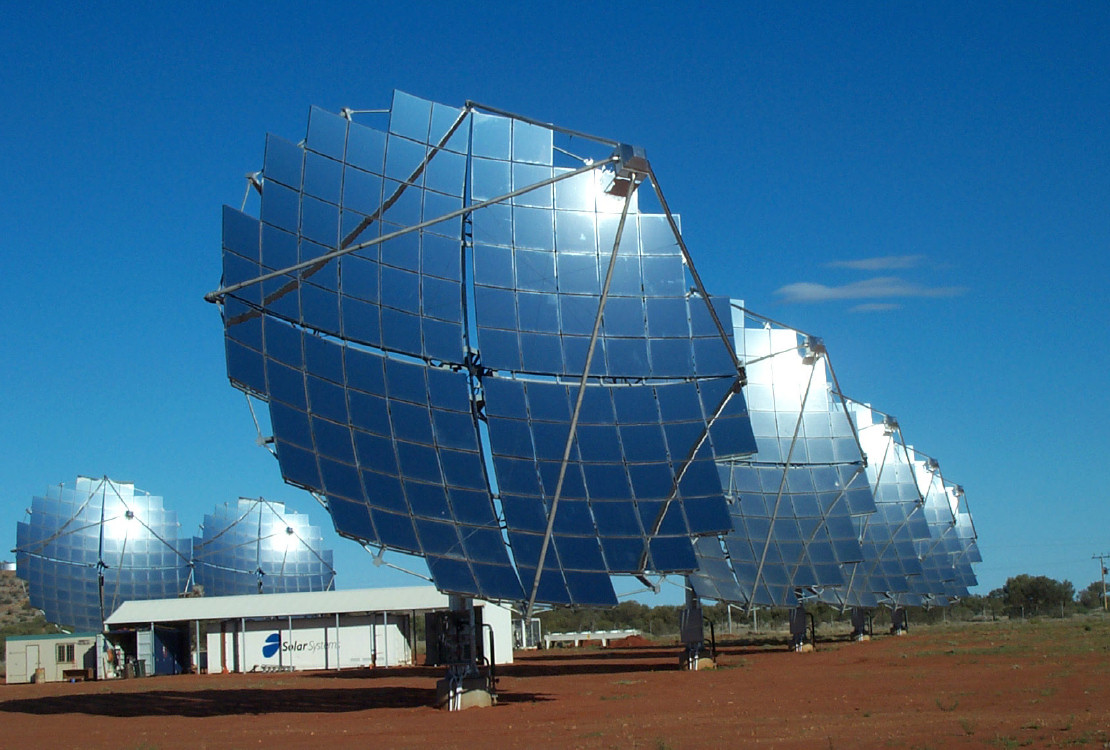
Dish/engine systems from Solar Systems at Umuwa, South Australia
Introduction
It is said that, in 212 BC, Archimedes used polished bronze shields to focus sunlight, trying to set fire to wooden ships from the Roman Empire that were besieging Syracuse. Although we don’t know whether he succeeded, the Greek navy recreated the experiment in 1973 and managed to set fire to a wooden boat at a distance of 50 metres. In the 16th century, Leonardo da Vinci proposed the use of concave mirrors to concentrate sunlight to heat water.It was not until the late 19th century and early 20th century that the idea of capturing solar energy with mirrors was tried on an industrial scale in California, Egypt and other places with lots of direct sunshine. But the era of cheap fossil fuels snuffed out these early developments and it was the mid 1980s before serious attempts were made again to apply the technique of ‘concentrating solar power’ (CSP).
The basic idea is to arrange mirrors so that they concentrate sunlight into a relatively small area and then use the resulting heat to raise steam to drive turbines and generators, just like a conventional power station. Direct sunlight is needed and CSP works best when sunshine is plentiful, as it is in hot deserts. In those kinds of conditions, CSP is currently the most cost-effective way of capturing solar energy but this might change in the future with further developments in photovoltaics (PV).
A nice feature of CSP is that it is possible to store solar heat in melted salts (eg nitrates of sodium or potassium) so that electricity generation may continue at night or on cloudy days. This is currently a lot cheaper than flow batteries or other technologies for bulk storage of electricity. Because CSP plants are so similar to conventional power stations, it is also possible to use gas as a stop-gap source of heat when there is not enough sun. With heat storage and hybridisation with gas-firing, CSP plants can provide base load, intermediate load and peaking power according to need.
There are several variations on the scheme that I have outlined, including systems that use heat to drive a Stirling engine and generator, and hybrid schemes that use mirrors in conjunction with PV.
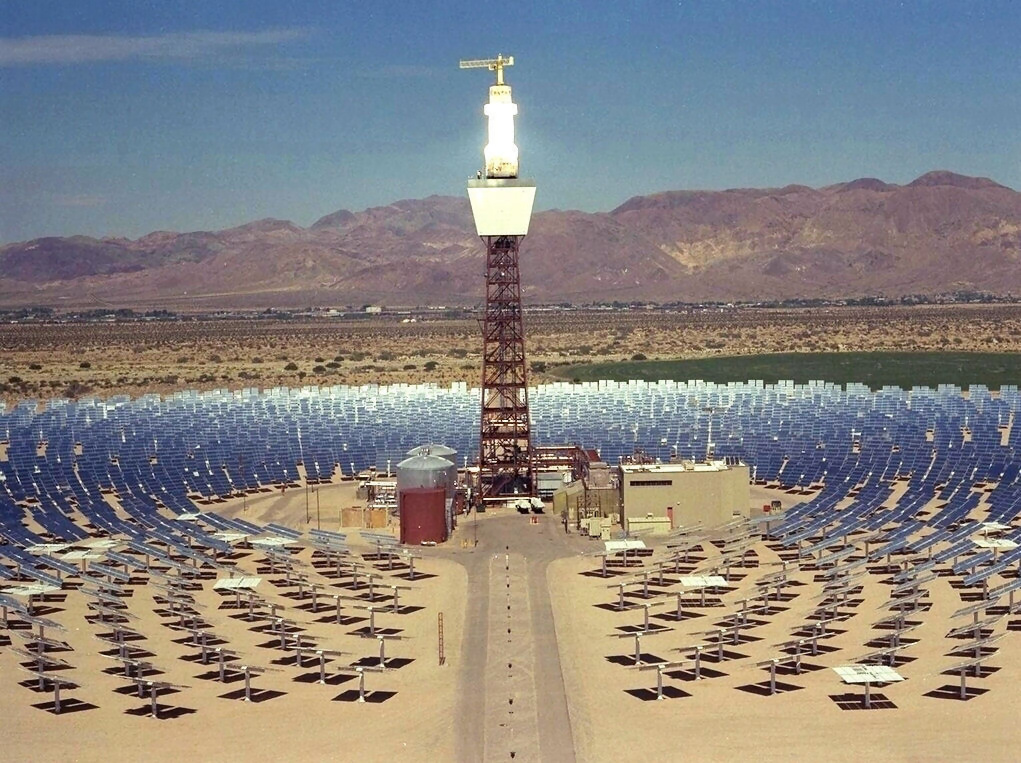
Solar Two tower and heliostats in Daggett (Barstow), California.
New developments and potential
Currently, there are CSP plants in the Mojave desert producing 354 MWe (peak), and there are smallish installations elsewhere in the world. But concerns about CO2 emissions and future energy supplies have led to a recent surge of interest in CSP, with new plants now being planned or built around the world.The statistics are quite startling. Every year, each square kilometre of hot desert receives solar energy equivalent to 1.5 million barrels of oil. Multiplying by the area of deserts worldwide, this is several hundred times the entire current energy consumption of the world. It has been calculated that, if it was covered with CSP plants, an area of hot desert of about 254 km x 254 km—less than 1% of the total area of such deserts - would produce as much electricity as is currently consumed by the whole world. An area measuring 110 km x 110 km, a small fraction of the area of desert in North Africa and the Middle East, would produce the same amount of electricity as the European Union consumed in 2004. In a report published in January this year, the American Solar Energy Society says that “...analysts evaluated the solar resource in the Southwest [of the US] and ... found that CSP could provide nearly 7,000 GW of capacity, or about seven times the current total US electric capacity.” (emphasis added).
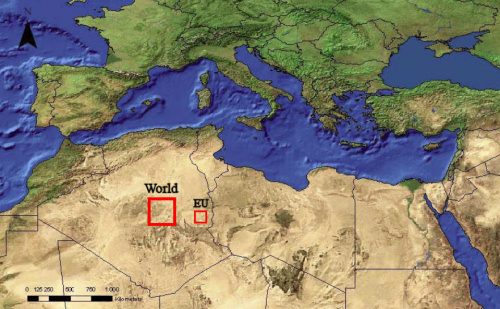
What has this got to do with the UK?
Of course, the UK is not over-endowed with hot deserts and it is natural to assume that CSP is not relevant to our needs. But for reasons that I will describe, CSP could become a major source of carbon-free energy for the UK and many other countries that do not themselves have deserts.One possibility, which is not entirely frivolous, is to take Mahomet to the mountain: relocate energy-intensive industries so that they can make direct use of thermal or electrical energy from CSP plants in desert areas. For example, the heat and electricity that is needed to convert bauxite into aluminium could be provided by CSP plants in the Australian desert, close to where the bauxite is mined. Naturally, this would not assist the production of aluminium in the UK, but in the highly inter-dependent global village that we live in now, this kind of solution to energy-supply problems could be a major benefit.
Another possibility is to transport solar energy over long distances using hydrogen as an energy vector. In principle, the hydrogen could be derived from water by the direct application of solar heat and there have been some experiments along these lines. But until such time as this can be done efficiently on a large scale, hydrogen may be generated by the electrolysis of water using solar electricity.
Hydrogen that is produced in this way could be used as fuel for trains, road vehicles or even planes. But if hydrogen that is derived from CSP is merely a means of recreating electricity in the UK or other distant location, then it quickly begins to lose its shine. It has been calculated that about 75% or more of the original electrical energy would be lost in conversions and processing that would be required between CSP electricity at its source and electricity at a distance, created by the combustion of hydrogen.
If electricity is what is needed at the destination, then in almost all circumstances it is very much more efficient to transmit solar electricity directly using high-voltage transmission lines. HVAC works well over relatively short distances but for longer distances, HVDC is the preferred option. With transmission losses at about 3% per 1000 km, electricity may for example be transmitted from North Africa to the UK with less than 10% loss of power.
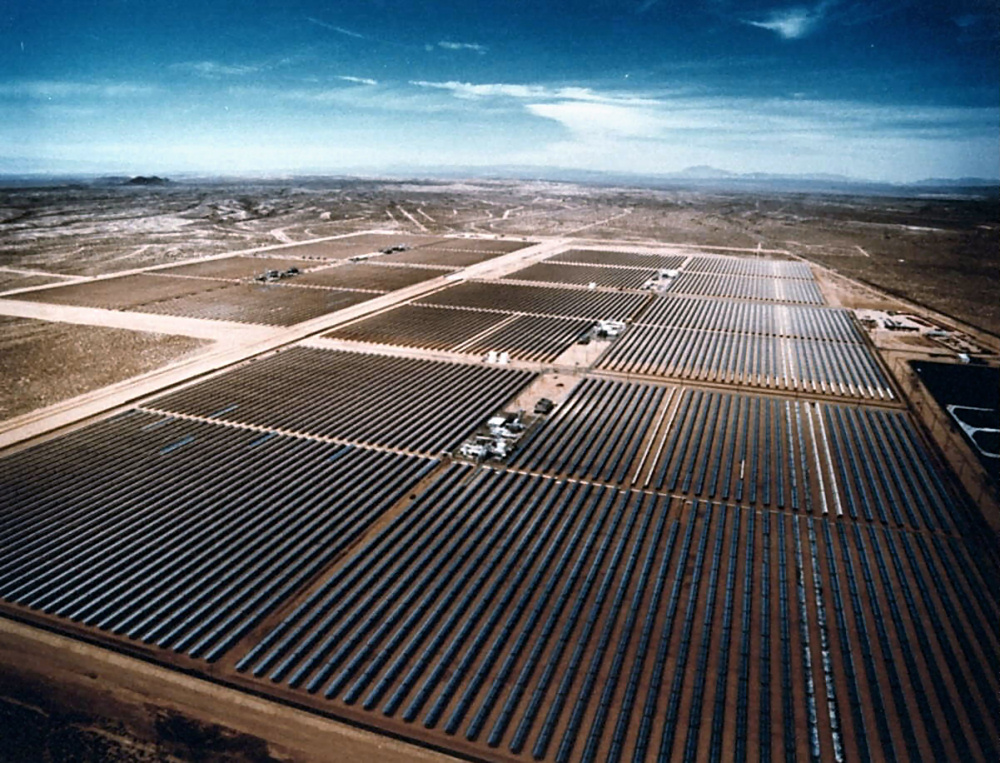
150 MW of parabolic trough CSP plant at Kramer Junction, California.
The DESERTEC concept
The ideas that I have sketched are part of the ‘DESERTEC’ concept, a set of proposals for future electricity supplies in Europe, the Middle East and North Africa (EUMENA) that has been developed by the ‘TREC’ international network of scientists and engineers. The proposals are described in considerable detail in the ‘MED-CSP’ and ‘TRANS-CSP’ reports prepared by a team of researchers at the German Aerospace Center. Copies of these reports may be downloaded via links from www.trec-uk.org.uk/reports.htm.The second of those reports shows how, in the period up to 2050, Europe could meet all its needs for electricity, make deep cuts in CO2 emissions from electricity generation, and phase out nuclear power at the same time. Compared with the situation now, there would be an increase in the diversity of sources of energy and there would be an overall reduction in imported sources of energy. Those two things together would mean an overall increase in the resilience and security of electricity supplies. CSP would be just one element in the mix - up to 15% of the total - and would be an exception to the rule of reduced imports.
An important part of the DESERTEC concept is the creation of a large-scale HVDC transmission grid, spanning the whole of EUMENA, and designed to work in conjunction with existing HVAC grids. This proposal chimes well with an independent proposal by Airtricity to create a Europe-wide HVDC grid. One advantage of this kind of grid is that it provides an answer to the often-voiced objection to wind power—that “the wind does not blow all the time”. This is true in any one relatively small area but it is almost never true across a large area like Europe. Another advantage of large-scale HVDC grids is that surplus electricity in any one area - more than the local people can use - may be moved to other areas where it is needed, thus reducing the wastage of energy that may otherwise occur.
An interesting aspect of the Airtricity proposal is that all the power cables would be laid under the sea! Modern designs of HVDC cable make this a realistic option now. One advantage is that it would largely eliminate any problems of visual intrusion. And it would greatly simplify the processes of planning and construction.
One of the most fascinating aspects of the DESERTEC concept are various spin-off benefits, especially for local people in host countries. For example, waste heat from CSP plants may be used for desalination of sea water - a very useful bonus in arid regions. The shaded areas under CSP mirrors are protected from the full glare of the tropical sun and may be used for many purposes, including horticulture using desalinated sea water. Throughout EUMENA, there would jobs and earnings in a large new industry. More generally, the development of a win-win collaboration amongst countries of EUMENA, with substantial benefits for all, would be a good way to promote good relations and mutual understandings across the region - a positive alternative to the confrontational policies of recent years.
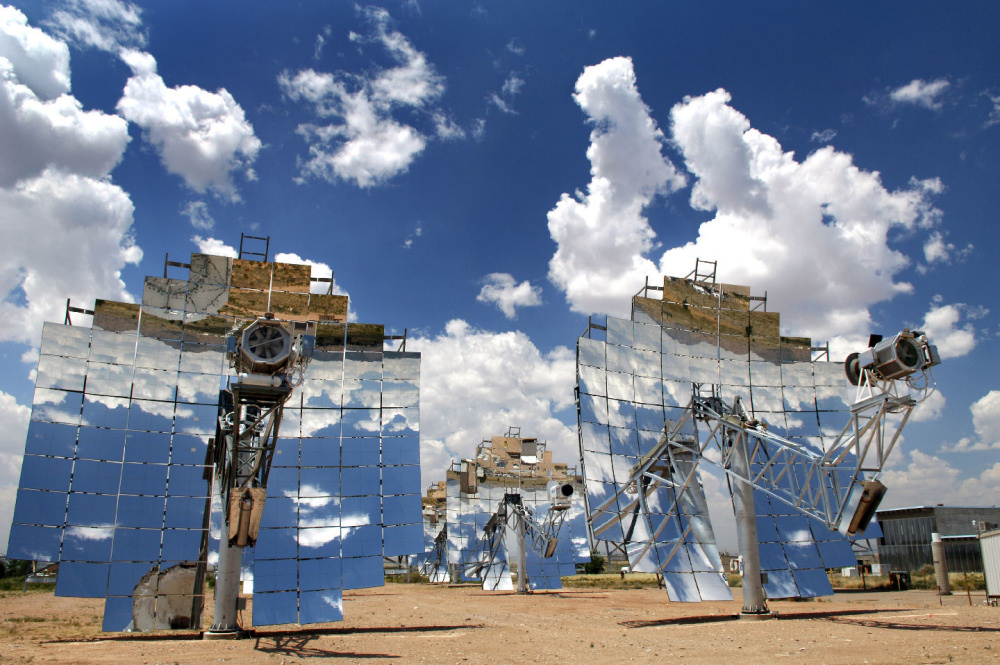
Dish/engine systems from Stirling Energy Systems at the Sandia National Laboratories in Albuquerque, New Mexico.
Costs
The cost of collecting solar thermal energy equivalent to one barrel of oil is about US$50 right now (already less than the current world price of oil) and is likely to come down to around US$20 in the future. The MED-CSP report, published in 2005, suggests that CSP will need public support for a time (like other renewable forms of energy) but that, with economies of scale and refinements in the technology, the cost of CSP electricity is then likely to tumble relative to more traditional sources of electricity. The TRANS-CSP report calculates that CSP is likely to become one of the cheapest sources of electricity in Europe, including the cost of transmission.A report in Business Week (2006-02-14) quotes the CEO of Solel as saying “Our [CSP] technology is already competitive with electricity produced at natural-gas power plants in California”. Similar claims are being made by others in the industry. Speaking about CSP at the Solar Power 2006 conference in California, the US venture capitalist Vinod Khosla said “...we are poised for breakaway growth - for explosive growth - not because we are cleaner [than coal-fired electricity] but because we are cheaper. We happen to be cleaner incidentally.”
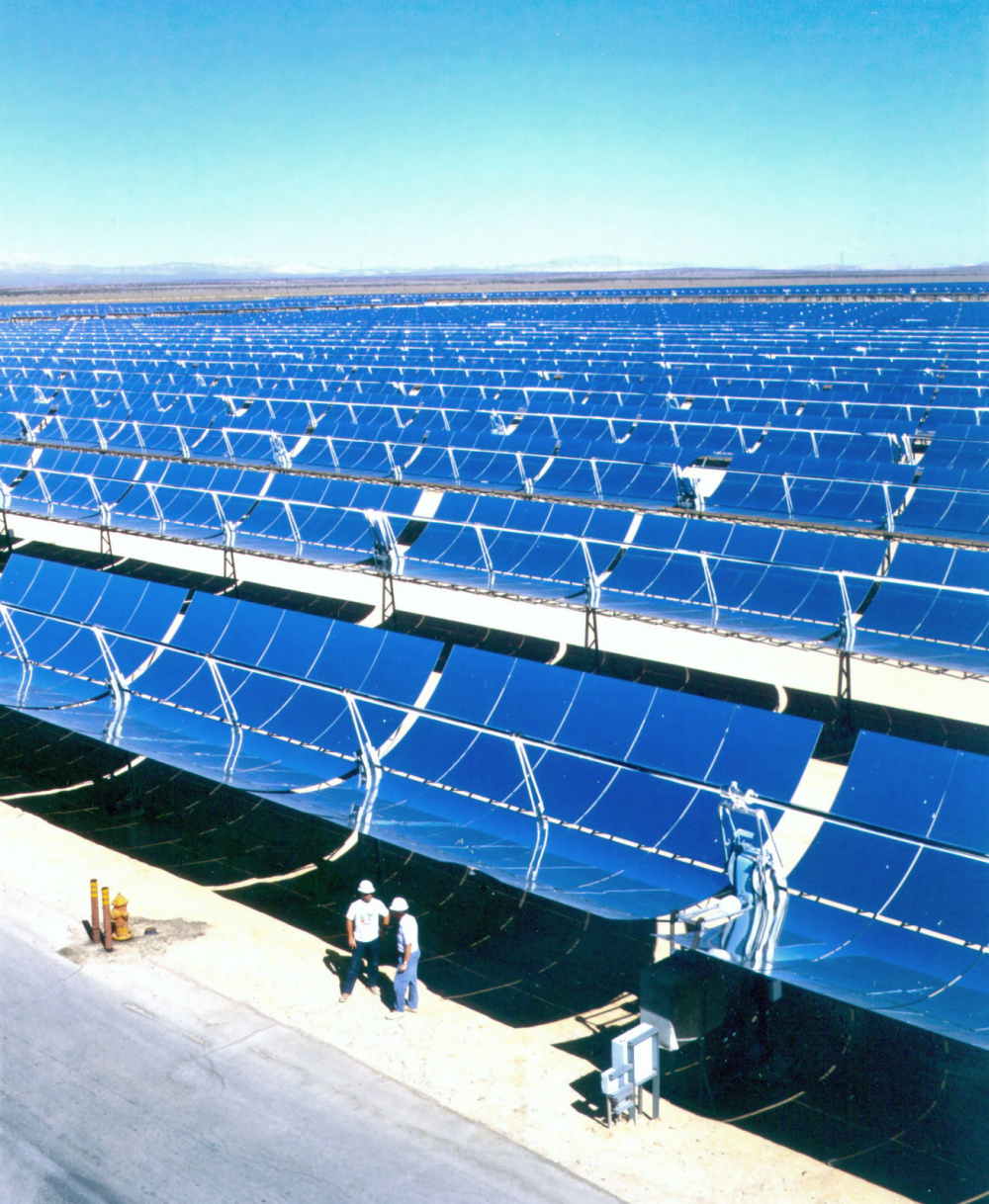
Parabolic trough mirrors with maintenance workers at Kramer Junction, California.
Security of supply
Although few people express any worries about the fact that the UK produces only about 60% of the food we eat, a surprisingly large number of people seem to think that it would be quite unacceptably risky to import some of our electricity from North Africa and the Middle East. For several reasons, I believe that any possible risk is more apparent than real.The number of countries with hot deserts is quite large so we would not need to be overly-dependent on just a few sources of CSP electricity, as we are with some other sources of energy. Given the substantial benefits that CSP would provide for host countries, there is little incentive to disrupt their operation. The transmission grid can be designed to accommodate damage in very much the same way that the internet was designed to be resilient in the face of military attack: rather than rely on a few large transmission lines, electricity may be transmitted over a network of smaller transmission lines; and submarine cables, as proposed by Airtricity, would be relatively safe from attack. CSP plants would be difficult to damage by any kind of attack and they would be easy to repair.
Conclusion
The DESERTEC scenario, which has been developed with considerable professionalism and care, shows that concentrating solar power can be an important source of carbon-free electricity, not just for countries in the sun belt but for many other countries as well—including the UK. Additional potential benefits include the not-insignificant prize of improved relations amongst different groups of people.All the relevant technologies are available now. With the right political impetus, the necessary infrastructure can be put in place quite soon.
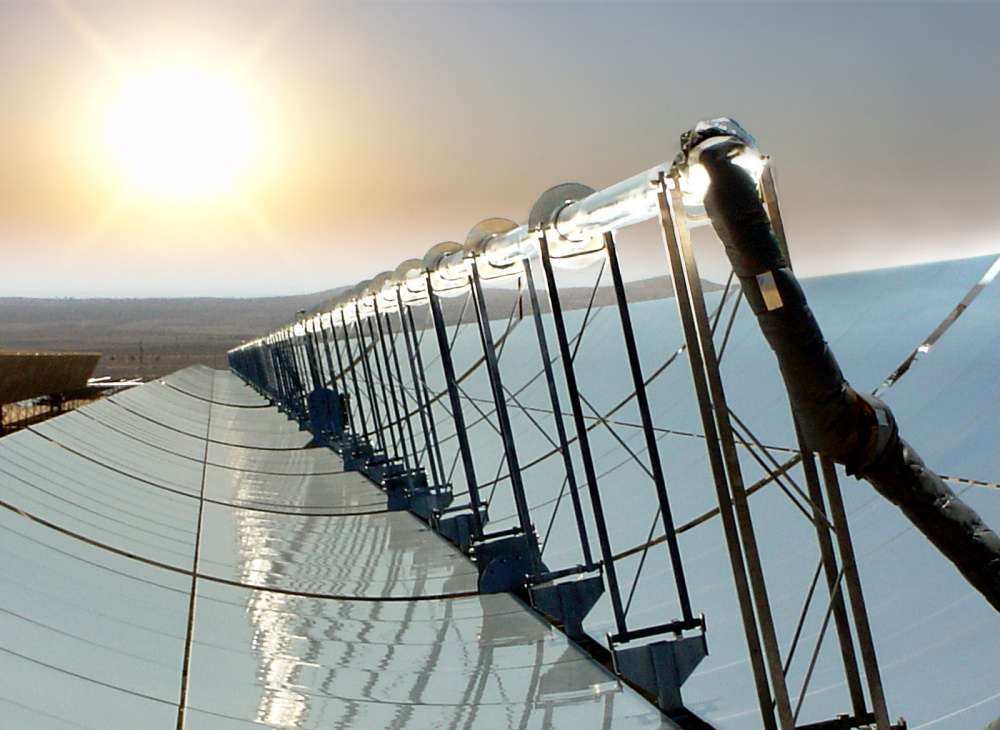
Close up view of parabolic trough and heat collector.
Technical information is available in the two reports prepared by a team of researchers at the German Aerospace Center:
Trans-Mediterranean Interconnection for Concentrating Solar Power (TRANS-CSP, 2006, PDF, 6.1 MB).
Concentrating Solar Power for the Mediterranean Region (MED-CSP, 2005, PDF, 11.9 MB).
Copies of these reports may be downloaded via links from www.trec-uk.org.uk/reports.htm.
This article was first published in the April/May 2007 issue of Power Engineer, magazine of the UK Institution of Engineering and Technology, pages 22-25.
Personnel
Editors
Contributors
Peak Oil Primers
Archives
- November 2010 (3)
- October 2010 (6)
- September 2010 (4)
- August 2010 (7)
- July 2010 (6)
- June 2010 (7)
- May 2010 (2)
- April 2010 (8)
- March 2010 (4)
- February 2010 (6)
- January 2010 (3)
- December 2009 (5)
- November 2009 (8)
- October 2009 (12)
- September 2009 (6)
- August 2009 (5)
- July 2009 (11)
- June 2009 (8)
- May 2009 (16)
- April 2009 (10)
- March 2009 (7)
- February 2009 (10)
- January 2009 (15)
- December 2008 (9)
- November 2008 (9)
- October 2008 (9)
- September 2008 (13)
- August 2008 (10)
- July 2008 (14)
- June 2008 (23)
- May 2008 (16)
- April 2008 (12)
- March 2008 (16)
- February 2008 (9)
- January 2008 (13)
- December 2007 (13)
- November 2007 (16)
- October 2007 (22)
- September 2007 (8)
- August 2007 (9)
- July 2007 (16)
- June 2007 (8)
- May 2007 (7)
- April 2007 (7)
- March 2007 (10)
- February 2007 (10)
- January 2007 (12)
- December 2006 (9)
- November 2006 (15)
- October 2006 (4)
- September 2006 (5)
- August 2006 (5)
- July 2006 (9)
- June 2006 (5)
- May 2006 (10)
- April 2006 (9)
- March 2006 (13)
Vital Trivia
License

This work is licensed under a Creative Commons Attribution-Share Alike 3.0 United States License.
I visited a web site of a guy from Africa that is using Mylar and satellite dishes to make these things on a personal level.
Drill a hole in the back of the sat dish big enough for a tube
Attach the mylar across the sat dish so that it is sealed.
Put tube in the hole.
Use a pump to siphon the air out of the dish.
This draws the air out and pulls the mylar in toward the back creating a parabola.
Have something in front where you wish to aim for the focal point.
Once you have the distance down turn off pump and seal the tube.
Then never ever walk in front or let anyone else.
The guy claimed he could put a beam thru metal in no time.
I've been keeping my eye out for used dishes since then on the curbs.
even small ones like sat tv should work.
He claims you make a box and get the same effect, seems like the dish shape would work better, don't know.
Weather is the problem for the mylar. thin mylar by the roll is not very expensive.
Quid Clarius Astris
Ubi Bene ibi patria
Googling "solar ovens" or "solar cookers" brings up loads of pages, many of which describe taking discarded satellite dishes and replacing the surface with reflective aluminum.
But here's my favorite design, because
a) you don't need to find a cast-off dish;
b) you could make it as large/powerful as you want; and
c) selecting the size of the individual mirrors you use lets you get whatever size focus you want to end up with
http://amasci.com/amateur/mirror.html
"The result was approximately 1000 watts of solar influx concentrated on an area the size of a silver dollar. Wood ignited with an audible "pop" the instant it entered the focal point. Toast burns instantly. Aluminum melts after 15 seconds. Half inch copper tubing deforms under it's own weight after 20 seconds. Steel glows red in about the same time."
Besides cooking, one of these could be very useful for
- heating a pressure cooker/canner for preserving produce (which you'd be doing during the summer, when there's plenty of sun)
- boiling 5 gallons of wort for making beer
- a smaller version could be used for heating an IcyBall: http://en.wikipedia.org/wiki/Icyball
http://www.ggw.org/~cac/IcyBall/crosley_icyball.html (see especially the home-made one at the bottom of the page)
I especially like the pressure-canning idea. Once you got this thing set up & working, you'd be able to preserve what you get out of your garden year after year, with no electricity or fossil-fuel input whatsoever...
I was wondering whether CSP could be used to make concrete. Part of the process involves mixing up some common chemicals, and heating to about 1400C in a kiln:
http://en.wikipedia.org/wiki/Portland_cement
Typical design for a kiln given here:
http://en.wikipedia.org/wiki/Cement_kiln
So the question I have is whether it is possible to design a kiln that could directly use CSP instead of oil/natural gas.
It might or might not be possible to use the CSP directly - depends on whether you can design the kiln to get the material heated properly. It might be easier to replace the flame in an existing kiln with a hydrogen flame, but this would be clearly less efficient.
There are other industrial processes which require heat in one form or another that currently use gas or oil, and my guess is that people ought to be thinking of ways to use the light of the sun directly to provide this heat.
I've given this some thought myself, and concluded that it is possible to make C3S clinker, but not by the same route used in conventional kilns. Remember that 75% of PC kiln feed is limestone, and the limestone produces CO2 as it is calcined, so that about 80% of the CO2 produced in cement-making comes from the limestone, not the fuel. (and cement accounts for 5-7% of man-made CO2 globally!)
An alternative process uses molten calcium chloride, and has been around for decades.
CaCl2.H2O -> CaO + 2HCl
3CaO + SiO2 -> Ca3SiO5 (at about 700C)
Hydrated calcium chloride melts at about 180C, so the whole process can take place in liquid phase, with the silica in slurry form.
If there is an ocean or brine reservoir nearby, the CaCl2 can be made from limestone and MgCl2 brine by exchange
CaCO3 + MgCl2 -> MgCO3 + CaCl2
You also need a market for the hydrochloric acid.
The challenge here is firstly materials, because molten chlorides + HCl at high temp are extremely corrosive (remember there is water present). The whole reactor loop, and especially the solar absorber will have to be ceramic (carbides?) and able to withstand day/night thermal cycling. If you can figure this out you will be a hero.
Second challenge is business. The cement companies are global semi-monopolies with billions invested in conventional kilns, and won't change until they absolutely have to. They will buy carbon credits for decades first.
Hadn't considered this 2nd process. On the one hand it sounds easier, on the other there would be a hell of a lot of HCl that needs to be put to good use. Reminds me of the glycerine problem with biodiesel...
The global companies will just end up chasing fossil fuels all over the world. As time goes on that will get harder, or the plants may need to relocate (esp if they are using natural gas).
Rib
I think we will have to just make less Cement.Timber houses Etc.
See company below has promise of solving issue of what to do with waste glycerol from bio fuel
VIRENT ENERGT
Cellulose /Sugar conversion to Hydrogen /Methane/MethanolCan also use waste Glycerol from Biodiesel manufacture as fuel
http://www.virent.com/
http://www.ecw.org/biomass2power/index.html
There are some thoughts along these lines at http://www.trec-uk.org.uk/csp_sections/csp_synthesis.htm .
In principle, it should be possible to use CSP for a variety of energy-hungry industrial processes.
Now THIS is walking down the correct path. Could you tell from my screen name?
1st Law of Thermodynamics: Energy can neither be created nor destroyed. From a purely physics standpoint, if we look at the earth as a closed system, there is only one usable external source of energy - the sun, in it's many, many forms. Wind energy, solar thermal, solar electric, hydro, ethanol, nuclear, and yes, petroleum fuels all ultimately are energy received from the sun. Everything else is just shuffling the cards.
Harnessing, maximizing and storing the only external source of energy we have is what we need to focus on. Thanks for the post.
This is another reason why the oil cartel is going to get crushed, and probably sooner rather than later.
PHEVs and biofuels. If we even try, we will easily see our way to a cleaner and more prosperous future, seamlessly, without major recessions or calamities. We can eliminate the use of fossil fuels for 90 percent of transportation. It game over nearly now for the fossil boys.
The only problem is after the cartel is broken, oil prices will tumble like ten-pins. We have to put a gas tax on, and a stiffy, or we go back to Lincoln Continentals longer than semis again.
Love this solar stuff. I wish everybody in this industry that best of luck, and look forward to someday soon outfitting my factory with the full get-up, so I sell rather than buy electricity.
BenjamineCole, prices won't tumble like ten-pens if OPEC collapses. Producing flat out we are barely supplying the world's energy needs, and not discovering enough fossil fuel to replace the oil produced. And demand keeps growing all over the world.
But I agree with you on the gas tax, and the great potential of photoelectric. Since we import about 60% of our oil and we want to discourage the use of imports, a stiff tariff would have the same effect while encouraging domestic production of energy. It could be made polliticialy palletable by calling it a national energy security initiative and dedicating the proceeds to building the infrsstucture to make alternative energy practicable.
OilmanBob-
Well, check out world fossil consumption figures. Demand was up 3.1 percent in 2004, then 1.8 percent in 2005, then 0.9 percent in 2006, according to EIA (at their website). And new technologies are just being implemented now. Higher MPG cars just now entering the US fleet of cars and trucks. I predict permanently declining demand for fossil crude in this price regime. US demand was down last year.
The average marginal cost of production a barrel of oil in 2003 was $3.57 a barrel, according to the EIA. Yet demand is falling already. It is true, at this price point, OPEC can cut production and make plenty of money, and in fact they say they are cutting production, willfully.
Peak Oilers know the real facts, and that is that OPEC is lying, to keep oil prices artificially low, and hide the truth that they are running out of oil to pump. Somehow this particular conspiracy theory doesn't make sense to me, and I like conspiracy theories.
I wonder if hedge funds, having gone long, have not planted a PR campaign to the effect that oil supplies are tight. The hedgies have billions of dollars at their disposal, and could hire websites and commentators at will. If you were long a few billion, would you not try to color the perception of oil scarcity?
The nomenclature of the oil world is increasingly hysterical.
You would not guess that fossil oil demand is nearly stagnant if not declining, and fossil crude prices well down from last summer's peak. Yet those are the facts, on a global basis.
But, hey, let's get on with the post-fossil world, I say the sooner the better, as a patriot and environmentalist. With PHEVs and biofuels, solar power plants and a thousand other steps big and small, I have little doubt we can get to a cleaner and more prosperous future. We are already headed in the right direction.
BenjamineCole, I certainly hope you are right about oil supplies, however, I don't believe it. The main reason is that Exxon, Shell,Conoco-Phillips ,Sunoco and Total are all investing billions in the Alberta Tar Sands and Four Corners Kerogen shales in the Green River formation(so-called oil shale). A little bit of arithmetic shows these sources cost $100,000.00 per barrel per day of level production in capital costs, plus another $20-$30 in production costs per barrel of synthetic crude. That's excluding transportation and refining costs.
While many nasty things can be said about big oil, they are not fools. If the world were'nt running out of cheap oil this would not make economic sense-who drills a million dollar well for 10 bbls./day of production? I've been in oil and gas exploration since 1976, believe me, those numbers don't fly because the flow rate must be good enough to pay the well out within 30 months and have a total return on investment of at least 4:1 to justify a new well in a development situation. Two years and 6:1 in a wildcat.
Of course the majors have different economics, they treasure a steady flow to keep their refinery and chemical operations working. But, watch what they do, not what they say.
As far as hedge funds being behind the peak oil folks, contact me, I'm very easily bribed!
All joking aside, the problem with any conspiracy is that most people can't keep their mouths shut. It's human nature. And especially the types that make up hedge fund cowboys-when they were all natural gas players at Enron, Dynegy and El Paso they all rolled over. But, this isn't glamerous or prooveable, just the truth. My personal psychological theory about "conspiracy theories" is that they are actually a form of denial, people are denying that real events are out of control so they blame a conspiracy, the Elders of Zion, the Illuminati, the Masons, the devil, Communists, The Government suppressing Aliens,Big Oil and OPEC.
...so they blame a conspiracy, the Elders of Zion, the Illuminati, the Masons, the devil, Communists, The Government suppressing Aliens,Big Oil and OPEC
I think Peak Oil conspiracy was started by the Amish.

:-)
Could be. My great-great grandfather was Amish, born in Lancaster County and left home in the turmoil after the Civil War to homestead in Nebraska.
I think it was the buggy whip manafacturers are behind it all.
The TREC vision is probably PART of the right path.
But before I point out the difficulties, let me nitpick at your list: nuclear (and geothermal resulting from nuclear decay), whether fusion or fission has little to do with energy from the sun nor with the 1st Law of Thermodynamics - rather with E=mc2.
I have been following the TREC-Program for a while. I must admit, I get very excited at the idea.
BUT:
1. If it ain't going to happen in Spain, Portugal, Sicily, Crete, Israel etc.. first, it ain't going to happen. The infrastructure needs to be developed in these EU/EU-friendly areas first, before the African wet dreams can even nearly be realized.
2. A corrolary to that: TREC is silently advocating (probably unconciously!) European colonialism of N. Africa. "Let the US invade Iraq, we're going for Algeria!" If the N. Africans aren't offering it themselves, why should the Europeans think they can force it (yes, investment)? I'm much more positive about such a project outside Phoenix, for instance, or a Mexican/US joint venture than EUMENA..
3. It's a centralitic, complicated solution to our energy needs. The idea shouldn't really be to build the most complicated replacement to our FF world. Simplify!!! Complex structures implode much more fantastically.
4. Sending the energy across the Med. will be the biggest obstacle. Just like with the hydrogen economy, storage/shipment is an almost unsolvable hurdle. I've been thinking about simpler (more costly?) solutions - compressed air came up the other day while reading about the car being run on it (www.theaircar.com). Surely better than batteries..
5. And this list was only off the top of my head.
Greetings from Munich!
Dom
---
My grandfather pumped oil with an engine-house,
my father pumped oil with a 20 lb. electric motor,
can't I just pump it online?
Maybe not. There is currently a project in the plans to build a tunnel under the Mediterranean between Gibraltar and Morocco. I read about this quite recently. A Swiss company was awarded a contract to develop a detailed concept for such a tunnel.
Electricity could be shipped across the Mediterranean using that tunnel.
Well, I guess they did build the other Chunnel across (under) la Manche, now didn't they?
But I don't think the real Problem is where to lay the power cable, but more the fact that the cable needs to be thousands of klicks long to get to the consumer.
Italy buys most of its e- from across the Alps (French nuclear mostly). That's another reason to begin in So. Italy / Sicily - Producing for the "local" market. If it works there (and once the infrastructures have been built up), then the Africans can be tapped..
There is a choice of one of two problems with long transmission lines. If you choose DC of a high voltage, you have to convert it back to AC at the other end. Imagine trying to convert a million volts of DC to house current.
The other choice is alternating current. Easy to step-down the voltage with transformers, but those long lines actually serve as an antenna of high impedance. A lot of the power will be lost as it turns into radio waves at the low frequency. The powerplant is effectively made into a transmitter! As you step up the voltage, you more closely match the impedance of the antenna impedance of the transmission likes. The wavelength of 60HZ is like 3,100 miles. As transmission lines approach a quarter-wavelength, it becomes more and more like an antenna, resulting in lost power radiating into space.
For really long transmission lines, you would need something like coaxial cable - a power pipeline. But that is not without lossiness due to stray capacitance between the wire and the pipe. And higher voltage means a better match between the the powerplant's output impedance and the impedance of that stray capacitance.
As it stands, our own grid loses about half the power from resistance of the wire and the RF loss described above. The majority of the loss is the resistance loss.
What a crappy choice.
Petrol prices high enough yet? Just wait!
As it stands, our own grid loses about half the power from resistance of the wire and the RF loss described above. The majority of the loss is the resistance loss.
Uh, what? Contemporary AC grids have an average loss of about 7-8% between the power plant and end user.
Yes, you can ... but only snake-oil.
And what is the EROEI of snake oil?-)
--
My grandfather pumped oil with an engine-house,
my father pumped oil with a 20 lb. electric motor,
can't I just pump it online?
They EROEI of snake oil approaches infinity!
Actually, much oil is pumped online. Pipelines are monitored in real time over the internet. Lots of remote locations are monitored online, and the adjustments in flow rates of offshore wells handled online. If Chevron and Devon decide to complete the deepwater Eocene Jack discovery, all the production equipment will have to be remote controlled for both installation and production. Refineries are the same, lots of monitors and controls. Pretty soon the whole world will be controlled by a dozen guys in Mumbai with pocket protectors!
Portugal has GE (I think) building a 11MW collector.
http://news.bbc.co.uk/1/hi/world/europe/5056012.stm
Spain has 11MW in Seville up and running.
http://news.bbc.co.uk/1/hi/sci/tech/6616651.stm
France has a parabolic collector operating in the Pyrenees.
http://explorer.altopix.com/map/vcczsy/Solar_Furnace_at_Odeillo_Font-Rom...
Sicily is beginning what looks like a 5MW array.
http://www.italymag.co.uk/italy_regions/sicily/2007/current-affairs/ital...
The North African pipe dreams are more likely to happen because where they are oil importers, they can model what happens when a barrel goes over $100, and they can't invade other countries for their fix.
2. Colonialism: The only part of N. Africa that HASN'T been under effective colonial control for the past 50 years has been Libya. We have control, we're not ceding it, we may as well use it.
3. Energy dissipation over distance: I should think replacing FF demand in N. Africa with solar should be cheaper than trying to route the electricity across the Med.
Well, there is obviously hope, although I wouldn't call 3 objects more than just a beginning..
But you're right, it might just be worth it to build the platfoms for the north Africans - you're assuming they're willing to pay first world prices, right?
Nuclear from the sun???? How much U235 and U238 does the Earth recieve from the sun every day???
Gerry,
I believe there is a station like this in operation in Spain. But I also remember that currently, the costs were still higher than traditional electricity. What is the reason for that?
Firstly a quick nitpick; bauxite is a form of laterite soil that forms in the tropics, not deserts. Interestingly both bauxite refiners (alumina plants) and aluminium smelters have discussed using akaline wastes as an offsetting CO2 absorbent.
Given that even uranium will run out one day I think CSP needs major consideration. However even with molten salt heat storage and HVDC I think the problem will be smoothing and fairly sharing the output and the infrastructure costs. Where I live (Tasmania) the Basslink undersea HVDC cable has not worked out the way predicted, both in cost and net flow. Even the Australian desert has cloudy, rainy weeks so we might need major backup generation, perhaps in nondesert areas using biomass when NG runs out.
I'd like to see a multi-country proposal with costings. A sobering conclusion may be that this can only work for a smaller world population.
Boof - "Even the Australian desert has cloudy, rainy weeks so we might need major backup generation, perhaps in nondesert areas using biomass when NG runs out."
However you have to admit we have a LOT of deserts. I would like to see a link across Australia to link us here in Western Australia with the eastern states. Think of the deserts such a link would pass through - not all of them would be rainy at the same time.
Better yet make is a HTC superconductor. http://www.amsuper.com/
They are just bringing to market affordable high temperature superconductor wire. And the final part of the transmission line would be a Superconducting Magnetic Energy Storage system. In this case in the Nullabor we could have these and not have a problem with space:
http://en.wikipedia.org/wiki/Superconducting_magnetic_energy_storage
"Size - To achieve commercially useful levels of storage, around 1 GW·h (3.6 TJ), a SMES installation would need a loop of around 100 miles (160 km). This is traditionally pictured as a circle, though in practice it could be more like a rounded rectangle. In either case it would require access to a significant amount of land to house the installation, and to contain the health effects noted below."
This could take care of most fossil fuelled operational reserves and cut emissions drastically.
Makes Mr Howard's nuclear vision all the more stupid. I am sure we could build the tranmission line for less than the 25 nuclear reactor he want to build. No waste to dispose of either.
Wow, you completely dont know what you're talking about. All that technology sure is cool but its using a steamshovel to empty a litterbox.
SMES is great stuff, but its for power quality not energy storage. Use pumped hydro instead...
Thats what the coal lobby is hoping for.
It hasn't rained much in Australia for the last ten years. They are running out of stored water for hydroelectricity and it's a serious problem. CSP is looking good because half of peaking power can be handled by the sun, and that stretches the hydroelectricity.
Of course, they could also build long pipelines or LNG trains (as in installations, not choo choos) to move the gas from the West to the East, or the North to the South, that would also work.
I know you're writing from a UK perspective, but obviously this technology would be even more attractive for the U.S. and Australia.
It also fits in well for proposals for a "Supergrid" which would use superconducting cables along with liquid hydrogen flows to send power across much longer distances with low transmission losses. Scientific American had an article about this last year:
http://www.sciam.com/article.cfm?chanID=sa006&articleID=00003872-159C-14...
SHPEGS is our open project that is attempting to adapt solar thermal to more moderate climates like Canada, the Northern US, Europe and Asia.


The concept combines concentrated solar thermal, geothermal and heat pump technology to take advantage of the high summer solar insolation and cold winter temperatures of a more moderate northern climate.
The intent is to design and build a system that provides base load renewable electricity and thermal storage for structure heating in a location independent and efficient manner.
There are some additional essays on evaluating renewable systems and background and prior art.
Thanks rohar,
I've been conceiving solar tower technologies which combine with geo (and wind!!) for a while now. Thanks for the link!
----
My grandfather pumped oil with an engine-house,
my father pumped oil with a 20 lb. electric motor,
can't I just pump it online?
Beautiful idea.
Fernando
Thank you, Chris Vernon, for some much-needed positive perspective on an otherwise gloomy site. My issues boil down to three, so to speak:
No mention is made in this excellent overview about the kind of infrastructure required to outfit "only" a 110 km square with CSP's. How do we devote the needed inputs of energy and materiel to build these reflectors, heliostats, support structures, and the like, in an era of declining energy supply?
Solar is ideal for places like California, where I live, because of the peak output matching the peak demand for A/C. But how realistic is it to expect that sufficient energy could be transported to the high latitudes for their long, cold Winters? Will we ever be able to do anything more than provide for lighting and other low-wattage apps? How much copper and aluminum are we talking about here, just for the cabling?
The statement: "CSP plants would be difficult to damage by any kind of attack and they would be easy to repair" leaves me wondering. Large facilities are inherently harder to defend than smaller ones, and the envisioned CSP's would be whoppers, way out in the middle of noplace. How hard would it be to hit one with a primitive, inertially guided Scud, and what kind of damage would an air-blast of TNT and ball bearings inflict?
In other words, it's all great, I love it, and in an ideal world it would surely point us in the right direction. But in a world dominated by veto-by-nutcase, it's too easy to undo such interdependent, global-scale energy systems through well-placed destructive acts. I echo the thoughts of others here when I say that localization is the best way toward a robust system, or at least a graceful powerdown.
I am not sure which high latitudes you are speaking of, but I have spent a considerable amount of time In Fargo, ND, USA (46 deg North Lat.) during January and February. Many times I have seen cloudless days when the temp. is -20 deg. C. Other days I have seen the wind blow for 24 hours at 20 to 30 mph during a period of extreme cold. Further east the potential for energy capture may not be so good, but in North and South Dakota (USA) the possibilities for capturing the sun's energy through wind power and CSP is great.
The pictures of Kramer Junction remind me of my days working for Luz Engineering in the late 1980's. The projects that you see in the picture needed power purchase agreements with fixed (and rather high) prices to be financable. I would be interested to see whether today's energy prices are high enough to make Luz style projects financable without the benefit of the old-style power purchase agreements.
I guess a successor company to Luz (Solel ?) is trying to do just that.
Hi Cantab
Want to share some stories about Luz?
a. So, who made money on the project?
b. What happened to Luz during the California-Enron energy crisis? Did they sell power for lots of money, or was it all contracted for?
c. What were the people running things like?
In case you aren't already familiar with it, go to dlsc.ca for the Drake Landing Solar Community just south of Calgary, Alberta, Canada which seems to be a functioning example of solar thermal in action in a rather northern and inhospitable climate. This was a good post and in my opinion the future of solar thermal looks much brighter than photovoltaics for large scale powerplants. If it were my money, that's where I'd put it.
A lot of the inspiration for the SHPEGS idea came from seeing the Drake Landing project.
The seasonal thermal storage is the main thrust of the SHPEGS idea and the system design is to build a much more effiecient solar water heater by leveraging the concentrated thermal energy to transfer additional heat from the warm summer air. This is similar to an air source heat pump pool heater, but with an absorption heat pump powered by solar thermal. Both the heat from the air and the heat to do the work are stored in underground thermal storage.
The main focus of SHPEGS is to create a local geothermal source that is much closer to the surface than deep geothermal. In the winter months this massive thermal storage is used for structure heating and to generate electricity as with a conventional geothermal plant. The cold winter air is used to create a massive cold storage which makes the summer cycle more efficient.
A good demonstration of Solar PV in a northern climate is the Toronto Exhibition Solar PV Demonstration it has a online live output stats and history that demonstrates the issue with Solar PV in Canada. There are 2 peak electrical demands in Canada, one in August and one in February. Solar PV puts out almost no power in the winter in Canada. A geothermal system being cooled by sub-zero winter air has very good performance during the winter peak load in Canada.
This is a technology that I have been advocating for a long time. It's low tech; we know how to make it work; and it can make a big difference in the longer run.
The cost of $50 to produce the same amount of electricity that you can produce with 1 barrel of oil may be a bit optimistic though. The real problem is not making these powerplants, but maintaining them.
This is a very large system with many parts, and large systems with many parts are plagued by short time intervals between failures.
The largest cost incurred is in keeping the mirrors clean, especially in a sandy desert area. Also, the sand has a tendency of getting into all of the couplings, getting the mirrors stuck in a given position as well as destroying the electric contacts for systems that use motors to track the sun. With systems that use gravity for tracking the sun, the gas stored in the tubes of the trackers has a tendency to escape; thus the mirrors will need to be constantly repaired.
Because of the huge maintenance effort, it may also not be possible to use the shady area underneath the mirrors for growing crop, but large CSP plants would lead to a local cooling as well as increased humidification of the atmosphere, which may even lead to additional cloud cover, additional precipitation, and thereby a greener desert altogether.
The issue with security is primarily a political problem. Rather than having the Europeans own large production facilities somewhere in the Algerian desert, the IMF and World bank ought to give financial support to countries like Algeria for building such power plants on their own. Algeria can then hire European and/or American companies to help them build these new CSP plants. Once the plants are operational, the IMF and World Bank can be paid back from the profits of these powerplants.
If the ownership of these plants is local, if these plants occupy many of the locals for maintenance work (which is highly labor intensive), the locals will have very little reason for wanting to sabotage these power plants.
I would just like to raise the geopolitical risk in the ideas proposed here. Namely terrorism.
Having this equipment in the desert is to leave a very nice target for those not in agreement with European politics. The saving grace may be the fact that to sneak up on an installation in a desert will not be easy. No trees to hide behind.
Plus one will be able to create a "No Entry" zone large enough to monitor electronically and give an early warning.
No population to hide behind. A 100km square is easy enough to control entry to - you have 400km of perimeter, which can be guarded with a few million in motion sensor cameras and a few million in helicoptors.
It's easy to guard in a way that a hundred thousand 1km squares with 400,000km of perimeter is not.
"The cost of $50 to produce the same amount of electricity that you can produce with 1 barrel of oil may be a bit optimistic though."
This estimate also bothered me until I saw that apples were being sold for oranges. "thermal energy equivalent to one barrel of oil" is something completely different than producing electricty (3X more costly) or making oil out of the heat (probably 5x more costly):
Try burning oil in the desert, create e- out of it and pipe that back to Europe. That's the comparison being made. You'll find that even $20 oil is too expensive at the moment..
---
My grandfather pumped oil with an engine-house,
my father pumped oil with a 20 lb. electric motor,
can't I just pump it online?
We currently pay close to $70 for a barrel of oil, irrespective of what we do with it afterwards.
It is certainly correct that the oil is much more versatile and more easily transportable than the heat produced by the CSP system.
It is also correct that we don't usually burn oil to produce electricity. Oil is too precious for that. We may burn coal or natgas. Hence a comparison with the cost of coal and/or natgas might be a bit more meaningful than comparing with oil.
However, even that comparison wouldn't be totally meaningful, because also coal and natgas can be stored and transported more easily than the heat produced by the CSP system.
The heat of the CSP system will have to be converted locally to electricity. Thus, a fair way to compare prices would be to include the cost of converting heat to electricity in the CSP system and to include the cost of producing electricity in a thermal powerplant running on coal or natgas.
An effort has been undertaken many years ago by H.T.Odum to create a better accounting system for energy. He converted everything to equivalent units of emergy (this is not a typo).
Thanks. Do you have a link to that?
Cheers, Dom
Sure! Try:
EmergySystems.Org for general information, and Environmental Accounting: Emergy and Environmental Decision Making for a more in-depth analysis.
Not exactly beneficial for solar power station operation - but growing grass around the power plant may reduce dust and sand contamination of mirrors and moving parts?
Now you're thinking like a true engineer!
I think. I'm not one myself, so I can't really decide on that.
Maybe like a German engineer? They *tend* to tell you why nothing ever could work before developing a working life-sized model, just to see and then improving on the model the next century.
See, for instance, the solar tower in Spain :"built under the direction of German engineer Jörg Schlaich". His engineering office has gone on to build a number of other solar projects, ie working models...
Anyway, now you're thinking like Murphy.-)
Wow - biggest compliment for days! I'm quite sure the engineering / maintenance problems will be solvable. But the burning issue is the system eroei!
The poster suggesting we blast mirrors into space should ponder a while and calcualte how many millenia will be required to recoup the fossil energy used to acheive a geo-stationary orbit.
German engineers are a special kind.
They will take forever to explain and document to you why it will never work, and when they build it, it will work at least a factor two better than specification.
I think they take a class in this in university.
My take is btw that we should not really look at this as a way to produce one product: electricity. Instead, we need to look at the whole system (which is, what I think you're getting at).
For instance: solar collectors create shade. Isn't shade in the dessert a wonderful thing?
Focusing light creates unused heat. Can't we pipe that into something updrafty (updraft tower)?
Instead of producing e- directly, compress the air (which can be tanked and used as kinetic energy); use the excess heat produced to boil water (for instance) which will turn turbines; use the decompressed air as an air conditioner or to pull water out of the air (great in the desert);...
What I'm trying to say is, the real issues involved are terraforming, i.e. systems engineering, either in the desert or elsewhere, but TREC is concerned with a product, while hoping, of course, to reduce CO2.
Products will be supplied by the cheapest producer (surely not TREC).
New systems, on the other hand, might just produce very desirable side products and secondary systems (air compressed cars..).
Am I making any sense?
Cheers, Dom
> the IMF and World bank ought to give financial support to
> countries like Algeria for building such power plants on
> their own.
Morocco plans to build an Integrated Solar Combined Cycle Power (ISCCP) partly funded by the World Bank.
January 5, 2007: Algiers, Algeria: Abener Signs Contract for Solar Thermal Electric - Combined Cycle Hybrid Plant
Abener has signed a contract for a solar thermal electric - combined cycle hybrid plant in Algeria. The signing was presided by the Minister of Energy and Mines, Chakib Kheli. Vice-president of Sonatrach, President of Sonelgaz, President of NEAL and Manuel J. Valverde Delgado, General Manager of Abener also assist to this event.
This project has been promoted by Solar Power Plant One (SPP1), a combined society between Abener and NEAL, constituted for that purpose and it will operate and exploit the plant for a period of 25 years. The Algerian state society Sonatrach will buy the total amount of the produced energy. The plant will be composed by a 25 Megawatt solar field of parabolic cylinder technology and will provide complementary thermal energy to a combined cyvle of 130MW.
See http://www.trec-uk.org.uk/resources.htm#CSP_GE
More information here: Announcement
And discussion at The Energy Blog.
Man, you just had to know that a paragraph like the following would cause all of us folks blessed with the "get happy if it kills ya'" gene right into high gear :-)
The statistics are quite startling. Every year, each square kilometre of hot desert receives solar energy equivalent to 1.5 million barrels of oil. Multiplying by the area of deserts worldwide, this is several hundred times the entire current energy consumption of the world. It has been calculated that, if it was covered with CSP plants, an area of hot desert of about 254 km x 254 km—less than 1% of the total area of such deserts - would produce as much electricity as is currently consumed by the whole world. An area measuring 110 km x 110 km, a small fraction of the area of desert in North Africa and the Middle East, would produce the same amount of electricity as the European Union consumed in 2004. In a report published in January this year, the American Solar Energy Society says that “...analysts evaluated the solar resource in the Southwest [of the US] and ... found that CSP could provide nearly 7,000 GW of capacity, or about seven times the current total US electric capacity.” (emphasis added).
Hmm, looks like we may have found a bit of that cubic mile after all...but let's not make it sound easier than it is...the logistical hurdles and engineering challanges are still enormous to the solar energy solution...what causes one to keep coming back to it are that
(a)The energy resource is vast
(b)And here's the best part...NO DEPLETION. Solar, wind, tide, and in many cases and applications, geothermal are the only energy sources that break out of the depletion treadmill, i.e., the more you use the more keeps coming...it's all about the capital costs of materials and assembly. Renewable energy is a logistical game at it's heart, and the laws of physics are pretty much neutral, everything depending on how you play the game!
Roger Conner Jr.
Remember, we are only one cubic mile from freedom
A thought: north African and Middle Eastern deserts are generally in countries which are net producers of oil (exceptions that I can think of are Morocco, Tunisia and further south Mali, Burkina Faso etc).
Why would they build, allow to be built or agree to supply solar-based electricity to the west, which, by virtue of its renewability, would essentially fatally wound or kill the goose that lays the golden (oil-producing) eggs?
We may indeed be only one cubic mile from freedom, but in this case, the cubic mile in question is "owned" by the very same people who sell us the original cubic mile....
Good point.
Saudi Arabia is the Saudi Arabia of solar power.
I think the answer will lie in the expected quadrupling of SA's population by 2030 (see thread from yesterday). North Africa will see similar trends. Trade, consumerism, and Adam Smith will ensure that they supply the world with energy.
The bigger question is whether we will have anything they want. Western manufacturing continues its nose-dive (except Germany), so what can we sell? Food? Lawyers?
CSP is the way to go! All we have to do is do it. Just start building them as some gigantic work project like the Hoover Dam. Create tons of jobs building and maintaining it. Sell power to aluminum smelters built on-site. Use the aluminum output to build more concentrators. Forget new road building and ethanol. Funnel that money into CSPs. All the side benefits like salt water distillation will evolve as our engineers try to wring out more profit. All we have to do is do it. Maybe Silicon Valley will turn the trick. It's possible. Coat the parabolas with Teflon and have a small shaker motor shake the dust off each morning. This is tech that we know how to deal with! We just need to do it.
What is stopping us? I'm afraid a social worker would need to answer that one. How can we be so good with tech and so bad with social actions? How can we be so paralyzed into inaction?
Loved it, will you marry my daughter? (joke).
Did i miss a reference to CSIROs SolarGas?
http://www.solve.csiro.au/0806/article14.htm
Worth a mention i think for its value adding.
FYIs, the Australian Labor Party recently announced it will (if elected) give $50 million to "establish The Australian Solar Institute, ..This new institute incorporates the CSIRO's National Solar Energy Centre and will create a global solar energy hub and fast track the development of solar thermal technology in Australia. .."
http://www.theage.com.au/news/national/labor-gazumps-pm-with-climate-pla...
Pretty but not directly useful.
'Heres to' TREC-UK leaving their governments dithering in the stalls and finding a useful endevour for what little real money remains in our crooked money money markets (and to Mike C for that solar furnace link).
All those issues with sand, rain, and whatever else are easily solved. Put the mirror in orbit. The beam will pierce clouds just fine. You can even daisy-chain light around to the nighttime side of the planet with enough mirrors.
... and heat the Earth further up in the process.
There is a difference between harvesting solar rays that arrive at the surface of the planet anyway, and re-directing solar rays from outer space.
What is the EROEI of a space mirror? Who services, maintains, replaces it?
Not feasible, not sustainable. But if you write a book about it, have some speaking appearances, shmooze some clueless investors, I'm sure you could turn a handsome profit.
This may not be the right thread but it amazes me how visceral is opposition to nuclear power. Consider the dangers of other forms of baseload or storage of intermittents.
clean coal: cubic kilometres of waste, not c. metres
supercoducting rings: effects of high magnetic field
hot granite geothermal: radon gas in steam
flywheels: disintegration at high rpm
sodium sulphur batteries: rupture, fire
molten nitrate: rupture, auto-oxidative fire
HVDC: grounding by accidental contact or terrorism
None of these must be a problem because surely the folks who warn us about nuclear would have said something.
You missed being tied in front of a solar furnace just before dawn
Or going over the race into a watermill
Or trapping your hand in the millstones
or a onshore wind turbine losing its blades which cartwheel downhill through a village
I think my 'visceral' opposition to nuclear, and not entirely unlike that with GM crops, by the way, comes down to 'Long Term Effects' and 'Chain Reactions'. I was similarly concerned with the physicists who proposed an accelerator on Long Island which would simulate a 'Really small and Safe Black Hole', some years back. What could possibly go wrong with that?
Any of the systems mentioned above can cause harm, but few threaten to remain dangerous or grow more dangerous for generations, and hundreds of generations. As highly condensed waste stockpiles age, get forgotten, decay their containment facilities.. get bought and sold and manipulated by unscrupulous groups who might not have filled out all their OSHA paperwork . As unlabeled wastes find their way into water supplies and food systems. I know, genetic mutation and dire disease only happens in the movies.. but I do worry.
Who said fear has to be fully rational to be justified?
Well, most smart people for a start.
Well, most smart people for a start.
Then show us how smart YOU are. Show, exactly, how there are no concerns over the failure modes of fission power.
Go ahead.
Why don't you show me how to build another strawman.
Not able to do anything beyond rhetorical arguments beyond 'Liars!' eh?
And here I was hoping for someone to be able to do some actual heavy mental work. Oh, if you are not able to Dezakin, perhaps someone else can step up to fill the vacuum left behind your collapse.
Guess someone doesn't know what a strawman is no matter how often he builds them...
People are not entirely rational. Even smart people are not entirely rational. An example is Dezakin's irrational failure to recognize emotion as a component of the human decision process. :)
This may not be the right thread but it amazes me how visceral is opposition to nuclear power.
Spend some time looking into the long term costs of failure modes in fission power.
Go ahead.
Show how they are as dangerous as, say, a thrown blade from a wind turbine.
Or perhaps a collapsed dam? A hundred thousand souls washed away into the night and people still trust hydropower.
Nuclear exceptionalism is the rule however.
I know you don't wish (or perhaps are even able) to respond to address the failure modes of Nuclear Fission power Dezakin.
Thank you for showing the readership again. Your unwillingness to respond just helps show how bankrupt the idea of fission is.
I just addressed it! In a single night the failure mode of a collapsed dam can cost hundreds of thousands of lives. Its happened before. Thats more than nuclear power has killed in its entire history even with the Greenies estimates of the Chernobyl event. The point is clear that the failure mode of nuclear power is clearly less severe than the favorite renewable option.
Its simple exceptionalism to nuclear power based on ignorance and fear. And it serves the coal companies well.
Thank you for showing the world you're a tool. Sheesh.
Dezakin, we have discussed this before but Chernobyl's effects are ongoing and some estimates which you may laugh at already put cancer, heart disease and other fatalities well over 100,000. A hydropower dam collapse is an absolute calamity, tragedy etc. etc. for sure but the effects are immediate and nations, populations etc. start recovering within relatively short natural cycles. Hydropower dams also can be argued to save as many lives as they take in collapses thanks to flood control benefits.
As we have also argued before, people differ adamantly on the effects of low level artificial nuclides on biological populations and thus will have vastly different ideas re risk/reward.
Sure I laugh at them, because they're lies. But even if we took it at face value 100000 over decades is a hell of a lot more managable than 26000 overnight and 145000 over the next several months.
http://en.wikipedia.org/wiki/Banqiao_Dam
All things have risk, and dams like nuclear power plants are far better engineered now.
Sure I laugh at them, because they're lies.
So that is your debunking method?
Call the other position 'a lie'?
No data. just the hand waving 'its a lie'
Its just bald assertions devoid of evidence. Weather TORCH or Greenpeace as the source they consistantly ignore evidence and operate from theoretical models that don't match the reported data. When the data is obviously differing from the desired outcome, accusations of governmental interference or other conspiracies arise.
They're both organisations with an agenda, where WHO and the IAEA is far more impartial.
But really you dont care about taking apart the data anyways.
I just addressed it!
No you did not address the failure modes of fission power.
In a single night the failure mode of a collapsed dam can cost hundreds of thousands of lives.
In what screwed up world is a dam fission power?
Well?
Thats more than nuclear power has killed in its entire history even with the Greenies estimates of the Chernobyl event.
Lets see, this is just a few points of demonstrated failure, and the theoretical "terrorist threat".
http://www.greenpeace.org/international/news/us-administration-served-iraqi
Baghdad, Iraq — The "yellowcake" sample we delivered to Paul Bremer, head of the US civil administration in Iraq, is safely contained - but who knows how much is still left unsecured and unsafe in the local community. We brought Mr Bremer a container of the radioactive uranium found abandoned near the Tuwaitha nuclear facility and urged him to allow the return of inspectors from the International Atomic Energy Agency (IAEA) to carry out a full survey and decontamination of Iraq.
The land that is no longer inhabited by humans near Chernobyl. (How many resources would become un-useable/denied when a fission plant fails?)
http://serc.carleton.edu/research_education/nativelands/navajo/index.html
Today, more than 50 years later, the Navajo are still feeling the effects from uranium mining.
http://www.sea-us.org.au/wastenot.html
http://www.google.com/search?ie=UTF8&q=terrorist+threat+nuclear+plant
Results 1 - 10 of about 1,090,000
(1 million hits? Yet not 'worthy' of mention by Dezakin)
How about Depleted Uranium
http://www.google.com/search?ie=UTF8&q=health+effects+depleted+uranium
(a fine heavy metal, with the occasional radioactive effect! )
If the max seawater rise happens (243 feet) - what does that do to the long-term decommissioning plans for a fission plant? (hint: More contamination)
The point is clear that the failure mode of nuclear power is clearly less severe than the favorite renewable option.
You need to work on your point then. Because you've not addressed the simply found, reasonable objections I found with a few minutes in a search engine.
Oh, and I don't see alot of people killed with PV or Wind.
Its simple exceptionalism to nuclear power based on ignorance and fear. And it serves the coal companies well.
Really?
http://www.ornl.gov/info/ornlreview/rev26-34/text/colmain.html
Guess you are out of touch.
But hey, YOU are claiming "ignorance and fear.", so educate us all on how humans can build a machine that can not fail, and how all the links I've provided are wrong. Go on. I await you showing how error-free and safe getting fission power has been and will be!
In what screwed up world is a dam fission power?
Yawn. Its an exact parallel of an energy source with big bad failure modes, and I find them much worse than the failure modes of a fission power plant.
Well this is stupid, but what the hell:
http://www.google.com/search?hl=en&q=terrorist+threat+dam
Results 1 - 10 of about 607,000 for terrorist threat dam.
(six hundred thousand hits? Yet not 'worthy' of mention by eric blair)
I still like hydropower. Everything has risk and the risks of nuclear aren't any more severe than any other sort of risk. The reason I favor nuclear is the risk profile is significantly lower than alternatives such as hydropower or coal.
Wow, you're laughably nonsequiter. Nuclear power is in direct competition to coal. Look at Germany, or for a closer look at the politics behind the Queensland nuclear ban.
Dezakin dreck snipped
So you don't actually address the failure modes of fission power (yet again).
Just more handwaving and blanket claims. If I want to read such, I could go to yahoo's alt.power and read John A Grant's posts.
The shining mirror of hypocricy is a funny thing. Really, after rambling about DU and rising sea level as a risk solely for nuclear power.
http://www.angelfire.com/extreme4/kiddofspeed/chapter1.html
The above link is to a Russian woman that loves motorcycles. She also went to Chernobyl on her bike and took photos.
Please go see what happens when there is a nuke disaster.
this link is to an older site she had. If you google her name you will find a newer site, but her is the original. She has a photo book for sale and she says all proceeds go to fund.
She also had this info. She says that not one researcher or scientist is allowed into the area. JOURNALISTS are, but they don't represent a danger to revealing what is really happening there.
Lots of photos and her commentary from her home point view.
worth the look for sure.
Quid Clarius Astris
Ubi Bene ibi patria
Now don't you feel silly...
http://www.uer.ca/forum_showthread_archive.asp?threadid=8951
She's a pretty fraud though.
While we're posting funny stuff...
http://www.theonion.com/content/node/39473
The above link is to a Russian woman that loves motorcycles. She also went to Chernobyl on her bike and took photos.
http://www.museumofhoaxes.com/hoax/weblog/comments/1026/
http://www.stumbleupon.com/url/www.kiddofspeed.com/
worth the look for sure.
Ya sure about that? What with the hoax status.
Hmm, don't know about the hoax part. First I have heard of that. How is it a "hoax". Maybe the part about her being alone. But Go thru all the photos she has. Are you saying they are fake. Pretty good photo shop job, and this is from the days when Photoshop was new. I saw this original site many years ago.
What I see is a ton of photos from that area. They are not fake. She is in the photos, and so is the Bike. One down the road, and one shining into house. They could be fake, but the shots of the town and more sure aren't.
The source is a Russian source saying its fake as far as I can see. The Russians don't like this type of info out. She has an updated site that says it is from 2007.
I guess you have to ask yourself who has the most to lose from showing the photos and wishes to discredit them.
I guess you have to ask yourself do you believe a Russian source that claims she is wrong. The same Russian sources that claim how many died.
Dez, also makes the claim that most of her information is not factual.
show Dez, show us the info that is real.
You have a big habit of posting stuff without backing it up. You make grand statements with no beef. You're like a neocon Fox channel host. All bluster and ideology and hot air.
This is a link to a site that says its from 2007
click on the link that says hi rez photos and there are videos and photos/
One of which is a helicopter shot flying around it.
Fake, you decide if these photos and video's are fake. Me I do Film and video for a living. I don't see how most of these can be faked, some close up photos' etc. yea. Putting objects together in an abandoned room is called "staging". and Its done all the friggin time. YEP even the US news channels do it. Large areas of towns and helicopter shots over the reactor. No I don't think so.
http://www.angelfire.com/extreme4/kiddofspeed/
ONe more thing. I read some of the comments on the slashdot site. One guy says, YEA, I was there and talked to the "tour guide" and she told me this and that and about Elana and her trip.
LOL LOL LOL. NOW there's a reliable source a TOUR guide at a Russian nuclear site. Now no way she could have been KGB, no no.
That brings me back to a tour guide I had an interesting encounter with in Buda Pest. Little bi**ch tried to set me up, I saw it coming a mile a way.
Quid Clarius Astris
Ubi Bene ibi patria
Please show where I claimed them to be a SOLE failure mode of fission power, the harnessing of the peaceful atom.
(and I also note that you have no comment on the failure mode(s) of Iran and fission power, Feel free to comment on that while holding a fan however so when you hand wave there will be a nice breeze)
Our entire planet is in failure mode and we are careening towards a disaster with only ten years to mitigate it. Any failures that might occur have trivial consequences compared to what is happeing with our current trajectory path based on the way we currently use and produce energy.
If nuclear power killed hundreds of thousands of people, this would be a trivial event compared to what is in store and, after, all this is what the recent tsunami did in Asia.
The planet is already unsafe; nuclear power cannot do much to make it unsafer. Nuclear power has the potential to kill, but fossil fuels already kill every hour of every day.
Best hopes for solar, wind,geothermal, and some hydro with nuclear to cover the baseload.
Yours truly,
Former anti nuclear activist.
If nuclear power killed hundreds of thousands of people, this would be a trivial event compared to what is in store and, after, all this is what the recent tsunami did in Asia.
Cancers, land access denial, an inability to execute on the waste problem, or the risks when man's machines (fission plants) fail don't matter, its gotta be insta-death eh?
Well gee. Global warming is no threat because its not insta-death, right?
The planet is already unsafe; nuclear power cannot do much to make it unsafer.
And if Iran fission power plants are bombed, where do they fit on that 'safety continuum'
The opposition to nuclear is visceral because none of the other technologies have the kind and combination of failure modes and that nuclear possess. Of course every technology has its problems, its just that nuclear has more than its fair share in comparison to the others.
1. Security from sabotage
2. Effects of emissions from routine operations
3. Cost in comparison
4. Infrastructure required (both material and skilled)
5. Security in a wartime environment (Will nations that possess nuclear technology always be at peace with one another ?)
6. Unanticipated failures that have a nasty habit of cropping up (Murphy)
7. Consequences of a mishap in comparison to the other modes
8. Long term sustainability.
etc. etc.
I need say no more.
Fossil fuel based power systems represent the ultimate failure mode because the fate of the entire planet is at stake. Fossil fueled based power systems are killing now and will continue to kill. Fossil fuels success in its ubiquity is in itself a failure. Nuclear failures are hypothetical and have a low probability of occuring. The effects of fossil fuels are guaranteed and continuing. Even if failures occur, their consequences will not come close to what is guaranteed if we continue down the fossil fuel path that we are on.
While nuclear may not be sustainable in the long term, the problem that requires minimizing the use of fossil fuels is now. If we continue our current path, the long term won't be worth sustaining.
Fossil fuel based power systems represent the ultimate failure mode because the fate of the entire planet is at stake.
Yes.
So that means other poor ideas should be tried to keep the consumption party going?
the problem that requires minimizing the use of fossil fuels is now.
Guess so.
Now, what are nation-states like Iran supposed to do?
If you can provide base load power without both nuclear and fossil fuels, then go for it. Please show us how. Who said anything about keeping the consumption party going. Bring consumption to a minium, but the minimum still needs to be fueled by something. If the choice is between nuclear and fossil fuels, I'll take nuclear. The slow death you worry about it is happening now because of cancers and respiratory disease from coal.
If you have good ideas as to how we power the entire economy with just renewables, I would be interested in hearing them.
A fair number of the comments have linked to concrete proposals for doing exactly that, using heat storage (e.g., liquid salts, ground-based) or pumped storage to provide stable generative capacity.
Of course, doing so with no nuclear or fossil plants is a very long-term goal, due to the enormous infrastructure requirements involved. That doesn't mean there aren't solid ideas on how to do it, though.
"Base load power" in the face of a growing population means either that effective energy available per capita is declining, the effective power supplied is growing in total, or both.
Which case are we talking about here?
Effective power supplied is growing. We've got lots of room to grow in terms of power capacity.
The solar flux is close to 100 petawatts, while human civilization uses only about 10 terawatts for everything. Demographics show population growth to be slowing significantly, so we're not facing crisis in a century or anything along those lines.
The problem is total systems cost is much higher than using baseload nuclear. Then you have to run HVDC lines to everywhere that isn't sunny...
That and when you run into a power crunch in the short term, coal allways comes in to save the day.
Many will argue including myself that nuclear is also killing now and will continue killing as long as they operate and even long after they cease operation. The trick the nuclear industry uses is that they hide behind the fact that it is hard to separate out the effects (cancers, heart disease, down syndrome etc. etc.) caused in part by their operation versus all the other myriad partial causes like chemical pollution, diet, exercise, genetics (genetics may be past radiation or chemical damage in any case)
We are not arguing for the long term continuation of fossil fuel combustion. We are saying however that one does not slay one dragon by embracing another. We are saying that there are technologies which with reasonable research and development effort (at least comparable to what nuclear received and continues to receive), are capable of mitigating the problem on the same scale as nuclear with few of the attendant negative issues.
It's hard to separate the effects, because they are insignificant.
Life in the "deadzone" around Chernobyl is thriving - now humans have mostly left, biodiversity has increased significantly. I was surprised to learn that the average radiation dose at Chernobyl was lower than the dose many people receive naturally, without ill-effects.
The only reason we thought low-level radiation was dangerous is because of scientific research, based on the linear no-threshold model. Now scientists are saying that model is incomplete, and there is a threshold. The sensible thing for laymen (like me) is to accept that scientific knowledge has progressed and update my prior belief.
For some reason which I am not sure, the irrational fear of nuclear power is a popular meme, and has become deeply embedded. I really don't understand irrational objections to wind farms, either. Meanwhile, coal plants and cars continue to kill the planet and people turn a blind eye. Funny creatures, humans.
http://news.bbc.co.uk/1/hi/sci/tech/5173310.stm
"Life in the "deadzone" around Chernobyl is thriving - now humans have mostly left, biodiversity has increased significantly. I was surprised to learn that the average radiation dose at Chernobyl was lower than the dose many people receive naturally, without ill-effects."
LINK please.. The zone around chernobyl has area's that are not as bad, wind you know caused uneven distribution.
Where is the data to back up this claim
and bobcousins, Did you catch the news story just the other day about all the spent fuel rods in the storage tank the ruskies built. Said it would last and would hold the rods no problem. The salt water wouldn't penetrate it. WHOOPS, seems like the salt water has penetrated and is breaking down the rods. This means that there is a chance, and the odds are who you talk to, that it could EXPLODE and release a ton of radiation.
People that claim they have all the bases covered for nuclear reactors and the spent fuel are liars, because history has proven them so.
Quid Clarius Astris
Ubi Bene ibi patria
Well, you could read wormwood forest...
http://www.ukrweekly.com/Archive/2005/400512.shtml
http://www.dailykos.com/story/2007/3/9/103512/0949
I'm a bit amused at how you can complain about lack of links and citations and just start making stuff up.
Here ya go Dez, now go wipe that illiterate smirk off your face, hmmm.
http://go.sosd.com/servlet/nrp?cmd=sty&cid=RIM&pgn=1&ino=1142993&cat=Wor...
And I had already posted this info from another news source link if not in this thread in another. It may have also been in the drumbeat.
Yet you go ahead with your wild flights of fantasy and neocon agenda of attacking and not doing much else.
Other news agencies around with the story to if you don't like this one.
As for your new posts to make your claim about Chernobyl.
Lets see. THe source is a TOUR GUIDE. LOL, I guess you think Russian tour guides at a destroyed nuclear facility are telling the truth. Go ahead if you will, not me bubba.
Russian tour guide, most like ex/current KGB or whatever the new initials are.
Where is a source you can quote from a SCIENTIFIC group that has done research there, besides people quoting a TOUR QUIDE.
I guess photos of the area don't meet your criteria of evidence.
That no scientific group has been allowed in to my knowledge to investigate the damage.
If you can link to that, please do so,
And did that tour guide in that story tell you how many people died and are still dying DEz, I doubt it, and if she did, why you would believe that ol Russian tour guide, but you seem to do that Dez. And why, because it fits your AGENDA, truth and fact be damned. I want my nukes waaaa waaaa, just like a little baby.
I bet you support the guy that wanted to use them for "contruction purposes" too, so Dez whats your stance on Nukes for contruction.
your links don't prove squat.
Quid Clarius Astris
Ubi Bene ibi patria
Nice, but its still revelling in hypocricy.
What are you talking about? Its by Mary Mycio, a Long Island native who's visited the exclusion zone a number of times for her book. She's not Russian, and the exclusion zone is in Ukraine.
You need to ask yourself the big question here. How are you goin to produce solar panels in 30 years??
http://zone5.org/2007/05/14/peak-opportunity-2-energy-literacy
Solar panels require both expensive materials and fossil energy in their manufacture. In one sense, putting a solar panel on your roof is really the same as sticking a large barrel of oil on the roof- far from being a source of “free” or even truly “renewable” energy, photovoltaics, like windturbines and many other forms of “renewable energy” are just more efficient ways of using or effectively storing fossil energy. A big question is, when solar PVs come to the end of their life in 20-30 years, will society have the resource to make new ones?
Reno, if we drasticly reduce our hydrocarbon needs we should have more than enough fossil fuels. Texas is still producing about 25% of the crude that we were producing in 1973 at the peak.
Making PV's require Energy.. why do you think it has to be 'Fossil Energy'?
A solar panel repays its embedded energy (what it took to mine, refine and create the entire unit) within 2 years, while they can be producing power for well over 30.
The process takes signifigant electricity and heat, which can be generated by Hydro, Tidal, Wind, and more PV.. not to forget Coal, Nuclear, Biofuels. Further, if Silicon PV panels are still being made when my current set has died, the materials can be recaptured and reused with far less energy required than making a 'virgin' PV panel. PV recycling has already been gearing up in Germany.
http://guntherportfolio.blogspot.com/2006/09/foundation-pv-cycle-europea...
Regards,
Bob Fiske
I agree. However, assuming that CSP is more efficient, what is the argument for continuing to subsidize PV installation?
NREL says the energy payback for PV systems is between 3 and 4 years. Wiki says between 1 and 20 years. A Home Power Magazine study in January 2001 found that single-crystal panels have a payback in 5-10 years, polycrystalline 3-5 years, amorphous silicon less than 2 years.
otherpower.com
wiki
nrel (pdf warning)
But by your own admission, they take significant energy to produce, and it doesn't have to be fossil fuel energy that produces PV, but currently it virtually all is. The infrastructure used to build PV currently requires FF inputs. Building infrastructure that accepts renewable energy inputs will take time. In the best case scenario we are rapidly running out of time.
How about making PV cells in the desert? Ditto for CF bulbs etc?
That will reduce the energy load in non-desert areas.
Moving appropiate production to appropiate climates.
Rice in flood plains, not irrigated areas.
Internet server farms to cold regions, i. e. maybe northern Ontario, or near northern and southern oceans? They have hydro, and a natural heat sink, instead of A/c needs. Fiber optic transmission should be no problem.
How much is Boeing paying to cool their assembly plan in wichita in the summer versus the heating costs at their Seattle facilities?
Rib
Having been following “Peak oil” ,ASPO and others for some time I believed we are at peak oil or will be in the very near future . Like a lot of other contributors I have given up on trying to explain to so called intelligent people the reasoning. An am taking my own precautions having given the Information to those I respect and let them make there own decision so as the can not say they were never told. I am of the firm belief that we can change whether it will be in time is another question. I believe that as in the article Concentrating Solar is the way to go with HVDC power distribution. Just think if Ford/GM/Toyota started to use the spare capacity tomorrow to build Sterling solar dishes the price would be a fraction of what we pay today. And they are a lot less complicated to build than a car! Big business just needs to get behind it and realize there is money to be made here. I think between the following and conservation of the oil we have our energy needs as aplanet could be covered
1 (Solar CSP) see SUNMACHINE Gmph.
Solar collector ( 25% overall efficient compared to P.V. @12-15%)
http://www.sunmachine.com/english/index.htm
2/ VIRENT ENERGT
Cellulose /Sugar conversion to Hydrogen /Methane/Methanol up to 80% efficient compares to corn /fermentation at 20%.Can also use waste Glycerol from Biodiesel manufacture as fuel
http://www.virent.com/
http://www.ecw.org/biomass2power/index.html
3/ Standard renewable’s Wind /Hydro with HVDC
Wind power storage
http://www.vrbpower.com/technology/index.html
4/Biodiesel (Twice the EOIR of corn ethanol and engines are 20% more efficient than gasoline)
5/ A long shot just yet but holds the best potential. If they do as they claim and turn the science world on its head.
STEORN Ltd.
Orbo is the brand name of our free energy technology. Orbo is a technology that produces free, clean and constant energy. It can be applied to power products ranging from portable music players to cars.
Watch this space
http://www.steorn.com/
Hello Rib - wellcome to TOD!
Still a total waste of time I'm afraid. Temperate latitude corn ethanol with eroei hovering around 1, getting up to 2 is still pointless - in one sense you'd have 50% of the population working in energy production (in the absence of fossil fuel energy slaves).
Distillate diesel contains more energy than gasoline - which is one reason diesel appears more efficient - its related to the energy content of the fuel. So you need to look at the energy content of bio-diesel.
I asked Robert Rapier the other day if he had data on eroei for temperate latitude rapeseed biodiesel - and he didn't know. If you had any links I'd be interested to know.
Rib
Just a small point Diesel engines are 12-15 % more efficient than petrol/gas for two reasons, even alowing for higher
1/they are not throttled thus reducing pumping losses gas engines suffer from at low throttle openings
2/Higher compression ratio of diesel raises thermodynamic efficiency.
This does not allow for the lower energy content per kg of bio fuel which is 5- 7% less compared to standard diesel.
values may not be exact memory from college may not be exact. Point taken other than that. I am only sugesting stop gap measures.
Thanks
The surest sign of a functioning perpetual motion machine, like the non-existent Irish example above, will be that the developer doesn't need or want outside investors.
People don't "need" money in the same way that they need the things that money enables. But for all those "things", cars, food, hot showers, it is actually energy that provides them.
If you had free energy, you wouldn't need the money.
Maybe they could also experiment with plugging an iPod into a potato?
710,
ROTFLMAO !!
Nice twist to the age old dismissal of the surest sign of a PPM is they want investors to make a
for-sure-overunity (COP>1) prototype.
Have you been interested in this area long enough to understand what a PPM is by conventional definitions ?
But the real crux to your reaction is – what do you know about Maxwells 1865 quaternion theory of 20 formulas and 20 variables ?
In that answer, lies where PPM was BORN !!
Where IS that 'Theory of Everything' ?
Here it is !
But the real crux to your reaction is – what do you know about Maxwells 1865 quaternion theory of 20 formulas and 20 variables ?
Actually Maxwell first published his equations in the form of a set of scalar differential equations. Only later on they were rewritten in the mathematically equivalent quaternion and vector formats, where the Heaviside (vector) version is the one which is used practically universally today.
Note that all the formulations are mathematically equivalent. Contrary to what some internet crackpots might want you to believe, there is no additional physics hidden in the quaternion formulation. We just use the Heaviside formulation because it's the easiest one to work with.
In that answer, lies where PPM was BORN !!
Sorry, there is no free lunch.
JBL,
Your statement implies that all of Maxwells work was incorporated into the equations that Heaviside published.
Are you saying that Heaviside published every bit of Maxwells work.
Maxwell also wrote poetry and many of his thoughts on the universe and what is possible were also included in it.
Heaviside is not Maxwell
also, please take Heaviside/Maxwell equations and tell us how they explain the Hexagon shaped storm on Saturn
Quid Clarius Astris
Ubi Bene ibi patria
Your statement implies that all of Maxwells work was incorporated into the equations that Heaviside published.
No, my statement does not imply that, especially when taken in context. I wrote "Maxwell first published his equations", "his equations" as in "Maxwell's equations" as in the four (in the usual Heaviside formulation) famous equations forming the basis of classical electrodynamics. Secondly, the previous poster mentioned the quaternion formulation, which implies (to anyone familiar with the history of science), well, Maxwell's equations of electromagnetism and not e.g. his work in statistical physics, his poetry, the color of his eyes or a zillion entirely irrelevant things.
also, please take Heaviside/Maxwell equations and tell us how they explain the Hexagon shaped storm on Saturn
Um, no, that's not how it works. If you want to prove that the quaternion formulation explains something the Heaviside formulation doesn't, the burden of proof is on you.
Im not a math major. I do research and study history. From my research Maxwells Quaternion work was based on 4 dimensional space, not three. heaviside excluded this when he changed it to vector, Heavidside consider the other point "mystical" and did not include this point in the equations that we now use.
As for explaining the Storm. Well you use the vector based and show me how they work. From what I understand, they can't. Thats a problem with Heavisides interpretation Maxwells original work. Maxwell believed in the "aether". That word is "taboo", but because they have said it doesn't exist for so long, they now it appears "save face" and use the words "dark matter" for what they are now finding.
Oh, people that work in Hyperdimensional physics that use incorporate spatial dimensions do claim that it can be explained and are working on it.
The fact is, you can't explain it using the physics that are in common use today, or do you deny this.
Quid Clarius Astris
Ubi Bene ibi patria
Im not a math major.
That's not an excuse. Since mathematics is the language of physics, if you're going to make profound statements about physics, especially ones that conflict with the status quo, you better know enough mathematics to not look like a total ass. Sorry, vague handwaving explanations doesn't cut it.
From my research Maxwells Quaternion work was based on 4 dimensional space, not three
Since quaternions are 4-dimensional objects, is that supposed to be a surprise to anyone?
heaviside excluded this when he changed it to vector
Yes, since one of the big advantages of vector algebra is that it generalizes to any number of dimensions. Quaternions are 4D, no more no less. Hence in the vector formulation it is obvious to use the number of space dimensions directly, rather than some other dimensionality and later figure out how to map the results to whatever dimensioned space one is interested in. Nothing "mystical" here, just different mathematical notations to describe the physics.
Of course, in relativistic electromagnetics, we do use 4-dimensional quantities, with the fourth dimension being time. Again, a mathematical convenience. Albeit in this case it has a physical basis too, since relativity dispels with the concept of universal time.
As for explaining the Storm. Well you use the vector based and show me how they work.
Again no, that's not how it works. I have no obligation to prove or disprove any hypothesis of yours. That's your burden.
Perhaps you should take a short break in your study of history, and study the philosophy of science.
The fact that there is a huge hexagonal feature on Saturn is interesting, but as noone has yet offered any explanation for it (implicitly limited to published articles in an appropriate scientific journal, some random nutjob with a website doesn't prove anything), it is not proof that our current understanding of electromagnetics (of all things..) is deficient. Nor is it any proof that an alternative formulation of electromagnetism (that has been shown to be mathematically identical to the current Heaviside formulation) would be able to explain it while the Heaviside one isn't.
Maxwell believed in the "aether". That word is "taboo", but because they have said it doesn't exist for so long, they now it appears "save face" and use the words "dark matter" for what they are now finding.
The 19th century hypothesis of the "aether" and the current day "dark matter" have nothing to do with each other.
Oh, people that work in Hyperdimensional physics that use incorporate spatial dimensions do claim that it can be explained and are working on it.
I'm sorry, but it seems your self-confessed lack of mathematical clue has misled you. "Hyperdimensional physics" is nothing but a bunch of crock cooked up by a bunch of crackpots.
The fact is, you can't explain it using the physics that are in common use today, or do you deny this.
Again, the fact that noone has yet put forward an explanation for this phenomen is no proof that current day physics is deficient on a fundamental level. Eventually it will be explained, and I'm willing to bet it doesn't require any new fundamental physics.
I just love the way 'Europe' is thought of, even by Europeans. Here in Spain (yes, we're europeans too ...!) we have Europe's largest centre for the study of solar energy: www.psa.es/webeng/index.html
In Seville Europe's largest solar complex is currently being built by Abengoa and will supply the entire city by 2013 according to news reports.
This article mentions North Africa extensively, where as far as I know there is very little infrastructure per se let alone solar energy installations. Almeria has for 25 years been leading europe in solar power studies, it is one of europe's least well known deserts. Southern Spain shares such a degree of autochthonous plant and animal life with North Africa, that you could well include it in that geographical label. Europe's only native mongoose is found here, and North African exotic bird species such as Bee eaters, Hoopoe and flamingoes ... thought you might like to know!
...and with the help of major 'carbon polluters' your dessert resource will only be getting bigger and bigger... ;o)
Seriously though it is a welcome relief to see a positive article here at TOD. I think it's all too easy to get focused down on one issue and ignore the potential of solutions which themselves could have exponential impact. Yes, yes, I know about EROEI, etc, etc. It's clear to me now that transition to post fossil fuel society is not going to be a bed of roses to say the least but I am seeing some light (sunlight?) at the end of the tunnel.
I would like to see some economics of how this technology compared with -say- a 500MW/Year NanoSolar PV Manufacturing plant.
Btw -did anyone else spot this:
"Hydrogen Breakthrough Could Open The Road To Carbon-Free Cars"
http://www.spacemart.com/reports/Hydrogen_Breakthrough_Could_Open_The_Ro...
Nick.
Gerry, thanks very much for this fascinating post. My main question:
What is the eroei for Solar Concentration Systems?
You mention that the cost energy equivalent for 1 bbl oil is $50 – but what does that mean? It probably costs about $1 to produce a barrel of oil in Saudi Arabia and not much more than $5 / in the North Sea.
We know the eroei for wind is about 20, and this provides ample room to spill some energy in conversions to a more usable form. If concentrated solar is anywhere close to 20 then it will be a winner. Significantly less than 7, I’d imagine it is a total waste of time for inter-continental transmission as political risks and other losses will not be covered by an ample energy surplus – Nate, if you are around would you care to comment?
This is the second paper in as many weeks that has emphasised the massive surplus of solar energy arriving at planet Earth – the other post being that of Francois Cellier. And so long as this can be gathered with an eroei much greater than 10, then the OECD economies do not really face an energy crisis but more an energy problem related to political inertia.
As I see things, the energy debate is still being led by CO2, and whilst politicians like to capitalise on their environmental credentials they are unlikely to spend 10s of billions restructuring our European grid system to reduce CO2, whilst in their heart of hearts they don’t really care – besides China is going to burn every last tonne of lignite on the planet.
So I still feel very strongly that the political focus needs to be shifted towards energy depletion and energy security as the main threat to the OECD economies – and this is a very real threat in the UK (but not Scotland that has enough oil and gas and oil shale to last for decades). We still need better deterministic data on depletion of global oil and gas, and coal to convince our politicians of the need for action to rebuild our electricity grids around renewable energy and nuclear.
It seems that the existence of a pan – European HVDC grid is fundamental to enabling large scale access of multiple renewable electricity forms that may be balanced against each other. Alan (Drake) from Big Easy (a long-term TOD poster) has advocated the building of an HVDC connector to Iceland to utilise their hydro power in the balancing exercise.
It is of course possible to model wind – solar – hydro production on all time scales on a pan-European / north African basis. Do you know if any organisation is undertaking this task and attaching costs for gathering this energy? All a waste of time of course if solar does not have a large positive eroei.
This question cannot be answered precisely, because there are many different designs for CSP systems. A good first article about this issue has been written by Tom Konrad.
The EROEI will vary with the design. Lower technology systems (like solar chimneys) will have a better EROEI than higher technology systems.
Yet, all designs of CSP systems exhibit EROEI factors similar or better than wind power. Some numbers can be found in an article by John Turner. He lists EROEI factors of around 40x for CSP systems.
The first article is pure crapola.
There is no mention of methodology or how/where/why these numbers were selected. I could pull similar articles out my behind and produce inane conclusions from it as well.
The second article is an xlm file, which for some reason my compy at work doesn't want to render, so I'm missing out on a bunch of stuff.
I would like to see some serious scientific articles before you go throwing around EROEI of 40 for CSP.
Thanks
Why do you say that? I posted it for the pictures of the different types of systems plus the explanations of how these systems work. They represent a good first-hand introduction to the topic.
The second article doesn't explain, where the numbers come from, although there is a reference to a thicker report that possibly offers more information (I haven't read it myself).
Yet, the numbers look reasonable to me. Large wind turbines (the tall windmills with three blades, not the small ones with five blades) produce EROEI gains of about 20. They rely on wind occurring naturally, i.e., they are often not producing anything at all.
In contrast, a solar chimney operates on "wind" that is much more predictable. It's very low tech with components that are easy to build and don't consume large amounts of energy. There are no movable parts at all except for the turbine inside the chimney, i.e., the maintenance cost of this type of CSP system is indeed low. Consequently, I would expect that the EROEI numbers for these systems are higher than for regular wind turbines.
Other CSP systems are considerably more complex and also more maintenance intensive. However, such systems have been built for a good number of years (both of the parabolic type and of the solar tower type), i.e., meaningful EROEI numbers ought to be available for them. I trust that the author didn't suck these numbers out of his thumb.
I would expect the EROEI gains for these system to be lower than for the chimneys, because the higher maintenance intensity not only reduces profitability, but also reduces the EROEI.
However, the numbers should still be in the same ball park, because essentially, I am still using the same amount of sunshine to produce the same final product (heat).
When you boil a pot of water to make yourself a cup of tea, it doesn't really matter which stove you use. Boiling a certain amount of water simply consumes a certain number of calories.
Francois - thanks for the Turner link. A man who's mission is the hydrogen economy - but he provides this interesting link to a Norsk Hydro wind - hydrogen demonstration project in Norway:
http://www.msnbc.msn.com/id/4853004/
My gut feel is that eroei of 40x for CSP is way too high. There is a huge amount of material needed to cover the desert (this needs transporting), it seems there is considerable engineering involved in moving the mirrors and the efficiency of turning sunlight into hot water is unlikely to be that high. And then there are the maintenance issues. Turner quotes eroei of 20 - 30 for wind, whilst I would have placed that at 15 - 20, so perhaps he is prone to exaggeration.
But nevertheless, 40 is a better starting point than 4. All we need to do now is to convert to Islam and invite Algeria, Morocco and Tunisia to join the EU - job done!
I would agree that an EROEI of 40 is probably a bit high, but solar-thermal must be fairly efficient.
Why is that?
We have gone over these numbers already a good many times. Almost all of us have meanwhile agreed that running a car on FF is more efficient than running the same car on electricity, if that electricity in turn is produced by FF. Also, most of us agreed that running the same car on hydrogen is even less efficient, if the hydrogen is produced from electricity, which in turn is produced by FF.
It's simple thermodynamics: each additional energy conversion must lose some of the efficiency, and usually it loses quite a bit of it. Thus, the shorter the chain, the more efficient the system is expected to be.
What primary sources of energy do we have? Except for nuclear and gravity (tidal waves and some of wind power), all of our primary energy comes from the sun. Thus, if we start out with the sun and keep the chain short, we are likely to be winners.
Also, not each energy form is equally easy to attain. The easiest to attain is heat, because thermodynamics helps us rather than fights us. We don't need to spend extra energy to produce heat. Energy likes to be converted to heat.
Thus, a solar-to-thermal conversion is expected to give us high EROEI numbers.
I agree that the simplicity of CSP will contribute to making this efficient. One thing about living at high temperate latitude is that we rarely feel the full force of the Sun and tend to forget how powerful it is. In terms of primary energy sources we have:
0. Fusion
1. Current solar
2. Fossil solar
3. Fossil supernova (geothermal, nuclear fision and gravity)
I think you'll find that energy derived from gravity (which is a force not an energy store) is actually derived from the kinetic energy of rotation of bodies in the Solar system and that ultimately is derived from condensation of the Solar system from the remnants of our supernova precursor. This actually constriubutes to heating the interior of the Earth as tides cause friction / strain within the crust and mantle, though the biggest constibutor to the heat within is fision. Tidal heating is very important on IO , one of Jupiters moons, which is the most active volcanic body in our solar system, that is more or less getting ripped apart by Jupiter's gravity.
http://science.nasa.gov/newhome/headlines/ast27aug99_1.htm
Certainly. It's a question of where you stop.
Solar power isn't solar power either, but is a by-product of gravity pulling gasses into a huge gravity well, a well so strong that it leads to fusion of hydrogen into helium.
The kinematic energy of rotating bodies is caused directly by the Coriolis force of already rotating gas clouds getting pulled closer together by gravitation (like the rotating iceskater pulling in her arms).
Ultimately, the rotation of the entire universe ... is most likely a remnant of the big bang.
Yet for all practical purposes, we may choose to deal with solar power simply as solar power, because the time constants involved in anything further back are too great to be of significance to the human race.
I'd agree about drawing a line at 4.55 Ga - the condensation of the Solar system. But its important to be aware of the fact that all the heavy elements in our Solar system, including U and Th, most likely formed in a Supernova that pre-dates that time. Hence, much of the nuclear energy available to us actaully comes from an era that pre-dates our Sun.
Interesting point though about gravity and Solar fusion.
> What is the eroei for Solar Concentration Systems?
The MED-CSP report says "Water, wind, and solar-thermal power plants need between 3 and 13 months
for amortisation of their construction energy, i.e. considerably less than their useful service
life." (p 161).
Wow - what a report!
http://www.trec-uk.org.uk/reports/MED-CSP_Full_Report.pdf
(big fat pdf warning)
p 161 says:
I'm still a bit sceptical about such rapid pay back - but it seems solar-thermal might be a winner. So how does one go about investing in this?
This comment is directed at the guest poster.
I am very interested in a couple different numbers which you probably know about.
What is the capital cost / square meter of relector?
What is the typical radius of mirrors around such a tower? (1km, 100m, ect)
How much does each tower cost, and what is the typical height?
What is the reflection inefficiency, and what kind of mirrors are you using(currently i assume deposited aluminum behind glass with reflection_eff~80%)?
Typical losses due to dust when rays are travelling from mirror->collector? I assume these are measured in % losses per some distance.
and finally, do you have problems with bird poo on the mirrors? ( I only ask because these large CSPs will cause thermals, and birds ride the thermals for a while and poop alot)
Thank you in advance.
> What is the capital cost / square meter of relector?
I don't know. It is generally accepted that those costs are likely to fall with economies of scale and refinements in the technology and methods of manufacture.
The TRANS-CSP report estimates that CSP electricity is likely to become one of the cheapest sources of electricity in Europe, including the cost of transmission.
> What is the typical radius of mirrors around such a tower? > (1km, 100m, ect)
The diameter of the array of mirrors around Solar Two in California is 773 meters. Each of the parabolic trough mirrors at Kramer Junction in California are about 10 meters across.
> How much does each tower cost, and what is the typical
> height?
I don't have figures for capital costs but until volumes reach about 10 GW, costs are likely to be high. Wind power was expensive until volumes increased and then costs tumbled.
I don't know the exact height of the towers but you can make a judgement by looking at the pictures at http://www.trec-uk.org.uk/pictures.htm .
> What is the reflection inefficiency, and what kind of
> mirrors are you using(currently i assume deposited
> aluminum behind glass with reflection_eff~80%)?
> Typical losses due to dust when rays are travelling from
> mirror->collector? I assume these are measured in % losses
> per some distance.
> and finally, do you have problems with bird poo on the
> mirrors? ( I only ask because these large CSPs will cause > thermals, and birds ride the thermals for a while and poop > alot)
Schott Solar pioneered much of the mirror technology and should be able to answer these kinds of questions (see http://www.renewableenergyaccess.com/rea/partner?cid=2126).
Mirrors do need to be cleaned and this is currently done with water (and I assume that much of this can be recycled). I guess that, in principle, it should be possible to clean mirrors with compressed air.
Compressed Air?
Interesting idea. The Mars Rovers were cleaned by passing storms.
As the mirrors are not useful at night, I wonder if they could be rotated into a position to be "scrubbed" by prevailing winds.
Not as effective as washing, but it might lower the number of cleanings per month needed.
High cost is relative.
High captial cost or high running costs, we all have to eat a cost in the end.
The Radius of the mirrors as they extend from the base of the tower is quite interesting to know because beyond that distance the engineer in charge has decided is not worth it for some reason(likely losses from the atmosphere i suppose)
SOOO! we get 1000*1000 meters in a km^2, meaning we have ~(1000*1000)/(pi*773^2) towers per square km. (~.5)
This is good because those towers look like they could be very expensive. so in 2 sq km we have one tower and 12 wind turbines,(turbines first probably due to must lower capital costs) and secondly solar towers.
There was recently an article about the Sevilla tower on BBC News. It lists the height of the tower at 115m (377ft).
Each of the reflectors is 120 sq m in size. There are 600 of those mirrors producing 11 MW of electricity. The reflectors are made from steel.
Stainless steel? high carbon steel? white steel(graphite steel)? Galvanized? Cementite? Austenite? Messanite?
Each of these steel types is more or less expensive than the other. Stainless steel is quite expensive, and will corrode over time.
knowing 120 sq m is useful as well as 600 of those mirrors.
i can get quotes on steel prices, that is the final piece of the puzzle. (im trying to workout how capital costs scale compared to energy gathered. Obviously energy gathered will decrease if the reflectors are poor, however a ton of cheap reflectors may be able to substitute!)
Thanks for the information!!
I'll try and come back with more useful information next time.
These must be polished stainless steel. All other steels would likely corrode during night time settling of dew.
Sure stainless steel will corrode when exposed to high concentrations of ions in solution (salt water, acids, alkali), but in a relatively dry atmosphere most 18-8 (300 series) stainless steels will not have much surface corrosion even after 50 years. I know this because I am a mechanical engineer that designs rebuild programs for railroad passenger cars(in midwest USA). Many of these cars are stainless steel construction, some being built in the 1940's. Their exterior sheathing is 300 series stainless steel (301 or 304) and very much still bright. Polishing every 20 to 30 years is required to restore original reflectivity.
I don't see any problems with using stainless steel for reflectors in this CSP situation.
Other possibility is chrome plated steel which would be less costly than stainless steel, but would not have as long a life if underlying steel corrodes.
Tough to take this seriously without any kind of a cost estimate, especially since an entire rebuild of the grid system has to be thrown in. If you're talking about investment costs of > $5000/kw it's never, ever going to be done.
I agree, that it's tough taking this seriously right now, simply because the infrastructure does not exist.
As commented above, the closer to home solutions (so. Europe) will have to be (and are being) done first. I assume it will gradually move south as the net grows.
I wouldn't doubt that the Europ. retiring population also moves south, spurring consumption nearer production..
Solar rooftop collectors for heating domestic hot water are probably the most cost efficient uses of solar energy technology in existence.
Someone might qulaify for a tax credit (U.S.) after installing such a unit:
http://www1.eere.energy.gov/solar/solar_heating.html
Solar roof top heaters at Wickepedia:
http://en.wikipedia.org/wiki/Solar_hot_water
Some systems were as simple as putting a water tank on the roof to soak up the sun and preheat water used in bathing and washing. Some parts of the world are using forms of roof top water heaters because of the expected return on investment. If it can pay for itself in 15 years it might be economical.
Roof-mounted (thermal) solar collectors pay for themselves in 4-6 years in arid areas like Arizona or New Mexico. However, they even pay for themselves in more moderate climates like Switzerland.
Estimates are for about $2,200/kWe at high production volumes (p.21). That compares reasonably favourably to coal-fired plants, which have capital costs of $1,500-$2,000/kW (link), plus ongoing fuel costs.
(Solar plants at that price require volume production, but creating the equivalent of one coal-fired power plant every 4 years would be enough to generate the assumed volume.)
Estimates from greenpeace... Somehow I'm not exactly filled with confidence.
We await with bated breath your superior estimates.
While you're researching them, you might wish to look at this contract for an EU research project targetting pushing the install price below ~$2,500/kWe for similar systems to those mentioned in the first report. From the sounds of it, the project should be wrapping up this year.
Hey, me too. Show me where I can get them...
Laudible goals that still dont match current prices. Wind and nuclear I expect to be more economic than CSP for decades to come.
If I'm wrong, I'll not be disapointed, but it doesn't play with the prices needed today.
This is the same guy who repeatedly spams any forum that discusses nuclear energy with a canned message about CSP. Advocacy spamming I suppose is one way to get your message out but he neither addresses the reasons we should abandon nuclear or comparative costs. Eventually Gerry Wolff was put on a number of spam filters I imagine because he started posting with a pseudoname the same canned message...
Examplum Gratae:
And of course would just bomb forums with his prepackaged message.
Look at the cost section closely, and notice the absolute lack of any quantitative statements. CSP is all fine and well and someday will contribute to the global energy supply I'm sure... But its entirely incapable of displacing any of todays energy supply for simple reasons of cost.
Its irresponsible and foolish, but a great boon to the coal lobby.
This is inspiring. we need more of this good stuff.
Boris
london
Here is alink to an article that estimates costs of CSP at $2500/KW. Dezakhin is a BS artist.
http://www.energy.ca.gov/2005_energypolicy/documents/2005-07-01_workshop...
Well I'm glad to see a link that isn't Greenpeace, but its still speculation, and still several times more expensive per KW/hr than nuclear or wind. In a couple of decades it might be worth talking about.
Not entirely sure what BS I'm spinning, but whatever.
Here is another link that estimates costs at $1500-3500/kW.
http://www.solargenix.com/ae_files/case_study/files/PowerGen.pdf
Dezakin, BS artist and hypocrite extrodinaire, accuses others of spamming while he spams every CSP thread with his pro-nuclear rants. Either he is deliberately making a fool of himself, or he is a paid shill for the nuclear industry. Four independent reports by experts, each identifying costs in the $2500/kW range and he, with no expertise in the area, has the gall and nerve to criticize them with absolutely no evidence to back him up.
Dude, whats your beef with me. I'm fine and well if CSP works out but I'm not holding my breath.
The four independant reports from experts are a paper from greenpeace (so we dont have to use big bad nuclear plants) a rather hopeful european energy study fishing for grant money and two forward projecting industry reports probably fishing for VC, and all of them are rather short on any sort of detail.
Its not like mirrors or troughs have advanced over the past fifty years, but we're still no closer to solar thermal being a major competitor. Why now? Maybe theres something different, but its reasonable to be skeptical.
Theres lots of room for improvement in concentrating solar sure. You can use stirling dish machines, VMJ photovoltaic, or thermophotovoltaic systems. Or you can use dichroic filter/mirrors to optimize the spectrum for generating for all three systems and get total conversion efficiency way up while saving on the most expensive part of the system, the optics.
I've been following this for a while, and sure I'm hopeful that we'll crack the price barrier at least in areas like California in the short term... but optics, manufacturing prices, and operations aren't that different from fifty years ago. Just tax CO2, untether nuclear, and see what happens when venture capital starts dipping its toes into CSP.
But folks like Gerry Wolff with their single systems approach feed the likes of Greenpeace which inevitably serves the interests of the coal lobby. Nuclear can't be displaced today by CSP, but it sure as hell can be displaced by coal. Now if CSP is ludicrously affordable (cheaper than wind) then maybe it can be displaced in thirty years, but I still have my doubts about that, especially in the higher lattitudes.
Now you can be an antagonistic dick if you want I suppose, but it doesn't do much to illustrate your point... whatever it is.
Its not like mirrors or troughs have advanced over the past fifty years, ...... You can use stirling dish machines,
Material science HAS made advances. Electric Steel mills can make some amazing material VS what was made 50 years ago. Ceramics have advanced also. Hence Stirling MIGHT happen. Whispergen's were $30,000 a few years ago. For $10,000 or less one can get a newer unit.
Yet:
we're still no closer to solar thermal being a major competitor. Why now?
Well duh, how humanity gets its energy is mattering now that oil isn't $10 a barrel.
And yea...we really aren't any closer to Stirling thermal as a shipping consumer product. If you were in a special town in Germany one could get a 10kW Solo based unit for under 10,000 deuchmarks.
Now we know that certain that Dezakin is either BS artist or a paid shill. $2500/kW is on a par or better than nuclear. It is certainly not "several times" greater than nuclear. Dezakin is full shit.
Try again....
http://www.uic.com.au/nip08.htm
And be nicer.
...because I'm sure information about nuclear energy from a centre funded by some of the world's largest uranium producers is going to be completely unbiased.
People's "beef" with you is that you're dismissing links from multiple sources without providing a shred of evidence to back up your own claims. Now that you (finally!) have, it's from an industry group directly involved with the technology you're using it to support. From someone who airily dismisses links he doesn't like as not believable, that's rather hypocritical.
Basically, nobody believes you without evidence. Back up your claims, or stop spamming.
Sure sure, you post an unbiased breakdown of the measured economics of solar thermal from a non-industry source and I'll do the same for nuclear.
UIC happened to have the most detail with citations of reported costs, measured from past exerience.
Really we can operate with open eyes here.
How is $2500/kW "several times" graeter than $1500/kW for nuclear? Including decommisioning the costs are about the same.
First, Please thread if you're responding to me, just to cut down on the confusion.
Second, $2500 is several times greater than $1500 for amortized kw/hr cost.
Third, systems aren't producing solar power now for $2500 per kw to my knowledge. Are one of these reports a measurement of an in place system?
C'mon, we're talking about installed costs and not cost per kwh and how is %10-20% greater, "several times greater."
Er... okay. You were talking about installed costs and I was talking about energy costs. Energy costs are several times greater and installed costs roughly 50% greater (than nuclear or wind)
I usually expect the energy costs dominate in order of importance.
If they really can get $2500 per installed kw then maybe they can contribute to peaking energy supplies in sunny areas where the production/demand curve happens to follow the sun. If natural gas prices continue to rise we'll see what happens; I expect this will be the first application.
One report by TREC, one sponsored by the government of California, the two others cited above by experts, all point to costs about $2500/kW and yet you say differnetly with nothing to back you up.
Bah, thread. Oh well....
I've been trying to find the costs of these optics for a long time. These people are giving numbers sure, but not where they're getting them. I'm not saying they can't do $2500/kw... great if they can. I'm saying they aren't showing how they do it and even if they were $2500/kw still isn't good enough.
Wind is easily far cheaper for a start.
It's as good as nuclear, so what's your point?
Wind is about $1,300/kW and declining slowly (~3%/yr over the last 10 years).
Maintenance costs are fairly high for wind (20-25% of total lifetime cost), and should be substantially lower for solar (less mechanical wear); nevertheless, even a factor of 2 less expensive is pretty dubiously "far cheaper".
Moreover, it's not as useful - large-scale solar can provide baseload generation via heat storage, while wind is highly intermittent, so it needs careful management and pairing with more stable electricity sources.
(They'd pair nicely together, though.)
I'm pretty sure I don't buy heat storage as ever being more than a lab setup, do you?
I expect pumped storage to be far more economical, so there wind and solar are on equal ground, and solars primary advantage is in following the demand curve that happens to exist when the sun is up.
I have some other sources of levelized costs of electricity for different power sources. The levelized kWh prices are what matter because they take into account amortized costs to build as well as the operating costs. It is what you end up paying on the utility bill. It determines how much the company that builds it will earn. If you buy a hotel to rent it out, are you only concerned with the $/sf to build it or are you concerned with how much you can expert to earn per sf per day (with the correct vacancy rate) compared to costs that are leveled against sf per day?
http://advancednano.blogspot.com/2007/06/solar-cells-with-407-efficiency...
The best current energy costs for CSP are 8-9 cents per kWh. the hope is to get it down to 4-5 cents per kWh in 2015.
Hydroelectric can be 1.9 cents per kWh, but China is the main place where a lot of new hydroelectric is being built. The US is mostly built out.
Coal and nuclear are at 1.7 to 2.5 cents per kWh for older plants that have paid off construction.
New plants have projections in the 3 to 5 cents per kWh range for coal and nuclear.
Wind can also get down to that price range.
Wind and solar energy costs are variable because performance varies by location. Better wind prices in windy areas. Better solar in sunny.
The best wind projects get to 2.8 cents per kWh.
http://advancednano.blogspot.com
There is nothing exotic about heat storage and it has been shown to work in Solar II at the 10 MW scale. Sure, there are engineering and material science issues like corrosion resistance etc. but they are trivial compared to the engineering and materials issues that the new generation of nuclear will require. In other words, I have more faith in our ability to get heat storage working than in the our ability to seamlessly sort out the issues with advanced nuclear. I place my bet on the simpler technology.
You're mixing things here, nuclear power and power storage, they're not directly related.
It doesn't matter if it works if something else works better... pumped storage has been economically proven on the industrial level, while thermal storage hasn't and likely wont.
Since I have said a lot about concentrating solar in the past, I might as well say something here. I have been working on it for about 35 yrs, mostly as manager of a bunch of R&D engineers.
Stirling engines. They are the choice of NASA for long life and high efficiency in space power applications- /but only the free piston variety/, which has about 10 to 20 times the mean time to failure of crank type stirlings.
Stirlings are good in sizes from a few watts to tens of kilowatts. That fits the range practical size of concentrators very well.
Stirlings come in any cost range from cheap to very very expensive (NASA), with performance to match.
Concentrators, ditto. My favorite is thin glass reflectors formed from simple flat strips. they last a long time, have high performance, and are not expensive. Don't forget to put a big dirt dumping hole in the middle.
Trackers and mounts. Do a smart design and they are very durable and cheap, not bothered at all by sand, and very accurate if not too big.
Storage- I am glad to see that there seems to be almost a consensus on what I have been advocating from beginning of time- pumped storage of water. the sahara is close to the Med. it is full of water and won't miss a little. Or, just dig a great big hole in the ground and pump water up and down.
Terrorists. God, what a job! Every night wandering down endless rows of parabaloids, whacking each one with a RPG, But don't be too noisy! otherwise might wake up the Tauregs.
System cost- I am betting on less than 1 dollar a watt, no kidding.
Labor- Hey, we have way too many people, let 'em do mantenance.
Investment. Don't. I want it all myself.
I was waiting for you to decloak.
So....when will we see these things ship? Who is going to actually deliver?
Dean Kamen, http://www.energyinnovations.com/, http://www.omachron.com/tech.html and others have all talked about a low cost shipping Stirling......yet nothing.
When shall we see a low cost engine?
When? I guess when people like me quit fooling around with things like TOD and get back to real work.
Truth is, I am too old. tried to pass it on to the next generation, but they were not taking any advice from geezers- want to play their own games, and let the world fry.
Well, as we used to say on the flight deck when one went over the side- TS.
Past bed time. Maybe I'll think up a better answer tomorrow.
OK, I have regathered a few neurons and will try to answer again.
Stirling history is littered with masses of passed-on bad ideas, self-delusions, repeated efforts to commercialize very bad cranky engines in uses totally unsuited to them, arrogance, myopia, ego, simple stupidity, and tons of other evidence of the pathetic condition of homo sapiens. There has been no lack of money- just sense.
Think of it as an exact parallel to the Cambrian explosion of whacky life forms, many so inept as to defy imagination. Proof if needed of the total absence of Intelligent Design.
But now there may be some evolution toward real promise there. At the same time, we seem to be getting vaguely aware of the threat of fossil fuels, and the long term promise of solar energy. What is absent is any collective will or sense of urgency.
So, as we were urged to do by John Holdren at the AAAS meeting, let's blow the trumpet and charge.
1) Declare a world emergency-now.
2) Energy- set up a front-and-center competition of solar advocates, with a BIG prize to the winner.
3) Take that winning concept and put it out there. Shut down automobile production until it is done, like unto WW2.
4) Do the equivalent with population, insane economics, and the other dragons eating us out of house and home.
PS. If I said or implied that stirlings were the foregone winner of that contest, I would be displaying the same stupidity as I say everybody else in my little claque has done.
PPS. But just between you and me, my idea is best. Have a good day.
What do you think of this idea of combining a gamma style Stirling with rotating 1/2 cylinder displacer

in a trough collector?
The idea would be that the displacer could be completely sealed and balanced and rotated by a tiny PV powered motor.

Rotating the displacer would take very little energy and the "cooling" fluid would still be relatively high temperature, but would actually be the "loss" of the Stirling.
http://www.shpegs.org/stirling.html
This could either be timed to be 90° from a reciprocating power cylinder or an idea like this to pump air or even it's own cooling fluid:

Energy Independence begins with Energy efficiency
Updated
MANDATORY RENEWABLE ENERGY – THE ENERGY EVOLUTION –R15
By Jay Draiman, Energy Consultant
In order to insure energy and economic independence as well as better economic growth without being blackmailed by foreign countries, our country, the United States of America’s Utilization of Energy Sources must change.
"Energy drives our entire economy.” We must protect it. "Let's face it, without energy the whole economy and economic society we have set up would come to a halt. So you want to have control over such an important resource that you need for your society and your economy." The American way of life is not negotiable.
Our continued dependence on fossil fuels could and will lead to catastrophic consequences.
The federal, state and local government should implement a mandatory renewable energy installation program for residential and commercial property on new construction and remodeling projects, replacement of appliances, motors, HVAC with the use of energy efficient materials-products, mechanical systems, appliances, lighting, insulation, retrofits etc. The source of energy must be by renewable energy such as Solar-Photovoltaic, Geothermal, Wind, Biofuels, Ocean-Tidal, Hydrogen-Fuel Cell etc. This includes the utilizing of water from lakes, rivers and oceans to circulate in cooling towers to produce air conditioning and the utilization of proper landscaping to reduce energy consumption. (Sales tax on renewable energy products and energy efficiency should be reduced or eliminated)
The implementation of mandatory renewable energy could be done on a gradual scale over the next 10 years. At the end of the 10 year period all construction and energy use in the structures throughout the United States must be 100% powered by renewable energy. (This can be done by amending building code)
In addition, the governments must impose laws, rules and regulations whereby the utility companies must comply with a fair “NET METERING” (the buying of excess generation from the consumer at market price), including the promotion of research and production of “renewable energy technology” with various long term incentives and grants. The various foundations in existence should be used to contribute to this cause.
A mandatory time table should also be established for the automobile industry to gradually produce an automobile powered by renewable energy. The American automobile industry is surely capable of accomplishing this task. As an inducement to buy hybrid automobiles (sales tax should be reduced or eliminated on American manufactured automobiles).
This is a way to expedite our energy independence and economic growth. (This will also create a substantial amount of new jobs). It will take maximum effort and a relentless pursuit of the private, commercial and industrial government sectors’ commitment to renewable energy – energy generation (wind, solar, hydro, biofuels, geothermal, energy storage (fuel cells, advance batteries), energy infrastructure (management, transmission) and energy efficiency (lighting, sensors, automation, conservation) (rainwater harvesting, water conservation) (energy and natural resources conservation) in order to achieve our energy independence.
"To succeed, you have to believe in something with such a passion that it becomes a reality."
Jay Draiman, Energy Consultant
Northridge, CA. 91325
May 31, 2007
P.S. I have a very deep belief in America's capabilities. Within the next 10 years we can accomplish our energy independence, if we as a nation truly set our goals to accomplish this.
I happen to believe that we can do it. In another crisis--the one in 1942--President Franklin D. Roosevelt said this country would build 60,000 [50,000] military aircraft. By 1943, production in that program had reached 125,000 aircraft annually. They did it then. We can do it now.
"the way we produce and use energy must fundamentally change."
The American people resilience and determination to retain the way of life is unconquerable and we as a nation will succeed in this endeavor of Energy Independence.
The Oil Companies should be required to invest a substantial percentage of their profit in renewable energy R&D and implementation. Those who do not will be panelized by the public at large by boy cutting their products.
Solar energy is the source of all energy on the earth (excepting volcanic geothermal). Wind, wave and fossil fuels all get their energy from the sun. Fossil fuels are only a battery which will eventually run out. The sooner we can exploit all forms of Solar energy (cost effectively or not against dubiously cheap FFs) the better off we will all be. If the battery runs out first, the survivors will all be living like in the 18th century again.
Every new home built should come with a solar package. A 1.5 kW per bedroom is a good rule of thumb. The formula 1.5 X's 5 hrs per day X's 30 days will produce about 225 kWh per bedroom monthly. This peak production period will offset 17 to 2
4 cents per kWh with a potential of $160 per month or about $60,000 over the 30-year mortgage period for a three-bedroom home. It is economically feasible at the current energy price and the interest portion of the loan is deductible. Why not?
Title 24 has been mandated forcing developers to build energy efficient homes. Their bull-headedness put them in that position and now they see that Title 24 works with little added cost. Solar should also be mandated and if the developer designs a home that solar is impossible to do then they should pay an equivalent mitigation fee allowing others to put solar on in place of their negligence. (Installation should be paid “performance based”).
Installation of renewable energy and its performance should be paid to the installer and manufacturer based on "performance based" (that means they are held accountable for the performance of the product - that includes the automobile industry). This will gain the trust and confidence of the end-user to proceed with such a project; it will also prove to the public that it is a viable avenue of energy conservation.
Installing a renewable energy system on your home or business increases the value of the property and provides a marketing advantage. It also decreases our trade deficit.
Nations of the world should unite and join together in a cohesive effort to develop and implement MANDATORY RENEWABLE ENERGY for the sake of humankind and future generations.
The head of the U.S. government's renewable energy lab said Monday (Feb. 5) that the federal government is doing "embarrassingly few things" to foster renewable energy, leaving leadership to the states at a time of opportunity to change the nation's energy future. "I see little happening at the federal level. Much more needs to happen." What's needed, he said, is a change of our national mind set. Instead of viewing the hurdles that still face renewable sources and setting national energy goals with those hurdles in mind, we should set ambitious national renewable energy goals and set about overcoming the hurdles to meet them. We have an opportunity, an opportunity we can take advantage of or an opportunity we can squander and let go,"
solar energy - the direct conversion of sunlight with solar cells, either into electricity or hydrogen, faces cost hurdles independent of their intrinsic efficiency. Ways must be found to lower production costs and design better conversion and storage systems.
Disenco Energy of the UK has announced it has reached important
milestones leading to full commercialization, such as the completion of
field trials for its home, micro combined heat and power plant (m-CHP).
The company expects to begin a product roll out in the second quarter of
2008.
Operating at over 90 percent efficiency, the m-CHP will be able to
provide 15 kilowatts of thermal energy (about 50,000 Btu’s) for heat and
hot water and generate 3 kilowatts of electricity. The m-CHP uses a
Stirling engine generator and would be a direct replacement for a home’s
boiler.
Running on piped-in natural gas the unit would create some independence
from the power grid, but still remain connected to the gas supply
network.
Whereas heat is supplied only when the generator is running (or
conversely electricity is generated only when heat is needed) a back-up
battery system and heavily insulated hot water storage tank seem
eventual options for more complete energy independence.
FEDERAL BUILDINGS WITH SOLAR ENERGY – Renewable Energy
All government buildings, Federal, State, County, City etc. should be mandated to be energy efficient and must use renewable energy on all new structures and structures that are been remodeled/upgraded.
"The government should serve as an example to its citizens"
Jay Draiman, Energy Consultant
Northridge, CA 91325
Email: renewableenergy2@msn.com
Posted on: 05/31/07
renewableenergy said,
FEDERAL BUILDINGS WITH SOLAR ENERGY – Renewable Energy
All government buildings, Federal, State, County, City etc. should be mandated to be energy efficient and must use renewable energy on all new structures and structures that are been remodeled/upgraded.
"The government should serve as an example to its citizens"
Excellent example, but let's make it easy for them: The mandate would kick in from the sunbelt and work north, to give the best possible return on investment and opportunity for success.
Let me give you another one, and we can do a scavenger hunt:
Start naming the American Universities and Colleges with a solar program of at least measurable scale (let's say target 20% of total energy consumption). I know there must be some, but they are damm hard to find and far between.
WHY? The college level technical education system is where these types of ideas are supposed to be born in many cases. There are hundreds of college and university think tanks preaching everyday about the need for change, the threat of global warming and the danger of fossil fuel depletion. What is there premise? That it is good enough for you to have to do, but not good enough for us?
This is the sort of thing that makes renewables a hard sell. Any astute investor or buyer sees right through this: When you folks in acadamia not only talk the talk, but walk the walk, we'll listen is the view many in the business and investment community will say, and they will have a point. If we hope to educate the next generation of bankers, investors, architects and designers, we need more than just a handful of universities and colleges not only showing off great artists renderings for someone elses facilities, they need to show us a few of their own facilities using this stuff.
Roger Conner Jr.
Remember, we are only one cubic mile from freedom
Roger K
Roger K
'A report in Business Week (2006-02-14) quotes the CEO of Solel as saying “Our [CSP] technology is already competitive with electricity produced at natural-gas power plants in California”'
Here is a link (http://www.solel.com/files/press-pr/sacyr_nov-7-2006.pdf) to a recent announcement of an agreement between Solel and the Spanish company Sacyr to build 150MW of solar trough generation in Spain. The announced price tag is U.S. $890 million ($6000/kW), and the announced price of the electricity to be generated is $0.30/kWh. That does not sound competitive with natural gas to me. Furthermore Solel and Sacyr are not going to be building thousands of miles of transmission line, and they are not going to be building thermal storage facilities. If someone can explain away this announcement I would be happy to hear about it. In the mean time I am not holding my breath waiting for CSP to deliver electricity at at prices equivalent to today's fossil fuel generation
Electricity from fossil fuels is far to cheap because the atmosphere is being used as a free dumping ground for CO2. This has to stop.
US venture capitalist Vinod Khosla has said "... we are poised for breakaway growth—for explosive growth—not because we are cleaner [than coal-fired electricity] but because we are cheaper. We happen to be cleaner incidentally."
Roger K
I agree that we should stop using the atmosphere as a free dumping ground for CO2. But I believe that when we do so our economy will have to shrink because rewewable energy sources will not be able to support the same levels of production as fosiil fuels in their prime. The point of my post is that Vinod Khosla's claim of cheaper cost for CSP relative to to coal is false (at least if you believe the numbers quoted by Solel and Sacyr in their announcent for building new CSP capacity).