
 | Science and Technology Energy and Environment Subcommittee Action Today | The Oil Drum | Nigeria: A Closer Look at "Above Ground Factors" |  |
Can We Be Happy Using Less Energy? Uhhh.... YES!
Posted by nate hagens on June 21, 2007 - 7:10pm
Peak Oil is one of many symptoms of an ecologically full planet. Our genetically embedded drive for `more' coupled with an expanding world population of 6.5 billion mathematically suggests a finite limit for growth will eventually be reached, if it hasn't been already.
In discussions about the impacts of Peak Oil, it is sometimes implicitly assumed that we NEED to replace the energy lost from the coming liquid fuels decline with other energy sources in order to maintain our way of life and our happiness. Indeed, it seems that much of the current effort is focused on comparing/discovering the best energy alternatives with respect to EROI, environmental impact and scalability/timing. In addition, demand experts also look at efficiency, carpooling, 4 day workweek, living locally type solutions, etc. In this post, I look at Peak Oil from a broader context: the necessity and purpose of continued increases in demand for energy. What is it all for, if not to make us happy?

Ansel Adams photo "Richard Kobayahsi - Farmer and Cabbages"
Some ecologists are of the opinion that the world can sustainably house 1-2 billion humans-others believe we can hold upwards of 10 billion. Any figure used here presupposes a certain energy consumption and planetary impact per human. But the world currently has a broad variety of cultures, habits, and energy footprints. Based on the sometimes fearful rhetoric of the Peak Oil community, it is presumed that less energy per capita is necessarily a bad thing. In an initial exercise towards some longer term research, I looked at data of subjective well-being from a large multinational study done by www.worldvaluessurvey.org. This study, done in 4 waves over the last 15 years, measured dozens of demographic indicator variables, one of which was subjective well-being.
Below is one of their better known graphs showing the relationship between GNP per capita and % of population in each country that is `satisfied' or `happy' with their lives.

It can be seen, that at low levels of GNP, happiness is lacking, but once a certain level of GNP is reached, incremental income per capita adds very little to subjective well being.
Ronald Inglehart of World Values Survey verbalized the above graph by stating that after meeting basic needs, lifestyle choices make up the majority of the difference in the GNP spectrum, and lower energy lifestyles do just about as well as high energy lifestyles (indeed, there are at least 10 countries on that graph that score higher on life satisfaction than the USA, and they each produce less GNP).
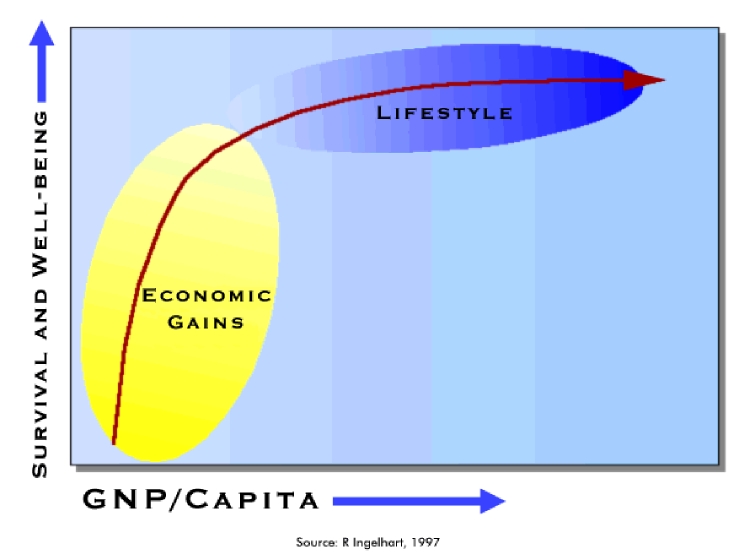
In reading on this site, and in observations of life, it seems the concept in the above graph of diminishing returns once a set minimum has been reached, is ubiquitous in our culture. When you buy your 5th car, does that make you anything close to as happy than when you bought your first? (does it really make you happy at all, or is it like opening the fridge at midnight?). Is the 10 million dollar in the bank 10 times better than the first? Do we buy the 50th pair of shoes because we need them, or we need the feeling we get from buying them?
Since GNP and energy use are correlated, I was curious what the link would be between happiness and per capita energy use. Using the `very happy' percentage from the 1999/2000 wave of international tests from World Values Survey, I compared them to all countries that www.bp.com had primary energy data for (primary energy is a broader measure than just oil) and then divided by 2000 population census. The results are in this graph:

As can be seen, there is little correlation at all between subjective well being and energy use. (The actual r2 is 14%). Of note is the United States uses 39 times the primary energy as the Phillipines yet the percentage of the population that is `very happy' is about equal. While there is a low r2, this does not mean there is not a relationship. The graph shows that all high energy users are happy. But it also shows you don't need high energy to be happy. It could therefore be read as saying that the high users are wasting considerable amounts of energy - ie not needed to be happy.
Vaclav Smil, in his book "Energy at the Crossroads" did similar work on objective measures of wellbeing vs energy consumption. A pattern similar to the above `boomerang' curve is found on comparisons of female longevity, sufficient nutritional food, educational opportunities, freedom etc. The shape is also the same, but inverted, for infant mortality. In general, Smil concludes that a reasonable level of well being on objective measures is achievable between 50 and 70 GJ/per capita, with marginal increases up to 100 GJ per capita. As a comparison, North America is currently at 340 GJ per capita. Again, the large excess consumption is not improving objective wellness.
As evolved animals at the top of the food chain, humans have become adept at acquiring resources, including energy. At some point though, "more energy" apparently does not make us "more happy". Anecdotally, as a former stockbroker, I witnessed first hand that clients worth hundreds of millions were no happier than the entry level clerks, even though being fabulously wealthy represented the `carrot' that people strived for. Similarly, in travels abroad to Ecuador, Zambia, Thailand, etc, I consistently noticed extremely happy people with very low energy usages.
Everyone has wants and needs. The wants can never really be satisfied, irrespective of energy use (look at Donald Trump or Tom Cruise). The needs are what are most important. This is an encouraging point to be aware of in the years leading up to and following Peak Oil. More is not necessarily better. Less is not necessarily worse. Perhaps, through education, marketing and living by example, society can slowly modify the definition of the `carrot', to one requiring less energy but providing equal or greater happiness.


In Part II I will look at: how subjective "subjective well being" is, how our happiness is based on meeting/acquiring certain neurotransmitter cocktails that met with evolutionary success, how happiness itself is probably a combination of contentment+novelty and the large energy consumption is on the novelty side of the equation.
In closing, a Thought Experiment:
Think of or write down the 10 things in life that you most enjoy or like to do. Then, imagine you could only choose 3 from that list. What type of things would those be? Compare the wide boundary energy/ecological expenditures of your favorite 3 versus the other 7. More or less?
Note: This is an update on the first post I wrote for theoildrum, archived here. I'll soon be building on these concepts with a Part II.
Contact
- Content: editors at theoildrum dot com
- Tech support: support at theoildrum dot com
License

This work is licensed under a Creative Commons Attribution-Share Alike 3.0 United States License.
Your distinction between wants and needs is an essential one. My paternal grandfather earned one dollar per twelve hour day digging ditches in Chicago--and he raised eleven children. They were reasonably happy on a low income. My maternal grandparents failed in rural North Dakota; they did not have enough to eat and had to put their children out as servants to others, just so the kids could eat. They were most emphatically unhappy.
We need relatively little to be happy--enough simple food, good water, warm clothing, shelter from the elements, medicines, education. The stoics claimed that happiness could only be found by reducing wants to genuine needs. Aristotle and Mortimer Adler had variations on this theme, which come down to the idea that we should want exactly what is good for us--and no more than that.
And yet, that doesn't explain why the majority of the planet wants to live the 'American Dream', or bring the AD to them in their home country. Its an interesting sociological conundrum. On the one hand, people are happy with meeting their most basic hierarchy of needs, and on the other, the pursuit of happiness seems to involve the accumulation of wealth and material possessions.
The most interesting thing to me is that, from a purely social stand point, the population as a whole, given a long enough time period, SHOULD migrate towards activities and a lifestyle that not only makes them the happiest, but requires the least amount of materials to get that point.
So the question is, whats driving the western world towards a material lifestyle? Perhaps we really are all being brainwashed in a consumer oriented fashion :P
Evolutionary fitness is a pretty tired horse beat six ways from Sunday around here (and mostly, I think, in the wrong ways), but perhaps being happy has relatively little to do with fitness compared to the accumulation of stuff?
I think the 'American Dream' is a bit of a moving target.
Sometimes, I think the appeal has been that 'They love us for our Freedoms'.. or at least those that we, until recently, did what we could to exemplify.. and these are or can be pretty signifigant. A stable democracy, civil rights, free speech, religion and an open press.. a 'melting pot', creating a land of immigrants from across the globe, people valued by hard work and who would then have the chance to have a life, get ahead, maybe get rich.. etc. We all know the drill. But those things, mythic as they might be, are not really the same as the 'Three-car Garage and a 35" flatscreen in every room' American Dream that has crusted over the 'Big Cake' picture of a land of plenty. The 'Streets paved with Gold' image can have as much to do with a person's dream for a Homey, multicultural 'Shangri-La' as with the Horatio Alger fantasy.
I don't deny that the Marketing and Manipulation of the Innocent, Apple Pie America has been overwhelming, and has worked as a fine protective veneer over industrialism's far-less-than-perfect complexion.. but I would also still have to buy into the premise that our Constitution did more than a little to rebreak the table which was littered with traditional Monarchies and Feudal states that couldn't quite break the inertia to revolutionize their governments until someone started the balls (or Heads) rolling, so to speak.
That people want this current American Dream of suburban bliss and prosperity probably has as much to do with A) Television/Hollywood's successful makeover of what Suburban 'bliss' really is.. ('More Human than Human' Tyrell-Blade Runner) and B) European/Protestant culture's insistence on presenting everything as 'Fine and Nice', because we have been conditioned to 'Put on a happy face', and let that be our Reality, regardless of the facts on the ground. How could that not be addictively appealing, if it could just be sold convincingly?
Sincerity. Once you can fake that, you're golden.
Problem + Product = Happy
Obey your Thirst
Bob Fiske
The American dream is a pyramid scheme.
They pretty much finished feeding on the rest of the world. They have begun feeding on our own working class. What will happen here when they begin feeding on each other?
I think the 'American Dream' is a bit of a moving target.
No doubt, as we became richer in a material sense. Still, there are at least two aspects of "the Dream" that have been fairly constant over the last 100 years, even as the details have changed: personal transportation and greater living space. The first provides the freedom to travel where and when you want to, rather than being subject to schedules set by others, and the second is enough space so that you don't have to listen to the screaming brat in the family "next door". TTBOMK, every developing economy, as it becomes richer, immediately begins spending money on personal transportation and larger living spaces. As one example, consider China's real estate boom and staggering forecasts for automobile sales.
To the extent that they are required to give those things up, the American public as a whole will feel that their standard of living is declining. The interesting question -- at least as far as I'm concerned -- is whether all or part of the US can maintain these "critical" aspects of their standard of living in the future. I suspect that, for example, the strip along the east side of the Rockies can manage. There are plenty of local energy resources, adequate water (with a bit better planning than now done), reasonable food production capacity. I hold out much less hope for the BoWash corridor, regardless of the higher density of its metro areas. There are not sufficient local resources to support the 70M or so people living there.
Yet people want to live in the cities, where there is much less space.
Living rurally is cheap and easy in Norway, since it's a stated political goal to have rural settlements (in contrast to Sweden, where large rural areas are downright abandoned). When I was a student, I actually had enough money to buy an old house rather than renting an apartement. I own quite a bit of acreage, actually! If I'd went a little further out, I could have had a farm, no trouble.
In Oslo, I would have needed more than twice the amount of money to buy even the tiniest room, even if it hadn't been painted since 1940. Yet more people live there.
Space and mobility matter, but they're not the whole picture by far. I think that opportunity is what people crave most of all once their basic needs for sustenance and companionship are met. They may be happy in the Phillipines (my impression is that they are very good at the companionship bit), but they are moving out by the millions. When I've had the occasion to talk to filipinos about it, they say the same: they miss their families and communities, but they saw no future there for them, nor for their families unless they could support them from abroad. Especially those with little education are deeply pessimistic about the lives in store for them if they stay.
Isn't that a sad commentary on how we increasingly view life? "Opportunity", I presume, refers to the ability to earn more and consume more. On the Philippines there may be little opportunity in those terms but is that the only way we now measure happiness?
And yet, that doesn't explain why the majority of the planet wants to live the 'American Dream
Sorry PartyGuy,but I find that a really dismal thought, as bad as living the Canadian dream whatever that is. I want to live the French Artist's dream of the turn of the 20th Century, (no Fox). Those guys rarely ate high on the Yankee style hog but there was a vitality about the arts that more than made up for it. Oops just got called to supper which I guess is everyone's dream, if not overfed already.
reasons are simple:
1 - People outside the US really don't know much about what is the "american dream", except that they see foreign americans with lots of power and money, gadgets and "freedom", who wouldn't want that? Except that people don't really think much about what they would have to trade off to get that;
2 - People outside the US really don't care much about the "american dream". Believe me, I see more americans talking about it than anyone around me. It's called in-the-house hype. You really think you're the "thing", but outside, few really care. National media hyping the american ego for just internal satisfaction;
3 - "American Dream" jealousy was used throughout the american media to support the reasons why terrorists wanted to attack USA and americans, ignoring the fact that the most arrogantly agressive and outright illegal invading country... is the USA itself. Hatred is confused by americans as if people were jealous of their "american dream". Not true at all.
What is true is that the "american dream" is no longer a colorful tag that the world still "admires". We see America morefor what the movies tells us what it is: a brutal violent country, full of ambitious greed men in a flawed system where money not people is all that matters, with a youth childlike corrupted to drugs. Hollywood may have destroyed more the "american dream" legacy throughout the world than anyone else has had.
But americans still don't realise this. They still think they're the men!
Nate: IMHO, there are male/female differences in regards to psychological fulfillment/contentment resulting from consumption or purchase of advertised products. A consumption based society is to a certain extent a "female" society (this was the point of the film FIGHT CLUB, with the main character obsessing about his Ikea furniture set in the opening scenes). Another example is the huge "mail order bride" business, which rests upon the desire of attractive young Eastern European, Russian, Asian and South American women to get to the consumption capital of the universe and spend, spend, spend (even if they have to hook up with an unattractive older American).
I always get my behavioural research material from Hollywood.
I get mine from Van Nuys.
Chimp---
That is really scary!
Capitalism is a pyramid scheme, and it is just a matter of time----
The sooner the better, if you ask me.
Well, the consumption culture does seem linked to the liberation of women from the home. Is, "shop 'til you drop" a phrase associated with men?
Maybe not 'associated' as such, but it well should be..
Sorry, This whole line of logic is convenient sexism. Men do plenty of shopping, and are marketed to for an incredible range of unnecessary products, from Movies and Videogames, to Pornography, Oversized Trucks, Cheap Tools, Sporting 'Accessories', Alcohol (this is where much of the 'Dropping' comes in, whether its dropping off the barstool or just dropping much of your paycheck too many Fridays.).. no small amount of vanity products, etc..
We're all consumers to some degree, but I'd wager that women having access to more discretionary cashflow has done more to benefit children, household and nutrition than when they had to get the money from Dad.. but by a similar token, now that it takes at least two incomes even to barely get by for so many people, the resulting detriment to child welfare likely far outstrips the benefits of the Mothering instinct.
I don't buy the 'Men raised by women' premise in Fight Club.. the logic escapes me.. If anything, it's that most of us have been raised by TV.. which is to say Cereal Commercials, while both parents were working, grandparents might be in another state, etc etc.. The particulars run the gamut, of course.. but I'd say we were suckled by Ma Bell and General Mills.
Obey your Thirst.
Bob
Jokuhl: Whenever anyone points out obvious differences between men and women (in general) a label of sexism will result. I realize that what I am going to say is a generalization, but here goes: I have met a great many men who could be quite happy and fulfilled living in a basement apartment providing they had access to all the attractive women they desired. I have yet to meet a single female who would call living in a dump while having access to attractive poor males a dream existence. Yes, there are American men who love to shop, buy moisterizer and shoes, and there might be some American women who would love the existence I outlined above, but IN GENERAL there are major differences between the sexes in happiness/fulfillment derived from shopping/consumption.
Moisturizer and Shoes? Did you think I was talking about boutique shoppers? Frankly, my own examples replaced sexism with classism, but just to make the point that 'shopping' doesn't mean carrying cute little bags around the Galleria. The comment that consumerism was a result of womens' lib just seemed hilariously blinded to the great marketing targets that are out there.. so since this is a fairly male site, albeit a reasonably intelligent one, that perspective looked a lot like a bit of sloppy police work.
I do notice a lot of things I think are actual distinctions between men and women.. and there are certainly women who like to go shopping, but I don't really see that cliche' as a useful broad brush (no pun) to paint with.
Bob
A basement apartement, attractive women AND a whole load of hi-tech gadgetry, at the very least. I tried "Magic: The Gathering" when I was young, and let me tell you, men are very much susceptible to the shopping urge.
I just don't agree. Anecdotal evidence alert: I have never known a man to go shopping for leisure, as a form of recreation. I have hardly known a woman who does not do it (any women who hang out on TOD are probably the exception). I know there's a book out there about the first London shopping district and how women were instrumental to its success because they were taught to see shopping as a sign of independence and modernization...Also I would say that the vanity products are indulged in primarily by men who more or less are becoming women. There is nothing wrong with being clean, but there is everything wrong with being Patrick Bateman.
Men becoming Women?
Well, there's a market there, too. In fact, Gay men have, as a demographic anyway, a great amount of purchasing power, though I don't see them as 'becoming Women'. They're just gay men.
When I mentioned vanity products, I was thinking about Viagra, Bald-spot Spraypaints, Big Trucks. Soap I see as an essential, not a frill. And to keep with my 'Just plain guys' Demographic, then shopping for Leisure could be either the Sports Authority Jersey Aisle or the Hooters LapDanceteria. Mine, true to the spirit of the site is SuperbrightLEDs~dot~com or the Altenergy Store.. maybe Amazon for the odd DVD.
Good luck with the range of women in your world. It's reminding me of Westchester county. Yeeach!
Bob
When I said shopping for leisure or recreation, what I meant was viewing the store and the browsing thereof as a source of enjoyment, not the products themselves. How many guys do you know will go out on an all day shopping trip? I know none. What I mean is that men want something, they go to the store, they get it. Women go to the store to see if something will catch their eye. They view the act of shopping itself as recreation, where a man does not, in my experience.
Ok, those are your impressions of how the scenes play out and by whom..
I'm trying to get at;
How much is getting spent,
Whether the purchases are useful or not,
Did the consumption make some happier, or did it just make their 'consuming addiction' happier?
Men do their leisure shopping at Home Depot :-).
To continue in the sexist thread, isn't it basically 99% guys on this site? Only Leanan and Gail come to mind from the fairer sex. That would imply a difference between the sexes, in general, in how much amusement or intellectual satisfaction
one would gain from such a website.
There are a lot more of us women here than you realize.
And as for shopping: of course women shop more! Who does the overwhelming majority of family grocery shopping, kids clothes shopping, purchasing birthday/wedding/ect. gifts for friends and family. Yes, some women think shopping is fun, but most of what they buy is at least somewhat useful. Guys buy big expensive things that often are purely entertainment (boats, jetskis, freakin' World of Warcraft junk).
You don't even want to speculate on what I think of that comment...
Most women don't have time to hang out here, between work and family responsibilities. Younger men are helping more with household chores/child rearing, but the bulk is still done by women on top of work.
Few have jobs that allow for internet surfing (think nurses & teachers can surf at work?)
Thanks, CSS;
To fill in that picture, I've got a 4 yr old hanging off me, waiting to be put to bed as I type, while my wife is across the street at a Womens' Summer Solstice party.. but without question, she is the shopper, the planner, the nutritionist, the clothier. I'm no slouch, but dang, she puts me to shame!
She's no Mall-princess, though. Busts her butt doing what's necessary, and a big part of that is shopping.
Did I mention, though.. I'm no slouch.. really.
Ok, Lorelei, I'm coming. Bedtime!
Bob
Ok, we are not talking about buying the necessary items for the house--which, in my experience, is not shopped for or maintained "overwhelmingly" by women anymore--but purchasing things like clothes and cosmetics. Granted, I live in Chicago, but even in the small town I grew up in the girls liked to shop.
I don't buy the somewhat useful argument...at all. A pair of shoes is useful. Your thirteenth pair of shoes--all of which hurt your feet--is not. Your $900 handbag? Yeah, not useful. Also, remember, we are talking about the culture of shopping. Buying a jetski is not the same--in this context--as going to Neiman Marcus every couple of weeks. The jetski purchase happens once. There is no end to the shoe pile. By the way, a significant fraction (as in over a quarter) of World of Warcraft players are female.
Also, I would like to reiterate that any women who regularly frequent TOD almost certainly do not fit this profile, but in my experience nearly all women these days do.
Arthur Robey
Warning!! Tedious hot button topic. Around and around we go.
I have reached the conclusion that men and women should avoid each other except while breeding.
Strict Apartheit. Seperate religions. Seperate surnames. Seperate homes. Seperate bank accounts.
I for one, can smuggly report that I do not burden any female.
Women also gain hapiness from giving...
A study just published in Science (Neural Responses to Taxation and Voluntary Giving Reveal Motives for Charitable Donations) used MRI technology to observe the brain activity of 19 women who were given $100 each. They could chose whether to give away money or keep it for themselves. The study found that reward-related areas of the brain lit up when giving to charity, similar to the satisfaction after having eaten a nice meal.
Oh, don't be snarky - The message of Fight Club, about "a generation of men raised by women," is valid. And there's no denying the pronounced gender difference in consumption patterns within the American model, though that difference may not appear in other cultures.
I'm not being snarky. Human behaviour research is a deep and murky field. Tossing off references to "Fight Club" (a great movie) as some sort of substitute for the generally intelligent material we find of this site is pretty lame. (IMHO)
Now, I'm busy, I have to go make a nice doomer retreat to attract hotties to my side when TEOTWAWKI. I don't disagree with Chimpy, I disagree with "Because it was in Fight Club it must be right"
Larry: I mentioned FIGHT CLUB as an example, but the screenwriter didn't invent the feminization of the American male (Madison Avenue did that).
By "Feminization" you would mean the desire to by things simply to have them? The so called nesting instinct? Sure, I believe that.
I object to you labeling it as "Feminization". Just because some hollywood writer did that doesn't mean he knows the 1st thing about anthropology.
Here is some food for thought.... common believe held is that women choose a man who will support and protect them. Chimpy's common mantra of "More Energy == More Fitness == More chance to score some poontang". Yet Diamond has stats in 3rd Chimpanzee that shows that something like 25% of all babies out there are being raised by a man that thinks they are his but are not. Why would women cheat to such a high degree? Obviously they picked the man they thought would be best to raise their children why didn't they mate with that one?
One theory holds that women are sexually attracted at a basic pheremonal level to men that will produce babies with strong immune systems. (There was a study linking which man women thought smelled 'sexy' and immune system response... I just forget where you can dig it up) So the forebrain of said woman might be picking a man based on social fitness but her hindbrain (or gonads even) is picking a man based on immune systems genetics. Classic cognotive dissonance and a reason to cheat on ones socially recognized mate and have a kid belonging to another male. I can get behind a theory like this as smell is the only sense that goes straight to the brain without preprocessing... smell is powerful on a subconscious level.
Or it could all be hooey and we have no idea why we act the way we do.
But I'm sure as heck not going to make claims on human behaviour based on the rant of a fictional lunatic suffering from multiple personality disorder.... especially not from the sociopathic personality.
Larry,
Chuck Palahniuk (Fight Club author) isn't a Hollywood writer, but a contemporary satirist. I don't like his style, but he does hit the target quite well.
On raising others' children: My understanding from "The Moral Animal" by Robert Wright, was that you can pare the arguments on why women do this, or why men haven't got foolproof tools for detecting it, to the fact that a set of genes that has a section of the genetic code for sometimes cheating on your partner has a better chance of being passed on than one that is always faithful.
I have a book called 'The Philosopher at the End of the Universe' that expounds on philosophy as shown in science fiction movies. Not a great book, but interesting.
Here's a blog post that approaches the same question using a slightly different metric: Energy Use vs. Living Standards. Instead of reported happiness and satisfaction, the metric is the more technocratic (and objective) Human Development Index, which is a combination of life expectancy, literacy, education, and GDP-based standards of living.
Leanan pointed out that tropical nations will use less energy for heating than cold weather nations. Also, she observed that offshoring a nation's industrial base will reduce its apparent energy use, even as its citizens are responsible for increased energy use elsewhere.
My reply was this:
This is a sort of silly story. Its got some assumptions that we take at face value that we should probably question.
First, is happiness objectively measurable? While spend all day on the farm working in pig shit is appealing to some, others would be distinctly miserable.
But more importantly, is happiness even the goal? We want it to be the goal, but I very often see people making decisions that will obviously make them less happy in the short and long run because they have different objectives than simply being happy.
Human development seems a much better way of approaching this.
If your society gives you a choice to work with the pigs all day and make a decent standard of living, or work with computers all day and make a decent standard of living....... would you have more people being happy?
I did both at the same time ("snark") and preferred working on my car or pounding nails to the pigs w/computers.
As to shopping, I can say without question that my ex'es were all MUCH bigger shoppers than I was. They had to have the latest and greatest toys, trucks, mototcycles, etc., so that they could brag about how great they were and how much it all cost. I wasn't a slouch, but this female couldn't even begin to approach the spending levels of the men in her life. And I was the one always trying to give away "stuff" because I felt it was a burden that controlled my life, and the men tended to hang onto "stuff" for dear life as if it defined them. The sexual stereotypes in this thread at the beginning of the comments are beneath the intelligence of the oildrum participants as a whole.
Cheryl
You're at TOD. You are--almost by definition--probably "different".
And sorry, but I am not going to ignore what I see around me every day because you call it a stereotype or label me stupid.
Excuse me? I don't believe I called you stupid.
While you are focusing on shoes and moisturizer, you might want to consider the big trucks, wave runners, motorcycles, high end stereos, etc, that American men seem to gravitate to. Although men may not go to the mall as often as the women do, the cost of their "toys" generally far exceeds the cost of the "toys" the women buy. But there is a certain level of denial built in just because men don't go to the mall as often. It's apples and oranges: The number of trips to the mall versus the amount of $$$$$$$$ spent.
Hi Cheryl;
I'm glad a few women have pitched in on this topic. It doesn't surprise me that many don't, either.. but it's a good reminder of what kind of exposure to a broad range of people can be compromised in our TV-Web informed, walled-off culture. I'm not saying this to call Adam stupid either, just 'underexposed', uninformed.. and I don't deny that there are MANY people who are as completely immersed in the consumer-culture the way his testimony suggests.. but the images he relates are also the ones the consumer-pushing TV and News perpetually relate to us, and it misses just tonnes of exceptions and other lifestyles, expectations that are simply never part of the consuming-world's perspectives, except as unexplored postcard cliche's like 'Hippy Commune' or 'InnerCity Slum', etc.. The range of realities for people is immense, and we express these averages and quick-summaries to our own disservice..
When I went scouting for an apartment share in Manhattan, many years ago, each apartment and dweller I visited had, behind his/her little door, a completely different world than any I had seen before. Different expectations, different habits, a different reality. Now I see how this is true from town to town, state to state, region to region.. so this old 'Girls Shop' is such a blinded view
...
While we're on the subject of shopping for essentials..
Did you find out about solar PV options out there?
As we get closer and closer to 'whatever the future may bring'.. I have been continuing to suggest that people try to buy themselves at least a couple panels, even if the rest of the system has to wait. I'm concerned that panel prices could jump to ridiculous levels, instead of merely 'uncomfortable' ones, and availability will take time to catch up to any 'hiccups' in the energy-systems that would send us reeling.
Hard to keep up with old conversations in this format.. but if you want to bounce any questions around, feel free to email me (it's with my account info).. I'm building a solar-battery box this morning (finally!) for my little guerrilla system. Should be enough for a bunch of lights and a laptop, for starters.
Did you find Laf Young? He's the installer on Maui I think, who wrote some Testimonials in 'The New Independant Home Book' (Real Goods publ, I think) Hope he or somebody was able to help you!
Regards,
Bob Fiske
The happiness of any given person might be objectively measurable, even if the appeal of a given job might not. But I wonder even about that. It seems to me that there are more components of happiness for one given person, and they may be in conflict, and even cause intransitivity, so that a person irrationally prefers A to B, B to C and C to A.
Though I agree that people can be happy while using less energy, I think that getting people give up certain energy intensive behaviors will be difficult and make them much less happy. Losses are taken harder than the pleasures of the status quo, and are feared more. That is what is making the transition so hard.
No question about this, but I also know from personal experience that there is a level of happiness that can be achieved from setting yourself the personal target of "using less", finding creative ways of doing so, and achieving them. I now await each utility bill with a certain amount of hopeful anticipation, waiting to see how various measures I've tried out have impacted our water/electricity/gas usage. Seeing our last water bill, which put us well below "typical" usage for a household our size definitely made me happy. On the flip side, our last electricity bill didn't drop by nearly as much as I'd hoped, which was a little frustrating, but I'm still happy it dropped.
There's also been a slew of TV shows and radio competitions recently where individuals or groups actually compete against each other to use less of various things, and they all seem to come out being happy to have achieved that goal. So in some sense it seems to be an issue of goal-setting. If your (unspoken) goal is to go on living as you always have done, then being forced to make do with less can definitely make you unhappy. If you consciously aim to do so, then the actual act of using less can increase your happiness.
This is 'getting more' by actually getting less! Something like this is the bottom line ultimate answer to resource depletion on an individual /community scale. Perhaps not so draconian, but your mind has accepted the artificially imposed (by yourself) challenge as how it keeps score.
I dont want to seem like I have all the answers, though i am consuming about 1/5 of what I used to (please dont ask how much I used to), and I still feel a twinge of *pain* when I see my very rich friends getting large bonuses, etc, but I am nearly the happiest Ive ever been: gardening, studying, writing on a blog for free and learning about what I believe matters...
Thanks for the interesting comment.
I think that the graphs are missing perhaps the most important point. It's not "standard of living" versus happiness that needs to be plotted, but CHANGE in "standard of living" versus CHANGE in happiness.
As a former stockbroker you must be aware that customers reactions to rising and falling portfolios is much different than the absolute starting level. How did your clients react to beating the market? To under-performing? I bet I know the answer because I've found that all clients react the same way.
People are acutely aware of changes in income and social status. It's all relative.
And because "It's all relative." when everybody has to get by with less energy, relative position will still matter--but not absolute amount of energy consumed (within the limits specified by Nate).
> when everybody has to get by with less energy
That, of course, is a different issue. Personally I don't think that in the long run people will be using less energy -- solar, wind, and wave will fix that problem. The near-term might be difficult though.
Yep, it's not a matter of whether you or I are screwed that is the operative issue. It's whether we are screwed more or less than our neighbors. So long as I percieve that I'm less screwed than my neighbors, I'm a happy guy. =)
Is that what really makes YOU happy, Matt, or is it what you surmise makes 'the Masses' happy?
Assuming that you're not all that different from most humans in the basics.. aren't you the most happy when you are together with people you like? .. and of course, that you are able to eat and sleep, and have something useful (in your own definition) to do with your days..
I can see being pretty happy about not being as 'screwed' as I was yesterday, or that I can even see escape routes available to me from where I am getting screwed.
Bob
Nice to catch up to you Chimp, hope you don't mind me chucking a few cents in here sort of goes along, I think.
Simple thing: Where there is a fear of a loss of basic necessities one works to right this and becomes trapped into a never enough exponential growth of perceived need often seen as greed. If one has learned that necessities will likely be met, then one has time for the finer things like the arts and true science. Also time to add a few beats to The Oil Drum and to say, 'Nice Job Nate'.
wstephens,
YOU NAILED IT! it's whether you are going up or down,not your absolute level that determines your happiness. You're happier if you get a pay raise from $25,000/year to $30,000/year year. But a few years later if you're earning $50,000 and you get pay cut to $45,000 you are not as happy as you were when you got the raise from 25 to 30 even though 45 Gs is a lot more than 30 Gs.
I wrote about this and did my darndest to make this distinction clear but people would email me constnatly and it would be obvious they totally missed the point. My sense was most of these subscribe to and/or advocate political advancement agendas around the idea of "less is more" This distincition throws a monkey wrench in terms of how realistic such an agenda is so they delete out the distinction.
http://www.lifeaftertheoilcrash.net/OriginalArticles/doesmoneymakeushapp...
@Nate: sell off half your material wealth, wire the money to my account, and come back and tell me if you're happier or not! ;)
I didn't intend to make this distinction as one person relative to another, merely one person relative to themselves (i.e. timewise) -- easier to measure too.
It is sad, but possibly true, that some of the "less is more" crowd may be (obliviously?) engaging in relativism by attempting to bring down the SUV-McMansion group.
That's what I meant, I'm happier relative to my position/standing previously. Say yesterday or last month or whatever.
As far as the "less is more" crowd, that is EXACTLY what they're doing. It's the same game, just dressed up differently. That's why we have "relocalization" conferences where people fly in from thousands of miles away to hear people tell them "we need to use less oil and focus more on our neighbors!" Okay, then why did you fly 3,000 miles away from our neighbors and burn up all that oil and why did I fly another 3,000 miles away from my neighbors to hear you say that? ????? The actual reason is the conference is being held to promote our tribe in an attempt/hope to bring down the currently dominant tribe of SUV-Mcmansionites.
though few would admit it, what Chimp has stated is true, and the behaviour is prevalent, just under the surface.
But how will us knowing this help anything, or can it?
"But how will us knowing this help anything"
You've got to lose a little today to be happy tomorrow.
It's all change. Maybe that's all the old five year plans were about.
> position/standing..."less is more"
In the coming period, if the West can outbid all of Africa, most of Asia-stan, and chunks of South America for enough oil to continue our economic standing for another decade (with only minor economic sluggishness, and perhaps sending those other places into a "tipping point" economic spiral) what will this say about our desires to maintain "relative standing"?
I think that this will drive the "less is more" crowd TOTALLY INSANE! -- and I don't see any particular macro economic argument as to why it can't happen (at a 2% to 3% rolloff from peak rate).
I remember seeing an old (playboy?) cartoon of a single US soldier holding his rifle to a background of utter destruction.The caption was I ,won.
What about a cartoon of a really FAT AMERICAN with a background of wasteland and a caption of "I'M STARVING, LET'S EAT!".
Nate,
On a more serious note, if we can't even eat less when we're fat what techniques do you have for selling "less is more" to the masses? Nothing pops to mind. I heard on NPR that the food industry makes twice as much calories as we need and spends enormous amounts of money convincing us to eat it -- producers are pretty good at pushing sexy consumption.
wstephens , also on a serious note, have you ever taken a look see into what is happening to the nutritional value of our food I am not talking about fast food or junk food but about the stuff good old mom and pop served you to make you grow big and strong so you could support them in their dotage? Well take a look there has been a real loss in all the things the body needs...lots of calories still but the body craves more than calories and will make that up by eating more just to get enough vitamins and minerals and all those micro things.
Even if you are doing your best to stay away from the junk end and eat like we did fifty years ago you will still end up pigging out and getting fat because of that nutritional loss in current 'good food'. Grow your own or if you cant do that go organic.
wr-
on a more serious note, you are right. There will need to be policy/government intervention in some areas. I dont believe we are collectively or individually smart enough to do always make correct choices.
With respect to nutrition, our stores and restaurants are full of stuff that either tastes good or makes money or both. We dont know any different really. I hypothesize, though cant prove it yet because data is scarce, that our acidic american diets, reduce our bodies natural serotonin, creating craving for the wrong types of foods in a virtuous cycle with the end result of having steeper discount rates, and being unable (due to preference for immediate feedback/feeling) to seriously access and act upon the information on subjects such as peak oil.
It's a little unfair of me to use carnal issues like food, sex, and drugs as a means to model for "less is more".
I had earlier suggested the anti-smoking campaign as a model for anti-energy -- attacking/appealing on a "dependency" or "control" basis. "Home Power" subscribers, I'm sure, love to flaunt their increasing control and freedom. But for suburban masses, there are a lot of people who don't and won't feel guilty about consuming. "More is more" to them. I see only price=pain going forward for them, not "less is more" understanding.
Perhaps farmers and pseudo-farmers (on hobby farms) will provide enough of a market to grow the solutions before hard-hitting impacts really bite (or solutions on the supply side increase).
Even though this is a "dead thread" -- this whole topic has been stuck in my head since yesterday. I firmly believe in psycho-political and psycho-economic behavior -- that people's own psychology is the primary driver of their socio-political-economic behavior. BTW, I am politically neutral which means I have no personality :-)
Further, I believe that the "less is more" approach is a niche-psychology. Most people are immediate-gratification and few people are delayed-gratification oriented. "Selling" the "less is more" concept to most people will therefore require re-packaging it into "more" -- more independence, more control, more hot water, better tasting fruit, whatever. Farmers, hobby-farmers, and delayed-gratification folks will buy this anyway (they sell themselves on it).
yup
less is really more! (but in reality it is less, just feels like more)
Chimp: IMO, material wealth (even if it is increasing) is overrated as a happiness generator. The happiest persons I have met personally are full-time skydivers, who by and large have very little in the way of material wealth. I wouldn't be surprised if full-time surfers are also happier than normal. Again IMO, most people put off their happiness in order to make more money, telling themselves that once they accumulate enough they will do what they want with their time- the necessary amount of money is always just out of reach, like the mechanical rabbit at the dog track.
You missed the point! Gosh darnit, how clear do I have to make this? It's not absolute material wealth, it's relative!
RELATIVE. I just got done explaining how people would email me with examples of poor people who are happy to "debunk" my theory and that they were missing the point. So what do you do? You respond by missing the point in the exact fashion I just complained about. Sorry for being a bit peeved here but it's like geez louise this is not that hard to understand. Are people so caught up in their agenda(s) they can't make the distinction between "absolute" and "relative"?
Here's an example using your surfring/skydiving guys:
Let's say they go from having the time/money to surf/skydive 5 days a week down to 2. Are they happier or sadder?
If I'm grand champion surfer of the world in 2006 but in 2007 I drop to tenth place, I'm sad.
If I'm the 50th ranked surfer in the world in 2006 and in 2007 I'm the 25th I'm going to be happier.
You might say "it doesn't take money to surf." Yes it does, at the very least I need to be able to afford quality food (energy) to fuel my body.
You are right, it is relative.
Happiness = Achievement / Expectation
Acquiring more stuff makes us happy, it fulfils a genetic need. But if we raise our expectation of what we could achieve, we don't increase our happiness.
This is why the American Dream doesn't work. It gives us more stuff, but it also promises still more than we can actually achieve. So you can be less happy, even with more stuff.
As people have also correctly pointed out, if you reduce your Expectation to what you actually need, this can be easily met.
Capitalism and consumerism are just ways of efficiently realising what our DNA tells us to do. Unfortunately people have an elaborate smokescreen, called 'self determination', which rationalises that we want to do things of our accord, when in reality we are still being yanked around by our primitive hind brain. The human race will only become truly mature, and live in a sustainable way, when it realises it does not have to blindly follow what DNA tells us to do.
Hi chimp lets put a third case,say I have enough money to skydive happily up to the point I break my neck, but I am not happy because I feel it might be taken away from me and I won't be able to break my neck after all. My options are to try to forget that capitalist crook who is out to get my loot and skydive until that theft occurs or the other thing I can do is go get more bucks and every time I do that I can be incrementally more happy but will be generally unhappy because this striving takes away my time from skydiving to personal oblivion.
All this is just to say our present economic capitalistic way of pie slicing sucks and it is time to start rationing and reallocation of resources. Time for another French Revolution about equality fraternity (as well as the liberty to break ones neck).
Crystal: One could argue that the extremely high level of irrational fear in the US culture is one of the causes of unhappiness in a relatively wealthy country. GWB won two presidential elections by pandering to Americans' irrational fears, mostly stressing the terrorist boogeyman hiding under the bed.
Hi Brian, Yes, but where does that irrational fear rise from? I agree that Bush has used the bogyman to get elected but why has that been such an easy tool to use?
P.S. These are not meant as rhetorical questions.
Plenty of exceptions to the above rule "it's whether you are going up or down".
My income has gone down about 60% in the last year, since I quit a corporate job and started doing independent energy modeling software development, and I am very happy about the change. I have total flexibility in my work hours and I work a lot less hours, while still earning enough to keep adding to savings.
The list of people that I know who are happier after trading lots of money for less money, more freedom, and more meaning is long. Most of my friends have chosen to maximize something other than income. I would wager that most people in the US have not chosen maximizing income as their highest priority, so the claim above is just a gross over-simplification of complex motivations.
I bet you have a higher EROEI than you did before. If your total income went down but your hourly wage went up it still sort of validates my theory.
I'll also bet that you're still making about as much if not a bit more more than your neighbors and/or have much greater overall wealth/financial security than they do
It's like Alex Rodriguez saying he's happier after he gets traded back to the Seattle Mariners or other small market team in exchange for taking 50% paycut.
If you were making 40% of what your neighbors are making and that got cut to 15% of what your neighbors are making I doubt you would be very happy.
It's both relative to your own past/present and to your (percieved) neighbors.
You might be an exception, of course, but I think if we got a representative sample of the population the vast majority would be very sad if they saw their pay cut by 60% regardless of the side benefits (like more time) they got in exchange for the cut.
That's two different stories you got there Matt.
The first one, which references to Devon's paradox or smth, I really don't understand how that applies. The overall right catch would be that he "downsized" his own energy consumption, by producing a lot less GDP than he was before. EROEI means nothing here. You could have a tremendous EROEI but meaningless energy numbers to have significance at all.
The second story is about jealousy. You however fail to mention the point that when crisis come, they come for everybody, so I really don't understand your post at all, Matt.
Relative to what? Relative to what the media tells the consumerbots is important.
As long as you cannot realize that you are being programmed every second you are near advertising to be a consumerbot, you will not see the simple truth of the matter.
And, Fight Club was about Buddhism.
Virtually every aspect of the film can be directly related to an aspect of Zen Buddhism.
Wealthy people have always had high levels of material consumption, even before highly pervasive marketing systems became the norm. As I explained in an earlier thread, affluence is the main driver of consumerism - marketing boosts it somewhat, but isn't essential.
The main reason we have so much marketing is because once one company starts to advertise its wares and grab a larger portion of the market share, everyone else needs to do the same just to keep up. A sort of arms race, effectively.
Nate,
I believe wstephens brings up a very valid observation. Is any of the data you used on GNP per capital and happiness available over time? There could possibly be a much more direct relationship to increases in happiness levels and increases in GNP per capita. Has any or most of the countries with high happiness scores and low GNP relative to the US had recent increases in GNP per capita? I'm not sure exactly how you would graph that even if the data was available but if you could point me in the right direction, I'd be willing to try.
Maslow's hierarchy of needs suggests that everyone is always on a quest to meet higher level needs. As long as we are advancing up the pyramid we are happy. When we stall out at a certain level, we become less happy. The longer we stay at a certain level, the less happy we become. If this is true, it could explain any position on your first graph. However if recent changes in GNP per capita do not show a change in happiness then it would support your theory that we can be happy at any economic status no matter how long we stay there.
Americans moved up the GNP ladder for a very long time and may have just recently "stalled" on Maslow's pyramid. If relative changes in economic status is a direct driver of happiness and not one's absolute economic position then peak oil should create a lot of very depressed people.
An interesting tidbit on Maslow Pyramid is something he defined as "peak experiences" http://en.wikipedia.org/wiki/Peak_experiences.
Seems society as a whole is in for a self-actualizing peak experience, whether or not they are ready for it!
yes
there are numerous 'waves' of this subjective well being survey. I havent looked to closely at the year over year changes, because its not a smooth dataset and I thought it alot of work..
Thanks Nate,
I've bookedmarked the survey site you referenced. Lots of data there to play with. Do you have a web reference for GNP data that you used?
This essay reminds me of the "voluntary simplicity" movement, also "downshifters."
I wonder if anyone knows of data on how many people have tried to consume less and if there are time series data on their subjective happiness/well being?
most of these people ARE NOT actually downshifting. they're just saving more money by buying less crap and then putting that money in the bank. the bank than loans that out 6-12 times over, thereby increasing the overall activity in the system.
if somebody really wants to be a downshifter they need to lower their net-wealth. But most of the people who claim to be downshifting, at least the ones I've met in the 707 area code, have $500,000 plus homes.
I'm 707 too. Sebastopol
That's the worst in terms of this phenomonon. A bunch of hippies living in homes that average over $750,000.
The good news is some of them are prepping for PO. The bad news (for me) is I have no hope of being able to afford to live there unless we have another 20 years of BAU. The good news (for me) is the folks there who are prepping are not prepping to defend their preps. In fact, most are oppossed to such thinking. So it'll be a short bike ride down Highway 12 to grab some fresh veggies the day law and order breaks down. . .
Of course, I'm joking. Well sort of but not really.
Hi Jason,
I've long appreciated your good work.
There's people in the peace and justice movement who are "tax resistors", refuse to pay federal income tax, some illegally, some by "income reduction", giving to charity to get their income below the taxable level.
I tried (limited) "income reduction" for 5 years, reduced my salary in exchange for donations of my choice to organizations.
I stopped that when I got a mortgage, figuring paying down debt sooner means LESS feeding the economic debt engine, and expands my choices to live on less later.
The whole idea of "living below your means" is fascinating to me. What do to with excess income is an important question. Work less? Invest to decrease the cost of living in the future? Invest in community organizations that make the community stronger? Charity?
Some say I ought to put more into my 401(k), but I just find that offensive, forced to invest in broad categories by managers who think I'm just there to make money (while I have no faith money will be worth anything when I "retire".)
Mostly I find the "voluntary simplicity" as recognizing there is a "cost" to abundance and opportunity not measured in money. Wanting simplicity is perhaps most about prioritizing what really makes a difference to our lives, and what is just noise and distraction.
I have hope for the future, that we can make do with less when we need to, and be happy about it. The clear value of community is greater when times are harder.
I also think greatly about Wendell Berry's views of "Home economics" and the loss of seeing the home and garden as something productive rather than just consumptive. It's hard to seriously talk of "simplicity", while we've become simpletons in our modern life that needs money for everything.
The thing that scares me the most isn't loss of income, but the need for debt to get ahead. I keep imagining we're in a game of musical chairs and I don't want to be the one whose left standing when the music stops, but in a debt economy I just don't see how we can avoid MANY losers when things turn sour.
The biggest thing I'd teach people isn't "simplicity", but living below our means to reducing debt, and returning to a "savings economy" as best we can. At least I gain my security that way, and security (along with a chance for self-determination) is a large part of happiness.
Me and the wife invest our spare money in our farm. Thus when TSHTF we have food. (I'll have the guns)
If TS doesn't HTF, well.... its better spent learning how to raise chickens and on a nice orchard than on plasma TV.
I have downshifted.
Went from net worth of 1.2 mil to a yearly income of 8000. Money went to ex and kids.
I have never been happier.
Where are North Korea's numbers? I'm guessing if someone was allowed to poll them that they'd be below Moldova.
After watching the BBC doc "The Century of the Self"
http://video.google.com/videosearch?q=the+century+of+the+self
it occures to me that our built-in happiness indicators have been hijacked by the PR/ Marketing folks. (along with our sexuality but those are intimately connected aren't they?)
Only through understanding this process can one hope to regain control.
Also a great presentation by Dan Gilbert called;
"The (misguided) pursuit of happiness"
http://video.google.com/videosearch?q=happiness
Psychologist Dan Gilbert challenges the idea that we'll be miserable if we don't get what we want. Our "psychological immune system" lets us feel real, enduring happiness, he says, even when things don't go as planned. He calls this kind of happiness "synthetic happiness," and he says it's "every bit as real and enduring as the kind of happiness you stumble upon when you get exactly what you were aiming for."
The cynics probably had a point. The Greek ones, I mean.
We will have to do internal re-evaluations indeed.
Money keeps people and institutions in power. When most money is based on oil and energy (as it is now), it has value that lets you buy things like food and private corporate jets. When oil runs out like it is doing right now, that money loses value, and that money becomes worthless.
And before people will even evaluate their "wants and needs" voluntarily, gas shortages, stock crashes and loss of money value will force it upon them. After all, when money crashes, there will be a lot of angry, hungry people.
That’s why in an “ownership” society, it comes down to what “stuff” people claim rights to. If the ultra-rich have 13 homes all over the world, I say let them keep them. If you have a house and owe a $200,000 mortgage, hey, you just scored a great house and get to keep it!
If everyone gets to keep what they have at the moment, then the fear of losing “stuff” will allow us to work out this energy crash thing without killing off so many people. If bankers kick ebveryone out on to the streets - we have the complete Oh Shit factor.
But as far as happiness goes - yes, consuming less is certainly a path towards happiness - but when so many jobs are presently connected to consumption... we'll need to dirty up those white collars as middle managers become farmers.
After all, many people need a “mission” to give them purpose in life - and our collective mission would be to maintain the ability to feed, clothe, and transport ourselves. Let me assure you, there is LOTS of work to do to make that happen - it is a heroic mission that everyone can embark upon together. Consumerism is dead - long live self sufficiency!
But self sufficiency takes hard work. If the leaders of the world that are so fearful of us “little people” would realize that we are willing to still work, so long as we get time off to spend with family and such, then labor will continue.
I LOVE farming my little yard. I wish I could steal away from the chains at my desk to go work in the dirt. I would gladly hop on a bus with other laid off workers and ship out to a farm and help grow the food we need, since fertilizer and other oil-based inputs are going to run out and be too expensive for farmers to keep using.
I would like to think that the wealthy people of the world can still keep their “Stuff”, but that we would read stories about Paris Hilton working side by side with regular folk now and then. Or the CEO of Coca-Cola working two days a week on a farm… if they would just show some backbone the elite and the common folk could work it out.
But I’m just a dreamer. I highly doubt that families with blue blood and so many generations of wealthy living will go down without killing off us folks that don’t matter. We’re fungible fuel for corporate machinery.
That’s why I’ll just keep on farming my little plot of land and watch it all go down. Food grown at home tastes better anyway.
www.lawnstogardens.com
Randy,
Your show had me lmao. "yeah, saudi arabia is like a keg that we tapped out." putting it in terms people will understand.
POB, you're not just a dreamer, you're a Commie!!!
What you describe is what I've seen every time I've been to China, even today, even in the big cities. Their patriotism is so deeply ingrained, it's unquestioned, even among the nouveau riche.
A few months ago, walking near the fourth ring in Beijing, I saw people planting trees - just regular people, not laborers. Among them is a young woman in an immaculate, fluffy white coat, nails all done, an office type. Turns out they're all office workers on their lunch hour, planting trees to score points with the boss, but also because it's just what everybody does.
Planting trees is symbolically important to the Chinese, in part because their government decreed it to be so, but also because it draws on the egalatarian, agrarian ideal they were raised with. They're not mindless drones, and they're certainly not enslaved peasants. They're true believers, dismayed by official corruption but unwilling to write off their national pride: patriots who believe that they're responsible for the stewardship of their land.
Ammonia fertilizers were made from natural gas formed into hydrogen. Electrolysis and other methods might also be used to make ammonia based fertilizer.
http://72.14.205.104/search?q=cache:v296JvtjQgUJ:www.nei.org/index.asp%3...
If nuclear or coal plants' peak power were used to make hydrogen or ammonia, they might be run at higher capacity. Non-peak uptake of electric power might also be used to smelt aluminum or other industrial process.
Layed off workers usually did not look for farm work as it was picking fruit or vegetables sometimes lower than minimum wage. Many illegal immigrants did not want to do that type of work either, they went to the cities. Guest farmworker visas have been used for years to bring farm labor crews into the country.
Neat, a complex subject. In "Figure 2" subjective well being it is notable that the majority if not all the unhappy countries are former East European countries or Soviet republics. A stark comparison can be made between Finland (very wealthy home of Nokia) and the Baltic states - Latvia, Lithuania and Estonia - very unhappy former part of the SU. I bet if you ask them now they will be much happier, as was the Czech republic and Poland back then - free with a promise of EU membership waiting in the wings. I think you need to unscramble the plot for the political time table of leaving FSU, talks about joining EU, joining EU and ultimately joining the Euro.
The important point here is comaprative happiness. The Baltic states were probably very, very unhappy because they knew they could have been like the Fins - and once the promise of opportunity is granted, happiness will rise.
This is important I believe in the energy debate because we have a hierarchy of automobiles that are symbols of wealth, virility and social standing. The Chief Executive probably wants to drive a big Benz or a Porsche - because it is important for her to express her comparative importnace and success. I believe there is scope here for re-education whereby peers frown at such expressions of wealth and importance through materialism. The most important attribute of an automible is that it provides individual freedom to make a journey - and this freedon can be granted in a small, fuel efficient car.
Similarly, I personally am content to not travel nearly as much as I used to. By and large I've been their and done it and no longer have the urge to spend countless hours of misery at air ports, in taxis and on planes sipping G&Ts. But its quite important for me to know that I can still travel when I want to. If I was denied the option of foreign travel I'd go down a hack on the happiness scale - so I'd like that option in future even though I may not use it.
Finally, climate I believe plays a major roll in happiness - and cold northern countries tend to be less happy - and need to use more energy to survive.
I would have said the same thing, but what's with Iceland's position on that top graph? Couple that with this and I am thinking seriously about moving there. ;-)
Iceland of course is a warm northern country with ample geothermal resources and a huge amount of hydro power - and lets face it, who would not be happy in geyser surrounded by Icelandic fishermen:-))
Well done Nate, and I agree wholeheartedly. Even if we become very much poorer as a country, and no doubt we will, this doesn't necessarily mean that we have to turn into weapons wielding lunatics, and become completely miserable. I call this the "Whoville Factor" in honor of the Grinches.
we don't need to "turn" into weapons yielding lunatics because we already are weapons yielding lunatics!
Ha ha! Guess you've got a point there!
Random comments.
Marketing, keeping up with the Joneses, that's a large part of it. We are being forced fed with crap.
Security. This is another part of it. The safety net is being shredded, and there wasn't that much of one anyway. So even if one doesn't want much crap, one is forced to accumulate.
Family. The extended family here has been decimated by job chasing. So that's one more support network down the tubes.
Community. Ditto. The corporation is the enemy of community.
Suburbia. Key institution in force feeding, isolation and alienation.
Personally. I'd gladly give it all up for a place to sleep, some food to eat, a future for my kids and grandkids, and a government that was friendly and peacable and I could think was mine. (There are people who think that way now, but they are extremely wealthy.)
Future? Hell in the short and medium term, here at least.But maybe some of what is happening south of here will catch on eventually: a gov't that says get yourself organized and we'll try to help you out. But there is quite a struggle ahead of us.
dave
by golly your post is spot on.
its the ostensible fact that there are ostensible billionaires ostensibly spending more money and having fun and ostensibly getting higher respect and more political connections that keeps us doing the things we are doing, when 90% of people would agree with your second to last comment to a T.
The other problem is that our society has such a fixed infrastructure that there is no real roadmap for how to be happy with less because there is no real road map even HOW to have less.
As other new members have noted, this site offers a wealth of information and insight and I, too, greatly appreciate the many contributions of this community. If only there were more hours in the day...
There are tremendous opportunities to use energy more wisely. Halifax's farmers' market, established in 1750 and the oldest operating farmers' market in North America, will be moving to its new facilities next summer. The building will be powered by on-site wind turbines and heated with active and passive solar energy. Located on Halifax's waterfront, it will be cooled with ocean breezes and by a harbour cooling system. In all, it will use 85 per cent less energy than its current location.
You can view the architectural renderings here:
http://halifaxfarmersmarket.com/index.php?option=com_content&task=view&i...
More information on this building can be found here:
http://halifaxfarmersmarket.com/index.php?option=com_content&task=view&i...
On a more personal note, I'm part owner of a family business and our main showroom was illuminated with standard 75-watt halogen PAR38s. The display lighting alone exceeded 9 kW. I replaced these halogen track heads with ceramic metal halide fixtures that produce the same amount of light, but use 1/6th as much energy -- 85 lumens per watt versus 14. Estimated savings, including reduced A/C demand: 40,000 kWh/year. Our security light (a 400-watt metal halide high bay) ran 24 hours a day and consumed some 4,000 kWhs/year. We didn't require that amount of light, so I replaced it with a smaller, two-tube T8 fluorescent fixture that draws just 58 watts. The energy savings from replacing this one fixture are enough to power my home's heat pump for an entire year.
It's not hard to find the hidden savings once you begin looking for them.
Best regards,
Paul
The main curves are GDP/capita versus happiness index. Is that adjusted for Purchasing Power Parity? (Just because you can live on $5/day somewhere does not mean you really can live on $5/day in, say, the USA or Germany where the basics are far more expensive; exchange rates tend to be more about luxuries than the basics.) If not, then the knee is too low on the GDP/capita axis, for the use being made of the curve here, making a visual reading misleading.
A more USA-centric question: the knee of the curve, at, say, $5000 or $6000 per capita, might just about cover current medical spending, and, even in places like Germany or France, very little beyond medical spending. Could we really be happy with almost nothing in life save for operations, drugs, and nursing?
Alternatively, could we really balance our economy as in the $6000-per-capita places, by cutting our medical spending by a factor of five or ten - in order to have anything at all in life besides operations, drugs, and nursing, such as food, clothing, shelter, and maybe even a little transportation? Wouldn't that cause a riotous social, political and religious explosion? Everyone here has the "right" to a liver transplant as needed, though that costs millions and often only extends life a few months. If the discussion does not confront this issue, then is it grounded in any sort of useful reality?
Most of US medical costs are a consequence of high-consumption living (heart disease, obesity, diabetes, many ramifications of physical inactivity,etc.). If the US lived on $6000 per capita, these diseases of overconsumption would be almost gone.
France per capita health spending = $2077
US per capita health spending = $4178
France life expectancy 73.1 yrs
US life expectancy 70.1 yrs
from http://dll.umaine.edu/ble/U.S.%20HCweb.pdf
Nate,
Very nice article. Lot's of valid points mentioned above.
My take on it is that "happiness" is coupled with expectations. When you develop expectations and they are readily achieved, you tend to be content. When not achieved, you are not satisfied. The more unrealistic the general expectations, the greater the general dis-satisfaction. Most of the west, and especially the US of A have developed marketing and mass media to an art whereby expectations are constantly being pushed to new limits. Subtle placement of products, thrilling movies, more lavish settings on Must See TV, etc, keep driving the subliminal targets of our collective expectations.
I suspect soon we will have our collective expectations re-calibrated.
Exactly! So our happiness gauge has a 'memory'. If people generally understood that no matter how much money they make, they will want to make more the next year, one can see that one will have to make millions or billions someday to keep pace - much better to nip that in the bud. I forget where I read it but probably some buddhist economics origin that:
Wealth=Possessions/Desires. You can keep increasing the numerator or work at decreasing the denominator. The post Im working on (but battling my steep discount rates) is about novelty/salience/dopamine - we have so many free/cheap avenues for what once was a difficult but important neural algorithm to excite, that we keep turning the volume knob up - our happiness baseline now has a memory.
This bodes ill for countries like the US vis-a-vis other OECD countries like Britain, where people are (on average) more staid and less given to histrionics and expanding new horizons every weekend.
Perhaps this explains why you see a very good movie and then it's very good sequel. The first was exciting and new, the second was perhaps nominally better than the first, but with raised expectations from the hype, disappoints. And what does it take to push the envelope further to regain the novelty and excitement of the first? It is a never ending quest for more, or better...
EJ
Happier... Yes. Is there an inverse correlation between happiness and energy consumption? To wit, the faster and farther I go, the less centered I be, and that does not make for a happier me.
I suspect different cultures react differently to pollsters. There may be a lot of Mexicans conditioned to give a cheerful response, and a lot of grumpy slavs.
Yes, the cultural aspect has been a major problem with well-being research. However, it can be overcome... this field of research is rapidly developing by using psychology and neuro-science to find out how people experience events and how they judge them later, i.e. in terms of whether they were happy or not. For example, brain-scanners have been used to detect whether people are experiencing pleasure when carrying out various activities.
Money is a poor substitute for the things that really matter.
I posted this yesterday to an older thread that's now buried so far back that no-one's looking at it. Someone asked essentially the same thing - surely we can be happy without "growth"?
My response:
Note that I'm using a rather abstract definition of "growth", which is essentially "accumulation of technological developments and artistic creations". This isn't a definition that per se requires continued significant growth in energy and resource usage, although personally, long term I do expect that we will use far more energy, if nothing else because we will need it to enable us to better re-use resources rather than dig up new ones. Also, if we wish to preserve the best of our of physical creations (paintings, sculpture, architecture etc.), some amount of incremental resource usage is necessary. But if this was the only driving factor, we would be using up the remaining resources so slowly as to be sustainable for many many millenia, after which I'd like to think we were no longer dependent on a single planet.
What a timely thread. I was viewing the user group site today for a technology I work with. The administrator of the site was so proud of the new stuff they got for their newer bigger house (which they needed so they could buy more stuff) that he decided to post it for everyone to see. What it has to do with the technology in question, I'll never know, but he sure seem excited about letting everyone in his profession see their new goodies.
I can't imagine how these folks are going to deal with the coming decline in energy and consumption of "stuff". Heck, you won't even need for TSTHTF for this lifestyle to become impossible... just a moderate economic downturn. I'd love to see their savings account and credit card statements.
Well, if they get themselves a woodstove then the furniture will provide firewood for a while. The electronic toys will make usable doorstops for when a/c is no longer affordable. One way to go about things, I guess.
God those people are shallow...
Shallow? That isn't barely enough a word to make to the forewords of a book that should be titeld "The existential chrisis of the western lifestyle"..
It's so utterly painful for me seeing people like "Kim and I" acting the way they do. Yet I understand WHY they do it. Everybody is looking for something meaningful to do with their life. To put it simply, the poorer you are, the more meaningful (to you) activities you'll do for the majority of your time, such as trying to get food, water, shelter for the day. As you get richer you find that you can buy those things easily and as a result you'll have a horseload of spare time.
This is where the problem with "Kim and I" starts, they have loads of time to spare since their basic necessities are already sorted out by their wealth, but they propably don't have the slightes idea of what they want to do with it. To understand what you'd like to do in your spare time, you would have to first understand who you are, what you like, why you exist and other self concious stuff. But if you lack this understanding you'll find yourself in a vacuum in you spare time.. and as it happens you wander past a furniture shop, see the Italian Leather Couch in the window with a price tag and a brochure next to it telling all about the couches advantages. Now, for a person that would know himself, know what he wants and needs in his life, this wouldn't be a problem. But Kim here gets confused and stops for a moment. She doesn't know what she wants or needs, neither who she is or who she want's to be, and so the advertising goes right into her brain and fills the self-fulfillment need. This couch WILL enrichen her life. It WILL make her happier. It WILL make all her friends like her because she's got that new couch. At least that's what's perceived in her mind from the ad, since Kim doesn't know what to make of her life she let's someone else decide. In this case, the furniture shop. Seconds later Kim heads into the shop to test the couch and half an hour later she's grappling after her credit card. A void is filled. In Kims world this couch really enrichens her life, believe it or not. Because there isn't anything else that does.
And that's what is so disturbing about Kims new couch. Why don't most westerners have a meaning in their lives, other than being consumerist slaves? What happened to self-reflection, -criticism, -consciousness? Happiness of just existing in todays excess wealth with good friends that make you smile and laugh? Is it too painful to get to learn what you are that most people don't want to deal with it? It don't know. Just making DAILY observations of people who lack meaning in their lifes and thus are sitting duck targets for advertisements and consumerism.
If have no problem with consuming some things. We all need to consume food. We might need new tubes for our bikes once in a while. New paint for the house to keep it rotting away. But to store a perfectly working set of furniture in the basement just because.. well I don't know what?, is insane. If the couch is damaged from years of use, it is most likely repairable (provided it wasn't destroyed completely in a fire or similar event). Actually most broken things can be repaired. If you really FEEL THE NEED of getting a new one you should seriously ask WHY? Why are you not happy with the things you've already got? In which ways, that the old one didn't, will the new couch make an enrichement in your life?
This behaviour is making me feel more and more sick every day. I've gotten to the point where I'm ready to confront people in a furniture store and ask them why the hell they're buying this shit? They don't need it, it will not make their life happier, so why on earth
spendwaste your time on it?A line from the movie "American Beauty" comes to my mind, when the character Lester tries to make out with his idiot wife on the couch and he nearly spills his beer on it.
I'll bet Kim will be saying the exakt same thing in a couple of years when the "I" in the above story gets sick of his pointless life, gets piss drunk and is about to throw up on the couch.
And no I don't want to make this a gender issue, it was just more convenient using Kim as and example since she had a name. From the story it appears the "I" is just as mentally depraved.
Shallow isn't adequate a word.. Utterly pointless is.
I'm not flaming you, ericy, hope you didn't feel like that. "Kim and I" was the target, and all their likes.
This is a pretty good description of what is happening in our society. What to do about it? Well for one thing, if "Kim" had learned in school about who she is, where she came from, why she's here and a part of a special finite world, perhaps she would have ownership in principles or ideas much more valuable, interesting, satisfying and ecologically sound than a $4000 couch.
Tip of the iceberg.
http://www.mininova.org/tor/745069
There is also a great PBS Frontline about the credit industry:
http://onebigtorrent.org/details.php?id=1837&hit=1
*Synchronicity At Work*
LOL ! I just watched that a couple of days ago - right after I watched the new show, 'Endgame'.
I'm a deadbeat !!
'He says proudly'
Where IS that 'Theory of Everything' ?
Here
it is !
As Nate well knows having spent time with Jay Hanson, humans certainly can be happy living with less energy. We've done so in the past. If we hadn't ever discovered fossil fuels there would still be a few hundred million of us living an agrarian lifestyle.
That's not the issue we are facing. The problems come when people have to ratchet down the lifestyles to which they've become accustomed. That's when the violence breaks out. Look at what happens when people used to living with electricity suddenly have to do without:
Pakistan: Mass madness breaks out in the suffocating blackness
And that's in Pakistan which is already many rungs down the energy ladder from the USA. Just imagine what will happen when the grid starts to fail in the US.
Of course some people on this list think we'll keep the grid running with windmills, waves, and solar panels. HaHaHa!
You included in that, or are you changing your tag?
-maybe I'm missing some double sarcasm or something..
What I expect from Solar, Wind and Wave/Tide is energy, which is what we'll get if we set it up. Not saying 'as much as today', or 'enough to maintain current expectations' not even enough to keep a constant baseline of power, which today's grid and consumers seems to require... just that there IS energy in those sources, and a lot of it, every day.
It'll take a real effort and real investment to bring it to fruit, and those who say 'Look, no fruit!' seem to suggest that it CAN'T be done, as opposed to it just HASN'T been done.
You got something better?
Bob
An interesting article from the Mises Institute, that I received via e-mail. Needless to say, they are not "Peak Oilers," but they are unintentionally describing a post-Peak Oil future.
Horsefeathers.
Or, at least, it will be a very, very short future, because:
That's not an economy, it's a Ponzi scheme. And, self-evidently, the perpetual population growth required to provide all those young, fit "helping hands" is explosive, not slow. That makes it even more of a Ponzi scheme than US Social Security and European social insurance schemes are now.
Which exposes the hidden flaw of all the horse-and-buggy visions. Last time the West had horse-and-buggy economies, life expectancy, even for a teenager, was only about age 50 - go look at the old parts of any cemetery to humanize the picture. Nowadays, even meager Cuban-style medicine can ensure the existence of a huge proportion of people who simply cannot provide the sort of "helping hands" required of virtually everyone to sustain a hard-labor existence.
Currently, the Amish and the Cubans mitigate the problem by bringing in stuff from the outside, and the Amish also by expanding into the outside. But in a horse-and-buggy world future, there is, of course no such outside.
So whatever the future might look like, it's not going to look like that for long because it simply can't - even in the highly unlikely case that there is room for almost seven billion people to live that way now.
Like Jim Kunstler, I am anticipating that a lot of people that used to live off the discretionary income of other Americans are going to be employed in agriculture.
Perhaps, but it remains that no one on the planet, not even the Cubans under their harsh tyranny, is supporting a large population of old people plus a sizable number of physically 'disabled' younger people without a very substantial non-agricultural energy input. And agricultural energy is clearly already tapped out. Absent a new superplant that can grow anywhere and convert 20% of sunlight instead of 0.05%, agriculture is in no position to support a Ponzi scheme based on an exploding population. A historical horse-and-buggy model is simply not scalable without returning to the very high death rates and other unpleasant social realities of historical times. It's a double whammy - much of the current population can't do hard labor in the first place, and much labor that historically went to agriculture is needed just to keep them alive.
So whatever happens, even a substantial increase in agricultural employment, the non-scalable Amish model is not a very good guide. Three or four billion people are not going to just peacefully roll over and die no matter how fast the oceans might rise. Which, given social and scientific inertia, probably means that political leaders had better be looking at GW adaptation (starting, for example, with outlawing the settling of any additional people near or below sea level), but that's a whole other part of the story.
From 'green fingers' to green fingers!! Ironic really.
Dan McLaughlin is full of it.
Equating agrarian lives with misery is a manufactured idea created by Hollywood for consumption by the "superior" peoples of industrialized society.
I also live near the Amish and find that they are among the happiest people I have ever known. The work they do is meaningful. It is not paper-passing or ass-kissing to move up the cubicle chain. It is not selling poison, or BS items we have been brainwashed to buy. Every single act performed on the farm is geared towards the basic needs of life. These people have entertainment. They laugh, they smile. And, yes, they cry.
But these people have not been assimilated by the Consumerbot Borg because their lives are far better than the techno-riven BS lives we claim are necessary in our chauvinistic need to be top dog -- another media manufactured idea.
That one cannot see this provides testimony to the power of the Consumerbot Media Enterprise.
I suspect you somewhat misread the article. He accepted that the Amish were happy. It was subsistence farmers in 3rd world countries that suffer from the very real effects of famine, disease and drought are "mired in misery" (which I agree is an exaggeration - children, in particular, in many of these environments, despite not having sufficient nutrition etc., often seem to appear a good deal happier than children in affluent countries. But obviously "appearance" is one thing, reality another. Many of them do starve and die of diseases in a way that no-one could reasonably argue is somehow a good thing.)
WestTexas,
That's an interesting article. My last name, Ebersole, is a Pennsylvania Dutch Mennonite last name. One of the poor little Amish girls killed in the school shooting this year had the same last name and is probably a distant cousin.
Nate used a couple of graphs in this article that are hard to interpret and probably wrong. The problem is the definition of happiness and people of different cultures having both different definitions of happiness and differing expressions of happiness. I'm not satisfied that we are all talking about the same things.
The other problem is that happiness existed before the consumption of fossil resources. I suspect that many hunter-gatherers had happy, satisfying lives even with a lifespan of 40 years or so. Therefore I think this corelation is fallacious. Happiness is subjective, and apparently experienced through brain chemicals, and this is demonstrated by the anti-depressant drugs.
In the preamble to the Declaration of Independence, Thomas Jefferson said we were all entitled to "the pursuit of happiness" as a basic human right. The problem is that if a person is seeking something, by logic he/she doesn't have it. In fact one of the four noble truths of Budhism is that desire is the basis of all suffering. Nirvana, or release comes because a person stops desiring. Confucious said in his treatise Doctrine of the Mean that we acheive a good life through sincerity and love. The I Ching, the basis of the Taoist religeon says in Hexagram 48, that true joy rests on firmness and strength within, manifesting itself outward as yeilding and gentle. Jesus said that the Kingdom of Heaven is within you. I'm not quoting these men because of a particular point of view, but rather to demonstrate that the problem of acheiving happiness is a question as old as the human race, and probably something we all have to acheive individually.
I agree that the problem of acheiving happiness is an age-old question. The ancient religions do give some good pointers. Unfortunately, although "desire is the basis of all suffering", desire is also the basis of all marketing, and we are bombarded each day with such to make us spend, spend, spend. If we didn't constantly buy stuff which we thought (often wrongly) will bring us hapiness then our consumerist economy would grind to a halt.
The answer? well, there are many ways of getting a happiness 'fix', but some of these will have a longer-term negative impact on our well-being. Our overall life satisfaction may be determined by whether we look back and judge that we have had a confortable life with enjoyable experiences. For the more contemplative, a life that has also had meaning, i.e. done some good (or at least not inflicted harm on others). But don't forget genetics, some people have a predisposition towards an unhappy state.
There sure seems to be alot on the Amish this past couple weeks, whether here or on the radio. Radio show yesterday with an author who was accepted to a rather strict sect for awhile. Comment was that feelings are strong in the US about the Amish-they're either revered or hated, but in both instances, looking thru rose colored glasses for something you think you'd desire, or the other end, the ideas are usually false.
I used to have a good deal of interaction with Hueterite colonies, either buying their products or hunting on their land. (The state provided incentives for allowing hunters, and they also liked the harvest of excess game) In each, they were the most hospitable, but it was surprising in many regards. Many of the members, sent to show me areas of the ranch they wanted hunted, were some of the most foul mouthed folks I've met once we got away from the compound. Like they'd been saving it up for a year. Or the constant bickering, for lack of a better term, in the sewing building. Or the reverence of some of the workers in the wood/machine building. The pride of the chief poultry hatchman in showing off the incubator, or his belittlement by some of the grain folks. They'd come to town in communal buses, and the merchants would hold their breath. Whether it was from forgetting the distinctions of private property, or what I'm not sure, but they were often reminded at the door to return an unpaid article before leaving. No one quite called it shoplifting. Sometimes the elders would intervene with the managers, and things would be resolved. It's all there. They are just like the rest of us.
Any spoiled brat who gets a toy taken from them will cry, kick and scream... but eventually calm down and cry themselves out. Only at that point will they listen to reason or adult advice.
We have a nation full of spoiled brats, unprepared for something so shocking (especially when they get wind it's not a temporary thing)- which means that:
1) Either they haven't been informed
2) They don't have provisions
3) Combo of the two
It's like when I'm drinking with my band mates. I tell them the store is closing, and to nurse their beer. They keep drinking their beer, it runs out, and then they get pissed it's run out and they can't get any more.
So then they want me to share my extra beer, which I have conserved. Now, I may be able to fight off my drunk bandmates, but a nation full of ignorance? .
So, what can be done? Honest preparation - and we need big media to do it. No pussyfooting - just the facts: The American Dream cannot be sustained, folks. Now here's what we can do about it... X, Y, & Z.
Without offering hope and a plan backed up by Maslow's heirarchy of needs, people will act desperately. Trying to remain calm while your only source of food is wiped out in a few days (grocery stores) - that's the issue Congress needs to address IMMEDIATELY.
What to do?
Federal subsidies for everyone to get the kits they need for growing food at home, and for people with no yard/land, quickly find a way to offer them some sort of peace of mind.
Welcome to the unraveling of the ownership society - we had better figure out how to appease those without or methinks they'll go get it with shotguns, pitchforks & torches.
www.lawnstogardens.com
A lot of people will have lawns, but have neither the tools or the know-how to use them to raise food. There will be a great opportunity for people who do have the tools and know how to negotiate what are essentially sharecropping arrangements with these people. The gardener digs up the lawn, raises the garden, and divides the produce with the land owner. (It may not necessarilly be a 50:50 split; we are really talking about a form of land rent here, so the split will depend upon the relative values of land and food.) This will enable land-poor gardeners to produce a surplus for sale in local markets. It will also enable gardeners to forge a cooperative partnership with their neighbors, which should go far toward eliminating the threat from hungry neighbors.
WNC - you've stumbled onto my business plan for Lawns to Gardens!
Here is the radio commercial:
What's this you say? No idea how to turn your lawn into a food garden? Then call "Lawns-to-Gardens", your Urban Farming Experts! Lawns-to-Gardens sends you your own personal farmer and turns your yard into a renewable food machine! The best part? It only costs you a small setup fee and portion of the vegetables your lawn produces! It's practically free food!
If you are ready to have someone get your food garden started for you, then call "Lawns-to-Gardens" right now! 503.XXX.XXXX. You get to keep 80% of all the food grown on your lawn, and it's all natural because we only work organically! Call Lawns-to-Gardens and start getting your free food today. 503.XXX.XXXX
www.lawnstogardens.com
Great commercial, but even the most downtrodden dirt poor sharecroppers got to keep 50%, and vegetable gardening is even more labor intensive than field crops. I'm thinking that 50% is about the MAXIMUM that the sharecrop gardener would want to give the landowner; anything much more than that and it would hardly be worthwhile for the gardener to expend the effort.
Look at it this way: There are 43560 square feet per acre. Let's assume a lawn garden yields 1/2 pound of produce per square foot. (That is very conservative, potatoes might yield more like 2 - 2.5 lbs per square foot if enough organic matter has been worked in and the plot is well watered and gets full sun. Let's assume a conservative average of $1.00/lb for retail value of the produce. (Again, that is quite conservative; potatoes would be worth less, but many other things would be worth a lot more.) So, if the neighbor had a whole acre, that would be 21780 lbs of produce, with a 50:50 split the neighbor would get 10890 lbs of produce, at a value of $10,890. Unimproved land rent at $10,890/acre is pretty high almost anywhere. So 50:50 is actually quite generous. On the other hand, there might be a psychological barrier to the landowner giving away the use of their lawn for anything less than a 50% share of the produce, so 50:50 may indeed be the magic number.
as long as i can go to my local pub for a cold beer and play a few tunes on the jukebox i will be a happy man in a post peak oil world.
You'll need to grow hops and wheat or barley in your garden and learn to make your own beer because the pub will be closed down. No jukebox either because no electricity. Learn to play the guitar and sing on your front porch to provide your own entertainment.
Curious, England boasts pubs that are over 900 years old (http://www.fatbadgers.co.uk/Britain/old.htm). So by your logic having the amount of oil available to us that we did 30, 40, 50 years ago will set us all back nearly a 1000 years?
I agree with your implication, wizofaus. However, I'd like to highlight the more general kind of argument that I think arises from your comment. It is that people did fine n years ago without the energy we have now, therefore "we" will muddle through also and all will be well.
Well, isn't the world a very different place now? We can only grow food (generally speaking) with vast machines and lots of artifical aids (including fertilizers and pesticides). There are a lot more people to be fed, watered and housed. There is a lot more sewage and other waste to be dealt with. We've forgotten how to fix things and probably couldn't fix the high-tech stuff we have now, anyway. We're going to have to go through a lot of pain to go back 50 years and it's possible that the pain may drag us back a lot further than that, as most will no doubt complain violently about having to do so.
So there certainly could be pubs, serving different ales, by different means. But it may take a big effort to create enough such pubs (and associated produce) to keep everyone happy.
Well yes, the population problem definitely comes into it. It might just be feasible that we crash so badly that almost everything goes belly-up simultaneously, but the world is still a big place. That many millions die in 3rd world countries every year right now from starvation and disease right now doesn't make any difference to our ability to dine in 5 star restaurants.
While I don't disagree with your point entirely...
By nature, we'll deal with oil's ascent much more gracefully than its descent.
Great post, Nate scores again.
I really shouldn't sully this string with my own comments, but at least they'll be fairly far down the thread.
Clearly, ostentatious levels of 'stuff' or energy don't cause happiness once you have the basics. A few other comments:
The 'relative happiness' thing works not just in a 'keeping up with the joneses' sense; it seems to me that people (and even dogs) who have been mistreated and had to 'do without' basics in early life are generally happier in later life once their basic needs are met than are those whose basic needs were always met. There is a border collie lying across the room from me in a state of permanent transcendent ecstasy, his feet currently all 4 in the air and his nose stuck into the crack of the couch; he was mistreated as a pup, confined in a small cage on a 30th-floor condo balcony. When he came to us he was insanely afraid of heights, of pigeons, of being left alone, and of doing something wrong. He's now about the happiest animal I've ever seen, and I think it's because he has some sort of perspective on just how good he has it now. My Dad, as well, grew up during the Depression and was raised in a very austere situation and had to work; once he got the basics in life, he smiled more every day than I smile in a month. So would it maximize happiness to make sure that everyone started their life more miserable than they would wind up?
Changing subjects abruptly, I wonder about drug use. Back in the days before they declared war on marijuana-growing here in Hawaii, there was a not-innaccurate stereotype of poor local folks strumming ukeleles and smoking pakalolo, and smiling all the time. (these days, the drug of choice is crystal meth, which doesn't seem to have the same societal-euphoric effect). But hey, as Jay Hanson would remind us, happiness is about brain chemicals. If 'peak dopamine' were to be in our future, might drug use be involved? Would we burn less coal if we burned more reefer? Would we really need to go to the mall if we consumed the ethanol directly? And in terms of low-hanging happiness fruit, if getting sex was easier, arguably Americans wouldn't need to buy as much stuff. Perhaps "patriot brothels" could replace the nascar culture. Indeed, prostitution, if elevated to its proper status, could be a better basis for a pegged currency than precious metals. Not only would it be directly linked to brain chemistry, but there would be less reason to hoard - who could ever use up a million BJ credits? So Sex & Drugs should not be overlooked. Choice of music optional, but mp3 players don't take much energy.
Doing another abrupt segue, since the previous paragraph's panacea probably won't be realized, I'll note that one operative factor in the "boomerang" shape of the graph is the tyranny of "too many choices" which is faced by the increasingly affluent. There is a counter-intuitive malaise which comes from being forced to deal with the increasing complexity of decision-making as more "freedom" and "wealth" are taken on. Many americans are paralyzed by this, and are 'way past the point of diminishing returns in managing their personal decisions. If not cognizant of the trap, we wind up wasting most of our psychological energy and time in fight-or-flight situations which are artificial and matter not the slightest except abstractly to us. People in such a situation desperately want to be told what to do, whether they'd admit it or not. Simplicity is seductive, but people find it difficult to find a path to it on their own, so are often gulled by the simplicity of cultish ideas, argument from authority, or totalitarian 'revolutions', etc.
Of course, another odd sort of happiness is the satisfaction of figuring things out first and thus achieving perceived advantage. Not That There's Anything Wrong With It....
Greenish: Great post.
yeah, awesome post.
and good for you regarding the border collie. we had a boston terrier that had been abused before he came to us and over time he got better and better psychologically.
the conspiracy theorist in me says that THEY make more money from people being hooked on crystal meth than on weed. There's more crime with meth which means more contracts for security, defense, etc. the proceeds of which all end up in wall street's coffers. with weed, people just sit on the beach and toke up then fall asleep.
the reality based conspiracy theorist in me thinks that meth just hijacks our mesolimbic reward pathways with a stronger pull. Physiologically its just easier to get addicted than ganja or ukeleles. But Ill grant your motion is also logical.
Nate,
The idea that meth's popularity as compared to weed is because:
is not incompatible with my theory at all. IN fact that might be even part of it. It's like the "conspiracy theory" that much of the cocaine today comes from plants which were specifically breed to be even more addictive then they would be otherwise.
I can't prove either theory but if either or both turned out to be true I would not be the least bit surprised.
The occupation of abstract fitness space is a process which proceeds subject to the same rules whether it's biological evolution or any other highly-connected adaptive system. I would submit that in Hawaii the ganja/meth replacement was neither a conspiracy nor a qualitative competition. It's an example of the robustness of an occupied niche; which is to say the same deal as dinosaurs and mammals, or betacam and vhs, or aedes egypti vs. aedes albopictus. In other words, once a thing gets established in such a system, it acquires a huge resistance to perturbation, so much so that quality is largely irrelevant. (see mac vs windows in the early years). The superior mac and betamax were marginalized, the latter to extinction, despite being superior, due to failure to occupy the niche first. Mammals coexisted with dinosaurs for the entire age of dinosaurs; it took a huge perturbation (kaboom) to level the playing field enough to make most niches even accessible to mammals. In the case of Hawaii, the 'war on drugs' cracked down on growers via helicoptor scanning and spectral analysis, displacing pakalolo. However, you could buy sudafed cheaply by the pound at the big-box stores, so this provided an alternate highly profitable way to fill a similar-enough niche. That's why it happened, and why IT is now robust. The energy crash will eventually tilt it back to weed, but the meth culture now enjoys occupation of the niche even though the sudafed is no longer as easily available. Meth is more addictive, but that really has little to do with the evolutionary aspects which are the controlling factor.
And albopictus is why the ukelele-strummers in Hawaii don't get dengue fever the way folks on other tropical islands in the pacific do. Early whalers introduced the asian tiger mosquito, which is a less efficient vector but which got an early hold on the 'mosquito' niche in Hawaii. Thus egypti cannot get a foothold here, and avocado-eating surfers need not worry about breakbone fever. A lot more is due to evolutionary processes than most apprehend.
youre onto something in each of your paragraphs - the politically incorrect ideas will likely never happen because they are probably more correct ecologically. Rationally a bunch of ukelele playing surfers picking avocados seems to be a fine existence -not hurting anyone, little or no negative externalities other than the surfboard making industry, etc. But the IDEA that this is how a society could look would be outwardly abhorent to our culture which has a pretty set and stable 'carrot' - even though many, upon hearing this idea would vocally scoff at it but internally wonder if it could really be true. Interesting thoughts greenish
Definitely agree about the tyranny of "too many choices", but to put it in perspective, I would argue that it really only applies to about the richest 1% percent of us (which would include most Americans - according to http://www.globalrichlist.com/, an annual income of $48,000 USD is enough to put you in that bracket).
while thats true statistically, its not really correct - a US family making 48,000$ doesnt have a whole lot of extra income, whereas someone in Zambia making 48,000 can live like a king. I wonder if there is a chart showing wealth compared to what it takes to get basic needs in a country - would the US be so wealthy then?
Well sure, obviously that needs to be adjusted according to PPP, but I doubt it would make that much of a difference to the overall percentage of us that are truly likely to be inflicted with a "tyranny of choice". Also note that someone earning $48,000 USD living in Zambia argubly doesn't have THAT many extra choices as far as consumer goods go, without travelling to first-world countries, where they have to pay the same prices as the rest of us.
Either way, the fact remains that the vast majority of the world's population have very limited economic freedom.
I'd submit that there are too many choices for comfort even at relatively low income levels in current culture. "what do you want to be when you grow up?"... the illusion of near-infinite choice could be just as stress-inducing as the reality. How many flavors of toothpaste do we really need to decide between? At what point do you reach diminishing returns when you compare the fine points of which credit card offer is the best deal? What part of all the information which bombards a citizen is necessary and what is spurious? What is true and relevant, what may be ignored? Living in western cultures these days means you're served up information overload no matter where you fall on the economic spectrum. I think this is so pervasive that it's inherently unstable, requiring most people to revert to a simpler state of some kind, adopting some mechanism to avoid unresolvable levels of complexity in choices. Pick your poison: talk radio, religion x or religion y, conspiracy theories, red or blue politics, nascar, team sports, etc. Our collective unrealized hunger for fiat simplicity will take us to some dangerous places in the coming decades.
Perhaps, but at least we do actually have the genuine choice to ignore all those "fake" choices (e.g. as my Dad recently did by moving to a small farm in the country, with no mega-marts or super-malls). But I agree that most of us aren't very good at seeing that the net effect of having too many choices is often increased stress levels rather than actually having genuine options to improve our lives.
We photographed this truck at the Wild Rose ranch on the north shore of Henry's lake, ID on about June 15, 2007
while on essential non-gas-wasting about 3,900 mile two week vacation to Glacier Park and Yellowstone parks.
We saw only about 3 hummers and NO Toyota Priuses.
We listed to The Camel Club on the way up and The Road by Cormac McCarthy on the way back.
Both are about as depressing as reading The Oil Drum or Peak Oil.
Cheers We're optimists.
Love how the camera angle makes the truck look twice as tall as the people and almost as large as the house :-)
There are 3 doors on the side of that pickup and steps in the side tanks. It IS a monster pickup !
The cornwe of another vehivle is in the lower left corner and it should be affected by odd lens choice, but it seems far more normal.
I bet the giant PU owner 1) believes GW is a bunch of craap 2) never heard of Peak Oil (and if he has, wants to use it all NOW) and 3) bitches about the price of gas.
Best Hopes for that Pickup ending in a Future Museum of Horrors,
Alan
Very good. In fact, your first chart doesn't really show any correlation between GNP and happiness, contrary to your initial commentary on it. There are just as many well happy nations (in the 70-80 percent happiness range) as unhappy nations, at low GNP. It is only when GNP increases significantly that we start to see marginal increases in happiness.
But you've hit the nail on the head. I would say that even the majority of posters here, who realise that peak is coming, can't contemplate making do with less and they strive to look for ways to replace oil, in order to keep the party going a little longer. I don't think there is much room for optimism in that. Until we accept that we can be happy with less, I don't think there will be any effort at adaption, rather than substitution, and so collapse becomes even more likely.
Hi to all. Very great post once again on oil
drum. Salute to all those dedicated writers and
researchers.
I got something to share I calculated last night
and found useful. Somebody here mention that
human happiness increase significantly
from 50 GJ/yr to 70 GJ/yr. I converted that into
how much human usable energy is available in a
pure agrarian society where all energy income is
from growing food. Then try to find how many
acres of farms we needed per capita to get say
70 GJ/yr.
A person on average needs 2350 k cal per day.
That translates into 3.6 BJ/yr just from food.
That is 1000 kwh/yr. To get that much energy
from food 2000 sq meters of farm land is needed
per person assuming we are farming the way it is done in
15th century using no chemicals, no machines and
only one crop per year in which all the water is
get directly from rain (no need of any dams,
canals, tube wells etc).
To give further break up of how much food we
need per person per day having a balanced diet
with flexibility of choice, region and culture
and how much food can be grown in 15th century
style I would request editors of oil drum to let
me have a key post. Though this site is about
oil but the underlying reason is energy and if
we all have to soon retreat to an agrarian
economy we must know atleast something about it
and the potential it provides.
For now I just want to share this information
that if available 20 acres of farms per person
we can get 72 GJ/yr/cap.
Amount of available farm land in world is about
12 billion acres (40% of total land area). If we
put aside half of it for wild life we can have
6 billion acres for our use. Using that we can
have food for 12 billion people in all but since
human population density is not uniform (high in
india, china, europe and very low in americas,
australia) we can think about a quarter of that
that is 3 billion people just having enough food
to live. So unless we have mass migrations from
highly populated area to low populated areas
(very hard in a post peak world) our calcuations
say our world can support 3 billion people at
most.
Remember we are talking about food only, that is
3.6 BJ/yr/cap. No match with american energy use
of 340 BJ/yr/cap.
Welcome to the oil drum! I suspect this might be your first post? It's good to see contributors from a range of countries.
Of course a huge factor is the big proportion of potential and actual agricultural land that is use to produce crops that are not fed to humans:
Crops used for livestock feed (10J of energy in cereal fed to cattle produces 1J of energy in the meat)
Non-food crops - tobacco, drugs, flowers, decorative plants, lawns, etc.
Biofuels!
One certainty in a post-peak world will be a big reduction in meat eating as fossil-fuel based fertilisers become too expensive to use. In my opinion, we will no longer be able to afford to feed so much grain to animals to produce meat. Livestock will mostly be restricted to low-grade land unsuitable for crop production, or kept in backyards and fed on food waste and scraps. This will leave enough land for growing sufficient food for the current human population - IN THEORY.
However, in practice, as long as we have a globalised, free-market food system, the rich in USA and elsewhere will still demand and be able to pay for, expensive meat while the poor in many countries will starve due to lack of basic foods, grain, etc. If the globalised food system does break down, many areas and countries that currently depend on food brought in from elsewhere (including UK!), will go short of food.
So in either case, it will be important for all small communities and regions to produce their own foods sufficient for their own needs, and to start work on preparing for this immediately.
Nate I like your idea if we can't increase supply. Can
we decrease demand? Furthermore for those of us that have been blessed with the knowledge that the shiny carrot is just a carrot. Means IMHO that we can look to other endeavours to fill the void.
W/r/to diminishing marginal utility. If we gave a man 5,000 blue mercedes benz's then following this reasoning then this man's amount of pleasure derived from the 5,001st should be virtually nothing. If we knew that this man possessed a shotgun would you be surprised if he would shoot someone trying to steal that 5,001st?
When we look at what we are consuming versus what we 'need' it is remarkable. It was estimated in the 1950's that the average family had some 300 wants. What would that be now? 5,000? Perhaps the terrorists to be most concerned with would moonlight in the marketing depts of the major corporations.
The epitaph of this society could best be summed up by the picture of the chimp with his hand holding an apple in a vase. He can't get his hand out as it is too big, and yet he can't enjoy the fruit. And the vase should have a picture of the person(s) who are responsable for functional obscolescence.
via con dios amigo
Just a note about that last chart. Singapore should probably be deleted from the results because it always looks bad. But from living in Singapore for a year (and experiencing life there) and also finding out about its economy, I think that the main reason that Singapore is ranked so high is because it has many oil refineries per capita. This oil then continues to its destination (and most is probably not used in Singapore). Singapore itself has an excellent bus and train system.
So am I a half-empty or a half-full kind of guy if when I see my beer glass has only 50% liquid in the bottom of it and the top 50% is filled with air that I drink it right down and order another beer. Well maybe the old half-empty half-full question is just pointless. And when I was on a life boat in the middle of the pacific during WW2 I didn't really give much thought to whether anyone was happy or not; we had too much to do just to survive. So how is our life boat (planet earth and western civilization) now? Or maybe you think you need to talk about your happines and your tender feelings. Sorry I don't have much time for that.
Im talking about collective happiness because I know people have a propensity to order another beer when theirs is 50% empty and if all of the planetary denizens do that, then I recognize I wont have any beer left to drink in a short while. So talking about it today is an attempt to improve societies (and therefore my) future 'beer' supply
I recall seeing a graph of satisfaction (dependent) versus income (independent) in Your Money or Your Life, by Joe Dominguez & Vicki Robin. The book is of the how-to variety with the 'to' being financial independence (ie. no need to work for income). The book is ok, but my focus is the graph.
The curve on the graph was what I would call a reverse bath-tub. So, as income increased, satisfaction increased, then it plateaued, and actually decreased. This has some pretty stark implications. Of course, I can't recall whether the graph was based on actual data or was just to illustrate an assumed truth.
I'm not sure that there is a direct link to the energy-satisfaction graph, but it might be worth a look.
mark, I knew i had seen that graph somewhere! If anyone has it please upload an image and the description