
 | Geopolitical Feedback Loops in Resource and Oil Depletion | The Oil Drum | OPEC says pumping more won't bring oil price down |  |
| ODAC Newsletter, Monday 29 October | The Oil Drum: Europe | The World's Expected Carrying Capacity in a Post Industrial Agrarian Society | |
It's no longer 'oil', it's 'liquids'
Posted by Jerome a Paris on October 30, 2007 - 5:00pm in The Oil Drum: Europe
This is crossposted from the European Tribune, as well as from DailyKos, where this series was started in June 2005 as oil prices were closing in on the $60 mark. All previous installments are listed at the end of this post; most have focused on the physical and political factors that have been pushing prices up and are meant to be read by non specialists (so my apologies if I spend too much time explaining things which may be obvious to regular readers of TOD). A useful companion to this opus is DoDo's Oil price in euros which has various graphs showing oil prices in euros and inflation-corrected in both dollars and euros.
We look back to a week where new record highs were set almost every day for both oil prices (above $93) and the euro (above $1.44) against the dollar. On this round number juncture, we can note that we're less than 10% away from the other symbolic line I chose in June 2005 as a target to be reached inexorably, and that it's pretty likely that this $100 figure will be reached before opus 100 is written (and I expect to continue to stick to writing just under 2 opuses per month as from the beginning).
But rather than focusing on the most recent prices, I'd like to flag a distinction that Michael Klare, in an excellent article over at the Nation (Beyond the Age of Petroleum) makes:
This past May, in an unheralded and almost unnoticed move, the Energy Department signaled a fundamental, near epochal shift in US and indeed world history: we are nearing the end of the Petroleum Age and have entered the Age of Insufficiency. The department stopped talking about "oil" in its projections of future petroleum availability and began speaking of "liquids."
One of the arguments that the cornucopians (or peak oil deniers) have used to dismiss the "peak oil" theory is that oil has been increasingly supplanted by new sources with equivalent or quasi-equivalent use.
The first category of "unconventional" oil usually includes production form other processes of the oil industry: condensates (high quality oil produced from natural gas reservoirs), NGPL (natural gas plant liquids - other liquid byproducts from gas production) or "refinery gain" (the volumes remaining after oil has been processed into refined goods). It then adds oil sands (like those in Alberta, Canada), bitumens (extra-heavy oil, the biggest source being in the Orinoco belt in Venezuela) and oil shale (as found in large quantities in Colorado). Next come gas-to-liquids and coal-to-liquids - ie other hydrocarbons which require an additional processing step to be usable as an oil substitute in the existing infrastructure (GTL is a way to produce high quality diesel fuel from natural gas). Deep offshore oil is also often counted in that "unconventional" category, as are the potential volumes in the Artic and Antartcic areas.
Regular summaries of the production of each category can be found here at the Oil Drum, such as, for instance, this post summarizing recent statistical data.
Then there are completely new sources like biofuels, produced from crops or agricultural leftovers - ethanols and biodiesel, notably.
"Liquids," the [Energy] department explains in its International Energy Outlook for 2007, encompasses "conventional" petroleum as well as "unconventional" liquids--notably tar sands (bitumen), oil shale, biofuels, coal-to-liquids and gas-to-liquids. Once a relatively insignificant component of the energy business, these fuels have come to assume much greater importance as the output of conventional petroleum has faltered. Indeed, the Energy Department projects that unconventional liquids production will jump from a mere 2.4 mboe per day in 2005 to 10.5 in 2030, a fourfold increase.
One of the main arguments of peak oil skeptics is to say that peak oil is irrelevant, because we keep on finding new sources to complement old ones. Thus, peak "oil" is not relevant because other liquids are successfully taking up the slack and are boosting overall production numbers. Some of the early prognoses of peak oil did not take into account such new sources, and when they did update their work to incorporate them, they were dismissed as ddomsayers, always promising the peak a few years from now - whereas the reality is that production is increasing as needed.
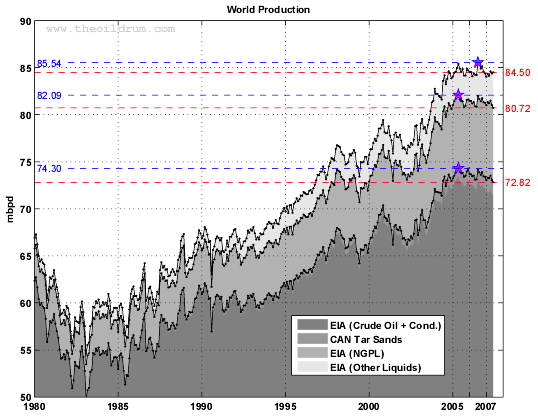 In fact, the reality is that production IS stagnating, even taking into account all new kinds of liquids and, moreover, that the predictions of peak oil, using traditional definitions of oil, are correct. Oil production has peaked in the vast majority of countries it has been produced, it has peaked for the non-OPEC world, it seems to have peaked for light crudes - the high-quality kind - already.
It all hinges, then, on whether new substitutes can be found for oil (nobody yet amongst "deciders" seems to be considering seriously that we might want to significantly reduce our consumption, and overall demand is still growing briskly around the world, with the US and Europe more or less stagnant). And each of these new sources of liquids has massive drawbacks, and is extremely costly, as Klare nicely summarises:
(The United States already produces large quantities of ethanol by cooking and fermenting corn kernels, a process that consumes vast amounts of energy and squanders a valuable food crop while supplanting only a small share of our petroleum usage; the proposed cellulosic plants would use nonfood biomass as a feedstock and consume far less energy.)
(...)
But while attractive from a geopolitical perspective, extracting Canadian tar sands is environmentally destructive. It takes vast quantities of energy to recover the bitumen and convert it into a usable liquid, releasing three times as much greenhouse gases as conventional oil production; the resulting process leaves toxic water supplies and empty moonscapes in its wake.
(...)
Government geologists claim that shale rock in the United States holds the equivalent of 2.1 trillion barrels of oil--the same as the original world supply of conventional petroleum. However, the only way to recover this alleged treasure is to strip-mine a vast wilderness area and heat the rock to 500 degrees Celsius, creating mountains of waste material in the process. Here too, opposition is growing to this massively destructive assault on the environment.
One thing that has struck me over the past few years is how the price level that people say will allow for a real boost in these technologies seems to always be $10 from current oil prices. It used to be $25/bl a few years back, it was then put at 40-50$/bl, and now people say that $75 will allow them to come online. What this suggests is that these new sources "embed" a lot of oil - i.e. they need a lot of oil or oil equivalent (convenient energy, in the form of gas or electricity) to be produced, and thus their cost of production goes up with the price of oil. in technical terms, their ERoEI (Energy Return on Energy Invested) is low - lower than that of oil anyway.
Klare gets this impression too:
But the real story is not the impressive growth in unconventional fuels but the stagnation in conventional oil output. Looked at from this perspective, it is hard to escape the conclusion that the switch from "oil" to "liquids" in the department's terminology is a not so subtle attempt to disguise the fact that worldwide oil production is at or near its peak capacity and that we can soon expect a downturn in the global availability of conventional petroleum.
We are now stuck with costly alternatives, which promise to be massively damaging to the environment, as our best chance to keep production going. And oil prices simply reflect that reality, with an additional premium to reflect the urge by so many of our politicians to solve by force problems that they can no longer solve by bluster and intimidation (as noted in this WaPo article the premium for the "small" chance of a war with Iran is "$3 to $15", which means that if "small" is interpreted as a 10% chance, prices are expected to increase by $30 to $150 in the case of war, the current premium reflecting the expected increase in the event, multiplied by the probability expectation of it happening).
Or, to keep it simple: oil is getting scarcer, the other "liquids" are dirty and expensive, and the White House would rather go to war to solve that rather than focus on demand reduction.
Yep, $100 oil is just around the corner.
:: ::
Earlier Countdown diaries can be found over at The European Tribune at the bottom of the post.
Personnel
Editors
Contributors
Peak Oil Primers
Archives
- November 2010 (3)
- October 2010 (6)
- September 2010 (4)
- August 2010 (7)
- July 2010 (6)
- June 2010 (7)
- May 2010 (2)
- April 2010 (8)
- March 2010 (4)
- February 2010 (6)
- January 2010 (3)
- December 2009 (5)
- November 2009 (8)
- October 2009 (12)
- September 2009 (6)
- August 2009 (5)
- July 2009 (11)
- June 2009 (8)
- May 2009 (16)
- April 2009 (10)
- March 2009 (7)
- February 2009 (10)
- January 2009 (15)
- December 2008 (9)
- November 2008 (9)
- October 2008 (9)
- September 2008 (13)
- August 2008 (10)
- July 2008 (14)
- June 2008 (23)
- May 2008 (16)
- April 2008 (12)
- March 2008 (16)
- February 2008 (9)
- January 2008 (13)
- December 2007 (13)
- November 2007 (16)
- October 2007 (22)
- September 2007 (8)
- August 2007 (9)
- July 2007 (16)
- June 2007 (8)
- May 2007 (7)
- April 2007 (7)
- March 2007 (10)
- February 2007 (10)
- January 2007 (12)
- December 2006 (9)
- November 2006 (15)
- October 2006 (4)
- September 2006 (5)
- August 2006 (5)
- July 2006 (9)
- June 2006 (5)
- May 2006 (10)
- April 2006 (9)
- March 2006 (13)
Vital Trivia
License

This work is licensed under a Creative Commons Attribution-Share Alike 3.0 United States License.
http://science.reddit.com/info/5zgvr/comments/
thanks.
Got into a little debate with a representative of the Sierra Club over this particular issue. The subject of his presentation was climate change but he did but up that EIA chart on future production rising to 130 MMbbl/d 20 years down the road. He dismissed peak oil as a non-issue because of subtitutes like ethanol, CTL, GTL, shale, etc. I said coal ain't oil, coal ain't oil, pavement ain't oil, and corn squeezins ain't oil.
You can discuss the following article and presentation next time:
Filling the oil supply gap (pdf .5MB)
http://tinyurl.com/345wbp
Future Oil Supply- It's all about how fast (not how much) (PDF 2.3MB)
http://tinyurl.com/2g2j9p
They should shed some light on the issue of alternatives and scaling.
http://biopact.com/2007/09/experts-brazil-victim-of-its-own.html
The alternatives are expensive because the US taxes them with a 54 cents/gallon tariff. The EU is equally foolish.
So the rise in oil prices will continue until it has cancelled out the trade barrier of 54c/gallon. Then Brazilian (and world) ethanol production will ramp up to meet the shortfall in oil.
However it does seem a little foolish to jeapoardise the US economy, and so the world economy, just to protect some thousands of farmers in the American corn belt.
Expecting markets to work when you deliberately rig them so they can't is just plain silly.
Ethanol needs to go. It does not clean the air, it costs too much fuel to produce it to be an energy saver, it does not increase gas mileage, and it increases the cost of food.
Biodiesels might be able to replace "some" future oil shortfalls, but there is simply no way to produce enough for expected future needs without causing a couple of billion people to starve to death.
"Ethanol needs to go." Maybe Ethanol made from corn and supported by ridiculous subsidies, needs to go but Ethanol itself is a rather useful fuel. I was driving a 100% ethanol fueled VW fox back in the early 80's in Brazil, Ironically I was working as a commercial deep sea diver on Petrobras Oil rigs shortly before that time. Though you are right about ethanol not cleaning the air.
Check out my friend's presentation:
http://www.biofuelsnow.com/Ethanol%20From%20Sugar%20Cane.pdf
I currently live in Florida and would love to own and drive that old VW fox here today.
" Biodiesels might be able to replace "some" future oil shortfalls, but there is simply no way to produce enough for expected future needs without causing a couple of billion people to starve to death."
http://www.biofuelsnow.com/biodieselbrazil.htm
Not sure which is worse starvation or this:
http://www.aftenposten.no/english/local/article1559489.ece
So what are you going to put in your gas tank when gasoline becomes prohibitively expensive? You are welcome to walk, but some of us would rather use ethanol. Corn is not generally used as human food; it is animal food mostly. Animals are very inefficient at converting corn to human food. The "couple of billion people" will starve to death with or without ethanol as they have no money to by any food of any kind. What do you propose? That farmers should give away their corn to the starving? How are they to remain in business? Ethanol is not going away; so get use to it. The anti ethanol crowd at TOD are out of touch with what is going on. As gasoline rises in price with the increase in crude's price, ethanol will become more and more attractive. The only hope those opposing ethanol have is that corn's price rises to such a level (above $5.00/bu.) that ethanol becomes uneconomic. That would mean very high food prices indeed. The fundamental problem is that the market refuses to price corn appropriately in light of its energy content.
As I have been lurking and researching since mid 2005 I figure its about time I start to contribute here as well as lurk.
Practical,
I'm not sure that you are seeing all the sides to the problem with Ethanol. No, its not going to go away, but neither should it be touted as a 'solution' to the problem of peak oil /liquids. Its hardly even a "silver b.b." as I have seen it referred to here. The mono cropping that ethanol creates is inherently dangerous:
Currently in Brazil some of the plantations are the size of "European states, these vast monocultures have replaced important eco-systems,"
http://www.commondreams.org/headlines07/0305-05.htm
"Financially, once an economy comes dependent on a single crop, it has the distinct potential of being devastate[sic] should pest or disease destroy that crop for even a single season. Environmentally, mono-cropping depletes the soil of various nutrients, permitting scant opportunity for it to replenish itself"
http://www.american.edu/ted/projects/tedcross/xagric3.htm
Add to that the lack of clear proof regarding a positive energy return on most corn based ethanols (sugar cane being an exception and to some degree cellulosic)
http://pubs.acs.org/cgi-bin/abstract.cgi/esthag/2006/40/i06/abs/es052024...
and now include that ICE only have an efficiency of 15% on average.
http://www.fueleconomy.gov/feg/atv.shtml
Keep in mind that current crop yields are dependent on the FF fertilizers, herbicides, and pesticides, and without them you are looking at a reduction of crop yields. So you plant more crops. Agriculture in the US currently uses 85% of the available water.
http://www.oilcrash.com/articles/eating.htm
If we increase the crop size we will quickly hit peak water.
Also, mining the soil for fuel will simply exacerbate the rate of soil depletion. It takes 500 years to create 1" of topsoil, in prairie lands the soil is being depleted 30x faster than it can be replenished.
http://www.oilcrash.com/articles/eating.htm
Add all these together and you have a reasonable argument to keep the land being as a source of food and not of fuel.
So it will still come down to the question, do you want fuel in your tank or food in your stomach?
MS in Ontario Canada
In the coming battle between the 'rightness' of our economic model, and the geological limits to growth, I have a strong suspicion that the geologic limits may win.
Currently in Brazil some of the plantations are the size of "European states, these vast monocultures have replaced important eco-systems,"
True enough and I won't even mention soy farming, but so do a lot of things we take for granted in our modern American world such as cities, roads, industry shopping malls, fast food restaurants, agriculture, raising chickens, pigs and cows to name a few. You don't seem to be interested in advocating a reduction of the eco-system impacts of all of these other things. Sounds like you are the pot that is calling the kettle black.
It doesn't have to be the way you describe it.
http://www.biofuelsnow.com/Ethanol%20From%20Sugar%20Cane.pdf
•Why is sugar cane ethanol so efficient?
•First, because of the sugar cane plant itself
•Sugar cane fixes nitrogen from the air
•The farming process
•No irrigation needed
•All energy for industrial process comes from burning bagasse
•Industrial process produces surplus electricity, sold to the grid
•Nutrients from bagasse ashes are recycled
•Nutrients from vinasse are recycled
Great presentation. Repeat after me: There is no sugar cane grown in the Amazon (slde 3). Organic sugar cane has an EROEI of of 12:1. Much better for environment and climate than oil.
It's not going to save the world, but sugar cane-based ethanol does work.
WOW what a welcome to TOD....
"You don't seem to be interested in advocating a reduction of the eco-system impacts of all of these other things. Sounds like you are the pot that is calling the kettle black."
Instantly reducing yourself to an ad hominem attack is hardly the way to engender a positive response. If you had started your response at "it doesn't have to be the way you described it" your whole response would have a different feel to it. As it stands, I have a sour taste in my mouth wrt your response and am less likely to pay attention to any science you have to back up your statements. But I will move past that and do my best.
I did concede that Ethanol will play a part (I even stated that sugar cane was an exception did have a positive energy return!!). As will all forms of renewable energy play their part. But blindly worshiping at the foot of one technology is how we became addicted to oil.
And how, by questioning the applicability of ethanol to ease world peak oil am I not "interested in advocating a reduction of the eco-system impacts of [lot of things we take for granted in our modern American world such as cities, roads, industry shopping malls, fast food restaurants, agriculture, raising chickens, pigs and cows to name a few]"?
How you could infer such a stance from one singe post (my very first here) that I am such a anti-enviro minded person?
May I pose other ethanol related questions? (or will I get attacked personally again for daring to question the role of ethanol?)
So then how do we grow sugar cane in other parts of the world then?
How much sugar cane would need to be grown organically to slip in place for oil?
How are the problems of monoculture farming avoided?
How are the problems of P&K addressed?
Wasn't I talking about corn based ethanol anyways???
MS in Ontario Canada
In the coming battle between the 'rightness' of our economic model, and the geological limits to growth, I have a strong suspicion that the geologic limits may win.
Upon second read I admit my response to you was a bit off base. It's just that as someone who lived the ethanol experience in Brazil I reacted a bit from the gut in defense of that reality. To be honest what I got from your critique was something that upsets me quite a bit, namely what I consider to be a sort of arrogance of those who have created quite a mess both ecologically and economically in their own countries to criticize others who are trying other systems.
That does not in any way mean that I advocate the use of sugarcane based ethanol as a panacea to our energy needs. Nor by the way am I a great fan of monocultures for all the reasons you mentioned and I consider myself to be an environmentalist as well. So my apologies for the bad taste in your mouth due to my response. Having said that I still would like to import the excess ethanol that Brazil has already produced and have access to that technology here in the USA. BTW I'm not stuck on the "the 'rightness' of our economic model," Quite the contrary I believe it needs serious reexamination and some of has to be discarded or at least modified. Cheers.
Enviro Tech,
Welcome to The Oil Drum! I thought your comment was well thought out and summarised the arguments against sugar cane. You missed only one other I'd mention-that sugar cane requires either peonage/slavery to keep the EROEI positive. Its subsidised in South Louisiana and Florida as part of . the hate Cuba embargo, but, only there are the returns high enough to farm sugar cane in any modern society.
Sorry you had a rude introduction. Most of the folks posting here are very decent people who evaluate your arguments and respond politely. But like almost everwhere, we attract some jerks, so it helps if you are insensitive and a bit boorish. Please don't let this dissuade you from posting again!
Bob Ebersole
Bob, You might be describing me and that's ok because I have a pretty thick skin to begin with and sometimes I have a tendency to shoot from the hip. BTW you may also have noticed that after cooling off a bit I apologized to Enviro Tech. However despite what you say about peonage/slavery being the only way to keep EROEI positive I don't believe that is true.
I have lived both in Florida and Brazil among other places and certainly am aware of the perverse social conditions that exist in some parts. They can be addressed and changed if there is political will to do so. Just for the record this is being addressed in Brazil, ironically not so much in the Land of The Free. Though I'm sure it will also happen here eventually.
I've been wondering if sweet sorghum wouldn't prove to be a better ethanol feedstock for the temperate US than corn (maize). It won't compare with tropical sugar cane, but that can't be grown in temperate zones, whereas sorghum can. In fact, sorghum can be grown everywhere that maize can, and farmers can use the same equipment to plant it. (They may need to at least modify their harvesting equipment, as what they want to harvest is the cane and not ears. This should not present an insurmountable obstacle.) My understanding is that processing of sweet sorghum would not be all that different from the processing of sugar cane.
I wouldn't expect an EROI of as high as 12:1, but even an EROI of only 4:1 (which, as best as I can determine, is getting close to what might be expected for sweet sorghum) looks a whole lot better than the <2:1 obtained from maize ethanol.
Strange that no one at all seems to be talking about this.
Yep, it is a problem. But as far as monocultures go, sugar cane is one of the best to have. There are little problems with pests and very little (if any) soild deletion. Also, an european state is normaly quite small.
Yees, that happens if an economy is dependent on a single crop, and you have an agricole economy. Nedless to say that Brazil is far from both. (Do I need to say again that an european state is normaly quite small?)
Yes, sugar cane is an exception.
Not a lot for sugar cane. Sugar cane is mostly planted on bad terrains (but not as bad as Amazon), where nothing else would grow, uses very little fertilizers and pesticides. Also, it doesn't use herbicides at all (unless you are trying to get rid of the cane, but cows are better for that task anyway).
I don't know if there are exceptions, but people don't irrigate cane.
Ethanol from sugar cane works. Get over it. The only problem you can point is that it is not enough.
I believe I DID say sugar cane works... The post before mine referred to CORN ethanol - I intended to respond primarily to THAT. I aplogize if I made that unclear
My post was written in mostly in response to CORN ethanol (plant in switchgrass and whatever else you want for corn that can be grown in temparate climates)
and for a point of reference, one of the smallest EU states is Luxemburg with a size of 999 sq miles. I know, there are other farms out there with crop fields ranging in this magnatude, but "just because others do something, doesn't make it right".
MS in Ontario Canada
In the coming battle between the 'rightness' of our economic model, and the geological limits to growth, I have a strong suspicion that the geologic limits may win.
Despite sugarcane having a higher energy return, people I know who lived in Brazil when it was started have not painted it as a giant rosy picture at the time. Also their production of sugarcane, and more soy to replace supplies from the US going to biodiesel are pushing other crops deeper into the rain forest for arable land.
Also they have a hell of a lot fewer cars which means they DRIVE a lot less than we do; we already outproduce them in ethanol (with no end in sight to our biofuels thirst, oh, unless a nice recession pushes the price of oil way back down for awhile).
http://www.sfbayoil.org/sfoa/myths/index.html
The market may not price corn "appropriately" but it also does not price petroleum with any intelligence at all.
The market has no clue about the value of corn.
The market has no clue about the value of petroleum.
The market is a rigged casino game.
Ultimately no one wins -- not even the House.
The so-called free market is all about war.
Eventually everyone is sucked up into the war as the House self-destructs.
How can we know or express tha value of anything without degrading it into a "commodity?" This label destroys the thing we supposedly value so much.
Only when things are understood as gifts can they truly be valued and used wisely.
We're not doing so well on the wisdom thing.
I am with Practical on the ethanol debate. A lot of anti ethanol from people that don't live in the corn belt.
The U.S. corn belt was a near mono culture of corn and soybeans long before ethanol came along. In Iowa we are working on 70+ years of hybrid corn production.
The fear that a huge ethanol boom would cause farmers to plant corn year after year with no bean rotation has not come to pass, at least in 2007 in Iowa. The reason is biodiesel demand for bean oil has kept bean prices high as well. There is a slight reduction in bean acres but many farmers will make good money on beans this year because input costs are less, corn prices are low, and altering the ratio of corn to bean acres just a bit influences the pricing which never gets discussed much in projections.
What farmers know (and knew years ago) is that as energy prices rise the cost of farming and food rises. It always does, it just takes a few years for increased costs to work through the system. All prices are rising, not just food, so don't single farming and ethanol out as the driver for costs.
This time around the farming community (world wide IMHO) is buffering itself from those prices by converting some of the output into high value energy products.
I agree that currently they are not totally competitive with Petroleum but give them a few years to optimize the system and get off petroleum as much as possible. Farmers are looking for ways to cut input costs which is the fastest way to make the EROEI of biofuels more positive. No till farming, chicken manure, ladybugs, etc. are all being employed on multi thousand acre farms.
The hunt is on for driving costs down and each person has a different approach. What works will be kept, what doesn't will be abandoned, but it will take years of high energy prices to prove what method is best. A return to low prices would penalize the unconventional approaches.
Ultimately the farming community will be producing much of its own liquid fuel as well as feedstock for fine chemicals. It has already started with Dupont and others converting glycerine (from biodiesel) into base chemicals.
The readers of TOD want change, well it is happening right before our eyes. Unfortunately the reality of change is not as painless as our vision to reduce oil, but it is change. It took the world 100+ years to become an oil culture. We can't just change everything in a decade or so.
It will take a long time to find a new way. It will be painful and hard work for many of us. We will make lots of mistakes along the way. There is NO easy answer or solution to peak oil. So we can complain that others are doing the wrong thing(s), or we can roll up our sleeves and get to work finding solutions.
It is your choice, but you might find that implementing your solution (ask Alan Drake) is damn hard work with little gain for years. So before disparaging others attempts remember they are doing the best they can with the tools they have.
What have you (the posters on TOD) built and marketed that gets us off oil?
I'd rather walk, or bicycle. I can't wait until we run out, or at least low. My town is entirely accessible by foot or bike, but everyone drives. My neighbor drives her fat kids 1800 feet to school. One day I took out my 7 iron and bounced the ball into the parking lot.
As for food, I can probably live off the flesh of all the pigeons who now call my solar panels home. Damn things!!!
Long live the Interstate Bicycle System. You don't need electrified railroads, you need a bike and no cars. If it rains, wear a jacket.
Arrgh! %#@&*!!!! Ahh! it feels soooo good to smash my head against my keyboard over and over again!
Gosh Imagine an ethanol electric Prius Hybrid pickup truck.
I for one could really use such a vehicle if the price of the ethanol at the pump were comparable to the current price of regular unleaded.
Can Toyota and Brazil make that happen for me here in Florida.
Can we impeach the entire Federal government now please?
Ok, time to wake up and head back to the mines.
The markets have always been deliberately rigged by the most powerful players for their won benefit, to whatever extent the markets could be rigged.
This is true now, and will be true tomorrow.
The market does not know the value of anything at all -- oil, water, soil, air. the market cannot know because it has no brain.
The market is made by some powerful people - already wealthy people - for their own benefit at whatever "Real" or true costs the other people and the planet have to bear.
Including all manner of terrible things -- especially the very profitable things like war. The more brutal the war, the more profitable: rape, torture, and senseless murder of civilians seems to be especially profitable.
The end game of capitalism is war. The market as we have known it is about economic rapacity.
What is the value of oil? What is the value of ethanol? If we knew, how would we even begin to express that value?
Nobody owns anything. The planet owns us.
Oil, water, air, and soil are to be carefully husbanded with an eye to preserving them for as long as possible, while learning as much as possible from the ways they feed and energize us.
We have no clue about how to do this, so our real game ends up being war. We traffic in blood and slavery and tears because we are afraid to even begin to understand the value of anything -- our lives, other people, the planet.
Hi beggar,
Interesting thoughts, thank you for sharing them.
Thomas Edison, 1910:
"Sunshine is spread out thin and so is electricity. Perhaps they are the same, Sunshine is a form of energy, and the winds and the tides are manifestations of energy.”
“Do we use them? Oh, no! We burn up wood and coal, as renters burn up the front fence for fuel. We live like squatters, not as if we owned the property.
“There must surely come a time when heat and power will be stored in unlimited quantities in every community, all gathered by natural forces. Electricity ought to be as cheap as oxygen...."
What if Edison had teamed up with Eistein based on Einstein's 1905 proof of Quantum Mechanics using the PhotoElectric Effect. Sunshine and electricity might cost nearly the same.
Using ultra-light rail technologies, recommended by DOT (PB-244854) as a permanent solution to oil embargoes, requires only 200 watt-hours to transport 4 people or 1200 pounds of cargo a mile. Morgantown, Heathrow, Swedish clip
Solar collectors, 6-foot wide, over that mile of rail can gather 2.5 million watt-hours a day, or power for 12,500 vehicle-miles.
There are alternatives. We just have to act on them.
BillJames,
Even conventional freight rail is good. The Freight Rail Association (or some such) is running ads on the radio saying they move "one ton of freight 400 miles on one gallon of fuel". Pretty impressive and yet we still move most consumer goods by truck from coast to coast.
Are you sure about the 200 watt-hours per mile figure? That seems a bit high. Compare this to the following:
One gallon of gasoline contains approximately 35 kilowatt-hours of potential energy. If an infernal combustion engine has an efficiency of 15%, it gets 5250 watt-hours out of a gallon of gas. Say this is employed in a motor vehicle, which gets 25 miles to the gallon, then the motor vehicle consumes 210 watt-hours/mile (5250 watt-hours / 25 miles = 210 watt-hours/mile) in mechanical energy. If the vehicle is carpooling, with four passengers, this number is reduced to 53 watt-hours/mile*person.
Surely an electric train, with an electric-to-mechanical conversion efficiency of ~80% can outperform this sub-optimal motorcar?
I've noticed that CERA and others with a vested interest in preserving faith in the status quo have been conflating oil actually pumped out of the ground with all manner of 'other liquids', the obvious purpose of which is to mask the leveling off or, arguably, the actual decline of conventional oil production.
This is a highly transparent and dishonest attempt to prop up the notion that 'things ain't all that bad'. As with all such exercises, people will eventually see through the smoke and come to the angry realization that, indeed, things ARE all that bad.
The longer we pretend that things are OK, the worse it's going to get.
Partly its a falling dollar, but the other part is that they can come online now, it just takes years and people allways chase the biggest profit they have the most experience in. Sasol is making huge profits off of its CTL and GTL infrastructure and off of contracts for building CTL and GTL infrastructure in places like China and Dubai. As the price continues to stabilize above $50/bl long term, more players will enter the unconventional oil market. The asian financial crisis wasn't that long ago and no one wants to be caught pissing in the wind when the tide changes. If another real recession hits and fails to sink the price of oil, that'll convince everyone.
which could be re-written as:
and when you revert to the first law:
http://en.wikipedia.org/wiki/Laws_of_thermodynamics#First_law
you realise how ignorant this whole debate about liquid substitution really is.
keep at it Jerome.
From what I have read, energy production can be sustained with coal and nuclear in the short term, and renewables (hydroelectric, solar, wind, geothermal, waves, tides, etc.) in the long term.
The problem is that we can't fill our gas tanks with any of these.
ArianeB - the first point is that we do not actually produce any energy - all we do is gather it. And the more concentrated it is the easier it is to gather.
True: gas and coal may help sustain our current energy paradigm for perhaps a decade after peak oil - but what then - with a growing global population?
True: a massive expansion of solar, wind and nuclear may help fill the energy decline left by fossil solar fuels - but to what to extent is still subject of research and debate.
IMO making sure that in future we make the right choices about which energy sources to gather (the ones that will require least effort) and how that energy may be most efficiently used - will determine whether or not we survive.
Trying to create liquid fuel based energy - which is the current focus of much effort - is a monumental error - IMO.
What the hell are you talking about? Everytime someone brings up thermodynamics in these discussions they seem to misuse it. At least you didn't try to bring up the second law. Trying to invoke thermodynamics is obfuscatory doublespeak; Its insulting and childish.
We're not even close to running short on energy. Hell, solar alone dumps nearly 10^17th watts on the planet, more than ten thousand times what all of human civilization consumes.
It is not how many watts that fall of the surface of the earth that matters. It is how much economic effort it takes to process part of that flux into 1 unit of energy in a useful form. We also have lots and lots of fossil energy in the form of methane hydrates, but if the economic cost of processing 1 GJ of net energy out the stuff is too high, then it is not economically equivalent to conventional oil.
Thats precicely the point. Thermodynamics dont enter into the debate at all.
Thermodynamics has been used and misused far too often. The Second Law seems to have been adopted by liberal arts types who think it sounds good but who in reality have little idea of what it's all about.
In fact, when you get right down to it, thermodynamics owes more to the steam engine than the steam engine owes to thermodynamics. ... Meaning that we built the steam engine first and then started scientifically investigating how it worked. Or in other words: we had the steam engine without thermodynamics, but we probably wouldn't have had thermodynamics without the steam engine.
As most scientists are loathe to admit: the physical embodiment of the practice oftentimes comes before the science that describes such but which then pretends to be its progenitor.
If I had to interview applicants for some sci-fi 'Ark', theoretical scientists
would be way down on my list ... somewhere above lawyers but probably below accountants. Then again, we might want to bring a few lawyers along solely for their rich fat and protein content.
Dezakin - I need to apologise for being a mere childish mortal.
Energy can neither be created nor destroyed - a good first approximation.
In converting energy from one form to another some gets lost - ah that's a useful concept too.
Petroleum is a concentrated liquid energy source formed by capturing solar enargy over about 500 million years - but then using fossil supernova energy that drives plate tectonics (and as a result many Earth systems) to bury this fossil solar energy (kerogen) so that it matures in the heat within - again fossil supernova energy - until the solar energy locked in the kerogen is released in liquid form and trapped by geological strata.
A miracle of solar energy, super nova energy and geologic time - blasted into space in the blink of an eye on a drive to the mall.
And Man believes he can recreate these liquids by burning these liquids or by planting seeds and get more energy out of these activities than he puts in?
I am a true beiever in wind and direct solar, nuclear and an electric economy - but do not hold out much hope for those who want to pursue a manufactured liquid energy future - for reasons outlined above.
Perhaps you would care to clarify how Man (or his superior Woman) can recreate liquid fuel here on Earth using significantly less energy that the liquids will themselves liberate. I've heard the words catalysis and enzymes used in this context - but from my limited understanding of these words they do not actually create energy - but merely reduce reaction energy thresholds or make reactions marginally more efficient.
I disagree with the "we're running out oil = we're running out of energy" assertion, and the invocation of thermodynamics to back it up.
To a useful approximation, the solar system is a closed system. Fortunately, it contains a truly huge mass of hydrogen which is happily converting itself into helium, emitting radiated energy in the process, and it will continue doing so without any effort on our part for a truly long time. Hence, the Earth is not a closed system. It receives an energy input, which we can use. It's true that it's a dispersed input, not as conveniantly concentrated as our inherited fossil fuels, but it seems to be quite enough to meet our total energy needs in the long run. Wind and solar are not quite as cheap as coal for electricity generation, but they're not many multiples more expensive either.
So it's not a problem of "running out of energy". Overall, it's a problem of planning a transition of our economy to non-fossil fuel sources of energy. That transition could be smooth, or it could be turbulent, depending on how well we plan it. And more immediately, it's figuring out how to meet our transportation needs. They can, in theory, eventually be met by the electric grid via batteries or fuel cells. That technology is not quite ready, but getting closer. And again, the transition is potentially turbulent. Hence the desire to keep transportation liquid-based, and stretch the supply of liquids via biofuels, oilsands, GTL, CTL, etc (or at least offset the declines of conventional). Yes, GTL/CTL/oilsands/shale are still calling on fossil-fuel endowments, and therefor are not "long-term" solutions. They don't have to be.
(Note: I don't actually like these options for CO2 reasons, and I'd much rather see us dramatically increase vehicle efficiency and/or expand electric rail. But if the fear is, "we're running out of total energy" then I disagree, and i the claim is "we're running out of conventional oil to run our transportation system" then alternative liquids have to be considered as legitimate, even if they too are temporary).
peace,
lilnev
Hi lilnev,
re: "Overall, it's a problem of planning a transition of our economy to non-fossil fuel sources..."
Well, the tricky part is (of course)- we have to do this while on a budget of fossil-fuel sources.
How much FF energy do we have? How long do we have? If we do not take certain steps, if the "transition" does not occur, or does not occur to the degree necessary for...(what, exactly? The continued growth of global economies? Another question)...
then, we have exactly very little and perhaps, even at some point, zero *usable* energy (for any practical purposes.)
It seems accurate to say: "Running out of oil does, in fact, equal running out of energy - " - with the caveat of - "*unless* we act in the right way."
And acting in the "right way" has to take into account factors other than the technology of extraction of the world's endowment, (including the sun's contribution).
Perfect, except for the fact that the caveat was missing from the original poster, passing the message that "there is nothing we can do".
On the contrary.
Other than solar gain, meteorites and comets, the Earth CAN be considered a closed system.
Solar energy is diffuse, inconstant and could never be collected in sufficient quantities to power our present industrial civilization.
So what we're left with is the terrestrial store.
Fossil fuels and nuclear material are the densest, most energy rich of that storehouse.
The energy these provide can do useful work only once.
After that the products of combustion and the spent fuel rods(and the heat they generated)remain on Earth but in a form that leaves them unavailable to again do useful work.
That is the Entropy Law.
According to the Theory of Relativity, all matter is energy, so the Entropy Law works on matter exactly the same way.
No materials can be recycled with 100% recovery and certainly not without expending additional energy.
Seen through the construct of the Entropy Law, our magnificent industrial manufacturing civilization does nothing more than provide us with a temporary, transient utility, between the processing of the Earths storehouse into mountains of trash, toxic wastes and gasses.
Not only are we running out of fossil fuel energy but high grade metallic ores, arable land, fresh drinking water, diversity of life forms, it goes on and on.
A poster up thread was scornful of the use of thermodynamics in these discussions.
Any discussion of energy that attempts to evade the Laws of Thermodynamics, especially the 2nd, the Law of Entropy, isn't worth having.
Holy crap, are you ever ignorant.
The only reason to fret about increasing entropy is when you're approaching thermodynamic equalibrium. Is the night sky really getting as warm as the sun?
I see.
So everything you buy at WalMarts never gets thrown away?
And every gallon of gas you burn in your car somehow doesn't add to the greenhouse effect.
You must be happy in your world.
Entropy is an ongoing process.
Dude, these seriously have nothing to do with the total entropy of a system. You're misapplying mixing entropy and thermodynamic entropy; As long as there's hot and cold to do the work of sorting the whole concept is totally irrelevant. You seriously don't know what you're talking about.
Entropy isn't a process, its a measure of a systems avaliability to do work.
http://en.wikipedia.org/wiki/Entropy
You are likely feeling the influence of Jeremy Rifkin. His thesis on material entropy is quite incorrect. It assumes that no energy is applied. You can read an explanation of where he has gone wrong here.
Also, the solar luminosity is pretty constant, and the portion we receive here is really pretty intense. What you get on the roof of your house is enough to power it. It turns out that by weight, silicon gives about 200 times more energy that coal before it need to be recycled. So, it is a good bit more "energy dense" than coal.
It is interesting that a material that we are in trouble on, top soil, is useful because it is homogenized. Many kinds of rocks have been mixed into its composition. It has high material entropy in the sense you are thinking of. Trying to mix up a new batch though would be a pretty big effort.
Chris
"Also, the solar luminosity is pretty constant"
Except for clouds, solar dimming and nightfall.
Your link provided no facts, commonsense or otherwise to upset my definition of Entropy.
Typical "denier" statements from the "father of nanotechnology" cornucopian no less!
I think you need to delve a little deeper into physics. If by nanotechnology we mean taking advantage of reversibility in quantum mechanics, then it is correct to say that the huristics of thermodynamic can't be applied blindly. For example, when DARPA sets a goal for 50% conversion efficiency for a solar cell, they are being realistic and could set the goal higher, but if they were to set the same goal for a steam engine we'd be giggling about it.
What do you mean by solar dimming?
Chris
Nano may never pan out and my understanding of physics is equal to most posters here.
Seeking salvation in unproven technologies is truly putting your faith in the unseen.
You might try prayer instead, anecdotally I've gotten impressive results.
Solar may be useful in a lower energy, future time but only if Lovelock is wrong.
As for solar dimming, check this link:
http://www.sciam.com/article.cfm?articleID=000C3AAE-D82A-10F9-975883414B...
Also, the solar luminosity is pretty constant
Except for clouds, diurnal variation, and seasonal variations.
If your live in a place like Seattle these kinds of variations are pretty darn important if you want to replace fossil fuels with solar energy. Even if you plan to export solar energy from the American Southwest on a super grid, the winter/summer variation of insolation will be quite significant.
It seems to me that if you live in Seattle, you have hydro and you'll have more as LA goes solar since the Pacific Intertie will see less use in the southerly direction. Of course, the San Jauns don't have the cloudiness problems that Seattle has so there may be a local solar supply as well. The west's winter/summer demand variations are significant as well.
Chris
I do not live in Seattle. I was just using Seattle as an example because I know it has lots of cloudy weather, and it is relatively far north so that that the winter summer insolation variation is large. Nationwide hydro provides only 6% of current US electricity supply so that even if Seattle happens to have good supply from such a source there are other cloudy places which do not. I get tired of this facile dismissal of the problems of the intermittency of renewable energy sources. Yes, I know that in some cases insolation variations roughly follow demand variations, and in other cases wind variations complement solar variations and so forth. But the fact is that delivering regulated grid voltages 365 days a year over a wide variety of geographical locations with intermittent renewable without fossil fuels presents serious economic problems. Don't get me wrong. I believe that solar energy (both directly as sunlight and indirectly as wind, waves, and flowing water) is the future of humanity. But I do not believe that these energy sources can support business as usual operation of the stock market for the rest of the century and beyond. Suggesting that they can discourages people from thinking about the kinds of social and political changes which will be required to create a humane, democratic society in a resource limited world.
Actually, the solar system is not closed. It is a big energy exporter providing about 4e26 W of constant power. Over the last 4.5 billion years, all that exercise has only allowed it to lose about 0.03% of its mass, not counting the solar wind. Weight watchers anonymous members take heart, you're doing better than the Sun.
What is interesting about the Earth is that it intercepts a tiny fraction of that power. It pays it all back to space, but, and here is the trick, in a higher entropy form. Energy comes in from a tight direction as a smaller number of photons and leaves in all direction as 20 times more photons. We get to interpose ourselves in this conversion and build up as much order as we like.
Now, you argue that wind and solar are more expensive than coal. But is that really true? With coal, we are scraping the dregs of someone else's history of building up order by interposing itself in this flow, but we are doing it a lot faster than that history gets laid down. So, we are going to run out and our dregs scraping is going to get harder. Already mining deaths are going up rather than down. Scraping the last dregs is going to be very expensive. But, we could, using wind and solar, do our own interposition and never run out. Taken as a whole, wind and solar seem cheaper because they do not have that built in pointless scratching around for the last little bits that coal has.
I would say that the difference is not so much in price, but rather in cost structure. With coal, you pay as you go for the most part, and pay later too because of the pollution, but with wind and solar you pay first and reap later. With coal, you get to defer expenses while with wind and solar you get to enjoy you investment. The size of the defered expenses, the cost of going after less accessible coal or cleaning up the pollution (or failing to clean up) is not known at the outset, but it is likely to be quite high. As I was learning to work, elders told me over and over again, don't cross yourself and don't carry a lazy man's load. The first means keep your right hand on the right side of the work and your left on the left. That way you don't get in your own way. The second means that if you try to make one trip out of what should be two, you'll end up dropping something and have to make two trips anyway. These were methods of avoiding awkwardness and subsequent frustration. Coal seems to me to have the flavor of awkwardness and we should probably get on to more mature pursuits.
Chris
That's an interesting way of looking at solar. It's a nice respite from trying to imagine how it could be physically scaled up to replace the 60% of the world's energy currently provided by oil and gas, or 86.5% factoring in coal, while currently supplying less than 1%.
Here in the US the cost of implementing solar panels is beyond the financial ability of most private households, never mind the cost of converting transportation needs to electrified forms, so any adoptation of solar power on the vast scale required needs to come from government or some other massive social organization.
This late in the game and world governments are for the most part completely unaware of the problem facing us. What will strike the spark to ignite such a massive effort, and where will we find the resources necessary to bring it about?
It seems to me that we are talking about more than a shift in technologies... I think what you describe would entail a shift in species. This is just not how mankind behaves, is it?
You are asking if mankind is able to exhibit wisdom. The answer is fundementally yes.
Wind was 20% of new generation in the US last year, so we are seeing the scale you are interested in there. Powering a home over 25 years costs about 10% of the home's value at current coal prices but these are going to go up while solar power costs the same and is coming down. Market forces, which lack any wisdom and only rely on self-interest, thus push towards killing fewer coal miners. Insurance companies, which attempt to emulate wisdom through foresight, are no longer renewing policies where the the effects of pollution from coal are the most severe. This reduces the value of a home by much more than the cost of powering a home for 25 years. While this sort of approach does not reflect the full cost of pollution from coal, it does show that we're trying to work with our arms crossed. Perhaps judges, who are in some ways selected for wisdom, will compensate these losses of value through a surcharge on coal.
Governments can be capable of wisdom. The GI Bill is an example. Past investment in solar technology is beginning to pay off now as can be seen in its broad commercial adoption. The rooftop solar resource in the residential sector is much larger than in the commercial sector and can cover 46% of our energy use at current system efficiencies. New Jersey's government is adopting a solar renewable energy credit system which may spur very rapid adoption of solar there while California's government is trying to increase the size of the solar market to the point where economies of scale bring the price well below that of coal. Investment bankers project costs of a few cents per kWh within a decade or so. On the world scale, global issues are being addressed through climate treaties. The influence of the fossil fuel industry has been a problem for this effort, but while governments are capable of wisdom, they are also subject to corruption, so this is not entirely unexpected. Where corruption wins the day, an historian like Gibbon will generally have some interesting work to do.
Chris
Lilnev - I guess my comment was poorly phrased - but an interesting series of comments none the less.
In simple terms I am fairly opposed to vast ammounts of FF energy being squandered in attempts to make liquid fuels that will sustain our ICE based transport system for but a few more years.
I'm also fairly concerned by the fact that our (UK) government is heavily influenced by economists - who are able to magic money out of nothing and seem to believe the same can be done with energy.
Going forward I believe it is absolutely essential that we make the right choices on alternatrive energy - e.g. wind, direct solar - and that everyone understands the principles that every time energy gets transformed from one form to another, that some of it gets wasted.
Syncrude, ethanol, biodiesel et al are not actually creating or capturing any useful energy. I don't think our politicians understand that.
I'd be interested to know why my passing reference to thermodynamics caused a stir?
We won't. But mankind doesn't need liquid fuels directly, mankind needs the mobility that liquid fuel provide. It is not unreasonable to suggest that there are pathways to making this happen.
In part it looks likely to come from conservation (but only as prices go up). The rest probably from electricity. Solar, nuclear, biomass, and others may fill the gap adequately, but they may not. Nobody speculating one way or the other (and yes, we are ALL speculating) is right or wrong.
Obviously the laws of thermodynamics apply. It is just not clear that they can be held up in front of you like a cross to ward off anyone who disagrees. Same for EROEI.
From an energy perspective, thats incredibly easy to do. You just have to spend hundreds trillions of dollars on infrastructure in giant nuclear/wind/solar farms for reducing water and limestone to hydrocarbons. The question comes down to money and what it really represents that's scarce, being capital and labor. Talking about energy and the laws of thermodynamics is a pointless distraction.
We aren't short of energy, the sun dumps plenty of that. No need to worry about the first law.
We aren't short on a heat sink, the night sky provides well enough of that. No need to worry about the second law.
We aren't in a system that's reached thermodynamic equalibrium trying to get closer and closer to absolute zero. The third law isn't even something we should bother thinking about.
I'm just adding the full context in which my original comment was made. If you still believe that thermodynamics are irrelevant to "creating" liquid fuels then a full explanation would be appreciated. If you have misunderstood my point then no problem.
We're not even close to running short on energy.
And your point is?
Energy - yea there is a lot of it. Big whoop.
Energy at the price point "we are used to paying" and have built out existance about - now *THAT* we are running out of.
Er, look I know it may come as a shock, but we're not even disagreeing here. My point was talking about the laws of thermodynamics doesn't even enter the picture except maybe for designing better powerplants and engines. The things that are scarce are things like capital, labor, and commodities. Obfuscating with total avaliable energy and the like isn't even worth discussing.
OPEC is holding back production this hour, not pumping at full capacity. Technologies to produce heavy oils may be improving. If gasoline prices really hit hard, then more will be invested in vehicles that get 40-60 mpg's, scooters, and public transport. Currently many consumers are in heavy, low fuel efficiency vehicles accustomed to cheap gasoline and have not been reformed into energy conscious drivers. One would suppose the population might stop expanding at such rates if indeed this potential gasoline shortage restricts food production, processing, and distribution. Switching to CNG vehicles was occuring rapidly in China where they have been operating buses, cabs, and private vehicles on natural gas. Some of their cars can be driven with either natural gas or gasoline in the same engine. In China the economy is growing quickly while using much less fuel per capita than in the U.S. and Europe. The supplies of gasoline are low. Oil inventories are yet sufficient. Refinery expansions might solve refining problems, but cannot solve oil supply bottlenecks, delays, and the depletion of mature fields.
Well, that's the big question today, but evidence is inconclusive to support your theory, at this point. Unless you have better sources - which we'd be keen to hear about!
Precisely. Oil prices will increase enough for substitution and energy savigns to take place. But these happen slowly (how fast can you replace a fleet of several hundred million unefficient vehicles?), and current prices seem insufficient for the purpose, given how oil consumption is, at best, stagnating in the OECD (not to speak of the rest of the world).
And, in the short term, there's much less that can be done - thus oil prices will increase high enough for it to be more painful for people to take the bus rather than their car, or to carpool - pretty inconvenient alternatives that ensure that prices will need to go a lot higher, in the short term (or that we'll have shortages and rationing by queue)
Yeah, but their use of energy (oil and a lot of coal) per unit of GDP is higher than for us. And their use of oil is skyrocketing.
Based on exchange rates rather than PPP; When using PPP, the reverse is true.
Thanks, Jerome. I've been griping about CERA et al purposefully trying to muddy the debate by calling sustances oil, that aren't oil. I guess I'm a little old fashioned but for me to consider a substance oil it has to cme out of the ground and be a liquid at 70 degrees farenheight. All liquids is a measure of substances that can substitute for oil, but it isn't crude or even crude plus condensate.
The main utility of oil is that it can be pumped and therefore has a much greater utility because of the savings in labor than coal or sands or shale. Its not that you can use it in a refinery. So lets not confuse thingh by alling synthetic oil, oil. Anytime we let them get away with this lie we have conceded a large part of our argument for no advantage. Bob Ebersole
When people are saying "energy", they really mean "energy" as a shorthand for "free energy", the energy available to do work. Free energy is *not* conserved. References to the first law are not significant in this discussion.
George
*Now that you mention it, once upon a time I did make life miserable for generations of chemistry students by teaching chemical thermodynamics.
Hi phillies,
"Free" - that's the word I must have been looking for (when I found "usable"). Thanks.
Apologies if this has been done before but I was looking idly at the graph of the three liquids production curves. The supplies look curiously stable to me over the last three years with none of frequent sharp drops of previous decades. Total Liquids has been in the same 1.5 mbpd range over this time.
I was wondering whether there is an underlying reason for this stability (were the sharp drops in the past always deliberate production cuts to support prices?) or whether alternatively it might mean that there are serious implications for any future supply shocks that disrupt the status quo?
Frederik Pohl, "Gateway"
I don't know if you've ever worked in the food mines, but you've probably heard about them. There isn't any great joy there. I started, half-time and half-pay, at twelve. By the time I was sixteen I had my father's rating: charge driller-good pay, hard work.
But what can you do with the pay? It isn't enough for Full Medical. It isn't enough even to get you out of the mines, only enough to be a sort of local success story. You work six hours on and ten hours off. Eight hours' sleep and you're on again, with your clothes stinking of shale all the time. You can't smoke, except in sealed rooms. The oil fog settles everywhere. The girls are as smelly and slick and frazzled as you are.
So we all did the same things, we worked and chased each other's women and played the lottery. And we drank a lot, the cheap, powerful liquor that was made not ten miles away. Sometimes it was labeled Scotch and sometimes vodka or bourbon, but it all came off the same slime-still columns.
-------------------
You don't go outdoors very much. There's no reason. There are a couple of little parks, carefully tended, planted, replanted; Rock Park even has hedges and a lawn. I bet you never saw a lawn that had to be washed, scrubbed (with detergent!), and air-dried every week, or it would die. So we mostly leave the parks to the kids.
Apart from the parks, there is only the surface of Wyoming, and as far as you can see it looks like the surface of the Moon. Nothing green anywhere. Nothing alive. no birds, no squirrels, no pets. A few sludgy, squidgy creeks that for some reason are always bright ochre-red under the oil. They tell us that we're lucky at that, because our part of Wyoming was shaft-mined. In Colorado, where they strip-mined, things were even worse.
I always found that hard to believe, and still do, but I've never gone to look.
And apart from everything else, there's the smell and sight and sound of the work. The sunsets orangey-brown through the haze. The constant smell. All day and all night there's the roar of the extractor furnaces, heating and grinding the marlstone to get the kerogen out of it, and the rumble of the long-line conveyors, dragging the spent shale away to pile it somewhere.
See, you have to heat the rock to extract the oil. When you heat it it expands, like popcorn. So there's no place to put it. You can't squeeze it back into the shaft you've taken it out of; there's too much of it. If you dig out a mountain of shale and extract the oil, the popped shale that's left is enough to make two mountains. So that's what you do. You build new mountains.
-------------------
Funny. In the old days oil used to bubble right out of the ground! And all people thought to do with it was stick it in their automobiles and burn it up.
Perhaps "liquids" could also include the rainbow-hued water which has at some time been in contact with the hydrocarbon-y strata in an old field.
| The problem will solve itself.
| But not in a nice way.
The problem is not energy or liquid fuels. The problem is that stupidity rules the earth with an iron fist. We will do things the stupid way, because all the stupid decisions will be made for us in a downward spiral of stupidity until we all land in a cesspool of stupidity down at the bottom of an infinite stupidity well. [/rant]
Nice rant, Petro - it made me smile. (Now off to attempt the un-stupification of at least myself.)
Well, that's the argument for Peak Oil Doom. The claim popular here is that in order to retrofit to other energy sources and/or conserve, you have to plan in advance of the price rising too quickly for you to do so (= supply falling too quickly).
The counterargument is that it's precisely the rising price/supply decline that correctly times the changeover.
I haven't seen enough evidence one way or another to decide which is right.
I'm trying to make sense of the array of proposed alternatives to petroleum and NG, including the "other liquids". What I'd like to see is a good comparison table that lays out the salient characteristics of petroleum and the "pretenders". Here's a strawman to give the feel of what I'd like to have available (with just the left column filled in for a few sources):
By the headings, I mean:
Don’t take the actual columns too seriously – I’m far from an expert; the point is to have a multi-dimensional display that captures the most important considerations in evaluating whether, when, and to what extent, some mix of sources might be able to replace what we’re losing.
I’m guessing that one use of such a display will be to make clear just how counterproductive lumping all “liquids” together really is. I’d also hope it would also be useful to help guide a rational transition policy. We need to know what’s best to focus on in each stage of descent.)
Question about propane:
If I understand all of this correctly, propane is one of the products that comes from this broader "liquids" feedstock.
My question is this: If there are people looking at these "liquids" as a future source of automotive fuels, does this not put the demand for automotive fuels and the demand for propane on a collision course?
(I use propane for residential heating, cooking, and water heating, and in fact use a lot more propane than gasoline. I would not be at all happy at the prospect of seeing my propane supplies curtailed just so that SUVs can keep their tanks filled.)