
 | The Bullroarer - Monday 12 November 2007 | The Oil Drum: Australia/New Zealand | The Bullroarer - Wednesday 14 November 2007 |  |
The Freezing Point of Industrial Society
Posted by Big Gav on November 14, 2007 - 7:00pm in The Oil Drum: Australia/New Zealand
This is a guest post by Kiashu. Kiashu says he has read a lot of books and sometimes been asked to write essays about them, has met a wide variety of people in his life and concluded that no, "they" won't just find an answer to our problems, and we really do have to worry. He is a good example of the fact that in the internet age anyone with a brain and too much time on their hands can find out just about anything and talk about it intelligently.
When will fossil fuel industrial society end?
When oil costs $240-$1,500 a barrel for several years.
One says to me, "I wonder that you do not lay up money; you love to travel; you might take the [railway] cars and go to Fitchburg today and see the country." But I am wiser than that. I have learned that the swiftest traveller is he that goes afoot. I say to my friend, Suppose we try who will get there first. The distance is thirty miles; the fare ninety cents. That is almost a day's wages... Well, I start now on foot, and get there before night... You will in the meanwhile have earned your fare, and arrive there some time tomorrow, or possibly this evening... And so, if the railroad reached round the world, I think that I should keep ahead of you...
- Walden, Henry David Thoreau
What was true in 1845 when Thoreau wrote that is not true today in the developed West, but is still true in the Third World. Fuel was still expensive enough that a journey of a day's walk taken by mechanical means was more expensive than a day's labour. Resources were more expensive than labour; now in the West labour is more expensive than resources, while in the Third World labour is still very cheap. But will it always be so?
This piece considers that industrialisation could only happen with cheap fuels, and by looking at the countries of the world, tries to figure out just how cheap fuel has to be before lots of people start using it before a country can industrialise with fossil fuels. The flipside to this is seeing how expensive fuel must be before it deindustrialises. This then gives us a clue to if and when will industrial society will end.
By an industrial society I mean one in which machines are powered not by human or animal motion and are a part of everyday life, and we design our homes and cities with machines in mind. A non-industrial society may have some machines, but it's not designed around machines; a Kalahari Bushman can happily use a radio, but he does not live in an industrial society, whereas his cousin who moves to Johannesburg and takes the bus to work does, even if she has no radio.
Going from a mostly-manual or animal economy to an industrial one, you can think of it as like the melting of ice into water at 0°C. When there's enough heat (cheap energy) it melts (becomes industrial). But does the reverse apply? If you cool water down to 0°C, it'll freeze. So if the cheap fuel becomes expensive, will we lose all that industry? Does industrial society have a freezing point, a point at which the heat (energy) has been drawn out of it, and so it changes from liquid (industrial) to solid (non-industrial)?
One way to figure this out is to look at the undeveloped countries of the world, consider how affordable fuel is in each one and then estimate how cheap fuel would have to be before they can industrialise ? Next we can look at other countries where incomes have dropped and/or fuel has become expensive, and consider what happened to them. From this we may be able to estimate, what is the freezing point of industrial society, the point where it soldifies into a manual economy? What will the price of fuel have to be before we hit that freezing point?
History of energy use
Throughout history, humanity progressed from using only their hands, to using tools, to using animals, and finally to using machines. Progressing from the work of hands to those of tools did not involve an increase in use of energy, but an improvement in the efficiency of energy use - a crowbar can let you lift a rock more easily than you can with your bare hands. But adding animals did not let us use energy more efficiently, it simply took energy from somewhere else and put it to work for us - the same applies with machines.
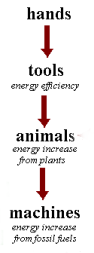
Tools don't need any fuel or food, so if people have the physical resources and skills to make them, they will. But animals and machines are different. Tools did not require extra energy use, they simply used human energy more efficiently.
Animals need food, and so whether they're used or not depends on whether enough excess food is available. Perhaps you have 1 acre, and could plough it in one day with oxen, but the oxen eat a haybale every day. Either you must be able to get 365 haybales from 1 acre, or you must be able to hire the oxen for just one day at something less than that. If you can't do that, then you'll not use the oxen on your land, it's not worth it. In other words, for animals to be used their food (fuel) must be cheap.
Machines need fuel, and need it to be cheap. Perhaps you have 1 acre, and could plough it in an hour with a tractor, and six months later harvest it another hour, and from that acre get ten bushels of corn, but the tractor would use two gallons of fuel. If the two gallons of fuel cost more than ten bushels of corn, then you won't use the tractor, it's not worth it. In other words, for machines to be used their fuel (food) must be cheap.
We didn't use the animals and machines as soon as they became available, but only when their use was cheaper than the alternatives. Oxen can plough an acre in a day, and a fit man will take twelve days to do it with a spade, but if oxen cost twelve times as much to feed as men, then men will keep digging. Similarly, tractors can plough ten acres in a day, but if a tractor costs ten times as much as an ox, or one hundred and twenty times as much as a man, then people will keep using oxen.
But whatever the cost of buying the actual animals and machines, the minimum running cost is their fuel/food. So the cost of food and fuel is the limiting factor that determines when a society goes from using tools to animals, and from animals to machines. There's no animal use without cheap food, and no machine use without cheap fuel.
What happens when the cheap fuel runs out? Well, either we find a new fuel, or we return to using animals and tools.
Note: I won't consider here economies where animals are too unaffordable to use, as we're looking at industrial and non-industrial societies, rather than the different kinds of non-industrial societies. A look at a non-industrial society where animals were unaffordable - in one community farms averaged less than a third of a hectare each - is found in Land relations under unbearable stress: Rwanda caught in the Malthusian trap, Catherine André and Jean-Phillipe Platteau, Journal of Economic Behaviour and Organization 34:1-47 (1998). This is also discussed at some length in Chapter 10 of Jared Diamond's Collapse.
Cheap and expensive fuel
If it is true that fuel affordability determines industrialisation, then we'd expect to see that in places where fuel is expensive, people don't use machines a lot, and where it's cheap they do. Cheap is a relative term. Petrol costs $0.54/lt in Laos, and $1.63 a litre in Belgium, but the Laotians don't use three times as much petrol as the Belgians, since Laotians have an income of $567 and Belgians one of $37,214. Logically, if the Laotians cannot industrialise with an income which can buy them only 1,050lt of fuel, then the Belgians could not stay industrialised if their income could only buy them 1,050lt of fuel if petrol were $35.44 a litre, or if Belgian income halved to $18,607 and petrol were $17.72 a litre.
Different fuel prices and industrialisation
Here our idea is that all things being equal, having cheaper fuel will lead to greater industrialisation fewer people working larger farms, more roads and so on. Let's consider two similar neighbours, Venezuela and Colombia.
In very few countries in the world is the free market allowed to determine the price of fuel without interference by government or corporations. Typically, oil-exporting countries subsidise fuel, keeping them below the market price for crude oil (US$0.38 a litre); while oil-importing countries tax fuel, keeping it above the market price for crude oil. In Venezuela petrol is $0.03/lt but $0.98/lt in neighbouring Colombia; both have similar per capita GDP of around $6,600, but despite their similar wealth Venezuelans should find it easier to live an industrialised lifestyle than Colombians, because of their fuel being cheaper for them. And indeed we find that this is so.
Colombia has many small farms, with 10.3 million agricultural people living and working on 570 million ha, or 55ha per person (coffee plantations are even smaller, on average just 6ha); Venezuela has 2.8 million people on 329 million ha, or 118ha per person. Colombia has 110,635km of roads and rail, or 0.0025km per person, while Venezuela has 96,387km or 0.0037km per person. So Venezuela with cheap fuel has farms twice as large per person involved in agriculture, and 50% more roads.
[As a side note, this shows that Chavez's policy of breaking up large farms and giving them to smallholder peasants is doomed to failure without price guarantees for their goods. In a free market, whoever makes the most profit will tend to absorb the other businesses; in agriculture, cheap fuel means large farms where machinery can be put to best use will make the most profit, while expensive fuel means smaller farms where you don't have to use fuel at all will do best. Smallholders cannot succeed in a free market with fuel at $0.03/lt; but they could succeed if there were fixed prices for their produce, ensuring the smallholder's profits and limiting the larger place's profits. So Venezuela can have cheap fuel and price guarantees, or expensive fuel and a free market; but cheap fuel and a free market leads to big landlords taking everything over.]
We find similar results around the world: where fuel is cheap, industrialisation follows. But how cheap does it have to be?
I've taken figures for per capita GDP as a rough guide to an average income in that country, and compared these with international fuel prices to see how much fuel an average income could buy. Per capita GDP is not a perfect guide to wealth, since it's just total income divided by population; if an accountant on $100,000 moves into a house with a waitress on $10,000, their average income may be $55,000, but the waitress is not necessarily better off. This is particularly true in countries whose economies rely on exports of raw materials like oil and minerals, which tends to lead to a very few rich people and lots of poor people; for example Angola has a GDP per capita of $2,758, but 70% of the population live on less than half of that. But in terms of considering industrialisation potential, per capita GDP is a decent guide, since even if only 1% of the population can afford cars and televisions, they will ensure that roads and power lines are built.
Food prices vary considerably, however because we want to consider the effect of fuel affordability on industrialisation, we can fix food prices as about that of wheat on the world market - $300/tonne, with 184kg of grain supplying the minimum calories and protein for a moderately active adult, or $55. Food also represents a minimum wealth necessary before anything else can be bought; if your annual income is only $500, whether fuel is $1 or $0.01 per litre doesn't really matter, since between food, water, clothing and housing, you'll be hard-pressed to have anything left to spend on fuel.
Fuel affordability and industrialisation
Of the top 50 countries in terms of fuel affordability, all are able to buy 10,000 litres or more annually. Their average income is about $28,000. 16 of them are net oil exporters, 3 produce a significant portion of their own oil; 29 are Western or First World countries (Ireland, Australia, Greece, etc); the other 21 are the 16 oil exporters and 5 island-states heavily reliant on tourism or other foreign subsidies for their wealth.
This tells us that what gives you cheap fuel are one or more of having enough to export, a high per capita wealth, and lots of foreign money coming in. You need money or to produce the stuff yourself. (Obvious enough!)
Of those top 50, 40 of them are industrialised countries. Of the 10 which aren't, Iraq's slow deindustrialisation has more to do with war than anything else, Turkmenistan was for many years held back by dictatorship, as were Libya and Oman, Venezuela is in the process of industrialising fully, and four are small island-states, which for physical and cultural reasons resist industrialisation. There remains only Gabon, 50th on our list, with their average income able to buy just over 10,000lt annually. So absent civil conflicts, foreign invasion or dictatorship, being able to buy 10,000lt or more annually should give you industrialisation.
Of the bottom 50, none have an income greater than $1,100, none subsidise fuel use, and they average being able to buy 10 years' grain with their income. At the top of them is Nicaragua, whose people can buy about 1,350lt of fuel annually. None are industrialised, and the vast majority of industrial infrastructure beyond gravelled roads was built with foreign supervision and money.
So we see that countries of under 1,500lt of fuel each definitely can't industrialise, and those of more than 10,000lt definitely can. Somewhere between those two figures are when industrialisation becomes achievable for rising fuel affordability, or difficult for dropping fuel affordability.
To create and maintain a modern industrial economy requires fuel affordability of something between 1,500-10,000lt per person annually.
It's not possible to be more precise than this given the data, since some countries like Namibia can afford more than 3,500lt and are not industrialised, while others like Ukraine can only manage 2,800lt but are industrialised; however Namibian wealth is increasing and so they may industrialise, while Ukrainian wealth was once greater but is somewhat unsteady so they may not retain it. Then there are countries like Cuba (3,727lt fuel, 13,667 years' grain), with poor levels of industrialisation in communications and electronics, but good levels in pharmaceuticals.
Most likely, fuel affordability is like other kinds of income it takes a lot to build something up, not so much to maintain it. So a country might go through a period of affordability of 10,000lt fuel and industrialise, and later when fuel drops to 5,000lt affordability, remain industrialised. In support of this, we may note that the former Eastern bloc states and European republics of the USSR were once relatively wealthy and industrialised, and later dropped in wealth but remained industrialised the Czech Reublic tops out at fuel affordability of 10,652lt, and Ukraine's at the bottom with 2,807lt Georgia and Albania are lower, but no-one could really call either of them industrialised, you need more than Hoxha's concrete pillboxes for that.. We also find just above the bottom 50 is North Korea, a country which in the 1960s was wealthier than South Korea at the time, but which had a steady relative decline, and then after 1991 was essentially cut off from reliable oil supplies by the fall of the Soviet Union. It has experienced sending people out of factories and into the fields to produce food by hand, animal and tools, and now can afford 1,418lt annually.
So while it may take less to maintain an industrial society than create it, there is some lower threshold of fuel affordability below which it can't be maintained.
And of course just as some people spend their money with more efficiency than others, getting more bang for their buck, so too will some countries spend their fuel more efficiently, either in building up or maintaining their industry; if there can be one person on $30,000 who can afford a mortgage and one on $40,000 who cannot, it stands to reason that there should be countries with 3,000lt fuel who can afford industrialisation and some on 8,000lt who cannot.
Food affordability and industrialisation
As noted above, however cheap or expensive the fuel, people need to eat before they can lay down asphalt roads, build lathes, drive cars or produce television programmes. So what's the minimum food before a country can industrialise?
The list of countries and their food affordability, since we fixed the food price at $300/tonne, is the same as the list of countries and their per capita GDP. We find that Luxembourg is at the top of the list with being able to get over 293,000 years' grain, and Latvia with 28,500. Of the top 50, 37 are Western or First World countries, 8 are net oil exporters (including a Western country, Norway), and the other 6 are the small island-states again. Excepting the small island-states, all are industrialised. The poorest of them is Estonia, with $8,500 income.
Of the bottom 50, from Cameroon with $1,002 and able to afford 18 years' grain, to Burundi with $119 and 2 years' grain, only about 10 have any real industrialisation, and it's far from universal consider for example India (at #129), where tens of millions live their lives in airconditioned comfort using computer software in their daily work, while others hoe in the fields and are only one bad harvest away from famine.
So we see that, setting aside small island-states receiving large foreign subsidies, an income of more than $8,500 is required for industrialisation, and an income of less than $1,000 definitely prevents it. The level for industrialisation is probably somewhat higher, since a number of the countries on $8,500-$15,000 are former Soviet countries, where industrial infrastructure was built in wealthier Soviet days.
To create and maintain a modern industrial economy requires food affordability of about 270 years' grain, or $15,000.
Four economies
A modern industrial economy requires fuel affordability of something between 1,500-10,000lt per person annually, and food affordability of about 270 years' grain, or $15,000.
This leads to three types of economies, with a fourth possible one.
Manual Economy
Fuel < 1,500lt, or food < 270 years' grain
Laos, North Korea, Honduras, etc
A manual economy uses hands, tools and animals, but not machines. When fuel is expensive, people turn to manual labour, and food becomes more expensive in proportion (or national income drops, if you prefer to look at it that way). When fuel is cheap, if food remains expensive then they still can't industrialise. Nothing is wasted, and the accoutrements of industrial society televisions, four wheel drives, etc will be objects of wonder or symbols of prestige. The citizens sometimes migrate (as legal migrants, illegals, or refugees) to countries with mixed-industrial economies.
Mixed-Industrial Economy
Fuel 1,500-10,000lt, food 270-28,500 years' grain
Ukraine, India, etc
A mixed-industrial economy uses hands, tools and animals in many parts, but also has some use of machines, typically concentrated in cities. Often an economy in transition between manual and wasteful, or vice versa. Typically, parts are deeply-industrialised while other parts are still in a manual economy. Industrial objects will be relatively common but not ubiquitous, often old, and old ones will be kept and repaired. Wasteful industrial economies may export their waste to such a country to mine for raw materials for recycling (for example 90% of the world's shipbreaking occurs in India, Bangladesh, China and Turkey). A society which was once a wasteful industrial and is now a mixed industrial economy may mine its own old landfills. The citizens migrate to wasteful industrial countries; those from the industrial parts migrate legally, those from the manual parts typically illegally.
Wasteful Industrial Economy
Fuel > 10,000lt, food > 28,500 years' grain
US, Belgium, Japan, etc
In this economy, fuel and food are so affordable that they're often wasted. People leave their airconditioning on when not at home, throw out a quarter or more of their food, and so on. Industrial objects will be discarded rather than repaired, and often discarded when still working to be replaced with something better.
The Ecotechnic Economy
Fuel < 1,500lt, food > 270 years' grain
No such economies yet exist. This would require either extreme taxation or a global fuel shortage, combined with high technology renewable energy, local organic polyculture farming and the like. These are high-technology economies which don't burn fossil fuels for power, and which have little or no waste. Whether such an economy is technically possible or not is the subject for another article; no-one has yet painted a comprehensive picture of what one might look like.
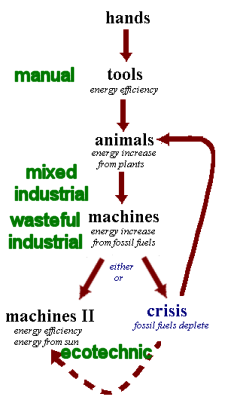
Development of the Four Economies
Returning to the model of the development of technology, from hands to tools to animals and then to machines, we see that we have two possible fates, depending on how we respond to fossil fuel depletion.
Either we begin designing our machines to not use fossil fuels, relying on energy from the sun (solar, wind, geothermal, etc), or else we continue with Business As Usual, and at some point when fossil fuels deplete, their affordability reaches dangerous levels, and with no non-fossil fuel-using machines, we return to the widespread use of animals and tools.
Note that the fuel affordability I'm talking about must be sustained for some years, whether to begin an industrial society or end it. Lagos is not going to turn into Dubai if fuel is $0.01/lt for a single year, nor will Chicago turn into Timbuktu if fuel jumps to $100 a gallon for a year.
When fuel affordability is 1,500-10,000lt per person annually, the wasteful industrial society can't go on, and will go into recession. For First World countries with an average of $30,000 income, that would be a fuel price of $3-$20 per litre ($11-$76 per gallon, or assuming that crude costs 50% of what petrol/gasoline costs, $240-$1,500 per barrel).
That is, at a fuel price of $3-$20/lt ($240-$1,500/bbl), the wasteful industrial society will be under threat; if this goes on, it's likely to become a mixed-industrial economy. With good planning at this stage, it may change to an ecotechnic economy.
The transition is less likely if the fuel prices are mostly due to high taxes, since a tax of more than 100% on anything creates a significant black market for it, which will keep the effective affordability at better level.
With long-term fuel affordability of less than 1,500lt, or prices above $20/lt ($1,500/bbl), transition from a wasteful industrial to a mixed-industrial economy is certain, and eventual transition to a manual economy quite possible. Moving to an ecotechnic economy does not seem likely, as people will lack the funds to invest in the new infrastructure. We do not for example see wind farms and solar panels and electric monorails in Pyongyang, North Korea.
Thus, denying the inevitable depletion of fossil fuels and the falling affordability of them means that a society is more likely to collapse directly from a wasteful industrial to a manual economy, while preparing for it allows the possibility of transiting to an ecotechnic economy.
Prices destroying industrialisation?
In history so far, several economies have gone from wasteful industrial to mixed-industrial, or even manual. However, this has been due not to high fuel prices as such, but to the fuel being unavailable at any price because no-one could or would sell to them. Cuba, North Korea and Iraq are examples of this. And several countries have been unable to industrialise because of unaffordable fuel. But none have yet deindustrialised due simply to the price of fuel.
The importance of the price/supply distinction is that lack of supply for a particular country is different to globally rising prices and lack of supply, since lack of supply may be political or otherwise temporary. If you are given unpaid leave from your job during a company's time of trouble, you're less likely to look for another job than if you're fired outright. Likewise, a wasteful industrial economy which finds oil prices rising to $240 a barrel may assume it to be temporary, and not prepare to change.
We can imagine, for example, that in 2020 world oil and condensates production has dropped from 84 to 60Mbbl/day, with demand being 20Mbbl in the US, 10Mbbl in the EU, 5Mbbl in Japan, and 20Mbbl in each of China and India, with another 15Mbbl spread out about the world. With 70Mbbl of demand and only 60Mbbl of supply, many regimes are going to assume that with the right combination of military might, diplomacy and trade deals, they can secure a sufficient supply, and therefore they don't bother trying to change to a new kind of economy. They reason that while world supply isn't enough for the world, it's enough for them, just as when you are one of 1,000 workers and know that 200 will be fired, you don't immediately look for a new job because you hope to be one of the 800 who'll stay.
However, as fossil fuels deplete, it'll be harder for countries to resist change as they did in previous oil shocks simply because previous oil shocks they knew to be temporary. Nonetheless, we can expect that countries will as I said try various combinations of military might, diplomacy and trade deals to put off decisions and change. Thus, even with oil hitting $240/bbl and moving towards $1,500/bbl, we can expect that positive change towards an ecotechnic society will be slow.
Conclusion
But whether the crisis is prepared for or not, it will come. When oil has an affordability of 1,500-10,000lt, or is $240-$1,500/bbl in today's Western economies, wasteful industrial societies will come under great strain, and move on to at least an attempt at an ecotechnic economy, or else collapse to a mixed-industrial economy. If affordability stays at that low level for several years, or continues to decline, we can expect them to turn into manual economies.
Some western-EU countries are beginning to attempt to move towards Ecotechnic economies, though the eastern-EU's oil use is increasing. But the other 70 of the 85Mbbl/day demand remains and is increasing, with 22Mbbl in the US, 5Mbbl in Japan, 8Mbbl in China and so on. Since supply is declining with no sign of picking up, and demand is increasing with little sign of abatement, it's obvious that the price will continue to rise. Demand destruction will come first from the poorest countries; if you can only afford one barrel of oil a year at $80, then if it becomes $240 you will probably just do without entirely, rather than getting one-third a barrel. These poor countries consume relatively little oil already, perhaps 10Mbbl/day; if they stopped buying tomorrow, their supply would be taken up in 2-3 years by the US, China, Japan and India.
Again we must remember affordability. In the 1970s, a drop in world oil supply led to a quadrupling of price and a Western recession, with economies shrinking by 5%. With smaller economies and less money about, the higher prices hurt even more, a vicious economic circle. So we ought to keep the 1,500-10,000lt affordability range in mind, rather than the $240-$1,500/bbl price range. A country with per capita wealth of $50,000 will hit crisis at that 1,500-10,000lt affordability, but that's $400-$2,700/bbl for them; but if they should become a $20,000 country, as is quite possible with a global slowdown in trade due to fossil fuel depletion, then $160-$1,000/bbl oil will do it.
But on the whole, the developed West has a per capita wealth of about $30,000, so that $240-$1,600/bbl oil will bring on a crisis. When could we see such a price? Let's look at the figures for the last several years.
1998 $15
1999 $21
2000 $32
2001 $25
2002 $27
2003 $30
2004 $38
2005 $51
2006 $64
Oil hovered around $20/bbl for most of the 1990s, but has risen in price in eight out of the last nine years, the exception being 2001 when it dropped 22%. The average increase over those nine years, including that drop, has been 23%. This projection would give us $78/bbl this year of 2007, $220/bbl oil in 2012, and $271/bbl in 2013. It would pass $1,600/bbl about 2021. However, reality rarely follows such neat mathematical formulae. Could there be a drop in price? Not likely, says the chief economist for the EIA. Some are even fearing a rise to $250/bbl in the next two years, and taking steps to insure against it, says the Financial Times. In this year of 2007, oil has been as low as $51 and recently hit rather close to $100/barrel.
However, in my judgment a continuation of the current rapid price rise isn't likely, except in the case of US war with Iran, a South Asian nuclear conflict, some combination of another Hurricane Katrina and a very destructive earthquake in Iran, or similarly catastrophic events. However, there are those who say that we're currently at peak oil, and can expect declines of global oil supply; while the total oil produced may not decline much in the next two decades, because of rising consumption in the oil exporting countries, the total exports will decline, giving us fuel affordability of 10,000lt in the West, or $240/bbl oil almost certainly by 2015.
At this point, modern wasteful industrial economies will begin coming under strain. Like the old ex-Soviet countries, they may struggle along for a few years but will eventually collapse, becoming mixed-industrial economies, with animal and human power returning to widespread use, but much industry remaining. A picture of what this sort of mixed-industrial economy might look like can be found in how China looks today.
By 2025, if oil production has not declined at all, but demand continues to rise at 2.3% annually, demand for oil will be more than 50% higher than supply, leading to fuel affordability of less than 1,500lt, or oil of more than $1600/bbl. Mixed-industrial economies will then struggle to move to ecotechnic ones, or collapse to manual economies.
Internal conflicts are likely. Already today manual economy regions of countries sometimes rise up against the wasteful industrial regions, economic disparity combining with ethnic tensions to produce violent conflict; this violent conflict then perpetuates the disparity, and the conflict uses resources which both types of economy could have used to enrich themselves. What happens as a country is rising in wealth is just as likely as it falls in wealth. For example, in the US we can imagine that the New England and California areas would remain wasteful industrial, while the South and Southwest might become mixed-industrial or manual economies. If this disparity were to combine with hispanic or black discontents, violent conflict could result. Economic freezing point may turn out to be social boiling point.
Certainly with wars of conquest for access to fossil fuels, smart diplomacy and the like, we may see some countries holding out for a couple of decades longer. But in general, the 2015-25 period will see the end wasteful-industrial economies, and after that will begin a long decline for any who have been unwilling or unable to go to ecotechnic economies.
Is an Ecotechnic society possible? What might it look like?
The answer to the first question is maybe. But it can be difficult to get a realistic picture of what it might look like. When thinking about someone in a manual economy, we can imagine their day, what they do and wear, the tools they use. Likewise we can imagine a wasteful industrial economy, people getting up in the morning, putting on a suit while their coffee machine burbles water, sculling it down and jumping in their car and spending half an hour or so sitting behind other cars moving at only twice walking pace, going into work among bright lights and humming machines, bopping their heads to music from a tiny player. But what will the day of a person in an ecotechnic economy look like?
This requires thought and study, and so will be the subject of another article.
Contact
- anz at theoildrum dot com
License

This work is licensed under a Creative Commons Attribution-Share Alike 3.0 United States License.
Archives
- November 2010 (2)
- October 2010 (5)
- September 2010 (4)
- August 2010 (8)
- July 2010 (2)
- June 2010 (2)
- May 2010 (6)
- April 2010 (7)
- March 2010 (12)
- February 2010 (11)
- January 2010 (7)
- December 2009 (10)
- November 2009 (6)
- October 2009 (7)
- September 2009 (10)
- August 2009 (10)
- July 2009 (3)
- June 2009 (14)
- May 2009 (10)
- April 2009 (15)
- March 2009 (16)
- February 2009 (16)
- January 2009 (15)
- December 2008 (15)
- November 2008 (23)
- October 2008 (25)
- September 2008 (24)
- August 2008 (30)
- July 2008 (44)
- June 2008 (38)
- May 2008 (48)
- April 2008 (43)
- March 2008 (29)
- February 2008 (32)
- January 2008 (30)
- December 2007 (26)
- November 2007 (32)
- October 2007 (11)
Good article Gav but you have looked at the Macro through the eyes of the Micro - how it will affect an enterprise.
Recessions, and hence economic collapse is caused by the Markets. The real reason no one is saying much about Peak although the eia C&C stats are there for all to see, is the very real fear that it will affect the markets. When punters realise that their shares in Tyre Corp et al will not grow they will flee Tyre Corp et al - although it has all its factories and staff and IP intact the banks will see its market capitalisation is close to ZERO and will call in their loans - the remaining shareholders will get 5 cents in the dollar or so and there has been massive WEALTH DESTRUCTION. Once the process starts and the market realises that almost the entire offering is oil dependent then gold will increase its price even further than the 30% increase in the last year or so.
Those lucky enough to get out some capital should invest in land, cause you can't eat gold, especially when your ownership of it is on a tatty piece of paper or a piece of computer code!!
By now the liquidators are going flat out, both with Liquidations and bankruptcies - unemployment is rampant, the governments ability to cope is strained....
AND NOW COMES THE INTERESTING BIT.... but we must wait a few weeks, months or perhaps a year, even two to find out - but we will..
Now with this senario does anyone of sound mind think that the very conservative capitalist - venture or otherwise will invest in some technology that is not proven and already in wide spread use?
If we are to ever get an Ecotechnic society it will have to be imposed, and I for one have now concluded we don't need a dictator, so I will concentrate on spuds, beans, pumkins and a few greens and hope the system stays together long enough for me to grab my too few pennies of "super" to pay off the remaining mortgage.
Sololeum,
Sharing the road back to Olduvai
Just a quick note to point out that Kyle is the author of the article, not me - I just posted it.
More later...
It might be interesting to read this article in parallel with this one.
I am fascinated by the concept of an ecotechnic society. I look forward to hearing what you think, Kyle.
For some reason, the link in the subtitle to Greer's article didn't come up. So far as I know, apart from some German company, Greer coined the term in his article, Towards an Ecotechnic Society. I strongly recommend the article, it's most interesting. Overall he's a bit more pessimistic about the prospects of our wasteful industrial societies than I am, but still he's worth having a look at.
I was thinking about this today. I'm torn between what I think is likely to happen - we'll collapse into mixed-industrial societies, lots of little Indias with wasteful hearts and manual outlands, and what I think could happen - the ecotechnic society.
I think the best way to handle it will be to deal with a look at an ecotechnic society as just ecotechnic, rather than an ecotopia. Aim for plausible but optimistic.
I fear we'll just zap off into crisis, though, after several years of fuel affordability in that danger area of 1,500-10,000lt each.
OK - the link is fixed now - thanks for telling me.
I've never really studied Greer to be honest (even though the ArchDruid moniker is pretty cool), however I think his vision of the ecotechnic society broadly equates to what I call "our clean energy future", which is basically a post peak scenario based on the Viridian stuff I'm so fond of.
Just for fun, I looked at this, and at Ace's bottom up graphs, and at inflation... And I wish I were skilled enough to really put them together, because it ain't pretty.
The solutions to $1600/bbl oil:
http://en.wikipedia.org/wiki/Trolleybus
http://www.iset.uni-kassel.de/abt/w3-w/folien/magdeb030901/
Good article.
One of my thoughts about industrialization VS deindustrialization is that industrialization depends on excess wealth. If a society takes a certain amount of "resources" (a term deliberately left vague) to maintain the existing population and infrastructure, only those resources in excess of the amount needed to maintain can go into new infrastructure, new business, new technology, etc.
An industrialized society does not need excess resources to stay industrialized, but the amount of resources necessary just to maintain the system is greater. Overall, my guess is that it takes fewer resources to stay industrialized than to become industrialized. Does it take more resources to build a factory or maintain a factory? The fact that some countries have seen declines in wealth, but no country has deindustrialized absent of war and bad dictatorial policies, seems to support this assertion.
On the other hand, it's hard to imagine that a country could possibly deindustrialize without some kind of major political catastrophe, which might disguise the fundamental cause of the deindustrialization. We may never know for sure just how much fuel a society needs to maintain industrialization.
Another issue is the financial system. If a country gets stuck at a certain level of fuel consumption, it could wreak havoc on the financial system and in the extreme case cause deindustrialization even if sufficient fuel is available.
it seems to me that over the last 15-20 years the us has de-industrialized
any thoughts
The US has offshored much of its industrial capacity, but Americans still enjoy industrialized commutes, industrialized entertainment, and work in industrialized agriculture. Despite the high level of imports, the United States still has a high level of manufacturing capacity per GDP. So no, I don't think it's fair to call the US a deindustrialized country.
The US has exported the part of industry that makes actual machines, clothing, chemicals, steel and some other products to a virtual empire. These industrial colonies get all the disadvantages of the resulting pollution and can be attacked by the Pentagon at will, but the US has no responsibility for their well-being. So they are a plausibly-deniable extension of our country.
What remains of actual US manufacturing is trucks, food (since it's become too unnatural to be called anything but a manufacture), refining (though we've begun to import a lot of gasoline), and houses. I'm not thrilled.
You forgot to mention the biggest part of remaining US industry: weapons.
There's a difference between letting your manufacturing sector go kaput, and "deindustrialising" in the sense that this article means it. I meant an industrial lifestyle - as I said, having lots of roads, computers, pharmaceuticals, mobile phones, cheap t-shirts, and so on. You could have all that and have zero actual production in your own country. I mean, Monaco, Vatican City, Abu Dubai, these are all "industrialised societies" but they produce nothing materially.
To answer whether it's "an industrialised society" or not, simply ask yourself, "if I took away all the fossil fuels today, would it make any difference." For somewhere like Albania, the answer is "not much." For the US or Australia, "hell, yes!" So the first is a manual economy, the other two are industrialised economies. Places like China, where in the east the answer is "yes", in the west, "no", they're mixed.
[double post]
Well, the "excess wealth" bit is what I was getting at with "wasteful industrial" economies, and talking about how much food people could buy. Again, Laos could have $0.01/lt fuel and still wouldn't industrialise, because with only $500 or so they just can't do much at all.
For most machinery other than transport, the energy and material inputs are 2-10% of construction annually. So if you run a factory for more than 20 years, it takes more to maintain it than it did to make it - but looking at it from one year to another, it's way more to build than maintain. There are obvious exceptions for very energy-intensive machinery, like aluminium smelters.
No country has entirely deindustrialised, but lots have partly deindustrialised, going as I said from a wasteful to a mixed-industrial economy. There are heaps of abandoned cities and factories in the old Eastern bloc, lots of places where the tractors stopped and the hoes and oxen came out. The entire country didn't go under, some industry always remains, but large parts became manual economies.
Another factor is that so far all of the economies that have gone through a regressive change like that, there were others who could back them up. Poland joined the EU, North Korea is subsidised by China and kept from starving by South Korea and Japan, Cuba gets oil for power stations from Venezuela, and so on.
That is, the wasteful industrial economies declining to manual economies had other wasteful industrial economies to back them up, and keep them at least only mixed-industrial. But imagine Poland or Cuba entirely on their own...
Whereas with global peak oil, no-one can back you up. If the world produces only (say) 50Mbbl/day, I really doubt that the US or Saudi Arabia are going to say, "dear Australia, wouldn't like to see you go under, here's a million barrels a day to keep you going."
In terms of the financial system, this article notes that each +/-1% in oil supply gives us +/-0.7% in GDP. I'd expect this effect not to be linear, though, but to have cascading effects.
pepper2000
great distinction between the amounts of energy necessary to change and the political disruption caused by deindustrilsation. I wasn't quite as coherent as you, but it was the point I was trying to make with my thoughts on possible regional secession in Texas. I'm not in favor, but I was raised with those greedy, narcistic bastards. A "major political catastrophe " is just S.O.P..
The giant empire is at an end without cheap transportation. Look at the practical administrative area of the Roman Empire as the limit, or any other number of empires pre-industrialisation. The Renaisance European empires wre based around water transportation routes because its impossible to supply an army very far with animal transportation, and rail is very vulnerable. Even if the countries maintain air with Kerosine from coal ect., air has proven ineffective to maintain a modern force, any number of modern attempted conquests prove that-the US can't even whip the Taliban who don't seem to be either popular or smart, or the Somali war lords.
So I expect the giant empires to break up. The US can keep their name on as much useless desert as it wants, the Canadians Alberta and the Russians can keep Siberia because of no native population, and wanting these areas? for specific resources. But empires with more than regional control?
The great part about this is it will make decent post-industrial societies possible. Energy resources which are renewable and easy to maintain with local industries can provide a new focus of wealth. And regional information centers will gain new importance as the autocrats commit suicide trying to overreach themselves to have the empires of their piratical ancestors. The key is going to be to build up local structures that can be maintained-wind farms, solar concentrators, chemical plants from lignite (brown coal) microhydro and tidal energy harvesting and have them near water transportation like oceans with natural ports the rivers and interstate canals, and oil that is producable at low but profitable rates.Two thousand foot wells that will ooze a couple of barrels a day forever and can be pumped with a horse' head on a timer, or a submersible. The other key is to build up local populations of aware and progressive folks that will maintain knowlege and tradition, but be unafraid of the future because they understand it and want to contribute as decent humanistic people.
Our only enemy is our own fears. That's why I deplore the people who try to stir up fantasies of fear and hopelessness. With human knowlege storable electronicially and so easily shared ther is unlikely to be another dark age unless we are fantasticly improvident, the breakdown of the megaempires will ensure that such fate never happens. Bob Ebersole
The best thing about this article is that you constantly refer to a real amount - i.e. the litres/person/yr. As you are probably aware, there are a lot of discussions around price and inflation on this website - But a litre is a litre.
Reminds me of the units for rocket fuel, specific seconds; 1 specific second = 1 pound of fuel giving one pound of thrust for one second, or 1kg, or 1mg or 1 ton. You can't fiddle the physics of it.
Interesting you came up with 17 dollars a gallon as the magic level. I actually believe its effectively half of that since your not including rising food and other costs. This is for people earning half of the current median income which is in general the poverty line so around 17,000 USD. I believe your results are too high. I can't see some one earing 17,000 USD as able to pay the full adjust prices this would entail food costs for example would probably triple not just gasoline costs. We are already seeing that food costs on a percentage basis seem to be tracking close to oil costs. Food at least for me is twice as expensive today as in 2000.
The key part that I think is missing is this concept of minimum standard of living or poverty line. In the US for example once you can no longer afford a car food rent for a apt and say a average 20 mile commute then your unable to live the minimum US lifestyle and you have to lower your standard of living. Obviously the first move is probably roommates and cheaper food followed by car pooling or public transportation. But note that this pullback in discretionary spending will send the economy into recession meaning a lot of people will face steep drops in their salaries. And for countries like the US that has a minimum wage the wealth distribution will continue to steepen.
Above this you have numerous levels of minimum lifestyles that generally consist of bigger houses cars and more toys.
Below this you have the renters. The point is you will see people cascade down this curve as oil price get more expensive the problem is that we will have a lot of people also falling off the bottom end as they get pressured out of minimum wage jobs by well educated former professionals.
I think this race towards the bottom starts at 8 dollars a gallon or so in the US once we get to that point a downward spiral is impossible to escape as spending slows more people lose income etc etc. Its seems to me your missing this sort of tipping point concept. All the boundaries seem right even if the effective dollar amounts are disputable for deindustrialization. As you say its never happened before so we don't actually have good examples for how this playes out. But I'd suggest that once we see steady contraction of consumer spending we fall into deindustrialization fairly rapidly. This depends on some key cost factors which causes a significant portion of the population to stop spending. Once this starts the shrinking economy is self reinforcing.
So a tipping point model seems more correct to me.
Mike - In essence, what you are postulating are cascading cross defaults similar to those discussed pre-Y2K...a shark's fin of economic collapse if you will and I agree with this view.
One reason I feel this way is that even countries that have deindustrialzed to some extent have still had access to both food, financial and technological assets outside their geographic area. In a global deindustialization (although I prefer the word collapse), it is unlikely that this will be the case.
My gut feeling is that the tipping point is closer and sharper then many people assume. If the US economy is 60-70% consumer driven, it would not take much to push it over the edge.
Todd
We're tlaking about different things. You're talking about what will ruin a large number of people's lives, I'm talking about what would change society entirely from being a wasteful industrial one to a mixed-industrial or manual economy.
It's quite possible to have tens or hundreds of millions of people living in abject poverty while a few million live wasteful industrial lifestyles. We have India as an excellent example of this.
So in your scenario with fuel at US$8/gal for several years, we could end up with 250 million Americans living in abject poverty, living in slums in the cities or squatting in abandoned houses in Detroit tilling the land about to survive, hoping to get enough cash to buy things to burn to heat them through the winter; while another 20 millions Americans live very well with wind and solar keep them going in medium-sized towns on the east and western coasts, and another 30 million make a decent but not good living as the service sector for those rich ones.
Only one-sixth the population lives a modern industrial lifestyle, but the society itself is "industrial". There exist metalled roads, mobile phone towers, grain grown with loads of artificial fertilisers, and so on.
Whereas if the fuel gets up to $70/gal or so for several years, then even that one-sixth minority finds they can't manage it. Roads, bridges, mobile phone towers, etc, can't be kept going.
There's a difference between the individual suffering of many millions of people, and a grand change of society from being industrialised to not, or vice versa. I absolutely agree that at lower fuel prices than would change society, there'll be a great deal of suffering. It's happening today, after all, with Ghanans unable to afford to fuel their irrigation pumps, and poor inner-city Americans having to choose between feeding their children and keeping them warm in winter.
But that's not a permanent change to the structure of society, which very high fuel prices will give us.
Yes but the point is once a society start the downward spiral and for our current economic system its when the the economy starts shrinking then it effectively deindustralizes so the techno society is dead. Note the reason its dead is because our current industrial society is incapable of in effect giving birth to its next logical descendant. For example even though our current society is for all intents and purposes a close descendant of the Greak/Roman society its not a direct descendant intervening was the middle ages. Thus the assertion is its impossible for our society to directly transition because of its very structure.
Now these islands of technology are in reality just that islands, oasis, enclaves whatever. I find it entirely possible and probably that a few million people will indeed manage to create enclaves that will eventually result in a post oil high tech society but this is nothing more then a larger version of the monastery of the middle ages that helped preserve knowledge until the renaissance.
Arguing that the formation of enclaves is preservation of society is false it is preservation of knowledge and probably a good life style for a few but the industrial society and middle class are dead. The society in these enclaves will I'm sure take advantage of abundant cheap labor and focus on technology for the production of luxury goods.
This means I suspect that we probably will keep our computers/communication and medical and biological knowledge alive in these enclaves since this knowledge creates luxury items of interest to the wealthy and of course the military to protect them. But this is a far cry from preserving our current technical society. Its probably closer to how military production works today for small runs of combat aircraft the economies of scale critical to our society are not relevant. You can readily preserve high technology without preserving the need for economies of scale thats the real foundation our our society.
As and example a fairly small lab of smart guys could probably continue to create ever faster better microprocessors in low volume this is how the Russian military works and how a lot our ours works. Computers would be relatively fantastically expensive with this type of manufacture. So the technology will continue to develop but its focus would be on small scale almost R&D production.
So a world where you have only say 150 million people that can afford cell phones is radically different from today. Your say looking at producing maybe 25-50 million communicators a year at best. Thats a utterly different world. Sorry for the mobile phone analogy but its the area I work in. And these can be state of the art since they are practically one off productions.
Well, we don't know that it will be so, that industrial society will simply die, and be unable to transition to something nicer. We don't have examples of it in history, we have only speculation. I enjoy that speculation, but I think it's important to note where we're taking from history (for example, talking about Ukraine changing from a wasteful industrial to a mixed-industrial economy) and where we're just speculating (for example, talking about the US goes tits-up).
The important thing about islands of technology is whether the islands are expanding or shrinking. Assuming infinite fossil fuels, the islands of industrialised society in China and India are going to gradually expand until they cover the whole country. Being in the sea doesn't seem so bad if the shore is advancing towards you. The point is that fossil fuels aren't infinite, so a fossil-fuel-based technological island would be shrinking, not expanding.
I agree that all inds of high tech stuff will become more expensive. I'm inclined to think (but cannot of course proove - speculation again!) that this would be a vicious circle, with high cost leading to lower purchases which leads to higher cost, and so on. The technological island shrinks.
A world of shrinking technological islands is a rather bleak one to imagine. It's a bit feudal, really, with inbred rulers over impoverished masses. :(
[double post, damn my dial-up]
Memmel great points as usual.
But note that this pullback in discretionary spending will send the economy into recession meaning a lot of people will face steep drops in their salaries.
If you stop buying anything, someone goes out of work.
Look at a mall. Nearly all discretionary spending. If no one buys no one works.
I think the analogy for our current economy is a RamJet Engine.
It runs great if it's already at 500 mph or so. If you STALL a ramjet, it's all over. You crash.
In essence a Shark. Stop swimming and it sinks.
Manufacturing(of daily used products) is about the only thing that will jump start an economy. But even that needs fuel...
John
Right and commodities like food/oil etc are markets that are trivial for the wealthy to corner. So if anything wealth will concentrate even faster in the hands of a few once your down to the base markets food/clothing/shelter.
I'm big on sharks these days so love that one :)
Okay so the bottom line is the middle class is toast and the economy to support it will wane.
Technological loss probably can prevented by formation of enclaves. You also have billions of desperatly poor so effective slavery and deindustrialization anywhere a human can be employed is almost certain. I recently read a story on how fiber optic cable was deployed in india. Cant find the story but I saw with my own eyes poor women and men living in high rises in Shanghai as the built them.
So what does this mean ?
I think the western assumption that somehow high technology and a enlightened equality based society is going to be shown to be false. Technology can easily co-exist within the framework of a serf/slave society. North Korea in a sense could in a sense be seen as and example of a technologically advanced society co-existing with slavery. China/India/Brazil/KSA for that matter.
The problem is westerners have little understanding of the high technology deployment in these strange societies yet they seem to represent the future.
Hell Germany and Russia made great technical advances during WWII and afterwards in Russia but no one in their right mind would consider these almost perfect examples of Ecotechnic societies good. Thus Ecotechnic in and of itself is not a good thing in fact we in general see societies that have the properties of Ecotechnic are effectively dictatorships.
The next step in this analysis is how the collapse in the poorest societies will affect the richest, and how the collapse in the poorest neighborhoods will affect the richest. That makes the analysis a lot more complicated. To me it comes down to the question: what will we Americans do when the Chinese container ships stop arriving?
Build production capacity in USA as they did in China with the resoucres available due to recession.
Damn Kyle!! Bless your little grey cells.
I really cherish your perspective and your style of delivery.
IMO this is the inter nets at it's best.
You have nudged some of my reasoning around a bit and I need to sleep/dream on it but I don't disagree.
(BTW memmel I think that at around $100 oil we are at $3.00 gas might mean at $240 oil = $8.00 gas so you two are not far off)
Very much looking forward to the fleshing out of Ecotechnics
Cheers
Great Essay Kyle... There is one thing that bothers me though, (and it is a recurring theme on TOD), that is the
sunny idea that we will resort to animal power for agriculture. How quaint a picture it is, but then there is reality....
i agree that someday we will use horses extensively, but as an owner of several light draft horses I can assure everybody that the time and expense and potential danger of owning/training/feeding horses simply has to be experienced
to be understood. The learning curve will be decades long for modern civilization to revert to late 1800's agriculture for this reason alone!
Remember that I was not talking simply about the United States or Australia, but about the world as a whole.
Places like Germany, though very much "wasteful industrialised" societies, have quite a lot of small farms, which means quite a lot of people per animal compared to the US or Australia. So while a country like the US might have 1 farmer per 100 animals, a country like Germany might have 1 per 20, so you get proportionally 5 times as many people skilled with animals.
And of course, the former Eastern Bloc countries had large parts of their economies which were never entirely industrialised. Russians were still using draft animals in some parts well into the 1980s with the cheapest oil they ever had (they were exporters then).
As someone who potters about with a bit of vegie gardening, I'm well aware of the learning curve, and that along that curve many people fall off.
That's why in my diagram I put "crisis" and then a long arrow back to between "manual economy" and "mixed-industrial". If you want, you can add "famine, confusion and misery" to that arrow - I thought it was redundant. All involuntary change of entire societies has that.
As I see it, the greatest problem with returning to an animal-based economy is not the skills, which can after be taught in a few years, but the actual animals. Draft animal herds in the Western world are not even 1% of what they were 100 years ago. It'd take quite a while to get them up to a good level.
As an owner of several light draft horses, perhaps you could write an article about that, looking at how many we used to have for whatever the population of people was in 1907, how many we have now, how many we'd need for our population now, and figuring out how long it'd take to get the herd up to those numbers.
The pre-1800 agrarian societies had to use animals for transportation as well, while post-1850 ones at least had bicycles. The Golden Age of the bicycle was so short in Europe and America that we still don't know what its potential was. We know that a bicycle is still the most efficient way for an individual to move himself, more than using an animal. How many other things can we do with pedal power to take the pressure off a supply of labor animals that will never get close to what we need?
Pedal-powered McCormick reaper?
Pedal-powered cotton gin?
Cowboys pedalling the range on mountain bikes?
Ho Chi Minh trails for everybody
Pedal powered sound systems?
http://web.ukonline.co.uk/baka/rinky/technic.htm
Xeroid.
Actually I can conceptulize something like a 'Commuter Mule' that would allow a number of bikes or scooters to perform some sort of 'docking' and be towed a greater distance. At the destination, they undock and move about a local area. At the end of the workday (or whenever), you redock and travel home (?_wherever). The vision is of some kind of trailer assembly pulled behind a mid-sized diesel (bio-diesel?) that would allow for load of 12~36 bikes. The bikes' front wheels would
be in an off-pavement cradle, just the back wheel on the ground. The rider remains on the bike for the journey (?higher priced tow for inside seating?).
SandPine
Ha! So true. Learning to grow your own food is one thing. Transitioning to horsepower, literally, may result in a higher human fatality rate than we currently see from auto accidents.
Won't happen. We know quite well how to make internal combustion engines which run on gasified biomass. A tractor with a gasogene doesn't need to be "fed" when it's not working, won't spook, doesn't need training, and feeds a skilled-labor pool of machinists and mechanics of which we'll have plenty for some time.
IIRC, farms used to reserve about 1/4 of their area for animal feed for the horses/oxen. Change to combustion engines, and that overhead goes away. There are all kinds of knowledge-intensive but very low-tech processes we can use to boost ourselves well beyond 19th-century processes and yields (terra preta, anyone?).
No it doesn't. You have to grow enough biomass to feed the tractors. I wouldn't bet on it being much less. Unless you convince a lot of people to downscale and move out to farms. Most farm machinery is designed much larger than the farm actually needs because one of the advantages of power is to be able to harvest or plow faster while the weather allows it. Unless you put people back on the farms so that the tractors (and farms) can be scaled down to 3 or 4 horsepower, then you will still need the 1/4 of your area to feed those big tractors, which are inefficient due to overpowering, but efficient on the bottom line since you harvest more with less 'weather waste', etc.
You guys are learnin'. Keep it up.
AG
I would, and I do take bets from suckers. How much you want to put up? (I once accepted a bet from someone claiming that veal was pork. Easiest $5 I ever made.)
I'll bet there isn't enough biomass on the planet for two tractors to make more tractors without any help from humans.
Oh very good! I bet horses need more food than tractors. See how wonderfully off topic that was also?
Horses are self-sustainable with food alone, no input from humans. Tractors are not sustainable without additional exosomatic energy PLUS the food to sustain the necessary number of humans for an industrial society capable of producing tractors.
Sorry, Dezakin, tractors need more food than horses.
Try again? Rebuttal?
edit: oops
A strawman; Its not 'industrial society needs more food to run than a horse.' Its simply a horse requires food where a tractor doesnt.
However while on the topic of your strawman, industrial society with horses (or oxen or whatever) serving as the motive power for agriculture requires more food than industrial society relying on tractors.
Probably the same guy who wouldn't believe me when I told him that pigs don't eat their own dung. They just pick the corn and grubs out of it. His religion told him I was wrong.
Your religion is "technology".
Modern populations are dependent upon a certain number of horsepower to get food out of the fields in a certain amount of time. When you figure how much can be produced with 1 horsepower (horses only work so many hours per day, also), and compare it to what is produced with 200 horsepower today (consolidation efficiencies and all that), then to replace the 200 horsepower tractor, you need more than 200 horses. Not very 'efficient'. I'm a tractor fan, I'm not a horse lover, by any means. The fact is, however, that they are really apples and oranges, and we could argue all day about the details, but the reality wouldn't change: we have spent the last 100 years replacing PEOPLE on farms with oil. Whether that was done with tractors, or pesticides, or roads and bridges doesn't really matter. The only way to maintain high populations without oil is to put those populations where the food is, and since they won't have jobs any more, to make them grow the food by hand. Thus, you eliminate the need for the horse, but you still may want to keep the tractors around for putting up buildings, breaking new ground (modern knowledge leans toward no-till, though), and moving big rocks. In such a situation, you would then need much less biomass to feed the tractor because you wouldn't need the tractor so much.
If you tried to grow the biomass to run the 350 hp tractors, the milking machines, the 500 hp chopper that my brother drives, the semis to haul the feed, the hot water heaters, the pasteurizing plant, the plastic packaging factory, etc. etc... you get the picture. You cannot simply compare the horse-based life to the tractor-based life because we have outlawed both of those in favor of the System of systems -based life. The comparison has to be between an oil-based system vs. an non-oil based system, and we have no data on a non-oil based system of the size we have populated ourselves into(well, we do, but it involves something like 7 planets).
You sound like the creationists who denigrate science by casting it as just another dogma.
No, I already had the picture. YOU don't get the picture. I've laid it out before here, but I'll do it again for your benefit.
Which is why you won't use horses, you'll use tractors with slightly different power sources.
Take that field of corn, or whatever. It takes roughly 1 gallon of diesel to make one pass over 1 acre with a modern tractor; call it 140,000 BTU of fuel. You need one pass to sow, one pass to harvest, and call it 3 more passes for other purposes during the season. That's 700,000 BTU of fuel per acre per year.
This is a fairly small figure. The heating value of corn is roughly 392,000 BTU/bushel; 2 bushels of corn (out of what, 150+?) would fuel the tractor. But grain isn't the most likely fuel stock.
Herbacious biomass has a heating value of about 15-16 million BTU per dry ton. You can torrefy it to preserve it at a loss of about 10% of the energy, or convert it to charcoal with about 50% remaining in the solids (the rest converted to heat and gas). At between 7.5 and 14 million BTU of fuel produced per ton of biomass, you need between 0.05 and 0.1 tons of biomass per acre per year to use as tractor fuel (turned to fuel gas in a gasogene and burned in a conventional engine).
Corn produces 2-3 tons of excess stover per acre. Wheat produces on the order of 1 ton/acre of excess straw. It appears that any area growing corn or wheat could produce enough bio-fuel from the non-grain portions to fuel all the farm machinery and have some left over. Excess charcoal can be plowed in as a carbon-sequestering soil improvement, and the gas produced during carbonization is also a fuel with plenty of uses.
Farms can run on biofuels just fine; it's the rest of our society that needs to ditch chemical fuels entirely.
The people coming up from Mexico often still have these skills because their villages are small farm/large garden food production places.
I remember flying into Oaxaca airport from Mexico City about 20 years ago and seeing as we approached the ground a campesino plowing with a yoke of oxen. Farmers like that are the farmers displaced by NAFTA agriculture and their kids come to the US for jobs and swim the Rio Grande. Oaxaca is desperately poor and the Indians have a half a dozen kids. Pinto beans and tortillas are cheaper than a tractor and their labor is free until the get to 16 or so and start walking to the US. But thats 10 years experience with oxen, or a hore and making a living off an occasional job with a large garden.Bob Ebersole
Good point.
Although I suspect something like the traveling bands of combines used during wheat harvest would evolve. You own x-number of horses & appropriate equipment and you travel about a given geographical area selling (or bartering) your
services to the population.
SandPine
I agree. 240 in todays dollars is probably the point we for sure are on a downward spiral. Interestingly enough if the financial crap causes a earlier recession things get even more interesting. My bet is we see incomes falling from the financial fiasco and oil prices increasing faster than predicted using my shark peak model. Right now we can expect a world wide recession to start before we get the financial aspects of peak oil kick in hard. The good news is we probably will see if demand decreases I think at best the rate of increase will slow. Regardless of the cause however with our current high prices we can expect once a recession really gets going then we will see the economies start their downward spiral. Consumer spending outside of fuel and food should slow down a lot next year from both factors.
The bad news is that this pre-meltdown will only cause serious problems with adopting alternatives to oil so we may well find that this year was the last year we really even had a chance to adapt away from oil since if I'm right we move into the situation that oil prices are increasing against a slowing economy which is the downward spiral condition. The fact it may be initiated by financial problems is probably not relevant.
So to back up a bit a purely oil induces economic downward spiral would be initiated by 240 oil for sure but is not the real problem only when we start into economic contraction and increasing oil prices ?
I think we fail to convert to a Ecotech society if our growth based society starts shrinking before the conversion is underway. This means that the only chance in a sense for Ecotech to develop is for the price of oil alone to be our only problem.
The assumption is we can only make the transition from a expanding albeit slowly expanding economy.
So the bottom line is peak oil ensures we will eventually falter but its probably not the "killer".
I certainly agree that we're not likely to see a scenario where all that happens is that the price of oil goes to $240-$1,600/bbl and stays there for years, and industrial society either goes kaput or reinvents itself as a result. We're going to get other things, financial sector problems, internal and external conflicts, etc - either in parallel or as effects of the oil affordability dropping.
But what I wanted to do here was to mimic the experimental method - hold everything constant except for one or two variables, mess about with those two variables and see what happened. That doesn't mean that other things have no effect, it just means that this is the effect I've tried to isolate.
Remember that if you have economic contraction, that $240/bbl oil is not the same as $240 oil today. That's why I was talking about "fuel affordability" in litres. 10,000lt at $2/lt for a country with a $20,000 per capita GDP is - in this simple analysis - identical to 10,000lt at $1/lt for a country with $10,000 income.
So if we get $240 oil (10,000lt each), and our economy halves in size as a result, then while it's still $240, we can only afford half as much. I didn't give the money figure as something worthwhile in itself, but just to illustrate in dollar terms the "affordability". This illustration would be different if I were writing from the perspective of developing countries, or the former Eastern bloc, etc. The key thing is that 1,500-10,000lt affordability range. Divide whatever you think the per capita GDP may be at time X and place Y by whatever you think the price of petrol will be at the same time, and you arrive at some figure in litres. If it's between 1,500 and 10,000lt, your manual economy may be on the way to becoming industrial, or vice versa.
The transition to an ecotechnic society is a difficult one to imagine happening, in that it's most likely when fuel becomes less affordable, but fuel affordability dropping happens either quickly or slowly. If it happens quickly, people may assume it's temporary so not bother changing (just ask Jimmy Carter about that), and the economic decline from lack of fuel may make them not be able to afford any changes. If it happens slowly, then people gradually adjust in other ways - like invading countries with large reserves.
See my other posts the critical factor is not the magnitude of these numbers but the overall direction of the economies is it growing stagnant or declining. I see no chance for any sort of overall enlightened action while a economy is slowing.
This indicates unsurprisingly that times where hard for scientists during the great depression.
http://books.nap.edu/openbook.php?record_id=579&page=320
Even though one would think that a massive investment in research to spur innovation would be a good way to combat the effects of the depression. R&D departments are the first to go during hard times.
Ecotechnic probably will happen but not directly following our current society we have little choice but to suffer the next dark ages until the very concept of infinite expansion and reckless waste of resources are considered sinful and disgusting.
There is a scene in the documentary, Manufactured Landscapes (a very beautiful and devastating film), in the bonus features, where the film maker discusses with the foreman of a crew of labourers who work to dismantle freighters in Bangledesh, mostly by hand. There is a shot of about 100 men carrying a very large cable across a mud beach, and in the bonus feature the filmmaker asks the foreman why he didn't use the diesel winch to move the cable. The foreman does some simple math, saying paying 100 men @ 10 cents/hr is cheaper than $15 that the diesel would cost to do the same task.
That to me is the crux of the matter.
At what point is manual labour cheaper than fossil fuel.
Exactly and it has nothing to do with the absence or availability of technical solutions. As your example vividly demonstrates. The best solution for this large mass of impoverished people is to sell themselves as and alternative to scarce oil. People are a renewable resource.
Hi memmel,
Thanks, as always.
Just to put in a contrary word,
re: "R&D departments are the first to go during hard times."
Agreed in past. The thing is - can we make an attempt to do something different now?
The argument is there. Many TODers have commented on the need for leadership. It seems to me that a few concrete proposals might also be useful.
If transportation does collapse then indeed we're screwed.
If petroleum is $2000 a barrel then yes, it's the end, but I don't think we're going to get there so quickly.
Firstly, a $1000 chinese scooter at 80mpg will be a pretty quick substitute for a 18mpg truck, when people need to get to their jobs and can't afford it otherwise.
Yes, when it snows, then business will stop.
There will be massive efforts made for transportation substitution.
Hello Kyle,
Very, very well done text--looking forward to future installments! I wish I could write that well.
I have posted some similar concepts before [see TOD archives], but you have a wonderful way to clearly explain.
Me: An energy exporter that only trades one-time use FFs for biosolar goods will enjoy increased long-term advantage.
biosolar = eco-technic close enough for me!
That is why my earlier series basically stated that if I was the king of a big exporter [Venezuela's Chavez, or KSA's topPrince, et al]: full Peak Outreach + Asimov's Foundations + no Hummers imported, but wheelbarrows, bicycles, garden tools, PV panels, solar-water heaters, RR & TOD, SpiderWebRiding, etc, etc.
Lots of community action in the daylight hours, but mostly everyone enjoying or sleeping through the natural nightly darkness and quiet--so that maximum resources can be biosolar-focused properly. The cities would be mostly dark at night except for essential hospitals, water-purification plants, etc.
As posted before: it drives me nuts that we keep trying to get black asphalt to reflect an all night flood of photons from bazillions of streetlamps and other nightime illumination. The most energy-efficient appliance is the one that is rarely used.
Bob Shaw in Phx,Az Are Humans Smarter than Yeast?
Clicking on your name tells me there've been no articles by you, and the "comments by user" function doesn't work too well. So if you could point us to some of your musings that'd be great.
So if you could point us to some of your musings that'd be great.
www.theoildrum.com
Drumbeat, Pick a day. ;-)
Great stuff on a daily basis.
I love Bob Shaw's articles. I wish I could live in the Bob Shaw universe. It would be a cross between a Jeunet-Caro movie and Toontown. A confusing and perhaps catastrophic life, but always entertaining.
Hi super,
re: "I wish I could live in the Bob Shaw universe."
Lucky us, we get to visit.
Off topic: Bob, please send email (address in my profile).
This article is thought provoking. Some provoked thoughts:
About the Walden quote: A writer named Ivan Ilyich did a calculation a while back about the time sucked up by motor vehicle ownership. He figured that if you add up the time the average American spends earning money to pay for a car, fuel, maintenance, etc, plus the time spent driving, plus the time spent in repair shop waiting rooms and generally screwing around automotively, and then divide the average annual miles driven by that figure, you get about five miles per hour. A brisk walking pace. And yet our society is structured so that few people can just walk.
At ASPO 06 in Boston, Cutler Cleveland talked about the concept of a minimum EROI necessary for industrial civilization. He pegged it at about 5:1. EROI tends to decline over time for all extracted fuels, so this could be an accelerator. He also spoke about energy quality, including the concept of energy concentration in use and production. Renewables tend to be diffuse in production (W/m^2, kWh/day), while industrialized society tends to be concentrated in use, both geographically and temporally. I wonder if there is a place where price, EROI, and energy quality reinforce each other to kill industrial society below $240 a barrel.
Our present wastefulness is a buffer. Back in 1970 Americans drove half as much as today. Ok, the hairstyles were ludicrous, but we weren't spearing rats for lunch. There is a lot of behavioral conservation out there to be used up, no new technology needed, just pain. Yes, that conservation would cause some economic contraction, but it might give us enough slack to work on the ecotechnic program. We might even start using our existing waterways and cut some cargo energy per ton-mile by a factor of 8: http://www.minor-heresies.com/?p=70
Market price signals are like having a sensor on the front bumper of your car so if you hit a brick wall a warning light on your dash lights up with "Time to invent the seatbelt!"
Again the problem is we don't have a "contractible" society.
Its pure expand or die.
As you mention we had a better chance of conversion in the 1970's I'd offer that not going down the path we have taken was easier almost every year prior till you get back to the early 1900's when we had street cars.
We had a choice then and made the wrong decision since then its simply become progressively harder to change until our society and economic system needs growth for its shear survival. Thus its now impossible to convert to this new form.
We are talking about 100 years of misguided and squandered resources its not something you fix in a few years or even a few decades. We blew it after WWII and yet again in the 1970's. This is not baseball you don't get three strikes.
If Cutler Cleveland's got that 5:1 EROEI article online somewhere, I'd love to see it.
It's Aussie and American wastefulness that made me come up wit the "wasteful industrial" category. I was walking at the mall, looking at the huge airconditioning pipes, all the many shops and bright lights, goods brought from around the world, and thinking, "surely this is not very energy-efficient." Then I thought, well, this waste is a sign of our wealth. We can afford to throw stuff away. And then I thought of Third World countries where people make a (poor) living by sorting through landfills. And it started coming together.
For a good one read this classic.
Energy and Human Evolution
by David Price
http://www.dieoff.com/page137.htm
I'm sceptical of articles that tell me that large parts of the human race are gong to die off, but then doesn't tell me what they'll actually die of. From the article,
"Starvation will be a direct outcome of the depletion of energy resources. Today's dense population is dependent for its food supply on mechanized agriculture and efficient transportation."
This I've refuted here. In the future we'll almost certainly have more than enough food for everyone, as we do today; any widespread starvation (of entire states, I mean) will continue to be only due to political causes, such as having a civil war.
We'll certainly go through a lot of drama, but mass famine is unlikely, absent an overnight stoppage of the oil, civil conflicts or brutal dictatorships.
But our agriculture system that produces the quantities of food you listed at your link will be likely pretty dysfunctional during the scenarios you are talking about, too.
Remember, there are 9 or 10 calories of fossil fuel used in many industrialized countries (and even a high ratio in others) to create 1 calorie of food. The green revolution has depleted our soils. With lower yields likely and distribution more expensive (not to mention there aren't a whole lot of horses around right now, and in order to get them you need to consider how much land they would require just to feed their burgeoning numbers as well; it's not a small amount, though varies between climate/ecosystems), you might want to consider that food is a bigger issue than you are assuming. (Then there's the bugaboo of changing climates, the jury is out on it for the final effect of it on crops.)
Concerning the 10 fossil fuel calories for each 1 of food we produce, the depletion of fossil fuels would then mean that as fuel becomes less affordable and is used less, and animal and human power used more, food becomes less affordable, too.
If both fuel and food are more expensive, everything else will be, too: in a very real terms, "wealth" - however the GDP is counted at that time - will have dropped. The US will be more like Venezuela, and Venezuela will be more like Ghana. Ghana probably won't change much either way.
I don't see mass famine - absent an overnight fossil fuel supply collapse, or civil or international conflicts - as a plausible possibility as a result of fossil fuel depletion. The simple fact is that people do adapt to their circumstances, and countries do help each-other out as best they can - at least they prevent mass famine.
I mean, at the moment the Mexican situation is that they could produce all the corn for tortillas they need, but they got undercut by US subsidised corn, and lost their small farms, which are now big farms, ranches and holiday homes for the wealthy. But then the US went on its ethanol kick, and now the price of food is going up for them. At some point they're going to say, "bugger this", and you're going to see Mexican peasants heading back to the land and squatting on it, and you'll get the old Latin American issue of land reform popping up. And then eventually they'll feed themselves again.
People do adapt - though there can be a lot of pain along the way. But they adapt enough to avoid mass famine.
That's already under discussion in Mexico. Check out Narconews.com, which over the years has specialized in covering the speeches and resolutions of radical Indian movements in Latin America. The Zapatistas and Subcomandante Marcos are the most sensible extremists I've heard in a long time. They complain that rural schools teach their kids nothing about how to be a farmer, just how to move to a city (or sneak into America) to get the kinds of jobs there. They want the illegals to come home and sustain agriculture!
Hi Minor,
Thanks, Kyle -
Minor,
re: "Market price signals" Yes, the "signals" are there. And there are other "signals" as well. (People trying to warn the world.)
The problem is, 1) what/who needs to respond and 2) on what scale? On the most general level, if the current FF infrastructure was built up by X% "market" money and Y% "non-market money" (or, "indirect market money/taqxes" - roads, legal system to keep corporations from overtly doing each other in, subsidies, etc. - and, yes, very important - the US taxpayer subsidy of arms, weapons and high tech weapons sold/donated globally) - then, how is it the "market signals" can actually work?
To whom is the market signalling?
Well I think the degree of success in moving towards the ecotechnic system has fairly strong dependence on how adaptice/counteradaptive the societies culture/political system is. Given that Europe/Japan has already ramped up their transformational efforts to the half-hearted level, I'd give them pretty good odds. The US is now ramping up towards the quarter-hearted effort level. Thats quite a change from where we were even two years ago, but its too soon to tell how far we will move. We've already seen our political system take some bat-gauano insane counteradaptive steps, such as invading an oil-rich country, and cutting research into renewable (because these industries/researchers do not support the ruling political party). So in the country by country struggle to adapt, I think some will be a lot more successful than others. How much trouble the laggards can make is the real wild card.
I think recession and oil affordability are anti-correlated. I.E. the demand modulation from recession/expansion will move oil prices in the opposite direction. That should tend to make the decline relatively steady and slow. We are seeing this happenning this week, recessionary fears partially driven by the oil price spike are moderating demand and price. Lets hope political/financial system instability doesn't upset that rosy picture.
Excellent article!
So, to get to $250.00 per barrel, how much does supply need to be cut? The elasticity of demand for oil is about -0.1 so a to jump from $100.00 oil to $250.00 oil is a 250% increase or a -0.1*250% = 25% decrease in the supply of oil. (I think I did that right. Where is an economist when you need one).
Less, if the rate of change is fast (no time to adapt, PED will be smaller) and More if the rate of change is low (time to find substitutes, PED will be larger (larger is better)).
Jon Freise
Analyze Not Fantasize -D. Meadows
Well, I don't know about such equations, and my observation is that reality rarely behaves that neatly.
Across the West, we use pretty much as much oil as we're ever going to, I think. But it's a bit different in the developing world. The Chinese sold 1.7 million vehicles just in the first three months of 2006, says their commie newspaper, which would make it 6.8 million a year. Presumably they are not buying them just to polish in their garage, so demand will go up.
Demand exceeding supply by X is effectively the same as supply falling short of demand by X. So that's why in the article I noted that even if we could keep up current oil production forever, we'd still be in some trouble. In classical economics, when demand is greater than supply, supply rises to meet it; but if the supply is limited by physical factors, well... If the stuff just ain't there to buy, up goes the price.
I don't agree with that. Prices are set on the margin once supply does not meet demand prices increase dramatically until demand is finally curbed. You could use the recent housing bubble as and example once a shortage was perceived prices increased 100% in a few years. Once a shortage condition exists prices go on a exponential increasing curve.
This is WT bidding war. My best guess is it start in earnest when we are down 3-4mbpd from current production this is effectively the same as removing Iranian production which most people agree will send prices into the 200 dollar range or above overnight. We have not quit started this stage. My best guess is it starts in 2008 so we should see 200+ oil in 2009 with less than 1000 a barrel after that. The maximum prices could be anything but the floor is pretty much the cost of creating a gasoline substitute out of coal/plants.
Given you can buy cooking oil readily for about 15 dollars a gallon the max price that would both cut demand enough to allow substitution and make substitution viable is probably around 15 of todays dollars a gallon.
Now using the cool approach of the ratio of price to income this implies since organic substitution can only provide a small fraction of the amounts provided by oil your looking at average income of I think a few thousand dollars in todays dollars. So I think this article is probably on the right track the absolute price will rise till substitution is possible i.e around 15 dollar a gallon but the key is real wages will drop until only a few can afford to pay 15 a gallon thus balancing supply and demand.
So Ecotech still looks like a society enjoyed by the privileged few. If you think about it today thats the way it already is less than 1/4 or the world population lives a decent life of this say a 1/10 have a reasonably rich life style. What we are talking about is this 1/10 becoming 1/100. So it still comes back around to the loss of the middle classes around the globe.
This comes back to the observation I made a while back if you eliminate the middle class and its mass market consumption pattern then we have no problems.
Thus ecotech is just another way to say we can afford to build Ferrari's but not Fords.
This is a thought provoking piece, but it seems to me there's a huge logical gap in the argument. You argue (and I buy) that there's a correlation between a high labor cost to fuel cost ratio and industrialization. But then you assume that the causality all runs from the labor/fuel cost ratio to industrialization, and you offer pretty much no argument for why this should be so. When you have a correlation between A and B, there are many more possibilities for the causal relationship.
In particular, isn't it much more likely here that the causation runs both ways - it's easier to industrialize if fuel is cheap, but you can also afford fuel a lot better if you industrialize. So there's a positive feedback loop that affects both (it's usually called economic development...).
So then it would seem that you would need a more complex and subtle argument to try to discern what fuel price might cause that feedback loop to run in reverse.
No, I assume that where fuel is cheap, you can industrialise, and where fuel is cheap you cannot industrialise.
Somewhere in the middle between those two price points is some level where industrialisation is encouraged or discouraged. By looking at fuel affordability in various countries, I conclude that the "grey zone" of fuel affordability is 1,500-10,000lt per person - if they spent their entire income on fuel, which obviously no-one does.
But it's certainly true that as you say, "it's easier to industrialize if fuel is cheap, but you can also afford fuel a lot better if you industrialize. So there's a positive feedback loop that affects both (it's usually called economic development...)."
You could certainly go for a more subtle and complex argument to figure out where that feedback loop reverses. For this, I would suggest someone study the former Eastern Bloc countries - though it'd be difficult to discern the exact price point, since there are olitical factors, too, and since their collapse was mitigated or reversed by help from the West, by emigration of many of their people who otherwise might have ended up hoeing the fields, and so on.
I don't doubt that it's a complex question. It just seemed to me that in all this discussion of the oil running short and dooming us all, it was just taken for granted that there'd be some tipping point, and/or some period of crisis induced by high fuel prices, some crisis that'd destroy industrial society. But with all this discussion, no-one seemed to ask, "but when? Is there a temperature check we could make to tell us when it's coming?" So I thought I'd start a conversation on that.
"I assume that where fuel is cheap, you can industrialise, and..."
Exactly - you assume it. But you never present any evidence that causation runs only the way you say, and without that your numerical estimates aren't very persuasive.
The evidence is the 171 countries of the dataset.
Go ahead, present a counter-example of a country whch developed a wasteful industrialised society with fuel affordability of less than 1,000lt/person, and without foreign subsidies. Show me the Ghana that turned into a Singapore, or the Colombia that turned into a Dubai.
You can have cheap fuel without having industrialisation start u, if the government and business just can't get their shit together. But you can't have industrialisation start up without cheap fuel.
How cheap the fuel has to be to maintain the industrialisation once you've got it is very much an open question.
Let me see if this makes the problem any clearer. Given that all countries started out with fuel very expensive compared to labor, under your assumptions, how did any country ever manage to industrialize?
They went from being a manual to being a mixed industrial economy. That is, while fuel was too expensive for the average person, it was cheap enough for parts of the country to industrialise. And that made the country wealthier, which made fuel more affordable, and the industrialisation made the fuel cheaper, and so on, as you so well described. Eventually the mixed-industrial economy became a wasteful industrial one.
Fossil fuel didn't start out very expensive compared to labour. First the fuel was wood, which cost the price of people cutting it down; then it was coal, which cost the price of people digging it up. The first shoveful of coal ever dug up did not cost a year's labourer's wages. It cost whatever it cost to hire the labourer to dig one shovelful. And then of course the steam engine was invented, which drained the lower levels of mines, so that miners could dig a shoveful more quickly, and so on - in that positive feedback loop you described.
Only after that was really humming along did oil and its products appear, and only after that natural gas.
If you believe that industrialisation is a positive feedback loop, then you've answered your own question, because even if the first shovelful of coal makes you a net loss of money, you'll dig it anyway if you know that it's feeding a drainage pump which will let you dig a thousand shovelfuls, on which you do make a profit.
But of course that first shovelful doesn't make a loss at all.
The development from manual -> mixed industrial -> wasteful industrial economy is only possible when the energy available becomes cheaper with each stage of development. The positive feedback loop of the steam engine which is powered by coal helping your miners dig more coal, that doesn't work so well when you're running short of coal. Resource scarcity is a damping effect on the positive feedback loop of industrialisation.
When the resource you're using for your energy is diminishing, it becomes more expensive. This slows the development, and at some point is going to stop it. Just ask the Russians how their industrialisation went with not much fuel available to them. Or ask the Cubans, or North Koreans.
The original causes of industrialization have little to do with cheap energy it was started using slave labor in the US cotton fields and effectively slave labor in India coupled with advances in metallurgy that allowed us to harness water power for the textile mills and the cotton gin.
The water power was already used well before this it was not until excess cotton poured in that it made sense to mechanize the manufacture of cloth. So its pretty clear that at least the original industrialization was started on top of slave labor. Expansion of industrialization from that point was based in investment after the bootstrap process. Technological innovation was big of course through this period but industrialization was well underway before the steam engine and the finally coal was introduced.
Behind all this was the fact that sailing ship design had reached the point that is was safe to ship bulk cargo around the world so moving even further back its easy to argue that advances in ship design that allowed you to conquer and hold far off territories and ship slaves far from their native home was the real beginning of the industrial revolution. Firearms also played a big role. So ships and guns.
Bootstrapping a industrial society based on using a fuel has never happened. Slavery however has worked in the past and I'm sure it will work in the future.
I'm convinced Ecotech will happen but I'm just as convinced it will be built with slave labor the same way we built our current society.
You're using a different definition of "industrialisation" to that I used in the article.
I said,
Now, if you want to call a bunch of slaves picking cotton with a mill powered by water, "industrialisation", that's fair enough. But then you should bear in mind that when you say, "industrial society", people aren't going to think of that. I'm using the definition that comes to the mind of the common person when you talk about "an industrial society." The common person doesn't think of cotton mills powered by water and fed cotton by slaves.
What I'm calling industrialisation requires cheap fuel, and surplus wealth.
Even using your definition, the industrial revolution happened in Germany and Australia without slave labour. Cheap labour, yes, slave labour, no.
I'm certain that slave labour would help in any societal technological change, but I don't see that it's necessary.
Defining terms is good, but your definition diverges from the "standard" definition, which unfortunately introduces a lot of confusion. You terms are based around energy use, unlike the standard terms, but unfortunately your names overlap.
I think what you are referring to could be called advanced industrial or consumer society. Unfortunately we then need to find a new name to describe the society that was formerly called industrial. According to you it would be "pre-industrial", but this is misleading.
I don't know if I qualify as a common man, but to me industrial only means "having industry", nothing more.
To support your cheap fuel argument, the three most important industrializations in history were defined by cheap coal: Britain, the northern United States, and current-day China. While these societies had cruelly exploited human labor for some part of their prior economics, the turning point required, among other things, that you could make steam and iron.
What should scare us is the question of whether any significant industrialization has ever occurred without bountiful coal. Russia and Germany had theirs. Japan I assume imported a lot, but it was willing to make sacrifices elsewhere to do so. Has anyone ever done it just with oil and natural gas?
Kyle,
I guess you use energy/capita as that is an easy metric to calculate.
However, the way I think about it is that a salary is somehow related to the amount of energy that your employer can use, e.g. salary = (production - energy cost) / head count.
Another crucial factor I think in the transition from agrarian to industrial is the mechanisation of agriculture. Industrial processes like the assembly line require a "human robot". Machines are powerful but still require a "brain".
Once agricultural production reaches a break-even point, it allows people to be freed to become machine operators.
I read this with the causalities already broadly understood from systems theory (e.g., World3 model, Limits to Growth), with the aim here to get an idea of where the price points might be for a phase transition into a collapse phase.
Kyle,
Thanks for the article, this is very stimulating.
I live in Galveston, Texas which is an Island in the Gulf of Mexico fifty miles from downtown Houston. We have a huge concentration of oil processing plants, both petrochemicals and refineries plus the biggest concentration of E&P professionals in the US and possibly the world.
Somehow, I can't see the area being willing to share on a national level. Our local powers that be havemanipulated the politics of the US and the world more that any other city state in the modern west except perhaps London and Moscow. Its sad to admit, but true. Thats why George H.W. Bush, father of the current president made it his political base after he moved his family's power base from Connecticut. I would like to suggest that if they can't suceed in maintaining control of the US, they will seceed and become an autonimous area outside the US sphere as a response to deindustrialisation.
Texas produces about 60% of the oil produced in the US and will continue to do so. And although Texas has been a part of the US now for about 160 years, Texas was an independent republic for 10 years and a member of the Confederacy for the 3 1/2 years of the Civil War, and occupied as a foreign conquest by the federals. I predict a real movement towards secession rather than submission to a federal policy of deindustrialsation.
There are other areas of various countries that will likely break away. The Tampico-Campeche area of Mexico will possibly secede from the Capital and the impoverished rural villages, and so will the organised crime/manufacturing areas of La Frontera (the border)
Thanks.
That's interesting, those speculations of secession. However, my observation of history is that while the richest regions of countries more often talk about seceding, it's the poorer regions that actually do secede. Essentially while the well-off say, "we're tired of carrying your lazy arses," it's the poor who actually turn around and say, "we're tired of getting the shitty end of the stick, see ya later", and secede.
This is probably tied to what old Galbraith called "The Affluent Society" - when you're well-off, you're content, and don't feel very rebellious. When you're badly-off, you're annoyed, and get rebellious. That's why I think it's more likely you'll get the US Southwest breaking off than Galveston, or the Mexican villages rather than Mexico City.
But that's just speculation. The fundamental physical realities will remain for everyone, however we choose to draw borders on the map. The only difference would be the size of the area administered. A federal government of a large countries has a lot of resources but not much initiative and responsiveness, a city has relatively poor resources but is more responsive and innovative. So the USA may have the $ to (say) put down railway lines, but not the will, while Boondocks, TX, may not have the money but have the will. Administrations which control areas somewhere between that in size will probably have the most effective response to crises.
Again, just speculation.
Texas is part of the southwestern U.S.A. We mark the most western extension of the forests of eastern America, the most westerly Gulf Coastal plains, then transition to the southern great plains and then the Sonoran/Chihuahuan desers and the most eastern part of the Rocky Mountain/ Sierrra Madre ranges.
The population is 23 1/2 million,MOL of which35% isLatino49.2% is anglo and 11.7% black and a fairly large number of oriental people. About 31% don't speak english at home, mostly spanish is spoken by immmigrants. About 1/4th are Mexican, the rest speaking languages from all over, Farsi, Hindi Chinese and Vietnamese bejng large groups.
Texas was originially part of Mexico. Spanish is a legal language, many old records are in spanish
I think the veneer of American nationalism is pretty thin in a lot of areas west of 100 degrees of latitude, and in the eastern half of Texas some of the people are very rich but unwilling to share much. It proven by watching what they do not what they say-and I think people who try to subvert traditional rights are not patriots no matter what they say.
Bob Ebersole
Should the US fall into "deindustrialization," I suspect that the process would be quite disorderly and that many of the States, including Texas, would move toward secession or some type of autonomy. Under the strain of depression, the Feds very well may find it untenable to keep all of the States in line. I could certainly see my home State of California moving in that direction.
Northern California yes it fits naturally into a Pacific NorthWest nation along with British Columbia and Alaska.
That region would make a prosperous nation.
Southern California will simply become a hell hole no one wants.
A cool link was posted a while back on natural divisions for the US it looked about right to me. Maybe someone could find it.
Apparently some bloke called Garreau wrote a book with the idea of Nine Nations.
More idle speculation :)
Oops - you beat me to it.
This concept is called "bioregionalism".
I'm not sure what map you saw but Anthropik has some good ones in this post (which I just found then - I'm very glad to see they took my admonition a while back to study ecofascism in 1930's Germany to heart).
http://anthropik.com/2007/06/nine-nations-bioregionalism-in-north-america/
The topic pops up in all sorts of guises :
http://www.treehugger.com/files/2007/03/greg_searle_one.php
As for the Pacific Northwest, The Economist (troublemakers that they are) used to be quite big on promoting the idea of a nation they called "Cascadia" - BC, Washington, Oregon and Northern California.
It would be one wealthy nation - lots of good industry, educated people and natural resources (especially if you throw in Alberta as well, though I don't think thats part of the bioregion).
Good article Gav, but in my opinion you need to express an ecotechnic economy in terms of a common energy unit such as joules, along with the other economies described, in order to give the concept of an ecotechnic economy some basis for existance. It's Jimni Cricket wishful thinking at this point. Give it a go.
Gav didn't write it :)
I wanted to distinguish between different types of economies or societies in terms not of their energy use, but the source of their energy.
A mainly-human and animal energy society is a "manual" one. A mainly fossil fuel energy society is a "wasteful industrial" one. A mixture of the two is a "mixed industrial" one. A society which uses no fossil fuels, and yet still manages to be somewhat like an industrial one is an "ecotechnic" one.
The joules-per-person is irrelevant to the article as I framed it. We don't use a tractor instead of an ox because it uses less or more joules, but because the joules the tractor puts out are cheaper for us, because the joules from fossil fuels are cheap.
And as I said, the "ecotechnic society" will be the basis for another article. One thing at a time, mate :)
I agree the nature of the energy source is important.
On that note you have sidestepped electricity and its role.
Once oil based solutions are not viable then its electric energy vs human which is quit different. I tend to think electricity would win. A electric powered tractor that uses solar energy is probably a winner over human/animal power once the fixed costs are recovered.
So anyway I hope you cover electricity in your next article.
By the way I liked your article very thought provoking and in general I don't disagree with you I just get the feeling that your assuming a benign society while I see a more repressive one. Basically at the end of the day I don't see a good reason that our concepts of individual freedom will last beyond the industrial age.
I set aside electricity for two reasons.
The first is that the really significant thing that characterises "our industrial society" in the mind of your average citizen of any part of the world is fossil-fuel-based transport. Being able to jump in a vehicle and drive wherever you want whenever you want, being able to get Chilean cherries in New York in winter, buy cheap Chinese t-shirts in a KMart in Melbourne, and so on - all transport powered by fossil fuels.
Now, even assuming some perfect technology, it just physically takes time to build all the new vehicles.
So even with that perfect electric technology being built, fossil fuels are going to be the limiting factor on how much transport we have for the next couple of decades at least.
The second reason to set aside electricity as a means of transportation is that this is the path we're on. As I've said, the obstacle to an "ecotechnic" society is that slow change (fuel price rises) don't encourage change, and fast change prevents change. Like I said, you don't get solar panels and electric monorails in Pyongyang. The change was too fast for them, they just didn't have the money to sort things out.
My article was about what had happened in the past, which gives us hints about what will probably happen in the future probably we collapse to mixed-industrial economies, "islands of technology" in seas of impoverished misery as someone described it earlier. What I would like to happen, and what could happen is something rather different, of course.
Substitution !!!
very nice article but I think you forgot one thing: at 200$ a barrel, many other energy will be competitive, so if oil is over that price, it wont affect so much the economy, because people won't be using it anyway. Maybe oil will be used only for planes and chemicals, and you will run your (little) car on compressed air.
I don't believe in desindustrialisation, because science will find new ways. What if we cover every single home with PV ? what if we start to save seriously energy? what if we cover the deserts with Jatropha ?
Ah, one of the Faithful! Science! will save us. Remember boys and girls, it's not "science", it's Science!
Maybe, maybe not. How do you know? That's "faith". Expecting future inventions to save us from current problems is like jumping off a cliff hoping that before you hit the bottom you'll figure out how to fly. Maybe you will - but it's probably better to just not jump.
But even supposing a Magic Doohickey that saves us all...
When was the first electric generator attached to a bunch of homes or a factory in the United States? When were 99% of homes electrified?
When did the first internal combustion car roll out onto the streets of Berlin? When did half of households own one?
When was penicillin invented? When did the last Australian citizen die of an illness which could have been prevented by it?
When was the printing press introduced in France? When did France achieve 100% literacy?
Answer those questions, and then you'll understand that even obviously useful technology takes decades to spread.
Thus, for the foreseeable future, the affordability of fossil fuels will have a dominant effect on our way of life.
Consider a different question - how long did it take for mobile phones to spread ?
Remember - the rate of change is accelerating - Alvin Toffler described this decades ago (spawning all sorts of interesting attempts scenario modelling - one of which formed the basis of my favourite post at PE - http://peakenergy.blogspot.com/2007/06/shockwave-rider.html).
Note that if we convert transportation from primarily liquid fuels to primarily electric, that doesn't require a complete replacement of our infrastructure - just some components...
(What about agriculture you say ? I jotted down a few thoughts about that problem here - http://peakenergy.blogspot.com/2007/10/fat-man-population-bomb-and-green...)
So big Gav, what did you do, set your buddy Kyle Shuant up just to slap him down? Because in a face off of interesting ideas and provacative commentary, that's what you did with your link
http://peakenergy.blogspot.com/2007/06/shockwave-rider.html
Because the fuel, the REAL FUEL of the industrial revolution was not "fuel" now was it? Think about it, wood, a very good fuel had always been there.
Peat, a very good fuel, had always been there. Look at the giant sailing ships of the Colonial powers. Why were these not designed in centuries past, by the Australian aboriginals or some South American tribe...all they required was wood and cloth to sail, how hard could it have been.
What everyone wants to forget is that the real fuel of change is INFORMATION.
I now have on my own hard drive more files concerning battery performance, thin film solar panels, inverters, controllers, AC motors and regen systems for transportation, hybrid drivetrains, methane recapture, concentrating mirror solar, tar sand extraction, and oil and gas projected production, reserves, trends in production pricing...on and on and on....on my own hard drive, than I could have gotten in past years using 2000 gallons of fuel driving to libraries to get, and spending MONTHS of research in the stacks.
And if I have it, more dedicated researchers with larger hard drives have more. Richer designers and technicians, who can afford to build have even more.
The central fuel always has been and always will be INFORMATION.
The tragedy in many developed "industrialized" nations right now is that education and access to information has been treated as an issue of secondary concern. The very thing that will decide the fate of our nations (Aussie, Kiwi or American) is access to INFORMATION, and education in how to find it and use it. This will decide who is destitute and who is not much more than oil and gas per se will (and by the way, one more time everybody repeat oil and gas are ways in which energy is stored, they are not "energy". Energy is not oil and gas. There are moe types of energy than oil and gas.
RC
I certainly wasn't trying to slap Kyle down - by and large we seem to have pretty similar views on how things could pan out.
And somewhere, someone has plans for a nuclear weapon on their hard drive... INFORMATION!
I like the notion of INFORMATION as the driver of change. It has certainly worked in my own life and that of many others I know of or read about. But what about WISDOM?
Interesting to note that the Wikipedia author did not include science as an endeavor that recognizes WISDOM as a virtue. Or politics. This seems to me to be a shortcoming in the definition.
What to "do" about PO is question that touches culture, religion, politics, and science. WISDOM is essential for making the transformation (to the new way of being in the world demanded by PO) in a graceful manner.
Yet we don't value wisdom much in the two arenas that where the debates (and conflicts) will be the hottest: science and politics.
Yes, INFORMATION propels change, but WISDOM--it seems to me--is the only quality that will shape the change towards sustainability with the least amount of suffering.
"It is up to the most conscious member of the relationship to create the space for the relationship to grow." Ram Dass
Good point (and one I addressed in "Shockwave Rider", by the way).
I agree with your comments about information - this is why the process of change has accelerated so much - we now have huge amounts of data and analysis, often available to pretty much anyone who wants it, and the ability to rapidly develop and disseminate new technologies as a result.
The "ecotechnic" society Kyle mentions (or what I call "our clean energy future") is simply one where we get our energy from non fossil fueled sources.
I don't believe in the concept of "energy descent" at all nowadays - if we use our brains we will have all the clean energy we could ever want or need.
However the transition still needs to be done, and it does involve a lot of work.
Whether or not some people / organisations / nations "freeze" in the meantime is an interesting question.
What everyone wants to forget is that the real fuel of change is INFORMATION.
Yes, we have tons of technical information at our fingertips, but do we have the social intelligence to use this information in a non-destructive manner? Everyone knows that topsoil is being lost from our agricultural lands faster than it is being replaced by natural processes, and we just shrug our shoulders and say that it is not ‘practical’ to do anything about it. If we are incapable of responding intelligently to such a glaringly obvious and important reality, it seems unlikely that mere technological cleverness is going to get us out of our current difficulties. In an economy with specialization of labor all wealth is community wealth. If you were stranded alone on a desert island with a mountain of gold bars and a vast library of technical information you would not be rich no matter how great your intelligence or your capacity for work. Material wealth resides in a community of skilled, healthy workers with the necessary support of a sustainable resource base. If we want the process of producing basic goods and services to be sustainable, then our primary task as economic actors should be to preserve the health of the real source of our material wealth. As long as we are competing with each other to ‘store up value’ we will continue to sacrifice community wealth in the name gaining short term economic security for ourselves and our immediate families. Social transformation is the key to a sustainable future. Large concentrations of private finance capital which are constantly seeking to increase in size cannot be the primary economic institution of a post-growth world. Only if we create the necessary institutional framework that will emphasize community investment over the accumulation of private wealth is there a hope that our technological prowess will allow us to live in reasonable material comfort in a resource limited world.
We also have COGNITIVE LOAD.
Too many choices. Too much information. Too many competing expert opinions.
Frozen. Unable to decide. Confused. Overwhelmed by information.
Lack of wisdom and deep knowledge.
What I seem changing very fast is not just technology and information, but the ability of ecosystems and social systems to be resilient under stress. Breakdowns everywhere. Humans are a species of animal.
It cuts both ways.
What can we do with a hard drive full of information if the climate is kaput, the oceans are dying, the soil organisms have been poisoned, and the forests apt to burn?
Well, a couple of things there with the mobile phones. What do you call a "mobile phone"? The "Mobile Telephone Service" - phones not attached to a landline, communicating by radio frequency and then to a landline, that started in 1945. In 1947 Bell invented "cells" for mobile towers. Car phones existed through the 1950s and onwards, but a true handheld, non-car-dependent mobile phone was invented by Motorola in 1973. The first commercial cellular network started in Japan in 1978 or so. But it wasn't until 1984 that we got the thing where you could pass through several mobile towers' area with your frequency changing and not lose your call. But then it wasn't until the mid-1990s that the things were small enough to carry around in your jacket pocket, and that's when they really took off.
So depending on where you want to count as the "start" of mobile phone technology, you get anywhere from 10 to 60 years for mobile phones' spreading. Basically, from idea to first commercial use was 30 years. From first commercial use to development of the right kind of product was another decade. From that to its being widespread was another decade still. And yet even now though most people have a mobile phone, the transmission coverage still isn't across the whole country in the US or Australia. Another decade again?
I'd also note that the infrastructure for mobile phones and the things themselves, are relatively simple compared to hundreds of millions of vehicles and their fuel stations. That's why we see that in countries getting communications networks for the first time, places like East Timor, they're not building landlines much at all, they're putting up mobile towers. It's just heaps cheaper and technically easier to build and maintain.
On the other hand, they've not built a whole lot of petrol stations in East Timor.
So mobile phones offer an example of a relatively simple and cheap technology which took about half a century to become relatively simple and cheap, and which have immediate paybacks in profit for the makers, and utility for the users. So they've got a relatively quick implementation. Other sorts of technology we can expect to take longer than that.
Changing every vehicle to some alternate power source, or building entirely new vehicles and fuelling stations, it's not clear that relatively simple and cheap, and has significant, but not as great and immediate paybacks in profit and utility.
Toffler was not entirely right. What Toffler and we ourselves suffer from is the exaggeration of proximity - things which happen close to us in place and time seem more important. So we're aware of the changes of fashions in clothing from 1980 to 1990, but not from 1880 to 1890. Going from (say) mobile phones to mobile camera phones seems to us to be amazing and revolutionary, while the invention of the pianola, not so much. Because recent changes seem more important to us than distant changes, our perception is that the rate of change is increasing.
Really it's hard for us to say. The world will know in 100 years.
"Answer those questions, and then you'll understand that even obviously useful technology takes decades to spread."
I'm not sure I agree.
How fast did it take for PCs to spread? Ten years or so.
How fast did it take for the internet to become ubiquitouos? Also ten years.
How fast did the iPOD spread? A couple years max.
Also: even further back, look at the military technology at the beginning of world war II:
biplanes where they MANUALLY dropped bombs from the plane.
By the end of WWII they had Jet Planes and Nuclear weapons.
So I think the true answer is: it depends.
Here we're entering into the realm of semantics. There's new technology, and then there's new technology. Was the PC really "new technology"? Or just a new implementation of an older technology, electronic computers, invented in 1941?
And what is a "PC"? A portable (more or less) and affordable computer with the same functionality of larger computers? Well, the first PC advertised as such was in 1968, the HP 9100A. Then in 1976 some Yugoslav bunch built some PCs for the government - not just calculators, but programmable computers. Then in 1977 that the Apple II and TRS-80 came up for private sale - It was in 1973 that we got the first computer with a graphical interface, but PCs didn't have the processing power for that until the Macintonish in 1984. And it wasn't until 1995 that we got Windows 95 with the motto "a PC in every home" - presumably they wouldn't have that motto if it were already so.
So as with my earlier description of mobile phones, what you get is that from the first genuinely new technology (in this case, electronic computing) to it being commercially available to individuals was about 3 decades. For it to develop into a convenient, simple and (more or less) reliable form was another decade. And after that, another decade or two to become popular. Overall, from invention to ubiquity in the developed West it's 50-60 years.
Or you could just say that it's not really a "PC" until it has a graphical user interface, a multicoloured monitor, and is under a month's average wages - but then you're not really talking about a "new technology", you're only one step away from talking about a brand.
And of course PCs have the advantage that they use the existing infrastructure (power and phone lines) without needing new infrastructure. If you want to consider hydrogen or ethanol fuel for cars, or electric cars, well you'd need entirely new infrastructure for that.
You can do a similar sort of analysis with almost any technology you care to choose. Basically it's about 40 years from invention to commercial viability, and then another 10 years or so for different models to appear and for someone to find the right combination of features for it to be really popular.
Pretty much all the technologies we'd need to convert entirely to renewable energy (and many other products, such as polymers) were in limited use no less than 40 years ago. Fuel cells? In manned spacecraft in the 60's. PV? Unmanned spacecraft from the first long-term probes. Megawatt-class wind turbines? 1941. Even the latest concepts in solar thermal are aimed at using off-the-shelf steam turbines developed for boiling-water reactors.
We are a lot closer to being able to build this stuff by the tens of gigawatts than you seem to think.
In the first place while I agree with Engineer Poet's position that we are a lot closer to being able to pump out huge volumes and that our real issue is political and resistance to change, I won't argue with your point about semantics I'd prefer that you addressed the second issue I raised which you chose not to look at.
We DID have a crisis situation in world war ii:
Which led to the development AND implementation in breathtaking timescales (less than 5 years).
Please address this.
Wars are different from other kinds of political actions.
In the West, the political obstacles to having a war are not very great, because we typically have the wars far from home, and we always convince ourselves that this war will be a short one, a cheap one in lives and money.
But the political obstacles to building large amounts of infrastructure and changing the style of the country's economy are very great, because all that hapens at home rather than far away, and because it's plain that the thing will take years and cost billions.
If I say that we should go to war with Country X, I can fairly easily make a convincing argument that we need to go to war, and that we can win quickly and easily.
But if I say that we need to abandon cars, lay down millions of kilometres of rail, relocalise food production, cycle and walk more, tear down coal fired stations and replace them with wind and solar, and so on - it's much harder for me to convince you that we need to do it, and there's no way I can say it'll be quick and easy.
Or consider it this way. US Presidents have often taken Americans to war, and been re-elected. Only one has seriously tried breaking America's oil habit, and was not re-elected. In any country in the West, imagine trying to get elected on a platform of "no more burgers and SUVs." And if you did get elected, now imagine trying to persuade several hundred people in your parliament to go along with that and pass the necessary laws and monies.
In considering the ease of the task, consider that the example people always give is of WWII. That's one time more than sixty years ago. That there are no more recent examples of the entire nation getting behind some effort (no, the Apollo programme did not require the entire nation's resources) is a very telling one.
It can be done, but it's not easy. Whereas taking your people to war is a piece of piss by comparison.
There's something else to remember about wars. The ones that people get behind always involve a very concrete, identifiable enemy that poses an easily understood threat to universally held values and can be defeated in a limited amount of time according to well-understood victory criteria. That's why wars like WWII against countries bent on territorial expansion that can be declared "won" when the opposing side signs surrender papers are easy for everyone to commit to.
Wars that don't meet that set of criteria don't get massive public support and sacrifice: wars against abstractions ("The War Against Terror" or "The War on Poverty"); wars against shadowy, ill-defined enemies (insurgents in Iraq); wars with no easily understood victory criteria (Vietnam, Iraq); wars with indefinite timetables(Vietnam, Iraq); wars in which the threat is not universally accepted (Vietnam, The War On Drugs). People may get behind such efforts for a while, usually out of some mix of patriotism and fear, but their commitment tends to flag pretty quickly.
Even compared to those failed wars, "The War Against Not Being Able To Drive" or even "The War Against Warmer Temperatures" seem extremely unlikely to motivate the level of commitment and sacrifice that would be required to succeed. This "War Against The Collapse of Civilization As We Know It" is a war against abstractions posing no clear, universally accepted threat, with no identifiable enemy, an indefinite timetable and no victory criteria. What citizen in their right mind would sign up for a war like that?
You are fond of strawmen, aren't you?
Only the doomers are saying that. Cars don't need petroleum to run around cities (it took some time for internal combustion to replace batteries), and today's batteries allow range of 200+ miles.
The US has only about 69,000 km of Interstate highways. It would take less than 1/7 million km of railways to double-track down every median. How many km of paved highway does Australia have?
People are driving this with consumer pressures alone.
Many people would do this if they had half a chance. This is being pushed up from the grassroots to make room for bicycles on the roads, e.g. Critical Mass in NYC.
Wind is mostly replacing natural gas in the US, but sequestered coal could replace conventional coal.
Solar is the odd duck. Thermal works best in relatively large installations, but PV can go anywhere there's a sunny spot. Putting PV at the point of use eliminates both the losses and capital cost of transmission and distribution. As the price of PV comes down, it becomes more and more attractive to put it in all kinds of places. People will do it just to get a better price. PV is in such a state that a major purchase committment (which a government could guarantee) could push down the price in a very big way, by underwriting the cost of all the mass-production machinery to perform the heretofore labor-intensive steps and creating a supply of silicon dedicated to PV.
This seems as good a place as any to put the comment I mis-posted earlier.
I see a number of weaknesses in your piece, Mr. Schuant.
But the biggest weakness is that the analysis fails to look at history. The world began industrializing when oil had barely been discovered, and there were no internal-combustion engine vehicles to speak of for decades. The affordability of oil was low in those days (much personal consumption was probably as patent medicines) and per-capita energy consumption was relatively low. Despite this, the world was on a rapid upward path.
Things are different now. On the negative side, we have exhausted many high-grade resources; it takes much better technology and more energy to tap what remains. On the positive side, we can make buildings which effectively heat themselves rather than burning huge quantities of wood or coal to compensate for uninsulated walls and drafty windows. Instead of a mill pumping a few hundred gallons of water a day, a modern one can generate upwards of 5 megawatts of electricity. We are not going to run out of wind for turbines or sun for PV or solar thermal. At wind's 30%/year exponential growth curve in the US, it will pass petroleum's contribution to electricity in 2012. We've got enormous resources that we aren't using yet; in this sense, the situation is similar to the 1850's.
History doesn't repeat itself, but it rhymes. If we do the right things we could set ourselves up, not for a crash, but for a boom. And the greatest part about it is, most of the things we'd need to do to create that boom are the same things we'd do to cushion a crash (insulate, go electric, add PV and wind). If it can't hurt, why not do it?
Please don't call me, "Mr", I work for a living.
1. Efficiency of fuel use is always improving, and yet our overall and per capita consumption continues rising. In the long-term, efficiency is irrelevant. It gives a few more or less years, but the long-term picture doesn't change.
2. Substitutes - in terms of burning stuff other than petrol/gasoline - have yet to be shown to make much difference. If they're not rolling off the production line with $100 oil, I'm sceptical they'll be doing so with $240 oil, or $1,000.
In any case those substitutes have limits similar to oil itself. We are not going to see even the current world fleet of 800 million vehicles run on wood gas, let alone a whole world of 5,000 million vehicles. It might keep the Farquars of Vermont driving their SUV - like I said, a wasteful industrial minority in a mixed-industrial majority.
3. Transport's the key thing characterising our current Western way of life. Take away the average Aussie's telephone, or television, or fast food, and their life does not change substantially; take away their car and all goods brought by vehicles, aircraft and ships powered by petroleum, and their life changes utterly.
When we speak of a modern industrial lifestyle, burning oil lies behind most of what people think of. Yes, there was industrialisation before oil, and before coal even - it began with steam engines burning wood, and before that with mills powered by water. But if you show people the world in 1850 and say, "don't worry about a lack of oil, things can be like this!" they won't be terribly impressed. So it's not really meaningful to talk about industrialisation without oil in Idaho in 1850, or whenever/wherever you reckon - that's not what we're talking about. We're talking about the way we live today in the West.
Transport of people and goods cheaply over great distances is one of the key defining characteristics of our modern Western industrialised civilisation. And that's done almost exclusively with oil.
We can do a lot of things to mitigate this, yes. But whether we will do them is an open question. Thus the decision tree I posted up, which I repeat here for your convenience.
We're somewhere around that "either/or" there, deciding whether to proceed with Business As Usual, have a crisis then collapse into a manual or mixed-industrial economy, or move on to an ecotechnic economy, with all the improvements you're suggesting.
You start with false modesty, and go downhill from there.
No, it does not. Real oil shocks lead to significant depression of consumption for years (down from 1978 through 1982). Had motor fuel remained at post-shock levels of affordability rather than becoming cheap again, this trend would most likely have continued.
You are wrong again. Renewable resources are insufficient to supply the needs of low-efficiency systems (like 12-MPG "flex fuel" SUVs), but high-efficiency systems are another matter entirely.
Proof: US gasoline consumption of ~140 billion gallons/year and the average light vehicle fuel economy of ~25 MPG implies annual vehicle mileage of roughly 3.5 trillion miles. If this vehicle fleet was replaced with PHEVs achieving somewhat less than Prius-level economy and averaging a combined efficiency of 200 Wh/mi and 1/100 gallon/mi, total annual consumption would be just 35 billion gallons of liquid fuel and 700 billion kWh. The former is well within the capabilities of e.g. cellulosic ethanol to provide, and the latter is also well within the off-peak capacity of the grid. (2006 wind-electric generation was 25.8 billion kWh, well short of 700 billion kWh but the target is less than 13 years away at wind's 30%/year growth rate. This would make the fleet's energy supply fully renewable and able to continue indefinitely.)
They make little difference while the supply of petroleum is increasing, but it looks like that's not happening any more. If the efficiency of vehicles takes a sudden jump, the fractional contribution of substitutes jumps with it.
I don't think that the future is in liquid fuels; they exist mostly for combustion engines, which are too inefficient to form the basis of the system. The future is electric, and the battery chemistries already shipping today are adequate to give us freedom from petroleum. Liquids from renewables will be important, but not the workhorses.
You could easily see a whole world of 5 billion electric scooters running on PV and the like. China already builds the scooters.
And it doesn't have to use petroleum. (That horse was dead two points ago.)
That's not what we're talking about. We're talking about whether less than a given amount of petroleum consumption forces de-industrialization. I propose two theses:
The conclusions I draw from this are (1) since oil production will decline on a curve similar to its rise, that industrialization will not be lost suddenly either (absent e.g. nuclear war), and (2) substitution of renewable energy and material resources for oil will cause any industrial decline to bottom out rather than going to a manual economy, and the slower the decline the higher the bottom will be.
Substitution is what the article is all about: substitution of expensive energy by cheaper labor.
Except even expensive energy is cheaper than labor.
[deleted]
Not historically.
Ever since they used the energy from horses and oxen and the like to draw a plough...
"And the like" included very cheap human labor throughout most of history. They were called slaves. Wasn't that long ago, still happens as noted somewhere on TOD yesterday. According to Derek Jensen's The Culture of Make Believe, it seems at least in the US South the rate of return was fairly low by today's standards.
Er, thats nice. Slaves were still far too expensive to use for energy. Its a whole lot more cost effective to have a horse or tractor pull a plough than to try to buy a slave to pull the same plough.
I've read that roughly one quarter of U.S. farmland was needed to supply horses a century ago when they were the main transport. Railroads and riverboats were also major means of travel (steam from coal, right?). So I guess we were industrialized without oil but not everyone could afford to keep a horse and buggy. And our population was MUCH smaller.
A book called The Economic History of Europe covers preindustrial means of production pretty well if it comes to that. The problem is the way our society and economy are set up now with only 3% of population growing the nations' food.
People need to plant fruit & nut trees in their towns, make kitchen gardens, raise chickens and rabbits. We need zoning changes so families can share houses. If everyone has a place to stay and food to eat, maybe things won't have to be mean and ugly.
Hi alderlily,
You raise an interesting point,
re: "If everyone has a place to stay and food to eat..."
According to the easy source, Wikipedia, currently about 68% of folks in the US own their own homes.(link lost trying to post, so I'm just going to go ahead and talk...)
So, we have:
People who own outright - but then they have property taxes and maintenance - and will they be able to afford those?
People who own w. mortgages - probably the largest %
People who rent.
People who live comfortably some other way.
People who live uncomfortably some other way.
So, there are (relatively speaking) - already a lot of "places" in the US (as an example).
What happens, though, when people cannot pay the mortgages or the rents or the property taxes?
So, it seems part of the problem is not just matching some basic good, such as housing, to people. It's that the current system of doing so is very much part of the growth economy. And, to change it - hard to visualize and also has it's own problems, as alluded to in the discussion of the drawbacks of "liberating" large farms from their owners.
Deindustrialization will occur much faster. Power grid failures will occur in the not too distant future. The nation depends on electricity for: industry; manufacturing; auto, truck, rail, and air transportation (electric motors pump diesel fuel, gasoline, and jet fuel); oil and natural gas heating systems; lighting; elevators; computers; broadcasting stations; radios; TVs; automated building systems; electric doors; telephone and cell phone services; water distribution; water purification; waste water treatment systems; government offices; hospitals; airports; and police and fire services, etc. Phillip Schewe, author of “The Grid: A Journey Through the Heart of Our Electrified World,” writes that the nation’s power infrastructure is “the most complex machine ever made.” In “Lights Out: The Electricity Crisis, the Global Economy, and What It Means To You,” author Jason Makansi emphasizes that “very few people on this planet truly appreciate how difficult it is to control the flow of electricity.” A 2007 report of the North American Electric Reliability Corporation (NERC) concluded that peak power demand in the U.S. would increase 18% over the next decade and that new power supply sources would not meet that demand. NERC also noted concerns with natural gas disruptions and supplies, insufficient capacity for peak power demand during hot summers (due to air conditioning), incapacity in the transmission infrastructure, and a 40% loss of engineers and supervisors in 2009 due to retirements. According to Railton Frith and Paul H. Gilbert, power failures currently have the potential of paralyzing the nation for weeks or months. In an era of multiple crises and resource constraints, power failures will last longer and then become permanent. When power failures occur in winter, millions of people in the U.S. and Canada will die of starvation and exposure. There are not enough shelters for entire populations, and shelters will lack heat, adequate food and water, and sanitation. The following 2 sources are insightful:
http://sandersresearch.com/index.php?option=com_content&task=view&id=1257
http://www7.nationalacademies.org/ocga/testimony/Blackouts_America_Cyber...
Under this scenario, we would not be able to get the oil to get things running again and thus the U.S. and Canada could not get the power gird back up. The energy house of cards will collapse fast. Because there is no preparation by the governments, it can happen here fast.
I would hazard a guess that Singapore could switch to an Ecotechnic mode a lot faster than societies run by lawyers, journalists and MBA's
I think it has already begun - they just announced construction of the world's largest solar panel plant for starters...
How much natural gas and oil will be spent on this ecothecnic society. What can we do with electric power that is important for survival? Not plant, not harvest, and not transport food. Chris Shaw asks about alternative energy development: "Shall we empty the treasury into the bog in order to get a little more traction?" Ecothechnics is quicksand. Save that oil for a rainy day. The rainy day is soon
http://www.onlineopinion.com.au/view.asp?article=5964
Shaw has 5 articles (linked to the above article) that are useful in thinking about the past and the future.
Why do you think electric power can't enable us to plant, harvest and transport food ?
As for the Feral Metallurgist, I've read his stuff (hi Chris if you're reading) and don't remember anything about pursuing alternative energy being a step into the quicksand - he was talking about pursuing ever lower EROEI fossil fuels, especially via resource wars, as I recall...
Why do you think electric power can't enable us to plant, harvest and transport food ?
As for the Feral Metallurgist, I've read his stuff (hi Chris if you're reading) and don't remember anything about pursuing alternative energy being a step into the quicksand - he was talking about pursuing ever lower EROEI fossil fuels, especially via resource wars, as I recall...
Chris Shaw: "In the (alas, too few) years to come, we will see great argument over the proper allocation of dwindling oil reserves. It will be realised that other sources of energy cannot deliver sufficient surpluses to replace the potent portable energy we know as gasoline and diesel. It is not generally understood that poorer quality energy sources can be critically dependent on oil for their extraction, processing and distribution. In other words, oil is the precursor for other sources of energy; gas, coal, nuclear, solar, hydro, because these require oil fuel to create and maintain infrastructure. It also gives them the illusion of being profitable." http://www.onlineopinion.com.au/view.asp?article=3837
For solar, the EROI is a lot lower when you consider ALL of the energy invested, not just the energy for the aluminum etc. It takes a lot of oil and natural gas to construct those solar panels. The reality is that with oil at $100, $200 and then $500 and then $1000 per barrel, no one is going to be building solar panels and all of the infrastructure that goes with it. The Wall Street Journal reports a week ago that alternatives (including solar) are now having major problems due to the high cost of oil. This is reality, what is really happening now, and more so in the future as the cost of oil and natural gas increase.
But you don't need oil and gas to make solar panels - you need energy - energy from wind / solar / ocean / geothermal / hydro sources is an adequate (and in many ways superior) substitute.
Anything with a full cycle EROEI over 1 can sustain an industrial society if you make enough effort.
What we need to do is swap out liquid fueled transportation for electric transport...
Oil, natural gas, and coal are used for mining bauxite, iron ore, and silicon, and for rail, 18 wheelers, gigantic mining/earth movers, transportation of everything, including for workers for the 1000 steps that go into the design, manufacture, distribution, installation of solar panels, and maintenance for panels and power lines...and for manufacturing and transporting all of the above. The EIOR for solar must include all of this. Shaw is right, oil gives solar the illusion of providing much energy. According to reliable studies, wind, solar, ocean, geothermal, hydro, nuclear, shale oil, oil sands, and coal GTL are limited/peaked, see pages 16 to 40
http://www.peakoilassociates.com/POAnalysis.html
where these studies are reviewed. In The Wall Street Journal 5 November 2007: "The cost of solar-powered cells has been pushed up in the past few years by a tight supply of silicon, the main raw material in such cells." Why? The price of oil: from $25 in2003 to $100 in 2007; coal: 2X in 4 years; uranium: 7X in 4 years. These increases are minuscule compared to the years ahead. The solar energy economy would take many trillions of Euros and decades to construct and an enormous expenditure of oil, natural gas, and coal. Do we want to do that now?. As we all know, Peak Oil is here, so too is Peak Natural Gas and Peak Coal. We are out of time.
Wrong. The price of oil has had negligible effect; the problem has been PV's position as stepchild to the semiconductor industry and surviving on the surplus silicon created as part and parcel of semi's supply and scrap chain. When semis boomed, PV got starved.
PV is now big enough to warrant its own supply of PV-grade silicon (below chipmaker standards) and this problem is going away.
The semi-conductor industry has been around a long time. The main cost of silicon is energy -- to mine, transport, process, and transport again. And then there are the energy costs used to transport all of the workers for all of these processes, from mining to cells. As the price of oil, natural gas, and coal increase, so too does the price of silicon.
Do you honestly think that the cost of transporting the few hundreds of grams of silicon in the typical PV panel adds significantly to the cost? Do you think it costs much to "mine" quartz sand?
The main cost of semi-grade silicon is in the ultra-refining. Semi-grade silicon used to be zone-refined (a hot zone moved slowly through the large crystal) several times to remove impurities; I'm not up on the latest, so maybe it still is. This is costly in both energy and the time of expensive equipment. Metallurgical-grade silicon is cheaper by far, which disproves your claim.
Blah, Blah, & more blah.
"He [Kyle Schuantis] a good example of the fact that in the internet age anyone with a brain and too much time on their hands can find out just about anything and talk about it intelligently."
I read enough to agree with this & have nothing further to say.
Cheers for that. Remember that talking about something "intelligently" does not mean "being right." It just means not making a complete dick of yourself. If you take the time to do some research and think about what you're saying, you can come up with some interesting ideas that aren't completely bonkers.
Quite a good general framework for the future. Kudos!
The variables seem to be difficult to predict and already with the known values for income, food cost and fuel cost the results are a fairly wide range. These three variables also are interrelated so that I imagine a model would be difficult to construct; for example, as fuel cost increase from scarcity, food cost would likely increase, economic activity and income might decline, fuel usage might temporarily decline affecting fuel cost, etc.
And I have questions about how much industrial activity might be fueled by renewables; I am not optimistic that we will be turning over much of a world to our children and grandchildren.
I like it, Kyle. It's a very useful way to think about what's coming.
I have a comment about food prices, though. If you're going to consider a 3x to 15x rise in oil price, I think you also should factor in a similar 3x to 15x rise in food prices. While this would not drive a lot of de-industrialization among the rich, it will shift the dividing line between the middle class and the poor, and may trigger or accelerate de-industrialization in the lower "middle class" nations. If the cost of a subsistence food supply were to go from $55/yr to $550/yr, that would change the picture for a lot of nations at the bottom of the pile.
I think such a price rise is likely over the next few decades it you factor in the loss of natural gas supplies (resulting in rising fertilizer costs), declining soil fertility and irrigation water supplies, the effects of Climate Chaos (droughts and floods) on crop yields, and growing third world populations competing for a stagnant or shrinking food supply.
As Henry said above, it'd be a very complex model then. I'm not convinced it could even be a good model. After all, people don't just buy food, they can grow it themselves at zero cost in money, their only cost is in time - but in a declining economy with mass unemployment (such as is often imagined after peak), they'll have plenty of time.
I don't see how we'd model the effect of dropping fuel affordability on the price of food. After all, in the real world we find that in countries where fuel is unaffordable, food is very cheap in dollar terms - it's just expensive relative to their income.
I'm not really up to the task of creating a more complex model. I just wanted to look at the world as it is now, country by country, and from that try to draw some qualitative conclusions about where the world might go.
wonderfully thought provoking post. the
categorizing of the up & down of machines, fuels & societies + history is great. too busy heading towards
mixed industrial to comment more.
look forward to more.
We are approaching peak oil not peak energy. Wind and solar will continue to double every three years because the alternative is to find a cave somewhere.
RobertInTucson
I haven't escaped from reality. I have a daypass.
We are now at Peak Oil, Peak Natural Gas, and Peak Oil. The studies are reviewed here: http://www.peakoilassociates.com/POAnalysis.html
And because energy demand is increasing, we are facing multiple crises. Solar and all alternatives depend on oil and natural gas for mining, manufacturing, transportation of people and materials, food production and food transportation. We are now at the limits. Pouring oil and natural gas into alternatives is a waste of fossil fuel resources. Now is the time for conservation and risk management, not trying to do the impossible. Some things work: passive solar, bicycles, super insulated sleeping rooms, being happy with less, and figuring out how we can survive with little energy. The age of oil has given us much technology that we need to preserve for the future of humanity. Making penicillin is not difficult, but if the technology is lost, it can't be "rediscovered" in small communities that are separated by great distances. Birth control will be critical in the future. It can be done without pharmaceuticals if we plan ahead. Do we want to leave this generation and all the rest with an oil and natural gas depleted world with a lot of solar hardware that will do nothing to fertilize, produce, and transport food? Do we want blunder along the same path or plan for the future that will be, not the future we want.
I think you're somewhat missing the point.
Taking your perspective to it's logical conclusion you are saying that we AND our potential descendants have no chance whatsoever of sustaining anything more than a rudimentary agricultural pre-industrial society.
Thus you are arguing that we must logically dieoff (that word again).
If this is the case then why delay the inevitable?
If we are going to dieoff anyway, then why prolong the misery, why not just dieoff now?
In any event, when I am in a doomer mood swing my worst case scenario is a global nuclear war as our leaders (who have come to the same conclusion as you) decide to fight for the last remaining ergs of oil and DEFINITELY doom the rest by nuclear destruction.
When I am in a more balanced mood I tend to discount the doomer scenarios. While we have not built the infrastructure to continue somewhat as we are right now, there is PLENTY of substitution that can be done.
Once a bicycle is built, how much OIL does it take to maintain it?
Can a bicycle be built WITHOUT OIL or without fossil fuels?
Sure it can.
Can food be produced WITHOUT OIL?
Sure it can. The vegetables in my backyard don't require any oil input whatsoever.
Could I, for example, decide to ship a ton of product to China without oil?
Sure I could. A bunch of guys could bicycle it to a depot, where it's loaded onto an electric freight train, shipped to the coast and carried to China via sailing ships.
The problem we have people, is a human problem.
It's twofold.
1. A lack of up-to-date knowledge on the part of our leaders, who still think there are NO solutions to the peak.
For example, we are pretty close to having energy dense batteries which could compete with gasoline for commuter trips. We could DEFINITLEY use light rail.
Nobody has to freeze in the winter. There is such a thing (worst case) as a sleeping bag which is useful down to -40C (not pleasant but not sure death either).
For long distance transport, trains, barges and sailing ships STILL work. The wind does NOT depend on oil.
Likewise we could STILL build infrastructure ENTIRELY without oil or were the pyramids and machu pichu built with oil?
No: instead the GDP would fall due to the velocity of money collapsing.
AND
2. A lack of will on the part of the US public who are change-resistant to any kind of downsizing their supersized shopping at walmart in their SUVs mentality.
We do NOT have to collapse. If we do, we are CHOOSING to.
Worst case (other than a nuclear war) I see some regions collapsing, some prospering and many sinking into a deep economic depression with a long term recovery. Probably the USA will no longer be kingpin of the world economy either.
The poster who said the middle class will disappear is mostly correct, though not everywhere. There will be some pockets of business as usual scattered across the globe even as the center collapses.
You're conveniently ignoring issues of scale.
How many bicycles could be built without oil?
How many people have gardens large enough to grow enough vegetables to feed them without oil?
How many Machu Picchus or Great Pyramids were build without oil?
How many tonnes of goods can be moved per day by sailing ship?
There are 6.6 billion people in the world today. I claim that not all of them would be serviced adequately to survive in a world without oil and natural gas. We here in the OECD will by and large muddle through as you suggest. On the other hand, I have a hard time imagining how those Egyptians whose forebears build the pyramids would survive with a per capita GDP of $1500 and the annual cost of a subsistence diet nosing around $750.
You do your argument no favours by ignoring the problem of scale.
I'm NOT ignoring the problem of scale.
Of the 6.6 billion people alive today, MOST of them are dirt poor and getting along with virtually no oil.
If oil disappeared tommorrow, MORE of them would be dirt poor but even those suddenly made poor in the OECD would be better off than those in say, Egypt as you suggest.
In other words: we are saying exactly the same thing.
If I may expand, however, when (if?) we work this thing through (and I'm not going to go out on a limb and say we WILL because Rome collapsed along with a multitude of other empires so it's no foregone conclusion we make it through) we will still have enough surplus from wind, wave etc to (much more slowly than present) build up wealth.
So it may take 500 years to get "back" to where we are now after 50 years of progress. It's still possible to make it.
In any event, we're NOT talking about no oil, we're talking about much more EXPENSIVE oil. So in answer to your question: SOMEBODY will find a way to build the maximum number of bicycles with the minimum input of fuel.
It's the capitalist way.
First, no they're not "getting along with virtually no oil". The poorest 2.5 billion on the planet today are still using 273 million tonnes of oil per year. While that's not much compared to the rest of us, it's still a full 36% of their primary energy consumption. If you add in their 136 Mtoe of natural gas (also a likely candidate for a peak in the near future), those two hydrocarbons amount to 55% of their primary energy. Losing any of it is going to hurt. A lot.
Second, those 2.5 billion people live in countries with high fertility rates. The UN expects their population to rise to 4 billion by 2050, an increase of 40%. Will that extra billion and a half be able to muddle along even as the oil portion of their already minuscule primary energy budget shrinks? What happens when you have 40% more people trying to live on 40% less energy? At what point does the notion that, "Those poor people do just fine without oil" cease to be operative?
This is a popular misconception. Most poor use kerosene for cooking. They often have one or more family members working in a distant city or another country. The rest of the family depends on the remittances from these family members. In many countries the poor rely on a network of "ration shops" where food is subsidized by the government. Most poor are not self-sufficient. I would say the poor are even more vulnerable than wealthy to an oil shock.
Every one here talks about 'the poor', without questioning what is it that they mean by poor.
Scavenging, or picking up rags is poor, walking miles to get a few pots of water is poor, but I suspect most people's definition of poor is
the descent can be staved off for quite a long time, with Ration shops or Public distribution systems, Price supports for farmers, Shared automobiles in a mixed economy, An army of 5000 taxi drivers can provide a city of 6 million occassional 'wastefulness' - Some will use it everyday, some will use it only to rush their wives to the hospital based on their relative wealth.
We might even envision the cost benefit of staying home with a small pension provided by the state to not consume vs getting into the hurly burly to make it in the big city.
I wonder if you are still in the denial stage or at most bargaining.
SURPLUS from wind, solar and wave, you are dreamin'.
Just think what will happen to economies when consumerism collapses due to the high price of oil and subsequently food.
Businesses going bust taking with it jobs.
Collapse of the tourism industry, millions more jobs and business gone.
Consumerism drives the whole economy, there will be no recession and recovery, the only way food prices will come down is when there is not enough population left to purchase it.
I watched the BBC news where a reporter took a hidden camera over the border into Zimbabwe.
The agricultural industry there has collapsed.
People walk 10 and more kilometres daily to work, they are all under fed.
Supermarkets are empty.
Kilometre long queues for fuel.
Black markets functioning.
Health care non existent, no drugs.
Millions have fled to Australia and other countries, they are the only lifeline for many left behind.
Children at school receive a gruel meal a day supplied by foreign charity.
It was truly terrifying for a peak oil aware person to watch. Non peak oil aware people or denialists don't see the connection, they think there is a political solution.
Zimbabwe has absolutely no chance of recovery, the only thing which will keep millions alive, is if millions go away.
That is the stark future most of us face in the coming decades.
It is best to dig the well before you are thirsty.
"I wonder if you are still in the denial stage or at most bargaining."
No denial here buddy. I read the very first article in scientific american in the late 90s so I've been thinking about this a LONG time.
In any event: If you take the "we're screwed" line of thinking to it's final conclusion you have to conclude that our leaders know this too and thus they will fight a nuclear war over the last remains of oil.
Yes I balk at being nuked.
But to address your statement.
Consider a non-technical agricultural society such as that of the Romans. Almost entirely driven by human and animal labor.
They STILL had some surplus.
Thus it is NOT a leap to conclude that if they e.g. built some windmills out of CLOTH and WOOD (like in 16th century europe) and also watermills out of much the same kind of materials, and used those to charge batteries then they could run some kind of machines.
So no, I do NOT buy the complete collapse back to the stoneage line of reasoning without a nuclear war.
In our own situation, we are not even looking at a complete absence of fuel, we are looking at an emergency situation such as happened in Europe during world war ii:
many people planted "victory gardens", much of the population was moved around the country, rationing took place.
In a scenario such as this, some kind of economy will still run.
What you are advocating is a recession/depression scenario and I will buy that with no problems.
But even during a recession, depression there are still advances and infrastructure is still built.
We have 20 years till oil production halves.
If we stopped making barbie dolls and other fluff then we have plenty of energy to push ahead and build more renewables, more nuke plants and whatever else will pop out of the market.
Zimbabwe did not stuff up because they couldn't afford fuel, they stuffed up because the leadership deliberately stuffed them up. They took land off people who knew how to produce things very well (five years ago, Zimbabwe fed two or three of its neighbours) and gave it to people who'd never been farmers. The leadership further divided the people with them fighting amongst themselves, and then printed heaps of money to pay their civil servants.
All that shows is that if you make a deliberate effort to really fuck things up royally, you can do it.
Their troubles are very grave and absolutely dreadful, but have nothing to do with oil or the lack of it.
I never said they stuffed up because of a lack of fuel.
Their problems now are compounded by a lack of fuel due to their economic collapse.
I presented an example of life without fuel and probably no prospects of obtaining any.
It is best to dig the well before you are thirsty.
double
Hmm, cave construction may grow exponentially into the foreseeable future. If I were an investor...
"Jon Freise
Analyze Not Fantasize -D. Meadows"
Fantalyze!
I found the comparison between Colombia and Venezuela interesting but I think that there are factors apart from the cheap availability of fuel to explain differences in size of farms, miles of railroads and roads. The first factor that is critical in explaining these differences is geography and the role that topography has played in economic development. Colombia is about the size of California and Texas combined but about of the third of the country is in Amazonia and holds under 1% of Colombia's 44 million people. Another 20% of the country is tropical grassland savanna holding another 2% of the population. The remaining 50% of the country is where 98% of Colombians live. On the Pacific Coast is one of the world's wettest jungles, with two major ports and a handful of small towns scattered on the banks of rivers or ocean inlets. The area holds few people with Buenaventura, the largest city at 325,000. The Atlantic littoral is a vast coastal savanna punctuated by marshes and the world's highest coastal range, the Sierra Nevada de Santa Marta. The first part of continental America to be settled by the Spanish, the region has three large cities and many more smaller one. All told, the area accounts for 20% of the Colombian population. The remaining 75% of Colombians live in the intermontane Andean region. As the Andes enter Colombia in the south from Ecuador, that single range splits into three finger-like Cordilleras stretching northward and eastward with two major river valleys, the Cauca and the Magdalena, dividing the Cordilleras. To travel by land in Colombia in 19th Century was herculean task. The journey from Cali to Bogota, a distance of 250 miles meant the following: leave Cali at 3,000 feet and go north about 50 miles through the Cauca River Valley, then you would head east slowly up the Cordillera Central up to a pass at 14,000 feet only to descend down to the Magdalena River Valley at 1,000 feet, you cross the 20 mile wide valley and start climbing up the Cordillera Oriental to go up to Bogota at 9,000 feet. In the rainy season, the journey could take 3 months, in the dry 3-4 weeks to go 250 miles. Today by road, it takes 24 hours. By plane, it is 30 minutes. Colombia literally went from the mule to the plane. By 1919, Colombia had established the world's second oldest commercial plane service (SCADTA the precursor of today's Avianca, only KLM Royal Dutch Airlines is older). Railroads in Colombia were developed on regional basis since Colombia's regions tended to develop on their own given what I call "the tyranny of topography" that prevented policies that aimed at national cohesion from taking hold until late in Colombia's post-independence history. The first railroads in Colombia were built as a short trunk lines connecting cities with river ports either on the Magdalena or the Cauca, the sole exception to this was the cross-Isthmus line in Panama which was part of Colombia until 1903. The next major line was not built until 1914-1919 to connect the coffee region through Cali to the Pacific at Buenaventura. With the advent of the plane and trucking, Colombia basically diverted its transportation investment. Even today, there is more emphasis on air transport than land. Bogota's El Dorado airport is currently undergoing expansion that will make it the third largest in Latin America after Mexico City and Sao Paulo.
Land tenure in Colombia, especially that in the coffee region, is also explained partly by topography but also by a rare event in Latin American history, internal migrations in the late 19th century. The central part of the country with its rich volcanic soils were found to be ideal for coffee and a land rush was on with largely peasant farmers staking out small claims. This accounts for Colombia's smaller land tenure size.
Where Colombia has larger "plantations" is in the areas where the geography matches that of Venezuela, the eastern Llanos and the coastal littoral. In the colonial period, Venezuela was plantation economy (sugar) whereas Colombia was more of a mining one (gold and emeralds). That also led to differences in land tenure.
Colombia is also a much more industrialized country than Venezuela but here the reason is that once Venezuela tapped into its oil resources, it was cheaper and easier to import than produce internally. Colombia didn't have that option, it had to produce what it could not import. Colombia also has a much more diverse export platform (coal, coffee, cattle, leather, handbags, flowers, underwear, sugar, bananas, books and printing, financial services). Venezuela is a mono-export country, both blessed and cursed by oil. Terry Karl of Stanford University has written extensively on the subject.
Venezuela is a coastal country really. 80% of the population lives within 100 miles of the coast. For Venezuela, building roads along the coast is a simple proposition; for Colombia building roads in the intermontane Andes a formidable engineering task. It is also important to note that Venezuela's modernization took place in the wake of the oil boom from 1950 on.
In terms of land tenure, Venezuela started out as a plantation and has remained so. Its primary agricultural outputs are cattle and sugar both of which are suited to larger holdings and few workers. Coffee and flowers, however, require more workers and are thus better suited for smaller holdings.
Colombia and Venezuela are at first glance tantalizing similar but their history diverged early on. Politically Colombia has been an uneasy federalist proposition with regions clamoring for independent development. Colombia has only endured two military dictatorships (the last in the 1950s, the first in the 1840s). Its leaders are as likely to come from outside Bogota as from within. Uribe is from Medellin, for example and only two of its last six Presidents are from Bogota. In contrast, Caracas rules the roost in Venezuela. Venezuela until 1958 was governed by military strongmen. Even today, Venezuela is more prone to authoritarianism than Colombia.
I hope this helps to account for some of the differences between the two countries.
Charles Lemos
facta non verba
San Francisco, CA
Hi Charles,
This is interesting - and a little difficult for me to read (though I'm out of time temporarily as well).
Perhaps you could write this up as its own post? (And add some references? I really like your summaries, and also what appears to be your firsthand experience and I'd like to hear more from you.)
And perhaps expand...in relation to the implications for "peak fossil fuels" - ?
re: "I think that there are factors apart from the cheap availability of fuel to explain differences in size of farms, miles of railroads and roads."
It would also be interesting, and perhaps useful, if you could talk about the relative weight of these factors, or how cheap fuel intersects with the other factors, and then...what the implications might be for both a most-like case and then, best case mitigation path and/or planning.
I'd also be interested in seeing a longer article from Charles. The real test of my thesis that fuel of a certain affordability is likely to give you industrialisation is to look at a few countries as case studies.
Though that might be getting to doctoral thesis sort of length and complexity if you're not careful. :o
Yes, true, Kyle, So, perhaps Charles could just add a little bit, and re-post.
I didn't include it in the original because I had to supply it in html and tables are beyond me, but for those interested, the table of fuel affordability, per capita GDP and so on is here.
I found the article and posts interesting, but in all of this discussion I found no mention of Marxism or the Labor Theory of Value. I'm not an economist and certainly not an expert on Marxist theory, but the basic idea of the Labor Theory of Value (here's one source: http://en.wikipedia.org/wiki/Labor_theory_of_value )
is that the real measure of value is the human labor that goes into a product.
Marx developed the labor theory of value, but others such as Adam Smith also alude to it, eg. "As explained by Adam Smith:
The real price of every thing, what every thing really costs to the man who wants to acquire it, is the toil and trouble of acquiring it. What every thing is really worth to the man who has acquired it, and who wants to dispose of it or exchange it for something else, is the toil and trouble which it can save to himself, and which it can impose upon other people.(Wealth of Nations "
If you or I had enough time there is much in this discussion above that could be related to the labor theory of value, and there are many critiques of the labor theory of value that would apply here too.
I'm just offering this as food for thought and further reading if you are interested.
I didn't quote Marx because he's an idiot.
It's true that the real value of a product is the human labour that goes into it, but there's also a thing called "price", which is its perceived value, moderated by how much money the would-be buyer has.
Now, Smith's way of describing things is much more sensible. And it's in fact the undertext of what I've written in my article. The "toil and trouble of acquiring" things is much less with cheap fuel than with expensive fuel.
But I don't see how this helps the discussion at all. It's just bringing ideology into things. You may as well say, "why didn't you mention Jesus with the loaves and fishes?"
Wow.
Karl Marx was an "idiot" huh? He may have been used and misused for a lot of purposes, but your response is very revealing, and it mostly it tells us about you as a thinker and personality, and not about Marx or the labor theory of value.
I brought no ideology into this conversation, and only pointed out that some of your ideas have a long history, including in the writings of Thoreau, Smith and Marx. In point of fact the 19th century was rich with explorations about the relationship between labor, wealth, power and politics.
Your original post is situated in that context of "labor economics", which involves heroes of both the right and the left, who studied these issues and reached different political conclusions about their implications. When you go back and study those folks as I did some years ago you find both differences and similarities in their modes of reasoning and concerns.
It is regrettable that you choose to read my comments as ideological. They are not in any way. You make me regret my effort to be supportive.
Go and study.
Marx was an idiot because he missed a lot. In this article, I didn't speak of "labour theory of value" or anything like that because that's abstract stuff. I wanted to keep things concrete and understandable. Writing should summon up mental images to people, so they can "see" what you're describing.
Abstract stuff doesn't do that. I'm not going to start quoting large swathes of Marx, Engels, Friedman, Ronald Coase, or anyone like that, because I don't want an abstract discussion. Abstractions causes readers' eyes to glaze over and then they switch to another browser window to surf for pr0n.
I did in any case answer your comment about the labour theory of value; I said that it missed the important point about "price". But you ignored my comment of substance and focused on me abusing Marx. Which leads me to think that is indeed ideological.
So THAT'S what I've been doing wrong!