
 | DrumBeat: July 15, 2008 | The Oil Drum | Multiple Birds – One Silver BB: A synergistic set of solutions to multiple issues focused on Electrified Railroads |  |
The post-oil energy economies of the future - by Gordon Brown
Posted by Euan Mearns on July 15, 2008 - 9:45am in The Oil Drum: Europe
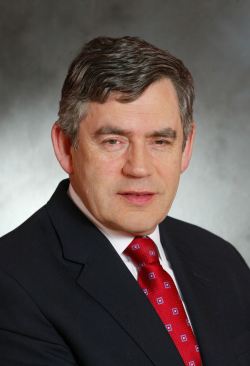
British Prime Minister Gordon Brown - from zero to hero?
.... to set ourselves on a new energy path - a path from our economies that are today over-dependent on oil towards the post-oil energy economies of the future. And moving towards this sustainable energy economy helps us meet our economic, political and environmental goals.
| The stuff of Statesmanship? From a speech made by Gordon Brown on 13th July at The Union for the Mediterranean Summit. The whole speech is below the fold. My emphasis added. |
At this summit the 27 nations of the European Union and our Mediterranean neighbours pledge ourselves to take action to promote our mutual prosperity, security, liberty and democracy.
We must now leave behind the old wasteful, oil dependent ways of yesterday and embrace the new cleaner and sustainable energy future of tomorrow. The increases in oil and food prices we have seen over recent months are causing hardship to families and businesses in Britain and throughout Europe. They threaten economic instability and their production is environmentally not sustainable.
The years of cheap energy and careless pollution are behind us. We need a new strategy. Past total dependence on oil must give way to a clean energy future.
I have called for a better dialogue between oil producers and consumers and a more transparent market, and for measures to increase investment in oil production and refining. Following the meeting in Jeddah, Saudi Arabia last month we will take these initiatives forward at the meeting in London in December, endorsed this week by the G8.
But improving the functioning of the oil market can be only one half of our strategy. The other must be to set ourselves on a new energy path - a path from our economies that are today over-dependent on oil towards the post-oil energy economies of the future. And moving towards this sustainable energy economy helps us meet our economic, political and environmental goals.
Today in Europe more than a third of our energy comes from oil, and a further 40 per cent from other fossil fuels - gas and coal. Only around 20 per cent of our energy comes from low carbon sources - renewables and nuclear. None as yet comes from fossil fuels with carbon capture and storage.
With our ambitious climate and energy package - which we must commit to completing under the French Presidency this year - Europe is on a path to increase the proportion of renewable energy in its energy mix by 2020 from under 10 per cent to 20 per cent. And if we are to meet our long-term climate change objectives - to reduce our emissions by at least 60 per cent by 2050 - Britain, alongside our European partners, will need to do even more.
And at the same time as we move to clean energy sources, we must also become much more efficient in the way we use energy. Over the last forty years the energy intensity of the British economy - the amount of energy we use per unit of national income - has been halved. But as our economy continues to grow we must reduce that still further.
So let me set out the five main points of an oil replacement strategy.
First, since 70 per cent of future oil demand is from transport, we need a step change in the fuel efficiency of vehicles. So Europe must push ahead with mandatory fuel emission standards for new cars. But to drive innovation in the car industry we need not just a target for 2012, but a target for 2020 to match those in the rest of the energy package. The UK is urging that this should be an average of 100 grammes per kilometre, a cut of 40 per cent from the 164 grammes today. This could reduce road fuel consumption in Britain by an average of 2 billion litres of road fuel a year and save the typical British motorist around £500 pounds a year in running costs.
To achieve such a target we will need to see the mass production of electric vehicles - conventional hybrids, plug-in hybrids, and fully electric vehicles. Electric vehicles are now available on our roads - but they are specialist cars and vans available only in small numbers. I want to see the mass production of hybrid and electric drive technology in ordinary family models.
And I want to see those cars manufactured in Britain. So I will be meeting with leaders from the British motor industry next week to discuss their plans for hybrid, electric and other low carbon car technologies.
Already initiatives are under way in several countries to accelerate the commercialisation of electric vehicles by supporting the required charging infrastructure and automotive technologies.
At the European Council in June we agreed to explore the scope to accelerate the introduction of commercially viable electric vehicles - and the infrastructure that their widespread use would require - in the EU.
And today, as a next step, Britain is discussing with other countries - including Denmark, Portugal, Israel and Germany - how we can create a strong policy and consumer environment to promote the development of electric vehicles. And I will propose that we convene a meeting of energy, automotive and planning experts to exchange key information on infrastructure requirements and technology standards in advance of the London energy summit later this year.
Second, we need all countries to commit to taking rapid action to improve energy efficiency in households and businesses. The G8 nations this week committed to implementing the IEA's 25 recommendations on energy efficiency. If implemented globally these could cut oil consumption by 15 per cent and energy-related carbon emissions by 20 per cent, equivalent to the emissions of the US and Japan combined. Europe must therefore commit to implementing its own energy efficiency action plan.
The UK is the first European country to phase out energy inefficient light bulbs - which we will do by 2011. We want the rest of the continent to follow. We need agreement on lower levels of VAT for energy saving goods, as proposed by Britain. And we need to move faster to develop energy efficient standards for appliances, such as phasing out inefficient standby on electronic goods.
In Britain we will also introduce new measures to encourage the installation of household insulation and energy efficiency appliances, which can together save a typical British family up to 20 per cent - £170 pounds a year - off their energy bills.
Third, I am convinced that we need a renaissance of nuclear power. Britain is now moving quickly to replace its ageing fleet of nuclear power stations. And all around the world I see renewed interest in this technology, as countries contemplate the alternative - continued oil dependence and unchecked climate change.
So Britain will work to make possible the best arrangements for security, safety and disposal. Last week the Nuclear Decommissioning Authority announced a preferred bidder for the clean up contract at Sellafield. We are also collaborating with France in this field, and stand ready to do so with others.
Fourth, we need a massive expansion of renewables. Britain is fully committed to the EU target that 20 per cent of all energy must come from renewable sources by 2020. Last month Britain set out its strategy to meet our own 15 per cent renewable target - a $100 billion investment programme over the next twelve years.
As a result of this strategy Britain will become the global centre for offshore wind. We will see major investment in energy from waste and biomass and in new forms of microgeneration. We are pushing ahead with the development of marine and tidal technologies, including an examination of a tidal scheme on the River Severn, which could supply 5 per cent of all the UK's electricity.
And now I believe it is time for a major investment in the development of solar power. The IEA suggests that additional investment of up to 215 million square meters of solar panels will be needed every year to 2050. And particularly in the Mediterranean region, concentrated solar power offers the prospect of an abundant low carbon energy source. Indeed, just as Britain's North Sea could be the Gulf of the future for offshore wind, so those sunnier countries represented here could become a vital source of future global energy by harnessing the power of the sun.
So I am delighted that that the EU is committing at this summit to work with its neighbours - including Egypt, Jordan, Morocco and the League of Arab States - to explore the development of a new 'Mediterranean Solar Plan' for the development and deployment of this vital technology from the Sahara northwards.
Last, and because we recognise that fossil fuels will continue to be an important part of our energy supplies for years to come, we must make good our commitment in the EU and globally to the development and deployment of carbon capture and storage. I am pleased that last month the European Council asked the Commission under the French Presidency to develop an incentive mechanism, which would enable the EU to meet its target of up to 12 demonstration plants by 2015.
The UK and France committed earlier this year to work together on an action plan to work towards not just demonstration but the EU's aspiration to move towards deployment of CCS by 2020. Britain is already working with Norway, Canada and the Netherlands on how to do this. And we are discussing this weekend how we can collaborate with Spain in this field, bringing together British and Spanish companies and experts to examine and exploit opportunities.
The development and deployment of all these low carbon technologies will require a partnership between government and the private sector. Governments can and will provide the right framework of regulation and incentives. The private sector will have to provide the investment. But we can support this too.
So I call on the European Investment Bank to use its 3 billion euro sustainable energy fund to support a clear strategy for the reduction in global dependence on oil and traditional fossil fuels and for the development and deployment of new low carbon energy technologies. And we need to see a similar refocusing of EIB spend within the EU.
We live in a new era. Today our globalised, energy-hungry and warming world requires a shift from oil dependence to sustainable energy.
Only with political leadership from all of us will we be able to move towards a new sustainable economy. This is now Britain's goal. It must be Europe's destiny. In this unique partnership of European and Mediterranean nations, let us commit ourselves to realising it.
I will give Gordon Brown 7 out of 10 for this effort. It's the closest I've seen to a coherent plan for the future of energy in the UK. It repeats certain strategies that have been unveiled piece meal in recent months but places these is a sensible context of post-oil, energy security, political security, economy and climate. In particular I like the juxtaposition of:
- Expansion of nuclear
- Expansion of renewables, possibly including Severn barrage
- Discussion of solar energy with Mediterranean states
- Tax breaks for energy efficiency measures
- Electric vehicles are placed on the agenda
My main criticism of the content here is inclusion of carbon capture and storage that will likely be obsolete given the massive CO2 reductions delivered by the non-combustion of non-existent fossil fuels implicit in this strategy.
There are certain key omissions as well. In particular we require an emergency strategy for reducing oil consumption now and abandonment of expanding our fossil fuel based transportation in favor of high speed electric collective transport.
For me, this speech is a significant step in the right direction. One step at a time I guess. And plan delivery is of course imperative.
Hat tip to Zizania at Postmanpatel for the link to GB's speech.
Personnel
Editors
Contributors
Peak Oil Primers
Archives
- November 2010 (3)
- October 2010 (6)
- September 2010 (4)
- August 2010 (7)
- July 2010 (6)
- June 2010 (7)
- May 2010 (2)
- April 2010 (8)
- March 2010 (4)
- February 2010 (6)
- January 2010 (3)
- December 2009 (5)
- November 2009 (8)
- October 2009 (12)
- September 2009 (6)
- August 2009 (5)
- July 2009 (11)
- June 2009 (8)
- May 2009 (16)
- April 2009 (10)
- March 2009 (7)
- February 2009 (10)
- January 2009 (15)
- December 2008 (9)
- November 2008 (9)
- October 2008 (9)
- September 2008 (13)
- August 2008 (10)
- July 2008 (14)
- June 2008 (23)
- May 2008 (16)
- April 2008 (12)
- March 2008 (16)
- February 2008 (9)
- January 2008 (13)
- December 2007 (13)
- November 2007 (16)
- October 2007 (22)
- September 2007 (8)
- August 2007 (9)
- July 2007 (16)
- June 2007 (8)
- May 2007 (7)
- April 2007 (7)
- March 2007 (10)
- February 2007 (10)
- January 2007 (12)
- December 2006 (9)
- November 2006 (15)
- October 2006 (4)
- September 2006 (5)
- August 2006 (5)
- July 2006 (9)
- June 2006 (5)
- May 2006 (10)
- April 2006 (9)
- March 2006 (13)
Vital Trivia
License

This work is licensed under a Creative Commons Attribution-Share Alike 3.0 United States License.
Thanks for picking up this speech. Unfortunately it seems to have been completely missed by the mainstream media.
That is a very good point. Where is the media on this story?!
This is a major speech from the Prime Minister. Sure, it's light on details but as a framework it's pretty new. I would have expected this to get some television news coverage but I've seen nothing this evening.
http://uk.reuters.com/article/domesticNews/idUKL1338159220080714
"Early editions of Monday's British newspapers reported that Brown wanted at least eight new nuclear power stations to come on stream in Britain during the next 15 years.
Brown, who also attended the summit, said a "renaissance" of nuclear power was one of the key elements of the British government's oil replacement strategy."
Perhaps the editors think Brown on the front page won't sell papers!
Is it news anyway?
As is said they are mostly proposals that have been released piecemeal already.
Well It is very hard to report on a story that implies that the cost of liquid fuel will go uop, if your sponsors and advertising contracts are made up of the big Car manufacturers and oil giants. Here in Australia the term "Peak OIL" is now becoming ever present in our Organised media. (ABC,au, Like BBC) one thing I know for sure, (being an insider) is that MSNBC (General Electric) have been signing a lot of contracts for distribution over the last six months. Any media outlet that has one of these contracts, will never use the term "Peak OIL" or "GMO monsanto" See if MSNBC has crept into the Business section of your chosen News source, If so dump it.
It seems that the ruling elite who I think intend to remove the labour party from office at the next election don't deem this suitable news for the general public.
Ridiculed though this may be by people who don't believe in conspiracy, it's hard to explain this kind of media omission without infering some kind of hidden power agenda. If we had a sovereign government, should they not be able to promote speeches like this?
Alternatively, the 'government' doesn't actually mean to follow through with this, and so don't want the domestic electorate thinking too much about it, or they know nuclear power is too thorny an issue to touch at home, and want to keep it out of the media as much as possible.
Just thoughts.
I think overall, the lack of MSM interest in this speech is quite simply that they have lost the ability to recognise significant news when they see or hear it.
If its not sensational and if it doesn't have immediate appeal to the masses then it's not recognised as news.
In the UK winters to come, when its quite likely there will be widespread hardship, the media will be all over the stories of grannies dying form the cold. But a major policy speech that may just help fix this problem a decade from now is not worthy of comment.
The lack of in depth and objective analysis by both media and academia on matters of vital national interest is one of the greatest failings of our society today.
Yes, anything that requires even a little attention and holistic thought from people runs in the opposite direction to the purpose of (esp. televison) news, which is to pander to, and promote our animal instincts that lead us along hedonic treadmills to oblivion.
The broadcasting oligopoly is the most powerful influence over peoples lives I'd say, and those who set the agenda surely have more power than our elected government.
If only the types of things we discuss here were given an important place in our education system. But then people wouldn't make such passive, all consuming, debt slaves - I suppose.
At least we can reasonably expect a change of some sort when consumers are no longer fit for purpose, rendered that way by poverty.
I reckon Euan Mearns's comment above about the role adopted by the Media is one of the most pertinent and accurate observations I have ever read. I intend to write it down and re-read regularly so that I can reassure myself of the relatively simple changes that could help put the world right!
Thanks so much for publicising this speech by Gordon Brown.
I am sure I was not the only UK Oil Drum reader who was literally starting to despair at the empty soundbytes and general cluelessness being reported from the UK government around critical issues of energy and economic policy.
Thanks.
Peter, Tamworth.
Euan, you are being kind in attributing the bias to sensationalism. I receive 4 local newspapers each week, delivered to my door, free of charge. The major dailies cost $.50/issue, a price that has not changed in 20 years.
The cost of producing a newspaper is now almost entirely paid through advertising. To see where the editorial allegiance lies, just count the advert column inches. They are allocated to cars, (mostly suburban) real estate, (mostly imported) groceries, travel, and entertainment, in that order.
I expect never to read about peak oil, distress of car manufacturers, distress of builders, or need to relocalize in my local papers. The reporting is pure payola, designed to reinforce the impact of the ads.
In video, BBC, CBC, ABC are truly public, though political animals. NPR is paid for by rich though varied patrons. The rest are just as oil-dependent as the papers. I think media requires constant attention to motive, and must be interpreted accordingly.
Euan,
Here is another speech that set the course for the alternative energy options we have today. It is kind of sweet thinking of a family of four getting a tax cut on $10,000/yr. Notice that Carter emphasizes greater nuclear safety rather than seeing nuclear power as a future energy source. Perhaps he could see TMI coming. Brown's enthusiasm, in contrast, seems to lack prudence.
http://www.americanpresidents.org/ram/amp120399_e.ram
Chris
It is interesting that some of the press reports mention eight 1.2 GW reactors. This is about the rated power claimed for the Westinghouse AP1000, and less than the other two designs still in the running. Westinghouse claim a build time of 36 months, although this seems very ambitious as it is still only a design.
I wonder where this leaves EDF and their plans for British Energy and the EPR?
Forgive me for perhaps stating the obvious, but I suspect that peak oil will not mean an end to oil consumption. Assuming that we have arrived at the peak, then we still have 50% or so of the oil left to burn. Comparing the highly favorable EORI (energy return on investments) for crude to the EORI of the alternatives, I believe that the oil will indeed be burned.
Fortunately, developing the alternatives sooner rather than later could well mean that the price-point at which the two are equal may be more affordable. Moreover, this could also extend the period of decline.
Given that burning the first 50% has caused a significant perturbation to the global ecosystem, then there may very well remain a need to mitigate the consequences of burning the last 50%.
There's not THAT much carbon left in the second half of the oil. Most of the carbon has been from coal and most of the potential carbon to come is from coal. We can burn all the conventional oil and gas and keep CO2 concentrations well below 450ppm. Coal is where we should focus.
Yeah, when you think about it the global volume of oil is actually not that big after all. If we assume 2,000 billion Bbls as the absolut global reserve and imagine it is equally spread on the serface of the Earth, then it will only be a 0.6 mm thick layer, just like a very thin layer of paint.
I'm not so persuaded of this notion that people will still go on burning/using coal. You can't just dig it up with a spade in your garden. You have to (1) go to the remote location, (2) use some heavy machine to break it up and get it out (or seriously heavy manual labour); you then have to haul it back to its place of use. All this requires time, energy, steel etc. We might not have these available in sufficient quantity and cheapness to be able to do that coal-digging. I'm more fearful of all the trees getting burned to extinction by people trying to keep warm and well-fed.
Was that 450 figure picked out of the atmosphere by a politician? Is it any less arbitrary than the 350 picked by Jim Hansen?
http://www.350.org/
James Hansen (NASA) has incorporated "oil peaking" into his policy analysis. From his recent Congressional testimony:
"Requirements to halt carbon dioxide growth follow from the size of fossil carbon reservoirs.
Coal towers over oil and gas. Phase out of coal use except where the carbon is captured and
stored below ground is the primary requirement for solving global warming.
Oil is used in vehicles where it is impractical to capture the carbon. But oil is running
out. To preserve our planet we must also ensure that the next mobile energy source is not
obtained by squeezing oil from coal, tar shale or other fossil fuels."
http://columbia.edu/~jeh1/2008/TwentyYearsLater_20080623.pdf
Anybody who is freezing cold will pay no attention whatsoever to Jim Hansen.
There's way too much coal available at much lower cost than nuclear to be able to talk about "non-combustion of non-existing fossil fuels". Given the push for Coal to liquids in certain parts of the world CCS for all fixed CO2 sources (including natural gas and biomass) in compensation may be necessary anyway.
Every time I read a comment like this I fear that TOD is not achieving its goals.
I would expect a comment like this on other kinds of fora, but not here, and much less from a commentator that has been around for 2 years. Still, after all this time reading TOD, Pieter thinks that we just need to “wish upon a star” and Coal will come to save us.
What can I say Pieter? Keep dreaming, if you don't want to deal with reality, it will eventually deal with you.
I don't believe that he was saying that Coal will come and save us. I read Pieter's post as saying that Coal will get used anyway, so we may as well store the carbon emissions from it.
I'm not writing that coal will save us, I'm writing that coal will destroy us if we're not careful. CTL is an obvious choice for countries (not the UK) with declining or zero oil production and large coal reserves like the US, Australia and South Africa. The technology for CTL is available on industrial scale . Coal has a flow rate problem but in these countries the expansion of coal production for CTL is much easier than nuclear (which does not drive cars and aircraft). The liquids from CTL have a better power density than coal itself so a CTL plant near a mine will help solving a major bottleneck in coal expansion, efficiency loss through transport of this relatively low volume density fuel. Given the problems with current coal reserve estimates this strategy will lead to a crash or at least serious growth problems after some 30 years but that will give some breathing space for 'business as usual'. Remember the Hirsch reports' 20 years. As end of pipe (CCS) solutions to the emissions when used in cars or aircraft are not possible the effects on climate are similar to the use of oil at best and worse if the CTL plants are not CCS capable.
The CO2 produced by combustion of FF does not stay in our atmosphere. There is a massive 2 way exchange of CO2 between atmosphere and oceans on an annual basis - with a small net accumulation in the atmosphere - the cause of much concern in certain quarters.
When FF peak, likely before 2020, the rate of CO2 emissions will fall - and there will be nothing we can do to stop this. And this will also place us in an emergency situation of flat out energy decline.
Now, we need to decide in such an energy starved world if we want to use a significant part of the precious energy we have to bury CO2 - when our CO2 emissions are already falling.
Or do we invest instead in more energy efficient ways of using the remaining FF and making them last longer.
A small but vitally important net accumulation of a couple of ppm per year. Data available from http://scrippsco2.ucsd.edu/home
You're right, Euan, to remind us that we won't stop this and that we won't waste any of the precious energy burying CO2 unless to enhance oil recovery (even if we could). And that doesn't mean Hansen is wrong to insist that we must.
Peaking of all fossil fuels before 2020 is doubtful. Peaking of oil and gas before 2020 is something we can agree on I think.
Net accumulation of CO2 is a major problem, especially when CO2 levels start damaging the feedback mechanisms you have just mentioned. Hansen's tipping points are about this problem. A massive increase in CO2 levels for a relatively short period can do this through ocean acidification and melting of permafrost along with other factors. Destroying major carbon sinks by destroying old growth forests and and their soils does not help.
There is enough coal and lignite available to damage these feedback mechanisms permanently. Hence the necessity to use CCS on coal/lignite plants (and as much as possible on other fixed emitters). When used in oil/gas production it's CCU (Carbon Capture and Use) BTW. "Certain quarters" like Greenpeace Netherlands disagree and talk about CO2 "dumping" which should be banned .
Anyone have any details on or referrals to;
From the speech (my emphasize);
This seems to me like an invitation to start drawing a new roadmap for future energy consumption.
G8 Leaders Declaration http://www.g8summit.go.jp/eng/doc/doc080714__en.html
Para 26
26. We recognize the importance of setting mid-term, aspirational goals for energy efficiency. In national goals and objectives, as well as in country specific action plans, we will maximize implementation of the IEA’s 25 recommendations on energy efficiency.
IEA Work for the G8 - 2008 Messages http://www.g8summit.go.jp/doc/pdf/0708_06_en.pdf
Full report - Towards a Sustainable Energy Future
http://www.iea.org/G8/2008/G8_Towards_Sustainable_Future.pdf
All G8 Toyako Summit documents
http://www.g8summit.go.jp/eng/doc/index.html
Developing carbon capture and storage could wind up being a good way to get more oil out of the North Sea so I suspect his motivation isn't entirely related to the issue of global warming. The key thing to watch now is whether this broadly sensible set of policies becomes part of a wider cross-party consensus at Westminster. Unfortunately politicians are prone to populism when there are general elections to be won and nuclear power and fuel taxes will be highly tempting avenues for that.
Still wants to have the cake and eat it.
"First, since 70 per cent of future oil demand is from transport, we need a step change in the fuel efficiency of vehicles. So Europe must push ahead with mandatory fuel emission standards for new cars. But to drive innovation in the car industry we need not just a target for 2012, but a target for 2020 to match those in the rest of the energy package. " Blah, blah, blah ...
Lessee: making the cars, making the dealer/shop/factory buildings, the roads, the places to go with the cars the replacement parts the power infrastructure; all the things the cars need and love. don't forget the maniac drivers and the thousands of deaths and injuries.
With pols, it's always more, always, 'we can consume our way out of this problem.' The obsolete mindset.
When is a politician gonna stand up and say 'Less!'?
The first step toward energy indepandence is to get rid of the cars. All of them. Then, the energy problems can be solved in a leisurely manner.
Never. The current strategy is to let the market say "less" in the form of high prices while the politicians rally the hoi polloi with "more!".
Not a bad strategy really. People can indeed be talked into believing less is more. No doubt about that.
Psst I guess you missed the line:
That's spending 'Less' for illiterates.
Not quite - it's increasing the efficiency of the same or a greater quantity of stuff. He's nopt asking for us to use less, but to use more in a more efficient way. Business As Usual.
Wrong, taking rapid action means spending more. Energy efficiency costs; equipment costs, time spent on installation costs. If the overall outcome is less, that's fine, but is not the case in general. Legacy 'inefficiencies' remain along side the added 'efficiencies'.
Wrong, taking rapid action means spending more. Energy efficiency costs; equipment costs, time spent on installation costs. If the overall outcome is less, that's fine, but is not the case in general. Legacy 'inefficiencies' remain along side the added 'efficiencies'.
Mr.
Let's imagine that you could invest X in energy efficiency so that in a year, X has been paid off and in further years you won't spend as much energy as you are now. How's that "spending more"? Could you elaborate?
Are you telling me that investing in efficiency is wrong? Is this the level reached here at TOD? You're not one of those Jevon's witnesses, are you?
This is classic Jevon's idiocy. What you fail to understand is that Jevon's paradox only applies when the price of energy is static. If the price is escalating exponentially, efficiency is the best way to accomodate it and Jevon's paradox is non-existent. I'll give you a straight example.
Year 0. You spend 10 energy units for 10 actions and spend 10 money units.
With prices escalating to double, and if you are 100% more efficient, the result is:
Year 10. You spend 5 energy units for 10 actions and spend 10 money units.
You don't have extra money to spend and you make your own things by using half of the original energy. Net result: less energy used overall.
This is what is happening. So out with Jevon already.
You remember what Miz Piggy said about "Less is more"? "Some people say that 'Less is more.' But that's silly! Less is less!"
:o)
You had to have been there. It was the intonation and the phrasing.
As I see it placing an emphasis on greatly improving efficiency is the BEST we can hope for from the politicians. Compared to anything I expect to see in my country (USA), this is really an enlightened (if unfleshed out) policy. It kind of maps with my strategy of pushing for BAU-lite. Get the public enthused about saving energy, as they see their bills drop. Then as we get further from peak FF, the next step is a transition towards BAU-extralite. Depending upon how well we are able to scale up renewables, and nuclear, we will see how much further we need to go things unfold. I also believe we need to explore CCS, there are several possible capture technologies, some of them if they work out could potentially have much lower energy costs than the critics contend. This is a technology we need to invest in as a kind of climate insurance (insurance against the effects of human greed).
If I had been asked to recommend the contents for an enlightened energy speech for a major politician, thats pretty much what I would have recommended. I would have put a little more emphasis on the disastrous effects of PO and energy imports (especially if import prices rise several fold), but aside from that this is a pretty good start.
You guys seem to have a lot more faith in politicians than I do. This is the guy who just last week said he would give military aid to Nigeria to help fight the rebels. Did we not learn any lessons from our current oil war?
Where was he talking, was anyone listening? – The Union for the Mediterranean . What is that? Just Sarkozy doing a Blair and trying to make a name for himself - using EU money of course.
Some real bastions of democracy amongst this lot: Algeria, Egypt, Israel, Jordon, Lebanon, Mauritania, Morocco, Palestinian territories, Syria, Tunisia, Turkey
This is urgent so let’s wait six months.
Easy solution, destroy the rest of British industry and make us completely reliant on finance and tourism!
Wow, a whole 1.8 gallons / week
British motor industry, what is that? He is taking the piss.
Says it all, we don’t even control that aspect of our fiscal policy.
That gives typical bill of GBP 850/year. You can tell he does not pay his own bills. Using The Energy Shop’s typical medium usage average dual fuel bill comes between GBP 900 to GBP 1000. And BG are putting theirs up again.
10 GW capacity to be replaced, so that is the 8 new ones spoken for. What about replacement for 8 GW of coal and 7 GW increase in consumption – all from renewables?
Easy one that, just involves giving shed loads of our money to already oil and gas rich Arab governments!
For me it is just cynical ‘tell them what they want to hear’, 'make them feel good' rhetoric
You can see his dastardly plan:
New appliances, new cars, British made.
Revive the "economy" by pretending to be green and manufacturing more trash.
I can't wait to buy a brand new British Leyland "Oxymoron".
In theory it's all part of the mix that will make up the future though surely? Better than trying to buy Chinese/Indian/Japanese equivalents I believe will exist.
However, if this new British industry really happens (although in reality it takes big investment and several years to develop new car models when you have no existing such industry), Gordon Brown will quickly realise that the CO2 emmissions involved in creating a new car are comparable with those of driving the same car over its entire lifetime. (And that is based on current vehicle emission levels! Hmm, need to quote a source for that "fact" if anyone has one?) I am saying that all Kyoto style CO2 targets will be straight out the window. Not to mention the UK government's latest unpopular car tax amendments encouraging people to buy new low-emission models revealed to be the opposite of a "Green" policy.
As Euan says, it is a step in the right direction, in the sense that "a journey of a thousand miles begins with the first step.
Peter, Tamworth.
I wonder how the burnt out British economy is going to pay for this "lets spend our way out of the problem" plan? Is the money going to come from the dwindling tax payer, the insolvent banks, near bankrupt businesses or the soon to be unemployed consumer? Perhaps Britain is going to pawn itself to the Sovereign Wealth Funds of the Saudis, etc. to finance its phoenix like attempt to raise from the ashes of financial collapse.
Somehow, I don't think this "BAU but by other means" attempt is going to happen. And I certainly hope this particular massive misallocation of resources falls flat on its face:
"we will need to see the mass production of electric vehicles - conventional hybrids, plug-in hybrids, and fully electric vehicles"
Of course it will all be attempted, that's only to be expected. I'll certainly not be making any plans based on Mr Brown's vision of BAU in the future that's for sure.
What I do hope happens though, is that the public will understand the real situation from what he says and make the necessary changes to their lives as a result. Perhaps this is why the media are ignoring what Brown says. Wouldn't do to have people simplifying their lifestyles to the detriment of the elite, better to keep them in the dark and not rock the boat.
Brown's already said he wants to get the ME oil producers to stump up a big portion of the first £100 billion for our renewables. It's in their interests (unless they really could raise production substantially for a few years) and they know it. They can profit from the problem and still end up owning the solution.
If he pulls that one off his place in history - incredibly - would be more assured than Blair's.
However, he'll be very lucky to achieve it in the time left before Labour get crushed at the next election. Listening to Cameron on the BBC this morning:
http://news.bbc.co.uk/today/hi/today/newsid_7506000/7506840.stm
talking about restarting growth, he is definitely pursuing the mushroom strategy - keep the public in the dark and feed them a lot of horsesh*t. I can't believe that DC's not as well briefed on Peak Oil as GB, so his disingenuous pretence that BAU can be restored is depressing. Maybe he's biding his time, hoping to steal Brown's clothes in the election campaign.
I agree with your analysis of why the media are ignoring everything Brown does on the subject. Can't have too many of the gente realising it's not in their interest to keep buying more and more stuff from the advertisers.
As I've posted before.
On the Andrew Marr show guest Sharleen Spiteri asked Shadow Chancellor George Osborne about Conservative policies in relation to Peak Oil. Osborne just looked at the ground. He was rescued by Andrew Marr interrupting to get Osborne off the hook and change the subject.
Thank you Undertow. Still, Osborne won't have forgotten that moment. Now that both the FT and the Economist are able to discuss Peak Oil without compulsively asserting that demand will bring forth supply, perhaps Mr Osborne is taking the trouble to inform himself.
I am sending him a PO primer anyway.
Osborne and Cameron are close to Zac Goldsmith.
Goldsmith knows all about PO.
His words:
''Peak Oil Informs Everthing''.
They know.
Question is, are they like rabbits in headlights?
First thing it would be great if Sharleen started posting here as Eastexas - or similar. Did she really ask a question about PO?
Cameron and Clegg have their work cut out to come up with an alternative energy strategy that stands a remote chance of working without new nuclear in the mix.
But it looks like we may be consumed by the Credit Crunch first.
She not only mentioned it by name but said she was involved with Transition Towns. I presume the BBC thought she was a safe bet until she ambushed them with that!
Like the Texas joke :-)
Zac Goldsmith was on Straight Talk with Andrew Neil at the weekend but I only caught the end of it live. There was no mention of PO in the segment I saw but I intend to watch the whole interview (it's on iplayer). Link below
http://news.bbc.co.uk/1/hi/programmes/bbc_parliament/7505266.stm
It's a good interview and he even mentions energy efficiency and also that GDP doesn't measure progress!
The burnt out British economy had a GDP of $2.772 trillion in 2007.
http://en.wikipedia.org/wiki/Economy_of_the_United_Kingdom
Spending about $200 billion between now and 2020 (as envisioned in the link below) to sort out the energy sector would only be about 0.6% of GDP if the pessimistic assumption is made that there will be zero economic growth in the interim. The problem is solvable in other words and steps are currently being made to streamline the planning system in England and Wales to get it done:-
http://www.independent.co.uk/news/business/news/lights-will-go-out-by-20...
"past performance is no guarantee of future results"
70% of the British economy comes from services. I doubt there will be much of a service industry left in a few years. The economy is going to be eviscerated by the coming global depression and Britain will hardly be able to feed itself, let alone rebuild its energy infrastructure and transport systems.
I think they need to be very careful were they use their available resources. I believe chasing the illusion of BAU will create yet another massive misallocation of money and effort, leaving everyone worst off in the end (well perhaps not the elite, who will pocket the misallocated money).
What you are really quoting there is employment percentages. It is worth noting that 72% of France's workforce and 68% of Japan's work in service industries as well and as in the UK much of what they do is related to activities which are completely irrelevant in international trade terms. There is nothing unusual about having multiple service sector jobs for each manufacturing one in the context of a western economy in other words. The impact of mechanisation over recent decades shaped that. In reality, Britain still relies primarily on manufacturing and the activities of financial institutions like Lloyds for its export earnings rather than on service industries like air travel based tourism, which are most likely to be completely decimated by rising oil prices. You paint a doomsday scenario but an alternative outcome to the one you describe is that the end of globalisation due to higher transportion costs will result in a significant portion of manufacturing returning closer to the consumer again.
I guess that the question is whether we can do this and also construct ourselves a new energy system. Given that both require more rather than less energy, I am pessimistic as to whether it is possible,
Peter.
It was 70% of GDP IIRC and I'm not painting a doomsday scenario, that's where we're going. Britain does not primarily rely on its dwindling manufacturing base, in fact I wouldn't be surprised if the manufacturing base relied mainly on the service and housing industry. Recently Britain has relied on the global expansion of credit and all the resulting bubbles.
Now the magic carpet that was keeping Britain aloft has suddenly vanished and all that was built upon its magical surface will fall to earth. Impact should be around 2012, what we are feeling at the moment is just air turbulence.
This is the first step. The recognition of a problem, and even if politicians are only talking to their votes, it's nevertheless a sign that voters are changing their attitudes. It's a good sign overall. What makes me chuckle is the number of doomers who for years talked about the fact that politicians would never engage in this kind of speeches. Now that they did, it's obviously because they are lying.
Well, he couldn't be talking about that, now could he? Still, economic trade is a better way to spread ideologies of peace and democracy rather than waging wars. My two cents.
This is a major thing. And it's not that urgent. He's talking about 2020. It looks like he doesn't share with you your hysterical fear.
Easy. You're falling into blind despair now. It is widely known that many developed countries in Europe have reached their peaks in energy consumption long time ago, without major issues. We need wealth in our needs, not energy per se.
You're not british, you're an american. Duly noted. It seems that americans still think they rule the car industry...
What do you prefer, to give them bullets or atom bombs? I see through your racist rationale all along. To invest in solar in Britain is to waste resources. This is known for ages. Even the oil drum made calls to this energetic mediterranian plan. So, what is your alternative? Oh, don't bother to answer that, I guess it's some kind of return to the age of apes.
luisdias
Got a big chip on your shoulder have you?
Don't like Americans is it? And I'm the racist!
What, you making lists? Racists, Americans, Doomers, etc.
You have lost me there, "racist rationale" "all along"? So my opening statement "You guys seem to have a lot more faith in politicians than I do." highlighted you to the fact that the reason for my comment was racist. Wow, you are one sad twisted little bastard.
Cut out the swearing please.
Just out of curiosity, are you American ? Most of your distinctive phrases (shed loads, taking the piss etc) are British.
Why don't you like the north African CSP plan ?
Maybe some of those countries you seem to dislike might become more liberal, democratic and pro-western if they had a solid footing for trade with Europe - isn't that possible ?
Note we've discussed the Desert TREC plan here a couple of times:
http://europe.theoildrum.com/node/2583
http://anz.theoildrum.com/node/3791
Have I made a faux pas?
It appears that the following are acceptable:
1) luisdias and coconut calling me a racist
2) coconut calling me an idiot
3) luisdias calling steve from virginia an illiterate
But that me calling luisdias a little bastard is unacceptable.
Little bastard, whilst being considered rude by some, is not swearing.
However as your are one of the sites editors I will be guided by your opinion as to what is acceptable, i.e. that it is swearing.
Please advise if you consider slurs such as racist, idiot and illiterate to be acceptable language for your site.
No you are right I apologize - it's probably the way you attack everyone, from the brits, sarkozy, the mediterranean regions involved, to the readers themselves. I usely never react to articles but enjoy reading TOD very much. I believe that nowadays it's better to say things like Brown (especially as it's not completely nonsense and is added with figures which are reachable) than saying nothing. Speeches and texts can lead to improvements (and it does not cost much). Same thing for the mediterranean union, it's a small path towards something, but it's a path. It's easy to criticize (same thing applies to me hence why I apologize). And little bastard is swearing
I'm sorry for the racist remark, it was out of bounds. Your comment struck me as condescending but you are right in being pissed off. As for the illiteracy remark, I think it was quite appropriate, I would even say precise.
Could you though answer my other questions I posed to you?
luisdias
I can see three questions in your original comment:
I assume that is rhetorical
This one also, but in case it wasn’t then my answer is ‘give’ them nothing. Make them pay. See my comment below about cost effectiveness of building up MENA instead of ourselves.
Can we put this in context, the post Topic is Policy/Politics. My opinion as stated in final line of my comment is
There are some contributors here that appear to hold a similar opinion to mine, whilst others have a different opinion and feel that Brown is sincere and has at least made a start. That is the nature of debate. What I tried to highlight was what I saw as the bull****, the easy words, doublespeak whatever you call it.
My reply
i.e. just words required from UK, support only, easy to say.
via the EU. If in the end it turns a profit it could all be worthwhile, but cynic that I am, I don’t think it will turn a profit. Before anyone jumps on me, by profit I mean any of: money, reduced CO2, additional O&G to the market, etc.
I assume that is a fact that no one disputes, i.e. that the Arab governments with oil and gas are rich. So why the need for inward investment? Is it really going to be cost effective to build solar and nuclear plants throughout MENA just to free up O&G for rest of the world. Why not make that investment in UK to reduce our dependence on MENA O&G.
Oil from MENA is a central tenet of IEA policy thinking and scenarios through to 2030. http://www.iea.org/textbase/npsum/WEO2005SUM.pdf I assume because it was ‘easy’ and ‘plentiful’. As highlighted in TOD this may no longer be the case. Should policy change to reflect that?
With regard to the MSP scheme itself I have to agree with DaveMart’s comments (further down) on the practicality of the scheme.
On some of your other comments:
The Jeddah meeting was about NOW and the current oil market, see Jeddah Energy Meeting Joint Statement 22 June 2008 (KSA, IEA, IEF, OPEC) http://www.opec.org/opecna/Press%20Releases/2008/JeddahMeetfinalstatemen...
Oil at US$ 130+ now is serious! Inflation, world economic crisis, etc.
As an engineer I find the destruction or sale of our industrial heritage depressing. That’s how I feel, I can’t change that.
What little heritage we have left has been sold-off to foreign investors, ‘The British Motor Industry’ being a prime example. Anyone from UK would know what I meant when I made reference to that. For Brown to use those words really shows contempt for all of us in UK. Pondlife mentioned some of the remaining British motor companies, unfortunately he must have left the room for five minutes as two he mentioned are no longer – Rolls Royce Motors is now part of BMW and Lotus part of Proton. Tell me what other country in the world would allow some of its most well known ’symbols’ to be sold abroad?
For BIG GAV
I am English. Whilst luisdias and coucou’s 'racist' and 'idiot' slurs were hurtful what hurt the most was being called an American.
I agree with luisdias , Goood you are a racist (and an idiot)
luisdias: The UK doesn't have a motor industry anymore. And I am British.
The UK gov counts Honda and Nissan as UK cars because we have assembly plants here.
The only UK car companies are people like London Taxis, Lotus, Rolls Royce, Aston Martin, TVR [now Russian afaik], Morgan, Bristol etc. Basically people who carve cars with a spokeshave..
I'm guessing the timing is due to the US election.
Wind back the clock to April:
Same old emperor, same new clothes.
Quite. The word "growth" isn't mentioned in this speech, though there is the passage you highlight. However, he's clearly in growth mode with this speech. He talks about sustainable energy but he has no idea what sustainable means. He often mentioned monetary benefits to consumers from energy efficiency, as though those savings would not be spent on anything that required energy (or other finite resources).
Any good in the speech (which is mainly words and very little action) is wasted without a paradigm shift. I don't see that coming, at all.
My view is this is pablum for the masses; just more of the fraud that political solutions fundamentally are.
I am sure they will pass out taxpayer money to get businesses to invest in what no sane person might invest in. Sound projects do not need subsidies and incentives from government; all they need is for government to get out of the way with their plans and regulations.
Gordon Brown is just part of the ruling class. His great claim to fame as head of the UK's central bank was to dispose of a significant portion of their gold in order to discourage people from a flight from bank money into real money. And he sold right near the bottom of a 20 year long decline, a great example of the Midas touch in reverse. So this is the brilliant mind behind the collectivist solution; a central plan no doubt that will turn out just as effective as the many Soviet 5 year plans which went nowhere. Beware of the benevolence of government.
I see T. Boone Pickens here in the US is staying true to his colors also as a huckster. He wants to invest a huge sum in wind farms up and down the Midwest wind corridor, perhaps a good idea, until you see that he wants the government to give him $1 trillion US dollars in subsidies. He is even going so far as to spend around $50 million in advance to condition the public to his "plan" so that they will tell their federal representatives to fork up the money. If his plan is so viable, and he is going to make so much money implementing it, then why is he asking for the taxpayers to pay him to make his profits?
I do not know which of all these proposals are viable and which are boondoggles like the Ethanol scam promoted by G. W. Bush, and I doubt that Gordon Brown or T. Boone Pickens does either. If either wanted to risk his own money or convince investors and lenders to join in, then I wish them well. But thank you, I would like to keep my own funds to proceed with my individual plans, and I resent those who would plunder me through the force of government to finance their schemes.
Henry,
IMO alternatives will unfortunately require subsidies at least initially; they aren't currently competitive simply because the external costs of present energy sources are borne by the public. Additionally, present energy sources are receiving indirect subsidies (how much money is being spent to 'secure' Iraqui oil?). An additional problem is that petroleum is not being properly priced due to active denial of PO; as Matt Simmons puts it, "Oil is too cheap.".
While central planning has been shown to make poor decisions in allocating resources, I believe that time is so short that US Gov't borrowing power (credit rating) will be necessary to make the needed investments in the time available.
Errol in Miami
This is an interesting speech, coming from a man that I suspect is feeling the floor failing under his feet. It is just a matter of time before a serious crisis hits the UK, a state that made the brilliant move of planning the decommissioning of its Nuclear park to the same period in time when it's internal production of oil and gas would peak.
Sorry Mr. Brown, too late, you can't avoid that crisis any more.
There are some interesting things there of course. You understand the problem, you understand some of the strategies to deal with it (I especially welcome the reference to Severn). But this is a breathless amalgamation of loosely dimensioned policy tactics currently at different stages of development that will have a slow impact over an extended period of time.
And unfortunately you still manage to embroil all this with emission targets. I think that anyone trying to promote energy efficiency by measuring it in grammes per kilometre and at the same promoting CCS can't possibly be serious. You have to make a decision, either we a face fossil fuel shortage or a glut – we can't have both at the same time.
Apart from the delusional references to CCS, I endorse every strategy put forward. But let me ask you a few things: how will the energy generated in North Africa reach Europe? I hope you're not thinking of pipe dreams like H2. The renewable strategy: highly commendable, but where and how will that energy be stored to allow for load balancing? And what about those electric vehicles? The batteries they'll use will be made of what? And how much will they cost?
What really disappoints me is the feeling that you try to transmit that you've got the situation under control, when there are so many loose ends.
I hope that the UK can make it through these turbulent times, with the help of the other states maintaining an acceptable energy delivery system. The UK will eventually learn how to deal with the crisis and truly emerge into a post-oil future. You're getting there, but don't think it'll be either easy or swift.
The plan, if it can even properly be called, that, to get solar thermal power to Europe from North Africa is to use DC transmission lines:
http://www.desertec.org/
Trans-Mediterranean Renewable Energy Cooperation (TREC) Homepage
In actual fact this is based on extrapolating technology which is only technology which has only been tested at much smaller scale, much of it in Spain and at great expense.
The plans in reality are more to do with a natural gas burn, lightly assisted by solar:
http://djamelmoktefi.blogspot.com/2007/08/algeria-taps-sunbelt-as-energy...
Contemporary Algeria: Algeria taps sunbelt as energy export
Without plentiful supplies of natural gas the plan has little chance of working.
The recent Scientific American Grand Solar plan also comes unstuck on the same issue:
http://science-community.sciam.com/topic/Solar-Grand-Plan/Solar-Grand-Pl...
A Solar Grand Plan Article Comments Scientific American Community
Another issue would be the water needed, although good progress has been made on this.
http://www.westgov.org/wga/initiatives/cdeac/Solar-full.pdf
To sum up, whilst in the hot parts of Europe solar thermal looks promising, these TREC schemes for the moment as a practical proposition are about as Heath-Robinson as they sound.
As for Electric Vehicles, there is no reason they can't be built at reasonable cost - the plug-in Prius for instance that Toyota hope to bring in for 2010 would cost a premium of around $4k on the same kind of spec ICE, as it has a 4kwh lithium battery.
For that you get a range of 10 miles electric- if they top up at work many will hardly need to visit the pumps.
Batteries from Byd are closing in on $300/kwh, which would make all electric cars a good proposition:
http://www.byd.com/tech/F3etech.asp?show=t1&color=a
F3e technology--BYD AUTO
Advanced lead acid batteries would also do a pretty good job at reasonable cost:
http://www.a123systems.com/
A123Systems :: Home
Delivery vehicles can also run on electric:http://www.popularmechanics.com/blogs/automotive_news/4272875.html
2008 Electrorides Zero Truck Test Drive: All-Electric Heavy Hauler’s 100-mile Range Costs $3 to Recharge - Popular Mechanics
So if you have the power, electric vehicles or plug-ins are practical and affordable, and there seems no good reason why France, for example, should not use them extensively, although the ramp up in build will take a while.
Britain though has stuffed it's energy build, so that serious gaps in supply appear certain - they are relying on gas which is not going to be available at any affordable price, and the off-shore wind build which, at around £10 million/MW installed capacity, after you take out for intermittency but without costing for storage and linking to the grid, is at least twice costs for nuclear build - and rising steel costs which affect wind builds much more than nuclear mean that the difference is likely to get worse.
Intermittent and scarce electricity make EV cars a lot more difficult and less useful.
Dave - can you elaborate on the nat gas part. It seems to me the plan is to balance solar with nat gas burn at source - and with HVDC this seems to make good sense to me. It allows them to provide a stable grid supply whilst conserving nat gas when the sun shines.
From the link I gave:
http://djamelmoktefi.blogspot.com/2007/08/algeria-taps-sunbelt-as-energy...
So this is basically a natural gas plant with some assistance from solar.
The amount of ng burn could be reduced in later prototypes, but you run into the problem that without storage to utilise the generating equipment efficiently you would need to burn natural gas at night, and also supplement the solar power considerably during the early morning etc when sunshine is not at peak.
At the latitude of Algeria sunshine is considerably weaker in the winter when demand from Europe is at peak, which worsens the situation.
The proposals in Algeria represent a need for substantial natural gas burn even if the technology was further optimised - but it should be borne in mind that they are doing it the way they are because that is where the technology is at the moment, and advancing technology takes time.
An alternative solution is that proposed in the Scientific American article I linked, where the solar power is stored as compressed air, but that also uses a lot of natural gas in the process.
Other methods of storage are possible which do not use the natural gas, but they are at a very early stage of development.
Other elements of the technology are also relatively immature, as the plants in Spain are only of up to 50MW size and larger plants in various parts of the world are only just being built which will provide the ability to more accurately assess the technology and costs.
None of this should be taken as in any way saying that solar thermal should not be researched and developed, or that it should not be deployed quickly where most suitable, IOW in hot regions with close proximity to consumers.
It is way to early in the development of the technology to rely on it for Europe's energy supplies - we just do not know how to do that in detail at the moment without the consumption of vast quantities of natural gas, and whilst I do not know how long supplies of that from Algeria are likely to last, peak gas means that long term investment in transmission lines would not seem a good bet until we know a lot more about how to store the energy and overcome intermittency.
To look ahead and try to estimate the opportunities and problems when perhaps the problem of natural gas burn was overcome, and most of Europe's power came either from a Saharan solar system, or nuclear energy
You can order a nuclear reactor off the shelf and have the power where you want it - the solar thermal system has not even been thoroughly prototyped, natural gas supplies aside.
Even if you were to overbuild so as to provide for peak power requirements, the surplus power would still be useful, perhaps to make some liquid fuels for transport needs which are difficult to electrify and to produce nitrogen.
The overbuild you would need for solar would be more difficult to utilise as it is much greater - production is far lower in winter, when need is highest, whereas nuclear would be stable throughout the year.
In the South West US the situation is radically different, as highest demand is near peak solar output.
For Europe other than a few plants in the south in my view these Saharan solar thermal projects do not have sufficiently developed technologies to make serious proposals, and by the time it might be possible to do so, in perhaps 10 years, natural gas supplies are likely to be too scarce to make anything other than a much more advanced system requiring extensive storage possible.
And we just don't know how to do that at the moment - the prototypes still need building.
EDIT: I should have written that winter solar incidence is a lot better in Algeria deep in the Sahara in the south, but early plants would likely be built in the north, where the logistics are way easier, but winter incidence lower.
Building solar thermal plants with dry cooling and without using natural gas to supplement output but extensive storage instead deep in the Saharan desert and then building transmission lines to carry it to northern Europe would be a staggering undertaking, for which most of the engineering is not developed and which would be very vulnerable to terrorist attack throughout the length of the transmission lines, making supply uncertain even if it could be built.
That is before costs are considered.
In the medium term at least, before solar reaches a significant portion of the total capacity, why not just forget about the storage and concentrate on providing daytime peak power (air conditioning etc.) as cheaply as possible?
Without wishing to personally criticise you, but rather to address some tendencies in commentary, it amazes me the extent to which advocates of solar power ignore local conditions and possibilities in an attempt to make solar 'the' solution.
Electricity production is governed by when the peaks happen, and the need to cater for it whilst betting what is known as 'base load' - ie the minimum level of power that tends to be needed day and night, winter and summer, as cheaply as possible.
If, at enormous expense and with unproven technology, you somehow managed to satisfy this base-load market( and the UK uses power mainly in the winter, when it is cold, not for air-conditioning in the summer), then you would have ruined the economics of base load generation whilst still doing almost nothing to contribute to peak winter load.
For the same reason unless someone chooses to spend their own money and go off-grid, then subsidising solar PV power at the latitude of the UK not only wastes money, but actively hinders the grid in providing power when it is really needed, early evening in the winter, when peak load occurs in the UK.
Off-shore wind is appallingly expensive, but, windless periods aside, at least has reasonable load-following characteristics.
Solar power has a genuine and major contribution to make in providing peaking power in hot areas where the primary need is for air conditioning, and hopefully will move on to become viable for base-load power there.
The first questions to be asked of it though are:
'Is it sunny there throughout the year?'
And:
'Is the main need for cooling, not heating?'
David,
You are a responding to a post which identified day time peak load, specifically AC s a good fit for solar without storage. Nothing was said about the UK, and in fact, Brown discusses solar for southern Europe in the speech.
Now, solar power with certainly become a cheaper form of generation in the UK than nuclear power before Brown's nuclear nightmare can be carried out. And that means that the UK will adopt solar power in a big way. But that is no reason to jump all over a post that said nothing about the UK and qualified the present use of solar power as being good for air conditioning.
Chris
If your read what I actually said carefully I specifically said that hotter regions where cooling is a major concern have good prospects for solar energy, and that of course includes regions in southern Europe.
It seems reasonable again since I carefully qualified what I wrote to avoid any personal reflection on the individual posting, and the whole thread is in the context by a British Prime Minister and more specifically the recent discussion was about the TREC proposals for importing solar power from the Sahara to Europe, especially those parts in the north which do not themselves have access to the better solar resources of the south, to put my comments in that context.
Where in the world you get the notion that solar power will 'certainly' become cheaper than nuclear power in Britain I can't imagine.
Here is a thorough assessment of the prospects for renewables in a British context:
http://www.withouthotair.com/
Sustainable Energy - Without the Hot Air (withouthotair.com)
Until the scale considerations in that are addressed, and then we have some reasonable costed fully engineered and prototyped proposals, then in my view there is simply no case that has been presented for the use of renewables to provide most of the power for the UK.
The nuclear plants just need ordering.
EDIT: Even the most favourable regions in Europe in no way compare to the best areas in the US.
Madrid is only on the latitude of New York, and so variations in solar incidence are high relative to the best areas such as the Mohave, and it is annual variation that can really kill costs, as you have to overbuild to make up for it unless you have a pronounced peak in the summer.
Winters even in Southern Europe can get pretty nippy too.
Really? How do you work that out? Looking at my encarta globe it looks like the sun in Algeria is at 45% in midwinter. That's still over 70% of the summer peak.
Luis - I agree that in parts this is a dogs diner where targets are couched in terms of emissions and not straight energy efficiency. But overall I felt there was a significant realignment of thinking away from climate and on to energy. And the overall balance of politics, economics, security and climate is getting about right. They (GB / UK government) were never going to ditch the whole climate agenda at once - and indeed following precautionary principles it can be argued that climate concern should stay on the table - but should not be directing energy policy. I'm pretty sure that all policies that are sensible to tackle energy decline are also good for CO2 emissions. But as we at least are agreed, the opposite of this is not true - e.g hydrogen fantasies, food to fuel and CCS, pander to the whims of environmentalists with disasterous outcomes for energy availability to society.
Euan,
I see you ignored my previous posts on CCS which has very sucessufully sequestered millions of tons of CO2 at Weyburn(Canada) and Sleipner(North Sea). You've clearly made your mind up.
And you've also clearly made your mind up on the wonders of nuclear power which has been allowed to gradually waste away in Britain. The fact that uranium is likely to be even more scarce in the future based on IEA reported reserves also is less important your uber-optimism that it can replace current coal technology.
I find it ironic that oil which will last at least another 50 years
or coal which will last another 100 years are considered less acceptable than uranium which may last less than 50 years and which poses a much greater proliferation/waste threat than any fossil fuels.
My advice to you is to think HARDER.
As to PM Brown, I greatly sympathize with his dilemma, but he
should probably concentrate on offshore wind and energy conservation legislation. The North Sea has a potential of 1900 Twh per year of wind according to DEWI, where as current UK electricity consumption is about 400 Twh. Fossil fuels offer a way to balance out peak loading and of course more nuclear power plants are just more base load. Buy nuke baseload electricity from those foolish frenchies.
http://www.geni.org/globalenergy/library/technical-articles/generation/w...
(BTW, I wouldn't be so blunt if I didn't think you could take it.)
Majorian - its taken me all day to wade through emails and other stuff.
On CCS: the UK government view is to capture CO2 post combustion from coal and bury the CO2 in a saline aquifer and it is in that context that I am hyper critical.
Using CO2 in miscible gas flooding of reservoirs as in Weyburn is something completely different - the objective here is to maximise FF production - which I wholeheartedly support.
Statoil in Sleipner is something peculiarly stupid. They are simply burying CO2 co-produced with gas in a nearby aquifer. Why not put this to good use to boost oil recovery else where?
As for nuclear - I am still none the wiser about the availability of U fuel for expansion of fission reactors - but intend to place my government on the spot by asking them this question directly - since the fuel availability issue is one that is more straight forward to answer than other questions that surround nuclear power.
The main issue here is weighing the risks of energy decline, energy scarcity and disintegration of society against those risks of fictional terrorism and waste disposal.
Fire away.
Euan
If the company had a customer for the CO2 (for increased oil recovery) they would have sold it.
First of all they need to bring the gas to buyer’s specification that is taking out CO2 so it can burn properly (heard about something called the Wobbe index?)
The other reason is that there is a CO2 tax on NCS for emissions to the atmosphere. Putting the CO2 into an aquifer makes good economical sense.
What is stupid about that?
Whoa, Euan!
The natural gas extracted from the Sleipner natural gas field has 9% natural CO2 in it , unacceptably reducing the heating value of its commodity--this is strictly a business problem. (But should they vent CO2 to the atmosphere?)
The project buries a million tons of CO2 per year. If it was an oil field they might recover 3 million barrels per year but Sleipner is a gas-only field. At $10? a barrel oil, when the Sleipner project was started up in 1996 the idea of using CO2 to recover oil was new for Europe and certainly uneconomic.
Here's a plan to connect the UK and Denmark CO2 producers like coal plants to North Sea oilfields. As far as I can see there are no natural sources of CO2 around the North Sea to do this tertiary recovery. Once the pipelines are in place would there be any reason not to sequester CO2 from coal fired plants? The North Sea alone could absorb several hundred years of CO2 emissions according to the report below.
http://www.co2.no/files/files/co2/12.pdf
EOR-CO2 typically boosts oil production by another 20-40%.
Also, I've heard that there are VERY large deep coal deposits under the North Sea which could conceivably be converted in-situ to
syngas/hydrogen by underground gasification methods which are being developed in Australia.
Other gas fields have a similar natural CO2 contamination problem.
At the In Salah(Algeria) gas field where they have 4-9% CO2 in their methane they are also sequestering.
Look at Australia's giant Gorgon gas field raw gas is 12-15% carbon dioxide, again, should they dump that CO2 into the atmosphere or just forget about using all that gas?
I don't care for your rather dismissive attitude toward nuclear proliferation dangers.
A-bomb fuel(plutonium) is manufactured in nuclear reactors just as Soviet bomb fuel was produced in the old Chernobyl reactors. I find the idea of a world of rapidly shrinking resources filled with nuclear reactors a terrifying prospect. It is in fact easier to make a few dozen pounds of plutonium than a hundred of tons of uranium fuel.
And I believe the North Korea just got shipped 50000 tons of oil in return for blowing up a rather ramshakle 5 MW nuclear reactor at Yongbyon( which supposedly produced around 5 kg of plutonium per year--a 6 kg Pu-bomb was dropped on Nagasaki in 1945).
http://en.wikipedia.org/wiki/Yongbyon_Nuclear_Scientific_Research_Center
Will nuclear weapons will be used to extort money/oil/resources in the future?
A nuclear renaissance will make it almost certainty.
And suppose you only can buy enough uranium fuel to either build a dozen bombs or keep the streetlights on for a year? Which do you decide to make?
Euan, the recently retired Chief Scientific advisor to the Government stated that if it were reprocessed the fuel available from British nuclear waste stocks alone would be enough to power nuclear reactors in this country to provide 60% of electricity until 2060:
http://www.guardian.co.uk/science/2007/dec/23/scienceofclimatechange.cli...
Exploration for more uranium has also upped reserves by large amounts for a small cost in exploration - the exact reverse of oil, and an indication that peak is nowhere near:
http://89.151.116.69/ENF_Exploration_drives_uranium_resources_up_17_0206...
Apparently you can also design the Westinghouse AP1000 reactor to burn thorium in a fairly straightforward manner - see the comment by Ken here:
http://blogs.news.com.au/news/blogocracy/index.php/news/comments/thorium...
Between reprocessing, better designs for more complete fuel burn, new discoveries, the easy of substituting thorium (CANDU reactors can also burn thorium) and even the already tested although not developed extraction of uranium from seawater, concerns about nuclear fuel supplies seem entirely misplaced.
The only reason that alternatives are not used is that uranium is so cheap it has not been worth the bother - most of the cost is processing the uranium into fuel rods, not the raw material - one of the reasons that the molten salt reactor was killed - producing the fuel was too easy for the nuclear industry's taste.
I am wondering whether this technology might get us off the hook in Britain with our energy gap:
http://www.popularmechanics.com/science/earth/4273386.html
Portable Nuclear Power Shows Promise - NuScale Power for Nuclear Energy - Popular Mechanics
They should be ready to be ordered in around 18 months time, and presumably would be very quick to build and install.
The UK will eventually learn how to deal with the crisis and truly emerge into a post-oil future.
That is one of the most optimistic sentences I've read on here.
A Pessimist is an Optimist who is aware of the facts!
Of course the UK will eventually learn how to deal with the crisis and truly emerge into a post-oil future. The question is whether the UK will by then comprise 60 million happy smiley faces or one man and his dog squatting in a cave mouth.
Great stuff Euan. It is an encouraging and not insubstantial step.
But we have seen similar grand speeches around the world, only for Brown, Rudd, Bush et al to sign up to more of the 'same old' the very next day. Brown's words are stronger and as you say 'more connected' than most so we can only hope he has truly processed the meaning of his words.
In particular, this kind of sentence worries me:
What that means is he will tour the big motor companies, they will tell him lots of nice stories about the concept cars they have and all their long-term plans, but nothing much will change in the short-term. He needs to be going to them and providing strong incentives (carrots) for real changes in what they produce and big sticks if they don't come to the party. What we've seen from these kind of political tours is 'all bark and no bite'. I hope Brown is planning something different.
Phil
It seems people are being a little too cynical about this speech IMO. It is the most direct and rational assessment of the PO situation I've seen from any political leader by far. The main theme is nuclear, wind, and electric cars - a very reasonable solution for Britain IMO. Sure he didn't come out with a direct discussion like you'll get from an online PO forum, and certainly people can take issue with various points, but what do you expect? Politicians don't have the luxury of speaking their mind.
Glenn - I expected a degree of skepticism but agree with you that many comments here are overly cynical. I felt a sense of relief on reading this speech if for no other reason it does confirm that the problems are understood at the top and the solutions are also understood in a general sense.
Its clear that a speech like this doesn't solve all our problems at once, if indeed it solves any at all. But it is at least a starting point with the boat pointing in the right direction.
the thing that matters to my mind does this signal the government finding a new source of advice?
or spin?
what do we know about the back room boys here?
who, what, where, when?
Boris
London
If there is one failing the Brits have with respect to their politicians it is that they are not cynical enough.
Sorry, I don't believe Brown has had a sudden "road to Damascus" experience.
While this speech was obviously not meant to be a detailed peak oil strategy, I note that there was no mention at all of:
Sorry, but nuLabor is the bunch that is still pursuing the Tories' road-building programme, massively expanding our airports and trying to build a new bunch of coal-fired power stations (maybe they'll have CCS in several years' time, and maybe not), but couldn't cope with meeting targets to increase cycling, abandoned promises to reduce road traffic, or tried to retrospectively increase the UK's CO2 emissions quota in the EU ETS to such an extent that we would have struggled not to achieve it. It's ironic that he's calling on the EU to lead more on energy security and renewables. On so many energy and environment issues it is only EU Directives that have spurred his government into action.
If he doesn't "get" climate change, which is hardly controversial any more, when will he "get" peak oil? I fear for my country.
I fear for my country.
Do you fear more for your country than you did before reading this speech? Or less?
A little less, which is a very welcome change given the events of the 2 years or so. Why?
I have always felt Blair sold the Brits to Bush. He was so far up Bush's anus he could not see the horizon.
I do not see brown backing away from a losing game. The UK will have the same pain the US will have.
Brown has gushed a bunch of political platitudes. Motherhood and Apple Pie. Of course we must all do what he suggests.
Peak oil was 2005, What bills are before Parliament to make reality happen. Where is the, "We shall fight them on the beaches, we shall fight -----" Britain needs to regain its backbone and start doing things the British way.
Graham
That's what is going on now.
See: http://www.independent.co.uk/opinion/commentators/johann-hari/johann-har...
http://afp.google.com/article/ALeqM5jIgOCevYjqxdhnoNDq4xVnRP9MQQ
How about: "I have nothing to offer but blood, toil, tears and sweat."
That would be a lot more appropriate for the present situation - without, one would hope hope, the blood.
Here :)
Sounds like Brown wants to support the growth of a UK motor industry again, or maybe its just giving Toyota a kickback to build a hybrid factory in the UK. It would be sensible to give government support to a company to mass produce EV, but I bet he doesn't do it.
Recharging stations here we come.
Get off your fat backsides Italy, Spain and Greece.
Its not happening.
Stop wasting the cash and send it this way. We're not going to settle for propping up french farmers or eastern european oligarchs anymore.
We're saved! All we have to do is build electric cars, make those lazy club med countries produce the fuel and bankrupt French farmers to pay for it all. Nice!
Just to point out, I'm translating Brown into English.
From his point of view, there are no downsides to his path. Nobody in the UK is going to worry about what europeans think and there is a widespread acceptance that we should stop funding it so generously when there are needs at home.
That will go triple if we suffer gas shortages and europe doesn't.
Playing hard man to europe will only help him, providing he doesn't fail. Maggie handbagging the eurocrats will be his model.
We could build these again:
http://www.virtualgaz.com/invacarpage.htm
should be totally safe when the hairdresser-tanks/chelsea tractors disappear from UK roads.
Translated from Spinglish, the doublethink self cancels.
At this tax-payer funded jolly, the European Union and our tax suckling neighbours pledge to take action to promote our own mutual prosperity, at the same time reducing your security, liberty and democracy.
You must now leave behind your old wasteful, oil dependent ways, we will enforce the new clean and sustainable energy taxation of tomorrow. The increases in oil and food prices you have seen over recent months are, apparently, causing hardship to families. They threaten my economic stability and so the tractor production statistics are not sustainable.
Your years of cheap energy and careless pollution are behind you. We need a new stealth tax strategy. Past dependence on oil revenue must give way to a clean green energy tax revenue.
I have emailed some oil producers asking for more market obfuscation to blind-side consumers, and for creative measures to increase investment tax, oil production tax and refining tax. Following the coffee and cigars, burp!, in the seraglio, the Saudis will announce a production increase but then quietly reduce it.
But taxing the oil market more can be only the first half of our stealth plan.
The second half must be to set you on a new energy path - mumble mumble peak-oil! mumble sniff .....
And the remaining half is moving you towards this green tax economy which helps me meet my feather bedding goals.
etc
Gordyz notez to fixz teh futurz
* leccy carz
* insulat hooz
* turn stuff off
* nucleer powr
* renublez
* ccz
..borrow from teh EIB
That's us freezing and hungry in the dark then.
This is simply not good enough. Gordon Brown was chancellor when the North Sea
peaked, and he was still chancellor (in charge of the countries money) when
in 2004 we (UK) became a net importer of fossil fuels again.
The last budget (yearly explanation of the tax burden combined with policy
logic) made no mention of any ring fenced taxation to tackle the issues:
Selected quotes from the budget speech delivered in 12 March 2008
http://www.hm-treasury.gov.uk/budget/budget_08/bud_bud08_speech.cfm
Crude Oil prices (WTI futures) hit $111 per barrel on March 13.
More from the budget speech:
So here we are 4 months later:
http://www.guardian.co.uk/business/2008/jul/15/inflation
More from the budget speech:
Fast forward four months:
http://www.hifx.co.uk/marketwatch/market_briefing/latest_market_briefing...
I remain an optimist - however I think the opportunity to be fiscally
visionary was 10 years ago - when the Labour party finally secured the
size of mandate needed to push through real change.
Now we get the speech .. but Labour are going to lose the next election
so sadly Brown sounds like Bush .. a man without a mandate.
I work in education and whilst I admit that there has been an academic inflation in the grades awarded to our students I still don't see this
as a 7/10 effort. Sorry Euan .. I'm going to apply the external assessor
approach to this and downgrade him to 2.5/10 - I can see that the student
has laid out an action plan, however i can find no evidence of the work being done, nor do I see a portfolio that suggests the student has both
understood the subject matter and made a practical start on the
required output.
Maybe Mrs Sarkozy's smile will get us all safely through this ?
Glad you're not my teacher.
July 13th - I set out action plan for next five academic years.
July 15th - you give me 2.5/10 for not starting work on July 14.
As far as I can see, in less than six months the UK has gone from total official silence on Peak Oil to a measurable amount of alarm and excursion in high places.
The PMs's somnolent attitude to the energy crunch prior to Easter was more apparent than real IMO. The UK is democratic country where 99% of the voters currently live in blissful ignorance of the UK's dire energy situation. If Brown goes on TV now with lurid warnings and emergency plans to turn car factories into wind turbine workshops, what'll happen?
People won't give a great shout of "Lead us, heavenly leader, lead us" and rush home to knit warm pullovers. They'll get as mad as frogs at the messenger; the Government will go into limbo, and two more precious years will be wasted in deadlock and denial.
If ever there was a situation that needed a grass roots response, it is Peak Oil. The uncomfortable truth about the potentially rapid end to cheap and plentiful energy is that, whether we are led to a new situation or fall chaotically into it, the direction is down and back from where we are today. Anyone here care to go canvassing for election on that platform?
It's depressing to see how often, even on TOD, people who claim to recognise the colossal scale of the challenge facing us (of getting ourselves out of our mind-bogglingly extreme overshoot situation) simply resort to glib retorts and catcalls when confronted with the almost intractable problems of delivering real world political responses.
If you are only giving Brown 2.5/10 for repeatedly raising the issue and getting down on his knees to beg for oil money to help us survive, to whom would you give more marks; why; and what are they doing to justify the points?
Maybe he has been told the truth where to get off in his recent visit to Opec to beg for more supply?
But yes, the start of a sea change.
I've got you guys should take a look at. The Energy Crisis is coming, thats for sure, and the government is all ready to capitalize in the coming economic depression to get even more power.
Please do check out
Part 1: http://www.youtube.com/watch?v=BiFlouOozpk
Part 2: http://www.youtube.com/watch?v=n-JF6wZC6v0
This is really important. Look at this information. Maybe you all can connect the dots, with what can happen...
Debate about Secret Session in House of Representatives pt 1
http://www.youtube.com/watch?v=kB-JGqDukbY&NR=1
Debate about Secret Session in House of Representatives pt 2
http://www.youtube.com/watch?v=Y6i8ESCVj-4&NR=1
Gauthar,
I was willing to listen to the show with an open mind, but I finally got to a part that doesn't pass the BS stiff test: "the necessary and unavoidable merger of the United States with Canada and Mexico."
Even GWB isn't dumb enough to take on Mexico; Mexico is fixin' to be a worse mess than Iraq. My tinfoil hat started to wrinkle its nose...
Errol in Miami
Well, just try to imagine how a merger of USA, Canada and Mexico into a North American Union would pan out in the post-oil era. Canada is rich in Oil and Gas Reserves, and exports 1 million barrels (Net exports) a day. Also, the Tar Sands Oil Kerotine is set to increase to an industrial scale.. And this oil can be used within the union.
And then, the biggest issue would be localization of production. Where else can they find cheap labour for the factories than in Mexico.
And add to it, millions of new tax-payers, in the time of crisis would carry the burden together. Thats the only way to save Social Security Net.
When the times get really tough, anything can happen. You can always count on politicians... :)
deleted duplicate
I think with this speech Gordon Brown's makes a logical step in the right direction - but we shouldn't overestimate it. Words are much easier said than deeds done, and the British government has a good tradition of excellent speeches and papers concerning climate protection and energy topics, whereas the real performance so far is rather poor. For example despite so many announcements and programs renewables have barely advanced and despite much talk about "energy poverty" the thermal quality of British buildings is still among the poorest in Europe. Let's see if this time the government really means what it says.
>> Let's see if this time the government really means what it says.
Labour issues a sound bite like this every day or so.
Didn't we have one a few weeks back promising wind turbines every few miles along the UK coasts? Where are they? Are supply contracts under way? I don't think so.
Or how about relaxation of Planning law so that people can install solar & wind power at home? Oh dear, it seems that the local planners don't like this so in a couple of months the domestic planning rules will be TIGHTENED up so you won't be able to put even a small shed in your garden without local government approval!
I'll revisit his speech when I hear that the first nuke contract has been signed.
I can see 49 turbines in the sea from my beach hut on the Lincolnshire coast. That number will be trippled next year.
This link was just posted in the Drumbeat. It's from the "All Party Parliamentary Group on Peak Oil and Gas". Also you can sign the online petition at http://petitions.pm.gov.uk/Oil-Depletion/
'The Impact of Peak Oil on International Development' (PDF)
Current Membership
John Hemming MP (Liberal Democrat) (Chairman)
Colin Challen MP (Labour) (Vice Chair)
Lord Teverson (Liberal Democrat) (Vice Chair)
Mark Williams MP (Liberal Democrat) (Treasurer)
Austin Mitchell MP (Labour) (Secretary)
Frank Cook MP (Labour)
Michael Meacher MP (Labour)
Dr Rudi Vis MP (Labour)
Dr Alan Whitehead MP (Labour)
Kelvin Hopkins MP (Labour)
Celia Barlow MP (Labour)
David Chaytor MP (Labour)
Dr Ian Gibson MP (Labour)
Anne Milton MP (Conservative)
Lord Taylor of Holbeach (Conservative)
James Brokenshire MP (Conservative)
Bill Wiggin MP (Conservative)
David Amess MP (Conservative)
Ian Taylor MP (Conservative)
Lord Armstrong of Ilminster (CB)
The comment would read something like this:
I'm afraid at this late stage I have little choice but to fail you.
The central issue being that the assignment brief was laid out clearly in 1999.
Whilst your draft action plan of 2008 begins to address some of the central
issues, leaving yourself less than two years to deliver concrete results that
would possibly have secured you a deadline extension seems almost reckless on
your part.
Whilst your enthusiasm for prudent decision making is to be applauded, the
examiners (the voting public) concur with the original mark of 2.5 given by
this Morri Poll in June 2008:
http://www.ipsos-mori.com/_assets/pdfs/june%202008%20pm%20tables.pdf
Is this the same Gordon Brown who sold 395 tons of gold at an average price of US $275.6?
http://www.bbc.co.uk/blogs/thereporters/robertpeston/2008/03/gold_and_go...
It's the same Gordon Brown who has got away with seriously massive fraud - goggle "public fraud initiative".
I think you're being much to generous with your marking. Judge a man by his actions, not by his words.
In that case, Mr. Brown, why did your government announce a few weeks ago that the M25 motorway is to be widened at a cost of a mere £5,000 million? Any why is your government also actively supporting a huge increase in air travel and a third runway (a separate airport really) at Heathrow? For every non-British person that flies into the UK, two British people fly out. The UK balance of payments deficit in air travel is enormous, never mind the environmental impact.
Hooray! Happy motoring can continue, thanks to electric cars and all your shiny new, safe, cheap, green nuclear power stations. Why did neither you nor Bliar support Prescott's integrated transport plans? What happened to the light rail schemes that should have been built by now? What have been you doing for the last 11 years?
Things which Labour criticised in opposition, like the PPP projects and other private finance scams that will end up costing far more than direct government spending, have been greatly expanded. Why didn't you reverse the idiotic railway privatization? After all, you were the de facto UK prime minister when Bliar was playing at international statesman.
The fact is that New Labour = Old Tories, 1980s style, and then some. If I have learned one thing since 1997, it is that things can always get worse. Gordon Brown has been a louder cheerleader for "economic growth" at any cost than anyone else, the Chinese Communist Party included. When it comes to the environment and the real world, I don't believe a word he says.
Hello EuroTODers,
Just googling along tonight and came across some rather startling statistics.
I have never been across the pond, but does Ireland & UK really use this much I-NPK? Ireland #1, UK #7 in world ranking! Does the rain washing most of this fertilizer out to sea explain this high usage?
If true, keeping the lights on and feeding yourselves maybe very difficult if prices keep rising fast for I-NPK as we go postPeak [Suggest O-NPK recycling pronto]:
http://www.nationmaster.com/graph/agr_fer_use-agriculture-fertilizer-use
--------------------------
Ireland #1 594.5 kg/ha
United Kingdom #7 285.8 kg/ha
------------------------------
No wonder your forefathers craved guano, Atacama Desert nitrates, and 'immigrants' dead-headed home in earlier times.
Bob Shaw in Phx,Az Are Humans Smarter than Yeast?
The British Survey of Fertiliser Practice 2007 (DEFRA website) indicates 226kg/Ha for tillage; 145/34/47 for I-NPK.
That would give the UK rough parity with German usage.
But yes, it's a lot.
Here is an amazing treasure trove of information for sustainable living.
http://journeytoforever.org
Translation: "Give me more power to fight the Supreme Threat of Scarcity. After you have given me all the powers that I require, I will proceed with the orderly euthanization of 80% of the population."
Every speech has its context. Brown's speech was intended for two sets of ears : those at home [his party, the electorate] and those present [the significant Med basin players].
It's a shame that no MSM picked up on it: it was the first time I can recall a major politician doing joined-up-thinking. If he had posted it here under a different name we would probably have thumbed him up a good few points.
But he was actually speaking to an edgy group, newly-convened under Sarkozy ['the mountebank' - wish I could source that quote!] and his Club Med idea. And while I haven't the time/energy/expertise to go through his words point by point, I do feel that E.Mearns was right to emphasise this phrase: 'the post-oil energy economies of the future.'
I see this as a clear if veiled reminder to those on the Saharan Rim that while they may be sitting round the table with a handfull of Oil-cards - there might just come a day when Oil is not so mighty, and that those countries [and here he boasts that the UK is capable of transforming itself] who do manage to wean themselves off oil to a greater or lesser extent, will no longer be in thrall to oil-sellers.
It's a warning and an encouragement. The hand the oil-sellers hold at present may seem strong - but in a 'differently-energized' society they might be left behind.
Lest it be thought that I'm pro-anything, please note that I have just bought a scythe, and am building an earth-closet.
And yes - I have hugged my bag of fertilizer today.
And yes - some humans are smarter than yeast: they are called women. At the very least they represent one of the most under-utilised, under-represented, under-paid, and un-tried resources the planet posesses.
www.universalmining.com domain name is for sale at SEDO.com