


A Compromise on the Drilling Question
Posted by Robert Rapier on July 24, 2008 - 10:00am
| I have given a lot of thought to the issue of opening up new areas for drilling in the Outer Continental Shelf (OCS) and in the Arctic National Wildlife Refuge (ANWR). My position has always been to leave that oil in place for a very rainy day. I wanted to see major conservation efforts in place before we considered tapping that oil. Opening those areas when oil was $20 a barrel would have meant that much of it would have been used frivolously. |
Now that oil is over $100 - and in my opinion will be much higher in 5 or 10 years (T. Boone Pickens predicts $300/bbl in 10 years) - we will have tightened our belts a good deal by the time any of this oil could actually reach the market. Therefore, I think now is the time for Congressional hearings on opening up these areas. Let's have an open debate on the issue. However, if these areas are opened for drilling, I have a compromise that should be very attractive to those in opposition.
Hopefully this essay conveys a pragmatic approach designed to bring two sides in this debate closer together. At present it is hard to imagine that they could be further apart. A big part of the reason for the chasm between views is that there is a great deal of misinformation and misunderstanding surrounding the issues. I hope to address those in this essay.
A recent sampling of letters to the New York Times gives a flavor of the views of the opposing sides:
To Drill or Not to Drill? There’s the Rub
First a letter opposed to further drilling:
Allowing offshore drilling for gas as a solution to high fuel costs, as President Bush urges Congress to do, is as sensible as growing more food in response to rising levels of obesity or robbing a bank in response to overspending one’s budget.
While it is not popular, the clear answer, as it is in the case of overeating and overspending, is to cut back in the consumption of food, in the consumption of one’s salary and in the consumption of fuel.
Painful as it is, I applaud the $4 gallon because it is the one thing that has finally gotten the public to focus on the fact that we need to consume less. For the first time, one hears from every quarter, turn off the lights in rooms you are not in, recycle that paper, drive less and take public transportation or ride your bike. That is the kind of talk political leaders should be encouraging, not new ways to keep up the old habits.
And one in favor:
As a 40-year Alaskan, I can tell you that opening of the Arctic National Wildlife Refuge is the most sensible solution for America’s oil problems. Most of the people who are trying to stop drilling in the refuge have never been in our state.
You have no idea how little space they are talking about. Take a regular envelope, pretend that is the refuge ... now where you would put the stamp, that is the area they want to open.
Alyeska Pipeline has worked, the gas pipeline is in the process, and the Arctic National Wildlife Refuge should be. Congress is making this a party fight. How about putting that energy into fighting for all Americans, as oil prices don’t care whether you are Republican or Democrat?
So, where does the truth reside? Is it not worth the effort? Or can we "drill here, drill now" and make a significant step toward energy independence? Let's investigate.
What is the Objective?
This is the key to the entire debate. Different groups have different agendas, and desires are often based on misinformation. Take a couple of extreme examples. I consider myself an environmentalist, but one who is practical, and informed on energy issues. Let's take an environmentalist who may be less-informed. Like me, they are concerned about the impact of continued fossil fuel consumption on our environment. When they think of drilling, they envision oil slicks washing up on the shore, and a polluted ANWR. They see oil companies - not ordinary citizens - as the primary beneficiaries if drilling is allowed. They are optimistic about the ability of alternative fuels to rapidly scale up and replace depleting fossil fuel reserves. Or, they don't fully understand the implications of falling fossil fuel reserves, or in an extreme case they don't care and think the earth could use a healthy die-off of the human population.
Each of these groups is going to be vehemently opposed to opening up areas to additional drilling. They simply don't think there is a need, and that it will simply delay our transition to alternatives. Those in Congress who are so outspoken against additional exploration likely fall into the category of 'alternative fuel optimist.' If they can only keep the ban in place, alternatives, mass transit, and conservation will rise to the challenge. The key to this approach is that the alternatives must deliver when they are needed, and they must cover severe shortfalls. What if they don't? What is Plan B? Shortages? Rationing?
For our other extreme example, let's consider the Hummer-driving, non-negotiable lifestyle mentality. The majority of this group is also not very informed on energy. They believe that underneath U.S. territory lies an ocean of oil, waiting to be tapped - if those darned environmentalists would only get out of the way. They are prepared to drill through a polar bear's head if it will mean cheap gasoline - which they know it will. These people are going to be very outspoken about the need to drill anywhere, anytime. This approach suffers from a very similar problem as the previous approach: What if the oil that is available simply can't cover any severe shortfalls? What if the expectations of these vast oceans of oil lead us to delay actions on alternatives? Again, what is Plan B? Military action?
The majority of us fall somewhere in between, but it breaks pretty sharply along party lines. Democrats don't want to drill, Republicans think we should drill. Perhaps we should first develop an idea of the stakes.
How Much Oil is at Stake?
That's a big problem. We don't know. All we have right now are 'educated' guesses. Multiple government agencies have made assessments. The Minerals Management Service in the Department of the Interior estimated in 2006:
The MMS estimates that the quantity of undiscovered technically recoverable resources ranges from 66.6 to 115.3 billion barrels of oil and 326.4 to 565.9 trillion cubic feet of natural gas. The mean or average estimate is 85.9 billion barrels of oil and 419.9 trillion cubic feet of natural gas.
Of that, they estimate that reserves in areas currently off-limits to exploration amount to just under 18 billion barrels. Based on the 2007 U.S. consumption rate of 20.7 million barrels of oil per day, 18 billion barrels would last just under 2.5 years.
The EIA estimate from areas currently off-limits to exploration was very similar at just over 18 billion barrels:
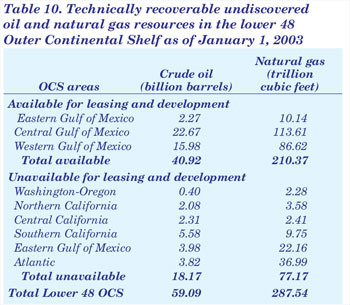
This graphic was recently used in a post at Grist by Joseph Romm, who argued that the amount of oil that is off limits has been greatly exaggerated. Based on the above graphic, Romm has a point, as the amount of undiscovered oil in areas open to exploration is more than twice the estimate from areas off limits to exploration. However, much of that oil is mile-deep water that will be very expensive to develop. So the comparison isn't necessarily apples to apples.
Estimates of recoverable oil from ANWR are of a similar magnitude. The Energy Information Administration (EIA) in a 2008 report noted:
In the mean oil resource case, the total volume of technically recoverable crude oil projected to be found within the coastal plain area is 10.4 billion barrels, compared to 5.7 billion barrels for the 95-percent probability estimate, and 16.0 billion barrels for the 5-percent probability estimate.
The EIA also presumes that it will take 10 years to scale up and bring production online:
At the present time, there has been no crude oil production in the ANWR coastal plain region. This analysis assumes that enactment of the legislation in 2008 would result in first production from the ANWR area in 10 years, i.e., 2018.
The primary constraints to a rapid development of ANWR oil resources are the limited weather “windows” for collecting seismic data and drilling wells (a 3-to-4 month winter window) and for ocean barging of heavy infrastructure equipment to the well site (a 2-to-3 month summer window).
The timeline broke down as 2 to 3 years to obtain leases, 2 to 3 years to drill an exploratory well, 1 to 2 years to develop a production development plan, and 3 to 4 years to build infrastructure.
What's the bottom line? With an estimated 18 billion barrels of oil offshore and 10 billion barrels in ANWR, there is potentially enough oil there to meet four years of U.S. demand. However, in terms of imports, currently around 13 million barrels a day, there is potentially enough there to eliminate oil imports for nearly 6 years. Further, based on my proposal below, there may be enough there to eliminate imports for 20 years.
Finally, consider the economic ramifications. If we do nothing, despite well-intentioned calls for conservation, our insatiable demand for oil imports will continue. With production from some of our major suppliers having peaked (e.g., Mexico) and with internal consumption in other countries negatively affecting their exports, the price of oil will be under constant upward pressure over the long term. If we don't produce those 28 billion barrels of oil, we will go and buy those barrels on the open market. At today's oil price, that means that about $3.5 trillion will leave this country, much of it flowing into countries that are hostile to the U.S. By keeping that money at home, we can not only create jobs, but we have an opportunity here to fund a transition away from oil, and to more sustainable options.
Let's Compromise
Both sides generally agree that our dependence on petroleum is a problem. Among the arguments from both sides is that this dependence puts our national security at risk and that it endangers the environment. I think both sides would agree that a long-term solution to the problem could be a combination of conservation, along with alternative options such as higher efficiency vehicles, electric transport, and mass transit. Where large numbers will start to disagree is whether this is achievable in the short-term, or whether it is going to take a few more years and a few more technological developments.
I fall into the latter category, for a variety of reasons. I am pretty familiar with a lot of the alternatives, and they are simply not competitive even at gasoline prices of >$4/gallon. To illustrate that point, consider Europe, where gasoline prices in many locations are now approaching $10/gallon. Even at that price, fossil fuels remain the dominant choice for transportation. It is going to take more than price - or at a minimum much higher prices than Americans probably anticipate - to drive us away from a very high level of dependence upon fossil fuels.
So how about a compromise? I propose that we open up some of the more promising areas to exploration, and then devote the royalties to funding fossil fuel alternatives. We could subsidize public transportation. We could provide a tax credit of $1,000 for each person who purchases a car that gets over 40 mpg. We could borrow a page from T. Boone Pickens' plan, use these oil revenues to fund wind and solar power, and displace natural gas which could then be used to displace petroleum.
It is true that the oil won't flow from these areas for perhaps a decade, but by then we are likely to be in very bad need of it. Prices will probably be very high, which means the royalties from the oil will provide a lot of money for funding alternatives. This should be a compromise that parties from both sides could agree to. If not, then what's going to happen is that as prices continue to rise, so will the pressure to drill, and Congress will eventually cave in to these demands. But by failing to earmark the money for alternatives, it will just postpone the inevitable. So now is an opportune time to hold open Congressional hearings on the subject.
That's a compromise I prefer. However, one that would have even greater support behind it would be to return an oil dividend to U.S. citizens (as Alaska has historically done). That is tangible for people, whereas funding the alternatives may not be. However, while I think this compromise would find wide support among many people with stretched budgets, it does nothing to address the problem of oil dependence. That, in my opinion, must be part of any solution.
A final excerpt from those New York Times letters summed it up best, in my opinion:
People say we should have a Manhattan Project-style program to develop alternative energy. That is fine, but while the Manhattan Project was continuing, we did not put World War II on hold while we waited for the atom bomb. The conventional war was continually fought throughout that time.
Conclusion
As I recently calculated, we could displace a great deal of our fossil fuel consumption with solar power, but it will ultimately take a multi-trillion dollar investment. We could borrow from T. Boone Pickens' plan and use wind and solar power to displace natural gas that is currently used to produce electricity. That natural gas could then be used in CNG vehicles to displace petroleum. The net impact would be a large reduction in our fossil fuel consumption (and note that it is much easier to produce natural gas from biomass than it is to produce liquid fuels).
We sit on top of trillions of dollars of oil. We should use it – sparingly – to wean ourselves from oil dependence. The realistic alternative to this is that we continue to be highly dependent upon petroleum. As a result, we will watch those dollars flow out of the U.S. - right up until the point that our imports dry up and we watch a new generation of sons and daughters march off to fight resource wars because of our failure to plan ahead.
Additional Reading
The US Offshore Drilling Argument: The Debate Between "Starting Now" and "Waiting a While" by Gail the Actuary
An Example of a Competitive Lease Sale Notice from the Bureau of Land Management
U.S. federal oil and gas royalties from Congresspedia
Contact
- Content: editors at theoildrum dot com
- Tech support: support at theoildrum dot com
License

This work is licensed under a Creative Commons Attribution-Share Alike 3.0 United States License.
If the oil doesn't flow for ten years, what good is your compromise? If we are going to compromise, let us start the royalties now. In other words, the oil companies would have to pay up front for the privilege of drilling and not just a token lease fee either. We need the money now to fund alternatives. The Pickens plan needs the money now to meet his ten year goals. The Gore plan needs the money now to meet his ten year goals.
I would reluctantly support a compromise but only if we have the money upfront to fund a crash program on alternatives. My fear is that the "drill, drill, drill" crowd will open up the OCS and ANWR and provide no money now. This also relates to global warming. Waiting for the funds later puts up way over the tipping point.
I think Pickens said we send $700 billion per year overseas to fund imported oil. And that "investment" is burned up shortly after it is imported and refined. The money is gone forever with no return. Perhaps we should also have an import tax which cuts demand and provides some funds for conservation.
Some want to use the "kitchen sink" approach where we do it all. Drill, drill, drill. Conserve. And fund alternatives. But the U.S. is broke. I don't see where we find the money to do it all. We also expect the oil companies to invest trillions in new sources of oil to "keep up". Well, if peak oil is really a reality, we won't be able to perpetuate the peak even with massive new investments. The oil companies will not set priorities which move us away from oil because they have a short term perspective. Priorities must be set for them through the tax structure.
Having said all that, this country is in a financial crisis which is being "solved" by making the crisis worse through taxpayer bailouts. But these are bailouts by current taxpayers; the debt is just being piled up even higher.
If oil companies are asked to pay billions up front in order to drill, with a ten year wait for a return on investment, they are not likely to bother drilling at all.
The IOCs are running out of new places to drill, especially due to the dominance of the state owned oil companies. I am sure we can find a price point where they are willing to pay to play. Otherwise, they can start planning to go out of business. Another alternative would be to nationalize them.
This was also my thought. In fact this compromise can be used to delay investments in the alternatives. The argument will go: "We are broke. Wait until the ANWR royaties come in."
If we are going to compromise, let us start the royalties now.
You won't get the royalties now, but you will get money from the lease sales up front. You put blocks up for competitive bid, and the high bidder has the opportunity to drill. When the oil starts to flow, you get the royalty. For instance, let's say you bid $500/acre up front, then the government gets that money right away.
You could also put in royalties based on an escalating scale. A royalty that is 15% at $80 a barrel could go up to 40% if oil is $200 a barrel. There are all kinds of workable solutions here. But as the next poster noted, if the demands are too high, oil companies will deem the risks too high and they won't bother.
In order to be energy independent in ten years time the USA probably needs new domestic flows >10 mbpd.
Nobody knows how much oil is in the currently off-limits areas but, even if we did know, the reserves have almost nothing to do with flow rates, let alone the required flow rates (if indeed any oil discovered is thin enough and the rock is porous enough to allow flow.)
Whether these areas are developed (and produce any royalties of consequence) will depend on the oil companies making a profit and the US consumer being able to afford the price - if you don't know what the price will be in ten years how can you predict the flows or propose that the flows will be adequate in any meaningful way?
Why can't you leave some potential oil for your grandchildren as a deliberate insurance 'plan B'?
Why can't you leave some potential oil for your grandchildren as a deliberate insurance 'plan B'?
That was the take home message from Gail's previous essay: This oil is expensive and difficult to produce. If we wait, we may be in too deep of a hole to ever be able to extract it. You leave a trillion dollars in the ground, and instead send it to Saudi Arabia.
The plan I have for my grandchildren is that they won't need oil. At least that's my dream.
So, no 'plan B' then, with your 'plan A' grandchildren (and all later generations) have no option, no oil it is! ... and this oil will last you how long? ... and KSA will let you have all the oil you want for how long? ... Do you actually plan to have any surviving grandchildren? IMO this plan says 'NO' to a very high degree of certainty!
IMO your plan has way too many unknowns and is therefore very, very risky and too short term - if this ? ... and ? ... and ? ... and ? ... and ? ... then all might be well for a very few years.
Several thousand million people in the world would say that your plan of burning all the oil as fast as possible is the exact opposite of what is required - importing all you desire form other countries is never going to be a solution, even in the medium term.
Another plan would be 'Rapidly learn to live sustainably with much less oil' - it isn't BAU but it is an inevitable inconvienient truth - the sooner the USA starts the easier it will be for everybody.
So, no 'plan B' then,
I am proposing Plan B. That's the whole point of using the revenue to make a major push into alternatives. I could make a very long list of things that could be done with the oil revenues that would make a major dent in our oil demand.
Another plan would be 'Rapidly learn to live sustainably with much less oil' - it isn't BAU but it is an inevitable inconvienient truth - the sooner the USA starts the easier it will be for everybody.
You are proposing a concept. I am proposing a road map. As I said, I am pragmatic. Your "plan" isn't pragmatic. It isn't even a plan. What is going to prompt people to live sustainably? Well, ultimately price and supply shortages will force it on them, but they aren't going to voluntarily do it in large numbers. And while it is forcing it on them, we will make our oil-exporting neighbors rich while we sit on our endowment and squander away any chance of ever using it to affect positive change.
Again, I can assure you that when Joe Public is paying >$5/gal for gasoline, those areas are going to get drilled. Joe Public will demand it. I see a chance to make some positive change, but that window may close by the time Democrats start caving on the issue.
Oh, I am sure those areas will get drilled and I am sure that people like KSA will not willingly supply the USA with the oil it needs for long term BAU growth.
Being pragmatic and proposing a middle path you are missing a critical point - oil is just one part of the total economy.
A workable pragmatic economic plan for the future must consider all the limitations, not just the problem of oil in isolation.
What you are proposing is a faith based compromise attempt at BAU high growth for as long as possible, party on, burn the oil ever more quickly 'til it's gone, the 'just-in-time-fairy' says alternates funded by this bonanza will be perfectly adequate to allow exponential economic growth forever - what lucky people our grandchildren will be.
At some stage less oil will be consumed, and if this leads to deflation (as seems possible) then since the banking system MUST have growth to function normally there will be less and less resources to invest in anything - let alone sustainable, adequate, energy alternatives - what unlucky people our grandchildren will be!
Oh, I am sure those areas will get drilled
Then you will have lost the opportunity to use that oil money at an early stage to push us down the alternative energy path.
What you are proposing is a faith based compromise attempt at BAU high growth
How so, when what I am proposing could move us away from oil? When prices may be $300 a barrel by the time the oil could flow? Do you think it will be BAU at $300?
Robert is right -- there is going to be more and more political pressure to drill in ANWR and the OCS -- better to head it off now into something constructive. I'm opposed to drilling, if it will only be used to perpetuate BAU -- and the temptation to do that will be overwhelming. If OCS or ANWR oil revenues can be earmarked for a major push into renewables, that is more palatable -- Rep. Roscoe Bartlett (R-Md.) realizes that, I think that is why he is starting to change his mind about drilling in ANWR. We should have probably done exploration work in ANWR and OCS a lot earlier, if only to find out exactly how much is out there. Hubbert, in Congressional testimony in 1974, doubted that OCS oil would make much of a difference -- and that was 34 years ago, when our domestic oil production was a lot higher than it is now...
RR,when are you and people like you going to realize that it is a whole new ball game.Thinking in terms of the past just will not cut it.
Developing and applying new low emission energy has to be started now regardless of the BAU crowd.The alternative is for the whole ricketty show to fall flat on it's face,sooner rather than later.
Drilling in currently restricted areas is going to make stuff-all difference to the outcome either way.Compromise is not an option.
I'm sorry to say that you are just blowing smoke.
Developing and applying new low emission energy has to be started now regardless of the BAU crowd.
And of course high prices are giving it a good boost. However, let's get real. When gas gets too high, people are going to be ready to throw environmental laws out the window, will the polar bears, and to hell with the ice caps. That is the reality when this starts deeply affecting pocket books. I can tell you that at that point, you will wish you had seen the wisdom of compromise. Because people who insist on holding their ground at all costs are going to be steam-rolled. Momentum is building now. You may get a reprieve if gas prices back off, but it won't last. And you will have lost an opportunity.
Drilling in currently restricted areas is going to make stuff-all difference to the outcome either way.Compromise is not an option.
Those sorts of arguments are just silly. Drilling won't make any difference. Thus, we must stop drilling? If drilling won't make any difference, just collect the money from the oil companies for the rights. They will be big losers when they come up empty, and alternatives will get a boost.
RR, I appreciate the motivation behind your proposal, but I think your words here sum it up. In other words, I think that any compromise made now will be thrown out the window once gas prices start to rise; any promises made will be unmade. I've dealt with legislation and compromise, among other things, and it's shifting sand. That's what I have against CO2 sequestration too: it's nice in theory but ultimately it won't be done. In retrospect it will just have provided a rationale to do what's easiest.
There may be future civilizations. Be nice to leave a little reasonable-EROEI oil on the planet in case they actually want to do something useful with it. We won't, I'm afraid. (and the climate up there may be pretty temperate by then).
cheers
I don't know about people living more sustainably, since after all burning even gram of any depleting resource is unsustainable; but people may live conservatively, or frugally, or less wastefully.
Currently, people are happy to burn fuel to move themselves and a tonne or two of steel fifteen minutes' walk to the shops. Just recently on TODANZ someone was telling me,
That's a wasteful attitude, and is very common. The US uses around 25 barrels of oil per person annually, countries like Australia, France and Germany 12-15bbl, and countries like Croatia or Hungary 7bbl or so. The US also produces 9.25bbl. So if the US used oil like France and Germany, it would cut it imports from 16bbl to 3-6bbl each, saving the country hundreds of billions of dollars annually. If it used oil like Croatia it would be an oil exporter again.
While the examples of Croatia and Hungary may not seem appealing to most Americans, I daresay Australia, France and Germany are fair examples. Why is it that we have two sets of countries, both with very similar lifestyles and qualities of life, yet one with a much larger oil consumption than the others? The significant difference is waste.
This is nothing new. Wealthy and militarily dominant countries tend to be wasteful with resources. Imperial Rome, Louis' France, Victorian Britain, Mughal India, Ming China - none of these countries were known for their frugality.
But it need not be so. It's been shown time and again that Westerners in general, and Americans in particular, will respond to calls in time of need. Laws and regulations and taxes combined with strong advertising explaining the need for them in an honest way produce this kind of hard work and frugality.

That is, in WWII people were told that conserving fuel by sharing vehicles would help the war effort and the defeat of fascism. A very similar argument could be made today about radical Islamic terrorism, since it's funded largely by people in countries which are oil exporters. "When you ride alone, you ride with Bin Laden!"
Laws, regulations, taxes and an honest advertising campaign describing the reasons for conservation - these have proven effective in reducing water consumption in Australia, smoking across the West, and energy and resources in wartime in many countries.
It's fashionable to imagine that "the masses" are politically apathetic and utterly inert and useless. Aside from these ideas being the root of fascism and thus deserving of rejection, they're simply wrong. People do respond to calls for action.
Of course you may feel that "the masses" are fat and lazy and can never possibly change their behaviour. In which case, since peak oil and climate change are facts, the world is doomed; whatever we do can only put off the inevitable collapse in Mad Maxian anarchy by a few years. But I don't believe it's so, and even if it is it does no harm to try.
Oh, Fer crimminies sake, Puleeeze! Can we get real here, huh?!!
There are many reasons to fight terrorism, Islamic or otherwise, but if you truly buy the above argument you are full of it to the point of being more likely to explode than a cartoon of Mohamed with an explosive device in his turban.
You want a scapegoat look in the damn mirror, hasn't it become clear enough yet that we have met the enemey and he happens to be us!
Ride a Bike or take a Hike!
Don't look at me, I walk, ride, and use public transport, and don't even own a car - my spouse does, and it does one-third the average kilometres of an Aussie car (4,500km to the average 14,700km).
I'm the one advocating the one tonne CO2 lifestyle, and trying to live it - personally, if I can't manage it as a household (try making your spouse do anything...!)
But if you are going to burn petrol, be aware that it's putting money into the pockets of radical Islamic terrorists. That's not "scapegoating", that's a fact. We're responsible for how much fuel we burn, and for the consequences of its burning.
No offense Kiashu, your argument however well intended does not hold water.
Even if some of the money that goes to Islamic oil producing nations does end up in the hands of Islamic terrorists, it does not in any way follow that it is directly supporting them. Unless you can back that statement up with hard empirical evidence, which I very much doubt that you can.
Osama Bin Laden is too convenient a boogey man, if I'm not mistaken even the Saudis have officially disowned him. Then again maybe they have a master plan since a terrorized poulace in the western world tends to drive less there will be more oil left over for them right?!
Then again how about if you drive alone you drive with, Dick Cheney, Putin, Hugo Chavez or any of a rather long long list of possible alternative scapegoats. We don't need scapegoats we need to accept responsibility for our own actions, I'm certainly with you on that.
Cheers!
Maybe it holds oil.
Perhaps you dislike the presentation of the argument, but I agree with its validity. T Boone Pickens has called what's occurring, "the greatest transfer of wealth in history". This is not difficult to see, if we import 9 million barrels of oil a day that is, at present, some one Billion one hundred twenty five million dollars that flows out of the US that day, or over 400 billion dollars per year.
While I disagree with the premise and execution of the "war on terror" a significant portion of this 400 billion dollars goes to nations that are opposed to the United States. If conservation reduces this cash outflow to nations which, we are told, intend us harm, it is not only a frugal action, it is patriotic. Such civic mindedness needs encouragement not derision.
Dismissing the role of oil in current geopolotics, no offense intended, just strikes me as silly. Where did Bin Laden, a "prince" of the house of Saud obtain his 100s of millions, a tiddlywinks factory?
You know there are even some who speculate that the war on Iraq and the current aggression towards Iran on the part of the US are directly related to securing access to Mesopotamia's oil.
Conservation efforts which negate the need for this oil, along with increasing where possible domestic production, are not only patriotic it, to the extent they might decrease oil related international strife, they also show a humble and responsible attitude towards other nations.
eeehh, shiver, if I saw that on a bumper sticker it might be enough to get me bicycling to work.
First of all I'm actually open to the possibility that the war in Iraq had quite a bit to do with oil.
That is *NOT* exactly the same as proving beyond a shadow of a doubt that burning fossil fuel in America is supporting Islamic Terrorist Acts.
Some of that wealth is being transfered from the American middle class to the likes of Exxon and Shell oil too, are you saying they are making bank transfers to Osama? How about the oil that is bought from other oil producing nations? Where does the money go that is ending up in the hands of oil refineries in the Gulf states of the USA? Are all of them also sending their weekly contribution to Islamo Terrorists?
How about the fundamentalist Islamaic religious grass roots organization around the world that get contributions directly from their followers at the local mosque? Maybe they get their money directly from the American gas station owners?
The statement made by Kiashu is a simplistic one to say the least and plays on the basest of fears. Any one out there have a dollar figure as to how much money spent at the pump actually ends up in the hands of Islamist Terrorist?
I do: x>$0. And the more Mexico declines and we import from KSA the higher x goes. Which makes Kiashu right.
BTW, where do you think all that money in the mosques comes from?
I do: x>$0. And the more Mexico declines and we import from KSA the higher x goes. Which makes Kiashu right.
BTW, where do you think the money in the mosques comes from?
Driving cars isn't the only evil.
Buying lots of crap made of plastic, imported from China, from huge supermarkets which you have to drive to is another part of the problem. Consumption for the sake of consumption (or to prop up an economy based on ridiculous principles)
I'm all for boycotting WallMart, even if you have to tell them they are supporting the boogeyman. They won't change to save the environment or for any other ethics.
Kiashu, you're not a kook (or maybe you are and don't care).
I made a decision to conserve 5 years ago, bought the highest efficiency hybrid 45 mpg available and I work from home.
I reduced my
mileage to 4500 miles a year(7200 km), so I'm at 880 kg per year just driving. Not much of a bike rider though.
Power, I'm good (my utility is a nuke-HA!), gas not so good at 118 kg(winters are cold here). Food (I have no idea but I'm on a diet so I put down 0). So spining things in as self-serving
way possible I am proud to say I'm a 998 kgC!
Hey,
That is a great poster. We had rationing, which should be considered Plan A, but more to conserve rubber than fuel in WWII. You are correct that there are finacial ties that make an even stronger case today.
I think we need to do all we can to discourage any further drilling and to do that we should force the price of oil down. This frees up money immediately to put towards alternatives. Robert's idea about royalties will be strangled because it will be claimed that they boost the price at the pump. We need to cut consumption now to a level that promotes $20/barrel oil so we actually have the funds right now. http://mdsolar.blogspot.com/2008/06/oil-is-too-expensive.html
Chris
Great post.
Conservation, while not as sexy as all these whizz bang renewables, holds a ton of value. Especially in any transition period.
We are not totally boxed in...yet.
I thought you might be interested in this:
http://www.amazon.com/When-You-Ride-Alone-Laden/dp/1597775134
I have a comment in regards to ANWR. At the present time the Trans Alaska Pipeline is operating and its operating costs are supported by existing oil fields. If we wait until 2025 to allow drilling in ANWR I suspect the oil may be effectively unrecoverable.
Declining production from existing fields will eventually not provide enough revenue to fund the operations of TAPS. If this occurs before drilling in ANWR it is likely that TAPS physical plant will be deteriorated requiring massive investment to either repair or replace it(I saw the original effort required to build TAPS and would not care to have to estimate costs for major repairs or a rebuild in todays environmet).
If ANWR is found to have merely a large amount of oil these fields may not be large enough to fund the effort needed to bring TAPS back on line. While if the drilling occurs sooner the existing fields can continue to produce for a longer period of time because ANWR will help fund the TAPS costs. This should increase the URR from the existing fields feeding TAPS.
Based on what I know we should drill in ANWR now and not count on huge finds for future use.
Alaskan pipeline throughput has fallen from about 2 million barrels per day to less than 700,000 barrels per day. I have read that if throughput falls below 300,000 there is a danger that the pipeline might freeze during the long cold Alaskan winter. Is this true?. If so should ANWR be explored soon so that any economic oil can be produced and transported while the pipeline is still functioning? Any oil situated off the beach in Santa Monica can be saved for our grandchildren.
When will the results from KIC-1, the well drilled in ANWR during the 80's, become known?
http://anwrnews.blogspot.com/2005/04/aint-it-kic-story-of-anwrs-only-wel...
"let us start the royalties now"
what royalties ? royalties are paid on oil and gas extracted and sold. you apparently want the ioc's to pay in advance for an undefined quantity of oil and gas. it's a pig in a poke.
and as has been stated herein previously, there may never be any recoverable oil or gas.
you may consider the lease bonus a trivial amount, but in reality it will likely amount to $10's or $100's of millions(if any anwr lands are ever leased).
There's a proposal to develop the NG in the North Slope, and spend the revenue on developing the oil in the area as well, thus maintaining flow in the TAPS as well.
Executive Summary - Prospects For Development of Alaska Natural Gas
90 billion barrels of oil in the Arctic. 84% of it offshore.
http://pubs.usgs.gov/fs/2008/3049/fs2008-3049.pdf
How do you KNOW there is 90 billion? Why not estimate a Gazillion?
The Arctic, just like ANWR, just like Eastern and Western seaboards first require a geophys program , basin analysis and exploratory drilling.
All of these figures are just made up until somebody pulls a core to the rotary table.
Drill it now.
Find out what you got. (Might be lots , might be nowt)
THEN decide what you want to do with it.
(you dont even know if there is anything there yet)
BTW No sane oil company would stump up billions up front to take up the chance of a gamble - and all exploration is a gamble.
Right now this is all just theoretical.
It's worth remembering that the America that eventually uses oil from ANWR, round about 2025, is likely to be a lot less profligate than the America of today.
If the next ten years are as tough as I think they are going to be, the main concern in 2025 will be keeping the tractors running.
That's an excellent point.
Just to strengthen that, suppose instead that America in 2025 is not, as hoped, less profligate. It would still be preferable to start exploration and drilling now, in order to lay down appropriate rules and royalties while there is still relative calm in the country, rather than later, when people may be panicked.
In addition, the knowledge that ANWR is in the process of being developed might have a beneficial effect on public psychology. It will be reasonable to suggest, "We must be patient and work hard to conserve energy as we wait for ANWR to come on line."
In a way I think this whole debate is silly. Of course ANWR will be drilled. As the price of oil continues to rise, and as social disruption resulting from those prices continues to increase, can we really imagine that any area which is remotely drillable will not be drilled?
Definitely oil and natural gas to be found in the Arctic. It is a matter of opinion what belongs to whom. The Arctic Ocean is not an American lake.
On the oil dividend, it seems like the US would have to get its budget to be balanced before it would make sense to pay an oil dividend to citizens. At this point, we are in such a huge deficit position that the thing that would make most sense is simply to reduce the amount of additional debt we are taking on. This would be worthwhile in itself, but not so popular with voters.
Incidentally, it wasn't my intent to leave off a link to your previous essay. I had intended to do that from the start, but I started and stopped this essay several times, and forgot it when I posted it (at the end of a very, very long day). I have included a link now.
But that's the whole point of this Last Hurrah for Big Oil?
Remember the oil royalties due to the US Treasury that the government 'forgot to collect'? Or that they've failed to develop the huge number of leases they already bought? (Have they ALREADY determined those tracts to be EMPTY with their 'revolutionary, new' technology?). I've heard that right now the big deepwater rigs are leaving GOM, why is that??
There's probably a reason why Big Oil is not TRUSTED to develop ANY other countries' oil but Petrobras and StatOil are. Sadly, the memory-damaged american politician/voter is the last refuge of Big Oil's hopes.
When oilman Boone Pickens says we can't drill our way out, I tend to believe him over energytomorrow.com(American Petroleum Institute).
"Enough oil and gas to power 60 million cars and 160 million homes for 60 years"...Pah-leese!
I propose that we open up some of the more promising areas to exploration, and then devote the royalties to funding fossil fuel alternatives
How much $ are we talking about assuming the middle case reserve estimate? Why not just force the oil companies to drill on existing leases first(they have plenty of $ to extract deep water)and raise the royalty on that oil? Why not just seize Big Oil profits and invest in alternatives now? Politically, Big Oil is not very popular at the moment on either side of the spectrum. Congress really has a lot of leverage on them and could really beat up on them if we wanted to.
You mean beat them up as opposed to give them lollipops, right?
Who do you think has been writing our energy legislation for the last couple of decades?
Who do you think has been writing our energy legislation for the last couple of decades?
Based on the direction our energy policy has taken, ADM and associated ethanol and farming interests.
Unraveling energy legislation is iffy but the support for ethanol is not as generous as you suggest.
Tax reductions by subject area
$4.3 billion for nuclear power[6]
$2.8 billion for fossil fuel production
$2.7 billion to extend the renewable electricity production credit
$1.6 billion in tax incentives for investments in clean coal facilities
$1.3 billion for conservation and energy efficiency
$1.3 billion for alternative motor vehicles and fuels (ethanol, methane, liquified natural gas, propane)
A total of $14 billion and the total of alternative motor vehicles and all alternative fuels is $1.3 billion, less than 10%, while oil and gas gets double that.
Nuke power gets over 30% and while they made half a dozen applications nothing has actually been built since 2005. At the same time several nuke plants were decommissioned due to age.
http://en.wikipedia.org/wiki/Energy_Policy_Act_of_2005
You make my case for me. In your example, the tax reduction for oil and gas was twice that of ethanol. But the production amount was what, 30 times greater? The taxes paid in were what, 100 times greater?
Further, you forgot all kinds of ethanol subsidies:
http://zfacts.com/p/60.html
Again, the ethanol subsidies are disproportionate. Thus, again I repeat that it appears that ADM has been writing energy policy.
And the new USA farm bill raises the tax subsidy for cellulosic alcohol from 50+ cents per gallon to over $1.00 per gallon while dropping slightly the tax subsidy for corn based alcohol!
Your tax dollars at work.
30 times...100 times?
Really?
Of course it's obvious that we get 30 time...100 times more value for the money we throw at the oil companies...because it HAS to be!
Hmm... Look at a list of the top 100 US oil fields--discovered between 2000 thru 2006 we have the following
http://www.eia.doe.gov/pub/oil_gas/natural_gas/data_publications/crude_o...
2000 Elm Coulee MT 19 mb
2000 Orion AK 2.5 mb
2000 Polaris AK .8 mb
2001 Borealis AK 5.7 mb
2001 Blk 339 GOM 5.6 mb
2001 Blk 680 GOM 3.8 mb
2002 Tahiti GOM 0
2003 Blk 654 GOM 0
2005 Blk 339 GOM 0
Total 31.8 million barrels.
Since the top 100 fields represent about half of domestic production lets assume that half of the 'new oil' came from baby fields and double that to 64 million barrels, supported by half( assume the half of the support went for natural gas discovery) of the $28 billion or $14b/64 mb = $218 per barrel of price support,
all to reward
Big Oil's Big US discoveries.
OTH Big Corn's ethanol production between
2000 1.63 billion gallons
2001 1.77 billion gallons
2002 2.13 billion gallons
2003 2.8 billion gallons
2004 3.4 billion gallons
2005 3.9 billion gallons
2006 4.9 billion gallons
Total 20.5 billion gallons divided by the $13 billion dollars
'reward of the 2005 Energy Act' or $.63 per gallon of ethanol.
Assuming a barrel of ethanol replaces .65 barrels of crude oil,
that sum is equal to 317 mb of crude oil(20,500/42/.65=317 mb of oil eq)
317 million barrels of crude...for $13 billion of tax breaks($41 per barrel) versus
possibly 64 million barrels on the high side
of discovered crude for $14 billion of tax breaks on the low side.
This shows the kind of magnitude of the reward Big Oil gets versus
Big Corn for addressing the energy crisis IMO.
I honestly can't make any sense of that analysis. What Big Ethanol does is recycle natural gas into ethanol, and get paid subsidies to do it. They also drive food prices up in the process. But we are drifting away from the original point, which was the amount of benefit that U.S. energy policy delivers to ethanol. I mean, forcing people to use ethanol is a pretty big benefit. I can assure you that wasn't written in there by the oil companies. So, who is writing this legislation? You asserted the oil companies are.
True, but corruption generally is tolerated more during the "good" times. Once gas prices hit $8, the pitchforks will be out in force. Pinning the problem on environmentalists may be convenient, but Big Oil is losing that argument as the facts are rolled out. I've seen many Joe Sixpack types indicate their rage toward oil industry - it seems to have something to do with the idea of someone getting rich off of their pain - they've already lost their jobs to offshoring and perhaps, Mexicans, and most do see the CEO's as the architects of the whole thing. Daily reports of record profits and Oil executives' 7-Figure salaries aren't sitting well at all. Treehuggers may be annoying, but at least they aren't out flaunting their new private submarines as the rest of the world sinks.
Personally, I'm leaning towards oil nationalization at this point. I know, I know I'm now a "socialist" for supporting this position. I don't like the idea of bureaucrats running the operation, but I trust them more than Big Oil at this point. It seems like every time I turn the TV on, I see oil-industry propaganda. Times are becoming more and more Orwellian. It's becoming more clear that the future of this country is completely out of the control of the citizenry. The best thing that could happen with nationalization is that every penny of revenue (and there would likely be more, since salaries would be reined in) would go towards the development of oil alternatives. What's the worst that could happen with nationalization? Reduced output? So what?
I'm puzzled about the logic of nationalizing oil industry. I presume you believe that we can't drill our way out of this problem. Put another way, we can expect a decline in oil production even if the oil industry is well run by energetic private enterprise types. So why make the problem worse by a fight over nationalization? Why not treat the oil industry like we treat the military weapons industry, the people who build tanks, bombers, warships, etc. ? These companies are guaranteed a 'fair' profit. Anything that they accidentally get that is in excess of 'fair' must be returned to Treasury. For oil there could be a tax on a sliding scale that limits their after tax profit to what is 'fair'. They don't need to reinvest in new production. We all know that there is no oil to be found, certainly not enough to invest a significant fraction of their current profits.
Maybe there could be a system for oil exploration companies to write exploration proposals and submit them to government, which would then let contracts for exploration. Part of the exploration proposal would be explicit proposals as to where to drill. Proposals would be scored on many factors, one of which would be their past record on choosing good places to put holes.
But mostly the revenue from the excess profits tax would be used to fund development work in alternatives to oil.
I know this way would be a big change for the oil industry, but this is the way the weapons industry and the space industry work already. Its worked for decades. It works for them, and it can work for oil. AND, there are already well run lobbying operations for the companies in these industries. Their lobbyists might just run circles around the oil lobbyists. I would relish seeing an alliance of WMD maker lobbyists and tree hugger lobbyists.
Exxon's profit was about ~$50 billion last year and this will rise every year for the foreseeable future. They say they have budgeted $8 billion on development of alternatives....OVER THE NEXT 10 YEARS. That is simply not enough. We'll need, at a very minimum, 5,000 nuclear power plants (or the equivalent) to offset oil declines without major economic consequences. These run about $5 billion a piece (more expensive for renewables). Assuming even this minimum additional generating capacity could be financed, we'll need at least $2 Trillion more for a non-oil transportation and distribution infrastructure.
IMO, we need every penny of oil company profits or we're not going to be able to keep the lights on.
There is a commercial on TV where an Exxon engineer talks about the super duper battery he is developing which will save tons and tons of co2. Does anyone believe that the battery will see the light of day. After all the millions that Exxon has spend trying to debunk global warming, does anyone believe they are going to spend more than a pittance doing anything about it? And what are these so called alternatives? Oil shale? Exxon is an oil company, period, end of sentence. To rely on them to come up with renewable alternatives is not something I would want to stake the world's future on.
gek7 wrote:
I'm puzzled about the logic of nationalizing oil industry.
OK - I'll spin the logic for ya:
Oil Company spends (A) dollars to drill (X) millions of barrels out of the ground, sells it, and realises (Y) billions of dollars of revenue with (Y-A) billions of dollars in profits. As it is, with private ownership, the essential purpose of the corporation is to make money and satisfy the shareholders profit interests, and in the process, make the upper most managers extremely wealthy.
By nationalising the oil companies, we would spend (A) dollars to drill (X) millions of barrels of oil out of the ground, and realise (Y) billions of dollars of revenue resulting in (Y-A) billions of dollars in profit, which is then routed into funding (P) programs for the government. Some of these programs are more worthwhile than others, and represent the desires of different groups in society. Failure to fund IMPORTANT STUFF like alternative energy systems and the relocalisation of civilisation will result in Very Bad Things Happening. However, with the government owning the energy sources, the onus is on them to use it wisely for the common good.
With corporate ownership, there is no onus outside of profitability for the corporation and its shareholders and massive payouts to its upper management. The corporation can make bad decisions, and screw its shareholders and go out of business - however, such a failure is not on the scale of a failure of government itself, where , if it fails, everyone's life will suffer. Hence, the circle of responsibility is much larger in government work, and that is why it operates as it does, as it is bound by legalities (which, in a responsible democratic republic, eventually devolve on issues of fairness, justice, and reason.)
If government is incapable of this, it is not the fault of the notion of government, but the practice of it relative to the corrupting influence of persistent power values, and the variability of vigilance in a given polity.
Given the dire nature of the present crisis, nationalistion of energy production only makes sense, and is proven by the dominance of national(ised) energy companies.
I hope that explains it well enough for you.
VMT -- I sure do prefer socialism to our present system of "Corporatism" or "Fascism."
Our VooDoo Trickle-Down economy trickles down poverty and bloodletting to the poor, while trickling up wealth and power to an ever-more concentrated group of folks at the "Top" which is actually the bottom in a Sermon-On-The-Mount sort of way.
Spiritual Blindness accompanies this concentration of wealth. Corporate Welfare feeds on the blood, sweat, and tears of the poor and the rich wealth of our planet but eventually will implode.
Meanwhile, I still think that the best strategy for me is to keep being absolutely vulnerable, and to live the way I honestly feel I should.
I am willing to talk about options with others, but loathe to prescribe.
Our collective Corporatist efforts are doomed, but will play themselves out along the way. Honest engagement in Corporatist politics will mean different things for different people who come from different backgrounds.
I am trying to maintain awareness of my absolute vulnerability which is the only thing that opens me to the realization that as the Corporatist games play themselves out I still need to live creatively within the tension between the future I dream and the present culture which glorifies the attainment of wealth and power primarily through genocide.
The Killer Apes are in full tilt. Google "apocatastasis" for a dose of mystical hope to complement our usual dose of Corporatist Apocalypticism. If one does not get too hung up with Classical definitions, there might be some comfort to be found in the notion of apocatastasis.
VMT,
You could seize the Big Oils right now but then 10's of millions of Americans would loose their retirement monies. In case you didn't know the majority owners of ExxonMobil et al is are the school teachers, firemen, etc. They own the majority of the stocks of the Big Oils through their retirement/pension funds which are mananged by the big fund companies. This little fact may be hard to believe but it's easily researched. Yes: the big oil companies are owned by the American public who have been the direct beneficiaries of the recent oil price spike.
As Pogo said years ago: "We have met the enimy and he is us."
Sure, pension funds will take a hit; however, some accommodations could be made. If we can bail out Bear Stearns, then we can bail out CalPERS.
The bottom line here is this. If you believe the TOD consensus, that a minimum level of oil is a REQUIREMENT in order for our people to survive without some combination of die-off/starvation/New Deal program, then oil is equivalent to other public goods like air and water. Imagine private companies controlling the air and water supply and it suddenly becoming unaffordable to millions. A similar argument is taking place currently with Healthcare. If one supports a national health service, does that mean they are the equivalent of Hugo Chavez, as Robert suggests with those who support oil nationalization?
The government has accomplished major capital investments in the past. The settlement of the west was made possible by capital projects managed and designed by the Federal Bureau of Reclamation. Yes, there were boondoggles and corruption, but water is still flowing at relatively cheap rates. Those projects dwarf the management of a few oil rigs.
If one supports a national health service, does that mean they are the equivalent of Hugo Chavez, as Robert suggests with those who support oil nationalization?
I imagine the calls to nationalize will only increase, and I have written as much several times. However, let's keep things in perspective. Big Oil already pays many tens of billions in taxes. The higher the oil price, the more they pay. So it isn't as if the government is currently standing on the sidelines. The industry is partially nationalized now.
But I have seen what happens - and we have many examples - when the industry is nationalized. I personally do not believe our government could efficiently manage that industry, and you would see a much steeper decline on the backside of the peak oil curve.
I personally do not believe our government could efficiently manage that industry,
Why not? The government manages all sorts of huge operations - the U.S. Navy is larger than the U.S. Oil industry. Whether they could manage it more efficiently is debatable. Governments have been shown to manage healthcare and prisons more efficiently than the private sector. The majority of Exxon profits go to stock buybacks. How is that in the public's good? Are those decisions impacting the future slope of the oil curve?
you would see a much steeper decline on the backside of the peak oil curve.
I doubt it. the domestic oil supply is not large enough to be the critical factor here. The velocity of peak oil affects will be largely determined by OPEC (who are all nationalized by the way) and the amount they choose to export - as Jeffery Brown has pointed out - not by fluctuations in domestic production.
The government manages all sorts of huge operations - the U.S. Navy is larger than the U.S. Oil industry. Whether they could manage it more efficiently is debatable.
Not really. Can you give an example of a government takeover that improved operations? Maybe there are some, but most of the ones I know of introduced all kinds of inefficiencies. The government really has no skin in the game. They can get away with incompetence for years.
I doubt it.
See Venezuela for a real-life example. They sit on top of enormous oil reserves, and because of mismanagement they are forced to lie about their production numbers.
The velocity of peak oil affects will be largely determined by OPEC (who are all nationalized by the way) and the amount they choose to export - as Jeffery Brown has pointed out - not by fluctuations in domestic production.
If we open up new areas to production - and allow the professionals to produce - it can add critically needed oil to our supplies in 10 or 15 years. If you let the government manage it, they will still be trying to decide where to drill 15 years from now - and by that time Saudi could have purchased the U.S. with their oil riches.
Can you give an example of a government takeover that improved operations?
Nationalization could affect future operational efficiencies, or it could improve them. What would happen if revenues were invested in actual infrastructure rather than stock buybacks? There really is no model to follow. Mexico and Venezuela governments are apples to oranges with the U.S. government. Even if it did reduce operational efficiency, is maximum output what we should be focused on? I say no. We should be focused on alternatives and how to fund them. Right now, we don't have anywhere near the amount of money for these investments. Capturing 100% of oil revenues I think will become more politically feasible than raising a gas tax as peak oil sets in. And will likely result in more revenue available for the development of alternatives - like a national electric railroad system.
Only 7% of the world's oil is controlled by private companies. I repeat, any operational impacts of U.S. nationalization is a drop in the bucket. It would be NOWHERE near the impact of Saudi Aramco cutting exports by 20%.
Further, why do you assume that domestic oil production will be "ours" if developed by Exxon? It won't, it'll be Exxon's and placed on the world market for the highest bidder to purchase. It may or may not stay in the country. Sure, it'll help our balance of payments and Exxon shareholder profits (which btw include the Saudi's and other foreigners) but will do nothing to reduce prices at the pump - according to the DOE's recent analysis.
Further, why do you assume that domestic oil production will be "ours" if developed by Exxon?
Some portion of it will unquestionably be "ours" in the form of taxes. It is also not out of the question - when resource constraints really start to bite - that we will ban oil exports just as India banned rice exports.
but will do nothing to reduce prices at the pump - according to the DOE's recent analysis
If you think I am interested in reducing prices at the pump, you are seriously mistaken. My concern is that there is enough oil to meet critical needs like ambulances, fire trucks, farm trucks, public transport.
Well, now it sounds like we’re in general agreement. You are interested in a) greater government revenues b) government control of trade and c) government control of use (“greatest need”)
It seems as though greater government control and revenues are the objective – it’s how we get there is what we disagree about. You distrust the government’s ability to manage the oil industry operations efficiently. That’s logical. However, you seem to be dismissing the fact that the oil industry’s focus is its shareholders, not America’s economic security.
Exxon paid $5 billion to the U.S. treasury in income taxes last year. It paid foreign governments $25 billion. And we cut their taxes in the latest energy bill. Yes, we cut taxes for ethanol too, who cares? They spend millions on TV propaganda misleading the public into believing that they are focused on the development of alternatives, when the numbers prove they aren’t. Exxon makes $400 billion per year and spends only 5.3% of revenue on exploration – a big reason why it’s profits are so huge – their revenue goes to shareholders, not investments. Rex Tilerson goes on the evening news and talks about environmental restrictions and imaginary reserves in ANWR and on our coastlines – a nice diversion to the fact that he has a choice to invest in infrastructure or ride the demand curve to higher profits. The oil industry has closed 300 refineries in the past 25 years and 80% of its existing leases are still unexplored.
The real motive here is for private for-profit multi-nationally owned companies to gain access to the last remaining oil owned by the citizens of the United States, and is using the current high prices at the pump to scapegoat the government into gaining the legal access to these reserves cheaply. I’m not falling for it, I’m sorry it appears you and most of the media have.
This thread is preposterous -- the same short-sighted, policy-inept gov't that got us into this mess over 30 years (both parties) is now going to rescue us? Look at Mexico, going down the drain with Pemex, like a giant oil-sucking leech. Why would any gov't relying on oil income be expected to do any better? After 70 years of gov't growth and the relating rise in corruption, debt, welfare, taxation, bureaucracy, and resulting drops in personal freedom, initiative, equity, and self reliance, how can MORE gov't POSSIBLY help?
The obvious solution is to get away from witch-hunts, nationalization, and communism and put market forces to work, because in the end they WILL do their work anyway.
1) Incent conservation IMMEDIATELY through tiered billing (penalizing high users, rewarding low-users) and tax credits, with assistance for low-income home owners. Create tax breaks for negawatts to encourage business to value conservation over growth (and get both, rather than neither).
2) Cut ethanol import tariffs, and let imported ethanol compete with other imported fuels.
3) Add a tax to every barrel or gallon of oil product imports, and fund alt energy build out in partnership with industry and individuals through tax credits. New technologies are the long term solution.
4) Increase local drilling as demand goes down, and increase taxes (domestic and import) as production prices drift down as well. Oil stays expensive (but available) and thereby funds continuing conservation and alt energies.
5) Encourage businesses to relocate, especially energy intensive manufacturers, to regions with abundant energy (the wind corridor, desert-area sun corridors, etc.) Factory towns can rise again.
There are other major problems -- population, debt refinancing, and agriculture approaches -- that need to be solved as well, but let's pick energy first as with reasonably available energy we might be able to solve the rest. Maybe not, but without energy we're doomed from the start.
not directly related to VMT, but related to this general thread:
The basic problem of how to handle the oil industry should be considered in light of the realization that as oil production declines the industry also declines. Pension funds that are sensibly managed will move their funds to some other industry, among other things. Putting a dying industry - (die follows decline) - into the hands of the government might be pretty smart social engineering. It's like gradually closing down the pension fund administration for veterans of the Civil War, which administration lasted until a few years after WWII, well after the last Civil War veteran died (there were widows and orphans, too).
It will be so much easier to handle the retirement benefits if the companies that are obligated to pay are still solvent when they are taken into receivership.
I think continued retirement is optional, if the "big crash" scenario plays out, in that way that anybody can choose to sit down and expire. After depression and inflation, there won't be retirement funds for most people, and if we're lucky there will be enough compassion that the helpless won't starve or freeze. The able-bodied will almost definitely work until they can't, just like people always did until the Boomers were born. Then they'll live with their kids, if they had any.
I'm not advocating, merely prognosticating. If things are merely bad vs terrible, maybe some sort of graceful spin-down for the retirement funds (including social security and medicare and medicaid) might happen, but the idea of full retirement will cease to be an option for an increasing number of people. And honestly, I'm not sure society or individuals will miss it too much.
VMT/Robert,
Just to clarify please describe what you envision as "nationalized oil companies". Thanks.
I don't know. But the goal should be to capture all oil revenues. How that is done should be the debate, not if we should. Privatization has not had great successes either - Haliburton is an example of the private sector running operations less efficiently than the government and with less control. Whether or not Exxon employees suddenly become the employees of a federal government agency shouldn't be the focus. What needs to be the focus is how the government can divert ALL revenues into the development of alternatives in America. This will likely require investor buyouts(much like an eminent domain taking)and using government bonds to finance capital projects instead of the capital markets.
"But I have seen what happens - and we have many examples - when the industry is nationalized."
So do we have a moral obligation to bring private enterprise to Saudi Arabia? by force?
Why not just seize Big Oil profits and invest in alternatives now?
Yes, Chavez has shown the way. How's that working out for him, by the way? Is he maintaining the necessary infrastructure? Is he investing back into the industry? No, he is treating it as his cash cow, and funneling the money into other areas, but he is neglecting to invest what he needs to invest. I recall an article last year (here's something I wrote about it, in fact) where Citgo was neglecting maintenance because the money was being siphoned off. Not good business.
This is an expensive business, and capital budgets are in the tens of billions. Governments don't have a very good track record of showing they are up to the task of managing these businesses.
Why not seize the assets of every person who advocates seizing Big Oil assets? It would make just as much sense. Nobody cried when Big Oil crashed in the 80's and suffered in the 90's, but they all want to reap the reward when they succeed.
In the 90's I had a friend to bartended on the side to make money to invest in stripper wells, most of which couldn't even pump at less than $20 per barrel. He invested and waited, while the lawyers and doctors who were living large ran up their debts but put tips in his jar. Now he's making money, and they're struggling. Whose fault is that?
Changes in policy should work to reward wisdom and discourage folly, not to punish the successful and rescue the foolish.
Good suggestion but in the current political environment(partisan stalemate with almost every politician fighting for personal advantage at the expense of everyone else) there is no chance of this being accepted or even the more modest idea to electrify the main lines of the US railway system to relieve the trucking bottlenecks. Of course, it is always worthwhile to TRY to convince people of good ideas, in the hope that a miracle will occur. They do happen.
Your comment about the results of the US NOT doing something like this causing future wars for Oil, is a little outdated though. The US has been fighting wars for Oil for a long time. It could be argued that WWII was a War for Oil (Caucasus, Romania, Indonesia, Middle East, etc.), but Iraq certainly is.
The real question is whether or not individual Americans will learn enough and become aware enough of the reality of the effect of their lifestyle on American foreign policy (and its consequences) soon enough to reduce the frequency and severity of the ongoing Wars for Oil of which Iraq is but one front. Your efforts to publicize one element of the solution hopefully will move that along.
Keep up the good work,
Ian
I think we should force the oil companies that have drilled a test well in ANWR to make the well logs and cores public. We need to know what is there before we consider drilling more (dry) holes.
Here is an article about the one test well drilled
http://www.gasandoil.com/goc/company/cnn11977.htm
Now, why would they cap off a well if they found oil and were on Indian lands where the Feds have no say? I am sure it was out of concern for the Caribou, and not unprofitability….
Here is a prior Oil Drum discussion about world wide Arctic oil where it was discussed that the nearest field to ANWR was shut down by BP because it was not profitable. It could well be that there is no recoverable oil in ANWR.
http://www.theoildrum.com/node/3666
“The closest developed field to ANWR is Badami, operated by BP, with an initial estimate of 120 Mb for 300 M$. It was abandoned in 2003 after 4 years of production, totalling 4 Mb with a peak of 3150 b/d in 1999, ten times less than expected! For the Mackenzie delta (FS2006-302) the USGS estimates undiscovered Oil at 10 Gb, Condensate at 4 Gb and Natural Gas at 87 Tcf.”
And I am including the link to Wikipedia just for completeness. It has comments from the DOE report on ANWR and estimated flow rates:
http://en.wikipedia.org/wiki/Arctic_Refuge_drilling_controversy
Actually Jon you don't need to force the oil companies to drill test wells. This has been done on the North slope and off the east coast of the US decades ago. It's called a "Stratigraphic Test" and is usually done by a voluntary consortium of oil companies. The goal isn't so much to find oil but to determine if the geologic history of the region holds promise for oil generation. Not all sedimentary rocks have a history conducive to oil generation. About 25 years ago such a well was drilled off the coast of Alaska on a man made ice island. About 10 companies shared the cost I think. None of the companies would have earned rights to any oil/gas discovered but the data collected would be shared amongst all. At today’s cost it would have been about a $300 million expense. The data collected effectively killed any ideas about leasing and drilling in the area. The info showed little potential for oil to have been generated in this region.
As far as drilling in ANWR the Federal gov’t is free to drill their all they want. They simple have to hire drilling contractors just like the other oil companies. Then the gov’t would own 100% of the oil/gas discovered. It would be simple to fund the effort also. In 2007 the feds received $6 billion from royalty payments from oil/gas production on federal leases. The average price they sold the oil for was $45/bbl. Given the price spike I suspect their income will exceed $10 billion in 2008. The royalty oil is owned and sold by the federal gov’t into the market place for the same price ExxonMobil sells their US production. Some of the oil has been taken in-kind and sent to the SPR. The US gov’t is actually one of the biggest oil sellers in the US…around 7.7 million bo per month these days. It might surprise and anger a few folks to realize that for the last few months the feds have been selling our citizens their own oil for $130+/bbl.
Jon,
I forgot to mention that the rules already require all geologic and engineering data collected on federal lands to be given to the gov't at the time of acquisition. After a proprietary period that usually runs for one year the gov't is free to give it to whoever they want. In fact, the gov't is allowed to have their own personnel on the drilling rig if they choose to. There are no secrets about wells drilled on federal lands.
Hi Rockman,
I am not saying we should force oil companies to drill NEW wells. I am recommending that the data from the one well that has been drilled be made public. It appears the data has been held confidential (it was drilled on the Indian reservation). It is in the article and Jean Laherrere's comments.
It seems to me a few more test wells are needed. If there is no oil, all this political hot air is for nothing (well, except to shift election results).
At 15,000 feet, I seriously doubt they would have found any oil. At those depths, we're talking pure natural gas. I have no idea why they didn't release the logs, other than maybe they would indicate oil or gas somewhere in the nearby area where they didn't have leasing rights.
IN most states though, you're required by the government to send a copy of your logs in to the county and they make all logs available publically.
Jon, I don't know the details on the data ownership on the reservation but you might have to fight the NA's for it. But given the age of the drilling the NA's might not have required the data be released to them. On the otherhand, I've worked in the oil patch for 33 years and there really are no secrets after a couple of years. Too many of us consultants and service compnay hands in the loop to keep anything really big a secret for too long. It might sound crazy but I would bet it's just as likely the data was thrown away and no one has a copy. Sounds very stupid I know but I've run into similar brick walls more than once. Often times in the oil patch silence is misinterpreted as being secretive when it's really just incompetence.
"It might sound crazy but I would bet it's just as likely the data was thrown away and no one has a copy..."
psst...... i have a magnetic tape of a certain seismic line, legitimately acquired,no one know i have, stored in my safe( not anywhere near anwr unfortunately).
"The oil companies capped the well and dismantled the wooden drilling platform."
huh, in 1985 above the arctic circle, oil companies using wooden drillling platforms for a 15,000' well ?
i think there is some artistic licence at work here. that marlburo man might be fiction too !
Hi Robert,
The problem with your calculation about displacing a great deal of our fossil fuel consumption with solar power, but it will ultimately take a multi-trillion dollar investment
http://i-r-squared.blogspot.com/2008/02/running-us-on-solar-power.html
is that your multi-tillion dollar investment will use enormous amount of fossil energies for the development, manufacture, deployment and maintenance of this solar power.
It takes energy to produce energy.
Cjwirth,
I've made the same point several times already but it has generally been studiously ignored. Clearly, many people still believe that PV solar belongs to the 'renewables' category just because sunshine is free of charge.
I suppose we'll just have to wait another couple of years before we can confidently say: 'We told you so'.
Goodness. Have you two somehow missed the many EROEI essays that have been written by, among others, Nate Hagens and myself? We understand quite well the concept that it takes energy to make energy. But higher EROEI options, like solar, are where it makes sense to make your investments. And most of the analyses I have seen for solar show it to have a decent EROEI.
Robert,
I've read quite a lot of (very good) EROEI stuff written by you, Nate Hagens and others. But the jury is still out on the EROEI of PV solar (though it's certainly less than 1 in Iceland). And until such time as its EROEI is reflected in market prices, people will remain skeptical. Besides, the question is not really whether PV solar has a 'decent' EROEI. The question is one of comparative EROEI -- for example, whether one would get more bang for one's buck by investing in nuclear power. In the real existing world, nuclear power still wins hands down.
I have read the EROEI essays by you and Nate Hagens and find that you overlook many energy inputs.
The planning, development, manufacture, and maintenance of alternative energies consume fossil energies. Proponents of alternative energies provide an analysis of net energy produced over the life cycle of a project or device, known as a life-cycle-analysis (LCA).
Invariably, such assessments are incomplete in accounting for only a portion of the energy inputs. For example for the typical LCA of a solar panel, the energy input is usually confined to the energy required to produce and construct the panels, photovoltaic cells, glass, and pylons.
What analysts do not included is all of the energy used in all of the processes required to plan, develop, manufacture, transport, store, install, and maintain the panels, including: the energy used to mine the ores; process the ores; mine the silica for glass; transport the ores; mine the coal; manufacture various parts in diverse locations; transport those parts via ships and trucks from diverse global locations; build, heat, and provide electric power for the factories and offices where all of the components and parts are designed, constructed, marketed, stored, and delivered; install and maintain major solar panel installations with gasoline operated vehicles and petrochemical-based cleaners; and the salaries and stock dividends of all employees and stock holders for all of these processes that are then spent, thus consuming fossil energy in the products and services purchased.
Because there are many confounded energy input variables (for example the transport of solar panel components may be transported with unrelated products), it is difficult to quantify the real energy costs of solar panels.
The high dollar cost of solar panels, however, is a rough economic estimate of these energy inputs. This explains why researchers in the industry
http://www.innovations-report.com/html/reports/studies/report-83108.html
conclude that “the initial costs [of solar panels are about 2.5 times the value of the electricity produced” over the 25 year lifespan of the panels. In sum, accounting for “all of the energy inputs” (AEI) is necessary for an accurate LCA.
We can call this “complete energy returned on energy invested” or C-EROEI.
I have read the EROEI essays by you and Nate Hagens and find that you overlook many energy inputs.
I think I speak for Nate as well as myself when I say that we are eager to learn. Could you show us some of the analyses you have done so we can see where we have gone wrong?
Proponents of alternative energies provide an analysis of net energy produced over the life cycle of a project or device, known as a life-cycle-analysis (LCA).
Yes, I am vaguely familiar with the concept. In fact, I have written one. Now that I really think hard about it, I recall that am in the process of writing a second one.
The high dollar cost of solar panels, however, is a rough economic estimate of these energy inputs.
Interesting, because your link says:
Installing photovoltaic solar panels on your roof will cost you more than you save on electricity bills before the panels have to be replaced. The good news is that you will reduce your carbon footprint and save energy.
How on earth - if your assertions are correct - could they be reducing their carbon footprint and saving energy? I mean, if it costs more than you save, then the energy inputs must be greater than the outputs. Yet your article indicates otherwise.
Here is a link that references a number of LCAs for solar:
http://www.world-nuclear.org/info/inf11.html
See Table 2. The EROEIs range from 3.7 for amorphous silicon to more than 10 for rooftop solar.
Robert,
In reply to Cjwirth you write:
There is an excellent article by Jeff Vail on the subject of EROEI of solar energy in which he advances what he calls the 'bootstrap' argument:
http://www.jeffvail.net/2006/11/energy-payback-from-photovoltaics.html
As I said, the jury is still out and I think it's advisable to remain skeptical. Remember the bullshit about the blessings of ethanol -- the bright idea du jour two or three years ago? Now ethanol is history, at least for the thinking classes. The same fate might be in store for photovoltaics.
There is an excellent article by Jeff Vail on the subject of EROEI of solar energy in which he advances what he calls the 'bootstrap' argument:
I am well aware of Jeff's article, and he and I have discussed it. He knows I disagree with it. He will be the first to tell you that there are issues with that sort of analysis. For instance, if the price of silicon rises, does the EROEI change? The analysis is full of issues like that.
Remember the bullshit about the blessings of ethanol -- the bright idea du jour two or three years ago? Now ethanol is history, at least for the thinking classes.
Yes, and more than 3 years ago I stood before the Montana state legislature and testified on what a terrible idea this was. Do I get extra credit for having seen this coming? You know, I might not be as stupid as you think on this EROEI business.
Robert,
You are the last person I would consider 'stupid' on this subject. One can, however, disagree with very intelligent people. My point is that the EROEI of PV is not cut and dried.
And yes, if the price of silicon rises, the EROEI changes. Ceteris paribus, it declines. Ditto for iridium and all the other precious metals and other non-renewable inputs into the so-called 'renewables'. Sorry for preaching to the choir, of course.
And yes, if the price of silicon rises, the EROEI changes.
That's just the thing, though. It doesn't. Jeff's analysis would have EROEI changing any time prices changed. If there is a run on PV panels? The EROEI is suddenly fantastic.
In fact, price is a pretty poor indicator of EROEI. There are often reasons that price trends with EROEI, but there are often times that it doesn't. Does the doubling of oil prices in the past year indicate that the EROEI has been halved in the past year? Of course not.
In my comments above, I gave many energy inputs that your EROEI misses.
Your answer avoids discussing what you are not counting as energy inputs for solar panels.
Instead, you go off on some tangent in the article cited. When if fact my argument is logical in that you are missing many important energy inputs in your analysis.
In my comments above, I gave many energy inputs that your EROEI misses.
How on earth could you know what my EROEI misses, since you have never seen a solar EROEI calculation from me? Further, you didn't quantify anything. What you provided has no analytical value.
Your answer avoids discussing what you are not counting as energy inputs for solar panels.
Which is why I gave you a link - full of references - to various LCAs.
Re EROEI and LCA analysis.
Let’s get things straight
In a full LCA- Cradle to grave after the ISO 14044:2006 standard, it is stated clearly that if any system boundary change gives a “significant overall change” in the LCA conclusions, then system expansion should be used. (section 4.2.3.3.1 of the standard)
Also the Cradle to grave concept implies that all ingoing materials- energies etc are calculated at the source. Also the energy spent and emissions produced during use- manitenance etc are included.
So in a proper- and recent LCA, you can expect that many- or most of the issues mentioned like auxilliary installations etc. are included.
A vital point in LCA is transparency – that is the author state clearly what is included- and what is not included.
The LCA’s on PV panels I have seen lately end up with energy and emission payback times of 2-8 years, with an lifetime of some 20 years, indicating a 3-10 times payback in the panel lifetime for panels placed in a reasonable climate.
Just a few links:
http://www.ecn.nl/docs/library/report/2006/c06002-LCI_data-cSiPV-pub-v1....
http://socrates.berkeley.edu/~kammen/C226/8r.pdf
In a proper LCA you define the system borders for the system you want to investigate. The Boundaries may have been poorly chosen. How do you know if you have made a proper analysis, including the important impacts? Well you do a sensitivity study, where you add the questionable impacts- upstream/ downstream etc. and see if the result is changed.
A good example of this is recycled waste paper, where a "narrow LCA" will show small impacts. If you do a system expansion, that include the upstream processes,disposal and the recycling of newsprint ), then you will find that the real impact on nature is far higher.(some 50% of all harvested wood is burned http://www.scientificjournals.com/sj/lca/Pdf/aId/9701
and some 40% of all felled trees end up in paper and if you extract 1 kilo of newsprint for other uses, then you have to producte new pulp as replacement).
So it is true that you could get another result by including more - or less !.
Recent LCA’s suggest that most is included for PV panels.
Links:
Boundary discussion:
http://www.setac.org/htdocs/files/hashimoto.pdf
Biomass- Biofuel discussion:
http://www.parliament.the-stationery-office.co.uk/pa/cm200708/cmselect/c...
http://www.aist.go.jp/aist_e/research_results/publications/pamphlet/toda...
Kind regards/ And1
The comment that got my attention:
I am not sure Congress is the best place to have this since it seems to me of the 100 or so questions from the committees you might get one or two that is worth a darn. Plus, there are always the usual suspects that are paraded in. You CANNOT underestimate the power of lobbying on what representatives and senators will say or ask.
Maybe Pickens and Gore and others would pony up and establish a series of public debates where the goal/topic/agenda and particpants - including perhaps some of our more eloquent TOD members - coudl be chosen representing "all" sides.
Pete
Exactly. Although in many parts of the world it will not be a rainy day but drought like here in Australia. Our current set of politicians will never ever do anything seriously to prepare us for declining oil production. Therefore, the best thing is to let the system run into physical oil shortages - the sooner the better - at which moment it will become clear to all that oil is needed for many more important things than gas guzzling around in cities.
Also, in the next years climate change will accelerate - we are more than 2 decades already in CO2 overshoot mode > 350 ppm CO2 - with the disappearance of the Arctic summer sea ice and other yet unforeseeable events which means we need oil as energy input in many and massive carbon free energy projects, whatever that is. Untapped oil will then be very welcome.
Whereas if we drill now everything will be gobbled up in consumption - to prolong a carbon based economy which is on the fastest path to commit climate suicide.
My plan: We open up OCS and ANWR, and the gov agrees to buy the first 1 billion barrels produced for $100 each. This establishes a price floor, and the gov can either keep the oil for the SPR, or resell to the market.
Good post and one that unfortunately sums up many of my fears.
I support the good idea of using royalties for good purposes but also believe the folks like NRDC etc need urgently to understand these areas WILL BE DRILLED, and the only negotiation now is making sure the environment is as protected as possible.
Liked the " would drill thru a polar bears head" comment--unfortunately this is why I have the position above.
Geoff Thomas
these areas WILL BE DRILLED, and the only negotiation now is making sure the environment is as protected as possible
That's it in a nutshell. I think the people who don't think they will be drilled are completely unrealistic. There is overwhelming support right now to drill, and the pressure will only increase as oil prices climb. Now is the time to strike a deal while you can possibly get concessions that are worth the tradeoff.
I agree that these areas WILL BE DRILLED. I also believe that, contrary to Rapier's hopes, the oil there WILL NOT be used sparingly and WILL NOT be used to wean ourselves off of oil. To the contrary, the whole mindset of the "drill now" crowd is that we don't really have a problem, except for those blasted Liberal/environmentalist types.
Robert,
I posted a comment on today's Drumbeat along the lines that I get this impression that politicians are really playing on people's emotions and on people's economic anxieties to push this drilling. What happens when some people begin to realize that these politicians won't be able to deliver on these promises?
... Then again, maybe the people will forget....
The "Drill Now" crowd will never admit failure to deliver low gas prices. They'll just find another excuse to blame liberals. Remember two years ago? The culprit for high prices then was refinery capacity along with the liberal NIMBYs who wouldn't let us build more oil refineries.
"They'll just find another excuse to blame liberals."
While liberals were delaying the drilling, the oil was leaking away, and now when we finally have permission to drill its practically all gone! Stupid liberals! F..k 'em.
I must admit, the Republicans artfully control their spin game: everything from the “liberal media”, dominated on AM radio by Rush Limbaugh, and other know-it-alls, to the fantastic fear program of terrorism with a wide open southern border, to this even more perfect call to drill, drill, drill! Don’t think for a second that these guys aren’t brilliant. They stepped out and took the energy issue, with three words. How ‘bout d’em apples?? Who believes otherwise? It’s truly perfect: they got a scapegoat, and they’re gonna ride in as our saviors: no, better yet, as our Liberators. Repubs play the Queen; the Dems, the pawns. My guess the Repubs will take the election; they’re extremely clever. The Dems and the Environmentalist don’t even realize they’ve been whipped; voters paralyzed by ear-hold traps, by clever sound-bytes…like candy from a baby. There’s no stopping the momentum now. Drill, drill, drill is the answer…and it will have to be for the Dems too, and hadn’t it been for the environmentalists, we’d only be paying two bucks for a gallon of gas! That’s right. I heard Sean Hannity reassure us that under the Rockies there’s more oil than three Saudi Arabia’s! Imagine that; at TOD we been lookin’ for reserves and there they were had we only listened in! Spin, spin, spin to a win. However, since most of us are issues people, “drill, drill, drill” sends a chill; we know the data: no quick fixes. Robert, I chose your argument. “Drill, drill, drill” was checkmate, and now we have to try and get something salvageable out of it: a compromise. My hunch: sadly… it’s already too late.
Eventually, the Alaska pipeline will need to be replaced. The pipeline is paper thin now which may account for some of the dwindling flow. Erosion and corrosion has taken its toll. Also the majors are required to return the Slope to its original condition when the oil stops. Where will all that money come from? I don't think the Slope is profitable now because of the reduced flow. I'm not sure why they continue at 700,000 bpd.
AWWR will require a new line. The pipeline is shot.
So sadly true dorlomin. We can thank BP for not keeping on top the pipeline erosion problem. Not to defend their poor mainteneance habits but I suspect they thought the line would be abandoned before any new major drilling efforts occured. As far as replacing the line that's not my field but remember: the original line was built on economics when oil was selling for less than $15/bbl.
I would contend that the current TAPS is not paper thin, though perhaps badly pitted in areas that were not UT tested. BP's mistake was basing its corrosion plan on spot checks and testing line fluid, not regularly running smart pigs. They were not required by DOT regulations to run pigs in what was essentially considered a corrosion free line (filled with sweet, clean crude), but probably should not have trusted regulation as gospel when it comes to corrosion mitigation. However, with the correction of the leaks, I am fairly confident that corrosion of TAPS is probably well mitigated now and the line very likely has a long life ahead of it if it is needed.
Since everyone already knows I'am not that sharp,
I will accept in advance that what I am about to say
will be corrected.
I was under the impression that the government officials had stated that ANWR contained 3 years
worth of world daily oil usage at present rates.
I also thought America alone used nearly 25% of that
total.
I heard that if we drilled ANWR yesterday, the oil
wouldnt come on line for 5 or 10 years.
So....Even if America kept all the oil for itself,
and no further growth in consumption happens in 5 or
10 years...America would buy itself 12 more years.
I realise 12 years seems like a really long time to
a four year old child.
But would a four year old child really need a drivers
license, considering what the numbers show?
Do I have everything all wrong?
Sorry I seem a bit confused. I always come here when
Iam confused and the nice people here always seem to
straighten me out.
The multi trillion dollars it takes to run the economy on solar is what we spend on imported oil in 5 years. Maybe some MBA can explain to me why business insists on 3 year return on investment or less? Because I don't get it. Do they think the sun isn't going to rise tommorow? Let's see, we can spend 700 billion for imported oil this year and every year or we can spend 5 trillion on solar panels and electrifying transportation once and for all. I'm mystified why this is a hard decision.
Making solar panels takes lots of energy but it doesn't necessarily take fossil fuels. We can refine silicon with solar electricity. All thats required is a double digit eroei which is true.
robert, If I understand your position you seem to be saying there's a choice between spending the money on imported oil vs. solar (or any other alternative). But I don't see where's there's a choice: if you stop buying the oil you can't run the economy. No economy no solar et al. Perhaps I missed your point. Our real problem is that we need to go towards alts as quickly as possible but the economy can only expand that direction so quickly. As we all know, it would not have been too difficult if we had started 30 years ago but we didn't.
BTW: business don't call the shots on required rate of return...the capital source does. And I'm sure you know the Golden Rule.
Nobody plans to fail. They just fail to plan. It's true we can't stop buying gasoline tommorow if we want to drive our current ICE cars. Well, we are ramping up wind and solar by 30% a year which probably is as quickly as possible. At that rate, renewables will double every 2.5 year so they will increase by a factor of 256 in twenty years. Which takes us from today's less than 1% to running the whole economy if necessary. I guess I shouldn't be griping since we are doing the possible.
Yeah Robert...that's what I thought you meant. It is so frustrating to think about the time we've wasted the last 30 years or so when there was the beginning of a hint to the future of PO. It's difficult to be too optimistic about the future. All political solutions will be short sighted because that's the time frame they live in. The free market isn't much better. Corporations will not be judged by Wall Street based upon their impact in 15 or 20 years but at most in the next 1 to 2 years.
It's not really all BP's fault. The pipeline is really owned by Exxon since they own the majority of the stock. BP can recommend maintenance but if Exxon does not bless it won't happen.
If the oil companies are nationalized, who will pay for the cleanup? The taxpayer. They make the money and now we here rumors of nationalization. I think the majors will eventually try to find a way to side step the cleanup cost.
The gas pipeline has yet to start. How will we ever get a new oil line. The new line would need to handle heavy crude since the light is all but gone. Most of the pump stations have been shut down been down due to lack of flow. Pumping heavy crude is going to be a lot harder.
Astounding. Two days ago Pelosi was a dingbat for wanting to release oil from the SPR, but a push for drilling by the Republicans and oilcos was dumb also (as a future post would tell us). But now it's a good idea (with some restrictions).
Not really a big surprise.
but a push for drilling by the Republicans and oilcos was dumb also
It is a terrible idea. What was it going to do to combat our dependence on oil? Nothing. It would simply provide cover for delaying taking the actions we need to move away from oil. We are likely to be in pretty bad need of the oil in 10 years, so my proposal addresses both supply and demand. Of course I stated all this in my essay, which you apparently only skimmed.
Pelosi and company have adopted a completely contradictory position: We need to use less oil. We need to reduce carbon emissions. Let's tap the SPR to make prices go down.
Not really a big surprise.
Then you may be one of these people who think I am a Republican, attacking the Pelosis while praising the Republicans. Funny, because I have never voted Republican. I attack stupid ideas, no matter who has them. I attacked McCain's stupid tax holiday. If the Republicans had proposed tapping the SPR, I would attack them. It has nothing to do with my political preferences.
Here is the bottom line as I see it:
Democratic proposal - increases demand (dropping prices by tapping the SPR) and reduces supply (by tapping the SPR)
Republican proposal - potentially increases supply, does nothing to impact demand
My proposal - potentially increases supply, decreases demand by funding alternatives
robert, i think you have put together a balanced essay. the example lease sale notice will educate many who bother to read it.
i just hope this is not the much anticipated other side that was talked about when you ripped the democrats a few days ago.
and finally one small criticism: you seem to use technically recoverable, resource and reserves interchangably. technically recoverable, i dont know what the he!! is, resources make more sense, but reserves have a very specific definition and by no stretch of the imagination have any reserves been identified in anwr.
as far as i know chevron drilled one well there back in the '80's.
i just hope this is not the much anticipated other side that was talked about when you ripped the democrats a few days ago.
See above. The idea from the Democrats on tapping ANWR is just silly, and inconsistent. It would undermine the things they stand for, like conservation. The Republican proposal was also silly. It would drain any remaining reserves without addressing the problem of dependence, which would leave us in a very exposed position. (Sort of like if we drained the SPR). So, I am trying to suggest something that will appeal to both sides.
you seem to use technically recoverable, resource and reserves interchangably. technically recoverable
These may all be mentioned, but the numbers are based on what is estimated to be technically recoverable. Estimates of the oil in place are much greater than the number given as technically recoverable.
As you say, there may be nothing there. Then the government pulls in money from the lease sales, funds alternatives with those proceeds, but there aren't any royalties or additional crude supplies to help out with the shortfall. In that case, times are going to be tougher.
You mean Dems tapping SPR?
You mean Dems tapping SPR?
Yes, SPR, not ANWR. Too much multitasking today.
Thanks for your cogent and data-rich argument for compromise. You do a better job laying it all out than I did two weeks ago on The Green Skeptic: http://tinyurl.com/6dx7gx
We need all barrels on all guns loaded on this one. And we shouldn't rule out any option without a reasonable, open dialogue.
We need all barrels on all guns loaded on this one.
Is that to make sure no matter which one cylinder stops on, the results will be the same?
Huh?
Good Post! I have been saying something similar for the past few months. I am an Obama supporter and frankly the Democrats are getting killed on this issue. The best solution IMHO is to use the issue to comprimise on more comprehensive energy policy. Include the things you suggest as well as a better system for competitive bidding for leases and royalties (if some oil companies believe in peak oil they may be willing to pay more than the current fixed royalty rates). In addition, it should be used as leverage to finally get the renewable energy tax credit renewed for an extended period of time (maybe 10 years or so).
The side benifit of opening up drilling to these areas is that it would eliminate another excuse that skeptics use to dismiss having to deal with the real problem, that there just isn't enough oil. As long as they can find someone else to blame they will never face reality. Also, the timing of production from these areas may help extend out the plateau or at least offset a few years worth of deline, possibly buying us a few more years for alternatives to come online.
Wishful thinking IMO because potential new reserve additions will be spread over a long period of time.
Looking at the relationship between proven reserves and production:
Since 1988, there is a tight linear relationship between proven reserve and production rates:
The linear coefficient is around 0.254 mbpd per Gb of proven reserve added.
If you look at the gross proven reserve year-on-year change by adding back the annual production volume to the proven reserve variation:
The average of gross reserve addition is around 0.369 Gb/year since 1977 and was around 0 in 2006, this volume includes reserve growth and development of new discoveries. Assuming, that the opening of ANWR (~10 Gb of potential discovery) corresponds also to going back to an average of 0.369 Gb/year of gross reserve addition, the boost in real production will be potentially around 0.369*0.254= 0.94 mbpd. In addition, if it takes 10 year to develop new discoveries, production for Alaska will go probably from 0.380 mbpd to 0.440 mbpd!
Of course I don't literally mean that we will go to zero imports and stay there for 8 years. That's just to give a feel of the magnitude of what is believed to be there. I could have written "replace 20% of our exports for 40 years" but then that just doesn't register the same way with me.
Khebab: I realize that it's probably pointless to speculate before we have actual drilling & seismic results from the Arctic, but using the same sort of analysis you did for ANWR here, can you come up with a reasonable range of estimates for the potential flow rates of the Arctic?
Thank you, but no thank you.
I do not care to borrow any page from T. Boone Pickens.
And you reference him not once, but twice.
Isn't this the same person who funded Swift Boaters? Now, that may mean nothing to you, but if someone is willing to use the most base lies and distortions to advance his own political interests, don't you think that whatever he says about energy might be subject to the same patterns?
Not to mention that he wants to divert water from the already severely depleted Ogallala Aquifer to water lawns for Texas exurban development.
http://pubs.usgs.gov/fs/2001/fs-029-01/
http://www.agorafinancialpublications.com/RudeAwakening/RAissues/2007/Ja...
Doesn't it seem odd that on the one hand Pickens appears to support responsible energy development and on the other that he underwrites the very urban sprawl that is one of the largest drivers of the current American energy profligacy? Unless it is just the money to be made from both.
Caveat emptor.
Isn't this the same person who funded Swift Boaters?
You know, if this was a pro-Pickens piece you might have a point. But it isn't. It merely notes Pickens' observation that if you use renewable electricity to displace natural gas, you could then use natural gas to displace petroleum. That's a good idea, and I am not going to flush a good idea based on who proposed it. That would be rather ad hominem of me, don't you think?
It is an excellent piece -
But you reference specific people only three times in the main body of the text - two of those, Pickens. Please understand that you run the risk of detracting from your analysis by doing so. Why? Because many believe that Pickens went far beyond the pale in political discourse. And since alternative energy is and will be fundamentally political, Pickens' abuse of political discourse weighs heavily.
It is one thing to oppose a certain candidate, but the Swift Boaters sought to destroy John Kerry's character. If anyone was ad hominem, it was Pickens. And that was not the first time that Pickens used the "Tonya Harding" School of Diplomacy. Wind energy puts itself into jeopardy by being so closely associated with someone of Pickens' background. Thus, it is not ad hominem given the content and the extent of Pickens' actions.
<<<>>>
Anything that approaches the comprehensiveness of energy policy must, by definition, be considered within a wide context. The wind issue has produced so many bizarre faultlines (i.e the Kennedys) - and, I admit, I am probably on the other side than you of some, but on the same side of most.
It is one thing to oppose a certain candidate, but the Swift Boaters sought to destroy John Kerry's character.
No argument about that. It was a disgusting piece of work in my opinion. But it should not impact whether Pickens had a good suggestion, and sadly I can't take credit for that part of the idea. Further, there is a lot of momentum around his proposal right now, and I am simply using a piece of it to show what could be done.
Where large numbers will start to disagree is whether this is achievable in the short-term, or whether it is going to take a few more years and a few more technological developments.
I fall into the latter category, for a variety of reasons. I am pretty familiar with a lot of the alternatives, and they are simply not competitive even at gasoline prices of >$4/gallon. To illustrate that point, consider Europe, where gasoline prices in many locations are now approaching $10/gallon. Even at that price, fossil fuels remain the dominant choice for transportation
You fail to mention two VERY relevant points.
The EU & Japan have much lower oil consumption by any metric (per capita, per GDP, etc.) than the USA & Canada. Reduce USA oil consumption to their levels and "problem 2/3rds solved".
The other is that they have MUCH higher price elasticity of demand because (IMO) they have an alternative Non-Oil Transportation system that they can switch to with minimal effort (EU rail freight is still an unsolved problem, by and large). Drive 13 minutes to work (including parking) or take the tram in 19 minutes or bike it in 24 minutes.
This readily available alternative for a majority of the population gives their societies much more elasticity, both in price demand and in the ability to deal with crisis (acute or chronic).
Alan
You fail to mention two VERY relevant points.
Alan, did you stop reading after a couple of paragraphs? The essay was heavily geared toward that first point.
I did only a quick read (working on two papers for TRB) but your endorsement seemed quite weak and FAR too cautious and missed too many possibilities. BAU light.
Alan
Seemed quite weak? Alan, I am proposing to direct the revenues gained from ANWR or the OCS into things like mass transit and alternative energy - thus reducing U.S. demand for oil. How is that a weak endorsement?
Even the EIA says drilling the outer continental shelf will have little impact:
http://www.eia.doe.gov/oiaf/aeo/otheranalysis/ongr.html
Even the EIA? The perpetually wrong EIA who thinks oil prices are going to drop back down in the long term? Well, that's not the best argument you have pulled out today.
Hi Robert,
Because the EIA is notoriously optimistic about the oil production forecasts, logically it is the best argument.
And please explain what is the problem with this part of EIA's analysis:
"The projections in the OCS access case indicate that access to the Pacific, Atlantic, and eastern Gulf regions would not have a significant impact on domestic crude oil and natural gas production or prices before 2030. Leasing would begin no sooner than 2012, and production would not be expected to start before 2017. Total domestic production of crude oil from 2012 through 2030 in the OCS access case is projected to be 1.6 percent higher than in the reference case, and 3 percent higher in 2030 alone, at 5.6 million barrels per day. For the lower 48 OCS, annual crude oil production in 2030 is projected to be 7 percent higher—2.4 million barrels per day in the OCS access case compared with 2.2 million barrels per day in the reference case (Figure 20). Because oil prices are determined on the international market, however, any impact on average wellhead prices is expected to be insignificant." (paragraph 5)
http://www.eia.doe.gov/oiaf/aeo/otheranalysis/ongr.html
Because the EIA is notoriously optimistic about the oil production forecasts, logically it is the best argument.
OK, since you insist:
http://money.cnn.com/2008/07/20/news/economy/alaska_drilling/index.htm
But the truth is, we don't know what's there. Those are the facts. If there is nothing there, what do we have to lose by selling the leases? The oil companies will simply be giving the government money if there isn't anything there. Personally, I think in 10 years we are going to need every drop, and all environmental laws will go right out the window as the average person finds oil prices hurting them badly. That is reality.
Might eventually...........hhhhhhhhhmmm I might eventually win the lottery, not likely, but eventually I might......who among us can deny this, for it is a true statement???
That's it? Well, I accept your implied concession. After all, you proposed an EIA projection, which is nothing more than a "might eventually." Then you blow my quote off - from the same EIA - because the "might eventually" is different from the one you posted? Priceless.
If we are going to tap the off limits oil, we really need some legitimate concessions. I own shares in a couple of US based oil trusts, they own the rights and pay another company to drill/produce/sell the product. Why not run things like this?
As to incentives for 40mpg cars, that's just business as usual. We need to get out of the 'drive 20,000 miles a year' mindset. What will we give to walkers/bicylers/mass transit users? I don't own a car and it bugs me that Prius owners are getting a tax break for consuming, when conservation is required.
What we should recognize is that the worst hardships are going to fall on oil-importing third world countries. We in the United States and Europe will outbid the poor nations of the world for a diminished oil supply, causing starvation and civil war in these nations, before we are eventually forced to drastically reduce our consumption. I'm not a bleeding heart, but this is one reason I like Robert's ideas.
We could, but why should we encourage car ownership? Where are the subsidies for people who do a lot of walking, or ride their bike? For a similar cost, why not simply make hundreds of thousands of bikes freely available in every city and town?
Where are the subsidies for people who do a lot of walking, or ride their bike?
Those were examples, not an all-encompassing list. As I have said before, I can think of a list a mile long we can fund. But I don't have a mile of space here.
I understand that, but I think you're missing my point. We should not be subsidizing car use. Period. End of story. If you want to introduce incentives beyond what "the market" provides, then make them negative incentives for the things which cost us all. In other words, a "gas guzzler tax", which is justifiable given the damage done.
Otherwise what you're saying, as a society, to those who opt for no car, is this: ha ha, sucker, we're going to take your tax money and give it to people who buy cars. Does that sound like an incentive for the people who are likely doing the most to reduce transportation energy usage?
We should not be subsidizing car use. Period. End of story.
Again, people are going to continue to drive. That is reality. We need to encourage them to drive less, and use less fuel when doing it.
But again, I didn't miss your point, because as I said my list of things we could do is a mile long. Many of them would have nothing to do with cars.
OK, so pay $1000 for every under-20mpg vehicle that gets crushed. Some people will buy bikes, some will buy Prius's. Some will go buy 2 more ready-to-crush cars. In the end you get rid of gas-guzzlers and free up some steel. What's not to love?
(It was hard for me to get past Pickens, but it led me to read every word carefully rather than do the quick skim that so many do - myself included - on blogs.)
Your arguments on drilling are right on target. Just as the majority of Americans have switched positions on nuclear in the past decade even though long-term storage has not been resolved, so too will most Americans demand drilling even though ANWR and the coastal shelves will likely not make any significant dent in U.S. imports.
Drilling in the current political debate is like the bikini-clad girl in automobile advertising. Auto advertisers were some of the first to discover that they were not selling a product - rather, they were selling an image. Similarly, supporters of progressive energy alternatives will likely face being shut out if they do not participate in the front end of the drilling debate.
I remain absolutely convinced that conservation and efficiency can return more barrels of oil in a shorter period of time than any drilling, but I fear that such an argument will be shouted down unless it is linked to bikini-clad drilling.
I am still not willing to relent on ANWR. There is a basic issue of environmental balance at stake, I believe. I would be willing to consider a moderate expansion of offshore drilling subject to stringent regulations - although I have little faith in federal regulatory agencies post-Katrina.
Perhaps the best domestic drilling option, I believe, is a tax credit that would reduce the risk of deep drilling in known fields such as the Williston Formation. Will it replace Saudi Arabia? No. Is it the best use of energy tax credits? No. But it will allow those of us seeking alternatives to stay on the stage during the drilling debate.
Who knows? We might even find a bikini to try on.
It is all a perception war and those on the side of drilling are winning by a landslide. It is frankly a very difficult sell to convince people we need to make sweeping changes to their lives and our energy infrastructure due to dwindling oil supplies when we are blocking exploitation of the resources that are dwindling.
The Average American is not terribly sophisticated (thus the effectiveness of the bikini ad). As long as one side offers them bakini girls and the other offers them tough talk about sacrifice, increasing taxes (carbon tax or cap and trade), and reducing consumption (things that are about as appealing as brussle sprouts)...which side do you think they will pick? As long as there is a percieved "easy" answer, that is what the public will demand.
The best option appears to be to have the bikini girl feed them their brussle sprouts!
Being a natural contrarian I see nothing wrong with trading dollars for imported oil while holding domestic supplies in the ground for as long as possible. Where is the advantage in draining America first and then being even more dependent on foreign oil later?
The idea of using royalties as a dedicated source of funding for renewables and efficiency improvements is interesting. The devil is in the details. Some politicians like Inhofe are so clueless about energy that they think natural gas is a renewable resource. There is too strong of an influence in favor of non-solutions.
There is just too little information on how much oil is out there. We have too many pundits not only counting chicks before they hatch there are counting eggs before they are laid. It is utter stupidity to discuss the development of 'undiscovered oil'. Before opening ANWR or the OCS we need an unbiased completely open siesmic survey of the areas in question. Public policy cannot be made without public disclosure of the facts.
Will these areas be drilled eventually? Maybe not if renewables and efficiency improvements ramp up fast enough. Electrification of ground transportation systems and development of algae plantations for our remaining liquid fuel requirements hopefully could make fossil fuels unnecessary by 2030 if not sooner.
Let's be clear about the objective: it is to return a very good profit to the major oil companies using a lot of existing infrastructure. The oil is not going to bring the price of gasoline down. There isn't much there (I firmly believe that the amount of recoverable oil is now being hyped to unbelievable numbers - the companies and their political supporters will lie as much as they deem necessary to gain their objective). But what is there is easier to get at than the oil in some other places, hence the enthusiasm.
I also believe that we environmentalists are going to lose on this one. The PR machine is revved up and is full blast that somehow this oil is going to help the situation of both the average American and the country in general. And I have lost all faith in my fellow countrymen to think of anything other than themselves.
So - now is the time to strike a deal forcing the companies to bear ALL costs of drilling, production at the highest level of safety (think of putting some of their environmental enemies on their project boards), complete removal of infrastucture later on.
Make them sign this deal and then see how eager they are to drill. So many corporate profits assume dumping a substantial amount of environmental costs on the general public. Let's shift ALL costs onto their precious profits.
I also believe that we environmentalists are going to lose on this one.
That's one big reason that my position moved from "leave it in the ground." First, I can see the momentum building, so now is the time to make the best possible deal. Later on, there won't be as much leverage.
The second big reason is that I think in 10 years we will need every spare drop we can find. If there is any there, it isn't going to be enough to allow BAU. But it may be enough that you can get some oil to help with the withdrawal.
RR:
I like your plan, but I'd like to push it a step further. Not only should we mandate that government royalties go to funding sustainable alternatives (which I think should include tax incentives for not having children), but the oil companies should be mandated by law to spend the resulting OCS profits on alternatives. It will still be attractive to the oil companies because they can still make a profit at developing alternatives, and they are diversifying anyways (which is usually seen as a prudent thing, no?), and society wins...everyone wins.
Robert;
Some good thoughts, thanks.
Before I read through the comments, I'll get mine out in hopes it's not too redundant.
The compromise I keep coming up with related to many of our energy-bandaid expenditures is one of Matching Funds, or the equivalent.
Up here in Maine, we saw LIHEAP funding a couple seasons ago getting shifted away from weatherization programs and into further fuel subsidies.. basically shipping that much more of the funds out into onetime costs, with the durable investments that much more neglected. I want at least to see matching dollars going into insulation and similar housing upgrades, solar hot-water installations, as go towards fuel purchases.
Similarly, the $8 billion that was pumped into the highway fund yesterday should have had a compulsory plan to develop lagging railways, build interurbans, bike paths.. some investment with a potential future to it.. Of course that is impossible until there is more of an open acceptance that the highway system itself is going to become an unbearable chain we are dragging around like Marley's ghost.
I do appreciate that your suggestion has the oil revenues (or royalties) helping to finance the alternatives, but like Tstreet said up top, I would like to see a program that puts some cash on the table immediately for the investments that we know we need to develop.
I think a massive Solar Heating buildout would be fairly sellable, since it directly frees up Heating Oil, (that does translate fairly closely to Diesel, right? I know it's more like Kerosene and Jet Fuel, but would it allow more transp distillates to be available?) Provides direct and continuing relief to homeowners against both freezing, AND food, healthcare and mortgage costs, and the industries that depend on them.. OR it would be freeing up Natural Gas, to remain more available for Electric Generation and Some Transp uses.
Anyway, that's what came up for me. I do think the need for compromise itself is as important a factor as anything else in your article.. we have to get out of these interminable deadlocks and start working out solutions, as muddy as they might be..
Bob
July 24 2008
Today’s vote in Congress showed how the DEMOCRATS are refusing to allow OUR OWN OIL to be used , and FORCING the USA to purchase OIL and NATURAL GAS from off shore.
Pelosi, Reed and the other LEFT WING LIBERAL DEMOCRATS, are HOLDING the Citizens of the United States Hostage to their insipid elitist actions. The DEMOCRATS state that it will take 10 years for any wells drilled today to produce oil, YET the Russians can drill a well in three months and have the oil in the pipe line. If WELLS were drilled today in 6 months to a year we could be producing over 6000 barrels a day from each well drilled. The DEMOCRATS LIE through their teeth! WHY? Because they are PAID by environments that are out of touch with reality, and want all Americans to ride bicycles and live in huts, with no electricity, water, or waste treatment plants. These “ENVIRONMENTALIST” would rather protect a foreign rat that came over on a tramp steamer from China, than the well being of Americans.
This winter there are going to be many elderly people on social security that will have to choose between heating oil and food, some may even die because they can not heat their homes. All because the LIBERAL LEFT WING DEMOCRATS refuse to allow drilling.
Our economy is in shambles, food is costly because of high OIL PRICES. The Democrats blame the President, YET THEY ARE THE ONES THAT REFUSE TO ALLOW DRILLING.
BOOT THEM ALL OUT IN NOVEMBER and put responsible people in Congress.
For more information view the expanded web site
http://www.ilm-efx.5u.com/photo4.html
You will be amazed!
Or you could just use less oil yourself. If the US used as much oil as it did in the 1950s, you'd be self-sufficient in oil. If the US used as much oil as Germans, French or Australians do, you could cut oil imports by two-thirds, more or less.
Nobody holds a gun to your head at the fuel pump. You're actually responsible for what you yourself do.
Wild, radical idea, I know. Probably Communist or something.
Is the caps lock on your keyboard broke or something? Thanks for sharing your propaganda. You forgot the mantra du jour, "Drill here, drill now, pay less." Please, don't go away mad, just go away.
EDIT: Actually, I am amazed. Amazed at the sheer unreadability of the website.
First night this got posted (last post very late on several waning topics) I asked if it had been designed on a monitor with about 6000x8000 pixels. The question still stands. It's hard to come up with fonts that size. It's almost easier on my monitor to read the source code instead of the page. I hadn't made it to the end but found this there:
Gerard;
Stick around awhile. Say your piece, but listen also. And Please stop 'SHOUTING'.. it doesn't make anyone hear you better. They'll just shut you out, and that gets everyone nowhere.
You've parrotted the Conservative's lines beautifully, which are just as contorted in their truths as are the Democrats lines. Neither side has time for balanced facts or solutions. They are all too busy gathering Ammunition to hurl at one another, which does nothing to help the American People in this energy situation.
If you really think the Bakken formation is producible, great, prove it. I see the US production numbers heading downhill since 1972/3, and don't imagine for a second that the environmental lobby has anywhere near enough power to have forced that decline. During the Reagan years? Are you kidding? Shale has been a glowing promise since the 70's.. it doesn't look too good, IMO. Tar Sands is a tall, stale muddy glass of water, and will take all Canada's gas AND water to get a bit of oil..
So IF it turns out that we are actually running out of affordable oil, are you ready for it at all? Do you think there's any chance that all the possible drilling in the US can offset the cascading declines of the North Sea, Cantarell, Russia and probably Saudi Arabia, etc etc?
Around here, you get to back up your claims, if you have the tenacity.
But please quit shouting. Save your strength. You'll be needing it.
Bob
(To the tune of "Maybe I'm Amazed")
Maybe I'm amazed at the way I hear that all the time
Maybe I'm afraid of the way they hate me
Maybe I'm amazed at how they all talk the same line:
"If we drilled it, we'd be fine"
Maybe I'm amazed at their grasp of numbers...
Maybe he's a troll or maybe he's a desperate soul
Who's in the middle of something
That he doesn't really understand
Or maybe he's a nut, shooting from a right wing gut
So who could ever help him
Could ever help him understand
Ooooooooooooahh
Very nice. :)
The Russians are that good? Let's bring them over here and put them in charge of Exxon. Honestly, I thought your post was a parody of the right wind lunatic fringe.
If the majority of US citizens really believed the dangers of peak oil and climate change, the problem could be solved very quickly - but the majority of US citizens do not believe these are real dangers.
Some combination of actions like a 40 mph national speed limit, heavy taxation of horsepower for non-commerical vehicles, serious penalities for any motorist harming a bicyclist, elimination of car crash potection requirements, mandated car mpg of 60 or better, ending school busing, etc. Lots of things could dramatically reduce our use of fossil fuels without tanking our economy or otherwise ruining our lives.
None of this will happen until "we have to step over bodies in the street".
Hi Robert -
Nothing personal, but you sound like an engineer. As much as a rational approach to resource planning development is appealing to many on The Oil Drum, and as much as rational thought is desperately needed by our country, alas, the rich and powerful have a very different set of values and objectives than those you propound and very different ethical standards than those you exhibit. This is not to say that rational policy debate, such as the one you are promoting, is unimportant, but rather to say that it is just the tip of the political iceberg.
The decision on when and how to drill for oil will be negotiated. In fact, all of the current campaign efforts on both sides of oil drilling debate might best be understood as negotiation posturing, even if many of the supporters of both sides do not see things in this way.
This negotiation will likely happen during a new administration, and hopefully negotiations will not be rushed. Trusting the current administration to negotiate a fair deal with the oil companies on behalf of the public would be like trusting a burned out whore to negotiate with his or her pimp. I can't see how a new administration could be worse. At the very least it will be younger and prettier and therefore have some leverage with both sides. At best, the trying times ahead may provide a new administration with an opportunity for more principled and fair action, along the lines of the situation in which the new FDR administration found itself. But this will happen only if Americans demand it.
I think many readers of The Oil Drum would agree that the situation we find ourselves in has been entirely foreseeable. If it is foreseeable to us, it is foreseeable to others as a strategic opportunity.
I believe the public framing around oil has been carefully designed by those with the resources to create and pay for such a frame, namely the oil companies, their managing investors and allied corporations. Current public perception is not an accident nor was it inevitable. The oil companies et al. have spent a great deal of time and money framing this debate, bringing us to where we are today. The oil companies knew that the day will come when they can back the tundra huggers into a corner and then, provided the debate is framed as "energy versus the environment," they win it all. The last thing the oil companies want is an open, rational debate about how to best use this national resource, about how to provide substantial funding for alternatives, about what's best for the country, because then they loose some degree of control.
Anyone who thinks that the ongoing ANWR debate has been the result of a balance between opposing forces understands this situation too simply. In many ways the ANWR fight has served the industry's purposes and provided it with a great deal of leverage, particularly with regard to increased leasing on federal land in the lower 48. It has kept many of the enviros focused far away while the Bushies have played. As some have mentioned up thread, many leased lands have not been exploited, so this is really about framing the debate to get what’s left as cheaply as possible.
It would have been entirely possible to frame this debate along more rational and constructive lines, so that we look at proposals such as yours, yet this has not happened. Instead the public is fed fear, false hopes and half-truths about oil. I think the fault here lies primarily with the oil companies because they have been in a much stronger political position over time than the environmental NGOs and therefore have had and continue to have the greater capacity to offer a compromise. Given that the environmental community is, as you indicate, in an increasingly weak position, those who understand negotiations also understand that if the environmentalists break first they're screwed, hat in hand.
I think the oil companies believe that through patience they can have it all, that they don't need to compromise. Corporation's can't give away their investors dollars for nothing; as long as they see a way to maximize their profits they will not compromise. Therefore, the oil companies are on a death march to get it all. Our job is to work to not have us all die with them.
I agree with you that the environmentalists are losing. I blame the environmental community for not picking up and promoting year ago the types of debate that happen on The Oil Drum. The resources were there to reframe the debate away from “energy versus the environment.” However, instead of viewing global warming as a resource extraction issue, they viewed it as an emissions issue, and this separated the issue of global warming from the issue of peak oil. They promoted solutions to global warming that focused on reducing consumption, and particularly individual consumption, not planning extraction. This focused a great deal of attention away from the fossil fuel industry and the other industries that depend on them and toward “consumers.” Sure, the fossil fuel guys got yelled at, but nobody seriously proposed to limit their business by limiting extraction. In the meantime, the fossil fuel industry could back a variety of real and fake alternative energy solutions that helped buffer their image and also put them in control of many new technologies. If the enviros had viewed global warming as a resource extraction issue and not just as a pollution emission issue, they might have been able to refocus the energy debate away from the “energy versus the environment” frame and into a debate about when and how to use fossil fuel resources given both energy security needs, global warming impacts and the needs of future generations of Americans. This reframing is an advantage of the “supply side” approach to global warming (keep it in the ground), an approach that Chris has broached and been pounced on by enviros committed to the dominate demand-side approach.
But, rather than just blame the environmentalists for not anticipating this day, it may be more useful to ask why the peak oil community failed to bring this issue more effectively before the public as a means to help re-direct effort more effectively. After all, one of the primary reasons for The Oil Drum has seemed to be to create a national debate about oil use. A failure to stop BAU would seem to mean that The Oil Drum has failed as a change agent. Public education alone does not create change. Unfortunately, much of the good work of The Oil Drum has remained a policy debate and has only recently begun to evolve into a political debate. But then, it’s easier to do policy then get into the dirt of activism.
I worry that while your approach sounds rational, it nonetheless has some omissions and perhaps some holes (see below). Further, there is a great risk that once overt negotiations start that a weakening of resistance to drilling will be washed away leaving us with nothing but good intentions and BAU. It is entirely possible that proposal such as yours will be used to shamelessly provide an appearance of compromise, to help the public feel better about drilling, all the while planning an endgame that results in BAU.
Here are some questions.
1) You ask, “What is the Objective” and state that this is the key to the entire debate. I entirely agree. Yet rather than stating clearly what you think our objective should be you talk about other people’s positions, discuss how much oil is at stake, and then suggest a compromise, which as do all compromises, reflects some of your objectives but does not state them outright. Because I value your opinion, I would like to hear more directly what you think our specific objectives should be.
2) You state that you believe we will need this oil in ten or so years, that by then we will have tightened our belts. Yet, how much more will it be needed in, say 20 years? You also say that we should use this oil “sparingly” yet do not define what this means, but it does imply that it should be used wisely over time. You also state that “we open up some of the more promising areas to exploration” but don’t suggest where or what these areas should be and which should not be opened up. Essentially, you make an argument for a particular timeframe and imply that extraction should be regulated and limited by area and time yet fail to discuss alternative scenarios for later extraction. I would very much like to hear how you (and others in the fossil fuel industry) would suggest limiting development by time and location. It’s easy to say now or later; it’s much harder to say when.
3) As Matt Simmons says, oil is still dirt cheap. Moreover, there is a growing tendency in some oil exporting countries to consider saving more of their oil for future years. Doesn’t this suggest that we should keep American oil in the ground until it becomes more valuable? Every day businesses decide when and how to exploit their resources and plan for this exploitation based on an estimate of their return over time. You say that not drilling for oil will mean a transfer of wealth to oil exporting countries, but the question as I see it is will this transfer be greater in ten years or twenty years or later – what is likely to be the best time? That is the real question. Again, it is easier to say now then when, but that doesn’t mean now is the right time.
4) You propose putting a great deal of money on the table. Have you ever seen what happens in DC when that much money hits the table all at once? Everyone gets their knives out and the blood starts flowing. Your example of an oil return dividend is the ultimate example of such dynamic. Resisting a death by a thousand cuts will take substantial political will. How do you propose to generate such will?
5) Essentially, those wanting change would have to trust that the government would abide by any compromise for years and trust that the government would not redirect these revenues to other needs in say 10 years from now when things are likely to be dire. In other words, the oil companies would get a front-loaded property right benefit that could not be easily reversed, but the consideration for this benefit would be back-loaded thereby putting greater risk on those who are trying to change BAU. If the oil companies are not yet hungry enough to agree to greater upfront funding, say by changing current royalty rates on existing public oil, then perhaps this is not the time for such a deal.
6) You seem to trust the government to collect this money and then wisely allocate it to promote renewable energy. Won’t limiting the supply of oil do the same thing only through market forces? If your proposal maintains existing royalty levels, does allocation of this funding toward alternatives take money away from other programs? Which would you propose defunding? If your proposal generates new revenue by increasing royalty payments, doesn’t this in effect transfer money from citizens to oil companies to the government so that the government can decide where to spend it? Wouldn’t it be better to let citizens invest directly in other means of meeting energy demands rather than passing the dollars through a combination of big oil and big government? Doesn’t your approach create a substantial risk of pissing this money away?
I worry that your proposal could easily be used to open the flood gates to oil drilling before a real national debate about energy security has a chance to backstop the enviros, leaving us with BAU and a lot of wasted words. The dollars are already flowing out of the US and a new generation is fighting a resource war. Now is the time for change, but change will depend on building political will that can balance the self-interests of the oil companies et al. While I appreciate policy debates, the will to solve our challenges will come from political effort or not at all. Are you prepared to get your hands into – or perhaps deeper into – the political dirt? Ultimately the leverage you seek won’t come from the enviros much, but it might come from you.
Thanks for your consideration.
HighT,
A very well stated position. I agree with many points. I think the real issue is the lack of confident predictability. How much will the economy be drawn down by higher oil prices? How much oil will be found in new areas and how quickly can it come to market? (as I've given my opinion before any debate on how much or how little oil can be developed in the Arctic et al is wasted breath. I've been in oil exploration for 33 years. The oil patch definition of "probable oil reserves" is: I can put as big or as little number I want on the table because you don't have any data to prove me wrong.) Can a weakening economy support a rapid transition to alternatives regardless of the dire need to do so ASAP? I'm fairly knowledgeable on some issues and not so much on others. But I'm comfortable concluding that no one can answer these questions with any credible level of confidence. All are free to express opinions but a consensus (not there is likely to ever be one) doesn't prove correctness.
Lots of smart folks here with good ideas on both sides of the issue. But policy, IMH but sad O, will be made by short term political decisions based on current public sentiment. Would you, robert and the other clever folks here like to address that issue and offer practical ideas on affecting it? New areas will be opened up for drilling not because it will help the economy…not because it’s the best use of our resources….not because there’s oil there. It will happen because the politicians will yield to the will of the angry villagers who want cheaper gasoline. I will gladly entertain any thoughts disputing that last statement since it’s very demoralizing to carry that thought around with me all day.
The decision on when and how to drill for oil will be negotiated.
That's the entire reason for this post. Some political leaders read TOD. I have heard from some of them. I want to put something on the table that I think both sides would have an easier time agreeing to; something that I haven't yet seen on the table.
Because I value your opinion, I would like to hear more directly what you think our specific objectives should be.
My objectives are really simple. I want my children to live in a more sustainable world. I don't want them to return to the 1800's (or worse) but it is clear that we are approaching a cliff. This is made worse if the "drill now" crowd gets its way. We will drill, may find more oil, and then what? Use it up, and then where are we? I believe 1). We are going to need oil in 10 years; 2). We better be reducing as rapidly as possible the amount of oil we need. I see my proposal addressing both issues.
Yet, how much more will it be needed in, say 20 years?
Yet I don't believe we will have what is needed, so we need to make other arrangements. My proposal is designed to provide funding to kick those arrangements into action. People like Alan's rail proposals. OK, here's the money, courtesy of ANWR.
Doesn’t your approach create a substantial risk of pissing this money away?
If we do nothing, the money will surely be pissed away. Momentum will build, the Dems will cave, and they will have lost a chance to earmark that money for programs to reduce our oil dependence. I think if all of our government leaders realized the predicament we are in, they would jump on this idea. Sadly, they do not.
One of the things that gives me hope with this proposal is that even with these other areas (some of them, rather) unlocked, the time-lag between now and when they produce will in all likelihood already have us facing increasing trouble with the existing supplies, and will arrive steadily at more of a consensus as to the need for an emergency buildout of alternatives. That timing, of course, is both critical and yet uncontrollable. We need to feel just enough heat so that more people know the house is truly on fire, without dropping the flaming roof on our heads.. and so that people will put down their drinks and finally start towards the exits. (cue; next Crichton Novel 'Drumroll!')
Robert & Rockman -
I appreciate your responses, and particularly Robert's statement about his objectives. It is in such statements that we find common ground.
The exact timing of when the villagers will overrun the seed corn store is a matter of judgment on which reasonable minds can differ - I think that much depends on the next administration. Moreover, I think that one of the purposes of The Oil Drum is to help enough of the villagers refrain from hysterics so that perhaps our society can have some thoughtful and intelligent control over this process. I'm not sure what more could be done to accelerate current efforts by members of The Oil Drum community to educate the public and propose agreed upon policy instruments to our elected leaders.
I would still like to hear a proposal that addresses (1) a prioritization of places to drill rather than just a general approval of drilling; (2) a schedule for such drilling; and (3) a means to ensure that there is a balance in terms of the timing of the capture of benefits so that the time risk is not entirely borne by alternative energy, the environment and the public -- that is, how you propose to acquire upfront money for your alternative energy goals. Since those in the fossil fuel industry have a better handle on how to plan for resource extraction logistics I think they should take a first stab at this.
Thanks again.
Robert,
I am not sure that the comparison with $10 per gallon prices in Europe is valid. Yes the consumer there pays that but he can only choose what he is offered. What he is being offered is $4-$5 per gallon fuel, from the perspective of the seller. This is relevant because those in the supply chain are also buyers (and sellers) so their costs are still not what the consumer sees as costs.
How would suppliers modify their own behavior if there were no or few taxes and the entire $10 per gallon price was what trickled through the supply chain? For example, if I can produce energy form X for the equivalent of $8 per gallon (before taxes) but the price of diesel or gasoline goes over that (again, before taxes), would I not now have incentive to change what I produce?
I believe that the high taxes in Europe, while helping to dampen consumption at the end of the supply chain, have also distorted expectations of behavior throughout the supply chain. Are there any other similar situations (energy or even some other commodity) where we can evaluate the possible differences in human response?
I am not sure that the comparison with $10 per gallon prices in Europe is valid.
Grey, I think it is valid for two reasons. First, it suggests a big reason people are more frugal with gasoline and diesel there. They have to be. Second, biofuels are given advantageous tax treatment. Some of this has been changing recently, but even with the price of gasoline held artificially very high, biofuels still required mandates. Thus, I think the general public underestimates the price point at which we will happily switch to cellulosic ethanol. That is my main point on that one.
Maybe this is a stupid question, but I seem to remember reading somewhere that US produced oil does not necessarily stay in the US - that it is sold in the marketplace. Is this true?
And if so, how would this change the question of drilling in ANWR and offshore?
Les,
No stupid questions here. All are valid. Oil produced on federal lands cannot be exported out of the US w/o gov't permission. That has been rarely granted (Alaskan crude) and then it was done more as a swap then a sale to save transportation costs. All oil from federal leases is priced as per the market conditions. The gov't would receive 1/6 of the oil as either a cash payment or they could take it in kind. The oil is actually titled to the US gov't and is sold by them with the operators acting as proxy. A lot of the SPR has been filled with in-kind oil. In 2007 the feds received over $6 billion (avg. $42/bbl) in royalties from production on gov't lands. With the current prices that number should exceed $10 billion this year. The gov't is free to sell their millions of bbl of royalty oil at any price they want. So far your gov't has been satisfied to sell your oil (7.8 million bbl per month) to you for the same price ExxonMobil does.
That bit of news might upset off a few folks...if anyone in the MSM would bother to tell them. The US ogv't is one of the biggest oil sellers in the US. And they're selling the American people their own oil back to them at the same price as the exporting companies. The royalty oil is titled to the gov’t which is then free to sell it to whoever they want at what ever price they want. Today the gov’t can offer that oil to any refiner with the stipulation that the refiner can add only so much mark up for costs and profit margin. Valero, the largest US refiner, would jump at the opportunity. The biggest risks today for refiners is price fluctuations and loosing market share. Such a plan would solve those two problems.
How much oil might be left out there is unknown. How long before it can reach the market in enough volume to affter prices? who knows for sure but it's going to be a very long time. But the feds could drive down gasoline prices next month without touching the SPR. True, the gov't would sacrifice some income but it is our money, isn't it. And I suspect the public would save a great deal more than that amount in reduced gasoline costs. At the very least the folks exporting gasoline to us right now would have to make some radical price adjustments.
A lot of oil is currently exported from the U.S. Whether that is good, bad, or otherwise necessary is subject to debate. Be that as it may, there is certainly no guarantee that much of the oil produced in the OCS or ANWR wouldn't be exported based upon the market at the time with respect to profit maximization. Again, this may or may not be a good thing.
Be that as it may, if there is a concern about this oil being exported, why not place a hefty export duty on the oil and use those proceeds for renewable energy. Extract money upfront from the leases. Extract money from the royalties and then extract money from any exports.
We should keep in mind that the oil being talked about is "our" oil based upon the fact that it is owned by the American people and not the oil companies. They do not have any inherent right to this oil and we should extract the maximum amount of revenue from the production and sale of that oil going forward.
On a down note, our current deficit and future deficits are so massive that all of this is going to be a drop in the bucket. It is highly probable that any "windfall" revenues extracted from this process will just be put in the giant sausage factory we call the government budget process. Remember when we thought social security was actually a fund for retirees. Well, it isn't. The money going into social security is up for grabs just like everything else.
If we don't get our fiscal house in order, which would require sacrifice and pain in the form of higher taxes, cutting the defense budget in at least half, and cuts in expenditures all around, it is arguable that none of these tax schemes will make a nickel's worth of difference.
All good points tstreet. A minor correction though: the oil companies do pay up front for the lease...many billions of dollars to date. As far as pricing the lease and fixing the royalty levels that has been done on a competitive basis in the past. Whether that maximized the gov't share can be debated. Ask too much and something doesn't get drilled. Take too small a bid and you're not maximizing the situation. The problem here is that the gov't doesn't have the data or expertise to set prices. Even valuations by oil companies can be quit varied: one company might bid a lease for $100 million while another wouldn't have the same lease for $10 million. One thing the gov’t could do is establish some sort of sliding scale on the royalties that would vary with the sale price of the oil. The oil companies wouldn't turn down that sort of trade as long as they were given some guaranteed floor on the price. Companies always run their economics on fairly conservative price expectations.
Rockman and tstreet - thanks for the info. And I agree - if people knew the govt could sell us some of our own oil cheaper, there would be a huge outcry... Of course, why would our govt give up profit any more than OPEC would. Although, does Saudi Arabia sell their oil to their own people cheaper than they do to us?
Good thread.
Les,
The observation about giving up profit is valid in one sense. But I also see it as an investment which could return many times that amount to the federal treasury. The big source of fed income is taxes. Loss in revenue from an economic slow down would dwarf the loss oil revenue I suspect. I can't began to build that economic model but it seems inherent that giving up $1 dollar in oil revenue could return many times that amount if the effort bolster the economy. It's certainly not a long term solution but something which might keep us from a severe and crippling recession in the next couple of years. And if we are going to push ourselves towards alternatives it cannot be done with a falter economy. All those good ideas thrown about TOD are worthless if they can’t be financed.
And let us not forget: it's our damn money...not the gov't. (chuckle)
Les,
Sorry...missed your last question. Saudi actually provides their folks with big fuel subsidies. About 75% of the drinking water in the KSA comes from gov't run desalination plants. But the deal is a little different in the KSA. That oil belongs to the royal house. Not the people. And that brings up an odd point that I think few folks here know: the USA is one of the few countries where private citizens can own mineral rights. US citizens have earned 100's of billions over the decades from their mineral rights. I'm sure you've seen the stories about the all the millionares suddenly springing up in places like N Dakota (the Bakken leasing frenzy). For most of the world the oil and gas under private land is owned and controlled by their gov't.
Is this a great country or what!!!
This article is so thoughtful and well-researched and full of figures and data, and yet it gives me the shivers and fills me with a surreal sense of living in the Twilight Zone. How can someone so intelligent and educated actually be talking about the "expense" of saving our planet, and argue that we should only partly save it, because of the monetary price? What will be the exchange rate of dollars to yen when there is no clean water anywhere? How can we maximize our retirement savings when the starving cities are abandoned by their citizens en masse and another Dark Age begins?
I picture my grandchildren huddling under a lean-to made of strips of old tires, their faces grimy, nails filthy, clothes itching all the time from the endless sandstorms that whip across what used to be Iowa, begging me for a drop of water, and I imagine myself looking into their eyes and saying, "Well, at least we saved all that money! It would have been very 'expensive' to prevent this, you see. We had to 'compromise' with people who didn't believe in the science that warned us about it. Sorry you have to live like this, but at least John McCain got to look reasonable on television, because intelligent people supported his plan."
Ten years is too long to wait. We need to stop using oil now. It's not just about the land that is destroyed for the drilling and infrastructure, it's also that every drop of petroleum we burn doesn't just disappear, it turns into a gas that enters our atmosphere. The more of this gas in the atmosphere, the faster our climate will change. Nobody knows how drastic that change will be. Maybe we'll get lucky! Is that what I should tell the grandchildren? "We thought we'd get lucky, so we waited another ten years before stopping the problem." I don't think they'll like that answer, and by then I'll be old and feeble and they'll have makeshift weapons and no social structure to hold them back.
Please, for the sake of the future, don't lend any more credibility to the addiction-minded idea that more oil is the answer. Even if we found it, and it didn't cost a cent, it would still turn into a gas that destroys our climate, so it's a no-go. I'm sorry it's so profitable, but it has to stop.
Elephant,
I really do appreciate your passion on the subject. It's easy to tell it is truly heartfelt. All I can do is suggest that you research the net effect on the lives of folks if they were suddenly denied much of the energy sources they've come to depend upon. An eventually adjustment in our consumtion model is certainly needed but a rapid change would cause untold misery IMHO.
But don't give up your passion regardless. It is encouraging.
Like it or not, we will eventually be denied cheap energy. We must eventually return to the Earth's solar budget. Nobody will die tomorrow if they are denied the ability to drive a car, people will die and starve as we throw the Earth's climate out of balance. Burning every drop of oil will turn out to be very shortsighted.
.
This claim depends on the nature of the rapid changes involved. If people suddenly could not get enough food to eat, could not keep themselves warm at night, or could not get basic medical care, then the results would indeed be disastrous. But if people were suddenly forced to decrease their consumption of gasoline by a factor of four, were forbidden to buy or use plasma screen televisions, electric clothes dryers, 100 watt per channel stero systems, etc., had to patch their old clothes rather than buying new ones, had to live with more people per square foot of interior space, had to wear multiple layers of clothes indoors during the winter, had to sweat indoors during the summer and so forth, I do not really see how this would cause "untold" misery even though many people would be unhappy about it.
All current attempts by the congress, of which there have been many, to fund renewable energy have been defeated by Republican filibuster after filibuster. The lastest rationale is that the Republicans are holding ANWR and the OCS hostage. They will not fund renewables until the Dems relent. Unless the Dems get a filibuster trip majority, this situation will continue. We won't be drilling in ANWR but we won't be getting any money for renewable either. We need to get off oil and other fossil fuels as soon as possible. However, your insistence that we dig in our heels because oil is not the answer will guarantee that oil and other fossil fuels will be the overwheming fuels of choise until they are substantially depleted.
Robert has proposed an approach that the Dems will eventually get around to unless they believe that a filibuster proof majority is coming down the pike. Even that, however, may not be good enough because there are still a lot of "drill, drill, drill" Dems left.
Ten years is too long to wait. We need to stop using oil now.
That's just the thing, though. We won't. However, peak oil is going to start cutting into supplies, and in 10 years we may already be at a level that is extremely painful. Thus, I am trying to come up with something to ease the pain while feeding money into solutions.
I am trying to base a proposal on what I see realistically happening. If I stake out the position that we need to stop using oil (and that is my position, by the way), all that is going to happen is the Dems will cave as pressure mounts, and an opportunity is lost.
I never said this was the best solution. But there is no realistic chance of getting the best solution.
I kept wondering how McCain made a comeback in the polls in certain mid-western swing states this past week. The reason was that those people want offshore drilling. Sure, it won't make even the tiniest impact for at least 10 years, and if sold worldwide its benefits to the US will be very limited, or offset greatly by declining mature oil fields. However the majority of people are emotionally driven vs. intellectually convinced. As such the article posts a compelling argument to split the uprights with a compromise. I agree with its premise.
Robert-
An interesting attempt at seeking a compromise position. But it seems to me that your position is undermined by the fact that it accepts as a given the terms of the current political fixation on the Arctic National Wildlife Refuge and the offshore minerals which are currently off limits. In effect, your compromise is based on finding a solution to a problem whose frame is, fundamentally, flawed in terms of providing a basis for true, meaningful energy solutions.
Thus, I really don't think you've made the case for opening either the Arctic National Wildlife Refuge or the currently off-limits offshore areas to development. I think you discount the potential to scale up renewable energy, the opportunity for intensifying our focus on efficiency (in Amory Lovin's parlance, our search for "negawatts"), and, in general, need to provide a better understanding/analysis of the broader dynamics in play regarding production of domestic mineral resources that looks at the big picture rather than just the narrow picture presented by the Arctic and the offshore areas. That said, I appreciate your contribution to this important issue.
A couple of additional points/observations/questions that, I think, tend support the above.
First, my understanding is that there are significant mineral resources both on and off shore that are already available for leasing & development. For example, west of the Arctic National Wildlife there's the National Petroleum Reserve of Alaska that have very significant, undeveloped mineral resources which. To the degree you think we need to continue to expand domestic fossil fuel development, wouldn't it be more prudent to focus on areas like the NPR-A rather than the Arctic National Wildlife Refuge? Have you looked at the numbers, in terms of available mineral resources, in these lands, throughout the entire U.S., that are already available for leasing and development?
Second, and relatedly, it seems to me that the fight over the Arctic National Wildlife Refuge, at least, if not the off-limits offshore areas, is in part a philosophical and symbolic fight over the dominance of fossil fuel energy over our environment. Though philosophical and symbolic, it is nonetheless important. The environmental community views the fall of the Arctic National Wildlife Refuge as a "line in the sand" for preservation of our last remaining wild places. You improperly discount this fight in your attempt to leverage so-called "objective" thinking when the fact of the matter is that these sorts of philosophical and symbolic fights are essential to our political discourse and the advancement of sound governmental policies which I think you would surely agree should serve the public interest.
Third, I'm curious if you've looked into the distinction between "technically recoverable" minerals and "economically recoverable" minerals and, if so, how that distinction factors into your analysis (or, if it has not been factored in, how, once considered, it would impact your analysis). I'm not an expert, but my understanding is that it's a critical distinction relevant to the long-term viability and magnitude of actual production from a given area.
I think you discount the potential to scale up renewable energy
Well, if you read the post, you know why I discount it. I have worked around the field for years, and I think I have a more reality-based view than most. Thus, my proposal is based on what I see as realistically happening, not what we wish would happen.
I also feel, as one who favors the energy conservation and renewable energy approaches, that we would need to compromise. And the best compromise on the drilling issue is to start allowing exploratory drilling in the OCS and ANWR to better assess the amount of oil that is present; at least in the near term. This way if there is a desperate need for oil (e.g. $200-300/BBL) in 5 years, we will be better positioned to ramp up production and satisfy the masses. On the other hand, if oil prices stay in the region of $100/BBL, then we dont need to ramp up production from these fields and we wouldnt have created a whole lot of environmental damage. I just feel that it would be politically prudent as a Democrat to start making a compromise of this nature.
I completely agree with your post and was pleased to read it.
I would like Mr. Obama to state that, when president, he will propose legislation to allow drilling in exchange for immediate increases in funding for alternative energy initiatives.
This would take away the Republicans strongest argument, provide an out for a democratic congress that is stuck in a losing position and, as far as I am concerned, is good policy as well.
Thank you.
Nonsense.
"This is one emergency we can't drill our way out of."--Boone Pickens
The McCain/GOP idea is a massive waste of resources and there is almost certainly very little oil out there. Big Oil has failed to increase offshore oil production in their leases(Tahiti, Jack, etc.) in the GOM where most of the alleged reserves are located.
I would guess that's because they
already know with their new-fangled technology that there's nothing major there and in fact the deepwater offshore rigs are leaving GOM for other areas like West Africa.
The Republicans are demagoguing the issue plain and simple and the industry knows it.
July 27 2008
The PROVE FACTS are that OIL WELLS drilled TODAY would be producing oil and putting it in the system within 12 MONTHS, NOT 5 to 10 years as CONGRESS and DOE IMPROPERLY INFORM Americans. These wells could produce 6000 barrels each a day. (Slant Well Drilling can allow one rig to produce up to twenty bores excluding any injection bores.)
It MUST be understood that with today’s technological advances low sweet crude can be processed with little effort and LITTLE COST. Getting the United States of America OFF the Middle East Oil is a must. Once we announce the opening of ANWR and the costal drilling, the cost of crude will drop, and countries will stand in line to purchase American Pumped Oil.
The only reason for $ 4.00 gas is the GREED of speculators. Once the USA announces that we have more oil than the rest of the world, there would be NO MORE excessive speculation.
Gore, Pelosi, Reed and the rest of the left wing loons, have no conception regarding oil drilling. They live in the dark ages of the 1800 and their concept is a “WILDCAT OIL RIG” as shown in the motion picture “The Giant”. Today’s wells are clean efficient and have protection built in to prevent any spills.
Gore actually believe the lies in his non documentary. He has no concept about how power is generated, and distributed. He believes that what comes out of the outlet is the same voltage that is generated. He is also under the misguided belief that energy once generated can be stored. He has no conception that the steam turbines driving the generators take time to produce a given current, and that steam is vented through the stacks, and scrubbers remove most all hydrocarbons.
Gore, Pelosi, and Reed, along with most of the Democrats, think it takes up to ten years to get from drilling a well to pumping crude. When in fact it can be done in three months, The Russians have proven this. If wells were started today oil could be flowing within a year, 6000 barrels a day from ONE well. With slant drilling technology a single rig can produce some 21 slant wells, not including the injector wells. The resulting crude would be close to 126,000 barrels a day just from one rig.
Now the Democrats have to get their heads out of the sand, and LISTEN to the American People and stop playing “fotties” with the environmentalists, that feed their pockets with cash.
For The Rest Of The Story Go To
http:/www.ilm-efx.5u.com/photo4.html
You will be amazed at what you read.
I'm always amazed at what you wingnuts believe.
Anyone who thinks this country which has been drilled for more than 150 years has vast undiscovered deposits of oil
in it is just stupid. Both coasts were explored with rigs in the 1970s and 1980s with few positive results.
But your reaction should hardly be a surprise.
I'm still waiting for you to dig up those WMDs in Iraq.
Forget Al Gore.
Listen to your fellow nutter(and swiftboater), Boone Pickens.
The man knows oil and he's saying basically the same things as Gore.
Time to get off oil.
And when you can turn Steel into Gold, I would like a copy of your Prospectus.
Since the Democrats have taken a position on ANWR that to drill there will bring environmental catastrophe (even though Prudhoe Bay is not a disaster and the new drilling will be done with much better tech) they can't back off of their position. We need to wait for some Congressmen and Senators to retire so that some new ones come in and do not have the legacy of their past positions to defend.
If I'm right then no compromise is possible yet. We will need to wait for the next oil price run-up that takes us up to $200 per barrel before Congress shifts on this issue.
I think it is too late for this proposal to help much. We needed wise policies about energy research, vehicle efficiency, and building efficiency back when oil was cheap. At this point the market is pushing people far harder than the government would even if the government suddenly adopted wise policies. In a few years the market will be shoving people to get more efficient and government interventions will be even more inconsequential compared to market forces.
This is a very interesting discussion. However I fear that on the political level in the real world there won’t be much room for discussion: I think at least on the long run it will be politically impossible to prevent drilling in the Outer Continental Shelf (OCS), due to at least 3 reasons:
1) Political feasibility: As long as the majority of people don’t object politicians who blame the environmentalists/democrats/… for rising oil prices these politicians will continue with their BAU policy.
2) Lobby power: As long as “big oil” has more money, workforce and political power than the economy of “alternatives” they will
3) Practical feasibility: Our economies and infrastructures are very much built on oil – and if you like it or not a transition to alternatives will take decades. For example according to the Hirsch Report it takes 20 years for a smooth transition and 10 years for a rush transition (Of course some sectors can do it quicker than others, for example for the aviation industry it may take quite a few decades more to resume business).
Furthermore I agree with Gail the Actuary that "Waiting a while" is not rational: As far as usable infrastructure exists (e.g. pipelines in Alaska) it should be used (of course a common logic in all industrial investments); however if Matt Simmons’ statements of rusting equipment is true there won’t be much usable infrastructure left for the future exploration – and new one is rare – and expensive.
However, despite the political unavoidability I rather suspect that in the “new frontier” there won’t be that much drilling any more – for another reason: Economy.
Yes, I think it is time to talk about money.
I’d like to make two points: One on the costs of oil from the “new frontier”, and another on alternatives.
Costs of oil from the “new frontier”
As for the costs of oil from the “new frontier” of course nobody knows them yet. We don’t even know how far the “90 billion barrels of undiscovered, technically recoverable oil” of the USGS’ recent assessment will be economically recoverable at all.
But again, the media didn’t grasp the difference between reserves and resources, which lead to another swing of misleading, cornucopian-style “reports” (e.g. The Independent: Riches in the Arctic: the new oil race “New geo-logical surveys show as much as a fifth of the world's undiscovered but exploitable gas and oil reserves lie under the Arctic ice. As the ice melts, the pristine wilderness could become 'the new Houston'.” Such “reports” ignore that the USGS assessment clearly states that it “did not consider economic factors such as the effects of per-manent sea ice or oceanic water depth in its assessment of undiscovered oil and gas resources”. I fear the new frontier costs are quite different from what our ancestors had to deal with in Houston.
In fact the USGS is now working on an assessment of the costs of exploiting these resources. A first idea of how this assessment (and its results) may look like can be found at its recent description of the Engineering and Economics of the USGS Circum-Arctic Oil and Gas Resource Appraisal (CARA) Project. I think this may add some transparency to assess the so far fairly uncharted back-waters of our planet. On powerpoint slides and excel spreadsheets the USGS documents a workshop on engeneering and costs of developing hypothetical oil and gas fields in the North Danmarkshavn Basin off the northeast coast of Greenland.
The costs were estimated using the proprietary program Questor of IHS Energy, Inc. and some excel calculations.
The report further says:
The excel spreadsheet, whose write protection can be removed, is especially interesting. On the sheet “Investment profile combined” I’ve summed up all “Cost/boe” data, resulting in 87,26 US$/boe. Maybe this approach is too simplistic, and I even don’t know how far this workshop strived for a first realistic assessment of if they just played around with dummy data. I’ll ask them, but probably this thread will be closed before the answer arrives.
If some of you are more experienced in such cost assessments you are welcome to comment here, I just add some food for thought:
In case the 87,26 US$/boe is serious then it is roughly in the range of the present margin cost of oil production (Goldman Sachs etc.). This appears rather low considering the extreme conditions in these regions. Maybe the data from the IHS database are not really up to date and do not consider sufficiently that within the last few years the prices for exploration and production have multiplied, so that this calculated price tag appears relatively low compared to other present day projects. Furthermore I’m not sure how far there may be an influence of the IHS database and the cornucopian view of Daniel Yergin’s CERA (owned by IHS company).
So far there are many open questions, but I have the impression that the “new frontier” oil won’t be cheap oil.
Costs of alternative solutions
Discussing the costs of alternative solutions is another huge topic, and in order not to blow the thread I just add a few ideas.
Of course in the oil drum most discussion is about the cost of oil and less on alternatives but I think it is worthwhile to begin a serious discussion of comparing the cost of both.
Here is the following calculation concerning transportation:
The energy density of gasoline is 36,38 kWh/Gallon. Thus, the “energy cost” of gasoline (at a retail price of 4 US$/gal) is 11 cent/kWh. However due to thermodynamics cars driven by combustion engines can only use about one third of this energy, the rest is waste heat. So the true energy cost of gasoline is about 33 ¢/kWh.
Now compare: The average electricity price in the US is only 10 ¢/kWh. The electric motor of a plug in (hybrid) car runs almost without energy losses, so that concerning energy costs already now it is much cheaper to run on electricity than on gas.
I’ve done the same calculation for Germany: With consumer prices (including taxes etc.) generally higher (true energy price gasoline: 0,74 US$/kWh, electricity price: 0,30 US$/kWh) again electric transport is more price competitive.
Of course this calculation is limited to the energy price and does not consider e. g. the purchase cost of the vehicles (which are still more or less in the prototype stage) nor the cost of building up the necessary electrical infrastructure.
But I think that it shows clearly that the concept of „cheap oil“ is not valid any more.
This will also apply when electricity gets more expensive, what I expect for the next few decades. For example coal power will become more expensive: Recent meta-studies add about 0,04 Euro for carbon capture and storage or even more for emission certificates. And the increasing coal scarcety and the approaching coal peak (which I expect between 2020 and 2030) will add quite a few more cents to it. But I am rather optimistic that within the years before peak coal seriously knocks in renewables will become sufficiently competitive to replace this old age resource: In Europe the costs of wind energy are already down to some 0,08 Euro, which is at the same level as coal if climate protection costs are added. And according to several sources the cost (not price!) of photovoltaic modules is expected to go down to 0,1 Euro for locations like Spain or California by 2010.
I might also add another short example concerning the heating of buildings: Most houses are heated with oil or gas. And with increasing costs of these resources one alternative becomes increasingly competitive: Just don’t heat them. Instead, build or equip so called passive houses , which stay warm with none or just minimal heating. Until recently there were only few and expensive prototypes of this novel sort of buildings. But meanwhile so-me enterprises started with serial production, making them competitive and even best-selling. And also re-equipping existing existing houses with thermal insulation can be financially awarding. I could add more about this. But in fact there have already been so many studies and reports showing that investing in energy efficiency is very often the most cost efficient energy in-vestment that I don’t even bother to look for appropriate weblinks (in English). Maybe I’ll do it at another opportunity.
I hope you understand now why I think that although due to political and practical reasons I think that conventional investments will continue, although there are alternatives, which are (or could be) economically much more competitive.
Now fire your objections at will!