


The Immediate Fuel Supply - Thoughts for a New Administration
Posted by Heading Out on November 6, 2008 - 9:50am
One of the considerable differences between the ongoing financial problems of the world, and the coming energy crisis lies in the nature of the commodity of concern. In the first case the problem focuses around money, though not really the physical and tangible cash that one uses less and less to pay for groceries, the rent, or the occasional book. The US has already transitioned to a point that more than half the time we use credit and debit cards to pay the bill. (The quote is from a year ago)
As debit card and credit card purchases become increasingly popular, check and cash payments continue to lose out. These traditional payment methods now account for less than half of all transactions, and a recent rule change by the Federal Reserve Board should tilt the balance even further away from paper transactions and toward plastic payments.
As a result, for the vast majority of us who do not keep our money in the mattress, financial solvency and insolvency is defined by electronic statements about the nature of our accounts, without there being a pile of gold sitting in the bank to define it. And, when the banks and other companies holding such accounts get into trouble, loans can and have been arranged for them, that are similarly electronic transactions, without large trucks pulling up at either Fort Knox, where 147.3 million ounces currently sit, or to the Federal Reserve Bank in New York, that holds about 216 million ounces. Rather the transactions occur electronically, and there is relatively little need for the physical presence of the cash.
Contrast that with the realities of an energy crisis. We cannot heat our homes with the promises of oil, or the electronic transfer of ownership of fragments of a tanker load making its way from Ras Tanura to the Gulf ports. We need the physical presence of the oil, natural gas or wood that we will consume. When we run out, we need to get some more.
If we are in Western Europe that means that though we buy, for the sake of example, natural gas from Turkmenistan, we have to pay the Russians to transport it through their gas lines, and the Ukrainians to allow its passage, before we can enjoy the fruits of our purchase. It is the nature of this physical reality that makes the energy problem that much more difficult to resolve, and in some cases to prepare for.
There was a poignant reminder of this in a story that Leanan caught on Sunday from the Buffalo News. I had mentioned last week the increased popularity of pellet stoves in the North East. But pellets are an easily storable commodity, and demand cannot keep up with supply. And thus we have:
At the same time that firewood supplies tighten, slowing lumber production for home building is reducing supplies of wood pellets, a sawdust-based fuel used in specialized furnaces.
Pellet seller Forest Products Firewood receives calls from people all over the state seeking a winter supply of the fuel, which has been sold out since Labor Day, Clay said.
“They say ‘what do you mean you’re out — I heat my house with them,’ ” she said.
If wood pellets are the only fuel that you can use to heat your house and there aren’t any to be had, then life gets complicated.
I have previously cited the problems that New England has seen in the supply of natural gas. In the book Cape Wind by Williams and Whitcomb, the authors describe a situation that occurred when there was a cold snap in 2004. Natural gas supplies to New England are fairly limited, and the companies that supply natural gas to homeowners and to power plants use natural gas from the same pipelines. At the beginning of the cold snap, homeowners and businesses suddenly started drawing more natural gas for heat. This usage drained all the available natural gas away from the power stations that planned on using it to provide electric power for the region.
The loss of natural gas supply was a surprise to the utility relying on natural gas, not too different from the lack of pellets in the example above. If one is heating with wood, one can tell by the lack of a stack of wood in the yard that one has an upcoming problem in getting through the winter warmly. The sudden lack of electricity in the middle of a cold spell, when the power fails, is something else again.
The incoming Administration is likely to be faced with an Energy problem sooner, rather than later. These problems will likely divide into two partially distinct parts, the need for a reliable source of heat and electricity, and a source of liquid fuel for transportation.
Within four years, there will be a need for more electric power generation capacity. Given the short time-frame, it is likely to be too late to rely on the addition of nuclear or coal power plants to provide an immediate answer, since they take too long to be permitted and constructed. There are a large number of coal-fired plants that have been planned but are currently on hold because of uncertainty regarding the treatment of future carbon emissions if a cap and trade program or other carbon legislation is passed. Some form of a decision on the future of coal power should be made fairly soon, so that plans can move forward, one way or another. In that regard, it is worth noting that as Senator, President-elect Obama did support the FutureGen project in Illinois. FutureGen is a plan for a near-zero emissions coal fired power plant in Illionois, including carbon capture and storage.
With respect to liquid fuel, the last Administration bet heavily on ethanol. While there has been considerable growth in ethanol production, there are increasing signs of local concerns with the plants and, as Leanan noted, the financial climate is worse.
VeraSun Energy Corp. (NYSE: VSE), a cash-strapped ethanol company that lost big in hedging corn prices, said late Friday it had filed for bankruptcy. . . . . .
VeraSun claims to be the largest ethanol producer in the world, citing data from the Renewable Fuel Association and its own estimates. As of Sept. 5, the company was running 14 ethanol plants that, combined, had the capacity to produce 1.4 billion gallons of ethanol per year, or about 14 percent of the U.S. ethanol production capacity. VeraSun was adding three more plants to bring its total capacity to 1.64 billion gallons per year by the end of 2008.
This has some relevance to future liquid sources of fuel, since corn-based ethanol is easier to produce than cellulosic-based fuel, and already in production. If current producers are having difficulty surviving in the marketplace, then plans for producing other biofuels (pdf) must be considered more difficult and longer term.
It has been suggested that the search for biofuels should take the form of an Apollo-type of program, and as you may have picked up from earlier posts, I am not sure that this single focus type of effort is necessarily a good thing. For example the Department of Energy is planning an Algal Fuels Workshop(pdf) to plan out the Agency program, in Washington in December. However it is “by invitation only,” so I fear that among other things, you won’t be able to read about what they are planning here. I have, in the past, commented that I favor a more comprehensive approach where there is initially a broader search for ideas, rather than the focus on single larger efforts such as that favored by DARPA. Again, however, this will continue, for around a decade, to be more of a research program, rather than a solution.
We are stuck with the uncomfortable reality that we need fuel within the next four years, for both vehicles and for our electric switches. In that short-term, the immediate shortage of an adequate supply of fuel and energy to warm houses, fuel power stations and power vehicles will become more evident. Debating points will have to be turned into reality, and the physical presence of an adequate fuel must be provided. It will be interesting to see where it comes from. Most likely a considerable portion will have to come from conservation, but that is not, in itself, going to be adequate.
Contact
- Content: editors at theoildrum dot com
- Tech support: support at theoildrum dot com
License

This work is licensed under a Creative Commons Attribution-Share Alike 3.0 United States License.
Good article, pertinent points, though I would like to explore your concluding statement;
For each energy source, this depends upon its current and imminent availability in the short run. If pellets simply are not available, and that is the only source of heat for a home, then yes, that will not be adequate.
If natural gas becomes unavailable or in very low supply, then building heat, peak electricity consumption, and industrial needs will be at risk. Wearing warmer clothing, reducing electricity consumption can help to mitigate such shortages.
And if we are talking about oil, then there are any number of conservation measures that can be taken depending upon the incentives and pain associated with each. If gas prices climb too high, people can ride more bikes, carpool, telecommute, etc. Incentives include tax credits for high mpg vehicles, lowered fares for mass transit, and any number of incentives/disincentives to halt sprawl development, while stiff carbon taxes, lowered funding for roads, etc can be the 'pain' that discourages oil consumption.
With electricity consumption, time of use and real time pricing combined with progress rates based on consumption (i.e., 0-100 kWhr/mth has the lowest rate, 100-300 kWhr/mth a higher rate, 300-600 kWhr/mth an even higher rate, etc), incentives and disincentives can be combined to encourage much lower electricity consumption. Also, the net zero carbon building initiative in the UK and in the US AIA can ensure that the replacing of building stock is performed in a manner that continues to reduce energy demand.
I believe you may be referring to cultural inertia where some percentage of the population believes that "progress and civilization" mean we deserve high energy consumptive lifestyles as a birthright. I agree that this inertia will be a struggle for many who see a lower energy consumption lifestyle as somehow beneath them. For example, Ford is still on track to sell 500,000 F-150s, and as gas prices drop, the percentage of these vehicles sold is rising again.
I am thoroughly sceptical that a planned or forced program of building replacements or upgrades really have net energy efficiency gains once you take into consideration the manufactured inputs. These inputs are often glass, steel, concrete, plastics, copper etc as well as the direct onsite fuel costs and all associated transport. Unless the building actually captures and sequesters more carbon over its lifetime than was released by its construction, then I fail to see how anyone can claim that a building has zero net carbon emissions. To date I have not seen a building that does CCS while performing the otehr useful functions that buildings usually do.
It is difficult to see how net energy demand will be reduced if a large scale building and construction program is aimed at replacement of the exisitng built capital with a a new sexier, green built environment. The danger is that the capitalists and socialists would both see this as an opportunity to expand the economy, which ultimately leads to more energy consumption, not less.
The definition normally means using as much energy as is generated onsite. There may be times when a building may produce more, or times when it produces less. Buildings will degrade over time and be replaced; any replacements should be as energy efficient as possible. Let's look at several variant terms and definitions;
Shred your credit & debit cards. Cash transactions only. Horde silver dollars, if you can find them. Don't leave an electronic trail of your transactions. Don't enrich financial parasites by participating in their scams. Don't borrow or lend. Do honest labor that does minimal harm, if any, to your local ecosystem & to the biosphere at large. Give up your computer & other electronic devices. Disdain the ICE. Learn manual skills. Eat low on the food chain. Lose weight. Give up your Joneses. Make yourself useful. Shut up... Otherwise, when the time comes, you won't even be any good as farm labor. You will starve.
Hmmm, having a little trouble giving up your computer I see. Help us out here unplug it.
I have unplugged it. I gave up the landline, DSL & the internet at home. Here at work they provide the damn thing for me. Killing frost came on Oct. 12. The irrigation water is off & the weeds are dead, so I have nothing better to do these days than sit here & read nonsense such as your mindless post. It sucks but for the time being I need the paycheck. I'd rather be home cutting firewood for next winter. Sorry if my truth-speaking makes you feel defensive.
"Do honest labor"
vs
"I have nothing better to do these days than sit here & read nonsense such as your mindless post. It sucks but for the time being I need the paycheck"
???
I agree. Number crunching doesn't constitute "honest labor." But it's what they pay me to do at this time of year. Don't blame me that we live in an insane society.
You are being paid to read and post on the Drum!!! How can I get in on the action?
Work for the government. ;)
1. Reduce our tax burden.
"Work for the government." So I take it you work for the guv?
You said you had nothing better to do but sit and read and post.
So reduce our debt. Quit.
I once contracted to the government. The civil servants did nothing but watch the contractors do all the work..including what the CS were supposed to be doing.
I learned the lesson well. I quit.
Airdale
I'll hire you, but you're on the same compensation plan I've got ... and you're free to read all the blogs you want :-)
How about using your experience, education, and analytical abilities to help others in exchange for a fee? That sounds like honest work to me. Maybe not Labor, but certainly Work that can be traded for goods and services under terms where everyone goes home happy.
Maybe that's just me, though.
I taught for many years, at several different levels and quite frankly, I burned out on it. The last thing I want to do at this point in my life is go back in the classroom. I discourage young people from seeking an academic education these days. My counsel to any teen or young adult is to apprentice him- or herself to a blacksmith or experienced farmer, and learn something useful rather than pursuing a diploma which will soon be good for nothing more than asswipe.
Ok, chuck the MBA diploma then but surely art, literature, history, music, philosophy, mathematics and science will still need to taught and someone will have to teach these subjects, along with basic survival skills such as farming, animal husbandry, carpentry, black smithing etc.. etc..
Why?....I find that most of our real honest culture has gone down the rabbit hole with Ipods,boomboxes and other noise makers. Hard to find good authors these days. A few are still around but few. Check the local theaters for some really sad noxious flicks.
Oh..say how about that last Chuckie movie or another Texas Chain Saw movie?
I used to go to the movies quite often. Haven't been in a couple months now. Its a wasteland. For music I have to go back to Bluegrass. Todays country is morphed into bimbos doing bumps and grinds and the Dixie Chicks. Real culture. Speaks to the inner man then!
When was there last a real philosopher? Only Robert Pirsig comes to mind.
Plenty of those who teach philosophy but no philosophers.
Airdale
Airdale;
Tend to agree.. but I gave myself a rare 'movie night' this week and went to see Angelina Jolie in 'Changeling'.. which I thought would be a wierd but tolerable Sci-Fi/Horror piece.. it's what I get for sometimes going in blind to a movie.. but it's a REAL FILM! By God, someone made a real movie (Clint Eastwood, as it happens), and nobody told me! Check it out if you get the hankering for some decent storytelling. It's not soft or light, by any means.. it's the guy who made 'Unforgiven', after all.
Bob
all week I've been muttering, 'A man's gotta know his limitations..'
Ahhh...we agree on this but there is a big problem here.
There aren't that many blacksmiths. I know for I am one.
I am also a farmer and they don't usually take apprentices and also they are farming in a different mode than the survival mode. In fact they are creating much of the situation that is happening.
Most farmers don't know how to raise table food. You won't get anywhere learning to drive a combine or a planter. Most farmers deplete the soil instead of building it up. yada yada yada...
Also you may notice that massive amounts of our scrap iron and other metals seem to be going to China. Now that scrap iron has fell to $60/ton is might slow down however this is what a lot of blacksmiths utilize,scrap metals. Scavengers are making it hard for smithys.
I have to go scrounge and find that its disappearing rapidly. Old farm implements as well. Stuff we really need to stay here.
Airdale
Airdale
My sat modem and laptop draw a combined total of 20 watts. Not to hard to generate right here. No wired infrastructure to fail. It's there if you look for it. So many here complain, yet want BAU, there is a different way and it's not really all that hard.
Don in Maine
I recently read a post that stated that we may have hit 'Peak Demand' in that the financial crisis has effectively put the breaks on all sorts of activity that consumes energy resources. The article above rightly points out that PO is initially a liquid fuels crisis that is likely to do the same but much more severely.
Now admitted we will at some point have to replace the natural gas component of the electrical supply as it falls away but probably not until a while after PO. So won't all the wind and solar projects just end up getting canned as the economy falls into an even deeper recession than the one we are seeing now, demand falls of a cliff and finances tighten even further?
It will be a real shocker for all those people expecting renewables to somehow 'come to the rescue' once PO 'hits'...
Regards, Nick.
'people expecting renewables to somehow 'come to the rescue' ..'
It then becomes a question of us coming to the rescue of the renewables, doesn't it?
I just put a homebuilt solar hot-air collector on the roof on Halloween, complete with 'concentrator barndoors' that shade it in warm weather, and scoop a bit more sun into it when open and operating. Still hooking up fans and ducting, but I'm getting there.
I also have an experimental Vertical (Savonius Style) Wind Turbine, waiting to feel it's first gusts.. it's on hold until the Hot Air is running.. (Fan directly driven by PV) It's silver BB's, but ones that many people can build from silver scraps found near home. Keep some glass, mirrors and building materials handy if you can..
Bob
Your going to love this -I'm not a DIYer but it made me want to get my drill out:
http://www.builditsolar.com/Projects/Projects.htm
-Enjoy!
Nick.
Thanks, Nick. It's a great resource.
I've linked this site to TOD a few times, actually. It's just a MOUNTAIN of ideas and designs! In fact, here's the basis of the one that I'm installing, while I've added and changed a number of details.. if I'd just followed his design, I'd have several of these running by now.. but it's my nature, I have to experiment and make my own customizations.
Here it is.. search the page for "Kreamer" Wall mounted Air Collector
http://www.builditsolar.com/Projects/SpaceHeating/Space_Heating.htm
and here's the PDF of the plan..
http://www.builditsolar.com/Projects/SpaceHeating/Homebuilt%20Solar%20Co...
Bob
In college, I had built a solar window box like this one for my folks' house; simple to build, and the materials included a dual pane sliding glass door that had been replaced (free), mostly salvage lumber (mostly free), layers of cardboard for insulation (free), and a sheet of scrap metal for the absorber (free). About all I paid for was the flat black paint for the absorber, a tube of caulk, and some nails. It was easy to put together, a little bulky to mount due to its size, and after 9am provided substantial heat input to the room (6'x3'collector surface). When the sun goes down, the cool air stays trapped at the bottom of the unit, halting the thermosiphon effect. Putting one of these on each south facing window will do wonders to one's heating expenses (and it works whether there is a grid outage or not).
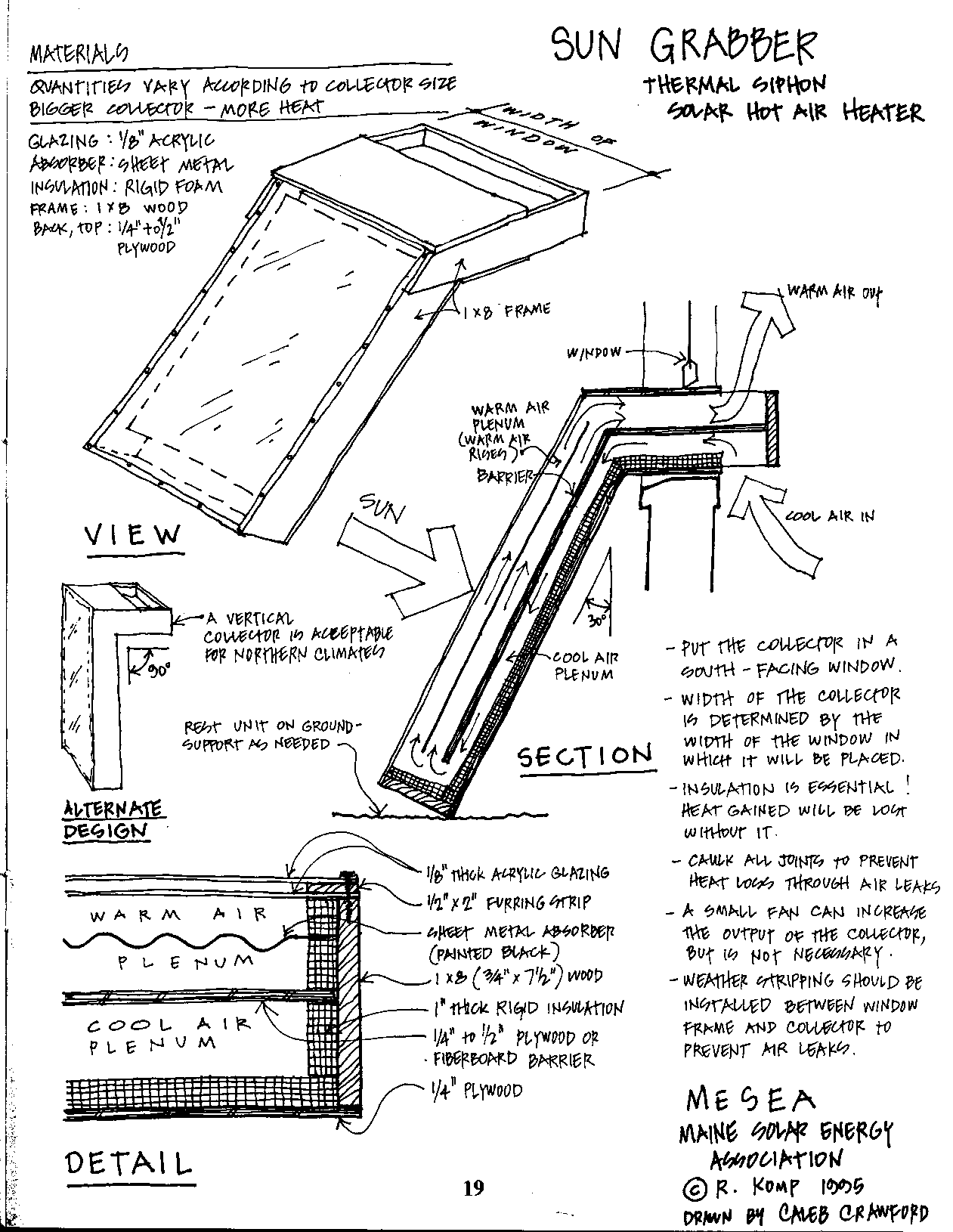
Thanks, Will!
Great and Simple Design! (I'm printing a copy right now)
Why am I not surprised that this came from Maine? Why am I glad that I chose Maine as a robust, hearty and creative place to invest my future in?
I want to build them ALL~!
Bob
However, does it capture particulate matter, mercury and radiation? Coal power plants emit 100 times more radiation per Megawatt than nuclear ones after all...
This article mentioned FutureGen project. I thought that was canceled a long time ago.
http://blog.wired.com/wiredscience/2008/02/futuregen-clean.html
The links in the article seem to imply otherwise.
One more item from the above links, it lists the cost at 1.5 billion to generate 275 megawatts of power. That seems like it would cost more than solar PV even at todays cost.
The project has been canceled, but not all that long ago. The monstrosity was to be built near Mattoon, Illinois, the town I was born & grew up in. When reading about the project I couldn't help but wonder where they were going to find sufficiently intelligent local people to operate the powerplant. Anyone with any brains left that hellhole decades ago.
Champaign? Urbana?
I just moved to Urbana, and I must say I've been really impressed with the sheer number of smart people that UIUC has educated and attracted to the area. And Mattoon is only about 40 miles down the Interstate from here.
I'm a reasonably smart guy and I moved to this island in the middle of the corn, because of the opportunities here.
Yeah, there are some smart people at the UofI & the Beckman Institute. Why any of them would care to commute down to Mattoon is beyond me, altho my dad commuted the other way around back in the day. Gas was cheap then. Anyway, it's a moot point. The carbon capture plant isn't going to be built.
The only good thing out of that area is Alison Krauss. And she left.....
At some stage someone is going to have to build one of these plants to demonstrate/validate that "clean coal" technology works as the integrated whole that it is claimed to achieve. While the original project was cancelled it may be, with the change in Administration, that it might acquire a new life. Though even if it does, it will not be constructed any time soon.
"There is no clean coal technology. There is cleaner coal technology, but there is no clean coal technology.”
From looking at the different options I think the only useful way to use coal is gasified and co-fired with natural gas in a combined cycle (with solar assist if practical)
Or micronised and used as fuel in slow speed stationary diesel engines.
In both cases using the waste heat for large scale fish farming and/or the heating of bio-digesters.
Ideally though we would leave it in the ground holding all that carbon. It might be a good future feedstock.
Can we make coal worth more in the ground by assuming they will eventually invent a way to turn it into diamonds?
SIU at the Carbondale Campus does work in this area.
Lots of coal in S. Illinois.
Airdsale
On the biofuel issue, I notice that Drumbeat has an article
Obama to Back Ailing Ethanol Makers, Follow Failed Bush Policy
It is difficult for a new administration to make a very big change on an issue such as this.
Corn ethanol makes no sense economically, ecologically, or morally. Barak Obama probably realizes this. But he is currently from Illinois and is no doubt beholden to the Illinois political machine. Throwing agroindustry a bone apparently placates those who helped him achieve the power or status he sought. I voted for Obama but I suffer under no illusions of his independence of mind or moral purity.
Corn isn't the best feedstock but it's what we can handle today. I get the feeling this is all going to go sideways pretty rapidly during Obama's first term. We may treasure what ethanol we can make because it'll supplement our domestic oil production, keeping more of the fleet moving while we figure out what we can do next.
There's also the issue of ethanol as a necessary alternative oxygenator in present gasoline mixes. I fully support corn ethanol to the level that it allows replacement of more environmentally damaging alternatives such as MTBE, even if it is a serious negative EROEI, which I suspect it may be. That lasts until a more rational alternative arrives, such as cellulose ethanol, diesel or whatever.
I am told that we really don't need oxygenators with modern cars. The cars burn the fuel so cleanly that the need for MTBE or a substitute went away. I learned this from the API folks--someplace I have a reference also. ( i don't think the laws requiring an oxygenator went away, though.)
One beneficial thing ethanol does do is increase octane. There are other ways octane cam be increased as well, but they cost more money. So I think this is ethanol's big plus.
Ethanol as a liquid fuel is a good alternative source to fossil fuel. Why would you want the new administration to change on this issue?
Ethanol isn't an alternative to fossil fuel. Most ethanol production is just fossil fuel that has been recycled. Consider your typical ethanol plant. You invest 1 BTU of fossil fuels and get back maybe 1.1 BTUs of ethanol and maybe half a BTU of DDGS. Most of the ethanol BTUs are derived from the fossil fuels.
I know, I know. It doesn't have to be that way, you might argue. But it is that way. You won't flip a switch and change it, and you can't change it on paper or with wishful thinking. There will be gradual improvements over time, but today's ethanol is recycled fossil fuel. There are no guarantees that tomorrow's ethanol won't be the same.
As long as you get more BTUs than from fossil fuel inputs, it is an alternative. As to how much "you get back" that's open to improvement yes.
I haven't seen much better immediately applicable alternatives for liquid fuel needs. Have you?
The best immediately applicable alternative is the one we saw take place as prices soared: Demand destruction as people cut back.
Of course we won't (willingly) conserve down to zero, but the problem would be more manageable if the scale wasn't so great. As I see it there are no immediately (or even short term) applicable alternatives to more than a fraction of our liquid fuel usage. A little longer term, if thin film solar pans out as promised, and storage technology continues to improve, then we might have a PHEV alternative that looks a lot better than ethanol. But not at today's usage rates.
Conservation is not alternative energy. I fully agree that it is very much needed. But I don't think that conserving "down to zero" is realistic at all.
Electric vehicles and solar require a storage solution that is still far out. The combination alone of solar (daytime generation) and vehicles (nighttime charging) is pretty difficult too. You almost need double the storage.
Ethanol can still be produced and improved in relatively short term. Give me the money today and I'll get you ethanol a year from now, maybe earlier. Think of present values (investments against time) and such financial considerations: you won't get anywhere close with the other alternatives.
But I don't think that conserving "down to zero" is realistic at all.
Isn't that what I said?
Ethanol can still be produced and improved in relatively short term. Give me the money today and I'll get you ethanol a year from now, maybe earlier.
I don't think this is sinking in. Of course ethanol is dependent on fossil fuels, but we are reaching the limits of what can be produced with corn (and far surpassed what can sustainably be produced). So to reach the levels you have been talking about will require economical, sustainable cellulosic ethanol. That does not exist, and I submit that we will see lots of PHEVs on the road before it does exist.
"I don't think this is sinking in. Of course ethanol is dependent on fossil fuels, but we are reaching the limits of what can be produced with corn (and far surpassed what can sustainably be produced). So to reach the levels you have been talking about will require economical, sustainable cellulosic ethanol. That does not exist, and I submit that we will see lots of PHEVs on the road before it does exist."
Define "what can sustainably be produced". I believe we can produce 12 - 15 billion gallons from corn. We can produce as much from sugarcane and sweet sorghum. And none of this would require cellulosic. Ethanol can be readily used in our current type vehicles, whereas PHEV (and other technologies) requires new vehicles. For massive Plug-ins use the grid might not be able to handle it and upgrading the grid won't happen so fast either.
I'll tell you what: we'll give you half a billion for your PHEV project (or any other of your choice) and I get half a billion for my ethanol project. Let's see who wins in terms of replacing barrels of oil.
By the way, I am not sold yet on cellulosic. I think we might as well burn the stuff and use it for heating. The economics of that look better than trying to get enzymes to convert the stuff into ethanol at low concentrations.
I get your 3*15 billion gallons (per year, right) to 3 mbpd of ethanol.
In order to produce your stated max. expectation, in the possible future:
would require also about 2 mbpd of fossil fuel in order to produce. Net
benefit:
your best "expectation", "sometime in the future", net gain: 1 mbpd ethanol.
Are you saying that will make a difference? Are my calculations/estimates
correct?
Cheers
I don't follow your calculations/estimates. 15 from corn and 15 from sugarcane/sweet sorghum =30. that translates to 82 million gal per day. There are 19.5 gallons of gasoline in a barrel of oil. So on a volume basis, the 82 mgal translate to 4.2 mbpd oil.
Also, I don't understand how you get to "net gain: 1 mbpd ethanol".
Ok no problem, we can hope for a max 4,2123 mbpd sometime in the future.
The net gain I estimate, with approx 0,6 barrels of oil used
for each barrel of ethanol, to be
net gain: 1,68492 mbpd ethanol
I repeat my question: Do you really think that will make a difference for the US???
Or if it is 2 (or hypothetically magically max 3 mbpd the year 2028).
Cheers
Of course it makes a difference: $36,500,000,000 per year (at $100 oil)
( 1 mbpd x 365 x $100)
Segeltamp, it takes 8 gal, or less, to grow an acre of corn. After allowing for DDGS an average yield is 720 gallons of ethanol. That's about the only petroleum in the process.
Most of the newer plants still use nat gas for process energy. And nat gas is used in the manufacture of fertilizer. Maybe this is what you're thinking of. The trend, however (see Chippewa Valley Ethanol, and Corn Plus ethanol,) is toward using biomass.
Corn Plus, for example, uses approx. 17,000 BTUs of nat gas, which, when added to the 6,000, or so, BTUS imbedded in the fertilizer and seed brings their nat gas usage up to about 23,000 btus of nat gas/gal (76,000 btus.)
Poet, of course, is confident they will get all of their process energy from corn cobs. That would leave their 76,000 btu gallon of ethanol with 6,000 btus of nat gas imbedded. BTW, Poet is a "serious" player with about 26 operating ethanol plants and over a Billion Gal/yr production.
Oh, and Monsanto's new "preferred processor" seed adds another 1/10 of a gallon to everyone that utilizes it.
Define "what can sustainably be produced".
If something uses large amounts of fossil fuels in its production, it isn't sustainable. Throw in the fact that soil is being depleted (the only way this thing works is by massive inputs of fossil-fuel derived fertilizers) and you add to the unsustainability. Again, I have to say that I think your grasp of the issue is tenuous.
I believe we can produce 12 - 15 billion gallons from corn.
And what are the consequences?
We can produce as much from sugarcane and sweet sorghum.
Why do you think this? Why do you think we don't produce it today in quantities from sugarcane or sweet sorghum?
I'll tell you what: we'll give you half a billion for your PHEV project (or any other of your choice) and I get half a billion for my ethanol project. Let's see who wins in terms of replacing barrels of oil.
As soon as oil and gas prices rise again, your half a billion will disappear pretty quickly. Ethanol is far too reliant on fossil fuels. Until it is largely divorced from fossil fuels, it won't replace them and you won't ever be sustainable.
"If something uses large amounts of fossil fuels in its production, it isn't sustainable. Throw in the fact that soil is being depleted (the only way this thing works is by massive inputs of fossil-fuel derived fertilizers) and you add to the unsustainability."
Then define "large amounts". Define "soil depletion". Is continuing to use crude oil "sustainable"?
"Again, I have to say that I think your grasp of the issue is tenuous." Always attacking the person I see....
"Why do you think this? Why do you think we don't produce it today in quantities from sugarcane or sweet sorghum?"
I think it is starting to happen.
"Ethanol is far too reliant on fossil fuels." I suppose you must have a much better solution that isn't? Let's hear it.
"I suppose you must have a much better solution that isn't?"
You haven't supported any of your assertions, so your "solution" is vaporware at the moment.
Other solutions, which you may have seen dozens of times here, include;
- Design vehicles with much higher energy efficiency
- Switch to electric (your assertion that batteries are not available is specious).
- Switch to greater use of carpooling/vanpooling
- Switch to greater use of biking
- Expand/improve mass transit networks
- Reduce unnecessary travel
- Grow more food locally
- Produce more goods locally
- Engage Smart Growth techniques
Ethanol is by no means a silver bullet as some proponents claim. High water, fertilizer, pesticide consumption have not been addressed by you, nor has soil erosion, impact on grain stockpiles, and a myriad of other ethanol issues.
Do you have any stake whatsoever in the ethanol market?
"You haven't supported any of your assertions, so your "solution" is vaporware at the moment." Well, then I would expect support for your assertions here below....
"Other solutions, which you may have seen dozens of times here, include;
- Design vehicles with much higher energy efficiency". Sure. And then ethanol would become even more efficient too.
"- Switch to electric (your assertion that batteries are not available is specious)." Pure misrepresentation. I never said such a thing.
"- Switch to greater use of carpooling/vanpooling" Sure. And then ethanol would become even more efficient too.
"- Switch to greater use of biking" Sure.
"- Expand/improve mass transit networks" When I had just moved to Houston, I waited several times for the last scheduled bus that never showed up. So, improvement is definitely needed. But this is not an easy or cheap issue either. And again, ethanol might help public transportation too.
"- Reduce unnecessary travel" Sure.
"- Grow more food locally" Sure.
"- Produce more goods locally" Sure.
"- Engage Smart Growth techniques" What is that now?
"Ethanol is by no means a silver bullet as some proponents claim. High water, fertilizer, pesticide consumption have not been addressed by you, nor has soil erosion, impact on grain stockpiles, and a myriad of other ethanol issues." Oh I never said it was a silver bullet. And all of your solutions except the "reduce unnecessary travel" have all their own drawback issues as well. So does continuing the current state of things.
"Do you have any stake whatsoever in the ethanol market?" No. And why would that be a problem anyway? Why these personal attacks?
"I never said such a thing" [i.e., batteries are not available for electric vehicles]
You had written "Electric vehicles and solar require a storage solution that is still far out." That's not true: NiMH batteries have been in use for 8 years. There are many solar battery solutions that have been in use for decades (I use AGM batteries). If you meant something else, you should have been more clear.
"And all of your solutions except the "reduce unnecessary travel" have all their own drawback issues as well."
You can believe that riding bikes, carpooling, mass transit, relocalization, etc have substantive drawbacks in comparison to BAU, but you'll be barking up the wrong tree trying to convince most people here.
And asking if you had a stake in the ethanol market was by no means a personal attack, but your insistence that you are under attack is a blatant ploy to draw sympathy to you, and a common internet debating trick used to cover a weak argument.
If you don't know what Smart Growth is, then look it up.
"You had written "Electric vehicles and solar require a storage solution that is still far out." That's not true: NiMH batteries have been in use for 8 years. There are many solar battery solutions that have been in use for decades (I use AGM batteries). If you meant something else, you should have been more clear."
So, thanks for confirming my point here: I didn't write that there were no batteries available.
But are you now trying to say that the electric storage issue for widespread PHEV application is resolved? Wonderful! But why is it then that we don't see a whole lot more of battery powered vehicles? You tell me.
"you'll be barking up the wrong tree trying to convince most people here." Are you (making yourself) the spokesperson of "most of the people here"? That would be good to know...
"And asking if you had a stake in the ethanol market was by no means a personal attack, but your insistence that you are under attack is a blatant ploy to draw sympathy to you, and a common internet debating trick used to cover a weak argument." What did you want to know then? Now I am REALLY curious why you asked that question.
Don't try to get smart with me.
Roll-out takes time, as the system has to be integrated and production of batteries ramped up.
Mitsubishi is due to bring out 2,000 EV's in Japan in 2009.
Many manufacturers are due to have really substantial numbers on the road by 2012.
Batteries can still be improved but are capable of doing the job for use in commuting.
William Verberk wrote:
>But are you now trying to say that the electric storage issue for widespread PHEV application is resolved? Wonderful! But why is it then that we don't see a whole lot more of battery powered vehicles? You tell me.
Troll alert.
I see. You can't seriously deal with the issue.
Of all the above Ethanol is the only product, at present, that can power 20 Million Vehicles in everyday use.
11,000,000,000 gal/yr / 550 gal/yr per car = 20 Million Vehicles.
Having said all that, it seems clear to me that the next four, or five years needs to be all about Biodiesel.
The Ethanol is creating a real imbalance in the market. We're going to have to get busy on the "Diesel" substitute.
Diesel is 50% higher than gasoline where I live. In Iowa it costs twice as much as E85 in some areas (Council Bluffs - Ampride Stations.)
Ethanol mixed in Diesel would work just great too!
Robert--Do you have any news regarding butanol? At one time, you thought that might be promising. Any positive developments you know of?
There is some interesting membrane work being done. A colleague in London has told me a bit about it, and I may take a trip to a facility in Sweden. But I don't think it's going to push bio-butanol into the economical realm. It's going to take some microbes that can tolerate much higher concentrations, in my opinion.
RFA lists present production at 11 Billion Gallons/Yr. And, corn is back to $0.06 lb.
Speaking of land: Yields are up 67% since 1980, And Fertilizer Use is DOWN 10%.
I've been noticing lately that many of the PV panels providing power at remote sites around here have steel grating locked in place over them. This is presumably to prevent vandalism and it must cut efficiency substantially by partially shading the panels. I wonder if the necessity for grating panels has been taken into consideration when performing comparative efficiency analyzes. I suppose vandals will soon be resorting to covering the panels, or spray painting them.
As for corn ethanol, as much as I detest the idea of producing fuel from food in a world where hundreds of millions are hungry, I actually prefer it to ligno-cellulosic biofuel tech. Corn ethanol production only trashes a cornfield, which is an already trashed habitat by virtue of being a cornfield. L-C tech promises to trash forest, grassland & kelp bed ecosystems. Humans already appropriate far too much of global primary productivity to their own ends.
That sounds like a business opportunity.
Producing panels designed with gaps in the collecting spaces so that they can be secured against theft would seem to be practical, and would mean that the buyer would get the full benefit of his investment.
Perhaps you might communicate with one of the PV makers?
Not a bad idea, actually, altho it wouldn't eliminate the risk of someone simply covering the panels with scrap plastic or paper, or spray painting them. When the battery goes dead 'cuz the panel isn't recharging it, the data analyst reports that the meter isn't transmitting data and the guy in the big diesel 4WD truck goes out to see what the problem is. Apparently they've had so much vandalism of panels that they've had to grate them. Your idea might help but it wouldn't keep panels from being covered or painted over, or stolen outright.
It's apparent that the folks there think that putting them under grids helps, even if it doesn't totally solve the problem.
Like chaining a bike to railings, you may still be unlucky and they might have a bolt-cutter, but you are a mug if you don't chain it as you will certainly loose it if you don't.
If that is the case, it makes sense not to waste money on solar cells covered by the grating.
Perhaps it could be combined with a small camera, to take and transmit a shot of any vandals or thieves.
I haven't seen much better immediately applicable alternatives for liquid fuel needs. Have you?
http://www.autobloggreen.com/2007/08/17/sweden-using-seized-alcohol-anim...
"It is difficult for a new administration to make a very big change on an issue such as this." How much change do you think is coming from a guy that has raised $600m??? Here's a cynical British view, after all Tony Bliar swept into power promising change, to be whiter than white (no sleaze).....
From thedailymash.co.uk
BARACK Obama swept to victory as millions of Americans lapped up all that bullshit about change.
The Illinois senator made history as the first black American to become President and the 44th man to win the office with a lot of vague platitudes and an army of creepy spin doctors.
He told a crowd of 250,000 supporters in his home city of Chicago: "Remember, change is something that happens in the middle of the night when we're all fast asleep and very often the next morning no-one can tell that anything has actually changed.
"I promised you change you can believe in, I did not promise you change you can actually see."
He added: "You believe in Jesus don't you? Right, but have you ever seen Jesus? Exactly. Just making sure we're all on the same page."
Mr Obama said he would bring about change by working closely with the vast and terrifying multi-national corporations that had funded his campaign and pledged to end the war in Iraq in order to create a much bigger war in Afghanistan.
"But instead of some middle-aged white guy doing it, it'll be me and I'm half-Kenyan. D'you see?"
Bill McKay, a college student from Denver, said: "I can't believe I now live in a country where an African American can be elected to the presidency after spending just $600 million on advertising." He added: "Give me a hug!"
Meanwhile, in the UK, thousands of people talked about staying up all night to watch the drama unfold, but then didn't.
Martin Bishop, from Oxford, said: "I was going to follow the coverage and have the significance of every result explained to me by Lord Dimbleby but then, at the last minute, I decided to go to bed because I don't care."
Denys Hatton, from Guildford, added: "If your life is such that you're placing all your hopes in a politician, then may I humbly suggest you get yourself a crate of superlager and a cardboard box and stop wasting everyone's time."
I personally have a very difficult time seeing how a very high carbon tax or very stringent cap and trade program will get passed. People will figure out if such legislation is passed, their electricity bills will suddenly be very much higher. This will eliminate most support for the legislation.
It seems to me that to actually keep coal in the ground, the legislation would somehow have to eliminate coal exports. Even if a tax were placed on exports, I am willing to bet the Chinese and other buyers would line up to buy any coal we don't use.
Gail,
I've always felt the president-elect's carbon tax plan would include a subsidy to many consumers. Similar to the HEAP sub the gov't dishes out for heating oil. That begs the question: where will that money come from? Given the seemingly complete lack of concern over the gov't current efforts "creating" money to pay for all the bail outs, it's not difficult to imagine our new leader being sucked into that same vortex.
Whenever my college raises tuition, they always say that half the increase will go towards financial aid, (and I believe that they actually do it.) A carbon tax that is coupled with a lowering of income taxes, (for instance,) could easily be popular enough to pass.
And of course, a carbon tax is cheaper than the alternative, (losing New Orleans and Houston, again,) but unfortunately I don't think the public is smart enough to accept that. People were in favor of a gas tax holiday last summer, even when we knew that our roads were failing and the highway trust fund was going bankrupt...
Whenever your college raises the tuition, they have to increase everyone's financial aid package or they can't afford to go there anymore.
If the approach is actually a carbon tax, it would seem like there will be additional money from the carbon tax that can be used as a subsidy for many consumers. So a carbon tax might be better in terms of the need to funds for rebates to consumers. It sounds like the way to go to me, if people would agree to higher prices for gasoline and electricity and food--but it still is hard to believe people will agree to this.
It is not as clear how a cap and trade system would work--would historic polluters automatically be given licenses to pollute to almost the extent they had in the past, or would these licenses by auctioned off? Unless the licenses are auctioned off, it doesn't seem like there will be revenue to rebate to taxpayers.
We will have to wait and see how Obama handles the situation. Until there are difficulties in getting bond issues sold, it is hard to see legislators being willing to scale back on their giveaways very much.
Agreed with Gail's concerns on operation of "Cap-and-Trade". There is also the further issue that a) Cap-and-Trade can only work for generating entities large enough to justify maintaining a trading desk for the credits, b) Cap-and-Trade is an automatic barrier to new technology entrance into a market because incumbents must somehow be "grandfathers in" at an "affordable rate", meaning they wind up with a financial advantage over new entrants (distributed solar, SOFC, etc. etc.)
Given the simplicity of a source Carbon Tax (no overhead of dealers/brokers, computer trading systems, arelatively much smaller and easier audited group of market participants, etc. etc.) and that no small-entity competitor could possibly justify maintaining a brokerage account for the ?$25 / yr? credits due to a high-efficiency SOFC distributed home micro-gen, solar PV or solar thermal system etc, all of which are the future technologies which we NEED to be promoting as fuel supplies dwindle and CO2 levels rise, I simply can't fathom anyone outside incumbents and banker/brokers supporting Cap-and-Trade.
Bottom line is that in future environment of restricted Natural Gas supplies, efficient use of the BTU's needs to become the most important concern. Burning 100 kwh of N Gas in even a 90% efficient simple boiler for home heat, then burning another 50 kwh of N Gas in a 50% efficient CCGT central generating plant to provide 25 kwh of electricity is less efficient than burning all the N Gas in a set of 90% efficient microCHP CHP unit. More electricity out for the same N Gas in.
Cap-and-Trade discourages this, I suspect intentionally.
A large central plant turns more of the fuel into high value electricity then micro CHP due to physical scaling and the economical ability to use a more advanced cycle.
But if you use the electricity to power a high efficiency heat pump, you'll get more heat out the 100 kwh of N Gas, burned in a efficient CCGT, than if you burn the gas in MicroCHP. And given that MicroCHP is more expensive to install than a high efficiency heat pump, and the heat pump can run off of wind/wave/solar/hydro/nuke too, I'd advocate people install a heat pump way before a MicroCHP, (even if you could get one outside of the NE US.) And the heat pump can be used in the summer too, where as MicroCHP is pretty useless in most of the US in the summer.
But before I'd recommend anyone do either, insulation is still the best investment people can make.
So what is the significance of your issues regarding Cap-and-Trade v.s. Carbon tax? If any?
Under a cap and trade system, I imagine the utility (the natural gas supplier,) would be allocated an amount of credits for their residential/small commercial users, based on previous years usage. You wouldn't give the credits directly to the small users because that is too complicated, (and it isn't how we do things in America anyways, we award the big guys.) And the utility would pass on the cost[value] of those credits to it's customers based on usage, be they new buildings, new loads in existing buildings, or existing customers. It doesn't really make a difference which, because for every credit the customers don't "use", the utility can sell that credit for that it's value, and for every credit the customers need beyond what they have, the utility has to buy those credits at that value.
What that means for microCHP is that gas will cost more. (Exactly the same as it would be a natural gas furnace.) It wouldn't make a difference if it was an existing one or a new one, gas is just going to be more expensive.
However, at the same time, the utility (the electric one,) would also be allocated credits based on previous usage, and just like the natural gas utility, they'll pass those costs on to the customers, because they can sell the credits that the customers don't use for money...
And what that means for microCHP and heat pumps is that electricity will cost[sell for] more. That is a good thing for the microCHP, and a bad thing for the heat pump. (However, after accounting for the natural gas costs, the heat pump still comes out ahead, because it emits less CO2 per BTU.)
The utility gets a windfall because they get a bunch of valuable credits for being an existing emitter in the first place. And with any luck the public utility commission would require them to give up that windfall to help pay for low income people's bills and stuff, but under both a carbon tax and a cap and trade, the small guys are just going to end up paying more...
Big customers are a different thing entirely. It should be noted that one thing that tends to happen under cap and trade systems is that marginal producers stop producing because they can sell their credits for more than the profit was in the first place. In which case the cap and trade system functions as a "buyout" for the emissions. (Under a carbon tax, the same producers tend to go bankrupt and then stop emitting. Obviously, cap and trade is more popular with the banks.)
Personally I think that until the sales of new gas guzzlers are banned, they/us are not addressing the problem seriously. My reasoning is that this is easy to implement requiring no new technology or breakthroughs, no huge capital investments. It only takes some will-power to go against the entrenched interests. Nobody really needs to drive a four litre car.
Unfortunately IMHO we will not see this for some time.
This is exactly what is happening in Australia. It's like standing on the edge of the diving platform but being too afraid to jump. In theory carbon trading should start in 2010 (why not 2009?) as a kind of pseudo carbon tax at $20 to $40 per tonne of CO2. This will have a minor effect on liquid fuels but a major effect on coal fired electricity. All the revenue is supposed to be re-spent on green tech subsidies. Household electricity bills will go up but you could get a free or cheap solar water heater.
In theory the carbon price will free float after 2012. Needless to say the tycoons who failed to predict the financial meltdown and therefore are idiots want to delay and water down the carbon trading scheme. Either that or ask for bigger handouts.
The coal export inconsistency is a doozie. Ballpark coal figures for Australia; lignite 65 megatonnes a year, bituminous coal used domestically 75 Mt, bituminous coal exports 245 Mt. Why even bother with domestic cuts?
I'm wary of saying conservation won't be enough. How much conservation wouldn't be enough? 20%, 80%, what? If all residences cut their winter electricity consumption by 80%, heated only the necessary portions of their home to sufficient but not modernly extravagant temperatures, etc., would that be enough? It's hard to describe sufficiency without some numbers on the ground.
Perhaps I phrased that a little inelegantly. Certainly one cannot use what is not there, but the short-term solution of closing schools or businesses is not a long term strategy that can work. From 1981
Many industries were closed because of the shortage, which affected an estimated 84,000 residential, commercial and industrial customers. In many stores that remained open, the temperatures were lowered, forcing employees to work in overcoats.
Maybe what should be said is that people won't be prepared to live with smaller amount of fuels. People will find themselves without jobs and without transportation. Pipes in houses may freeze.
Part of the issue is how what gasoline and electricity is allocated to individual people and businesses. If some are left without, this will be a problem.
Another part of the problem is the availability of alternatives. If a person can walk to the places where he or she needs to go, and has knowledge and tools to grow his own food, he is much better off than someone totally dependent on BAU.
Gail,
I am amazed that people who think that we may have an economic collapse with perhaps 90% of the population dying, do not think that people will be prepared to conserve. Its happened in the 1978-80 energy shortages, and during wars.
The EU is planning to introduce CAFE type standards of 48mpg in 2010. They have a fuel tax of approx $4 a gallon.
I so NO political downside from the new administration insisting on the same fuel standard in US as in EU. Its the same car companies, so they can't say it cannot be done.
Increasing gasoline taxes from 18 cents a gallon would have to be gradual( perhaps over 10 years) and would have to have off-sets for lower income households, BUT its also needed.
The third measure, greatly improved home insulation will take time but a massive retro-fitting would be a job creating measure, and would be very cost effective.
Incomprehensible. Try again, say when you have the brain engaged, and the fingers are working, and you can remember first grade grammatical constructions.
Diesels are the majority of European passenger car sales, and they won't pass US air pollution standards without expensive NOX after-treatment. Europe already exports their surplus gasoline to us. There might not be enough diesel fuel to go around if diesel passenger cars take off here. We could get to 48 mpg CAFE with hybrids instead of diesel.
Conservation --even among us NRG hogs in in the "developed" world-- will not be enough. We are adding 75 million+ new inhabitants to the planet each year. In 10 years, we add a new Europe. Even if we cut our consumption 99%, it will be quickly nullified by population growth, mainly occurring in the Third World.
Elephant in the room no nation's "leader" wants to acknowledge much less deal with: OVERPOPULATION. A world with only 1 billion humans or fewer would not be facing an "energy crisis". Significantly cutting our numbers would reduce stress on the biosphere, reverse the tide of deforestation, allow threatened species to recover, AND give humanity plenty of time to experiment with and develop alternatives to FFs.
A billion humans is still 5x too many. K is somewhere in the vicinity of 200 million. Organisms strive to maximize their Darwinian fitness & humans are no exception. Fail to reproduce & you become a genetic dead end. Reproduce successfully & you contribute to all the problems you allude to. We can accept imposed authoritarian limitations to our reproductive proclivities, or we can let nature take its course. Personally, I prefer the latter option. Others may disagree...
Nature will take its course. Your preferences will be ignored.
Of course. And so will everyone else's. :)
Fail to decrease rate of reproduction and your entire species becomes an evolutionary dead end. Far worse Darwinian fate than only the children of your distant cousins surviving. Darwinism is deeper than it looks on the surface.
Extinction is every specie's fate. Humans are no exception. But it's incorrect to say that extinction results in a genetic dead end for all individuals of the species. Homo erectus (ergaster) became extinct, but not before it speciated, resulting in H. neandertalensis & H. sapiens.
You are the result of every single one of your ancestors going back 4 bys being successful at reproducing. By your logic every one of those ancestors was human.
This being said, the extinction of humans probably will result in a genetic dead end for all humans. Incipient speciation was underway in humans but this process was interrupted by travel technology. Now Homo is a rather panmictic species & nascent allopatric speciation has ground to a halt.
Harm,
Conservation can have an immediate effect, changing birth rates, even going to a one child policy, will take 50 years or more for a significant population decline. Not saying its not needed, but with GHW and peak oil happening now , we also need short term solutions- CONSERVATION 1st priority, replacing FF with renewable's 2nd, population reduction 3rd.
We don't need to cut energy consumption, we need to cut FF consumption, so conservation is a stop gap until renewable's can replace FF.
Conservation is an important mitigation but not a long term solution.
Until available energy sources can replace FF. Since we have and can build more nuclear than renewables, that is likely to happen as well.
The sad fact is that it appears the answer to the question "Are humans smarter than yeast?" is no. Even on a board dedicated to discussing a critical finite and exhaustible resource who's production is at or near peak - population growth in both the Third World and the First World is almost totally ignored. It makes you wonder if asked to make a list of the 20 things to do to deal with Peak Oil if stop population growth would even be in that top 20 on their list. It just deals with things that are cherished and held sacred - you might say they are "off the table" - no restrictions on number of kids, and immigration.
It makes you wonder if asked to make a list of the 20 things to do to deal with Peak Oil if stop population growth would even be in that top 20 on their list. It just deals with things that are cherished and held sacred - you might say they are "off the table" - no restrictions on number of kids, and immigration.
Well put. Overpopulation --and the even *more unmentionable* remedies (incentivizing smaller families, penalizing large ones, one-child policy, mass forced sterilization, etc.)-- is the pedophile uncle no one in the family wants to talk about.
It isn't that population issues are "almost totally ignored" in these peak oil fora. They would be debated exhaustively & repetitively if this was allowed. An administrative decision has been made to discourage such discussion least the forum turn into an orgy of "doomer porn." The thought is that someone new to the idea of "peak oil" will be turned off by such discussion, and not stick around. The PTB wants the focus to remain on education about PO, and not turn into a dieoff forum.
I understand the need to avoid an exclusive focus on so-called "doomer porn", "Olduvai/dieoff" theory, etc. However, there *are* viable, constructive alternatives to the "dieoff is inevitable" POV:
--Advocating the personal benefits, as well as global, of smaller families.
--Encouraging/voting for political candidates with a scientific world-view vs. creationist/religious, who actually acknoweldge that there *is* a problem.
--Lobbying for government policies that incentivize smaller families and penalize larger ones.
--Donating money/time to charity organizations that promote family planning and women's rights (Pathfinder International, Population Connection, UNPF etc.).
--other...?
Of course, it helps to keep in mind that most of the world has fertility rates that are below replacement, or are falling quickly.
Really, the areas that are still growing quickly are mostly Africa and the ME, and the key issues are poverty and the oppression of women.
most of the world has fertility rates that are below replacement
Uh... wrong. It's only true today in a handful of mostly European nations (Italy, Greece, Germany, Japan, Russia, former Soviet satellites). If this *were* true, then the world's population would be declining, not climbing 75 million/year.
Lot of disinformation out there re: the so-called "birth dearth". A Cornucopian fantasy cooked up by the same team that brought you no-limits-to-growth and abiotic oil.
You are correct that the world as a whole does not have birth rates below replacement.
However, there are two errors in your statement.
First, there are many other areas of the world which have below replacement rates, most notably China, but also places such as Korea.
Secondly, below replacement rates can co-exist for many years with a rising population, due to demographic lag, as the large cohorts from the time when population was increasing have more children in absolute terms even though the rate has fallen below replacement, and also due to people living longer.
http://www.prb.org/
As noted by DaveMart, many other places have fertility rates that are at or below replacement.
These include the US (most growth is immigration). Many others are above replacement, but are close to it, and falling reasonably quickly, such as Mexico.
Why not? The one, the only really, good thing about the tremendous waste of energy here is that there is so much to be gained simply by conservation.
Here I mention only what can be done quickly.
Fuel: carpooling, employer busing, job-exchanges with incentives, expanded public transit, elimination of cars in major parts of downtown areas.
Gas and heating oil: Don't heat whole houses (except to keep pipes ok), heat a few rooms with electric or propane. Wear sweaters, etc.
Electricity: use fans, not AC, especially at night, except in extreme conditions. CFL, and use directed light for reading, etc. Use timers on lights.
All of these things could be cut in half, with some adjustment, but no real hardship, exemptions otherwise.
Longer term of course there needs to be a much more radical retrenchment: restructuring, relocalization, revitalization and densification of small towns, contraction and densification of the suburbs, reconnection to agriculture -- all without cars. Impossible(?), but ultimately necessary. We have to get ahead and stay ahead of the depletion curve: otherwise mass suffering.
Of course, we will need to explore all possible long-term-sustainable energy alternatives, but there is no hope that we can keep more than a small fraction of our current energy budget. And to count on any of them in lieu of conservation is risky in the extreme.
I am well aware that little of this is, for now, politically feasible. But it will become so, and it's important to beat the gongs now.
I wish I could remember where I read it, but ...
About a year ago, I read about a man in the Maryland suburbs of Washington who organized a buying coop with his neighbors to purchase pellets for their pellet stoves. He then purchased a few animal feed storage bins from a local feed store to store the shared supply of pellets. Then the next year there was a hiccup in the ethanol market. The price of feed corn dropped. That year he and his neighbors burn kernel feed corn in their pellet stoves. Apparently, corn kernels work fine in a pellet stove. ;-)
Corn kernels do indeed work fine in pellet stoves. A colleague of mine takes home corn harvested from variety trial plots to burn in his pellet stove. I take corn home too, but to grind coarsely for chicken feed and finely for tortillas, not to burn. I don't have a pellet stove but even if I did, I just don't think I could bring myself to burn corn in it. Using food for fuel is just wrong.
I find it odd that heating one's house electronically is dismissed. It is done all the time and I do it myself.
It is called electric space heaters. The electrons powering them are transferred electronically from the wind turbines outside my window.
And the monthly statement is paid automatically through electronic funds transfer from my bank account. Except for the construction of the turbines which took all of last summer, there is no fossil fuel use in the system.
Fossil fuel heating is getting a temporary reprieve due to falling prices. When prices rise again some of the market will have switched to heating electrically and will not likely return.
I sure won't.
The switching from fossil fuels to electronic heating should mitigate price increases even as the reduced supplies from Peak Oil become more obvious.
In the Northeast, which is where we have the problem, a lot of the electricity comes form natural gas. If there is an increase in electricity usages (as when more people heat with electricity) it will come from natural gas.
Historically people have heated with oil in the Northeast, so most of the conversion is from oil, either to natural gas heat, or to electric heat. Either of these have the effect of putting more pressure on natural gas supplies in the Northeast.
We have an LNG terminal in Massachusetts, but we are not getting much LNG there any more, because our prices are too low relative to the world market. There are pipelines to Texas, but it is a long way away, and the Northeast is more or less at the end of the pipeline. There are plans to build more pipelines, but the pipelines haven't been completed yet.
@Gail:
You have described why I get irate when anti-nuclear activists claim that there is no way for new nuclear plants to reduce the use of oil. There was once a time when New England was a leader in nuclear plant construction because people were smart enough to realize that electric heat was pretty cheap and reliable and that it could replace imported oil heat.
It is crazy that there are people in Vermont - the land of pellet stoves - that want to shut down Vermont Yankee. It is a clean, reliable, low cost source of electricity that can be used for whatever the customers want - heat, light, computers, or televisions.
Going back to the initial article - does anyone but me remember that the United States built Shippingport in less than 4 years? That was our first large scale light water reactor and when we started the project we had not yet figured out how to make the fuel, how to pump the water, and how to keep the corrosion under control. We figured all of that stuff out and built a plant that worked well for several decades.
If we could build a large nuclear power plant in less than four years at a time when engineers used slide rules and paper drawings, why should it take so long today when we have completed, licensed designs already on the shelf and ready to go? We have plants that still make most of the components, experienced engineers and operators, and an amazing safety record. Why do we, as taxpayers, allow our government to take so damn long to license a new plant when we need new, clean energy sources yesterday?
BTW - there are few things that would increase the optimism of consumers more than building large projects that provide thousands of high paying, skilled labor jobs. That is a stimulus that provides real, long term benefits rather than short term consumption.
Rod Adams
Atomic Insights
Space heaters are fire hazards. My insurance agent was quite clear to me that my policy does not cover them and if my house burns down because of it, I'm on my own. (I wonder what my mortgage company thinks of that/if they even know...) Built in baseboard or wall heaters aren't nearly as dangerous, although you have to build them in.
Heat pumps are far more efficient (twice as efficient as baseboard is pretty standard for even the cheapest ones) and you can get through the wall ones for a couple hundred dollars, (that will only work in mild climates.) For many people, they'll pay for themselves in a season. If you pay more, you can get ones that will work below freezing, and while the payback time is longer, the savings are also typically higher.
And for many people, storage heaters are also a good option. In the middle of the night the power is generated by coal and nukes and wind, and no natural gas is used. Since the fuel is cheap/free, and the demand is low, the power company will usually offer you a discount if you buy power then, (although you have to sign up to tell them you want this.) Storage heaters convert the electricity to heat and store it in bricks or water or molten salt (okay, I've never seen a consumer unit that does that,) and then release the heat during the day to heat the house... The only problem is that they tend to be heavy, so they need to sit on the ground floor or the basement, and then ducted/plumbed up to the rest of the house...
Hello Gents:
Resistance heating:
An all electric resistance oil filled heater is completely safe.
It only gets warm to the touch.
the 1300watt units are the safest of all. Safe for Kids or jumping pets !
Sold Everywhere for $40 each. For $15 you get junk. Same for a cheap coffee pot.
Did you know Mr. Coffee has burned down more houses?. check it out. The cheap ones.
Bad insurance is bad insurance. sorry. (did you read it? the Policy? )
Heat Pumps are great, I upgraded to one, 6 years ago, but there is no ROI.
My home is well insulated, so the saving is tiny. About $40 a month. (8 months a year)
I will break even, only when the unit is at ,end of life. About 12 Years. (but...)
That is if a Douglas Fur doesn’t take it out on the next wind or ice storm.
All the money saved is lost , after factoring in the maintenance cost.
But the next point, kills the whole deal:
Then the big issue, is the Fed and State interference.
If my compressor dies, I can not replace it with the same SEER, as the one I had.
So, I must upgrade my compressor to a higher SEER rating.
Oh, but guess what ,then both evaporator and condenser are no longer compatible, rendering the whole systems a loss. Off to the land fill with it all.
Oops, I just checked the price of a replacement, 2 times more, due to the Building boom."supply and demand".
Looks like ROI is 24 more years, long after the aluminum corrodes away , because of the acid soil up here in the PNW.
I just dodged that bullet last month by a tiny fraction. (starting Varistor exploded)
Best, is the wait for the new CO2 Heat PUmps, that actually work down to low temperatures. IMO.
In N. Europe they are popular, especially with deep water well on primary side.
"Since the fuel is cheap/free", (I won't comment on that)
Ok all the best.
I’m a Electronic technician, so you can see , the devils in them details.
Cheers.
Okay I've checked it out:
http://www.cpsc.gov/CPSCPUB/PUBS/463.html
The U.S. Consumer Product Safety Commission estimates that more than 25,000 residential fires every year are associated with the use of room (space) heaters.
But if you search CPSC for Mr Coffee, there isn't any mention of fires.
http://www.google.com/search?hl=en&q=mr+coffee+site:cpsc.gov&start=0&sa=N
A couple mentions of people getting burned by their units in among the recalls dating back to 1977, but no mention of house fires.
Maybe I'm looking in the wrong place.
http://www.usfa.dhs.gov/statistics/national/residential.shtm
Kitchen fires are the most common type of house fires, and "unattended equipment" is the most common type of kitchen fires, but they mention what that equipment is: stoves&ovens, igniting oil&grease. No mention of coffee makers anywhere.
I have no trouble believing that Mr Coffee has burned down some houses, (there are plenty of stories on Google of people leaving it on while they left for the weekend to find that their house smelt like burnt coffee when they came back,) but I'm not finding anyone who says it burned down more than 25,000 houses.
However, as for the oil filled space heaters, my [ex]girlfriend has smoke damage in her apartment from when the oil in hers caught fire. (I didn't see the fire, but I see the smoke damage.) And the heater was about 6 months old. So, I can tell you that they are not "completely safe." They are better than some other designs of space heaters, but, not at good as the ones that are built in. And the reason for that is that built in heaters are required to be designed to much higher standards than portable ones. Built in ones are expected to last 30-40 years, where as many of the portable ones are designed to last a season or two before you'll most likely damage the cord and throw them away...
Yes I did. My insurance also doesn't cover me if I'm storing more than 5 gallon of gasoline in a living area of the house, (I wasn't planning on storing any in the living areas,) or if I burn the house down while making a batch of meth, (or committing any other crime.) But I wasn't planning on doing those things. Why in the world would I buy insurance for something that I don't want to cover? As for space heaters in particular, they said that they'd cover them, but it is a separate rider, and I said no, I didn't want to do that.
It's not so much the coffee makers as it is the small electric switches they use. I knew an engineer who became an expert witness on the subject matter. He testified in a great many lawsuits back in the 80's and 90's. These switches are everywhere: coffee pots, irons, etc. He said the problem typically was poor ventilation of the switches....they over heat very quickly. That was 10+ years ago. I don't know if they are as much of a problem today.
I find it hard to believe that there is a landfill at the end of that story.
I'm a past ET, and current HVAC/R trainee. I'll be digging into that predicament for my own curiosity ;)
I found this on biochar group
we discussed wood and home heat
this could be part of a plan or it's europe' s plan
wood has one tenth the energy by volume of coal. I have also used coal to heat my house.
somebody wanted to force me to be more energy efficent, durring the solar home tour I escaped. I am poor I know people who got the energy efficency stuff and then could not afford their gas bill and now they heat with coal.
It turns out Canada is exporting massive quantities of pellet fuel to meet the fuel supply challenge in Europe. The Wood Pellet Association of Canada reports that, in 2006, Canada exported over 600,000 tons of wood pellets to Europe, eighty percent of which was shipped from the Canadian west coast. It is remarkable this business is profitable, given the rising cost of diesel fuel needed to ship this material from Vancouver through the Panama Canal to northern Europe. I would think a shorter trip from Saginaw might make more sense.
At its core, this Canadian industry utilizes a fleet of massive, ocean-going ships that are originally designed to haul grain. This industry uses much of the same infrastructure already in place for international grain markets: truck- and rail-transport equipment, ocean tanker terminals, and so on.
The rapid growth of this export industry is covered in a report by B. Verkerk, M. Junginber, and A. Faaij of Utrecht University; and E. Ackom and P. McFarlane of the University of British Columbia. Their report, "Current and Future Trade Opportunities for Woody Biomass End-Products From British Columbia, Canada," was presented at the 2008 World Bioenergy Conference that I attended in Sweden.