


The Problem with Making Predictions - Oil or Climate
Posted by Heading Out on December 14, 2008 - 10:16am
One of my most enduring memories of Washington D.C. occurred while attending a meeting on Geothermal Energy Development, back in the days before the Iron Curtain fell. In the evening after dinner, I took a colleague from Eastern Europe, on his first American visit, for a walk down the Mall. We walked, almost alone, on a still, bitterly cold, dark evening with fresh snow on the ground, and stars peppering the sky above us to see the sights, including the Lincoln Memorial. We stood staring, like backwoods tourists, through the windows of the Air and Space Museum.
We came back to the hotel for alcoholic refueling, thinking that the energy problems of the time would guarantee unending research funding into new forms of energy, and that our future was assured. That was about thirty years ago, and we were, of course, wrong, at least in terms of the funding and sustained interest in unconventional energy sources. Now we are walking back over some of the same ground. Again, fluctuations in oil prices have removed the immediate perception of the need for alternate supply, and have also weakened the credibility of those of us who try to suggest how to deal with the problem.
Prophecy, particularly when it deals with the near term future runs the risk of being corrected by the actual turnout of events. The ups and downs of energy demand, and available supply–-particularly when tied to the economic fortunes of nations, can make logical projection under one condition, but become apparently hopelessly in error when that condition doesn’t happen. Thus, at the moment, with the declining price, and apparent glut of oil, the public no longer feels that there is a crisis; the credibility of those forecasting a crisis is damaged, and can only be reconstructed over a longer period of time and changing circumstance.
Author's note: I have added a comment to the bottom of the post.
I thought of that this past week. While the driver of “energy independence” has become the discredited cry of the outgoing Administration, it has been replaced with the need to find alternate energy sources in order to prevent climate change because “the science is indisputable”. The over-riding driver is that we are seeing global warming caused by increased levels of carbon dioxide.
For those who forget, back in 2007 the Supreme Court ruled that the EPA should regulate the emissions of the greenhouse gases that include carbon dioxide. It noted in passing:
Given EPA’s failure to dispute the existence of a causal connection between man-made greenhouse gas emissions and global warming, its refusal to regulate such emissions, at a minimum, contributes to Massachusetts’ injuries.
This was germane since Massachusetts had to show that it had standing to bring the case, which it did since the rising sea levels would threaten the state’s well being. This has been reinforced by the recent decision by the EPA Appeals Board that EPA has no valid reason not to limit carbon dioxide emissions from power plants. Thus new plants will have to revisit their submissions to EPA for permitting, as the permits relate to their emissions.
Revisiting EPA submissions will be a time-consuming effort. EPA will first have to write some regulations, so that the permitting of new plants will be likely considerably delayed. Also, as I have noted in an earlier post, shortfalls in the power that the nation needs may develop as a result, particularly if it continues to get colder in winter.
An increasing level of acceptance and public support of global warming has been achieved, in part, by the repetition of stories that the world is warming, and that we can anticipate, as a result, that the ice fields of Greenland, the Arctic region as a whole, and Antarctica will melt, causing sea levels to rise dramatically. There is, however, as they say, a slight technical hitch to this concept. Nature is not co-operating, and the predicted events are not occurring with the inexorability that was initially projected (see for example here).
Now some of these shortfalls are beginning to be noticed on an increasing scale, although to quote Upton Sinclair (from the trailer to “An Inconvenient Truth”), “It is difficult to get a man to understand something, when his salary depends on his not understanding it.” And there are a lot of folks these days who have salaries that are tied in some way to the perception of global warming. To give but a few examples that suggest the need for more of a scientific debate, graphs of temperature rise do not show the continuous increase that had been projected ten years, ago, but rather seem to indicate a leveling and decline.
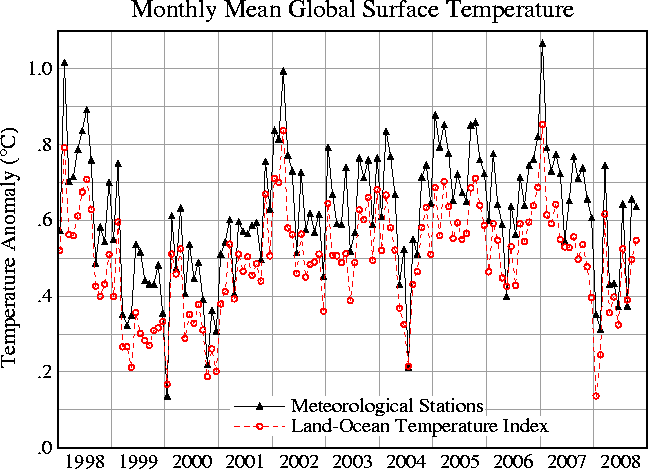
Greenland itself does not appear to be getting any warmer,

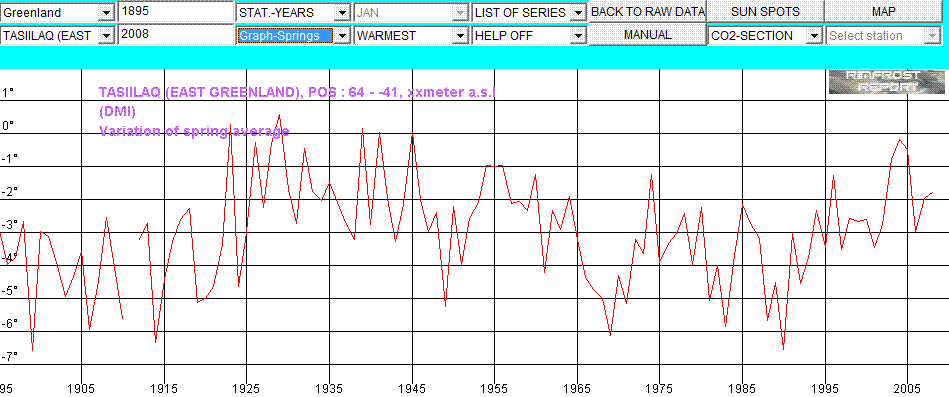
Glaciers in Alaska may be starting to grow again, under the changing snow patterns. And the Antarctic ice fields have been growing to record size.
Now it may be that there are good scientific explanations for these events; they may be transient events that can change with time. But to the public, these are, like the short-term fall in gas, an indication that the pundits are wrong. It is comfortable if those forecasting global warming turn out to be incorrect, because then the uncomfortable changes to a different energy source or more conservation may not need to be made. In part, the problem is that this is not being addressed as a scientific issue, but rather an extension of the topic as politics, as it has been treated so often in the past.
I was thinking of this when I read a post in the Washington Monthly this past week. It excoriated a writer at Politico for writing a piece that began with the paragraph,
Climate change skeptics on Capitol Hill are quietly watching a growing accumulation of global cooling science and other findings that could signal that the science behind global warming may still be too shaky to warrant cap-and-trade legislation.
What I found sad about the critique was the comment,
How many scientists are quoted defending the global warming consensus of the scientific community? Zero. Lovley's article reads like something one might find on World Net Daily.
This is one of the subjects where, as I showed above, it is possible rather easily to find the basis for scientific question. If someone comes into a room and says, “It’s raining,” one can look out of the window and see whether it is, or not. Having a debate by the assembled multitudes in the room as to whether it is or not, and whether their credentials make their opinion worthwhile, is not as informative as if the visitor coming into the room is wearing a wet raincoat, regardless of their background. Ad hominem attacks only work in the short term, and become increasingly less effective as evidence continues to pile up that there may be another side to the story.
The recent record snows in the Himalayas, for example, suggest that there may not be the predicted Asian droughts as the recharged glaciers will continue feeding water into the rivers. And in regard to the rising levels of the sea, there are studies that show that while sea level has been slowly rising for a quite considerable time, that there has been no acceleration in the rate, which runs around 1.3 to 1.5 mm per year, over the past 50 years. (This would mean that the sea level increase over the next 100 years would only be some 140 mm or about 5.5 inches). Web sites that collect such information are growing in number and popularity. One such tracks peer-reviewed papers that have evaluated temperatures during the Medieval Warming Period, frequently finding them higher than today.
Gradually this actual set of events makes its way into the public perception. If there has been no debate, then the proponents appear more starkly wrong when it all begins to be presented, and the initial position becomes discredited. (See for example President Reagan after Iran:Contra). Unless, that is, global warming has gone from being a scientific event, where events can be openly debated, to becoming a religion, where fanatical opposition to those who are not true believers brings attempted silencing by humiliation, excoriation, exorcism, excommunication and, in the past, immolation of such “heretics”. In such case, I suppose, then we face a different type of doom.
Administrations start with a certain amount of good will from the public--they have a certain initial credibility and belief that will carry them through some tough decisions. If the issues are openly and honestly debated, then unexpected change can be accommodated. This honest debate is good, because it means that the momentum to find the alternate energy sources that we need can be continued, rather than having the need challenged and discounted.
Without continued momentum, it may be that when, in the future, I return to the hotel from an exhilarating walk around Washington, the room may be cold and dark, due to inadequate power supply. Neither wind nor solar work on still, dark nights, and we may still need additional research and development to provide sufficient alternative replacements at scale for coal and natural gas.
Additional comment (or Part 2)
Grin:
Well first of all my apologies (this is written in Tampa Airport waiting to find out if the bad weather has mucked up my getting home) that I had to duck out of the discussion fairly early on – but given the nature of the discussion I thought I would add this second part to the post to explain what I thought I was doing, since it seems as though it was only evident to a few.
The whole debate on climate change and its relationship to energy is about to go through a paradigm shift, I believe, as the incoming Administration applies the policies that they come to power propounding. This is relevant to our continued discussion since those who are charged with preparing our Energy future are all very concerned with climate change. And, as the lead item in Drumbeat on Sept 15th notes
If you think Washington's debate over whether to bail out General Motors Corp. and Chrysler LLC is acrimonious, wait until the debates over energy and climate change policy start. The auto bailout debate has become a proxy for the coming clashes over energy strategy.
Now I have to tell you that the readership, and commenters here have both made me proud and caught me out. When I first posted on the climate change debate, back a couple of years or so ago, I got 150-odd comments some 55-odd of which were ad hominem attacks, and 5 were constructive debates about the science. I had thought that I might get the same sort of percentage here, and thus had planned this second part as a comment on this (since I don’t think it will hold up as a credible strategy as the debate becomes more public).
Instead of which – of the 461 comments on the site at the time that I write, only 25 folk actually engaged in ad hominem – though some did it considerably more than once. On the other hand there were some 53 folk that engaged in a more productive debate (and while there many who deserve credit for this, let me take my hat off to Barrett808 who patiently debated beyond the point that I suspect my patience would have worn out).
I still feel, as I tried to imply with the post, that the tone of the debate is going to change. And it is going to change in a way more hostile to those who propound GW, because they will now be the “party in power” and thus more exposed to the scrutiny that brings. Thus the “snow in Tibet” type stories, that have often from the pro-CC point of view appeared in Drumbeat in the past, will now become more common but written now more in the anti-CC mode – since challenging authority is not an uncommon habit of journalists. This will also become more the case if it becomes less evident (the weather outside) that the world is continuing to warm.
Thus, if the policies are to be understandable and accepted the sort of discussion that has taken place here should become more common rather than less. Stating that the science is irrefutable, when there is data that may argue the opposite is not the way I think this should go. And the debate has to be at a level that folk can understand.
One of the reasons that I helped found this site is that I believe, quite strongly, that we are all better off if we are aware of all the facts, and can thus make an informed decision. But the facts should be presented and debated in a way that folk can understand, and with the explanations obvious to someone below the level of even a “science-challenged lawyer.”
I, thus, disagree strongly with the 11 folk, and also apparently including Nate’s advisors, who seem to feel that this site should be censored to stay away from this topic, particularly since I sense that the topics will be more and more inter-twined in the future. And, while censorship and trying to deride the presenters might work at a level such as a blog, it is unlikely to get much respect in the popular press. Thus, the point of the post, that more of the debate on climate change should be carried out in the public venue, rather than hidden away. Censorship, as an example, might preclude me from posting this addenda as a fresh post, or disallow commenting on the latest EPA memo relative to the Bonanza situation.
I'm heading out, may I wish you the Compliments of the Season.
Contact
- Content: editors at theoildrum dot com
- Tech support: support at theoildrum dot com
License

This work is licensed under a Creative Commons Attribution-Share Alike 3.0 United States License.
I am someone who went from being 100% certain that IPCC report didn't go far enough, to one who wants to examine both sides of the issue. Some of the things that changed my mind include the following:
1. I don't think "coal" and "renewables" is an either/or option. With our current financial situation, and the time line to put in renewables, our options are probably closer to "coal" or "deforest the world", or "coal" or "mostly do without". If we don't have two equally good options, we need to understand exactly why we are making the choice we are making.
2. The climate is changing, but there are different stories that put less emphasis on carbon dioxide that seem to make at least equal sense. One concern is that we may be near the beginning of the next ice age. If this is truly the case, we need to understand the situation.
3. There are many measurement issues, both in the historical data (ice cores) and the more recent data, that raise issues about the accuracy of the supposed underlying data. See the web site wattsupwiththat.com.
That said, coal does have problems, aside from global warming issues. The acidification of oceans is a real concern, as well.
When rationality and irrationality converge, irrationality will always triumph. It has entertainment value!
In this context, reasonableness and restraint are weaknesses and expressing them are exploitation opportunities for the irrational. What are the rational alternatives to this triumph of irrationality?
- Climate disruption investigators can become advocates; data be damned, full speed ahead! This would give the newly created advocates access to funding from interest groups and both sides would have a level institutional playing field. After all, climate disruption mitigation is capital intensive and would require large investments. The public may not understand the science, but all understand money and lobbyists.
- Climate disruption investigators can focus on the data and hope that the political interface allows for wisdom and foresight to leak into the dialogue. (Ha, ha, ha, ha, ha, ha ...)
- Climate disruption investigators can create so much data that everyone becomes hopelessly confused. This is happening with the economy. Everyone is going broke but nobody can figure out why or what to do about it. There is a policy under this fuzz of conflicting data; the climate problem, like all the other human problems will solve itself. The catch is, we humanoids may not like the 'Gaia Solution' very much.
While scientists such as James Hansen have focused almost entirely - and persuasively - on climate disruption and atmospheric carbon, a large body of science and policy critics including Ralph Nader and many, many posters here have gathered this into the general heading of overall Earth Resource Availability. (ERA?) It's not just a predictably functioning atmosphere that is under stress, it is everything! We humans are stressing everything. Even if Earth temperatures are leveling off or declining, there is no substitute for topsoil and fresh water, which are in finite supply ... and oil and metals and credit and species and fishes and whatnot.
As for outcomes; unpredictablility is the new stability. If a market or context can gyrate wildly and upredictably, it will. Like price swings destroying investment in new and existing energy sources, an intermediate swing in global temperatures can be a simple 'fake out' move; a short- term drop before a greater rise. Creating instability and removing incentives to plan may be an outcome of our interference in the natural order - the most dangerous outcome.
Gail said:"That said, coal does have problems"
Yep. It sure does. It takes a lot of power to mine coal. Lots of fuel.
It also destroys nature. Like soil and trees and of late whole mountains.
I mean one needed to take a auto trip to DC from Ky back in the 80s when they hadn't time to regrow the vegetation on those mountain tops and as we came closer and closer to those mountain(via Ky to WV then to Viginia...I kept asking those in the auto.
"What the hell is wrong with those mountains? There is no tops on them,they are totally bare!!"
No answers were forthcoming.From a distance we couldn't tell. I thought to myself "what fool or organization is tearing down mountains?"
Later I learned the truth. How bad was it? Very bad. Then more recently I read the books penned by Silas House. A native Kentuckian who was born and raised there. The onslaught against the people there was unbelievable as I read his fiction that was likely not a bad as the real truth.
So yes, we will actually remove a mountain top. Some of the most beautiful country on the planet. We will do it for why?
I went this friday to the cinema and watched the latest movie. The Day The Earth Stood Still. I remember seeing the original but the premise and plot of this version was far far different.
Keenau Reeves was telling the population of this planet"Its not YOUR planet, and we can't allow you to destroy it for there are not that many that can support life."
The Sec of Def(Kathy Bates) was furious. She tried everything before trying to understand that we were the enemy.
The movie is worth seeing just for those words. "Its not your planet"...meaning I think that other lifeforms had a right to this planet just as valid as ours. So they had sent planetary life rafts to save the other lifeforms.
I won't give the spoiler on how it ends.
So lets tear down those mountains. Poison the water. Shove the debrie down the mountain side. Rip the land to shreds so future generations will realize what ignorant rapacious utter fools we were to destroy the planet.
Its like saying 'non-negotiable lifestyle'. It means eventually we ALL die in mass because we decided to not negotiate?
Airdale-there is little hope and seeing that on the faces of the actors was amazing when the truth finally dawned on them.
I love flicks. Always have since the Drive-Ins of my youth. I sometimes find truth and reality hidden in the rest of it. The part beyond just entertainment. Its displaying our culture.
Airdale,
Ah yes, I can always spot a fellow Kentuckian or a West Virginian, the only people in America who seem to know that mountaintop removal blasting even exists.
Former Vice President Al Gore is astounding to me...the man who can go into fits of hysteria about every yard of arctic ice, but seems completely blind to what is happining in a border state of Tennessee to one of the most (formerly)beautifully diverse ecosystems in the world.
Unlike the constant theoretical debates about climate change and global warming, the blasting away of mountaintops and the destruction of ecological diversity is anything but theoretical. All you have to do is look at photographs of the region, both from the ground and from satellite, to see the constant march of the destruction.
Mountaintop removal blasting is a horrific crime, but hey, wind and solar has "low EROEI" doesn't it?...depending on who is doing the counting, and what all is included, and how you factor the life expectancy of the hardware, and developments in energy storage, and developments in solar panels wind rotors, and, and, and...your right, solar and wind are too much trouble, blow off another mountain.
RC
If Mr. Gore were to complain about mountaintop removal, someone might ask him why his administration (1993-2001) promoted it, kept it legal and got rid of the regional EPA administrator (former Congressman Peter Kostmayer) who tried to protect WV's environment from further ruin. Gore made great speeches as VP, but "forgot" to protect the environment when he was in a position to do so.
WTI toxic waste incinerator, East Liverpool, Ohio
SUVs instead of efficient cars
interstate highway expansion (TEA-21 law)
more oil drilling for northwest Alaska
energy deregulation (which led to Enron scam)
shredding of food safety laws (Delaney Clause)
genetically engineered phood
NAFTA and WTO
Option 9 old growth forest logging plan
to mention a few problems
Tennessee has mining, too.
The mining companies say, "it's mine. All mine."
check out
http://www.ilovemountains.org
http://www.oilempire.us/wti.html
I don't think "coal" and "renewables" is an either/or option. With our current financial situation, and the time line to put in renewables, our options are probably closer to "coal" or "deforest the world", or "coal" or "mostly do without".
Do without what? Do you think that we 'need' to burn coal to manufacture and operate 40 inch plasma screen televisions, 100 watt/channel stereo systems, electric clothes driers, MP3 players, five star hotels, amusement parks etc.? If we are faced with energy descent, the primary thing we need to concentrate on is descending. That is we need to create economic institutions that are focused on creating real long term human welfare (i.e. physical and psychological health) with minimal resource consumption rather than on the indiscriminate increase of short term sales volumes.
Yes. Coal is a finite resource and its combustion is environmentally destructive. Its use should be continued only as part of a transition strategy. Trying to stay as rich as we can in the present and praying that luck and the technology fairy will pull our fat out of the fire in the future is not much of strategy. How much coal we 'need' to burn and how much renewable energy we can afford to incorporate into our economic infrastructure depends on what kind of lifestyle we are trying to maintain. We should be seeking a social transformation rather than trying to convince ourselves that the continued heavy use of coal may not be that destructive after all.
Many of us argue for social transformation and culture change.
I think that you are spot-on with regard to sorting out what we need versus what we want.
We have been sold a bill of goods by the Corrupt Crony Capitalist Establishment. Those who recognize must work for culture change however we can.
We must especially be the change we need to see as much as we can. Perhaps that is the best and most effective thing to do, even though it may seem to be the least effective thing we can do on the face of it.
Second, we need to converse about this need for radical cultural change with others. One-on-one or small-group conversation, especially in the context of ongoing relationships, is a very effective way to encourage change.
Third, and also essential is to work toward positive change within whatever political, corporate, religious, or social and cultural context one finds oneself.
Finally, there are opportunities to create new contexts within which to live out the radical change we need to see. Communes and cooperatives and every kind of neighborhood or community effort to reduce pollution and bring about sustainability is important.
I doubt that our funny little species can survive the next twenty or thirty years or so, but in the face of this I still work for change.
All of our efforts are imperfect and will need to be revised along the way. Our population will be reduced by war, famine, flood, fire, starvation, and disease. We have changed the soil and water -- not only the air -- to the point that we will reap painful consequences from our early ignorance and our later intentional ignorance.
Cultural change is the vital thing. Without it the most beneficial technological changes will not be possible, and the without cultural change the best technological changes would not be enough anyway.
Noah's job was relatively simple in the old story. He built an ark and found pairs of animals and family to bring on board, and stocked it up for the ride. In the old story, the vast majority of the people and other creatures were left to fend for themselves in the flood.
How much of our habitat can we save or recover in the face of massive ecological blowback? Will there be an habitable world for us in 20 or 30 years? It does not look likely, especially as we will likely use all manner of WMD along the way to extinction.
But still, there is a slim chance that someone will survive.
Some facts are in order here. Oxidation of coal produces CO2. Plants use CO2 in the photosynthesis process to produce food all living need to survive and thrive, especially humans. Plant photosynthesis is optimized at 1000 PPM of atmospheric CO2. Plant photosynthesis stops at 200 PPM. Atmospheric levels of CO2 have increased 35% from 285 PPM in the 1800's to 385 PPM today. That increase, together with moderate warming, has benefited all of us in the form of enhanced crop and forest production. Those two trends, 1) increasing levels of atmospheric CO2 and 2) moderate warming, largely driven by increased solar activity, have done more to green the planet over the last several decades than all the environmental political action and expenditures combined. One has to ask, why are environmentalists so anxious to torpedo both of these remarkably beneficial trends, and at such great economic, social and environmental cost. As the renown agricultural scientist, Sylvan H. Witter, once stated, "Seldom has CO2, even deserved mention in monographs or books on plant nutrition. Yet, it gives the most remarkable response of all in plant bulk, is usually in short supply, and is nearly always limiting for photosynthesis" (Witter, 1985).
I hate to make an argument based on expert authority, but just want to begin by saying my doctorate is in biology, primarily related to plant evolution and ecology.
co2 fertilization effect is overblown because it is only part of the story. To understand the whole story is not easy however. One part begins with an enzyme called RuBisCo (http://en.wikipedia.org/wiki/RuBisCO), which captures co2 in plant cells, eventually leading to carbon fixation. More co2 does indeed enhance the ability of RuBisCo to effectively fix carbon dioxide. Early experiments captured this effect, both in greenhouses and then outside in what are called FACE studies (http://www.bnl.gov/face/faceProgram.asp).
But back to evolutionary history to think through this fully. When RuBisCo first evolved oxygen concentrations were low and co2 concentrations were high. Today, the reverse is true. This leads to the issue of photorespiration, which is when oxygen, and not co2, finds the binding site on a RuBisCo molecule (http://en.wikipedia.org/wiki/Photorespiration).
Now let us connect some basic plant physiology to climate change and higher temperatures. When the temperature is higher, photorespiration dominates over carbon fixation. This is so important that some plants have evolved mechanisms to mitigate the problem (see discussion of CAM and C4 plants). Essentially, early FACE studies didn't capture photorespiration because they only increase co2 concentrations. Newer studies attempt to raise temperature and mimic changes in precipitation.
It doesn't help that you are citing a 1985 reference. Science has progressed way beyond the (necessarily) simple experiments of those days. Ecosystems going forward are generally expected to have weaker abilities to fix carbon, not stronger. There are even carbon flux towers in forests and fields around the world and they use "natural experiments," such as local drought or heat waves, to see how soils and vegetation respond to such stress.
Oh how I wish more people would be quiet or at least ask honest questions when delving into subjects they know almost nothing about.
For those unaware of the benefits of Carbon Dioxide (these are operational, not theoretical):
An important fact: "On average yields typically increase 33% with a doubling of CO2"
http://www.hydrofarm.com/articles/co2_enrichment.php
http://www.homeharvest.com/carbondioxideenrichment.htm
http://www.pinewoodgardencenter.com/green_house_carbon_dioxide_enhanceme...
http://www.greenhousemegastore.com/products.asp?dept=1025
http://hor134.blogspot.com/2007/11/module-12-co2-fertilization-and.html
http://www.4hydroponics.com/grow_room/co2.asp
So, large increases in atmospheric CO2 can warm the planet and turn oceans anoxic and sulphidic, but that's okay as long as it marginally benefits human agriculture.
There is a fundamental idea that farmkids learn by the time they're 10 (I certainly did). The formal version is called Liebig's Law of the Minium, and it means that plant growth limited by whichever requirement is in shortest supply, regardless of oversupply of everything else.
Plants need nutrients, water, sunlight, appropriate temperature/climate, and sometimes other things like bees.
People growing plants in greenhouses normally supply everything else, and then one can certainly increase yields somewhat by adding more CO2. Likewise, in great soil, with plenty of water and sun, a little more CO2 can help a bit, depending on the crop type.
This has approximately ~zero to do with most of the world's agriculture, and in particular, no amount of CO2 will compensate for not having enough water or the wrong temperature range. No amount of CO2 will grow corn in the Sahara. No amount of CO2 will avoid harm to the sugar maple business in New England from higher temperatures.
No amount of CO2 will help the megadrought likely coming in the US Southwest, reminsicent (but worse) than the tales in anthropologist Brian Fagan's The Great Warming: Climate Change and the Rise and Fall of Civilizations.
From CO2 Science [note the bold] (references include):
Forest Growth Rates
Volume 8, Number 16: 20 April 2005
--------------------------------------------------------------------------------
In a lecture presented at the University of Minnesota nearly ten years ago, Idso (1995) laid out the evidence for a worldwide increase in the growth rates of earth's forests that had been coeval with the progression of the Industrial Revolution and the rising CO2 content of the atmosphere. The development of this concept began with the study of LaMarche et al. (1984), who analyzed annual growth rings of two species of pine tree growing near the timberline in California, Colorado, Nevada and New Mexico and thereby discovered large increases in growth rate between 1859 and 1983, which rates exceeded what might have been expected from climatic trends but were consistent with the global trend of atmospheric CO2. The developmental journey continued with a study of ring-width measurements of Douglas fir trees in British Columbia, Canada, that also revealed a marked increase in growth in the trees' latter decades (Parker et al., 1987), leading the principal investigator of the project to state that "environmental influences other than increased CO2 have not been found that would explain this [phenomenon]." West (1988) reported much the same thing with respect to long-leaf pines in Georgia, i.e., that their annual growth increments had begun to rise at an unusual rate about 1920, increasing by approximately 30% by the mid-1980s; and he too stated that "the increased growth cannot be explained by trends in precipitation, temperature, or Palmer Drought Severity Index," leaving the rising CO2 content of the atmosphere as the likely cause of the increase in productivity.
Contemporaneously, stands of Scots pines in northern Finland were found to have experienced growth increases ranging from 15 to 43% between 1950 and 1983 (Hari et al., 1984; Hari and Arovaara, 1988). As to the cause of this phenomenon, the researchers stated that "CO2 seems to be the only environmental factor that has been changing systematically during this century in the remote area under study," and it was thus to this factor that they looked for an explanation of their observations.
The next major development in the continuing saga was the finding of Graybill and Idso (1993) that very long ring-width chronologies (some stretching back nearly 1800 years) of high-altitude long-lived bristlecone, foxtail and limber pine trees in Arizona, California, Colorado and Nevada all developed an unprecedented upward growth trend somewhere in the 1850s that continued as far towards the present as the records extended. In this case, too, like the ones that preceded it, comparisons of the chronologies with temperature and precipitation records ruled out the possibility that either of these climatic variables played a significant role in enhancing the trees' growth rates, strongly implicating the historical rise in the air's CO2 content as the factor responsible for their ever-increasing productivity over the prior century and a half.
Perhaps the most striking evidence of all for the significant growth enhancement of earth's forests by the historical increase in the air's CO2 concentration was provided by the study of Phillips and Gentry (1994). Noting that turnover rates of mature tropical forests correlate well with measures of net productivity (Weaver and Murphy, 1990), the two scientists assessed the turnover rates of 40 tropical forests from around the world in order to test the hypothesis that global forest productivity was increasing in situ; and they found that the turnover rates of these highly productive forests had indeed been rising ever higher since at least 1960, with an apparent pan-tropical acceleration since 1980. In discussing what might be causing this phenomenon, they stated that "the accelerating increase in turnover coincides with an accelerating buildup of CO2," and as Pimm and Sugden (1994) stated in a companion article, it was "the consistency and simultaneity of the changes on several continents that lead Phillips and Gentry to their conclusion that enhanced productivity induced by increased CO2 is the most plausible candidate for the cause of the increased turnover."
Four years later, a group of eleven researchers headed by Phillips (Phillips et al., 1998) reported another impressive finding. Working with data on tree basal area (a surrogate for tropical forest biomass) for the period 1958-1996, which they obtained from several hundred plots of mature tropical trees scattered about the world, they found that average forest biomass for the tropics as a whole had increased substantially. In fact, they calculated that the increase amounted to approximately 40% of the missing terrestrial carbon sink of the entire globe. Hence, they suggested that "intact forests may be helping to buffer the rate of increase in atmospheric CO2, thereby reducing the impacts of global climate change," as Idso (1991a,b) had earlier suggested, and they identified the aerial fertilization effect of the ongoing rise in the air's CO2 content as one of the factors responsible for this phenomenon. Other contemporary studies also supported their findings (Grace et al., 1995; Malhi et al., 1998), verifying the fact that neotropical forests were indeed accumulating ever more carbon; and Phillips et al. (2002) continued to state that this phenomenon was occurring "possibly in response to the increasing atmospheric concentrations of carbon dioxide (Prentice et al., 2001; Malhi and Grace, 2000)."
As time progressed, however, it became less and less popular (i.e., politically correct) to report positive consequences of rising atmospheric CO2 concentrations; and the results of Phillips and company began to be repeatedly questioned (Sheil, 1995; Sheil and May, 1996; Condit, 1997; Clark, 2002; Clark et al., 2003). In response to the most recent of these challenges to their work, we published a rebuttal in our Editorial of 18 Jun 2003. And now, Phillips, joined by 17 other researchers (Lewis et al., 2005b), including one who had earlier criticized his conclusions, has published a new analysis that vindicates his and his colleagues' earlier analyses.
One of the primary concerns of critics of Phillips' work has been the fact that his meta-analyses have included sites with a wide range of tree census intervals (2-38 years), which they contend could be confounding or "perhaps even driving conclusions from comparative studies," as Lewis et al. (2005b) describe it. However, in their detailed study of this potential problem, which they conclude is indeed real, they find that re-analysis of Phillips' published results "shows that the pan-tropical increase in stem turnover rates over the late 20th century cannot be attributed to combining data with differing census intervals." Or as they state more obtusely in another place, "the conclusion that turnover rates have increased in tropical forests over the late 20th century is robust to the charge that this is an artifact due to the combination of data that vary in census interval (cf. Sheil, 1995)."
Lewis et al. (2005b) additionally note that "Sheil's (1995) original critique of the evidence for increasing turnover over the late 20th century also suggests that the apparent increase could be explained by a single event, the 1982-83 El Niño Southern Oscillation (ENSO), as many of the recent data spanned this event." However, as they continue, "recent analyses from Amazonia have shown that growth, recruitment and mortality rates have simultaneously increased within the same plots over the 1980s and 1990s, as has net above-ground biomass, both in areas largely unaffected, and in those strongly affected, by ENSO events (Baker et al., 2004; Lewis et al., 2004a; Phillips et al., 2004)."
In conclusion, we note that these most recent developments continue to support the view that there has indeed been an increase in forest growth rates throughout the world that has gradually accelerated over the years in concert with the historical increase in the air's CO2 concentration; and, therefore, we fully expect this trend to continue into the future.
Sherwood, Keith and Craig Idso
References
Baker, T.R., Phillips, O.L., Malhi, Y., Almeida, S., Arroyo, L., Di Fiore, A., Erwin, T., Higuchi, N., Killeen, T.J., Laurance, S.G., Laurance, W.F., Lewis, S.L., Monteagudo, A., Neill, D.A., Núñez Vargas, P., Pitman, N.C.A., Silva, J.N.M. and Vásquez Martínez, R. 2004. Increasing biomass in Amazonian forest plots. Philosophical Transactions of the Royal Society of London Series B - Biological Sciences 359: 353-365.
Clark, D.A. 2002. Are tropical forests an important carbon sink? Reanalysis of the long-term plot data. Ecological Applications 12: 3-7.
Clark, D.A., Piper, S.C., Keeling, C.D. and Clark, D.B. 2003. Tropical rain forest tree growth and atmospheric carbon dynamics linked to interannual temperature variation during 1984-2000. Proceedings of the National Academy of Sciences, USA 100: 10.1073/pnas.0935903100.
Condit, R. 1997. Forest turnover, density, and CO2. Trends in Ecology and Evolution 12: 249-250.
Grace, J., Lloyd, J., McIntyre, J., Miranda, A.C., Meir, P., Miranda, H.S., Nobre, C., Moncrieff, J., Massheder, J., Malhi, Y., Wright, I. andGash, J. 1995. Carbon dioxide uptake by an undisturbed tropical rain-forest in Southwest Amazonia, 1992-1993. Science 270: 778-780.
Graybill, D.A. and Idso, S.B. 1993. Detecting the aerial fertilization effect of atmospheric CO2 enrichment in tree-ring chronologies. Global Biogeochemical Cycles 7: 81-95.
Hari, P. and Arovaara, H. 1988. Detecting CO2 induced enhancement in the radial increment of trees. Evidence from the northern timberline. Scandinavian Journal of Forest Research 3: 67-74.
Hari, P., Arovaara, H., Raunemaa, T. And Hautojarvi, A. 1984. Forest growth and the effects of energy production: A method for detecting trends in the growth potential of trees. Canadian Journal of Forest Research 14: 437-440.
Idso, S.B. 1991a. The aerial fertilization effect of CO2 and its implications for global carbon cycling and maximum greenhouse warming. Bulletin of the American Meteorological Society 72: 962-965.
This completely ignores the loss of forests to wildfires, as a result of rising temperatures and changing precipitation patterns. And this doesn't even begin to touch on the loss of millions of acres of forests to destructive beetles that can now flourish in the warming northern climes.
The Importance of Climate Change for Future Wildfire Scenarios in the Western United States
Researchers Link Wildfires, Climate Change
http://www.sciencedaily.com/releases/2007/07/070731191203.htm
jjauregui, let me gently suggest that the Idso family and their CO2Science site might not be the best source for climate science.
As always, I recommend that people educate themselves about the basic science before throwing stones.
Good Lord, you are a troll, aren't you?
You have a problem with references that go back to the 1980's. Does that line of reasoning also apply to Hubbert's work that goes back to the 1950"s?
Yes.
I am much more interested in actual figures of oil production from 1955 to 2008, than I am in Hubbert's speculation about oil production from 1955.
Actual data is always better than speculation, models and forecasts. Of course, we can't always wait for actual data; I don't need to jump off a cliff to gather data on exactly how much it'll hurt me when I hit the ground.
Nor do I need to burn all the world's fossil fuels, cut down all the forests, graze cattle on the pasture after the forests, and pour artificial fertiliser on them all and CFCs into the atmosphere to know that it'll hurt the Earth.
So this applies to the GCM's also, and to the GW/CC computer simulations that are predicated on these GCM's?
Crackpot science and BS really don't advance the discussion.
http://www.realclimate.org/index.php/archives/2006/10/taking-cosmic-rays...
http://www.realclimate.org/index.php/archives/2006/10/how-not-to-attribu...
http://www.realclimate.org/index.php/archives/2006/09/the-trouble-with-s...
http://www.realclimate.org/index.php/archives/2006/03/solar-variability-...
http://www.realclimate.org/index.php/archives/2005/07/the-lure-of-solar-...
http://www.realclimate.org/index.php/archives/2005/05/on-veizers-celesti...
http://www.realclimate.org/index.php/archives/2004/12/recent-warming-but...
So you are saying that the sun, which provides 99.999 percent of the energy driving earth's short term weather and long term climate, is not a good place to investigate as a source of what little global warming we have experienced over the past several decades? Furthermore, you are saying a trace gas, which composes and infintesimal 4 one hundredths of 1 percent of the atmoshphere, is the principal benefactor responsible for increasing the length of our growing seasons. Is that correct?
MP3 players
What is wrong with an MP3 player so one can listen to all the various podcasts to learn more about the world?
I don't think "coal" and "renewables" is an either/or option.
The objective of the Kyoto Protocol and its umbrella agreement, the UN Framework Convention for Climate Change, have been “stabilization of greenhouse gas concentrations in the atmosphere at a level that would prevent dangerous anthropogenic interference with the climate system.” Agreement on how big a change constitutes “dangerous interference” has been difficult and protracted. A common view (e.g. the European Union ) is that this point will be reached when the atmospheric greenhouse gas concentrations reach somewhere between 450 and 550 ppm Co2e, by which point some predict the earth will have warmed about 2 C. Hansen's group has said that just burning the rest of the world’s recoverable oil and gas would raise CO2e almost to this point, leaving no room for emissions from other fuels such as coal.
"Agreement on how big a change constitutes “dangerous interference” has been difficult and protracted."
This is true primarily because of political issues. The science is quite clear that we started to get into serious trouble once atmospheric CO2 exceeded 300 ppm. Good analyses of the science are available at www.carbonequity.info.
The main post of this thread is...what is the nicest thing I can say--deeply, deeply disappointing.
Apparently TOD is now a major mouthpiece for disinformation about GW.
OK, I'll stop being nice. Even as a disinformation piece, this is truly a pathetic attempt to muddy the waters. Couldn't the author at least have made some attempt at originality? Cherry picking the outlier year of 1998 and basing a theory of global cooling on that has been done to death and has been clearly and repeatedly shown to be stupid.
But the post fits completely into the modus operandi of the denialists--repeating endlessly cherry-picked and irrelevant data no matter how many times the enormous flaws in the argument have been pointed out.
This post is essentially an insult to the intelligence of the many bright people who frequent this forum.
Shame on you for so degrading such an important location for the exchange of ideas by presenting such utterly worthless (and to the extent that it confuses people about this deadly serious issue, very dangerous) tripe. It snows in the Himalayas!!!??? Are you kidding us?
What in the name of Sam Hill does weather in any particular location at any particular time have to do with the global climate catastrophe that is upon us, that has been well documented by hundreds of peer reviewed studies, and that has been accepted to be driven by human behavior--primarily the burning of fossil fuels--by every establishes scientific body that has weighed in on it?
The post goes beyond sad or pathetic. It is thoroughly disgusting. Below contempt is a phrase that comes to mind.
If I am banished from this site for this post, I will not be saddened a bit.
Well actually your comment merely illustrates the too frequent answer that is given when questions on climate change arise. Rather than discuss the facts cited, an ad hominem attack, such as yours is launched.
What perhaps you fail to recognize is that, by failing to discuss the facts cited, but rather instead seeking to address my intelligence etc you are attempting to change the subject. In so doing you are admitting to a weakness in your case since it suggests that you cannot argue the facts, but must instead attack personalities in order to seek to prevail.
It doesn't really need a detailed critique, because it's simply using details to try to obscure the general trend. Saying that it's snowing more in the Himalayas this year therefore we may not see much global warming is like saying that the Iraqis are pumping more oil from around Kirkuk this year therefore we may not see peak oil after all.
Presenting a temperature graph showing an undulating plateau of temperatures from 1998 to 2008 and then saying that therefore there's no global warming is like presenting a graph of world oil production with an undulating plateau from 2003-2008 and saying that therefore there's no peak oil.
And if it's wrong to "attack personalities", then I wonder about your own comment,
So if I argue that humans are causing climate change, it's only because I want cash? Well, can I then say that in arguing against it, it's because you want cash? What's your history, ever been employed by an oil company? Maybe you have some shares in an energy company which generates electricity with coal?
We don't know. So by your reasoning, we can just forget that we don't know and assume what's convenient for us: anyone who argues against me is just a shill.
Why is it that you can attack personalities, but people arguing against you can't?
Moving from one stable state to another is a chaotic process, possibly it would be more descriptive to use the term Climate Chaos rather than climate change. Temperatures I would expect to be chaotic and not point on predictive as you suggest in your thesis.
BTW Do you have any connections to interest in the coal or related industries, not that it has anything to do with all this, I am just curious? :)
No, no, you don't understand! If others have a cash interest in something, that invalidates what they say. If I have a cash interest in something, and you dare to point it out, then that is a personal attack and is wrong and evil and I can condemn you for it.
In other words, when I present facts, you must take those facts solely on their merits; when others present facts, you must not consider the facts but only who's saying them.
More simply put: me smart, you poopyhead.
Discuss the facts cited? Discuss the facts cited??!!
The only "facts" I see are that it snows in the Himalayas and that 1998 was a very warm year. From these you have decided that the considered judgment of every established scientific body in the world who have considered the issue of GW--who have all determined that AGW is very real and a very real concern--is hogwash.
This so so patently absurd, it does not credit any other response than open ridicule.
Either you believe these conclusions and so are very dim, or you don't believe them and you are consciously trying to confuse the unwary. I rather doubt the former, so I must assume the latter to be true. Such insincere intentional obfuscation is what is normally considered trolling.
Unfortunately, the trolls now seem to be running this forum rather than screening them from the site.
My only regret is that I fed you at all. I will do so no longer.
Best to all,
Dohboi
Yes, what he said!
You've cite several one off facts and then make assertions from that. I feel what you regard as personal attacks are peoples dismay and how you've collected then presented your data. The reference to the increased snowfall in Tibet is a classic example, you've turned a one off example into a trend. Several of the sources you use are highly questionable.
For example Glaciers in Alaska may be starting to grow again from the highly respected and peer reviewed Anchorage Daily News (sarcasm intended). The reference is from a paper the journalist starts quoting a scientist, then towards the end of the article the hack starts speculating and you use the speculation to support your argument!!
I'm seriously starting to wonder about a number of peak oil activists who seem determined to undermine the credibility of the PO movement by using extremely poor analysis and support for their arguments (in this case of embarassingly low quality - are you actually serious about that snowfall in the Himalayas bit?) and who insis that climate change and peak oil are fundamentally oppositional.
Realistically, an analysis of the available science on climate change and on peak oil suggests that there is more good, hard science on climate change. That doesn't mean peak oil is without merit - I obviously think it has enormous merit. But a scholarly observer who looked at the two, sorted out the evidence available for both, and considered it objectively would have every reason to believe that climate change was a well established fact, whereas there is still some room for argument on peak oil.
Given that reality, I think the increasingly shrill and badly reasoned anti-AGW analysis coming from some peak oil writers really does undermine the credibility of peak oil as a whole. I find it hard to imagine that anyone would say "oh, wait, they're waving the medieval warming period flag, thoroughly discredited - let's look at what they have to say about energy."
Any given thinker can and should have their own opinions. But I truly think that peak oil, already being relegated by urgent economic and environmental priorities to the background could be seriously undermined by people who insist on a AGW vs. PO analysis.
Sharon Astyk
Hi Sharon,
Exactly right, and well put.
I like each of the points you made.
It was the quality of information and analysis on TOD that alerted me to the issue of Peak Oil in the first place. Even the comments were carefully thought out and supported by fact based documentation. It was a presentation worth studying, so I did, and was convinced to the extent that I have no doubts about the actuality of Peak Oil. It wasn't the vehemence or eloquence that did the trick. It was the science.
I believe we all understand that the case for peak oil is a work in progress, with work still needed on the details of timing, consequences, and mitigation... but that there is no good to be gained from challenging the essential fact that we are facing Peak Oil.
Same goes for Climate Change, or more specifically Anthropogenic Global Warming (AGW).
We need The oil Drum because no one else is doing what it has done... but the only TOD that will do us much good is one that maintains its original high standards of scientific inquiry. No one is well served by "shrill and badly reasoned" arguments on any issue.
Surely AGW has been established beyond reasonable doubt. Its science and knowledge base are more mature because more scientists, with larger budgets have studied it over a longer period. Thus it is even more true that there is no good to be gained from challenging the essential fact that we are facing AGW.
Maybe all of the sarcastic put-downs, ad hominem argument and disingenuous practices (like cherry picking and quack science) can be chalked up to ignorance, human passions and hurt feelings... or perhaps there are more sinister motives behind the insinuation that Peak Oil and AGW are in some way antithetical to each other. It doesn't matter because there is a one-size-fits-all solution.
Insist upon sound reasoning, solid evidence and good math skills. That goes for both articles and comments. Nothing stops nonsense as effectively as dispassionately dismantling it in public, point by excruciating point.
Sure am glad to see you over here on the Oil Drum.
"Realistically, an analysis of the available science on climate change and on peak oil suggests that there is more good, hard science on climate change. ... there is still some room for argument on peak oil."
Hard to believe considering how many people use oil, but I really tend to agree with this. It is almost as if there is no challenge for any scientist to examine peak oil, yet everyone wants to sudy climate change. Quite perplexing, IMO.
The entire AGW case is based on computer simulations that cannot replicate past variations in the planet's average temperature over time. Until they can do that, the simulations are largely meaningless. To help the "cause", Prof. Man's tried hard to sweep past variations under the rug with his "Hockey Stick" graphic. It didn't work. There is a lot of talk here about what constitutes a climate time horizon. I suggest all concerned address the time horizon that includes periods known by such names as Little Ice Age, Medieval Warm Period, Roman Warm Period and the like. Until these types of temperature varitions can explained and replicated in operational climate models, the AGW case is dead in the water. How could it be otherwise?
How does making completely false statements advance your cause? A rewrite for accuracy:
Hi ccpo,
Yes, that's the ticket. Hold commentator's feet to the fire with dignity and respect.
Poor summary. Try again.
"The entire AGW case is based on computer simulations that cannot replicate past variations in the planet's average temperature over time. Until they can do that, the simulations are largely meaningless."
You, my friend, do not understand probability.
More importantly, he doesn't seem to understand google searches!
Here we see that models with only natural or only anthropogenic forcings are not a good match to observations, but when the two are combined it's a good match - from 1850 till 2000.
"These results show that the forcings included are sufficient to explain the observed changes, but do not exclude the possibility that other forcings may also have contributed."
If I eat a big greasy burger and smoke a packet of cigarettes every day, the doctor cannot tell me for certain whether I'll get lung or heart disease, still less the exact day on which I'll drop dead. But the doctor can say that it seems very likely that I'll be better off without the greasy burger and smokes than with them. Of course I could wait until the doctor's model of my body is perfected, and wait for the first chest twinges to confirm it, but...
Our understanding of the way the climate works is like our understanding of the human body. It's not enough to make precise predictions, but is enough to make general recommendations.
The general recommendations made to avoid catastrophic climate change happen to be things which we're going to have to do anyway - we'll have to use less fossil fuels once they peak - or which are otherwise good things to do - reforesting landscapes, eating less meat, removing power sources which emit soot and carcinogens, reducing our imports which send money to people who fund terrorists, etc.
Really, there are dozens of reasons to do these various things. Even if one of those reasons turns out to be all a conspiracy to get grant money or something, the other reasons remain.
A tenner says he doesn't respond to my link above. That's the denialist way.
"You said X! You can't prove X!"
"Here's proof: [source]"
"You said Y! You can't prove Y!"
"Um, what about X? Do you have contrary evidence, or do you concede X is true?"
"...."
"Well?"
"What about Y? You have no answer!"
"This is pointless."
"See? It's all a conspiracy!"
Right, some of these people seem to expect to match every fluctuating signal as well.
That's simply false. The data from the annual summer ice melt and from Satellite observations of the same from (Landsat) radar sensors showing the level of ice decreasing each summer, but in 2007 it plunged by around 25% making the downward trend even lower. In addition in field observations show the average age of the sea ice has gone from 3 to 5 years to just 1 year old and the overall thickness of the ice has also decreased.
There is also a vast amount of other data, from melting glaciers and ice core data and so forth.
The entire AGW case is based on principles of thermodynamics that have been well understood for 150 years.
Computer simulations based on these principles capture past climate dynamics remarkably well.
Indeed, that is a consistent problem I noticed. People seem to be unable to hold in their heads more than one crisis affecting Earth.
Thus you find this either or mentality everywhere. You even see it in sub problems and a good example is the way, Gail supports or at least seems to think we need to use the coal.
The fact is that we do have:
1) global warming
2) peak oil
3) fresh water problems + pollution
4) over population
5) major ecological crisis (i.e 6th extinction)
6) financial crisis (fiat money etc)
7) social justice and lack of a real democracy everywhere
8) AOB
The recent talk here on TOD in recent months was that all the oil price rise was solely due to Peak Oil even though there was obviously some speculation going on. And finance people saw it as 100% speculation and not peak oil related.
People really need to break this awful habit. It is time all these problems were integrated.
"Rather than discuss the facts cited, an ad hominem attack, such as yours is launched."
You opened the door on that one.
Most denialist writings contain hints about a conspiracy of scientists pushing an "AGW agenda", and yours is no exception.
That and deniers claiming to be the real scientists really get up my nose.
Gail,
I consistently like your posts, except for your early comments on CO2 and its relation to Global Warming. It's refreshing to see you considering other possibilities. Fifteens years ago I was a proponent of AGW. After just a bit of self-study and research, I came to the conclusion it was a tempest in a teapot, driven less by objective reality than by internal government research grant preferences. With a background in physics, I found Rhodes Fairbridge's work in "solar inertial motion" most intriguing, and intellectually satisfying as a principal driver, but not the only driver, of climate change on all planets, not just earth. There are other significant players, but CO2 is not one of them. CO2 is the proxy politicans are using to tie what little, and beneficial, warming we've experienced to human behavior and thus create a mandate for draconian political and economic action. The greater threat is PeakOil in the face of Peak Warming, and no one is discussing that scenario at all --- though it is the most likely.
So, you're claiming that planetary climates are sensitive to something called "solar inertial motion," but insensitive to atmospheric CO2 fluctuations.
Am I understanding you correctly?
Sensitivity? Let's talk sensitivity. Energy from the sun drives the earth's weather and climate. The sun provides virtually 100% of earth's energy budget. Two fluids, water and atmosphere, modulate our weather and climate by storing and transporting the energy received by the sun. Without the sun, or atmosphere, the earth would be frozen solid. The atmosphere is composed of 79% nitrogen, 20% oxygen and 1% trace gases. Carbon dioxide is a trace gas. It's composes four one-hundredths of one percent (.04%), or about 385 parts per million, of the earth's atmosphere, e.g. roughly equivalent to the wax on your kitchen linoleum compared to the distance from floor to ceiling. Here's the question. Is 1 degree F of warming most likely caused by a small variation in solar output, which provides ~100% of the earth's energy, or a large variation (35% increase) of a trace gas such as carbon dioxide? By the way, water vapor has ten times the beneficial global warming effect as carbon dioxide. Even with the sun, earth would be frozen solid if there was no water vapor, the truly big global warming player. Finally, regardless of Professor Michael Mann's "Hockey Stick" graphic used by the IPCC, the fact remains that earth's mean temperature varies from 1 to 2 degrees C over time. What explains that? Certainly not variations in atmospheric carbon dioxide, anthropogenically driven or not. Could it be variations in solar activity? And, the next question, what drives variations in solar activity? Those proposing alternative energy sources, such as solar, should be able to talk to these questions, since, at least as an alternative energy source (if nothing else), the sun is a big deal. Ockham's razor pertains. Where would you look for the source of a 1 degree F variation in the earth's average temperature, the sun or a trace gas, which together with the sun happens to be essential to photosynthesis?
Your point may be valid, but your reply is argumentative in tone rather than balanced.
I am continually distressed by the human tendancy to look for ONE cause. Reality isn't like that. Mutiple causes act together. In the real world things have a dozen causes, not one.
Obviously most warming is due to water vapour.
Obviously adding CO2 to the atmosphere has SOME warming effect.
The question is, how much of the observed warming effect is due to CO2? Is it enough to matter.
Not suprisingly a lot of work has been done on this question. It is generally agreed that a doubling of CO2 will lead to a 1.2 degree rise in global temperatures if
1) There are no positive or negative feedback loops.
2) There are no clouds (assume eternal clear skies).
The big debate is about the role of feedback loops and water vapour. Some argue that clouds dramatically reduce the CO2 attributed warming effect due to bandwidth saturation. Others expect positive feedback loops to exagerate the base warming effect (and don't expect clouds to dampen it significantly.)
Who has the more accurate model is anyones guess. My guess is that at this stage everyone is wrong - that is, we don't understand how to model water vapour, and we don't understand the feedback loops either.
Any attempt to "explain" recent fluctuations in temperature is a waste of time since the recent rises are only slightly larger than the error bars, and climate has varied significantly over the last 1000 years.
Given the thermal lag effect of the worlds oceans, we may have already caused significant warming, but it won't show up for another 200 years. Short term (decadal) variations in temperature are most likely due to the interplay of ocean current cycles in the Atlantic and Pacific.
The dramatic rise in temperature between 1980 and 1998 is TOO SUDDEN to be caused by human activity, given the thermal lag in oceans. Likewise the switch to a temperature plateau between 1998 and 2008 say NOTHING about long term trends or human impacts.
Conclusion: Everyone is wrong. We don't have reliable data, we can't model shit, and given the ocean's thermal lag we won't see any statistically significant change until we have already baked it in.
We're like theologians arguing over angels on a pinhead.
Argumentative? Please elaborate. It reads like basic reason and common sense to me.
Is 1 degree F of warming most likely caused by a small variation in solar output, which provides ~100% of the earth's energy, or a large variation (35% increase) of a trace gas such as carbon dioxide?
Over the last century? Carbon dioxide.
Earth's mean temperature varies from 1 to 2 degrees C over time.
And by much larger quantities -- during the PETM, temp rose 6 degrees over a few thousand years.
What explains that? Certainly not variations in atmospheric carbon dioxide, anthropogenically driven or not.
Carbon dioxide.
Now a question for you: What explains the nearly uniform 737K surface temperature of Venus -- "solar inertia phlogiston" or CO2?
Would you mind pointing us to the reliable historical data for:
Not that I'm arguing in any direction here but a bit of rigor is necessary when discussing such complex issues. There is no reliable data for the atmospheric conditions on other planets (let alone in the last 100 000 years or any other planetary-time-scale you choose), so saying that the sun doesn't make Venus' temperature oscillate on a planetary time-scale is not a very rigorous statement. No one knows.
With respect to the main article I think the point "Heading Out" is trying to make is more about how society accepts or rejects ideas and not so much about "debunking climate change". Many people have accepted blindly supposed "facts" about climate change, and they may well change their beliefs when other trends surface.
To any trained scientist it should be clear that much of the press about climate change is not presented in a scientific way.
You will read on many articles "there is 90% probability that the warming is man made" ... What? Where did they get that number from? Such numbers are obviously meaningless out of context. A rigorous presentation would run something like...
* We inferred this historical temperature record (with hypothesis (a), (b), (c) ... about the reliability of measures, ice cores, indirect methods etc)
* We studied this historical CO2 concentration (with hypothesis (1),(2) about this and that)
* We estimated man made C02 and disregarded all these factors
* There may be lots of factors we don't know about.
We ran a simulation (assuming lots of simplifications so that our computers could run it) and 10% of the times we got roughly the same climate as we experience today even without human intervention.
Now even if we don't fully understand it and may be completely wrong our basic understanding signals danger and we should hedge against it. But science can be proven wrong. And you have to make your business/life decision with partial information, sorry.
Examples like the "90% probability" or the "all scientists in the IPCC agree" are too often quoted. This gives the wrong impression about science. Nothing is said of assumptions (I suspect 1st because people under-estimate the readers and 2nd because the journalists are too afraid to go into details and get it wrong (and can't be bothered to ask a few scientists)).
Generally I recommend critical analysis, humility about what science can or can't predict ... and then common sense... you don't need certainty about climate change or peak-oil to have reasons to change the way the world is run.
There is no reliable data for the atmospheric conditions on other planets.
We have complete soundings, from the stratosphere to the surface, for Venus, Mars, and Titan; we even have sounding data for Jupiter.
so saying that the sun doesn't make Venus' temperature oscillate on a planetary time-scale is not a very rigorous statement
But we can say, with complete certainty, that Venus's temperature has not changed in a detectable way for the decades it has been under IR and microwave observation. It is in thermal equilibrium.
Assuming that the surface temperature of Venus depends only on the total solar irradiance (TSI), atmospheric chemistry, and cloud cover, we successfully predict the planet's surface temperature. No solar variation is required.
The same is true for Mars, Earth, and Titan.
Climate science is quite general and has been successfully applied to a wide range of planetary atmospheres, including extrasolar worlds.
Barrett,
Sorry, I didn't make my point very clearly. First I have no idea about what role the sun might play in our atmosphere's cycles. But after 10 years doing physics I just thing it's easy to make mistakes. I make them everyday studying things for which we have 100 years of evidence (quantum physics) and there are many unsolved questions. I'm just saying tossing around a question doesn't disprove anything.
Now there are three questions which got confused:
* Short term variability of planetary atmospheres (seasonal or dayly)
* Long term (in geological time-scales) variability.
* What we know and what we infer.
So,
1) We have complete soundings, from the stratosphere to the surface, for Venus, Mars, and Titan; we even have sounding data for Jupiter.
I'd be happy to see it but it's not in the 1000 years time-scale. We have data (of a few satellites, not on every corner of venus' surface, atmosphere, etc) that tells us about the seasonal and dayly variation. Because the atmosphere is so rich in CO2 (about 96%) it has a great green-house effect and shows little seasonal variation. Agreed.
What does that tell us about the possible role of the sun in our atmosphere's cycles: not much. It just says in other planets CO2 has a green-house effect and so probably also in a less important way on earth. But it doesn't disprove anything about the sun.
Assuming that the surface temperature of Venus depends only on the total solar irradiance (TSI), atmospheric chemistry, and cloud cover, we successfully predict the planet's surface temperature. No solar variation is required.
Again, we predict some very coarse numbers (which is already an amazing feat). But pretending we know how the climate of venus works on a timescale of hundreds of years is very pretentious.
The data we have is at most from 50 years or so ... insignificant for most planetary processes, but very relevant for seasonal and dayly variation.
Again, we predict some very coarse numbers (which is already an amazing feat).
Actually, we predict surprisingly precise numbers from basic climate science. For example, under the "gray gas" assumption, we get within 1K of the equilibrium temperatures for Mars and Earth. Venus is more problematic because of its cloud deck, and treating it correctly requires some more physics.
But pretending we know how the climate of Venus works on a timescale of hundreds of years is very pretentious.
Not at all. We're computing the equilibrium temperature, and there's a lot of evidence that things haven't changed on Venus in a very long time. We can say with high confidence that Venus is in radiative equilibrium with space.
Dear Barrett.
Are you absoloutly sure about your statement regarding the Martian Atmosphere?
rgds
Dropstone
Yup.
Dear Barrett,
So the similar increase in Martian Surface Temperature is due to what?
rgds
dropstone
Please share your peer reviewed material on the increase in Martian surface temperature.
Dust storms -- but it's a decrease in temperature, relative to Viking data. The reduction in size of the South Polar Cap is due to an interesting regional climate instability, not global warming or changes in TSI.
"Nearly uniform" means it varies, correct? Otherwise it would be perfectly uniform. It is not. What explains this variation? There is a signature response for each planet. What is the input, overtime, which generates that response? If GCM's for the earth were correct, they could shed some light on past variation in earth's temperature dynamics. They have not and they cannot, given the underlying model assumptions.
If GCM's for the earth were correct, they could shed some light on past variation in earth's temperature dynamics. They have not and they cannot, given the underlying model assumptions.
Pray tell, which "underlying model assumptions" are not correct?
Also, please tell us how you account for Venus's 737K temperature. Hint: It's not because Venus is closer to the sun.
YES!!! I wish I could relay the point as eloquently as you.
The financial meltdown is merely the icing on the cake.
The cake is still the peak oil prediction by M.K. Hubbert.
People are and will continue to demand, and act on, ceasing our dependence on foreign oil.
People are and will continue to demand, and act on, alternative energy sources.
As for climate change, it will take care of itself. When the oil's gone, it'll be gone once and for all. That's going a self-limiting factor in the global decision making.
I'm just worried about what's going to happen when we hit limits to human population growth. We should have applied the brakes on that two generations ago.
Agriculture without using oil can only support about a billion people. We're struggling to feed six billion. What kind of a mess will taking the actions necessary to ensure survival of the species leave the planet in?
Oh dear! Way too glib.
When the oil's gone, we'll turn to coal, and all talk of self-limiting factors will be shown to be bogus.
There are climatologists who argue that the current greenhouse gas concentrations in the atmosphere are excessive.
In which case, consuming any oil is a crime against nature and humanity.
No. That asumes that only the rate of emissions is what counts. It is the current and recent atmospheric concentrations of GHGes that matter. IIRC something like a quarter of CO2 emitted today, will still be in the atmosphere in thirty-thousand years from now. In the words of climate scientists in practical himan timespans CO2 is forever. Looked at from a longer timespan, the fight over carbon constraints, is really an argument about advancing (or not) the pahseout of fossil fuels by a decade or two. We already see that oil, and NG are getting tougher (more expensive) to produce. And the higher grades of coal are also mostly used up. There is a lot of poor quality coal and peat available, but this is not nearly as attractive a fuel source as the higher grades, which have been largely consumed.
As for the degree of skepticism of anthrogenic climate change seen here, it is unwarrented. Nearly all of the criticisms are cherry picked data, from sources who reject the scientific method (which requites the retirement of disproven theories). If you look deeper, you'll find that the majority of these contrarians have ideological and or political motivations, and are immune to real world data.
Notice the time span on HO's first time series, 1998 to present. That was not accidentally choosen by his source, but selected because 1998 was the year of the record sized ElNino (which is refered to as the warm phase of the El-Nino southern oscillation). It is like showing a chart of oil prices starting in July of 2008 to prove a conucopian theory of oil.
Now HO has an interesting observation/prediction. That transisient events can make the best predictions of events look foolish -especially to those not skilled in data analysis. And there is no shortage of people and institutions whose mission is to thwart effective action. These players rarely are concerned with intellectual integrity -if deceptive data selection -or outright lies are deemed to further their agendas, they will use them. We could well see our efforts at climate change mitigation, as well as our efforts at preparations for peak oil/NG seriously undermined by transient events which allow the reality of the problems to be ignored or downplayed.
You will forgive me if I tell you that you should not, perhaps, judge others by your own standards. You have no way of knowing how I came to pick this data, and making up reasons to suite your argument is not really honest.
For example I took the first plot from the NASA Goddard Institute for Space Studies (GISS) page, which on the day I wrote the post, was showing it on the front page, where I cited it. And the range that I showed is the one that they showed. The second graph I found because, after recently having had a discussion on an earlier post with Alan Drake about the historic temperatures in Greenland, I went to the Global Change Master Directory at NASA to find out what they have been, and that led me to the plot. After finding it I then looked at some 6 other plots found through that same site, and they all showed somewhat similar data.
The information on the Alaskan glaciers I came across while checking the Anchorage paper to see how the Palin case was continuing, and it was only the remembrance of the Antarctic facts from, I believe something in Drumbeat, that I then went to find that particular piece of information, which by then seemed in combination with the other information to be the basis for a post, - it followed on from the theme of my last post and was based on the original idea that Massachusetts had standing to argue the carbon dioxide case . . .well you can see how it evolved.
Attacking my integrity and ability to do data analysis - which I do weekly - is a form of "ad hominem" attack. It is usually used by those who do not have the factual basis on which to challenge the argument, and thus instead, they try to redirect it.
You have no way of knowing how I came to pick this data
But even the most inexperienced of scientists would acknowledge that you cherry-picked your data. Judging all 810,810 square miles of Greenland by one site. One snowfall in the Himalayas. Starting at 1998, instead of 1997, 1996, 1995, 1999, or 2000. See the debunking of common AGW skeptic claims.
Attacking my integrity and ability to do data analysis - which I do weekly - is a form of "ad hominem" attack.
The end product in the article above is not climate science by any stretch of the imagination. Playing with tiny datasets does not constitute "data analysis" of global weather, much less global climate trends.
The fact that you clearly cannot do data analysis (as evidenced by the whole post!) is an observation, not an ad-hom. Hacking together a few graphs with no consideration of their significance or of the underlying science is not analysis.
More specifically:
- Your graph of monthly mean surface temperatures, despite being picked 'accidentally', still shows a rising trend, not 'levelling or declining'. Firthermore, a competent analysis would have taken the possibility of a influiential starting date into account. Incorrect and poor analysis 1.
- Showing a single station in greenland.. what exactly were you thinking? One station for such a huge area? Seriously? And you claim credability in data analysis?
- More generally, your complete confusion of weather with climate. Single events mean nothing, something which skeptics are only too happy to point out when there is another record heatwave or drought.
You don't have the first clue as to how to analyse data; as I said, it's not an ad-hom if it describes reality.
It is not a personal attack or in any way ad hominem to attack the (remarkably low) quality of your sources, or the way you have cherry picked your data - or the poor quality of your interpretation (ie, you seem not clear on what one of your graphs actually says). Those are completely legitimate grounds for critique. Consider looking up the definition of "ad hominem."
Sharon Astyk
Can you unpack these statements a little bit? I'm wondering what the definition of "agriculture without using oil" here means? Grain Ag? Animal Husbandry? Without oil but with gas-derived fertilizers? Etc., etc. And, what's the calorie/person count?
Also, source links would be appreciated.
I think this is a great post, and I'm hoping for one of those super TOD debates around the issue.
Almost nothing that we human beings deal with on a daily basis in our ordinary lives is really very predictable. True, science and industrialization and rapid transportation and communication have made many things seem predictable on a fairly superficial level-- but really, can you:
1. Predict the weather in any meaningful way (what clothes should you take on a two-week trip to Boston?)
2. Predict your children's long-term behavior?
3. Predict the economy? -- Ilargi seems so right on right now, but what do we face in five years?
4. Predict earthquakes or Cascade Mountain eruptions?
5. Know for certain where your next meal will come from in two years?
This is just a silly, for-example list, but I think that it highlights, in a way, (as Steven Hawking points out) the fact that science is in the business of predicting the outcomes of various scientific models -- we don't have enough knowledge to predict reality, and in the end, God does "play dice with the Universe" -- at least from our human perspective.
So it is obvious that the "gambling gene" (term used loosely -- there is no specific "gambling gene" that I am aware of, but there certainly is a "gambling function" and risk taking behavior which appears to be far more developed in human beings that most other species) in our human makeup is truly adaptive, at least over the long haul, and perhaps explains why it is continually selected for even in the face of short-term attempts to manipulate behavior resulting from its presence-- for example, casinos and repeated Ponzi-type schemes.
The problem arises in trying to make political decisions based on scientific models -- and here the quality of "leadership" is shown to be quite different from the quality of "reasoning". It remains to be seen whether Mr. Obama, who seems to be taking a basically Technocratic approach will be any more successful than Mr. Bush, who trusted his "gut" more than his mind.
Certainly, I would like to believe that Reason will lead us (our whole culture, that is) to greater happiness. But like Mr. Heading Out, I have been around for a while, and I have seen the ebb and flow of various "certainties." And I believe I now have a deeper understanding of Cassandra's plight, and why the pig-headed Trojans wouldn't listen.
Everything seemed so obvious and simple -- thirty years ago.
I agree! I remember telling people many years ago, when global warming was not accepted by the mainstream, that one of the problems if it could be disproven or rejected would be that people would feel justified in continuing unsustainable practices and degrading the biosphere generally. Now that certain doubts are creeping in again I feel there's a mood of 'well perhaps we don't have to worry about that any more.' But of course whether we freeze or boil, one thing does seem predictable: if we destroy our home, we will not be able to live in it.
Heading Out's article above is even worse than Mearns' not long ago. His errors even more egregious: one example is weather, not climate. The only way he can make any of his claims is to ignore what the science, to be science, insists you *not* ignore: the trends. A month, a day, a week, even a decade can give false indications. If you are not looking at 15+ year trends, you well may not be looking at climate.
Another link goes to a denialist website that makes the following conclusion, which only an idiot or someone with an agenda could make based on the logic:
First notice the out-of-context cherry picking with the second quote... and that the base conclusion is that their data essentially agrees with the IPCC. Yet, the conclusion of the biased blogger?
Pure genius. It is even worse given that the IPCC data set is now a minimum of four years old. (Cut off was 2005.) And even worse than that? How does sea level around India = global sea level?
Truly, only someone with extreme bias could accept such poor "scientific" commentary.
Look at the foolish things people say about Arctic ice: Ooh! Look at that rebound! But you have to ignore the science, which in this case is counter-intuitive:
An expected paradox: Autumn warmth and ice growth
Say... what's that? The warmth of the water made the ice grow faster?
And still, it's warmer than usual? (But there's ice in Massachusetts, damnit!)
Ice growth slows; Arctic still warmer than usual
Hmmm...
What did he say up there? There is evidence of this and that? I post every time: link to the peer-reviewed, not-yet-eviscerated paper. I dare you. They don't exist. And if they do, they *will* be eviscerated in the future, or found to do nothing but add another piece to the puzzle.
E.g., HO says we might be cooling!!!! MY GOD! It would be news except
1. the trends say otherwise
2. there was already a paper published this summer explaining a cooling over the next decade is possible due to the pacific oscillation, but that it would be a masking of warming, not a reversal and that the warming signal would jump back up after the oscillation ran its course
3. the term is Climate Change, not Global Warming. It was changed for a reason. See: Younger Dryas, a thousand-year-long period of extreme cooling even as the overall trend still led to the warming up to the world modern civilization developed in. I.e., hitting the right tipping points can lead to a deep freeze just as easily as a hot house. (But don't tell denialists: they can't let go of "Global WARMING.")
I promise you: You remove climate change from your equations of the future and you will almost assuredly destroy any chance of keeping a functioning civilization going. Talk about being wrong. And the risk analysis blows your stance, HO, so far out of the water, it's not even worth considering.
I begin to wonder: two way off target denialist papers vs. zero AGW-aware papers in such a short time? Should we be worried about what TOD is becoming, or do the AGW-aware think there's no point since the science is so clear?
Cite your sources, Professor HO.
If you can.
The sources for the plots and statements can be found by clicking on the red words in the text. For the plots these are directly above them.
Chrissakes... A little w(h)ine...?
Snow in the Himalayas!!!
Is this supposed to be news? Do you give such great weight to spikes in weather or climate, when you would never do so in anything related to PO?
The Medieval Warm Period! But let's not look at the most recent data, which says the temps were not higher.... Old "data" is sufficient.
We ain't warming! Except that we are. The trends are clear. Particularly in the Arctic, which is where you should be looking because, if AGW has any merit at all, it is not even debated that the largest changes will be there. And, guess what?
Warmer than usual.
Second lowest extent since measurements began.
Lowest total mass since measurements began.
'08 brings the tend (sea ice) down, not up.
'08 brings the tend (temps) up, not down.
Etc.
One distinction that must keep being made is this: local weather is not global climate.
Long-term trends are set into the larger context of theories about what causes climate.
The folks who see an ice age approaching are trying to find data to support that theory, but I've seen no long term trends that support that theory.
The interpretive premises we use to screen out/include data seem to me to be important to evaluate.
As a species we are not well-adapted to survive for very long through this bottleneck of the sixth Great Extinction.
Once again, related specifically to Ice Age vs. Global Heating -- my strong hunch is that the trend is toward heating. The climate could "flip" in some strange way to cooling, but I don't see any trend data supporting the "we are entering an Ice Age" theory.
How about the fact that per Antartic and Greenland ice core analysis, in the past 480,000 years earth has consistently experienced "about 11,000 years of interglacial warmth" between 100,000 year glaciations (Ice Ages). We are NOW just passing the end of an 11,000 year interglacial warmth.
Sure, agreed. Maybe not this century, but likely some century soon (this is climate we speak of, not weather).
An Exceptionally Long Interglacial Ahead?
A. Berger and M. F. Loutre, Science 23 August 2002: Vol. 297. no. 5585, pp. 1287 - 1288 DOI: 10.1126/science.1076120
Dear Will,
So you concur that eccentricity / orbital forcing and proximity to the sun can influence climate? I think we may be getting somewhere.
rgds
Dropstone
Certainly. This is commonly accepted in climatology, though proximity is sometimes misunderstood by some non-scientists.
Yes, you are getting somewhere. Keep up the good work.
Milanković forcing does not account for the recent warming trend.
Milanković forcing does not account for the recent warming trend.
That's how I understand it as well. Now, I've shown the following references and graphics before, though jj hasn't been a part of the discussion, so I'll repeat them for those who haven't seen them yet.
Lockwood and Fröhlich, The persistent role of the Sun in climate forcing, Proceeding of the Royal Society, doi:10.1098/rspa.2007.1880
Schiermeier, Quirin, No solar hiding place for greenhouse sceptics, Nature 448, 8-9 (5 July 2007) | doi:10.1038/448008a
T Sloan et al, Testing the proposed causal link between cosmic rays and cloud cover, 2008 Environ. Res. Lett. 3 024001 (6pp) doi: 10.1088/1748-9326/3/2/024001
Even Lassen and Friis-Christensen have accepted that the current warming is due to something other than the sun.
That work was done in the early '80s.
There's a nice temps graph near the bottom just above the "After 1988" section.
Cheers
The Artic is warming far faster than even the models predicted;
Changes 'amplify Arctic warming' - BBC
Which is another way to spot a denier, as opposed to a genuine sceptic.
A denier says, "the models are just models, and might be wrong, and things will be okay."
A sceptic says, "the models are just models, and might be wrong, and things might be better, or might be worse."
One sees uncertainty of all kinds, the other sees uncertainty which favours Business As Usual. An important difference.
I have seen deniers look at this kind of comparison and say, "See? The models don't work!"
For real.
HO, I've looked at the links, it does look like cherry picking. As one of the posters has already mentioned the more correct term is climate change.
BBC made a very interesting documentary by Dr Iain Stewart which addresses many of you points.
See my comment above as to how the different parts of the puzzle came together. I understand that the name has changed, one could suggest that if the globe is no longer warming, then perhaps the old term needs to be repudiated - but since that was the reason given for all the concern in the first place, isn't this a little like a bait and switch tactic.
One of the things one finds in doing research on this topic is that if I go to sites at random (I did pick the Columbus site that way, with no knowledge of the temperature variation there until I looked it up at the end of the post to complete the story) and they tend to provide the same underlying facts, then after a while you start forming hypotheses about what that data is telling you. If you look for Greenland ice core data, and the first site you come to has ice core data that says that temperatures in the MWP were 1 deg kelvin above those of today, . . well I could continue, but it is not cherry picking, it is actually the reverse.
Heading Out, let me suggest that reading a textbook on climate science gives you a much clearer picture than hopping randomly around teh internets.
I personally recommend Ray Pierrehumbert's excellent Principles of Planetary Climate (pdf). Climate science is really quite general, and it successfully predicts the climates of very different planets, such as Venus, Mars, and Titan.
Please give it a read and then re-evaluate your opinion of the science.
About record snowfall in the Himalayas. Your post asserted that
The referenced article says
Please explain how snow that melts before Christmas will recharge glaciers and prevent summer droughts.
I do not believe you are as fundamentally ignorant of 'science' as that makes you sound. It's a shame - the previous post of yours on climate that I responded to (quite angrily, I will admit) didn't contribute much. This post does - it raises interesting 'human' questions - which are unfortunately lost within your clear bias - most evident in selective quoting of your sources and cherry picked examples.
I think you are correct when you say that to many, 'global warming' is almost religion. But they are a minority compared to those who accept current climate science from a rational perspective.
But you attempt to use a well-known fallacy, by attacking ad-hominen the nature of the beliefs of the most fervent, you attempt to discredit simultaneously those whose beliefs are rational, supported by the weight of good science - but opposed to your own.
Indeed - you come across here as something of a parody of that which you attempt to discredit, using the classical style of those who's faith forces them to retreat to fallacious arguments with a veneer of credibility.
What you describe above *IS* cherry picking, that you use the 'first site' that comes up using search terms chosen by you when it happens to agree with your pre-documented bias is simply not science.
Many of the other critical points raised in this thread seem valid - and I think you know that somewhere - that is why, in one example post above [ccpo], when several criticisms are made, you pick the easiest target, challenge it; while ignoring altogether the other strands - any one honestly claiming to be 'scientific' would either acknowledge the other criticisms, or rebut them - by ignoring them you expose what I believe you really know - what you are preaching here is not 'science' - it is 'faith'
Absolutely agree this. The unfortunate thing is that the debate is a political one (See feature article this sequence) rather than scientific.
If the people doing the discussion are no climate scientists, then the debate is political. You're off your base, HO.
"that you use the 'first site' that comes up using search terms chosen by you when it happens to agree with your pre-documented bias is simply not science."
Yeah, that is just an incredibly poor way to judge the merits of an article or to claim randomness. It is quite easy to move a site up to the top of a google search.
The first thing we teach freshmen about on-line research is to be judicious, that any randomly picked site is likely to be worthless and number of hits (how close to the top it is) does not increase worthiness--more often the opposite.
I would fail any freshman who presented these sources or this kind of argumentation in a research paper. It is a deep pity that it was considered worthy of our consideration here by the good editors of the site.
I implore them to reconsider posting items of this low quality--whether on GW or any other issue--for the best interests of the reputation of the site, and for reputation of PO theory in general.
Please.
I do not like to get involved in these kind of emotional discussions but Ccpo you are clearly not understanding what is said in the link.
Arctic ice growth rate is a measure of the rate of increase in area of total arctic sea surface not a measure of sea ice thickness. The greater the area of open water before winter sets in the more rapid the sea ice will spread because the air temperatures in early winter are still well below 0 degrees C. In spite of higher arctic air temperatures compared to times past, the air temperatures are still very cold!
The freezing of water gives offs large amounts of heat (latent heat of fusion) in the process.
If the sea is largely covered by ice before the winter freeze up the amount of area covered by new ice will be much smaller and therefore, of necessity, the rate or sea ice expansion will be much less than in the case where there are initially very large areas of open water.
One should keep in mind that water below ice cover freezes slower than open water because of the insulating properties of ice. Also, even though water freezing below an ice pack does evolve heat, the heat must penetrate the ice layer before it can raise air temperatures above the pack. Thus, when there is large initial area of coverage before freeze up one will not expect to observe much rise in air temperature above the ice.
Finally, I must add that I do not like your constant confrontational attitude. It is not very becoming or helpful:
Incorrect.
Did I say thickness? I did not. Apparently, it is you who is confused about who is confused.
You have walked in a big circle here. Have you a point not already made?
Your point? Heck, I noted myself air temps in early September were already below freezing. It was important because melt was still happening because of the high temperature of the water. (I was talking about water temps, so why are you on about air temps?)
Indeed! Great! Now we're getting somewhere.
Doh! Glad you caught that! (Why are we repeating the obvious, especially since both the report and I have already said it?) Ah, ic. You are trying to imply the warmer water had nothing to do with the speed of ice formation? Ummm... the scientist(s) who wrote it appear to disagree with you.
The report specifically states air temperatures were well above normal specifically because of the fusion due to the warmer water. Are you saying the NSIDC scientists are full of bull poo?
And yet, here you are, confronting.
I have no idea why you responded at all. You did a whole lot of writing and said a whole lot of not much.
To review: the open water led to higher water temps which resulted in the expected but counter-intuitive (to us non-scientists), high air temps at the same time there was rapid ice creation - thus the title used by the writer(s).
One of us is confused, but it ain't me.
As for being confrontational, it's the denialists I give little quarter. Time is short. We can't afford to pretend they have a legit argument - as if they have not had their say! False equivalencies are false information, not honest debate.
Sorry for tweaking your nose, but you have to admit it was well deserved. All in fun.
;)
Cheers
PS. You consider
to be confrontational? I find that quite strange. I suppose you are one of those people that think the above and
Heading Out's article above lacks even the rigor and careful construction of argument of Mearns' of recent vintage, which itself came under a great deal of fire.
as being qualitatively different? If so, I say they are not. Pretty words don't mean a thing. They are but pretense.
Actually, motorists pay more in fuel taxes than is spent on building and maintaining roads - USG has been making a profit for years; motorists are taxed as they drive on the nation's roads while they simultaneously subsidize those that ride the rails, both directly (some gas tax is used for light rail) and indirectly (passenger rail is separately subsidized by the feds.)
BTW, I wonder what the actual passenger-mile fuel use is, on average, of those riding the trains... not calculated as if the train was full, but based on actual (subsidized) number of passengers... trains compete for tourist travel, not business (commuters excepted); probably tourist travel has an average of at least 2.5/car... (subsidized) cost of buying ticketsfor a family of two is substantially higher than the fuel cost of driving, to say nothing of a family of four...
Naturally rail looks better at $5/g, but probably not compelling. At 10/g you likely have a good case.
Actually, motorists pay more in fuel taxes than is spent on building and maintaining roads
SIMPLY NOT TRUE !!
Many billions are spent each year on maintaining city streets (and some county roads) with funds from property taxes.
I drive almost exclusively on property tax supported streets, yet my fuel taxes go to subsidize highways used by Suburbanites ! While the Suburbanites get a free ride on the city streets supported by property taxes they do not pay, directly or indirectly (significantly).
Some years the Federal highway fund generates a surplus (during Reagan yeas most notably) and other years they spend the prior year surplus.
Best Hopes for much higher gas taxes,
Alan
Wrong, wrong, wrong!
Maybe you better look at how much the US Dept of Transportation spends on US roads then look at the income from the 18 cent per gallon gasoline tax. This year the congress had to supplement the gas tax with over $6 billion in general tax revenues (largely income tax) to keep the highway trust fund solvent. In the next fiscal year the trend of 6% less gas used by moterists will require a subsidy of general tax revenue to reach over $9 billion.
All transporation is subsidized, including the automobile and truck drivers.
The gas tax only susidizes the building of transit and bus systems. No federal gas tax money goes for directly subsidizing rail transit operations (been that way since 1980's).
Oak ridge national Labs did a study based on data from 2004 and 2005 that showed intercity train passengers using less energy per mile (BTU's) than either airline or auto passengers. Trains are even more fuel efficient today given that Amtrak has stopped hauling hundreds of boxcars of freight on their trains. Go here for this data: http://www.narprail.org/cms/index.php/resources/more/oak_ridge_fuel
Except possibly for a high gastax state like Oregon, this is untrue. I have seen estmates that the federal gas tax would need to be near $.70/gallon to pay for the cost of roads. It is currently $.18. That doesn't take account of other externalities, like our military budget -or the damage that high oil import costs do to our national balance of payments. The tax rate was set in stone decades ago, when that amount roughly paid for road construction/maintenence. But successful anti-tax demagoguery has prevented any upward revision of the gas tax.
Oregon's gas taxes are average. In Portland, gas taxes make up for 30% of PDOT's maintenance budget, property taxes make up about 20%. Then there are a bunch of little things: fees on new constructions, grant, parking meter revenue, etc that make up the rest. And there is a growing maintenance backlog, PDOT needs about 20% more money than they get right now, just to keep the streets from getting any worse than they are right now, and they need about $1B to bring them all up to fair condition. In rural Oregon counties, (that would be all but 6 of them,) most of the road maintenance budget used to comes from timber revenue, and then later, from replacement revenue when they stopped harvesting the timber. Now that has been cut off, and the revenue comes from pork that was added to banking bailout bills in order to get congressmen to pass it. (Mine didn't fall for it, he still voted no.)
Thanks to fellow TODers for repudiating this falsehood:
"motorists pay more in fuel taxes than is spent on building and maintaining roads..."
I am stunned that anyone with even a 6th-grader's ability to read and do research could still believe that sort of nonsense.
When one adds up costs of our current system as compared to the relatively energy-efficient alternative methods of transportation, together with benefits related to land use, human health, and overall lower pollution, our current transportation paradigm is a vampire system. We are literally sucking the lifeblood of our resources to subsidize a way of transportation that is energy-expensive, encourages poor land use, and is terrible for human and planetary health.
We are overdue for a paradigm shift in transportation.
Since Heading Out was awarded his PhD, a new decision science has developed; making decisions in conditions of uncertainty.
Yes, AGW is NOT proven to 100% certainty, but the certainty is well over the threshold for decisive, dramatic, strong and prolonged action, which includes using dramatically less coal. Building new, much more efficient coal plants AND scrapping old ones on a 1 MW new for 1.2 MW old basis could reduce coal use by 50% or so.
HO earlier tried to make the case that Columbus Ohio needed a new coal plant to keep from freezing in the dark. What they really need is an Austin Texas like conservation program. Over 600 MW saved so far and another 700 MW planned for a city of roughly comparable size.
One of a number of sources
www.austinsmartenergy.com/downloads/THSlides10-28.pdf
pdf warning
coupled with local wind, imported wind and some of the 5 GW of new hydro that Manitoba# is trying to find buyers for, conservation + renewables could allow Columbus Ohio to scrap, not build, coal plants.
# HydroQuebec is also looking for new buyers, but not as aggressively as Manitoba.
AEP is a true laggard when it comes to conservation and just wants to build more coal plants (not even nukes AFAIK). These type of corporate decisions should be severely penalized by public policy. A special income tax based on the carbon emissions of public utilities would be in order. In the worst case (example AEP), taxing 50% to 75% of what would have been the after-tax income would be appropriate for their efforts to boil the planet.
Also, in the last 18 or so months, it is apparent that unconventional US NG (mainly shale) is a larger resource than previously estimated. New information such as this can, and should, affect public policy.
Any new, efficient (US utilities seem not to want to build extremely efficient coal plants) coal fired plant should be matched by an older one scrapped, preferably of larger MW.
Again, CERTAINTY is NOT required to make appropriate public policy decisions. This is a dichotomy with the academic world. And AGW is a larger threat than PO in an overall probabilistic and long term POV.
Best Hopes for More Action and Less Denial,
Alan
"Decision Science" may be new in the scientific world, but it is the basis of politics, medicine and economics -- and a very old human activity.
Decisions are not made based on "information" -- witness the runup to the Iraq "war" for example -- but rather on the basis of a story which the decisionmaker ("decider") is able to tell to his people. This story is probably based to some degree on "information" -- but that can't be all there is, or it won't be coherent. Absolutely, "CERTAINTY is NOT required to make appropriate public policy decisions" -- for the obvious reason that there is no certainty (and hardly anyone really expects certainty).
I think TOD needs to take a more Studs Terkel approach -- let's listen to the stories people tell each other. For example, why is it that "US utilities seem not to want to build extremely efficient coal plants", or why isn't something as obvious as electrified rail seen as a great idea by the masses?
I just got back from a passenger rail trip from Portland to Chicago, Washington D.C., Boston, Seattle and Portland. It is clearly the only civilized way to travel -- and yet it remains the province of a dedicated band of rail enthusiasts (and a few here and there who have no other means of transportation)and fights for track space with freight traffic. Public money spent on rail is called a "subsidy." Public money spent on highways and airports is called an "investment in the future." -- Why is that?
We need a better story than the one currently being told. We already have plenty of "information."
Heading Out wrote:
the room may be cold and dark, due to inadequate power supply
The underlying assumption is that rotating blackouts# are simply unacceptable and all public policy goals should bend to avoiding that risk.
NOT SO !!
A 100% probability of limited rotating blackouts every year with extreme weather is a far BETTER choice than a 20% chance of making AGW slightly worse.
Having cold and dark rooms for an hour or so is "not a good thing", but it hardly ranks with a chance (even 10%) of increasing sea level rise by even a small amount. One is transient, relatively localized and can be easily adjusted to, the other is permanent (for millennium) and worldwide and takes some of the most valuable land and structure humanity has away FOREVER.
Best Hopes for Better Priorities,
Alan
# Rotating blackouts are what utilities do when the grid is functional but the electrical supply is < demand (and a modest voltage reduction is not enough). In the USA, it could be 45 minutes off, 3 hours on, 45 minutes out, etc. This is in contrast to grid failures such as Maine is currently experiencing, which can result in days without power.
If reliable electrical supply is an important issue (it is), then preventing grid failures (a la Maine, after hurricanes, etc.) is much more important than adequate generation for extreme weather, since multi-day complete loss of power is much more adverse than scheduled interruptions of short duration (the possible consequence of not building more coal fired plants).
Build transmission lines, not coal fired plants !
Alan:
Somehow I don't think that you can run for public office with this in your platform and have any realistic belief that you can get elected.
It would be a matter of phrasing and the electorate. Emphasize the positive and minimize the negative.
Point out that multi-day outages are worse than 45 minute pre-announced outages. Promise *NO* 48 hour outages ! And that mercury poisoning for the kids and sea level rise are worse than a couple of 45 minutes outages every other year.
Best Hopes for Political Spin,
Alan
"Point out that multi-day outages are worse than 45 minute pre-announced outages"
Seriously? If that kind of stuff was happening in the US, you can forget anything like political stability. If it comes down to people having to choose one kind of outage over another, the government will be overthrown. People don't see that as an acceptable option. However, it may come to that, which is why I see some dismal days ahead.
A lot of people are going to be very frustrated, dissapointed, and confused, because they can't understand that oil and gas and coal really are finite, and someday won't be around, period. Thats a pretty crazy concept to wrap your head around, especially for Joe the Plumber.
On a different note, as far as predicting stuff. I think one of the problems is that events like peak oil and climate change really aren't events at all. They are periods of time, and they are too long for people to point and say "look, peak oil!". For people to really notice stuff, it has to happen during a period that captures their attention. Many years doesn't really work. To beleive it, they have to wake up one morning and not be able to buy gas, and see houses burning and people fighting in the streets.
So when people like Matt Simmons go on tv and talk about what might happen, people watch that and they say, "OK, show me". When it doesn't happen to them, Matt loses credibility. Thats why I like JHK's approach, "the long emergency", because the whole thing is really like a slow motion train wreck.
I think the same thing is true for global warming. Its not happen fast enough, so people can ignore it. But if the waves are beating down their door, they'll do something. That why we really need an event, as dismal as it might be, to get people to get off their asses. And that could be anything from a serious power failure, to a gas shortage, to starvation, to whatever. However, people like politicians will blame these things on seperate, unrelated problems, and make up random causes, which won't help us at all in preventing them in the future. Bummer. I guess we are f**ked.
Actually, Alan, I was writing about the time delays that the change in EPA procedures may have on the delays which face new coal-fired plants. These delays face new plants whether they are more efficient replacements of the old, or not, because of the change in permitting requirements. One of the concerns I noted was that there might not be enough local wind - though I was not that explicit in explaining why wind might not help there. The example was meant to illustrate the sort of problems that the utilities are facing in trying to meet anticipated demand and regulation. I do not disagree that we need an intensified effort toward conservation, but we also need power, and plants should be around when we need them. Columbus was just a random pick from one of the more than one hundred stations with this sort of dilemma, and with that size of a problem, I am not sure that there will be that much extra wind energy to import.
HO wrote:
I do not disagree that we need an intensified effort toward conservation, but we also need power,
I would modify that to
I do not disagree that we need an intensified effort toward conservation, we also need less electrical power in toto
There is no good reason that 2007 or 2008 could not be the all time maximum electrical production year for the USA, even as we move to electrified rail, more heat pumps for home heating, etc. and a generation mix richer on non-GHG sources of electrical generation.
Austin Energy's service area is about the size of Columbus OH. Reduce Columbus Ohio peak electrical demand by 1.3 GW via conservation and good things can happen, economically and otherwise.
Best Hopes for less coal burned,
Alan
AFAIK, all new coal plants are mostly or entirely for growth and few coal plants are scheduled for closure (none before they wore out).
Alan From Big Easy
"Best Hopes for Less Coal Burned" see link
http://images.library.pitt.edu/cgi-bin/i/image/image-idx?sid=3c7eb8f6468...
"I thought of that this past week. While the driver of “energy independence” has become the discredited cry of the outgoing Administration, it has been replaced with the need to find alternate energy sources in order to prevent climate change because “the science is indisputable”
----------------------------------------------------------------
The science is indisputable! I encounter this claim frequently. But it is being disputed. Scheduled speakers at the 2009 Internatonal Conference on Climate Change include Arthur Robinson, Lord Christopher Monckton, Richard Lindzen, Willie Soon, Benny Peiser, William Gray, S. Fred Singer, Jay Lehr and John Coleman. Unfortunately Jay Lehr and some other of these individuals also tend to be energy supply cornucopians.
http://www.heartland.org/events/NewYork09/newyork09.html
Please, Robert, tell me you are joking...
http://www.realclimate.org/index.php/archives/2008/01/what-if-you-held-a...
I do not understand your comment. I am reporting a fact. A meeting will be held in 2009. I claim no expertise in climate science and am not taking sides. I do take sides on peak oil issues and strongly disagree with some of the cornucopians, especially Jay Lehr.
http://www.wileyenergy.com/Editors.htm
You are reporting fact only if you accept the circus that you linked to as being anything other than a clusterBEEP for denialists. You characterized it as a challenge to the science of AGW, which it is not.
See my link.
As they say, not taking a side is taking a side. If you're not part of the solution, you're part of the problem. All... is for good men to...
Etc.
Dear ccpo,
You call AGW a science. AGW is not a science. Neither is consensus a science. Physics is science, Chemistry is science, Biology is a science. Even Geology manages to just slip into that rarified category. AGW is a theory with evidence for it and evidence against it. AGW is effectively a model based predictive theory with some back up by true measurement and data going back for a few decades. On some of your posts, you rely heavily on the term AGW. On others you revert to the term Climate Change. But you also revert to ad hominem attack or snide commentary. You frequently challenge the credentials of 'the denialists', be they recognised scientists or educated laymen, but I wonder what your credentials are?
I suspect that the consensus is actually starting to break down. As more scientists become aware of what is required by them in the form of endorsments for AGW theory, they are suffering from a real agony that what they say will be acted upon and the outrageous claims of extreme proponents of AGW will become a reality. This would be the effective shutting down of Western Civilisation as we know it. As the debate reaches crisis, I would anticipate that the scientists, not wishing to be blamed will think a lot harder about what exactly we are to be committed to in terms of sacrifice and hardship for what is after all a theory and not a Law of Physics.
I can understand your fervent postings at this point. Were I too to hold deeply held beliefs, I too would be tempted to scream and shout down a debate which is not yet finished by a wide margin. The recent cooling and Antarctic Ice rebound is absoloutly the last thing you need to here about. I sympathise with you. I am a 'coolist' by tendency, so the last 30 years have not been easy for me.
I suspect this debate has some time left to run. I hope our political leaders do not commit us to an irrational prospectus.
rgds
Dropstone
double post
oops
No, I don't.
I also use ACC. Do you have a point?
Because I find it impossible to believe there are people out there who have been so completely fooled by Exxon and the double-headed BuCheney, but, alas, you do exist. (Not bad, eh?) More seriously, given the science truly is 1,000/1 for and the sources of 95% of the denialists' B.S. actually were Exxon and BuCheney, it's hard not to have contempt for people who are stuck in their ideology so deeply the science means nothing to them.
When you then add in the lies, cherry-picking (just another form of a lie), false data, bad science... Ugh.
The litmus test: show me the science.
That challenge has never been met. Are we surprised? No. I mean, "some" Alaskan glaciers are expanding, so the other hundreds or thousands that are shrinking don't over balance that? Criminy...
It's just... ridiculous that one can't identify a single credible denier.
Suspect all you like. It's not.
2007: http://www.opendemocracy.net/global_deal/scientists_scared
From one week ago: http://search.japantimes.co.jp/cgi-bin/eo20081207gd.html
WTH does that even mean? You're babbling.
Oh, and:
THEY are writing on the subject and pretending at having insight beyond that of us mere mortals. THEY are arguing against a massive amount of science with nothing but their ideology and/or agenda to support their contentions. THEY are being illogical. THEY cherry-pick. And some of them are just plain lying their arses off for a few bucks. Ask Exxon.
As for me, I do not make claims refuted by the science. (Though I have made claims the science had to catch up to. Nifty, eh?) I do not write papers pretending to a knowledge of the science I do not have.
I DO note myself to be a layman with a certain gift for certain kinds of analysis and insight. In fact, I have never claimed a denialist could not be a good analyst, I have only pointed out that I've never met one, and the reason is obvious: to make a supposedly strong case against AGW, you have to ignore the science. Let's take the '98 temps.
To a denialist, '98 is the Holy Grail, the proof positive that AGW is a bunch of poo. Anything since is a down trend. But, anybody with a brain sees '98 was an extreme El Nino and tosses '98 out as an anomaly. Because it's anomalous. And we know why.
My faves are the one's like you: Sir Polite, Balanced, Objective, Honest AGW Dissenter. (cough) A few tough lobs in your direction and the pretense drops faster than a penny tossed off the Empire State Building. Your schtick is dishonest.
And that's why I don't respect denialists in the morning.
Speaking of "Big Oil". Google "The Energy Improvement and Extension Act of 2008" to get an understanding of the reason for the relentless Anthropogenic Global Warming (AGW) propaganda. Here's a very telling extract:
"CO2 Capture Credit. The bill provides a $10 credit per ton for the first 75 million
metric tons of CO2 captured and transported from an industrial source for use in
enhanced oil recovery and $20 credit per ton for CO2 captured and transported from
an industrial source for permanent storage in a geologic formation. Qualifying
facilities must capture at least 500,000 metric tons of CO2 per year. The credit applies
to CO2 stored or used in the United States."
Hidden amongst the AGW hyperbole is the plan to richly compensate oil companies for their use of carbon dioxide to enhance oil recovery in old wells around the planet. Rather than simply telling people that we are at the threshold of Peak Oil, the powers-that-be feel compelled to gin up a proxy (AGW) hoax which blames humans for adding to a minor "trace" atmospheric gas thus justifying unbounded political action and spending to counter the evolving "environmental disaster" that isn't. This bill pays oil companies to pump CO2 out of one underground source site, transport it to an oil recovery site and pump it back in to facilitate oil recovery. AWG is a red herring. The government has paid billions to have academics "create" AGW papers and computer simulations which 1) show warming is bad, when it is on balance good, and 2) blame humans for producing an atmospheric trace gas (CO2), which happens to be essential for food crop and forest production. Welcome to "1984". Do I mind Big (but growing)Government funneling money to "Big (but shrinking) Oil" to help maintain oil flows? No. I mind the propaganda, which is used to justify the political action and sets the stage for much more insideous activities.
What begat what? Did industry create the climate change "propaganda"? Or did climate change scientists unintentionally create an opportunity for all sorts of people to leech onto it?
I suspect the latter, as there are much simpler ways for industry to defraud people -- c.f. the stock market, cheap credit, raiding pensions, etc.
Dear ccpo.
These are your own words posted above:
''You characterized it as a challenge to the science of AGW''
How then am I supposed to take your words on one post and then later say ''No I dont''.
rgds
dropstone
Dropstone, it is not wise to argue language with an English teacher.
Science of can be:
The area of science, AGW.
The science done studying AGW.
Capiche?
Cheers
Dear ccpo,
your words are quite explicit. English Teacher (or not), this is now mere word-play.
Rgds
Dropstone
You a funny one. Not very bright, apparently, but funny. You even insinuate I do not teach EFL? You're so desperate that you call me a liar not once, but twice?
You poor lost souls always lose it under pressure.
Cracks are showing.
Cheers
Dear ccpo,
I have never once called you a liar. And I assure you, I am not loosing it under pressure. The cracks are definitely not showing. Perhaps you are talking about yourself now?
Oh, and it is: 'You are a funny one'. Not 'You a funny one'. But I am not a Teacher of English so I may be wrong.
rgds
Dropstone
You did call me a liar. You said I claimed AGW is a science. I did not. I said so directly. I explained your misinterpretation. You repeated the charge. Is that not calling one a liar?
You are taking this too personally. Step away.
I suppose I was not speaking in the vernacular, either ,eh?
Please. This is beneath even a denier.
Step away, for your own good.
Cheers
Dear ccpo,
Frankly, this is bizarre. I think you may be loosing the plot (to use the vernacular)
As for stepping away for my own good? That sounds like a threat.
rgds
Dropstone.
I named you a denier when you arrived with your false politeness. I predicted the curtain would fall away. And now I say you are what you are showing yourself to be: a liar.
You have intentionally mischaracterized three statements by me as of this last post.
You are dishonest, and intellectually dishonest.
dropstone,
There is no recent cooling trend. Show us 30 years of significant continuous cooling and we might -- might -- have something to talk about.
Secondly, there is no "Antarctic Ice Rebound." There have been shifts, but nothing that altogether constitutes a rebuilding of total ice mass in the Antarctic -- nothing I've read, anyway. And I've looked for that.
What I have seen is a bunch of people who are misinformed by a very well-paid bunch of PR hacks and junk scientists for hire -- from places like The Cato Institute and other organizations funded by people who want pseudo-science to provide cover for the processes and products that devour the very ecosystem we rely on to give us breathable air, water that supports life, and soil that can grow food.
Our godlike technology has so far mostly served our urges to fight, kill and devour for immediate satisfaction without regard for the future. We remain stuck in a Medieval Ego-centrism which sees the universe revolving around us; not even our species as a whole, just around our current little Corrupt Crony Capitalist Corporatist system here and now.
Science shows that we've pretty well decimated our life support system in a number of ways. Those who argue otherwise simply make matters worse by putting off any action to make matters better than they are.
"Doubt is our product," wrote the tobacco executive in 1969. So it is the product of those who see the world as though the transient luxuries acquired by a relatively few people on the planet today represents some eternal state of bliss. No one dares to doubt that we are invincible conquerors of all that we survey, but let scientists -- or artists for that matter -- raise a doubt about our Godlike invulnerability and the notion that we are the one and only apex of the ascent of our species, and a whole host of commentators will scoff and raise doubts about the veracity of such critique.
Some football player recently shot himself in the leg.
I guess he was wearing sweatpants to the club, and had tucked his handgun into his pants for extra security.
Those who argue that we must arm ourselves against those Thugs who have so rudely pointed out the reality of Global Warming remind me of this football player so stupidly tucking a loaded handgun into his pants for protection. Ouch!
Dear Begger,
The recent, slight warming trend over the last 30 years showed a peak at 1998. It has started to decline. The overall warming trend since the 1880's is our planets continued warming (we are in an interglacial after all) from the LIA. Regarding Antarctic. My apologies. I of course meant Arctic Ice rebound. The Antarctic shows no real sign of warming at all.
Rgds
Dropstone
Begger had one of the best summaries, which I will slightly tweak;
Many people are misinformed primarily by well-paid PR hacks and junk scientists for hire -- from places like The Cato Institute, the Marshal Institute, the Competitive Enterprises Institute, and other organizations funded by vested interests who want pseudo-science to obfuscate the steady decimation of the very ecosystem we rely on to give us breathable air, clean water that supports life, and soil that can grow food.
And then we have people like dropstone who are presented with clear evidence that deconstructs their position, but continue to rebroadcast the same flawed information over and over, never understanding data that does not fit their preconceived notions.
The recent, slight warming trend over the last 30 years showed a peak at 1998. It has started to decline.
This has been debunked repeatedly in this thread, but dropstone still continues to attempt to influence people into accepting this propaganda.
If we have to show the evidence over and over again, we will;
The overall warming trend since the 1880's is our planets continued warming (we are in an interglacial after all) from the LIA.
Specifically what forcings influenced the climate since 1880? We discussed this extensively, though you are repeating the same propaganda that "Oh, the Earth is coming out of the Little Ice Age" as if that had any scientific significance.
AGW is not a science.
Your position is that "climate science is not a science"?
I wish people would open a textbook before making embarrassing statements like this.
He's trying to say AGW, the problem, is not a science in and of itself. And he's only doing that because he is so desperate to have a point to win that he ignores context to claim I stated AGW is "a" science.
He'll ignore that I was responding to a single conference not being a credible challenge to AGW theory, thus would not attempt to claim a single conference would **ever** be able to turn over an entire field of scientific enquiry...
Oh, nevermind. He's not going to get it, anyway. And willfully so.
Dear Barrett,
Climatology is the study of Climate using and covered by scientific principles. AGW is a theory within this discipline.
rgds
Dropstone
Correct. Did you check out the textbook?
Thankyou Barrett.
I have made it my Christmas reading.
rgds
Dropstone
Cool!
Let us know when there's a conference made up of people who have not received money from Exxon-Mobil or some mining companies, and/or have not a record of also being shills for the tobacco industry. See sourcewatch.
The same "debate" went on for decades with the tobacco industry arguing "look, here's a scientist we just happened to find who thinks that tobacco ain't so bad..."
Back in the 1800s we had scientists who'd happily present papers arguing that negroes were an inferior form of life and thus ought to be enslaved.
Toss around enough cash and you can get someone to argue your side, however absurd it is.
Yeah, but most of those people tend to argue the merits of a case by casting doubt on the exsiting facts, they're called lawyers, not scientists.
Robert Wilson -- dude, the Heartland Institute is funded by Big Oil and Coal and Big Tobacco as well.
It is one of many organizations taking big checks to spew out Convenient Lies with which to counter Inconvenient Truth.
The "650 scientists" claim has been thoroughly debunked over at Realclimate and other sites. Someone has already listed that link in one of the discussions here.
The detailed bio's of the "scientists" and "experts" listed by The Heartland Institute show clearly that none (or almost none, from memory -- read the article at Realclimate yourself, it has been available for a very long time) are scientists at all, none are recognized as climate experts by other scientists.
All of the supposed "scientists" and "experts" mentioned here by those who wish to dismiss largely Anthropogenic Global Heating have been quite thoroughly debunked and even shown to be outright liars and and shams. The "Lord Monkton" fellow would be an absolute hoot -- something out of a Monty Python skit -- except that he is taken seriously by folks who don't dig for information and analysis and who just take the first convenient argument as God's own Gospel.
Funny thing, most folks on the religious right are right in there with the Big Oil, Coal, and Tobacco shills just screaming to High Heaven that AGW is a hoax and that we should be burning more coal, oil, and trees rather than less, and that we should be socking out more babies and have bigger families and also a bigger military budget so we can kill off more people to steal their good shit: oil, that is .. Iraqi Tea.
The kind of shallow investigation that allows groups like the Heartland Institute and the Cato Institute and the like to spread disinformation is worse than no investigation at all because it participates in spreading falsehood so as to manipulate ignorant folks who also believe that Rush Limbaugh is a serious commentator rather than merely an opportunistic entertainer who thrives on the bigotry he apparently shares with his audience.
Do your homework, dude!
Dude, I am not a fan of the Heartland Institute. I am particularly appalled by its cornucopian leader Jay Lehr. I wonder if any of well informed participants at TOD have considered submitting articles to the Wiley Energy Encyclopedia that he is editing
Does anybody regularly refer to these encyclopedias anymore? They seem a bit anachronistic in this age of Wikipedia, which though messy at least has some sense of balance and fairness.
Haven't these guys been meeting every month for the past ten years? And saying the same thing to each other?
What is not debatable is that if resources are overexploited, they deplete. If fossil fuels are burned, the air and atmosphere are fouled. Soil blows away, ocean dead zones grow, fisheries decline, water sources are polluted or disappear, species go extinct - and population grows. It is no accident that all these problems are coming to a head at one time. They have a common cause.
Perhaps we are not faced with catastrophic climate change. Perhaps our grandchildren will be. Does that seem less important? Or just less urgent? What are the odds? More importantly, what is the risk?
I should have paid more attention in my Statistics and Probability class, but this much I did manage to understand and retain:
1. It has a lot to do with statistics... which begin with choosing what to measure in the first place. Measure the wrong thing (or the wrong aspect of the wrong thing) and the most beautiful stats in the world are about as scientifically useful as wrapping paper. For now we do not know which natural phenomenon (i.e. ocean levels, glaciers in Alaska, or the growth rate of Mrs. Smith's butter beans) best reflect the truth or falsity of Global Warming. For now (and until we get much better at this new science) we must depend on the preponderance of evidence as our best gauge of change... and the preponderance of data is that things are warming up, carbon dioxide is the culprit, and human activity is the cause.
2. It also has a lot to do with probability... which does not predict what will happen, but only the separate probabilities of a variety of things that might (or might not) happen. It's really hard to explain that to people who are not all that interested in the first place. What has worked best for me is comparisons to gambling. Would you toss a coin to see who gets first possession in a football game? Sure, why not? The stakes are small. Okay then, would you toss a coin to see who will be President of the United States? Of course not. When the stakes are high, you are a lot more careful... even when your best effort is not guaranteed to be right. When the stakes are life and death, you better be damned careful because you get one shot and that's it, forever. Regards Global warming I think we should be very very careful indeed. The stakes could not be higher.
Having said all that, my own opinion is that despite the unprecedented magnitude of what's at risk with global climate change there are two other issues that must be successfully dealt with first, because otherwise climate is completely and utterly beyond our control for either better or worse.
Those issues, as you know, are the economy, and energy (especially Peak Oil).
We must set those priorities, and win, before we can even hope to effect Climate. If we lose at either or both then the only remaining choice is no choice at all... we simply ride things out and either make it or don't.
My opinion is that it is going to take a miracle, but that's what smart people are good for. My advice is that we git crackin'.
This comment together with AlanFromBigEasy frames my worldview.
Alan said that "making decisions in conditions of uncertainty" is the key element of the new science. We need to use probability and statistics to do this properly. But using statistics alone forces us into situations where we have to generate all those (ridiculous, IMO) "null hypothesis" arguments, whereby the numbers alone determine the validity of any projections. On the other hand, a good analytical or computational model goes a long way to breaking through the pure statistics deadlock.
So what kind of models do we have for (1) Climate Change and (2) Peak Oil?
(1) For climate change, we have plenty of models, with almost all of them being purely computational. Unfortunately, these need a huge learning curve to understand properly. And then the historical data used to compare against is incomplete and fragmentary, with the deniers thinking they can pick apart how data is getting reconstructed. Not having tried any of climate change models myself, my view of the computational aspect is that we have to trust the scientists.
However, a simpler analytical model may exist for climate change. It would probably derive from some type of thermodynamic equilibrium argument balancing solar inputs and radiative outputs. But this would get thrown out the window as soon as any uncontrollable positive feedback is allowed to enter the picture. The finite probability of this occurring alone is what needs to keep us on our toes.
As the common computational understanding is way above the layman's head, the best bet for those concerned about climate change should be more pragmatic. We know historically how much that coal has screwed up our environment. Back before we cared about any pollution controls, the urban climate was horrible. Anectodal evidence that I have heard suggests that China's air and water is just as bad as that during the industrial revolution. Not many people focus on this aspect, because environmental regulation has been taken for granted.
(2) For oil depletion and peak oil its worse than climate change. We actually have no widely accepted models derived from first principles. The Hubbert curve is not a model but a simple heuristic. The mega-projects list, although good, is a bean-counting model which suffers from the "look out the window to see if it is raining" effect. The ELM also does not derive from fundamentals but does a good job of tying together circumstantial evidence. We actually may not need a good analytical model as the circumstantial evidence may turn out to be overwhelming.
The promising part of oil depletion modeling is that I do not think we need deep computational resources to make headway. The act of bean-counting itself is one of the easiest processes to analytically model. For large amounts of "beans", the analysis has deep roots in the elements of probability and statistics. In the past few years, this has been what I have tried to pursue.
We do not have the best data to deal with for oil depletion, so we are always dealing with making decisions in conditions of uncertainty. Therefore, the mating of probabilistic bean-counting models with projections of future supply burdened by uncertainty combine the best of both worlds (so to speak). However, as far as most people are concerned, this is a foreign language to speak in. So we still have a problem in communicating to the lay-person.
I don't even want to get into what a deep computational model for oil depletion involves. Years of geologists telling us that every oil-bearing region is unique and therefore not "appropriate" for general analysis has tainted our outlook on how to incorporate an analytical model, IMO.
The elements of a good probability-based fundamental analytical model for oil-depletion involve:
A. Probabilistic model for oil reservoir sizing
B. Probabilistic model for oil discovery dynamics
C. Probabilistic model for reserve growth
D. Probabilistic model for oil extraction
Put these all together and you have an analytical model that deals with uncertainty and the lack of complete historical data. But, alas, the sad part of all this is that the oil depletion modeling should be much more easy to do than climate change modeling, yet somehow the scientific establishment has gained credibility through the use of computational simulations that no one can readily desk check on their own. The mathematical focus of attention is completely out of whack. Oil depletion modeling should be much more easy that climate change modeling, yet no one* has picked up on this.
* The "no one" of course does not include the folks on TOD, which provides about the only outlet for this kind of analysis.
But a very simply 1D or 0D model can give an intuitive idea, that adding CO2 -or any other gas with significant IR opacity to the atmosphere will delay the reradiation of heat energy to space. As the average energy in the atmospheric system is the total amount of radiation absorbed divided by the average retention time of a unit of heat energy, it should be noncontroversial that the zeroth order effect is warming. A 1D model, including detailed spectroscopic data for CO2 -and other GHGs is needed to make a decent determination of the zeroth order effect. To non-physicists the zeroth order effect is the direct effect of the change in CO2, ignoring all feedback effects. A very important positive feedback effect is water vapor, which roughly doubles the impact. As atmospheric water vapor responds (finds a new quasi-equilibrium) within a couple of weeks, the fact that this has been observed and measured gives a high degree of confidence to the computation of short-term climate sensitivity.
Clearly beyond that, the longer trem feedbacks, mediated by atmospheric and oceanic circulation, changes in cloud cover, and changes in the biosphere, make an exact determination of sensitivity impossible.
Nice discussion. This is why they are called "greenhouse" gases. The analogy is that heat is trapped, like walking into a greenhouse.
I have also seen the analogy of a blanket used--greenhouse gases trap more heat against the Earth in the same way a blanket traps more heat against your body.
Now unless people want to know enough about chemistry and physics to explain how matter interacts with photos/light waves to either block and re-radiate energy or permit its passage then the above explanations should suffice.
In some ways this should be so simple and yet certain people are repelled by it.
I submit they are not reacting to the science, but to more personal motives.
This is my impression also. I have a friend who makes plastics (he works for a giant chemical plant that makes the precursors to the plastic beads used to manufacture plastic products).
Try to talk to him about persistent organic pollution and the trouble with the oceans and sea life, etc. and he might say that anything is toxic at high enough concentrations. There's even a disease where people drink too much water!
Now consider that many people who visit The Oil Drum are from the fossil fuel industry or academia. Some time ago I believe a poll was done and, alas, a lower percentage of people who worked in the fossil fuel industry believed that climate change was a problem than the general public (wish I could find that again...can anybody else remember this?).
No I don't remember that poll but I surely never saw the results of the
LAST poll regarding the makeup of the membership.
If it was shown , then where is it?
If not then let me state that if you ask members to take a poll then you most certainly owe them the right to see the results.
Where are the results? Did I miss something?
Thanks if they are available. No thanks if they are still in limbo.
Its been quite a while.
Airdale
What is CO2? About .0004 (4/100 of 1%) of the atmosphere? And, it vibrates at the same frequency as water vapor which is twenty some-odd times more ubiquitous?
"And, it vibrates at the same frequency as ... "
NO! Both CO2 and H2O have molecular resonance bands. Within a band there are many individual resonance lines. At high altitude, there is very little pressure broadening of the lines and they rarely overlap. There was a lot of confusion about this in the atmospheric physics research community, but not today. This is a really OLD objection to the data. And, totally out of date.
Of course, for a suitable fee, someone with a PhD in Denier Science, or someone who is honestly ignorant of the literature might repeat the old work, done the old way a get the similar junk data.
Then, shouldn't it be getting warmer at "High" altitudes? It's Not, according to the MSU data.
Read The Discovery of Global Warming.
www.aip.org/history/climate/author.htm
And note the word is altitude, not latitude.
The MSU (microwave sounding unit) measures temperature at different Altitudes. CO2 theory implies that the middle/upper troposphere should warm before the lower troposphere. It's not happening. It's getting colder up there.
It is actually the stratosphere that is cooling. Wunderground has a nice primer on this:
http://www.wunderground.com/education/strato_cooling.asp
It's getting cooler all the way up. MSU TROPOSPHERIC MEASUREMENTS.
Just click on the altitude you want.
Dear Jason,
And that is why the term greenhouse gas is a regrettable misnomer. CO2 does not 'trap' heat. The glass of the green house prevents convection of re-radiated (infra red) heat.
rgds
Dropstone
The glass of the green house prevents convection of re-radiated (infra red) heat.
That's actually not quite accurate. Heat does convect off of the greenhouse glass, otherwise it would continue to climb much higher than desired, to put it mildly.
CO2 does not 'trap' heat.
It does absorb more heat, so the word "trap" could be interpreted in different ways. The overall results (warming) are similar, if not exactly the same.
Dear Will,
My understanding is as follows.
A greenhouse traps heat on the inside by impeding convection to normal atmosphere. Heated air would otherwise rise. The glass is the cause of the greenhouse effect more than the Infra Red emmission from the CO2 or (More effectively - Water Vapour). CO2 receives solar photons and almost immediately re-emits infra red. CO2 is not a 'trap'. Hence the instantaneous cooling effect when a cloud passes overhead and obscures the sun. If CO2 were a heat sink the effect would not be instananeous.
rgds
Dropstone
CO2 does trap heat, as do all greenhouse gases. This is the very fundamental tenet of GW and was proven in the lab before being observed in the field.
Sunlight that reaches the ground is re-radiated at infra red. CO2 in the atmosphere reflects IR back to the ground.
Direct solar radiation swamps any other signal so this observation of clouds during the day is not relevant. It is very well known that on cloudy nights it's warmer than clear nights, water vapour is a greenhouse gas and traps heat from the ground.
But you are getting to hung up on the precise mechanism of the "greenhouse effect", it's called that because the effect is the same, not because the mechanism is the same.
Dear Bob,
Cloud cover traps heat between the planet surface and the cloud base. The heat is radiated out from the land surface as Infra red radiation. Cloud cover provides a temporary insulating blanket that stops the heat being re-radiated out into space. Look up Insolation on google. Cloud cover is not Water Vapour. Cloud cover is condensation. Water vapour is a gaseous phase. Clouds are condensed water droplets. That is why on clear nights we loose heat over the diurnal range and on cloudy nights we loose less heat to space.
rgds
Dropstone
But does that low-order model exist as a widely accepted alternative to the computational simulations. For example, will it show up on Wikipedia as a set of equations that we can fiddle with ourselves? (that is a bit of a rhetorical question, as I know the answer)
"...we can fiddle with ourselves?"
Absolutely not. To the extent that the situation can be dealt with algebraically, the algebra is too complicated to be done by hand, and is done with symbolic computation.
There are some formulas that fit the absorption data, but they are just summaries of the data, not theories about the physics.
Too bad, I was hoping for an opening. I don't think the critics of climate change theory stand a chance to attack anything other than the data collection methods and perhaps some of the statistical assumptions. The cost of entry is way too high.
Read Hansen's paper at:
http://pubs.giss.nasa.gov/abstracts/2008/Hansen_etal.htm
For his new analysis, data on recent surface temperature is largely irrelevant.
We do not need a model of any kind for peak oil. We have already seen past history in the US and in the North Sea. It is very clear what is going to happen. Unlike climate, we have complete control over oil production and usage. Conservation will be driven by price. When oil becomes expensive again, people will conserve. Knowing that oil will run out in a matter of years, we have only one choice and that it to get off of oil. No debate required on oil in the future. It is much simpler than climate change. It will not be long however until oil will not matter at all because there will be a water shortage. When you need water to live, oil will be worthless. You cannot drink oil! Global warming has a simple solution too, just move to higher ground and farther north.
I must take exception, for the corollary is: if we don't act on AGW soon enough, it won't matter if we have acted on the other two.
I repeat:
1. Economic collapse might kill some, but won't kill all, and might not even result in societal collapse.
2. Energy decline might kill some, but won't kill all, and might not even result in economic or societal collapse.
3. ACC (my preferred term: Anthropogenically-enhanced Climate Change) can destroy civilization may well kill us all dead. You get 6C+ warming or cooling in a short (can happen in as little as two years) span of time, and there may be no way to adapt. Remember the Younger Dryas lasted a thousand years. It appears to have nearly wiped or wiped out the Clovis culture in N.A., according to the History Channel's Journey to 10k BC.
I would be interested in your and WHT's take on http://www.youtube.com/watch?v=mF_anaVcCXg
Edit: Here's his website: http://manpollo.org/index.html
There are a lot of vids in his work, but this one is a good overview of his arguments on risk assessment.
Cheers
Climate Change or ACC as you call it will not destroy civilization and kill us all dead.
It will cause some people to move. The earth and people have endured many climate changes in the past including ice ages. We are not sure about what will happen to the earth's average temperature in the future. On the other hand, we are 100% sure that oil will run out in less than 50 years! We do not even begin to understand how we will replace oil. If temperatures change, we just move....Simple....
Simple, we'll just move cities of millions of people to new cities that will magically appear for free. Desertification of farmland means that people will just move. Lack of fresh water means that people will just move.
I think I'm getting it.... all this concern can be completely mitigated by U-Haul... Your nickname shows the places most people will have to move to in order to escape AGW effects.
Humans may be able to move, but entire ecosystems can't. Crops are particularly sensitive to relatively small changes in temperatures too. An interesting article about crops.
Glibness(?), thy name is Nowhere.
Query: What was the population 20k years ago?
Query: Where did that population live?
Query: What was the population 100k years ago?
Query: Where did that population live?
And I appreciate your absolute certainty. I am reassured.
;)
Cheers
Humans have never experienced the kind of climate change that would result from +6C. This kind of change causes mass extinctions.
IF it has never happened before, then why do you think it will cause mass extinctions????
What evidence do you have to support that conclusion???
I live at 1000 feet above sea level and I am not worried about it at all....
Yes, but you need to eat and drink fresh water, though. When humankind's agricultural system is broken beyond recognition after a 6 degree rise, what will your ancestors do for nourishment?
IF it has never happened before, then why do you think it will cause mass extinctions????
There's plenty of evidence of mass extinctions in the geological record -- mass extinctions often mark the beginning or end of whole epochs. And there's a lot of evidence that some or most mass extinction events were caused by large excursions in the carbon cycle.
The human species is only ~100,000 years old, and the last mass extinction event was about 33 million years ago.
Nowhere, he did not say it never happened before.
Take a tour through wikipedia's quite-good article on mass extinctions first.
Then get yourself a copy of Peter Ward's excellent book "Under a Green Sky."
The best current understanding of all past mass extinctions (except of course the dinosaur extinction), including the "Great Dying"--the Permian-Triassic mass-extinction that saw 90% of species wiped out--involved rapid run-up of global temperatures involving feedbacks from frozen methane, especially from submerged clathrates (see also "clathrate gun hypothesis").
Research vessels in the Arctic this fall found heightened levels of methane in the Arctic Ocean, 100 times above background rates and more. Perhaps it is too early to tell for sure, but this looks like the beginning of a feedback loop that may send the planet into a much hotter state.
So the denialists can rest from their efforts. They have won. They have delayed meaningful action on climate change till it is now likely too late to avoid extremely negative consequences, mass extinctions beyond anything we and perhaps the earth has seen.
I hope they are all very happy with their handiwork.
Keep in mind that we were already in what most biologists considered a mass extinction event before GW started kicking in. So there will likely by the equivalent of two dinosaur-annihilating meteors hitting the living systems of the planet at once--this is the impact modern industrial humans have had and are having on the earth.
It is not clear that complex life will be able to recover from such an unprecedented impact before the sun becomes so hot that life on earth becomes impossible. Earlier recoveries from extinction events took something in the order of tens of millions of years before the pre-extinction levels of diversity were reached. The double whammy living systems are getting from us may kick this up to the next order of magnitude--hundreds of millions of years--at which point you are bumping up against the point when the expanding sun will make recovery impossible.
So glib notions that "The earth is fine; it's the humans that are f*ed" (George Carlin, I believe, with his signature colorful use of the English language) may be in fact wildly optimistic.
Best wishes to all on a happy holiday season.
Very good Youtube video. He did a much better job than Al Gore.
Excellent piece Heading Out! The consideration of other points of view (backed with evidence) is a wise thing. This is something we should all take to heart as we make the journey home to spend time with our families, many of whom will hold different points of view.
It is a false characterization to say, "The consideration of other points of view (backed with evidence) is a wise thing." as if this has not already been done. The history of AGW science is not that alternate views have not been considered, but that they have been shown to be incorrect.
http://www.aip.org/history/climate/index.html
Here's a time line:
http://www.aip.org/history/climate/timeline.htm
This was interesting to note, given the prescience:
"Some scientists predict greenhouse warming "signal" should be visible by about the year 2000."
Actually there is an underlying theme to the piece. For the past few years the AGW argument has had virtually a free press, in part I suspect because it was the antithesis to the Bush positions. With the advent of the new Administration it is clearly going to play a leading part in their decision making. But this will make it much more of a target for criticism, and I think that the Politico story is a marker of the start to this additional scrutiny and argument, particularly since there is evidence, such as that I cited, that we are not seeing the steady rise in world temperatures that some of the more frenetic of the stories on AGW have been suggesting.
HO,
That is the way I took the theme to your post as well. We better do a good job understanding our arguments inside and out as the anti-___ crowd that fills in the power vacuum will be out in force. They no longer have to be apologists to the current admin and thus can turn into full-time critics. I occasionally read http://climateaudit.org and at least get some motivation into the way people think. The bad thing about ClimateAudit however is that they do not do any models on their own. Full-time nit-picking carries the day over there.
Perhaps the title of this post should be "The Problem with Making Predictions and Defending Them". Modeling takes twice the effort as criticism since you have to do the original thinking and then be able to defend it when the anti's pop out. Same thing happens if you defend a model that you did not come up with yourself. You really should spend lots of time trying to understand it, otherwise the best you can do as Jason Bradford said, is to defer to the credentials of the original modeler.
WebHubble:
Thanks - I'm glad there are some folks out there that understood the message.
In regard to modeling, I suspect that one of the reasons that ClimateAudit spends so much time on the Mann model is that the model was given such prominence and credence by both Vice President Gore and the IPCC.
Now in regard to critical reviews, in my own area I do both model and review the modeling work of others - you have to if you are going to teach the stuff with understanding or use it - but I look at models for what they contain, the assumptions, the data that they are based on, things like that. Sadly I have been around too long and seen too often how politics and where you are at influences credibility over what is actually being said. But that is in another field and we don't need to go there today.
So, now we are dunces because we didn't respond to one aspect of your post? Does not mentioning the decision-making aspect mean we didn't get it?
How about you check out the series on risk analysis I've posted repeatedly? Or try reading sites posted that blow all your arguments out of the water? Why *didn't* you do that before writing what you did?
Regarding decision making, pray tell: if you start from an utterly incorrect assumption, how can you expect to make the right decision? Iraq is an excellent example. 9/11 --> Afghanistan (Taliban for helping, Al Queda bases) --> Iraq (lies, lies and more lies --> oil) --> millions dead/misplaced (4000+ Americans), nothing solved, drain on economy, reputation of the nation destroyed, Afghanistan now an exercise in country building
VS.
A. 9/11 --> international police/anti-terrorism police/military strike force --> Al Queda neutralized/on the run/in hiding/destroyed. (See: history of terrorism in the US and Europe pre-9/11.)
B. Oil! --> massive investment in renewables/sustainability --> solutions to economic, energy and sustainability problems.
Seems to me they started with, "We are invincible! (And our buddies
needwant the money,)" rather than, "We are the world..."Don't you think?
Slipping further, Prof. Defensiveness does not become you.
Hello TODers
I am not so well versed with climate science but I believe that 450 ppm is seen at the threshold level where global climate change becomes drastic.
What I'd like to ask the board is, with the current credit crunch, the possibility that we are heading for a greater depression. Won't economic activity slow down drastically to a point where reaching 450 ppm becomes impossible.
We are already on the long descent of the peak oil slope it seems. Once oil starts depleting rapidly by some estimates at 9.1%, we hit mineralogical barriers as well, even with regards to coal use as that becomes more and more energy expensive to extract and hence people won't be able to afford it. (http://www.theoildrum.com/node/3451)
According to the Automatic Earth, the financial system is headed for a crash with a brick wall. It's quite possible that 2007 was the peak of industrial and economic activity. There is simply a lack of credit out there and governments are making a valiant last stand trying to blow a public debt bubble.
If that is indeed the case, how would that affect the climate models going forward? As I would suspect that a vast amount of emissions would be cut. It may be a severe problem right now but will it be in the future? As reaching 450 ppm assumes BAU will carry on, but all signs point to that it won't.
I suspect China's emissions will be vastly curtailed over the next few years, 3/4's of their toy factories have shut down this year, US, Japanese, UK, Eurozone etc manufacturing is drastically being cut down.
" I believe that 450 ppm is seen ... "
This number is shifting. James Hansen now says the concentration needs to be less than 350 ppm. Reaching this goal will be very difficult since the concentration has already risen to 385 ppm. His paper is available at
http://pubs.giss.nasa.gov/abstracts/2008/Hansen_etal.htm
In this paper, he does his work in terms of CO2 concentration and pretty much ignores recent temperature fluctuations. In my opinion it is a good paper. It has been published in a peer reviewed journal. It might have been published in Science, but Science has a policy of not publishing papers that have been widely available in draft form on the Web.
It would be funny if were not so serious,
J Hansen - Climate Doomologist
J Hanson - Peak Oil Doomologist
Now does anyone know a J Hanson who predicted the financial disaster? We could have a doomer triumvirate!
There was just a thread on this a couple days ago.
The answer is no. Economic collapse will not do the work for us. And 450 ppm is too high. It is a figure based on politics, not science.
James Hansen and others determine that we have to get well below 350, better below 300, if we want to avoid catastrophic runaway climate change from kicking in.
This means quickly reducing all use of fossil fuel as fast as possible, reducing sources of other greenhouse gases (from land use, cattles...), and working to sequester as much CO2 as possible in as low energy way as possible--replanting the prairies with native grasses which keep 90%+ of their biomass below ground, reforestation...
Even so, it is probably already too late. Levels of atmospheric methane seem to be on the rise again probably mostly from melting tundra and perhaps from melting submerged methane hydrate--levels over 100x the background rate have been detected over the Arctic.
If you want an idea of how scary that last bit of info is, please wiki "clathrate gun" (clathrate is another term for methane hydrate).
Basically, a number of feedbacks seem to be kicking in that will push the climate into a very different state no matter what we do now. The denialists have succeeded in delaying action so long that we are now looking at a planet in almost certain terminal decline.
Keep in mind also that there are over five degrees of warming "in the pipeline."
I could go on, but you really don't want to know. Believe me.
I believe you, I get my fair share of doom and gloom just from the financial and energy crisis. From what I can tell, we should've started doing drastic things 15-20 years ago regarding curbing fossil fuel dependency and climate change.
Politicians and economists are worried about short term GDP growth and did nothing but talk, talk and talk. If what you say about 5 degrees of warming is in the cards, we are F%$K*%.
In one way a financial collapse and fossil fuel depletion will atleast give our children a fighting chance and the planet might still be able to recover.
What a way to go (like the movie), climate change, peak oil and financial collapse...
I expect another Great Depression, but I don't expect to see any letup in CO2 emissions as a result. There may be a slight dip during the worst years, but it takes a Russian-style collapse of industry to really cut emissions.
The world seems to be heading towards an FDR-style infrastructure makework program to fight the depression, which will require a lot of steel, cement etc.
The financial crisis is only money. You can print more of it, you can declare bankruptcy and start again, you can impose martial law and create a new currency if needed. Look at history. A Great Depression comes along every 60 years. The Russians seem to have one every decade. Look at how quickly Germany and Japan rebuilt after WWII, when they were physically flattened. A financial crisis leaves the factories standing for the next owner. You turn over a new page and you start again.
Looking back from 2100 the coming years will just be a bump in the upward trend of emissions.Unless somebody can convince Obama to do a nuclear power rollout.
I don't think lack of coal will stop CO2 emissions rising, we will just move to unconventional coal (UCG, there's probably arounf 2 trillion tonnes available for UCG after we run low on the 1 trillion tonnes remaining of conventional coal.)
The beef I have with Ilargi and TAE is that he thinks we're doomed. As, in, prisoners of fate. He doesn't seem to believe in radical changes in human behaviour. Whereas my reading of history is that human beings resist change up until they reach breaking point, and then they change very fast, all at once and with great determination and violence.
The question is will the NET energy be available to cater for the Industrial production and demand?
Net energy content from coal peaked in 1998 in the US, Nate Hagens has posted the graph many times on TOD discussion boards. The coal that is now available is of poor quality and has low energy content.
The thing with all past crisis is that, we still had the best energy resources to discover. All the low hanging fruits were available. In 1929 during the last great depression, the world had yet to find Ghawar and Canterell.
We always had a richer and better energy source to move on to, it was cheap, easily accessible and the technological innovations allowed for rapid recovery and growth.
IMO, the low hanging fruit are behind us. We have passed the peak in terms of NET energy content. Already there is much supply destruction happening, Matt Simmons and Dr Robert Hirsch are saying that the IEA's chief economist Dr Birol? is going around the world telling governments in private that conventional crude oil production will be 25 million in 2030 (Best case) and worst case at 9 million bpd.
Government's can print their way out of debt, but they can't print more resources, they can't print more quality engineers and scientists and they can't print more NET energy.
I too believe that humans have great capacity for change and that they can alter their lifestyles to low energy consumption and CO2 emission. But I believe Ilargi and Stoneleigh when they say Western civilisation won't reach it's peak ever again. Not because of the financial crisis but because of the decline in Net energy and Net energy per capita.
For Nuclear reactors, I believe that thorium reactors could be the answer but the question of time and scale are key. We simply have left this too late :-( This should've begun 15-20 years ago.
We can only hope.
I doubt that the Climate Models took into account the chance of a global financial implosion, so they'll all be out-of-whack if this keeps up for long. However, a reduction in economic activity may have the counter-intuitive result of increasing temperatures, as the 'protective' layer of particulates from industrial output dissapates, and allows more radiation in. I'm sure the Deniers (as opposed to the Skeptics, who are actually a requirement of good science) will latch onto the reducing activity/increasing temperatures as 'proof' that AGCC is a scam... :\
Seriously, how can you say such a ridiculous thing? This
http://vagabondscholar.blogspot.com/2007/04/false-equivalencies.html
discusses what you claim quite well. Free press? I think you'd best define wth that's supposed to mean.
Wrong. It's the start of another leg of the disinformation campaign because the denialists are scared to death that their watchdogs in the WH are GONE. Big business is scared to death of having to change to deal with AGW. I have been expecting the attacks to ramp up. Not a surprise. But, then, I predicted Iraq, the economic downturn (before IPCC IV and the bubble bursting) - in part because of Iraq (war destroys economies in the long run) - and the rapid loss of ice in the Arctic, but wth do I know?
Cherry-picking does not = citing evidence. You should be absolutely ashamed to have pulled that crap with the glaciers in Alaska, e.g. As I said to the authors of the previous poor work on climate: if you aren't going to do more than cherry pick, kindly don't write on the topic at all. Just to be clear: a couple glaciers advancing when thousands are retreating does NOT equal evidence against AGW, or what I like to call ACC.
Most Alaskan Glaciers Retreating, Thinning, Or Stagnating
Note the title uses "most" and not all. Your use of a few Alaskan glaciers building ice is the equivalent of me claiming the average American male is not 5'10" tall because I saw fifteen yesterday that were a lot shorter than that!
No, there isn't. There is just you wanting and wishing it to be that way. You make claims that are absolutely false (some glaciers advancing is evidence AGW is dead), some that is just loony (AGW has been getting a free ride!) and the rest is just wishful thinking or bad science (it was warm before! it was warm before!). As for temps, you quite clearly are taking periods that are far too short and drawing conclusions from them. When temp trends have been up for two hundred years, it is foolish to claim a ten year period = the end of the larger trend.
You have written an embarassingly poor post.
All the more since, like all good denialists, you pick on the few things that you think might slide by as legit, particularly temps, since those are so long term and so dependent on modeling.
Here is your challenge: show how your position squares with:
1. wildlife ranges changing so fast populations are dropping and life cycles getting out of sync with the food cycles
2. glaciers melting everywhere
3. droughts and other extreme weather increasing in frequency and magnitude
4. extinctions on a massive scale
5. Arctic ice melt 80 years ahead of expectations
6. models being wrong.... in that they have been too conservative, not wildly past the mark
7. observations agreeing with models, only worse than predicted
8. THC slowing
9. vegetation moving toward the poles
10. Etc.
That is, don't cherry pick if you want to be taken seriously.
You got some good science? Bring it. I'm sure it will be useful.
But you don't.
I agree. This entire article does not belong on TOD. Contemptible, embarrassing, shamefully biased cherry picking. It's nothing more than a scream of denial born out of fear of change. But that's not science.
I personally believe that CC, overpopulation, and the economic and political crisis we are now engaged in are all ultimately related to the rapid and massive use of fossil fuel, but that does not mean that TOD can move authoritatively into every area. TOD needs to focus on areas within the expertise of the contributors, and this is pretty obvious outside of that. Besides, there is no need as RealClimate has that ground covered.
I would suggest that this article be removed from TOD, otherwise how can you ask people to take the site seriously?.
My sentiments exactly. This article is an embarrassment and not worthy of the forum.
Patent nonsense. You just have to pick up a News Corporation ("Is that the truth, or is your News LTD?") newspaper or switch to a News LTD tv channel (Fox) to see that the pro-AGCC viewpoint is not getting a free ride at all, and that, on AGCC, obstufaction and sowing the eeds of doubt is the order of the day within News Corp. In fact, it seems to me that Rupert Murdoch has gone out of his way to select for anti-AGCC mouthpieces both on television and in print. Frankly, the fact that Peirs Ackerman and Andrew Bolt are still employed by News Corp makes a mockery of the '1 Degree of Difference' campaign News Corp is intermittently waging.
We all know that 1998, an El Nino year, was one of the hottest years on record so starting a temperature graph with 1998 is a little misleading.
If you back up a bit, there are a lot of records that don't look good -- like this one, from Cryosphere Today plotting Arctic ice:

The honest presentation of information is not always as simple as one might like - I have read and tried to follow some of principles that Edward Tufte has written on in this regard. But was it not somewhere in the 1970's that the cooling spell that started in the '40's ended. We are sufficiently far into the new century that soon folk will focus more on what is happening in it, than over what happened in the last one, I suspect.
Here is a graph of global annual mean surface air temperature change from the well-known site wisco linked in the next comment:
It shows the 40's cooling. And yes, it goes up starting in the 70's.
But then 1880 was at the end of the Little Ice Age, so it is not surprising to see that temperatures would rise following that. They did at the start of the Roman Warming Period, and at the start of the Medieval Warming Period. And if I knew the official name of the Warming Period before the Roman, then I could bring that one in also. But then, as those periods continued, temperatures leveled off, as they may be doing now.
Dear Heading Out.
I think it was numbered warming phase number 38.
''As the earth warmed with the waning of the Ice Age, the sea level rose as much as 300 feet; hunters in Europe roamed through modern Norway; agriculture developed in the Middle East, the Far East and the Americas. By 7,000 years ago and lasting for about four millenniums, the earth was more clement than today, perhaps by 4deg. Fahrenheit, about the average of the various predictions for global warming from a doubling of CO2. Although the climate cooled a bit after 3000 B.C., it stayed relatively warmer than the modern world until sometime after 1000 B.C., when chilly temperatures became more common. During the four thousand warmest years, Europe enjoyed mild winters and warm summers with a storm belt far to the north. Rainfall may have been 10 to 15 percent greater than now. Not only was the country less subject to severe storms, but the skies were less cloudy and the days, sunnier.
From around 800 A.D. to 1200 or 1300, the globe warmed again considerably and civilization prospered. This warm era displays, although less distinctly, many of the same characteristics as the earlier period of clement weather. Virtually all of northern Europe, the British Isles, Scandinavia, Greenland, and Iceland were considerably warmer than at present. The Mediterranean, the Near East, and North Africa, including the Sahara, received more rainfall than they do today. During this period of the High Middle Ages, most of North America also enjoyed better weather. In the early centuries of the epoch, China experienced higher temperatures and a more clement climate. From Western Europe to China, East Asia, India, and the Americas, mankind flourished as never before.''
A warming phase is less of an issue for mankind than a cooling or Ice House Phase. An ice house phase would be more catastrophic than a warming phase. We are currently in a warming phase with minor oscillations such as the LIA.
The Vostok cores show a greater probability of an Ice house phase than a warming phase. The Warming phases are dangerously short and far between. If , for example you were to show the Vostok curve to a bookmaker the form would be 5 to 1 against warming.
Warming could be more easily managed by mankind than cooling. Cities at risk from flooding can be sea-walled. Agricultural patterns can be changed and crops could be grown further north etc.
However having a third of our Northern Hemisphere bulldozed by Ice and another third with a sub-arctic tundra climate will not easily be managed, even though the new land created by a major fall in sea level would be available.
We are still in an interglacial warming phase these have occured from the Pliocene (very balmy and pleasant) to the Pleistocene (ice house with cycles of warming) including this , the Holocene Optimum.
We have enough to be scared of, but warm phases should not even be on the list. Chronic Energy Depletion should be public enemy number 1 as this could tip us in to a horrific nuclear war, or , failing that, not enable us to deal with warming effects on coastal population centres or worse still, not allow us to deal with the massive dislocation of an Ice House phase.
Regards
Dropstone
When are you denialists going to drop this inane pretense that Climate Change precludes cooling? While I admit most people are concerned about warming as that seems most likely at this time, the fact is that a flip up OR down would be due to the same inputs and either would be a severe challenge to the survival of our societies and/or existence.
Quit pretending you've got some great secret all those poor scientists just don't understand.
Dear ccpo,
I dont preclude cooling, in fact if you read my posts, I would have thought it obvious that cooling is a concern of mine rather than the short lived interglacials.
rgds
Dropstone
1. You deny AGW.
2. You thus deny it can lead to a bifurcation to lower temps.
3. You have posted ad nauseum... screw it... not worth it.
Dropstone, you are getting tiresome. Please at least attempt to understand what is written.
Dear ccpo.
I do not deny anything. If validated proof of concept, backed up with supporting data were to be supplied regarding AGW I would concur. However I see nothing at all unusual around me. There has been a period of possible slight warming over the 30 year period (broadly speaking) This followed a period of cooling. We know have a potential cooling phase in relative terms compared with the previous 30 years. This may be an anomaly as it has only just commenced, but it was not predicted in the computer models, it surprised the IPCC and the Met Office and all they can do is post that warming will continue from about 2015. The prediction business is tricky; especially when it concerns the future.
Overall, were are in an interglacial phase and I would suggest a few gentle up and down temperature trends in our interglacial warm period are to be expected. The difference this time is that we,as a species,are around to observe and record the phenomena.
As for being tiresome, I suppose that any who disagree with you are of course tiresome. But that in itself does not change the historical and geological record.
rgds
Dropstone
The difference this time is that we, as a species, are around to observe and record the phenomena.
The difference this time is that we, as a species, have dumped 500 gigatons of carbon into the atmosphere on a geologically brief time scale.
If validated proof of concept, backed up with supporting data were to be supplied regarding AGW I would concur. However I see nothing at all unusual around me.
I can't believe that a person who alludes that they understand the concept of scientific investigation would utter such words. This is all the validation I need.
Sorry Will,
The link is to Wikipedia. And therefore is suspect
rgds
dropstone
Dropstone,
Every single one of the scientific organization references are linked to their respective websites. If you don't believe the websites of the US National Academy of Sciences, US National Research Council, the Royal Society, the National Academies of Brazil, Canada, China, France, Germany, Italy, India, Japan, Mexico, Russia, the American Meteorological Society, the Royal Meteorological Society, Canadian Meteorological and Oceanographic Society, Australian Meteorological and Oceanographic Society, World Meteorological Organization, American Geophysical Union, American Astronomical Society,American Physical Society, American Chemical Society, International Union of Geological Sciences, etc, etc, etc, then it's hard to say what else you consider genuine.
Dropstone,
Sounds like PeakOil in conjunction with Peak Warming is the worst case scenario (WCS), and perhaps the most likely going forward. Why isn't TOD addressing and discussing this WCS? Are you familiar with Rhodes Fairbridge's "solar inertial motion" theory of global warming vs the AGW theory of Global Warming? It predicts cooling for the next three solar cycles, which constitutes much of the remaining life cycle for many posting here. It also correlates well with the cooling and warming phases you mention above. It also makes the most sense from a planetary dynamics and climate variation perspective.
What the?? "Peak Warming"??
Please don't contribute to this site if you do not have the slightest idea how the term "peak" should be used. It has a very formal definition relating to the use and decline of a non-renewable resource.
If I didn't know any better I would refer to this moment as reaching Peak Ignorance :) :)
I looked it up. It works well in this context. You are talking about number 5. I'm talking about number 3. I think everyone should be pretty clear on it now. I was unaware that you, or anyone else, were making the rules for english usage on this website. Please provide me the link that so describes these language usage standards. Or, is the problem not my language, but my alternative presention of ideas and concepts.
peak1 /pik/ Show Spelled Pronunciation [peek] Show IPA Pronunciation
–noun 1. the pointed top of a mountain or ridge.
2. a mountain with a pointed summit.
3. the pointed top of anything.
4. the highest or most important point or level: the peak of her political career.
5. the maximum point, degree, or volume of anything: Oil prices reached their peak last year.
6. a time of the day or year when traffic, use, demand, etc., is greatest and charges, fares, or the like are at the maximum: Early evening is the peak on commuter railroads.
7. the higher fare, charges, etc., during such a period: If you fly during the Christmas holidays, you'll have to pay peak.
8. Physics. a. the maximum value of a quantity during a specified time interval: a voltage peak.
b. the maximum power consumed or produced by a unit or group of units in a stated period of time.
9. a projecting point: the peak of a man's beard.
10. widow's peak.
11. a projecting front piece, or visor, of a cap.
12. Phonetics. nucleus (def. 8a).
13. Nautical. a. the contracted part of a ship's hull at the bow or the stern.
b. the upper after corner of a sail that is extended by a gaff.
c. the outer extremity of a gaff.
–verb (used without object) 14. to project in a peak.
15. to attain a peak of activity, development, popularity, etc.: The artist peaked in the 1950s.
–verb (used with object) 16. Nautical. to raise the after end of (a yard, gaff, etc.) to or toward an angle above the horizontal.
–adjective 17. being at the point of maximum frequency, intensity, use, etc.; busiest or most active: Hotel rooms are most expensive during the peak travel seasons.
18. constituting the highest or maximum level, volume, etc.; optimal; prime: a machine running at peak performance.
Oh dear, jjauregui evidently thinks that civilization has or will soon use up half its warmth by now. I don't care what definition you use for peak, this is the commonly accepted shorthand for how it is defined HERE.
Have you not learned anything by reading TOD?
Seriously? The United States, ven with all its resources and manpower, couldn't successfully seawall one city on the GOM. Can you imagine just what it would take to seawall half the worlds coastline, when our politicians can't even summon the courage to force even small dents in CO2 emissions?
They did not "level off," as the trend is ever upward. And perhaps you should explain to us why the temp trend goes up till the Little Ice Age, then, right where the trough created by the LIA (which may well have been caused by warming sending warmer water into the Atlantic and shutting down or slowing the THC) ends, the trend appears to pick up right where it left off? Just as the paper this summer expects to happen with the Pacific oscillation.
I'm not sure that the periods with names, that you mention, were global phenomenon.
Realclimate did a piece on the problems with choosing short term trends to claim long term trends. It included this:
This piece from the UK Meteorological Office demonstrates that the notion of recent cooling is a myth. Almost all of the years since the turn of the century feature near the top of the positive temperature anomalies list.
But intelligent people, who are not climate scientists, still like to suggest that there is some kind of reasonable doubt with regard to either global warming or that it is linked to human activity. That is the thing that amazes me.
"But intelligent people, who are not climate scientists, still like to suggest that there is some kind of reasonable doubt with regard to either global warming or that it is linked to human activity. That is the thing that amazes me."
I use AGW as a yardstick. My conclusion is that those people who are AGW skeptics are not that intelligent after all.
In skilled hands, propaganda is a powerful tool . Reasonably intelligent people can sometimes succumb to it.
I would hope that truly smart people can see through propaganda. Self deception is harder to see through though, which is why we always need to calibrate our views against an objective standard. The scientific process does exactly that.
:)
Edit: Down arrowed for thinking something is funny? Some of you people are petty as all get out.
Bob,
Why should anyone care about your opinion? It's clearly prejudiced. You've made that very clear.
Prejudice is naturally frowned on, but if you have the right criteria it provides a quick shortcut. For example, if someone tells me they don't believe in Darwinian evolution, and what's more have a better theory, then I can quickly deduce they are not very smart, since you have to willfully ignore huge amounts of good science to disbelieve Darwinian evolution.
To be fair, I assume that all humans are not very smart, and of course being human I must include myself in that category.
But since science is the best method we have discovered for overcoming our dumbness and finding the truth, it provides a useful standard. Anyone disagreeing with well established science must be lacking in sound judgement, at least. I grant that the same could not be said for other areas like economics or interior decoration. If I assumed that people who think that coffee and beige is a great color scheme would provide lousy investment advice, I concede that would be prejudicial in the bad sense.
So yeah, I guess I am prejudiced against people who wilfully ignore science.
I wouldn't say that, I would rather say that some people are having trouble understanding that AGW is a reality for many reasons:
1. AGW is somewhat counter-intuitive (how a trace gas measured in part per million can warm up the entire planet?) whereas we really understand that the sun is the main driver of our climate (summer is hot, winter is cold).
2. We are sensitive to local short-term temperature trend (it was cold in my backyard this winter) and relating to long term global trends is difficult and abstract.
Now, compare that to a climate scientist who has worked with models and data for decades, he has a pretty good feel of what AGW is but communicating that conviction is really difficult.
I can understand that people have difficulty understanding science. I have trouble understanding relativity or quantum mechanics, but it would be an act of lunacy to suggest that relativity must be wrong because it doesn't make sense to me.
Climate science is a lot simpler than relativity, it's largely about heat flows. High school students should be able to get it.
I appreciate it is polite to credit people with intelligence. But there really seems to be a switch in some people's heads that turns off the intelligence when it comes to certain "inconvenient" subjects. I can see no other reason than they are not behaving rationally.
The significant feature seems to be that people happily accept the 99% of science that provides benefits to lifestyle such as airplanes, microwaves and mobile phones. No one expresses doubts about the Copenhagen Interpretation while buying a PC.
But when 1% of science says your lifestyle is causing problem, suddenly people become self-taught climate experts and declare the scientists must be wrong. A coincidence? I don't buy it.
Good point!
"Climate science is a lot simpler than relativity, it's largely about heat flows"
And oil depletion analysis is all about abstracted probability flows of volumes of discovered and undiscovered reservoirs.
What caused the plateau from 1950 to 1975?
Volcanoes and aerosols.
Try learning abnout AGW before dismissing it..
http://www.realclimate.org/index.php/archives/2008/05/how-to-cook-a-grap...
We are sufficiently far into the new century that soon folk will focus more on what is happening in it, than over what happened in the last one, I suspect.
This makes no sense. Are you claiming anyone but the denialists are ignoring current data? That's the problem with you denialists: you ignore the latest data, as you do in your post, and Mearns and (who was it?... aigooo...) did in theirs: pretending the very old (given the speed of new data is coming in and observed changes) and seriously flawed (by its very nature and exclusions - that old data again...) IPCC IV is the gold standard in climate research.
You can view a range of longer-term charts here:
http://data.giss.nasa.gov/gistemp/graphs/
I place the long-term health of the biosphere over the short-term health of the economy every time. I never thought the path to a sustainable economy would be smooth or fun. We're getting on that path today.
Marty, in the interest of presenting a balanced view, I think its important to show the S hemisphere as well. Also from Cryosphere Today. The combined N and S anomaly is here:
http://arctic.atmos.uiuc.edu/cryosphere/IMAGES/global.daily.ice.area.wit...
Now I want to stress that I was as freaked out as most about the accelerated loss of Arctic Sea ice summer 2007 and this event was one that prompted me into reading a fair bit around this subject. I find it irritating when the UK MET office or British Antarctic Survey report every chunk of ice shelf that breaks off whilst forgetting to point out that the overall Antarctic annual sea ice anomaly is stable if not growing.
Climate models usually predict Arctic warming coincident with Antarctic cooling. This transient asymmetric response is not surprising, given the different ocean/continent distributions: the Arctic has ocean surrounded by land, and the Antarctic has land surrounded by ocean.
The long-term response in both hemispheres will be warming.
So if the models predict the Antarctic is cooling why is the break up of some Antarctic ice shelves presented as evidence of warming? OK, so the Ice shelves are around the Antarctic peninsula which sticks out N of the Antarctic circle.
Whilst I follow your logic regarding land surrounded by ocean - may warm less quickly owing to thermal inertia provided by the ocean, I fail to see why it should actually cool in a world that is warming.
Furthermore, in the ocean surrounded by land, is it not the case that annual melt is actually moderated by ocean currents flowing in through the Bering straight and that a warming of that current is one of the key drivers behind the accelerated Arctic ice mass loss and this may be linked to the 1998 el Nino. Is there any possibility that the reversal in the PDO may influence the rate of this trend?
No lectures please, but if anyone had a link to a paper that explains why the Antarctic undergoes transient cooling in a warming world that would be helpful.
Here's a quick overview by Spencer Weart:
Additionally, there is a wall of wind protecting the interior of the continent, as stated on these forums in the discussion of Mearns' post touching on AGW.
Dear ccpo,
A 'wall of wind'? Please explain. This sounds fascinating.
rgds
Dropstone
http://en.wikipedia.org/wiki/Katabatic_wind
Thanks Barrett - its very late here, I'll get back to you tomorrow.
My pleasure, enjoy.
Barrett, the Spencer Weart link didn't lead me anywhere immediately informative - so lets park that and focus on the RealClimate link.
If I were an environmentalist receptive to ideas about AGW I may accept it as sufficient evidence to be simply told that climate models predict Antarctic cooling in a warming world.
However, if one wanted to be a bit more cynical and to probe this assertion then I'm afraid that the RealClimate article doesn't actually provide me with a physical explanation for this phenomenon.
1. I can accept that since Atarctica is very, very cold that a little warming may have little impact since very cold is still sufficient to keep stable ice and to allow ice mass to increase through annual snow fall exceeding melt ± glacial discharge.
2. I have no problem accepting that the oceans provide a heat sink that provides inertia to atmospheric heating. However, I wonder if the concept of heat gradually seeping deeper and deeper is not over simplified. My world view is that ocean currents likely play a significant roll in heat transfer both laterally across the surface and vertically from surface to deeper layers, and that temporal shifts in these currents may actually produce a more punctuated transfer of heat from surface to deeper layers. I'm aware that during the late 1990s the concept of a warm stable surface layer was described, by amongst others Lovelock. I wonder to what extent that view is still valid?
And as a question here - do current climate models adequately capture the role of decadal scale ocean current shifts in determining the transfer of heat across the surface and between ocean layers and how changes in the distribution of SST anomalies may affect climate / weather?
3. I have no problem with the general theory that the large volume of southern hemisphere ocean may act to slow AGW in the southern hemisphere.
4. Bryan and Munabe I presume have produced a computer model that has shown a slight cooling of the sea surface around Antarctica but no physical explanation is offered - other than deep ocean water plays a role. And the author of the RealClimate piece is actually cautious in his choice of words saying that we cannot expect Antarctica to warm up much in the near term - which is not the same as saying we should expect it to cool.
In conclusion, while a number of posters here don't seem to have a conceptual issue with a cool Antarctic in a warming world for me it is counter intuitive and I still lack a physical explanation.
Why does the excess CO2 in the Atmosphere over Antarctica and the Southern Ocean not trap an excess increment of outgoing radiation and lead to measurable warming of the troposphere in the S hemisphere summer when the area enjoys 24 hour daylight? As mentioned many times before, I accept that CO2 will / should lead to an excess greenhouse effect and so in this large chunk of the Southern hemisphere it seems to me there is a natural process or a combination of processes at work that over rides it.
Adequately? Almost certainly not - running a global-scale simulation requires very large grid sizes.
A friend of mine writes these sorts of simulations, though, and his PhD is in oceanography, so you can be pretty sure that those issues (and many more) have been considered in the context of atmospheric models. Roughly speaking, it's unlikely anyone here will be able to come up with an oceanic, atmospheric, or coupled effect that's large enough to make a substantial difference that my friend hasn't already considered, and he's only one guy out of literally thousands working on this.
I don't say that to denigrate the knowledge or intelligence of people here; I say it to point out what an enormous level of work it is to understand the body of knowledge and techniques required to really understand what's going on at the cutting edge of any area of science. That doesn't mean laymen shouldn't comment and question - honest questioning is always good - but it does mean that laymen who believe they've seen The Truth that the scientists have missed are almost always grossly over-simplifying the problem and grossly deluding themselves.
Welcome to the world of the analysis of oil depletion, where no one has ever done anything significant really outside the realm of heuristics. In other words, no real statistical math or probability models at all. (Excepting of course the people here on TOD who have done lots of good work)
Not what I was looking for, but does address the cooling associated with the circumpolar winds.
http://209.85.173.132/search?q=cache:oj53kDuYWr0J:www.phys.uu.nl/~broeke...
Don't have access to this one, but it's free, I think:
http://www.nature.com/nature/journal/v380/n6576/abs/380699a0.html
Thank you CCPO - I've had a quick look at the first paper and observe that the Antarctic Oscillation (AAO) may be implicated in the current cool state. I've not had a detailed read yet, but it seems this is part of the natural climate cycle and that the cool state is not a consequence of AGW and may arguably mask an underlying warming trend.
Now would you agree in NW Europe that if the NAO (North Atlantic Oscillation) switches to a cool state bringing with it colder snowier winters and maybe hotter drier summers to this region that this would not signal the end of AGW.
Until you stop making this claim, there is no basis for logical discussion. This is not cheekiness, it's a fact. You are asking a question without a legitimate premise. This makes all discussion following largely a waste of time.
A rather excellent graph showing the trends in 8 year moving averages, I believe it was, sits on this very topic thread. If you can't even acknowledge that, you can't be seen to be objective in your investigations.
On an observational basis: 2005, 2007, 2008: the 3rd, 1st and 2nd largest meltdown of Arctic sea ice in at least decades, if not much longer.
How does this support a cooling trend? (E.g. I.e., a rhetorical question.)
But to answer you anyway:
Unless there is a known link between the two questions, I don't see the relevance of the question. To tell you the truth, I don't understand your question. Are you sure you typed it as you meant to? Also, I think it is a suspect assumption that these oscillations are de-linked from climate change.
Well the charts in Broeke and Lipzig did not come over on my computer (MAX OSX, Safari) and I wasn't aware that describing Antarctica in a current cool state was contentious. The subject of the RealClimate link was exactly on the topic of cool Antarctica.
I'll take the heat on this one. I took your statement as one on the climate. That said, using "state" for Antarctica is just as incorrect. It implies a stable condition, doesn't it? The temperatures for the continent are neither stable nor the same in all areas.
Anywho... can you restate your question?
Dear ccpo.
This IS truly fascinating. A relatively warm (water is warm compared with the Antarctic Polar continent) circumpolar current would regulate the Ice house phase that would otherwise spread to lower latitudes. But it does not really help explain your 'wall of wind' theory. Is it something to do with Phil Spectre's 'wall of sound' theory?
rgds
Dropstone
"Why does the excess CO2 in the Atmosphere over Antarctica and the Southern Ocean not trap an excess increment of outgoing radiation and lead to measurable warming of the troposphere in the S hemisphere summer when the area enjoys 24 hour daylight?"
A collection of answers (http://www.realclimate.org/index.php?p=18)(in short - it probably does at the edges, but we havent spent the time/money measuring it, yet):
"Long term temperature data from the Southern Hemisphere are hard to find, and by the time you get to the Antarctic continent, the data are extremely sparse." Thats the most obvious answer to your question (I spent myself 2 months in the arctic this summer - it is not fun to do longterm measurements in these places ;)
Dynamical effects (changes in the winds and ocean circulation) can have just as large an impact, locally as the radiative forcing from greenhouse gases. The temperature change in any particular region will in fact be a combination of radiation-related changes (through greenhouse gases, aerosols, ozone and the like) and dynamical effects. Since the winds tend to only move heat from one place to another, their impact will tend to cancel out in the global mean.
The Antarctic Peninsula, site of the now-defunct Larsen-B ice shelf, has warmed. On the other hand, the few stations on the continent and in the interior appear to have cooled slightly (Doran et al, 2002; GISTEMP)
Thompson and Solomon (2002) showed that the Southern Annular Mode (a pattern of variability that affects the westerly winds around Antarctica) had been in a more positive phase (stronger winds) in recent years, and that this acts as a barrier, preventing warmer air from reaching the continent. There are also some indications from models that this may have been caused by a combination of stratospheric ozone depletion and stratospheric cooling due to CO2 (Gillett and Thompson, 2002 ; Shindell and Schmidt, 2004).
The presence of a deep and circulating ocean component is key because ocean heat uptake increases most in the Southern Ocean as the climate warms (see Gregory 2000, http://www.realclimate.org/index.php/archives/2006/01/polar-amplification/)
I guess that is one paper where you might be looking for; Gregory, J.M., Vertical heat transport in the ocean and their effect on time-dependent climate change, Clim. Dyn., 16, 501-515, 2000.
Cheers
Hi Euan, thanks for the thoughtful reply. Rather than answer in detail, let me wave my hands a bit to weave a conceptual framework in which a slightly cooling Antarctic makes sense.
Consider the anthropogenic carbon injection of some hundreds of gigatons into the atmosphere. On a geological timescale, this can be modeled as a step-change input into the climate system. From the perspective of signal theory, the system will have a transient response and a steady-state response. The steady-state response is the temperature several centuries after the step; the characteristic timescale is centuries, because the residence time of CO2 is around two hundred years. Because CO2 is an effective heat-trapping gas, for the atmosphere to remain in radiative equilibrium with space, the atmosphere must warm.
But between the injection and the steady-state response, the transient response will dominate. The transient temperature signal will have all sorts of interesting wiggles and oscillations, depending strongly on the geology of the planet under consideration, but the long-term trend will always be upward toward the final steady-state response.
We shouldn't get too distracted by the interesting transient response, with cooling here and warming there, droughts here, monsoons over there. It's the steady-state response that matters. This is what Jim Hansen means when he says we risk turning Earth into a different planet.
To make some more analogies: The transient response is all that is interesting in terms of oil depletion. Signal/Control theory is the basis of the Oil Shock Model, which essentially solves the response assuming a few physical latencies (extraction rate, dormancy durations, construction rate, etc).
The steady-state response of oil depletion accordingly is zero: No more oil!
Hmmm.
The northern hemisphere is characterized by a relatively large portion of the surface taken up by land but with a large ocean at the pole.
The southern hemisphere is characterized by a relatively large portion of the surface taken up by sea, but with a large continent at the pole.
The two hemispheres are about as different as two hemispheres could be. Why would you expect them to respond identically to the same forcing? The default assumption would I presume be that they would respond very differently indeed.
Specifics of how exactly these different land/sea patterns and other factors create specific effects in specific regions is an interesting discussion, but a tad academic in the face of a global climate crisis, IMVHO.
But we should hardly be surprised to see these two strikingly different hemispheres responding differently.
Euan - I don't know why the explanation is quite clear and simple. The Antarctic is almost completely cut off from the rest of the atmosphere by circumpolar winds unabated by any land. In this isolated system of the Antarctic the loss of an important greenhouse gas, Ozone, has been greater than the increase of CO2 leading to a net cooling effect over the Antarctic. Also warm air masses are prevented from moving heat into this system
http://www.spaceref.com/news/viewpr.html?pid=6071
http://findarticles.com/p/articles/mi_m1200/is_/ai_n27927991
http://www.realclimate.org/index.php?p=18
Perhaps you and Heading Out are becoming the JD of global warming. Remember how you panned him?
http://peakoildebunked.blogspot.com/
Reading Spencer Weart is an absolute MUST for anyone entering into discussion of AGW. There is a long history of mis-steps and mis-understanding. The scientific literature and text books are littered with old and mistaken views. The literature is a gold mine for deniers. Weart is a guide to avoiding the well know traps.
Do read The Discovery of Global Warming. It's very accessible and beautifully written.
If the history of climate change science is littered with mistaken views, is it fair to characterise a skeptical person as a "denier"?
Lots of smart, sincere people have been wrong in the past, but we are supposed to now accept every aspect of the current thought without question, or be ridiculed as unintelligent and bent on the destruction of the Earth?
I don't know what degree of climate change is currently taking place, I don't know what the human contribution is, and the more I look into it the higher my estimate of the inherent uncertainty rises.
The one thing I can say with absolute certainty is that human beings make mistakes, now and forever.
Well, plain old physics is littered with mistakes in the past, does that mean that we should happily jump off a tall building in the hopes that gravity turns out not to exist? You can if you want, I'll take the stairs, and see you at the bottom.
The difference between a "sceptic" and a "denier" is simple. A sceptic asks questions, and responds to the answers, adjusting their ideas as part of that response. This is what happens at a person's presentation of their PhD thesis to a board of academics - the academics act as sceptics, poking holes in the thesis, its arguments and facts presented. Scepticism is good and advances our understanding of the world.
A denier asks questions, and ignores the answers, never changing their ideas as a result of the interaction.
So we here on TOD we can look at some of the articles posted recently, look at the responses people give to those articles, and see whether the article writers listened to the responses or not. And then we can judge that Mearns, Heading Out and possibly de Sousa are not sceptics, but deniers.
They ignore responses which present facts contradicting statements they've made. That's not scepticism, but denialism.
Making "new" mistakes is understandable, when information is lacking, but repeating old mistakes that are well known to be mistakes is just stupid.
Here at Lat 43S the oceanographers of different countries are often in the news saying that the warmth is trending polewards as shown by changes to krill or whatever. What I don't understand is how land temperatures can be consistently 5-10C cooler here for 6 months while the equivalent northern latitudes have also been cool not to mention the occasional ice storm. Did the sub-polar seas absorb the warmth?
I'd sorta expect 2009 to be a backswing warm year.
What I find fascinating is that what you are reporting here is widely understood by anyone who gets into much depth about climate science.
This begs the question: What's the point of showing that graph?
I suppose the point was to try and raise some doubt over AGW.
I seem to remember reading a story about increased ice extent but reduced ice thickness, leading to an overall drop in ice mass. Does anyone know more about that?
In the meantime, this story appeared in a quality UK newspaper, recently:
Climate change at the poles IS man-made
Not only does it complete the picture of human impacts around the planet, but it appears to say that the Antarctic is warming, not cooling.
Its posts like this that have me spending far less time at the oil drum than I used to.
Of course there is not certainty. As most of you know, you can never PROVE a hypothesis only disprove it. But we are messing about with an extremely complex system of which we have limited understanding.
Peak oil will negatively affect humanity.
Anthropogenic climate change will negatively affect millions and millions of species - in fact it already is. Its time that we realized the natural world is not just there for our use.
Well, the point is: There are some (many) awfully smart physicists, geologists, meteorologists, chemists, etc that think there's just no way the pitifully small amount of CO2 we put into the atmosphere can have anything but the very slightest effect on the climate. They need to be heard.
Look, I'm quite nonplussed by the whole matter. The fixes that the AGW'ers are advocating are the things I'm in favor of. They seem necessary for our future energy security. However, we can't afford, as a society, to have our people lose faith in Science. If there is a sizable chance, and there is, that the AGW meme will turn out to be mistaken we need to slow down a bit, and make sure what we're doing (and, saying.)
After all, 3.3 mm/yr (11 inches/century) is unlikely to drown anyone, anytime soon.
There is certainly a need for further research, and many intelligent people will have differing views on the current evidence of a significant effect to date. But your characterization of the amount of emitted CO2 as "pitifully small" excludes you from that group. In particular, very few chemists or biologists with any brain would conclude that the resulting changes in ocean acidity are benign. With temperature, one can postulate that other external forcings are having a larger effect and then one can look for supporting evidence. But to conclude a priori that there is "no way" suggests a limited understanding of physics.
Exactly! The point is we cannot know exactly how this will play out. To say that we have over-reacted is just plain silly. We may have overreacted in political rhetoric and media coverage but how have we overreacted in terms of actual policy?
A reasonable insurance policy is in order.
Also, while climate researchers have disagreed on the details and pointed out anomalies within the paradigm, the one who disagree with the paradigm of anthropogenic climate change are pitifully small. As for the heartland group linked above, check out its funding:
http://www.sourcewatch.org/index.php?title=Heartland_Institute
It lokks like a textbook example of Jeffrey Brown's Iron triange.
“I am a skeptic…Global warming has become a new religion.” - Nobel Prize Winner for Physics, Ivar Giaever.
“Nature's regulatory instrument is water vapor: more carbon dioxide leads to less moisture in the air, keeping the overall GHG content in accord with the necessary balance conditions.” – Prominent Hungarian Physicist and environmental researcher Dr. Miklós Zágoni reversed his view of man-made warming and is now a skeptic. Zágoni was once Hungary’s most outspoken supporter of the Kyoto Protocol.
“Many [scientists] are now searching for a way to back out quietly (from promoting warming fears), without having their professional careers ruined.” Atmospheric physicist James A. Peden, formerly of the Space Research and Coordination Center in Pittsburgh.
“CO2 emissions make absolutely no difference one way or another….Every scientist knows this, but it doesn’t pay to say so…Global warming, as a political vehicle, keeps Europeans in the driver’s seat and developing nations walking barefoot.” - Dr. Takeda Kunihiko, vice-chancellor of the Institute of Science and Technology Research at Chubu University in Japan.
Thanks.
Care to explain why the publications on climate are 1,000/1 for AGW? (Old data, sure, but no newer is available.) And do you know how many scientists there are on the planet? Further, can you provide any link at all that indicates climate scientists, in particular, are not overwhelmingly concerned about AGW?
What about the guys I read about saying the climate scientists are all scared as hell?
I can cherry pick, too. But I have a hell of a lot more cherries to pick than you do.
Cheers
Has the peer review process failed science?
http://tinyurl.com/5vlf3c
Are you familiar with the expression: "The first duty of the true scientist is to prove himself wrong"?
It has been attributed to Richard Feynman.
The first duty of a scientist is to do good science, lest there be nothing to prove wrong.
I'll take peer review over unadulterated BS any day of the week and twice on Sundays. The blogs are one way to add an element to the system, but I hope you are not arguing the system is flawed, so let's just not bother at all?
As I said, intelligent people can come to different conclusions. You can find a few stances, and (currently) someone else can find an order of magnitude more with the opposite view. As for Dr. Kunihiko, his qualifications to make broad claims about climate science are about as impeccable as those of Rush Limbaugh.
http://search.japantimes.co.jp/cgi-bin/fl20080722jk.html
He's your guy! Go buy his books, including "We Should Not Recycle!", and quit wasting your time here.
650 International Scientists dissent on anthropogenic global warming. PDF Warning.
OK. Let's assume (conservative estimate) that there are least 650 000 "international scientists" among the world's population of approx. 6 billion.
New headline:
Only one scientist in a thousand disputes anthropogenic global warming.
Dear Carolus,
not all 650,000 scientists have an abiding interest in the Quaternary or even Climatology. 650 scientists 'coming out' as 'deniers' is a significant development. It is as significant as the much touted 2500 scientists that have endorsed Climate Change (formerly known as Global Warming). One of the reasons why I think CC or AGW is now loosing traction is because of the outrageous claims made by Gore, Hansen and Mann et al in the teeth of a decade of slight cooling. The other reason is the word 'belief'. Add to this the penitential aspects of cap and trade, then it should not surprise anyone that not only the (about to be carbon taxed) common man is cynical, but now also scientists of merit and distinction are prepared to speak out. This recent development may explain the increasing hysteria regarding CC or AGW by its proponents. Basically it is not going to plan, and many now smell a rat. Personally, I understand climate change well enough over the last epoch to be not too enraged in either direction. But if I was to list my worst fear for humanity after chronic energy depletion, it would be another Wurm Glaciation Event.
rgds
Dropstone
Well, here's a couple of hundred scientists who "accept the biblical account of creation."
That don't make it so.
Of course, some who deny human-caused climate change won't be upset to learn about scientists who are creationists, since they are themselves. Some call this strange phenomenon where a person believes one loopy thing and it seems to encourage them to believe other loopy things, "crank magnetism".
Maybe we should ask Mearns, de Sousa and Heading Out what they think about creationism, whether the Holocaust was real, whether HIV causes AIDS, whether 9/11 was a government/Israeli conspiracy, and so on. The results could be informative, and amusing. We could discover why broad consensus plus argued-over details in climate science causes them to be deniers, while at the same time broad consensus plus argued-over details in (say) peak oil causes them to accept it. Or evolution, etc.
650 = significant, 650,000 = insignificant. Gotcha.
kdolliso,
You are an island of reason in a sea of AGW hysteria.
JJ, I'm just going for the record. I've already got a "personal best" of -10 on one comment. :)
Very impressive. Keep up the good work. I'm getting ready to spring an extended discussion on "Characteristics of Adult Bullying", and then name some names. Maybe I can beat your record.
Yes, it's not that anything you say is wrong, it's just that we're all BIG BULLIES.
Nelson Muntz, my hero.
Frankly, I don't see the downside from operating under the assumption that AGW is valid and that projections of future warming are valid based upon trends regarding fossil fuel use. There is a sizable, as you say, chance that AGW projections by the IPCC are correct, and, therefore, the downside of doing nothing or little seems much greater than the downside of taking significant actions which turn out to be unnecessary. In the mean time, there are many positive benefits regarding reduction in mercury, so2, lead, etc, retention of mountain tops, streams, etc,. which would result from placing a moratorium on new coal and phase out.
The biggest argument for doing for very little is that our GDP might end up lower because we spend so much on things like alternative energy, efficiency, and conservation. Well, these actions produce GDP just as assuredly as other expenditure that might be made in the absence of fighting AGW.
By all means, I would welcome that the climate experts continue to evaluate any all new data presented by the skeptics. I would like nothing more than if it were conclusively shown that there is little to worry about from the increased co2 in the atmosphere. HO apparently believes that many of the climate experts who believe in AGW do so because they stand to profit from it. Besides the fact that many of the denialists have been supported by the energy companies, where is the evidence that our climate scientists in such places as NCAR take their positions because somehow they are beging paid to do so, somewhat ironic since the Bush administration has been in charge the last eight years. Is there evidence that these scientists at NCAR, for example, would lost their jobs if they concluded that warnings about AGW were overblown?
The oil companies have explicitly supported foundations and individuals who main agenda is to deny AGW. NCAR exists to study the atmosphere and the climate. It was not set up to deny AGW but to do good science.
If indeed, we have reached, or will shortly reach, a tipping point, your reference to sea level rise may be seriously outdated and conservative. But sea rise isn't necessarily the main problem anyway, other than potentially making various cities along the coast substantially uninhabitable.
Yes, for the same reasons, I didn't visit this site for six months or so and just lately have been reading the articles again. HO is not a climate scientist and his links are pathetic. The glacier gaining mass in Alaska in 2007 is a trend? I wonder how much money TOD takes in from Big Oil for this stupid crap.
You're never going to get the developing countries of the world to sacrifice their economic developement for a hypothesis. Green is the color of money and corruption.
Who is the head of the vaunted IPCC? Rajendra Pachauri, an economist and engineer from India.
This year he helped craft the Indian government's “National Action Plan on Climate Change,” which unapologetically states that the UN’s climate change convention “recognizes that ‘economic and social development and poverty eradication are the first and overriding priorities of the developing country parties.’ Thus, developing countries are not required to divert resources from development priorities by implementing projects involving incremental costs.”
And India doesn’t. Throughout its National Action Plan, India
demonstrates that it will divert precious little of its scarce
resources to solving the climate crisis. Where greenhouse gases will
be curbed — for example, by aggressively building hydro dams or
modernizing industry — the curbs will be a by-product of India’s
national security concerns or economic development plans.
The UN’s climate change convention is even better than that — it’s a
money-maker for India and a lever with which to obtain western
technology. As the Action Plan makes clear, there’s only one condition under which India need spend a rupee to help curb global warming “— (if) these incremental costs are borne by developed countries and the needed technologies are transferred.”
Apart from wanting to develop, and wanting transfers of western
wealth, the Indian government has one other reason for putting global
warming on the back burner — although it agrees that climate change
may one day pose a threat, the National Action Plan states boldly that man-made global warming may not exist, and that if it does exist, its existence may be of no account to India.
“No firm link between the changes described below and warming due to
anthropogenic climate change has yet been established,” the report
states matter-of-factly, before proceeding to list the areas in which
the science is not settled.
Parts of India have warmed, the Action Plan explains, and parts have
cooled. Monsoon rains have increased in some areas and decreased in
others. There have been no marked long-term trends in droughts or
floods. Some regions have had a greater and others a lesser frequency
of severe storms. Neither do the Himalayan glaciers demonstrate any
consistent trend.
The upshot? With climate change such an ephemeral threat, why spend
money on this possible non-event. Much better to focus on maximizing
wealth and health.
The prescription? Grow the economy as fast as one billion people can
possibly manage by building hundreds of new coal-fired power plants —
India is planning a five-fold increase by 2030, making it the world’s
third largest CO2 producer.
This National Action Plan is no ordinary report from a low-level
government bureaucracy. It was commissioned last year by the Prime
Minister’s Council on Climate Change, chaired by the Prime Minister of India himself, and has the imprimatur of both the Government of India and the Prime Minister’s council.
Neither is Rajendra Pachauri an ordinary government representative at
the UN’s Intergovernmental Panel on Climate Change. He is its
chairman, in effect the world’s most senior climate change official.
As such, he has been a vehement defender of the UN Panel’s position,
brooking no dissent from the view that time was short if the planet
was to avert climate change catastrophe.
As one example, when the mild-mannered Danish statistician Bjorn Lomberg, a believer in man-made climate change, concluded that climate change was unlikely to cause catastrophe, Pachauri likened him to Hitler. How did Pachauri react when his own prime minister, and the government that he represents at the UN, not only downplayed man-made global warming but positively asserted that there is no proof for it?
He vehemently endorsed his Prime Minister’s National Action Plan. “We
are an expanding economy. How can we levy a cap [on CO2 emissions]
when millions are living with deprivation?,” he told the Indian press.
The National Action Plan should be implemented and the west should
“get off the back of India.”
What you say is correct. However, what you describe is politics not science. As I have said on previous occasions, the IPCC is an Intergovernmental Organization - a political entity. It is similar to the IEA. While most at TOD have no problem seeing IEA pronouncements as problematic due to political influence, they can't seem to view the IPCC in the same way and attack ALL climate policy proposals by attacking the findings of the IPCC.
goghgone where did you see any thing about a trend in that quote? My original post dealing with this appears somewhere I've yet to get to.
the words 'may' and 'glaciers'-does that mean two or one hunderd thousand-are a tip off.
"Doubt is Their Product" is a book by David Michaels.
He shows that the same people employed to produce doubt about the harmful effects of tobacco have worked to assault science from within other industries as well.
Whenever the profit is high, industry well-established, and the processes or products are very harmful, a great deal of money is spent to lie about the harmful consequences of that industry.
Over at the website defendingscience.org is a good review of the book.
Isn't it odd that some of the same people who attacked science in the guise of science on behalf of Big Tobacco are now employed by the network of think tanks and shadow organizations and astroturf activist organizations paid for by Big Oil and Big Chemical industries to attack science on their behalf?
I am aware that there is an argument to be made that we are entering a new ice age, but as soil and water and air have been made into a huge sewer for our species, I wonder if that argument is mostly a cover for continuing business as usual.
We cannot manage the planet, of course, any more than we can govern our own species. Even a limited amount of management and government can avoid some violent crashes and clashes.
We seemed to have opted for management and governance through violence, graft and greed. This serves to bring us to crash and clash in the worst ways possible.
"Doubt is our product" wrote a Big Tobacco executive in a 1969 memo.
I am persuaded that our climate is changing in a way that will be generally hotter, but more volatile and less hospitable for our species. Together with resource depletion, this will encourage greater violence on the part of people competing for survival.
If a global winter comes on, it is likely to come from the fallout of a nuclear exchange.
See the novel "The Road" for an idea of how that outcome might look.
The same Establishment that brought our economic system crashing down while assuring us that "all is well" have also been the people assuring us that the human habitat is just swell, too. The Establishment have paid huge sums of money to raise doubt about climate change, and this leads me to be extra cautious about challenges to Global Climate Change as a working hypothesis.
The Establishment also profits from the huge global arms trade, the so-called War on Drugs, the Military-Industrial Complex, and the general destruction of our planet as a viable host for our species.
I guess that's just who we are.
If "we" could admit that we are addicted to power and the head-spinning highs that come from material consumption as well, perhaps "we" could also admit that our lives and our species are out of control and that "we" need to find better ways to live before we self-destruct in a messy, painful way.
What are the chances of that?
I try to balance my cynical critique of our Corrupt Crony Corporatist Culture with the realization that I cannot control outcomes, and so I need to enjoy the microcosm of my little life, enjoy the gift of time with loved ones, and do my best to engage the conversation about living through a kind of "End Times" passage as responsibly as I can.
It sure ain't easy!
http://www.ucsusa.org/news/press_release/ExxonMobil-GlobalWarming-tobacc...
Learn from the populists:
It is always more difficult
to make the people understand a complex situation
than to please them with a catchy claim -
even if this doesn't tell the truth.
(12-9-2008)In Poland the UN’s chief global warming alarmist concedes there’s no clear evidence global warming is an imminent danger to the world. Nevertheless, Rajendra Pachauri, chairman of the United Nations’ Intergovernmental Panel on Climate Change, says governments should impose these rules, regulations, taxes and penalties anyway.
....hmmm Yes, how could governments turn down the opportunity to increase taxes and bureaucratic control over citizens' lives.
There is.of course, little evidence right this second that the end of cheap oil poses an immanent danger to the world, either. I assumes that means we shouldn't do anything about peak oil until we are actually unable to meet demand, right?
Sharon
I don't think climatologists are trying to "make predictions" in a formal sense, though that is what people tend to interpret it as.
As bad as they are with respect to fossil fuel reserves, the inputs to climate models are derived from "Special Reports on Emissions Scenarios." The resulting climate models are therefore "scenarios" too.
It is okay to examine the scenarios and decide if they are based on realistic data sets and theoretically well-founded assumptions. If they aren't, then you may want to discount some of them.
What I find interesting is that I can largely agree with Mearns and Heading Out that the fossil fuel and economic inputs to the scenarios are bogus but totally disagree with their position on climate change. For example, I don't think the standard Charney sensitivity used in climate models is the full story. Huge uncertainty exists with respect to the rate and timing of impacts on the biosphere and how these feedback into GHG forcings. It looks like these feedbacks are mostly positive and happening faster than assumed, therefore climate models are probably underestimating the rate of change of the climate and the severity of impacts on the biosphere.
Hey, maybe I don't know something about cosmic rays or some other wild card out there. But most climatologists I have met have an IQ of ca. 156 and they think about this stuff nearly all the time so I am going to give them the benefit of the doubt and not bet on some exotic saving grace, such as entering a new ice age at the same time we are spewing GHGs like madmen and crossing fingers it will all balance out.
Heading Out, I'm curious to know what you think of the ocean acidification issue. Even if, for the sake of argument, the climate is strangely insensitive to a sudden flux into the atmosphere of hundreds of gigatons of carbon, we know the oceans are not insensitive to such a flux. The oceans are rapidly becoming more acidic, threatening ocean food webs at the most primary levels. In the extreme cases of acidification and anoxia caused by volcanic mega-eruptions, mass extinction events occur.
Flood Basalts and Mass Extinctions
Argue against the climate science if you must. But surely you won't argue that the oceans are insensitive to enormous, sudden influxes of carbon.
Dear Barrett.
Flood basalts are almost certainly devastating events, but they completely dwarf the CO2 pulse of the industrial era. So a comparison between , for example the Siberian Traps and the the Industrial era is of no real value. We do not wish to live in a world of Siberian Traps. It would finish us off before acidisation of the oceans.
Oceanic CO2 sinkage or pumping is probably ocean temperature dependent
(notwithstanding a Flood Basalt Event). This begs a couple of questions:
What changes ocean temperatures?
Does warming lead CO2 release or does CO2 pulsing lead warming?
For example, if the thermal lag of CO2 after warming has. for example a period of 800 years, then might it not be possible that the current CO2 pulse is related to the MWP as much as industrialisation?
I understand that the Vostok data shows a similar lag, though others disagree.
Furthermore, during the last 800 years, we as a species have eradicated the bulk of the northern hemisphere forests, also a carbon sink. This could also be a factor. In which case CO2 pulsing is man made, but not for the current reasons. However, the amount of CO2 generated by man is trivial compared with that generated and absorbed by the planet itself and especially the oceans
Rgds
Dropstone
Here's more info on ocean acidification, from the Royal Society's seminal study:
Ocean acidification due to atmospheric carbon dioxode, Altered Oceans: A Chemical Imbalance
Good source for new research:
Ocean Acidification blog
Dropstone, you say, Flood basalts are almost certainly devastating events, but they completely dwarf the CO2 pulse of the industrial era.
This is, unfortunately, not the case. We've increased the atmospheric carbon store by about a third over pre-industrial levels, which amounts to a few hundred gigatons. This carbon flux is quite comparable to a mega-eruption, but delivered over a much shorter period of time (~150 years vs. several thousands). This is changing ocean chemistry 100x faster than at any time in the past 650,000 years, and probably many millions of years.
Dear Barrett,
Our Carbon pulse is still a rounding error compared with the planetary Carbon budget, and nowhere near as devastating as the Siberian or Deccan Trap Events.
Regards,
Dropstone.
This would be comforting to believe, but it's unfortunately not the case:
Anthropogenic carbon emissions are quite comparable to past mega-volcanic events, but it's occurring on a much faster time scale (~2 orders of magnitude).
What makes the energy business so interesting is that there will always be surprises. Longer term forecasts have their uses but being correct is unlikely to be one of them.
More useful is devising energy policy that can accomodate a large degree of surprises, and have high dynamic cost efficiency. Maybe we can have a thread about flexible energy policy?
Heading Out cited as one of his proofs:
The recent record snows in the Himalayas, for example, suggest that there may not be the predicted Asian droughts as the recharged glaciers will continue feeding water into the rivers.
And linked to an article about stranded villages in Tibet after a record 3 day snowfall.
New Orleans also had a dramatic increase in snowfall in 2008, at a record early date.
How does either event in any way affect the analysis of Climate Change and whether it is man-made ?
Using such a weak isolated example, discredits his position. Has he nothing better to quote ?
His quotes from a VERY thin literature on Greenland Vikings are also extraordinarily weak (and I believe did not represent the facts on the ground at that time).
VERY weak reeds to build a case from. It appears to be an a priori conclusion and then a search for whatever facts will support that (I saw a similar approach by Big Tobacco trying to combat the "Cancer Scare").
But even conceding a falsity, that there is significant doubt about AGW, does NOT change the best public policy response to the possibility of AGW.
Best Hopes for MUCH less GHG,
Alan
As I said, I'm not really very interested, one way or the other, in the outcome of this kerfuffle. As one who is concerned about depleting energy supplies, I'm very much in favor of developing, or at least, researching, the full panoply of alternative sources of energy, and doing it now. Since this is what the AGW'ers want to do I'm pretty agnostic to the whole thing.
However, as an ex-insurance salesman who feels the public's faith in Science needs to be protected I'm concerned by a few things about the story. Probably, the main thing that concerns me is the seeming problems with collecting the data.
Ex. Global Warming by Computer.
That "hockey stick" isn't too sporty, either.
The "Hockey Stick" graph is alive and well, with even more converging proxy data sets:
Progress in reconstructing climate in recent millennia
The interesting thing about the hockey stick is: If you'll notice the bristlecones, et al, are doing just what they've been doing for centuries - basically, nothing.
It's, only, the man-made temperature gauges that are showing significant warming in the latter half of the 20th Century.
Like I said, I'm just an ex-insurance salesman; but, I can see the flaw in that.
I recommend reading the new paper by Mann, et al:
Proxy-based reconstructions of hemispheric and global surface temperature variations over the past two millennia.
It should answer most of your questions.
Weart, the new hockey stick, methane.... it's all been posted here repeatedly.
They don't give a damn.
Then they wonder why they are not afforded more respect. Look at Mearns above. "Thanks, Barrett" to you while ignoring me, all the while pretending he has never heard this stuff before.
Again, why I don't respect denialists in the morning.
Sorry, but I am a biologist and the idea that it is only man made temperature sensors showing a warming is completely false.
In fact, I would argue that people should stop arguing about whether weather stations are poorly positioned and therefore just measuring a heat island effect. The best sensors we have available are populations of living organisms who are migrating to higher latitudes and elevations in response to rapid temperature increases. Most of these species don't live in cities.
Here's just one of thousands of such lines of research:
http://discovermagazine.com/2009/jan/049
"Scientists have found vivid evidence of climate change in Southern California’s Santa Rosa Mountains, where the dominant plant species are creeping up the slopes as the weather gets warmer.
The researchers compared surveys of plant cover done in 1977 with new studies from 2006 and 2007, focusing on 10 species that were dominant at three or more altitudes. While the overall amount of plant cover at various levels was stable over the period, the distribution of individual species changed markedly. Nine of the 10 moved up the mountain, altogether averaging a 213-foot gain in elevation."
Indeed, and with catastrophic results for forests in the Western US and Canada:
The Age of Mega-Fires
Sierra Nevada climate changes feed monster, forest-devouring fires
Warming winters are causing disastrous pine beetle infestations in BC:
80 per cent of the mature pine will be dead by 2013
Interesting you should mention Santa Rosa. It's Gotten "Cooler," There.
In fact, in the 20th Century the trend in California Counties with less than 100,000 population is downward. UHI IS a Big Deal.
It's called "global" for a reason.
Not so:
No man is an (Urban Heat) Island
Are Temperature Trends affected by Economic Activity (II)?
Barret, neither of those posts had anything to do with "California Counties of less than 100,000 population," or Santa Clara.
But they are about the putative "urban heat island" effect. Wasn't that your point? You said "UHI IS a Big Deal."
Oh, okay, gotcha.
You know, I saw an interesting graph a few days ago. I'll try to find it. It showed considerable 20th Century warming for those California counties of over, I think it was, One Million Population. Lesser warming for those counties of from 100,000 to one million, and Cooling for those counties of less than 100,000.
The Santa Rosa Mountains are in Southern California between and east of LA and San Diego.
http://en.wikipedia.org/wiki/Santa_Rosa_Mountains_(California)
Not an urban environment but they lie within some of the most population dense counties in CA.
"The mountains extend for approximately 30 mi (48 km) through Riverside, San Diego, and Imperial counties along the western side of the Coachella Valley."
There is a reason, Jason, denialists almost exclusively attack temperature and cherry-picked weather data.
I didn't "bring up" Santa Rosa.
Who said anything about Santa Rosa? He's talking about observed changes and making the point, as I have repeatedly and have again in this thread, that the totality of the evidence is overwhelming. One must completely ignore the observable to even begin to think CC is bull.
cccp, if there is Anything in this world I'm "Sure" of it's that Climate Is Changing. I'm just not convinced that we lowly anthropods have all that much to do with it. A little bit? Sure. A Whole Heckuva Lot? Let's just "Color me Skeptical."
Why would you doubt that humans can affect global-scale processes? Biology has often caused very large changes in atmospheric chemistry and climate. For example, 49 million years ago, blooms of the lowly freshwater fern Azolla occurred in the Arctic Ocean, drawing down enough carbon (gigatons) to flip the climate from a hothouse state to an icehouse state.
Barrett, from your link:
The event coincides precisely with a catastrophic decline in carbon dioxide levels, which fell from 3500 ppm in the early Eocene to 650 ppm[4] during this event.
Fell from 3,500 ppm to 650 ppm (today it's 388 ppm) which gave us an ice house climate. That, btw, is what our climate today is called. In other words 650 ppm gave us our present climate.
Oh, that event took 800,000 years.
Gotta go buy a birthday present. Chou.
In other words 650 ppm gave us our present climate.
I wouldn't call the late Eocene climate similar to our present climate, but it is worth noting that the beginning and the end of the Eocene are defined by mass extinction events. The Paleocene-Eocene Thermal Maximum (PETM) led to the largest marine extinction of the past 90 million years. At the end of the Eocene, the Azolla event led to the Grande Coupure mass extinction.
The lesson is that large, sudden excursions in the global carbon budget are bad news for the biosphere.
Maybe,
But, what it says, for sure, is that going from Warm-to-cold is a "killer."
It almost seems like "living things" Like Warm.
The PETM event caused global temperatures to rise by around 6°C over 20,000 years, so warming is also a "killer".
Looking at PETM EVENT on Wikipedia:
There is other evidence to suggest that warming predated the δ13C excursion by some 3,000 years.
Looks like it got really hot (not sure why) released clathrates, killed some deep sea life (others like zooplankton thrived,) and Mammals "took off."
Complicated stuff. Maybe "Orbital eccentricities." Maybe, underwater lava from volcanos. Comet?
Sure kd,
'Cause terraforming the planet just CAN'T have any effect... even though, for example, just bovine farts provide enough methane to be a measurable addition to the problem.... but terraforming the planet?
Nah!
ccpo,
The climate is, always has and always will change over time, with or without humans on the scene. Humans are as much of the natural topography as any other creature. We may or may not impact the climate to some degree, but the principal climate driver remains the sun, like it or not.
Certainly climate change is partly natural over time. This does not make action on our part less urgent, but more urgent.
If I have a family history of heart disease, we can say that heart disease is "natural" for me. Does that mean I should go ahead and scarf down a few burgers every day? No, it means that I need to be more careful than a normal person.
Likewise, if the climate were changing even without human interference, then we would have to be even more careful with it than if human interference were the only thing changing it.
I leave aside debunking the solar nonsense as others have already done it several times.
This may be true. But species are constantly migrating in response to environmental changes. Always have, always will. Your underlying assumption is that we can and should control the average temperature of the planet. That strikes me and many others as profoundly arrogant. Good luck.
Plants respond to changes in temperature, CO2 levels, rainfall, soil nutriants, and Sunlight. Gets a little complicated to sort out the real affect. How many nutriants are flowing down the mountain side?
We're not trying to control the temperature, we're trying not to alter the natural temperature.
Proxy data is a very interesting development in the verification of climate change modeling. The ClimateAudit people are forever trying to stomp on the proxy data, but as soon as they debunk one little detail, another type of proxy pops up. At some point they will give up or say that all the proxy data suffer from some type of common mode calibration error.
WHT, the "Detail" I see is, according to the "proxies" it was warmer 1,000 years ago than it is at present.
1000 years ago, we did not have a continual stimulus creating a forcing situation egging on climate trends.
Mathematically, "delta" stumuli cause responses that result in some perturbation that eventually decay away before a "bad" result happens. Whatever caused the stimuli 1000 years ago did not cause a runaway or rail-clamping effect. The last 100 years of industrial output has caused an unending set of much smaller delta stimulations that show no signs of abating. The recent response, after an initial latency, has shown an arguable fast ramp upwards.
So, I think the proxies, more than anything else tell us where the safe rails are and what time constants we can expect. The number of proxy results add to the Bayesian estimator. Psychologically, perhaps we want to see a monotonically increasing temperature before we believe something bad is happening that never happened before. Yet, I think the interpretation has to be more deep than that, i.e. whether it is now warmer than 1000 years ago.
Yr wasting yr time WHT and missing the point:
kdolliso sez:
It's not science itself that matters, it's faith in science. Science does not exist unless people believe in it, much like fairies.
Belief is reasonable until it is put to the test - like the ones that science constantly poses to its practitioners. This is the difference between science and faith. Faith is easy, the barriers to entry are low, there is no entrance exam. Faith boils down to a simple matter of time served; one is faithful because he or she believes for a longer time period than somebody else. Unlike science, the details of belief are relatively unimportant except that they be 'fundamental'. The 'other' is someone with less seniority, who is a heretic or an infidel or who questions belief. Santa Clause hands out the goodies; shiny, new Ford F150 pick- ups with side impact air bags to those who believe the longest and the hardest.
Faith is at the center of our dilemma. Faith is the invention of a jealous - and rather insecure - god. He cannot exist unless we believe. God tells us he is all powerful and we are not; we have no control over our own destiny because we are stained with sin from birth. God sez he has complete control over all outcomes and that we have no choice but to submit to his will ... and that dude over in the corner will tell you what god's will is. If the oceans rise and Wall Street winds up under 80 feet of water it is god's will. There is no need for us to do anything about it.
If New Orleans floods it is because god is pissed off about homosexuals. I'm not making this up.
Being passive, insignificant blobs whose only life task is to condemn homosexuals and other infidels we can otherwise do whatever we want. If scientists have a problem with this belief system, then people will lose faith in science.
What sacrifice does god demand of us this time? What does god have to do to cause us to lose faith in god? Will rationalizing the capital/supply/environmental/demand/cultural destruction of our society be enough to do the trick?
Man, that is good expository writing. I am sated for awhile :)
These are good points. Few and fewer people are buying the AGW hysteria and hyperbole, and for good reason. Mixing Global Warming/Climate Change topics with Peak Oil topics dilutes TOD's credibility amongst readers and potential readers. What do the website hit statistics say? I'm betting it's not a pretty picture.
Alan:
The initial comments that I received back when I wrote on the temperatures in the Medieval Warming Period were that it was a strictly local Northern European event. Since then a Web site has sprung up CO2 Science which cites peer-reviewed papers that show the warmth around the world during the MWP. It includes data indicating that Greenland was warmer back then, than now.
The point about quoting Tibet is that the severe winter that affects parts of N. America - e.g. New Orleans, is not restricted to this continent, but also includes parts of Asia. It suggests, as does the rest of the information that I cite, that the globe isn't warming at the moment.
Leaving aside the question of whether the MWP was "global," it was clearly a different phenomenon than today's warming:
Personally, I would be very skeptical of anything from CO2Science.
It suggests, as does the rest of the information that I cite, that the globe isn't warming at the moment.
It does nothing of the sort ! Not even remotely close to "suggesting"
Your standard of proof for even "suggesting" is appallingly low. A few random events, cherry picked to support an a priori position, is NOT suggesting a world wide trend.
Alan
NASA Satellite Data since 1979
In 1979 the AMO had just headed up, and the PDO was getting ready do the same. NOW, the PDO has headed down, and the AMO (Atlantic Multidecadal Oscillation - the other half of the equation) is at it's top and will be heading down in a couple of years.
We Could be in for a twenty, or twenty-five year cooling trend. Quite likely, in fact. This, of course, will increase, to some extent, the absorption of CO2 by the Oceans.
It, also, seemed interesting from Barret's link above that it took somewhere North of 650 ppm to drop the Earth's climate from Hothouse to present conditions.
Or, we could start a new ENSO cycle, which could drive global mean temp above the 1998 ENSO maximum. Using contrarian logic, that would be evidence of a sudden increase in the warming rate -- and that conclusion would be just as wrong as the popular idea that "warming has stopped."
The point I was making, Barrett, is that most of the warming over the last century has been the last thirty years; and those thirty years were strongly influenced by, not just a positive PDO, but, also, a sky-high AMO. In thirty years we will have gone through a Complete Cycle. Whatever increase is left (yes, I believe there will be a small increase) will be the true underlying "trend."
I'll be 92. I can't wait.
G'night. It was a pleasure.
was wrong.
Heading Out,
Good post here. Thanks for having the cojones to state the unpopular. I think your points and arguments are largely on target. As I've said before, I think PeakOil coincident with Peak Warming is both the worst case scenario and the most likely scenario. TOD needs to address it, whether the AGW crowd likes it or not.
You missed the point of HO's post. I treat the logic as a cautionary tale, although not nearly as blunt as "A Modest Proposal..".
"TOD needs to address it, whether the AGW crowd likes it or not."
What does this even mean? Address what? Peak Oil? Of course we address it here? Peak Warming? What kind of made-up nonsense is that? Like it or not? What does that have to do with anything? Otherwise it does sound like we are addressing both sides of whatever issue comes up. Unfortunately, all you seem to sense is overwhelming hysteria on one side.
Heading Out - "Since then a Web site has sprung up CO2 Science which cites peer-reviewed papers that show the warmth around the world during the MWP"
Only by misrepresenting what the papers actually say. I checked a few of them and what CO2Science said they said was completely different from what they actually said.
http://stevegloor.typepad.com/sgloor/2006/02/bogus_descripti.html
This is what I said when I checked them:
In almost all cases the CO2 science description is deceptive and not representitive of what the authors said. It is a clear example of AGW skeptic cherry-picking and misrepresentation. The tragedy is that they really did not need to exaggerate the claims. The research speaks for itself quite well. In my reading of the sources quoted there is quite compelling evidence that the MWP was at least as warm as present and quite possibly global in extent.
Having wrestled with statistics in the past, I would warn about reading anything in the way of trends into spotty data on graphs.
It's worth stepping back into history and looking at a past Doomster, the late 19th century French astronomer, Camille Flammarion.
http://en.wikipedia.org/wiki/Camille_Flammarion
He had a very laid back attitude to time. He pointed out that the English Channel was sinking, at that sooner or later, Paris would become a port and then sink beneath the waves. He commissioned some wonderful doomster engravings of Paris beneath the waves, but, of course, as yet there was no Eiffel tower to poke out of the sea.
In 1893 he wrote a science fiction novel 'La Fin du Monde' all about the imminent end of the world due to a collision with a comet (translated into English as 'Omega'- The Last Days of the World').
A lot of it is good fun, with people trying to escape to New Zealand in electric airships (yes - they did have electric airships in the 1880s). The modern couch potato with his plasma TV is forseen in the Telefonoscope:
http://commons.wikimedia.org/wiki/Image:Science_fiction_telefonoskopien.jpg
In fact most of the novel consists of a reflection on various possible 'ends of the world' - a heat death, a cold death, etc, etc.
The striking thing about the book is that although Flammarion was very depressive, his writings contain no premonition of the impending catastrophe of the First World War and the death of millions of young Frenchmen. Nor is there much on 'weapons of mass destruction'. (Strand magazine in London had a cartoon in the 1880s about the possibility of being able to destroy the whole world with the push of a button).
The point is that whatever Doomster thing it is you are worried about, Fate is likely to deliver something different, unexpected and possibly worse.
BobE
Precisely, PeakOil in conjunction with Peak Warming. My point exactly. Nicely put.
I think that climate professionals must explain some things to the public or else the whispering campaign will gain momentum. Firstly IPCC must rework its CO2 forcing scenarios to cover peak everything by 2030. They lose credibility by talking about increasing coal use to 2050 and in their mitigation report suggesting that CCS is a serious option. In other words they need to get real.
The other puzzle is how the Earth's heat budget allows for prolonged cold snaps over extensive areas in both hemispheres. We may not have had ice storms Down Under but some summer crops are refusing to germinate as temperatures stay cool. Then again there was a heat wave only back in March. Of course by next March both fuel prices and temperatures could be way up and this will all be forgotten.
The tragedy of climate change is that of the 'climate commons': in the absence of utopia (world government) the positive externalities of climate control measures for each individual player (each nation state) are so minimal compared with the costs incurred by each individual player that climate control policy is simply impossible to implement at global level.
So while I think HO is probably wrong, the fact that he may be wrong is almost totally irrelevant.
We have witnessed over a decade of international lip service on the need to combat global warming and all we are going to get is another decade of the same.
If the climate 'doomsters'(I'm one of them) were to acknowledge this reality they would, of course, put their own livelihood and social status at risk.
So they won't.
Look forward to another decade of costly, ridiculous, and pointless international conferences, protocols, agreements and 'understandings'.
Heading Out, it's not the case that the 1998-2008 temperature data show a flat/cooling trend:
See also
Uncertainty, noise and the art of model-data comparison and Mind the Gap!.
Dear Barrett,
There is actually a slight cooling trend during this century, though it is too early to assume a general cooling trend similar to the last cooling trend, though it cannot be discounted. Equally, the former slight warming trend of the last 30 years or so should not be offered as confirmation of a permanent state of warming. It is no more significant than the MWP, Bronze Age or Eemian Thermal Optima. It is not outside the thermal envelope of the entire Quaternary. It is not anywhere near the Pliocene. And it almost certain that current levels of atmospheric CO2 have been higher in the recent (5 million Years) past.
What is at stake is the possible mis-diagnosis and incorrect treatment. The mis-diagnosis would be a permanent warming scenario and the mis-treatment would be shutting down mankind's ability to fight either warming or cooling. It is almost certain that we will burn more carbon in the next 50 years. Hopefully, this will not be in vain and will be burnt as cleanly as possible. But of course the caveat is that what carbon we have left should be regarded as a bridging source of energy to enable us to construct a new energy pardigm. This will probably be based on Renewables and Nuclear Power.
The alternatives are unthinkable horrors.
rgds
Dropstone
He gives you data and you respond with opinion.
*sigh*
There is actually a slight cooling trend during this century
Yes, it is hard to believe that someone will shut their eyes and hold their hands over their ears, and continue on like a broken record. It's not hard to conclude that they are trying to say something often enough to make it accepted, regardless of its falseness.
dropstone,
You make CO2 sound like a terrible thing. It's not. It supports photosynthesis, and improves that process at levels up to 1000 PPM. Nothing has done more to green the planet in the last several decades than elevated levels of CO2 in the presence of moderate warming, regardless of the source of each trend. Check it out. Get in touch with your inner Gaia.
CO2 also prevents Earth from freezing over; without this trace gas, the surface temperature would be around -18C.
Dear Barrett,
I think you will find that oceanic thermal sink and atmospheric water vapour is our principle defense against low temperatures.
rgds
Dropstone
And on Mars? Venus?
Not on timescales greater than a year.
With zero CO2 in the air, a negative feedback (i.e water rains out, temperatures drop, less water evaporates, ocean top freezes, albedo increases and reflects more heat) would freeze the planet in short order.
CO2 is not the problem. Excess CO2 is.
Let's take that logic out further. 0.04% CO2 is better than 0.03% CO2, you say, right? If we burn down the forests, can we get CO2 up to 1%, and live in Nirvana?
Yet another TOD staff member who can't do/understand basic science? I know that oil is a finite resource and consequently it's rate of extraction has to peak at some point in the future. But with the number of TOD contributors seemingly incapable of fitting a trend line to a set of data points, I really have to wonder now whether any of you guys have presented any oil analysis data honestly.
So long guys, I have no plans to return here to read TOD. It has been a pleasure to read so many different ideas from many brilliant people who post comments here. I've learned a tremendous amount and as a consequence I think some aspects of how I see and understand the world have changed.
Making the transition from qualitative to quantitative, or from a heuristic to formal reasoning is the hard part.
"I really have to wonder now whether any of you guys have presented any oil analysis data honestly"
If this is the case, we really have to consider that the entire world, for its entire history, has not been honest in oil analyses. Think about it. The oil industry has not been honest. The U.S. government and its agencies have not been honest. From the looks of it, the academic establishment has been anemic in its effort, with economists in particular showing very little interest in the subject matter and petroleum/geology departments having bigger fish to fry. Some renegades have given it a shot but there has not been any sustained effort to place any kind of formality to the science, so in the end, TOD and ASPO really is all there is. And since this is a community effort, we can keep it on the "honest" track with little motivation other than peer criticism.
Good luck and glad to see you got some good out of it.
I have nothing to contribute to this discussion; I have my opinions like most everyone else here. Seems to me, though, that the "denialists," whether or not prevailing on the science, are prevailing on the politics. Has all the talk of AGW really changed the trend of greenhouse gas emissions? Will anything the Obama administration does really change the existing trend very much?
If you discuss smoking, then you will find that every pro-smoker has a story of some old great uncle who smoked a pack a day, carried whole trees on his back, at 98 father a child with an 18 year old, and finally was struck and killed by a mad vegan cross-country cyclist at 103.
So it turns out that the thing of smoking killing you is pretty uncertain. But really it's not good for you. You can argue about exactly how many people will get lung cancer and how many emphysema and how many die from something else compared to precisely how many cigarettes you smoke each day.
But the general trend is clear: that if you smoke it makes you ill and will eventually kill you.
Likewise, with the climate and our effect on it. Exactly what will happen where and when is very much in doubt, how much sea level change, how many extra hurricanes, how many years more drought for Australia and western Africa, and so on. All those details are in doubt.
But that putting more carbon dioxide, methane, nitrous oxide and so on into the atmosphere will cause a general warming and more extreme weather events in the long term is not in doubt.
People who want us to do nothing like to argue about the details, while ignoring the general trends.
But anyway, the stuff is finite. It will at some point be not enough for our needs, and so we'll have to learn to do with less of the stuff, and eventually to do with very little or none. We may as well start doing something about that now. If you know you're going to be sacked from your job then you don't worry about exactly when you'll be going, you start your job-hunting now, because you need an income.
As with a person's money income, so with a country's energy income. So even if there were no human-caused climate change, even if burning coal gave us vitamin C and nothing more harmful than pretty girls emerged from gas flares off the coast of Nigeria, we ought to burn less of the stuff, and eventually burn none.
So rather than arguing about abstruse scientific details that will only be confirmed when it's too late to do anything, I think it enough to see the general trends and act on them. If in 1994 I'd waited for precise science to be sorted out about smoking, I might be rather ill now. And if in 2008 we wait for the precise science on fossil fuel peaking and human-caused climate change to be sorted out, then a few decades from now we'll be in the poo one way or another.
We need to burn less stuff, and eventually burn none. That's inevitable, so let's start now.
Things that are different can not be compared, added, subtracted, divided or multiplied. If they are anyway the result is silly nonsense.
When two different things are said to be alike it is called a false analogy. Smoking and climate change are not alike. No inferences from one can be applied to the other.
The obvious error in this analogy is that smoking which has only negative effects on a person is like climate change which in some cases has positive effects on some people. I suspect there are some other life forms that would also benefit from global warming even though many do not.
Here in North Iowa we are currently under a wind chill warning with temperatures heading to 5-10 below tonight. Wind chill will be in the area of 20 to 30 below. Global warming would a big plus for us.
In any case I find it highly questionable that with the most advanced weather forecasting models and technology, the best that can be achieved with any accuracy is a forecast for about 2-3 days.
In defies credulity that some feel they can predict weather ahead based on CO2 emissions for decades and even centuries. Extrapolating current trends is a well known error in any forecast.
But the bigger error is presuming that all effects of global warming are negative. It simply can not be true.
If it is not true, it may be that the positive effects of global warming mitigate, balance or even outweigh the negative effects.
It's a very relevant analogy, because in both cases the general trends are very clear, but the details are argued by those with a financial interest in preventing change.
The tactics used by Phillip Morris in the 1990s and those used by Exxon-Mobil today are very similar. And indeed, some of the people involved in the climate change denial are the same as those involved in the dangers of smoking denial. George Monbiot describes many of them in an article, but their names include Steve Milloy of the ironically-named junkscience.com, Frederick Seitz of the Oregon Petition, Fred Singer (a man also fond of the asbestos industry), and so on.
So the parallels between dangers of tobacco and of burning fossil fuels are very relevant.
You're confusing weather with climate, which is like me confusing my pay packet with the economy. It's quite possible for me to be poor while the economy is rich, or vice versa; likewise, it's quite possible for your local area to be colder while the world gets warmer, or vice versa. Weather is what happens locally; climate is what happens on a continental or global scale.
Which is like saying that because we can't predict the price of oil a week from now, we don't know if it will ever peak or not. Details are hard to predict; general trends are much easier to predict.
Well, some people got rich during the Great Depression, and some people met the love of their lives during the firebombing of Dresden. It does not follow from those facts that the Depression and WWII were overall good things. Again, we have to not be confused by the details, and look at the big picture.
Having the land that millions of people live on (for example in the low-lying Bangladesh) flood, and having more extreme weather events like droughts and hurricanes, these are a certain result of global warming. Does Iowa having warmer winters weigh more strongly than (say) a million Bangladeshis losing their homes?
Don't be confused by the details. Look at the overall picture.
The "big", common sense picture is telling people (at many levels) that AGW is over-blown hype.
Telling "people"... which people would those be?
I've seen this before. I know, I know - a million lurkers support you in emails.
You are incredulous perhaps because you are making the same mistake you were responding to? Weather forecasting and climate modeling are different animals.
Given that's not a contention of any scientist I know of, the error appears to be yours. And you're right: it isn't true.
Anything is possible, but given the destruction occurring to plant and animal populations, I'm thinking not. You are making another error: you are failing to keep in mind one of the most important issues: rate of change. Were these changes expected over, say, a thousand or more years, I dare say we might well adapt, but they aren't happening that slowly, which means we may well not be able to adapt.
RATE OF CHANGE. Try not to forget it.
Thank you. To attach some significance to oil depletion, let us consider this analogy:
-- Year-to-year oil discovery fluctuations are like the weather.
-- The envelope of the slowing cumulative of oil production is analogous to climate.
We can barely predict the weather (near term oil discoveries) yet we have a good chance of getting the climate right (long term production decline).
Well said.
A cogent, reasonable human speaks his mind and common sense in the presence of bullies. How refreshing.
This thing about smoking.
I used to smoke then quit many years ago.
But my urologist and I had a chat about life after 70.I told him, "this is not the golden years,its more like the leaden years".
He agreed that life tends to atrophy for those who reach senority..say about 70. His take was that since its so bad,like sitting in a nursing home hallway drooling and tied down,etc. That he was going to wait until he was in his 60s then take up many bad,but fun, habits. Like drinking and smoking..in the expectation that he would therefore die earlier but had a last fling at more enjoyment in what life was left.
It was a decent attitude. He was a good urologist. Took my cancer on my kidney out along with the kidney..and so being I am likely living on borrowed time then I have rekindled my habit by smoking a pipe. And consume righteous amounts of various alcoholic beverages.
I used to smoke a pipe on and off as I worked my fields and farmed. It was something to diddle with and yet no smoke entered my lungs and being by myself I was a hazard to no one else regards 2nd hand smoke.
In Ky we do a lot of tobacco. I missed it. A cigarette smoker gets about 8 big hits of nicotine per cigarette. A pipe smoker will get one medium hit. And no lung cancer but perhaps something else.
Yet cigarette tobacco is a heinous product. Yet say a Rocky Patel Sun Grown cigar is a delight to enjoy. As is good quality black cavendish. Its tobacco done right. Just like good bourbon or scotch.
So my days are likely numbered somewhere on some score card. I don't care for these days I do just exactly what the hell I want to do. Its gotten to be more fun.
Yes and I still ride my Harley. Yes I might still get a Light Sport aircraft. Yes I got a good fishing boat and will after all these many years go back to serious fishing down in the oxbow lakes here. Yes I will grow my garden and eat the excellent quality of food it produces , drinking some decent beer as the mood strikes me.
So yes I am smoking. Yes I am drinking. Yes its nice. Age does get a few benefits. As to being a health risk and causing others to pay?
Nope. I take what comes. No chemo for me. No more hospitals. Once was enough.
I just want to live long enough to see how this all turns out.
Its been a good ride anyway. TOD is a lot of fun. Good, bad or indifferent I have only seen one set of fora that matched it and that was the SoapBox Forum on IBM VM Shadows running IBMPC software, some of what I kept running in my younger days and in a world far far away.
Airdale-so keep at it. I need something to read late of night and now I am getting my PC EVDO card and going to go back up to very fast broadband instead of this ugly QuickNet at 14kbps. That and a Blackberry Storm for portable usage. Age lets me piss away a lot of money too.
Below is a brief parody of Heading Out's article, doing for peak oil what he did for climate change, using details to obscure the general trend. I changed as few words as possible.
***************
An increasing level of acceptance and public support of peak oil has been achieved, in part, by the repetition of stories that the oil is peaking, and that we can anticipate, as a result, that the oil fields of Saudi Arabia, Russia, and Africa will decline, causing oil supply to drop dramatically. There is, however, as they say, a slight technical hitch to this concept. Nature is not co-operating, and the predicted events are not occurring with the inexorability that was initially projected (see for example Kunstler).
Now some of these shortfalls are beginning to be noticed on an increasing scale, although to quote Upton Sinclair (from the trailer to “An Inconvenient Truth”), “It is difficult to get a man to understand something, when his salary depends on his not understanding it.” And there are a lot of folks these days who have salaries that are tied in some way to the perception of peak oil. To give but a few examples that suggest the need for more of a scientific debate, graphs of world oil production do not show the continuous decrease that had been projected ten years, ago, but rather seem to indicate a levelling and even a rise of more than 10 million barrels per day over the period.
The predictions of precipitous decline in Saudi oil production have not been borne out, either.
Oil production in Saudi Arabia may be starting to grow again, due to recent investments. And likewise with Iraq.
******************
And so on. Need I go on?
If I were to write such an article for TheOilDrum, would it pass the editors? I would hope not. Because it's nonsense. The details are used to obscure the general trend.
Nice.
In certain ways I think the statistical variations are even larger for oil depletion. Think about the variance in discoveries over the years, both in year-to-year variations and in size of the discoveries. Think about how the smaller the sample size, the more these variations become pronounced. Show me someone that is scared to deal with noise and fluctuations and I will know that person is not a statistician. Good models can deal with the inherent noise and actually help to understand how it comes about.
Agree, thanks for the parable.
Very, very well done Kiashu! This may be the single most credibility-destroying post every put up on TOD - not because he doesn't believe in AGW, but because the arguments used are so poorly made and analyzed. I truly am praying that no one of importance comes here while this is up on the front page - because the reality is that quality of analysis, ordinarily extremely high, matters.
I do think WebHubbleTelescope is right on target - many of the same tools being used to describe AGW are also being used for peak oil, and allowing a platform that describes one poorly suggests that we can't describe peak oil well either, and shouldn't be taken seriously.
Sharon Astyk
I have to agree with Sharon Astyk's opinion here. This was a most unfortunate keypost, and the discussion even worse.
Spot on.
Global Warming Denying on the Oil Drum?
Nate is right, story and myth dominates over critical thinking, heuristic thought over critical thought, and even with a arduous education, one cannot accept the fragile world in which humans live.
Maybe Capital, our god, will save us if we follow The Chosen Path, the free market.
Now back to reality:
"Most U.S. states are 'energy parasites'"
http://www.c-spanarchives.org/library/includes/templates/library/flash_p...
Australian PM Kevin Rudd has just made a big live televised energy announcement saying that national GHG reductions by 2020 should be in the range 5-15%. Great except that I think Peak Oil, low consumer confidence and water shortages will make that happen anyway. Rudd suggested 450 ppm CO2 should be the long term global target which I believe Aleklett and others suggest we will achieve regardless.
The speech had a couple of strange statements like Australia's population increase 1990-2020 will be 45% and carbon capture will help a lot. Don't think so on either count. Carbon permits will cost $25 a tonne starting 2010 but metals smelting will get 90% free, natural gas 60% free and lignite burners will get over $A3bn compensation presumably to restore lost profits.
What interesting times we live in; it's 50% fantasy the trouble is knowing which 50%.
The Federal ALP has violated the trust the voting public placed in it in the 2007 election. Kevin (from Queensland) went to the polls promising 1) Fibre-to-the-node for everyone, 2)20% CO2 cuts by 2020, 3) a laptop for every schoolchild, etc etc.
The FTTn is bogged down in legal games, now that Telstra has submitted an invalid bid and is considering suing the government because it was ejected, the laptops are on hold because nobody thought to mention that the States were expected to pick up 50% of the tab, and the CO2 cuts are now down to just 5%, which any householder can make without even trying. The big emitters are very happy at the result, because they're getting most of their permits for free, and houselds also get a big fat cheque to offset the cost rises that aren't supposed to happen because the enitters are getting freebies! At least we're getting a Very Kevvie Christmas, thanks to the Au$10bn in 'avoid a recession' spending that he's given to pensioners and people with kids (and not a scrap for those of us who aren't old, saddled, or disabled).
So glad I voted Green.
This post and 95% of the comments were a true waste of my very precious time. Pretty much a load of crap, and I don't need a PHD to know that. I'm a guy who actually kind of enjoys the smell of composting cow shit. Not this though.
Don in Maine
Not a waste in my opinion. Climate change modeling is one of the few disciplines that has a very close and symbiotic relationship to oil depletion. We can learn a lot from many aspects of the scientific debate. The politics/rhetorical arguments are similar, the math and statistics have lots of commonality, understanding the nature of historical data and projections is similar, how to deal with lack of data is eerily similar,, etc.
The only thing that differs is that climate change is much more dynamic, chaotic and therefore more mathematically complex than oil depletion. The climate change scientists and skeptics probably hate the oil depletion analyses because it is likely beneath their dignity :)
Hopefully, common sense will prevail, but I have my doubts given the preponderance of AGW hysteria posts here.
Oil
Is this true????
http://www.guardian.co.uk/business/2008/dec/15/oil-peak-energy-iea
Cyberkarmic asks "Is this true????"
First, is what true...is it true that Fatih Birol of the IEA said it, or is what he said known to be true?
It does seem that Fatih has been saying something about like this in several places, and it is the currently the first story on yesterdays "Drumbeat" right here on TOD.
Some headlines are saying "peak in 2020". The real remarks by Birol talk about "plateau" around 2020 and puts peak in the same window as has been discussed before, around 2030.
Now the devil is in the details. First, Birol is talking about "conventional oil" only, not all liquids. So such things as tar sands, heavy oil, and NGL's don't seem to be in the count at all.
Secondly, Birol does not, and this is hugely important, seem to be referring to "geological" peak. We can know this because he attributes the upcoming plateau in oil production to the economic setback we are suffering, and the projection that this will damage investment in oil industry E&P (exploration and production)
The other issue not discussed in detail is the "demand side" issues brought on by the current economic situation. If we accept Birol's projections, we must admit that oil is priced insanely cheaply, and the marketplace is completely out of touch with reality. This is not impossible, but for investment purposes, this should give us cause to ponder.
Either way, we should of course be making large and small scale changes and contingency plans to continue reducing oil consumption. There are many reasons (peak oil and climate change are only two of the more well known) that this must be done and will be done, one way or the other). We should do this for national stability and security in our respective nations.
We must also acccept the truth: What the U.K., The U.S., Japan and most of the nations in Europe do in reducing oil consumption will simply make no noticable difference to the timing of peak oil or climate change. These nations are already declining as a percent of worldwide oil consumption as the developming nations have been growing at double digit pace in their consumption over the last several years. This is why the economic slowdown matters most in how it impacts China, India and other developing growing nations. The currect credit crisis has already greatly slowed the Chinese economy, for now throwing the brakes on China's growing oil consumption, and this is true in many developing countries and regions. What matters is the economic growth rate and the growth in consumption in developming nations.
The already wealthy nations of the world or OEDC nations simply cannot grow oil consumption enough to matter very much, and unless we are willing to send our economies into depression, we cannot cut oil consumption much as a percent of world consumption. This is an important distinction: We can cut oil consumption enough to make a big difference in balance of trade and to improve our own national situations, but NOT enough to matter to world peak or world climate change.
Europe, Japan, and the U.S. are becomeing increasingly marginal to the peak oil and climate change discussion, but we still like to feel as though we have an important voice, and we can lead in a big way by example IF we can set the technical standard and styles for the developing world, which is where change will have the greatest effect. As the North Sea declines, the U.K. becomes as marginal as Portugal or Switzerland to the world energy debate.
RC
It's as true as TOD's preoccupation with AGW, when the worst case, and most likely, scenario is PeakOil coincident with Peak Warming. It's just not a politically correct thing to do, in either case. Wouldn't you agree? More importantly, what makes sense from a risk management perspective? Leaving any viable scenario out of the mix, particularly a worst case scenario is clearly unconscionable.
Love it. The is the kind of statement old Rush and his disciples so enjoy broadcasting. It takes less than ten seconds to say and can take hold of the listner instantly.
The fact 'may' is an operative word and that 'glaciers' doesn't say whether the speaker means two glaciers or one hundred thousand glaciers-thus making the statement meaningless-doesn't matter when this little tidbit gets stored away in a memory.
Having bytes like this spewed from all sides of an issue will tend to make the average listener numb and thus hold toward the status quo. Vituperative outbursts only raise the noise level and thus cause the average hearer to turn down the volume.
Screaming about misrepresentations will not help.
Clear, Concise and Civil will get the point across. A strong chorus of steady voices willing to reasonably deal with all conflicting data and able to keep lines of communication for debate open even when some of it seems just a rehash of old arguements is critical. Not every listener has heard the old arguements before. TOD didn't post this by accident. Preaching to the choir isn't what this is all about.
Well, the Alaska glaciers reference was to an article in the Anchorage Daily News, basically quoting Bruce Molnia about a *weather* phenomenon.
MOLNIA DOESN'T HAVE THE SLIGHTEST DOUBT THAT AK GLACIERS ARE IN LONG-TERM DECLINE, but you'd never know that from the article that Craig Medred wrote (ADN's "outdoors" reporter).
Molnia is indeed one of world's authorities on Alaskan glaciers - he's studied them for decades. Here's a recent 550-page book of his via the USGS,
a serious reference book on AK glaciers.
I heard him talk here earlier this year, at USGS in Menlo Park, heard him respond to questions. HE GAVE AN HOUR'S TALK ON AK GLACIERS AND THEIR LONG-TERM DECLINE, with fabulous then-and-now sequences.
I rather doubt he's suddenly changed his mind in the last few months. I've done a lot of press interviews, and you never know what comes out, even with good reporters.
If people care about glaciers, unsurprisingly, the Swiss have studied this for a long time, and they offer a well-done website.
Look especially at advances versus retreats.
I think most of the other issues were covered by other people.
Swiss glaciers declining, definitely. I saw one up close and personal this last summer, and it was sludge. They got rid of downhill skiing last year, and the x-country tracks closed this year.
Dear WHT
About 4000 years ago, high passes in the Swiss Alps were were open due to warming. The body of a man was found, preserved in ice with kit and clothing from the time. He was so well preserved that the police were called. It turned out he died (inflicted wounds). was preserved in ice and as the ice recently thawed (again) was uncovered. This pass had been blocked to traffic until recently.
Now this could show warming - it does. But the body was preseved in ice for a long time. The man must have made it up the pass at an earlier time. When the passage was free of ice to a substantial altitude. I think his he was named Otzi.
rgds
Dropstone
It won't, and it doesn't. There is nothing in all the flawed statements made in HO's post that haven't been pointed out on these forums ad nauseum, yet, he wrote it.
Go figure.
As far as I could tell HO was only selling a few of points: arguements exist against global warming, data can be cited to support them, what the average person sees outside today affects how he will react to the predictions that were made yesterday. This of course is all set in the backdrop of that person trying to remain comfortable.
The statements HO made wanted to make the faithful scream, most delivered thoughtful measured responses, that gives me hope.
I remember drills on Tuesday mornings in my Chicago suburban school. The air raid sirens blasted and we crouched under our desks. The Cuban missle crisis was on and that was going to be our response to a nuke attack. We haven't blown ourselves up yet and it was the chorus of reasonable voices that have made that possible. Keep singing but try to hold a tune.
A question for those in tune with what's happening with climate change.
What's been done in the last 20 years to stop it/prevent it from rising?
As far as I can tell we're just accelerating off the cliff...
Well, there was the Kyoto Protocol. It turned out to be not enough and most of the signatories didn't fulfil their promises, but nonetheless it's a start. It's a bit like the treaties about war crimes and banning this or that weapon, which began with one banning poisoned bullets - treaties pretty watered-down and ineffective, but it all has to start somewhere. As much as we complain about war crimes, we have to admit that we're not likely to see a developed country do something like the Holocaust or the firebombing of Dresden again any time soon.
So the simple fact of making a treaty, admitting that you should be bound by something other than whim or short-term interests, that there are higher principles - that's a start.
And so we see that once people start making international agreements, we have the potential for real positive change.
The other thing is that there's been a lot of investment in research for renewable energy. We've got more kinds of solar pv and so on to choose from now. Now, we're not actually putting them in place anywhere near fast as we should, but the tool is there to pick up whenever we get ourselves together to do it.
So the advances over the last two decades have been advances in potential. But that's not nothing. I see it as like a kid going to university - yes, in those years he's going nowhere, but he's now got greater potential than before. He now has some hope, more than he had before.
Whether all this comes together in time to avoid real suffering is impossible to predict. But we do have the potential to do it. People have agreed there's a problem, and we have lying around the tools to at least try to solve it. Now all we need is the decision to act.
As Boof notes, our federal government here Down Under today set the rather unambitious target of 5% reduction in emissions by 2020. That's nothing. It's pathetic. It's like someone with an income of $10,000 but spending of $60,000 promising to reduce spending to $57,000 by 2020. Come on.
But within four hours of this GetUp! had organised a campaign to say "not enough!" to Krudd. So even in darkness there is some light.
Normally elected representatives are not leaders, but followers - of public opinion. But this time they're not even following, they're like the fat kid at the back of the school group puffing and sweating and saying "please, slow down..."
Thanks for the info. I'll have to go read up the age on that!
K Rudd got elected because of his environmental platform, I remember the campaign last year and there's Peter Garett as well, I thought he would call for stricter standards. The thing with environmental movements is that they tend to get left behind whenever a financial crisis pops up.
It's the law of receding horizons, just when all this talk of peak oil was setting in, oil prices were rocketing upwards, people were finally talking about alternatives on a grand scale and than...WHACK! I suspect the credit crunch is going to get very severe and very ugly, will financing be available when unemployment could reach 25-30% or when GDP contracts 30-40%?
As for
We can only hope not, but I've been around enough discussions and doom boards to know that it could happen. Direct resource wars are not far away the way things are going.
We're also in the winter wave of the long wave kondratieff cycle. It's a very interesting read, wave theory. Environmental movements tend to peak during the summer phase and peter out in the winter phase. This winter phase marks a period of war, economic contraction, deflation and a general downward trend.
http://www.thelongwaveanalyst.ca/pdf/07_12_04_News.pdf
"Every performance a sell-out."
I'm not a global warming or peak oil denier, but I am a skeptic. It's kind of like with religion for me. I don't "believe" in any particular aspect of any particular religious faith, and I'm generally skeptical about them all. On the other hand, I allow for the possibility that their teachings could be true and I see no harm in proceeding under that assumption, providing that the actions thus prescribed are, for the most part, valid on their own merits. In other words, I have no idea as to whether or not Jesus Christ was the Son of God, but I do think a whole lot of those who seek to live according to his teachings. So, while I'm somewhat skeptical about global warming and peak oil, I can think of nothing more important for our society than moving away from a petroleum-based economy towards something else, something more advanced and more environmentally-friendly.
Most recently, however, I do think the case against global warming and peak oil may get a lot stronger depending on the depth of the economic realignment that seems to be occurring. Illargi seems to believe that our choice is to act and end up with an economic life similar to 1940 or fail to act and revert to 1490. If either of those comes to pass, we will see a radical reduction in greenhouse gas emissions and oil reserve depletion, way beyond even the most optimistic estimates under the GHG reduction programs being proposed and implemented across the globe, and in a far shorter period of time. We're only a few months into this and already the actual worldwide demand for oil has dropped, and people are cutting back on all kinds of GHG-generating activities at a breathtaking rate.
If the economy continues to contract at the current rate for a prolonged period of time, methinks it would take decades before we even get back to these discussion about global warming and/or peak oil. The short- and medium-terms would be far more about piecing together some semblance of an economic system capable of meeting human needs.
The real point is few care or will care much about the Global Warming/Climate Change issue in the face of prolonged economic recession/depression and/or declining availability of fuels for heating and transportation at or post Peak Oil. Of course, one begets the other. This AGW diatribe is strictly academic with a strong flavor of cult following and attendant bullying of non-believers, otherwise know as Climate Change deniers. In the big picture it's truly ridiculous, but kind of fun none the less. Many posters think it's a big deal. It's not. They need to get a life.
"strictly academic" is bad? Would you prefer that the discussion be unacademic? Maybe we could just make stuff up, would you prefer that?
"get a life"?
This is the brilliant debate we're supposed to be dazzled by?
This thinking illustrates exactly the problem of being on the fence or a denier. Either is quite unhealthy for the planet in the long run because they allow incomplete understanding to shape behavior which then results in disaster. Under your assumptions above, civilization continues to be a net GHGs emitter. This is a problem if the new climate sensitivity data is anywhere near correct, as it means we need to be a net carbon sink for a period of time long enough to reduce present levels from 387 to 350 or less.
Sitting the fence may seem like a comfortable, safe location, but it's an illusion.
Ask H. Dumpty.
;)
Cheers
It's cold outside today, therefore AGW is total BS.
Can I get a TOD key post?
Seriously, what was the point of this post?
Remember what Heading Out himself said in the article,
Likewise, there are a lot of folks who have salaries that are tied in some way to the perception of peak oil. If we suspect (say) James Hansen at NASA because he makes a living studying climate change (Heading Out didn't name names, didn't tell us exactly which climate change person was lying to make money, he just wanted to leave it general so we'd suspect them all), if we suspect him, then we must likewise suspect (say) Matt Simmons who makes a living in oil stocks. When oil is perceived to be scarce, its price rises, and Simmons makes money.
Obviously Simmons is lying, and there is no peak oil. Yes/No?
Maybe Heading Out has investments in oil, coal and natural gas stocks?
The key thing is that in general price rises when demand is greater than supply, and drops when supply is greater than demand.
If peak oil is real and people believe it, then supply will drop while demand stays high, pushing the price up, making fossil fuel stock holders rich, rich, rich.
If human-caused climate change is real and people it, people will seek alternatives to oil, coal and gas, and then demand will drop, pushing the price down, making fossil fuel stock holders poor, poor, poor.
So if you own stocks in fossil fuels or fossil fuel companies, you ought make a big noise about peak oil, and downplay the importance of or deny human-caused climate change.
Or you could pull your money out of fossil fuels and put it somewhere else, and then talk up stuff to do with that instead. But people are funny, they have their favourite things to put effort and money into, and don't like to change.
Somewhere amongst all that money is quite a few people who, like me, will lose money if either peak oil or climate change are real, and yet who still believe the evidence presented for both. That is, we decide what is possible or likely on the basis of evidence, rather than on the basis of what we wish were so.
This article had a frosty framing and a chilly timing. Coincidence?
US grapples with ice storm damage
"In the bleak midwinter
Frosty wind made moan,
Earth stood hard as iron,
Water like a stone;
Scientists say it's getter hotter,
Jeez they must be nuts!"
Heading out has the US disease, that's not really interesting.
Instead addressing the key thesis (making predictions is difficult) what's being missed is that while real world systems are indeed complex (in the scientific meaning of the word) you should still expect to see repeated patterns as the basic interconnections occur again and again.
As such what we need to point to are the instances of ice ages, snowball earth, the Deccan traps and other volcanic global dimming. What they say, written in the geologic record, is the environment is quite capable of switching into some pretty nasty states for human life. We know it can do it, so being alert for the pattern is important and avoiding it sensible.
Now we know the CO2/methane connection; we've seen it happen in the past. If you want to argue against AGW you need to provide a valid theory of how its not going to happen this time. To date no such theory exists, so avoiding it becomes important.
Saying all that, I have a few basic axioms in this area:
Finally I'd like to say that AGW is akin to standing on a rope bridge and purposely swinging it and jumping up and down. You might live, but anyone standing on the side thinks you are a jerk and anyone on the bridge wants to throw you off. Don't tempt fate.
Good points, garyp. But I'm not quite sure what you mean by "Probability-wise CC is less important than peak oil since the later has the capability and likelihood of leaving a smoking ruin of human civilisation long before CC gets to heat up."
Tens of thousands of people died from a heatwave in Europe in 2003. Extreme weather events are taking their toll around the world.
The problem is and always will be that almost any one disaster will be withing the realm of probability so cannot be absolutely atributed to GW. Of course denialists happily scream this point when it suits them, then turn around and point to other isolated events (like snow in the Himalayas--give me a break!) to "prove" that GW is a crock.
As China's economy goes into a tail spin, we are likely to see a sudden jump in global temperatures. The soot their dirty coal plants spew have been shielding the world from up to five degrees of warming. The soot will fall out of the air within days--months at most--while the CO2 they spewed will stay for centuries or longer.
So if they get hit hard enough economically that they have to shut down coal plants, we will suddenly see climate change (better "climate catastrophe") really "heat up" quickly.
But even when their environment has become a parched wasteland and the oceans have risen up to their eye balls, denialists will go on claiming that this is all just part of natural fluxuation and nothing to do with anthropogenic global warming.
Consider this.
What is the probability of >100 million deaths by a given date for each mechanism?
Peak oil has a higher probability, earlier, because as a global society we are so dependent on its continued availability. Systems stop working in human timeframes and large numbers can die within a single decade.
Meanwhile CC can hit the same numbers, but it takes longer, centuries even, for the effects to be felt. That's part of the problem, excepting a significant earlier tipping point its our descendents that will suffer.
Peak oil is simply more immediate as a threat.
Not even that bastion of conservatism, the Pentagon, believes that. GCC is leading to crop failures and water shortages which will inevitably lead to conflicts, which they want to prepare for. You, of all people, should know that the odds of freezing in the dark because of the evil environmentalists are about the same as drowning because of rising sea levels. We'll be at war long before either happens. And both look equally probable as causes to me.
I do not understand how the fact, yes, fact, that temperature changes of as much as 7C in as little as 2 to 10 years occur in the climate record escapes people. This is a very dangerous point to lose track of. Even more so since you specifically warn of tipping points.
We hit a 7C +/- tipping point, and we're in some deep doodoo.
Cheers
First off, you are overplaying that geological climate record. Frankly you would be hard pushed to see timescales less than two decades accurately at the best of times, so 2 years is pure supposition.
Secondly, you are missing the probability aspect. The probability of a large scale tipping event in the next decade is low. There is the fact we don't know the timelines, then the probability of occurrence.
That is against the very high, near 100% probability of peak oil in that timeframe, and the known capability of the system (financial, political, social) to react violently (~ 1-3 years) to disturbance.
Sorry, do the maths and climate change IS less urgent.
How are you proposing to avoid a violent system disturbance? Increased usage of coal, tar sands etc., even if they work, are just delaying tactics. The writing is on the wall for growth based private finance capitalism, and the transition to a new economic paradigm is going to involve financial, political, and social upheaval. Get used to it. Maybe be you are hoping delaying tactics can work for the remainder of your life so that some other generation is left to deal with the transition, as well as with potential climate disaster. Great attitude.
But warming is just as certain as depletion -- perhaps more so, because it depends only on well-understood laws of thermodynamics.
I certainly am not. I tried to find the link yesterday and couldn't, but I am certain of the 5-7C in a single decade and 95% certain I've read of such a change in 2 years' time.
Tell it to the ice cores.
No, I am not. And probability does not apply here. There is no way to determine the probabilities here. For the record, personally, I am 95% sure we've already passed the Arctic sea ice threshold and almost certainly the 3C threshold. Now THAT is supposition.
You have 1. no way of knowing that and 2. no way of determining it. What you have just stated is junk science; no better than opinion.
I would love to see the math! Since we 1. don't know what the tipping points are and 2. have no way to quantify them and 3. don't even understand how all the feedbacks fit together and 4. are almost certainly yet unaware of some feedbacks, you'll need to do a bit of explaining.
Finally, my points are thus:
- tipping points exist
- they can be very large and occur in the time frame of a decade
- we don't know what the tipping points are, so may have already passed them
- there may be significant lag time between a tipping point and the feared effects.
You are conflating the tipping point and the effects.
Cheers
"The probability of a large scale tipping event in the next decade is low."
These issues have not been covered anywhere near well enough in the main stream media, given their absolute importance, so it is not surprising that you and most others remain unaware of our very precarious (at best) situation.
Tipping points are already here.
What do you think happened with the Arctic losing dramatic ice coverage in '07 and further loss of ice mass in 08?
It's now looking like total Arctic melt will hit in years rather than the many decades predicted just a year and a half ago by the IPCC. Clearly feedbacks kicked in that had not been fully anticipated or figured into the models--tipping point.
The effects that an ice-free Arctic Ocean--absorbing solar radiation 24/7 for months, more than hits the equator--will do to the climate of the northern hemisphere is anybody's guess, but it's not likely to be pretty. And this is quite likely to happen within the next ten years. This is a very imminent tipping point.
It has been overwhelmingly shown that the tundra all over the far north is melting rapidly, and in the process it is emitting methane in growing quantities--sometimes whole lakes have been seen literally bubbling with the stuff. And there are hundred of gigatons of carbon in the tundra and ocean (see below) ready to be released, more than all the carbon released by humans into the atmosphere since the beginning of the industrial revolution. If you don't think that's a potential tipping point, you may want to do a bit more research on methane which has a short-term warming effect some 100 times stronger than CO2.
Now methane is being measured at levels over 100 times above background rates in the Arctic. Massive releases of sea-bed methane (also known as methane hydrate or clathrate) has been implicated in most of the mass extinctions in the history of life. Tipping point.
The acidification of the oceans is also very well documented, and it is causing die offs of plankton, plankton that play a major role in carbon sequestration and also in oxygenation of the atmosphere. Tipping point.
And of course as the oceans become warmer and more acidic they will absorb less and less of our CO2 (about half of human generated CO2 has been absorbed by oceans up to now), and they may eventually start become a source rather than a sink of CO2.
Forests around the world are evaporating under the combined assault of GW, insect infestation abetted by GW and human action, and direct destruction by humans. Tipping point? Affect on habitability? Rain patterns?
I could go on, but it would just depress everyone more. Plenty of tipping points are kicking in.
Already the UN rates GW as a major cause of death and destitution world wide.
But the underlying issue is kind of pointless--What's going to kill the most people the fastest?
GW and PO both have enormous potential for destruction of humans and natural systems.
The main question is what should we be doing or not doing about each.
My vote is for a rapid planned, reduction in our use of fossil fuels, since both problems demand this. Planned so that the poor, who did the least to deplete oil and to generate GHG's, do not bear more of a burden than they need to, and so we adopt best practices that minimize unnecessary suffering and destruction rather than worst practices that do the opposite.
I see almost no possibility that this will happen given political "realities." But this does not keep me from working toward it at every level I can.
I'm not sure whether that makes me a hopeless optimist or a hopeful doomer. Or both. Or neither.
Isolated events? Al Gore's "Inconvenient Truth" is loaded with isolated weather events, as well as misrepresented data and computer generated CGI weather events. The media follows the same format on a daily basis. It's called propaganda - repetition is central to its methodology and to its success, as demonstrated by many posts here.
Not having read any of the comments, I add this article from Scientific American: "Shaping the Future: Scientific uncertainty often becomes an excuse to ignore long-term problems, such as climate change. It doesn't have to be so."
Basically it suggests that the solution to the problems that you point to are best solved with steady, if seemingly too slow, progress, as overly quick action (which might indeed seem to be needed) might have the perverse effect of delaying cumulative progress over time as public appetite for such a pace slacks off when drastic condition no longer seem to warrant it.
I beg to differ, here is Hansen et al. forecast made in 1988 (the baseline year is 1984):
For a 20 years old forecast this is particularly good, predictions do work for climate unfortunately.
ref:
Hansen, J., I. Fung, A. Lacis, D. Rind, S. Lebedeff, R. Ruedy, G. Russell, and P. Stone 1988. Global climate changes as forecast by Goddard Institute for Space Studies three-dimensional model. J. Geophys. Res. 93, 9341-9364. (Abstract). pdf.
I have been traveling last 4 days so therefore am late to this 'party'. All I can really articulate is that this band of merry volunteers that is TOD is collectively (and individually) very smart and capable, though no doubt each of us (and collectively) have our blind spots. Our diversity is one of our strengths. As I have said before, there is not ONE view that staff shares, other than our current energy mix is about to change. Regarding energy descent, some believe it will be quick, some think it will be steep, and others beliefs based on their own interpretation and experience fall in the middle.
To me, the net energy debate trumps all others, especially when combined with what we can interpolate about social reactions under a declining energy per capita regime. Another key consideration is non-energy limiting sources and sinks, of which 'climate' is one of MANY. Discussions about whether Medieval Warm Period was warmer than today are only relevant at the tiny margin of whether we devote energy policy towards reducing CO2, to the exclusion of all other impacts (though politically this tiny margin actually is looking quite large).
My biggest fear is that we will focus on CO2 reduction and continue with all of our other 'consumptive ways'. Evidence of this was in the IEA WEO 2008 where they had an entire 'Environmental Impact' section yet CO2 and future global temperature took up the entire section (no mention of biodiversity, ecosystem health, water, soil, etc.) We NEED to reduce consumption and find other ways to fulfill our evolutionary cravings. Business as usual or discovery of some new energy, will just extend the current paradigm and add more negative externalities to it down the road.
As such, 'climate' discussions will/should never hold a central place on this site. However, the author above, who I have met and respect as a scientist, in addition to as a person, is one of the founders of this site, and as such has earned the stripes to write (almost) whatever he chooses. But in my opinion, there are better places to debate climate science than here. The temperature constraints we face are one of many biophysical and biological limits to our policy options, and can be periodically updated and discussed as they pertain to energy - they will not be a central part of what we discuss here. On the flip side, for them to be taboo is a bit disingenuous to what we stand for as well. We live in tough times - in many ways the difficult discussions undergone on theoildrum are a microcosm for greater society - a canary in the future (sequestered?) coal mine..
We all have belief systems and these come out when we type words on the internet. At TOD, we want to host civil, intelligent (preferably with references) discussions about energy and our future that collectively paint the truth into a corner (or rather, paint what is NOT the truth out of the corner). And the next 6 months are going to be critical and perhaps our last chance to steer the ship in meaningful ways. Onwards.
You're a little too Socratic for me. From what I see the BAU guys have a big overlap with the deniers. If HO hasn't seen enough research money to develop increased fossil fuel production or Euarn Mearns is concerned that CO2 emission standards are too restrictive I just have to remind them who's been running the world for the last twenty years. It's not been the environmentalists, that's for sure.
Well, from the perspective of a guy who gets back from vacation to have 20 vitriolic emails in ones inbox from friends, colleagues and thesis advisors, Socratic might have been the better language to use.
Here's the problem: The energy issue alone is not going to get the change we need. It's just not sexy. Nor can the avg. person wrap their head around it conceptually in such a fashion that doesn't require the months and years of study many, if not most, that visit this site have done.
The same is true of the economic issue, but somewhat differently: people can imagine a Great Depression II, but they can't imagine a collapse. (And judging from the way many are behaving, there is a huge number of people still thinking it's not going to happen to them.) Additionally, people will be thinking they are sacrificing enough, or that the involuntary reductions will solve the energy/climate problems, etc.
There is only one issue that can supersede either of these, and it already has the most traction: climate. The climate can kill us. People can understand that. They can envision a burnt out Earth. They can imagine raging storms. These images already exist in their memories, even if only from hurricanes and pictures of deserts. The need for behavior change is self-evident and also easily imaginable.
There is, with AGW, the problem of the triggers for disaster being essentially hidden from view while potentially happening as I type, and even being unknowable, and the added problem of the actual extinction, were it to come, being some generations down the road. But, if people can be made to think in terms of their grandchildren, etc...
I think it is a mistake to focus on one issue, or two, particularly when you are (temporarily) dismissing the only one of the three can can make us extinct. But if you are going to choose one to place at the head of the march, I don't see why it wouldn't be climate change. (Frustratingly, more so with the economic strains potentially pushing back the supply problems many of us were expecting to begin showing up over the next two or three years.)
Cheers
From the perspective you portray (marketing and expanding the definition of our tribe to global as opposed to local or national), I totally agree that climate is 'sexier' and more capable of uniting people. But when we bring in the topic of discount rates, and knowing that our steep discount rated culture doesn't respond to long term threats, then we are back to discussing how urgent energy descent will be.
My comment above was not a definitive or collective answer - just a stab at framing this dialogue in a broader light before theoildrum.com winks out of existence due to side discussions outside of our expertise distracting our core message (and believe me, site going dark due to this AGW issue is becoming a distinct possibility)
Tipping points gets past that, or have the potential to. If the case can be made clearly enough, people can be made to see that tipping points are silent, stealthy killers. Being poisoned might be a good analogy: Poisoned at dinner, dead in a month. Or whatever.
As for AGW being discussed here, I'm all in favor of the topic being banned, or allowed only as a side issue on major posts. I mean, let discussions of potential impacts/feedbacks/usefulness as outreach within the perfect storm be discussed while banning the debate as to pro/anti-AGW.
Cheers
Dear ccpo,
I wholeheartedly concur. All discussion of pro /anti global warming / climate change / AGW should be banned from this site and only that that informs our understanding of energy depletion should be allowed.
I am sure, like you, I come here for an understanding of energy and energy depletion only to find myself discussing climate change. I am sure you would be the first to agree that this is not the site for such debate, and also that pro climate change posts should not be promulgated just as much as anti climate change posts. Perhaps such venting should be allowed only on the the daily 'Drum-beat' posts, which is now widely regarded as a drop in centre for a certain kind of person.
regards
Dropstone
It would be a shame to artificially curtail such a relevant and enjoyable discussion.
The issues of energy production and climate are intimately connected, and they can be usefully discussed together. For example, I very much appreciated Luis and Euan's post, IEA WEO 2008 - Fossil Fuel Ultimates and CO2 Emissions Scenarios. This kind of synergistic investigation is crucial to the future.
What we'd all like to see from this discussion is more light and less heat. I council patience and education. Peak Oil and Climate Change are scary, overwhelming issues, and it's not surprising that people get their hackles up. We should educate ourselves from the best, peer-reviewed sources, for Peak Oil (Matt Simmons, thank you for Twilight) and for climate change (everybody, please read Spencer Weart).
The Oil Drum should stay focused on energy production issues, but I think climate change should be allowed or even encouraged as a contrapuntal voice.
Diversity is a strength, but wilful ignorance is a weakness.
That's why you won't publish someone's article on abiotic oil, or someone else's article on "unknown technologies will save us, honest."
If I say, "look at this one oilfield increasing, therefore there is no global peak oil," that is wilfully ignorant, just as is "look at the snow in the Himalayas, therefore there is no global warming." That's not a strength, that's an embarrassing weakness.
It's as embarrassing for TheOilDrum to have climate change deniers as it was embarrassing for the EdGCM guys to have someone tell me that fossil fuel supplies were "effectively infinite till the end of the century."
The problem is not ignorance as such. No-one can know everything, and being human we all just go ahead and express opinions about things even though we know nothing about them. The real problem is how we choose to respond to being given evidence our uninformed opinions are wrong. The guy at EdGCM (educational global climate model, a piece of freeware software), I showed him evidence of fossil fuel production declines, and he responded with insults. He didn't present contrary evidence or concede I was right, he just insulted me.
That's wilful ignorance. "La la la I can't hear you!" Now, Mearns and Heading Out and de Sousa at least don't insult anyone. But they do remain wilfully ignorant. They ignore any contrary evidence presented to them.
That's not diversity giving strength, that's wilful ignorance giving weakness. As Sharon Astyk (jewishfarmer) said above, it hurts the credibility of this site. If they ignore contrary evidence in one area, why not ignore contrary evidence in another area?
For example, given the wilful ignorance of someone who contributed strongly to developing the EdGCM, I decided that there was no point in my using it. Garbage in, garbage out, as they say - there was too much chance he'd put garbage in, and I don't have the expertise to find it in a global climate model in a piece of software. It could be perfect, it could be nonsense - I wouldn't know. But given the response I got to presenting actual facts, there seemed a fair chance there was some nonsense in there.
I mean, most of us are not experts in either fossil fuels or their effects. So we take experts at their word. However, if the expert has been shown to ignore contrary data in one area, should we really trust them in another area? If a guy on the Flat Earth website tells me about quantum mechanics, should I believe him?
It hurts the credibility of the site.
Whether peak oil or climate change or social problems will cause us the most misery and exactly when and how much misery, these are certainly up for debate.
Which just goes to show that we don't need wilful ignorance to have enough diversity of opinions to have something to discuss. I mean, scientists are always talking. All those scientific journals are one big conversation. But with all the argued details being discussed, there are some basic things everyone agrees on.
And one of those is that humans have an effect on their environment.
It's not clear that the seeking of truth is the aim of all TheOilDrum's editors. Some just have a particular tune to harp on, and that tune never changes.
Why the next 6 months particularly?
Your exchange with the EdGCM guy is fascinating. How much transparency is there in the software? Do they give out the source code?
There is no such thing as an acceptance test with such software, and you have to be taking a risk in trusting its results.
I mention and link to the discussion with Patrick Lee here, though I should note that a few posts were deleted by the moderator after she locked the thread - I think one of mine and two of his. Mine was just taunting him for insulting me - "is this how you respond to peer review when presenting your papers?" - and his were just insults, so no actual content was lost.
I'm not sure if their software is open source, this is their "about" page. I didn't look into that because I wouldn't have a clue how to look into the guts of the thing anyway. I was just assuming, well it's Columbia University with lots of international collaborators, so they must know what they're doing.
Really I overstated my setting aside of their software because I didn't trust one of the people involved. On thought, it was more because as a non-expert I'd have to engage in a discussion with them, to learn how to use the thing properly, how to develop the scenarios I was thinking about, ie how fossil fuel peaks due to physical or Kyoto-style treaty agreements could interact with climate. I just couldn't do that without a discussion with them before, during and after using the software.
But if they had people like that guy running around unmuzzled then there wasn't much hope for a productive conversation. So I wouldn't be able to do anything useful with the software, and deleted it.
I didn't expect the thing to give me perfect detailed calculations. Just to give a rough sketch. I mean, we have two extreme possibilities,
(1) there's more than enough fossil fuels available quickly enough to totally fry the planet, or
(2) peaking of fossil fuels will somewhat mitigate climate change
Obviously the truth lies somewhere between those absurd extremes. I wanted to look at how other things might interact with it all, for example if fossil fuels are less available (due to scarcity or treaty) then we'll see an increase in Third World deforestation.
I didn't intend it to be a perfect and precise answer. But I did want to start a conversation about the interaction of peak fossil fuels and human-caused climate change. Because as in my linked blog post above, it seems they're two different circles of people who don't interact much if at all. The peak oilers downplay the importance of or deny the existence of climate change, and the climate changers do the same for peak oil.
I just wanted something reasonably thorough to start a conversation. But apparently they don't like each-other much; see article above.
Probably I'm punching above my weight in even thinking about such a project. But no harm in trying, I thought :)
Dude, I am so totally interested is this kind of project.
My wife came up with a perfect idea for doing this a year ago. I have since found the software package it needs.
Contact me via the address in my profile, please. You, I and Kiashu might have a project idea worth developing.
Cheers
Count me in too!
(I don't have any issues with dealing with more than one problem at a time)
Patrick LEE got his bad attitude because he is probably a grad student forced to sleep in a hammock in some Columbia U broom closet. I am not kidding, that's what happens if you live in Manhattan on student wages.
He's in Hong Kong, says his profile. Last I visited that's even more cramped than a Columbia Uni broom closet :D While he lists his interests - "cosmology, particle physics, climate studies, computers" - he doesn't list where he works or his qualifications. Perhaps more could be discovered by searching through the forums but I couldn't be bothered. Unfortunately a google search for someone called "Lee" in Hong Kong turns up rather too many results :)
So I don't know what caused his bitterness. I call it the Problem Exclusion Principle, he's not the only sufferer from this painful syndrome. "Only the problem I'm interested exists or at least it's the most important one, nothing else matters."
For climate change & peak oil connection, see paper by Pushker Kharecha & James Hansen of NASA GISS Implications of "peak oil" for atmospheric CO2 and climate.
Thanks - but if you'd read my blog link, you'd have seen that I've read that paper and am not completely convinced by it. I don't mean they made any scientific sorts of mistakes, just that the assumptions they make for their scenario don't seem to me to be plausible ones.
For example, they talk about constraining fossil fuel use, and then explicitly assume that deforestation can be constrained, too. They need to assume that to keep things short of disaster in their scenario, since deforestation accounts for (according to IPCC 2007) 17% of all GHG emissions.
But if fossil fuels are scarce - whether because of physical peaking or some sort of Kyoto-type treaty - then it's likely those in the Third World (where most deforestation happens today) will lack artificial fertilisers and cooking and heating fuel. So they'll cut down forests for fresh agricultural land and fuel.
With global warming affecting rainfall patterns and river systems, fresh clean water may become scarce, and people may have to distill dirty water, increasing the need for cooking/heating fuel further. And so on. Many things like this make deforestation likely to increase rather than stop in coming decades.
So that climate change combined with fossil fuel scarcity is likely to lead to more deforestation, not less, let alone having it stop.
Now factor in other things like coal and gas being less well-studied than oil in peaking terms, and thinking about things like gas being used to get out tar sands, thus avoiding oil peak brings gas peak closer, and you see a lot of uncertainty there, too.
That's why it's a big project, looking at how climate change and peak fossil fuels interact. That's why I'd never hope to be right in any such scenario I developed - just to start a conversation between those who could deal with it better than I.
I think you're being a bit hard on them. My read on it was that they were presenting a rather pollyanna-ish scenario, and knowingly so. By definition given current constraints, anything ranging from arresting carbon CO2 at 450 to actually getting it back to 350 has got to be considered very near to Pollyanna-ish.
Cheers
Good point, if you can keep an optimistic view and it still shows a pessimistic result you increase certainty as well as credibility.
The same thing happens in oil depletion analysis. One example I use is that I do not assume that large oil discoveries are always found first. This makes it optimistic, but it still shows diminishing returns, and no one can complain that you are Pollyanna :)
Oops, sorry, my wife had called me to dinner, so I was in a hurry.
The point wasn't that their paper was necessarily "right", it was that they recognized the issue...
But really, at least in some places, Peak Oil/energy & Climate are well-connected, and people assume both are problems. Maybe I';m just too used to that...
I attend a lot of lectures at Stanford:
0) GCEP = Global Climate & Energy Projectis a major effort.
1) Here's the Fall list of energy seminars.
At least 3 of them were about oil including Peak Oil. At least 2 had climate.
Kenneth Deffeyes talked earlier in the year, unfortunately I had a conflict and missed that.
I'd say there are at least several Peak Oil-related lectures per term that I know about offhand and often attended by climate folks.
2) Both energy & environment folks are housed together in the Y2E2 building.
The include an Energy efficiency institute, although of course, the Lawrence Berkeley Laboratory (which Steven Chu has been running) is more famous for that, and of course, he knows both Peak Oil & Climate, and he may have some influence :-)
3) There are *lots* of people at and around Stanford (including major venture capitalists, and certainly its President) who just assume Peak Oil & climate are both issues, which is why people are scrambling very hard on energy efficiency and alternate supplies. Of course, CA is an oil state, but we have the added pressure of air pollution problems to want to reduce oil usage as fast as we can ... which is why CA has sued the Federal government of late.
4) I'm not really worried that climate+energy folks are talking.
The IPCC AR4 (WG III) certainly admits to the coming of Peak Oil, and I'd guess the next round of scenarios will have versions that try to model fossil Peaks better. See IPCC on new scenarios. We'll see.
Actually, if I have to worry, it's whether or not *economists* as a group synch up with this.
I know Bob Ayres and some others understand the connection, but I don't know how much of a minority position that is.
I'm very happy to hear that CC and PO people are talking. I hope to see some articles and books discussing these issues in an integrated way very thoroughly soon.
Kiashu
Your project seems about right, including as it does, critical thinking about the Hansen paper. As you say, not a lot wrong it seems when Hansen lays out the science, but continuing damage to forests must be a huge variable. A major factor disturbing forests is advanced economies looking for resources - for example, 'we' have started tearing up forests to fuel our airlines. Will that now cease, or do we get only temporary remission?
I know something of the increasing pressures also on the boreal forests - pulp etc - maybe these pressures will slow in a period of negative growth globalization? Maybe not much?
Guess you will have seen a recent paper in Nature?
I expect forest mega-fires will clear the remaining forests from the planet during this century. If the Amazon rainforest goes up, it will release something like 90 gigatons of carbon and might even cause a global cooling event.
I think it would be best to note for those that might not understand that the (temporary) cooling would be from the airborne particulate, not from carbon emissions.
True, I should have said "short-term cooling event."
Increasingly high energy prices have reduced the 'consumptive ways" you describe above with the help of an evolving recession, at least in the short term. Miles driven, fuel purchased, largess consumed have all declined. Few people, particularly politicians, appear to embrace this new paradigm, judging by their draconian actions to reverse it. What say you to that human reality and what it holds for this critical ort-like AGW action plan most here hold so dear? I think it's absolutely nonsense to discuss GW/CC in the face of PO. It's like saying the Yankees need a new water boy in order to have a chance at taking the series. It just doesn't matter much in the big picture. I give joy though, with just a little luck and re-emergent high energy prices, this "short term" can be extended a great deal into a protracted depression, which fortunately, may be the most likely scenario anyhow. Be careful what you ask for because high energy prices clearly have the power to get us there. Given this economic environment, the likelihood of anyone paying top dollar to build coal power plants, which consume 40% of their output to sequester CO2, is nil. Same goes for the rest of the ort plan. Thanks for providing the forum to say so, whether anyone agrees, or not.
There is inescapable irony in this post. The OilDrum has become the authoritative source for information the thesis of peak oil which through thoughtful data-driven analysis has begun to challenge the orthodoxy purveyed by the big oil companies of near-endless supplies. And here this post, through widely debunked arguments, chooses to reinforce the talking points of the SAME big oil companies. Given that the oil industry's talking points on peak oil are so untrustworthy why should their talking points on global warming be taken as trustworthy - global warming threatens the industry in the virtually same way as peak oil. Just maybe we actually have 2 major crises occurring at the same time, both of which reinforce the same set of action requirements.
It is also amusing that the author hangs his hat on the notion that global warming advocates are in it for the money. Are you really suggesting that profit from clean-tech (~$1B in VC funding last quarter) is of the same order as the oil companies (ExxonMobil PROFIT ~$14+ BILLION last quarter)? Or maybe it's a reference those laboring in underpaid NGO positions?
The reality - long emphasized by the national science academies of every industrialized nation - is now even being acknowledged hesitatingly within the industry. Humans are dramatically changing the climate.
This post does a disservice to the OilDrum's reputation.
I think that anyone who makes such an assertion should have to either,
(a) show that a particular individual saying something disputed received money for it (we can do this with Fred Singer, etc), or
(b) reveal their own CV and investment details.
The first is backing up their accusation with facts, the second demonstrates any financial interest they themselves might have.
Or we could just, you know, contend with the facts and ideas people present. I mean really it doesn't matter who Fred Singer gets money from, 90% of what he says is bollocks anyway, and this is easily shown. It's hard to do that when speaking directly to deniers, though, because they ignore your facts. The best you can hope for is that you convince the other readers, and the deniers slink away and hide in a dark corner somewhere muttering to themselves, fondling their little crank theory, "my precious, my precious!" for a month or two before emerging from the hole and starting the same blather all over again.
I mean, let's consider future scenarios for Heading Out (or our other resident "sceptics" Mearn and de Sousa), as we've posted all these links and information for him contradicting his assertions.
(1) He could read them, not change his mind, and respond with his own references further backing his points in a later article.
(2) He could read them, change his mind, and post an article saying so.
(3) He could not read them, ignoring everything contradicting him, and post the same sort of stuff again a month or two from now.
I'm giving odds on #3.
Variations in solar activity are modestly changing the climate, much as the lengthy proxy record shows. People are observing these changes, are compelled to feel guilty and take responsibility for a natural process they have no chance of controlling.
No, it's not the sun causing recent global warming.
Compare solar irradiance,
with temperature,
[Note that the temperature graph begins in 1880, not 1980.]
Please refrain from posting things that any interested person can debunk in five minutes with google. Make us work to knock you down, we need the exercise. You should focus your denier arguments on things which most people don't know about and will have difficulty researching, like cosmic rays.
I also advise you to avoid relying on proxy data. After all, a common denier argument is that the proxy data is unreliable; they have to argue that since so much proxy data shows warming and humanity's part in it. Using proxy data to "prove" there is no global warming or it's mostly/completely natural may thus get you into trouble, you could find yourself claiming some data is good and then it goes and disproves what you say, woops.
Here's a handy list of the most common denier arguments in case you've missed some, along with their debunking - it's only fair to make sure that you're prepared to face... um... science and facts and stuff. That'll make it easier for you to spot the informed people and avoid them, or accuse them of wanting grant money, or get ready to wail about personal attacks - "how dare you call me a denier when I keep denying things?!" - or whatever.
Many of the smartest people I know think that climate & energy issues are inextricably tied together, and that we have to solve both.
As one example of many, GCEP (Global Climate & Energy Project) is run via Stanford, which has recently completed the Y2E2 building (courtesy Jerry Yang) to house Environment & Energy research together.
Likewise, TOD readers may know Lord Ron Oxburgh, a geoscientist who was Chairman of Shell Oil in UK for a while. He's outspoken on both climate and Peak Oil, here at TOD.
As for relative urgency of problems, I'd claim this is (mostly) a red herring:
The Peak Oil downslope is a heart attack that might kill you sooner, but almost certainly leaves you debilitated. If you handle this badly, your descendants inherit the weakness, at least for a few generations.
AGW is a long, lingering death from lung cancer that happens later, like a slow-motion train wreck. If you handle this badly, your descendants are born with lung cancer of increasing severity for centuries.
Of course, the worst of all worlds is to have them both.
Doctor's advice for both problems: "Start exercising while you're young and quit smoking."
[Stretch the use of fossil fuels as far as possible with efficiency, *invest* (energy) capital to produce (energy) income (sustainable sources) so descendants have some. We'll use all the oil+gas we can - the real argument is about coal, where energy says: use more coal to backfill oil+gas, and climate says No!]
Oof.
I had been keeping this key post on the shelf until I could take some time to carefully enjoy it. And what do I get for my patience? A sucker punch below the belt.
What a bullshit thread.
This whole thread is embarrassing.
We just don't need vague opinions on climate change here when there are many other sites around with better knowledge of the subject (eg RC).
Guess its part of the general trend to ignore the climate in the face of our more immediate problems... but i did expect better from TOD.
Woo-hoo! #400!!
Anywho...
I'd like to get ahold of a paper or data that lays out the CO2 level issue once and for all. If the above statement is true, then all this BSing about warm periods and such is just so much jabber. What data is the quote based on?
I assumed she was talking about precipitation, but she might have meant CO2 or temp.
If someone wants to build a coherent knowledge base about AGW, from scratch, it is really a good idea to read a few books written by real climate scientists first, before reading popular press or plunging into the maelstrom of information, misninformation, and disinformation of the Web.
I'd recommend 3 books for starters, about $50 total at Amazon, all by serious climate scientists. For most people, this level of knowledge is likely enough.
William F. Ruddiman, Plows, Plagues, and Petroleum.
[I've given this to friends, who've then given it to other friends, saying "My lawyer friend said it was the first book he could understand."
David Archer, The Long Thaw, just came out, but very good.
Michael E. Mann and Lee R. Kump, Dire Predictions: Understanding Global Warming, which is useful for understanding the latest IPCC report.
For the context of these recommendations, and much further reading, see How to learn about science, as it doesn't make sense to try to repeat that here, except for:
"It is easy for a non-expert, starting with the wrong book, website, or blog, to become convinced that AGW is all wrong, especially with a snapshot at one point in time, and especially if they get pulled into a self-reinforcing group that knows this. (Ruddiman calls this an amazing "alternate universe" in which "most of the basic findings of mainstream science are rejected or ignored.")
If you want to build a working knowledge of AGW, I would suggest that you read a few climate science papers and data sites first. They aren't that difficult and the concepts underlying AGW are pretty simple.
[1] Humans add CO2 to the atmosphere
Global, Regional, and National Fossil Fuel CO2 Emissions
http://cdiac.ornl.gov/trends/emis/meth_reg.html
[2] The CO2 content of the atmosphere is increasing
CO2 Concentration at Mauna Loa Observatory, Hawaii
http://scrippsco2.ucsd.edu/
[3] CO2 is a greenhouse gas (a gas which helps warm the surface of the earth)
On the Influence of Carbonic Acid in the Air upon the Temperature of the Ground
Svante Arrhenius, 1896
http://www.globalwarmingart.com/images/1/18/Arrhenius.pdf
Radiative Heating Due to Increased CO2: The Role of H2O Continuum Absorption in the 12-18um range.
Kiehl, Ramanathan, 1982
http://ams.allenpress.com/archive/1520-0469/39/12/pdf/i1520-0469-39-12-2923.pdf
[4] The temperature of the earth is rising
GISS Surface Temperature Analysis
http://data.giss.nasa.gov/gistemp/
Temperature (Hadley Center Research Unit - HADCRU)
http://www.cru.uea.ac.uk/cru/data/temperature/
[1] -> [2]
The Global Carbon Cycle: A Test of Our Knowledge of Earth as a System
Falkowski, et al, 2000
http://www.sciencemag.org/cgi/content/abstract/290/5490/291
[2]+[3] -> [4]
Radiative Transfer Within the Earth's Troposphere and Stratosphere: A Simplified Radiative-Convective Model
Ramanathan, 1976
http://ams.allenpress.com/archive/1520-0469/33/7/pdf/i1520-0469-33-7-1330.pdf
Global climate changes as forecast by Goddard Institute for Space Studies three-dimensional model
Hansen, et al, 1988
http://pubs.giss.nasa.gov/docs/1988/1988_Hansen_etal.pdf
I think your (good) list is a couple levels above where my suggested books started, but I could be convinced otherwise if you can describe having tried those on non-technical people and had them be enthusiastic about that.
Would you give this list to a non-techie lawyer, for example?
As a hand-off to someone with no physics background? Probably not.
On the other hand, a serious student of High School physics should be able to handle this. The most advanced concept is radiative absorption and emission. I seem to recall they teach absorption bands in HS.
I have used this in many non-technical forums. The principles are easy to grasp and have been able to explain much of the physics behind it with metaphors (bathtubs and garage doors :-) ). They help narrow the discussion to the actual AGW theory, avoiding distractions such as the hockey stick, Al Gore, CO2 lag in Vostock ice cores, and solar correlations. I need to be able to reply to those issues, but can emphasize that those are extraneous to AGW itself. AGW is a physical theory. That increasing CO2 causes warming is a physical fact. How much warming and whether that warming can be overwhelmed by other climatic factors are the only questions on the table.
Yes [and I use the bathtub often], but for calibration:
AUDIENCES
1) According to Percentage of U.S. students taking high school physics reaches all-time high, that percentage recently reached .... 30%.
2) Not everyone who has taken high school physics remembers it very well decades later.
I live in Portola Valley, a small town which has an unusual educational profile (see chart at lower right in this page. About 10% of adults have PhDs, 40% Masters/Professional degrees, 44% Bachelors.
Still, not everyone remembers their high school physics, and when giving a talk to a substantial audience, unless one does a well-crafted post-talk survey, you can get misled as to the distribution of understanding within the audience. Most questions tend to come from the more knowledgable people, not the ones thinking "*What* is he talking about?" :-)
3) As an example, last night, James Hansen was here giving a slight newer version of this talk. This town is intense on environmental issues, and you can guess the 150ish people who showed up on a rainy weekday night were already pretty well-educated on this ...
but I talked to several people who were interested, concerned, but really wanted something a bit simpler to start with, so I gave them those books as recommendations. Of course, many talks are just motivations to go study something seriously.
CLIMATE VS PEAK OIL (NOT)
4) By the way, from his talk (especially page 31-35) and from discussion with him at dinner, I don't see *any* conflict between him and Peak Oil&Gas folks. He basically said we've used about half the oil, and hence are likely around the peak, although he said there was still argument about the exact timing.
He says that we'll burn all the oil, and since it's mostly in transport, it's hard to sequester that CO2, and *the exact timing probably doesn't matter*, since he thinks the big variable is coal. He worries about peak oil&gas mostly because he's afraid the downslopes cause to use yet more unsequestered coal and {tar sands, shale oil, methane hydrates}
5) In dinner & later in reply to conversations he was quite succinct:
a) Efficiency
b) Renewables
c) R&D for Gen4 nuclear and/or coal with carbon sequestration, although even with the latter, he had reservations about whether or not coal could ever be “clean” (mercury). Key reason: India & China, who will certainly burn unsequestered coal if neither of these work.
As seen at BraveNewClimate, India & China do not have the combination of sustainable energy sources that some other places do (like US & Australia, both of whom have both solar and wind).
He says he got a lot of angry email from people for whom even the word “nuclear”was too much.
You make these questions sound incidental,
"How much warming and whether that warming can be overwhelmed by other climatic factors are the only questions on the table."
They are, in fact, central to the discussion. The entire argument here for "how much" is dependent on unproven computer simulations, and other climatic factors are largely ignored.
The entire argument here for "how much" is dependent on unproven computer simulations, and other climatic factors are largely ignored.
This claim is false. All other conceivable climatic factors have been considered by climate science. Putative external forcings like cosmic rays and TSI variations have been solidly ruled out; there is no trend in these variables that can explain the observed warming trend.
So much for this warming trend. What about past warming trends and past cooling trends? What drove those? Certainly not anthropogenic CO2. So, what then? Until that question is answered and GCM's can explain and replicate past warming periods and cooling periods, AGW theory and associated computer simulations are political science, not natural science.
Good old OIL DRUM.
High quality reading!
Burning all the fossil fuels,
as fast as we possibly could,
might change whole climate?
D'uh! I believe that seems so.
PREDICTING MEANS MODELLING.
I love the paradoxical effects:
Recursive, reflective functions
kick in when a camera aims at
its screen, or when the map of
a territory is inside of that
territory being mapped,
and,
THAT is what human beings do!
We have our consciousness that
goes through its self-reflective
"tunnel of infinite recursion."
The most intense paradox is
the paradox of enforcement.
The human "rule of law" can only
be enforced by those who could
be the best at dishonesty, and
backing that up with violence.
In fact, human society is an
organized system of robbery,
since primates must live as
robbers in the environment,
& groups of human beings
must be gangs of robbers.
Since money is based on robbery,
and it controls a civilization that
is based on an organized set of
lies, backed up with coercions,
WE ARE THOROUGHLY BURIED DEEP
IN THE PARADOX OF ENFORCEMENT.
Governments are the best organized
gangs of criminals: governments are
de facto territorial gangsters, while
the best organized criminal network
is the international banksters that
have taken effective control over
monetary supplies of countries.
Since the money system is a fraud,
a faith-based, crazy cult religion,
that only prevails because it was
also the enforced state religion,
we are all trapped by this world
being controlled by HUGE LIES,
backed up by lots of violence,
now spinning out of control,
since the violence can not
make the lies become true.
Speculations on how we could
survive in the future, after we
have burned most fossil fuels,
(& that does whatever it did
to the global climate reality)
take place inside of society.
A society goes down its own
path of least resistance, that
is the path of least morality.
We struggle to organize resistance,
in order to change where that path
of least resistance will actually go.
We make mental maps of a world.
Philosophy of science begins
with the idea of subtraction.
We project and predict futures.
However, we are inside of
the map of our own world.
Therefore: tunnel of the infinite.
Self-fulfilling prophesies galore!
Everything human beings do is based on
organized systems of lies operating inside
of organized systems of robbery, and thus,
the real world drives endless conflicts
between different systems of lies, that
depend on being backed by coercion.
Conflict on peak oil & climate change
fits into the overall accurate, scientific
view of human beings as gangs of robbers,
attempting explanations through huge lies.
Struggle for relatively less dishonesty,
which may be backed up with forces?
Predictions are self-reflexive in many ways.
Welcome to the perpetual propaganda wars!
Everything human beings know
must be relative illusions,
and we are in conflicts
of organized lies ...
It is not true versus false.
It is
relative lie v. relative lie
as backed by real forces.
Hi Heading Out,
Thank you for the shout out. I appreciate the thrust of your post and agree that we should have more discussions like this, rather than less. Keep up the good work!
B