


The IHS Energy View of Peak Oil
Posted by Dave Cohen on December 20, 2005 - 12:48am
Recently, Robert Esser of CERA testified before congress World Oil Production capacity to increase up to 25% by 2015; No peak seen for decades, US Congressional Committee told.
"A detailed new audit of our own analysis and the enormous scale of reserve upgrades in existing fields, confirmed by the most extensive and complete databases on field production - the proprietary databases of IHS, of which CERA is now part - contradicts those who believe that peak oil is imminent," Esser testified.CERA was acquired by IHS Energy in September, 2004, so of course this amounts to CERA auditing itself. It seemed that the IHS Energy website might be a good source on the IHS/CERA point of view and this turns out to be a bit of a gold mine. Indeed, there are a number of presentations there that give us some insight into their thinking. There is a lot of material there to sort through. In order to narrow this story somewhat, a presentation entitled Global Oil Supply Issues: Recent Trends and Future Possibilities (pdf) seemed a good place to start--not least because it contains some slides on IHS Energy's position on peak oil. The presentation is by Ken Chew, IHS Energy VP for Industry Performance and Strategy. Let's see what Chew had to say about the peak oil issue.
The slides (44-46) deal with peak oil. Here, we'll present each slide followed by some comments pertaining to Chew's points.
Slide 44--Peak Oil Can Not Be Forecast
If you look at Chew's slides 26-28, the IHS Energy Methodology is described for estimated discovered recoverable resources.
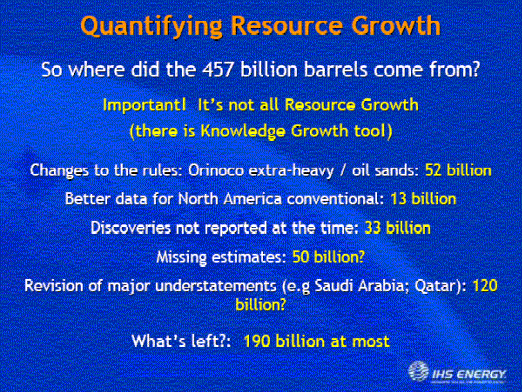
TOD readers are familiar with these kind of numbers and can decide on their own whether these estimates, some of which are clearly marked as questionable by IHS Energy itself, are credible. And, even if they were all true, would peak oil flows in the near-term foreseeable future be affected in any significant way?
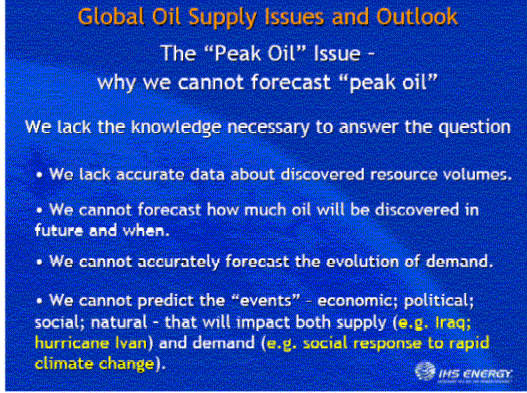
Concerning our inability to forecast how much new oil will be discovered and when, Chew (slides 2 & 3) presents a discovery curve that looks pretty normal showing that liquid resources put on-stream have outstripped discoveries since the 1981 to 1985 period. The 20 year trend seems clear--how can there be any major uncertainty about the expected discovery volumes in the future? The Earth is well-explored by petroleum geologists. There is no new magic technology which will buck the trend and find lots more oil than we already know about. However, perhaps we have underestimated knowledge growth. As Lord Bacon once said, Knowledge Is Power. I just don't see how it translates into more consumable liquids (boe) in the future.
As to the evolution of demand, that will depend on price and the economic fortunes of various countries (eg. Russia in the early 90's) but see the discussion of slide 45 below for an in-depth discussion.
Regarding "above the ground" events that will impact supply, these can only certainly be negative unless mirabile dictu, there is a magical turnaround in Iraq, Osama and friends decide to take early retirement, Nigeria insurgents make peace with Chevron, Iran has a change of heart about its nuclear program, feuding ethnic groups in the Caspian Sea region sing "Give Peace A Chance", India & China decide that ramping up energy usage is less important than climate change impacts, the US adopts a national policy to go with biofuels, solar and wind to mitigate its foreign energy dependence--you get the idea.
Slide 45--Peak Oil Is The Wrong Question
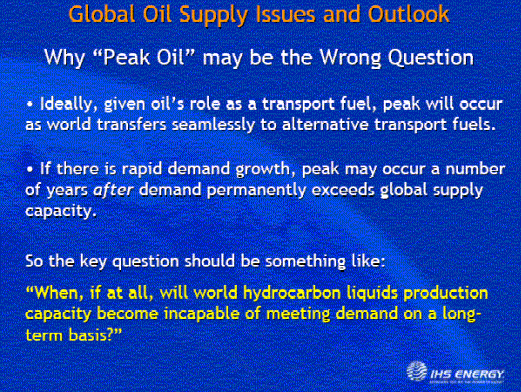
The seamless transition to alternative transport fuels? Can someone out there, anyone, demonstrate how exactly this transition is going to work? As far as oil supply & demand issues go, given overall declines, this would seem to be the biggest problem that peak oil presents. Biofuels? What's the answer? If there is one, what's the timeframe?
Now, here's an interesting point of view. The "peak" may occur a number of years after demand permanently exceeds global supply capacity! In other words, there would be a period in which oil supply capacity continues (however marginally) to grow but can not keep up with demand. This amounts to a kind of "economic" peak, not an "absolute supply peak" in which incremental flows (mbd) reach their maximum value over some period and are never exceeded thereafter. Not being an economist, Chew's key question brings up many thoughts.
Slide 46--Peak Oil May Not Be The Real Problem
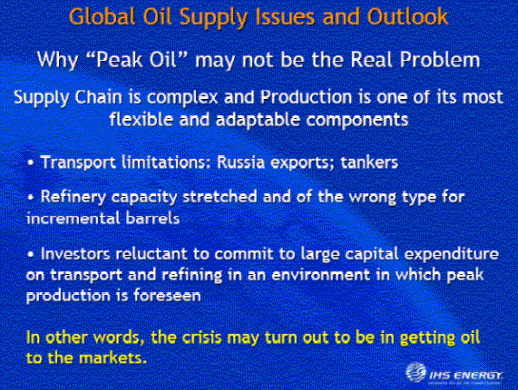
We are familiar with the usual arguments about insufficient refinery capacity and the inability of existing infrastructure to deal with "heavy, sour" crude. As far as transporting oil to market goes, that is yet another kind of "above the ground" consideration, in addition to delays, geopolitical events, hurricanes, and the rest, that have an impact on the timeframe in which peak oil occurs.
But here, Chew's remarks provide some insight. Investors will be reluctant to commit to an environment in which peak production is forseen. The crisis may be in producing the oil and getting it to markets. The crisis! Well, maybe IHS Energy and TOD are not so far apart afterall. It may be simply an argument about timeframes in which the peak oil community says the crisis will be sooner than later but the IHS Energy/CERA crowd--based on some inaccurate data and optimism about "above the ground" events (see slide 44)--pushes the date out into the 2010 to 2020 period.
An Alternate Universe...
No where in Chew's presentation are decline rates from existing (including mature megafields like Burgan) mentioned. Not at all. When referring to depletion, Chew is talking in the usual sense about historical cumulative numbers as a percentage of estimated URR backdated to the start of production. (eg. slides 26, 43). It is as though we are living in an alternate universe. In this universe, available capacity only goes up and never goes down. It seemed prudent to disregard silly references to what Chew calls resource plays (slides 8 to 16, including oil shales, tar sands and Orinoco heavy crude). Or his references to USGS data (slides 33,34). Chew's presentation also clearly shows the continued failure of E&P Effort and Investment by the IOCs (slides 20 to 25).
But bringing all that up just seemed like piling on.
Slide 44--Peak Oil Can Not Be Forecast
If you look at Chew's slides 26-28, the IHS Energy Methodology is described for estimated discovered recoverable resources.
Slide 27 -- URR EstimatesSo--you guessed it--Chew bases his entire analysis on purported data about discovered resource volumes but when considering the question of "peak oil", turns around and says that we lack accurate data about such resources. Of course, a Hubbert Linearization attempts to estimate Qt for a given field, oil province or country based on its production history (P/Q)/Q. IHS Energy uses no such analysis. Chew's slide 31 indicates thatSlide 28 -- Total Recoverable Resources
- Uses a "bottom-up"approach that reflects evolution of resource estimates for individual fields
- Sum the ultimate "proven+probable"technically recoverable liquid and gas resources of each field and undeveloped discovery, by year
- All resources attributed to the year of initial discovery
- Aggregate the annual discovered resource values
Subtract country cumulative production (slide 26) from country ultimate recoverable resources [URR] (slide 27) to derive remaining resources by country (slide 28).
- Pre-1995 Resource Growth (upward revisions) = 457 billion bbl
- 1995-2003 Production = 236 billion bbl
- 1995-2003 Discoveries = 144 billion bbl (61% of #2)
TOD readers are familiar with these kind of numbers and can decide on their own whether these estimates, some of which are clearly marked as questionable by IHS Energy itself, are credible. And, even if they were all true, would peak oil flows in the near-term foreseeable future be affected in any significant way?
Concerning our inability to forecast how much new oil will be discovered and when, Chew (slides 2 & 3) presents a discovery curve that looks pretty normal showing that liquid resources put on-stream have outstripped discoveries since the 1981 to 1985 period. The 20 year trend seems clear--how can there be any major uncertainty about the expected discovery volumes in the future? The Earth is well-explored by petroleum geologists. There is no new magic technology which will buck the trend and find lots more oil than we already know about. However, perhaps we have underestimated knowledge growth. As Lord Bacon once said, Knowledge Is Power. I just don't see how it translates into more consumable liquids (boe) in the future.
As to the evolution of demand, that will depend on price and the economic fortunes of various countries (eg. Russia in the early 90's) but see the discussion of slide 45 below for an in-depth discussion.
Regarding "above the ground" events that will impact supply, these can only certainly be negative unless mirabile dictu, there is a magical turnaround in Iraq, Osama and friends decide to take early retirement, Nigeria insurgents make peace with Chevron, Iran has a change of heart about its nuclear program, feuding ethnic groups in the Caspian Sea region sing "Give Peace A Chance", India & China decide that ramping up energy usage is less important than climate change impacts, the US adopts a national policy to go with biofuels, solar and wind to mitigate its foreign energy dependence--you get the idea.
Slide 45--Peak Oil Is The Wrong Question
The seamless transition to alternative transport fuels? Can someone out there, anyone, demonstrate how exactly this transition is going to work? As far as oil supply & demand issues go, given overall declines, this would seem to be the biggest problem that peak oil presents. Biofuels? What's the answer? If there is one, what's the timeframe?
Now, here's an interesting point of view. The "peak" may occur a number of years after demand permanently exceeds global supply capacity! In other words, there would be a period in which oil supply capacity continues (however marginally) to grow but can not keep up with demand. This amounts to a kind of "economic" peak, not an "absolute supply peak" in which incremental flows (mbd) reach their maximum value over some period and are never exceeded thereafter. Not being an economist, Chew's key question brings up many thoughts.
- Liquids supply goes up but increasing demand is never met. Isn't this called resource scarcity?
- Re: #1, doesn't that mean prices can only increase if there's little elasticity in the world markets? Even in the best case, where demand can be reined in, wouldn't such a structural adjustment take some years to achieve? With supply increases that are inadequate to meet demand, how could prices ever decrease even if demand is able to eventually adjust? Supply & demand would remain on the precarious razor-thin edge we find today in the best case. Does anyone believe worldwide demand will actually decrease (without sacrificing sacred "economic GDP growth") in any timeframe worth mentioning--because that would be the only thing that will lower prices. Otherwise, it's a recession or it's a depression (whatever your preferred term).
- If there is so-called demand destruction, doesn't that mean zero or even negative GDP growth on a region to region basis? Certainly, there is a constraint on worldwide growth based on Chew's year-to-year ceiling on available supply vis-a-vis demand.
Slide 46--Peak Oil May Not Be The Real Problem
We are familiar with the usual arguments about insufficient refinery capacity and the inability of existing infrastructure to deal with "heavy, sour" crude. As far as transporting oil to market goes, that is yet another kind of "above the ground" consideration, in addition to delays, geopolitical events, hurricanes, and the rest, that have an impact on the timeframe in which peak oil occurs.
But here, Chew's remarks provide some insight. Investors will be reluctant to commit to an environment in which peak production is forseen. The crisis may be in producing the oil and getting it to markets. The crisis! Well, maybe IHS Energy and TOD are not so far apart afterall. It may be simply an argument about timeframes in which the peak oil community says the crisis will be sooner than later but the IHS Energy/CERA crowd--based on some inaccurate data and optimism about "above the ground" events (see slide 44)--pushes the date out into the 2010 to 2020 period.
An Alternate Universe...
No where in Chew's presentation are decline rates from existing (including mature megafields like Burgan) mentioned. Not at all. When referring to depletion, Chew is talking in the usual sense about historical cumulative numbers as a percentage of estimated URR backdated to the start of production. (eg. slides 26, 43). It is as though we are living in an alternate universe. In this universe, available capacity only goes up and never goes down. It seemed prudent to disregard silly references to what Chew calls resource plays (slides 8 to 16, including oil shales, tar sands and Orinoco heavy crude). Or his references to USGS data (slides 33,34). Chew's presentation also clearly shows the continued failure of E&P Effort and Investment by the IOCs (slides 20 to 25).
But bringing all that up just seemed like piling on.
“Data always beats theories. 'Look at data three times and then come to a conclusion,' versus 'coming to a conclusion and searching for
some data.' The former will win every time.”
—Matthew Simmons, ASPO-USA conference, Boston, MA, October 26, 2006
Contact
- Content: editors at theoildrum dot com
- Tech support: support at theoildrum dot com
License

This work is licensed under a Creative Commons Attribution-Share Alike 3.0 United States License.
> recoverable liquid and gas resources of
> each field and undeveloped discovery, by year
As an energy analyst and consultant I would like to
point out that this above is the real culprit why
IHS and CERA conclude peak is "not imminent". They
add the proven (P-95) and probable (P-50) to come
up with URR which they later use in their analysis.
What they do not tell you is that the probability
for them to be correct is 50%. If they only use the
P-95 (95% chance the URR to be what they believe)
then the peak date will be around 2007, give or take.
Everything else like transport and refinery limitations
take back seat to the fact that their principal
assumptions are correct with 50% probability.
Cheers,
Maybe it is this "unbiassed estimate" of the probabilities we are lacking in both cases.
So adding all of the individual field estimates together will not necessary reduce error dramatically, even if the field-by-field estimates are unbiased.
Combine this factor with ever increasing world demand and the result is predictable. Arguing whether accurate estimates of probable reserves peg the brunt of the shock in 2 years or in 10 years is a matter of pedantry - as much of a waste of time as arguing over the ideal placement of furniture while the house is burning down.
First, a few months ago at an oil industry meeting, the Texas State Geologist, in response to a question from me, stated that with new and improved technology, Texas, while it may not be able to equal its peak production, could substantially increase its oil production. One little problem. Texas oil production has fallen for 33 straight years. Our esteemed Texas State Geologist is pretending that three decades of declines don't matter.
In a recent interview, the Norwegian Oil Minister apparently asserted that Norwegian oil production would not peak until well after 2008. Another little problem. Norway, as predicted by the Hubbert/Deffeyes Linearization method, has already peaked.
The common connection here is that when faced with years or even decades of production declines, the anti-Peak Oil crowd still refuses to recognize the hard, cold reality of depletion, so why should we expect them to acknoledge the reality of depletion before the worldwide decline has even set in?
- We make "..narrow, and sometimes even unwarranted assumptions.."
- "They wrongly assume they know what that finite amount is" in regards to the total amount of oil
- They relegate "to mythology the recovery of new reserves from existing fields"
Of course the proof of the peak concept - the documented declines in Texas, North Sea and Kuwait etc. are not mentioned.The following are held up as the sources to trust for future energy outlooks - the USGS, IHS Energy, and CERA.
He predicts a new methane economy, especially as the source of hydrogen for the hydrogen economy, which will start sometime after the middle of this century. But at the end he notes, almost parenthetically, that during the transition to this golden age, we will consume twice our historical consumption of oil and increase natural gas consumption 15-fold.
How much of AGI funding comes from AAPG I wonder - and when will Peak Oil get the serious scientific scrutiny it is screaming for from the mainstream academic geologic community?
BTW, this is my first post - I have learned an awful lot from TOD the past 6 months
Perhaps he knows about the proposed genetic engineering of cows which will enable them to be 'milked' of their methane. Animal rights groups are outraged by suggestions that the me-cows will have to wear lead booties to prevent them floating away and becoming a hazard to airplanes.
Now where did I put those dashed di-lithium crystals? Scottie...
Thanks to OilCEO for the graph.
Do market fundamentals reflect reality now (end 2005) or were they actually out of whack in 1999 when oil dipped below $15/bbl? Fisher quotes "Pete" Stark of IHS and "Dan" Yergin of CERA (we're all buddy-buddy here) without mentioning that these two organizations are essentially the same. He also quotes his good buddy "Tom" Ahlbrandt over at USGS.
Finally, Jesse Ausubel's methane economy by 2050. My first reaction is "Beam me up, Scotty". On the other hand, I may post on this one.
Vienna airport always wanted to build a third runway by 2011 to meet demand projections. Now they outbid everybody in the privatisation of Bratislava Airport (capital of Slovakia), which is only 48 km away from Vienna airport. The concept: operate Vienna as a hub for premium passengers, move the cheap flights to Bratislava, get back to Vienna by rail.
I do think that this community and CERA are not that far apart. I'd like to remember some more things said in Congress (more or less like this):
"Beyond 15 years, we're all guessing here" - Well, ain't 15 years from now 2020? The year after which CERA predicts the "bumpy plateau".
But most important of all were the questions posed by congressman Alan from Maine:
"We've been talking here about production, but to us what matters is price. If it's going to be a sharp peak or a bumpy plateau, who cares?"
He then questioned Esser if the bumpy plateau would have the same impact in prices as the peak would have. He answered yes.
Congressman Alan : "So you're not telling us to sleep over it, right?"
Esser: "Right."
I would have liked to see a slide on this.
If anyone has had to do that dreaded project (fill in blank) you know how you put it off just one more hour, or day. You knew you were putting it off, you knew you had to do it, but yet you didn't.
This is where we find ourselves.
And the answers will be same, we will put it off, we will have people even tell us it is * OKAY * to put it off!! That was some of the talk going on in the news and in Congress, and even at the local shop where you met folks. It is OKAY to put it off it's so far away someone else can worry about the project, I can live my life like I have been. I can make a future like I had, for my kids, It'll be OKAY.
I'm tempted to make a bumper sticker for my car that says, "Burn more fossil fuels NOW! What has the next generation done for you lately?" But it would be just my luck that some enivronmentalist wouldn't realize that it was sarcasm, a fight would break out, and we'd wind up on the TV show Cops.
We are the first generation in the history of our species to be able to collectively use 300x the annual net primary productivity of the sun. We are also the first generation -in the 280,000+ generations sicne man split of from apes, that will see less people on the planet when we die than when we were born.
Intersection of thermodynamics/human genes gonna be a live experiment on a grand scale-circa 2020-2030ish.
Most of humanity died because of that volcano. Our genetic diversity shows signs of it. Cheetahs were so badly hit that they are almost genetically identical, to the extent that they can accept skin grafts from each other.
Trying to remember a show I saw on genetics and human populations:
All of present day humanity can be traced back to roughly 15-20 humans on the African coast. Do you know, is that about right?
Seems to me that every risk in their forecast is to the downside: optimistic reserve numbers, optimistic production numers, optimistic (no realistic) depletion numbers, everything being fine on the geopolitical front. Given that, I say that IHS/CERA are being grossly irresponsibe and scientifically misleading. If they were to properly model these downside uncertainties in their forecasts they would end up with a much more pessimistic picture.
It will be interesting to watch what the major oil producers do over the next couple of years. Will they buy the IHS/CERA view and step up investment in production and the supply chain or will they hold back? We can see Saudi drilling frantically, yet the major western oil companies and Russia seem to be holding back. No doubt they will all have their own analysis and reasons for doing whatever, but there will be lines to read between.
I'll stick with my previous explanation: there are really 2 Earths, and CERA are living on a different one to me.
Even if PO is not till 2010 to 2020, Hirsch's report concludes we need at least 15 years' massive action to moderate it's impact. Even the PO optimists should be arguing for that effort to be a major priority NOW. I'd guess most of us here think we'll be very lucky, unless a massive recession intervenes, to make it much past 2010 before hitting PO. It's hard not to get very angry at irresponsible fools like IHS/CERA.
I can tell you firsthand from my experience at Arthur D. Little in the 1970s that nothing is more true than what Mark Twain said on the subject: "You tell me whar a man gits his corn pone, en I'll tell you what his 'pinions is."
It is a market driven approach. So what if peak oil comes along? Be it a peak in extraction or a peak in delivery infrastructure. Whenever the supply gets scarce the demand side will just have to shrink by substitution of other energy. No big deal. Oil will continue to be viable. New technology will will take over at the margins where high cost forces a switch away from oil. The peak will be a non event whenever it shows up. Very calming.
I see this as denial in the worst way. They just can not admit that bad things could happen. A positive attitude solves all!
The very intellegent and knowledgeable posters here at TOD have shown how difficult it will be to shift to alternative energy AND keep a similar economy and standard of living. It the energy density stupid. It isn't only about energy anymore. The economy has to weather an energy crunch or the peak will cause other unwanted problems. There are way too many people just glossing over this problem and it is going to bite us when oil gets scarce.
Oil companies can actually just sit and wait - prices will rise, and their profits with them. Investors will not be a problem, as they will pile on when everything else seems to be flat or going south. Thus they should be able to fund most anything they want to sometime in the future. They should be ok with rising prices.
But the rest of the country is headed for a wall. The inflation conveyor is quickly replacing the cheap stuff we are buying today with higher priced stuff made in 2005, after this latest jump in gas prices. This decreases demand, reduces sales, lowers earnings, and results in plant closings and job cutting. Mergers have been going on for the last decade in retail and most other sectors - not much cost savings left in doing that anymore.
We really haven't felt the full impact of this latest fuel price jump. I look for it to hit sometime 2nd Q of 2006 or so. It will not bother us in the oil business, but industries where fuel is a significant operating expense have only recently adjusted their pricing to reflect the new costs. That means that the effects haven't reached the end users just yet. Even the airlines haven't digested the newer fuel costs into their fare structures. It may take bankruptcy of a few to force that.
The only industry that seems to reflect price increases instantly is the power industry. I think we can all see what is coming for most other industries next year. What happens when driving season opens and demand rises again? No new refineries yet, and another record hurricane season predicted.
It looks to me like we are heading for a very bumpy economic road, and if it isn't actually caused by the increase in price as we are approaching the peak, then the Peak may well be the end of the world economy. If this is just a small dose of what we can expect from rising energy prices, then things are very gloomy...
"A dispute over the best way to move Alaska North Slope natural gas to the U.S. market has resulted in an antitrust suit claiming BP Plc and Exxon Mobil Corp. are conspiring to withhold the fuel to drive up prices, according to a media report Tuesday."
http://www.marketwatch.com/news/story.asp?guid=%7BDA7C23ED%2DE7B6%2D4F48%2DA0C7%2DC0FB8F36B6D4%7D&am p;siteid=mktw&dist=
I mentioned earlier today that one should watch the oil producers to see which way they jump - rushing to develop their massive remaining reserves or holding back. Perhaps this is one indication. No doubt BP and Exxon will reasonably say: we'll produce for when the pipeline is scheduled to open (they haven't even decided the route yet, LOL). 'Tis a frivolous suit, methinks.
Do I hear 'nationalise them' echoing through the ether from the future?
Don't panic, don't panic, don't...
The majority of Americans today live off the discretionary income of other Americans. The problem for energy producers is that they are a minority within a minority (energy producers within a minority of producers).
I think that energy producers are making an epic mistake when they side with Peter Huber, Yergin, et al. If--as Huber and Yergin say--we have plenty of energy, then rising energy prices must be a result of a conspiracy. Thus, more and more calls for punitive taxation, virtual nationalization, etc.
In late October, the NY Times reported that retailers and manufacturers have been absorbing the costs related to higher energy prices. The article said many of these businesses have little maneuvering room at this point and another increase is energy prices will force them to pass the higher costs onto consumers.
Massive consumer debt (negative savings rate), job loss (GM, and Ford layoffs, plus predictions that a downturn in the housing market will lead to a loss of 800,000 jobs), and the specter of inflation represents a worrisome combination.
The part you have to read between the lines to see is that IHS and CERA provide services to the oil investment/infrastructure community. What happens to CERA if investors create the self-fulfilling prophesy above? CERA turns out to not only be wrong, but out of business and probably under congressional investigation. What happens to CERA if they convince enough people to keep investing in more infrastructure? They might have a remote chance of staying in business for a little while longer. If nothing else, they can pin their forecasting error on other people's lack of investment, instead of their own delusions.
I will quote from my story here. That's not to say that IHS/CERA does not make political calculations--they obviously do. But I'll stick with my remarks as quoted above.
Disagree - if stockholders are making killer dividends then they want their fearless leader (CEO) to make even more, as the whole planet clamors for more shares of stock...feeding frenzy, which means a lot of cash which has to go somewhere or the government will get it just like they did the tobacco guys. Oil companies will have no choice except investments as their reserve portfolios shrink, and as prices get stratospheric, everything becomes more economical, even the spaceships to Jupiter to scoop LNG...
Why? Because the alternatives WERE NOT READY!! The smooth transition we all hope for is out of the question, because it will minimize profits for the shareholders of these big companies. Need I remind you of Dick Cheney's vested interest? Big OilCo shareholders are waiting with eager glee for PO, because it will enrich them beyond wildest dreams of avarice.
You are right about CERA/IHS simply not being able to tell the truth - but IMO, it's not about self-fulfilling PO. What it is actually about is preventing investor panic and capital flight from everything outside energy. Once people really snap to PO, they go to gold, precious metals and oilfield stocks. That is the only positive way to position your money in the event of an imminent oil peak, outside of the small community of renewables ventures.
I really think that this is the first bump in the road for oils price climb. We got whacked with shortages from aging infrastructure, sour/heavy oil and lack of capacity, increasing heat energy in the atmosphere and associated storms and various political crap across the world (Nigeria, Iraq, etc.). Much of this is not going away, and may get worse. And all the while, depletion rates increase and it seems consumer demand is set to increase until we reach some critical energy cost number that shuts down profitability and tumbles the whole world economy.
As long as TPTB refuse to address the issue with the urgency and honesty it demands for practical management, we are looking at some kind of massive economic collapse.
As it is in their own best interest to profit from this same collapse, I would say that people should batten down their hatches over the next few years as best they can, and be ready for WTSHTF or even TEOTWAWKI. To believe that the ultra-rich do not see what is approaching is delusional - the signs are all out there .
We are reading the same tea leaves they are, and coming to the same conclusions. The only people coming to a different conclusion are the think tanks, book peddlers and talking heads who are being fed their lines to keep the public unaware. Even reading between the lines of the independent oil companies and national oil companies lays out a scary picture. Don't think that others are not reading between these same lines and reaching similar conclusions.
We could accept an estimate that has a 50% probability of being too high if it had a low probability of being very high. The estimate of 50,000 'heads' from 100,000 coin tosses has a 50% chance of being to high but less that 1% chance of being more than 1% high.
These considerations do, I accept, rest on some shaky premises:-
As I commented elsewhere in the thread, it's quite possible for there to be no political or financial biases, but still have the field estimates correlated.
As a simple example, suppose there's a new technology X about which opinion is split as to whether it increases total oil recovered from a field by -10%, 0%, or +10%. Best guess gives 25% chance of -10%, 50% chance of 0%, and 25% of +10% for any particular field. But this probability is based on uncertainly about the technology, not the particular field.
In that case increasing the number of fields added doesn't reduce this bit of uncertainty at all.
Obviously in real life there will be uncorrelated uncertainties that will reduce overall uncertainty when you add the data. But I'd be willing to bet that many of the biggest uncertainties are indeed correlated, and will leave a sizable core of uncertainty to even the most carefully unbiased estimates.
The issue of 50% probable reserves is fine for determining a RANGE of estimated of total reserves. However, we shouldn't lose sight of the forest for the trees. Whatever remains of the world's oil will become increasingly more energy intensive to obtain.
Yergin had great timing in coming out with his book, The Prize, in 1990 right when Saddam invaded Kuwait. He got world wide acclaim, and became an international figure.
CERA, however, has no more real inside information on what is going in in the oil industry and what the world wide supply will be than a suite of other consulting firms and players. Also, as pointed out here on TOD, CERA has been dead wrong in a number of past predictions (on oil price and on nat. gas supply). IHS is new to the consulting game. It is interesting to me that they are starting to publish opinions like those you would see coming out of CERA.
For other opinions coming from within the oil industry, I have found that Petroleum Intelligence Weekly has articles almost in every publication warning of supply difficulties ahead. The Oil and Gas Journal has published many articles in the last year or so on Peak Oil, even if they haven't used that terminology. Obviously, Matt Simmons, Boone Pickens, and Richard Rainwater are energy insiders. And of course there is ChevronTexaco - "Will you join us". The oil industry is starting to wake up to Peak Oil.
My perception is that IHS/CERA have positioned themselves as high-profile "experts" both in the press and now testifying before congress. That is why I examine them here just as Stuart and HO have done in a number of posts on their yearly supply numbers. As you say, sources like OGJ and Petroleum Intelligence Weekly are more serious and trustworthy. But when I listen to NPR, read the NY Times or the Washington Post, I don't hear the nuanced expert opinions of PFC Energy's Roger Diwan--instead they trot out the always available Daniel Yergin for the soothing, "everything's OK" view. Personally, I want TOD readers, especially those new to the peak oil issue, to have a discrimination filter in place when they hear these pollyanna views.
You asked...
<The seamless transition to alternative transport fuels? Can someone out there, anyone, demonstrate how exactly this transition is going to work? As far as oil supply & demand issues go, given overall declines, this would seem to be the biggest problem that peak oil presents. Biofuels? What's the answer? If there is one, what's the timeframe?>
Now that's what I call a loaded question! And there are so many words that would need "tighter definition"..."seamless" (the transfer to mass car use was not "seamless", just ask the railroad workers (the ones still around from the glory days of rail), demonstrate how "exactly" it work...how exactly...technical developments could make any prediction a guess..."what's the answer?", "what's the timeframe"...is there any one "answer" or a myriad mix of technology....and would the price and nature of depletion change "the timeframe"...in other words, would it be done in one fell swoop...or in fits and starts forward, with a market driven "staged transition" over time....?
But for a second or two...let's play. You are surely aware here at TOD of the "plug hybrid" cars of http://www.calcars.org
Now, they are not an economically viable alternative with gas at $4 bucks a gallon...even $5 won't make them competitive...but what about $6 or $7 bucks? (before you laugh, the Europeans are already getting into this range)
The Lithium ion batteries are already powerful enough...they have enough energy density per pound for almost all in-town, lower speed range (some talk of a 20 mile range at any speed below 20 mph, but that can be easily managed...if a battery pack can be charged at home, and then run, let us say 50/50 (up to 50 mile range with a 50 mph speed), and recharged at home, it revolutionizes the whole issue of peak oil or depletion of oil, all that is lacking is the price of the batteries, and HERE'S THE BIGGIE, whether or not they can take the charge discharge cycle with durable battery life....THAT'S IT.
The batteries are VERY CLOSE NOW to what is needed to alter the fuel consumption landscape forever....where will they be in 5 years...10 years...
A bit more....suppose the batteries can never get much better or cheaper....then, with the knowledge now gained about plug hybrids, we go up another path...let us say, Hydraulic Hybrid, which the EPA has already shown a full size vehicle using (a Ford Navigator of all things!). It works this way: An efficient gas, Diesel or natural gas turbine (of the Microturbine or Capstone type) drives a hydraulic pump, which builds pressure in "accumulator" tanks. At low speed and for short range, the vehicle moves on hydraulic power only....but at higher speed, or at longer range, the gasoline engine starts and recharges the pressure in the accumulators.
It gets better: With the hydraulic system, the system can be VERY deeply discharged with no damage, (zero pressure), and then recharged back to 100%, something that would destroy a battery after a few times...and there are no rare earth or precious metals involved.
IT GETS EVEN BETTER. With the plug hybrid concept, the vehicle could have it's accumulators charged to max in the garage or driveway by the house current....giving the full effect of plug hybrid. The vehicle would never even have to start the engine to leave the drive under hydraulic pressure drive!
http://www.epa.gov/otaq/technology/420f04019.pdf
We could go on....WalMart roofs and parking lots roofed in to protect customers from the sun, and also carrying high efficient solar panels to create solar hydrogen for fuel cell cars....
http://www.ieahia.org/pdfs/honda.pdf
Electified rail trains to haul freight, methane from sewer gas, animal, plant, and manure waste to create fuel used in the same applications as natural gas today...
We must recall that these alternatives DO NOT have to replace all fossil fuel consumption.
Even the most pessimistic of the "Peak Oil" scenarios, the "Upsalla Protocol", projects crude oil production out to 2060 or later at least as high as it had been up to 1968 or so....all we have to do is fill in the growth since 1968, and account for future growth. The fossil fuel industry will be HUGE for a lot of years to come (the rest of our lives, certainly)
Predicting the "seamless" transformation is almost impossible, but it is where the rubber meets the road. Almost everyone now agrees there WILL BE FOSSIL FUEL DEMAND DESTRUCTION. I was once asked what the "peak oil" crowd felt they could do....and after much thought and self examination.....it hit me.
The job of those who see and accept Peak Oil is this: To make the coming "demand destruction" as humane as possible. Roger
The exact figures of the extra power consumption to use hybrid electric or hybrid hydraulic type cars/vehicles would depend completely on the market penetration of these vehicles, and their efficiency, (20% of the market, 30%, or 50% ?, with better batteries than we now have, and how many in town vehicles could be full electric (battery electric...at what range and efficiency, and what about the other developments, hydraulic electric, solar produced hydrogen...how many fuel cell electrics, and at what efficiency?), but the KEY thing almost everyone goes right past is that most of the recharging of any grid produced transport energy would take take place at night, on off peak hours.
A study of the California power market shows a day peak vs.night off peak nights at around 20% to 30% depending on time of year. What this means is that at night California has about one third of it's power plant productive capacity at almost idle, leaving that power available, but of course, if we began to pull that power, it would definitely increase night time fuel consumpton needs. But the excess power available nationwide at night (as far as generating capacity goes) is many gigawatts. And that's with no additional renewable power (solar, wind, etc.) added, and dismisssing the growth of "distributed generation", which is a rapidly growing business, with large users like hospitals, schools etc., providing power generation and multi cycle recycling of hot water from waste heat, etc.
On the curbside parking problem mentioned by some posters, thinking like a typical suburban/rural American, I frankly haven't given it a great deal of thought! (blush!) :-) It would be an infrastructure problem that would require some considerable work and planning, that is a given....not undoable, but not cheap either....
On electrified rail, two points: The rail companies would almost surely consider some added power production (again, distributed generation) to power their own trains, and of course, again, much of the power consumption would be at night....hauling frieght would not have to done at as tight of a time schedule (Matthew Simmons has made the case that a great deal of heavy transportation would move almost immediately to rail and river barges when peak oil/gas production comes, meaning that one of the first casualities of the event will be the JIT (Just In Time) delivery methods of most business), but the DECREASE in overall consumption of fuel compared to highway tractor trailers could be large....
I want to go back to the original set of questions I was playing around with: exactly how "exact" the plan can be would depend greatly on the price points of fossil fuels, how much the expected newer efficient technology could be introduced, and how fast (the exact "timeline") and many legal and social barriers and issues....that was my point that when CERA says a "seamless transition" to other fuels and technology, they are assuming an "if everything goes perfectly" scenario. Things seldom go anywhere near perfectly, and most transitions are not "seamless". That doesn't mean the transitions cannot be made, but, exactly as some of the posters here have indicated, difficulties in changing a built up system of this size will be difficult, and in many cases, probably painful. It also depends on (as ole Curly said in "City Slickers") THE ONE BIG THING.
WILL. Right now, the real central problem is almost everyone in the mainstream press and the public at large completely refuse to admit that the clock is running and that time is getting very short. On these boards, we often loose track of the fact that MOST OF THE PUBLIC have in no way accepted that this is anything more than a temporary inconvenience, and the banking and investment firms show little interest in investment, and MASSIVE it will be, that must be made NOW if we have a hope of making a transition anything close to "seamless".
That's okay if you live in middle-class suburbia and have a garage. A hefty portion of world car users live in flats and use on-street car parking.
Obviously they are not going to run a 50 metre power cable from their flat to the car or move en masse to a house with a garage.
Apart from the fact that nobody will buy such a car until their own petrol/diesel car is near the end of its life, what do they do to recharge?
Vast recharging lots looks an expensive option to me. You pay for parking (land is not cheap), you pay the premium for using the service and you have to somehow get from there to your place of work and back.
Excuse me for thinking this option has a long way to go!
The hardest part is to make the plug in hybrids good and inexpensive enough. The second hardest is to generate more electricity.
http://newerainvestor.blogspot.com/2005/12/problem-with-electric-cars.html
Swipe card power points? Even parking meters are only about one for every 5, 10 or 20 cars. Can you imagine the cost of manufacturing, installing and maintaining such power posts for every car parking space in the world? Or perhaps we are down to rationing again? Thirty cars for every recharge point? I can see the fights now.
Once again, has common sense been applied to this problem?
What if you are not guaranteed a parking-recharge spot (a common problem in my city), push the car home?
Then you have the problem of chronic parking spacing more stretched by people wanting not to park but recharge.
This also looks like a no-go in developing economies.
Overall, too expensive for non-garaged car owners.
The only key component I would hope get extra attention and standardisation is a better power connector. Ideally one wich can be disconnected automatically and where nothing breaks if you drive away without a manual disconnect. Extra points if fancy equipment on the car can make an automatic connection when you park. I have some ideas about this but they are far from finished and I have not done any litterature search.
1-2 kW power posts with fuses, timers and sometimes fancy control equipment are very common in nordic countries for motor heaters to easy the starting in cold weather and comfort heat the car. They are usually installed at parking spaces reserved for workplaces and at home. Scale up the power rating, add a card reader, a tiny computer and a standard power cable network and it is solved. Building them in the millions is dead easy and installing them is easier then installing a streetlight lamppost.
You talk as if the Free Market has already decided street power points is the most optimal solution!
The Free Market may decide through a multitude of field trials and customer feedback that hybrids cars are a crock.
The public might even reject them for less efficient measures.
I just have my doubts about a future with every street lined with these recharge points. Too utopian.
If plug in hybird cars or all electrical cars get longer battery life lenght and lower price and thus become very attractiv I am sure recharge post problem will be solved almost everywhere and probably quickly. They are far easier to build and run then for instace a fast food restaurant a cafe or an unmanned petrol pump.
The vehicles do not even need street power pointes to start selling in large nubers. Its enough with non credit card charging aoutlets in private and company garages.
Worry about the cars and the powerplants. The parts inbetween are much easier to build and run.
Chris
Page 4 says:
Overall Weight 240 pounds (22 gallon system)
Specific Energy ~8 kW-sec/kg
Energy Density >50 kW-sec/gallon
Power Density 3 kW/kg
So at 8 kW-sec/kg, a 109 kg system should store 872 kW-sec. Divided by 22 gallons, that's 40 kW-sec/kg, not >50.
Chris
In an 11/1/04 Forbes column, Yergin was quoted as saying that oil prices on 11/1/05 would be at about $38 per barrel.
Another miss for the Yerginmeister.
Note to self: I need to start a table of predictions "from famous (oil) people."
N.B. - Yergin wasn't that far off, was he? I mean, look at how his prediction would have been viewed at the time. How many people, besides me, would have been right a year ago?
Seriously. I mean none of you guys knew me then, so how would you have known that I'm always right about the Price of Oil?
Have you ever talked to someone who gambles alot or plays the lottery. They are always winning. I've never understood this, since the odds say quite clearly that they should always be losing :)
10 points within $1
5 points within $5
1 point within $10
-5 within $15 and over $10
-10 over $15 out
-15 over $20 out
I never buy lottery tickets, did think about betting on NFL - there were actually situations where you could fleetingly get prices that guaranteed a very small win (about 2 to 5%) by using different online bookies and backing both teams in a game but they only came up about once every 3 weeks so not worth the effort of watching prices like a hawk. I do spread bet on stock indices, commodities, currencies but only do a bit better than break even, hopefully I'll improve with practice and be able to earn a decent living.
As far as I'm aware the major oil companies are very much NOT building new refineries, some people (and I might agree with them) say this is an indicator that they expect the supply of oil to be limited before new refineries could repay the investment.