
 | Economides: $100/bbl oil and $20/McF NG before the year is out... | The Oil Drum | Bush: Short Term Conservation Needed |  |
Peak Oil and Community Solutions Conference (Friday)
Posted by Stuart Staniford on September 26, 2005 - 9:55am
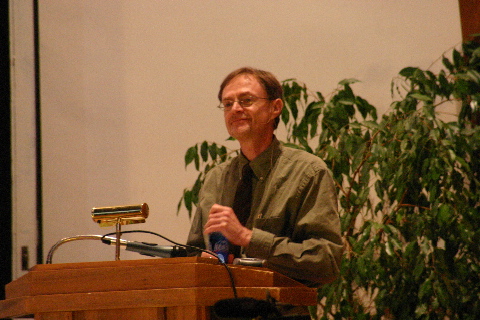
Richard Heinberg giving the keynote speech.
For background, I work in the high-tech industry, and live in San Francisco. The conference is in Yellow Springs, Ohio, which is a tiny little town in the midwest. So that's culture shock #1. And this conference very much draws the eco-sustainability wing of the peak oil movement, so that's culture shock #2. The crowd here will cheer at the mention of Hugo Chavez's name, or at the idea that we definitely should not solve this problem by building any more nuclear power plants. I suspect those sentiments will not have been expressed much at Roscoe Bartlett's peak oil conference.
It's an interesting thing about the peak oil movement that it completely cuts across the traditional political spectrum and makes for strange bedfellows. To a certain extent, you've either drunk the koolaid, and you're obsessed and more-or-less frightened and ready to collaborate with anyone who shares your views on this issue, regardless of what they might think about gay marriage or abortion, or you haven't and you won't. Yet still there are discernable left/right/eco crowds within the movement. Here we have the eco crowd.
Yellow Springs, population 4000, is close to Springfield, and slightly less close to Dayton. So it's very much the Midwest around here: decaying industry, all the jobs moved to Asia, big petro-agriculture. But the houses are incredibly affordable and it's pretty: everything is green in September and there are lots of trees. I think it's the kind of place James Kunstler would approve of: rain-fed, horse-powered agriculture would work great here: lot's of good soil still, and an excellent growing climate. Small towns that can be rehabilititated. The only downer is going to be staying warm in the cold, cold winters. So a good place to come to focus on community responses to peak oil.
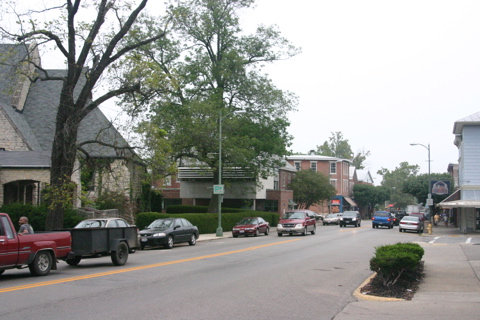
The main drag in Yellow Springs.
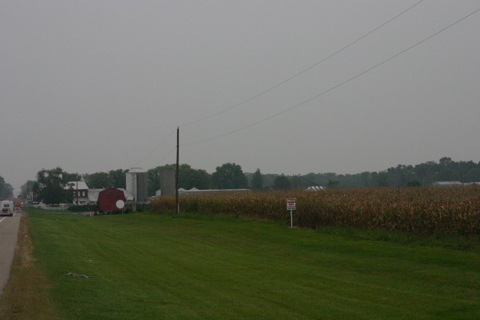
Ohio cornfield and farm just outside Yellow Springs.
Yellow Springs seems to have as its cultural heart Antioch College, which is a small and very cool and progressive liberal arts college. It was shaped a lot by it's president in the 20s and 30s Arthur Morgan, a famous communitarian. Morgan was deeply concerned by the trend of increasing large cities and the loss of rural life and small communities. He founded a non-profit, Community Service, Inc, to work on this issue. They have existed for 65 years, but recently discovered peak oil, and realized, "Oh, it's fossil fuels that have been driving the trend we were created to oppose. And now the fossil fuels are going away - we have something to offer in solving this problem." And part of what they are offering is this conference.
This first conference last year drew 212 people, according to Faith Morgan, one of the organizers. This year is up to 450. That's 112% annual growth - not bad. The crowd is very knowledgeable and involved. At one point Heinberg asked how many people had either given a speech or written an article about Peak Oil. It looked to me like about two-thirds of the hands went up.
The conference kicked off with introductions from organizers Megan Quinn and Pat Murphy, and then moved to the keynote speaker Richard Heinberg - long time Peak Oil author (including "The Party's Over", and "Powerdown"). Heinberg gave an excellent and engaging overview of the problem which I won't cover too much here, since it will be very familiar to regular Oil Drum readers. Instead I'll pick a few highlights that struck me.
One of his best laugh lines was speaking of ordinary newspaper readers who read the phrase "proven reserves", and think that "there must be somebody doing the proving; some global oil cop who goes round with a giant dipstick and sticks it in the ground and measures that stuff."
He drives a 25 year old Mercedes Benz which he mostly fuels with bio-diesel. But he doesn't believe biofuels are a scalable solution due to the land requirement (I thoroughly agree). He put it a very interesting way. At some point, if we go down that road, it's going to be more profitable to use land for making fuel than growing food. Rich people will pay $20/gallon to have gas, and we'll have hundreds of millions of people starving so a few million people can drive.
He sees the poor government response to Hurricane Katrina as a metaphor for the likely response to Peak Oil - too little, too late, so a lot of unpleasant consequences. It's not that peak oil is insoluble, in his view, it's that we won't do what it takes in time.
At the end of his presentation, he gave a list of resources and he plugged the Oil Drum, as a particularly good way to stay up-to-date!
In the Q&A afterwards, a questioner asked about nuclear energy. Heinberg basically said that while nuclear power plants could indeed be helpful, he felt that it would take a long time to ramp up the necessary changes, and nuclear power was also something that required a tremendous level of technical competence and organization to build and maintain. Thus in a world that was becoming less complex and more local, it was hard to see how it could be a major part of the solution.
Another questioner gave a comment to the effect that there's hardly any uranium reserves anyway and nuclear power wouldn't be cost effective without large subsidies - renewables such as wind were more cost effective. I don't believe either of those things are true, but he got applause.
And that led me to reflect. I think the attendees at this conference would a) not want to do nuclear, b) not want to do large scale LQHCs and coal because of global warming, and in general c) go back to a simpler, more local biomass based society, augmented by wind and solar were they aren't too environmentally damaging. Now, I haven't investigated it carefully enough yet, but my gut feel is that a society that low in energy usage could not feed 6.5 billion on the way to 9-10 billion people. Before 1750 we were feeding less than 1 billion people with biomass and wind energy, and there were plenty of famines. The efficiency of photosynthesis has not changed in the meantime.
So I think that's going to be my mission while I'm here amongst the eco-folks. I'm going to see if I can find somebody who can give me a convincing quantitative argument that there's a way to organize a society of 10 billion humans who all get fed reasonably without using fossil fuels and without using nuclear energy. You can talk till you're blue in the face about local sustainability on the village scale, but if there isn't a path to doing it on a global scale without massive die-off, then it's not a good direction to try and go in.
Contact
- Content: editors at theoildrum dot com
- Tech support: support at theoildrum dot com
License

This work is licensed under a Creative Commons Attribution-Share Alike 3.0 United States License.
I run a Spanish speaking website about PO and energy resources, so I get asked all the time about the possible solutions. I've met the people from Community Solutions and Richard Heinberg and I think they are sincere and well meaning, and in a way, I think they do what they can to bring solutions to the problem. In our forums, we got responses all across the spectrum you mention. From people that plan to run for the mountains, to people that is young and is preparing professionally for a new energy paradigm (we have also our share of cornucopians, but discussions with them is quite boring).
Faced with the choice of a simpler way, even knowing that it won't suffice to feed 8 billion people in a few decades, I believe a lot of people would choose that path. Egoism or shortsightedness? I don't know, but it's the way the mind works, faced with a global scale problem that is going to burn your mind trying to solve it, there's always the well tested exit of "taking care of yourself and your kin" (even if that's not going to last much).
I've been thinking for a long time (well, just 5 years, but very intensive thinking!) about this issue, and if I have learned something is that there are no magic solutions, even if we could have the guarantee that the decision making would be confined to "rational parameters" (heck, we wouldn't even agree on what means that!).
Anyway, I think being informed is never a bad thing, so I agree with you, people must know that going back to small communities is not going to be enough. You mentioned how the PO movement cuts across many mindsets, I would add that we need more "crossthinking", perhaps sometime thinking that comes as a bit self contradictory. An example: I am against building new nuclear reactors, but I am against early decommissioning of working plants (as ecologists want). I also recognize that (save for a total collapse), markets should be an important drive in the quest for solutions but I won't buy the cornucopianism that just fails to recognize that energy resources are not just like another commodity.
What I am trying to say is I don't think this problem is solvable on a global scale, but ONLY on a local scale. Perhaps if we try to solve the issues locally the global aspect will take care of itself (doubt it).
I don't think that supporting 6.2 billion, let alone, 10 billion people is a reality without technological miracles. And since an age of contraction and decreasing energy such miracles will be less likely to occur I think we are better off preparing for a shrinking population.
Why are so many people so determined to preserve populations? Could it be that die-off may be the one thing that saves our planet for future generations?
But then one gets to the question, would I be so ready to accept this solution if I was the one dieing-off? I'm not so sure if I would. In that case, being white and from America, am I not saying that my life has more value than someone from China, India or Africa?
I would argue that since I had no choice as to where I live and where other's live I am simply advocating the natural remedies to overshoot, and sooner than complete overshoot might perscribe. Can I ever be totally absolved from the fact that my continued life is based on the ending of other's lives? Not at all. But if that fact is held in reverance, and one never advocates for violence to others because "I am better," then I think there is something noble about trying to find a way that works (at least for a lot longer than techno-society). I cannot control what the entire world does, and even if I could, would I want to feed everyone? Probably not, because overshoot (imposed by nature/2nd law of thermodynamics) will become a reality eventually, to one degree or another.
Here's a way to put it in perspective: The sun shines with an intensity of about a kilowatt per square meter. Solar cells can collect an average of maybe a kilowatt per ten square meters.
Crops collect about one or two kilowatts per acre.
If we had an effective solar technology, we would not be short of energy. Wind already looks like a good investment, and it's not all that energy-dense. To store solar, use pumped water for the electric grid, and the new charge-in-a-minute batteries for cars (or even just plug-in hybrids).
Still almost an order of magnitude worse than solar cells. But it's sounding halfway reasonable to get energy by growing stuff.
I wonder how fast the algae would grow if supplied with concentrated CO2 in closed tanks? This might be a way of reducing the environmental impact of carbon-heavy fossil fuels. Not as good as sequestration, but at least you'd get to use the carbon twice rather than once.
Chris
BTW, uou also need to fertilize the algae. Look below for my pig-farm idea...
On the other hand, if peak oil coincides with peak water for us, we'll be in big trouble.
http://odograph.com/?p=114
By the way, I've been looking for a web page I've seen before. It is about some fanatic gardeners up in Pasadena or Altadena or someplace, who grow litterally tons of food in a small suburban lot. The do use a LOT of water though.
Ha! Found it. My memory isn't quite shot yet:
http://www.pathtofreedom.com
By the way, I've been looking for a web page I've seen before. It is about some fanatic gardeners up in Pasadena or Altadena or someplace, who grow litterally tons of food in a small suburban lot. The do use a LOT of water
They don't have to use a lot of water though... not if they use drip irrigation... and even 'less' if they use 'grey water' for the drip irrigation. They use NOTHING per ton of food produced compared to flood irrigation like up in the central valley.
Peak Oil & Peak Water are similar in concept... think of your typical suburban yard as a big wet green SUV...
This just does not have to happen. Our current corn production is made with about 77 pounds of nitrogen per acre. But we produce upwards of 2 tons of crop wastes per acre of corn; if it can be used to produce as little as 2.5% of its weight in fixed nitrogen, the fertilizer problem disappears.
My own thinking is that this could easily be made into a non-problem. If a ton of corn stover can be made into 25% of its weight of charcoal (an underestimate),
My own thinking is that this could easily be made into a non-problem. If a ton of corn stover can be made into 25% of its weight of charcoal (an underestimate), that would make 500 pounds of carbon. A pound of carbon cycled through thermochemical zinc production followed by oxidizing the zinc with water produces 1/6 pound of hydrogen, and the carbon monoxide output from the zinc process can be shift-converted to hydrogen (CO + H2O -> CO2 + H2) and yield another 1/6 pound of hydrogen. The total potential yield from the ton of crop waste is around 167 pounds of hydrogen, which can fix about 780 pounds of nitrogen.
When half the crop waste from an acre can be used to fix enough nitrogen to fertilize ten acres, you don't have a problem; you have a business opportunity.
I should stress, lest anyone missed it earlier, that I am quite ignorant about low-input sustainable agriculture. I don't pretend for a moment to know that it is impossible for this to be done. But just knowing a little bit of history, I see an obvious inconsistency, and I am hoping the experts have figured this out and someone will point me to why it's not what it looks like. So far, the experts I have met have not known the answer, but maybe I just haven't found the right experts. I am willing to believe that we have discovered new ways to massively increase yields that our ancestors didn't know, other than just throwing energy at the problem, but I'd like to know specifically what they are. Basically, I just want to know that this has really been thought through before I accept that folks should charge off in that direction (as some are advocating very strongly as you'll see in my report tomorrow). So far, I've seen a lot of fuzzy thinking.
Do the Amish tell us anything here? How many people/total acres does Amish agriculture feed compared to industrial agriculture?
Again, the "dieoff" scenario assumes that mechanized agriculture will collapse because we won't have the fuel to fix the nitrogen or run the equipment. Fortunately for the world's population, farms can make do on stuff that we're leaving to rot. If you look at this Nebraska calculation of fuel use, total fuel requirements are less than 6 gallons/acre (50 lbs/acre). Such a small demand could be satisfied easily using gasogenes turning waste-derived charcoal into fuel gas to run existing engines.
They don't figure in this context.- Crop waste could be reduced to charcoal on-site, reducing its mass by at least 70% and the transportation costs similarly.
- There does not appear to be any inherent minimum size limit for a Haber plant, and modern technologies like medical oxygen concentrators (which could be used to make nearly-pure nitrogen in the space of a dehumidifier) may offer ways to make them very small indeed. The question is the economics.
- Transportation costs are unlikely to be an issue; N. American natural gas shortages have resulted in the US importing nitrate from overseas. Compared to the weight and bulk of the crop that we export, the fertilizer is nothing.
One reference I've found claims that residue over about 1 ton/acre begins to cause problems by slowing the warming of the soil in spring; the excess corn stover (which needs to be plowed in or removed) runs to about 2.5 tons/acre at 150 bu/ac yield.Burning the residue doesn't necessarily remove all its nutrients; potash and phosphorus remain in the ash IIRC and can just be spread on the surface.
No-till systems leave the roots in the soil and don't promote oxidation by plowing them up, and there's the 1 t/ac residue left on the surface.Nutrients removed in any form will have to be replaced. Nitrogen is the one with the big energy budget, and I've shown that it's far less of a problem than the pessimists claim.Sure, we'll have a problem if we act like idiots and fail to do anything. Moral: don't act like idiots.
At the core of the peak oil issue is this question--how well will we, individually and collectively, respond to this looming challenge. While I am certain that peak oil will be nasty, brutish, and anything but short, I am confident that we will find a way to avoid a die-off and the collapse of societies.
Heinberg using the post-Katrina debacle as a metaphor is a little too cute for my taste. Clinton's FEMA handled disasters (but clearly smaller ones), vastly better than we're seeing now. Why not use that earlier experience as a model to say, "See? When faced with a disaster we really can pull together and do the right thing. Bush's screw-up was an anomaly."
----------------------
"But he doesn't believe biofuels are a scalable solution due to the land requirement (I thoroughly agree). He put it a very interesting way. At some point, if we go down that road, it's going to be more profitable to use land for making fuel than growing food. Rich people will pay $20/gallon to have gas, and we'll have hundreds of millions of people starving so a few million people can drive."
This is a classic case of two different logical errors rolled into one position.
First is this implicit notion that any useful contribution to our energy future has to be very highly scalable. Our energy future is going to be "D and D" as I like to say--diversified and decentralized. We'll have a lot of solar collectors in places like the US southwest and Mexico, and wind turbines where it's windy, and wave power on coastlines, and a lot of biofuels where it makes sense. Can we replace all of our current motor fuel consumption with just biofuels? Hell no, but we won't have to--a lot of transportation will be run on electricity generated by the non-biofuel sources I just mentioned, plus nuclear.
Second is the old bugaboo of a linear extrapolation. In this case, seen as this idea that all future public policy will be dumb as a bag of rocks, leading to a future in which people starve while farm land is creating biofuels. Where is the evidence that such a mindlessly simple extrapolation and set of assumptions would actually come to pass?
Our energy future is not wholly predictable. We can reach conclusions about the supply of various fuels, but once we start to project from that what the future will look like, which fuels we'll use, the mistakes and successes that will line our path, etc., it's insanely easy to make bad assumptions or overlook the interaction between factors (like transportation demand moving to electricity and putting a much heavier burden on a system that's already in a precarious situation in the US).
I felt this Katrina shadow on peak oil myself in the week or two after. I've bounced back to my normal semi-optimism, but I can still ask the central question:
If we're so good on peak oil, where is our progress?
In my opinion, until we can actually reduce the oil consumption per capita, we are just talking. We are all hat, no cattle.
The crime is that plug-in hybrids would let us cogenerate with our fuel, letting us get both heat and motion out of the same petroleum/natural gas (they would be interchangeable). $2.00/therm natural gas fed to a 25% efficient cogenerator and a 350 Wh/mile GO-HEV yields ~21 miles of driving as well as .75 therms of space heat; if the car would otherwise have gotten 35 MPG on $3.00/gallon gasoline, each therm saves $1.80 in motor fuel and the net cost of the natural gas is about 27¢/therm (after the extra fuel required to make up for the electric conversion is taken into account).
Such a system could save our butts over the next 10 years, easy. Is it time to get started yet?
We are wrestling with a tough issue. There is real value to the talk that occurs here--no one yet has enough knowledge to know exactly what or when it will occur. As messy and inadequate as it seems, we're at the forefront of knowledge here. That will bear fruit over time, in ways that are hard to predict.
Yes, we need to cut consumption, but the situation is tougher than that, as you know. If all we do is cut consumption, we're still toast, because it will not be enough. We also need to increase supply, and develop feasible alternatives, and reorganise or economies and communities, and ... It will take people of all skills and interests--theorists, geologists, engineers, propagandists, community organizers. From each according to their abilities, to each according to their needs.
"They" are not going to fix this problem. Any solutions that we [humanity] come up with will be led and informed by the talkers and thinkers. So, lock and load. It's going to be a good fight, and one hell of a ride.
My current feeling is that Kunstler is right about everything up to the degree of catastrophe. I don't think things will get "that bad" but I'm now pretty sure they will have to get "bad" (recession, job loss) before action is truly initiated.
If you really want to cheer me up, show me something in the gross averages, the national behavior, that is cause for hope.
(Apparently Pres. Bush called for conservation and a curtailment of non-essential driving today. That offers a glimmer of hope, but just a glimmer.)
It was just that nobody got off the stick until we'd been through it once. The second hurricane was better.
So, I'll give you this you optimists - I'm sure we'll be better at Peak Oil the second time it hits ;-)
We had never before (or at least in recent memory) experienced a severe hurricane hitting a heavily populated city that subsequently was inundated with flood waters.
We will have never before experienced the decreasing availability of "cheap" energy and the inability to do anything (much) about it that Peak Oil will present.
So where does the optimism come in? We do know that materialism, beyond a point, doesn't create happiness. I think it's entirely possible for part (only part) of the earth's population to lead simpler, less energy-intensive lives that are fulfilling and happy.
Yeah, we're soft, mentally and physically. I take hope in the fact that all of us are descended from hardy souls who successfully lived, loved, bred, worked, worshipped, and probably laughed a bit with nothing but biomass for fuel. Most of the world still does.
I was going to say I'll probably be less optimistic when I'm eating roast roadkill for dinner. Then I realized that roadkill will be in very short supply ...
Demand for oil to surge dramatically - WPC
September 26, 2005, 18:15
The 18th World Petroleum Conference (WPC) underway in Johannesburg has casts a gloomy picture on the global supply of oil. The demand for gas and oil is expected to double in countries already heavily dependent on these products. Analysts now say unless new oil wells are discovered, the future looks bleak.
The United State's gas demand is meanwhile expected to surge by 40% by 2025 and the demand for oil by 60%. According to the WPC, 25% of the US's oil requirements will come from Africa by 2016, compared to the current 10%. Africa's oil giants - Nigeria, Libya, Angola and Algeria - have announced multi-billion dollar plans to invest in oil exploration in their countries to counter the growing demand for the commodity.
http://www.sabcnews.com/economy/business/0,2172,113126,00.html
Current oil prices are enough to get Americans looking for alternatives, create interest in coal-to-liquids and even get Congressional money for plug-in hybrids (albeit a trivial amount). Gas prices at even $1.50/therm are going to create a revolution in building codes and cogeneration. Those projections for 2025 are not worth the magnetic domains they're encoded in.
But those investments are made based on expectations of costs; the expectation of cheap fuel is no longer tenable. Even among people who see gas-guzzling vehicles as a lifestyle-enhancing decision, I hear a lot of envy over my Passat TDI's 40+ MPG economy. Those people will be making decisions based on different expectations next time.
Look at the historical data. See how petroleum consumption sank in 1974-75, and again in 1980-81. These correspond to the aftermath of the oil-price shocks and the consumer surge toward smaller cars (and the Japanese invasion).
It's already happening again, mark my words.
You both are 'right' and 'wrong'... You are correct if discussion is limited to the current crop schemes but likely VERY wrong once the development switches to other 'feedstocks'. I worked in the second largest ethanol plant in the US... a massive operation producing food additives, animal feeds, sweeteners & ethanol.
We loaded out many, many railroad tank cars of EtOH every shift... and we had just started the scale up. We ground between 250,000 to 350,000 bu/day 365 days a year. We had our own co-gen power plant. In effect we practiced energy arbitrage - we converted solid coal energy to liquid fuel via ethanol fermentation & distillation. So even the 'low energy yeild' wasn't that bad considering coal is almost useless as a transportation fuel.
The weakness in the system is 'feedstock'... Two things need to happen (1) go from starch based to cellulose based processes (2) higher biomass yeild per acre. Corn is lousy feedstock for energy - but great for food.
Of course 'gasification' of biomass is also an option. Not sure how that would stack up against coal gasification.
But look for other energy-only crops once yeilds on cellulose conversion is cracked... poplar trees, elephant grass, hemp, etc. They grow well in places where food crops don't so no net loss of land... and there really is a lot of land out there. Doubt me then drive across I 80 from east coast to west coast.
Scale up isn't as severe a problem as you might think.
But I'm not able to see how your comment this goes to the crux of the concern outlined; that biofuel has this faustian bargain hidden in it. The poor starve so the rich can drive. Is this a real concern? I'd be very relieved to be convinced it's not a real concern; for example that biofuels can be generated from feed stocks that grow on lands useless for food stocks.
Consider where the fuel might come from in that 1/4 world and then biomass has a chance. Use passive solar for residential heating, wind & solar for supplemental residential electicity. Couple with well insulated homes (earth shelter &/or other super insulated)... things start coming together.
I mean you then only mfg & agriculture as the big energy pigs... Build products that last a LOT longer (own less but better)... And start growing food closer ... And those become managable too.
I tell folks Peak Oil is like 'Strangelove'... How I quit worrying and learned to love Peak Oil.
It will be hard but might actually be liberating for us & the third world a like (after all they have a lot more labor than energy).
If cars were competing with people for calories, it wouldn't be that bad anyway. Suppose that the rich are willing to pay $10 per gallon-equivalent for biofuel. A gallon of gasoline is about 125,000 BTU or 32 million calories, so a dollar would buy about 3,200 kilo-calories of fuel. That's about a day of caloric requirements for a well-fed human. (This assumes no losses in the conversion process.) Can the poor afford a dollar a day to eat?
Fuel at $10/gallon equivalent would drive a huge run toward electric vehicles run off wind and solar. The rich would be no exception; they depend on delivery vehicles too. Either food would remain affordable even to the poor or the whole system would collapse, taking the rich with it.
http://www.iogen.ca
But it has been years since I looked at the problem in detail.
To drag out a pet subject again, no coal is not a useless
transportation fuel. You use it in a power station to
generate electricity and use the electricity to drive
electric trains.
A Prius manages 55 miles/(US)gallon at 50 mph. With four
passengers that's 0.118 MJ/passenger mile of gasoline
energy but if you assume 19.4 gallons of gasoline/ 42
gallon oil barrel and 10% used in distribution you
get about 0.36 MJ/passenger mile of crude.
The German ICE 3 train achieves 0.19 MJ/passenger mile
of electricity at 155 mph. Assuming 42% thermal efficiency
in a coal power station and 15% transmission loss that
comes to 0.55 MJ/passenger mile
That's not bad for three times the speed and if you
swap four people in a Prius for one in a Hummer coal
wins over oil hands down. Furthermore you can replace
the coal stations gradually with more environmentally
friendly power generation gradually as it becomes
practical.
Now I expect someone will tell me again that passenger
rail transport will not work in America and we will have
to accept that large numbers of the world's population
will have to die so that American acreage can be turned
over to producing liquid fuel and not agricultural
surplus to help feed the world.
There will be two solutions (1) an urban electrical solution like you described (2) a more rural solution with dispersed transportaion.
And one of the fallouts from Peak Oil will likely be densification of population in rural areas but also reduction of population in large higly packed urban areas... the reason will be the high cost of logistics. It will be hard to get stuff to spread out rural people but also difficult to manage the supplies in & waste out of mega-cities (like NYC)... Stuff will need to be made & recycled close to where folks live & that will best be done in smaller urban areas with surrounding rural support.
Both liquid fuels & electric solutions will be needed.
Coal-to-electricity is running about 40% efficient in IGCC plants. Transmission losses average 7%, battery losses 10%, electronics 10%, motor 5%, net efficiency is 28.6%.
Now compare ICE vehicles. 20% pump to wheels is good. Put losses of 1/3 to 1/2 in the CTL process ahead of it, and you're in the range of 10-13%.
Coal-to-liquids can run current vehicles, but that appears to be more of a liability than an advantage. We need to convert as much as we can to electricity.
liquids will be better?. The figures I quoted were for
an existing railway system in Germany. With power stations
along the route and transmission at very high voltage until
feeding into the catenary, transmission losses are fairly low,
Coal to liquids is not more than 40% efficient. My
figures show coal via electricity powered railways
are as energy efficient at 155mph as crude oil via
gasoline powered cars with average mileage at 50mph.
This is equally true for coal via liquid powered cars
High speed electric railways are being built all over
Europe. Brussels to Valence is 520 miles at an average
speed of 161mph and in this case the electricity is
nuclear generated.
Yes, nuclear powered transport is real and in daily use,
over one billion passengers so far.
It amazes me that people that happily contemplate
vast changes to society including mass starvation
find it hard to imagine a massive reduction in
the use of personal cars and the adoption of an
established and very civilised form of public transport.
Just because Amtrack is a shambles does not mean
that passenger rail has to be like this.
If you had tried one of these trains you would not
want to travel in the cattle wagon like conditions
that air transport has become for journeys less
than 500 miles if there was such a train available
and car journeys over 300 miles may soon become
prohibitively expensive for the personal budget
of many poorer people. Even in a country as large
as America a high proportion of journeys are less
than 500 miles and at 200 mph 2000 mile journey
times are still less that endured on long haul flights.
The trouble seems to be to change the mind set
against massive investment in public transport
at a time when it is not strictly economic with
narrow based short term costing in time for it
to be ready for a time when it will be easily viable
For me it all comes from the unability (or unwillingness) to think for the other human beings the same way as we think for ourselves. For them the phrase "I can live like that" prevails against the more logical "It is not possible that we ALL live like that". The latter is pushed aside in some corner of their minds and kept locked by tons of shallow arguments and wishful thinking. This is the trap we all are falling in all the time: the word "ALL" is an abstraction that we can easily ignore. I even suspect that some of them think that in their world the "exess" population will quietly and peacfully die out.
For me if there is a non-armagedon way out of this mess, besides downscaling, it will REQUIRE nuclear power, entirely electrical ground transportation and maybe hydrogen to fuel jets and ships. There are already technologies like thorium breeder reactors that can solve the lack of onground uranium reserves problem and can drastically deminish the energy spent for mining and enrichment. It is only the blind fear of the environmentalists against nuclear energy that stops its development. Does anyone of them realize that this way they are promoting coal, oil shale, tar sands etc.?
Maybe in future renewables can be scaled enough to make a difference but we are already much too late for that future. Somehow we'll have to survive the next 30-40 years don't you think?
Demonysing the nuclear power was a very easy target for the enviromentalists because people have no knowledge about it, and people fear what they don't know. The result is that if some cadidate president or senator announces his/her plan to support new nuclear plants he or she will automatically lose any election. They even have their solutions they offer as a panacea: renewables. Good - but show me your numbers? Well nobody gives numbers because the public is also not interested in numbers but reacts like a Pavlov's dog on the well working and tested mantras "dangerous technology", "radioactive waste", "Chernobil" etc. This way the enviromental organisations succeeded in gaining reputation but effectively promoted coal and gas. The reason is simple - the world will NOT stop what it is doing and put a windmill on every car overnight just because someone says so. It evolves and it is sad that people with otherwise good intentions hamper evolution by introducing their revolutionary ideas. Ok, let's say we drop nuclear and all fossil fuels in the next 2 decades (something very likely to happen anyway if things go on like that). What shall we eat after that? Clean air?
Since I do agree, especially in light of the fact that EROEI estimates for biofuels often do not count the cost of the large-scale agriculture to grow the corn, I would be interested in why people here think biofuels can ramp up to provide a significant part of our future transportation fuel usage.
They've made some headway in Brazil using sugarcane, but that industry is 20 years old and is (and has always been) heavily subsidized.
Oh, and the problem with PVs in the desert is that the immediate shortfall isn't going to be electricity, in my opinion it's going to be fuel.
Amazingly fun book though. Those ecologists, they actually know some really fascinating stuff. Lead me to read the his text book.
Oh, cool. If you go to amazon you can search for algal and read some of it online.
As for what's left, I'm waiting for UNH to perform a test of their scheme on the scale of a few hectares. Algal productivity in glass tubes in the lab is one thing, but when they are pulling their CO2 from the air and competing with wild pests it is quite another. If algae don't work under the conditions they'd need to to make a difference, it's time to look at Miscanthus or switchgrass for carbon fixation and other ways of getting energy to wheels.
Think about it... an American uses about 20 kW of power, total. If switchgrass were used to provide this power, it would require at least ten acres per American.
Oh, and that 1-2 kW is the amount of biomass produced. It does not include fertilizing, tilling, gathering, transporting, or processing.
Chris
That's only if you're using it as the sole energy source; there are ways to use the carbon to bootstrap another energy-capture system.
Researchers at ETH Zürich have tested a thermochemical system for reducing zinc oxide to metallic zinc, driven by concentrated solar energy. (It could also be driven by wind-electric, using the zinc as storage; the zinc produced has about 78% of the energy of the heat consumed.) You also get carbon monoxide, which works well as a fuel for stationary gas turbines or solid-oxide fuel cells; CO is also storable or usable for chemical synthesis ala Fischer-Tropsch. The thermochemical system boosts the available energy from the carbon by about 60%.
Solid-oxide fuel cells run at about 60% efficiency. If you convert carbon to CO at 73% efficiency and thence to electricity at 60%, throughput is 44%. That's a full third better than the average for coal-steam plants so you'd only need 3/4 as much input energy... and if the CO was produced in a thermochemical zinc cycle you'd also have the energy in the zinc.
Note that you don't need to satisfy all needs using such a system, you only need to deal with demand that can't be supplied by wind, solar and nuclear. When you consider that a zinc-air fuel cell runs at an efficiency of about 62% and thus needs a third to a quarter of the raw energy that a gasoline vehicle needs for the same output, you'll get an idea of how much low-hanging fruit there is.
If you mean that business as usual is doomed, that's a given.
If this is anywhere close to true, increased scale for biofuels may be quite feasible, but the total output would still fall far short of needs. The estimate for New Zealand is that converting 100% of arable land to canola/rapeseed oil production would replace about 6% of our fairly modest diesel needs.
The only option then would be scope enlargement-make all the oceans into algae farms.
This has been a major source of my scepticism about biomass economies - the output of photosynthesis is already all spoken for by somebody who probably won't give up their claim lightly. However, I see that algal biodiesel at least offers some logical possibility of escaping the assumptions built into these papers (since both CO2 input and water input could potentially be much higher in a managed algal tank), so it seems worth further exploration.
Probably they'd get outcompeted by meaner, tougher, wild algae.
You use two co-located industries - a pig farm and a biodiesel pond. You biodigest the pig manure, and get methane. You burn the methane either to heat the pond water or to generate local electricity. Any additional electricity requirement is met using a diesel generator running on a portion of the biodiesel. The resulting CO2 from the methane and the generator is captured and bubbled into the pond to feed the algae. The digested pig waste is fed into the ponds to fertilize the algae. Once the algae are processed and the oil is removed, the remaining carbohydrate is fed back to the pigs. It's a zero waste loop, where the inputs are some additional pig food and sunlight, and the outputs are biodiesel and pork.
If you want to get fancy-schmancy, add in a third industry to the loop - a mushroom farm. Mushrooms grow very well on pretty much any waste biomass - wood, straw, bagasse, whatever. As they grow, they break down the lignins in the biomass and make the residual proteins available. So from that process you get mushrooms and ... pig feed. So with suitable scaling and balancing, you have a zero-waste industrial loop that takes as its input waste biomass and sunlight, and produces biodiesel, pork and mushrooms.
Interesting little thoughts in there. Take a look at ZERI for more on the closed-loop zero-waste philosophy.
On a related note, does anyone know what the story is on the effect on plant growth of the atmospheric CO2 rise to date? Is it beneficial, or has it started to get into the toxic zone where it stunts plants?
very briefly, omnivores require 1.4 acres per person
vegetarians can manage 3 to an acre
vegans can manage 7 to an acre
obviously the water ratio is much lower too, the plants that feed the animals all need water as well as the animals themselves
I dont suppose for one moment that this will support 10billion people, but if we are going to have to use land more efficiently taking out animals from the equation free's up a lot of land.
My current philosophy is that meat should be for flavoring/texture, not the main dish.
agree soya is problem, I am in uk is not viable at all to raise soya here, at the moment of course cows are being fed soya..(gm of course)
I am currently researching wild foods/foraging this year, stinging nettles contain high levels of iron, my current holy grail is "fat hen" found in the stomach of tolland man, 5% protein and more iron, calcium and b vitamins than nearly any other leafy green.
I think its worthwhile to try and propogate indingenous plants that have the best return..
hazelnuts last 1 year in the shell, there is a tribe somewhere (sorry didnt keep the link) that live on a similar nut to hazel and it is 40% of there diet.
sorry if this is all off message, I am preparing :)
and want to share, should i be posting somewhere else?
http://www.vegansociety.com/html/environment/land/
potato's are the best:)
Secondly I agree that currrent animal husbandry practices are horrific... I see them almost everyday in the rural midwest. However 'traditional' pracices were FAR less destructive and much higher yield in energy & water utilization. Grazing hardy animals - sheep, goats, buffalo & beefalo - while utilizing 'rotational practices' instead of feedlots is more sustainable in many of the more arid parts of the plains than trying to grow food grains or potatoes... zero irrigation, zero erosion, zero pesticide usage & self fertilization.
Doing this would mean FAR less meat/person consumption... just can't raise that much... but not a bad thing unless you are a surgeon and have payments you need to make (ie need patients to cut up).
The 'moral' issues of eating meat are a different matter... I personally have no qualms about that... but others views might vary.
I only mentioned potatoes because of the land use ratio.
I personally believe that the beginning of humaninties problems came with agriculture, many early civilizations wiped themselves out because there food was being grown near the city and inevitably they didnt know about crop rotation.
as the fields/crops failed so did the cities.
this will happen again after peak oil, in some places.
that is why i am particulary intrested in indigenous plants, foraging mixed with a little permaculture
www.pfaf.org
I believe this site to be proof of altruism in humans, selfish intrests/survival instinct would be not to tell people the escape routes, and save them for yourself..
check the plants for a future website if you are intrested in gardening
However they were always plagued with bugs - Colarado Potato Bugs mostly. He used BT to kill them but they are becoming resistant today due to all the GM crops using BT genes.
One of his neighbors used to house a chicken coop in with the potatoes... and the chickens supposedly gobbled the bugs like crazy. Plus they fertilized the patch and produced eggs.
That is permaculture to the max & easy for even urban small plot farmers to pull off.
So yes chickens and mabye rabbits, small animals.
I dont like this for ethical reasons but I accept it.
however it brings us back to the whole egocentric view that we can abuse/use nature for our own ends...
Why should humans not be able to interact with the rest of nature? I understand that sustainability is important, and ideally we should make use of our brains so that we're only making sustainable uses. But I guess it bugs me when I hear people wondering if we have any right at all to try to control nature, without a call for the destruction of all non-human destructive/parasitic life forms.
From http://www.rprogress.org/newprojects/ecolFoot/methods/components.html we see that there are "3.2 billion acres of arable land worldwide--not including arable land used as pasture" and "there are 11.4 billion acres of pasture and wooded area, including the arable land used as pasture."
So, that gives us 14.6 billion acres of arable land. Given BifFootVegan's numbers are world-wide averages (ie. one average acre will feed 1.4 persons), than we can, infact, support a population of 10 billion omnivores with a bit of wiggle room. If we move to a more vegetarian or vegan diet, then we get a lot more wiggle room.
And as someone already mentioned, if BigFootVegan's numbers are based on conventional oil-soaked farming methods, then they might change. However, if you read much of the literature at http://newfarm.org, you'll find that most organic farmers find that, after an initial four-or-so year dip in production, they are able to produce about as much organically as they could conventionally. And let's not forget that much of the world's food production system is not as oil-dependant as it is in the first-world.
So the eco-ideologists might be a bit pessimistic in the sense that we don't necessarily need a die-off to achieve sustainability.
The catch is that a much larger percentage of us will be spending a lot of our time in the fields.
China and India are pretty fossil fuel dependent - they went through the green revolution back in the sixties and seventies and certainly the perception in India is that it led to a big yield increase.
In havana (few years since I've been) there were advice bureau's for people setting up roof top gardens.
I saw a lot of these all over cuba, tyres rammed with earth sprouting greens :)
I believe there is a book called "greening of the revolution"
In the workshop I went too people argued that cuba had an adversary and this helped the people work together, similar to the self sufficiency and attitude of the people here in england during the second world war.
Today's farmers have a lot more knowledge (and much better crop varieties to work with than farmers did 50 years ago. Organic farmers have been able to exploit much of that knowledge and most (not the genetically-modified) of the crop varieties.
We've learned a great deal about the costs of tillage, the benefits of organic matter, drip irrigation, crop rotation, and non-chemical pest and weed-control in the last fifty years. The ultimate break-through, in my opinion, was the development of a non-chemical approach to no-till farming by the Rodale Institute over the last few years. The interesting thing is that these low-energy alternatives to farming seem to be cost-effective even in our current cheap energy economy.
Second, as far as the larger question of whether "there's a way to organize a society of 10 billion humans who all get fed reasonably without using fossil fuels and without using nuclear energy" I think the answer is clearly yes, although we may not yet have the technology. But if we could develop robust, cheap solar technology, the current land area given over to rooftops and road surfaces alone would produce more than enough energy to power the country. We don't have good enough solar technology yet, but nanotech or other future technologies will undoubtedly put us in a much better position in another twenty years or so.
It's clear to me that if we can keep at least our current rate of technological progress going for another several decades, we will have the technology to produce as much energy as we could ever want, in renewable form. Eventually even sci-fi scenarios like solar power satellites, cheap fusion generators, deep geothermal cores and other possibilities will all be available. There is no dearth of energy available to us, we just need to figure out how to use it. That takes time, and hopefully we will have enough time to make those technologies available when we need them.
I'll investigate the biodiesel thing for a future post - it looks intriguing.
But the problem is even worse, isn't it? Just because you've got the technology (eg. this biofuel algae stuff looks OK) doesn't mean it's going to get deployed. Powerful vested interests usually trump free markets.
There is the "Hirsch Gap" problem (as you referred to it) but the political problem is worse since this involves anticipating a problem which is not yet altogether manifest and devoting huge resources and effort toward solving it. We might refer to this as the "Jimmy Carter Paradox" -- they played a clip of our former president today on NPR's All Things Considered telling us, among other things, to drive 55.... Priceless.
A fellow from the Netherlands was on the radio the other day saying that he wasn't worried at all about rising sea levels, he was entirely worried about the lagging ability of politicians to make timely decisions about shoring up the dikes...
Of course there is also the concentrator and rest of system. We can do that too if we try; the whole works without violating either one of the laws of thermodynamics.
Would some of you smart young guys please go and do this before I die? Thanks.
I tried to show Heinberg a model of this thing at Yellow Springs but he was too busy to look. Otherwise, I thought he did a good job.
"According to the Audubon Society, roughly 70 percent of the grain grown and 50 percent of the water consumed in the United States are used by the meat industry."
http://www.veganoutreach.org/whyvegan/resources.html
I suppose the overarching theme here is that of the vastly inefficient ways that humans are using oil in general. Just think of the tons of food that industrial countries throw away every second. I hope the pressure of peak oil leads to efficiency gains that will buffer against collapse on all levels, but maybe that's unrealistic considering the fact that governments let so many people starve to death already.
Anyway, I appreciate all the intelligent posts on this website, thanks.
-Standard presentation by Deffeys, with one winning quote: "You have a Republican Congressman, a Democratic Ivy League professor, a Republican CEO, and a radical social critic (Heinberg) and we've all reached the same conclusion."
As one of the first 200 attendees, I got a nice energy poster, www.oilposter.org/posterlarge.html. Bartlett said posters were available to teachers and professors for free.
Rep. Bartlett is very intelligent and very well-informed about the subject. He gave a short intro in which he likened our situation to that of the Apollo XIII mission in that we have to do everything right, very quickly. He claimed that Hubbert had predicted the US peak at 1970 and was dead-on. I thought that Hubbert offered a multi-year window for the peak.
Ken Deffeyes showed up with a cold and a box of tissues. He's a bit obese, with rather rumpled white hair and clothing. He wears suspenders, too. He speaks very well and knows his laugh lines, such as this list of affected industries:
Agriculture
Automotive
Aviation
...
Zymurgy
He told us to expect some sort of rationing, whether By (high) Price, By Inconvenience (fixed price, low availability) or By Coupons.
He mentioned DiMethyl Ether, made from coal.
Matt Simmons is a fairly short man with a very ruddy face. He wore a nondescript navy jacket, blue shirt and red tie. He mentioned that he was coauthoring a book with Stewart Udall called 50 Years of Energy Mistakes. He mentioned having been on a panel with Dr Sadad al-Husseini recently. Simmons thought that while presenting a best case scenario for 25 MBD in 2025, Dr. Sadad offered about as much warning as he could given that he lived in Saudi Arabia.
Simmons said that we are in trouble right now because, "we are out of drilling rigs." We have been getting bad info, like using 3D seismic to "prove" reserves, and making bad decisions like drawing down our reserves in expectation of J.I.T. (just-in-time) oil deliveries. He noted that Rita was still Cat 5 when she hit the Gomex platforms.
He recommended that we demand a full accounting of Energy Data and go to an Energy War Footing.
Richard Heinberg was comparatively natty in a tan suit, dark blue shirt and brown/purple tie. He noted that the Hirsch report was "not being discussed" in official circles. He thinks Katrina and Rita have catapulted us into a bumpy plateau instead of a clear peak. He favors adoption of the Oil Depletion Protocol to control volatile prices and head off conflicts. While Heinberg was discussing the ODP, Simmons and Deffeyes were whispering, smiling ruefully and shaking their heads.
Rep. Bartlett ended the first session by thanking local politicos Shank, Krebs, Cooper, etc., for attending. He noted that one barrel of oil was the equivalent of 12 men working for a year.
More later.
I was struck by how short and rumpled Simmons looked as well...he looked like a man that needs a vacation. Also, his executive assistant whispered something in his ear at the end and he made a discrete exit...I'm not sure that anyone else there had something important enough on their calander to walk out on a U.S. Congressman. ; )
He first spoke about creating more efficiency in Transportation, noting that no new technology is needed. In order of importance (to him):
1 - Minimize Transportation - IOW live near work, go out less, live in small walkable communities, like Europe, and switch away from truck freight.
2 - Improve Vehicle Fuel Economy - Thinks we should be able to get 100 mpg in safe, comfortable cars.
3 - Shift from Petroleum fuels - Use electric cars for short range commutes and CtL for emergencies.
Don't be distracted by:
Mass Transit - this is a social program, not efficiency.
Hybrid Cars - a political solution.
Hydrogen Economy - a pipe dream
Coal-derived fuels (see above?)
Ethanol - not enough land
Telecommuting
Dissing Mass Transit got him the second biggest boos of the conference. He moved on to Buildings: Houses and non-residential buildings. He claimed that new buildings offer the greatest opportunity to reduce energy use; again, no new technology is needed. He advised intelligent use of insulation, but made the strange claim that we usually put 3.5" in the walls and 24" in the attic. He prefers 12" of insulation in the walls, which will allow for earthquake and hurricane-proof connections between walls and floors and walls and roofs. Thicker walls are all well and good, but builders actually put only about ten inches (R-30) of insulation in residential attics.
He claimed that non-residential buildings are less efficient now than ever, largely due to expanses of glass (I don't disagree). He advocated smaller, shaded windows. He wants to go back to task lighting, and institute monitoring of energy use. He claims that energy-efficiency need not affect the interior layout and use of modern buildings (which I cannot believe - look at building layouts before cheap energy - they are all about natural light and ventilation for every room).
He is very much against modifying buildings to generate their own energy. He feels Pepco (Potomac Electric Power) knows far more about generating electricity than he does. He noted that building design professionals are not being taught energy-conscious design (which may be true - at my school, many profs dismissed active solar as mere plumbing).
He urged that we adopt these measures, "to maintain our standard of living." He said that except for the last fifty years, American life was characterized by "Thrift" and that we should return to that value.
John Spears, CEM, of Gaithersburg, spoke of three oil problems: Running out of it, polluting ourselves with it, and that it is controlled by the few. In contrast to Wulfinghoff, he recommends Grid-Tied Photovoltaic systems or Battery BackUp Photovoltaic systems in his passive solar designs. (He may have architectural training, but his buildings look engineered rather than designed.)
He thinks hydrogen will be a useful, trouble-free fuel.
Wulfinghoff and Spears wore standard dark business suits with red power ties, and were very well-groomed. Either of them could have been going to a client presentation. In his tan shirt and rust tie, short beard and glasses, soft-spoken John Howe sported the rumpled professor look. He rambled all over the place, once smiling and admitting, "I tend to jump around here."
Howe is giving away a book, The End of Fossil Energy, which you can get by emailing Howe@megalink.net. He spoke of delusions such as the Hydrogen Hype, in which 97% of our hydrogen comes from NG, and Fool Cells, which got a laugh. He was the only presenter to remind us of Jevon's Paradox.
He said we needed a real leader like Shackleton, that rationing will be necessary to protect the poor and that we have to invest in solar and wind while we still can. He described his self-made solar NEV, an old golf cart with a range of 100 miles and a top speed of 15 mph. He also has a solar tractor, which charges itself enough to "work" about an hour or so per day.
In the Q&A, Bartlett said that the President was quite aware of peak oil. Barlett said he had voted against the Energy Bill.
Simmons said that our refineries must be replaced because of their age. Bartlett held up some uranium pellets and said that he was getting mixed responses as to how much uranium was available. Deffeyes said there was a lot. The largest booing was reserved for disagreements over nuclear power.
Rep Bartlett recommended that folks watch Albert Bartlett's presentation on exponents to learn about the population problem. John Howe suggested that, instead of putting birth control on women, all men should be snipped after fathering a first child.
Bartlett said he was opposed to drilling in ANWR (Simmons looked glum when he said that) because, "Why use what we still have as quickly as we can?".
I enjoyed the Spears and Wulfinghoff presentations. I liked the dueling techie talk.
Listening to Howe was painful...they were frustratedly signaling "times up" at the end and he just wouldn't stop rambling. I appreciate his passion and energy for the issue, but joining Toast Masters wouldn't be a bad move for him.
One final note: This was my first time interacting with the "peak oil community" in real space rather than cyberspace. I was pleased to see the range of people present: from business dress, to business casual, to birkenstock traditional. Overall, a very thoughtful and educated group, though there was clearly a hard-core peak-nik crowd that cheered the gloomy message of Howe.
As I was waiting to speak to Spears, this woman gestured at my tie, which is a pattern of van Gogh with bandaged ear. She had a Germanic accent, called herself a world citizen, seemed a bit Yoko-ish but turns out she's married to the Dem running against Bartlett. Seems that Bartlett's son holds elective office, too. There were quite a few pols standing around outside trying to give little speeches. I never did get to say more than a quick hello to Spears.
I found it interesting that the sustainability guys were all over the map. I wonder if there will be a clearer message from Yellow Springs.
"hardly any uranium reserves anyway and nuclear power wouldn't be cost effective without large subsidies - renewables such as wind were more cost effective. I don't believe either of those things are true, but he got applause."
I really urge you to investigate before making such
strong statements. On the issue or uranium, you don't
have to look much farther than Caltech physicist
David Goodstein..pointing out the uranium reserves
would last for a few decades at best.
AS for which is most cost effective, I'm not sure
if you heard the audience member right...maybe you did
hear them correctly. It's more an issue of energy effectiveness than cost effectiveness (obviously
the two are linked together but it's most clear
to see in terms of energy, and that's where
the buck stops).
The energy profit ratio,
Heinberg has pointed out elsewhere (and gave a refernece
to studies in at least one place...you should ask him
in person) or energy returned on energy invested,
is about 4 to 1 with nuclear. With wind it was 15 to
one and is probably higher today given the improvement
in just the last 24 months.
Unfortunately some people just don't
want to hear a word of it when it comes
to nuclear waste, nuclear accidents, or nuclear
terrorism....in my view that's unfortunate,
but when it comes to energy profit ratio
you can't argue with the numbers. (What
is this lust for all powerful centralized
enegy systems anyway? Aren't conservatives
supposed to be against centralization
as opposed to local control?)
Ask Heinberg for the studies, and look
into energy profit ratios. At the very least
I respectfully would request that you next time not scoff at
claims such as the one about nukes being
less (energy) efficient than renewables,
before investigating first.
as well, breeders are great for getting rid of long-lived (transuranics with 100,000 yrs or more half-life) radioactive waste that otherwise need to be buried underground. they convert the long-lived waste to short-lived waste (half-live < 300yrs) and more plutonium fuel. the design can be altered to have a net consumption (burning) of plutonium or production (breeding) of plutonium from uranium-238 sources.
The Integral Fast Reactor was a US designed breeder that had some great passive safety measures built in.
From Wikipedia, some advantages:
* Able to withstand both a Loss of flow without SCRAM (emergency shutdown of a nuclear reactor) and Loss of heat sink without SCRAM .
* Ease of fuel fabrication. Because the sodium fills the space between the fuel and cladding, the fuel need not be precisely fabricated. The fuel is simply cast.
* Because casting is simple, the fuel can be fabricated remotely, reducing the hazards of its radioactivity.
* Reprocessing is simplified because there is no need to stringently reduce the radioactivity of the fuel. Actinides can also be incorporated into the fuel.
* Proliferation hazards are reduced by the high radioactivity of the fuel.
* Pyroprocessing and electrorefining are feasible with this fuel. This allows on site reprocessing. Two forms of waste are produced, a noble metal form and a ceramic form. Both are suitable for geological disposal.
* The waste produced contains no plutonium or other actinides. The radioactivity of the waste decays to levels similar to the original ore in about 300 years.
disadvantages included:
* The flammability of sodium. Sodium burns easily in air, and will ignite spontaneously on contact with water.
* Under neutron bombardment, sodium-24 is produced. This is highly radioactive, emitting an energetic gamma ray of 2.7 MeV. Half life is only 15 hours, so this isotope is not a long term hazard.
* Many environmentalists oppose all nuclear technology.
unfortunately, the IFR, based in Illinois was discontinued because of political pressure, but other countries have developed working commercial breeder reactors (Russia's BN-600 has produced 600MWe since 1986, France's 250MWe Phenix since 1973, Japan's 300MWe Monju slated to come online in 2008 again).
http://en.wikipedia.org/wiki/Integral_Fast_Reactor
http://en.wikipedia.org/wiki/Breeder_reactor
The big issue is the fuel cycle. Again, the anti's use pessimistic numbers without justifying them. We used gaseous diffusion plants for uranium enrichment because it was what could be done with 1940's technology, but today we have gas centrifuges which need 1/50 of the energy. No new GD plants will ever be built, yet anti-nukes are still figuring them into their calculations. One should not take such people seriously; they are clearly motivated by ideology, not facts.
At 120,000 SWU per reactor-year and 2500 kWh/SWU, gaseous diffusion would use about 3.4% of the plant's output. Enrichment by gas centrifuge would use about 50 kWh/SWU and require about 0.07%. I have not found supporting data for the other claims made by anti-nukes, but if they're willing to make such blatantly ridiculous claims about matters which can be checked so easily, can you trust them on anything?
Good, we cannot trust them, but can you trust the nuclear industry?. It is my belief, that the most succesful detractors of nuclear energy have been the nuclear companies themselves. No one can be comfortable with nuclear energy when the people responsible for the security of the plants, constantly lie and try to hide little accidents from the public. That is a fact, and the reason why, no matter how technically secure, nuclear energy will never be trusted.
A very important thing is that energy needed for uranium enrichment is not a fixed number even using a fixed technology. It strongly depends on the uranium ore used. The poore the grade, the more energy you need. Eventually you will need more energy to enrich than the fission process gives you, making it a negative energy source.
Of course, we are far from that. An objective messure is seen how much power the enrichment in the USA needs. It needs two fossil fuel-fired 1000MW power plants. Taking into account that there are more than a 100 nuclear plants in the USA, it probably means more than 2%. But the USA enrich uranium for other countries as well, so it maybe is less than 2%. But then again MUCH more than your 0.07%. I know my numbers are a guess, but they make my point.
So the rich uranium ores currently used do make nuclear energy useful. But they will last one or two decades at CURRENT consumption rates (and take into account a lot of uranium consumption comes from nuclear weapons stockpiles). The rest of the big uranium reserves they are talking about are much poorer and will present much worse energetic (and monetary) payback.
So my conclusion is, it makes sense to produce electricity with the current plants, but it would be a severe missallocation to build a new generation of nuclear power plants, even if they are more efficient.
By the way, don't forget that the uranium enrichment process in the USA (that those two 1000MW plants are powering) produce currently over 90% of the illigal CFCs that are responsible for the Ozone hole (that keeps getting bigger) and some Global warming to boot (small quantities, but 10.000 times more powerful gas than CO2).
You may argue that the uranium process can be make cleaner and more secure (i.e. without CFC leaks), but THAT is the whole story of nuclear power. Could, would, will...
Save for a few spots on earth where natural reactors have depleted the U-235 (Oklo), all uranium has more or less the same 0.71% fraction of U-235 (balance U-238). While ores differ in concentration and will require different amounts of beneficiation, once you've got yellowcake it's all the same.
And it's using the gaseous-diffusion plant at Oak Ridge, TN which is what, 50 years old now?Why does it need fossil-fired powerplants? If you swapped them for two 1 GW reactors from elsewhere in the country, would the net carbon emissions from the system change at all? Yet the implication of the words "fossil-fired" is that the system which generated an average of 90 GW in 2004 is a carbon-emitter because the plants nearby happen not to be nuclear.This is obviously faulty thinking; a substitution of nuclear for coal anywhere results in a net cut in carbon emissions. The insertion of the words "fossil-fired" is pure propaganda, meaningless and aimed to sway emotions.
Okay, suppose that's true. Let's postulate that we have 20 years of uranium left at current consumption rates (assuming no breeders and recycling of LWR plutonium at a .5:1 breeding ratio, so the total amount consumable is 1.42% of the total mined).Uranium is not the only fuel out there. Thorium can be bred to U-233, and it breeds just fine in light-water reactors. There is about 4 times as much thorium in the world as uranium, and 100% of it can be bred to fuel. I make that about 280 times as much usable fuel as we'd get with light-water uranium reactors, or 560 years at ten times today's consumption rate.
The trend in atmospheric CFC's is down, and if the greenhouse influence of enrichment plants is less than that of the fossil fuels they replace (which will be strongly biased towards coal as natural gas runs out), it's still an improvement.If the CFC's are peculiar to the gaseous diffusion process, their emissions will be eliminated when those plants are retired. It will make sense to retire them when rising uranium demand and the end of recycled weapons material means more new uranium is required than they can supply; once you're making centrifuges the power savings may pay for a complete replacement of the old system. At 2500 kWh/SWU, 100,000 SWU/year and even 5¢/kWh, the potential savings are $15 million per GW-year or $1.35 billion/year over the industry.
If it's already better than coal is today, do we have to wait for it to be perfect before we accept it?no but, to state the obvious, the percentage of it we can harness can grow..
Also, we already have high food surpluses, with food incredibly cheap. And huge amounts of crops and land and water just goes to the massive amounts of meat animals we consume on a daily basis. So it's hard for me to believe that we honestly have any kind of real food shortage, especially when most of the world's people, including the starving ones, now find it beneath themselves to have basic home gardens, and most of the trees we plant are purely decorative.
My focus has been mainly on the solutions that are available to us.
It seems to me that a lot of people tend to think solution-wise in one particular way. But I think that there is no silver bullit to the peak-energy and eclogical destruction that is comming upon us. The way foreward will be a combination of a lot of solutions simultaniously.
Why spend so much time on defending that technology is never going to save us from peak-oil, when we know that technology can bring lots of good things in extracting more oil and conserving on useage?
Why argue that simple living and downscaling is the only option, when we know that that is not going to feed all our mouths?
Why discard the nuculair option, when we know it is at least capable of running our basic needs?
Why discard bio-diesel, when we know that there are a lot of succesfull project running?
Why discard Fischer Trops, when we know that South Africa is practical running on this and Hitler fueled his army on this?
Why claim that solar and wind is never going to be enough, when we know that you can get real energy out of this?
Sure, peak-oil is going to change a lot and fast. Sure there are going to be a lot of loosers in the proces (allready in Africa). But I think it is time that we look at the problem with a more wider view and start to combine the solution directions of tech, conservation, downscaling, biofuels, wind/solar/geothermal and localisation.
(I know it is hard for engineers to think out of the box, especially when the box is not exactly defined;-)
As Matt Simmons likes to say, PO is a problem that will require us to use "all available levers". I think that's precisely the right perspective as we move forward--we'll no longer have the luxury of using the extremely high energy density of oil (and later, NG) in a brute force manner. We'll have to be much smarter and approach this with a D and D (diversified and decentralized) mindset.
We're already seeing some of this diversification--look at the way wind is being exploited in some areas, but not others. Why should the windy places forgo a readily available, clean energy source just because another location thousands of miles away doesn't have enough wind to make it feasible? Same thing with solar, for example, and Spain's big push in that area, when you see relatively little of it where I live (northern US).
We've used a very narrow band of energy sources for a long time simply because the fossil fuels we could extract have such high energy densities, are transportable and storable, etc. High prices will for us to find substitutes, and the best alternatives will vary by location.
I think what industry and consumers are looking for is some type of direction on which to base all of their future investments. The answer can not be handed to them. They need to each come up with something that works and just make a bet on it.
I was at Bartlett's mini-conference today, and it was interesting. Hugo Chavez didn't come up, but there was a bit of uneasiness with going whole-hog with nuclear.
Someone (I would have to dig out my notes) made the comment though that the money spent on nuclear could instead be spent in an all-out push for solar and wind. These things don't help us with transportation fuels in any significant way, of course.
There is talk that we are actually in a tougher shape with natural gas than we are with oil right now, and the first thing to do is stop using natural gas to generate electricity (side note: does anyone know what the state of the art is WRT biomethane?).
Someone made the point that the greatest hazard is being distracted by ineffective solutions. On the surface that sounds good enough, but his list of ineffective solutions is probably somewhat controversial - it included mass transit, hybrid cars, the hydrogen economy, coal-derived fuels, ethanol, and telecommuting. This isn't my list, so go to his website at http://www.energybooks.com/ and maybe he will justify some of this stuff.
There has been a lot of talk about ethanol lately, and I might add a lot of controversy. People broadly speak of ethanol, but in this context they should really say "ethanol from corn". The numbers depend a lot on the feedstock - Brazil uses sugar cane which is quite a bit better than corn.
Deffeyes had a bad cold, and looked like he was going to keel over. Fortunately he made it through the thing, and made his points.
There were cameras there from CSPAN, so this thing should be available for viewing at some point soon.
The only thing he's partly wrong about is hybrid cars. Hybrids are a small evolutionary step from GO-HEV's, which evolve to pure EV's as batteries get cheaper.
The argument has been put forth that solar and wind resources are both intermittent and located too far from big cities to be economical.
There are two ways around this problem. One is the "make hay when the sun shines" approach. Certain industries such as highly automated ones could be started and stopped as the weather dictates. The pumping and desalination of water can flow with changes in the weather as long as proper storage is engineered in. The other solution is move the people back to where the sun shines and the wind blows. Big business doesn't need big cities anymore. The internet has eliminated the need for many tasks to have thousands of people in one skyscaper. Communication across oceans and continents is now very cheap. Rapid prototyping technology means goods can be manufactured by small groups for local markets.
The world can maintain 10 billion people in health and prosperity but not by using 20th century methods. The end of oil is not the end of civilisation but it is the end of business as usual.
How much energy would it take to set up all those greenhouses?
I have difficulty understanding on what basis people are (sort of) "optimistic" about our future energy supply problems. Is that just a "gut feel" kind of thing? I don't think that's how people work.
I'm just going to come out and say it since no one else has. No significant action on our future Oil & Natural Gas problems will ever come about unless there is a crisis, and the sooner that crisis comes the better. Otherwise, we will just try to muddle through as if nothing has gone awry but the longer we wait, the deeper and more insolvable that supply crisis will be. So, I hope you will understand when I say that it is for the best over the long haul if Economides' predictions on another thread come true and gas gets to $20/MMBtu and oil reaches $100/barrel this winter. I don't know what the fallout would be -- there's always a problem with political reaction -- but otherwise a crisis will just be worse the farther it is postponed down the road in 2006 or 2007.
But, on an encouraging note, we did reduce our oil demand to the supply shock in 1979 and not until 1997 did we surpass the 1979 peak (of course, there were energy switching options back then, but certainly part of the demand drop was due to habit change)
$20 nat gas is not a habit change though - it is freezing to death for alot of people...
Yeah, I know (sigh).
I rode my bicycle down to the beach yesterday evening. I did see a few other bicyclists, but I saw far far more cars.
Probably the biggest image of the day was to look at the blue skies and deserted beaches ... and then notice the boat offshore ... a 35 foot or so cigarette trailing a 50 foot roostertail. It only takes one guy like that to compensate for all the bicyclists.
Our society is no where near the point when such conspicuous fuel consumption is questioned ... by more than a few fringe bicycle riders.
A noble mission, but one predestined to fail. We can't feed even the 6.5 billion people we have today, almost half of whom live on under $2 per day. Despite technology and ever increasing yields, grain production on a per-capita basis peaked in 1985 and the shortfalls of almost 100 million tons in 2002 and 2003 were the largest on record.
Isn't working towards a future involving a global population of 10 billion, well, unsustainable and a less civilized goal than moving towards sustainability at a local scale?
The problem with the local view is that there is no isolated system, and that the outside is always bigger than the inside. Just when you think the crops are doing great, some hurricane or storm blows in and ruins everything. Or you get your harvest in and some well-armed opportunists come by and cart off a good percentage of it. Bad stuff happens at the local level, and the only mitigation is some relationship that can bring in support from a wider area. Of course, there is usually an obligation to help out if someone else's town or county is slammed.
We need to come up with a solution for everyone, something that can be shared and that involves effort and sacrifice everywhere. There seems an implicit write-off in local sustainability that ignores the resentment of those who feel that they are being written-off, of those treated more harshly by fate. We have to realize how easy it is for the failing multitudes to pull down the few that are keeping their heads above water. Everyone will have to see the great challenge before us and the possibility of a shared struggle, where terrible burdens are assigned fairly.
We have to realize that if we allow an unrestrained die-off, then there will be no exceptions, that everyone, including ourselves and those that we love, will be included in an enormous, terminal lottery.
When there are humane things that we (the developed world) can do, even at reasonable effort and cost, we often don't. We'll allow over 40 million to die of AIDS over the next few years. If we'll allow a die-off now, when times are good, we'll certainly allow one later under peak oil conditions.
The studies I've seen on sustainable population estimate a range between 500 million and 5 billion. Whatever the number, if we really overshoot, the burden will re-equalize somehow, sometime to match the resources available. Famine, disease, and war are the usual ways this happens.
If we're overpopulated by a small margin, shared sacrifice would work. But if our population far exceeds available food and resources (and it may already), that will not work. My worry is that we simply will be unable to save everyone, even if we wanted to. And yes, we could be part of that lottery.
What's needed are techniques which can leverage resources available where the needs exist and use them to meet those needs. Elsewhere in this thread, I showed how crop waste from corn could be used to provide all the energy required to cultivate it and make all its nitrogen fertilizer. That's not a complete solution, but a few more like it will leave the problem battered and reeling.
The real problems are going to be political, not technical. No amount of technical savvy could have fed Zimbabwe given the policies of Robert Mugabe, and the same appears to be happening in S. Africa and perhaps Venezuela. The great problems will be caused by authorities who are either idiotic or evil. Then again, what else is new?
In every locale where a goverernment bully is collecting communal wealth and wasting it on war making, the community has to rise up against the Bully (Magabe or Bush) and say, no, we will not fund your suicide politics anymore. We are going to divert X% of the money we normally send you as "taxes" and we are going to use the diverted money locally for developing energy conservation methods and renewable energy sources.
As in every good revolution, first needed is a Declaration of Energy Independence
... and probably a short Energy Common Sense pamphlet to be written by Gas Paine and distributed among the local townfolks.
The Declaration of Energy Independence may start like this:
When in the Course of human events, it becomes necessary for one people to dissolve the energy wasting bondages which have connected them with fossil fuel addictions, and to assume among the energy-using powers of the earth, the separate and equal station to which the Laws of Nature and of Nature's God entitle them, a decent respect to the opinions of mankind requires that they should declare the causes which impel them to the separation from a fossil fuelish administration.
We hold these truths to be self-evident, that all men are created with equal energy consumption rights, that they are endowed by their Creator with certain unalienable Rights, that among these are Life, Liberty and obedience to the Laws of Thermodynamics when in pursuit of Happiness. --That to secure these rights, Governments are instituted among Men, deriving their just powers from the consent of the governed, --That whenever any Form of Government becomes destructive of the planet and therefore destructive of sustainable maintenance these ends, it is the Right of the People to alter or to abolish it, and to institute new Government, laying its foundation on such principles and organizing its powers in such form, as to them shall seem most likely to effect their Sustainable Safety and Happiness. Prudence, indeed, will dictate that Governments long established should not be changed for light and transient causes; and accordingly all experience hath shewn, that mankind are more disposed to suffer, while evils are sufferable, than to right themselves by abolishing the forms to which they are accustomed. ....
(a link to the original Declaration:
http://www.law.indiana.edu/uslawdocs/declaration.html )
Of course in the near term, the solution is going to be trading fertilizer since NG is still plentiful in parts of the world and fertilizer is pretty easy to transport.
The issue I see is this. Industrial agriculture can go for quite a while. Demand for food will be more inelastic than just about anything else, so as the cost of the inputs (fertilizer, diesel, and petrochemicals) go up, the price of food will go up too. However, the proportion of people who cannot afford enough food to live will increase. If that change is gradual, people would become inured to it. However, it's unlikely to be gradual. Sudden changes in food prices that threaten to starve sizeable numbers of people will be politically destabilizing - you'll have revolutions etc in various parts of the world, and the other parts of the world will have to change their political systems and culture fast enough to keep such revolutionary movements from being able to grow and succeed (just as the spread of communism forced free market democracies into far more progressive and redistributive policies than they had before or since).
Now you've got me curious about what it would take to do this with electric generation. Assuming a 10 kWe wind turbine at 30% capacity factor, you'd get 26,300 kWh/year. If it drove an electrolysis cell at 50% efficiency, it would produce 13,100 kWh-equivalent (160,000 moles, 320 kg) of hydrogen. Ignoring power requirements to separate nitrogen and preheat the reaction system, 320 kg of hydrogen can fix 1490 kg of nitrogen as ammonia. At 86 kg of nitrogen per hectare per year, that's enough to fertilize 17.4 ha (43 acres) of corn.
That's clearly feasible, 100% renewable and doesn't even require processing crop wastes. Conclusion: running out of nitrogen fertilizer will require missing many different opportunities.
I don't want to be rude EP, but this is naive engineer-talk. Products never go to market on any scale because of garage-scale producers. And name a real-world, physical-product company or industry that went from brand new concept to widespread market penetration in 5 years. It doesn't happen (strictly virtual companies can, but that's because they mainly require shift in people's attention patterns, rather than lots of physical infrastructure).
Here a some steps that would be required in the development of the business:
The Haber process and most other elements of this have long been in the public domain. A garage-scale startup scenario might go like this:
Et cetera. You don't need patents or CEO's or business plans to build stuff in your garage, and there are a lot of people making commercially-viable amounts of biodiesel in the small business model. If the minimum scale of a plant is on the order of one farm or a few farms, that's what you'd see.
The nearest model to the development process you describe is the PC industry, which began with garage hobbyists in around 1972 when the Intel 8008 became available. The first sort-of production PC was the Altair in 1975. The first successful business use was the Apple 2 in 1977. Then came the IBM PC in 1981. That's almost a decade from garage hobbyists till the launch of the main industry platform, which then grew pretty steadily and went from basically a non-essential productivity tool for executives in 1981 to critical infrastructure today. It's a several decades long story.
Here's an Ipod history. It wasn't the first hard-drive music player, and it's been four years since launch by Apple so far. It doesn't require building major industrial plants, didn't require pioneering a new industrial process, and didn't require users to change their behavior (portable music players had been around for twenty years).
Anhydrous ammonia is a very different thing. It's a commodity, and anyone who can make it cheaper than the fossil guys is going to capture the market.
The thing you call a "cottage industry" actually depends on a large industrial base to supply parts: pressure vessels, pumps, valves, sensors, a PLC or computer to run things. The first units will come with cottage-industry prices, but that will only last until bigger companies with greater economies of scale get into the game.
How hard is it to make a gadget that pumps gas through a pipe full of catalyst at the temperature of a self-cleaning oven, and then condenses a liquid product? Scuba compressors can handle the required pressures, gas cylinders are cheap, electrolysis is high-school stuff. The only parts which look at all specialized is the nitrogen purification gear (probably adaptable from medical oxygen concentrators) and maybe the catalyst.
I'm going to have to put some feelers out on this.
When the water crunch comes, where will all the biomass be grown? How will biomass for liquid fuel conversion play in a food-short world and a water-short local economy?
i kinda see where you are going with this, and sadly the only solution i can see comes from the movie "solient green" or something like that.
a co-worker of mine was discussing petrol prices, same age as me, (43), and he comments, "they are gonna have to come up with an alternative pretty damn soon, this is starting to get dire." I was tempted to engage him in peak oil, etc, and discuss alternatives like bio-diesel, wind, solar. but i just stopped myself and moved on, thinking to myself. and the only thought i could think of was John Belushi, in the movie Animal House, running around screaming "HOLY SHIT"
Its gonna get ugly before it get better!
"I am willing to believe that we have discovered new ways to massively increase yields that our ancestors didn't know, other than just throwing energy at the problem, but I'd like to know specifically what they are."
A Couple of studies done in the USA in the last years show that organic farming can have yields as high as Industrial Agriculture, and with less water use. A comprehensive study: http://www.energybulletin.net/1469.html
When you combine old wisdom with new scientific achievements you can get very high yields, and things like Permaculture would rise yields as compared to Industrial Agriculture. So, the world could in theory produce as much food as now without fossil fuels. What are the problems in a post PO world then?. There are at least three:
1.- Distribution. A not so obvious fact is that carring capacity of Region A + Region B is greater than the carring capacity those two regions have separated. Something like las Vegas could not exist without cheap transportation. In a low energy world, you can not move huge amounts of surplus food from one region to another, so some regions will of course have to reduce their population. It doesn't matter what food yields are, because if there is no cheap transportation a lot of US megalopolis cannot exist. So "act locally and reeducate globally" could be a good slogan.
2.- Structural. The second problem is actually a societal one. One thing is being able to theoretically plan an organic, high-yield agricultural system. But provided you can reeducate all those farmers who don't know a thing about nature anymore, and change the whole system within a couple of decades, you still have the social problem. In Pre-industrial societies 90% of the population where farmers. In modern, industrial societies it is the opposite, 90% of the population work for the industry or services. Permaculture may provide higher yields than anything else, but it sure requires more human work. That is not a bad thing in itself, but it will be a challenge to transform society into a more agrarian one (maybe 30-50% farm workers?).
3.- The Gaia problem. You don't have to believe in some esoteric Gaia being to acknowledge the fact that the biosphere has self-regulation mechanisms that are resilient to external change, and have kept the Earth habitable through the ages, through Meteor catastrophes and in the face of a ever-warming Sun. It has been said in this thread that in the '80s humankind used 50% of the photosynthetic capacity of the planet, and now it maybe close to 90%. You can never expect the biosphere to be able to adapt itself to change if a single species uses nearly all Earth for its benefit. Eventually but inevitably, the planet will become non-habitable (either through conditions not adequate for our species, or really not habitable). Sure it is in a much longer view than say, Global Warming or Peak Oil, but it has to be considered nontheless.
You don't need to be an ecologist to see that you cannot make calculations of food or biofuel production that use up 100% of arable land. That would be suicide in the very long run, as sure as a run-away Global Warming. So in the end, humankind has to recognize the fact that it's population cannot increase forever. Two children per couple wouldn't be such a bad thing.
Ah!, Could you please indicate if the link to the study has been usefull to you?.
"Now, I haven't investigated it carefully enough yet, but my gut feel is that a society that low in energy usage could not feed 6.5 billion on the way to 9-10 billion people."
I don't disagree with him about his skepticism that we can feed 6.5 billion or more people in a low-in-energy usage society. I have grave doubts, too, though I don't view a die-back (in contrast to a catastrophic die-off) of the human population as the worst possible thing that could happen here. Civilization rumbling on until it causes unsurvivable climate disruption and a seventh mass extinction--both of which I'm convinced it's well on its way to causing--would be far worse. Where I disagree with him is in his (apparent) implicit underlying assumption that the world's human population can keep growing in an energy-starved future. I think this is demonstrably false. In order for the population to keep growing, the food supply must also keep growing because people are made from food: You can't make more people without making more food. And civilization is unlikely to keep increasing its food supply in an energy-starved future. We are animals, and we're no more able to continue growing in the face of a stagnant or declining food supply than any other animal species.
Civilization may now be on the verge of an end to population growth in the face of fossil energy depletion and consequent inability to keep increasing the food supply, though we wouldn't know this until we're at least a few years into such a colossal demographic change. The reason I bring this up is I recently finished Heinberg's Powerdown, in which he points out on pg. 21 that civilization drew on its grain reserves to meet demand each year during the period "A.D." 1999-2003, leaving reserves at their lowest level since the early 70s at the end of that period. At this rate of draw-down, he noted that "world grain reserves will be exhausted in the year 2008." I just checked the site for the U.N. Food and Agriculture Organization. Apparently the grain production in "A.D." 2004 was at an all-time high, and this did allow reserves to be increased somewhat. In this "Food Outlook" report from June, however--http://www.fao.org/documents/show_cdr.asp?url_file=/docrep/008/j5667e/j5667e00.htm--the FAO predicted production would be down again in "A.D." 2005, necessitating a predicted 4% draw-down of reserves.
So the question is: does our living arrangment allow that the Earth can start losing 2% of its population annually by natural way? I'm not familiar with demographics but if my simple mathematics is correct if the average life expectancy is 60 years, and everyone in the world stops bearing children at this very moment (which of course is nuts) the population will start to drop with the astonishing 3.3% per year. If (what is more likely) war and hunger kick in (sorry for saying that) my calculator says that 2% from 8 billion population annually will equal more than 3 World War II-s per year.
So is going back still an option? Well maybe from 1000 light years perspective it is, but at least I do not accept it.
http://dieoff.org/page88.htm