


The Iranian Oil Weapon
Posted by Stuart Staniford on January 16, 2006 - 1:05pm
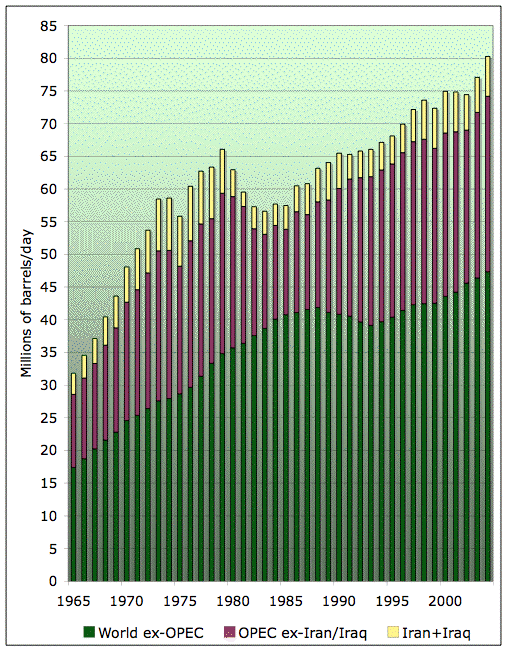
I'd like to take a more careful look at exactly what kind of oil weapon President Ahmadinejad is packing. In particular, let's go over the seventies oil shocks and use them to fashion a rough guesstimate of the likely impact of a cutoff in Iranian oil supplies now.
To give you the punchline up front, I'm going to argue that, with large (50%) uncertainties, a complete loss of Iranian production for an extended period might be expected to roughly double oil prices and cause massive economic impacts, while a halving of oil production due to sanctions, or retaliation to sanctions, might be expected to produce a 30-40% increase in price and significant economic impacts. If Iran is left alone, prices are quite likely to drift up somewhat anyway, but not by this much.
To help you get an overall feel for the history, the graph at right shows world oil production broken out into non-OPEC, OPEC excluding Iraq and Iran, and Iraq and Iran together (the last two having been big factors in many of the oil supply problems in recent decades). The graph runs from 1965 through 2004. The source of the data is the BP Statistical Review of World Energy. You can click the picture to get a more readable version in a separate window.
- The Arab Oil Embargo, which started on October 17th 1973, and ran through March 17th 1974.
- The effects of the Iranian revolution of 1979, and the Iraq-Iran war which began in September 1980. Sometimes these are viewed as separate oil shocks, but the effects are hard to disentangle.
- The Gulf War which began with the Iraqi invasion of Kuwait in August 1990.
Let's now focus in for a moment on the oil production of Iraq and Iran specifically:
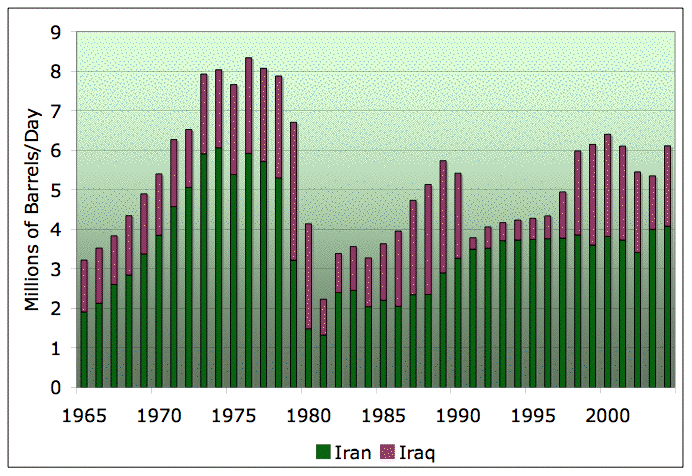
Annual oil production from Iraq and Iran 1965-2004. Source: BP Statistical Review of World Energy. Click to enlarge.
You can see that during 1974, while Iraq reduced production in line with their Arab brethren, Iran, under the Shah, kept right on growing production. In 1979, with the revolution, Iranian production starts to drop, but is partially offset by increased Iraqi production. However, in 1980 both have dropped to about half the 1978 level, and by 1981 we are down to a little over two million barrels/day between the two parties to the conflict - versus around 8 million barrels/day in the years 1973-1978. Production has never reached that peak level again. Iranian production slowly recovered through the eighties and early nineties to reach a level of about four million barrels/day in recent years. Iraqi production also increased during the eighties, but then fell to very little following the Gulf War. With the advent of the Oil for Food program in 1996, Iraqi production began to increase, until the most recent war began in 2003.
It's worth taking a closer look at that as a case study on the effects of an invasion/insurgency on oil production:
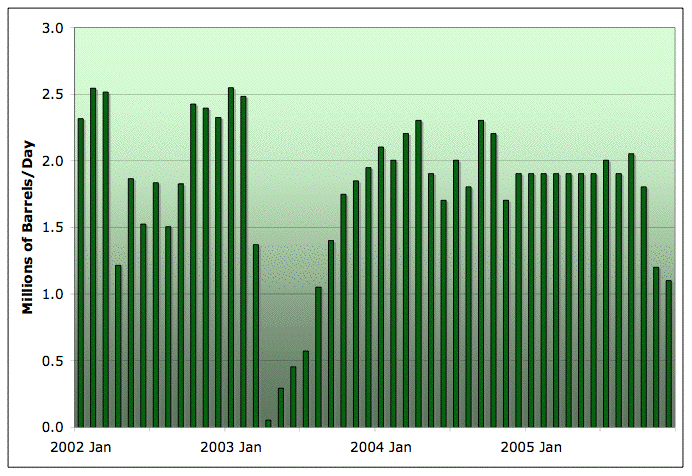
Monthly oil production by Iraq since January 2002. The US/British invasion began on March 20th, 2003. Source: Energy Information Agency. November and December 2005 are estimates from news reports. Click to enlarge.
As you can see, production takes a dive with the March invasion and reached a nadir of almost nothing in April. From there, it slowly comes back over the course of the next six-ninth months, and then is choppy since. It has never reached the January 2003 level again, and was particularly bad at the end of 2005. This is despite the fact that Iraq has enormous undeveloped reserves, which the country has never brought into production due to onoing political instability. Clearly the recent invasion has not improved that situation, but rather made it worse, at least on the evidence to date.
We now turn to looking at the effects of the oil shocks on price. The next figure shows average annual price of light sweet crude over time in 2004 $US (note that prices on any given day can differ quite a bit up or down from the average price over the year).
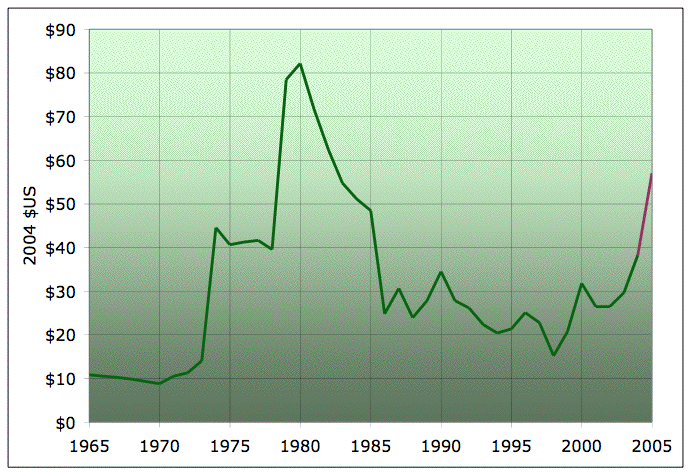
Average price for light sweet crude during each year 1965-2004. Expressed in 2004 US dollars. Source: BP Statistical Review of World Energy. Click to enlarge.
As you can see, the shocks had a dramatic effect. The 73-74 shock caused prices to roughly quadruple from $10 to $40, where it then stayed. In 1979, prices doubled again. What we now need to do is get a more quantitative sense of how much production changed in order to produce those price changes. That should help us to estimate how bad an Iranian oil shock would be now.
Economists like to look at the relationship of price to the quantity demanded through the lens of a concept called the elasticity. The idea is that if the price changes by X%, and then we find people using Y% less, then the elasticity is -Y/X. The minus sign captures the inverse relationship - when price goes up - a positive change in price - we use less, a negative change in quantity. For very essential commodities such as oil, the elasticity is very small (it takes a lot of X to get a small amount of Y, so the ratio Y/X is small). Inessential or easily substitutable goods can have a much larger elasticity.
In general, the idea that there is a fixed number, the elasticity, that controls the response of price and quantity should only be viewed as a very rough approximation. One thing that makes it better however, is to take account of the fact that oil usage tends to respond to changes in the size of the economy much more strongly than changes in the price (in econo-speak, the income elasticity is much larger than the price elasticity). So it makes more sense to look at how much the quantity used changed in response to price, relative to how much it would have changed otherwise. To do this, the next graph is helpful. It shows the percentage change from one year to the next in how much oil is used worldwide (ie the percentage changes in the production graph up top).
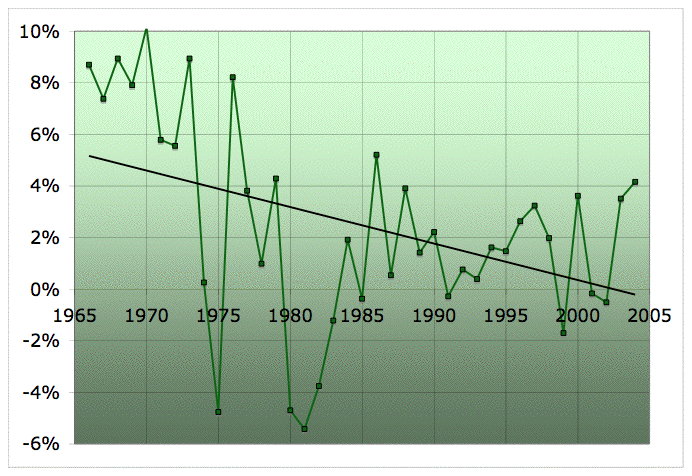
Year-on-year percentage change in global oil production. Source: BP Statistical Review of World Energy. Click to enlarge.
As you can see, in the late sixties and early seventies, oil production grew at roughly 8% a year (give or take a percentage point). So when the shock hit (it shows up in the 1974 point, which has a 0% growth over 1973) it causes about an 8% reduction relative to that expected. So, a 300% change in price is associated with an 8% change in production. -8/300 = -0.027 - let's call it -0.03. That's pretty inelastic, all right. However, these shocks seem to cause long-lasting changes in the growth of supply and demand. In the late seventies, production growth was only running at 4% give or take. So when in 1980, it takes a dive to -4%, that is also an 8% change. However, this was associated with only a 100% change in price: -8/100 = -0.08. You can see this elasticity concept is a bit fuzzy as different shocks give different answers.
After that, there again seems to be a fairly permanent change in the nature of oil demand. It runs negative for several years (as major efforts were made to make the economy more oil efficient). And when it does start growing again in the late 1980s, it now only runs around 2% a year growth. So when the 1990 invasion of Kuwait comes, it only causes a 2% change in production (from 2% growth to zero). So that's elasticity of -2/15 or -0.13.
So which is it -0.03, -0.08, or -0.13? Part of the pattern seems to be that the more severe the shock, the more inelastic demand appears to be in response. People are somewhat able to make modest changes in their oil usage, but find it very difficult to make sudden radical changes. It may also be that the absolute price matters as well as the relative change - when prices are lower, it takes a larger relative change to get a response. (As an aside, the straight line in the growth rate graph is a fit to the data, and the fact that it has just crossed the x-axis - zero percent growth - is one of the pieces of evidence for a near-term peaking in oil production).
Now in recent years, oil production growth has been volatile with economic swings, but the trend over the last decade is running at around 3% annually. However, in 2005, we seem to have started to run into significant difficulty expanding production much further (which has pushed prices up). Forecasts vary from people who think 2006 is unlikely to grow any over 2005 (near-term peak) to more optimistic forecasts of 2% growth or so. Let's take an intermediate case, and assume that the rest of production grows by 1% (about 0.8mbpd), and then consider Iranian possibilities in the background of that.
A harsh scenario is that Iranian production ceases altogether for an extended period of time, as war rages, let's say. That's a loss of about 5% of world oil production (at the 2004 rate of 4mbpd or so). Thus world production would be dropping by 4% (allowing for 1% growth in the other 95% of production), when the recent trend has been for around 3% relative growth. Thus the combination of complete loss of Iranian oil production on top of an already stressed supply situation would represent about a 7% supply change compared to the recent trend. That's comparable to the 8% shocks in 1973-74 and 1979-80. That might be expected to roughly double oil prices from their current level There's a large uncertainty associated with the uncertain elasticity, but my guess is that the 1979-1980 oil shock represents the best model for the situation in that it came on already heightened prices.
A milder scenario might involve a deliberate reduction in oil exports by Iran as retaliation for sanctions. A halving of their production would represent about a 5% oil shock relative to trend. That might give somewhere in the region of a 30-40% increase in oil prices. No doubt enough to make significant economic trouble for the world.
All of these estimates should be viewed as 50% uncertain, given the variation in response to past oil shocks, and our lack of knowledge of how today's economy might respond differently than the rather different world economy of the seventies and early eighties.
Finally, if the US were to attack Iran, there is some possibility of a supershock. Since Iran has considerable influence over Shiite factions in Iraq, and also can attack tankers from Saudia Arabia and Kuwait in the Gulf, there is an outside possibility of a very large - more like 10-15% -- oil shock as exports from all around the Gulf were affected. That would be an economic disaster.
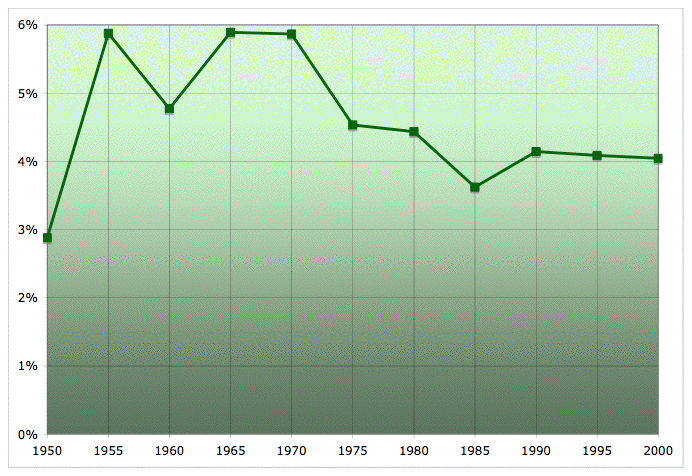
Indeed an argument can be made that the long-term effects that the oil shocks appear to have in reducing growth in oil production and consumption also translate into an effect in reducing economic growth generally. This next diptych shows the same oil production growth 1965-2004 graph we showed before (at left). But it also shows world GDP growth for the second half of the last century on the right. It's surprisingly hard to obtain a long annual sequence for world GDP, but Brad deLong cites the numbers every five years from 1950-2000. From that I constructed average growth rates over each five year span, which is plotted at the end of the span.
|
|
|
Left panel. Year-on-year percentage change in global oil production 1965-2004. Source: BP Statistical Review of World Energy. Click to enlarge. Right panel - world annual GDP growth 1950-2000 averaged over five year intervals. Source: Brad deLong. Click to enlarge.
As you can see, in the happy years of the 1950s-1960s, economic growth was very high - running around 5-6%. For the period containing the first oil shock, it drops to only around 4.5%, and then drops again to a little over 3.5% following the second oil shock. Since then, it has recovered but only to about 4% annually, where it has been since.
Now whether the correlation in the way these growth rates evolve is indicative of causation is not certain. However, the possibility should certainly be considered when we start to consider doing things that might affect Iranian oil supply.
Contact
- Content: editors at theoildrum dot com
- Tech support: support at theoildrum dot com
License

This work is licensed under a Creative Commons Attribution-Share Alike 3.0 United States License.
should we not focus on Iranian oil exports, vs total Iranian production, in an estimate of the effect on the world economy?
Iran is using a significant portion of its production for domestic use (something on the order of 35-40%).
The same cynic might regard a deindustrialization of Iran by way of Western aerial bombardment and subsequent seizure of the oil-rich regions (which are concentrated in Khuzestan bordering on Iraq) as a valid policy goal in its own right, as it would keep those Iranians from burning their own oil.
a) our Western leaders heed the advice about stopping the digging when you´re already in a hole, and
b) Allah does a quick trick to replace Mr. Ahmadinejad with a less doom-driven personality.
It´s one of history´s nice ironies that the first non-clerical president of Iran would also seem to be the first outright messianic apocalyptic among them - which severely perturbs calculations of mutually assured destruction that would have wokred quite well with the Rafsanjani kleptocracy.
Ultimately, it's probably our own president who set this in motion...by invading Iraq.
Iran knows they're safe. We're tied down in Iraq, and we know Iran could throw the entire region into turmoil, just by sending some Shi'a militia units to "defend" their brethren in Iraq. Indeed, Iran has threatened to do just that, if we attack them. They know it would ignite a civil war.
In this situation the role of Ahmadinejad cannot be underestmated. Just imagine where we would be now, if instead of saying that israel should vanish/be relocated, he had said something like the political confrontation with Israel is a result of historic injustices which need to be resolved so that the rights of Palestinians are respected. In this case, everybody would be happy with diplomacy and there would be great pressure on Israeli and US hawks to do nothing until there is proof of a real nuclear threat. Instead due to Ahmadinejad as a catalyst we are in a situation reapidly accelerating into uncontrollable conflict.
And if Ahmadinejad is indeed not in conflict at all with other groups, but instead only expresses what a homogenous power structure wants, why all the problems within the regime (e.g. the oil minister, scuffles with ayatollahs, etc). The Iranian regime doesn´t look like a homogenous power structure to me (but can be forged into one by an external threat and a martyric mission, like it was in ´80-88 - the gory glory days which Ahmadinejad wants to revive) and I have the impression that there were some conservatives who wanted to get rid of the reformist movement by bringing in someone to "clean up" the Islamic Republic from such degenerate influences. The classic mistake, like Hindenburg appointing Hitler in 1933. Ahmadinejad got is out of control, and is now endangering the very existence of their republic and nation.
No matter who was elected, we would have reached this point. One, Iran really does want nuclear energy. They have struggled to meet their OPEC quota for awhile now, and are painfully aware that their oil will not last forever. They want to prepare for the future (not to mention sell as much oil and gas as possible to the west). Two, we are trapped by the tar-baby of Iraq, and everyone, including Iran, knows it. This has emboldened Iran immensely. Indeed, I expect it will embolden banana republics all over the world. They know we can't start anything. Or if we do start anything, we can't finish it. We have too much on our plate already.
Also when it comes to whether Ahmadinejad is an extremist or not by Iranian standards I remember that many Iranians were quite shocked both by his taking first place in the first round and then winning the run off. Most it seemed expected that Rafsanjani would win as the 'lesser evil' and 'devil we know' choice. And that it cannot be ruled out that the ballots were somewhat stuffed by coordinated Bassij operations etc.
To participate in successful negotiations, I think you have to be able to place some small amount of trust that your adversary will follow through with the resulting agreements and be able to place yourself in your adversary's chair to fully understand what his/her idea is of reaching a successful conclusion. If they think you are out to destroy them, any attempt at negotiation is more likely to be only an information gathering exercise. This is why I believe there have been no fruitful results with negotiations canceled in frustration by all parties.
So what is their perspective? Example: If Bermuda was responsible for blowing up Twin Towers and the Talaban were stockpiling stolen dirty bombs there now, wouldn't you be highly suspicious of Bermuda's intentions today and saying that, "We are keeping all options open? If Mexico was responsible for 8 years of war and killing I don't know how many millions of Americans with chemical weapons, If.... I think you would be saying "Yes Mr. President. We will blow them off the face of the earth as soon as you say the word." Just because Mr President mentions "Israel", everybody's outraged. Well, that's only because the rest of the world is still on such a (well deserved) guilt trip about their previous treatment of Jews that they are (naturally) very sensitive about it to this day, as well they should.
Well, It seems to me that Iran has "stumbled" onto the ultimate Non-Nuclear Counterbalance. No easy trick. Maybe they should be given some credit for that.
We didn't learn much as to what Iran needs to be able to arrive at a successful conclusion to those negotiations, but let's postulate for a second as to what the major issues of interest to Iran might be. Do you suppose that it might be something like this,
#1 "It must be guaranteed that in order for us (Iran) not to continue to develop nukes, Israel must be stripped of nuclear weapons and subjected to full UN verification inspections, just as we accept now."
#2 "The US must vacate Iraq and remove its Naval Base in Qatar. You can keep operating from Diego Garcia.
What's wrong with those? Do they present real problems for America, or is removing the Naval Base going over the top? Why? Is that too high a price to pay for a future without nukes in a highly dangerous area? Or, do you lose too much face if you have to vacate Iraq or remove a Naval Base to guarantee stability in the most important oil production area of the world? Is it a problem for the EU? What's your opinion of my hypothetical Irani conditions? What do you think the real conditions would be? Would they be acceptable to you, if you were the President of the United States? Why? Why not? I'd like to know your opinion and your proposed solution, if it doesn't involve blowing them back to the Stone Age. Your solution is very highly likely to be more viable than anything Condi can come up with. Help her out here. I don't think the Pipsqueek has thought it through.
When did Israel attack Iran?
http://www.israelnewsagency.com/iranisraelmissilesnuclear8730918.html
In 1981, Israel attacked a Baghdad nuclear reactor. Israel combat jets bombed a French-built nuclear plant near Iraq's capital, saying they believed it was designed to make nuclear weapons to destroy Israel. It was the world's first air strike against a nuclear plant.
So.. Given Israel's behaviorial history and considering the latest threats against Israel coming out of Iran, can you think of a any reason why Israel would attack Iraq, but they would not attack Iran?
Continuing... don't forget it was the US that made the first nuclear attack on any country, which many today believe was totally unjustified under the true circumstances that existed at the time (Germany had already capitulated and Japan's had no remaining mil-ind capacity to speak of) and the motive was simple revenge for Pearl Harbor. Wheather that was the actual motive or not is immaterial. Image and and the resulting emotional response does not foster a detailed investigation into the justification for previous actions. The lasting association is simply who did what to whom.
http://www.amazon.com/exec/obidos/tg/detail/-/0743261127?v=glance
Evidence: In addition to the sunk sub, a massive secret recovery operation, and tales of oil slicks and radiation, satellite photos showed burning missile fuel--the missile blew up in the tube on the surface.
Speculation: The KGB wanted to frame China; the warhead used Chinese fissionable material, and China had a Kilo-class sub, and the Soviet sub sank within the Chinese sub's missile range of Pearl Harbor--significantly closer than the Soviet equipment would have needed to get.
Relevance: If this is right, then it illustrates another failure mode in the nuclear standoff; shows that we came closer to nuclear devastation than we thought; shows that nukes just aren't as safe to have around as we might have hoped; shows that things can go to hell quickly and randomly.
Sleep tight.
Chris
You raise some valid points but there are also some things I have to disagree with. You complain of a double standard, comparing the outrage caused by a call for "destroying the Taliban" (none) and Ahmadinejad´s call to remove/relocate Israel (a lot).
Well, the Taliban were basically a movement , whose members joined voluntarily, that took over a state. The call was never to wipe out the people of Afghanistan, or to wipe out all people in Afghanistan who shared the Taliban´s dominant ethnicity (Pashtun) or their religion. The call was to destroy the Taliban government and the Taliban movement.
Ahmadinejad´s comments were however not directed against a movement, they were directed against an entire people. and the existence of their nation. You could now argue that Israel is simply a piece of land that has been hijacked by a radical political movement (Zionism), like Afghanistan was hijacked by the Taliban. There remain however still much more important differences, like the fact that Israel has long since become a people, and that their nation, at least in certain borders, is fully recognized by the international community.
How do you gain moral or legal justification for political action by governments? Does the justification derive from God, then you will have religious wars of all factions. As long as the justification comes from within the world itself, it does in fact come from the majority, not of people, but their representations. It´s called the United Nations and International Law, and while it may be very imperfect and often insufficient there is nothing better around. And in sight of international law and the UN, the Taliban were not recognized as the government of Afghanistan, and they were taken into responsibility for their actions. On the other hand Israel is recognized as a nation with a right to exist (the matter of Israel breaking many aspects of international law is another matter but does not negate their right as a nation to exist).
Possibly more importantly we saw how much the afghans really wanted to be governed by the Taliban, didn´t we; I don´t think the Israelis have a desire to jump into the sea that is comparable in strength to the desire Afghans had to shave their beards after Nov.12,2001.
Israel and Iran have to my memory never met on the battlefield. (In fact Iran clandestinely procured arms from Israel in the 1980s!) Iraq, the US, Britain, and the USSR all are responsible for aggressions, terrorism, or intervention against Iran. However, Iran is also responsible for plenty of its own turmoil! But Israel?
What is it with the fixation on Israel? Think of Egypt and Jordan, they have fought multiple wars with Israel, are they still calling for Israel´s annihilation; no, they have signed for peace. For Iran, Isreal is really a foreign country, where perhaps certain foreigners are oppressing certain other foreigners. The situation in Israel infringes on Iran no more than apartheid in South Africa did. The questions of Jews in Palestine yada yada El Kuds bla bla is irrelevant. If Iran feels threatened by Israeli nukes, that is another matter. But Ahmadinejad has not called for an end to Israel´s nukes, he has called for an end to Israelis.
Your point regarding the prerequisites for true negotiation is well taken. The approach of the US is that they will act against Iran if they do not give up their nuclear energy program, however if Iran does agree to give up the program, it appears guaranteed that the US will claim that the program is continued in secret anyway, and attack just the same (see Iraq), and even absent the nuclear issue the US have dedicated themselves to destabilize and regime-change Iran and take over their country. And any program that would allow verification to the standards that the US is willing to accept would mean posting US personnel all over the country, aka giving up to occupation without a fight, as the US will never accept a verification by the UN (again, see Iraq).
So indeed there is nothing to negotiate as long as this position is held, and that is why I assume the Iranians have come to the conclusion that a US/Israeli attack is inevitable anyhow; Ahmadinejad´s goal seems to be to rekindle the flames of early revolutinary hysteria and circle the wagons. He doesn´t mind feeding the flames.
The problem is, that even if we assume the EU and US come to the conclusion that there is no real threat, we cannot realistically expect Israel to ignore the situation. The Jews have learned two lessons the hard way, 1) do not be patient, obedient and rely on others to help you in your hour of need; 2) if someone says he wants to kill you, believe him.
Your hypothetical conditions would in my eyes be totally acceptable, if we add to them, 1) a guarantee that Iran will respect the rights of Iraqis to come to their own decision about their future (if they WANT an Islamic republic, so be it), 2) a reasonable solution to the 'terrorist support' issue (easy, actually), 3) guarantuees to freedom of shipping in the Strait of Hormuz so Iran doesn´t abuse its position by threatening with closing shipping for every little thing it wants. But of course this is all parallel-universe stuff.
If I were president of the United States, ha ha - well if I suddenly got remote-control of Bush´s brain I would still have the problem that the situation has developed to a point were it is very close to getting out of control - and this is one thing that Ahmadinejad does have a lot of responsibility for. If he had continued playing a different hand he would still have full support of Russia and goodwill of Europe, due to his statements he has lost this. However if a different strategy could have been followed, well I would start by thinking about the following things.
I presume you've also been through first grade, or bot school, so you will also know what is basically right and wrong and acceptable or unacceptable. I don't need a code of anybody's laws to tell me what is right and wrong. When you write down the "laws" all you're really doing is defining the loopholes for some wise guy to get away with murder. And, as we've seen many times, if a certain power doesn't like the existing law, he/she/it/they will change the law to suit them, or failing that, simply disregard them entirely if they think they do not need to be held accountable to the law. You seem to imply that the Taliban were not an officially recognized, person, place, thing, organisation or government, therefore you can overthrow them or vaporize them as you chose. Extending that analogy, are you saying that, if I don't have a valid passport or driver's license at this moment, or for some other reason, I am not an officially recognized human being, you're free to kill me? Man! That's like Jihad, something else I don't understand; a "law" that says (from what I do understand about that) it's alright to kill me if I'm not a Muslim, as long as it was properly sanctioned by meeting some kind of religious conditions. See, there's all kinds of "laws". You say that's making some irrelevant comparison between apples and oranges and you have nothing like that written down in your government's "codes". What about the draft back in Viet Nam days? Closest thing I can think of to Jihad. I would have had to go there and kill people, just because the US law said the conditions were present and I had no other viable choice. What did any Vietnamese ever do to anybody within 5000 miles of the United States borders? What does clear and present danger mean? See... loopholes all over the place.
I think my "fixation" on Israel has something to do with their strategic location and them being the most powerfull recognised adversary of Iran and just about everyone else in the area at one time or another who also happen to have a widely recognised nuclear capability. Something to which perhaps Iran would like to provide some conterbalance. Given the US history with building nukes to counterbalance the SU for most of the last 60 years, do you claim that would be an unnatural desire? I don't think I tried to justify Iran's call to oblitherate Israel. I think I was examplifying their natural desire to have parity with their neighbours.
How can you say that the Israel problem is irrelevant when every mideast country I know of and the US government among others has agreed that the resolution of the Israel-Palestine issue is paramount to a "Long and Lasting Peace in the Area"? Although later down, you seem to me to be agreeing that it is not irrelevant. Confussed me.
I don't see anywhere else where we have any unresolved issues and found the rest quite good reading, except I don't think the Pipsqueek's brain even functions on remote control (we'll have to ask Cheney how he does it. I think its cue cards), but seriously .. dead on. The US needs to stop showing so much (bloated) face in order to avoid losing it and getting their political ass kicked in the process.
I have only to add a couple of items,
1.) That the nuclear kitty is out of the bag and we all need to learn to deal with it sooner or later. If we don't resolve this issue with Iran, it will resurface sooner or later, probably sooner. Direct confrontation is definately not the way to go about this. Do you suppose the US can bluff them into a rerun of the old "Star Wars" Antimissile System Development Program and bankrupt them out of existance? Looking at the current account balances of each country, that doesn't look like a promising solution, but then again, cheap credit may be available to finance a system like that. Hopefully it will be "Open License Technology". Oh I suppose you just giving them to everyone now would work too... little difference... in the long run we'll (effectively) get to the same point on the curve, if we're not their now.
2.) Even if Star Wars goes to production, the threat of terrorism could go on unabated. I for one don't like the errosion of civil liberties, and I think the costs of looking under everyone's beds is getting way too far out of hand for the methods used today of combatting that threat. Even in GB, where there must be the highest number of CATV installations per capita than anywhere else on the planet, they still got to the tubes. Sure, those guys were identified by their pictures, but the CATVs didn't stop anything from happening. Is it possible that simple probability of one getting through and the cost of maximizing survailence and interception before the fact actually prohibits an effective implemantation of antiterror measures? Is this the ulitmate counterbalance to everything?
Well, anyone who has read my stuff here knows I'm not the least bit cynical--though I do think that Algeria is a land of opportunity.
We can only look at history (as you have meticulously done Stuart) to give us a clue of the impact. But in 1979, we had a huge natural gas inventory to fall back on (plus nuclear, hydro etc). Now our 'fuel-switching' is biomass and coal, both viable but with limits, as well as capital and time constraints.
In my opinion, Irans production totally offline in todays world is not only a price spike but a disaster.
This is interesting because after the Venezuelan political unrest in 2002/2003, their production has never reached former levels.
However, the geopolitical effects of an attack on Iran would be severe. I've thought for a long time that Iran is to World War III as Poland was to World War II.
Guess who is playing the role of the Germans this time?
This morning, a Fox News talking head introduced a segment on Iran with the following lead, "When will the time for talk be over and when will it be time for action?"
Now, I would have never thought that way. It's a brilliant point you've made Stuart.
This explains very well why the rise of prices since mid 2004 haven't made more havoc than we'd probably expect. Smaller increases allow people to acomodate more easely.
Well, as for Iran it really is a difficult case. I can't see any other way to the West than diplomocy. A diferent course of action will be worse to us than them.
And of course, I believe Iran to be a respectfull country like any other. They've signed the Non-Proliferation treaty, why should we distrust them?
The four top net exporters are: Saudi Arabia; Russia; Norway and Iran. Three of the four are at or beyond the 50% of Qt mark (I haven't seen a P/Q versus Q plot for Russia).
Iranians will be unable to afford oil as peak oil hits. All their oil will be exported, and they will rely upon Nuclear for internal energy use. Iranian economy is not highly automobile dependent. Thus Rail and electric power can suffice for a large proportion of their energy use.
How much power is Iran currently producing using nuclear? How many facilities are planned? Given the duration of Iran's interest, their capital resources, and the availablity of nuclear technology, why aren't they generating now?
At least the argument that Iran eeds weapons to protect themselves makes some sense. Claiming that pursuit of nuclear power generation is ther motive appears to be willful blindness.
As for the natural gas potential, I believe that some of it is being used support some fields in decline as well as power their expanding economy. With an expanding economy, and planned exports to India, China and Pakistan, I wonder if immense gas reserves may already be spoken for.
Iran has only so much hydro power in the Zagros mountains, and supplying its economy will either consume its own oil and gas or they must go nuclear (or wind, or solar if possible, but doubt). Iran is not a small country, with a small population.
The case for nuclear was set with the US lead invasion of Iraq -- no nukes -- get wiped out. North Korea's Kim Il Jong must feel very smug right now.
I acknowledged that this is a reasonable argument. I said it was unrealistic to pretend that there is no weapons component to Iran's nuclear program, or that it is a secondary consideration.
I don't buy the ideas that Iran has sold all of their gas and are now cash rich and energy poor. I do not see any scenario in which it makes sense for China to generate electricity from gas, but doesn't make sense for Iran. Gas plants have a low capital cost and given local resources is a very viable solution to the countries energy needs.
If someone can present a case for why it would make sense to think that Iran is selling gas for others to use to generate electricity, but can't do so themselves, I'll listen.
Comparative advantage in developing nuclear power must come in part through access to inexpensive capital. Gas versus nuclear is certainly a real debate in some countries, but face facts: Iran's nuclear ambitions involve bombs, not power plants.
-Get yourself the numbers for the development of Iranian oil/gas production and their trends
-Get yourself the numbers for Iranian economic growth, energy consumption, population growth rates
-Project them into the future and llok for the intersection...
-Now consider that Iran needs jobs for its huge population of young people or must descend into poverty. Those jobs need to come from industrialization, which needs lots hard currency, as they cannot bootstrap their entire industrialization. that hard currency right now is coming from energy exports. So it does not seem unwise for Iran to invest heavily once into developing a major nuclear infrastructure and profit for many decades (nuclear plant running time, 50 years or so) by selling off a much higher part of the fossil fuels instead of buring them. Iran is still creating even electricity in significant amounts from oil.
You cannot make a comparison of China and Iran. China´s economy is living off exports of manufactured goods to other Asian nations and the West. It is not living off the sale of raw materials - instead it depends on their import. Iran is in the position of wanting to develop an economy that might make money by export of manufactured goods but is right now still living mostly living off resource exports. The goal for Iran is to extend the life of their valuable resource until their economy is transformed. People all over the world will continue to buy oil/gas from them, but if they burn all their oil/gas for electricity, will Japan or EU buy electricity off them? Hardly. So it is wise for Iran to create its electricity and internal energy consumption from something other than exportable fossil fuel, and sell as much of those as possible.
Iran extracts oil/gas fro its. It uses this for two things
a) domestic - transport + electricity
b) export to EU, China, Japan etc.
If it replaces its domestic electricity generation with nuclear energy, it saves oil+gas which it can now export. That is what Japan, China and EU are buying from Iran: Oil, gas. Iran gains export revenues from this.
If it increasingly uses up its oil/gas for domestic electricity generation because "it doesn´t need nuclear" - nobody imports electricity from Iran. So, no export revenue.
Nowhere did I suggest that anyone imports electricity from Iran. My argument is that the statement "Iran doesn´t have any motivation for civilian nuclear energy use because they have oil and gas" is wrong; they have a very strong motivation for it.
You said it, so I'm assuming you suggested it.
If I say it is "hardly likely" that Japan or EU will buy electricity from them then what I mean it the likelihood is LOW. (because there is no way to do it anyway)
So, to restate clearly: No-one is buying electricity from them, and no one will, and I never suggested this is happening, or could happen. What I did suggest is that it is extremely unlikey this would ever happen.
A person called Jack said the following
"I do not see any scenario in which it makes sense for China to generate electricity from gas, but doesn't make sense for Iran. "
and
"but face facts: Iran's nuclear ambitions involve bombs, not power plants. "
I argued against these statements of Jack saying, that converting its fossil fuels to electricity is not the best path for Iran. And that therefore a primary energy motivation is an acceptable notion.
Here I said "but if they burn all their oil/gas for electricity, will Japan or EU buy electricity off them? Hardly."
IF states that this is not happening now.
WILL states that this would have to be somehting in the future.
'HARDLY' denotes that this Not-happening What-if scenario for the future is unlikely. Since it is IN AN ALTERNATIVE REALITY FUTURE I cannot claim full knowledge but my guess is that even in this alternative future such an event could not happen. Although my personal conviction is that it is 100% impossible.
And then you, Mr. Oil CEO jump in and berate me for allegedly claiming that this Not-happening Alternative-Reality What-if scenarion were the truth! What is your problem? I would suggest, just drop it.
And if it is my language problem, I have no problem with that. Since after all, I did suggest that it was my language problem.
But then, I recognize here the pattern, you argue about that which is not there, but ignore that which is there?
I'm not saying you were wrong to be confused, but I am saying that he was not wrong to write his argument the way he did, and I think you have no call to badger him to admit he was wrong.
Chris
To be accurate, yuor quote would have to read
"If Iran were to use ALL OF THEIR GAS to generate electricity, they would be left without an exportable commodity."
I don't think domestic demand would put that much of a crimp on overall supply or significantly reduce exports. Iran has one of the world's largest gas reserves and not a huge amount of power demand.
Further, the income gains from would be less than the cost involved in generating electricity from other fuel sources.
I am staying far clear of the earlier skirmish, but don't think it is at all clear that it makes sense for Iran to treat gas as strictly for export. I have explained my thinking in more detail in other posts.
Iran could develop its gas sector more fully - but that wuld probably require an end to US sanctions and access to World Bank funds to develop the pipeline infrastructure.
Have you see the little quote that rotates in the upper right corner? "My father rode a camel. I drive a car. My son flies a jet-plane. His son will ride a camel." The oil-producing countries of the Middle East are very aware of depletion. Iran has made a conscious decision to husband their petroleum, so that future generations will have something to sell. They are thinking about the future in a way we never do.
If you don't have coal and you have quite a lot of uranium the nuclear option is the only one and left (if you leave wind in the environmetal dream world where it belongs).
I can not escape the feeling that your opinion is predetermined maybe by some "Axes of evil" talk. Like it or not countries that have not a ouchy-gouchy goverments like ours have long understood that nuclear is the only alternative to fossil fuels in the medium to the long term to come.
Agreed. Iran's oil ministry has openly talked about peak oil for awhile now. They know they are looking at becoming an oil-importing country in a few years if the trendlines continue.
I'm just trying to bring the conversation around to facts. I have said several times, that I disagree with your assertions and that I would like to see evidence so that we can discuss, learn and maybe even meet in the middle.
It seems bizzare to me to claim that it is uneconomical for Iran to use gas to generate power, but it makes sense to convert it into LNG, ship it around the world and gain export revenues from others that use it. Your link seems to prove my point. It is too expensive to build power plans where it needs to be shipped in as LNG.
However, Iran is sitting on a lot of gas. My impression is that it is not going to run out in the medium term (defined by the operating lifetime, or cost recovery cycle of a gas fired plant). You appear to disagree on this point. If you have data that shows I am wrong - and maybe you do - I will admit it. I think that would be win-win. I'm here to learn, not score debating points.
Natural gas plants are also fairly low technology and and have lower capital costs than nuclear - an additional asset for countries that have limited access to capital. Finally, many other countries do plan to develop nuclear power, however there are much easier ways to do it than the approach the Iranians have taken. The costs of capital for a capital constrained economy added to the burdens of sanctions make nuclear a losing proposition for Iran compared to using their own gas.
So you can keep on throwing out stuff like "countries that have not a ouchy-gouchy goverments like ours have long understood that nuclear is the only alternative to fossil fuels in the medium to the long term to come." But face facts - this is a discussion board. I'm allowed to discuss it.
The original point that gas-fired power is cheaper and better for Iran seems so obvious to me that I have also doubted your partiality and motives. However, I chose to try to focus on facts. I suggest you do too.
Surely, IF the peak oil thesis is approximately accurate, then the one thing you don't want to do is consume hydrocarbon reserves now. You know they'll (very likely) be worth a great deal more in the relatively near future. You want to do what you can to not burn them now and have more available to use or sell in the future.
The balance to this is you need to power your economy now.
I would not be surprised if Iran's motives for nuclear power include a weapons component, but to argue that Iran could not reasonably seek nuclear power without having a weapons motive seems to me absurd.
If you think the value of hydrocarbons is going to skyrocket in the relatively near future, it makes only simple common sense to seek to preserve them for when they are highly valued, and to ensure you will not be locked in to using them for trivial purposes (read substitutable) when they are so highly valued.
I know some Iranians and IMO they are not a stupid nation at all; they don't want to share the future of Saudi Arabia which is already doomed to face severe problems due to its overexhaustion of resources.
Inside Iran gas is cheap and supply is assured. Outside Iran, it is more expensive (based on how and how far it is shipped), and bears supply risk. Look at Constellation Energy. It is obvious that electricity produced using gas outside of Iran is going to cost more than inside of Iran. I don't see how this can be disputed.
Outside of Iran nuclear is going to be somewhat cheaper. Developed countries have more open capital markets and lower risk premiums on investment. Developing countries have limited access to capital in any case. Sanctions make it worse. Shipping uranium is easier than shipping gas.
At a system level, the lowest cost means of producing electricity in the two places is gas in Iran and nuclear outside. Any deviation from this introduces new costs that are either waste or transportation costs.
If using gas for electricity doesn't make sense in Iran, it can't possibly make sense anywhere else.
Anyway if I were Iranian I'd want this to happen, because there is a clear distinction between countries which are in the nuclear club and those who are not. The world is slowly waking up for the nuclear power and those that are first will be the winners. I can not agree with the double standards here - Iran is sentenced to be an "evil country" and that's why they are refusing it to have what it wants. All others apparently are the good guys because they can get what they want freely. I don't think Iran is like Korea no matter what they say; the anti-Israely talk was mainly to challenge US in their current game. Nobody is going to go to war with anybody (not to mention about nuclear weapons), especially in the presence of US nearby. It seems that only we are that stupid to do that nowadays.
I recognize that Iran is an independent country with a great history and culture. It is not a backwater and can't be preached to. I don't think it is an evil country, or even that its leaders are evil. I understand that it is hypocritical for the US (and others) to say Iran can't have nuclear weapons, but it can. I do think that Iran has a right, equal to that of every other country to pursue peaceful nuclear energy.
However, in addition to the obliterate Israel comments, Iran has been accused of being primary supporter of terrorism in the region and as far Argentina. The current government is totalitarian and their democracy is in part a facade. The range of people permitted to run for election is very small and select.
The US did not encourage, or turn a blind eye towards the development of nuclear weapons in India or Pakistan. In fact the US did sanction both countries (if recall), but what can you do after the fact - especially unilaterally.
The US, much of Europe and even the IAEA seem to be talking from the same sheet. Mohamed ElBaradei even said:
"If [the Iranians] decide to go the confrontation route, everybody will be hurt, there is no question about it. But at the end of the day, in my view, they will hurt more because there is a more united international community."
http://www.msnbc.msn.com/id/10858243/site/newsweek/
I do understand your desire for a fair and equal treatment for Iranians, but think you need to have some sympathy for those of us who legitimately feel the world is a better place without nuclear bombs in Iran.
The US couldn't possibly invade Iran without the pretext of nuclear weapons. So while you can say possession of the bomb would protect Iran from invasion, it is also the only reason I can think of they would be a realistic target for attack at all. The foolish quest for nuclear weapons is condemning millions of Iranians to poverty and dooming the hopes of its people to be treated with the respect they deserve.
PS: I wasn't suggesting that Iran import electricity. I think that they could generate plenty themselves using gas in the short to medium term and nuclear further out (if they wanted). No one would have any problem with Iran developing nuclear power as long as they proved it was for peaceful purposes. Brazil and South Africa did this too.
I guess we have a fundamental difference of views here (always comes to values, huh?:). You'd feel much safer if the world did not have countries like Iran or had them put under some kind of control (like for example tied hands, legs and mouth). I'd feel much safer if we were not provoking countries like Iran who have no other option but counter our rude power with subtle measures. This would potentially result in us seeing the bomb coming... Let's face it - Iran is a weak and poor country, dependant for almost everything on its trade with the Western World. It wouldn't do anything stupid, they know it and just gamble for a better place on the table. Just like all the rest. TI was talking about a lot of possible mutually beneficial deals with US and I think that was the correct path to take. With bluntly demanding that they shut down their program (yeah potentially dual-use, but isn't this part what they hope for us to think?) completely we closed ourselves the doors to that (ever heard US making a compromise?). Well I don't believe in US going delibertely into the "Iranian trap", I am expecting a further move from them and that's what I fear from.
The most idiotic theory I read today is that Iran is planning (nuclear?) attack on USA so that USA retaliates attacking Iran and inflaming a world-wide hate throughout the muslims. Question: what Iran wins from that? Scenic pictures of nuclear mushrooms over Teheran?
A simple need for hard currencies is what drives a lot of government special export programs.
http://adaptationzine.com/content/misdirected
Business News Americas reports that OPEC member Venezuela, in response to rising oil prices and the growing concern over peak oil, has committed to converting the nation to wind power in order to free up more oil for export. Venezuela's state oil company, Petroleos de Venezuela S.A. (PDVSA), plans to boost exports by 100,000 barrels per month through increased domestic use of wind-generated power. The oil will fetch about ten times the price internationally as it would at home, and wind-generated power will be gentler on the country's environment. The first generator facility is tentatively scheduled to be operational in 2007, generating 100 megawatts of electricity, and another facility is in early planning stages.
I would note a few counterpoints:
But there's another problem with the argument about making electricity in Iran being just as good as making it elsewhere. That argument ignores the aspects of time and peak-oil preparedness. Let's look at some of the choices Iran has:
- Buy gas-to-electricity plants today, have enough electricity for a while, not export much gas.
- Buy nuke plants today, have enough electricity for a while, export gas later.
- Buy nuke plants today, have enough electricity, build gas-using infrastructure later.
By your argument, option 2 is pointless, because using the gas outside Iran will be less efficient than using gas inside Iran. Better to build the nuke plant where the gas would have been shipped to.The trouble with this argument, and the advantage Iran has, is that most areas of the world are not going to seriously prepare for peak oil. You think America is going to build that nuke plant? Not likely. Not before gas goes to $5 or $6 a gallon. Then we'll start looking for a site, trying to get permits, etc. America will be hurting for energy for a decade. Look how much gas-fired electricity we have.
Meanwhile, Iran will have the nuke plant already built and running, and plenty of gas to sell to America at a premium, because they looked farther ahead than we did. In this scenario, that gas will be worth far more in America than in Iran, because America was short-sighted. This is certainly true if it's used to make electricity in both places--and it may even be worth more for heating in America than for electricity in Iran, because we have lots of money and no plan B.
Chris
BTW, if Iran has more than enough natural gas to produce the world's supply of fertilizer, then why are we worried about fertilizer being scarce when Peak Oil or Peak Energy hits?
Chris
You appear fixated on the weapons aspect alone. Iran's oil is close to or past peak, according to Ali Morteza Samsam Bakhtiari, senior expert at the Iranian National Oil Company. Further, as we've seen in the US, gas depletes much faster than oil. And further still, the value of the oil and gas as trade to other nations is high right now. This all leads to the same view as in the US - that a long term energy strategy, not one predominated by asinen MBA 90 day bottom line assessments, leans towards nuclear solutions, not petroleum/gas.
So yeah, anyone with eyes to see will agree that Iran almost certainly has nuclear weapons ambitions. The US has ensured that having the nuke is a trump card by how we handled Iraq versus how we handled North Korea. But at the same time, nuclear power remains the better long term choice for many nations, including Iran. Iran doesn't have an existing infrastructure for petroleum consumption like the west does. So why not sell the oil at high markup to the west and build their own infrastructure around nuclear which can last far longer?
There is an excellent case for nuclear power generating capacity for Iran, especially if you look beyond the end of the next quarterly earnings report. Consequently, I fully believe Iran when they say they want nuclear power generating capacity. However, I don't believe them when they say they are not interested in the bomb. The two positions are not mutually exclusive, no matter how much you seem to think they are.
I agree, but I also think that we have a lot more to worry about that just Iran. If a massive and highly destructive attack is made against Iran, and particularly if Israel is directly or indirectly involved, than would it be unreasonable to expect that many of the other oil exporting countries in the Middle East might also impose an oil embargo on the West out of sympathy for their Islamic brothers?
And if that happens, then what?
You mean the Sunni House of Saud? Remember that Iran's IRBMs can reach Riyadh and Cairo. The US is not the most likely nuclear target but the local Islamic brothers. The Sauds were supportive of our removal of Saddam; today they face a similar threat from Iran.
The big problem is not so much Israel as Iran as a regional nuclear power with an unstable theocratic ruling group. They intend to intimidate their "Islamic Brothers"' not lead them.
Comparing the US to Nazi Germany is a complete misreading of history. Even Mussolini thought Hitler and gang were nuts. Listen to the public utterances of Ahmadinejad and tell me he is not trouble with a capital T!
The choices are coming down to capitulation to a nut, regime change, or military action. The second is preferred but the first is the unthinkable option.
The threat to the Saudi's is that Iran represents a popular revolution that overthrough the monarchy. The threat to the West is that Iran represents a popular revolution that overthrough a monarchy, installed a shite theocracy, and might inspire wahhidists and other extreme sunnis to do the same in their countries.
It was the threat of overthrough that resulted in Kuwaitis and Saudis bankrolling Iraq in the first gulf war (Iraq vs Iran)! The West was only too eager to supply the weapons in the 1980s to their ally, Saddam Hussien (paid by petrodollar loans from the Kuwaitis and Saudis to Iraq).
http://opinion.telegraph.co.uk/opinion/main.jhtml?xml=/opinion/2006/01/15/do1502.xml
or also at:
http://tinyurl.com/btbdb
http://www.torontosun.com/News/Columnists/Margolis_Eric/2006/01/14/1394381.html
btw ... fwiw Iran was reported to have received 3 stolen nukes in the 1991 period (CIA report via Time Magazine back int eh mid 90's) and another 6 to 9 in the 1995-98 period so they may already be a "nuclear power".
http://mutters.invisionzone.com/index.php?showtopic=3596&st=0
Keep in mind that Buehler reported on the phone that these guys have nukes.
http://www.prosefights.org/baltimoresun/shanebowman.htm
Gavrilo Princip fired the shot that killed Archduke Ferdinand, triggering World War I, and indirectly World War II. I suppose that the war might have happened anyway, but perhaps not. How might the history of the 20th Century have been different without this assassination?
My thesis is that Gavrilo Princip was to World War I as Ralph Nader is to World War III, in the sense that Nader politically assassinated Al Gore. How might the history of the 21st Century have been different if Gore had been president?
BTW, I suggest that you read Al Gore' speech today, on the Drudge Report. The introduction is as follows:
"(Republican) Congressman Barr and I have disagreed many times over the years, but we have joined together today with thousands of our fellow citizens-Democrats and Republicans alike-to express our shared concern that America's Constitution is in grave danger.
In spite of our differences over ideology and politics, we are in strong agreement that the American values we hold most dear have been placed at serious risk by the unprecedented claims of the Administration to a truly breathtaking expansion of executive power.
As we begin this new year, the Executive Branch of our government has been caught eavesdropping on huge numbers of American citizens and has brazenly declared that it has the unilateral right to continue without regard to the established law enacted by Congress to prevent such abuses.
It is imperative that respect for the rule of law be restored.
So, many of us have come here to Constitution Hall to sound an alarm and call upon our fellow citizens to put aside partisan differences and join with us in demanding that our Constitution be defended and preserved."
'We the People' Must Save Our Constitution
by Al Gore
Constitution Hall, Washington, D.C.
Monday, January 16 2006 12:30 PM
Congressman Barr and I have disagreed many times over the years, but we have joined together today with thousands of our fellow citizens-Democrats and Republicans alike-to express our shared concern that America's Constitution is in grave danger.
In spite of our differences over ideology and politics, we are in strong agreement that the American values we hold most dear have been placed at serious risk by the unprecedented claims of the Administration to a truly breathtaking expansion of executive power.
As we begin this new year, the Executive Branch of our government has been caught eavesdropping on huge numbers of American citizens and has brazenly declared that it has the unilateral right to continue without regard to the established law enacted by Congress to prevent such abuses.
It is imperative that respect for the rule of law be restored.
So, many of us have come here to Constitution Hall to sound an alarm and call upon our fellow citizens to put aside partisan differences and join with us in demanding that our Constitution be defended and preserved.
It is appropriate that we make this appeal on the day our nation has set aside to honor the life and legacy of Dr. Martin Luther King, Jr., who challenged America to breathe new life into our oldest values by extending its promise to all our people.
On this particular Martin Luther King Day, it is especially important to recall that for the last several years of his life, Dr. King was illegally wiretapped-one of hundreds of thousands of Americans whose private communications were intercepted by the U.S. government during this period.
The FBI privately called King the "most dangerous and effective negro leader in the country" and vowed to "take him off his pedestal." The government even attempted to destroy his marriage and blackmail him into committing suicide.
This campaign continued until Dr. King's murder. The discovery that the FBI conducted a long-running and extensive campaign of secret electronic surveillance designed to infiltrate the inner workings of the Southern Christian Leadership Conference, and to learn the most intimate details of Dr. King's life, helped to convince Congress to enact restrictions on wiretapping.
The result was the Foreign Intelligence and Surveillance Act (FISA), which was enacted expressly to ensure that foreign intelligence surveillance would be presented to an impartial judge to verify that there is a sufficient cause for the surveillance. I voted for that law during my first term in Congress and for almost thirty years the system has proven a workable and valued means of according a level of protection for private citizens, while permitting foreign surveillance to continue.
Yet, just one month ago, Americans awoke to the shocking news that in spite of this long settled law, the Executive Branch has been secretly spying on large numbers of Americans for the last four years and eavesdropping on "large volumes of telephone calls, e-mail messages, and other Internet traffic inside the United States." The New York Times reported that the President decided to launch this massive eavesdropping program "without search warrants or any new laws that would permit such domestic intelligence collection."
During the period when this eavesdropping was still secret, the President went out of his way to reassure the American people on more than one occasion that, of course, judicial permission is required for any government spying on American citizens and that, of course, these constitutional safeguards were still in place.
But surprisingly, the President's soothing statements turned out to be false. Moreover, as soon as this massive domestic spying program was uncovered by the press, the President not only confirmed that the story was true, but also declared that he has no intention of bringing these wholesale invasions of privacy to an end.
At present, we still have much to learn about the NSA's domestic surveillance. What we do know about this pervasive wiretapping virtually compels the conclusion that the President of the United States has been breaking the law repeatedly and persistently.
A president who breaks the law is a threat to the very structure of our government. Our Founding Fathers were adamant that they had established a government of laws and not men. Indeed, they recognized that the structure of government they had enshrined in our Constitution - our system of checks and balances - was designed with a central purpose of ensuring that it would govern through the rule of law. As John Adams said: "The executive shall never exercise the legislative and judicial powers, or either of them, to the end that it may be a government of laws and not of men."
An executive who arrogates to himself the power to ignore the legitimate legislative directives of the Congress or to act free of the check of the judiciary becomes the central threat that the Founders sought to nullify in the Constitution - an all-powerful executive too reminiscent of the King from whom they had broken free. In the words of James Madison, "the accumulation of all powers, legislative, executive, and judiciary, in the same hands, whether of one, a few, or many, and whether hereditary, self-appointed, or elective, may justly be pronounced the very definition of tyranny."
Thomas Paine, whose pamphlet, "On Common Sense" ignited the American Revolution, succinctly described America's alternative. Here, he said, we intended to make certain that "the law is king."
Vigilant adherence to the rule of law strengthens our democracy and strengthens America. It ensures that those who govern us operate within our constitutional structure, which means that our democratic institutions play their indispensable role in shaping policy and determining the direction of our nation. It means that the people of this nation ultimately determine its course and not executive officials operating in secret without constraint.
The rule of law makes us stronger by ensuring that decisions will be tested, studied, reviewed and examined through the processes of government that are designed to improve policy. And the knowledge that they will be reviewed prevents over-reaching and checks the accretion of power.
A commitment to openness, truthfulness and accountability also helps our country avoid many serious mistakes. Recently, for example, we learned from recently classified declassified documents that the Gulf of Tonkin Resolution, which authorized the tragic Vietnam war, was actually based on false information. We now know that the decision by Congress to authorize the Iraq War, 38 years later, was also based on false information. America would have been better off knowing the truth and avoiding both of these colossal mistakes in our history. Following the rule of law makes us safer, not more vulnerable.
The President and I agree on one thing. The threat from terrorism is all too real. There is simply no question that we continue to face new challenges in the wake of the attack on September 11th and that we must be ever-vigilant in protecting our citizens from harm.
Where we disagree is that we have to break the law or sacrifice our system of government to protect Americans from terrorism. In fact, doing so makes us weaker and more vulnerable.
Once violated, the rule of law is in danger. Unless stopped, lawlessness grows. The greater the power of the executive grows, the more difficult it becomes for the other branches to perform their constitutional roles. As the executive acts outside its constitutionally prescribed role and is able to control access to information that would expose its actions, it becomes increasingly difficult for the other branches to police it. Once that ability is lost, democracy itself is threatened and we become a government of men and not laws.
The President's men have minced words about America's laws. The Attorney General openly conceded that the "kind of surveillance" we now know they have been conducting requires a court order unless authorized by statute. The Foreign Intelligence Surveillance Act self-evidently does not authorize what the NSA has been doing, and no one inside or outside the Administration claims that it does. Incredibly, the Administration claims instead that the surveillance was implicitly authorized when Congress voted to use force against those who attacked us on September 11th.
This argument just does not hold any water. Without getting into the legal intricacies, it faces a number of embarrassing facts. First, another admission by the Attorney General: he concedes that the Administration knew that the NSA project was prohibited by existing law and that they consulted with some members of Congress about changing the statute. Gonzalez says that they were told this probably would not be possible. So how can they now argue that the Authorization for the Use of Military Force somehow implicitly authorized it all along? Second, when the Authorization was being debated, the Administration did in fact seek to have language inserted in it that would have authorized them to use military force domestically - and the Congress did not agree. Senator Ted Stevens and Representative Jim McGovern, among others, made statements during the Authorization debate clearly restating that that Authorization did not operate domestically.
When President Bush failed to convince Congress to give him all the power he wanted when they passed the AUMF, he secretly assumed that power anyway, as if congressional authorization was a useless bother. But as Justice Frankfurter once wrote: "To find authority so explicitly withheld is not merely to disregard in a particular instance the clear will of Congress. It is to disrespect the whole legislative process and the constitutional division of authority between President and Congress."
This is precisely the "disrespect" for the law that the Supreme Court struck down in the steel seizure case.
It is this same disrespect for America's Constitution which has now brought our republic to the brink of a dangerous breach in the fabric of the Constitution. And the disrespect embodied in these apparent mass violations of the law is part of a larger pattern of seeming indifference to the Constitution that is deeply troubling to millions of Americans in both political parties.
For example, the President has also declared that he has a heretofore unrecognized inherent power to seize and imprison any American citizen that he alone determines to be a threat to our nation, and that, notwithstanding his American citizenship, the person imprisoned has no right to talk with a lawyer-even to argue that the President or his appointees have made a mistake and imprisoned the wrong person.
The President claims that he can imprison American citizens indefinitely for the rest of their lives without an arrest warrant, without notifying them about what charges have been filed against them, and without informing their families that they have been imprisoned.
At the same time, the Executive Branch has claimed a previously unrecognized authority to mistreat prisoners in its custody in ways that plainly constitute torture in a pattern that has now been documented in U.S. facilities located in several countries around the world.
Over 100 of these captives have reportedly died while being tortured by Executive Branch interrogators and many more have been broken and humiliated. In the notorious Abu Ghraib prison, investigators who documented the pattern of torture estimated that more than 90 percent of the victims were innocent of any charges.
This shameful exercise of power overturns a set of principles that our nation has observed since General Washington first enunciated them during our Revolutionary War and has been observed by every president since then - until now. These practices violate the Geneva Conventions and the International Convention Against Torture, not to mention our own laws against torture.
The President has also claimed that he has the authority to kidnap individuals in foreign countries and deliver them for imprisonment and interrogation on our behalf by autocratic regimes in nations that are infamous for the cruelty of their techniques for torture.
Some of our traditional allies have been shocked by these new practices on the part of our nation. The British Ambassador to Uzbekistan - one of those nations with the worst reputations for torture in its prisons - registered a complaint to his home office about the senselessness and cruelty of the new U.S. practice: "This material is useless - we are selling our souls for dross. It is in fact positively harmful."
Can it be true that any president really has such powers under our Constitution? If the answer is "yes" then under the theory by which these acts are committed, are there any acts that can on their face be prohibited? If the President has the inherent authority to eavesdrop, imprison citizens on his own declaration, kidnap and torture, then what can't he do?
The Dean of Yale Law School, Harold Koh, said after analyzing the Executive Branch's claims of these previously unrecognized powers: "If the President has commander-in-chief power to commit torture, he has the power to commit genocide, to sanction slavery, to promote apartheid, to license summary execution."
The fact that our normal safeguards have thus far failed to contain this unprecedented expansion of executive power is deeply troubling. This failure is due in part to the fact that the Executive Branch has followed a determined strategy of obfuscating, delaying, withholding information, appearing to yield but then refusing to do so and dissembling in order to frustrate the efforts of the legislative and judicial branches to restore our constitutional balance.
For example, after appearing to support legislation sponsored by John McCain to stop the continuation of torture, the President declared in the act of signing the bill that he reserved the right not to comply with it.
Similarly, the Executive Branch claimed that it could unilaterally imprison American citizens without giving them access to review by any tribunal. The Supreme Court disagreed, but the President engaged in legal maneuvers designed to prevent the Court from providing meaningful content to the rights of its citizens.
A conservative jurist on the Fourth Circuit Court of Appeals wrote that the Executive Branch's handling of one such case seemed to involve the sudden abandonment of principle "at substantial cost to the government's credibility before the courts."
As a result of its unprecedented claim of new unilateral power, the Executive Branch has now put our constitutional design at grave risk. The stakes for America's representative democracy are far higher than has been generally recognized.
These claims must be rejected and a healthy balance of power restored to our Republic. Otherwise, the fundamental nature of our democracy may well undergo a radical transformation.
For more than two centuries, America's freedoms have been preserved in part by our founders' wise decision to separate the aggregate power of our government into three co-equal branches, each of which serves to check and balance the power of the other two.
On more than a few occasions, the dynamic interaction among all three branches has resulted in collisions and temporary impasses that create what are invariably labeled "constitutional crises." These crises have often been dangerous and uncertain times for our Republic. But in each such case so far, we have found a resolution of the crisis by renewing our common agreement to live under the rule of law.
The principle alternative to democracy throughout history has been the consolidation of virtually all state power in the hands of a single strongman or small group who together exercise that power without the informed consent of the governed.
It was in revolt against just such a regime, after all, that America was founded. When Lincoln declared at the time of our greatest crisis that the ultimate question being decided in the Civil War was "whether that nation, or any nation so conceived, and so dedicated, can long endure," he was not only saving our union but also was recognizing the fact that democracies are rare in history. And when they fail, as did Athens and the Roman Republic upon whose designs our founders drew heavily, what emerges in their place is another strongman regime.
There have of course been other periods of American history when the Executive Branch claimed new powers that were later seen as excessive and mistaken. Our second president, John Adams, passed the infamous Alien and Sedition Acts and sought to silence and imprison critics and political opponents.
When his successor, Thomas Jefferson, eliminated the abuses he said: "[The essential principles of our Government] form the bright constellation which has gone before us and guided our steps through an age of revolution and reformation... [S]hould we wander from them in moments of error or of alarm, let us hasten to retrace our steps and to regain the road which alone leads to peace, liberty and safety."
Our greatest President, Abraham Lincoln, suspended habeas corpus during the Civil War. Some of the worst abuses prior to those of the current administration were committed by President Wilson during and after WWI with the notorious Red Scare and Palmer Raids. The internment of Japanese Americans during WWII marked a low point for the respect of individual rights at the hands of the executive. And, during the Vietnam War, the notorious COINTELPRO program was part and parcel of the abuses experienced by Dr. King and thousands of others.
But in each of these cases, when the conflict and turmoil subsided, the country recovered its equilibrium and absorbed the lessons learned in a recurring cycle of excess and regret.
There are reasons for concern this time around that conditions may be changing and that the cycle may not repeat itself. For one thing, we have for decades been witnessing the slow and steady accumulation of presidential power. In a global environment of nuclear weapons and cold war tensions, Congress and the American people accepted ever enlarging spheres of presidential initiative to conduct intelligence and counter intelligence activities and to allocate our military forces on the global stage. When military force has been used as an instrument of foreign policy or in response to humanitarian demands, it has almost always been as the result of presidential initiative and leadership. As Justice Frankfurter wrote in the Steel Seizure Case, "The accretion of dangerous power does not come in a day. It does come, however slowly, from the generative force of unchecked disregard of the restrictions that fence in even the most disinterested assertion of authority."
A second reason to believe we may be experiencing something new is that we are told by the Administration that the war footing upon which he has tried to place the country is going to "last for the rest of our lives." So we are told that the conditions of national threat that have been used by other Presidents to justify arrogations of power will persist in near perpetuity.
Third, we need to be aware of the advances in eavesdropping and surveillance technologies with their capacity to sweep up and analyze enormous quantities of information and to mine it for intelligence. This adds significant vulnerability to the privacy and freedom of enormous numbers of innocent people at the same time as the potential power of those technologies. These techologies have the potential for shifting the balance of power between the apparatus of the state and the freedom of the individual in ways both subtle and profound.
Don't misunderstand me: the threat of additional terror strikes is all too real and their concerted efforts to acquire weapons of mass destruction does create a real imperative to exercise the powers of the Executive Branch with swiftness and agility. Moreover, there is in fact an inherent power that is conferred by the Constitution to the President to take unilateral action to protect the nation from a sudden and immediate threat, but it is simply not possible to precisely define in legalistic terms exactly when that power is appropriate and when it is not.
But the existence of that inherent power cannot be used to justify a gross and excessive power grab lasting for years that produces a serious imbalance in the relationship between the executive and the other two branches of government.
There is a final reason to worry that we may be experiencing something more than just another cycle of overreach and regret. This Administration has come to power in the thrall of a legal theory that aims to convince us that this excessive concentration of presidential authority is exactly what our Constitution intended.
This legal theory, which its proponents call the theory of the unitary executive but which is more accurately described as the unilateral executive, threatens to expand the president's powers until the contours of the constitution that the Framers actually gave us become obliterated beyond all recognition. Under this theory, the President's authority when acting as Commander-in-Chief or when making foreign policy cannot be reviewed by the judiciary or checked by Congress. President Bush has pushed the implications of this idea to its maximum by continually stressing his role as Commander-in-Chief, invoking it has frequently as he can, conflating it with his other roles, domestic and foreign. When added to the idea that we have entered a perpetual state of war, the implications of this theory stretch quite literally as far into the future as we can imagine.
This effort to rework America's carefully balanced constitutional design into a lopsided structure dominated by an all powerful Executive Branch with a subservient Congress and judiciary is-ironically-accompanied by an effort by the same administration to rework America's foreign policy from one that is based primarily on U.S. moral authority into one that is based on a misguided and self-defeating effort to establish dominance in the world.
The common denominator seems to be based on an instinct to intimidate and control.
This same pattern has characterized the effort to silence dissenting views within the Executive Branch, to censor information that may be inconsistent with its stated ideological goals, and to demand conformity from all Executive Branch employees.
For example, CIA analysts who strongly disagreed with the White House assertion that Osama bin Laden was linked to Saddam Hussein found themselves under pressure at work and became fearful of losing promotions and salary increases.
Ironically, that is exactly what happened to FBI officials in the 1960s who disagreed with J. Edgar Hoover's view that Dr. King was closely connected to Communists. The head of the FBI's domestic intelligence division said that his effort to tell the truth about King's innocence of the charge resulted in he and his colleagues becoming isolated and pressured. "It was evident that we had to change our ways or we would all be out on the street.... The men and I discussed how to get out of trouble. To be in trouble with Mr. Hoover was a serious matter. These men were trying to buy homes, mortgages on homes, children in school. They lived in fear of getting transferred, losing money on their homes, as they usually did. ... so they wanted another memorandum written to get us out of the trouble that we were in."
The Constitution's framers understood this dilemma as well, as Alexander Hamilton put it, "a power over a man's support is a power over his will." (Federalist No. 73)
Soon, there was no more difference of opinion within the FBI. The false accusation became the unanimous view. In exactly the same way, George Tenet's CIA eventually joined in endorsing a manifestly false view that there was a linkage between al Qaeda and the government of Iraq.
In the words of George Orwell: "We are all capable of believing things which we know to be untrue, and then, when we are finally proved wrong, impudently twisting the facts so as to show that we were right. Intellectually, it is possible to carry on this process for an indefinite time: the only check on it is that sooner or later a false belief bumps up against solid reality, usually on a battlefield."
Whenever power is unchecked and unaccountable it almost inevitably leads to mistakes and abuses. In the absence of rigorous accountability, incompetence flourishes. Dishonesty is encouraged and rewarded.
Last week, for example, Vice President Cheney attempted to defend the Administration's eavesdropping on American citizens by saying that if it had conducted this program prior to 9/11, they would have found out the names of some of the hijackers.
Tragically, he apparently still doesn't know that the Administration did in fact have the names of at least 2 of the hijackers well before 9/11 and had available to them information that could have easily led to the identification of most of the other hijackers. And yet, because of incompetence in the handling of this information, it was never used to protect the American people.
It is often the case that an Executive Branch beguiled by the pursuit of unchecked power responds to its own mistakes by reflexively proposing that it be given still more power. Often, the request itself it used to mask accountability for mistakes in the use of power it already has.
Moreover, if the pattern of practice begun by this Administration is not challenged, it may well become a permanent part of the American system. Many conservatives have pointed out that granting unchecked power to this President means that the next President will have unchecked power as well. And the next President may be someone whose values and belief you do not trust. And this is why Republicans as well as Democrats should be concerned with what this President has done. If this President's attempt to dramatically expand executive power goes unquestioned, our constitutional design of checks and balances will be lost. And the next President or some future President will be able, in the name of national security, to restrict our liberties in a way the framers never would have thought possible.
The same instinct to expand its power and to establish dominance characterizes the relationship between this Administration and the courts and the Congress.
In a properly functioning system, the Judicial Branch would serve as the constitutional umpire to ensure that the branches of government observed their proper spheres of authority, observed civil liberties and adhered to the rule of law. Unfortunately, the unilateral executive has tried hard to thwart the ability of the judiciary to call balls and strikes by keeping controversies out of its hands - notably those challenging its ability to detain individuals without legal process -- by appointing judges who will be deferential to its exercise of power and by its support of assaults on the independence of the third branch.
The President's decision to ignore FISA was a direct assault on the power of the judges who sit on that court. Congress established the FISA court precisely to be a check on executive power to wiretap. Yet, to ensure that the court could not function as a check on executive power, the President simply did not take matters to it and did not let the court know that it was being bypassed.
The President's judicial appointments are clearly designed to ensure that the courts will not serve as an effective check on executive power. As we have all learned, Judge Alito is a longtime supporter of a powerful executive - a supporter of the so-called unitary executive, which is more properly called the unilateral executive. Whether you support his confirmation or not - and I do not - we must all agree that he will not vote as an effective check on the expansion of executive power. Likewise, Chief Justice Roberts has made plain his deference to the expansion of executive power through his support of judicial deference to executive agency rulemaking.
And the Administration has supported the assault on judicial independence that has been conducted largely in Congress. That assault includes a threat by the Republican majority in the Senate to permanently change the rules to eliminate the right of the minority to engage in extended debate of the President's judicial nominees. The assault has extended to legislative efforts to curtail the jurisdiction of courts in matters ranging from habeas corpus to the pledge of allegiance. In short, the Administration has demonstrated its contempt for the judicial role and sought to evade judicial review of its actions at every turn.
But the most serious damage has been done to the legislative branch. The sharp decline of congressional power and autonomy in recent years has been almost as shocking as the efforts by the Executive Branch to attain a massive expansion of its power.
I was elected to Congress in 1976 and served eight years in the house, 8 years in the Senate and presided over the Senate for 8 years as Vice President. As a young man, I saw the Congress first hand as the son of a Senator. My father was elected to Congress in 1938, 10 years before I was born, and left the Senate in 1971.
The Congress we have today is unrecognizable compared to the one in which my father served. There are many distinguished Senators and Congressmen serving today. I am honored that some of them are here in this hall. But the legislative branch of government under its current leadership now operates as if it is entirely subservient to the Executive Branch.
Moreover, too many Members of the House and Senate now feel compelled to spend a majority of their time not in thoughtful debate of the issues, but raising money to purchase 30 second TV commercials.
There have now been two or three generations of congressmen who don't really know what an oversight hearing is. In the 70's and 80's, the oversight hearings in which my colleagues and I participated held the feet of the Executive Branch to the fire - no matter which party was in power. Yet oversight is almost unknown in the Congress today.
The role of authorization committees has declined into insignificance. The 13 annual appropriation bills are hardly ever actually passed anymore. Everything is lumped into a single giant measure that is not even available for Members of Congress to read before they vote on it.
Members of the minority party are now routinely excluded from conference committees, and amendments are routinely not allowed during floor consideration of legislation.
In the United States Senate, which used to pride itself on being the "greatest deliberative body in the world," meaningful debate is now a rarity. Even on the eve of the fateful vote to authorize the invasion of Iraq, Senator Robert Byrd famously asked: "Why is this chamber empty?"
In the House of Representatives, the number who face a genuinely competitive election contest every two years is typically less than a dozen out of 435.
And too many incumbents have come to believe that the key to continued access to the money for re-election is to stay on the good side of those who have the money to give; and, in the case of the majority party, the whole process is largely controlled by the incumbent president and his political organization.
So the willingness of Congress to challenge the Administration is further limited when the same party controls both Congress and the Executive Branch.
The Executive Branch, time and again, has co-opted Congress' role, and often Congress has been a willing accomplice in the surrender of its own power.
Look for example at the Congressional role in "overseeing" this massive four year eavesdropping campaign that on its face seemed so clearly to violate the Bill of Rights. The President says he informed Congress, but what he really means is that he talked with the chairman and ranking member of the House and Senate intelligence committees and the top leaders of the House and Senate. This small group, in turn, claimed that they were not given the full facts, though at least one of the intelligence committee leaders handwrote a letter of concern to VP Cheney and placed a copy in his own safe.
Though I sympathize with the awkward position in which these men and women were placed, I cannot disagree with the Liberty Coalition when it says that Democrats as well as Republicans in the Congress must share the blame for not taking action to protest and seek to prevent what they consider a grossly unconstitutional program.
Moreover, in the Congress as a whole-both House and Senate-the enhanced role of money in the re-election process, coupled with the sharply diminished role for reasoned deliberation and debate, has produced an atmosphere conducive to pervasive institutionalized corruption.
The Abramoff scandal is but the tip of a giant iceberg that threatens the integrity of the entire legislative branch of government.
It is the pitiful state of our legislative branch which primarily explains the failure of our vaunted checks and balances to prevent the dangerous overreach by our Executive Branch which now threatens a radical transformation of the American system.
I call upon Democratic and Republican members of Congress today to uphold your oath of office and defend the Constitution. Stop going along to get along. Start acting like the independent and co-equal branch of government you're supposed to be.
But there is yet another Constitutional player whose pulse must be taken and whose role must be examined in order to understand the dangerous imbalance that has emerged with the efforts by the Executive Branch to dominate our constitutional system.
We the people are-collectively-still the key to the survival of America's democracy. We-as Lincoln put it, "[e]ven we here"-must examine our own role as citizens in allowing and not preventing the shocking decay and degradation of our democracy.
Thomas Jefferson said: "An informed citizenry is the only true repository of the public will."
The revolutionary departure on which the idea of America was based was the audacious belief that people can govern themselves and responsibly exercise the ultimate authority in self-government. This insight proceeded inevitably from the bedrock principle articulated by the Enlightenment philosopher John Locke: "All just power is derived from the consent of the governed."
The intricate and carefully balanced constitutional system that is now in such danger was created with the full and widespread participation of the population as a whole. The Federalist Papers were, back in the day, widely-read newspaper essays, and they represented only one of twenty-four series of essays that crowded the vibrant marketplace of ideas in which farmers and shopkeepers recapitulated the debates that played out so fruitfully in Philadelphia.
Indeed, when the Convention had done its best, it was the people - in their various States - that refused to confirm the result until, at their insistence, the Bill of Rights was made integral to the document sent forward for ratification.
And it is "We the people" who must now find once again the ability we once had to play an integral role in saving our Constitution.
And here there is cause for both concern and great hope. The age of printed pamphlets and political essays has long since been replaced by television - a distracting and absorbing medium which sees determined to entertain and sell more than it informs and educates.
Lincoln's memorable call during the Civil War is applicable in a new way to our dilemma today: "We must disenthrall ourselves, and then we shall save our country."
Forty years have passed since the majority of Americans adopted television as their principal source of information. Its dominance has become so extensive that virtually all significant political communication now takes place within the confines of flickering 30-second television advertisements.
And the political economy supported by these short but expensive television ads is as different from the vibrant politics of America's first century as those politics were different from the feudalism which thrived on the ignorance of the masses of people in the Dark Ages.
The constricted role of ideas in the American political system today has encouraged efforts by the Executive Branch to control the flow of information as a means of controlling the outcome of important decisions that still lie in the hands of the people.
The Administration vigorously asserts its power to maintain the secrecy of its operations. After all, the other branches can't check an abuse of power if they don't know it is happening.
For example, when the Administration was attempting to persuade Congress to enact the Medicare prescription drug benefit, many in the House and Senate raised concerns about the cost and design of the program. But, rather than engaging in open debate on the basis of factual data, the Administration withheld facts and prevented the Congress from hearing testimony that it sought from the principal administration expert who had compiled information showing in advance of the vote that indeed the true cost estimates were far higher than the numbers given to Congress by the President.
Deprived of that information, and believing the false numbers given to it instead, the Congress approved the program. Tragically, the entire initiative is now collapsing- all over the country- with the Administration making an appeal just this weekend to major insurance companies to volunteer to bail it out.
To take another example, scientific warnings about the catastrophic consequences of unchecked global warming were censored by a political appointee in the White House who had no scientific training. And today one of the leading scientific experts on global warming in NASA has been ordered not to talk to members of the press and to keep a careful log of everyone he meets with so that the Executive Branch can monitor and control his discussions of global warming.
One of the other ways the Administration has tried to control the flow of information is by consistently resorting to the language and politics of fear in order to short-circuit the debate and drive its agenda forward without regard to the evidence or the public interest. As President Eisenhower said, "Any who act as if freedom's defenses are to be found in suppression and suspicion and fear confess a doctrine that is alien to America."
Fear drives out reason. Fear suppresses the politics of discourse and opens the door to the politics of destruction. Justice Brandeis once wrote: "Men feared witches and burnt women."
The founders of our country faced dire threats. If they failed in their endeavors, they would have been hung as traitors. The very existence of our country was at risk.
Yet, in the teeth of those dangers, they insisted on establishing the Bill of Rights.
Is our Congress today in more danger than were their predecessors when the British army was marching on the Capitol? Is the world more dangerous than when we faced an ideological enemy with tens of thousands of missiles poised to be launched against us and annihilate our country at a moment's notice? Is America in more danger now than when we faced worldwide fascism on the march-when our fathers fought and won two World Wars simultaneously?
It is simply an insult to those who came before us and sacrificed so much on our behalf to imply that we have more to be fearful of than they. Yet they faithfully protected our freedoms and now it is up to us to do the same.
We have a duty as Americans to defend our citizens' right not only to life but also to liberty and the pursuit of happiness. It is therefore vital in our current circumstances that immediate steps be taken to safeguard our Constitution against the present danger posed by the intrusive overreaching on the part of the Executive Branch and the President's apparent belief that he need not live under the rule of law.
I endorse the words of Bob Barr, when he said, "The President has dared the American people to do something about it. For the sake of the Constitution, I hope they will."
A special counsel should immediately be appointed by the Attorney General to remedy the obvious conflict of interest that prevents him from investigating what many believe are serious violations of law by the President. We have had a fresh demonstration of how an independent investigation by a special counsel with integrity can rebuild confidence in our system of justice. Patrick Fitzgerald has, by all accounts, shown neither fear nor favor in pursuing allegations that the Executive Branch has violated other laws.
Republican as well as Democratic members of Congress should support the bipartisan call of the Liberty Coalition for the appointment of a special counsel to pursue the criminal issues raised by warrantless wiretapping of Americans by the President.
Second, new whistleblower protections should immediately be established for members of the Executive Branch who report evidence of wrongdoing -- especially where it involves the abuse of Executive Branch authority in the sensitive areas of national security.
Third, both Houses of Congress should hold comprehensive-and not just superficial-hearings into these serious allegations of criminal behavior on the part of the President. And, they should follow the evidence wherever it leads.
Fourth, the extensive new powers requested by the Executive Branch in its proposal to extend and enlarge the Patriot Act should, under no circumstances be granted, unless and until there are adequate and enforceable safeguards to protect the Constitution and the rights of the American people against the kinds of abuses that have so recently been revealed.
Fifth, any telecommunications company that has provided the government with access to private information concerning the communications of Americans without a proper warrant should immediately cease and desist their complicity in this apparently illegal invasion of the privacy of American citizens.
Freedom of communication is an essential prerequisite for the restoration of the health of our democracy.
It is particularly important that the freedom of the Internet be protected against either the encroachment of government or the efforts at control by large media conglomerates. The future of our democracy depends on it.
I mentioned that along with cause for concern, there is reason for hope. As I stand here today, I am filled with optimism that America is on the eve of a golden age in which the vitality of our democracy will be re-established and will flourish more vibrantly than ever. Indeed I can feel it in this hall.
As Dr. King once said, "Perhaps a new spirit is rising among us. If it is, let us trace its movements and pray that our own inner being may be sensitive to its guidance, for we are deeply in need of a new way beyond the darkness that seems so close around us."
WWI is an outdated example. Let's try WWII. Just as it took millions of good Germans to vote Hitler into power, it took millions of good Democrats to vote Bush into power - and to continue that support to this day. It wasn't Ralph Nader who "politically assassinated" Al Gore, it was those millions of Democrats. Al Gore even had a hand in his own "political assassination" as evidenced by his pathetic failure to take even his home state of Tennessee in the 2000 elections.
</political rant>
the characters might look like this:
United States=> Lawful/evil Warrior Hit Points 2,000
Strength 17, Constitution (er..oil) 4, Dexterity 15, Intelligence 17, Wisdom 3, Charisma 16
Iran=> Chaotic/good Cleric Hit Points 800
Strength 9, Constitution (oil and gas) 18, Dexterity 9, Intelligence 12, Wisdom 15, Charisma 5
Seriously though, in looking at geopolitical strengths and weaknesses, there does seem to be a subtle (and not-so-subtle in some cases) shift between the energy consuming nations and energy producing nations. The US is importing oil to create jets/missiles/bombs to enforce importing more oil to make more jets/missiles/bombs.
Essentially ERoMI (Energy Return on Military Invested)
Incidentally, Russia and China appear to be going along with US and Europe regarding Iran.
- We keep talking about the impact on the USA but it will be less than the impact on Asia and to a degree Europe as the Iranian oil goes there for the most part.
- If Iran disrupts shipping passing through the Persian Gulf (and they would) it will make it worse on the Asian importers of that portion of the Middle East.
Plus the higher price will be harder to be paid by say India certainly, or China (though she has tremendous $$ reserves), not even mentioning poorer nations like Pakistan or the Philippines.Evidently, having been written into the contracts these diversions are a routine business practice.
Western Europe and Japan have well developed public transport infrastructures, hence more scope for switching away from car use in response to high gasoline prices.
Despite the US not importing any Iranian oil I think it would suffer most from a 50% or greater oil price jump. It would probably result in slightly lower food production in poorer countries especially, but that would take some time to feed through.
http://energybulletin.net/12125.html
It talks about the IOB and if collapse of the dollar happens over the next couple of years, then gold and silver will indeed rise in comparison to a falling dollar. I think that the US would rather not attack Iran, but rather than allow the IOB to open, I think they will attack. Either way will be ugly for the US, but attacking Iran will be ugly for the whole world, which may be preferable.
When pinch comes to shove, how long do you think you can continue to bid more and more of those more and more worthless US Dollars for more and more of the world's energy? The US is the world's biggest debtor nation. $1800/yr avg American family... on interest alone. I'll tell you how long you can continue to do this... as long as you can continue to convince your creditors to keep on buying dollars and lending them back to you. In other words,
1.) Until China and Japan let you, or
2.) Until you can't pay your credit card and mortgage any longer and slow down or stop your purchases of foreign goods and oil.
#1 is a strategic issue which might be enough to start seriously swaying US Administration policy toward lessening those unilateral actions (which is probably not a bad thing) and
#2 is purely an economic issue which will result in skyrocketing US interest rates. (see #2 above)
As soon as China and Europe start replacing the US as Japan's #1 trading partners and visa versa... or a strategic issue of importance to Japan or China arrises the crap will be arriving at the face of the fan blades. Welcome to the third world where most all actions and reactions are controlled by the (your) creditor nations.
However, even with new fMRI and PET scans, we can barely begin to model the behavior of the human brain, let alone the thousands of decision makers involved in a geo-political situation like this one in Iran and others to come. It is virtually impossible to model what might happen. We can just hope for the best and educate and discuss.
The last time the world was at war (1940s), each country was a much more local place, with global imports and exports not nearly at the scale of today, nor the $ price of the marginal barrel of oil so paramount to making the system work. In my opinion, there is some finite price of oil where economic 'models' of demand destruction just get trumped by the human instinct for resource acquisition (read: war)
The short answer is yes. But it is not that simple. First, they do not have a lot of Silkworms, and as we have shown in the last two wars we shoot off hundreds of Tomahawks. They have, according to THE MILITARY BALANCE, a few dozen missiles that we need to worry about. But it would be an asymetrical defense on their part. They have 200+ small craft, including hovercraft and missile patrol boats - and guys willing to blow themselves up in. They have at least one midget submarine that can release frogmen. They have some larger assets that will get sunk quickly.
But the point is that the Straits will be disrupted for 2-4 weeks. There will be a spike. It could last longer
Do they have some asymetrical plan for attacking Saudi oil fields?
The other wildcard is if they hit one or two of our big aircraft carriers, it will most likely not sink anything but it will take a lot out of our attack.
I still think we will see three days of bombing from either us/USA or Israel. Not a full on invasion.
It is not that simple. First the Gulf States have been buying Patriot anti-missile stuff and have a pretty up-to-date fighter plane force available to it. The Sunni dominated Gulf States have been scared of Iran for almost three decades. Plus the USA keeps military stuff there on a pretty complete basis. We have our Aegis cruisers armed with Standard III missiles that have been very reliable so far at shooting down missiles - part of our Star Wars program. That certainly does not guarantee they will shoot them down.
Iran has at least one home-built (North Korean design) mini-sub and two building. They have three older and noisy Kilo Class Russian built subs. Israel has three German quiet subs with missile capability (short range - probably with nukes) and two more on order.
Iran has lots of sea mines.
Just the threat of and sinking or damaging one oil tanker will cause insurance rates to climb and will disrupt the oil trade.
This world policeman would crush Iran militarily but boy will it create a lot of other problems. Will get us to alternative energy stuff more quickly though!
Patriot's are not proven as effective. True that one or two hits have been claimed in combat situations, but it's still a largely unproven anti-weapon. I think more friendly fire damage has been attributed to Patriot system launches than actual hits on enemy targets. Two incoming missiles probably square-root the Patriot success probability.
Some Arabic mideast air forces have relatively up-to-date equipment, but the electronic packages are often obsolute. Mideast pilots are good fliers, but not good at independently interpreting situations and taking appropriate actions during active combat missions. <Direct from a conversation with a RSAF sqdrn commander>
Agis anti-missile defence systems are (to my knowledge) not proven in actual combat situations (and we all know how test results can get "fudged"). Kilos can present a considerable threat to oil tankers and divert considerable military resources to nutralizing them. Mini, not sure, but my dad told me they were pretty quiet back in WWII. He was a sonarman at Layte Gulf. Given improvements in both sonar and noise control, I'd be willing to bet that they could still be a RPITA (royal pain in the arse).
But as we both agree, the tankers arn't going to head in or out. 25 million $ cargo value will not make it a profitable run. Ship and cargo, what? maybe 100 million value? What does a breakeven analysis say: ¿How much would oil have to be selling for to give them a $1 or $2/BBL profit, after paying the insurance premiums? (assuming some idiot insurance company is greedy enough to write a policy that doesn't exclude sea mines.) I haven't got a clue as to what they'd charge for a policy. Probably none available, so now figure the shipping company would have to make the total risk (value ship+cargo) on one or two runs), ... Yup... thats about 200$/BBL. Ouch!
$200/BBL is the price Osama Bin Laden says is what the rate should be. He stated that on one side or the other of 9/11.
It is not if it will hit that price, just when.
Purchase of North Korean Missiles Extends Iran's Force Projection Capability
A little-noticed story from late 2005 could prove quite significant as conflict with Iran draws closer. On December 16, the German newspaper Bild reported on the German secret services' claim that Iran had bought 18 disassembled BM-25 missiles from North Korea.
The BM-25 missile is based on the Soviet SS-N-6 (R-27) submarine-launched ballistic missile. Although Bild said that the missiles Iran purchased have a range of 2,500 kilometers, Jane's Defense Weekly reported that North Korea, with the help of Russian specialists, has developed two new versions of the R-27 with extended ranges. Analysts believe that the land-based version has a range of 2,500 to 4,000 kilometers. Consistent with this report, Bild reported that Iranian president Mahmoud Ahmadinejad wanted to have the missiles' range "extended to 3,500 kilometers." The German secret service report warned that "with a longer range, and the probability that (Tehran) would try to equip the missiles with nuclear warheads, there is the risk that Iran could strike at Israel and parts of central Europe."
Reader Timothy Thompson, who is always able to provide keen insight into weapons systems, comments on the missile purchase:
[The BM-25 missiles that Iran purchased] can easily be launched from [a] freighter modified with launch tubes and blast channels. They give Iran a projection of force capability far beyond the 2000-3000 km range of the missiles. It is possible -- though not confirmed -- that Iran may not use the BM-25's but only bought them to get the R-27 rocket motors for a missile of their own design.
The countries most concerned about these developments are Israel and Turkey. Israel's concern is obvious: Anytime a country whose president has vowed to wipe you off the map improves its ability to strike, that is a worrisome development. Turkey's concern stems from three major factors. First, it shares a large border with Iran. Second, Iranian missiles can reach vital Turkish military and industrial targets. Third, the NATO treaty obligates Turkey to treat any attack on another NATO country as an attack on its own territory. In the event this were to occur, we may see the use of Turkish ground forces.
Iran's ability to strike at longer range makes military options against that country increasingly perilous.
Iran would never attack Israel because the Israelis have a significant nuclear arsenal, and would have no hesitations to use it.
While a part of me agrees with you, we do have a current President of Iran who is expecting the return of the hidden Iman and we know what he has said about Israel.
A previous Iranian President, a "moderate", has said on more than one occasion that the loss of 10,000,000 Muslims to destroy Israel would not be too tough a price to pay. And you norI have had our people go through a holocaust not too many years back. I think it is difficult to say what the Israeli's will do
I am actually wondering if the Israeli's will wait to be hit first before they use Nuclear Weapons. France's Chirac just came out this past week saying that nuclear weapon use to retaliate because of a terrorist attack in France is fine by him. I am not sure what he would nuke . . . It is on the table.
Probably the best thing that has happened the last few years is when Pakistan and India backed off from their confrontation. The fear of nuclear weapons was enough to get them to pull back.
Kuwait, Saudi Arabia, Iraq, & Iran...
Not a lot of room:

Larger image:
http://www.lib.utexas.edu/maps/middle_east_and_asia/iran_strait_of_hormuz_2004.jpg
It might sugget who would be on which side in the United Nations debate.
These export numbers are important since the category Asia & Pacific obviously gets the bulk of the imports. Eventually, Iran (being in Asia, after all) will be firmly aligned with its important customers--which are in Asia & the Pacific. China is the big player here. Especially with the US insistence that Iran belongs up there with North Korea in the axis of evil and that these Persians are not a bona fides member of the community of nations.
But it puts Europe in a pretty tight squeeze, doesn't it? Are they getting nervous yet? This would be the time.
If oil is truly bought in a global market to the highest bidder, how can the US avoid buying oil from Iran?
Warning! The pipeline may not reach rated capacity if the Chinese continue to purchase in the greater Caspian region, as BP was counting on adding new reserves over the next 10 years or so that China has been actively seeking to purchase lately, and has actually signed some 20 year contracts, attempted to purchase Unocal, a partner in the BTC pipeline, and when refused SEC permission to do so, immediately purchased Hurricane Oil of Canada with their reserves and operations in Kazakhstan. Look for PetroChina to continue searching for accquisitions to the south. Without the additional supplies for the BTC pipeline, the cost/BBL transported will be relatively high since it was one of the most expensive routes out of the Caspian area of all possible contenders.
http://www.lib.utexas.edu/maps/middle_east_and_asia/iran_major_oilfields78.jpg
A site with a large amount of info on Iran:
http://parstimes.com/Ioil.html
The resulting oil shock may give the healthy countries a hard time, but the 'cancer' of Iran will be eliminated.
Heck, they might even think that knocking the poorer (less 'healthy') China and Russia down a few pegs is an added bonus!
However, I am more heartened by the Russian idea that they could process the Uranium for the Iranians, thus eliminating the contentious part of the Iranian nuclear program.
First, the U.S. was reportedly pressuring Japan to switch oil suppliers from Iran to Libya. I wonder why?
Second, there was a front page story in the WSJ about war gaming efforts focused on planning for a limited takeover of a small portion of Iran. Can anyone guess which portion?
I have postulated that Bush was aware of Peak Oil from day one. One of my logical outcomes of Peak Oil is that the federal debt will never be repaid--therefore why not max out the federal credit card? What if Bush is in effect borrowing money from foreign creditors to pay for our takeover of key oil fields in the Middle East?
Also, it's only a question of when--and not if--that economic growth, at least highly energy intensive economic growth--and much of world trade--comes to a halt. What if the grand plan is to suck in all the capital we can, seize the oil fields and then in effect renege on the debt?
It seems awfully stupid to risk everything on a war you might loose.
Will Iran Be Next?
Soldiers, spies, and diplomats conduct a classic Pentagon war game--with sobering results
by James Fallows
http://www.theatlantic.com/doc/200412/fallows
Middle East
How Iran will fight back
By Kaveh L Afrasiabi
TEHRAN - The United States and Israel may be contemplating military operations against Iran, as per recent media reports, yet Iran is not wasting any time in preparing its own counter-operations in the event an attack materializes.
http://www.atimes.com/atimes/Middle_East/FL16Ak01.html
What will happen to my mind? Nothing that fearful. Bush and Co know that they can not touch Iran but will keep on with the cold war of words in order to keep control over that country. USA is losing influence with every day passing and now is the time to step back and gather some more friends for the next stage - the battle for Central Asia's resources. Actually this is what this fuss is all about.
Heck, they might even think that knocking the poorer (less 'healthy') China and Russia down a few pegs is an added bonus!
Russia exports oil and China exports money to buy US treasury bonds. To be blunt about it, we are going to get hurt more than they are.
In the case of China, I think you are wrong. China is dependent on growth to justify the rule of the current government, clean up the financial sector, and employ millions of dislocated people. The Chinese government is in, and views themselves as being in, the middle stages of transforming their economy into one of the largest and mostr successful in the world. However, it is still precarious.
Iran has a powerful oil weapon, but it is a blunt one. It hits who it wants to hit, not who Iran want to hit with it. If Iranian oil is held off the market, prices will soar. Poor and energy dependent countries will suffer the worst. I would guess much of Africa, South Korea, Thailand, the Philippines and others would be the first victims. Russia, as an oil exporter, could potentially benefit. The US has domestic oil and the strategic reserve. The US would be hurt badly, but would be fine in relative terms - and could hold out longer.
I would like to see (and participate in) a fact-based discussion of who would be hurt worse, but it is not the most important question. Far more important is how badly would China be hurt. The answer is very badly. Do not expect China to back Iran in destroying the world economy.
Of course, the Saudis may start loaning us money with all the massive profits they will be making at 200$ per barrel.
Or the Saudis might choose to buy nukes from someone who desperately needs oil. Pakistan, perhaps. China and India have nukes. Japan does not have nukes but is officially in possession of quite literally tons of refined plutonium from it's fuel reprocessing plant.
Yes, a bit :-)
It runs negative for several years (as major efforts were made to make the economy more oil efficient)
You've made the assumption that production variation is a function of price, where price changes were due to external shocks or pressures.
While this is likely true of the oil embargo, I'd argue that the production changes of the early eighties and early nineties is a function of US-led global recession. That is porduction change is demand-driven, rather than the other way around. The first years of Reagan were marked by deep recession pulling out of the seventies. Oil production growth resumes in tandem with demand later in the dacade when the US economy starts humming again, only to be kicked in the shins by Bush I.
You touch on this a bit in this paragraph but...
Now in recent years, oil production growth has been volatile with economic swings, but the trend over the last decade is running at around 3% annually. However, in 2005, we seem to have started to run into significant difficulty expanding production much further (which has pushed prices up).
...in a lot of ways, oil price is a decent coincident indicator of economic strength. Maybe 2005's price changes are simply a function of continued US, China, India growth, and even Old Europe and japan eeking their way out of decade-long slumps. Try overlaying your global oil production change chart with a chart of US economic growth. I think you'll see tight correlation
and here's US oil usage:
I'll try and remember to make a longer term oil-intensivity plot later tonight - gotta go for dinner now.
Could there be enough of a correlation to estimate how steep of a decline after peak oil the economy could withstand before going into a depression?
"The Proposed Iranian Oil Bourse" by Krassimir Petrov
http://www.energybulletin.net/12125.html
http://www.dailykos.com/storyonly/2005/12/27/115725/53
http://www.theoildrum.com/story/2005/12/27/232238/03
(scroll down)
My opinion is that the claim that theory that the Iranian Oil Bourse and fear of Euro pricing of dollars is a driver for war and a major threat to the US role in the world gets solidly debunked whenever it is brought up. The Daily Kos thread does it best and it is hardly a right wing site. No serious economist will even discuss this topic.
If there was logic to the arguments expressed in this thread, it would not fail to address or adequately explain the North Korea phenomenon... Why THEY are not the focus of the world's attention at this moment.
Everybody! READ the Dailykos. You will understand why this is happening NOW and concerns Iran, whom with no nuclear weapons confirmed is taking the US Administration's total attention, rather than North Korea with already having 5 confirmed nuclear weapons and has no less a radical leader than Iran, is quietly allowed to continue making #6, 7, 8...
WHY???
1.) NK, China, Japan have no oil.
2.) NK does not freely trade in USD.
3.) NK is not a clear and present danger to Israel
4.) NK is not a threat to US oil security
The US clearly sees the mistakes it made in its successful invasion of Iraq. If we go into Iran, it won't be to occupy and rebuild a country. It will act at the behest of the UN with the full backing of the other major powers in the world. Same with North Korea. Which means the rest of the world will be slated to clean up the mess.
Mines and Diesel Submarines will be about as effective against the US Navy and Air Force as filling ditches with burning oil was against US Marines.
Any threat these countries pose is to their neighbors. Current US posture is just that. Diplomacy, International relations, whatever. That's our role in the world.
As far as Iranian oil and gas - the only way it can be used as a weapon is if all 4 million barrels are taken off the market. 2 million won't cut it, there is enough play in the system to handle that with nothing more than a large price jump. But withholding 4 million barrels is a double-edged sword. It will kill Iran, while only shocking the rest of the world.
Face it. American forign policy IQ is somewhere below 40. The US will not even admit to the extent of the disaster and true cost of the war that they have on their hands now?
4MM? Iran can easily stop up to 15 MBOPD from going anywhere (at least long enough to cause a major problem). Just turning off 1 million at the "right" frequency could spook the Street enough to cause a lot of grief for the rest of us.
You still fail to even mention why Korea is not the center of attention instead of Iran, never mind explain it. Keep up the paint it green talk though, but try selling it to your stockholders. Maybe they'll buy it.
A perfect case in point when I say you are part of the problem is when you say, "Protecting Tiawan", in China that translates to, "Giving aid to a renegade province". To me it sounds like it must only be a "good thing" if you (American, no?) say it. If you saw things from a non-unilateral perspective, you wouldn't have put that on your list of the good stuff you're out there doing every day. Now do you understand when I say its you that is part of the problem?
Why should it make a difference as to where a prisoner is held to any American that truely believes in HIS/HER US Constitution? Doing such only says, "If you live in the USofA, you have rights. If you don't ... SOL bud." Good image? Right! To the rest of the world, that is exactly how it seems like the US treats us.
Like I said, take it to the stockholders, the rest of us have had enough of your "Look! We're saving the world"... rant.
Now tell me again how Korea is no threat to US interests. Am I under the mistaken impression that there are some 50,000 US troops there? If Korea is no threat, please explain what in the HELL ARE THEY DOING THERE. The US interests or non-interests are whatever the US Admin says their interests are from any given minute to another, wheather it violates the US Constitution, soverign territory, the Bible, the "Rule of Law", the Geneva Convention, the theory of relativity or anything else is always at best a far secondary concern.
Those US troops in South Korea could as easily be explained as keeping the North from being a threat rather than being there because North Korea is a threat. The reality is that they are probably a symbolic deterrent leftover from the Cold War. I wouldn't expect you to pay to much attention to any subtleties. Rumsfeld has recently, to my knowledge, moved the American component rearwards - indicative of the reality of the situation. Maybe you should be a tad more clear about why you are so revved-up about Korea? Isn't it really an issue for the Chinese/Japanese?
The fact is, no matter what the US does on a particular issue, half the world will have a problem with it. You're the proof. If we focused on Korea, you'd just be screaming that we were.
I've spent time in Saudi myself. Your travels don't impress me, nor do they make your argument any more effective. Try not to assume anybody's background here, it'll ruin your game.
"More people died in Chinese coal mines over the weekend then by US missiles in Pakistan."
That is such a sterotypical American justification that I am actually shocked you used it!
OK, so Rummy moved everybody around last year. Pawns get moved here and there all the time. Maybe it was a guesture to try to tone down the tension there? Maybe somebody did learn something.
Now, wanna' try responding to the other points.
I think you haven't been to Saudi in quite awhile and that I'm doing rather well with "my game" thank you.
That is why it is so disappointing to see you (Gets It) being so hostile. I actually agree with many of your points and you are clearly well informed on many things. However your hostile attitude and arrogance will keep me and many others from listening to you. It's my opinion you will get a lot further if you try a little patience and change your attitude. You seem to like to complain about the US, but it would seem you are using the same tactics that you are complaining about. Just my two cents.
Have a nice day. :)
I try to remain open-minded and even invite more debate from anyone willing. As you may have noted, I did concede one point, (OK kinda') but have not been granted the favor of a continued discussion with CEO on any of the remaining topics.
Was there a particular problem you had with any of my comments? (Is it my clarvoiance?) Be happy to talk about them with you, if you like.
(We do have a much-valued contingent of commenters from all around the world, as well as a lot of Americans).
Just my perception, FWIW.
Rick
I will give you a reply to OilCEO's comment on the strike on Pakistan, though I learn lots from his posts as well. The attack on an "ally" was terrorism, yet the American media responses were appologetic. The lack of shock and outrage that the government will kill people at will outside their country is appalling, but the way you put out your point did nothing for your argument. Just try to keep the noise down for all of us trying to learn something from here, please.
You have a big problem with my statement about dead Pakistanis and Chinese. Look back at what I said. It was a statement, I made absolutely no judgement, I offered no comparison other than numbers, I offered no opinion. You decided to call me crass and insensitive. To Who? The Pakistanis or the Chinese?
I'll tell you now why I wrote what I originally wrote, then I'll defend what I wrote in light of your baseless insult.
You were upset by a US missile strike in Pakistan over the weekend. You blamed the US for its intrusive foreign policy. You held the US in a vaccuum, not considering the policies of other nations. Over the weekend I heard a report on the BBC comparing the fact that 12 Americans died in a coal mine in West Virginia last week(a once every few years occurance) to the fact that 12 miners die in Chinese coal mines EVERY DAY.
What I was thinking was that you didn't particularly care what China does, domestically or not. Your beef is with the US - the same US that pays a huge amount of attention to worker safety, citizen safety, human rights, miner safety, foreigner's safety(unlike China, which you don't have a problem with) - But all you want to talk about is Abu Ghraib and all the other unsavory moments in American history. I'm just trying to be fair and balanced.
Don't try to paint me as someone who doesn't care. You misquoted me as saying "who cares." I said nothing of the sort. The evidence is clear in the record above. That would make you a liar.
So who was I crass and insensitive to? Was it the Pakistanis, the Chinese coal miners, or - here's a new one - the American coal miners? Again, I made the statement to simply put things in perspective, something you seem incapable of doing for yourself. Anything other than that is something you read into it.
As far as the Pakistanis, I know little about the incident. My understanding is that a well-known Al-Queda member was targeted and they got what the media calls a bunch of his associates instead, but those could have been innocent bystanders. Personally, I don't know how effective many such methods in the war on terror are and I deplore the loss of innocent life as any real American does, unlike you who merely uses death counts to suit some anti-American agenda. Don't pretend that missile strike wasn't carried out without the express authorization of Musharraf. Don't ignore the fact that the Pakistani regime has more to fear from IslamoFascists than we do. Fact is - you had no idea about the Chinese deaths and won't be losing any sleep over them. For you - out of sight, out of mind.
The US image as it appears to the world concerns me, not the Chinese image. And I do resent the fact that many American jobs have left for China because without equal OSHA and environmental protection regulations, it ain't a level playing field. Trade barriers should be reinstated, to level the field and give the world a even chance of environmental survival, the little Chinese coal miners a chance at a long and decent life and the American workers a level foothold in a truely competitive market that considers "true lifetime and environmental costs". Chinese cities are putting out the coal smoke from which you will shortly reap the benefits in the form of acid rain, as Europe has reaped the benefits of your acid rain for years. Advice: Reconsider your obligations both to Koyoto and your own American workers.
From a country that has the potential to do so much good, it gets mucked up far too often. This is very depressing to me. I have (had) higher hopes for the US. I admit that I do not deal with disillusionment well.
I'm also trying to show you why the US has a problem with Terrorism. Something I thought that many innocent Americans are still wondering about and don't fully understand to this day... as I believe you obviously don't recognise as well. It's not simply because there are radical fundamentalists running around. There are people with issues out there. If you want to address the issues and try to solve the problem, take heed. An ounce of prevention.. you know. Or would you rather continue to walk around wondering when the next plane to hit the Pentagon will come along. Or do you like putting your bags into three X-ray machines in the same terminal? I simply tried to make evident that those kind of statements do nothing to prevent the rest of the world from arriving at the same conclusion that I did... justifying innocent deaths by minimization of the horror in relation to something else. So MSNBC.
I also DO NOT believe that, as you suggest, if Musharraf preauthorises a US attack on Pakistani soil (which he does not himself control or otherwise) that it makes the resulting deaths any more politically or morally acceptable than those attributed to Hitler and his henchmen. I think it makes Musharraf an equal accomplice to an indispicable immoral act and ... a traitor to his (supposedly) own people. But then he is not what I would really call a properly elected and completely ligitimate representative president of (certainly not all of) Pakistan anyway. So, do you want to be the accomplice or do you prefer that it be him? Matters very little. My point is that the resulting world opinion and image that is fostered by such actions and your crass statement are highly negative. Why make a statement comparing Pakistan missile strike deaths to Chinese coal mine deaths, if you did't mean for me (us)to make the only possible inference? Don't you think I can read both stories independently? What was your point in saying stating those to highly independent events together, if you didn't mean for us (me) to draw some illogical conclusion? Were you just restating recent events for out benefit in practicing reading? It certainly gave me the impression that you were justifying one, by use of the other. Did you think that through?
I commend OSHA's efforts and the American worker's safety record and agree it is one to be proud of, although I'm not sure how much of the results are simply due to automation and the reduction of the workforce caused by sending a lot of manufacturing capacity to Mexico and China where no such worker safety or equally protective environmental regulations exist.
Surely, the Iranian bourse is not THE reason we are beating the war drums over Iran (the Bush Administration's de facto strategy of trying to control oil resources militarily and pressure from Israel being reasons No. 1 and No. 2 in my book) but it is probably an aggrevating factor.
How can the US financial establishment be happy about the prospects of large amounts of oil no longer being traded in dollars?
I think it is reasonable that if the opportunities present themselves (multiple), then enough interests are brought together to create the critical mass for armed conflict.
The oil bourse is a real threat to the US petro-dollar hegemony -- but one that would unravel slowly at first. The US dollar has certainly dropped in relative value against most major currencies in the last few years. A petro-euro would certainly hurt US purchasing power.
Control of Iran's western oil fields might be another. I am sure that there are other opportunities.
Isn't a war usually rooted in multiple motives?
To that list we might add: revenge, spite, vanity, national pride, lust for glory, distraction from domestic problems, domestic political power, and plain old stupidity and pig-headness. I'm sure I could add lots more if I though about it enough.
In the ten years that I lived in Saudi Arabia, from 1991 to 2001, I never heard one anti-US Dollar sentiment. Now, people are finally waking up. Before they had USD accounts at Merrill Lynch and Prudential and the Isle of Man. Now they have Euro and Islamic Gold Dinar accounts in Dubai.
Many things are changing all over the mid east region. Watch out for the blowback. It will happen when they can't fit any more Boeings into the hangers or stuff any more green paper into their socks and finally cry uncle, or when you don't want to pay the high interest rates that it will eventually take to keep your US Dollar scam going.
Almost every time the dollar goes up a little, the Chinese take a bit of what they have and buy oil. That floods the market with dollars and the Euro and gold go up. You can quite easily see the effects on any overlay plot of the two during the last year. These actions have recently pushed th e Euro up to what are temporarily unsustainable levels, which forced a break with the general price track the Euro has been making with gold for the last five years and the Euro has fallen back some, however gold has continued to rise.
So now, just keep an eye on USD interest rates. Its already going up. Dollar interest last year reached levels 2% or so higher than Euro rates, which temporarily forced a decline in the Euro, but the Euro has recently resumed its rise. So... look for that cycle to continue and another push up in the USD interest rate must come soon as it attempts to stay within 1 Euro:1.35 USD, because allowing the Euro to go over 1.35 doesn't seem to be sustainable.
http://www.sandersresearch.com/Sanders/Newsmanager/ShowNewsGen.aspx?NewsID=1182
If you think the Arabs have lots of US dollars to recycle, try playing the role of China now that it has been told by the US that it can't always spend them -- think back to the UNOCAL take over bids.
See where I mention the BTC pipeline above.
Actually with Unocal the true reason had nothing to do with the official excuse handed out by the SEC, which was that the domestic petroleum market is far too strategically sensitive to have a foreign entity involved. Unocal is a partner with BP in the BTC Pipeline from Azerbiajan through Turkey for Caspian Sea Oil. If PetroChina bought Unocal, BP would lose what they had already considered as their "pipeline" oil. BP was and still is counting on locking up as much Caspian oil as they can to go into that pipeline eventually and I am absolutely certain that Lord Brown and Tony Blair were the ones knocking on the wall when the SEC nixed that particular deal.
P.S. Shell is Dutch and BP is British and if I recall correctly, Cities was Venezuelan owned at one time or another.
Yawn
BTW it is still unclear for me why US opposed that much the introduction of the euro currency. Or why not a single oil exporting country is pricing in anything else than USD. Why for example the London IPE is not pricing in pounds? Is there a special reason for Britain to prefer a foreign currency against its own?
But for the part that USA will not go to warfare this particular time I do agree. We are not suiciders, we'll think of something else... What about sanctions?
- The unilateral US sanctions against Iran. They are hurting almost only the US, so the US must get rid of them as soon as possible to be able to participate in the Iranian oil and gas industry. A Libyan model would work here. Libya didn't really have WMDs, but it could announce cancelling all WMD programs and so the US could lift the sanctions. Compromise on the Iranian nuclear program could be a fine face saver for the US.
- The Southern Iraq. Iranian-controlled political forces are now in charge almost everywhere there. The US needs a deal here. And there are indeed some signs already. The Shias have not yet declared an autonomous state in South, despite of the possibility in the new constitution. There are rumours of negotiations between the US and the Resistance. The last election results are being "corrected". The deal could be a united Iraq where no one of the three main political groups, the Kurds, the Sunnis and the Iranian-backed Shias, have a majority. The Iranian backed forces could have wide influence and the US would keep mostly inside in those big bases the Americans have been busy building. The idea would be that the US and Iran would back each other against the Iraqi nationalists, but the nationalists could have Iraq unified and some influence in the mostly Sunni provinces. A very fragile deal, but it could bring some peace.
- The pipelines, and also the strategic position of Iran. Europe would be mostly interested in connecting Iran via (EU-)Turkey and Balkans to the EU gas network. This would be the only real alternative to Russian gas. A good deal in Iraq, and Iran would be happy to achieve this. It could earn some transit fees from Central Asian gas, too. The US could improve its strategic position if it could get peace in Iraq as a result of an US - Iran - Iraqi Resistance deal. The US troops would break free from the quagmire and be a power factor in their bases. This could be interpreted as a victory - and everything would be just fine.
Ahmadinejad is no fool. He should not be underestimated. He can make a deal - if the Americans are not too dumb.US position reminds me too dangerously on the pre-Iraqi war one, when the government kept pushing the ridiculous WMD argument no matter what the other side or the UN inspectors said. But my working hypothesis this time is that the goal is not to justify a new warfare but to try to isolate and destabilize the country just like they did with Serbia. The ultimate goal is a pro US government, Ahmadinejad is seen as a too strong and independant leader; a Hugo Chavez type one.
It might be argued that the whole thing was started by Iran, but IMO Iran was pretty much provoked to do it, just like Saddam was provoked to expel the UN inspectors for their apparent espionage. Iran was sick for a long time from the restrictrions it was subject to and (a coincindence?) just before the opening of the oil bourse saw a convenient moment to push for its goal to get US out of its way to the European market... But this contradicts the US goal to control the region and hence the US reaction. There will be no deal (at least with this government) because independant Iran, supplying countries from China to Great Britain is not acceptable for Washington.
The US doesn't have much choice. Either a deal or a desperate war in all of Iraq and Iran (or the worst case - using the US nuclear option). Toppling the Iranian government is most unlikely. The present Iranian posture is understandable. They will show that they are not afraid and will not back without getting something. And they are creating a situation where the nuclear power program seems to a bigger issue and hence could be used as a better bargain chip.
Remember that the Iranians did let the Americans to Iraq and helped them to consolidate their positions there. And the Americans have helped the Iranians gain a strong control of Southern Iraq. All this despite the fact that Iran, too, was designated as a member of the "axis of evil". The Iranians did not make a common cause with Iraq but with the US, and the US with the Iranians. They already have a deal.
But the Iranians must have had a plan of how to deal with Americans later. If Iran wants war, they already had a chance. If they want a better deal, they have the chance now. From the Iranian viewpoint the US, Russia, China, and the EU could be seen as balancing forces. Everybody, but the Iraqis, love the Iraq war. It neutralizes the US nicely.
It is, of course, possible, that Iran has only created better positions for the war against the US. In this case they will start the action, probably in Southern Iraq. If this were so, we are right now seeing a clever provocation scheme going on. Some Israeli or US boming raid would be the signal of attack in Iraq. I suppose that they in Teheran know pretty well what they are doing. Does the US?
US dollar pricing for international trade occurred because of Bretton Woods and its previous convertability to gold. Its a legacy system because nothing better has replaced it yet for international trade.
Krassimir Petrov has received his Ph. D. in economics from the Ohio State University and currently teaches Macroeconomics, International Finance, and Econometrics at the American University in Bulgaria.
This is the fourth time this Iran Oil Bourse story has been linked to in two days and the second on this thread. I nominate it for most popular conspiracy theory of the whole year.
Here is what I said the third time it was posted:
This topic comes up twice a week and this is the third reference to the same article.
Rather than go over it again and again, I keep posting these two links, which I think largely debunk the idea that this is a significant problem for the US or the dollar. Oddly the Daily Kos says it best.
http://www.dailykos.com/storyonly/2005/12/27/115725/53
http://www.theoildrum.com/story/2005/12/27/232238/03
(scroll down)
In response Muhandis, says it is not debunked and posts these links:
(as a note, Al-Jazeera.net is a Qatari based company, Al-Jazeera.com is a British company.)
http://business.guardian.co.uk/story/0,3604,1239644,00.html
http://www.iranmania.com/News/ArticleView/Default.asp?NewsCode=28176&NewsKind=Business%20%26%20E conomy
http://www.atimes.com/atimes/Global_Economy/GH26Dj01.html
http://english.aljazeera.net/NR/exeres/C1C0C9B3-DDA9-42E2-AE9C-B7CDBA08A6E9.htm
http://www.aljazeera.com/cgi-bin/review/article_full_story.asp?service_ID=9752
My main points are that the role of the US dollar as a global currency is underpinned not by it shortterm use in transactions, but because dollar denominated assets are held for the long term by oil producers and other exporters. They do this because of return and exchange rate considerations.
The Iran Bourse doesn't change anything. It only translates the dollar price into Euros, then asks for that. This may cause some countries to stop converting other currencies into dollars for a few hours, but so what? I am pretty sure that the EU can pay Iran for oil in Euros anyways, the dollar price is only a price, not a currency requirement. It is fundamentally impossible to have two unrelated pricing schemes. If Iran created a Euro price that was anything other than a translation of the dollar price purchasers would just choose whichever one was cheaper.
I contend that no serious economists even consider this issue. Muhandis said that I have a US bias and claimed some Candanians do. I would welcome a link. Maybe the Daily Kos is American, but it is hardly the party line. I think you have to wander pretty far into conspiracy land to get people to say ths is a top tier issue.
But, from what I have read in the Iranian and Asian press, the Bourse appears intended to eventually become a regional exchange. So, the plans are that it would be able to conduct transactions for central asia and the middle east -- a much, much bigger pool of potential transactions.
Iran's authoritarian autocracy is hardly the place for an international capitalist financial institute to take root.
1- Iraq - the sunni will not control the Iraq's oil, the shia and the kurds will control the oil. As the Iraq's shia have strong ties to Iran I guess that they will sell their oil at the Iran's Burse sooner or later, USA like it or not.
2- a problem with markets is that there are sellers and buyers. I guess that the big buyers at the Iran's Burse will be China and India. Maybe Japan or Europe too enter as buyers after some time if there are few oil being produced (Peak Oil). Russia and Venezuela can too enter as sellers if they see that they will have better profits there. I gues that that will make the Burse a global market and not a regional market. But the worse thing is that China will not need so much dollars as money reserve if they enter at the Burse as buyers. The dollar need China...
João Carlos
Sorry my bad english, my native language is portuguese
That China and India will buy at the Iran's Burse too is fact. They need the oil, China mostly need it because China is growing 10%/year. They will enter the Iran's Burse because they need oil, they have no options.
The only guy making wrong assumptions is you CEO.
If Iraq ever gets to the point where Western companies can safely come in and enhance the production to more than 2.5 mbpd by exploring and renovating a decrepid system, it will be a day when the Sunnis are satisfied that they will get a fair shake, IMHO. Do you not agree that this is just as likely a scenario as what you propose?
I don't think there is any question that, in a seller's market, Iranian oil will be sold where and when the Iranians want to sell it.
If their exchange works and they manage to sell some combination of oil contracts totaling 4E6 BOBP @ average ~$50/spot price => 200 million $/day loss to FX transactions which, from my very general (and probably highly INaccurate) estimates on the FX exchanges, that could lead to constant downward pressure of say a 0.75 to 1.5 cents/month for the USD. These days any downward pressure more than zero cents/month would not give anyone I know, with USD denominated investments in their portfolio, a really pleasant feeling.
One could possibly view this as part of a broader struggle between the EU and the US-UK for banking and financial dominance. Maybe this is only a subtheme? Settling international petroleum and other trade goods in US dollars is left over from the gold standard days of Bretton Woods, and now only benefits the banks and the US. Much of the rest of the world is being bled on conversion charges as well as stuck accumulating American IOUs in the case of China, SA, and even Iran. Yes, they can sell their US dollars, but they loose on the sale, and the banks gain.
As for the percentage, I don't know. But these are large FX transaction amounts with serious implications I suspect.
Past articles on the bourse have been covered in the press.(as a note, Al-Jazeera.net is a Qatari based company, Al-Jazeera.com is a British company.)
http://business.guardian.co.uk/story/0,3604,1239644,00.html
http://www.iranmania.com/News/ArticleView/Default.asp?NewsCode=28176&NewsKind=Business%20%26%20E conomy
http://www.atimes.com/atimes/Global_Economy/GH26Dj01.html
http://english.aljazeera.net/NR/exeres/C1C0C9B3-DDA9-42E2-AE9C-B7CDBA08A6E9.htm
http://www.aljazeera.com/cgi-bin/review/article_full_story.asp?service_ID=9752
IF
1.) the above amount of petrobucks were left entirely on the table,
2.) the US oil consumption remained constant during the period we're looking at, and
3.) oil continued to be priced in USD,
in about 17 months of continuous linear decline, the USDollar would therefore (thoretically) be worth nothing to anyone outside of the Homeland! Actually, if it all came out on the table today, it would be worth far less than nothing, but I'm not going to tell anybody that.
Now consider the same scenario, but using a monetary unit with a constant value (NOT pricing oil in Dollars), the cost of the oil in USD would rise each month corresponding to the depreciation of the USD by the 5.72¢/month, even though the actual amount of oil to be imported during the next month is here assumed to remain the same. Extrapolation of that scenario yields a 0 USD value in only 6 months.
Theoretically, pricing oil in ounces of Gold, or some other thoretical monetary unit of constant value in relation to oil would kill off the USD in only 30% of the time that it would take if oil was to remain priced in USD. Keeping oil priced in USD extends this theoretical lifetime by 280%!
Fortunately, there are still some things that you can buy with enough of these little green paper airplane makers, so practically speaking this is not true and on the FX markets, things do not move linearly for more than 15 minutes at a time, unless its the weekend, so there is some hope the above scenario will not play out in its entirety, but the pressure is still there. And of course there are people who believe in Santa Claus, but I think that now even they (ie. all those holding USD) can see the advantages of maintaining the oil price structure with a USD base. So use the above to your advantage however you prefer and remember, "The one-eyed man is king in the Land of the Blind." Until then, dump your holdings with the highest interest rate costs.
War Ahead or Just Training?
Not to be an alarmist about such things, but we have one Reader who spends a lot of his time watching public information about the US military. Today, he notes the following:
WOW ... almost everything that can carry a Marine is now at sea. Enough stuff is now out to fully outfit an ADDITIONAL FIVE (5) Marine Expeditionary Strike Forces.
All 8 LSD's are out
6 of the 8 LPD's are out (1 was scheduled for retirement this spring and another 1 in Aug so I don't even know those two (2) are capable of going to sea)
4 of our 7 LHD's (new model mini carrier) and 3 of our 5 LHA (old model mini carrier) are out (enough for one for each real and each potential ESG).
The Marines are MOVING.
Follow The Money Tuesday
Iran: The Money Issue
So, you want to understand international diplomacy, do you? Well, start by looking at the money issues. Both China and Russia are now pushing for a peaceful resolution of the "crisis" because both have made major investments in the country. Of course, on the other side of the equation, the US is more anxious than ever to move on this latest fortress of evil. Why? Because, as one observer notes, they dare to speak the Great Heresy: They wish to sell Oil for Euros not Dollars. Collision of economic proportions, no doubt about it.
Iran knows something is coming - and perhaps it will start with an "event" late this month or within the first week of February. What are they doing to prepare for self defense? For one thing, they're letting CNN back into the country...
Nigeria: The Money Issue
So, with the US trying to contain Iran from getting nukes, and keeping them from opening up an oil bourse, the other remaining oil in the world becomes progressively more important. That's why Venezuela is in the news, reporting back taxes owed for oil, and that's why we watch the situation in Nigeria, where locals are fighting for control of their natural resources so closely.
Afghanistan: The Money Issue
26 people dead in Afghanistan yesterday. That's a country which has some importance in terms of energy (think pipelines) and drugs (think heroin). Because of the attacks, the president of Afghanistan is urging the West to keep up the fight against "terror.
My google-fu is great for linux and mac related information, poor for 'most everything else :-)
This might seem like the opposite of what might be expected, but it is the opinion of someone whose military opinion I deeply respect that the US Navy would be quite vulnerable to anti-ship cruise missiles in the short ranges and confined space of the Persian Gulf. The latest variant of the Russian-made 'Sunburn' missile is really bad news, with mach 2.2 speed, a 600-lb warhead, and capable of final-approach evasive action. Just one of these hitting the flight deck of a carrier would so materially degrade its ability to launch and retrieve planes as to effectively take it out of action.
The Aegis anti-missile system would down a lot of incoming missiles, but it could be overwhelmed by a lot of junk missiles just prior a launch of the highly effective Sunburns. I don't think we really know what missiles Iran has bought from Russian or China or how many they have. That is why the US Navy would more likely play it safe and try to conduct an attack from outside the Persian Gulf.
Another point is that while Iran only has a few diesel subs, these are not to be taken lightly either. The modern diesel attack sub, such as the Russian Kilo class, is not your father's U-boat. It is extremely quiet (more so than a nuclear sub, whose only advantage is cruising range and endurance, two features that don't matter much in short-range local operations), difficult to detect, and can launch highly effective modern homing torpedos. The US Navy takes the threat from modern diesel subs very seriously and therefore tries to keep its carrier battle groups as far away from any subs as possible.
For these reasons, the bulk of a US air attack on Iran will come from land-based aircraft rather than from a carrier battle group.
I am surprised that Iran is egging us on right now, but perhaps they've concluded that some form of military action is inevitable. Even so, I don't know what they're playing at.
All this discussion about the nuclear issue is so much hot air and distraction - it's not what it's about - maybe for the Israelis, but not for the US.
Iranian leaders have always excelled at wild statements, threats, etc... I wonder how much of the recent Iranian bravado and statements is the 'same old' ongoing loop of sayings and statements? (It is a pity I do not understand Persian to read things in their original context). Only now these wild statements are used to illustrate how 'dangerous' Iran's regime is to the West.
As for the main media, there is just a few majors which heavily influence coverage. For example, CanWest Global controls almost every local newspaper in Western Canada, as well as several major TV and radio stations. Not to mention, operations in Israel, UK, NZ, etc... Big geographic coverage, one corporate feed.
News is entertainment, and fear sells. Maybe the US and UK need another boogy-man?
World can't afford to lose Iran's oil: US EIA chief
WASHINGTON (Reuters) - A disruption in Iran's crude oil exports because of a dispute over that country's nuclear program would affect an already tight global oil market and lead to higher petroleum prices, the head of the U.S. Energy Information Administration warned on Tuesday.
"The market is so tightly balanced, clearly, we can't afford to lose a large supply of crude to the market," EIA chief Guy Caruso told Reuters in an interview.
Even though the United States does not directly import Iranian crude, Caruso said a cutoff of Iran's oil would affect the U.S. market because other countries that buy Iranian crude would compete with America to find new supplies.
"It's a fungible world oil market, and any disruption in supply affects everyone, because the price would go up for everyone," he said.
Caruso declined to say whether a disruption of Iran's oil exports would have an impact significant enough to spike oil prices to $100 a barrel.
"I wouldn't want to speculate on that. Hopefully (the nuclear dispute) would be resolved without any disruption of supply," he said.
However the same person if asked if Peak Oil was a reality would probably deny it.
Listening to the BBC on a regular basis, however, you would have heard over the same period what seemed like almost daily stories about Iran and its nuclear program. All these reports had one thing in common - they talked about how the European powers and the IAEI headed by El Baradei, I believe, were doing all the work.
If you are honest and look back over the last few weeks at the reporting on this (hyped-up)"crisis" you will see that nothing has really changed. The Europeans and the UN continue to take the lead and I think Washington is happy about that. Aside from occasional statements from Secretary Rice or some other notable, this story, from the American vantage point, is driven largely by the media's lack of a better story. Bird Flu is not as exciting as was iniatially thought(at least not yet).
This site has a legitimate reason to discuss Iran given that country's importance in the oil world. However, it saddens me that so much of the discussion involves conspiracy theory talk highly critical of the Bush administration and its supposed "cabal of neocons."
Clearly there is not much to suggest an imminent invasion of Iran. Anybody who knows the first thing about military matters should be well aware that months of conspicuous mobilization and work-up precede any significant US operations. This has not been happening.
We are not talking about cruise missile strikes here. Any surgical strikes on Iran have to be taken with the expectation that there will be retaliation, which means escalation, and therefore the need for a full-on air/land/sea component that would require the aforementioned buildup.
Also lacking is any serious talk in Washington of such an approach. This always procedes large-scale military operations. The only ones yapping are Pat Robertson and his opposites on the left.
While it is common read here that the Iran's youth "like the USA", I think they will not give "flowers and candy" to the US troops if the USA invade or attack Iran. Get real, the iranians elected that nut, they not elected a moderate. I think it is more reasonable to think the iranians will mostly enlist to the "suicide" battalions to fight the invaders, any invaders. And it is good too remember that Iran have less racial/religious divisions than Iraq. Persians are predominant there, Arabs are only 3% and Kurds are less than 20%. And almost everyone is shiite...
USA can have the most powerfull army but we know that powerfull armies too have a bad day. I don't like the possible consequences we can have if US troops fight the Iran army and the iranian "suicide" battalions. Iraq army had a lot of disgusting surprises when fighting the iranian suicide battalions, they had to return to Iraq and defend Basra from the iranian counter-attack.
We ever need remember that Iran is not wasting time when preparating to fight USA. They had a lot of time to buy weapons and to train troops and the persians aren't stupid, they learn with the mistakes. They certainly know how US troops work and they are thinking a lot how to fight US troops tatics and superior equipment. They too observed with a lot of attention how the afgans fought (and won) the russians. And they are observing how the sunni rebels are fighting US troops on Iraq now.
I don't like the fact they are preparating against an US anfibian invasion for some time now. They are buying missiles with the intent to fight the the US navy. We really not know if they can sunk a sip, I think that can be a question of luck (the anti-missile system not work as intended and the iranians use their missiles effectivelly). An important factor will be if they mantain an operational Air Force if the US don't destroy iranians fighters instantilly and if the iranian fighters have pilots that want to make suicide attacks. If the iranians have a chance to counter-attack they can be lucky and get the big prize, sunk a carrier. I am just not sure how much luck they will need for get the big prize, but I fear that they not need be extremelly lucky if they have a lot of suicide pilots.
The Iran's topography too not help. It is easy to US troops advance to Bagda from Kwait because the terrain is plain. The US troops only had problems when fighting inside the cities and villages, any opposition the saw at the plain desert was oblitered by the tanks and artillery and Air Force. But Iran's terrain is not good for tanks and for Air Force strikes, so US troops will lose some strategic advantage. And a serious problem is that the natives know the terrain and how to use it to make effective counter-attacks and ambushes. And they certainly have a lot of AK-47 and RPGs to use and if they had military training they will know how to use them (remember, RPGs too are effective against copters).
And the fact they have strong links to the iraq's shia will make the things worse. I think they certainly have infiltrated troops training the Badr and the Sadr militiamen to fight US troops if US attack Iran. South Iraq will be a bad place to stay if the war starts and the supply lanes to the troops at the sunni triangle will be problably gone. I think this can be a lot bad.
And too there is the oil problem. If the war is fast the problem will be minor, but if the iranians are really smart they can make the war be long (the USA don't have a fast victory and need some months to win) and that will have nasty effects to the world's economy. Maybe disastrous effects...
Boy, if there is a war there I think it will be a lot messy bad thing.
João Carlos
Sorry my bad english, my native language is portuguese.
http://www.nytimes.com/2006/01/19/politics/19diplo.html?pagewanted=print
an international petroleum market that sells its oil, gas, nat. gas futures in Euros - not US dollars. Thus undermining petro-dollar currency. This is the one thing the US of A will go to whatever end to stop, try to stop, desparately halt, delay, undermine, sabotage, covertly/overtly, stop, end...
Hence the nuke is the only thing that guarantees the survival of the Bourse. Iranian victory appears to be imminent.
Yes, do scroll up this post. I would have thought it made sense to see what people were talking about before commenting on what they weren't talking about. Also see the Iran post of a few days ago, where it also came up two or three times.
This has been covered in great detail here and in the Daily Kos. I don't think we've reached agreement, but all sides have aired their views. Follow the links in the earlier comments.
Intra-Islamic Diplomacy
If the Iranians are seen as getting too close to a weapon, either the United States or Israel will take them out, and there is an outside chance that the facilities could not be taken out with a high degree of assurance unless nukes are used. In the past, our view was that the Iranians would move carefully in using the nukes to gain leverage against the United States. That is no longer clear. Their focus now seems to be not on their traditional diplomacy, but on a more radical, intra-Islamic diplomacy. That means that they might welcome a (survivable) attack by Israel or the United States. It would burnish Iran's credentials as the true martyr and fighter of Islam.
Meanwhile, the Iranians appear to be reaching out to the Sunnis on a number of levels. Muqtada al-Sadr, the leader of a radical Shiite group in Iraq with ties to Iran, visited Saudi Arabia recently. There are contacts between radical Shia and Sunnis in Lebanon as well. The Iranians appear to be engaged in an attempt to create the kind of coalition in the Muslim world that al Qaeda failed to create. From Tehran's point of view, if they get a deliverable nuclear device, that's great -- but if they are attacked by Israel or the United States, that's not a bad outcome either.
In short, the diplomacy that Iran practiced from the beginning of the Iraq-Iran war until after the U.S. invasion of Iraq appears to be ended. Iran is making a play for ownership of revolutionary Islamism on behalf of itself and the Shia. Thus, Tehran will continue to make provocative moves, while hoping to avoid counterstrikes. On the other hand, if there are counterstrikes, the Iranians will probably be able to live with that as well.
From The Daily Star, Lebanon
Quote:
Iraq needs $20 billion over the next five years to solve a chronic electricity crisis after U.S. reconstruction funds failed to flick the right switches, the Iraqi electricity minister said. "When you lose electricity the country is destroyed, nothing works, all industry is down and terrorist activity is increased," Mohsen Shlash said Tuesday
.
.
.
"The American donation is almost finished and it was not that effective. They did a few power plants, yes, but that definitely is not worth $4.7 billion," said the minister, adding that some of the work carried out was worth just one-tenth of the money being spent.
From IRNA
Quote:
Iran's Charge d'Affaires in Iraq Hassan Kazemi met here Monday with Iraqi electricity Minister Abd al-Muhsin Shalash.
They discussed implementing the signed agreement including the expediting building nine electricity transfer plants.
Shalash expressed his country's readiness for reconstruction of its electricity sector with Iran's assistance.
He also called for implementing electricity projects from credit allocated by Iran for Iraq's reconstruction drive.
After the meeting, Kazemi told IRNA that given Iraq's electricity needs and Iran's experiences in the field, the electricity sector is the highlight of the two neighbors' cooperation.