


Brian Schweitzer on 60 Minutes last night
Posted by Super G on February 27, 2006 - 1:53am
After having tackled tar sands and climate change, 60 Minutes took on coal liquefaction:
The governor of Montana says he can turn the billions of tons of coal under his state into enough diesel fuel to greatly reduce America's dependence on foreign oil.We've discussed Mr. Schweitzer and the Fischer-Tropsch method before:And there's an added benefit, says Gov. Brian Schweitzer: the United States will be sticking it to the "rats and crooks" who run the countries that sell oil to us.
- Montana could supply the whole US with fuel!
- Brian Schweitzer replies
- A Discussion with Governor Brian Schweitzer
“First they ignore you. Then they laugh at you. Then they fight you. Then you win.”
—Gandhi
Contact
- Content: editors at theoildrum dot com
- Tech support: support at theoildrum dot com
License

This work is licensed under a Creative Commons Attribution-Share Alike 3.0 United States License.
To be honest, my biggest fear is that 60 Minutes will overplay the value of FT-ing all that coal. It's inarguably a valuable and needed resource, but it's just as clearly only a step in the larger transition away from fossil fuels, and even at that one we'll have to manage and use intelligently to minimize the environmental impact.
But all things considered, I would much rather that the US had that coal and have to deal with the issues surrounding its use than not have it at all.
Look out your window, people. This is what those "interesting times" we've all joked about for years looks like.
- What is the EROI (Energy return on Investment)
- What is the scalability/timing of the source?
- And, often overlooked, what is the environmental/ecosystem cost of scaling the source (sometimes this is included in EROI)
For energy liquids, Hisrch and Bezdek concluded FT Coal to Liquids was the only source that was scalable but that it needed a long lead time. Anecdotal evidence from Powder River Basin is that coal infrastructure is currently maxed out (not enough rail, coal cars, employees, etc.) It will take a huge amount of lead time to really ramp up CTL in the US - Sasol in South Africa has been doing it for decades and is producing about 100,000 barrels per day.Ive posted this before but it bears repeating. Of great concern is the impact on greenhouse gas emissions in a world where rapid climate change becoming less of a fringe idea. A good chunk of the GHGs we emit from driving are just from the choice to drive, irrespective of the fuel - however, as the following chart shows, the MARGINAL greenhouse gas emissions from FT technology vs Saudi crude oil refining (purple segments) are a magnitude of 5 times. (source - Ciferno and Marano 2001 report commissioned by DOE)
href="http://www.flickr.com/photos/16092113@N00/86990826/" title="Photo Sharing">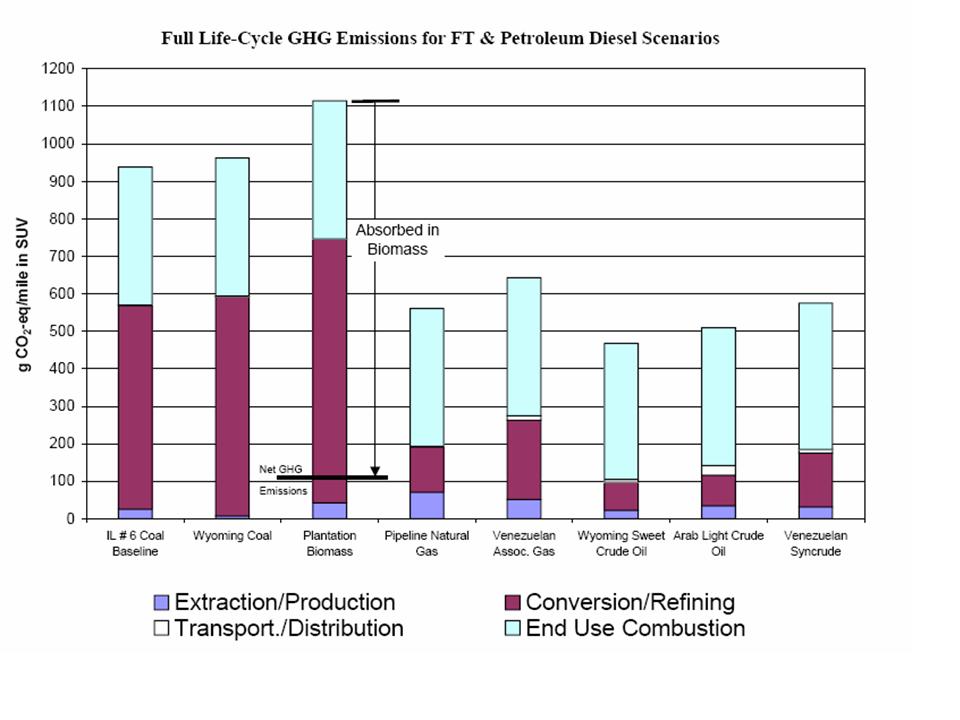 </<p>
Systems dynamics work that measures the tradeoffs between energy, climate, food and water will be increasingly important. Case in point, geopoets comment about water needs trumping drilling rights in Oklahoma. Liebigs Law of the minimum is fundamental. (second paragraph on link)
</<p>
Systems dynamics work that measures the tradeoffs between energy, climate, food and water will be increasingly important. Case in point, geopoets comment about water needs trumping drilling rights in Oklahoma. Liebigs Law of the minimum is fundamental. (second paragraph on link)
We are not going to have a mass aha moment.
More and more of us are going to slowly start sliding below the poverty line without knowing why. We will have more Katrina's, more government screw ups. Soon it will like situation "normal". Very boring the way these things evolve.
The revolution will not be televised
I liked Stuart's description of the kind of leadership we need; perhaps Schweitzer is closer to it than any other politicos. We will see if he is forthright in his description of the true extent of the problem.
Consider this recent EnergyBulletin.net article by David Orr:
http://energybulletin.net/13177.html
key point:
--------------
In other words, we have better ideas than we're implementing," Orr said. "One of the problems we have is we hear this stuff, and it doesn't really affect us on a bottom level."
He elaborated, saying that if he was to pull out a gun or perform some other physically violent action, it would ignite a proactive response in the crowd. "Something would kick in with you," Orr said. "It doesn't really kick in with verbal things."
---------------
He is basically saying our brains are not wired to react until a crisis erupts, but this is a sub-optimal strategy for Peak Everything.
By definition, detritovores will not give up their addiction to detritus easily-- Dieoff.com and Matt Savinar's book & LATOC website are the best 'verbal cattle prods' I have found to shock us addicts into action. Everyone must realize the only way out is to go 'cold turkey', anything less will be woefully insufficient.
One of my ideas to shock people into energy sensibility is deliberate temporary city-wide blackouts combined with vehicle use moratoriums. The President, Governors, and Mayors could preannounce the time and plans. Let's take Phx for example.
The target time would be when the weather would not impose a health hazard by being too hot or too cold. Everyone would get copies of books like Matt's "The Oil Age is Over" or Heinberg's "Powerdown" to read during the daylight hours. The "Humanure Handbook" and other positive ecological paradigm shift reading would be given to everyone too. Basic goal is for everyone to relax, read, and discuss the books.
Emergency services would still continue to protect health and home, and anybody hungry would get MREs. The cops and National Guard would be stationed everywhere to help people, give out ice bags and drinking water, and prevent violence by thugs. Driving a motor vehicle would be forbidden unless it was an emergency, but bicycling, walking, and visiting with friends and neighbors would be lavishly encouraged.
No energy at home for five days would give everyone a good idea how delightful a Powerdown could be: BBQs galore, lots of parties, millions of people pedaling delightedly to and fro, no stress, and no shopping! Our tax dollars during this trial blackout period would refund any loss of normal income from employment paychecks so nobody would be financially deprived. Plastic solar-heated water bags, just like what campers now buy and use, would be given to everyone for showers or PTAs. Add all kinds of public displays on ways to conserve, and townhall meetings to discuss next steps etc.
Turn everything back on, then move the Guard to the next city and repeat. In a very short time, with adequate Media coverage: the entire country would be fully aware of what Peakoil means and what we must proactively do to change.
Bob Shaw in Phx,AZ Are Humans Smarter than Yeast?
Bob Shaw in Phx,AZ Are Humans Smarter than Yeast?
Informing the public is the first step. I spend much of each week going from church to church offering to show "The End of Suburbia." Some are willing to see it, some are not. The ones who do often ask to see it again. Each time the crowd grows.
I can't emphasize enough how important informing the general public will be in the preparations phase. They need to feel that their particular ball team, whether it is the Democrats or the Republicans, are the originators of the idea. If possible, they should believe that their belief in this scenario adheres to some part of their tenets. For instance, Roscoe Bartlett R-Maryland, obviously is a Republican and he is interested for reasons that dovetail neatly with both his political philosophy and his experience as a scientist. Perhaps by appealing to the basic tenets of fiscal conservatism, conservatives will find it fits within their worldview and become motivated to action.
I wouldn't think one would need to show the potential Democratic political alignments, but, from their current involvement, you might think that they have even less concern than the Republicans. Perhaps they do need education and may be more difficult due to their tendency to fragment into interest groups each with its particular bailiwick.
All in all, information, practice, and direct demonstration as totoneila suggests is a beautiful thing.
Great post.
I have all the equipment, though most churches these days seem to be really hip to the audio-visual experience and have great systems. I set up a date, usually on the slowest night, but that sometimes changes on the second showing. I offer to stand up before the crowd and answer questions as best I can. I keep a crib sheet with all the notes I need for all the various topics that may arise. (The most frequent topics are, of course, the technological savior types, i.e. "What about bio-diesel?") The next question is the timing. They want to know. This year? Next year? When? I tell them the time to prepare is now. I cite the Hirsch report at this point. If you wait for it to happen, it will be more difficult to ameliorate.
It is mostly a job of salesmanship, patience, and love.
I have been showning "The End of Suburbia" to groups of wacky newagers.
This is about peak oil. We are not discussing peak electricity here because we are not going to have peak electricity. We are not running out of coal, wind, or solar. There is some dispute about whether we are running out of uranium fuel and I am not certain that we are, but if we are, we can always build fast reactors of various kinds. Oil (mostly diesel fuel for trains, trucks, and ships) is a very, very, small part of the electricity budget for coal, solar, wind, and nuclear.
But your response is classic and no doubt comes from taking offense at anything far removed from a conventional toilet. Relax and realise that conventional sewage systems are tremendously wasteful. Whether the energy comes from oil, natural gas, coal, or nuclear, it still doesn't make sense to treat a resource that could largely replace conventional fertilizers as a waste product. Perhaps worse, the "waste" often becomes a dangerous pollutant.
The thinking behind sawdust toilets (eliminating unnecessary waste) is the same thinking that is going to help us weather peak oil and peak energy shortly thereafter.
But I disagree with the original comment that sawdust toilets can be used on a large scale. Composting toilets perhaps, but not sawdust toilets specifically. There just isn't enough sawdust for millions of people to use nearly a 5-gallon bucket of the stuff each week.
A GREAT advance in civilization !!!
In New Orleans, water is very plentiful and low energy cost (see Mississippi River). Central sewage treatment allows for large scale biodigester/biogas. In Austin, 100% of their sewage solids are mixed with leaves/tree dust and sold as
"Dillio Dirt".
As a Southern boy, I learned that handling human waste, even slightly, was a great way to spread worms.
We can improve our central sewage processing, but let the people in Phoenix shit in a bucket ! I will happily flush away :-)
I think many people are like Wkwillis, horrified at the thought of Humanure. They will be among the first wave of the predicted 30 million migrants heading to the American Northwest of Seattle and Oregon so they can enjoy the 'luxury' of a flushing toilet. But by then, all those new migrants will so overstress the sewage systems of Portland and Seattle-- it will be a pathogenic life and death issue.
Bob Shaw in Phx,AZ Are Humans Smarter than Yeast?
Lets start with the first of his three mistakes.
A GREAT advance in civilization !!!
In New Orleans, water is very plentiful and low energy cost (see Mississippi River). Central sewage treatment allows for large scale biodigester/biogas collection. In Austin, 100% of their sewage solids are mixed with leaves/tree dust and sold as "Dillo Dirt" for gardening.
As a Southern boy, I learned that handling human waste, even slightly, was a great way to spread worms.
We can improve our central sewage processing, but let the people in Phoenix shit in a bucket ! I will happily flush away :-)
Thxs for responding. You are correct in suggesting composting toilets as the better alternative to a plastic bucket. The plastic bucket would just be for the temporary blackouts to acculturate the masses into the need for a professional humanure system.
An excellent interrim step to save water would be if people would use camping toilets like those in this link:
http://www.jacksons-camping.co.uk/general/toilet.htm
Most houses have easy access to home sewer cleanout openings-- they could dump their wastes there. We don't want to go through a situation like that illustrated in the following link:
http://www.bbc.co.uk/history/society_culture/industrialisation/seven_wonders_04.shtml
or http://tinyurl.com/pi24
Excerpt:
-------------
Bazalgette's London sewers
In the summer of 1858, while the Great Eastern was being fitted out for her maiden voyage, London was in the grip of a crisis known as the 'Great Stink'. The population had grown rapidly during the first half of the 19th century, yet there had been no provision for sanitation.
'... sewage was everywhere, piling up in every gully and alleyway ...'
Three epidemics of cholera had swept through the city, leaving over 30,000 people dead. And sewage was everywhere, piling up in every gully and alleyway, in the cellars of houses in poor districts - and even seeping through cracks in floorboards.
---------------
Jay Hanson has talked long and hard about how subsequent generations will not have access to general knowledge and past history. He believes most of the past tragedies will repeat themselves over and over again as ignorance will be the norm. Education is very energy-intensive!
http://dieoff.com/page181.htm
excerpt from Jay's classic "Requiem":
-----------
It really will be back to the good old days! Shouts of "BRING ME HIS HEAD" will ring through the land, slaves, scalps, souvenirs and trophies of all sorts, ... exciting possibilities limited only by our ingenuity.
The good news is that recycling will finally become fashionable! We will see feral children mining the dumps for plastic to burn (Pampers) so they can heat the hovels they are forced to live in. The strongest kids will set traps for fresh meat -- rats -- while the weaker kids will eat anything they can cram into their mouths (old shoes, styrofoam peanuts, newspaper soup). Pandemics will sweep the world, punctuated every so often by explosions as abandoned and rotting nuclear facilities blow up. Leaking dumps and tanks will spew PCBs and radioactive hazwaste into the feral food chain spawning surprising new shapes for young mothers to enjoy nursing.[55] Toxic chemical fires, blowing garbage and trash, genetic mutations, filthy water, cannibalism ...
As the Easter Islanders say: "The flesh of your mother sticks between my teeth".[56]
The situation will be especially serious for a short time because the population will keep rising due to the lags inherent in the age structure and social adjustment. Then mercifully, the population will drop sharply as the death rate is driven upward by lack of food and health services.[57] Trapped in obsolete belief systems, Americans won't even know why their society disintegrated.
A hundred thousand years from now -- once the background radiation levels drop below lethality -- a new Homo mutilus will crawl out of the caves to elect a leader. Although we have no idea what mutilus might look like, evolutionary theory can still tell us who will win the election. He will be the best liar running on a platform to end hunger by controlling nature.
How could it be otherwise?
---------------
Bob Shaw in Phx,AZ Are Humans Smarter than Yeast?
The next step before modern sewers is to mostly enclose the gutters. Better, but it still makes for some funky living!
Why wouldn't they dig a little hole somewhere and bury it? Could you please explain more? Too lazy or ignorant to the health risks? No place to dig in an urban setting, etc? Do they have any knowledge of composting and so on? Clue me in if you can? Thxs.
Bob Shaw in Phx,AZ Are Humans Smarter than Yeast?
In some parts of China, the honey pots are considered to be valuable, and you can get someone to pay you for the privilege of picking yours up. In other parts, everyone poops down by the river...
I helped put in a few water wells in Nepal, and one of the problems that we had was that folks just wouldn't believe that they could be hurt by something they couldn't see. We laugh at that, but the Western culture went through the same thing, and it took many years for us to internalize ideas like microorganisms. So, I got a microscope from a school in a city and took it to a village. Then I showed the kids slides starting with big objects and going down to microorganisms. This worked for the kids, but the adults still thought that I was crazy, and they didn't want me to talk to their kids anymore - I was making them crazy too...
Well, no, but in that case, the solution was not pooping in a bucket. That was the problem. The solution was a modern sewer system.
But my water supply and sewage system still does not run on diesel, gasoline, or JP-4.
Thxs for responding, same to the others posters in support of humanure. Your posting is a perfect example of mental resistance to providential behavior change-- this is exactly what will be so dangerous as we go postPeak. Would you prefer humanure, or would you prefer to having your residence surrounded by fresh raw sewage for you to wade through?
May I suggest you google websites & images of sewer system infrastructure-- huge iron castings and electrical pumps, millions of tons of required chemicals, millions of miles of pipe and electrical wiring-- sewage engineering is a very difficult, highly technical profession. This will all be unsupportable postPeak. We normally don't consider this complexity when we flush a toilet.
Please google declining Zimbabwe to read about overflowing sewage surrounding houses and standing in the streets, cholera outbreaks, etc as they cannot afford the sewage system upkeep. There are numerous postings in the archives of the forum Yahoo:AlasBabylon carefully detailing this. Here is a horrific recent CNN link of the Zimbabwe sewers being clogged by abandoned newborns:
http://www.cnn.com/2006/WORLD/africa/02/17/zimbabwe.fetuses.ap/
Please read about how terrible London was before modern sewage treatment linked here:
http://www.swopnet.com/engr/londonsewers/londontext1.html
If you study all this info--I think you will readily agree that humanure recycling is the best behavioral change we can make for the future.
Bob Shaw in Phx,AZ Are Humans Smarter than Yeast?
I worked with the NYC-DEP to make a video about the newest water tunnel (#3) supplying the 5 Boroughs, and the first point that they made to me, was.. "People turn that knob, and expect that water will come out, while 600 feet down, we hardly know how that system has weathered the decades, and have no or very little opportunity to 'shut it off' and inspect or maintain it"
So even if the example was just your toilet, I think you're also being asked to realise that the things that are as completely unquestioned at the water in your pipes could easily affect or be affected by any of the other systems that we also expect to continue 24/7. The DEP engineers let me know that if the water supply went down in any part of the city, that major parts of Manhattan would have to be evacuated. No water would kill a number of Electrical Power Plants, most Residential buildings below 6 floors are purely gravity fed, Firefighting would be out, Hospitals, etc. These systems are often highly interdependant, and we do ourselves a disservice by not having figured out our dependencies and found workarounds.
Graywater systems and Methane Digesters for medium to big residential buildings could make a big difference.
Bob
ps Great Bumper sticker on a Logging Truck..
"Hate Logging Trucks? Try Plastic Toilet Paper"
got corn cobs?
The current population can be supported by either Tunnels #1 & #2 OR Tunnel #3. Gravity feed from Upstate New York, pure, clean water is readily available without any power input for the first few floors (very little of the Bronx, Brooklyn, Staten Island or Queens is above the gravity feed limits of fresh water).
A massive undertaking, and clearly sustainable (with cutbacks during prolonged droughts). New, low water consumption toilets will reduce the impact of droughts as they becomr more common.
A bit of good news !
BTW, tunnel friction will drop with the addition of #3, gravity water pressure will increase and less energy will be required for pumping up high rises.
'Clearly Sustainable' - Somewhat sustainable. Ask the farmers in Putnam county or farther up in the Berkshires. They feel NYC gets what it wants what it takes, which is a LOT of water. And a few towns up there were sacrificed and submerged for the Reservoir system that feeds it all.
Also, as fine as it is, it's still one of several umbilicals keeping people alive in that city. I felt that directly when I went down into Shaft 21b in Redhook. 500 feet into 'Granitic Gneiss', I think it's called, and some of the hardest rock ever mined, so they told me, and I knew that a handful of huge air and waterpumps were pretty much responsible for keeping me/us alive down there. This was a place you couldn't scratch your way out of, and you just had to trust that complex system while you were in there. But you are in that situation anyhow. Food Supplies, Water, Power, Building Materials.. how many of these flows can we find local substitutes for? How much water do we keep handy, and how long would we be able to make it last? (Me, about 6gals plus the toilet tank and the baseboards)
The nitrogen should be recycled, and doubtless will be. But this is something that is best done at the sewage treatment plant, rather than individually.
Far better than eliminating water and sewer systems would be encouraging people to conserve, particularly in areas where water is scarce. In fact, we should probably be discouraging people from moving to areas where there is already a water shortage. Some of the plans out there - building hundreds of miles of pipeline, hundreds of feet deep, to supply the growing suburbs in the southwest - are just goofy.
Thxs for responding. The best way to make people conserve water and save energy is to make everybody hand-carry all the water they wish to use. Every urban & suburban neighborhood should install a clean water tap about every 600ft or so, carrying a five gallon plastic jug this far is not a big deal, but it will make people carefully consider their water usage. To protect human health, we will eventually plug everyone's home sewage system with concrete to prevent the spread of pathogens. Business will spring up to haul urban humanure to the community gardens and rural areas.
Please read my recent posting on how our sewage infrastructure will gradually become unsupportable postpeak. People vastly underestimate the energy required for maceration pumps, high pressure sewage lines, and other details; to repeatedly lift sewage to maintain adequate scour rates so downhill flows can be maintained to the treatment plants. Valves and other castings can be large enough to walk inside. Treatment plants generally cover large acreages to perform the many required steps to render sewage safe to handle. Out of sight, out of mind-- until it starts backing up and overflowing into your house.
Hopefully, cities will be proactive on this issue before it becomes a health risk. Unfortunately, I feel it is more likely we will wade through sewage like the Zimbabweans and many other countries because we chose to ignore the obvious. How much sewage mixed in with the floodwaters in hurricane Katrina?
Bob Shaw in Phx,AZ Are Humans Smarter than Yeast?
I don't think that's reasonable. Heck, the ancient Romans didn't hand-carry water. Why should we?
Waste of resources. There's a lot more we could be building. We don't need to build an entire water system just to teach people lessons.
Far better to let price show people the "true cost." If people have to pay for their water, they'll conserve.
Maybe the rich will not...but the rich will not conserve anyway.
I don't think we'll have the central government left to do that, if it comes to that. Besides, many people are already living off the grid with respect to water and sewer. They have wells, and septic fields.
It's an interesting thought, though. Right now, "town water and sewer" is a selling point for houses. That might not be the case in the future.
Bob Shaw in Phx,AZ Are Humans Smarter than Yeast?
I am no expert here, but I would refer you to the writings of Jared Diamond and Joseph Tainter on social complexity theory in Dieoff.com. Their books go into much greater detail. Real short--What goes up, eventually comes down.
Bob Shaw in Phx,AZ Are Humans Smarter than Yeast?
Agreed. My point is that there was NOTHING inevitable about the decline and fall of the Roman Empire at the time or in the way it happened--and nothing in the books you cite nor their bibliographies that asserts that it was.
I believe the notion of "inevitablility" in history is a dangerous fallacy, the fallacy of fatalism: "Oh it was all God's will." Or: "It was the inevitable working out of dialectical materialism." To which I respond, "Bushwa!"
In Diamond's excellent analysis he looks closely at the major factors that contribute to the collapse (or conversely the long-term survival) of various societies, and it is impossible to praise that book too highly, because he makes it clear that people and organizations and institutions and beliefs and technologies and wars and diseaseas, among other factors, are all involved with how well societies do over time.
Intuitively, one might have expected the Roman Empire to collapse first in the eastern (Byzantine) part because the East was more overpopulated, more deforested, had more eroded soil, a longer history of severe ethnic and national conflicts, and so on. But that did not happen. Why not? Because of particular historical happenings. My reading of history suggests that there was nothing inevitable about the path of the decline in the West, but one can make a case for a run of bad emperors, beginning with Commodus, who failed to do the constructive things that more effective earlier ones had done.
Is modern Western society "inevitably" going to go down the tubes because of Peak Oil? If so, let's start the orgies . . . .
the average city dweller as well as slave had to get all their water from public spots such as fountains.
Getting enough water is not an important issue here. Quite frankly dumping untreated sewage into the Mississippi would not have a measureable effect on water quality due to dilution (and no one downstream anyway). Cisterns could supply water for flushing & even potable in any case. We average a bit over 5 feet of rain/year.
I see MAJOR ADA issues in your water every 600' idea. My elderly parents would have to pay someone to haul (on a wheeled convenience carrying, say 250 gallons at a time if hand pulled, more if on a human powered trike, much more if motorized).
I will let you desert dwellers poop in a bucket, I will continue to flush.
May I suggest you google the history of NYC's water supply? Typhoid and cholera outbreaks were the norm. Additionally, google the epizootic equine outbreak of 1873 that killed off all the horses--humans took their places everywhere in a desperate struggle to maintain the urban infrastructure. Shortages of everything led to a depression.
Bob Shaw in Phx,AZ Are Humans Smarter than Yeast?
A settling pond, sand filter and a little chlorine is all that is needed (and the chlorine is just to be safe).
You did not address my public health concern about the spread of parasites (worms) due to the handling of human feces. This was a major public health issue a 100 years ago !
You maybe entirely correct as to the flow volume and sewage history of the ole Miss. I claim no professional sewage expertise, just wanting to make everyone aware of possible problems and potential solutions. Obviously what will work best in one locale may not be suitable or workable in another. Cheap energy and resources allowed the luxury of great similarities in sewage design nationwide. This will change postPeak, value of water will be a key determinant.
As to the parasite problem from waste handling-- I claim total ignorance of this issue. Perhaps you could post some instructive links for everyone to read. That is what is so great about forums-- the quick spreading of crucial info.
Bob Shaw in Phx,AZ Are Humans Smarter than Yeast?
http://www.niaid.nih.gov/factsheets/roundwor.htm
Note advice to wash hands after using bathroom. How much water will be used after handling human manure ?
As for volume of Mississippi, think of a mile wide river, a 100' deep and flowing as fast as you can run.
That statement is somewhat misleading.
The problem with conventional sewage gathering and treatment systems is that a valuable resource (bodily waste) is mixed with all kinds of dangerous stuff (household cleaners, road-way run-off, industrial waste effluent, etc.) as well as valuable potable water. This makes it very expensive and energy intensive to recycle the nitrogen, potassium, and potash. So the mixture ends up being treated as waste. If the bodily waste were instead sequestered (preferably without additional water), it could be safely composted and then used as fertilizer. Cradle to Cradle, by William McDonough and Michael Braungart, links this idea to much broader applications than municipal sewage.
Composting toilets are a very simple technology to safely divert a valuable resource from becoming part of the waste-stream.
I've lived "off the grid," and we still had flush toilets and running water. Water was collected in a cistern on the roof, and gravity-fed through the plumbing. It ended up in an open cesspool on our property. If it didn't rain for awhile, we'd flush every other use.
I greatly appreciate all the input from members. I am glad most of us are not reluctant to discuss this topic.
My residence in Phx is small with a small backyard-- my backyard is approx. 30 by 75 feet, and walled with a seven foot high solid brick fence for privacy. I piss in the backyard all the time, with no bad effects noticed, to save water. Pick a different spot every time, been doing it for years.
Obviously, I cannot use the front yard for the same task unless I am willing to get arrested.
Speaking of bathroom habits: has anyone tried to figure out when Peak-Toilet Paper will occur? Nooooooooo!
Bob Shaw in Phx,Az Are Humans Smarter than Yeast?
It's only good if it hurts, isn't it?
Some do. Most don't.
"The main problem is the concentration of heavy metals, but there are ways of solving that."
Possibly the best way to solve the heavy metal concentrations in composted sewage is to not mix everything up in the first place. It certainly seems a low-energy solution. And you reduce the number of trips people to the Borg to buy bagged fertilizer.
Toilet use accounts for approximately a third of the water use in the average north american home. Composting toilets could reduce that to nothing. A potential one-third reduction seems pretty significant to me and it is almost without cost.
Don't get me wrong, this isn't a technology that will single-handedly save the world. But it sure seems like it could contribute a huge savings to many households. And let me be clear, it really doesn't stink. Proof: I used a sawdust toilet in my house for a year. I am still married.
As for off-grid housing, maybe it's just because of the climate I'm in, but I have yet to see an off-grid house that didn't feature a composting toilet. I guess I'm just on the wrong side of the Rockies.
That's probably it. Water simply isn't an issue around here. Many houses here have their own wells and septic fields; probably most, in fact. Water shortages have never been an issue here. (Though I suppose it might change with global warming.) Even with several drought years in a row, we've never had to impose water restrictions.
I think sawdust is more likely to be in short supply than water. That's what they make wood pellets out of, isn't it?
The first one is heavy metals, its slowly being worked on and the local levels are now in manny Swedish towns in a range where some advocate banning artist oil paints with cadmium since brush cleaning is a notisable contributor. The biggest problem have been and still are runoff water with dust from car traffic and waste water from various industrial processes, often small shops. It takes years and millions to separate sewage from runoff water when its built with old standards, it takes years to inform companies about standards, measure where the problems are and enforce standards. But sometimes someone figures out something brilliant. For a while we had mercury dogs sniffing out mercury in drain traps and so on in schools at dentists and so on.
The second problem is the yuch factor. The heavy metal problem stopped the sludge use as fertilizer on the fields, the yuch factor is hindering use as fertilizer even if the heavy metal levels are lower then for mined and procesed fertilizer. While this was controversial due to heavy metals our farmers included no sewage sludge in their own quality certifications and now they get PR problems if they reverse it. I think this will solve itself when fertilizer gets more expensive, after all people eat saussages. :-)
Another thing I think will come with time and higher prices is urine separation. It is quite popular with our greens to try to introduce it and they have sometimes managed to make it code in some municipials but only where it were easiest to enforce due to the way the laws are written, in sparse houses with individual sewage treatment. It would make more sense in apartment houses. I think it will be retrofitted when the urine is valuble enough.
As for the yuck factor...some sewage treatment plants here are producing fertilizer, and people are using it.
Just think of the energy saved by power holidays. It might be popular enough to repeat it, say once a quarter. People could use a week off from work once in a while! We work too much the way it is. Your idea gets my vote!
Yeah, but will the top dogs allow this to happen? Overconfident deer generally get quickly trapped, then cut down by the elite wolfpack. Although, I sure would like to see Roscoe Bartlett convince his citizens in Baltimore to give it a try. Time will tell if it could snowball nationwide from there.
Bob Shaw in Phx,AZ Are Humans Smarter than Yeast?
Energy Fasting can be a real reminder of what opens up when the switch goes off. The electronic music, tv, video games. It really is incredible to see what a group of people do when the gadgets disappear. Happened to me by accident the first time. Was with a small film crew in the Maine woods, Lakeside cabin, and a storm killed our lights, killed the VCR, the Laptops, the Boombox, the Nintendo. Silence. Some of the Crew had brought some goofy, plastic 'musical instruments' for someone's birthday, and we all hung out on the porch, making up songs, talking, whatever. I was an electrician, and snuck away to the basement and tripped the Fuse box, so when they brought the power back, our cabin stayed dark. It was a great evening, which had started with everyone facing their gadgets, looking out at the walls, and it became all of us sitting around, looking IN at each other and being much more connected. I knew the service was back up, but waited until people were solidly headed towards bed, in case a premature 'PowerUp' would get the all-night movies and games going again, and make the people turn towards their corners again. And look at me. I'm typing this instead of going to sleep with my wife. Alas.
How did I "rough it"? I used a candle for light, a battery-driven boombox for tunes, and used an ingenius if wasteful way to chill beer. I merely ran the sink at a trickle to let ground temp chill the water to chill the cans of beer in the sink!
I once read about a person who owned a rural cabin and a car. Like me, he did without the power company. At first, he used 12 volt stuff in the cabin, added a second battery to his car to catch power, and normal commuting charged the battery pack. He later added solar or wind or both to said cabin.
Moral of our tales? Sure, it's not easy to go with less or without. It's a case of "when the going gets tough, the tough get going"! If you know about energy, MacGyver-like creativity can go a LONG ways. That's how the Cubans do it.
invented the light bulb, telephone, plane, is
that they happen globally.
like some kind of psychokinesis.
As in-
One of my ideas to shock people into energy sensibility is deliberate temporary city-wide blackouts combined with vehicle use moratoriums. The President, Governors, and Mayors could preannounce the time and plans. Let's take Phx for example.
this is exactly the remedy for SOC's(Self Organized Critical Systems-a controlled burn, if you will.
It must be done. Or we will experience General Conflagration.
http://www.snopes.com/pregnant/blackout.htm
Bob Shaw in Phx,AZ Are Humans Smarter than Yeast?
Putting all this in place is a pipedream and I wonder what Brian is smoking.
If you want to talk about coal gasification as a better use for coal, I'd be willing to do that.
I'd be all for CAFE standards, increased efficiencies, more rapid transit, if anyone was actually willing to do any of them starting right now. I'll take what I can get.
faq
Synthetic fuel technology works by heating coal into gas in a contained reaction requiring no external energy. This first step is known as coal gasification, and is used widely around the world to create other forms of energy and industrial products. The gas is then cleansed of sulfur, mercury, arsenic and other toxins, as well as greenhouse gasses, and then distilled into a synthetic form of crude oil which can be refined on site to create any liquid fuel. The resulting fuels burn dramatically cleaner than petroleum-based fuels and can help America reduce emissions.
And we'll get 10-1 from cellulosic ethanol. And Saudi Arabia has 260 billion barrels. And methane hydrates will be commerically scalable. And there is enough sunlight hitting the earth for 100,000 times our current power needs, etc etc.
Click to enlarge
On the other hand if he gets the project started, there's nothing to stop Montana four years from now to use the gasifier output to make methane or even fertilizer if they desire.
That's the crux of the matter. And I must confess, I need to research both of these subjects more in-depth. If anyone else on TOD could shed some light on these subjects, that would be a good thing. When you say "pollution-free", are you talking about sulfates, mercury and such or are you talking about CO2? I will be looking around for this information. I don't want to come off as someone who knows all the answers--because I don't. So, this gives me something to look into.
I do know this in so far as I have been looking at future natural gas supplies in the US--coal gasification figures basically nowhere in the equation. It's all conventional gas production, unconventional gas production (eg. deep gas), LNG and that planned pipeline from Alaska. Since natural gas is our biggest shorter term problem in my view, it's interesting that coal gasification does not show up in the projections. Since this process is expensive and most companies (like XCEL where I live) are required by law to provide gas the cheapest way possible, that might explain it. But at some point, it's got to become price competitive with some of the wild-assed schemes I've been looking at to supply the US with gas.
best, Dave
Based on the information from WMPI's proposed plant in Pennsylvania (waste coal to diesel, 5,000 BPD go to ultradirtyfuels.org for more) there will be some sulfur dioxide, etc. Mercury it seems is very tricky to get out of gas streams, too.
Then of course, since matter is neither created nor destroyed by this process, you've got the problem that all the crap that's in the coal (trace metals, sulfur, etc) has to come out somewhere. If you take it out of the gases, then you've got to store liquid or solid wastes somewhere. Lots of them. Will they leach? Where will we put it all? Questions yet to be answered, here in Montana, anyway.
And then there's the CO2....
Check out www.northernplains.org, which has analyzed how the F-T coal to diesel process plays out in Montana, there are references to a bunch of cites.
On F-T for synthetic natural gas -- they make this oxymoronic fuel at a plant in Beulah, ND, thanks to you and I, the American taxpayer. We subsidized them first with a price guarantee, but that was insufficient. The plant went bankrupt a year after it opened. DOE took it over, and then sold it to Basin Electric for less than a nickel on the dollar. Basin Electric bought it because it had built a power plant to provide power to run the gasification plant, and stood to lose 7& of its market. It's not clear if this would be replicable in the real world, enough to make a dent in natural gas supplies anyway.
So for alternatives to natural gas -- the best bet right now (next to insulation and caulking) is wind. That sounds funny, but wind is perfect for backing off the most expensive electricity, natural gas. We have an excess of natural-gas fired electric power plants, which were relatively (to coal and nuclear) cheap to build but which are expensive to operate, worse now that the price of gas has skyrocketed. This makes wind, which is less reliable than coal plants -- although maybe not IGCC plants, we'll see -- more valuable, since natural gas plants are easier to back off when the wind is blowing, and easy to turn on when it's not.
So if we build a lot of wind, we save a lot of gas.
Then we need to grow crops that need less anhydrous ammonia -- made from natural gas. More switchgrass, less corn. And more nitrogen fixing plants, including lots of oil seeds (suitable for biodiesel).
One recent estimate of gas to liquids (i.e. plants under construction and others planned in Qatar) -- $20,000 construction costs per daily barrel of capacity. At the Governor's energy symposium in Bozeman, MT in October, Sasol's representative said that Coal to Diesel was roughly twice as capital intensive as gasification (or GTL). If you do the math, we've got a ways to go to raise that money.
As far as Bush with the switchgrass, what's needed is to genetic-engineer a cellulose-cracking bacterium that also brews up ETOH (booze) like brewer's yeast. The F-T process is off-the-shelf technology unlike the cellulose-cracking yeast. An alternative is to crack cellulose into glucose or fructose for normal yeast to use, "syn-food".
Those enzymes, however, are off the shelf -- in Spain, where a commercial scale plant is being built. And there's a demonstration plant in Canada. The plant in Spain isn't going to pencil out to start with, as I understand it, but neither will F-T from coal. The economics for cellulosic ethanol will keep getting better as it has for corn-based ethanol. The economics for turning one non-renewable fossil fuel into another will keep getting worse, IMHO.
http://www.indystar.com/apps/pbcs.dll/article?AID=/20060226/OPINION03/602260365/1002/OPINION
In case it doesnt get published, here is my reply to Science Magazine editor on their recent spread on ethanol:
"Farrell and colleagues offer hopeful opinions about corn-based ethanol
and suggest even greater promise in cellulosic technologies. Their
analysis centers on the return of ethanol to fossil fuel inputs and
suggest that since this is positive, ethanol should be further
developed. If replacing oil is our goal, we must look at two criteria:
1) Energy Return on Investment (EROI) including environmental impacts
on soil, water, climate change, ecosystem services, etc and 2)
scalability/timing. Farrell and colleagues' most optimistic current
EROI of 1.2:1 (which does not include tractors, labor, or environmental
impacts) implies we would need to produce 6 MJ of ethanol to have a net
yield of 1 MJ of energy that can be used for other productive
endeavors. This reduces the yield of ethanol from 360 gallons per acre
gross yield to a mere 60 gallons per acre net yield, not even two
fill-ups for an SUV. At 2004 levels of gasoline consumption (382
million gallons/day according to the EIA), this would amount to burning
over 70 acres of ethanol production a second! If the entire state of
Iowa were planted in corn, this would yield approximately five days of
gasoline alternative.
To devote HALF the nations corn crop to ethanol would require 3.42
billion barrels of oil equivalent as input (almost half our current national use)
to net out 684 million barrels of 'new' ethanol energy to society. This
says nothing about the loss of food, soil nutrients, ecosystem damage
and the massive amounts of water required for irrigation. The local
profits and jobs created would be transferred from other sectors of our
economy that have their own needs for the 3.42 billion boe
required by the ethanol process. We need alternative energy. But
ethanol from corn is neither scalable nor sustainable. Let's pursue
better options."
It really is that simple.
What youre really pointing out (and I agree) is that alt energy schemes (ethanol being the prominent one currently) are viewed from bottoms up approach instead of top down. If energy policy makers nationally and globally look at our remaining fossil as 'capital' and decided how best to invest them, ethanol from corn would be a non-starter - However no such umbrella agency, that uses the right metrics yet exists.
In that vacuum, local, persuasive, financially backed groups will use the wiggle room in the literature (corn can replace gasoline!!) to expand projects at a local profit at expense to the whole system. It is yet another example of relative fitness and Tragedy of Commons- if farmers can improve their own profits and well-being, why would they care about EROI? The sad thing is, on a comparative advantage basis, North America (and Russia) have by far more arable land per capita than any other continent, and if free market forces let farmers farm organically, and distribute locally, everyone could be better off
moment, but anyone who imagines that will be the
case in the future clearly knows little about
how plants are grown in the US. Apart from the
masssive inputs of fossil fuels via tractors and
harvesters etc. there is the matter of
pesticides and fertilisers, many of which are
derived from oil or gas and all of which are
transported by oil.
Then we might examine climate change and note
that Texas and the states north of it are
experiencing an extended drought that is going
to impact severely on yields this year. Just
when the drought is going to break is anybody's
guess, but we can be certain that preposterous
schemes like trying to make liquid fuels from
coal will simply add to the environmental
catastrophe that is already underway.
Humanity is clearly faced with a fork in the
road: one way leads to misery and death, the
other to complete annihilation. It seems that
much of population is opting for the second.
The real question should not be 'How can we
manitain the current energy-profigate lifestyle
as long as possible?' but 'How can we wean
ourselves off it as quickly as possible?'
Few commentators wish to even consider the real
issue of abrupt climate change and blithely
promote schemes that will markedly increase CO2
emissions, if not double them. Many of those
who do think about EROEI and emissions make
pronouncements along the lines that solutions
will be found 'Offcourse there are to downsides
to this; there are still bad environmental
sideeffect (but they can be overcome or
minimilized)' without suggesting what those
solutions are.
There is no solution to rising emissions except
to reduce energy consumption...
and we all know that would be a cardinal sin in
a system predicated on more of everything.
All the dangers to third world agriculture that George Monbiot described for biodiesel will apply to ethanol.
The obscenity that Leanan pointed out here on TOD of food being shipped out of a starving country while food aid is shipped in will be repeated with the results of the destruction of domestic food production being shipped out as such aid as we deign fit is shipped in.
We have to ask ourselves how much hatred of the first world by the third world we can afford to let build up.
What the hell are these people smoking. We are using the equivalent of MILLIONS UPON MILLIONS of years of ancient sunlight each and every year when we burn fossil fuel whether it be oil, gas, or coal. The earth does not receive enough sunlight to let the current insanity continue. I would like to believe in Santa Claus just as much as the next child, but, hey, let's be adults. There is no free solar lunch, at least not one that lasts much longer.
Don't be dumb. The ethanol route only continues the fantasy of easy motoring, cheap plastic crap, and environmental destruction.
GIVE IT UP.
Hemp does not require pesticides.
Hemp can be grown in rotation with food crops.
Hemp essentially tills and re-fertilizes the soil.
The dire predicitons of Peak Oil (as promulgated by TEAM DEFCON) can be mitigated through the cultivation of Hemp for BioFuel in concert with government mandated conservation programs.
Whether or not countries (US, China et al.) choose to implement said initiatives, however, is quite another matter.
Speaking of GWB, now there's a guy I'd love to see poop in a bucket!
Bob Shaw in Phx,AZ Are Humans Smarter than Yeast?
Special requirements/permits apply.
The US has grown Hemp for Victory before. I'm sure it can be done again.
"Oh, PissBoy!"
Is it still good to be the King?
Maybe a fine pipeful of 'Bait and Switchgrass'
Uh Oh, I see the Hemp page down there. Dad, is that you?
- Ethanol is a very good additive to get cleaner burning gasolene, we need it even if it adds little new energy.
- The infrastructure cost for E05 to E20 is almost 0. The infrastructure cost for E85 is small. If it at a later date is displaced with a better fuel little investment money is lost.
- We have a food surplus, this is a constructive use for it.
- Ethanol and methane from food grade biomass also gives an opportuity to end manny farm subsidies and thus simplifie state bueraucracies. Those people are needed elsewere where they can add something to the economy instead of being a burden.
- No new technology is needed, the investments can be made right now. If they end up being irrelevantg in 10 or 20 years recycle the stainless steel, etc.
- If TSHTF we can stop making as much ethanol and methane and eat the biomass.
This reasoning should apply to EU, USA and probably also Canada.I realy hope we get more ethanol plants in Sweden, more methane plats, a gas pipeline infrastructure and more RME production. I would be happy if we get more such plants then we have local production, ship by boat and get cheap heat from biomass fed combined heat and power plants and we got reasonable electricity prices. It would basically be the same thing as "our" refineries make about 150% of the petrol products we need, a percentage I hope will try to approach infinity. :-)
I support rural subsidies as a military measure.
HEMP it is!
Please research the energy efficiency of photosynthetic plants before posting.
Corn is a C-4 grass, as is sugar cane. Hemp is a C-3 plant as are poplars and switch grass. C-4 species are significantly more efficient at trapping CO2 into organic carbon than C-3 species. C-4 grasses use more of the intercepted light energy, particularly at high temperatures and light intensities, to fix carbon.
Corn is one of the most efficient carbon sequesters in North America. If the goal is to capture as much CO2 into plant biomass/acre/year it will be hard to beat corn. I agree there are other concerns (fertilizer, soil fertility, etc.) with corn. It needs all that soil fertility because it is growing so fast. This requires careful maintenance to maintain this high productivity year after year.
But if the goal is to fix carbon into organic compounds for future burning, it might be best to start with the plant that is most efficient at doing that. For the frost free midwest growing season, nothing produces as much biomass per acre as corn. It is not a fair comparison to compare corn from the midwest to other plants grown in other parts of the country. Completely different growing seasons and environments.
Google is your friend.
The key is the seperation of light capture and carbon fixation into different compartments in the plant cell in C-4 plants.
As stated by other posters no strategy is best in the plant world. C-3 photosynthesis has an advantage in cold, low light environments.
To confuse people even more check out CAM plants (Crassulacean Acid Metabolism), mostly found in Australia. See here.
The seperate light and dark reactions not by space, like in C-4, but by time. CAM plants capture light energy during the day but don't fix carbon until night making them some of the most water use eficient plants. So if you want biomass without water use CAM plants.
Finally, I don't have any problem with hemp production. But it isn't a perfect crop either. It needs high inputs to have high yields. There is a great amount of knowledge on hemp because it was widely grown, pre WWII, for rope fiber. Cultivating 100's of acres of pure stand hemp has its challenges just like corn.
There is no perfect sustainable crop. They should all be rotated to prevent diseases and soil fertility problems.
This CAN be done.
Hemp produces 7-9 tons of feedstock per acre on a 60-90 day cycle up to 3 times a year pending length of season.
There is NO, repeat NO terrestial plant that produces the biomass that Hemp does.
And after Hemp, we move to algae.
Corn is political. But for now (political or not) corn gets the ball rolling.
The world wants liquid transportation fuels (LTF's)--gasoline; diesel and jet fuel. The cheapest way to obtain LTF's--in terms of both capital and energy requirements--is to refine them from light sweet crude. We would therefore expect light sweet crude to be the first to peak, and that appears to be the case.
As we all know, we can obtain LTF's from any fossil fuel source. However, as move away from light sweet crude and toward the endpoints (natural gas and coal), the cost--in terms of both capital and energy expenditures--will increase per unit of net energy obtained. Also, on the "heavy" end--heavy sour, bitumen and coal--the environmental costs will be substantially greater than on the "light" end.
IMO, the nonconventional sources are only going to slow, and not reverse the decline of aggregate oil production. But we shall see.
In any case, the move toward the "endpoints" is going to be irresistible. IMO, the only way to bring some sanity to the situation is to tax the hell out of LTF's, preferably by replacing the Payroll Tax with a LTF tax (probably including even ethanol). This would unleash all of the powerful free market forces against the profligate use of energy.
Well put! I think discussing the whole thing in terms of a continuum from natural gas to coal is a very effective way of presenting the various pros and cons.
This corn-to-ethanol scheme has such a strong factual case against it that only the clout of powerful agricultural interests can keep it rolling. Unfortunately, it appears that that is exactly what will happen. I cringe at the perfect storm situation of a severe draught combined with a Middle East oil embargo combined with another Category Hurricane in the Gulf.
Doing almost anything with coal is a mess, but we are also going headlong in that direction also. As one who has been in the environmental field since the early 1970s, I can guarantee you that once people start feeling the pinch, concerns over environment degradation and concern over global warming will go right out the window. An inherent difficulty in dealing with environmental issues is that the general public has a hard time seeing a convincing connection between causes and effects. There is probably even a less pursuasive connection regarding global warming (at least right now).
So, it looks like full steam ahead in increasing liquid transportation fuels, come or high water (High water? Pun was not originally intended, but I think I'll leave it in).
In some ways it would have been better if nature had only given us light sweet oil and said, here, use it anyway you like, but when it's done, you're outta luck. Instead, there are ways out, so we will never have to bite the bullet in any absolute sense. There's just a series of ever more expensive and disastrous postponements.
I also think the first part of the peak oil debate, re: the light sweet stuff, is coming to a close for almost everyone, except the public, and moving to the next phase: what are the alternatives? The powers-that-be certainly want to extend the status quo as much as possible, as long as possible -- and that's only possible in the way you describe.
he wrote back saying ...collective groan...no talk of sequestration....environment?..we don't need no stinkin' environment!
An advantage of both TDP and F-T are that the conversion facilities can use a biomass feedstock (switchgrass, wood, manure, etc) when the coal runs out.
Despite the dearth of national-level leadership, I'm not totally pessimistic. I think there is a chance for change at the local/individual level, driven by renewable/conservation technologies that will be cost-competitive and offer advantages of independence & keeping money circulating locally. Just as electric power generation was originally a local community affair, it may become so again as communities bypass the centrailized political gridlock and come up with smaller-scale solutions.
One technology I have an interest in is ultra-high energy density capacitors. I see these as fulfilling a dual role: smoothing the variability through time of wind and solar power generation, and enabling all-electric vehicles with longer range and very short recharge times. Plus, these could potentially be made using carbon instead of more limited metals. Does anyone have any good information resources on this they'd like to share?
If looked on as a capacitor they have a very high capacitance rating, farads or kilofarads as opposed to millifarads or microfarads for a normal capacitor, and a high capacitance/voltage product rating. However they are slow to charge, seconds against milliseconds or microseconds, and limited life, tens or hundreds of thousands of charge/discharge cycles against billions for a normal capacitor.
Looked on as a battery they have a miserable energy storage density but can give very high power outputs for brief times for duties such as motor starting. They have very fast charge times compared to hours for a battery and the charge/discharge cycle life that looks poor as a capacitor looks sparkling compared to the few thousand of normal batteries.
As a reference take a standard lead acid car battery which has a energy density of 100kJ/kg.
Typical examples of large super capacitors systems that can be purchased today using well established technology is this engine starter. It has an energy density of 4.3kJ/kg.
Recently introduced single cell ultracapacitors from Maxwell have a energy density of 20.2kJ/kg.
Skeleton Technologies claim to have produced capacitors with an energy density of 40kJ/kg but I don't think they yet have a commercially available product.
There has been talk of using carbon nanotubes but I cannot find any mention of a actual practical sized capacitor rather than micro sized proof of principal experiments. Given that carbon nanotubes are at present a thousand times more expensive per kilogram than the materials of existing supercapacitors I don't expect them to be a practical consideration on a large scale for a long time.
Thus although they have other advantages, even yet-to-be-commercialised supercapacitors have only 40% of the energy density of 147 year old technology. The best Lithium ion batteries have an energy density of 200kJ/kg, about twice the best lead acid batteries and have a longer cycle life but are not as good at delivering high peak power.
Supercapacitors may have a use to give a peak power boost to a lithium ion battery electric vehicle but a purely supercapacitor driven vehicle for general use is nowhere on the horizon. The best that has been built is a tiny one person buggy that could travel for 20 minutes at a very sedate pace.
To realise the size of the mountain that electric vehicles have got to climb consider that gasoline has an energy density of 44000kJ/kg. Even taking into account a five fold difference in efficiency of conversion of stored energy into mechanical energy this is 44 times the energy density of the best lithium ion batteries, 88 times the energy density of lead acid batteries, 220 times the energy density of yet-to-be-commercialised super capacitors and 440 times the energy density or readily available supercapacitors.
While a few of the true believers on this site and over at Green Car Congress might be persuaded to accept the drastically curtailed performance such figures imply, I think that to persuade the bulk of the American public to accept them while gasoline is less than $20 per gallon would take a mass conversion that would put in the shade the efforts of the Chinese general that baptised the whole of his army with a hosepipe.
If supercapacitors look like a poor bet for the main energy storage in vehicles they look absolutely hopeless for smoothing out the intermittency of solar and wind energy on a large scale.
As long as solar and wind energy is only a few percent of total electrical power generation in the grid they ar attached to, the intermittency can be soaked up by the reserve that is there to take care of demand variation. However if we wish to replace the bulk of power generation with solar and wind energy we have some truly horrendous swings to take care of. We will have very short term variations and longer period seasonal and even year to year variations.
To replace the output of a single 1GW fossil fuel power station over a year will need something like a 8GW rated photovoltaic installation or a 6GW wind farm when you take into account the availability of each source. The power from a photovoltaic system can drop form 100% to 10% in a minute if a cloud front passes over especially if concentrator cells are used that need direct sunlight. Wind power does not drop quite that suddenly but can die in 15 minutes. The cube law wind speed to power output relation means that halving the wind speed cuts out 87% of your power. Such drops can last for hours. Sudden gigawatt dropouts can cause cascade tripping and can damage equipment.
I got taken to task several posts back for suggesting that seasonal variations would generate the need to store up to a third of an installations annual energy output to match the output to demand. It would certainly be the case for a single solar installation replacing a 1GW fossil fuel station. In many places, such as here in the UK, 80% of the solar energy is in the summer 6 months and only 20% in the winter.
It is a difficult task to predict how much variability is left when a large number of generators, diverse in type and location are averaged together. It will vary greatly with the mix and the particular location.
However if we consider replacing 10 fossil fuel stations of 1GW with a system of solar and wind generators I doubt that it is unlikely that there will be at least 1 year when the total generation in a six month period is at least 10% less than average. That is 0.5 GW years of energy to supply from that stored in the preceding months. That is 15.7 x 10^12 kJ. At 40kJ/kg that is just under 400 million tonnes of supercapacitor.
The major obstacle in implementing a power system based largely on solar and wind is not the design or siting of the wind generators or the cost of photovoltaic cells but the storage of energy on a GW year scale. A problem that is negligible at a 2% replacement level becomes a major headache at 30% replacement and overwhelming at 80% replacement. I know of no system that can provide storage on this scale. Yet this level of storage is only equivalent of a 200,000 tonne stockpile of coal at each of the power stations to be replaced burnt at 30% efficiency.
has good graphs on 1) seasonal variations in wind by month and 2) 20 years of annual variations in wind
for the small area of Denmark.
Note that the driving forcea for wind (Artic vs. Tropical solar heating) are more or less constant on an annual basis. The jet stream and other factors willl determine just where the winds are, but the global total wind for a year should be close to constant since the solar input is basically constant.
Just linking UK & Irish with Danish, German and Polish wind grids would even out hourly, daily, weekly and monthly variations (including even time of day due to different time zones). Add European Russia and and diversity helps even more.
Or East Coast of Canada & US with the West Coast and Alaska.
Hydroelectric turbines are an excellent match with wind turbines and should allow extremely high levels of renewable power on the grid.
http://europa.eu.int/comm/energy/res/sectors/doc/wind_energy/ewea_051215_grid_report.pdf
I believe that a very high % wind will require a revamped grid (I support HV DC links). For example, most (but not all) West and North Texas wind turbines could feed into a generators only grid that is converted to HV DC and shipped to Houston, Dallas-Ft. Worth and Austin-San Antonio. The stability requirements of such a "generators grid" would be far less than today's universal grid. HZ could vary from 55 to 66 HZ to tap into the inertia of the blades.
But let us get to 20% wind penetration first and then look at what else is required.
I think going to an 75% wind energy electrical grid (in North America the rest would be hydro, geothermal, biomass and some solar thermal in SW desert) would require:
- A minimum of 25 years (long enough to wear out the first ones installed) and 40 seems more reasonable.
- At least a continent wide HV DC loop with smaller capacity spurs (to James Bay, Manitoba, etc.)
- Increased hydro, some new sites (and improved use of existing sites, add 10% or so)
Massive new pumped storage schemes regionally dispersed.- Much wider use of interuptible power for low priority applications in exchange for lower prices.
- Limited use of nukes is an option. However, there are dispatch issues that preclude a say, 50% nuke and 50% wind mix. I could see nuke = 1/2 the 3 AM minimum power requirements and nuke = 1.5 x pumped storage capacity.
However, a high wind %, high nuke %, low pumped storage/stored hydro solution is not, IMHO, very workable.OTOH, a high wind % (say 55% of energy), medium hydro/pumped storage (say 15% energy + 15% pumped), small geothermal, bio & solar (in SW fro US) (say 5%) and "medium" (say 25% of energy) nuke as workable (and desireable), with excess energy production "most of the time". This "spill power" when all pumped storage is full, nukes & bio cut back, may be ideal for electrolysis or other energy storage medium.
Storing bio gas (landfill for exmaple) in old natural gas fields, coupled with mothballed NG plants could provide a longer term storage medium for very rare use.
Basically, nuke + wind are not a good mix, one must dominate or the other.
Wind + hydro are an ideal mix and nuke + hydro work well together as well.
The optimum mix would require massive optimization matrix with a complex and ever changing "solution".
Tne nice figures & maps for MW & MWh incorporate some assumptions about technology that are changing.
Size matters !
For a given site, installing fewer & larger wind turbines will extract more energy from the site. One reason is that wind speed slows the closer one is to the surface due to friction with the surface. Just putting the same WT on a 10 m taller tower will increase production by 8%-10% range.
For road supported WTs, the largest crane that can be squeezed onto some roads (too big for other roads/bridges) can erect the largest 3 MW (90 m diameter ?) WTs. However, water serviced and rail serviced (think ROW through Great Plains lined with 8 MW 115 m diameter WTs on TALL towers) can support larger WTs.
So far (to 3 MW) larger is cheaper/MW & MWh.
Manufacturers are also taking blades & transmissions from larger WTs (say 3 MW 90 m) and putting them on 1.2 MW generators. (Blade pitch modified slightly) Result is WT that has a lower cut off wind speed on both the high & low ends. Good for those mild sea breezes but they go to zero quicker when the wind heads towards gale force. Such WTs gain in value in a high wind % grid since they extract more from mild days and "who cares" about them cutting out during stiff breezes. Too much wind energy then anyway ! But some power (say 200 kW) on a "calm" day has value.
Texas is large enough to have several wind regimes. Coastal South Texas has good "sea breezes" working off temperature delta between land & sea and arid South Texas heats & cools much faster than the Gulf of Mexico. Strongest in the summer and morning/evening. Great Plains North Texas works off interaction between Artic & Gulf of Mexico with nothing but a barbed wire fence in between (no mountains). Mountains of West Texas work off of a more complex air movement, some of which is between Pacific and Gulf.
Wind varies, but so does demand. I believe that pumped storage is ideal to balance the two on a daily/weekly and even monthly basis because it is the most efficient storage medium AND hydro generators enhance grid stability. (High rotating mass coupled with the incompressable water column and improvement in sine wave with 10 to 24 pole generators). Low capital costs per MW & MWh, depending upon site. Pumped air is not as efficient (adibatic heating of compressed air is lost when stored) and pumped air turbines do less for grid stability (2 or 4 pole, lighter).
IMHO, the final % of fossil fuel will be for seasonal peaks (either heating or cooling). Coal fired plants (gasification > combined cycle, a technology under development) will run with 24 hours notice when demand is projected to be high, wind speed low and pumped storage ~half empty. Pumped storage can pump up 4 AM coal fired power as well. The alternative to these "occasional" coal plants is a significant over building of WTs and pumped storage MWh (i.e. LOTS of water in upper reservior). Great Lakes has potential there. Produce enough MWh in the slowest weeks and too much the rest of the year (a cheap source of power for ... ?) Any "base load geothermal or nuke" is a major plus for these low wind supply, high demand weeks up to some limit that pumped storage can handle (my SWAG 20% to 25% max).
The nuances of design optimization for a high % wind grid are exceedingly complex (and will change as one builds the new grid).
I suspect that Denmark can generate enough MWh to meet annual demand. Coupled with Norway & Sweden (mainly hydro, some nuke) variations in demand, even seasonal, can be accomadated.
All of the EU is a harder nut to crack, but with Polish, Russian, Ukrainian, etc. WT surplus + more pumped storage it could work. A bit of solar thermal from Spain & South Italy would help as well.
It is nice to speculate on what a completely renewable grid could look like, but FAR more important is getting to 1/3 renewable first !
Same thing goes for solar.
Other pumped storage projects elsewhere (UP Michigan looks ideal).
Combined with a continent wide HV DC grid/loop, your 1:1 match is not required. Wind is blowing somewhere ALL the time !
Another source is interruptible power. Hook a interruptable socket to your electric water heater, refrigerator (super insulated) and stove and get a MUCH lower bill. Add industrial interruptible as well.
It is a myth that hydro sites have been exhausted. VERY few US sites smaller than 10 MW, just not "worth the effort" past 1930 apparently. VERY few run-of-the-river schemes (old power plants and telephone controls could not deal with with up & down output) and economics of a new hydroelelctric site had to compete with cheap oil, coal and natural gas.
In addition, many sites in the past were too distant to jistify runnign power lines to them.
If we look at these sites with the economics & technology of 2006 / 2010 many more sites can be developed.
In New Zealand, they are developing 1/2 MW run-of-the-river sites.
Alan, what's an interruptable socket? I googled it but found nothing...
Everyone's refrigerator on the island would be plugged into this type socket. When voltage drops to a preset point (not all sockets have the exact same set point) power is cut off to the frig and takes a load off of the system. A soft bounce for the grid instead of a crash. Electric stoves & water heaters are also placed on these devices (stoves, lowest set point, water heaters highest). Perhaps street lights as well (or every other one).
Radio control or high Hz signals sent through the electrical grid could make them "smart" and let central dispatch adjust the load as required and rotate power outages among users and types of users.
We will need decades to make the conversion, which allows plenty of time to design install and make these work socially.
Think of it as knocking on a neighbors door and asking for some sugar : )
Also, small organizations without high overhead are required to maintain (mainly clear trash collected on trash racks in front of intakes) small units under 10 MW.
I see a coming place for small hydro developers and I am willing to help anyone with a specific project.
Geothermal is very steady and reliable. To maximize ROI, they are built to run 100% and "deplete" wells (which, unlike oil wells, come back decades later) and rotate around the field.
It would be possible to build larger units and turn these fields into "peakers". Larger generators, more wells, slower depletion/well, same GWh (or close). See my friends in Iceland @ Landsvirkjun for a DC line to Scotland.
Karahnjukar (hydroelectric) is being built for a steady 540 MW, but an export peaker of 2 GW was looked at.
Wind turbines will have to be "over sized", providing too much power most of the year, to accomadate low months and a couple of standard deviations below "average for X month". This will result in overproduction and VERY cheap power much of the time. Use this to seperate hydrogen from H2S and ... (make methanol ?)
Sacrifing the tourist value of Niagara Falls "occasionally" and drawing down Lake Superior up to 50 cm "once a decade" (to feed Lake Erie, Niagara Falls & St. lawrence power plants) will create an awesome hydro storage scheme.
Duplicates of Raccoon Mountain (but with much more water up top) are really not that hard to find, just need mountains and (preferably) lakes or reservoirs down below. UP Michigan, Ozarks, smaller ones on bluffs over Mississippi River, Newfoundland, Appalachian, Rockies, Cascades, even West Texas if "captive water" is recycled and more.
I am not opposed to a limited role for nuclear (say 25% of electrical energy), but this power source is not readily variable in most cases.
A SWAG is limit nuke to 1/2 base load MW (4 AM demand) and have 2 MW of pumped storage for every 3 MW of nuke.
A 2003 story about a new German pumped storage unit. Market demands only short term storage (8 hours production of 1,060 MW).
They give the PC answer that this is to balance more wind power, but economic reality is more complex. Still, such schemes add to max % wind that grid can take.
article in Time magazine discussing the tax breaks some of the coal companies are getting for a "synfuel scheme" that isn't producing what the tax breaks intended.
Could you please post the slide you mentioned,
showing the spectrum of fuels? It sounds worth
seeing.
Or please email it to me at rudall@aol.com
thks
rudall
Thom Hartmann's book, "The Last Hours of Ancient Sunlight," gave me the idea for the slide. Until I read the book, it had never really occurred to me what plants are made of. They almost exclusively consist of three things: air; water and sunlight, via the photosynthesis process. Except for life forms around deep sea volcanic vents, virtually all current and formerly living things--plant and animal--are (directly or indirectly) principally made of sunlight. As Thom Hartmann noted, fossil fuels represent "Ancient Sunlight."
Today, every fossil fuel except for kerogen, a precursor to bitumen, is being commercially exploited. These proposals to convert the lighter end and the heavier end to Liquid Transportation Fuels (LTF's) are merely proposals to increase the rate of extraction of our existing fossil fuel supply.
It took about 65 years to almost completely deplete the 6 Gb East Texas Field, the largest oil field in the continental U.S. From nuclear + fossil fuel sources, the world consumes the energy equivalent of the East Texas Field every 30 days.
Don't be dumb. The ethanol route only continues the fantasy of easy motoring, cheap plastic crap, and environmental destruction.
GIVE IT UP.
The cultivation of Hemp as a BioFuel pretty much shreds your argument.
Hemp is no better than any of the other plants. It cannot begin to solve our problems. Other than potheads, I haven't found any reputable sources that indicate otherwise.
While technically this all might be true, it is deceiveing, because it only refers to ONE YEAR of production. If the hemp is removed and used the soil depletes very fast and its advantage over tree fibers for paper and other uses diminishes rapidly as years go by. I will find a link but I know University of San Diego has done alot of work in this area.
My take from a different angle: Caffeine and sugar create neural pathways that are activated by consumption and are legal. Tetrahydrocannabinol (THC) makes us less ambitious, and less consumptive (except maybe for ice cream). For reducing consumption nationwide the wrong drugs are legal...
Would you rather have your hot babe of a 16-year-old daughter be in a room full of a dozen frat guys skunked out of their skulls on beer or would you rather have her in a room full of hippy-ish artsie types who are pleasantly mellowed out on THC? No guarantee either way that something bad won't happen, but which would you prefer?
The use of 'controlled substances' cannot be viewed in a vacuum. One of the rationals for the US Prohibition was that drinking made workers less willing to work. (Or course, no one asked: why should they want to work at the grinding, boring, soul-destroying jobs that were typical of industrial America of the time?)
The human race has always attempted to transcend its dull, brutish reality, and at times has done this via 'controlled substances'. Ok by me.
This means that regardless of being caught with cannabis to smoke OR industrial hemp to make ethanol, one would likely go directly to jail - do not pass go.
As such, I cannot (at this time) provide you with a stunning array of links to scientific hemp studies.
That said, prior to 1988, both the Stanford Research Institute and Hawaii Natural Energy Institute did some work on the viability of hemp as a BioFuel - please feel free to research.
Hemp is specifically mentioned as an ENERGY CROP here:
http://www.agr.gc.ca/misb/spec/bio/pdf/ethanol2_e.pdf
And just plain old ENERGY CROP is mentioned here:
http://tonto.eia.doe.gov/FTPROOT/features/biomass.pdf
James Woosley is legal counsel for the North American Industrial Hemp Council here:
http://www.naihc.org/index.html
Or for fun you could always check out:
http://www.hempcar.org/
Click to enlarge (if browser sizing problem)
If you look at the process graphic carefully, you will immediately see that adding the FT reactor to the coal gasification process does not seem to generate any additional CO2--it merely adds the FT Reactor and some intermediate steps. The CO2 would be generated from the gasification process itself if these steps were not included.
Thanks to GreenCarCongress for this information. This is useful to know and changes my thinking about these issues somewhat.
Note well that all this depends crucially on there being a carbon sequestration process in place. Otherwise, the CO2 emissions are a disaster.
Michael Wang, Assessment of Well-to-Wheels Energy Use and Greenhouse Gas Emissions of Fischer-Tropsch Diesel, Workshop on Fischer-Tropsch Diesel Rulemaking Office of FreedomCar and Vehicle Technologies, U.S. Department of Energy, Washington, D.C., October 16, 2002
According to the document above, the standalone Fischer-Tropsch plant seems to be 61% efficient and goes down to 53% with Electric or steam co-generation (in comparison standard diesel refining is 87.0% efficient). There are other documents on Fischer-Tropsch from the same website:
Energy Policy Act (EPAct): Docket for Rulemaking on Fischer-Tropsch Diesel Fuels (EE-RM-02-200)
The figure below compare different energy conversion process (taken from the website above):
These are the first #s I have seen on efficiency. Uses 21% less coal per graph (GOOD for GW, but also less coal to mine & transport, reserves last longer).
And adding F-T seems possible as well. Interesting !
But well over a decade away from implementation.
BTW, where are we going to get the capital for all of this ?
Because of that, BEST case scenario for greenhouse gas emissions over the life cycle of F-T diesel from coal is 1.1 times (i.e. 10% worse) than diesel from petroleum, and best case assumes sequestering the carbon at the plant.
Worst case, it's twice as much carbon per gallon of fuel. That would be under existing law in the U.S., for example, which of course does not require capture or sequestration, or penalize emissions, or otherwise give incentives for capture or penalties for emissions.
It is time to admit that there are no locally contained effects.
It is time to stop killing the planet just because we are in love with technology.
TIME TO STOP.