


Monday Open Thread/Which Battle Plan Would You Draw?
Posted by Prof. Goose on March 6, 2006 - 12:06pm
“My father rode a camel. I drive a car. My son flies a jet-plane. His son will ride a camel.”
—Saudi saying
Contact
- Content: editors at theoildrum dot com
- Tech support: support at theoildrum dot com
License

This work is licensed under a Creative Commons Attribution-Share Alike 3.0 United States License.
I think the thing that is not fully appreciated by a lot of people is that going with any alternative energy scheme such as solar, wind, wave, etc) will actually worsen the fossil fuel situation over the short term, even if that time period is only a few years.
This is not to say that we shouldn't be pursuing such alternative energy schemes, it's just that we have to factor in the reality that such schemes will actually increase fossil fuel demand for some time period. If we wait till the supply/demand situation gets really bad, it will become far more expensive and difficult to implement such systems. It's analogous to the starving farmer who can't afford to buy seed for next season's crops.
It's also become almost an article of theology among financial and business types that a unless a certain percent return on investment is guaranteed, there is no justification for going with a project. I think when it comes to trying to develop a whole new energy infrastructure, the insistance on such criteria is highly flawed. What if NOTHING you can do in the way of alternative energy shows an acceptable return on investment? What do you do then - just wait around until things collapse?
There is also a displacement in what we include as 'investment'. Arguably, a certain fraction of the US military budget of over $400 billion can allocated to maintaining our access to oil and in obtaining new sources of oil (read that as taking control over someone else's). But this huge amount of money doesn't get charged against the current price of imported fossil fuel. Rather, it shows up under another account, euphemistically called, 'national defense'.
So, what if we were to take say 25% (just to pull some number out of the air) of the $400 billion US defense budget, or $100 billion, divide that by the total number of barrels of oil we import per year from the Middle East, and then add that number to the market price of oil? That sum would more accurately represent the true price of imported oil - the market price plus the price of the 'externiality' (I believe that's the word economists love to use) of maintaining a huge military presence to ensure the continued flow of that oil.
Of course, neither the government nor the oil companies would ever accept such a number as valid, as it would be far too embarrassing. I maintain that the number is valid because if the US were to magically obtain a reserve of oil equal to that of the whole Middle East, it would be possible to reduce our military spending by some huge amount because there would be no need to perpetually meddle in the Middle East.
None of this will ever happen, but it's a way I prefer to look at the situation.
Not exactly, projects or investments are evaluated based on a hurdle rate and not judged acceptable unless the expected return is higher than the cost of capital. Your comment about a guarantee is overstated as is calling ot theology. But you are right that the private sector requires that their money earn more in any given investment than they would get in the next best option. If oil is subsidized by military spending, it skews this decsision.
What would you suggest as an alternative? There are a limited number of possibilities:
- Investors agree to lose money - which is highly unlikely
- Governments (or other bodies) agree to subsized certain investments - which is difficult and subject to political influence. None-the-less, it is the logical way to include the externalities you mention above ("what if we were to take say 25%...") in allocating investments in alternatives.
So how would you see these subsidies determined? Would this favor coal and nuclear energy - or would you also make adjustments for climate impacts? Who would decide all of this?I agree with your fundamental point - oil is subsidized by miltary spending, which makes all alternatives more expensive than they should be. I would just be curious to see more details on how we can move to mitigate ths problem.
However, if a corporation can realize returns of anything above their cost of capital they should be able to raise this from the market. Companies with access to returns above their cost of capital should not be capital constrained and hence can invest not only in the projects that return 25%, but those that return 24%, 23%, 22%, etc.
However, I dispute this statement "The floor now for projects is more around 15-20% ROI". No one in the world has access to a steady stream of projects with an expected return of 15 - 20% unless they are very risky.
Many individuals have reached this point. I think the industry as a whole is pretty far from this point.
This theology is the heart of our problem: the debt-and-interest financial system that requires endless "growth" to survive. Without a new paradigm we're doomed.
Those investors that refuse to "lose money" now will lose everything later. Sort of like the claim that reducing GHG is "bad for the economy". Tell that to NOLA.
Here's the link to a paper I wrote in an attempt to outline the paradigm of an organic economic system. An organic economy is an economy that does not require perpetual growth (an impossibility on a finite earth) , but balances the forces of growth and decline.
The Organic Economy
We can experiment with wind and solar today, when fossils are cheap and we are not confronted yet with the necessety to store the renewable energy, but stubornly refusing to face the realities of tomorrow is a perfect recipe for disaster.
The reality is the following: either we start building nuclear power plants (EROEI ~ 50, potential reserves in the order of million years) or we decide to give up the industrial civilisation. The stubborn refusal of enviromentalists even to mention the word "nuclear" makes me think they want us to pick the second option. What they do not tell us is what their "bright, non-industrial future" will be like which tells me that they simply don't know. They don't know neither what it would look like, nor how we can get there without shooting ourselves along the way. They are pushing their vague daydreams to all of us and we are buying it, because we are the same daydreamers that like and even demand to be fooled.
One thing is sure - either thing happening - a massive die-off or a massive but hard switch to nuclear power, our kids will be looking at us and wondering what kind of idiots were living at the beginning of the 21st century.
I don't think that's fair. Many environmentalists are supporting nuclear these days, because of global warming.
IME, it's local residents who don't want a nuclear plant in their backyward. Even in Japan.
True, but it is almost as far to becoming a MSM as the economists acknowledging PO as a serious problem. I'm sorry for generalising too much but it is the MSM that the public is getting the messages from.
As for the NIMBYsm - it is mostly function of the way the media presents things. While media is being a double whore (sorry for the expression) - serving both what the public wants to hear and what their sponsors want to be published, you can not rely on anything meaningful as a public opinion. IMO it is obvious there are situations it needs to be overriden - who supported USA going to war against Nazi Germany for example? For a reversal to happen it is the responsibility of those that ignited the NIMBYsm at the first place to admit they could have been wrong. I don't expect this to happen.
I am one of those environmentalists. I've had my share of marches and blockades, but I have done a 160 on this issue after 30 years (not quite 180).
The environment movement is split on this issue, but the pro-nuke wing is a minority wing. Same over the question of immigration as we witnessed with the election last year for the Board of the Sierra Club. The let us stop immigration minority wing was labeled as "racist" over wanting less people to illegally enter the USA.
There are many environmentalist (a minority) who want to go back to the Rousseau "noble savage" world too. They may get their opportunity, but it is interesting to note that those same noble savages killed off the mammoth, mastodon, etc.
"
Worth repeating. Making some past culture your latest and greatest mental refuge (religion) is silly. Our ancestors were just as cut-throat as us.
Otherwise The Mother of Nature would be looking on a group of Homo Saps doing something Other than making plans to gor at eachothers throat and ask questions later.
"it is interesting to note that those same noble savages killed off the mammoth, mastodon, etc."
There is still a debate going among archaeologists as to the proximate cause of the extinctions--climate change or overhunting. See one discussion: http://www.sfu.ca/archaeology/museum/mammoths/extinct.htm
Most likely it was a combination of the two, but there are good arguments made on both sides. The so-called "savages" lived with the same pressures we do--finding enough resources to survive and reproduce. In an environment where there was an abundance of other game, I doubt there was much pressure to conserve one species. Mammoth and mastodon were preferred because there was a lot of return on your investment of energy. Once they were gone, people switched to other sources but probably not without difficulty. In general (there are always exceptions of course), tribal hunter/gatherers evolved ways of living sustainably in their environments, including keeping their population sizes stable through infanticide if necessary. While that statement might be construed as an argument for the validity of:
"Our ancestors were just as cut-throat as us" there are also examples of hunter/gatherer cultures that are much more cooperative and non-agressive than we are. Google the Kung people of the Kalahari, or the Mbuti people of the Forest in Africa. There are also the Yanomamo in the Amazon, however. My point is that it's not necessarily true that humans are by nature wasteful or "cut-throat". Culture has much more to do with it and that is something we can change. Given the dwindling supply of the resources that keep our culture going, IMO we are definitely going to have to change and adapt in order to survive.
Would you PLEASE email the Midwest Renewable Energy Association at: info@the-mrea.org ???
(please just once though or they get quit owly at you - "pest" stone repelant they use (organic even)
PLEASE talk to them. Like the NewAge Repbulicans, myself and the EcoCulturally Correct, we have the SAME GOALS (goals - like in tag as a kid).
But I feel their (MREA) good intentions only serve to CLOUD the rode to HAdes we are now Paving In Progress...
1. Those who advocate immediate and big-time investment in nuclear energy.
versus
2. Those who apparently cannot do even simple algebra, maybe not even sixth-grade-level percentage-type computations.
Politics rules, and most politicians appear to be innumerate, or too scared about the next election to tell the truth. Or both.
We have oil that can power our civilisation for 10 year, NG for 20 years, coal for 100 years, uranium/thorium for many thousands of years, while wind could at least partioally power it indefinately (after you factor out the resources you need to build it). It is the availability and the impact of the resources we use that matter.
Even economicaly - just look 20 years ahead. Price of oil will probably be in the stratosphere, NG and coal will be somewhere above the clouds, while uranium will still be cheap. Because it is abundant, and we will not have to worry about it in the next several thousand years.
It's just like with wind - you need a public support to do it, because wind needs subsidies. In this case the subsidy required is "trust" plus "public control". It is simple - nobody will bury $2-3 billions if they are not sure that the next goverment will not just close down the project because of NIMBYsm. Public control is needed to ensure everything is built safely. I feel it is the need for public control that drives many people away - they prefer not to care. I think it is time to care.
VS the subsides oil gets (do you think the military isn't one?)
VS the subsides nuclear power gets (by law, the libality is limited)
VS the subsidies (of whatever) gets (insert tax law treatment, laws or whatever)
Is the 'propping up' of wind less than, say nuclear power? The occational failure of a wind turbine means something on the ground gets hit. What IS the downside when nuclear power fails?
I'm not advocating oil. Using it and especially coal is probably the greatest liability we're leaving for the future.
VS the subsides nuclear power gets (by law, the libality is limited)
Where is the subsidy here? Make a research how much nuclear power plants are paying on insurance yearly. Many, many billions. How much is it paying to government in terms of license fees, fees for building that storage in Yuca Mountain, etc. etc? Even more. There is a reason why governments like nuclear - they are profitable and a cash cow at any stage of their operation. Unfortunatelly the fear from not being re-elected is stronger for any politician than the concern for budget balance (we can always print money, right?).
Usually governments give guarantees for financing of new plants, but this is because of the nature of the business and does not affect taxpayers in 99% of the cases.
Finally wind will also be developed by huge corporations seeking profits. I don't see any place for idealism here.
That would be the rates under the Price-Anderson Nuclear Industries Indemnity Act?
Its a mighty BIG government handout.
But, go ahead. Figure out what the libality of operatioon of a nuclear plant would be WITHOUT that law,
they are profitable and a cash cow at any stage of their operation.
What an over-the-top statement. When they are being built, they are not operational and therefore tyou have choen to ignore the cost. When they are de-commissioned, they are not operational and therefore you have chosen to ignore the costs.
Most businesses have to pay for their waste liability. Yet, the nuclear power industry has the government take on that libality. (Yet another subsusidy)
How was Chynerboyl and Three Mile Island 'profitable' due to their operation? Lets concentrate on the last few days of operation, because they ARE profitable at ANY stage of operation, right?
Finally wind will also be developed by huge corporations seeking profits.
Yea, because if you have land, some skills, copper, magnets, steel and resin you too could be a wind turbine maker AND user.
http://www.otherpower.com/
http://www.otherpower.com/17page1.html
(Yup a wind turbine 3kw all home made)
Enjoy poking about at otherpower!
Utilities pay interest on capital for the time they are constracting the plants. They have also accumulated close to 100 bln. in payments to the govt for that waste disposal site we still hope to see in our lifetime. Bad decision to rely on our govmnt to do that - it seem that former Soviets was much more effective, because it solved their problem decades ago and many times cheaper.
Chernobyl was in former USSR, where everything was payed by the government and utilities did not pay insurance. Don't start me on that topic for I'll be long.
First there is a question of arithmetic--adding up how much capacity is needed. I see no evidence that you have done this.
Second there is the question of whether coal and nuclear are complementary or competitive approaches. Clearly, they are complementary. Again, doing the simple column addition, how much added capacity is going to be needed (on reasonable demand projections) over the next ten two twenty years? After you have done this computation, please find me one knowledgeable coal person who claims that coal alone can do this.
Third: If coal is so great, why don't the French and Japanese use more of it? They have good ports and if it made any economic sense (which it does not) they could have opted to import huge quantitities of coal rather than going nuclear.
I look forward to seeing your computations.
Wow. Now, I've asked you in the past to answer questions about the special laws which protect nuke plants and limit the legal libality in the US of A.
Yet I've not seen your response.
Why is that? Did I miss your response?
You also forget a 3rd, 4th, 5th, 6th et la types like Monte Quest over at PO.com who advocate a powerdown or population reduction (or both).
Because the same people that talk about "power down" and a return to the pastoral living of shepherds in the loans of ex-suburbia, will be the first that will start screaming when homo sapiens begins eating itself and the whole planet alongside, trying to protect what it has now.
Obviously, anyone who speaks of a pastoral living of sheperds has never actaully BEEN a farmer or had to deal with more than a cat or a dog.
Powerdown is GOING to happen. The overall energy used by machines and humans WILL fall. The only question is, what rates of fall, and if the watt/human ratio will fall also.
Importing energy from space into the envelope of the earth will result in heating. The use of fusion power at a level to support all of the humans now on the planet would also add heat to the atmospheric envelope.
Getting off planet and harvesting the other planets in an orgy of consumption would work...if the energy source like fusion were to become more harvestable than just collecting photons from fusion.
screaming when homo sapiens begins eating itself and the whole planet alongside, trying to protect what it has now.
Then education has no hope, does it? Because what it has in the recient past was cheap energy. That cheap energy is at an end. Nuke power isn't AS cheap/flexable as oil. Nor is wind, PV, or hydro. Biomass can be as flexable (bvecause oil is just old biomass...processed), but it will not be as cheap.
I'm far from being hopeless. There is a huge resource available in terms of efficienty, conservation even renewables will help.
The reason nuke power is not cheap is that it is not mass produced. It is not mass produced because of cheap fossils before and because of NIMBYsm now. And not to last extent because of not enough international cooperation in the sphere plus strong oil/coal industries receiving huge profits for relying on their dwindling and polluting resources. All of this can change if we start working for it. And - again - and of course - we must fire all guns. ALL of them.
But really, it's going to be nukes, coal, solar, and wind. Or maybe coal, nukes, wind, and solar.
Now if only we could get wave costs down to wind costs, there's so much slamming into the California, Oregon, Washington, and British Columbia every day...
At least no hope for the Global Village Mass Delusion.
The one where Every Tom, Chen, or Ahmoud (sp??) can live in a First World Home Country. "Not gonna happen, uh-Ah, no sir, not gonna happen."
I think Fractured Fairy Tales is coming. Pockets of Civilization instead of Pockets of 3rd World-or-less poverty will become the norm for a while.
Religious nutz will hopefully voluntarily Remove themselves from the Gene Pool in the process thank their godzain'treal.
EEeeeeventually of course this will all be followed by a Tousind year Raign of Terror if the Religious Fanatics decide to use their Tool to Crush Skulls instead of Build Communities.
Or, maybe some Phantasm will come riding out of the clouds and usher in a thousand years of peices-of-8.
Mother says, "git ta bed and i mean it now."
Insurance is not an especially effective way to handle very large and very uncommon accidents. How do you correctly size the insurance funds? How do you keep them liquid, where are they to be invested and what is to be done with the raw economical power those massive funds will have?
I use to advocate that a large number of nuclear power producers, preferably all of them, should agree to write contracts with a clause to all raise their prices with 0.1 cent after a major accident and use the massive money flow to compensate victims and work with decontamination etc. This would create a money flow that could pay for any reasonably sized relief effort for manny years.
I don't think that anyone can convince you that cement kilns are powered by coal. Well, these days a lot of them run on oil. Specifically the used crankcase oil they get from Jiffylube and other oil change franchises. But they don't run on natural gas anymore, now that the price of natural gas has got so high.
The point is that nuclear is much less dependant on fossil fuel subsidy than the proposed alternatives.
Compare the numbers:
Source (pdf): http://www.nuc.berkeley.edu/news/CEC/CEC_Nuclear_Workshop_PFP_8=051.pdf
To replace US electricity generation system with wind turbines we are going to need some 4500 GW of capacity, correspondent to 3 mln.middle sized turbines (or 1 mln. offshore turbines). This would translate into some:
~ 2070 mln. tonnes of steel;
~ 3915 mln.m^3 of concrete (40 years of total US production!)
~ Enormous amounts of composites, wires, pavement for access roads etc.
~ Undefined amount of (yet to be invented/developed) energy storage
Even worse though, each year we will need to recycle 3 to 5% of them due to amortisation.
In comparison 700GW of nukes would require:
~ 28 mln tonnes of steel
~ 133 mln.m^3 of concrete (1.3 years of US production)
~ Much less additional infrastructure because we can place them wherever we want.
The numbers are 30 to 80 times lower! Do I need to comment?
Not quite. The knowledge gained about the physical world won't go away, unless humanity destroys that knowledge. The abilities of modern metal making, ceramics, composites are not something anyone wants to give up on, and like the launching of satalites to watch the weather will find many people who'd sacrifice to keep that functionality.
a massive die-off
A die off would allow for the use of taking photons and fixing them as hydrocarbons, alcohols, directly to current, or moving conductors through magentic fields and the resulting harvest of energy to keep the ones alive at the level of existance they are used to.
The problem is overcoming human greed and corruption, not to mention their fondness for the past of cheap oil and an unwillingness to give up on that past.
Besides, don't you think that the "power elite" would be unwilling to have you killed just so they can keep their black SUV's?
Human knowledge is lost. We are all part of a complex system aimed to preserve it and to pass it on to the next generations. Remove any part of it and after 3-4 generations we are back to feodalism, if not worse.
Here's the problem with nuclear. I'll concede, at least for the sake of argument, that in theory a nuclear power plant can be operated safely. If all the procedures developed by the engineers are followed scrupulously and indefinitely out into the future, then all will be well. What no engineer can guarantee is that the procedures will be followed. That's because engineers cannot guarantee societal stability. They cannot guarantee that even just the profit motive might not lead to "shortcuts".
So what is proposed is a massive expansion of nuclear technology on an ever weaker industrial base, with the ever greater prospect of social turmoil and instability. So there are then at least two factors here which are greatly multiply the chances of disaster.
Well, if there were real hope that in spite of all this it would at least give us a chance to go on at least remotely like we are now, then one could entertain the thought. But it does not. Because there is not an infinite supply of uranium either. Aha! Breeders you say. And here the dangers escalate several orders of magnitude. And still there remains a horizon.
No matter how you slice it, technology alone is not going to save us this time. Science is going to have to be applied to the globe and our relation to it -- nothing short of that. And as of right now, I think science suggests that we may have overshot. How much? Science is mumbling on this one.
I don't believe in anything else: science and rationality. But they have to be applied to globe now. Don't get angry. Say where you differ.
But there are limits to efficiency and also below some level the line of material wellfare will threaten the basic needs of humans. This should be avoided - there is already enough starvation in the world. Here nuclear power will help, because fossils will be depleted much faster than our society will be able to transform.
I don't accept the die-off hipothesis, let alone propositions. It isn't natural and can not happen "peacfully" in any way. Even a natural decreasing population will result in enourmous pressure of one elderly world that can drive us to even lower end-point.
IMO the industrial civilisation is sustainable. The industries will change and adapt, after we (finally) learn to exercise a better control over the impact they have on environment.
The fate of capitalism is more questionable and I see it turning into something less-resembling cancer but I don't dare to predict what it will be.
Overall I tend to resist fiercely to revolutionistic ideas. They have never brought anybody any good.
Nuclear reactors and their support infrastructure will be crown jewels in an energy poor society. Almost as valuble as good hydro dams.
Regarding nuclear safety - I think we are very close to producing a self regulating plant design. It can only get better there, unless we are headed for a nuclear rush build up, which to be worried about. Already incidents of the type the public fears (Chernobil type) are practically impossible in contemporary water moderated reactors - if the core gets overheated the water turns to steam and steam does not slow neutrons well; the result is that fission slows very fast and will finally stop even if the control rods or/and cooling system are out of order.
The idea were to build a PWR with a giant preassure vessel filled with borated water and a much smaller inner tank around the core with non borated water being pumped to the steam generators. The inner tank were to be connected to the outer tank by vertical open bundles of tubes with differences in density between hot borated and cooler non borated water preventing circulation. One bundle at the top and one in the bottom of the inner tank. If the circulation pumps then were run to fast or to slow the borated water enters the inner circulation and shuts down the nuclear reaction.
The PIUS design had a preassure vessel made of prestressed concrete lined with stainless steel, the same kind of structure as a BWR containment but much thicker and with more steel cables. The volume were calculated to be enough for cooling the core for one week with boiloff before uncovering the top of the fuel elements. But the main emergency cooling systems where four small free draft cooling towers in the top of the containment building with natural circulation to four heat exchangers in the borated water. They could keep the system cool untill water started to leak somewhere, after a year or ten.
Almost walk out and throw away the keys safety.
The smaller SECURE district heating version were almost sold to heat Helsinki, Finland but then Tjernobyl happened. :-(
The biggest problem with PIUS is as far as I have heard that it is less fuel efficient then standard PWR:s.
"the true EROEI of renewables is in the low single digits" - you know, as long as it's greater than one, EROEI is NOT the primary criterion that matters. What matters is the bottom line - capital costs and maintenance/fuel costs - on the one hand, and scalability of the solution on the other. EROEI does affect both of those issues - the more energy invested of course the more expensive something will be, so particularly for capital costs (but nuclear power has huge capital costs too, at least part of which is "EI"). And low EROEI increases the primary production requirement, so something that requires a lot of land will require, to produce the same net energy, that much more land if EROEI is too low.
This is much more of a problem when EROEI is not much above 1. EROEI of 1.2 (as even some optimistic ethanol figures have it) means that although your total energy production is six times your net (1.2 vs. 0.2) so you need six times as much land, capital, etc. as you might expect. But an EROEI value of 5 or more is hardly different from an EROEI of 100 - it increases expected investment only 25% or less above the raw figure you would expect from direct output.
If all non-energy inputs were incredibly inexpensive and abundant, even an EROEI of 1.2 wouldn't be a problem; you're still getting net useful energy out.
Electricity is a much HIGHER quality energy source than oil and is available NOW for transportation use - has the author never heard of rail? And I was just in Toronto, where the streets are filled with electrically powered streetcars. Ocean and air transport may be more difficult problems than transport by land, but there are lots of solutions much better than hydrogen electrolysis for that!
The article complains that payback times are "calculated in terms of current financial costs, not energy availability" in the future - but EROEI (if that's what he's complaining about) is a matter of physics and a pretty definite value, given a reasonable degree of fungibility of energy sources (taking into account for instance that electricity is usually higher quality - a unit of electricity can typically do 3 times as much work as a unit of heat at boiling-water temperatures). Yes there's some fuzziness in definitions, and people can certainly choose to waste as much as they want.
Having positive financial payback (subtracting the effects of all government incentives) is a pretty good indicator of high EROEI though, if all revenue is from energy sales and given the fungibility requirement.
Lower EROEI indirectly means smaller scalability. This is clearly seen in the tar sands production where restricted inputs are straing the production. With poor sources there will soon come a time that the net additions of capacity are hardly able to keep with the capacity that stops working because of amortisations. Clearly - there are limits that will soon be met.
As for electricity being a better source, if so why are we talking about Peak Oil?
Because oil and other fossil fuels have been cheap; we're entering an era of more expensive energy sources, unless technology developments fix that. Why are you talking about nuclear power - that only provides electricity also, right? How does it help, if electricity is useless?
The fact is, a given unit of electric energy can be directly converted to mechanical energy with upwards of 90% efficiency; chemical fuels can only approach that through the intermediary of fuel cells, which themselves produce electricity.
Heat, which is what you get by burning fossil fuels for the most part, can only be converted to mechanical or electrical energy with at most about 35% efficiency using steam turbine technology; gasoline internal combustion engines do worse. Gas turbines can do better by extracting mechanical energy more directly from the expanding burning gas, but it's still a lot less mechanical energy (useful work) than you would get from the same number of Joules of electrical energy.
Conversely, electricity can be converted to heat for low-level heat requirements (household heating for instance) via heat pumps that produce 3, 4, or more times as much heat energy as the input electricity.
So electric energy is higher quality in direct use than heat or anything you can do directly with chemical sources. That doesn't make it easier to handle - trans-continental transport of significant quantities of electric energy is costly and lossy, and storage is also expensive (though it can be done with pretty high efficiency through mechanical or chemical means). But claiming electricity can't be the primary energy source to transport steel or run heavy equipment or chemical processing facilities is simply wrong.
FWIW nuclear could be much more helpful in synthesising synthetic fuels than renewables which must go through efficiency conversion. But we digressed - the whole point is that we are going into an energy stagnant world. For now we know of two ways to go on: nuclear and renewables. The first being a much more scalable, reliable and cheap resource. If we for political reasons decide to skip it, can you prove that using only the second option is possible? Do you know how many wind turbines will be necessary? I recently calculated them to 3 million medium sized for the electricity and about 10 million for our whole energy consumption (USA). Energy storage aside.
How do you forsee maintaining all of them (and replacing 500 000 a year)? More importantly where do we find the resources to build and maintain them? Won't we be trying to solve one problem created by the complexity of our society by creating even more complex infrastructure and many more future problems, unforseen now? And at what point will we just give up pouring our dwindling natural capital in a dead-end technology?
I'll leave you to answer these questions by yourself I'm starting to feel tired of this argument.
"FWIW nuclear could be much more helpful in synthesising synthetic fuels, than renewables which must go through low-efficiency electricity conversion."
Yes, storing electricity is difficult; the concept of energy quality is very specific though, at least the concept I was trying to express: usable work that can be obtained from a given quantity. Basically, the free energy in a given usage environment; electric and mechanical (including hydro) energy are worth roughly 3 times as much as the energy you get from burning fuel, in that specific measurable sense.
Yes it requires wires or batteries which are capital costs that you don't have with chemical fuel. But you started this discussion complaining about EROEI for renewables, and those capital costs are seriously not a large "EI" component if they're well used and amortized over a period of decades.
Furthermore, if we really need chemical fuels, there are a lot of electrochemical techniques out there that would be far more efficient than what you'd get from hydrogen electrolysis. If it's a chemical process that just needs heat, heat pumps can provide that with greater than 100% efficiency as I mentioned. Electrical energy could easily be the source energy for fertilizers and the like needed for bio-fuel production, which might be the most efficient option where we still really need chemical fuels.
You say we would need a lot of windmills - well I don't personally think windmills will be the primary source in the long run, but have you counted how many nuclear plants the world will need? Tens of thousands, very likely, to meet world energy requirements by mid-century - are you ready for that?
This question is meaningless because you are offering no practical alternatives to that.
We already have tens of thousands of coal and NG fired plants, and close to a billion cars (being a type of mini-oil plants). I think living with 10-20 thousand nukes is a better alternative than abandoning our civilisation altogether.
We won't be the only ones rushing to build power plants (nuclear and otherwise). It will be hard to scale up production of concrete and steel when petroleum is getting scarce and expensive.
Of course, the same thing applies to wind, solar, etc. The time to start on this was 30 years ago, when we got our first wakeup call.
http://www.theoildrum.com/comments/2006/3/6/11519/34768/195/
I estimate that we will need orders of less steel and concrete for nukes than for wind; I guess for solar it would be even worse.
We produce a higher proportion of the world's wafers than cement or steel or aluminum.
FEEDING THEM poridge with Dumplings of B.S. Called "GLOBAL WARMING" is not helpful for their FOGGY minds.
It just skeers them needlessly and distracts.
Stupid cheap FUNDING-CONSCIOUSNESS RAISING non-sense by people calling themselves PRIESTed in High Ivory Towered Wallz where they frequently covort nude - no linens needed in private - just in public, before the Dumbed Down Reality TV-COW-eyed Public.
The very, very GULIIBLE and Ignorant Public herd.
- cost of high-tech safety equipment
- cost of highly qualified personel
- costs of waste disposal fees, insurance etc.
If you compare them to renewables, where the bulk of expenses are for energy-intensive materials and construction activities you will see why they will be utterly unacceptable as solutions in energy-scarce world.Maybe if it's old technology with Gas Diffusion isotope enrichment instead of centrifuges it might make some kind of sense, but not in the real world.
I'd like to see some numbers. Not the fake dimensionless graphs again, but something real. Got a cite? I'm always looking for stuff on Thermal Diffusion. If they've dug up some numbers on that to make nuke look worse, I'd definitely be interested. Now there was an energy inefficient isotope separation technology. Far worse than even Electromagnetic or Gas Diffusion separation.
Of course, since you could run it off waste heat from the cooling towers, technically it didn't use any energy at all!
Nah, the eco-nuts have nuclear in the low single digits.
The numbers I posted came from the Office of Fusion Energy Sciences, part of the Dept. of Energy.
See this Powerpoint presentation. The EROEIs are on slide 6.
- First strike on "nuclear facilities" (probably by Israel), most of which are really Iranian command and control & high value military targets.
- Simultaneously we move to secure the Straights of Hormuz from UAE territory.
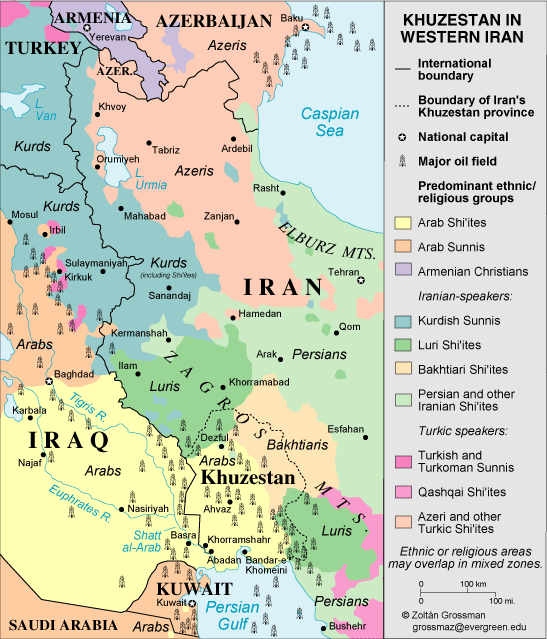
- We move to secure the oil fields in Khuzestan.
It cannot be an accident that we're getting more friendly with the UAE now. Watch for some build up of forces accross Straights of Hormuz.BTW, this does not mean I think any of this will work, or that there is a shred of morality in trying it.
If we move forward to point 3 though, we will need to deploy probably a triple of the current size of our military in the area that will have to be prepared for continuous fight with the iranians whom I don't beleive will give up their oil that easy. For this to happen I have to assume the following:
- A military draft
- War bonds to finance the tremendous costs
- Hyperinflation and probably a military coup at home
Therefore I don't think they will go for it, the price is much too high and we will probably trigger a total breakdown of the system.http://turcopolier.typepad.com/sic_semper_tyrannis/files/lang_johnson_tni_83.pdf
Good post.
However they are wrong on a couple of points. One is the Iranian air force and AA defenses. The Iranian air force is old, prone to accidents, and would be quickly destroyed. AA is better, but still dated. Remember there have been all sorts of embargoes on Iran going back to 1979.
As to Israel, the authors fall into the Beltway mentality. Below is a letter from the February 28 issue of DEFENSE WEEKLY:
Striking Iran
David Isenberg, in his commentary in the Feb. 20 issue, says the United States and Israel do not have good military options to pre-empt the Iranian weapons of mass destruction (WMD) program. If he means that the political and economic ramifications of such an attack are undesirable, no one could debate that. But if he means that either lack the targeting data or military capability to execute such an attack, he is spouting nonsense.
It is an unarguable reality that because of their size and unique signatures, it is not difficult to discover and identify conventional facilities used to generate weapons-grade plutonium or uranium. Once discovered, these facilities can be destroyed.
However, once a country has adequate quantities of these unique materials, it becomes very difficult to find them, or much smaller weapon manufacturing sites. Hence, the need to stop the Iranian WMD program before it is able to generate weapon-grade plutonium or uranium.
The conventional wisdom is that Israel lacks the military capability to pre-empt Iran. This is based on the assumption that the Israel Air Force (IAF) has only 25 long-range F-15I strike aircraft. It also assumes that the Air Force is a mirror-image of the U.S. Air Force, in which case it could only generate about 20 long-range sorties daily, of which only 12 would be strike missions.
Unfortunately, this inside-the-Beltway conclusion is flat wrong. The IAF has 264 long-range strike aircraft, all of which can fly round-trip missions from Israel to Iran unrefueled. Unlike the U.S. Air Force, Israeli F-15s are all heavily modified multirole aircraft, with higher maximum gross takeoff weights, updated engines, conformal tanks and large drop tanks, and vastly improved avionics. In 2006, the IAF conservatively could sustain 700 long-range fast jet sorties daily versus Iran, of which 500 or more would be strike.
The wrongly held view that Israel cannot pre-empt Iran has had a catastrophic impact on the effort to neutralize Iran diplomatically. The Israeli director of military intelligence has just laid out their view of the time line. Iran will master uranium enrichment within nine months and then will be able to produce nuclear weapons by 2009. He has stated that the Iranian president's threat represents a real policy and is not merely propaganda.
For Israel, because of its small size, its population density, its military dependency on a handful of key airfields and rapid mobilization of military reserves, any nuclear threat would be existential. Israel does not have a survivable second-strike nuclear deterrent. A theological regime might not be deterrable in any case.
The Arrow missile defense system is a superlative technical success but only will work against a small-scale, poorly planned attack. Iran can deliver its weapons by a variety of means that Arrow cannot defeat.
To survive as a nation, Israel has no choice but to pre-empt Iran this year, before it begins to produce weapons-grade uranium. U.S. policy should be to prepare for the days afterward, when a humiliated and defanged Iran unleashes its anger. If Israel conducts a well-planned air operation lasting three or four days, initiated by strikes which will slow program reconstitution, followed by targeting critical defense components, Iran will not be able to directly retaliate.
No, Iran will target the undersized U.S. Iraqi garrison and the vulnerable lines of communications through the Gulf of Hormuz. The United States should increase its naval and amphibious forces in the region before Israel attacks.
If Ehud Olmert does not launch the attack I am sure Ariel Sharon was planning, he will bear personal responsibility for the future destruction of Israel.
Kenneth Brower
Spectrum Associates, Springfield, Va.
Hard to argue with Jack.
-Major T.J. "King" Kong
The Saudis, Qatar, and other aligned Sunni countries have an extremely vested interest in protecting their assets. The respective elites in each country obviously have prepared plans to eradicate to sustainability any opposing internal dissension. The continuing rising stress levels between Sunni-Shia factions is offered as evidence as how the internal cull will proceed.
The world elites have surely considered that the unceasingly increasing demand for ME internal consumption adversely and directly impacts the exportable fuel amounts. A negotiated 'decline methodology' based on pure power principles to maximize optimal future inflection points would be a logical pursuit.
Optimal Population curve matching to the Hubbert Downslope has been a longtime covert policy directive of the IMF, WTO, and other 3-letter milgov orgs. It is only a matter of time whereby the continuing compression of short term needs overwhelming long term planning, and my axiom of ERoVI > ERoEI will lead to the more overt method of open decimation. The "Nuke their Ass--I want Gas" mindset to maintain energy/capita at the highest achievable levels to optimize detritovore lifestyles continues unabated.
Thus my 'Humanimal ecosystem' continues its detritus fueled course to elite consolidation [inclusive fitness]. Keystone predators are somatically limited by Nature in how far their effects can spread in time and distance; consider the inclusive effects of wolfpacks' or lion prides' hunting activities. Our humanimal topdogs should logically pursue inclusive fitness at the global level to rule the decimation course of all the lesser 'humanimal lifeforms'.
Sadly, detritovores continue their delusion of the Energy Fiesta versus facing facts of Peak Everything and adopting the Powerdown mindset of 'No Thanks--I like Empty Tanks'. It will be a desperate race to somehow rebalance the scales of biosolars vs detritovores to optimize the Dieoff Bottleneck. The present course guarantees a squat funnel with a very small opening-- we should be seeking to create actions that transform the funnel in a long conical tube with the opening as wide as possible. I fear delusion and denial, even at the highest elite levels, spells unbelievable sadness in the years ahead. Such is Life.
Bob Shaw in Phx,AZ Are Humans Smarter than Yeast?
Better to understand the effect of "" ...the kinda personal emotions that some of you fellas may be thinkin'... ""
And I think he does in fact have "" pretty fair idea that something doggone important is goin' on back
there" in the minds of the godz-Hearing and gosdz-fearing Leaders of our little orb Here and NOW.
Watch the elections in Israel. I got $1 says Labor Party is not going to form the new govt. I just hope it is not the Likud that does get to.
Truly, we live in the best of all possible worlds? How can you possibly imagine otherwise? ;-)
Pangloss
Thanks Mr. Greene for sharing this - Right or wrong it sounds like he is at least Trying to think about the situation from a POV other than his own cherished onez.
And he seems to feel detached enough to be rational.
Good for him. And good to see him share.
First, this entire theory that the Iranian bourse will bring chaos to the world's money markets is silly. As if the oil countries, Japan, China, and the EU all want their dollars to become worthless tomorrow - or should I say the end of the month when the bourse is to open. Now should they be shifting around into other currencies, sure, and there is some of that going on. So the premise is wrong.
Second, the national debt is a concern. But the next president will raise taxes and the budget will get closer to being balanced unless we are in a major war and/or get serious about GHG and fast-track the required and necessary changes. In doing this kind of stuff, no one can do it at our scale with the possible exception of the EU. China and India are still a bit away from being able to make massive shifts.
Third, Bush is certainly concerned about oil. No question. But his paramount concern is about a nuclear bomb in a cargo container going off in Charleston harbor. Just from a political point of view there would not be a Republican elected as President, certainly with the name Bush, for the next fifty years. Jeb would be really bummed. (the dream Republican ticket right today is McCain - Jeb Bush).
Now let us examine this from a military point of view.
Just last week I heard a retired naval officer suggest that we would land marines on the oil coast of Khuzestan and he noted that we have a lot of our marine task forces currently at sea. Couple of big carriers headed out that way too. He suggested the marines and the 82nd airborne were to go in with the other target being the Straits of Hormuz and the main Iranian naval base at Bandar Addas. The problems are:
- Holding this once we got it. I don't doubt we could seize it but we could not hold it without the issues we already have in Iraq. Last time I looked the Iraq military/political situation was NOT helping oil production and delivery in that nation.
- There would be international hell to pay. China would be real unhappy with this and might take the opportunity to get Taiwan back.
- Our military would be terribly stretched. People would be in the streets around the planet, and there would be an upsurge of violence in Iraq, orchestrated by some of the militia outfits there. Yes, it can get much more violent there.
- The Iranian counterattack would include suicide speed-boats loaded with explosives, ship to ship missiles, but most of their active conventional military would be fried by our massive airpower. But travel in the Persian Gulf, for at least 1-3 weeks would be shutdown, and reopened only under naval escort for tankers.
I think a more likely outcome is that the American Public Opinion, while not liking the war in Iraq, they certainly do not like the Middle East and some of Islamofascist thinking. The latest rant about "why can't we make jokes about the Holocaust and homosexuals" that was in the newspapers over the weekend, to the entire question 2 women equalling one man for Islamic fundamentalists, and the outrage over the port deal with the UAE suggests to me that we will want less to do with the Middle East, not more. But American Public Opinion is coming around to thinking bombing the heck out Iran's nuclear facilities for 2-3 days, or by Israel, is O.K., even if we have to release the strategic oil reserves to keep oil under $80-90 a barrel.But bombing them would have a big price tag economically too. World-wide recession? This is an election year too. Bombing would occur after the Israeli election this month, and before we get into the high summer. Or it will wait for 2007. Most experts think the Iranian nuclear bomb is still not realizable until 2009-2010.
But be really afraid if we do nothing about Iran and something horrible happens in Tel Aviv or Charleston. At that point the gloves would come off and a lot more innocents along with the guilty would be hurt.
http://mutters.invisionzone.com/index.php?s=de966a23869a47d2d79035a982a97b49&showtopic=3596& st=15
Keep in mind that Buehler reported on the phone that these guys have nukes.
http://www.prosefights.org/baltimoresun/shanebowman.htm
And what might they have borrowed from N. korea? And what Role China in any exchanges between them?
Is there a lining up in the BackGround (like maybe after hours at happy hour at the G8 RECENTLY ???) of a New Boringly-Same version of the game "Axis and Alliees?"
(apologize if your link addresses this - short time now, will read later, thanks very much for it though)
Don't raise 9-11. You really believe 3 buildings fell straight down at free fall speed because of melting steel, all the steel melting just exactly in sync so that none of the buildings would topple this way or that? And fell in the wrong order to boot? Please!!!
You concede that Bush "is concerned about oil". It's like telling the judge: I held up the bank, and while it's true there was a lot of money there, the real reason I held it up was because the bank president was planning to steal my car.
Ted Koppel, at least, is now prepared to be open and honest about it -- it's the oil. Coulter, someplace, after giving a long list of reasons why it's not about the oil, then adds, besides what would be wrong about just grabbing the oil?
So I ask you -- if that's all it were really about, would you still support just grabbing the oil? Because if that's true, the rest of the discussion is a waste of time, isn't it?
I hesitate to raise this point after previous discussion of "off-topic" posts, but what exactly do you mean by this? What exactly are you proposing happened? I'm not sure I'm reading your tone correctly. Are you alluding to something, but not saying it? Please be clear.
But I'm not going to hog the blog any further. Read author and theologian David Ray Griffin's two books and 9-11 and tell me you honestly have any doubts whatsoever about who did 9-11. Tell me what they are. Yes, it's a challenge.
I will respond in full to your concerns very soon. In the meantime, can anybody advise me on the best way to get my money back for a shipment of rocket-propelled-grenades that don't seem to have any propellant in them. I got them from a source in Africa who shall remain nameless at this time.
Pool party at my place this Saturday. Remember that fake, "Saudi/Kuwaiti/UAE" prince whose party caused such problems for Matt Damon in Syriana. Well my bash is going to be way better. Clooney is going to need his Karl Rove. Who will that be? Pity Good Night was such a hit in the very same year. Only George will get that. Sailorman is welcome as long as he sticks to wine.
We will discuss options for the RPG's, of course. It was a very large shipment.
P.S. I don't need any challenges. Getting up in the morning is big enough. Oh great, I gotta read two more books before I can even respond to you! Get in line, is all I have the strength to respond. I'm the leader of a third-world country, and in addition to my official books-to-be-read list which numbers 344 as of last Thursday, I've got to add yours to the pile. Thanks, that made things so much easier.
I suppose I have to buy them for myself, too. Y'know I don't control everything. Rafael has his fingers in things. It's not like I'm Saddam. You pitiless bastards have no mercy.
I wonder why they always like to do autopsies first, emotive self-inflicted lobotomies first and Then 2much Later decide to -Ponder Remedies. In that foggy-azzzid state of mind....
why Mother, why is that anywayz agi'n ??? }}}}
That is typical of the way highrise buildings fail. They don't tip over, they "pancake." The floors' connection to the building is usually the weakest part, and gives way first. (And at least one of the towers did not fall straight down.)
They were not hit identically. One building was hit at a lower speed, higher up, and suffered less damage. It also happened to have upgraded fireproofing. So it stood longer.
People always seem puzzled that buildings don't topple over like trees. If they were built with a continuous cellular structure and very little open interior space, then skyscrapers might topple over, hitting the ground with a largely intact structure. But they aren't.
My first class in structure was called Statics. Each floor is strong enough to hold up the floor above, with a substantial safety factor, as long as the floor above is relatively static. If the mass of the floor above falls, it becomes a dynamic load, then the floor below fails and becomes a dynamic load itself, which cascades into a failure of each floor in turn.
I've read a bunch of stuff over the past couple of days, ranging from wacked-out conspiracy theorists to just regular guys analyzing the data. It doesn't seem that anyone can find a plausible cause of failure other than controlled demolition. Here are a couple of reasonable sites to get started on, in case you haven't read anything about this yet:
http://www.physics.byu.edu/research/energy/htm7.html
http://wtc7.net/
http://en.wikipedia.org/wiki/Collapse_of_the_World_Trade_Center
How is controlled demolition plausible? I saw two planes hit the buildings at full speed and full of fuel. Are we even talking about the same incident? I think the regular guys you are talking about are really conspiracy-theorists who do an extremely good job convincing certain segments of the population of their theories.
That is the classic conspiratorial contradiction.
Leanan-- Thanks for wiki link, however, it actually presents some divided opinions on WTC 1 & 2, and no conclusive opinion on WTC7.
Jack-- As amusing as conspiracy theories are, I feel they can often interfere with a quest for getting at what actually happened.
Additionally, I assume that there are transfer beams for each story. As one story fails, it would crash into the one below it, and they would crash into the one below, etc. This would not be a free-fall collapse. This is what I'm trying to make sense of...
I remember exactly when WTC 7 went down. I was sent home from work after the 2nd tower fell, and was online, searching for information and discussing what was going on with friends. Then my Internet connection died, and stayed down until Saturday - four days. WTC 7 took a Verizon switching station with it when it fell.
I can't seem to find anything that discusses this phenomenon outside of the the WTC buildings and controlled demolitions. Thanks.
You might try searching for information on building failures during earthquakes. I know many buildings "pancaked" in Kobe and Northridge during those earthquakes.
This building in India suffered a pancake collapse during an earthquake. It's nothing but rubble, but the buildings around are only slightly damaged.
You expect a steel frame building to still have a steel frame after the earthquake, not just liquefy. Even if it has a trashfire going in it.
These transfer beams must be very strong, and may be deep steel I-sections, deep trussed girders or steel-reinforced concrete sections. But, if a transfer beam fails, the entire stack of columns resting on it fail also, and the many floors of beams resting on those fail, all more or less at once.
WTC7 was built over some sort of powerplant, so rather than excavate in and around the equipment, they spanned over the powerplant with transfer beams. If those beams failed, there would nothing holding up several bays of columns, and the beams resting on those columns from the transfer beam all the way up to the roof. Several bays would all come down at once, and the impact load would likely drag down neighboring bays.
The World Trade Centers ("WTC's") could, and did, fall in what was essentially free fall.
I timed the WTC fall and it took about 6 seconds--free fall time from 1300 feet. Watching with me was landslide/ avalanche scientist Dr. Francisco Fiorillo (from Milan Italy) visiting at the US Geological Survey Menlo Park, CA whose knowledge was relevant. We discussed the collapse.
How it happens, making some simplifications, is this:
The first floor (or set of floors) falls starting with a collapse at one intermediate floor. Although the weight of the structure above the collapsing floor is "W", stopping the upper floors, must necessarily arrest the fall in a distance less than the distance they have fallen. The physics requires an enormous upward or "support" force be exerted to stop the falling floors. If for example the falling floors are to be stopped in a distance that is one tenth the distance they have fallen, the force must be ten times the weight of the falling floors or with falling floor weight W the support need is 10 W. The strength of the building is not anything like sufficient to hold up 10 W or stop the falling floors. The building pancakes, floor after floor as weight and speed of the increasing number of falling floors increase. This is in a fashion much like that of an avalanche all going at once down a steep slope. Once collapse started, the strength of the WTC was almost nothing compared to what was needed to arrest the collapse as it occurred floor after floor. Free fall from 1300 feet, the height of the World Trade Centers, would take 6 seconds. Six seconds is what it took as I timed the replays.
The scary thing is that all tall buildings could be subject to the same type of collapse.
t = √(2*h/g) = √(2*396/9.81) = 9.0 seconds?
The final report found some evidence that the fuel did burn, at least on the 5th floor.
In case you haven't...
Loose Change is a video documentary (found on Google) that effectively shreds 9/11 'officialdom' to the core.
Icing on the cake, is that Loose Change is written and produced in America by AMERICAN KIDS!!!
Children of the United States who -unlike their good American parents- recognize the overwhelming contradictory evidence that supports COMPLICITY not incompetence.
My problems revolve around the fact that I started this debate by trying to kill it. My mother always told me,"Hugo, you want to make the fire bigger - use gasoline!"
So before they crucify you on the conspiracy-pire, remember this, my Dear Leanan, they believe because they want to believe. But you will always be right.
That reminds me about the guillotine-engineer joke. Either Sailor or Gets IT will surely relate that to you now.
That rest of you "got nothin'."
Nah, there's a lot of great movie-material there.
That, and you probably shouldn't ever go into a US-built building more than 2 stories tall. They tend to disintegrate suddenly. <grin>
Ancient engineering is a marvelously interesting topic, and IMHO we could learn much from those anonymous great ones, especially the Roman engineers who built roads and aqueducts with soldiers when they were between battles (which was most of the time).
Humans are engineering animals because we can think to solve problems and accumulate knowledge over generations. Beavers build dams, but they lack human culture and always build the same kind of dams. Humans, with the benefit of cultural accumulation can do great things--and terrible ones.
WTC 7 did suffer severe damage from collapse of WTC1. WTC1,2 did not fall 'into their own footprints', steel does not have to melt to lose significant strength, etc. etc. etc. over and over and over.
Haven't yet seen anyone describe the process it would take to rig WTC1,2,7 for 'controlled demolition'. Probably would take 6 months or more, crew of 100 or so, lots and lots of tearing out of walls, ceilings, pre-cutting steel members, cross-cabling structural members together, doing test blasts. Funny how this all happened without anyone noticing. Oh... I forgot, it must've been secretly developed explosive systems that nobody knows about yet....
http://video.google.com/videoplay?docid=-5137581991288263801&q=loose+change
Attacking Iran would be folly of the highest magnitude because the Iranian reaction is hard to guage or quantify. The Iranians have the military capacity to make life very difficult for the US army in Iraq. They could probably overrun it if they made a concerted effort regardless of the cost. How would the US reply to this? Would the US us nukes to regain its strategic advantage? Do we really want a nuclear war in the Middle East of all places? How far would such a war escalate? Who else might be drawn into the conflict?
Is this all really just a re-run of the Iraq fiasco? Only this time with even higher and more dangerous consequences? Are we really going to follow the same leaders who fooled us all over Iraq again? Are we really ready to risk nuclear war?
News stories recently reported about this being the new U.S. strategy, to give Iran a piece of their own medicine by trying to stir up trouble there. Here is one I found with some quick googling, from Feb 20:
http://www.iranian.ws/iran_news/publish/article_13405.shtml
Also Colin Campbell (you've heard of him?), planted a whole chapter on 9-11 right in the middle of his book OIL CRISIS. See what it says, please. Why did he plant it there right in the middle of his book on peak oil?
I have great respect for Campbell: he is consistent in his willingness to face unpleasant truths. David Ray Griffin has done the research on 9-11 Campbell has done on peak oil. Of course, not as long.
I'll lay off now - read Griffin. Otherwise I am hijecking the blog.
Iran - a threat to the petrodollar? by Emilie Rutledge
The End of Dollar Hegemony by Hon. Ron Paul of Texas
The Proposed Iranian Oil Bourse by Krassimir Petrov, PhD
Petrodollar Warfare: Dollars, Euros and the Upcoming Iranian Oil Bourse by William R. Clark
March 6 (Bloomberg) -- Crude 11:56 EST
http://www.bloomberg.com/apps/news?pid=10001013&sid=aU9TNw96Kxdc&refer=commodity_futures
(oh my godzain't Mother, quit it, quit ticklin' me)
"Considering the many productive uses of petroleum, burning it for fuel is like burning a Picasso for heat."
--Big Oil Executive
That's one of the most profound statements I have read on oil anywhere. (We just need to find something else to burn.)
*
Or someOne*else
to burn. As the case may be.There was a front page WSJ article last year some time that discussed Army war-game plans for a partial takeover of Iran. The WSJ actually had Army officers talking on the record about their plans.
Their professed theory was that instead of taking over all of the country, the US could just seize a small part of Iran and show what freedom and free elections could do for that region, and then hope that the rest of Iran fell to the "forces of freedom."
I wonder what portion of Iran that they had in mind. . .
In an interview published in Forbes on 11/1/04, Yergin unequivocally stated that oil prices on 11/1/05 would be at $38 or less.
What amazes me is that anyone still listens to this guy.
http://www.peakoil.ie/newsletters/649
Similarly, if oil were $40/barrel in December or October, I would count it as a "hit" for Yergin, even though he actually guessed $38 on Nov. 1.
I don't think anyone expects predictions to be that exact. But if, like Stratfor, you predicted oil would be $30 and it's $60, that's an obvious miss.
http://observer.guardian.co.uk/business/story/0,6903,1519745,00.html
Yes, you can quibble and say he only predicted it "could" hit $100, but let's face it: if oil actually had hit $100, you know this would have been counted as a correct prediction. The fact that oil stayed in a narrow range for the rest of the year is clearly not in the spirit of what he was predicting. We did not have to face up to "the biggest crisis we have ever had". We got through the winter just fine.However the water shortages caused by the subsequent lack of snowfall may prove to be much more serious.
And it's not going to be any easier without cheap energy.
(Farmers, not agri-busness...)
Science is being cut off at the knees, except for military and defense-related research. And it's gotten to the point where you really can't expect scientists to fund their own research.
This is, of course, exactly what Tainter would predict, for a society facing diminishing returns on technology.
There are some tough choices coming as to which parts of our complex world should be maintained, and which should go away.
Iran has too much to lose to push the issue militarily, so they won't. The US has too much to lose economically and in worldwide stature, and possibly militarily. That last part is related to Iran's conventional missile capability, which is very formidable. Unless the US managed to take out all of Iran's missile sites before they could launch, Iran, if pushed hard enough to throw caution to the wind, could inflict huge losses on the US by sending missiles into US bases in Iraq. Barring that, they could turn the world oil market inside-out by attacking Saudi oil facilities.
I think this is situation boils down to a simple set of facts:
Iran knows that with the US mired in Iraq and at the mercy of the international oil market that they (the US) can't attack without paying an enormous price, one so large even Bush and his circle can spot it in advance. Therefore, they're exploiting the situation to get what they want--becoming a nuclear power and untouchable (ala N. Korea), and making the US look like ineffective morons in the process.
The US is bluffing as best it can to get Iran to back down because that's all they have right now.
Once Iran has at least one working, deliverable nuke, the entire US policy in the Middle East will be exposed as a failure. They attacked an innocent country, tied themselves into knots, and let the real threat cross the nuclear threshold.
I tend to agree with you, though I think we should not underestimate the maxim "power corrupts." Huge mistakes ARE made by the power-hungry fellas that head countries. After all, there's some evidence that we've come pretty damn close to nuclear war - and that's about the most ill-advised action a country can make, considering the overall effects.
On another note has in situ hydrocracking ever been experimented with for EOR?
There was a nuclear explosion in New York. Almost all the city is destroyed. No one has taken a charge for the explosion. Foreign governments deny their implication.
Do you think this is impossible?
Think again.
There are eight known countries which have got nuclear bombs. And maybe from ten to fifteen which have got know-how and fissile materials. Imagine. Some country has smuggled few bombs and mined big cities of its adversary. Just in case if the missiles wouldn't hit the targets.
Do you think this is impossible?
Think again.
When you threaten somebody don't forget there are many countries which hate America not less than you hate Iran.
Andrei, from Moscow with sincere love.
Sookim-sim! Stoly! Nyet . . . . Dah.
Those are the only four words of Russian I know.
Did I spell "son-of-a-bitch" correctly? I've seen it different ways, and even in English there are variations, such as "sonsabitches!"
What else can I say?
Sookim-sin! More Stoly, ice cold. And another. Sookim-sim . . .
A wise comment. Bolshaya spasebo
(many thanks in English, po-Angliskii) I fear that far too many im my country are in cocoons and isolated from reality.
Looks like you are offshoring all your high tech jobs and high tech armies need a high tech skills base
''...The United States is the first country in history to destroy the prospects and living standards of its labor force. It is amazing to watch freedom-loving libertarians and free-market economists serve as full time apologists for the dismantling of the ladders of upward mobility that made the America of old an opportunity society.
America has begun a polarization into rich and poor. The resulting political instability and social strife will be terrible.''
The above from Counter Punch, March 6th by Paul Craig Roberts. Long article but worth a read.
BTW, regarding the Exxon Advert: Is there no Advertising Standards Authority in the US?
The best move? Get all U.S. forces, and what is left of the coalition, to Kuwait, board ships and heavy lift aircraft, and get the heck out. One more nation with nukes is going to be a lot less dangerous than the supposed fix. If, in the next few years, Iran does develop their own nukes, carefully explain the principle of MAD. If there is any lingering doubt in their minds about the consequences of MAD, have the Chinese explain it; they may be a lot more persuasive.
If the U.S. attacks Iran, all hell is going to break loose, and peak oil and global warming will be the least of our worries for many years to come.
If Bush has a choice between attacking and "losing face," who thinks he will choose the latter option?
I think that you also can't overestimate the importance of the fact that if Bush leaves, it will be proof that his old man was right in not taking out Hussein in the First Gulf War.
While Iran may pose an 'existential threat' to Israel, Iran is hardly such a threat to the US, anymore than North Korea is. The only problem a nuclear-capable Iran poses to the US is that once it achieves that status, the US can permanently forget about installing another compliant Shah-like regime that will play ball with the US regarding favorable access to Iranian oil.
It really galls me that so much US blood and treasure is being drained to do Israel's bidding. The explanation should be quite obvious to anyone who is not blind: the powerful pro-Israel lobby in the US and the almost total lock they have on the US Congress and the Bush regime. Israel is our 51st state, and thought it is only about the size of New Jersey, it is by far the most influential one. What congressman up for re-elections dares to go up against the well-funded Israeli lobby?
We are Israel's ally and sole guarantor of it's very exisitence. But Israel is hardly our ally, and wouldn't think twice about stabbing us in the back if it had something to gain. (Something that have already done.)
So, there appears to be a reasonably good chance that we are once again going to go to war for oil and for Israel.
If you thought Iraq was a smashing success, wait'll you see how well Iran is going to turn out!
Suddenly, it's July 1914.
I have previously made the point that Ralph Nader's "political assassination" of Al Gore is to World War III, as Gavrilo Princip's actual assassination of Archduke Ferdinand was to World War I.
How many people have died because Ralph Nader helped defeat Gore? 100,000 or more? The truly scary part is how many are going to die because Nader helped defeat Gore. Amazing how one man can have such influences on history.
But you've got to love the irony. It was a group of left leaning voters and antiestablishment types that delivered us into Bush's hands--and perhaps into World War III.
Whoops.
The problem is that Nader's support plummeted in 2004, and Bush still managed to win.
I'm usually not a conspiracy head, but you have to assume that we had a relatively clean election in 2004 in Ohio.
Christopher Hitchens, also not a conspiracy head, thought that the 2004 elections were almost certainly rigged in Ohio. Odd that an ATM can print out a receipt, but electronic voting machines can't?
I frankly think Clinton's little indiscretions and Gore's own fund-raising incident left Al on the defensive against a MSM that didn't like him anyway. Gore was fighting so hard for the center, the far left was open for Nader.
I like Nader. He'd make the policy choices that our world needs. But while his backers understand a great deal about how to run a country, they don't know how to advance policy within a political system that is structurally two-party, and has been since the Federalists and the Anti-Federalists. All the idealism in the world ain't gonna create a permanent third party, or hope to win an election where a candidate is lucky to get 3% of the vote. The Oil Drum isn't the place for an extended discussion on Duverger's Law or first-past-the-post voting disticts, so I won't go into them. But basically, if you try to work outside the system (even if ostensibly to improve it), you end up shooting yourself in the foot.
Not July 1914, more like the retreat from Kabul.
Guessing is good, but betting is better!
http://www.intrade.com/jsp/intrade/contractSearch/searchPageBuilder.jsp?z=1141684358095&grpID=44 28
The betting line on an air strike on Iran before the end of June is currenty at 10.3%. You could get ten to one odds on an event that you view as having one chance in four of coming true. Not a bad deal!
Most contributors here are much luckier than they realize. There are a myriad of opportunities in the world for them to become wealthy, just like this one. Because their views are so far out of step with the mainstream, and because betting markets exist these days on almost anything, a Peak Oil supporter can put his money where his mouth is and have an enormous positive expectation from his bets.
Of course, that's assuming he's right; and more to the point, assuming that he still feels confident in his beliefs when it is necessary to put his money down, and he realizes that there must be some reason why so many people are willing to bet in the other direction.
Most of the problems discussed here are so controversal within the "PO community" itself that I'm starting to think that we are more of a bunch of communities than a single one. Just look at the nuclear discussion above for instance.
(BTW personally I wouldn't bet a single dollar on the idea that we are attacking Iran. but I'd bet all the money I have that we would want to)
Like you said, I have little doubt that the Bush administration wants to attack Iran, and will if they can. It seems to me they have made a lot of preparations for it. I don't see a lot internally that would stop them, so I'm hoping that they are constrained externally. But hoping is not hopeful.
I am no better at predicting the future than you are. So why should I want to bet any more than you want to ? So please don't give me this shite of "Let's make a bet." You tell me: what specifically would you like to bet on? Then we'll maybe talk. If you don't think there will be a war with Iran, just say so and give your reason is a logical civil discourse. But let's dispense with this casino shite.
I was just expressing the opinion that I think there's a decent chance that IT's going to happen regarding an attack on Iran. I am not trying to make money out of this.
So tell me: what are your reason for thinking it won't?
Betting markets are being used increasingly as a mechanism to consolidate opinions and come up with more reliable predictions:
http://www.sciencenews.org/articles/20031018/bob9.asp
When I quote figures from intrade.com and other markets, it is to provide the most accurate information available about possible future events. I'm not saying that I want to bet you.But... actually there's more to it. Once you find out that the market consensus is a 10% chance of an Iran attack, you need to either change your opinion of the probability to match the market opinion, or else recognize that you are intentionally passing up a chance to make a bet with an expected positive outcome. Passing up free money is at least arguably irrational. So it's actually questionable whether it is ever rational to disagree with the market consensus! That's an advanced result, though. Not many people are ready to hear it.
Your comment about fighting for Israel reminded me of the oft heard 1938-9 cry of "Why die for Danzig?" We helped establish the state of Israel and a study of what went down in 1948-49 is very interesting. And Egypt and Jordan seem to have accommodated to Israel existing.
Frankly I don't like anyone who says they want to fry Israel when they are head of state as the current Iranian president has said and the one before the last one.
I also get worried, no matter what religion, when the head of state says the 12th Iman is about to reappear after being in a cave since, what, the 1200's (?) and God cast light about his head when he spoke at the UN last year and no one blinked during the entire speech.
By the way, the odds are 30% by March of '07 for military action.
Here is a little article that came out this weekend from a Iranian news report (it is anti-current govt., but accurate.) It is another example of I think we should all listen to what people are saying. Sometimes they do what they say and it is reprehensible:
The weekly newspaper, PARTOW'EH SOKHAN, the mouthpiece of Mullah Messbah-Yazdi (also known as "Professor Crocodile"), Ahamdinejad's spiritual advisor, in its most recent issue called for a more active and increased deployment of the suicide missions that can also be aided by Islamist terrorists. The article published the locations of several of the training camps for Islamist terrorist operations in Qom and added: "The world has decided to antagonize us and therefore the only way to protect and promote the ascendancy of the Islamic rule is to set their entire world on fire and the only way to achieve that is through the expansion and increase of suicide missions."
Referencing one of Khomeini's speeches where he had touched on the subject of the "Essentiality of Peoples Voice", the article also wrote: "Up until now, it had never crossed anyone's minds that the Imam's intention was that the common people would be so audacious as to permit themselves to get involved in the divine rule. The meaning of this phrase is not what people thought it was and if anything, the phrase has been misinterpreted. People have no rights and count for nothing in an Islamic rule; it is God that reveals his commandments to the supreme leader, Imams and Ayatollahs in order for them to carry out. How can the average and ordinary people who are all sinners and complete idiots be permitted to express their opinions when there are superiors like Khamnei are in charge? Imam Khomeini's meaning when he used the word 'voice' in that phrase was 'to see'; in other words people are only there are spectators, nothing more. The measure of the legitimacy and authority of the Islamic rule is not in the majority vote of the people; in general people are too stupid to be involved in a process for which they are simply not qualified."
Yes folks, Iran has been recruiting and training lots of suicide bombers of late.
- The big blue Kurdish Sunnis area that overlaps 3 countries, Turkey, Iraq and Iran
- The yellow Arab Shi'ites area with bordering green Luri and Bakhtiari Shi'ites areas. The yellow area contains most of the oil production. The Shi'ites (regardless of sect) are very concentrated in a large area.
Geopolitical realities in the region have more to do with this distribution than country boundaries ever will--at least in the long run.As for the oil bourse paranoia accompanying the article cited that contains the map, Jerome a Paris deconstructed that very effectly I think.
Country O & G J BP Campbell Author's range
Iran 132.5 132.5 69.0 35-45
http://www.energybulletin.net/13009.html
Nuclear power is not a panacea for all our energy problems. James Lovelock the father of the Gaia theory has suddenly become an advocate of nuclear after decades of opposition. His reason is simple. He believes oil and gas are running out and there is no realistic alternative available in time to avoid the collapse of our civilization. Therefore for him nuclear is the only short-term answer to our energy problems.
Unfortunatley there appear to be substantial problems connected with a massive increase in our nuclear capacity. I really think one needs to slow down and remain calm when discussing nuclear for a number of reasons. Whilst the United States is close to being the size of a continent, many other countries are not. Building dozens of new nuclear plants in small and densely populated European countries makes me slightly nervous. A substantial accident in a small country could lead to it effectively being wiped off the map. What about security condsidrations? Dozens of nuclear plants could become targets for terrorists. What about the waste from the plants? Unless we are absolutely sure we're going to have social structures and economies that are capable of dealing with the large ammounts of waste produced, isn't it irresponsible to dump this waste on coming generations without asking them? Can democracy survive the creation of the nuclear state? Do we really have enough available uranium? Where is this uranium? Do we really want to develope fast-breeder reactors? What do we do with the plutonium waste? I could really go on and on here, and I've only begun to scratch the surface of the problems connected to nuclear.
I'm pretending to be the world's greatest expert on nuclear, but I do think there are many more problems than most of the posts here imply. Let's just calmly and rationally examine the nuclear option before we almost glibly decide to support it no matter what.
We're headed for the ice berg with the Titanic's engines turning at maximum RPMs for maximum speed. Some advocate putting the engines in reverse. Some advocate putting the wheel hard to port. I say, do both . . . and get the pumps running . . . and man the lifeboats . . . and build rafts . . . and then we might have a fifty:fifty chance of hitting the berg less hard so as not to sink and maybe, just maybe barely brushing by. It is already too late to miss hitting the ice altogether, in my opinion.
However, as long as those in power do nothing--just as the Captain of the Titanic had another drink and ignored messages from the radio room of ice sigtings, . . . well, make sure your life jacket fits.
"Flatten 'em before they can get nukes. Dehouse them. Demoralize them. They want to turn the clock back to the good old days of a thousand years ago? Fine. We'll help put them back in the Dark Ages. Gentlemen, start your engines . . . ."
General Jack D. Ripper
"Your Commie has no regard for human life. Not even his own".
With Mandrake - Click to Enlarge
"Now why don't you just take it easy, Group Captain, and please make me a drink of grain alcohol and rainwater, and help yourself to whatever you'd like".
General "Buck" Turgidson
"Mr. President, we are rapidly approaching a moment of truth both for ourselves as human beings and for the life of our nation. Now, truth is not always a pleasant thing. But it is necessary now to make a choice, to choose between two admittedly regrettable, but nevertheless *distinguishable*, postwar environments: one where you got twenty million people killed, and the other where you got a hundred and fifty million people killed".
The quotes are from here.
All free.
I say: worry about nuclear war, not nuclear power!
Off Tangent Topic - SAD AND DOWNRIGHT PATHETIC dept.
(oops)
Look what happens when Mixing Science and SIDE SHOWS Like Godznshit like that.
In thrall to the green god
VIEWPOINT
Environmentalism has become a religion, writes Martin Livermore in this week's Green Room; humans should take off their hair shirts, and enjoy the lifestyles which progress has created. With the decline of Christianity and Marxism, environmentalism has taken the place of religion for many
We humans have an uneasy ...
http://news.bbc.co.uk/2/hi/science/nature/4766096.stm
The Mother is LHAO at us Lint Pickers stuffing our Matress with Factoids when we still have full bellies. "Now I lay Me little Pickers of Lintoids... now I lay me on The Bed You Made and now refuse to Make after sleeping in it. Contemptable ??? - or just complacently watching and not Using the Lint for ANYTHING constructive sometimezUp...
hmmm... but wait - what's this ??? hmmm let me see that game they is starting to play amongstest themselves there... interesting little critter that homosap..."
http://www.cnn.com/2006/WORLD/meast/03/05/zawahiri.tape/index.html
-----lost bits-O-convesation drifting quietly now across the Cosmos billionzes and billionzes of Infinite cracks and Crevices in timezUP and space.... (shhh, may git spooky or just creidble)--------
About Stealing their oil - I agree with him very much on this in a way. But objectively only (again, as if I am not on a side and this is past history so i kin remain blameless like the titbabies alive today).
The point is - what if right now you and i were sabotoging pipelines build over the past few decades to SUCK our Great Lakes DRY slowly but shirley.... ?
Most of the little sand people and jungle people are just now waking up to the Greatest Heist in History = the Sucking Dry of their valuable resouce by the FIRST WORLD... under the watchfull eyes of "leaders" elected or not who helped Line their pockets etc while they Sold Their Peoples down the river.
Attached find an idea for Red Claw (in Paint):
How did the Red Claw manage OverPopulation and Reduction of Natural Resoures? Model Red Claw (not the Yabbie or maroons though, they act more like us) ???
http://aquanic.org/publicat/usda_rac/efs/srac/244fs.pdf
Can Peoplez possibly live like them (if not NOW maybe THEN after the Survivors of This Transitional Wave are left to populate the Homo Sap Pen?
----------
or ... I like the Way of the SexPistolChimp.. :p)
'Hippie chimps' fast disappearing as (desperate someonez) dinner(s)
http://www.cnn.com/2006/TECH/science/03/05/bonobo.disappearing.ap/index.html
Different Mechanisms of SAME Problemz Sovled by The Mother Already in many, many little Escape Pods she hides among the Contestants. Think like a crustacian or "lower" pretro-bate primate ??? Maybe give it a try sometime somewhere Soon Now?
"Our ancestors have been *pumping oil *for
centuries. How could (it) disappear?" First World Reality TV victim of his own circumstances and refusal to take responisbility for himself - AND who pretends to be educated and WorldlyWize and NOT HYPnotized said.
<<VIRAL WILD CARDZ by MOTHER>>
(The 4 Horses with Quiet Hooded Riders are about ??)
Madagascar hit by mosquito virus
Reunion Island is trying to eradicate mosquitoes
Madagascar has recorded the first cases of a mosquito-borne disease that has caused havoc and is linked to 93 deaths on Reunion Island, to the east.
http://news.bbc.co.uk/2/hi/africa/4777530.stm
How many manhours would it take to turn this dayze board game into Disc 1 in a Series?
Rapid Deployment Free-On-Line of a Sane Game in Real Time cobbled together with few rules?
A sort of B-version of the Game Plan for Fun education of the Next Generation (at least more fun than the coming of the Mother.... ah, Her University... she charges VEry steep Tuition - especially to LATE ENROLLMENTS who partied instead of Studied for FINALS.)
First is a small article, "Rising interest rates lure oil exporters back to the US dollar". It bears on the debate swirling around the importance of Iran's intent to price their oil in euros instead of dollars as cause of the upcoming attack as opposed to those who say: it's just the oil.
The second one is on GTL: "'Designer fuel' fires oil companies optimism". How much new info there is for TODders, I don't know. But I got out of it three things:
First, GTL becomes more economical relative to LNG with the rise in price of oil.
Two, GTL fuel is a premier fuel, and therefore a soemwhat a niche product, even though it may become quite big. The military market for example? I still think liquids from coal will be called on to provide the bulk of liquid fuel as the shortfall increases.
Three, ExxonMobil has or intends to have a big position in gas and this GTL market. This despite their public opposition to peak oil.
WOULD YOU INVESTORS buy Stock - if any? What if your Pension Fund or Mutual Funds are not AS SMART as the Kenyeenezian-type guy mentioned on-site a few dayze ago?
---------food for thought?
About "Global" or "International" investing and Pension fund decisions etc...
If say an Energy Company is in Asia or Africa, and another one is in the USA... if you are in the USA which do you invest in? - Does "LOCATIONlocationetc" apply? ... boils down to Control of Production or Energy Security as Putin said?
Consider the Stock Performance as the Truest guage of the companies value... at the Here and Now: - if a Shock occurs, Local producers, suppliers etc will weather any Shock better than "Global/International" investments.... That the Big Herd seems to be selling and maybe even really is (delusional) enough to be buying yet (the energy markets are not awake yet, the gold market is, each in turn I guess...).
Profoundly local sources of energy and companies managing them are a much better and more "safer" investment than most international or global opportunities on any scale or with any nation - IMHO.
darnitmothergonnagitmesuedyetgodzain'tmightyAllFriday
I am Not an Investment Advisor or even a moderately respectible investor let alone person in 3D.
Also - PLEASE NOTE 1) CHECK WATER TABLES (*hint*hint - discused on this site the other day for kolorectal and some other west-midwest-southwestish states...) AND 2) Check the INSIDE OWNWERS list for Brilliant Billionaire Investors etc etc (e.g smart or dumb money on board)if you do invest in a smallish US based company with some local mini-JR-Ewings (whose oil and gas wells are now 1/2 FULL instead of half-empty == just like Some of those little gold companies with marginal mines Then but productive mines NOW at THIS Times Price.
I would suggest that the takeover of KHUZESTAN has already started:
http://news.bbc.co.uk/2/hi/middle_east/4769724.stm
REMINDS ME of the Army of Poor, Hungry Cold Dis-and Dat-malcontents...
Easier to hide in war games than tanks etc...
Maybe spies too and lose "terrorist" networks helbent on (in THEIR OWN MINDS at least) getting what remains of Thier Peoplez Fossil Fuel Wealth.
ATTACK says the ... (quiet guy behind the scenes... wo show instability... to provoke instability... to avoid Unclear NUCLEAR exchanges of POV - at the wrong places and wrong timezUP).
Keep an eye on that region, the Arabs that live there have no love for the Persians.
http://news.google.com/news?hl=en&ned=us&q=khuzestan+bomb&btnG=Search+News
Will the results of even a limited war with Iran be any better than the results of the Iraq fiasco? I doubt that very much. Looking at Iraq one has seen the destruction of the State, the smashing of infrastructure on a massive scale and the virtual end of civil society. The costs to Iraq are almost immeasurable and will take decades to put right.
The costs for the United States are also gigantic. Somewhere in the region of five to six billion dollars a month. The costs over the long-term will astronomic too. What's the cost over fifty or sixty years of taking care of severly injured young soldiers? Probably over a trillion dolllars! It just doesn't make any sense to fight wars anymore. Modern warfare is simply too expensive and too destructive, war just does not pay economically. To say nothing of the cost in lives and the morality of killing in itself. For these and many other reasons, modern warfare is insane.
What value does one put on the "good name" of the United States? I suppose one could call it "Brand America". That bran name has now been dragged through the mud and defiled. On a scale of infamy, brand America is probably somewhere between Stalin's Russia and Nazi Germany. Well, not quite, but you get my drift. The costs of destroying a positive brand name are astronomic.
But maybe there is some method in this madness. Maybe having a huge army in the Middle-East has a purpose after all. Is it just the well-known imperial tactic of devide and rule? Has the administration decided to smash the Middle-East and re-draw the map. Iraq is just the first stage in this plan. Given the ethnic and religious coflicts in the region it shouldn't be to hard to create chaos. Then when the whole region is fragmented and weak, and after enormous destruction and loss of life, some kind of equalibrium will return. The oil will still be in the ground and the United States and it's allies will be in control once more. But is this "plan" realistic? No, the troops don't exist. Just pacifying Iraq would require a million men. Where is the logic of war taking us? I don't think re-shaping the Middle-East in our image and smashing Islam in the process is possible with using nuclear weapons, and that is a whole other ball game. How the US is to reamain anything near a democracy once one starts to use nukes against cities in the Middle-East is beyond me. So I think the stakes are very high, and not just for the people on the other end of a nuclear strike. We may destroy them, but their ghosts will haunt and eventually destroy the United States too.
It's not as if this hasn't been done before. When the British and the French carved up the Ottoman Empire after World War One, they made sure that the oil was separated as much as possible from the mass of the population. Thereby small countries with small populations had lots of oil, but no power, and therfore easily controlled. It's an interesting thought, that if the Turkish Ottoman Empire had not been carved-up in this way, Turkey might well have been a world power like the United States.
In a way, it is a darn shame we cannot bring back the Ottoman Empire--corrupt, inefficient, but wonderfully tolerant. So long as you paid your bribes to the appropriate authority, they did not care if you were shia or sunni, Arab or Jew, Kurd or Croat or Serb. Any of this foolish racial rioting, send the Janissaries and cut off some heads to show that intolerance will not be tolerated.
However, the carving up of the Ottoman Empire was somewhat more complicated than you suggest. France and Britain were at the table, but Russian and U.S. interests were not neglected. Winston Chuchill (Yes, he had a hand in this.) was exasperated by the infighting of sunnis and shias, thought that occupying places such as Iraq would be almost as bad as Afghanistan, and he recommended air power for control of the oil-rich areas. As a big fan of Kipling, Churchill knew the DUET (Deep Universal Eternal Truth) stated in ARITHMETIC ON THE FRONTIER (i.e. India's NW frontier) by Kipling:
A scrimmage in a Border Station--
A canter down some dark defile--
Two thousand pounds of education
Drops to a ten-rupee jezail--
The Crammer's boast, the Squadron's pride,
Shot like a rabbit in a ride!
No proposition Euclid wrote
No formulae the text-books know,
Will turn the bullet from your coat,
Or ward the tulwar's downward blow.
Strike hard who cares--shoot straight who can--
The odds are on the cheaper man.
Ah, what a pity it is that our Fearless Leaders in the U.S. do not read Kipling, who was not only a fine poet and novelist, but also one of the clearest and most intelligent journalists of empire.
I wonder how many of our leaders have read aloud or understand at all the poem, "East is East, and West is West." Or "Gunga Din."
Oh, BTW a jezail rifle is an old-fashioned long-barreled muzzle-loader. Doctor Watson suffered from a wound from a jezail bullet, though its exact location in his body is questionable. The Brits hated the jezails and never could forgive the tribesmen for better accuracy than they had with their "modern" rifles, just as they hated the American colonists for their Kentucky rifles that were far deadlier at long range than the English muskets.
One thing Native Americans never developed was very effective weapons. They hunted by getting very close to game and then shooting it with relatively feeble bows or using spears that were nowhere near the equal of, e.g. Zulu spears.
Of course there were traitors like Squanto, who foolishly showed the Pilgrims how to grow corn and beans and squash, and knew how to hunt turkeys, but we'll have to kill off Squanto and his Quisling ilk to make the plot go. Just think how history might have been changed had the Pilgrims all starved to death . . . . And it was a near thing.
So many ideas, so little time.
Can anyone spare America a dime?
US government near to debt limit
see link below :-
http://news.bbc.co.uk/1/hi/business/4780844.stm
Does YOUR PERSONAL HMO Cover ???? (timezUP for chickens-Checkin' now please???)
JOBBERs OPENINGS by Da Mudda
Massive Toxic-Psychic-Shock&Awe Therapist(s):
Openings HERE NOW: 2
Openings Anticipated: 14M
Pay: $$$, gold, chickens, Walnuts and mockingbirdz, whatever they can offer?
Hours: (24/7/365) x Indefinitely
Job Description: Hold hands for one hour with one titbaby@aTime. Guide them through the Coping Stages for the Lost Civilization. Reassure "this too shall pass." Tell them stories they forgot about in their stupid dusty books layin' over their collecting small mammal fecal matter.
*(EXTRA SPECAILIST subposition * - Gifted writur toungeus speaker (?lol?), Charismatic, Attention-starved-madlyCraving Credible Shrink - WRITES NYTz Bestest Seller full of interviews with living fossil Saps who remember FONDLY (for good reasonz) Their Lives in the little Great Depression, WWII Rationing, City vs Country life w/cousins from city coming for "picnics" every other dayze of the week .... LIFE AND TIMES OF HAPPY SAPS who made due and LEARNED what Billy BobParkerain'tGotNoSon? SAID "in passing" once Long ago.... " I could Work at a McDonalds and STILL BE HAPPY..." Hmmmm said one overhearing Angry Elf-Oaf on Hispersonal way back to his Personal Dungeon Cubical with test-tubes full of colored stuff, some smokin' a little, some test-tubes "stirring by magic" as little tiny Sap1onesez once said loooong, long ago ;p)
How did some stones gather moss while rolling?
How did some critters live where nothing could be living ever Not Here&Now or Ever be4 or Then... but In FACT do live anyway?
How Red Claw... AND Maroon?... AND THE YABBIE even -how all 3 Made the Mother's Final Cut in the Last Big Draft their PARENTS and GRANDPARENTS went through??? ...
Hope-OpporTUNE-i-TiTies, & Transfer of Da Wealth and Passin' of The Plate
contents:
RichRussel story
korean kids story::: (on BBC somewhere - 8? Pics by tourist in N. korea, kidzx "iceskating" on improvised blades- those lil' mothers-O-funkyinventors...
other crisis survivor stories today::: everyday newz in E. euro and 2nd world NOW PLAYING... (duh..)...
Gramma on the farm story::
Ditto in the city:::
Grampa as a farmer, logger,poacher-w/lawOnHisSide4once ;)
Games "we played W/O needin' No...":::
Things we Never Dreamed we could live w/o:::
Things we :NEVER DID MISS THAT!" :::
Pet's and Death and FOODdammit ::
Hot, cold, Hunger And Anger Management Mother's WAYZ:::
tired. nap timezUP ;P)