
 | Tuesday Open Thread: W's Speech and Why We Should Love High Gas Prices... | The Oil Drum | Record Oil Company Profits and High Gas Prices: A Connection? |  |
Perhaps we are getting a little more attention
Posted by Heading Out on April 26, 2006 - 12:25am
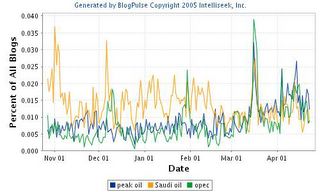
So being curious I did it again.
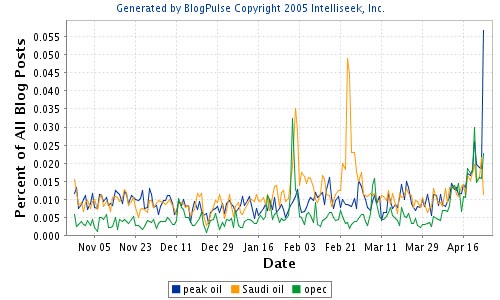
And suddenly we have another peak, though this is about twice as high as the last one.
To turn to the President's plans; if I understand this correctly, the President has stopped filling the Strategic Petroleum Reserve (SPR) in order that there should be that much more (only actually around 70,000 bd) crude oil to go around and to keep prices down. Which would suggest that there is a shortage, where every little helps.
Saudi Oil Minister Ali Naimi, the powerbroker within OPEC and its convincing voice on extra capacity, said while it would offer more oil if the market wants it, the demand isn't there.would suggest that the supply of crude is not the problem.'There's no demand even for light crude,' Naimi said, referring to the higher quality oil favored by most refiners. The usable spare capacity is judged to be as low as 1.7 million barrels a day of high-sulfur, harder-to-refine crude.
'Send the customers, we will give them what they want,' said Naimi.
Well, the Murphy refinery at Meraux (125,000 bd) is scheduled to reopen the second week in May; so we should soon be back in production at all the refineries, just as the new Hurricane season starts. This should allow some greater influx of crude, to provide additional gas to the market, and perhaps this might influence prices. Though following through on the scenario that developed last year nothing much helped.
It would be nice, for those of us who look for answers, if there were more funds for creative processes outside of the defined few, since, as has been said before, the answers will be in bb's not a single bullet. Unfortunately we are not seeing that level of creativity in the allocation of funding. Pity, really!
Contact
- Content: editors at theoildrum dot com
- Tech support: support at theoildrum dot com
License

This work is licensed under a Creative Commons Attribution-Share Alike 3.0 United States License.
"With international oil prices breaching US$75 per barrel, China's crude prices, which fluctuate with international benchmarks, are expected to rise considerably as well. The country's Daqing crude price is forecast to rise to 4,701 (US$586.55) yuan/ton in May, 421 yuan/ton higher than that in April"
One last try. Does this indeed mean that China expects oil to go to $83/b on the June contract, and does this mean that they are willing to bid to $83/b next month?
A price of 4701 yuan thus translates (today) into $586.89 which is close enough to the original poster given currency fluctuations. At $586.89 per ton, this works out to $80.06 per barrel.
So yes, the Chinese appear to be willing to bid oil above $80 per barrel soon.
RR
The president's statement notwithstanding, this MTBE purge will continue until all of the MTBE gas is out of the system. Whether the gas going out for sale is reformulated with ethanol or straight-up gasoline is another story altogether. As soon as these declines are wrapped up, I cannot fathom continued declines in gas stocks, given most refineries seem to be up to speed at the moment.
Off topic, but yesterday someone from the U.S. House of Representatives domain was visiting my blog. I was feeling pretty good about that. This morning, someone from the CIA domain ws visiting it. I wonder if I should be concerned? Both were reading my essay on windfall profits. I captured a screenshot:
http://img85.imageshack.us/my.php?image=ciavisittomyblog12fm.jpg
RR
Crude oil stocks fall by 200,000 barrels. Gasoline stocks fall 1.9 million barrels. Both are larger declines than expected. More soon
Also, in the other thread I reported on today's COP earnings release:
HOUSTON, April 26, 2006 --- ConocoPhillips [NYSE:COP] today reported first-quarter net income of $3,291 million, or $2.34 per share, compared to $2,912 million, or $2.05 per share, for the same quarter in 2005. Total revenues were $47.9 billion, versus $38.9 billion a year ago. During the quarter, the company reinvested 141 percent of its net income into the development of oil and gas resources and its global refining business, excluding the acquisition of Burlington Resources.
Emphasis mine.
RR
Anyway, thanks for the info. I have to admit I did a double-take when I saw that this morning.
RR
I don't think it's automatic spidering, because I run several personal sites for friends and family, and I never see government agencies on the visitor source list. Google, yes, the CIA, no.
(McKillop has been predicting, for some time, that higher oil prices, at least up to the $75 range, would not slow the economy.)
http://www.financialsense.com/editorials/mckillop/2006/0425.html
Whatever Happened to Oil Price Elasticity?
by Andrew McKillop
Author & Consultant
April 25, 2006
Excerpt:
Getting back to the narrow question of why oil demand (and world gas demand now growing at around 5%-per-year) are much less than unaffected by rising prices, but are directly increased by higher oil and gas prices, we finally call on facts. We can use theory first, but finally we call on facts, because scientific theory is based on and comes from facts. The other way round is called economics - that is, bending facts to fit brokenback theories.
Price elasticity of anything has an underlying notion, hard to quantify, of `satisfaction', and another of `substitution'. Neither of these have much place for the vast majority of oil and gas users. Nobody uses oil and gas `for the fun of it', or at least very few persons. Equally, the famous `hi-tech emerging new energy' substitutes and alternatives simply don't exist. They may exist on the Nasdaq or in people's heads and PCs, and in cute business video presentations, but not in the real economy.
So the simple fact that oil and gas demand is increasing much, much faster than during the cheap energy 1990s, with much, much higher oil and gas prices should at least allow us to accept reality, and find or develop theories that fit. When we go back to economic theory notions of `elasticity', as mentioned above, we soon see that they don't apply in large measure, or any convincing way to explaining what is happening. The bottom line is however very simple: until and unless interest rates are sharply raised, to double-digit annual rates, oil and gas prices can go on crawling ever up. With the ever surer approach of Peak Oil, they will in any case have no other direction to move.
Demand is INCREASED by higher oil prices.
The economy is not slowed by it.
I truly don't understand how this works. I mean, my own discretionary spending diminishes. The extra money I'm spending on gas is somehow being recycled to my benefit?
Anyone care to light my lantern on that?
http://www.energypulse.net/centers/article/article_display.cfm?a_id=1019
Oh, then what's NASCAR? - and won't it be looked back upon similarly to the Roman spectacles?
Crude oil stocks fall by 200,000 barrels. Gasoline stocks fall 1.9 million barrels. Both are larger declines than expected.
Who was it that suspected the inventory report had bad news, and Bush saw it early, hence yesterday's speech?
Anyway, it looks like it's back up to where we started, and a few cents more...
IMO, in regard to oil prices we are going to see steadily higher highs and higher lows, as the markets allocate declining crude oil and product supplies to the highest bidders.
This is what is ironic about the US Congress complaining about high prices. IMO, the only thing keeping the US market supplied is higher prices.
The article is quite supportive of westexas' theory about declining net export capability:
Iran is one of top four net oil exporters. The bottom two, Iran and Norway, are definitely declining. The top two, Saudi Arabia and Russia are, at best, flat to slightly up. The economies in all four countries are growing fast, and domestic consumption in at least three, all but Norway, is increasing fast.
This is the reality of 2006. What the top exporters can, or will, export is declining. What the top importers want to import is increasing. Price is where the battle will be fought, if we are lucky. If we are not lucky, the battle may involve weapons, conventional and otherwise.
We are now below the average range.
They're like the bin Laden tapes that always seem to pop up whenever the administration is in some kind of trouble. They could be real; or they could be just more psych-ops.
I just don't know what to believe, and I feel like I'm being manipulated most of the time.
On the other hand, "oil for food" (i.e. Iraq) got about 32 responses. And "global warming" got about 46 hits.
It has been that way for the last year and a half that I have monitored that site. These people and just about all the right-wing blogs (except for a few econoblogs) are deathly afraid of the topic. And it isn't because it is an "end-times" marker.
recognition in the msm! ...if only fleeting
to those TODers (or just PO-aware folks) who made ads, good work!
-pop
You mean we were pre-programmed to financially self-destruct just because of one terrorist attack?
We were/are programmed to self destruct because the game is one where the best bullsh*tter comes out ahead in each round. It is not win-win on each exchange. It's tails they win and heads you lose. When some fancy-named water-in-a-plastic bottle company sells you water for 100 times cost, it's not fair and balanced. The game belongs to those who can and do psyche you out.
Same with cars and gasoline. Why does a machine that pollutes the atmosphere, puts you in hock and just drives you in circles cost $30,000?
----------
Step Back,
Why do you hate our freedoms?
Best,
Matt
Yo. It wasn't my people who slammed the jets into the towers. It was "them that sell us crude" (and maybe them that kiss their cheeks too).
--still stepp'in
So over the last few weeks I have been giving things away, and throwing away the junk I have collected, It has been enlightening to see the things I have stored for years.
But if any of you would like a 3 peice Queen sized bedroom set, with a serta mattress only 4 years old, let me know you'll have to pick it up. I have been sleeping on the floor for about a month now, got to rest in a Hammock yesterday. Product made in China, Failed through a design flaw which would have not been there had they not used plastic that was not rigid enough to take the strain.
A big named US company had to make in China, ColeMan, the Outdoor outfitter of the ages, made in China. I want to growl about things, but I am just not going to worry.
PS. If the end of the world is just around the corner, I am not suppose to worry about that either, I am not the star of the show, just a guy doing his itty bitty part.
GOD bless you.
I have been going through the same thing. I look around my apartment (only 600 sq ft) and see all the 'stuff' I have collected. I try to go through and thin it out. I've even been tempted to quit my corporate job, go back to Colorado, work as an EMT on an ambulance and live out of a VW van. But not quite that couragous yet.
But why are you sleeping on the floor?
The problem is not individualism or capitalism. The problem is credit. President Thomas Jefferson strongly opposed a national bank, fractional banking, and fiat currency. Our Constitution, Art 1, Sec 8, Cl 5 says The Congress shall have Power ... To coin Money, regulate the Value thereof, and of foreign Coin, and fix the Standard of Weights and Measures. The Federal Reserve Bank is unconstitutional as well as our entire banking system. That is the problem. Kunstler touches on this in TLE saying that our present banking system requires increased amounts of debt which requires increased amounts of energy, however, he missed the part about it being unconstitutional.
When you have the world's reserve currency, you can just print more (or more technically, transmit a few more electrons between banks' computer systems) in exchange for a tangible product. Today's housing bubble is different from the stock market bubble in 2000. All the latter did was shift around a few more electrons on computer systems. The former involves actual resources and manual labor.
Funny post, becuase it almost implies that humans are perfect beings, and would be living in splendor without external programming to mess them up.
On the other hand, if you are saying we are built a bit imperfectly for this modern tech/industrial society, I might be on board with you. That isn't really programming for destruction though, it's more (and I think this is the case) that we are a bit clumsy in our path to solutions.
And they certainly did it, quite successfully, it appears.
The North Sea oil discoveries saved our asses then, but the public didn't know that - all they knew was, they tossed Jimmy Carter out on his ass and voted in Reagan and everything was okie-dokie. Just keep singing "High Hopes" and "Happy Days Are Here Again" and everything will be just peachy. Just trust that invisible hand, and all that blather and things will be fine.
Again, feh.
It may have been one of the greatest, best-organized robberies in history. It's all gone, all of it. Trillions of dollars.
It may have been one of the greatest, best-organized robberies in history. It's all gone, all of it. Trillions of dollars.
I remember when Reagan was President and increasing the deficit and the economy was strong and saying, "Heck, I could do that and look good." Spend money I did not have to boost the economy. It worked. That is why Cheney said early in the 1st term, "Reagan proved that deficits do not matter." This has been a calculated move to power it up the economy (it worked) and keep money away from the Feds so Democratic Party handouts after 2008 would be more difficult to implement.
I also find it ironic that Australia, in its third term with a Republican like govt. has just ELIMINATED their national debt/ They paid it off! We will have to wait for another Clinton type President to do the same.
There are worse places.
Sure seems like it was planned.
The macro-game is to try to bankrupt government, and then privatize it and profitize it. The idea would be to return to the 19th Century robber baron era, where financial elites are in charge, and the middle class goes away.
It's the opposite of "The New Deal."
It wasn't the North Sea oil development that saved our asses, it was all the oil discoveries made with improved seismic from improved semiconductors and software. The North Sea oil fields were just a significant part of it, but not all of it.
Bush is the culmination of what the Demopublicans have worked so hard to create for 60 years - an all-powerful state. Having created the throne for Caesar were the damnfools so stupid as to not expect Caesar to take the throne?
Stirling Newberry argued at DailyKos that fiscal conservatism died with Newt Gingrich. Or Newt Gingrich's leadership role in the House, anyway.
Rick
Let me call bullshit on the idea that 'fiscal conservatisim' is somehow 'A Republican Value'.
Look at the spending increases whenever Republicans have been 'in charge' of the Congrees/WhiteHouse.
Words != actions when it comes to 'lets cut spending' happy talk.
At least you are honest enough to acknowledger the hypocrisy of the current Republican party.
I would not typically be bothered by political posturing, but I find the "pull yourself up by our bootstraps", "stay in school", "don't do drugs", "work hard" rhetoric by the Republican "do gooders" difficult to take.
If were affiliated with this party, I would be bothered by the chasm between rhetoric and reality.
Modern "republicans" go out and buy a huge SUV for the bogus tax rebate, real Republicans buy the thriftiest and most sensible thing they can get, and then only if a financial analysis shows they're better off having a car at all. Sadly, I fall into that group, I'd rather not have one of the annoying things at all.
I think Republicans and Democrats should drop the sectarianism and take a cool and unemotional look at the current administration. Are these guys really Republicans or even Conservative? I'm not sure they are. I think they are something different altogether. My Big problem is what are they? A lot of people think they're religious nuts, but I don't buy that either. If they are 'religious' what religion is it, and what God is their deity?
None of the following is meant to be definitive. I don't maintain that I sitting outside the US know all the answers. It's just a few thoughts and observations. It's meant to be taken with a pinch of salt. I believe that future historians will look back at the current Bush administration with something like dismay and incredulity! How did such a small and unrepresentative group of people ever get control of the Republican Party and the White House? A big problem for many of us outside the US is how come so many members of the White House team, people with real power, like Cheney, Rice and Rumsfeld, never actually got elected by the people, they are appointees and have been given power by the President. It seems odd that one votes for Bush and then one gets a whole bunch of other guys along with him that one really knows nothing about in the bargain. It seems a strange sort of 'democracy.'
I think the White House is in the grip of a kind of cult or sect, some people call it the 'cabal.' I think they are an intellectual elite, who relish power and have some rather 'interesting' ideas about 'democracy.' I don't believe they really believe in Democracy. I think they believe in elite rule over the ignorant masses, who are incapable of understanding the complexities of the world, and have to be led by the elite 'priesthood' for their own good. The masses are merely 'sheep' looked after by 'good sheppards.' These guys do not believe in an American Republic. I think they believe in an American Empire. In order to build the Empire, the Republic must die or be sacrificed so the grand strategy can succeed.
Clearly this rough outline of mine isn't meant to cover everything. It's a Big and complicated subject. Academics will spend entire lives writing about this Whitehouse! It hasn't got much to do with the old fights between Democrats or Republicans about how one runs the American Republic. That is the old politics. The real fault-line is between those who support the birth of a true Empire in the Roman sense, or those who wish to see the Republic re-established.
I think most Americans, Republican or Democrats, don't support an Empire like Rome, but on truly global scale. Obviously the elite cannot say all this openly to the American people, so they don't. I alos think they believe in 'noble lies' which are cynically used to 'hoodwink' the masses for their own good. A final interesting point is, how are members of this 'elite cult' or 'Sheppards' going to retain power over the Whitehouse, if Bush falls or the 'Republicans' are regected by the 'sheep?' How about starting a process which, by its very nature may prove 'irriversable' in its consequences? So that it doesn't really matter if another group takes over the Whitehouse, the die is already cast? Launch America on a truly terrible course, with no realistic way back, at least not in our lifetime.
I hope a "failsafe" order has quietly been put in place over at the Pentagon, and that if a disastrous order is given, it will not happen.
Somehow this administration has to be carefully removed by indictments and resignations. The wrong move now might send the world into thermo-nuclear war. Then it would be too late.
It's a difficult situation.
I also have a hunch that something really big is going on behind the scenes in Washington, and I suspect it has to do with the possibility of the Bush regime launching an attack on Iran. The Democrats do not appear to openly oppose such an attack, and many seem to even support the notion of 'fixing' Iran. So, it doesn't so much appear to be a Republican/Democrat thing, but rather something deeper. The 'generals' revolt' may only be the tip of the iceberg.
At any rate, the Bush regime getting increasing nervous about the Republicans losin control over Congress in November, and the calls for impeachment are growing louder and louder. Therefore, my thinking is that if indeed the Bush regime does plan to attack Iran, they will do it before November so that it becomes a fait accompli by the time the Democrats take control of Congress.
What would make for an extremely dangerous situation is if Bush ordered a purge of high-ranking generals in an attempt to replace them with ones who willing to carry out a possibly nuclear attack on Iran. Under normal circumstances I would consider such an eventuality as quite far-fetched, but these are hardly normal circumstances.
Actually beyond the joke, there probably is (seriously) an anti-intellectualism in their movement.
http://www.rollingstone.com/news/profile/story/9961300/the_worst_president_in_history
http://www.rollingstone.com/news/profile/story/9961300/the_worst_president_in_history
But don't worry, the link should still work if you click on it.
writerman, your comments echo those of Shadida Drury, professor of political theory at the University of Saskatchewan and author of a number of books on the political theory of Leo Struass. As you may know, a number of prominent neo-cons were students of Strauss.
In an interview she said:
"A second fundamental belief of Strauss's ancients has to do with their insistence on the need for secrecy and the necessity of lies. In his book Persecution and the Art of Writing, Strauss outlines why secrecy is necessary. He argues that the wise must conceal their views for two reasons - to spare the people's feelings and to protect the elite from possible reprisals.
"The people will not be happy to learn that there is only one natural right - the right of the superior to rule over the inferior, the master over the slave, the husband over the wife, and the wise few over the vulgar many. In On Tyranny, Strauss refers to this natural right as the "tyrannical teaching" of his beloved ancients. It is tyrannical in the classic sense of rule above rule or in the absence of law (p. 70).
Thank you for the link to the interesting and rather frightening interview with Shadida Drury. If her assertions are correct, we almost seem to be entering the realm of something that appears closer to science fiction than normal politics. The very idea that a cult with secret knowlegde might have taken over the government of the United States, is difficult to swallow. It's like a nightmare, conspiracy theory, or paranoid movie plot.
Unfortunately, Drury makes a very plausible case that this is not fantasy, but reality. She argues well and clearly knows her philosophers. My problem is, I really don't want to believe her. I feel emotionally that I have to remain sceptical and dismiss a lot of what she says. If she's right, I'd feel both depressed and angry. I've sort of arrived at her position by another route, the opposite route that she took, so to speak. She seems to have moved from philosphy to real world politics, I've gone from real world politics to philosophy.
I kind of wish Strauss had thought more about how his own own teachings could be used, and abused, and vulgarised themselves. There's much in what Shadida Drury says that's deeply disturbing. I'm not sure I care for the idea of washing away the decadence of Liberalism, with blood, in perpetual war!
I wonder where a man like President Bush would fit into the secret hierahcy; is he one of the wise, a gentleman, or one of the vulgar mass?
What did you mean by this?
--------------
Fleam,
Why do you hate our freedoms?
Best,
Matt
I would suggest to you that the freedom to be wrong, the freedom to fail, is part and parcel of what has driven us through the evolutionary process so far. Yes, the consequences of failure can be dire but that doesn't mean we should embrace timidity in search of false security.
Perhaps it is time for western civilization to fail. Perhaps it is time for homo sapiens to fail on some large scale. And if it is, perhaps that is the best outcome possible for the future of our species and the future of the planet.
Do you mean sadly you have to own a car, or sadly you can't afford to choose what kind of better car than your $$$'s can support?
I have almost always tried to be Thrifty. I have failed in the past, and will likely continue to fail at being thrifty, though getting 1,400 miles without a van would be a bit much to ask. But I do hope the Refineries do come online and dump the high prices we have been seeing and when I do travel, the price of gas will ahve gone down a few cents, and I can afford to buy myself a few neat items like food.
Great news I will be in a city that is only 6 square miles in land area, not 125. Though my girlfriend is in a rental house in a town 7 miles away, she lives closer than my brother who lives in the same city as I do. My current church is 2.5 miles away, the one that I might go to in Sterling is 0.5 miles away and even in bad weather not that far away. I will be able to walk to most things with a lot more ease than here in Huntsville.
I think the real reason the author is so angry is that he isn't speaking for as many Republicans as he'd like to.
FASTANDMEGARICH
PO Box 6000
90210
USA
It's truly saddening to see so many people blind to what's happening. I think it was JHK who wrote about how the people of Easter Island cut down every single one of their trees and died off because of a lack of fuel for heat. I was shocked how people could do such a thing in the face of certain death. Now I understand.
People are getting it, just not quickly.
I'd say wait a couple months and see if they answer gas price questions a bit differently.
http://www.hartford-hwp.com/archives/24/042.html
I am a liberal kind of guy and have a neighbor in town who is very conservative. Old style conservative business type.
He has successfully developed manufacturing sites in our town for hard industries. He is currently at odds with the people who want to just put in housing and big box retail.
Both sets are Republicans but one is focused on creating wealth and the other set is interested in capturing wealth.
That is what I see has happened to the Republican party. Too many of the party are only interesting in getting rich not creating a society and community. The pary is still about money but the focus is very different than pre-70's.
My liberal tendencies are based in a focus on inclusion of all people in the community to take part in the U.S. dream. I don't see that being possible anymore with the current Republican party. It is not about hating freedom.
Thoughts?
Someone else mentioned that old school Republicanism died with Newt Gingrich. That's probably true but I disagree with why. We do not need all the government we are paying for today no matter what the statist Dems claim about government being a pseudo "service" organization. Most of government is moving wealth from Peter to Paul in order to buy Paul's vote. However just as clearly, we do need some government so the anarchist extremists in the Libertarian party are just as wrong as the Democrats who chase the total statist Marxist bullshit dream.
Personally I felt like the tension between the Democrats and the old time fiscally conservative Republicans was a good thing. On the one hand, the unions, largely via the Democrats, were empowered to force corporations to come to the negotiating table and share the wealth. On the other hand the Republicans kept sniping at the Democrats socialist agenda in order to keep it to a reasonable size.
Now today we have two parties, neither of which cares about the average worker, both of which are on the corporate payroll (just from different sides) and being controlled by the same corporations while engaging in a large scale pillaging of the middle class solely for their corporate masters. Do these political fools think their corporate masters will still have a use for them when they are done sucking the life out of the dying middle class? If they do, they deserve the hideous fate that history suggests awaits them.
As I've said before, I think this may be connected to peak oil, if only tangentially. Perhaps offshoring of manufacturing would have happened anyway, but peak oil U.S.A. sure helped it along. And once management had the threat of moving overseas and hiring people willing to work for a dollar a day, the power of the unions was completely gutted.
In any case, what worked in the past may not work in the future...or even be possible.
Christian Science Monitor printed this editorial today:
Creeping toward oil as a social good
I don't know who owns the asian times
http://www.atimes.com/atimes/Middle_East/HD25Ak02.html
but here's some more.
I was surprised by the negativity later, in response to this uptick in gas prices and peak oil awareness. More bizarre to me was the idea that a ragged start to mobilization was seen (by doomers?) as a proof that we'd never do anything better. I mean, like, what do you want in 48 hours?
This is a huge opportunity, and as public attention becomes focussed, this is the first time in six months when people might actually be listening. I think it is a little better to use this to name concrete achievable steps ... rather than to moan about how dead you are. Jeez, if you feel that bad lay down in a hole and let someone cover you.
http://www.msnbc.msn.com/id/12440799/site/newsweek/
http://www.theoildrum.com/comments/2006/4/25/11239/2308/116#116
She is rather conservative about peak date (stating that "about three years from now, the non-OPEC world will start pumping at slowly diminishing rates" and "Within 10 or 15 years, it [Saudia Arabia] too may not pump enough to meet increased demand") but doesn't sugarcoat nontraditional sources:
Doesn't mention EROEI, but for a single-page MSM article I think it may get some people interested enough to type theoildrum.com into their browsers...
http://www.msnbc.msn.com/id/12333796/site/newsweek/
To revive a tradition....
Much beloved and esteemed
I note, respectfully, that no light sweet crude spare capacity number was given by Mr. Al-Naimi. I note with some irony that it is the minister from Nigeria that said
I note the foolishness of not adding to the SPR with the hurricane season coming up and wonder how we will fill it to capacity so that when the big one rages through the GOM, there will be some buffer.Also, on the news front, from Playing politics with gas prices
Not getting that bulk discount. However, $0.40/gallon seems very high. How do we know price gauging when we see it?The president speaks
Considering all the other subsidies, this plan amounts to nothing. At this point, all these tax breaks are giveaways in any case since throwing money at the problem does not increase recoverable reserves significantly (and if you're ExxonMobil, not at all).http://www.scoop.co.nz/stories/PO0604/S00169.htm
Bush says that he's doing his best to to take positive measures to contain the rising price of gasoline (e.g., posponing the filling of the SPR, delaying gasoline reformulation, etc).
Well, may I humbly suggest to Maximum Leader that one very positive measure would be to publically pledge to the world that the US will NOT attack Iran. If it is correct that nervousness over Iran is one of the main aggrevating factors, then such a move might immediately drop the price of oil by possibly $5/bbl or more. (What IS the thinking at TOD as to dollar magnitude of the 'Iran nervousness factor'?)
Of course that will never happen, but I think people out there should be aware that the Bush Regime itself shares some of the blame, for the rising price of oil because of its saber-rattling over Iran.
Richard Heinberg writes in Powerdown that there are a couple of choices the human race can make regarding Peak Oil: global-powerdown, or last-man-standing. I absolutely guarantee you we, China, India, and the rest of the world will be doing last-man-standing.
And the sooner oil rises in price, the better it will be for us to get through Peak Oil. The free-market will force people to consume less and change their lifestyles. It's going to be rough, but we need to start now.
Well, in all the news I've been reading it's been the US and Israel making a steady drumbeat of increasingly belligerent direct and indirect threats toward Iran, and not the other way around.
The threat posed by Iran to the US has been manufactured in the White House, just like the WMD threat posed by Iraq was manufactured in the White House. I just hope the American people are not going to be suckered into a war for a second time in a row.
Perhaps you get all your news from Rush Limbaugh?
My only point in the previous post is that by beating the war drums over Iran, the Bush regime shares a good deal of responsibility over oil market 'nervousness'. Whether this effect is $1/bb, $2/bbl, or whatever, there still has to be some effect.
And I'm pretty much disgusted with the Republicans (and being one myself) on how they are handling everything else other than the War. I'm aware we are being lied to about the War, but we need the oil. What else can we do? Powerdown?
I would agree that the main reason we are in Iraq is oil, with Israel being a rather distant secondary reason.
However, when it comes to Iran, I really have a hard time seeing how attacking Iran is going to get us access to Iranian oil. I don't think anyone seriously thinks were are going to actually invade and occupy Iran while we are barely holding our own in Iraq.
Sure, we could launch a massive air attack on Iran and destroy a lot of military and civilian infrastructure, but unless we invade and occupy at least the oil producing regions of Iran, we are not going to be getting a drop more of Iranian oil.
And judging from what I've seen of the way things have gone in Iraq, I think it is unrealistic to think we can bite off a chunk of Iran and quietly tap its oil reserves while the remainder of the country is unoccupied and overtly hostile. You simply can't operate giant oil fields in a perpetual 'Fort Apache' mode. Then you have the possibility of a scorched earth policy, in which the Iranians could easily destroy their own oil fields and terminal facilities if it became clear that the Americans were going to take them over.
No, strictly from the standpoint of oil availability, I can see nothing positive coming out of a US attack on Iran. It would delight Israel, but it would do absolutely nothing for the US.
Of course, this delusional administration may still be operating under the fantasy that if we bomb Iran sufficiently hard, the Iranian people will rise up and replace the current regime with one that loves the US and is willing to give the US favorable access to its oil. As I recall, this was the game plan for Iraq also, and look how great that has turned out.
This is a complex subject but I'll make a few observations.
- Iran said they were considering opting out of the Nuclear Proliferation Treaty. So, they're raising the (mi)stakes in this game of poker.
- Russia and China will never approve sanctions against Iran. They will never permit Iran's oil exports to be threatened.
- Wall Street knows what kind of cabal is running the US government and they are aware of #1 and #2 above.
In what way can the stand-off with Iran be alleviated? I don't know. As long as bombing is on the table, there is no solution. Israel will never allow Iran to develop nuclear weapons and the US will not back down or abandon them.Although the observation is correct that the Maximum Leader should renounce preemptive force, he will never do so since that is his avowed policy. Iran is a case in point. If these guys wanted to attack Paraquay, they would do so.
All and all, I think Iran deserves worry. As to prices, I believe it is having a negligible affect--maybe a buck or two. What's driving oil prices, IMHO, is a growing imbalance between available supply and the quantity demanded for light sweet crude. All and all, the Iran "fear factor" is mostly a sham as far as the market is concerned. It has been noted on this thread that many excuses are given for not acknowledging the supply/demand imbalance and peak oil in general. Iran is a good example.
At the end of the column Jon gives several links to sites covering oil in Africa, some of which may be of interest to TOD readers.
Snip ......
The Indians and Chinese are in this huge fight now to see who can get the most oil. We may be at a point of peak oil production. You may see $100 a barrel oil in the next two or three years, but what still is driving this globalization is the idea that is you cannot possibly get rich, stay rich and get richer; if you don't release more greenhouse gases into the atmosphere.
Snip ......
From Speech at London Business School, April 24, 2006.
http://www.egovmonitor.com/node/5728
The EPA is offering a research grant opportunity that I believe is a perfect fit for this idea. I have sent an e-mail to a hand picked list of university professors who have experience with government research projects. I'm looking to form a research team to apply for the EPA grant, conduct a social-economic experiment and surveys to determine to what extent the American public will support it, project the economic potential of WPH, and identify logistical, social and political obstacles as well as opportunities.
All government grants are awarded based on merit of the proposed research. I believe WPH has merit but your help is needed to verify it. You can help by posting your feedback. Let the professors and the EPA know what you think about WPH. Do you think this idea is worth pursuing? We need to know if Americans will support a plan like this.
Do you have any ideas to improve the plan?
Share any and all of your thoughts.
Tell your friends and family about this Blog post and ask them to post their thoughts on WPH
http://wepayhalf.org
Thank you
Craig