


Vinod Khosla - Give Him Your Ideas
Posted by Robert Rapier on July 27, 2006 - 8:50pm
Therein lies the opportunity. I know what I plan to say to him. I have already sent him some indication of my intentions, and I have prepared talking points. One of the things that we will discuss is alternative transportation solutions. As I was making up my talking points on alternatives, I thought "What have I forgotten?" I then remembered Alan's crusades for light rail. I started to sum up the pros and cons, but realized that I don't know enough about it. That's when I thought "I need to hear from TOD readers."
So, if you are interested in getting an idea to Mr. Khosla, here is the opportunity. Please present a better alternative than ethanol, and a brief synopsis of the idea. You might briefly list pros and cons, and by all means let's discuss in this thread. I am going to filter through and try to present him with what I believe is the cream of the crop. However, I will also send him a link to this thread. This may be your big opportunity. I know that he favors a carbon tax, as do I. One of the things I plan on discussing with him is the best way to implement a politically palatable carbon tax. I plan to talk about solar, wind, and biodiesel. But I can't cover the entire spectrum of ideas without input from the well-rounded group that makes up TOD.
I understand that people will have greatly differing opinions. There are those who would be against any solution that does not involve putting a stop to suburban sprawl. There are those whose primary concern is affordable transportation, who couldn't care less about suburban sprawl. But let's keep it clean and respectful. There is a good chance Mr. Khosla or some of his associates may read this thread.
I will update TOD readers after I speak with him.
Update [2006-7-28 20:11:45 by Stuart Staniford]:
So by the time I got to this thread there were 249 comments and still rising. Thus I had no choice but to abuse my editorial privileges and tack my comment onto the end of Robert's story. Something we don't talk about much but that I've been thinking about a lot lately is the role of the Internet in all of this. Besides being the most important development in human culture since the printing press, I think the ongoing Internet revolution has tremendous potential to help alleviate peak oil. Since around 2/3 of US oil usage is for transportation, anything that improves the ability of people to work together remotely can soften the blow. Most Internet technologies help in some way, but an area that seems particularly important to me is that the telepresence experience of computers still sucks. Video-conferences with no eye contact don't work very well. We need better cheap video cameras with wider angle and more pixels (and preferably in pairs for stereoscopic). We need software post-processing of the video image to fix the eye direction, and/or different/better technology to pick up body language. Working collaboratively on documents is much more difficult than it should be. Can we please get a proper global distributed file system already? Can we have lots of little super-cheap video cameras that sit around conference rooms and hallways and allow two people to stay in contact as they walk around their respective offices and workplaces via mobile screens (without it being an up-the-nose shot?) Oh, and I love my 30" Apple screen, but I'd like it to be even bigger - but it has to curve to get any bigger than it is - ultimately it could be a super-lightweight semicircular thing that wraps around 180 degrees and sits on my U shaped desk as I swivel (with, say, four mounted video cameras for full body-language resolution).
Then when when we're stuck at home because we can't afford the ethanol to get to work, at least we'll have excellent toys to distract us! :-) And surely we can do this a lot faster than ripping out all the suburbs and replacing them with something else.
Contact
- Content: editors at theoildrum dot com
- Tech support: support at theoildrum dot com
License

This work is licensed under a Creative Commons Attribution-Share Alike 3.0 United States License.
What needs to be got through to people who have influence is that we need to decide whether we head for sustainability or for an ever decreasing economic cycle where boom is followed by bust, is followed by smaller boom, is followed by bust, etc. I don't know what the long term, and probably long lasting, end scenario is for the boom bust cycle, but I'll bet it isn't going to be pleasant and will be with a much smaller population. If we want to head for sustainability, then a very different society and economy will need to be engineered, one that will never result in people like Vinod (at least not in wealth).
So, assuming a goal of sustainability, any cheap non-renewable energy we have left needs to be directed only to sustainability projects (or at least increasingly so). Any carbon tax must have a specific measurable aim of reducing oil, gas and coal use for leisure, and later for more "essential" uses. Saved oil, gas and coal must then be put to use in building sustainable infrastructure; sustainable without oil, gas, or coal.
Tony
Cheers,
RR
I wish them luck but I think a limited proposal will have limited results.
Effective subsidy ($/KWh) Nuclear (1947-1961): 15.3
Effective subsidy ($/KWh) Wind (1975-1989): 0.46
So, as part of my community service, this will be another installment of "lying with numbers" (TM).
First of all, notice that they are over different periods, why not make them over the same time period? Secondly, note that the effective subsidy of $15.30/KWh is about 300 times the wholesale cost of electricity (roughly $0.04/KWh). Is it really true that we are subsidizing energy with a factor of more than 300x its wholesale value? Even for wind this would be a subsidy of at least 10x. Seems fishy already.
More importantly, there wasn't that much nuclear capacity in the US in 1961, the majority was added between 1960 and 1980, so what we are probably seeing here is a few test reactors that produced minimal amounts of power (like the one at INEL that powered Arco for awhile). Take the money for the test reactors, probably add in lots of money spent on nuclear weapons, then divide it by a really insignificant amount of energy produced, and voila, the result is a "subsidy" of 300x the wholesale price of electricity.
Now for the wind period. How much R&D really occurred in the wind realm between 1975 and 1989? Seems to me that most wind has really taken off in the last few years, and thus the research was probably done mostly in the last few years as well. This is probably another case of taking the cost of a few research projects, and dividing it by some insignificant amount of energy produced. Voila, anohter meaningless number, but one that is slightly "better" than the meaningless number produced for nuclear. In any case, a subsidy of 10x wholesale cost seems a little steep to me.
Also, notice the last column of the table, the installed capacity from a year that is not in any way considered by the rest of the table. A non-sequitur. Even if it does have meaning (the R&D paid for nuclear caused it to have more installed capacity), note that 1999 is 38 years after the end of the development period for nuclear, but only 10 years after for wind. To be fair, this column should include the wind power produced in 2029, but sadly, these numbers are not available, and probably wouldn't show as wild a disparity if they were. Much better to use the contrived situation.
OK, there you have it. Second page, severe problems, numbers manufactured to support the conclusion they desperately want to draw. It's a waste of time.
I have watched the development of wind turbines for a couple of decades and the major forces in development were:
- A carbon tax in Denmark
- Favorable pricing of wind generated electricity in Denmark
- An "in service experience" database on WTs collected and published by the Danish gov't (Better quality WTs got more orders; poorer quality models disappeared). Market driven evolution.
- Danish law and society that allowed for groups of people (a half dozen farmers, some city residents and one farmer) to own one or more WTs as a co-op.
Just a few years ago, Danish companies produced 80% of the world's WTs. Please note "Massive R&D spending by Denmark" was NOT listed. (Enron bought last surviving US & German WT makers, merged them, and then GE bought the division from bankruptcy court. GE put in some major marketing & research $ and is now #1).Many billions have been spent by gov'ts around the world and only nuclear power can be said to be the "in service" result. R&D spending by gov't is *NOT* the answer ! They have had a long series of "not in market" results for over 30 years. Geothermal was also developed with minimal gov't R&D.
Thus my preference for mature technolgies that we know can work; especially Urban Rail.
Also, it should be added that the R&D for nuclear is now spent, so there is no reason to not use it just because it was pretty expensive to develop.
Realistically, taking only R&D related to civilian nuclear power (no nuclear navy stuff, no nuclear weapons, none of that), how big was the subsidy compared to today's generating capacity, in $/KWh. Probably pretty small. Even if 40 billion was spent in 1960, that's less than a billion a year for something like 100GW of capacity. A penny per watt of capacity, a tiny fraction of a cent per KWh, hardly seems like the criminal waste that was claimed.
Jack it up to 100 billion or more, it doesn't matter. The electrical infrastructure in this country costs trillions of dollars, a few hundred billion for R&D doesn't fundamentally alter the equation.
I just don't see why the fact that this tech cost a lot to develop (yeah, less than 1% of the cost of installing our current electrical generation, that's apparently a lot...) somehow means that it's bad to use it now. Want subsidies for wind development (which you don't, I see...) fine, but it's no reason why nuclear can't be used.
That's all I'm saying.
Otherwise - there is one "single bullet" for US, namely a higher gas tax. The rest will happen naturaly.
I would love for that money to be dedicated to providing alternate transportation options to local areas heavily dependent on automobiles...
I still don't see the political will for that to happen...but a few voices screaming at the trees are better than none.
Cheers,
RR
The commodities markets seem to have woken up to the reality of future oil shortages. Even with a relative glut of supply today, prices are high on the assumption of shortages in the future. That's exactly how markets are supposed to work and it is one reason we have them. The result is that even if the geopolitical situation improves, oil prices are likely to stay high, making gas high, and continuing to encourage conservation and development of alternative resources.
In short, we are on a good track right now. We have the effect of the gas tax but it is coming from market mechanisms, making it much more efficient and economically rational.
Alternately, if we were to remove all the current subsidies to oil and gas, that would be an even better first step.
We should be advocating removal of subsidies to oil and gas companies long before we push for an increased gas tax. I suspect that if all the direct subsidies were removed, and some of the (many many many) indirect subsidies the market would be much more likely to take care of itself.
In the current political climate, this is an easier sell than making gas prices even more expensive through taxation.
Only with that log burning in the fire would I throw in the much bigger and greener increased gas tax log.
I agree, a gas tax now is probably too little, too late.
Hitting the average Escalade driver in the well-padded wallet with an extra buck (or two, or three) will have little effect on their consumption
A real supply shortage* -- with gas lines, ten gallon limits and odd-even fill-up rules -- will hurt them where it really, really, hurts, in the pocket watch.
A month of waiting in a gas lines is a great inducement to consumption adjustment.
I wonder how long it will be before the "Will wait in gas lines for food" signs appear.
*Say if Saudi Arabia or Iran decide to apply pressure to force an Israeli cease fire by cutting oil exports.
The rationale behind higher gas tax would be primarily to cover the externalities associated with oil consumption - military expenses, pollution, traffic, suburban sprawl and associated waste of resources for land, roads etc. Secondary we have high level of uncertanty within the oil market about the true state of reserves and prospective production which makes the market quite inefficient in pricing in future scarcity.
In all cases gas tax will buy us time for the mitigation response and will make it smoother. Maybe it is true that politically it is too late to impose it, but this is a different problem.
I think he would want to champion some technical fix, something for which people will think he has some credibility. Something like Robert's biodiesel from algae or wind power. He might be willing to champion a new generation of nuclear power plants that will inevitably be a big part of our mitigation but which is still pretty politically radioactive. Or possibly put money into developing new battery or fuel cell technology.
A possible exception would be if the capitalist was not advocating it from a point of view of a seeking for a successful enterprise, but because he is concerned about the long-term stability of the system as a whole. A rich, successful VC like Khoshla may very well fit the latter category if he wants to, but his support for ethanol (the limitations of which I'm sure he is aware of) makes me think that he doesn't.
How to make it politically acceptable - that is the real challenge.
In short, the general public is starting to realize that renewables will be crucial in energy independence. This realization can and should be leveraged to adress the imbalances in government support for various energy industries. Shifting support from Big Oil to renewables can be presented as a revenue-neutral and labor-market-neutral policy that is very hard to refute. Another angle is that it's a fitting "punishment" for Big Oil's "excess profits".
This could be linked to engine capacity / mpg / carbon emissions. The bigger the engine etc , the higher the tax.
This has started to happen in the UK , but with minimal effect yet as the difference is not that great in tax rates and if you can afford a large 4wd, you can afford the tax difference.
One side effect however is that it bites impoverished hill farmers who need land rovers more than it bites a 'Chelsea Tractor' driver.
Gas has always had an important tax here, in fact every fossil fuel.
Today, %60 of what you pay for filling up your tank is gas tax. I think this follows the general pattern in Europe.
We "achieved energy independence" more than 15 years ago and today Argentina is a mild oil exporter and our cars are small just like the Europeans.
That's a different pattern of what you could see in México or Venezuela (comparing apples to apples this time) where, as far as I know, gas taxes are not so high and cars are bigger and not so efficient.
Of course, timing issues regarding the USA case can not be ignored.
Regarding the "efficiency and rationality" of markets, the idea of having your A/C on while you're not at home, driving thousands of miles each month to get to your work, using SUVs to get to the grocery store around the corner, are IMHO very wasteful behaviors. This has been known for years in Europe, where energy taxes have played an important role.
Best
Fernando
If you favor having the government support conservation efforts and production of alternative fuels then it should come from returning to the income tax rates of the 90s. Bring the troops home would free up hundreds of billions of dollars for healthier uses.
Tony
http://www.eia.doe.gov/emeu/cabs/argentna.html
The tax would give people incentive to reduce gasoline consumption and the rebate would give people incentive to install alternative energy systems on their homes, further reducing our dependence on foreign oil...
or even take a penney from current gas taxes to give out as tax rebates for alternative energy.
Surely, they can do something to get us moving down the best path.
something? please? save us from ourselves? a little?
Actually, no they can't agree to governement intervention in what they consider to be an area where "The Markets shall provide".
It is against their religion.
They believe that the government should not pick the winners and losers. Only the Free Market (and the Invisible Hand) is allowed to pick the winners and losers.
What they don't understand is that Mother Nature has ultimate pick of the winners and losers.
Right now, because of our unwavering worship of the Adam Smitian religion, Mother Nature has the human species in the "soon to be de-populated" column.
We need to get the radical fundamentalists expelled from the Smithian churches. Only then do we have a chance.
My impression of sentiment over gas taxes is that people see it as another government ripoff that will increase their burdens instead of reducing them. The only way to rebut that idea is to dedicate every cent of that money right back to the taxpayer's pocket. If they see it as rewarding the virtuous and penalizing the wasteful, they might get behind it.
This should work but it WON'T, see my reply to one of your previous comments.
Taxing oil, or carbon, and putting that tax right back in people's pockets gives a "price signal". It "disadvantages" oil and carbon. It creates a relative advantage for anything which uses less, or none.
It's strange that Smithians claim on the one hand that luxury taxes destroy the market for e.g. yachts by discouraging consumption, but turn around and say that taxes on gasoline won't discourage consumption. I smell hypocrisy.
I am not arguing that a tax won't work (I actually don't know) but that NO governement will pass such a tax at a significant level, the ones which seemingly have have done so just to get the dough.
I am no Smithian.
Did you read the links I gave?
But I am uncertain about its efficacy ...
Gas at the tank has tripled in the past seven years, yet fuel use has gone up ... Thus, uncertain about the the elasticity of demand against price. Traveling in Europe, it is impressive to see the slow but steady introduction of larger vehicles (even SUVs) on European roads over the past 10+ years. 4x4s are not "rare" in France, for example, as they were just a few years ago.
Now, the benefit of a gas tax would be the certainty of the increase -- no expectation it would fall. And, a gas tax that came in to start at, perhaps, 30 cents/gallon with a guaranteed step increase (2 cents / month) would create a clear signal to the entire market space that there would be continued incentives for fuel efficiency, alternative fuels, and changed usage patterns (including better urban planning).
And, the best would be if that money were (mainly) targeted to moving toward a more sustainable and prosperous energy future.
By the way, I think that gas tax is not "it" -- carbon tax, with the same sort of explicitly stated growth. Not great to move people off oil and onto coal-based fuels ...
- Start a national campaign to get Compact Fluorescent Light Bulbs into the hands of every household.
- Set up an independent think tank for the best minds in energy to write scientific reports on different types of energy production without influence from government, industry or academia. The best minds in the world would flock to you!
- Make sure that every drop of vegetable oil waste somehow makes it into biodiesel
- Start a national "sustainability" movement that tries to put the US on the path to a sustainable lifestyle.
- Go on CNBC, MSNBC, Bloomberg, CNN, Fox wherever and tell them that CORN ethanol is not scaleable and probably at best has a near neutral EROEI. Tell them a gas tax would be the best way for us to save fuel.
A few first ideas. Definitely talk about electrifying rail and bus transportation.All of your ideas are good, but this one is dear to my heart. Every reasonable sized city in the U.S. should recycle vegetable oil into biodiesel. You could have occasional pickup and delivery to a central location for processing.
Cheers,
RR
I like the idea of distributed energy generation.
Making a point of how much time you lose and how much money you save driving at 65-70 instead of 75-80.
It's probably too late to make cities walkable ...
Or perhaps I overstate things a bit. Certainly he said waste biodiesel had very low quality compared to the guidelines laid down for biodiesel users.
I do agree that it is not an ideal source, as it starts too high up the food chain. But until we cut back on the McNuggets and KFCs, might as well make use of the waste, which will otherwise ultimately end up as CO2 anyway.
And most important: conservation. If we can't learn to do more with less, we're just getting closer to the day of reckoning.
I am much less enamored of CF bulbs than I once was. After switching about a dozen or so fixtures in my house to CF, I had a failure.
Most people would probably just throw it in the garbage with banana peels and vacuum cleaner dust, but I have kept it in the 'to be recycled' pile because of its little drop of mercury. Haven't gotten around to finding out where hazmat recycling is located and drive the stupid thing there, but unwilling to throw it out.
Anywho, my point being that this will be a source of heavy metal in the garbage we -should- be recycling for plant micronutrients.
And another thing, don't believe the BS about CF bulbs lasting longer. The ones I buy don't last much longer than regular bulbs, in my experience. The costs are a lot higher than they let on.
I don't know, I've had CF bulbs everywhere for a long time (my tiny apartment has 19, and I've only ever lost a few. For instance, in my apartment, I've been here for two years and only had to replace one of them. I did drop and break another one, but I don't think that can be blamed on the bulb.
Similar thing at my parents house. We've had them in for years (getting close to a decade now, I think, I forced them to early adopt) and only had to replace a couple of them.
Maybe there is something bad about the brand of bulbs you are getting? Also, try not to use them in the bathroom, I always heard the humidity was bad for them.
Of course, you can be the ultimate green and go without lights.
BTW, environmental attorneys have done more to protect the environment through legal actions than any other group in the countries.
- Not much related to oil, but a good idea.
- Um, not such a good idea. Has anything other than partisan and industry backed hackery ever come from a think tank?
- Sure, why not. Why stop at oil though, maybe incinerating all trash (or use TDP or something) and sludge would leave the world cleaner and provide power too. Of course greate care must be taken to keep the exhaust clean, but probably not insurmountable.
- Why bring out this boogeyman. The US lifestyle would be entirely sustainable with only minor (technical) changes. Electric cars and a non-fossil source of electricity would do the trick. I thought the point was to make change, not make enemies. Why tell them they have to live in caves when it's not true, just tell them that the eggheads need to make electric cars and we'll be fine, which is closer to the truth. As for the sprawl of suburbia cutting into the environment, and similar issues, substantially more expensive transportation will be a good check on that anyway, but there's no need to really bring it up here. It's solved as a natural consequence of a sane development policy, don't make enemies here.
- I despise the term EROEI more than you can possibly know. Learn to love efficiency, not EROEI. Subtract the inputs from the outputs, then divide the remaining outputs from the remaining inputs, and you're done. If it does really take more liquid fuel to make than it produces, then this will be negative, end of story. If it isn't negative, then the end result is dependent on how many BTUs of corn we have Vs. How many BTUs of ethanol we need, not on some mythical ratio that is heavily determined by the accounting of the process rather than the process itself.
EROEI is a totally meaningless number, please don't propagate it.If you aren't subtracting the inputs from the outputs, then adding to both sides will bring the ratio closer to 1. There is an actual difference between ratios less than one and ratios greater than one (just like positive and negative efficiencies), but there is no meaningful difference between two ratios that are greater than one, because of this lax accounting problem inherent in an EROEI calculation. For instance, the EROEI of ethanol may be 1.2, but if I power all the machinery with ethanol, then it's infinite, whereas powering the machinery with oil and producing ethanol makes the ratio 1.2, or really any other number greater than one. If a metric can't tell the difference between 1.0000001 and infinity, it is not a good one.
The limitation is not based on the fact that the farm equipment does or does not run on ethanol (which is all the EROEI calculation cares about), but rather on what fraction of the energy from the original corn (or sunlight even, if you like) is contained in the ethanol after all other inputs (fuel for tractors, for instance) has been produced from the outputs. Just take the amount of sunlight we can capture (area of land we can use for this), multiply it by the efficiency ratio, and if this number is less than the amount of energy we need to run our cars, then the plan won't work. It's just that simple.
From the little I know about this Vinod Khosla person, I would be extremely cautious about interacting with him. I'm sure he didn't get to be where he is by being a reasonable nice guy who respects the other person's opinion. I have met a few examples of his general type, and they can be exceedingly ruthless and manipulative. They do not like to lose.
If I understand correctly, he has some sort of actual or possible future financial interest in ethanol from corn. Correct? If indeed that is the case, than why would he really want to talk to the likes of you, other than to probe behind enemy lines, gain more ammo for his own arguments, or the find some way of co-opting you into being for rather than against some ethanol scheme?
Anyway, it should be interesting.
This is true. However, his white paper advocated a number of solutions that did not involve ethanol. It also suggested eliminating the ethanol subsidy based on a certain price of ethanol.
From my reading of him, I think he strongly believes ethanol is the answer. But I think he is listening to other options.
Cheers,
RR
I am surprised to hear that Khosla is already part way towards recognizing this. If you can convince him that ethanol is really not a practical solution, there is a good chance that he will "flip" and be willing to work to push people away from ethanol and in other directions.
Frankly I see Khosla as a man interested in doing the right thing and making money. Ultimately corn ethanol will accomplish neither.
Doing the right thing and making money is an oxymoron.
Clearly, not all money making schemes are the same, some do less damage than others. But bottom line, the solution to our problem is to consume less, to powerdown, and to somehow change our attitude about growth as being inevitable and good.
This is not going to sound very exciting to a career capitalist, especially a highly successful one. These ideas are typically very hard for someone like that to swallow.
If I had some face time with the man, I'd try to get him to put his energy (no pun intended) towards reducing consumption and promoting conservation.
The problem is, once you renounce capitalism, you lose your influence. The system is designed to spit out such heretics.
Short of getting him to focus on conservation and more efficient energy use, the ideas everyone else have presented sound like the next best thing.
How do you expect a cancer cell to campaign against cancer?
Despite Mr Khoslas questionable statements (eg about electricity) it's not at all clear to me that this scheme is ultimately flawed.
I wonder how open he will be to discard it.
Personally, I think the best way to leverage money now is to fund an impartial entity that acts as a clearinghouse for the world energy balance sheet, and fuses academic and private research into an umbrella model matching up energy assets and liabilities and mapping out strategies for the best options to transition from a world run on energy stocks to one run on energy flows. Ethanol works pretty well in Brazil, but wind works better in the US. Solutions will need to be local based on the limiting factor locally.
This doesnt sound as sexy as 200 billion gallons of ethanol, but we cannot afford to waste our fossil bullets on large scale marginal net energy projects. We need to dramatically increase the % of our world energy that is produced from electricity, and develop policy initiatives that reduce dependency on personal automibiles.
Unless Mr Khosla understands the severity of the crisis ahead, he is more likely to choose the business as usual path. What is really needed is a new paradigm. The best advice I have for someone of his means is to start looking at investments from an energy perspective instead of a dollar perspective. Expect energy across the board to be much more expensive in the future and invest only in things that have high energy returns. Investing in ethanol follows the neo-classical model (and poorly at that).
Oh and lets not forget. Certain scaling options (like coal) may have good energy payoffs, but when environmental externalities are included, look quite unappealing.
We need some billionaires to understand that there ARE limits to growth and without their help, our grassroots effots may be too little too late.
Well said!
Who is going to decide what the correct balance sheet is for every supplier/customer? Why would the US with 4% of the people be entitled to use 25% of the energy balance sheet? How is that position going to be defended? I'm sure the idea is well intended but the execution is impossible.
The only solutions can be bottom up by grassroots initiatives where everybody is aware and involved. On a global level the 'open market' will take of the problem anyway, by raising prices to levels that people are forced to local solutions.
The idea that some global institution will solve all these problems belongs in kindergarten alongside Santa Claus and the tooth fairy. People have to take charge of their own destinies, something that some people call 'growing up'.
I think now is the time to present your biosolar-Earthmarine plan. Let her rip . . .
thanks, just blew beer out of my nose
haven't laughed that hard in a long time
please bob accept my preemptive apology
That is the last-chance plan if Powerdown fails. In the meantime, we need to dopamine tickle Vinod Khosla's brain cells with electronic ideas to save energy--afterall, that is his area of expertise and the original basis of his fortune.
1. He could be convinced of the need for Foundation-- this would require incredible supercomputing power from Sun Microsystems, and would create a lot of high skilled jobs. If Matt Simmons could talk to Vinod and other billionaires to push for total oilfield transparency, and these guys can politically make it happen -- it would take alot of cpu horsepower alone to crunch all these numbers and derive better, more accurate models than HL or like Skrebowski's bottom-up model. Maybe we could then finally try to ERoEI model the world.
Then you also got to model Peak Grain, Peak Coal, Peak water, etc, etc....Gobs and Gobs of required Petaflops to run all kinds of simulations on predictive collapse and directed decline. I am sure Vinod is already familiar with Sandia Labs' "Energy Surety Model", this is a budding effort-- Vinod could help kick it up to be the pioneering Foundation, then he could help it spread across the globe.
2. I wish I was an inventor, but Vinod could earn another $200 million or so off this idea I got today watching people wait curbside for the bus in the blazing Asphalt Wonderland.
They are all gathered at the bus stop sweating away and inhaling the toxic fumes from passing vehicles, but many appeared to have cellphones. My idea is to label each bus stop with a code they could text into their phone to alert the busdriver that they are wanting a ride, then they are free to abandon the bus stop and go into a nearby A/C store or someplace in the shade nearby. Then when the GPS-located bus is only 3 minutes away, a computer calls all the people to alert them that the bus will arrive soon. This would give them sufficient time to then regather at the bus stop before their ride arrives.
Spread this tech nationwide: nobody is ever impatiently waiting in the heat, cold, rain, or snow for the damn bus to arrive anymore. Same tech applied to any mass-transit system might make it easier to schedule passenger cars to demand.
3. Most of the history of man is no illumination at night when the sun goes down--duh, it is natural for it to get dark-- tremendous energy savings can be gained from not having lightbulbs on advertising signs and streetlamps burning away all night long trying to get empty blacktop to reflect photons. But if people really feel safer with nightlight, then only have the light turn on when they near the area. They could wear a prepaid bracelet or some other piece of jewellry that signals the streetlamp or billboard to turn on as they approach it, then the lightbulb turns off automatically when they leave. Those that choose to forego the bracelet can save alot of money by carrying a flashlight instead.
Okay, this post is long enough already. Vinod, send me a check for $1 million when you are first to market with these ideas.
Bob Shaw in Phx,AZ Are Humans Smarter than Yeast?
- I'm going to drive somewhere, key in the origin and destination, and see if there is a registered (for security and whatever sort of compensation is provided) passenger wanting to go there.
- I'd like a ride somewhere, key in my information, and look for a car going there.
We'd save a huge amount of fuel if a lot of vacant car seats got used.Great idea! Could go along way in creating a much friendlier community too. But you would get alot of political lobbying resistance from cab & bus companies against installing this new transport system; Kunstler's oft-repeated problem of overcoming the existing investment. But maybe Vinod Khosla carries enough political heft to overcome this resistance. It seems right up his tech alley-- would require a lot of computers to coordinate.
Bob Shaw in Phx,AZ Are Humans Smarter than Yeast?
First, MUCHO Congratulations on your incredible rise in energy expertise and credibility that Vinod wants to talk to you. Extreme Kudos for all your hard work!
I certainly hope your employer is aware that you are becoming a key go-to person on the national energy scene and will compensate you with more pay, training, and research options of your own design so you will not be tempted by big offers from competing corporations.
I have been following the Mexican Election Standoff for sometime. I also was concerned about recent US elections. If Vinod Khosla decides to back out of ethanol--he can do the world a unbelievable act of justice and make another electronic fortune to boot-- if he can make a perfectly tamperproof voting system so everyone worldwide will confidently know that no voting fraud is ever possible. A winning candidate's victory margin of even just ONE vote would be accepted by all as the mathematical truth.
I don't care if he has to re-invent the cpu from scratch to achieve this tamperproof goal. If it requires a separate, dedicated new internet to rollup the vote totals nationwide to prevent hacking--so be it--even if this internet is only activated during voting days, then remains unpowered the rest of the time.
As we go postPeak, incredible issues and candidates will be chosen, it is vitally important, IMO, that the people have confidence that no fraud occurs. I am afraid we will have more than enough violence just from Peakoil alone, we don't need additional violence from warring factions over a disputed election. I really hope Mexico can resolve their deadlock amicably.
Bob Shaw in Phx,Az Are Humans Smarter than Yeast?
http://blackboxvoting.org/
I am also from AZ Cascabel. I have encountered you on dieoff or some other list. I am looking into the idea of using biomass from the stagnant stands of ponderosa on our Mogollon rim for energy production. Those stands are now destined to end up as fuel for wildfires if we don't figure out politically, enviromentally and economically how to remove them from the forest.
I have a MS in Forestry from NAU (1974) and the Dean of the School was saying the above at the time. As you know the 2004 wildfire near Heber and Show Low burned several hundred thousand acres. that all went into CO2 and global warming etc. if it had been converted to ethanol or other energy it would have offset some petrol use.
Maybe we can get togehter sometime I still visit Phoenix area on occasion
charlie thomas
from beautiful Cascabel AZ
Health care, which we don't really get in US, is pushing 20% of GDP. Housing, transportation, food. They are all highly dependent on cheap fossil energy. How is one going to make money when the cheap energy is no more and it takes 200% of GDP to maintain our non-negotiable way of life? Look at all the states that cannot come close to maintaining infrastructure. That's going to get better exactly when?
How does one make money when one has to be ahead of the market with a more costly product? Because all new sources of energy are going to be more costly. How do you put together a pro-forma financials for something like that? It doesn't do to assume that because you can grow some biofuel someone is going to have money to buy it, not when everyone's expenses are 200% of what they can maintain.
The so called free-market economy is not capable of handling this. The PTBs have put large amounts of effort into destroying every possible mechanism of populist control over the market via WTO/GATT and so forth. Even the Commerce Clause in the Constitution.
Nor is this a problem we can "grow our way out of". Growth makes it worse. The liberal agenda of "rising tide" - which allowed them to avoid talking about distribution of wealth - is not going to work. We have to get serious about redistribution of wealth. A fill-up for a car or a year's worth of food - that sort of distribution.
A new paradigm indeed. Or an old one. It used to be that corporations were chartered only for large projects clearly in the public interest. Amen. From Tainter, a calculated program of simplicity. That 20% health care needs to go back to a 5% kick-ass public health system. Roads can't get rebuilt to ever improving standards; we need a solid public transportation system - light rail connecting every community, minibuses, electric carts (not cars). All these complex segments of the economy need to be simplified to bring that 200% down to 100%.
Complexity and scale of our society go together with energy and the economy. As we lose the energy and the economy falters, we will have to simplify and reduce scale. That's what happened in Soviet Union and Cuba.
Smart growth is shrinking.
Community investment trusts, building local assets owned by local people in their own community - some of which might well be small biofuel plants - producing for members not for a global market, that might be something. Ownership really matters. Biofuel as a market opportunity and solution to Peak Oil, well, that is really just another name for mass starvation.
cfm
If he DOES believe in/understand Peak Oil, then the money lens can be lifted and he can use his considerable intellect and contacts towards real change.
Well said...
I think you are hitting the nail on the head. Our current economic system will empty out our resources as quickly as possible since money is more scarce than any other resources. The only logical conclusion is that we have to abolish it and set up a system that naturally promotes stabilizing to a sustainable level. It can be done:
http://www.transaction.net/press/interviews/lietaer0497.html
How to get rid of our current system? The powers that be will try to sustain it at any price....
I think there are 2 options:
- Local communities everywhere start using their own sustainable currency systems and people get used to it. Maybe when the awareness sets in that we have to organize our economy locally, a natural switch to this system happens since people are already used to the idea.
- 25 million people that are reading The Oil Drum all go to the bank on the same day to cash out their accounts (avg. $10K/account). Since the banks don't have the cash at hand, they all have to declare bankruptcy. Since there is no more gold to confiscate, government has to throw in the towel. At that time, The Oil Drum 'coup team' takes over Washington and we present our roadmap for a sustainable future and bliss for everyone.
I personally think 1) stands a better chance.Dear LoveOregon,
Despite the extreme neoliberal critics, yes, it worked. At least it allowed local governments to pay to its own employees. Even the most important province, Buenos Aires, issued its own currency (imagine California issuing its own dollars).
Severeal moths after the peso's devaluation, those local currencies where discarded and exchanged for pesos.
During the 90's Argentina pegged its currency to the U.S. dollar: 1 dollar = 1 peso. The law forbbided to issue any money not backed up by Central Bank reserves (nominated in U.S. dollars). In practice, our economy worked like under a gold standard. Not being able the government to expand the monetary base (and with the aid of other factors/mistakes) the brutal recession that followed pushed the local (provincial) governments to issue its own money, wich was well accepted by the local population. You see, when there is not a bill at sight anything is better.
The economic collpase that ended with the 90's could be seen as some sort of mild rapture by TOD readers.
Imagine driving your car and start to see hundreds of people marching on the streets, black outs, bonfires everywhere, people shooting from cars, massive riots, banks set in flames, Dante's inferno. We changed 5 presidents in less than a month.
Millions of people became poor. Even now, after 6 years and intense government help, you can see every night poor and self employed scavengers digging the trash in the streets of Buenos Aires.
Best
Fernando
How high can the prices go before society really starts to strain, the answer is, pretty high. We are fantastically wealthy (compared to past civilizations) not so much because energy is cheap (though it is), but rather because it is stable and reliable, which is far more important. The problem with peak oil is NOT that it will double the price of energy, that is not really a severe problem for our civilization. The real issue is that it undermines the stability and reliability of our energy supplies. It threatens to force us to transition to another energy sorce on very short notice, when we are not ready. That is what is dangerous.
So growth is the underlying problem; growth in populations and growth in economies.
As part of this, I have been looking at relative consumption and what impact biofuels can realistically have - lots in poor African countries where the average consumption is a fraction of a barrel per capita per year. Virtually none in the US where we AVERAGE 28 boe/year per capita.
But that word AVERAGE is important. You have an opportunity to get in personal contact with a member of the global elite. Maybe one important starting point in on PERSONAL impact - a turning inward instead of outward.
I live on the approach path of Boeing Field in Seattle, and I watch Paul Allen's jets fly in and out all the time. I think it is virtually universal that elites WANT to do good.
It is also universal that elites consume many, many times more than the average jane. I would think that someone like Paul Allen consumes hundreds or thousands of barrels per day, with jets, boats, houses, etc.
If we can get an effort towards personal conservation among elites we can both change the mass ethos, and make a huge impact where it is easiest. Maybe the question is not what can he do for the world, but what can he avoid doing for the world.
Ty in Seattle (where the blue Angels will soon convert immense quantities of jet fuel into noise during Seafair - wish I could be somewhere else for that)
We need to start building an emission-free or low emission super structure. A distributed DC grid with PHEV's is the sane way to go. The DC grid will be powered by wind, PV and solar-thermal (stirling engine) means. It can also be powered by geothermal (our great fission reactor at the core of the Earth).
It is a daunting task. But it is the right thing to do --even if it is not the most "profitable" thing to do.
But I agree that at this point, electricity looks better as a replacement power distribution system for transportation than hydrogen or ethanol. As you point out, there are many different ways to generate electricity, so this approach will give us a high degree of flexibility in terms of ultimate power source.
However it is too soon to really say for sure. Rather than pick winners or losers with the knowledge we have today, we need to push on all technologies and see which ones prove out.
FLEXIBILITY that electric gives is the best way to provide energy security in my opinion.
There is a big difference between "need" versus "want" versus intelligent choice.
When a man is starving he will "want" every piece of apparent-food he can lay his hands on.
Unfortunately some may end up killing him instead of helping.
Coal is poison.
We "need" it like a hole in the head.
(Nothing personal you understand. We are just debating here. I for one do not believe the Invisible Hand will intelligently guide us into making intelligent choices. It will guide us into making quick and dirty choices. We can rationalize by thinking "people could [later] put solar panels on the garage roof to charge the car". But it ain't going to happen as a course of natural events.)
Despite the new methods of trying to clean it, coal emmissions/pollution are a real problem, I agree. However, I feel that people will need/want to use coal in the near term regardless of how we feel about it. The point is that a car running on CTL will be difficult to replace later. A car running on electric, powered with coal fired stations will be able to gradually replaced with renewables. We can't do it with renewables early on - we don't have time. And lets face it, ethanol will never provide the volumes.
You have to be practical and come up with a solution that average people will accept. A significant loss of overall energy wont be acceptable and people will turn to coal and/or uranium whether people here like it or not.
You are very quick to dismiss electric transport but in typical fashion here give no other solution. What would you suggest?
CTL - bad environmentally and will be tough to replace later.
Hydrogen - it's too tough to produce post fossil era.
Ethanol - Will never give enough volume without seriously hurting food production.
Do you seriously think these are better than electric? So what is your solution?
Charcoal is renewable. The vagaries of bioproductivity aside, it will last "forever" (or as close to as makes no difference). Our hypothetical 1.3 billion tons/year of waste biomass comes to roughly 20 quads of raw energy (~15 million BTU/ton), which can make about 10 quads of charcoal plus another 10 quads of heat and combustible carbonization off-gas. 10 quads of charcoal put through direct-carbon fuel cells will make roughly 8 quads of electricity.
The US burns 140 billion gallons of gasoline per year, roughly 17.6 quads worth. Converted to work at 15% average efficiency, that comes to a mere 2.65 quads of output. Bio-charcoal could replace that three times over. If we replace lots of the electricity with wind and nuclear and use carbon fuels only for handling lulls and long-haul vehicles, we'd only use a fraction of that.
We can do it. It will take a technological shift as big as the one from horses to internal combustion, but it can be done.
New Wind is faster than New Coal generation.
Jutland routinely runs 60% wind, and has gone over 100% wind. New Zealand says "no problem" till 30% (from memory) and then we will look at the issue then. (They do say that the wind turbines need to be sited properly though).
Do you think that China building a coal plant every ten days is a "transition" that will not effectively make this planet a living hell. Some transition.
Many countries are making efforts to transition to a renewable future - particularly in Europe. But as I said about 5 times already: IT TAKES TIME - IT CANT HAPPEN NOW.
REALITY: people demand power. people won't accept significantly less power. China is using coal because they have been chronically short power and it was the only way they could get significant power NOW. When the energy demand growth stabilises they can move to renewables. Again for you: IT TAKES TIME - IT CANT HAPPEN NOW.
I don't know anyone who has died because of fossil fuels. I would argue that if we had a lack of heating over winter we would have more deaths than we have had from using fossil fuels. MANY people die from cold and heat which is alleviated because of the cheap energy we have. Use your brain. Many people have been saved & populations have been able to increase because of energy, NOT the other way around.
You DOOMERS are really screwed. You claim that people will DIE if we dont have fossil fuels but you also claim people are dying because we have fossil fuels. So basically you choose to believe that there will be mass extinction whatever scenario we face.
I presume you accept DIEOFF and all sorts of negative scenarios just because you choose to and yet you claim that humanity can't transition to renwables just because you choose too. Any sane person will see which is more likely.
This is an elite group of people. We understand...alot of things.
I'll recommend Jack, Robert Rapier, Sailorman, Halfin, Lou Grinzo, and even Stuart if you want to join a sub-species. Consider yourself a Jedi Knight in training.
Don't waste your time getting bent out of shape by this or that comment. Concentrate your fire.
Flexibility is a sine qua non.
Engineers who work in public utilities spend a lot of time thinking about ways to store electricity. This is its biggest drawback; it can't be stored directly. TVA continually works on that problem having done many research projects over the tears. They constructed Raccoon Mountain Pumped Storage which works very well. Two other pumped storage facilities were proposed but were NIMBYed . (They have the Buffalo Mountain wind farm but a couple of other proposed wind farms have been NIMBYed. New needed transmission lines run into NIMBY problems also.) They just recently cancelled the RENESYS project which was also a storage effort for technical reasons.
I have heard the car battery as storage idea tossed around a lot too. TVA's load factor is usually somewhere around 60-65%, This means that most of the time one third of the capacity is not being used ! This cushion is necessary because at peak load times everything available is running all out and interchange power may be bought in addition. Most times there would be plenty of electricity (in our region) to charge those car batteries at night since they would likely use no more electricity than the home they are attached to uses in the evening hours for cooking, TV, dishwasher, etc. But to serve as effective storage they would need to be connected to the grid during the day while people are at work since that is when the peaks usually happen. Might be a little of a problem if people can out of work and their car wouldn't start because a dead battery! Incidentally solar collectors on every roof with attachment to the grid selling surplus power back into the grid is a planner's nightmare as they would likely turn into consumers at peak causing even wider swings without a lot of mitigating storage power. On sunny moderate days car batteries connected while people are at work could soak up that extra solar power flowing back into the grid.
The point is that electricity can provide energy for most needs (I even have a very good little electric tiller for my garden) from a wide variety of sources, even transportation. We need massive new investment into the rail system as rail, in any form, is ever so much more efficient. I love my car, but a small electric model would suffice for all my transportation needs except vacations. When I was a child, all family vacations were taken by rail and it is much more pleasant than driving. But now there is no passenger rail service for hundreds of miles.
TN Granny,
(& BTW, fix the unDerscore in your user info)
This is kind of where my rants about "specialization", tunnel-visions and the Smithian model of the Universe come into play.
Understandably, you worry about the nightmare the utility will face as loads swing even lower (because people are using renewable energy rather than fossil burn!) if we adopt the PV-on-every-roof approach.
But how about "stepping back" and seeing the bigger picture?
Every lump of coal that we don't burn is that much less CO2 (and other more objectionable things) being pumped into our common air.
What's a bigger "problem"? The headache that the utility planner gets or the stir-fry cooking of our planet?
Did you see this story about California's heat wave:
You're thinking of the more ambitious idea of Vehicle to Grid (V2G), where the car sends electricity to the grid. That's a little farther out. The first step is charging the car at night or other non-peak times, thus soaking up windpower at times that it would otherwise not be needed, thus solving the problem of wind not being dispatchable at peak times.
There are a lot of things that happen on the grid beyond just the peak "bulk" demand number.
Every time a large electrical motor (elevator motor) rev's up from 0-RPM to speed, it needs a surge of current to kick start it for overcoming inertia.
So let's say it's 8:45 AM and workers are arriving at a tall office buliding, parking their cars in the common garage and heading for the elevator.
Well guess what? All their batteries are fully charged and are going to be sitting around most of the day doing nothing.
So what if we heavy discharge those batteries to power the morning lift up and then trickle recharge them (from the building's PV system) over the rest of the morning so they're ready for the lunch rush? --That's just an example.

The latest generation of li-ion batteries (nanotech ones like A123systems) now in the process of being deployed appear to have extremely long lives, on the order of 10,000 charge/discharge cycles. That will allow this kind of use, where the batteries may be charged and discharged several times a day to absorb excess supply, and provide needed peak power. The peak power could be needed locally, in the house or workplace, or for the grid.
I hope everybody here has rented Sarah Silverman's "Jesus is Magic." Feel Good Hit of the Summer.
Love,
The Ghost of Stalin
You need to share with us what evidence you have that tends to prove said intentions. Words? No good. The mean nothing. In fact, less than nothing. Need to see physical, verifiable ACTIONS. Words and good intentions mean jack shit.
With all due respect, if you can't come up with some physical evidence of said intentions then I'm inclined to believe you're being suckered and are being suckered semi-willingly because it is flattering to have the ear of a billionaire.
Some physcial evidence please.
Remember attorneys (even us non-practicing ones) are trained to
This is entirely possible, as I confided in an e-mail to thelastsasquatch. He may be just trying to convince me that he is a nice guy, so I will pull back on my ethanol criticisms. A lot of people have and will read that criticism, and I am sure it will be thrown back at him again and again. So it could be just be damage control on his part.
On the other hand, I am not easily suckered. My first talking point is on the energy balance of corn ethanol. If I am unable to convince him that it has a signficantly worse energy balance than gasoline (a no-brainer), then I have no hope that we will accomplish anything at all. I will have been suckered, as you say.
Until them, I am an optimist. And I will not pull any punches. For example, I sent this to him just last night:
Cheers,
RR
We have plenty of low quality coal to turn into high quality liquid fuels - if societal infrastructure values liquid fuels over electricity, people like Mr Khosla can make fortunes on Fischer-Tropsch Coal-to-Liquid conversion plants (makes more sense than corn ethanol). But that is where his intentions come in - unless some sort of failsafe sequestration can be made, the incremental CO2 from converting coal to diesel is fivefold that of fossil fuels and the total is double. This from Marano/Ciferno DOE funded paper:
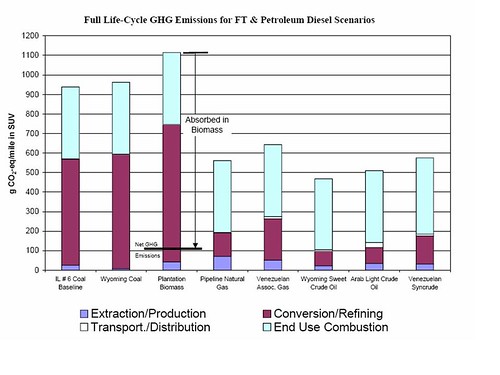
Here we run into the wall between the things that are currently valued by the market and the things that are not. The future will (must) value energy and the environment over money, or people like Mr Khosla (and people like us) might not be able to spend their money at all.
This sentence from TLS is accurate if ethanol is read as "grain ethanol", but is inaccurate as written:
"I expect you will successfully convince him that the energy balance on ethanol is poor (shouldnt be hard to do)."
Here are five studies that all cite figures of positive 8-10 EROEI for ethanol from sugar cane. I have given page references for three of them and will find and post the others later.
I think the frequent misrepresentations on this issue from Cherenkov are intentional. For others, here are the facts.
1) FO Licht presentation to METI,
http://www.meti.go.jp/report/downloadfiles/g30819b40j.pdf
EROEI Calcs: Page 20
2) IEA Automotive Fuels for the Future
http://www.iea.org/textbase/nppdf/free/1990/autofuel99.pdf
3) IEA: Biofuels for Transport
http://www.iea.org/textbase/nppdf/free/2004/biofuels2004.pdf
EROEI calcs: page 60
4) Worldwatch Institute & Government of Germany: Biofuels for Transport (Link to register - study is free)
http://www.worldwatch.org/node/4078
EROEI Calcs (for 12 fuel types): Page 17
5) Potential for Biofuels for Transport in Developing Countries
http://www-wds.worldbank.org/external/default/WDSContentServer/IW3P/IB/2006/01/05/000090341_20060105 161036/Rendered/PDF/ESM3120PAPER0Biofuels.pdf
I understand what you are saying and will try and peruse those other links you sent - in general we probably should indentify what type of ethanol we are referring to (I usually do). In this particular case though, the promoted product under discussion are corn and cellulosic ethanol in the United States, where we could grow a little, but not a significant amount of sugar cane.
I understand and agree completely. You are right that the current discussion focusses on corn-based ethanol, which I think is not commercially viable outside of an aggressive subsidy program. I have seen no evidence that this could change or that cellulosic ethanol could be viable in the near term. I am on board 100% with RR's points in this regard.
However, I do think that the sugar ethanol baby gets thrown out with the corn bathwater and that is counterproductive. There are times where lack of precision is a lack of accuracy. This is one of them.
TOD has a global readership and while the current discussion is directed towards a specific US issue, that is not always the case and the errors exist in those posts as well. I agree that suagr cane is not viable in the US, but because of sugar subsidies, as I believe you notes yesterday.
Please do peruse the links. The three main reports (WB, WW, and IEA) are 1-200 pages. The FO Licht presentation is succinct, as are these:
http://www.brazilianchamber.org.uk/documents/articles/braziliancaseEthano.ppt
http://stapgef.unep.org/docs/folder.2005-12-07.8158774253/folder.2005-12-08.9446059805/folder.2005-1 2-08.0238464777/folder.2005-12-20.8533782016/file.2006-06-21.7937961463#341,13,Slide 13
Note in particular the huge climate chnage benefits. I don't know how anyone can be concerned about the climate and ignore sugar-based ethanol.
Jack
"Dry as a bone?" in Food Systems Insider, July 2006 "Will there be enough water?" issue
http://www.foodsystemsinsider.com/ME2/Default.asp
http://en.wikipedia.org/wiki/Ogallala_Aquifer
In the world,
Global cereal supply and demand brief
World cereal balance to become tighter in 2006/07
http://www.fao.org/docrep/009/J8104e/j8104e03.htm
Again, I only think biofuels are viable in the tropics until some technical breakthrough. I do not think irrigating corn for fuel makes sense. Neither am I an all out sugar-based ethanol advocate. It is not perfect and does have some real issues, land and water among them.
I do think there is an important role for sugar-based ethanol and think it gets unfairly tarred by association with corn. It will not entirely replace gaslone or oil, but it does have an importnat and positive role to play.
Woods Hole Oceanographic Research Center is spreading alarm as the Amazon goes into it's second year of drought. They fear that after two years of drought, the forest will die, burn, and may not rejuvenate. The article is called ["The Amazon Rainforest Could 'Become A Desert" http://www.climateark.org/articles/reader.asp?linkid=58635 ]
The drought is apparently caused by the destruction of rainforest (1/4 destroyed, 1/4 damaged). Call it "Peak Amazon," but as the damaged percentage approaches 50%, it's threatening to change the weather patterns for this entire hemisphere, increase global warming dramatically, and spread drought all the way to Britain. The effects could be catastrophic, completely unpredictable, and could happen swiftly.
I've been following global warming issues for a quarter century, and this is by far the most alarming thing I have ever read.
On the two points you raise above,
1)That report (though scary) may have been a little misleading - a colleague who works on Amazon and global warming issues told me that that experiment was done in the eastern portion of the Amazon, close to its present geographic limits. Whether the results can be generalized to the western and central portions of the region, particularly as one approaches the Andean slopes, is questionable
2)My understanding is that (at least currently) the sugar cane regions in Brazil are quite distant from the Amazon, as can be seen by this graph. The actual sugar cane area in Brazil is only 6/10% of 1%.
Perhaps Mr Khosla should set up an export facility between Brazil and USA and we can buy THEIR ethanol, given that it supposedly has an ERoEI higher than gasoline (I find the 8-10:1 hard to believe and suspect there is some double counting, but its possible and I will call it impressive until I have time to look at data)
Thank you for posting this. It makes me feel better.
By the way, that map doesn't come out very well; do you have a link?
-- jim
As I noted elsewhere, I think that EROEI multiples are a very useful way of measuring something. We just need to be very careful that we know what that something is when we use EROEI. I don't see the numbers as absolute indicators because the boundries are not as clear as they seem and all the loops are not closed.
More to the point, I do see how sugarcane could have a very high EROEI. To understand this, list the inputs and where they come from. You will see that the refinery is almost a closed loop. The main energy input, electricity and heat for the fermentation and distillation processes come from burning sugar cane fiber. If transportation of sugar cane to mill and mil to customer were done with ethanol fueled vehicles, I could see the numbers being even higher than 1:8.
I understand that the UK did a biofuels study and found they would be best serves by importing ethanol from Brazil, rather than producing it themselves.
His argument is not that we will use corn ethanol, as he admits the yield is too low, and the amount of land needed is too high.
The arugment is that switch grass, and/or other bio mass can give a much higher yield (say 20X more ethanol/acre than corn), that the acreage would then be reduced 20 fold and be merely crazy (say 20% of US farmland). This jump requires technology for the fermentation process which right now is not there, but if such a plant were to be built crops could be changed very quickly.
If the above becoomes true, using corn ethanol to aid the transistion makes a small amount of sense in terms of building the rest of the infrastructure.
SO I HAVE A VERY TECHINCAL QUESTION - the kind of thing the oil drum is good at. What yields of Ethanol per arce are possible within 10 years? What land area is required to for national Ethanol production capacity?
Technical question #2 - how could we speed the development of increased yields?
What is really needed is a in depth discussion of the data beind the yield numbers, as he simply quotes numbers from others, it is hard to know the caveats of the original studies.
As Ive said, Mr Khoslas plan might work if a new technology for cellulosic is developed but people have been working on this for 30 years with many false starts. To have a plan to get to 200 billion gallons of cellulosic ethanol is like saying lets run the whole country on nuclear fusion - its certainly possible but hasnt been scaled beyond a tabletop.
How many of us here on this forum can prove that with physical, verifiable evidence? What would it consist of? You would have to come see me in person. What we all share on here are words. If you spend enough time writing the words, I am inclined to suspect that you believe what you write. I might be wrong, but I suspect that most of us write what we believe most of the time.
The reason I think he is committed is that many of the solutions he proposes, even in the video presentation, do not involve ethanol. I read a very long white paper of his last night, and he focused quite a bit on non-ethanol solutions. As I said, I found a lot wrong with the paper, but he is at least giving lip service to some of the ideas I believe in.
Cheers,
RR
Is he looking for money-making opportunities or opportunities to improve our situation?
Obviously the two are not necessarily exclusive. However, some of the things needed to improve our situation are not necessarily the most profitable. Like a massive campaign to make bicycle riding and carpooling the sexy thing to do.
Let's say he had made a big donation to the Post-Carbon Institute or some nonprofit that deals with Climate Change. That would be, to me, an indicator he is seriously concnerend about our situation and not just looking to maximize his personal ROI.
Steps he's taken in his own personal life to lighten his footprint would also be actions.
Take a look at Rainwater for an example of words How do I know he is truly freaked out by Peak Oil? Is it because he says he is? No,it's because he's pulled $500,000,000 out of the market and has it ready because he expects the economy to tank. He is also growing his own food, getting his ranch off-the-grid, etc. That tells me his words are not empty.
I realize this guy isn't necessarily convinced 'the world as we know it might beis ending' like Rainwater. I'm simply using Rainwater as an example of somebody whose actions indicate he is serious about what he says.
The same thing with any of us who post. I, for instance, don't have a car even though I can afford one. I buy gold. I have a stash of emergency supplies. I could go on but you see I have actions that indicate I believe what I say.
Pretend he is a random VC.
What is your Business Plan (or anti-Plan)?
Present it.
Kohsla is a first test case for TOD.
What is our elevator pitch?
We have 30 seconds ... tick tick tick.
Ethanol is [is not] a viable way to invest because ....?
- marginal EROEI
- water consumption
- GHG emission from fermentation
- GHG emission from distillation
- topsoil degradation
- to scale it to current gasoline usage at that EROEI will require most of our arable land
etc ...Spit the points out.
click
click
click
We VC's are smart.
We "get it" right away.
I propose the following:
The Party's Over by Heinberg
The Long Emergency by Kunstler (Got Richard Rainwater to see the light)
The Coming Economic Collpase (For a financial perspective0
That's the beauty of the situation. I get the impression that he is not at all Peak Oil aware. He is approaching this issue more from a global warming/energy independence issue. Just look at that exponential growth curve he posted on ethanol production, and it soon becomes apparent that he has either not heard of Peak Oil, or does not believe it is imminent. Therefore, it is one of the first items I will discuss, to get a feel for what he knows. If he isn't Peak Oil aware, he may begin to get a paradigm shift when he understands how PO will change our lives.
Cheers,
RR
Explain to him it is incredibly complex, probably far more than any issue he has dealt with. Insist he read somethings for himself. A second proposal:
And leapfrogging Savinars idea - why doesnt Vinod just CALL Richard Rainwater, or Matt Simmons, etc.?
For a more serious comment, I understand the noble intentions of the gas tax, but much tax money seems to end up as pork.
We will never be rid of pork, but the really stupid subsidies should be eliminated before levying additional taxes.
And that wil take time.
All that is required is a good bell curve (ASPO perhaps, along with Stuart's), and perhaps a little bit of explication.
If Bill Gates has read all the PO books... then why is he fixated on world health solutions that only add yet more fuel (bodies) to the over-population fire... (humanitarian sympathies, aside)
One would have to conclude that he doesn't beieve in PO??
I have thought for several years that with Bill's wealth and marketing savvy... he should repeat what he has done in the computing market in the energy market... inventing energy solutions that offer the consumer something that they haven't had before and making them chic/desireable such that(following the PC analogy) early adopters are willing to pay through the nose for them, and then the price falls rapidly until everybody has "one or more" in their house.
The next generation of billionaires will not come from computers but from energy and natural services. 57 boe per day for americans has spoiled us to thinking technology is making our world better, when its really energy thats enabling the technology.
Philanthropy from Gates, Buffet and others (like Alfred Nobel) gives me hope even when I don't 100% agree with the choices. If this behavior became contagious/competitive I think a fantastic amount of damage could be mitigated.
Let's start again.
The Hydrogen Economy - Rifkin(don't mistake the fact that hydrogen has been debunked with the fact that this is the first book of the new era of energy contemplation and a genuinely good book)
The End of Oil - Roberts
Hubbert's Peak - Deffeyes
Beyond Peak(?) - Deffeyes
Out of Gas - Goodstein
Boiling Point - Gelb
The Color of Oil - Economides
Crude: The Story of Oil - Shah
Oil: Anatomy of An Industry - Yeomans
Twilight in the Desert - Simmons
A Thousand Barrels A Second - Tertzakian
If you haven't read each and every one of these, don't even bother with the crap Alpha Prophet is recommending. Give sanity a chance before you embrace doomerism.
Let me make clear. None of the books he suggests is one of the biggies. Kunstler in particular knows absolutely nothing about oil so it is hard to imagine how he knows about peak oil. And yes, I've read these books. In fact Kunstler actually shys away from the topic of oil when you ask him. This is what I've gathered from everybody who has ever interviewed him on the topic.
Alpha Prophet himself knows nothing about oil. Doubt me? See how often you can actually find him on this site talking about the subject. Ooooooooooooh!
Still doubt me? Count how many times his writing references oil and how many times it references penis. I'm serious. Try it. Calculate a ratio. When you're done. Try the same excercise with Stuart or HO. Who won? By how much?
And Alpha stopped talking to me some time ago. Wonder why. You would think I was an easy mark.
However desireable from an environmental perspective, to replace the US coal infrastructure with nat gas would seem nearly impossible, given current constraints on natural gas production. The gas industry is working full out now, and such a replacement of coal would require gas to go from roughly 20% of electricity generated to 70%.
I don't understand how the idea of eliminating coal could even be considered given even a twenty year horizon. Our best hope would be having the growth rate of coal usage be lower than the rest of the possibilities.
To those who say, this is not practical, is it practical to create a planet that is uninhabitable? The heat of this summer is just an appetizer. Is it moral to condemn your children and grandchildren to a sun fried planet? Is that practical?
Of course we may have already reached the tipping point. When I see 101 degrees in Olympia, Washington, I see evidence that we may have already reached runaway climate change. In which case, party on.
As much as you or I might like to do away with coal for electricity, it won't happen until there are viable alternatives. Conservation should be first priority, I agree. Wind/solar/geo should be built as fast as possible, which unfortunately won't be fast enough. According to the EIA, all renewables (from pv and geothermal down to burning wood chips, sludge, and tires believe it or not), amounted to 2.2% of total elec generation in the US. It has been growing at a modest (well under 10%) pace for a decade. Even if it could grow at a 10% pace for the next decade, it would come to only around 6% of the US total elec. Merely to replace coal--at 50% of generating capacity, and growing--with renewables, with no growth overall, would take decades of expensive work. A moon race-type effort.
To expand the electric generating capacity of the US or the world in any significant way, the currently viable options are coal or nukes. We don't have the gas to grow reliably, and even if we could, it wouldn't help the CO2 problem. Maybe we'll have a new nuclear plant in Alabama, if the recent NYT Magazine article was right, by the middle of the next decade. I think they were planning 2000 megawatts, which is a nice start, but it won't change much.
If we look realistically at the choices, we might be able to fashion the political will to move towards the moon race needed to have significant amounts of renewable generation in the world. In the meanwhile, while we run our air conditioners, we are burning coal and we have little choice. Keep cool or powderdown? I believe that right now there is not the global political will to do what is necessary to avoid spewing increasing amounts of CO2 into the atmosphere for our power needs. The populations are concerned about global warming, but when it's 101 in Olympia, people want their air conditioning. Is it moral? Probably not.
Yes but, this cannot be done because short term ALWAYS trump long term in any system.
To get the generality of the idea think about a ball rolling on rugged plate with the goal being to reach the lowest point.
If the ball is actually trapped in a small hole on the side of a big slope it will never get out of this small hole to run down the big slope.
Short of some SHOCK...
Which kind of shock do we want?
In regards to #2, I think (at least in the short to possibly medium term) you've got things backward. I've come to this conclusion because of a few simple problems, the main one being that we'll never produce enough batteries to give BEV's a good 300+ MPC range that everyone will demand. Taking that as a given, and the statistic that the average daily round trip commute is something like 30 miles, it would be much better to give Five PHEV's a 60 mile range, than it would to give One BEV a 300 mile range. Those five PHEV's will reduce liquid fuels comsumption a lot more than one BEV and four ICE's (realistically).
The average daily travel distance of 50% of U.S. drivers is 25 miles or less, and another 30% travel 25-50 miles. Shorter-range EVs as second cars would work for many people, and PHEVs with All-Electric Ranges of 20-60 miles would use little motor fuel.
Good references on PHEVs:
South Coast Air Quality Management District seminars on PHEVs, June 22 and July 9, 2006
Scientific American, April 2006 article on hybrid and plug-in hybrid vehicles
This suggests that bikes or electric scooters are entirely doable for a good sized segment of the population. What is often lacking is a safe lane. That is easily managed in most metropolitan/suburban areas. We're talking about a corridor 5-6 feet wide.
Usually, when I bring this up the objections are: rain, sweat and winter. Those are challenges that experience and equipment are able to handle. But if they don't... there are still at least 150 days of the year that we can get a lot of automobiles off of the road. And electric scooters are obviously: no sweat.
Establishing the corridors and providing incentives to move forward cannot possibly break the public treasury. Imagine 20% of the population 15 pounds thinner <g>. Imagine how much less cranky they'd be without the cholesterol and blood pressure meds.
We keep trying to introduce layers of technology into the solution set. What we're proving is the ever-popular hammer analogy, that every solution requires a nail, or, in this case: a car.
But don't you think we need to give cars a rest?
Adding value there isn't going to significantly displace energy consumption. Whether you substitute CTL, BTL or electric, it still takes lots of BTUs to go anywhere in a car. It still pushes the CO2 envelope the wrong way.
Those stats posted, re: 50% of auto use is for less than 25 miles per day, mean that solving our personal transportation issue isn't the killer issue widely assumed here. Building tech-lavish hybrid cars and alt-fuel cars shows absolutely no get-out-of-the-box imagination. We are over-engineering AGAIN.
Wind-to-electric is probably going to be our first serious solution. I am hopeful that it will run mass transport systems and power buildings. But the daily commute as we know it??? No way.
What makes you think so?
Energy Independence and Public Transport by BruceMcF
http://www.dailykos.com/story/2006/7/24/181920/012
Two by the user cskendrick:
Toward a Post-Petroleum Economy
http://www.dailykos.com/story/2006/4/6/195417/0756
Oblivion about Peak Oil = Oblivion
http://www.dailykos.com/story/2005/6/18/112418/292
Hope it helps.
TOD is attracting attention. You, as the resident Ethanol expert are thus also.
Khosla profits from the status quo setup in the US re Ethanol and as such your rational and empirically grounded arguments are a threat to him, but the "great" man must not be seen to avoid his accusers for that gives them credibility in the eyes of others.
The advice to be given to Khosla, is I would suggest unchanged for thousands of years:
"Now you have become rich, sell all you have and give it to the poor, then go out into the world and seek enlightenment"
First off, I'm not convinced that higher taxes will solve the oil problems. Increased the tax at the pump is unpopular and political suicide in a democracy. Even if it could be done, without a more effective government, the revenues are likely to be squandered on subsidizing Hummers and the like.
But lets say taxes were raised and consumption drops - without offsetting efficiency gains, the resulting economic downturn would result in less consumption, but also less output. Taxes simply increase the drag on the process. Its like breaking a leg to save gas, it works, but its not the best solution. Also, remember oil companies are global - they don't have to be US companies. Choke thier profits and they can move to other countries (hell, the greedy bastards can buy countries). More realistically, they can simply buy more politicians and block efforts much like they are currently doing.
A better solution is to find more economic alternatives through R&D, incenting conservation (higher CAFE standards with less exceptions, stricter building codes, etc), and implementing quick-win strategies that address multiple issues.
One such strategy is to incent the entire desiel-based transportation industry to switch to biodesiel ASAP, picking up the tab (subsidizing) on infrastructure and conversion costs within the first 3 years, and replacing all farm subsidies with minimum payment guarantees that will cover a portion of losses. this will move unused land into production. Exempt farm-use biofuels from taxes and the first 50 million gallons of fueling from taxes. At the end of five years, a major portion of the infrastructure will be converted over and sustainable.
Step 1 is good government. Step 2 is good policy.
More to follow.
The idea here is two fold use simple evaporation effects to produce energy and liquid nitrogen for storage to normalize energy production.
Ive not drawn up plans but the ide is pretty simple.
Water is drawn up through tubes via the use of large black sponge
evaporators basically
a artifical tree. If you need to recycle the moist air is reused to
heat the liquid nitrogen.
As the water moves through the tubes it passes through a water
aspirator drawing in air
that is compressed on the source side a partial vacum is formed.
Periodically the pressure is released and the air cycled through a
number of hirch vortex tubes resulting in partial liquidfication.
Cycle repeated.
I don't know the entergetics but even if its as low as 2% the design
is dirt cheap.
The compressed air/vacum can be used directly to power a generator
based I prefer the
plastic tesla turbines since agian they look cheap to make and could
use air bearings.
Cheap cheap cheap is the motto :)
Anyway thats the basic outline I just ordered my second hirch vortex
tube I could not figure out a easy way to get any real cooling with
out chaining at least two together.
I can test with a electric water pump so I'll start experimenting when
I get home I'm traveling now.
The idea is pretty sound and will for sure work with running the
compressed air over the turbine. I'm confident that I can eventually
get the liquidification given enough time.
If I can even hit 5-10% efficiency the cheapness of construction
allows it to be viable.
I know its mainly plastic but there is no reason it could not be done
with bio plastics wood for many parts. Black cotton or sawdust can be
used for the evaporators.
In desert climates the moist air can be recycled by letting it move
through underground passages to condense and the liquid nitrogen or
cool air can be used to dew water out of the air so in that case it
would work as a water collector if needed. Or it can be condensed by heat transfer to the source liquid moving to the evaportator to recover the heat.
Anyway if your interested or know and investor that's interested or
better a mechanical engineer or even someone with a good workshop let
me know.
I can send a lot more research later if you need it.
Now the design is based on water and liquid nitrogen but there are many small organic molecules that may be a better fit the since it works on a preassure differential the working fluids vapor pressure is important. Alcohols/Butane may also work. Except for using a simple generator that can be made of plexiglass or other reasonable plastics there are no moving parts. There are enough variables that I'm confident a functional system can be developed.
Technologies.
Vortex Tubes
http://answers.google.com/answers/threadview?id=523179
http://en.wikipedia.org/wiki/Tesla_turbine
The evaporator is simply a large open or closed black mat of spongy material and the rest is plastic tubes and reservoirs. One pressure valve may be required.
The key is there is no reason the whole system can't be incredibly cheap made of plastic or ceramic and wood even if needed. Charcoal or charred cotton can be used as the evaporator. The vortex tubes could be made out of porcelin.
Tubing could be clay concrete or recycled tubes from langfills. For the closed collector windshields windows or plastic sheeting could be used. Considering cost per kilowatt not necessarily the size this could be very economical. I't could take say one acre of land to produce power for a home but the material cost would be a few thousand dollars.
Michael Emmel
mike.emmel@gmail.com
Looking at the cash-flows of businesses and the government in the US of A, if you want an assured profit, become a protected business.
Energy companies that are already established have local government granted monopolies and are able to use lobbyists to keep that monopoly, at the expense of the users. Mr. Khosla sees a market that WILL have a protected status and wants in on the ground floor.
Figure out a market he can own that the government will protect and he'll be all over it.
The real constraints in wind energy are transmission lines, storage and the capital to build enough wind plants,not places to build. Landowners like wind farms as they receive about $4,000.00 per wind turbine a year as a royalty. Plus they help provide local jobs and so help their neighbors.
The opposition to wind farms in Yankeeland seems to be based in the basic negativity of the nut fringe environmentalists. I'm a little predjudiced, I like the way wind farms look,plus I also know that wind turbines kill a lot fewer birds than are displaced by strip mining for coal.But, western Texas is just now becoming developed and the coastal areas have not been touched. Its a real example where wind has been economicially successful.
I think wind is several of the silver BB's in the solution. I wish there were more domestic manufacturers of wind equipment and companies selling more wind electricity directly to the consumers like Green Mountain does.
Wind turbines look like a great way to get more energy to the emerging world,plus a great way to help wean us from fossil fuels. Unless we have solutions that help the rest of the world acheive a good standard of living we will fail.
If he wants fast money, ethanol is the way to go, the government covers his risks and the taxpayers fork over for the delusion. Low risk too: whatever party wins the next election, they have all embraced it.
If he has enough mullah, and wants the right thing, however, not the same picture:
- Ethanol is ridiculous; apart from the EROEI, the world will need its soil, and will need to cold-turkey that soil off of its chemical addiction, which takes a few years. Unless someone wishes to suggest organic ethanol, growing corn (or cane, or anything at all) for fuel equals murder. Without chemicals, this continent stands to lose 70% or more of its food production (Pimentel has higher numbers). Regenerating soil is the best, and likely only, bet we have. Soil trumps oil.
- Anything meant to power automobiles is out. Peak oil equals peak automobile equals peak American dream etc. Moonshine all you want, what road-surface will you drive on? How far?
- Anything meant to keep the electricity grid going is out. The entire behemoth grid will go down and not return. Peak oil equals peak electricity equals peak media etc. Oil built these infrastructures, roads, grids, all of it, and lots of oil is needed to maintain it.
Peak oil will make the world a much smaller place, and we have to think in that kind of space if we wish to come up with sensible answers, for Khosla and for ourselves. We have a few years left in grid-powered forums like these to get those answers. Sticking to car and grid status quo doesn't help.Centralized power systems, be they political or energy-related, will go. Huge plants and factories providing services and goods for millions of people will follow the dodo when oil goes.
Our energy sources will have to be next to where we live, where everything else will be.
So suggest: micro-generation, for power and drinking water. Not ideal for making the next billion perhaps, but it might keep him alive.
If you want to scare him, mention die-off and suggest he go into funeral services. Growth industry. Opportunities.
See my posts above. The World Bank and Worldwatch Institute have detailed analysis of the land use issue for sugar-based ethanol. While the conflict between food and energy does exist, it would not become significant until production levels are mucg higher than near term projections. Brazil can double production using unused farm land. Thailand is ramping up using existing plantations.
Do you really think the difference between growing sugar and growing fuel is murder? Cheap fuel is far more important for the world's poor than sugar, tobacco, grain for beer, and many, many of the the competing land uses.
Do not dare trying to survive?
Maybe that billionaire can lobby Congress to copy the Japanese laws allowing 660cc Kei cars on our roads
(We also have an old LPG [$0.86/litre] fueled Nissan, the utility car.)
Detroit is on the edge of bankruptcy, so any way you slice it the future lies with foreign cars. There are a number of Japanese, Chinese and Euro cars that are cute, park easily and get terrific mileage.
And best of all, some of them are REALLY cheap!
If Mr. Khosla were to invest in these companies, and help get them imported into America, I guarantee I would buy one! (Is there any other technology listed here that YOU would pledge to stump up money for?)
Perhaps, instead of inventing a new technology, Mr. Khosla could be tempted to invest in a technology that already exists, has demonstrated its capability, and is ready to ship right now.
Mr. Khosla could be one a prime mover and shaker of the next Detroit. These cars could be shipped in, accepted, then plants could be built here and the cars manufactured in the US.
Once one accepts Peak Oil (whether now or in 4 years), one will see the need for efficient, affordable transportation, and it already exists. We merely need to allow its imporation!
If he insists on investing in ethanol (and there are political reasons why it will probably fly anyway,) he could make money off both ends of the equation, and help improve CAFE standards.
So why not do the same with these other cars?
Thanks for tasking us with this homework..
Looking at your previous Vinod post this week, I found two of your points to VK closely reflect what I've been thinking as a response..
7) Investments into conservation are the best use of our alternative energy dollar.
--Hardly news, but that of course masks the extreme benefits of simply 'cutting back'. Not too sexy for an investor, tho, unless you 'productize' it.
8) Solar is the key to sustainable energy, not ethanol. The efficiency of solar is an order of magnitude (or two) higher than the solar efficiency for ethanol.
--I probably bang this drum regularly, but I think the best direction of Solar that I would like to see instigated, and it should be profitable, in as much as it would trigger a great deal of construction/installation work, is introducing affordable products to use as much of our Domestic Roof space as possible collecting heat and electricity, Heat being the primary, AND a cheaper investment, with the quickest return on that investment.
..I don't hear 'fungible' around here as much as I used to, but it seems that the degree to which we can let Solar Heat preclude the burning of Oil, Gases and Wood for home heating releases those more portable energy sources back towards transportation, while working to reduce our overall demand.
As far as Vinod is concerned, my approach would be to plant that argument with him that most effectively spears Ethanol's achille's heel(s), and making sure it's presented as a point that is also easily made very publicly, in terms everyone will understand. Of course, this would include anticipating and challenging the point(s) he considers to be the most supportive of ethanol. In particular, I would be looking for the areas where his advocacy is most based on 'exuberance without evidence', and make sure that magic carpet can be respectfully, but unapologetically unraveled. If you see this winding up as 'Let's agree to just disagree', do you have a parting shot ready that really encapsulates Ethanol's problems? Like the elevator speech, only in 11 words?
I look forward to hearing how it goes.
Bob Fiske
1) Battery technology that makes the gas optional plug-in hybrid electric vehicle competitive on the show room floor with the conventional car.
Such cars enable the use of considerably more efficient energy conversion processes, feedstock to electricity and electricity to motion, with cogeneration and CO2 capture possible at central electricity generation sites. Reduces multiple problems due to energy consumption in its present form.
http://www.calcars.org/vehicles.html
Where to go from here?
http://ergosphere.blogspot.com/2004/11/where-to-go-from-here.html
Nothing will be enough if you keep wasting it
http://ergosphere.blogspot.com/2006/07/nothing-will-be-enough-if-you-keep_18.html
2) Green building system technologies and design that builders can't afford not to use
Conventional building systems use a tremendous amount of energy. Day in and day out, likely for their lifetime because of the cost and difficulty of retrofitting.
http://www.usgbc.org/
http://epa.gov/greenbuilding/index.htm
http://www.eere.energy.gov/buildings/
3) LED light technology with good color temperature and balance that leapfrogs fluorescent and is competitive with incadescent on the store shelf
To address both peak oil and global warming, my priorities for transportation would be all three of:
(1) Conservation -- reduce driving via walking, bicycling, transit, better urban form, ride-sharing, shorter commutes, less travel, etc. (Overlaps AlanfromBigEasy.)
(2) Efficiency -- higher-mpg vehicles; if every vehicle averaged only today's Prius' mpg it would save HALF of U.S. gasoline, 1/4 of U.S. oil.
(3) Alternative fuels -- but which actually are sustainable? The candidates include:
- Compressed and liquefied natural gas;
- Synthetic crude oil from tar sands, coal, and oil shale;
- Biofuels, primarily ethanol (corn, sugar cane, cellulosic) and biodiesel;
- Hydrogen fuel cells, with hydrogen produced from natural gas reforming or water electrolysis;
- Battery-electric vehicles and plug-in hybrids (PHEVs).
The first two are just other fossil fuels, with major production impacts. The lifecycle CO2 emissions from the Fischer-Tropsch coal-to-oil conversion process are up to 40% higher than for conventional petroleum use. North American natural gas production may already be in decline.As you've documented for corn ethanol, many biofuels have issues with soil depletion and runoff, low or negative net energy, potential quantity much less than current oil provides, and competition with food crops or rainforest.
Hydrogen fuel cells are extremely expensive, depend on rare minerals, lack a fueling infrastructure, and their hydrogen may not be sustainably produced.
In contrast -- adding to JMG's post above -- battery-electric vehicles are a proven technology, more efficient and more affordable than hydrogen fuel cells, and can use sustainable electricity from wind and solar. Plug-in hybrids (PHEVs) add the flexibility of unlimited range and use of the current gasoline fueling infrastructure, and are expected to be on the market in 2-3 years. There is ample off-peak capacity in the existing grid to charge millions of EVs without justifying new power plants.
With the average life span of an automobile less than 15 years, a combination of doubling CAFE and adding EVs / PHEVs could reduce total U.S. oil use by nearly half in two to three decades.
plug-in hybrid batteries are a perfect match for wind: the more batteries being charged, the more wind the grid can use.
Worst case, driver comes home for supper, plugs in, turns on a/c to cool down house and starts cooking supper on electric stove.
Recent CA days would have been pretty much a "skip". Minimal wind (AFAIK) and NG running 24 hours/day.
I'm a strong transit supporter, but it's worth comparing transit's energy consumption to high-mpg cars. In a rapid transition of peak oil I expect few new roads to be built but that we will continue to use the existing infrastructure.
Per APTA's 2006 Public Transportation Fact Book, Table 55, "Bus and Trolleybus National Totals, Fiscal Year 2004", buses' 2,150,535,000 vehicle revenue miles carried 21,376,973,000 passenger miles. The average load of about 10 passengers on a bus balances heavy commute loads (standing room only) with off-peak directions, off-peak hours, and lower loads at the ends of routes.
These buses consumed 550,466,000 gallons of diesel fuel and 131,356,000 gallons of "other fuel" (19% used alternative fuels e.g. CNG and LNG), averaging 31.4 passenger-mpg.
The four cities that use electric trolleybuses carried 173,205,000 passenger miles for 67,679,000 kWh, or 2.56 pass-mi/kWh. The reciprocal of .3 kWh/mile for a RAV4-EV is 3.3 miles/kWh. Interesting: so a RAV4-EV with just a driver is using a little less than the average for trolleybuses. (Although I wonder if some of that kWh was not just for traction power?)
I'm a big fan of trolleybuses. They give a better ride with much less noise and vibration, and their electricity can be sustainably generated.
Light rail (Table 82) carried 1,576,198,000 passenger miles for 553,025,000 kWh, or 2.85 pass-mi/kWh, just slightly higher than the average for trolley buses.
Heavy Rail (e.g. New York subway, Washington Metro, BART -- Table 81) carried 14,354,281,000 passenger miles or 3,683,674 kWh, or 3.90 pass-mi/kWh. They pack a lot of people onto the New York subway!
If you are comparing apples and apples, I am shocked that the RAV4 beats all the electric mass transportation modes and makes we want to rethink mass transit vs the electric car. Maybe Alan can help me here. If the electric car gets better passenger miles per kwhr, shouldn't we be investing in electric cars and PHEVs vs. mass transit? I know their are other considerations, but from an energy use perspective, why would we want mass transit vs the EV or the PHEV?
This only looks at direct savings. The "other TOD", changes in the Urban form, result in larger indirect savings than direct savings.
Another factor is that most US light rail lines are not part of complete systems. A demonstrated fact is that adding a line to a system increases pax density along every part of existing lines. There is a positive synergistic effect from creating a "system" that we do not yet have in the US. Not even Portland or San Diego have more than fragmenst of a light rail system.
Trolley buses should, in theory (and I have talked to Skoda, world's largest trolley bus maker, about this) us 3 or so times as much electricity per AVAILABLE seat mile. But the APTA #'s show different. Operating differnees, choice of routes, etc.
Unfortunately, I have to check out now. Limited posts for next 12 days as I depart on trip.
pS; My 240D diesel gets same mpg as city buses. but that is not ALL of the story.
I think this is final demand. A gallon of gasoline contains the energy equivelent of 36kwh. If ICE is 15% than the energy to the wheels will be 5.4kwh. If RAV4 is 70% outlet-to-wheels efficient then if it was powered by ICE it would be making the the equivelent of 5.4 / (0.3*0.7) = 25 mpg, which is pretty reasonable. If the efficiencey is 50% then the equivelent is 36 mpg which is also a normal one.
I think the true role of the mass transit is often not well understood. The direct gains are relatively small, the real gains are in the indirect effects. Because of the much higher travel density, the high mass transit promotes development of a densely populated urban patten. This on its turn reduces the times (less traffic!) and distances travelled within a city for every other mode of transportation. The conclusion - mass transit is a century long investment benefiting the public as a whole. As a consequence the mass transit can not be delegated solely to the private sector, needs a lot of regulations, and in most cases needs subsidies to operate.
I appreciate Alan's efforts to promote it, but I fear that it could be a bit too late for it... in order for the indirect gains to kick in we need at least 20-30 years in addition to the years we need to build it.
The rate with which "the other TOD" takes hold varies dramatically from city to city. Your "20 to 30 years" is not a fixed but a highly variable #.
First, in the next dozen years, the choice is not large fleets of EVs vs. mass transit; but gasoline powered cars (even diesel cannot replace a majority of the fleet by 2018) versus mass transit. We can build mass transit fairly quickly and we will likely need both mass transit & EVs. But the subsidy $ are better spent on Urban Rail than any other alternative (except retrofit insulation).
The rate of "the other TOD" increases when the economy is booming and residential & commerical building peaks. Unlikely looking forward.
TOD also increases as the mix of what is built shifts away from single family residences and towards multi-family. (I see townhomes close to stations here in Portland so some SFRs are TOD).
The last factor is gas prices. I expect the demand for TOD to increase as gas prices increase.
So we may see a situation of very low building rates, but a very high % of what is built is close to mass transit. The most likely result IMHO.
Washington DC Metro is like an "alternative oil well" whose production increases each year. And when it is most needed ($3, $5/ gallon gas, founding of Islamic Republic of Arabia, etc.) it increases production of "oil" in response.
The rate of Mass Transit productivity increases varies with the need, but grows steadily over time (Buffalo NY comes to mind as the ONLY major exception).
So new Urban Rail can be thought of as oil wells that will only increase production over time :-)
I'm not proposing what you may be thinking offhand. I propose that we take the existing automotive infrastructure and alter it slightly. The current trajectory is heading towards fossil fuel and/or bio fuel electric hybrid vehicles. These may be gas/electric, ethanol/electric, bio diesel/electric (my fav.), or fuel cell, which is little more than a fancy hybrid from a fuel standpoint. If we were to take these vehicles, and add a few more parts, we could easily add the ability to run directly off the grid. We already do this for subway trains, light rail/trolleys, and electric busses (ala San Francisco). The tricky and expensive part is retrofitting the existing roadways to provide power in a simple, safe, and idiot-proof way (trust me, there's idiots out there). There are several ways this could be accomplished using existing tech, or we could come up with a fancy new technology such as conduction coils buried in the roadbed. If we went with a "simple" road retrofit plan, then I would think that the fast lane on multilane freeways (or the commuter lane if you have those) would be the obvious choice for electrification. Note that you don't have to retrofit everything, you just need enough roadbed retrofitted so that the vehicle is powered, and the batteries are recharged enough so that you can make it to your front door from the off ramp. Areas with large amounts of city traffic would want to electrify portions of the city streets. Perhaps a couple car lengths in front of intersections would be enough.
Some advantages:
People get to stay in their own vehicles rather than be forced to ride public transit. Very few people enjoy public transit. Many people love their cars.
People rarely have to fill up their tank due to continuous recharging. Battery packs, and the associated weight can be greatly reduced. At some point in the future when enough roadway is retrofitted, people will be able to drive vehicles without substantial energy storage at all. These cars could continue to have regenerative braking by feeding the power back into the system.
There is little to no pollution, at least on the roadway.
Provided that the method of transmission from roadway to car is efficient, there may be an overall efficiency improvement in the system when compared to onboard power generation.
The vehicle "burns" any form of energy fed into the grid. This can range from the green to the ungreen. Is nuclear green this week, or was that last week?
The system provides an excellent opportunity for highway automation. There's little reason why you couldn't press the button labeled "work" on your dashboard in the morning as you get on the freeway, and let your car take you there automatically. The lane next to the electrified fast lane would become the "automerge lane". Cars could be packed together tightly at high speed. This has already been prototyped by several groups, and there are few hurdles (but a whole lotta safety testing) to make it a reality.
Existing "vintage" cars such as the Hummer can continue to be driven on the same roads, though the fuel will likely be expensive. There may be some opportunity to retrofit older cars for road power as well. I doubt many of the true classic car owners will want to yank their big block V8's.
The car manufacturers would not fight the transition, though big oil might. They shouldn't worry though because chances are someone is still going to be burning something somewhere to generate the electricity for the grid. What this replaces is the distribution network which is not a big profit center for the oil companies.
Now here comes the leap of faith jump: if we can figure out how to make the automation completely safe in a congested urban setting as well as in rural areas, there would be other huge advantages as well. For instance, you don't need to own a car, you can just have one waiting for you "near" your front door in the morning. If you own a car, but don't have a place to park it near you, it can park itself elsewhere. At the point where the system becomes safe, you can also turn it into an automated delivery system. You don't need huge semi-trucks on the road for most distribution when small "just in time" deliveries show up at your door (or loading dock). You've just replaced most rail and subway, so honestly you can just recycle their infrastructure into conduits for personal transport. People could get into their cars in Connecticut, and step out of them in a midtown Manhattan (former) subway station. Their cars will go find a place to park on their own.
On that note, I think that the best way to make the system idiot proof is to isolate the automated vehicles fully from anything unpredictable such as foot traffic, older cars, livestock, deer, etc. Using underground or elevated roadbeds similar to what subway trains use makes a lot of sense in both urban, suburban, and even many rural areas. Concrete is going to be relatively cheap and abundant for a very, very long time. Asphalt (tarmac) is not. Perhaps we could plan the system around a monorail for most automated portions. Monorails make efficient use of resources, they're relatively cheap to build, they provide an off the shelf opportunity for "old fashioned" physical electrical connections rather than potentially lossy conduction, and face it, they're just plain cool. There would be little difficulty (other than financial) to add raised automated transit lines to areas currently served by busses, light rail, trains etc. Oh yeah, I almost forgot, there would be no red lights when under automation. What is a few months of your life given back to you worth?
Now back to reality. This is a solution that would require an absolutely massive commitment of public funds. With a bankrupt federal government, there isn't a ready source of funds there. It is a solution that will strike some as socialist, though that is just a knee-jerk reaction. The private sector would make tons of money on what would be the largest infrastructure project since the interstate highway project. It's an idea that smells of utopian ideology, and would have loud detractors from day one. In short, it is an idea that has little chance of moving forward. It's too bad that we're too nearsighted to think big because I'm afraid that the real future of transportation is going to look like India or worse, Mad Max.
http://ergosphere.blogspot.com/2006/02/out-of-town-on-rails.html
Best thing SinceSlicedBread
http://ergosphere.blogspot.com/2005/10/best-thing-sinceslicedbread.html
The cost of grid electricity is far less than gasoline, for number of miles traveled etc. This lowers pollution, moves it to central plants, and makes cars themselves more efficient since they don't have to carry heavy energy storage systems around with them!
Without the grid, anything that can store energy is an option; the criteria are efficiency, cost, and mass per quantity of energy stored. Batteries could work; compressed air, anything a fuel-cell can burn, or perhaps bio-fuels - but the problem there is they will simply not be possible to scale up to the 20 million barrel/day US demand level.
One interesting option for grid power is some for of "beamed" electric power. It was one of Tesla's dreams, and has been tested long ago (look up William Brown's experiments for instance). That may make powering vehicles in rural areas much more feasible. There's definitely some development work needed there though before it could be practical; we do have a lot of experience with direct-connected grid-powered vehicles, like the light rail mentioned above so that may be much more practical.
He sees self-driving cars becoming theoretically possible by about 2010, but in practice not appearing in significant numbers until the 2020s due to the many practical and liability issues. Now, he wasn't thinking about the fuel system, just control issues. Whether the car runs on gas or electricity doesn't matter to the AI.
Either way you do get considerable theoretical fuel savings similar to what you suggest. Cars could communicate electronically with each other on the roadway, allowing them to move in "platoons". This will greatly increase highway capacity and make gridlock a thing of the past. Right there you save a lot of gas. More efficient driving, no speed ups and slow downs, will also produce savings. So it's a pretty big win.
Unfortunately I don't see much prospect for accelerating his time line. I suppose Khosla could invest in this technology, and in lobbying to make it legal for these cars to exist, but most of the advantages come from having all the cars on the road like this, so they can work together. That's going to take a long time.
"And then someone overrode the programming to brake for a cat ..."
I was wondering if there is any research done on contactless transmission of electrical power, and what is the distance over which power can be transmitted. I found this research at a German university.
This pdf shows that it is possible to reach an efficiency of over 90%, and that through an air gap of 10 cm.
So it is possible to transmit a significant amount of power (several kW), with no contact, over a distance of 10 cm.
The rest is along the lines of the previous post. Electrifying short portions of the road, especially where cars are forced to stop (intersections), would allow people to recharge their batteries while driving through the city. For long distance travel, electrified lanes on the freeways would greatly extend the range of electric cars.
Experimenting with "gadgetbahn" is, at best, a long distant adjunct to solving our problems.
Let us suppose that we have some new, paper technology that will work and work well. How many year(s) to lab prototype ?
How long to a working outdoor model ?
How much longer to asmall scale system (say a dozen vehicles and 1.5 miles of track) ?
How many years to a real world, minimum scale implementation in one section of one city ?
How long to prove that out, re-engineer for bugs, get other cities to decide to build their versions ?
Then how long to do EIS, design and build ? (miniumu 4 years for this step for each city)
How long from paper to saving 0.1% of US oil use ?
An absolute minimum of 20 years and more likely 30 years IF you have a great, new technology !
Civil works are NOT semiconductors !! (And semiconductors take years as well for each generation)
I propose to build ONLY mature, existing technology. In ten to twelve years we can build the NYC 2nd Avenue subway, LA's "Subway to the Sea" and every other plan, BART to San Jose & several "eBarts", DC Metro to Dulles AND Baltimore, Miami's 103 miles of elevated "Subway in the Sky", Denver's 117 mile system of light rail & commuter rail, Salt Lake City's 30 year plan, the 2030 plans for Dallas (a 160 or so mile system) and much, much more.
In 20 years, new and expanded Urban Rail, with generous funding (90% federal match, just like we built the Interstate Highways), can reduce US oil consumption by 10% or even more even if fuel prices are not much higher than today. (See the transformation of Washington DC as DC Metro was built). Add $8.50/gallon gasoline and it is hard to estimate the potential savings.
Much of these fuel savings would come from the well known effect of TOD, Transit Orientated Devlopment. A changing Urban form that "wraps itself around" the new Urban rail and is much more energy efficient to service (police, deliver mail & packages, construction, food, dry cleaning, all that comes with walkable communities).
IMO, go with what we KNOW works !
So, gadgetbahn or mature, well proven technology ?
However, some people insist on making (and buying) bigger and noisier cars, no matter how expensive gasoline is (even here in Europe). I would rather see non-polluting (and less noisy) electric vehicles on the road, instead of internal-combustion ones. So if Mr. Khosla would decide to promote rail, I think that is an excellent opportunity to make a difference right now. However, if his vision of the future of transportation is centered on cars, then battery electric vehicles might be the better alternative to advocate then ethanol and biodiesel.
BTW, yes it is induction, not conduction...
The advantage of doing something over long distances like that is the infrastructure costs could be lower - you don't have to rip up all the roads, as you would for inductive energy transfer over 10 cm distances; rather you position power antennas along roadways at suitable separation distances. The problem of course is handling this sort of long-distance transmission in a safe manner: it should only transmit with a clear line-of-sight from vehicle to antenna. But that's really just a software problem - in principle it could be quite workable.
Ethanol is a great fuel-the problem is making and transporting it. I cannot see it as the next great hope, but I think it has a niche that is workable.
Ethanol from corn does not work as a long-term solution mostly because of the fossil fuels currently needed for fertilizing, planting, harvesting, distilling, and transporting in tanks. Oil and natural gas are scarce, costly, and environmentally unfriendly to use. And corn to ethanol converts what are already perfectly good fuels to another type of good fuel, without much net energy gain.
If the EROEI were good, we'd actually be OK with this process. But there is one other circumstance that might work out. A low EROEI, or even a negative EROEI might be acceptable if we are converting a less-desirable energy form to a premium energy form like ethanol.
If we succeed with cellulosic ethanol, then we can convert less energy-intensive biomass feedstock to ethanol. If we were to use biomass, geothermal, concentrated solar, hydro-, wind-, or nuclear electricity to run the distillation process, then we don't use fossil fuels as input, and we're carbon neutral.
If we use coal or lignite to fuel the process, we're really bad on the C02 side, but we are converting energy from a solid form to a liquid that's far easier to use for transport. You could compare the environmental damage to a Fischer-Tropp process, and see which is worse. And we could run the tanker trucks or trains on ethanol as well.
There are obviously scalability questions with this. As always, the non-sustainable solutions are a lot easier to scale and run than the sustainable options. But that doesn't make it impossible, just more difficult. And we're going to have to get used to doing things in more difficult ways.
I see Khosla as an ally in trying to move away from the fossil fuel problem. Find the common ground, and work from there.
when we start driving our top soil it's all over. I'm not sure of much in this world but I'll take a stand here. (pipe-dream ahead) why can't we pursue this algae thing. wouldn't it be great if we could get the algae to help in our sewage treatment plants to. can we turn plastic back into energy? think about what that would do for walmarts bottom line. Vinod there are a lot of ways to make money out there' but driving our top soil is suicide
nameste
The gas tax is regressive and unfair.
If your want to raise taxes and spend it on R&D great.
But don't unfairly tax those that need it the most.
I stole the following from a web site....
While well-intentioned advocates of a gasoline tax tout the way it will shift demand away from gas-guzzling SUV's and toward hybrid cars and public transit, they fail to recognize how it will devastate large groups of lower-income commuters.
Many of the rural poor already spend a large percentage of their income on commuting to and from work. If a sizable gasoline tax were to be enacted, without the public transportation infrastructure already in place, many of these lower-wage earners would be left to choose between gas for commuting to work, or food on the table. If they choose to immediately feed their families, they could be left without sufficient funds for gas, in which case they could lose their jobs due to their inability to get to work. It's a "catch-22."
Many people say, "Regressive taxes are tough. Deal with it." That is easy enough to say when you aren't worried about when your next meal is coming from. That is easy enough to say when you can afford the $20,000 price tag that goes along with a new Toyota Prius or Honda Insight. That is easy enough to say when you live in an urban environment when you already have access to public transportation. But when you're not lucky enough to have these advantages, a regressive gasoline tax can be devastating to your ability to simply survive.
Plainly put, regressive taxes (such as gasoline taxes) are unfair, and they are wrong. Instead of looking to regulate fuel consumption through regressive taxation, maybe we should look at placing additional sales taxes on vehicles with low fuel efficiency, while eliminating sales tax from high-efficiency vehicles. The Rocky Mountain Institute (a market-based think tank) advocates placing a sliding sales tax on automobiles in this manner, with SUV's like the Ford Excursion and GM Suburban taxed at a rate of say, 10-12%. High-efficiency vehicles like the Prius and Insight could have a 0% sales tax. Funds raised from an "efficiency tax" could be used to fund public transportation projects. Of course, Congress raising and enforcing higher CAFÉ standards wouldn't hurt, either.
The real answer to our problems lies in creating and enforcing a progressive tax system based on fairness and establishing equality of opportunity. Regressive taxation only places more of a strain on the people who need the most help from the very social programs their taxes are funding. This isn't right, and it must be stopped.
None the less, I advocate a gas tax increase of 2 cents/gallon each and every month (with quarterly inflation adjustments) for 20 to 25 years.
Oil price increases will likely dwarf tax increases, but the taxes will be more certain. People will be able to make plans to adjust (move closer to town. get lower wage job closer in, car pool, buy a very small, economical car, etc.
And use most of the gas taxes to reduce social security tax rates; which will help the working poor in both Urban & rural areas (lots of benefits for the urban working poor who do not own a car). Done thusly, a major boon for the urban working poor that use transit !
To solve the problem for people that are using the car, just make the cost of transportation to/from your work tax-deductible. I would only make it tax-deductible for people that are car-pooling. Or use some of the raised tax to sponsor companies to provide energy efficient transportation to/from work.
Still...the future will be without cars....maybe partially solar powered bikes might be viable, but be realistic, no plan will provide the opportunity to keep 700.000.000 cars.
In terms of energy, a car is an enormous waste. Why do I need to power a 3500 pound vehicle to bring my 170 pound body to work. Sounds like 95% wasted on warming the world.....one day we should face that.
Sure we can make 100miles/gallon cars, but that is still postponing the reckoning for a few more years. A 100 miles/gallon 9 person vehicle could be economical. A person on a bicycle will get about 900miles/gallon.
Possibilities proposed include a lump-sum per-person rebate of increased gasoline taxes, or corresponding decreases in the payroll (Social Security) tax.
Another approach is gasoline rationing with resellable coupons (everyone gets the same amount and buys more if desired or sells ones they don't use), Martin Feldstein's "Tradeable Gasoline Rights," or the following from the UK on July 19:
Any of these would would transfer real dollars to people for gasoline not used, both economically progressive and a big incentive to use less.
Population Control.
The above statement I think is a knee jerk reaction in accordance with bleeding heart values. Mind you, I don't like seeing unfairness, or strife on anyone either, but if the argument of whether or not this planet can sustain 6+ billion people is settled, and the answer is no, then the sad news is that we are about to enter a very unfair period in human history.
Furthermore to state this is somehow morally wrong, is an unuseful argument at best, and a detriment to survival at worst. Which is more wrong, avoiding the enactment of measures to forcibly curb peoples appetite in preparation for the day when they physically won't be able to satiate that appetite, or to cause some financial discomfort and possibly hardship now, in exchange for them being adjusted when the rug gets pulled?
At least a slowly introduced gas tax that expands over a period of years will provide the cattle prod to the masses to perhaps minimize the impact of de-population and/or prolong the available resources needed to scale 6 billion plus down to 2 billion minus or whatever is managable.
If 2 billion or less people is what will be sustainable on this planet(that is personally the number I'm hopeful of), then that means 4+ billion people are about to get a very unfair treatment from Mother Earth, and their fellow man. Unfortunately, historically, when situations similar to this have arisen in the past, it is the poor that are usually eliminated from this Darwinian race first. Is it fair? Perhaps not, but can you come up with a more fair way to decide who lives and who dies? At least in the game of Darwinism those with the "best" traits get to keep trucking, or hypothetically that is how the theory goes.
I know the whole idea sucks, and I'm not trying to sound like a doomer, or defeatist, but at some point when the lifeboat is filling up, the people on the boat have to realize that those remaining in the drink are on their own, else the boat and its passengers end up there to.
I've seen many ToDers tout Population Control at one point or another, but the implementation of how to go about that seems to always be avoided. Personally I think raising taxes on non-renewable energy, cutting social programs, and cutting over seas humanitarian aid is probably the most beneficial and humane way to ensure American/Western interests namely our own people's survival. The gradual and systematic implementation of these taxes/social cuts will give people the chance to make adjustments. If the age of oil ends with any abruptness, I doubt the adjustment to the new life will be a picnic for the poor either.
Unfortunately for Europeans, if you look at a population density diagram, the Western nations that are least in overshoot, are Canada, Australia, and that Evil US of A that everyone likes to beat up on. Admittedly the energy concerns of the US are certainly huge as we do use a disproportionate amount per person, but when energy begins to crumble and feeding populations begins to be a more important issue, America has a much shorter way to fall, in terms of population density as compared to Europe.
In otherwords I suspect that while we will suffer economically, and lose many of our ammenities, I think the US from a population stand point will be in a better position to power down and de-populate even though that fall from an energy standpoint is higher than other nations.
The other advantage that America, and to a greater extent Australia has are a variety of terrains to implement renewable non-bio energy resources. Fairly unpopulated Flat windy plains and deserts with high sunlight yield in both countries offer prime areas for wind and solar farms.
Europe is hurting in this stand point due to the very few areas with high sunlight/wind yields that are not already populated. The high population density of Europe will pose additional problems in that Europe will have to possibly contend with land use resources splitting their land up between non-bio renewables which require land surface area, and bio products for food, and possibly fuel which require land also. Admittedly some overlap can occur, but you can only squeeze so many solar arrays, wind turbines, and rows of crops per acre. I suppose the question will be how much population can a jam packed acre support in terms of both food, and energy needs. Europe does grow quite a bit of food, but they rely on imports to a very large extent to augment the lack of growing capacity to sustain their population. When the other countries end up having to consume all their food production Europe is going to have a rough time finding their next meal.
There are many inhospitable regions around the globe that are populated(over-populated) because of high energy technology. Early examples of this are already being shown in some African countries that can no longer afford energy products for farming (admittedly there are political causes pitching in as well, but lack of capability to attain resources is taking a toll). Note in many regions of Africa the population density is still fairly low, but even at these low levels that capacity is/was being sustain by high energy technologies.
I'm sorry folks but while people dread (perhaps rightfully) the us vs them scenario of things, that is the very nature of the beast we have groomed through our feeding of a high energy society. At least things like an ever tightening tax will be a methodical and predictable method for the layman of the street to perhaps recoginize and respond to.
Telling your average worker/welfare recipient about the mathematics, and statistics of PO and in general resource depletion related to land use, metals, and water on a global scale, and most people will glaze over and will ignore it because they can't understand it in a tangible way until its probably too late, but tell them that they can keep more of their money if they adopt certain behaviors i.e. moving closer to work to avoid paying gas taxes, and all of a sudden they have a direct stimuli to react to.
Of course I'd imagine making a market of Population Control can be a little difficult, and I doubt it would be a popular "product".
I know I'm preaching to the choir somewhat, but everyone mentions tough decisions, but perhaps the toughest decisions will be to find a way to curb our own population overshoot in as a controlled, and hopefully merciful way as possible. A slow introduction of discomfort when using resources in a non-desirable way is a start in my opinion down that path.
I will repeat a story one of my Indian friends told me- The greatest effect on the birth rate in India was the soap opera "Dallas"- Lots and Lots of sex among lavishly rich people (almost all extramarital, of course) and NO KIDS! How did they do it??? So people ran around trying to find how to be rich, have lots of sex, and not be burdened by kids- they found condoms.
Well, anyhow, that's what this guy told me, I'm just passing it on. For a mere billion or two, we might be able to actually figure it out for real.
My first suggestion is he take a course in soil sciences so he would understand something about nitrogen, carbon, potassium, phosphorous, micronutrients, soil fungi and other cycles in nature. Then maybe he wouldn't be so gung-ho to mine the soils barren. Whenever I see the words "marginal lands" or "farm wastes" or the like, I just shake my head and think "this person is an urban-born, urban-bred, urban-educated person who hasn't a clue what makes nature sustainable". And I see many well-educated posters here of the same ilk.
After all, in the US today, we consume 104 EJ of energy in the form of fossil fuels (with a part being nuclear and hydro). Total photosynthetic energy capture ("primary productivity") of the entire country is estimated at 70-90 EJ. A quarter is already under human control in the form of agriculture. To imagine biofuels of any kind can provide more than a small slice of our current total consumption is an exercise in wishful thinking. The irony is, with high US natural gas prices, we are trading, with this scheme, our import dependency on Middle East oil with import dependency on Middle East fertilizers.
The paradigmatic problem is one of sustainability. Those who believe that exponential economic growth can continue unabated simply by switching from the mining of millions of years of stored solar energy to current solar income obviously don't understand natural accounting. Khosla's proposal is in that vein. If there were dollar signs attached to the natural accounting, perhaps then he would understand.
Perhaps he can be an influential voice, but he needs to be much better educated than he is today.
The Soil Biology Primer (on-line version, USDA NRCS)
http://soils.usda.gov/sqi/concepts/soil_biology/index.html
Building Soils for Better Crops, 2nd ed., Fred Magdoff, Harold van Es, 2000 (4.2Mb pdf)
http://www.sare.org/publications/bsbc/bsbc.pdf
USDA ARS National Programs - Soil Resource Management
http://www.ars.usda.gov/research/programs/programs.htm?NP_CODE=202
This says it all.
Fossil fuels may have taken millions of years to accumulate, but the processes that created them were incredibly inefficient. According to Jay Hanson, 2 weeks of the earth's solar income is equal to all of the earth's fossil fuels. Or, from another perspective, every 20 minutes the earth receives the equivalent of mankind's energy usage.
We can indeed live on our current income.
Get rid of cars.
Done.
Gee. So easy, yet so hard for some to follow. Let me repeat.
SOLUTION --
Get rid of cars.
Done.
Wow. I feel better already.
But, I suspect that the "save the automobile" crowd will ignore the only real solution to the problem.
Ho hum. Bring on the dieoff. Maybe its the lack of young brains that makes the introduction of new paradigms so difficult here. Takes so long to make those neural connections.
Bloom. Dieoff. Repeat.
"reductio ad absurdum" cuts both ways.
Unfortunately, Peak Energy and Climate Change threaten to reduce us to situations that seem absurd from the vantage point of our present comfortable situation.
That said, "Get rid of cars" begs the question, "And replace them with what?" We can reduce our mobility to some extent, but we do still need to get around, if only to produce and distribute food.
I have a cell phone that it only used for critical uses only as it is pay as you go at $.25 per minute. I wouldn't think of using to it just to blather. The same principle should be applied to cars. They should all be pay as you go and expensive enough that most people would only use them for critical uses, not as a substitute for walking or other transit options.
The argument, of course, is always, you can't propose these kinds of solutions because it is not politically feasible. Maybe so. But all actions that are currently politically feasible are not sufficient to solve the problem. Better than nothing doesn't cut it.
I just want to add a generic comment. I have my own ideas for conversion of solar to electric power there are many but the most important concept that's needed is we need a easy way to store electric power in a distributed manner and regenerate the electricity. The biggest thing to understand especially for renewable resources is unneeded electric power is worthless.
I propose a simple thermodynamic cycle involving a gas liquid that boils at room temperature as the best way to reversibly store electric power the other choice is pumped storage which uses gravity to recover the power. Others are batteries or better super capacitors. I win on expense. As we know this summer using electricity for cooling is a huge waste of electricity. In a liquid nitrogen approach the cooling is done thermodynamically and your regenerating electricity. So when you come home and want a cool home your actually supplying electricity to the network not taking in out. So the whole thermodynamic system is reversed.
When you start your ac your causing electricity to be moved onto the network if its not needed then it goes into efficient pumped storage during non peak hours its converted to distributed liquid nitrogen storage to handle the next peak load.
Long haul there is no reason you can be on the grid going down major roads and only drop to battery power for local areas.
The only thing really missing is a fast charging high density storage that could be expensive but this is doable with new capacitor technology or even better batteries that charge faster.
The distributed capacitance factor is in my opinion critical for making the electric grid into a more generic energy source. It needs to be reasonably efficient at each conversion since there can be two or three. Assume its 60% efficient and you still get for two conversions overall 36% efficient.
http://en.wikipedia.org/wiki/Pumped-storage_hydroelectricity
Pumped storage is well over 60% more like 70-85% batteries and capacitors are up there also so you need one more cheap distributed storage and thermodynamic conversion is technically 60% but 30% or better is fine. A fuel cell may also work but why the expense ?
Shoot for vapor condensation you can add gravity also and do a gravity conversion plus a liquid to vapor.
Its a thermodynamic problem at the heart and no we can get the energy density of gasoline but that's not its only strength its also the fact its distributed. By adding grid power for major arteries and using distributed power battery or other only when your on side streets you get a pretty good proximity to what we get out of gasoline.
Think of it this way gas is good for getting me to the major road for my commute but once I hit the road/rail etc I'm happy to go back on the grid till I get to my destination.
The next problem is how far is the destination from the grid. If its too far then it may make sense to take my personal transport with me to use off grid at my destination or if I want to pay for the privileged fine.
I think were way to focused on the abusing gasoline when grid power would work just for the fact that it give you freedom at each end where a grid solution may not always be the best.
No easy solutions. Lots of hard work and ideas are needed. But with support and telling folks what the options are, the truth could help push people faster than not telling them anything.
The United States are not the only ones in this boat. We have been world leaders before let us step up and lead again, making the hard choices and gettting the actions done.
Making cities where the car is only needed for family vactions if even that, would be an improvment.
I write fiction and poems, energy is not my forte, but others here can fill the edges in, on this big puzzle of ours.
I would point to Switzerland during WW II, where they endured a six year complete oil embargo with ~10 months of oil in storage. Each year they used less, but they functioned (and kept their military trained till 1944).
In the 1920s Switzerland made the strategic decision to electrify their railroads and preserve their electric trams in the cities and towns. With their hydroelectric power, bicycles and shoe leather they "got by" fro 6 years. Oil for military, police, medical and what was left over, a minimal amount, for farming.
In 1998, Switzerland made another strategic decision. A national plebiscite voted to spend 31 billion Swiss frances (adjusted for population & currency = to $1 trillion for US) over 20 years to improve their already excellent railroads. There were several goals but the largest one was to get heavy trucks off Swiss roads and onto (hydro) electric rail.
This will have massive energy efficiency gains (20+ to 1), environmental and economic benfits to Switzerland.
Instead of Brazil, let us emulate Switzerland (and Russia as well).
More details at:
http://www.lightrailnow.org/features/f_lrt_2006-05a.htm
We can reduce US oil consumption by 10% in ten to twelve years (more later) IN ADDITION TO EVER OTHER PLAN !
If cellulose ethanol can be made to work, fine. This plan will save an extra 10% on top of that.
Short/Mid term strategy: Reduce Power consumption with Mass Transit (light rail, bus, tube, whatever applies best); biking whenever practical.
Long Term strategy: hard to tell, but I like
Folke Gunther's Ruralization a lot.
Be careful with that man though. It seems to me that he's lying consciously in order to put his business through. He might just use that talk in order to "have an insight on Big Oil alternatives".
Good luck.
When first I meet somebody, no matter what the situation,
#1. Establish common ground. For example, do you know anybody in common? Do you have children? Grandchildren? Here, look at the pictures of my kids (and grandkids) . . . great kids, huh? We'd do anything for our kids and to make our grandchildren live in a better world, right? Oh, and what a beautiful daughter you have? A genius like her father;-) And so on.
#2. Find out in a friendly nonintrusive way what makes the other person tick: I'm from Minnesota, where are you from? You know, Minnesota, the place Garrison Keilor makes fun of . . . yeah, we are really nice people there. Ever seen the film "Fargo," yah, we really do talk like that, you bet. And where did you say you were from? And so on. In other words, establishing rapport and gaining mutual respect is 80% of the battle. (The only competitive dick swinging allowed here is on talents of grandchildren or niceness of people where you come from. Do not, Do Not Under Any Circumstances discuss anything substantive during the first fifteen minutes. He wants to know if you are a dickhead with a secret agenda. You want to know how an apparently intelligent and well-educated man could be so sincerely and so grossly misguided.
- Follow the ten rules in Dale Carnegie's "How to Win Friends and Influence People." Surprisingly, they work well. I've yet to find anything else nearly as effective.
- Use the GENTLE form of the Socratic method. In other words, make no assertions whatsoever. Instead, ask "innocent" questions, just as Socrates did, but be careful. Socrates was often cruel and humiliated the idiots he had dialogues with. Win, lose, or draw, you want to be in a position to be invited for a rematch.
- Whatever he is drinking, you drink. He orders tea, you order tea. He orders a single-malt Scotch, you order one also, but a different brand, just to show you are not trying to be a toad eater.
- If you eat together, eat super duper ultra slow. I often use chopsticks in this situation, just because one of my worst habits is to eat too fast and too much in social situations.
- Before you say "good night," be sure to say how much you enjoyed the meeting and how you would like to make this the first in a series.
- Raise no unnecessarily controversial topic. If he mentions the Mideast, just mutter, "Terrible, terrible, it's terrible over there," and sigh. If he says it is hot outside, agree with him.
Once rapport and mutual respect have been established, then and only then is constructive dialogue a possiblity.(And for heavens sake, say nothing bad about Pacific Ethanol. He knows way more bad things about that company than any of us do. If possible, say something nice--e.g., maybe they contribute to charity or sponser a softball team. Who knows? (Doing your homework in advance in this regard can have an enormous ROI.))
I respectfully disagree. Robert has 30 seconds to make $$ signs dance in the guys head or he loses him. If he doesn't see dollars in what Robert says he will be thinking about something else that does while Robert is yammering on about Minnesota.
VAZ
Please try again.
sunfishsailor@hotmail.com
The promise, and challenge of the Plug Hybrid Electric
Let us now connect the importance of this to transportation, and to the
automobile in
particular. The electric car has a very long history. Sadly for those who have
believed in
the promise, it has not lived up to expectations to this point. And the
weakness has been
the same one that creates the limitations discussed above on the electric power
grid:
Electric power storage. In the birthing days of the automobile, around 1900,
electric cars
had many advantages. They did not require hand cranking as did gas cars. They
were
clean and quite as gas cars in those days were not. They started almost
instantly as steam
cars did not. And they could be powered up at any home with electricity. The
last item
was only an advantage in towns with operating electricity. Combined with the
biggest
single limitation, that being limited range on a charge of batteries, the
electric car was,
from the start a "city" and not a long range car. But in the early 1900's, this
was not a
problem, as even small towns had rail service. in those days, the "Interstate
Highway" was
in the heads of only a few visionaries, and was regarded by most as the stuff of
science
fiction. After the introduction of the electric starter, and reasonably easy
access to
gasoline for refills, the development efforts began to favor the gasoline car.
And when
Henry Ford put the advantages of standardized construction and assembly behind
the
gasoline car, thus reducing costs, it essentially sealed the fate of the
electric car as a
marginal player. Except for some short range delivery vehicles, golf carts, and
novelty
cars owned by supporters of the electric car cause, the world left the electric
car behind
for about 50 years.
It would not come back into the automotive spotlight until the energy crisis
year of 1973,
and the California environmental movement began pushing for a way out, and
seeking
cleaner options than gasoline.
When they returned to take a look at the possibilities of the electric car, and
the challenges
involved in it's use, they came upon exactly the same barrier that had already
been known
for over 60 years: THE BATTERY.
And the truth is, there had simply been no battery development to speak of for a
half
century. Lead Acid batteries, at that time just about the only choice, were
still king. They
were cheap and easy to build compared to anything else. It was a mature
industry, with
no breakthroughs needed or sought for many years. On the down side, in a car
they
limited range to far below what the modern "interstate" driver considered
useful. The
batteries were heavy, so the car was slow, and much space had to be provided for
the
number needed to have any useful range at all. And worse, they wore out. They
could
only be charged and discharged a given amount of times, before they would stop
holding
a charge, and had to be changed, at considerable expense. But the promise of
the electric
car was there. It offered the opportunity to take advantage of that wonderful
electric
power grid, which was humming away day and night, delivering power right to the
owners
home. It must be doable, with a little work. Now, where to start? Of course,
at the
battery!
For most of us, our memories can begin to take over here. In the science, auto
and tech
magazines, we have followed at a distance what has the seemingly never ending
struggle
to produce the super battery. It would be cheap. It would hold enough power to
give
gasoline style range. It would deliver the power quickly on demand to give the
wanted
acceleration. It would be small enough to allow for luggage and passenger
space. It
would take thousands of recharges so as to last about as long as the car itself.
And it would be lightweight, making the electric car the vehicle of choice. In
the sentences
immediately above, I have laid down the challenges, the parameters faced by
battery
designers and technicians. With the burst of research and development
throughout the
1970's, every conceivable material in every conceivable arrangement was tried.
Nickel
Cadmium, Nickel Iron, Aluminum Air, Nickel Air, Lithium Ion, Polymer Ion, on and
on...and
in every conceivable shape and arrangement, cylinders, sheets, and radial
sheets, layered
together in different arrangements. And at the end of the 1970's, some progress
had
been made, but not nearly enough. If a battery excelled in one area, it was
weak in others.
If the range was there, it was too expensive, if the expense was low, it lacked
range, if the
range and the expense were pretty good, it would not take the needed recharges,
and
then there were tempeture considerations; some could not take heat well, while
others
needed heat to work well. And one wall was always hard to overcome: COST.
Nobody
could do it all well at a cheap price. By the end of the 1970's, only three
major contenders
began to emerge:
http://www.rqriley.com/images-spech/img006.jpg
http://www.rqriley.com/images-spech/img007.jpg
Nickel Cadmium, or NiCad, Nickel Metal Hydride, and Lithium, either polymer or
Ion.
These cost more than lead acid batteries. But, they promised the cycle life of
recharges
and the power density needed to increase range, and last for almost the life of
the vehicle,
but, and this is important to our discussion, WITHIN LIMITS. Those limits, in
how deeply
the battery could be discharged and recharged without shortening the life of the
battery,
will come back to haunt us momentarily.
So with this in mind, another idea began to emerge: Hybrid electric. If the
battery could
do everything else well except hold enough energy to give long range, then
combine the
gas and the electric car, and use the gasoline for the range, and the electric
for the other
advantages. This is not a "new" idea. Ferdinand Porsche built an electric
drive car, using
gasoline to run a generator driving electric motors in the wheel hubs very early
in the
century. And GM and GE built railroad locomotives using Diesel engines driving
a
generator to power motors at the axles of trains. It is still used to this day
with computer
control. What was new was the idea of adding batteries for electric storage, so
that the
gas engine could be shut down if need be, or could be used only to recharge
batteries, OR
be used in combination to drive the car, charge batteries, and still be shut
down when
needed.
It is a complex dance for a drive train to perform. But even before computer
controls were
available, it was doable. In the links below, you will see described one of the
most
inventive and pioneering cars ever built.
http://econogics.com/ev/bspamph4.jpg
http://econogics.com/ev/bshybrid.jpg
http://econogics.com/ev/bspamph6.jpg
http://econogics.com/ev/bspamph5.jpg
This was the gas/electric hybrid of Briggs and Stratton Corp., in conjunction
with the
Canadian maker of short range electric delivery trucks, Marathon Corp built in
1980. The
car was never put into production. Data concerning the performance is sparse.
Reports at
the time said that it would do "highway" speeds, and would achieve over 80 miles
per
gallon. Notice, that since range was handled by the gasoline engine, the
batteries were
the old cheap standby, lead acid. There is one other point to mention. The car
was
conceived from day one as a "grid supported" or plug in hybrid. It never
occurred to the
original pioneers not to take advantage of the ability to plug the car in
overnight! This
surely helped on the fuel mileage side, since the first low speed miles around
town were
using the electric power already in the batteries. In fact, the batteries could
provide for
almost all low speed commuting for at least an hour or more a day, if the speeds
were not
high, and we know that this is the way most cars are used each day. It was a
plug hybrid
by it's very design, with all the advantages of that layout. But, and this is
very important,
one question remained unanswered, since the car was never developed and tested
for full
"life cycle" of the vehicle. If used this way, how much would the constant deep
discharge
and recharge shorten the battery life of the lead acid batteries, which are
limited in their
ability to take the cycles?
No long term testing of any hybrid system was actually done that I am aware of
after
1980.
The Reagan administration took a dim view of the electric car research programs,
and as
gasoline prices collapsed, and the SUV craze took hold, small, efficient cars
became passé'
For twenty years, fuel consumption became a non issue. Prosperity was the game,
and
conspicuous consumption was everywhere. No one asked where the fuel was coming
from
or how much it cost. We simply assumed that the concerns over fuel consumption,
environmentalism, and balance of trade with the oil producing nations had been
resolved.
It was yesterday's problem.
Until Sept. 11, 2001, when a group of Saudi Arabians, at the command of the
Saudi
Arabian Osama Bin Laden, struck the blow. It can be argued, (and I would argue
it, but not
in this post) that the attack on 9/11/01 was the opening shot in the oil wars.
Prices had
already began to climb, after being so absurdly cheap in the 1990's that oil
producing
nations in the Mideast were begging for mercy. It was a factor in causing Sadam
to invade
Kuwait. He was going bankrupt, after the damage done to Iraq in the Iraq/Iran
war, and
felt the Kuwaiti's and Saudi's, with no war damage and small home populations,
were
bleeding him to death by selling oil so cheap. Through the 1990's, oil was
giveaway
priced.
But after 9/11, oil slumped on the expectation of a recession of great
consequence.
When the recession was not as bad as expected, and accepting the suggestion by
G.W.
Bush to "go about your business, go shopping, travel....", consumption of fuel
climbed
back to it's old levels, and then kept on climbing. Meanwhile, non-OPEC oil
production
was declining. British North Sea, Indonesia, American, including Alaska, our
ace in the ice,
were speeding up in their decline. And China, Eastern Europe, and India were
all
increasing consumption. By the end of the first Bush term, prices for oil were
climbing
rapidly, and after the election, they have only speeded up in their climb. For
the first time,
many Americans began to hear
of something long ago predicted, and discussed only in geological and oil and
gas
journals until then: DEPLETION. At some point, it was argued, that rising
consumption
would outrun the ability of the oil to be extracted from the ground, and prices
would
continue to rise, in fact, the rise would speed up. Dick Chaney, now Vice
President of the
United States, had said in his years at Haliburton that we would need "a new
North Sea
sized find every decade" to stay up with demand. The remark was at an oil
conference in
Europe, so was not widely repeated in the U.S. The energy advisor to Chaney
and Bush
from the outside was Matthew Simmons, among others, and Simmons began to sound
more alarmist. In the two years prior, his speeches had simply insisted that
the United
States needed massive investment in oil infrastructure to stay ahead of
consumption,
giving the number as over a trillion dollars in "the next decade". He said this
in 2001. By
four years later, Simmons began saying anywhere to anyone who would listen: The
world
was near peak, IF we had not already past it. And, natural gas, long considered
the ace in
the hole of American "clean" energy production, was near peak as well. People
began to
do web searches on Peak Oil. The name of that great giant of petroleum geology
and
forecasting, M. King Hubbard returned to the press, and his disciples, Ken
Defeyes and the
big name, Colin Campbell, who had been shouting from the wilderness for years,
were
suddenly in major newspapers. And the price of oil kept climbing, knocking down
price
barriers in a mater of, at first, months, then, weeks, 40 dollars a barrel, then
50, then 60...
And the Japanese were ready. Having embarked on a program of "Hybrid Electric"
cars,
Honda and Toyota begin to relive their old status as the technology standard
bearers, and
were suddenly back in the same great place they had been in the 1970's, when
there had
been waiting lists for the fuel efficient Civic and Carolla. Now, there were
waiting lists for
Honda Civic Hybrids, Honda Insights, and Toyota Prius hybrids. The development
of the
electric idea, combined with gasoline for range, long ago abandoned for all
practical
purposes in the U.S., had been going on apace in Japan.
Chrysler had built an experimental sports/race car using combination flywheel,
gas
turbine engine, running on Compressed Natural Gas, (CNG) but they had bitten
off more
than they could chew, it was too much technology to manage at once.
http://www.rqriley.com/images-spech/img010.jpg
They abandoned it as junk only a couple of years later. General Motors, in an
attempt to
answer the environmental crowd, had built the GM EV-1, one of the most well
conceived
full electric cars in the modern history of the industry. Dr. Paul McCready had
used all the
tricks of the trade to raise the range, performance and comfort levels of a full
electric car
to almost gasoline car standards, with all the advantages of using that great
American
power grid.
http://ev1-club.power.net/evpics.htm
It was a wonderful car, even if they are all in the crushed and scrap heaps.
The issue was
cost and timing. GM could not make money on them, and with gas still not at
high prices,
they were met with a yawn. The EV-1 will go down in history, like the Briggs
and Stratton
attempt, as one of the great bits of "bad luck" in auto history. They were the
right
development, but for the wrong time.
Toyota and Honda, however, had gotten the timing just right. (aside: are they
that lucky,
or do they just use patience and stay with their program, until the games come
to them?
An interesting study in management and technical leadership)
But fuel prices were still climbing, and the concern about "Peak Oil and
Depletion" was
beginning to gain strength. Even oil companies were admitting there were
"replacement
issues" concerning "mature fields". Chevron created a discussion board and
advertising
with along with the http://www.willyoujoinus.com web site, one of the most
fascinating
sites ever by a major oil company on the web. Exxon Mobil in the annual
outlook on
petroleum, quietly showed charts showing that oil, 20 years from now would be a
smaller
percent of total world energy consumption as a percentage of total use than it
is today.
What would take it's place? Renewables, natural gas, nuclear? The chart was
shocking if
you read between the lines, because the replacement fuel was coal. There was no
way to
believe that acceptance of coal over crude oil, with coals carbon/acid
rain/greenhouse gas
issues, would be a voluntary choice. Exxon, with the best technicians in the
world, and
access to the best data, seemed to be telling us, in their beauracratic way,
that the oil
simply would not be there in enough quantity to play as large a role as it does
today.
Suddenly the press began to tell stories of "The Plug Hybrid Prius". A web
site was set
up: http://www.calcars.org
The press went crazy. The numbers were insanely high: 150, 200, and in the
last report
250 miles per gallon! Was it just hyperbole, or was it actually possible?
Much had happened since the 1980 attempt by Briggs and Stratton. A ready made
car was
there to begin the attempt. The Prius is a daring work of art and technology,
and may go
into history as one of those great breakthrough cars in the history of the
industry. With
the modern computers to make the transition from gas to electric and back, with
an
aerodynamic shape, advanced electric and gasoline drive train, great packaging
efficiency,
it was the dream platform for a tinkerer to begin work from. So much of the
work had
already been done. But it gets even better. For emergency purposes, the car
already had
a provision to run on electric only for low speed/short distances, for example,
if the car
ran out of gas. It could be plugged in. In the American market, this had been
disabled
and blocked off. Given the recent EV-1 experience, Toyota wanted it very clear
that the
car DID NOT HAVE TO BE PLUGGED IN TO RUN. They even featured this in their
advertising. But the tinkers wanted to plug it in, and recharge at home, giving
the first
40+ or so miles at low speed as electric only. For many people, this would be
most of
their commute for the day. Then, with a bit of added battery, the gas engine
could
recharge the battery by engine and regenerative braking, and thus, run on only
electric at
low speeds and short distances again.
What this means is that the gasoline would ONLY be consumed at higher speeds on
longer
trips. Essentially, the car is an electric car that uses gasoline for range and
power
enhancement. The revolution is huge. It changes everything. It opens up
possibilities
due to the low consumption of fossil fuel that have been to this point out of
the question.
Because the alternative fuel can be used in such small quantities, options such
as bio-fuel,
alcohol, natural gas, propane, compressed methane from waste, on and on, become
viable. The car becomes essentially grid based. It gets even better. If you
recall our
discussion of the grid at the start of this document, you will recall the
discussion of peak
power production. The grid is built for the absolute highest consumption of the
year. The
rest of the year, and in particular, at night, the electric utility grid is at
surplus. Units
cannot be shut down easily, due to the costs and complexity of restart, and it
cannot store
the power it produces (at least not until some type of efficient night storage
comes along),
so there is a MASSIVE excess of power available at night. The plug Prius would
be charged
at night. The wasted power would be used, making the grid more efficient by
assisting the
day/night power difference, as the car is also reducing fuel consumption, making
auto
transportation more efficient. There is more: Using the grid as the power base
allows the
whole range of power production methods to be used as transportation power:
Nuclear,
wind, solar, hydroelectric, natural gas and coal all become transport fuels.
The price
leverage and
supply leverage given the buyer increases dramatically. Gasoline and Diesel
would be
direct competition with the power grid with all other power sources.
IT IS JUST TOO GOOD TO BE TRUE. Or is it?
There must be a fly in the ointment, so let's look for it: The car is very
good. The
computers allow a level of drive train control not possible in prior years. The
standard
Prius Hybrid is very efficient even before it is tinkered with. It has standard
NiCad
batteries, which would be too small and light to use as a "Plug Hybrid" so the
Calcars
technicians install a larger set of batteries in their place. At this moment,
the battery of
choice is the
Lithium Ion set from a company called Valence Technology http://www.valence.com
Ahhh, there we are! We are back at the battery! Does the battery have enough
power? All
indications are yes, particularly when used as in a hybrid, where it works in
tandem with a
gas engine. Is the battery small enough? yes, if you are willing to forego
some luggage
space. Is it safe, and environmentally friendly? This is considered it's
strongest point.
The so called "Saphion" medium is classed by testing (including military) as
safe enough to
withstand high powered rifle shots without catching fire, a real advantage over
other
batteries in a crash. The medium encasing the cells is essentially dirt ((of a
particurlar
grade, but easily disposed of as environmentally neutral). Is it cheap enough?
Well, now
we are getting to a bit of a problem, it is DEFINITELY NOT CHEAP. But, if fuel
prices
continue to rise, and battery production is brought to full scale the comparison
becomes
VERY close, and it can compete with gasoline above 4 dollars a gallon. If we
assume full
crude oil depletion, and prices in the U..S comparable to what Europe already
pays, (over 6
dollars a gallon in some places) the battery is definitely in the ball game.
In California,
prices are beginning to be high enough to make the plug hybrid competitive.
What have
we forgotten?
Oh yes. Discharge and recharge. How many times can the Valence battery take
it? The
claim is huge numbers, upward of 10,000 cycles. BUT, at what discharge rate?
This is where it gets a bit sticky, and involves some very intricate testing.
Because if the
battery life is 15,000 cycles at discharge recharge of 20% capacity, the Plug
Hybrid does
not gain you much. The car would only allow you to go about 4 miles at low
speed, before
it would essentially go to being a standard Prius hybrid, but NOW carrying as
baggage the
larger battery pack. BUT....if the battery can be discharged down 80%, it
changes
everything. The amount of grid power stored becomes a big factor. But what
will 80%
discharge do to the life of the battery? Again, if it shortens the life by some
10%, no big
deal. If it cuts the life of the battery in half, shortens it by 50%,
economically, this is a very
big deal. THIS IS THE HEART OF THE MATTER. Right now, the only holdup is
whether the
battery can take the charge/discharge cycle at deep discharge rates, without
shortening
the life of the battery. If the Valence, or any other battery can do it, we
have a revolution
in transport and fuel consumption which changes everything.
We should remember that the Valence battery is not the only one available.
Other
privateers have done the Plug hybrid conversion using electric bicycle
batteries, grouped
together in a rack, some Nickel Cadmium. There have even been experiments using
lead
acid batteries, which will not last over a year under such strain, but are very
cheap. If
crude oil goes much higher of course it opens up possibilities that would not
previously
pay.
And more new batteries are on the way. Below is a link to the extreme amount of
work
going in research and development of the "super" battery. It describes advances
in battery
development, Lithium Ion and lithium polymer in particular, 131 pages long. The
applied
battery section is of great interest:
http://www.eere.energy.gov/vehiclesandfuels/pdfs/program/2004_energy_storage.pdf
With new "nano" chemistry, advances may come very fast.
Now you begin I hope, to see why the "Calcars" plug hybrid has the press,
politicians (it is
already endorsed by one political lobbying group, http://www.setamericafree.org
), and
other technicians fascinated. It is a tantalizing possibility which would
completely alter
the economics of transportation. We now know that the package works, in it's
ability to
move a vehicle at reasonable speeds with VERY LITTLE LIQUID FUEL. All that is
needed is
the battery that can take deep discharge and charge, at a reasonable price.
Easily done,
just ONE BREAKTHROUGH, WE ARE SO CLOSE.
But of course, that is what the electric car folks were saying back in the
1970's.
Only time will tell, and the cost comparisons get easier each time crude oil
goes up in
price.
It demonstrates how difficult predicting the future can be.
Thank you for your time and attention.
Roger Conner known to you as ThatsItImout
Oh damn, I shouldn't have said that; you might actually repost the ENTIRE THING!
What makes you think it was formatted? :-)
Seriously, it was extracted from a post I did on my own small energy group, and so was copied from there...I didn't realize how choppy it was formatted, so I apologize for that. After I saw it on TOD, I said, damm, that's going to be almost unreadable! Nice to see I got one thing right!
On reposting the entire thing, no, I wouldn't do you that way, I felt a little guilty for the first time, and that's coming from a guy who has little respect for the proclaimed virtue of brevity! I actually shortened somewhat from it's original, but couldn't do much more without it loosing the point. What was the point? That "grid based transportation" is coming, it is promising, and that our billionaire investors could help themselves and the nation MUCH MORE by working on the batteries and the grid based idea than by pizzing around with ethanol, which has been toyed with for decades and always proven to fall "just short". (by the way, a plug hybrid with a small gas turbine could make use of alcohol fuel much better than anything else, if some of the market goes that route, and without consuming so much of the topsoil, water, and natural gas we have, because it would use ethanol or methanol (or natural gas or LPG or butanol, or on and on and on) in such small quantities)
Roger Conner known to you as ThatsItImout
put it somewhere else and link to it, for goodness' sake! :)
vtpeaknik,
you ask, "As fuel costs go up, will battery prices stay put? ", good point, and the answer is probably not. It is hard to imagine oil price not having some effect on any industrial or manufacturing process. But, your sentence, "More likely, like the tar sands facilities, prices will increase in tandem." That part is debatable. "Stay in tandem" seems to me less likely by far that it does in the tar sand industry, because the natural gas price, barring greatly improved technology has such a direct effect on tar sand cost.
" Advanced chemistry is expensive precisely because of the embedded energy.? I accept that as true in a limited effect, but some products are expensive due to expensive hand layup of the item, extreme precision in quality control and inspection, and the nature of the manufacturing equipment slowing production due to the need for complex layup of the materials and need for extreme precision.
All these costs can be brought down with better methods and differently arranged manufacturing equipment and facilities, completely nuetral of oil consumption and price, in fact, they should even make the manufacturing facility more energy efficientt.
I see oil price and manufacturing of high tech components as related, but not married.
Roger Conner known to you as ThatsItImout
I am not opposed to your "replace instead of recharge idea". As battery weight and size comes down it gets more realistic. A battery pack right now is a rather heavy and cumbersome item, so the issue is mostly a logistical one, in that it would have to be rack mounted, and easily slid on some type of weight handling wheeled carriage or rack or a slide of some type into and out of the vehicle.
In the 1970's, I saw a homebuild job in which a wheeled rack was slide right up the rear center tunnel of the car...the car was backed to the front of the rack, and the whole rack went onto a set of stainless steel tracks, and slid right in....the builder had two sets of batteries, and when one was in the garage charging, the other was in the car...at the time, he claimed to be very happy with it!
Roger Conner known to you as ThatsItImout
Mr. Khosla is a Silicon Valley guy. He could best use his talents by building a LED foundry.
60 watt incandescent light bulb = 60W
Equivalent CFL = 15W
Equivalent LED bulb = 4W
Air conditioner load to remove heat from 60W bulb = 90W
from LED = 6W
That should have been:
Air conditioner load for 60W bulb = 20W
for LED = 2W
As informed as I try to be over energy issues, I have never thought about the potential for doubling up your savings by turning off the conventional bulbs. We have compact fluorescents almost everywhere, but still have a few conventional bulbs. As soon as I read your message I called my wife and asked her to be sure and keep those conventional bulbs turned off whenever possible: Saves electricity directly and reduces A/C load.
Cheers, and thanks for a great tip.
RR
Hallways went from 4 bulbs to one bulb (low poutput ballast) and reflector. Would not read newspaper in hallway but well within IES specs for hallways.
Capital savings on a/c paid for ~70% of cost of lighting retrofit.
Per http://www.superbrightleds.com/
their 3 watt LED edison base 120 V bulb puts out half the lumens of a 4 watt CFL.
That 3 watt LED would be OK for short cycle use (closet light) that kills CFL but other wise not useful IMHO.
I have ordered 4 times (mainly auto lights, cut 52 watts of diesel powered, inefficient alternator generated electricity during night driving).
Problem is, I don't think I really need this gadget.
but then again, maybe you guys do, so I am really not committing a sin, just giving a noble example for the benefit of the less fortunate.
But then again, if you really need it, your well water is probably too hot to use---.
Ah, well, maybe should start to think about solar absorption cooler or something.
Hey! how about a blood transfusion? Just sit in yor favorite chair and get nice cool blood to replace all that hot blood. That's it!
There are two types of conservation, and only one will ultimately work.
The first is the patriotic, do-something-for-the-planet and conserve variety - try and guilt people into wearing sweaters, turn down their thermostats, etc in order to save the polar bears and the environment for their children. This will relatively quickly run into the tragedy of the commons where people cheat and the conservers will notice that and stop conserving in order to compete, etc etc,
The second type of conservation is to recognize that ones life (and biological fitness) would be better off by conserving, using a lower energy footprint, simplifying, etc. If people figure out that they dont have to have 3 cars, 2 houses and keep up with the Jones to be happy, and they choose a lower consumption lifestyle on their own volition, then it could work. In a sense, they WOULD be better of than the Joneses, given we are headed for an energy constrained world.
Also talk about investing in technology that has relevence outside North America, grain ethanol is a NA only "solution", the technology cannot be sold around the world.
Short term wind seems to provide the highest rate of return at low risk. It has a very good EROEI and low dependence on external factors (other than the wholesale price of electricity) after the initial investment. There is currently a shortage of manufacturing capacity for wind turbines, which shows signs of continuing for many years given the 40% pa growth rate.
Solar electric probably would be competitive with domestic tarrifs if production could be raised to 10x present levels. So investment in large production facilities could not only expand the market, but also give market leader position.
Longer term in-flow marine turbines and wave look good bets, there is relatively little competition in these areas.
The diesel, fertilizer and other soon to be expensive inputs related to oil and natural gas to ethanol output relationship is probably fairly ok since the distillation energy comes from low grade forest biomass and the process electricity from a mix of nuclear and hydro electricity.
(Unless you subscribe to the marginal powerplant theory, I would like to kill that buy building nuclear powerplants faster then new powerlines but that is another discussion. )
The proposed new plants seems to be colocated with district heating powerplants. I dont know if that is correct for the proposed sugar beets to ethanol and biogas pilot plant proposed for the iceland Gotland.
The leftover mash is either dried partly to liquid bulk cattle feed or untill it can be pelletized or used as raw material for biogas (methane) and then as fertilizer.
The biogas stage can be mixed with silage, manure, glycerine from biodiesel production and all kinds of food production leftovers. There is a tiny facility in my home town where short date packaged food is fed thru a press that separates liquid parts to the biogas plant and plastic and paper from packaging to the garbage incinerator where it is turned into electricity, district heating and district cooling.
The decided ethanol plants will use an ammount of grain equal to the current average overproduction in Sweden. With the proposed plants we need to import grain or increase the production. This makes Swedish farmers happy since we finally might have an upwards trend in grain price and a future not depending on subsidies but in being farmers and produce valuble greenery that people need. We have the same development in biodiesel from rapeseed oil, building and proposed industrial capacity will soon be larger then the current production.
My unscientific guess from reding some papers is that the farming sector in Sweden soon will be able to fuel itself and some vital services and feed the local population. The same might be possible for the US since you have an enourmous production and probably a lot of waste streams that can be used.
And getting good use out of ethanol is easier if it only is complementing gasolene. You get better milage out of it if you low level mix it with gasolene then if you use fairly pure ethanol in E85. Personally I think E85 overall is a mistake and it would have been better to increase the general low level mixing as supplies are made available. But that would not have sated the need for "going green" and E85 gives an extra incentive for engine development.
Very little of this were my ideas. Its more of an observation about thinking in systems, other peoples thinking in systems and good coincidences.
Grain ethanol and biodiesel is soon maxed out here. I think the next logical step is plug-in hybrids, more biogas and different fuels synthetisized from pulp mill black-liquor or gasified biomass. This is due to forest biomass being locally plentiful and growing with a good EROEI.
And then to replace biomass for heating and cooling in large cities by combined electricity and heating nuclear powerplants. This should be started with a 20 year plan of new culverts to Stockholm from Forsmark NPP and a new reactor or two at Formark and then new turbines at the older reactors when the ones being installed now wears out in about 20 years. A nice complement to that would be a pair of hydrogen producing reactors at the largest refinery in Sweden to add energy to the import heavy oil and export diesel business
If a project has a negative EROEI, it can only be beneficial if it is converting a lower value fuel (ie. coal) to a higher value fuel (ie. gasoline). However, once EROIE is positive, it gets much more complex. It is not possible to look at one project that is 1:3 and say it is better than one that is 1:2. Here is why:
1) The energy turnover period also makes a difference - at least from an investment standpoint
If one project has an EROEI of 1:1.2, but can be done 50 times per year, it may produce more energy than one that has an EROEI of 1:1.5 but can only be done once. If corn ethanol has an EROEI of 1:1.2 but turns the initial investment over frequently enough, it can produce quite a lot of energy.
If you take the same ratios, but harvest twice as often, your energy input may double and your energy output may double, but your investment stays the same since the harvests are sequential. It's continual compounding.
The process looks like this:
Invest one unit
Get back 1.2 units
Invest 1.2 units
Get back 1.44 units
Invest 1.44 units
Get back 1.73 units
Etc.
2) Using ethanol as the fuel input
As long as EROIE is positive, you can create whatever ratio you want by using ethanol itself as the energy feedstock. If all of the trucks that shipped ethanol and all of the machinery that worked the fields were run on ethanol, it would reduce both the numerator and the denominator equally and the ratio would go up.
However, it would make absolutely no difference. The reduction in gasoline used would be offset by the reduction in ethanol produced. But it is important to realize that if you wanted to create an elaborate system of fooling EROEI, you could.
This brings up the question of why don't ethanol producers use ethanol fueled machinery and transport. The answer is because no one makes ethanol fueled tractors or suitable trucks and it would be inefficient to use custom made equipment.
As long as a project is EROEI positive and the inputs can be substituted with ethanol, you can theoretically get the EROEI number as high as you want.
I agree that by using the total output of the first ethanol plant as the input to a larger ethanol plant, etc, etc, in a piggy-backing manner, you can make the 'apparent' EROEI appear quite favorable.
However, the analogy between financial compound interest and energy return is imperfect and can be only taken so far. One always has to be very careful how and where one draws the envelope of analysis.
If you put pencil to paper, you will also see that as you go through several such iterations, the ratio of the amount of ethanol actually leaving the system and thus available FOR USE AS A TRANSPORTATION FUEL to the amount of corn input actually gets lower and lower. (Try it.)
What this means is that a self-sustaining ethanol- from-corn scheme will use an enormous amount of corn to produce relatively little fuel for actual use in transportation. It is somewhat paradoxical that as the EROEI goes up in such a piggy-backing scheme, the efficiency of corn usage goes down.
And it won't do to say that it doesn't matter how great the corn input is, because, as we all know, even devoting the entire US corn production to ethanol will only replace a relatively small fraction of our current gasoline usage.
Energy Needed = (Consumable Energy)/(EROEI-1)
Therefore, with an EROEI of 1.2, we need to produce 5! joules of ethanol just to produce 1 joule of consumable ethanol, while four of those joules must go back into the manufacture of the next ethanol crop.
Now go back and redo your math, and let us all know how much farmland you're going to need, in order to sustain one quarter of today's energy consumption rate indefinitely... hint: it is much more than all the farmland available in the U.S.
Imagine a computer game, similar to the Civilisation series in concept, playability and addictiveness, but with the following key difference:
the models for the game world are the cutting edge, the very best scientific knowledge that we have for each and every aspect. ie, the game world behaves as close as we can make it to the real world.
ie, the resources in the game deplete in exactly the same ways as in the real world, with energy costs for recovery, appropriate behaviour for renewables that depend on soil type, climate, lattitude etc.
The way this could be done would be to have a huge collaborative, open-source and inter-operable model set that experts in the different fields can contribute state-of-the art knowledge as they are able (along the lines of the wikipedia). You would have state-of-the art models for fisheries management, climate change, mining, economics, forestry, military conflict, acid rain, soil depletion, salination, population dynamics etc. etc. etc.
The model set would act as a game engine that could be interfaced to standards compliant commercial game interfaces, as well as being a useful research tool. People would learn a lot about the realities of the world we live in just by playing the game. Uncertainties could even be built into the game!, ie maybe you don't really know how certain things work until it's too late!
I'm sure there would be a group of developers out there who could figure out a way to do this.
Is there a better alternative?
No, I don't see one. Plug-in hybrids are a non starter, at least in Europe where the grid is already at capacity and cannot be easily expanded. This is especially true if you consider limitations of current battery technologies.
Light rail will help a lot but it isn't backwards compatible. The road/car infrastructure is mind bogglingly vast. Replacing it is something of a non-starter at this point. So even a competently-executed light rail system in every city will not even halve road usage, and considering the difficulty/cost of building them ...
JIT ride-sharing .... yes, the technologiy is viable today but it's an optimisation and there are limited gains to be squeezed out there. It is obviously not a gasoline replacement.
So we end up needing some alternative liquid fuel for cars and trucks, alternatives are either unworkable or optimisations designed to reduce usage of cars but cannot eliminate them.
Of those alternatives what are there? Waste vegetable oils. Doesn't scale. Methanol? Unless somebody cracks the separation of CO2 from the atmosphere problem, doesn't scale/unviable. Leaving ethanol.
Of all the alternatives it seems celluloisic ethanol is about the only one that has a chance of making significant dents in petrol usage, given the wide range of possible feedstocks.
Why is this analysis wrong?
Sounds like a good idea at first, but lets think this through. Do you expect women to get in a car with someone they have never met before? That little scheme would come crashing down as soon as a women got raped after using it.
Its decades since hitchiking were realy popular, I am told. I dont see why the same system or a high tech version should be impossible.
Europe is not that homogenous, there is capacity for this in the Swedish grid and as far as I know our neighbours grids in Norway, Finland and Denmark are not overloaded since the major planned investments are to increase long distance power trading and redundancy in extreme scenarios.
If plug in hybrids become common and we need more capacity it will make the current slow build of new power lines quicker. And even overloaded grids can charge batteries during nighttime.
> Light rail will help a lot but it isn't backwards compatible. The road/car infrastructure is mind bogglingly vast. Replacing it is something of a non-starter at this point. So even a competently-executed light rail system in every city will not even halve road usage, and considering the difficulty/cost of building them ...
Its backwards compatible with feet and you have to start somewhere. Its old and proven technology that can fill some of the transportation need and more as the investment in new building shift towards m2 close to cheap rail transportation. This is a decades long process.
> JIT ride-sharing .... yes, the technologiy is viable today but it's an optimisation and there are limited gains to be squeezed out there. It is obviously not a gasoline replacement.
And why would mere optimizations be bad?
> So we end up needing some alternative liquid fuel for cars and trucks, alternatives are either unworkable or optimisations designed to reduce usage of cars but cannot eliminate them.
Why do you want one single solution? Its about as stupid as deciding on the optimal food for all humans.
> Of those alternatives what are there? Waste vegetable oils. Doesn't scale. Methanol? Unless somebody cracks the separation of CO2 from the atmosphere problem, doesn't scale/unviable. Leaving ethanol.
You dont even know about biogas, DME and FT-diesel. I can also assure you that none of those are enough on their own, nothing is.
> Of all the alternatives it seems celluloisic ethanol is about the only one that has a chance of making significant dents in petrol usage, given the wide range of possible feedstocks.
Its the easiest one to use with nearly zero change of the gasolene infrastructure limiting the investments to production plants. This is good enough for it to be used for as much as it can contribute. In the long run it will probably to a large portion be outcompeted by more field-to-wheels efficient systems but the inertia in the old sunk investments probably means that this will take manny years.
> Why is this analysis wrong?
You seem to lack broad knowledge and think in a single optimal solution way.
This is the same Sweden that just voted to dismantle its entire nuclear fleet, which will plunge the nation into massive electricity shortfalls?
Basically, I know Englands grid is at capacity, and France recently had to start importing from us due to shutdowns at one or two of their nuclear power stations. So they aren't exactly running with a massive surplus.
The main problem with the idea of using electric cars in any great number is that there just isn't the electricity going spare.
Sure, as long as you live near by to a station. I am lucky, I do, many people especially in the suburbs or countryside don't. And this is in a place with lots of trains.
Look at London - the roads are clogged up even with an extensive subterranian rail system. The tube is also pretty much full and could not take on the cities road traffic as well - probably not even if money was thrown at it.
I never said it was! But this is not some alternative to ethanol (or any alt fuel).
In the last paragraph you seem to have agreed with me though?
I'm not saying there is a single solution. But I see no way to avoid needing lots of liquid fuel alternative, and ethanol seems the only credible candidate.
Oh yes they are. Except during heat waves.
The problem is cooling water : the majority of the stations are built on rivers, and there is a limit to how much they are allowed to heat them. So when, for example, the Rhone is running at 15 cubic meters a second, as it probably is today (in contrast to a couple of hundred in winter), there comes a point when the waste heat from a station is raising the temperature of the river by 2°C or so. And they have to reduce power production.
In fact, a very significant percentage of French electricity is exported (Switzerland, Britain, Spain etc). There is structural excess capacity... except during a drought (and that is a major bug, given climate uncertainty!) -- when things get grim a few years from now, I would expect the environmental regulations to be relaxed, and the fish will get cooked every summer.
Work is about to start on building the first of the new-generation reactors. There is no need for it, in terms of electricity capacity, for at least a couple of decades (replacing the existing reactors), so the new generation mostly makes sense in terms of exports :
I am lazy when there is lots to quote. And I am nominally in a hurry. :-/
> This is the same Sweden that just voted to dismantle its entire nuclear fleet, which will plunge the nation into massive electricity shortfalls?
Quite a stupid thing to do 26 years ago. Fortunately it was followed by completion of all the reactors that were being built back then and we have lost two 600 MW reactors since then due to the greens insisting on us starting to follow the referendum. This has made us into a marginal electricity importer instead of an exporter. Fortunately the political climate is steadily changing into one positive to nuclear power. The 10 reactors left are being life lenght extended and uprated recovering the lost 1200 MW at a lower overall operating cost. It would of course be even better if the mothballed 2x600 MW could come back online.
> Basically, I know Englands grid is at capacity, and France recently had to start importing from us due to shutdowns at one or two of their nuclear power stations. So they aren't exactly running with a massive surplus.
I do not know anything baout the Britich Grid other then that the falling natural gas prodction is hurting them.
> The main problem with the idea of using electric cars in any great number is that there just isn't the electricity going spare.
I guess we then would have to realy bring back those 2 x 600 MW on line. That will probaly not happen untill the Danes ask for it. What is being built besides of the upratings of NPP is more wind power, and combined heat and power fueled with natural gas and biomass. It would be a plesant suprise if plug in hybrids would draw a lot of power, moving the problem from liquid fuel to electricity makes it easier to solve.
> Sure, as long as you live near by to a station. I am lucky, I do, many people especially in the suburbs or countryside don't. And this is in a place with lots of trains.
Thats life, not everybody will live in the best places but it is still a win to make manny areas better to live in.
> Look at London - the roads are clogged up even with an extensive subterranian rail system. The tube is also pretty much full and could not take on the cities road traffic as well - probably not even if money was thrown at it.
I am more familiar with Stockholm who seem to have bearable queues togeather with a well functioning subway and "S-bahn" system and a few light rail links. Both systems have logical upgrades left to do. Stockholm might be extreme due to the waters funneling growth and more or less forcing a parellell development of mass transit. There is an experiment being done with road congestion tolls simmilar to those in London and they seem to work better then prognosticised. This could turn out great if there is funds to complete the motorway ring and some other car liks and enlarge the mass transit systems and probaly with the aid of a road toll get a queue free 2 millin pop city, no London but still fairly good.
> I never said it was! But this is not some alternative to ethanol (or any alt fuel).
Sorry for reading your text in a negative way.
> In the last paragraph you seem to have agreed with me though?
Dont think so.
> I'm not saying there is a single solution. But I see no way to avoid needing lots of liquid fuel alternative, and ethanol seems the only credible candidate.
They are needed in parallell, no candidate is enough and only developing the best one seen from one set of raw materials and needs will mean a loss of opportunities.
Plug-in hybrids are a possibility with distributed generation - doesn't stress the grid as much. You could even set up the system to use the hybrids as distributed storage, allowing increased penetration of intermittent renewables. Batteries are one possibility, compressed air is another. Also include demand management schemes like gridwise.
source (600K PDF) slide 6
I disagree.
Many freeway lanes can be easily converted to light (or heavy/rapid) rail. "Glue" concrete ties to road bed, install rails & power supply, erect "Jersey Barriers" against remaining rubber tire lanes. In some cases, overhead clearance is an issue. Just dig down in roadbed (6% grade perfectly OK, 10% max grade) Entrance/exit with tunnels or bridges.
Streets work perfectly with streetcars. Our New Orleans streetcars can take a 50 foot radius curve in service (28' in barn). 18 wheelers have a 47' radius curve turning radius, but their path "varies". ANY corner that an 18 wheeler can handle (any street built since 1950 and many before) so can a New Orleans streetcar.
Best to put rough concrete outside tracks (keeps cars off tracks except when streets are clogged) and smooth inside rails to attract bicycles.
To date, cities have not been willing to donate street lanes for exclusive use by Urban Rail (except St. Clair in Toronto & Rampart in New Orleans*) but they should. Streetcars (easily) and Light Rail (limited) can share lanes with rubber tire traffic.
Also methanol (AKA "wood alcohol") can be derived from wood.
* One of my few triumphs :-)
I am way down the list hope you get to me.
- Reduce consumption everywhere, particularly liquid fuels, via drive for efficiency of motors and conversion of fuel energy to work.
- Eliminate waste everywhere. All waste will be some one elses raw material. Stop sending everything to Land fills. Ames Iowa has one of three Resource Recovery plants in the nation (built in the 1970's) that sorts metals, glass and others and and provides refuse derived fuel, RDF. The RDF is sent directly to the coal fired generating plant and reduces coal consumption very significantly, electric rates haven't changed for 25 years. We need more of this approach country wide.
- Mass transit should be funded massively to reduce use of cars for work commuting. This can be electric, hybrid diesel or other and can be light rail buses or other. The goal is lots of bodies moved per btu's consumed.
- Raise CAFE standards (double?) now with built in increases yearly. Make sure these can't be reversed if things improve in the short run.
- Do not pick winning transportation strategy (hybrid, electric, hydrogen, NG, etc.) but allow 3) to crank up innovation.
- Each state must identify the correct mix of alternative low fossil fuel energy to chase. This needs to be fostered with incentives provided nationally to holistically reduce energy consumption and start capturing renewable energy.
- I live in Iowa and see ethanol from corn and biodiesel from soybeans as viable for the midwest. Good EROEI in these states where irrigation is not needed. This technology should not be exported to all 50 states.
- For the midwest it makes sense to maintain a liquid fuel supply to farm and transport agricultural commodities. Biofuels can meet this need with waste streams feeding animals or used for industrial purposes.
- The loop on biofuels can be closed in the midwest. Percent of crop used to make fuel which is used to plant and harvest next crop with distillers grains and glycerine being used locally to make more food. If this can be done other places with other raw material it should be pursued. Energy must be captured and used locally, don't make ethanol from cellulose in New England and send it to Arizona for consumption. All the efficiency is lost in transportation.
- The goal is for each state/region to manage their energy balance, gaining as much non fossil energy as possible from appropriate sources. Every southern state is a natural for solar cells on every roof surface.
- Push solar, wind and micro-hydro at the individual consumer level. Facilitate a distributed grid for electricity production and storage. Lots of small generating sites rather than a few huge generating sites. Big companies can manage the maintenance and distribution system.
- All of above should be set up to allow people to track their consumption and production of energy so that feed back loops get created.
- Once people are more responsible for having to maintain more of their balance of energy they will hunt for ways to use less and make more on their own because it has direct financial benefit to them.
I believe in the silver BB's approach to reducing reliance on fossil fuel. Government and investment capital needs to stop trying to replace oil, NG and coal with technology X. Isn't going to happen. Invest instead in conservation approaches and on site energy capture.This needs to be a 50 year, minimum, retooling of the United States. The Interstate highways took 50 years to build. The new transportation and energy system will take just as long but will be self sustainable when complete.
Over the 50 years it takes to get off oil and coal world population has to be allowed to decrease through lower birth rates matched with natural die off of elderly. If we stop having lots of children in 30-50 years 6 billion people will be die naturally at the end of their life span. At that time a smaller population can use the energy capture system that will have been built to maintain a stable population.
That's the vision. How do we convince moneyed and political interests to buy into that long term view at the expense of short term gain?
Keep 'em coming. This evening I will e-mail him a link to this thread.
Cheers,
RR
Congratulations on your contact and I'm glad you're our proxy. Best of luck making your case in direct conversations.
Brief primer. Two large sets of "electric rail".
One is intercity long distance, basically freight rail. A subset of this is High speed rail (TGV, ICE. bullet trains) that can handle ONLY passengers (technical issues) on their reserved tracks.
I propose converting existing US freight rail to electric, and adding back double tracks torn up in the 1960s to 1980s. (Rule of thumb; double track has 4 times the capacity of single track AND has much faster transit imes. All due to not having to wait for tracks to clear before opposite direction traffic goes). A 3rd track adds capacity and allows double track operation when maintenance is underway.
I do not think HSR "fits" the US, but propose a series of mostly new, linked electric regional rail (250 miles) semi-HSR that handles both pax at 110 mph max, 100 mph average and freight (speciality freight cars at max 100 mph (copied from Swiss), average 90 mph and normal freight at max 79 mph, average 72 mph. Example: DC-Richmond-Charlotte (spur to Atlanta)-Jacksonville-Orlando-(spur to Tampa)-Ft. Lauderdale-Miami. This will take market share from both trucks and air freight (fish, meat, vegetables, packages, JIT inventory, etc.). Each city-pair will generate decent pax traffic.
The other set is "Urban Rail".
Subset #1 - "Rapid Rail" (or metro or heavy rail) is NYC subways, Chicago & Miami elevated, and the mix at DC & BART of subway, at grade (grade seperated) and elevated. 3rd rail operation. Typical stops every mile. 10 foot wide cars.
Subset #2 - "Light Rail" Designed in 1980s (based on EU trams) is downgraded & cheaper Rapid Rail. Overhead wire operation, some very limited "in street" operation, at grade crossing mixed with grade seperated crossing (depending on budget & street traffic densities). Typical stops every mile. Portland, San Diego, St. Louis, San Jose (poor design), Sacramento, Minneapolis, Pittsburg, Salt Lake City, under construction in Phoenix, Seattle, Charlotte. 9 foot wide cars.
Subset #3 - "Commuter Rail" is "short distance" (up to 100 miles; 25 to 40 miles more common) almost Amtrak type operation on freight railroad tracks. Typical stop every 4 or 5 miles. Mix of electric (overhead) & diesel in US. 10 foot wide cars. Long Island, MARC, VRE, CalTrain, TriRail and more. PATH (NYC) is mix of commuter and Rapid Rail types.
Subset #4 - "Streetcars" is lighter duty, overhead wire, one to three car operation. Stops every 3 blocks or so. Mix of "in traffic" and reserved ROW operation. No swingarms to block intersections. New Orleans & Portland (downtown, west only). 8.5 to 8 foot wide cars.
"Ideal" is commuter trains drop off long distance commuters for Rapid or Light Rail transfer at central station (DC Union, Grand Central & Penn Central in NYC) while streetcars "feed" several different Rapid/Light Rail stations. The streetcars serve as collectors/distributors. In a smaller city, all that is needed in streetcars.
All sets above can have "fuzzy" edges.
Best Hopes,
Alan
Alan makes a distinction where none is needed. Whether passenger travel in North America is linked by one transcontinental electric rail system, or travel is via interconnecting regional networks, probably won't matter in the long run.
Midwest section, 1912
With airlines, their future business is to spend as much time as possible in the stratosphere, due to the high fixed cost of takeoff. Having airlines run short hops of under 500 miles is not the best long-term solution where surface corridor density is high enough to justify rail. Jet fuel is precious and takes away refining capacity from diesel, since kerosene and diesel use the same base stock. Diesel actually gets the work done in North America, while much gasoline is simply wasted.
But modern rail passenger systems would likely spread out like they did before, based on the interurban trolley map above. Not all the lines even had the same gauge. People taking the trolley from Pittsburgh to Cleveland would simply get off one car somewhere in Ohio and get on another. Once built, in most of the US and much of southern Canada, networks would intersect. If you build a line to Chicago from St. Louis, you might as well go to Kanasas City and Memphis also. If you look at I-45/I-35E, for example, it's really all just one high-density corridor. If you serve any portion of it from Galveston to Oklahoma City, you might as well do all of it.
The great problem we face is the delays involved in implementing new technologies. New kinds of cars, like hybrids and plug-in hybrids will take 10 years to replace the majority of the existing vehicle stock.
If we get a large number of hybrids on the road in 10 years, and then later start plug-ins, it will take another 10 years from that starting point to change the existing stock, and if another generation of plug-ins arrives that has better batteries, it will take another 10 years to switch to them!!
It seems clear to me that electrification of cars is the way to go, and that a gradual shift from gas-dominant hybrids to gas-dominant plug-ins, and then to electric dominant plug-ins is the path we'll eventually take. But, this could take 30 years.
The Federal government should push to make hybrids plug-in, and make the batteries upgradeable!!! Then new battery technologies can be implemented quickly, and we can get there in 15 years, instead of 30-40.
A carbon/gas tax or increased CAFE would help enormously, but you need the regulation to get the upgradability, which is the KEY to speed of implementation.
Vinod is well educated in engineering - to the MS level - as well as in business and economics (Stanford MBA). He may need to brush up a bit on his thermo but he likely has it in his background. http://en.wikipedia.org/wiki/Vinod_Khosla
Given his track record, I expect that he is very much more market-solution oriented rather than government-solution oriented.
Put a competitive product on the market that solves a problem faced by many or saves them money and mountains are moved overnight by individuals making their own choices in their self-interest. Government solutions require the consent of the governed, require continuing compromises made in smoke-filled back rooms, take a very long time and are almost never as economically efficient.
There are a lot of great things about Ethanol - for a start, it's nearly a direct substitue for gasoline.
But when you make it from corn, there's a real question f if it scales.
I think it doesnt scale for a couple of reasons.
Firstly, grains are a feedstock for animals and for people - and both those uses directly compete with ethanol from fuel. If there is a drought or some other sort of supply crisi, it's likely that people will be more willing to pay an extra 20 cents on a loaf of bread or a packet of cornflakes than an ethanol plant is to increase it's OpEx numbers.
Secondly, there dont appear to be many quick technical fixes that will improve ethanol from corn technology. We've been making the stuff for a long time, there's a very liquid market in it, including futures, and it's probable that any technical fixes would have been implemented by the industry.
At the moment, ethanol is selling for more than for gasoline, and I think thats giving us a hint about the state of the markets.
Finally, grain production uses quite a bit of fuel, both directly for tractors and harvesters and indirectly for chemical fertilisers. Ramping up grain supply to provide feedstocks for ethanol from corn is going to increase demand for these hydrocarbons ... from where I sit, the amount of liquid fuel you are getting out as ethanol looks pretty similar to the amount of liquid fuels that are being put into the system.
I think ethanol is part of the solution, but personally, I'd be trying to skip a generation and looking at research into non-grain feedstocks.
**
Basically, Khosla is a player, both in terms of influence and raw cash. You dont want to piss him off , and by making the 'scaling' argument you go back to his technical roots (plenty of good technologies dont scale).
Ian Whitchurch
A cap and trade system will help us sort out which technologies throughout all sectors are the least carbon intensive and most energy efficient. Just looking at the transportation sector alone will not be adequate to sufficiently lower emissions to avoid catastrophic global warming.
Under an overall cap and trade system, each corporation and individual would be forced to buy additional carbon credits or tradeoff one use of energy vs another. If one chooses to buy a Hummer, one would have to cut one's air conditioning or retrofit one's house to be able to drive that Hummer. The same principle would apply to all products purchased by the consumer. Buying products with high embodied energy or operating energy costs would also cut into one's overall store of credits.
At the most basic level, liquid fuels is about mobility - connecting people to places, goods and services, activities and interests. This naturally breaks into 3 meaningful distinctions - transporting people, transporting goods and services, transporting photons via the internet in the form of voice, video communication and entertainment, and the web.
The danger of an excessively narrow focus on just the "fuel" issue is that the larger opportunities, which have demonstrably much higher economic, ecologicial, social and political returns may be lost as we continue to maintain an unsustainable business-as-much-as-usual paradigm.
Benefits of this technology would be:
1.Existing transportation infrastructure would remain in place including vehicles, pipelines, storage facilities etc...
2.Carbon neutral ( Or if excess production capacity is used to make synthetic crude for injecting into existing depleted oil fields for carbon sequestration carbon negative)
3.Process could also be used to make synthetic petrochemical feed stocks.
4.Would free up crops now used for bio-fuels for human food production which with the short falls in global grain production are going to be needed in only a few years.
5.Liquid hydrocarbon fuels produced could be used as a storage medium to be used when the sun doesn't shine or the wind doesn't blow to produce the electric power the nation needs on a 24/7 basis. This would permit both solar and wind to become base load capable in electric generation.
6.This proces would permit all of the nations of the world to produce the fuel they need (within the limits of available solar/wind input) which would eliminate the need to ship vast amounts of petroleum products all over the world. And this would also eliminate much of the current global political strife over access to and price of both crude petroleum and refined petroleum products.
Negatives:
1.At this time I have no specific information on costs and efficiencies. (Sandia National Labs is believed to have (at least some) of this information.
2.Most of the fuel would probably have to be produced in the "Sunshine Belt" of the USA and transported via pipeline to the rest of the country - Much like petroleum products are today, rather than being produced locally.
Again, I am sorry that I have not yet received the information I have requested so that I could give much more definitive information on the current status of this technology.
Makes me wish I wasn't old and retired <BG>.
Vinod Khosla, and partners at Kleiner, Perkins, Caufield and Byers funded the ballot initiative Proposition 87 in California. It appears they are all involved in alternate energy ventures and could profit from this initiative if it passes. Proposition 87 is expected to generate billions of dollars in tax revenue.
Is it right for multi-millionaire venture capitalists to put a referendum on the ballot that they might directly benefit from? Is this really the way to energy security for the U.S. or just an enrichment scheme for venture capitalists?
What happens if tax policy like this moves to other states? Will we see millionaires across the country putting initiatives on ballots that they could directly benefit from? This is the worst case example of horrible tax policy.
I too think there should be gas taxes. I specifically endorse the tax policy of the Earth Policy Institute that raises taxes on gas for 30 cents a year for 10 years and is offset by a reduction of income taxes. This should be done at the Federal level of government where our elected legislators can determine where the money will be appropriated.
I doubt Khosla will want to discuss the issue of Proposition 87 and who will benefit from it, but I think it's an issue that should be discussed by the rest of us. As we try to move towards energy independence tax policy will be the center of the strategy. And, tax policy of the type of proposition 87 are a prescription for failure.
I have mentioned this in my blog, and I have a partially finished essay on the initiative. I think there is a lot of misinformation going into pushing this thing, and I agree that Mr. Khosla should not be pushing it since he may benefit directly from it.
I don't know how long I will have to speak with him, but the initiative is on my list of talking points. I have to prioritize, because I don't really know how much time he wants to spend discussing this stuff.
Cheers,
RR
double cheers,
John
Cheers,
RR
I'm gonna get going on a real small electric vehicle with instant battery slipin-out to get me back and forth to town. 3 batteries, one home charging, one in the car, one in town charging. I'll blow those SUV finders inside out as I pass 'em on the hill.
Another politically infeasible but important idea is to eliminate the flex-fuel-vehicle mileage rating loophole. Treating cars that potentially burn ethanol as if they are not burning any fossil fuels is foolish in the extreme.
I believe that higher gas costs are absolutely necessary, but I also see that a simple pay-at-the-pump tax is going to put the worst pinch on those who can least afford it. The best solution to that problem I have heard so far is a tradable gasoline ration system. Problem is, it would involve the creation of a huge new bureaucracy with so many possibilities for abuse, that I'm not sure it would do more good than harm.
As for alternative fuels, I'd like to know why he isn't supporting algeal biodiesel. In terms of potential energy ratio impact, it seems like one of the best options out there. I terms of technical complexity, it's not as right-here-right-now as corn ethanol, but it's not nearly as far off as cellulose ethanol.
For that matter, if he wants to talk about ethanol production, why hasn't sugarcane been mentioned? To the extent that Brazil has done anything miraculous with ethanol, it's been done with sugarcane. According to Milton Maciel, an organic sugarcane farmer in Brazil, it's a semi-annual crop that fixes a large fraction of its own nitrogen. Granted, we have alot more good corn land than we do good sugarcane land. But it could be a piece of the puzzle.
Which brings me to what may be the most important point to make with Mr. Khosla: THERE IS NO SINGLE, SIMPLE SOLUTION. As with any good investment strategy, we must establish a portfolio of technologies. Picking any one technology, even a good one, and riding it to the exclusion of all others is not going to get us there.
As you know, transportation fuels are the biggest problem caused by Peak Oil. Mr. Khosla is trying to address this. When I watch his video carefully, I see a much stronger focus on cellulosic ethanol than corn ethanol. In other words, don't attack what he isn't selling. In his video, he also pointed out that he was specifically not looking at a range of other promising technologies. He does this because he thinks they are not yet ready not because he won't invest in them. (He is a VC. They make hedge investments all of the time.)
As to advice, I would ask him to join with Mr. Woolsey and the Plug-In Partners. This group, who's existence was catalyzed by my citiy's electric utility, Austin Energy, is leading the charge to have cities make their fleet purchases require plug-in hybrids - to create a market. Personally, I would also add a requirement that any such vehicle come with what I call a 'Prius Plug'. This plug is a warranty approved way for customers to add extra batteries to their vehicle. (Both the warranty concerns and the engineering difficulties are major impediments to adding more batteries to any hybrid.) Of course, these plug-in hybrids should be flex fueled. (This is a prudent low cost addition to any gasoline powered vehicle. Yes, I know it undermines your argument but flexibility in public policy frequently has its own reward.)
In my opinion, the most politically promising technology is both coal and natural gas into a methanol gas additive and di-methyl ester diesel. We cannot forget that a major part of the enthusiasm for ethanol is the large number of entrenched interests it doesn't gore. We should be pitting interest against interest. I also have high hopes for algal biodiesel.
Andrew
A "plastics" tax (say 150% of the "at the plant" price tax) should reduce unnecessary waste (why not take a canvas bag with you when going shopping. Avoid the nickel or dime/bag charge). Since lighter weight of plastics reduces direct oil use, exempt transportation uses of plastics.
Is cast iron lower energy that PVC pipe for drainage pipe ? It surely uses coal instead of oil. A difficult question for which I do not know the answer.
Home and water heating with oil is more ticklish. NG is not super abundent (and limited NG pipelines).
Ground source geothermal seems the best solution in many areas; with district heating plants in urban areas. Solar water heating for domestic consumption (assisted retrofits plus required for new construction) will free up oil, NG and electricity). A good use of new gas taxes IMHO.
Heat pump hot water heaters (especially if located in attics) are also "good".
Cogeneration of heat and electricity is a very good idea and the technological development is making smaller units economically sound.
Magnus, we have extremely limited demand for heating in New Orleans during the summer. >:-)
In fact, we provide free saunas for everyone during July & August !
Actually, even when there's virtually no demand for heating houses, solar heating can provide a way to heat the hot tap water. Although I don't really know if even this is needed in hot areas where lake or river water is treated and used as tap water, since even here in Finland you cannot get decent cold water from tap during the summer months, unless it is from groundwater.
Ethanol can be produced in a myriad of ways and not just from food-chain feedstocks.
Corn ethanol of course has its limits in terms of yield, arable land and EROEI, however corn ethanol production has played a valuable stepping stone for the renewable green fuel industry as a whole and at the very least, has started a national discourse for building a bridge to people's understanding of what we study here: Peak Oil.
That said, if the ultimate objective is to mitigate the effects of Peak Oil and perhaps avert what will likely be an all out war for the remaining resource base, then the very scope of the task at hand will require every tool in the toolbox - tools such as the big `C' or conservation, LRT, solar, geothermal and biofuels including ethanol.
In light of this, I ask why no one attributes awareness of the Peak Oil crisis to Vinod Khosla's actions?
His presentations are actually quite good and if any of you have seen one, then you would know that one of the first statements he makes, is that `ethanol is not perfect'.
Furthermore, Mr. Khosla's light hearted jabs against Big Oil are a far-cry from the alleged threats he has received in return and in point-of-fact, Vinod actually credits the oil companies for being some of the most receptive and adoptive forces of change.
Make no mistake, the ethanol industry is in a veritable stage of infancy and Mr. Khosla does an excellent job of outlining the likely progression of ethanol production away from fermentation to enzymatic, to gasification (Syntec's process) to algae.
As such, I suggest that it's quite naive to think that Mr. Khosla has invested solely in grain-ethanol production processes or that grain-ethanol producers are not aware of their respective barriers or savvy enough to overcome them.
As I've stated above, there are many ways to produce ethanol not just from food-chain feedstocks and I encourage all Drummers to broaden their understanding of the true potential that exists.
Feel free to learn more at: www.syntecbiofuel.com.
As posted above, it's naive to think the Mr. Khosla is invested solely in ethanol fermentation processes, however, you allude to a very important aspect of how technolgoy and increased efficiency will affect the future of the ethanol industry: cogeneration.
I can assure you that grain ethanol producers are -right now- looking at expanding production and offsetting both costs and EROEI loss through cogenerative applications for heat and electricity.
I highly recommend this video of a speech given by William McDonaugh:
http://www.treehugger.com/files/2006/07/william_mcdonough.php
The theme is that something as destructive as the modern American lifestyle is a design problem. We should not be striving for a scaled back version of a clearly disfunctional system. Instead, we should come up with a better design for the way we live that meets environmental needs, of which humans are a part. It may have some pie in the sky aspects to it, but I think it has some merit. And it's inspiring at the very least.
*
Indeed, in today's LA Times an article about air conditioning
www.latimes.com/news/printedition/la-fi-air28jul28,1,1690321.story
Snippet
People "just wouldn't buy" a new home without air conditioning.
And some very telling statistics about the percentage of homes with air-conditioning, by county:
Santa Barbara 11%
Ventura 57%
Los Angeles 48%
Orange 61%
San Diego 39%
And, wait for it, the fast growing counties of the Inland Empire ...
San Bernadino 80%
Riverside 87%
It is hard to reconcile these numbers with any trend to greater "efficiency".
On the otherhand, I've read about building designs that levereage, of all things, termite technology, which create natural air currents and maintain temperatures at comfortable levels even in some of the warmest climates. Point being, we have the tech now to make better design and living decisions while preserving our "comfort"; we just don't use it. Why? I see two reasons: (1) Consumers don't demand it, largely because they don't know it exists or they don't know they want it (PR problem), and (2) builders/designers are stuck in the old habit of doing things the way they've always done it and have no incentive to change (economic / education problem).
Solution? Covince Khosla to get into land development, build the community of the next century, and use it as the set for the biggest MTV reality show you've ever seen. Convince people that the cool kids live a better way. I'm only half joking.
Cheers,
RR
Sustainable transportation must place an emphasis on electrification of public and personal transportation: electric rail, BEVs, PHEVs must be a priority.
Mr. Khosla, please invest billions in battery technology and electric / hybrid drivetrains instead of ethanol!!!
Where liquid fuels are a must, such as in aviation, I believe thermochemical conversion of all of the biomass via Fischer-Tropsch is the way to go, not just a fraction of the biomass via fermentation. Extending this further, I would prefer to capture atmospheric carbon dioxide directly and then use thermochemical means to produce syngas from carbon dioxide via a reverse water-gas shift and then use F-T to make a number of synthetic hydrocarbon products in a much more direct closed loop, rather than go through the very inefficient process of: agriculture to fix the carbon, to harvest it, transform it into fuel, ship it and finally burn it.
I believe that an overlooked way to make a dramatic impact on energy consumption would be to mass-produce integrated technology to:
A. Measure total household energy consumption to provide the occupants with info on how their lifestyles and conservation efforts affect their energy consumption and associated costs. A near-real-time display of $ per hour of total (gas, oil, electricity) energy usage would give people the feedback they need to alter their habits and to make wise investments in energy efficiency upgrades.
B. Retrofit vehicles with a real-time MPG display, and several options for displaying the cost (per mile, per trip or per unit time) of fueling the vehicle. All new vehicles should be equipped with this feature as well
As energy prices continue to rise, people will gladly grab the low-hanging fruit. IMO if they have a way of accessing information that gives them a fix of instant gratification, the fruit will taste all the sweeter. I have used a commercially available product (WattsupPRO tm) to make measurements of electrical usage on certain appliances and circuits and the information this device has provided served to alter the behavior of a very self-involved teenager. Truly a "powerful" tool, I just wish I had something like it for the whole house.
My wife's Ford Escape has a real-time MPG display, and I love it. You can experiment in real time to find out how to get the best fuel efficiency. I think it would be very eye-opening for people if there was one in every vehicle.
Cheers,
RR
Consumption of fuel in May 2006 (light vehicles):
1.985 billion liters of Gasoline (E20 by law)
398 million liters of Ethanol (Hidrated Ethanol)
Since 1.985 billion liters of Gasoline contains 397 million liters (20%) of Ethanol, the total consumption of Ethanol was 795 million liters against 1.588 billion liters of pure Gasoline.
The consumption of Ethanol in Brazil was around 50% the consumption of Gasoline when we are talking about light vehicles.
This is a pretty good ratio, and a good example of how we can walk toward independence of oil, a better environment and a better income distribution.
It's a fact that Brazil's overall fuel consumption is about a seventh of the US, but the solution to the change in paradigm is presenting itself bit by bit.
Altough in the US the sugar cane is not avaliable, and the Ethanol is made from grains, people should not disregard Ethanol as a means of fuel and the investments in the research of new ways to produce it must go on. There will soon be a day where cellulosic Ethanol will be competitive enough to be a good alternative to oil in the US.
I think ethanol could be useful for a very powered down society where liquid fuels are still needed for what is regarded as essential use. Anything more seems like a pipedream, to me.
Tony
Ethanol isn't subsidized in Brazil for about 4 years now (if I'm not mistaken), the only involvment by the government is on the regulations. The price of Ethanonl at the pump is between 50% to 70% the price of gasoline (E20).
Productivity in 2003 was 6,350 l / hectare of sugar cane. By now it should be a bit more.
And I believe that if Brazil had better infrastructure, better tax structure, less corruption, less burocracy, lower interest rates, and more acess to capital, the price of Ethanol could be about 10-20% lower then what it is right now.
The bagasse of the sugar cane is used as biofuel by the plants and the excess eletricity is sold to the grid. All mills are self-suficient.
Projections are that the Ethanol production in Brazil should increase by 80% in the next 10 years.
Of course you can't fully replace oil with Ethanol, but the less Oil we use the better.
Pedro
Human waste (sewage) to biodiesel via algae ponds. Previously discussed here, but I haven't seen it mentioned in this thread.
Technology seems to be simple, just needs a bit of R&D. to scale it up. Probably easy to retrofit to existing sewage treatment plants, if you pick the cities which have sufficient real estate for the ponds, and sufficient sunshine to get high energy density.
In the west there are many acres of 'stagnant' ponderosa. Arizona saw nearly .5M acres burn in 2004. The potential for cellulosic ethanol conversion of thinnings, would actually benefit the forest ecologically and economically. This stagnant stand material is going to end up as CO2 either by wildfire or by utilization. Using it to produce ethanol or with solar energy to refine metal ores (a Swiss process for ZN ) reduces use of petro energy. There seem few drawbacks to this IF it is used wisely in conjuntion with conservation efforts.
Charlie Thomas
?Beautiful Cascabel Arizona
My idea echoes those of Will, Darrell, Alanfrom New Orleans, and others.
I would try to persuade Khosla to see that our imaginations are bound. We continue to explore paths which are merely extensions of the transportation staus quo.
Sure ethanol might be a viable "bridge technology" given The Best of All Possible Worlds" in terms of Peak Oil, Global Climate Change, Population Overshoot and Geopolitical Strife. But we are not likely to get that Best of All Possible Worlds.
So we need to invest more in unlearning the way we've organised human settlement and transportation around cheap gas, and also in learning how to live well without that pattern.
If Khosla is as well-motivated as he professes to be, perhaps he would be willing to also invest in work that will further biking and walking and relocalisation of farming. As far as more resource intensive transportation technologies go, perhaps he would find a way to invest in light rail.
My guess is that Khosla's imagination is bound in a number of ways, but he might see such investments as a way to demonstrate his goodwill, and to leave a legacythat will possibly outlast the ethanol path he is so enthusiastic about at present.
Imagine that Khosla supports a nonprofit that acts much like a car dealership, but instead sells and leases a variety of workbikes and trikes. These vehicles could be a rolling classroom for folks to learn how they might integrate biking into their own daily lives -- for getting groceries in an urban setting, for example.
When people think of getting a vehicle, they immediately think of going to a car dealership where there are a huge variety of cars to choose from. People are already familiar with cars, and so can easily see how a car might work for them. Given the opportunity to see and try out a variety of HPVs -- Human Powered Vehicles -- many people might overcome some of the hurdles which prevent them from considring them presently. Namely, they are largely an intimidating "unknown" and not easily accessible to try and learn about.
Human Powered Vehicles are a necessary element of our future transportation mix, and well-placed HPV fleets will very effectively reduce our need for liquid fuels. That way we can use the liquid fuels where they are most needed right now.
Good luck talking further with Mr. Khosla!