


The World according to Gave
Posted by Euan Mearns on September 28, 2006 - 10:56am in The Oil Drum: Europe
Charles Gave a partner in GaveKal Research, and co-author of the book "Our Brave New World" has been on a lecturing tour of the UK sharing with others, amongst other things, his unique view on World energy and oil. This has been the subject of some debate around the TOD office in recent days and it was therefore fortuitous when an article detailing his insight fell into our mail box affording us the opportunity to examine some of this influential character's analysis of world energy trends. Given my location in the UK, I had at least six hours head start on my US based colleagues and the opportunity to pass the TOD ruler over Charles Gave fell to me.
The article Oil: Will the Malthusian View Carry The Day? appeared on InvestorsInsight on 26th September. Editor John Mauldin had this to say:
Today's "Outside the Box" will be one of the more controversial pieces that I have sent out over the past year. My long-term readers are well aware of my views on oil and energy, yet despite my beliefs, I find it valuable to read thoughts from those who have different views. These challenging view points come from my good friend, the very intelligent and always thought-provoking Charles Gave.
Thank you John for providing us with the opportunity to put the record straight on some fundamentally important issues.
In his essay on Oil: Will the Malthusian View Carry The Day? the respected Charles Gave lays out his vision for energy in the 21st Century. This vision to a large extent seems to be modeled on France, where he maintains a home, a country that he considers to have already achieved energy independence. He sees a future powered by nuclear electricity, a future that is no longer dependent upon energy from countries that are run by what he describes as "unsavory characters" and "unreliable lunatics".
This critique of what Charles Gave has to say is incomplete. Quite simply, I do not have the time nor space to address all of the inaccuracies and inadequacies in his essay on Oil. I have chosen to focus on several key issues. In ignoring other issues, I invite my-co-contributors and readers to have their say.
Gave on new oil recovery technology
With the price of oil where it is, it makes a lot of sense to invest substantially to try and optimize the output from any individual well. In the past 25 years, we have seen the average extraction at existing wells climb, thanks to technology, from 25% of known reserves to 40% of reserves. Norway has set a target of 65% to 70% recovery for a good part of its reserves and is already achieving that in some fields. Where do the improvements come from? Technological progress!
Promising technologies include digitalization, whereby numerous fiber optic temperature and pressure sensors are placed underground in a field and connected to the surface. Data from sensors is sent to operations centers and fed into computerized optimization models. The combination of real-time, belowground data and sophisticated modeling then allows engineers to optimize ongoing pumping and future drilling schedules and thus capture a larger percentage of the oil that's in the field.
Gave is of course right to draw attention to new technology that enables higher recovery factors. I believe he is referring to down hole pressure, temperature and flow monitoring technology that actually has little to do with improving overall recovery. The big technological developments in this regard have been the development of inverted 3D seismic techniques that allow engineers to actually image fluid distribution in the sub-surface, running these seismic imaging surveys at regular intervals to build a picture of fluid movement through reservoirs with time (4D) and horizontal wells and the drilling and steering technology that has made these wells possible. All this has been combined with an explosion in computing power and the development of reservoir modeling tools that allow the data to be displayed and simulated. An array of other techniques such as miscible gas flood, hydro fracturing of reservoirs and under-balanced drilling have all played a role in increasing recovery factors.
So geologists and engineers can now build an accurate picture of the subsurface oil and gas distribution and drill the wells to get at and produce the oil and gas. And these technologies have existed and been deployed for many years. There are physical limits determined by reservoir wetability and capillary forces that determine how much oil can be recovered from a reservoir and it is quite wrong to offer hope that these technology developments can drive up recovery factors forever. Norway is a fine example where all the available technologies have been deployed and high recovery factors attained. Norway, however, has some of the best oil and gas reservoirs in the world and it is wrong to suggest that by applying technology that the Norwegian example may be replicated at will. Many poor quality reservoirs will never produce more than 10% of the oil they contain.
The most pertinent and sobering aspect of applying technology in oil field development is that it does not prevent the inevitable peak and decline in individual fields, sedimentary basins and countries. Despite all the technology deployed in Norway, oil production peaked in 2001 and has now began fairly rapid decline - 7% in 2005. It has been a recurrent theme here on TOD that enhanced oil recovery technology (EOR) tends to borrow production from the future and that once peak is passed, decline may be more rapid than had technology not been applied in the first place. That I believe is one of the main lessons to understand about EOR - once decline starts it may be very rapid.
Gave on oil and politics
"But of course, there is more to oil than a simple supply and demand equation for God, in His infinite wisdom, put oil reserves under the control of some of the more unsavory characters out there (or did they become unsavory because of oil?) After all, oil has been a curse to most countries endowed with it."
On this I must agree in part. The USA was of course endowed with far more than its fair share of oil and gas, as was the UK and Norway. And this has proven to be a curse, breeding dependence upon this resource, leading to a life style and transportation infrastructure that is totally dependent upon oil.
"The fact that oil is mostly controlled by unreliable lunatics (Iran, Venezuela, Russia, Iraq...) should lead the non-lunatic parts of the World to invest - regardless of the costs involved - to achieve energy independence (this is what France did in the 1970s and 1980s with its nuclear program, though few countries decided to follow this path). This process will likely involve massive wastes of capital (but then, that is the price of independence). It will also push oil-producing nations towards political irrelevance."
Of the many dubious statements made here, the one I want to focus on is Mr. Gave's notion that France some how achieved energy independence. This is a ludicrous notion.
Unlike some of its neighbors (the UK, The Netherlands and Germany), France has little by way of indigenous energy resources - oil, gas and coal. Faced with the crippling rise in energy costs following the oil shocks of 1973 and 1979 France opted for the nuclear route, whilst others turned to coal and natural gas for electricity generation.
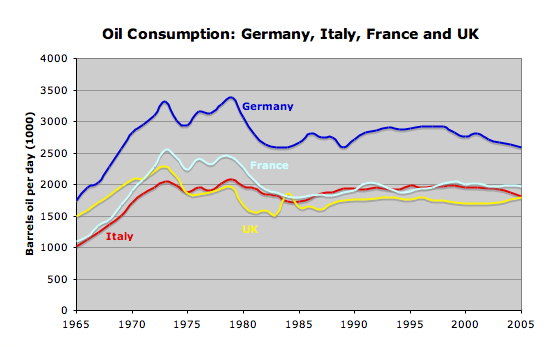
In 2005 France consumed and imported more oil than the UK and Italy
In 2005, France consumed more oil than Italy and the UK, but unlike these countries that both have indigenous oil industries, virtually all of France's oil was imported. So French automobiles and planes run on imported oil. The big difference in France is that 80% of their electricity is generated from nuclear. So where does nuclear energy come from? At the present time, virtually all commercial reactors run on enriched uranium. Like oil, the bulk of global uranium reserves lie outside of the OECD:
| Country | Tonnes | U% of world |
|---|---|---|
| Australia | 1,143,000 | 24% |
| Kazakhstan | 816,000 | 17% |
| Canada | 444,000 | 9% |
| USA | 342,000 | 7% |
| South Africa | 341,000 | 7% |
| Namibia | 282,000 | 6% |
| Brazil | 279,000 | 6% |
| Niger | 225,000 | 5% |
| Russian Fed. | 172,000 | 4% |
| Uzbekistan | 116,000 | 2% |
| Ukraine | 90,000 | 2% |
| Jordan | 79,000 | 2% |
| India | 67,000 | 1% |
| China | 60,000 | 1% |
| Other | 287,000 | 6% |
| World total | 4,743,000 |
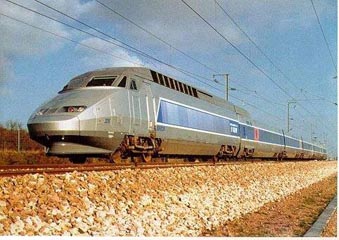
French TGV trains run on nuclear electricity produced from uranium that is probably imported from Africa
Only 3 OECD countries have significant U reserves representing 40% of the World total, thanks to Australia being particularly well endowed in this respect. This needs to be offset against the fact that the Australians have had a moratorium on opening new uranium mines for many years. In general, within the OECD there is reluctance to open new uranium mines because of environmental concerns and this means there is a growing reliance upon non-OECD supplies. This gives rise to energy security concerns of the conventional type, i.e. reliability of supply, but has the added concern of enriched uranium ore (yellow cake) falling into the wrong hands.

Langer Heinrich, the World's first new uranium mine for decades is located in Namibia
France once had indigenous uranium deposits but these are now depleted. So France now imports uranium ore from Niger and Gabon in Africa (former colonies) and is looking to expand supplies from countries such as Kazakhstan, Uzbekistan, Mongolia and Madagascar.
In 2005 France generated 57 Terawatt-hours of electricity from hydroelectric power (compared with 453 Terawatt-hours from nuclear). France is one of the largest hydroelectric generators in Europe but apart from hydro and some other renewable sources France is totally dependent upon imported energy. In short, among the large OECD countries France is probably the most reliant upon imported energy and therefore has the poorest energy security. This vulnerability may in part explain why France is often keen to explore diplomatic routes to resolve conflict.
Gave on oil exploration
"In the world today, there are massive possibilities to explore for oil, and there is certainly no shortage of oil discoveries to be made. However, almost everywhere there is a chance to find oil, the underground has been nationalized. As a result, the oil companies that have the technology can not drill, while the countries that have the oil do not have the technology, nor the will to look for it."
Whilst I sense where this statement is coming from, it falls well wide of reality. Lets look at how this statement stands up against Russia and the USA.
Russia is the world's second largest oil producer with a daily average of 9.6 million barrels per day in 2005. The Russian Empire (known to most as the Soviet Union) collapsed when it could no longer sustain its satellites and republics with cheap oil - a direct result of US foreign policy. It is naïve to think that the Russians didn't do everything they could to find new oil reserves in the decade leading up to this collapse? Whilst working under a medieval political system, Russia had and has a superior education system and turned out world class scientists. The notion that Russia has not been comprehensively explored for oil and gas, therefore, is quite simply untrue.
What is true, is that much of Russia's unexploited but discovered resources lie in extreme inhospitable environments. Like the Shtokman gas condensate field, 530 km from land, north of the arctic circle in the Barents Sea. This is the new frontier in oil and gas development - and it is called the bottom of the barrel.
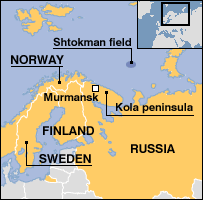
The Shtokman gas condensate field in the Barents Sea, offshore Russia. 113 tcf of gas, 350 m water depth, 535 km from shore in a land inhabited by ice bergs and polar bears - the new frontier in oil and gas development.
This needs to be compared with the exploration strategy of the USA. Vast tracts of prospective acreage lie off the East and West coasts of the USA and in the Arctic refuge of Alaska. These areas may, or may not, contain significant amounts of oil but remain unexplored. Not because the ground is nationalized but because Americans are afraid that oil exploration and production in these areas represents a threat to the environment. I can respect the views of the American public wanting to protect their natural environment, but I find it hard to tolerate the view that other countries are being obstructive to the OECD's God given right to rape them for their natural resources.
The majority of developing countries welcome foreign exploration companies for both the capital and technical expertise they bring. Much of the new oil coming to market today is from countries like Kazakhstan, Azerbaijan, Libya, Algeria, Mauritania, Congo and Angola. These countries have been and are being extensively explored by OECD oil companies. The trouble is, they are just not making big discoveries any more.
The fact is that since 1983, the world has consumed more oil every year than it has discovered. This has nothing to do with national politics or culture, it is a plain fact of life that big fields are easy to find and most of the big fields were found early on in the oil exploration of the world. It is of course true that if western companies had access to parts of the Middle East and Russia that exploration success may be improved at the margin. But it is naïve to believe that this would produce an oil bounty that would solve the World's second biggest problem right now - which is the imminent peak in global oil production.
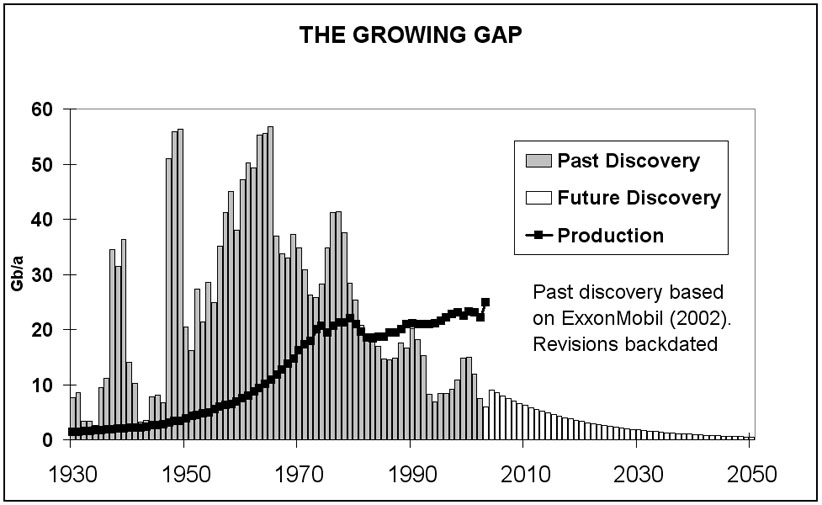
Each year since 1983, the World has consumed more oil than has been found. For over 20 years, a back log of old discoveries have been developed but now this back log is running thin. By 2010, the cupboard will be virtually bare and it will be increasingly difficult to replace production losses from thousands of declining fields with production from a diminishing number of new field developments. Data from the ASPO web site. Click to enlarge.
Gave on prices and substitution
"Production of energy at the individual and local levels: everywhere we go, especially in Europe (where the price of energy, on top of being very high, is also heavily taxed), we find new and interesting forms of energy production: in Scandinavia geothermal energy (one drills in the rocks, and gets the heat coming from below); in France, a massive movement towards heating pumps (exchanging heat between a source of water and the atmosphere - in fact, after a brutally hot summer in Provence, I am biting the bullet and having such a system installed in my Avignon house); in Denmark, there are quite a lot of wind turbines; in Spain, you can see solar panels on a growing number of roofs. All these systems enjoy huge tax breaks, and, once they are put in, they are here to stay; markets lost for oil, forever."
"The first conclusion that one has to reach is that the use of oil (and natural gas) outside transportation is thus going to go down structurally. Oil will increasingly be used for what it should, namely 'movable energy' and transportation. But even there, big changes could be unfolding."
In these two statements Mr Gave provides a view that a variety of alternative energy sources being developed and deployed in Europe, and indeed throughout the World, will lower our dependency on oil. At the heart of his argument is the notion that Europe still uses oil for electrical power generation and space heating. This of course is fantastic nonsense. In Denmark, following the oil shocks of 1973 and 1979, virtually all oil fired power generation was closed down (the Danes now rely upon coal supplemented dubiously by wind). In the UK, the use of oil in power generation and in industry has already been reduced to near zero. The Norwegians of course are near 100% dependent upon hydroelectric power and the Swedes use nuclear and hydroelectric power. The French, as already discussed, rely mainly upon nuclear and hydro power for electricity generation. Whilst I have not had time to check all OECD countries, I think it is likely that the majority will follow these trends having converted to coal, natural gas, nuclear and renewables in the wake of the 1970s oil shocks. Some oil will still be used of course for space heating and back up-power generation, but I believe that in most the demand for oil in industry and power generation has already been destroyed - and cannot be destroyed again.
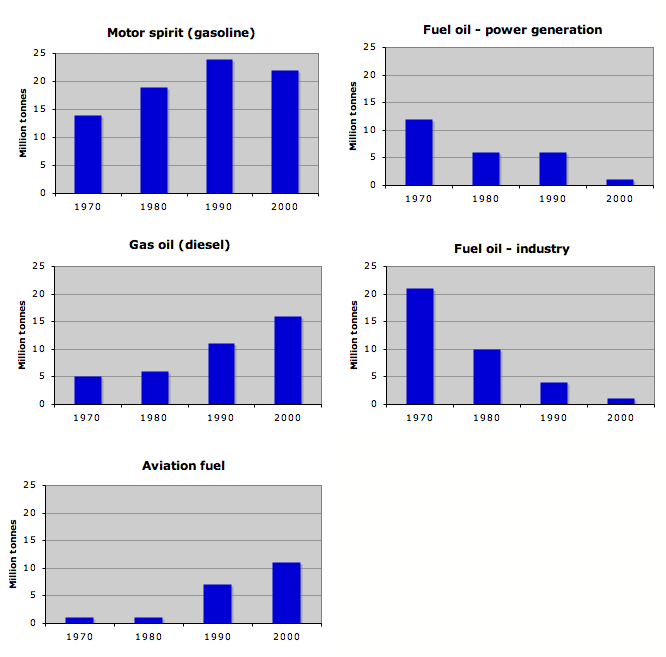
In the UK, the 1970s oil shocks destroyed demand for fuel oil used in power generation and industry. Transportation now accounts for most oil use. The 2010s oil shocks will likely destroy demand for transportation - starting with the poorer countries and poor consumers. Click to enlarge.
Thus, if significant cuts are to be made in our oil consumption these must bite into use of oil for transportation. Ironically, Mr Gave seems to understand this point, but offers the empty chalice of oil consumption cuts elsewhere.
I also feel compelled to comment on Mr Gave's point about geothermal energy being used in Scandinavia. Geothermal energy is a viable alternative energy source where, through volcanic activity, hot rocks form which energy can be extracted, occur at shallow depths. This energy may be tapped by drilling, and pumping water down the wells that returns to the surface as super heated steam.
In a plate tectonic context, there are three geological environments where volcanic activity occurs - at destructive plate margins such as the subduction zones that surround the Pacific ring of fire, at mid-ocean ridges - where new ocean crust is formed by the up-welling asthensophere and in hot spots, such as Iceland and Hawaii. Scandinavia, I'm afraid, does not fall into any of these environments.
According to BP in 2005 The World had 8938 MW of installed geothermal generating capacity. The USA was top with 2544 MW, followed by The Philippines with 1931 MW and Mexico with 953 MW. These figures need to be compared with other forms of electricity generation and for example a large coal fired station is typically 2500 MW. So all the installed geothermal capacity in the World is equivalent to between 3 and 4 large coal fired plants - not very much! Furthermore, Scandinavia has zero reported installed geothermal capacity (unless you include Iceland which is geologically unique on planet Earth). So the geothermal energy result is:
Rest of the World 8938 MW - Scandinavia 0 MW
The main point I want to make here is that the respected and influential Charles Gave doesn't have a clue what he is talking about with regard to energy substitution and geothermal energy. He is offering the world non-existent solutions.
Gave on the future and the motor car
A lot of oil is used in short-haul transportation (commuting). The hope here lies in the fact that the technology in batteries is changing fast. Next year, in the US, the first electric car with a range of more than 300 kilometers (a two seater, very exciting sport car) is going to be produced in California. Granted, it will be very expensive (over US$80,000), but all inventive new products are, at first, very expensive. With time, and greater production, prices collapse.
The emergence of the electric car will be a huge bonus for the nuclear power industry, the cars recharging at night, when the demand for power is the lowest, hereby guaranteeing an optimum use of the power grid infrastructure. Within a little more than a decade, one could see the use of oil for short-distance commuting absolutely plummets.
The long haul will remain the undisputed domain for oil, whether for trucks, cars, boats or planes. But here also, technology is going to bring about quite a few changes on the demand side of the equation. One only needs to think of the hybrid car, or the growing dominance of the diesel engine, or the fuel-efficient Boeing Dreamliner, or of the substitution of gas-guzzling SUVs (for example, I traded in my Avignon Range Rover for a far less chic new Diesel Citroen. The Citroen literally uses a fifth of my old gas-guzzler... and will most likely break down a lot less too).
And so towards the end of his essay, Charles Gave begins to make some sense. I have to agree that the emergence of better batteries and short haul electric cars will solve part of the problem, that nuclear power will be greatly expanded and that fuel economy, especially in motor vehicles, should be one of the first measures introduced. The problem is that Mr Gave does not seem to understand why the world is moving in these directions. He seems to see a nuclear future emerging so that the OECD will reduce its dependency upon fossil fuels imported from developing countries - only to have this dependency replaced by importing uranium from developing countries.
The world is moving towards a nuclear future, mainly to reduce carbon dioxide emissions related to coal and gas fired power stations. To then make the transition to an electric transportation network will add significantly to grid demand requiring that nuclear and renewable electricity sources are expanded well beyond the current grid capacities. Making this transition will take decades. Not only do we need to build vast numbers of new reactors, we need to gain consent from a fearful public, and we need to find and mine the uranium resources to power this new electric future.
Gave seems to believe that this nuclear electric panacea can be delivered in a matter of years, marginalizing oil and bringing, in his opinion, deserved turmoil to countries upon which we are all still dependent for energy. He conveniently ignores the fact that rapidly developing countries like China have an accelerating thirst for oil. He seems oblivious to the fact that the energy debate revolves around how to get from current dependency upon oil for transportation to a CO2 free, nuclear / renewable energy future. This step will take decades to achieve and it is doubtful that the World Economy will survive intact, particularly if it listens to poorly informed advice from the likes of Charles Gave.

Runaway chinese oil imports paused for breath last year, presumably as higher prices began to bite. With Chinese urbanisation and industrialisation continuing, how long will it be before the trend of rising oil imports is re-established? Falling per capita oil consumption within the OECD (which must happen) will be swallowed by rising per capita consumption in the industrialising world.
Our 19th century world was dominated by coal. Our 20th century was dominated by oil. It is our firm belief that the 21st century will not be dominated by oil. It will be dominated by electricity; and oil will become a marginal energy. This simple truth might help explain why, since 2001, uranium has not had a single down month, and since 2003, uranium has never traded down for even a single day, regardless of what was happening to oil prices.
In recognizing these simple truths, Charles Gave does not realize that he is adopting the Peak Oil position. He is of course right, oil will become a marginal energy form as the 21st century progresses and supplies fall year on year on the long journey down the depletion curve. But to suggest that it will become a worthless irrelevance denies the fact that for air travel there is no viable substitute for jet fuel on the horizon.

Running on alcohol, or even hot air? Virgin plans to spend billions developing new forms of aviation fuel brewed from logs and corn. Click to enlarge.
Conclusion
There is no doubt that we have been on the wrong side of the great oil bull market. And a number of clients have (rightly) taken us to task for this mistake. After all, oil was one of the more important calls for money managers in the past year.

Charles Gave - running on empty
Charles Gave opened his essay with an extraordinary admission that they (GaveKal) have completely misread the oil market so far this century - and their clients are rightly annoyed. These clients now need to ask themselves whether it is wise to continue accepting advice from a xenophobic organisation that seems to have little understanding of World energy resources.
Charles Gave represents a Cornocupian of the most dangerous sort, respected and influential in some circles and yet almost entirely ignorant on energy matters.
Personnel
Editors
Contributors
Peak Oil Primers
Archives
- November 2010 (3)
- October 2010 (6)
- September 2010 (4)
- August 2010 (7)
- July 2010 (6)
- June 2010 (7)
- May 2010 (2)
- April 2010 (8)
- March 2010 (4)
- February 2010 (6)
- January 2010 (3)
- December 2009 (5)
- November 2009 (8)
- October 2009 (12)
- September 2009 (6)
- August 2009 (5)
- July 2009 (11)
- June 2009 (8)
- May 2009 (16)
- April 2009 (10)
- March 2009 (7)
- February 2009 (10)
- January 2009 (15)
- December 2008 (9)
- November 2008 (9)
- October 2008 (9)
- September 2008 (13)
- August 2008 (10)
- July 2008 (14)
- June 2008 (23)
- May 2008 (16)
- April 2008 (12)
- March 2008 (16)
- February 2008 (9)
- January 2008 (13)
- December 2007 (13)
- November 2007 (16)
- October 2007 (22)
- September 2007 (8)
- August 2007 (9)
- July 2007 (16)
- June 2007 (8)
- May 2007 (7)
- April 2007 (7)
- March 2007 (10)
- February 2007 (10)
- January 2007 (12)
- December 2006 (9)
- November 2006 (15)
- October 2006 (4)
- September 2006 (5)
- August 2006 (5)
- July 2006 (9)
- June 2006 (5)
- May 2006 (10)
- April 2006 (9)
- March 2006 (13)
Vital Trivia
License

This work is licensed under a Creative Commons Attribution-Share Alike 3.0 United States License.
Then you link to Virgin's funding of alternative jet fuel choices. You could also have linked to this work by the US Department of Defense testing jet fuel made from natural gas and coal using existing plants and technology:
Synthetic fuel runs bus, B-52
It seems that you are contradicting yourself. Could you clarify this point?
http://en.wikipedia.org/wiki/Fischer_Tropsch
I guess any confusion originates with government strategy. Branson wants to develop alternative fuels for environmental reasons - no mention of the possibility that there just might not be enough jet fuel to go round come 2012.
Fischer Tropsch uses nat gas, coal or bio-mass as feed stock. All take CO2 that is currently locked away and sends it into the atmosphere. I can only imagine that the processing required to make synthetic fuel will increase its CO2 foot print.
A couple of quotes from the Synthetic fuel link:
Development of this technology will advance the Air Force's goals to provide increased capabilities to the war fighter, support our environmental and energy policy requirements and reduce the dependency on foreign energy sources
Engineers expect the fuel will have the same performance as regular jet fuel but with less pollution because it contains less sulfur than regular fuels.
The bit about the environmentaly friendly fighting machine I think is matched only by recent reports that BAE systems are going to develope environmentally friendly shells - low in heavy metals - it really is a joke. Again the statements are ambiguous - is it environment or energy security that is driving this - or both?
I checked with Robert Rapier before putting this up asking if it were feasible from a capacity point of view to produce enough cellulosic alcohol to keep aircraft flying and he said "The world could probably grow enough food to fuel jets, but not jets and cars".
So I guess I'm scepticle from a capacity point of view that the world's fleet of aircraft could be kept flying on alcohol and from a CO2 point of view that synthetic fuel is a viable option. But I may be wrong.
Thanks for the link.
France has the potential to move large amounts of freight by rail, but fails to do so (management and the unions of SCNF often get the blame). Often the financial troubles of the Chunnel get blamed on this. Much more rail freight was projected than actually moved between England and France. (Of course I read the English language comments; French comments may blame the Brits). France has made it a goal to get every last switchyard and rural one track spur line electrified. Perhaps the Swiss move to rail freight will affect France as well.
Another overlooked point is the pioneering TGV system, now nearing completion. The rest of the EU is following the French lead. Short hsul sir travel is being challenged by high speed rail, and the EU HSR network will be in place as oil becomes more expensive and the balance point between rail & air shifts from the current ~400 km to longer and longer distances.
And lastly, France is on an Urban Rail building binge. It appears that every town of 250,000 is getting one tram lne and cities of a half million are getting two. Today, these non-oil transportation alternatives may move a minority of the daily trips; but that can change as oil rises in price. Already, there have been reports of French & German auto use falling by 6% as US use merely slows it's annual growth. They have a non-oil alternative in place to move to, we do not.
Best Hopes,
Alan
And then there will need to be a pretty ferocious debate with the public about whether or not nuclear electricity is a good idea or not.
It is "fairly easy" to recycle used fuel (try doing that with oil !) if fuel imports become a problem. CANDU reactors can burn used fuel basically "as is". France has enough used fuel in country today to get by for decades with recycling. A a breeder reactor remains a theoritical possibility.
The fuel cost per BTU is quite low for U. Always good if one is importing energy. Recycling and breeding are viable only at much higher fuel prices IMHO.
France is finally getting interested in wind as well, for some diversity of supply.
Best Hopes,
Alan
PS: yes you did include a picture of a TGV train. Sorry for my oversight.
Switzerland it the similar, I spent a week in Switzerland a few years ago working on a telecoms projects for the train operators. Spent most the time riding the trains which were absolutely faultless. One interesting observation was how much road freight from Italy, France and Germany was loaded onto trains at the Swiss border and offloaded at the other side having passed through the country without touching the road networks or burning a single gallon of oil. When I say loaded and offloaded I mean the heavy goods trucks themselves were transported by train from one side of the country to the other, drive on - drive off.
I think the only country that is following the french lead seriously is Spain, we are obsessed with HSR and lots of highways, so our solution to mobility and the energy crisis is building more roads and HSR. Another big problem with HSR is that it eats a big part of the budget. At least, in our future transport plans there is a return of light rail urban and suburban, that is a step in the right direction, IMHO.
The existing Northeast Corridor (Boston to DC) down to Miami and west to Kansas City via Chicago, etc. I 6think that it is the best option for the US, rather than true pax only HSR.
ICE in Germany is the equal of TGV, just a decade behind.
Do you have any comparisons available on the maintenance requirements of Railways vs Paved Road? I know track maintenance is pretty steep, but with Asphalt going up these days, how do they compare?
Also, is there a way to design railways to improve on their railbeds' durability? I know that with such a massive, installed base of legacy equipment, the thought of changing the basic structure of it would be monumental.. but still, how would you design a rail system, if you could start from scratch? Wider wheelbase, Different track structure? Tie systems?
I spoke with a guy in the rail industry at an unrelated event recently in Atlanta, and he told me about the big 'changover' in 1939? to a unified gauge, all over Christmas/New Years week. Who isn't thrilled by a story about a monumental, almost insane effort, where everyone has go go above and beyond.. well buckle-up, I guess.. ours is coming!
Bob Fiske
But on the other hand railway maintainace disrupts the traffic flow much more then road maintainance...
I think the biggest difference if you started from scratch would be larger loading gauges for wider and higher loads and higher unified platforms. This would at least be relevant for most european countries. The wheelbase dont matter as much.
If you had enough rail to have two complete systems it could make some sense to have a narrower wheel base for light and medium heavy rail passenger only traffic and a wider one for cargo and long distance travel. But this probably only made sense in earlier times when earth moving equipment were primitive and concrete expensive and the smaller turning radii of a narrow wheelbase mattered a lot for the building cost. Large parts of southern Sweden once had a 891 mm network, three swedish feet from before metrification. One small part of the 891 mm network have survived for commuting to Stockhom and there are a few museum railways. The rest is either scrapped or widened to standard gauge. Had those lines been built now none would have been built as narrow gauge.
There are differences between now and then. The war time electrifications in the early 40:s disrupted the traffic flow a lot less and where made faster then those being made today in Sweden. Back then most of the labour were done manually, they used manny more workers, the equipment installed where lighter and security procedures much simpler. They could more or less suspend working within a few minutes and step off the track when a train approched.
But that were an mobilization effort and today we optimize for cost with a completely different cost for labour and other machines being available.
The differences obviously led to problems and, with the aid of a large number of navvies, the Great Western was converted to the standard gauge. If memory serves me right, it took a weekend for the conversion, but presumably the amount of track was small at that time.
astronomer1
High speed systems around the world are being built to standard gauge, evin if the home country (Spain, Japan, and Taiwan, for example) uses another gauge for its conventional system.
There is a move in Europe to integrate the formerly separate national rail networks into a single european network with common technical specifications, signaling systems, and the like, and some big infrastucture projects that will create trans-european high-speed and freight networks.
Asia is divided into several large "gauge oceans" of differing gauges; Western Asia, including Turkey and Iran, are predominantly standard gauge, as is China; the Indian Subcontinent is mostly the 5' 6" gauge; Russia and the Central Asian republics are mostly 5' gauge; and Southeast Asia is mostly meter gauge. Projects across Asia, like the Bosporus rail bridge, a standard gauge railway connecting China and Iran across Kazakhstan and Turkmenistan, and the linking up of the Iranian and Pakistani rail networks across southeast Iran, are slowly knitting together Eurasia into a single network, although with several major breaks of gauge. It will be interesting to see whether the advent of Peak Oil and Global Climate Change will create a push for more linked up, inter-operable, and electrified rail networks across large regions.
Japan rail is all narrow guage 3.5 feet except their high speed rail network.
I would have built the track gauge slightly larger (New Orleans gauge of 5'2.5", 6 inches wider than standard) but with wider loading gauge and more overhead clearance.
Biggest change would be electrifying every rail line. Perhaps every other frieght car would have 1 electric motor and one driven axle. This would increase traction, acceleration & braking and allow for steeper grades on the track (much cheaper).
Changes today ?
Electrify at 60 kV AC, double & triple track most lines (back to 1950s), drill more tunnels, develop light weight & streamlined rail cars (aluminum, titanium, carbon composite) and my network of semi-high speed pax & freight rail lines. Most areas of US are served by two rail companies, try and build a third (perhaps my semi-high speed line).
Build more rail bypass lines around cities (save existing track for local service) and add more grade seperation (see Alameda (spelling) in Los Angeles). Rail tunnel to bypass most of NYC.
I am intrigued by Swiss plans to build quiet rail cars, making trains quieter.
Change US safety regulations closer to EU & Japanese standards. Improve signaling, thus allowing more trains/hour on track, better scheduling. Car tracking & routing is currently improving (bar codes & computers).
Off the top of my head :-)
Best Hopes,
Alan
http://krugtales.50megs.com/rrpictale/OWYtrip/OWYtrip_c.htm
scroll down to just above where the second set of pics start to show:
also, this short story (about halfway down the page) is quite wellwritten, it is the tale about a locomotive, 15 coal cars, a bet and a skilled engineer. One of the more exciting things I have read this week :)
http://krugtales.50megs.com/rrpictale/kiewit/kiewit.htm
This site gives a view into the world of american railfreight, always from the engineers perspective.
"I don't like HSR, construction and maintenance costs are very high"
Relative to what? Certainly not relative to large highways.
"energy consumption is also an issue (at least from an efficiency point of view)"
That depends on what you are comparing it to. Compared to rail service at slower speeds (say, 200 km/h) true high speed rail (300+ km/h) is less efficient. Compared to anything that runs on rubber tires it is likely more efficient, and compared to smaller vehicles with rubber tires it is a runaway winner.
http://strickland.ca/efficiency.html
Take a look at the table: the TGV Duplex achieves a gasoline-equivalent 506 passenger-mpg in actual service (using quoted 80% overall load factor). Even the least efficient European high-speed rail figure I could find was a potential (all seats filled) of 412 passenger-mpg for the AVE. You are unlikely to better that figure with a diesel bus going even 1/3 as fast. Compared to cars? No contest. There simply is no comparison - electrically-propelled rail service is remarkably efficient.
Contrast with airliner efficiencies on the order of 50 passenger-mpg - 1/10 as efficient!!! HSR also consumes less land - I recall reading the original TGV line (Paris-Lyon) in total consumed less land than one Paris airport. It's a piece of land that's distinctly longer in one dimension, but the overall area is smaller. I think in terms of efficiency HSR is a big winner when the alternative is flying. Lower speed rail service may be more energy efficient but total energy consumption will be much higher if the service does not attract people away from air travel.
About 10 years ago, an aquaintance who lived in Paris claimed that their metro/commuter rail system had the capacity to move the entire commuting population of greater Paris. Is this true?
Paris is unusual in big cities in that a lot of people still live in the core-- it's kind of Manhattan like in that regard. This is changing though, as more and more French people find it too expensive or inconvenient to live there, rents rise, etc. and there is a marked movement out to the suburbs
They make extensive use of buses, though.
The mayor had a scheme where they closed part of the roadway along the Seine for the summer, and built an artificial beach.
Since France is quintessentially a country of car drivers, who are militant about their rights, though, I'm not sure how long this initiative will last.
Paris Plage is here to stay. After decades of car domination, push-back is huge.
However there is a philosophical objection to congestion charging from the left -- I think it'll come one day, from a future right-wing minicipality.
It's a real shame all those wonderful boulevard trees were cut down, all over France, to make roads 'safer' (aka if someone skidded off the road, and hit one, they were toast-- the solution to which is, except at corners, not to skid off the road at a speed which will make you toast). A piece of the French landscape lost forever.
http://www.fao.org/docrep/005/Y2328E/y2328e17.htm
Roadside trees: the aggregate linear length of roadside trees fell by 23 000 km from 1975 to 1987. This 42 percent drop amounted to some 3.5 million trees. While there has been a reported 14 percent increase in trees bordering roads since 1992, the frailty of this aging legacy is heightened by security constraints. It is also inadequately managed.
Conversely France, with its cycling culture, and a car design like the 2CV, is/was way ahead of the curve on technologies with lesser environmental impact.
I've often thought what the world really needs is an updated 2CV.
I am envious of the French nuclear electric transport system - once England's motorways fall silent and everyone asks what went wrong - looking across the chanel to the Frensch zipping around on African U will stick in the throat.
Still a bit worried about the state of those cliffs at Paluel though.
We shall see if the nuclear industry is capable of even reproducing its aging inventory of reactors, much less ramping up production of additional reactors. Any evidence yet?
Oh, right, I'm against nuclear.. but I loved Paris!
Bob
But this in an industry (like the oil geology industry) that hasn't hired in 20 years. A lot of skilled people at all levels are going to retire with the Baby Boom. Reconstructing that expertise will be no mean feat.
My guess is a lot of work will have to be outsourced to China and India, where there is a larger pool of engineering talent. There may also still be good nuclear engineers in the former Soviet Union and Eastern bloc.
Gave's main problem is that he let his writing ability get ahead of his understanding of the problem of Peak Oil. Maybe its his age and wealth, but he seems to believe in acomination of technological innovation and eternal growth. These are great precepts for a religeous faith, but the evidence isn't in his corner on energy.
Also, Cry Wolf , you gave a succint summary of the drilling and production improvements that are yeilding great increases in URR of oil fields. Although I have great expectations for raising the recovery rates of many old and derelict fields onshore in the US, its not going to be cheap and redeveloping old fields with depleted pressure will be unlikely to yield cheap, plentiful oil. I've got several prospects like that that I work on in my spare time, located in the Texas Gulf Coast and East Texas areas.
But on the positive side for Gave, at least he is trying to understand the issues and can admit that he has been wrong in the past. I hope he reads further and continues to think as he is an influential person and is looking at the problems.
But then I may be the naive one if he is a CERA/Lynch stooge beholden to the Iron Triangle and therefore he is just trying to perpetuate the Status Quo. In which case I don't give them the conniving credit for perpetuating the myth of unlimited energy that they deserve.
You have to give him credit for acknowledging previous mistakes, but he clearly wrote this without having fully corrected his earlier mistakes. It sounds rather like something written on deadline.
One decommissioned field was redeveloped in the N Sea. It was a disaster - produced OK for while before the water came - and they had to rent floating offshore facilities.
Very few, if any, have been reshot with 3D, and there are few wells below 8,000 ft on the flanks. There is no pooling or spacing, so they can be redeveloped without having a solid lease block.
They're shallow, drilling is cheap. There are lots of good reentry posibilities. Since they are in old producing areas,its very easy to find logistical support.
But my main thought about it is if you can buy some leases that have produced 50,000,000 barrels, raising the total production 10% yields 5,000,000 bbl. My math skills are weak, but I'm good enough to know I could make a great living for the rest of my life on a deal like that. And I'm not greedy, so I would be happy to sell my researc for a little cash and an override or carried working interest and throw in with some like-minded guys.
5 million * $75 = $375 million (less costs)
I always wanted to start an oil company.
The main legacy from Chernobyl - lots and lots of CO2.
Some day I would like to read a summary on the Geology of that region with all the different types of mineralization and the oil sands that must have been a real geological oddity
http://au.news.yahoo.com/060530/23/z699.html
Then again plenty of vegetarians wear leather shoes.
These tests were open air, which President Kennedy and the Russians stopped doing in 1963. No civilised country tests atomic weapons in the open atmosphere.
There is loads of evidence about the long term effects of radioactive particles (the cancer belt in Utah and Nevada-- atomic testing may have claimed the lives of Rita Hayworth and John Wayne, amongst others: a suspiciously large percentage of the people in the film crew for that movie where he plays the Monghol warlord died of cancer).
Also France was threatening ecosystems and human life in the South Pacific: note they weren't testing the bombs on the Massif Central!
The dirty bomb cleanup was a comedy of errors. They tried to vitrify the soil with high amp currents but the machine blew up due to sticks of dynamite hidden in the soil. I think they ended up with a $5 sign 'Do Not Camp Here'.
However they all, I believe, took place in the 1950s and British was a signatee to the Comprehensive Test Ban Treaty.
France (and China) continued with this nonsense for at least another 25 years. Rainbow Warrior anyone?
I think this is what is called in systems engineering 'tightly coupled systems'.
see below quote re Three Mile Island (TMI):
The political scientist Aaron Wildavsky suggested that because of this complexity and the nteract, adding safety devices and procedures will at some point actually decrease safety. The TMI accident offers a number of examples of how this works. The control room, for instance, had more than 600 alarm lights. Each one of them, considered by itself, added to safety because it reported when something was going wrong. But the overall effect in a serious accident was total confusion, as so many alarms went off that the mind could not easily grasp what was happening.
Charles Perrow, a sociologist at Yale, has taken this sort of reasoning one step further and argued that such complex, tightly interconnected technologies as nuclear power are, by their nature, unsafe. With so many components interacting, there are so many different ways an accident can happen that accidents are an inevitable feature of the technology-what Perrow calls "normal accidents." The technology cannot be made safe by adding extra safety systems, for that would only increase its complexity and create more ways that something could go wrong.
It's impossible to do justice to Perrow's complex, tightly argued thesis in just a few sentences, but in essence he argues that the requirements for successful control of certain technologies contain inherent contradictions. Because what happens in one section of a nuclear plant can dramatically affect events in others, some central control is needed to make sure that actions in one place don't cause unanticipated consequences in another. This control can might be in the form of a central management that approves all actions or in the form of a rigid set of rules governing actions throughout the plant. On the other hand, because the technology is so complex and unpredictable, operators need the freedom to respond quickly and imaginatively to special circumstances as they arise. Both rigid central authority and local discretion are needed, and, Perrow says, it is impossible to have both. Thus a nuclear plant will always be vulnerable to one type of accident or another-either one caused by a failure to adapt quickly to an unanticipated problem, or else one created by not coordinating actions throughout the plant.
Perrow argues that a number of technologies besides nuclear power face the same inherently contradictory demands: chemical plants, space missions, genetic engineering, aircraft, nuclear weapons, and the military early warning system. For each, he says, accidents should be considered not as anomalies but a normal part of the process. Their frequency can be reduced by improved design, better training of personnel, and more efficient maintenance, but they will be with us always. Perrow goes on to suggest that society should weigh the costs of these normal accidents against the benefits of the technology. For chemical plants, the costs of accidents are relatively low and are usually bome by the chemical companies and its workers, while the cost of shutting down chemical plants would be rather high. There is nothing to replace them. But nuclear power is different, Perrow says. The costs of a major accident would be catastrophically high, while the cost of giving up nuclear power would be bearable. Other ways of generating electricity could take its place.
So far, of course, that hasn't happened. But what has happened is that the way people think about safety has changed, particularly in the nuclear industry, but in others as well. No one believes any longer that it is possible to engineer for complete safety, to determine the maximum credible accident and then assure that it won't threaten anyone. The best that can be done is to try to make dangerous accidents very unlikely.
People have also come to appreciate how complexity changes the risk equation. It makes risk harder to calculate by making it difficult to understand all the ways that things can go awry. But equally important, complexity can amplify risk. The more complex a technology, the more ways something can go wrong, and, in a tightly coupled system, the numbers of ways that something can go wrong increases exponentially with the number of components in the system. The complexity also makes a system more vulnerable to error. Even a tiny mistake may push the system to behave in strange ways, making it difficult for the operators to understand what is happening and making it likely they'll make further mistakes.
The problem of global warming is that great, and that urgent.
A more profound problem is the one of nuclear proliferation: the main problem with Breeder Reactor programmes. Interestingly Al Gore was asked about this, and said basically that every foreign policy problem in the White House seemed to revolve around the fact that country X had obtained, or would obtain, nuclear weapons. Therefore he discounted nuclear power as a solution to global warming.
For me the biggest problem with nuclear is cost. No matter how you jig the numbers, if you fully cost the costs of waste disposal and storage, the security costs, the cost of the insurance for the industry (which no private market will bear-- hence the Price Anderson Act), etc., then nuclear power has never been anything other than an expensive government programme.
For that money, you could go a long way on wind and solar in terms of new capacity. And you could move much faster, and without legacy cost problems.
Charles Who?
Somehow I'd never heard of this Charles Gave chap before -- quite a character, obviously, though somewhat cavalier when it comes to distinguishing between fact, fiction and fantasy. Still, I liked his dictum that "Few things concentrate the mind as much as the ability to make money."
How come though that you dissed GaveKal by calling it a 'xenophobic organisation'? Because Gave did not display sufficient 'respect' for the goons that govern some of world's oil-rich countries?
At any rate, your critique was far more 'thought-provoking' than Gave's original article. Good stuff.
Renewables (wind and solar mostly, with a moderate amount of biomass) and batteries are at a tipping point of both size, cost and growth rates, such that I think they're really more useful than nuclear.
How do we over come this scenario without a nuclear base load?
2nd, you'd want greater transmission inter-connection with Europe, for greater geographical averaging.
3rd, I'd use storable biomass (and maybe hydrogen/ammonia/synthetic methane) for about 20% of electrical generation, for just this purpose.
I suspect that solar tends to be counter-cyclical with anti-cyclones - anyone have any info on that?
Which is not helpful if your demand peak is January early evening (the UK position).
Seasonally, wind bottoms in the UK in June and July in average intensity (peak in midwinter I think).
More helpfully, a high wind coincides with an increase in winter electric power demand.
The basic problem is that UK homes are mostly very badly insulated, so you have to put the heat on when you come home. Also of course the TV and the cooker and the kettle go on, whilst offices and stores are still lit up and computers working.
It's an area where active demand management could have a big positive impact.
No single hour in the last 20 years when it took place, over the entire UK.
however you do still have to plan for that.
The UK has 70GW of peak demand, and roughly 84GW of capacity with the reserve margin.
The 'Capacity Credit' the National Grid Co network operator has given for 25GW of wind capacity is 5GW. (Capacity Credit is lower than Capacity Factor, the latter measures annual power output as a per cent. of rated output, the former is what the grid operator will give you, in terms of reducing the need for other power).
30GW capacity would produce roughly 20% of the UK's power demand. 350TWhr total, 30GW X 7680 hrs X 0.25 capacity factor.
If you link all the emergency generators in the UK to the grid (which they tend to do anyway- -they're not reliable if not run regularly), and if
- you have a decent amount of CHP (say 5 GW capacity) and you have some more pumped storage (I think the UK is 3GW now, you could probably raise that to 6-7 GW)
- and you keep a decent amount of fossil fuel capacity on reserve (which isn't hard to do, as you are not running the plants much, they don't wear out)
- and you incorporate sensible 'demand management' systems e.g. Ontario (35GW peak) is targetting 6.5GW of demand management savings by 2020. For example my parents have a tariff where the utility can turn off their air conditioning for 60 minutes at peak times. In Switzerland you can only run your clothes dryer at night.
then you can have some really big levels of wind into the UK. Everyone is modelling 20%, but I think there is a case you could go up to 50%. George Monbiot in his book 'Heat' tackles this-- he reckons the politicians haven't asked for 50%, so no one has tried to model it.There are some good papers by a guy at Oxford named Graham Sinden on this.
http://www.eci.ox.ac.uk/lowercf/renewables/UKWindResource-EnergyPolicyPaper.pdf
(to get to a near zero carbon electricity system, you would still probably need 30% nuclear unless we go big for carbon sequestration on our fossil fuel system -- there is a 450MW CSS system being built in Scotland I believe, with BP as a jv partner)
The point is that you need the wind to be blowing flat out over the whole country to be making meaningful power. No good if its calm in Scotland and breezy in England.
I'm trying to get my hands on anenometry data from about 6 sites around the UK - its a half hour job then to model the load capacity and fluctuations over a year. This must have been done already. I've had a quick look at the paper by Sinden - this looks good stuff - thanks for the link.
I'm enthusiastic about the potential of wind balanced with hydro and pump storage - this would be good for Scotland where we have quite a bit of installed hydro capacity already - not much good for flat and parched England though. Other problem is that Scottish and Southern Energy (who own all the hydro dams) are not that keen on the idea of balancing wind with hydro - I wrote to them to ask.
Demand management - great idea - but this is not yet on the political agenda or in the public eye. The notion of using energy when it is available rather than on demand - will require a significant public education exercise.
With fossil fuel thermal stations - I'm not sure you can just turn those on and off - and that's part of the problem.
Solar would be in phase with anticyclones - so yes when the wind doesn't blow you switch over to solar - so Nick what is the EROEI of a sloar back up system for the whole of the UK? In Scotland we maybe get 60 days sunshine each year - though this year it is still worryingly warm for late September.
Actually, I would think that would be ideal. If half the wind turbines are working at any one time, that's much better than all working at one point, and none working at another. If parts of the country take turns generating power you'll have a nice, smooth average output.
"I'm trying to get my hands on anenometry data from about 6 sites around the UK - its a half hour job then to model the load capacity and fluctuations over a year."
I'd be very interested in your results.
"Scottish and Southern Energy (who own all the hydro dams) are not that keen on the idea of balancing wind with hydro - I wrote to them to ask."
Did they say why? Alan, any comments??
"The notion of using energy when it is available rather than on demand - will require a significant public education exercise."
I agree, though the easiest place to do this is industrial/commercial demand - that's where you start. Actually, it's been done for years: all your big I/C electrical users, like steel mills, operate at night. So, it's a question of expanding this, and introducing it to residential users. The major California utility, PG&E, is installing time-of-day meters for all it's residential customers. Time of day meters are the key.
"what is the EROEI of a solar back up system for the whole of the UK? "
I would expect that the best system would be a mix of wind, solar, hydro, wave, biomass, etc. Where sunlight is less good, like the UK, solar will be relatively a bit smaller %. But, you would use solar as a normal part of the system, and the different patterns of variation of the various components would help reduce system variance. This would be much more cost-effective than as a backup, though I would expect that biomass would serve that role, as I believe it's easy and cheap to store hay, switchgrass, etc for burning when needed.
Solar in good locations has an E-ROI of 10-30; I'm not sure of the UK's insolation.
I am both a renewables enthusiast and skeptic simultaneously. The Danish experince with wind has actually been quite negative - even though a positive spin has been put on it. Until I actually get my hands on some data and see for myself what the simulated output of a UK wind carpet might look like my skeptical leanings will prevail.
ValueThinker posted this link on UK wind which is a good strating point:
http://www.eci.ox.ac.uk/lowercf/renewables/UKWindResource-EnergyPolicyPaper.pdf
1-they're a small country
2-their grid is split in two, and the 2 halves don't connect
3-most of their wind is in the western grid, while most their population and demand is in the eastern grid
4-Danish wind supply is weakly negatively correlated with Danish demand
5-their scandinavian neighbors have a lot of hydro, and the western grid (with the wind) is connected to them
So, the result is that much of the wind supply is at night and isn't needed in Denmark, so it's exported to the neighbors, who use it instead of their hydro, thus handling the load/supply balancing problem.
As far as I can tell, this seems to be reasonably successful, though a little expensive for Denmark, as they pay their citizen-generators a premium for wind, and get paid low rates for the exported night-time electricity. On the whole, they seem to feel the premium is worth it.
Obviously, Denmark has chosen to maximize a resource which isn't as optimal for them as it would be for others, like the UK or the US. This is similar to Germany, which doesn't have great wind resources, but has chosen to maximise them anyway for their security-of-supply and environmental benefits.
Does that fit with your understanding?
The Western Danish grid is also connected to Germany, so they often sell their off-peak power there.
http://www.theoildrum.com/story/2006/8/31/194053/962
In respose to that wind enthusiasts were very enthusiastic. While others were more skeptical.
http://www.countryguardian.net/denmark.htm
I did have another skeptic link - but it isn't working any more.
Vestas claim that it takes about 7 months for a wind turbine to repay its energy from cradle to grave!
http://www.vestas.com/uk/environment/2005_rev/energybalance.asp
If this were true I would be running towards the enthusiast camp. But then else where I read EROEI for wind of around 2.
If you or Alan could clarify this point that would be helpful.
My mind is not made up.
The basic methodology appears to be sound and based upon ISO/EU standards. They look at (from memory) how long to repay initial energy investment, NOT EROEI. We see "9 months" and 20 to 25 year life time and do our own EROEI. In the first 9 months, there should be no repairs (and no manufacturing defects ! remember this is a Vestas) and hence no reason to include them in the calcs.
I would multiple EROEI by .75 to .85 for repairs & maintenance. and ancilliary energy for access roads, cranes, maintenance workers trucks, etc. OTOH, all copper & steel will be recycled which is a major plus. And pylon towers can last for two to five generations of WTs, another savings if the same class of WT is used.
Would you agree that differences in E-ROI above some moderate value, like 10 or 20, no longer matter?
I had a previous discussion with someone who could not believe that wind could have a higher E-RIO than oil, or that renewables in general could have a decent E-ROI. Any idea where that perception is coming from?
In the case of wind, ANY modern WT is well worth doing !
When a modern 1.67 MW wears out in 22 years, one would get a better EROEI by reusing the pylon, wiring, etc. for a replacement 1.75 MW WT. But we might be better served by installing a 3.5 MW WT with new pylons, wiring etc.
Also, EROEI improves if one keeps a worn-out WT in service, with higher and longer outages for maintenance. So EROEI is not the ultimate metric.
And I do support wind, strongly, but I also support good engineering analysis.
A dozen years ago, I suspect that EROEI of the 250 kW WTs was MUCH lower. And I wonder if the EROEI for the 60 kW WTs was even 1.0. Short lives, low altitude -> low energy production. No economies of scale in metal invested per MWh output. For those that do not stay current, and see renewables as just green hype & subsidies, such attitudes are "reasonable".
I do stand by my analysis of overlooked maintenance in EROEI calcs. Not nearly enough to change the fundamentals, but significant enough to mention.
Cry Wolf is looking for facts, not hype.
A strong grid is required to add significant wind. In addition, utilities see an operational headache in matching hydro to wind and they may have various requirements on water releases at certain times.
How much hydro does Scotland have ? How much storage is behind their dams ? If the have one weeks worth of storage, this limits their utility with wind. I suspect that utility just does not want to be bothered.
It looks like 1544 Megawatts. Given Hydro is 8% of UK Terrawatt hours, that number looks low.
http://www.scottishrenewables.com/data/reports/060410_hydrobriefing.pdf#search=%22scottish%20hydro%2 0capacity%22
says 1300MW, plus 700MW of pumped storage.
(Dinorwig in Wales is 1800MW pumped storage. Rainfall is heavy enough to offset evaporation, and in fact I believe to offset the cost of pumping the water up there).
For scaling, UK peak demand normal is about 64GW, and peak capacity about 74GW (theoretical). The Interconnector with France is about 2.5GW.
The Interconnector with Scotland is 2GW, but I think it is being upgraded.
The worst and most irritating lead time is the time to get things to start moving.
I doubt Al Gore's film will change anything, but American evangelicals are beginning to talk about global warming. that is the most positive sign I have heard in a very long time.
Ray Charles gave Jamie Foxx
permission to play him on screen
It's all good. Technology improves our life every day!
- The implications of endless growth are understated or rejected out of hand.
- Past economic trends are projected automatically onto the future.
- Evidence that doesn't fit growth scenarios is dismissed.
- There is an extraordinary faith in technology to solve all problems.
And so in Charles gave we have the type Cornucopian species.When I was visiting my old mother earlier this summer (she is in her 90th year) in beautiful rural Perthshire one of her old neighbours came to chat and complained about the price of petrol (gasoline).
I strated to tell him about looming fuel shortages and he came up with a great idea. What "they" need to do is invent a small tablet that you pop into your fuel tank instead of petrol.
Rather than move on to thermodynamics I agreed with him.
The basic source of the high temperature thermal energy in true geothermal systems is radioactive decay in the core of the earth. In favoured geological sites the heat flow from the core is concentrated rather than being uniformly spread across the earth's surface and sizeable temperature differences can be found at relatively shallow depths.
Ground sourced heat pumps absorb heat at fairly low temperatures (0 to 5°C) close to the surface. They use electrical energy to pump this energy up hill to provide hot water at about 40°C. In good systems 3kW to 4kW of heat can be pumped uphill for every kW of electricity fed in. The heat that re-warms the ground against the cooling effect of the heat pump is largely solar energy absorbed by the ground.
I think they renamed 'ground source heat pumps' in the US as 'geoexchange' heat pumps because they thought it was a better marketing tag line.
The French are going large for this technology, apparently.
I think the heat in the ground is simply the fact that the planet is hot-- which is presumed to be a consequence of decaying radioactivity in its core, rather than solar absorption per se? Not sure about this, but I thought the 55 degree ground temperature, all year round, was pretty much invariant across the planet?
Vt
My ground sourced heat pump, when on, sucks about 8kW from my back garden with an area of about 200m² from looped pipes .8m to 1.8m deep. That is about 40W/m² of garden surface, The thermostat ensures that for much of the year the daily average is a lot less than this but in cold snaps it is on most of the time. This heat is replenished by making the surface a little cooler lowering the thermal output below the solar input. It also receives heat by lateral thermal conduction from adjacent properties lowering the surface temperatures of their gardens slightly. Thank you Mr. Timmins and Mrs Buckman.
Ground sourced heat pumps can therefore be classed as a form of solar, or at least solar assisted, heating.
Thank you for the data.
Glad to meet a (presumed) Brit who has a heat pump. It is a great technology, but almost unknown here! The Scottish Executive is a little more progressive I believe in encouraging it for institutional use.
Maybe one of the reasons is virtually everyone in Canada now installs air con (hotter, longer summers than we used to have). At which point, a ground source heat pump is a more than no-brainer (although still a minority of Canadian installations). I expect to see Brits install air con (as a leading indicator, 70% of cars sold in Britain now have air con) and the case is much stronger if you can use it all year round.
Any particular operating experience you can relate? Any particular problems? How long have you had it?
This is the 4-reactor complex at Paluel in France,

and you can see that the car park is nearly as big as the power station.
For a look at each step of the nuclear cycle, see
Does nuclear energy produce no CO2 ?
In a world rapidly approaching Peak Oil, how can we possibly rebuild all our electricity and transport infrastructure ?
Dave
Courtesy of Google Maps:
The parking lot is about 150 by 150 meters. The reactor complex is about 200 by 600 meters.
BTW, an equivalent coal-fired complex would burn about 12,000,000 cubic meters of coal every year. That works out to a cube of coal about 230 meters on edge, each face of the cube has an area more than twice the area of the parking lot.

If anything, my crude cube drawing underestimates the size of the coal mountain that is not burned every year because of the nuclear facility. From this viewpoint, it is hard to believe the Storm & Smith assertion that nuclear power can produce anything like the CO2 release caused by fossil fuels.
The Paluel site is a good one since the ocean provides cooling that is more reliable than the inland river-cooled sites.
If the car park was full of electric cars, it wouldn't look so frightening. The technology isn't there yet for pure electric cars for out of town sites, but the streets of London are crawling with them (they are exempt from the Congestion Charge)-- they cost about £8,000 ($14k) to buy.
So have they worked out the effect of higher sea levels and storms on cliff erosion?
Flamanville, where the first 3rd generation plant is planned, is another story, it's at the foot of the cliff, as this cute little video illustrates.
(They claim they can start construction in 2007 and produce the first electricity in 2012.)
The aim of the picture was to show that without building all the nuclear workers new cars, you can't run a nuclear power station.
Its no big problem to pay for the biodiesel or synthetisize the hydrocarbon fuels needed for the support functions when you generate about 12 TWh of electricity per year.
Battery technology, while it's advancing, has quite a few problems being ignored. Particularly li-ions going into the Tesla. We have our eyes on EEstor supercaps and carbon nanotube supercaps, though the chances of those coming to fruition seem to be low.
The time it takes to bring Nuclear online - spot on.
The replacement for jet fuel? Very easy, biodiesel. One of the few things we can replace with few changes, without destroying our foodsources, at the yields required. And since it's something like 2% of hydrocarbon use, I wouldn't mind simply laying it off on fischer-tropsch, sacrificing the carbon for a use that doesn't have a substitute.
Uranium - the case is much less important than you note. Firstworld uranium mining was essentially a cold-war era military process, and reactors simply fed on the scraps. When the Soviet Union broke up, the uranium mining industry died overnight. Their excess stocks have been feeding the reactors for years, as well as repurposed nuclear warheads. The recent price increases are because those sources are finally beginning to dry up. In reality, uranium is common as hell relative to the incredibly amount of energy we get out of it, and in uranium resource reports, URR don't measure the point where EROI hits one like oil does, they measure what would make a profit at current prices.
http://www.americanenergyindependence.com/uranium.html
The Indonesians are planning to bulldoze Borneo jungle, to plant more palm oil trees, to produce oil for German biodiesel.
Similar things have happened in the Brasilian Amazon re land for ethanol crops.
The carbon hit from doing that is much worse than is gained from using a non-oil based fuel source.
Aviation fuel is only a small proportion of total world oil demand. Economies in the use of oil in other applications like ground transport can probably more than make up the gap (subject to limits on how much aviation fuel you can get out of a barrel of oil).
I ask because it's worth a letter to the Environment Minister and my (Liberal Democrat) MEP.
My reference to the impact of soy cultivation for biodiesel on rainforests comes from a link Roel likes to post.
If I have time, I will try to track down more specific references, rather than just linking to large studies. However they are all good and free (although the WW Inst one requires registration).
Jack
1) FO Licht presentation to METI,
http://www.meti.go.jp/report/downloadfiles/g30819b40j.pdf
2) IEA Automotive Fuels for the Future
http://www.iea.org/textbase/nppdf/free/1990/autofuel99.pdf
3) IEA: Biofuels for Transport
http://www.iea.org/textbase/nppdf/free/2004/biofuels2004.pdf
4) Worldwatch Institute & Government of Germany: Biofuels for Transport (Link to register - study is free)
http://www.worldwatch.org/node/4078
5) Potential for Biofuels for Transport in Developing Countries
http://www-wds.worldbank.org/external/default/WDSContentServer/IW3P/IB/2006/01/05/000090341_20060105 161036/Rendered/PDF/ESM3120PAPER0Biofuels.pdf
On uranium - I'm not sure there is anywhere within the EU that would permit U mining. Low grade deposits requiring large open pit operations. WRT exploration - my understanding is that it is dead easy to find surface deposits - you just fly around with a Geiger counter - so I'd be surprised if all the high grade surface deposists had not been found. Finding high grade depsosits at shallow sub-surface (where the radiation signature may be shielded) is a bit more challenging - though you can look for the gaseous decay products of uranium - radon gas and helium.
Electrical grid: Replace 50% of coal generation with nuclear, optimise renewables to about 20%, balance to be efficiency and forced conservation. Liquid fuels: Biofuels to replace 25% of current liquids, electrification via PHEVs and light rail, balance to be fewer miles/km.
Nobody seems certain how vehicle electrification will affect the grid. If there was a rough consensus on what path to take that path would be smoother.
Personally, I don't see Mr. Gave as acknowledging any error. I know he says he does in his opening. But given the rest of his piece, this is hardly an acknowledgement.
He seems to be saying,"well, I'm right, except the last 3 years might lead you to believe I was wrong, but I'm still right."
What does "Malthusian" mean? Is that some kind of code-word/euphemism for peak-oil now? (Yes, I know what it means - but what does he mean by it?) Lynch used this term in the radio interview with Simmons. We may have AMPOD to thank for this.
You would think that by now these organizations would employ some type of a house contrarian or something?
I guess they've been successful in the past. But from reading this, I can't imagine why all their clients aren't suing them. France - energy independent? You're on the mark on that one. These people are insane. The geopolitical assessments of the oil-state leaderships are extremely naive. It's almost as if they got the Ghost of Hunter Thompson or Kunstler to write those sentences.
I looked at their website. They have a research department. Maybe they should stop researching and try a little reading. Starting here.
Cry Wolf,
Good post, lots of interesting stats and a very good conceptual debate on your part.
On the other hand, was I the only one caught by a little off guard by the mean spiritness of your references on a personal level aimed at Mr. Gave?
Oh well, it's a tough world out there, I guess I better be glad you didn't get a hold on my post, ironically, just a few days earlier on TOD,
http://uk.theoildrum.com/comments/2006/9/24/9156/47119/130#130
which was a good bit closer to some of Gave's points than would probably acceptable here! Well, might as well get myself in trouble and get it over with:
Gave was apparently not correct on some factual issues, or at least not on some terminology. However, before I would go so far as to dismiss him as "almost entirely ignorant on energy matters" (compared to whom? Given that most people have no knowledge of how any form of energy is produced or delivered, the bar of "ignorance" is set pretty low in the world), I would like to look at at arguments in the larger context, for just a few minutes. Let us start with the paragraph defining his position:
"Charles Gave lays out his vision for energy in the 21st Century. This vision to a large extent seems to be modeled on France, where he maintains a home, a country that he considers to have already achieved energy independence. He sees a future powered by nuclear electricity, a future that is no longer dependent upon energy from countries that are run by what he describes as "unsavory characters" and "unreliable lunatics". While a bit narrower than what he actually talks about, that's good enough for a starting place:
1. First, what Mr. Gave seems to be discussing is a set of alternatives. Using the same loose terminology as above, we can loosely say the choices are:
(a) do something
(b) do nothing and kiss your azz goodbye
(c) root for a new primitivism that ends the modern age
Given that, Gave seems to opt for the (a) option, do something. I have trouble arguing with that.
Now, despte the assertion that Gave "sees" a future powered by nuclear energy, he is open minded enough, unlike most nuclear fans, to also include renewables, ground coupled heat pumps (as opposed to the often used misnomer "geothermal" a different thing entirely) advanced transportation, and natural gas.
This is a diversified plan, in many ways similiar to what T. Boone Pickens was recommending before he fell in love the tar sand oil pit, of going to nuclear for electric generation to free up natural gas for transportation, something he admits is lagging what he predicted by more than a decade, and a return to an idea born in the 1970's energy crisis. The idea of using all advanced methods possible for oil and gas extraction goes without saying, since it will happen anyway.
That a person holding such a view is now regarded as "the most dangerous sort" is a bit of a shock, and something I will have to digest at a later date, but says much about how hard it is going to be to win acceptance of any mitagation plan, and helps explain the absolute helpless confusion of the public as they try to figure out exactly what it is the most pessimistic among want to happen, short of a catastrophic collapse. (?)
There is another point: The tone of the whole post left the impression, as so many do, that "peak oil" means running clear out of oil. I know, it will be argued that no one believes that is what "peak" is, but the discussions of the airlliners/planes is a fascinating example. Is it actually believed that the world will soon be so out of oil or a usable substitute (coal to liquids or gas to liquids or biodiesel would would suffice in the small volumes needed) that even airliners and cargo planes, much less military jets won't have the fuel to fly? (!!!)
The discussion of reduction of oil use in industry, electric power generation and home heating was likewise confusing: There are charts showing the HUGE drop in oil consumption in these areas, but then the idea of substitution in transport is scoffed at. It is fascinating to no end that we can see oil substituted for by margins of 80% and 90% in three major areas of consumption in only 30 years, and then believe that such a thing is completely impossible in transportation!
I would say look at the charts of the drop in oil consumption in electric generation, and in industrial consumption. Beautiful charts! If oil ever goes over $100 per barrel in todays dollars, these will be the harbingers of the future for transportation consumption.
Charles Gave did however, somewhat give away his lack of knowledge about what is going on in the world technically by not really pointing up the breakthrough advances in solar cells. If he thinks the advances in batteries are astonishing, the advances in solar electric generation are now beginning to reach a point of "confluence" very much like the computer chip did in the 1970's, or internet and instant data transfer did in the 1990's.
There is no other way to say it: We are on the edge of a revolution.
Cry Wolf seems to take the position that advances in stationary power do not help much, since as his beautiful blue charts show, the "demand has already been destroyed - and cannot be destroyed again."
This is a bit of a mistatement: The demand for oil in those areas was destroyed, yes. The demand for energy was not destroyed, it was substituted for by natural gas. Freeing up this natural gas will be an economic boom. But it goes further than that, in that solar at a cost comparable to fossil fuel will free up GROWTH potential in electric power consumption. But, it goes EVEN FURTHER than that: It will free up the potential for distributed power growth, increasing efficiency, and development in diverse places. The reduction in stationary power consuption, combined with the new generation of batteries and onsite hydrogen production liberates transportation in ways only dreamed of a few years ago.
Amazingly, the technology is all essentially developed. The rest is purely political, logistical and marketing. Combined with the remaining amounts of oil and gas (vast as they are, remember, peak means only halfway at most, over the mountain, the downside still gives the other half or more) and a rapidly developing population peak and then downslope) means that we are in for some interesting times.
Gave is right. The oil age is essentially over, as the driving engine of modernization and advancement. And if we get off our azz and use what we have, that is nothing to be depressed about. IF.
Roger Conner known to you as ThatsItImout
You're right that Gave makes a lot of reasonable points - and I do repeatedly say that I gareed with him in part.
In my opinion the big mistake from his presentation is that he seems to want the world to stop using oil first to inflict pain on Islamic oil producers and second to prove the GaveKal investment strategy was correct.
If he stood back and looked and modified his own arguments from the perspective of:
- Oil production is peaking at a time when demand continues to grow at 1.1 mmbpdpy
- We seem to have an increasing problem with CO2 and warming
then I think with a few tweeks to his technical understanding about renewables mainly displacing nat gas, coal and nuclear in electricity generation, then he would be well on his way to making a constructive contribution.Your right in saying that he reaches a lot of the correct conclusions but he gets there by the wrong route and if you don't understand the fundamental nature of the problem you are unikely to develop the correct strategies to deal with it.
John Mauldin does refer to Charles gave as very intelligent and thought provoking. So lets imagine that he understands the peak oil problem and that he also understands that the US is full of folks who hate "unsavory characters" and "mad lunatics" and so recognises that the best way to persuade middle America to save fuel is to urge them to do it in the name of the war on terror - rather than because fuel is running scarce. So Americans may put on an extra sweater and trade in their SUV's in the name of fighting a common enemy - whilst they won't do it for the sake of saving fuel? If this is the hidden sub-text of his essay then he may well be very clever indeed - but do you really think this is so?
In terms of substitution - of course this will happen at many differnt levels. Fuel economy is the obvious place to start - lower engine sizes and lower speed limits - i just ain't heard any of our politicians talking about that yet - and when they do start talking about it it will be in the name of CO2 reduction - not fuel conservation. Another place to start would be to shut down nat gas fired generating plant - replace it all with nuclear - and conserve nat gas supplies for automobiles. Matt Simmons I believe promotes this idea. It's a no brainer - but I don't see it happening. As for running jets on brewed logs and corn - I just don't see the feasibility but I'm not an expert in this area. With an EROEI of say 1.1 does that not mean you have to brew 11 gallons to have 1 free gallon of fuel?
When I walk around the woods where I live there is lots of debris left on the forest floor following harvesting - and this is pretty important to return nutrients to the soil and to protect the soil from wind and rain. It also keeps a fair amount of C locked away - that will be liberated over a period of years / decades as the wood decays - not released instantaneously through industrial scale harvesting and combustion. My gut feel, no way planet earth can grow enough food to eat and food for fuel - especially against a back drop of drought. It is basically going back to the pre-coal medieval period where wood was used in construction and for fuel - and all our forest disappeared then most never to return.
As for being a bit mean on Mr Gave - you're right I was feeling a bit mean at the time - but I invite him to respond to the points made.
By the way, I found you a hotel for $100 a night, right in Kenmore Square. Walking distance. Crawling distance actually. But, hey, I'm good.
In terms of flat production this year there is no doubt in my mind that we are looking at flat demand - and if demand went up so would production - in other words we are not yet at peak.
I believe that KSA has some surplus capacity and they are back playing swing producer. How much I don't know. But I guess that falling sour heavy crude production at Cantarell may be met by sour heavy crude from KSA - meaning that they are withholding light sweet. They also brought on new capacity this year - so my guess is they could up production by at least 1 mmbpd - though not all agree with me on this point.
For the last 25 years, global consumption has been rising near linearly at 1.1mmbpdpy - and it seems this may be correlated with population growth. High price of course may bust this trend that was established following adjustment after 70s oil shocks. The real question then is at what price does demand destruction and substitution kick in?
The essence of my peak consumption model is that production will peak when the price gets too high and people either stop using energy or find an alternative. If folks would pay $500 / bbl then production might rise to 95 mmbpd? But I don't thik that will happen. Consumtion peaking at $70? - my feeling not yet. My guess is that $120-$150 is the number that will see consumption peak - due to combined forces of demand destruction and substitution. Big question - after that will we be using more or less energy?
So maybe you're right Mr Gave was on the right lines - just well wide of the mark in detail. He should sign up and post some comments.
Stance 1) ugh fed up using oil, lets go use something else and oil price collapses.
Stance 2) world is addicted to oil and will only be weaned off with high price - say $120 / bbl by 2010 - then you may want to hang on to those oil stocks for a while yet.
Calling all GaveKal investors - what do you think?
Much depends on how long that price is sustained for: in 1980 it was a very short time.
In the short run, I think the estimates for elasticity of gasoline are -0.10 ie 100% price rise = 10% consumption drop. I think the longer run estimates (up to 5 years) are closer to 50% ie -0.50. It takes a long time to turn over physical capital and replace it with more efficient capital.
If there is a sharp recession, that will cut demand very quickly.
Cry Wolf,
Just a few lines....you said, "So maybe you're right Mr Gave was on the right lines - just well wide of the mark in detail. He should sign up and post some comments."
I think there is truth in that, and him posting here would be fascinating, this string has to my tastes been extraordinarily interesting and informative, a good kicking around around of all options, steller discussion! :-)
Allow me to say that I did not intend my post to act as an apologia for all of Mr. Gave's conclusion. I certainly differ with him on several very big points:
First, I think he far over estimates the usefulness/ease of "going nuclear". In fact, I have this difficulty with several "peak believers" as Boone Pickens likes to call himself, and he is one of the nuclear fans.
My problem with nuclear is not a "chicken little" fear on the safety or environmental issues. The world already lives with a very large nuclear industry for military purposes, and the civilian power generation use of nuclear is already a fact of life. The great thing about nukes is that they are like being pregnent, once your in a little your in a lot, that's just the way it is, once your over a few rads of nuclear radiation your in no better or worse shape for a few more! Nuclear power has proven at least as safe as most chemical processes (witness Union Carbide in India)
My problem with nuclear is cost and centralization. The capital cost of nuclear is fantastically high, and it all has to be committed to at once for a large nuclear plant. And all the risk to capital for a plant is packaged in one place. If the plant is defective on construction, or heaven forbid, there is a serious accident or natural catastrophe, it puts huge amounts of money and electric power at risk. But even more frightening to investors than catastrophic failures can be economic upheaval. What if other sources of electric power, or renewables suddenly got cheap, or real efficiency measures and conservation took hold after the multi billion dollar nuclear investment was made, (it sends shivers up the spine of nuclear investors to think about it!)
There is now a radical point of view, that we have discussed on TOD in the past, that renewable distributed power may have a huge advantage, in that the investment can be made incrementally, and widely distributed in location, thus spreading the investment both in time and distance.
In other words, solar electric can be introduced in repeated sets of installations, so that technical advance can be incorporated with each added generation, and the investment and capital investment cost (interest on borrowed money) can be spread out.
This was th advantage of the PC (personal computer) revolution, and explains how over a matter of a decade or so, at least a third or more of the users had the most advanced system on their desktop. With each now distributed round of shopping for a PC, the newest advances were brought to market. In 1980, Alvin Toffler discussed this in his book, "The Third Wave" and called it "mouse milk runs".
For example, if solar panals are built in say sets of 20,000 (arbitrary number) then when at the end of the first run, the newer advances learned can be incorporated in the second run, and then the third, so that by the 100,000th panal, you would be working on the 5th generation of development, and the cost would be spread out likewise. Compare this to say a 2 billion dollar nuclear plant (cost arbitrary). When you begin construction, you are married to that design for all 2 billion. Heaven forbid that a major cost or design breakthrough occur just as you complete the project! Your then married for a huge chunk of money to th outdated design. And improvements in other alternatives would have a likewise catastrophic effect on the nuclear investment. Suppose just as you finished your nuclear plant, solar electric panel prices dropped by two thirds? It is not out of the question, with Honda of Japan and others coming to the market.
Recent reports have given new solar electric panals as being about 2 times the cost of fossil fuel in certain markets (California, due to some environmental cost on gasoline/Diesel, and of course, Europe and Japan, due to the taxation structure there)
That is an astounding number! It means that oil at anything over $120 or so a barrel or natural gas at over about $10 to $12 or so per mm/BTU would begin not to be cost competitive with solar and wind, and that those prices could not long be sustained. And if you count for normal inflation since the early, 1980's, crude oil prices would already be at easily over $130 per barrel, if oil had went up as much as everything else has in that time window (someone said to me on TOD just the other day that if you counted inflation from the 1980 superspike, oil would be at about $180 or more, but that wouldn't be fair....it does go to show how incredibly cheap crude oil is, even at $60 to $70 a barrel though) More interesting:
If there was any realistic carbon tax reflecting the real danger posed by global warming, the balance would swing further to renewables.
It gets better: Due to the distributed power structure of solar/wind, the improvement in power distribution efficience, reduncy, and avoidence of line loss adds to the balance in favor of renewables. Now add on Mr. Gave's concern about the "lunatics" in far away lands, the balance of trade issues, and this starts to become a rout. And that is with solar/wind and conservation/efficiency methods only at their current levels, dismissing the improvements coming over the next decade.
In one way, ironically, it was the "peak aware" crowd that pointed me up to the real possibilities of renewables, by constantly stressing the falling Energy Returned on Energy Invested of fossil fuels.
The EROEI of oil and even natural gas are going down. But the EROEI on solar, wind, ground coupled heat pumps (and yes, as one poster says, heat pumps comsume power they don't produce it, but if they use the heat of the earth, they essentially become solar concentrators and can be astoundingly efficient) are going up. They may soon pass each other, renewables on the way in and the fossils on the way out.
At that point, where does that leave nuclear, with its billions of dollars needed for investment, billions of yards of concrete needed for construction, it's very expensive high stress pipes and machines, it's 'little army" of technicians to run it, it's need for fuel coming in, and extreme caution with waste going out, and it's security risk?
I think nuclear plants are the peak oil war equal to the old Maginot Line, an expensive boon for contractors that protects from nothing, and ironically, Mr. Gave's French home may be sitting right behind it, relying on it for protection.
I really do wish he would come by and post here though! :-)
Roger Conner known to you as ThatsItImout
Starting with EROEI - points well made - converging trends for fossil and renewable sources. One thing I feel we really need here is better information on EROEI. For example - what is the EROEI of an oil production well on Jack? What is the EROEI of wind - I have data varying from 2 to 30 on the latter.
Prices - I believe are an abstract reflection of EROEI - and it is more straight forward to understand that when solar / wind becomes cheaper than oil / gas -, there will be a rush to the former.
This basically fits with concepts of
Demand destruction
Subsititution
So we have rising HC prices, falling renewables prices - and when the lines cross, market forces take over.
You mention the CO2 cost of HCs - here you need to bear in mind that in Europe we have huge taxes on HC already - and renewables get subsidised - so untangling that lot would be key to undersanding true cost competitiveness.
The points you make about nuclear are well made - in particular the comparison with PCs - and this has got me thinking. I am old enough to remember working with main frames - which I hated - and for me PCs (in particular Apple Macs which I still use) were a revolution. (I got enough redundant Macs in my loft to start a museum). At the human psychology level I just wonder if using locally produced energy may make folks more aware and thoughtfull about how it is used.
On TOD I have argued in favor of nuclear on many occasions - believing that coal and gas fired power plant needs to be shut down with some "urgency", that dangers of radiation post - Chernobyl had been overplayed and that renewables require a form of base load provided from other sources (XX%?) to maintain grid integrity.
http://www.who.int/mediacentre/news/releases/2005/pr38/en/index.html
The main problem I see with renewables is the periodicity of supply - and I'm aware of the many arguments that are put forward to counter that using various storage techniques and "use when available" arguments. The Danish experience with wind has really been quite negative - despite the positive spin that can be placed upon it. What I tend to see are renewables enthusiasts cherry picking data and I am still trying to get my head around an objective assessment of renewables in this regard.
Mr Value Thinker gave a link to a good paper on the UK wind resource by Graham Sinden - it is going to take me some time to get my head around all the data in this paper. It just bothers me that this paper doesn't have as Figure 1 a theoretical / modelled power output for the UK wind carpet on a daily, weekly and monthly time frame. The Danish wind carpet oscilates wildly.
http://www.theoildrum.com/story/2006/8/31/194053/962
http://www.eci.ox.ac.uk/lowercf/renewables/UKWindResource-EnergyPolicyPaper.pdf
Thanks also to ValueThinker for lots of useful input to this thread.
Roger - I'll be sending your comments off to some of our local politicians here.
Its another fine calm sunny day here in Aberdeen (Saturday midday).
Euan
aka CryWolf
Wind, CHP, etc. can probably get to 40% of total Terrawatt hours. No one is calling for that, but I think it's doable-- the grid issues can be solved.
So it's down to fossil fuels and nuclear. The global warming problem has aptly been called a 'coal problem'. Coal is something like 30% of the world's electric power but it's carbon impact is twice the equivalent amount of gas.
Carbon Sequestration hasn't been done yet, but by the end of the period we will surely need it (and it costs - 30% of power plant energy input).
Cut the pie any way, you get a hole labelled 'nuclear'. My concerns are that nuclear is:
- expensive - cheaper now that real interest have fallen (but therefore the same argument applies to solar and wind). Real costs per kwhr wholesale for electricity are on the order of 6-8 cents, (not the 2 cents claimed-- that is ignoring the cleanup costs and the state subsidies)
- risky - as I posted elsewhere, nuclear safety is a 'close coupled system'. Close coupled systems fail -- think the 9-11 hijackers. The US has spent hundreds of billions on dollars on air defence, NORAD, national security, airport security. 19 guys with knives and less than $1m of cash ripped right through it.
TMI and Chernobyl (and Windscale, and Douglas Point....) tell you nuclear reactors fail. There is no 100% safe technology.- contribute to nuclear proliferation
When all is said, though, I don't see how we are going to make it to 2030 without new nuclear facilities. In our own interest we want to at least encourage the Chinese and Indians to build them like blazes, as their alternative is coal.
By 2050 I expect solar and its derivatives (fuel cells, solar towers, solar PV, solar heat, etc.) to be very significant-- technology can, and will, move that fast (if pushed).
The problem is we are politically going to get distracted with nuclear, which in many ways is not the solution, but a band-aid and an interim stopping point.
Holding world ppm CO2 to 450m is going to take everything our industrial civilisation has in terms of ingenuity, flexibility and investment.
I don't see the political or human will or urgency to do anything about it. Already the Scots are arguing for local windmills, local power, so their landscape is not 'despoiled' creating electricity for England.
What was that poll of Americans, they would pay an average of an additional $10 pcm for electricity, to fight global warming?
- heat pump is a use of energy, not a source of it
- there isn't enough uranium in the world to wire it up like France without breeder reactor technology. Deffyes tackles this point quite well.
It's interesting France is going large for wind power as well. I think what is important to the French is 'independence', not necessarily what the power comes from.That said, the French burn lots of oil, and lots of natural gas.
I am a big fan of the theory that societies, cultures, civilisations, political and business organisations evolve to fulfill ecological 'niches'.
When those niches change, who wins is not obvious. And in the case of business, the market leader in one technology (Smith Corona in typewriters, Wang in Word Processors, DEC in minicomputers) is seldom the winner in the next (all the 3 named are gone).
The defining ability of our societies and nations in the era of Global Warming (certain) and Peak Oil (certain, but timing very uncertain) may well be their ability to adjust to the new circumstances. It's not how well you survive in one set of environmental conditions, it's how well you adapt to change.
I can think of a million examples of this. In 1941 Soviet Russia lost the land on which 60% of its industrial capacity was based, as well as over half its food production, all in the first 6 months of the war. By extraordinary discipline and mobilisation, they fought back, and drove the best Army the world had ever seen, back to Hitler's bunker in Berlin. It wasn't pretty, and 1 in 10 Russians died, but they did it. A highly centralised, completely dictatorial state survived a shock which would have destroyed most nations.
Cuba has shown us that a highly centralised, totalitarian socialist society can survive a shock which could have caused civil chaos in the USA, for example (Kunstler's point about a well armed populace). Their energy inputs fell by something like 60% in a couple of years, and the society survived (the average Cuban lost something like 20 lbs, it wasn't a pleasant experience).
It may be that France is showing us a social democratic equivalent. A highly centralised state, which lauds engineering and science and is intensely nationalistic (the French word is expressively 'chauvin') will find high technology solutions to the threats that face it.
One design of reactor, repeated 76 times to maximise learning curve effects. Mass transit systems in every substantial town. These are not solutions either the USA nor the UK in their neo-liberal forms are capable of at the moment.
The technology is there to tackle global warming what we lack is the institutions and the leadership. Incidentally that solution also helps with Peak Oil (but I think GW is a bigger risk than PO-- I assume 99% of the people here disagree).
My understanding is U is one if not the most prolific elements in the earth. Large scale deposits are being discovered with regularity in Canada and Australia. Kazakstan is also finding significant new deposits and in the U.S. reserves are also increasing as more exploration increases the size and quality of known reserves.
As far as reactor types I would like to see some discussion on the Pebble Bed reactor format being perfected by the Chinese. My limited un-sophisticated understanding is that these reactors are low temperature reactors that are basically foolproof in terms of causing a meltdown of the core due to the low temperature reactions. They are also more efficient and cleaner due to the the way the glass coated nuclear pebbles are designed and produced. I know if it sounds to good to be true..... Would love to hear from some industry or scientic experts on this
http://www.321energy.com/editorials/mckern/mckern031306.html
The UK has a £70bn decommissioning liability (present value) which will take up to 100 years to discharge.
Add that to the cost of the power we have had so far, and it doesn't look cheap. And we still don't know where to store the waste.
The next breed of reactor is supposed to generate far less waste, but the decommissioning liability is still there for those new plants (ie the net increment above £70bn).
- I believe the South African pebble testbed reactor nearly melted down: one of the pebbles caught in the recirculation pipe. We'll go with the technologies we have for the 3rd Gen: boiling water (GE), pressurised water and the French one. I suspect the Canadians are out of it, (heavy water CANDU with no enrichment), although I have much affection for a system my father helped to engineer.
- as cited in an earlier post, I don't believe in failure free complex systems. All systems fail.
- I take the point about Uranium supplies. There is undoubtedly more out there. But according to Cameco, 30-40% of the world supply right now is dismantled bombs and reactors.
It's not an infinite resource. And breeders really are a safety and proliferation nightmare.5. I think nuclear is a distraction, in the sense that I cannot see the UK (system capacity c. 75GW) building say 15 new GW of nuclear power in a hurry (10-12 units). Nor the US building say 150 (to replace the 100 existing, plus 50 new). Nor any of this happening fast enough to really make a difference in the next 20 years (when the fate of the planet may well be decided).
What might happen is we start the nuclear build and everyone says 'well, we don't need renewables then'. Which is supposedly what is happening in Finland.
Nuclear you might call 'heavy industry's last throw'. The world is moving towards a more decentralised, more robust, set of solutions. But elite technocracies want elite technocratic solutions.
6. We need it all. Nuclear (but not because it's cheap, but because it fits a renewables portfolio well), conservation, renewables (hate that word -- let's just call in 'Zero Carbon') , carbon sequestration (probably we need that more than anything else-- a way to keep burning coal).
The French do burn some gas - but not nearly as much as European counterparts - will do a plot on this some time.
How democracy fits with all this is also a good question - as you say all the technology and knowledge is there - its just that anyone proposing to do what needs to be done will never get elected - but this is an issue which I guess I'll skirt around.
My Lib Dem MSP - thinks he's an enevironmentalist - but 100% against nuclear and I fear the sort of populist politician is likely to kill the planet. It's easy to stand up and say we're in favour of renewables and to win votes.
On world U resources - something I really need to learn more about - maybe Deyfes book is a good starting point. Some facts about U:
It has two oxidation states (like iron)
U 6+ - the oxidised state is highly soluble in water
U 4+ - the reduced state is not
So when water crosses a redox boundary it will dump all its disolved U - I beleive that is how a lot of the high grade U ores have been formed.
Also, a lot of the U in granites etc that you often here folks talking about is locked away in a mineral called zircon - a zirconium silicate that is very hard and insoluble - no way of ever getting at that U. It is losely bound leachable U minerals that explorers need to find - I can never remember their names.
'terrible windmills which can be seen in the distance from the Cairngorms' was their immortal form letter reply. Seen in the distance... what's the point of saving the British landscape if global warming is going to destroy that landscape anyways?
Environmentalists are sometimes their own worst enemy.
(Mind you, one of the UK's leading venture capitalists told me at a conference that wind power would never be economic, it was all a big hoax.)
This isn't an argument about 'green' or 'less green', this is an argument about whether we have a planet to live on in 50 years. At which point all cards are on the table (even the less good ones: like nuclear power).
It wasn't until I read John McPhee (famous US writer of narratives about men, nature and work, writes for the New Yorker, the London Review of Books bookshop has all his books-- Amazon him) that I realised what a living legend Deffeyes was, at Princeton and in the geological community, long before he started publishing on Peak Oil.
So yes, a good guy (second book) to consult on Uranium supplies.
I want to get my hands on anemometry data - it should really be quite straight forward to work out.
These guys spend their lives building big solutions based on carbon technologies. The mindset shift that you can get fuel 'for free' is impossible for them to make. And the bitterness with Environmentalists is entirely personal and derived from decades of name-calling and threats and fights.
(Environmentalists tend to say NO, not 'this instead'. Or solutions which are completely unrealistic in a socio-political sense).
I wonder in 50 years time what we will think of the men who run Drax (the CEO is a woman in fact), Europe's largest coal fired station. I suspect if we are around to worry about it, it will be with the same disbelief about the people who bombed Dresden, who carried out liquidation of the Ukrainian Kulaks, the men who ran the slave trade, the guy who shot the last passenger pidgeon, the men who hunted whale species into extinction.... ie we will see them as prisoners of their circumstances, but damn them despite it.
If we are still around, I suspect we will simply ask the question 'Why? When it was so obviously stupid and wrong?'. I'm kind of glad I am unlikely to be around to answer that question ;-).
If you put a realistic price on Carbon emissions (I would argue $100/tonne) then wind stacks up. For the same reason Hydro stacks up-- free fuel.
At the moment we subsidise wind because we don't capture the carbon externality of fossil fueled power, and we subsidise fossil fuel production and consumption.
I made my remarks about nuclear above, but your sentence "I think GW is a bigger risk than PO-- I assume 99% of the people here disagree).", is very correct in one way:
Many ways in which peak oil perhaps could be somewhat mitagated involve the risk of creating even greater amounts of carbon: Deforestation due to biofuel production, tar sand oil, Coal to Liquid, high sulpher and sour crude oil and attempts at using oil shale are examples. With enough technical mucking around, we could end up with BTU's of energy, but also billions of tons of CO2. Peak oil delayed could equal GW accelerated. That is one more reason the renewable option is rapidly becoming the option. Some say it won't scale fast enough. Well, it has to. Conservation, artistic design, and efficiency can reduce the amount of scaling it will have to do. But solar/wind/renewable hydrogen are becoming the only non dead ends.
Roger Conner known to you as ThatsItImout
I suspect 2020, not 2006. That makes me different from most posters here. I think oil is just a very long lagged industry, with supply and demand quite inelastic, and therefore a low oil price in 1998 causes a supply crisis in 2005.
But GW is now, and the red line for the world's climate is near to being crossed, or being crossed, or has been crossed.
The red line being the point where the planet's ability to collect excess CO2 ceases, and the ecosystem becomes a supplier of CO2 rather than an absorber. In the extreme case, the permafrost melts, releasing methane, causing more extreme permafrost melt, releasing more methane... at which point, the Permian extinction rears its head.
Once we cross the red line, we are in a position where we can either do nothing about GW, or we won't, and the climate and ecosystem will move to a new equilibrium which will be drastically out of alignment with our ability to survive it.
I'm not talking about trivial things like the loss of Bangladesh and the forced migration of hundreds of millions of people. that is probably inevitable. I am talking the James Lovelock '200 million of us will make a new home on the shores of the Arctic Ocean'. Or Permian extinction type threats.
There are radical things we might and could do (genetically engineered algae? orbital mirrors? human created stratospheric dust clouds?) but much as I hate doom-mongering, this is the magnitude of the threat that faces us.
I agree with you that many of the 'solutions' to PO involve lots more CO2. For this reason, Canada is not signing Kyoto-- Alberta wouldn't have it and our new PM (Albertan) doesn't believe in global climate change.
Wind and solar (and energy conservation, and nuclear) might ssave us, but the window of opportunity is getting very small.
The point you make about the inelasticity of the oil industry is a good one. However, I'd be amazed if we get to 2020. Equally, I don't see peak in 2006 - peak hysteria! My own preference is 2012±3 years. By 2020 a lot of the new production that is keeping things going right now - Angola, Brazil, Congo etc will be in decline and eventually the balance of those in decline just outweighs those who are growing. Part of the problem was low oil price in 1998 - but the bigger part is that oil companies have run out of places to explore. You just need to look at the amount of equity the majors are buying back to see that this is an industry with no where to go.
See:http://www.loremo.com/daten_en.php.
Fisheye.
The latter is indeed part of a dangerous species: perceived as a highly educated, well-mannered, experienced and probably wealthy entrepreneurial penholder ... his opinions put quite some readers on the wrong track. The output Charles Gave produces isn't worth a dime. In writing about oil and energy, he doesn't master the subject. And even when talking about entrepreneurial spirit, platform companies and new ways of looking at a country's payment and capital balances, that person only compiles articles that are achieving a level close to saloon talk. The problem is: how to keep his view "unique" because it should stay that way.