


DrumBeat: December 28, 2006
Posted by threadbot on December 28, 2006 - 10:05am
IEA Studying Natural Gas Security Measures
The International Energy Agency is studying ways to bolster the security of global natural gas supply, including the setting up of national strategic reserves by member-states of the IEA, said the newly elected head of the OECD energy watchdog.
BP joins renewable power campaign group
BP is to throw its weight behind the renewable power industry by joining its main campaigning body. Its decision to join the BWEA, formerly the British Wind Energy Association, early in the new year is a seen by the alternative energy sector as important because BP always had close links with government.
Ex-Interior Secretary Norton to join Shell as counsel
HOUSTON -- Royal Dutch Shell PLC Wednesday said it hired Gale Norton to serve as a counsel for the oil giant.The move comes amid rising scrutiny on Capitol Hill of Norton's former agency's dealings with the oil industry.
Gazprom says will compensate for possible gas tapping by Belarus
"Not everything depends on us [in the gas dispute] with Belarus this year, nor did it last year with Ukraine, but we will spare no effort to make up for the possible unsanctioned tapping of gas [in transit]," Alexander Medvedev said.But Medvedev said compensating European consumers in full was impossible for a prolonged period given Russia's growing domestic gas demand.
Belarus gas row 'may hurt Europe'
Russian energy giant Gazprom has warned that its gas price dispute with Belarus may affect consumers across Europe.Gazprom has threatened to cut off gas supplies to Belarus unless it accepts an increase in prices from 1 January.
Belarus responded that if supplies were cut, it would deny Gazprom access to its pipelines, in a move that could hurt supplies elsewhere in Europe.
Pakistan: Gas supply cut causes closure of four power plants
KARACHI: Four power plants have been closed in the country due to scarce supply of natural gas, federal water and power minister told a press conference in Karachi.
Pakistan: Hydro, wind, solar energy power generation units to be set up soon
ISLAMABAD: In its efforts to harness power from renewable resources, the government in collaboration with private sector will set up electricity generation units of up to 50-megawatt capacity utilizing hydro, wind and solar energy resources.
India: Privatisation central to coal mining policy
The prime reason for sluggish performance of the sector has been strong government control over coal production. After having a free run, the sector was nationalised in 1973 with the enactment of the Coal Mines (nationalisation) Act. The aim then was to bring coal, an essential commodity, under a central supervision so that consuming industries like power, cement, steel companies could be provided their raw material at reasonable prices. However, this very act is coming in the way to take the resource-rich country out from its deficit status.
Bulgaria Fumes as EU Demands Nuke Reactor Shutdowns
KOZLODUY, Bulgaria - At this sprawling nuclear plant in northern Bulgaria, Kiril Nikolov feels he is about to unwillingly betray his nation.As part of the Balkan state's treaty to join the European Union, he must shut down two of the plant's four functioning reactors on Dec. 31, the day before entry.
Nigeria: Afenifere Wants End to Fuel Scarcity
The Pan-Yoruba socio-political group, Afenifere, has called for an immediate end to the current fuel shortage in the country. In a statement, the national secretary of the group, Mr. Yinka Odumakin, expressed regret that the "interest of the sixth largest oil producer in the world are consistently being subjected to severe hardship as a result of mismanagement of the oil sector by the ruling elite."
In recent years, a parade of business and military leaders has tried to rally support for a more responsible national energy policy. Perhaps the Bush administration, with a nudge from a new Congress chosen by voters last month, will finally take notice in 2007.
Fuel diversity is the key for our state's future
Last spring, parts of Texas were left in the dark and without power for up to five hours when record temperatures hit the state, leading to a series of rolling blackouts to prevent a total statewide blackout.Months later, when temperatures soared in the peak of summer, Texas exceeded previous peak demands by the equivalent of two to three large power plants.
Unfortunately, our expected population growth could make these situations commonplace.
Energy company Anadarko Petroleum Corp. has something harder to find than oil -- the floating rigs that explorers need for drilling.A boom in drilling deep-water oil and natural-gas wells in the Gulf of Mexico and off the coasts of Brazil and West Africa has driven demand for the specialized rigs needed to work in depths as much as two miles. Deep-water rigs are in short supply, and companies are scrambling to get their hands on them, which could pay off for Anadarko.
Six bodies found after helicopter goes down in UK
LONDON - Rescue workers recovered six bodies after a helicopter carrying gas rig workers went down off the northwest English coast on Wednesday, police said.
John Michael Greer: Resolutions for a Post-Peak New Year
As 2007 approaches, worldwide conventional oil production remains noticeably below its 2005 peak, and the geopolitical situation in the Middle East and elsewhere promises at least its share of oil crises and economic shocks in the months and years to come.Thus a set of New Year’s resolutions for a world on the brink of the deindustrial age seems timely just now.
Australia's drought natural, researcher says
CANBERRA - Australia's crippling drought, which some lawmakers have called the worst for 1,000 years, is a natural occurrence and has no link to global warming, the country's top science organization said on Thursday.
Divers to Plug Oil Leak in Gulf
Divers today were expected to plug a ruptured pipeline, about 30 miles southeast of Galveston, that had spilled about 42,000 gallons of light crude oil into the Gulf of Mexico by Tuesday, the U.S. Coast Guard said.
Want alternative energy? Try pond scum
But while corn, soybeans, canola and other common food crops have drawn the greatest public interest in biomass as a source of fuel, those commodities have been championed by a nexus of growers, processors, brokers and powerful lobbying groups looking to boost the value of existing crops by developing alternative uses for excess capacity and waste byproducts. Algae has few such advocates, and market demand has yet to materialize.
Even as some states go on a building binge of coal-fired power plants, Washington is considering hefty restrictions that would do the opposite, essentially allowing just one new coal plant to be built. It's part of an emerging schism over coal as a future source of energy, pitting those who see it as reliable and cheap against those who consider it the dirtiest way to make electricity.
Near-Zero Emissions Power Production Projects
The Department of Energy announced the selection of five projects totaling nearly $12 million targeting cost-effective technologies to improve the performance and economics of near-zero emission, coal-based power generation systems.
According to the Peak Oil theorists, we are rapidly approaching the halfway point of world oil consumption. Since the second half of the world's oil supply is harder to get to than the first half, we can expect production to taper off long before the oil runs out. If the Peak Oil folks are right, the tapering off could begin any day now.And this is where things get silly. Many in the Peak Oil community are saying that the drop in oil production will cause civilization to collapse, that we not only won't be able to drive, but we won't have plastics, medicines, or even coal (since oil burning machines are used to mine coal).
It seems like you can’t go anywhere without someone telling you that in ten years we’re all going to be driving ethanol or biodiesel cars. Biofuels are hot. People who a year ago had never heard of switchgrass keep assuring me that it will be fueling my car practically next week. No need to change anything significant about our lives, they say – just raise fuel efficiency standards a little bit and alchemically turn the corn into gold er… oil, and off we go, back to business as usual.
Ed Begley Jr.'s 10 Tips for Going Green
The Footprint of a Cheeseburger
I wondered a couple of days ago what the carbon footprint of a hamburger might be. It's the kind of question we'll be forced to ask more often as we pay greater attention to our individual greenhouse gas emissions. Burgers are common food items for many people; it's said that the average American eats three burgers per week, or about 150 burgers per year. What's the global warming impact of all that? I don't just mean cooking the burger; I mean the gamut of energy costs associated with a hamburger -- including growing the feed for the cattle for beef and cheese, growing the produce, storing and transporting the components, as well as cooking.
Report claims high oil prices threaten UK food security
Dwindling oil stocks and EU trade and energy policies threaten food price hikes and could cause food shortages in the UK, according to a new report by Green Party Euro-MP Caroline Lucas....The report warns that we must change energy, trade and agriculture policies at an EU level if we are to avoid a food crisis precipitated by 'Peak Oil' – the point at which half of global oil production has been consumed, and beyond which extraction goes into irreversible decline, and prices rise accordingly.
U.S. Embassy Is Warning Beijing on Iran Gas Deal
WASHINGTON — The Bush administration and Congress are warning that a proposed $16 billion deal between a Chinese company and Iran could trigger economic penalties under an American law aimed at starving Iran of funding for terrorism and nuclear weapons.
One doesn't have to be a rocket scientist to figure out that the renewed US campaign about the Iran nuclear issue camouflages a struggle for the domination of the Gulf and the Middle East - a region that set the tempo of the Cold War in the last century and will significantly determine the contours of the world order struggling to be born.
Energy price wars ahead in 2007
Britain's big six energy suppliers are poised to launch a price war in the coming weeks that should send household bills tumbling by the spring.British Gas has signalled it will cut prices 'significantly' after the winter, with customer losses running at 20,000 a week - or one million over the past 12 months, its worst ever year for customer defections.
China, sure of power supply, freeing coal prices
BEIJING - China will allow coal producers and consumers to set their own prices without state interference next year, as Beijing anticipates excess supplies and more than enough power capacity, government documents showed.Analysts say the shift reflects Beijing's growing confidence in energy and resource price reforms that will bring rates into line with higher global markets in an effort to encourage conservation and promote "green growth" for its booming economy.
Bright idea makes a big comeback: Conservation

Nearly all businesses share an all-consuming mission: sell, sell, sell. McDonald's wants to peddle more hamburgers. Airlines strive to fill every seat. Phone companies want you to make more calls.But power companies these days are increasingly being told by regulators to pump hundreds of millions of dollars into selling less electricity.
Contact
- Content: editors at theoildrum dot com
- Tech support: support at theoildrum dot com
License

This work is licensed under a Creative Commons Attribution-Share Alike 3.0 United States License.
It's official- the world now has two reserve currencies, not one:http://www.ft.com/cms/s/18338034-95ec-11db-9976-0000779e2340.html
Brian,
Though this is yet another nail in the US financial coffin, not so fast.
The term "reserve currency" is completely detached from banknotes, so in that regard the FT article has little impact. Americans probably need less paper, because they use more plastic; total "flow" is still much higher in the States.
In the 1990's there was a report that said only 3% of all "money" in the UK was banknotes, the rest was "virtual". If the percentage would be the same now in the EU and US, the $800 billion in banknotes in both regions would represent some $25 trillion in total available "money". The mortgage- and other-credit craze in the US since 2000 would make us fear that it's much more than that, though.
A few days ago, the New York Times ran an editorial by Ben Stein, who parrots Bernanke's statements about a "global savings glut". The idea would be that the Japanese and Chinese save so much, it allows them to buy all those US securities, bills and bonds.
Prof. John Succo at Minyanville refutes that idea and describes what he thinks really goes on.
Prof. Succo doesn't say it in so many words, but the Chinese do something similar to what the Fed does. He says they print yuan, but of course they have figured out fractional banking as well.
In theory (just to be careful), the original $1 billion Fed REPO sends $100 billion to China, where it's used for two purposes:
(note: the Chinese are not yet as nuts as the Americans)
We don't just use our homes as ATM machines, we use China for the same purpose. If I spend $100 for every dollar I earn (or print), by borrowing ever more, how nice will my creditors be to me down the line if I can't pay them back?
I can tell you: they'll take my TV, my car, my house, my wife, everything, Now I can think I have the biggest muscles, and the biggest guns, but I can never kill them all, and that means I'll have to pay someday.
What's worse for the US in the short term is that the creditors will start applying pressure on the loans, the Euro is much better for them, they want to cash in their US securities and move them. Or charge more interest. Total US debt is around $40 trillion, not counting Medicare and Social Security. That means interest payments (not principal) of around $3 trillion per annum, for an economy with a $12 trillion GDP. Time to move to Albania?
These two caught my eye:
http://www.theaustralian.news.com.au/story/0,20867,20984990-30417,00.html
http://www.theaustralian.news.com.au/story/0,20867,20980586-30417,00.html
The Australian drought is not yet over, so it is quite premature to talk of when the next one might come.
When will this one end is the relevant question.
2007 ?
2010 ?
2038 ?
All seem possible IMHO.
Alan
Can you say denial? Sure. I thought you could.
I have been saying for a while Aus drought is not a climate change event. NZ same air mass same latitude same weather systems had a record rainfall this year. If the upper atmosperic waves had setup differently OZ would have had a high rainfall.
No question Dumping tonnes of CO2 into the air is a bad idea and it will have some realy bad consequences. But i think it is to early to lable Australia's drought a climate change event. The 1890's 1900's had a equally bad drought clearly not related to climate change.
The 1890's 1900's had a equally bad drought clearly not related to climate change.
True. Read "Late Victorian Holocausts" to see the devastating effects of drought in India and China in the late 1800's.
ongoing shift of the gravity center in world economics
Post Peak Drill
On Tuesday afternoon, nearly everyone in Humboldt County, California lost internet, cellular and long distance service due to a severed fiber optic cable (Why both DSL and Cable modems went out is beyond my cyber expertise). Around 2am a windstorm knocked out power for 24 hours. It ended up being a day of candles, Aladdin oil lamps, only gravity fed water from the storage tank and cooking my son’s birthday dinner on the wood stove. Just to add to the mix, a large tree went down on the road to town, requiring a 30 minute detour. Today all is back to normal (except a large number of dirty dishes that I decided to wait for some light to wash.) I always find these outages useful as drills. Last year’s extended outage made me realize an essential tool was missing – a non-electric coffee grinder! As the saying goes, “Death before dishonor, but nothing before coffee.”
Now, I have a lot of TOD posts to catch up on.
Pre-Peak Drill in the South Bay too.
In a real Post-Peak situation, there will be no gasoline-filled car to retreat to. There will be no promise of a better day tomorrow.
We here recently found an exquisite antique hand coffee grinder on ebay UK for not much money. Check out the nice grinders they have in Europe.
klee said:
"Humboldt County, California lost internet, cellular and long distance service due to a severed fiber optic cable
(Why both DSL and Cable modems went out is beyond my cyber expertise)"
That fibre optic cable uses a technology called Sonet. Sonet links can be configured to offer multiple OCX, DS3 and sub-rate interfaces to carry both voice and data.
Most DSL systems (in Verizons footprint) aggregate net traffic and send it over an ATM connection carried by a Sonet link.
Obviously, the cable modem provider used the same fiber/Sonet link for all of its aggregated net traffic. As did the cellular and long distance providers.
Lobby the owner of the fiber optic connection (usually the phone company) to provide a survivable BLSR Sonet ring.
Thanks for the info Sandor. I will pass it on.
A post peak Drill. What a great idea.
Why not turn off your gas and elec for a day. Take note of all the problems you have. See what you need to change.
Finding out you need a hand powered coffee grinder is amusing.
Discovering your well pump won't work could be life saving.
In anycase it will definetly help you pinpoint the areas you need to prepare not just for post peak, but hurricanes, blackouts, earthquakes etc.
I think everyone should try this.
24 hrs Man do I wish... we were out for 6 days after the last wind storm...
From the article about China:
So... just for an year China's contribution to GW is going to grow with 100mln.tons.carbon (367mln.tons CO2) only from coal. For comparison the total reduction of the EU green energy champion - Germany from 1990 to 2005 is in the order of 40mln.tons of carbon, and is largely due to the closure of East Germany ineffective industries.
So where are we going? Clearly this will lead us to nowhere. Here is my suggestion: implement an international crash program to replace all coal power plants with nuclear by the middle of the century. This is the only way we can realistically reduce our carbon emission, everything else is plain stupidity, or even worse - it is pretending to tackle a problem which needs fundamentally different approach.
I think it's time to prepare to deal with climate change, because preventing it is likely to be futile.
I agree. It is a totally lost cause.
But it makes me gloomy about what will happen with the rest of the global challanges we are going to face in the course of the century... maybe indeed we are stupid lemmings after all? sorry for the depressive tone, but the fact that all of this could have been prevented (if only... several utopical points follow) is simply way too much for me.
I've grudgingly come to the same unhappy conclusion.
From what I've seen so far, massive carbon sequestration is highly impractical and in most cases economically unfeasible. Furthermore, it only deals with stationary combustion sources and thus will leave vehicular C02 emissions untouched (unless all transportation is converted to electric). Not to mention agricultural greenhouse gases, such as methane from bovine flatulence.
Planting more trees also looks to be of dubious effectiveness as a worldwide strategy, and conservation can only be taken so far. It will also take decades to implement mass use of nuclear power. And as we've discussed endlessly at TOD, biomass has some serious inherent limitations.
So, I really don't see much of a dent being made in CO2 emissions anytime soon. If global warming accelerates as rapidly as some people claim it will, we're going to be stuck with it one way or another.
We're just going to have to phase out development in low-lying areas and take a good look at what important agricultural areas are going to be negatively impacted and plan accordingly. The economic and demographic dislocations are likely to be severe even with the best planning, but we better start 'making other arrangements' sooner than later.
It would also not surprise me if some attempts are made to mitigate global warming by adding more aerosols and/or particulates to the atmosphere (as has already been proposed by one scientist). This, of course, will be a tricky proposition that could have some very negative consequences. But, if things get bad enough, I think it will be tried.
(Turn off the electrostatic precipitators on those power plants and start up the carbon black pumps! Maybe 'stimulate' an active volcano with a 10 megaton nuclear device? Hey, we've got to get creative here.)
Nuclear Winter!! After all The American Way Of Life is non-negotiable. We all know that.
Why not start with a 10 megaton volcano in the area of 1600 Pennsylvania Ave? I hear that region is known for extended geophysical dormancy. It needs some stimulation.
There are reports that climate change will result in the extinction of 50% of all currently known species. There is no particular reason to believe that homo sapiens will not be part of that 50%. Given our level of dependency, I think the odds are better than 50/50.
So how do you propose to prepare for extinction? And if this seems an unkind question, please reflect that I am simply expressing LevinK's frustration in a slightly different form.
New account said:
So how do you propose to prepare for extinction?
Eat, drink, and be merry, for tomorrow we die. - Dave Matthews, Trippin Billies
Ethanol is wholesaling at $2.46 on the spot market. Perhaps its use would be better if diverted from the folly of driving and toward drinking!
Oh, I think there is. We're the reason so many other species are on the brink, after all. Our success is killing them. We can move and adapt, and we will.
Will there be a lot of pain and unpleasantness? Undoubtedly. But extinction? Not likely. Dieoff, maybe, extinction, I doubt it. At least, not in any time frame we have to worry about. Nuclear war over the last of the oil is more likely to cause human extinction.
No, we don't prepare for extinction. We prepare for climate change. Which means a "managed retreat" from the coasts. Seed banks, in case the climate changes so much our current crops won't grow where they're growing. Larger food stores than we have traditionally kept. Plans made to evacuate people from low-lying islands. Thinking twice about building expensive infrastructure in harm's way. Perhaps trying to save other species by moving them or storing their DNA. Things like that.
Leanan, I agree completely with your point. Homo sapiens occupy every corner of the earth. The expansion of our niche means that the niche for many other species is disappearing. Our sheer numbers are what are driving most other species into extinction. We are competing with every other species on earth for territory and resources and we are winning...big time.
Of course when we degrade the carrying capacity of most of that territory, and remove a lot of those resources, our numbers will be reduced, perhaps even dramatically reduced. But there is no doubt that there will be survivors on every continent. Absolutely no doubt about it, in my opinion anyway.
Ron Patterson
Our numbers will be reduced. The rest of the planet would be better off if this occurs as soon as possible.
Which means a "managed retreat" from the coasts. Seed banks, in case the climate changes so much our current crops won't grow where they're growing. Larger food stores than we have traditionally kept. Plans made to evacuate people from low-lying islands. Thinking twice about building expensive infrastructure in harm's way. Perhaps trying to save other species by moving them or storing their DNA.
A lot of words which can be better summarized : "pipe dreams"
Not for lack of ideas, not for lack of technology, not for lack of money, not for lack of energy, but...
For lack of proper socio-political mechanisms which could bring about such projects.
Well, I'm not suffering under any delusions about the likelihood of success. But such projects are a better bet than the other things that have been proposed: giant sunshades for the planet, controlled nuclear explosions, building railroads tracks or power plants where they are likely to be inundated, etc.
People are already working on seed banks, and on saving endangered animals.
Long before 50% of species are extinct you will see cascading systems failures. What survives will basically be weeds.
Survival will be on a weed strategy - reproduce quickly, utilize any low grade resource, keep it simple. It will be a much simpler planet
Sadly, I agree with you. The mega-fauna will go the way of the dodo and the algae, larvae, viri and all of their kin will establish themselves in the ruins.
The notion that we might begin building dikes (how high do you want to build? Who pays? What about the increasing energy costs in the face of scarcity) strikes me as an outcome of a mistaken set of beliefs. Just go with the "shining city on a hill." That avoids the need for dikes.
Made edit to correct spelling of "mega" 1341
I console myself by remembering that there have been several major extinction events in the earth's history and each time the set of species that developed afterward was orders of magnitude more diverse, complex, and IMHO more beautiful than what was here before. (Of course it took millions of years--but the earth is resilient.)
Agreed, we aren't going to stop or really control fossil fuel consuption from a global perspective.
Same for population growth. As long as the resources come to the table population growth will continue.
It's easy to be a doomer these days (if one considers the eventual impacts of global warming and population growth to be negative).
Jared Diamond's books cover how things will go.
This is not directed at you jturpin,
I am really really starting to dislike the "Doomer" label.
If anyone points out the effects of Global Warming, Peak Oil, Peak Food, the Loss of 90% of the large fish in the sea, Drought, Economical collapse, etc. The Effects of the Entire Game Plan built on UnEnding Growth, Out comes the "Doomer" label.
What the heck? I call them a REALIST's observations.
Call me PuddleGlum(Narnia) maybe but I have always subscribed to this quote from Dieoff.com
"If a path to the better there be, it begins with a full look at the worst."
-- Thomas Hardy
I predict that 2007 will be the year the REALISTS(ie Doomers) hit the mainstream.
Sorry for the rant.
(Now John, you're just being a Negative Doomer...)
Peace
John
Just remember, I sort of have this copyrighted in my tag line:
Todd; a Realist.
nope. you only label yourself as one :P
The "doomer" tag is just an ad hominum. Why debate the issue when you can dismiss everything the persons says by labelling him/her a "doomer"?
I don't consider myself a doomer I just think that the issues we face require a degree of cooperation and sacrifice from everyone in the world far greater than ever done before.
Our addiction to oil/coal has resulted in a vast array of negative consequences its time to end that addiction.
Ending this addiction in a reasonable manner is not doomerish but if we continue to act as we have in the past then sure the consequences of our action will continue to build and result in increasingly negative events unfolding.
The problem I have is that if we did act to end our fossil fuel dependencies I can only see positive outcomes while to not act only produces negative outcomes.
The fact that enumerating the problems we face and the possible consequences and proposing we find better way to live is considered negative says a lot about our society.
I agree completely, but you left fresh water off your list…
What I find most interesting (not depressing though) is that we are facing multiple intersecting and inter-related potential catastrophes in our near future and it’s clear that there aren’t solutions to several of them.
Fossil Fuels and Global Warming – We won’t stop using fossil fuels, it would be better to accept this and address mitigating the effects (if possible, if even known).
Population Growth – Population is controlled by external events. It’s been allowed to grow unabated due to advanced technology. Eventually war, famine, and disease address the issue. Peak oil and water issues are directly related to this.
A realist accepts that fossil fuels will be consumed and that population will grow. Understanding the ultimate catastrophe is where the term doomer applies.
CERA and The Oil Drum both predict that the world will always consume the maximum amount of oil available (demand = production). They are in complete agreement on that fact. But the Oil Drum espouses a much different future based on nothing more than the slope of a production curve.
Projected population figures show consistent global growth (macro level), everyone agrees population is increasing. More and more people are realizing the problems this can cause (the pollution and water issues in China are very clear indicators). The super vast majority don’t see the problem, most don’t even consider the issue.
Anyway, that’s how I differentiate realists and doomer. Populations will always be oblivious to the true reality, even when gripped by catastrophe. This is why religion surges in times of sorrow; it is easier to seek solace than to accept reality.
I am enjoying the new blog called "overcoming bias," which has recently taken its first looks at peak oil.
For what it's worth, I don't think the terms "doomer" and "realist" capture the central question. A "doomer" has a commitment to "doom" which may in some cases be rooted in bias. The "realist" ... well, biases might creep in there as well.
I'd say a lot of it comes down to limits of knowledge, and limits of prediction.
If you are going beyond what is rationally predictable, or putting emotional investment into a prediction which you know cannot be quantified, you are inviting biases home to roost.
Given the nature of the human mind, this might be especially true when we start with a laundry list of fears and concerns. The mind is imperfect at translating fears into predictions, as is well documented.
(I hope you read that Time article above fully. It sort of turns that Thomas Hardy quote on its ear.)
(as a footnote, The Oil Drum has had comments from self-described "doomers" and "realists" alike)
Sadly, yes. But I wonder how those poor polar bears are going to prepare. And all the other thousands of species that will die because of warming.
For an example of how maintenance of infrastructure will become progressively difficult as climate change occurs:
-----------------------------
http://news.monstersandcritics.com/energywatch/oilandgas/features/articl...
Excerpt:
"But besides politics, a whole other problem could threaten Europe`s
gas imports -- climate change. Russia`s gas fields lie below a
several-hundred-feet deep layer of permanently frozen ground --
permafrost. In western Siberia, entire pipeline systems are relying
on the solidity of the year-round ice.
Over the past 30 years, however, the mean temperature in western
Siberia rose by 5.4 degrees, resulting in gradual melting of the
ground. As that process is releasing large amounts of greenhouse
gases (such as methane), the melting even speeds up climate change.
Russian and British scientists have monitored temperatures and have
warned officials that already tapped-in gas field infrastructure in
western Siberia and the exploitation of future fields on the Yamal
peninsula and eastern Siberia are threatened. The existing pipeline
infrastructure would sink in the marsh, and even worse could happen:
'The high-pressure oil and gas pipelines can explode,' Roland Goetz,
energy expert at the German Institute for International and Security
Affairs, told United Press International. 'Roughly half of all
Russian fields are affected,'
Levin, as I said in yesterday's thread, even if it's true that China will emit as much CO2 as the US by 2009 (and I will stick to 2012 as a more correct date), that still means the per capita emissions over here are more than 4 times as high as in China.
As I also said: why would the Chinese consider cutting emissions before the US cuts theirs by 80%, and bring the per capita rate on par? They should cut their economy so Americans can continue to pollute 5 times as much as Chinese? It makes no sense whatsoever. By what right could we ask that? Because we've been polluting so much more already over the past 100 years?
You are barking up the wrong tree, the by far biggest problem is here, not in China. And we will never solve any of this unless we acknowledge that. Looking at China merely serves as an excuse to not look at ourselves.
And Leanan is right, we lost the whole climate change fight already. The CO2 that warms us now was emitted decades ago, the system inertia makes sure of that. It's time to prepare to move away from the coast, not just New Orleans, but London, New York, Boston, Amsterdam, and many more places.
Yeah, well, I doubt it. I've seen headlines in both The Guardian and Worldwatch Institute the past few days that claim the US "woke up" to climate change in 2006. First, that is more of the same feel-good nonsense (it's OK, we're awake now, never mind we're not doing anything), and second, it's way too late. By about 40 years minimum.
My bet is we'll prove to be as inept now that we're supposedly awake as we were when still asleep.
The problem is overpopulation. We needed to cap the worldwide population decades ago at maybe 2 billion.
You got me totally wrong. Note I did not say any word against China et al.
I am simply observing what is the natural result of the process development in the world as we know it. As I said the problem is technically solvable - if only we had the level of international cooperation, political farsightness and will to do it. But we don't and we will fail.
What I see is EU (my personal stupidity champion) fighting both carbon emissions and nuclear power. Closing down 2 perfectly good reactors in Bulgaria - which will naturally be replaced by burning coal in our neighbours. Governments setting idiotic CO2 reduction targets which they know will not be met. USA and China tied in a "you first" gridlock. The media loudly applouding a 1500MW wind farm somewhere in California and hardly noticing the 150 coal power plants being built or on the boards (each one producing MORE power than this one will displace). Tell me what to think how will this will play out? Not barking, just observing the WHOLE picture.
Coal accounts for some 60% of the carbon emissions worldwide. A coordinated worldwide effort to get rid of it is the only way we could do the job. BUT IT WILL NOT HAPPEN. Kyoto is a joke and everybody knows it. What we are doing now is a THEATER to calm down our disturbed souls... sorry son, we did what we could... BLAH
You need to have more confidence in the workings of the invisible hand of the market. Perhaps we could make a start by selling THEATER tickets?
Hello TODers,
If you want to watch an Detritovore Energy Fiesta go quickly to maximum Thermo-Gene Collision bad: just click below for a free 3-minute Theater Ticket to this YouTube video of the Rhode Island Great White Concert.
My heart goes out to these people and their families. Notice how many precious seconds were wasted by so many people in denial of the fire's potential. The refusal to practice "the Precautionary Principle" proved deadly for many, but it allowed the cameraman enough time to navigate from very near the stage to an early exit safely outside.
I think this link helps illustrate what a noble lifesaving effort all of us Peakniks are trying to accomplish by emailing community and national leaders, posting & blogging, informing family and friends, plus all the other efforts.
To my great frustration: CERA, TPTB, and the MSM seem to want to lock & chain-off the fire exits.
http://www.youtube.com/watch?v=5IBMKtYw1gw
Bob Shaw in Phx,Az Are Humans Smarter than Yeast?
... Unfortunately from the same model as Tschernobyl one....
Aham, so you are the nuclear expert here? Go back to class then, because you got that part wrong.
The reactors are totally different design - VVER-440/230. This design is close to the PWR operated in France and USA.
The Chernobyl type was RBMK-1000 which is a dual purpose reactor - both for electricity and for plutonium manufacturing. None of those were built outside former USSR and thanks God because they are inherently dangerous.
The media may be calling Kozlodui by whatever name they want - potential Chernobyl, or Krakatau if they wish. But this does not change the facts.
More information here.
So what? The systems have been modified and nobody is doing the same insane experiments like at Chernobyl. Those experiments put Chernobyl squarely outside of accident into the criminal negligence category.
It is not true.
The only functional Chernobyl-type reactor outside Russia is in Ignalina, Lithuania, due to be closed in 2009.
But it is true that after Chernobyl all of the nuclear industry has done tremendous efforts to tighten safety and todays practices have nothing to do with the ones 20 years ago. At least today nobody would start doing dangerous untested experiments in a large civil nuclear plant.
Then why the EU would like to shut down these 2 reactors if they are similar to some reactors running in France (if it is not a security issue)?
from the site you've given:
This is not a scientific study but political BS. We all know that the west has a monopoly on human intelligence, so obviously anything from anywhere else is inferior. US pressurized light water reactors are no safer than ex-Soviet ones that are not of the graphite variety like Chernobyl. The Canadian heavy water reactors are by far a safer technology (loss of the heavy water coolant shuts moderation of neutrons down and kills the fission chain).
But all current reactor designs are short term fixes. There is no choice but to go to breeder types.
Good question.
Mostly it was a political decision. Early in the 90s EU took a course of abandoning nuclear power, which now seems to be slowly making a 180 degree turn. But the pressure, mostly from the greens in Germany is still there and Germany is also set to close down its plants after the end of their projected lifetime. Makes you wonder how stupid you need to be to do it, as these plants will eventually be replaced by coal which Germany has in abundance.
The other half of the reasons are purely economical. France is interested in replacing Bulgaria as electicity exporter by their protege Romania - more specifically they are building a NPP in Cherna Voda which is poised to take the market niche released by closing the 4 units in Kozloduy.
You are right the two functioning units are VVER-1000 reactors, and not the RBMK graphite core reactors like at Chernobyl. The pressurized light water reactors of the VVER-1000 type are as good as anything built in the USA.
As an Englishman my fingers almost refuse to type praise for the French, but you have to give it to them, going nuclear big and fast is a damn effective way to reduce carbon emissions.
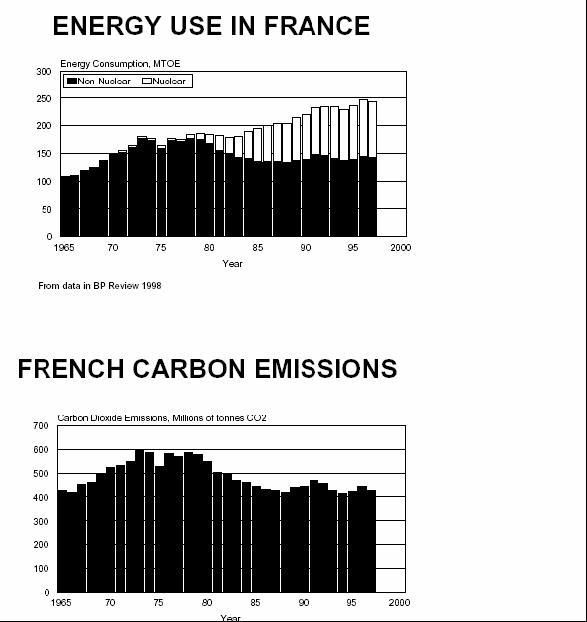
A similar picture for UK:
In 2005 UK emissions were 153Mtons of carbon x 3.67 = 561 mln.tons of CO2. With growing electricity consumption and no new nuclear plants the recent reduction in energy industry is obviously due to NG replacing coal. Interesting that if it was not for nuclear power France would likely be emitting higher amounts of CO2 (just by eyeballing the energy usage and transponating it to the second graph).
I think the curse of UK is the fossil fuels of North Sea which made it quite complacent. I don't think the French went nuclear out of GHG far-sightness, they simply don't have significant fossil fuel deposits, coupled with the notorious French strive for independance. But they definately hit the jackpot with it, in my view...
New Orleans has a unique advantage that other coastal cities do not. We had been pushing for decades to use the silt from the Mississippi River spring flood to rebuild our coast-line.
Even with a one meter increase in sea level, annual deposits could grow the swamps around New Orleans and provide a buffer againts both storm surge and high winds from hurricanes. The volume of silt deposits is *LARGE*
Current plans (from memory) are for a 1 foot rise in sea level, but these could be adjusted upward.
It would not be a heroic effort to raise the levees to Category 5 protection even with a 1 meter rise in sea level. The long term cultural and economic value of New Orleans does not justify "giving up"
The Dutch are not going to abandon the Netherlands, but will improve their defenses.
I wouldn't bet on that one.
Maybe they can get Halliburton to build a wall along the coast, unless London hires them first. Lynne Cheney and her newborn-to-be will inherit a growth industry.
Neither the Dutch nor New Orleans will come even close to adequate defense vs. 3 feet of sea level rise and the double whammy of more violent storms. Not a chance.
Ignorant, arm-chair "engineering".
Quite frankly all that has to be done is add an extra meter of silt over many thousands of square miles of existing and lost marsh and raise the levees facing Lake Pontchartrain about 2 meters and those facing the Mississippi River a foot or so. The volumes of silt in the Mississippi River are staggering. Consider a 30 meter (100') deep, mile (1.6 km) wide muddy river flowing faster than you can walk.
We currently divert 1/3rd of the water down the Atchayala Basin, building up that delta. Some of that could come down by New Orleans if need be.
One man's silt levee is another man's agricultural topsoil. I agree that the volumes are staggering. But we need to contemplate that AGW means everything is subject to change.
How are you going to transport that silt when the entire drainage basin suffers extended drought?
There is the problem that the Mississippi is a sewer for the whole central US and the silt is full of toxic chemicals.
Toxic Levees!!
Two options:
1) Sell the toxic levees to the Dutch and invest in Halliburton stock.
2) Truck the toxic silt to Yucca mountain and let it stew with all that other toxic gumbo.
Problem solved!
I am being sarcastic but I think this thread illustrates a key point: one man's solution is another man's toxic dilemma. We keep proposing solutions which on examination reveal a cascade of negative systems effects each more intractable than the last. What we refuse to face is the fact that extinction is nature's solution to the problem.
New Orleans gets it's fill (river silt) from the Bonne Carre Spillway. Constructed in the early 1930s (when the US Army still did decent engineering), it is a "pressure relief valve" for the Mississippi River upriver from New Orleans (along with the active Old River Structure & Louisiana Hydroelectric Plant).
Bonne Carre is opened about once a decade for a week or so. The silt left behind is given away free by the US Army Corps of Engineers as a way of preventing buildup.
*THE SILT IS NOT TOXIC*
Quite frankly, the volumes are so *LARGE* that any human contamination is diluted to nothingness. And the weeks in transit allow for significant bioremediation.
Alan
Quite frankly, the volumes are so *LARGE* that any human contamination is diluted to nothingness.
The changes in PPM in CO2 are so small, why is a rise in CO2 a threat?
The rise of CO2 in the ocean is small, how can that have an effecT?
The lead in gasoline was so small, why should lead be banned in gasoline?
I know a professor who was heavily involved in removing lead from gasoline (did not make tenure at Big 10 University because of his efforts) so he came to Xavier University (their pharmacy school).
He was involved in reducing exposure to lead from previous lead paint and leaded gasoline in the soil by filling the yards with several inches of fill on top.
The fill, of course, came from the Bonne Carre spillway and I asked him about that issue. He said that he had been assured that it was safe, but he double checked for absolute values (vs. standards) and against pre-European silt deposits.
All toxic levels were "well less than 1% of any standard anywhere" and the modern silt had considerably higher nitrogen and potash levels than pre-historic silt. but complex hydrocarbons, heavy metals, etc. all came back the same. The years of exposure after being deposited ~8 years before apparently eliminated complex hydrocarbons, clorinated hydrocarbons, etc.
Best Hopes,
Alan
*THE SILT IS NOT TOXIC*
http://pubs.usgs.gov/circ/circ1133/heavy-metals.html
http://pubs.usgs.gov/circ/circ1133/polychlorinated.html
http://msucares.com/pubs/techbulletins/tb221frames.htm
To quote from your articles (repeated several times for different metals)
This corresponds with results quoted from the Bonne Carre Spillway.
Concentrations should also be lower in the spring, when water is at a maximum, erosion from spring runoff is high and industrial activity is constant. And the spring silt would be the primary ingredient for rebuilding our wetlands.
Alan
Higher temperatures > higher rates of evaporation > higher precipitation
The distribution of this precipitation will change, but the total will increase.
The Tennessee, Ohio, Missouri and Red Rivers all feed into the Mississippi, which gives a fair amount of diversity. In addition, a canal exists through Chicago where water could be drained from Lake Michigan & Lake Huron into the Mississippi.
Currently an average of 1/3rd of the Mississippi is drained into the Atchayala Basin, less during drought, more during flood. A valve that can be altered.
Alan
Currently, an average of 1/3rd of the Mississippi is diverted down
Maybe they can get Halliburton to build a wall along the coast,
Maybe they should ask Israel, they are better at building BIG walls around countries quickly.
Sorry, I will stand in the corner now for that antisemetic slur... and incur the oncoming comments ;-)
Peace
John
dont forget the chinese they are very experienced wall builders and the dept of homeland security they only plan to spend a few billion of your tax er i mean debt $$,$$$,$$$,$$$.
I would - but that is because much of the Netherlands is comfortably above sea level. The problem is, where many people live isn't really. Germany faces the same problem in a city like Hamburg, or America with New York City - to what extent does it make sense to protect such an area compared to the cost of building something completely new to replace it. Or will it just have to be written off because the weather/water overwhelmed our efforts keep such areas functioning.
Both Venice and London are interesting examples of this process in action.
Exactly. New Orleans is just a start. Many other places will be claimed by the sea and hurricanes.
New Orleans has two unique advantages. It already has levees that can be built up and is has cubic miles of silt coming down the Mississippi River every year that can be spread around. Advantages missing in Washington DC, New York City et al.
Alan
I can understand how you love New Orleans life but, really, do you hope to sweep the silt UNDER the existing buildings and roads to raise them or some scheme like that?
I can understand how you love New Orleans life
And many people LOVE the culture of the car, the culture of the truck and the culture of the suburbs. Yet Alan posts all about how THAT cuture and that love for where tehy are should be sacrificed.
Why is what he wants to save so valuable, yet the people in the 'burbs and who love their cars aren't?
Why is what he wants to save so valuable, yet the people in the 'burbs and who love their cars aren't?
Both are "valuable" if you will, the difference is that the New Orleanites MAY only screw themselves while the SUV junkies WILL screw the whole planet.
If resources are taken from what can be substained to support the doomed and results in everywhere being doomed, how is that a good plan?
(I'm using the 'car culture' as an example of "we must save this CULTURE" arguments...and why they are flawed. It'll be interesting to see if the 'save the culture' warriors will diss the one culture while pimp'n for another)
If resources are taken from what can be substained to support the doomed and results in everywhere being doomed, how is that a good plan?
A LOT of mindless assumptions here, the most notable being that a local consumption necessarily draw ressources from a global pool, impacting everyone.
This is the case for oil NOT for most everything else beside mineral ores, thus your argument is a strawman.
I'm using the 'car culture' as an example of "we must save this CULTURE" arguments...and why they are flawed.
No, the "we must save this CULTURE" arguments are NOT flawed (unfortunately...), ultimately the whole collapse trade offs ARE about which culture to save.
The "winning culture" will be the one which will be able to both be sustainable in the long run AND repell competing cultures without global devastation.
Not that many candidate cultures up to now, they all fail one condition or the other or BOTH.
Not all cultures have equal value, particularly on a global level. As an example, exurban culture has no value outside it's borders and I see little within it's boundaries.
You mentioned cultures focused on oil consuming machines, which is an apt description.
One consensus that has developed in the hundreds of hours of planning sessions that I have been part of is the #1 attribute that New Orleanians want to save above all others.
And what is that priceless attribute that we will suffer and endure to preserve instead of running away to more car friendly pastures ?
Our food, the best in the world (Paris #2, Roma #3) ?
No
Our music, jazz, blues, zydeco, Mardi Gras Indian chants ?
No
Our architecture, unique and beautiful ?
No
Mardi Gras, the world's greatest free party ?
No
The most priceless treasure we have is the way that we relate to each other. Many cultures and sub-cultures that co-exist and interact and live together with comity. EVERYONE that evacuated, but especially the native born New Orleanians, complained about the lack of comity, communication and coldness whereever they went.
I am a nerdy white engineer yet I have black musician, gay artist, Italian grocer, hippie (as in grew up on a 1960s commune) MD friends among others.
My MD friend moved here for her residency and said "The longer one lives in New Orleans, the more difficult it is to live anywhere else" and "New Orleans is the first city that I have loved that has loved me back".
I have noticed that New Orleans has no pressure to conform to whatever culture or sub-culture you are supposed to be part of. You are truely free to be what you chose to be, which I have found has liberated creative energy within myself.
I think this may be the fountain, this liberation to be yourself, that has created so much here.
At parties elsewhere, I am asked what I do in the first 5 or 10 minutes. Here, one can chat for hours without asking. What matters more than your social status (i.e. work, car, etc.) is who you are.
More on New Urbanism and New Orleans later.
Best Hopes for Naw'lins,
Alan
Great post Alan, thanks...
..
.
A large majority of homes built prior to WW II (a large majority) were built raised (2 to 3.5 feet is typical) with the balance having a ground level "basement" (usually less than 8' ceilings whilst other stories had 10 to 14' ceilings). Steps to a second floor entrance with a single side entrance to the basement.
Many are being raised higher (3 feet minimum is the new standard, although FEMA cannot wrap it's "head" around the concept of ground level basements that are historically expected to get water in them every decade or two).
Another adaptation common in the French Quarter and marigny was brick floors on the ground level with walls that could stand some standing water (brick between timbers was classical).
Before Katrina, the "standard" price to raise a double shotgun was $10 to $12,000. Much higher today, hopefully lower again by 2008/9.
When a heavy rain is expected, everyone parks their cars on the higher neutral ground.
Historically, street flooding was accepted and ordinary and the infrastructure was adapted to that. But improved pumps severely reduced the risk.
Best Hopes for Classical New Orleans architecture,
Alan
What amkes you thing NYC, Boston, Washington DC and other places will be 'saved' either?
Oil Derricks have utility. So do deep water ports. No one has a home on an oil derrick, and places where homes get washed away will end up being places where people go to work, not go to live. Other than the poor who can't afford to place a structure where it won't be washed away. And the nation doesn't really care about the poor.
Federal flood insurance gives people the wrong message about living in a hurtricane belt. Cheap electricity allows for air conditioning, giving another false signal about the livability of an area. Slapping railroads everywhere isn't going to help the long term plan of WHERE the energy will come from to do what you want - pump water outta land that should just be underwater and cool the fariuos places where people go.
How 'liveable' will an area be when the poorest people can't afford air conditioning? The death rate will go up, crime should rise (I have not seen data to tie the two together however), and the ever popular 'look at the poor how lazyt they are just sitting about' (Naw, look at the poor. Its so hot that working in that heat is taxing, so they don't work in the heat ya n00b)
Which city do you think will get the bigger share of federal funds, Washington or New Orleans?
Sadly, NO is already living on borrowed time. With the recent upswing in hurricane activity, we see how vulnerable many parts of the South coast are.
In NO I see a microcosm of the whole PO conundrum. Man's natural pride in his achievements leads to hubris. We try to defend the indefensible against the inevitable. PO tells us we cannot continue with the status quo; we must change and adapt.
Building a wall around our cities will not keep the enemy at bay forever. Every civilisation that has tried has ultimately failed.
rebuild our coast-line.
Why should energy be spent in an attempt to 'save' a city that is scheduled to be underwater when the sea water levels rise 20 feet (or more)?
The long term cultural and economic value of New Orleans does not justify "giving up"
Who says anything about 'giving up' when the reality is the cheap energy past is just that - the past. Why should resources be diverted from non-doomed locations to the doomed? Why should limited resources be expended to save an old, unworkable model - a model that owes "What you see" due to cheap energy?
The Dutch are not going to abandon the Netherlands, but will improve their defenses.
And that somehow matters to what you are trying to claim?
20 feet increase in sea level is VERY far from a given, and will occur in a couple of centuries if ever.
Given the extreme flaw in your "assumption" the rest can be dismissed.
BTW, Rotterdam is more than 7 meters below sea level, so given the asset of Mississippi River silt (cubic miles/year), New Orleans could be saved from a 20' sea level increase at reasonable costs, well below the cost of replacement just for the economic assets, which are far less valuable than the cultural values (something that Americans ignore, but more civilized nations do not).
The $14 billion requested for "Coast 2050" is the cost of Boston's "Big Dig" about the replacement cost for the Huey Long railroad and highway bridge, the busiest railroad bridge in the world (I was told and believe) and an essential link in our rail system.
You seem to THINK you know the price of everything, but you clearly know the value of nothing.
Beest Hopes for Civilization,
Alan
Given the extreme flaw in your "assumption" the rest can be dismissed.
Saying 'I dismiss thee, begone' is simpler than actually admitting New Orleans will be claimed by the sea....just like Smith Island, Cartets, and other locations.
New Orleans could be saved from a 20' sea level increase at reasonable costs,
Is this claim based on exactly what????
which are far less valuable than the cultural values (something that Americans ignore, but more civilized nations do not).
Values of culture can be moved to dry land. Texas citizens had the brains to move their capital..and all the 'culture' that goes with government.
Given the reporting from New Orleans, the tourist strip is back up, but much of the rest is still gone. So exactly what 'culture' is trying to be saved, other than a tourist trap?
The $14 billion requested for "Coast 2050" is the cost of Boston's "Big Dig" about
And what makes you think THAT $14 billion engineering project will be able to be kept up? Or spending that kind of energy will be able to be expended in the future?
You seem to THINK you know the price of everything, but you clearly know the value of nothing.
Nice try. The 'rebuilding' of New Orleans to date is a failure - yet the US of A keeps moving on...thus showing how unimportant the place is. That must really be a bother to you, to have reality not back up your position.
Rotterdam today is over 7 meters below sea level. It can be done, with good Dutch engineers (and not the failures of the US Army).
Texas has no culture of any value to anyone else, so there was nothing to move. And New Orleans cannot be moved and save it's culture.
Your "reporting" is biased (as are you) at best. The port is at 90% to 95% for cargo, the rail lines are back 100%. The food is back 80%, the music back perhaps 60%, and the population back 50%. It is a marathon that will take a number of years, but the dedication of the population is incrediable and FAR beyond any other city.
One small sign. 2,530 people spent one Saturday, 9 AM to 4 PM in a planning session. That is almost 1% of the pre-Katrina adult population that is still alive.
Alan
Rotterdam today is over 7 meters below sea level. It can be done, with good Dutch engineers (and not the failures of the US Army).
Humans can start using thermonuclear devices to kill. Does that mean it should be done also?
Your 'argument' of 'it can be done, therefore it should be done' is, well, not very convincing.
You are confusing what should be done with what YOU want to be done.
Tell ya what. I'll back your 'should' plan. Because I'm a nice, reasonable guy.
But I've got a condition or 2.
1) The federal flood insurance has to go away.
2) After that has happened, check the demand for a rebuild after 5 years. If the rebuilding/damming you seek makes economic sense, then fine, the state can use the states money to fix whatever they want.
In fact, #2 can be done without my blessing, or the blessing of the Feds.
Texas has no culture of any value to anyone else, so there was nothing to move. And New Orleans cannot be moved and save it's culture.
Says you. If your whole argument is "save the culture", that line forms on the right. Behind saving the culture of the American Indians. I think they have a longer standing claim.
Where is your call for 'saving that culture'?
I'm reminded of an old science fiction story I read once. I can't remember who wrote it, but it was about a future where the Western Interior Sea had returned, drowning Kansas and other central U.S. states. It caused great crisis and upheaval, but eventually, people got used to it. To the point where they couldn't imagine life without their interior sea.
All except the former residents of Kansas, and their descendants. Though they were now living in Arizona, Indiana, etc., they still declared themselves to be proud residents of Kansas. Even though it didn't exist any more.
New Orleans is EXACTLY the opposite model. It is a model of a low energy future with a high quality of life.
Before Katrina, we were tied with New York City for the fewest miles driven my local residents, but on a much more human scale.
Only Chicago has better rail connections than New Orleans and our barge connections (Mississippi River and Intercoastal) are the best. Easy access deep-water port (closest central Gulf port to Panama Canal for example). Ideal for low energy transport of goods.
We are the "low energy point" for a port for the middle of the nation. The higher energy costs are, the greater our competitive advantage.
I live the low energy life style that others can only hope for. Recently, my fuel use has dropped to 4 gallons/month. Energy utilities of $38/month average billing and that could be dropped.
If you want an model to rebuild the rest of the US around, New Orleans is your best example.
Diverting silt is quite low energy. Build a sluice gate into the Corps of Engineers levees, open when water is high during spring flood.
Alan
New Orleans is EXACTLY the opposite model. It is a model of a low energy future with a high quality of life.
Low energy lifestyle?
On Dec 27th, Gorman Rupp got an order for 8 pumps that can move 135,000 gallons a minute. How exactly is that 'low energy'?
The seafood input to that lifestyle is collaping - expected to be 'done' by 2040. How much 'low energy' food is able to be pulled from other places once the seafood collapses?
If you want an model to rebuild the rest of the US around, New Orleans is your best example.
No it is not. Many other cities don't have to have water pumps to keep them dry. They arn't worried about a bit of rain putting the city underwater like on the 21th of December.
Pumping rainwater up a few feet takes little energy. FAR less than moving Phoenix's water up hundreds of feet and hundreds of miles.
A while back I calculated the average energy to move our average rainfall, about a dozen MW.
You quote the volume, but not the lift or the expected annual duty cycle. Quite misleading.
Seafood collapsing ??
News to me.
Crawfish do well, (half wild, half double cropped with rice). Rice is another staple of the local cuisine BTW.
We underfish redfish and should expand the catch by at least 50%. Red snapper, etc. do well off the oil rigs offshore. Oysters will always be "up and down" but no long term trend down AFAIK. Shrimp doing well.
Rebuilding the wetlands will expand fisheries, allowing for an expanded catch.
You must be thinking of the Atlantic coast.
Our pumps (when in proper repair) are designed for 24 inches of rain in 24 hours (up from 20 inches a few years ago, getting rainwater out is a local responsibility and we took it seriously). I was there about eight years ago when we got 20 inches in a day (7.25 inches in 45 minutes) with street flooding but only four homes flooded in Orleans Parish (more in Jefferson where they underinvested in pumps).
I flew out Dec. 19, but friends told me "it was no big deal". In most American cities, 20 inches of rain in a day would be ruinous. Phoenix has problems with 4 inches.
Again, your ignorance is showing. But you place no value on culture, so that is not surprising.
Best Hopes,
Alan
Living in the Asphalt Wonderland, I just wanted to say Allen is correct in his Phx info--Google Central Arizona Project for the mind-boggling logistics of Arizona's water infrastructure fragility. A genuine metro area wide 4-inch rainfall turns our normally dry riverbeds into huge, thundering, bank-to-bank raging rivers because very little water soaks beneath asphalt, concrete, and impermeable caliche'. Many people lose their lives yearly crossing a shallow 2-inch deep streambed that can become 3-feet deep or more within seconds. The Weather Channel has good video links illustrating this normal desert occurence.
Hell, just a few hundred feet down the street from me is a small 20" v-shaped dip in the road that becomes impassable for cars in a normal half-inch in a half-hour rainfall, but pickups generally can make it through till the cops close the road off to all traffic. For some reason, people like to wreck their car's engine and interior versus waiting 15-20 minutes to drive across with no problems. Usually by the time the towtrucks arrive--it is just a tiny garden hose sized trickle crossing the road. I won't soon forget the woman, who was both crying and bailing out the fancy leather interior [with a Starbucks coffee cup] of her husband's brand spanking new high-end Mercedes.
Bob Shaw in Phx,Az Are Humans Smarter than Yeast?
Pumping rainwater up a few feet takes little energy. FAR less than moving Phoenix's water up hundreds of feet and hundreds of miles
And who says THAT is going to be 'saved' or should be 'saved'?
Seafood collapsing ??
News to me.
http://news.bbc.co.uk/2/hi/science/nature/6108414.stm
'Only 50 years left' for sea fishI flew out Dec. 19, but friends told me "it was no big deal".
http://www.cbsnews.com/stories/2006/12/21/national/main2291736.shtml?sou...
Heavy Rains Swamp City; Pumping Stations Struggle To Keep PaceYou should get better informed friends.
Rebuilding the wetlands will expand fisheries, allowing for an expanded catch.
I'm not areuing the rebuilding of the wetlands, I'm saying pooring money into saving a doomed city is a bad plan.
Again, your ignorance is showing. But you place no value on culture, so that is not surprising.
Oh look. The "culture" argument again. What about the 'culture' of people of, oh say, Islamic faith? Shooting such people seems, well, non-supportive. What about the easy motoring car culture? Why are you pitching to destroy that with rail? At what point should 'culture' arguments not be considered?
Why is it a 'culture' you are involved with is "worth saving" while other 'cultures' should be tossed aside in an effort to adapt to a low energy lifestyle?
Well? Why are you trying to kill the car culture with your pro rail-posts?
At a worst case scenario, fish could be gone by 2040. Proof positive that we are all dooooooooooomed!
Honestly people, that prophecy will never come to pass, as we will run out of motor oil to send our fishing fleet out to catch all those pesky fish long before the fish are all gone!
Seriously though, look at places like Iceland, where they have been fishing in sustainable ways far longer than many US cities have been in existence.
Seriously though, look at places like Iceland, where they have been fishing in sustainable ways far longer than many US cities have been in existence.
Seriously?
Yeah! If it ran for centuries it will keep doing so.
What a CRETINOUS TROLL, even Iceland is short of fish, up to the point that they "fight" UK:
The Cod Wars (also called the Iceland Cod Wars) were a series of confrontations between the United Kingdom and Iceland over Iceland's claims of authority over tracts of ocean off their coastline as being their exclusive fishery zone.
As fish stocks diminished around the world, the scope for confrontation has increased.
Remember however, that the flesh of aquatic species acts to concentrate what is found in thier environment. We will need to harvest all remaining fish species in order to extract the U-238 required to fuel the power plants to supply the electricity to erect the levees to protect New Orleanians so they can operate the fish farms required to raise the carp to make the gumbo to save the culture of the non-texan, non-indian populations and keep the dastardly islamo-fascists from using light rail to invade North America.
It is all very simple really.
Praise the
Lord, the Decider, pass the egg nog and happy New Years to all.Seafood collapsing ??
News to me.
http://www.projectcensored.org/censored_2007/
#3 Oceans of the World in Extreme Danger
Mercury pollution enters the food web via coal and chemical industry waste, oxidizes in the atmosphere, and settles to the sea bottom. There it is consumed, delivering mercury to each subsequent link in the food chain, until predators such as tuna or whales carry levels of mercury as much as one million times that of the waters around them. The Gulf of Mexico has the highest mercury levels ever recorded, with an average of ten tons of mercury coming down the Mississippi River every year, and another ton added by offshore drilling.
Along with mercury, the Mississippi delivers nitrogen (often from fertilizers). Nitrogen stimulates plant and bacterial growth in the water that consume oxygen, creating a condition known as hypoxia, or dead zones. Dead zones occur wherever oceanic oxygen is depleted below the level necessary to sustain marine life. A sizable portion of the Gulf of Mexico has become a dead zone—the largest such area in the U.S. and the second largest on the planet, measuring nearly 8,000 square miles in 2001. It is no coincidence that almost all of the nearly 150 (and counting) dead zones on earth lay at the mouths of rivers. Nearly fifty fester off U.S. coasts. While most are caused by river-borne nitrogen, fossil fuel-burning plants help create this condition, as does phosphorous from human sewage and nitrogen emissions from auto exhaust
I agree it makes sense to have a decent port at the mouth of the Mississippi but is New Orleans the best place for it ?
Considering how the grain export traffic had moved away from New Orleans to other cities like Port Allen....you can see how un-important New Orleans really is.
And its not like the US of A will be shipping much grain out of the nation...what with the bio-fuel demand.
New Orleans is where the Intercoastal Canal (east-west) crosses the Mississippi River.
Going further upriver takes fuel and time and pilot fees for the ocean freighters. To avoid unions, some grain traffic has moved upriver. Metals and containers are still in New Orleans. As fuel costs rise, port business will drift back downriver.
New Orleans is where the Huey Long bridge is, a high capacity double track rail bridge (no weight limits). A single track bridge in Vicksburg (some weight limits) and, I think, Memphis. St. Louis is the next double track rail bridge upriver AFAIK.
New Orleans is served by six of the seven North American rail lines. Chicago has the Canadian Pacific, we do not.
Relocating these rail connections and switch yards would be next to impossible.
New Orleans is the closest central Gulf port to the Panama Canal (Mobile is close). When the bottleneck is opened up in 2014, much of the Los Angeles/Long Beach traffic will move to New Orleans.
Of greater value than the economics is the cultural value though.
Best Hopes,
Alan
And one needs an entire city to support a rail yard? Oil companies don't put cities with famalies on oil derricks, why is a city needed to support a rail yard? At some point, the rail yard will go under water and the port will need to move. Nations have moved ports for years. It can be done.
Relocating these rail connections and switch yards would be next to impossible.
Oh good! it is impossible becase we are saving the more valuable car culture. Oh, and truck culture that drives so much of the Country and Western music.
Somehow the rail got there. I'm betting the same methods of getting rail to another place can be replicated.
Of greater value than the economics is the cultural value though.
Translation: I can't make a valid economic argument, so I'll appeal to emotion via the word 'culture'.
Why are you not willing to support the car and truck culture?
SoFly
40 years back would've been a good time to act and we were trying. There were great historical defeats 1968-1970 and Thermidorean reaction has ruled the planet since.
SoFly
40 years back would've been a good time to act and we were trying. There were great historical defeats 1968-1970 and Thermidorean reaction has ruled the planet since.
My impression was that the battles were cancelled when the draft was abolished in the US. But I suspect you may know more about this than me.
The battles of the 60's were mostly cultural and this was doubly true in the US where history and politics do not exist.
Thermidor is still quite real. Black reaction looks only at the past and that is why we are trapped in a social and political world of absolute stasis. Global warming and peak oil and anything else will not be addressed because they cannot be conceived in the mental universe of our rulers.
Making things worse 2.5 Gt is the *demand* number for next year while 2.4 Gt is this year´s *production* figure for China.
http://www.mineweb.net/energy/540667.htm asserts that the *´07 demand increase* is estimated to come in at 11% or *approximately 250 Mt*. Since the coal reserve numbers circulating are even more opaque than Opec oil reserves an independent assessment when coal production will hit a wall would be of utmost importance.
heh! example:
CO2 emission rights a hot Christmas gift for green Swedes
STOCKHOLM, Dec 22 (AFP) The Swedish Society for Nature Conservationsaid Thursday it was offering last-minute Christmas shoppers the chance to buy carbon dioxide emission rights in order to block polluting companies from doing so.
Sweden.SE
So Ulla buys Bjorn some certificates, after all he already has 100 ties, plenty of cufflinks, suits, etc. now he can take 6 plane trips over the year with a clean conscience!
LevinK: Foget the prior idea about selling THEATRE tickets. The Swedes have clearly beaten us to the market.
Perhaps we can try CO2 coupons sold over the web? A variation on billets doux perhaps. The use of a french product name would attract the upscale buyer and be a strong selling point.
I'm sure there will be a boom of innovative ideas how to enhance ones personal green self-image in the near future. And if I was an enterprise type of person I would have considered thinking about such very seriously.
On the "buying carbon coupons" one - the idea strikes me with its absurdity. European authorities overallocate carbon permits and then the public buys some of the extra so that big companies couldn't buy them instead. What, did they do it to earn some money at the first place? Looks like the perfect money machine - give permits, take cache. So, anybody wants some of my home-made carbon permits? I'll give you a discount...
The concentration of greenhouse gases is cumulative. These additional gases will be in the atmosphere at least 100 years. I think we can pretty much say "game over" unless we have a moratorium now on new coal fired plants. But that isn't going to happen. But just think , the universe consists of billions and billions of stars. I'm betting on the cosmos, not so much are little, infinitessimal corner. While we are replacing coal plants with nuclear, will will also be building coal plants. Apparently, so. China is hopelessly committed to its own and the world's destruction. Short term economic gain rules.
China is doing what we all do, maybe on a bit larger scale, but essentially the same. It is very easy to poke a finger on them, but did we give them an example of a successful alternative path to take at the first place?
My finger is pointing at everyone. China is just one of the scariest countries because it is so massive. Yes, of course, start with the U.S. and work down.
I see Bush now recognizes the obvious, that the polar bears are threatened. Big whoop. Like we are going to do anything about it.
So you have the Uranium everybody is looking for already NOW (with only very few new plants planed)...
A glimpse at current situation: http://321energy.com/editorials/taylor/taylor122506.html
The problem with that 'graph' is that it is highly misleading. Its showing how much Uranium is mined per year, and how much is 'consumed' per year in all nuclear reactors around the world. The trouble is, the 'consumed' nuclear fuel still contains roughly 99.5% of the initial fissile material. Note that this is not whats left of all Uranium, only what is suitable for nuclear fission in the reactors. A huge portion of the 'shortfall' is made up, and could probably be exceeded by more efficient recycling of the resource base.
As usual though, we wont do so until it becomes a crisis...
I was not even trying to mention recycling/breeders etc. as I know that there will be a myriad of seemingly flawless but fundamentally biased arguments you will have to deal with - basically watering down the whole point.
The truth is that fuel producers will need persistent high prices for at least a decade until they start considering the investments needed, which will themselves take additional time to implement too. It's the same like oil, but unlike it I would not bet on uranium staying that expensive even in the medium term. Many mines are currently reopening and there might be a moment when they enter and flood the market at the same time causing the price to collapse.
Of course we will never run out of nuclear fuel because Uranium can even be easily harvested from seawater.... (fair enough a minimum harvesting cost of 5-10 times of mining costs is stated)
http://peakoildebunked.blogspot.com/2006/01/207-uranium-from-seawater-pa...
http://peakoildebunked.blogspot.com/2006/01/208-uranium-from-seawater-pa...
A 1000ton harvest installation can bring 1 ton natural uranium (in 240 days i.e 1 year?) and is said to power 5000 people (at 7900kwh demand).
1 million people supplied by harvested natural uranium energy would only need a 200.000 ton installation (mainly stainless steel) this is only 0.7 percent of 2006 world production.
Now multiply with what ever number you wish ;)
World steel production is more than 1 billion tons, so your 200K tons would represent only 0.02% of the total. So in theory you can supply 1 billion people with the per capita power of Japan with only 20% of world steel production.
And you should consider that this is would be one time investment, you invest 20% of the steel (or 1% in the course of 20 years) and you get the whole developed world powered up.
Of course if you factor reprocessing or/and breeders the needed resources will shrink to a factor of 2. Like you said - uranium is not a problem and will not be for centuries to come. Still I won't be surprised if someone screams now: what will we do when we run out of uranium by year 7540?
The system appears to ask for stainless steel....
Stainless steel is made like ordinary steel plus additional elements like chromium... no real danger for shortage of that either.
The point is there are no fundamental obstacles for us to do it. If we don't count doomsday thinking and neo-ludditism as a fundamental obstacle.
Oh Sweet Jesus, I hope this is a joke, and that it's on me, but I'm traveling and it's late, and I wouldn't want anyone to think this is serious. There's enough floating baloney as is...
We will NEVER EVER harvest uranium from seawater, unless we use uranium from seawater as the energy source to do it with. Is that clear enough? Any part of this that any of you girls don't understand? Put it another way: the chances are as good as harvesting stainless steel from seawater.
I hope you are kidding, because otherwise your post shows ignorance beyond need of discussion.
exactly.
and to give a better picture on the scale requared and the amount of energy needed /too/ harvest uranium from sea water.
out of every person on the planet if we were all water. only 21 people and one half a person would be uranium. or roughly 3.3 parts per BILLION
Thanks, I don't remember when I laughed like that last time :)
Did you know that if all persons were rock, only one person was going to be from gold? You got it right that person is me!
otherwise they would just attach their "porous" mats to fishing nets and they would save most of their cost, which acc. to the text is mooring the special cages.
And of course there is plenty in Uranium in ground too, but 5 years is not too short a timeframe. Workforce, environment and security problems don't actually speed up restarts of mines, so I am not goining to sell my Uranium shares right now but will wait at least a few more years.
But don't get me wrong I am no doomer nor against nuclear (but of course NIMBY). But only as far as I can weigh the different arguments presented (many texts on peakoildebunked border on the absurd) I concluded an energy crunch in the next 10-15 years has a chance of at least 30 %(my personal guesstimate) and as I could live 40-60 more years energy is one of my core pension investments (followed by food).
WOW, you are much more an optimistic than me. I'm absolutely positive that there will be an energy crunch of some sort in the next 15-20 years until alternatives and nuclear at first place pick up. Even then, they will not be able to provide the standard of living we're used to maybe until the middle of the century.
I also think that the more we wait the less are our chances to go through that period relatively painlessly and without wars. I also predict that in 50 years our kids will judge very sternly the current anti-nuclear movement, because it will show it has a great deal of making their life as miserable as possible - and of the whole planet actually, after you factor in Climate Change in the picture.
You seems to be rather pro-nuclear, but please consider the following:
I don't know in which country do you live, but if a reactor blast out, somebody will have to do the dirty job of building the sarcophagus around the exploded core.
DO you agree with that?
So, typically, i think the army would do that, but here where i live, the army is a militia and every joung people at the age of 20, if physicaly fit, must do it (Switzerland).
If, in your country, the army is made of paid professionnal, it doesn't change a lot.
My question is: would you be ready, as a nuclear proponent, do put yourself in charge of doing this suicidal mission, by adding you on a specific list of volounteers, or would you let the young people (or the professionnals) die for you.. and your (and mine too) ever increasing electricity consumption ?
Gosh, what a strawman.
In 1970-s a blast in a chemical factory in my country killed more than 40 people - more than the people killed in Chernobyl. Yet this is nothing compared for example to the Bhopal disaster in India, that took the lives of 15,000 people.
Now am I sorry about these people - yes. Do I have concerns about chemical factories - yes. Do I think we have to stop building chemical factories - NO. To oppose chemical factories or nuclear power but not to be ready to give up the life of a modern person is hypocricy beyong comprehesion. Every day thousands die on the roads or in planes... don't you think we have to stop driving and flying prior to giving up heating and lighting? when you explain me where is the logic behind your arguments and what makes nuclear power "different" from the other goodies of industrial civilisation, then I'll try to answer your strawman question.
I'll try.
First, the chemical factory incident didn't ban the human being from thousand of km2 of land.
Secondly, Chernobyl killed more than 40 people. (http://www.who.int/mediacentre/news/releases/2005/pr38/en/index.html),
and IMO, based on what i've read on Internet, even more than 15'000 people. The double is IMO appropriate.
Thirdly, when you die in a plane or in the street, you don't ask anybody to die with you. You do it alone, like a big boy.
When a nuclear reactor blows, the entire society must paid the price of the explosion.
Of course, the entire society benefits from the plant too, but I, personnaly, am ready to give the benefits in order to escape the responsabilities.
That's why I say: if you (or anybody else) stands for the nuclear power, you must déclare being ready to build the sarcophagus in case if it explodes.
I don't want to be asked for that.
How do you know? Maybe am I more ready to give up than you think..
And you take as granted, that without nuclear, it's return to the candle, which assertion I think is not accurate..
Your own link says 59 people are known to have died, but you prefer "what you read on the internet"! Okay...
If anyone is interested in actual science, rather than scaremongering, Horizon ran an interesting report on radiation in the light of Chernobyl. It seems that the estimates of 1000's of deaths were based on faulty modelling. I was surprised to learn that there are people already exposed to natural levels of radiation much higher than the doses received by most people around Chernobyl, without ill effect. Because cells already have mechanisms to repair damage to DNA (e.g. due to other carcinogens), they are able to repair small amounts of damage from radiation. Scientists expected to find radiation damage and mutations to wildlife in the exclusion zone, but in fact wildlife is thriving in the absence of humans.
If you believed the scientists who said that radiation is dangerous at low levels then you must also accept that they now say that low level radiation is not as dangerous as previously thought. I don't why nuclear power evokes such a panic reaction in people. Statistically and practically it has negligible risk.
First line of the link...
It's just a guess. They have already been wrong once. 4000 is still considerably less than those who have died due to chemical plant explosions. And 4000 is about the same number of people killed every year in the UK due to road accidents.
59 is the number who have actually died.
I ask you a simple question, beyond your theory about the "low level" radiations:
Would you be ready to go live, all year long, in the forbidden area around Tschernobyl?
Sure, there are people living in the exclusion zone. The main risk is to children, as an adult I would be fine.
I will not address the thousand casualties thing as you can claim whatever number you wish and it would be a waste of time to try to disprove. But your own link states 59 casualties... whatever. Let's take it one by one:
Thirdly, when you die in a plane or in the street, you don't ask anybody to die with you. You do it alone, like a big boy.
...
I don't want to be asked for that.
So that's what bothers you? The people that were exposed during the recovery operations? Several points:
1) First this mission was far from "suicidal". Your own link states that from 220 thousand workers less than 50 actually got sick and died. It cites many other "it is estimated that ... will die", but nothing is cited as evidence and so far it is pure speculation. Considering that the Soviets did not use any protective equipment of significance this is actually quite low and can be pointed in support that you are only scare-mongering here.
2) You are a NY fireman and it is 09/11/01. You are called on emergency - some planes hit the Twin Towers. Do you go or not?
How do you know? Maybe am I more ready to give up than you think..
I don't know for you, but all evidence shows the alternatives will bear very high to unaccpetable costs for the society as a whole. The realistic scenarious without nuclear in the long term are:
1) Significant coal ramp-up and electricity price hikes, very likely blackouts everywhere. Climate of course goes to hell. In addition try to sell this idea ot Japan or whichever country that does not have coal.
2) In theory we can try to ramp-up renewables but the costs will be mind-boggling. The prices will go to the sky and the blackouts move from sporadic to regular. You can check how much do they pay in Germany or Denmark with realtively low wind power penetration. Even if solar reaches coal as per kwth cost, we will still need electricity storage to use it. All available storage options have low efficiency and are pricy and slow to build. Eventually we will hit the wall on renewable limits, and then what? How long can we run a society on a 3:1 regime?
The thing is that all of this stays very abstract if just layed out like that. If it happens in reality the people will scream, will go out protesting and basically will do everything it needs to get their pill. Concerns about coal will be forgotton, in Northern areas people will turn to wood in winter (just imagine the effects!), Shell will start its oil shale project, pick whatever quick and dirty technofix - it will be done!
So... if you need to make a responsible choice for the future which one will you choose now?
AS stated just over, they are talking about round 4'000 people. They have not died yet, but these are conclusion from a large panel of experts.
You say i'm scare-mongering, but would you go without after-thought, even with a "top notch" nuclear protection suit, to build a wall or whatever in the middle of a blasted nuclear plant? Would you not be a little scared?
I will not discuss the renewable energy issues, especially the need of storing energy, because it is a whole discussion in itself.
I agree with you in that the people will "scream" as you say, and will probably accept any energy source that can be brought online as soon as possible can when the problems will occur.
This fact, however, must not prevent me to discuss the opportunity of a nuclear energy choice.
Your analogy with the fireman is good. I would say that it is true that he takes actually the risk for the whole society, but I still have the right to choose to limit this risk to the lowest possible.
Besides, I don't think the entire firemen force of a given region is enough to handle an nuclear plant explosion (see these 250'000 people for tschernobyl).
When you talk about nuclear, I have the impression of somebody saying: no need to talk about that, there's not other solution.
In this particular subject, I cannot accept this kind of thinking.
(You suggest that it would be even a "responsible" choice for the future. I cannot share this view, unless to speak about the nuclear waste...)
I have a problem with your arguments. You seem to accept there is a problem, you seem to accept that the alternatives will not work or will be disastrous, but still you remain focused on the fix idea of an exploded nuclear reactor. If you try for one moment to get rid of it, maybe we could go on from that point.
The truth is that the risks you are talking about are for the most part hypothetical - much like the risk of a cyanid factory releasing its output in the underground waters or your house being hit by a meteorite this evening. People usually don't think about such things but if they start focusing on them they can become truly paranoid. No need to mention that you can not argue such arguments - these things are theoretically possible, but should we stop living then? I refuse to.
I have a problem with your arguments. You seem to accept there is a problem, you seem to accept that the alternatives will not work or will be disastrous, but still you remain focused on the fix idea of an exploded nuclear reactor. If you try for one moment to get rid of it, maybe we could go on from that point.
The truth is that the risks you are talking about are for the most part hypothetical - much like the risk of a cyanid factory releasing its output in the underground waters or your house being hit by a meteorite this evening. People usually don't think about such things but if they start focusing on them they can become truly paranoid. No need to mention that you can not argue such arguments - these things are theoretically possible, but should we stop living then? I refuse to.
I wouldn't worry about the stainless steel..
What cost was assumed for the hydrocarbon-based polyethylene fabric?
Can the amidoxime groups made economicaly in the immense quantities required?
Any idea how much energy the high energy electron beam takes to make the absorbent material?
Once it's out of the water, how much energy does it take to extract the uranium from the absorbant (It sounds like it picks up all manner of heavy metals.)
Don't get me wrong, it's an interesting technology, but I'd like to see a full survey of the energy inputs and outputs before I got to excited.
Picking up a mix of heavy metals is not "bad". All have some economic value. Most will be the cheaper, more common metals like lead and mercury. But some will be platinum group metals :-) as well as uranium.
Some seas (deep water Red Sea comes to mind) are much more metal intense than others.
I suspect that we will reach "breakeven" with extracting metals from geothermal waste water and Red Sea waters before straining Pacific Ocean water.
Best Hopes,
Alan
A 1-2 year oportunity driven price run-up is a meaningless noise. There are thousands of mines that were closed when uranium was below $20 and no significant exploration and development has been done up until recently. It just needs time and we need to talk again in 5 years. What really matters is the ultimate size of the uranium resources we can exploit in the longer run - and we know they are very large - millions of tons are available in phosphate and granite rocks and much more are in the seas.
I've argued this many times, including against the flawed argument that the energy needed to obtain the uranium from poorer sources will move it to energy negative - for example here.
Summary of Weekly Petroleum Data for the Week Ending December 22, 2006
http://www.eia.doe.gov/pub/oil_gas/petroleum/data_publications/weekly_pe...
Robert...that's why no more predictions, although 2/3 is not bad:
crude = down
gasoline = up
distillates = up
crude = down -- understatement!! :)
I wonder if that is a record two week drop??
Two week drop? That was a one week drop. The two week drop was 12.1 million barrels.
Ron Patterson
And...inventories have dropped for five straight weeks for a total drop of 17.8 million barrels over that five week period.
Ron Patterson
I was refering to last weeks drop of 6.3 and this weeks drop of 8.1 for 14.4 total in 2 weeks. That seems like alot to me.
Well.. obviously the draw-down of inventories is ending. Very soon it will become evident what is the real supply/demand ratio. The price is not budging yet but it be a long time until the rally starts again.
Ya, the crude draw of 8.1 million barrels was pretty huge!!
It looks to me like maybe this is year end inventory management.
I agree. What seems to be overlooked in this inventory decline the past month or so is the financial incentive to do so. There's a big buzz in Washington now about switching from LIFO to FIFO inventory accounting, which has sent many oil companies scrambling to reduce inventory. Though it's been tried before, we have a new Congress that's not as friendly to business and needs the revenue stream.
I know what LIFO and FIFO stand for (Last In First Out, and First In First Out) but can you explain how switching from one to the other would make companies want to shrink inventories?
Thanks,
garth
The difference is in your cost basis to determine your profit margin.
The basic assumption is that the most recent inventory purchase of one barrel of oil is always more expensive then the prior purchase of a barrel of oil.
With current high crude oil prices, using LIFO means that the cost basis for determining the profit margin is much higher, which means less "profit margin" per barrel. Less profit margin mean less corporate tax revenue.
When you use FIFO, the first barrel purchased is used to determine your cost basis. With the assumption above, the first barrel of oil costs less than last barrel of oil purchased. The lower cost basis mean that the profit margin per barrel is higher. Higher profit margin means higher corporate tax revenue.
By running down/out the inventories, the switch to FIFO would use a higher cost basis because the inventories would need to be repurchased at a much higher cost per barrel.
Oil prices steady despite supply plunge
The Total US Petroleum Import number (11.2 mbpd, four week running average) continues the same downward trend that started at the beginning of the fourth quarter. We have drawn down crude + product inventories at the rate of about 870,000 bpd since early October.
Looking at US numbers, and trying to divine world trends to some extent reminds me of the old joke about the drunk looking for his keys: He is looking for them under a streetlight outside the bar; when queried as to where he might have dropped them, he replies that he dropped them down the street, but the light is better under the streetlight.
We have pretty good US import data, but pretty poor world export/import data, at least in the short term. Having said that, I think that US import numbers may at least signal price changes, and December 2006 total petroleum import numbers continue to be the lowest since December 2003, while our long term demand for total imports is growing at close to 5% per year.
We are expecting rising US imports, while all of the data now indicate aggregate declining world export capacity, led by an estimated 13% decline in Saudi exports from 12/05 to 12/06.
World and Saudi production fit the same mathematical (HL based) patterns that we have seen in other large producing regions, especially because of the near certain simultaneous declines in the four current super giants. For those of you who believe that we will see rising production from here, I am looking for investors for my new start up company, "The US Perpetual Motion Motor Car Company."
Hi WT,
where do you find your data in relation with the US imports numbers?
http://www.eia.doe.gov/oil_gas/petroleum/info_glance/crudeoil.html
You have three options to the right of supply estimates. The text gives you four weeks of data. The Navigator button takes you to a wealth of data. Note that you can choose weekly or four week running average import data (look for the buttons at the top of the page).
Peak Oil Increasing Oilfield Scams?
Are rising crude oil prices and the concern about peak oil setting traps for the unwary, where suckers and their money are soon parted? Growing up near small fields, the oil business appeared to attract more than its share of high rollers, con artists, lease speculators and people just a hole away from big fortune and happy to sell you a share. A relative in a business peripheral to oil production is seeing old fields being "prettied up". In one rumor, output from other wells in a small field was contributed to one well, making the well look good and the rest of the field not so good. That well was then sold by the owner, who just happened to be the field manager. He then bought the rest of the not doing so good field. Production of the sold well decreased and that of the balance of the field increased.
Is this business like the commodities market, where it is alleged that some 95% of people loose their money to the 5% who don't?
Yes, recently I had a prospective tenant that was in the "oil bidness". Being a former oil and gas producer I queried him
about his present deals. Seems he had some
hot prospects that were going to make the investors rich in the old Caddo-Pine Island
field near Shreveport, La. This field was
discovered shortly after 1900. Most of the
wells make less than a barrel a day. Yes there is still oil in place, just enough
to say we made a well and send more money.
Next applicant!
My (general) oil investment suggestions are as follows:
(1) If you were investing directly in oil deals in 1999 at $10 oil, you might consider continuing to do so today.
(2) If I were new to energy investments, I would take a hard look at dollar cost averaging into low cost energy index funds.
One indirect play on energy (mainly natural gas) LONG TERM is hydroelectric power. Many Canadian merchant power providers are in long term contracts, but these expire and will be repriced at going market rates. The ongoing returns at current prices are good, with a "kicker" when renegotiated.
I own a geographically diverse holding, with some in Canada, Brazil, Austria & Switzerland and looking at New Zealand. The situation is different in each nation.
The US built little but natural gas fired electrical plants for a dozen years. NG is the marginal source of power almost everywhere in the US (and parts of Canada).
I am looking into geothermal and wind developers as well.
I also own an oil company and some mainly gas companies.
Best Hopes,
Alan
From the New York Times:
It’s Free, Plentiful and Fickle
This is part of an ongoing series whose home page is here:
The Energy Challenge
Hi TODers! I just became an uncle last month, and I've been mulling over for weeks what I could get my new nephew as a combo baby gift/Christmas gift this year that would be in line with a vision of what this kid's life is going to be like as he grows up. I wracked my brains, and what I finally came up with is...gold! I mean, my mom suggested a savings bond but...I think many people here would see that as a pretty useless investment.
Problem is, I don't know where to start! I don't have a broker, and I'm only considering a small amount since I can only afford maybe $100-$200. I'm in Canada - any suggestions on where to go? Perhaps my bank? I did some searches online, but the info is pretty confusing.
As an alternative to gold, may I suggest silver dimes? They are still legal tender and can be purchased in bulk from any reputable coin dealer. IMO silver is a bargain compared to gold, which to me seems to be overpriced. You might also consider a $25 box of pennies and some rolls of nickels.
To teach my children to count I used to use the Big Eisenhower dollars some thirty years ago; for my grandchildren I now give them "gold" Sacagawea dollars and teach them to count by fives and tens using nickels and dimes.
Money is the perfect gift because one size fits all.
Try eBay. Gold coins may be the way to go, with the amount you have to spend.
I was thinking that, yeah. I mean, the kid has gifts pouring in left and right, between (tiny) waredrobes of clothes, changing equipment, swings, pacifiers, rattles, gift cards to stores, and all manner of bric a brac...all of which is really for his parents as right now it means utterly nothing to him. And it all WILL mean nothing to him years from now.
But precious metals? THAT'S the one gift he'll get right now that he will actually be able to thank me for personally later.
You can purchase online from Kitco.com. Otherwise you can look in your local yellow pages for a rare coin shop. they usual sell bullion as well.
If in the end you decide gold is too expensive, you might try looking at "junk" silver. This is 1964(?) and earlier US Dimes and Quarters. It usually sells at a very small premium to the spot price.
Or you could pay a slightly bigger premium and buy Silver Eagles.
Good luck! I think it's an excellent gift.
Garth
rolls of u s nickels are a good bargain a $2 roll of nickels contains about $5 worth of metal but the question is what are you gonna do with the nickels they might get kinda heavy to tote around and you cant legally melt them down but they might be a nice gift for your nephew to teach him what brilliant leaders we have
Thank you! It's particularly important to me since, like many people here, I'm really the only one in my extended family who has ANY clue of the enormity of the Peak Oil/Climate Change problems we face. I'm not quite in the Savinarian doomer camp, but I'm much closer to it than the corncopian CERA crowd, and I feel a tremendous sense of responsibility to this little guy who is going to live through a very tumultuous time. I want him to grow up knowing that if nothing else at LEAST his uncle saw the writing on the wall, and tried to help him out to the best of my ability.
When I first held him, about six days after he was born, I knew exactly what to say, because I'd been thinking about it ever since I first heard my sister was pregnant.
"Parker...I'm sorry. I'm sorry we've left you with this. I'm sorry you're not going to live in the same perpetually expanding society of wealth I grew up in. Sorry we didn't have more foresight, and sorry we left you with such a massive pile of shit to deal with."
Anyway, I will take your suggestions guys. Thanks again!
An additional tip. You can buy gold coins directly from the Royal Canadian Mint, Canada Post or through authorized dealers (there are several in Toronto, you can get their addresses from the RCM site www.mint.ca). The RCM offers a 200$ denomination gold coin which should fit you budget.
I think this is an interesting development ...
POWER PLAY
"By DON OlSEN
The ghost of Colorado Ute still haunts the Delta-Montrose Electric Association.
So much so that the board of the tiny Western Slope rural cooperative has voted unanimously not to sign a contract extension with its regional power provider, Tri-State G&T.
“We’re protecting the economic interests of our customers,” says longtime board member Ed Marston of Paonia. “It’s just the sensible thing to do.”
Marston and other members of the DMEA board remember all to clearly what happened a couple of decades ago when Colorado-Ute, the region’s old power supplier, went on a massive growth binge supported by its member co-ops. When oil shale and the energy boom went bust in the 1980s, Colorado-Ute was forced into bankrupcty, and electric co-ops like DMEA and its customers bore the financial brunt of the disaster.
Today, Tri-State, the giant energy provider that eventually replaced Colorado-Ute, wants to go on its own growth binge, spending some $5 billion on three expensive new power plants that would mostly serve the Midwest and Front Range of Colorado. DMEA has decided it doesn’t want to take the risk of financing such a huge expansion, and it wants to negotiate for the opportunity to purchase more power from local providers on the Western Slope.
“The DMEA board and staff know that we are taking a very important and historic step by refusing to sign this contract extension,” said Les Renfrow, President of the DMEA Board.
“We have agonized over this decision for almost a year. In the end the board decided unanimously that not signing the contract extension at this time was our best chance to get a better deal for our 30,000 member-owners. This is our best chance to reduce the immense flow of money that leaves our two counties each month bound for distant power plants. This is our best chance to support our local industries by using their waste wood, coal-mine methane and dairy manure to generate electricity and create jobs and income here.”
Local electric customers will not be cut off from power by DMEA’s move, since the co-op still has the long-term contract with Tri-State that will be in effect until the year 2040.
We’d like to generate more power locally,” says Marston. “By not buying into the whole thing (Tri-State’s contract extension), we believe we can also insulate and protect our customers.”
Renfrows say that currently Tri-State is going down a path of constructing increasingly expensive, massive coal-fired power plants with an estimated price tag of $5 billion. In a world of increasing pressure on carbon emissions, he says, new technologies that can save large amounts of electricity and lower costs for renewable energy make Tri-State’s path “extremely risky.”
Much of the perceived need for the new coal-fired power plants is being driven by the very profitable natural gas industry. Large electric-powered compressors used to transport natural gas from the Rockies to East and West coast markets are driving the need for the planned new electric generating capacity.
“DMEA does not feel it equitable for residential, small commercial and other rate payers to bear the cost of developing electric generating capacity for the very profitable natural gas industry.” says Renfro. “The natural gas industry should bear the cost and risk of generating the power they require.”
DMEA believes that for its customers, local power production is a more cost-effective strategy, and it is pressuring Tri-State to put less emphasis on large, expensive coal-fired plants.
“We’ve been encouraging Tri-State to allow its member-owner cooperatives more flexibility to develop local power generation from renewable sources, to pursue a greater mix of renewable energy resources, and to aggressively promote energy efficiency programs,” says Renfro. “If Tri-State would agree to follow the reasonable path we’re asking for, we’d gladly extend our contract with them through the mid-part of this century ... The DMEA Board remains open to working with Tri-State in the hope of finding common ground.”
The local co-op thinks Tri-State should also build coal plants using new technology that creates less pollution. By doing so, Tri-State would avoid having to retrofit the plants in the future, a cost that would have to be borne by the member co-ops.
i remember when gale norton was named secy of the interior she said she was "passionate" about the environment and immediately set about implementing the policies of her mentor james watt
Rail tonnage up, trucking tonnage down. More details at urls
Rail Ton-Mileage Sets Ninth Consecutive Annual Record
WASHINGTON, December 28, 2006 — For the ninth consecutive year, total freight volume on U.S. railroads as measured in ton-miles has set an annual record, the Association of American Railroads (AAR) reported today.
Total volume for the first 51 weeks of 2006 reached 1.712 trillion ton-miles during the week ended December 23, breaking the 52-week record of 1.696 trillion set during 2005. This year's total was 2.6 percent above the total for the first 51 weeks of 2005.
For just the week ended December 23, total volume was estimated at 34.8 billion ton-miles, up 8.1 percent from last year.
http://www.aar.org/Index.asp?NCID=3913
Wednesday, Dec. 27, 2006
ATA Truck Tonnage Index Plummeted 3.6 percent in November
ALEXANDRIA, Va.— The American Trucking Associations’ advanced seasonally adjusted for-hire Truck Tonnage Index plunged 3.6 percent in November after falling 1.9 percent in October.
On a seasonally adjusted basis, the tonnage index fell to 106.8 (2000=100) from 110.8 in October, which is the lowest level since late 2003. The index decreased 8.8 percent compared with a year earlier, marking the largest year-over-year decrease since December 2000. Year-to-date, the truck tonnage index was down 2.8 percent, compared with the same period in 2005. The not seasonally adjusted index decreased 9.5 percent from October to 106.5.
http://www.truckline.com/NR/exeres/240082F3-7160-4162-92A5-C834A84E2401.htm
http://www.theglobeandmail.com/servlet/story/RTGAM.20061228.wshelf1228/B...
A giant ice shelf the size of 11,000 football fields has snapped free from Canada's Arctic, leaving a trail of icy boulders floating in its wake.
"These ice shelves can break up really quickly, perhaps more quickly than we thought they could do in the past"
“Within an hour we could see this entire ice chunk just disconnect and float away.”
tick, tick, tick... :-(
Hello TODers,
Doesn't "Operation Chikorokoza Chapera" more accurately translate from Shona into English as "Operation Full-Body Cavity Search"?
Does a Zimbabwean have any choice on 'rights', or is the police 'left forearm shiver' the standard mode to explore the limits of freedom?
http://www.voanews.com/english/Africa/Zimbabwe/2006-12-28-voa45.cfm
---------------------------------------------------
Zimbabwe police have arrested more than 16,000 illegal miners around the country in what Harare authorities called Operation Chikorokoza Chapera, Shona for "Operation Gold Panning Ends," the state-controlled Herald newspaper reported Thursday.
The Herald quoted police as saying the blitz was launched November 21 with the aim of halting unauthorized gold panning and the smuggling of diamonds. Police told the newspaper seized a 3.2 kilograms of gold and some 4,900 rough diamonds.
------------------------------------
Bob Shaw in Phx,Az Are Humans Smarter than Yeast?
Hello TODers,
The Russians are resuming the drilling over Lake Vostok. Could this potentially blow sky-high and be much worse than the unlined East Java mud volcano? Is 400 atmospheres of overpressure a routine drilling occurence? Even if the borehole is steel-lined, can the surrounding ice handle the overpressure? Thxs for any informed reply.
http://www.spacedaily.com/reports/Russian_Scientists_Resume_Exploration_...
Bob Shaw in Phx,Az Are Humans Smarter than Yeast?
Is 400 atmospheres of overpressure a routine drilling occurence?
Unless there some gas in the lake it's not a problem because this pressure is just the same as the one from the 4000m water column : at the ground level emerging water will be at NO pressure if ever emerging.
Thxs for the reply!
Hello TODers,
http://www.voanews.com/english/2006-12-28-voa43.cfm
------------------------------------
Turkmenistan Opposition Presidential Candidate Reported Missing
By VOA News
28 December 2006
An opposition group in Turkmenistan says its candidate for next year's presidential elections is missing.
Officials of the Agzybirlik Peoples Democratic Movement say the group's leader, Nurberdy Nurmammedov, has not been seen since he left his home in the country's capital Ashgabat December 23.
--------------------------------------------------------
Gee--Do you wonder if it is a Tom Clancy world? Recall my earlier posts in Heading Out's Turkmenbashi Keythread.
Bob Shaw in Phx,Az Are Humans Smarter than Yeast?
Hello TODers,
EnergyBulletin has an excellent article on the 'Ethics of Biofuels' by Sharon Astyk here:
http://www.energybulletin.net/24169.html
I hope this well-crafted article helps convince others of the need for 150 million wheelbarrows and a massive labor force shift whereby 60-75% of us become relocalized permaculturists. Us North Americans have a golden opportunity to lead the world in Detritus Powerdown and Biosolar Powerup. IMO, much more satisfying than 150 million rifles and the '3 Days of the Condor' scenario.
Bob Shaw in Phx,Az Are Humans Smarter than Yeast?