


DrumBeat: January 6, 2007
Posted by threadbot on January 6, 2007 - 10:05am
Peak Oil Passnotes: Is 2007 Time to Get Out of Oil?
There is a chance - this time - that those lows are going to be breached. The unfortunate fact for the executives of our international oil companies is that any price fall could not come at a worse time for the oil industry.Because the recent run up in prices have meant that companies have been falling over themselves to put on extra barrels of production. Of course this cannot be done overnight so we are now seeing the first wave of new output about to hit the market.
Facing a reinvigorated Liberal Party and Canadians' focus on the environment, the Conservatives are in a hurry to get green. It is a race companies in the oil sands have been running for years, some of them for decades. While the Conservatives appear ready for a sprint — Mr. Baird declared Thursday that “This year, I'm going to clean up the environment” — this race is clearly a marathon, a difficult and challenging slog, where the costs begin in the hundreds of millions of dollars and many of the solutions are unproven.
Planning for a Post Carbon Era
It doesn’t matter where in America you live; it doesn’t matter what your job is. Let’s imagine, for an instant, that tomorrow you wake up and the nation has entered a Post-Carbon Era.
Oprah's academy: Why educating girls pays off more
"With education, the girl child will grow up and be a better mother - she will be better able to understand the importance of her own children being educated, and will be better able to provide for her children," says Sarah Crowe, a spokesperson for UNICEF in Johannesburg. "Men and boys are often out of the home," she notes, so that fathers are less able to teach their children what they have learned.
AES executive joins alternative energy group's board
AES, one of the largest power companies in the world, is bringing its muscle to a national group that's an advocate for alternative energy.
Alternative-Energy Spending Fizzles Out
Congress ends without funding research programs, as the United States falls behind in alternative technologies.
Next IEA Chief Tanaka Vows to Spur Dialogue with Oil Market
Tanaka, originally from Japan's Ministry of Economy, Trade and Industry, said he sees it as important to ensure transparency in the oil market, but that he does not support the idea of "controlling" speculative funds in the market, which some see as the reason for increasingly high prices.
Europe to suffer as the world warms up
Chilly northern Europe could reap big benefits from global warming, while the Mediterranean faces crippling shortages of both water and tourists by the middle of the century, according to the first comprehensive study of its effects on the continent.
RFF Scholars Awarded Prize for Economics of Climate Change
Out of habit from when energy was cheap, open windows in winter
BERLIN: If you ever visit countries like Ukraine, Moldova or Georgia during the winter months, try to avoid spending much time in government buildings. They are sweltering. Ask that the temperature be turned down and your host will immediately oblige — by opening the window. Thermostats are nonexistent.
Geothermal power moves ahead as reliable source of renewable energy
LONDON: Homes in Unterhaching, a town south of Munich, will be warmed by hot water piped from 3,300 meters, or 10,800 feet, underground starting in May. The town of 22,000 people is at the leading edge of a shift toward geothermal power generation that may swell Germany's capacity 1,000-fold within a decade.
German Renewable Energy Usage at Record High in 2006
Japan to provide $2 billion in energy aid to Asia: Goal is "the eradication of energy poverty."
This is where political math becomes more complicated - while a political party espousing the cause of a hydroelectric project can expect to lose the support of people displaced, it cannot expect to gain patronage of people who stand to benefit until after the project is completed, by which time governments would have changed hands more than a few times.
Local action: a new initiative aims to deglobalize the Bay Area's economy
In what some experts are hailing as a first for sustainability movements in the United States, a coalition of policy organizations has unveiled a comprehensive campaign to reduce the Bay Area's reliance on global markets in favor of a more locally based economy.
Bunning, Obama Re-Introduce Blueprint For Energy Independence: Will Form Senate Coal-to-Liquid Fuel Caucus
Washington, DC - U.S. Senators Jim Bunning (R-KY) and Barack Obama (D-IL) today introduced the “Coal-To-Liquid Fuel Promotion Act of 2007.” This bipartisan piece of legislation is based on the bill first introduced by Senators Bunning and Obama last spring and would help create the infrastructure needed for large-scale production of Coal-to-Liquids (CTL) fuel. It is a comprehensive bill that expands tax incentives, creates planning assistance, and develops Department of Defense support for the domestic CTL industry.
New Congress juices energy bills
WASHINGTON -- U.S. lawmakers unveiled a raft of energy-related bills in the early hours of the 110th Congress aimed at boosting fuel ethanol use, extracting liquid fuels from coal and tightening automobile fuel efficiency rules.But instead of heaping all their ideas into a behemoth energy bill like they did in 2005, this year's Congress looks poised to pursue energy legislation on a piecemeal basis.
Unfazed by Oil Price Fall, OPEC Sits Tight for Now
Organization of Petroleum Exporting Countries' officials, so far unfazed by this week's sharp decline in global crude oil prices, say they will sit tight to see if the downward trend continues before discussing an emergency meeting or whether they need to deepen existing supply cuts.
Interview with Paul Gipe, Wind Energy Pioneer
First of all, Americans have to cut their consumption. There’s no way around that. Then any renewables you put into the system do more good.
The Future's so Bright...I'm Going Solar!
Listen: At this point, unless you hate money, there’s no reason you shouldn’t be playing at least a few renewable energy stocks in 2007. It’s just a no-brainer.
Bolivia Gas Exports Spike in 2006, But Party May Be Over
Bolivia's natural gas export sales rose spectacularly in 2006, but the party may soon be over.While the thirst for gas in neighboring Brazil and Argentina continues unabated, virtually no fresh investment is being made in new production as companies lick their wounds after last year's oil and gas nationalization.
India's PM Says West is Environmentally Wasteful
CHIDAMBARAM, India -- Slamming the West for its "environmentally wasteful lifestyle", Indian Prime Minister Manmohan Singh called on Wednesday for industrialised nations to look at alterative energy sources to save the environment."We, in the developing world, cannot afford to ape the West in terms of its environmentally wasteful lifestyle," Singh said at a science conference in Chidambaram, 195 km (120 miles) south of Tamil Nadu's state capital, Chennai.
"Equally, developed industrial economies must realise that they too must alter their consumption patterns so that few do not draw upon so much of the Earth's resources."
The hype is racing ahead of consumer appetite for alternative-fuel vehicles, industry experts say. Only a small fraction of the cars on the roads are hybrids and diesels, which get better fuel mileage than gasoline-only cars and burn cleaner than they used to. While such vehicles have distinct advantages, consumers for the most part seem unwilling to pay their higher prices. As a result, carmakers will push ahead cautiously before deciding to turn out large numbers of the vehicles.
From a Collapsing Wall to a Pipeline
The unprecedented cooperation between Russia and China over the last few years is a waving red flag that could signal future complications for the U.S.
Saudi raises crude selling price for February
Saudi Arabia has hiked the official selling prices of its heavier crude oil grades for February term supply to Asia, possibly setting the stage for further term supply cuts....Saudi Arabia will announce February term supply allocations shortly, and traders expect the kingdom to deepen term supply reductions in line with the Organization of Petroleum Exporting Countries' decision to further tighten the market.
But they're lowering light crude prices: Aramco, light crude cuts
Saudi Aramco has cut the price of its light crude oil varieties that will be exported to Asia next month due to rising diesel and kerosene stockpiles, reported Bloomberg.
Australia and China ratify nuclear fuel deal
SYDNEY - Australia and China have ratified a nuclear agreement clearing the way for the export of uranium to feed Beijing's giant nuclear power programme, Canberra has said.
Bartlett will introduce 15 bills to Congress
Peak Oil Resolution -- Reintroduction of H. Res 507 that expresses the sense of the House of Representatives that the United States, in collaboration with other international allies, should establish an energy project with the magnitude, creativity, and sense of urgency that was incorporated in the "Man on the Moon" project address the inevitable challenges of "Peak Oil."
Junior minister in bother after airlines attack
LONDON - A junior government minister has been told to make no further comments, after accusing British, Irish and US airlines of failing to take global warming seriously.The Department for Environment Food and Rural Affairs (Defra) said it was to avoid fuelling the controversy further, after Ian Pearson branded no-frills carrier Ryanair "the irresponsible face of capitalism".
Warmer Seas Leave Fish Gasping
Difficulty in taking up oxygen via respiration and blood circulation, caused by the warming waters, proved to be the key factor in diminishing the size of the fish stock.
Use and abuse of oil discussed - More on the Indiana Energy Conference in Crawfordsville. It takes place over four weekends.
Pakistan: Import parity pricing to increase LPG production
KARACHI: The decision to take up the cost of locally produced liquefied petroleum gas (LPG) to import parity price (IPP) will encourage investment for its production and allow consumers to choose between different fuels, an Ogra official told The News on Friday.Oil and Gas Regulatory Authority (Ogra) on Wednesday announced the base stock price of LPG benchmarked with Saudi Aramco Contract Price (CP) for the first time ever, provoking marketing companies to term the move unjustified and against the consumers’ interest.
Big Oil profits in danger as price of crude slides
NEW YORK - Energy stocks have taken a beating as crude oil prices plummeted this week, but oil producers will really feel the pain on the bottom line, threatening to wipe out billions of dollars in profits.
The attempt by Belarus President Alexander Lukashenko to fight a hike in the price of natural gas from Russia has German newspapers predicting a quick end to his resistance -- or his country's independence.
Book Review: The Downside of Up - Catagenesis
It's such a good read: San Fran in 1906, the day after the earthquake as the survivors try and stop the fires; jump/skip to a keystone in one arch of Rome's Coliseum and how it got there, Rome's rise as an empire and long decline; Americans in Iraq, the suburbs grown from cheap oil; our amazing, complex, emergent, globalized world, astonishingly, beautifully alive in the ecologist's eye, caught on video, for just a precious moment, before the peak.
India: Govt upset with ONGC`s poor recovery
The country’s largest upstream company — Oil and Natural Gas Corporation (ONGC) — appears to have fallen foul of the government.Petroleum Secretary MS Srinivasan today said he was unhappy with the company’s inability to increase recovery of crude oil from proven reserves.
“The recovery rate seems to have been stuck at 28 per cent. I wrote to them a week ago regarding this,” said Srinivasan.
Falling oil prices should help drivers
NEW YORK - U.S. drivers could start seeing lower prices at the pump as early as this weekend, thanks to the cascading price of crude oil and a seasonal dip in gasoline, analysts say.
Pentagon to train a sharper eye on Africa
Strife, oil, and Al Qaeda are leading the US to create a new Africa Command.
What future for BC’s offshore oil and gas?
Provincial and national policy should acknowledge and prepare for the growing risks of US take-over.
Contact
- Content: editors at theoildrum dot com
- Tech support: support at theoildrum dot com
License

This work is licensed under a Creative Commons Attribution-Share Alike 3.0 United States License.
2006 Top Green Tech Ideas (truthout.org)
Apparently Kelpie Wilson has been reading TOD or EB ...
News here in Europe say, the new democratic majority wants to decrease tax benefits for big oil companies and shift it to programs in order to promote the use of renewable energy technology.
On first glance this sounds really good. But will there not be big resistance against this programme? Especially promoting bio ethanol would probably direct most of the money to the big energy companies (bio ethanol needs as well the network of gas stations etc). Further using ethanol - as I know as frequent TOD reader - doesn't help escaping the PO dilemma, because this form of energy needs a lot of energy to produce and uses fertile soil which is better in use for agriculture.
Or will solar, wind, tidal, geothermal energy be as well among the technologies which will benefit.
marotti32 from much to warm Berlin, germany (this is definitley NOT a winter this year!)
Yes. Yesterday's DrumBeat has a story about the Democrats' plan...and one from the American Petroleum Institute, warning that doom will result if it goes through.
...doom will result...Distinguishable from the doom we are headed for anyway, by having someone to blame for it.
.. might even trigger a civil war in Iraq, if we're not careful!
Japan uses quite a bit less energy than the US, partly by fuel cells (heavily subsidized) and partly by conservation. Some interesting ways to conserve: $5.20/gal gasoline, smaller dwellings, space heaters, recycling bath water. It would take a lot for most of my countrymen to engage in this stuff, much less the government mandating it.
Article:
http://www.nytimes.com/2007/01/06/business/worldbusiness/06japanfuel.htm...
I read one article that said that Japanese drivers actually turn off their engines at red lights, to conserve fuel. That right there tells you all you need to know about the difference between Japan and the U.S.
What it really says is how gullible people are. I have been to Tokyo, Osaka and many towns in between, and I never saw people turn off their engines at red lights.
Several people posting from Japan confirmed the story.
It is routine in Germany to do this at a train crossing, even if only for a few seconds - along with the long rolling stop, motor idling. German cars are still mainly manual transmission equipped - Germans seem to hate automatics, and if you take a driving test using one, your license is restricted to automatics only.
Further, warming your car up, for example to defog the windows in the morning, is essentially illegal (Ordnungswidrigkeit - a minor offense against the public order), and will definitely earn various reproaches from your neighbors. However, such regulations are essentially local, and obviously not rigidly enforced - except for your neighbors' opinion, of course.
While here, the cool people have remote control starters, so you can look out your home or office window and start your car without actually having to go outside. I know people who start up their cars remotely half an hour before they plan to use them. So they'll be nice and warm, and they won't have to scrape the windows.
their add says they can start the car up to one mile away .............. what, walk a mile to the car ? get a ride ? take the bus ? taxi ?
Office in the penthouse of a skyscraper. Huge parking lot below...far below.
I have lived in Japan for three years, and will be here for a few more years. Very few people turn their engine of at red lights, but public buses have been doing that in my city ever since oil becmae expensive (they didn't do this when I first arrived).
The main reason that Japan uses so little oil in comparison per capita with the U.S is because almost no houses have central heating here (or insulation strangely enough). Instead they use portable kerosene heaters for a few hours at a time (but not at night due to the high number of accidental carbon monoxide deaths, especially this winter). We also use a Kotatsu (heated table) and sit under that instead of heating the whole room. Most schools also don't have central heating but just use kerosene in periods.
Comuting distances are not as large either, and public transport is very efficiant and relatively cheap. Also in cities like Tokyo, cars are inconvenient for getting about on as opposed to subways. But because many families live communally (with grandparents, in laws, etc), many Japanese friends go to convenience stores and park outside them for several hours at a time as it is the only private alone time they get. And they idle the engine the whole time to keep the car warm or air conditioned depending on the season.
Natural gas is getting more expennsive here, and almost everyone I know has instant hot water heating devices using natural gas. My bill for hot water per month is about 4,000 yen ($33 U.S.D) and that is just for my showers (I live alone). And petrol is 168 yen per litre (Equates to $5.40 U.S.D per gallon). So at that price for natural gas and petroleum products no one is going to use it for something such as central heating.
I'll confirm it again. You don't see it as much on the city roads (in central Tokyo, for example) but it's routine out in the suburbs / countryside.
I'd caution against thinking you know anything about Japan from a 'Lost in Translation' business trip to Tokyo :)
Were you looking in other people's cars to see if they were turning off their engines? In our car, if you have the brakes on and turn the engine off, the brake lights stay on. I turn the ignition back on right away, but don't engage the starter, so the headlights and running lights stay on too. The only thing you would see is a quick flash of the headlights and a lack of exhaust. When the car is warmed up, you probably wouldn't see that either. I doubt anyone around here has any idea when I turn our car off at a red light.
You know, I shut off our car's engine at lights when I know it will be a while. It's another thing I love about simple manual transmission cars. On the other hand, the car is a Subaru, and I studied Japanese in college for two years. Maybe I was brainwashed and didn't know!
Back in my bus driving days I acquired the habit of shifting to neutral to unload the torque converter at red lights. It took less effort on the brake pedal which adds up to alot of weariness after a 8-9 hour day. The practice also improves braking on slippery roads. Don't know if it saved any btus.
Unless your engine speed really went up when the transmission went to neutral, it saved quite a bit. (Coasting and idling in neutral is one of the ways I am able to beat the EPA numbers for my car by such a large margin.)
I would suggest that market forces have far more to do with acts of conservation (such as shutting of cars at long lights) than social differences. If the US lived with $5 / gallon gasoline for an extended period of time I'm sure you'd start to see people shutting off their cars at red lights.
No, I think this is a social/cultural difference. Japanese tend to be a lot more civic-minded and a lot more environmentally-conscious than Americans. Indeed, it's quite striking.
The article was about a government office in Japan, where they all agreed to go without heat to save energy. Everyone wore heavy coats and hats at their desks, were typing on their keyboards with gloves on, etc. I can just imagine what the reaction would be if they asked that of government workers here.
In Germany, it is a social difference - the main reason not to run the engine is based on environmental concerns, not fuel savings, though obviously the two are 'synergistic,' to use a favored expression of American business. As a side note - busses turn off their motors here at any bus stop if they will be waiting any appreciable amount of time, such as before the start of their route or at a rail crossing, but generally don't while in traffic. Sometimes, bus stops are changed as the people living near them complain so fiercely about the exhaust.
Sounds like a battery-powered or PHEV bus with charging built into bus stops would go over well in Germany.
The fuel cell mentioned in the article uses natural gas to create the electricity, therefore a loss of energy in conversion must take place. He would have been better off in terms of efficiency to burn the gas outright for heat. Also the fool cell costs 50 grand, and is subsidised by the government. It's a fool cell boondongle...even the Japanese are pursuing technologies with no future.
GROK,
As the article mentioned, the fuel cell in the article is a _cogeneration_ fuel cell, so it generates electricity from the natural gas, then the coolant fluid (probably water) is used to heat the hot water tank. If this person has a new house, the hot water might also be used for radiant heating under the floors.
As a result, the fuel cell's overall efficiency (electric + thermal) is >80%. The best gas-fired water heaters get about 65% (thermal only). Note electricity is a higher "quality" energy than heat.
http://www.aceee.org/consumerguide/topwater.htm
Though the fuel cell initiative might seem a boondoggle right now, we'll need to wait a decade before passing judgement. As the article notes, ten years ago, the Japanese gov't ran a similar program for rooftop photovoltaics.
http://en.wikipedia.org/wiki/Photovoltaics (partway down the page)
Now, four of the five top PV manufacturers worldwide, are Japanese companies. (Anyone have the data? I think I saw the numbers on www.solarbuzz.com but couldn't find it just now)
The Japanese gov't helps domestic manufacturers become first-movers, reasoning that when the technology becomes commercially viable, Japanese companies will be the dominant players in the global market.
So: if fuel cells don't take off within a decade, yeah it'll have been a boondoggle. But if they do, future Oil Drum readers will compliment the Japanese gov't's far-sightedness... ;-)
Cascadian
Cascadian,
I agree that co-generation is a more efficient use and that the Japanese engineering is top notch. Fool cell technology in the terms of millions of units for personal use is not feasible! The use of platinum alone will kill this technology outright...I see a trend where technologies that can't be scaled up cost-effectively are touted as "the future", like the concept cars that Detroit hauls out every year that are never built for distribution. Our civilization has limited resources and time from here on out and proceeding to waste money on stuff that doesn't conserve RIGHT NOW means there will be less time before TSHTF.
Japan has lots of passive solar possibilities. They could retrofit and redesign their structures right now. Waiting for fool cells and the fusion illusion is a suckers game.
I really don't understand why Japan doesn't do more with geo-thermal. It would appear to rival Iceland in terms of activity (the number of hot springs is amazing) but it seems to be almost completely unexploited.
The hot springs used commercially for bathing in my town are all 1km deep. The water is not just there at the surface waiting to be exploited. Well water is used to melt snow in car parks, however.
The main reason cited for the lack of geothermal take up is the high cost of boring compared to other countries. As for low-cost implementations like Slinky coils that go in shallow trenches, most people don't have enough land. Typical UK applications use 100m trenches.
Cogen can be achieved in many ways, such as by Stirling engines.
Most old Japanese residential buildings are not worth retrofitting. They are too flimsy, too shabby, too leaky, and too poorly insulated. You'd be better off ripping them down and starting again, this time with the intention of learning from the past and building to last. Very few post-war structures were built to last.
Modern houses can be state-of-the-art however. The only question is how they will stand up to the climate in the long term. In the countryside, you can have summer at 35C, winter at -10C, high humidity most of the year, and very heavy snowfall on the Japan Sea side. That is more variation than houses face in many temperate countries. You're right about passive solar because much of Japan lies further south than Italy. We get some strong rays!
Delphi is working on a solid-oxide fuel cell (SOFC) APU for automotive use. They delivered a prototype to DOE which would have a production cost of $254/kW (5.4 kW unit) and 49% efficiency.
Vehicular production volumes run to "millions of units", and cars and light trucks qualify as "personal use". It's not only feasible, it's going to hit you before you know it.
This page says the old GM EV1 was a 102 kilowatts unit. $254 * 102= $25K in power generation costs, before we build the car, the motor, the energy storage, ...
Please also note (per that page) that the EV1's maximum battery capacity (NiMH) was 26.4 kWh, which yields an average 13.2 kW power consumption at a 2-hour drain rate; in other words, your figure is peak (unsustainable) power. If you wanted to keep up with that plus a few kW of housekeeping loads, a 20 kW fuel cell would do. $5000 or so. The energy consumption figures appear to be at the charger; even assuming 260 Wh/mile from the fuel cell, burning gasoline (126,000 BTU/gallon) at 49% efficiency would yield 18.08 kWh/gallon for a rating of 69.5 MPG. Real efficiency would probably be twice that (no charger losses, much lower battery losses).
But the real improvement comes from putting the fuel cell in the house. Burn a therm of methane at 49% electric efficiency and 90% total efficiency, and you get 14.35 kWh of juice plus 41000 BTU of heat. That would heat more than 60 gallons of DHW and supply the juice to get two EV1's through the 23-mile daily commute, for under a buck.
How much the plant costs depends how fast the job needs to be done, but a 2 kW cell would handle it overnight. $500.
Ah, I am prepared for this ;-)
I considered after I posted that a hydrogen FC car might not need a FC to match peak output, so I went and looked up an actual model:
http://corporate.honda.com/environment/fuel_cells.aspx?id=fuel_cells_fcx
Interesting, isn't it, that they match a 86kW FC with a slightly smaller 80kW motor.
86kW * $254 = $21844
Now, while I do actually have hopes that FCs or batteries will advance to where they do fit "conventional" automotive costs, these are chickens which have not hatched. I cannot count them.
The only real technologies available today are efficiency options, high (40-60mpg?) efficiency automobiles available at relatively low costs (esp. in Europe).
(natural gas fuel cells in homes seem much closer and more practical, yes)
Of course Honda did that; that model doesn't use batteries for load-levelling (it just has an ultracap for regeneration). They sized the FC for peak loads, but that doesn't mean you have to.
Unless you're towing, you don't need 86 kW continuous. Heck, even when I AM towing, I get by with about 65 kW pulling up mountains! Freeway cruising at 70 MPH is well under 30 kW by my calculations (assuming 40% thermal efficiency from the diesel, which I doubt I get; at 35% it would be about 25 kW). A slightly lighter, cleaner vehicle would cruise all day on 20 kW, no problem.
Right, but we have a bit of a conundrum here when neither FCs or Big Batteries are ready to roll in $10-30K cars. Does spending on Very Expensive Batteries save enough on the cost of a Very Expensive FC ... enough to bring it down to reasonable production costs?
(you are after all towing with a diesel, one of those currently-practical technologies I endorse)
Some back of the envelope on that. The typical car gets 23 mpg (I actually think this is dreaming, based on Hwy numbers, but going with it) and travels 12K miles per year. That's 522 gallons of fuel per year. A 45 mpg hybrid or diesel (being conservative) would use 227 gallons. A savings of 295 gallons. Moving from there to an effective 100 mpg (however you do it) reduces fuel consumption to 120 per year. A savings of 402 relative to the current fleet but only 175 relative to the hybrid.
You've got a classic case of declining returns on investment. We can get a 295 gallon savings today, by choosing a low cost efficient alternative ... or we can put our money on cars costing $10,000 to $1,000,000 more ... just to squeeze out that last 175 gallons.
I note that E-Drive is still hoping to hit a $12K conversion price for a plug-in Prus, and given that they assert "most Prius EDrive users will likely get closer to 100mpg,"
... it will only take $12,000 / (175 * $3) = 23 years to break even.
Reducing the number of miles driven seems a far easier solution.
31 mpg, about 150 to 180 miles/month works for me.
Best Hopes,
Alan
Given the choice between a $10K+ upgrade and cutting the miles, I think a lot of people will agree with you.
I know we're not ready to roll today, but two things:
The last time I bought a battery for my UPS (105 AH, 12 V) it cost me about 5¢/Wh. Firefly Energy's batteries will use much less lead per Wh, but let's assume they cost the same (but last 3,000 cycles and 5 years). If I bought 20 kWh of batteries to get 60 all-electric miles out of my PHEV, that would come to $1000 for batteries; they'd age out before wearing out, costing me $200/year for batteries. Electricity at 300 Wh/mi, 10¢/kWh and 12K mi/yr would be $360/yr (total $560/yr). At that price, an ICE sustainer would probably be enough for me.
But take the situation of a travelling salesman who can't stop every hour to charge. He averages 400 miles/day 250 days/year (total 100,000 miles per year), 60 miles/day on juice and 340 miles/day on fuel. If he can boost his mileage from 50 to 100 MPG with a fuel cell sustainer, he'd cut his fuel burn from 1700 gal/yr to 850 gal/yr; at an import-abatement-priced $5/gallon, his savings would be $4250/year. A $5000, 20 kW fuel cell would pay for itself mighty fast at that rate (much faster if the size discounted it to $3000). If you discount the FC by the avoided cost of the ICE sustainer ($1000?), he'd probably pay for it in 6 months.
These things all have their place. Take heavy trucks. If you can swap a diesel at 40% efficiency for a turbo-compounded MCFC at 70% efficiency, a 6 MPG truck goes up to 10.5 MPG. At 100,000 miles/year, the difference in fuel consumption is 7140 gallons/year; at even $3/gallon, that's $21500 more or less. A $50,000 fuel cell would pay for itself very quickly at today's fuel prices, and in less than 2 years at $5/gallon. (This does assume that something in the 300 kW range could sell for about $170/kW, but that doesn't seem out of line.)
And notice, "His cell, which generates one kilowatt per hour, provides just under half of his household’s electricity." So this fuel cell produces 24kWh/day, and this is *half* their usage! There's something wrong there. I suspect the reporter wrote that wrong, and meant that they use just under half the output of the fuel cell. Or maybe that's what happens when you use heatlamps in the bathroom to dry your laundry?
I also wonder about whether four people using the same bath water would use more or less hot water than four people using a low-flow showerhead with a cut-off valve. Using the bathwater for laundry... Have to think about that...
The device is basically hot-water heater that also produces electricity while it is producing hot water. So it won't be running all day full pelt. Unless the guy leaves the hot water tap running all day, of course.
Japanese people shower to get clean and then relax in a hot bath. A shower-only would be more efficient of course, but bathing is engrained in the culture. People won't give it up in a hurry, not even the bureaucrats in that small town who work in unheated public buildings.
The linked article falls into the same trap as many articles about Japan in that it takes an extremely small sample of Japanese people (one person in this case?) and asks their opinion, which then is presented as somehow representative. This is possibly because the reporter (1) is lazy and/or (2) cannot communicate in Japanese, limiting source material to only English-capable Japanese, a distinct minority.
For starters, current mandates in Japan push for all new homes to be equipped with 24-hr active ventilation. Such systems expel air from all rooms via a heat-exchanger to heat or cool the external air drawn into the home. Obviously the idea here is that you heat or cool the entire structure, which should be well insulated and airtight. Active ventilation also acts to prevent sick-house syndrome that can occur in airtight homes made with synthetic materials. The architect in the article is way behind the curve if he thinks point heating is the way to go. A highly insulated-highly airtight modern Japanese home in a cold region can be heated for the same cost as his living room. Aside from creating major discomfort, point heating in older uninsulated and draughty Japanese homes kills a good number of old people who suffer heart attacks as they move from heated to unheated spaces, such as when they go to the toilet.
As for passive solar, traditional Japanese houses ("kominka") are built facing south and have large eaves to shade out summer sun and allow winter sun to enter. We've just bought one that we're going to renovate. In the city, residential areas are so built up that southern exposure is not available for many. Also, if built wrongly, a passive solar house in Japan will be a furnace in summer.
Regarding cogeneration, Honda and the filling station operator Eneos are also pushing their own systems. Honda's is a natural-gas-powered engine, not a fuel cell. I suspect one reason for the promotion of cogen systems is that gas and kerosene are losing market share to heat-pump water heaters that run off low-tariff overnight electricity. Japan has a lot of hydro power, so overnight electricity from nuclear is currently used to pump water uphill. Heat pumps give you more heat for your money than cogen, but may be less efficient in total due to transmission losses and heat loss at the power plant. I don't know the numbers.
I just asked myself if a period of stagnation will have a dampening effect on energy consumption, taking a look at Japanese electricity consumption this doesn't appear to be the case.
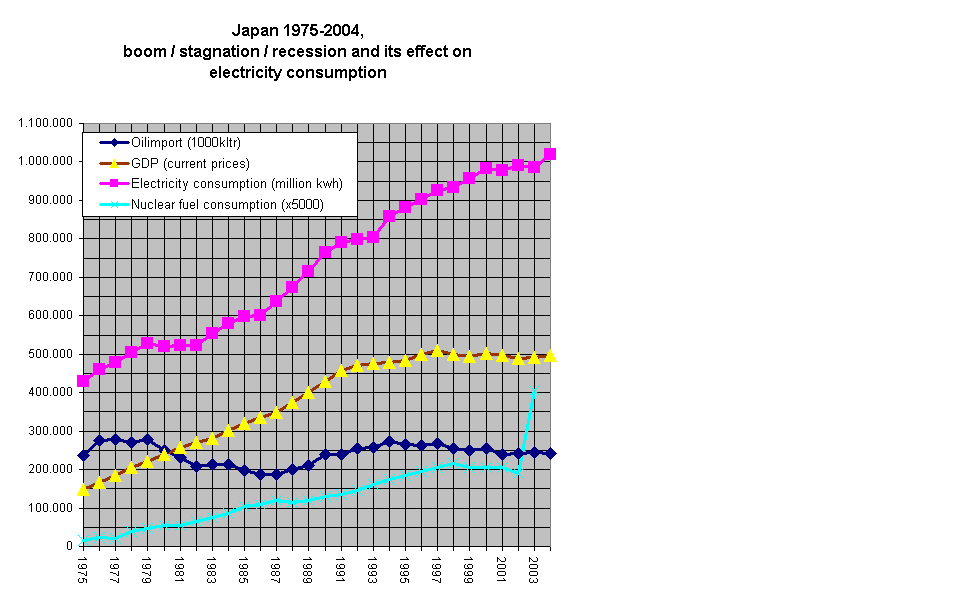
Regarding electricity production oil was reduced somewhat mainly in favor of nuclear and coal.
Source: www.stat.go.jp (historical data and recent data don't line up in GDP figures but the trend is clear, nuclear fuel consumption jump in 2003 appears strange)
Checking out Amurkah:
This is airdale, who is currently likely to be shifting from a possibly sustainable lifestyle on the farm and residing in a loghouse(built by myself totally over 3 long years) to a suburban location.
To make the shift I have spent the Thanksgiving week and now also the last week helping my son and wife search for a residence in the Raleigh/Durham/Greensboro area, which some refer to as the triad/triangle and various neames. This area is long been a most desirable location for those leaving the north for more suitable climes.
While so engaged I took a very close detailed look at several facets of our society/culture as it concerns real estate, attitudes and traffic/travel.
Been a long time since I traveled the over the mountains and spent so much time on the interstates and in searching for real estate. I once lived and worked in the most desirable and wealthest area of Raleigh , NC. North Raleigh which is in Wake County, arguably the most expensive county in N.C.
Observations then:
1. Convincing my family of the future possibilites was a totally lost cause. They spend hours in idleness watching the MSM via cable TV. They even watch the most disgusting of the disgusting. Infomercials. They are addicted I suppose and it rounds out their lifestyles. They rarely question what the talking heads say. They very much question the veracity of my statements since it disagrees markedly with the MSM. They are hooked and cannot fight the bait on the hook.
2. Traffic. Long lines of savage drivers who are intent on using the roads and vehicles to make their personal statements and vent their angst. They surely hate the traffic but again as in #1 above they are addicted or cannot consider life in any other form than the excursions in a vehicle and the mental tensions it provides for a release or whatever. The utter stupidity and habits of the drivers both on and off the interstate is amazing in its breadth and depth. It is frankly unfathomable as to how we became such bruteish creatures.
3. Real estate. I talked to several realtors and agents. They all claimed that this area(N.C.) was bubble-proof and it was NOT happening here. Yet it was. I saw one brand new home that had been on the mkt for 2 years. Huge numbers of listings and the prices seemed to be somewhat in decline. Most all properties were vacant and seemed to be owned by someone trying to 'flip it'.
The ones who were still occupying their homes were in extreme desperation to sell. Even writing up personal notes to explain the residence...like "Raleigh is a bad place to drive and I love to drive xxxxxxxx and so I am moving"..part of a whole page about how the residence and location was so wonderful!!!
Conclusion: I will move. My son now has a contract on what I helped him chose. I managed to nudge him into a quite large lot(1 acre+), a full masonry fireplce(good for heat), fully wooded, private well(souce of water) and in a fairly remote area backing up on mostly areas that will not be developed and therefore open for foraging.Orientation and lot such that I can grow a substantial garden and erect a large greenhouse.
This IMO will provide the best possibilities in a suburban setting that one could hope for to mitigate future crises.
All my observations lead me to believe that most people are doomed if the energy crisis unfolds as I think it might.
I was amazed at the weather and how it had changed from what I knew 20 + years ago. I think many are starting to realize that GW is starting to happen and this might help to wake them up. If they do wake up I doubt that they will not have many viable options.
The 'cookie cutter' developments are totally without any sustainable features. The houses are built with utterly flimsy materials and very cheap. Low quality dimensional lumber, sheathed with cheap OSB panels,wrapped in housewrap,flimsy cheesy vinyl siding stapled on, drywalled and various ugly fake gables and gingerbread added to the front.
What I am now hoping for is a few years of gradually dawning comphrension by the populace that a bad moon is on the rise. Something to scare the living shit out of them and shed the ignorant actions that now is all they appear to subside within. Crass consumerism, no friendliness, no community cohesiveness on any level that would matter, a mentality that means more and more of the same doomed and spirituality dead lifestyle.
Amurkans are very ugly folk from what I observed out there in Uberville. Only out in the poorer areas , where I had to go to get decent bbq, did I note any friendly people. In the outback finally I met up with friendly,laughing folks who seemed to enjoy their life.
That which most of the populace tend to disparage and shield their eyes from. The ones you don't see much of anymore if you stay on the path chosen by the Ugly Amurkans. The ones who have signed our death warrants.
Airdale,
Your right on about RaleighWorld, it's a LA-Atlanta type suburban wasteland. The downtown area has been redeveloped somewhat and is measureably better than 15 years ago.
I live in the Chapel hill-Carrboro downtown: free buses, bicycle paths, a vibrant downtown with lots to do. We have progresive leaders here who know about PO.
Being carless for 2 years, I recently took a trip to Myrtle beach. I was astounded at the traffic and big box crap that lined the highways. It was ugly and unpleasant. Myrtle beach has been decimated by developement, I will never go back.
Airdale,
Glad to see a post from you again! As far as real estate goes, there was a well documented essay in the Market Wrap-up at http://www.financialsense.com this week. In essence, real estate has a long way to drop.
Todd
Interesting obsevations, Airdale.
I have noticed similar real estate patterns in areas near St Louis where I currently work.
Some new subdivisions completed early last year still have about half their McMansions
empty and unsold.
Good to hear from you.
Airdale;
Sorry you lost the vote. and glad you're not giving up. Good luck!
Bpb
"And you, my father, there on the sad height,
Curse, bless me now with your fierce tears, I pray.
Do not go gentle into that good night.
Rage, rage against the dying of the light.
-- Dylan Thomas
Various commentors posted on my thoughts and upcoming life choices.
To answer some of them.
Raleigh:
Raleigh is indeed a sprawl yet I found a house and lot with somewhat over an acre and rather close to Cary at that. Close but not too close since my son and wife wanted some choices.
St. Louis sprawl:
I spent 30 yrs in St. Louis. Brought my my first house in the Florissant area and all past my house was farmland. I watched for those 30 yrs as some extremely arable soil was destroyed for housing. Traveling Hwy 70 finally drove me to Jefferson County and then it became flooded with the same. I gave up and moved to N. Carolina back in late 70s when the Ranch Motel was the place to stay for temp assignment folks. J.D. Crowe still played bluegrass music as the Holiday Inn up near the IBM plant on the beltway. Brunswick stew and pulled pork bbq was abundant as well as very fine seafood(Creekside). All now mostly gone in the Raleigh area.
The future for me: I envision that the energy crisis will be either a soft landing or outright chaos and anarchy. My plans encompass both scenarios or any in between.
I will still have many friends here in Ky where I now live. I will stockpile my survival supplies/needs here in some friends caches.
How will I travel from the new lodgings to this location in a Mad Max world? About 550 to 700 miles?
If the roads are death traps and your liable to not make it, I intend to use a light sport aircraft. Two seater with STOL and carry enough fuel to make it cross-country in one hop. Refueling in mid air or setting down on a remote farm field temporarily to refuel. Cost about $16,000 turnkey or build yourself.
Room enough to carry some weapons, fuel and one other person. I will simply fly above it all and high enough to escape small arms fire. Plenty of obscure landing sites near my friends farms and barns to store it in. I carry enough fuel in a portable bladder and keep it usable with additives, replacing it as need be as it becomes stale in storage.
If its bad then perhaps my old farm and residence will not be inhabited at all by that time or come empty later and I can just resume living there or at my buddies who is with me on all the upcoming events and is very, very well prepared. We have a fuel tanker which we will likely fill before things get unreasonable. Already have plenty of diesel. Many LP gas tanks.
All I currenly need is something in 7.62 x .51 (Nato) and some night vision gear. A few more reloading dies and shell plates. More hunting arrows for my compound bows and some extra camo fatigues.
Oh yes.. Takeoff in the light sport.
Row out of backyard shed in NC, attach wings(26 feet wingspan), push out to suburban street, fire off the Rotax and taxi to an acceptable takeoff spot, one of the wider streets(no overhead wiring to contend with either), head into the wind and takeoff. 80 - 90 cruise speed. Follow the interstates or the rivers. No crazy drivers to contend with.
Acreage to survive and sustain yourself on is not the problem nor is the actual signed ownership as long as you have long footprints in the community, such as being born here, history,relatives and a good reputation.
I am glad to have solved some of my possible future problems. I realized while I was in N. Carolina that I was a stranger in a strange land and to survive I had to return here(Ky). If I get 10-15 more good years then I won't care too much how it plays out by then.
Various commentors posted on my thoughts and upcoming life choices.
Airdale,
I am a daily reader of TOD but am not a frequest poster. I have always enjoyed your posts.
Interestingly, I am posting from western KY tonight. I am visiting my mother who lives here.
I remember the St Louis area much as you do from 30 years ago. I was a child but visited relatives there.
As with most areas, the spawl is even worse than you remember. Even the Jefferson Co area.
This past year I have moved back to this area so I could be closer to my family after spending most of
the last 10 years in SC and VA. (I am familiar with your area in NC).
You and my mother are in the same generation. (You either did it yourself or did without). She is a rabid gardener and is a wealth of info on how to grow things. (She grew up on a small farm and can still describe how to milk goats and hitch a team of horses to a wagon). I consider myself blessed being able to learn from what she knows. We spent the day going through seed catalogs and planning our orders for spring plantings (with an emphasis on heirloom seeds).
I have spoken to my mom about Peak Oil and she totally understands. Her answer to various problems we may encounter is that, "We'll just have to do it the old fashioned way now, won't we"? (usually accompanied by a smug smile).
Long story short to TODers. Talk to your parents and grandparents about what and how they did things as kids. You might be surprised about what you can learn and they may be more receptive to PO and PO issues.
Rude Crude:
You likely won't read this and with the loss of YOUR COMMENTS function even more unlikely, but if you do:
I was born and raised in Western Ky. I specify that anywhere west of the lakes is Western Ky. When I worked and lived in Lexington,Ky then did not even acknowledge , obliquely or otherwise , that life even existed beyond the lakes.
My father remarried and moved me and my brother to Ferguson, Mo. in 1949. I finished growing up there and worked at McDonnell Aircraft then to the Navy and back to Mo to marry and then worked in St. Louis until 1979 when I moved to NC.
Ferguson was once an old outlying town with many old mansions. My grade school friends mansion has a carriage shed and a hole underneath with chains for tying up recalcitrant slaves. We used to sit in it and talk. There was local train service to the city of St. Louis and we used to play on the old roadbed.
Funny but now Ferguson is totally changed and african-americans are the majority of the population. Pretty much the same in Florisant when I was there last.
The only reason I ever go back to St. Louis is to eat at Rigazzi's on Dago Hill and replenish my cheese/pasta supplies. I once loved downtown St. Louis then they tore out the streetcar tracks and all the wonderful older buildings. The waterfront and gaslight square were great but now only a memory I suppose.
I brought my farm here in the mid 80's and retired early 90s here.
West Ky has abudant water, good aquifers, and being at the confluence of the Ohio,Mississippi,Tennessee and Cumberland should never want for good water. Good soil west of the lakes. Very good soil. Some good stands of timber still exist. People are still not lobotomized to any great degree by the MSM. There are still 'old timers' to be found who could write many FoxFire type stories or tell them.
I intend to die and let my bones rest in my native area. Til then I will fight tooth and nail to survive be it the burbs or the outback.
The aircraft I intend to build will be my method of movement when TSHTF but until then will insert me back into the world of flight which I used to enjoy, both militarily and personally, immensely.
Good luck to your and your mother. Consider this area a good place to survive in when it does get bad.
airdale--be peaceful but be prepared
Airdale,
Good story. I'll have to check out Rigazzi's. Best of luck on the aircraft.
Too bad you'll have to leave the Harley behind. It might make a nice lawn ornament someday.
(Ultimately, it is what I plan to do with mine) :-)
Be wary of flying over the mountains in light aricrraft as there is a lot of thermal activity that
can be detrimental to light aircrraft.
I hope you keep your farm and don't have to sell it. It may be a place of
refuge sooner than you think.
all the best,
rude
As an alternative to homebuilt aircraft, take a look at some of the old J-3 Cubs and other planes from the 1930s and 40s. An old Ercoupe would be nice--original ones had forty horsepower engines.
But I'd worry about weather--a lot. Maybe the old HD is a more reliable escape vehicle than a little plane not rated for IFR conditions.
For me, a sailboat is the best possible last-resort retreat; we go with what we know.
For me, a sailboat is the best possible last-resort retreat; we go with what we know.
I couldn't agree more. Not a bad plan if you live on or near the great lakes. One could make it
to Canada and various points north. One of the things that may be of concern when trying to reach
open water from the U.S. interior would be the Lock and Dam system. If things are tough, the military
could restrict travel through the system by denying access to "non-esssential" watercraft. Of course,
this would apply to wheeled vehicles at major river crossings, also. (bridges would become checkpoints).
That would reduce movement of an "unrestive" populace! Many often forget that the U.S. Interstate
system was originally designed to move the military across country quickly.
While I hope it doesn't come to that I am not optimistic in the long term.
Always have a backup plan or two.
regards,
rude
Living on the Pacific coast, I have all sorts of tropical paradises a sailboat trip away ... but to think about that would be to let the survivalist mood of TOD pull me toward outcomes I consider completely unproven.
We don't know what we'll get. It may be pretty nice here in the US, with some combination of wind, solar, walkable/bikable communities, and so forth. And if dark scenarios truly loom, I think they will do so with considerably more concrete evidence. It won't take tea reading.
You know, being sympathetic as I am to the Hubbertian core of the Peak Oil message, I can take some issue with those who look at current prices to dispute peak oil. They say "how can it be peak oil, when energy is so cheap?" And the standard reply is that "The market does not know all." Ok fine. The market doesn't know all. But does it know something? Does it know enough to tell us that catastrophe is not right around the corner? I think maybe it does.
So no, I'm not going to plan my escape route when gas is at $2.50 a gallon.
Quite right--wait till gas is over seven dollars a gallon to do any planning. Never do today what you can put off until the day after tomorrow:)
Seriously, however, ever "doomer" contingency I look at I try to meet with something that will be good for me even if business as usual continues. Why shouldn't I have a thirty-foot sailboat stocked with a year's supply of food at all time? Why shouldn't I have purified (with Chlorx) drinking water stashed in bottles all over the place? (I mean, what better use can there be for empty rum bottles than to fill them up with drinking water. We sailormen take drinking water very seriously.)
Yo ho ho and a bottle of Adam's Ale!
Hi,
The aircraft with a wing extension is rates as soarable. Thermals should not be a problem.
I hope to have enough time to throughly check this out and take a few trips crosscountry over the same route.
IFR? Doubt I will be filing flight plans and if weather worsens then a good cow pasture will be the choice interim.
I expect the problem isn't thermals so much as turbulence (your maneuvering speed will go down with wing extensions) and downdrafts exceeding your ROC.
Best of luck to you. Maybe you can get Wimbi to build you a Stirling generator to run off your wood stove!
There was some minor discussion on yesterday's Drumbeat regarding Norway's projected oil output decline in 2007.
To appreciate the significance of this it's worth looking at Euan Mearns' Oct 17th post on Norway (and UK) production titled Lies, Damned Lies and Government Oil Production Forecasts?. In this post Euan expressed scepticism of the Norwegian Petroleum Directorate's 2006-2010 production forecast, which projected almost unchanged oil production (C&C+NGL) of c. 2.8 mbd in 2010.
Euan said:
He also said:
As Forbes reported yesterday:
The new forecast decline for 2007 from the NPD? ...roughly 7%.
The reversal has been attributed to delays in starting some new fields and a shortage of offshore drilling rigs. For more details see the NPD's presentation "The Shelf in 2006" (pdf).
Yup. That's the problem with the bottom-up analyses. There's no reason to expect the delays, shortages, etc., to get better as oil gets scarcer, and every reason to expect them to get worse.
Dang it, Obama... So much for hoping he might help make the switch to energy sources that don't rely on CO2 belching processes.
Obama has now distinguished himself as just another politician who will solve all our problems with supply so that we won't miss a beat in the continuation of our easy motoring lifestyle. He just confirms the iron rule; that which needs to be done is not politically feasible, that which is politically feasible will not solve the problem.
Obama is allegedly one of the best and brightest, and most honest, but either doesn't have a clue or has a secret plan to save the planet once he is elected President.
It was probably too much to expect of him, seeing as he represents a state with large coal reserves.
And growing lots and lots of corn.
The only one with a lick of sense (or not a sell-out) seems to be Roscoe Bartlett.
Norwegian Gold
http://www.msnbc.msn.com/id/16408290/site/newsweek/
The Barents sea could become Europe's natural-gas Klondike—and an alternative to Russia
This is why the industry has always been cyclical: When times are good, everyone rushes out to build new capacity. Then, suddenly we have too much capacity and prices fall. However, I would argue that in the face of a true production peak, it will no longer be possible to overbuild capacity (unless there is very large demand destruction) and hence the industry, post-peak, will no longer demonstrate this cyclical behavior.
Interesting point, Robert. I could imagine situations where there would be sufficient spare capacity to drive down the price, even post-peak. Consider two scenarios:
1) Oil production declines at a rate lower than the markets anticipated
or
2) There is a larger than anticipated reduction in demand
Either of these situations would have the effect of creating more space capacity and reducing the price of oil.
Another article about how oil and gasoline prices are going to crash in the next few weeks.
http://news.yahoo.com/s/ap/20070106/ap_on_bi_ge/oil_prices
A newbie question for Westexas:
What percentage of current world production comes from the 4 super giants?
For me, a peak now or a peak 10 years from now makes a lot of difference. So one has to wonder if a proportionately small percentage of the worlds recoverable oil is found in the supergiants, the peak might be later.
Thanks, James
I should have mentioned that the blockquote comes from a comment Westexas made either yesterday or the day before.
One thing that I have noted previously. Earlier in the year, when Richard Heinberg's anonymous source said that Ghawar was already down below 3 million barrels per day, the Saudis were still producing at near record rates. The ASPO conference took place on July 18th, and that was where Heinberg's source told him this. At that time, Saudi production was still 9.3 million bpd. If true, that suggests that a sharp dropoff for Ghawar does not mean a sharp dropoff for Saudi, since they would have seen Ghawar drop by 2 million bpd and yet were still capable of producing at near max rates.
Having said that, I don't dispute that Ghawar is close to peaking. I even saw an interview in which the Saudis said it is 48% depleted.
Re: Heinberg
One key question, assuming that Heinberg is correct, is what Ghawar was doing in the 12 months prior to the first quarter of 2006. It may have been dropping by 100,000 bpd or so per month, and in the first quarter of 2006 the Saudis couldn't keep exports up by pushing their other fields as hard as possible and by draining inventories. Of course we don't know for sure what is going on. One interesting point in the "truth" department is that David Shields has discussed how Pemex tried to hide what they really thought the Cantarell decline rate would be.
It is really odd that the Saudi stock market started crashing at the same time that they announced the first of their "voluntary" cuts, while the Venezuelan stock market (with long life nonconventional reserves) started booming at the same time, plus the fact that the Saudis had to import petroleum products in August.
WT...I have not followed what the Saudi stock market has done recently. Has it bottomed out?
Here's the graph. It ain't pretty...
http://trendlines.ca/energy.htm#misc
James, the giant fields do not tell the whole story. Approximately 47.5 percent of the world's oil comes from nations that have declined since May of 2005, the C+C peak so far. Therefore 52.5 percent of the world's oil comes from nations that have increased since May 2005. However the decline from the decliners has been 570 thousand barrels greater than the gain from those nations that have not declined since May 2005. That means that since May of 2005, world C+C oil production is down 570 thousand barrels per day.
And by the way, those nations still increasing, declined by 20 thousand barrels per day, September to October.
At any rate one must look at the entire picture, not just the giant fields. Also, May 2005 may not turn out to be the actual peak, I am not claiming that at all. What I am claiming is that we are at peak right now. By that I mean we are currently on the peak plateau and have been there for about two years. There will be no great upward surge in oil production in the future. We will stay on this plateau, up a little and down a little, until world oil extraction turns down for good, forever.
Ron Patterson
http://www.foreignpolicy.com/story/cms.php?story_id=3567&fpsrc=ealert061002
The List: Taking Oil Fields Off-line
My comments:
The four current super giants (that are, or were, producing one mbpd) are: Ghawar (recently about 5 mbpd); Cantarell (recently about 2 mbpd); Burgan (recently about 2 mbpd) and Daqing (recently about one mbpd).
(Edit: By recently, I mean in the past couple of years. Current production numbers, IMO, are below these numbers.)
As a percentage of world crude + condensate production, these fields recently accounted for about 14% of world production.
Daqing is in a permanent decline, with about a 90% water cut.
The Kuwaitis have admitted that Burgan is in a permanent decline. I have seen references to rising water cuts, but I haven’t seen any numbers.
Pemex has admitted that Cantarell is declining, but energy analyst David Shields has documented how Pemex has tried to hide Pemex’s actual predicted decline rate. As of early 2006, the remaining oil column of about 800’ was thinning at about 300’ per year. According to the WSJ, the worst case predicted internal Pemex decline rate is 40% per year. Shields predicts that Pemex production will drop by 800,000 bpd this year.
Saudi Aramco was forced to redevelop Ghawar with horizontal wells because the vertical wells were watering out. As Shell found out in the Yibal Field, to their surprise, when the water hits the horizontal wells, production drops very rapidly. “Down Under” noted that in some portions of the Ghawar complex, the oil column has thinned by 90%. In any case, the best case for Ghawar is that the field is producing one barrel of water for every two barrels of oil, after Saudi Aramco redrilled the field to put horizontal wells into a rapidly thinning oil column between a rising water leg and an expanding gas cap. Only in the most hyper-technical sense am I forced to describe the Ghawar situation as a “near certain” decline/crash.
Matt Simmons, quoting someone else, described a lot of production from many large fields as “Oil Stained Brine.” The once mighty East Texas Field, which powered the Allies to victory in the Second World War, now has a 99% water cut. Prudhoe Bay has a 75% water cut. This is where the current four super giants are headed.
IMO, anyone in the oil business who believes that we can increase world conventional oil production with the near certain decline/crash of the four current super giants is in deep, deep denial. The only new super giant on the horizon is the problematic Kashagan Field, which won’t, at best, start producing until 2010, and won’t, at best, hit peak production until 2020.
We need to know more about what Down Under knows and how reliable his/her information is. I said this in an earlier thread but it was buried. This guy/gal, if reliable, is our missing link to KSA data. If what he/she says is true, then things look pretty bad in KSA.
Down Under is definitely a he. His source, also a he, lives in Brisbane but works in Tunisia. I could tell you a lot more about him, from emails, but Down Under has not given me permission to do so. But this friend who works in Tunisia has been in the business for some time and has friends working in Russia and other oil producing nations.
But one thing I can tell you about him, he would emphatically agree with WestTexas and I on Saudi Arabia and other Middle Eastern oil producing nations.
Ron Patterson
Very interesting. Since reliable data via official channels is not available, and not likely to be, this may be the best we can do.
Yep...my thoughts as well. Whoever this guy is...protect this man and his contacts. He may be the most wanted man by KSA.
I just caught Peter Beutel of Cameron Hanover on CNN. He says oil will drop below $20 a barrel within 4 years. He cited CERA and said they have identified 300 new sources of oil that will be coming on line soon.
He was predicting a recession, caused by the high price of oil, along with new supply as the reason for the drop.
Ron Patterson
Maybe the bad news is that $20 will be $200 in today's dollars.
I quoted an Oil & Gas Journal article a few weeks ago that showed a list of all new 100,000 bpd fields and/or field expansions (their list not mine). The sum of the new fields, even counting the Kashagan Field which won't, at best, hit peak production until 2020, would not equal the recent production from the Ghawar Field.
CERA is basically ignoring depletion and using best case scenarios for new fields.
A severe and long-lasting global recession could knock the price of oil back to about one Yergin. However, I do not think the recession which is coming soon (or may already have started) will be either severe or long lasting.
Thus I stand by my Fearless Forecast: The price of oil will fluctuate. (And contrary to many, I predict more price volatility in 2007 than there was in 2006.)
I'll join in on the CERA bashing by offering this quote:
Capacity in China is projected to decline slowly from peak levels of 3.52 mbd in 2005 to 3.30 mbd in 2010.
Judging from IEA data they are wrong. Production continued to climb in 2006.
http://omrpublic.iea.org/supply/ch_to_ts.pdf
Yeah, the EIA shows about a 2% increase in C+C production from 2005 to 2006 (average through October for 2006).
Of course, close to 30% of their production comes from the Daqing Field, which is in terminal decline, with a 90% water cut. But other than that, I'm sure that their petroleum future is very bright indeed.
Daqing is currently 25% of Chinese production and has been declining at about 3.5% in the last few years. Its production is about 920,000 b/d now. An HL plot of Chinese production points to 2007 to 2008 as the peak year, not 2005.
REFERENCE REQUEST: Is there a publicly available database with world oil production (monthly, yearly or daily) going back to 1920 or earlier. So far I have found nothing at BP (1965), EIA, IEA. Maybe I'm just hunting in the wrong place?
Hi Engineer,
I've put some data in the following spreadsheet:
http://www.editgrid.com/user/graphoilogy/Oil_Production
Complete production data 1900-2005:
http://www.editgrid.com/user/graphoilogy/Roberto
Saw this today in the Baltimore Sun:
http://tinyurl.com/ybnxqn
Hello TODers,
Hopefully before TSHTF, we will be moving to relocalized permaculture and all the other great suggestions here on TOD. Does anyone have any ideas to help promote my idea of 150 million wheelbarrows in use as we move to 60-75% permaculture labor force?
I was thinking maybe a property tax rebate based on the square footage of your household garden. People living in apartments would get a rebate on rent for hours worked in the landlord's garden/orchards. The landlord would get a property tax rebate for ripping out the non-essential concrete/asphalt to convert it to permaculture and/or buying a nearby piece of land for such purposes.
Schools that ripped out their playing fields and parking lots for permaculture, along with eliminating student busing, would get $/student from the govt. Businesses that did the same to their employee parking lots, then put in scooter and bicycle racks instead, would be able to sell this spare land to the apt. landlords in the above paragraph. Schools and businesses could use solar cookers and PVs to power their cafeterias.
Fast-food restaurants would convert their auto drive-thrus to bicycle drive-thrus or be taxed heavily. The parking lot space freed up could grow vegetables and or chicken coops.
Parents could incentivize their children by making their allowance based on hours worked in the garden-- would this make them abandon videogames, and get in better physical shape?
I know it seems impossible [I am a doomer myself], but do the cornucopians on TOD have any better ideas on how we can start the masses towards relocalization before we start starving and reaching for 150 million machetes?
Bob Shaw in Phx,Az Are Humans Smarter than Yeast?
You have a great many ideas and I do enjoy your posts. But 150 million wheelbarrows just are not on the menu. You elsewhere talk of "earthmarines" (which is an oxymoron: Marines are associated with the sea--always have been) and the fundamental problem of society is to preserve order. We saw what happened in post-Katrina N.O. when the police ran off and the arsonists and looters took over. One can make the case that post-Peak U.S. will look like post-Katrina N.O. writ large. Now that the National Guard has restored order in N.O., wheelbarrows make sense, but I'd tell my children to buy rifles before wheelbarrows, if it were a choice just between those two items.
Hello Don,
Thxs for responding. Earth-Sea = Earthmarine--> the idea is that they are dedicated to protecting all lifeforms in all habitats [even at the expense of a human life], thus preventing the last carrot, llama, polar bear, tuna, salmon, flamingo, sequioa tree, etc from going extinct. In short: we should prefer cannibalism before we should eat the last mating pairs of passenger pigeons, dodos, moas, sabertooths, hairy mammoths.
The fundamental problem of society postPeak is to preserve the Natural headcount as best as we can, much less effort will go to preserving human headcount. Like Todd's posting of sitting in his forest shooting anyone who wants to steal some wood when its -10 below.
Unfortunately, your advice is probably correct, but if PO + GW Outreach was successful 150 million wheelbarrows, bicycles, etc would negate much rifle and machete' usage. I think we will decline, we can't stop it-- as mentioned before: the goal should be to try to OPTIMIZE the decline. Growing carrots makes more sense than fighting to the death so the winner can eat the last one on the planet.
Bob Shaw in Phx,Az Are Humans Smarter than Yeast?
Yeah, but what do you do when the militias with the rifles come to take your carrots away from you?
When social order fails, there is a tendency to go back to warlordism and banditry (which is a kind of mobile warlordism). "The Seven Samurai" and its western version, "The Magnificent Seven" illustrate what happens when peaceful villagers come up against the bandit gangs. (The only really fictional part of these films is the magnificent courage and altruism of the warriors. In reality they would take over as lords as soon as the bandits were defeated.)
If you are looking for a new hobby, let me recommend cowboy action shooting--in which one learns useful skills and gets to hang out with fun people.
Hello Don,
No doubt about it, there will be warlord militias. I don't have answers for everything, I don't think anyone does.
I think alot depends on just how soon and how fast the decline will be. Two brief scenarios below start from dire to less worse [who knows?]:
1. If Deffeyes, WT, and Darwinian are indeed correct on timing, plus a precipitous energy dropoff occurs [no plateau]--- because very few are prepared, ELM would be floor-boarded--it would get very dramatic very fast. As Matt Simmons famously declared: "We don't want to go there!"
Todd, Airdale, Richard Rainwater, Don in Colorado, et al, would be overrun quite quickly IMO, unless extremely lucky. Basically, all Hell breaks loose. Probably difficult to avoid the full-on ICBM gift exchange, but unless our leaders are truly idiots, probably prevented or maybe just a very minimal exchange [Pakistan--India, Israel-Iran?]. Releasing Smallpox and other bugs again would be the obvious answer: people would be too sick to fight and kill the planet, but the 1/3 survivors would have an almost immediate abundance of things to scavenge, lots of infrastructure to restart and use, and much more flora/fauna/land to grow things on. In short: prevents the catabolic collapse; stops the planetary Easter Island. Very little extinctions occur, Global Warming greatly suppressed, but at a very high cost of nuclear wastes, pollution, massive loss of essential transition knowledge & skills, widespread Olduvai Gorges, etc.
2. If Peak is about now, but we fairly downslope for 5-10 years but ELM fairly brutal to importers, plus grass-roots Outreach ramps up to 20-30% of populace, but GOVT chooses war-footing and the "3 Days of the Condor" when exporters finally shut us off--- maybe Hawaii, Cascadia, Alaska, and New England have time to Biosolar secede to resist the severe Credit Debt Economic Draft, and setup preliminary, large habitats with some indigenous Earthmarine protection, some PVs and windturbines, but a fair concentration of wheelbarrows, bicycles, food stockpiles, ammo, hand tools, etc. But the biosolars would be much more focused, prepared, and organized than the detritovores.
Govt would have time to stock Yucca Mountain with irreplaceable tools, books, arts, music instruments, DNA samples, heirloom seeds, etc. The ICBMs and other badboy-toys could be safely disabled, no Smallpox & Ebola release required, but Bird-flu would break free requiring Martial Law & huge govt slave labor camps to suppress violence in the detritovore areas. Huge losses from soldiers killed abroad in resource wars, and here at home from detrito-terrorists & insurrections, but the rich make Blackwater Security type-Corps the most valuable companies on the planet as they carve out fresh warlord high security/detritus areas amidst the remaining detritovores. The Earthmarine/Blackwater confrontation is limited because the Earthmarines staked out/prepared the best areas first; the high ground; it's easier for the Mercs to shake down the helpless detritovores vs going toe-to-toe with the excellent Earthmarine Snipers. Also, Mercs aren't dumb: they know that they will eventually switch over to the Earthmarines to help protect and expand the Biosolar areas when the easy detritovore pickings start getting slim.
US & NATO Navies are primarily a global pirate force that charges a very high cost to shipping and/or extortion of some countries in an effort to offset ELM. For example: say New Zealand can outbid anyone for just one VLCC, but the Navy could force the Captain to sail for Seattle instead-- rapidly sending NZ into Zimbabwe-mode X 10.
So that is just two crudely-sketched scenarios--I got a bunch of different ones playing out in my imagination. But the crucial point is that looking back over historical collapses in the past is that they were biosolar-biosolar collapses: Rome, Aztec, Mayan, etc-- no FFs to give one party a huge leverage advantage over another.
Not true today: one group with a hoard of FFs PROPERLY USED can enjoy an advantage til they sputter and stop, but then the advantage swings to the biosolar side that now has a higher ERoEI and better and longer preparation. How long that shift takes is very hard to tell.
Bob Shaw in Phx,Az Are Humans Smarter than Yeast?
Your scenario would make an exellent role playing game, Earthmarines versus Mercs.
My depressing scenario is more like the cutoff from most of its trade Sweden had during WW-2 but shared by most of the developed countries. More seasonal greens and rabbit stew and much less travel and in some countries very fast urban relocation near production and logistics centers.
I suspect that geopolitically extremely poor areas will be contained by poor areas that have little to loose and this might become limitlessly nasty. We globally need trade, rule by law and economical development before its to late for some regions. But I dont assume this will consume the whole world, people would probably get used to terrorist attacks and intrusive police work limmiting the terrorism rather then opt for death by total war.
I expect the leading powers who ever they will be to keep the trading routes open and free from pirates and extreme tolls since they will benefit from it, it would benefit ruling and middle class everywhere giving the leading powers people to negotiate with and it avoids wastage of resources in numerous small conflicts.
One nasty problem is use of irrational religion for gaining power or simply advancing some traditional collective insanity. This might destroy parts of the middle east and I dont like some of the US trend.
I think this will leave the world as it has been for a long time, it will have some centers of culture/power/technology that affects the rest of the world. Those centers will probably be ones that have prepaired for this chage or have natural means for changing fast and I think a flexible culture is more important then natural resources even if having local resources help a lot. The choices made in these areas will mean a lot for our global future and I hope the benefits of democracy, secular humanism, and well behaved market economy will outhweigh having religious zeal and lots of natural resources. Its thus very intresting to see what choices (parts of?) USA and Russia will make in the near future.
Hello Magnus,
Thxs for responding. Your scenario is very interesting. Speaking of religious zeal this just hit the newswires:
http://news.yahoo.com/s/ap/20070107/ap_on_re_mi_ea/israel_iran_nuclear
--------------------------------------------
LONDON - A British newspaper reported Sunday that Israel has drafted plans to strike as many as three targets in Iran with low-yield nuclear weapons, aiming to halt Tehran's uranium enrichment program. The Israeli Foreign Ministry denied the report.
Citing multiple unidentified Israeli military sources, The Sunday Times said the proposals involved using so-called "bunker-buster" nuclear weapons to attack nuclear facilities at three sites south of the Iranian capital.
----------------------------------
Bob Shaw in Phx,Az Are Humans Smarter than Yeast?
Israel has denied that story. Of course, as a way of keeping the Iranians off-balance, the "leak" and subsequent denial couldn't be better.
For some reason, British publications seem to be especially gullible. Remember last April about the Brit paper that published the "secret" plans for an imminent U.S. attack on Iran? I spotted it as twaddle and nonsense immediately and posted to that effect on TOD.
Bob Shaw(Totonelia) said:
"Todd, Airdale, Richard Rainwater, Don in Colorado, et al, would be overrun quite quickly IMO, unless extremely lucky."
Well perhaps and perhaps not. You realize the possibilities and factor
them into your plans, hopeful that you have prepared well and have had the time to do so. Basically its much akin to the early pioneers to Kentucky who had to keep very heavy, single shot, long time to load Kentucky Longrifles handy whilst they went about hacking a living out of the wilderness. The indians could easily hide in the canebrakes and mount suprise attacks at will. Note that they did NOT reside in Ky but did raid there. Ky was considered the home of white ghosts and other indian legends against residing there. They came across the Ohio, as I read that history. They were extremely vicious and in some ways made the Islamic terrorists look like kindergarteners at play.
So they survived and some of my ancestors were fighting and surviving right alongside D. Boone and his band at Fort Boonesbourough near Lexington. When I lived in Anderson County there were many locations where 'stations' once stood and Harrodsburg was the next town south.
So they did survive and without modern weaponry. They mastered woodcraft and outdoor skills. They bested the native americans and befriended many. They essentially took the land and kept it.
To do the same when TSHTF you must relearn those skillsets or make use of what is available to defend yourself. A background in hunting, scouting and traipsing about and around the woods and forests is desirable. I have found that I am able to stalk whitetail deer and have walked upon many both in the woods and fields. Turkey hunters are good at this.
There are so many skills that can be developed that it is difficult for normal folks who live in the burbs and cities to even start to comphrend.
The 'mad max humungous' types will find it difficult to root out those who unprepared. You do NOT live in your house. Its a death trap unless you have trip wires and other devices as well as outposts to warn you.
What you do is lay up in the woods nearby and wait for THEM to occupy the residence then you walk up to the windows and take them out. Or as they walk about.
With a good bull barreled .22 and good optics you can do this at 100 yds. I prefer a .223 or better yet a 7.62x.51 Nato round.
Can I kill someone? I prefer not to and unless threatened I would not but their comes a time when its you or them. I could do it. Having a mentality to do so is essential. The rest follows. The rest is preparation.
Your mind might not be able to grasp the concepts but our forefathers did it thusly. They built a nation. We need to keep it alive in some form..better I hope.
airdale
You are telling people it is a good idea to become a living booby trap for refugees who find an abandoned house and try to survive by using it? I would prefer to plan for TSHTF scenarios that makes the world a tiny bit better and not a lot worse.
If your goal realy is to build an nation or keep a nation alive I would suggest interacting with your neighbours, joining independant/state volonteer relief or military organizations and then prepair to solve problems in a more positive way.
This also makers it less likely that these organizations have to waste resources rooting out crazy survivalists harassing refugees or neighbours.
Anyway, its hard to survive on your own and almost impossible to make the life you have left enjoyable withouth company and someone to hug. Your days are allways precious, its all you got and they will be even more so if TSHTF and you realy get to know that you are mortal.
Magnus,
As usual, I agree with you 100%.
There is also the "self-fulfilling prophecy" aspect of our actions. If I stockpile rifles and ammunition, hoard three-year supply of food, build a bunker for a retreat, etc., I start thinking in these terms and interacting with others of similar interests.
On the other hand, if I get involved in my community, deliver meals to old folks, read to kids at the public library, teach more people to sail, and so on, not only will I be happier, but by making connections with good people I increase my chances for doing well during future hard times.
Good suggestions.
Myself I have joined the Swedish home guard and I do some local political work on the municipiality level and in debates. I do from time to time do some feeble argueing for maintaining the state stockpiles but mostly I try to do a small difference in environmental and energy issues. I have no military or surviavalist skills to brag about and if I do something usefull it will be as part of a group or in planting usefull ideas.
To work in groups in a constructive and practical way is common all across the political spectrum in Sweden. I think we might do ok in the post peak oil times if we keep working on our long term infrastructuren and making our society more agile and competetive. Ironically I dont regard my self as skilled in working in groups but you got to try, I do at least listen to other peoples ideas. ;-)
If our capital would become glass and people would start to starve I still think we would pull thru with intact local communities making the most of the available resources. It is at least more likely then Mad Max. It would have been easier in earlier decades since we have lost some cohesion and did not handle the post cold war draw down well. The disarment were bungled destroying most of the stockpiled military capability and worse most of the civil defence, but at least we have significatly increased the investments in railways, etc.
Does one maximize the quantity or quality of the limited years we ALL have left to live ?
Does one maximize the good (quality or quantity, see above) for one's self or for some larger group ?
I know the answer for myself.
Tomorrow I am going to help select appliances for a friend (cute MD in residency, female) that is now weeks away from moving back into her flooded home. And follow up on my plans for building the Desire & Elysian Fields Streetcar Lines. (We do have good names, don't we :-)
Best Hopes,
Alan
.
..
...
Does one maximize the quantity or quality of the limited years we ALL have left to live ?
Does one maximize the good (quality or quantity, see above) for one's self or for some larger group ?
I know the answer for myself.
Tomorrow I am going to help select appliances for a friend (cute MD in residency, female) that is now weeks away from moving back into her flooded home. And follow up on my plans for building the Desire & Elysian Fields Streetcar Lines. (We do have good names, don't we :-)
Best Hopes,
Alan
Well my two closest neighbors are both in law enforcement. They will not stand by as others try to take what they have, and neither shall I.
A booby trap? No ,survivability.
I do interact with my neighbors but many are not aware and will perish very fast.
Hard to survive on your own? Perhaps harder if you have a bunch of others who haven't a clue on how to go about it.
Looking at the type of many suburbanites in the cities where I recently visited it has massively reinforced my views that they are completely unprepared and don't have a clue. They will be the ones who make this country a losing situation. Not me.
I checked them out in the stores, malls and on the highways. They are dead people walking IMO. What can I do for them?
This country has no cohesiveness left. No sense of community. No ability to come together in a big crisis. Ohhh they put chessy flags on their vehicles and yellow bow stickons. Thats about it.
Not their fault and surely not mine. I was born early enough that I saw the hard years during WWII and tough farm life. We survived without electricity and running water. The normal Amurkan today would not even be able to envision that life.
I do not make it a practice to harass my neighbors.I am related to many. Will I take them in and share my stored food with them?
Not unless they can pull their own weight and have something valuable to contribute. They wouldn't ask unless they could anyway.
I have been living alone for 4 years. I can do that. Its not the best way but these days are not like the past when the women had to do a mans work sometime. They were far different then. I watched my grandmother raise 14 children on a wood burning cook stove and a cistern out back. A 2 hole outhouse. What woman today can fathom this?
Mine surely can't and preferred to not even live in a home with all the amenities in the country. The glamor of city life took her away.
Thats what I was commenting on earlier.
Airdale,
Those of us with vivid memories of World War Two remember:
"Use it up,
Wear it out,
Make it do,
Or do without."
The ideas of frugality and making do (not to mention helping neighbors) are not popular these days.
Your comments on neighbors in law enforcement are right on. I live a block and a half from a guns and ammunition store where many current and retired law enforcement officials spend a lot of their time, just talking and trying to drum up business for their concealed carry classes, and these are good people to know--not to mention also knowing a couple of master gunsmiths.
Come visit New Orleans. Virtually everyone back who is not flat on their back, living in a tent inside their gutted home, is doing "something".
We talk with each other, work with other, support each other and, yes, party with each other. Urban survival is quite different from rural survival, it is a collective effort.
One question that has come up in the planning efforts is "What is the most important thing to preserve" ?
The answer is "The way that we relate to each other".
More important than music, food, architecture, Mardi Gras.
Native New Orleanians, as they evacuated around the country, were often shocked at how distant and cold (or just weren't there) interpersonal relationships were elsewhere.
Yesterday, at the line at Home Depot, We joked with the Vietnamese man who was buying paint. He said this was the third and *LAST* time he was painting his house . If his wife did not like the color *THIS* time, she could stay in the FEMA trailer and he would move back in alone . He asked how much water we got (my friend got 7 feet). He laughed and said "You beat me by 6 inches" and then said "We are all brothers and sisters".
A stranger helped us load the toilet into my friend's trunk and asked if we had a plumber lined up because he thought he could get one for us if we didn't have one (plumbers are in VERY short supply). He also said that all one needed was a toilet, running water and electricity to move back in.
At lunch a cop (sargent) was seated next to us. He ran the police camp in New Orleans East on a spot of high ground. He had two diabetic officers and he talked about the looting he directed (legal in an emergency for essentials to life BTW) including a pharmacy, including the pharmacy and the distress on the Interstates.
He mentioned something I was not aware of on the Danzinger bridge shootings. The initial call said that there were two officers down.
He also talked about the new Hispanic population (we were that last US city to do our own dirty work before Katrina).
SOP for NOPD when they came onto an altercation was to kneel everyone involved down and then handcuff them, then sort things out. 90% of the time, people would be released in a few minutes.
When they came on a schuffle with Hispanics, they would either start praying, begging and crying in Spanish or attack the officers. Then NOPD found out the the police back home would kneel people before executing them. NOPD now gets Hispanics to put their hands on the heads or against a wall (no kneeling). NOPD is giving Spanish classes and trying to hire Spanish speakers.
In many ways we operate like a large extended family. we talk, we laugh, we work together. The crime situation is nearing getting out of contral and their were meetings last night (and a march Thursday) on ways to control it short and long term. A month ago, the first prostitution arrests since Katrina were made (our courts can finally handle minor offenses). Unfortunately, prostitution leads to drugs which leads to criminal violence. I heard the 1st and 3rd District police commanders and the Councilmember for District C. All were impressive in their grasp of reality, their search for ways to deal with it. Some council members are working on the long term changes needed, others are working on short term changes. Street lights should be back in operation around the city within the month as one small short-term example (People were asked to tie a bright colored bow around non-functional lights to help). Juvenile justice restarted in early December, the local bar association is volunteering resources to help get the system working again. Etc. Pilot programs for first offenders are starting "soon".
3rd District Police is till operating out of a single trailer but they got high-speed internet back recently. They asked FEMA for a second trailer for paperwork and workspace for officers filing forms, etc and they were turned down. A nearby local church is offering them space now. 3rd District is getting 15 National Guard/shift to patrol uninhabited drowned areas and that is working out well. They just need more.
60 to 80 people showed up for the 2.5 hour meeting. Polite, interested, good questions.
JUST MY LAST 24 HOURS IN NEW ORLEANS,
Best Hopes,
Alan
Bob Shaw(Totonelia) said:
"Todd, Airdale, Richard Rainwater, Don in Colorado, et al, would be overrun quite quickly IMO, unless extremely lucky."
Well perhaps and perhaps not. You realize the possibilities and factor
them into your plans, hopeful that you have prepared well and have had the time to do so. Basically its much akin to the early pioneers to Kentucky who had to keep very heavy, single shot, long time to load Kentucky Longrifles handy whilst they went about hacking a living out of the wilderness. The indians could easily hide in the canebrakes and mount suprise attacks at will. Note that they did NOT reside in Ky but did raid there. Ky was considered the home of white ghosts and other indian legends against residing there. They came across the Ohio, as I read that history. They were extremely vicious and in some ways made the Islamic terrorists look like kindergarteners at play.
So they survived and some of my ancestors were fighting and surviving right alongside D. Boone and his band at Fort Boonesbourough near Lexington. When I lived in Anderson County there were many locations where 'stations' once stood and Harrodsburg was the next town south.
So they did survive and without modern weaponry. They mastered woodcraft and outdoor skills. They bested the native americans and befriended many. They essentially took the land and kept it.
To do the same when TSHTF you must relearn those skillsets or make use of what is available to defend yourself. A background in hunting, scouting and traipsing about and around the woods and forests is desirable. I have found that I am able to stalk whitetail deer and have walked upon many both in the woods and fields. Turkey hunters are good at this.
There are so many skills that can be developed that it is difficult for normal folks who live in the burbs and cities to even start to comphrend.
The 'mad max humungous' types will find it difficult to root out those who unprepared. You do NOT live in your house. Its a death trap unless you have trip wires and other devices as well as outposts to warn you.
What you do is lay up in the woods nearby and wait for THEM to occupy the residence then you walk up to the windows and take them out. Or as they walk about.
With a good bull barreled .22 and good optics you can do this at 100 yds. I prefer a .223 or better yet a 7.62x.51 Nato round.
Can I kill someone? I prefer not to and unless threatened I would not but their comes a time when its you or them. I could do it. Having a mentality to do so is essential. The rest follows. The rest is preparation.
Your mind might not be able to grasp the concepts but our forefathers did it thusly. They built a nation. We need to keep it alive in some form..better I hope.
airdale
>People living in apartments would get a rebate on rent for hours worked in the landlord's garden/orchards. The landlord would get a property tax rebate for ripping out the non-essential concrete/asphalt to convert it to permaculture and/or buying a nearby piece of land for such purposes.
For starters, I don't think it would be a good idea to consume food grown in urban regions because of ground contaimation. Its highly probably that the soil is containated with carcingations and other toxic substances.
Second Permaculture involves the recycling of human waste, which in my opinion is a bad idea, especially in urban settings which could result in the spread of diseases. Few people would consider recycling thier waste anyway.
>Schools that ripped out their playing fields and parking lots for permaculture, along with eliminating student busing, would get $/student from the govt. Businesses that did the same to their employee parking lots, then put in scooter and bicycle racks instead, would be able to sell this spare land to the apt. landlords in the above paragraph. Schools and businesses could use solar cookers and PVs to power their cafeterias.
One sentence: Insufficient water resources to make this feasiable in most of the country.
>I know it seems impossible [I am a doomer myself], but do the cornucopians on TOD have any better ideas on how we can start the masses towards relocalization before we start starving and reaching for 150 million machetes?
1. Find an alternative source of water to replace the dwindling aquifers in the US bread basket. Construct large canals to bring fresh water for agraculture needs. If they go dry any mitigation for an energy crisis is pointless.
2. Switch to more efficient crops that are not as heavy dependant of fertializers (reducing corn production and replacing it with Legumes) and require less water.
3. Stop urbanal sprawl immediately and recover whatever fertial farm land that has been recently converted to urbanal sprawl (sinces its probably not too contaiminated yet).
4. Immediately begin prepations to abandon the american car. Construct rail on top of existing interstate highways to move goods and people and set a end timeline for personal transport.
5. Immediately raise interest rates to stop wasteful use of resources and to prevent inflation when shortages begin.
6. Immediately start large construction of energy efficient apartment complexes to house suburbanites that will no longer able to remain in their existing homes. You will also need some sort of nationwide program to help people adjust to the changes (like AA, or drug rehab programs). Most suburbanites will have a tough time making an adjustment. Energy inefficient dwellings in Cities will either need to be upgraded or replaced. Apartment blocks should be surrounded with parks and social places so that the residents don't go batty and start killing each other.
7. Immediately begin construction of new nuclear power plants, CTL, Wind, etc. We will need to CTL to produce fertializers and pesticide to maintain farm productivity (at least until the population declines to a self-sustainable level). We also need fuel for local delivery trucks to transport goods from rail distribution centers. Nuclear power plants have a low carbon footprint than coal and have a much smaller land footprint than wind power backed with hydro to support base loads. Nuclear plants can be decommissioned after the population declines to a sustainable level.
8. Immediately enact laws to limit one child per women (since divorces could make it difficult to track per couple). Financial incentives could be awarded to women that don't have any children.
9. Transition from to currency based upon energy. Goods and services can be priced on their energy inputs.
Note: The majority of the population will be unemployed and living off social services. While there will be plenty of work, to keep everyone busy, its unlikely that everyone will be able to participate because of health issues or education. You can't have a airline pilot architect a building and you can't have a 50ish person who has worked in a office for the past 30 years do heavy manual labor.
Hello Techguy,
Lots of good ideas in your reply! Hopefully TPTB reading TOD will consider enacting some of them before it is too late. Time will tell.
Bob Shaw in Phx,Az Are Humans Smarter than Yeast?
"Warmer Seas Leave Fish Gasping"
Just so we all don't believe the consequences of GW are terrestrially limited.
With cold polar lakes and seas, the fisheries are profoundly affected. For them, it is a double dose. The fauna has evolved in a cold, oxygen saturated enviroment. As water warms, it holds less oxygen. The saturation level, in parts per million, declines. And respiration increases with the increasing temp. It's a gruesome duo for fish, stressing them at temps only slightly above their normal, and cascading into a bunch of stress related disease.
I'm pessimistic, but I wish the earth could get a handle on future coal consumption.
Hi All,
If any of you live near or around the Pittsburh, PA area, I thought you'd like to know Allegheny County proposed cutting its public transit service routes by 60% this past week. Yes, over half of the bus routes are being completely ELIMINATED. Great. Being a regular reader of the Oil Drum and deeply concerned about peak oil, obviously I find this move to be idoicy. If we are indeed at peak or even close to it, this is possibly one of the worst things a city could do.
http://www.post-gazette.com/pg/07004/751190-147.stm
http://www.post-gazette.com/pg/07004/751189-147.stm
Ugh, this is so frustrating. I guess since oil prices are down a bit lately, we have nothing to worry about. Everybody riding public transit please now buy an SUV and drive to an exburban mortgage, as WestTexas says. Nothing to see here, we'll all be just fine.
The PAT system in Pittsburgh is a mess. They lose millions each year, the employees are probably in the top 10% of wage earners in the county, and diffusion outward of employment has impacted ridership levels. They have basically run out of ways to get the state and federal government to give them enough money to keep the system operating. Raising rates won't work, since people can't afford current rates.
The realistic solution is privatize the transit system and cut wages in half. However, it is impossible to cut government in Allegheny county. There are 130 different cities, townships and boroughs in this county, and every damn one of them has to have its own set of municipal employees. Add in county, state and federal workers, and I would guess that half the working people in this county work for some form of government.
I love this area, but it is so doomed that it is not even funny.
Cutting wages means those people smart enough to pass the commercial driver tests would go elsewhere for employment. There is still strong demand for OTR truck drivers. If Pitt cuts routes by 60% then it might as well cut routes 100%. The 40% of drivers not layed off would be those with the most senority and highest health care costs. A total closure would get a quick response from state and local governments to fix the system's financial problems while a partial cut back merely delays sound policies from being implemented.
Sadly Pittsburgh had a very extensive electric rail system until the late 50's (down to 1 line today).
http://world.nycsubway.org/us/pittsburgh/pittpcc.html
After an extended period of building BRT (bus "rapid transit") Pittsburgh is looking at more rail. The Overbrook Line (see map, actually a second line that shares the downtown section) was reopened a couple of years ago after closing in the mid-1980s.
Pittsburgh is currently building a subway under the river to the north. Later plans have several (at least two) Light Rail lines spurring off this short and expensive underwater section.
Best Hopes,
Alan
I seriously hope that they scratch the idea of a tunnel under the allegheny. Not only would the Small Dig be expensive and disruptive, it will really do nothing to reduce driving or congestion. All it would do is allow people that park on the north side of the river to ride the subway in instead of walking across the bridge.
What they should do is scrap the 15 mile interstate extension that they finished in the early 90s (after 20 years of construction) that runs north and put a light rail system in on the cleared route. Now that would be an improvement.
The tunnel has some (perhaps limited) value in and of itself. But the greater value is that "more than one" Light Rail line north can spur off of the tunnel "later".
Best Hopes,
Alan
Alan;
Tho' you didn't mention it directly here, I would expect that LightRail Transit would do a lot to ameliorate the Transit Wage issues for Pittsburgh, as opposed to a bus system, right? Is the overall employment demand for rail more bearable, or does the savings in drivers get balanced out elsewhere?
Bob
In virtually every North American city with Urban Rail, rail is cheaper per pax-mile than buses in that city.
Wages are part of that savings. This comes not just from more pax/driver, but also higher average speeds (drivers get paid per hour, not per mile). And rail attracts more fare paying customers than buses. A win-win-win for rail over buses.
This was part of where Stuart went wrong in his analysis. Yes, new Urban Rail is not as cost effective as established urban rail (duh when one considers TOD effects), BUT new Urban Rail has lower operating costs than the buses they replace without ANY exception that I am aware of.
PAT went very heavy into BRT (bus "rapid" transit) and the higher costs of buses are coming in. Hence the change back to new rail instead of new & more buses. If they had made that choice twenty years earlier, they would be in better shape today.
I was told by the VP Finance of New Orleans RTA a few weeks before Katrina that the opening of the Canal Streetcar Line (April 2004) was saving RTA from chosing between cutbacks and fare hikes due to higher costs, mainly diesel.
Best Hopes,
Alan
There is basically zero chance of a new light rail line being constructed. As I mentioned earlier, it literally took 20 years and billions of dollars to build a new interstate bypass line from pittsburgh north 15 miles to tie into Interstate 79. There is no way that this region could muster the time, money and political will to aquire the property and build a light rail north.
Of course, thinking about it, we could take the basically unused HOV lane that they built when they built the bypass and turn it into a light rail. That would be a serious improvement, and we would still have the bypass for cars. Alan, do you know any people in the Pittsburgh transportation business that this possibility could be discussed with?
Hello TODers,
It would seem that one of the best uses of crude oil is for the making of termite poisons so we are not literally eaten out of our home. If wood becomes extremely expensive: people will pay gladly to keep termites from munching away. Even if your house is made of brick, they can eventually get into your attic area.
Arizona now has the Formosan termite:
http://www.ars.usda.gov/is/AR/archive/oct98/term1098.htm
They are making progress with more natural baits to prevent molting and other measures, but maybe the best strategy is to build an eco-tech house with non-cellulose materials such as steel, brick, and plastics. Nature always seems to find a way to evolve past our defenses, but if a house structure offers nothing to eat to a termite, they will pick your neighbor's house instead.
The other advantages of non-cellulose housing is theoretically your homeowner's insurance for burglary, fire, flood, and hurricane/tornado coverage should be much less. Allergies might be reduced because there is no chemically treated wood out-gassing into the interior space.
A few years ago, I saw a house in a wealthy area being built with metal-- it seemed to be quite easy to erect with very little waste as everything was pre-sized. What impressed me the most was the metal roof, probably damn expensive, but should last for a very long time. The scorching sunshine in Az just cooks the asphalt shingles until they lose their chemical binding ability and start flaking away, and flat asphalt roofing gets lots of leaks at the seams without proper maintenance. Even house with tile roofs heat up sufficently to cook the tarpaper underneath requiring tile removal for replacement.
In Rocky Point, Mexico, those than can afford it go with brick houses and concrete and rebar roofs to dissuade termites. This is easy to do because labor is very cheap, but if a severe earthquake ever hits, the occupants better get outside real quick! I think a steel attic could take the twisting and shaking pretty well thus offering much more time to get the family outside, but it would sure be a lot of work hammering the pieces back into shape to make it all square and watertight again.
I like the idea of a bought-used steel culvert, covered with dirt, with a trailer inside, but a heavy guage steel garage door. Then, depending on the weather/temps you move the trailer into the sun or leave it inside. Cheap Housing, No termite problem, and should be very survivable if an earthquake, tornado, or hurricane comes along with greatly reduced chance of fire or break-in. Should last hundreds of years with minimal maintenance.
Bob Shaw in Phx,Az Are Humans Smarter than Yeast?
I've heard the residential construction in Hawaii is mostly done now with metal studs due to termite problems.
I have recently framed some rooms in my basement in Seattle using steel studs. It has its challenges, but the advantages are many, including straight walls and resistance to moisture. It is more expensive, but if you DIY, it's easier to splurge on better materials.
I once did a lot of work in a steel frame house where the termites were feasting on drywall facing paper. Finally the owner pulled all the drywall and installed plaster.
Ants & termites are more than half of all the animal life on this planet - by weight - so you better learn to live with them.
oldhippie, not familiar with termite problems in a "tropical" or semi tropical environment. but in colder climates termites must live underground at least part of the year, so the solution is rather simple: eliminate the pathway between the wood and the ground. i dont know why people waste so much money on chemicals
is there a better construction material for earthquake prone areas than rienforced concrete ?
Whatever material you use, it must be designed to accommodate seismically-induced movement. Monolithic RC is very strong, but at some point of stress, it will break rather than bend. I'm sure a resilient frame can be designed from RC or steel, or even wood.
What you want, Bob, is ThermaSAVE panels. They are:
When I visited the Alabama site last March, the crew was on its way back from installing a panel plant in Arizona. You may have a source near you.
Disclaimer: I have no financial relationship whatsoever with these folks.
Totoneila your posts are so great, I was going to go to read-only on here but I can't resist.....
Happy 2007 everyone!! Leanan you are the heart and soul of this site, I adore you - from afar, of course!
OK Toto, my experience is that wheelbarrows are purpose-made for a certain task - they're great for a husky guy at a construction site to wheel loads of dirt, sand etc a short distance and tip'n'dump.
They are not good for hauling any real distance, it takes a certain amount of energy to keep it balanced side to side. It's made for one purpose and good for it, but not a universal machine. Likewise the hand-truck, great for what they're normally used for, but I, during my carfree period, was using one to haul packages to the post office and ended up messing up my shoulder a little, actually had to rest my arm in a sling for a couple of days and eat with my other hand, lol.
What's the ideal is something like a small rickshaw. Two shafts go farward, you walk between 'em and since the load is pulled, the shafts don't have to be as beefy as if the load was pushed. Two wheels so that solves the side-to-side balance energy drain. Basically a small rickshaw. Very very handy and versitile, a decent sized one, maybe 2.5 - 3.0 foot square box, could carry all kinds of stuff, goods to market, packages to P.O., your sick gramma to the doctor's in a pinch. The limiting factor would be decent wheels.
Kids should all go to Scouts, or something like it, learn how to make travois, how to camp out, make acorn mush, fish, mend their clothes, and most importantly the mindset that Scouting at least used to teach. To improvise, make-do, feel comfortable in the woods, etc.
As always I agree with you 100%, we're going to need a lot of farmers.
And this is a good reason NOT to post here, this page is chaotic, visually noisy, difficult to use, and chances are better than even that if you Reply to someone's post, your Reply will end up at the bottom of the page.
Back to read-only mode.
It is still very difficult to find Replies to Comments. Also, when u post, u lose all the "new" demarcations.
Hint: To find the new postings after posting or in general, click Control F and type: [n
This works great in IE7 & Mozilla. No more scanning of whole threads...
p.s. - i do like the feature that now the cookie recognizes "already read" no matter which browser one opens. thanx.
Right click on "Reply" and choose "Open in New window"
That preserves the [new] marks (sorry) in the old window. :-)
Then you are faced with a dilemma:
The only decent solution is to go back to the old way, where a new comment shows only itself and everything posted since you opened the parent window remains marked as unread.
Fleam, you just need to learn how to post. Your reply to Totonelia was posted as a new thread, not as a reply. Also, there is a queue. If you reply to a post, it goes after other replies to the same post, not before them. And that is how it should be.
But you, and everyone else for that matter, should blockquote, the message you are replying to, as I do here, or italicize the passage, and mention the name of the person you are replying to, also as I do here. That clears up all confusion.
It is all just so simple Fleam, you simply must learn the system.
Ron Patterson
Hello Fleam,
Just trying to help keep TOD interesting with my wild ideas. I have no idea which of my many speculative brainstorms [brainfarts?] may take root, but I really hope some clever inventors and/or engineers take a good, hard look at my spiderwebriding idea.
Your points on wheelbarrows are valid. A quick 'image google' shows lots of different types of wheelbarrows with one or more wheels, and rickshaws and wagons all have various strengths and weaknesses--I will leave it up to the purchaser to determine what tool will work best for them.
I just wanted to plant in TODers' heads the image of 150 million Americans laboring away peacefully outside as something worth working for as a goal. A wheelbarrow full of freshly picked grapes, apples, or some other fruit or crisp vegetable brings a smile to anybody's face. If the lowly wheelbarrow was once a secret weapon for the Chinese-- maybe it can become our secret weapon to help promote permaculture, just as the bicycle is seen as the best replacement for the personal auto.
Currently, it is just way too easy to imagine 150 million people in climate-controlled offices, then climate-controlled cars--this won't last much longer IMO. Lastly, even I don't like to imagine 150 million angry gun-owners with a razor-sharp machete' strapped to their side. I want us to do so much better-- have you ever given a child a wheelbarrow ride with swooping and banking turns?--- it feels just like flying free as a bird, smiles a mile wide!
Bob Shaw in Phx,Az Are Humans Smarter than Yeast?
The usa & europe have cutback imports of heating oil. Everyone else is status quo. These are demand figures (not supply). IEA stats as of 2006/12/13
http://trendlines.ca/energy.htm#misc
Great Article
An Almost Friendly Update on World Oil
Ron Patterson
Hey people, you must read this article, mentioned above. It is all about the Newsweek article that has been the subject of discussion all this week.
Any fool knows that 500 miles down you are in molten or semi molten rock. Nothing "perculates" from that depth.
Ron Patterson
Hello Darwinian,
He obviously hews closer to our TOD 'geologic determinism' than many economists concerning Peakoil--good for him. I like his dry, witty, sarcastic writing style too when he rips into those he considers lying, deluded, mis-informed, and/or corrupt. I agree--Good Read for us TODers.
Bob Shaw in Phx,Az Are Humans Smarter than Yeast?
Here's a question for TOD.
Why is hydroelectricity considered a dirty word?
From an article posted today on Geothermal energy, http://www.iht.com/articles/2007/01/04/bloomberg/bxheat.php out of 4,100 gigawatts of worlwide electricity generation capacity, "Hydroelectric generators have 816 gigawatts of capacity and wind farms account for 59 gigawatts". That is to say Hydroelectric power supplies 20% of worldwide demand. Let that sink in for a moment, I will say it again hydroelectricity supplies 20% of the world's electricity.
If Wikipeida is to be trusted http://en.wikipedia.org/wiki/Hydroelectricity
there is potential to more than double production in the US and more than quintuple production in Canada (which currently has an output nearly equal to the US). There was an excellent site which I saw some months or years ago from a hydroelectric lobbying group (I believe I may have found it and now they want $1,000 dollars to join -- some lobbying group) while I may no longer reference the figures they brokedown possible capacity expansion and noted that there are thousands of megawatts of of unused capacity in rivers that are already dammed. In any event, why if someone brings up expanding hydroelectricity is it seen as some social faux paux not to be whispered about again in polite company? Can you imagine the benefits of doubling hydro in ten years. Do you prefer nuclear? Oh, I suppose hydropower actually increases CO2 emissions, to which I say, quite commonsensically, give me a definitive study or BS! But think of the poor fish, to which I say put a net in front of the intakes and sell them, If this is unethical then shut down all fish farms. Well, we have seen the disasters hydroelectric dams have caused in the past such as Niagra and more importantly California. California, a breadbasket to the world and the sixth largest economy in the world has benefited tremendously from hydroelectric power and its current constraints on growth relate to water and electricity. What am I missing, it takes up too much space, not like the farming for ethanol of course. It will cover over an important cultural land mark, then put the dam 10 miles further upstream. And what about small hydroelectric power? Allright I've made my point I realize a lot of this site is about the spiritual emptiness of modern life which I can agree with and the angst of typing this after a 70 degree day in January, but I see no rationale argument against rapid expansion of large and small scale hydro. By the way it also provides base power and is the perfect compliment to wind and solar, just close the sluice gates a bit and you have your stored power.
Hello ZPDM123,
I am by no means an expert on dams, but I believe they are making progress on small-scale 'run of the river' power-gens, purportedly these won't effect the river eco-system. The large dams sites are mostly already taken in the US--quite difficult to build any more for increasingly conservation of energy and wildlife is seen as the better buy. My feeble two cents on the issue. Hopefully, some expert TODer will chime in. Good luck on your search for answers.
Bob Shaw in Phx,Az Are Humans Smarter than Yeast?
I just want to suggest googling the Colorado River's history and legal problems--armies of lawyers and lobbyists to this day still battle in court and legislative bodies over what is the best way for society [US & MEX.] to handle this drainage basin, power, water usage, and all the different lifeforms that depend upon it. A big dam effects everything in the eco-system, even far out in the Sea of Cortez by salinity, oxygen, and food levels of fisheries. Eventually, we will have shootings again over this river as we once did in the past-- it is an extremely difficult problem.
I attended a presentation at HydroVision last year by the USGS. They did a widespread review of small hydro potential in the US and found that 17 GW potential in 10 MW and smaller hydro plants (some on existing dams w/o power plants).
Best Hopes,
Alan
Only about 10% of the dams already existing in the US currently have generators. A large number of small dams that formerly had generators no longer do.
Its raining soup and you have smashed the bowl...