


IPCC Summary and Fossil Fuel
Posted by Chris Vernon on February 12, 2007 - 11:00am in The Oil Drum: Europe
Column yards have been written about it already, I’m just going to offer brief comment on a single extract spread over pages 12 and 13. (GtC = billions tonnes of carbon)
Based on current understanding of climate carbon cycle feedback, model studies suggest that to stabilise at 450 ppm carbon dioxide, could require that cumulative emissions over the 21st century be reduced from an average of approximately 670 [630 to 710] GtC to approximately 490 [375 to 600] GtC. Similarly, to stabilise at 1000 ppm this feedback could require that cumulative emissions be reduced from a model average of approximately 1415 [1340 to 1490] GtC to approximately 1100 [980 to 1250] GtC. {7.3, 10.4}
How does that compare with the resource we have available to us?
Oil
This is the data form the latest ASPO newsletter available here (.pdf) table:
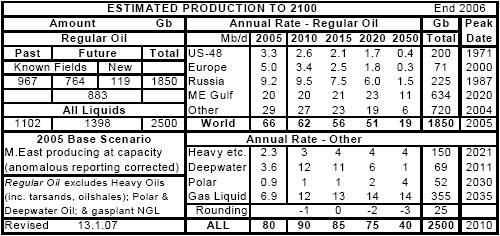
The important number is 1398 Gb all liquids future production to 2100.
1.4 trillion barrels of oil left to burn, that's 191 Gt (7.33 barrels per tonne) or 162 GtC (assuming an average carbon share of ~85% by mass) in the remaining oil.
Gas
Gas... is less. The 2005 BP Statistical Review lists world gas reserves at 179.83 trillion cubic meters. 1.0 cubic meter natural gas contains 0.49 kg carbon so we are left with 90 GtC in the remaining gas.
Total so far
Total carbon in remaining oil and gas is therefore 252 GtC or barely half the IPCC’s 490 GtC threshold. This supports James Hansen’s point I emphasised in the past about being able to burn the remaining oil and gas reserves without causing dangerous climate change (considered here to be +2C and 450ppm CO2).Assuming that all the remaining oil and gas will be burnt as fast the depletion curve allows, it is strangely addictive stuff after all, what does this leave us with? A remaining “allowance” of 490 – 252 = 238 GtC, a whole lot of coal and the significantly smaller anthropogenic CO2 emissions from land use change.
Coal
The World Coal Institute lists 2005 world coal production as 4973 Mt hard coal and 905 Mt brown coal/lignite. Hard coal is approximately 95% carbon and lignite is around 35% so that totals to approximately 5.0 GtC in 2005 from coal. Not all the hard coal will be the "good stuff" though so this will be a slight overestimation. Coal burn has increased rapidly in recent years - I wouldn't be surprised if 2007 doesn't come in close to 5.5 GtC.Taking our remaining budget of 200 GtC (leaving the other 38 GtC for land use change and other minor sources) would allow 200 / 5.5 = 36 years of 2007 coal burn. It is this statistic that shows us where to focus our attention. It appears the climate change problem is all about coal. One approach would be to stop coal expansion and new build within a decade (at least without proven carbon sequestration technology) and be off coal by the 2nd half of the century. If we do stop new build within a decade the old plant will gradually retire producing the desired result.
Is this even remotely feasible? I can't help thinking that it is easier to move away from coal than it is oil and gas leaving it unburnt in the ground and surely that is what is important, the easiest of a bunch of hard choices? I say easiest as we have many alternative (wind, wave, nuclear, tidal, solar, geothermal, biomass etc) ways of generating electricity and from where we stand today electricity consumption could be reduced significantly with minimal pain.
Previously on The Oil Drum
Peak Oil and Climate ChangeDr James Hansen: Can We Still Avoid Dangerous Human-Made Climate Change?
Greenland, or why you might care about ice physics
More Coal Equals More CO2
Climate Change and Electricity From Biomass
Personnel
Editors
Contributors
Peak Oil Primers
Archives
- November 2010 (3)
- October 2010 (6)
- September 2010 (4)
- August 2010 (7)
- July 2010 (6)
- June 2010 (7)
- May 2010 (2)
- April 2010 (8)
- March 2010 (4)
- February 2010 (6)
- January 2010 (3)
- December 2009 (5)
- November 2009 (8)
- October 2009 (12)
- September 2009 (6)
- August 2009 (5)
- July 2009 (11)
- June 2009 (8)
- May 2009 (16)
- April 2009 (10)
- March 2009 (7)
- February 2009 (10)
- January 2009 (15)
- December 2008 (9)
- November 2008 (9)
- October 2008 (9)
- September 2008 (13)
- August 2008 (10)
- July 2008 (14)
- June 2008 (23)
- May 2008 (16)
- April 2008 (12)
- March 2008 (16)
- February 2008 (9)
- January 2008 (13)
- December 2007 (13)
- November 2007 (16)
- October 2007 (22)
- September 2007 (8)
- August 2007 (9)
- July 2007 (16)
- June 2007 (8)
- May 2007 (7)
- April 2007 (7)
- March 2007 (10)
- February 2007 (10)
- January 2007 (12)
- December 2006 (9)
- November 2006 (15)
- October 2006 (4)
- September 2006 (5)
- August 2006 (5)
- July 2006 (9)
- June 2006 (5)
- May 2006 (10)
- April 2006 (9)
- March 2006 (13)
Vital Trivia
License

This work is licensed under a Creative Commons Attribution-Share Alike 3.0 United States License.
I made the following analysis at this link: http://www.theoildrum.com/node/2244#comment-155897
As you say, there are 2 problems here.
1) global warming
2) peak oil
The solution to problem #1 is not as obvious as simply finding a 'sustainable' rate of fossil fuel consumption. I doubt that there exists such a rate of any significance because what ultimately determines the Earth's climate is the cumulative amount of CO2 in the atmosphere. That is, the total amount _not_ sequestered in the ground or water. Since the time scale is hundreds of years, then any rate that would consume all fossil resources within, say, 300 years would end up more or less like consuming them in 30 years. It might give a some extra time, but the end result would be the same. I don't think any rate that we set as a 'sustainable' amount will last over 200 years.
Ultimiately, we need to have as much CO2 sequestered in the ground or water as possible. Clearly, the amount in vegetation is limited. Most CO2 must be sequestered under ground, either in form of coal or waste CO2. We have to set limits on what we can burn and/or how we burn it.
Problem #2 complicates things. Given the tremendous value of liquid fossil fuels, I would say that if we are going to emit CO2, then using oil gives the most punch for the emissions. So, I would write off all crude oil as gone. It will be burned. The stuff is too good.
That leaves coal, tar sands, and oil shale. Since these give less return for cO2 emissions, this is where we need to set limits. Designate areas as 'no mining', or 'carbon-sequestered mining only'.
Natural gas may be in the same boat as oil.
My suggestion would be to ban oil shale globally. Move towards banning tar sands globally. Designate the most envirnomentally sensitve areas as 'no mining' zones. And figure out how much CO2 from the remaining coal must be sequestered.
Of course, nobody suggested that I was onto something. So I found your post to be very affirming.
Hm, 2 problems, Peak Oil, and Global Warming.
Folks, only Global Warming is a real problem, Peak Oil is a problem for only one species out of millions.
Yeah, unfortunately fleam, it's that one species whose finger rests on the trigger.
I object to the use of this ASPO data. Not to mention that this is one of the most confusing charts of all time. EIA, IEA, OGJ would be better. Not to mention IHS Energy or Wood Mackenzie.
I'm thinking C+C+NGLs.
I'm thinking C+C+NGLs.
What the ASPO calls "All Liquid" is in fact C+C+NGL.
Then, I can already see a major descrepancy between EIA (81.55 mbd in August, 2006) and ASPO (79.7 average 2005). Who could believe that C+C+NGLs production increased that much (= +1.85 mbd, for even that one month in 2006) — the difference between the ASPO 2005 average and the EIA August, 2006 number? Not me. One is right, the other is wrong. Actually, they are probably both wrong.
People talking about peak oil should always use the historical production data least supportive of their position. I find that this helps matters, because the same peak oil arguments still hold. In addition, we are talking about production projections which, as I said, are nonsense beyond 2010. Everyone's production projections beyond 2010 are subject to large margins of error.
Use of ASPO data probably indicates a selection bias. No one uses it, including me. Therefore, that detracts from the argument.
Not sure I understand your point. The EIA estimates for 2005 and 2006 are 81.45 mbpd and 81.37 mbpd repectively (the ASPO is saying 80 and 81.90 mbpd, see here). Anyway, what matters in Chris argument is future cumulative production i.e. the URR minus past consumption. The ASPO URR is probably the most conservative.
Are you talking about this?
Solid Red Line is ASPO (C+C+NGLs, I think?)
Shows a rather sharp peak, don't you think?
ASPO-(70)71 forecast -- 84.48 mbd in 2007, 90.00 mbd in 2010, 85.00 mbd in 2015? Or, is it ASPO-58? Or is it ASPO-45?
Actually, there are so many forecasts on the page you referred me to (in the figure above) that I can't even begin to get it straight. The ASPO forecast (solid red line) does stand out, however, in it's pessimism.
By the way, the numbers I quoted (for ASPO) were taken exactly from Chris's confusing ASPO chart as shown in this story -- that's not Chris's fault.
Sigh. My standard comment: Jesus wept
So will there be a near term Oil and Gas peak or not?
I'm rather convinced there will be.
If so, then ecomomics will sort out the Oil and Gas depletion scenario and we will have to focus our political efforts on coal (and maybe shale oil), which is much more abundant and extremely tempting to use.
I assume that:
ASPO-70 (CO) and EIA (Crud Oil + Cond) is the same thing
ASPO-70 (CO + NGPL) and EIA (NGPL) is the same thing
ASPO-70 does not forecast other liquids
Which means that last production data is below ASPO.
Most of the time, ColinC does not incl proc gains of 2-mbd. Once a year he does. He does not incl BTL or CTL or Syncrude or any synthetics for that matter. When he says Regular Conv, he does not incl NGL either.
There is about 4 mbd difference betw his All Liquids & that of EIA, IEA or OPEC. And sometimes just 2.
And, to be clear, I might accept the figures out to 2010. The others are meaningless.
Total carbon in remaining oil and gas is therefore 252 GtC or barely half the IPCC’s 490 GtC threshold.
Hansen is saying in his presentation Global warming: can we avoid dangerous climate change
The discrepancy revolves around what numbers are used for the remaining reserves of gas and oil. Hansen is using higher estimates.
Your analysis makes the assumption that climate response will be linear and proportional to the quantity of CO2.
Hansen has said that this linear response cannot be assumed and that a non-linear, abrupt sequence of climate change is much more likely.
The fairly recent discovery of accelerating glacial ablation is evidence for a non-linear response.
If we follow your logic we are placing a bet that climate response to CO2 is linear and we therefore can go ahead and burn all the CC and NG available to us.
This is not science; it is betting. The stakes are very high. You may wish to ask your children if they wish to assume the risks to which you appear willing to subject them.
I agree that the uncertainties arund climate change are an excellent justification for reducing emissions sooner rather than later. I did just want to point out that the growth rate in emissions is part of reason climate change is accelerating. Emissions from fossil fuels grew from 6.5 GtC/y in 1999 to 7.2 GtC in 2005.
Key point. In fact the two are related by various feedback mechanisms, some negative, some positive, appears to be net positive (oceans, permafrost ...). At least historically T leads CO2 out of recent ice ages, though CO2 probably leads T out of massive glaciations.
Also, that 90 Gt C in NG is only true for economically recoverable sources. If we decide to tap methane hydrates (or otherwise release them, by say, warming at least the shallow water reserves) the whole game changes.
The above is from page 43 of the PDF Vernon cites above for Hansen. In this PDF Hansen is clearly arguing against the Business As Usual (BAU) scenario and is most emphatic that BAU may result in runaway, uncontrollable climate change.
Chris Vernon's post above appears to be arguing in favour of BAU. I do not believe Hansen has changed his opinion. If not then Vernon's post appears to be an irresponsible distortion of Hansen's warnings.
No I think Chris is simply saying this is where we get to, if we burn all the estimated available resources.
He also points out that if you burn all the ASPO estimated gas and oil reserves, you still don't really have a GW problem.
However if you burn the estimated coal reserves, you do.
Pardon the fact of my being a complete and utter blockhead but perhaps you or someone else can clarify the following:
We have to date burned one half of the ASPO estimate and it appears that we already have a GW problem. Glaciers are retreating, isotherms are galloping north at 6 km a year, Australia and Sudan both subject to prolonged drought. I am puzzled how it is that half of a bad thing produces these results while the full amount of a bad thing is not a problem at all.
I fail to understand how Hansen can be seen as a climate change radical or why he complains over political attempts to muzzle science reporting. He appears to be saying pump it and burn it, no problema. How does this radical position get him into trouble with the Bush White House?
I agree that coal is dirtier than oil and NG and has a higher carbon loading. But CO2 is CO2. If the current level of anthropogenic emissions result in evidence of climate change how do you argue for more of the same and deem the outcome to be safe?
One half of the ASPO number, but we have been burning a heck of a lot of coal as well.
And of course we have had massive land use changes such as deforestation of the rainforests. And emission of a large amount of non CO2 greenhouse gases (methane, nitrous oxide, CFCs etc-- as much as 40% of the greenhouse gas effect).
Hansen uses much larger estimates for oil and gas reserves.
Hansen is a radical because he has consistently said that global warming is a problem, and we need to do something before it is too late.
In 1988 when he said that before the US Congress, most climate scientists thought he was really going out on a limb, and there was no way we had enough data to support his assertions and modelling.
In 2006, if anything, he is only slightly to the radical side on what climate science is saying about what will most likely happen if we do not control CO2 emissions.
He is of course opposed:
'radical' is such a great way of discrediting someone, vs. moderates like, say, James Inhofe or Michael Crichton. 'radical' sounds like 'Islamic radical' or 'communist radical'.
His message wasn't comfortable in 1988, it is less comfortable 19 years later.
On GW generally, if you believe the APSO numbers (I don't) then we will burn our way through the existing oil and gas, and the atmosphere might be OK.
However we will also burn our way through the Canadian tar sands, the Venezuelan oil sands, and all of that coal out there. I think pretty much everyone realises that is enough to drown us in our own CO2.
While radical simply means going to the radix, the root of the problem. I wonder, is latin a subject available in school for US teenagers?
We should have an objective of cutting coal use by 5% a year from now on. For the western world that could mean not only turning off light switches and driving fewer miles but also buying fewer goods and not just from China.
Coal's dream run looks set to continue for a variety of reasons;
1) politicians won't hurt coal jobs
2) politicians won't bring in meaningful carbon caps without giant loopholes
3) green utopians tell us magical energy sources make nuclear unnecessary
4) carbon capture and storage is prohibitively expensive
5) the average consumer doesn't see the connection between shiny appliances and dirty coal
6) oil depletion will spur coal-to-liquids
7) electrification of transport will probably require more cheap generation
I don't see any coal slowdown within a decade.
I agree. That is why I am certain that humankind has entered its terminal phase.
It is not the end of the world merely the extinction of humankind. The world will continue on very well without us for billions of years, perhaps some fossils will testify of our existence in the Universe.
David Mathews
http://www.geocities.com/dmathew1
I agree no coal slowdown in a hurry.
The best we can hope for is restrained *growth* in coal use, as a result of alternative energy, greater efficiency and (perhaps) more use of gas.
Medium term, we could also phase in more nuclear. I am anti-nuke, but better a Chinese or Indian nuclear power plant, than the equivalent coal plant.
The same would also be true of Texas. If there is an environmental disaster around nuclear power, then Texas is a long way from where I am.
(I would probably accept new nuclear units in the UK, on the same basis: our alternatives are few, although I think we can do a lot with wind and with conservation).
UK can also do a lot with tidal (amplitude) power. Severn Estuary, Morecambe Bay, Mersey Estuary, Thames Estuary, Jersey, Guernsey and North Wales coast all have tidal ranges sufficient to warrant the building of tidal barrages simialr to that at La Rance in France (http://www.edf.fr/html/en/decouvertes/voyage/usine/usine.html).
Conservative estimates point to about 15 GW of capacity operating at about 35% capacity factor. Additional benefits would be the ability to use the tidal pools as electricity storage for off-peak wind power generation, not to mention the flood defence protection offered by such barrages. Wind power clearly comes in cheaper on a "per MW installed" basis against the traditional estuarine barrage model, but there are ways of mitigating some of this cost.
'36 years of 2007 coal burn'
however since 2007 is up 10% from 2006, and with the depletion of oil, this rate of increase would increase, we'll hit that limit quite a bit sooner.
(assumin 10% increase)
the amount of coal burnt each year = 1.1^x
the intergral of 1.1^x between 0 and y = -10.5+10.5^y*10^(1-y)
where 10.5 is a rounding of 1/ln(1.1)
: solving for when this reaches 36 gives us 15.6 years, not 36.
the worrying thing is that by 37 years we have put out 10x the amount required to cross the threshold, assuming the 10% per year continues.
Andrew
ps. anyone know a cheap source for electric solar panels in Australia
i'm looking at about 1kw depending on price - yes i know this isn't enough, but they are expensive little beasties atm.
(i think we have roughly until the beginning of next year when a coal power station shuts down due to lack of water because of the drought we are having - http://www.news.com.au/couriermail/story/0,23739,21189976-5005340,00.html)
Hadn't even considered the drought aspect of these coal burners--they love water. On the production growth, you can't assume any type of increase based on the current coal production figures, especially 40 years out, and most especially at high growth rates (i.e. anything over 5% per year). Hard rock mining is an energy intensive process, one that is not conducive to sudden, sustained increases in production.
US coal production is supposed to decline for the next two years, then have a slight uptick in 2008 (back to just under 2005 levels)--this is all according to the EIA of course. I buy it though. Production capacity growth has all taken place in the Powder River basin, and they are maxxed out due to rail constraints--they're hauling as much as they can already. The US DOT just made $1 billion in federal loans available in the 2006 budget for rail infrastructure development; much of it went towards expanding rail lines to and from the Powder River basin. ETA on added production ~3 years. I don't see the rate of production increase heading up past 3-5% per year even after the new rail lines are in place.
US Coal Production, 1890-2005

China, however, is a totally different animal. One look at their leap in production from the mid-1990's to today shows some serious cause for concern relating to climate issues, most especially when you take their exponential power generation growth into consideration.
2005 World Coal Production by Top Producers

Your plot of US coal production is interesting, but another way to look at these numbers is to plot the energy from coal. We are right now moving toward lower quality coal, and although the number of tons being mined is flat, total energy is actually decreasing. Not a good trend.
Another interesting point - stated world coal reserves have been declining over the past decade or more, and at a rate faster than can be explained by production. Very different from coal and NG, for which reserves continue (for awhile) to increase, in spite of increasing production. Peak (profitable) coal before 2050? It is not unthinkable.
You might check out these guys:
http://www.greenandgoldenergy.com.au/
I would check very carefully. This is still in the category of 'unproven' technology in that it hasn't been marketed before at the consumer level.
That SunCube is a really cool idea. Hope it gets legs.
MANDATORY RENEWABLE ENERGY – THE ENERGY EVOLUTION –R12
In order to insure energy and economic independence as well as better economic growth without being blackmailed by foreign countries, our country, the United States of America’s Utilization of Energy Sources must change.
"Energy drives our entire economy.” We must protect it. "Let's face it, without energy the whole economy and economic society we have set up would come to a halt. So you want to have control over such an important resource that you need for your society and your economy." The American way of life is not negotiable.
Our continued dependence on fossil fuels could and will lead to catastrophic consequences.
The federal, state and local government should implement a mandatory renewable energy installation program for residential and commercial property on new construction and remodeling projects with the use of energy efficient material, mechanical systems, appliances, lighting, etc. The source of energy must be by renewable energy such as Solar-Photovoltaic, Geothermal, Wind, Biofuels, Ocean-Tidal, Hydrogen-Fuel Cell etc. This includes the utilizing of water from lakes, rivers and oceans to circulate in cooling towers to produce air conditioning and the utilization of proper landscaping to reduce energy consumption. (Sales tax on renewable energy products and energy efficiency should be reduced or eliminated)
The implementation of mandatory renewable energy could be done on a gradual scale over the next 10 years. At the end of the 10 year period all construction and energy use in the structures throughout the United States must be 100% powered by renewable energy. (This can be done by amending building code)
In addition, the governments must impose laws, rules and regulations whereby the utility companies must comply with a fair “NET METERING” (the buying of excess generation from the consumer at market price), including the promotion of research and production of “renewable energy technology” with various long term incentives and grants. The various foundations in existence should be used to contribute to this cause.
A mandatory time table should also be established for the automobile industry to gradually produce an automobile powered by renewable energy. The American automobile industry is surely capable of accomplishing this task. As an inducement to buy hybrid automobiles (sales tax should be reduced or eliminated on American manufactured automobiles).
This is a way to expedite our energy independence and economic growth. (This will also create a substantial amount of new jobs). It will take maximum effort and a relentless pursuit of the private, commercial and industrial government sectors’ commitment to renewable energy – energy generation (wind, solar, hydro, biofuels, geothermal, energy storage (fuel cells, advance batteries), energy infrastructure (management, transmission) and energy efficiency (lighting, sensors, automation, conservation) (rainwater harvesting, water conservation) (energy and natural resources conservation) in order to achieve our energy independence.
"To succeed, you have to believe in something with such a passion that it becomes a reality."
Jay Draiman, Energy Consultant
Northridge, CA. 91325
Feb. 12, 2007
P.S. I have a very deep belief in America's capabilities. Within the next 10 years we can accomplish our energy independence, if we as a nation truly set our goals to accomplish this.
I happen to believe that we can do it. In another crisis--the one in 1942--President Franklin D. Roosevelt said this country would build 60,000 [50,000] military aircraft. By 1943, production in that program had reached 125,000 aircraft annually. They did it then. We can do it now.
The American people resilience and determination to retain the way of life is unconquerable and we as a nation will succeed in this endeavor of Energy Independence.
The Oil Companies should be required to invest a substantial percentage of their profit in renewable energy R&D and implementation. Those who do not will be panelized by the public at large by boy cutting their products.
Solar energy is the source of all energy on the earth (excepting volcanic geothermal). Wind, wave and fossil fuels all get their energy from the sun. Fossil fuels are only a battery which will eventually run out. The sooner we can exploit all forms of Solar energy (cost effectively or not against dubiously cheap FFs) the better off we will all be. If the battery runs out first, the survivors will all be living like in the 18th century again.
Every new home built should come with a solar package. A 1.5 kW per bedroom is a good rule of thumb. The formula 1.5 X's 5 hrs per day X's 30 days will produce about 225 kWh per bedroom monthly. This peak production period will offset 17 to 2
4 cents per kWh with a potential of $160 per month or about $60,000 over the 30-year mortgage period for a three-bedroom home. It is economically feasible at the current energy price and the interest portion of the loan is deductible. Why not?
Title 24 has been mandated forcing developers to build energy efficient homes. Their bull-headedness put them in that position and now they see that Title 24 works with little added cost. Solar should also be mandated and if the developer designs a home that solar is impossible to do then they should pay an equivalent mitigation fee allowing others to put solar on in place of their negligence. (Installation should be paid “performance based”).
Installation of renewable energy and its performance should be paid to the installer and manufacturer based on "performance based" (that means they are held accountable for the performance of the product - that includes the automobile industry). This will gain the trust and confidence of the end-user to proceed with such a project; it will also prove to the public that it is a viable avenue of energy conservation.
Installing a renewable energy system on your home or business increases the value of the property and provides a marketing advantage.
Nations of the world should unite and join together in a cohesive effort to develop and implement MANDATORY RENEWABLE ENERGY for the sake of humankind and future generations.
The head of the U.S. government's renewable energy lab said Monday (Feb. 5) that the federal government is doing "embarrassingly few things" to foster renewable energy, leaving leadership to the states at a time of opportunity to change the nation's energy future. "I see little happening at the federal level. Much more needs to happen." What's needed, he said, is a change of our national mind set. Instead of viewing the hurdles that still face renewable sources and setting national energy goals with those hurdles in mind, we should set ambitious national renewable energy goals and set about overcoming the hurdles to meet them. We have an opportunity, an opportunity we can take advantage of or an opportunity we can squander and let go,"
solar energy - the direct conversion of sunlight with solar cells, either into electricity or hydrogen, faces cost hurdles independent of their intrinsic efficiency. Ways must be found to lower production costs and design better conversion and storage systems.
Jay Draiman
Northridge, CA 91325
Email: renewableenergy2@msn.com
"MANDATORY RENEWABLE ENERGY – THE ENERGY EVOLUTION –R12
In order to insure energy and economic independence as well as better economic growth without being blackmailed by foreign countries, our country, the United States of America’s Utilization of Energy Sources must change.
"Energy drives our entire economy.” We must protect it. "Let's face it, without energy the whole economy and economic society we have set up would come to a halt. So you want to have control over such an important resource that you need for your society and your economy." The American way of life is not negotiable."
you sir, are part of the problem
the amerkin way o' lif knot negotionabible?
energy and economic independence?
blackmail? foreign countries. mosedek Iran, saddam iraq
you're heart may be in the right place, but your head...?
I apologize before hand
earldaily,
I am so sorry he upset you....I can tell that whole idea of American independence and continued existence just kinda' makes you sick don't it?
Don't fret, in that you have much in common with many here....the utter hatred of the United States is strong everywhere, but strongest in the U.S. itself....
Of course, given that the U.S. consumes only 25% of the worlds oil (and yes, that is far too high for it's share of the world population, not only on a moral basis, but in that it is bleeding us to death financially and destroying our nation's history of self determination and destiny, something that all nations consider important) we can assume the following:
>America is not, despite the hubris and lack of understanding of this by it's citizens, in a postion to decide world energy production/consumption and or energy use or efficiency. We can work on our own, yes, we can somewhat reduce our vulnerability, but we are a small percent of the world's population, and a declining percent of it's oil conusmption. What we say has less sway on global energy patterns with passing day.
>Despite what some may wish, and despite the "America hatred" that is so much at the core of many, the U.S. will not go down without a fight. No nation would. I don't know how that blends into the idea "American way of life is non-negotiable". That sentence seems a bit rigid, given that there are differences even in the U.S. about what constitutes the fundamental things about "the American way of life". But many years ago, a very good diplomat/negotiator once told me, "just about everything is negotiable except my own existence. If you want to negotiate that, then it becomes about surrender, not negotiation. The other party or parties in the negotiation will feel pretty much the same way."
A surprising number of people seem willing to agree that even before attempting solutions, America has no right to exist, I am willing to bet that is a contention that will be met with the strongest possible resistance. Perhaps not at TOD, but in America, it will be.
RC
Remember, we are only one cubic mile from freedom.
America has any right to exist. It also has the moral obligation to act responsibly, just like every other nation.
And, to be honest with you, since Americans ride the highest moral horse in the history of mankind, I will also expect them to act more responsibly than any other nation. And it is by their own hybris that Americans fall fall short of these expectations.
In less PC words: if you act like a buffoon, don't be surprised if people call you a buffoon.
go get'em big fella
bomb the're ass take there gas
it's america's right to exist
Whoa, LOL, I think you took Earldaily's comments a bit further than he meant them.
The quote "the American way of life is non-negotiable" I think is generally attributed to Dick Cheney about 4 years ago when he was specifically speaking about US access to oil and energy supplies (please correct me if I am wrong).
Cheney is, of course, wrong: the logical extension of his argument is that the US has the right to appropriate whatever energy, oil and resource supplies by whatever means it chooses and can achieve. So far its economic pre-eminence has enabled that, in future more coercive means might be necessary. Would you agree with that, RC?
Now there are some who think that USA is a cancer on the face of humanity in its profligate use of ultimately limited resources. There is some validity in that perspective but there are many good things about USA, too, and I would not wish to throw the baby out with the bath water. Nor would I support the mass nuclear destruction of USA to reduce global oil consumption by 25% and introduce a bit of global dimming to assuage climate change for a while.
Some might think that humanity is a cancer on this planet. The are valid arguments that may support that view, but I would not support the collective destruction of humanity. (I can't speak for Gaia, though).
I'm hopeful that the US way of life will negotiate itself to a place that is more conducive to humanity as a whole and this planet in general. Virtually everyone, everywhere on this planet, will need to do that, but USA more than most, methinks. Without negotiation and mutual cooperation there will almost inevitably be conflict. I don't think we really want that.
One point of leverage the US federal government has is its mortgage insurance programs through FHA and VA. Requiring the use of solar heating and greater use of insulation in new construction as a requirement for insuring a mortgage would instantly change how new housing is built.
Thanks for this Chris.
What I don't quite get is this 450 ppm number. Do you know where this comes from? Does Hansen explain it clearly?
From what I can see going on with respect to positive feedbacks and functional declines in the cryosphere, the biosphere, and the oceans--all of which will take decades if not centuries to adjust to the current levels of GHGs--we are in a very dicey situation at the current 380 ppm (or ca. 400 ppm CO2 equivalent when other GHCs are included).
I think we need a decline in the concentration of GHCs toward pre-industrial levels rather than thinking about stabilization at some amount higher than today. Do you know of anyone out there saying this?
It is interesting to have Hansen talk about this though. The IPCC uses estimates of fossil fuel availability based on a review paper by Roger from the late 1990s. This can be found in references in the SRES section of the TAR.
the new hansen graph:

Note that Freddy's graph shows the levels of CO2 expected in the atmosphere FROM various anthropogenic - mostly fuel - sources at various times, NOT the expected burn of each fuel at that time. Note that a CO2 molecule emitted from a chimney/tailpipe has a half-life in the atmosphere of around a century. A CO2 molecule emitted from your exhaust now has an even chance of still being up there at the end of this century. Even with constant CO2 output rather than increasing output, e.g. from massive coal burn, atmospheric concentrations will continue to rise.
At present nearly half of the CO2 we have ever emitted as been absorbed by the soil, vegetation and ocean. There is plenty of evidence that these "sinks" - especially the first two - are nearing saturation and cannot take much more. Indeed in a warmer world they might turn into sources of extra CO2, e.g. if Amazonia dries out and burns.
These ideas of stabilising CO2 at some level much higher than they have been for hundreds of thousands of years, let alone higher than they are now, are fraught with danger. The levels we have now, even if they "froze" at 380ppm, will continue to drive up global temperatures for decades and may trigger severe positive feedbacks. Higher levels such as 450 ppm are even more likely to do this. 450ppm is no more "safe" than 600ppm, than driving for 10 seconds with your eyes shut is safer than doing it for 20 seconds. It is less dangerous, but still dangerous. It is simply based on what might possibly be achieved by policies with some level of political acceptability, what we can actually aim for in the real world of people wanting to drive cars, shop at Wal-Mart, take a two week holiday 5,000 km away. We can still expect nasty surprises and climate scientists seem to find a new one - like faster than expected melting of Greenland's glaciers - almost every year.
I see that in the time I've been writing this memmel has added some good extra info and links below.
Chris equates 450ppm with 2C in "total so far" but my interpretation of Hansen's work is that 450 = 1C and worse, his 1C is from 1880 and we've used 0.6C of that already.
While he says we can use oil and gas reserves and reserve growth fairly safely, that includes only conventional oil and ngl. It does not incl the 150-Gb of ASPO Heavy oils (venez, tar sands and shales) ... which he says must all be co2 sequestered if used. Similarly with methane hydrates and all coal used after today.
Methinx his reserve and reserve growth figure for oil is only 1200-Gb. Consensus is that unused URR is presently 2000-Gb. The diff is not factored in and worsens the situation if true. If Peak Oil is wrong, it does not bode well for co2. A good news ... bad news tale.
Now you know why I think we need to re-engineer our grid and transport around carbon-negative energy systems.
Thank you Chris for keeping this subject up to date.
For those who want to know more about fossil fuel consumption, especially Coal, on the XXI check this paper:
Fossil fuels: what future?
This is a great link on the cryosphere I post periodically.
Its updated daily.
http://arctic.atmos.uiuc.edu/cryosphere/
Here is todays graph.
http://arctic.atmos.uiuc.edu/cryosphere/IMAGES/current.365.jpg
You can clearly see the effects of the warm fall on sea ice.
In if you look through past years it is obvious the at least in the Artic we are seeing a real change in the climate not a smooth warming.I don't think we can assume that increases in CO2 levels lead to smooth changes
in the climate.
More important is the fact that natural positive feedbacks such as melting permafrost which add C02 and worse methane to the atmosphere may significantly increase C02 levels in addition to the effects of human C02 production. Remember our planet has a natural cycle of warming and cooling periods. Human induce warming has probably caused a unnatural initiation of a natural warming cycle.
I'm not convinced that any of the measures put forth would solve the global warming problem. The only safe approach is to move a zero emission society. Even constant emissions are probably not good enough to prevent a significant warming event. And once the natural warming cycle gets going I think that emissions from natural sources could easily swamp any reasonable change we could make in emissions if we continue to live the way we do.
As you can see I'm far more pessimistic about the prospects for us to ameliorate the effects of global warming
than the IPCC report which is considered pessimistic itself. And the chances of us even meeting any of the reduction requirements suggested in the report are slim on the global scale.
Thus I think its more important for countries to take the stance that they plan to convert their societies to zero emissions and that they assume that international trade may fragment over time requiring them to be able to produce everything needed for their society locally if needed. For a modern way of life like ours this probably requires the country to have significant renewable resources and a population in the range of 30-100 million.
With enough agricultural land to sustain the population. And finally the climate should probably not be semi-arid and dependent on glacial or winter snow melt unless the population density is low since these types of climates are subject to severe drought during global warming.
In short we need to consider the creation of economic arks that create high tech zero emission localized societies. Trade will continue to be important of course but economic upheaval in regions that are suffering from climate change or the failure to convert from a fossil fuel economy will make dependence on trade problematic.
In fact towards the end of the Roman Empire the estates followed exactly this model moving to produce all goods locally this became the medieval guilds.
http://en.wikipedia.org/wiki/Guild
In our case a guild like system might be needed to ensure supplies of finished goods in the face of chaotic
international conditions.
In any case the direct impact on us from both global warming and peak oil is local recurring shortages of goods
and unstable exports as strife hits both producers and consumers.
I just cannot see us able to take our society forward as it is today as the twin effects of global warming and peak oil become obvious. Either the societies will restructure to maintaining a high standard of living with zero emissions or they will collapse reverting to low emission primitive agricultural societies.
I assume a mix of both with large population loss all but certain. Assuming we can maintain regions of the earth that can continue to produce high technology it may be 100 years or more before technology again spreads through most of the planet. This time it will be green high tech and probably fusion devices. But the second industrial revolution will probably be a lot slower than our current one.
IMO there is a perverse tendency of posters at TOD to become Kunstlerian dystopian fiction writers. No one knows the future. When I first heard of Peak Oil, I got the impression that it would be a dramatic, near term thing. That was about 3 years ago. Despite all the price increases and talk of shortages, oil is readily available and discounted for inflation is probably about the same price it has been for years. House prices have increased 10 times and car prices are up 10 times since the 1960's. Gas back then was 28 cents per gallon I remember. Now it's about $2.15 here. So where is the big crises? There is no market for global warming but I suspect over a long period of time the effects will be equally benign. Some species will die off as has always happened, some will evolve and adapt. Some areas of the world will become hot and dry and some will melt and become fertile. Kunstler makes yearly stock market predictions and is always wrong big time. He travels to various cities and posts the same dire predictions of collapse of suburbia with only the name of the latest speaking engagement city substituted. Some problems, if they ever happen, will have to be solved by future generations. Those that came before us didn't solve all our problems, nor could they.
Other species replace them? Yes. In millenia.
Your panglossian short-termism and parochialism is depressing.
True about not solving future generations' problems
*but*
we shouldn't leave them a legacy that is within our power to do something about.
So we banned CFCs, because we could see the hole in the ozone layer. Which is still expanding, btw, but it is hoped it will cease to do so in the next 20 years or so.
Similarly we banned PCBs, and DDT, because we could see we were destroying the living conditions of future generations.
or not extincting species, randomly, because then future generations cannot choose whether to see those species.
Global warming is something we have the power to do something about, now.
Peak Oil, if it is real, is something we can delay by conservation now, giving us a greater chance to develop new energy technologies.
How dramatic a fall out of a window on the 60th floor appears to someone depends of their longterm outlook on life. Someone who happens to look forward to less than three seconds in the future will, of course, not be particularly frightened and enjoy the views. Everyone else might just be scared to death. Quite literally. Enjoy your views. They will last for all but the equivalent of three seconds.
Predicting the future is difficult and prone to error. I'd love to see a gentle transition on the same hand evidence exists that points to the approach of a painful transition. We certainly cannot continue to live as we have and have China and India reach the consumption levels of western nations. Their is simply not enough resources on the planet.
We need to change our societies so that they can grow in a sustainable manner. No one that promotes a laissez fair approach has made a compelling argument that the world can handle 8 billion people living anything close to an American lifestyle.
How the future unfolds and the external conditions that prompt this change are not important whats important is that it is obvious we need to fundamentally change to a conservation biased and sustainable oriented culture.
We can still expand but not on this planet. So if we wish to continue to grow its time to seriously considering migration to other planets in our system and let the earth stabilize. I hope that if we choose to expand into the solar system and can continue to maintain the technical ability to do so we will do it in a sustainable manner
or we will face a crisis similar to that on earth sometime in the future.
Thus even if we continue our expansion off the planet we must still solve the problem of sustainable living regardless of the size of the resource base. If you don't you will eventually reach the point that some critical resource becomes depleted or you cause a unfavorable change in the natural system your exploiting.
This does not mean you can't alter the natural surroundings to make it easier for humans to live a modern life.
Their is nothing wrong with farming parts of the river deltas or harvesting wood for our use. Just we need to balance our impact and leave plenty of reserves to balance our impact.
I do believe that we can have a fairly high population on the planet esp when we achieve fusion and still not destroy our environment. It would be great if we start researching exactly what levels of population and resource use are possible for a given environmental impact. Short term even fission power plants may be the most sensible approach to transition our societies if we work through a way to limit the amount of radioactive waste and a way to convert all the waste to short half life isotopes. Renewable sources such as solar and wind etc should be investigated but I suspect the environmental impact of these sources may be much larger than people realize.
Vast wind or solar or biofuel farms are certain to have a serious impact. The use of solar/wind/bio resource as small scale power generators for city and towns and remote villages has far less impact. In short its one thing to automatically cover all our rooftops with solar cells and another to blanket large parts of the earth with solar cells or wind farms. They are not a cure all. On the same hand central power stations with large strips cleared to distribute power also have a negative impact so again its a matter of balance.
The balance seems to be to have small regions with dedicated high energy sources preferably fusion so that the environmental impact is minimized with the rest of the regions using solar/wind/bio power in such a way that it
does not destroy the local environment. I cannot see us continuing our high tech society without a significant amount of cheap electrical power for manufacturing and powering our cities.
Long term the power source with the least natural impact is fusion followed by solar and and wind power.
So if you actually do the analysis a very aggressive campaign to make fusion viable seems to be critical.
In closing current conditions such as peak oil and global warming are raising alarms that we may need to become aggressive about changing the way we live false or not they do not change the fact that we must evolve away from our current wasteful society. I'd love to see us have the maturity to change because its the right thing to do.
Current conditions are warning us that if we do not change on our own we may face a difficult future in the short term that forces us to make the change. All indications are that we will wait till well past the last minute to change.
I can get onboard this switch everything off strategy as far as coal goes but surley the problem with peak oil and peak NG is that there will be moves into a growing use of coal.
getting off coal onto the list of alternatives looks a ask to me without some sort of direct comand intervention.Whats more stopping new builds with in the decade? currently electricity consumption global is running at 8.5%! most of this via coal. I only hope India and china go off the boil somewhat.
if this continues for a decade we are looking at burning more coal in the next 10 years than all previous history!
we need to start switching stuff now. are we going to need to wait another two US election cycles for action on this.
I don't consider myself in the doomer camp but etc... continued page 94
we already have proposals for new coal stations in the UK IIRC?
I think we need to push rationing and the command economy
Boris
london
most people do not look at china enough
china has 100 years of coal left. I would like to know how they
get to that figure
Chinas coal reserves are given by B.P as
62200 million tons hard bitnmme
33700 million soft bit
18600 millin lignit
total 114500 million tons
This figure was first used in 1992, and was the figure given by
the Chinas member to the World energy council.
So just like K.S.A. over the last 15 years they do not seam to
have used any coal.
96% of there output is bitunim 4% lignite as stated by the W.E.C
production from 1999 to 2006 inclusive 12998 million tons.
figures taken from the world coal institute.
62200+3700= 95900 million tons bitumin
959000-12478= 83422 million tons left
18600-520= 1808 million tons lignite left
2006 production 2538 million tons
83422/2538=33 years lelt
if you include modest producton growth for 1 new power station every 10 days and planned coal to liquid plants of 100 million tons
a year for the next 9 years to 3500 million tons a year to hit
max production Chinas hard coal runs out in 2032. 25 years time.
lignite would last anthor 4 years.
The volume of coal China uses is to great to import and then rail
fright it around such a large country.
With oil and gas supplies in very short supply by then China will
fall apart by 2040. without the help of climate change.
China will stop increasing their rate of coal burning shortly. They are already suffering enormous ecological and medical problems and have to repair the damage to their environment. There are signs that the Chinese government takes this problem seriously. And since they are usually very succesful at anything they put on the short list (think population growth), we will see changes over the next decade. China will also see carbon taxes on their exports way before that, anyway. The US and Europe will (have to) curb China's export growth for sake of their own economies and carbon taxes will be a great way of doing so without calling it a "trade deficit import tax", which would piss China off big time. On the other hand, with a carbon tax everyone can save face, which is especially important in diplomatic relations with Asian nations.
I hope you are right, but if they just keep to the same rate it
will only take 33 years. If we are lucky they will use some of there trade surplus to build renewable power plants, not just
to meet planed growth, but also replace some of ther currant coal
power, and retro fit coal fired power plants with filters.
There environment is in a grim condition,and they need to take
action to limit the damage done. I hope they are succesful for the
sake of their own people, and all of us in the long run.
They have a difercult balancing act to pull the 700 million
people still in poverty out of it, and not destory their environment at the same time.
Well done. The "100 years of coal" was a good number when China was still producing around 1 billion tonnes back in 1999, but production never stands still, which is why R/P ratios are fairly meaningless. China's 2007 forecast production is 2.5 billion tonnes.
I have been doing the same kind of analysis myself for a detailed study of China's coal industry I'm leading, and geological and logistical constraints appear to become increasingly binding by 2015 or so. I doubt China can increase production beyond 3.5 billion tonnes per year, even though, as you noted, they are working their way down the quality scale already in terms of energy content of the coal they produce and will need to produce more to provide the same amount of energy. Only 6 mines in China can produce coal of 6kcal quality--the rest are in the 4kcal and lower range.
CTL impacts could be huge (350 million tonnes additional coal demand if all 100 million tonnes of Shenhua's plans are built by 2020--not each year), not to mention the coal-to-chemicals projects, but water will be extremely limiting as well (3-6 tonnes of water per tonne of output for CTL).
China is finding few options to reduce its dependency on coal, and in the tradeoff between the present and the future, I'm afraid the future is going to get screwed as a result.
This disparity is easily explained by the fact that China's coal reserves amount to a small fraction of the actual coal in the ground. When such a situation occurs with any resource, reserves tend to be static or increasing with time, rather than depleting due to consumption. For some idea of how much current reserves underestimate the amount of coal China could actually burn, read the following article:
From a resource depletion point of view this is comforting. From a climate change perspective, it's an absolute f*#@ing nightmare.
Resources aren't reserves aren't recoverable reserves. China averages about 30% recovery on it coal reserves, and more than half of the resources are more than 1000 m deep, so basically inaccessible. It's a lot of coal, but there are binding limits to what it can produce.
Very true, but even if only one sixth of that 5.5 trillion tons is mineable, that still equates to almost a trillion tons (what is currently counted as the world's reserve). And what is mineable changes with time and improvements in technology. Underground coal gasification (UCG) could make it possible to access seams too deep to exploit with conventional mining, for example.
My primary point, however, still stands and is that coal reserves will continue to increase rather than decline due to the gargantuan size of the resource base.
Another example of which I'm familiar with is the UK. In the early nineties, before privatisation, British Coal reported to parliament that 40 billion tonnes of coal were accessible with the mining technology of the time out of a resource base of 190 billion tonnes. Today British coal reserves are below 1 billion tonnes. Did we really mine such a large amount of coal in one and a half decades? Of course not. Natural gas, CCGTs and cheap foreign coal all combined to make most of Britain's deep mine coal uneconomic. But there it still sits.
Those who predict peak coal for sometime this century on the basis of current reserves are thus likely to be disappointed.
Rationing electricity is trivially easy. Start by saying all new build houses will henceforth have 5 amp + [2 amp*bedroom] rated supply breakers [double it for you low volt-ers over the pond] that only reset 1 hour after tripping [so you don't lose your frozen food]. Then watch as LED lighting etc will instantly become standard for new housing! Gradually apply it to older houses - maybe with a higher allowance for poorer efficiency in old properties etc.
Limiting the total current is a really bad idea. 5A+2A*bedroom makes for 11A in total for a 3 bedroom house. That's 1320W of power, not even enough to run the stove to cook a lunch. On the other hand, someone who consumes that much 24/7 will have a 950kWh/month electricity bill, far higher than many households have right now (ours is 350kWh/month).
Wrong idea. On all levels.
how about Kwh smart cards you strip your meter with? could be based on a system similar to a oyster card.. this would encourage individuals to cluster for high energy activities to stretch the value of their ration.. you ca also manipulate the Kwh for OAPS etc
your also free to sell you Kwh if you are frugal on a parallel market but the fact remains the total Kwh in circulation is fixed and the average consumption stays the same
Boris
London
to expand this idea.. your electricity bill is still based on the premises and is not rationed. the ration smart card is free as is the allowance on it as you still need to pay your bill separately. The ration is just a limit on each individuals ability to buy. In other words you could sell your ration allowance without buying any electricity as the bills are by meter not by card. this allows the maximum flexibility in individuals to improvise and organize on a local level in social units of their choice. In effect I would hope that you would end up with a macro conservation effect being offset by ingenuity at a local level that mitigates lifestyle impacts.
responsibility and power is given to individuals and aso encourages cooperative thinking and mutual benefit solutions
Boris
London
Limiting the total current is a really bad idea. 5A+2A*bedroom makes for 11A in total for a 3 bedroom house. That's 1320W of power, not even enough to run the stove to cook a lunch. On the other hand, someone who consumes that much 24/7 will have a 950kWh/month electricity bill, far higher than many households have right now (ours is 350kWh/month).
Wrong idea. On all levels.
==============================================
Eat less lunch! I did say double it in the US [110V]. A low limit is exactly what we do need to change the psychology that electricity is a limitless convenience. You can also phase it in [as I stated]..
Incidentally I can run a slow cooker at 150 watts, and I can melt solder [300C] at 15 watts.
cheers
Chris, I agree entirely with the bit in bold.
The crux of the matter in getting off coal is substitution - and I think this graphic posted by Khebab gives some food for thought.
http://www.theoildrum.com/node/2186
I never fully got my head around the "each year for 50 years" part of this graphic. But the question is, to get off coal, how many nukes or how many windmills will we need? The coal plant was rated at 500 MW, the wind turbines 1.650000 MW and the nuke 1.1 GW.
I'm still a little concerned about the availability of U - and what we might use to dig it out of the ground.
What this guy said... which is similar to my position
i see no option but rationing while building a lot of that other stuff in Kheabs graphic. I can get onboard nuke bandwagon if needs be but we need to switch stuff off now.
if new builds stop in 10 yrs approach is a political concession fine. but to my feeble mind its not enough soon enough
reducing electricity consumption? how? AFAICS your going to have to mandate it and i think market based solutions are now just some deranged fantasy. And this position is not borne out of some ideological priori left vs right as much as perception the market is just not doing the job as I see it.. quite the reverse, i would love the market and the price of stuff to sort this out, but as someone above stated oil is still cheap because the price never has reflected depletion or secondary effects like GW.
what does that mean? To my mind it means massive market adjustment at some stage, and by definition the market will correct itself because like relativity the market is absolutely correct.
but I have a growing impression this market adjustment=collapse of civilization if we are not too carfull. I am no doomer but shit happens.
At what point do we say business as usual is not going to happen?
the solution is very simple
Calculate your mitigation plan based on a rationed consumption of a know depleting resource base and divide your output in per capita blocks and ration it untill we reach the promised land.. if that means less than 3kwh per person per day or what ever than thats the life we all enjoy in the 21st cent...
thats my solution and it will work you correctly calculate out coal production from the ration and leave that puppy in the ground for a rainy day as Chris suggests.
As in game theory defection has to punished or enforced through diplomatic pressure... who is going to tell the chines to turn out the flame unless we are switching of the lights.
the radical simplicity of rationing that runs counter to current market addicted perception is the reason why it will work.
the analogy is the film apollo 13.. we are all onboard and the power is life so we power down.
the market is really another name for human ingenuity and is represented by those smart bods from NASA and JPL working out how to fit a round filter in a square hole...or figuring out the re-entry procedure with less power than a toaster
ingenuity and individual entrepreneurship doesn't disappear in a rationed environment as it has 2 outlets
1) increased utility per ration: note jervon's paradox does not apply there is a concrete roof
2) cheating, which you try and limit
problems? you bet, but the markets is just going to create a conflation of interests and by inference conflict which is the cheery on this F**k-up cake of all time
The need to express oneself through consumerism can be deflected into a virtual economy of goods and service existing in cyberspace (thin i know but you come up with something else..civic pride?)
Rationing and soon
Boris
London
This is based on Paccala and Socolow at Princeton, their 'wedges' model. Google it.
1.6 m wind turbines built over 50 years, defers 1 bn tonnes pa of Carbon emission into the atmosphere (3.667 bn tpa CO2) or about 1/15th of projected 'Business as Usual' emissions at that time.
Roughly speaking, coal is about 30% of the world's energy consumption.
Oil is about 35%, IICRC.
So it follows we need to build in the region of 20-30 million wind turbines or in the order of several hundred thousand a year.. or some percentage of a total mix made up in a wind/solar/nuke scenario.
better get started.. if we can mass produce 60 million cars a year?
How preposterous is a ramp up to 750,000 turbines/yr? compared with us burning coal like there is no tomorrow..literally?
how gradual a phasing out of one to an other can we get away with?
Boris
london
It follows that the US has to bring their average power consumption per capita down from 10kW to 5kW, Europe and Japan have to get closer to 3kW (from 4 and 6kW).
It follows that everyone needs to co-generate (with solar electricity and heat) as much as they can.
I am interested In how that calculation is made.. I can see how everything can be represented by differential rates acting across each other but what sort of assumptions are we talking about for a 50% ration regime? I am surprised its not lower
mitigation strategies such as Hirsch are limit to single issue rather than a holistic GW to zero emission economy
has anybody laid out a solid "if I was the ruler of the universe" transition scenario with calculated rates of replacement based on the assumption we need to start powering down tomorrow (a year or two!)?
Boris
London
Back to the Socolow model.
1 million wind turbines is 1000 nuclear stations is carbon sequestration for 1000 large power plants is doubling the fuel economy of the world car fleet (which will rise from 400 million now to 2 billion by then, on their forecast) is halving the average miles driven per car.
They have 15 wedges in their model, we need to achieve 7.5 of them to keep world CO2 emissions at the current level vs. the Business As Usual (BAU) scenario for 2050.
I don't see 20-30 million 1 MW+ wind turbines as possible (depends on what happens with home microwindmills, of course).
The problem with energy conservation,or with alternative energies, is the following : they may change actually the rate at which we burn fossil fuels, but not the total amount that we are able to extract at a reasonable cost. The latter is fixed by Nature and we cannot really act on it. secondly, don't forget that the energy market is a free market. If we reduce by a fair fraction the amount of fuels we use, then the price will collapse like in the 80's,which is likely to cause an economic boom and a rush on cheap energy, cancelling the effort we made. Don't forget also that 90 % of mankind is living with 5 times less energy than industrial world : how can we prevent them to use the amount of fossil fuel that we have spared?
The CO2 lifetime being around 100 yrs, the amount of CO2 that will be staying in the atmosphere in 2100 depends essentially on ONE , on only ONE parameter: the total amount of carbon that we will have burnt during this century. All IPCC scenarios differ only in this final value. As i said above, it is extremely unlikely that this amount will be much lower than the maximal amount we are able to burn. So the best is to hope that ASPO is right for oil and gas, that coal will be too expensive to extract more than 1000 GtC, and cross the fingers....
If consumption is capped by rationing rather than efficiency gains allowed to expand consumption al la "Jevons paradox" would you agree conservation and efficiency start to have a real impact on consumption?
in a sense conservation doesn't work because there is a free market and the market doesn't price resource replacement into the price (or lags in this regard in a very unhelpful way)
Boris
London
See my post on Robert Rapiers discussion of the Auto Efficiency Wedge. I lay it out pretty clearly there.
cheers i will do that
The "each year for 50 years" part is the crux of this graphic comparison. To equal the energy of just one year's worth of the oil we burn, we'd need to build 104 coal plants each year, for the next 50 years. That's 2 a week for half a century just to equal the oil we burn in a single year. Or build one nuke a week, every week for the next 50 years, to equal just 365 days worth of oil. If I'm wrong about this, please correct me. But if this indeed is what is being illustrated, and I believe it is, consider the gravity of it for a moment, and that even here on the most informed PO site in existence, we don't collectively 'get this' yet. The graphic demonstrates the tremendous concentration of energy contained in oil, and the utter impossibility of replacing it. Civilization will scale back of necessity. William Catton's "Overshoot" is an excellent read on the impossibility of continuing this energy-extravagent civilization we take for granted.
Too many people using too many resources.
It looks like we are not willing to deal with reality, so reality will deal with us.
Ouch.
Thanks for the technical discussion.
What I take away thus far is that we have no technical solutions which will enable us to continue to consume nearly the amount of energy we consume now.
Stir the whole big picture into this.
We will spend far more energy on war in the next few years than we ever have -- stupendous amounts of energy and materials.
We will begin to experience various shortages -- water, food, energy, medicines -- as resources are depleted and population continues to grow.
We will spend more energy dealing with the effects of Global Warming already happening.
We will spend more energy on social unrest due to massive changes and unresposive political elites.
Things look a bit grim.
The technical discussion is so necessary, but we sure do need more informed public discussion of these issues and more informed public policy decisions based on that process. As always, eh?
And so it goes...
"What I take away thus far is that we have no technical solutions which will enable us to continue to consume nearly the amount of energy we consume now."
So you took the wrong thing away from the discussion. You should have noticed by now that there is ample evidence that we do not need to consume nearly as much energy as we do. Our standard of living is not based on our waste but only on the usefull amount of energy and that, unfortunately, is very, very low. By improving efficiencies, we can do the same, cheaper and better.
"We will begin to experience various shortages -- water, food, energy, medicines -- as resources are depleted and population continues to grow."
That is simply doomerism 101. You can as well subscribe to the Church of the Second Comming. They meet every other Thursday on the hill and praise the Lord, hand in hand, while waiting until someone decides that it will happen Thursday two weeks from now.
"We will spend more energy dealing with the effects of Global Warming already happening."
And what would we do that for? The effects of global warming can not be combated on any level. You can not bring glaciers (and tourists who want to ski) back and you can not put levees around whole continents. The effects of global warming you will simply have to live with.
IP: You must remember that you are dealing with a people who belive that a cubic mile of crude oil equates to freedom in some way, a people who also believe that "others" are seeking to take this "freedom" away from them, and that this existential threat to their society of gas powered lawnmowers and golf carts is justification for the pre-emptive destruction of everyone else on the planet.
Chris, I think you have the numbers slightly wrong. This graph here:
shows carbon emissions from coal at 2.2 Gt carbon for 2000. With 5 bln.tonnes of coal burnt in 2000, this translates to 44% average carbon content of coal. This is in line with various sources, pointing carbon content ranging from 30-40% for lignite to 85-90% for anthracite. Your 95% for hard coal is way off and is applicable only to the tiny amounts of very high-grade anthracite.
Using the 2005 number of 5.9 bln.tonnes of coal produced x 0.44 = 2.6 Gt of carbon. 200 / 2.6 = 77 years of coal at 2005 consumption levels. With rising coal consumption this will certainly go below 50 years. Still we are way off bounds but this sounds much less urgent than 36 years IMO... I believe that for less than 50 years we can replace all coal capacity with nuclear - entirely doable task, which would be much harder for the 36 years you come to.
As for reserves they are entirely sufficient to sustain our drive for coal-fueled self-destruction - only the proven reserves are ~ 1 trillion tonnes. Thus reserve / production ratio using 2005 figures would be 169 years, or more than twice the "threshold" number of 77 years. It is estimated that undiscovered or currently rendered uneconomical reserves are 4-5 times the proven reserves and I am certain that a substantial part of those will be put into production when the time for it comes (not very soon).
Of course GW is all about coal, though if I may humbly suggest you can safely put tar sands, heavy oil and oil shale in the picture... these resources total more than the current coal reserves and if business as usual continues, using them is only a question of time.
LevinK,
Could you point us to the source of that graph and numbers? Thanks.
Sorry, the graph is from wikipedia:
http://en.wikipedia.org/wiki/Greenhouse_gases
The figure for coal production for 2000 is from EIA:
http://www.eia.doe.gov/emeu/aer/txt/ptb1114.html
The coal reserves are also from wikipedia:
http://en.wikipedia.org/wiki/Coal
Carbon content of various grades of coal is largely available on the internet if you google it. Wikipedia gives ultimate oil shale reserves at 1.8 trln.barrels and tar sand totalling about than 4 trln. barrels - when totalled, both their energy and carbon content exceed the proven coal reserves.
These were the prima vista sources I found in Google to determine average coal carbon content - I got suspicious about the 5Gt coal emission figure as I remembered that total emissions from human activity are less than 8Gt and that made coal contribution unproportionally high.
This does not change the important points that Chris made of course.
(edited to add some more sources)
One more thing: you are also assuming that as oil and gas dwindle this will not affect coal consumption or other fossil fuels consumption, while it is very feasible to gasify coal and replace oil & NG with it. The result would be that it is very likely the 50 year carbon budget I suggested previously would drop even further to 25 or 30 years.
There may be a problem with the methodology you used to estimate the amount of carbon in the world's remaining oil and gas. To reach your total of 162GtC in the 1,398 GB of "all liquids future production to 2100", you assumed "an average carbon share of ~85% by mass...in the remaining oil." This is a common misconception. In reality, 1 barrel of oil generates 3.09 tons of CO2. The correct methodology gives these equivalences: 1.4 trillion bls of oil /7.33 bbls per ton = 191 billion tons of oil. One ton of oil = 41.86 Gigajoules, giving a total of 7,895 billion GJ. One GJ of crude oil = 0.0755 tons of CO2, giving a total of 669GtC, or more than 4 times greater than the 162GtC that you calculate. If I haven't stumbled badly in my calculations, this would call for a re-evaluation of the role of oil in the global warming formula.
If I haven't stumbled badly in my calculations, this would call for a re-evaluation of the role of oil in the global warming formula.
I tried to repeat your calculations, ended up with 603 Gt CO2. Note that Dave's number is GtC, you forgot the last step converting Gt CO2 into GtC.
You're right, I did indeed skip the final step of multiplying by 44/12 to convert CO2 into C. Many thanks.
So we're back to ~162GtC? :-)
0
1
2
3
4
5
6
7
8
10
11
12
13
14
15
16
17
18
19
0
1
2
3
4
5
6
7
8
9
10
11
12
13
14
15
16
17
18
19
0
1
2
3
4
5
6
7
8
9
10
11
12
13
14
15
16
17
18
19
0
1
2
3
4
5
6
7
8
9
10
11
12
13
14
15
16
17
18
19
0
1
2
3
4
5
6
7
8
9
10
11
12
13
14
15
17
16
18
19
0
1
2
3
4
5
6
7
8
9
10
11
12
13
14
15
16
17
18
19
0
1
2
3
4
5
6
7
8
9
10
11
12
13
14
15
16
17
18
19
0
1
2
3
4
5
6
7
8
9
10
11
12
13
14
15
16
17
18
19
0
1
2
3
4
5
6
7
8
9
10
11
12
13
14
15
16
17
18
19
0
1
2
3
4
5
6
7
8
9
10
11
12
13
14
15
16
17
18
19
0
1
2
3
4
5
6
7
8
9
10
11
12
13
14
15
16
17
18
19
0
1
2
3
4
5
6
7
8
9
10
11
12
13
14
15
16
17
18
19
0
1
2
3
4
5
6
7
8
9
10
11
12
13
14
15
16
17
18
19
0
1
2
3
4
5
6
7
8
9
10
11
12
13
14
15
16
17
18
19
0
1
2
3
4
5
6
7
8
9
10
11
12
13
14
15
16
17
18
19
me0
me1
me2
me3
me4
me5
me6
me7
me8
me9
me10
me11
me12
me13
me14
me15
me16
me17
me18
me19
0
1
2
3
4
5
6
7
8
9
10
11
12
13
14
15
16
17
18
19
10
0
1
2
3
4
5
6
7
8
9
19
18
17
16
15
14
13
12
11
19
18
17
16
15
14
13
12
11
10
9
8
7
6
5
4
3
2
1
0
do0
do1
do2
do3
do4
do5
do6
do7
do8
do9
do10
do11
do12
do13
do14
do15
do16
do17
do18
do19
19
18
17
16
15
14
13
12
11
10
9
8
7
6
5
4
3
2
1
0
19
18
17
16
15
14
13
12
11
10
9
8
7
6
5
4
3
2
1
0
19
18
17
16
15
14
13
12
11
10
9
8
7
6
5
4
3
2
1
0