


That cubic mile
Posted by Engineer-Poet on February 28, 2007 - 11:50am
A lot's been said lately about how much energy is in a cubic mile of oil. This is roughly the amount the world uses in a year.
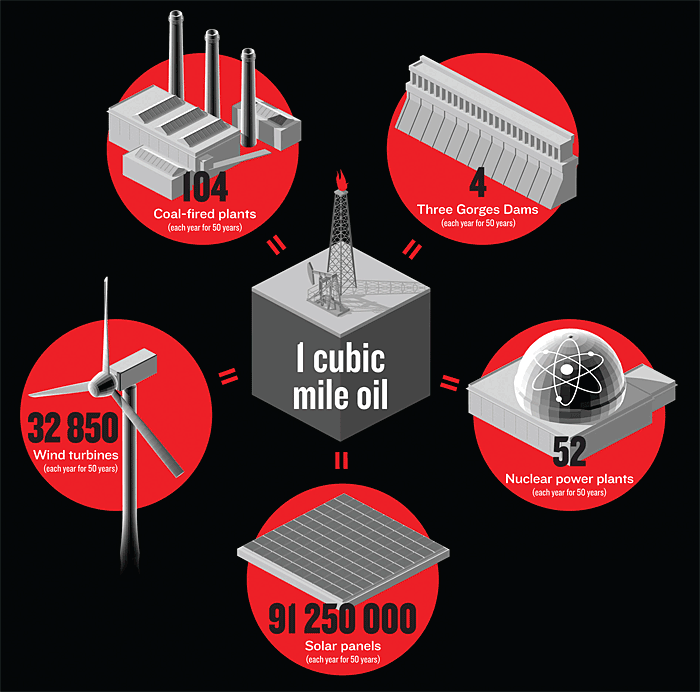
Assumptions: The Three Gorges Dam is rated at its full design capacity of 18 gigawatts. A nuclear power plant is postulated to be the equivalent of a 1.1-GW unit at the Diablo Canyon plant in California. A coal plant is one rated at 500 megawatts. A wind turbine is one with a 100‑meter blade span, and rated at 1.65 MW. A solar panel is a 2.1‑kilowatt system made for home roofs. In comparing categories, bear in mind that the average amount of time that power is produced varies among them, so that total energy obtained is not a simple function of power rating.
src: Joules, BTUs, Quads—Let's Call the Whole Thing Off, IEEE Spectrum, January 2007
Illustration: bryan christie design. Click to enlarge.
Leaving aside some errors (the coal and nuclear numbers are off by about 10% to each other, and the capacity factor of wind turbines should be closer to 30%) the most essential oversight in that equation is elephantine:
Compared to that, the rest is small potatoes.
- 4 Three Gorges dams, cranking for 50 years.
- 32850 1.65 megawatt wind turbines, cranking for 50 years (100% capacity factor).
- 91,250,000 2.1 kW solar PV installations, for 50 years.
- 104 500 megawatt coal-fired electric plants, for 50 years.
- 52 1.1 gigawatt nuclear electric plants, for 50 years.
- A barrel of oil has 6.1 gigajoules (GJ) of chemical energy.
- A cubic mile is 26.2 billion barrels (42 gallons/bbl). (The USA uses about 20.5 million bbl/day, or 7.5 billion barrels/year; this comes to less than a third of a cubic mile annually. World annual consumption is closer to 1.3 cubic miles.)
By this, a cubic mile of oil is even more impressive: 1.60*1020 joules. That's 5070 gigawatt-years of energy, nearly twice IEEE's estimate. But that's what we put in. What do we get out of it, and what would it take to replace it?
Ins and outs
Oil gets turned into a bunch of different things, and those uses vary widely in efficiency. If used for heat, oil can be very efficient. Bunker fuel burned in low-speed marine diesels can yield 50% efficiency. But our most important uses of oil are also the least efficient.
Take the average car or light truck. They don't run on crude oil; they require a highly refined fraction known as gasoline. Demands of octane rating, vapor pressure and sulfur and aromatic content increase the losses in the refining process. One source claims 82.9% efficiency from an oil well to a refinery's gasoline output. That cubic mile just got smaller.
But the losses are just starting! The average vehicle is very inefficient, turning just 14.9% of the energy that goes into the tank to work done against air and rolling resistance. The rest is lost in the engine, transmission and brakes. From well to wheels, the total is a pathetic 12.4%. That cubic mile just shrunk by half... in all three dimensions! Diesel is more efficient both at the refining end (87.9%) and the consumption end (35-40% engine efficiency in heavy trucks) but overall throughput is still around 1/3.
If the world followed US patterns (it doesn't, but it's not that far off), refineries would average perhaps 90% efficient. Gasoline would be about 43% of the total energy of the product supplied, distillate (diesel and heating oil) 22%, jet fuel 8.3%. All the rest comes to 27%. If we drop jet fuel as non-essential and add the rest up by efficiency (14.9% gasoline, 40% diesel), the total useful energy comes to 42.2% of the input. Best of all, only 15.2% of that is mechanical work; the rest is heat.
Adding up the end products
If we were going to supply a cubic-mile-of-oil equivalent of heat and work from nuclear plants at 33% thermal efficiency (3.3 GW thermal input, 2.2 GW thermal + 1.1 GW electric output) it would take a lot less. If you cranked them for 50 years, a mere 14 1.1 GW plants could supply 771 GW-years of electricity and another 1540 GW-years of low-grade heat, more than satisfying the requirement of 1370 GW-years of heat from oil. Coal would do about about the same, but it would take 31 500 MW plants to equal the 14 nukes. Wind has no waste heat stream and couldn't do as well (the energy would have to be all electric), but the possibilities for solar are amazing. Solar heat (for space heat) can be collected for very little, sometimes for free with careful design. Supplying 770 GW-years of electricity from solar PV at 25% capacity factor would require only about 40 million 2.1 kW installations; doing a year's worth per year would require about 2 billion 2.1 kW systems, or about 700 watts per capita.
700 watts is about 10 of today's PV panels. The industrial nations could almost afford to give 10 panels to every child at birth, and cost improvements in the pipeline could extend this to much of the world in the next decade or two.
Imagine clean, cheap energy as a birthright. Something to ponder.
Edit: Note that this analysis only considers energy obtained from oil. Weighing this against the total consumption of (especially first-world) humanity leads to inaccurate conclusions; coal, gas, nuclear and hydro sum to considerably more total energy than oil. Ponder and discuss accordingly.
[ED by PG] You may also want to check out Khebab's story called "Getting a Grasp on Oil Production Volumes" which also discusses this topic.Contact
- Content: editors at theoildrum dot com
- Tech support: support at theoildrum dot com
License

This work is licensed under a Creative Commons Attribution-Share Alike 3.0 United States License.
Hit reddit, hit digg, hit your favorite link farm! :) Send it to slashdot, metafilter, del.icio.us, stumbleupon, etc.
Let's get EP some eyes for this really good post.
Great post EP. I gotta call you on the Nuclear numbers, though. How do you deliver the low-grade heat to homes that currently use heating oil, etc? There is also the transmission loss, and then the loss in the presumed charging of the electric vehicles that would be required in an electric-only world. A quick guess would be that you'd need about double your 14 1.1GW plants/year. Still under the 52/year from IEEE.
Do what was done in London with Battersea Power Station - simply have big pipes conducting the hot water to the houses across the river. It was then like a giant central heating system.
(From the book London Under London):
Should we put our Nukes in the city centers? What is the chance of getting that done?
I'm all for harvesting the wasted heat. For instance, check out the Ecopower combined heat/power unit (goggle it, it is pretty good). That takes care of the 60%+ energy loss due to heat/transmission. Unfortunately, it runs on fossil fuels, though a hydrogen version should be possible. Still, it is no Mr Fusion, but then I'm not holding my breath for that one.
I initially read that is should we Nuke our city centers.
I thought it was a pretty good idea.
In fact, it's called combined heat and power (CHP) with district heating.
This is something widely used in Europe (especially Denmark and Germany). 30% of Berlin's (ca. 3.5 million people) space heating requirements are covered by CHP.
So, it's absolutely no rocket science and has been refined and optimized for decades already. Just not in the UK or the US.
CHP causes slightly lower electric conversion efficiency (like, 5% less), but makes use of this 5% loss to deliver another like 20%-30% of the otherwise wasted primary energy to the homes.
CHP with nuclear plants is not exactly a good idea. Consider a radioactive leak in the plant, contaminating the hot water loop. It would have to shut down immediately to avoid pumping radioactivity into the homes, leaving entire cities cold from one minute to the next.
Micro-CHP units in individual homes are half-nonsense, because
- the capital cost for a home owner to buy such a thing is much higher than for large-scale utility companies,
- maintenance needs to be organised in much more decentralized and therefore more inefficient way,
- a change of fuel is almost impossible and
- propagation of such units is much slower than with a central solution which would serve whole cities or at least city quarters in one go.
Cheers,
Davidyson
Have to disagree here in USA circumstances. With most homes heated by natural gas (at least presently), the CHP unit does not necessarily mean more maintenance than present if current furnaces/boilers are swapped out with CHP. It also gives the homeowner electric power that is competitive with utility-based power (due to addition of taxes, etc), and also gives backup power during (the rare) outages.
Here in Connecticut, with some of the highest rates in the country (Long Island and Hawaii are the only higher areas), the CHP unit I'm installing will pay for itself in under 8 years. It helps that we have net-metering. If we could get hourly net-metering, the unit would pay for itself in probably 5 years or less.
Hi goinggreen,
thanks for the reply.
You are right - there are of course places and circumstances in which micro-CHP actually makes sense.
However, please note that what might make sense for you as an individual might not make sense for society. The capital cost point remains, as does the fuel switching point and the speed of propagation point.
Also, micro-CHP units are more complicated than simple gas boilers, so probably subject to more or more expensive maintenance.
Cheers,
Davidyson
As for the comparisons, I plead haste. (I noticed, too late, that I hadn't dealt with the amount of heat we get from natural gas and coal, directly and indirectly. That would have to figure somewhere, and I intend to go back and insert a note to that effect.)
Delivering heat to homes isn't necessarily impractical. If you are willing to put a nuclear plant in tunnels beneath a city (and what better place to put it to eliminate the threat of terrorist attacks?), you could transfer the heat as medium-pressure steam to neighborhood energy recovery turbines [1] and then the exhaust low-pressure steam or hot water for space heat. The water goes back down to the steam generators by gravity. [2] I did a writeup on this almost two years ago.
When heat is not required for space heat or to drive absorption A/C, it could be vented through cooling towers. These might be integrated with office towers or other buildings.
Electric transmission losses, battery losses etc. would probably be on the order of the efficiency gains from electric drivetrains. This looks close to a wash.
The one thing I didn't consider is higher-grade heat requirements for e.g. industrial process heat. This could also be supplied by nuclear (which was the original intent of what became the Midland Cogeneration Venture in Midland, MI) but there would be a greater impact on electric output.
[1] Medium-pressure steam is probably better than low-pressure, because the pipes will be much smaller, cheaper and have lower heat losses.
[2] If the reactor is deep enough, gravity could provide a large part of the pressure required for the boiler feedwater.
Electric transmission losses, battery losses etc. would probably be on the order of the efficiency gains from electric drivetrains
And if the batteries are replaced with an overhead wire ?
No battery cycle losses (out/in), no weight to haul around (include structure to support the Battery), no wasted time and distance refueling.
Best Hopes,
Alan
This illustrates the perennial problem of comparing apples to mangoes. I will stipulate the relative efficiencies in your calculations, but of course you're still begging the question of usefulness. Oil can't do the same amount of formal work as electricity, but electricity can't do the same amount of useful work as oil. And of course by "useful work" I mean "run cars and light trucks". Given that 60% to 70% of our oil consumption is for that purpose, unless we have a generally available mechanism for turning electricity into vehicular motion (and I don't think current BEVs need apply) the whole discussion is moot.
We use a lot of oil. Some of that usage could be supplanted at low cost by electricity or waste heat streams, some couldn't. Some could be supplanted at higher cost, but some still couldn't. For me, the only utility of the "One Cubic Mile" image is to help get across to laymen just how much oil we use. The implication that the various forms of energy are interchangeable is incorrect, unfortunate and distracting.
"unless we have a generally available mechanism for turning electricity into vehicular motion (and I don't think current BEVs need apply) the whole discussion is moot."
The latest generation of li-ion batteries really do fill the bill. A123systems and Altair have much greater cycle life than conventional li-ion, thus dramatically reducing lifecycle costs.
GM indicates they are satisfied with the specs for the 2 batteries they're considering for the Chevy Volt (A123systems and Saft), and are just waiting for the engineering of large battery packs suitable for vehicles.
The only limitation right now is cost - PHEV's/BEV's can't compete at the moment with very cheap gasoline (heck, BEV's preceded ICE's, but haven't been able to compete for the same reason). That will change in the next 3 years with the Volt, and other PHEV's. Of course, it could change even faster, if gas prices rise...
What is the penetration of A123systems-driven BEVs going to be like in Africa, Asia and South America? What's the global fleet change-over time? What about cost of retraining mechanics world-wide? How much will a 20% penetration of BEVs in these regions over the next 25 years help the global problem? This problem doesn't stop at the shores of the United States.
As I say in my Musings on Peak Oil Mitigation I look on BEVs strictly as a near-term technology that will promote a softer entry into the coming depletion phase. The way I see things unfolding, if we roll into a medium term characterized by localization, the technology requirements of such devices will be too great to maintain.
By all means we should develop them. Just don't be surprised if they have less impact on the situation than some are hoping.
Electrics are much simpler, and easier to maintain than ICE's. Their lifecycle cost is going to be less than ICE's.
If you think our ability to maintain complex systems will decline, electrics are just the ticket.
I'm thinking more about our ability to produce batteries that depend on nano-technology.
Nanotech in this case is a bit of a misnomer.
Originally it referred to very complex, very small scale systems, like tiny robots. Here it really refers to very tiny particles, or materials with very altered characteristics at a very small scale due to an understanding of material dynamics at that scale.
I don't think manufacturing it is all that much harder than conventional batteries.
Of course, if you think we won't be able to maintain central large manufacturing facilities due to catastrophic economic collapse, all bets are off. I think that depends on the assumption of catastrophically fast depletion combined with a lack of substitutes for oil. I don't see either being the case.
Oh, I have no question that oil consumption will look like that chart. I just see no reason why it has to cause economic collapse.
Peak oil does not equal peak fossil fuels - coal will be with us for a long time, and it will be used if it's needed to prevent economic collapse. Peak FF does not equal peak energy - renewables and nuclear will do just fine. For that matter, peak energy wouldn't equal peak economic growth - the US could easily function with 10% of our current energy. Heck, replacing heat engines (with renewables for electrical generation and electric motors for transportation) would reduce our energy consumption by 2/3, with no loss of functionality).
Given the sun pumps out 10^26 watts, peak energy is a good deal beyond the scope of reasonable conversation.
I agree that solar/wind can supply all the energy we need, i.e. it is technically possible. However, getting to that situation without accidents under the way is what most people here think the problem is, and it is caused not by technical difficulties but by the peculiarities of the human social behaviour.
Exactly. Can Be is different than Will Be.
As a test, go to Walmart parking(or any mall) lot for a half hour, Look at the people close and consider how easy/hard it would be for them to change radically their lifestyle. Go and convince them that Economies of growth may be a thing of the past for quite a while.
Tell them that their may not be NASCAR in 5-10 years.
Tell them to meditate on "Less is More" for a while.
Or (with GW thrown in) tell them to watch Grapes of Wrath.
Peace
John
this one is for SIX
In using the calculator on the numbers put forward in this ‘CUBIC MILE ‘- thread, you’ll see some ridiculous numbers/sizes coming up - after those 50 years of compensation (for dwindling oil , as I understand it all).
As for windmills the numbers comes to 1,8 millions of them – and at a rotor-diameter set to 100m and equator at 40.000 km – the line of wind turbines will, put ‘shoulder-by-shoulder’, circumference equator 4,5 times OR more or less cover all coastlines of this planet ……. Still possible??
AND as for the insane number of the 2,1kW solar arrays (demanding ca 30m2 pr unit) – you need a jam-packed area of more than half of that of the UK – or alternatively the area of the Czech + Slovakian Republics …. Still possible????
Both of these energy converting systems are subjects for replacements and maintenance – and PV’s are prone to be depleted through 20/25 years, rendered dead and gone ….
I reckon these systems will yield much less than what ever we can imagine at our worst, reality are some times brutal (!)
Fifty times 32850 wind units is a bit over 1.6 million. If you arranged them in lines 300 meters crosswind and 1 km downwind, the entire complement would only require an area of 493,000 square kilometers (190,000 square miles). This is less than 3 times the area of North Dakota, for the entire world. (The land between the turbines can still serve for agriculture or forestry.)
50 times 91.25 million 2.1 kW solar units (which would require about 15 m2 each, not 30) would require 68437 km2 of area. If I recall correctly, the USA alone already has about twice this much area beneath impervious surfaces like roofs and pavement. The world as a whole could put this much PV on existing rooftops.
Last, today's PV panels are warranted for 25 years. They will probably produce at upwards of 60% of their rated power for 50 years. If the cells on Pioneer 6 can operate in the high-radiation environment of space for 35 years, cells on the ground which aren't mechanically damaged should do just fine.
You are failing to see my point Engineer Poet.
And you are correct for the Wind turbine numbers – I used the number 35850 – for some erroneous reason, so my number came out 10% wrong.
But I googled an 2,1 kw array saying 1 kw needed 10x15 feet , giving my number 30m2 some truth.
BUT my overall assessments to these energy-systems are the shear scale of it all – and my claim is that the cubic-mile of oil will never be substituted by these systems on a MToes basis.
Surely the spaces are readily available – that’s not the issue. THE issue is to understand the ‘simple task of pumping oil/refine it’ in COMPARISON to the ‘complexities to manufacture, maintain and substitute PV/Wturbines as per needs’ – on this grandiose scale.
Both systems are dependent on their limitations –
a) it must blow – and nominal yield is roughly 15m/s …. Think again
b) it must be day and the sun must shine …. Think again
You will never be able (in the future) to depend on such systems – but they will constitute an add-on effect which we surely must go for ….
You are arguing against scale (argument from incredulity), when today's petroleum systems have an even greater scale — thus questioning your argument ab initio.
The USA installed about 2.5 GW of wind power in 2005, up from about 400 MW installed in 2002. This is more than doubling every 2 years. Potential of the continental 48 states is about 1.2 TW average, the continental shelves about 0.9 TW average; at 0.3 capacity factor, the USA could carry on installation at 50 GW/year for several decades without reaching limits of the resource. Production scales relatively well. What's the show-stopper?
15 m/sec is well above the average design speed for a typical wind turbine. The ones I've seen are generating considerable power in 7 m/sec winds.
There is nothing intrinsically expensive about PV. Silicon isn't especially energy-intensive (unless you try making it into single crystals), and one advance like a long-lived dye-sensitized TiO2 cell would slash costs radically. Once PV comes down to a small multiple of the cost of conventional roofing or glazing materials, it will replace them. There is an enormous installed base of structures in the world, and those structures require fairly regular roof repairs or replacements.
I can depend on wind and PV producing a certain amount of energy every year, if not every hour; PV is well-matched to one major load (air conditioning). Technology like thermal storage, grid-interactive vehicles and biomass-powered fuel cells can provide the buffering capability to manage a lot more. Keep 20% nuclear and 15% hydro in the electric mix, and you're probably there — I'd have to do the numbers to be sure.
Your last argument is equivalent to claiming that because individual electric plants go off-line for minutes or weeks, I can't depend on the grid. Your logic is faulty.
If your primary energy source peaks, I can't see peak FF being far behind, if it is behind at all. "A long time" for coal, won't be as long as you think, especially if it starts to substitute for oil, at least not at the required quantities. Natural gas is already peaking, or close to peaking, in some major regions. No doubt the US could operate on 10% of current energy consumption but there will be severe hardships getting there, unless it's done over many decades.
Renewables also take resources and would take a very long time to ramp up to what is required. No doubt they'll do fine but I don't expect them to be able to allow the party to continue. And growth will trump any "solution" eventually.
Just because you think something can be done doesn't mean that it will be done, or will be done in time, or that the transitions will be anywhere near painless.
Let me address things out of order.
"Just because you think something can be done doesn't mean that it will be done, or will be done in time, or that the transitions will be anywhere near painless."
There's no question in my mind that we will go to alternatives. The process has started: wind is 1% of US electricity and is growing at 25% per year at least: that's a doubling period of 3 years, so in 15 years we could be at 20% wind easily. If all of the wind projects planned for the US in 2007 actually get built, wind capacity will double to 2%, in just 1 year. That's not likely, but it tells you something about the demand for wind, which is mostly being held back by the speed with which turbine manufacturing can ramp up. Solar is doubling every 2 years, and in 10 years will be where wind is now. The needed batteries are here, and will be on the road in 3 years (whether it's GM or an asian manufacturer).
OTOH, I'm not suggesting that the transition will be painless. As I've noted elsewhere, if depletion happens relatively fast (or if war expands in the Persian Gulf to the point of greatly disrupting oil supplies), and we haven't prepared better than we have so far, then the transition will be much more painful than necessary. The question is, how painful will it be?
My hope is that the campaign against global warming will accelerate preparations.
"Renewables also take resources"
No question. OTOH, they don't take significantly more than conventional energy. Excess costs will arise if we have to retire infrastructure before the end of it's normal lifetime, as appears necessary. That's difficult, but doable.
"I don't expect them to be able to allow the party to continue"
Why not? And why do you phrase in a way that suggests that our current way of life is vaguely immoral, and that we should return to an ebstemious, pure life of ascetism?
"growth will trump any "solution" eventually."
Not really. This is an outdated notion. Growth levels off. Population growth is doing so, and manufacturing is doing so in OECD countries. The difficult question is how to raise developing countries to the standard of living of the developed.
"If your primary energy source peaks, I can't see peak FF being far behind, if it is behind at all. "
Oil isn't our primary energy source: it only provides 40% of our energy. Imported oil only provides 24% of US energy (and yes, US oil is declining, but very slowly).
"I can't see peak FF being far behind, if it is behind at all. A long time" for coal, won't be as long as you think, especially if it starts to substitute for oil, at least not at the required quantities."
A long time for coal is 30 years. No one thinks coal will be used up earlier than that, even with the highest estimates of growth in consumption. That's all we need it for - alternatives will be in place long before then.
"Natural gas is already peaking, or close to peaking, in some major regions. "
No question, NG is going to be painful. OTOH, we don't import much now, some imports will be available (as LNG, and probably in the form of fertilizer), and it will be around for a while, even declining.
"No doubt the US could operate on 10% of current energy consumption but there will be severe hardships getting there, unless it's done over many decades."
We could convert to PHEV's for 75% of vehicle miles driven in 20 years with relatively little pain (3 years to PHEV sales, 7 years to convert most vehicles to PHEV, 10 years of sales). That would accomplish a large chunk of the reduction. Actually, it could be really good for the domestic car industry to do it that fast or faster: it would keep them solvent, if done in the right way.
Nick - maybe - maybe not ...
As I see it Peak-Oil and the add-on of Peak-Coal will coincide with peak-Fossils somewhere down the line – which in turn will coincide with peak-everything so to speak.
Now, philosophically speaking or rather physically speaking: ARE we NOT in the progress of putting the physical parameters for the atmosphere back to the stages where FOSSIL-FUELS where produced at the first stage (?) some 90 – 170 million years ago…
As we now deplete the fossil-fuels and put them back into circulation again (CO2, methane, etc) – over a few hundred years –
… and eventually if we did succeed 100% in doing this – we would reach the same temperatures (greenhouse-effect) as way back than when the oceans went green from algae(oil/gas) and the peat-swamps(coal) blossomed …
ARE we about to close some kind a circle here ????
In the US we have a lot of under-used vehicles in our inventory. We can replace 50% of vehicle miles driven in 5-6 years, easily.
Poorer countries that tend to wait for our used cars will have a harder time, no question.
One paper I found shows the 50% crossover at about 9.5 years (link), but under pressure from high fuel prices and/or legal changes it might be quite a bit less.
hmmmm. I don't see the 9.5 years. The data on page 15 suggest that 8 years of sales accounts for 49.0% of total VMT (cumulative total of %'s in 4th data column).
The same data indicates that the median life of CA vehicles is 16.6 years (total vehicle population divided by last year sales), while the same figure for the country as a whole is 12.4 years (210M divided by 17M). So, apparently California is not representative.
The same ratio (8 to 16.6) applied to the national figure of 12.4 gives 6.0 years.
I agree, that could be accelerated.
A neat editorial on why car manufactures seem so reluctant to use all these wizbang new battery technologies we see popping up.
He basically goes through and explains the wide range of operating conditions cars are used in. Then points out that these new batteries have yet to be proven in real world conditions, and until that happens big car makers can't afford to use them.
----------------------------------------------------
Keep in mind that these new battery technologies don't even claim to be usable in the entire range of real world operating conditions.
http://www.technologyreview.com/Biztech/18086/page3/
--------------------------------------------------------
It seems to me we still have a long way to go before we can electrify transportation in any reasonable way. As one commenter in the first editorial said:
Necessity breeds invention. If we need battery powered vehicles because it simply is too expensive to fuel with gasoline, then we'll have them. They may have limitations compared to normal ICE vehicles and it simply will not matter. When the question changes from "which would you rather drive?", to "would you rather drive or not?" then the answer becomes very easy.
There are other solutions, of course, like increased public transportation. I think that is a very viable idea. But EVs will definitely play a part in the solution to our dwindling oil supplies, and all of the problems they'll face will fall by the wayside as time goes on.
betting that this will happen is like going out and buying a 500,000 dollar boat on the assumption just because you bought a lottery ticket you will win the lottery. it might happen but the chances are so remote and you only have one chance to win before the collectors start calling that it's just better not to take the chance.
more simply put modern(not counting bagdad batterys) battery's have been around for almost a hundred years and to expect a increase of efficiency larger then the it's history combined is asinine.
"to expect a increase of efficiency larger then the it's history combined is asinine."
Possibly, but the increase has already happened - check out Dewalt 36 volt tools.
Need a different kind of "efficiency" here: the high price of advanced batteries reflects (in part) embedded energy, and thus their price will RISE as energy prices rise. (They'll also fall as technology improves, those two effects will happen simultaneously.) Couple that with harder economic times, and the ability to "turn over the fleet" is going to be limited, IMHO.
"high price of advanced batteries reflects (in part) embedded energy"
Do you have any specific reason for believing this? Energy cost as a portion of industrial sales averages less than 3%, as I documented in a post elsewhere on this article (search for "cement").
The manufacture of batteries is one of the most energy intensive, and wasteful, processes on earth. The average Li-Ion battery pack can store less than 1/100 of the energy used to manufacture it, and has a limited number of recharge cycles.
The MIT battery is still very much a dream, articles on the technology still use the weasel words 'may' and 'possibly', if the technology does actually pan out it will be years before its in production. Time is short. The Altair Nanotech battery is not available for sale, and their claims are yet to be proven. We all hope these and other technologies will see the light of day but the fact still remains you can not buy a reasonably priced EV today, one with a good range, one that is a real car not a converted atv/golf cart.
I want to like EV's, I really do. I recently got a price of $55k for the S.U.T. and that is out of my range. There has been much talk of solar panel charging, yet a modestly sized residential grid tied PV array is over $25k, will never pay for itself at current residential electric rates (per BP Solar's own website) and solar panels require a great deal of specializes resources to manufacture (hence the present shortage of them).
Granted, EV developments are looking better but at the same time internal combustion engines have also gotten progressively better, more reliable, lower emissions. The balanced view if you ask me is EVs will take over when they are really ready and that isn't now. The last vehicle I sold had 220,000 km on it where nothing has ever been done to the engine except oil changes, plugs and wires. The only problems (and had some)were all electric. The I.C.E. continues to roll.
Factor in the 5000 to 8000 li-ion batteries in the drive banks, the 12,000 odd fuse links, the 300 circuit board to solder all the cells to, the DC controllers, cooling bath for the batteries, fans, tons of sensors for temp and voltage, wiring harnesses, hopefully well shielded DC motors, and various interconnects, and there is a ton of extra spark gaps just waiting to fail in the dynamic load situation and inclemental weather normally seen by passenger vehicles in normal use. All with low use reliability testing. Every ICE powered vehicle I have ever owned I have driven for 100k or more virtually without a hiccup. Does anyone seriously think you'll get that kind of reliability out of an EV?
Ever?
Think you will ever seen an EV tractor trailer?
"The MIT battery is still very much a dream, articles on the technology still use the weasel words 'may' and 'possibly', if the technology does actually pan out it will be years before its in production. "
Are you referring to the A123systems battery, originally researched by MIT? If so, it's being sold currently in Dewalt power tools. GM is waiting for engineering of a large battery pack for the Chevy Volt, but the battery itself is real. GM says they expect to have a prototype on the road this year, and be in full scale production in 2010.
" The average Li-Ion battery pack can store less than 1/100 of the energy used to manufacture it, and has a limited number of recharge cycles."
Could you provide more info? Is this process heat provided by natural gas? Does the energy info apply to the new generation of li-ion, like the A123systems?
"The Altair Nanotech battery is not available for sale, and their claims are yet to be proven."
Isn't it being sold to Phoenix for the SUT?
"the fact still remains you can not buy a reasonably priced EV today, one with a good range, one that is a real car not a converted atv/golf cart. "
Well, sure. The day that happens everything will be different. That's what we're all waiting for, with bated breath.
"There has been much talk of solar panel charging,"
It's perfectly clear that grid electricity is cheaper than PV (before subsidies) - this is for the minority of people who are willing to pay a premium for clean, independent power.
"Every ICE powered vehicle I have ever owned I have driven for 100k or more virtually without a hiccup."
You're luckier than most. OTOH, EV's are much simpler than ICE's, and will be much cheaper to maintain. For instance, the Prius has much lower maintenance than the average car.
"Think you will ever seen an EV tractor trailer?"
Sure. Hybrid-electric is the preferred technology these days for large vehicles, like tanks and trains. More reliable, more efficient, better low speed acceleration.
I wouldn't be worried about complex electrical systems. Cars these days are already rolling computers. The batteries are the least of it.
30 years ago my father was selling electrical harnesses to Ford that allowed complex electrical interconnections that would nevertheless be reliable - this is old hat.
I think you're getting confused by different kinds of "batteries".
First, the editorial to which you refer is dealing with the new generation of li-ion's, the A123systems, Saft, and Altair. These are inherently safer, cheaper, more powerful and longer lasting.
As the editorialist noted, they will get used. His point is just that it will take several years to engineer the battery packs/power electronics and test them. That's all - he's just asking people to be patient.
The TR article is talking about Eestor ultracapacitors. Everyone agrees that these are much more speculative. They promise the world, and it will be wonderful if they deliver, but for the moment everyone is skeptical.
The last person you quote is talking about conventional Li-ions. He doesn't seem to be aware that, in fact, there has been a quantum leap in li-ion progress in just the last 5 years in the new-gen li-ions.
The best candidate for GM's Volt is the A123systems battery. If you have any contractor friends, ask them about the latest DeWalt 36volt tools which use them.
You're right, I was lumping different technologies together.
And I also agree that these new techs (ultra capacitor and next gen li-ion) will get used eventually.
I was trying to stress that there are no new battery technologies currently capable of performing in real world operating conditions.
Take a look at the A123 batteries (for the Volt). Neat stuff, I sure they work great for power tools. But only rated to -30C. Next cold snap and every car north of Virginia dies.
Batteries have a long way to go before you see viable EVs.
1st, -30C (-22 F) is pretty cold.
2nd, take a look at their spec sheet: http://www.a123systems.com/html/products/ANR26650M1specs.pdf
The drop in performance at -20C (about 15%, by eye) is a lot smaller than the drop in conventional car starter batteries (sealed lead acid), which lose 50% of their power at only 0C. I'd say the electric cars will be going when the ICE cars are frozen.
Gets colder than that around here. And to start the ICE, only need to preheat the engine a bit. And the battery too, in extreme cases. After starting, the engine keeps itself (and the driver) warm, and the battery can be cold, since little electrical power is needed. With an all-electric vehicle, be sure to dress warmly!
"With an all-electric vehicle, be sure to dress warmly!"
Probably 95% of the heat thrown off by an ICE is wasted. If you use 1,000 watts for resistance heating that would only use about 5% of the car's cruising power consumption, and you'd get instant-on heat, instead of waiting several minutes like you have to in a gasoline vehicle.
Interesting question: would it make sense to put a heat pump in an EV, instead of a straight air conditioner?
Yes, but are they mangoes from India?
I agree that the CMO concept is useful in terms of use (just as it is useful in one the diagrams to pose the 5 Eiffel Towers to give a concept of length of one of the sides).
And you are correct that some kinds of equivalencies don't work too well. We can have electric trains (rather than diesel engines turning electric generators to run the motors that power the train as a very workable alternative, but we can't have electric aircraft (or if we did, it would bring a whole new definition to "fly by wire") or "nucular" aircraft or vehicles. There's just nothing quite like the high energy density associated with oil to offset low efficiency of some of our mechanical devices.
In the worst case scenario we don't actually need air planes. Not to mention, oil is going to be with us for a long time. If we use the residual small amount of oil for things like aircraft it will probably work out fine. If everything else is displaced it means more is left over for those things that cannot be displaced.
Alternative powered, efficient aviation could expand a lot! It's hardly been considered. Bring back the blimps! Send 'em into the jet stream and you got ships in the sky at 300kph! Use renewable electricity to cast (relatively non polluting) solid rubber rocket motors for long distance powered gliding (ala SpaceShipOne design). Or hydrogen itself? I don't know - maybe there are much better ideas out there too. But don't discount alternative aviation.
unless we have a generally available mechanism for turning electricity into vehicular motion
I am a few weeks away from the return of the St. Charles streetcars 2.5 blocks from my home. Built in 1923 & 1924, they convert electricity into vehicular motion quite well :-)
The newer Canal & Riverfront streetcars convert braking energy back into electricity, but the 83 year old streetcars do not.
New Orleans once had over 600 streetcars in operation over 222 miles of track, so that meets any reasonable criteria of "generally available".
Best Hopes,
Alan
Yes, for fixed routes you're good to go with electricity. Any place where you can use a "hundred mile extension cord" is going to be OK. Unfortunately there is no tram line out to my folks' farm 10 miles outside London Ontario, or most places in Kenya, Chile, Siberia or China.
Unfortunately there is no tram line out to my folks' farm 10 miles outside London Ontario, or most places in Kenya, Chile, Siberia or China
The Trans-Siberian Railroad was completely electrified in 2002. Any place that people live in Siberia (with a few exceptions, like some oil fields) is served by electrified railroad. My SWAG is 95% of the Siberian population lives in towns served by electrified railroads.
China has recently gotten serious about electrified railroads and Urban Rail as well. The new Tibet railroad is still diesel though.
And there has been talk of an inter-urban light Rail line in the London ON area. VAGUE memory was from London or Hamilton to Toronto.
There is no way to do a full-access electrical rail network in a region with a primarily rural population. The low densities won't allow it, at least not economically. We will see electric rail in high-density regions and corridors. For cities it's a no-brainer. For high density regional corridors like the Canadian side of the Canada-US border it will work, as long as the "last mile" can be serviced as well. That does not make it a general transportation solution in my mind. "Not general" does not mean "not useful", of course.
Illinois and Iowa, as two examples of many, were once criss-crossed by interurban railroads, most of them electric.
http://en.wikipedia.org/wiki/List_of_interurbans#Illinois
Yes, the "last mile" was on foot or horse & buggy (perhaps bicycles) and later Model Ts.
http://www.gemcar.com would work well as a "last mile" vehicle today IMHO.
You under estimate "what was".
Best Hopes,
Alan
Arguments from facts, who ever thought of such thing! Thanks for always increasing the signal/noise ratio here.
This is interesting - do you know of a source for maps of those rail lines?
I saw a map of Iowa interurbans (with the edge of Illinois on the map) in a friend's out-of-print book and was astounded by the network.
A few minutes googling found a low quality map of Ohio interurban rail lines.
http://hometown.aol.com/metrafan/maptinoh.html
and a larger download 1920 map of Indiana and Ohio
http://www.railsandtrails.com/Maps/Interurban/default.htm
Please note that 1920 era rail was largely built with "coal, sweat and mules". We could do more today.
Best Hopes,
Alan
In my area, which is predominantly rural, the train lines had stops every five miles in their hay day (50 years ago). This was because a farmer could only move his grain about ten miles from his farm in a day and make it home to do it again the next day.
I still find it hard to believe that rail transit would be realistic in my area, but I'm beginning to think that I'm wrong.
What proportion of travel is in rural areas? I don't see this as an issue. The vast majority of travel is urban/suburban, areas that *can* be covered comprehensively with electric mass transit.
Thank you, Alan, for reminding all of us that there is more to transportation than "cars". I have an atlas from the 1950's that has a large-page map of each state in the USA. In those maps, the roads are NOT shown, only the railroads are shown! And the rail network in Ohio depicted therein is MUCH more extensive than in the older maps you linked here. Almost every town important enough to be shown on that map of Ohio, must be many hundreds, is shown served by rail. That presumably reflects "peak rail", before those tracks were abandoned. Perhaps I should scan that page, I found it really striking.
Yes, I would like to see it, perhaps post it on TOD.
Rural transportation is essential for food production, our most essential industry. And a reasonable fraction of "Vehicle Miles Traveled" are rural. So, yes, rural service will never have as high a % by rail as NYC but it CAN be an essential part of the solution.
Best Hopes,
Alan
Great post EP, thanks.
It really opens up the door to the possibility of realistic FF replacement options and makes for a slightly more optimistic take on AGW.
Again, thanks.
Top down, OK - however do these figures meet the bottom up derivation?
In particular that 700 watts per capita looks questionable, particularly since you haven't seemingly taken into account storage, clouds, environment for most big energy users, etc.
I'd agree there is good scope for making benefit from solar heating, solar PV etc., but I wouldn't get carried away - there are losses and factors you haven't considered.
yea more then i can count on both my hands :P
but the biggest is that none of the ones he mentions have the 'ease of use' factor as oil does but the system is tuned to that exact factor.
Interesting article.
I know the '50 years' thing comes from the IEEE article, but I think that construct is not terribly usable.
What I'd like to know is, for a given year (say -- 2006)...
1) How many Nuclear Power plants would it have taken to replace oil in that year?
2) How many Windmills would it have taken to replace oil in that year?
3) How many PV rooftops would it have taken to replace oil in that year?
4) How many Solar (thermal) rooftops would it have taken to replace oil in that year?
These questions lead to the next level: What are the energy inputs and outputs for establishing these infrastructures, and what about the EROEIs for each?
All of these questions assume that we need to consume energy like we did in 2006 -- so that leads to efficiency and conservation...
Aw jeez, EP. If you wrote a book about this, I'd buy it!
J.
All of these have EROEIs of higher than 20, which is more than enough.
You could replace all US electrical generation with residential rooftops alone: 440GW needs about 2.2TW of PV at 20% capacity factor, or about 130B Sq ft at 15.7 watts per sq foot, or 100M residences at 1,250 Sq ft per roof.
Replacing light vehicles would increase consumption by about 16% (210M vehicles, 12K miles/year, 250wh/mile), which would mean you'd have to throw in some Industrial/Commercial roof space as well.
I agree that PV should be the way to go. How much is the "grid-tie" mechanism? I have a figure of $10k US but it includes battery strorage/backup, power conditioning, etc.
Sombody correct me if I'm wrong (which is likely), but here's how I read E-P's numbers. One cubic mile of oil consumed in one year can be replaced by:
* 700 1.1 GW nuclear plants cranking for one year
* 1,550 500 MW coal plants cranking for one year
* 2 billion 2.1 kW solar PV systems generating for one year
Well, it looks a lot more doable when you put it that way...
A better way of putting it might be:
The world's annual consumption, one cubic mile of oil, can be replaced by:
* 700 1.1 GW nuclear plants,
* 1,550 500MW coal plants, etc
That clarifies that once you install the plants (or wind turbines, or solar systems) they will replace oil consumption going forward, not just for one year. That's very doable.
You are off by an order of magnitude here.
One barrel of oil/year equals roughly 200 Watts of power continuous (1 bbl oil = 6 million btu; 1 kWh = 3414 btu; 8760 h/year; 6 million btu/year /3414 btu/kWh / 8760 h/yr = 0.2 kW = 200 W).
So, we need 30 billion x 200 watts of power, which is 6 Terawatts, or 6000 GW. In other words, 7000 nukes or 15000 coal plants. The cost to install that capacity, even without assuming any inflation which will be inevitable if you try to push that much capital through in a short period of time, and regardless whether nuke, coal, or solar, is roughly the same is global GDP, $50 trillion. So that's not particularly "doable".
Just for reference, rated power capacity in the US is roughly 1 Terawatt....
Ah yes, I didn't read EP's arguments correctly - he is stating that oil usage is inefficient, and to go to electricity would require only 10% that much energy.
However, that game can be played both ways - how much electricity would be necessary to go the other direction, i.e., electricity to oil? That depends upon the medium of transport - if the "hydrogen economy" is the route, it's just as bad due to losses from electric transmission, electrolysis, hydrogen compression/liquifaction, and added transport due to the low energy density of hydrogen. The efficiency in that direction isn't going to be much more than 20%, either. Even counting the fact that electric motors coupled with fuel cells are 2-3 times as efficient as internal combustion engines, that still means we'll need 2 times the power given by the "cubic mile" of oil/year to replace oil as a transportation medium.
The bottom line is that oil is used for transportation, and (at this point) electricity isn't on a significant scale (in the US). The amount needed to replace the "cubic mile" will depend greatly upon the route taken from electricity to transport.
"if the "hydrogen economy" is the route, it's just as bad"
True. There is, finally, near universal agreement that the "hydrogen economy" will never happen for transportation.
"The amount needed to replace the "cubic mile" will depend greatly upon the route taken from electricity to transport."
Very true. The best route, at the moment, is definitely via batteries. That's clearly happening, though more slowly than we would all like.
Kyle, you should go back and review the basic ideas and calculations in the main article.
You're comparing the heat input value of crude oil to the energy output of electrical generation. We can replace 30B barrels of oil with much less electrical BTU equivalents. For one example, the Tesla runs on .215kwh per mile (wall to wheel), which is equivalent to 159 MPG.
Only 104 nuclear power plants provide 20% of US power, which in turn consumes 39 of the US's 97 quads (BTU's). It would only take another 75 plants to power electrical replacements for all 210M light vehicles in the US.
Average electrical generation in the US is about 445GW....
You'll notice that I quoted electric generation in terms of "rated capacity", which is how much could be produced theoretically, not actual production.
The electric car thing is very debatable in terms of efficiency, much more than you are letting on. I am playing devil's advocate here, but there are definitely some issues that deserve more discussion.
Comparing apples to apples, I could buy a similar 2-seater "muscle car" such as a Chevy Corvette for about half the money, which would pay for gasoline at any cost for as long as I would ever care to drive the car. This is obviously a joke to compare these two cars, but for example, if you compare the Honda Civic Hybrid versus the gas version, the price difference is about $6,000. At 100,000 miles expected life, that suggests a gas price of $6/gallon for breakeven, i.e., substantially more than the $2/gallon energy price that was around when the car was built. While I have no problem with paying to go green, I do worry about whether this represents an EROI issue - why do these electric/hybrid cars cost so much more than the gas versions? Do they truly save energy full cycle? It may be the dual drive. Regardless, we won't find out until electric cars become widely available...
I believe that expected life is more like 150K+ - good used cars stay around for a while. If gas prices rise, I would expect new PHEV's to have a much higher than average lifetime mileage, and gasoline to be lower...
It is the dual drive, plus the NIMH battery, plus R&D costs. As with most manufacturing, it's high priced labor, not energy.
Toyota expects to reduce the cost premium for their hybrid system, for the next-gen Prius, by 50%.
Serial hybrids are in some ways likely to be significantly cheaper than parallel hybrids. EV's are simpler than ICE's, and a serial hybrid is an EV with a small add-on generator.
The battery cost is the wild-card. That's one reason GM is playing off two battery suppliers against each other, to reduce their pricing leverage. The first generation is likely to be a bit pricey, but come down quickly. The real question is the TCO - total lifecycle cost of ownership. That should be equal to or lower than an ICE at current gas costs, and dramatically lower if gas prices rise. It looks to me like a question of engineering and project management, which GM is pretty good at, once they have their goals right. I think they understand how crucial this is to their future, so I'm hopeful.
Actually, I missed a big one. Those things would only replace the energy we get from oil. Replacing all the heat, electric, etc. energy we use from all fossil sources would take quite a bit more, especially when those sources are used with greater efficiency than 12.4% well-to-wheels.
And what about peak generation? It may be possible to theoretically calculate the amount of electrical energy required to replace the energy we get from oil but electricity generation has to deal with peak loads. This would surely add a factor to the calculations (double, triple?). Oil seems very good at providing those peaks; just look at the traffic jams, at peak times, with all those engines still running just fine.
The analysis is about energy, not the rate at which it's used (power).
I'll go for the PV panels.. the 14 nukes.. is that a per annum builds figure. I never did understand this cubic mile graphic? what about the replacement utility.. by that how many nukes does it take to replace the cubic utility of oil by electrical means?
Heat and btu's is all well and good but its not really the end goal?
Boris
London
Looking at end uses of energy may be the best way to look at the problem. It's not neccesarily gasoline that I want, it's the work it can do for me. I don't neccsarily want natural gas, I want a warm house and a hot shower. I don't want coal, I want power for this computer and a few other gadgets. But is 700 watts enough power to improve the quality of life for the world's poor? Put another way would you be comfortable on just 700 watts?
A big problem with substitutes for oil and coal is Wall Street's insistence on maximizing profits by always going for the lowest bidder. There is enough biomass produced every year to replace all our coal use and then some but it is much cheaper to use strip mined Wyoming coal. If we applied the standards that the military uses in weapons procurement and emphasized bangs over bucks then conversion to renewables and greater efficiency would be a no-brainer. Placing a reducing cap on the amount of fossil fuels sold each year would change long term energy investing enormously.
All it takes is changing a few rules of the game.
700 watts is 16.8 kWh/day; enough to drive 84 miles every day at 200 Wh/mile.
If the goal is to replace oil, 700 W/capita is enough for a very comfortable world.
Man does not live by transportation alone. Transportation is only 20% of my energy use. 3.5 kw or 84 kwh/day which includes the embodied energy of all the goods and services I use.
We should keep in mind the multiplier effect in the other direction for heating: heat pumps (air and geothermal) can turn 1 kwh of electricity into 3 or 4 times as much heat. That means wind and solar electric are much more useful than a straight comparison would suggest.
How do wind/solar powered heatpumps compare with diesel powered heat pumps?
Well, diesel electricity is very, very roughly about $.25 per kwh ($2.50/10kwhs per gallon), depending on efficiency and handling costs (the military estimates fuel can cost $70/gallon in the war theatre due to supply chain costs).
Wind in the US is around $.04 to $.06 wholesale, or around $.10 retail, so wind is a lot cheaper, especially given that you could probably shift some of your daytime heating/AC to the night, when pricing is likely to be around $.05. Wind can be double the cost in countries like Denmark and Germany, whose wind resources are pretty poor (even though those countries are determined to maximise it).
Solar PV is around $.30/kwh, so it's a little more expensive at the moment. It's dropping very quickly in cost, though not yet in price due to skyrocketing demand.
Carbon dioxide actual heat pump efficiencies (not theoretical) can be found at Performance test of a carbon dioxide heat pump for combined domestic hot water and floor heating
Hot water output at 65 to 95 deg C. COP of roughly 4.5
Well, we're treating cheap energy as a birthright, one out of two ain't bad? Still and all, I'm a bit leery of that 700W/person number. Today we have energy beyond imagining -- in the imagination of 100 years ago. Give us 1400W/person, or 7000, and I suspect we'll find ways to waste it and suck up resources even faster.
Anyway,
I assume that this is oil only and to replace nat gas we will need even more?
This is ALOT of stuff to build. Factoring out river capacity already being used, coal from co2 emmissions, the intermittance of wind and solar, and of course nukes.
The chart should be refined into a "best options list". Conservation via rail has to get bigger press(Alan!).
I get a sense of urgency thanks to WT and Khebabs work. "Net export capacity" or nat gas for the US, which will be the dog that bites us first.
"This is ALOT of stuff to build. "
Not really. If we built it for new consumption, and to replace obsolete infrastructure at it's end-of-life, it wouldn't be any more expensive than our current approach.
Now, if we start to replace coal plants and ICE vehicles before the end of their normal life-time, it starts to get a little expensive (though still afordable, IMO).
I'm also having trouble reproducing their calculations.
There are some clues in another presentation from the same author (Hewitt Crane):
Second set of considerations about the state of the world’s energy supply
They give the following figure:
From the first line, a new oil well producing 27,000 barrels per day installed every week for 50 years give:
27000*50*52= 70.2 mbpd= 25.6 Gb/year ~ 1 CMO
One new nuclear reactor (0.9 GW) installed every week for 50 year, at the end we get an annual production of:
0.9*52*50= 2340 GW-years
but 2340 Gw-years is 46% of the raw chemical energy you mention (5070 GW-years).
In conclusion, I'm wondering if they assumed that the useful energy from 1 CMO is the electricity that would have been generated by burning the oil (assuming a 46% efficiency). Assuming a steam cycle to produce electricity with heat rate of 10,000 Btu/kWh (i.e. 34% thermal efficiency). At best, an industrial plant cogenerating electric power with process steam is capable of having a thermal efficiency of 5000 Btu/kWh (i.e. 68% thermal efficiency).
Do we have any comparisons in history that give some guidance as to the social and economic changes (upheavals)that will occur with the decline of the availability of low cost oil?
Homer Dixon posits that the decline of the Roman Empire was due in part to their inability to source enough energy to maintain it.
Was it energy, or was it wealth?
Wealth comes from productive capacity and productive capacity comes from energy.
Is this as good as it gets, or will technology save the day?
Do we have any comparisons in history that give some guidance as to the social and economic changes (upheavals)that will occur with the decline of the availability of low cost oil?
Homer Dixon posits that the decline of the Roman Empire was due in part to their inability to source enough energy to maintain it.
Was it energy, or was it wealth?
Wealth comes from productive capacity and productive capacity comes from energy.
Is this as good as it gets, or will technology save the day?
My understanding of the decline of the Roman Empire is that it was by nature short-lived. AFAIK, agriculture couldn't sustain the lifestyle in Rome, and they kept it going by conquering their neighbors. The circle of exploitation had to keep expanding until the empire was too big to defend.
In our case, peak oil does not equal peak energy - renewables and nuclear will do just fine.
http://www.bbc.co.uk/dna/h2g2/A2184473
The Role of Deforestation in the Fall of Rome
From the time that Octavian became Caesar Augustus in 27 BC, the Roman Empire dominated the Mediterranean world for about 500 years. The Emperors had absolute control over the lives of as many as 70 million people - from Hadrian's Wall in Britain to the Euphrates River in what is now Iraq. The Roman legions were the largest and most powerful military the world had ever known, and peace and prosperity reigned without interruption for centuries at a time. The famous historian Edward Gibbon describes this as the best time to be alive in the entire history of the world. Yet in AD 476 the last emperor, Romulus Augustulus, was removed from power at the whim of the barbarian general Odovacer. What events led the most powerful empire in the world to its dramatic collapse? The question of the fall of the Roman Empire has been debated for 1500 years, but new evidence suggests that the wealth and prosperity of Rome may have been the cause of its own downfall. According to a new theory, environmental damage, and particularly deforestation, to meet the needs of the luxurious elite caused a whole host of problems eventually weakening the Empire to the point that it could no longer stand.
The Causes of Ancient Deforestation
· Building with Wood
· Wood for Heating
· Wood-use in Industry
· Felling Trees for Agriculture
· Deforestation in Warfare
The Effects of Ancient Deforestation
· Soil Depletion
· Increasing Marshlands
· Abandonment and Flight of Industry
The Fall of the Roman Empire
So, what was the end result of this all? In essence, at the same time as neighbouring barbarian tribes became more powerful and organised, Rome became a starving parasite which had sucked its land dry. Population began to decrease, and with a worthless coinage and empty treasury there was no way to pay the army. Eventually, in AD 376, there was no longer any way to keep the barbarians out, and the borders were overrun by a series of invasions. 476 is the year usually given as the official fall of Rome - but it was nothing but an empty shell for many decades before that, a victim of its own rapacious hunger and unwillingness to develop sustainable systems. As the great Roman orator Cicero said in a speech which no one apparently heeded: serit arbores quae alteri seculo prosint ('He plants trees so that another age may profit').
I think you are taking a symptom as a cause.
Rome had a host of problems...breakdown of the nuclear family, lead poisoning, complete lack of morals, and a ruling elite who abused the public.
We have plenty of trees and no lead poisoning (on comparison to rome) yet we have many early signs of rome's decline.
Rome also gave bread (food stamps) to the masses to keep them fed while the watched the games (television). What happened when the bread ran out?
I think you get too much information from old movies.
Cuiusmodi familia multesimus?
Discipuli putant se linguam Latinam amaturas esse....
But you won't :)
It helped me through life though especially in school.
Don't you mean "peak oil does not *have to* equal peak energy"? Oil is 40% of US BTU worth of energy. We're going to have to get cracking if a reduction in that 40% is going to be covered by increases in renewables and nuclear.
Having done a small bit of research on Rome, I'm fairly convinced that they hit peak wood. Remember, it isn't how much oil there is in the world, it's the rate you can extract it to do work. In the Romans' case, it wasn't how much wood there was in the world, it was how fast they could produce wood for their uses. The production rate incorporates the rate of growth, the slow reduction in forested land, the smaller size of trees as they're recut compared to their old growth size, shipping distances, etc. They cut the easy to get and higher quality wood first, then went for farther and poorer supplies, eventually conquering the vast forest resource of the British Isles, but being held back by the Germans. In the end the shipping costs for hauling wood long distances overwhelmed the value of their harvests. They attributed the constant price increases for wood to speculators and gouging. Those price increases combined with the need to otherwise maintain their far-flung empire to bring them down.
"Don't you mean "peak oil does not *have to* equal peak energy"?"
Sure, it's just not as catchy.
More seriously, I thought in terms of a strict identity: PO does not equal PO, meaning that one does not necessarily cause or imply the other. That doesn't exclude the possibility of getting PE. This is a long discussion, which needs to include energy quality (as discussed in the main article), efficiency, substitution growth rates, etc.
Re: Rome - I had the impression that food agriculture was more important than wood. In any case, do you think that your description of peak wood is consistent with the idea that Rome was inherently expansionist, and unsustainable, because it was stealing from an ever expanding fringe of colonies to support central luxury?
Yes, I think most people have that impression about food in Rome vs. wood. Of course if you asked most people today whether they burn more calories as food or as fuel, they'd almost certainly say food. People don't think about how much energy they use; the Romans didn't either. There are great records of how much grain moved through Ostia, but AFAIK there aren't many records of how much wood moved through Ostia, though it was probably far more BTUs of energy. As good lumber and firewood species became more scarce in central Italy, wood consumption for producing goods moved to the provinces, so the energy consumed came to Rome as finished goods like cement, metals, glass, pottery, and food, making it even more difficult to see how much energy was being burned. The food still came to Rome as food however. This should sound familiar, since we're doing the same thing in the developed world today.
I would say that Rome was unsustainable, but I think it was expansionist because it was using its wood resource faster than it could be naturally replenished and the Romans had to expand their territory to maintain an adequate wood supply. It isn't quite the same thing. Rome was unsustainable because it used resources faster than was sustainable.
My understanding was that Rome was sustained by taxes on conquered agricultural areas. They overexploited those areas, and then moved onto more distant lands, using the taxes stolen there to subsidize closer lands.
I guess the basic question is, which came first, empire or excess wood consumption? Did they conquer first, exploit and get a taste for excess consumption, or did they consume first, and expand to feed the habit?
In the case of the US, clearly the high energy consumption came first, and later was fed by imports as US oil peaked.
Hi Nick,
re: "Don't you mean "peak oil does not *have to* equal peak energy"?"
Sure, it's just not as catchy.
More seriously, I thought in terms of a strict identity: PO does not equal PO, meaning that one does not necessarily cause or imply the other. That doesn't exclude the possibility of getting PE."
I'm glad you brought this up, because I've recently run into a problem with exactly this logic.
This particular formulation, namely "...That doesn't exclude the possibility of getting PE." seems somewhat (unintentionally, of course) misleading, it seems to me, especially to those unfamiliar with the role and function of energy to meet human needs.
In fact, without adding anything else, I'd say the situation is exactly the opposite. PO (in fact) *does* (for sure!) equal PE, *unless* mitigation measures, including new methods of energy production, are taken. (And even then, it still might, we don't know.)
I would say what's missing here, is a qualifying word that involves time, i.e., the future.
How I'd parse this:
1) Oil is a subset of our total energy production/consumption in the real world, as it functions today. (Please add quantifiers - I leave that to you!)
2) An impending decline in this one source (world supply of oil) definitely means a certain decline in total energy production/consumption, unless mitigation measures, including new energy production methods, can be instituted.
3) These leads us to some important questions:
-- How do we analyze the current production/consumption?
-- Do alternatives exist on the production side?
-- Do these add up?
-- What else can be done?
-- What kind of lead time is necessary?
And so forth.
I suppose it depends on your perspective.
In England of the 1300's (and, apparently, Rome ca 300 AD), peak wood was peak energy. When they ran out of wood, they were out of luck.
Now, there is no question that there are alternatives to oil. Oil is only 40% of our energy consumption. Coal is plentiful, and it will be used if the alternative is turning out the lights. Nuclear is similar. Wind is plentiful and more than cheap enough. Solar thermal is cheap, solar CSP electric is cheap enough, solar PV will be cheap enough in a short time.
When oil gets more expensive there is no question at all that these will be used. We can quibble about the external costs (GW, pollution, catastrophic risk of failure) and comparative costs between them, but they will be used if the alternative is no power.
The only questions that remain are: will these be more expensive or less convenient than oil, and if so how much, and how long will they take?
But the alternatives exist, and they will be used.
Hi Nick,
Re: "The only questions that remain are: will these be more expensive or less convenient than oil, and if so how much, and how long will they take?"
And:
1) If "more expensive" where does the money come from?
2) If "less convenient", what is the dollar/energy cost of that inconvenience?
3) "How much" - and is there "enough money" to put them in place?
4) "How long will they take?" And how much time do we have?
5) Who will do this transitioning?
6) Will they do it in an optimal (or even sensible) manner?
etc.
I left out: 7) Do they add up as replacement? Or as a fraction of replacement?
8) What about continuing growth?
Let me start with the most important:
"7) Do they add up as replacement? Or as a fraction of replacement?
8) What about continuing growth?"
Yes, they can replace oil (and coal) and provide room for growth. For example, wind in the US could generate twice the electricity we use now.
Here is an analysis for just one region, the Mid-Atlantic:
February 7, 2007
Mid-Atlantic Offshore Wind Potential: 330 GW
by Tracey Bryant
The wind resource off the Mid-Atlantic coast could supply the energy needs of nine states from Massachusetts to North Carolina, plus the District of Columbia -- with enough left over to support a 50 percent increase in future energy demand -- according to a study by researchers at the University of Delaware (UD) and Stanford University.
More at http://www.ocean.udel.edu/windpower/
Regarding solar: the earth receives 100,000 terawatts continously from the sun, and humans use the equivalent of 4.5 terawatts on average. There's more than enough.
If electricity costs go up by 20-30% (my estimate of the premium for a 100% renewable grid), you'd have 20-30% higher electric bills. You'd spend a little less on pizza.
If transit, or EV's, were a little less convenient, you'd spend a little more time traveling. Actually, I suspect they won't be. The biggest permanent effect of much less oil might be on air travel, which is likely to get 25-50% more expensive. Why not more? Because we can synthesize kerosene, or use ethanol, and that won't be out of this world expensive. Jet fuel is perhaps 30% of airline costs these days, so a doubling of their fuel cost would add 30% to overall air travel cost.
The hardest question is how long it will take. That depends on how serious we get as a country about global warming, and how quickly oil prices rise. As I noted elsewhere, we could convert to PHEV's for 75% of vehicle miles driven in 20 years with relatively little pain (3 years to PHEV sales, 7 years to convert most vehicles to PHEV, 10 years of sales). That would accomplish a large chunk of the reduction needed. Actually, it could be really good for the domestic car industry to do it that fast or faster: it would keep them solvent, if done in the right way. If done in the wrong way....we'll all be buying our vehicles from Toyota, and upcoming Chinese car manufacturers.
How do you define "plentiful"? Oil is plentiful, also, (1 trillion barrels of conventional recoverable resource, produced at about 80 million barrels each and every day), but we're discussing the decline of that particular resource. Whenever I've seen the calculations done on coal, it doesn't last more than about 80 years, if it could be produced at the required rates. It won't be produced at the required rates and so will last longer, but will peak much sooner. And if used to substitute for oil, the peak will occur even sooner.
As I discussed elsewhere, I define plentiful as sufficient to get us through a 30 year (or less) transition.
Keep in mind that coal usage for generation isn't going to increase greatly in the US. TXU just cancelled 8 coal plants, and other cancellations will follow. The remaining new plants are likely to be substantially more efficient than older coal plants.
Wind is 46% of new planned generation for 2007, and coal is only 13% (adjusted for capacity factor - see http://www.nei.org/documents/Energy%20Markets%20Report.pdf
page 8, keeping in mind that only 07 is accurate for wind because of the short planning horizon for wind: this is a compilation of specific planned projects, not a forecast or projection). Wind has challenges providing peak capacity, but there's no question it's great at reducing fuel usage.
I expect to see substantial CTL, but I expect EV/PHEV's will be the main solution to oil depletion.
I'm not so sure that renewables and nuclear will step in so easily to fill the gap. Liebig's Law of the Minimum states that growth is controlled not by the total of resources available, but by the scarcest resource. Oil is and will stay essential for maintaining our current state of affairs in the coming decades AND is needed to fuel the transition to new energy concepts for our society. Here lies a potential area for big economic conflicts. Such economic conflict is already visible on the corn markets.
Every system operates in pulses with 4 phases: growth, climax/transition, decent and restoration for the next growth phase. Just as the Roman Empire started to decline after 250, so will our western culture do at a moment. But it's a big question if we will and make the efforts to sustain our societies. Our technologies do not only consists of knowledge but depends on materials, fuels and economic exchange.
When peak oil arrives the economic and material exchange can and probably will change unfavourable for the don't haves i.e. most western countries. This will make the transition to renewables even harder within our current economic paradigm's.
"Here lies a potential area for big economic conflicts. Such economic conflict is already visible on the corn markets. "
No question. I expect high EROEI renewable and nuclear energy investments will attract money and energy even during an era of declining oil production, but it will do so at the cost of other areas, especially light vehicle use and Industrial/Commercial consumption, and maybe meat production (as is happening now with corn).
If depletion happens relatively fast (or if war expands in the Persian Gulf to the point of greatly disrupting oil supplies), and we haven't prepared better than we have so far, then the transition will be much more painful than necessary. I expect it to happen - the only question is how painful it will be.
My hope is that the campaign against global warming will accelerate preparations.
I "digged" this; I like comparisons like this article provides. All that's missing is acres of corn required to replace this cubic mile, expressed perhaps as a fraction of the earth's available surface area.
According to my calculations, it would take about 13% of the world's total land area to produce the ethanol equivalent of 30 billion barrels of oil from corn. Coincidentally, that's almost exactly the total amount of arable land.
And of course, you still need to burn fossil fuels to make the stuff...
Why do you need to burn fossil fuels to create ethanol? I agree that you need energy inputs to run the tractors, fertalize the filds, ect. But why cannot renewable energy be used?
Because then you'd need to use many times the arable land in the world, given that your EROEI is just over unity. The point of this exercise is to compare oil energy to some of the suggested replacements, and to offer the sheeple some hint of the scale of the problem. I think corn ethanol is stupid, but then I think all food-sourced biofuels are criminal, and PV is a non-starter as well.
I agree with you that corn ethonol is a poor use of land, and not an adequate replacement for petroleum. But there are non-fossil fuels that don't require arable land; hydro, wind, solar, nuclear. The challenge is to replace fossil fuels wiht non-fossil fuels. The only sustainable situation is the one where non-fossil fuels contribute 100% of our energy use.
Yeah, ethanol from corn is very inefficient.
It would be probably 10x more productive to generate electricity by burning or gasifying a crop that was tailored to the purpose.
Let's be honest, we all know here that corn was chosen for political reasons, not technical ones. Sugar beets would be a better crop, and the better choice is still bio-butanol.
The continued attempt to subsidize ethanol from corn will prove unsustainable and the switch to other crops and a better end product will begin. It is only a question of how much time, money, and natural gas we waste before we get the politicos to realize this.
RC
Remember, we are only one cubic mile from freedom
We are only one cubic mile, and a total reform of the political (and financial) system, from freedom.
Don't even get me started on ethanol... the blinkered mindset of "vehicles cannot run on anything but a liquid fuel" is our biggest problem in the struggle to deal with oil depletion and climate change. Our future is the "electron economy", and liquids like ethanol will play only bit parts.
Well!!
I don't even have to say how happy I am with this little discussion! :-) :-) :-)
Engineer Poet, excellent post, excellent starting point to really work over and visualize the numbers, and once more, one sees what the "one mile" visualization can do for creating a conceptual leap and a fascinating change of perspective. Great job.
A minor point or two:
--First, I don't think anyone has ever said replacing or substituting the volume of oil the world uses would be "easy". We are talking about a change of infrastructure as large (probably larger due to the increased population and technical complexity) as the one that ushered in the industrial/fossil fuel age itself. It is not a "slam dunk" or inevitable that it will happen. Another interesting issue is who among nations and regions will be able to break out of old ways and make the leap. We (the U.S., Europe, Japan, Former Soviet Republics) will find it most difficult to leave a vested infrastructure and a system that has worked for us. We are talking about a "Powershift" (to use a term from Alvin Toffler, with a book by that name, now mostly forgotten...) not only in type of power but who has it.
--The chart showing alternatives to oil above only shows 5 choices, or 5 major technologies. 3 of the shown technologies are already well developed and "old" in that they are in play in a large scale way (hydro, nuclear, coal)
I think the range of technology, the confluence of other sciences, and the breakthrough science will lead us down many more energy paths than those listed above, not only in energy production, but in efficient distribution and use. In fact, I think it will have to, to avert major energy shortfalls in this century. Some of the numbers listed above sound staggering until we think about what is already being done in manufacturing of energy consuming devices.
I gave this example once before: Building 91 million solar panels sounds impossible doesn't it? But remember, last year the world built over 65 million cars and light trucks! Think for a moment of the complexity of cars and trucks, and you see that mass manufacturing can do some large scale shifting about in the world, but, again, and again we must say, or I must say anyway, that this is not an exercise in trying to make it sound "easy". All I am trying to demonstrate is that it is "possible", and that complete destruction of a technically modern world is not assured for technical/scientific reasons. It may happen though, because the one thing that matters most is the desire, the will, to save it, the belief that the technical age and the work of technology and scientific inquiry have not been for nothing for these last couple of thousand years since the Greeks! That is a question each of us must answer for ourselves. Is it worth saving? Because it is possible to save, possible for our children to have as good or better lives than we knew, free from that one cubic mile and it's controllers. But we have to want it enough to make the changes, and now. Time, not energy is now our enemy.
Roger Conner Jr.
And what a place to get to use my tag line....:-)
Remember, we are only one cubic mile from freedom
I don't understand a posting regarding Solar PV or Nuclear as oil alternatives. Solar PV panels take a high amount of energy to produce relative to the energy they will ever put out before they degrade completely and there already is a semiconductor feedstock shortage.
The Australian Uranium Information Center has a prediction for 75 years worth of uranium with minimal growth in usage. There are other estimates that are even lower than that.
Both of those links are from their respective industries and are worth what they are worth, but I don't understand why anyone would mention replacing a non-renewable resource like petroleum with another one that is in short supply before it has any substantial contribution to world energy.
"Solar PV panels take a high amount of energy to produce relative to the energy they will ever put out before they degrade completely "
I'd be curious where you saw that. It was true decades ago, but it no longer is. The following is good: http://www.theoildrum.com/story/2006/10/17/18478/085
I would note that the author is being conservative, and sticking to the older published studies. E-ROI for both wind and solar PV have increased further since then, but AFAIK no one has published on it - I suspect they think that a high solar EROEI is old news.
"there already is a semiconductor feedstock shortage."
Only relative to demand. Supply is increasing quickly, but demand is doubling every 18 months, which is hard to keep up with. Remember, the basic feedstock is silicon - think sand.
think sand
Has anybody told the Saudis?
Heh.
Yeah, they're the Saudia Arabia of sand. Of course, maybe you mean, has anybody told them alternatives & renewables are a threat? The answer is yes - that's a big reason why they wanted to keep oil under $40 for a long time: Carter's CTL was at that price point, and it was a real shot across the bow for them.
They have a lot of light too. More seriously, so does Iran. If we had gotten started a little sooner on solar power, we could be offering Iran a real alternative to nuclear. As it is....
Wind turbines weren't in the discussion.
"Remember, the basic feedstock is silicon - think sand."
No, "think sand" and massive amounts of electricity in an electric arc furnace. You also have to think about construction of high tech factories and equipment.
"Wind turbines weren't in the discussion."
No, but they were in Cleveland's article, and they're perfectly relevant, so...they're in the discussion now.
"massive amounts of electricity in an electric arc furnace"
hmmm. Massive? Do you have any figures? Solar has a high EROEI, so it can't be that big.
Let's back out possible figures, using industry costs. It takes about 2 pounds of purified polysilicon (which is melted in the furnace) to make 100w of cells. Until demand outstripped supply it was going for very roughly $20/lb, so that's $.40/watt. If electrical costs were half the manufacturing cost (likely it's less) and power averaged $.10/kwh, than we're talking 4 kwh's per watt, and a payback period of about 2.5 years, which is consistent with analyses from about 10 years ago. The payback period has roughly dropped in half since then, as polysilicon usage has been reduced.
"construction of high tech factories and equipment."
Which is mostly labor. Manufacturing costs are very roughly 3-10% energy.
Just saw a video on BBC that showed manufacturer output ratings for home wind turbines do not come close to actual real world performance.
http://www.bbc.co.uk/mediaselector/check/player/nol/newsid_6400000/newsi...
I don't want to be misunderstood. I think Solar PV has a niche market in the energy picture.
1.25 years to balance EROEI on Solar PV? Did you know that 80% of facts on the internet are made up on the spot? This link proves that statement.
I live in Saskatchewan, Canada. Canada is the worlds largest producer of uranium and it's all in Saskatchewan. They are building 2 new mines here and you are right, they haven't looked very hard for uranium. There also are large supplies in reclaimed nuclear weapons.
Homer Simpson and Chernobyl have had a major effect on society's view of nuclear, whether the fears are valid or not, it's a tough sell. I work in what is supposed to be High Availability systems, and I wouldn't want us running a nuclear plant (at least not before coffee Monday morning). If you read about the events of the Chernobyl disaster, you will understand how multiple layers of safety can still not be enough.
In the case of Solar PV and nuclear, you have to ask yourself why technologies that have been around for more than 50 years haven't become a major factor in the energy supply.
A 3-10% energy cost on construction of anything is a total fabrication. Think about it a step back, it's _all_ energy cost. Everything is built from stuff we found laying around the planet, it didn't "cost" anything except the energy to recover and process it. Human labor is a renewable resource and everything else is energy cost. A bag of cement at my location went from $7 to $10 last year with the increase in the oil price, not because of a limestone shortage.
Saskatchewan also has 2.6 billion tonnes of coal and at the current extraction of of 10 million tonnes per year, the known supplies will last for 260 years, and again they haven't looked very hard.
The original point I was trying to make was not that any of the so-called renewable ideas are "bad", it was that some of the things labeled as "renewable" have components that might run out before petroleum does if we shift any amount of the energy picture to them.
Wind wasn't in the discussion, because it doesn't suffer the same problems as Solar PV and generally can be built from common materials without a high level of technology or long EROEI balance.
you forgot to add this little tid bit of tasty information on that little factoid.
at current usage levels
"1.25 years to balance EROEI on Solar PV? Did you know that 80% of facts on the internet are made up on the spot?"
uhmmm. Are you suggesting the figure of 1.25 is incorrect? Do you have a source (using data less than 5 years old) that suggests otherwise?
"In the case of Solar PV and nuclear, you have to ask yourself why technologies that have been around for more than 50 years haven't become a major factor in the energy supply. "
Well, I think renewables are a better priority than nuclear, but there's no question that nuclear is a major factor. It's 20% of US electrical generation. That's not major? On PV, compare cell phone usage 20 years ago to usage now. The growth rates are similar.
"it's _all_ energy cost."
uhmmm, sure, if you want to define it that way. But, nobody does. I've seen the argument that human labor is a form of energy, but labor is a great deal more than the calories it requires, and almost all costs are ultimately labor (labor to machine drill bits, drill for oil, refine, etc). That's why EROEI analysis is useful: it looks just at energy separately from labor, in order to identify supply bottlenecks and weird feedback loops created by subsidies. But, EROEI is a fairly straightforward analysis, and so is analysis of manufacturing costs.
If everything is energy....how do you analyze anything? Heck, you could extend that way of thinking to say that 99% of our daily energy usage is solar, warming up the planet on a daily basis.
OTOH, you seem to be excluding labor. I think maybe you just haven't sat down and added up the costs for your operation, to inform your intuition.
If you added up all of your costs, you'd very likely find that energy is less than 10%. What % of your cost is cement? What % of the cement cost is energy? It's probably less than 25%, all told (data anyone?).
Add up your direct costs: energy (utilities, fuel) is likely to be less than 5%. Then look at your supplies, like cement. That's probably less than 50%, and energy costs are likely less than 10% of their costs, overall. You could follow the supply chain back, with similar results.
Oil, at $60/barrel and 7.4B barrels, is $420B, or only about 3% of the US economy.
http://www.cement.org/basics/concretebasics_history.asp
I don’t see info on energy intensity. BTW, are you thinking about cement, or concrete?
According to this: http://www.eia.doe.gov/oiaf/analysispaper/industry/consumption.html
“ In 1998, delivered energy intensity for the cement industry was 68.0 thousand Btu per 1992 dollar of output; the average for the energy-intensive manufacturing sectors was 15.6 thousand Btu per 1992 dollar of output; and the average for the entire industrial sector was 5.5 thousand Btu per 1992 dollar of output. “
And “Coal is the largest energy source, providing two-thirds of the energy delivered to the cement industry. “
Finally, coal costs about $1.70 per million BTU, and gas is around $7 per million BTU. If we assume 2/3 coal and 1/3 gas then our weighted cost per M BTU is $3.47 per million BTU. The energy cost of our $1 of cement is, therefore, .068 times 3.47, or about 24 cents, so my seat of the pants estimate of 25% was almost exactly right.
The comparable figure for the overall industrial sector, assuming 25/75 mix of coal vs oil & gas, is 3 cents, at 2007 energy costs and 1992 industry sales figures!
Contract coal prices have been pretty stable, so I don't know why your cement has jumped in price by almost 50%. Gas rose, but it maybe accounts for about 8% of cement costs, so even at it’s peak (about 3x before), that would only be a 16% increase ( and that would be on the spot market - contract costs would be more stable). It's not energy costs. Maybe it's demand from China...
It's partially supply and demand. Hurricane Katrina, Athabasca Tar Sands, residential construction boom in Calgary and we had a lot of housing starts locally. I think there were some industry shortages in some of the cement additives.
Beyond those factors, Diesel jumped $0.20/L. Partially due to oil price and partially due to refinery capacity. A 40 bag pallet of 40Kg bags of cement weighs 1600 Kg and at $10/bag retail is $400. How far would you haul 3500 pounds of anything for $400? And that is full retail. Truckers aren't making more, they are probably losing margin with every fuel increase, but the cost of transport and manufacture of heavy goods still has to increase with oil prices.
It's the same with other heavy but cheap construction materials. Drywall (sheetrock,gypsum board) floated around $5 per 4x8 1/2" sheet from 1985-1998 and now it's at $11 retail. There is nothing in drywall but gypsum and paper and it's a competitive market. The retail price jump again had to do with supply and demand, but the price of petroleum affects all of these either directly or indirectly.
Well, at 80,000 lb semi capacity, 1,000 mile trip, 6.5 MPG, $1.25/gallon, $7/bag and 88 lbs/bag, the fuel cost was 3% of the cargo value. So, if fuel increased by $1.25/gallon that only increased the cost by 3%, and as you note truckers have been eating some of the increases, so it would have been even less than that.
A similar calculation for drywall at $5/sheet is 2.6% of cargo value, so that the doubling of retail price had very, very little to do with shipping costs.
Not to mention that I would hope that shippers would start using inter-modal/train shipping, which would cut fuel cost by 90%.
Hmm, over on the ROE2 group, there's a guy there who works in the solar industry today and calculates a payback time, without subsidies, of about 40 years. Other's agreed, though with subsidies, that comes down to 20-odd years. A TV programme on the subject, earlier this week, talked about 25-30 years payback. 2.5 years seems very optimistic.
Not that payback time should necessarily be the yardstick, now, but it perhaps illustrates the confusing information that's available on this stuff.
You are confusing financial payback with energy payback.
I'll believe the energy payback claims when the finances concur. Otherwise my guess is that the energy accounting is missing some big items. E.g., installation cost is substantial, and that represents an energy input too. A characteristic of low EROI is that a large portion of society would have to work in the energy sector. That leaves fewer people doing other things, i.e. fewer other products being made, which means (in this example) that we all end up with solar panels and not much in the way of electricity-using devices we can afford to buy. (Were is Eroi Van Tanstaafl when we need him?)
"I'll believe the energy payback claims when the finances concur."
That's the whole point of EROEI analysis: EROIE and $ ROI are not always the same. If they were the same, what would be the point of doing EROEI??
Again, EROEI analysis isn't hard to do, and it always includes things like installation, supplies, embedded energy, etc. That's just basic.
You may be allowing the low EROEI of corn ethanol to give you the impression that such a thing is common. You shouldn't, because it isn't. Corn ethanol is just weird.
Corn ethanol is just weird
That's right, due to extensive and convoluted subsidies. But in cases where there are no subsidies, or they are more transparent, the EROI analysis is not all that radically different from the economic analysis. Especially so in a case (PV) where both nominal inputs and outputs are primarily of the same kind of energy (electricity). So how can you explain the major (10x) discrepancy between the two analyses? I claim uncounted energy inputs. Got a better theory?
"where there are no subsidies, or they are more transparent, the EROI analysis is not all that radically different from the economic analysis. "
That's not the case. The point of E-ROI is that $-ROI can be fooled by subsidies, so that with subsidies you can have a good $-ROI and have a bad E-ROI. If there is no subsidy, then a bad E-ROI will force a bad $-ROI.
The reverse is not true: you can have a high E-ROI, and still have a low $-ROI, if there's a lot of expensive labor involved.
Let's walk through examples. In the case of ethanol, they're trying to produce $1 of energy with $.83 of energy input. If they can't do it with less than $.17 of labor (which is pretty hard) they can't make a profit without a subsidy.
In the case of PV, they're trying to produce $1 of energy with around $.04 of energy input and very roughly $1.20 of labor. So, they have high E-ROI, but nonexistent $-ROI.
Labor is an energy input. You have to account for the laborers' McMansions and SUVs. You might say: in a tighter economic situation the laborers will live more frugally, and thus the energy contents of labor, so to speak, is not fixed. But that means that in tighter economic conditions we'll all consume less and work harder to keep those PV panels going, i.e., lower EROI. You can change the labeling of things, but the physical constraint is that you cannot base an "affluent" society on a low-EROI energy source, and PV panels seem to be an example of such.
As I explained above, if you consider labor as equal to energy you make it impossible to think coherently about energy.
The calorie content of labor is the least important element of it. It's necessary, but not sufficient. Consider - a large German Shepherd consumes as much energy as a person, but they don't contribute to the economy (at least for house pets...).
Don't forget, the price of labor is very important. PV requires expensive labor.
"You have to account for the laborers' McMansions and SUVs."
Well, no. Think of a situation where energy triples in cost, but salaries rise very little (say, 5%). If something has very low E-ROI, then it's cost will triple too, but something that is expensive because of labor, like PV, but uses little energy to produce will only rise in cost by 5%.
Suddenly the energy output of PV would be worth 3x as much, but the cost to produce would go up very little, and it would have a pretty good $-ROI.
The number of wind turbines required depends on the capacity factor, which varies with geography and is a bone of contention regardless. However, I am very bullish on wind. Any energy technology which can grow 25-40% per year for 2 decades is bound to be a big player.
...
the best pv solar cells use the exact same power hungry cpu fab factory's that power the chip in your computer right now.
they use silicon one grade lower then cpu/gpu grade. the entire plant needs 24/7/365 power to maintain the clean room(cleaner the operating rooms and about as clean as the space nasa uses to handle space martial). as little as a one minute brownout would force the entire plant to be closed for cleaning and cause all silicon on the production line to be thrown out(considered too risky to even recycle).
then there is the fact that NOT ALL SAND can be made into pure silicon.
peak oil unfortunately /does/ mean peak energy when our current system require it to do anything. coal might extend it a few years longer using the same tech the nazi's used in ww2. but not much. top down like it or not is /not/ a good way to look at a problem like this since it /will/ make you tend to overlook factors.
the article you post on wind those doesn't take into account the making of all materials needed to make the wind turbine. it starts with these parts already made to make the whole thing look better then it is. yes this means going all the way down to mining raw ore, because nature only counts the whole picture. arbitrary points such as the ones used in said article are not counted. thus they are my starting point for determining eroei.
Hi TK,
Thanks for the phrasing here: "... top down like it or not is /not/ a good way to look at a problem like this since it /will/ make you tend to overlook factors."
I suppose, though perhaps not optimal, it is part of an analysis, in the sense in can give some parameters (?). Likewise, my problem was in making it the exclusive approach.
"the article you post on wind those doesn't take into account the making of all materials needed to make the wind turbine. "
Ah, actually they do. Really. EROEI procedures are pretty straightforward, and they include stuff like that.
"NOT ALL SAND can be made into pure silicon"
Interesting. Given that we have a whole lot of silicon (it's 28% of the earth's crust), that doesn't seem worrying, but if you have info I'd be curious.
"peak oil unfortunately /does/ mean peak energy when our current system require it to do anything...top down like it or not is /not/ a good way to look at a problem like this"
Well, no, it really doesn't. Look at it bottom-up: the average household has enough roof space needed for PV for half of their current highly inefficient electricity needs, even assuming inefficient PV, and bad roof placement, etc (750 Sq ft roof space for the average household (half of actual), 15w/SF, assume low capacity factor of 12%, gives 1.35 KW average, about half the average household usage). Of course, PV is much more expensive than the alternatives at present, so that's a worst case scenario right now, but it would work if necessary. Of course, wind, nuclear and coal are more than cheap enough right now.
Every couple of weeks this myth gets replayed.
From the very link you posted:
When you consider how small the fuel cost component is in nuclear power, and how little exploration has been done for uranium for the past fifty years, its not alarming in the least. We have enough nuclear fuel to last at the very least thousands of years.
What are facts support thousands of years of uranium? It may be as common as tin, but if it isn't in rich ore, it takes a lot of energy to find and extract. Until the recent price increase it wasn't worth mining even the rich ore they knew about.
This today on Financial Sense:
http://www.financialsense.com/editorials/casey/2007/0228.html
Australia is poised for a breakout in uranium production. The land down under hosts 36% of the world’s reasonably assured uranium resources (recoverable at low cost)—more than any other country—and yet it accounts for only 23% of global output. But that picture could change drastically in the next few years...The stakes are enormous. Because of past governmental disincentives, few of Australia’s prospective uranium regions have been explored with up-to-date technology. There’s big potential for a significant discovery in the Northern Territory, where, according to a November 2006 report by the Northern Territory Minerals Council, only 20% to 25% of the prospective rock units have been effectively explored.
I think the problem is going to be more about the cost of construction of Nuclear Plants as the demands for concrete and steel (both very high energy demand products) is going to continue up for a very long time. Plus, even more strict environmental and accident controls are certain to be implemented if small plants are planned near non-isolated areas.
20 to 1 efficiency gains
What happens in the substitution formula when freight is shifted from heavy trucks to electrified railroads ? Energy use goes from 20 BTUs (or joules) of diesel to one BTU (or joule) of electricity ?
Or Miami builds out 103 miles of elevated Rapid Rail (already funded locally) and # 3/4ths of the population moves to within a mile of a station, the auto population drops by 1/3rd, total miles driven drops by 2/3rds and oil use drops by 90% ?
http://world.nycsubway.org/us/miami/miamiextmap.html
Of course, more electricity is used for transportation, but more than a 20 to 1 gasoline+diesel to electricity exchange.
Best Hopes,
Alan
# A reasonable SWAG for twenty years of TOD post_peak Oil
Is rail really that much more efficient than (even electrified) semi-trucks? I don't have figures handy.
At even 5:1, moving half of our freight from interstates to rails would make a considerable dent in energy requirements.
I am surprised you never read my paper on how to Reduce US Oil Use by 10% in ten to twelve years with mature technology
I found an 8:1 efficiency gain for diesel-electric locomotives vs. heavy trucks in the US in my paper.
http://www.lightrailnow.org/features/f_lrt_2005-02.htm
Thus the strong growth in intermodal shipments.
Someone else also quoted an 8:1 gain in Canada.
The industry "rule of thumb" is a net energy gain of 2.5 :1 on the plains and 3:1 in the mountains and congested urban areas by going to electric locos vs. diesel-electric locos. The difference can be ascribed to more regenerative braking in the mountains/urban areas.
Since I am comparing electricity BTUs to diesel BTUs, transmission & transforming losses of ~8% vs. ICE losses to electricity in a small diesel generator; 37% ICE efficiency is reasonable (and all locos brake occasionally). Both type locos use electric motors for the final drive.
8:1 x 2.5:1 = 20:1; 24:1 in some cases.
Also consider refueling losses (diesel fuel requires transport to the loco, and has to be hauled around till burnt; also idling time while refueling, warm-up time (~30 minutes in cold weather before putting a diesel-electric into service), etc.
Best Hopes,
Alan
How does one electrify an 18 wheeler ?
I can think of three ways to electrify an 18-wheeler:
AltairNano is a scam corporation
Altair Nanotechnologies was founded in 1973 as Diversified Mines Limited and changed its name to Tex-U.S. Oil & Gas, Inc. in 1981. Later, it changed its name to Orex Resources, Ltd. in 1986; to Carlin Gold Company, Inc. in 1988; to Altair International Gold, Inc. in 1994; to Altair International, Inc. in 1996; and to Altair Nanotechnologies, Inc. in 2002. The company is headquartered in Reno, Nevada
The company is listed as being in the "Drug Manufacturers - Other" industry. One could speculate on just what drug >:-)
http://finance.yahoo.com/q/pr?s=ALTI
Changing lanes on wired interstates could be "problematic", etc. Zinc-air fuel cells cannot accept regenerative braking and ALL sorts of practical problems develop from that proposal.
OTOH, the Trans-Siberian Railroad is electrified. All problems resolved.
Trucks vs. rail still suffer from delta in coefficient of friction between steel-steel and rubber-concrete or asphalt plus pneumatic losses from tire sidewall flexing.
In summary, it is not practical to electrify heavy trucks for long distances.
Best Hopes,
Alan
"AltairNano is a scam corporation"
Alan, what makes you think so? They seem to be shipping product.
http://localnewsleader.com/jackson/stories/index.php?action=fullnews&id=...
http://www.latimes.com/business/la-fi-ev26feb26,1,948395.story?coll=la-h...
http://www.sys-con.com/read/343190.htm
Clearly they haven't looked entirely reputable in the past.
http://www.fool.com/investing/high-growth/2005/05/31/history-repeats-at-...
but they seem to have finally delivered. Again, scam seems too strong....
Your links all point towards an iffy company that got a Photo-op with out "Engineer-in-Chief" @ 1600 Penn. Ave. I trust his engineering judgment even less than I trust his military judgment (over-riding his generals recently).
Phoenix is doing what has been done before with lead-acid batteries. Take a regular ICE vehicle, take out the ICE & related components and add batteries, controls and an electric motor. Nothing magic, or very desireable in that.
Yes, Altair is a scam. Has been since Day One. Just suckered $20 million more from investors.
Do you believe that the scam artist that hangs out in the local bar and has a bit of a drug problem will one day be the second Tesla or Thomas Edison ?
Well, our "Drug Manufacturer - Other" HQ is on Edison Way !
No, scam is not too strong a word. Anyone that partners with them is equally tarred IMO. I discount 110% any Altair PR.
Best Realistic Hopes,
Alan
The point of the articles was that they seem to have actually produced a battery.
Sure, the SUT isn't designed from the ground up, but it seems to be using the Altair battery, and PG&E seems to be buying it.
I don't know if it's real or not. I note that GM isn't dealing with it as a potential supplier. OTOH, they're not dealing with Firefly, which certainly seems reputable.
What specifically makes you think it's a scam? Do you have a source, or info not publicly available?
Their bio-medical research "effort" (note their industry classification) had some negative feedback that I am aware of.
But this company has ALL the earmarks of a scam company. Guilty until proven innocent beyond any doubt is the ONLY safe way to deal with companies like Altair Intermational Gold that now lists itself as a "Drug Manufacturer - Other".
I disbelieve ANY claim from them ! All hogwash and hokum. I see Altair and I think "Scam".
You seem to believe that scam artists are innocent until proven guilty. That is a sure path to being mislead and decieved. Give them the benefit of the doubt and they will scam you.
Best Hopes for reality based planning,
Alan
Altairnanon have yet to allow third party to independently verify the performance of their battery systems. The news releases by the company are not convincing short of third party verification.
I also see CA based Phoenix Motorcars paid $750,000 for ten of their 35kw battery packs. That's $75k a piece for just the battery, sans vehicle. Toys for the rich, nothing to get excited about.
Lets see here
Altair has claimed to create an amazing technology significantly better than anything else on the market.
However, they don't seem to be making any sales attempts towards possible consumers (like GM & Ford), have not tried to use them in consumer electronics, have not provided any OEM development samples (like A123), nor submitted their batteries to independent verification.
They establish an exclusive agreement to sell them only to a company with questionable finances (Phoenix Motorcars), which they now own a part of.
No rational mind would choose an exclusive agreement with no name Phoenix over possible orders for a major automaker.
Likewise, apparently we can buy a BEV for $45k that has a battery pack that cost Phoenix somewhere around $75k.
This is starting to look like either incompetent management or investor fraud. Either way, I, like Alan, smell BS.
Trucks don't change lanes through weigh stations either (charging lanes), and the Blade Runner concept would be on rails. Convert the left shoulder of the freeways to rail and put all the semis on it.
Neither can diesels. But if you want to move a load where you've got no rails and no wires, ZAFC will do the job with no fossil fuel.
Blade Runner places most of the load on steel wheels. Rubber-to-steel contact is used for drive and braking, but the required loads (and rolling resistance) is much lower because of the relatively high coefficient of friction.
You've made an assertion without proof. You should do better than that.
WalMart is working to make its trucks achieve 13 MPG (up from 6.5) with better streamlining and better tires. If we assume 140,000 BTU/gallon of diesel and 40% thermal efficiency in the powerplant, the energy delivered to the transmission is 1.26 kWh/mile. If that came from zinc-air fuel cells through a 90%-efficient motor and controller instead, it would take roughly 1 kilogram of zinc per mile (assuming a fuel-cell output of 1.40 Wh/gram of zinc metal). Half a metric ton of zinc gives a range of about 500 miles.
This is not just possible, this is clearly feasible and practical.
Doubling fuel mileage @ Walmart is just wishful thinking. Pulling all known tricks (including Michelin's newish double wide single tire, synthetic oils, waxed trucks at 55 mph) and a few new ones, they MIGHT get 9 mpg. When I first saw this goal, I thought some non-engineer wanted to help WalMart's stock price. BTW, I would use a truck size electric motor efficiency of 88% under varying loads.
In summary, it is not practical to electrify heavy trucks for long distances
Interstate highways were not practical in 1908, the first year of the Model T. They were practical by the late 1930s or late 1940s.
New "gadgetbahn" technologies are not practical until proved in practice. My minimum is a half dozen systems in varying climates and use patterns in operation for a decade.
The elevated Metrobus in downtown Miami is NOT practical, despite the initial hype and engineering theory "proof" in the 1980s. Operations showed that it is simply not price competitive (and too slow).
OTOH, monorails just barely meet the practical threshold. The "wrapped rail" version is practical in amusement parks and MIGHT be practical in VERY rugged terrain.
I know nothing of Bladerunner except that it seems to be just another gadgetbahn. They are not even close to being practical (where are they built and operating in a commercial envirnoment ?)
OTOH, electrified rail is EXTREMELY practical with 10,000s of miles in operation for over a century. And rail in street is no big deal. Accross the river from me, freight trains run on 6th Street in Gretna in mixed traffic and streetcars run in mixed traffic in the CBD of New Orleans and on Carrollton Avenue.
Best Hopes for reality based planning,
Alan
Quite wrong. Today's faired semis have a drag coefficient of 0.6-0.7. We can probably hit 0.25. Steel wheels cut rolling resistance in half. If the drag is distributed 35% rolling/65% aero, this would give a prospect of 14.6 MPG (assuming the original 0.6 Cd figure; an improvement from 0.7 to 0.25 would give as much as 16 MPG).
I have no doubt that it is. It is also capital intensive and grossly unsuited to serving the hinterlands. We're going to have those trucks anyway, and they're going to compete with your rail on selling points like flexibility.
Nothing like a free market, eh?
Steel wheels cut rolling resistance in half
Just what I want pulling up behind me on Tchoupitoulas (access road to Port of New Orleans) on a wet day.
Safety and braking are MAJOR issues. Our streetcars have sand drops (computer controlled on the new ones) and four 1 meter long "high friction" bars that electromagnetically clamp to the rails (battery backup) for a VERY fast emergency stop (as well as regenerative braking and disc brakes). That is how we can safely run streetcars in mixed traffic.
Just how do you propose to run steel wheels on 18 wheelers safely in traffic ?
And I can already hear the Civil Engineers screaming about steel wheels on THEIR roads !
Not to mention embedded design issues (assumed acceleration up on ramps to Interstates in all weather, spacing of exits and signs, etc. that cannot materoally change w/o changing our roads).
I just do not see this efficiency gain happening.
The pdf link did not work for me, but we are VERY near the economic and legal limit on aero improvements. As an example, a long tapered tail helps Cd, but does nothing for legal limits on total length, cargo capacity and economic loading and unloading. Boxes are rectangular and fit into rectangular interiors.
Cars can get low Cds becuse the cargo is a 2-6 people and some luggage. Walmart trucks (AFAIK, old vague knowledge) max out on volume before maxing out on weight. A cube gets the most cargo into a given legal limit volume, not a low Cd shape. Running 4 low Cd trucks to deliver what 3 "old style" WalMart trucks delivered is not acceptable.
Again, I do not see this efficiency gain happening.
Best Hopes for realistic planning,
Alan
They wouldn't be on the boulevard, or running steel wheels on pavement. They'd be running steel wheels on rail (converted medians, shoulders or even traffic lanes) and lifting them to run on pavement for the legs from rail to destination. They'd also be using rubber tires to drive and brake, so their stopping distances would be acceptable to you even when on rail.
You assume that the trucks would stay on rail for those maneuvers. It wouldn't be necessary, and probably wouldn't be done immediately if at all. The typical operation would either be on dedicated rail rights-of-way or rolling onto an interstate on pavement, crossing to the truck lane at the divider, and dropping the rail wheels to engage the rails and lift most of the load off the rubber tires.
Legal limits can be changed. Inflatable aero boattails could be exempted from state length limits by Congressional fiat. A soft boattail would present minimal safety issues and might even be collapsible for city driving. And a rail vehicle can do things a road vehicle cannot; one driver could easily tow a train of 4 trailers delivered to the railhead by short-haul tractors and picked up the same way at the destination. This would allow most of the efficiency of rail, but for distances far too short to be economical for conventional trains.
It looks to me that you view it as competing with your vision, so you don't want to see it. We all have our blind spots.
Nothing like a free market, eh?
And with tolls on interstates (= to maintenance + lost property taxes + interest on cost of construction), we might begin to approach a free market :-)
Hint: It was not a free market that shrank the railroads.
It is also capital intensive and grossly unsuited to serving the hinterlands
VTPeakNik posted some links to a 1960 atlas, showing rail lines in 3 rural areas.
http://www.theoildrum.com/node/2329#comment-165293
I think I win the "access the hinterlands" point with those old maps.
As for capital cost, please add long term maintenance & life expectancy to that cost. Rail need not cost much more than a first class highway, and it's life cycle costs is lower (especially with new concrete ties; the most recent ones seem to have VERY long lives except under the heaviest loads (and 30+ years even then).
Have highways pay property taxes on their value (or make railroads exempt).
Best Hopes,
Alan
Re: 700 watts is about 10 of today's PV panels. The industrial nations could almost afford to give 10 panels to every child at birth, and cost improvements in the pipeline could extend this to much of the world in the next decade or two.
Imagine clean, cheap energy as a birthright. Something to ponder
OK, I just pondered it. This works, if you disregard all realities except physics.
And, also
"This works, if you disregard all realities except physics."
Well, if you look at the pessimistic PO web sites, you see that they mostly hang their hats on physics. Of course, they do so with superficial analyses, but that's where they base their arguments. If, once they've lost the physics argument, they want to shift the discussion to cultural/psychological inertia, it suggests a predilection for pessimism more than anything rooted in realism.
"very inefficiently, over many millions of years"
very, very, very inefficiently. Like, .00000000001% efficiency. It's not really relevant to what we can do today.
Re: ... you see that they [doomers] mostly hang their hats on physics ...
Sorry, I don't get what you said.
Irreplaceable buried sunshine, biological limits, economics, energy in forms necessary to be converted to useful work, cultural & psychological inertia (as you say), etc. Various realities.
I sometimes wonder if I shouldn't refer to some people (not you) as "Mr. Free Lunch". Mr. Amory Lovins and Mr. Ray Kurzweil come to mind, among others. Not to mention Dr. Carl Sagan, who many think was a scientist but who, really, on examination, turns out to be a mystic. Let's all chant it in unison — TechoFix! Thanks, but no. I'll stay part of the reality-based commmunity and watch 2001: A Space Odyssey later tonight.
"Sorry, I don't get what you said."
I mean that many sites say: renewables can't supply the energy we need.
They say it flatly, don't give any backup, and then go on to speculate on the manner of collapse.
For instance, James Hanson goes into great length and detail about solar, and then dismisses it in one sentence as "too dilute". Others dismiss wind as "intermittent", with no analysis, no numbers, no backup.
Why is this important? Because some people actually act on what they learn on sites like those, and this. They move to a rural retreat, or not have children. I think a lot of people would just shut down their thinking on the topic, and do nothing, but others might take drastic steps like that, if they really, really believed that nothing could be done to prevent doom.
What we do here is actually important, and we should take care to be realistic. That means looking at data, not making assumptions. I've looked at the data, and I see real problems, but no reason to expect collapse.
When someone objects that oil can't be replaced, and I show them that it can, and then they move to an argument that social/political/psychological obstacles will prevent it, that looks to me like a conclusion in search of an argument.
It's not really relevant to what we can do today.
And yet the 'tomorrow' is going to be viewed though the lens of the expanding economy, better sick care, leisure opportunities, food 'always being there' (if you have some money VS no food at any price), and the lens will be colored by the WAY cheap price of oil in the past.
So exactly HOW are all these changes going to be done so the .00000000001% efficient generation of the past will be seen 'as good as' whatever-you-think-is-doable-today?
hhmmm. I'm not sure what you're asking.
My point was that some people look at the very long time required for fossil fuels to be created, and think that tellls us something about the difficulty of replacing them. My point is that it does not - the geological processes that produced FF were astonishingly inefficient, and tell us very little about the practicality of non-FF energy sources.
Those sources include wind, solar thermal and PV, nuclear, geothermal, wave/tide, and biomass. Wind and nuclear are already essentially equal in cost to fossil fuels, and the rest are developing: solar costs will almost certainly fall into the same range, while the others will likely play niche roles.
Electrification of ground transportation and home heating will allow the replacement of most uses of oil. In the long run air and water shipping, and petrochemicals may use biomass for liquid fuels; improved electricity storage; or direct synthesis of liquid fuels without biological processes; it's not clear to me how these will compete cost-wise, but biomass is the cost leader at the moment, at probably twice the cost of FF-derived kerosene. In the short run jet fuel is likely to simply out-compete other uses for dwindling oil supplies, and in the medium term it may use CTL.
In the long run coal will be replaced by renewables and nuclear. I expect the complete replacement of FF to raise electricity costs by about 20% (depending on the mix - a lot of nuclear might be a little cheaper), reduce ground transportation costs by something similar, raise air shipping costs by 30-50%, and water shipping costs by less than 1%.
Does that help?
Love it!! This has to be the quote of the week!
disregardovercome all realities except physics. Everything else is equivalent to geocentrism; people may have an emotional attachment to it, but they'll come around to reality eventually.Re: I fully intend to
disregardovercome all realities except physics...What are you, the Messiah?
Just another truth-teller. E pur si muove, and the truth cannot be denied forever.
I fully intend to disregard overcome all realities except physics.
Oh, pray tell how will you do this?
The Livermore Labs put out Energy Flow Diagrams that give a birds-eye view of energy usage by input, useful output, and waste. PDF File.
Those should make a good starting point and representation for such "what-if" analyses.
That's a great chart. Please note the huge losses in distributing electric power. Power should be generated near where it gets used or this is gonna happen. Installing huge generators and huge transmission grids alone is no solution.
I think the losses are mostly in power plant conversion inefficiencies, not transmission. If I recall correctly, electricity transmitted 500 miles has a transmission loss of seven percent.
IIRC, the average transmission and distribution loss in the USA is about 7%. All the other losses are in conversion from fuel to electricity.
I don't quite understand the electricity generating loss here. According to the chart 38.2 quads of energy results in 11.9 quads of distributed electricity. That's only 30%? Why is this so low?
To get the 5.3 quads of energy needed for transportation you need 17 quads of energy at that rate. Nearly as much oil as we are using now. What would be the point of switching to EVs then?
The average heat rate of thermal plants in the USA has just dropped below 10200 BTU/kWh, which is about 33% efficiency. After T&D losses, 30% is dead on.
So where is the advantage in switching to EVs?
If we took all the oil we burn in our cars (utilizing 20% of the energy) and diverted it to electricity generation (utilizing 30% of the energy) we end up just barely ahead (there are losses involved with the batteries etc).
Am I missing something here?
The advantages are several:
There's an amazing amount of low-hanging fruit, heavy and sweet, almost begging to be picked. Just Do It.
1. You say well to wheels is 12.4%. But on the above chart it looks more like 20% (5.3/25.6).
2. You say gas turbines is 50-65%. But just a post before told me that the 30% is dead on for thermal plants.
3. If nukes, wind or PV are so efficient at generating electricity why are we still using coal,NG to generate almost all of our electricity? And since we get our electricity from coal and NG its really a moot point isn't it?
I'm not trying to be a PITA here, I just don't understand.
1. I meant this chart
http://eed.llnl.gov/flow/pdf/USEnFlow02-quads.pdf
It says "Source: Production and end-use data from Energy Information Administration, Annual Energy Review 2002."
2. So we see the advantages of EVs only if we swap out our electricity generating capabilities at the same time?
3. Just how different a direction?
There is another advantage to moving to electric vehicles other than the efficiency gains, and that is system robustness. Presently, virtually all of our transportation is fueled by oil, and we are dependent upon the institutions that control those sources.
With electric vehicles, you immediately get a portfolio of sources, of which petro could be one of them, but it doesn't have to be. One advantage of electric is that it can be generated essentially anywhere. In terms of risk management and personal empowerment, electric wins, no contest. Geopolitics are extraordinarily different if we don't need the oil.
'With electric vehicles, you immediately get a portfolio of sources'- I like this argument -
and as most 'heavy thermo-plants' (coal,nuke) run at least at base load 24/7 - i foresee EV's to be re-charged at night only - when we all (most) are in the state of ZZzzzzzzzzzz, and commercial el-consumption are at a minimum as such,
I think we have it - now you tell Bush tomorrow to switch to EV's - case closed !
Yeah, electricity is domestically produced, except for a bit of nat gas and uranium.
Even 100% coal powered EV's would be much better in every way: a little better on CO2, much better on other pollution, cheaper and oil independent!
With electric propulsion, you can eliminate much or all of your transport carbon emissions by just buying and installing some solar panels. You can't do that with any liquid fuel.
Ok, fair enough. There does seem to be several advantages of EVs over ICEs.
But I keep reading that EVs are so efficient compared to ICEs. But I think now maybe that's just because you are hiding the inefficiencies.
In your article you talk about shrinking that cube of oil by half in all three dimensions by just moving from ICEs to EVs. But I'm not sure that's a fair thing to say when you count the inefficiency of thermal electric plants.
You still have to generate that electricity somehow. You still have to replace that cubic mile of oil EVs or no EVS.
Okay, let's hide nothing.
If you are comparing electric output to oil input for transport, that's exactly what happens. And not all oil is used for transport either.
And why is that wrong? The original comparison measured the output of those plants, after all generating losses were taken.
Quite right, but the appraisal of the required electricity should be based on more realistic assessments than the analysis behind the IEEE graphic. Hauling out an envelope...
If we consider only gasoline and only the USA for a moment, the country burns about 140 billion gallons/year in vehicles averaging about 22 MPG; the corresponding annual mileage is 3.1*1012. If we assume a fleet-average energy demand of 300 Wh/mile for electric replacements (cars like the Tango and tzero use around 200, the RAV4 EV uses about 300-330, a bigger truck would use more) the same mileage would require 930 billion kWh of energy per year. This could be generated by:
The smart way would be to start building the vehicles as fast as possible (starting with PHEV's) plus the nukes and wind, using oil-fired turbines to fill in as required. This would also make the grid very robust while cleaning up huge amounts of air pollution; three birds, one stone.
Thanks for taking the time to discuss this EP
No, thanks for the peer-review. If the concept can't be defended, it isn't worth anything.
I'm with you Rethin. When 50-65% efficiency rates are on the table even dinosaur utilities are not hanging on to plant operating at 30%. And to get an average like 30% there would have to be many plants at 15% or 20%. If there were utilities and management teams perpetuating THAT, yeah that would be some low-hanging fruit.
Transmission losses of 3% or 7% are possible in engineers dreams. And were sold and promoted and sold some more when the power market was deregulated, when electric power became a commodity that was magically transported enormous distances to make spreadsheets happy.
The blue-grey bar in the upper right is mis-labeled. Transforming and Transmission (or Distribution) losses in the US are about 8%. (I think this 8% excludes transforming losses inside the electrical generating plant).
Best Hopes,
Alan
So... that flow chart raises a really interesting question for me.
If we switched the transportation sector to electricity (batteries), and redirected the energy for petroleum from transportation to electricity generation, would we not potentially save a whole whack of petroleum use?
someone else mentioned current vehicles get about 150mpg.
That's 6-8x better than what we get now.
Same goes for natural gas for heating... NatGas furnaces are less than 100% efficient, heatpumps are 200-300% efficient. That again is a major improvement.
Joules, BTUs, Quads—Let's Call the Whole Thing Off
Now that I'm actually noticing that title, it's giving me a good laugh. Right. Let's fix the problem by piling on yet another obscure unit. And let's not use anything remotely related to SI units. And this is an engineering institute. Sheesh.
And then we have actual text from the article:
So that's four Three Gorges per cubic mile, or two hundred Three Gorges per cubic mile, or four Three Gorges per fifty cubic miles? Who can tell from that tortured sentence, without doing an analysis? I can't. And it's a comparison of a quantity (a cubic mile) to a flow rate (the production of a dam or a vast acreage of solar cells), so what does it matter?
And then we can get the functional work of that cubic mile via efficiency gains, using only 14 1.1 GW plants for 50 years, if I'm reading the lead post correctly? But so what? Here's where I really get confused. We want that functional work every year, not every 50 years. So, even accepting the idealized calculation, don't we need an inventory of 700 1.1 GW plants? Or an inventory of 500 solar panels, not just 10, for every person? (BTW I very seriously doubt we're going to be able to put thousands of square miles of solar cells in places where they can be used at 25% of nameplate capacity. Just because of NIMBYism alone, never mind that if you concentrate them in one area you're done for if it gets cloudy there for a while, or a hurricane - however improbable it might be - demolishes the patch. I think that for a long time yet, we'll do exceedingly well to pull 10-14% of nameplate panel capacity out of our actual average real-world wall sockets, except when we hand-pick our example system with great care.)
In the end, I keep coming back to 12kW (USA) per-capita energy consumption. In some idealized world of super-expensive hyper-efficient everything, we push that down to, say, 5kW. Meaning that after that huge expense, we still need 40kW, nameplate, of panels per person, if we (or the nucleophobes, or is that nuculophobes) make them the primary energy source. That's one hell of a lot of panels, about 250 square meters per person, or 1000 per family of four, the latter being much bigger than many older-city house lots. Not to mention the as-yet-uninvented storage (there are no plans to stop the sun from setting?), plus an abundance of transmission lines (there are no plans to prevent clouds from forming?) Not cheap by any stretch of the imagination, and maybe not all that "clean" either (there are no plans to make solar panels from clouds?)
My head hurts from gazing into this immiscible soup of units, this inscrutable admixture of quantities and rates. Time to go do something else until it sorts itself out.
Those units were in the original IEEE figure... which I was rebutting. You'll notice that things get a lot more SI-friendly afterward.
I don't think this interpretation is correct (see my post above).
I think they really mean "52 new 1.1 Gw nuclear plants every year for fifty year", after fifty years you can produce:
52*50*1.1= 2860 GW-years
But 2860 GW-years is 50% of 5720 GW-years (the energy content of 1 CMO). So the only logical explantation is that their intent was to compare with the electricity that could have been generated by burning directly the oil in a thermal plant at 50% heat conversion rate (which is higher that the average of 33% for the US).