


Our World Is Finite: Is This a Problem?
Posted by Prof. Goose on April 30, 2007 - 9:20am
This is a guest post by Gail the Actuary.
We all know the world is finite. The number of atoms is finite, and these atoms combine to form a finite number of molecules. The mix of molecules may change over time, but in total, the number of molecules is also finite.
We also know that growth is central to our way of life. Businesses are expected to grow. Every day new businesses are formed and new products are developed. The world population is also growing, so all this adds up to a huge utilization of resources.
At some point, growth in resource utilization must collide with the fact that the world is finite. We have grown up thinking that the world is so large that limits will never be an issue. But now, we are starting to bump up against limits.
So, what are the earth's limits? Are we reaching them?
1. Oil
Oil is a finite resource, since it is no longer being formed. Oil production in a given area tends to increase for a time, then begins to decline, as the available oil is pumped out. Oil production in the United States has followed this pattern (Figure 1), as has oil production in the North Sea (Figure 2). This decline has taken place in spite of technology improvements.
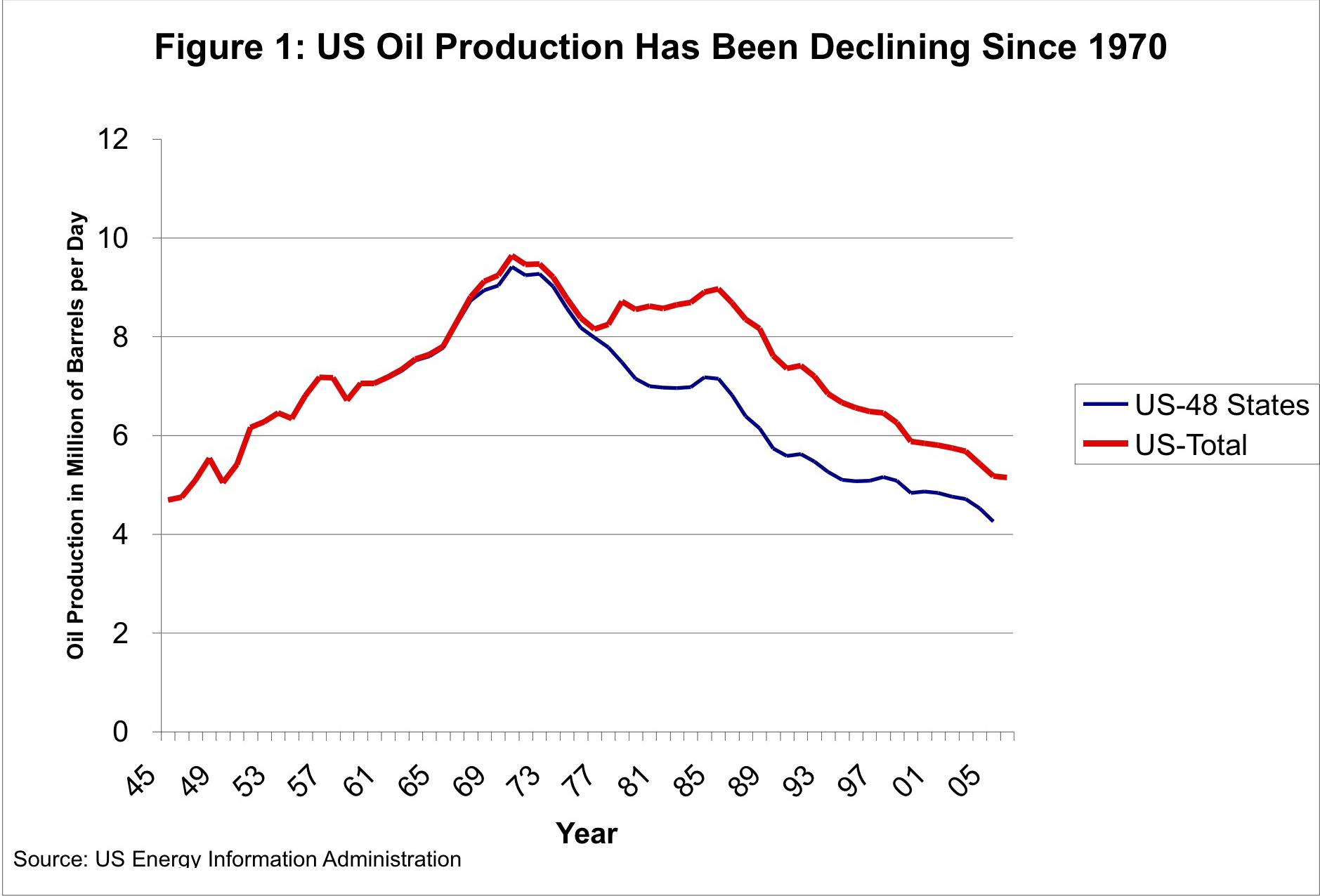

There is now serious concern that world oil production will begin to decline ("peak"), just as it has in the United States and the North Sea. I discussed this earlier in Oil Quiz - Test Your Knowledge . A congressional committee was also concerned about this issue, and asked the US Government Accountability Office to study it. The GAO's report, titled CRUDE OIL: Uncertainty about Future Supply Makes It Important to Develop a Strategy for Addressing a Peak and Decline in Oil Production confirmed that this is an important issue.
Exactly how soon this decline will begin is not certain, but many predict that the decline may begin within the next few years.
2. Natural Gas
Natural gas in North America is also reaching its limits. United States natural gas production reached its peak in 1973. Each year, more and more wells are drilled, but the average amount of gas produced per well declines. This occurs because the best sites were developed first, and the later sites are more marginal. The United States has been importing more and more natural gas from Canada, but this is also reaching its limits. Because of these issues, the total amount of natural gas available to the United States is likely to decline in the next few years - quite possibly leading to shortages.
3. Fresh Water
Fresh water is needed for drinking and irrigation, but here too we are reaching limits. Water from melting ice caps is declining in quantity because of global warming. Water is being pumped from aquifers much faster than it is being replaced, and water tables are dropping by one to three meters a year in many areas. Some rivers, especially in China and Australia, are close to dry because of diversion for agriculture and a warming climate. In the United States, water limitations are especially important in the Southwest and in the more arid part of the Plains States.
4. Top soil
The topsoil we depend on for agriculture is created very slowly - about one inch in 300 to 500 years, depending on the location. The extensive tilling of the earth's soil that is now being done results in many stresses on this topsoil, including erosion, loss of organic matter, and chemical degradation. Frequent irrigation often results in salination, as well. As society tries to feed more and more people, and produce biofuel as well, there is pressure to push soil to its limits--use land in areas subject to erosion; use more and more fertilizer, herbicides, and pesticides; and remove the organic material needed to build up the soil.
Are there indirect impacts as well?
Besides depleting oil, natural gas, fresh water, and top soil, the intensive use of the earth's resources is resulting in pollution of air and water, and appears to be contributing to global warming as well.
Can technology overcome these finite world issues?
While we have been trying to develop solutions, success has been limited to date. When we have tried to find substitutes, we have mostly managed to trade one problem for another:
Ethanol from corn
Current production methods usually require large amounts of natural gas and fresh water, both of which are in short supply. Increasing production may require the use of land which has been set aside in the Conservation Reserve Program because of its tendency to erode.
Oil from oil sands and oil shale
Oil from oil sands requires large energy inputs, currently from natural gas, as well as fresh water, and creates pollution issues. Oil from oil shale is expected to require even more energy and fresh water.
Coal to liquid and coal substitution for natural gas
"Clean coal" and sequestration of carbon dioxide from coal are not yet commercially available, and are expected to be very expensive if they become available. Thus, coal production is likely to exacerbate global warming and raise pollution levels. If coal is used to replace both oil and natural gas, it is likely to deplete within a few decades, like the natural gas and oil it replaces.
Deeper wells for fresh water
If deeper wells are used, they will requires more energy to pump the water farther. In locations that use aquifers that replenish over thousands of years, the available water will eventually be depleted.
There are a number of promising technologies — including solar, wind, wave power, and geothermal — but the amount of energy from these sources is tiny at this time. Nuclear power also seems to have promise, but has toxic waste issues and is difficult to scale up quickly. A general introduction to alternative technologies is provided in What Are Our Alternatives If Fossil Fuels Are a Problem?
What if we don't find technological solutions?
We can't know for sure what will happen, but these are some hypotheses:
1. Initially, higher prices for energy and food items and a major recession.
If the supply of oil lags behind demand, we can expect rising prices for oil and gasoline and possibly other types of energy. Prices for food may also rise, because oil is used in the production and transportation of food. Recession is likely to follow, because people will cut down on their purchases of discretionary items, so as to be able to afford the necessities. Layoffs will follow. People laid off will find it difficult to pay mortgages and other debt, so banks and other creditors will find themselves in increasing financial difficulty.
2. Longer term, a decline in economic activity.
With fewer resources, economic activity is likely to decline. We will need to find replacements for many products in a relatively short time frame — heating fuel, transportation fuel, plastics, synthetic fabrics, fertilizer (currently made from natural gas), and asphalt, among other things. Living standards are likely to drop, because we don’t have infinite resources for replacing all the things that are declining in availability.
A graphic representation of how this might happen is shown in Figure 3. Real gross domestic product (GDP) gives a measure of how much goods and services the United States is producing in a year, in constant (year 2000) dollars. The "Fitted" line in Figure 3 shows the expected growth in real GDP, if growth continues as in the past. Scenarios 1 and 2 show two examples of how limitations on oil and natural gas might impact future real GDP. Scenario 1 shows a fairly rapid decline, starting very soon. Scenario 2 shows a slower decline, starting in 2020. If the downturn is still several years away, we have longer to plan, and a better chance that the decline will be more gradual.

3. Transportation difficulties and electrical outages.
Since transportation generally uses petroleum products for fuel, a reduction in the amount of oil available is likely to cause transportation difficulties. These difficulties may extend to all forms of transportation--automobile, trucks, airplanes, boats, and railroads, to the extent that fuel is unavailable due to shortages, cost, or rationing.
If natural gas supplies decline, electrical outages are likely, especially during high-use times of the year. Electrical outages may also result from interruption of transportation of other fuel, such as coal, to power plants, because of petrolum shortages. Outages may be one time events, or may be planned outages at certain times of the day, to compensate for an inadeqacy in the fuel supply.
4. Possible collapse of the monetary system.
This is perhaps the biggest single issue, and the most difficult to understand.
There is a huge amount of debt in the world today. When loans were made, the expectation of the lenders was that the economy would continue to grow as in the past--that is like the "Fitted" line in Figure 3 above. If this continued growth occurred, people, on average, would be a little better off financially when the time came to pay off their loans than they were when the loans were taken out, so they would have a reasonable chance of paying off the loans with interest. Corporations would continue to grow, and because of this continued growth, most would be able to pay off their debt with interest.
What happens if a scenario like that shown as Scenario 1 or Scenario 2 on Figure 3 occurs? When it comes time to repay the loans, people and corporations will be on average, worse off, rather than better off, than when they took them out. It is likely that many people will be unemployed, and cannot pay back their debt. Companies manufacturing goods that are no longer in demand are likely to be bankrupt, and thus will be unable to repay their debt. Organizations holding this debt, such as banks, insurance companies, and pension funds will find themselves in financial difficulty, because of the many defaults on the loans that are the assets of these organizations.
Two possible outcomes of widespread defaults come to mind. One is that there is so much debt that cannot be repaid that banks, insurance companies, and in fact the whole monetary system fails. The other alternative is that the government guarantees all the debt, so that the institutions do not fail. The latter approach would likely lead to hyper-inflation.
In either event, people and businesses would lose their savings, because money either wouid either be no longer available (first approach), or would be worth very little due to inflation (second approach). In either event, foreign countries would be unlikely to accept our currency in trade. Simple transactions, such as purchasing food or paying an employee, would become very difficult. Eventually, some approach would likely be found to circumvent these difficulties--perhaps a more barter-based approach--but this would be a huge change from our current system.
5. Failure of economic assumptions to hold.
We have been raised in a world where supply and demand are generally in balance. An increase in demand results in a greater price, which in turn leads to a greater supply. If the particular item isn’t available, substitution is generally available.
Once we reach geological limits, these basic principles seem much less likely to hold. An increase in energy demand isn't likely to translate into greater supply. Distribution of the limited available supply seems likely to reflect considerations other than price, such as rationing and long-term alliances. There may also be military conflict over available supplies.
6. Changed emphasis to more local production.
Two factors are likely to encourage local production and discourage international trade. One is the higher cost and/or unavailability of fuels used for transportation. The other is difficulty with the monetary system--either hyper-inflation or complete failure of the system. If there are monetary system problems, other countries are likely to want actual goods in trade, rather than IOUs or money. This requirement is likely to greatly reduce the amount of trade with foreign countries.
Food production is likely to be more localized, since this insures a continuous supply, and reduces the amount of fuel needed for transportation. If there are problems with shortages, people may choose to have gardens, so as to grow a few of the foods they need themselves.
7. Reduced emphasis on debt.
Once it is clear that future production is likely to be less than current production, as in either Scenario 1 or Scenario 2 of Figure 3, it will be very difficult to find any lender willing to provide long term loans, since if the loan is paid back at all, it is likely to be paid back in money that is worth very much less than it was at the time the loan was taken out.
If governments still have debt at this point, they will find it difficult to sell new bonds to replace the ones that mature. Businesses desiring to build new plants may find it necessary to accumulate resources for new plants in advance of their construction. Mortgages may not be available for prospective home owners, either.
8. Reduced emphasis on insurance and pensions.
If there are difficulties with the monetary system, insurance companies and pension plans will be among the hardest hit, since thy take in funds and invest them, and pay benefits later.
It is possible that a limited form of Social Security coverage may continue, but this is by no means certain. If a high level of inflation occurs (see point 4 above), benefits that have been promised to date will be worth very little. If a new monetary system is in place, it will be up to the government at that time to determine the level of benefits. Because total goods and services will be lower in the future (Figure 3 above), benefits to retirees will almost certainly be lower as well.
9. More people will perform manual labor.
As the amount of oil and natural gas becomes less available, more work will need to be done by hand, since the fuels to run machines will be less available. In order to encourage people to take jobs involving manual labor, manual labor will pay better in relationship to desk jobs. Because food is such ain important commodity, farming may be particularly highly valued, and may pay especially well.
10. Resource wars and migration conflicts.
If there is is an inadequate amount of a resource (water, oil, natural gas, or food), countries may fight over the limited supplies that are available. Conflicts are likely to spring up regarding areas where resources are plentiful.
Alternatively, people may choose to migrate from an area if resources become less abundant--for example, migration may occur if water supplies dry up, or if land is flooded due to global warming, or if declining oil supplies limit transportation. Receiving areas may not welcome the newcomers, leading to more conflict.
11. Changes in family relationships.
Families are likely to see more of each other, because of reduced transportation availability. Families may work more closely together, tending gardens and running small family businesses. Co-operation may be more highly valued by society. Divorce rates may decline.
12. Eventual population decline.
The food supply produced in the world today is many times greater than the food supply 100 years ago, before oil and natural gas were used in tilling crops, pumping water for irrigation, making fertilizer and pesticides, and transporting food to market. As oil and natural gas become less available, the food supply is likely to decline. Eventually, world population is also likely to decline, reflecting the lower food supply.
Conclusion
We cannot know exactly what the future will hold, if technology is not able to overcome the many issues associated with a finite world, including declining oil and natural gas supply, decreasing fresh water supply, and climate change. Whatever changes occur are likely to differ from location to location, as the world activity becomes more localized.
We tend to think of governments as fairly stable, but these too may change. Countries may subdivide into smaller units. Some have even suggested that groups of states may break away from the United States.
Educational institutions will most likely change. Fewer students will probably attend colleges and universities, and the subjects of interest will likely change. The sciences and agriculture or permaculture are likely to be topics of interest. More students may want to live on campus, if transportation is a problem. Adult education may become more important, as people seek to develop skills for a changing world.
Businesses will also change. Local businesses will become more important, while multinational companies recede in importance. Manufacturing will become less important, and recycling will become more important. Providing necessities will get top priority, while nice-to-have items will not sell well. Barter, or a new monetary system that substitutes for barter, may be the way business is done.
People may choose to live closer to work, or may work at home, so as to minimize costs associated with commuting. Some people may choose to live with relatives or friends, so as to save on utility costs. Eventually, many homes in undesirable locations may be left empty, and the parts of these unoccupied homes that can be used elsewhere will be recycled.
The next 50 years will certainly be interesting ones. Perhaps, with technological advances, some of the potential problems can be avoided. But we will need to work hard, starting now, to develop ways to work around the problems which seem to be ahead.
To Learn More
The Power of Community: How Cuba Survived Peak Oil 53 minute film, available for $20, tells the story of how Cuba adapted to losing over half of its petroleum imports after the collapse of the Soviet Union.
Closing the Collapse Gap: The USSR Was Better Prepared for Peak Oil than the United States Humorous talk by Dmitry Orlov
The Long Emergency: Surviving the End of Oil, Climate Change, and Other Converging Catastrophes of the Twenty-First Century Book by James Howard Kunstler
Discussion Questions
1. What are five things that might improve after world oil production begins to decline? (Hint: Consider exercise, weight problems, family situations, etc.)
2. If there is a decline in oil and gas production, how do you expect the large amount of debt outstanding to resolve itself? Do you think there will be monetary collapse, hyper-inflation, or some other solution?
3. Do you expect that families will have more or fewer children after oil and natural gas production begin to decline? Why?
4. How can businesses prepare for interruptions in electrical service?
5. What types of buildings are best adapted to frequent outages of electrical service? Which buildings are likely to have the most problems?
6. What vocations appear to be most likely to be useful for supporting a family, after oil and gas production begin to decline?
7. What changes might a college make to its curriculum, to better prepare students for the changing world situation expected after production of oil and natural gas begin to decline?
8. In Figure 3, real GDP in Scenarios 1 and 2 are shown as changing in relatively straight lines. Could alternative scenarios have the lines zig-zag or drop suddenly? What real world situations might cause different patterns?
Contact
- Content: editors at theoildrum dot com
- Tech support: support at theoildrum dot com
License

This work is licensed under a Creative Commons Attribution-Share Alike 3.0 United States License.
We hope that you will use the reddit and digg buttons for our authors, it helps them get readers for their hard work...and seeing as how this is a good "primer" kind of post, this would be a great first read for new people.
Thanks.
There is a way to have continuing economic growth with a finite, fixed resource base (and a stable population that is within the carrying capacity defined by those finite resources). Any economic growth that happens under such circumstances must be due to intellectual development. The products of human creativity and scientific discovery can lead to more efficient usage of those finite resources. Demand can increase for products that require increasingly fewer resources to produce. Many of the fine and popular arts, for example, require only small material inputs, and with the applications of technologies such as digitalization, those inputs can be continually reduced. Yet the arts have expanded to become a huge component of our modern economy, and there appears to be very few constraints limiting their continuing growth in some form or another, other than the obvious ones of the discretionary wealth and available leisure time of consumers.
While some level of continuing economic growth might thus be possible under a stable resource base, my guess is that we are talking about a very low rate of growth -- maybe 1-2% annually at best. It also must all be hard growth rather than easy growth. In other words, the growth must be genuinely earned through real improvements in humankind's intellectual and cultural patrimony.
Perhaps there is a way to have continued economic growth for awhile, but even at 1 or 2%, the music has to stop somewhere, sometime.
The key, regardless, is that total material production and consumption must stabilize and decrease soon because we do not have enough planets for our current level of consumption, much less increases in our current level of consumption.
In any event, economic growth, as represented by GDP, has become an increasingly flawed parameter to even approximate well being. We need to focus on other measures of well being, which may or may not be reflected in changes in GDP.
Even within the strict context of GDP, the number is not a good guide to economic well being since most of the increase s in GDP over the last couple of decades has gone to the very rich. At least in the U.S. the level of inequality just increases year by year. To focus on the gross overall GDP or even the per capita GDP is a terribly distorted way of looking at the economy.
And then we have this perverted way of looking at greenhouse gases. The Bush administration prefers to focus on intensity as if the overall level doesn't matter as long as we are becoming more efficient. Well, efficiency isn't getting us where we need to be. Whether it could ever result in the overall reduction of GHG is a matter of debate, but in any event, the overall level needs to be capped. If, within those constraints, economic growth continue for awhile, perhaps that is acceptable.
A further related note. As more and more of us economize,localize, and produce, our efforts will larely not be reflected in GDP. But our well being will increase. The religion of economic growth is a curse.
NO, there is not "a way to have continuing growth with a finite, fixed resource base."
Growth is growth. Any increase in resource use beyond its capacity to replace itself means collapse.
We are not going to think ourselves out of this. This is the first canard that must go away. If you go to the Sudan and tell the starving there to just think about food and everything will be all right, you will be beaten to death. Then, if they are smart, they will eat you.
Do not tell me that people will grow an economy based on art. That is specious at best. Have you heard of the Tulip bubble?
What all Westerners and much of the rest of the world must come to realize is that a growth economy is a poisonous illogical, cancerous, waste of time and resources designed to enrich a tiny minority and screw the rest. Give up this paradigm. Live outside the patriarchy, escape the mean daddy paradigm.
The system is closed basically as far as mass goes but its a open system for energy primarily from the Sun but in general fusion creates a open system vs energy and breeder style fission effectively creates a open system. Also mining of solar system creates a system that is effectively open for critical raw materials also of course nucleotide synthesis can be used if needed and if energy is abundant. A element synthesizer orbiting close to the sun can provide effectively unlimited amounts of elements for a price at a finite rate.
I know it sounds like science fiction but nothing I said is not doable starting with todays technology it a engineering problem.
The problem is EROEI cannot be solved simply and constrains the system. The real constraint is thus EROEI which is constrained by...
E=mc^2
This constrain is one we don't know how to beat yet.
Surely you mean, "....is constrained by the Second Law of Thermodynamics...."
E=mc^2 has nothing to do with the case. In fact, if we ever get Fusion working (which we almost certainly wont) then E=mc^2 will solve our energy problems.
We're depleting the capacity of the sky to act as a heat sink?
Yeah yeah he knows, it was just to get you out posting! Welcome :)
Growth is growth, but there are different types of growth. Of course, you and everybody around here is thinking about exponential growth most of the time. Take a second and imagine a logarithmic growth curve, or better yet, a curve that approaches but never reaches an asymptote, like the logistic growth curve. Those curves allow for endless growth with an endlessly shrinking growth rate.
Asymptotic curves are what we can expect in the long run for most processes.
You didn't read what he wrote. He said:
"Demand can increase for products that require increasingly fewer resources to produce."
i.e., he is not talking about increasing resource use. He is talking about producing more with the same level of resource use - i.e., sustainable growth.
Consider, for example, the situation where a widget takes 1% less resources to produce every decade due to technological improvements. Production rate can grow indefinitely on a fixed rate of resource consumption, or production rate can remain fixed indefinitely on a finite, non-renewable resource. So long-term growth is possible, at least in theory.
In practice, there is the potential for long-term growth as well. Our energy use could expand enormously before solar would be unable to supply it, and - with enough energy available - projects to increase other resources (such as deorbiting asteroids for mining, or large-scale desalination for fresh water) may become possible.
In other words, there is a much weaker case for impending terminal decline of economic growth than there is for impending terminal decline of oil supply growth, and conflating the two like this does little more than dilute the peak oil message. If you are terminally pessimistic about everything, nobody will listen to you about anything.
So next year the same amount of nutrition, sunlight, water and care will product two turnips where this year we only have one. I don't think so. Maybe it's semantic - we could have qualitative change. We need it.
Growth is "more" - an increase in size, quantity or number. 2% is still a doubling in 36 years or so.
cfm in Gray, ME
No - we were discussing economic growth, not agricultural growth. The two are different.
In particular, with synthetic goods, we have more control over the production process, meaning there is more scope for improving efficiency.
Sure you can produce some widgets more efficiently for a few year, but for infinite sustainable growth you have to produce every widget more efficiently for ever. That is utterly impossible, Moore's Law or its equivalent lie in wait for you sooner of later - and normally sooner. Eventually, all else failing, Heisenberg's Uncertainty Principle will hit as you try to make widgets measuring less than Plank length.
However, putting that aside, given this potential underling infinite supply of more efficiently built widgets, you have to find the energy and investments to switch to sustainable energy using solar or wind, and keep growth going at the same time. That's a bit like doing a valve job on an engine while the engine is going! As the old Irish joke goes, "I wouldn't start from here.";
Surely there is a gap between terminal pessimism and being a realist - although I can't see much difference at the moment.
Well, realists realize that these problems are at the very least centuries in the future, and more likely millenia.
It depends on which problems you're referring to.
Peak oil? Definitely less than centuries, much less millennia. Current oil demand levels would consume over 3T barrels in the next century, which is about the sum of petroleum believed to exist, including tar sands and oil shales.
Peak energy? Centuries or millennia. Solar irradiation onto the earth's surface is more than ten thousand times the world's current power consumption (link). Converting that to electricity (~30% efficient) and placing solar cells only on infrastructure (~3% area for US-like country) still gives a thousand-fold increase in available energy, without even leaving the planet.
Of course, there's only so much energy available in the solar system - the sun only produces a finite amount of radiance - so there are theoretical limits to growth of energy consumption here. But those theoretical limits are so enormously large that they're utterly irrelevant right now.
So we need to be a little careful with terms. Oil supply? Bound to peak soonish. Energy supply? Functionally limited only by ingenuity and capital.
Conflating those two is not useful.
You do realize that Moore's Law is (a) not a law (it's just an observation), and (b) says the opposite of what you're saying?
If you wished to provide evidence that infinitely-increasing efficiency is impossible, you'd do much better to argue from the perspective of thermodynamics. It's not clear that production must inherently be non-reversible, though, meaning there's no clear path to proving that continually reducing the energy requirements of a recycle/produce system is impossible.
So, really, all you're saying is that you believe continually-increasing efficiency is impossible. That you believe something does not make it true.
Why would you make widgets of less than Planck length? You'd recycle and reuse the finite resource base, including the resource requirements for that in the overall production requirements.
That'd lead to a faster and faster update cycle for the widgets in the constant-consumption-rate scenario, of course, but that's really not a practical concern - demand for a type of widgets typically follows a logistic curve (see, for example, railway installation or cellphone adoption), meaning the number of units we want to produce would eventually approach an asymptote, shunting us into the fixed-production-rate scenario.
Not at all.
It's like doing valve jobs on a fleet of engines while the fleet is still in operation. And that happens all the time.
If you don't see a difference, there's two cases:
Never underestimate the chances that you don't know everything. Skepticism about your beliefs is tremendously important.
i.e., that you believe something does not make it true.
Neither of us, thank God, can know the future. However, I have great difficulty in imagining one in which we mange to continue expanding the production of everything (including, I presume people) for ever. There are many constraints to prevent this and I touched on only a few in my post yesterday.
Honesty must compel you to admit that all previous civilizations we know of have collapsed and that there is no particular reason to expect our society to be different.
I agree that such a scenario is beyond unlikely.
The rate of population increase has been going down for quite a while - both as a percentage of current population and in raw millions per year. Indeed, the UN projects world population will peak at 9.2B in 2075, and the cessation of population growth will mean that only per-capita factors can drive increased consumption.
Some of that will happen, but - as the last few decades in Germany suggests - eventually people's consumption levels will saturate and stabilize. There's no particular reason why consumption rates of anything should increase indefinitely - like I said, that kind of thing tend to follow a slow-fast-slow curve that eventually approaches an asymptote.
A lack of growth in consumption of resources doesn't imply a lack of economic growth, as mentioned previously. A lack of growth in consumption of goods, though, might - economics is the study of allocating scarce resources to competing uses. If resources aren't scarce, then the notion of "the economy" is not entirely well-defined. Some fiction looks at that kind of scenario, though, and what might occupy humanity's time and energy. "Star Trek", oddly enough, is probably the best-known example.
Not at all.
First, I don't agree that all previous civilizations have collapsed, and I think that's either an ethnocentric or naive view. Some groups of Australian aborigines have oral records going back - literally - tens of thousands of years, as confirmed by references to geographic features that are not present anymore but can be determined to have been present at the time. I haven't seen particular evidence that they've "collapsed", unless you'd prefer to say they don't count as civilized.
Similarly, many of the native groups in North America were destroyed by conquest rather than collapse. That may represent (one of the) potential differences between our current (global) situation and previous (isolated) civilizations, which is that there's (a) a broad-based desire for peace, and (b) nobody "outside" our current civilization to come in and knock it over.
Indeed, the claim that every prior situation has "collapsed" is far from obvious, and needs to be backed up before it's taken seriously. And remember that universally-quantified claims ("for all") are not demonstrated by anecdotal evidence; merely claiming this or that civilization collapsed does not show that all of them did.
If you would like the claim that "all prior civilizations collapsed" to be taken at all seriously outside of the doomer community, you'll need to examine much less favourable cases than Easter Island. What about China, for example - it's been trucking along pretty well for a couple thousand years, despite periodic civil wars. Or Iceland - it has the oldest continually-sitting parliament in the world (the Althing), meaning it's had governmental continuity since it was settled a thousand years ago.
If honesty was going to compel me to say anything, it would compel me to note that either you have a very restrictive definition of "civilization", or that you simply haven't thought about whether your claim is true - and that I strongly suspect the latter.
Civilization comes from the Greek word Cives which means cities (by extension an urban, urbane, and literate society).
Aboriginal culture was indeed long lasting (>60k years possibly) but was static, not constantly growing (which is where we started this thread if you can remember).
Aboriginal society introduced no innovations and was sustainable. They made the minimum of widgets the same way for long periods of time and eschewed agriculture.
As I said before, you need to be much broader when attempting to supply evidence for your claim. You've noted that your definition does not support Aborigines as "civilized", but you've failed to address any cases that your definition does cover.
What about China? It's had large cities and literacy for millenia. When did it collapse?
What about tiny, harsh, isolated Iceland, surely a prime candidate for collapse? It's done pretty well for itself over the last thousand years (although it may not have had cities per se until about 250 years ago).
In fact, if your definition of "civilized" is "city", then what about all the major cities - Paris, London, Venice, ... - that have continually existed as large and stable cities for well over a thousand years?
You really haven't provided any evidence for your claim that all prior civilizations have collapsed, so how could you possibly expect anyone to believe you unless they already agreed with you? (That's one of the key dangers of insular communities such as Peak Oil, by the way - you get so used to people sharing the same beliefs that you can forget to check whether those beliefs are actually true.)
Hi Pitt and Le, (and others),
I like the conversation.
Just wanted to note about Easter Island AKA Rapa Nui
http://www.americanscientist.org/template/AssetDetail/assetid/53200?full.... It looks like the history was a bit more complex than the story one usually hears.
Professor, please excuse my ignorance, but most folks, including me, are not knowledgeable enough about this entire "Peak Whatever", GW, Super Volcanoes, Meteors, Gamma Rays, etc. to even pose rational questions.
What we want to know, is: How much of any of this, from any side or expert, is bullshit, and how much is something we ought to worry about?
We've seen the films, read the publications, and listened with rapt attention to pronouncements on all of it from hundreds of experts, celebrities, politicians, and Bubba down at the local watering hole. But we still don't have an answer.
I do enjoy reading your posts and the oildrum in general, but all the analysis doesn't answer the basic question posed above.
Help us out, please. We have lives to live.
No one really knows for sure. At best these are all educated guesses. I'd really like to see an IPCC-style panel address global energy/water issues.
Do the best to prepare at whatever level you deem is reasonable.
If worst case scenarios do come to pass (not saying they will), it may be that any preparation (short of a Vault) could be fairly worthless anyway. :)
If you don't want to study the science, then you must accept an "Argument from Authority". Internet blogs run the Gamut - from those who think the earth is 7,000 years old or don't believe in thermodynamics, to very knowledgeable Phds with years of experience.
The best way to sort out the silly stuff is just reject those who don't believe in the basic laws of physics (or evolution etc) or those who have a political philosophy so set on some agenda (like avoiding government taxation or control) that they are willing to bend all facts.
I would recommend reading "Limits to Growth: The 30-Year Update" It does a good job explaining how exponential growth crashes into a wide variety of limits and tends toward collapse. Unthinking creatures follow population booms and busts. And so do thinking creatures that refuse to think (or act). It may be a tough book to get into, but it will pay back far more understanding than reading hundreds of posts.
If that book is too technical, then try "Plan B 2.0" by Lester Brown. It does not do as good a job of explaining the theory behind why systems collapse, but it does have a great list of all the limits the human race is crashing into. And it has helpful ideas of what can be done to act smarter.
There are also a bunch of "state of the planet" type books from reputable sources like Science magazine.
gTrout, some good reads, of course you could go back to 1980 and read Alvin Toffler's "The Third Wave" and see every single issue we think is new now discussed then. His view then was that the time of the end of the worship of growth was THEN, 27 years ago. Was he correct in fact, but just wrong on the timing?
By the way, Toffler did not see the end of growth as growth was then (and now) narrowly defined as the end of human experience, far from it. But he did see it as the beginning of a change in human history as powerful (and as potentially chaotic) as the birth of the prior two great changes in wealth production, agriculture (recall that at what time, every human on Earth was a hunter-gatherer, now, not even 1% is) and industrialism (recall that at one time 90% of the human race was involved agriculture, now, barely 3% in the developed countries are), that would change at the core humanities way of existing and creating wealth and surplus. I will talk in another post about some of the directions we thought we would go back in those days, but there is a change a'comin', there always is, the only question is how fast and hard it will hit....and who will benefit (some will) and who will get hurt (someone always does)
Roger Conner Jr.
Remember, we are only one cubic mile from freedom
Malthus was in fact correct 200 years ago. A finite planet will not support an infinite population of anything. At that time no one could foresee how far we would overshoot that limit, but I believe we've done it.
| The problem will solve itself.
| But not in a nice way.
That's a very good question, but really unanswerable. If we are frank, there is an awful lot of BS written about PO (and everything else) - that applies to both sides of the argument. Anyone claiming to be able to predict the future with such accuracy is obviously a charlatan or a fool.
If you can't decide on the evidence yourself, then you would have to ask someone you trust to give a verdict. Personally, I trust the scientific method to eventually come up with the truth, but science is poor at predicting one-off events. Observation of events as they happen will be the only way to know for sure.
In the event that there is something to worry about, if you decide there is nothing that you can personally do that will make any significant difference, either to your own future or anyone elses, then the best thing is to ignore it, and get on with your life. Worrying about stuff you cannot change will only cause stress, to no useful end.
Then, every pronouncement on these issues (from whoever ) should be preceded by a disclaimer. Eg. "This is my opinion, and it's quite possibly complete BS." Logically, then, lacking any definitive proof, the avg Joe should ignore all of it, and deal with whatever comes his way, when and if it does.
Put simply, "Tomorrow will take care of itself". Right?
Therefore, why on earth should anyone consent to higher taxes, limited life style, and so on, "just in case"?
Thank you.
Logically - which is to say, acting rationally - he should do no such thing. Definitive proof is highly overrated, largely because it's almost entirely lacking.
If Joe wants to act sensibly, he should examine the arguments about the issues, kick their tires, maybe educate himself a little, and then make a reasoned judgement about which ones are most likely, how likely they appear to be, and what he should do about it.
Doing nothing until definitive proof exists is just silly. It's like not locking your car until it's stolen, since you don't have definitive proof of the existence of car thieves until then.
I have to agree with Pitt. Humans have a clever brain, why would it be "Logical" to pretend we don't and act like sheep?
Watch a movie like Titanic if you want to see what happens when people set aside rational planning for wishful thinking. It would have been a lot easier to save all the passengers if they didn't hit the ice berg in the first place.
That is the whole point of peak oil planning. 30 years ago the first population limit debates raged that we should not allow growth to get larger than the "lifeboat" that we live on. The people arguing for the limited lifestyle lost.
The next argument will be about who gets to be in the lifeboat.
Go read a "State of the Planet". I think you will find the water is up around your ankles. But don't worry about that because the Titanic can't sink! "God himself cannot sink this ship". Return to your state room. Have another beer. Ignore the highly qualified engineer saying ships of iron can and will sink. Do nothing. Watch more TV. Take out another mortgage. Buy another big car.
You won't need to consent to a limited life style. It will be the only choice available.
Hi Gene,
I like that you're asking a practical question. It may be difficult for people to respond, without knowing more. What are you most concerned about?
Regarding what Bob says:
"Anyone claiming to be able to predict the future with such accuracy is obviously a charlatan or a fool."
To me, it looks as if the crucial phrase here is "...with such accuracy...". It's not foolish to look at the problem - it's wise. No one can predict the future with accuracy. Still, we can say some things about the present. This means, we can say some things about the future.
There are (at least) two aspects of discussing "energy and our future":
1) The broad outlines of resource in terms of available amount and time.
2) The fact the resource is finite.
3) This means something.
The question is: What?
In other words, we can know something about the situation we are in, and then talk about what the changes will look like.
We can also say definitively what will happen if there are no changes. And that looks extremely bad.
Assume we don't want "bad".
How do we get "good" or "least bad"?
Okay, let's pull some things out of my arse. I view myself as an optimist at TOD, compared to many of the viewpoints here.
Supervolcanoes, Meteors, and Gamma Rays(I think you mean supernovas within a few parsecs) have a fraction of a percent chance of killing off, say, half the population of a continent of people in the 21st century.
Global warming is the next most likely event, but it is quite difficult to predict the weather next week, much less accurate atmospheric forcing over the course of a century. All we really KNOW is that Northern Hemisphere average temperatures in the last decade are scary(read: beyond all reasonable models we were using), and the steadily(read: reversal of trend is the hardest task humanity as a whole has ever faced) climbing atmospheric CO2 is scary. 60% confidence level of beginning to melt Greenland and wiping out most of the arctic glaciers in the next hundred years, flooding most sealevel islands and coastlines gradually. 75% confidence level of causing over 10% of the earth's population to relocate their home through agricultural or flooding problems.
Ecological problems and 'The peaks' are the only virtually assured disasters. Ocean fisheries, forests, topsoil, aquifers, and accessible hydrocarbons are all being depleted at rates that simply can't mathematically continue for another 93 years.
Ecology
Invasive species are destroying previously isolated flora and fauna, and WILL continue to, for lack of ability and more often, lack of caring(we're annihilated stronger hazards than the wild boar): 100% confidence. Industrial pollution WILL continue to sterilize or contaminate riverwater: 100% confidence. Desertification WILL cause large food shortages(and accompanying wars, which we can see in Africa now) and shifts over to less nutritious foods: 95% confidence. Fresh water WILL become a semiprecious commodity in much of the world that now takes it for granted by basically mining it: 95% confidence.
Hydrocarbons
Oil, gas, and coal WILL become the most important strategic assets in the world, the subject of numerous wars: 95% confidence. That one of those wars will be of the same scale as WW1/WW2: 30% chance. Whether the first world can replace most of their use without cascading collapses of industrial infrastructure (and eventual dieoff) is up for debate. I give it 90% chance we can do it, but 80% chance that it will be looked back on as at least as dark a period as the Great Depression. Partially because if there ever was a trigger for the fiscal problems of the United States to explode(the housing market hasn't done it yet), it's peak oil, which would put our trade imbalance so much deeper in the red than it already is, it threatens our credit rating, and thus, our status as an anchor currency. Chance of hyperinflation in the US after a global peak is discerned: 60%.
After that, there's the matter of the 'true' price for oil. Exports will dry up much faster than total supply when a peak becomes apparent, as countries nationalize, strategically reserve, and in general tighten their supplies(aside from rising internal consumption, which is what the much-repeated 'exportland' term refers to). Call it a 1-5% decline rate, paired with a 5-15% decline rate in exports. The 'true price' is a very subjective matter, masked partly because oil becomes the anchor currency in the short term.
Alternative energy is poised to grow to large-proportion-of-most-economy sized proportions, at least for a while. Regardless of what romantic environmentalists like to think, 'Powerdown' is not an option. 6.5 billion people living at 18th century levels of industrialization is simple not possible, preferable, or something they will accept. Nor is mass genocide acceptable so that the few survivors can 'live off the land'. Whether it can take hold fast enough is a big question. I have a lot of optimism - thus far alternative energy is a hobby. There is every reason to believe that it is possible to bring up the level of innovation if we take it as seriously as we do major wars.
I appreciate all the comments and opinions, I really do. But ya' know what? I've yet to hear from "Professor Goose", who was the author if I'm not mistaken.
And I did mean Super [i]Volcanoes[/i] - eg: Yellowstone. Although Super Novae (or the Super Flu ) are yet more "things we should fear". Sorry, y'all. I don't scare easily. Which really pisses off politicians, preachers, and certain special interests. Sometimes people need their ricebowls kicked over, and I'm an equal opportunity rice bowl kicker. They can deal with it. Or bite me. Don't much care which.
Hi Gene,
Are you still reading this thread?
If so, "Prof G" posted this for the author. The author herself is Gail.
I think she posted it in order to get feedback, and I take it her main desire is to educate people.
So, are you saying that you'd like to know "how scared" to be?
Another way to say this: "Are you wanting some guidance in how to assess the importance of 'peak oil'?"
My take on it is that Gail is writing to help give people the information they need in order to evaluate our situation. So, she may not want to tell you how afraid you "should" be.
Rather, she may want to give you facts, and then ask "What do you think we all ought to do?"
Robert Hirsch, who is the author of the 2005 Hirsch report, said in a public interview that this was the most frightening thing he's encountered in his lifetime. It might be useful to you to look up his writing. Check out http://www.energybulletin.net/28895.html
Perhaps the question to ask is "Why is he afraid? And why is he also concerned about being seen as alarmist?"
Aniya, yes I still follow this, and other threads, etc. You asked where I was coming from with this line of questioning.
I'm retired now, but at one time I was a senior internal consultant and statistician for one of the worlds largest manufacturing corporations. At that time one of my constant concerns was over-reaction to normal system behavior by the management of those business and manufacturing systems. People are generally not comfortable with variation, and tend to react in ways that are not only unpredictable, but dangerous to the proper and normal functioning of the system.
My concern now is the same: one of over-reaction by the public and by policy makers. I have the same issues with the Climate Change people. To a layman a 90% confidence is close enough to a "sure thing" to start stockpiling food. To a statistician it's barely noticeable and is certainly not sufficient to engender drastic corrective action unless the fundamental physics of the situation support such action. Statistically, "action" taken within the "6 Sigma" control limits is generally a waste of time and resources and often will create a problem where none existed prior to the "adjustment". This is all predicated on the existence and demonstration of a stable system however. Since I seriously doubt whether such stability exists (in the statistical sense ) for either Peak Oil or Climate Change my inclination is to prod the proponents of such analysis to establish the basic requisites to obtain a 99.73% conf. in their conclusions before any significant action is contemplated.
The above is, of course, greatly simplified, and would require significant work to establish the appropriate probability distribution(s). If such work has been done, I've not seen it. What I have seen is a great deal of "I believe", without even so much as a reference to either traditional or Bayesian analysis, let alone a serious consideration for the natural variance and/or chaotic behavior of the system being discussed.
You appear to be talking not about "confidence" but about "likelihood", which is very different.
An event with around a 100%-90% = 10% likelihood - such as flipping a coin three times and getting "heads" each time - is (as you say) statistically boring. Things that are 10% probable happen all around us all the time - it's not even two standard deviations (assuming a normal distribution).
By contrast, saying that there's a 90% chance X caused Y is very different. The key is to realize that the probability of any random event being responsible for any other random event is tiny - much less than 1% - so 90% is a huge deviation from that zero-knowledge value.
Think of it this way: there's a million people in the city, and you know one of them killed a man. Without any other information, you assign a 0.0001% chance of guilt to everyone. By contrast, if there's a 90% chance Bob killed the man, that's an enormous difference from 0.0001%, and hence is highly statistically significant.
You're analyzing the situation completely incorrectly - you're confusing probability distribution of occurrence with probability of causation. Those are not the same thing, are not comparable, and can not be correctly analyzed as if they were.
In particular, the probability that X caused Y is typically not normally distributed, so it doesn't even make sense to talk about its standard deviation.
You would be well-advised to think very carefully about your use of statistics in shaping your beliefs; it's an important thing to get right.
Trust me, I do know the difference between a probability distribution and a frequency distribution. And StdDev can be calculated based on any known distribution, including Poisson, and others besides the Gaussian. But, it isn't going to make any difference to anyone if we argue about it, so let's agree to disagree, shall we? As I stated earlier, I'm retired.
Have a nice day.
Not based on your comments here you don't.
Fine - what's the standard deviation of "90"?
Consensus scientific opinion is that global warming is 90+% likely to be caused by human actions. How are you analyzing that number to determine it's statistically insignificantly different? Different from what - what's your null hypothesis? It makes no sense to say a number is "statistically insignificant" without saying what it's statistically the same as, and there's no indication there's any sensible baseline to compare to here.
It's like saying "7 is a high score" without knowing what sport the score is from.
Saying "90% is statistically insignificant" while talking about the "6 sigma level" makes it pretty clear you're thinking about the probability of a normally-distributed random variable being a certain distance away from its mean value, and that's a completely nonsensical thing to talk about when discussing a number like "90% chance humans cause global warming".
You don't need to admit that's what you were doing; just don't tell other people to do it.
Hi Gene,
Thanks for responding.
re: "This is all predicated on the existence and demonstration of a stable system however. Since I seriously doubt whether such stability exists (in the statistical sense ) for either Peak Oil or Climate Change..."
A couple of qs, which may help me understand what you're getting at:
1) When you speak of a "stable system", do you mean the system of industrialization, housing, food, transportation and etc., all of which rely on a continuous input of oil and natural gas, for a given percentage of the earth's population?
2) If this isn't what you mean, could you possibly explain in different words? I'm not quite getting what you're saying here.
3) When you say "...Peak Oil or Climate Change..." Are you putting these together in some sort of category? If so, could you explain what it is you believe they have in common?
As I see it, the two notions are very different. "Peak Oil" refers to the beginning of a decline in world supply flows (input), which will never reverse, given certain assumptions involving the extraction rates. In other words, it's a turning point in rate of extraction of geologically-imposed total amount. (I could try to say this better, I'm just giving it my best for the moment.) Let me try again. "Peak Oil" is about humans extracting oil from deposits in the earth.
Climate Change, though is about trying to assess current climate temperature trends in terms of causation.
I don't see many similarities in looking at how to understand these problems, other than ones we might draw just for the sake of discussion.
Do you? If so, what are they?
4) I do see overlaps in looking at ways to address each problem. Others have written on this as well. See http://www.energybulletin.net/24529.html
However, it is entirely possible (not desirable, but possible) to address each problem in isolation.
5) The issue of oil depletion (and impending or already-upon-us decline in oil flow input) I see as a much easier problem to analyze, in it's broad outline, as we have a straightforward history to use, and some fairly straightforward facts about how the extraction process works.
Of course, looking at the dependencies, (esp. what we might describe as economic dependencies) engendered by humans use of oil is another, more complex problem.
In terms of analysis, here's a simple one: Just as an example:
1) If the oil flow input to the world's people were to suddenly cease tomorrow and never return,
2) The result would be massive economic disruption and severe problems in people meeting basic needs for food, water, medical care, transportation and work in most of the world.
I won't use the word "economic collapse", though we might.
It's fairly easy to put numbers on what the input is.
It's more difficult to predict the effects of the abrupt cessation, though certainly possible.
3) Then, in order to talk about the effects of decline, we can say "Okay, let's back up a bit. How about instead of the entire flow suddenly ceasing, we had 90% of the flow suddenly cease. What would that do?"
And then, continue in this fashion, until we decided what kinds of decline rates would be tolerable, what kinds catastrophic for sure, and so forth.
One thing to do would be for an individual or family to look at exactly what dependencies they have. Then decide if and how they would survive if these input flows were to cease.
Just my thoughts on these subjects.
PG, Leanan and TODers...
Knowing how frequently you urge us to digg articles... did you catch the "Smart Digg Button for Firefox" released last week?
http://neothoughts.com/2007/04/27/firefox-extension-smart-digg-button/
Might be useful to you?
This article is aimed at a broader audience than the regular TOD readers. Hopefully, it is something people would not feel uncomfortable e-mailing to their friends.
I tried to condense the story as much as possible, so as to keep the article a reasonable length.
This is an excellent overview, and I shall probably email it to a number of people.
I do have a comment on item #4,"Possible collapse of the economic system."
You write "Two possible outcomes of widespread defaults come to mind. One is that there is so much debt that cannot be repaid that banks, insurance companies, and in fact the whole monetary system fails. The other alternative is that the government guarantees all the debt, so that the institutions do not fail. The latter approach would likely lead to hyper-inflation."
An additional possibility is deflation, as happened during the Great Depression.
During a deflationary cycle, waves of bankrupcies eliminate a lot of capital, and the "normal" growth cycle goes into reverse. Desperate people are selling, nobody is buying, the value of assets declines and the value of what currency remains increases.
If a house costs $20,000, and gas is 50 cents a gallon, it won't do you any good if you are out of work, with creditors lining up at the door.
Central banks would, of course, do everything in their power to inflate their way out of this, but once a deflationary cycle begins it is extremely difficult for them to do anything about it. Just look at Japan during these past 15 years or so, or any country during the Depression.
I had to laugh at the insults hurled at a poster who mentioned it may be possible to beat the 'LAWS' of thermodynamics.
Those laws only apply to a CLOSED SYSTEM. If the Ether exists which it DOES (call it what you want...ZPE, quantum foam, virtual particles), the laws of thermodynamics do NOT apply.
Geez, I'd have thought with all the high paid braintrust on this board, someone would have known about it.
Want some hope? Do some research. Read some books. Read old papers on the Ether. Research Tesla and what he really knew. You've been hoodwinked...sucks doesn't it ?
yes, that's quite funny, but you shouldn't joke about it. There are some nuttos out there who actually believe that stuff.
Yeah, nuttos all right... :)
Thank goodness more people don't believe it or we might actually come up with a solution to the 'energy problem'.
In fact you know what's even funnier, all the nutters that believe that Relativity and Q/M crap:
1) Length goes to zero, mass goes infinite, and time stops at the speed of light.
2) EMPTY space can be CURVED...bwaaahhaaa
3) The speed of light is absolute and constant in the vacuum irrespective of ether spin zone.
4) Gravity is caused by GRAVITONS....bwaaahaaa!
5) The universe is one big probability function ala quantum mechanics...and stuff only 'collapses' when it is observed.
6) There might be 11 dimensions and you might exist in all of them.
Go back to sleep...
I have never really looked into it but you make some interesting points.
Were all of Einstein's derivations Algebraic manipulations?
Did Lorentz come up with his transformations before Eninstein published the theory of relativity?
(Einstein's derivation is below)
http://www.bartleby.com/173/a1.html
How strong in your opinion is the experimental evidence for item (1) in your post?
IMO thanks to PBS (via their "educational" shows) - all pseudo-intellectuals now believe in item (6) of your post and have heard of string theory.
thanks in advance for any response!
(PS: My knowledge of Physics is limited to Physics 101 and 102 from an old edition of Resnick and Halliday)
I believe it was Tesla who said Relativity was copped from one of his fellow country men written in the 1700's. I'm sure you could find the quote if you search for it. Tesla did not believe in Relativity and did believe in energy from the vacuum/ether.
He also had his dynamic theory of gravity that related gravity to the E/M interaction. Conquering gravity via E/M was his life's goal, but you won't find much written about it. You might try William Lyne's book, Pentagon Aliens, for some revealing info.
As for Relativity, I am of the opinion after much reading and THINKING, that it is all BS to cover for the disappearance of the ether, but you should make up your own mind and use common sense. Do you believe a twin would come back younger after a round trip near the speed of light than their sibling ? Too many paradoxes for me.
They're both very reliable models that have predicted every physical interaction we can conjure up. If you can come up with a better model that makes predictions, you get a very rich prize.
That you can mischaracterize some nonproblems because of some popular science article youve read just means you're an arrogant dilletante.
Now Dezakin, calling someone a name does not further your argument. If you choose to believe those models, that's your right.
Dude, there are no gravitons.
I love all the contradictions in Physics that have to be explained away with continual fudging, 'normalization', curved space (curved 'nothing'), action at a distance (field with no intervening 'media'), and wavicles.
Another thing I think is rather revealing is the creation of 'phenomena' such as charge, mass, inertia, or 'field', without explaining WHY or WHAT exactly accounts for the property.
Do I have a better theory, I can prove. Nope. I suggest you read some early papers on the ether, or maybe you are a PHD already? But it makes a heck of alot more sense when you consider the existance of an ether to account for inertia, induction, wave propagation, etc. than a curved nothingness, action at a distance, and wavicles. I mean what is all this talk about ZPE, quantum foam, unexplained dark matter ? There are PLENTY of current day physicists who believe in the Ether, even though they may not call it that.
Don't tell me you believe the twin paradox scenario of relativity. That's a real winner.
Say I have an incompressible rod that is 1 light year long. I push on one end, the other end moves NOW. That is a signal that can beat the speed of light, which would have taken one year to reach the other end. Is that faulty reasoning?
If any of these "Ether" models test better than conventional physics models, they will be quickly adopted. Until that happens, they aren't really worth talking about here.
Hi mark,
Actually, while many of us place much stock in reason, science, study and discussion (I know I do), it's also the case that there's a lot of politics involved in science as it's practiced. This affects funding, positions, what is studied, what is "accepted" - and much else.
So, it is not necessarily the case that models are "quickly adopted". In fact, sometimes there's such a bias, it's reflected in the papers accepted for publication, and thus we get a self-reinforcing process. Just to speak in general.
Or, another way to say this is, watch closely what happens after the results of "Gravity Probe B" come out. http://einstein.stanford.edu/
We may be witness to a change of "model". We'll see.
I suggest you read some of the later papers on the ether. In particular, read up on the Michelson-Morley experiment. Michelson went into that intending to measure the speed of the ether relative to the earth, and came out with very strong evidence that the ether doesn't even exist. (Wikipedia links to the original paper! link)
Relativity drew on that evidence against the existence of ether, and has been a very successful theory - it's made a number of predictions that have all been passed, giving it a very high confidence as scientific theories go - see, for example, this discussion. It's a very strongly supported theory, so - fundamentally - nobody cares whether you like it or not.
That's simply how experimental science works.
You observe.
You draw conclusions from your observations.
You attempt to explain those conclusions.
You make predictions based on your explanation.
You observe again.
You amend your conclusions, explanations, and predictions in light of new information.
You repeat.
The question of "why" comes after the question of "what". That you don't understand that suggests you should educate yourself on the scientific method.
Yes, that's faulty reasoning. You're assuming an impossibility - a completely incompressible rod - and it's well-known that if you assume a contradiction you can logically prove anything.
Oh, so you're a professional then? Working to advance the field of knowledge?
Its been measured, literally thousands of times.
Its faulty the moment you assume you have an incompressible anything.
That is absolutely incorrect! The second law of thermodynamics applies only in a closed system. That is the law of entrophy, in a closed system it always increases.
"This law also predicts that the entropy of an isolated system always increases with time."
The first law of thermodynamics, the law of conservation of energy, does not give a damn whether the system is open or closed, it always applies.
"The first law of thermodynamics is often called the Law of Conservation of Energy. This law suggests that energy can be transferred from one system to another in many forms. Also, it can not be created or destroyed. Thus, the total amount of energy available in the Universe is constant."
The third law is also not concerned with open or closed systems. It deals only with absolute zero.
"The third law of thermodynamics states that if all the thermal motion of molecules (kinetic energy) could be removed, a state called absolute zero would occur. Absolute zero results in a temperature of 0 Kelvins or -273.15° Celsius."
Ron Patterson
Great Ron...you seem knowledgeable...
Do you know what the energy density of the vacuum is ? Wheeler supposedly calculated it at 10E94 g/cc.
Do you agree that it is possible to create an over-unity system by extracting energy from the vacuum ?
Amazing how physics kinda went from there is no ether, to 'well there is this quantum foam' and 'these virtual particles' that 'appear and disappear' out of 'nothingness' and by the way there is the ZPE which happens to sound an awful lot like the ether of Faraday, Tesla and others.
By the way, did you know that a mathematical model had been worked out showing why F=ma as the interaction of the accelerating mass with the ZPE ? Interesting huh, means that Inertia can be cancelled if the ZPE can be blocked.
But Tesla knew that...before 1900.
He was being tongue in cheek if you hadn't realized. Stop spouting nonsense.
Nope. Pseudoscience crap. The cold fusion guys were on much more solid footing.
BenjaminCole
My, quite a bit of handwringing today! Reminds of the Club of Rome days.
In fact, higher energy prices are already having the right effects: Conservation and substitution. Do you really think we face economic collapse because we drive smaller cars, use mass transportation, get plug-in hybrids, go to florescent bulbs? Move closer to work?
Already central cities are rebounding nicely, and I suspect suburbs may falter for a while.
Ethanol is not perfect, or other bio-fuels, but if fossil fuel demand flatlines (as it shows signs of doing at more than $60 a barrel) then bio may be very helpful. And we are getting better at bio all the time. Check out cattle-ethanol-methane combo plants. They use cattle dung to fire the ethanol plant and feed the wet distillers grain to cattle. Very postive energy plus, something on the order of 40-to-1. Probably can be done with pigs and potatoes too.
Also, check out graphs of world proven reserves., They keep going up, not down. Heavy oil out there in huge amounts.
There is an energy problem, but it is 90 percent political, not geological, or technical. 1) The USA seems to have the willpower of a fattie facing a diet, when it comes to real energy programs and 2) nutball countries control much of the world's light oil. These are problems, but do not spell the end of civilization.
Anyway, if you really really believe in the doomsday scenarios ahead, then go long on oil, or on oil companies (use the options market to really leverage up). Hmmm. No takers?
I suspect there are a lot of people on here who are long on oil companies for precisely that reason.
A life cycle EROEI of 40:1 for a dung-fueled ethanol plant? I'd have to see a good solid analysis to buy that - that's a better return than most conventional crude gets these days.
The rest of your comments seem peculiarly America- (or at least OECD-)centric. PHEVs, CFLs and moving closer to work don't apply to most of the rest of the world that uses kerosene light, travels by shank's mare and has a cottage business in the living room. You do realize this is a global problem, not just an inconvenience for the USA, right?
"My, quite a bit of handwringing today! Reminds of the Club of Rome days.
In fact, higher energy prices are already having the right effects: Conservation and substitution. Do you really think we face economic collapse because we drive smaller cars, use mass transportation, get plug-in hybrids, go to florescent bulbs? Move closer to work?"
Dear Mr Cole, are you new to TOD? These issues have been covered in great detail on previous threads. The issue with economic collapse comes down to the reality that the US has been able to shove its IOUs down the throat of China, Japan, Europe, etc only because it is the currency of oil commerce. Sadam was made an example of because he dared to take Euros for Iraqi oil. Sooner or later the rest of the world will have their fill of our IOUs and stop buying up US t-bills. Big problem for the US.
"Already central cities are rebounding nicely, and I suspect suburbs may falter for a while.
Ethanol is not perfect, or other bio-fuels, but if fossil fuel demand flatlines (as it shows signs of doing at more than $60 a barrel) then bio may be very helpful. And we are getting better at bio all the time. Check out cattle-ethanol-methane combo plants. They use cattle dung to fire the ethanol plant and feed the wet distillers grain to cattle. Very postive energy plus, something on the order of 40-to-1."
Could we have a link on this, please? I would be very interested to see their calculations.
"Probably can be done with pigs and potatoes too.
Also, check out graphs of world proven reserves., They keep going up, not down."
These wouldn't happen to be CERA's graphs, would they? They have been thoroughly debunked on this site.
"Heavy oil out there in huge amounts.
There is an energy problem, but it is 90 percent political, not geological, or technical."
It has been suggested repeatedly on this site that 'above ground problems' will be the chosen spin when PO really starts to hurt.
" 1) The USA seems to have the willpower of a fattie facing a diet, when it comes to real energy programs and 2) nutball countries control much of the world's light oil. These are problems, but do not spell the end of civilization.
Anyway, if you really really believe in the doomsday scenarios ahead, then go long on oil, or on oil companies (use the options market to really leverage up). Hmmm. No takers?"
Actually, I'm long North American oil and natural gas as well as PM producers. As my momma used to say, I've got my money where my mouth is.
BenjaminCole
Okay, here is one cite. There are others. The grain leftover after making ethanol is fed to the cattle. I thought it was called distiller's grain. If it is called something else, okay. In any event, it is fed to the cattle, and they eat it.
Nobody is doing this with pigs yet, although there is one guy who is converting pig poop straight into diesel oil...he says you let the pigs break down biomass into something more palatable for making energy....
The pigs-ethanol plant has a lot of promise as 1) Pigs grow more efficiently than cattle, and 2) potato yields per acre are much higher than corn yields....
Agricultural Situation Spotlight: Do Ethanol/Livestock Synergies Presage Increased Iowa Cattle Numbers?
Bruce A. Babcock
babcock@iastate.edu
515-294-6785
Chad E. Hart
chart@iastate.edu
515-294-9911
Increased ethanol production in Iowa and other Corn Belt states has led some to believe that the Midwest will no longer need to export any of its corn to other states or other countries. Farmer-advocates of more ethanol see such a future as making them free from reliance on unpredictable export markets, free from reliance on aging Mississippi River locks and dams, and free from worrying about the impacts of trade agreements and foreign competition. But such a future would not make the Corn Belt free of the need to export distillers grains, an ethanol by-product.
Efficient Use of By-products
A 50-million-gallon ethanol plant uses roughly 18.5 million bushels of corn. At the 2006 Iowa state-trend yield of 160 bushels per acre, this represents 116,000 acres of corn (80–90 percent of corn acreage in an average Iowa county). On a dry basis, 315 million pounds of distillers grains must be marketed.
The best use of this by-product is as feed for dairy and beef cattle. But Iowa has large numbers of hogs and poultry, not cattle. Without some resolution of this mismatch, most distillers grains from Iowa will continue to be dried and shipped to other states.
Dairy cattle can be fed a diet with 20 percent of their dry matter intake in DDGS (distillers dried grains with solubles), which translates into 13 pounds of DDGS or approximately 40 pounds of wet distillers grains per cow per day. Thus, an ethanol plant produces enough feed for roughly 60,000 dairy cattle.
Iowa currently has only 190,000 dairy cows in the state. Current Iowa production levels of 900 million gallons of ethanol would require 1.08 million dairy cows. This number of dairy cows would produce 15 percent of total U.S. milk production, so this increase is not beyond the realm of possibility.
Figure 1
There are at least three synergies that could occur from bringing dairy cattle (or beef cattle) into Iowa to consume the DDGS, as illustrated in Figure 1. The first would occur if the dairy cattle were located close enough to the ethanol plants so that the distillers grains would not have to be dried. This would save the ethanol plant about $5 million in drying costs. The second synergy would be that 1.08 million dairy cattle generate vast amounts of valuable manure that can fertilizer crops and add to soil tilth. In most states where dairy cattle are located, the manure is a waste by-product rather than a valuable replacement for imported fertilizer. The third possible synergy is if the dairy farmer and the ethanol plant worked together to capture the methane from the manure before it is applied to farm fields. Recent estimates of the Iowa Department of Natural Resources indicate that the manure from one dairy cow over one year can generate 3,170 kilowatt-hours of energy if the methane is captured from the manure. The manure from 60,000 dairy cattle could produce enough methane to meet 25 percent of the natural gas requirements for a 50-million-gallon ethanol plant that does not have to dry the distillers grains. Capturing the methane from the manure would also help reduce odor problems for the dairy farm.
Will Iowa Encourage Growth of Livestock?
Whether Iowa embraces a future that includes a large increase in livestock depends on the strength of the financial synergies just described as well as the political environment in the state. High energy prices increase the value of locating more cattle in Iowa. But the current political environment works against more livestock. Many politicians and farm leaders must be asking themselves why they should lead the charge for more livestock when it is so much easier just to promote more ethanol production.
Figure 2
As shown in Figure 2, the top two uses for corn are domestic livestock feeds and exports. Ethanol has just passed the sum of all other uses, which includes seed, sweetener, and food. Given the planned expansion of ethanol production, exports will soon drop to the number three position. At first glance, this seems like a beneficial move for U.S. corn producers. After all, corn that is used domestically saves on transportation costs, boosts local basis, and creates domestic jobs. However, there are several reasons why ever-increasing reliance on ethanol markets may not be in the long-term best interest of Iowa's corn farmers.
One unforeseen impact of replacing exports with increased fuel use is that it will make the price of corn more sensitive to changes in quantity produced. Export demand is relatively price sensitive: a relatively small drop in price can result in large changes in exports. Domestic feed and fuel demand are price insensitive in that it takes a large drop in price to stimulate a significant increase in demand. By making total corn demand less price sensitive, the domestic price will drop by more in bumper crop years and will increase by more in short crop years. A future free of government subsidies would mean that corn farmers would have to rely on forward contracting and the purchase of put options to protect themselves against downside price risk. Similarly, livestock feeders and ethanol producers would have to use futures and call options to protect themselves against increased price volatility.
A second impact of greater reliance on ethanol production is increased vulnerability to changes in technology or government policy. Currently, the low-cost feedstock for U.S. ethanol plants is corn. But the high price of oil combined with ethanol tax credits and the obvious widespread availability of cellulose has increased investment in technologies that could result in cellulose becoming the low-cost feedstock for ethanol. If this happens, the impacts on corn prices could be dramatic. Vulnerability also arises because ethanol profitability largely depends on a combination of government tax credits and import tariffs. What would happen if in five years the price of oil were to decline and, in a fit of budget cutting responsibility, ethanol tax credits and ethanol import taxes were eliminated? After all, what is bestowed by government action can certainly be taken away.
Iowa is basking in the current economic benefits of the ethanol boom. But there are risks to corn farmers from ever-greater dependence on ethanol as a determinant of the price of corn. Technology changes, as do governments. It may be wise in the long run to support the industry that will be with us when corn-based ethanol is replaced by the next great thing. After all, the growth in consumption of meat, eggs, and dairy products should continue to outpace growth in income and population, unless human nature changes dramatically. ♦
Real pigs eat melamine.
cfm in Gray, ME
Absolutely thermodynamically impossible. The absolute minimum heat of distillation for ethanol to raise it from 12% to 95% purity (when it become azeotropic with water) is 15,000 BTUs per gallon. Dehydation (under high pressure and temperatures) to go from 95% to 99.5% requires another 8,000 BTUs per gallon. That's 23,000 BTUs alone for one gallon not counting any other energy expediture in the chain. LHV of ethanol is 76,000 BTU/gallon, so distillation and dehydration alone sets the absolute maximum energy return on any kind of ethanol at 3.5:1.
And distillers grain is toxic to cattle.
Hi Gail,
I just wanted to say I appreciate your work in bringing many points together for a broad audience.
You've got the optimistic scenarios for economic contraction. I think external wars and internal uprisings are far more likely.
Great work Gail.
I hope it inspires some digging by many students.
However, I wish I could be so optimistic. But I agree, sometimes you have to, no point in just saying its hopeless.
Let's hope its not.
Keep up the effort!
Thanks for your nice comment.
"Possible collapse of the monetary system" is not very positive to me. Even if I think it is probable, I really didn't want to put it in those terms. If the monetary system collapses, it seems like we are in lots of difficulty - How do we buy everyday goods? Can we buy anything overseas, including oil?
I would agree...but I am even more pessimistic than you, so I didn't want to taint the discussion with my doom.
Keep up the good work, we need hope, especially when educating.
People do like positive spin, and more than that, the possibility of action. This article has both. The message is hard to sell, however, to warm, well-fed people who are glued to a TV screen or out driving around or flying off to exotic places.
The greatest fraud that has ever been perpetrated is that we can run some kind of a civilization composed of mindless consumers who get stuff from who knows anywhere in the world, but mostly places where the workforce is abused. This separation of production and consumption is good for a financial elite -- but not for regular people. One of the basic levels in Maslow's famous "hierarchy of needs" is a productive, meaningful job.
My personal program is to learn and practice some basic skills -- gardening for food, carpentry, masonry, blacksmithing and forging, and the like. And far more important even that that, is to develop a network of friends and a local community that supports each other.
I have been reading TOD for over a year now and am consistently impressed with the quality, depth and breadth of scope offered by the regular posters and guest posters. Thanks to Gail for her consistent ability to make difficult concepts available to everyone. However, there's a concept that's been bothering me that I have yet to see anyone touch. I've been stewing over it for months and today, for the first time, I am registering and posting. Part of what bothers me is that no one is asking the questions. Each time I see a reference to finding technological solutions, I get a bit more nervous.
All the solutions that the best of our thinkers come up with for our energy problems: wind power, solar power, water power... even the most environmental of us seem to still believe that there is energy being "wasted", energy that we can harness for our own use. If our ecosystem is like a giant engine, with turning parts and complicated interconnected systems, then isn't it possible that the water flowing down the East River isn't just wasted energy? That the turbines we put there to capture this energy slow the water flow down just a little bit, so that the fresh water doesn't reach quite as deeply into the Atlantic as it used to, disrupting the currents, possibly contributing to the dead zones in the oceans? Isn't it possible that the wind blowing over the mountaintops has a relationship with the weather further East/West, and that our wind turbines keep this energy from reaching where it used to reach? What happens when we put more turbines in? What happens when we cover the midwest with giant fields of wind turbines and solar cells (preventing the soil from absorbing the heat, preventing the sun's rays from reflecting back to the sky the way they've done since the Earth was formed).
It seems that the more we try to reach for solutions to our problems, finding the unique ways that the planet cycles energy and tapping them for our own use, the more we keep trying to ignore this basic fact: THE EARTH IS A CLOSED SYSTEM. There is effectively no more energy here than there was ten million years ago, it's just flowing in different patterns, and the more we try to steal "free energy" without comprehending the effects, the more we are repeating the same mistakes.
It's not magic, folks. It's energy.
My guess is that if you grow any "solution" big enough then you probably end up with unintended and negative effects which create more problems which require new solutions. As far as wind, however, I think it is generally held that the negative effects you describe will not occur, if at all, until after we have built up an extremely high level of wind power.
But your point still stands in the sense that regardless of the technology we will reach new limits whether they be of a material or environmental nature or both. The key is that we need to have the wisdoem to set overall limits on our consumption, whether it be of materials, energy, water, air, or all the other resources on the planet.
Unfortunately, the main focus will be on technological solutions because it they seem to not require painful choices or tradeoffs. This is why the politicians love to talk about ethanol, for example, as the solution to our oil problem. It will just create new problems but we or someone else will worry about those later or at least until after the politicians have left office.
The people of this nation and this world refuse to accept any limits. China recently acknowledged that global warming will probably have all sorts of disastrous consequences but then proceded to say that it just wasn't economically feasible to do very much about it. In essence, we are told that we are doomed but are also told we must press on regardless.
True conservation will be the last resort and it will be imposed upon us by nature.
I'm sure there is someone else who knows more about the earth as a closed system than I do.
My thought is that the system will collapse long before it reaches the limits you are talking about. To maintain windmills, we need lots of replacement parts and huge cranes to service the windmills. We also need roads or some other form of transportation that does not use roads to get to the windmills. As the amount of oil goes down, I wonder whether we will be able to maintain the windmills.
Also, there will be increasing fluctuations on the grid, as wind becomes a greater percentage of the total. Will we be able to maintain the grid, with little oil?
The monetary system plays a big part too. If we lose our ability to import parts from overseas, will we be able to make all of the necessary parts here, using the small amount of oil the United States still has? How will trade go on in the US with an essentially barter-based monetary system?
C'mon. The Earth is decidedly NOT a closed system. We have a huge input of energy called the Sun.
But the point you are making is very important. It is not that the Earth is a closed system. It is that the Earth is a system in equilibrium. And this equilibrium is based on a myriad of cycles, intertwined in complex, chaotic, nonlinear ways.
Our society depends on a very profound way on that equilibrium. And we are messing big time with the cycles right now. The carbon cycle is getting all the front pages, but we are also changing the nitrogen cycle, for example, and all but destroyed many of the biological cycles by clearing out ecosystems wholesale. All that will change the equilibrium point of the Earth, and who knows if the new equilibrium will be suitable for us.
It is not nature that we are destroying. Nature has endured much bigger stresses. It is us.
Instead of speaking of sources, we should start speaking of cycles. So we could look on how we could insert ourselves in the energy cycle of the Earth, without messing it up. Of course everything we do will affect everything else somewhat. The alternative, though, is just lie down and die. So we have to find ways that will have the least impact. And very probably solar energy is the one with the least impact. You could even get it from space. Now if we could just get ourselves an space elevator...
Thanks mencial - opening the system is actively being considered in a DOD study - though the driver for them is not avoiding a die-off on a scale to make the Black Death look like a SNL skit...
You are correct in stating that the harnessing of energy has an effect on the environment. Hydroelectric dams change silting patterns, solar collectors shade what is beneath them, wind farms change wind patterns (slightly), geothermal cools the "middle" of the earth.
I think the effects, however, are either benign or at least many orders of magnitude less "damaging" than harnessing energy by thermal means (burning coal, oil, etc). In many cases in fact the effect is positive, at least from the human perspective. Hydroelectric dams, for example, often have the effect of preventing devastating floods. Wind farms may decrease wind-caused erosion. Solar collectors shading a desert might arguably be a good thing for the wildlife, though obviously not for plants.
You could have the same argument about forest fires - should we let them burn or not? Forest fires used to be an order of magnitude larger before humans started extinguishing them. This meant more air pollution and more loss of wildlife. Nothing is ever black and white.
Your last paragraph is faulty reasoning. THE EARTH IS NOT A CLOSED SYSTEM. We radiate energy into space all the time. We receive a lot of energy from the sun all the time - without it life would not be possible. Oil, in fact, is energy that was harnessed through photosynthesis a long time ago, so your claim that there is no more energy here than there was ten million years ago is wrong, unless you posit some exactly matching loss of stored energy.
I do not see wind, solar, and hydroelectric energy as repeating the mistakes of fossil fuel extraction. Far from it.
If you read Arundhati Roy, you might think that a hydro dam *is* a devastating flood, displacing a lot more people permanently than the flash floods that preceded its construction.
Forest fires and air 'pollution' is a very human-centric concept. Pollution doesn't exist in nature, and loss of wildlife comes with a permanent reduction in ecosystem capacity, for which the collective we can take credit. Every lifeform that lives in regions subject to forest fires is able to either outrun, outbreed or actually works at creating the fires to benefit its habitat.
In both cases, we cleverly use a lot of fuel to try and arrest natural cycles, needing ever more energy input as the dams silt and the dredgers work harder, the eucalyptus leafmulch gets deeper and drier, and we need more fire patrols, until eventually our clever systems fail.
The best thing to do in that case is to educate yourself about the technologies involved - that will usually help allay fears. Technology is not innately bad.
Highly unlikely. Dead zones are due to lack of oxygen, and are largely caused by abnormal algal blooms fed by fertilizer runoff (link). Mixing plays a role, but the primary sources of that appear to be wave action, wind, and thermal/salinity-based flow (link).
Being a nonlinear system, weather is notoriously susceptible to change - hence "the butterfly effect".
However, that's also a good argument against windmills having a substantial noticeable effect on it - if changes of that scale caused problems, we'd have noticed it already. A cluster of windmills is - to a first approximation - of similar drag on the wind as a stand of large trees. If a large change in that drag pattern were to cause traumatic weather changes, we'd already have seen that in the large-scale deforestation early logging caused.
Not much - the average albedo of soil is less than 20%, meaning over 80% of the energy is absorbed already. link
Besides, "covering the midwest" with solar cells would provide orders of magnitude more energy than the US currently uses, so that's not really a realistic concern.
"Almost all of the energy that drives the various systems (climate systems, ecosystems, hydrologic systems, etc.) found on the Earth originates from the sun." link
The earth is far from a closed system.
There was an interesting discussion a while back on another blog about the Earth and it's rotation generating a weak electric current (hope I have this right). If we tapped into this energy the rotation of the earth would actually slow because of this energy use, if this is true, it ties in with what "junebuglet" is saying.
Others have pointed out before that the world is finite, most famously the book "The limits to growth".
Strangely enough, not a lot of people seem to be following through with that work, with a few exceptions. I found one here:
http://www.1iveearth.org/p23.htm
I was just thinking about this. Is the "Limits to Growth" the study that was produced by the Club of Rome in the 70's? Wasn't the basic premise that no matter how they modeled it, that the system would collapse? If they fixed one problem it would only create another? ie... find an answer the to energey problem and the pollution or population crash the system....
To a large extent that was an artifact of the modeling that was used. The trouble with models that reduce the world to a few hundred or thousand variables is that they cannot adequately factor in the unpredictable billions of variables known as human beings. People DO react to changing circumstances, sometimes in surprising ways. For example, if an area is becoming overpopulated and food and water and housing supplies are becoming tight, they don't just keep going on having huge families as if nothing is happening. This is part of the reason why the earth's population is not already at 10 billion, as some of the models predicted -- people's behavior can and does change.
None of this suggests that the future is a cornucopian dream and that we have nothing to worry about. It does mean that hopeless fatalism is not justified.
Please identify to me which model predicted population in excess of 10 billion by 2007.
Thank you.
Ghawar Is Dying
The greatest shortcoming of the human race is our inability to understand the exponential function. - Dr. Albert Bartlett
I don't have either the Limits to Growth or the Population Bomb, but I do know that given a 1967 global population of a little over 4 billion, one would only have had to assume an annual population growth rate of 2.35% to get to 10 billion by 2007. That is only a little bit above the 2% replacement rate. I am certain that some of the projections used in each work included scenarios with global population growth rates of at least that much. These may have been high end projections, but they were included.
Are you confusing the net birth rate with the replacement fertility rate? The replacement fertility rate is 2 children per woman, for a net birth rate of 0%. Our current net birth rate is about 1.15%, and we're growing at 75 million+ per year. The global fertility rate is about 2.6.
My point was that a late 1960s prediction of a global population of 10 billion by now was not considered to be an unrealistic possibility. It was certainly within the range of what was being discussed.
If you check the facts, world population reached 4 billion in 1974. The main reason for the slower than prognosed growth was the surprising effectiveness of the coercive measures of the totalitarian state that is home to over a billion people, namely china.
This is simply nonsense. Both the worldwide crude birthrate and the worldwide total fertility rate have been dropping steadily since the UN began gathering these statistics circa 1950. This drop has caused demographers to revise downward projections for topping out of global population several times.
As for the China one-child law: It was enacted in 1979 when China's total fertility rate was already dropping steeply. It probably wouldn't have had a chance of working at all if the fertility rate hadn't already been heading downward. I suspect that even if One Child hadn't been enacted, the total fertility in China would be about the same as it is now (somewhere below 2.0).
'If you check the facts' you will find a lot of interesting information, often contradicting popular misconceptions.
According to wikipedia China´s one child policy avoided an aditional 450 million births since 1979. If you compare the chinese birth rate over the years with other developing nations this policy most certainely had an effect.
As of this moment, neither the "People's Republic of China" article nor the "One-child Policy" article say anything of the sort.
What the articles do say, though, bolsters the argument you were trying to undermine:
"The steepest drop in fertility occurred in the 1970s before one child per family was implemented in 1979." (Overview section, para 3)
So I have no idea where you got that "450 million" figure, but it certainly doesn't seem to be Wikipedia - keyword searches for "450" or "million" in either article totally fail to support your claim. Anyone can check this for themselves in the article history.
http://en.wikipedia.org/wiki/One-child_policy
The german version of wikipedia gives you 450 million.
It might interest you that the gender ratio of newborns in china is 118 : 100; a highly abnormal ratio caused by selective abortion of female pregnancies.
http://en.wikipedia.org/wiki/People%27s_Republic_of_China
As of the time of this comment, your link does not contain any of the text you've quoted.
In fact, none of the versions of your link from the past 24 hours contain the text you've quoted, meaning you are intentionally misrepresenting what's in that article.
If the German version contains that text, then cite the German version; don't lie about what's in the English version.
Global population was not 4 billion in 1967.
You totally confuse fertility with birth rate with replacement rates.
Have you even read The Limits to Growth? Have you read the 30 year update?
You have thus far failed to demonstrate any actual projection made that comes close to 10 billion in 2007. In fact, the population we currently have is within a few percent of predicted values.
You have constructed a strawman out of whole cloth then attacked it to prove your point, which does not exist.
Ghawar Is Dying
The greatest shortcoming of the human race is our inability to understand the exponential function. - Dr. Albert Bartlett
If the behaviour of a system is being driven primarily by a few factors, it's possible to model it accurately at least from a top-level perspective.
I claim that as near as makes no difference, human civilization has been driven for a hundred years by one single factor, oil. The details of our civilization and its reactions to various opportunities and crises are merely elaborations on that theme.
If you model the oil, you model the civilization. You won't be able to tell anything about the details - how individuals or communities or regions or countries respond to specific challenges - but you can tell a whole lot about the most important aspect of the unfolding situation.
Fatalism is not justified, but you sould try to apply your energy where it's going to do some good. We can be fatalistic about the near-term decline but still have hope that humanity will ultimately share characteristics with cockroaches as well as yeast (i.e. we will die back but you just can't kill us all).
Gail, you giddy optimist, you...
While people really want to be told that everything is going to be OK if they take the bus more, use different light bulbs and start a garden, there has to be some role for a sober, realistic analysis that says the problem is a whole lot worse that it looks from a picture window on Main St. USA.
The quadrupling of the earth's population since 1900 was driven entirely by oil. The oil is about to start going away. It will be mostly gone within 75 years. There are no substitutes that can be scaled up sufficiently to take up the slack. Many proposals for substitutes will do enormous environmental damage well before they get to the required scale. In 75 years we will be back to approximately the resource situation we were in around 1900, but with a greatly degraded global ecosystem. What does that collection of facts imply?
At what point should we start telling people that the most useful thing they can possible do is to help prepare humanity to rebuild out of the sure and certain rubble? At what point do we stop selling pie in the sky and start talking about the realities of the situation?
Actually, basic sanitation practices, antiseptic medicine, and some improvements in calories per person produced globally all had something to do with it also.
Helping more people live longer simply placed more stress on our resource base. Fortunately that resource base was sufficiently capacious to accommodate the decline in infant mortality and the extension of life expectancies that were driven by the improvements in medicine and sanitation.
To support those people we need food. The so-called "Green Revolution" is at its heart nothing more than the application of oil to agriculture. No oil, no Green Revolution. No food, no people.
Actually, no.
The Green Revolution relied on using high-yield strains of crops with irrigation, pesticides, and fertilizer. link
None of these require huge amounts of oil, as should be obvious from India's ability to support over a billion people with an eighth the oil consumption of the USA. link
Synthetic fertilizers require a hydrogen source, the cheapest of which is currently natural gas. While some people attempt to confuse that with oil, it's (a) not the only source of hydrogen for the process, and (b) not subject to the same decline schedule as oil, especially in places which can reach the Middle East by pipeline (i.e., where most of the world's population lives).
So there's very little evidence that declining oil supplies will lead to an inability to grow enough food. Based on current-day India, 17% of today's oil production levels should be enough to feed everyone...plus 100 million motor vehicles.
If there's any kind of near-term dieoff, it won't be because of lack of oil - it'll be due to sociological factors, plain and simple.
Do you know what proportion of India's total oil consumption goes to the agricultural sector? Is that proportion higher or lower than in developed countries? If it's higher, that implies that we may be able to keep agriculture going at the expense of other economic sectors, which I would expect anyway. I looked for numbers, but couldn't find any quickly.
Natural gas is not on the same decline schedule as oil, but it's hampered by a lack of transportability and some nations are already depleting pretty fast. You need hydrogen to make fertilizer, and the only other large-scale source I'm aware of is water electrolysis. While it would be technically possible, it 's currently hampered by low production rates and high cost compared to NG. Much fertilizer production has moved to countries that have large remaining stores of natural gas, as fertilizer is easier to transport across oceans than NG. Those sources will deplete over time too, though.
If the food production situation is so rosy,why has the world grown less grain than it has consumed during six of the past seven years? Why is global per-capita grain production declining? link
I notice you didn't address the role of mechanization in the Green Revolution?
In the face of this, as well as soil depletion, aquifer drawdown, diversity loss and the dependence on a highly technological and oil-dependent infrastructure, is our global food supply really secure?
The end of the Green Revolution is why I place widespread famine near the top of the list of peak oil fallouts. Famine won't likely be in the wealthy West, but in the poor, overcrowded Asian nations such as Bangladesh & Pakistan, then Indonesia & Burma & China & India.
All of these countries rely on the Green Revolution to feed their people -- often with subsidized fertilizer and irrigation.
I look forward to some dates on this so I can call doom as canceled, but whenever that happens its allways a moving of the goalposts.
You'll never get a date until the event has passed. Sorry.
Just so, theres no difference between 'soon,' 'someday,' and 'never.'
The difference is nobody can predict a massive drought or massive flood which would tip an impoverished area into die off. It has happened many time in the history of human beings before the cushion of fossil fuels and it will happen again after the cushion of fossil fuels.
For the purposes of my argument, it doesn't matter.
2.45mb/d of oil is enough to feed 1.1B people and 13M motor vehicles. Scaling that up, we get 15mb/d of oil being enough to feed 6.6B people and 80M motor vehicles, plus some airplanes, heavy industry, and so on.
How much goes to agriculture, as opposed to cars/petrochem/whatever? Doesn't really matter - 15mb/d is low enough that the world will be geologically capable of producing that for many decades to come, giving a fairly long time in which to transition agriculture away from whatever dependence on oil it has.
I didn't say it was rosy; I just pointed out that even a large decline in available oil is not by itself sufficient to significantly reduce our ability to produce food. Other problems - such as depleting aquifers in the Middle East and depleting glaciers in the Himalayas - may be more significant, but are fundamentally separate from peak oil.
My sources didn't mention it as being particularly important. If you have sources that say it was, feel free to share them.
Much of world food production isn't dependent on a "highly technological and oil-dependent infrastructure" - plenty of Indian farmers are illiterate and have little or no access to technology or mechanization.
It's not at all clear that diversity loss in food crops is a problem, especially considering the relative ease with which we can produce new strains of crop plants. It didn't cause any problems in the organic-farming test I mentioned. Feel free to provide evidence otherwise, though.
Nevertheless, you may well be right that global food supply is precarious. Whether it is, though, has very little to do with oil - plenty of things in the world simply don't revolve around black gold.
Hi Pitt,
I'm appreciating your consistency and presence in this thread.
I'm curious. Do you know or have you yourself written an essay or anything, which explains these views in a little more detail?
Most of what I've read are the second-hand sources, and they stress a danger to the production of food with the advent of "peak".
I'd like to see what you say above, for example, "...Much of world food production isn't dependent on a "highly technological and oil-dependent infrastructure"..." explained in a little more detail, perhaps with some quantification. In fact, this would make for an interesting guest article; I'm wondering if you'd do this? (Assuming it's ok with the editors.)
No.
My reference to substantial amounts of world food production being not based on oil and technology is just due to observation as I was passing through rural India - farmers in the poor-looking areas appeared to be working with hand tools, and I certainly didn't see any high-tech farm machinery there.
It's really beside the point, though - the amount of oil involved in even high-tech farming is tiny in comparison to other uses. This study looks at the energy usage of Canadian agriculture. It's a little dated (1995), but shows that direct use of refined petroleum products at the farm level consumed 127PJ of oil, or about 21Mbbl. The EIA shows Canada's oil consumption for 1995 as 430Mbbl, meaning direct farming use - all the machinery of modern agriculture - only requires about 5% of the country's oil consumption, and I'd expect the US to be at a similar ratio.
So is agriculture in trouble if there's suddenly no oil? Sure. But even a 50% drop in oil supplies still leaves far more than enough oil to keep growing food, even the modern high-tech way.
This is a common myth put about by PO doomers. Like a lot of the PO scare story, it falls flat on inspection.
The Green Revolution didn't start until at least the 1940's, so your "since 1900" is off to a bad start.
The Green Revolution did not require oil, Wikipedia barely mentions it (a coincidental company name). In fact in the context of fossil fuels the Green Revolution depends on synthetic fertilizer made from natural gas. There is more to the Green Revolution than just synthetic fertilizer though.
If you had said "the Green Revolution since the 1940's depends in part on natural gas" you would have it right. But that doesn't fit the PO scare story, does it?
Hi Bob,
Thanks for furthering the discussion here.
My qs:
1) re: "The Green Revolution did not require oil..." So, would you say that the production of fertilizer counts only so far as it depends on oil in the form of transportation for workers, inputs and then, delivery of the finished product, as any other manufactured product does?
So, are you saying, there's nothing particularly special about the production of fertilizer WRT oil? And that it falls into the same categories (what we might call "categories of dependency") as any other finished "good"?
2) Is this aspect of the dependency quantifiable?
3) Mechanization was mentioned above. Do you have any further insights and/or information on this aspect of the intersection between oil and contemporary agriculture?
I think this is probably basically true. However, the worldwide birthrate is correlated inversely with the increase in per-capita calories, at least since around 1960 or so.
I don't know if this portends ill or good, but it throws another light on the often one-dimensional view that more food = more people.
The primary global concern of the 1920s was not sanitation, which had become a norm in industrialized countries by then and which was expected to ultimately extend worldwide. The population was about 2 billion or less.
No, the primary concern was starvation. At 2 billion people. And then the green revolution happened. We go from an estimated 2 billion in 1930 to almost 7 billion in 2007.
Population is the primary driver of our problems.
Ghawar Is Dying
The greatest shortcoming of the human race is our inability to understand the exponential function. - Dr. Albert Bartlett
And oil is the primary driver of population.
Hi GreyZone,
It is almost like breathing that the primary concern is overpopulation, but on the Green Revolution my personal view is that it has been a negative factor in food security. I doubt that the population today would be any less without it having occurred. Oil has replaced people in agriculture not per person production.
http://en.wikipedia.org/wiki/Green_revolution#Production_increases
Took the words right out of my mouth, and with a link to boot. There is little in oil-enabled agriculture that can't be accomplished by vastly increasing the number of people in the fields. Except for the ability to move food around, we could support the current population with 1850s agricultural technology, and probably more sustainable than modern conventional agriculture could.
Of course, with a massive shift of labour to agriculture, there would be a deficit of labour in fields (like medicine) that the population has come to depend on.
Population is the primary driver of our problems.
Stopping population growth and beginning a population decline would seem to be a no-brainer to anyone concerned about Peak Oil. And ye, unless I missed it, I don't see it being put on center stage by any of the peak oil luminaries.
I agree we must consider limits and better understand our impact on the planet.
However, this exercise in "futurism" seems glaringly deficient in one respect: It ignores innovation as it projects resource constraints going forward.
We all know that "necessity is the mother of invention." Hence, rising prices and other constraints as described should stimulate innovation, making it a yet larger factor in future.
I am not a "technological optimist" .. I am simply stating that any projection of future trends that freezes current technology and projects shortages is less credible. (The author makes one passing reference to "technological change" but does not include it among the basic parameters of her model.)
Excellent presentation Gail.
Since the comments so far seem pretty doom oriented and I like being a devil's advocate...;>)
The population is also greater, implying that there would be greater food production now by many times without the use of industrial inputs.
The productivity of small acreages by organic methods surpasses those of large industrial farming methods without the great destruction of soil and attendant ecosystems.
In my opinion it could be possible to just support the present population by using small farms, modern small tools and innovations, past knowledge and an all-inclusive concern for agriculture and the ecosystem. I just wouldn't make even a small bet on it happening. Oops, just slipped over into the doomer side of things, darn it.
I think lack of fresh water is going to play a big role in the decline in food production. This will happen whether or not organic farming is used.
Already Australia is looking very bad from a drought point of view. Climate change is reducing the amount of water melt from glaciers in many places, including China and the Western United States.
Part of the green revolution involved the increased use of irrigation. There are several issues with this. Fuel is needed for the pumps. As the water level drops, more and more fuel is needed to pump the water higher. Eventually, the aquifers run out, or the soil becomes saline from repeated irrigation, and production drops.
I would also look to corporatism for a major factor in the lack of potable water. The small holder does not foul his own water supply, fouling and over use of water systems are externalities for corporations.
I am not a fan of the green revolution as I am not a fan of Cargill or any other device for destroying the commons. The green revolution runs on oil and it's true beneficiaries are not the peasantry but the corporations. When fertilizers are unfordable, the seeds of the green revolution are unusable. In the meantime the seed that fitted the ecological niche has disappeared.
Good article Gail...stimulating lots of discussion and views.
It depends in part on where the agricultural activity takes place. There will be places getting more precipitation, not less.
Salinization is much a factor of evaporation as it is of irrigation. It is the rapid evaporation of water that leaves the salts behind. Heavy mulching cuts down on the evaporation, and also cuts down on the amount of irrigation required. If the mulch is organic matter, then it will eventually be incorporated into the soil, building up the topsoil. A topsoil that is rich in organic matter will hold more moisture as well, further reducing the amount of irrigation required.
Obviously, temperature is also an issue in salinization. Higher temperatures equal more rapid evaporation, which is why salinization is a particular problem in arid locations.
At the same time that arid lands are being abandonded by agriculture, it is likely that other lands in more northerly areas will become viable for farming as growing seasons lengthen due to global warming. These areas will have considerable more rainfall than the arid tropical and subtropical regions, and also more topsoil built up by boreal forests. Thus, the natural productivity of these new farmlands will be considerably higher than the artificial productivity of the deserts and near-deserts that will soon be abandonded.
None of the above is to suggest that a cornucopian dream is in the making. The substitution of oil-fueled machinery for human and animal labor that has so dramatically increased the per-farmer productivity over the past century will most likely have to be reversed. But we know more now than we did then, and we can work a lot smarter than we used to.
I see this repeated a lot in discussions about agriculture. I have to wonder how true it is. We know an awful lot about the use of oil-powered machinery and fossil-fuel-derived fertilizer and pesticides. But do we really know that much more about very low-input agriculture? We know more about some aspect of it than farmers did a couple of hundred years ago, but I suspect we've forgotten a lot of old lore as well. I wouldn't be surprised if the two come uncomfortably close to balancing each other out.
Then factor in the displacement of traditional crops and varieties by modern engineered plants that require heavy inputs to remain viable. Add to that the fact that some of these engineered seed stocks may not even be maintainable because the produced grain is infertile. I think we're in a very precarious position when it comes to the continuation of agriculture without the help of oil.
Very. In particular, we can tailor crop strains much more effectively than people could centuries ago, and doing so was one of the key drivers of the Green Revolution.
As for low-input agriculture, I've posted a link here multiple times about the results of a 22-year long-term, large-scale study showing organic farming can produce equally large harvests that conventional farming can, but with no synthetic pesticides or fertilizers. I can dig it up again if people want.
Organic farming still requires oil for the machinery, of course, but the amount of oil used by farm machinery is small in comparison to the amount used otherwise. Since oil production - geologically speaking - tapers off slowly rather than ending abruptly, there will be sufficient oil for agricultural needs for a long, long time. As I note above, 17% of our current oil supply - 14.5mb/d - would allow the whole world to live as India does: self-supporting for food, with strong high-tech and industrial sectors, and limited use of airplanes and cars. There's no geological reason why oil supply should drop below 15mb/d any time soon, so there's no geological reason why mass starvation should occur any time soon.
So people looking for that to happen would do well to concentrate on the sociological risks, rather than fixate on resource-constraint ones. If the doomers are right, it won't be lack of resources that'll do us in - it'll be each other.
Pitt the Elder,
I am sorry, but your optimism is misplaced.
India is far from sufficient in food with hundreds of millions malnourished and millions starving.
Read this: http://www.indiatogether.org/2007/apr/chi-nutrition.htm
The green revolution in India is faltering as water tables fall and fertilizer gets more expensive. Last year India imported wheat for the first time in 3 decades. India also now imports massive amounts of cooking oil/oil seeds; only 10 years ago they were self-sufficient. Thousands of farmers commit suicide every year because they are unable to pay their debts as local agriculture fails.
Read this:
http://www.nytimes.com/2006/09/19/world/asia/19india.html?ex=1316318400&...
True; however, it's also true that they're alive, and supporting a burgeoning industrial and high-tech capitalist economy.
So the doomer fantasy - where civilization collapses and billions die due to lack of food in a permanent new Dark Age - certainly doesn't need to happen if we can get as much oil per capita as India has. And India doesn't have much, so that won't be a problem for decades to come.
Will it be easy? For a lot of people, no - I've been to rural India, and compared to some of what I saw there I have trouble calling anything in the west "poverty". But they're alive, and - by all indications - enjoying being so. So I see doomers ranting about "The Dieoff" if oil availability drops by 10% as being not only deluded and naive, but also rather ethnocentric and elitist - it's not the end of the world if you lose your air conditioner and have to sleep in your car during the week instead of commuting.
What a joy! Supporting a capitalist economy really gives meaning to one's life. That's why people all over the world run off to a place higher in the food chain when they get the chance.
What you are saying is true for the US and the relatively well off parts of the world. We have a long way to fall from SUVs and McMansions to starvation. But what about those who are already at or near the bottom? Civilization will collapse and many will die; perhaps not in the developed world.
Hundreds of millions of people in India use kerosene for cooking. In most parts of the country there is no more firewood. There are water and electricity shortages almost everywhere. In many parts of the country people get their water in tanker trucks. Agriculture depends on pumping ground water via diesel or electric pumps.
If Bakhtiari is right and the world only produces 55 Mbpd in 2020................
"Civilization" includes the developed world. Accordingly, what you're now saying is that civilization will not collapse, but that some nations or regions might suffer terribly.
That's much more likely and a much more reasonable statement, but also abandons the common meme of the "new global Dark Age". That meme is not based on rational analysis.
Pitt the Elder:
Except that 17.5 mb/d is just about what the USA needs to import every day, and the whole world has been assured by D. Cheney that "Our way of life is non-negotialbe." That means everybody else starves.
-
James Gervais
Hope was the last ill to escape Pandora's box.
That could mean a variety of things. Having never seen the original quote - every hit on Google is of people reacting angrily against it - there's no way to tell what he was actually talking about.
From the context I've been able to pick up, it sounds like he was saying that in response to terrorism, rather than energy matters, and that "our way of life is non-negotiable" actually means "we will not change our morals, customs, or beliefs to appease the demands of radical terrorists."
I'm pretty dubious that the quote has anything to do with energy, and a quick Google makes it seem as if a few groups - particularly the peak oil community - have latched onto it out of context.
Have you ever seen the original quote, in full context?
I'm certainly willing to change my mind if you can show me a contextual source for the quote and it turns out to mean what you claim it does. Absent that, though, it's meaningless.
(Actually, it's largely meaningless in the context of peak oil anyway. Whether Cheney wants to keep all the oil for America or not will be irrelevant in a year and a half, and a situation of declining supplies would largely tie his hands anyway. So continually quoting it is little more than a way to rally the faithful.)
Hi Pitt,
Thanks, this would be helpful, as I've heard about that study, but haven't read it, and it would take some hunting to find.
re: "I can dig it up again if people want."
http://www.news.cornell.edu/stories/July05/organic.farm.vs.other.ssl.html
For example, before the green revolution, "good" farmland produced about 20% of the grain as it would produce after under green revolution techniques.
Adding more manpower does not change this. In fact, adding more manpower was the essence of feudal Europe and feudal Europe capped out at a population about one quarter of today's European population.
As you subsequently note, we would have to change basic agricultural practices, which is independent of manpower so manpower is irrelevant to the question except insofar as how many people you want to have around. And frankly, the planet would be better off if we as a species were of a more manageable number.
Ghawar Is Dying
The greatest shortcoming of the human race is our inability to understand the exponential function. - Dr. Albert Bartlett
Hi Greyzone,
Here is something from Wikipaedia,
Some, however, have challenged the purported production increases of Green Revolution agriculture. Miguel A. Altieri, for example, writes that the comparison between traditional systems of agriculture and Green Revolution has been unfair, because Green Revolution agriculture produces monocultures of cereal grains, while traditional agriculture usually incorporates polycultures.[9] Additionally, some traditional systems of agriculture that were displaced by the Green Revolution such as the chinampas in Mexico or raised-field rice farming in Asia are known to be very highly-productive.
A better off planet with less monoculture human species, yes! Also better off with an agriculture that is economical rather than merely a hierarchal system of wealth accumulation.
The next stage, a Cargill type green revolution of genetic modification gets even worse than the results of the green revolution (especially after the fun of oil based fertilizer is gone).
Despite a lonely little article in Science by Caregill run 'scientists' the word is that much less is produces as in cotton with a pitiful 20% yield. I think it likes pesticides just fine though.
The topsoil we depend on for agriculture is created very slowly - about one inch in 300 to 500 years, depending on the location.
1000 years with 'natural rock weathering'
Or 7 inches a year if you are a university that has outdoor worm bin and you dump all the organics (leaves, grasses, cafeteria wastes)
The extensive tilling of the earth's soil that is now being done results in many stresses on this topsoil, including erosion, loss of organic matter, and chemical degradation.
Not to mention the compaction of subsoil and destruction of fungi/microbes in the soil. And worm death. (Worms that break up the sub-soil.
Hi Eric,
I have a question, perhaps you might help. I'm interested in looking into what would be required to take land that was farmed conventionally for about 50 years, and convert it to "organic". I realize the answer must be location-dependent (and probably lots of other things). I just am wondering if you have some favorite references on this and related topics - anything you might want to share?
Also, wondering if you know of any (kind of) organized efforts to do this, on any scale in the US. Or, support for same.
Gail,
For completeness, you might want to add information technology and communications to your list of possible technological solutions. It is expected that the power of information technology will grow a billion fold in the next 25 years, as it has already in the last 30 years. There is enormous potential to enable people to work together without traveling. Most people will not need to leave home to do their work or will only need to travel to somewhere in their neighborhood. These kinds of technologies are today in their infancy and can be dramatically improved.
Of course, computers require electricity but this is where the massive potential for nuclear power comes in.
"The power of information technology" is an extremely vague phrase; it would be helpful if you defined more clearly what you meant.
Those of us who deal with Moore's Law every day can sometimes forget that the rest of the world doesn't obey it. A billion-fold increase in raw compute power has led to only modest gains in actual productivity, and there's no particular reason to think that will change in the near future.
What its done is eliminate borders in a number of service industries and allowed knowledge pooling much more rapidly. If theres a solution to your problem you can often find it in minutes at whim, or at least find other groups or service companies catering to your needs.
Sure, a billion-fold increase in raw computing power doesnt translate directly into a billion times the annual productivity in 1977. But it has opened up billions of potential customers, collaborators, and workers to each other, which has helped fuel the economic growth for the past 30 years.
Raw computational power was important. The high speed modems allowed for faster computation and processing of imformation. Large size files were sent at lower prices. The increase in software was also vital for new technology marketing systems, lower price books from online booksellers, and online HTML publishing. This inovation was perhaps more importent than the invention of the Guttenburg printing press. Where else could one get colored maped estimates of Ghawar's remaining oil within seconds of their publication.
Fuel economy transport systems are as vital as fuel itself.
The invention of pesticides, hybrid seeds, drip irrigation of orchards and groves, the disc plow, may have brought forth more food than merely drilling for oil.
The fact that Japanese birth rates were lower did not prevent them from having higher income levels than the residents of Niger of Chad with much higher birth rates and lower per capita worker productivity.
http://www.mapsofworld.com/world-top-ten/countries-with-highest-birth-ra...
Ill agree that the disc harrow is as about as good as modern agriculture gets but lets leave out pesticides.
http://reveg-catalog.tamu.edu/images/07-Site-Prep/06-Disk%20Harrow.JPG
As far as computational power increases, they have probably sped up corporate globalism and destruction of the of this planet more than all the good that has come from them. When we push the economy of the planet faster than it normally turns we can expect friction, global warming and a lot of species spun into extinction.
You see destruction, I see industrialization. You see corporate globalism, I see the rest of the world finally being lifted out of poverty of bare subsistance.
http://www.yesmagazine.com/article.asp?ID=698
http://www.zmag.org/bios/homepage.cfm?authorID=90
Nice work if you can get it, D..
I'm not sure how you see the rest of the world being so successfully uplifted. The splits between haves and have-nots have never been broader, the violations of poor and 2nd-class 'global citizens' with Mine Tailings, Toxic Watersheds, Economic Strangulation and outright Slavery, so the west can have fine Chocolates- has to be the worst indictment of our 'progress'.
My response to Gail's question about any Benefits of PO would be that it might at least limit our ability to clearcut what's left of the Rainforests, and such.. I don't see much that will keep us from fishing the oceans past the breaking point, however.
McDonough's 'motto of the industrial revolution'
"If brute force doesn't work, you're not using enough of it."
Bob Fiske
Hi Bob,
We can hope *something* helps save the rainforest.
I'm wondering about the role of multinational corporations in all this...existing, as they do, outside the control of so many of the heretofore "normal" (at least in theory) controls, (though I haven't studied the WTO, NAFTA, etc. in detail.)
I wonder what the intersection of multinationals (as they actually exist today) and the prospect of "re-localization" actually is.
(Also wish there was some temperate zone, easy-to-grow chocolate.)
Hi Aniya,
Hope fades re rainforest, as El Nino strengthens the rain forests are now starting to catch fire just like they do up here.
About chocholate well there is carob which might do well (an for all I know does) in Southern coastal California.
http://en.wikipedia.org/wiki/Carob
And if you like your coffee well that old WWII standby chicory.
'It's all good'
Much poverty was caused by competition with the capitalist world to begin with. Those people didn't wallow in their misery waiting for the salvation by the supreme capitalist angels.
The cheap stuff and services we can buy are cheap because of low wages, and cheap resources elsewhere. Tell me, how could that system be of benefit for everyone at any given moment?
Most of them have the choice about leaving the farm. Most of them do it.
I guess its a bit late for you to look up Ricardo on comparative advantage.
Many of them are forced to leave, since their farm products are outcompeted by cheap industrial farming calories, and they suddenly aren't producing enough trade value to satisfy their needs in the local economy.
(There are also the ones that return to their villages after a few years in the factory, quite disenchanted. And the ones that just work three weeks to buy a steel axe to replace their stone one, so they can have more leisure.)
It's the same Ricardo that claimed that wages gravitate towards the subsistence level.
So, any benefits of comparative advantage will just lead to a larger population - at subsistence wages.
Subsistance, when you use that word... I do not think it means what you think it means.
IT is already good enough for intellectual cooperation withouth gathering people in the same physical university or lab. This and faster availability and cheaper distribution of information might already be a large part of the benefit of IT in the post peak oil times.
What seems to be left to do is not a billion fold increase in capacity but a migration of old institutions or rather the people within them from paper based peer review to network based. One of the biggest hurdels for that to happen is how the people living on doing this will get paid for it. An economy on the internet could mean more then a thousandfold increase in raw capacity.
The technological advancements will continue. Even if we hit realy bad times there is a momentum in the research and ongoing investments. Only a few more years and we will get a cost reduction by a factor of about 10 or a raw capacity increase of about the same factor. Both are good news and I am certain that we will continue to communicate even if we get poor.
It's already a large part of the benefit of IT now, and the sum total of its productivity contributions is a few percent. Expecting much more than that in the near future is optimism bordering on fantasizing.
(That being said, even a 10% increase in productivity is pretty substantial. I'm not arguing IT makes no difference; I'm just pointing out that it's not the panacea some people make it out to be.)
Either you don't know what "peer review" means, or you're just not familiar with how it's done. Nobody - in my field, at least - submits or gets paper review copies anymore, but the difference that's made is minimal.
How? I don't believe you.
How? I don't believe you.
Merely saying "the internet/nanotech/magicpixiedust will solve everything!!" doesn't make a convincing argument. Strong AI and fusion have been 30 years away for 40 years, and there's no indication nanotech is any different, or that ubiquitous networks will have anywhere near the benefits some claim for them.
I suspect strong AI is somewhere between 30 and 60 years away based on prerequisite hardware development and trends in software engineering with respect to doing neurosimulation.
Development of strong AI would seriously warp all facets of the economy.
I think the hardware component is largely irrelevant - that we can do something doesn't mean we know how, and I think that's the fundamental mistake people like Kurzweil make. I checked out the AI-related predictions he made in his first book recently, and the only one he got right was chess - the others we just don't know how to do yet.
I'm not particularly familiar with neurosimulation or software engineering; however, I know folks doing research in the latter, and talking to them hasn't given me any reason to believe projects of that magnitude are getting rapidly more tractable.
I know there has been work in doing full neurosims - there was a full sim of the 100-odd neurons of drosophila a few years ago, IIRC - but scaling up that kind of brute-force sim would be immensely difficult. And, of course, there's the minor problem of understanding how brains are constructed well enough to try simulating one, should we try the simulated approach.
Should we try the constructed approach instead - as we've been doing for the last 40 years - I don't see why we're all that much closer now than we were previously. Most of the field appears to have abandoned strong AI as a goal, partly because they don't know how to get there, and partly because we already have plenty of strong Is - humans - and there's no pressing reason to build more. More focussed approaches - expert systems or Attila the Bug, for example - have proven vastly easier and much more useful.
So I can't say we won't have strong AI in 50 years, of course, but I have no reason to believe we will.
The hardware component is less relevant than kurzweil's camp believes, but not irrelevant. You need to have it cheap enough for independant researchers to do large scale projects.
As for learning how to do things, we're working on that now; For instance the blue brain project.
Sure. Top down approaches aren't going to be solvable for strong AI in the next century at least in terms of current trends. Bottom up brute force simulation is where its going to occur.
We have lots of working models to reverse engineer... For the past 40 years it just hasn't been feasable, and only recently has it become plausible to consider it.
Bart (most likely of Energy Bulletin) has a nice posting on his blog about my article. This is part of it:
Gail,
I would mention that it is possible to have per capita GDP increase with total GDP decreasing. That would happen in a severe population contraction. That may be the only long term solution our govts are left with. Super stringent birth control.
Would not be that hard realistically once everyone has accepted what is happening. Govt should nudge things along by removing maternity leave beneifts child tax credits etc.
If one considers "wealth" rather than GDP, it makes more sense. Think of clean air, water, fish and land as one's share in the commonwealth. The more people there are, the less of that commonwealth to go around - with all the associated problems of pollution and instability. If the human species is to survive, it will have to reduce its footprint on the planet radically; that will lead to great increases in per-capita wealth, well-being, resilience and overall sustainability. Tragedy of the commons, indeed.
There is, of course, that pesky question of does it matter and why survive? All we are is now.
cfm in Gray, ME
HI Dryki,
I really like the way you say this, here:
"If one considers "wealth" rather than GDP, it makes more sense. Think of clean air, water, fish and land as one's share in the commonwealth."
I like the way you blend the idea of the "common" and the "individual" - it kind of gives a different cast to the way the topic of "protecting/saving the environment" is usually framed. Inheritance in human shares, as opposed to something "outside" that has to be protected just because it "should be".
As far as what matters...I think Alan's the resident authority on that.
Good point!
Hi fireangel,
Thanks for the additional view re: GDP.
Q: re: removing benefits, tax credits, etc. -
does this approach actually work? Has it ever?
Really, though my main reaction to what you're suggesting is less scientific inquiry and more from the emotional world I live in. I wonder if these measures introduce another risk. Namely, there's such a huge range in the way children are treated - and it makes so much difference to the child. People just (often) don't realize.
With so much neglect and abuse, parental ignorance and...it's just painful to think of doing things that might add to the emotional neglect and maltreatment - and problems (from lack of nurturing) so many children already have to deal with.
Hi Aniya,
In reply to your question I dont think it has been tried on a large neough scale.Incentives work. In THE EU some countries increased birth rate by making free daycare available. Remember things work at the margin. Without incentives a middle class couple may settle at 2 children instead of 3.
I agree children have to deal with a lot of neglect. But I think we are not addressing the root of the problem. I dont know whether you noticed that Lucy Liu had posted a question on Yahoo "How do you save 20,000 children from dying a malnutrition everyday?"
Stop them from being born. I mean its crude but we are overwhelming our ability to deal with this. As food prices soar, less and less charitable food will available. No offense intended.
Thanks for the link, Gail. I'm not the Bart from Energy Bulletin, though I'd like to have half of his pageviews. :-)
Bart
---------
http://moralequivalentofwar.wordpress.com
Good work Gail. Thank you.
Number 5 from above struck me. As a trained Landscape Architecture person, and lover of fine buildings the world over, I think I'll address this one first.
High rises, anything over about 5 to 6 stories tall will be very hard to maintain once hits on the power grid get going. I know people who in good health take the elevator up to the second story when they could just take the stairs. I had to climb 7 flights of stairs to get to my Dorm room while going to college, the elevators were never working. Other problems accur in highrises, Pumping of water, cooling and heating would all be affected if power shortages were to be a regular event. Over time only a few building would be able to be maintained. Cities like having high rise aprartment complexes. Imagine how many people would be stuck in their apartments if the power went out in the average high rise.
Though this all ties into a whole change of Family, Jobs, Places to live, Ways of living scenarios too.
Another thing is not many fast food joints, more farm fresh foods, less packaging in our food, but also less people.
Again, Thanks Gail, a good primer for the new to the issues folks, and something to make us old timers think about again.
Charles
I think a lot of people think only in terms of gasoline shortages and forget about other impacts, especially electrical ones. Every time I see a new building go up with virtually no windows and fancy electronic equipment in the bathrooms for every imaginable function (turning on water, dispensing towels, changing seat "cover", flushing toilet), I wonder what folks are thinking of.
Gail,
This is a very well written high-level document and I will direct interested individuals to make it a "first read" and link it on our site.
Our open not-for-profit renewable SHPEGS project was recently featured in a full length The Future of Things article/interview.
The project site also has some improved presentation materials, costing and efficiency calculations and a few strong commitments of assistance from specialists in various portions of the system.

I've been waiting almost 30 years to see thermal solar electricity generation take off as an industry... and I'm still waiting. I think it is a good idea, but so far the demand has not been there to do it.
At 40 MWhours per day (for Arizona) your system is small (compared to major plants) but no doubt still useful in certain locales. The tradeoff arguments will come no doubt from the PV enthusiasts.
I'm thinking that serious Chinese interest will arise once they reach their limits on importing coal.
In Canada, there is now a lot of interest in residential ground source heat pumps for home heating and the Canadian government has a $3500 rebate plus most of the provincial governments are adding a tax credit. Shallow thermal storage works very well in moderate climates.
The goal of the design is to develop a system that is baseload and scalable in both directions from a small community up to the mega-project and takes advantage of the cold winters and high insolation summers of Canada and the northern US and Europe.
The previous attempts over the last 100 years at concentrated solar thermal plants have basically been Rankine steam plants with the heat source changed from coal, with very little thought into the differences between a constant heat source and solar.
The idea with the SHPEGS system is to develop a scalable community system that may be grid connected for a distributed power system and provide high value seasonal structure heating similar to the Drake Landing Solar Community.
In larger systems an ammonia/water absorption pair is suitable due to relatively low cost, but in an urban environment other absorption pairs may be deployed in the heat pump system and by providing summer cooling, winter heating and electricity in a scalable system the idea has a much better feasibility than the previous direct solar steam attempts.
The long term goal is to provide a renewable power source for agriculture and attempt to move it away from fossil fuels, fertilizers and chemicals. Once this is initiated it will be possible to produce biofuels for consumer vehicles in a sustainable manner.
The question that comes to my mind is... why hasn't there been large scale deployment of plants such as your SHPEGS to date? Or, in other words, what are the tradeoffs that keep natural gas and coal as still the preferable sources of generating electricity? Why the sudden interest in promoting multi-billion dollar nuclear plants, rather than thermal-solar?
I was not kidding about China... you very likely might find that the scalability of your idea fits well with rural China. This year China is significantly expanding coal imports and to meet future electrical generation requirements will need to greatly increase said imports. However, there will be practical limits to coal production increases. Which leads me to a question... are you familiar with current efforts in China at developing thermal-solar?
To the best of my knowledge, the ideas of "creating a geothermal source with concentrated solar", "using concentrated solar to upgrade ambient air heat", "using cold winter temperatures to improve solar thermal efficiency", "adding a massive convection tower and wind turbine for efficiency" and "building solar thermal with reliability (base-load) as the first priority" have some existing prior art, but putting them together in a complete power generation system is novel. There have been some attempts at thermal storage at Solar Two with liquid salt, storing the thermal oil at SEGS, etc., but it has always been a secondary consideration.
Nobody has built a SHPEGS plant yet because the ideas and project started in August 2006 and it is still in the concept stage.
As far as traditional solar thermal, the Kramer Junction solar thermal plant is the largest solar plant in the world at 384 MW and Nevada Solar One is 64MW of solar thermal (3rd largest solar plant) and set to come online this year, Stirling Energy Systems has a CPUC approved contract with SCE for a 500MW parabolic stirling solar thermal plant. FPL partners/operates several SEGS plants.
There have been many attempts at solar thermal, but generally they have just replaced the coal heat source in a Rankine steam system and used a wet cooling tower in the hot desert air. This works in arid high insolation locations, but the SHPEGS idea is a very different approach and new.
As far as China, we have received inquiries from all over the world, but very little from China. From the little I know, they are concentrating on hydroelectric and coal. The IP mapping of the website doesn't show any amount of pageviews from China.
Gail,
Take a look at Episode 2 of "Lawns to Gardens"... it's a start on trying to communicate these points using "Pop Culture" video.
WARNING - Profanity & 1/4 second of nudity in the video.
www.lawnstogardens.com
Nice video!
I think we need a lot of people communicating in a lot of different mediums to a wide range of audiences. Somewhat home-made looking videos are probably best for some audiences.
People will need to hear the message more than once, before it sinks in.
Great work!
An interesting and comprehensive essay... Regarding tech solutions: I'm a journalist, working on an update on the “most important technological developments in energy over the past year” (June 2006 through now). Anyone care to weigh in? To clarify, I'm looking for major measurable tech achievements (such as a photovoltaic cell breaking the 40% efficiency barrier in the lab), rather than policy or public-opinion developments. All types of energy. This is for World Book Encyclopedia’s Science Update Annual. All ideas/opinions appreciated.
I'm not sure that you would call this a tech solution, but this is good:
Carbon-Negative Biofuels from Low Input High Diversity Grassland Biomass by David Tilman et al.
He is talking about how much more biomass per acre can be produced from high diversity grass than, say, switchgrass. He also talks about the fact that very little input is needed and that the mixed grasses are "carbon-negative".
The article does not go into how he proposes to make biofuel from mixed grasses, but I believe I saw a newspaper article talking about the possibility of making little pellets that might be burned like coal or wood for electric power.
Has anyone visited worldwithoutoil.org
Looks like a new website for peak oil theory.
I posted a link to my blog version of "The World Is Finite: Is This an Issue?" on worldwithoutoil.org, and am getting a lot (100+) of hits on my blog web site from it.
I looked at the worldwithoutoil.org web site to see why my blog is getting so many hits, and my "story" seems to be the winner! I called it "An analytical view of implications" on that site.
http://worldwithoutoil.org/awards.aspx
I'm not sure if you can get to this page directly.
This isn't obvious. We've had large price spikes in oil over the past several years coupled with some of the largest growth rates in decades. Energy isn't the most fundamental determinant of economic growth, its capital and labor.
Unlikely long term and unobvious in the short term. With a rapid drop of oil its equally possible it could lead to more economic activity as capital starts surging into infrastructure development. Recessions and depressions are often driven by a collapse of demand rather than of supply.
Now, average purchasing power might drop as energy driven inflation eats away at wage gains... or the infrastructure development boom could outpace the inflation also.
This ignores that there are substitutes for oil at certain price points, but they have issues with elasticity because they are bottlenecked on infrastructure. Coal liquefaction and tar sands development is on the cheap end and full hydrocarbon synthesis from hydrogen and limestone is on the more expensive end.
There are some industries that can't survive $200/barrel oil equivalant or $300/barrel oil equivelant... but many can bid the essentially unlimited supply of purely synthetic liquid fuel at its final cost. Which industries can do that is an exercise for another post.
This is incredibly unlikely. Fuel costs are very small compared to the benifits accrued from specialization in production. The only thing that is more likely is centralization of distribution centers, meaning the cities get more dense as it becomes more expensive to use trucks to ship goods from the rail and port lines to the outlying suburban stores. But factories reopening nearer to markets because it costs too much to ship large containers of goods? Not bloodly likely.
Oh jeez. Productivity growth in all areas has set this trend forever in the past. Maybe in some mad max world where the industrial base is decimated by full fledged thermonuclear war.
Dezakin.
"Smile when you say that, pardner..." :-)
You have been coming here for a half year...you must know that kind of talk is going to be veeeery poorly recieved here...:-)
In the meantime, the band plays on, in reference to above posts about tall buildings...
http://www.ny1.com/ny1/content/index.jsp?stid=203&aid=68949
http://www.allheadlinenews.com/articles/7007106491
http://www.ireland.com/newspaper/breaking/2007/0420/breaking48.htm
http://business.timesonline.co.uk/tol/business/industry_sectors/construc...
http://www.gowealthy.com/realestate/news/2261/detail.asp
Not to be outdone by the secular world...
http://www.chinadaily.com.cn/china/2007-04/30/content_864654.htm
Limit's to growth? "WE DON'T NEED NO STINKIN' LIMITS TO GROWTH!"
:-)
(Two billion to build the world's tallest target for Al Quada, and we can't raise pennies for solar energy and solar to hydrogen research because it has a low EROEI....:-(
give me a break.....
Roger Conner Jr.
Remember, we are only one cubic mile from freedom
Dezakin,since you are certain oil (its availability and price) has little role in economic growth, why did the world enter economic recession after the oil price spikes of 1974 and 1980? If fewer people have money to spend because of the outflow of capital to the oil producing/exporting countries, then many developed oil importing coutries such as the US, Germany, France, Japan will have an economic decline. The US now sees over $300 billion per year in capital outflow due to imported oil. If oil goes to $100 per barrel then the capital outflow goes to $510 billion per year. Would this not effect the economy?
Furthermore, as oil prices (and also commodity prices) rise, so does inflation. So a further decline in pruchasing power for the average person in non oil exporting countries. Current US consumer price index is not accurately reported, with some estimates of actual inflation being twice the official government level. This general rise in prices, coupled with stagnent or falling wages is a sure way to restrict economic activity and bring on a recession.
I think your logic doesn't hold up and history has thus far disproved your arguement.
Oil was a much higher percentage of the economy then and there were simultaneous drops in other commodities markets. Now oil has climbed yet we still see low inflation economic growth. Suggesting I'm certain that oil has little to do with economic growth is a strawman; I'm not, but I raise it as one obvious possibility today that high or declining oil prices cripple the global economy.
Sure, but you're talking from going from 2% to 3%, or holding steady if economic growth continues to outpace energy demand growth.
Oh right, the government is lying thing again.
"Issues with elasticity" is a rather mild way to put it.
Adding about 200kb/d per year of tar sands production is warping the entire Canadian economy - which is, recall, about the 10th largest in the world. Trying to add 1mb/d per year would require enormous amounts of manpower and money, and adding 5mb/d per year of tar sands production is probably impossible - the men and materials needed for that project probably don't exist, so no amount of money can conjure them.
"Price elasticity" will only take things so far - push it far enough, and you're likely to reach an asymptote fairly quickly.
All of that infrastructure development requires (at least right now) substantial quantities of oil to power the machinery used, meaning that will lead to even greater demand for a good whose supply physically cannot be raised (in a span of months, at least - alt-oil projects are big and not nimble). The result is likely to be massive inflation - much as we're seeing in Fort McMurray with the tar sands.
The tar sands have an external input (men and machines shipped from elsewhere), so their development is constrained more by bottlenecks in shipping those increased resources into the area (attracting more men and machines, building housing for them, etc.). Post-peak infrastructure development projects will have no such external source of their limited good (oil), though (alt-oil won't be able to ramp up fast enough), meaning more money is going to be chasing the same amount of good. That's a recipe for inflation, not economic boom.
(Of course, the specifics of the situation - fast/slow decline, how demand reduction is handled, etc. - would determine how things worked out. Slow decline with surge of telecommuting and flex-schedule work? Possible boom. Fast decline with businesses pushing up their bids for oil and their costs until their debts put them out of business? Possible bust.)
Oh come on, you're being entirely melodramatic. Its warping Ft Mac, but saying its warping the canadian economy when its a small percentage of the total canadian economy (less than 5%) is just wrong.
And the tar sands aren't the only source of synthetic oil; Coal liquefaction can be done with the advantage of being leveragable in locations that allready have a skilled workforce.
Its entirely unobvious that inflation or growth will dominate, unless you have a crystal ball into things such as absolute depletion rates and capital flows.
Not at all. It's pushing the dollar up, which is hammering manufacturing in Ontario and Quebec. It's pulling in workers from - literally - coast to coast, meaning rejuvenation projects in the Atlantic provinces can't find enough skilled workers. Many of the economic analyses I've read over the last two years refer to Canada as having two economies - the West and the rest.
It's even warping the nation's politics - conservative Alberta is suddenly a very rich province, and is demanding more political influence, which for obvious reasons Harper is not entirely loathe to grant. By contrast, the other traditional "have" province - Ontario, long-time political powerhouse and moderate - has been enduring a steady slide.
So, no, I'm not being melodramatic at all.
Absolutely true. I'm just using the tar sands to illustrate some of the difficulties involved with quickly ramping up such massive infrastructure projects.
If there is a rapid decline in conventional oil production, alt-oil projects would be tremendously hard to scale up fast enough to make up the difference. Probably impossible. (And probably not necessary, although many doomers would disagree.)
Here, at least, we appear to agree.
What it the difference between labor and energy according to you? Can lack of capital still be a problem with several fiat currencies and a slew of financial instruments that create forms of capital?
Aren't you taking a lot for granted here?
Energy just makes machines run. Labor does all the stuff to get the machines built in the first place. You can allways bid just a little bit more and the world will produce more energy, but labor has a hard ceiling of wold population.
As for capital, capital is stuff like trucks and power plants and factories. Clever monetary manipulations might make it move faster from owner to owner or allow it to be produced faster but it doesnt magically change how much there is.
In your eyes yes, though I dont think so. I assume that energy supply can continue to grow even after the oil supply goes down, and that capital can continue to accumulate.
I think that the productivity of labor depends mostly on the presence of capital, and the usefulness of capital mostly on energy, nowadays. If you assume that energy supply can continue to grow, naturally the bottlenecks will be lying elsewhere.
12. Eventual population decline.
The food supply produced in the world today is many times greater than the food supply 100 years ago, before oil and natural gas were used in tilling crops, pumping water for irrigation, making fertilizer and pesticides, and transporting food to market. As oil and natural gas become less available, the food supply is likely to decline. Eventually, world population is also likely to decline, reflecting the lower food supply.
Albert Bartlett has a part of his talk on growth where he splits a slide into two halves. One has things that increase population (motherhood, immigration, medicine, public health, sanitation, clean air) and that which lowers it (small families, stopping immigration, disease, war, famine, accidents, abstinence, contraception, abortion).
Most of what causes population growth is sacred and most of what stops it is despised, at least by some people. Immigration will probably stop in the developed world as it did during the Great Depression in the US.
I would think that there is no hope of a reduced population coming voluntarily were it not for Russia. They currently have a negative population growth rate and I don't believe they are a particularly wealthy country and their population growth is supposed to have turned negative around 1991, at a point where I think their standard of living was lower than what it had been under the Soviet Union.
There was a big drop in oil consumption in Russia starting about 1991. This is about the date of the crash that Dmitry Orlov talks about in Closing the Collape Gap: the USSR was better prepared for peak oil than the US
Hello! Thanks for the fine and well-thought-out article.
I am not able to regularly read TOD, so I apologize if I'm about to turn up plowed ground...
The GDP is only one measure of economic health; another is the Genuine Progress Indicator. (http://www.rprogress.org/projects/gpi/)
I find it quite curious that according to the GPI, true economic progress (in the U.S.) peaked in the early seventies, which is coincident with U.S. peak-oil.
Mere coincidence or a causal relationship?
Any thoughts?
-ip
I'm late to this conversation because it took me a few days to figure out how to compress a video file to work on YouTube, but I produced a short video-clip primer on exponential growth for peoples' consideration. It's in my signature line. I took the title line from Bob Shaw.
At this point, I still consider it a draft. Your helpful comments are welcome.
--
Authentic learning ends where faith begins.
Are Humans Smarter Than Yeast?
My one thought is that I might use 2% or 3% exponential growth in an example, instead of doubling, since this is closer to the kind of growth we are expecting, and people tend to think it is so small it won't have any impact. Three percent exponential growth is about the growth rate of US real GDP; two per cent is about the growth rate in worldwide oil usage.
I posted a link to your comment on the May 1 Drumbeat.
have you looked at the growth rate of auto purchases in china lately
Yeah, mind-boggling growth rates in China, and mind-boggling growth in pollution, too.
Gail,
Thanks. And thanks for inviting help from others on another thread. I'll try to think about how to make the 2% (35year doubling period) more clear.
Dan
The message overall was a good one that needs to reach as many people as possible. Here are a few suggestions:
1) I believe you meant "billion" instead of "trillion" at one point.
2) In the discussion about the lake, it would have been fun to have included a graphic showing the lake from above, and lilly pads spreeading exponentially. This would more dramatically make the point.
:o)
-best,
Wolf
Wolf,
Acch! You're right. "Billion." Ugh. I'll re-do it. I like the overhead view idea. That will take me some more time.
Thank you very much, Wolf. Your feedback is precisely what I was looking for, and what I needed.
Dan
I posted this video clip about growth on YouTube on May 1st. By this afternoon (May 3) it had received more than 550 views. On another post today, Gail referred people to this thread. I followed her link back to realize that already I had received some good feedback, including, in particular, the observation by Wolf that I had introduced an error.
That now has been corrected, but I couldn't overwrite the original video clip on YouTube. So here is a new link, "Are Humans Smarter Than Yeast?". I continue to welcome your helpful feedback.
Dan Chay
--
Authentic learning ends where faith begins.
Thanks for furthering Al Bartlett's effort on this via video production!
Two things that Bartlett emphasizes, but are absent from the video (other than in the "if the pond size doubles we only get one more day" example) is discussion of the small impact of the initial resource size on the time to exhaust it, and, more importantly, the huge impact of the rate of exponential growth on the time to exhaust the resource. E.g., that the coal that is enough for "centuries" (at the current rate of use, of course), would run out in just a few decades if extracted at an exponentially increasing rate (with a relevant rate). That would be a good addition, even if the video "grows" (ugh!) to 12 minutes or so?
Hi Chay,
Thanks for your contribution. Definitely worth checking out, (though I'm not a "video person".)
Your last line is interesting. It's kind of funny, I have almost an opposite sense...
re: "Authentic learning ends where faith begins."
Something like "faith" in taking the risk to look at "reality" - or "the struggle for truth". Which would not be "faith" in the outcome, rather in the process being something that makes being alive meaningful.
Is a finite world a problem? Well, for the way we do things now, yes. But we do not have to do things that way. We have to change.
That's what's important. The *whole* world, West AND East, is laced to the core with problems and flaws. It's time for a change.
With regards to the resource problem (just one of many world problems), we need to go for a non-growth-dependent economy and society, and use renewable and recyclable resources. If we still use nonrenewable ones, our distant descendants will still have to deal with their depletion. We need to get a society that can do well with the much more limited renewable and recyclable resources. It's time to stop letting history dictate how we do things, it's time to change our ways so as to make previously unworkable things workable. Is a growthless economy possible? I don't see why it's not. We have to change, though, so that it will work. For one, we have to put a cap on our greed and not just want more and more, and settle for less -- enough that we can rely on only sustainable resources. Greed is what keeps us hanging on to the growth economy.
Mike, I just want to add a couple of comments to your good note above. It has always puzzled me why my many middle class friends buy all that stuff they have. I'm not claiming any virtue here. Somehow, I was born lucky, and never had the slightest temptation to accumulate stuff. I use no more than 1/3 the average US amount of electricity and could use a lot less, my car is 28 years old, and I almost never travel. And I never had any debt and am happier and far more secure than my spending friends -who envy me.
And since we don't ask for much, My wife and I find it pretty easy to supply our own food, shelter and other needs.
So when I hear talk about "growth" I ask why in the world don't people see that what they really need is "shrink" Less of everything (of course I am talking about mid-america, not starving Indians).
Two things I know of can grow indefinitely and not hurt anybody - knowledge, and wisdom. More worthless junk? Why bother????
Come to think of it, I do in fact want to buy some things- A nice trout stream is the first one to come to mind. But if other people keep buying that junk, my trout stream is gone, and I can't buy it, no matter how much money I have saved.
Good post. I've never had a big desire to consume and indulge with reckless abandon myself either. I can't understand why having 50 million bucks worth of gadgets, cars, etc. is all that important. In fact I wouldn't know what to do with all that junk if I had it...