


Climate Change, Sabre Tooth Tigers and Devaluing the Future
Posted by nate hagens on February 23, 2007 - 11:30am
The debate on the realities of both climate change and Peak Oil has moved from 'are they real?' to questions concerning timing, magnitude and impact. At the same time, expanding research in 'temporal discounting' in economics (called 'impulsivity' in psychology), is shedding light on how steeply we value the present over the future, a trait that has ancient origins. Knowing this tendency, how can we expect factual updates on peak oil and climate change to behaviorally compete with Starbucks, sex, slot machines, and ski trips?
Science is rapidly increasing our knowledge about the planet. To affect change however, we must become equally knowledgeable about ourselves. The time has come to integrate ecological science with insight about human behavior derived from new findings in anthropology, hunter gatherer studies, evolutionary psychology and the neurosciences. Below the fold is an overview on human discount rates, their evolutionary origins, and their relevance to the mitigation and adaptation to climate change and peak oil.
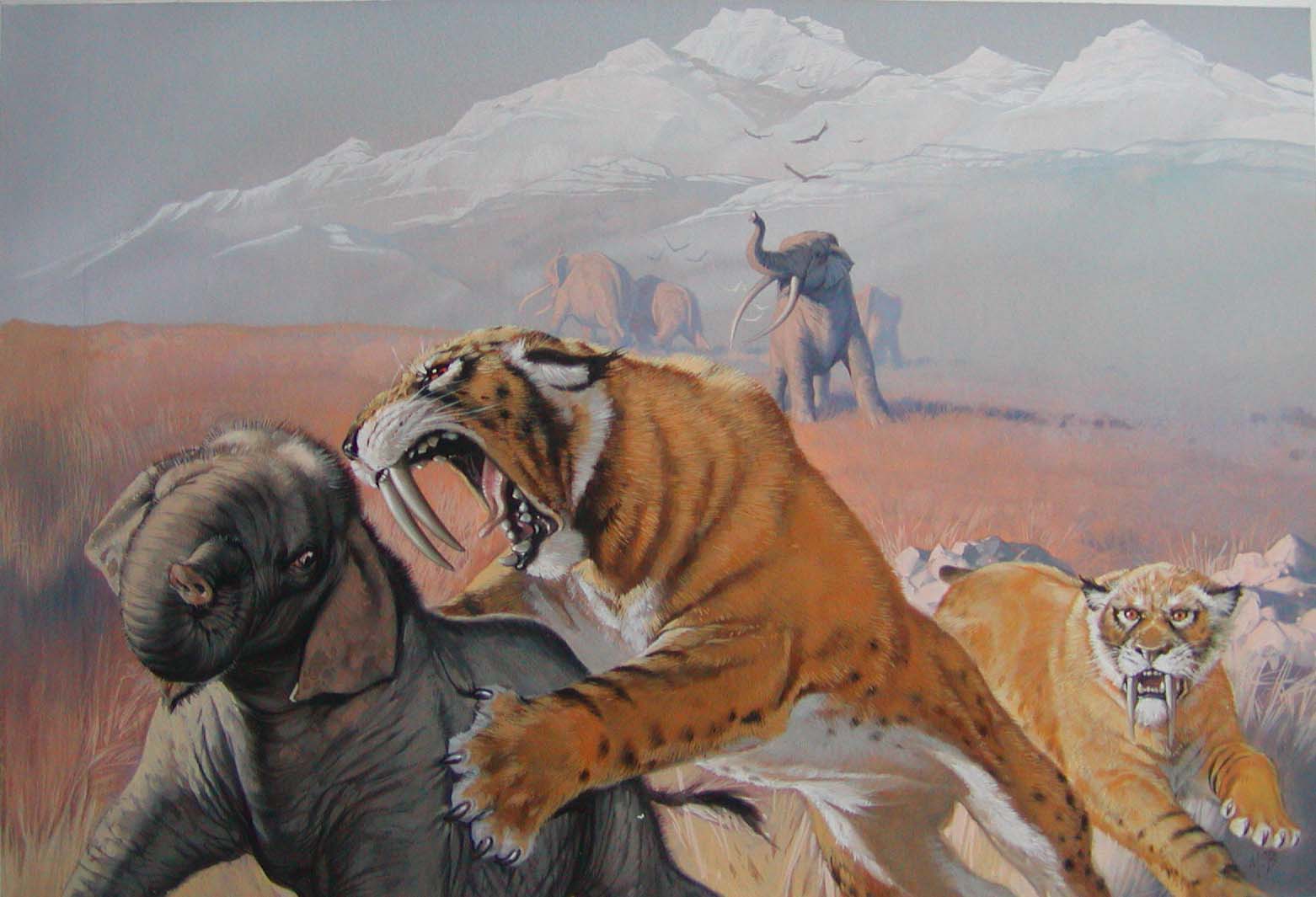
"Dumbo, caught obsessing about higher planetary CO2, did not leave any descendants"
INTRODUCTION
Much analysis and effort is being made in environmental science, ecological economics, energy analysis, and grassroots blogging (including and especially on theoildrum.com) to improve and refine data on our natural resource problem. But is "education" enough? Can reading Khebab's and Euan's posts about the upcoming peaking in world oil production push us to make forward thinking policy choices while we are still buying $2 gasoline? Would a report raising the value of the Amazon basins ecosystem services from $1 trillion to $10 trillion make a difference to those who read it? Why or why not?The understanding and application of behavioral economics and evolutionary psychology will play an integral role in the battle with the two-headed monster Peak Oil / Climate Change. This first of several 'demand related' posts will highlight our innate bias to place more weight on the present than the future via steep discount rates.
Before some definitions, lets start with an example.
AN INTERVIEW
Following the release of the initial segments of the recent IPCC report, I called a good friend to get his reaction. (After I told him I would post his responses, he requested anonymity – lets just call him Thomas)
Nate: What do you think about the IPCC report that came out today stating by the year 2100 global temperatures will rise between 3-7 degrees? And sea levels will rise by between 17-34 inches?Though the above conversation is of course only a sample size of one, it effectively highlights two prevalent evolutionary concepts that are related to climate change and oil depletion. The first is the biological concept of inclusive fitness popularized by Richard Dawkins in "The Selfish Gene" and related to ecology in the famous "Tragedy of The Commons" by Garret Hardin. This concept of individual selection over group selection in a world of declining resources and sink capacity will be covered in my next post. The interview also highlights how distant events seem not to intrude on ones daily thought process, until they become close enough in time to affect our normal routines. I assure you my friend Thomas is not losing sleep over Peak Oil or global warming.Thomas: I read "State of Fear" by Crichton – most of those scientists are just playing with models – they really have no idea how its all going to play out. Plus we are in a general warming trend anyways.
Nate: I disagree with that, but let's assume the scientists are right, even conservative, would you change your behaviours or view of the world.
Thomas: Dude that's 100 years from now. I'll be dead. My kids will be dead. Its someone else's problem.
Nate: Ok – what if instead of 17 inches, there would be a 17 foot sea rise by 2100?
Thomas: Well, I'll still be dead and it will still be someone else's problem. Though I imagine the world would be a wild place were that to happen. That's alot of water.
Nate: Ok – what if instead of 2100, the 17 foot sea level rise would happen by 2050, maybe not in your lifetime but definitely in your childrens? And what about their children?
Thomas: It depends if it happened all at once or was gradual. If it was all at once, I'd either be prepared or deal with the consequences. I'd certainly tell my boys to buy land inland Oregon and California around 2045 though. Still - a long way off for me to worry about it.
Nate: Ok – imagine that it happened in 2015 – a 21 foot sea level rise.
Thomas: Dude – you do realize that Dennis Quaid movie was fiction right?
Nate: I know – just hypothetically
Thomas: Well, I'd probably move pretty soon from New York somewhere to the Rockies. I'd start moving my retirement assets out of stocks and into bonds because 17 feet is going to cause a hell of a recession, not to mention global upheaval. I wouldn't change my job or anything but probably would prepare my children a little better to face a chaotic world. Would everyone know it was going to happen or just me?
Nate: Ok what if the Greenland ice sheet melted this summer and there was a 17 feet sea level rise this August?
Thomas: Well now youre getting plain nutty. But if that happened, I'd liquidate all of my investments, take my wife and kids on some expensive trips to Africa and other places that might be changed forever, then hunker down. Probably get stocked up Y2K like, just in case, and just enjoy life as best I could - what can I do anyways? These things all have a momentum of their own – nothing me or my family could do would make much of a difference. I like eating meat and I like my SUV. Nate you should work for Greenpeace or something.
THE EVOLUTION OF THE HUMAN BRAIN
"In the distant future I see open fields for far more important researches. Psychology will be based on a new foundation, that of the necessary acquirement of each mental power and capacity by gradation."Just a decade ago, an observant generalist could see cracks in the foundation of the standard social science model(SSSM) (and for that matter standard neoclassical economics). It is now apparent these models have fatal flaws and that we are in the liminal space defining what will supercede them. The SSSM posits that we are born a blank slate and during our lives culture infuses us with our language, instincts and behaviours. We now know that we have been shaped through millions and millions of years of mutation, migration, genetic drift and natural selection and that we are not born a blank slate but a creature optimized for activities leading to resource acquisition and reproduction. Culture is very important, but it is the mortar, not the bricks. Nature and nurture are inseparable, and both play a role. But we unequivocally posess genetic leashes - some are long (what do I want to eat for lunch?) and some are short (if Jennifer Garner kisses me, I will like it.). This post will attempt to go beyond economics and psychology and first look at why we so strongly value the present, an answer found in biology, Darwinian ecology and evolutionary psychology.
-- Charles Darwin, The Origin of Species, 1859
In "The Adapted Mind", Leda Cosmides lays out 5 core principles of Evolutionary Psychology:
1. The brain is a physical system. It functions as a computer. Its circuits are designed to generate behavior that is appropriate to the environmental circumstances.2. Our neural circuits were designed by natural selection to solve problems that our ancestors faced during our evolutionary history.
3. Consciousness is just the tip of the iceberg; most of what goes on in your mind is hidden from you. As a result your conscious mind can mislead you into thinking that our circuitry is simpler than it really is. Most problems that you experience as easy to solve are actually very difficult to solve-they require very complicated neural circuitry.
4. Different neural circuits are designed for solving different adaptive problems.
5. (and the famous one) Our modern skulls house a stone age mind.
Though the revolution started with Darwin, the last decade has put the finishing touches on explaining who and what we are as humans. There are still some periods with missing links, but from the small mammals that survived the Chicxulub meteor 65 million years ago, through Proconsul 20 million years ago, to the chimp/human split over 5 million years ago, the compounding of slight changes that improved mating, reproduction, and survival of offspring success have honed us into the most successful species on the planet (by some measures in any case). I'm not sure what is more amazing, the fact that we evolved from common ancestors of tarsiers, or that we have managed to figure out we evolved from common ancestors of tarsiers.


The ancient civilizations of our history books are only 5000 years old, a time period of 1/5th of 1% of the time since our ancestors first sharpened stones (2.5 million years ago). Genetic data suggest that our species was once as endangered as the mountain gorilla today (Stringer/Mckee). At that bottleneck and others, what stood between human extinction and the 6.5 billion of us today? What behaviours were selected for and selected against? Everyone reading this post today is descended from the survivors of that and subsequent periods.
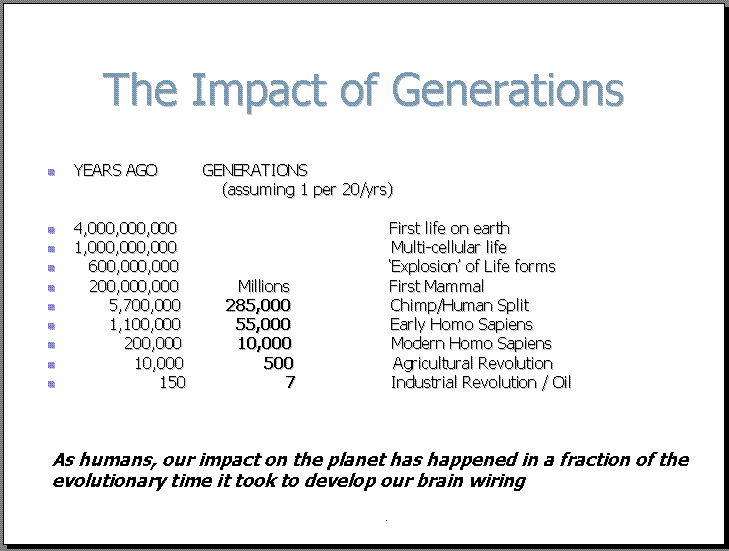
The relentless progress of brain and behaviour
We actually have 3 'brains' within one (termed the Triune brain, shown below). About 1,000,000,000 years ago, multicellular life started to form on the planet. Simple 'brains' that responded by moving towards or away from stimuli gradually evolved into more and more complex forms until they reached the stage of reptiles and amphibians, about 600 million years ago. Since the brain never sleeps, each subsequent mutation or new species added layers (through the 4 mechanisms of natural selection) on top of what existed before it. The 'reptilian' or primitive brain controls basic instinctual survival behaviour and thinking. It is here that our 'board of directors' reacts to fight or flight stimuli, without us consciously being aware of it. (Indeed, research by Benjamin Libet has shown that our decisions are made 500 milliseconds (1/2 second) before we are consciously aware of them. "Culture" presumably has the remaining 400 milliseconds to veto the decision since we need 1/10 of a second to process the behaviour). With the eventual arrival of what we now call mammals 200 million years ago, new structures had been 'added on' to brains - the amygdyla, the hippocampus and hypothalumus. With the emergence of this mammalian brain (also called the limbic system) organisms showed emotion, memory and feelings that led to associated behavioral response patterns. Finally, in the higher mammals, apes and humans, the neo (or new) cortex developed. This is where 'rational' thought is processed. This brain region controls higher order functions like reason, speech and Hubbert Linearization. But human emotional response patterns depend on the neural pathways that link the right hemisphere of the neo-cortex to the mammalian brain which in turn links to the reptilian brain.
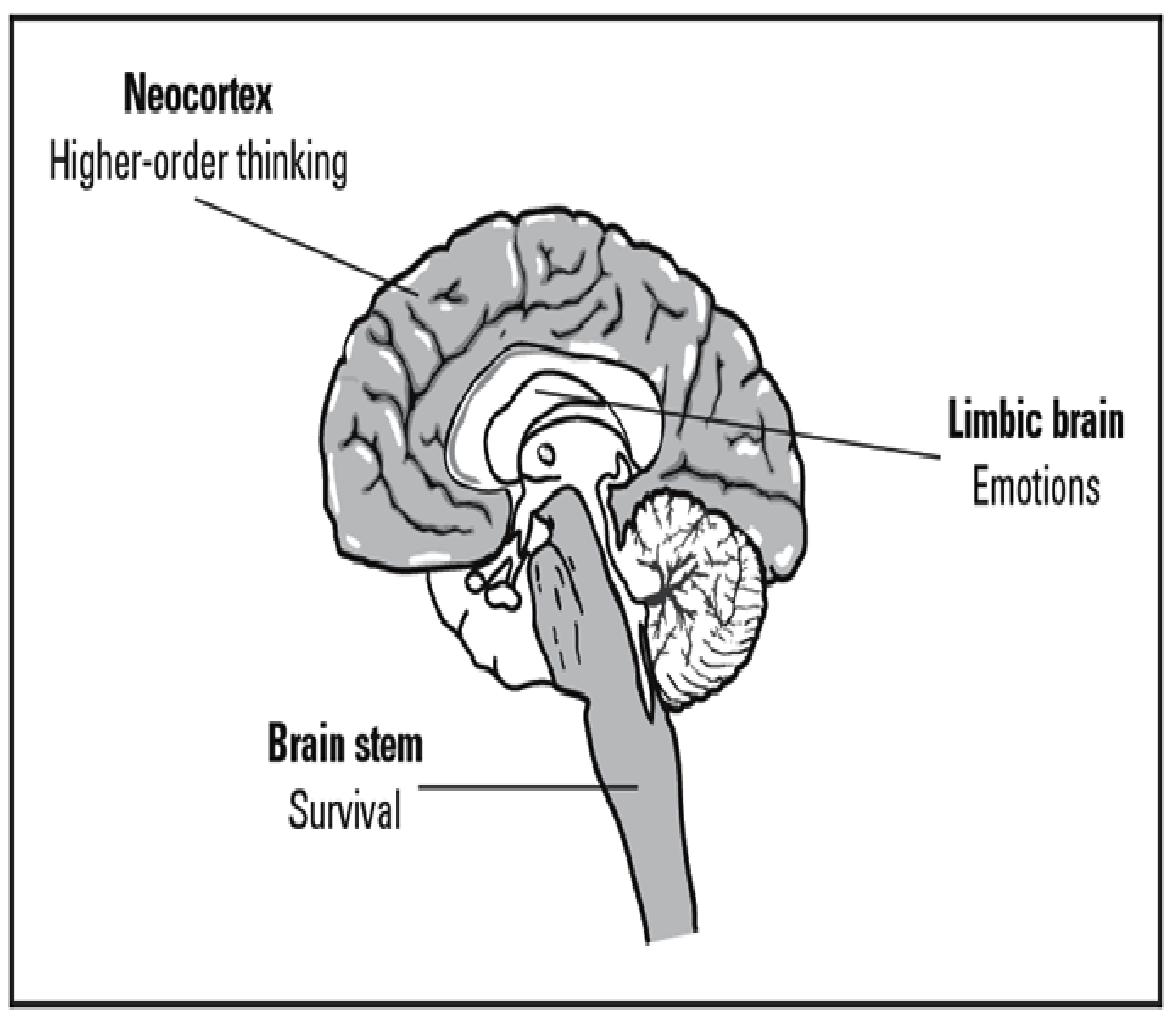
The Triune Brain (Mclean 1959)
THE MECHANISM
The mechanism between brain and behaviour is the pursuit of a similar mixture of neurotransmitters that allowed our ancestors reproductive success in periods of privation. Dopamine, a core neurotransmitter plays an integral role in our short term desires. If you've ever bought a pair of shoes you'd been wanting for 6 months or hit three 7s on a slot machine, or been the first customer at a Starbucks when they opened, you know what dopamine activation feels like. A relevant medical story has been in the news of late. Parkinsons disease results from not enough dopamine in certain areas of the brain - a drug Mirapex is given to Parkinsons patients that increases dopaminergic activity. In the last few years however, dozens of Mirapex patients have checked in to Mayo Clinic with bizarre symptoms - church pastors were having extramarital affairs, normallly conservative people became compulsive gamblers - one person lost $100,000 gambling in a very short time. Apparently, it is not easy to find the right dosage of Mirapex and many of these patients were now receiving too much dopamine.
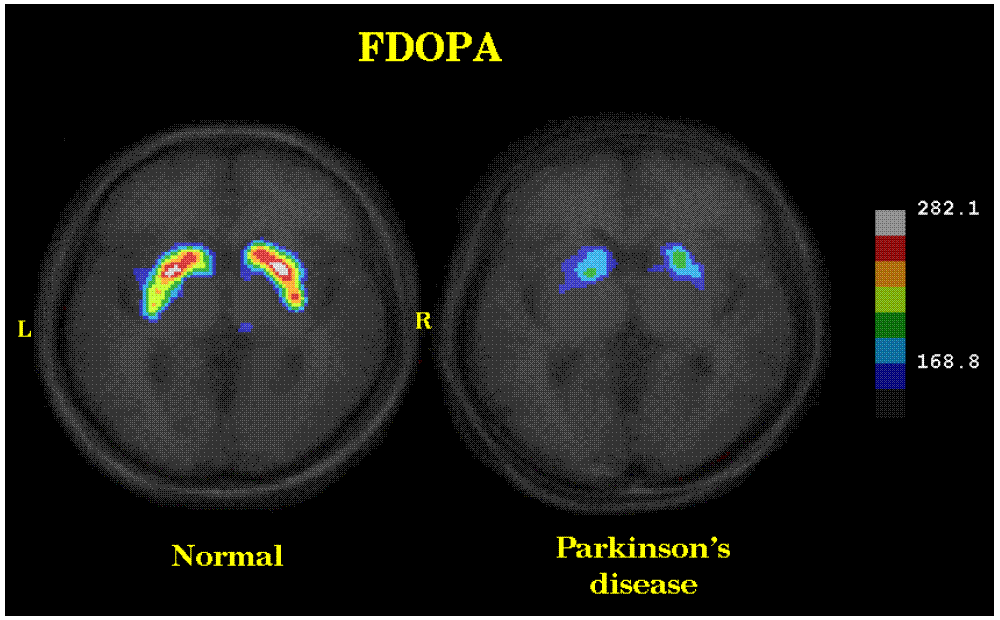
Functional MRI showing dopamine activation in normal patient vs Parkinsons patient
This is concerning, considering Dr. Peter Whybrow, one of my thesis advisors, and the author of American Mania, suggests Americans, due partially to a genetic bottleneck favoring ambitious migrants, and leveraged by our frenetic culture are becoming 'dopamaniacs'. The dopaminergic system is clearly is one of the drivers of our short term behavior. In short, more dopamine craving means less concern about Peak Oil and climate change.
MALADAPTATION?
Our culture presents a smorgasbord of options that allow us to 'feel' like our ancestors did when they were successful. Neuroscientist Robert Sapolsky likens the physiology of two grand master chess players to a marathon runner - the body is experiencing the same neurotransmitters (presumably, they did not have chess back on the Pleistoscene). Many of the options available to us that engage our neurotransmitters are maladaptive. Pornography, fast food, arcade games, lottery tickets, etc. all give us feelings identical to those our ancestors were good at pursuing. But now they often trick our brains into thinking they too will lead to evolutionary success.
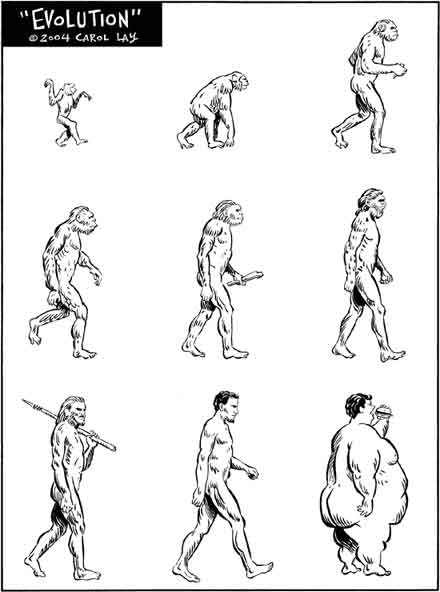
Cultural Options - Maladaptation?
SO WHAT IS A DISCOUNT RATE?
Everyone is familiar with the 'discount rate' in the financial markets. It's the rate that the Federal Reserve charges its member banks. Its also the rate that a stock analyst might use to discount a companies future earnings stream back to the present. Imagine a company whose entire business plan is to sell a product in 10 years – say at the Olympics – they make no money until then but a lot of money in that one year, say $100 million. How much would investors pay for this company? Certainly something less than $100 mil, as that money wont come for 10 years. They would determine what the risk was of actually getting that $100 mil 10 years hence, then determine what an appropriate rate of return would be, say 15% per year. Discounted at 15% per year, $100 mil is $24.75 mil- that is what they should be willing to pay. So in this example, the discount RATE is 15% and the discount FACTOR is 24.75%, or how much something in the future is worth today. The higher a discount rate the lower the discount factor will be. A discount rate approaching 1, means things in the future have no value at all in the present moment. A discount rate of zero means that $1 dollar in 2050 is worth $1 today.
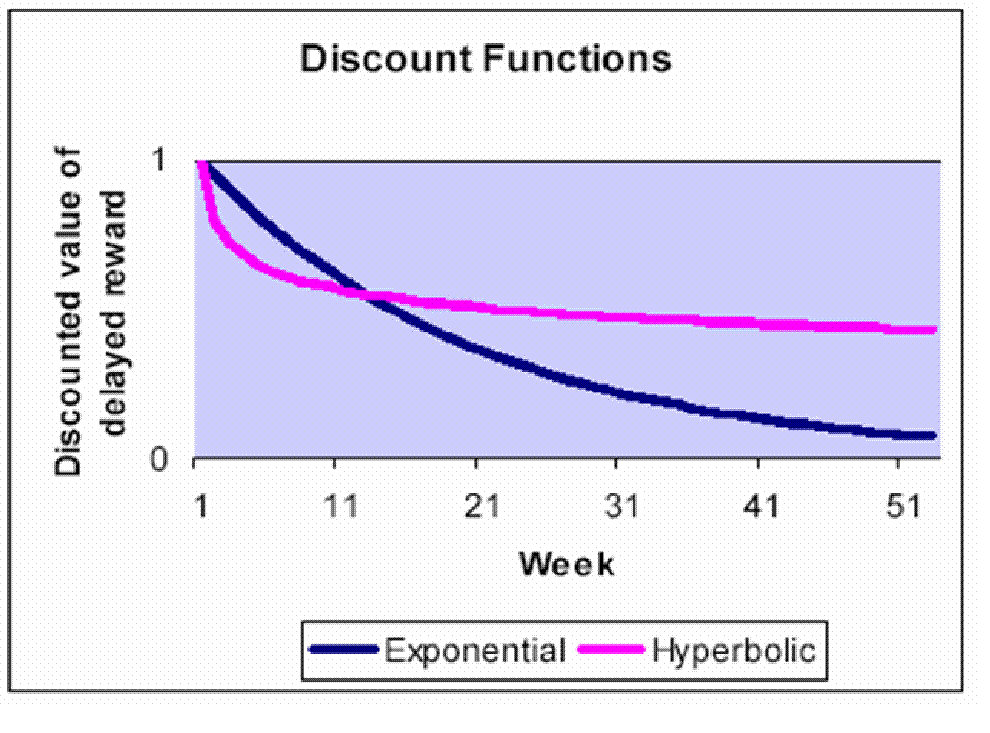
The Human Hyperbolic Discount Rate
The original neoclassical assumption was that the discount rate curve was exponential, meaning that we discounted the same from period to period. Actual economic experiments however show that the shape of the discount curve is hyperbolic, or as Harvard economist David Laibson prefers quasi-hyperbolic. This means that the early periods have much steeper discount rates than later periods. Laibsons research indicates that peoples discount rates are 12% during days 0-5 but drop to 4% in days 20-25. We REALLY prefer the present.
Animals (and humans) have their own internal discount rates exogenous from the market on how they choose between the short term and longer term options offered them in life. Since many animals have short lifespans, they have been shaped through evolution to gather resources and reproduce quickly before they die (this is not a conscious motive – they innately pursue behaviours that were historically successful). Different species have different discount rates, though all are steep, much steeper than our financial systems rates. If you leave for the weekend and give your goldfish 3 days of food at once, you will probably return to a dead bloated goldfish - they have discount factors close to zero and discount rates close to one. One reason humans discount rates arent quite as steep is probably due to our sunk costs. If we didn't have mortgage payments and college funds for our kids, our discount rates might even be steeper. Its quite logical – animals that deferred opportunities to eat, might come back and their food was stolen, or they might have been eaten themselves in the interim – the long arm of selection would have favored organisms that valued immediacy over those who preferred to wait.

Humans care more about Peak Oil than rats or pigeons
Researchers on animals and humans measure discount rates using the following technique. They offer a small short term reward (SS) as well as a larger long term reward (LL) with differing time delays depending on the experiment. To calculate the discount rate they repeat the experiment until the subject is indifferent between the 2 choices – based on how large the future reward must be, they can compute a discount rate and discount factor, similar to the business example above. With animals, the discount rate tests are almost always food, while with humans they are often money or drugs (e.g cocaine addicts). A recent study on two different monkey species suggests an ecological basis for differing discount rates. Two monkey species, similar genetically and in habitat but differing in diet were studied using food rewards. One species was a gummivore - it scratched on trees and waited for the sap to ooze out which was its main food source. The other species was an opportunistic insectivore, grabbing whatever insect it would see and could catch. As hypothesized, the monkey whose feeding behaviour had evolved to require patience had lower discount rates than the other species in laboratory tests. How cool is that?
NEURO-ECONOMICS
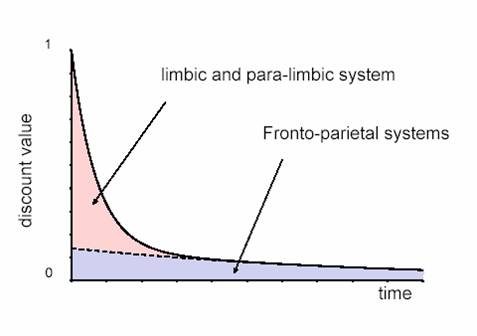
Neuro-economics is a rapidly expanding field that combines traditional economics experiments with fMRI or PET scans. Economist David Laibson has made an amazing observation. During economic games, subjects who choose the LL (larger long term reward) had their prefrontal cortex activated. Those who chose the smaller short term rewards showed neural activity in the limbic system, or emotional mammalian brain.
The relentless progress of brain and behaviour
This graph shows that humans in effect have 2 discount rates. The blue line shows our 'thinking' discount rate whereas the steeper red line shows our emotional discount rate. This is clearly suggestive that we make decisions in different parts of our brain. It also proves (not that we needed proof) that emotions have the ability to trump reason.
DISCOUNT RATE STUDIES
Some people balk at evolutionary psychology because they feel it is deterministic and doesn't apply in all situations. I agree. However it does give an accurate general template for how people interact with eachother and the world. If I say that 'men are taller than women', that doesnt mean that ALL men are taller than ALL women, just that on average this is the case. (Not the case on TOD staff, fyi). I have shown that our evolutionary origins tilt us towards valuing the present more than the future. Not as much as lower animals, but much more than purely 'rational' beings. The table below shows some research results suggesting certain members of society have even steeper discount rates than others. Specifically, those who smoke, do heroine or cocaine, gamble, are mentally ill, consume alcohol, or are young. Of import is studies on cocaine addicts show that not only do they discount cocaine steeply versus the future - but they discount other things as well. In other words, if you have are addicted to something, you tend to value the present more than the future in other areas of life too.
Not on the table is a study by anthropologists Wilson and Daly showing that when shown a pretty female face versus an average one (activating the limbic system) men's discount rates increase and they subsequently make irrational monetary decisions. Women, by contrast, made equally rational decisions whether they had been shown pictures of handsome men or those of average attractiveness. (7) Somehow I believe this study.
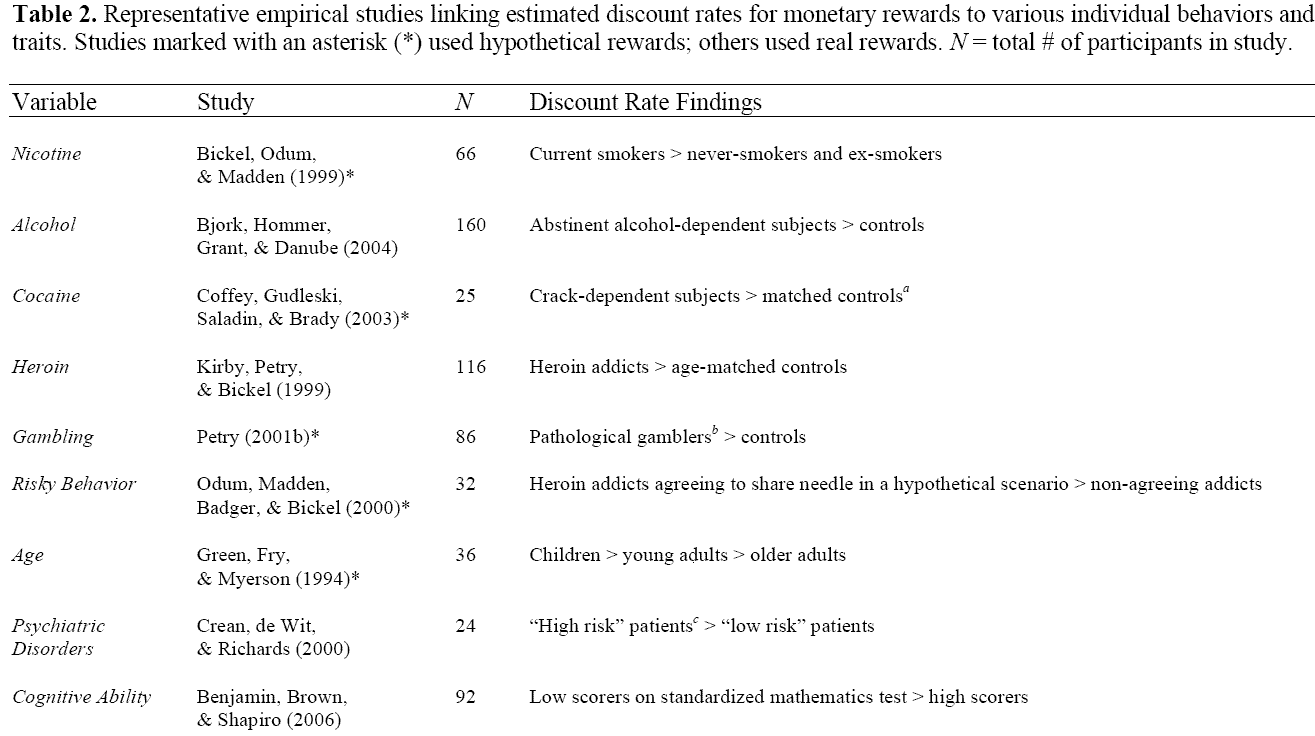
DISCOUNT RATE STUDIES (2)
Increasing research in the side fields of economics is painting a clearer picture of our tendency to value the present. The above graph is suggestive of different sub-groups of society that exhibit higher discount rates than average. Anecdotally, I originally promised Professor Goose I'd write this piece a month ago, but perhaps since I'm single, male, drink wine and coffee, play poker on the internet, and have been called 'crazy' by some of my friends, I wrote the entire post in the last 24 hours. Its a good thing I don't smoke or do cocaine or it would never have gotten written. However, since I am aware of my own steep discount rates (also called procrastination in favor of other more fun and intersting things), I devised a solution. I decided to consciously email the entire TOD staff and alert them this post was in the queue this week. In effect I made a social contract and would have suffered embarrassment that I let the team down if I blew it off. More research in this area is necessary - social contracts may provide solutions for a society driving towards a cliff but addicted to driving.
THE FUTURE EATERS
Australian biologist Tim Flannery has called the human species "The Future Eaters". Indeed, paleo-anthropology suggests many historical societies collapsed due to resource depletion even though they must have been aware of it. The example made famous by Jared Diamond is 'what was that Easter Islander thinking that chopped down the last tree'? The best documented recent mass extinctions of flightless birds and other large mammals from New Zealand and Madagascar show that humans were to blame. Though Neandertals and early Homo Sapiens did hunt game without hunting it out, upper Paleolithic hunters were more numerous and better equipped for mass slaughter - 100,000 horses killed at one site, a thousand mammoths at another. Given the millions of years of shaping of our neural circuitry, it is hard to imagine that our mental structure has changed that much in the last few thousand years. Indeed, for those who are not high on the oil subsidy banquet and need food stamps to survive, scientists have shown a 10-15% decline in caloric intake during the month, implying a steep discount rate exists when food is the primary concern.(1)
WHAT THE HECK DOES THIS HAVE TO DO WITH CLIMATE CHANGE AND PEAK OIL?
If you're still with me, Im impressed, as the above diagrams and verbage are quite disparate. Yet so is our situation. Environmental icon Gus Speth, in "Red Sky at Morning" laments that the single biggest failing of his generation of environmentalists was that they just 'talked'. We have tens of thousands of well intentioned environmentally minded scientists and activists in this country and others. I pose no answers in this post, because I don't have them. But I am certain that a fusion of the brain sciences and evolutionary biology into the environmental and energy discussions will be a large step forward.
Ultimately we are after impact. If we spend 99% of our efforts on educating people on the facts of peak oil, yet nothing happens, it would be better to spend 50% of our efforts on education and 50% by example. For example, researchers attempted to persuade young students not to litter either by teaching them about ecology and pollution or by telling them they were neat and tidy compared to other students -only the latter had a positive effect.(4) E.O Wilson suggests "A stiffer dose of biological realism is in order..The only way to make a conservation ethic work is to ground it in ultimately selfish reasoning. An essential component of this formula is the principle that people will conserve land and species fiercely if they forsee a material gain for themselves their kin or their tribe." All of our past environmental successes (DDT, Ozone depletion, unleaded gasoline, etc.) had some sort of smoking gun - an emotional trigger. The problem with climate change/peak oil, is when we do get the emotional trigger, it may be a gatling gun on full bore.
After preparing this (what I thought was novel) post, tonight I found that Larry Karp at Cal-Berkeley has written a paper on the same topic, titled "Global Warming and Hyperbolic Discounting" Here is the abstract:
ABSTRACT: The use of a constant discount rate to study long-lived environmental problems such as global warming has two disadvantages: the prescribed policy is sensitive to the discount rate, and with moderate discount rates, large future damages have almost no effect on current decisions. Time-consistent quasi-hyperbolic discounting alleviates both of these modeling problems, and is a plausible description of how people think about the future. We analyze the time-consistent Markov Perfect equilibrium in a general model with a stock pollutant. The solution to the linear-quadratic specialization illustrates the role of hyperbolic discounting in a model of global warming.
THE BOTTOM LINE
1. Education about oil depletion and climate change is not enough. We need to incorporate how people react to information. If companies like Daimler Chrysler are using neuromarketing to sell more cars, an equal effort needs to be made on the environmental and energy front.
2. Two of the planets largest problems, climate change and peak oil, are in the future. As such, our evolutionary derived penchant to focus on the present lacks the discipline to think and act ahead. Either accelerating the expected 'bad news' or making the expected bad news 'worse' are both ways to increase the weight we place on these events.
3. We can't easily reduce our discount rates. But having a team of middle aged female monks running the climate change team may not be a bad idea (I'm only half kidding).
4. There are so many scientific disciplines running parallel courses. Somehow we need to integrate them into a logical framework that makes sense and is practical. I don't expect President Bush will soon appoint a Secretary of Darwinian Ecology but the time is now to combine the sciences.
5. Though it's difficult, we can learn from our mistakes. Those on Easter Island, Rome and the Mayas and Aztecs were neurally not dissimilar from us. To recognize they valued the present even when they could forsee the future (cutting down the last tree) means we have to acknowledge ahead of time that our intelligence will be trumped by our emotion, and plan accordingly.
5b. In writing this post, it dawned on me that much of the work we do in raising peak oil awareness is received by readers as kind of an interesting horror movie. Yes - tell me more scary facts and I will sit at my computer and read them. But its the rational brain that is receiving this information. And its not budging behavior much.
5c. Understanding that stress increases peoples discount rates suggests to me that the events surrounding peak oil (and perhaps climate change) will reach an inflection point. We need to hit the emotional triggers well ahead of peak oil. Once people are stressed and things become difficult, accessing peoples rational minds will be all the harder. Plus, greater awareness of resource depletion might trigger increased consumption, as people try to get their share.
6. I think steep discount rate is another term for addiction. Humans are addicted to what modern life offers. Some more than others.
P.S. Lets do lunch!...;)
REFERENCES
1. "Is There a Daily Discount Rate? Evidence from the Food Stamp Nutrition Cycle"(pdf), Shapiro, Jesse, et al, Harvard, November 2003
2. "Intertemporal Choice" (pdf) Chablis et Al, The New Palgrave Dictionary of Economics 2007 (to be published)
3. "The Ecology and Evolution of Patience in Two New World Monkeys"(pdf) Stevens et Al,
4. "The Evolutionary Roots of Our Environmental Problems: Towards a Darwinian Ecology" Penn, Dustin, The Quarterly Review of Biology Sep 2003 Volume 78 No 3.
5. "Separate Neural Systems Value Immediate and Delayed Monetary Rewards", Mclure, Laibson, et al SCIENCE Vol 306Oct 2004
6. "Why Be Nice? Psychological Constraints on The Evolution of Cooperation" Stevens et al TRENDS in Cognitive Sciences Feb 2005
7. "Do Pretty Women Inspire Men to Devalue the Future?" Wilson, M, Daly, M. Biology Letters May 2004
Nathan John Hagens
The University of Vermont
www.theoildrum.com
email thelastsasquatch@yahoo.com
Contact
- Content: editors at theoildrum dot com
- Tech support: support at theoildrum dot com
License

This work is licensed under a Creative Commons Attribution-Share Alike 3.0 United States License.
Folks, also consider this a reminder to positively rate these articles (using the icons under the tags in the story title) at reddit, digg, and del.icio.us if you are so inclined. Also, don't forget to submit them to your favorite link farms, such as metafilter, stumbleupon, slashdot, fark, boingboing, furl, or any of the others.
These posts are a lot of work, and the authors appreciate your helping them get more readers for their work however you can.
In better words, spread this around!
It seems to me that the discount rate for an individual and even a group of individuals would change as they age. Infants and children are notorious for wanting instant gratification. As the child grows he learns to defer gratification in hopes of a higher reward. However, as one ages and comes to toward the end of life, as in my case, instant gratification becomes more attractive again. Observing other elderly I often sees things like the purchase of a new luxury car shortly before death, whereupon it is sold to settle the estate. Perhaps with the aging baby boomers now in power, a discount rate approaching one is appropriate. I know I don't have much interest in long term investing any more.
Yes this is true. The study on age related discounting showed that older people DID have lower discount rates, but only on 1 the tests of 1 year horizons. For 5-10 year horizons, they exhibited steeper discount rates. Which makes sense.
As one octogenerian said: "at my age, you don't buy green bananas".
I've also seem a bit of this tendency among peakers: the oldest ones understand it all but say "oh well, I'll be safely dead when TSHTF".
Vtpeaknik, you quote a line I have used often. "I hope to be safely dead when TSHTF!" But I never put "Oh well" before saying that. I am greatly concerned with peak oil, global warming and all the other things that affect the earth. But I know there is nothing I can do about it except to try to get a few people to try to save their own ass.
I am a doomer pure and simple. I have thrashed this straw for forty years and have seen people discount and deny every fact that hits them in the face. I know we will do nothing about any of the problems until the consequences proves the doomers were all correct.
All this causes me to grieve for my children, grandchildren and all humanity. I do not simply shake it off with an "Oh Well!" But I cope.
Good bourbon helps.
Ron Patterson
“There is not any memory with less satisfaction than the memory of some temptation we resisted.” James B. Cabell
Oh the many truths of life and discounting that lie therein...
This doesn't mean that there shouldnt be discounting. Economic growth being stunted now by 1% has absolutely enormous cost for instance over a century.
Economic growth being increased now by 1% has absolutely enormous cost for instance over a century.
I agree. Often our proposed solutions are the problem. Grow the economy so we can afford to protect the environment...etc.
Can we have economic growth at 5% globally per year while reducing our ecological footprint by 5% per year compounded over the next several decades?
With this sort of attitude we can't possibly have a rational conversation. We have diametrically opposed worldviews.
The answer to your question depends entirely on how you measure "economic growth".
(If by GDP, then the answer is no way. But GDP is a lousy measure of real progress. It measures activity only, without distinguishing between productive and destructive activity.)
Dealing with Peak Oil and Global Warming in a way that overcomes the various forms of myopia, irrationality, and selfishness that are the outcomes of the psychological phenomena Nate Hagens speaks about is ultimately a moral and spiritual problem. Overcoming the "discount problem" requires the willingness to rationally appreciate the true nature of what we face, and to freely embrace the acutely self-sacrificial choices required in overcoming the "discount problem" within oneself so as to deal with what we face effectively. As individuals and as a race, we are free to embrace or to reject the moral and spiritual transformation that all this entails.
Richard Heinberg recognizes this in his book "Powerdown." There he writes, among other things, in response to critics of his who chide him for overlooking the need for moral and spiritual regeneration. His response to them is that what he outlines as the path of "Powerdown" IS ITSELF the very moral and spiritual regeneration that would be necessary for humankind to deal with the problems facing it without descending into anarchy and war leading ultimately to oblivion.
That is exactly the achilles' heel of Heinberg's very thoughtful overall outlook, in my opinion. Just where exactly does he expect this widespread moral and spiritual transformation to originate from? To suppose that one could reasonably expect something like that to happen is tantamount to implicitly introducing a "Deus ex Machina" into the world, insofar as this world is regarded from a scientific standpoint.
Western man has been awaiting the dawn of this moral and spiritual transformation ever since the rise of Progress Ideology in its various forms during the Enlightenment - but it clearly hasn't happened yet. What reason is there to believe that it will happen in the next generation or so, when humanity so sorely and desperately needs it (as many who post on TOD would reluctantly agree, I think)?
It is at this juncture of the discussion that religion DOES become very germane to the Peak Oil/Global Warming debate. As a very general matter, religion has pertinent things to say about the moral and spiritual dimension of the problems we face as a race that are utterly crucial, and that the scientific/technical standpoint on things is incapable of addressing. The very short answer is that Divine Grace is necessary to effect the required moral and spiritual transformation.
I have to say that many things about the Roman Catholic Church hierarchy have never made any sense to me before reading this essay. Celibacy, relinquishing worldly goods, extreme age of the College of Cardinals - they all make perfect sense if the goal is continuation of one of the longest-lived human institutions. Yes, religion probably does have something we need here. It deals with the human "magic" that John Michael Greer was recently talking about, it has the tremendous timeframe needed to appreciate these problems, it is one of the few organizations/concepts that has found ways to harness short-term human desires to long-term goals. Unfortunately, religions are still calling for population growth, are only now speaking up about climate change, and haven't discussed fossil fuel use. What if peak oil happens too fast for long-horizon religions to respond?
I am just amazed that I haven't seen a book about this topic before. What an eye-opener. Thanks, Nate!
Great point - organized religion is an institution that dampens peoples steep discount rates. I hadnt thought of it that way before, but it makes sense.
Think about it - with no religion, people would REALLY focus on the present - but the concept of an 'afterlife' is a huge lump sum at the end of ones life thats net present value overcomes small daily costs and allows people to behave differently than animals with incredibly steep discount rates. (my dog is eating a hambone right now and couldnt care less who the pope is)
So thats the cultural template, even though in many cases it has gone awry - but if the template works, we could apply it for a different reason (climate change and peak oil)
Just thinking out loud -thanks for your comment!
Wow. Three responses even more stimulating than the original essay. Which started damn good. Wow.
I don't think that's really necessarily true. I am not at all religious, yet I have an extremely low personal discount rate. I actually find living for the moment quite difficult and depressing.
I do accept though, that religion performs a necessary function, many people really need it, and of course I agree that it would be of great benefit if it could be harnessed to move civilization to a new paradigm where we could powerdown in such a manner that it/we could have a future.
From an American spiritual leader:
Oren Lyons, seventy-six, is a wisdom carrier, one of the bearers of a variety of human tradition that can’t easily be reduced to a couple of sentences….
After the Peace Maker gathered five warring nations—the Mohawks, the Oneidas, the Cayugas, the Senecas, and the Onondagas—and after great efforts and great cohesive work, the power of the unity of the good minds brought together this confederacy based on peace. And after he had taken the leaders and sat them under this great tree on the shoreline of Onondaga Lake and instructed them on the process of governance, on the principles of governance, on the importance of identity and the importance of rule and law, he said, “Now that we’ve planted this great tree, in your hands now I place all life. Protection of all life is in your hands now,” and when he said all life, he meant literally, all life.
And it’s an instruction that we carry today. We feel responsible for animals, we feel responsible for trees, and responsible for fish, responsible for water. We feel responsible for land and all of the insects and everything that’s there. And when he spoke of the four white roots reaching in the four directions, I think he was talking to all people. Not just Haudenosaunee. This is an instruction for all people.
But after all of that, a woman said to him, “Well then,” she said, “how long will this last?” And he answered, “That’s up to you.” So it’s completely up to us if we want this Creation to continue, and if we want to be involved in it, a part of this whole recycling, this whole regeneration of life, and we want to be celebrating it, and we want to be enjoying it, and we want to be preserving it, carrying it on, protecting it for future generations.
http://www.orionmagazine.org/pages/om/07-1om/Lopez-Lyons.html
IIRC, celibacy was not a requirement of the priesthood until the twelfth century. I understand that it was introduced because preventing priests from leaving issue would ensure any property they owned would pass to the church rather than to heirs. (As many churchmen and bishops were also wealthy landowners, the measure made sense in terms of church power).
You can interpret this development as one particular Pope deciding to aggrandize the Church (and hence himself)... that is, it is consistent with the 'selfishness' hypothesis that ties in with discounting. In other words, don't expect to see an institution like the Church doing much good in ameliorating the negative impacts of discounting. Churchmen have the same neuronal circuitry as the rest of us, and those that survive Church bureaucracy and hierarchy are exactly the sort of short-term careerists and conservatives that also screw up the world in every other field of human endeavour. Sh*t floats to the top, as they say.
I agree with your assessment for the need for moral/spiritual regulation of behavior to stay within carrying capacity.
Some indigenous peoples use taboos to control overharvesting by making some areas off limits (sacred areas).
The ancient Egyptians had the longest running continous urbanized culture in the history of the planet, from about 3000 BC to about 1500 AD when the last remanents (above the Nile cataracts) were crushed by Islam. This was achieved despite being limited to a very narrow strip of land in the midst of a huge desert. How did they achieve this?
1) A Greek historian called the ancient Egyptians "entirely too religious". Egyptians believed they would be judged after death as to worthiness for afterlife; this controlled behavior in the present. Also, the priest class was responsible for storing grain in times of plenty against times of famine. No one questioned their authority.
2) Greek historians also regarded ancient Eqyptian men as fools for treating women as equals. Fools like foxes! Women were allowed to own businesses, initiate divorce, and most importantly (drum roll, please)...practice birth control.
To paraphrase a little saying that went around a few years ago, "all I need to live indefinitely in a finite world I learned 5000 years ago".
Could you give me a link to a web source about the remnants of the Egyptian civilization above the Nile cataracts? I love history and would like to read more about that. I've googled and haven't found anything specific. Thanks
http://encarta.msn.com/encyclopedia_761559385/Civilization.html#p7
http://www.britannica.com/eb/article-47441/history-of-education
I also recommend reading about the Indian early (urban) civilizations:
http://en.wikipedia.org/wiki/Indus_Valley_Civilization
http://www.harappa.com/har/har0.html
While I don't dispute your premise about religion which makes intuitive sense, it seems to me that a formal religion or sense of spirituality isn't the essential ingredient. What is essential is a value system that places the individual within the larger context of humanity and all life. Religions can do that, but they can also carry a lot of baggage that redirects the focus back to, if not the individual, then at least to that individual's tribal group. One of the things that most religions are very good at is promoting the us/them divide, whether it's between sects within the same religion, between religions and their undrpinning cultures, of between believers and non-believers.
It seems to me that the more inclusive a value system is, the more it places the individual within the entirety of humanity and life in general, the more likely it is to promote the kind of flattening of the discount curve that is essential. For this purpose, my choice is for garden-variety humanism.
Unfortunately, the inclusivity of the value system of an individual seems to be as innate as many other aspects of personality. From the cultural level, it can only work with what is available, the world isn't populated with latent buddists.
It only appears to be innate because we're taught it very early. The world is populated with potential Buddhists (or at least potential Unitarians), we just can't rescue them early enough. that makes the deprogramming a bit harder later on.
I found this article very interesting, even aside for Peak Oil issues. It explains a lot of things about human behavior. A lot of the "Why would he/she have done that stupid thing?" questions can be answered by the person in question having a steeper personal discount rate. (Too steep for what is good for them in my view, but I have have a more shallow discount rate I guess)
It's particularly evident in financial issues; gambling, running up credit card debt, buying a house or car you can't afford the payment on, failing to save for retirement. But I also see obvious connections in health issues too. Why do we eat more than we should? Fail to exercise like we should? Eat healthier foods? Because the short term rewards of eating a lot of unhealthy food and getting to sit around and relax override the long term problems.
I enjoyed the article very much. Thank you.
Thank you.
I sometimes ask myself at 11 pm when i open the pantry or refrigerator - does my body need nutrition? Am I lacking calories to sustain my activities? The true answer is I am seeking a certain 'feeling' that eating chips or a sandwich or some ice cream will give me. Most foods generate serotonin, the zen master of neurotransmitters, and what antidepressants create (Serotonin reuptake inhibitor SSRIs block the 'disposal' of used seronin in the system and allow it to stay around longer). A topic for another day is the acidity of our diets causes long term low serotonin levels and we then seek out dopamine generating activities to feel better.
Eating sweet and salty things give our stone age brains signals that we are doing something good - our cognitive awareness that they will make us fat, give us diabetes, etc is typically not strong enough to overcome those ancient signals.
Excellent post...in my work, I deal with people whom I now know how to describe as having "steep discount rates" on a daily basis. I previously referred to them as "not forward-thinking people," but the idea is the same. A capacity for denial of their own actions is also notable. I enjoyed especially your conversation with Thomas--the answers he gave seem quite typical of those I've heard in trying to explain certain aspects of our coming problems.
Hi Earthworm,
I think we need a 'group plan' discount rate spanning generations.
As we grow from childhood individually, in our society, we become fearful we will not get enough or have enough. Depending on our abilities we try varied methods to assure that we always have 'enough'. This 'getting' ranges from short fixes of gambling or 'beggaring the neighbour' to longer term plans like 'getting an education' . BUT, no matter, how much we have, it will never be enough as some other force or person might take some or all of it away. Having a long discount rate for the individual doesn't seem to translate into a good outcome for the group any more than a short rate.
If we could assure each other that, no matter what, all would eat or no one would eat, I would feel pretty assured of our survival, but this is a step in evolution (social or genetic) that hasn't been made. Maybe we will just have to clasp P.O. to our breasts and be purified by that fiery furnace before we reach any golden age. (Lucky for me at my age I will likely crap out before that happens...boy talk about luck!)
Pessoptimisticaly yours,
Black Bald,
Well, that about covers it.
A good place to start, if you want to change your behaviour, is to remind yourself (often) that humans are animals with an evolutionary history. After you study & think about this for a few years, you will come to realize that "the big brain" you've got isn't really helping matters much, unless you make a conscious effort to override the more ancient stuff. Otherwise, that big brain is completely dominated by the part sitting beneath it that you can't access (discounting, et.al). This picture may help.
Nice job, Nate.
Dave - just to complete the complex pictorial metaphor (is that a chunk of the Larsen B by the way)
The captain of The Titanic saw no reason to slow down, despite clear warning of dangers that lay ahead - why?
So Nate, what was his discount rate? And is there any mileage in looking into the behavior (discount rates) of individuals and groups that have been involved in disasters - Shuttles Columbia and Challenger, Piper Alpha, Chernobyl?
I think there is a lot of mileage in looking into the behavior (discount rates)of individuals and groups that have been involved in disasters.
One element that seems to arise frequently in disasters is fixation on the accomplishment of a particular objective--fixation that causes useful information to be ignored. For example, the captain of the Titanic was fixated on setting a speed record for a transatlantic crossing, and he rejected information from his chief engineer that maximum revolutions were severely damaging the brand new engines (which should have been broken in gently) and rejected or ignored information concerning sightings of floating ice.
Now here is the problem as I see it: Fixation on achieving an objective is often prerequisite to achieving notable success. The successful politician or architect or engineer is not one who is easily dissuaded by naysayers. In other words, the bullheaded sometimes fail, but great successes often result from bullheaded behavior.
What is at work are brain mechanisms that encourage wishful thinking and self-deception. Intelligence is little help, because more intelligent people can come up with more impressive rationalizations to support their self-deceptions. Ideally, education can help us to think critically--and especially self-critically, i.e. to examine and re-examine our premises, to look for suppressed or unwelcome information, to check the validity of our logic.
A combination of education and experience should have been sufficient to cause to captain of the Titanic to slow down--but it wasn't. Why it was not are questions of biography and psychology to which I do not have the answers. People who make their living at sea necessarily deal with harsh realities and generally have learned to make preparations to avoid disaster; the exceptions are puzzles.
When we look at social groups, including whole societies, a new set of factors (e.g. the failures of democracy) comes into play that tend to amplify tendencies toward self-deception and wishful thinking. Nevertheless, I think it is useful to focus on defective decision-making by individuals--decision making that is a product of evolutionary psychology. Thus I think a study of, for example, pilot error that leads to plane crashes can illuminate issues as to why we fail to deal effectively with Peak Oil and global warming.
Re: What is at work are brain mechanisms that encourage wishful thinking and self-deception. Intelligence is little help, because more intelligent people can come up with more impressive rationalizations to support their self-deceptions. Ideally, education can help us to think critically--and especially self-critically, i.e. to examine and re-examine our premises, to look for suppressed or unwelcome information, to check the validity of our logic
Beautifully put, Don. Practically speaking, education is not enough. At all times in the human experience, some of the biggest fools (evil-doers, what have you) have been very highly educated. That's why I think a little psychoanalysis is also a good idea — even if you don't think you need it. Introspection is not for everyone, though.
Catton - "Overshoot"
Education and experience can make things worse. How many people out there nod their heads to Yergin because they went through the 70s and figure he's right and we're just going through that again. Most of the population has "learned" that cheap energy is the norm.
Dave
Could you give some examples of the highly educated evil-doers? I wonder what sort of education does not cause some critical hesitation and introspection. Everything in my education was focussed on the question: How do you know that? How do you know what you think you know?
There is education and there is training and there is assimilating the norms of either high culture or normative culture. I have a lot of doubt that any culture sanctions too much educatiopn. Ours does not.
Josef Mengele had a PhD in Anthropology.
That's one.
Hi oldhippie,
Can I nominate B. Gates, S Jobs and those Unix cats for popularizing computers, massively increasing the movement of capital and thereby enabling the consumption of world resources which are used mostly in the production of the trivial.
You or anyone want to put up their dukes about that one?
Black Bald
Black & Bald
Nominate away. You just made me laugh. There is not a shortage of fools or of educated fools. From what I've read of his bio Bill Gates is basically a con man. No education worth mentioning.
I will put up my dukes only in pantomime.
What you call production of the trivial I call pseudo-goods and pseudo-services. We will be without them soon enough.
OH;
"Too much is not enough.." as MTV reminded us. There are a lot of people raised to believe they need Higher Degrees, maybe a bunch of them, while the message is to win Social and Parental Approval and get High Salaries and basically 'Be Successful'.. not necessarily 'Become Wise'.
The problem here is in the assumptions that accompany the term 'educated'. It does not promise balance or self-correction. There are great disciplines that CAN be learned with advanced education, but getting a scad of acronyms in a sea of arcane specialties does not guarantee you'll have a person who gets a clear picture of the 'RGO', what a roommate once termed 'what's Really Going On'.
Sure, there are the Mengele's, but there are also the Nobel's (Gunpowder, right?), the Manhattan project engineers, or the insulated and unmalicious drafters of meticulous trade policies that drop 'smart-bombs' on populations that these otherwise humane architects have never heard of. It's not evil-by-commission, it's just business as usual within an encapsulated and disjointed system.
nobel made dynamite, the chinese made gunpowder
Stanislaw Ulam & Edward Teller, co-inventors of the Hydrogen bomb both had Phd's
Gerhard Schrader, The first developer of nerve gas chemical weapons for use against humans (as opposed to use for killing insects) was a Phd.
Re: Intelligence is little help, because more intelligent people can come up with more impressive rationalizations to support their self-deceptions.
This is very true. Clever people can be very good at justifying their own actions escpecially when they know they are in the wrong. It makes them more guilty and more stubborn. They need "My time" and "My space". We may be talking about the future but they are listening in the present and vice-aversa.
To other, such as family and friends, their actions, often self destructive, may make no sense. (How can they smoke, drink etc if they know there is a high probablity it will lead to a horrible death and they have already seen other relatives die.?)
However to those indivdual geared towards satisfying near term goals the actions of other acting on long term goals ( other actions like studing and working to get through uni for years) makes as little sense. You may scrimp and save for years to acheive a goal then get hit by a car and it was all for nothing.
Thinking about the discussion here helps put it in context. Long term planners are able to conceive of the future as something worth working toward. The very act of planning (Deferring gratification) can be enjoyable. Maybe the trade off is not being as able to enjoy the moment or live in the present as those who are geared towards short term goals.
Also it is always worth remembering that one type of behaviour which may be maladaptive in one situation may be benefical in another situation. Whoever cut down the last tree on Easter Island may well have servived longer than however did not.
1) Smith was making his last crossing before retirement. He wanted to leave the service with a bang!! Ego ergo sum.
2) Ismay was on the run and he wanted to make a splash by breaking a speed record on the ship's first crossing. His demand provided a command rationalization for Smith. Smith was not exercising his own judgement but accomodating the request of his superior. Critical incidents are often associated with lack of command clarity. When it is unclear who has primary authority the situation becomes "muddled" and this contributes to the critical incident.
3) Smith also believed that his vessel was unsinkable. A sense of invulnerability is often found in association with critical incidents. This sense may be personal or organizational (the US cannot be defeated by a bunch of ragheads.
4) The night was clear and the sea was glassy calm. If you have ever been on the Grand Banks you will know that these are exceptional and unusual conditions. Smith misinterpreted these conditions as being supportive of his decision when they should have ruled in favour of reduced speed. This is counterintuitive to a mariner's training and experience where reduced visibility is considered the problem while clear and calm is viewed as benign.
There were other technical failures that compounded the set of decisions outlined above and which turned the outcome into a disaster. In peak oil terms this can be seen as:
1) Hedonic lifestyle with emphasis on self-gratification as a primary life goal.
2) Transfer of auhority. "If AGW/PO was really that bad someone would do something about it." I can abdicate personal responsibility as I have transfered responsibility to an other.
3) Disbelief that biosphere can be impacted by my driving to work. Sense of personal invulnerability to climate change / Peak Oil.
4) Not sure this has a direct equivalent. Maybe someone else can better interpret this element.
Similar set of circumstances befell the drilling rig Ocean Ranger which suffered similar tragedy in same waters 70 years later. Would cover this but already this is too long. Apologies.
Note that we have a reasonably complete explanation of events and we have not utilized any form of discount rate. This leads me in the belief that discount rate explanations lie in the sphere of sorcery and religion and serve to obscure rather than explain.
I disagree. All of the points you made have steep discount rates as their deep underlying reason. You only need to apply the concept in a slightly broader sense - and I would use the expression "poorly balanced values" to describe it. For example:
1) Hedonic lifestyle with emphasis on self-gratification as a primary life goal.
This one should be obvious. The imminent external contribution to one's ego is favoured against the harder path of building of a meaningful self-satisfactionary life. A short-term injection of dopamine (oh, that sweet glory of putting a record!) is highly favoured against the future peace with yourself - coming with the knowldge that you have done the right thing.
2) Transfer of auhority.
It is much "easier" if somebody else is to blame. Blaming is the easiest psychological way for avoiding a immediate effort (taking the responsiblity yourself) and transferring the negative consequences to the future, and preferebly to the others.
3) Disbelief that biosphere can be impacted by my driving to work
If you believe something in spite that you understand well all scientific evidence to the contrary, this can mean only that you believe what you want to believe. The next question is then why do you do that? Isn't this because you favour way more your present driving to work than the abstract and highly distant negative consequences of AGW?
The point is that discount rates lessen certain values from the future in favor to present ones. There are also other, obviously much steeper rates with which we as individuals discount positive or negative things happening to other people and to the environment we live as a whole. What is the discount rate of GWB for the lives of the Iraqi citizens for example? And here lies the cause of the problem - what we humans seems unable to get a grip of, in spite of all these millenia of violence and enviromental distruction is that we are all living in a closed system. The Earth is a closed system and any negative impact we cause on something, somewhere, somewhen always comes back to us. Maybe not immediately, maybe we can postpone the reconcilation for some time, but it always comes. This is actually the logical basis of all moral, philosophical or religious systems in the world - protection of the long-term values - the environment, the society etc., and as a result the individual himself from his steep personal discount rates.
LevinK: Thanks for the response. It helps clarify a set of issues criticial to both AGW and PO response.
I think this is the key statement:
Nate's essay and your response focus on discount rates as an explanation of individual behaviour. If only those pesky individuals would change their discount rate then the world would be a better place. The problem is volitional; the individual is free to choose, and free to choose badly. How to overcome this fact?
First, I would question its basis in fact. This list is composed of individuals who do see the problem and do wish to make concrete positive change. But they see this as impossible to the point they take refuge in bourbon. Why? They recognize the reality of limited individual control. Somewhere in these threads Heisofly restates Putin's argument in regard to American unilateral exercise of military might; there is nothing I can do about this regardless of my discount rate. I do not believe ethanol will displace burning of FF. I think homo imbecilieus will burn all the FF and burn as much ethanol as she can fit in her tanks. My discount rate is immaterial to these decisions.
Second, I would argue that much of what we view as "individual behaviour" and as actions consequent on "individual choice" are in fact the outcome of established social memes. (With this concept Dawkins made a great contribution; I think much of the rest of his thought is bunk). The reason for driving the car is less the outcome of personal decision making and more a consequence of established land use patterns, separation between place of work and residence, availability of cheap energy and the profitable eco-structure that surrounds and enables the automobile. The fact is that we do not have thoughts and do not make decisions; we simply go with the flow. You can describe that process as being the outcome of "individual discount rates." But this understanding is fundamentally irrelevant to what is taking place. I may as well come up with a theory regarding the colour of automobiles as explaining suburbia. Note that I accept the use of discount rates in investment and financial circles. They are employed within that structure. They are not generally applied in a formal way outside of it.
Third, I want to point to the great problems in changing human behaviour in any meaningful way. I am speaking of changing embedded social memes. How long did it take for the acceptance of women as equal to the male of the species? What do you pick as your end points? When women ceased to be chattel? When women were accorded some rights over their offspring? When women were granted the right to vote? Own property? Compete for jobs normally filled by males? On an optimistic basis you are looking at a 30 to 40 year time period; on a realistic estimate it is more along the lines of 100+ years. How about the emancipation of American blacks? 1863 to present? Look at the effort, time and conflict that went into these changes. Is there any reasonable expectation that a response to PO or AGW will be faster or less bloody? You want to talk to some black dude and tell him "discount rates" are all wrong and his life would be better if he changed them? Tell some Iraqi that if he had set his discount rates correctly he might have avoided bloodshed, and US occupation?
I do not think the discount rate is set by the individual (investments excepted). I believe that what we call a discount rate is an outcome, it is an effect, not a cause. I think we need to look deeper into social mechanisms and I am not convinced we have the time to reach intellectual understanding and turn back the 200 year tides of history that have got us into our present predicament. I wish the foregoing were not true. Pass the Lagavulin.
Cheers!
EDIT: to fix run amok bolding
The problem is volitional; the individual is free to choose, and free to choose badly. How to overcome this fact?
Not willing to start bickering about free will but it is not exact that "the individual is free to choose".
The individual is manipulated by his OWN unconscious drives, see Clotaire Rapaille : The reptilian always wins (devious marketing...)
Also have a look at George Ainslie's Breakdown of Will which I already mentionned in this thread with respect to hyperbolic discounting.
I am in general agreement with you, Kev. My view is that individual discount rates have not altered much since we left Olduvai. What has changed is the social structures which in the past promoted long term concerns; these have adopted high discount rates and no longer act to moderate or check individual impulse. These social structures have in the past been critical to the creation of what we call civilization and modernity.
I have been awaiting this essay from Nate for some time now! Thanks Nate.
A few years ago I was really upset by my inability to use any kind of rational discussion to persuade people that "we had a problem." A colleague told me that it is not easy to be ahead of the curve.
I tried to understand what was going on and came to much the same conclusion as Don does. Wrote about it here:
http://www.energybulletin.net/3948.html
As a non-religious, hyperrational person who can also get emotionally charged and frustrated, I long for help enrolling a broader segment of the populace. This is a really important essay and I would really encourage TOD to step into the role of helping us understand social change "beyond the cold hard facts" that work to motivate us here.
Discount rates have little if anything to do with these disasters. Challenger was an O ring failure, Columbia was a chipped tile. Piper Alpha was a failure of their lock out tag out program. And Chernobyl was some curious scientists and administrators pushing the envelope to see what the reactor could do.
All of the disasters significantly changed the safety regulations in their respective fields. Titanic included.
I disagree. To use just one example...the engineers knew launching Challenger was a mistake. Or at least, a very big risk. It was too cold. The manufacturer said so, the engineers knew it.
Remember that infamous "Take off your engineer's hat, and put on your manager's hat"? The engineers were pressured to shut up and go along with the launch, because NASA feared losing funding if they didn't.
My boss has a cartoon on his bulletin board from around then. It shows a shuttle ready for launch...upside down. An engineer is talking to his manager. The manager is saying, "Don't be coming to me with problems now. A schedule is a schedule."
And yeah, the reason he has it on his wall is because he encounters analogous, if less dramatic, situations all the time.
Leanan: I agree!!!
Many a time I have told management, “if you do this, the system will fail”, and it did. I think it is inherent in the level of technical complexity, that the manager/politician will never understand the system like the person who designs, builts and operates it. You need to have a history with the manager/politician. Where you have allowed them to make decisions that cause small failures so they will become trained to trust you. Failing that, you need balls of steel and a golden parachute.
yet every project that succeeds probably has had naysayers who might have said "I told you so.."
Exploration sometimes fails. Everest is littered with the bodies of men and women driven by success. Illogically driven as there is no valid reason to climb the mountain other than vanity. However Astronauts and mountain climbers are respected because they do what many of us wish we could.
I think there's an inherent bias toward optimism. We tend to discount the possibility of catastrophic failure, especially if we got away with it before.
That's what happened with the second shuttle disaster. They knew about the foam problem, but instead of realizing they were playing with fire, they started thinking it didn't matter, since they landed safely the other times it happened.
And that second tragedy might have been the beginning of the end for NASA. A lot of people are now convinced that space travel is too dangerous. Yes, there's talk of Mars, etc., but the average American thinks it's a ridiculous idea. They'll support unmanned missions, like Pathfinder, but the gloss is well off manned missions. NASA's short-term view may have killed them in the long term.
I used to spend all my time as a kid reading sf. Now, I have a sense that man has hard limits, we will have to settle for the planet we have, etc. I see no chance of our ever sending a man to mars... even a return to the moon seems very unlikely. Far too costly, both dollars and energy, were running out of both... well, we can print as many dollars as we want, but already people are turning away...
So, just to be clear.
If one has balls of steel and a golden parachute, what is one's discount rate?
There is a lot of difference between striving for new heights, and being reckless, or foolhardy, with other peoples lives. I attended a lecture by an individual who did a postmortem on Chernobyl (He actually entered the sarcophagus). It was a bad design, politics, arrogance and stupidity that caused Chernobyl not curiosity.
I have also been responsible for projects that pushed the bounds of current technology, and brought them to successful conclusion. I managed to not kill anyone in the process.
I probably sound arrogant, and make the whole thing sound easy. So let me say flat out, that it is never easy!!!! Sleepless nights, high blood pressure and a prescription of Valium testify that it is not easy. The difference between diasater and success is going the extra mile.
Titanic picture.....
To say that your fate is not tied to mine is like saying "Your end of the boat is sinking" Huge Downs in Readers Digest
...unless you are in a lifeboat...
LIVING LIKE GODS
Nate, remember Rany Udall's talk at ASPO Boston?
I guess in the US, your airline industry is still in a mess post 9/11. But Why? What is the probablity of getting hi jacked?
In the UK (and Europe), the air travell industry is booming. A multitude of low cost, no frills carriers are adding routes transporting the masses to wherever they want to go at next to no cost. I just checked with Easy Jet - I can get a flight Glasgow - Geneva return, 9th to 16th March for £78 GBP - pitty there's no snow - I wonder why?
The serious point I want to make is that the the folks that need educating are the "Less Well Educated" classes - its pretty tough to try and tell them that they can no longer fly to Spain once or twice a year - they sure as Hell are not going to give up this God given right for so long as they can afford to do so.
So this leads to the conclusion that any solution must be political - the deterrent lying in much, much higher fuel taxes - and as we all know, no politician will ever get elected on that ticket.
So my guess is that we will continue with business as usual until one almighty catastrophe occurs - clearly New Orleans getting wiped out does not count - and by that point it will be to late to do anything about it.
I loved your interview with Thomas - it basically sums everything up, says it all.
I think I will buy an axe and keep it beside my tuna.
Eaun
I think I will buy an axe and keep it beside my tuna.
I usually just eat mine with a fork :)
Eaun,
To be totally honest, I missed Randys talk, but I heard it was great (is that where TOD people stood up and people applauded?)
I was downstairs at starbucks on the phone with my stockbroker...
Dear Nathan,
Thanks for an informative and challanging post. If I understand you correctly, and forgive me if I haven't, you appear to be implying that we have to develope a new kind of language in order to communicate with one another about the problems we face going forward. This "language", given our evolutionary psychology and culture, needs to appeal mainly or primarily to our "emotions", almost bypassing our "rational" minds.
Put crudely, are we to appeal to the "hearts" or the "minds" of the people. Personally, as an optimist, I believe our "rationality" is product of "culture" or "nuture". In many respects what really seperates us from other species has been our development of what I call "reflective culture". You alluded to this when you discussed how amazing it was that we had the ability to look back and reflect that we evolved from a lower form of ape, not that this process was easy, or without danger.
I think there's a powerful dynamic or dialectical process at work in the apparent dichotomy between "culture" and "nature" and perhaps it's the complicated nature of this dynamic that's of real importance, on a par with "culture" and "nurture."
Personally I'm really concerned about the "explosion of emotion" in our culture, undermining "rationality". I appriciate this is an enormous subject to get into here and now, especially as I have to start cooking dinner in couple of minutes! Anyway thanks for an interesting post.
Writerman,
We all pretend to be "scientific" when talking about Peak Oil. But when it comes to talking about human behavior, and most notably the human brain, a large proportion of we the TODders are totally out of touch with science. The Decider Man buried deep inside of us has already decided we don't want to eat the fruit from that Tree of No-Ledge.
Whenever the politiciams are talking to the "hearts" as well as minds of the people do you actually believe they are talking to the beating herats? No. They are talking to the subconscious cognitive portions of your brain.
Exactly. The conclusion from examining the way evolution actually works ("the selfish gene") is that natural selection does not "care" about long-term success, or even survival of the species. It breeds genes that manage to out-compete alternative genes under the prevailing conditions. When the conditions change (the sugar level decreases and the alcohol level increases in the yeast-in-juice vat), sayonara.
Since appealing to reason won't save us, perhaps our only hope is using "meme selection". With Rovian cunning, we need to inject into the cultural realm ideas that can spread themselves. But what determines the "fitness" of memes? Is it closely tied to our genetically-determined tendencies?
A phrase like "Peak Oil" is ineffective on multiple levels -it does not activate the reptilian core with fear, it does not resonate with the limbic herding layer and it doesn't excite the neo cortex much either. Try this on for size:
"Coallition for Managing the Crude Crisis"
I'm not saying that this will work (the Crude Crisis line). At the end of the day you need expensive focus groups to see what noises will resonate with the crowd this week and what the average effect will be. (I don't know. Maybe "Anna Nichole's Fossil Fuelishness Flame Club" might resonate better this week, ... or "American Crude-idea-of-Oil" where the latter is a stretch for resonating with American Idol. It's not that easy to know ahead of time. Those focus groups are vital. Oil Deal or No Oil Dear?)
But here is the point. In the above bolded line, the word "crisis" is targeted toward the reptilian brain. The C. C. alliteration pattern is Cranium Candy for geting the line to stick. The "Coallition" word activates the limbic need to belong to a crowd. And the "Managing" word appeals to the higher neo brain and to its false belief that it can mange things through resort to unlimited human ingenuity.
So you see? Every word in the phrase has to be carefully picked and merged with others to get a total effect that drills itself into the brain and sticks simultaneously to all 3 layers. "Peak Oil" just doesn't cut it.
Council on Liquid Fuels Strategy. 'Council' denotes a group effort of knowledgable people. 'Liquid fuels' being plural implies we have a choice. 'Strategy' emotes a military aspect which would get the attention of rednecks.
Yes, good idea. Though I would make it shorter, and replace crude with carbon. "Carbon Crisis Coalition" with as subtitle "taking power into your own hands", which is good enough for the rational mind, since it only comes into play when the attention of the limbic and the reptilian brain has already been attracted, and it can chew longer sentences.
The Strategic Carbon Crisis Conference
It sort of says, we know we have a crisis, but we're cool about it and we're strategic in dealing with it. We're going to "confer" with everyone and get our rational heads around the problem. Comforting and yet alarming at the same time. Very intersting effect. How will it play in Peoria?
The interview with “Thomas”, sounds like just about every technically literate, well educated, friend I know. Only when the crisis arrives will they modify their behavior. Forethought and planning is not in our nature. However the more they deal with number and statistics the more likely it is they see the growing problem. They still aren't willing to make big changes, but they do realize that happy motoring must eventually end.
However I have had some success by emphasizing the relationship between food and oil. It's not that hard to get people to plant a garden and some fruit trees. People like fresh food.
And I have notice that fact that leading by example works. When I talk about my fruit an nut trees and how much I enjoy, them several people have approached me on where I got them. (starkbros.com and Lowes if anyone is interested.)
This is slightly off-topic tho’ it does quote from the original Nate-Thomas conversation. The following comment jumped out at me as revealing a lot about our current modes of thinking and behaviour.
Why would one want to do such a thing? What would be the point of this?
It is as if we have come to believe that when we reach “heaven”… we will be “tested” on what we managed to see (or acquire) during our time on Earth. One can almost imagine John Cleese in the role of check-in at the Pearly Gates.
Scans checklist… so, what did you get to see during your time… the Pyramids of Giza? Masai Mara? Taj Mahal? Machu Picchu? Sydney Opera House?
What about Acquisitions… big fat house? Hummer? 54” Plasma TV…
No sorry, mate… not enough points… it’s Hell for you.
What I am asking is “why is it necessary to “see Africa before it is changed for ever”… whether you did or did not… isn’t going to make any difference to your post-PO life… and three generations hence nobody would know/remember/care whether you or your kids had been to Africa or not.
Furthermore, your very presence on your “expensive trip” actually detracts from Africa’s unique difference…
It reminds me of the most (unintentionally) ironic travel advert I ever read…. Explore Magazine 1981
"The Sahara Desert remains one of the few completely untainted places left on Earth. Using 4wd vehicles, we explore its magnificent landscapes."
Personally… whatever problems PO-GW brings… down the line… two minor benefits that I hope for the future world are: the end of mass-tourism/a re-emergence of unique local cultures;
And a return to DARK SKIES…
I found this very interesting and rather persuasive. PO and GW never was the problem... the problem is human beings behavior confronted with difficult long term (solvable) issues. I think this is where it is at
Boris
London
I'm a member of an organization called Life Extension Foundation.
www.LEF.org
It was founded by a couple of "change the world" hippies who decided that the world's problems resulted from a short-term consciousness stemming from a mere 70 year lifespan. They theorize that if people have a good chance of living to the age of 200, they will be very concerned about the consequences of their decisions one hundred years hence.
Not surprisingly, membership demographics are highly skewed to higher levels of education and income. Probably no crackheads ;-)
i think you must of skimed over to all the stuff pointing that it's not only the short lifespan.. but the evolution that shaped the bran during many many generations to the point that is hard wired the 'discounting of the future for the present'
so unless your life extention junk also removes genetically those factors your only making the problem much much worse..
Dopamine. The quick direct way to get dopamine is called cocaine. And yes, American culture does look more and more like a buncha crackheads.
Wow, interdisciplinary posts like this are what TOD is all about. It made me laugh and it made me think. Fascinating.
Agreed!
I have in fact heard this as an argument in favor of doomers. Anything less, and no one cares.
It also reminds me of Tom Whipple's article about Capitol Hill. He said they all asked him "when?" Because they had so many other things to worry about, if it wasn't happening soon, they weren't interested.
politics has a very high discount rate... nothing exists past the next election cycle.
and this is why i now see democracy's as failures from the get-go. and regimes that have much longer regimes as slightly better to cope with what is happening.
dugg it, redd it, thxs Nate.
<sigh> we are so so screwed ...
Maybe not. The other threads today cover the decline rates at Cantarell and North Sea. They are rather ominous. The MSM won't be able to play happy music in those countries for much longer.
In both of those situations, the economies are going to tank. That, and a bit of bad weather... will change some discount rates.
But if all that's happening, then (1) it's too late, and (2) discount rates will go higher, not lower. (Both the psychological ones and the financial ones.)
Well... yes and no.
I wouldn't want to be a tree in England in 4 or 5 years when they are scrambling to get their nuclear right-sized in the teeth of NG shortages. But... that's not catastrophic (unless you are the tree).
If we're way wrong on the polar ice situation and big chucks start sliding into the sea. Then yes... it is too late. I can hear the MSM flaks now: "Yes, 50 bazillion cubic yards of ice moved a foot this morning, but the President has assured us..."
I think the depletion scenario offers some hope. Higher discount rates, if I understand the essay, will then drive survival strategies. There will be no tolerance for frivolous sh*t like ethanol or other long term plans to end the addiction. Driving a car will be A BAD THING once we get scared.
One area I think I'd dispute (what I take to be the output of this): that increasing the impact and nearness of the problem will increase the chance of action.
From my experience peak oil/climate change are seen as 'too big' problems - implicitly people believe its impossible to do anything about them, so don't worry about it. That is exacerbated by the doomers who seem to say "there is no solution you would be willing to take". We don't need the problem to be any bigger or more immediate.
Rather, it needs to be personal enough that the benefit for action is obvious to the individual, its immediate, and it has real impact in scale. The peak, as such, isn't the issue, its the consequences for the common man that really count in creating action.
Less academic, more practical.
The "too big a problem" philosophy is a real obstacle. The individual may indeed believe in Peak Oil and Global Warming, and acknowledge they are a major threat. But no action that individual is going to take is going to solve either problem. If that person starts taking mass transit and driving less, so what? It's not going to impact the big picture at all.
If everyone was doing it, then it would help of course. But for the individual to use less fossil fuels might just make them feel like a sucker for saving enough gas for someone else to drive their SUV cheaply one more day.
My dad was a car salesman for 40 odd years. What Nate's post says to me is that we need a sales strategy.
If you hadn't realized it by now, when you walk into a car dealership, nothing happens by chance (if it is a well run shop). Every word, every facial expression, every piece of body language, has been worked out in advance to manipulate you into buying a car. Even furniture and building design are used to manipulate you.
The down side of formulating a script to manipulate people, is that it would have to be done in a public forum. If the script appeared on a MSM outlet, the whole movement would be discredited.
Of course another successful strategy would be to “hitch our wagon to a star”. Global warming is a current media darling. Addressing peak oil will help mitigate global warming. Another current media star is Islamic fascism, addressing peak oil will de-fund terrorists. The organic food/environmental movement is a booming business, more locally grown organic food will help with peak oil.
There are a lot of ways to affect media/public opinion. Just look at politicians. They pick talking points then hammer them to death by repeating them over and over. If they are successful the public believe the talking points. After a while the public gets bored so you have to have a succession of sound bytes to give the illusion your saying something new. It's a really despicable thing to do but it does work.
Good ideas... none of which sound very despicable, and certainly would not be if they work.
nate,
You are making some assumptions i think. There is a huge amount of diversity in how we (human) respond to stimuli. Some people can try an addictive substance once and need it always and others can use it on weekends and never have a problem. I would wager, and I have no way to prove and you have no way to disprove that the mix of personalities as a percentage has changed since 10,000 years ago, not the actual characteristics just how many make up our population. Take art for example, most teenagers today can produce more realistics sketches than anything produced on a cave wall. Do you believe if you cloned 100 cavemen-women from dna and raised them in modern families they could match average test scores in language and math? Oakridge TN has a much higher average IQ than nearby cities as an artifact of the atomic bomb centralizing many scientists. The past 10,000 years has rewarded complex thought and foresight. It has not been fat bellys that survive famines but also the village with a grainery or the general able to muster troops to pillage the dumber less militarily prepared neighbors. We are animals yes but we are not trapped into some doom by our animal brainstems. We just need a few leaders to impose a sytem which rewards the right behaviors and punishes the bad ones. Don't sell us humans short......
matt
It has not been fat bellys that survive famines but also the village with ... the general able to muster troops to pillage the dumber less militarily prepared neighbors.
- that only "helps" if the neighbors have resources to be plundered. That stopped working for the Romans eventually. That worked thus far in the "modern age", but when the Peak comes the overall pie will shrink. Those who manage to plunder further will indeed play "king of the hill" for a little while longer. But the name of the game is that unless you manage to plunder at an exponentially increasing rate, it does not count. I also expect that resistance will get fiercer, given that the plundered will have no other avenue. (See Iraq.)
Out of context my man...I am saying that (War, medicine, math, agriculture, art, music, language...you get the point) some things we have in our agricultural and industrial societies different than what our ancestors had act as a filter. Only the clever succeed.
And if we want to plunder Iraq or any other country we could easily do it. That currently is not the goal though, we are paying an extremely high investment of money and lives to establish stability in a region and create a democracy we can do business with. That is not impulsive at all. That is extreme long-term planning for a outcome which may not be possible.
Well "we are paying an extremely high investment of money and lives" is right, but who are "we"? Who pays and who gains? IMO it is plundering, of the oil (see: "oil law"), and of you and me and our children, and above all the people of Iraq and the US soldiers who serve there, for the goal of making Halliburton richer. Which is all part of the "king of the hill" oil endgame.
Who was it that described the American "melting pot" as: "those on the bottom get burnt, and the scum rise to the top"?
Anyway back to the topic, the question is whether the industry and technology etc are used as a "filter" against our reptilian brains, or mostly in the service of those selfish genes. We need evidence to show either way. Yes we're smart enough to make nucular bombs. And stupid enough to wave them in the worlds face. Smart enough to make electric cars. And stupid enough to shred them. Smart enough to create a government agency to disseminate small-scale farming technology. And stupid enough to de-fund it. Smart enough to calculate exponential growth of investments, and too stupid to realize (as a society) that the same math holds for population and resources. So which part of the brain is in charge?
I recently rented the DVD "Our Daily Bread" (available on Netflix), which holds several films from the Depression era (1930's). What struck me very strongly from those films is their "socialistic" bent (from current perspective) -- and several of them are US government propaganda films! In other words, after capitalism showed itself a dismal failure then, people were willing to think of other values and methods. A "new deal" was pushed. But since then we've forgotten those lessons. The selfish genes took hold of us again. The good news is that perhaps we'll come back to our senses when the conditions get worse. The bad news is that (1) we won't until then, and (2) we (in the USA) may instead turn to fascism, as Germany did back in those days. Goose-stepping for the Homeland fits the reptilian brain better?
"Anyway back to the topic, the question is whether the industry and technology etc are used as a "filter" against our reptilian brains,"
no my point is it is a filter against our genetics. Smarter people (until welfare) are more succesful in reproduction.
This only applies IMHO from onset of agriculture till 50 years ago. Now smarter educated people have 1.3 kids or something like that and highschool drop outs crap out five kids. We tax the rich and redistribute this money to the dumbasses with five kids...rewarding their stupid behavior.
matt
and how does your "reward stupid behavior" theory apply to the current corporate welfare state ?
Maybe you care to explain why in general countries with the highest marginal tax rates and the most generous social welfare programs have low to negative population growth, while countries with little or no taxation of the rich and a virtual absense of state provided social welfare have the highest rates of population growth.
Apples to Oranges.
I am saying here in america, our educated couples have less than two kids on average compared to the other end of the bell curve single mother on welfare having five. US growth rate would be negative without immigrants.
I am not against social programs just the ones we have implemented now. They dont work and are widely abused.
IMO you should have to have an IUD or scheduled depo shots to qualify for welfare.
If your concern is too much population growth, then you want to support high marginal tax rates and generous social programs. That is the obvious conclusion from the evidence.
As for your ignorant take on the situation in the US, here is some reading that may enlighten you (though my experience of people with your level of prejudice is that your mind is usually nailed shut):
"Jill Duerr Berrick and Anne Marie Cammisa address these myths in their books "Faces of Poverty: Portraits of Women on Welfare" and "From Rhetoric to Reform," respectively. Berrick specifically addresses the two myths that women on welfare have many children and that they continue to have children so they can get additional money every month (Pg. 15). Cammisa also addresses the same myth. Both authors rebut this myth with statistics saying that the average woman on welfare in fact only has two children. (Berrick, Pg. 15 & Cammisa, Pg. 16) In fact, Berrick notes that only one child is found in the families of forty-two percent of recipients. Thirty percent of AFDC recipients have two children; sixteen percent have three children while four or more children are found in the remaining ten percent (Berrick, Pg.15) The U.S. Department of Commerce, Bureau of the Census documents that in 1993 mothers who receive WIC had an average of 2.2 children ("Mothers Who Receive WIC Benefits- Fertility and Socioeconomic Characteristics", Pg. 3). (WIC is the Special Supplemental Food Program for Women, Infants and Children which gives vouchers for specific foods to promote healthy lifestyles to low income mothers who are pregnant and/or have children under the age of five.) These statistics are consistent with Berrick and Cammisa's observations but the U.S. Department of Commerce also takes into account that the women used in this study vary in ages from fifteen to forty-four. The women in the older age group of thirty-five years old to forty-four years old actually had an average of 3.7 children each. As they got older in age, the average number of children they had rose. Even though the statistics in Berrick and Cammisa's books state that the average number of children in a welfare recipient's home is two, this may not be the actual or average amount of children that the recipients had throughout their duration on welfare. At age eighteen or twenty a woman on welfare may only have had one or two children due to the few amount of years she has been able to bear children. A woman who is in her thirties in fact may have had more children than the younger woman. Averaging these figures out at one point of the recipients' lives may result in the average number of children only being two but as the younger woman gets older her chances of having children later in life also increase. Additionally, 28.9 years old was the median age for female welfare recipients in 1991. (U.S. Dept of Health & Human Services, Washington D.C., 1991) In my opinion, if these statistics were studied over a period of one generation at different points of each of these women's lives the average number of children they have while on welfare may increase. Berrick however did note that based on a study by Mark Rank, for each additional year that a woman receives government assistance the "odds of conceiving a child decrease notably" (Berrick, Pg. 154).
The second issue regarding women on welfare who continue to have more children to increases their welfare check is also a misconception among the public. Both Berrick and Cammisa argue that a welfare recipient's check may increase due to having another child but only on average by approximately $70.00 per month (Berrick, Pg.15 & Cammisa, Pg.16). Seventy dollars per month is hardly enough money to support a child and supports the notion that in fact many women on welfare find it harder to raise their children and to escape poverty and the welfare system if they have additional children. Berrick states:
one study found that women on welfare were more conscientious about using contraceptives while on welfare, that they were less likely to want an additional pregnancy, and that they were less likely to become pregnant while on welfare. Other studies have found that women on welfare become less interested in having additional children when they realize how great the financial strain of child rearing is." (Pg. 15)."
http://tiss.zdv.uni-tuebingen.de/webroot/sp/spsba01_W98_1/denver2.htm
While working 60 hours a week on an ambulance in Tampa, Fl I:
Lived with a married couple who recieved WIC in a beautiful 4 bedroom house in Palm Harbour. The Husband was a POS who worked 20 hours a week to get health benefits for the family and played video games on his Xbox the rest of the time. His mother Owned this house and recieved Section 8 money form the housing board for it.
My female roomated best friend also on WIC was a stripper who made more money than me and sold prescription meds and lived in governent housing but drove a BMW registered to her mothers name.
At least once a night I would be sent on a call to the projects where a "sick" baby with a runny nose needed to go to the hospital. Since they had state medicaid an ambulance ride was free so why not use it. Often the boyfriend was home and had a car.
I have not met a person on welfare who used it properly, to climb out of poverty, ussually they just use it.
Now that being said re-read my above posts. I am concerned with population but also with population content. Nations with social programs may have neutral growth, but WHO is breeding? The lower classes on the social programs. If our college graduates are not replacing them selves at a high enough rate and our poverty class is we will eventually "dumb down" society. This is because the lowerclass who are smart escape the ghettos go to college and have 1.? kids.
I am not prejudiced toward anyone in particular I despise all poor people content to live in squalor.
Correction, I knew a Private while I was in the military with three kids and he qualified for food stamps. Until he made specialist he never drank or bought himself anything cool. He said if he can't afford to pay for all his own food he could not afford beer. Food stamps are fungible you know and a good percentage end up on the black market.
matt
Affinity groups. A localization post-peak version of the Clamshell Alliance. A "community" is too loose - and most of us don't even have that.
cfm in Gray, ME
Thanks, Nate. Now here's a question. Suppose people didn't discount the future. Would they ever do anything at all, or would they just quiver and die for fear that anything whatever that they did might have a small bad effect on each of an infinite number of future generations, and thus an infinite bad effect overall? Or would they just go into a catatonic state, paralyzed by the choice between all the different speculative infinitely-bads?
If the ocean rises by 17 feet, or even 40 feet, over the next 1000 years, which seems to be the reasonable-worst-case takeaway from the IPCC summary, isn't 1000 years plenty of time, in fact many times plenty of time, to get out of the way at negligible cost, i.e. by abandoning infrastructure, etc., as it wears out, instead of rebuilding it? I mean, it's nice to protect speculators who choose to load up on coastal real-estate, but if it would have to come down to taking some of the more cockamamie hair-shirt measures that have been proposed, why would it be worth it?
The IPCC is not the worst case scenario. It is a conservative (meaning the less scary stuff is discounted) consensus weighted by a lot of political considerations. It is also outdated with respect to sea level rise as much recent work suggests the big ice sheets are much less stable than previously understood.
This is my favorite place to follow climate change issues:
http://www.realclimate.org/
Your question contains an excellent question. Discounting the future is essential in economic terms and fundamental to our "existential" condition as conscious creatures situated in "the flow of time."
We would be strange creatures if we didn't discount the future. For example we wouldn't care if we ate today, or ate tomorrow.
We would be strange investors for analogous reasons... we wouldn't care if we were paid back a fixed amount owed us today, or next year.
We cannot help discounting the future because of our biology and the very nature of time.
It isn't going to far to say that we "should" discount the future in order to behave rationally.
The problem is that of to what extent we should discount future outcomes. Take the value too high and we become monsters... seeking only short term returns and gains. Take it too low and we become catatonic and no longer recognizably human... or even animal.
It is important to realize that we have the capacity to shift societal discount rates further than we can shift people's biological/psychological discount rates because institutions and governments are only composed of people... they are not people themselves.
At the same time, human institutions cannot create policies that ignore the fact that people, as biological animals, have immediate interests that are more real and pressing and important than their long term interests. Governments and human institutions can lead... but they have to keep in mind the fact that they are leading human beings... biological animals with innate discount rates.
One thing that policy can do is create rules and economic incentives that shift people's perceptions and behaviors in directions that make it seem as if they have lengthened their time horizons and lowered their discount rates, even though they may not have actually done so.
For example, a carbon tax that was used to invest in sustainable energy development would fund long term investment in forms of energy that would seem to reflect a collective lowering of the discount rate. Our immediate interest in cheap energy (reflecting our high discount rate) could be collectively sacrificed even though each of us alone would be unlikely to sacrifice it.
Here's why. Simply giving people a choice between cheap fossil fuel and expensive clean fuel will run into the problem of people's high discount rates and the fact that they can save money by burning cheap fossil fuel now... Their money has better immediate uses... even if our planet has no better long term use for their money than renewable energy. Because they act only as individuals, they find it difficult to move beyond their personal relatively high discount rates... they (you and me) feel compelled to buy the cheap planet destroying fuel... rather than the expensive energy that comes from a sustainable renewable source and that reflects a low discounting of future outcomes for the planet.
By reducing the availability of the choice of a bad option (cheap fossil fuels) by taxing them so that they more closely resemble the preferred (low discount reflecting) option... we can increase the rationality of everyone's behavior as individuals.
You might say that collective action is impossible because people will just vote the carbon taxing politicians out of office.... but that's not the case. We are taxed for all sorts of purposes, but people keep returning politicians to office anyway. We are capable of organizing ourselves and taxing ourselves .... and so there is a challenge to organize and tax ourselves in a way that reflects a new social imperative... extending the national time horizon and lowering our collective discount rate for future outcomes around climate change and energy descent.
In fact, I'd suggest to you that "long term thinking" (probably organized more around climate change than peak oil) might be the political mantra that an Al Gore or other political leader could use to organize everything form a carbon tax to education to maternal and child health.
"Long term thinking" is just a layman's way of saying stop discounting the future. "Long term thinking" is just a way of saying tax the stuff that is cheap now, but creates problems later, and use that money to act collectively as if we have a lower discount rate for the future than any of us are capable of exhibiting as individuals.
People haven't realized that "the economy", fueled by the oil bubble, is no longer the wave of the future... no longer the best expression of a political commitment to "looking out for the future."
It's not a slam dunk. The case has to be made by one of the star politicians... an Obama or a Gore perhaps.... "Climate Change" may be the best way to make that case for taking the future more seriously, and imagining in it a different light. But maybe we can make "long term thinking" into a political mantra if we want to.
Excellent -you really are thinking about this.
I particularly like this:
Nate :
Excellent post, a joy to read.
Some thoughts:
It's important to distinguish two completely different types of thinking :
* Individually-oriented thinking, with typically steep discount rates... many people never do any other sort
* Collectively-oriented thinking, when we are concerned about the welfare of (from a genetic-wiring point of view) the tribe. This will typically have a much lower discount rate. Depending on the degree of social cohesion, people adhere to this more or less. Societies often delegate this mode of thinking to a ruling caste/ wise elders/ elected representatives etc...
The modern world militates against this sort of thinking (often insidiously, as in when we demand that our elected representatives think like us!) for numerous reasons. In particular, many people don't really have much of a tribe to think collectively with, or delegate this thinking to (in terms of a human-scale cohesive group of the order of a hundred people). I guess this is one powerful reason that we seek to belong to clubs, political parties, somewhat elitist web sites etc...
To try to get to some sort of point : I suspect that long-term, low-discount thinking is largely tribe-oriented in its evolutionary origins; and by its nature, not really the province of every individual. Most people are going to concentrate on their personal/family high-discount thinking, and will not want to be bothered with the long-term stuff, especially if it gets in the way of short-term gratification. The best that we can aim for is to get the consent of the individuals to delegate this thinking to others. In practice, wrt peak oil and global warming, I suppose this means that individuals who don't really do collective, low-discount thinking will consent to the constraints of the other sort of thinking insofar as it becomes the conventional wisdom, i.e. the thinking of those who they implicitly acknowledge as the wise elders of the tribe.
If we're talking specifically about the USA, I suspect this means that there is a need to target church leaders...
This is a key insight and serves to explain a great deal.
The individual makes decisions based on gratification of immediate needs but the society makes decisions based on long term needs. We can restate this as the individual high discount rate is balanced by the societal low discount rate. This serves to explain why agriculture and civilization occurred at the same time. Agriculture requires that you do not give in to the immediate temptation to feast on all of your seed corn and it requires the patience to wait for next years crop.
It also serves to explain our current dilemma as there has been a consistent move toward higher discounting in the social sphere. Social institutions which once encouraged and protected the long term needs of the society have shifted toward a higher discount rate. The individual still gratifies her immediate needs as she has always done but now the social institutions are also focused more on the short rather than the long term. I believe people sense this and it is the cause for despair over the inability to effect change.
At the heart of this question is the issue of group selection vs individual selection. After instinctually believing in group selection, I was hammered by my professors (and by reading) and assured that VC Wynne Edwards Group Selection model was thoroughly put to rest by George Williams in the late 60s. To this day, 99% of biologists believe exclusively in individual selection. But there are a few, David Sloan Wilson, Mike Wade, and Charles Goodnight, who have proven group selection exists under certain circumstances in animals. I now prefer to view the issue as 'multi-level' selection. At certain bottlenecks of our history actions for the good of the group would have trumped other tribes which were completely selfish, and these 'algorithms' would have persisted. In the end, we each have competition and cooperation as deep seated behavioral responses. I am going to write a post on this as its extremely important. Size of group is what ultimately makes the difference. With millions of towns and cities, its easy to cheat, and move on. Not so if you are in community of 100. If you steal someones bike, everyone will know it - strong reciprocity is the key. (now Ive sidetracked my own post)
As you explore this, the key differences between group selection for small groups (aka 30 or 100 people on the plains of Africa in the evolutionary context) versus much larger conglomerations of people made possible first by agriculture and then by the rise of the oil age, need to be considered.... as it sounds like you plan to do.
It is easy to see how small groups of closely related individuals expecting a life time of interactions can create pressures for responsible pro-collective behavior, and responsible future oriented behavior for the collective.
But we also know that in still larger groups, with greater annonymity (the disinhibition effects of crowds), the incentives for responsibility are actually reversed....
Many of us crave the freedom of massed urban life, far from the disapproving looks of small town neighbors. We want freedom to pursue our own personal interests, and not to be plugged into those old evolutionary systems of social control (and "responsible" progroup controls) that always exist in any small long term group.
Urban living is a an opportunity to live for the self, and for the moment. It's a dopaminergic high, an endless opportunity for immediate satisfactions, in comparison with life down on the farm.
So we quite possibly did have small group selection... but paradoxically we escape the control systems by which small groups evolved to advance their interests when we move into the agricultural stage of civillization and leave them far far behind when we enter the oil age of huge massed urban conglomerations.
In the modern (post 1850) context our group social lives are largely disinhibitted. We have escaped the connections and daily interactions that would support long term thinking.
Now here's the great paradox: the very substances that have enabled the mass disinhibition and present focussed life that is possible in our great post 1850 urban conglomerations.... are the same substances about which we need to engage in a new level of collective long term thinking about.... namely fossil fuels.
Fossil fuels create the need to reason about the future, but they create the environments that make it biologically harder to do so.
Fossil fuels have created the modern urban world (largest pre-coal age cities, no more than 1.5 million persons, were London and ancient Rome, by my reading)... and that urban world pulls us out of the small group small town socially connected contexts in which our brains are probably best able to make long term plans, and behave with low discount rates.
Just when we need most, as a species, to peer into the future, and care about the future the most, we find that we live in a world (massed urban society) that makes it unusually (in evolutionary and biological terms) difficult to do.
That's my hypothesis until I come up with a better one, or confront some facts that force me to think again.
One correction:
I said "It is easy to see how small groups of closely related individuals expecting a life time of interactions can create pressures for responsible pro-collective behavior, and responsible future oriented behavior for the collective."
I should have said "It is easy to see how small groups of closely related individuals expecting a life time of interactions can create pressures for, AND MIGHT SELECT OVER MANY GENERATIONS FOR, AND MIGHT FIND THEMSELVES COLLECTIVELY SELECTED FOR responsible pro-collective behavior, and responsible future oriented behavior for the collective."
Those selective pressures for individuals who would behave in ways that benefit the group in the present or that benefit the group in the future would however very likely evolve to operate in the social context of small group life, with its close social monitoring, repeated interactions, high level of genetic relatedness of group members, relative social stability and so on.
The individual organisms who are bearers of the genes that cause them to sometimes sacrifice immediate self interest for collective interest or for future collective goods, might be dependent on the above noted features of small group life for those evolved behavioral traits/proclivities to manifest themselves.
The trait (of "group oriented future mindedness") in other words, like many human traits, may be linked to the social context and ecological context in which it evolved, and even require certain social triggers that were once normative but that have now disappeared for it to express itself.
I share this view. My interpretation is that we, FF humanity, have lost the sense of community loosely defined as a body of people who have associated themselves with a specific locale and share a common set of values. The geographic anchor is required to ensure that reciprocity is a valued attribute (Nate introduces this above). The geographic anchor also results in a sense of ownership of some aspect of the physical environment. When this anchoring in the environment occurs then we will fight for the neighborhood, oppose the new bridge, seek to protect the greenspace, etc. When we lack this anchor we don't care about the destruction of the neighborhood, give thanks for the new bridge as to gets us to our weekend destination faster, and we don't even know about the greenspace. If we appreciate these aspects of "micro-nature" then we are more likely to appreciate and develop concerns for "macro-nature" i.e. AGW and or the local impacts of PO.
Community "loyalty" has been displaced by loyalty to an employer or to a professional occupational group. It is not an accident that the first item of information sought on initial meeting with another is "what do you do?" At one time we might have asked "where do you live?"
I am still uncomfortable with the issue of discount rates. I agree that 200 years of FF society is not going to have significant impact on behavioral patterns honed by countless years of evolution. My argument would be that civilization and agriculture were co-emergent phenomena that could only arise through coercive impact of some form of crisis that demanded a change in discount rates if the species were to survive. That then resulted in a set of social structures biased toward the long view; these structures balanced out, or moderated, high individual discount rates and this interaction, coupled with an abilty to document and transmit memes enabled us to enter FF society. Fairly recent changes in FF society have resulted in the removal or reduction in those moderating social structures.
The dilemma we now face is that we perceive the problem but find ourselves powerless to re-establish a long range view in the face of social structures biased toward high discount rates.
I think your time scale is too small. Punctuated equilibrium coupled with allopatric speciation strikes me as having greater explanatory power. I don't believe that there is a single model of evolution but rather multiple evolutionary processes all operating at different levels (group, phenotype, genotype) of an organism at the same time.
Agreed that reciprocity is key. This is an attribute of community formation that acts to moderate high individual discount rates.
Fair enough. I enjoyed all your comments.
the carbon tax idea was made by a committee and is full of holes. mainly this loophole the size of a planet.
http://www.ft.com/cms/s/c07a48b4-b6d9-11db-8bc2-0000779e2340.html
they then go and sell these carbon credits on the cheap. discounting them well below those 'honest traders'.
cheating or using loopholes in a human made system is a very good example of the human mind discounting the future for gain in the present.
Kaiser,
The scrubber example : That's not a loophole. That's a good outcome (because taking out the GHG is what it's about).
The fact that they get to sell the carbon credits is not a loophole either. That's what motivates the desired behaviour. The "only" problem is balancing supply and demand in carbon credits, to avoid them becoming too cheap. That's fixable... at least in theory. Currently there are too many carbon credits floating around because national governments had too big a hand in fixing quotas. That needs to be tightened by a supra-national agency.
it is a loophole, plain and simple because no one has the spine to do what actually needs to be done.
these factory's then get to sell the carbon credits on the cheap.
then company's like xom will buy the cheap credits. being cheaper then fixing their own stuff and do nothing to reduce their emissions, will result in higher emissions because surprise surprise short term thinking says buying more of these cheap credits is easier then fixing their own company to reduce what they emit.
end result emissions go up while company's can legally advertise that they are fixing the problem by buying the credits.
the carbon trading system is flawed from the get go because of this.
sorry but using the quasi/pseudo science of economics to fix a problem that is rooted in reality will only lead to ruin.
what i am trying to say is that a carbon trading system won't fix the problem, only make it worse. because of loopholes like this which from what it looks like was intentionally built in, will of course be used because it's a way of both giving a pseudo green look to the people whole continue bau. instead a punitive carbon tax say 10 million per ton emitted, non negotiable, non tranferable fine would do better.
remember nature if it was a actual being, would not care for such a system. all it would care abut is the following.
to be a carbon sink one must take out physically more c02 then one emits. to be carbon neutral one must take out the exact same amount you put in, physical. no offsetting and no 'trading' of credits which are by design a cop out.
sorry but using the quasi/pseudo science of economics to fix a problem that is rooted in reality will only lead to ruin.
Well, given that the problem has origins in the economy, then it makes sense to try to fix it with economic parameters. Do you have an alternative fix? Perhaps one involving the dictatorship of the proletariat?
first it's a human induced change due to our short sightedness so your basically confusing a effect for a cause.
climate change is the long term effect of burning fossil fuels that the discoverer's of those fuels /never/ thought about because all they could think of was how much more it would improve their standing like how making a big kill for a hunter in a tribe does.
economic prosperity did not come until after that, but even then no one /thought/ long term. they only cared about how much stronger their nation is because of it so who cares about something that will happen later..
too bad that later is just about here.
second labeling it a problem imply's that there has to be a fix, when in reality we well fscked up and even if i could wave a magic wand stopping every single country, city, town, house etc from emitting any more c02 then the stuff we breath out the temp will STILL GO UP. i bet by now your thinking we should go plant those fake c02 sucking trees mentioned in a drumbeat. sorry that won't work either the c02 emmisions from making them outweighs what they take out when you factor in the c02 costs for every peice of material made manufactured and transported to make it.
but your too blinded by a positive side effect of burning fossil fuels(a hyper charged growth at all costs economy) to see the negative side effect of climate change stems from the same thing. carbon trading is self defeating simply because if it were to stop fossil fuel usage that sends up c02 into the air it would also kill the economy's of those country's that use it. the only way to stop this is to build in by design a fatal flaw. and that is what the article i posted points out. so by design a company can flood the carbon market with cheap credits which for the participating country's allow company's in those country's to well pollute to their hearts content. simply because these cheap credits are well cheap and minuscule compared to the modifications for doing what needs to be done.
it's only oh sweet irony that the Chinese are the ones spreading the cheap carbon credits and not some other company in some other country.
Great post.
Maybe this is part of the problem as well. 216 Million Americans Are Scientifically Illiterate.
wow.
yes. that is part of the problem. but thinking two steps ahead, it may be part of the solution. if those 216 million people read and understood what weve been saying on theoildrum these past 2 years, what picture would you paint?
The only answer I see is to live by example, live a lower carbon lifestyle not because you have to but because its better. It makes your life better, happier and healthier. When others see that, they will (using social pyshcology, evolutionary psychology, whatever) imitate. The Jason Bradfords of the world are the scout team. Its not random who the adventurers will be that follow.
I am in the middle. I unfortunately due to my background on wall st and personal foibles, have a very steep discount rate - so although I think I can see the future, I am constantly climbing that slippery slope which is called 'today'.
Nate,
First off,thankyou.This explanation improves my personal understanding of how peoples head work,and yes, I have many "thomas type" freinds.
I am fortunate in that the .gov types spent .5mil training me to think in the future...emergency responce for radiologiclal hazards.Enought rubbed of into my personal life that I am now sitting in a "liferaft" farm/orchard with 150 fruiet trees,kiwi vines,grapes,spring,superinsulated house ect.
I work with steel fabricators,and construction worker types.I am constantly surprised by just how aware many ,many of them are to the likely result of our current bumbleing in the middle east,and the fact of peak oil...your excellent discusion of the why of their responce helps with my understanding of seeming inaction on their part
once again,thank you
Thanks for the compliment Nate, I am deeply into what Jeffry would call ELP. I would say my life has never been more interesting.
What I find amazing is how often someone, perhaps an old friend or family member, will say something like "I am just so impressed by what you are doing, what an inspiration." Next thing I know, they are talking about the trip to Europe planned for next summer, a complete joy ride on a jet.
On a recent family visit someone asked me "Are you saving the environment?" I replied, "No, it is going to hell in a bucket. This is not a problem I can solve. It takes all of us."
This gets discouraging, to put it mildly. In social psychology I believe this is known as Basking in Reflected Glory (BIRG).
I think it might take a huge slap in the face, real pain, and then solid leadership to change the incentives (e.g. carbon taxes, etc.) before large-scale behavioral change occurs. Hope I am totally wrong here.
None of the 216M scientifically illiterate read this blog, excepting only those spying from cera.
Scientific Literacy
According to one site I found (see image on right and then click on it), "scientific litercy" is the ability to read a story in the newspaper that deals with science and the ability to understand that story. According to this site-to-the-right (an Intelligent Design supporter BTW), scientific literacy among Americans shot up from 10% to double that beginning in 1995.
One problem with this measure of scientific IQ is that it very well may be that newspaper reporters got dumber rather than Americans getting smarter.
The chart shown here appears to indicate that education in engineering and other physical sciences (including geoscience) peaked around 198-1985.
One kudos that must be given to TOD readers is their insistence on having people back up their assertions with "evidence". Bravo to all you TOD readers who still keep that part of the neo cortex active.
The 2006 NSF report may be found here.
One graph shows American 15 year old "scientific literacy" as being well below that of Japan and South Korea.
The picture to the right shows that China R&D expenditures is almost caught up with that of Japan.
This is why I think this post is so important. I suspect just about everyone involved in TOD is 90+ percentile and scientifically literate. It seems inconceivable to people here that others don't get it, and don't want to get it. This article partially explains the problem, in that *the majority don't think in the same way that we do.* I usually hate to look at things in this way, since it seems like the height of arrogance. But every now and then something comes along that really has no other explanation. Honestly I think this is one of those things that conservatives have always known and assumed and those of us who are more liberal have a hard time with. While we would like to think that everyone is basically the same, there are fundamental concepts like future discount rates for which people have drastically different perspectives.
Of course, the real problem is that we need the vast majority to move in the right direction to deal with climate change and peak oil. What if they're essentially unable to receive the message in time?
[Edit] Oh wait. We only need to convince people who vote. I wonder what percentage of the electorate is math/science literate?
It seems that Larry Karp had it TOTALLY THE WRONG WAY AROUND with hyperbolic discounting:
The use of a constant discount rate to study long-lived environmental problems such as global warming has two disadvantages: the prescribed policy is sensitive to the discount rate, and with moderate discount rates, large future damages have almost no effect on current decisions. Time-consistent quasi-hyperbolic discounting alleviates both of these modeling problems, and is a plausible description of how people think about the future. We analyze the time-consistent Markov Perfect equilibrium in a general model with a stock pollutant. The solution to the linear-quadratic specialization illustrates the role of hyperbolic discounting in a model of global warming.
Hyperbolic discounting is MUCH WORSE than exponential discounting (constant rate) for dealing with long term decisions.
We DO ACTUALLY USE hyperbolic discounting, even the finance mavens who should know better and stick to the rational constant rate discounting in finance matters are making investement errors every now and then blinded by emotionality.
Hyperbolic discounting is WHAT YOU USED Nate to trick yourself in finishing this post :
However, since I am aware of my own steep discount rates (also called procrastination in favor of other more fun and intersting things), I devised a solution. I decided to consciously email the entire TOD staff and alert them this post was in the queue this week. In effect I made a social contract and would have suffered embarrassment that I let the team down if I blew it off.
In the same way that which you propose :
Either accelerating the expected 'bad news' or making the expected bad news 'worse' are both ways to increase the weight we place on these events.
Those are tricks to CIRCUMVENT both hyperbolic and exponential discounting.
Our discounting schemes are (with respect to PO & GW) the "problem" not the solution, except if we could set for a zero discount which we cannot.
You are entertaining the same error than Larry Karp.
The graph you use to compare hyperbolic and exponential discounting is true but MISLEADING:
The same "formulas" give a totally different perspective when seen for a EXPECTED DATE of a known reward (or punishment):
We do indeed "discount too much" and the hyperbolic discounting is WORSE than exponential discounting and not even "rational" in that we switch preferences with the passing of time.
This is the cause of procrastination and why we still eat the chocolate dessert when we try to keep on a diet.
See George Ainslie's Breakdown of Will.
It is quite unfortunate that your explanation tend to confuse the issue on this point about a topic which is already difficult to grasp.
To repeat: Yes, discounting is the problem but hyperbolic discounting makes it worse not better.
Kev
thanks for your articulate comment - I have yet to read Karps paper. I have read stuff by Ainslie but not the one you linked. Ill check it out.
I threw alot of stuff in this post - I originally intended to focus more on the differences between hyperbolic and exponential - but got sidetracked by the evolutionary stuff. I agree with you that hyberpolic 'makes things worse', but dont think I suggested othewise.
Once a post is submitted, we cant change it, but if I could, I would add the following point to the "Bottom Line"
7. Our discount rates are comprised of two parts (this is hypothesis only). One is a human genetic component that we all have pretty steep discount rates, though not as steep as lower animals. Say 20% in first month. Then our individual behaviours and cultural influences can make this discount rate higher or lower. (If someone drank no coffee or alcohol and was surrounded by farmers rather than stockbrokers, then their discount rate would be shifted down to say 10%, whereas others (crack addicts in Atlantic city) might have 50% discount rates.) I am suggesting there is a fixed (genetic) and marginal (cultural) component of each of our discount rates - which means they CAN change over time, though only so much.
And my example of emailing the TOD team - did nothing to affect my discount rate - it is set in stone at least in the short term. What it did was increase weight of the negative consequences in the future thus overcoming my pursuit of short term pleasures.
In any case - thanks for flipping the graphs. you are correct.
Excellent post. By far one of the most intelligent and pertinent posts I've seen on this web site. What it essentially points out is that the doomers are more likely right about the speed and results of our coming powerdown. Though scientists love to believe that if only everyone thought like they did, all would be well, the truth is far more complicated and interesting.
I also love the implication that somehow all of the horrible things produced in the name of science are somehow not the fault of scientists but just our lack of understanding as indicated in another post. Nate's article reinforces my argument that short term thinking is responsible for the problems science causes. Instead of actually worrying about the lack of knowledge we may have about any one thing (think asbestos and depleted uranium), we assume that the short-term benefits will outweigh the long-term problems. Scientists are just as culpable for this type of gambling with our future as the "dumbest" early man.
Great work!!
Bravo. Superb post. It reminds me of Wall Street's balancing motivators, fear and greed. Adrenalin and dopamine. But somehow I think the old unsustainable way will just be, at some point, out of fashion and nothing will better relegate something to the scrap bin than being out of fashion.
The question will be how much damage will occur beforehand and how much momentum will already be built into the delayed effects of our prior actions. Fashion is an easier sell than science or logic or any conscious mental process. In fact, it can often be hard to stop, which is where we are now. But fashion is everchanging and can turn on a dime. Oooh, cars are so, like, last year!
Nate:
Given the information you have posted here today, can you please give your explanation of how and why homo sapiens invented agriculture?
Cheers!
good question - im sure you could find some official explanation if you dig. But since you asked my opinion, here it is.
Pre-agriculture, our species was made up of hundreds if not thousands of nomadic bands of between 50-150 people. Primarily (because they were stronger and bigger)the men would hunt and the women would gather. At some point, somewhere, sitting around a fire, a man said "Sweetie, these mastodon backstraps always taste better with those potatoes you find". His brother Krull, who had just imbibed some peyote said "Dude!, what if instead of searching for those tubers, we went to that open field and put not 5, not 50 put 500 holes in the ground to grow new ones!!- then we could hunt less and sleep more!" And his brother said "Brilliant!"
A couple of dozen generations later, and the tribes that leveraged this idea were overseeing fields of wheat in Sumeria, with irrigators, field workers, and a more stratified social hierarchy.
In sum. It was a creative accident, likely by women, and time, momentum, and recently oil and natural gas, have kept it going.
Interesting side note - apparently they have no fossil record of blood types other than O, pre-agriculture and the oldest AB is about 700 years old.
"apparently they have no fossil record of blood types other than O, pre-agriculture and the oldest AB is about 700 years old."
so how do you acount for a nonexistant gene in seven hundred years accounting for a sizable percentage of all humans? That does not make sense. where did you read this?
"Eating right for your blood type" by Peter d'adamo. Im not sure of the original scientific reference so am unsure of its validity - but an intersting book - i am blood type A - the book suggests I should be a total vegetarian
Um, Nate... That book is wacky. You might as well be reading those "blood type horoscopes."
LOL
I dated a woman who was a student of his and she swore by the book and the little cards you take to the grocery store to tell you what to buy.
See, Daly and Wilson were right...;)
I skimmed through that book and saw long detailed speculations on prehistoric events and conditions in certain parts of the world, with no references whatsoever. And no clinical data to show any relationship between blood type and tolerance of food types. Nor any theoretical reason why there should be any such relationship.
I am type "O" and my sense of smell advises me to be a carnivore. Surface proteins on our blood cells don't really have much to do with our diet. I'll check that book if I can find it but their are many more compelling reasons to go vegetarian.
Try the book 'Why Some Like it Hot'
There are IMO definite connections between a group's genetics and their diet. And the adaptation/evolution (take your pick, depending on your own theories) happens pretty quickly in terms of evolutionary time. Lactose intolerance, favism, etc. have genetic bases and are part of a feedback between environment and group genetics.
I'm inclined to agree.
In Japan, the population is roughly evenly distributed among all four blood types. And 700 years is nothing in Japan. Culturally and genetically, they are a very old people.
I haven't found any reliable info on this, though. A lot of blood group info on the Web is kind of wacky.
I think Jared Diamond wrote a piece on the origins of the Japanese people (not the Ainu who they displaced). If I remember correctly, it was not long BC when, he hypothesizes, they came over from the Korean peninsula. So the modern Japanese are not really that 'old' a people, if you don't consider ~2400 yrs or so to be old.
here's a link:
http://www.discover.com/issues/jun-98/features/japaneseroots1455/
The Korea link is also supported by linguistic evidence, which points to an Altaic language family origin for Japanese. I can track down the reference if anyone's really interested.
I have read that piece, being a fan of Diamond and a long-time Discover subscriber. I don't think there is any argument that Koreans had a lot of influence on Japan.
But I also think it is incorrect to say the Japanese displaced the Ainu. The Japanese are the Ainu. Yes, other migrations have washed up on the shores of Japan and added to the mix, but the Ainu are not all that genetically distinct from other Japanese. They look very different, with brown, wavy hair, pale skin, and even blue eyes sometimes, but genetically, they are not that different. Genetic studies indicate that modern Japanese are descended from both the aboriginals now known as Ainu, and a more recent Korean influx.
This is of course controversial, since the Japanese kinda look down on both Koreans and Ainu.
Here's what I mean:
Blood groups by ethnicity
Note that the "ancient" Ainu actually have a higher percentage of B and AB than the mainland Japanese, who are a mix of old and new immigration. If AB actually arose only 700 years ago, wouldn't it be more common among the mainland Japanese?
Now you have me puzzled. I just finished reading a longish article which advanced a theory which uses human discount rates as a central factor in explaining human behaviour and I ask a question to clarify this theory, and its application, and your response dispenses with the proposed theory altogether and substitutes something else entirely different ie: creative accident.
I am not critiqing the use of creative accident. I prefer it. I believe it has explanatory power for the transition to agriculture (as you outlined above), the transition to coal fuels, and the later transition to liquid fuels (remember Colonel Drake was about to abandon his efforts only to make his accidental discovery). I also believe that through the application of Occam's Razor we can use creative accident to greatly clarify Dawkin's odd set of beliefs about genes and evolution.
Since creative accident can be used in this way, why did you not write about it? Why spend so much time trying to justify the application of discount rates?
This is not a troll. I'm genuinely puzzled.
it was a creative accident in the context of (mens) steep discount rates. Anything that would be discovered that would give them more at the moment rather than waiting would be favored.
Incidentally, an amazing story out today from Current biology that chimpanzees in Senegal have been seen making wooden spears and sharpening their points in order to more effectively hunt small mammals.
Charleton Heston look out.
FWIW...I seriously doubt it was "creative accident." As Diamond and others have pointed out, foraging societies know about farming. They often plant seeds - for when they come back next month or next year. They can and do domesticate animals.
But no one would choose farming as a way of living if they had an alternative. It's a lot of work, and a lot of risk. You can't just run away if something bad happens - flood, drought, war, etc. You've invested too much in your land and your crops to do what a forager might do, and just get the hell out of dodge to avoid conflict or natural disaster.
It's Malthusian pressure that resulted in farming. Farming lets you support a much denser population than any other system. Which lets you dominate your neighbors.
i was more thinking about the FIRST foraging society to learn about farming. By definition it had to be accident - they tried something and it worked - made things easier.
I don't think there was a "first," and I don't think there was one point where you could say, "Now they are farmers."
It was likely relatively gradual. Even today, foragers will scatter seeds of plants they favor. But they are not farmers.
Somehow the 'serendipity' theory of human advancement doesn't ring bells for me. Humans are tremendously curious and experimental. I think that most things ascribed to accident were more likely the result of experimentation. The development of cooking, the treatment of olives with lye, the planting of seeds, and on and on. These were the result of curious experimentation, not accident.
There is that climatologist who advanced the theory that climate change--in the form of dessication and desertification--drove the formation of civilization by requiring more calories per square mile or some such to support the extant populations than hunting and gathering could supply.
That concords with the palaeoclimatic data. There was a warming, leading to the long stable period of climate that we're currently trashing. I guess this would lead temperate forest regions of the Middle East to change into savannah (rather than desert), giving a favourable environment for the emergence of agriculture. Note that agriculture, and civilization, were not invented in Europe, which was presumably transitioning from boreal to temperate forests.
A similar theory is advanced for our ancestors' transition to an upright posture : retreating forests encouraged us to leave the trees and walk tall in the savannah.
My question on agriculture had to do with the need to change discount rates. Agriculture is all about patience and waiting and the expectation that no one will steal your seed corn, burn your village, seize your crop. Immediate gratification serves a hunter gatherer well; it does not serve an agriculturalist well. What would have caused this significant change in human behavior?
I am aware of the theory with regard to agriculture emerging in response to an environmental change. I expect agriculturists were "forced" into farming due to the depletion of other foodstuffs either as a result of population pressures or climate change. I suspect it required force majure and some form of crisis to alter human behaviour.
ET also brings up a good point. But I see both what I call "accident" and ET calls "experimentation" as variations on the same theme. This still applies today. Researcher looking for better window sealant discovers Post It notes through an accident of experimentation. I would also shade "experimentation" into "play."
Cheers!
Jared Diamond goes into the origins of agriculture in great depth in Guns, Germs and Steel. Unfortunately, I don't have my copy with me to pull some quotes from.
On a more micro level, try this scenario. An intelligent, but relatively-high discount rate male is a successful tribal alpha male. His slightly lower discount rate tribal elders see that the rate of succesful hunting is falling over time and competition is increasing. His lower discount rate wife or primary wife sees the problem and recalls her past experience, and that of others in the tribe, with raising small quantities of food in the rich soils between their camp and the nearby stream. She, and her lovely daughters, all smile sweetly at alpha male and suggest that they try growing more of their food, or at least that alpha male keep the tribe in place for a bit longer this year so that they can see if the plants grow well.
Alpha male is naturally inclined to follow his past experience and stick close to their usual nomadic pattern, which has always resulted in immediate gratification in the past, but there are enough female faces acting on him that he is convinced to stay longer to see what happens. The "harvest" is good, and they have a surprising store of extra food to get them through the winter. This keeps the tribe strong compared to other tribes they are competing against that winter, with the result that their tribe succeeds in competition/combat with another tribe. The females of that tribe are retained, and put to work the next year to repeat the lead female's successful experiment, and so on. Alpha male is heavily rewarded for this success, and the other males of the tribe learn from this experience.
While the initial discovery that food can be grown must have been a bit of creative accident, the switch to agriculture could conceivably have been due to differential discount rates among members of the tribe combined with conditions both compelling and amenable to a change.
personally i find the sexism in your ideal kind of offensive.. you are trying to paint all males and un-intelligent buffoons who can't think long term at all..
yet in real life i have seen women act the exact same way as men, some even more short sighted then men. please give up the old and incorrect idea the human civilization would be better off run by women.
Agriculture was invented by the women who noticed what grew out of the dung pile was the same fruit they had eaten months earlier. She noticed that seeds weren't digested and by taking out the seeds before eating she could grow even more. Her clan gained a small reproductive advantage as she passed this knowledge to her sisters and daughters. Step by step these ladies learned how to control their food supply and made the methods so easy that even men could understand.
New Account:
Just finished "Constant Battles" by LeBlanc. Often discussed on TOD. He gives a very good account of humankind's flow from forager to tribe and chiefdom, and onto complex societies. It's all about resources and carrying capacity, and warfare.
Agriculture supports more people. More people prevail in warfare.
He makes 2 main points and reiterates them to death. Humankind has never lived within its resource base, over time; and, humans have never failed to outgrow their resource base through overpopulation, over time.
He does conclude some good things about the present and future. But also points out some historical facts such as: Humans fight before they starve (not a good sign...) Complex societies, however, can supress resource wars within their populations, and thus allow members to starve (while the elites carry on). E.g. look at what happens when the lid comes off...(Yugoslavia, Iraq, LA riots?)
I learned some cool stuff. This book complements Diamond's and Tainter's "Collapse"'s very well, and especially "Overshoot", Catton. Really fills things in a gives a big, complete, rational, historical-thru-time into-the-present explanation of where we are, where we're going (backwards?), and why.
Living in the 'West' I never understood when they talked about 'tribal-based societies' (Iraq, e.g.), all I could picture was natives with spears. But his explanation, especially when tribes are subsumed within a 'weak' state, was very geo-politically enlightening.
He can tell you why agriculture developed...
Great Post Nate - this is why TOD is so great, and why PO is so fascinating.
Archaeologist Kent Flannery has contributed importantly to the question of the origins of agriculture The Origins of Agriculture, Annual Review of Anthropology, October 1973, Vol. 2, Pages 271-310 and to the multiple routes to the development of civilization The Cultural Evolution of Civilizations. Annual Review of Ecology and Systematics, Vol. 3. (1972), pp. 399-426.
Is this it in a nutshell?
Nate:
A "modest propsal". When you say:
"Pornography, fast food, arcade games, lottery tickets, etc all give us feelings identical to those our ancestors were good at pursuing. But now they often trick our brains into thinking they too will lead to evolutionary success."
It sounds like you are suggesting that pornography, fast food, arcade games, & lottery tickets are maladaptive. If thats your intention I'd suggest that you are mistaken on 3 out of 4 counts:
- Pornography: I assume by this you mean aids to masturbation. The motivator here is the Dopamine hit from orgasam. Masturbation does not have the potential, in most cases, for resultant breeding, unlike the "old" alternative: mixed gender copulation. Given that population overshoot lies at the core of much of our global predicament I'd suggest that to the extent that we are able to substitute masturbation for actually breeding we are doing a good thing from the point of view of fitness. We do not need more global population increase, quite the opposite.
- Arcade games: A substitute for the Dopamine hit from victory in combat. On both the micro scale (I play a game of "Doom" rather than going upstairs an murdering the guy in the other apartment who always plays his music too loud, get arrested, wind up in prison, am unable to engage in mixed gender copulation) and the macro scale (I play a game of "Doom" rather than starting world war 3 if I happen to be the leader of a nuclear armed state) net fitness of my "tribe" (local gene pool) increases.
- Lottery tickets: Purchased in the hope of getting the Dopamine hit traditionally resulting from sucessful "hunting and gathering" (i.e. resource aquisition for personal / gene group consumption). Given that lotteries, and other gambleing are, at least in theory, a "zero sum game" resulting in little net increase in resouce depletion it seems to me that this substitution may also render net fitness increase for those tribes who do this substitution, given that they mitigate that tribes dependance on aquiring more of a shrinking global resource pool.
- Fast food: Triggers the Dopamine reward for consuming high caloric food items i.e. high sugar/hign fat. Agreed with you here, maladaptive, since the scarce egg or ripe fruit item in the ancient jungle has now been replaced as the most common and cheapest of food items (refined fats and sugars from industrial sources). The substitute is a healthy meal with the Dopamine hit at the end (i.e. dessert)
We evolved this highly addicitve Dopamine system as a way of driving basic survival behaviours in the face of struggle and adversity in our historically harsh conditions. Those OLD responses have now become maladaptive in our new situation of overshoot.
The final step on the progression is the substitution of Cocaine, Meth. or other chemical "over-drivers" for the Dopamine system. Now thats maladaption.
Just my opinion.
I think you don't get the "selfish gene" bit. Your examples of "tribe fitness increases" are irrelevant, since genes don't care about tribes, or individuals, or species. Genes that cause behaviors that tend (statistically) to perpetuate the gene are the ones that get spread around better in the population. (The word "fitness" is a tricky one better left out.) Nate did not say those example behaviors are maladaptive, he said that they are accidental behavioral outcomes of genetically-ingrained tendencies that in some other circumstances (even if only in the past) aided survival and reproduction. Same genes still there, same dopamine, different environment. Genes don't change very fast* (it takes many generations) and thus a drive towards, e.g., eating sweets and salts reflects the conditions 100,000 years ago, and has nothing to do with fast food chains.
(* and I really cringe when people say "humanity now needs to evolve" in this or that direction, as if you can throw that switch...)
Lots of examples in non-human species in which (presumably) inhereted, thus genetically coded behviours, where individuals die prior to breeding, or forgo breeding entirely even though they are anotomically capable of it resulting in the incresed odds of survival of the extended group of which they are a member (i.e. their "tribe"). Why do you say: 'The word "fitness" is a tricky one better left out.'? vis.: "The reproductive success of a genotype, usually measured as the number of offspring produced that survive to reproductive age relative to the average for the population."
I agree that economic theories that discount way into the future don't reflect how people think. Maybe there is zero discount rate for a discrete planning horizon eg what happens in 10 years is very relevant. Suppose I'll be retired and dividends from Exxon Mobil represent a chunk of my expected income. It is very relevant to me if EM tanks by year 2017.
As Steve Miller Band said
Time keeps on slippin', slippin', slippin'
Into the future
I found a great article the fits right in with this; "Patch Disturbance and the Human Niche" by John Logan.
http://dieoff.org/page78.htm
good point. i am still surprised at all the information and knowledge that the site contains dispite it's name.
Nate - at risk of adopting Troll like behavioral traits - I want to leave some further thoughts:
Spectrum of behavior
Global society is currently characterised by an absurd spectrum of behavior - from the Islamic suicide bomber on the one hand to the doctor trying to cure terminal cancer in a 75 year old patient in a plush OECD hospital on the other. I could write a huge list here of totally contradictory behavioral traits - incorporating religion and Hollywood - the tear jerking line in every movie about not leaving anyone behind - even though hundreds get slaughtered in the rescue attempt.
In fact the truth is that we are all going to die, and I think most of us actually accept this inside and do not actually fear this as much as we may think. Thats why we smoke (not me), drink, have unprotected sex (not me), climb mountains and drive along strips of asphalt with closing velocities in excess of 150mph.
What we fear the most is something happening to our children.
Timescale of discounting
It is often difficult to think outside of a time scale greater than a few multiples of our own lives. Burning all the fossil fuel we can dig is unlikley to cause planet Earth any lasting harm - it will be smudged out in a few hundred thousand to millions of years. So thinking long, global warming is irrelevant. Thinking short - like Thomas - there's nothing individuals can do. Thinking 50 to 100 years ahead - the OECD will command Earth resources. Our generation will worry about our kids - but not about our unborn grandchildren.
Tribalism
Right now I feel inclined to stay in my home country - becuase it seems the best place to be if there is to be a crisis - and I don't think there will be a crisis of society meltdown in the OECD. Politics is modern tribalism and I see the greatest near term threats from resource wars.
Whilst Gaia may survive burning all the fossil fuel we can dig, it would not survive unleashing the power of the Supernova. Nuclear weapons do have the power to irreparably damage life on Earth and completely alter the course of Earth history.
What about the increasing number of people who do not have any children?
All of western civilization is moving towards a higher discount rate... this is not just happening in the US.
Western europe, for eg, have strikes whenever they try to reform labor laws. France is finding it tough to amend laws to allow at least small firms to fire workers (if you can't fire, you are extremely hesitant to hire.) And, to allow the young (inexperienced and therefore worth less) to be paid less.
Another example; people without children have a higher discount rate. WHy? The cost to raise kids is climbing, the difficulty of raising them (drugs, etc) is climbing, kids no longer allow their parents to live with them when they grow feeble, the cost/risk/reward ratio is climbing fast... meanwhile, advertising has developed into such a fine art that consumers find the latest gadgets irrisistible.
I disagree that this is evidence of a high discount rate. The major ruckus in France last year had young people up in arms against a reform that would make it easier for them to get a job (short term gratification), but they opposed it because such jobs would be precarious in nature, i.e. the individual would have less job security. They opposed it, with the approval of a majority of French citizens, exhibiting a low discount rate both wrt their own interests (preferring the prospect of a stable career, albeit hard to get started on) and for society in general (not wishing to lower the job security of people already in work).
As a parent of two boys I know this to be true in my case. The broader picture is much more complex. For those who choose not to have children - what do they fear most? Or for those who would like to have children but can't for a variety of reasons, e.g. a shortage of self sufficient Canadian farming girls.
A society or civilisation that stops having children I imagine must be discounting the future completely - not sure if that is a discount rate of zero or 1? So is choosing to not have children an act of cultural suicide or an act of civic responsibility. I guess the answer to this is bound up in health care and the OECD obsession with living as long as possible.
People who live in cities and either don't grasp or refuse to believe are gonna die. I am not going to die. Like the post-oil man I'm building a still, learning to make beer(which I would prefer), seeing what will grow here easily, figuring out how to provide electricity to my computer/video game consoles, buying a gun, creating a network and generally planning to enjoy post-oil.
I suspect you've got this backwards, Euan. Greenhouse gases have the capacity to tip us into a greenhouse-planet climate, analogous to that of Venus. Past a certain tipping point, this is irreversible (unlike the other endpoint, the stable iceball, which has already happened, and was reversed apparently by CO2 released by volcanism).
Whereas thermonuclear war has a possibly overstated capacity for lasting damage. When I studied this briefly in the late 70s, it seemed that the "nuclear winter" effect would be transient, and the radioactivity, while locally a major problem, would not render human or animal life unviable on the planet in general. I may be completely out of date with this stuff, but I suspect that, with the reduction of the strategic arsenals of the two nuclear superpowers, the danger of the end of life on earth is not very great.
But if you've got recent references, I'm eager to learn more.
that depends greatly on the amount of bombs and their respective yields.
if we had a 'full on nuclear gift exchange' in which we as a species use them all. every single last one. we would no doubt cause enough short term damage to render or at least kick off a bigger long term die off of various species.
Alistair, maybe, maybe not. The key difference between Earth and Venus is distance from the Sun. Venus receives a lot more solar energy. Sir John Houghton says runaway greenhouse effect is not possible on Earth (pages 22 and 23 of his book "Global Warming", Figure 2.7).
CO2 may rise, melt all the ice, move climatic belts around a bit, cause all sorts of financial and humanitarian crises for Mankind. But once we stop burning fossil fuel, the Oceans will mop up all the excess CO2 (converting it to CaCO3 that will get buried in ocean basin mud rocks) within a few hundred to thousand years or so.
This venting of fossil solar energy, I believe, is within the Earth's ability to equilibrate with current solar input. I'm not so sure about Eraths ability to equilibrate with the fossil energy of the Supernova. No problem here with the natural decay that gives rise to the heat within the Earth and background radioactivity - which I believe may have a roll to play in forcing mutations and evolution. The Earth has even coped the Oklo natural reactor in Gabon.
However, unleashing this power in unconstrained thermonuclear war, I believe could alter the genetic course of life on Earth - and life is linked to a myriad geological cycles - so I am but speculating that such an event could alter Earth history. I don't think this will happen.
I got on to this topic late last night whilst musing about individual versus tribal decision making. I see that you, Nate and NA have been discussing this further up the thread and I am not even going to pretend to know anything about this. However, I think Nate should reconsider his original Sasquatchian instincts here in developing tribal theories for responding to global events.
Nate has brought up a powerful story that explains a lot of things. But I think it has some giant holes in it that people aren't mentioning.
For example, there was a group of natives in the West Indies before Columbus got there in his little ships. That society wasn't headed for a resource disaster despite the human tendency to ignore the future. In fact, before the advent of worldwide shipping, there were societies living on islands all over the world and the simple fact that they were there supports the claim that societies can and frequently do find ways to live stably on existing resources. Easter Island was probably more of an anomaly than the norm in that part of the world.
So on the one hand we have this evolved tendency to discount future problems, but on the other hand there are plenty of examples of societies that kept their ecological footprint in a small-enough pair of shoes. I'm sure that there were members of the native societies on those islands who wanted to raise more pigs, who wanted to have more wives, who wanted to have more children, but apparently something kept that mindset from dominating. What was it?
I wish I knew, but I'm sure that the difference is cultural. Some people here have mentioned that our culture is promoting this discounting of future consequences, and I think this is an extremely important issue. Not all cultures do this. For example, Richard Heinberg, in his latest Museletter, wrote that
". . . it was a precept of the Gayanashagowa, or Great Law of Peace (the constitution of the Haudenosaunee or Six Nations of the Iroquois Confederacy) that chiefs consider the impact of their decisions on the seventh generation to come."
Can you imagine anyone considering the impact of their decisions on the seventh generation? This idea seemed impossible to me when I first thought about it. But then I considered what the discourse might be like in that society, and I realized that if everyone talked that way regularly, then they might have gotten pretty good at seven-generations-later considerations. And it was mandated by their culture, so they did it.
The problem we have is that western culture has a habit of ignoring future consequences. It's not something we're asked to do very often. And it's been exacerbated in recent years by serious efforts coming from advertising agencies. Most of Big Business wants us to forget about the future consequences of our actions. And guess who wants us to ignore oil depletion? So our culture is being manipulated by powerful, well-funded forces.
Of course the effect of religion, mentioned by others, is a cultural one.
So the reason I don't like the bricks-vs-mortar analogy is that bricks can't be reshaped, but human minds can change in important ways. Ask any buddhist monk about this.
And the reason I am having problems with Nate's post is that it makes the situation look totally hopeless. Well, Nate is probably right, but I don't want to blame it on human nature. I instead want to blame it on our culture that was already pathological a century or two or three ago when white men were wiping out the indigenous peoples who had so much wisdom. And it is still a very large problem that we are still allowing our culture to be steered in a very wrong direction.
If it's all just human nature then we should give up. But of course it isn't, and that's why we shouldn't give up.
Re: If it's all just human nature then we should give up. But of course it isn't, and that's why we shouldn't give up
Doesn't matter. Never give up. Beethoven's Ninth Symphony, Gershwin's "Rhapsody in Blue", Miles Davis' "Kind of Blue", I could go on and on and on....
Dave,
So ya' dropped by and right off graced us with a great contribution.....:-)
I am still convinced that the best use of electricity I have seen so far is the electric guitar! :-)
They talk about "deep discounting"....well, don't discount the aesthetic, an S-class Benz under streetlights in the rain with significant other in a black gown in the passenger seat is hard not to want to fight to keep (or to get, as the case may be....;-)
It's all about the aesthetic.
Roger Conner Jr.
Remember, we are only one cubic mile from freedom
Science Ed guy:
(That's what I do too, by the way...)
You ask: "What was it?"...that kept these island societies from outstripping their resources...
Well... They killed their babies. They killed their neighbors. Then they killed each other (often eating them afterwards). Then they starved. Or paddled off in canoes into the sunrise/sunset.
Sorry to be so bleak. Not that any one book, person, or source is definitive (except maybe for Einstein), but times of peace and prosperity come when: The climate becomes more favorable; your competitors are all dead; or you discover a new land or otherwise dramatically increase your carrying capacity.
Everythings peachy-keen until the crunch. There are people out there trying to disavow us of our 'myth of the Garden of Eden' mentality. LeBlanc explicity states this about a hundred times. As do others.
I can't think of any 'island societies' where people lived sustainably, THRU TIME. It's easy to be all peace-and-love in good times, and if you sail up in your big ship just then maybe that's the impression you'll get, but dig a little and you'll find spearpoints, skulls and cooking pots.
Finally, in 'Constant Battles' Leblanc points out that foragers, tribes and chiefdoms (as in many island nations) had a MUCH higher mortality rate from warfare than recent complex societies.
Jared Diamond describes several island societies that were sustainable for thousands of years.
However, you are correct in that it requires measures we would not consider right now. Infanticide, encouraging suicide, and just sending people away when it gets too crowded.
This might be where fears of "eco-fascism" are not completely ungrounded.
Having read a good bit of anthropology and history, I'm more inclined than many to believe we will change our ways. But it may not be pleasant. At the Oil Drum we tend to think the cost is all about giving up comforts, conveniences etc. The real cost might be living under a powerful eco-state that forcibly interferes with our production and consumption and reproductive activities.
Then the 1M $ question is: If that's what it takes, are you in?
That depends if you ask me in public, or private...;)
I agree.
I assume I won't have much choice, if it comes to that.
It wouldn't have to be what the term "eco-state" implies. It could just as well be a militarized toxic waste site. Where everything is owned by the rulers (or ruling class), if they want to take your trees and dump their toxins in your yard, you have no say. They interfere with your production, consumption and existence. Rape your children, shoot your spouse, kidnap your kin. Iraq.
cfm in Gray, ME
I side with Kunstler doubting the ability of any great power on a larger scale than the local community (i.e. smaller than formal communities today) being able to exist logistically. The ambiguous spector of a big-brother eco-state might be very much mitigated by more interpersonal, and perhaps more "humane" form of coercion at the local level. In other words, we might actually pull together and do some quick learnin' when our world starts exploding. Not that there won't be some serious turmoil and less graceful "coercion" right along with it.
On a general note relating to this post: catastrophic developments in the human life support system (resource depletion etc.) might trigger some really wild evolutionary jumps. Evolution is very irregular. This could work to our advantage.
There could be some bottlenecks, for example, people with tendencies for shallower discount rates might do better, but the truth is our neural architecture has taken 250,000 generations to build - and thats just as hominids - a few generations of upheaval may change the cultural mix but wont change our genetic structure much if at all.
Those with tendencies for shallower discount rates might do better IN THE VERY SHORT TERM--even to the point of some kind of second wave of die-off I'm thinking, but when the dust settled, they wouldn't. Supposing some are left at that point, you might just have a dramatic and fast paced evolutionary development no? 250,000 generations to build, but not always at a steady rate, was my point. And it might be a very subtle genetic change that makes all the difference--that would have historical precedent too I think.
could be...
but my genes wont be among them (of course, I hope to continue to trick my brain into thinking they will...;p)
Yeah, this kind of optimism really requires throwing any confidence in your personal well being out the window! To reference the religious themes at the top of the thread---it requires a kind of "death to self" :)
All I meant was I hope to continue to have sex after Peak Oil
Don't trust any community larger than you and your friends. "Local Authorities" will be a threat. Confiscating your larder. Enlisting you into forced labor for the "Common Good"; generally defined as good for the people who declare themselves as the local authorities.
Wariness will be a virtue fo sho--but I hope you are a little extreme. I think there is possibility that a scaling down of the scope of power of "Authorities" could have some positive results for smaller communities and their individual governing bodies, at least in some cases.
I haven't read all those references, only Tainter's and Diamond's books.
Of course, population control is the key issue for those societies living stably on known limited resources. In the past, those cultures had limited technology for restricting the birth rate. (Although one very useful method is breastfeeding. Women who are not eating the caloric equivalent of three big macs and extra fries every day generally don't become fertile very quickly while they are nursing a baby).
So sustainable primitive societies had to have some way to get rid of excess population. They found various ways to do it, and these were institutionalized. Probably the Native American population stayed down because of institutionalized war-like conflicts with other tribes, as well as due to the occasional famine. Island dwellers probably killed babies sometimes.
The point I'm trying to make is that these societies had formal means in place to control population when natural disasters didn't do it for them. This implies that not everyone was doing things only for their immediate enjoyment. In these cultures, the desire for satisfaction (or even wanting to keep your fourth baby) was not strong enough to stop the social mechanisms of population control. This seems to be good evidence that culture has a powerful influence on how people behave.
I think we have better options nowadays for controlling our population, if we would only use them. Trying to get young people to "just say no" doesn't seem to be working so well.
By the way, I hear that a woman's level of education has a strong inverse relationship to the number of children she has. I'm thinking we don't need a police state, we just need smart people to act appropriately for the circumstances.
The difference was that nearly all were hunter-gatherer EGALITARIAN societies. It was the advent of hierarchical societies where trade developed that burned up the resources they depended on to provide trade goods to create wealth.
That it may be a human tendency doesn't mean that we are always doomed to make the worst decisions regarding the future. The fact that there are examples such as Japan and Papua New Guinea where societies have come back from the brink means that there is no reason to give up hope.
Science Ed Guy
For a fuller understanding of the harsh realities of Native American life Pre-European contact, see the the first hand account of Cabeza De Vaca.
The book is free online here:
http://www.library.txstate.edu/swwc/cdv/
This book is an absolutely remarkable historical document.
The Indians De Vaca encountered, and there were a lot of them, since he walked from Florida to the Pacific Ocean over the course of 8 years, did not seem to be talking frequently about planning 7 generations hence, at least De Vaca did not mention anything of this sort. It appeared they were more concerned with finding food. Torment, disease, warfare, and especially starvation were the norm.
This account will absolutely suck the breath out of any romanticized vision of Native American life.
The typical primitivist response to such claims is that the waves of European diseases crippled and overthrew the fabric of society.
Good point.
Edit: I was going to say I Wonder to what degree this was true.
Of course it's true.
correct me if i am wrong but weren't the tribes of Indians in north America the decedents of the survivor's of a attempt to build a agriculture civilization in the plains? the ones that left those mounds?
On a larger level Cahokia provides an interesting case study in resource depletion in itself, "peak wood", if you will.
http://anthropik.com/2005/10/the-fall-of-great-cahokia/
Little is known of there demise, but resource depletion is thought to be the culprit. That they, with their high culture, too vanished would lead me to believe that they had a steep discount rate.
Edit: Or you know what, perhaps their discount rate wasn't steep enough. Too much thinking about the future and building all these big mounds.
I agree that it's not just human nature; there are two important cultural factors which should be mentioned.
Firstly our current debt-based financial system encourages a high discount rate. See this article for a previous discussion on this point. According to Richard Douthwaite, a scrip-based currency enables long-term, even multi-generational, investments such as building cathedrals or replanting forests.
Secondly alienation and insecurity - a lack of a sense of community or "social capital" - lead people to make shorter-term decisions, ie have a steeper personal discount curve. Advertising and inequality both worsen this, as do politicians who say there is "no such thing as society".
The Dutch have been maintaining sea-dykes since Roman times, so it is possible for communities to continue long-term investments over long periods when the consequences of inaction are clear. The current degree of short-termism is not genetically hard-wired.
I love this post and it expresses so many ideas that I have thought about. I endorse its basic idea.
And yet, and yet, and yet.... sometimes I think I pay a personal cost by over-valuing the future ... having a low discount rate.
It leads me to live for the future and miss the present.
Life is full of errors involving insufficient discounting. For example, you can over save for your children's college education and thereby neglect to spend enough on their primary education.
Or, you can save too much for retirement and forget to have a life worth looking back on when you sit in your comfortable retirement.
We are constantly warned of the danger of not planning for the future... but who ever warns of the dangers of being too responsible, the dangers of valuing the future too much?
I'm speaking on a personal level, but the same argument applies on a societal level. We could make so many investments with so long a payback period that we drain economic activity out of the economy, and lose the ability to continue to make them.
We could be so future oriented that we can't make it to the future. This is hard for us to believe, because most of us have a model of irresponsible high-discounting present oriented people, and our irresponsible high discounting present oriented society.... and I would agree... I'm one of those hyper responsible, low discounting worriers who wants everyone to think about the future and decrease their discounting of events 20 and 50 years out. I'm just saying that there are errors to be made in that direction too.
Spending as if there is ONLY tomorrow can ensure that there is no tomorrow at all. In point of fact the present has huge value. "Live and be in the moment" isn't just a philosophy, and it's not just hedonism. It's also buddism. It's also a deep truth.
Figuring out the discount rate that properly balances the present and the future is a deep question, at the individual level and the societal level. We wouldn't want to err too far in either direction, because both paths lead to problems
Some individuals do fear the future too much and live without enjoying life because they are always saving for a rainy day or finding excuses not to take risks; I see this behavior especially among the elderly. On a societal or lower organizational level, however, I think almost all the mistakes are made by focusing too much on immediate consequences and far too little on longer term results of choice.
I cannot think of a single example of a social decision in the U.S. during the past hundred years where the mistake was to weight the future too heavily at the cost of present benefits foregone. All choices have both costs and benefits, and often the most important costs and benefits are in the long term. There seems to me to be zero risk that United States (or other countries) will give up much in the way of present benefits to be able to mitigate global warming or Peak Oil. Our institutions are set up to accommodate incremental change; we do not deal well with situations where a major break with tradition are required. For example, there was no incremental way to get rid of slavery in the United States--a horrible civil war was the only way to do it.
Can incremental steps get us away from business as usual to a paradigm of zero economic growth? No way. The short-term benefits of continuing burning fossil fuels as fast as we can are such that the long-term consequences of this behavior are discounted nearly to zero.
What evolutionary biology enables us to do is to deal with immediate threats and immediate opportunities. I think Peak Oil will (within a dozen years) result in economic hardship comparable to that of the Great Depression: Only as a result of great pain will great changes be possible. I can imagine a scenario where everything goes right, but it is a science fiction drama where at the last minute some brilliant technological advance saves the day. I am not a doomer. Severe and widespread hardship does not equal doom, but I know enough about science and technology to recognize that the no-pain technological fix is an extreme long shot, maybe one chance in twenty.
Toynbee saw the question of civilizations rises and declines as being a matter of challenge and response. The challenge of Peak Oil is just about here; how various societies will respond to it is unclear. Of one thing I am certain: There will not be an excessively precautionary response; in other words, the chances that we will give up too much in the present for a better energy future are nil.
Well, that's an interesting idea, but you could argue it just the other way. Our evolutionary biology leads us to high discounting, coping with immediate threats and opportunities. Organizations, in contrast, have the theoretical possibility to behave according to a collective agreement on rational behavior (which may include a lower discount rate)...
Has the U.S. always failed to value the future, and never valued the future highly enough? Do we really know what to do to value the future? Probably the biggest thing we could do would be to invest in maternal and child health, and early education, and yes we haven't valued the future in that sense.
There is an economic notion of "overinvestment" http://financial-dictionary.thefreedictionary.com/Overinvestment
I'm not sure if it is a "conservative" or a mainstream economic construct, but as I understand it, it is a cyclical phenomenon, and refers to a condition of an inbalance between current consumption of goods with hedonistic and immediate survival value versus consumption of goods that have productive value. As I understand it, according to that perspective, overinvestment occurs all the time... spending too much on stuff that will have value in the future... not enough on stuff that has value now. I'd appreciate a real economist's comment on what is meant by "overinvestment" and whether it can be associated with a cyclical function in the discount rate. (The psychological discount rate is of course reflected in the familiar monetary discount rate....)
On the other hand, perhaps that doesn't deal with the question of investing in stuff that has value 10 and 50 years from now. But should we ever do that... because don't we generally lack sufficient predictive power to make that kind of forward looking investment rational?
And on the third hand, if we really do see Peak Oil coming (I certainly think we do), perhaps in THIS case, the future is uniquely visible too us, and uniquely less uncertain than it is for the vast majority of other decisions. And if that is the case, perhaps our decisions that respond to Peak Oil are justifiably based on a much lower discount rate.
Maybe the real problem is that of understanding, and accepting the possibility, that the normal levels of uncertainty about the future may not apply in the case of Peak Oil and therefore our normal levels of high discounting for investments to avert that future should not apply. And perhaps therefore we should speak not of a single discount rate for social decision making about the future, but a variable discount rate that reflects differing levels of scientific certainty that surround different kinds of future outcomes in different domains.
Peak Oil and climate change seem to be two kinds of future outcomes about which there may be an unusually high level of certainty, and thus worth spending and making policy choices on the assumption of a much lower discount rate than for other run of the mill possible future events.
Thanks for your comment/response.
Most Peak Oilers have heard of William Stanley Jevons, a 19th century economist of the eponymous "Jevons Paradox". But Mr. Jevons 150 years ago is also famous for thoughts similar to the one you just described.
He assumed that people ONLY care about immediate utility and that the deferral of gratification will come only if it produces an 'anticipal' utility that outweighs current consumption. So ==>maximize current and future behavior to maximize current utility
In effect, we all just care about the present. But some of our 'presents' are always in the future. I had clients on wall st that were 80 years old and worth 500 million dollars yet they took the bus to work and ate $2 discounted sandwiches. With mentalities like that, their present perception of future utlity was high.
We are all riding the wave of a unique combination of current and deferred consumption that fits our own personality and circumstances.
Thanks Nate, interesting stuff.... kind of goes in the direction of "there is no reality but the present"... the future is always an illusion.... its only reality exists as it is imagined in our minds... and that is enough perhaps. Your final sentence says it all, but of course what the balance is for each person and society is the nub of the issue.
Nate,
Speaking of Wall Street, did you notice that the Wall Street Journal's Energy Roundup Blog makes explicit citation to this, your post regarding brain-based discounting of the future and that the Wall Street blog editor admits to being a regular reader of The Oil Drum ?
Good provocative discussion by the way. Thanks.
Oregon7,
You seem to be speaking from personal experience. I feel for you. But it is not to late. You can build your own still and play video games and live for the rest of your life. Like a post-oil M*A*S*H.
Thanks... isn't everyone speaking from personal experience? Yes, I am. I've lived a too responsible life (thinking about the long term, my own, and that of the planet), and any regrets I have are associated with not being as irresponsible (short term pleasure seeking) as I might have been.
On the other hand my prudent lifestyle and behavioral proclivities enable me to entertain any such mild regrets from the comfort of a relatively secure middle class life... so who am I to complain?
Still and all, as I commented at the top, I find no small resonance with the words of James Cabell:
“There is not any memory with less satisfaction than the memory of some temptation we resisted.”
But, I still think that the basic problem on planet Earth around peak oil and climate change is a massive collective failure and apparent inability to give sufficient weight to the future. I'm just reflecting on the fact that this belief, although I believe it to be fully rational, also has deep roots in personality and personal experiences.... it is supported by the particular biopsychosocial experiences of this brain, sitting and typing in this basement in Portland. It's not pure reason... it's what reason a mess of particular brain cells with their own life experiences can come up with.
Ah, sweet irresponsibility ... get it while you can.
To paraphrase from a song by the Butthole Surfers,(God, I hate that name) "A funny thing about regret. It's better to regret something you did; than to regret something you didn't do."
Imagine stuffy James Cabell ( 1879 - 1958) http://en.wikipedia.org/wiki/James_Branch_Cabell
and the Butthole Surfers drinking together and having a good laugh.
I am not a fan of sociobiology , since it can be used to support almost any position someone wants to take. Trying to show the relationships between genes & environment & culture makes for interesting speculation. But the idea of a "discount rate" for taking actions in the future is a perfectly valid way of looking at peoples' decisions. One factor that does not get enough attention is the widespread dishonesty in our society; people tend to discount many ideas because they suspect they are just another con job. The ideal person in our society is the salesperson, whose goal is to get you to believe (buy) something; whether it's true or not is irrelevant. That's why the peak oil doomsayers need to be more careful about what they say and predict (so they don't come across as just "salespeople"). They don't have to be wrong very many times to seriously damage their (and TOD's) credibility. How many people on this site have pointed out that the data and procedures are just not good enough for precise predictions of such things as peak oil?!
Even when the doomsayers may be right, people don't want to believe them (people usually believe what they want to believe, rather than do a completely scientific rational analysis of every problem). I like to lead them into the idea of peak oil by pointing out how fuel prices have been going up, and new oil discoveries have been going down, and show them how they can take actions where they can save money. Housing insulation is one that I like to push, because it can produce results quite quickly. When people realize that they can get a return on their investment of 10 or 20% a year, and this goes on indefinitely, it gets them thinking more about resource depletion and how they can find more ways to save money. An economic downturn will help this along, too.
Nate, I am so impressed with this post. I am a biologist and I think you have really hit the nail on the head with this. To my mind this is the stuff kids should get to understand at school. We need to use our intellect to transcend our other tendencies. When the Yale economists argued to Stern that a much higher discount rate should have been used in his study it seems to me that what they were saying is that we should be behaving like a pack of apes about to go extinct. Is that really how we want to act?
This Look at Stern and this paper within discuss the discount rates used in Stern report. One of the arguments the latter paper makes is that the low discount rate is appropriate where huge and unknowable downsides exist. We are not apes, the argument might go, and we see there is a very large probability we might make ourselves extinct, so we must pay more attention to the future. Personally I find the argument unconvincing individually, though it might carry weight in a group. It reminds me of Heinberg's raft, where some people are ripping up the raft to party and others are trying to patch it.
cfm in Gray, ME
Thanks for the links. Personally I do find the argument convincing because I have relatives in Australia who are experiencing drought first hand (if I understand your comments correctly?). Perhaps its a matter of personal or at least close to personal experience with what the possible consequence may actually feel like. I think this will be born out in the next Australian election.
All this can be summarized with one quite famous phrase: "Greed is the root of all evil"
What we are discussing here are in the end the various forms of human greed, undermining the future of the human species and the environment it lives in.
As a side note I want say special thanks to you for putting this essay together. The problem you describe represents what in the end is the really big picture of the resulting smaller-scale problems we are discussing elsewhere.
“I am not a fan of sociobiology , since it can be used to support almost any position someone wants to take.”
Well, well, finally somebody lays down a coherent closing argument. What we have here is “analysis paralysis” writ large,
and we are mystified that no real action is taken in America on anything...gee, wonder why?
What if it is much simpler folks....GIGO (garbage in garbage out) and so the system simply locks into “run safe” mode, until it can recieve sensible instruction.
Example: Take the average middle age, middle class business schmoe, who hears about “peak oil” or “global warming”.
Wanting to be informed, he/she does some web searching, reads some articles, maybe goes to Amazon and buys a book or two...what’s to see?
Let’s see, we got ExxonMobil, the Department of Energy, the Saudi Arabians themselves (and they should know, they produce the stuff) the IEA (first time he’s heard of those guys) and some big money outfits like CERA telling him it’s a wacko thing like Y2K, not to worry about it....we’re cush for at least a quarter century, and beside, the oil industry never spends money looking more than a quarter century out, why jack your oil prices now looking for oil we won’t need for 25 or 30 years, so by then, we’ll have more, just like after the 1970’s.
On the other side, we got this “oil drum” thing (who are those guys?) Some billionaire banker (Simmons I think...) these guys Deffeyes and Kunstler (oh dear heaven help us....), and a well known guy named Pickens who has a reputation I remember, as a player in the old days in nat gas, but is heavily invested in the tar sand things (so would it benefit him to drive the price of oil up....who knows....?
Now these peaker guys are telling me it’s a full blown catastrophe, I should be selling out and headin’ for the hills....toss away the investments and try to walk everywhere, no alternatives will work, there’s this conspiracy thing, see, called the “iron triangle” that is controlling the “MSM” ( he/she had to look that one up, it’s main stream media, the news he/she watches at night...anyway, they all lie, everything they say is controlled by car companies and real estate and oil people.....so I need to cut loose my whole way of living, and be ready for the collapse.....but on the other hand, there’s Exxon and the Department of Energy, and BP and the Arabs saying don’t worry....and they do this for a living....and those peakers are calling me stupid and sheepy and deluded for not throwing in the towel....and is it true that no technology works, because cars and planes and computers and rader and rockets and missiles did.....(????)
Are you getting my point here?
probably not. Sorry to have busted in.
Roger Conner
Remember, we are only one cubic mile from freedom, but boy, we sure know how to make enough of that one cubic mile don’t we...?
(Thank you again, and you don’t know how much I mean that Khebab....:-)
Sorry, I'm not. How did you end up taking this problem seriously? How did anyone end up taking this problem seriously?
In my case, I'm smart enough to consider that my interests are probably not the same as EOM's interests, so I try to read between their lines. And there is this matter of data which provides evidence.
Without recourse to actual evidence, we're all just saying whatever we feel like. But the oil discovery rate has been dropping for decades and the oil companies haven't denied it. So a reasoning person should be able to conclude that the PO side has some viable evidence which the other side seems to be ignoring or trying to hide.
Maybe you mean that most people aren't reasoning. I can't argue with that, as I think it's partly the fault of our education system - that broken one that I've been trying to fix. . . .
"How did you end up taking this problem seriously?"
I don't say this a brag but simply as a statement of fact, I have been studying energy since Juior High School....my first science project was a model of a hydroelectric dam, my first presentation for a grade in public speaking was about a solar house, and I talked my parents into buying me my first science kit, a photovoltaic kit made by Bell Labs to teach young kids about electricity by way of solar energy, and all this was before 1975 :-)....in other words, this stuff is in my blood....:-)
Roger Conner
Remember, we are only one cubic mile from freedom
from what i have seen. the emotional trigger point will come much to late to make anyone's attempts to adapt worthless.
this is a sea change in the rules of the game. a change in the environment that causes Darwinian evolution to favor the longer term thinking of homo-sapains over our now shorter term thinking. the question in my mind is what are the chances that those without the ability to think longer term will use as bob shaw puts it 'full on nuclear gift exchange' as their lack of future discount causes them to go headlong into resource wars that will lead to such a exchange?
The discounting method is a human accounting construct which is incompatible with the laws of nature. When assessing projects to solve peak oil and global warming problems the only valid criteria should be that we follow a critical path
http://www.answers.com/topic/critical-path-method-1
which allows us to stabilize green house gas concentrations at a certain level, e.g. 450 ppm CO2e as depicted in the Stern Review
http://www.hm-treasury.gov.uk/media/987/6B/Slides_for_Launch.pdf
We have to adapt our economy to this requirement of nature, not the other way round.
A set of projects which leads to the destabilization of ice sheets (James Hansen: different planet Earth) is simply unacceptable, no matter whether profitable or not under discounting rules.
Well yeah, but the notion of discount rate is crucial to understanding why it's so hard to get people to accept such self-evident facts.
As individuals, we have a high proportion of long-discounters on this site : people who are prepared, at least in theory, to defer, even renounce, personal gratification for long-term benefit (not necessarily even for themselves or their near and dear, but for humanity in general). This is not characteristic of the human race as a whole, and that is the heart of the problem.
Strategically, in many countries (particularly the US, where I believe the percentage of churchgoers is quite high), religious structures seem to me to be a very promising way of getting the message out. There is nothing hypocritical or manipulative about this. I have no religion, but as a humanist, I feel we have a "sacred" duty to perpetuate life on the planet, and not just our own genes. I have no problem with communing in this duty with others who believe in a creator, of whatever nature, insofar as this notion gives them a vehicle by which they can share this sense of duty with me.
Recommended reading by the Wall Street Journal:
k3:
We're obviously reading the same thing at about the same time per my earlier note here about WSJ.
Kudos to Nate for making it into the Wall Street Journal. Well done.
And kudos to the Wall Street Journal for being educated enough to read TOD --welcome to the beat, WSJ.
Apologies for reposting step back. Will read Nate's story and comments this morning. I think this is a breakthrough in getting MSM attention. I do disagree with their characterization as "light-reading." This can not be more serious.
And Grist gave it a recommendation, too:
http://gristmill.grist.org/story/2007/2/24/01948/1781
Wow! Very cool.
Weight and Switch
Nate's mention of Crichton's "State of Fear" intrigued me enough to look at this author's writing style. Crichton is a master at psycho-linguistic manipulation.
Crichton's essay, "Why Politicized Science is Dangerous" takes advantage of a "discounting" phenomenon similar to the one Nate discusses here.
In general, the human brain (and more fundamentally, most nerve cells) operates as a "neural net" that assigns different weights to different inputs. So in the case of Nate's post above, a very large weight is assigned to inputs dealing with the here-and-now while much lower weights are assigned to inputs that deal with the future-and-may_never_happen stuff. If you think about it from an evolution and survival perspective that makes very good sense.
With that as background, let's "weight" in on an excerpt from Michael Crichton's essay:
So were you paying attention to what happened to the weighting factors in your brain?
Michael managed to put GW (or PO) on equal footing with eugenics and by so doing, discredit all of them at once. Weight and switch. Clever, no?
Since it's off-topic, a deeper rant on Crichton's "State of Fear" is posted here.
One should know how one's opponents operate.
Peak Oil is Nazism all over again.
You should have known that in the first place from your high school history class.
This looks like a great article Nate. After a few skims back and forth, it looks a lot like what I've come to believe after a couple years of oil-energy-environment watching.
Speaking as an observer, I think our ultimate outcomes will be shaped by a fairly random factor. That is the way events unfold, and the degree to which they look "immediate" to the population. A hurricane, or a gas crisis, or a heat wave, can move these problems forward in "subjective time."
Speaking as an advocate, I think change is more immediately accepted when the initial cost feels low. That's why people found "trillion dollar" price tags for global warming response to be scary, but found a few compact florescent bulbs to be less so.
Wow..what an amazing article and just as amazing discussion!!
I would just like to point out how informative, civil, and pleasurable it was to run through all the comments here. This is what TOD can accomplish when it is not contending with HUGELY distracting posters. There is still difference of opinion. No one is being castigated for their opinions. No one is attacking others personally.
This entire thread needs to be archived for the ages.
Well done, one and all!!
This is how it's supposed to work. :) It becomes a community investment, people learn and exchange.
It makes me feel like dancing. Even though I dance like poo.
Ugh, if you want to be happy raise you discount rate! If times seem uncertain, raise it still more!
People with low rates are often tortured souls trying to control a future that is beyond their grasp. And in their souls they know their preparing and saving stands a good chance of coming to absolutely nothing or worse than nothing since the preparations can exacerbate the problem.
Jesus has had very good press for a while now advertising very high discount rates. Let me quote from Matthew 6:
What a spectacular essay, Nate! It's wonderful to see the chord it has struck around here, and to feel its resonance spreading out in so many different directions. The discussion has been among the best I've read here.
For me, it has finally clarified why Peak Oil outreach (or any activism related to aspects of the World Problematique) bears such little fruit. That understanding prompted me to write a short essay on the subject for my web site, in which I point right back to this thread.
Congratulations, and thanks for opening the windows of understanding a bit wider.
As I've watched this thread unfold over the last day, I am surprised that the discussion has focused upon the dicotomy between high and low discounters without recognizing that there is a third kind of discounting that incorporates both of these. By this I mean, there are actions that provide both short term and long term discounting simultaneously. In fact, many of us live our lives that way.
This kind of discounting seems to be most prevalent among active doomers, i.e., doomers who are doing something beyond bemoning the future. For example, I just replaced one of my chainsaws. I get an immediate reward because I won't have to use my really big chainsaws that weigh a ton to cut little stuff. At the same time, this new saw will last well into the future, in fact, probably outlive me or at least my wood cutting days.
Of the people I know who share my view of the future, all of them operate the same way: the stuff we buy has both present AND future value. In other words, the curve is flat across time.
Todd; a Realist
Todd, I agree. So did W.S Jevons. and even many contemporary economists.
This is a truly wonderful post - pithy, funny, and yet with a really important point to make.
I came to roughly the same conclusion some time ago - based on my anecdotal observations of my own and others behavior. High human discount rates is why I've emphasized the critical importance of post-peak decline rates in what happens with peak oil (as opposed, Hirsch report style - to the amount of warning of peak). I basically assume that people won't do much about peak oil until it's here. If it's not here pretty soon, most of use will go back to sleep until it is. So long term warnings about peak oil don't have large effects on society. Instead, the decline rate controls whether society's (considerable) ability to adapt will be sufficient to overcome the problem, once the problem is upon us, and with how much pain.
And this is why global warming is so dangerous - the multi-decade lag due to the ocean's thermal inertia could cause us not to take the problem seriously enough until much too late.
I should add that there is some value in long-term warnings nonetheless.
1) it establishes credibility for those making the warning, giving them more influence when society is finally ready to react. I think perhaps this should be christened the Churchill effect in honor of his long tour of the political wilderness for warning about the German rearmament, ultimately resulting in being made Prime Minister when the UK was finally ready to take him seriously.
Presumably, Churchill had a lower internal discount rate than most politicians.
2) it allows the small group of people who do take the warning seriously to spend time working out details, building networks, etc, etc. Eg Colin Campbell and ASPO. The more planning, and the higher quality the planning, such groups can do, the better.
But I think that's all long term warnings can ever hope to accomplish. Real change will only ever occur after the problem has materialized before us, fangs forward in full leap at our throats.
I do tend to agree that the majority of us are "reactionary" instead of "preventative" in our daily lives as well as upper-level governance's, but we do have modern day examples that illustrate forward thinking to prevent disasters that have not yet occurred.
- Tsunami warning systems
- EPA
- Social Security
Although thinking on the list above, I believe each of these were created AFTER disasters had occurred and they were established to prevent future occurrences.
I'm sure there are more, but it is difficult to think of an agency or program that was established BEFORE there had been any actual occurrence of the event in hopes of preventing that event.
All I can think of is the study looking at ways to annihilate asteroids before they hit the earth.
I largely agree Stuart, but I think we have to be wary about the similarity of the Churchill effect to the selection effect. At any point in time there might be 100 or 1000 smart people out there worrying about something. It might be simple statistics that makes one of them true, and gives us a "prophet," someone "who could see further than the rest."
For that reason, I still think we need to balance all this with what Taleb calls The Black Swan, as well as that effect's unnamed flip side - all those worries that didn't happen.
I'm prepared for Hubbert's method to successfully predict a peak, but that leaves an open door to a lot of futures. In these pages we see many prophets with many ideas of where this may all lead. Some even have been predicting disasters for decades (I see them up-thread, waiting to be "selected" as "right").
So sure, in a broad sense something will happen, and it really is wonderful that people are out there working on solutions for 1000 problems that may or may not arrive. If needed, we will select from those solutions, and applaud the lucky worrier for his foresight.
Brilliant Article, the procrastination was worth it.
David Suzuki, our Canadian environmentalist/scientist spokesperson, has said something similar without the jargon; that we as a species do not have a sense of, 'long time,' and that we may lack the sensory capacity to pick up on long time. However, I strongly favour the findings that are being brought forward by our latest evolutionary contributors.
Lack of, 'long time,' perceptive ability fits well with those who use and exhibit more dopamine dependent short term rewards based behaviour. But interestingly those who gained most at the turn of the 20th century from unregulated monopolistic capitalism, do not now lack the higher thought necessary to keep their earth inherited resource based wealth from excessive depletion. So they are very able to protect their financial assets into the future, these are called futures markets. Of course I am talking about 1% of the world's wealthy here and not the millions and millions of millionaires.
So again, I am imagining a majority of respondents here on this board as being the squeezed out, upward or downward shifted middle-class majority.
I think that to offer the different answer from, "all we as environmentalists did was talk, and walk the talk," to .... and now we are sort of, kind of, talking about better action as equated with better word choice, well this is a waste of time. It is the visual image along with the word that will capture the addled imagination. This is being perfectly exampled by, "An Inconvenient Truth." Depictions of time constructs became more real when applied graphically and seen visually on film. And it is exampled by the very use of this computer domain, as a means of communication.
We need the visual/word image to grapple with the unruly imagination of time.
We need action, political action. If Canada were to implement the Kyoto Accord goals this would send our economy into chaos. But this is the price we must pay to secure our future.
One way to offset radical impacts on economies is to think outside the box.
In first world nations worldwide we must immediately:
half the work week,
double the minimum wage,
have employees move closer to their workplaces,
stop providing tax breaks for fuel based industries,
regulate banks to create an approximation of the distribution of wealth by shoring our monies into our environment first,
federalize all public utilities,
politically insist that the world's wealthy foot the bill for our pressing environmental agenda and remind them that the life of luxury they now lead from profits gained by robbing our nature's store house was ill gotten gains before they head on up to their lovely little lunar bases,
and lastly bring the urgency of our environment's dire need for stewardship to second and third world countries.
We must reverse globalization which is proving only beneficial for the very rich and become communitarian.
As a child, I heard David Suzuki on CBC Radio Canada speaking about the impact that automobiles already had on our environment, as a result I have never owned a car. I have paid the price in having a lower standard of living.
There are places in the world where they have used the same land for thousand of years and they are still able to very successfully live off of their land.
It is possible to live in harmony with our surroundings.
OneCarLess
In psychology, proximate causes have been considered to be the most relevant to explaining behavior change in humans and other animals. While the ideas of behaviorists have been found inadequate to explain the complexities of human and animal behavior, the fundamental power of reinforcement can't be denied.
Whilst homo sapiens' cerebral cortices have developed mightily, motivation for change is most easily understood as the avoidance of pain and the seeking of pleasure. We are wired to learn because of our sensory and emotional systems which provide the experience of reward and punishment.
Abstractions such as future resource scarcity may incite fear, but this is more likely to lead to paralysis than problem-solving for most people. It is the immediate perceived threat which is most likely promote an active response.
It is my belief that there are profound individual differences in reinforcement responses. Those who live low on the Maslow hierachy of need (for example) are more likely to escape punishment (survival mode) than to seek rewards. Those who have plenty are more likely seek pleasure (travel, amusements, entertainment).
I am making some sweeping generalizations. There are many factors which go into decisions to seek reward and avoid punishment. Why do some (especially poor folk) seek the distant reward supplied by gambling? Addiction (short-term dopamine dependent rewards), hopelessness, intermittent reinforcement all play a role.
Education about peak oil is not enough to change the behavior of a populace. The reason denial is such a common response to peak oil (or global heating) is that acknowledging the reality of peak oil is a punishing experience for most people:
1)We are a people dependent on oil for our basic needs.
2)We have no readily available replacements.
3)Acknowleging the above facts requires that we change our whole paradigm of living in order to live sustainably
4)Most people feel helpless and hopeless when faced with the array of facts. For example, one might think "I am a psychologist, not an engineer or scientist. What can I do to avert a global catastrophe?" Answer: very little. I can only live in a more responsible way within the current doomed system.
5)It is preferable for many to enjoy the present and deny the future because it is intolerably painful for most of us to acknowledge that we may be responsible for our own demise.
The problems of peak oil and global heating may be solvable or at least be manageable, I acknowledge this. However, the enormity of these problems means that only a few souls will have the courage to face them. The only reason one has to face these problems is if one believes that the internal resources one has and the external resources we collectively have may be sufficient to address them.
What is the incentive to try and understand a highly threatening problem when one has little to offer toward its solution? Most of us are not equipped to deal with profound environmental problems of great magnitude. Some of the contributors to the Oil Drum, for example, may believe that they have some knowledge that could contribute to solutions. RR has had experience with butanol. Some believe that their contribution may add to our knowledge base, even if nothing immediate comes from what they know. If you have faith that you can do something to be personally effective, you may be more willing to acknowledge the reality of undesirable circumstances.
Thanks for the article. It pretty well explains my observations of the problem. I have read most of the comments, and there is a fascinating trend by most people throughout all the discussion and news threads on the subject of Peak Oil to want a scientific fix. The whole point of this article, (and I think a correct one), is that to effectively address the issues of Peak Oil and Climate Change, we need new emotional motivations that will change our behavior. The Easter Islanders did not need a new way to cut down trees. They just needed to stop. I just e-mailed my Governor and US representatives and Senators. You might find it interesting in that I wrote and sent it a couple of days ago.
Feb. 22, 2007
Dear Governor Schwarzenegger,
I have been living in California for 48 years now, and I appreciate how seriously you take the responsibility to us, and your strong efforts to create consensus within the diverse interests of the states many citizens. Your recent move to take the national lead in fighting climate change is heartening, for this it is a subject which will surely come to effect everyone.
A leader such as yourself is probably faced daily with too many issues to physically deal with. There are only just so many hours in the day. Thus, I am sure that you must be selective with your time, and choose from the many urgent or important issues to act upon. Still, some issues are hard to identify as urgent AND important, even though they may have only small immediate effects, but they will build over time if not dealt with early. I applaud your acknowledgment of this.
There is another urgent AND important issue that we face that is in a way related to climate change, yet surprisingly few people are aware of it. This issue is particularly insidious because unlike climate change we have seen only the merest hints of it reflected in the volatility of the price of oil. It is called Peak Oil. Representative Roscoe Bartlett of the US House of Representatives has spoken of this issue before congress. I urge you and your staff to become familiar with this issue if you are not already. You can find a good overview of what Peak Oil is about, at http://www.lifeaftertheoilcrash.net/
I believe that there is a role that responsible government can play in mitigating the possible effects of this hidden yet looming issue. This problem of oil dependence we suffer, and the vulnerability we present to its disruption or reduction is almost entirely cultural, not technological. We choose to live in suburbs with long commutes because our cultural mores state that this is an acceptable trade-off in our search for a rewarding way of life. We choose to drive oversize vehicles to work and shop at mega-stores far from home with goods made overseas because our cultural mores state that having power at our control, and many things of little value, will make us happy. While the search for alternative fuels may seem like a quick answer, and will certainly be necessary to survive Peak Oil, it is really answering the wrong question. The wrong question is: “How do we keep doing everything the same, (driving large vehicles, living many miles from where we work, eating food from 3000 miles away, etc.) by replacing fossil fuel energy. I submit that any efforts to maintain the status quo will eventually fail. Renewable energy sources will never equal the vast amount of energy we are currently using. The right question, that would solve both climate change and Peak Oil, is: “How do we restructure our society to live in energy balance”. This will require a willingness within the society to embrace difficult changes in our culture. Just a few suggestions along this line might include the dismantling of suburbia, replacing it with high density housing and mixed use structures, interspersed with a lot of farmland that is currently covered with houses and asphalt, and by building smaller local scale industries. It may also require a virtual elimination of the private automobile, and a major return to walking and the bicycle, and as much mass transit as we can afford. But for this to take shape, will require us to rethink what makes us happy.
So what can a government do to change lifestyles and culture. Actually, government at all levels already have a large influence on culture. City councils lord over land use and dictate where people can, and can not, live or work, through zoning laws. Counties and states decide what kind of transit is available to people by the location, funding and building of roads, highways and mass transit. Of course, these things are ultimately paid for by the citizens it serves, and in most cases needs to get voter approval to be created. Therefore structural changes to civilization are not possible unless there is a corresponding change in cultural mores. People will need to WANT to give up their single family detached homes with a plot of grass. People will need to WANT to give up their private vehicles. People will need to WANT to become small scale farmers and craftspeople. If not, the realities of the worlds limited resources will force it on us eventually, and this will not be at all pleasant.
I would like to propose a good place to start. The government has had a long standing campaign to educate the population, regulate advertising and the public usage of cigarettes. A similar campaign could easily be started to change the social mores of energy use. First, ALL advertising of any kind, for any kind vehicle, should include the EPA gas milage rating or equivalent, and how it compares to other products, much like energy star ratings for home appliances and the surgeon generals warning on cigarette packaging. This will put energy efficiency into the public mind at a whole new level without dictating what is produced or sold. Second, the government can launch its own advertising campaign to promote energy awareness. I am sure some bright marketers would have no trouble thinking up cleaver images that make energy efficiency look cool and wastefulness look unacceptable. This would be along similar lines to the ‘licking an ashtray’ campaign against smoking. Third, the government at all levels can begin the process of reversing urban sprawl and controlling growth through re-visioning zoning laws and city and transportation design. I am sure that you have smarter people at your call than me, but I ask that you put them to this task for all our sakes. Business as usual is not sustainable. Do we want it to crash, or transition. Please consider moving forward programs and legislation to address Peak Oil immediately.
Sincerely,
Greg Yurash
Good intentions.
In today's ADDH culture, it's got to be short:
:-)
tx
not to be crass, but won't one slove the other? If PO is a problem, as the world economy slows and oil use will be curtailed to the point of slowing CO2 emmisions that are blamed for the human contribution of GW?
Human contribution to GW will only be a problem if PO is not right around the corner?
Do the GW models assume a population curve upwards, along with a energy use(co2 producing) curve that matches it?
4 of the Scenarios assume a population peak in 2050. 2 do not. All represent differing cumulative emissions due to fossil fuels from zilch to BAU.
When we can't get enough Oil to meet our needs we will begin mining and burning coal as fast as we can get our hands on it. Electricity Now will win out out over Future Catastrophe every time due to the above mentioned discount rates. 130 degree summers in Texas are probably just around the corner.
Fascinating article. It's immediate implications are depressing as hell, but replacing dysfunctional models of behavior with more accurate ones will be key to generating the impact we need. The "economically rational human" is clearly one of these dysfunctional models.
The neuropsychological basis of discounting helps explain why people do things that they know are bad for them, and procrastinate unpleasant things that they know they need to do. But what about the converse phenomena: active and aggressive denial?
It's one thing to guiltily eat french fries and skip your veggies. In this case, your rational mind is being overruled by your limbic and reptile brain. It's quite another, though, to maintain that french fries are good for you and veggies are bad (or that climate change is a conspiracy of climate scientists who hate America). What's going on in this later case? Has the subconscious actually co-opted the rational mind to its own ends? Or is there some more direct effect related to discounting?
It's quite another, though, to maintain that french fries are good for you and veggies are bad (or that climate change is a conspiracy of climate scientists who hate America). What's going on in this later case?
I guess it's a case of reducing Cognitive dissonance.
When the guilt feeling would be too overwhelming it has to be "rationalized away".
Dear GE:
Modeling the human brain as a triune structure (i.e. containing a primitive reptilian/amphibian core, followed by the herd animal's limbic shell and then finally by the primate's neo cortex) is only a crude first level understanding of how that gizmo upstairs functions.
If you want a more up to date understanding (based on fMRI and other scientific observations), I would suggest reading a book on neuro-science like Restak's, The Naked Mind.
Then again, "you" might be sorry you did because "you" won't be the same after that. We're not what we think we are --well not yet.