


Ecological Footprint, Energy Consumption, and the Looming Collapse
Posted by Sam Foucher on May 16, 2007 - 11:07am
This is a guest story by Professor François Cellier.
François Cellier is a specialist in modeling and simulation of physical systems and is teaching system simulation and control at the Institute of Computational Science of ETH Zurich, Switzerland.
This article explores dynamic relations governing population growth, resource depletion, and world economics by means of a few simple modeling and simulation exercises. To this end, we start out by exploring the concept of an ecological footprint, representing the amount of land that a person needs to produce everything that he or she consumes: food, clothing, energy, shelter, the tools that are needed to make the clothing, etc. and place it in relation with the human development index, a measure of the quality of life of an individual. We then relate the ecological footprint to the per capita energy consumption. This discussion serves to provide a quantitative understanding of the limited resources that are at our disposal.
The article continues by exploring the dangers and seductions of exponential growth, and uses a system dynamics approach to illustrate why we are moving at a rapid pace toward global collapse with our eyes wide shut.
The article ends by discussing what we would need to do in order to avoid the looming collapse.
Carrying
Capacity and the Ecological Footprint
You
just finished preparing
lunch for four people when your son storms in, asking whether his
friend can
stay for lunch. Hence
the lunch prepared
for four people must now feed five.
There isn’t much of a problem.
The family members simply receive a bit less than they
would have
received otherwise.
This
short story illustrates why the
much discussed concept of the carrying capacity of
planet Earth is
flawed. It is
entirely possible to
distribute the available wealth among more people.
The consequence will simply be that there is
less available for each one.
For
this reason, Mathis
Wackernagel, CEO of the Global
Footprint Network, developed an alternative concept called
the ecological
footprint.
The
ecological footprint of a person
is a measure of the amount of land that a person needs to produce
everything
that he or she consumes: food, clothing, energy, shelter, the tools
that are
needed to make the clothing, etc.
Under
contract by the United Nations and the Swiss Government, Mathis and his
team
calculated the average per capita ecological footprint of many nations
on this
globe. The average
Swiss consumes
roughly 5.5 hectares (13.6 acres), the average American occupies
roughly 10
hectares (24.7 acres), whereas the average inhabitant of
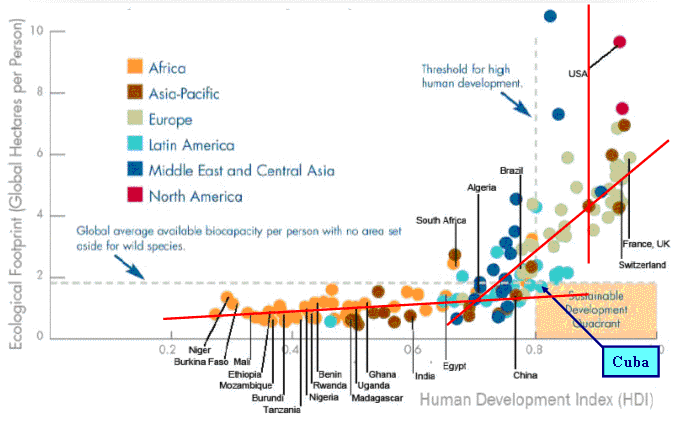
Mathis
then took the entire
available arable land of this planet and divided it by the current
population
of 6.5 billion people. This
produces an
available per capita footprint of 1.8 hectares (4.4 acres).
He
then plotted the ecological
footprint of different nations against their Human
Development Index (HDI),
a measure of the quality of life of their inhabitants.
In
order for the inhabitants of
planet Earth to lead a decent life without taxing the resources of the
planet
in an unsustainable fashion, each nation should consume less than the
1.8
hectares per capita of the ecological footprint available, while being
granted
an HDI of 0.8 or better. Hence
all
nations should strive to have their “dots” move to
the orange box in the lower
right corner of the graph.
Currently,
there is only one nation
that has its dot inside the orange box.
That nation happens to be
The
banana-shaped curve can be
approximated by three separate tangents.
The almost horizontal red line at the bottom represents
primarily the
African nations. The
good news is that
it should be possible to move them further to the right, i.e., in the
direction
of an improved quality of life, almost without increasing their
ecological
footprint. These
nations get by with
such a small footprint, because they cannot afford to waste anything. They are careful to use
their few available
resources in an almost optimal fashion.
The
second (tilted) tangent further
to the right represents the European nations.
Their gradient is steeper because they live more
wastefully. People
in Switzerland heat their houses in
the winter and cool them in the summer more than would be necessary;
they
maintain weekend houses that they heat and possibly cool even at times
when
they are not present; they keep their computers running 24/7; and
finally, they
buy food items that they then forget in their refrigerators and
freezers until
they are rotten and need to be thrown away.
Finally,
there is a third vertical
tangent representing the
So,
what is the carrying capacity of
the planet? If we
wish to live in a
sustainable fashion like the Cubans, we’ll need to reduce our
numbers by 20% to
5 billion people. If
we wish to all live
like Americans, we shall need to decrease our numbers to roughly 1
billion
people. Finally, if
we decide to live as
poorly as the people of
Unfortunately,
expansion is in our
genes. The Cubans
would gladly vote to
become the 51st State in the Union, if this
would enable them to
drive around in these sinfully gorgeous SUVs; if they could heat their
houses
to 24C in the winter while cooling them down to 18C in the summer; and
finally,
if their supermarkets would carry all the food that they can only dream
about
at an affordable price 24 hours per day and seven days per week.
Energy
Consumption and the Dependence on Fossil Fuels
At
the current time, we are
satisfying our energy needs almost exclusively by burning fossil fuels. Everything else is icing
on the cake. Hence
if the fossil fuels become unavailable,
we have a real problem. Let
me quantify
our current energy consumption:
|
Energy
Type |
EJ/yr |
% |
|
|
|
|
|
Oil |
160 |
38 |
|
Coal |
100 |
24 |
|
Gas |
90 |
21 |
|
Biomass |
30 |
7 |
|
Nuclear |
25 |
6 |
|
Hydro |
15 |
4 |
The
three types of fossil fuels:
oil, coal, and natural gas, together account for 83% of our entire
energy
consumption. The
units used in the
table, EJ/yr, represent exajoules per year.
We are currently consuming 420 EJ/yr, corresponding to 13
TW (terawatts).
Although
we are definitely hooked on
fossil fuels, many of the uses that are currently covered by fossil
fuels could
equally well be met by other means.
For
example, it isn’t necessary to heat our houses by means of
central oil heating
systems. We could
utilize electric heat
pumps instead. We
use as much fossil
fuels simply because they currently represent the cheapest solution. As long as electricity is
sold at a price
three times higher than heating oil, why should we consider changing
our
heating systems?
The
problem is that we are running out
of cheap oil fairly soon. Once
the price
of raw oil rises to $200/barrel, everyone in
As
it is possible to replace one
type of energy with another, it makes sense to discuss energy
consumption
simply in terms of power units, rather than in terms of barrels of oil.
If
we divide 13 TW by 6.5 billion
people, we get 2 kW per person.
Knowing
that we live beyond our
means,
This
is tough. In 1950,
shortly after the end of WW-II, the per
capita energy consumption in
A
lot can be accomplished by better
insulating the houses. New
houses can
and should be built as min-energy houses, whereas older houses ought to
be
upgraded. I expect
the Swiss government
to pass a law probably by 2010 that will force people who consume more
than 10
liters of heating oil per year and per square meter of heated area to
either
upgrade their dwellings or reduce the room temperature accordingly. Tax incentives will be
offered where needed.
The
public transportation system of
I
recently attended the annual
meeting of the Swiss
Academy of
Engineering Sciences (SATW).
At that
meeting, a former CEO of the electricity company of the Canton de Neuchâtel,
Charles Rognon,
made a presentation about Swiss energy policies.
Rognon
showed a graph on which he
plotted the “proven” energy reserves in the year
2050. He assumed
that our hydro-electric power
plants shall continue to produce the same amount of energy by 2050 that
they do
now. This
assumption holds, unless
global warming will have melted our glaciers by then.
He also accepted the (somewhat optimistic)
assumptions made in the Road
Map:
Renewable Energies Switzerland that stipulate that we should
be able to double
our renewable (hydro, solar, wind, geothermal) energy production by
2050. He dropped
the fossil fuels, because they may
no longer be available by then, and he also dropped the nuclear energy
due to
the political pressure of shutting the nuclear power plants down.
Using
the “proven” energy sources
only, Switzerland will have available only 1 kW of per capita energy by
2050,
i.e., even the envisaged 2000 Watt Society is a
pipe dream without
additional sources of energy. The
hidden
message was that we cannot afford shutting down our nuclear power
plants. In order to
meet our goal of 2 kW per person,
we would need to double our nuclear power and
increase the
efficiency of these power plants from currently 33% to 50% by using the
excess
heat for heating the houses in nearby villages rather than our rivers
as we do
now.
Yet,
even if we manage to have
available 2 kW per person by 2050, the 2000 Watt Society cannot be
realized by
better insulating houses and driving smaller cars alone. There is a direct
relationship between energy
consumption and productivity. Reducing
the energy consumption, we’ll have to move down the tilted
red line in the
footprint diagram, i.e., not only won’t we be able to waste
energy any longer,
we’ll all be significantly poorer as well.
Our HDI will get reduced from 0.9 to 0.8.
We’ll become Cubans, and we won’t like
it a
bit.
The
Seduction
of Exponential Growth
Let
us play a little game. We’ll
simulate a synthetic chain letter that
obeys the following set of rules:
- A
chain letter carries two addresses, the address of the sender, and the
address of the sender’s sender.
- After
receiving the chain letter for the first time, the recipient sends $1
to the sender’s sender. He then sends the chain letter on to 10 new
recipients,
again with two addresses, his own address as that of the sender, and
the sender’s address as that of the sender’s sender.
- The
letter is only mailed within the
- Every
recipient answers the chain letter exactly once. If and when he receives the letter for a second time,
he
simply throws it away.
We
need special rules to provide
initial conditions:
- The
originator sends out 10 letters with only one address, and
doesn’t send money to anyone.
- If
a letter is received with only one address, the recipient sends it out
to 10 new people with two addresses. Such a recipient doesn’t send money to
anyone
either.
This
is a wonderful, and totally
illegal, way of making money. Each
participant is expected to make $99 on the deal.
I
quickly programmed that game and
simulated it. Here
are the results:

The
top graph shows the infected
population. Already
after seven
generations, the entire population of the
Participants
during the exponential
growth phase of the game consume money sent to them by future
generations,
whereas those who participate during the stagnation phase send money to
past
generations.
This
behavior is true for all
exponential growth patterns. During
the
exponential growth phase, i.e., while the second derivative of the
growth curve
is positive (the curve is “u”-shaped), we borrow
money from the future, and
during the stagnation phase, i.e., while the second derivative of the
growth
curve is negative (the growth curve is “n”-shaped),
we pay back our accumulated
debt.
In
fact, we are worse off during the
stagnation phase than in steady state, because in the steady-state
phase the
second derivative of the growth curve is zero; we have meanwhile paid
back all
of our debt and are now debt-free.
Whereas
sending out chain letters is
totally illegal for individuals, it is not illegal for governments. In fact, this is how our
entire economy
works.
When
we pay money into social
security, it is not being invested in order to pay it back to us with
interest
once we retire. That
money is used at
once to pay retirement income to our parents and grandparents. The Social Security
Administration simply
relies on a growing number of young people to pay into their funds, so
that we
can receive an income once we retire.
The
system lives off the exponential
growth and is designed to go broke once the
exponential growth pattern
comes to an end.
Yet,
this is not only a problem with
social security. It
is one of the main
driving forces behind our entire economical system.
Our economy has been optimized to exploit
exponential growth, and once exponential growth ends, it is designed to
fail.
For
this reason, we cannot rely on
market forces to get us out of the exponential growth dilemma. Our business managers and
politicians have
every (short-term) interest in preserving the exponential growth for as
long as
they can.
What
we need is the EGA, an
organization called Exponential Growth Anonymous
with a strict “twelve-step
program”:
- We
admit that we were powerless over exponential growth – that
our world had become unmanageable.
- We
have worshipped the chain letter principle.
- We
stole money from our children to support our addiction to exponential
growth.
- We
lied shamelessly and remorselessly in order to support our addiction.
- We
even were ready to start wars, if these allowed us to continue our
addiction a little while longer.
We
can rely on our business managers
and politicians to fix the exponential growth problem as much as we can
rely on
junkies to fix the drug abuse problem.
World
Models
and the Looming Collapse
For
the past 35 years, researchers
have attempted modeling world dynamics with the purpose of gaining a
better
understanding of the forces that drive population dynamics, resource
utilization, waste management, and world economics.
One
of the main contributors to this
body of research is Dennis
Meadows, one of the authors of the book Limits
to Growth. Meanwhile in its third edition, the book continues
to offer a useful,
inexpensive, and easy-to-read introduction to our collective knowledge
concerning world dynamics.
World
models are based on plausible
interactions between different variables that are considered key to
governing
the dynamical patterns. The
interactions
themselves are modeled using statistical data collected in different
nations. For
example, it is proposed
that the birth rate is a function of the Human Development Index (HDI),
as we
have observed that in countries with a high HDI value, the birth rate
is
usually significantly lower than in countries with a low HDI value.
Different
world models may use
different relationships governing a different set of key variables, but
they
are all based on the same principles.
A
set of internally consistent relationships is formulated that can then
be
simulated to obtain sets of behavioral patterns that are compatible
with these
relationships.
If
you read the book Limits to
Growth with the hope of finding a prediction of our future,
you will be
disappointed. No
one can predict the
future with any degree of reliability beyond a fairly short time
horizon. What the
book does demonstrate is how the
model can be manipulated to generate different possible behavioral
patterns
that are all consistent with the assumptions (internal relationships)
on which
the model is based.
The
book discusses 10 different
scenarios, most of which, but not all, show a collapse,
i.e., a rapid
decrease of the world population sometime after the year 2030. Between 2030 and 2070,
approximately, the
world population decreases from somewhere around 7 billion people to
somewhere
around 1 billion people.
Dennis
updated his world model
(WORLD3) from one edition of the book to the next by adding new
statistical
data that have meanwhile become available.
The behavioral patterns that the model exhibits
haven’t changed much by his
doing so. The
principal message of the
original 1972 edition has not been invalidated by the new facts that
were added
between 1972 and 2004.
However
in 1972, there were
considerably more options available to avoid the collapse than are
still
available today. The
window of
opportunity is closing rapidly, and up to now, we seem to have
consistently chosen
paths leading to collapse.
Let
me try to explain why this is
the case. To this
end, I shall employ an
older world model, WORLD2, created by Jay
Forrester and
described in his 1971 book entitled World
Dynamics. I
am using this model
because it is simpler and fits on a single graph.
Here is the model:
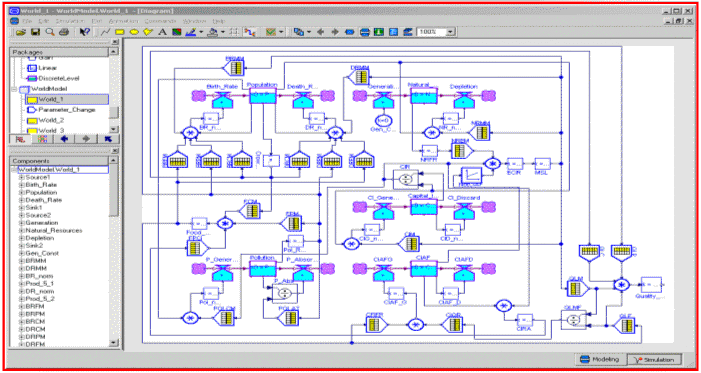
The
model contains five “levels”
(state variables), shown in the model as blue rectangular boxes,
representing
the population, the pollution, the unrecoverable natural resources, the
money
invested in the world economies, and the percentage of that money
invested in
the agricultural sector.
Each
of these levels has an “inflow”
and an “outflow,” represented in the model by blue
valve symbols, whereby the
state derivative is the difference between inflows and outflows. These
“rate” variables themselves are
non-linear static functions of the states and other auxiliary
(algebraic)
variables.
Let
us check what happens if we vary
the rate at which the natural unrecoverable resources (like fossil
fuels) are
getting exhausted. We
shall define a
“performance index,” i.e., a measure of goodness of
the observed behavioral
patters. We wish to
keep the world HDI
value as high as possible, while punishing negative gradients of the
population. We want
a high living
standard while avoiding the die-off.
Five
different scenarios are shown
below. The
performance index is plotted
over time.
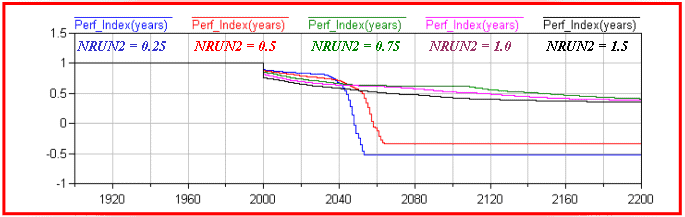
The
faster we use up the remaining
fossil fuels, the better it is. The
reason is that after the end of cheap oil the exponential growth
pattern cannot
be preserved any longer. The
sooner we
get out of the exponential growth pattern, the better we’ll
be off in the long
run.
Two
of the scenarios, the blue and
the red, are plagued by massive die-off after the year 2040. The other three scenarios
avoid the
die-off. Hence we
ought to prevent the
blue and red scenarios from becoming our future.
Yet, these are precisely the scenarios that
offer the best short-term perspectives.
Since
market forces always optimize
with a short time horizon of two years or less, our politicians and
business
managers will invariably embrace the blue or red scenarios, and
consequently,
we are meeting our demise with our eyes wide shut.
The
Consequences of Collapse
What
does a collapse entail? GliderGuider
demonstrated in a recent
article published
on The Oil Drum
that, in order to
“accomplish” a reduction in world population from 7
billion to 1 billion within
a few decades, we would have to maintain an annual excess death rate of
3% or
“better” over an extended period of time.
Let
us look at
In
order to get an annual excess
death rate of 3% or “better,” we would need, on a
global scale, a situation
that is worse than that of current-day
Let
us look at world population
statistics of the 20th century:
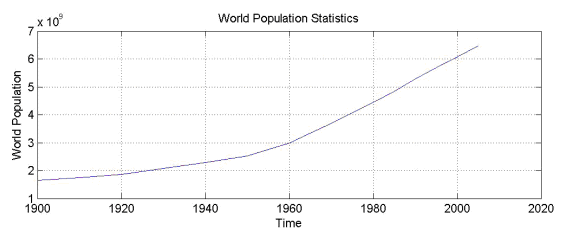
What
happened during WW-I and
WW-II? In spite of
the horrors of these
wars, the world population kept growing.
All of the horrors of these wars didn’t even
make a dent.
What
about the Spanish flu of
1918? We
don’t know exactly, how many
people died from that flu, but according to our best estimates, roughly
50,000,000
people died from the flu during the winter of 1918.
This corresponds to 2.5% of the world
population. So for
once, we came close
to our “target” of 3%, and yet, there
wasn’t even a dent left in the curve,
because we didn’t keep at it for sufficiently long.
Even
Adolf Eichmann had to learn
that killing millions of people and getting rid of their corpses is
very hard
work. Reducing our
population from 6
billion to 1 billion in 75 years, that’s hell come to Earth.
How Can The
Collapse Be Avoided?
There
is an old proverb: when you
are already in a hole, stop digging.
We
have documented that we are already consuming an ecological footprint
larger
than that provided by planet Earth in a sustainable fashion. Thus, increasing our
population further can
only hurt us.
In
order to avoid the collapse, we
need to get out of the exponential growth pattern as fast as we can. We ought to behave as if
fossil fuels had
already become essentially unavailable, using this precious commodity
only for
purposes where they are absolutely essential and to help us create a
sustainable energy infrastructure for the future.
Such
an approach will immediately make
us poorer. It will
be uncomfortable; but
remember, this will happen sooner or later anyway, whether we like it
or not,
and the longer we continue in our current exponential growth pattern,
the more
painful the subsequent adjustment will be.
By
accepting the transition now, we
will make it much easier, because as of now, the fossil fuels are still
available to help us cheat. Where
a hard
transition is too painful, we can make it a soft transition. Where fossil fuels can
help us create better
living conditions for the future, we can still use them. Finally, by weaning us off
our addiction
voluntarily now, we prolong the availability of the remaining resources
substantially.
It
is a bitter medicine, no doubt.
Can
we understand its
necessity? You bet!
Will
it happen? I see no
inkling of it.
A Powerpoint presentation of mine about these and related issues can be found at the web address http://www.inf.ethz.ch/~fcellier/Pres/AGS_07.ppt
Contact
- Content: editors at theoildrum dot com
- Tech support: support at theoildrum dot com
License

This work is licensed under a Creative Commons Attribution-Share Alike 3.0 United States License.
Dr. Cellier,
I haven't read your post yet, but I just wanted to issue you a warm welcome to the fold of TOD contributors. I read some of your comments the other day on one of the TOD-Europe threads, and I look forward with considerable anticipation to reading your present and future posts.
'...representing the United States and the United Arab Emirates. They consume simply because they can without improving their quality of life any further.'
Actually, at least in the case of the United States, arguably that mindless consumption leads to a lower quality of life.
"Actually, at least in the case of the United States, arguably that mindless consumption leads to a lower quality of life."
I think that mindless population growth in the United States leads to a lower quality of life. Imagine if we could wave a magic wand and go back to having only 200 million people like in 1970. Transportation would be so much faster and housing would consume so much less of one's income. But as it stands now, we will add another 100 million people in the next 30 years. Apparently, as hard as it is to believe, Americans want to be more crowded.
" They consume simply because they can without improving their quality of life any further."
When I hit comments like this I tend to doubt the quality and reliability of the rest of the work, without further inspection. Let us say that I can compare notes on occasion with Europeans I meet, and the notion that Americans do not improve their quality of life by being wealthier is somewhat hard to believe. I could phrase this a bit more emphatically.
It's not a random or subjective comment. He's talking about the Human Development Index, and provides a link that explains it.
If you have particular beefs with the HDI, then by all means, share them.
Well, yeah, but then again this was an education.
I see now how places like Cuba become the darlings of addled, woolly-minded Europeans. As long as you live for a long time, irrespective of quality; have a time-consuming education, irrespective of quality; and have food to eat, irrespective of quality; you score high on the HDI. The actual quality or awfulness of your life, the degree to which you have any economic, political, or religious freedom, or instead live in what amounts to a concentration camp, the presence of art and culture; these and all other considerations are omitted from the picture as seen through that carnival mirror. All that matters are quantities and durations.
I'm afraid these considerations lead me to see the article as rubbish, in alignment with the original sentiment.
The HDI site well illustrates one of the many processes by which the UN continually excuses the sloth, stupidity, incompetence, cruelty, and brutal oppression of so many of its morally degenerate member governments. As ever, every villain is followed by a sophist with a sponge. Would that I could see $0 of my tax money going to that worthless, corrupt, morally bankrupt organization - Robert Mugabe in charge of development! - and see all traces of it extirpated forever from the USA. Of course that's not PC so it won't happen, but a small consolation is that at least I don't have to live among the sort of woolly-minded Europeans who come up with such nonsense.
Oh, and who says we have to live solely from agricultural photosynthesis, which seems to be the tacit assumption behind the notion of "ecological footprint"? Is that idea yet another manifestation of the primitivism that seems to have become so de rigeur lately?
ROI on free "cool aid" seems to be enormous. LOL.
"Oh, and who says we have to live solely from agricultural photosynthesis"
Guess we could all consume huge amounts of propaganda and spatter poor Todders with the resulting manure :)
You're being humorous... right?
We have never produced food on a wide scale that comes from anything other than "agricultural photosynthesis". If you believe otherwise, please document the case.
As for quantities and durations, yes that matters far more in reality than human abstractions about freedoms. So far as the universe is concerned it does not matter whether we are "free" or not. What matters is that there are N resources and we can never use more than N, no matter how much you cry about "freedom".
Finally, your assumption that life at Cuban levels of energy consumption must be bad seems to ignore the US itself from about 1776 to about 1940. People then seemed to live fine "free" lives without living in concentration camps. Your "concentration camp" argument is a strawman intended to invoke an emotional reaction. It has failed, probably because you fail to understand the physics of the problem.
Ghawar Is Dying
The greatest shortcoming of the human race is our inability to understand the exponential function. - Dr. Albert Bartlett
Well yes, call it what you want, but absolutely it was meant to provoke an emotional reaction. There's more to life than the mere survival that is all there is to be had under an ugly, brutal tyranny such as Cuba, Zimbabwe, etc. After all, any bacterium, plant, or animal can merely survive as some sort of pointless automaton - so what?
One way or another, the "US itself" has been supplementing agricultural photosynthesis with other processes on an increasing scale throughout its entire history (there were water wheels and sails from earliest days). And that really took off in the early 20th century, well before 1940. And it took off in many places, not only the US. And one way or another it will go on doing so - if less so with oil, then more so with something else. And if not to as lavish an extent as some would like, most likely nonetheless to a greater extent than primitivists seem to want.
First you go on about food, then make crazy claims about not using photosynthesis for food, and now you are trying to shift the game by asserting it has to do with other energy sources?
You appear to be rather confused.
Ghawar Is Dying
The greatest shortcoming of the human race is our inability to understand the exponential function. - Dr. Albert Bartlett
an ugly, brutal tyranny such as Cuba, Zimbabwe
Entirely disingenuous!
Both are "tyrannies" but Zimbabwe much much more so and for absolutely no reason but the whim of a madman.
And while Cuba is making its best while being short strapped for ressources, partly thanks to the US, Zimbabwe is a total waste of PLENTIFUL ressources, if not for the delirious mock up of occidentalisation by the "elites" it would at least as rich as South-Africa and probably more.
Intellectual dishonesty is the hallmark of trolls or morons (or of both qualities).
Considering you live in a country which is trying to near the limit of totalitarian fascism (with severely limited civil rights) while trying hard not to look like one, I don't think your comparison is without it's problems.
I live in a country with half the energy use, half the energy need and half the CO2 output compared to you. And probably have equal amount of if not more "nice additional freedom" than you have.
It's just that even where I live, the energy use is a multiple of what is sustainable.
Look, the HDMI is not a joke. You have have your own subjective "feels-good-to-me" index, but don't be so sure that other people would share it or would like to measure their happiness by it.
If you want objective data, you look at what sociologists, economists and psychologists have found out with mass samplings from various cultures.
And these all say pretty much the same thing.
After a certain level of material well being, people only become less happy, not more.
Regardless of how they spend it. Even if they consume extra cultural and non-material things with this wealth.
As for the non-material things that cannot be consumed with wealth (political, artistic and other freedoms).
Yes, they are important, but they are even harder to judge.
You may like your certain set of freedoms, but you seem to be clearly oblivious to the restrictions you live under in your culture of choice.
To me they are painfully obvious.
But it's a matter of preference. I'll give you that.
What is not matter of preference is the PHYSICAL day-to-day living. The material bit. You know, getting enough of energy, food, clean water, heat, shelter and that short of thing.
Only after that can you start choosing the other nice bits you prefer.
But if you haven't got those basic things, there isn't anything to choose from.
In that case nature chooses on your behalf and makes you part of this one gigantic performance art piece called emergency survival, whether you prefer it or not.
That's why this article is important and your arguments completely seem to miss the point. Even Maslow understood this.
As for the "agricultural photosynthesis" quib. Surely you are joking? You aren't that removed from the biological/physical reality, are you? Do you have any idea how your body is able to live?
When the going gets rough, I'll trade all my art collection, my library, opera seasonal ticket and my freedom of speech for your last 1000 liters of clean water and 10 Mjoules of food.
See you on the other side of the great equalizer. Be ready to make the switch, you'll get double the amount of all the "nice bits" you prefer so much :)
Paul S sounds rather bitter. Of course, given the preparedness of the US (which after 1970 after all did become the first industrialised nation to seriously consider the long term oil problem at the highest official levels) in the present day, conditions in the US some 10-20 years from now are going to produce a lot more of this sort of bitterness.
ciao,
Bruce
ps pity the awareness didn't exactly percolate to the rest of the society, especially after 1980 and the return to There's a Will There's a Way mentality
Paul, I will suggest that long term (I'm talking centuries here) almost certainly "we have to live solely from...photosynthesis". IMO it is VERY arrogant for humans to assume they can make a solar collection system superior to that produced by literally billions of years of competition and selection. I'm waiting to see the human-designed energy gathering and concentrating system that:
repairs itself
reproduces itself
produces useful waste products (such as O2)
produces no waste nor structure that is not biodegradeable
Since I'm on a roll, I'm going to go out on a limb here and propose that a big part of how humans got into this mess is arrogance. We arrogantly believe we are somehow more important than everything else on the planet. We arrogantly believe we know better than 3 billions years of competition and selection. We arrogantly believe we're so damn smart we'll figure our way out of our present predicament without giving up comfort and convenience.
The ancient Greeks were aware of this; more than one of their tragedies demonstrated the outdcome of hubris. Our turn will come. Again from the ancient Greeks: "The mill of the gods grinds slow, but it grinds exceeding fine".
PLAN, PLANt, PLANet
Errol
" They consume simply because they can without improving their quality of life any further."
I was going to comment on this by saying there were a rabidly wealthy few that did improve their quality of life and then I thought of Paris Hilton and gave up.
Professor Cellier,
Enjoying your article and as well your moustache, it is a fine job too.
Well, as an European who has visited the US, I was shocked at how poor the US is! On TV you only see the nice pictures, but i saw the real US:
..whitetrash-trailerpark
..blackslums
..spanishonlyspeakingpoorvillages
So yes, a lot of US people could improve their lives.
Roger from The Netherlands
I remember 1982, driving from Salinas in the morning to Santa Barbara in the afternoon, the contrast was a shock.
Having lived in Germany and then returning to the U.S., I suffered from culture shock from my own country. Americans still live under the illusion that they are truly wealthier than the Europeans.
In January, 2001 when Bush 'assumed the position', a Euro cost only $0.94, today it costs $1.36.
And crude was $25.70.
I believe on average that Americans consume more simpply because they can. Huge cars, SUV's, homes, mostly badly designed and inefficient - this is consumption simply because the US can.
Most other countries can't, so they don't, yet in the UK and France at least, there is a better quality of life.
I am especially pained by the typical reactionary notion that even though the Cubans might be living at a sustainable economical level it is unacceptable because they have a supposed communist government. Just in case that is too complicated for some: It is possible to be doing something right even if you do everything else wrong. Even if it is an accident. Noticing that does not make one a commie sympathizer.
I've lived in the U.S my entire 63 years except for two years in Germany in the U.S. Army and a little traveling, but you don't have to look very hard to see that there is much good in the European way(s) of life that is sadly missing in the U.S. There is more to life than accumulating things. I'm not sure where European culture is going but I often tell my children that this country is a lot meaner place than it was 30 years ago.
But...I doubt Cuba would be in the "sustainable" box, if not for its Communist dictatorship.
If they were not Communist, they would probably be much like the U.S. Fully part of the global economy, with the benefits and drawbacks there of.
If they were not a dictatorship, could they have done the things they did to cut back their energy consumption?
This reminds me of something Diamond talks about in Collapse. He argues that the key to avoiding collapse may be strong central control, because otherwise, the tragedy of the commons rules.
If you want to learn more about Cuba's situation, I suggest you go to Google Video and type in "Peak Oil Chinese" and "Peak Oil Portuguese" and "sort by date". I'm not sure where the first part went, but it's a documentary split into 6 parts (again, check out both the Chinese and Portuguese ones, which are just subtitled in those languages, while mostly in English).
Cuba, when Communism was strong in the world, was much like the U.S. However, when the U.S.S.R. went caput, the majority of their imported oil dried up almost overnight. I don't know how the real situation is over in Cuba, but while watching the video, I felt more hopeful than I'd previously felt. (Not that I don't think we should worry. We definitely should...) Now, they have gardens all over their cities, and 80% or so of their agriculture is organic. You should check out the video.
Well, that's a rather depressing graph.
Cuba is barely in the box.
And that box is with "no area set aside for wild species"?
So we convert the whole world into land to support humans, and maybe we can live like Cubans?
I see a catabolic collapse in our future.
Actually, this is not entirely true. The reason is that the available footprint has been calculated with reserve forest needed to remove the CO2 in a sustainable way. Evidently, some wildlife can live in that forest as well.
Well, I guess that's better...but not much.
It's looking like only certain kinds of forest actually help remove CO2. And of course, not all wildlife are adapted to forests.
And, once again, it is anthrocentric.
To the best of my knowledge, no one has done an actual study of how much of the Earth's carrying capacity is required to maintain a healthy, stable non-human world.
It seems like half would be a first guess. It might be much higher than that.
So, take the model and divide by two. For a start.
Um, who cares what it would take to support a non-human world? Some of us like existing, you know.
Try living without the support of the natural world for a while. Let's see--oxygen, clean water, food, waste recycling...all provided free of charge by Nature! What are they teaching in the schools these days???
Please. The person to whom I am replying appears to be one of those who is interested in a world without humans, for some reason I have never, ever been able to fathom. Your misreading of my comment--assuming I don't care about the natural world rather than correctly seeing that what I don't care about is a world without humans--probably derives from your haste to post a "clever" comment about what they're teaching in schools these days.
I think what Autodidact is saying is that, if you care about a world with humans then you had better care "what it would take to support a non-human world."
Why? Simply because it's the biodiversity of ecosystems that facilitates ecosystem functioning and the provision of their free, life-giving services such as clean air, nutrient recycling, clean water, buffering from storm and drought events, productive soils, raw materials for input to the economy, etc.
We are totally dependent on the biodiversity of the biosphere yet we are reducing that biodiversity every day through the root cause of our environmental problems: economic growth.
Continuous economic growth on a finite planet with finite resources is sheer folly, yet it's a perennial goal of governments and it always results in ecosystem conversion and thus biodiversity loss.
Thank you, nkdawe. This was exactly my point. Our technology, cultural values, and societal lifeways make us believe that we humans are somehow above or outside of the natural ecosystems that surround us. This is a grievous error, one which may lead to our extinction as a species. While this would certainly be to the benefit of many of the planet's other species, I'm anthropocentric enough to think that would be tragic. For all our faults, we do have some redeeming qualities and I think it's a loss to the universe whenever any species goes extinct.
Sorry if I misinterpreted your comment, adamdschneider. And I did think the comment was rather clever, actually. ;-)
Leanan, I can only see the left half of the first graph (the one that is supposed to show Cuba in the box). I am using Firefox. Can you help?
Thanks.
Here's the link:
http://www.theoildrum.com/files/EcologicalFootprint.png
If you're using Firefox, I recommend the Show Image and Image Zoom extensions. They make dealing with images a lot easier.
thanks.
Consider too that Cuba is only in that box at TODAY'S POPULATION! By the end of the year, the population will have gone up, the box will have shrunk, and no nations will be within that box. In fact, by the time we reach say 7.5 billion, no nation on that graph will have a sustainable ecological footprint, no matter how primitively they live. This is where the collapse comes in.
The point at which this article really brought everything into perspective for me was where he said that it would take a death rate 6 times higher than that of Iraq for 50 years to bring us back down to a 1 billion population. I guess I'd never been clear on what collapse would really look like. I thought anything stretched over 50 years couldn't be that bad.
Unfortunately, it is more likely to be a 50 year process punctuated by events in which things are 600 times worse than Iraq for a few months across broad parts of the Earth.
Truely inconceivable.
Actually, it is entirely conceivable, if you read about long ago disasters like the 30 Years War (1618-1648) that reduced Germany's population by at least half.
THe difference between World War I & II (& Iraq & Vietnam) and Medieval and earlier wars, is that modern transport and distribution systems enable food and other critical resources to reach refugees, homeless and others left stranded by war.
In the past, without these systems, these people would have died off very rapidly. Armies lived off the land, and vacuum cleaned the food from farmers, who died off and the land reverted to "wasteland" as they used to call it.
Something similar appears to have happened in stretches of Africa, such as the Eastern Congo, and previously in the borderlands between Mozambique and what was then Rhodesia. I read a piece in the New Yorker a couple years ago, by a (white) woman in Zambia who became fascinated by a (white) Christian banana farmer/ex Rhodesian commando, who she persuade to take her to his old battle grounds on the Mozambique borders. They saw no people, and had to step around a LOT of elephant dung.
The regenerative power of the earth is great, and the ability of human (and other overstretched) populations to crash in the absence of modern support systems is also great.
We only need to note that the city of Rome had perhaps one million people during the time of Christ, and maybe 15,000 by the eighth century. We can surmise that most of those people were unsuccessful in relocating, because urban centers everywhere else contracted as well. Also, this was a time when 80% of people worked the land, so there was a lot of resiliancy in society -- which also existed during the Great Depression. Now, of course, very few people have any experience in "creating" food.
Similar things happened in Hawaii. There are accounts of battles where few died in the actual fighting, but many died in the aftermath. The land was at its carrying capacity, and could not support the invading warriors as well as the original residents. The result was mass starvation.
China's Famine 1958-1961 - a cautionary tale
http://www.overpopulation.com/faq/health/hunger/famine/chinese_famine.html
The new versions of history claim that the 'new world' had a lot of people and the populations were cut back via the 'old world' diseases.
Large scale death has happened before it seems.
Besides, a bio-agent could be blamed as 'natural' - aka 'we leaders can't protect you from acts of God, so you can keep us as leaders....'
Eco-systems get rights against humans
cfm in Gray, ME
The problem with models is that the underlying assumption(s) may be weak. When this occurs, the model becomes invalid. It is sometimes useful to vary the assumptions, thereby discovering which assumption(s) is most critical to the result, and, from society's perspective, discovering where attention and resources should best be spent.
"The system lives off the exponential growth and is designed to go broke once the exponential growth pattern comes to an end."
1 The application of this statement to social security has been obvious for years. You did not make as good a case that other current economic systems are not sustainable.
2 TOD is mostly concerned about oil, you are logically concerned with all energy. Current distaste with nuclear power will disappear as societies discover their limited options for base loaded power, and actinide breeders will appear if and when uranium becomes overly expensive, and usefully burning the long lived bits of modern day nuclear wastes. Meanwhile, imo cheap solar is coming soon, <$1/w, cheap enough for rooftop systems to replace most of their daily consumption, feeding excess daytime generation to the grid as is already allowed in 34 US states. Studies that assume affordable nuclear/solar are worthwhile in generating a more optimistic, and probably realistic, future.
This is certainly true, and this is exactly what world modelers are doing these days. No modeler with any sense will claim that he or she can predict the future. All they can do is to explore the envelope of all possible futures that are compatible with the model. Furthermore, sensitivity analysis can be applied to identify the set of model parameters to which the simulation results are most sensitive.
Evidently, the model still contains an underlying structure. For this reason, it is important that different modelers develop independently different world models that are based on a different set of base variables and different internal relationships.
If it now happens that separate models constructed in this fashion cover essentially the same trajectory space, then the confidence grows that these models don't contain any further hidden assumptions that may in themselves be invalid.
While we're discussing possible problems with this model, you write:
"If we divide 13 TW by 6.5 billion people, we get 2 kW per person. Switzerland has currently a per capita energy consumption of 5.5 kW, whereas the U.S. shows a per capita energy consumption of 10 kW."
I presume you mean kW hours/day? Otherwise, this makes little sense.
24 KW hr/day = 1 KW
1 KW per what? Kilowatt is a measurement of flowthrough, a kilowatt hour is a unit of power.
Thus, 24 kWh/day = 1kwh/hour. Without the measurement of time, I believe this number has little meaning.
A kilowatt-hour is a unit of energy. A kilowatt is a unit of power.
As stated above, 24 kWhr/day = 24 kWhr/24 hr = 1 kW.
I get it. Thanks.
As I posted below, 10 kw of constant energy for each American, 24/7, is mind boggling.
Worldwide, we consume the energy equivalent of about one Gb of oil every five days from nuclear + fossil fuel sources.
During George Bush's eight years in office, the world will have consumed from nuclear + fossil fuel sources, in round numbers, the energy equivalent of about 600 Gb of oil.
It takes decades to fully deplete a field like East Texas (largest oil field in Lower 48), Prudhoe Bay (largest oil field in North America) and Ghawar (largest oil field in the world).
600 Gb = 100 East Texas Fields or 50 Prudhoe Bays or 10 Ghawars (production to date for Ghawar, URR for other two). And this is in eight years.
This is also true.
Let us play another little game. We are visiting one of the casinos in Las Vegas, where we choose a special version of the game of Roulette.
We can set on either red or black. For simplicity, we want to assume that the likelihood of hitting either red or black is exactly 50%. We also want to assume that, if we bet correctly, we get twice as much money back as we bet, whereas we lose our money if we got it wrong.
As long as we can guarantee exponential growth forever, we can make an infinite amount of money at that Roulette table. It works as follows:
We start out betting $5 on red. If we win, we just made $5. In this case, we'll bet once again $5 during the next round.
If we lose, we double our bet to $10 on the next round. If we win, we once again made $5 over the two rounds. If we lose again, we bet $20 the next time around, etc.
Since the likelihood of a run of infinitely many blacks is infinitesimally small, we'll eventually make $5. Then we start afresh.
Probability calculus tells us that, on average, we'll make $5 on every second game. If we play infinitely many games, we make infinitely much money.
Of course, every casino owner knows that, and for that reason, they'll limit the amount of money that you can bet at the table. They claim that they do it to protect their customers, but in reality, they are protecting the bank.
The scheme works once again because of exponential growth. By doubling your bet each time, you follow an exponential growth pattern.
If you hit the allowed limit, or if you run out of money, that's when you lose your shirt, and if you play long enough, this will invariably happen.
Economic systems are good at exploiting every feature there is. If money is to be made, it will be made, because if you don't do it, someone else will. That person will get rich, and therefore, will need to reinvest his or her money in the market. By doing so, the former door gets squeezed a little tighter, until every opportunity has been exploited. This is called the efficiency of the markets.
Exponential growth patterns always offer opportunities to make money. For a simple game, a simple strategy can be designed. In reality, the strategy may not be that obvious. Yet all exponential growth patterns offer possibilities for making money on them. Hence the markets will invariably exploit those. When the exponential growth pattern ends, the opportunity goes away, and the market will start losing money.
I posted some money supply numbers a few days ago (from Financial Sense) that are astounding. All of the examples cited showed double digit year over year increases in money supply (Russia was up over 40%).
I am beginning to think that we are about to see--absent an immediate recession--a blowout inflationary bidding war for declining crude oil and petroleum product export capacity.
Indeed. Ergo the Phoenix in 2018.
That is of course 'IF' we make it that far.
One of the many jokes about economists: Only madmen and economists believe in an infinite, geometric expansion in a finite world. And funding social security in the future will be the least of our worries. We will do it the way the Russians did: with fixed payouts of a deteriorating currency, if growth stalls for any real length of time.
We'll get exactly the Social Security checks that we were promised. One of those, and $25,000,000, should be good to buy a cup of coffee.
Seems to me that something like the US social security system should be able to work sustainably. If folks generally work for X years and then collect retirement income from social security for kX years, things should balance nicely if they pay kW social security tax on an income of W. If population levels and lifespans were stable, why wouldn't this work just fine indefinitely?
Of course, population and lifespan are not stable. Population fluctuations don't seem too troublesome. People work first then retire. When some boom generation is working, tax income will exceed retirement outflow, so the excess needs to be invested. What makes sense to me is to invest in infrastructure, so that when the boom retires, the smaller worker generation that follows can take advantage of that infrastructure to be able to support themselves and the seniors.
Lifespan changes don't seem so difficult either. Retirement age just needs to change along with lifespan.
What am I missing here? Is there any technical difficulty with setting up a sustainable retirement system like social security?
Of course, the political problems are something else altogether. Give people power, corruption follows. Any centralized system that manages such a huge amount of money cannot work because the folks in power will surely find ways to siphon off practically the whole pile. But that doesn't seem to be what Prof. Cellier is talking about.
Medicare is a whole other animal. What do people need to live? Food, shelter, clothing, medicine. With food, shelter, clothing, the concept of "enough" has some graspable meaning. Not so with medicine. The medical industry can continue to develop ever more profitable products that provide some detectable benefit. "Enough" has no anchor.
Personally, I think the whole social security brouhaha is a big distraction. The real problem is Medicare. Nobody really makes a profit off social security - though I suppose it does bring down interest rates & help the Treasury fund the deficit. But Medicare, that is hugely profitable for the medical industry. That's why we hear so much about social security.
Indeed, this is not what I was talking about.
Of course, social security could work if the money that I pay into it were being invested and paid back to me with interest after I retire.
Social security could (theoretically) provide a better return on the money invested than I should be able to get by investing the money myself. The reason is that there is a larger pot of money available than I would have individually, which reduces the trading commission.
Yet, this is not how the system has been built. People are greedy, and markets tend to squeeze everything out of the system that they can. Thus, the money that I pay into the social security fond is constantly being syphoned off to pay for current debt, hoping that new money will come in to pay my retirement income to me when I retire.
Instead of investing my money, social security makes a bet. It's like a derivative product.
Because the system gets squeezed out to the maximum, the system is designed to operate on a constantly (and exponentially) growing population of young people.
This is not sustainable. At the moment when the population goes into saturation, two things happen. (i) There are not enough young people any longer paying into the system at the required rate, and (ii) the average population age grows.
Social Security and Medicare's financial problems are rooted in their funding mechanism, i.e. wages. Real wages have been declining in the US due in part to globalization and in part to automation. Almost all the economic growth in decades has gone to investors. Income from investments are not a source of funding for Social Security and Medicare. This will change as more baby boomers retire and that is what scares Wall St.
helping the treasury fund the deficit is NOT a benifit, but part of the problem (imo). let me ask you, would we be searching, still searching, for wmd's if we actually had to pay for it with real hard earned taxpayer's dollars ?
but i totally agree with you re: medicare (and health care in general for that matter). my own solution to increasing health care costs is the same as the one for increasing costs of energy - consume less.
my doctor agrees completely. eat less and excercise more.
The problem with healthcare costs is mostly "inelasticy of demand" - just like with energy. People are ready to pay whatever it takes for their health and this allows the "suppliers" to raise their rates almost unconstrained. In addition the "suppliers" are not actually interested in curing you, just like the oil producing countries are not interested in us finding alternatives. What our doctors/hospitals/pharmaceutical companies are strongly interested in is in us eating unhealthy food, driving instead of walking/biking, replacing prevention with etc.etc. The fact that this is what is happening in practice is of course just a coincidence...
In short, by applying unchecked market principles to such a fundamental service as healthcare, US has created an ever-growing and gouging OPEC within itself. Now we are paying ~10 times more for healthcare than for energy and healthcare costs have been rising in double digit rates for many years. This ain't going to change soon.
No, this is not true.
Firstly, I am not concerned with all forms of energy ... I am concerned with sustainability. The planet has finite resources, and no exponential growth pattern can continue forever without being accompanied by growth in resource utilization. Since many experts agree that we are already now (since roughly 1984) using up resources faster than the planet can resupply those, we'll need to reduce our resource consumption rate in order to becme once again sustainable.
Secondly, your assumption that fossil fuels can be replaced by nuclear and/or solar is a bit cavalier. We are currently consuming 13 TW of power. Out of those, 83% or roughly 10 TW are from fossil fuels.
Let us assume that the fossil fuels go away over a period of 50 years. Hence we need to replace 10 TW of power over 50 years. Let's do it with nuclear power plants.
Let us assume for simplicity that one nuclear power plant generates 1 GW of power. Hence we'll need to build 10,000 additional nuclear power stations over 50 years, i.e., 200 power stations per year. This means, we'll need to build one new nuclear power station every other day over the next 50 years ... assuming that the world power consumption remains constant, which the Chinese and the Indians will contest heavily.
There certainly is enough solar power reaching our planet, no question about it. Yet, the numbers stay about the same, i.e., if we go for big solar towers in the desert regions (the more economical solution), we'll need to build one of those every other day, and if we go for photovoltaics and collectors on our roofs, the problem gets even worse. There is no way that we can produce enough of those in a sufficiently short period of time to catch up. It ain't gonna happen.
If available as electricity from nuclear plants (or solar or wind), 10 TW is not needed to replace 10 TW of fossil fuels because these are used rather inefficiently (e.g. burning coal and nat. gas for electricity, petroleum for transportation). Of course, even if we assume we need only 1 TW, the prospects still appear dim.
This is old news here. We've been over it over and over, and the numbers aren't that hard to come up with.
Assuming that you need entirely nuclear, this isn't a hard chore at all. You can build several at once, and 200 power stations per year is only about 500 billion dollars in bad conditions, less than 1% of the global economy.
But you dont need to do exclusively nuclear anyways, and we wont. We have huge coal reserves, several terawatts avaliable from wind supplies, and some 10000 terawatts avaliable from solar.
Its like you've never heard of people building two buildings at the same time. How did we build our fossil fuel infrastructure to begin with?
"We are currently consuming 13 TW of power. Out of those, 83% or roughly 10 TW are from fossil fuels."
This line scared me more than anything else in this excellent article. (Highly suggest those commenting should read The Limits to Growth or Beyond the Limits before spouting off, oh wait, that's just the nature of sites like this...)
And we receive 10000 TW from the sun, and can burn that much nuclear fuel daily for roughly 16 million years.
Sure theres a limit, but its a ways away.
Nuclear fuel must be mined and transported. Currently that requires fossil fuel. Nuclear power only works on a large scale. When the fossil fuel is gone, most nuclear power plants are going to cease operating. The only ones that might continue operating will be close to their fuel supply.
Where do people go off making such naive assertions.
Coal requires 10000 tons shipped per day.
Nuclear requires 200 tons per year.
You see the difference at all?
Hello Dezakin,
How many tons of ore must be daily mined and highly processed to get the 200 tons of finished product suitable for use in the nuke plants?
A different question entirely because mining equipment can all be electrical (and often is) and could be very plausibly powered by a nearby nuclear power plant...
But, currently the lowest ore grades being exploited that I know of are 300ppm at Rossing Mine, so just over 650000 tons. Most ore bodies currently exploited are much more dense than that though.
Now this is for once through light water reactors only. With fluoride breeders the total fuel flow would be 1 ton per year.
This has been covered here before many times. The bottom line is nuclear power wont run out anytime worth talking about.
And all the extra specialists to run these nuclear reactors, they're going to readily appear overnight too, right? Building a reactor a week is one thing, and I never saw why anyone would doubt nuclear fuel abundance (bar maybe bottlenecks in the neglected mining industry that can soon change), but people to run the plants don't sprout up instantly when you want them, unless you really go lax on standards.
It's ridiculous that people think nuclear power can be ramped up soon enough to even come close to replacing worldwide energy needs. At the very best, nuclear could gradually increase a few % in overall global electrical energy production.
Take into account the following:
1) Bare minimum of 7 yrs. to go from paper to full-scale operation
2) Waste storage? If we are having problems now, imagine our problems when nuclear is increased by 100X or 1000X. We will need like 50 Yucca Mountains.
3) Where are you going to put all those plants? They all require a lot of land, nearby water sources, and other supportive facilities.
4) Hyperbole over breeders. This technology is still very speculative and can't be realistically relied upon to create tons of extra fuel from the spent uranium. How many breeder reactors are there in the world? France had one, then closed it and they rely on nuclear for 75% of their electricity.
5) Exponential growth rate of electricity consumption, much of it in countries who have no nuclear energy know-how.
I think it is counter-productive to embark on a "nuclear revolution," because it is clear that this technology can only be sustained for a limited time unlike REAL renewables like wind, solar, tide, etc. that are PROVEN technologies that will last indefinitely.
Over the next 50 years, thats all we need. We've got huge wind resources and plenty of coal to get by before we really feel a crunch...
Most of it in licensing/regulatory issues. Not a problem when you can build most of these in parallel anyways.
Yucca is a political solution to a nonproblem. Waste storage can be stored on site for centuries just by having an extra parking lot.
Coasts work fine, next to dams works even better for dispatchable power. Siting isn't even a problem.
Breeders have been successfully demonstrated, but they're totally unnecissary for centuries to come unless they offer a significantly less expensive fuel cycle. Fluoride liquid fuel reactors offer the most promise, and when we need them we'll have ample time to develop commercial models... If solar energy isn't cheaper by that point rendering the whole topic moot.
Nuclear can be shown to last for centuries to millenia, long enough to ramp up wind then solar, and none of these have the EJ demonstrated capacity of nuclear power today.
Dezakin,
Your suggestion that siting isn't a problem seems a bit oversimplistic. Setting aside political issues, technical issues must surely constrain siting too, right? For example:
- reservoir/river water temperature constraints
- seismic vulnerability issues
- costal storm risks
Certainly manageable, but still issues that impact cost and schedule.
Water temperature constraints are primarily political.
Seismic issues are certainly manageable for reasonable cost if you can overcome political hurdles, or you can just run more HVDC lines from your production center on some stable coast.
I dont really see coastal storm risks as an impact on nuclear power plants. They're built pretty durable.
I'm not saying that there aren't concerns for siting, but its by no means a difficult problem.
Can nuclear electricity (or any electricity for that matter) smelt the megatons of ore needed for the miles of alloy tubing required to build all those reactors? How about to make the megatons of cement needed to build the containment buildings? While the last of the oil is being used to maintain agricultural production till we can get the population down?
If the whole world dropped everything and started on a crash nukes program tomorrow I doubt we would make it.
I wish I could believe in your vision, but I can't.
Easily. I can run numbers for you if you want.
Population isn't going to go down.
Easily. I can run numbers for you if you want.
Then do it, easily but without mistakes or (intentional) lies!
Population isn't going to go down.
Numbers, please, and with justification, not just an extrapolation of the exponential!
How much do you get paid for nuclear propaganda?
Unless you are already quite old, 70 or more, it is likely that YOU will get screwed like everybody else, what are you gonna do with the money in the (short) mean time?
How many commercial flouride reactors exist?
None; But with enough uranium to last hundreds of years in the once through LWR cycle at the least, its not like theres a big rush for it either.
And its not like we couldn't ramp up a technology that was developed 40 years ago if we needed it.
I'd love to see an article that argues in copious detail that nuclear is going to save the day. Not only will it provide all the electricity the world needs, but it will also drive the needed changes in infrastructure.
Nuclear will solve our transporation challenges. Nuclear will provide (indirectly) the material for our roads and the energy needed to run agriculture. Electricity will be used to shape metal. The list seems endless....
And you ship it with what???? COAL!
No one ships anything with coal now, we ship it with diesel fuel.
Because that's so much better, right?
The point is simple enough... how much fuel does it take to ship 200 tons of material anywhere.
Its not within 6 orders of magnitude of the energy pumped out by a 1 GW power plant for a year. Its inconsequential.
There are several issues that would have to be addressed if we wanted to go the nuclear route:
1. Coal=CO2 emissions=climate change=mega $ to deal with consequences. Clean coal technology would help but still would be too expensive for many developing countries. This is assuming you are right about there being an abundance of coal still around--the Energy Watch Group isn't so sure: http://europe.theoildrum.com/node/2396/0
2. Siting issues--there would be a lot of resistance to siting near any population centers. This could be overcome through propaganda campaigns (i.e. "You want to freeze in the dark?") or governmental decrees but there could conceivably then be higher health costs, higher insurance costs, etc. And what about environmental effects? Water temperature issues are not just political. And you seem to dismiss political issues as though they are inconsequential--dangerous assumption.
3. Coastal sites? With ocean levels going up who knows how much? Hmmmmm....
4. Assuming nuclear generated electricity replaces transportation fuels, we'd have to replace the world's vehicle fleet with electric or hydrogen powered vehicles. Wonder how much that will cost?
Maybe none of these issues are insurmountable but I don't think you've taken into account the added expense and time to address them. Maybe the developed world can afford it, but what about China, India, Africa, etc.? They're going to want the cheapest, fastest solutions--not a good scenario, IMO. Nuclear may provide part of the solution, but I wouldn't want to bet on it.
Please do not forget #5: Radioactive waste disposal and long (~10,000 years) leak proof storage!!!
We haven't yet figured out how to properly dispose of plastic and many other toxic substances, including nuclear wastes, but what the hell -- leave it to the future to deal with.
Brilliant!
This is a political problem. You seal spent fuel in concrete and revisit the issue every fifty years. In time we either recycle it or find a better way of disposing of it. If civilization crashes, it really isn't our problem anymore.
Leaving the future to deal with it is entirely appropriate for all liabilities, yet people for some reason reel at the notion.
Its a liability one way or another. If it were up to me I'd replace all coal plants with nuclear, hydro, and wind.
No, but if it came to keeping the power on, those issues vanish.
Several meters. Well within the ability of plant designers to manage over the expected operating lifetime of the plant. You can also build floating plants to eliminate the problem entirely with the added bonus of having a centralized company for plant construction that contracts out large baseload electricity for delivery on site.
I rather doubt hydrogen will ever be a major fuel because of its terrible volumetric energy density. Synthetic diesel and gasoline can be made by running hydrogen over CO or CO2 and appropriate catalysts. Costs would be high, but not so high as to destroy personal transportation.
I think most people here vastly overestimate the costs and assume the depletion rate for oil and related fossil fuels will be too extreme to deal with. Die off is ridiculously implausible, but an inflationary economy for decades because of rapid infrastructure changes isn't entirely out of the realm of plausiblity.
A very good essay. Thank you.
I assume various regions have been modeled in isolation, like Cuba, in your example. Have you modeled the U.S. with various imported energy limits?
As our oil imports drop from 14 to 12 to 10mm/b/day what might that situation look like?
There do exist regional models, so-called open exchange models. The way they work is that only the interfaces are defined between the regional models, not the models themselves.
It is then left up to the individual countries to code their own regional model. For political reasons, each country is allowed to keep its own model secret, i.e., they use input data coming from other neighboring models, and they produce output data to be used by these other neighboring models, so that they can be simulated together, but how the output data are being produced remains a secret.
Yet this was not the case with either WORLD2 or WORLD3. These are (fairly simple) global models.
Dr. Cellier,
Could you suggest a reference on the open exchange models (a paper citation or the name of a researcher?)
I have just finished Limits to Growth, and if I understand the model correctly, food production is prioritized over industrial growth.
It seems the opposite is happening in our world, where agricultural land is being converted into fuel for urban consumption.
One idea of why this is happening is that some regions have food surpluses, and the value of the fuel is higher for them then the value of the food.
But that does not explain why countries like India are promoting biofuels when so many local people are on the edge of starvation.
I would have to dig references up that you can download from the Internet.
WORLD2 and WORLD3 were 1st generation world models. These were global models.
The open exchange models became fashionable during the late seventies and early eighties, i.e., during the 2nd generation of world models. IIASA was quite actively involved in these research efforts at the time. For example, you can find an article on an open exchange model in the food production sector written by Klaus Frohberg in a book of mine from 1982. The book was entitled Progress in Modelling and Simulation. The article by Frohberg was entitled The International Linkage of Open Exchange Models. Frohberg used to work for IIASA at that time. He is now a professor with the University of Bonn.
Yet, the concept of the open exchange models was mostly discontinued again after a while, because although these models could be simulated, the results obtained from these simulations were difficult to interpret.
During the 3rd generation of world models, the models were cut into sectors rather than into geographical regions, i.e., some modelers concentrated on water distribution systems, whereas others were working on food production models, etc. Many such modeling efforts exist in isolation, but mostly, these sectoral models don't communicate with each other.
Only now have we finally the modeling and simulation tools available that are needed to connect these sectoral models back together, and this is the topic of a conference that I plan on organizing in 2008 here in Zurich.
Francois,
While you're here... would you have any references for modelling of the sensitivity of agricultural + transport (i.e., "food delivery") networks to disturbances, either economic or physical? At this point merely knowing which journals such studies are published in would be helpful.
Thanks,
Bruce
I am afraid I don't have this information.
However, I have a colleague at ETH, who is another modeler. He is a biologist by education. He has been one of the lead authors of the 2nd part of the new IPCC report on global warming that has been released about six weeks ago in Paris. I can ask him. If someone has an answer to your question, it would be him.
However, today is a public holiday here in Switzerland (Ascension), which is why I have so much time to spend on the Internet. Many people, including myself, are "making the bridge," i.e., are taking tomorrow off for a long four-day weekend.
Thus, I won't be able to ask him until sometime next week. I'll need to get together with him anyway. He will be organizing next year's world modeling conference together with me.
Hi Francois,
Thanks for that. It's not a big hurry, but I do want to try to get into the literature on that subject over the Summer, circa July/August. All I know up to now is some studies by some of my plasma physics colleagues on electrical supply and auto traffic networks as complex systems. I'm interested on anything about bifurcations in nonlinear network response.
Thanks,
Bruce
There may be another problem with the WORLD model. I am straining my eyes here looking at the graps - is it right that the model treats the whole world as one compartment that thrives and suffers together? This would have very little connection to reality. One would need at least one model per continent - if Africa collapses, this will do relatively little to Brasil or Paraguay. It would do more to Europe though. More complicated to model, but today's computers can certainly handle it.
Another problem is that nobody knows what the future carrying capacity will be on each continent taking the different global warming paths into account.
Indeed, WORLD2 and WORLD3 are gobal models, not compartmentalized models. Such models do exist though.
Furthermore, these models do not account for social unrest and similar phenomena. All they do is to look at population dynamics, resource depletion, waste management (pollution control), capital markets, and agricultural markets, defining a set of proposed significant interactions between those. In addition, the regional models also account for migration patterns influencing the local population dynamics.
The "carrying capacity" is not fixed, but there is certainly an upper limit. Let me explain this statement once again by means of looking at the case of Switzerland.
During WW-II, Switzerland was completely surrounded by the axis powers. We could import very little and therefore had to produce everything that we needed on our own.
Almost immediately, most of our farm animals were slaughtered, because you can feed more people per acre of arable land on potatoes and beans than on beef and chicken. Only in the high alps were farm animals allowed to graze, because at those altitudes, nothing grows in Switzerland except grass.
Secondly, the Swiss were not allowed to have any lawns any longer. Every patch of grass or lawn had to be plowed under and planted in order to produce enough food.
Thirdly, every inhabitant had to help with working those fields. Those who held a regular job had to work the potato fields during the weekend, and those without a job had to work in the fields all week long.
With those measures, Switzerland was able to feed every inhabitant a diet of 1800 calories per day. The food wasn't very good, and it certainly wasn't rich, but at least, no one was starving.
In those years, Switzerland had a population of 4 million people. 15% of the population were farmers.
Today, Switzerland has a population of 7.5 million people, only 2% of the population are farmers, and roughly half of the former arable land is now urbanized.
Thanks to cheap energy, less people are needed to work the fields, and thanks to the green revolution (fertilizers), the average yield per acre has been increased by about 65%.
Yet, Switzerland can only live in luxury, because we can afford to import whatever we need. If globalization breaks down, i.e., if and when we once again have to produce everything that we consume locally, there is no way that Switzerland will be able to feed 7.5 billion people. The population density is simply too high.
The same holds true for most of central Europe, and even a simpler lifestyle won't overcome the limit that each person needs a minimum number of calories to survive.
Yes, but if a country like Switzerland made large investments now in things like greenhouses, for example, would this not increase the amount of food you could potentially produce? (I am thinking in terms of year-round food production instead of just 1/2 year.) Obviously you cannot cover the entire country with greenhouses, but enough could be put up to make quite a difference.
Furthermore, is it realistic to think in terms of zero trade with neighboring nations as a permanent state of affairs?
There are no silver bullets. We'll need each and every type of energy that we can potentially produce to soften the impact of the end of cheap fossil fuels.
I for one am all in favor of expanding nuclear power, not as a cure-all, but simply because without it we are even worse off.
Furthermore, it has become clear to me that the problem that we are facing cannot be solved in time by any type of renewable and durable energy.
Hence we must think not only about renewables, but also about bridging technologies. To me, nuclear power is a bridging technology that can help us soften the impact of Peak Oil and grant us more time to come up with a durable (sustainable) solution to our energy problems.
Hopefully, our societies will not degenerate to a state where everyone has to rely on himself (the Mad-Max scenario) because no super-regional organizations exist any longer. Thus hopefully, interactions with neighboring countries will continue to exist on a friendly and good-neighborly basis.
Unfortunately, Europe is fairly flat w.r.t. structures and resources, i.e., at the time when Switzerland will face energy problems, so will all other nations around us. Thus, even if they might like to help us, they may not be able to do so.
In fact in some ways, Switzerland is better off resourcewise than many of our neighbors, because we have more water per capita available due to our glaciers. If these glaciers melt away as a consequence of global warming, which may indeed happen within the next 100 years, Europe will face an even worse problem.
Dr. Cellier:
Fascinating story!
I've got lots of detailed questions about this.
When you say they were not allowed to have lawns any longer, how was this enforced? Was voluntary compliance good, or did more heavy-handed legal methods have to be employed?
Were the homeowners responsible for getting their lawns plowed up, or were there work teams that just went around and did this (with or without the owner's permission)?
How did they deal with trees growing in the lawns? Did they just plow around them, or were those pulled out?
What about people already growing kitchen gardens -- were they allowed to keep on growing other vegetables such as cabbage and carrots, or was everyone required to just grow beans and potatoes?
How was the Swiss government able to come up with the additional quantities of bean seeds and seed potatoes required? Were homeowners required to buy these or were they provided to them free by the government?
Were the homeowners allowed to keep their own produce and sell the surplus, or was everything deposited in a central storehouse and rationed? How was this enforced?
If you don't have the time or ability to answer all of these questions, I would appreciate it if you could point me in the direction of a source (in English or Francais) that could provide the answers.
Thank you!
I am afraid, I don't know the answers to many of your questions. I myself have been born shortly after the war, and only know this part of our history second-hand through the stories that my parents told me.
There is also relatively little available on the Internet, simply because there wasn't any Internet available at that time.
What I could dig up quickly are two interesting documents, one in English, the other in French.
The first (English) document talks about Switzerland's economic dependence during WW-II. It is well written, but unfortunately, doesn't provide answers to many of the questions that you were raising.
The second (French) document is a historic video from 1944 explaining to the Swiss population the need for the work draft. In those years, there was not only a military draft, but also a work draft, i.e., any person between the ages of 13 and 62 living in Switzerland could be drafted to do any work that required additional manpower. It is a highly interesting historic document. Unfortunately, it isn't available in English. It is only available in German, French, and (presumably) Italian.
Thank you/Merci Beaucoup!
Thank you for this excellent and enlightening article. Could you comment on the models and dynamics? Do they take into account changes in behavior as the situation deteriorates?
You cited the example of deaths in Iraq compared to what would be needed to obtain the required population reduction. Does the model expect human behavior remain constant when it appears that this die off rate occurs?
I suspect at some point when the situation starts to become apparent that Civilized behavior will possibly cease and we may see an acceloration toward chaos.
Respectfully,
EJ
Yes and no.
The models do fairly well in terms of taking into account the levels of consumed energy. When less energy per capita is available, the models adapt themselves to a simpler lifestyle, where less energy is also needed.
Yet the models don't account for wars or other forms of social unrest, and they certainly don't account for a reduction in "carrying capacity" due to the side-effects of such wars or social unrest (e.g. contaminated water, agent orange, or similar effects).
My difficulty with the Limits to Growth models has always been the assumption of limited resources, which are too simple.
We can think of two costs associated with providing goods; the enthalpy cost, and entropy cost. Up until now, we have "cherry picked" the low-entropy resources, those that nature has expended energy in the past to concentrate. As those are depleted, we will substitute less concentrated alternatives that require more energy to collect and use.
Consider Phosphorus as an example. Florida phosphate rock is about 20% pure, while the natural abundance of phosphorus is 0.1%. The additional energy to concentrate phosphate from un-mineralized rock is at least RTln(200) (far more in a practical process), but the "resource" never runs out. A realistic price curve should converge to the price of the substitute rather than just climbing exponentially as the phosphate rock depletes.
I think 2kW is an unrealistic goal. Rising entropy costs will probably offset any efficiency gains, and 5 kW is the least people will ever consume. This is only 125m2 of solar panels per per person, and quite realistic.
But only for the sort of person that installs solar panels.
Theoretically, we aren't going to run out of energy any time soon. Solar input alone provides plenty of energy for everyone.
The problem is not available energy, but rather energy density. Solar energy is unfortunately very diluted. Concentrating it to make it useful is costly. The same is true with your Florida phosphate rock.
It's a race against time that we are likely to lose, because we have a tendency of delaying preparations for as long as we can get away with.
This is not true. Switzerland is currently consuming 5.5 kW, and we live almost as wastefully as the Americans. The reasons why we nevertheless consume less energy is:
More can certainly be done to save energy.
The envisaged 2kW of energy only account for centrally produced energy, and don't include the energy that the individual person may produce locally.
For example, my wife and I have already replaced our central oil heating system by a heat pump that is on its primary side supported by a geothermal system and on its secondary side by thermal solar collectors.
Thus, the government will only count the electricity that we are buying off the grid, ignoring the geothermal and solar energy that we produce locally.
Hence when energy gets rationed, we'll (hopefully) have more energy available, because we produce some of it locally.
Whether 2 kW is realistic or not is beside the point. I frankly don't believe that Switzerland will be in any position to produce more than 2 kW per capita by the year 2050 (excluding strictly local production).
During the cultural revolution, Mao decreed that every village operate a steel furnace and a brick kiln. Quality was poor and productivity was low, but it gave people hands-on experience, and started an abrupt shift from agrarian to industrial economy, now almost complete after 40 years.
The solar-shift for the west will begin when 1) we receive a signal about as compelling as a decree from Mao, and 2) there is an appropriate solar technology, the modern equivalent of that brick kiln, that can be produced at a regional level.
As you point out, it isn't the poorest who need to make the shift. They are already living within their footprint. I believe the west (europe first) will adopt solar quickly, when energy gets sufficiently expensive
You are talking about the Great Leap Forward, from 1958 to 1960. The steel produced was mostly unusable and of poor quality. Tens of millions of people died as crops were left to rot in the field, as most available labor was busy collecting scrap and farm tools to use as feedstock for the back yard kilns.
We can't be precise as to the number of deaths, as too many people died to keep track of. Estimates range from 14 to 43 million excess deaths.
I hope that this is not the solution we are going to implement! It would probably be effective more for the population reduction than the energy produced.
Switzerland will be in any position to produce more than 2 kW per capita by the year 2050 (excluding strictly local production)
I hesitate to question a professor in his own country, but have you considered:
Small Hydro (http://www.mhylab.ch is a world leader)
Wind (Switzerland has installed very little so far)
Solar PV (the German areas just north of you are installed quite a bit).
A bit of biomass
And domestic heat from geothermal sources ?
Not to mention nuclear power (at least to a limited degree).
Best Hopes,
Alan
Yes, yes, and yes.
If you read the Energy Roadmap (PDF) that I referenced in my article, you'll see a fairly elaborate (and somewhat optimistic) plan for doubling the alternate energy production (hydro, wind, solar, geothermal) of Switzerland by the year 2050.
These guys thought of everything that is possible ... and also of some things that IMO are not feasible.
And yet, with all of this, we will only be able to produce 1 kW of energy per person by 2050 without the availability of fossil fuels and nuclear power. With nuclear power, we may make it to 2 kW per person. More than that is a pipe dream.
I think I see the answer to my previous question. 10kw for Americans is 10 kw constantly, or 240 kwh/day, correct? And that includes transport, everything?
That's a heck of a lot of power. Having installed 250 watt hours of PV on our off grid home (perhaps 1.5 kwh/day), it seems inconceivable that we could replace that with solar and wind. To get 240 kwh/day from solar, when peak sun is about 6 hours, average, would require roughly 40 kw per hour over six hours.
That would require 320 of the large, 125 w PV panels I put up, at $600 each.
That's $200,000 for just the PVs, without thinking of storage or providing baseload for a system intertie.
I think people will discover that vast savings can be made through conservation.
I have 20 75 w PV panels and a 1500 w peak power wind mill on my off grid cottage/office but it's definitely not enough to power all the regular household appliances, especially in winter.
Solar is a lovely bb solution, but one that isn't all that affordable or practical at present energy level useage, and requires a lot of hands on management, especially for any off-grid or grid down application.
Folks are in for a surprise when and if they think they'll solve any coming energy crunch by running out and throwing a few PV panels on their roof.
10 kW of power is not what you consume personally. This includes not only the consumption of an individual home, but the consumption by the entire American infrastructure. The number is computed by summing up all energy uses across the country and dividing this amount by the number of people living in the U.S.
I don't have the American figures handy, but here in Switzerland, the distribution of energy use is about even:
I would assume that the situation in the U.S. would be similar, i.e., you consume only about 3.3 kW (corresponding to 80 kWh/day) personally in hour home; the rest of the energy is being consumed elsewhere.
Furthermore, even the 80 kWh/day include the entire life-cycle of your house, including its construction. If you construct a house and then live in it for 50 years, you spend overall about 50% of the energy during the construction of the house if you include the production of the materials from which your house is being constructed. They also include the energy to support you personally.
The average middle-class American sub-urban single-family home consumes roughly 25 kWh/day of power for heating/cooling/electricity.
When we were still living in the U.S. (I used to be a professor at the University of Arizona for more than 20 years), we had a weekend home in the White Mountains of New Mexico, where I generated most of my energy needs by myself using photovoltaics. The house was a log-sided double-wide mobile of 1200 sft. I lived comfortably there on 6 kWh/day of electricity for everything except space heating. Space heating was done using a wood-pellet stove. We also had a 1000 gallon burried propane tank, but this was used primarily to prevent the house from freezing while we weren't physically there. We used the propane also for cooking and for drying our cloths. Everything else was electric.
Interesting article and discussion. I never ran the numbers before, but my family's direct energy burn is about 6.4kW, ignoring energy embodied in goods consumed. What really shocked me was that 50% of that was heating (house and hot water). Another 38% was transportation fuels.
Ouch. We have a ways to go. Already have a TDI. Better windows are next.
Given the quality of guest posters whos only claim to credibility is being a professor who we've seen here...
Why?
Remember the guy who thought nuclear power wouldn't work because he did a book report on a single paper he read?
And it was later revealed that the paper based its modelling on the widely discredited storm/smith paper.
Switzerland can run their entire grid off of hydro, wind and nuclear for the indefinate future. Tie the grid to more of europe and it only gets more stable.
This is very true, except that when "the goods" is energy itself, there truly is a limit--collection energy can't exceed delivered energy.
This notion follows the entire EROEI myth that so many buy into here... That the price of energy in dollars is directly proportional to its energy payback ratio.
Its only true on the margin. Further away it doesn't matter and then installed capital and labor matter much more, and people start making all kinds of ridiculous assumptions (like the energy cost for paying for the education of the haidresser that cuts the hair of the engineer of the nuclear power plant operator) to fit the energy return model to their expected costs.
Where has anyone assumed that energy's cost is based only in dollars? Last I checked, you used funny things like Joules and I also seem to recall that anything that expends more energy than it can sustainably produce is in a game already lost.
This will be evident enough with the less energy dense fossil fuels when it comes to extracting and refining them. Even if economically still turning a profit, energetically speaking it's a dead end if after you've mined, refined and transported that fuel, you get less energy back than was put in.
This of course doesn't factor into nuclear given the huge quantity of energy within fissile material, but nuclear has other problems (and no, I don't mean the Storm et al paper).
I'm not arguing any different... I'm arguing over the long run it doesnt matter because we have alternative primary energy sources.
That you think that the EROEI argument has anything to do with money is amusing.
Wow, some strawmen are carefully constructed, and then theres blatent pieces of ridiculousness like this.
If you'll read the comment again you might find I was arguing the opposite.
My original comment didn't mention money. Neither do any relevant posts on EROEI on this blog.
We both burn men of straw. Mea Culpa.
If you are talking about solar energy, this issue has been studied here, for example. You could also read up on the american inventor Farrington Daniels. . Daniels invented the pebble-bed nuclear reactor, then went on to develop solar-chemical reactors. He was more optimistic about the potential for solar because he realized that the attainable reaction temperature was much higher with concentrating-solar than in a nuclear reactor. He was able to synthesize nitrogen fertilizer from air, and reduce metals.
Farrington Daniels was my esteemed friend and mentor. He encouraged my interest in solar stirlings in the '70's, and pointed me to many clever ideas on low cost concentrators. Unfortunately, then as now, there was very little interest ($) available to carry these ideas into hardware.
It is a tragedy that people like Daniels are not heavily subsidized by some sort of automatic process that would direct to them the relatively trivial funds needed for demonstration proofs of their concepts.
I was not implying that conventional PV technology (locally applied on your roof, for example) is a net energy loser--although I do find it perplexing (annoying?) that the financial payback time is much longer than the energy payback time your reference suggests. My point is simply that a diffuse power source presents challenges in gathering it in. If we exhaust available land for PV, there is always the ocean. More energy cost to retrieve it from there, however. Beyond earth? Yeah, it's there--but that's not going to help with peak oil.
Thanks for the reference on Prof. Daniels.
A truly excellent post. Lots of people will look for ways to deny all this stuff which to me has been obvious for at least thirty years. But of course denial is a central part of our culture, perhaps its most important failure mode. We are not conditioned by any part of the public sphere to think about, let alone feel responsible for, indirect consequences of our actions. Having too many children, with all the ideology that supports that, is our most important dangerous action. All others, whether too much shopping or simply bad TV, is secondary.
Thanks for putting up such a post with more effort and more background knowledge than I could ever come up with.
ciao,
Bruce
ps... C McEvedy, An Atlas of World Population History (Penguin, 1975), should be on everyone's "have read" list.
Perhaps for some it is denial, but on the other hand some conclusions are pretty obvious even though they would be taboo to discuss openly in a PC world.
In the US, we will do nothing useful to deal with the coming horror.(crisis and catastrophy did not seem strong enough words for what we face) Those in power will accrue as much wealth as they can right up to the moment of collapse. They will prevent anything that will interfere with them accruing as much wealth as they can right up to the collapse. They will do everything in their power to keep the game going as long as possible, which includes decieving everyone about the actual state of affairs as long as possible. AND, I believe they will kill as many people as necessary to ensure their own survival afterwards.
And Cid Yama,,
knowing all this(coming horror) or at least believing it, then I ask you...what is your plans? What do YOU intend to do?
How will YOU proceed?
Not being nosy but just wondering about those who profess to understand the shitstorm that is coming but post nothing of value on the personal avoidance of same.
Is nobody preparing? Reading TOD I go thru volumes of discouuse but little of preparation do I find.
Its like a huge disconnect exists between belief and action.
Again not slamming you personally but the thought just occurred to me reading your post, and you do state that "we will do nothing useful.....etc"
So why do we do nothing useful SINCE as you imply those in power will keep the status quo? We are not their serfs, at least not in principle and not in fact.
It seems to me therefore that with the obvious freedom we enjoy in the USA to do as each desires that many would have personal lifeboat plans ....and yet conjecture here on TOD on this subject seems to be somewhat taboo or not worthy of too much discussion.
Reams about graphs and oil geology and of late the obvious consensus of those making those massive topic posts is that we are in very big trouble. Lots and lots of detailed commentary YET almost zip about personal objectives and plans. ZIP I say. ZIP.
Ohhh yeah Todd and myself and a few others comment from time to time but usually are ignored by the hard core posters here. Its like......"Pullleezzeee not that again" or that sustainable food production by the individual is verboten.
So grubby in nature....so 'backwards'...so plebian...
Therefore I submit...most are here because of the addiction of watching the firewall slowly advance upon civilization and relish the front row seats but personally do not want the 'drudge work' of actually DOING SOMETHING!!!! Its like...real life on the telly..or another Monty Python thingy. My case: Witness the frolics of one previous OilCeo who found much humor in chaos..or the past and newly arisen Hothgorians/DMathews..et al
Airdale- just one of those 50 million hated bubbas from the outback
Actually, I am already in my lifeboat. I made major changes in my life years ago, including relocation following extensive research and radically simplifying my life. Think globally act personally. I hold no hope for the millions of American sheep still driving their SUV's and supporting leaders and policies that allow them to remain asleep at the wheel driving off into the sunset of civilization. Now it is time for me to sit back and watch it all unfold. Yes, I do enjoy throwing cold water on the sleepers. Hopefully, one or two will wake up and save themselves.
Airdale, I am getting ready. For what, I am not sure. I suspect we will see an economic disaster first. It probably will be the easiest to explain to the sheeple. TPTB will have trouble explaining limits of our finite world. I tried the corn seed trick of one on top of another in my garden. Not everybody has there head in the sand.
Or, some of us refuse to discuss preparations publicly for various reasons.
It is not either/or, Airdale. This is a website devoted to energy issues, not personal preparation for the effects of those issues. As such, I see it as being mostly off-topic to discuss the subject here. It comes up occasionally. I've made a few offhanded comments myself but I don't intend to talk about my preparations extensively, regardless of the level of badgering I get on the subject.
Ghawar Is Dying
The greatest shortcoming of the human race is our inability to understand the exponential function. - Dr. Albert Bartlett
Actually I don't believe it is off topic. Note the header under THE OIL DRUM on the home page which says "Discussion about energy and our FUTURE"...To me that means were are discussing Peak Oil and related oil subjects AND our future as a result of energy usage.
Lots of talk about GW I note and that is just as much off topic if you hold to the real issue of energy. GW is a 'related' subject. Sustainability is right on the other side of energy.
As to speaking of personal preparations? I agree and don't go into much details except some observations on farming and agriculture that are not that personal.
Airdale
Agreed. Awareness of Peak Oil automatically fosters thoughts of preparation. However, the burning of fossil fuels is reversing the mechanism that Earth uses to regulate its own temperature. So whatever horrors the Peak may bring it is nothing compared to potential of Runaway Global Heating, potential for which there is no preparation.
Airdale,
I pretty much believe the same you and Cid do, but there is more then one way to get ready, and different people have different areas of expertise.
For example it would be a waste of resources for a farmer to become a sheep dog and vice versa.
To answer your question directly, my answer is mobility and association with like minded individuals that can be trusted because it is what I'm most comfortable with.
I liquidated all my real estate a couple of years ago and at this point just have to decide where exactly I want to make my stand.
Hi mus,
Thanks and I'm interested in what "making your stand" amounts to, (for you), and also in the location - when you decide. Just out of interest. (Not wanting to crowd in, of course.) Do you have some places you're thinking about now?
Aniya,
If I had to take a wild guess today it would probably be a remote part of Cascadia or South America, but everything is subject to the way the cookie crumbles. Timing is always one of the big issues, you don't want to be in the last chopper off the roof top and you don't want to commit in one direction without some hard data, so you watch and wait.
As far as "making my stand" it is in the sense that I'm not likely to forever study every little detail looking for something perfect, more like when running into something that feels about right just take a position and make it work.
Airdale, I appreciate the useful info in your posts, so I say the following most respectfully.
I'll suggest that Matt Savinar's site is a better place to discuss preparations for the coming troubles - he generously hosts discussions on many preparedness topics. In fact, I appreciate posters' willingness to fully air topics "not discussed in polite society".
PLAN, PLANt, PLANet
Errol in Miami
The energy requirements for a technological life form that is analogous to fungus or mold in the DNA, RNA protein system is – infinite. It will grow until there is no more. If a rich energy store could be set aside within the geographical boundaries of a nation it would soon be plundered by a competitor or be used up metabolically in defense of the same energy store. If we are to make it to a more structured existence like a plant in the ecosystem that uses diffuse renewable solar energy it must be done across international boundaries by the “one world government” we fear, otherwise there is no way to back down from our current adversarial relationships. For instance, the United States cannot decide to flush much of our high tech infrastructure and the high energy society that makes it possible without becoming vulnerable to attack by others like Russia and China unless Russia and China make equivalent changes at the same time. I believe we will become one world or we will perish.
If this unification can be accomplished and a renewable energy base can be established then let the competition begin once again with all comers competing for use of available energy in an open marketplace. Perhaps that will only be enough energy to support 1 billion people with a decent level of consumption. We should have clamped down on population 30 years ago and started some sort of energy and infrastructure conversion. In all likelihood, under the current regimes, we will all come to resemble North Korea with a starving and impoverished population and most energy will be funneled to the military to maintain supremacy or at least a deterrent. Once the deterrence begins to crumble and the lion senses a weakness in its prey, the warfare and slaughter will begin. As Professor Cellier mentioned, there aren’t many signs of change out there except that perhaps the United States will attempt a world coup. I would much prefer some reconciliation among the elites so we can get where we need to go.
How long do you think nuclear weapons will exist before accidentally or purposefully being used? It’s like the space shuttle disasters or other seemingly unlikely events – give it time and it will happen. Imagine 3 lottery balls marked 0 – 9. Each year we pick the 3 balls. If they come up 000 we have a nuclear exchange. There’s only about a 1/1000 chance each year. We’ve been wiping our brow every year as we play this lottery except that now we’re playing every month. In a couple of years we may be playing every week and in 20 years we may be playing every day.
When the Limits to Growth was published, it was required reading for every engineer in the various engineering programs as a lesson for the insidious nature of exponential functions, something "we" deal with a great deal in our day-to-day work.
The collapse scenarios were just scary as hell and they made an impression upon me as to what unpleasant outcomes would likely occur with BAU approaches. While the Limits to Growth was silent on issues like oil, electricity, etc., the impacts associated with ever-present growth were clear to see...at some point the numbers become so big that the costs to support the growth simply are unsustainable.
At 2% growth is the US really going to use 40 million BPD of oil, is the electrical grid capacity really going to be 2 TW (and how many 500-1500 MW power plants have to be completed per week to achieve that goal. It's a big number no matter what distribution you use). Most of the US, if not the world, is simply unaware.
Welcome and thanks for your view. Maybe one day we can get these points across, but probably without a good deal of panic.
"but probably without a good deal of panic."
Don't you mean "but probably NOT without a good deal of panic"?
Yes, I left out a very important word. Thanks
I find it astonishing that in your otherwise excellent article, which speaks of the important concept of the ecological footprint, you completely fail to mention the words Permaculture, Vegetarian, Vegan, Meat, or Dairy (maybe I missed it). I'll assume you are aware of the astounding resources pissed away every second by eating high on the food chain (obviously animal products use massively more resources than plant foods - it's basic physics). The fact is, humans would have massively more wiggle room if everyone ate a natural diet of whole plant foods (most truly poor folks do already) - permaculture+relocalization+simple living is the future of humanity, whether we like it or not. Frankly, the BIGGEST thing an individual in a "modern" country can do to preserve natural resources and improve personal health and environment is to GO VEGAN, ASAP (and learn natural farming, hehe). But that's practical, direct, putting your money where your mouth is - and people are creatures of habit - but any one who has done the in-depth research knows that there is no such thing as an environmentalist who eats lots of meat and dairy!
Permaculture (Richard Heinberg on the front page ;)
http://holmgren.com.au/
An Inconvenient Truth: We Are Eating Our Planet To Death
http://www.drmcdougall.com/misc/2006nl/dec/truth.htm
Global Warming Strategy by Noam Mohr
http://www.drmcdougall.com/misc/2006nl/dec/globalwarming.htm
Natural Farming - this Japanese guy produced crops in the top 10% of yields without the fossil fuel inputs (which saved him money, thus he profits more than conventional farmers).
http://fukuokafarmingol.info/
Overview Of Environmental Aspects Of Veganism
http://www.veganoutreach.org/whyvegan/environment.html
*The point is to at least eat LIKE a vegan, for the environment, health, etc - nutritional science is quite clear on this, if you go by the big picture research - the only fair argument remaining is whether a diet of 100% whole plant foods is better than a diet of 95% plant foods.
**I think the climate change info is important because the changing climate may have as big an effect on Collapse as other factors, and by eating low on the food chain, you get a huge bang for your buck, since it isn't that tough to eat pasta primavera, or a veggie burrito, etc :) - in fact it's much harder to try to get everyone onto mass transit. Of course I don't expect people to give up meat/dairy voluntarily - Peak Oil is going to price them out of range for most people, and that's a good thing. On the other hand it will increase population growth a bit since the most common causes of death in industrialized nations will plummet (always a down side!).
Indirectly, I did. I wrote that the idea of a fixed carrying capacity is flawed. The footprint depends very much on how we utilize our available resources.
Yet, the article couldn't cover every aspect explicitly. I had to keep it sufficiently concentrated to preserve its digestibility.
In one of my subsequent comments, I mentioned the issue explicitly in the context of feeding the Swiss populace during the years of WW-II. I mentioned that most of the farm animals were slaughtered at the onset of WW-II, because more people can be fed on an acre of arable land on a diet of potatoes and beans than on a diet of beef and chicken.
"In one of my subsequent comments, I mentioned the issue explicitly in the context of feeding the Swiss populace during the years of WW-II. I mentioned that most of the farm animals were slaughtered at the onset of WW-II, because more people can be fed on an acre of arable land on a diet of potatoes and beans than on a diet of beef and chicken."
Please note that the person in question tends to rant rather than read.
Did they really slaughter all the chickens? I would think chickens could be raised sustainably. My great-grandmother always kept a few in a coop in her garden. For the eggs more than for the meat, which was eaten only rarely.
No, they didn't. They slaughtered the cattle, sheep, and goats. They still needed the horses. Individual people were allowed to have chicken and rabbits. They don't consume much space and can essentially be fed waste products. My parents in law had both chicken and rabbits throughout the war.
This post provides a window into an immensely important area of research. Anyone who looks at a population graph for the last few centuries dispassionately, says to themself "whoa, those folks are going to be in trouble at some point. Oops! Those folks are us."
Humanity really is at a turning point. Can we develop a collective species consciousness and the will to survive and act as a species? Science has been international for a long time and in the last century started to look at earth and the limits it imposes on the human explosion. The have been various attempts at international cooperation on some issues, but nothing remotely approaching the scale of what's needed.
The worst crime committed by the warmongers is not the wars they wage, but that they divert us from addressing the catastrophe we face. On the other hand, maybe not -- maybe this will be their contribution to humanity, provoking, waking up and uniting the people of the world so that they (we!) can look squarely at what we face and begin to deal with it.
It looks like we are at a turning point and there is not alternative that will save us from disaster, except disaster itself. Perhaps future generations would be better off with an asteroid and a few truly major volcanic eruptions and a several tsunamis. Get the dying over quickly and then rebuild.
It is too late for the required collective species consciousness. We will refuse to get down to the cuban footprint and we will have too many people to get to the European footprint.
We might have had a chance about 35 years ago. While it is beneficial to warn of future limits, once you reach them, which we may have, it is too late to do anything but a lot of dying.
And the sooner the better. Because the more we finesse and put it off, the worse it will be. For every day we lose resiliency. Every increase in "efficiency" will make it that much harder to rebuild.
cfm in Gray, ME
There it is, folks. A holocaust every day of the year for fifty years.
The crash, she is a'comin'. I've been hammering this point on this site for some time now. The cornucopians will, of course, pull some sort of techno-fix out of their collective wazoos and present that as some sort of panacea. Not going to happen, pocket-protector boy.
The world, for me, has become a weird place where every sight I see rings of precognitive nostalgia. I catch myself marveling at the stupidity of techno-man, at his ego, at his stunning capability. I look out across the automobile playground and see thousands of wheeled creatures surging and cavorting as if they will avoid extinction forever.
The people too. So many. Most, if not all within my direct line of vision, oblivious. Each one is focused on buying something, moving themselves fast in order to get home and watch pap and the attendent purchasing cues. They would not listen if told, would not heed the warning if they did.
I see dead people. Or, as my daughter's T-shirt proclaims, "I see dumb people."
Remember, sustainable growth is an oxymoron!!
I've used the metaphor of the Titanic's architect, in the most recent movie, walking, after the ship hit the iceberg, about the ship in wonderment that the ship would soon be at the bottom of the Atlantic and that the majority of the crew and passengers would soon be dead--and in wonderment at how oblivious everyone was to the looming disaster.
Except that I don't expect a nice steady decline rate in human population, Cherenkov. When we do it, we will find ways to do it in staggering bursts that are probably going to embed themselves in human mythos for thousands of years due to the sheer horror of it all.
Ghawar Is Dying
The greatest shortcoming of the human race is our inability to understand the exponential function. - Dr. Albert Bartlett
Yes and the interesting question remains... who exactly will 'we' be.
Any day now I'm sure, right?
I've heard that for years, and I'll keep hearing that for years to come.
Powerful argument.
Yes, he's very persuasive, isn't he? Can't tell you the number of times I've been overwhelmed by his amazing hopefulness in the face of all these TOD "doomers." Oh, and he manages to be insulting too...excellent performance overall.
I do not recall ever seeing any data provided by Dezakin to support even one of his claims. Just blustering. It colors my opinion of his posts.
Ghawar Is Dying
The greatest shortcoming of the human race is our inability to understand the exponential function. - Dr. Albert Bartlett
I cant count the number of times I've posted even basic uranium distribution data.
Pot, kettle, black.
I do not recall ever seeing any data provided by Dezakin to support even one of his claims.
I've asked him to comment on and explain how the failure modes of fission power justify the use of the man made machine of fission and get the hand waving 'there are safety programs' Not an answer - just avoidance.
For Iran - the failure mode of having reactors bombed seem steep. Iraq had that failure mode years ago.
The laws that exist, under the banner of protecting the citizens from harm, are violated often,....Illegal waste dumping, waste repositories not active, laws about trade with nuke-powers, it seems the lists go on and on.
Where?
There are failure modes of every power system, and the historical cost/benifit risks of nuclear show it to be a very good bet.
I suspect theres no conversation that we could have where you wouldn't eventually just say I was handwaving away your concerns.
If the model is right, most likely none of us here will see the dire population drop that is forecast. If that gets rolling around 2060, well, maybe some young folks here will be 70 then.
It is a huge ethical challenge. Why should I cut my energy consumption by a factor of 5 (I'm in the USA, so it seems I would want to cut from 10 KW to 2 KW to be a "good citizen") in order to acheive benefits that I will not experience?
Obviously the usual engineering feedback loops are not operating here, and that makes the challenge even more difficult. We can't build a few dozen replica earths and actually run them ahead a century or so and then rerun after tweaking the parameters to make sure we have a robust strategy. We have no records of any prior civilization navigating these waters in the past. Sure, termites or bacteria can do something vaguely analogous, but that is extrapolation across a vast chasm.
The best science we have is really not very good - not because the scientists are stupid or careless, but because of the scale and complexity of the planetary system.
So it is very easy to avoid the ethical challenge - why should I suffer discomfort now, in order to relieve suffering of others that I will never observe - with the excuse that the science is not all that certain, so I don't really know any such relief will happen.
It's very strange, actually. In 1976 I read a US Senate Report by Hubbert, on peak oil. As far as I can tell, everything that has happened in the 30 years since has been well within the error bars of what Hubbert forecast. OK, lots of forecasts have turned out wrong. Does that mean that one should ignore every forecast? Is that even possible?
Even stranger. The cornucopian approach seems to include great faith in science and technology. The kind of planetary modeling provided above by Prof. Cellier is a straightforward example of competent science. Yet it seems to be very easy for the cornucopians to dismiss such competent science. It really does look like the cornucopians want it both ways!
What model is it that projects die-off around 2070? I generally hear them project it around 2030 or 2040. Personally, I would expect a correlation with energy availability. IE, within a few years of peak oil, our lifestyle will begin to feel strained. As soon as oil production starts to slide rapidly downhill, the population will follow it. Presumably the die-off will begin in those countries that are already closest to the edge, while those of us in the industrialized west get an extra year or two in which we just have to carpool, but taht won't last long. Hunger and cold will get us. If you live in a house or apartment heated with oil or electricity, and you live in a high latitude, you stand a good chance of dying the first year there are oil shortages in your country.
Actually, I figure they will start reducing the population intentionally soon. Say maybe a genetically modified wheat rust we've had sitting around since the cold war that attacks even resistant strains, release it in Africa, like maybe UGANDA, and watch it spread across the Middle East, India and China wiping out billions through famine. Oh that's right. They already did that. I believe it has already reached Yemen.
I know this is anethema on a scientific site, but I have the urge to mention the Mayans. Their shamen claimed that some human events caused enough emotional energy to send ripples back in time.
Their timeline:
2012: the end of the era, whatever that means to you
2030: collapse of civilization. They included a special message for smartasses like me who think they can prepare their way out of this: "even wise men and prophets will be lost".
I just think it's interesting that the projections of our best scientific minds in the present and shamen 800 years ago correspond so closely.
PLAN, PLANt, PLANet
Errol in Miami
I'm sure that you will be hearing "any day now" even after it is already happening. That's as though it were not already happening.
You have been hammering these points home, but really, what's the point? It is too late to even stabilize and we will not accept negative growth. No amount of warning will do anything of use because the warning is too late.
What a great phrase!
The analogy I generally use is from the movie Terminator 2 where Sarah Conner has recurring dreams/visions of the playground and the nukes going off. She shouts warnings but no one can hear her.
"No fate, but what we make."
Then again, also:
"It is in your nature to destroy yourselves."
Great movie.
A good read on what happens to a society after collapse is the book Embracing Defeat, by John Dower. I is about Japan and what happened to it's society after WW2. A real must read for the doomers. You can see the return to the dark ages and the rise of small city states, lots and lots of local warfare until larger states organize an impose law and order. I'm sure it will happen at some point in the future. I think it will take some sort of large natural disaster to trigger it, but it is a very real possibiliy.
This isn't really relevant, since Japan post-WWII had the US Occupation to restore order, and import raw basic needs whenever necessary. This will not be available in the collapse phase of oil decline. As James Kunstler says, don't worry about the Feds, as they won't be able to even answer the phones when times get bad.
ciao,
Bruce
Thank you for a very succinct and compelling (albeit globalized, hence general) essay on mankind's (especially the developed nations) totally unsustainable ecological footprint as presently enacted.
While others will want to quibble over inherent or perceived modeling weaknesses, or your frank commentary even, I was impressed by the decent common sense sanity of it all! In short, I think it a fairly brilliant presentation.
For sure, as much as I was smiling to myself throughout it all, the implications are dire, but, damn, it's nice to see someone else telling it like it is, or at least as I see and understand it too.
Re your conclusion:
"Can we understand its necessity? You bet!
Will it happen? I see no inkling of it."
Agreed. Which is why it's up to each of us as individual's to do whatever we can to transitionally prepare for the worst while hoping for the best. Not everyone or place needs to completely fall apart if enough people do what they can now for the daze of catabolic breakdown that is due.
Will any of it matter? I'll let the future determine that one. That it feels right to me is all that really matters. Soon enough more folks may see and do as I am and others are trying to do, and in the right place and circumstances that may be all that matters then.
(And no, it doesn't involve bunker building with large stores of guns & ammo. With most governments, esp. the US's, awash in hyper-destructive weaponry capabilities, any thought of dependance on a civilian type weapon strikes me as utterly useless. Good hand tools and other skills of deceny is more in keeping with my thinking.)
That's the lesson I'm reading in all this TOD analysis. Thanks again and best wishes to you and yours.
Take another 64k barrels off the market for a week or so...
http://www.chron.com/disp/story.mpl/front/4809382.html
Articles like this are why I absolutely love the Oil Drum! Even though I don't agree with the arguments, people use actual data when making their arguments instead of the usual hand-waving that goes on when discussing the relative importance of world events!
The relative importance and magnitude of world events to each other when measured by objective means is often shockingly distorted. Peak Oil is a good example of this. Here we are sitting on the precipice of a real disaster and the situation is largely ignored.
Looking at wars in general, the media coverage of the Iraq war is disproportionately large in proportion to the attention given to some of the other conflicts around the world recently. For example, the largely ignored Second Congo War(1998-2003) killed 3 million people! The Second Chechen War (1998-2004) lowered Chechnya's population from 1,300,000 to about 300,000.
Thank you for introducing System Dynamics in a serious way to TOD.
I collected all the books by Forrester when they came out 30+ years ago. Later, I had to abandon them in the heat of the Iranian revolution - with a lot more besides.
I mentioned System Dynamics on this site last year but am quite unqualified to write an article such as yours.
Clearly different parts of the World are going to suffer in different ways. For example, I think that China and India are going to be very poorly placed. The USA, once some more honest politicians enter the picture, are not so badly placed. I mean there is just so much waste over there.
I agree with you that much of Mittel-Europa will have a very tough time. However, people like the Swiss, the Germans and the Scandinavians are pretty good at organizing themselves and good at working collectively.
Over here, in the UK, like in the USA, we were good at grabbing resources from others who were too weak to defend themselves. Obviously, this is not a sustainable approach especially in the age of the car-bomb and EFP
If we accept the premise that the world absolutely must reduce its population down to one billion within a few decades, then it may be true that "excess deaths" will be necessary.
However, I think François Cellier fails to draw the correct conclusion from two of his key observations about the effect of the world wars and the great influenza pandemic of 1918.
WHY didn't these wars and pandemics produce even a little dent in the curve of population growth? Because people respond to terrible wars, epidemics, and famines with increased fertility rates. They see their children dying, and they respond by replacing them with more children.
To reduce the world's population successfully, we will need some tactic other than killing off people with wars and diseases!
Fortunately, the lessons of the past 60 years are unequivocal: there is a way, and it requires (a) lifting families out of poverty, (b) reducing infant and child mortality, and (c) inducing more people to move to cities.
Peak Oil will, I think, cause (c) to happen even more rapidly than it is already. Cities with mass transit and cogeneration of power are very efficient, and are steadily getting better in this respect. Even without these improvements, people are leaving the countryside and moving to the cities at rates never seen before in history.
Item (b) has been underway for a long time, very effectively, in all parts of the world except some zones in central Africa. It is the reason why so many Third World countries have been able to reduce their fertility rates even in the absence of prosperity.
Item (a) seems finally to be achievable, as India and China are demonstrating, but Peak Oil may work against these countries if they cannot find an energy-efficient path that uses much less fossil fuel than the developed countries used at the same stage of their development.
Even if we are successful in all three of these tactics, population decline will not occur on the urgent timeline that François Cellier and many others so desperately want. The inertia of the demographic system is enormous. If we do nothing we are not already doing, the world's population may peak about 2050. If we work incredibly hard, then it may peak as early as 2040. That is about as good as it can get. Wars, pandemics, and famines on scales seen in history will not hasten the decline.
Here is a link to a Java simulation of Population and Peak Oil, with parameters that you can adjust to suit your own theories:
http://tqe.quaker.org/2007/TQE155-EN-WorldEnergy-1.html
Enjoy,
Loren Cobb
I think you missed the main point: there will not be enough resources (such as food) to keep most people alive. Infant and child (and adult) mortality will therefore rise. Poverty will deepen. Not by choice. And moving people from farms to cities will make the situation worse. Instead, people will move back to the farms, as manual labor there will partially compensate for lack of fossil fuels, resulting in some food. People in cities will have to offer something worthwhile to those in the farms in exchange for surplus food, if any.
Exactly. I think everything points to the progress we've made in reducing the population growth rate being reversed due the effects of peak oil. Less energy, less wealth, more political strife. It's not a recipe for lifting people out of poverty, educating them, increasing urbanization, improving medical care, and making birth control widely available.
I have about 60 acres of land in the Green Mountains of Vermont. It is categorized by the USDA soil survey maps as being unsuitable for agriculture. I cannot find what criteria are used to make such a designation, but suspect that it has to do with scale. True, my property is at a high elevation, winters are hard and long, the terrain is mountainous, the soil rocky and heavily forested, but it can be used for small scale agriculture. Small plots of land can be farmed with a walk-behind tractor or by hand, but we're talking farm to family and CSA scale agriculture.
I suspect that the USDA means land suitable for farming with large equipment and on a large scale when they designate land as suitable for agriculture.
I am by no means suggesting that farming of the scale I mentioned can supplant the production (however shitty and low-quality it may be) of the large factory farms, but I do know that there is more land that can be farmed if the farmer sets his expectations differently.
It will make a negligible difference in the available food because of the small scale, but one can certainly have a satisfying life this way. However, I have a hard time envisioning a Valley Girl moving to Vermont to raise organic potatoes.
m005E,
Ur correct about the USDA. They are concerned with agriculture and not family farming(of ye oldense dayse).
You will do well in Vermont IMO. Soil classification can vary widely as regards creek bottoms or where good soil has eroded off hillsides to a lower lying level area.
Even in the Ozarks on a farm I once owned , it was rocky as hell. You drove over one spot twice and it was automatically a graveled roadbed. However in a creek bottom at the bottom of the hill was an extremely fertile area of quite good soil where I put in some fabulous gardens ,right alongside my horse corral.
Good luck,
Airdale
Fortunately, the lessons of the past 60 years are unequivocal: there is a way, and it requires (a) lifting families out of poverty, (b) reducing infant and child mortality, and (c) inducing more people to move to cities.
I think you may be confusing cause and effect here a bit. In order to reach the desired effect (lifting families out of poverty, reducing infant mortality, urbanization, etc.), you need to have the social and economic conditions in place that will favor those outcomes.
In my view, history indicates that rule-of-law, widespread literacy, and broad reproductive rights for women are the most critical ingredients. Trying to paternalistically "lift" a backward society out of poverty solely through foreign aid (however well intentioned) is doomed to failure if it is not accompanied by a concerted effort to address these factors. It will also fail when such efforts are viewed as being imposed imperialistically by force, without the consent of the aid recipients (i.e., our current efforts to "help" the Iraqis).
Simply throwing more money after bad governments and bad reproductive policies is not likely to make much of a positive impact, either on quality of life or population growth. In fact, it is likely to make a bad situation even WORSE (e.g., throwing gasoline on a raging fire). As long as most 3rd World inhabitants still operate with a Medieval mindset and culture (esp. with respect to fertility and breeding), we are wasting our time and money trying to "help" them.
Everyone robbed of natural resources, oppressed by a brutal military junta (scouping part of the resource money) is under the risk of a operating with a medieval mindset.
Including you.
The problem with Africa (generalizing) is not that the people don't want to live like you or me or that they are too stupid to learn.
The problem is western systemic corruption (World Bank, IMF, DoD, CIA, MI6, etc) destroying democratic systems, building up conflicts, arming the poor and stealing the resources.
This has been going on for several decades now and is known as a resource curse for those nations.
If all western nations would completely disarm & pull out of Africa, only leaving behind pure humanitarian aid, the whole continent would probably be much better off than it is now :)
At least the oil & mineral rich countries would find a way to actually make some of that money stay behind in Africa, instead of flowing to OECD countries and tax havens.
But that is unlikely to happen. We need their energy and we are going to take it. Helping in all this corrupted military leaders who rule with an iron fist are much more straightforward aides than a democratically elected government.
As such, I wouldn't put the whole blame on those "poor uneducated 3rd worlders". I would just take a quick look in the mirror and accept that hard facts.
I'm sorry, Loren, but I think you are very mistaken with your remark about how Dr. Cellier "and many others so desperately want" a population decline as described. What we want (not this situation we are in) versus what will (eventually and more than likely) happen is still worth considering, even if it's ghastly.
What I firmly believe tho, and I think Cellier's essay reasonably postulates and attempts to address, is that the ability of the earth to support homo sapiens is not at all ecologically practical as presently practiced; which is to say, it is not sustainable for us as a species living on a finite planet. You may seem to believe that this is not the case, but whatever your fantasies are about earthly ecological reality, I refuse to harbor any such misguided beliefs or understandings about how bad off our ecologic base of necessities are.
It may well be that we get a lot more population growth (even if at a slower rate) over the coming years, but it will not be a pretty or happy ecological (never mind social) reality humans will inhabit, and the strains upon the earth's rapidly diminished natural capital resources that we are absolutely dependent upon (clean earth to till, clean water to drink, and dependable weather/climate to survive by, etc.) will ultimately fail us, and our population will crash shortly thereafter. Although I do hope this scenario will not be so un-repairible that our species, and much else of creation, goes extinct.
The primary mistake I think you've made is the assumption that the population reducing lessons of the past 60 years will apply in the future. Much of these improvements have been very dependent upon the bounty that FF, particularly oil, have granted us. Thus the future that will have to adjust to less FF inputs, as well as ongoing loss of ecological diversity and resiliency, climate change, and vast social unrest as these features gain traction, will not result in the same successes as you've described. If you really think about it, you'd understand this.
One way or another, the harsh reality of earth bound limits and natural rules will prevail and our numbers will decline. There is no celebration in believing or stating this, just an honest appraisal of what is due for a species that falsely believes it is immune from earthly realities.
Me too, especially the much else part. If all we bring through with us is the same old baggage we have collected perhaps it would be time to turn the planet over to new hands.
I was talking to the guy in our neighborhood who collects bottles, I would like him to survive, he is always of a good nature and I have never come across him unexpectedly to be otherwise. He lives very lightly, and that's a good start.
An instrumentality of mind rather than that of technology is what is needed for any future that includes humans. Perhaps a start is being made here on the net, just have to throw away the training wheels eventually.
You are buying the "rising tide" argument of liberalism. But the rising tide is not working. Krugman does the numbers and shows it's not working here in US. It's clearly not working in Africa or any other place subject to our technology (technology IS terms of trade). A rising tide in India or China will drown everyone.
cfm in Gray, ME
Those are well and good, but don't make a damn bit of difference unless people have access to easy, cheap and effective birth control, and also access to abortion services. If we lose easy birth control, you will see the population quickly reverting to normal state of birth rates and death rates, which are much higher than current levels.
"Fortunately, the lessons of the past 60 years are unequivocal: there is a way, and it requires (a) lifting families out of poverty, (b) reducing infant and child mortality, and (c) inducing more people to move to cities."
You know, the problem with this, as I've noticed, is that it's highly correlated with vastly increased energy use, which sort of undercuts the whole point of reducing population in the face of declining finite resources.
"lifting families out of poverty..as India and China are demonstrating"
Only a small part of their populations benefits from the industrial boom, and they are able to grow because the downward pressure they put on wages.
Hold on, what die-off? I don't see how that conclusion is derived from the previous discussion. It's just thrown in there, like you already decided it is going to happen. Indeed, it seems like the model is set up to provide the desired conclusion. You start with the assumption we have exceeded carrying capacity (defined in a conveniently subjective way), proceed to create a prediction of the future where a die-off happens (except for some reason you don't want to call it a prediction), then say "OMG billions will die, this is terrible!". Sure it's terrible, but exactly why and how is it going to happen?
This is classic emotion-driven marketing, you create a nightmare vision which gets everyone excited, and hope people don't notice the lack of sober, rational proof of why the scenario will happen. It seems to work quite well.
You then conclude that it is really important to avoid the dire prediction you have not made. Actually, I guess the reason you don't call it a prediction is to excuse the need to prove it. You can just ride on the impact of the "not a prediction". The prediction of "looming collapse" is already made in the title of the piece.
It is much like the converse of those cornucopians who say "don't worry the future will be wonderful because of technology!". People breathe a sigh of relief, without bothering to inquire exactly what this technology will be.
This article is no better than GliderGuiders article, but instead of eyeballing some graphs and saying "look we are all doomed!" you fabricate some fancy numbers like HDI and say "look we are doomed!".
The fact that these "die-off" models are produced by a bunch of computer nerds, with highly technical looking flowcharts etc, may be convincing to some laymen (and perhaps some fellow nerds). However, being a computer nerd myself, I am not impressed by flowcharts, however detailed. It looks like a simple case of GIGO : Garbage In, Garbage Out.
Before you go making these models, you need to understand things like what causes the demographic transition, which no one seems to know. I checked up some of the assumptions that go into calculating carrying capacity. Apparently, golf courses are included in "land use". Gee, golf is so essential to life....
If there were any models not set up by people just wishing to prove a priori conclusions, I would be interested to see them. At least, can we have models that don't include the cheap Hollywood style horror movie plot as part of their justification?
It seems like the article was intended as an introduction to a field of research, not an exhaustive proof. You've become spoiled with SS's work lately.
You don't see how people will die off with dwindling energy to produce food, sustain the economy and leading to resource wars?
Sorry, but that's not "doomer porn" that's part of a Hollywood movie. It's something that happens today already to a degree, whether the models in this article are accurate or not is beside the point. The premise of population overshoot is well grounded in reality. To think that die-off won't happen when already we're looking at massive energy shortfalls and geo-political instability, on top of economic collapse given the state of the dollar among other things is quite naïve and certainly not invalid by throwing around doomer monikers as if that refutes anything.
Re:
I don't see what is going on here. Using up the fossil fuels up quickly is the market forces solution -- the one that discounts the future heavily and which leads, I presume, to the blue or red scenarios. But the passage starts out by saying that using up the fossil fuels quickly is best because exponential growth ends sooner and, I presume again, avoids the die-off scenarios. ?I am a bit tired today, so maybe I missed something. Please explain again.
I experienced the same confusion.
Thanks for pointing this out. I understand your confusion. I guess, I didn't explain myself so well on this issue.
What matters in the model is the availability / non-availability of energy. As long as enough energy is available to fuel the economy, exponential growth will continue.
Having a slow utilization of the available resources is thus identical in its effects to using the resources up faster, but having more of them available than previously thought.
You are right. The market solution is to use up the available oil as fast as the market will permit, and then extend the energy bonanza by building more coal firing plants.
In the model, these additional energy resources lead to an extended generation of pollutants, which ultimately produce the collapse.
The "good" (not market-conform) solution is to use the energy resources up rapidly, and not replace them by others, as this will stop the exponential growth earlier.
An even better (and even less market-oriented) solution is to not use them up at all, but to restrict their use voluntarily to get out of the exponential growth pattern, while still having the energy resources available to work with them where they are most needed and beneficial.
This was my nirvana moment of the day. To simplify, think of growth like a car. Growth increases demand every day. Every day we go faster, therefore the sooner we crash into the wall, the gentler the crash. If my memory is correct, the energy in the crash is a function of the square of the velocity. The sooner the better.
I don't really see a practical application yet; what, I should buy drums of gasoline and torch them in the back yard?
cfm in Gray, ME
Nah, just by the biggest SUV you can find, and drive it everywhere. Take it out often for "joyrides," and long trips to nowhere, and just revel in being an American, because we have the greatest nation on earth, and we'll bomb the hell out of anyone who says otherwise.
No. The crash happens when the resource base is "used up". But it does not have to be used up. Fossil fuels can be converted into wind power, solar power, good insulation, triple pane glass, bicycles, long lived stone structures. All of these soften the landing.
30 years ago we could have prevented the need for any die off. That is lost to us. Now we can still prevent the need for much of the die off. But it requires building wind power, not SUVs that quickly burn off the last 50% of the fossil fuels. Doing nothing to prepare and we get the massive die off.
Thank you, g.
This addresses my need for perspective in the discussion. I'd suggest other things that "soften" as well, especially in addressing the social and political issues.
People have learned a lot about mediation, communication and other "soft" studies. www.cnvc.org, www.newconversations.net. www.mediatorswithoutborders, and so forth.
Many of us may have a tendency to downplay the importance of these, while still stressing the idea that social and political problems of decline are intractable (due to their social and political natures.) (This seems like an unfortunate contradiction.)
judas priest.
Hello TODers,
First, welcome to Francois and thxs for this keypost--well done.
As a fast-crash realist, I can only encourage that everyone become conversant with the Jay Hanson's Thermo/Gene Collision, Reg Morrison's writings, and Dr. Richard Duncan's Olduvai Gorge writings.
Additionally, I heartily recommend that all become familiar with the numerous writings of Richard Preston on Bioweaponeers, Ken Alibek, Ebola-Smallpox, and Biosafety Level 4 BioLabs.
I have posted much on this before: a full-on ICBM nuclear gift exchange should be avoided at all costs because it is not a very thermo-efficient method to achieve rapid population decline and it decimates infrastructure and habitats for other lifeforms. In short, it is suboptimal for the coming Bottleneck Squeeze.
A human targeted bioweapons program is much more effective for achieving the necessary rapid planetary dieoff rates and conforms nicely with Asimov Foundation concepts of predictive collapse and directed decline to avoid catabolic collapse. But we will probably end up using some % mixture of both nukes and bioweapons: MPP is practically impossible to overcome. Such is life.
I have written much before on building huge numbers of bicycles and wheelbarrows as strategic weapons for the postPeak era. The ability to leverage human exertion for migration, relocalized permaculture, and infrastructure scavenging will be essential to help prevent collapse to the lowest survival level and help jumpstart the next phase of Biosolar MPP. Never forget that a barrel of crude = 25,000 physical man-hours of labor.
http://www.uni-kiel.de/sino/ar/sk/12a_1970s.jpg
Bob Shaw in Phx,Az Are Humans Smarter than Yeast?
To play Devil's advocate: I think nukes would do just fine.
If we correctly targeted pop centers of 500k or more we could use our 10,000 warheads to wipe out 5 billion. Of course we would spare our friends, except maybe France.
Problem solved. The 1 trillion barrels of oil left and only 1 billion people. Now we can begin to make the sustainable society we should have but didn't because of lack of scientific knowledge.
Lets hope Shrub isn't thinkin like this...
Of course he is. And so is Hillary. And so will every peace-loving rich, white "progressive".
cfm epicenter Gray, ME
Actually, this idea solves nothing. It merely resets the population to a low level. Presumably the population would again grow until the oil was used up. You don't explain how the survivors "begin to make the sustainable society we should have".
I don't think it is a lack of scientific knowledge but a lack of political wisdom. Scientific knowledge simply lets us grow faster.
My reading of this thread is that sustainable life will occur when it is imposed on us by circumstances. Think of the societies that managed to survive for many years on some of the small South Pacific islands. They figured out ways to manage their agriculture sustainably and they managed to control population.
Bob,
I keep reading about the wheelbarrows and bicycles.
I sometimes wonder what infrastructure , if any, will be the supplier of parts for those items.
Just to be on the safe side I brought at auction a very neat little chrome air hand pump for $2.00 . Understanding that the wheelbarrow I use daily to mix my stonesetting mortar in will not function long if my air compressor is dead in the water due to grid failure.
Ditto the innertubes and tires. How will one maintain those after the fast crash sceanario you believe in(as will as myself).
I once owned a rather large collection of blacksmith tools. 4 forges and 9 anvils plus several leg vices. Stupidly I let them go at MY auction........
Its said that only a blacksmith can make his own tools and bootstrap upwards. So how does one function with rubber tires and innertubes?
Wouldn't it be best to build them , like in the past, of metal rims and wooden spokes? There were some very fancy buggies in the past. Some very lightweight. It only requires a horse or mule , which only requires a bit of pasture and a tad of corn and hay to keep a horse or mule.
I past the Amish on the roads constantly around here and they appear to be doing fine. Hitch the horse to a tree at the auction and carry their belongings back and forth in the buggy. Works very well for them.
Unless we do something about the use of draft animals in the future chaos then WE will become the draft animals and I must tell you that I would far prefer to ride and animal than function as an animal.
My immediate future plans call for sectioning off a piece of pasture and putting a mule and a horse on it as well as buy a used buggy from the Amish and some tack.
regards,
Airdale-- A fine Kentucky FiveGaited SaddeleBred is hard to beat for fine traveling,,,just ask William Shatner who owned a horse farm not too far from mine in Versailles,Ky.
Hello Airdale,
Thxs for responding. I have no easy answers, but I have posted before how we should strive to have minimal strategic factories for ball-bearings, bicycles, wheelbarrows and other essential human-powered tools. Our reliance on China supplying us with these items will be immediately shutoff at crunchtime as these are postPeak essentials. Recall my earlier link where wheelbarrows and rickshaws were secret weapons in ancient China.
I have also posted much on spiderwebriding: the use of narrow gauge railbikes and/or railbarrows will be seen as a great way to leverage human exertion--steel wheels on steel rails eliminates much frictional losses and the need for tires, which will absolutely skyrocket postPeak.
For those interested in bioweaponeers, here is the latest info:
http://www.commondreams.org/archive/2007/05/15/1213/
------------------------------------------------------
Boston Residents Face to Face with Bio-War
-----------------------------------------------------
I think it is important to read 'between the lines' on this article. It only makes sense to reduce our numbers by some method before the planetary petri dish is toast.
Bob Shaw in Phx,Az Are Humans Smarter than Yeast?
Over the last few years we have been discussing Peak Oil and what it means, and whether the peak is 2005 or 2010 or 2015 or even 2020. So now the implications of the peak are made crystal clear and everyone is surprised? Or was the Peak Oil Exercise just a fun thing to discuss in terms of data, models and geology? In the scope of the real issues is eveyone now clear that whether the peak is 2005 or 2020 it is not very important? The future is not rosey. If you want it to you better put your rose colored glasses on because human inventivenes, technological fixes or prayers to your god aren't going to solve this one.
Invisible Sky-Being bless you, Oscar.
The amazing tunnel vision/myopia of the scientific community is often mind-blowing. As one techno-worshipper wrote earlier, and I paraphrase: thank god we have someone using facts and figures to tell us the obvious otherwise it is just handwaving.
That anyone with a smidgen of cognitive ability cannot see the ramifications of a FINITE system makes me lightheaded. That a blog full of techno-wonders can't see this obvious fact makes me think that our teaching paradigm is creating monsters.
The problem with a scientific inquiry method that isolates its subjects from the holistic reality field, is that it no longer accurately models anything except the model. Kinda like quantum physics, spooky effects at a distance. You know, Heisenberg uncertainty.
It does not matter what color the bandaid, it is still loaded with poison.
In 1998 or so I was part of my employer's recruiting team at an engineering career fair at U. Texax in Austin. Not such a busy venue for us - we're in the electronics industry, and what dominates at UT is clearly petroleum.
I figured I might as well take what's on the menu! So I spent a lot of my time quizzing petroleum engineering grad students on peak oil. These were excellent students I am sure. Dissertation research on all sorts of ways to hunt and squeeze oil out of rocks. But nobody I talked to had a clue about the basic big picture. How many barrels of oil have been produced over the last couple centuries? The question had never crossed anybody's mind before. What fraction of the way are we in running through the earth's original petroleum resources? No opinion, not a clue, never thought about that.
If by solve you mean allow us to go on as is, then true, But if you scale it back to "deal with", then I don't agree. Human inventiveness will be required, but it will need to be applied globally as well as locally. Science isn't just about more gadgets, it's also about how the earth works and how we can adjust to the constraints it imposes on us. That kind of science will be more important than ever.
Is there yet some distance to go before we are able to deal with these problems however great they are? Yes. But in this one sense I'm not a doomer: once we have a good idea of what the planet can hold, there's no reason humanity cannot ultimately use its collective brains to adjust to that reality. But I maintain the collective brain is situated in the butt. We learn by getting kicked there real hard.
once we have a good idea of what the planet can hold, there's no reason humanity cannot ultimately use its collective brains to adjust to that reality.
I'm surprised that The Chimp hasn't chimed in here. Who are "we"? Where in human nature do you see a tendency to work together for collective survival, rather than work against each other for personal advantage? That's how we got to where we are.
Anyone have any thought about the characteristics of those who will survive? Cooperative blue eyed blonds, either sex, maybe? Sorry.;-)
Maybe the Great Culling will result in a new ball game, maybe a recessive gene will come to the fore. I have a feeling that the previous genetic mix of leaders and those willing to be led will not survive. There is a third way, an anarchy of cooperative individuals with the ability of alternately leading as well as following as situations dictated. Of course this is just an imagining but it its also not an impossibility.
The Great Culling is different from Die off only in quality not in quantity. I am looking for converts not animosity. Come over from the dark side DieOffs, come over to the bleak side.
Why? This "culling," if it happens, will be no different than many other cullings that have occurred in our past.
Unfortunately, when things are really, really bad, selfishness pays off. Now, it doesn't pay off when things are not that bad. No one likes selfish people. But when it's a matter of life or death, it's the selfish who survive.
Jared Diamond wrote an article about the Donner Party for Discover magazine. He uses it as a way to explore who survives in crises of all sorts.
Diamond points out that the only family where all members survived, including the children, was the most selfish one. And they were selfish even before the trouble started, which put them in a better position to survive when TSHTF.
Selfishness pays in the short term but for anything to survive long term (what will possibly to be a total breakdown on this continent) there will need to be cooperation outside our 'family circles' (not too may families with 9 kids any more, my grandmother had 10, I have one).
Your quote from Jayrd Diamond (among other like items) while not saying much for us as a species does have within it the seed of the idea that, for survival, we (in the West) will have to look beyond blood ties to an extended family. Those who do would in my outlook have a better possibility of surviving.
In my case I hardly know my immediate neighbours other than a bit of over the fence chit chat, yet while I am preparing things on my property, greenhouses, garden fertility, I know that a family of three would be hard pressed even in good times to 'go it alone'. Cooperation with these relative strangers will be necessary and I have been considering how to broach the subject of peak oil with them for our mutual advantage. (They are average MSM types and would likely, at present, consider me quite mad if I were to jump over the fence gibbering; 'it's all over') This plan for future cooperation, in itself, can be considered selfish as it is generated by the wish for my family to survive, but even so it is of a different order than that of a :
"Eat Thy Neighbour Before He Eats Thee." cross stitch sampler
I hope, for our sakes, that you are incorrect in this matter but just in case your aren't, know any good recipes for longpork?
You are thinking along the right lines. Just like there is 4th generation warfare there is 4th generation everyday life.
It takes a very long time to build the necessary trust.
Minorities have their gangs, TPTB have their thin blue line, the logical continuation isn't that hard to figure out, those without a extended family or power base are toast when TSHTF.
Perhaps the more sustainable portion of the World will cull the less sustainable part. For example, culling one American would be far more effective than culling someone from the Third World. It would also be more efficient due to the smaller numbers involved. In fact culling people with white skin may solve everything. I'm not for one minute advocating any of this, just using it to emphasise the insane logic that comes into play when die-off is treated as a solution.
Once the lid is lifted off of Pandora's Box and people start rationalising such things, then all kinds of twisted logic can be applied. Better to keep the lid on and stop looking for answers inside Pandora's Box.
Die-off is not a solution, its a problem, and should be averted even if it means reducing everyone's lifestyle to the same level.
And yet...dieoff is going on in some places right now, and few are prompted to try to avert it by reducing everyone's lifestyle to the same level. Including you and I, or we would not be sitting at our computers right now.
Why will it be different when resources are even scarcer?
Leanan, I'm enough of a realist to believe die-off is certainly a possibility, but also that it can be made worse by rationalising it as a solution. As a "final solution" if you get my drift. Rightly or wrongly, I sense a whiff of eugenics in the air when the matter of die-off raises its ugly head.
One aspect which seems to have been missed in these discussions is the matter of resource usage and survivability. Presumably, those requiring the most resources to live have the least chance of surviving when resources become scarce. Another way of looking at it; those using the most energy to live will be more disadvantaged in a world with less available energy.
The tacit assumption that "others" will be the ones to die-off first may be very wrong. The "others" may well have the edge when it comes to survivability.
True...but using the most resources is not the same thing as requiring them.
There are some who think Americans will be the worst off when peak oil starts to bite, because they use so much. OTOH...we may have a lot of resilience, simply because we are so inefficient. We can move closer in, drive smaller cars, etc. While a country that is already doing those things has a lot less room to make further cuts.
I don't think many here make that "tacit assumption."
Yes, becoming more efficient would mitigate the resource problem, if it could be done without requiring a further net increase in resources to do it. Dependency develops its own unique infrastructure, change usually requires a different infrastructure, hence much talk about EVs, alternate energy, etc.
I believe we're going to have to make do with what we have now. On the down slope our efforts to make the necessary changes will be thwarted by the chaos of unintended consequences. Energy conservation thwarted by economic collapse, economic recovery thwarted by Climate Change, Climate Change mitigation thwarted by energy constraints, all made worse by blundering incompetent governments.
Me, too. Maybe if we'd started in the '70s, when we got the first wake-up call...but we didn't.
We'll build some new infrastructure, but I don't see how we'll build enough to make a difference. Nuclear power plants, wind turbines, railroads, electric cars, solar panels, CTL pipelines, whatever.
However, a lot of our existing infrastructure can be used more efficiently. We may end up living like the Palestinians in Jerusalem, 15 people in a small apartment, but that's an inconvenience, it's not dieoff.
Leanan, thanks for the replies, it certainly helps me clarify my thoughts somewhat. So summing up, we have a very basic model of how die-off could be mitigated (at least initially) in a purely systemic way without any conscious action by governments, etc.
High resource users suffer the largest lifestyle changes and low resource users relatively little, neither reaching a tipping point for die-off. The overall effect is to reduce resource consumption down to levels which partly remedies overshoot and averts wholesale die-off. We could also throw in the traditional mitigation method of population migration, with low resource users moving to areas of high resource usage and vice-verse further levelling the resource usage map.
So, the areas that will suffer the worst consequences will likely be those areas where the above mechanism is interfered with, through war, sanctions, etc (ie. government meddling). In fact we are already seeing this with North Korea, Iraq, Afghanistan, Sudan, Somalia and Zimbabwe. So perhaps we can also conclude that die-off (should it occur) will be limited to specific hotspots and characterised by enforced dysfunction (ie. failed states) or pockets of dysfunction within a state (ie. within prisons, camps, ghettos, etc.)?
I would include natural (and manmade) disasters in the "pockets of dysfunction" category. As resources grow tighter, governments will become less able and willing to help. Areas destroyed by hurricanes, wildfires, earthquakes, epidemics, tsunamis, war, etc., would be on their own, may be abandoned rather than rebuilt.
Famine relief is particularly troublesome. The Green Revolution gave us the ability to grow food surpluses, and the infrastructure to transport it anywhere it's needed. Countries used to store grain in case of lean years. Now, we just expect to buy it on the open market if there's an emergency. (Except China, which still keeps large food stores.) That may no longer be possible in the post-carbon age, especially if biofuels catch on.
Of course, that may well lead to dieoff, as those who are already there battle the invaders.
Yes, it may well lead to wars. For example, if people migrate from high resource use areas (say Europe) to low use areas (say Africa) because that's all they can afored to do or prospects are better or that's where the required resources are, then governments may feel obliged to protect them. In such cases you'd get something akin to colonisation. Colonisation is also another overshoot mitigation strategy.
As you rightly point out, food and water are the most important resources. Without these nothing else matters. As all roads lead to Rome, all actions will ultimately be defined by these two resources. These two resources are also the ones most threaten by PO, economic collapse, Climate Change and government incompetence.
Whatever my start point, the ultimate problem always ends up as food and water. All else simply turns into defining variables outlining the extent of the real underlying problem (The Strange Attractor?).
It is the other way. When oil is at $200/barrel, most Americans will not take vacations, will not eat out, will shop a lot less, carpool and drive small cars or ride scooters and bicycles. They will also lower the thermostat to 55 degrees during winter and wear a sweater.
What is a poor person in a third world country who uses kerosene for cooking supposed to do when oil is at $200/barrel and his government can no longer afford to subsidize it?
If it were a matter under our control, it would be eugenics, but it isn't. We practice at best a warped form of humanism that places human life over all life on the planet. Either we must get a better attitude and change our act, if not the big boss fires us and we head on down the road of failed species. Die off is just another word for a job badly done.
crystalradio:
please look at majorityrights.com and contact me there if you wish.
initials there "s" "r"
I wondered what all the hush was about, this is as far as I got. I really feel bad to get this sort of thing; would you mind telling me what I said that would make you think I would be in any way interested?
Your comment about blue-eyed blonds, I assume.
Ah! Thanks a whole bunch Leanan, I guess if I hadn't added 'of either sex' I would have been okay on the eugenics front?...but then wouldn't I have been referred to the nearest feminist site? Stuck between the Devil and the Deep B*** Sea. I won't venture to surmise what those guys that speak with a lisp think here...Oh my goodness I think I have done it again.
Good article - but I have an observation. If we are to get down to 1 or 2kW per human this will entail change of varying degrees of pain, and the market (in the form of rising energy prices) will see to some of those. I will try to work it out properly but as a relatively concerned European I would estimate myself at about 4kW. I don't really wish to, but it wouldn't be the end of my world to forego my discretionary mileage, my heating on cool but not freezing days, my dishwasher etc. In other words the price mechanism could deal with some of the problem before civilisation begins to collapse and before we become Cuba. This would buy some time - I suppose the question is how much time, and whether we could use it sensibly.
Mission: improve the soil
Some people use "Cuba" as a synonym of "Hell", and some people understand that foregoing mileage, heating and dishwashers is "Cuba". And examination of the facts shows that Cubans spend a lot of time on participatory arts and sports, life there is not all empty toil. I would not deny there are downsides to Cuban life. But it sure beats North Korea, Zimbabwe, or Iraq.
To raise awareness I think we should start injecting these messages
into popular culture, for example, Madonna could adapt
one of her songs to: "Like a Vegan - munched for the very first time"
Also someone mentioned that animal flatulence is a greater source of CO2 than fossil fuels - what about human
flatulence? If we reduce the population from 6B to 1B, that should make a difference
Pardon my cynicism and flippancy, but The Club of Rome covered this topic thirty years ago. Then there was the Doomsday Clock with the hands that were always at 1 minute to midnight
When I was in grad school, one of the profs had a poster on his door, with a large picture of Marx, Lenin and Engels. The caption underneath said "Everyone talks about the weather - we don't"
The usefulness of this article stands or falls almost entirely on the concept of ecological footprint and the ability to measure it accurately. If it has been measured accurately, then world population has already overshot by a factor of about 700%, which seems like a large amount.
However, population density in some prosperous countries like Japan and Taiwan is much greater than the world average. Japan, if taken as a closed system, would have "overshot" by a factor of 20,000%. I realize Japan is not a closed system and they also may be drawing down non-renewable resources, so this is an oversimplification, but the extreme number makes me question the accuracy of the ecological footprint measurement.
I am of course not arguing for the possibility of unlimited exponential growth in a resource-limited environment (mathematically impossible).
To All The Geeks, Gamers, And Non-Attention Payers
Yo kids.
I doubt you will ever read this warning because you are either too wrapped up in Warcraft, Halo, or some other shoot 'em up game with ultra-realistic bloody graphics to care. I mean, don't get me wrong... I'm super stoked about the new Transformers movie that's coming out as well (which may teach you about Energy, since that's what the robots are fighting over).
The fact is - you are woefully unprepared for the very real and bloody video game coming your way, which includes more guts and gore than you can ever imagine. Man, how cool will it be when you get to not only feast your eyes on the very real world scenario of people shooting one another in the streets - but that you might actually get to truly fight for your life? Wow. How rad that will be.
You see kids - while you are busy playing online games and watching movies (yes, I watch movies too), there is a really messed up situation in the world you need to pay attention to right now. Your very REAL life (the one you don't get to start over) now depends on you paying attention to what I'm about to tell you, so listen up.
1) Your video game units are powered by energy
2) The world is about to explode in a big firefight over the earth's remaining energy (it could even be nuclear war)
3) Re-read the intro paragraph
That's right kids, the time is nearly here! You will be most likely be able to open up your window or stand on your front lawn and watch chaos go down, just like you see in the movies. It will be pretty scary to you when the power goes out, and your video games or Internet connection no longer work.
When lines start forming at gas stations and grocery stores start running out of food because prices have risen too high, you won't know what to do. That's ok... I'm not trying to finger wag - it's all our fault. You are growing up in an energy intensive world with lots of people in it. Humans became too dependent on energy sources that power our cars, food system, electricity and everything that allows us to live the way we do, and now it's just about run out.
What's going to happen is that war will only continue to get worse around the world as the fight for energy increases. You won't be able to ignore this as food becomes more expensive, gas stations run out of fuel, and things break all over the place.
Again, don't freak out too much, there are those of us who have known this was coming and it must be quite a shock to you. The faster you get over the shock, the faster you should be able to see this as the opportunity you have been waiting for. You DO want to be a hero, I assume, after all that gaming and all those movies you watch, right?
This is your chance to be Superman or Wonder Woman - Obi Wan or Luke Skywalker - Optimus Prime or some other super hero. Be whoever you choose... but I ask you to fight for the force of good - which means recognizing that everyone is pretty much in the same boat as you and it's time to help everyone else, which means that people will be willing to help you back.
So what are things you can do?
I'll make it easy for you. First, watch this quick video I made for you. It will help you understand some of the basics of what's called "Peak Oil". Once you start to grasp the concept that the world you think will go on forever is just about to come to an end, only at that point will you start to see the new world we will be forced to live in.
I will keep making videos to help you learn what you can do. But you must first start by putting down the games for a while and learn to start growing food at home. It's the magic power that could help save your life so you make it to the second level.
www.lawnstogardens.com
That meaningless off topic screed was even more worthless than this condescending reply.
Hello Dezakin,
I respectfully disagree-- I think the destiny of the young is highly dependent upon how quickly they abandon gaming, then accept Peakoil Outreach and modify their lifestyles accordingly with bicycles and wheelbarrows [among other biosolar programs] versus reaching for weapons. Consider that Mother Nature never plays games, but is 24/7/365 dealing out a constantly harsher ecologic reality.
Those youngsters that bury TOD postings on DIGG and other websites are merely decreasing the chances for mitigation and increasing the likelihood of a global machete' moshpit.
Optimal decline should include sufficient knowledge retention and infrastructure to guard nuclear wastes until hi-tech neutralized or ecologic isolation until safe to ignore. This will be a monumental undertaking consuming tremendous postPeak resources as we cannot have plutonium and other wastes floating freely about in our water, soil, and air. It would be a suboptimal choice.
My earlier postings on Jay Hanson's Pandemic Powerdown allows for this to protection to occur, and saving nuclear weapons for making electricity for some small % should be the preferred choice instead of a planetary scattering of radioactive wastes. The induced distortion in all lifeforms from GW will be bad enough. I hope we have the wisdom not to add further distortion with the full-on ICBM nuclear gift exchange.
Nuclear weapons have a tendency to drive the masses into the hinterlands thus accelerating catabolic ecologic collapse. Bioweapons essentially give nowhere for humans to run thus helping to protect other lifeforms and aid in rapid regeneration of habitats.
Proof of this can be found by reading about the keystone predator 'bioweapon' re-introduction of wolves into Yellowstone. Since the big elk and deer now had a risk constrained pasture as Nature intended all along--the whole habitat benefited.
For example, if my Asphalt Wonderland had an outbreak of bird-flu, Sars, Ebola-Smallpox, or some other fast-acting virus: you can sure as hell expect the other states to instantly quarantine or risk-constrain our migration rates.
Obviously, I would prefer an endless cornucopia of beer and honey, but PO + GW seem to indicate otherwise.
Bob Shaw in Phx,Az Are Humans Smarter than Yeast?
Bob, interesting observations.
However, biowarfare could have its own ramifications. Diseases mutate. They could extend to non-human life forms. Constantly mutating diseases could also turn around and get the people who initially inoculated themselves. A PTB-sponsored bio attack to accomplish the big population implosion might possibly be more risky than using nukes. Or maybe the risks are similar in scope, but just different in nature.
Just some thoughts.
-best,
Wolf
A more effective means of population reduction may be found in reducing the harvestable yield of food crops with plant pathogens and livestock pathogens. Since these plants are mostly monocultures great swaths of crops could be destroyed by single type pathogens without much disease resistance. Rice, corn, wheat – a sudden failure in any of these over a period of several growing seasons could induce massive famine much like the Irish Potato Blight. It could also put an end to our ethanol fuel program.
Many chickens have certainly met untimely ends with the bird flu and there was a large die-off of pigs in China recently but these are likely natural epidemics and pandemics. The loss of bees is interesting but I’m not enough of an expert to know what net effect a 95% loss of pollinators would have on our food production. I’m not sure, but I don’t think the U.S. stockpiles much food. Of course a genetically modified pathogen can always be found out but knowing where it came from is more difficult. I suppose that any nation that has created a large stockpile of food would be suspect.
No need for a food die-off in the oceans since these resources will likely be harvested until they are inconsequential and then finished off with escaped drift nets.
But what if someone wiped out the coffee plants? Withdrawal, insanity and societal collapse would quickly ensue.
"Of course a genetically modified pathogen can always be found out but knowing where it came from is more difficult. I suppose that any nation that has created a large stockpile of food would be suspect."
You presume that those in power care what happens to their population, which in this case they probably want reduced, just not as much as everywhere else.
Hello Greywulffe,
Thxs for responding. You may be correct in possible mutations offshooting into other species--I am certainly not an expert on these matters. But, for example, if smallpox is released again: it would be a simple task to use ring-encirclement techniques to corral it back into a vial again after it has reduced human pop. levels to sustainability. This might prevent mutations from breaching the genetic barrier into other species.
Bob Shaw in Phx,Az Are Humans Smarter than Yeast?
Love your global machete' moshpit mind if I use it sometime? It is just so au courant.
As far as bioweapon wolves, I thought Bowling For Columbine would answer as that and be a little more festive if not so cutting edge.
Hello CrystalRadio,
Sure, go ahead. Credit the Hutu-Tutsi Massacres of Rwanda, where the rivers became so full with corpses that, at times, even the crocs got out of the water.
EDIT:
http://en.wikipedia.org/wiki/Rusumo_Falls
-------------------------------------------
The falls gained international fame during the 1994 Rwandan genocide, as thousands of dead bodies flowed underneath the bridge while a simultaneous stream of refugees crossed over it, fleeing into Tanzania to escape the fighting. This was one of the first mass outflows of the Great Lakes refugee crisis. The Kagera drains water from all areas of Rwanda except the far west, and consequently carried all the corpses which had been discarded into rivers nationwide. This led to a state of emergency being declared in areas around the shore of Lake Victoria in Uganda, where these bodies eventually washed up.
---------------------------------------
I expect Africa will resume the fall as demand destruction kicks into high gear postPeak.
Bob Shaw in Phx,Az Are Humans Smarter than Yeast?
I tried to find something decent for you about Romeo DeLaire, the only senior military leader I have ever thought positively about. Anyway he was the general in charge in Rwanda at the time Hewas devastated by the lack of response to his appeals for more troops to quell the massacre. I am totally amazed that there is nothing on Wikipaedia about him and nothing quickly definitive elsewhere.
If as you say, Africa resumes the fall after Peak oil, it won't be saved by the U.S. run U.N. security council, Madeline Albright or the Canadian government.
BTW, I hope you don't infer yeast are dumb, just evil...they invented beer wine and french bread to add ferment to our population explosion.
Romeo Dallaire's Wikipedia entry is here.
I agree with your assessment of him. He is one of my few personal heroes, both for his actions in Rwanda and his response to his own personal crisis afterwards. I've heard him speak three times and the depth of his understanding, passion and commitment never fails to move me.
Sure, which is why we seal it in concrete casks instead.
Hee hee, you don't like yummy deep thread kookery?
Crop yields per hectare have increased by a factor of about four in the past century. This and bringing more hectares under cultivation through irrigation and mechanical plowing-harvesting have resulted in the means to produce growth.
http://jxb.oxfordjournals.org/cgi/reprint/51/342/1.pdf
The incidence of violence has threatened life as we know it and is a bigger problem than times they raised the price of gasoline. Eliminate the killing and you get a much more stable society. Buddha taught this. Jesus also taught this.
Birth control is legal in the U.S.A.
Detroit might have to cut prices on SUV's again ... had not quite recovered from the Katrina gas price spike. Daimler sold Chrysler as it did not need the pain of financial loss. Excessive litigation and allegations of unsafe cars drove the US auto industry to try to sell monster size vehicles. The talk about tort reform was mainly talk. Honda had sold motorcycles for years. They are able to cash in on a surge in demand for small gas efficient vehicles.
That's not strictly true. The theory is that in the process of overshooting, the Earth's environment is degraded, and causes at least a temporary reduction in carrying capacity.
Catton goes into this in "Overshoot" - my recollection is that LTG does as well (my copy is in storage at the moment, so I cannot look it up easily).
Japan imports food and fuel and raw materials. A lot of food is grown in Japan but with huge amounts of fertilizer and pesticides applied. At the same time, Japanese live rather efficiently in small houses using little power, lots of mass transit.
Interestingly, Japan has a very low birthrate, currently about 1.25 children per woman's lifetime. About 2.1 is needed for a static population. Given enough time Japan's population would drop to manageable levels. The interim portion will be difficult as they have to manage the bubble of elderly. It is not just the idea of the cost of care but the the demand for able bodied people to act as nurses and other caretakers.
This is true. Yet at the same time Japan is the second largest oil importer and the third largest oil consumer in the world.
Japan is completely reliant on exported primary energy source.
Remove that source and the society collapses.
I trust most of you are familiar with the concept of a Technological Singularity. Up until now I thought of it as little more than inconsequent musings of computer scientists and futurologists. However, after reading an article like this one, I begin to wonder if that Singularity is indeed the only thing that could save us from a very grim future.
The problem is the champions of the singularity are lunatics like Kurzweil who managed to coincidentally time his predictions of technology to save his life at the end of his natural life (not to mention his hippie zillion vitamin a day nonsense) do their best to discredit the idea of technological advancement with outrageously optimistic claims.
Sure I think its all eventually acurate, just stretch out the timeframe a bit.
Hello Cultura_Sublimation,
Thxs for posting this fictional and hypothetical info. I counter with a cold, verifiable, factual Singularity of a Winter of Discontent:
http://dieoff.com/page80.htm
Feel free to read everything on Dieoff.com, then try to scientifically dispute the Thermo/Gene Collision. I would argue that achieving a realistic 'Peakoil Outreach Singularity' would be a more effective course of mitigation on a finite little blue marble floating in the universal vastness.
Bob Shaw in Phx,Az Are Humans Smarter than Yeast?
Michael Spertus and I were discussing Peak Oil and the Singularity a few years ago when he told me that "the Singularity would be worse than collapse". I think I know what he meant.
Professor,
Just finished reading Stuart's post and now your post. I guess it sounds glib, but it's a serious question. How do you stay sane?
Ric
Easy! I don't suffer from a "Jesus complex," i.e., I don't believe that I must be able to save the world.
I chose the profession of educator, and so, I see it my duty to fill that job as best I can by educating people in the best way that I know.
What can I do personally?
You are very lucky to have been able to buy then upgrade such facilities. Most of us are constrained to available things like small apartments, and then the upgrading depends on the decisions of the authorities. On the upside, these arrangements are one reason consumption in Germany is so much less than in the US despite the equally wasteful habits of the general population.
Ciao,
Bruce
"How do you stay sane?"
All of this has been pretty obvious to those of us with open eyes since the mid 1970's.(Athough becoming radioactive ash was first on the list back then.) I had no kids, kept my life simple. I'm just here to watch. Should be a pretty good show. Also, I see this as just a playground within eternal existence. We don't die, we come back to play some more. And there are infinite playgrounds.
Hi Cid!
In the 70's my major concerns evaporated when I too saw "this was just a playground within eternal existence." The divine was infinite--with infinite solutions--infinite resource. (This is why I suppose so many religious people tend to ignore, or become oblivious to the issue. They confuse divine infinite resource with "physical" resource.)
My attitude has slowly changed, though, over the years as I consider my professional ethical responsibilities. Personally, I can reduce my footprint; profesionally I'm conflicted. I teach CIS in a community college, where my collegues at best regard my energy concerns with tolerance and my students wonder what it has to do with the text. I've had to work extremely hard to teach in a way that seems "ethical" to me and yet doesn't alienate my students. Instead of getting easier over the years, the task has gotten harder. Professor Cellier is certainly right about not having "Jesus Complex" to save others; yet I do feel ethically bound to communicate in the classroom. Mr. Rapier once commented that he was glad his children weren't in my class; perhaps he's right!
Holding up Cuba for the Americans to ponder - what irony! But I'd gladly choose Havana over Baghdad, not that I'll get the choice.
It's surprising to me that only one little comment by biologist mentions climate instability - the models all presumed "pollution" as a linear input, no? How do you factor in wild cards like sea-level-driven refugee populations, or a new Dust Bowl?
The indignant tone of Dezakin is no less surprising, since we presumably all know about exponential functions at least as well as we recognize PO or soil depletion. Aren't the deniers of population crash really arguing about whether it will happen in 2030 versus 2060? Where does the admission of finite limits come in?
"Where does the admission of finite limits come in?"
I suppose only on the day they die.
And even then, there's the question of where to bury all these people.
Which brings to mind an article published in the Boston Globe back in 1997 I wrote a reply to that they published. My letter was as follows:
Re: "Quincy cemetary expansion encroaching on snake habitat."
Following the logic of "I have to meet the growing needs of the city," as expressed by Thomas B. Koch, Quincy's director of parks, forestry, and cemetaries, and evidenced by the cutting down of forest acreage (never mind the life forms therein), one wonders where this endless civic duty to provide burial plots ends?
After the forests are gone - now turned into cemetaries - does the future director turn next upon the parks?
Strict adherence to this civic logic might finally be felt by the living souls when a neighborhood is leveled to make room for the dead ones - until, ultimately, Quincy is one vast graveyard of honorary citizens.
I mean no disrespect, but I wonder when the citizens of Quincy and elsewhere are going to figure out a way of honoring and remembering the dead while still leaving room for the living - including anything as rare, beautiful, wild, and mysterious a creation of God's as a timber rattlesnake?
I'd guess that God would prefer we honor our dead by acting as shepherds of all creation rather than as gravediggers.
No, only that population will plateau due to falling fertility.
Many times, no need for the strawman.
We only disagree on what the limits are.
Naive extrapolation of an exponential can give some surprising results that map quite poorly with reality.
I believe you're right.
Among her essays, Donella Meadows wrote "Leverage Points: Places to Intervene in a System." (pdf) Of a dozen leverage points in a system that she identifies, the three she ranked highest are:
I think most people haven't realized our addiction to exponential growth, let alone its negative implications. If collectively we could shake that paradigm, and change our system's goals, it would be quite a surprise for the skeptics among us. Still, we can be hopeful, if not optimistic. I'm intrigued by virus-type network marketing models for making interventions with large populations.
Thanks for your essay, François. Fyi, the following linked video clip adds another perspective on exponential growth.
--
Authentic learning ends where faith begins.
Are Humans Smarter Than Yeast?" (video clip: 8.5min)
Thanks for posting the link to this essay. It is fascinating reading. I'm a natural-born skeptic so I started reading it, convinced that there would be little I could take away from it, but I was pleasantly surprised by the cogency and relavance of her arguments.
Unfortunately, our current paradigm (economic growth) seems so entrenched, that it's difficult for me to imagine changing the rules without disrupting our entire political and social system.
I recently watched the documentary "A Crude Awakening" and one of the interviewees was Matt Savinar. Savinar explained that the only way to avert disaster from PO was to slow economic growth. But he posited who would vote for slowing economic growth as it would mean economic upheaval, unemployment, lowered standard of living etc.? Posing in front boxes of survival drinking water, Savinar stated that he himself would probably not vote for a person that suggested slowing growth.
If a doomster like Savinar is hesitant to change the current paradigm, how do we convince the hundreds of millions of people that also have a vested interest in the current system? Worse still, how do we fight the disinformation and power of corporate controlled media and the entrenched major political parties? Democrats and Republicans are simply different wings on the same bird. Third-party candidates have an abyssmal record in our political system.
It strikes me that the current system is so rigged in favor of the status quo, that nothing short of a major upheaval will be able to affect change. Viral marketing may work for pushing a new TV show or product, but it hardly seems appropriate for convincing people to make a paradigm shift in economic or social systems.
I hope we can manage somehow to muddle through the next few years/decades without facing the horrors predicted by Savinar and other doomsters. Those "cornicopians" or technophiles that believe that the economic growth will provide a solution will forgive me if I don't share their optimism.
It is difficult for me to imagine the same free market which has brought us such wonders as the Monchichi, American Idol, and vehicles that are less fuel efficient than their counterparts from 30 years ago, will provide a solution to our future energy crisis.
... for the convenience of TV, you can only be one of two kinds of human beings, either a liberal or a conservative. -- Kurt Vonnegut
What's your over/under on how much time we got till the nukes fly, somebody releases a massive bioweapon, or both?
If one is strictly and coldly logical....any day now.
Even the Oil Drum has realized that there is NO way 7 billion humans can survive on this planet now. Maybe 1-2 billion. Now if you were the POTUS wouldn't you know this as well? If you had the best minds and resources on earth and realized the Finality of it all what would you do?
Choice 1: Let humanity just walk into the abyss and emerge in 75 years with billions upon billions dead and only and small fration left to carry on, but with no energy resources and little infrastructure and knowledge. Medieval age here we come.
Choice 2: Accelerate the Die-off (1-2 yrs). Educate the remaining 1 billion of the shitstorm we are in and procede to build a truly sustainable world based on the scientific knowledge we have.
Either choice is horrific and I am not vouching for either but....
What is better for the human race?
Hello Korg,
I think your Choice 1 is the one clearly being taken by our leadership. A Separate Peace, as in the article Noonan wrote in the WSJ (of all places). A continuous squeeze out of firs the working and then the middle classes, just as we see now. With plenty of such diversions as "the culture wars" to put into play as the long-term profitable drawdown continues.
ciao,
Bruce
While I agree with most of the story, I have a few niggles.
We don't know how Cubans' consumption compares to the actual resources in Cuba, so the graph doesn't demonstrate Cuba is sustainable. Graphing individual countries' footprint against their actual arable area would give a better picture of which countries are closer to sustainability.
Having a Cuban-level footprint doesn't mean sustainability, because this an aggregate measure. For example you may have excess water per capita while degrading your topsoil even with a "sustainable" footprint. Different resource types are not substitutable. As global trade declines, regional limits will be more important and Liebig's Law will bite.
On the other hand your graph gives a too pessimistic picture because HDI is significantly based on GDP (1/3 weighting), which just measures economic activity, so I question whether it is a reasonable measure of quality of life. Surveys suggest that above a certain point, increasing GDP is correlated with lower happiness and quality of life.
I don't think the current level of fossil-dominated energy use is viable for future sustainability, so treating it as a goal is pointless. Given existing persistent inequalities, adopting a world per-capita average is doubly pointless.
Declining liquid fuel availability may cause the collapse of much of our industrial infrastructure, but the actual degree of die-off will largely depend on how productive organic horticulture can be made, how effectively society can restructure so human resources are redirected to argiculture, how quickly degraded soil can be improved and aquifers refilled, how much conflict can be avoided, how many refugees there are, and how damaging climate-change will be.
Models such as World3 undoubtedly generate plausible trends, but if the model doesn't explicitly include concrete factors such as soil quality, deforestation and water availability for each region then it can only be used qualitatively. We need quantitative models and long-term planning. Are there any open-source quantitive models or parameter sets available?
Thanks for these comments. They are certainly very much to the point.
This is true. In fact, Cuba will probably survive PO relatively unscathed because they are living pretty much "off the grid" already now - thanks to the 800 pound gorilla next door.
By ostracizing Cuba, the U.S. has probably perpetuated a regime that otherwise would have falled long ago, as they kept viable alternatives away from Cuba.
The net result is that Cuba is importing/exporting comparatively little; they produce most of what they need locally; and consequently, they'll be doing relatively well, as long as they are left to their own devices.
One additional point in their favor is their climate. Their vegetation period is 12 months out of 12. They don't have to survive any harsh winters. Thus, as long as they can keep population growth under control, they should be doing fine.
This is correct also. This is why I pointed out that, without FF, Switzerland will have difficulties producing even 2 kW in a sustainable fashion at current population levels. Each country will have to figure out for themselves, how much energy they can produce locally without FF.
On the other hand, Switzerland is overpopulated anyway. It is simply not feasible for Switzerland to feed 7.5 million people over extended periods of time from local resources only. More realistically, Switzerland can feed 2 million people from local resources with an acceptable HDI value; and with a population of 2 million people, there will be enough per capita energy available to live comfortably.
WORLD3 does some of that on a global level, whereas WORLD2 does not. There are much more detailed partial models available, but they are not currently interlinked. That is what we are working on at the moment. We now have the computational tools to do so.
Dr. Cellier:
RE: Cuba
While you indicate that Cuba is the only nation "inside the box", your graph suggests that several other coutries are very close. It would be most helpful if you could tell us the identity of the other countries clustered close to the corner of the box. It would be interesting to compare and contrast these "close runners up" to the Cuban case study. Understanding what they are doing that brings them so close, and what they are doing or not doing that doesn't bring them as close as Cuba, would help us to better understand the pathway that we would have to construct and follow.
Thank you!
Sure!
You have access to the complete information yourself. The document from which Wackernagel's graph was taken, the WWF Living Planet Report 2006 is available on the web in PDF format. It contains tables listing for all nations a number of metrics including the ecological footprint (EF) and the human development index (HDI).
Cuba shows an EF value of 1.5 and an HDI value of 0.82. Several other Latin-american countries are close. Uruguay and Costa Rica have HDI values of 0.84 with EF values of 1.9 and 2.0, respectively, i.e., they are above the 1.8 ha limit, but not by much.
Ecuador, the Dominican Republic, Jamaica, and Paraguay have EF values between 1.5 and 1.7, with HDI values between 0.74 and 0.76, i.e., not much below the desired 0.8 limit.
Other countries may fare even better. The Philippines has an HDI value of 0.76 with an EF value of only 1.1, whereas Thailand has an HDI value of 0.78 with an EF value of only 1.4. Both of these nations could be brought fairly easily into the orange rectangle.
Thanks so much for the link, interesting document.
Interesting, too, that most of what I would call the "runner up" countries to Cuba are also Latin American. It should be noted that many people would not consider Costa Rica or Uruguay to be terrible places to live -- one could do far, far worse! Ecuador isn't too bad either, though it, DR, Jamaica & Paraguay each have their own problems.
Might it be fair to say, then, that Cuba found its way "inside the box" not so much because it is a unique society that did everything right, but rather that it was already in that cluster of Latin American countries with EF values under 2 and HDI values > 0.7, and maybe just did a few things a little better than the others?
I would think that this hypothesis, if true, would change the whole complexion of the discussion considerably. The question would then not be: "How do we make the U.S. (or Swittzerland or fill in the blank) just like Cuba?", but rather "How do we first make our country more like a moderate EF and high HDI Latin American country, and then do a bit better?"
Looking at these "model" countries, the first thing that strikes me is that all are relatively small, but not microscopic. They are small enough to be reasonably compact and thus to minimize the extent of transport networks required; they are large enough to have a mix of resources and to support some diversification of industry.
The second thing I note is that most of the population centers of the Latin American countries are located either in the highlands or near the ocean, thus moderating their climates and minimizing the need for heating or cooling.
The third thing I note is that most of the subject countries are either on islands with the ocean as a natural defense, or are historically pacifist (Costa Rica), or are bordered by nations that presently are no real threat. There are individual exceptions to this, of course, but for the most part the military does not impose a huge burden on the local economies of these countries.
Finally, I note that at least in the case of Costa Rica and Uruguay, stable democratic governments have been able to implement long-term policies and programs to improve social welfare to some extent, leading to their higher HDI values. Cuba's high HDI is also undoubtedly attributable considerably to its educational and medical programs.
A few preliminary conclusions, with regard to the US:
1) Our country may just be too big to be governable, at least for the world we are now moving into. Smaller and more compact countries appear to be easier to govern. (Good news for Switzerland!) A rapid devolution of power from the federal to the state governments may be the pathway of least resistance toward this end, and may be a high-priority agenda item if the US, or parts thereof, are to have much of a future worth having at all.
In the case of transport, for example, we might be better off focusing our efforts on developing intra-state passenger rail systems rather than inter-state and trans-continental routes. Perhaps some inter-state linkages can be maintained and extended later, but those are of far lower priority than in keeping as many individual states running as possible.
2) Part of the US is very cold in the winter, and part is very hot in the summer. We need more of our population to cluster where the climate is moderate, less where it is extreme. Energy price increases should drive mass migrations to achieve much of this, but some advance government planning would help. Given that some states like Arizona and Nevada are also facing worsening water shortages due to global warming, it is possible that a few states will have to declare bankruptcy and be merged with more viable adjacent states. Managing transitions of this severity will be a major political and social challenge.
Our housing stock is all wrong. The critique of suburbia and the over-reliance on the motor car is well known. Most of our houses are too big, and not efficient enough. Much needs to be done here, all of which has been discussed in detail already on TOD.
Unfortunately, what this all means is that the US will find it very difficult to get itself down below an EF value < 2.0. It is going to require a lot of work, a lot of changes, and it is not going to be popular. Again, because the US as presently constituted is essentially ungovernable, none of this is likely to be done (or at least what little that is done will be too little, too late). Action at the state level is more promising, if the federal government can just be gotten out of the way. Some states will take the right actions and be relative "winners", others will not do the right things and become "losers". This will likely trigger further population movements. Will states remain losely federated and accept migrants, or will the union dissolve completely as states close their borders?
3) Imperial overstretch hardly begins to describe the present US condition. We have grossly overinvested in the military, and it is proving to be far too heavy a drain on our economy. We need to disengage and withdraw immediately, not just from Iraq but everywhere, and downscale considerably. Changing to the Swiss model of a universal militia might actually make a good deal of sense. The greatest security threats are most likely to be in the form of domestic unrest; one cannot deploy the army everywhere unless the population IS the army. The greater regimentation that universal military service instills in the population would be helpful in fostering the challenging social changes that will be required in the future. Given American's attitudes toward firearms, folding their gun ownership into a required militia service might be the path of least resistance toward maintaining a modicum of social control.
Once again, the quickest pathway toward this end may be at the state rather than the national level. States need to take issue with the federal pre-emption of their national guard units for overseas deployment; this has left the states with inadequate disaster response resources. It is time for states to drop out of the national guard system entirely, and to institute their own state militias instead.
4) Again, maintaining and improving social interventions that result in a high HDI will more feasibly happen at the state and local than at the federal level. States are already moving to take independent action on the health care mess; the best the federal government could do would be to get out of the health care business entirely and devolve everything to the states. Ditto with education and all other social welfare programs. As we move toward the big crunch, there will not be enough resources to save every program, some hard resource allocation choices will have to be made. Those choices are best made as locally as possible.
My preliminary thoughts, at least.
A lot of Americans are moving to Costa Rica. Including some who see it as a peak oil sanctuary.
I do think that climate is an important factor. Cuba can grow food all year long, and winter heating is not necessary. Water is also plentiful. Not true for much of the U.S.
Diamond discusses this in Collapse. He argues that very small societies can be sustainable, because everyone feels a sense of ownership, and everyone can understand what needs to be done. The "grassroots" solution. Large societies can also succeed, if they have strong central control. The "top-down" solution. Medium societies (and perhaps large societies with weak central control) are doomed to failure. They are too large for individuals to feel a sense of ownership, or even to understand all the problems the society faces, but too small to support the central government that can prevent the internecine fighting that leads to collapse.
And I don't think it's a coincidence that all the sustainable societies Diamond found were on islands. If you aren't separated from your neighbors, you get drawn into unsustainable arms races, or get invaded.
Thanks for your comment.
WRT Costa Rica as a "peak oil sanctuary" please see my post below. I think it is dangerous to assume that the welcome mat will remain out for any American anywhere the way things are going. Even "good Americans" and "former Americans" may find themselves kicked out of places where they were formerly welcome.
WRT your comments on Diamond, small sustainable societies and islands: All true up to now. However, the end of FF is likely to turn a lot of places besides islands effectively into "land islands". It takes a lot of energy to mobilize and maintain an army, and we all understand that energy is going to be in extremely short supply. Ironically, if navies return to sail power it might actually be easier to invade a small island by sea than to invade a neighboring country by land. Small mainland countries surrounded by natural defensible borders (i.e. mountains, e.g. Switzerland) may find themselves well positioned to build a sustainable society.
WRT the US, there are a few places that suggest themselves as regions that might be able to successfully evolve into defensible and sustainable states:
Hawaii (island, naturally & obviously)
Oregon & Washington west of the Cascade ridgeline ("Cascadia")
The Columbia basin east of the Cascades
California's Central Valley
The Mormon Great Basin heartland ("Deseret")
The Ozark highlands of Arkansas & Missouri ("Ozarkia")
The Blue Ridge/Shenandoah Valley region of NC, TN, VA ("Katuah")
Parts of upstate NY, central & western PA, WV, and western MD might also be added to the above list. There might also be other candidates, these are the ones about which I feel most confident.
I would suggest that for anyone living in one of the above areas, staying and trying to do what one can to build the basis of a sustainable future is a worthy lifetime task, and maybe even a cause worth dying for. For people living in places not included on the above list, I'm not sure what I can suggest you do. The above areas cannot absorb and support the entire US population. Some of them can perhaps absorb a few more, so if you are going to make a move you'd best do it sooner rather than later.
That thought has crossed my mind as well. You may be better off sticking to where your root are, regardless of how unsustainable it seems.
I am from Hawaii, and the only reason I am considering returning is that my family is there. I love the islands, but I don't think they are sustainable. They were up against Malthusian limits when they were "discovered," and now the population is several times larger. Water is already a problem there, and it's likely to get worse if people cut down the forest to farm. Add rising sea levels and climate change, and it may be more a trap than a refuge.
Isn't it the case that much of Hawaii's population lives on income that comes from outside? (US Govt & airline & tourism industry employment, pensions & Social Security, mainland investment income, etc.) As that cash flow ends, won't there be a rush to take the boats back to the mainland? I mean, if you have to starve to death there is probably no nicer place to do it, but still. . .
Yes. The military will be a growth industry, but probably the rest won't.
I doubt it. The recent arrivals will, but many of the locals are quite insular. They've been there for generations, and they'd as soon move to Mars as to the mainland. Many of them are descended from the native Hawaiians and/or people who came to Hawaii from Asia or Europe. They don't necessarily feel much connection to the mainland, but they certainly don't fit in in the old country any more, either.
We have an (American) friend who moved to Costa Rica a few years ago. She tells us that real estate values have tripled every year since then. These are bad news. Very soon, if not already, the rising real estate prices will prevent the local population from being able to afford real estate any longer in their own country, and they may not like this at all.
The U.S. has some great advantages and some disadvantages over Europe.
One of its biggest advantages is that the U.S. are not overcrowded. The U.S. can feed (at least in theory) its entire population.
The big cities, places like Manhattan, will become essentially uninhabitable. How do you plan living on the 80th floor of a skyscraper once the electricity is out that moves your elevators up and down?
Manhattan may actually be under water if the Greenland ice is melting, but that is another story for another day.
In the big cities, the population is so dense that the supply chain will break down without plenty of cheap energy.
Yet, rural America can return to a simpler lifestyle and may actually do quite well.
Especially, a place like Utah looks promising, because the local (Mormon) society is still fairly intact. Mormons usually help each other out when there is need ... and they are the greatest preppers on this planet.
One of the disadvantages is the dependence on fossil fuels. The U.S. is producing even most of its electricity from fossil fuels. This combined with a tendency of many Americans to put their head in the sand and deny that there is a problem at all may lead to a rather brisk awakening accompanied by social unrest.
A very good post. I agree almost entirely. Two observations though:
Thanks for your comments.
Yes, not being tropical is an extra burden. That is why additional investments to leverage resources (greenhouses to extend growing seasons, super-insulated houses with active or passive solar heat, etc.) are essential. Since those investments are themselves a charge to our EF, we need to make up for them by being more efficient in our use of land and the resources it provides than tropical countries are -- they can get away with less efficiency.
Your comments on big corporations are well taken. I am thinking that the best pathway is for people to just increasingly boycot or shun them as much as possible. Don't buy their products, don't work for them, don't loan them your money. Do all this and they just might go away. Others have written on the importance of patronizing localized, small-scale producers as an important pathway to sustainability. I would also argue that people need to make a concerted effort to convert utilities and other providers of toll goods into a cooperative form of ownership.
Uruguay is a little bit of an anomaly because it is a little like a Monaco or Lichtenstein of South America. Lots of people in Argentina use it as a hedge.
There is much less of a class struggle then in Argentina or Chile, even though they have much more of a middle class then places like even the US.
The big difference is that in most places colonized by the Spanish the native populations were exterminated. They were a big believer in scorched earth policies.
Places like Cuba, Uruguay, and even Switzerland if you wish are survivable because they do not allow massive immigration and dilution of their culture. You can get people working together because there is no cultural conflict. It isn't how many plastic salad shooters they own, it is about a sense of belonging and the ability to work together for the common good.
Thanks for your explication of the Uruguay situation.
WRT your comment:
I think this is something that Americans looking to leave for a "safe haven" need to keep in mind. Even if they are (begrudgingly) welcome at the moment, that could change, and they could retrospectively find the welcome mat pulled up and be shown the door. If the US stays on the its present course and ends up infuriating the entire world, I wouldn't count on local populations (and especially rampaging mobs) being able to appreciate the difference between "good Americans" and "bad Americans" or even "former Americans".
For better or worse, I think we need to stay and take our medicine and do what we can to work for the best future that we can make out of these troubled times.
IMO that is somewhat of a consideration as things are changing but during 32 years of service stationed in over a dozen countries my observation is that people do not have issues with individuals as long as they make at least a small token effort to go native.
The problems start when more then a limited number of people from a different culture want to build their own little power base without integrating into the existing structure.
Granted American civilians are very good at that, heck, you don't have to go to a foreign country to see it. People escape CA because they are tired of the rat race and the first thing they do is to turn any little community they move to into a substitute rat race.
That isn't going to happen in places where people can speak and act their mind.
LOL. It used to be that way. Switzerland now has more than 20% foreigners. It has the highest percentage of foreigners of all of Europe except for Luxemburg ... but we are safe w.r.t. the production of plastic salad shooters. The company that produces those (and sells them even in the U.S.) is a Swiss company.
Switzerland has stayed out of the EU politically, because we didn't want to give up our local form of government (direct democracy). Yet Switzerland is becoming more and more a part of the EU economically.
Switzerland has recently signed the Schengen and Dublin accords that essentially remove border controls for goods and people. As of 2007, EU citizen from the original 10 EU nations can work and live in Switzerland, and as of 2015, this privilege will be extended to the entire EU.
This may be just as well in the long run, because Switzerland cannot survive PO as an island as we are unable to feed our own population.
WNC Observer,
I think your preliminary thoughts about the US, especially as to "[o]ur Country may just be too big to be governable" and how "[a] rapid devolution of power from the federal to the state governments may be the pathway of least resistance toward this end" are both excellent and compelling ideas for a wide variety of reasons.
Unfortunately, I do not see any such thing about to transpire in any pre-planned or coordinated way, and (for a number of reasons) it's certainly not something that will be soon considered or proposed from the federal levels of government.
Apart from the fact early on in our history Lincoln squashed the notion that parts of the Union could secede, we are for better and worse hog-tied together that will not and can not easily come undone.
None the less, I can hope that it may one day happen as the super-structure of the US government falls (hopefully some gently) apart around us and what remains viable of state governments (if anything?) recognize how bio-regional/watershed type reconfigurations will be the way to go.
But getting from here to there is quite a ways off and all of this will require a large amount of luck and social & political wisdom and enactments that is presently not in the deck of cards we are holding.
Actually, a perfectly legal, peaceful, and simple mechanism for the dissolution of the union exists. It existed in 1860-65, and it exists today. This method is embedded in the US Constitution itself. The Constitution has a provision for the states, on their own initiative and completely bypassing the US Congress, to call a constitutional convention to draft proposed constitutional amendments. Said amendments would then be submitted directly to the states for ratification, and would be adopted upon ratification by 3/4 of the states.
There is absolutely nothing that says that an amendment could not be proposed through this mechanism that terminated the constitution and the US government on such-and-such a date, and devolved all assets, liabilities, and powers of the US government to the states. Such an amendment would actually have to be quite detailed, and would be more in the format of a treaty than is the case with the other amendments.
Remember that it was this very scenario that got us our present constitution in the first place. A legal precedent thus exists to support my interpretation of the constitution.
If enough of the states decide that continuing to have the dead weight of the US government on top of them is more trouble than it is worth, you might be surprised how quickly the states could get this together and make it happen. The US president at the time would have no more power to stop it than Gorbachev had to prevent the dissolution of the USSR.
Ah yes, but this is entirely contingent upon the "If enough states" (i.e., the required 3/4ths) decide this is worth doing.
I do suppose it could concieveably happen and quickly so, but not until such time as the "dead weight of the US government" is so monstrous (as if it isn't already!) that much self-inflicted damage will have already been done.
Instead of waiting until that time I think this is something that should be considered well ahead of that day, but, here again, just who among our present leaders at the state level is going to start suggesting such a proposal to the rest of the states and get them to sign onto to such an idea? It's not exactly a platform that's got a lot of support right now, although I do suspect it could be lit given the right circumstances. Time will tell and time is of the essence here.
Unlike the Soviet Union falling apart in a time while the rest of world was not, we will not be so well positioned with respect to what's going on elsewhere in the world and with such similar time to spare (to work out all the detailed niceties of who gets what, etc. among such an atomized and conflicted nation as ours).
It's more likely, at least initially, despite all manner of people being fed-up with US governance, the majority of people will clamor for or expect the federal government to fix (or at least try) what is unfixable. The outcomes from such efforts are no more likely to be enlightened ones under the present political/social arrangements than any other coming out of DC of late.
All this suggests is that as social unrest rises the various levels of government will use all the forces available at its disposal to stamp out the rising dissent and chaos that may well break out. Greater efforts of control not less will be the rule. It's part of our cultural mind set and all the technological prowress we've come to depend on.
While our Constitution does offer ways out it has otherwise contributed to the sclerois of our political and public social life that does not bode well for any such visionary endeavors as often are discussed here about many of the problems we face. At least not presently. And should martial law be declared whatever the Constitution says basically becomes moot.
In any event, there is another way that skips this whole burdensome Constitutional Amendment process, which is Article X of the Bill of Rights: "The powers not delegated to the United States by the Constitution, nor prohibited by it to the States, are reserved to the States, respectively, or to the people."
Because there is nothing in the Constitution about succession or such a prospect, there is no reason under the Constitution why any state couldn't think to do so. But actually doing so is a whole other matter.
IMHO, by the time it does happen it may well not matter what the Constitution says.
References for this subthread: The Collapse of Complex Societies, (Tainter) Collapse, (Diamond), and The Upside of Down, (Homer-Dixon).
And The Untied States of America by Juan Enriquez.
This question is related to the question of operating the power grid as one big interconnected grid vs. operating each power station as an independent island.
In the past, there were few long distance power lines and lots of islands. This is still the case today if you live somewhere out in the boonies. In such regions, you get a lot more power outages. One little thunderstorm, and you are back to candles.
The interconnected grid was created to make the grid more robust. When one power station goes down, another neighboring station picks up the load. This works fine, and indeed, in our cities there are now much less power outages than before.
Unfortunately, the interconnected grid works only well as long as there is spare capacity. If we operate the grid at 80% of capacity, there is no problem. Neighboring stations can easily pick up the extra load.
However, when we reach the limits, i.e., when we operate the grid at 98% of capacity, we start seeing brownouts and blackouts that cover half a continent at a time ... and that is when we start dreaming again about the "good old times" when the grid was fragmented.
Bigger grids can be operated more efficiently, because the grid must be designed for peak utilization, and peak utilization may not occur everywhere simultaneously.
This is why buying energy off the grid is usually cheaper than producing it ourselves. If we produce our own energy, we need to design the system for maximum load, and we pay for the installed energy rather than for the consumed energy.
The problem is that, as we are approaching Peak Oil, we start operating (not only the power grid, but everything else as well) very close to capacity all of the time ... and so, we start dreaming about the good old times, when our lives were still much less efficient.
It is tricky striking the right balance between independence and interdependence, especially since the game keeps changing and the right balance keeps shifting. I do tend to lean toward the notion that striking an in-between balance, even if slightly sub-optimal, is likely to be a better choice than going for one or the other extreme.
Thus, using your energy example, being totally dependent upon a wider grid, and being totally dependent upon one's own off-grid energy, both leave one vulnerable to disruption. Being connected to the grid AND also having one's own energy resources is a considerably more robust and resilliant approach.
Applied to the political & economic realm, this would suggest that a considerable degree of localized autonomy and self-reliance is wise, but that it is not wise to be hermetically sealed off from the wider world.
Yes, but that presumes that American soldiers will shoot other Americans, even unarmed non-violent ones, when ordered to do so. That is so far almost totally untested territory. Even the Soviet troops refused to fire on Yeltsen and his followers during the coup. Should martial law be declared and the troops mutiny, the Constitution becomes equally moot.
Yes, a one-off, green undertrained troops in a panic.
Someone ordered them there. Someone ordered them there armed with rifles, bayonets and live ammunition. Not clubs. Not shields. Not riot gear. Not tear gas. Loaded 30-06 rifles.
There is some deep propaganda that Americans will not shoot Americans. Go for a walk in Arlington some day.
Hi g,
Here's an article on Jeremy Scahill finding out that FEMA had denied hiring mercenary troops for work (quote, unquote, "work") in New Orleans. http://www.democracynow.org/article.pl?sid=05/09/16/1222257
This adds another dimension to the problem, it seems to me.
While I do not argue about the value of certain models, I think there are too many academicians today modeling the mother of models. It takes skill to be in the lab and try things and it's very easy to get comfortable and sit in front of a computer while (mis)using electricity or running simulations on thousands of computers plugged on the national grid to find some (in)significant detail that will get published in paper Y just to show that Prof. X is doing science. Nothing can replace careful experiments. No model in this world. And real solutions to all our problems come from people doing real experimental work.
Peak Oil, Carrying Capacity and Overshoot: Population, the Elephant in the Room
A similar article by Paul Chefurka
"
The model warns us that the involuntary decline of the human population in the aftermath of the Oil Age will not happen without overwhelming universal hardship. There are things we will be able to do as individuals to minimize the personal effects of such a decline, and we should all be deciding what those things need to be. It's never too early to prepare for a storm this big. "
http://www.321energy.com/editorials/chefurka/chefurka051207.html
You guys spend all this effort on "digging" this and that to drive visitors here, and then you have threads like this filled with doomer gloom and off-the-wall predictions about nuclear war and global cannibalism. In my opinion the doomer ratio is getting out of hand here.
If this kind of outcome is what we are in for, don't bother trying to drive traffic to your website- WTF is the point?
On the other hand, if there is some hope of mitigating the effects of peak oil, STOP with the doomer talk and stick to the subject, which is peak oil.
My 2¢, as a relatively younger poster here who enjoys World of Warcraft but thinks doomers come off sounding like nut jobs, regardless of whether they are right or not.
*Edit: because of threads like this, I would not tell my friends or family about this site. For a while I thought the Oil Drum would be the "respectable" advocate for mitigating peak oil on the web. You cannot introduce people to a subject with a bunch of doomers hanging around screaming about the end of the world.
If you want to shield your friends and family from the darker implications of peak oil, try WorldChanging or other environmental sites.
There is no longer any hope of mitigating the effects of Peak Oil globally. It's already here. But there is time to mitigate it's effects personally. Time to take your head out of your game and start preparing for what will be the rest of your life. We don't sugarcoat the truth for anyone. Yes, it sounds very bad, especially if you are young enough that you will experience it all first hand, but it will be far worse for you personally if you wait for energy depletion to pull the plug on your game before you try to do anything about it.
www.disneyblogs.com
You can't experiment with planets, we've only got one. To set up useful experiments, you should know what you're going to use that data for. Science requires thinking, not only moving stuff around in white coats.
We're not just dealing with a radical cutback in our overall levels of consumption and reducing population; at heart we are also talking about a fundamental and structural redistribution of wealth and power.
It would appear utopian to imagine such a world coming into existance "naturally" without collosal social, political and economic disruption.
The point is, we're heading for massive dislocations anyway, great stresses and strains on our civilization, so isn't it better and more rational to attempt to control and plan for the inevitable changes we're heading for?
I don't see evidence that we are moving in the right direction, or that we will anytime soon. And there's the rub. We are in a race with time to institute the necessary reforms before we reach a point of no return and collapse, chaos and disaster, become realities.
Given the fact that right-wing governments have power in most countries, perhaps our future will look like a massive, global version of the current catastrophe in Iraq?
Right wing?
Communist = liberal = neo-con
Same platform, same pillars, same people.
Ug99 - The die-off is about to begin
http://www.sciencenews.org/articles/20050924/food.asp
http://voanews.com/english/archive/2007-04/2007-04-12-voa32.cfm?CFID=761...
http://www.globalrust.org/images/IR2007_002_GRI.pdf
http://environment.newscientist.com/channel/earth/mg19425983.700-billion...
This has the potential to turn a classic science-fiction story into a survival guide for many. Definitely a "non-cosy" catastrophe.
Francois,
I agree with your analysis, but I have two small questions.
First, the 1.8 ha limit. A good part of this is to neutralize the carbon that FF produce. Ofcoarse I am aware of the GW situation, but how sure are we we need this amount of land to do this? Can't we use currently unused land to do so? Plant trees in dry parts of the world, provide irrigation etc. A back of the envelope calculation shows it could be rather cheap to do so.
Second, about PV. It seems to me that PVs are waiting for a 'tipping point'. Currently, PV are 2-3x as expensive as electricity from FF, but the price has come down with a factor 10-20 the last 2 decades. What if it falls below the FF price? Then suddenly, PV go from 'treehuggerstuff' to a 'no brainer', reducing the price even more. With the current economic system, that may go very fast. Look at the introduction of mobile phones, that didn't take more than a decade.
This is partly correct.
The 1.8 ha limit (the available footprint) is simply the available land on this globe divided by the current population. This is independent of CO2 neutralization.
However, the 2.2 ha of consumed average footprint depends heavily on CO2 neutralization. If you look at the Powerpoint presentation that is referenced at the end of my article, you'll find a graph that shows the composition of the footprint. The only reason why we are already that much over the top is because there isn't enough rainforest left to capture the CO2 that we emit into the air. If we were to reduce our CO2 emissions, our consumed footprint would go down, because we would need less forest to compensate for our CO2 emissions.
Can we plant trees elsewhere? Sure, but there isn't really much unused land of suitable quality. Our consumed footprint is computed by the land that we actually use for something plus the forest reserves that would be needed to remove the CO2. That number is already higher than what is available.
I think a factor of 2-3 is a bit optimistic. When we built our PV system in New Mexico in 1999, we paid roughly $30,000 to produce 6 kWh of energy per day, and this was in a region with lots of sunshine and short contiguous periods without it. We had:
These were the major items. In addition, we needed two transformers for conversion from 120V to 240V (our AC water pump ran on 240V); two charge controllers for the batteries; and I had to pay a guy to help me put the system together.
If you do it all by yourself, you may be able to get away with $25,000. The prices may have come down a bit, but not all that much really.
I calculated at that time that the electricity prices would have to go up by at least a factor of 5 to make this system financially profitable.
More importantly though, you cannot build such a system e.g. in the midwest, where you don't see the sun for 2-3 months at a time during the winter. Also here in Switzerland, a system with batteries to store the electricity makes no sense for the same reason.
What can be done, and is being done by some people, is to put together a system without batteries yet with a transfer switch that allows you to dump your produced energy onto the grid. Your electricity counter will count up while you buy energy from the grid, and will count down while you sell energy to the grid.
Such a system doesn't make you independent of the grid, but is quite a bit cheaper, in particular because you won't need any backup device (propane generator). You can probably put together such a system for somewhere in the order of $18,000.
Let us calculate for simplicity a life-time of 18 years. Thus, you need to make $1000 per year from selling electricity to the grid in order to draw even. Let us say, you don't consume any electricity youself, but sell everything to the grid. You make 6 kWh per day (assuming you live in a sunny part of the country), i.e., you sell about 2000 kWh per year to the grid. Thus, you would need to get about $0.50 per kWh in order to draw even. Yet, you currently only get about 10 Cents per kWh. Hence the price of FF would have to go up by a factor of 5.
It is even worse than that. From the $0.10/kwth you pay for electricity contains a certain portion which goes for the grid capital cost plus O&M, plus some profit that goes to your utility on top of it.
Overall, maybe only half of it is due to electricity generation - the part you are replacing with your solar panels. So, electricity generation costs should rise 10 times, so that solar PV becomes competitive (or PV should go down 10 times or both). But this is not the end it - in case of coal, fuel costs represent 30-40% of electricity gen costs, so if the only variable to change is FFs, then the coal price should rise 30 times so that solar PV starts to become competitive.
In case of nuclear (with U representing ~7% of the costs) U price should go up 150 times and become more expensive than platinum.
Hello,
Much needed work Dr. Although not for the faint of heart or the uneducated,unprepared. And how to prepare? I was a little disappointed when the "Honey Do List" was:
"in order to avoid the collapse, we need to get out of the exponential growth pattern as fast as we can."
I am afraid we are doomed. No, seriously,your models have capsulated a Global projection. The most we can hope for is a speedy end. Sadly you may be correct, without meaningful reductions the situation will resolve itself. I do not see any mention of the ecological footprint of the Corporation. If the world used energy 10 percent more efficiently what impact would that have? Can we as a people Globally become more efficient by 10 percent while reducing population by 2 percent? Back of the envelope figures show only a additional 1 percent reduction needed, If, you reduce births by 1 percent based on this cursory sites:
http://www.wrongdiagnosis.com/death/overview.htm
http://www.pubmedcentral.nih.gov/articlerender.fcgi?artid=1447802
Do you include the tremendous reliance on injecting our waste streams underground in the models? Does this speed up the collapse? Or delay collapse? What promise does it hold to future holdouts? Also since it would seem to make sense the most educated, wealthy people would flee the particular collapsing region, is this a variable and how was it weighted? Brain/money Drain effect? By offering high dollar incentives to draw highly educated people from other countries here, do we speed up the collapse of the countries departed? How many variables in each models do you input? I apologize if this was asked and answered in a previous posting. How could you incentiveize not having children in free society? How will you convince people that it isn't necessarily good for the population as a whole to go to all these heroics to save individuals from a wide variety of natural causes? If we reduced the heroic measures and resuscitations, based on your work, you could theoretically establish a value and then set a cost not to exceed threshold, regardless of ones net worth, no? In this way all people would be treated equally, right? Is this heartless?
Thank you again for your work and your consideration of this post.
f3
I am not as pessimistic as you are. At least here in Europe, our governments are perfectly aware of the problem and are willing to do what is needed to tackle it.
Here in Switzerland in particular, the situation is a little more complicated by the fact that we truly have a direct democracy. Our government cannot do anything that the people won't support. Hence it isn't enough to convince the government. We have to convince the individual voters.
This is taking time, but in the last two years or so, Peak Oil and Global Warming have become household terms. Most people meanwhile recognize that there is a problem, and they are perfectly willing to contribute to any reasonable solution.
The Swiss live currently very well. In fact, the median of the Swiss live considerably better than the median of the Americans, although there is not much difference between the two mean values. The reason is that the wealth here in Switzerland is more evenly distributed over the population. There are hardly any very poor Swiss. The unemployment rate is below 3%, and there are comparatively few people living below the poverty limit.
Hence we can reduce our waistline quite a bit without suffering terribly.
I have no doubt that our government will introduce an energy budget within the next 3 years. Within the next 5 years, there will be some rationing of energy. Yet people will understand the necessity and support the measure.
As long as we are able to import enough food, there isn't really too much of a problem, at least not within the forseeable future (until 2020). This gives us enough time and breathing space to be able to come up with bridging technologies that will carry us further, maybe until 2030.
After 2030, there will be hardship, but even then, no people will die here in Switzerland for as long as we continue to be able to import enough food.
Food is the real crux of the matter here in Switzerland. There simply is no way that we can grow enough food locally to feed 7.5 million inhabitants.
The WORLD3 model does account for soil degradation due to overutilization and pollution. It also accounts for a reduction in arable land due to population growth.
Generally, resource depletion is more benign than pollution. It doesn't lead to rapid collapse. As the resources become more scarce, the population starts declining, but does so at the same rate as the resource depletion or even at a somewhat slower rate. The rapid collapse patterns are generally caused by overproduction (overpollution) rather than by energy depletion. For example, if we convert all of our arable land to growing fuel instead of food, that will most definitely lead to a rapid collapse.
Since WORLD3 is a global (non-regionalized) model, these parameters are not included. By making this simplification, some significant dynamical patterns may indeed be missed.
This is fairly irrelevant. Different world models operate on vastly different numbers of parameters. As long as the assumptions made are internally consistent, the results aren't influenced much by the number of parameters included.
This is not a modeling question, but rather an ethics question. How do you determine who may live and who must die? Are we at some point in time going for the solution of Soylent Green? I would surely hope that not!
Is a "just" solution also the ethical solution? Are you truly opposed to the (capitalistic) concept that the one who has more money can get better medical care? Thus, if I have enough money to pay for a heart transplant and my neighbor does not, and therefore, I continue to live for a little while longer whereas he dies, is this truly immoral?
Let's not get into a discussion of the virtues of communism vs. capitalism. That may carry the discussion a bit far.
Thank you for your response. Just to clear up, when I wrote "you" I mean't "we". I apologize for any misunderstanding.ing
Actually it is possible to reduce the global population from 6 billion to around 1.5 billion over 85 years in a non-violent fashion. It could happen entirely through natural deaths as long as the average birth rate per woman is reduced to around 1 and the average age of birth is around 35. (Demographers have recommended something like this to China).
Sure, this seems totally pie in the sky right now. But when the global economy goes into decline and people wake up to what is going on, then a massive global campaign (media, incentives, penalties) of one child per family and not before age 35 could work wonders.
Over simplified math: Let's assume that 1/3 of current world population consists of 'children' (teens or less). Assume also that most of the adults have already had their children, so that they produce only another 1/12 (an estimated 1/4 of an estimated 1/2 of adults of child bearing age), and that all adults have died naturally after 85 years.
Meanwhile the offspring of the original 1/3 are 1/6 after 35 years. Add the 1/12 for children of young adults to get 1/6 + 1/12 = 1/4 for this first generation of the reduction campaign. Typically the first generation will bear children around 20 to 25 years from the start of the campaign, so assume that 1/2 of this generation has died naturally by 85 years, leaving 1/8 of current world population as survivors.
Then cut the 1/4 first generation value in half to get 1/8 for the second generation, and assume full survival for this generation. Adding the first generation survivors to the second generation yields 1/8 + 1/8 = 1/4, a reduction from 6 billion to 1.5 billion.
Dr. Cellier,
I have now digested your post, and have also been following the comments on this thread for the past 24 hours. I'm sure I don't speak only for myself in expressing the hope that you will contribute posts regularly to TOD in the future. You speak in a measured and scientifically knowledgeable way about broader issues associated with the long-term effects of Peak Oil that have obviously been increasingly troubling to many posters here in recent months. Even if the news you bring is ultimately not good, I myself at least find it helpful to be in possession of some kind of handle about what the world can expect in coming decades that has an empirical and quantifiable basis, rather than being restricted to broad speculations of a merely qualitative nature.
I look forward very much to reading more of what you have to say in the future!
I can only echo your hope that Dr. Cellier continues to contribute.
The response to this post and my own much more meager effort was startling. There is a deep vein of pent-up concern about the clarifying implications of oil decline. Peak Oil analysis has ceased to by a purely analytic exercise. Even the feeling of being on the inside regarding this knowledge has stopped being fun. We have a pretty damn good picture of what's going to happen (at least in broad general terms) with the oil supply. That's all that most of us need to start getting very, very worried.
While I would hate to see the technical strength of TOD diluted by too much emphasis on "soft topics" like TEOTWAWKI, I think the need to have some discussion of consequences is unavoidable and is welcomed by most.
I think you are entirely correct, and second your comments.
Thanks Dr. Cellier for offering his thoughts on what will likely remain an unpopular subject.
Second, I think it is quite remarkable that Switzerland's government has adopted a "2000 watt" plan, or a reduction in per capita energy use by 64%, even if the target date is a relatively out-there 2050. Can you imagine the US government with such a plan? The Europeans are really thinking about all this differently. I think Europeans are more aware of their pre-fossil fuel history, while Americans tend to think that Life Began with the construction of the interstate highway system. I appreciate Dr. Cellier's tales of Switzerland's own Special Period during World War II, when, somewhat like Cuba today, it was effectively cut off from outside trade.
I personally don't see such a 64% reduction in energy use as a great hurdle. People in cold climates with superinsulated houses have reported that their living spaces can be heated with waste heat from electric devices, and body heat, alone. I think we may return to the idea of a "winter apartment," a small and easy-to-heat living space for winter use (500 square feet for example), which was the rule for almost all of human history. Even the Kings and Queens kept close to the fireplace in winter.
It is quite possible that technological improvements will bring the price of solar power way down, to the point where it may cost $1000 or so of today's dollars to cover one's entire roof with solar panels. That could provide more than enough electricity for a family's use, even at relatively low efficiencies in northern climates.
We have seen that it is entirely possible to enjoy sustainable high yields from Natural Farming techniques, which involve zero fossil fuel inputs and not a lot of human labor input either. I am apparently the first person in the United States to obtain the "Happy Hill" natural rice seed variety from Masanobu Fukuoka's farm in Ehime Prefecture, Japan. He grows it in dry fields without cultivation or weeding. Fukuoka himself -- a commercial farmer -- has all of one full acre of rice in production, which he has farmed continuously for thirty years with increasing yields. That is about the size of the lawn here.
As far as transportation, recent motor-assisted bicycles provide about the best efficiency/cost ratio you can find today. For $1200 investment (bike plus motor) you can make a 225mpg 30mph scooter-bike which would also have minimal maintenance and no insurance. Sure, it seems like a joke today, but full-size SUVs will be a lot funnier in the future if you ask me.
Econguy,
I would agree with you that we can do it... we have the technology to fix things, and we can still grow enough food, but:
1) We have no crash program for implementing enough food inventory between Point A and Point B
2) The elites of the world have to be willing to liberate the people from financial slavery.
www.lawnstogardens.com
WRT your #2: People have to be willing to liberate themselves from financial/job slavery as set-up by the elites.
Alas, a lot of people are sufficiently content, dumbed down and passified with the high-tech extravagances of our non-negotiable enslaved way of life.
Thinking their way out means doing so with less of all the toys and childish irresponsibilities that they've grown accostumed to.
The elites of this system aren't going to stop preying upon our own weaknesses. Any such renunciation will have to come from the addicts, not the drug peddlers.
Francois:
Thanks for a thought provoking essay and comments.
I'm coming late to the thread here, but let me post a couple of questions. The first is that I have not studied the details of the ecological footprint calculations, but I'm a bit dubious that such calculations could be done without huge error bars. Could you point me at whatever is the optimal succinct but technically detailed reference on how the values you quoted are calculated, so I can go educate myself?
Secondly, in one of the comments above, you made an argument that had the form of a reasonable sounding calculation of the number of nuclear power plants or solar power plants per day required to replace fossil fuels. You then leapt to the conclusion that such rates were absurd and couldn't possibly be managed.
This leap doesn't seem to me to follow of necessity. If the nuclear power plants or solar panels (hopefully the latter!) were energy positive, and financially profitable, and did not depend critically on some resource in inadequate supply, then the industry that supplied them could grow exponentially to whatever size was required to fill the need.
So my question is, for these cases of nuclear/solar, what specific constraints do you see that would prevent them scaling as needed?
Stuart:
Dennis Meadows does a calculation here for nuclear plants showing how EROI limits rates growth if you hope to keep the system energy positive.
http://www.aspoitalia.net/images/stories/aspo5presentations/Meadows_ASPO...
• Assume 4 year construction time.
• Assume 40 year operating life.
• Assume energy payback is 10.
• One plant starts to give net energy in the 9th year.
• A system building one plant/year gives positive net energy
in the 13th year.
• A system building 10% more plants each year gives
positive net energy in the 15th year.
• A system building 20% more plants each year never breaks
even.
You are right, and I am afraid I don't have access myself to such a document.
On the one hand, there is the WWF Living Planet Report that I already referenced earlier. This document is very detailed, but not technical. It lists the composition of the consumed footprint as well as of the available footprint (biocapacity) individually for each nation. However, it doesn't explain, how these figures have been obtained.
On the other hand, there is a Powerpoint presentation by Mathis Wackernagel that he discussed during this year's annual meeting of the Alliance for Global Sustainability, a collaborative research effort of Chalmers University (Sweden), ETH Zurich (Switzerland), MIT (USA), and Tokyo University (Japan). Most of the graphs of my own Powerpoint presentation that I referenced at the bottom of my article are taken from presentations made at that conference. Wackernagel's presentation is somewhat more technical, but unfortunately not very detailed.
In his Powerpoint presentation, Mathis showed the compositions of both the global consumed footprint and the global available footprint, i.e., the biocapacity. This slide is shown below:
The graph shows that we are already using almost all of the good (arable) crop land. There is still quite a bit of grassland available (roughly 50%). This land is currently used by wildlife. However, this is marginal land, i.e., if it is being converted to crop land, it degrades rapidly. The graph shows further that we are already fishing our oceans out a bit faster than they can resupply them with fish. The graph also shows that about one third of all forests are currently being used for logging (timber and fuelwood), whereas two thirds of the forests are still pristine, i.e., can be used by wildlife.
The big problem is the removal of CO2. We would need almost twice as much forest as we have currently available to remove all of the CO2 from the atmosphere that we are currently emitting into it.
If we reduce the amount of CO2 emitted into the atmosphere, e.g. by burning less FF or by carbon capture techniques, our consumed footprint will shrink.
The main obstacle is time. It takes at least 10 years from the moment a building request for a new nuclear powerplant is submitted to the authorities until the powerplant can be taken on-line. We are running out of time at a faster pace than that.
Furthermore there is still no political will to go down that road. What I most fear is that we'll wait until we don't have enough electricity any longer. At that time, it will be too late to build new nuclear power stations. Yet by then, the political pressure will be huge to generate more electricity at all cost. Hence old nuclear power stations, whose operation license has expired, will be kept on-line beyond their safe operational period, and that is when accidents (meltdowns) are likely to happen. It is not the nuclear technology per se that is unsafe ... but the operation of old nuclear power stations beyond their projected life span is truly dangerous.
Each country needs to judge its own situation independently. As far as Switzerland is concerned, what should happen immediately is that Switzerland should build two new nuclear power stations next to each of the seven existing ones, this time using the excess heat for heating the houses and factories in the vicinity rather than heating the local rivers. Then, when the operating licenses for the existing plants expire (the first license [Beznau] will expire in 2016), new plants will be ready to take their place.
Yet, this is not politically feasible at the current time. Instead, Switzerland is talking about building a bunch of new gas-firing plants, thereby enhancing rather than reducing our dependence on FF.
Concerning solar technology, solar thermal systems pay for themselves rapidly, even in countries with reduced sunshine, such as Switzerland. What Switzerland should do immediately is to pass a law that makes the granting of new building permits dependent on placing solar collectors on the roof. A new single-family dwelling here in Switzerland costs roughly $1,000,000 to build. Adding solar collectors to the roof increases the cost by roughly $15,000. Whereas it may not be acceptable to force people who may not have the cash available at the current time to upgrade their buildings, it is perfectly reasonable to ask people who are going to spend a million dollars to add 1.5% on top of their expenses.
Unfortunately, photovoltaic systems don't pay for themselves, and won't even pay for themselves if and when the cost of FF triplicates. Counting the amount of energy that is consumed by making the PV panels, it is not even clear, how much energy can be saved in this fashion.
Efficient and effective solar electric systems require high-temperature installations, such as solar towers. Unfortunately, those can only be placed in regions with lots of sunshine, preferably in desert regions, like the Sahara. Some countries, especially Saudi Arabia and Libya, would have the cash to build such systems, whereas others, like Algeria or Mali, don't.
What should happen is that international organizations, like the World Bank, offer substantial bank loans to these countries for the construction of such power plants. Once they are operational, these countries will easily be able to pay back these loans.
Whether or not we can win the race against time is actually irrelevant. I personally believe that it is already too late, i.e., that we can no longer avoid energy shortages by replacement technology. However, any and every bit that we can do will soften the impact of these energy shortages and therefore should be done. The sooner we start with it, the better it will be.
Could you describe how Switzerland is or plans to deal with it nuclear power radioactive wastes? Both low and high level components? Thank you.
Nuclear technology is only a bridging technology to help softening the crash. It's better than dying. Switzerland (just like everyone else) doesn't have any workable plan for what to do with the nuclear waste.
Switzerland luckily has high mountains that are essentially uninhabited. Almost the entire population lives in the low-lands, i.e., on one third of the land area of Switzerland. A second third of Switzerland consists of steep ridges at fairly high altitudes with low population density, and the third third is perpetual snow and ice.
One thing that could be done is to dig a tunnel through the mountains just for the purpose of burrying nuclear waste there. Switzerland is good at making tunnels. We are currently digging a new base tunnel through the Gotthard mountain that is 57 km (33 miles) long. there is a plan for constructing, at the center of that tunnel, a railway station with an elevator, 800 m (2400 ft) tall, to get the people to the village (Sedrun) above.
Maybe after the crash, some of our existing tunnels won't be needed anymore?
Thanks. I am all for softening the crash, but I personally dislike foisting upon the future such a reponsibility WRT nuclear wastes. Alas, it will be what it will be.
On a more personal note, I lived in Switzerland in 1969-70. My step-father had a job at the UN and we rented a house in the small village of Coppet outside Geneva. I have many fond memories of my time and our travels there.
Among them was the lush pasture behind the house that cows were grazed in with their musical bells ringing. I imagine that the pasture is gone now, occupied by homes. But the Jura Mtn range beyond, and Mt. Blanc glinting on a clear day in another direction, among many other beautiful Swiss sights I can vividly recall, remain intact.
Well, thanks for all your thoughts here. Best wishes to you and yours.
http://www.smh.com.au/news/environment/power-cuts-bigger-bills-on-the-wa...
Limits to Growth modeled the effects of pollution by having higher pollution levels reduce population life span and by reducing agricultural productivity.
What they did not envision is pollution reducing industrial production. Yet here it is. Rising sea levels would have the same impact, and massive investments in infrastructure go under water. Hurricanes also cause similar industrial damage.
In this example power plants are taken off line from lack of water. France had a similar issue last summer where river water was too warm to allow Nuclear plants to run at full power.
I think a case could be made for adding a pollution impact on industrial capital to the model.
In an epileptic seizure, the complexity of the neural EEG signal decreases rapidly just before onset and during the attack. [1,2] Moreover, there is high frequency pathological syncrhonization of neurons during the seizure showing a great loss in aggregate complexity.
In the cardiac system, dimensionality decreases prior to onset and during a heart attack [3] in a similar way. It has been remarked by James Lovelock that the earth behaves as if the earth's biosphere and climate were a connected living organism and perhaps this similarity is not mere coincidence but instead the result of similar underlying mathematical principles of self-organization that apply in a much broader sense than we have heretofore considered.
Taking a broader view, we may imagine the entire planet one large interconnected network of species. A high degree of biodiversity is the hallmark of a healthy ecosystem [4] and in fact monoculture exacerbates a great many agricultural plagues such as the mosaic virii. Each species extinction event also represents a degree of freedom forever lost in the global system and therefore an decrease in complexity overall.
Thus it seems reasonable to conclude that as we wreak ecological damage across the planet, each lost species represents a loss of complexity and a step closer, in an information theoretic sense, towards the spasmodic convulsions of a system in total dysfunction. It seems that any attempts to understand how things "should" work in this context based on prior principles of economics would have as much utility as predictions of a body about to enter convulsion and come up against the intractable problem of predicting a chaotic system through simulation.
It is not just in ecological terms that we may understand the similarities. In the intellectual sphere, there seems a neverending supply of echo-chamber like sychronization. The most effective political organizations, paradoxically, are also the most homogenizing, and therefore get selected and empowered through our politicosocial Darwinism until finally the most oversimplified modes of thought become the dominant, controlling, and defining ones. This happens within nations as politicians use increasingly simplified rhetoric to appeal to voter's increasingly simplified criteria for choice. Each mind converted to a form of fundamentalism also represents a loss of dimension or freedom overall, but locally each convert gains a great deal by converting, and thus each one is individually walking the path of least resistance towards a more homogenized, unmodulated and unrefined state for all. We might also understand this collapse to absolute polarities not to be simply religious in nature, but instead the result of a simplified needs-based calculus for all those living in a place changing from more-than-enough to less.
On general mathematical principles, therefore, it seems a good guess to strive globally to maintain diversity and "complicated (modulated, civilized) freedom" as much as practicable, for it alone expresses the complex statistical robustness that large interacting networks enjoy.
Dr. Rudi Cilibrasi
cilibrar@cilibrar.com
From the Independent
No Blair! America's Parting Gift to Britain's PM
From the article:
... and so, the downward spiral continues ...