
 | DrumBeat: July 11, 2007 | The Oil Drum | An Interview with Trilby Lundberg (or, Prof. Goose May Have a New Sworn Enemy) |  |
Old Sunlight vs Ancient Sunlight -An Analysis of Home Heating and Wood
Posted by nate hagens on July 11, 2007 - 10:00am
As the longest day of the year is just past, we begin the inexorable annual trajectory towards winter. A short fifty years ago, people heated their homes in winter with coal. A hundred years ago and before, people living in cold climates largely stayed warm in winter with firewood. Today, in a country (and planet) with vastly more people, we heat homes in northern climates largely with high quality fossil fuels, specifically natural gas, heating oil, and propane. Trees, a less energy-dense form of stored sunlight than oil and gas, have recovered a good part of their former % of landcover in the US, despite being still used for paper, wood, furniture, pulp and some heat. Below is an analysis of how the US residential sector heats its homes, how large are our forests and how much they grow and how much wood we could use for heat, after fossil fuels decline.
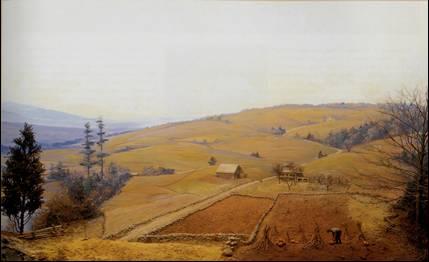
Vermont - Circa 1860 Where are the Trees?
INTRODUCTION
Peak oil and Peak Natural Gas have so many implications that I could think of a new one (and write about it) pretty much daily. In a recent discussion of the depletion of high quality fossil fuels with a neighbor - she quipped "Well - I guess its time to buy a woodstove then". It was the same day that the EIA heating oil inventories had dropped sharply. This got me to thinking, which resulted in the below analysis of how much heat from fossil sources we currently use and how much could be generated from our forests.
At some point in the next decade, perhaps later, probably sooner, we will likely be faced with liquid fuels shortages. Coincident with the decline in high quality oil production, a portfolio of alternative energy sources will be sought out to fill the gaps, both on the macro scale and by individuals. Already given increases in heating oil and natural gas prices, there is renewed interest in using alternatives to fossil fuels. Consumer switching ability for home heating exists, as it did in the 1970’s, but in today’s world we have little choice but to go southwards on the energy pyramid (oil/NG to wood or coal) as opposed to the lateral movement 25 years ago (oil to NG and propane) (Natural gas has more hydrogen atoms than does oil, and both have more than wood).
What if some of the TOD and private forecasts for dramatically higher oil and gas prices occur in the coming years? People quickly respond to these price signals, and may increasingly look to heat their homes using more traditional means that they can individually control. Trees are ubiquitous, and it takes but some money or effort to create a nice neat stack of warmth producing wood next to ones home, especially for the more rural dwellings in our nation. Living in Vermont and buying firewood for my woodstove has made me ponder the following questions: What if everyone wanted/needed to heat with trees at the same time? Would there be enough trees to go around? What is the annual biomass ‘interest’ vs. existing forest ‘capital’? Could any states replace their winter heating requirements sustainably from forests? (note: the Drupal spell check is telling me 'sustainably' is not a word...;) What would be the environmental impact of over-harvesting for heat? Would home heating demand for wood then displace other wood uses, (electricity, lumber, paper, etc.)
(A special thank you to long time oildrum contributor and GIS whiz, Luis a de Sousa, for helping create the GIS images of the United States).
CURRENT HOME HEATING MIX
The US uses over 7 quadrillion BTUs (quads - written 7,000,000,000,000,000) for heating our homes each winter (out of 100 quads total energy use). Heating needs are a function of a) cold temperatures, b) population and c) efficiency of heating method (I suppose I could add d)tolerance/preference). As seen in the below graphic, natural gas is by far and away our largest source of residential home heat, followed by heating oil and propane, which is a product of both natural gas and crude oil refining.
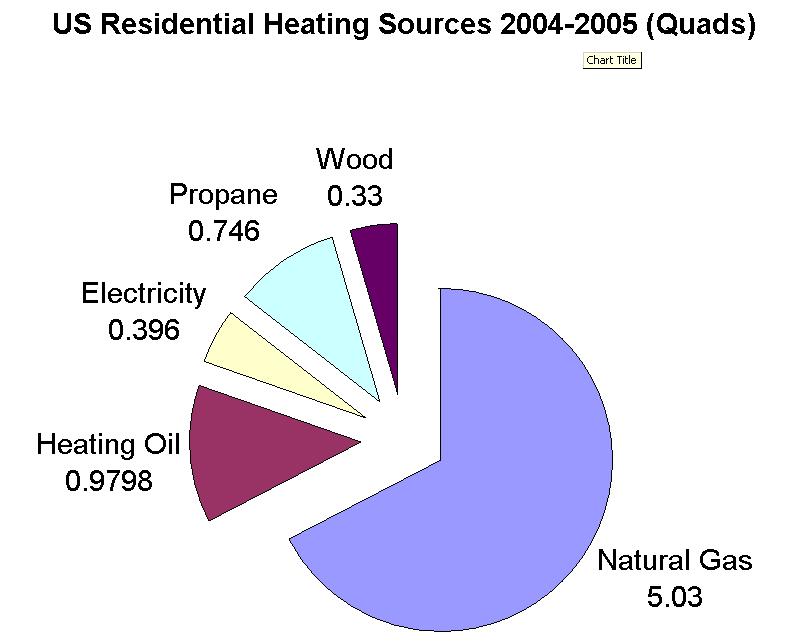
2004-2005 United States residential heating BTUs, in quadrillion units (quads) Click to enlarge. Source: EIA and Propane Council.
HOME HEATING DATA
Some notes on the data. Heating oil is the combined total of distillate #1, distillate #2 and kerosene, though the vast majority is distillate #2. Home heating use of distillate fuel (essentially diesel) is about 10% of total distillate use. (highway trucking is over 50%) (Source). I used 2004-2005 heating data partially because it was easier to find but also because the last 2 winters were among the lowest in the last 30 years as far as fuel usage. 2001 and 2003 were considerably higher (11% and 13%). 2004-2005 was close to the average of the last 7 years. There are a small number of homes that still heat directly with coal but good data doesn't exist so coal was excluded from the analysis. I don't particularly trust the EIA data on wood either as it appears they use the amount of firewood purchased and reported so those numbers may be light because of do-it-yourselfers are not good at reporting-it-to-authorities. Also excluded were heat generating sources/devices like the sun, better insulation, extra blankets or dogs, cats and spouses. In the broadest sense, these are very real heat sources, but they should still be there after fossil fuels decline.
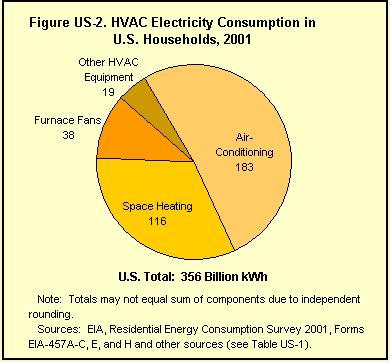
Electricity makes up a minor part of home heating use - of course, there is also natural gas and coal used as a precursors to electricity but I didn't extend this analysis that far. (About half of all energy used by a household goes to heat and cool the home. (116 billion kWh (2001) = 116 billion * 3,413 Btu = 396 trillion BTUs (.396 quads))
US residential heating is dominated by natural gas - more than 2/3 of our home heating is derived from piped natural gas. Below is a historical graph of demand for this largest component of heat in the United States.

Historical United States usage of natural gas for home heating, in quadrillion units (quads) Click to enlarge. Source: Energy Information Agency.

Current county by county United States usage of propane for home heating, dark blue >25%, light blue 10-25%, tan <10% Click to enlarge. Source: US Propane Council.
In 2005, 18.895 billion gallons of propane were sold in the U.S. 7.942 billion gallons were sold to residential users. At 92000 BTU per gallon this equated to about 6% of our residential heat needs. The above graphic illustrates that propane (LPG) is primarily used out West, and in the more rural areas that may not have natural gas pipelines or consistent oil access.

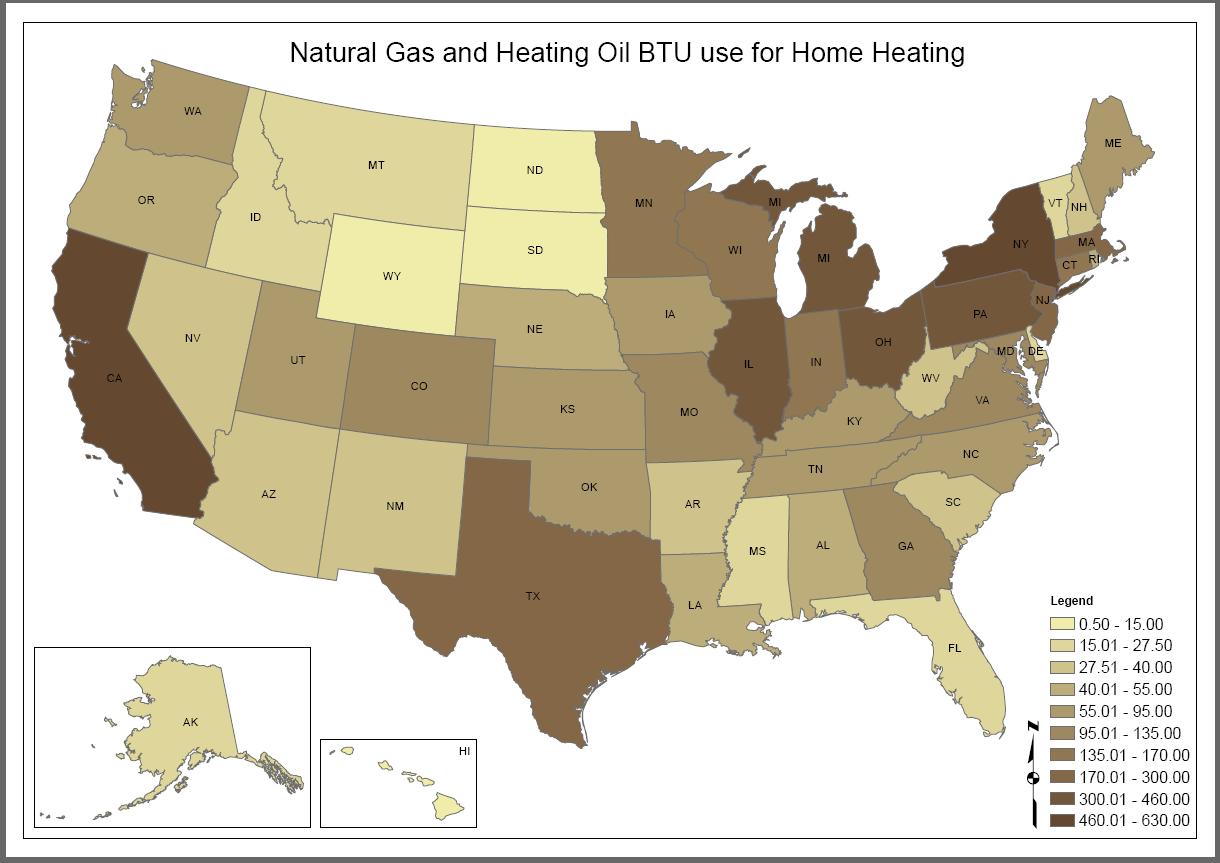
United States natural gas and heating oil use in millions of BTUs per person .
Heating demand is essentially a function of population and cold (temperatures). The above graphic shows the intensity of fossil BTU use for home heat per person.
The northeast and midwest have the coldest temperatures (and or the wimpiest people). Maine uses the most heat per person in the United States, but their low population makes the state itself not one of the higher ranked users. Adding the population factor produces the below graphic:
United States natural gas and heating oil use per state in trillions of BTUs.
WOOD AND FORESTS
Humans have used wood since the dawn of civilization and historical scarcities of wood have triggered major technological changes. Wood shortages in Greece taught architects how to exploit solar energy. Thousands of years later, shortages of wood forced England into the fossil fuel era, and it began a widespread use of coal. Englands attraction to America was in no small part due to the scarcity of timber resources in the British empire and the awareness of huge wood resources in the New World. In the United States, the market for coal expanded slowly and it was not until 1885 that a low population density, heavily forested nation burned more coal than wood. Even in the world today over 2 billion people use firewood as their primary fuel source. (1)

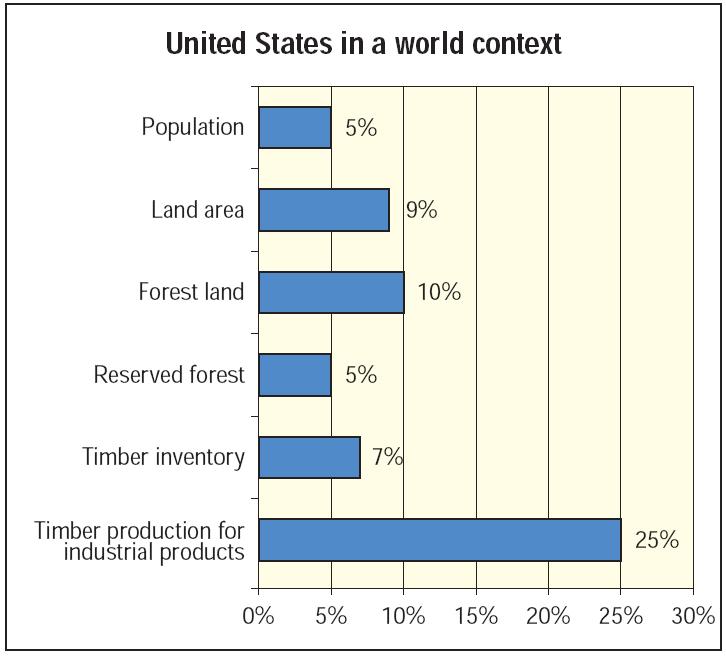
United States forest statistics compared to the World - Source National Forest Service (2).

United States land and forest statistics - Source National Forest Service (2).
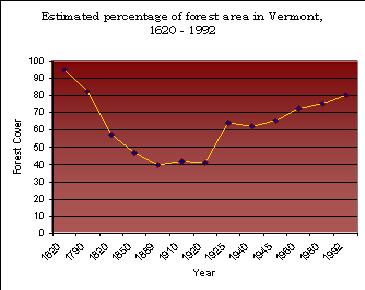
The US was heavily forested when it was discovered/populated in the 1600s. (note that the 30% decline in last 375 years is by land area not by volume of wood). Though the statistics above mask it, in the 1800s so much wood was used for construction, export and heat that the eastern forests were largely clearcut. Vermont went from 100% down to 40% forest cover and has since rebounded dramatically. According to biologist Stuart L. Pimm the extent of forest cover in the Eastern United States reached its lowest point in 1872 with about 48 per cent compared to the amount of forest cover in 1620. In the last 100 years, the amount of forest, due largely to presidential decree of increasing reserve land and intensive tree planting has generally held steady or increased.
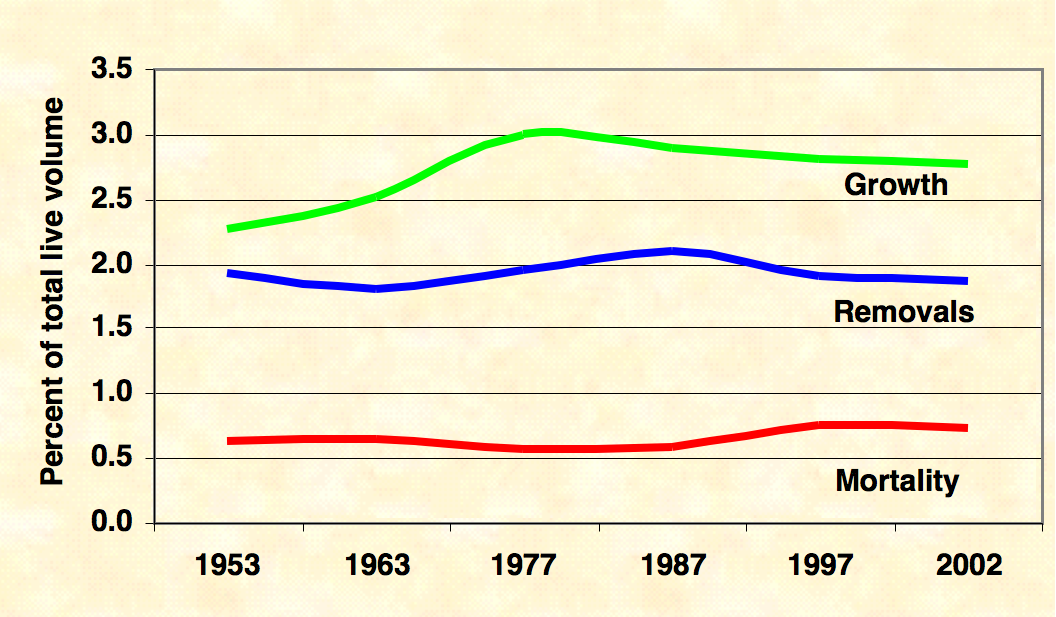
Rates of growing stock growth, removals, and mortality on productive unreserved forest, 1953-2002. Source: USDA Forest Service (Graphic first posted on TOD by Stuart Staniford here).
The US standing forest as of 2002 was 856,000 million cubic feet. The annual growth of this forest is 23,689 million cubic feet, or around 2.5% of the volume. The above graph shows historical trends of growth, removals and mortality on non-reserved forest - the growth on this type of timber is closer to 3% annually. As can be seen, the forest size was gradually growing as annual growth outpaced removals and mortality until recent years. Now the annual growth net of mortality is just about used. There is no rule saying removals cant be above growth - that just portends a smaller forest the following year. (It is unclear how much of the dead wood can or could be used, and decaying woods impact on soil nutrients and ecosystems is beyond the scope of this post.)
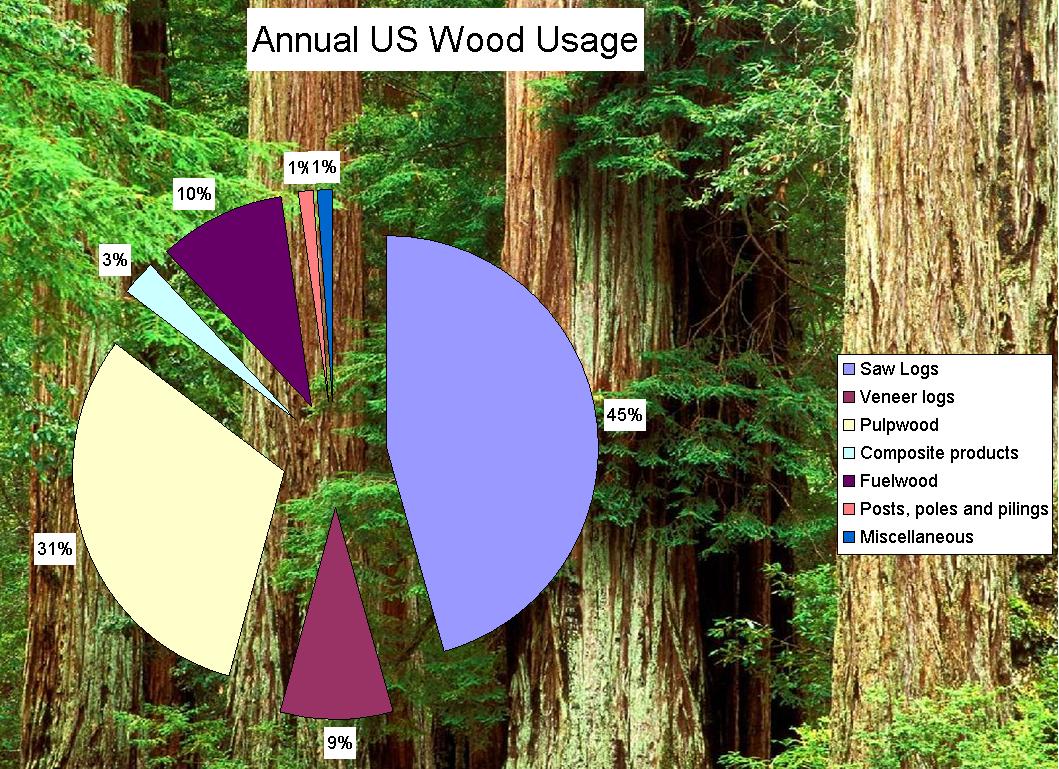
Total US forest products for all uses 2002 - Includes Hardwood and Softwood - Total wood used 15.7 billion cubic feet Click to enlarge. Source (2) National Forest Service.
Less than 10% of our wood use currently goes towards fuel use, and even less of this towards heating. The forest service did not break down this category into fuelwood for home heating and other fuel sources, though one can assume the majority is for residential use (though I know my schools city, Burlington, VT uses wood to generate heat and electricity for the public utility). The total use of 15.7 billion cubic feet is less than the annual total growth of 23.69 billion cf, but there is mortality of 6.3 billion cf which needs to be subtracted (though in theory this would have some heat value). Essentially, we are using all of our forests growth right now, even at the same time we are using all time record amounts of coal, oil and near record amounts of natural gas.

Cords per wood (128 cubic feet) per person in individual states. Click to enlarge. Source (2) National Forest Service.
THE ANALYSIS
HOW MANY CORDS OF FIREWOOD GROW IN ONE YEAR?
In 2002, the forested area of the United States contained 856,000,000,000 cubic feet of tree volume, of which 364,000,000,000 cf were hardwoods. (This is the forest capital). (Due to larger amounts of creosote and much lower wood fiber density in softwoods, they are not suitable for conventional firewood and I assumed are not used for heating –in a more advanced analysis this assumption could be relaxed as people could harvest softwoods and replant with hardwoods at least to some extent and/or install external wood burners).
The current annual volume growth is 10.1 billion cubic feet annually (or about 2.5%). Existing usage rate is 5.7 billion cubic feet with an annual mortality rate of 2.7 billion cubic feet. (Interestingly, the mortality rate was at a 50 year high and the USFS admit they do not know the reason for it). For ease of calculation let’s be aggressive and assume that humans can access all of the dead wood for burning. We then have 4.4 bcf of annual growth of potential firewood that is not otherwise being utilized for lumber, electricity or current home heating. At 128 cubic feet per cord, this equates to approximately 34.7 million (more) cords of wood that can be accessed sustainably, without dipping into the forest ‘capital’. If we discontinue other current market uses for the wood we would have 10.1 billion cf or 78.9 million cords of potential firewood per year.
THE ENERGY CONTENT OF FOSSIL FUELS
Each cubic foot of natural gas, depending on its origin, has about 1,027 BTU’s. #2 Heating oil has 149,793 BTU’s per gallon. Kerosene, used in some places for winter heating, produces 134,779 BTUs per gallon. In total, the amount of fossil fuels used for winter heat in the United States equates to over 7,000 Trillion BTU’s. (2001/2, a much colder winter, was 13% higher).
THE ENERGY IN WOOD
Freshly cut wood has over 60% moisture and therefore takes much more effort to release the energy in the wood fibers. Seasoned wood approaches 20% moisture content and releases about 6,400 BTUs per pound of wood. (Pure bone-dry wood tops 8,000 BTUs per pound but is not practical for home use). Almost all wood types create the same amount of BTUs per pound (6,400), but depending on their individual densities and other properties, differ in how many pounds make up 1 cord. Some examples are:
Hickory => 4,327 lbs per cord => 27.7 million BTUs per cord
Red Maple => 2,924 lbs per cord => 18.7 million BTUs per cord
Cottonwood => 2,108 lbs per cord => 13.5 million BTUs per cord
Cedar => 1,913 lbs per cord => 12.2 million BTUs per cord
A complete list of wood types and BTU content per cord can be found here
This analysis assumes one cord of wood typically is about 2400 pounds. We then arrive at 2,400 X 6,400 BTUs =15,360,000 BTUs per cord. Therefore, in the 52 US states, we have 34.7 million cords of annual volume growth of wood available times 15.36 million BTUs per cord => 533 Trillion BTUs that can be presently be accessed sustainably from hardwoods. (If we eschew all other forest products, this number roughly doubles, and if we include softwoods, it roughly doubles again)
PUTTING THE PIECES TOGETHER
Heating with wood is not as efficient as heating with natural gas or #2 heating oil. A significant portion of the heat generated from burning escapes up the flue to dissipate as heat in the atmosphere. Wood stoves and furnaces average about 55% efficiency. This compares to 85% efficiency for natural gas furnaces and 80% for furnaces using #2 heating oil or kerosene. (the lower the efficiency rating the more BTUs of heat is ‘lost’ and unable to provide heat to targeted areas).
So, of the 5,030 trillion BTUs generated by natural gas furnaces in 2004, 85% or 4,275 trillion BTUs went directly to heating, and 15%, or 755 trillion BTUs was dissipated as waste heat. Similarly, of the 998 trillion BTUs generated by heating oil, roughly 80%, or 799 trillion BTUs went directly to heating.
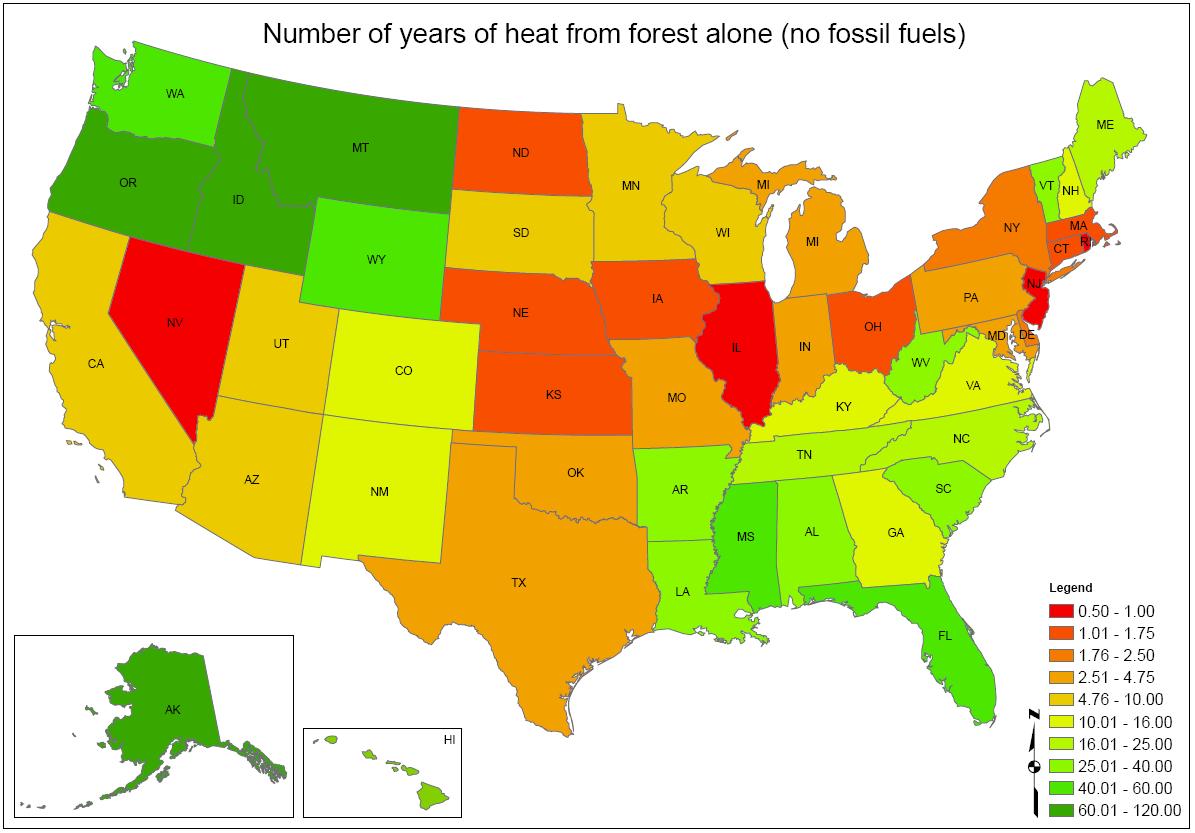
Of the 532 Trillion BTUs that could be generated annually from forest growth, approximately 55% or 297 Trillion BTUs would end up as ‘actual heat’. Natural Gas and Heating Oils collectively generated 5,074 Trillion BTUs of ‘actual heat’. Thus, this analysis indicates that we could sustainably replace 297 / 5,074 Trillion BTUs or 5.8% of fossil fuel home heating use with home heating from wood. Alternatively, the entire United States forest stock of hardwoods contains 364 billion cubic feet of wood, or 2.84 billion cords which would throw off 24,024 Trillion BTUs (note, this is only 24% of the total annual energy usage of the country). So the good news is if we were really cold and sans fossil fuels, we could chop down trees for at least 4 years before the US would resemble Easter Island (24,024/5,074= 4.74 years). On a state by state basis, the distribution would look like the following:
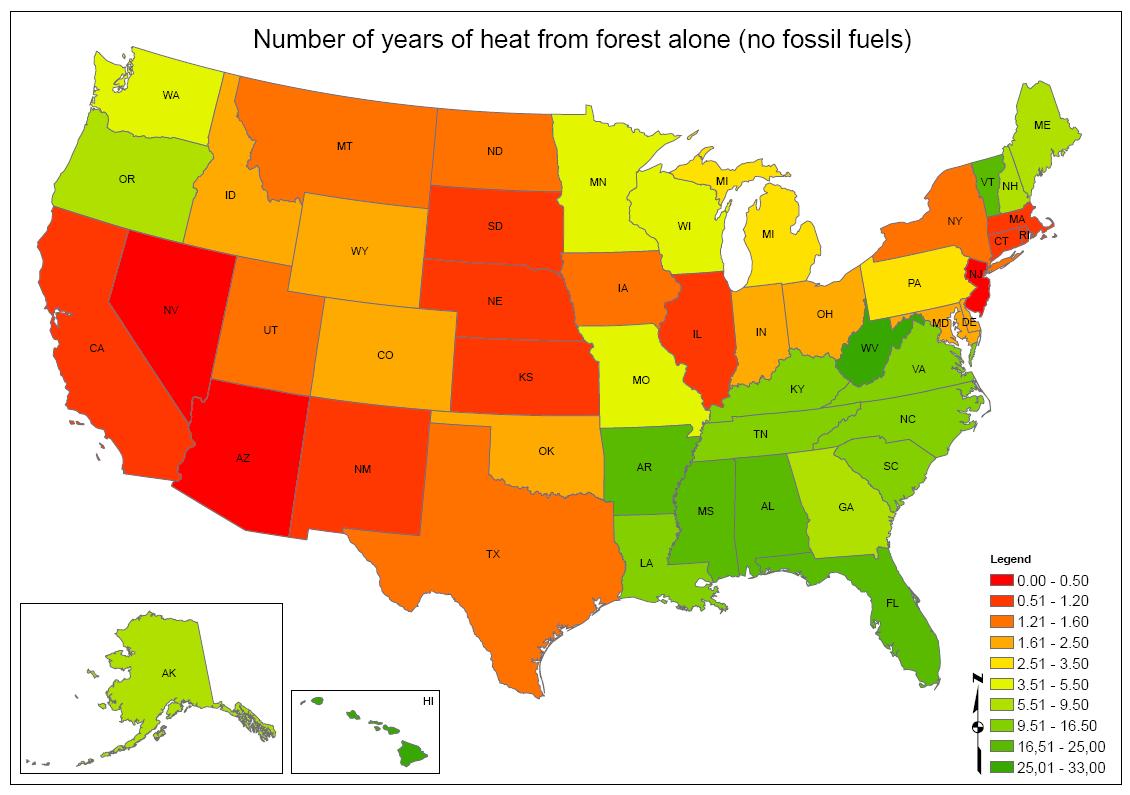
Years of heat in standing forest (hardwood only) in individual states. Click to enlarge. Source (2) National Forest Service.
To see a graphic including softwoods click here
THE ECOLOGY
If there is wide scale deforestation, for heating, ethanol or other uses, we will increase the CO2 in the atmosphere directly through wood burning, and indirectly through loss of soil biomass, not to mention changing the water/irrigation patterns due to increased erosion, etc. An in-depth environmental assessment of over-harvesting the annual growth in wood biomass is beyond the scale of this preliminary analysis, but of course is both relevant and important.
THE ECONOMICS
This last statement suggests that only a moderate amount of switching can occur given macro constraints. Consumers however, do not look at the macro picture of sustainability, but at their own microeconomics. Let’s see how the current rates of $2.70 heating oil and $14 natural gas (retail) stack up to $260/cord.
Cost per Million Btu's (MBtu) Useful Heat Into the Room:
1) Fuel oil at $2.70 per gallon: There are 149,793 Btus per gallon of fuel oil and oil furnace efficiency equals 0.80:
1,000,000 Btu x $2.70/gal
-------------------------------------
149,793 Btu/gal x .80 = $22.84/MBtu
2) Natural gas retail at $14.00/1000 cu ft, 1007 Btu/cu ft, and efficiency equals 0.85:
1,000,000 Btu x $14.00/1000 cu ft
--------------------------------------
1,007 Btu/cu ft x .85 = $16.36/MBtu
3) Wood ( red oak) at $180/ cord, 19.6 MBtu/cord, and efficiency of airtight stove equals 0.55:
1,000,000 Btu x $260/cord
-------------------------------------------
19,600,000 Btu/cord x .55 = $16.70 /MBtu
At today’s approximate prices, the per BTU cost is about equal natural gas and wood but a good deal less than heating oil. For those that own their own trees however, cutting them may prove a substantial savings. Economic theory would suggest that as fossil fuel prices increase, wood prices, as a substitute, will also increase – the large private landholders then may hold the key to whether we dip into the forest bank account when a fuel shortage presents itself.
ADDITIONAL ISSUES TO CONSIDER
1) Technically, since forests and people are not uniformly distributed, and a tree is too large to fit into a woodstove, energy must be used to reduce forests to manageable human chunks (by chainsaws or axes) and then transported to individual houses (by trucks or horses). These tasks mostly require oil. To an individual, the added costs will show up as higher price for cords of wood. To a society, they result in less BTUs available to heat what is needed from the new source. Clearly with NO fossil fuels, to obtain these amounts of BTUs from wood would be unattainable, as one would need chainsaw and transportation ability to cut all but the low hanging fruit in ones yard. So the net BTUS to the system, as opposed to each individual should be considered (in an Energy Returned /Energy Invested sense). Obviously, as with oil, there is a gross resource (which Ive presented here) and a net resource - I expect people in Colorado won't be heating their homes with the trees on Pikes Peak as they would likely be procured only at an energy loss.
1a)(deleted) I decided to make the discussion about wood harvesting, time and net energy a separate post next week as it got long (and interesting...;)
2)Using softwoods, while creating some problems, would increase the available BTUs available annually by 45% or so.
3)Very little of the Southern forests are used for winter heating. In this way, wood could be ‘imported’ if it were necessary. Again – how much would it cost to do this (in $ and energy?)
4)At some harvest point greater than the sustainable harvest of 5.8% of our heating requirements, there would arise externalities from loss of ecosystem services. Clearly the scale does not exist for large increases in the amount of firewood consumed annually without environmental consequences.
5)Walmart, Home Depot and others have recently been selling large quantities of electric heaters. If people are switching to electrical heat due to high fossil fuel prices, this will in turn increase the price of electricity and increase the amount of biomass currently used for electricity production (thereby reducing the amount of wood available for home heat)
6)Most population dense areas, and most new houses, don't easily have the ability to heat with wood. But external burners might be come popular in a hurry if winter heating needs increase in price or availability. In the same vein, most modern houses dont have the ability to NOT heat with natural gas unless modifications are made. This is another example of how fixed vs marginal energy investment will be key - like the automobile, home heating is not just a plug-and-play BTU problem, as there is long lead time necessary to change relevant built infrastructure.
7)Last but not least, I am not an expert on carbon cycles, but if fossil fuels should leave us before large human populations do, we will likely have a carbon sink problem of epic proportions as we switch from ancient, back to old, sunlight. (assuming current sunlight is insufficient).
CONCLUSION
This post has been a first look at the comparative scale of our home heating use from fossil fuels vs. more traditional methods. A more rigorous analysis using dynamic systems modeling could eventually be a component of a larger renewable energy meta-analysis.
We are at the very early stages of a Sustainability Revolution, equally momentous for humankind as were the Agricultural and Industrial Revolutions. While no one can know with certainty the timing of the decline in liquid fuels, analysis can be put in place ahead of time to focus our efforts on alternatives and portfolios thereof that collectively give us a chance at sustainability. While there is seemingly a huge inventory of trees in our country, there is also a huge inventory of humans and their respective consumptive wants. Warmth and protection from cold is among the most basic of our human needs – quite simply, there are not enough trees for an annual growth harvest to provide more than a fraction of our current heating needs. I don't really expect we will return to heating with wood, but the point of this exercise is to show that if the market should incentivize people to heat with wood, we have upper limits in expanding our use of wood for heating, and they are not too far from where we are now. This analysis provides yet another example of the power, density and importance of natural gas and oil in our society.
(1) A Forest Journey: The Story of Wood and Civilization, Perlin, Josh,; Countrymen Press 2005
(2) Forest Resources of the United States(large pdf warning), Smith, W. Brad; Miles, Patrick D.; Vissage, John S.; Pugh, Scott A. 2004 General Technical Report NC-241. St. Paul, MN: U.S. Dept. of Agriculture, Forest Service, North Central Research Station (I encourage anyone with an interest in trees and forests etc. to peruse this long pdf - lots of fascinating data)
Contact
- Content: editors at theoildrum dot com
- Tech support: support at theoildrum dot com
License

This work is licensed under a Creative Commons Attribution-Share Alike 3.0 United States License.
Thank you, Nate, for this exhaustive look at a less-than-renewable heating resource. It's no surprise that we can't replace seven quads per year sustainably from our already taxed forests.
One note, make it 7): The combustion of wood is very, very dirty, and the requirement that it be done locally for heating - meaning in your home, in your city - implies a large additional air-pollution burden. Of course all pollutants aren't created equal, and some people might say the impact of the wood smoke is less severe than, say, the NOx from autos. I'll take wood over coal, surely, because of the toxic heavy elements in the latter. But there's nothing "green" about decentralized wood burning, especially as a replacement for the near-ideal combustion of methane.
I actually heat with wood, but its an old fireplace and VERY inefficient and Im looking at buying one of those external burners so I can burn crap wood not useful for much else. This could also pipe heat into a greenhouse. Most of the companies that sell these are not concerned with emissions, but this one has at least looked at the issue.
I know that in certain areas of the country there are no-burning laws that forbid woodstove use during periods of inversion or high air pollutant days. In Vermont last winter, you could see dense smoke in the rural valleys that weren't connected to the nat gas pipelines.
Thanks for your comment -its another example that its a mistake to look at one variable in isolation in addressing resource depletion - there are so many moving pieces that comprise the system...It will all come down to being happier with less (and using less because we want to is better than using less because we have to)
Outdoor wood boilers burning trash wood, trash and construction debris are already serious environmental problem here in Maine. Some towns are trying to ban them and state DEP is wrestling with it - wrestling because their charter is to help businesses, eg sell more boilers.
Maine's large forest areas are already spoken for. Woods get chipped for pulp and electricity. They have been heavily cut. Smaller private landholdings provide a substantial amount of firewood; whether or not that gets reported or estimated I don't know. There are certainly not large amounts of woods waiting to become firewood.
One of the things about heating with wood not mentioned is zoning. I've got my 1500 sq ft solar home but really only heat about half of it to maybe 60 during cold dark stretches of weather. I'm cutting that down this winter to just the living room and kitchen - about 500 square feet - and I'll be beefing up the insulation between that area and the rest of the home and adding external shutters.
Even though I only have two acres, my wood pile is growing for now because I have to fell trees that shadow my garden. That's not going to be true long term.
cfm in Gray, ME
State law in Vermont now requires that new outdoor burners meet particulate requirements (which only a few makes do at present), and have a chimney higher than the roof of the house they're serving. They can be smokey; it would be rude to run one in a dense neighborhood, especially without that tall stack.
Is cordwood really going for $260 around Burlington now? Here in SE Vermont it's around $160. With a century-old 1800 sq. ft. house - reasonably weatherized and insulated - I'm going through about 3 cords plus a bit under 600 gallons of oil per year - the oil also being year-round hot water. However down the street, in a house that doesn't look a lot larger, they're managing to burn "1,700 gallons of oil and more than four cords of firewood". And that's in a house owned by a contractor.
What a lot of people around here are adding to their homes is pellet stoves. Those have the advantage of essentially using wood waste. However the pricing of the pellets is more in line with oil than cordwood.
The guy I buy my wood from sells it currently at $170 green and $270 dried. The green you can get in a week - the dried there is a waiting list. He processes 2000 cords a year - Im going to write more about this next week.
I think this price is a little high, as it is the same prices as of 2 winters ago when gas was sky high.
Really speaks to the questions of PO and GW when one doesn't bother to think 4 or 5 months ahead and let the sun and air save a hundred bucks a cord for him (or her). Also says something about how high gas prices are rationalized when it is a matter of comfort or convenience. Lots of room before demand gives way on the gas front I think.
Found this Boston Globe article from 2005 indicating the value of wood vs. fuel oil
http://www.boston.com/news/nation/washington/articles/2005/09/11/cutting...
A cord of drywood had the BTU value of about 200 to 225 gallons of fuel oil. Wood was cheaper heat. Had to work to keep the woodstove fueled.
I heat my home with a Taylor outdoor wood boiler. It does smoke a lot when it fires up. I burn about 20 to 23 16” face cord a year. I would normally burn around 1000 gal. fuel oil with the house at 68 degrees & 1200 gals at 72 degrees. Split wood is $50.00 a face cord, you pickup. I paid $600.00 for load of logs delivered this spring, yields between 20 to 30 face cord, depends on the guy loading the truck. I have had to tip the driver to get good red oak going to the mill. I also heat my hot water through the OWB. Fuel oil is 2.68 gal. & propane is 2.69 gal, today’s prices. I live in Broome County, upstate NY.
jbunt
Dryki - I agree, I can see from the map upthread that Maine is practically devoid of trees, especially on a per capita basis. I guess that fall foilage trips are out of the question.
Anyone looking at using or upgrading to a wood heat system might consider a masonry stove.
TempCast is one such brand that is very efficient, clean burning, has a bake oven option and can also be configured with a water heating element. Purchase and installation cost is not cheap, but sometimes you do get what you pay for. In this case a very functional wood heater that doesn't fry one's indoor air quality and can be aesthetically faced in a variety of materials. I have one and the chimney emmision (apart from the begining burn stage) is clear heat vapor, not smoke.
Thanks for the article.
I heartily second this suggestion.
Masonry stoves, similar to or AKA 'Tulikivis', Russian or Finnish stoves, are better known in Scandinavia and Russia than here, but they are like a flywheel for your woods' calories. The mass carries the higher heat from a fully combusted fuel very slowly into the living area over a much longer stretch of time, so you are also not wasting firewood by OVER heating your space during the burn, as happens with many wood-heating situations.. people will open windows just to keep from being uncomfortably hot, and later, the place cools off too quickly, inspiring another load to be burned.
As with many smart investments, this technology is very pricey up front, but pays back steadily and reliably for decades.
Bob Fiske
I really like those masonry stoves (though they need a ton of support structure cuz they weigh alot)
But heres the question: how many people could afford these and how much energy would it take to scale them?
So this to me is another dichotomy of what works best for some (TOD readers?) may not work for all (society).
How much of a masonry stoves effectiveness is due to it being an integrated approach to home-heating, as opposed to woodstoves that often seem bolted on almost as an afterthought? I have seen many examples of where a woodstove has been installed on an exterior wall at one end of a house. The flue promptly exits the building and then runs up the side of the home heating the outside. This also necessitates an expensive insulated double-wall pipe instead of a cheap single-wall flue. Such placement of a stove also prevents it from effectively heating one side of the house.
If you placed a woodstove in the middle of a building, ran the chimney up to the highest point of the roof, and surrounded the stove with a brick or stone fireplace, how close would it be to a masonry stove in terms of heat loss? Masonry stoves are said to burn hot at over 90% efficiency, but many woodstoves now get close to 70%. Thats worse, but not by that much. Presumably here both figures ignore the heat used to evaporate the remaining moisture in the wood. Do all masonry stoves have a dedicated inlet to prevent them drawing cold air into the house through gaps? Is that a major factor for the comparison with wood stoves?
I considered fitting a masonry stove to my home, but I think a woodstove might be better for us. I'm thinking of the compact size, flexibility, ambience of sitting watching the flames for longer, and familiarity contractors have with them compared to masonry stoves which noone has around here. We've got a big wall of south-facing glass, so we'll need greatly varying amounts of backup heat. The thermal mass of a masonry stove must be great for a passive solar house like ours, but they don't strike me as very adaptable to changing conditions. It either takes a while to get going and is then warm for a long time, or is off. A lot of people have solar hot water here, but they back that up with small instantaneous gas or oil boilers capable of supplying only the required amount of extra heat. A woodstove sounds closer to that ideal than a masonry stove.
Oh, and does anyone on here have a totally passive unheated house like a Passivhaus? That sounds like the ultimate integrated solution.
We heat our house entirely with a single woodstove. An imported Vermont Castings from your dear USA, excellent stove, 85% efficient. The house is 1900 sq ft, and our indoor temperature ranges between 21 C in the morning to about 25 C when we start up the stove in the afternoon. The bedrooms keep a nice 21-22 all day, as they are furthest from the stove.
And you can cook on the stove when we have blackouts.
We have our own forest, and also sell about five times our own firewood needs, all sustainable. Also about the same amount of lumber and paper pulp wood.
On the other hand our house is properly insulated as most Swedish houses are. It doesn't require much firewood to heat a house if it's insulated, and the temperature doesn't drop especially fast. Some heat is stored in the masonry chimney, but the rest is simply stored in the air and last long enough.
As for the nonsense on emissions, a modern stove like the Vermont (or a Swedish Nibe) produces very little emissions and very little ash as they burn clean. On the plus side for the Vermont is that it can be choked for higher efficiency and longer burn, and still not leave much ash or give emissions.
In fact, people who burn wood live longer and are healthier. One of the reasons is the excercise, another is that it's more common to live in the countryside and thus get fresh air, but also that anti-oxidants from the smoke is good for you.
Anyway, first measure is to insulate your house. We have almost a foot thick insulation in the walls and 1.5 feet on the roof, and high windows that bounce back the energy into the house instead of leaking.
In Finland there is a law stipulating that all single houses should have at least one wood stove or similar, as a backup if nothing else. Not so here in Sweden, although most do.
I know dozens of people who heat exclusively with a wooden stove, although it's supposed to be impossible and they are counted in statistics as using direct electric heat, and many, many more burning wood in a central heating furnace (usually with water tanks for energy storage and efficient burn).
But on the other hand, there's plenty of forest in Sweden, always has been.
Tell me more about the antioxidants in wood smoke, never heard about it.
Here's the english summary of a Swedish report, funded by the Swedish Energy Agency. The complete report is available in Swedish here:
http://www.afabinfo.com/pdf_doc/fou_rapporter/AntioxidantrapportCTH.pdf
Summary
Increased residential wood burning has been questioned referring to environmental and health
hazards due to emitted smoke components. In this project, the presence of phenolic
antioxidants in wood smoke was demonstrated, presenting a more positive aspect on the
smoke.
The antioxidants are mainly methoxyphenols released from the lignin of the wood.
Dimethoyxyphenols from hardwood are the strongest antioxidants. At combustion
temperatures below 800oC and especially for smouldering wood the methoxyphenols normally
constitute the main fraction of the organic smoke components. Most methoxyphenols condense
on cooling and are present as particulate matter in ambient air. The phenolic antioxidants are
released together with almost as large amounts of 1,6-anhydroglucose formed mainly from
cellulose.
The assessment of components in wood smoke which are positive or at least harmless with
respect to health has met with great interest. The occurrence and proportions of specific
methoxyphenols in wood smoke of various origins have therefore been emphasized in the
project. Comparisons were also made with smoke for food curing, from newspaper burning and
from burning of forest biomass components.
Smoke from residential fireplace burning of hardwood in particular consists of a large
proportion of effective antioxidants and a low proportion of hazardous compounds. Residential
boilers with unsatisfactory combustion may produce a smoke with elevated concentrations of
benzene and polycyclic aromatic hydrocarbons. An environmentally labelled boiler emitted
almost negligible amounts of organic compounds. Wood pellets burnt in free-standing stoves
or in boiler burners emitted lower amounts of both antioxidants and hazardous compounds than
comparable firewood burning.
Thanks, now it will be a real plesure to heat my house with wood.
but also that anti-oxidants from the smoke is good for you
Are you sure about that? I thought smoke mostly contained free radicals, in the form of NOx.
San;
Your chimney alterations would help. The greater advantages in a complete masonry stove includes very signifigantly A) The secondary combustion chamber, raising temperatures within the great mass of the core furnace and burning the wood as thoroughly as possible.. and B) a series of ducts crafted into the stone/brickwork which carries the smoke down through the sides and back of the Massive Block, further extracting heat from it, only exiting to the chimney back at the bottom of the unit.
There are masons' groups that specialise (see my reply to Nate) in these, and work to share info on who is nearest to a potential customer, plus useful knowledge about the stoves themselves. Both Masonry's that my Mother had built were beautiful craftspieces that adorned the heart of the house, they would be cozy to cuddle up against and read or nap, fully days after a burn (often 48 hrs, except in the deepest cold), the cats would sleep on top of it, we baked bread, turkeys, and pizzas in the 'Expansion Chamber' (Secondary Combustion), soon after the 2-hour burn was done, as they had been fitted with oven doors above the fire-windows, for just that purpose.
Even this year, visiting the older of these two homes, the current owner said this has been his cheapest home to heat, in Maine's white Mts, while his other homes had been in New Jersey! It's not excessive to say that this could be a clear advantage in the value of the house, were you to want to sell it.
As far as Solar.. this older home was also Passive solar, in addition to the Masonry stove. The new owner replaced a lot of the south windows with less glazed area, and has decided to use a gas heater as a supplement.. but we never did. It didn't take full advantage of its solar potential, but had it done so, I'm sure the two together would have been enough except for very extreme conditions.
Bob Fiske
(feel free to email.. listed under my account info)
Nate (Great Article, thanks!);
Affordability and accessibility is more an issue of priorities, I think, than of income. I think far too many Americans are taught to mistrust long-term investments, even when the numbers and other experienced buyers can attest to the wisdom of an expensive project like masonry heaters.
Yes, they generally require substructure, even under slab construction (our first in 1980). The cost is high against an Iron woodstove, unless you start to add all the cords of wood that the potbelly will be consuming.. like the watts saved by Fluorescents.
There are groups like the Masonry Heaters Organization, http://mha-net.org/docs/v8n2/v8n2.htm , which often work to connect interested homeowners with qualified/certified stonemasons. People can save some labor by having the Mason construct a Prefabbed Tulikivi from a kit.. and there are books and websites for those who want to take it on themselves, though it would be a daunting project.
Ultimately, it wouldn't cost more than a new truck or a few years of dwindling oil/gas/cordwood deliveries. As a solution that could ultimately cost the owner less in operating costs and fuel dependencies, the high up-front cost is really an argument about financial-education, not one of this being a special option for only the middle-classes, etc..
Regards,
Bob
I am a big fan on new sunlight. I believe solar thermal home heating can take care of most of the needs for home heating in the U.S. southwest.
We are facing a shortage of natural gas in North America that may hit crisis levels about 2010. The gas companies want to bring in expensive LNG. But if people installed solar thermal collectors on their homes, they could cut natural gas consumption in half.
Nate,
Thanks for such a detailed and eye opening analysis of the outlook for wood fueled heating.
As a long time owner of 200+ acres of forested land in a fairly poor area of the Adirondack mountains, NY I guess I'm facing an additional threat as my neighbors start to go foraging for wood when the temperature is -30 and heating oil is out of their price range or unavailable. I have about 10 low acerage neighbors whose land borders on mine. If worst comes to worst, I guess my best bet will be to get together with them and select trees that I can let them cut (dead and alive) each year and at the same time will enhance the quality of the forest as well.
-Don
Don,
I continue to believe that macro policies to mitigate peak oil will fall short on a national level- its one of the reasons I write here - to beat the drum so as to access the steeper discount rates of our leaders and policy makers.
But a (hopeful) positive externality of this writing is that certain regions and localities will build as much fixed infrastructure as possible while fossil fuels are still cheap (and they are), and accomplish locally what cannot be done nationally.
Though my graphic on New York shows huge fossil fuel usage due to its population, clearly yours is a large and spatially diverse state - sounds like your neck of the woods is in good shape. Do you know if the forest you owned was prior clear cut (in the 1800s)? Was it planted or naturally regrown?
Your comment brings up another concern - its possible that landowners in your position might realize they cant protect their own 200 acres from poachers in a cold winter post peak and may harvest much of it to monetize it while they can. Thats where community comes in of course..
Nate,
Much of the land was open and farmed up until circa 1929. So parts were clear cut in some areas. So I have old stone walls running through the middle of the woods with 60 ft trees on either side. Since then it has grown in naturally so there's still alot of scrub cherry wood, poplar and soft fir that i'd like to get rid of. The white pines have done well and have been logged on a couple of occasions, much to my disappointment.
-Don
You might consider a mini-sharecropping arrangement with them: You have the forested land, they apply their labor to cutting down the trees you select to cull, and you split the harvested wood 50:50 between them & you. This could be a win:win solution for everyone.
Excellent article, but several comments.
Softwoods burn just fine in an EPA approved wood stove with a secondary combustion zone.
Much of the current firewood use is recreation in nature. Burned in outdoor fireplaces, or indoor fireplaces with a negative heat efficiency. Eliminating these uses would substantially increase the amount of wood available for actual heating.
I don't think you can assume all NG and oil furnaces are 80-85% efficient. Just as an example, I have the original hot water boiler in my 80+ year old house. It was converted from coal to NG, probably 50 years ago. I guarantee you that it has a lower efficiency than my wood stove. There are literally millions of old furnaces out there that probably have very low efficiency.
I think that there is a lot of room for wood to supply a substantial portion of the home heating needs of this country, mostly because the the much higher efficiency of new wood burning stove. Having said that, I don't want it to happen, because I would hate to have to start paying for my wood.
What is a secondary combustion zone? I talked with several 'experts' while writing this post (one of course being my father) and most were very concerned about the creosote dangers in our current set up for wood burning, as well as the lower BTU content, etc. If we do include softwoods, the conclusions are roughly the same, though the annual and total BTU stores would be about double.
The 'secondary combustion zone' is either a catalytic converter or an area of the stove that gets a fresh supply of air. Both methods burn the smoke from the primary combustion area at a higher temperature - significantly reducing pollution from the stove. As long as properly seasoned wood is used, the stove is burned at a proper temperature, and there is a proper draft, there is very little chance of creosote buildup. EPA-approved wood stoves are typically on the order of 60-70% efficient, btw.
The above-mentioned 'Masonry' stoves and furnaces have a secondary combustion chamber in their design, allegedly burning off many of the gases that would otherwise condense in the chimney as creosote, or become condensate particles in the waste-smoke. This additional burning of course also captures more of the heat-potential in the wood within the thermal mass of the stove, increasing efficiency and decreasing pollutants/particulates..
Never mind that masonry stoves are normally fired hot (ie. not dampered) and burn efficiently when this is done. The hot burn results in very little particulate.
We have heated with wood for about 30 years. And since I am a gadget guy, I had to try to design and make my own. The rate of progress was fast, with a new design almost every year. And, what did I come up with- exactly the same as the stove industry did- a primary burn zone, from which the partially combusted fuel gas goes to a secondary zone, well insulated, where preheated secondary air mixes with it to complete the burn. That hot clean gas then goes to a heat exchanger zone to radiate and convect to the living space. This worked fine, with absolutely no smoke or odor, but still had some problems, mainly lack of thermal storage- the stove was just a steel box with ceramic inner liner.
So just recently, I started to experiment with gasifiers. Immediate success! A wood gasifier is just a fuel container which cooks off the wood gases by a fuel rich burn of the carbon, emitting a hot, highly combustible gas that then goes to a gas burner with the proper amount of heated secondary air where it burns just like natural gas. This thing is way better than the stove described above. It has some big advantages- clean, efficient, can burn at a very low rate without smoke, and can be turned off for many hours and still retain capacity to get going quickly.
It is in essence identical to the wood gasifiers used in europe during their war to fuel auto engines, except that the gas goes to a hot ceramic burner instead of a filter, cooler and auto engine.
If you search for wood gasifiers, you will find a huge amount of excellent work has been done on them, and details for design are available. If you don't happen to find fun and frolic in banging on sheet steel, you might even find some place that sells them.
Of course, what I am really doing is trying to get a burner for my domestic power plant (stirling engine). Problem is, the engine worked fine but turned out to be expensive- a classic opposed piston free piston stiring with linear alternators. So now I am working on a cheap one. Don't ask.
But first, insulate your house. Way more good/$ than anything else short of mutation to withstand wider temp swings.
I have looked into these, as well. I would love to get one, but they are pricey. Tarm USA (http://tarmusa.com/wood-gasification4.asp) sells them for 6-7k - that's without installation. They weigh over 1000 lbs, so if you're going to install one you'll need help. Plus, they require electricity to run the fan that draws the gases through the combustion process as well as run the circulator for the hot water. The other thing I like about having a free-standing wood stove is I can cook on it - can't do that with one of these.
That's all true for that particular design. But the gasifier concept can be applied to far less expensive designs that allow cooking on top, as well as natural draft for the combustion process. I am making one such right now, and I assume that commercial manufacturers will quickly pick up on this obvious improvement to the more conventional wood stove.
But more important, any discussion of domestic heater devices should include the fact that high temp thermal energy has a high potential to do work. For example, the gas stream from my wood stove in winter is usually carrying 10kW of thermal energy at approximately 1000K. The theoretical (Carnot) efficiency of a heat engine receiving that heat is about 70%. Even at an easily achieved 10% efficiency, a thermal machine could hence be delivering 1kW of electricity to my house from this heat. There are lots of ways to accomplish this, one being the stirlings I work on, but there are others.
It is amazing that there is so little discussion of this important opportunity.
I used a wood burning stove in a one-room cabin in Northern California for about four years. I prefer pine for such a small space and for the great smell. Sweeping the chimney each year kept away any excess creosote dangers.
Another observation - German pines (Tannen - firs or Kiefer - Scotch pine, Pinus sylvestris) seem to be fairly low in tar/resin/creosote/turpentine. I have talked to the town's forester, several chimney sweeps, and they don't really understand about Virginia/loblolly pine being the reason North Carolina is called the tarheel state - or that wood had multiple uses in ship building, and that burning pine was a source of tar / pitch.
I have also burned about a year's worth of pine from a local sawmill - no problems, as seen by the result of the chimney cleaning.
But lessons learned in youth die hard - and pine is not really the best burning fuel, though it has its place. Pine generally makes for a more dramatic fire, one not well suited to heating.
"Softwoods burn just fine in an EPA approved wood stove with a secondary combustion zone."
In Oregon, I have come to value doug fir as a best choice of heating wood. Pound for pound it contains more heat than hickory and it burns more cleanly, which isn't surprising given that a much larger percentage of its mass is turned into heat vs hickory which leaves more ash. Also, when considering convenience and ease of splitting, doug fir wins by a large margin. We have little hickory here but do have white oak which is high on the btu/vol chart. The Oregon white oak is a bear to split. I have to pilot notch with a chain saw any pieces bigger than about 10" in diameter to start a splitting wedge.
Great article Nate. I would like to see an analysis of energy used for cooking. Cooking is a big energy user and your typical house has an electric range. This is something that alt. energy mavens typically gloss over in describing how to run a household on PV or wind power. What are going to be practical alternatives to using electricity for cooking? Or do we depend on nukes for this part of our household energy budget?
I'm surprised you don't mention tamarack (larch). I believe it is the best of the "softwoods", btu's/lb. A bolt of what I call buckskin tamarack-dead several years with just that color, could almost be split by sharp raindrops. Then again, coastal doug fir is different from intermountain. Both fir and tamarack are so valuable as sawlogs it's hard to use them for firewood.
For truly holding a fire overnite, and for heat generated, I think cottonwood is underated. It does make alot of ash though. And hard to split. I've heard the coastal alder is great-both for firewood and for smoking food.
not great, believe me. It seems to absorb moisture and rots quickly, if you use it when it's dried out enough, and before it starts to go, it does ok, it is a hardwood, but I've never enjoyed burning it, throw in a big one for an all-nighter once you get the stove hot. I'm with you, an old buck-skin tamarack is the gold standard, known to burn the gratings out of cook-stoves. I've always shared the popular contempt for cottonwood, but I got a testomonial from a very wise old-timer last year, so I need to test that prejudice. Out here on the coast, we get a lot of hemock, it has same properties as fir (which I like) except it is harder to split. Unfortunate that same properties which make trees valuable for saw logs also make them valuable for firewood, straight clear tight grain.
I heated solely with cottonwood in a small airtight stove-the Resolute I think, for several winters. It was dry, very well seasoned. The thing I noted, not scientific, is that it burned slow, keeping the stove and room at a more consistent temp. Volumewise, I used the same or less wood those winters than when using the higher btu fir and tamarack. I think it was due to the fir and tamarack igniting quickly, burning hot and losing alot up the stack. Always a warm stove and fire with cottonwood in the morning, glowing in a bed of ash. Had a huge supply-2-3+ ft dbh trees knocked in a flood, but gave it up with the splitting difficulty (don't cut on a knot) and other reasons. Some also claim the woodsmoke smells like urine, yet I never noted it. To me, that would be grand or white fir, piss fir, but that monicker is an old sawyer term from the heart rot of older white fir and the market value.
I don't see why one needs a practical alternative to using electricity for cooking. If you use two 1,800 watt burners at full power for 20 minutes per day, at $.10/kwh that would only cost $45 per year.
Finally, wind can supply electricity as cheaply as nuclear.
Out of the billion tons of biomass production in the US only 8% is firewood. If firewood can supply 5.8% of heating needs then biomass could only supply 72% of current use.
Have you looked at the productivity of urban/suburban trees and the amount available?
to my knowledge the US forest service estimate of 856,000 million cubic feet is ALL trees in the US, including urban and suburban trees. Im not sure how they estimated that but its a grand compilation of lots of smaller forest surveys.
Regarding your first point, there is a great deal of land in the US - changing between food, energy, and heat production takes time and certain conditions are optimal for different products.
This analysis is not my expertise but I thought since US has used roughly 90% of its HL URR in oil, I thought Id look at how big the forest resource is. Of course, we would probably switch to coal before wood, but that would be pretty nasty. Im pretty certain China has a moratorium on private individuals cutting down trees for personal use- and friends that have traveled there say everyone wears masks outside in winter because the air is so bad from coal exhaust
So you are suggesting that ALL the biomass produced in US is redirected to home heating? Including food crops, wild plants etc.?
One simple question: even if this was remotely possible, what will all grazing animals eat if we took their grass? Isn't it better just to nuke ourselves to extinction than such a "solution"?
Two different observations -
1. There was a brief discussion in the late 1980s/1990s about restoring the Manassas/Bull Run battlefield in Virginia to its 1860s condition - which meant cutting down essentially all the trees that had grown since the Civil War/War Between The States. Of course, most people in the region found the proposal unacceptable, as the battlefield forest is considered to be one of the park's charming features. I have a feeling those trees will not last another decade or two.
2. The German emphasis on building insulation is very much tied to the amount of wood which German forests produce - increasing insulation means that less wood will be required. Combined with co-generation in more urban areas, this approach (along with PV and solar water heaters) will likely pay off in a big way, at least in terms of not freezing to death in the winter. Further, German wood heating uses a number of efficient ideas compared to most American homes - the built-in Kachelofen, for example, and interior chimneys increase the amount of heat used for heating the interior. And most Kachelofen set-ups I have seen use fairly large burning spaces, which means that the wood does not require as much cutting as in a typical American setting.
Unfortunately, current American housing is quite unsuited for such ideas to be helpful.
Nate,
I am very surprised by your figures for electricity, seem awful low, esp when hard to track plug in space heaters are considered. Many new home additions and homes from the seventies are heated via baseboard units, and I know not all have been replaced. I believe you should re-examine these electric figures.
In regard to the comment upthread and complete harvest to prevent neighbors swiping wood, I seriously look at complete harvest for portions or species on our timberland to preclude loss from global warming. It seems the whole issue of global warming and changing species composition is overlooked in your article.
douglas fir
I took the electricity figures (and all other figures) directly from the EIA.
I agree that it may be undercounting space heat, but in the greater scheme, natural gas would still be king.
Regarding species composition and global warming - those would be interesting additions no doubt -this post was already getting long in the tooth.
thanks for the reply.
Perhaps I've just lived rural and don't realize the gazillions of urban people, but it's hard to imagine that much use of nat gas. That requires piping, and so little of the country, percentage wise, is piped for gas.
A new report on GW is summarized in todays Wa Post. It centers on the changes for the northeast, and predicts loss of apple orchards, lobsters and cod, among other things. Nothing new I guess...
http://www.washingtonpost.com/wp-dyn/content/article/2007/07/11/AR200707...
The cellulosic ethanol folks seem to have their eye on some of the wood too. A plant is being built in Georgia that uses wood chips.
http://news.com.com/Cellulosic+ethanol+plant+to+open+next+year/2100-1139...
While writing this, it struck me that oil is millions of year old stored sunlight, trees are about 50 years of stored sunlight and corn is about 4 months worth. Trees are a very valuable energy source and always have been - we just tend to take them for granted with such ready access to the good stuff.
What was really interesting about the following report was discovering that we use more energy in fossil fuels per year than total yearly plant growth in North America. This was posted in the Drumbeat some time ago.
"In this edition of the Reality Report, Lawrence Berkeley National Laboratory staff scientist David Fridley discusses "The Myths of Biofuels" - specifically liquid biofuels geared towards transportation."
http://globalpublicmedia.com/the_reality_report_the_myths_of_biofuels
Jon Freise
Analyze Not Fantasize -D. Meadows
Yes, a Range Fuels plant is being built in southern Georgia that will convert hundreds of tons of wood chips made from logging residues. The process will involve thermochemical reduction of the mass and the capture of all emissions for conversion into cellulosic ethanol and other valuable alcohols.
Not many people know that the forestry products industry is the biggest producer of renewable electricity in the country - more than hydro, solar, or wind - made from forest residues and wood waste. Instead of combusting wood with all the smoke to generate electricity, new technology will enable the smoke to be efficiently captured and used as a resource for conversion to biofuels with residual heat being used to generate steam for co-generating electricity or heat.
I write often about the renaissance that is just beginning in the Southeastern U.S. in its forest products industry (http://biostock.blogspot.com). Perfecting wood-to-biofuels will lead to clean agricultural waste-to-ethanol and urban waste-to-energy to mitigate landfill problems.
I am a proponent of bio-fuel
and the production of ethanol from celulose.
I find the actual process of cellulose to ethanol scary
If an incompetent such as myself was involved in the process
like the danger of chemical punmonia, unintential release of an extreamly hazardous chemical or creating large quanties of a dangerous bacteria.
Hi,
I was wondering, how many homes are there in the USA? I am guessing that it is somewhere around 100 million, of which about 60 million are heated with gas.
The reason that I am asking is that I went to a talk this spring about heating efficiency. There were two speakers: a geologist and a home energy efficiency installer/contractor.
During the question and answer section, when I raised the issue of peak oil and gas, they said "Don't worry, if we install these energy efficient heated floors in every house, we will cut the natural gas consumption to a third and then there will be plenty of gas."
After the talk during a massive bout of "esprite d'escalier" I ran the numbers. In order to convert 60 million houses at the rate that the contracter and say 10,000 other contractor converting 100 houses a year (1 every 3 days per contractor!) is 60 years.
I wish I had run the numbers through my head quickly at the talk, because I don't think we can spare 60 years of 5 quad a year propane use for heating.
And if the economy goes into a recession, where will the money come from to make these conversions? TANSTAAFL was the neo con slogan of the 1970's but it also applies here.
Charles
P.S. "esprite d'escalier" is a french expression which describes all the clever things you could have said that you think of as you are walking down the staircase and away from your friend, now ex girlfriend, etc. If the peak oil projections are accurate, there is going to be a lot more "esprite d'escalier".
There are three good sustainable residential heating options long-term: solar, biogas (methane), and wood. This analysis demonstrates that everyone can't look to wood to supply 100% of their residential heating needs. Some people presently are relying 100% on wood, and their numbers will certainly increase substantially in the future. For many more people, wood will not become their sole heat source, but rather will be used in combination with solar and/or biogas.
Biogas can be generated from municipal and agricultural wastes efficiently on a small-scale local basis; it is a low-tech process that is already in use worldwide. Biogas is what will supply many of those homes presently heated by natural gas or propane when those fossil fuel resources become prohibitively expensive. Even with a massive crash program (and an article like this one to analyze this would be quite welcome), it is unlikely that biogas could replace 100% of natural gas for residential heating, so many present NG customers will need to turn to wood and/or solar to supplement; they will also need to make major investments in residential energy efficiency, and probably invest in warm clothes as they learn to live with considerably lower indoor temperatures in the winter time.
Solar heat is theoretically an excellent option, at least for those living in the southern 1/2 of the US. The best solution is a purpose-built passive solar home. Unfortunately, only a tiny fraction of the existing housing stock is designed with passive solar in mind. Once we are into the post-peak environment, it is questionable whether very much new residential construction will still be happening. Thus, the challenge will be to retrofit the existing housing stock for active or passive solar heating. That is difficult to do. At most, perhaps 50% of houses have east-west roof ridgelines; more likely, the number is considerably lowewr than that. Many homes are surrounded by trees; these are valuable for reducing summer air conditioning loads (and will be essential for shade once air conditioning becomes too expensive for most people to run), but this shade further limits the number of homes that can be feasibly be retrofitted for solar heat. Nevertheless, there are probably some minority of homes (with a larger percentage in the southern US) that could feasibly be retrofitted for solar to at least supplement their heating needs.
Considering the above, and looking at the above map on years of firewood per state:
http://www.theoildrum.com/files/yearsofheatdata2.JPG
It would appear that the region of the US that is best positioned for residential heating is the southeast. The southeast has good solar potential, it has some of the most abundant wood resources, and (given the large number of hog farms, etc.) probably has good biogas potential as well. Furthermore, winters for most of the southeast are not particularly severe, even here in the mountains. The truth is that those of us living here could get along with <60 degree (F) indoor temps if necessary (although some people might have to go out and buy warmer clothing). IF people in the southeast get busy and make the most of whatever solar heating potential they might have, and IF biogas is developed locally to the maximum extent possible, and IF they insulate and tighten up their homes, buy warm clothing, and keep the winter indoor temps low, then it is just possible that there would be enough timber available to enable those in the southeast that needed it to use wood to provide whatever supplemental heat they still needed.
I'm less sure about what to say about the other sections of the country. I'd be interested to hear from those of you living in other parts of the country.
I've been interested in solar for about 35 years and that was after I received a Masters in ME. I lived in Atlanta and experienced a crude passive system for many years. As a result of my experiences, I don't like passive solar very much.
The biggest problem I see is that passive solar is not usually built to provide more than a fraction of the overall heating and requires backup. The backup system needs to be large enough to heat the entire structure, if the inside temperature is to be kept in a comfortable range when the coldest conditions and clouds arrive. Electric and gas utilities won't want to provide only backup service, as the demand for all the backup systems will hit at the same time, just when their other customers are also at peak heating demand.
When I built my solar house, I used lots of extra insulation to begin with and then installed a large south wall system that acts more like a true active system. I'm located at 3,000 feet in Western NC and temperatures run about 10F below Charlotte of Knoxville. Last winter was my first winter with most of the solar system operating. I used used about 150 gallons of propane to supplement the solar heating for the 1,400 ft^2 of heated space. When the rest of the system is completed, I hope to do even better. Eventually, my backup will be wood, perhaps a wood pellet stove which can be hooked up to a thermostat to kick in when needed at 4 AM, just like a NG or propane heater.
Of course, my design is much more complicated than the typical passive system and would not be useful for retrofit on a typical house. But, the experiment shows that it is possible to achieve drastic reductions in space heating needs with a good design. I've seen articles about similar houses in Germany that also use almost no external energy supply.
Another big problem in all this is that the average builder and home owner has no clue about the engineering and design issues and isn't likely to understand that one can't just haul in a solar system and bolt it onto a typical code built house as constructed in the past 30 years. Then too, there is the problem you mention about siting the structure, which goes all the way back to the way the development of a subdivision is laid out before the first lot is sold. Finally, were it possible that all houses be built using solar beginning today, there would be many decades pass before a large reduction in demand would result.
E. Swanson
All good points wrt solar. It does take considerable special effort to site, design, build & operate 100% solar homes, which may a major reason why there have been so few of them. Solar as supplemental heat only is a little more feasible. I am thinking of adding a sunroom to the south part of my home. Include enough thermal mass plus good thermal shutters or shades at night and it should help quite a bit.
As you know, we have abundant wood available here in WNC (it will probably be one of our major sources of revenue in the future), anyone around here would be crazy not to get a woodstove ASAP if they don't have one already (many already do). My formula of conservation + wood + a little passive solar (if possible) + LPG/NG/Biogas (if necessary) should serve those of us in WNC quite well.
Your comments about standby/backup systems are well taken. By relying on LPG/NG/Biogas for cooking & water heat (supplemental to solar H2O, perhaps) as well as heating would provide for a more steady demand to mollify the utility somewhat.
I live in the Green Mts of Vt and heat with wood that I cut from my farm,split, and stack in a suitably situated woodshed. I like doing it and happen to be healthy and active enough to do it but a lot of our aging pop'n just can't do it. So, the number of pellet stoves sold around here appears to be going up - evidently they are pretty convenient and produce lots of heat. But last winter I heard of shortages of pellets and that actuates me to wonder about using these things (pellet stoves) . I don't know what goes into producing a pellet and wonder what the equivalent ( a stick of stove wood vs a pellet) is when you add up the cost of pelletizing wood, packaging it into bags and setting up a distribution sustem. Do you (or anyone else out there) know.
Also, a note to the person concerned about folks poaching wood during cold spells. That's not too much of a concern in areas where it snows a lot. You just can't move around enough to poach much.
AIUI, pellets are made from leftover sawdust. Our bags say they are made from hardwood, so I'd imagine the sawdust is from furniture, window or flooring mills. What I liked about pellet stoves was that the flue piping didn't cost more than the stove.
Once you begin moving a significant number of homes over from natural gas to wood - things have to stay clean or we will have a real mess with the air. Biogas makes a lot of sense for more urban settings. So do wood pellets. Pellet stoves are very efficient and significantly cleaner than even the best EPA rated wood stoves.
Another issue is the sustainability of soils over the long term when harvested for biofuels. Perhaps the most encouraging thing I have run across recently was the description of the "terra preta" soils that have been discovered recently in the amazon. These highly fertile patches of soil were created by the farming practices of pre-columbian Indians, largely by the incorporation of charcoal into the soil. The charcoal appears to improve the soil structure, provide a habitat for soil micro-organisms, and improves access to the soil nutrients.
Additionally, the "biochar" added to soil seems to have very good stability. The Amazonian "terra preta" soils were made about a millennium past. This provides a good method of carbon sequestration while at the same time building the soil. Here is one companies' approach to this idea:
http://www.eprida.com/home/index.php4
Nate, surely heat pumps (air and ground exchange) make the most sense. They can be powered very nicely by wind, and be 3-5 times more efficient than electric space heating.
"If people are switching to electrical heat due to high fossil fuel prices, this will in turn increase the price of electricity and increase the amount of biomass currently used for electricity production (thereby reducing the amount of wood available for home heat)"
Again, wind is the sensible choice here.
agreed
and it gets back to depletion rate. if things fall apart fast its a positive feedback system (in a negative way) as the majority of people will not have had time or resources to install such devices (or wind infrastructure).
In theory I agree with you and am very impressed by wind. How do we make it happen??
Well, on speed vs home heating, I would note that space heating of selected rooms is pretty cost-effective. Not convenient, but cost-effective and easy in an economic emergency. Air based heat pumps are a little more involved, but not bad.
On wind, I'd estimate that 3.5GW of wind will be installed this year. That's a 40% increase over 2006, and that growth rate is likely to continue, now that wind's future is becoming much clearer. At that rate, wind can handle new generation needs of about 7GW (average) in about 6 years, and start replacing coal and natural gas after that.
I don't see a significant threat to US electricity from peak oil: oil & gas are only about 20% of US electrical generation, and gas is likely to last longer than oil, allowing a transition. This is a regional thing, of course: some areas, like the Midwest, are almost entirely coal & nuclear, while others are more heavily dependent on natural gas.
The main barrier to wind is long-distance transmission, and that's happening, though a bit slowly, AFAIK, like the big CA and TX transmission projects.
Nick
not to debate too far off topic here, but the threat to electricity production, in my opinion is not about the oil and gas themselves, but the possible liquid fuel shortages that lead to problems with maintenance, repair, employee safety,etc. In that sense, oil IS used for electricity.
Bring on those GWs baby~! (gigwatts that is)
Nate, that's awfully hard to analyze. It seems to me that shortages are extremely unlikely, as there is a very strong consensus politically against the kind of rationing that created lines in the 70's. If there were rationing, I'm sure utilities would get first call.
That leaves high prices to ration supplies, and it seems to me that utilities will easily outbid other buyers for the fuel they need. It probably represents .2% of their budgets, and they'll easily spend 3 or 5 times as much to procure what they need.
On a more speculative note, I've noticed that many utilities are moving to hybrids, and are experimenting with PHEV's and EV's. They're delighted by the idea of providing their own power for their vehicles, and I think most will be on the leading edge of innovation here.
I didnt know that-sounds encouraging.
And yes this is all hard to analyze, especially the human element, but TOD gives me hope - there is a synergy of information - I thought I learned alot in researching this post but have learned almost as much from reading everyones input in these comments.
But how much energy/time would it take to meaningfully scale heat pumps and/or the machinery necessary to burn softwoods?
In reality, the woodburners are nicely represented in our readership but the majority of americans will buy their heat from a utility, no matter what.
I wonder what the average temperature is in European homes in winter vs US homes - and how much this temperature difference works out in terms of nat gas/distillate therms/BTUs
"how much energy/time would it take to meaningfully scale heat pumps "
The important thing to keep in mind is that fuel oil & natural gas prices have gotten quite close to that of resistance heating. We tend to forget resistance heating because it used to be so much more expensive than fuels, but that's not the case anymore. Resistance heating is very cheap and easy to install, so there's an easy and practical substitute available if fuel oil & natural gas prices were to skyrocket. A few people would have to resort to room or zone heating to keep it affordable until they could install insulation, and/or a heat pump.
I'm sure a conversion to a heat pump would have a very high E-ROI, given that there's nothing unusually energy intensive about the mechanical equipment involved (piping, ducts, compressors, etc.) compared with other kinds of manufacturing, so the high $-ROI is the main info that you need. Like other manufacturing, energy is a relatively small % of the cost, so the cost of the equipment would go up much more slowly than the cost of energy, so the higher the cost of energy, the better the $-ROI.
I don't think an air heat pump is especially hard to install, though I'll try to do a little research for specifics. Ground heat pumps require some digging and land, which sometimes is a problem.
A trade group website says that there are 1,000,000 heat pump installations in the US, and that new installations are growing 20% per year. see http://geoexchange.org/about/questions.htm and http://www.energystar.gov/index.cfm?c=geo_heat.pr_geo_heat_pumps
"I wonder what the average temperature is in European homes in winter vs US homes "
TOD comments from the UK have indicated that it is sufficiently temperate that air heat pumps are adequate.
Nate Hagens wrote
Nick responded
If we start substituting electricity for gasoline in our EV's then we will need a lot of new electric generating and transmission infrastructure, no?
Seems I keep hearing that the current US electrical infrastructure has been getting starved of maintenance because utilities were freed up by deregulation to focus on new investments instead. Let's recall the rolling blackouts in California a couple years back.
I also recall recent articles that the costs associated with new power plants (coal or gas or nuclear) have jumped to like double or more of what they were 5 years ago.
Maybe once the crisis hits we will figure out some way to make these infrastructure investments, moving towards clean electric generation and electric vehicles... but even with the most aggressive plans it would take 20-50 years to make a serious dent in the problem.
The longer we wait, the more expensive these projects become.
An energy transition takes time. This one will happen, whether we like it or not. The question is how fast will it be forced on us? How will we respond?
Don't try to predict the future. Get ready for it.
"If we start substituting electricity for gasoline in our EV's then we will need a lot of new electric generating and transmission infrastructure, no?"
Fortunately, no, we wouldn't. We could accommodate more than 3/4 of our current light vehicles with current capacity and transmission, on off hours. See: http://www.pnl.gov/energy/eed/etd/pdfs/phev_feasibility_analysis_combine...
Re heat pumps, just this morning was talking with an installer about putting in a heat pump - both to capture the summer cooling (here in western OR many, including us, do not have air-con) and, more to the point, to save big on winter heating. This would be air-source, as retrofitting with geothermal (ground source) heat pump seems to be too expensive.
Does anyone have figures comparable to Nate's on cost per million Btu's (MBtu) Useful Heat Into the Room with heat pumps?
Heat pumps get tricky, because air heat pumps are currently not at all efficient much below freezing. In fact they're built with conventional electric coils for when the temperature drops low - which takes you back to the figures on standard electric heat - actually a bit less efficient than standard baseboard electric, since you also need power to circulate the air from the heat pump then. So in a seriously northern climate, a heat pump is going to give you more efficient air conditioning, and more efficient heating in the shoulder seasons, but make no sense at all in the depth of winter.
That said, there's ongoing development of heat pump designs that would work in colder weather. You can't buy them yet, as far as I know.
When a heat pump operates in colder temperatures it does not work as well, at about 15 degrees with some units, the heat pump shuts off. With the heat pump off an electric resistance heat grid and fan heat the dwelling at the cost of regular electric furnace heat. At temperaturces between 32 and 15 degrees a heat pump will cycle into defrost mode part of the hour to melt the ice off the outdoor coil. The electric resitance grid will be turned on again. The heat pump was usaully used in areas where airconditioning was needed and the winters were mild compared to Oregon.
Let's say we get a conservative 3:1 leverage on our electricity. Electricity has 3,414 BTU's per kilowatt hour, so that's 10,242 BTU's for a national average of 10 cents, or $9.76 per million BTU, much less than gas, oil or wood.
Now, if you have time of day pricing, as is gradually being introduced into the US (see www.thewattspot.com), then you could get night-time electricity for 3 cents/KWH, and pay about $3 per MMBtu.
Heat pumps are definitely the way to go, even now.
As several posters have noted above, air heat pumps tend to go to the resistance heater below a certain temp. At that point you'll be paying roughly $30/MMbtu. Your overall cost depends on how much of your heating occurs below that temp.
As noted, efficiency drops with temp. There's no theoretical reason why a heat pump can't still operate at lower temps, though with dropping levels of "leverage", and such things are indeed under development.
You might want to run the numbers on the ground source heat pump, as they become much more cost-effective in more frigid climes, despite the higher capital expense. In fact, in such a climate they are generally the low cost alternative over their full lifecycle, even now. They're very popular in Canada (though low cost hydroelectricity helps there).
You might want to look into time-of-day pricing programs, as they can lower your costs dramatically.
I should have asked: what's your cost per kilowatt-hour?
Assuming this is directed at me, we're paying here in NW Oregon US$ 0.0908/kwh on the renewable future (all wind) schedule, fixed through end of 2011.
OK, then your cost per MMBtu would be $8.86.
How does the $.0908 compare to a standard price schedule, which I presume includes some hydro?
One more thought regarding your excellent analysis:
If things really do get bad, then we are likely to see a substantial number of single family homes sitting empty and unheated, and an increase in the numbers of inhabitants in the remaining housing stock as relatives & friends move in or spare rooms are rented out. This phenomenon would have a considerable impact on your analysis; the total number of residential housing units heated would decrease, and the amount of energy to heat the remaining occupied housing stock would decrease due to the increased body heat generated by increased numbers of occupants.
I admit there are assumptions upon assumptions here. As Ive written before, I have no idea what is going to happen in the future, but my mind creates a distribution of possible scenarios and attaches likelihoods -the ones in the middle are most moderate and most likely - nuclear war/collapse is on one extreme and people reducing consumption, being happier with less and wind/tidal/geothermal scaling globally is on the other extreme. I update the bell curve as time and information changes things.
In the end, those that are using this opportunity as something more than an academic exercise and are able to upgrade their community situations while everything still is pretty possible will be better off than those who ignore the connection of all these dots. Your point is a valid one though.
I am happiest in my life walking in an old growth temperate rainforest, or the northern deciduous forests. I hope I'll always be able to do this.
nate... excellent post...but you must live in a hardwood area...most of the forest in the west and northwest and even the southeast, is softwood..we burned wood in an elm woodstove for ten years..pine, larch and fir,when we could get it. burned it hot...no creasote problems. but don't count on hardwoods as the only source..there just isn't any in many national forests.
if you really want to mindboggle , consider the increasing number of wildland fires and the quantity of wood going up in smoke...millions of acres a year, after too many years of fire suppression by the forest service ,blm and others....now they realize that the forests are unhealthy and overgrown...not an urbanist point of view, i realize, but nevertheless true... they're lettin' em burn.
If you are going to burn wood, you need to know about Russian Masonry heaters/stoves.
These are the most efficient combustion vessels I know of. As an added bonus, they pollute very little.
The downside (of course there is always a downside when it comes to the energy equation) is the energy cost of building the fireplace. However, if we are to be building a stable population, we must also be building for longevity. There is no point in continuing the wasteful practices of cheap construction in a low energy environment.
Please check out the following web site:
http://www.daviddarling.info/encyclopedia/M/AE_masonry_stove.html
Firewood has problems even when it is 'free'. There is neighbourhood smoke pollution and strangers poach your resources. Standing dead timber may have nesting hollows for owls and furry critters that are lost to the area. Easily accessed stands of timber tend to be overcut and will therefore deplete. Not only do you need liquid fuel for your vehicle and chainsaw (hint; add some biodiesel to the 2 stroke mixture) but you have to frequently use your 1500w vacuum cleaner to collect stray ash from around the stove and fireplace. Firewood gathering is not a job for seniors so one day I'll have to stop. Dried pine cones are easily gathered from pine forests though they burn quicker than hardwood.
What could scale up is torrefied wood or charcoal pellets produced as a byproduct from pyrolysis of plantation timber or even shrubby plants. The main product would be oil as a BTL precursor. The stoves would need to be highly efficient and self igniting with air blowers. Supply of pellets would become reliable as an industry established and population was matched to the resource.
I think it's unrealistic that would will replace Fossil Fuels on a direct BTU for BTU basis.
Much of the heating discussed in the US simply implies a gross waste of precious resources. Large homes being heated (and cooled in summer) to excess.
I live in Sydney Australia and I can easily go any day of winter without any heating at all. Winter temperatures get around 5 degrees celcius and as low as zero celcius.
People will have to learn to heat less of their home, wear long underwear and track pants, two pairs of jumpers and warm head wear as well as gloves. Thats cheap you can watch TV rugged up throw a blanket over that and you're absolutely toasty, same with PC use.
Trying to maintain the excess in the current system to be replaced with wood is not practical.
I would work out the number of families and how much energy required to heat a small to mid sized enclosed living space to a certain comfortable temperature.
Then you get a better idea of how many BTU required to heat homes. Only price increases will motivate consumers to change their habits.
Living in Sydney gives you an unrealistic impression of what cold is. North American winters are actually deadly in the true meaning of the word without heating.
And we should not lose sight of this fact. A lot of the discussion here is focused on transport, and rightly so. However, in terms of absolute priorities for human survival, residential heating is near the very top of the list, at least in the non-tropical zones. Given the choice between keeping my car running and keeping my home minimally heated in the winter time, I'll gladly walk.
I figured the cheapest way to heat oneself in winter was electric heated clothing as used by motorcyclists. On full-heat (good enough for below-freezing weather at 60 mph), they use about 100W. At 10 hours a day, that's one kilowatt-hour, costing about $0.20 these days. For thirty days, that's $6. Probably more like $3 when you consider that it won't be full-on all the time.
I dunno if that's such a good solution. I would suggest superinsulating and heating one main living room, which, if done properly, could be heated with waste heat from lights and computers.
http://en.wikipedia.org/wiki/Superinsulation
Thanks for the article about wood heating, Nate. This is my first posting at the oildrum, although I've veen reading the site almost daily for a couple of years and have been following the peak oil issue since 1998 when I read The End of Cheap Oil by Campbell and Laherrere.
I've been in the wood heat business as a researcher, writer, trainer, designer and retailer for almost 30 years, so it is a subject close to my heart. I could raise dozens of issues that spin off from the post, but for now I'll just point you to woodheat.org, the web site that a colleague and I have had online since 1996 and which is a main source of noncommercial woodheat information on the net. You'll find it here:
http://www.woodheat.org/
In particular, here is a recent article that more or less sums up my attitude about wood heat.
http://www.woodheat.org/why/theargument.htm
I look forward to your future posts on the subject.
I was wondering when guys like you were going to show up.
I wish I'd visited your site before I installed my Magnum Zero Clearance Fireplace not that I've problems with the unit itself but my placement of it tends to lead it to smoke occasionally when I refuel.
It was a great day two years ago when it was delivered to my lifeboat. If and when TSHTF I can now make it through a winter without freezing(providing I can make it to my lifeboat!).
I wish I could have posted this further up the thread but it's time for me to introduce TOD to Phoenix Navigation and Guidance since I haven't seen reference to it yet.
It's an advanced do-it-yourself site that has articles and workshops concerning construction of tesla turbines, solar collectors and tracking devices and this month, plans for building your own hybrid electric vehicle. It's a huge site devoted to helping you help yourself to live off the grid. And no it's not in Arizona but in Munising, MI. They even have a "Developer of the Month" page that in January was awarded to Steve Redmond which also brings me back to topic. Steve has been experimenting with a Green Wood Chip Furnace that boasts some pretty impressive efficiencies.
Both sites are well worth a look.
Thanks Nate. Good article.
Nate
Thanks for your excellent post. Work like yours is especially important because it chips away at the notion that “a well, we just heat with wood then”. I live in Oregon and burning wood as a primary source of heat is still quite common here, at least outside the major cities. Many people believe that it is an alternative that will always be available to them.
Incidentally, we heat with a state-of-the-art pellet stove. It is EPA approved, is clean burning (hot), has low emission, is regulated by a thermostat and heats most of the house, even during cold winter days. The pellets are made from sawdust and other wood debris. I was told that they can also be made from waste paper. After burning very little ash remains.
I am not an engineer so I do not know if pellets could be more than a niche market. Right now they are quite popular here.
Hello Nate,
Thxs for the excellent keypost! But I wished you had included the world-class leading desertification, deforestation, and aquifer depletion down Mexico way in your analysis. Recall my numerous previous postings outlining the ramifications of this eco-Overshoot.
Bob Shaw in Phx,Az Are Humans Smarter than Yeast?
The main point here is that ff is many years worth of growth and sunlight condensed to form an incredibly energy dense fuel, even using wind / solar / biomass etc its hard to even come close to the energy supplied from ff, it is literally the blood of the earth. The most effective carbon sink is leaving the coal in the ground!!! By trying to solve the problem we are making it worse ~Ethanol, noncon oil etc
Fighting for the right to arm bears
A question for one of you wood heating experts:
What dollar value would you put on a piece of forested land assuming the only value was for its BTUs? Factors to consider are: species of tree, density, age of forest, market price of heating wood ... what else?
Has anyone studied this before? Just wondering whether there would be a good way to appraise a wooded property based on this value. I'm starting to get serious about relocating to a more personanlly sustainable property. As oil/natural gas prices increase, I suspect the value of treed properties will also increase. On the other hand, the heating value of a good hardwood forest in my area is probably insignificant compared to its value for maple syrup or flooring.
IMO one household needs at least 20 acres/8 hectares of hardwood forest in a good soil and rainfall area. To be sustainable just gather fallen branches and trunks of at least arm thickness or pull down loose boughs. Leave most kindling and rotten trunks to return to the soil, otherwise the yield will decline and wildlife will move out. Maybe some areas suit 'coppicing' whereby immature trees can regrow from a live stump or nearby saplings fill the gap. Dead wood lying around a bush block looks like a bonanza but quickly runs out.
As for land value that depends on factors like commuting distance to the 'big smoke'. Note both the town and the commute most likely depend on fossil energy. Who knows what will happen to land values as we power down?
I am also interested in other peoples thoughts on this.
The local cost of a cord of wood is an important factor, as is the projected future sale price, which we may assume will be increasing as fossil fuel prices increase.
The cord wood price should match the predominant wood found on the property in question. (hardwood price or softwood price)
I have been told that very roughly , an individual can sustain his forest if he cuts only 1 tree of every 50 each harvest year. The thought being that it takes approx 50 years to fully replace a cut tree. This number can be fine tuned by determining the growth rate for the predominate tree on a specific property. Another rough assumption is that each mature tree will yield 1 cord of wood suitable for retail sale. Small wood (branches ,tops etc) can be used personally which has additional value.
So , if we can cut 2% of the trees on our property in any given year and the retail sale price of a cord of wood is X we may get close to a valuation.
Subtract the labor required to harvest and we have a hatful of assumptions and perhaps a rough valuation of the wood.
Nate -
Thanks for the great post.
Something to note about wood-burning stoves is that insurance companies may view them with suspicion. My small condo in the Old North End recently renewed its master insurance policy, and the representatives inspected my unit to develop the quote. They asked explicitly if anyone had installed a wood-burning stove. Nobody has, fortunately. Of course, insurance concerns are hardly relevant if you can't heat your home any other way.
Also, do you know if the waste heat from McNeil is used for something? I looked at the Burlington Electric website and my impression was that the heat was disippated in cooling ponds on-site, and the water was then dumped into the Winooski. I've been wondering if the waste heat could be used to heat greenhouses for year-round vegetable farming.
Wood stoves are not all alike. When I bought my house I had to change out the old, cheap homebrew woodstove with a new cast iron Irish Waterford to satisfy my insurer. Some woodstoves are UL approved, those are what you should consider first. If you work with the insurer, you can probably find a model that they will accept, especially if you provide documentation that it is UL approved. If they won't accept any, shop for another insurer.
If your house burns down and the insurance won't cover it, you've got bigger problems than peak oil!
Things are moving in a bad way fast. When I informed my insurer that I wished to install a wood heating device, I was told that any freestanding wood burner would incur an extra 20%/year cost in fees!
Needless to say this led to an extensive search on my part for an alternative finally ending in a Magnum Zero Clearance Fireplace. I can't cook on it but its cleaner to operate than the woodstove in my primary residence. It does a great job of heating my lifeboat on its cold, windy and remote site.
If you build yourself a good thick and wide stone hearth in front of that fireplace, you can still cook with it. Get yourself a cast iron dutch oven -- the type that has a lid with a lip on it. You shovel out a few hot coals from the fireplace on to the hearth to make a bed on which you place the dutch oven. Put your food in the dutch oven, replace the lid, and put a few more hot coals on the lid. That's the old-time way to bake cornbread, will probably also work for some casseroles, etc. (though you might need to change out coals a few times).
If you are able to install an iron pipe with S hooks or pot hanger inside the fireplace, you can still use it to boil water, etc. You'll need good thick fireproof gauntlets and a cast iron pot hook, as well as cast iron pots.
Let your fire burn down to a bed of coals and with a little fiddling you might be able to fry some foods with a cast iron fry pan. A little more difficult to get the hang of, but if you've ever fried some fish over a campfire you're most of the way there.
As the above comments indicate, cast iron cookware and fireplace cooking go together. Might be one of those things to go ahead and get now while the getting is good.
You might also consider buying or making a solar cooker. Anything you can do in a crock pot you can do in a solar cooker.
Re: the McNeil plant (a 50MW wood-fired electrical power station in Burlington, Vermont), the "waste heat" from it could heat up the whole "old north end" part of town, if the investment were made to install the steam pipes. The nearby University of Vermont already has a central heating system with steam pipes - and has refused to connect to the power station.
Good article, Nate. I certainly hope we have the need for space heating; just today I read that the Union of Concerned Scientists published a study of the effects of global warming in the Northeast and suggested that the "the Northeastern ski industry, except for western Maine, would probably go out of business." As someone who loves to ski in Vermont, I hope that doesn't happen.
I would like to offer a couple of resources:
Natural Home Heating, by Greg Pahl
This is a good book that has major sections on heating basics, heating with the sun (passive and active), heating with wood, heating with biomass, and geothermal (air- and ground-source heat pumps). There are seven chapters on heating with wood, which is the largest section in the book. The author's web site is http://www.gregpahl.com
Modern Hydronic Heating, by John Siegenthaler
This appears to be the bible on hydronic heating. The intended audience is HVAC students and contractors. The book is not primarily about heat sources; there is one chapter (out of 14) on heat sources, with a part of that chapter on renewable sources. The book comes with a software program called Hydronics Design Studio.
University of illinois has a project heating a house with miscanthus pellets. I heat with natural gas, I have heated with coal, more often i have heated with wood. I have bought wood by the car load, I have cut and split it myself.
neighbors have called the fire department.
wood is waste around here you pay people to take it. a former municipal waste incenerator electric generator is being reopened as a wood incenerator electric generator.
the people i bought wood from were paid to accept it.
miscanthus could be more land and cost efficent then wood for pellet fuel. I recently read that in WW II the germans had rail cars that would convert wood into liquid fuel.
I'd rather not be writing about that.
I have been promoting the charcoal into the soil thing.
I think the United States can do a lot more in planting bio-fuel. and a lot more with concentrated solar thermal power.
I think wind is starting. I'll stop
There may be some potential in pellets-from-grass (if we can keep any grasslands away from the SUV-juice-growers), but there are also big problems. E.g., high ash contenst, and worse, highly-acid flue gasses that can eat through stainless-steel flue liners. Some experimentation with pellets-from-grass in our area are described here.
BTW, your interjected comments (from yesterday, now) about fire dept and wind are intriguing, are you in an area with an active wildfire? Hopefully your house wasn't hit.
my neighbors called fire department because they saw smoke coming out of my chimney. No wild fires in Chicago.
here is link for miscanthus
http://miscanthus.uiuc.edu/index.php/research/special-research-initiativ...
Nate, interesting post. Here are a few thoughts that may be twists on other replies:
1. Passive Solar. Much of the country has enough solar resource to not need much heating. They just need to use the sunlight that hits their building better.
2. Central district steam heating. If we get to the point that we're talking about many people using wood for heat, I expect people will be moving back to the cities because of lack of transportation fuels. District heating using steam pipes and radiators to whole dense city blocks is much more efficient than separately heating small units. There are web resources on communities that use nearby water bodies as heat/cold sinks for district heating/cooling systems.
3. Our woodstove is a newer model using secondary combustion with an estimated efficiency of 70%. We have it centrally located in our small house. It gets our family of four by on 1.5 - 2 cords of wood for a southern Michigan winter (including boiling down our maple sap.) Good insulation does wonders. It might help to compare the heating costs for McMansions compared to smaller houses.
4. Climate change will slowly make this winter heating problem moot.
5. I suspect we in the US could buy a good deal of wood from Canada.
6. If we really had problems, I would expect we would start growing plantations of fast-growing tree species that are either high BTU content, like black locust, or are good for coppicing, like poplar. The UK has a good deal of information on short-rotation coppice. I wonder if they're expecting to need it?
7. [edit - missed one] We don't need chain saws to cut trees. Crosscut saws work just as well, though they require two people to operate. When liquid fuels become expensive and labor becomes cheaper, people will rediscover the hand tools that do the same work with less energy.
Again, I agree with you in principle, but when/how will this happen - in theory this is correct, but so are many other energy saving fixed investments related to oil depletion - we cant just snap our fingers one day and tell everyone to buy plug in hybrids, solar pv, masonry stoves, and turning their lawns into gardens - this all costs money, energy and time...
Maybe. Maybe not. 2 warm winters in the US have spoiled us. Look at Russia and Europe last 2 winters - they got OUR winters - I think climate change is the more correct moniker than global warming -the high standard deviation of weather events will hamstring policy makers as well as individual homeowners.
True - but most of that is softwoods
True - this is the subject of my next post - but for now, time is money, and people optimize the energy(and money) return on TIME, not on energy. Using more labor and crosscut saws will increase the energy return but require an increase in non-energy inputs: labor and time. This is why brazilian ethanol return is so much higher than US, though I cant find definitive data on it (yet)
thanks for your thoughts kjm
Good thought. There are cities in Europe that put in such systems over a century ago. Retrofitting entire city neighborhoods for such systems would be a major project, but this is the best alternative to generating huge amounts of wood smoke pollution in urban areas.
That is a common misconception. Actually, some areas will experience COLDER winters. Many areas will experience no significant change in winter temps at all. A few areas (especially the arctic) will experience warmer winters, but some of those places will still be plenty cold enough to freeze to death without heat.
Both you and Nate noted number 4. Note that I said "slowly" and that was speaking generally of the problem of supplying winter heating sustainably. If the problem is that we won't be able to supply sufficient wood heating fuel over long periods, then climate change will make that problem easier. Even though some locations and some winters will be just as cold as before, in aggregate winters will be warmer.
I haven't seen anything, except the now considered more remote possibility of the North Atlantic Conveyor shutting down, that suggested that some places will consistently be colder because of climate change. Have you? I would like to read any reference you may have. All of the information I've seen points to greater variability along with a general warming trend, most strongly in the winter, and most strongly at higher latitudes.
Okay,
I've lived in Alaska, and there is NO PHYSICAL WAY that if every resident of that state enjoyed a bonfire, each and every single night, that you would ever run out of trees.
Evar.
In Fairbanks Alaska, where everything costs more, I heated a house to 80F when outdoor ambient was -55F (that's a 135F gradient) with ten cords. I cut them myself during a few weekends, with a net expenditure of about (excluding blocking, splitting, and stacking) of about forty hours and 30 gallons of gasoline.
The EROI was huge.
I've lived most of my life with wood heat as my primary source of heat (and only with two years in Alaska, the rest in the lower 48).
There is a serious disconnect in the article with respect to the EROI and the sustainability of using wood (and other biomass) as direct combustion fuel to heat a house.
I hate to sound overly critical, but reading this article makes me think of a scholarly paper about having sex - it just sounds so difficult, sweaty, and messy. In EACH STATE I have direct knowledge of, the estimates of wood available are hideously low. When you consider "hardwoods only" is like saying "consider only the lightest, sweetest crude that is 93 octane."
We burned the "problematic" softwoods. Umm, no, not problematic. They grow quick. They dry quick. They leave a clean chimney.
There's lots of trees. I burned junk mail, too.
$260 a cord? You using Gucci wood? I heated a house for (total cost, including all gas and chainsaw) for about $10 a cord. That's $120 for nine months of below freezing temperatures.
Not everone is so fortunate to live next to a forest, and this is not a good solution in New York. Or LA. Or Omaha. Or even Denver. In many areas of the country?
Super. And sustainable.
I live in Houston now, and in a given summer week my yard (one acre) produces enough biomass to power a week of winter heating - in Fairbanks, Alaska.
From an economics standpoint there is another flaw - I don't keep my house at 80F unless it's cheap or easy. I could live (fairly easily) at 60F in winter. Sure, the kids whine, but they adapt. To quote my mom, "Go put on a sweater, for Heaven's sake."
Energy usage will not be the same, nor does it need to.
The basic premise is flawed from an actual resource and economic perspective. If followed from the quote that you "expect people in Colorado won't be heating their homes with the trees on Pikes Peak" then I guess that Colorado Springs didn't exist until the natural gas pipeline hit there. No.
People did get their wood there. People do get their wood in similar circumstances.
Reset, rethink, redo.
Wood is a part of the solution, not in Texas, not in Kansas, but in many places.
I apologize for the critical nature of the comment (my first TOD comment) but I had to. (And, nothing personal, Nate, but you sound like a dolphin talking about hang gliding)
Don't be mean to yeast. Yeast make wine and beer.
Hehe all this talk of people getting wood....
Keeping animals and having a bio-digester for the waste will produce a crude gas which can be used for cooking / heating sumplemented with wood as required, however super insulation + passive solar gain sould minimise heating requirements anyway. Using heat recovery ventilation is an amazingly smart idea, look for Amory Lovins series of lectures on advanced energy efficiency on google videos, smart guy with good points.
Chinese oil imports up 11% in the firsts half of this year
John- welcome -thanks for your comment.
Alaska has a population of 670,000 people. The only source I could find on bonfires says you need 12-14 logs which look to be about 6 feet long - lets assume they are 6 inches wide (though they look wider) Then each bonfire requires 39 cubic feet of wood which is just about 1/3 of a cord (128 cubic feet)
According to the United States Forest Service seminal report , where I accessed all of my forest data, page 123 shows Alaska with annual growth in tree volume (the interest) of 206 million cubic feet of which 85 million is hardwood growth. (The cold weather and short growing season means Alaskas tree growth is much smaller per year than trees in warm, long growing season climes).
85 million cubic feet is 664,062 cords - or just under 1 cord per person. So using just hardwoods, you would burn through the annual increase in forest volume on your fourth night of bonfires. If you could use softwoods, and I agree that softwoods are certainly good for bonfires, you would instead have 1,625,000 cords which means you would burn through your annual 'interest' after 10 days of bonfires.
This is all you could do 'sustainably'. To 'run out of trees', you wouldnt care about the annual growth but the forest capital.
On page 70, the US Forest Service claims their aerial and other surveys indicate 34,268 million total cubic feet of trees in Alaska, 3,076 million of hardwoods. Since we are building bonfires, we can use all 34.268 billion - this is 268 million cords of wood, which works out to 400 cords of wood per person. Burning 1/3 a cord per night in a bonfire would mean Alaska would be clearcut in 3.28 years. This does not include any energy for cutting and transporting the trees long distances to where the people live.
That would be one hell of a bonfire, irrespective of EROI.
My point is twofold:
1)No, Im not a wood expert, but I used referencable figures that anyone can replicate - I did not make numbers up
2)We have alot of trees, but trees grow slowly, especially up north. We have alot of people and if everyone, or even 20-30% of people shifted to wood, you would see a dent pretty quickly.
Well, apparently I was fleeced by the main firewood seller near Burlington VT, Clifford Lumber. I could pay $160 if I buy it in advance. I suppose if I had had more time and wasnt writing papers, etc, I could have chopped it myself - but I didnt own the land, nor a chainsaw at the time.
John - I too apologize for the personal nature of my comment. I hope you continue to read and contribute in this forum. But when someone compares me to a dolphin, it gives me motivation to check my numbers..
Flipper
Nate,
Thanks for the response, I was worried about being a bit too acerbic in my comment, and I really appreciate the way you took it with the spirit that it was given. Kudos. (short way of saying that you rock, and, in retrospect, I'm not sure I would have been as nice as you {doing a reread})
in response . . .
1. The figures are wrong. Part of the related issue is the population within a reasonable distance from the location. In the NE (where I have NOT lived), there are huge numbers of people. In Alaska (and MANY regions) not so much. This is my main (internal) criticism of Kunstler, in that the dense population of the NE poses peculiar difficulties. You can't pipeline logs, and there are too many yuppie brew pubs. And this coming from a man who loves beer.
2. Trees do grow more slowly up north, but it keeps the losers out. Softwoods seem to do very well(at extreme north and extreme altitude) and grow quickly. Creosote? Clean your darn chimney.
The EROI drops (I admit) with distance. With horses? Forget heating NYC from Vermont. Besides, who wants to keep the NY Yankees warm?
The main firewood seller has a vested interest in (ta-da) selling firewood and making a profit. I could have paid $200. Dang, I skipped that, and I did oodles of work, too.
I got my own, off of public *queue NPR theme* lands. I paid in time with family, sweat from work well done, and a few (more soon) bucks in gas. When my boys grow up a tad more, they'll contribute the sweat. I'll bring water to keep them hydrated. Keeps us in shape and sharp.
I split (all) my wood with a wedge and sledge. My oldest is old enough to stack. In my opinion, this and growing your own food are the most wholesome things a man can do for a family. Unfortunately, I couldn't keep mold alive. I can chop trees, though.
When it comes to actual use of biomass for warmth (crude+condensate . . . er, hardwood plus softwood, plus other crap you can burn) we're a LOT closer to keeping warm (by warm, I don't mean 80F when it's -55F, more like 60F) than would be indicated by your post. Please don't consider me the Yergin of wood, but, really, it's true, for places next to wood.
I heated my house for work (that people pay money to do in gyms) plus a very few gallons of gas (plus all the industrial revolution technology in place) in a place that was VERY VERY VERY COLD. With old tech (axe and saw and horse)? I could have done the same with a few weeks of work, mainly walking.
Could many do the same? Sure. Many will - but everyone couldn't - this is the heart of substitution in economic-lingo.
Hardwoods will decline. Softwoods give a good BTU bang for the buck, unless you're making a table like Norm on New Yankee Workshop.
Peak wood? Not yet.
Be nice to yeast. Yeast make wine and beer.
Would it be too much to ask you a source of information to back that sentece? Can you point the errors on the USFS numbers?
You can't compare your "price" (for gas for chainsaw, etc) to retail price for wood cut and split and delivered. If you cut 10 cords in 40 hours (wow!) - not counting splitting etc as you said, then let's say 8 hours of work per cord, so if you value your time at only $10/hour that's $80. A professional firewood supplier would also have to pay for truck and insurance (perhaps) etc. Equipment maintenance?
That said, I cut my own firewood, even though it takes me a lot more than 8 hours per cord. And even though at this time I can still afford the fossil fuels. Because it's right there in my back yard (I mostly cut what dies naturally), seems like the right thing to do. I only need about 4 cords per year (modest house, average insulation, some use of heat from fossil fuels, Vermont climate).
BTW, when it's below zero (F) outside, lowering your indoors temperature by a few degrees does not make a big difference to the amount of energy you need for heating, percentage-wise. With a wood stove, the indoor temp varies a lot between rooms and over time, so it'll be 90 in the living room in late evening, and 50 in the bedroom in the morning.
Another quantitative point: some mentioned above the energy for cooking and heating water. My experience (in Vermont) is that the house heating is by far the big energy use, dwarfing the cooking and hot water. It is even bigger than the transportation energy use around here, unless every member of the household drives a big SUV a lot of miles.
Yeah, the labor estimate is way off. I just got my 3 cords dumped in a big pile. It'll take me at least 8 hours a cord to haul 'em across the yard and stack 'em properly. Then it'll take many more hours to haul 'em inside, make a bit more kindling out of 'em, and feed 'em to the stove in the basement.
My own experience in Vermont is that hot water is a big factor. I'm adding an indirect tank to the oldish oil furnace soon, but heating water on its internal coils has been running us about a gallon a day year-round. There was a suggestion referenced here that a cord of wood was worth 200 gallons of oil in BTUs - but I've seen suggestions before it's closer to 100 gallons' worth. In that range I'm getting 1/2 to 2/3rd of my heat from wood, the rest from oil. But I'm using more than half the oil for domestic hot water. And even at current rates electric hot water would cost twice as much here, where natural gas isn't an option (except as propane) ... and trying to mount some solar hot-water scheme on the old slate roof would be a bit crazy.
Anyway, I'm figuring that hot water runs up 20-30% of my household fuel use - more than that by cost if not figuring in the labor handling the wood. The indirect hot water tank will shave that down a bit. But if this is at all typical, then we're looking nationally at something like a quarter of domestic fuel use that won't go away unless we stop showering every day - a lot more remote of a possibility than expanding our sweater collections. If you've grown up bathing once a month, you can probably stay reasonably healthy going on that way; if you've been well-bathed all your life, I doubt your skin ecology can adjust to a cessation of soap and hot water without allowing some serious rot to set in.
You may have just discovered the ultimate energy resource -- will we EVER run out of junk mail???
Too bad we can't burn SPAM, perhaps we can eat it if things get tough. :=)
Some day, after consumerism dies out (no more junk mail) and we're shivering my the barely-fed wood stove, we'll wish we kept all that junk mail in the past.
Thanks for the post Nate.
A couple of points:
I have asked the exact same question as you as an academic exercise, but using data for the province of Quebec (Canada). As you are probably aware, we have a LOT of trees up here in the Boreal forest, and not too much in the way of population, so at first sight the outcome looks very positive, until you realise that most of the resource is located a long, long way from the population centers. So we are stuck with the problem of transporting all that heavy wood down south, which is just not do-able in a post peak era. The conclusion is that we would need to set up processing plants near the resource (the many closed down sawmills would make great locations), and use IGCC plants (Integrated gasification combined cycle, with a target efficiency of 52% US-DOE) to generate electricity which is then piped down south along existing lines and used for heating via baseboards (with local wood used as supplementary source). This, along with a good quantity of hydro, would put us in pretty good shape post peak I reckon.
However, the problem with this is that the population is still dependant on a complex infrastructre for heating energy delivery. Having a wood stove in your house is definitely a good way of ensuring that you don't freeze in winter if the lights go out and things get desperate (as happened here in the 1998 ice storm). I agree that having a wood stove in the house is essential. A new phenomenon in my local area is a breed of "environmental activists" that are 100% against wood burning in suburban areas and small towns around Montreal, mainly due to the effects of smoke on health (or rather they just don't like the smell). Reading letters published in the local paper reveals exactly how disconnected these people are from reality, as they link wood smoke directly to global warming (I kid you not!). The fact that cars and trucks also produce significant quantities of air pollutants in urban areas, but nobody is crying out to ban them, seems to fall on deaf ears. The worst thing is that these "activists" seems to be having an effect: local municipalites have already imposed a ban on outdoor open fires (admittedly a recreational activity with no real benefit apart from the warm glow), and are tightening up bylaws for the use of woodstoves, with the long term aim of banning them altogether. I don't think this will ever happen as far too many people use wood for heating around here, but it goes to show what a few idiots with no clue can achieve by screaming at anyone who will listen.
Finally, beleive it or not Hydro Quebec (electric utility) is now offering substantial subsidies for the installation of residential ground source heat pumps, which if everyone took advantage of, would seriously reduce electricity usage (and hence their revenue!). I suspect they wish to export more and so need to reduce consumption in the province..
Cheers,
Gary
Complete combustion of fire wood is possible if it is well seasoned and burned hot. The only emissions from such a burning (after the quarter hour it takes to get going) are CO2 and water vapor. Modern wood stoves don't achieve this, but home made "rocket stoves" can. It is also possible to build an additional heat exchanger on top of a conventional wood stove (basically increasing the amount of surface area exposed to the room to release more heat), and get much higher efficiencies of heat exchange as well.
Smoke is unburnt fuel. A new breed of stoves, hopefully at some point commercially made, will be required to make better use of this limited resource. Of course, passive solar should be the primary energy source, as this efficiency can approach 70% through clear windows. Once photosynthesis is taken into account, burning wood only releases about 2-3% of the solar heat into the room.
Information on rocket stoves and wood burning fundamentals can be found at www.aprovecho.org. Specifically, there's a pdf that's amazing called Designing Improved Wood Burning Stoves:
http://bioenergylists.org/stovesdoc/apro/Heat/Heating%20Stoves%20LO-RES.pdf
Bonjour, Gary.
Another solution to consider is to process wood into charcoal prior to transport. This would reduce the size of the transport problem considerably, and charcoal is a cleaner burning fuel than raw wood. Quebec could consider a scheme of floating timber downstream to the Hudson Bay, processing it into charcoal, loading it on to freighters, and transporting it by water to the St Lawrence. Global warming will be giving you a longer ice-free shipping season. Charcoal could also be a good export business for post-peak Quebec, along with electricity from Hydro-Quebec.
Excellent post Nate.
In England there are a lot of pubs called "The Royal Oak".
This comes from the days when the kings' servants marked up particularly good specimens for state use in ship construction. Felling these for village use was a Bad Idea. Budding EarthMarines may wish to mark up a few specimens now so they don't have to haul roof beams and similar heavy timber too far. Or so the US Coastguard has something better than reed rafts to operate from.
Some people in the UK are looking at short-rotation coppicing mainly with salix spp., and there are some trials of miscanthus, but mostly the emphasis seems to be on biodiesel.
Excellent article in many respects, but I would suggest that you are far from current in modern wood burning technology, in particular modern day, "EPA-II" Certified wood stoves. They offer much higher efficiencies and lower pollution outputs than the older "smoke dragon" airtight stoves of the 60's and 70's - Depending on how you choose to run them you can get up to 30% more useable heat out of the same amount of wood, or get the same amount of heat while burning 30% less wood. Either way if the stove is properly operated and maintained, (Especially if using properly seasoned wood) you will get minimal creosote buildup in the chimney, and can burn almost any sort of wood - some sorts burn better than others, but all will give good heat.
I would suggest that you or any of your readers who have questions about modern wood burning check out www.hearth.com which is an excellent site, and claims to be the worlds largest internet site serving the wood burning community.
Gooserider
thanks goose
remember - the analysis didnt so much portend whats possible, only what our current status is - it will take much time and resources to outfit a meaningful % of people with more efficient stoves
A few comments regarding pellets stoves. Many people around my area are switching to pellet stoves because they are supposed to be more efficient, less mess, and less labor intensive. When talking to a few pellet stove owners, (at least those who have done the math) are finding that the pellets to feed the stoves are only slightly less expensive than natural gas. They are also finding that buying pellets is becoming harder. Availablity of high quality pellets (which produce more BTUs than lesser grade pellets) is becoming very limited and costs are increasing dramatically. This is probably due to manufacturing and transportation costs which rely solely on oil. Also, when the costs of pellets equal or exceed the cost of NG or fuel oil, which will happen in the near future, people will be in the same boat they were in to start with. Another disadvantage with pellet stoves is you can only use pellets, you can't burn cord wood. Some are set-up to burn corn as well, but most use pellets only. The augers that feed the pellets into the stoves are run on electricity. Unless you have battery back-up, they are useless when the power goes out.
Seems to me there are very few alternatives when considering heat sources. I agree that we will have to use a number of combined sources and that will depend on where you live. My concern is for the poor, the elderly and those who don't have the access or the resources to have options. What are they to do? Do they depend on the government for help? (That's a scary thought) Or is a large part of the population going to end up as casualties placed in modern-day refugee camps?
New sunlight is better. Heat all the homes and buildings with solar thermal and you can reduce fossil fuel usage right away.
well, not right away, as there would be a large drawdown in fossil stocks in order to create the infrastructure for everyone to heat with solar thermal - and can this be done in minnesota, etc?