


DrumBeat: December 6, 2007
Posted by Leanan on December 6, 2007 - 9:54am
House approves energy bill, new fuel standards
The House approved the first increase in federal automobile fuel efficiency requirements in three decades Thursday as part of an energy bill that also repeals billions of dollars oil company tax breaks and encourages use of renewable fuels.The bill, passed by a vote of 235-181, faces a certain filibuster in the Senate and a veto threat from the White House.
Ready for America to reach its oil peak?
The price of oil affects far more than our daily commutes. Our entire consumer economy is built on the idea that oil will be relatively inexpensive and infinitely available.A reliable and affordable supply of oil makes globalization possible. Department stores, for example, wouldn't be able to fill its shelves with consumer goods made for less in overseas factories if not for the ability to ship these products inexpensively. Within our own borders, food is cheap and plentiful in large part because oil is. One reason we've built bigger houses — the average house size has doubled since the 1950s — is because we can afford to heat and cool them.
OPEC sent wrong message to oil market
The Organization of Petroleum Exporting Countries decided at its extraordinary general meeting in Abu Dhabi on Wednesday not to raise oil production.But this move may have sent a wrong message to the oil market.
Inflation worries hit Venezuela
After nearly four years of economic growth fed by record oil prices, inflation is beginning to eat away at Venezuela's economy despite efforts by President Hugo Chavez's government to put a cap on swiftly rising prices.
$3 gas is here to stay - analysts
Prices at the pump have dipped recently as the busy driving season came to a close. But analysts predict higher prices next year.
Analysis: Big Oil to sign Iraq deals soon
Big Oil's big dreams are close to coming true as Iraq's Oil Ministry prepares deals for the country's largest oil fields with terms that aren't necessarily what companies were hoping for but considered a foot in the door of the world's most promising oil sector.
Energy Driving Long-Term Growth Prospects In African Market
The African arms market, traditionally recognized for its low value and opaque business environment, may represent tomorrow's growth market for the global defense industry, according to Forecast International's "Africa Market Overview" report. Driven by changing geopolitical environments and enabled by hydrocarbon-derived wealth, select African nations are attempting to recapitalize their military and security forces in a way that potentially creates major opportunities for western defense enterprises.
Paradigm shift: There seem to be few, if any, large, easy-to-produce oil fields left. None have been found in 40 years. This means the new oil will increasingly need to come from places like Alaska's huge heavy oil reserves which are estimated to contain 100 billion barrels (five times the size of Prudhoe Bay). World prices for oil going forward will prove heavy oil economically viable, and indeed essential.
My real problem is simply that in my 48 years I've lived through so many pack-panic attacks over nothing that I won't fall so easily for the next.Your parents or grandparents may know what I mean. Go ask if they remember all those plagues we were told would surely smite us if we didn't sign some cheque, praise some god, or vote for some politician.
Ask if they remember scares like the nuclear winter, DDT, mega-famines, global cooling, acid rain, Repetitive Strain Injury, bird flu, the millennium bug, SARS, toxic PVC, poisonous breast implants, the end of oil, death by fluoride, the Chernobyl doom, the BSE beef that would eat your brains, and other oldies and mouldies.
Satellite images cloud Saudi oil decline theory
Satellite images may scuttle theories that the world's biggest oil field in Saudi Arabia is in decline, Bernstein Research said on Wednesday.A jump in drilling activity in recent years at the giant Ghawar oil field has raised concerns Saudi Arabia is struggling to maintain oil output and has fueled "peak oil" theories that global production is poised for a collapse.
But satellite images show that much of the rise in drilling activity has centered on two major expansion developments by state oil firm Saudi Aramco, instead of on keeping older parts of the field producing with enhanced recovery techniques, Bernstein said in a research note.
Shell North Sea Rig Remains Shut After Power Failure Last Week
Royal Dutch Shell Plc said its Cormorant Alpha oil platform in the North Sea remained shut more than a week after a power failure.Production was stopped Nov. 27 as a precaution after two generators failed. The platform remains closed today, Jack Page, an Aberdeen, Scotland-based spokesman for Shell, said in a telephone interview.
Nigerian naira hits new high at 117.95 vs dollar
The Nigerian naira rose to a new high of 117.95 to the dollar on the interbank market on Thursday from 118.40 on Tuesday on the central bank's support and huge dollar inflows from oil majors, traders said.
Six places in the world where climate change could cause political turmoil
From Nepal to Nigeria, Indonesia to the Arctic Circle, a warmer world poses different problems.
Saudi Arabia's climate stance mocked by green groups
- Saudi Arabia again received a drubbing from green groups on Wednesday who labelled the oil-rich nation "fossil of the day" at UN climate talks for its stance on global warming.Ben Wikler, from green group Avaaz, said they chose Saudi Arabia for the gong -- given out every day at a key climate conference underway in Bali, Indonesia -- for "complaining about an unfair focus on carbon."
House ready to vote on big energy bill
House Democratic leaders are optimistic that they can pass an energy bill that would repeal billions of dollars in oil industry tax breaks and for the first time in decades require a major increase in automobile fuel economy.Details on a tax package totaling nearly $21 billion, about two-thirds of it on the major oil companies, was completed late Wednesday, clearing the way for a vote Thursday on the energy package.
UK road hauliers threaten to blockade refineries
Members of Transaction 2007 will meet on Thursday night to discuss launching a protest against rising UK fuel prices including the possibility of blockading oil refineries and petrol stations, the truckers' action group said.
Vietnam faces power shortage in December
Vietnam's electricity supply may fall well short of needs in December, due to technical problems at a gas-fired power plant and a shortage of water for hydroelectric dams, an official said Thursday.
Maryland must deal with tight power supplies
Maryland faces a critical shortage of electric capacity that could lead to rolling blackouts by 2011 or 2012, utility regulators told state legislators this week.The state faces a potential energy crisis because consumers use more power than the state generates and the transmission lines are highly congested, making it difficult to bring more power in from elsewhere, the Maryland Public Service Commission said in a report to the General Assembly.
Delegations call for $1b for emergency heating funds
While New Hampshire and Maine got the first dose of cold winter weather this week, many in both states' congressional delegations are seeking a $1 billion emergency increase in home heating aid for low income residents.
A Holistic Solution to the IT Energy Crisis
According to the Environmental Protection Agency, nearly two percent of all electrical power consumed in the U.S. in 2006 was used by IT data centers -- an amount about equal to the electricity used by five percent of total U.S. households. And that number is growing. In a recent white paper for IDC, Jed Scaramella writes that for every dollar in server spending today, companies spend $.50 on power and cooling, and it is expected to rise to $.70 by 2010. The same report predicts that by 2012, 40 percent of an enterprise's technology budget will be consumed by energy costs.
Saudi Aramco raises prices of crude to US
Saudi Aramco, the world's largest state oil company, raised its official selling prices for crude shipments to the US in January, the first increase since July.
China: Oil crisis eases, diesel supplies increase
SHANGHAI'S fuel crisis has eased with daily supplies increasing, the city's main provider said yesterday.Sinopec said drivers should not encounter problems filling their tanks at its 500 city outlets as it had increased diesel supply to 8,000 tons this month, up from 6,000 last month.
Steaks and cricket, starvation and poverty: diary of a surreal week in Zimbabwe
Surprisingly, you can still rent cars. Maps of Harare are unobtainable, however, as there is no paper left to print them on. I rely on memory to find the safe suburban guest house where I plan to stay, the capital's hotels being infested with government informers. I arrive to find it has no electricity and not a drop of water.I also need cash, but it is in desperately short supply. The Government cannot print enough to cope with inflation.
The Future. Shades of the Past - Changing the Structure of Society
The Long Emergency! James Howard Kunstler (2005) has written about our possible recovery from the threat of the suburbia syndrome. The American dream following the second world war was to escape from the city, hence creating urban sprawl. The strategy? Concentration of services, Long commutes to work. Bigger, centralized schools and hospitals. All based on abundant and cheap oil. The author contends this cannot continue as oil supplies diminish. The future societal organization will have to be a return to our origins. Smaller self contained communities, i.e. towns and villages surrounded by rural lands to minimize shipping distances for delivery of food to consumers. People will have to live within walking or cycling distance from facilities. Shades of Schumacher's "Small is Beautiful" of 3 or 4 decades ago.
So BP is finally returning to Canada's black hell. Welcome back, stout British Petroleum. Eight years after you shunned our tarry oil deposits for the watery, more profitable Russian stuff, your desperate need for oil has brought you back to Alberta, batting your eyelashes and fanning yourself with $10bn in cash.
BP to spend up to $1.5 billion on refinery upgrades
Russia's third largest oil firm, TNK-BP, will invest up to $1.5 billion on refinery upgrades over the next five years to meet growing demand for high-quality products in Russia and abroad, an executive said.
Chevron sees 2008 spending up 15 percent
Chevron Corp, the second-largest U.S. oil and gas company, said on Thursday it expects its capital spending to rise by about 15 percent as the company works to bring several large-scale oil and gas projects online in a high cost environment.
A government-backed proposal to build a nuclear power plant in Albania has made Iran envious, the Italians interested, and the Greeks worried. But for many Albanians, the initiative is just the latest piece of rhetoric from a political class that seems unable to solve the puzzle of a deep energy crisis.
Energy meet is discussion on VY future
It was supposed to be a meeting to discuss the future of Vermont's energy supply. Instead, it turned into a pro and con discussion over the fate of Vermont Yankee nuclear power plant.
John Michael Greer: Solvitur Ambulando
First, a great many of the proposals on the table just now have surprisingly little to do with the problems they claim to solve. Not long ago, for example, I read a lively and well-written essay arguing that the best way to bring humanity into harmony with the environment was for nations worldwide to embrace socialism. We can leave aside, for the moment, the fact that this is about as likely just now as a resumption of the Crimean War; the point at issue here is that it doesn’t solve the problem it claims to address. On the theoretical plane, shifting ownership of the modes of production does not affect how those modes interact with the ecosystem. On the historical plane, socialist countries have had at least as bad a track record when it comes to the environment as capitalist countries. Instead of finding a solution to the problem it described, in other words, the essay simply tried to identify a new problem that can be used to promote the author’s preferred solution.
Panelists discuss climate changes, peak oil
"Kill your lawn."That was one of the recommendations from a panel discussion based around peak oil and climate change held Wednesday night at the First United Methodist Church.
On January 1, 2007, Angola became the 12th member of the Organization of Petroleum Exporting Countries (OPEC). As an OPEC member, Angola will have to pay $2 million per year in membership fees and might be restricted by OPEC quotas on oil production. Angola is the second largest oil producer in Sub-Saharan Africa behind Nigeria.
New Zealand: Need for Cross Party Commission on Peak Oil
The Maori Party has today reiterated the call it made on 4 September 2005 to establish a cross-party parliamentary commission on peak oil.“Right at this moment in London an All Party Parliamentary Group on Peak Oil and Gas and the All Party Parliamentary Climate Change Group are meeting to focus on the interaction between oil depletion and climate change and whether a combined solution can be developed” said Hone Harawira, Climate Change Spokesperson for the Maori Party.
New Zealand: Mortgages, rents and exports bear cost of oil
New Zealand’s very high dependence on imported oil for the transport sector makes our economy particularly vulnerable to the ever increasing price of oil. And, as global oil demand continues to reach the limits of global supply, oil prices will only continue to increase. The Government and the Reserve Bank are still in denial about peak oil.
Tom Whipple - The Peak Oil Crisis: Decision at Abu Dhabi
For those of you who came in late, it might be useful to recall that 35 years ago marginal world oil production (and therefore prices) was controlled by the Texas Railroad Commission. In those days, most oil production in the U.S. was hauled off by trains so by mandating how much could be moved the Commissioners could effectively control the price by preventing over production. This, of course, was based on the premise that plenty of oil was available to pump so that if you wanted the price to go down you simply pumped more. In the early 1970’s, however, production in Texas and the U.S. as a whole went into decline so the Commission could no longer lower prices by shipping more oil.
Oil: Desperate search for the scarce commodity
I don’t know if hundred-year history of the oil cycle is over. There is always a “this time it’s different” ideology at the peak. But then again, sometimes, it is different.
China plans subsidies for oil companies
China will give subsidies to oil refiners to help offset the gap between high international crude oil prices and controlled domestic fuel prices, state media reported Wednesday.The companies will receive rebates and will be exempt from paying oil import duties, the official Xinhua News Agency reported, citing the National Development and Reform Commission.
Malaysia: Far-reaching effects of high oil prices
RAISING fuel surcharges is becoming a norm for some global airlines and it should be no surprise if the two local carriers decide to follow suit to offset rising operating cost as a result of higher crude oil prices.
The most expensive cities to buy gas in the U.S.
Drivers in San Francisco enjoy views of the Golden Gate Bridge, with scenic stretches of the Pacific Coast Highway to the south and the rural shoreline to the north.And they pay for it at the pump.
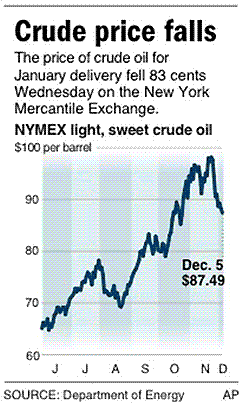
Oil drops as US fuel supplies rise
Oil prices dropped below $87 a barrel Thursday to their lowest levels in six weeks after an overnight report showed an increase in U.S. supplies of gasoline and distillates, as well as of crude at a key Midwestern terminal. |
|
Nigeria Has 900,000 Barrels a Day of Oil Halted, Minister Says
Nigeria, Africa's biggest oil producer, has halted about 900,000 barrels a day of crude output as a result of unrest in the Niger Delta and oilfield closures, the nation's minister of state for petroleum said.The figure includes about 500,000 barrels a day shut in by militant attacks in the Niger Delta and another 400,000 barrels a day halted by ``technical disruptions,'' H. Odein Ajumogobia said today by telephone.
US under pressure at climate conference
American climate negotiators refused to back down in their opposition to mandatory cuts in greenhouse gas emissions Thursday, even as a U.S. Senate panel endorsed sharp reductions in pollution blamed for global warming.
Use of such scare talk to scare up tough actions by adults on greenhouse emissions must be more measured. Youth cannot be traumatized for a global cause.
Australian PM distances himself from big emissions cuts by 2020
Australian Prime Minister Kevin Rudd on Thursday denied his government would support deep carbon emission cuts for developing nations by 2020 aimed at curbing global warming.Rudd said Australia remained opposed to the binding cuts of between 25 and 40 percent in the next 12 years, despite reports that Australian officials had publicly embraced the plan at a major UN climate change conference in Bali.
Climate change bill heads for full Senate
Legislation aimed at fighting climate change by capping greenhouse gas emissions was approved on Wednesday by a Senate committee and is headed for debate in the full Senate.
What if everyone believes in global warmism only because everyone believes in global warmism?
Their insight has been fruitful and multiplied: "Availability cascade" has been coined for the way a proposition can become irresistible simply by the media repeating it; "informational cascade" for the tendency to replace our beliefs with the crowd's beliefs; and "reputational cascade" for the rational incentive to do so.
Scientists demand swift climate action at Bali meet
Climate scientists from around the world urged delegates at U.N.-led talks in Bali on Thursday to make deeper and swifter cuts to greenhouse emissions to prevent dangerous global warming.In a declaration, more than 200 scientists said governments had a window of only 10-15 years for global emissions to peak and decline, and that the ultimate goal should be at least a 50 percent reduction in climate-warming emissions by 2050.
Contact
- Content: editors at theoildrum dot com
- Tech support: support at theoildrum dot com
License

This work is licensed under a Creative Commons Attribution-Share Alike 3.0 United States License.
For Those Without Enough to Worry About
Israel Prepares to invade Gaza
http://www.time.com/time/world/article/0,8599,1691071,00.html
Alan
Well, they better be careful in their invasion or they won't be able to travel to the UK.
http://news.bbc.co.uk/2/hi/middle_east/7130594.stm
Well since it's looking like this is shaping up to be a tinhat thursday...
Tinhat Tuesday has a better ring but this will do.
Hey how about WAG Wednesday?
Here goes;
Iraq. I believe the PTB can turn the level of violence up or down to suit their needs.
My WAG is that through years of sanctions, political coups, massive bombing, trumped up wars, money/bribes, a wide variety of destabilization activities (creating civil war, etc.) we are pretty close to getting the Middle East to a place where we can effectively manage it.
Or so thinks TPTB
I also believe that for the most part the leaders of the rest of the world don’t really have a problem with this. Well, maybe China but…
The one sore spot - IRAN
Cheers
Global WARMISM? What, believing scientific data is now a religion? Oh come on!
On the other hand, the author does have a point in that many people believe global warming to be true simply because other people do, or may not even really believe it to be true but simply agree because it's the popular thing to do.
After all, how many people do you know that go to church even though they don't consider themselves "religious?" How many people have you met that automatically assume you're Chrisitan because THEY are? Is believing global warming a religion? Certainly not. However, people can be easily swayed by others if they have no reason to stay with their current position, be it emotion, or fact.
~Durandal (www.wtdwtshtf.com)
Yeah, that's the latest tactic. They have lost on the science, so now they try and describe it as a religion of some sort. Either that or insist that it will be too expensive to try and do anything about so we should learn to live with it (I guess in a way restating Lomborg's writings).
Doesn't surprise me to see this sort of writing on the pages of the Urinal.
Its really absurd. The reason that people accept Global Warming is because there is a body of science that lies at its core. Yes, its not complete, and there is plenty of room for improvement, but it is now compelling enough for action.
On the other side of fence is not simply healthy scepticism - its largely manufactured denial. The same old lies get trotted out. The same quibbling around the edges and the same people whose allegiances are bought and sold.
Now, applying the precautionary principle to something as vital to the only planet we have to live on, means that we have to move to protect it as quickly as possible. The concern that this will result in a more constricted economy and a potentially less free society is probably valid. We may not be able to fly across the planet on a whim or drive every day everywhere in the largest vehicle possible. We may not be able to consume & discard hydrocarbons derived products in the same quantities. There may be uprisings from the formerly well-off's.
This is going to be a tough transition but it is possible to do minimizing the bloodshed. It will take education, understanding and sensible government that looks out past the next election.
"Have your cake and eat it too" has always been good politics.
The recent work at the Millennium Institute shows that the Best Economic Policy is a combination of the Best Environmental Policies in an oil constrained world. A FAR easier sell !
Best Hopes for that draft of a Peer Reviewed paper that I am working on,
Alan
The smooth operating of the western political systems will be interrupted by scarcity (energy, food, etc) - there is no doubt about that. Peak oil will solve many of the AGW issues unless we dive headlong into coal although I doubt that we could possibly mine the volumes of coal required to make up increasing shortfalls in oil production.
What will require a supreme effort will be curbs prior to the full impacts of AGW. How will citizens react to severe curbs on their ability to consume hydrocarbons is the question. Rationing based on carbon usage is probably how we will have to do it. The problem that will arise is when we see how small our carbon budgets will be. And will the rich be subject to the same carbon budget as the poor? I imagine that a future carbon black market will quickly spring into being where the plastic bags, shrinkwrap and the other little necessities of modern life will be traded at great prices.
Its going to be interesting.
Hmmmmm!!!
Last night I attended a meeting in the UK Parliament. Jeremy Leggett (Solar Century),Martyn Williams (FOE)and Chris Vernon from The Oil Drum Europe were presenting.
http://www.appgopo.org.uk/index.php
While waiting for the meeting to start I was discussing the climate change article that I was reading in the FT with the people sitting next to me.
Basically, to avoid irreversable catastrophic change the challenge is to reduce CO2 emissions to about 20% of 1990 levels by 2050 - because the emissions are cumulative we have to start reducing emissions now otherwise the challenge will be to get to the 80% reduction by an even earlier date.
So, the proposed interim target is a 30% reduction of CO2 by 2020 (with the added complication that we will have almost no nuclear by then!) We also need to grow the economy so we would expect primary energy use to grow 25% or so by 2020 if the IEA are to be believed.
The scale of investment in alternatives required was a shock to the climate change people - especially when I pointed out we wouldn't even meet the UK Kyoto challenge.
The words 'task' and 'impossible' come to my mind!
When Chris put up a chart showing the 'Russian' solution I could take no more, and left the meeting as I had probably seen the only solution that would do the trick. I was in Russia when they tried it ... not good!
The UK government are not prepared to plan including the effects of imminent peaking of oil and gas since, if word got out that they are even considering such a thing, the public would panic ... so, party on, it's official!
So how do we "fix" this then? Does this not show that it is physcially impossible to achieve CO2 cuts in the long run, save what PO will do to us?
Richard Wakefield
No. Not necessarily.
Nature has a way - in the very long run - if all else fails!
It works for all other species so I expect it will work for humans too - if we are not as clever as we think we are.
Because of the timing of the various FF peaks it seems we can burn all the conventional oil and all the natural gas that we can persuade to come out of the ground and still not double the CO2 levels from the pre-industrial era - now, you have to have faith that the politically run IPCC data is correct and that it is a safe or even desireable thing to do! - but you can't burn the coal.
So, the big question is, how do we stop people burning the coal?
And that is it! We are not as clever as we think we are. We think we can "fix" climate change, willing to spend tens of billions, when in fact we have no idea what the future will do to us. We have become so arrogant that we now think we are the gods of the planet. That's because of what we have done so far. Everyone is comfortable in the notion that anything thrown at us we can fix. Movies re-enforce this (eg Armageddon and Deep Impact, etc). The good guys always win scenario.
Your first point, however, is the correct one. In the end Nature will have it's say. We are a temporary blip.
Richard Wakefield
In the end Nature will have it's say. We are a temporary blip.
Perhaps this explains your policy preferences. It matters very little if the "blip" is a little shorter or a little longer. But what DOES matter (and is of more immediate importance), is if your monthly electric bill might increase by a couple of dollars or not.
It is just a matter of perspective and values.
Alan
Why?
So far, for most of my long life, it just does!
Because, sadly, people only vote for politicians that propose growth. Our modern OECD economies know no other way.
People only work for companies that grow.
The world population grows - in our world (that is, in reality, completely abnormal) exponential growth of almost everything is the paradigm - it's completely unsustainable eventually (hopefully not too soon) so enjoy it while you can.
Probably, like me, you enjoy a quality of lifestyle unimagined by your forebears (and that goes right back to the first cell that ever evolved, as life is continuous) - a thought that seems extremely improbable but is actually true for most people.
If you want to know what the opposite of growth is like? - try Zimbabwe!
So we can support a growing population. Which we need to grow the Economy. Which we need to support a growing population. Which we need to grow the economy. Which we need to support a growing population...
Does anyone alse see how utterly ludicrous this is?
We don't. We ban the construction of new Coal-fired power stations, and the repair of major elements of existing ones (like boilers). With bans in place, Generator companies will be forced to a) leave the market, or b) invest in cleaner technologies, such as Solar PV, Concentrating Solar Thermal, Nuclear, etc.
Convincing our various governments to implement the ban (especially in countries like Australia, where Coal exports support tens of thousands of workers) will be the hard part.
It is true that the economy needs to grow if the population grows. But it must continue to grow even if the population is static!
Here's why: Our monetary system is created by debt. That is money is created from debt. Video explaining the concept. http://youtube.com/watch?v=vVkFb26u9g8
What does this mean? Here is a micro example that scales to our fractional reserve banking system. Let's say that there is 10 dollars in the world because you borrowed 10 dollars from me the banker. So you have 10 dollars worth of debt but 10 dollars in hand that you spend on a pair of shoes. The owner of the shoe store then buys a chair from a furniture store that you are employed at and you receive a 1 dollar as a wage.
Now you begin to pay the bank back a dollar at a time. We begin to see the problem if you pay off your debt there will be no money in the system
What's worse if the bank is charging you interest (10 %) it becomes impossible to pay back 11 dollars of debt with only 10 dollars in circulation.
If the economy doesn't grow it collapses. It has to grow to pay interest on the current debt in circulation.
It seems like this scenario has to be wrong because it's so insane. And it is.
Here is another example of growth. A painter makes a painting he wants to sell. He has no money. Does the painting have any value? No, not until it is sold. So someone comes along and buys the painting for $1000. Now the painter has $1000 in cash and the buyer has a painting worth $1000. This means that the economy just grew in wealth by $1000. We now have $2000 of wealth here.
So the buyer then want's to borrow $1000 from the bank. He uses the painting as collateral. The bank creates the $1000 in his account from nothing (all the bank is required to have on deposit is a small fraction of what they lend out). The bank can do that because the item has a monitary value. So the creation of the money for the item is correct. Once paid back the money is "destroyed". Well, that's how it's supposed to work.
So now we have $3000 in wealth from that one painting and the initial $1000 the buyer had.
This is fiat money creation. The money is created to give a monetary value to goods that are created or manufactured that have intrinsic value. (bartering shows this)
This is why we went off the gold standard because other things have value than just gold. If you want a gold standard, then why not a plantium standard, or a microchip standard? Just as arbitratry. Gold has no more intrinsic value than anything else. Only a percieved value, just like everything else.
Richard Wakefield
Someone needs to read up on history.
gold has value due to two reasons.
1. it's pretty
and
2. it was rare and hard to acquire.
a gold/rare mineral standard is good because it sets ACTUAL physical limits on a system that normally has none. to create money in such a system one must have the same amount of gold/ rare mineral that what ever denomination you use.
a fiat system doesn't have this needed limit and always fails because the people who run it always succumb to the temptation of just making more to cover the debt.
or to put it even more simply rarity = value. thats why the artist's painting has value it's one of a kind. thats why gold has value, it's rare. in a fiat system money is not rare it's virtually limitless and because of this it always fails because it's value will always reach 0. the dollar has been crashing since we got off the gold standard it's just been so gentle a decline no one has noticed.
So, with a fixed amount of gold, how does the painting get value? As things are made that has value, the amount of gold would have be spread thinner to cover it (butter spead too thin), hence the value of gold would increase. How is that any different that the fiat money creation? And note, that fiat money creation is only because of goods which have value are created. I've discussed this at length with my brother-in-law in an attempt to understand how this works. He's VP of a government agency that overlooks banks and trust companies. His job is to make sure they follow the rules. Though, that said, he has been VERY busy the last few months on this whole debt issue.
The point is, as people create wealth through the creation of objects, is that not wealth creation period? Money is nothing more than a unit of measurement? There is certainly far less money, the float, around than the value of all goods, severices, bank acounts, stocks, etc.
Having a gold standard will also be skewed to the countries that have the largest gold extraction and mineral deposits regardless of all else in the country. Is that fair?
I would think the reason for getting off gold (which included the ability of anyone to own gold) was brought about by reasons that make sence, at least at that time.
That's not to say what we have is perfect, far from it. It's that there is no perfect system when people's two emotions are involved -- fear and greed. These two is what sets the value of anything. So the flaw is not the system, but those who practice the system.
Richard Wakefield
I keep seeing this over and over, and I must keep correcting it over and over.
It is NOT necessary for an economy to be growing for interest to be charged and repaid.
Let's say we have a sustainable, zero-growth economy. You and I each bring in $1000 per year, every year, which covers our living costs. You want to borrow $100 from me. I have tightened my belt and done without some things to save up that $100. Now, you are going to have to tighten your belt and do without some more things to repay me that $100 plus an extra $10 interest. Note that this is a ZERO-SUM TRANSACTION. There is no reason for either the money supply or the economy to have grown for it to happen. All that was needed was for different people to make different allocations of their available resources depending upon different priorities.
Note well, however, what was missing from this transaction: fractional reserve banking. I could only lend out money that I had actually saved. It is fractional reserve banking that inflates the money supply. A sustainable, zero-growth economy must have a stable money supply, which means that it must not have fractional reserve banking.
One final note: Some people claim that in a sustainable, zero-growth economy there would be no interest charged, but this is clearly wrong. In a sustainable, zero-growth economy, waste would be the cardinal sin. All assets would have to be used as efficiently and optimally as possible. This means that every asset -- including spare money available for investment -- would have to have a rental value. Assets without rental value that are available for "free" would inevitably be misused and wasted. A zero-growth economy would not be able to make up for the waste, resulting in a continually contracting economy.
How does this work, no growth, if people create goods that they can sell? Soon as a new item is created and sold, the growth in over all wealth has gone up has it not? If I grow a crop of wheat this year, and increase my output the following year is that not wealth growth? Soon as you add a new person on the planet, doesn't the economy have to grow?
Richard Wakefield
Increase = growth, sustainable means zero growth, means no increases.
Sustainable means that approximately the same size wheat crops are produced year after year, and those (plus other food crops) are just sufficient to support a non-growing population. New goods that are created, e.g. baskets, pretty much just replace the existing inventory as they wear out, with the old ones being recycled into compost to grow the materials for the new one. A closed circle, in other words.
Of course people buy and sell and trade, but it is a zero-sum game. Any one person's net gain would have to come at one or more other people's net loss. The only exception would be that to the extent that people have surpluses of different items in excess of their most pressing needs, the marginal utility for each person can be increased by trading those items that they have in surplus for other people's surplus that they don't have enough of; this would be a non-zero-sum transaction, but in a sustainable society at carrying capacity, there just wouldn't be room for an ever-increasing amount of it. There would really only be room for significant inequalities between people to the extent that the population was kept below the carrying capacity. If the population is right at carrying capacity, then inequalities mean that some people starve and die. Whether or not that happens, or is allowed to happen, is up to the population of that society, I guess.
I AGREE but we DO have a fractional reserve banking system that has an unstable money supply, therefore we need to INCREASE our current growth under the current WORLD banking system.
Or in other words, we need to continue to increase growth in order to continue to increase growth.
Except that we don't need to continue to increase growth. Indeed, given a global society that is either already past or very close to overshoot, increased growth is just what we don't need.
What's the Russian solution?
I don't have the chart - but, basically, the USSR collapsed economically and politically - and it had the desired effect - look at charts of USSR oil production as an example and you will see it - production of everything dropped by 35% or so!
I don't know how to put up a graph that shows this, somebody else may be able to help.
Oh okay, I just didn't know which "solution" was presented (Stalin's purges, etc). Thanks!
If cancer cells could vote...?
www.tripledistilledscarconol.info
The rep from COSEIA, the Colorado solar industries people frames it this way. We need to choose abundance over scarcity. Reliance on fossil fuels is being condemned to scarcity, relying on conservation and renewables is relying on abundance.
Ultimately, if the environment goes down the tubes, the economy goes down the tubes. We are dependent upon the environment for whatever wealth we have. Kill the goose, lose the eggs. I don't know if we can continue our current growth path, but it probably needs to be sold that way.
Personally, the need to grow is just a function of our collective illusion that growth is necessary for happiness and well being. It may be the other way around.
I think growth can be good at times and bad at other times. When a population has the resources and space to grow, then that is good for the population. When resources and space become limited, then bad things happen to the population if they try to maintain that growth.
We are really no different than any other organism in the world that is coming up to its sustainable limits of growth. Are we smart enough to recognize it and act accordingly before bad things happen?
Don't answer that...it was rhetorical.
The essence of capitalism is that it produces goods and services to sell at a profit. Part of that profit then becomes capital, which must (what else are you going to do with it) be invested to produce more goods and services to make more profit and capital. Ad infinitum. The capitalists are trapped in that kind of a system because of competition. All capitalists must try to grow because, if they don't other capitalists will, and put them out of business. Under capitalism, the only way I know of that might stop this is if you have a system of heavy taxes that only allows enough profits to be retained by the capitalists that they will be able to cover the costs of maintenance and repair, and nothing more. But the only way you are ever going to be able to do that, is if you get rid of capitalism. Their money just gives them too much power! (It's interesting that the greatest period of American capitalist prosperity was the 1950's, when corporate taxes were extremely high.)
triphop, I wish that we had 'education, understanding and sensible government that looks past the next election' but, unfortunately, we do not.
When education is reduced to teaching to the 'FCAT', understanding is constrained by human nature, and our government makes statements like 'the American way of life is not negotiable', I dont see a lot of hope for changing the course that we are on. Even in America, supposedly one of the most affluent countries, there is no out cry by a majority for meaningful change. Unfortunately I cannot see a happy ending on this course...just shoals ahead.
True, but there is a sale on plasma TVs at Walmart this weekend. So things can't be too bad. ;-)
Oh you guys, come on now!
And next they will be getting me to believe that smoking really does cause cancer.
GW is just another one of those do gooder causes!!!
I mean seriously there are guys living into their 80s fit as a fiddle and they smoked a pack since they were 16 years old.
Panic makers everywhere.
Air causes cancer, water causes cancer, vegetables cause cancer. I'm just sick of it all!
They just want us to worry so they can make a buck selling solar panels and hybrids. It's a German(wind turbine/solar cell manufacturers) and Japanese(totyota hybrids) plot to destroy the good old American way of life. I like my 4x4 off road GM car just as it is and I keep the windows open all weather and hate sweaters.
Those new age types from the coasts want to make us change our traditional way of life for those imported goods they think are hip and drink french wine and eat their imported cheese and wear Italian clothes and next they'll want me to go to a Buddhist temple and prey to an 8 armed goddess. It's all from Satan I swear it. did you ever hear Hotel California played backwards. I swear it was Satan talking!
"I mean seriously there are guys living into their 80s fit as a fiddle and they smoked a pack since they were 16 years old."
Heh. Love it when people bring out that kind of nonsense.
Yes, and for every one of those there are a whole bunch more from the same birth cohort that used to smoke just as much, but don't anymore because they are in the grave.
Yup.
Everyone believes the earth orbits the sun because scientists say so. But it's actually very difficult for laypersons to prove. That's why the geocentric model persisted until the 17th century. Confirmation of the heliocentric model by means of stellar parallax observation wasn't even accomplished until the 19th century.
If one wants to fully understand global warming, one must buckle down, learn and become conversant with all of the theories, models, techniques and data that underpin the scientific discourse of the past 30 years. The climate scientists who have acquired such a working knowledge have earned their expertise and authority.
We may have anti-scientific know-nothings in the halls of government, industry and media power, but that doesn't change the fact that hard work is required to obtain a working knowledge. You don't get something for nothing, as much as the armchair critics would like it to be so.
Exactly,
Scientific method requires that everyone should repeat the experiment for himself, and believe his own observations. Surrounding AGW, there is no reporting (that I can find) of amateurs doing this. I have researched CO2 measurement, to build a monitoring experiment that my child's elementary school can use. No kits, plans, local news coverage, nothing.
Science is not a religion, and IPCC are not the high priests. People should be just as familiar with the evidence for rising CO2 levels as they are with that for gravity, or they will continue to be vulnerable to myths.
What about evidence that does not support AGW theory?
And the doom-and-gloom alarmism that is not supported by any evidence at all, but is nothing more than a vehicle to get more funding through scaring the public? Now that's a form of religion. A method used every Sunday by preachers.
There's lots of faith based beliefs around the actual science going on, including ignoring evidence that does not support the orthodoxy.
Richard Wakefield
There is virtually no evidence that speaks against AGW. There are some abmbiguities and gray areas that are harped on my deniers, but evidence? Not much.
Please read the articles with their references in www.worldclimatereport.com They post a large number of them.
Richard Wakefield
Okay I looked at the first 2 articles in my lunch break:
http://www.worldclimatereport.com/index.php/2007/12/03/more-on-new-york-...
http://www.worldclimatereport.com/index.php/2007/11/28/terminating-warmi...
Neither of these contradicts the theory of AGW.
What the first does is point to a common misconception about GW - i.e. that it will increase the number of tropical stroms. Meterologists do NOT think this. Warming may increase the intensity of storms, but not their frequency (weaker ones may decrease in frequency). See for example:
http://ams.allenpress.com/perlserv/?request=forward-links&doi=10.1175%2F1520-0442(2004)017%3C3477%3AIOCWOS%3E2.0.CO%3B2
The second article is highly misleading. Looking at temperature changes over a small region, such as California, says nothing of global temperature changes. Plus, whether you pick a small region - such as California - or the whole world, localised differences are to be expected - they are not unusual or evidence against AGW or GW in general. Average temperatures are all that matter - and we need to take into account sea and land temperatures. Modelling temperature changes is not a simple task - and I suspect that anyone jumping on an article like this as evidence against AGW has a very overly-simplistic view of the complexity of the world's ecosystem.
Back to work... :|
World Climate Report reviews papers that not only bring into question the "offical" AGW theory but the "common" view of climate change. I've seen many times, including here, the notion put out that GW will cause more, stronger, hurricanes (even though the IPCC said there is no GW signal in the hurricane record). How many times have you seen Katrina used to justify that GW is happening? Try Al Gore!! The New York reference shows that the notion of more Katrina like hurricanes is not supported by past history.
As for intensity of storms, there is debate about that too. With more moderated temps there will be fewer cold fronts. Those are what cause the tornados. Thus there could be FEWER and less intense storms due to CC. Look further and there is a review of a paper that did a 5000 yr study on storms in Europe. No change in either the rate nor intensity of storms.
I havn't yet read the other. But please, do a search there on your favorite topic. They have lots.
Richard Wakefield
I read your little bit and just sort of lean back in my chair and think - wow, we really have no hope at all. The inability even to distinguish when science is science, or even what science is.
When I read how the United States scores lowest on math and science in the world, I understand its ramifications. It is like going back in time. It must be what an old surviving educated Roman must have felt like after the barbarians crossed into France and Italy, unable to even comprehend the learning they were destroying.
Yes, global warming is a doom and gloom religious belief, and the sun circles round the earth as do all the planet and the moon (indeed all of the cosmos circles round this lowly planet created out of nothing), and we aren't descended from apes at all. No, we were created from clay at the hand of god, just a scant 6,000 years ago. Luckily for us we survived the terrible flood that covered the highest mountains in a 40 days rain, along with all the animals of the earth housed in a single boat that was 400 cubits long and sealed by the hand of god.
Amen
Hey! He's Canadian! (not that I think you're wong. I'm just saying)
One man with the truth on his side makes a majority in the end. Bring it on JR!
Just what the world needs, more truthiness. But then, hey, Bush is the expert. Wasn't his major in science??
I can't get over the gnawing feeling that all these weird anti-global warming posts aren't actually being penned in some windowless office at an Exxon office somewhere by twenty year old interns. It was, after all, the same tactic used by the tobacco industry in the 1960's with letters to the editor.
Imagine the fate of the earth in the hands of marketing firms, treating the issue like they would sell coke.
I'm leaning back in my chair again - we really are doomed.
Bush actually has a degree in history, if you can believe it.
Oh, I do believe it. In the modern US system, it is quite the norm to acquire academic credentials without actually learning things.
I'm actually sitting in front of my computer at home getting ready to start my day of work. No I'm not paid by anyone to post here. And I don't smoke, never have.
Richard Wakefield
Leanan, I call for banning Richard Wakefield since he has repeatedly besmirched every scientist who has put his signature to the global warming thesis, by ascribing their positions to greed. It may be true that a few of the positivists are corrupt just as it is undoubtedly true that a few of the deniers are corrupt. To casually impugn their motives would be actionable if he were to say it about one of them.
The second reason is that he is wasting a lot of space on this blog, which is ostensibly about oil supply, and discussions about other topics should be limited. But he goes on and on , refusing to reply to arguments and demanding that we supply proof to the contrary of opinions on denial sites [he should look at http://www.realclimate.org/ himself]. Personally, I don't care what he wants to believe, but there is no way in hell I want to have to sort thru large blocks to get at intelligent comment because they have been infected with his drivel.
Forgetting about that should for the while, it seems to me that you're asking an awful lot of regular folks. Gravity is immediately verifiable. Tell me the theory, and then ask me to walk in air. Voila, you've proved the theory to me when I hit the ground.
It's not so easy with GW, not so easy at all. Understanding GW, it seems to me, requires a tremendous expansion of the mind. At the very least, it requires an understanding (and appreciation of) the fundamental interconnectedness of all phenomena.
How are you going to get folks to see the connection between them and some future, abstract catastrophe when most folks don't even have an appreciation for the connection between their behavior and its fairly immediate personal consequences? "I can't understand, Doctor, why I can't lose weight," he says as he eats his third Big Mac of the day.
This is the problem isn't it? How to make GW (or PO) REAL... How to make a (we think!) valid prediction come alive?
How do we know anything, really? I'm not being facetious, here, I'm just trying to point out that the problem is much larger than any "truth" about GW that science has uncovered.
Put another way, the new paradigm will be seriously considered when the old paradigm busts you up side the head with a two-by-four! When the universe tries to get your attention, the last tool in the kit is pain and suffering.
Pain and suffering have a way of focusing the mind.
And to steal a phrase:
Best hopes for early attention and minimal suffering...
Generally speaking, any opinion held by a significant number of people exists because other people believe in it. The number of people who independently derive conclusions is small, and in the case where those conclusions conflict with more popular ideas society exerts an extinguishing effect.
This is poorly understood even by activists; one might say especially by activists. "No rational cause can succeed without irrational support".
(I'm quoting myself here to start a trend).
Those who seek to change the world by turning the masses into scientists will be forever disappointed. Everyone who expects a significant percentage of americans to EVER understand thermodynamics, raise your hand.
I leave as an exercise for the reader why the stuff we discuss here, on the level it's discussed, is self-limiting in the culture.
Of course, the dishonesty of that article is to imply that just because the support is predominantly irrational, the argument itself is incorrect. That's stupid, no matter what the majority thinks.
or fails to think.
People need to keep in mind that Carnot efficiency is "just a theory". That gravity keeps the Moon in orbit around the Earth is "just a theory". That London, Ont was buried under deep ice several thousand years ago is "just a theory". Peak Oil is "just a theory". Human caused global warming is "just a theory".
You are confusing data sets (observations) with theories (that explained how those observations work). Gravity is a theory. There is yet an explanation of what gravity actually is. How it differs from the other 3 forces. Why is gravity always attracting and never repelling like the other 3 forces? So the theory of gravity is far from solved. They've been working on it since Einstien failed to figure it out.
The theory of evolution is the same. It went through a significant change when Punctuated Equilibrium showed that the last 150 years of gradualsism consensus was wrong, or mostly wrong.
Peak oil is a theory. AGW is a theory. All of which can be overturned by one bit of new evidence. PO is history if a new Ghawar is found, history for a while anyway. It's POSSIBLE that can happen, but not very likely. If the world average temps starts to fall 1 or 2C even though CO2 emissions continue to grow, then AGW theory has a problem. Is it possible? Yes. Is it likely? Well that is the big question!
That's the context. And if this logic is a reason to muzzle me, or ban people who do not agree with your dogma, then that is just plain censorship. Would you bad someone from here if they challenge the notion that PO will be catastrophic? No, as people have many times. I'm one of those who thinks that the catastrophic predictions of CC are unwarranted, and because of PO, irrelevant.
Richard Wakefield
No I would not ban anyone on this site who is holding genuine views. It strengthens, rather than weakens, TOD.
With the caveat of posting at a certain minimum level of intellectual rigor and analysis and preferably capable of proper debate.
Alan
In the roughly two years that I have been reading the Drum before I saw Mr Wakefield's name I have seen every objection to AGW that you have brought up debunked several times already.
Serious environmental problems have always threatened those with a deep vested interest in the status quo. This is particularly threatening to the sunken costs in coal mines and oil fields. It is particularly threatening to utilities which want to keep making money without massive investments in new technologies. "Stick with what you know" is basic conservative business dogma. I have no idea why Mr. Wakefield feels so threatened by the reality of the damage being done by the use of fossil fuels. I would be happy to see him present evidence to the contrary which is completely knew and which would convince climate scientists that they are wrong. Scientists are not dogmatic. They are very welcoming of new evidence which changes what they have learned. They are eager to support research which may change what they were taught in school. That is why they became scientists. The example of punctuated equilibrium is a case in point. The example of AGW is a case that has spent 100 years of gradually building a set of data points to support an idea which only one man believed in. Please, please Mr Wakefield give the world new evidence that gives us piece of mind about the future my daughters will be coping with.
Well, here is some good news evidence that climate change is not a threat. First is China. No increase in either drought times or wet times in the past 500 years. Things are as they have been.
http://www.worldclimatereport.com/index.php/2007/11/13/centuries-of-yell...
Second, is this one that the US has been seeing an increase in precipitation, less drought, over the past 50 years.
http://www.worldclimatereport.com/index.php/2007/12/07/sign-of-the-times/
Both of these counter AGW claims that predict a dire future.
The threat I see is when dogma becomes established in the midset of the public regardless of the evidence or the challenges from people like me. This eventually becomes a witch hunt of people like me who challenge, to the point where we become outcasts and unable to even get a job. We already see this with people who claim that anyone who challenges AGW orthodoxy should not be certified for work. Or are the same as holocost deniers. This can very easily happen once a dogma gets entrenched, and I see AGW dogma getting very entrenched.
Richard Wakefield
Sorry to hear you are unemployed just because of your personal opinion on AGW.
I'm just "dust and ashes," so I'm easily thrilled if anyone publishes my comments on peak oil:
Skeptics Dictionary
Mr Carroll is firmly in the "techno-copian" camp. So be it. One does what one can.
Whether it's true or not, 'they say' that there's no such thing as bad PR!
Bob
I really like the Skeptics Dictionary website. I've been going to it for years.
So, I'm shocked by the glibness and dogmatism of his response.
As Professor Bartlett so wryly put it:
Prediction X turns out to be false. Therefore, all predictions are false.
Mike your logic (and Dr. Bartlett's) is unshakeable. The only thing to be settled is whether the naked ape's numbers continue to be controlled via low-level culling or whether we get the "Grand Finale" with wall-to-wall corpses.
Via FuturePundit "Biomass Energy Push Making Diets Less Healthy?":
EurekaAlert (my apologies if this already made DrumBeat but I missed it)
This is the same sort of twisted logic that has Americans suffering horribly if they can't drive their cars wherever and whenever they want to for cheap $$.
One can have a nutritious diet for pennies. Rice and dried beans are amazingly cheap and can form the basis for a nutritious diet. People simply have to re-learn the creative process of cooking, rather than opening a 'Meal Ready to Eat' and nuking it in the microwave.
But it's not available in many areas of the US. "Food deserts" are places where there are no grocery stores, just fast food places and gas station convenience stores. Often the inner city and very rural areas.
Ya, well on a dead thread here....
"But it's not available in many areas of the US."
Sure there are areas where the resources available and the local culture are a toxic mix of non-functional modern urbanism; but, I would guess the grand majority of the population in the USA has available to them the means of living both very frugally and with a reasonably healthy diet. (I'm not saying they are well off in respects of jobs, income, etc.) People just plain simply do not do it, out of ignorance for the most part I suspect, but partly out of inability to grasp the fact that they do actually have choices.
First step, turn of the GD TV set....free up lots of time.
pray tell where will the time they need to do that come from? many many family of said group have to have both parents out working all day to keep what little they have.
in the old days it used to take hours to make a large dinner for a large family. you will learn this if you study recent history. housewives used to start making a 5 pm dinner at 3 in the afternoon.
Yep. Dad went out and worked. Mom stayed home. Mom cooked from scratch, she also did the shopping and watched the sales like a hawk. One roast lasted all week and that often included school lunch for the kids and lunchbox for Dad. Going back far enough, Mom had a garden and chickens too.
The kids had chores after school, Daughter may have been an enthusiastic little gardener and proud of the literal fruits of her labor, Son may have had a special interest in chickens or his FFA or 4-H cow.
Clothes were patched and mended, knee patches were de rigeur on boys, and pants were bought long and cuffs rolled, until the kid grew tall enough they became "high waters" and were cut off for shorts for swimming, and new ones bought.
Really, no cloth was thrown away, it all became rags, or patches, or kept for bandages when one of the kids got hurt.
Food was not wasted either - even bacon fat and drippings were saved. Yum!
I mean we're talking maybe 40 years ago.
We all know the situation now, dual workers, 2 cars, 60 hour weeks for both, 2 cell phones, maria the babysitter, and all slaving away to pay for a huge house that's really only a place to park their body when not working.
How to get back to the way it was 40 years ago? It's easy:
No more cable TV, Bunny ears, TV a conventional one, better yet bought used at a garage sale. Kids borrow books from the library. Clothes bought with durability in mind, and patched when they get holes etc. Shoes bought the same way, for durability and in summer when not in school kids go barefoot. No cell phone - the kids know who to go to or where to go if there's trouble. Cooking ALL at home, breakfast lunch and dinner. Restaurant eating only a few times a year, and that includes McDonald's. No housekeeper. Garden in yard if it's not allowed in front at least in the back or boxes along the sides of house, anything. In front yard put pressure to be allowed 'em in the neighborhood, plant things that look less like a 'farm" there. Mom stays home. One car goes, if there's payments on the remaining car, get out from under that sucker and get something used. Bike or bus if you can. Food is bought in basics, flour, eggs, veggies - if fresh spinich is expensive, get kale. Or canned - canned spinich is better than the fresh kind anyway.
People 40 years ago were FRUGAL to a large degree. Hang out with old folks who lived during the last Depression if you can to learn the thought processes.
It can be done. It's just that the psychological addiction to today's "conveniences" has to be broken.
To expand on your post a little more regarding clothing:
Mom (and daughters, who learned by doing with Mom as they got older) sewed most of her clothes, her daughter's clothes, and a lot of her son's clothes as well. Not so much Dad's clothes; if he was a white colar worker, the tailoring was usually too tricky for all but the very best seamstresses, and if he was blue colar, either the uniforms were provided or work clothes were of such heavy-duty construction that many home sewing machines could not handle the thick fabric well. Mom would make repairs to Dad's clothing, though. Sewing was considered a basic skill for all women, it would have been unthinkable for a girl to grow up not knowing how to sew. Many women who stayed at home were nonetheless employed on the side; those who had sewing machines and were good at it could often make a little extra money by doing some seamstress work for wealthier people.
Solid-colored cloth was popular for home-made clothing, because it was easier to work with -- patterns didn't have to be lined up. Clothing with patterned cloth was the mark of a highly-skilled seamstress -- or someone well-to-do enough for store-bought. Solids were better for patching, too. The left-over fabric would be kept, eventually to be used for patching the inevitable wear and tears.
One more advantage of solid colors: when they inevitably got a stain that could not be removed, the fabric could be dyed a darker color to hide the stain. It is pretty hard to dye patterned fabric and have it come out right; patterns were thus another marker of wealth - the owners could afford to part with the garment when it got stained, instead of having to dye it to make it last longer. People used to dye clothes a lot more than they do now. The natural fibers in the cloth would take the dye better, too. There's a reason for 100% natural fiber clothing that I bet a lot of you have never realized!
I can remember when public libraries would have sewing patterns that could be checked out - I wonder if they still do that any more? If that has gone by the wayside, it may eventually come back into practice. Of course, neighbors and friends would also swap or borrow patterns all the time, too.
Another use for clothing that could no longer be worn was patchwork quilts. If someone did have some better garments made of paterned matterial, when it finally could no longer be worn it frequently would be cut up for use in a patchwork quilt. The idea of buying fabric on purpose for a quilt would have been thought absurd - all of it was recycled from decommissioned clothing. Quilts were a good way for the young girls to start learning to sew. Mother and daughter (and usually several other women and girls) would all be working on a quilt, spread out with enough space for each to work. Mother and daughter could observe each other, daughter watching and mother correcting as needed. If the young girl's stiches were less than absolutely perfect, it usually mattered a little bit less for a quilt than it would for a garment. Quilts were thus not just a pretty thing to decorate a bed -- they were practical on several different levels.
These days sewing your own or your kids clothes is a political action akin to recycling or driving a hybrid. It is much more expensive to buy the materials and sew than it is to buy finished clothes ....for now.
That being said, knowing HOW to sew is going to be an important skill once those cheap clothes are no longer available. Now if I could just find a treadle sewing machine!
Hey Klee,
I found one on Freecycle - just needed some oil and the belt put back on.
Hey Klee..
I've got the treadle-table, but just gave the sewing portion to my Daughter's school for auction.. it got $20. I'm turning the table into a Multi-tool workspace (Scrollsaw, Sharpening, Sanding, Flexible Dremel, etc).. but I've also got a Singer Scholastic that was sitting on top of a City-Park Garbage Can last year, and I can adapt that to be 'cable-driven', since it still has the standard size Singer Base that will fit right into a classic Treadle Housing!
You've gotta love machinery that was built to last, and designed with real interchangability!
Bob
Brings back memories of when I was a hippie sandal maker. I had a Singer 111W-154 walking-foot sewing machine. What a beautiful piece of equipment. It would sew leather, sailcloth, denim, with the foot walking right over the big folded seams and all. It had an electric motor, but the original (it was a 1930s model) was treadle-driven. Good industrial sewing machines last forever with a little care.
Industrial/commercial ANYTHING is always to be preferred over the consumer model. Always acquire the heaviest duty model of any tool or piece of equipment that you really need. Anything less is bound to give you grief sooner or later - and probably sooner.
I do not think that there is a single tool or item of equipment sold at Sprawl-Mart that is not available in a heavier duty model somewhere else.
Treadle Sewing Machines:
Quite a few electric sewing machines could be mated to an old treadle table -- any of them with an external electric motor driving the sewing machine with a belt could work. It is only the newer machines with the motor inside the guts of the machine that won't work.
There are plenty of old treadle tables out there, occasionally they come up at auctions, or check out antique barns.
Of course, if you are fairly handy, you could always build your own treadle table.
Lehman's was carrying reconditioned treadle sewing machines for a while, I don't know if they still are.
Cost of DIY vs. store-bought:
Be careful that you are actually making a true apples-to-apples and not an apples-to-oranges comparison. These, days, most of the cheap clothing one can buy in places like Sprawl-Mart is made of pretty poor quality material, and the workmanship is pretty poor too. If anyone is going to go to the trouble of making clothes themselves, they are going to use better quality material, and take the time to really sew it well. Thus, a more true apples-to-apples comparison would be home-made vs. upscale store quality. When you look at it that way, home-made does compare pretty favorably on a cost basis. Remember, too, that lots of people pay a hefty premium for the same type of crappy, thrown together clothing that Sprawl-Mart has, but with some hoity-toity designer label. Home-made really is a pretty good deal compared to that.
Sorry but going back to all that?
There is no woman who would do it. Period. End of sentence. End of statement. End of world.
Men would. Woman will not. Children? Well they can be beaten with a hickory switch. It will take a generation or two of dieoffs and the women and men left will start all over.
Maybe.
BTW my treadle sewing machine is so old it has a shuttle instead of a bobbin. 'Free' is the brand name. But I have a new , out of the box Singer treadle that has never sewed a stitch. Saving it up.
given the choice of having to do it and starve. i am sure most women would do it sans the die hard feminists.
There are more Women under the Heavens and Stars, Airdale, than are known to your philosophy.
The women in my family are all over the fabric arts, and passing it along like it was a germ! My mom at 70 is working on her 'Journeyman' status with the New England Weaver's guild, having burned a path through weaving, sewing and knitting for my sibs all my life, handed down from her mother and hers.. but also cooking, canning, gardening, building homes, teaching music.
Maybe you really meant that women won't 'go back to the 1850's', and of course you're right, but why should they, or we? Even if we rediscover by sheer and dire necessity all the fabulous handtools and acoustic instruments of those times, we'll be making new homes and writing new songs with them.
My wife and I are funny how we have fallen into some of the roles that must go back ten thousand years, for all the modernity and assumption that 'it's different now'.. So much of it is also repeating itself again and again, and we don't have to go back, because we are still there. I still do the grilling and baking and make the fires, she plans the shopping lists and handles most of the clothing.. while I try to help without destroying everything. But we do also have the 20th and 19th centuries to work our ideas and our designs from. We have interchangable parts, hardened steel, fascism, Apollo 11, teflon and Evil Knievel to build the next legacy on top of.
The girls and boys may be doing their chores again, but they will be humming some Stones tune, and the Barn Door will roll smoothly on Ball Bearings..
Bob
My wife used to sew all her own clothes, and I have no doubt that she can and will do so again. Right now, since she is working full-time, her time is at a premium, so she doesn't tend to do much except for an occasional repair. Furthermore, we are already pretty well set for clothes, and don't need many new garments each year. There are a lot more perfectly good discards available at the secondhand shops and yard sales than there used to be, thanks to our hyperaffluent, throwaway society. Once money becomes scarce and people have to become frugal again, that source will go away and then households like ours will have to break out the sewing machine again.
I've just posted an update to my projections of energy and GDP in 2050, Energy Intensity and GDP in 2050: To Have or Have Not.
In the original article published on TOD here I used the conclusions from a paper by ecological economist Robert Ayres to derive the effect of energy on GDP. While Ayres' research appears to offer an improvement over the assumptions of classical economists, it has yet to be independently validated, and was tested only against the economy of the USA. Extending its assumptions to other countries seems somewhat premature.
Accordingly, I felt that a more standard approach to modeling energy and GDP would provide a more accessible and generally acceptable analytical foundation. This update revisits the question of national GDP in 2050 using the more standard approach of Energy Intensity.
The results are, if anything, more discouraging than before:
I remeber how in Jared Diamond's "Collapse" the Norse settlers in Greenland when the end came the poor invaded the houses of the rich and all died, regardless of the fact that thee rich had enough for themselves. this does not bode well.
When the Mayan civilization collapsed, the upper classes were particularly sought out and attacked. Piles of bones were found where entire families were slaughtered. Their front teeth were notched which indicated they were part of the priestly or highest class.
When TSHTF, being rich will probably be a huge liability rather than an asset. Unless, of course, you use your wealth in preparation for the coming anarchy. Buy yourself a place in the hills, or somewhere thinly populated. Invite other like minded families, arm yourself to the teeth and prepare for the worst.
Ron Patterson
This place might fit the bill...It has hills, is thinly populated, and I suspect that Vader is going along to shoot lawyers that show from the ACLU, World Court, et al :)
http://www.thetruthseeker.co.uk/article.asp?ID=5324
'Bush Buys Land in Northern Paraguay
Prensa Latina – Buenos Aires, Oct 13, 2006
An Argentine official regarded the intention of the George W. Bush family to settle on the Acuifero Guarani (Paraguay) as surprising, besides being a bad signal for the governments of the region.
Luis D Elia, undersecretary for the Social Habitat in the Argentine Federal Planning Ministry, issued a memo partially reproduced by digital INFOBAE.com, in which he spoke of the purchase by Bush of a 98,842-acre farm in northern Paraguay, between Brazil and Bolivia.'...snip...
River, it does seem to fit Ron's criteria :)
According to this dubious googled article:
http://wonkette.com/politics/george-w.-bush/we-hate-to-bring-up-the-nazi...
place in the hills: 100k acres in Paraguay, presumably thinly populated
other like minded families: Rev. Moon bought 1,482,600 acres in the same place
arm yourself to the teeth and prepare for the worst: 500 heavily armed U.S. troops arrived with various planes, choppers and land vehicles at Mariscal Estigarribia air base in the same part of Paraguay
Then there is one of the world’s largest fresh-water aquifers in case he's thirsty.
Bush is obviously a "Doomer" :)
I was wondering if anyone knows about the US bill going through that would create a national ID card. I read that the states had to comply by May 2004 with this new regulation, but I'm not sure.
The national ID card would not be mandatory, but would be needed by anybody needing to travel by air, bus or train and would be required to open a bank account.
So if you want to get a job you need a card, as you need a bank account to be paid. You need to get paid if you want to eat and survive, so the government is ultimately in control of your individual survival. If you chose not to abide by government rules, your "privileges" could easily be denied.
Does this seem plausible?
Chenry - this is why I see such an interest in alternate monies, barter, farming, self-sufficiency, etc. Even the yuppies are trying out dandelions and interested in haybale housing (which may only cost you a million and a half to own in California) these days.
The interest in this stuff is across the board, across all of the social classes. If anything it's higher among the middle class who are really feeling the floor drop out from underneath them.
Homeland Security won't let me have a bank account because I won't give them an address. I might be able to get one if I give a bogus address, but all the same, any money I make is likely to get garnished, so I like others am being forced into the cash/barter/underground economy. By the time I can file BK and get it taken care of, in 2 years or so, the economy may be in deep depression.
I've gone on and on about my own situation on here, probably too much. Let it suffice to say that the system is rigged so that if you're down, you're forced to stay down for quite a few years. Unless you're in your 20s it's just too tempting to say "f(_)ck it" and stay with the "alternate" economy.
Millions of people doing this will certainly break the US economy, if the things going on don't do that already.
Ur doing good Fleam. Keep with it.
You are way ahead of most. You got the right attitude.
It seems though that reading all the news...you must be the only one and the first one in this country to be so affected.
Strange, no? Everyone else wants to keep up appearances.
I never thought I'd end up in this situation, it's so incongruous ...... so why not talk about it? I mean, we're going to be out selling pencils on the streetcorner, hoping for WPA work, learning to forage like Euell Gibbons, all those 1930s things, why not come out and be open about it?
And dont' forget, burning wood scraps in the corner trash barrel.
Be open about it? Because it scares the shit outen most here..specially the yuppies and genxers. The slackers too.
Your telling the truth here. Most won't reply.
To me its very interesting , about how others are coping.
Today I am finally hooking up my hot water heater here in the barn, going out to deal another wood stove. I got two now and want a third..I get them for about $25 apiece.
I still don't have a shower..I will go to the discounter who sells seconds and pick up a dinged one. Then stop next door at the "House of God" goodwill type store to check out some bargains. Maybe drop off some books I have already read and a broken inkjet printer. That is if I can wade thru all the hispanics that are suddenly flocking in droves to the place from the far off cities.
airdale
Does this seem plausible?
Absolutely. In fact ID cards are going to be an essential component of control, both here in Europe / UK and the US.
You can control everything with ID cards: access to jobs, banks, travel, health and social services, and ultimately rationed food, petrol etc. And you can also set up internal borders and live in fear of 'your papers please' from every jack-in-office and policeman you may meet.
The Gov owns the card, you are nothing without the card and If they take it off you then you are a non-person.
And then of course if they RFID it then they know where you are all the time.
It will come, and as usual, under the guise of security from terrorists.
But then: 'If you have nothing to hide, you have nothing to fear'...
Yes. They've been pushing this since 9/11, but the voters haven't been too keen.
However, I could see it passing as a way to crack down on illegal immigrants.
Then maybe we'll just have to live with the illegal immigration problem. While I admit it is a problem, it is one I can live with. An all powerful, 1984-style authoritarian government can, and probably will, kill me.
I think it's coming, whether you or I want it or not.
That was already tried, back in the Reagan era. It didn't work very well then, and a lot of the laws which were passed then in terms of ID and employment have been studiously ignored for over a decade.
Universal ID will simply come because it is already here - it is just on the fringes that ID is not a part of daily life for most Americans, especially when dealing with any financial or governmental body. While not having ID is not yet, not entirely, a crime in and of itself, at this point, lack of ID when asked to present it is often seen as a reason to detain the person until those who have made that decision are satisfied to their standards you pose no threat in their eyes.
And these days, the fact you are innocent, arrested, and then tortured (as has occurred to both Canadian and German citizens) is sufficient reason for the American government to deem you a threat, thus forbidding travel to the U.S., for example to appear in court when attempting to receive justice.
That's the subtext of PNAC's agenda. In their view it's "Us vs. Them" (or "USA vs. them") all the way, baby!
when you combine that world-view with the probable "Chicago School" response to oil and climate shocks, the future does not look peaceful.
How helpful and productive to the future of civilization. :S
Or everyone out there can vote and write to the politicians who demand change, who are for the rapid increase of renewable energy, electrifying our railways, increasing CAFE standards to plus 50mpg, getting tax breaks to companys developing PHEVs, etc. etc. or go hoard guns in the woods. Not can you only vote and write, but you can make things happen with your wallet, support those companies that implement renewable energies, that fund alternative energy companies or go hoard guns in the woods. Which sounds more productive/helpful?
Unapologetic Antidoomer
Uh, for me personally building my lifeboat in a prime agricultural area.
Hell, this is what Homo sapiens has been doing since he fell out of the tree.
your talking about the start of city states. the stepping stone between tribal organization and small nation states.
vote and write ? you really believe you can make a change ? not a chance. if you want change, you will need to hire a lobbyist, and supply him with lots and lots of $,$$$,$$$,$$$ but good luck with that corporate america can trump your pitiful pile of cash, thanks to the generous support of the american taxpayer.
Right. I used to be a big "write my congressman/government" activist but I gave that up years ago when I realized they DON'T CARE what I think. I'm just about to give up voting too, for the same reason.
i still vote, but only for entertainment.
AD, I agree with you -
this time, anyway. I'm still a PO, AGW fast-crash realist, but we have to ask ourselves what we're really "saving" here.
Please, let's not get caught up in an either/or false dilemma. I can buy up a half-ton of .22LR ammo as a prudent investment in a hard currency - or buy a warehouse full of ammonium phosphate, if that appeals to your pacifist sensibilities. We can write our congresspeople via the Web from the safety of our rural redoubts; we can minimize our consumption and dependency; we can do lots of things for our society as a whole, while still preparing for shortages and chaos.
In other words, we can economize, localize and produce, but without sacrificing our social responsibilities and connections.
The hardest changes will begin in my unborn grandchildren's time, and it behooves me now to think up ways to make their lives more productive and secure. Concentrating my defenses and power for The Big Squeeze might also be required, but it doesn't fulfill the longer-term prerogative to assure the smooth, successful handoff of my DNA to the out-generations.
What legacy do we want to leave? Would you rather die than live in a post-crash world? Would you rather kill starving intruders than share your dwindling reserves? If you thought that your kids wouldn't be able to raise their kids to adulthood, what difference would it make? Sure, I want to live and die comfortably, but at what price?
Interestingly, some of the same folks on this board who excoriate the SUV-driving, McMansion-buying set see no irony in propounding a survival plan that is no less egocentric, and IMO only slightly (one generation) less shortsighted. The opportunity cost to the world economy of my fevered acquisition of material security is embarrassingly large, and it flies in the face of the pious pronouncements that "in the future, we'll all have to make do with less."
Each of us has to negotiate that balance between staying and leaving; as with all the big decisions, it makes sense to hedge.
Naw, the rich will hang on to their delusions of the survivability of their lifestyle to the last. He who dies with the most toys wins mentality.
It's quite likely that there was a racial angle to the Mayan killing. Some think that the priestly class was descended from precolombian Caucasian voyagers. Sorry, it has been a few years since I read "Before Columbus," and "They all discovered America," but the sculptures from that era show three distinct racial types. My small town is 95% non-hispanic white. Hate to say it, but that makes me feel safer.
The latest DNA analysis shows no evidence of multiple "discoveries" of the New World. All the peoples of the Americas appear to have descended from a very small group of people from Siberia.
However, they got farther, faster than previously assumed, because they traveled along the shore, settling the coasts first, then moving inland.
That dna analysis did not cover all groups of natives. it only focused on the northwest, southwest, and some Midwest tribes. no north east or south east tribe samples were taken.
Actually, it says no US tribes were sampled. But since we're talking about the Maya, that probably doesn't matter.
Actually it does. the current theory as to how the people moved about on the north American contentint was a ever southward movement. from the theoretical entry point of the bearing strait land bridge with a few groups stopping along the way becoming the ancestors of the groups there upon arrival of the Europeans. making them indirectly asain. defense of this theory has not been pure science, most of the native american groups appose the 'stone age columbus' theory has been because of their self view of themselves as purely Asian to difference themselves from the Europeans. they just don't want to be part of the same group of people who did what they did and i don't blame them.
Actually, that theory is fading fast, if it isn't dead already. Mainly because the progress south was so quick. Personally, I thought it was going to turn out that there had been earlier migrations, but the DNA doesn't support that. (So far.) Hence the "coastal migration" theory, which allows them to get to Argentina a lot faster.
neat animated map of human migrations from the bradshaw foundation, starts pre 150K.
link
http://www.bbc.co.uk/science/horizon/2002/columbus.shtml
there is some compelling evidence that inuit like people that were living in France and euorpe might of migrated to the america's by following ice flows like other groups followed the coast.
This is pure poppycock! If the skulls were Caucasian it would have been obvious. There is absolutely no evidence, in the hundreds of thousands of skulls found in Aztec or Mayan ruins, of any Caucasian ancestry.
Some people can find a racial motive in almost every human action. I would not deny that when times get bad, race will be one very powerful excuse for killing your neighbors. It always has been where there were different races present.
Class and tribal differences have been just as a strong motive to attack other peoples however. "Different from Us" has historically been the only excuse needed to commit genocide.
In the case of the Mayans, there was only one race therefore class differences was enough for one group of people to slaughter another. It is the exact same thing. "Hate those different because they are the enemy."
Ron Patterson
Agreed. I'll also add that race is a social concept, not a scientific one. There are still people in my neighborhood who don't consider Italians or Irish or Polish to be white. The local country club is known for not accepting anyone whose last name ends with a vowel (i.e., Italians or eastern Europeans).
Americans tend to see everything in terms of race, but that isn't universal. In other times and places, it's been religion, occupation, and, yes, class that defined you, not skin color.
If you look at old art from India, you often see a rainbow of skin tones in crowd scenes. And it's meaningless; the princess may be dark skinned, the commoner fair-skinned, or vice-versa. Basically, the variety of skin tones was for aesthetic purposes, like you might choose a variety of colors for vase of flowers.
I forgot to add, it is believed by Mayan research scientists, that the slaying of the priestly class of Mayans all had to do with the collapse, and not necessarily any class resentment. The Mayan empire collapsed after several years of severe drought. Because all their crops failed, the people literally starved to death. The priests were supposed to make it rain, they did not and the people took their wrath out on those who were supposed to save them. They blamed them for the drought.
This brings up a question. Could something like this happen again. Who will be blamed for the collapse of our empire? Whom shall we attack? ;-)
The above two statements are contradictory. The former is all about science, the latter is nothing but politically correct mumbo-jumbo. Race is definitely a social concept but if a person’s race can be detected with a DNA analysis, it is also a scientific concept.
Ron Patterson
That thought has crossed my mind, too. When the religion fails, the people turn against their priests. If capitalism is seen as the failure, the rich may suffer.
OTOH, if "progress" is seen as the religion that failed, it may be the scientists, engineers, and technicians who take the fall.
But race cannot be detected with DNA. They can tell where some of your ancestors likely came from, but that is not the same thing as race. I'm sure you've heard that 90% of human genetic differences exist within Africa. Genetically speaking, whites, Asians, and some blacks are more closely related than some blacks are to other blacks. So how can you say there is a "black race"?
I'd say that anyone in industry or government that has been re-assuring the public that everything is fine, nothing to worry about, there is plenty of energy out there, science and business will solve all of our problems, etc., yet know that there is in fact something to worry about, that there is NOT enough energy out there, and that the problems are not all solvable -- those people do indeed have something to worry about once the public knows that they were told lies rather than the truth.
That's the background of Walter M. Miller Jr.'s book "A Canticle for Leibowitz", where the people turn against engineers and scientists in the aftermath of a nuclear holocaust.
That's the background of Walter M. Miller Jr.'s book "A Canticle for Leibowitz"...
And in 1959 Miller introduced Gaia.
"He spun the globe until the axial mountings
rattled; "days" flitted by as briefest instants--
In a reverse sense, he (the Abbot) noticed
suddenly. If Mother Gaia pirouetted in the same
sense...
It's a good read.
It would be foolish to say that every heritable characteristic you possess is in your DNA but not your race. How on earth could that be the one heritable characteristic NOT found in the DNA. It is nothing but even more politically correct mumbo-jumbo to say that race cannot be determined by your DNA. Obviously, if it cannot then the analysis is faulty because it IS there.
But I do understand why many “Ask a scientist” web pages say race cannot be determined by DNA. That just goes to show how very far most folks these days will bend over backwards, and even lie, just to be politically correct. But if you are interested in the truth, you do not have to look very far to find it. Because a New study links race and DNA material
The bottom line, if it is heritable then it is in the DNA. It simply has to be because there is no other vehicle for heritability. The term “Unable to find” does not mean it is not there. But now it has been found that old saw can no longer be legitimately used.
And by the way, I never said there is a black race. There are lots of black people who are not members of the same race. There is far more to race than pigmentation. All I am saying is that if you are Mongoloid, Negroid, Caucasian or whatever other race there might be, that characteristic is in your DNA. It simply has to be because there is no other vehicle for heritability.
Ron Patterson
The obvious answer: race isn't heritable. At least, not as we normally think of it.
Sure, some of the characteristics we use to determine race are heritable, but not race itself. Otherwise, why is it that in the old south, someone who was 99% white but 1% black was considered black, not white?
Similarly, Khoisan are not black, according to their DNA, and in the eyes of many Africans. But they looked black to Americans, so they weren't allowed to eat at whites-only restaurants.
Interesting, but a very limited sample size. I'd like to see that study run in Africa.
Sure it is. But is it race? I say no.
The average American can't tell a Chinese person from a Japanese person. But genetically speaking, they are farther apart than a Swede and an Italian.
He he. Enough said. Thanks for the exchange Leanan, it has been fun.
Ron Patterson
The big problem with discussing race on this board is, this is not a race board.
There are discussion boards on the net for discussing race, of varying qualities. They are not hard to find, if you look around.
This is a Peak Oil board, and I think even the most racially-minded agree that Peak Oil would be a problem even if we were all identical clones.
So, other than mentioning in passing that race, like class, religion, and nation-state loyalty, will be a reason to kill each other in the coming times, there's just no place for it here.
Fleam, don’t get sanctimonious on us. This thread started when someone suggested that violence during the collapse of the Mayan empire, might have been due partly to racism. If there is a collapse due to Peak Oil, then we need to discuss what might be the consequences and will there be violence. Will race be set upon race? Will that be an excuse for neighbor to attack neighbor?
That subject is very pertinent to peak oil, or more correctly, the consequences of peak oil.
Ron Patterson
Look, Darwin, I'm on your side. I'm telling you not to do a combination of hammering your head against a brick wall, and hollering up the wrong tree.
This is not a race board.
Just as importantly, you or I are not going to dissuade Leanan from The PC Line, in fact she may have to stick to it to keep this site online.
Yeah there was probably a "racial" component in the Maya's situation, I can't prove there wasn't. Just as we in the US don't mind a bit having our country run by Israelis as long as times are good.
As long as times are good.
Of course in the future violence will be race against race, that's what it is now, as well as nationalities, religions, etc.
So, look, all I can say it, discuss race on race sites (approxmimately one new one monthly I think) and discuss peak oil and its effects here.
Look, it's not that hard. Race, and its anthropology, history, etc., can be discussed here. Comments insulting particular races are not welcome here.
Socially stratified societies, like Britain and now even more so the US, will tend to have just as much violence on a class basis. And from what I've read on Orwell's writings, the British upper class considered itself something like not merely a different race, but something like a different species than the commoners.
I can just see a bunch of Joe Bageant's people in the same room with a bunch of "limousine liberal" types a few years into this Depression we're starting into....
No, you are not on my side. I had already closed the thread. If you were on my side you would not have opened it again.
Well, perhaps you cannot but I sure as hell can. There was only one race there, the Mayans who were descendents of the original Mongoloids who came over from Siberia! How could it be possible that there was a racial component when there were no other races other than members of the original Mongoloid race?
So shut up and give at a rest!
Ron Patterson
Maybe I'm speaking out of turn, because it seems that Ron has the power to end threads now, and that last line really looked like one of those cues I'm supposed to heed that someone thinks that he has finally had the final word.
How exactly, Ron, can you know so Bombastically.. that they hadn't constructed out of whatever superficial differences their family lines might have left them with, some way of devaluing and eventually destroying each other in precisely the way it seems to happen all over the world, where people who might seem perfectly, identically 'Mongoloid' (Not a Mayan word, I take it) to us, have with their intimate knowledge of one another singled out some important distinction?
"Behold, the Hippopotamus!
We laugh at how he looks to us!
And yet in moments dank and grim;
I wonder how WE look to him?
"Peace, Peace, thou Hippopotamus,
We really look alright to us!
As you, no doubt, delight the eye
of other Hippopotami!
- Ogden Nash
Now hush, and get some sleep.
(A nicer way of saying 'Shut up and give it a rest')
No doubt they did Jokuhl. They had a class structure just like most other peoples of the world. They regarded different classes as being different. Just like racism but it was not racism, just another form of bigtory. It could not possibly have been racism because there was only one race present. That was my entire point, they were all of the exact same race!
And by the way, all Native Americans are of Mongoloid ancestry.
Ron Patterson
If race is at all heritable, then it is encoded in the genes, which in a normal environment will eventually result in variability and mutations. Some of those variations and mutations put individuals to the far edges of a bell curve. Some of those individuals traits will put them into selection pressure from the environment. Some of those individuals won't make it because of detrimental traits.
Are those individuals of the same "race" or are they of a different "race" that got selected out?
And given the variability resulting from genetic recombination and mutation, the only individuals who might qualify for being of "the exact same race" would be identical siblings.
My point is that the idea of "race" itself is ludicrous. Your genes come from your parents, plus maybe some mutations. They may be influenced and selected by local environments, but they don't come from the country you were born in.
Ron,
You're downright Evangelical in your self-certainty and literalism.
Racism is not genetics, it's psychology.
Bob
FWIW: I think there is a good chance that Religion will make a strong revivial. When the collapse occurs, people will more likely blame Technology, and I think more folks will beg God to save/help them. I give Humanity a 50-50 chance that it will abandon science and technology and imbrace religion again.
I recall reading an article about a Real Estate agents forming prayer groups in a vain attempt to get God to help them. If fuel prices pop up above $5/gallon will probably see Oil prayer groups: "Dear lord, Please provide us with Plentiful Cheap Gasoline"
TechGuy, please use HTML tags correctly if you're going to use them. You're using:
<blockquote> <blockquote>
The correct form is:
<blockquote> </blockquote>
You have to close your quotes. It's the same with bold, italics, etc. You have to "close" them with a slash. With some browsers, failure to do this can screw up the whole thread.
As for religion...you may be right. They'll probably be burning evolutionists and engineers in the town square.
Though I wouldn't be surprised if the religion they turn to is not Christianity. Since those priests won't save them, either.
Optimist.
Sorry Leanan, I know you need a '/' to terminate. I thought I have been putting them in, I will have check more carefully. Sorry for the trouble. I might have been using '\' accidental, on "Windows" autopilot.
That'll be unfortunate.
When under stress, some people focus, some people fold.
Those who focus will attempt to find new solutions, or new applications of old solutions.
Those who fold will return to old ways of thinking entirely, the comfort of the good old days and tradition.
So, yes, it is certain that some people will turn fervently toward religion to comfort them during their trials and tribulations. "Oh Lord, smite mine enemies in the oil companies, and let your vengeance be swift, righteous, and with a high EROEI."
When under continual stress, some people snap under the strain. Those are the people to watch out for, the closet crazies and stealth psychos. Remember that while you can't save everyone, it's also good to not be living next door to them when they 'go off'.
Seems evident enough. People are taught to beleive that anything that happens is not their fault. But the fault of society at large (what ever that means). Crime isn't the fault of the criminals, it's the fault of society (AKA Big Government).
Hence once things start to deteriorate there will be demonstrations against whoever is in government to "fix" it. Question is how will the government react? And how will the public react being told "There's nothing we can do about."? Will they take it out on the rich, driving by unemployed masses in their SUV's? You can bet they will. Though shooting each other at gas station lineups will most likely start first.
Richard Wakefield
Here is couple of more recent collapses where the ruling class was slaughtered:
The French Revolution (1789-1800):
http://en.wikipedia.org/wiki/French_Revolution
The Russian Revolution of 1917
http://en.wikipedia.org/wiki/Russian_Revolution_of_1917
In both cases the elites, as well as the Religious Sects were killed, imprisoned or worse.
I'm of a racial minority, and I don't feel safer. The history, as others noted, is that the misfits will be targeted first.
That's true. Though oddly, race really didn't become an issue until relatively recently in our history. Perhaps because travel was so slow that geographical physical differences just weren't noticed, because they were so gradual.
Now, though, it's become such a big issue that many Americans can't see any others. But the way things are going...I could see religion becoming the big divider, as has been so often in the past, and as it still is in many areas.
In America? Race beats religion, every time. Just notice how many churches had a black and a white section. Or how a number of biblical passages were used to justify slavery, then later miscegenation laws. Or which American based faiths have a hard core racial component, whether the Nation of Islam ('white devils' - http://en.wikipedia.org/wiki/Nation_of_Islam ) or the Mormon church through much of its history ('In 1978, after decades of political wrangling and social turmoil, the Mormon church finally changed their policy barring people of African descent from being "ordained" with the priesthood. The church never admitted they were wrong to discriminate. Instead, they claimed that "God" had changed his mind on the topic, and that the church as a whole would now follow the latest decree from "God" himself, as revealed to his prophet and mouthpeice on Earth, Spencer W. Kimball.' from the not necessarily unbiased but seemingly accurate http://realmormonhistory.com/god&skin.htm )
I bet class will trump race in many places, because it already does. (Your Region May Vary)
Here well off minorities tend to be viewed as just more "normal" folks by their white well-off counterparts. Poor of all colors or hues sit together in the "...make them go away" category.
cyclicious - the only people who've been a threat to me while riding my bicycle have been nonwhites.
So, am I to feel less safe if you were in my town? Yes.
So what, it's a nonissue. Don't move to the guy's town if you don't feel safe there. See? Problem solved.
What if you don't feel safe anywhere?
You have to live somewhere.
It's safe where I am now ....
Good point on the travel being so gradual that race was not much of an issue in the past. Speaking an odd language or wearing odd clothes would have stood out more.
Interesting. I've a long history of threats and
assaults while riding a bike. Thankfully all
that slowed down vastly in the 80's and 90's as
bikes became popular and normal. Only once was
there a racial angle.
In fact I've been rescued by black housemaids
twice when police beat me unconscious and left
me at the curb in subfreezing weather. White
people didn't care.
Your experience is yours so I can't argue.
I still feel threatened by the police at all
times. If you know a place where they aren't
I'll move there immediately.
oldhippie - the statistics I've got are interesting too. Hispanics in both cases, one was 2 guys following me, then eventually I messed with their heads by slowing down just a bit, I was on a singlespeed, then they sped up - it looked to me like there'd be a fight, not sure. 2nd time was the same thing amazingly, they got on either side of me, I thought well, the joke will be on them, I made myself very relaxed so if they tried to knock me down it would not happen, then I figured I'd do my best to use 'em for punching bags ... they seemed to sense that I was very relaxed but ready underneath, and sped on (again I was on a singlespeed lol) what's funny is, they seemed to have been running themselves ragged to catch up to me lol.
Look, there's a lot of this stuff that this is just not the proper venue to discuss. I know all about a lot of "redneck" (a title I'm sympathetic to these days) whites' animosity towards bikes and their riders. I know all about most whites' indifference to people in hurt too. That is all changing though as we head back to a 1930s type society where you'll have to REALLY have your head up your ass to be that insensitive to others. People WILL pick you up off of the road in the future, I think they really will.
This sort of behavior just amazes me. Gun ownership in this country is very liberal. Why anyone would ever step up to anyone else just puzzles me - way, way, way too much chance if being shot where you stand.
Heinlein said "An armed society is a polite society." I tend to assume people are armed and act accordingly ...
I am a hard-core doomer myself, and I have done pretty much what you've said here. I even reluctantly bought a gun and lots of ammunition. But I wonder about the ultimate benefits of making all these preparations. If society collapses, as you and I think it will Ron, you won't be able to get spare parts or supplies. You'll have to become completely self-sufficient, and who among us is prepared to do that?
I figure if there's going to be a massive dieoff I'll probably die like most everyone else. Maybe not right away, but sooner rather than later.
There are no preparations you can make which will guarantee survival. You could buy some land and become self sufficient but, when things get bad, the government could commandeer all productive farm land "for the public good".
GDM,
You're quite correct that actions cannot guarentee survival. But, I think you would find that those who are taking action recognize this. I look at the future from a risk management perspective partly because of my time in the chemical industry and partly because of my personality.
I recognize that there are outliers over which I have no control ranging from the .gov taking everything I have to hordes of displaced people invading my property. Now, it is unlikely I can stop these things but I can at least consider how I will respond by creating Plans C,D and E.
Someone who is statsically oriented might actually assign probablilities to various events such as financial collapse and eneregy shortages and, then, make plans around the results. However, most people who are preparing take a very simple approach by recognizing that they need water, food and shelter as a foundation and then build from there. Does this guarentee survival? No, but it is better then being swept up by events over which one has no control.
Todd
And at least we have one advantage. We are emotionally prepared. We've had the time to digest things and understand possible scenarios. Once things start to fall appart, depending how fast that happens, will catch the vast majority of the public off guard. Since most of those people who will realize that they are in a real pickle will be in the cities, it would be wise to get out of cities before then.
Richard Wakefield
The village is the time-honored method for human survival. That is the starting point and the successful ones still exist. The one I live in was founded by the Celts 1200 years ago and currently has a population of 100 (and a cinema). There are many similar villages nearby and all are within walking distance of each other and there's a town 10 miles away.
Each village is surrounded by farm land and forest. The villagers own parcels of land all over the place and most villages have a communal forest for fire wood. Thanks to the various socialist governments in France there is also a national will to preserve the country's natural assets and a deep reservations about free markets. A considerable amount of effort is undertaken by the Government to keep people in the countryside, even though there is little work to sustain such communes.
Humans have had to endure hard times on many occasions and have built systems and societies to survive them, despite the best efforts of the elites to screw everything up. It's not rocket science, its all been done before, it can be done again. Europe and its people have been through numerous empires, wars, invasions, famines, plaques, revolutions, resource shortages, etc. and survived them all. And for the most part the village was the means of survival.
perhaps a return to Shaker type communities? excluding the procreation clause of course. where all members could provide for the common good of the community. no slackers! there's way too many of them today!
in the 1800's when the wife of a farmer and/or landowner passed away, she was left desitute. The farm went to auction. (women had no inhertitance rights, times have changed since), she was dealt the idea of sending her children to a shaker community for a better way of life and education. while she fended for herself.
http://en.wikipedia.org/wiki/Shakers
There are zero guarentees in Life, You could end up dead tommorow even our modern civilization. Just Yesterday, Nine People were shot dead in a dept. store shopping for holiday gifts.
That said, its still prudent to wear a seat belt in a car, and take other measures to reduces risks. Relocation and making prepartions is a process to reduce risks to you and your family. In addition, the method that you choose will greatly affect your future lifestyle. Living in a Drug ridden neighborhood, depending on gov't handouts isn't my perferred choose of facing my remaining days. A pleasant Homestead, and keeping busy since much more enjoyable. Suit yourself!
Its unlikely the the gov't is going to commandeer someones homestead built in the hills. Its much more likely that they would go for the land that is already established to feed the masses. Does it make sense for an elephant to travel miles to pick up a thimble worth of grain, or does it make sense to travel to places that have large collections of foods available. It takes energy to transport food, and farming equipment. They'll focus on large farms, not tiny homesteads built in the hills spread out all over they place. Think EROI.
The alternative to the continuation of modern civilization is NOT survivalist self-sufficiency. (That belief is actually a part of modern civilization, but that's a different story). Here's a clue. The type of monastic orders that we think of as carrying the torch of civilization through the European dark ages had already been established prior to the fall of Rome.
Instead of all hanging our heads and trying to figure out how we're going to survive, start building the replacement to the modern way of life. And start now.
There seems to be a persistent idea that the so called Dark Ages were bad. Bad for empires and elites perhaps, but not for the average person. The Dark Ages should be renamed the Freedom Years.
Maybe the monastic orders should be thought of as carrying the demon seed through time, until it could again be released on an innocent world. But, of course, the victors write the history and accordingly indoctrinate their servants in their ways. The history of the common man however, is buried, for none to see.
When man is free, he goes about his life in a simple manner and does little of consequence, so leaving the pages of history blank.
New angle, never thought of it like that.
Actually, to obtain their statistics I think The World Bank looks to see what can be bought for 1$ in the USA (say, a McDonalds burger) then goes to various countries and looks to see how much of the local people's income is required to buy a similar local burger.
Unfortunately, if you were to actually take 1 US$ to that country and exchange it for the local currency then, because of the poor exchange rates, it normally would buy much more than a burger.
So, there are actually several billion people in the world living on less than 1$ a day - even now.
Beware - there are lies, damn lies, and statistics!
Exchange rates have a consensual aspect that makes them "rubber yardsticks" to some extent. Nonetheless, having five billion people people in the world living at the same level as the poorest one billion today is a frightening prospect no matter how far you stretch the measure.
I'm having trouble figuring out what you're saying. The World Bank actually isn't converting the actual earnings of the poor in those countries to dollars, but to a designated basket of goods, right?
So on the one hand, you're right, because their wages would not even buy them that burger if they were suddenly transported to the US. On the other hand, capitalist apologists would argue that this proves that things aren't really so bad over there because the cost of living is so low.
The market basket is confusing because in order to survive extreme poverty people would actually buy raw foods (beans, rice, etc) but then have to spend far more of their time gathering wood, building fires, cooking, washing dishes, etc than their burger-buying US counterparts. So they're trading off their time and bodily energy for their lack of money. But that means they need more food, and they have no time to enjoy survival.
This is the nasty part of a low-energy lifestyle.
You understand the situation.
GliderGuider -
"Today the world’s mean income is about $10,000 per person, while the median income is about $8,000."
I would be extremely happy to make the median, or the mean. There are one hell of a lot of people in the US making less than these numbers. As for the median going down to $2500 a year in 2050, that's still more than I am making now, by a little - and what I "make" now is relief, can be used to buy food only, other things I barter for, or make.
Globally speaking there are going to be a lot more people in your situation as the years go by.
The growing economic disparities uncovered by this analysis as well as the previous one will be seen within countries as well as between have and have-not nations.
yow, I hadn't seen that. My wife and I are actually in the poor half of the world population! Can those numbers be right?
And we live in one of the highest-cost areas of one of the highest-cost countries. I hope nobody finds out our horrible secret.
Hello Paul,
Just read this on your site and was interested particularly in the fate of Ireland. It goes from near the top of the per capita GDP table now to, well, nowhere in 2050. I don't think there's any other country near the top of the table now that falls so far. How low does it sink and why? Is it because it's almost completely dependent on imported fuel, and also most of its food? Be interested to know as I've been contemplating a move there to escape expected economic and social chaos post-peak in the UK.
The reasons Ireland falls so far in the per capita GDP rankings are their population and their energy supply. The UN expects their population to grow from just over 4 million today to just under 6 million in 2050, a rise of almost 50%. On the energy side, they are highly dependent on oil and gas - 86% of their energy comes from those two sources. While their energy intensity is improving, it's not improving fast enough to offset the decline of oil and gas.
Now, there are other predictions for the population of Ireland. I've used the UN's numbers, but other projections I've seen on the net (like those here) have it increasing much less than that. Lower population growth would help, but absent a major effort with wind and solar, Peak Oil and Gas is going to hit Ireland like a ton of bricks.
Check out this tool for plotting all kinds of socioeconomic parameters against each other, by country, over time:
http://www.gapminder.org/world/
You can visualize, for instance, how the developing world has become poorer and more crowded, even as the West has fattened.
Thanks, nelsone - I found that a very useful tool!
For Conspiracy Theorists ?
Let us assume that 1) Saudi Aramco cannot increase production and sustain the increase and 2) KSA does not want to confirm this to the world.
What would be the best strategy ?
Have OPEC meet, leak that they want an increase, but fail to generate permission for one.
Go onto the NYMEX (via 3rd parties) and sell enough oil futures to push the price of oil lower, showing that an oil production increase was unneeded.
There ae other fact circumstances that would alos be well served by KSA intervention on the spot markets.
Yes, it only buys time, but time is what life is made up of.
Best Hopes for Transparency (heh, right !)
Alan
Makes sense. Your PPT tax dollars at work! John
Could the Saudi's also just buy up their own oil on the US markets, or dump oil futures to change the price?
Richard Wakefield
I can't see why they'd be willing to lose that much money for such a short term delay of the truth getting out. Were that the truth, they'd need that money for increased security and other things.
Maybe (I guess without getting out the calculator and pencils) they figure the losses from allowing the US economy to tank 'prematurely' is worse.
Back in Sept. the lost about $260 MILLION in Forex alone due to the USD tanking.
Lesser evil possibly.
Does anyone have any information on Saudi new projects that have come on line lately? I did a search on line and found only this:Holistic view best for energy, says Aramco chief
Khursaniyah was supposed to come on line sometime in 2007. I heard at one point it was November or December. But if I read the above correctly, Khursaniyah has not yet come on line.
CERA has Hawiyah listed as one of their “Megaprojects” that is supposed to come on line in 2007 with 300,000 barrels per day. But a search on Hawiyah brings up the fact that that extra 300,000 bp/d is supposed to be entirely NGLs. And a recent very serious pipeline fire there has set that project back for an indefinite period of time. At any rate, it is not crude oil but only NGLs that this new project will add.
Ron Patterson
Last I heard, Khursaniyah was scheduled to come online in December. I think that's where the rumored Saudi increases are supposed to come from. At least, traders are hoping.
Per news reports dated November 12 to 19, the Financial Times and Energy Intelligence reports that 500,000 bpd of capacity will be available as of very early in 2008. Whether capacity equals production remains to be seen, or whether production from this field will be used as a substitute for other declining or less desirable fields.
A follow up from the SPP debacle that took place in Quebec in August. Police provocateurs were exposed trying to incite violence from the police line at a peaceful protest. (TOD related because of energy policies outlined in SPP)
Latest update from the film maker on demands for public inquiry with evidence of violent provocation:
http://youtube.com/watch?v=DCRsj06wT64
The original video of the the police provocateurs:
http://www.youtube.com/watch?v=St1-WTc1kow
I found The Mogambo Guru's financial article this morning to be entertaining:
Just some observations from the retail gas station level near Karlsruhe, Germany -
Prices -
Normal - 1,27.9 liter (fallen about 15 cents in a couple of weeks)
Super - 1,27.9 liter (roughly the same fall)
Diesel - 1,24.9 liter (diesel is taxed 20 cents a liter less than gasoline)
A couple of months ago, the normal price spread between Normal (95) and Super (98) was two cents, and then it narrowed to one cent - apparently by increasing the price of Normal. This price change was annouced, giving it the appearance of being planned, and led to speculation that Normal would be phased out - it is about 15% of the market for vehicle fuel, if I recall from the article correctly. Now, there is no spread.
The real shocker is diesel, which has been steadily reaching the price of gasoline over the last year. Diesel has been 'subsidized' by a much lower tax rate, in part because diesel motors were considered a better form of IC motor. In part, the fuel price was lowered to offset the extra cost of diesel engines, to help develop a competitive market for diesels in personal transportation. Which has pretty much happened, though the less than completely grasped problems with diesels, such as particle emissions, are only now being dealt with. It was strange to see how Germany was easily 15 years behind American environmental regulations in terms of being aware of the problems of such emissions. And current regulations come from the EU level, with Germany not being in very good compliance in general, especially in a city like Stuttgart - which is not only is the home of Mercedes, but also the federal state capital.
However, what is interesting is that the fuel prices are now almost essentially at the same level - I don't think this is a sign of a system in balance.
In today's Toronto Star:
U.S. foreclosures hit record
Credit risk to Canada remains: Bank
CIBC warns of more subprime writedowns
Saudi Aramco raises prices of crude to US
Can someone please explain this a little better than the article does?
The article talks about SA raising prices for shipments to the US. And it's raising the price by lowering the discount. What I don't understand is how these SA prices relate to the NYMEX futures prices or the WTI price.
And why does SA give these discounts and to who else do they give them? It seems to be charging a premium to Asian countries. Do these prices include shipping and delivery?
Saudi has been selling oil to the US at a discount. While some believe that this is an attempt to mollify the US or prop up Bush, I think it's just plain ol' infrastructure. Oil is not perfectly fungible. There really has been something of a refinery bottleneck, so Saudi lowered their prices to the US, to maintain market share.
Why not just shift to Asia, where prices are better, and get more money? Infrastructure. Tankers, pipelines, ports, etc. It's just not that easy to send oil that's been going to the US to Singapore instead.
Is it possible that the discount, which seems to be a fixed number, was raised to more closely reflect the increased cost of transport? Perhaps as a percentage it has merely been adjusted to its former amount.
Well, I skimmed the linked article and didn't see any reference to one vital piece of information, namely, the terms of sale. If that price was FOB (Free On Board) Ras Tanura for shipment to the US then yes, the discount reflects the cost of shipping and insurance that the shipper will incur for transport to the US, and the discount will be derived from the Worldscale shipping costs formula, which is updated daily (I think).
Saudi Aramco's marketing department aims to maximize revenue by competing effectively with other sellers of crude in any given market, in this case Mexico, Venezuela, Colombia, Ecuador and Angola. Who will have their own pricing formulas, of course. So no conspiracy here, nothing to see, move along folks.
This isn't really my field, but I understand that Saudi Aramco sales contracts force the buyer to deliver and refine the crude in a specific place, with similar restrictive clauses controlling resale to third parties. The sanction being that if you break the agreement, you don't ever get to do business with them again.
http://www.thefreelibrary.com/SAUDI+ARABIA+-+Saudi+Sales+Terms.-a0169688441
Interpreting Saudi Aramco's behavior is the Peak Oil Era equivalent of Kremlinology. Rapier is usually pretty knowledgeable about this sort of thing. Are you out there, Robert?
this would make sense of the Saudis investing in more production at home - as overseas customers are not building facilities unsure of a secure supply, which could lead to demand destruction
The Saudis also use price as a stick to temper buyers.If price is too high,buyers will go elsewhere, and Saudis can claim no one wants their oil and therefore lower/maintain production.
Is hydrogen power more than hot air?
NO! It is all just hot air. In fact it is an absolute hoax!
The Hydrogen Hoax
Ron Patterson
With current technologies, yes this article is True hydrogen is not the answer. But say practicle fusion is discovered from something like the Bussard Fusion reactor, creating cheap electricity. In this case electolysis for hydrogen production might make sense, but I tend to think battery technology will always outpace hydrogens usefulness.
I'm holding out hope for future technology to provide me with a vehicle made from upsidaisium and powered by dilithium crystals!
"I'm holding out hope for future technology to provide me with a vehicle made from upsidaisium and powered by dilithium crystals!"
Bruce, I'm almost there. I just need a bit more investment, and I will be able to reveal it to the world! C'mon man, put your money where your mouth is! You can get in on the ground floor, too! Just a couple of grand is all I need, and then I'm tellin' ya we'll clean up!
;-)
I remember my uncle George thirty or so years back holding some stocks in an oil shale company bragging how they were going to be his ticket to wealth. I wonder if he held on to them? Keithster, I mean Antidoomer, want to buy some stocks?
I think everything will be powered by unabtanium..
its EROI is ridiculously high...
LOL! Many years back I received some rare Yamaha factory racing team TZ250 connecting rods to install in my RD350 modified production bike (I was cheating - never would have passed tech inspection). When I asked the person who acquired these two brightly polished titanium jewels for me what they were made out of, he stated "unabtanium".
Unobtainium
Unobtainium, in Wikipedia, natch.
Typical monkeys!
Try to get hold of some unobtanium, and what would we do with it if we did? Burn it for energy? I despair!
--J
no how about a go cart powered by one's own feeling of self satisfaction ala the Simpson's epp where hommer pretends to care about the environment?
I thought the article on Zimbabwe of some interest. Is this how we can expect other countries to disintegrate as oil gets higher and higher? Is this just what happens when bad government meets peak oil? Are there better governmemt examples in which demand destruction has a better outcome?
Switzerland during WW II.
Deliberate strategic policy to create/enlarge a non-oil transportation system by electrified rail, city residents were drafted to cultivate labor intensive agriculture near cities & towns (rail would take them close and then they would walk/bicycle last few km.)
Remained a stable industrial democracy with a decent quality of life using less oil in a year (1945) per capita than the USA uses in a day (per capita).
Alan
Switzerland was, unlike Zimbabwe, essentially monoracial. Hell they had quite a few Swiss volunteers sign up to serve in Hitler's armies.
The US in past crisis times any more than say 50 years ago was also an essentially monoracial society, and thus the ability to work together was much higher than now in say katrina etc.
Zimbabwe is an ongoing disaster, if no one in the West is willing to go in there and take charge and get it running again, then by all means all of European ancestry should be rescued and given asylum in Europe or the US, and all aid cut off, let the situation resolve itself.
The Europeans just need to get out of there! The only societies ever to work on that continent recently were setup by Europeans years ago! There is just too much corruption around that area! Wish it were different.
what you mean by momoracial? During Civil war all those Irish came into the country and during the WWI and WWII all those Italians and East Europeans.
Zimbabwe was cut off by the TPTB. The problems started with too much national debt, I believe, and cascaded from there. The government was in very bad shape when they went anti-Western. I have read that the American and British powers put pressure on Libya to stop oil from flowing to Zimbabwe. Zimbabwe will not be the last pro-Western society to fall apart.
The whites have really created a sustainable system? What country?
Switzerland is arguably the most diverse nation in Europe (Russia and Spain are also contenders). 3.5 languages, 2 major religions.
I have heard a Francophone Swiss speak of the "Zurich Imperialism" and a few decades ago one canton split into two cantons, a French and a German speaking canton after continued friction.
They have three "races" in Switzerland, based on language.
Alan
Switzerland during WWII was blockaded. They didn't choose not to burn oil. They didn't have any oil. Perhaps we will do what they did when we can't get any oil. I hope so.
Cuba is another.
Hello Tirwin,
Yep, Zimbabwe's decline should be understood as the default role model for the rest of the world as we go postPeak. My hope is that Peak Outreach can mitigate the worst, but our leaders need to get on the ball to inform the huddled masses. Time will tell.
IMO, my speculative SpiderWebRiding, combined with the best attainable buildout of Alan Drake's RR & TOD ideas, can do much to alleviate the misery to come.
This following link is to my brief explanatory posting in yesterday's Drumbeat:
http://www.theoildrum.com/node/3332/273231
Notice that in today's Zimbabwe article [Thxs Leanan!], that so many of their problems are directly related to NPK, food, and clean water shortages.
I am not an engineer, but I believe the Hydrological Cycle harnessed to my canoe/railbike canal system can help answer this critical need. Basically, what I am trying to do is adopt the principles in this link to my "Can you railbike" ideas:
http://www.seawatergreenhouse.com/index.htm
--------------------------
The Seawater Greenhouse is a unique concept which combines natural processes, simple construction techniques and mathematical computer modelling to provide a low-cost solution to one of the world's greatest needs – fresh water. The Seawater Greenhouse is a new development that offers sustainable solution to the problem of providing water for agriculture in arid, coastal regions.
The process uses seawater to cool and humidify the air that ventilates the greenhouse and sunlight to distil fresh water from seawater. This enables the year round cultivation of high value crops that would otherwise be difficult or impossible to grow in hot, arid regions.
-------------------------------------
I hope that the many TOD engineers and scientists will help me further enhance my canal design with the principles from the above link.
Windturbines pumping seawater far inland to my modest canal network might generate millions of gallons/day of fresh, potable water, and the condensed mineral precipitate can be harvested, then separated for other uses.
The composition of seawater from Wiki:
http://en.wikipedia.org/wiki/Seawater
If my canals are lined with wicking, spongelike material: the passing canoes' bow wave and wake will tend to wet this material, then the sun and wind will evaporatively condense the minerals upon this material. Workers would handcrank this material higher dependent upon precipitate buildup saturation rates caused by sun, dewpoints, canoe passing frequency, and other factors. A scraper or wringing setup, external to the aboveground canal, would then extract the minerals for subsequent harvesting.
Since the seawater canals are evaporatively optimized: the time to release water to the next downstream section will depend upon the factors mentioned above: solar power, humidity, etc. Engineering studies might reveal that it could be once/day up to once/week. Heavily laden canoes moving upstream/downstream can easily clear these locks by the railbiker going to the lowest gearset, then the canoe auto-docking onto a railbarrow setup for the short portage section. Imagine a 4-wheel rail version of the item in this link:
http://www.wicycle.com/wanoe.htm
Application of non-FF windcatcher principles and construction to my canal system might further speed seawater to freshwater conversion rates. Weir doors to catch the passing canoes' wake could transfer water to a straw bed, with the adobe towers to speed mineral buildup and provide drafts for adjacent greenhouses.
http://en.wikipedia.org/wiki/Windcatcher
As the seawater moves downhill, overtime, from one section to the next: it gradually becomes less salty or more potable. I have no idea how pure it can finally become, so a final step of modest desalination may be required. But obviously, this will be much more energy-efficient/gal than desalinating straight seawater. Perhaps, we might have enough solar-gen & hydro-gen electricity to easily power this final step plus the NPK recycling and mining processes.
A further plus of using seawater starting at the highest elevation is its lower freezing point and higher density than freshwater. It can help the canoe float higher to save some human energy, and allow the canoe to be used until really cold weather sets in. It would be interesting to figure out if a cargo canoe, placed on skates dragged across ice, is still more efficient than just transferring the cargo load to the steel wheel-on -steel railbike.
Finally, when we can't ERoEI justify aquifer-pumping anymore: my SpiderWebRiding Seawater Purification System might be able to help fill the gap. Of course, freshwater irrigation canals with railbikes could also be non-FF utilized.
I think it would be fascinating if professional hydrologists on TOD could closely examine my crude ideas, then refine these concepts to a much better finished form to build and test. There is no shortage of stone or adobe that could be locally utilized to build these canals; all it takes is wind turbines, human labor, and wheelbarrows:
http://www.uni-kiel.de/sino/ar/sk/12a_1970s.jpg
Bob Shaw in Phx,Az Are Humans Smarter than Yeast?
"Wind turbines pumping seawater far inland..."
Afraid ya lost me right there on this one, Bob.
Hello Sidulin,
Thxs for responding. The fundamental basis for land-based lifeforms is the Hydrologic Cycle:
http://www.google.com/search?hl=en&q=Hydrologic+Cycle&btnG=Search
So any mostly non-FF based system's root-design must seek to move water to higher elevations. Nature fortunately moves freshwater ashore with its initial step in clouds, then we humans proceed to pollute its eventual return to the sea.
My speculation is based on moving seawater ashore, but having a contained system for subsequent-step purification, as it gradually moves downstream, that is also the basis for low-density transport in the areas external to Alan's TODevelopment.
My triumvirate of human-powered machinery: bicycle, wheelbarrow, and canoe, combined with SpiderWebRiding above a canal network, can eliminate the need for rural and relocalized permaculture asphalt, ongoing maintenance, and the associated ICEs.
I wonder if it occurs to people, while driving along, just how many miles of pipelines are paralleling their path underneath their vehicles. This network was only possible during the cheap energy age--the next system will have to be aboveground for easy & natural building, easy leak identification, and easy maintenance. Google ancient civilization irrigation systems, but remember that they didn't know about NPK and other trace minerals.
Farmers, the world over, are complaining about the inland-importation costs of fertilizers--my system allows one person to easily move 1,000 lbs of NPK far inland--there is no substitute for these Elements!
Trucks heavily wear roads, but canoes cannot wear out a freshwater or seawater path--no pounding of the roadbed. How much energy can that save as we go postPeak?
Once the endpoint of a SpiderWebRide is reached, the 1,000 lbs of NPK can be easily rubber-tired wheelbarrowed the short distance to the garden or farm for final application. The same for the returning harvest of water, wine, beer, whiskey, plants, and cages of birds, rabbits, etc.
The adobe windcatcher towers alongside the canals can also serve as community urine points to concentrate the collection, evaporation, and recycling of these minerals.
Seawater, pumped just 50 miles inland [one day canoe/railbike pedal distance] to its initial release point might serve 1,000 miles of spiderweb canals. When the gradually purifying water is released to the next lower level: micro-hydro generators can also recapture some of this energy flow.
Bob Shaw in Phx,Az Are Humans Smarter than Yeast?
OK, I'm no engineer, but I know water is heavy, what a little over 8 lbs to the gallon? And I know you can design a pump to pump a lot of water a little ways, or a little water a long ways, but if you want to pump a lot of water a long ways? Man, those better be some kick-ass wind turbines! But we will put those on the list of desirable, conceivable technology that just doesn't exist yet (alongside long-range quick-recharge low-cost PHEV batteries, fusion reactors, scalable low-cost biotic hydrogen capture, etc). But then seawater is salty. Boy howdy, is it salty! And salt water will just tear up pumps and bushings and corrode pipes like nobody's business, so there's gonna have to be a ton of redundancy built into your scheme. But I don't mean to discourage you, you're a brave man, taking on not only the sea, but gravity as well. Tilting at windmills indeed!
Hello Sidulin,
Yep, no doubt there are engineering hurdles to be overcome, but our continued aquifer pumping of the Ogallala and other locations is truly non-sustainable. Would you rather spend energy sucking underground water from 1,000 ft down, or pumping seawater 300 ft up and some distance inland plus provide postPeak transportation/aquaculture/permaculture with my SpiderWebRiding System? Please try and visualize this in its totality of the hydrologic cycle & human-power-cycle.
Recall my earlier posting on Hermosillo, Mexico: the aquifer pumping is rapidly encouraging subterranean seawater infiltration miles inland. This geography might be an excellent first candidate for SpiderWebRiding as their elevation is only about 700 feet (210 metres) above sealevel, and about 50-70 miles from the ocean with freshwater from the mountain range and a good riverine delta.
http://encarta.msn.com/map_701513131/Hermosillo.html
Where and when freshwater is plentiful: this can be used in the canals so that the wind turbines can generate electricity for other civilizational uses. But in a drought stricken area, depleted aquifer, or a desert--this seawater to freshwater conversion may make a critical difference as the population re-equilbrates to this modest boost to the Natural Hydrologic Cycle.
It will be up to the engineers and scientists here on TOD to figure out if it is postPeak feasible, but the mere fact that millions could be employed in the non-technical adobe/stone aboveground construction, greenhouse farming, the building of non-ICE railbikes and canoes, etc, is a positive sign, IMO.
One person easily moving 1,000 lbs without FFs is worth investigating. IMO, postPeak pounding of all the abandoned vehicular sheetmetal into canoes is much better than pounding it into machetes.
Bob Shaw in Phx,Az Are Humans Smarter than Yeast?
One assumption implicit in basic PO theory is that energy will become an increasingly dear commodity as EROEI falls. So hypothesizing a huge engineering project that would be dependent on almost unimaginable new energy inputs seems to me to be going in the wrong direction. As far as ways to address the problems that you've identified, it would seem to me that serious efforts at rainwater capture and impoundment and safe storage would be more fruitful avenues to explore. Low-tech and relatively low-cost and low complexity. Of course it is a problem in a climate where there are huge sudden pulses of fresh water-how to drink from a firehose? But that's where fertile minds like yours are useful.
Hello Sidulin,
Thxs for playing Devil's Advocate--I think it helps sharpen my focus.
I think we both agree that business as usual and infinite FF-growth is not sustainable: we cannot keep rebuilding, reconcrete-ing, and repaving roads, bridges, and redigging the countless miles of underground webs for replacement--we need new 'outside-the-box' thinking to delay entropy and environmental decline to a tolerable postPeak pace. Neither can we count on endless cheap A/C or heat, huge trucks moving millions of tons of organic and inorganic NPK inland to the topsoiled areas, then moving huge tonnages back to the urban clusters.
IMO, FF-scarcity will force the re-application of human-power. I think the multiple forms of my canoe/bicycle/wheelbarow triumvirate spreading out from the endpoints of Alan's RR & TOD ideas is a good area for further research and development precisely because they are non-hydrocarbon HPVs that greater leverage our feeble power levels. Imagine how grueling it must be to pull a load with your arms:
http://www.nps.navy.mil/library/yangtze/riverropes.gif
Hopefully we will decide to engineer a better system than this to get our NPK move upstream and inland!
Bob
I think among the things needed is a good "Briggs & Stratton" grade Steam motor. Small portable.
The individual site would Heat the boiler their own way.
One person/group might heat it like this,
http://www.junkyardsolar.com/page1.html
Someone else may use wood.
Some thing as simple as a steam engine doesn't exist. Either huge ones or none. Wheat Combines are similar. Huge ones but nothing that does the 1-5 acre size.
Storage of energy with trickle sources is one of the keys. Folks with private windturbines(and solar hot water collecters) usually just "Dump" their overflow to heat their hot tub.
I think something as simple as the "Grandfather Clock" method of stored energy. Wind up a big weight( 1000 lb or kgs) on a shaft, unwind it to run an alternator
I may have built at home. see www.otherpower.com
http://www.fieldlines.com/ ) when I need it.
A thousand pounds up twenty or more feet IS a lot of stored energy for example. After a year you STILL have thousand pounds up twenty or more feet. NO leakage. The 1000 lbs could be rocks, water, engine blocks of old SUV's...
But it has to have an individual/group as a focus. With the amount of changes we're gonna go thru a neighborhood/comunity level is where it has to happen.
They have to be simple solutions/ideas that any handyman could create(and eventually maintain). That is the level of equipment we need.
If a community is say 20-30 miles away on back roads, Just maybe those Copper Wires all that way will have portions missing and stolen very often. Things will change. Think Local.
Just rambling ideas.
Some stuff & ideas
http://www.forcefieldmagnets.com/catalog/index.php?cPath=22_30
Make your own solar collector
http://www.nielsensenterprises.com/snomo/mylar.htm
How to make a wind mill
http://www.otherpower.com/guemes07.shtml
Samsara said,
"I think among the things needed is a good "Briggs & Stratton" grade Steam motor. Small portable.
The individual site would Heat the boiler their own way.
...
I think something as simple as the "Grandfather Clock" method of stored energy. Wind up a big weight( 1000 lb or kgs) on a shaft, unwind it to run an alternator"
neat, practical sustainable [a very long time] ideas!!!
comes closer to the 'simple machines'. i want one of those steam engines.
Actually, grandfather clocks use almost no power - clockwork is a simple low tech way of storing not much energy though.
Lift your massive weight 20 feet into the air and you get
1000 x 20 = 20,000 foot pounds of stored energy
1 foot pound = 0.0003766161 watthours
therefore you have 20,000 x 0.0003766161 = 7.5 watthours
You could run a 100 watt lightbulb for (60x7.5)/100 = 4.5 minutes
To store enough energy to run the average house for even a day you would need a huge weight, or a massive height, or both - this simple example of clockwork shows why finding adequate low tech alternatives to Fossil Fuels will not be easy. I don't think we will see clockwork cars!
water is the mass to use!
thanks for the math xeroid , it is surprising but we grossly underestimate [ at least i do & my friends worse than me} energy relationships & the value of FF.
Bob,
Bottom line.
Do you have all your ideas in an organited manner on a blog, web site, 155 page PDF for free distribution with maybe a powerpoint presentation?
I apprecaite your effort only I am not completely up on your whole program and if it really is a comprehensive program like say what Hieinberg or others seem to present like PLAN B or POWERDOWN or similar books. Your ideas are large and interesting but seem disorganized and here and ther and nowehre if I just made a google search for everything you said and copied it all out and tried to organize it myself I might get the idea. This seems silly. If oyuwere really serious about this you would have written a book and been at ASPO in Houston with all the others and made a big presentation. Were you?
I admit I am not very serious but have a few disconnected ideas here and there but no big idea. I admire the big thinkers who lead the way and feel we here are just exchanging small ideas among ourselves , sort of gossip on the daily routine and mechnics but no big vision thing.
If you have a big vision, and you write a lot, it would be nice to have a 1000 page book organized plan for remaking society. Of course if it is all just a sarcastic joke, as I admit most of what I say seems to really be, then no problem and lets get on with life.
Basically occasionally I look back at all my old posts and organize them and get perspective on my ideas in total to see how I have developed. Ican accetp that htings just occur to one and no big plan falls from the sky like with Einstein or something. Perhaps with oyur massiv amountof practical inventiveness you could give us a real boost up. Otherwise Icould catalogue all oyur previosu writings and organize them myself. Are such writings in the public domain like wikipedia?
Hello Galacticsurfer,
No, I haven't accumulated my body of text-work yet, but I hope to do it someday. I am not a computer-guru, and I don't even know how to touch-type yet--My postings are therefore very-time consuming.
I am learning and thinking as I go--aren't we all? I spend much time googling away, pondering possible changes and ramifications, having a sudden brainstorm [brainfart?], then pounding away on my keyboard to get it dispersed on TOD before I forget it, and to solicit pro & con TEAM-TOD feedback to further refine my next idea. I have jotted down some notes on lots more feasible [insane?] ideas that I hopefully can get TOD posted.
My discovery of the Aramco Ghawar oil-sat graphic, then what SS, Euan, F_F, and other TopTODers did with it is the best example so far of this iterative WWWeb process. Another example was TODer Jokuhl using my weak postings to build a better design wheelbarrow to serve his personal needs--I hope that he can patent his design, then sell it to others to enhance their human-leverage postPeak.
I am severely hamstrung because I do not have engineering or scientific training--I am relying upon TOD experts and geniuses to see if I am merely 'wild & crazy' with creative ignorance, or really onto a breakthrough.
For example: my 'lake of steelies' for massive burst electro-generation didn't go very far, but hopefully some genius will figure out a way to make it ERoEI-possible. I would be thrilled to go deaf watching megatons of steelies thundering down chutes to the bottom of the Grand Canyon if it can really help postPeak society!
I have never been to an ASPO Conference because of costs, and I need to stay home for my ailing Mother.
Bob Shaw in Phx,Az Are Humans Smarter than Yeast?
Hello TODers,
A little more SpiderWebRiding Canal thinking!
As many already know, we grow shrimp in our desert:
http://ag.arizona.edu/azaqua/aquaculture_images/shrimp/shrimp.htm
I wonder how many thousands of tons of shrimp could be grown in my seawater/aquaculture canal networks? Shrimp-cocktails to accompany your favorite beverage-cocktail sure would beat starvation!
Another idea: a large, upstream saltwater reservoir [filled by wind-turbines pumping seawater] could provide an ideal habitat for salmon to live most of their lives. Then, when it came time for them to freshwater migrate to spawn--they would automatically be canal-swimming Downstream Towards the TODevelopment cities-- in effect, swimming for their Final Grill.
For example: could a 'Salmon Lake' in Riverside send thousands of tasty fish and shrimp right to the restaurants' doorsteps in Long Beach through these canals?
No refrigeration required--just clean, solar-cook, then serve. Yum! Yum!
Bob Shaw in Phx,Az Are Humans Smarter than Yeast?
Hey Bob;
Yeah, your 'Yeast Mobile' has been a real workhorse this last summer! (Have built and deconstructed at least 3 so far, actually!) Amazing things, wheels! I don't think I'll be patenting much (My own engineering degree is written in crayon inside my Daughter's Sketchpad..), but I might sell a few videos of how to make them.. that's more of what I do.
My favorite recent update to all-things-barrow is my 'Lego' system, in which I turn all the basic components, wheels, handles, boards, etc.. into standardized sizes that I can clamp, bolt or snap together in different arrangements, like a LEGO set. I Built the Wheels into plywood Half-boxes, so they would have both ends of the axles supported in a unit that can then simply have 3/8 or 1/2 inch bolts fix them to simple structures (on their x, y, and z axes) and parts to complete custom vehicles for various jobs. Then I can disassemble the components and not have to store a big gangly thing somewhere! I also use 'Speedrail' fittings and pipe a lot in such constructs, which are the cast aluminum or iron bits on Handrails, etc.
With a pile of each of these building blocks, you can really come up with some fine, useful gear! (See also 'Big Kid's Erector Set') I made a float for a Halloween Parade that carried my Daughter, a couple friends and myself this fall. I've also found the Guts from a 'Razorbike' this year, so I have a controllable 36v motor and battery combo that should be able to pull me along at 15mph! I don't want a free ride, however.. so I WILL have pedals on my EV, if I build one.
Thanks for all your brainstorming!
Sorry I missed you in Phx this fall, maybe next time!
Bob Fiske
If you don't have C-SPAN, you can watch the Energy Bill debate live on http://www.cspan.org/. Click on the C-SPAN logo under "Live Streams."
Nothing but gloom and doom here again today I see. I have much good news on the ELP front here at the sanctified pasture.
The girlfriend is whacking the mortgage and likely converting remaining dollars into junk silver, except for what she'll spend on the quilting sized sewing machine and the fixings for a chicken processing business - both trades with which she is well acquainted.
A friend with a nursing background and a desire to live on a farm and raise her own vegetables has noticed that inhabitable houses go for a pittance here. I'm not yet formally on the hunt for her, but I asked that my finder's fee be given in fresh veggies over the long haul if I do the work :-)
Another farm raised friend who is a wilderness fiend living in Colorado has known for a long time that trouble was coming. We talked for an hour last night, and he has a standing invitation here. He sleeps outdoors forty to sixty nights a year in all sorts of weather and can do pretty much anything - a real post peak renaissance man.
My shiny new employer is saying things like "very soft market" and "cash crunch due to that real estate thing in California going bad". They just put an NG generator on the roof of the building and I laid out a plan for markets that need the sorts of services we can provide even in the face of serious economic deflation coupled with peak oil using the phrase "peak oil" in the discussion. This doesn't even warrant an eyebrow raise any more. Oh, and neither did this: "I need the schedule flexibility to go take the wind energy course at ILCC". We think there is some work for us in the controller, networking, and maybe site placement areas.
A former employer and ongoing business associate has some problems related to the financial crunch causing some very bad behavior from a big vendor. I think we get to set up a little call center here to handle stuff that is now being dropped. He lurks here but I do not believe he posts (Hi, Joe!)
A relentlessly optimistic client who owns a small data center in a very rural area much like where I live has heard the peak oil lecture and we're trying to chart a course that'll turn more business their way as things get ugly in urban areas. Atlanta may soon burn like San Diego, but life goes on in and around a bunker on an abandoned air force base surrounded by Illinois corn fields.
So on both a personal and professional level, driven primarily by the obvious problems in the financial arena, people around me are now willing to listen and take action involving time, money, and strategic direction to mitigate dangers associated with the impending crash. I became peak oil aware in late June 2007, started rearranging my life on 7/5/2007, sparked by the PEMEX bombings, and now five months later some of those close to me are following this same path.
I just thought I'd stop and relate this to encourage those who're worrying over friends & family that are not planning - it is possible to get some people to make changes, especially now that the financial news is so grim.
I'd love to hang around and chat, but I have a http://relocalize.net group to get rolling today along with my regular flow of work ...
Good to hear from you SCT in the Land Of The Wealthy.
I'd long known that to be a Victory Garden farmer in California you need to be at least a millionaire.
Out here is less bad, but you'd still better have a quarter-million at your disposal.
Apparently you command fairly vast amounts of money to be able to do what you do, and my hat's off to you.
The future here well .... the county has 100,000 people in it. Needs to go down to 10,000. So, each person who's gonna stay needs to shoot 9 people and present the ears as proof to be allowed to stay, I guess.
You need I'd say a good 10 acres per person to support people here, plus suppliment with hunting, foraging, killing of invaders and using 'em for NPK.....
Not at all wealthy, Mr. Fleam Sir, in fact rather the opposite. Injury and changing business did to me what Ebay did for you about six months ago, and I limped home to momma. I happen to be blessed with a jumble of letters after my name that indicate I may have some skill managing the robots of the evil empire (Cisco routers & switches), and thusly when I do stir myself to press these little keys for purposes other than TOD postings I can bill at attorney like rates.
I recently had my own personal credit crunch - guy wants to pay me $625 for a job via something called Elance, sign up is $19, and I had two bank cards, one with $15 in it, the other with $17. Can't withdraw less than $20 from the cash machine, neither bank is near here, so what to do?
Again I was blessed, this time with good friends - called a guy up who lives in a big city with stop lights and everything, he walked across the street to a branch of one of the banks, and now I have to send him $100 just as soon as I figure out how this Elance gadget works and collect my $625.
I itch for two good ($8k+) months, as I've seen two houses go here for less than $10k over the last six months and I am not purposefully house hunting.
I'm haunted by the response one infrequent poster made to one of my posts a few weeks back - "You all seem like well off professionals and I live paycheck to paycheck. What can I do?" (paraphrased)
I think the minute we who are aware have the beginning of a sense of personal preparedness community action must be the very next step. This week I am feeling I "have my legs under me" after months of pain and situational depression(aggravated by reading Drum Beat?) so I am running here and there, cajoling those who are likely to move, ignoring those who are not (triage starts at home), and trying to figure out how to light a fire under this problem here in my little corner of the world.
The wind today is about to pick this old prairie foursquare up and carry it off ... its a shame we're not using it to produce ammonia for fertilizer and fuel.
That sounds like the kind of comment I'd make during a lapse of reason. Hard to escape the working class mindset. This thing that is happening is affecting everyone, no matter what the profession. I must learn not to paint with such a broad brush.
Wasn't you - if I recall correctly you're a sales professional still living in the Chicago area and I've have recognized your name. This was a one time poster ... single word name, lower case, maybe starts with a 't'?
Yeah, I know it wasn't me, but sometimes I'm guilty of the class warfare thing. It's in my blood. I don't live in Chicago anymore, I cashed out before the bubble burst (thanks for the heads up e-mail Jay Hanson!)and I bought ten acres with barn and house two hundred miles south of the city a little over a year ago on which I’m in the process of establishing an organic farm and vineyard. The amount of work is incredible, and I’m a tradesman accustomed to hard work and long hours. I’m a union cabinetmaker/carpenter with a BA in history and a law degree from a top twenty school attained when I was in my late thirties (never practiced, never will).
Now to find a hillbilly honey to help with the chores.
JD but not using it? Seems a waste ... surely you can find someone deserving of a little ongoing legal harassment? I avoid such things where ever possible, but I just initiated my fifth lawsuit. I'm batting a thousand so far and I think this one will go the same way ... some people mistake good natured for weak willed :-)
It was a waste of both time and money. It was one of those plans that once I set into motion I found it difficult to back out from. I was conflicted and if subconsciously hoped one of my professors would talk me out of law school and convince me to instead go for my PhD. in history (I won departmental honors). Unfortunately, they agreed with me that the employment prospects as an attorney were better than being a history professor. We all were unaware of the glut of attorneys at the time. I hated the study of law and learned to have contempt for the US legal system. I almost dropped out after my first year but finished my degree after consulting with friends and family.
Wow.
You are far richer than all but the richest Californians though, feel fortunate for that!
Right now I have about $15 in my pocket and that's all my cash. I suppose I can pawn a few things if I have to.
I also have a guitar, I am by no means too proud to play on the street with the case open, it's just that I barely know how to play.
I have a knack for drawing and a ton of books on portraits, I should be able to practice from photos for a week or two but haven't - depression? - and go downtown and hang out in the bars and such places and draw folks for tips.
I used to have $8k gross months on Ebay, of course I was probably actually making about -$100. And Ebay's long since tanked.
Frankly, the "face game" (caricatures) is probably the best "career" to go into for now, guitar for fun.
Sounds like situational depression to me. Would a good beating cheer you up? Send a photo and if you're not a great big dude maybe I can hitch hike down there and straighten you out. It'll have to wait until spring though, as we might just be shaping up for a nice ground blizzard here, and in general its best to stay in our of the cold unless there is money to be made.
All kidding and offers of nonlethal motivational violence aside, mental health is as important as a good set of choppers and feet to carry you around. Perhaps the best thing for you would be to find some way to make yourself useful. I don't itch to correct spelling, grammar, and punctuation in your posts, and you obviously have internet access. This makes you, in my estimation, a consultant of some sort ... but what are your areas of expertise? And how can they be translated into productive activities for a post peak world?
Perhaps you can get started by volunteer work - there have to be city and county programs available to those who live around you. Here we have water heater and furnace replacement, insulation programs for the elderly, and so forth. Help someone ... and another ... and another ... and pretty soon you'll feel less useless and someone will have paying work for you.
Being peak oil aware has depressed you ... get past it and its a strategic advantage, as you won't be wasting time on things that are going and not coming back.
I think you are right .... we're heading into 2-3 days of rain and snow, after that clear for a few days anyway, I think I will plan to go downtown and draw some folks no matter what.
Going into town or even into the "village" (town of chino valley) is fun but when it comes down to it, what to DO? All the things to do involve spending money. There's no such thing anymore as just sitting out in front of someplace and shootin' the bull or identifying cars as they go by or something.
So it's either spend money on stuff you don't really want or need, or wander around feeling like an idiot, and studiously ignoring everyone else who's doing the same.
But the person who can draw stuff at least has something to DO.....
indeed, my friend, indeed. but there are places out there should cause even greater shame because the wind is much fiercer and more consistent all the time and with no NIMBYs and no BANANAs to worry about...
now what is a small farm - if there is such a thing - going for over there?
My parents are closing tomorrow on a Truck Washing business. Fleet of three deisel trucks that wash other trucks.
They are pouring majority of their savings into this.
I've tried my best to inform them. Those conversations were awful and very uncomfortable.
Of course, I read the comments above by Fleam about picking people off on his way out and I wonder who the hell I'm being informed by.
Strange times.
What's even crazier is Fleam's comments are considered par for the course around here. Best hopes for the government rooting out insane survivalist.
When are the comments inappropriate? If Jared Diamond makes them; are they ok? If the Bible claims that man will destroy himself; is that OK? If fleam is describing in detail the process that the Bible and Diamond explain on a macro level, why should the government step in? Some of your positions, if society trods down your path, may end up killing more people than fleam will ever accomplish.
By the way your attitude is exactly what got us into this mess as it is against every law to be a hunter gatherer survivalist.
Much like Ruby Ridge, eh? I suppose you prefer the authoritarian government that would do such a thing. There’s your true colors. Probably would drop a dime on Fleam if you had the chance.
Best hopes for the government rooting out insane survivalist.
The only thing that scares me more than the above statement itself, is the idea that it will be the Goverment who decides what an Insane Survivalist is. It will probably get lumped into the "Domestic Terrorist" grouping.
First they came for the Insane Survivalists but I didn't stop them because....
I'm guessing it's a type of graveyard humor. By confronting our worst fears by making light of them it is easier to deal with them. This is common with soldiers, big city paramedics, police, etc.. Not that the situation will necessarily occur, but at least it won't be a total shock when it does .
Re: UK road hauliers threaten to blockade refineries
Does anyone have any status on the UK stock levels?
This hurt last time they did it (really really hurt), if they do this again and levels are worse...
It will be a nightmare...call our the Home Guard?
Gads. Here come the clowns!
I saw a petrol station today with "Sorry, no fuel" signs (BP station, north end of King Street, Aberdeen, Scotland).
Hello PeakTO,
Yep, blockading refineries dramatically increases dire cascading blowbacks. For any TOD newbies:
http://www.energybulletin.net/19919.html
------------------------
Remember, Remember the 5th of September, 2000
by Kathy McMahon
A year before 9/11/2001 happened in the USA, a ‘terrifying incident’ of a different sort happened in Europe that changed how political leaders across the world would forever understand the essential role oil resources played in the ‘developed nations.’
----------------------------
Since there is plenty of people who remember this last crisis: if it starts to happen again--IMO, it goes exponential much more quickly than the 2000 pace.
Bob Shaw in Phx,Az Are Humans Smarter than Yeast?
Hello TODers,
I wonder if biosolar mission-critical investing is really starting to get some strong backing. The following Yahoo Finance chart compares POT, FSLR, and the S&P index, GPSC over the past five years:
http://finance.yahoo.com/q/bc?s=POT&t=5y&l=on&z=m&q=l&c=fslr,%5EGSPC
Once the general stock markets start to cliffdive, I would expect key biosolar stocks to rise exponentially, especially if these companies legally assert 'hen & eggs' property rights to the stockholders. Could we see a price-to-earnings ratios [PE] of 10,500 when POT's products sell for greater than $10,500/ton like back in 1914?
Bob Shaw in Phx,Az Are Humans Smarter than Yeast?
Wild & Crazy Thought: what if my SpiderWebRiding idea is postPeak feasible, and TOD started a company to build interlinked spiderwebs of canals, railbikes, canoes, & windturbines. Would the stock price exponentially rise even postPeak faster than POT or FSLR? I would gladly invest some of my feeble funds in such a venture to help bootstrap its growth.
I hope Alan Drake can inform the Millenium Group of my ideas--it would be interesting to see the results of a computer run. I have no idea on how to software model this scenario, but if it works: I echo the upthread posts of us TODers getting together to build a TODland enclave. I could be quite content surfing the net and sipping a beer* while pedaling a load of canoe/railbike NPK thru TODland.
* Peakoil Shoutout when the bottle reaches half-empty! =)
Bob Shaw in Phx,Az Are Humans Smarter than Yeast?
Does anyone know why WTI (CLF08) jumped so much today (up about 3.5%)? I saw a few minor things in the news, but nothing that I thought should cause it to jump $4.50 from its low around 7:00am.
N.Y. Crude Oil Rises More Than $3 on Falling U.S. Inventories
But now that I read it properly it just says it's because of yesterday's inventory report, which makes no sense!
Maybe it's because winter has just arrived and people have started to buy heating oil.
I suspect it's mostly due to the dollar falling, expectations of a rate cut next week, and maybe a second look at yesterday's inventory report.
Re: House Approves New Energy Bill, Fuel Standards
In addition to CAFE standards and a 15% RPS the House bill passed today provides (from CNN):
Don't hold your breath as the Senate gets its opportunity to shred some of this, the 15% RPS and the tax provisions.
Bush will never allow this bill to pass. He would die before the oil companies have a tax provision taken away. the energy bill would be a nice start, but may not happen this year.
What we, everyone that drives can do now to reduce CO2 and fossil fuel consumption is to drive more efficiently. It would be great if the congress could add an amendment to the energy bill to make 60 MPH Max hwy speed and 55 MPH for city highways. This alone would reduce gasoline consumption by 10-15%.
See link. http://www.wheatmark.com/merchant2/merchant.mvc?Screen=PROD&Product_Code...
Now we need to tell everyone we can that they need to slow down, decelerate up to stop signs and stop lights.
These are things anyone can do without some politican telling us when to start.
If we can't do something as easy as this, then there isn't much hope about future mitigation of FF use. We are going to drive full speed off the cliff into Olduvai Gorge and won't know where we are.
Does Anyone knw anything about the AirCar http://www.theaircar.com/.
Is it hype or real?
After fourteen years of research and development, Guy Negre has developed an engine that could become one of the biggest technological advances of this century. Its application to Compressed Air Technology(CAT) vehicles gives them significant economical and environmental advantages. With the incorporation of bi-energy (compressed air + fuel) the CAT Vehicles have increased their driving range to close to 2000 km with zero pollution in cities and considerably reduced pollution outside urban areas.
The application of the MDI engine in other areas, outside the automotive sector, opens a multitude of possibilities in nautical fields, co-generation, auxiliary engines, electric generators groups, etc. Compressed air is a new viable form of power that allows the accumulation and transport of energy.
In the UK it is not legal to leave the scene of an accident.
Have you any idea what would happen if the air tank is cracked in an accident.
Do the math on air motors and you will find that there is a lot of energy trapped in the compressed air if you want the car to go very far using it - you are literally sitting on a rocket, or worst case, a bomb.
As always ... coming tomorrow ... just need a bit more money ... etc ... etc.
Apparently, the air tanks are carbon fibre (manufactured by Airbus) that split rather than explode in accidents.
I think at the pressures and volumes you would need for an air car the difference between a "split" and an "explosion" are rather academic.
I agree with you the noise difference between the split and an explosion would be academic. I understand the carbon fibre air tank was designed to reduce weight and to prevent 'bomb like' fragments that may occur in an accident involving a steel tank.
If a tank of that size and pressure splits, its going to be catastrophic. A whole lot of energy is going to be released in a very very short amount of time. Its going to make a whole lot more than just noise even if the carbon fiber tank doesn't contribute shrapnel.
Ian,
The Second Law of Thermo is working against you here; lots of the energy is wasted as heat when the air is compressed. And then you get hurt again using the pressure to do work, as the Joule-Thompson cooling reduces the F-dot-d that you can get back out.
But is it a strategy for reducing inner-city pollution? Sure, it'll work - but not as well as massive fuel shortages.
It's real and if I recall correctly France seems to have the lead on this tech. But range remains a problem and refilling is still an issue.
Eddy County, New Mexico about 50 miles to the east of the north west part of the Permian oil/gas basin is experiencing a large oil/gas development effort.
http://www.prosefights.org/newmexicoquail2007/newmexicoquail2007.htm