


Peak water in Saudi Arabia
Posted by Ugo Bardi on January 29, 2008 - 10:45am in The Oil Drum: Europe
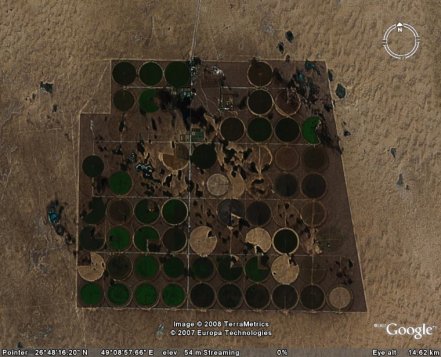
Saudi Arabian cultivated fields as visible using Google Earth. Each circle is an irrigated area of about 1 km diameter. The whole square is about 10 km side. The coordinates are 26°47'21.64"N, 49°10'41.43"E.
Look at these irrigated fields in Saudi Arabia, just an example of the cultivations that dot the desert. However, in a few years these fields may disappear. Peak water may have taken place in Saudi Arabia already more than 10 years ago.
According to recent news from Reuters (2008) the Saudi government has decided to stop all subsidies to agriculture. It means abandoning a policy that had obtained self sufficiency in food production and that had allowed Saudi Arabia to be a major food exporter in the past. According to Reuters, "The kingdom aims to rely entirely on imports by 2016". The desert is going to win back the land it had ceded to agriculture.
These news come as a surprise, but not so much. Saudi Arabian food production has been based on "fossil water." It is water from ancient aquifers that can't be replaced by natural processes in times of interest for human beings. Fossil water is non renewable, just as oil is, and it is unavoidable that it has to run out one day or another.
A wealth of data on the Saudi Arabian water situation can be found in the paper by Walid A. Abderrahman (2001) "Water Demand Management in Saudi Arabia". From this paper, we learn that water production in Saudi Arabia has reached a peak in the early 1990s, at more than 30 billion cubic meters per year, and declined afterwards. Today, it is at around 15 billion cubic meters, less than half than the peak value. We also learn that most of this water, 90% at the peak, came from non renewable aquifers.
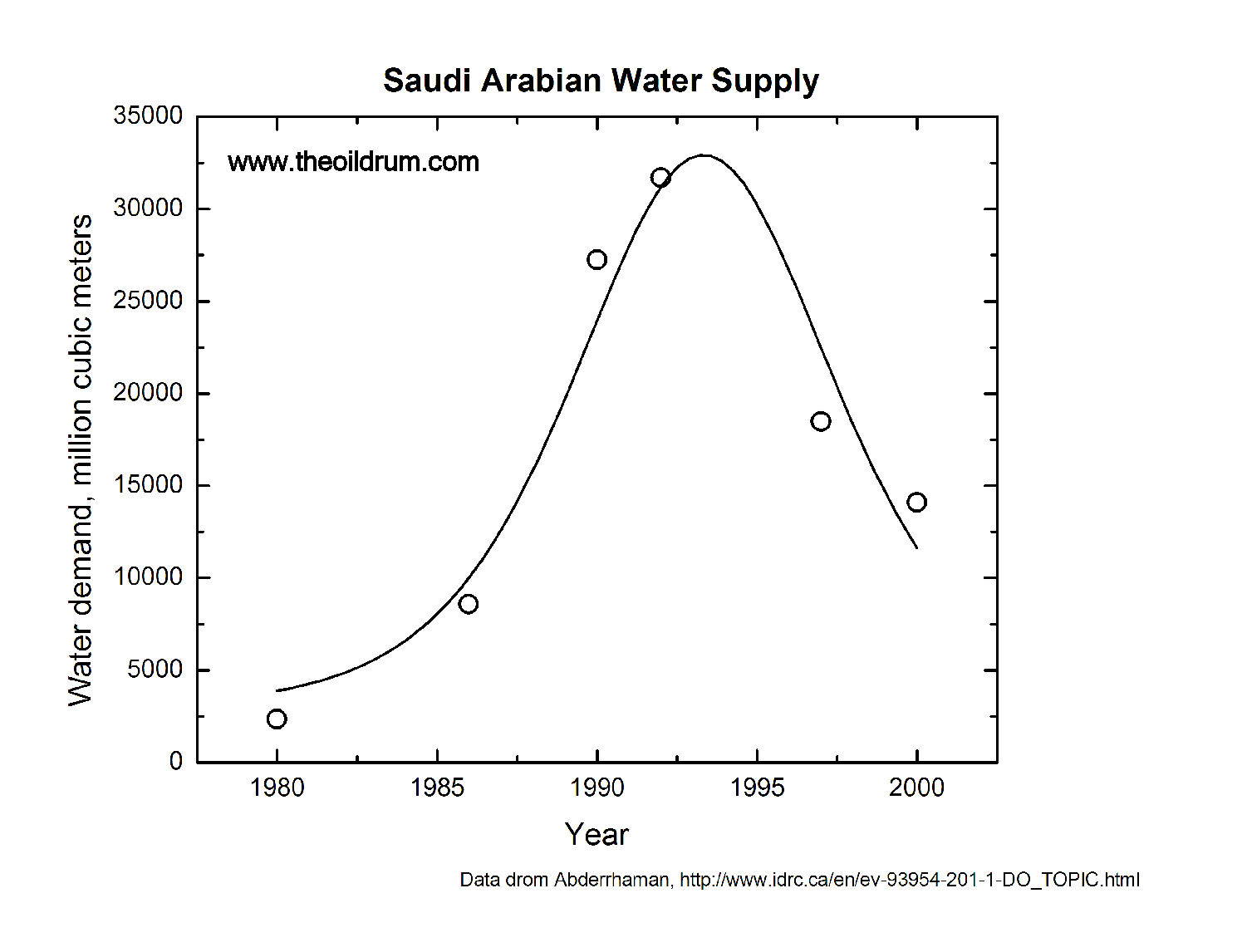
Source: Abderrahman 2001
The data reported by Abderrahman can be fitted reasonably well by means of a logistic curve. That indicates a "Hubbert" depletion mechanism, typical of non renewable resources. The Hubbert mechanism is confirmed by the data on the reserves. According to the "Encyclopedia of Earth" (2007) the total groundwater reserves of Saudi Arabia can be estimated as about 500 billion cubic meters, of which 340 billion are considered as recoverable. Indeed, the graph of water production can be extrapolated for a total production of ca. 350 billion cubic meters. That is, the peak has arrived at about midpoint, as expected for a Hubbert curve. The case of Saudi Arabian water production is another example of how general and widely occurring is the Hubbert curve.
Of course, we must also take into account government intervention. Surely, subsidies to agriculture have played a role in affecting water production. But there is no doubt that depletion of the Saudi aquifers is real. It would make no sense for a government to implement a policy that amounts to the destruction of the local agriculture if the aquifers were still able to produce has they had been producing so far.
It seems that the depletion of the aquifers has left Saudi Arabia with few options other than transforming oil into food. Selling oil and using the profits for importing food is the only possibility in the short term. In the future, however, it may be possible to replace aquifers with water from desalination.
Abderrhaman reports that 10 billion dollars spent on desalination plant have resulted in a production capacity of about 800 million cubic meters of water per year in 1998. Today, however, water produced from desalination in Saudi Arabia is reported to have reached 3 billion cubic meters per year and to be growing (ETAP 2006). That makes Saudi Arabia the largest producer of desalinated water in the world. It would not be impossible to step up production to a level that would boost agriculture and make Saudi Arabia again self-sufficient in terms of food production. It would mean to raise the output of a factor of five to remain at (or to return to) the present level (also assuming that population can be stabilized). The cost for the new desalination plants could be around 200 billion dollars, not impossible for a country that has a positive trade balance of more than 100 billion dollars per year (CIA 2008).
Of course, desalination has an energy cost. Modern desalination technologies are reported to produce water at a cost of some kWh per cubic meter (Clark 2007). 4 kWh/cubic meter is among the lowest values reported, but it is probably possible on large scale plants. In this hypothesis, we need 60 TWh for producing 15 billion cubic meters of water per year, the present production in Saudi Arabia. Considering that one barrel of oil can provide around 600 kWh of electric power, it means that about 100 million barrels of oil per year would be needed. Obviously, Saudi Arabia would rather use natural gas for powering desalination plants, but this calculation gives us an idea of the order of magnitude of the effort involved. That is not much for Saudi Arabia: only about 3% of the present oil production.
Unfortunately, oil and gas are non renewable resources and not even the rich reserves of Saudi Arabia can last forever. Even water produced by desalination should be considered "fossil" as long as it is produced using energy from fossil fuels. Much has been said about Saudi Arabia being close to peaking in oil production and gas cannot last much longer than oil. If that is what is going to happen, considering also that population has been growing at a 2% rate (CIA 2008), transforming oil and gas into a sufficient supply of food - either by desalination or by imports - may become problematic in a not too remote future. This problem is one of the reasons that is leading Saudi Arabia to consider nuclear energy. But that has obvious political problems and, in addition, would make Saudi Arabia completely dependent on imports of uranium.
Saudi Arabia is not an isolated case in Middle East and North Africa. Several countries in the region heavily depend on non renewable water from aquifers and on a contribution from desalination plants which, in turn, depend on non renewable resources. Libya, for instance, is at present working at a project named "The Great Man-made River" (Water-technology, 2008) which aims at extracting the resources of fossil water of the Sahara desert. From the data that appear over the internet, the Libyan resources may be much larger than the Arabian ones, but it is difficult to judge how reliable the estimates are. In any case, it is a characteristic of the Hubbert cycle that the start of the decline takes people by surprise.
So, the question of a sustainable supply of water from the arid countries of North Africa and Middle East cannot be ignored any longer. Indeed, the deserts of the region provide plenty of well sun irradiated areas that can be exploited for energy production that, in turn, can be used for the production of water.
Getting back to the case of Saudi Arabia; let's calculate what kind of effort in solar energy would be needed for the production of 15 billion cubic meters of water. A 1 kW rated power PV panel could produce 2000 kWh/year (and probably more) at the latitudes of Saudi Arabia and of the Sahara desert (Faiman et al. 2007). In order to produce 60 TWh/year, as calculated before, we need a rated power of 30 million kW, or 30 GW. The cost for this much power will depend on technological progress and scale factors. Taking 10 dollars/W, approximately the present value, we obtain a round number of 300 billion dollars of solar panels. This is just an order of magnitude calculation for the most expensive technology presently available. Obviously, the cost of PV panels could be much lower in the future. In addition, PV is not necessarily the best technology for desalinating water. Most likely, CSP (concentrated solar power) systems could be specifically designed for desalination and provide better performance and lower costs for this specific purpose (see, e.g TREC 2008).
Schemes that plan large scale solar plants in the desert are often considered remote from immediate needs. However, the water situation in North Africa and Middle East makes such plans the only realistic way to provide enough water for the long term survival of agriculture in the region. The idea can work, but only if implementation starts soon enough; before the decline of oil production makes the costs involved impossible to bear. That may be very difficult to achieve. As usual, the human tendency of discounting the remote future is our worst enemy (Hagens 2007)
Acknowledgment: Thanks to Debora Billi ("Our Lady of Petroleum") for having alerted me about the Reuters note in her blog petrolio
References
Abderrahman, W.A., (2001) "Water Demand Management in Saudi Arabia".
http://www.idrc.ca/en/ev-93954-201-1-DO_TOPIC.html
Central Intelligence Agency, 2008, "World Factbook" https://www.cia.gov/library/publications/the-world-factbook/geos/sa.html...
Clark, D. "Wind farms, the electricity grid and desalination in Australia" http://www.geocities.com/daveclarkecb/Australia/WindElecDesal.html
Encyclopedia od Earth (2007, accessed) http://www.eoearth.org/article/Water_profile_of_Saudi_Arabia
ETAP 2006, "Water Desalination Market Acceleration", http://ec.europa.eu/environment/etap/pdfs/watedesalination.pdf
Faiman D. Ravivb, D, Rosenstreich, R. 2007, "Using solar energy to arrest the increasing rate of fossil-fuel consumption: The southwestern states of the USA as case studies" Energy Policy Volume 35, Issue 1, Pages 567-576
Hagens, N., 2007 "Climate Change, Sabre Tooth Tigers and Devaluing the Future" The Oil Drum, http://www.theoildrum.com/node/2243
Reuters 2008: http://www.reuters.com/article/latestCrisis/idUSL08699206
TREC - Trans Mediterranean Renewable Energy Cooperation, 2008 (Accessed) http://www.desertec.org/index.html
Water-technology.net, 2008 (accessed) "GMR (Great Man-made River) Water Supply Project," http://www.water-technology.net/projects/gmr/
Personnel
Editors
Contributors
Peak Oil Primers
Archives
- November 2010 (3)
- October 2010 (6)
- September 2010 (4)
- August 2010 (7)
- July 2010 (6)
- June 2010 (7)
- May 2010 (2)
- April 2010 (8)
- March 2010 (4)
- February 2010 (6)
- January 2010 (3)
- December 2009 (5)
- November 2009 (8)
- October 2009 (12)
- September 2009 (6)
- August 2009 (5)
- July 2009 (11)
- June 2009 (8)
- May 2009 (16)
- April 2009 (10)
- March 2009 (7)
- February 2009 (10)
- January 2009 (15)
- December 2008 (9)
- November 2008 (9)
- October 2008 (9)
- September 2008 (13)
- August 2008 (10)
- July 2008 (14)
- June 2008 (23)
- May 2008 (16)
- April 2008 (12)
- March 2008 (16)
- February 2008 (9)
- January 2008 (13)
- December 2007 (13)
- November 2007 (16)
- October 2007 (22)
- September 2007 (8)
- August 2007 (9)
- July 2007 (16)
- June 2007 (8)
- May 2007 (7)
- April 2007 (7)
- March 2007 (10)
- February 2007 (10)
- January 2007 (12)
- December 2006 (9)
- November 2006 (15)
- October 2006 (4)
- September 2006 (5)
- August 2006 (5)
- July 2006 (9)
- June 2006 (5)
- May 2006 (10)
- April 2006 (9)
- March 2006 (13)
Vital Trivia
License

This work is licensed under a Creative Commons Attribution-Share Alike 3.0 United States License.
Hi Ugo,
Thanks for a great post. Any sense of how many acres of solar cells would be needed to desalinate the water to irrigate an acre of farm-land?
Dave
Well, I didn't make a calculation. But I have in mind that just the "empty quarter," Ar Rub al Khali, in the South West would be enough in terms of area to produce as much energy by PV panels as the whole world primary supply. The calculation is here, unfortunately I think it is accessible only if you have a subscription - plenty of space, anyway, for enough energy for solar desalination:
T. Muneer, M. Asif and J. Kubie
Generation and transmission prospects for solar electricity: UK and global markets.
Energy Conversion and Management
Volume 44, Issue 1, January 2003, Pages 35-52
Energy inputs to desal are not clear cut because there are issues like the salinity of input water, the distance input water needs to be pumped and hypersaline output water needs to be removed. In desert areas solar or waste heat (eg nuke) can be used to pre-warm evaporation cells and costs can be recovered from salt harvesting. For nondesert areas windpower can supply electricity to drive pumps required for higher capital cost reverse osmosis. These have to be weighed up against costs of the alternative to desal of partial sewage treatment to irrigation standards. Water charges seem to be around 50c to $1 per kilolitre but even that could be artificially low. Affordable for making tea but very expensive for farming.
Water price via the groundwater-reverse osmosis route in this desert area range from 90c to $A5.10 per 1000 litres.
http://www.cooberpedy.sa.gov.au/site/page.cfm?u=115
They don't have cheap NG in this particular spot. Maybe somebody grows some $10 apiece fresh tomatoes using this water but all other food appears to be brought in long distance.
Ugo
So, the question of a sustainable supply of water from the arid countries of North Africa and Middle East cannot be ignored any longer. Indeed, the deserts of the region provide plenty of well sun irradiated areas that can be exploited for energy production that, in turn, can be used for the production of water.
Fantastic post. Bring a WHOLE other dimension into view.
We are sooooo scroomed.
Hi all, lurker for a while. I'm a chemical engineer for the pulp and paper industry in the U.S.
I don't no why you'd ever use photovaltaic for this application. Where you only have a 14-30% electrical generating efficiency.
I rather use solar thermal multi effect evaporation. A 7 effect multi effect evaporator gets about 5.6 steam economy meaning, you can evaporate 5.6 lbs of water for every lb steam you generate. Further you'd only need low pressure steam generated. Low temperature steam say 5-6 bar is sufficient for multi effect evaporation. Since we are not trying to generate electricity high temperatures 400-600 C are not needed for high generating efficiency and thus this simplifies the solar thermal plant.
Water is solely a capital cost problem in Saudi Arabia. They have plenty of sun and access to sea water. And with current oil prices they have plenty of money. Further the intermittance of the solar is not a problem. This is not an electrical storing problem as it is for other solar thermal generating schemes. This is a water storing problem. Just desalinate large amounts of water during daylight hours and store during nighttime. Or if you want better return on investment on you ME evaporation plant use solar thermal steam generation during the daytime and then switch fossil at night.
I am NOT an engineer, but I'd like to see why this wouldn't be superior to photovoltaic. Each conversion of energy loses a lot. And couldn't the materials cost of this be a lot lower too?
Just price out a sq. meter or solar cells ($1000) and a sq. meter of mirror ($5), then factor in the 4 to 1 efficiency (20% vs 90%) advantage of mirrors, add the simplicity advantage of evaporation over reverse osmosis, it is hard to see what could overcome this 1000 to 1 cost advantage.
Hi Veramcor,
Thanks for your comment. Please let me rephrase the question. Anyone have any sense of how many acres of solar thermal would be needed to desalinate water to irrigate an acre of farm land?
Thanks,
Dave
Yes, of course. The calculation for PV that I made is only in order to get a feeling of the order of magnitude involved in the worst case hypothesis. Systems based on solar heat would be more efficient and less expensive. A very promising area.
Indeed solar thermal desalination has already been used in Saudi Arabia to desalinate water;
http://www.un.int/saudiarabia/solar3
And here is one system in use in Jeddah, Saudi Arabia.
http://www.dwc-water.com/technologien/thermische-entsalzung/index.html
Intuitively, I tend to agree with you re solar evaporators versus PV-powered reverse osmosis. However, I think one really needs to compare the overall energy consumption of the entire desalination system. While a PV collector collects less energy per unit area of colletor than a mirror-type thermal system, one has to look at the total amount of energy consumed per unit volume of desalinated water produced.
Part of that evaluation would be comparing the energy efficiency of reverse osmosis versus multi-effect evaporation. I think RO generally comes out ahead in such a one-to-one comparision, particularly if you're not dealing with full-strength sea water. But that must be weighed against the lower collector efficiency of the PV collector in comparison to the mirror thermal system. Then we need to consider the heat losses of the evaporator system.
Taking all these factors into consideration, I'm not so sure it's as clear-cut as you might think.
The good news: They plan to keep exporting oil so they can eat.
What has happened to these poor folks? They have traded their most valuable resources for paper.
I too weep for the poor Saudis and their awful predicament :) lol
We oftern think that it is the developed world which will suffer the greatest calamities of peak oil but this article points out the great weakness of the Arabs which is their utter dependence on imported food.
Saudi Arabia will neeed to be nice to the food producing nations of the world if it wishes to eat.
In that vein I propose that the Oragnisation of Wheat Exporting Nations (OWEN) be convened forthwith to regulate the wheat export trade and regularise prices. I wonder what they'd think of that!
It's a two way street. How do you think you're going to fuel the farm machinery that makes all that wheat??
Well, if we were really serious about it, we could probably electrify agriculture pretty quickly, a lot easier than doing the whole transport network. Not so sure about the food distribution network obviously.
Richard C
Already been done.
Informally called the Seven Sisters' of Grain.
Food and grain cartels.
The international grain market lies under the control of politically connected cartels, some of which have been indicted in racketeering and market fixing practices.
Companies like:
Archer Daniel Midland, Continental, Cargill, Bunge and Louis Dreyfuss
(Add Con Agra)
represent a grain oligarchy, controlling over 90% of the worlds grain trade. They have no national interests; their primary concern is profit for their private shareholders, unaccountable to anybody but themselves. These mega-merchants have cornered the market for the worlds food, we are at their mercy.
Exporting grain is exporting water.
See Australia for details. 12.7 million tons this year. On top of
9.6 last, means Australia's a net importer.
Insightful post.
...and topsoil and fertilizer.
and here in the us of a, we have so much food production capacity that we can trade food for ethanol. ................er, at least some are claiming................(that would be the politicians).
I think some of the figures may be overstated, but they are still in the ball park. I lived on a yacht for 2 years and designed, installed and maintained our on board desalinator. Now I work for Degremont - Suez, probably the leading Reverse Osmosis (RO) technology company in the world today.
On my yacht the desalinator produced 60 litres fresh water per hour from 10 Amps running at 24V. This is equivalent to 4 KwH per cubic metre. It is also small and very inefficient. The system pumped about 10 litres of sea water per minute with a 10% recovery.
By contrast our best practice RO plants (above 100k cubic metres per day) utilize "energy recovery" technology and are producing water at approximately 1KwH per cubic metre. These are multistage RO plants with recovery at about 50%. Power consumption is also improving, although a minimum will be reached.
Much of the Saudi desalination is done using using thermal technology and the waste heat from electricity generation. Degremont does not use this technology so I cannot comment on the metrics and what the true split is between power and water generation.
Hi Saildog,
That answers my question. The Nevada Solar One solar thermal plant does 100kWh/m^2 per year.
http://www.renewableenergyaccess.com/rea/news/story?id=43336
This gives us 100m^3 of desalinated water per year. Would this give us 100m^2 of irrigated land?
Dave
Hmm a metre per year or under 3mm per day. No commercial crop can get by on that little amount, based on 'grass equivalents'
http://www.fao.org/docrep/S2022E/s2022e02.htm
I think solar power would be a very good option of KSA. They have a ridiculous amount of empty, sun-baked land that would have tremendous potential. To extrapolate, I think the entire N.Africa/ME region can transition from being the world's provider of oil to the world's provider of solar energy. This excess electricity can be exported to Europe and Asia via transmission lines. In the process, this would free up natural gas currently used for power generation.
In your picture, there appear to be around 50 of these circles.
About a year ago, I was looking at google earth at Saudi Arabia and these are scattered around several different places.
From the areas I was scanning, there were in the range of several hundred of them, stretched out over a long narrow area.
It looked like they were built along a major river, although it might be an underground aquifer that you describe.
I suspected some type of agriculture, but could not tell for sure.
What really baffles me is - why are all of these in almost perfect circles and do not use the whole square ??
.
DocScience
http://www.angelfire.com/in/Gilbert1/tt.html
doc,
I imagine they are in perfect circles as it is easier to irrigate. You just need a rotating arm fixed at the centre. As KSA has no vast amounts of empty land they aren't losing anything by missing out the bits inbetween the circles.
Center pivot irrigation. KSA is swarming with these, as I found out when looking for oil infrastructure on Google Maps.
Not only the KSA.
I saw lots of those on a flight from New Jersey to Florida 10 years ago.
I think this is a fantastic post and very well thought out. If Saudi put in the investment, it could become the solar power hot-bed for the 21rst century. It has huge solar resources both for PV and CSP/Thermal. You can also store CSP using heat storage in molten salt chambers.
Is the following sentence from this article really a sentence?
These news come as a surprise, but not so much.
It's hard to make out what that means exactly, but the greater point is; I thought all the concern was about peak oil in Saudia Arabia, not water. The land cannot maintain their population of 120 million people after the influx of money from the oil depletes, so peak water will probably only play a secondary role in that country's demise.
Well, I was surprised when I read in the news that the Saudi Arabian government was going to kill their own national agriculture. Then I thought it over and I realized that it mut have been because they were running out of fossil water. Then I went to check the numbers and I found that it was really the case. Surprising, but not so much!
I am not just surprised but shocked. Shocked that the Saudi wheat program has continued for this many years. The program should have been stillborn.
Ron Patterson
Pot calling the kettle black, it seems to me. USA produces a lot of wheat and corn by mining topsoil and "fossil" water.
And rice. Soon to be, not so much.
Arkansas just forced Int'l Paper to take AR River instead of the Sparta Aquifer.
The Ivory Billed Woodpecker just stopped the Grand Prairie Irrigation
Project to get White River to the rice fields. Instead of the Sparta, which is
dropping rapidly.
And add Riceland Foods to that list up there on Merchants of Grain.
Yes, the cost to the environment is severe. If we are going to consider the cost to the environment then everything would be sky high. Look at the cost of coal fired power plants in the form of deaths from radium, mercury and other pollutants dumped into the atmosphere. And that is not to mention the damage done by acid rain caused by the sulfur dioxide dumped into the atmosphere. Production of food to feed 6.5 billion people is costing, in environmental cost, many, many times what the actual value of the food is. So Never, don't try to compare apples and oranges here.
If we considered the environmental costs then the cost of coal power would be way in excess of a dollar a kilowatt hour. But we are not discussing the cost to the environment here we are talking about actual dollar cost! They were spending a fortune to grow wheat when they could simply have bought the same wheat on the open market for one eighth of what it cost them to grow it. Stupid, just plain stupid!
One more point. Only 15 percent of US farm production comes from irrigated land and only a small percentage of that is from nonrenewable fossil water. Virtually all of Saudi's wheat crop was from fossil water. Most of the irrigation in the US is from renewable wells, ponds, streams and lakes.
Ron Patterson
But that 15% accounts for:
"Agriculture is a major user of ground and surface water in the United States, accounting for 80 percent of the Nation's consumptive water use and over 90 percent in many Western States.
Irrigation, Water Conservation, and Farm Size in the Western United States—While just 16 percent of all harvested cropland in the U.S. is irrigated, this acreage generates nearly half the value of all crops sold. "
And I can tell you right now that no irrigation means no rice in
the US.
Mcgowanmc, you and Never simply miss the entire point. The point is that it is absolutely crazy to grow wheat at eight times the price which you could buy it on the open market. They grew wheat just so they could say they were self sufficient in wheat, though they could bought it for one eighth the price that it cost them to grow it. That makes no sense even to a crazy man!
And to say we are doing the same thing is just not so. Sure, if you count the environmental cost, everyone on earth who engages in agriculture is going in the hole.
Ron Patterson
Yes. The Saudis are crazy. I agree.
It's what happens when you get handed the fortune of Midas.
Always and everytime.
Power corrupts and... ;}
"And to say we are doing the same thing is just not so."
That we're not crushing our ecology as fast as the Saudi's
are crushing there's?
Redwoods for toilet paper?
Topsoil flushed to the Dead Sea of the MS River mouth?
The Great Lakes flushed to the sea?
We can debate.
I believe that a better solution would be a combination of hydroponics in greenhouses and solar CSP, wind and PV to power desalination plants.
In hydroponics, water consumption is one fifth to one tenth of conventional irrigated agriculture, and especialy in SA where evaporation is extremely high, gains would be even better - essentialy the only water that gets consumed is about 50% of total plant + produce mass.
I think this site Sea Water Greenhouse explains a far more efficient way of doing things than the brute-force engineering approach to the problem. This is more of a systems approach and has been implemented in Tenerife (Spain), Abu Dhabi (UAE) and Oman on a small scale.
The UAE and Oman are neighbours to Saudi Arabia that also have access to the sea.
Frankly, the whole idea of using solar cells to generate electricity to compress salt-water in order to get sweet water for agriculture is a non-starter - I think the author of the article is just trying to provoke a reaction there.
Plus, "and before the decline of oil production limits the availability of fuels needed to implement these large scale projects."
Thanks for this post. This is another example that we can straight away deduct x million barrels of Saudi and other ME countries' oil production from what will be available on the world market. Westexas should take note and adjust his local consumption growth rates upwards accordingly.
http://www.global-greenhouse-warming.com/solar-desalination.html
All these construction projects require diesel and other forms of energy which we are now gobbling up for mere consumption. We need to set aside oil and gas fields as energy input for these particular project purposes.
Actually, I found quite an interesting article about Saudi investment in various forms of solar energy. It looks like it appeared in the "Saudi Aramco World" online magazine.
It contained the following thought-provoking sentence:
How many other governments are making investments "while there is still time"?
I was wondering about the quoted reserves of 113.5 billion barrels, until I noticed the date--1981.
This might be a stupid question, but why not use solar energy directly to evaporate/condense fresh water from sea water? If they started a slow program to steadily build greenhouse-like structures they could have quite a capacity in a few years.
Yes?.. No?...
It is not a stupid question. The technology exists and the apparatus is called "solar still". The problem is that it is not very efficient. It is supposed to be a low cost option for small scale applications. For the billions of cubic meters that Saudi Arabia needs, I think reverse osmosis or flash evaporation are the only conceivable options
I agree that it's probably not efficient on a quantity/time scale, but the sun shines for free every day. So, if you started building resonably large ones (or more of the smaller ones) - with underground condenser coils - on a steady schedule, by the time the oil exports stopped you (or most probably the next generation) would still be able to have enough water to drink and grow food.
Agreed: efficiency probably isn't the most important point for a solar still. If you're providing water to a city, you'll need a concentrated source, but the same is not necessarily true for ag. Why not exploit the inherently decentralized nature of farming, and use simple, low-tech plastic-sheeting-over-ponds solar stills to supply the irrigation locally? Lower tech solutions don't need highly trained workers to maintain.
In the 80s there was a plan to tow in icebergs to KSA. If my memory serves me right, the projected cost of towing the ice over a 25-year period was a lot lower than the building and maintenance cost of the [then] state-of-the-art desalination plant producing similar volumes of potable water. For some unknown reason(s), however, the project was iced before it even had a chance to start.
A draft study back in the early 80's calculated that 1 billion tons of ice per year would have to be started from Antarctic waters towards the Saudi coast to supply the non-agricultural, non-industrial fresh water needs for Saudi Arabia (at that time). It was assumed that 80 to 85 percent of the ice would be lost during the process of transporting and harvesting the ice due ot evaporation and melting.
Trips would take months and icebergs that were too small would not survive it. Can't recall the minimum size, but would guess it would at least 5 million tons (thinking 20 million tons). Very difficult for even several very large ocean going tugs to do more than minimally guide, that large of a load once it was moving, at least in less than a day or two. Even more difficult in cross currents and in storms.
During the tow bergs would fracture and pieces would break off from them or the entire berg would break up into multiple pieces. Keeping those pieces corralled during a storm would be challenging, especially during storms. Escaped pieces of the berg could be dangerous to the tugs and, if they got away from the tugs, to other shipping.
The conclusion was that it was too expensive and not viable at that time.
In 2002 or 2003 the Aussies looked into the same kind of idea but decided it was too expensive. I believe they assumed 70 to 80 percent loss during towing and harvesting.
For now, desalinization would seem to be cheaper and easier.
Oilearner
I'd like to verify your information and double check the actual figures and cost analysis. Can you point me to your sources of the two studies?
Thanks.
Since the early 80's work was a draft research proposal that died for lack of interest so there is no residual documentation. I dug around in some old boxes last night and found the old notebook where I had made a few notes and comments.
The numbers I wrote above from memory turn out to be basically those from a "pessimistic" scenario" that assumed a smallish iceberg of a million tons or so with no protective wrap around it to help insulate the berg from warmer air and water and thus slow the evaporation and melting. The optimistic scenario, based on wrapping a larger berg (over 10 million tons) to insulate it estimated evaporation and melt losses of 10 to 30 percent.
The group that did the draft wanted to get funding for some hands on research, including actually towing a small berg for some distance, measuring melt and evaporation and how they were affected by air and water flow over and around the berg, tracking specific bergs as they moved north of the Antarctic sea ice zone into areas where they seem to be prone to quick break ups, etc. They also questioned the feasibility of wrapping a large berg to capture the meltwater, including the durability of various wrapping materials.
In addition to the assumptions about melt rates, another key assumption involved the stability of large tabular Antarctic icebergs. It was believed that such bergs would be more stable than Arctic bergs (and thus easier to tow) and would generally remain intact, melting away from the outside. However, since then research has shown them to be less stable than thought and that melting can take place in the interior as well as on the exterior. As a result, the bergs can break up rather quickly, with seemingly little advance warning.
A 1977 study paid for by then-Crown Pince Faisal envisioned a 100 million tone iceberg with protective wrap and a bag to capture some or most of the meltwater. The estimated a loss of 15 to 20 percent, I believe, during an eight month trip. They also envisioned fleet of very large ocean going tugs to do the job. At the time the Crown Prince seemed sure that they would do a demonstration within three years or so. Nothing much further was heard about it after initial number crunching suggested the costs would run $60 million or more.
You can find information about the 1977 Saudi proposal and the Australian proposal on the Web.
Is there a reliable source of information on the Aussie study in 2002 or 2003?
Oilearner
Here's a quote from an article I just stumbled on:
http://english.pravda.ru/science/earth/28-01-2008/103693-water_crisis-0
"Got any spare water?" [caption is mine.]
Their photo was irresistible!
Interesting. I had not seen that article before.
Regarding the Aussie government report, it was actually the South Australian government. Link to report can be found here.
Also found a 2001 paper published in Australia that discussed the idea and came to the conclusion that it would happen, at least for Australia, but probably not for some number of years. In this paper the author proposes using icebergs in the 300,000 to 1,000,000 ton range, wrapped to reduce melt, capture what melt occurs and to reduce drag why under tow.
The second paper also has a number of reference citations that could be of interest. I haven't checked them out yet, perhaps will get the time in the next couple of weeks. It has been years since I was involved with scientists considering this issue. Nice to know others have continued to look into it.
It’s good that we’re all updated on this. The “alternative” approach, wrapping icebergs to prevent melt loss, seems to be the only viable approach, for now at least. I received samples of the reinforced plastic film for an entirely different application some years ago and was v. impressed with its properties.
The concept, as the second paper also suggests, is pretty simple, and as the techniques for handling the bergs mature, the cost of water delivered this way would be reduced dramatically.
The main issue then would be that of the environmental impact. What are the true long term costs and consequences of towing ice (inexpensive in $ terms) to various destinations compared with building and maintaining massive desalination plants (expensive in $ terms) at each of those destinations?
Ps.
More customers lining up to get their berg-bags!
Scientists see looming water crisis in western U.S.
http://www.reuters.com/article/environmentNews/idUSN3132180520080131
This might be an even more stupid question:
Surely the residue salts or brine liquor contains Uranium?
"KSA Plan B":
1. With all the oil revenue invest in a large scale role out of advanced Thin Film PV manufacturing capability. $2/Watt costs would see the above mentioned Wattage for $60 Billion -pocket money...
2. Use 1/4 to power desalanation, 1/4 to beef up the grid and the rest can be exported.
3. Deploy PV arrays over dessert areas -unlike the nuke option these represent a low threat from terrorism, worst case the terrorist blow up a couple of square kilometres before being gunned down by the overhead AC130...
4. Aquaponics setup (fish and Hydroponics): ultra low water usage and good source of locally produced protein and fresh veg. KSA could even become a NET exporter to the region. The Nile Tilapia as its name suggests comes from just over the road so to speak.
Main Advantages:
1. Frees up oil and gas for Export at increasingly outrages prices
2. KSA has a key industry for the new world order and could become a leader in the Permaculture field
3. Enables sustainainable economic and population growth
4. Limits threat from terrorism
5. Decreases ELM effects -enables KSA to subsidize Hybrid/Electric transport policy@Home once its clear the world has a problem...
Given a fair wind and no key resource constraints the world could roll out 20TW of PV capability in 10 years if each of the top 50 countries invested in 100 TF PV plants each.
Regards, Nick.
During the 1960s in the US there was a tremendous amount of government-sponsored research being done on desalination, no doubt based on the presumption that there would always be cheap and abundant energy. At the time, LBJ had visions of turning the deserts of the Southwest into prime agricultural land.
One scheme that garnered a great deal of interest at the time was the concept of nuclear-powered desalination plants that both generated electricity and supplied heat for huge multi-effect evaporators. Needless to say, this concept never got off the ground, but I wonder whether nuclear-powered desalination wouldn't make sense for Saudi Arabia or the Middle East in general. While the US in particular would have concerns over nuclear proliferation, the bottom line is that every fossil fuel BTU that isn't spent on desalination is a fossil fuel BTU potentially available for export.
Some form of solar stills are probably the way to go. That and using plants that require little water.
This stirred the memory. Back in the 1970s the Israelies turned parts of the (?)Negev(?) (?spelling?) Desert into farmland through conservation, drip irrigation, mulch, permaculture, and contouring so that rain water would run into storage basins and planted areas.
I haven't heard anything on it since about 1980.
People in the west today are uneasy about Nukes and the middle east - what ever the configuration.
dupe
Please tell me where I can buy 1000 watts of power generating solar cells for $10. Last I heard the cost of silicon cells was $4 PER WATT and nanosolar is talking about $1 per watt for their thin film stuff.
That $300 billion becomes $30 trillion assuming the best case estimate of $100/KW (nanosolar).
Actually I think that calculation is wrong too.
So starting again for 30GW of capacity, even at $1 per watt, it is only $30 billion dollars and at a more realistic $4/watt it is still cheap at $120 billion
What's the price pre Kw of thermal solar?, this seems from what i've heard a much better way to go the PV cells.
Oops.... sorry. It seems that there was a misprint. It should obviously be 10 dollars per watt!! (not for kW) of rated power.
Apart from the misprint, however, the calculation is right. I calculated that we need 30 million kW of rated power. If that is correct, it means 30 x10^6 kW, or 30*10^9 W. At 10 dollars/watt, that makes 300 billion (not 300 trillion) dollars.
It figures. Consider that the cost powering California using PV only has been calculated as around 1 trillion dollars at 10 dollars/watt (http://www.ecoworld.com/home/articles2.cfm?tid=355). And that is for the whole needs of power-hungry California! For water desalination in Saudi Arabia, 300 billion dollars make sense; 300 trillion dollars would be way too much.
Actually, I think I was pessimistic in calculating the cost of solar panels. I had in mind what I paid for the PV panels I have on my roof, but on the scale we are discussing, PV would cost much less.
You'll only get 5-6 hours of full sun per day in California. Not 8 as assumed by your link. That's going to increase the cost of PV by 50%.
Robert a Tucson
Thanks for the post.
This is about a group of scientists who wanted to work on desalinization in the 70s-they have now turned to using salty water to grow plants that animals will eat. Projects in east Africa and Sonora Mexico. They have interesting system of fish farming as well as goat and camel foods that provide meat and milk...They looked for and developed plants that can grow in salty soils.
The Seawater Foundation
Dedicated to greening the desert coastlines of the world to generate wealth in poverty stricken areas, eliminate famine, and improve the global environment ...
www.seawaterfoundation.org
Other comment is about nuclear in Saudi Arabia-How can they cool plants? I see that US southern plants will face water shortages. I recall last summers closing of one TVA plant as the, I think Tenn. River, was 94 degrees and too hot to cool anything...
I note that all comments gravitate to the energy and production side of the desalination process - understandably, but I remember reading that for all beneficial processes there is often an unintended downside.
As a result of the water with increased salinity being returned to the sea they are starting to find that the raised salt content and in some cases the warmer temperatures is having a detrimental effect on sea life, which exists within fairly narrow salinity ranges.
http://www.xpress4me.com/news/uae/dubai/20003208.html
" At a lecture given to the Dubai Natural History Group, Burt explained that while the remaining reefs in the Gulf survive under extreme conditions, the sea is just getting warmer and saltier -– with high amounts of chlorine -- due to increased rate of desalination.
Dozens of big desalination that dot the Gulf pump millions of gallons of warm seawater with higher and higher amounts of salt content back to the sea daily.
“Salinity here can reach 50 points per thousand (35 ppt is typical), which can be fatal to coral. In addition, water temperature in this area can range by 25 degrees Celsius. "
Increased salinity from the concentrated brine being discharged from desalination plants can certainly cause problems, but mostly of a localized nature.
But keep in mind that a desalination plant operating of Persian Gulf water and discharging the concentrate back into the Gulf does not really add any net salt to the Persian Gulf, as it is just putting back the salts that it took out. Of course, the desalinated water has left the Gulf, but much of it will probably be returned in the form of sewage and other wastewater discharges.
The localized salinity problem can be mitigated (at least somewhat) by mixing the concentrate with several volumes of fresh sea water and then making sure that the mixture is discharged over a wide area so as to reduce localized salinity 'hot spots'.
To be sure, localized high salinity is a problem, but not an insurmountable one.
I am really interested in this topic. I searched for this location at the given coordinates on Google maps (26 degs 51' N and 49 degs 41' E) and was unable to find this square.
Please look at my link to this above coordinate to see what I mean.
I use Google maps internal Javascript to extract the coordinates of any point in my tool IslandMap.co.uk
Look here:
http://maps.google.com/maps?t=h&hl=en&ie=UTF8&ll=26.808467,49.148681&spn...
There are a number of cluster of irrigation circles around KSA, including this one south of Riyadh:
http://maps.google.com/maps?t=h&hl=en&ie=UTF8&ll=24.075282,47.138097&spn...
and this one south of the Ghawar field:
http://maps.google.com/maps?t=h&hl=en&ie=UTF8&ll=23.776115,49.14964&spn=...
Thank you. That is most helpful.
I placed more exact coordinates on the post, sorry, the ones that I wrote initially were approximate. Anyway, the big square that I have shown is about 30 miles SW of Jubayl. It is easy to see plenty of irrigated fields around Riad.
Here's the same kind of thing in Montana, USA.
http://maps.google.com/?ie=UTF8&ll=45.209617,-108.709373&spn=0.102072,0....
I saw them on a flight from newark to SF a few years back, and though 'gaaad, its like the surface of Mars, or something'..
jm
I remember watching a documentary about the GMMR project a few years ago and if memory serves me it was said that the water was supposed to last about 30 years (don't know anymore if this was the supposedly overstatet official number or the more realistic one).
Apparently they collect the water in vast open pools leading to huge losses due to evaporation.
And further it seems that the depletion of the water reservoir is already causing a water level decline in oases and wells throughout the desert.
Overall the documentary gave the impression that the whole project was overly expensive, heavily fraught with problems and had a lot to do with prestige.
So in the end, I dare to say, they'll likely be worse off than before.
Just a question for our "interesting times".
What happens if terrorists who want to attack the present government of SA take out the desalinazation plants? How well protected are these plants compared to the protection afforded to the oil fields/processing facilities?
Thank you for your fascinating and well-researched paper! It shows how few options there really are for any of us, besides finding our way out of dependence on fossil fuels and fossil water!
Thanks for the interesting post. What I found astonishing is that according to the Renewable Fuels Association website in 2004 they were the worlds 9th largest ethanol producer . In 2006 they still were producing more ethanol than Australia. Presumably they have been using some of that precious fossil water to make fuel!
Interesting stuff. Just wondering whether anyone has considered less 'technical' solutions. For example, if they have access to large amounts of sea water then why not develop crops that tolerate it rather than expending so much effort in desalinisation? There must be all sorts of seaweeds etc. that could be farmed either for human consumption or as animal feed. Are there any plants that can grow in sea water and then be processed to extract fresh water?
[Edit] Just found this link: Saline Agriculture so it's not such a mad idea
Seaweed:
http://en.wikipedia.org/wiki/Seaweed_fertiliser
The wretched life of a Crofter:
http://books.google.com/books?id=YOlafx9QE4sC&pg=PA16&lpg=PA16&dq=seawee...
Seaweed as food:
http://www.seaweed.ie/uses_Ireland/IrishSeaweedFood.html
Note: All refer to coldwater activities. When diving in the Gulf of Suez, did not notice much Seaweed. Lots of nice corals though. So I am not sure if the Persian Gulf will yield much food.
I haven't any reference to hand but isn't there a problem with the plastic greenhouses of Almeria Andalucia ? The underground aquifer that is tapped to irrigate them has a finite life.
Apparently the twin problems in that region and Israel are labour and water and becoming the two major problems.
Good article ... one odd item to add , Mr Maktoum has plane loads of growing grass flown in from the UK to Dubai everyday to feed his racehorses.