


Science 1101 - Petroleum and Peak Oil - Old Version
Posted by Gail the Actuary on January 29, 2008 - 11:00am
Please Note: Based on feedback from readers, a revised version of this post has been prepared in two separate posts. See Part 1 and Part 2.
A university near where I live plans to add a short unit on "Petroleum and Peak Oil" to their Science 1101 course for freshman who are not science majors. They asked me to put together material for the unit - reading material, PowerPoint presentations, links to additional material, discussion questions, and suggested test questions. At this point, I am in the process of finalizing what will go into the reading material. I sent my contact a first draft, and he asked that I add sections on a number of other topics as well. This is my second draft, which includes the additional sections requested. I have not yet turned it in.
The focus is to a significant extent their choice. They wanted background information on a variety of petroleum-related topics, and not too much focus on precisely when peak oil would occur, or what dire results might happen. They recognize that corn ethanol is a very bad idea. The audience is expected to be 19 to 23 year olds, so the material needs to be suitable for this age group.
The university wants me to develop material others can use as well, so is willing to let me share what I develop with others. Thus, I don't see any problem with sharing this draft here. At this point, I can still make changes.
I would appreciate any input or comments TOD folks might have.
1. What is petroleum?
Petroleum (also called oil) is a viscous liquid that is found beneath the earth’s surface. It is not found in large pools. Instead, it is generally trapped in the pores of sandstone or other porous rocks. It is often found with natural gas, which is formed under similar conditions.
Petroleum is not a single compound. Instead, it consists of a mixture of hydrocarbon chains of different lengths, ranging from about C5H12 to C42H86. When petroleum is burned, the hydrocarbon chains plus oxygen are transformed into CO2 (carbon dioxide) and H2O (water), and energy is released. Carbon dioxide is one of the major gasses implicated in global warming.
2. What are the environmental impacts of petroleum?
One of the major impacts is its contribution to global warming. When petroleum is burned, carbon dioxide is formed.
If oil is compared to coal and to natural gas in terms of the amount of carbon dioxide produced per unit of energy, oil is in the middle. Oil produces 20% less carbon dioxide per unit of energy than coal. It produces 40% more carbon per unit of energy than natural gas. The problem is that we in the United States use nearly twice as much petroleum as coal. When the quantity of petroleum burned is considered, more carbon dioxide is produced from burning petroleum than coal.
Another environmental impact of petroleum is smog and other forms of air pollution. When petroleum products are burned as fuels, various chemicals are released from tailpipes. When these chemicals interact with sunlight, smog and various carcinogens are produced.
In some cases, local environmental damage can also be a problem. For example, development of the oil sands in Canada has had a very negative environmental impact. The extraction process requires a very large amount of fresh water. After the water is used, the polluted water is left in large lakes. http://www.commondreams.org/archive/2008/01/10/6304/
3. How was petroleum formed?
Petroleum was formed millions of years ago from the remains of small plants and animals that lived in seas or lakes. These plants and animals died and fell to the bottom of the sea. Gradually, layers of silt and sediment covered their remains, causing great heat and pressure to build up.
Under this heat and pressure, a chemical reaction took place, transforming the hydrogen and carbon from the decaying plants and animals into the mixture of hydrocarbons that we know as petroleum.
4. Is new petroleum now being formed?
Not in any measurable quantity. Once we use up the petroleum that was formed millions of years ago, it will be gone for good.
5. How is petroleum extracted from the ground?
Petroleum is generally extracted from the ground by drilling oil wells in areas where there is some reason to believe oil might be located. When oil is first found, it often comes from the ground very quickly, under great pressure. Gradually, the oil comes out more and more slowly. This happens partly because the oil pressure drops, and partly because the oil that is extracted from the ground tends to mixed with more and more water, as more oil is removed from the ground. Many US oil wells produce more than 99% water!
In some places, such as the Canadian oil sands, a very viscous form of oil is found. This is mined, rather than extracted using oil wells. Production of such oil tends to be very slow and expensive.
6. Is all of the oil in a given area removed by the use of oil wells?
No. As noted in Item 1, oil is not found in pools in the ground; instead it is trapped in the pores of porous rock such as sandstone or limestone. The rock is somewhat like a hard sponge, with the oil trapped inside. If only the oil that naturally seeps out is collected, only a small portion, typically 10% to 30% of the oil originally in place, can be extracted.
Various methods of enhanced oil recovery are used to increase the percentage of oil that can be removed. In some cases, water injection is used to increase the percentage of oil recovered. Carbon dioxide or some other gas may be injected, to force some of the trapped oil out. In one newer process, microbes are used to break up the oil droplets into smaller pieces, so that they can more easily be removed. Even with these additional processes, 50% or more of the oil originally in place cannot be extracted by current methods.
(Water injection: http://en.wikipedia.org/wiki/Water_injection_(oil_production) )
(Titan Microbal Method http://www.titanoilrecovery.com/ )
7. Can an oil company produce a constant amount of oil in a given location?
No, it generally doesn’t work this way. When a single oil well is drilled, production very often quickly reaches a peak, then tapers off over a several-year period, as oil pressure drops and the amount of water produced increases.
When we look at production from all of the wells in a given geographic area, production generally tends to rise for several years, as more and more oil wells are drilled. One by one, wells begin to decline, and new wells are drilled. Eventually, there are not enough new places to drill additional wells, and overall production starts to decline. US oil production for the 48 states excluding Alaska and Hawaii reached its peak in 1970.
Once energy companies realized that production was declining in the US 48 states, they looked for new locations where oil might be produced. Production began in Alaska, once a pipeline was built. Production in Alaska has been declining since 1988.
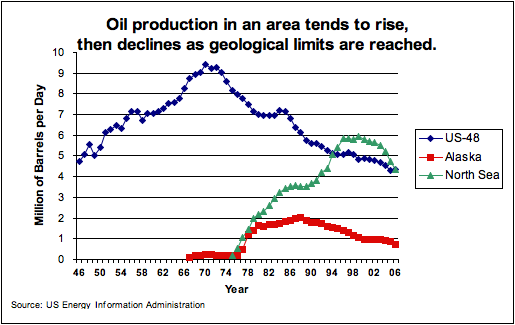
Oil production was also begun in the North Sea, near Norway and Great Britain. North Sea oil production has been declining since 1999. All of these declines have taken place in spite of new technology and improvements in oil recovery methods.
Oil is produced in many other parts of the world as well, but production in many of these locations is starting to decline as well. At this point, much of the world’s “easy to produce” oil has been removed. New oil production tends to be in difficult areas, like deep-sea locations.
8. Will world oil production reach a peak and begin to decline? If so, when?
Since oil is a finite resource, we know that production must eventually decline. There is considerable disagreement as to when this decline in production will occur.
The US General Accountability Office (GAO) released a report in March 2007 titled, “Uncertainty about Future Oil Supply Makes It Important to Develop a Strategy for Addressing a Peak and Decline in Oil Production.” This report indicates that the peak and decline is likely to occur sometime between now and 2040. The United States Association for the Study of Peak Oil indicates that the peak and decline is expected to occur prior to 2015.
Even oil companies are beginning to talk about the likely shortfall in future production, if not peak oil itself. Shell Oil says, “After 2015, easily accessible supplies of oil and gas probably will no longer keep up with demand.”
(GAO Report: http://www.gao.gov/new.items/d07283.pdf )
(Shell Oil statement: http://www.shell.com/home/content/aboutshell-en/our_strategy/shell_globa... )
(Canadian Business article: http://www.canadianbusiness.com/columnists/jeff_sanford/article.jsp?cont... )
9. Does the date of the peak matter?
We have already reached the point where the amount of oil that people would like to use exceeds the amount being produced. Because of this, we need to find ways to conserve, and to find alternative energy sources. The actions we need to take are pretty much the same, whether the peak in world oil production is now, or in 2040.
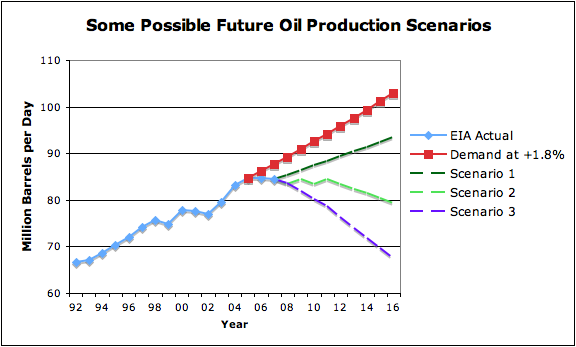
In Figure 2, the “Demand at +1.8%” line gives an idea of how much oil the world would like to use, if it is actually available, at a reasonable (2005) price. It assumes 1.8% per year growth. Scenarios 1, 2, and 3, give three (of many) possible directions future oil production may follow. Even if a fairly optimistic scenario like Scenario 1 occurs, there is likely to be a significant gap between demand and supply.
10. Aren’t we continuing to discover more and more oil every year?
We are continuing to discover oil, but the quantity of oil discovered is lower now than it was 50 years ago, and much lower than the amount of oil we are now using. A graph of oil discoveries by ten-year periods is as shown in Figure 3:
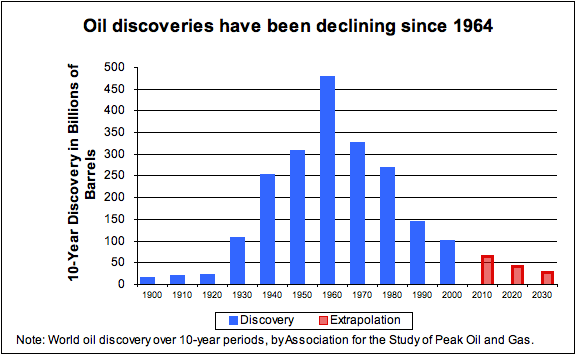
We often read in the news about finding new fields, but these fields tend to be smaller and harder to reach than those discovered in the past. We are now so concerned about finding oil that even small discoveries are reported as news.
Figure 3 does not include oils that are not liquids, like the Canadian oil sands. There are large quantities of these, but extraction is extremely slow. It is doubtful that they will ever become a significant share of world oil production.
11. Why don’t we have better information on when world oil production will begin to decline?
In 1959, M. King Hubbert correctly forecast that oil production for the United States was likely to reach a peak and decline about 1970. Many people, using a number of methods, have developed forecasts that indicate that world production is likely to begin to decline in the not too distant future. We cannot be certain of the exact timing, however, for several reasons:
(a) The United States, Europe, and Australia are now well past the peaks of their oil production. The biggest producers are now Russia and the Middle East. The governments of these countries are very secretive about the true state their oil fields.
(b) There is little relation between published “reserves” and the amount of oil that can actually be pulled out of the ground in a given year. It is the latter we are really interested in.
(c) The amount of oil production depends to a significant extent on the amount of resources (trained engineers, drilling rigs, funding for research and development) that are available. These may change.
(d) We can’t know what new technology will be developed and how helpful it will be in increasing future production. Current production methods leave a considerable amount of oil in the ground. There is a possibility that new methods will provide greater recovery in the future.
12. What is petroleum used for?
Figure 4 shows what petroleum is used for. The biggest slice is gasoline, with 46%.
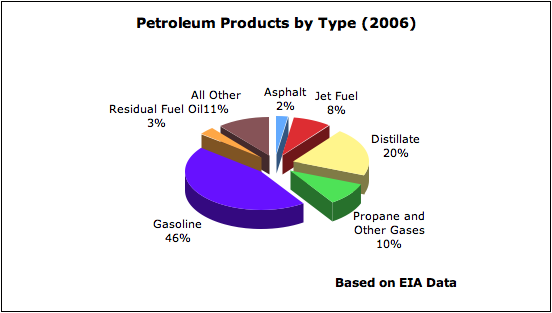
The next biggest slice is “distillate”, with 20%. Distillate includes diesel fuel and home heating oil (used primarily in the Northeast). Between gasoline, diesel fuel, and jet fuel, petroleum provides the vast majority of the transportation fuel used in the United States. It also provides asphalt for our roads.
The “All Other” category is quite small on the graph, but includes most of the chemical uses for petroleum. Products made using petroleum as a feedstock include plastics, synthetic fabrics, dyes, pharmaceutical drugs, detergents, insecticides and herbicides, and many other products we use every day.
In some parts of the world, petroleum is used to produce electricity. It is not generally used for electricity-generation in the United States, however.
13. How is petroleum processed to obtain its major products?
Petroleum is sent to a refinery, where it is processed to remove impurities and to separate it into its component parts. As we noted earlier, petroleum is a mixture of different hydrocarbons ranging from about C5H12 to C42H86. These hydrocarbons have different properties, including different boiling points and different viscosities. Very short chains, containing 1 to 4 carbon molecules, are gasses at room temperature. Chains with 5 to 10 carbon molecules are thin liquids that boil at low temperatures. The longest chains are asphalt or bitumen. Asphalt is very viscous, and has a very high boiling point.
During refining, a process called fractional distillation is used to separate out the mixture into components. In this process, petroleum is heated to a vapor, and then allowed to condense in a tower containing trays at different levels. Because the shorter hydrocarbon chains boil at lower temperatures than longer chains, this process can be used to separate petroleum into its component parts. The lighter the fraction, (that is, the fewer carbon molecules in the chain), the higher up it condenses.

For further discussion see “How Oil Refining Works” on HowStuffWorks.com
(http://science.howstuffworks.com/oil-refining.htm )
14. Is petroleum from different locations the same?
No. Some petroleum is “light” – that is, comprised mostly of the shorter chain hydrocarbons. Other petroleum is “heavy” – that is comprised mostly of longer chain hydrocarbons. Some is even “very heavy”. Oil also differs in the amount of impurities. The highest quality (and highest priced) crude oil is light oil, with few impurities. The lowest priced crude oil is heavy oil, with many impurities.
The reason that light oil is prized is because when fractional distillation is used, it yields a high proportion of gasoline and diesel fuel, and relatively little asphalt and other lower priced products. When fractional distillation is used on heavy oil, it tends to yield a high a proportion of asphalt and other low priced products. A process called “cracking” can be used to break very long molecules into shorter, more commercially valuable molecules, but this process is expensive, and requires specialized equipment.
The amount and types of impurities in crude oil is also important in determining the selling price of crude oil. Special processes, available only in certain refineries, may be needed to remove certain types of impurities. In some cases, it is necessary to build a refinery especially for oil from a particular location, so as to have the proper equipment to remove the impurities from the oil.
15. How is oil transported from place to place?
When crude oil is found in a location, it must be transported to a refinery for processing. If the crude oil is from overseas, it is generally transported by an “oil tanker” (type of ship) to one of the major US ports. It is then transported from the US port to the refinery by pipeline. If crude oil is shipped from within the United States or Canada, it is generally sent by pipeline to the refinery.
Once the oil is refined, the refined products are again shipped by pipeline to a location near where they will be used. Trucks are generally used for transportation to the final customer.
The one exception to this process occurs for gasoline with ethanol. The gasoline base is shipped by pipeline, but ethanol cannot be shipped by pipeline, because it tends to absorb water. Ethanol must therefore be shipped by other means (railroad, barge, and /or truck) to a location near where the gasoline will be sold. There, ethanol is blended with the appropriate gasoline base to make gasoline. After it has been blended with the base, it is shipped by truck to the retail location where it is sold.
16. What determines the price of gasoline?
According to the US Energy Information Administration, the components of the cost of a gallon of gasoline are as follows:
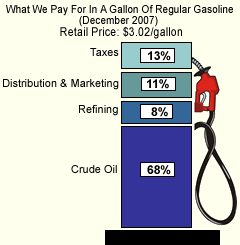
The biggest component is the cost of crude oil. As the price of crude oil rises, the price of gasoline can be expected to rise. Operating refineries amounts to 8% of the cost. Distribution and marketing would include the cost of maintaining all of the distribution pipelines, plus the cost of the retail facility, and the cost of marketing. Taxes would include state and local taxes.
This diagram above does not really discuss the impact of ethanol on gasoline price. Ethanol tends to raise the price of gasoline, particularly in summer. The problem is that when ethanol is added to gasoline, it makes the gasoline evaporate at lower temperatures, causing smog when outdoor temperatures are warm. To counteract this, it is necessary for refiners to take out that part of the gasoline that evaporates most easily – that is, the hydrocarbon chains in the gasoline mix with 4 and 5 carbon atoms. This still leaves hydrocarbons with 6 to 10 carbon atoms in the mix. When the chains with 4 and 5 carbons are eliminated from the gasoline mix, the total amount of gasoline available in the summer is lower. The resulting scarcity of gasoline during summer months tends to drive the price of gasoline up. (See http://www.eia.doe.gov/oiaf/servicerpt/fuel/mtbe.html )
We also pay for the ethanol included in gasoline in other ways. First, ethanol production is subsidized (51 cents a gallon nationally, plus many local subsidies), so we pay higher taxes to cover the ethanol subsidies.
We also pay for ethanol through higher food prices. A huge amount of corn (more than 25% of the 2007 US corn crop) is being used for ethanol. This means that land that would be planted for other food crops is being planted for corn, driving up the cost of the other crops. The cost of corn is rising because of the demand of corn for ethanol. This in turn raises the prices for meat and milk, since many animals eat corn.
17. If demand for petroleum products continues to be very high, but supply falls short, what is the likely impact on prices of petroleum products, such as gasoline?
Prices can be expected to continue to rise. The increase in prices is likely to be especially great, if world oil production begins to decline.
Even if oil production does not actually decline, the fact that there is likely to be a growing gap between the amount produced and the amount people want to buy means that prices for petroleum products of all types can be expected to continue to rise in the future. If oil supply should actually fall, there is a possibility that rationing may be needed, so as to have adequate supplies for farmers, the military, and essential services.
18. How certain are future petroleum imports?
Oil imports comprise about two-thirds of the United States petroleum use, but we are not very certain about how much we will be able to import in the future. Oil exporting countries tell us very little about what their true future oil production is expected to be. Reserve estimates are published, but are widely believed to be inaccurate. Furthermore, what we are interested is the amount of oil that will be exported. If there is a shortfall, the exporter may meet its own needs first, reducing the amount available for export.
There are other issues that also affect imports. If there is civil unrest in an area, oil exports may be stopped. Another concern is possible drop in the value of the dollar, because of difficulties within the financial system, or because of balance of payment problems. If value of the dollar should decline, oil will be much more expensive, so it will be difficult to buy as much.

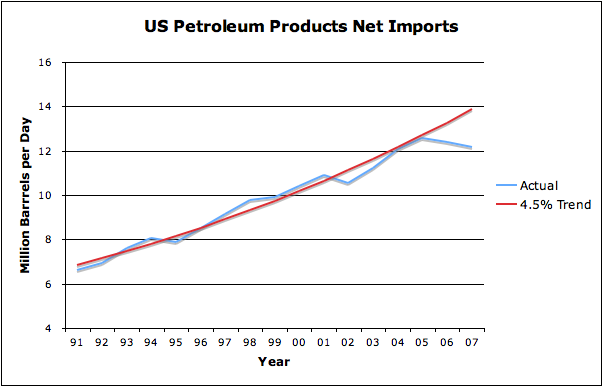
Note that net petroleum imports have declined in the last two years. It is likely that this is related to the fact that worldwide oil production has been flat since 2005. (See Figure 2). Flat world production and lower imports are also closely related to the run-up in price of oil products, such as gasoline, during this period.
19. Are there any good solutions to the expected shortfall in petroleum production in future years?
At this point, we are still looking for good solutions. It seems clear that conservation has to be a major part of any solution.
Biofuel, such as corn-based ethanol and biodiesel from canola beans, is one approach that is being tried. There are many problems with the current generation of biofuels. Some of these include:
(a) A very large amount of farmland is required to produce a very small amount of ethanol or biodiesel. It is not possible to scale the process up to more than 5% to 10% of our gasoline use, and possibly even less of our diesel use.
(b) The use of farmland for biofuel production tends to drive up the cost of food.
(c) When corn is used for ethanol, it takes nearly as much energy to produce the ethanol as is obtained in the end product, so we are mostly recycling other scarce fuels. A huge amount of water is also required, and there can be issues with topsoil depletion.
(d) Corn ethanol does not seem to be helpful from a global warming perspective. Some studies show a slight (10% to 15%) savings in global warming gasses relative to gasoline; one recent study indicates that corn ethanol may be worse than gasoline because the nitrogen used in fertilizer tends to react with the oxygen to form nitrous oxide, a greenhouse gas with 300 times the global warming impact of carbon dioxide. (Regarding recent study, see http://www.rsc.org/chemistryworld/News/2007/September/21090701.asp ; for the 10% to 15% estimate see http://rael.berkeley.edu/EBAMM/FarrellEthanolScience012706.pdf )
(e) The impact of ethanol (from any source) on air quality is questionable at best. One study by researchers at Stanford University indicates that ethanol has a more negative impact on air quality than gasoline. (See http://news-service.stanford.edu/news/2007/april18/ethanol-041807.html
It is possible that cellulosic ethanol, made from non-food bio-products such as wood, switchgrass, and corn stalks, can be a solution. At this point, we do not have an economic way of making cellulosic ethanol. Also, even if this approach can be perfected, it is not expected to produce more than 20% of our total petroleum needs.
There are other biofuels that may be helpful, but none is a good solution to date. Biodiesel can be made from left over vegetable oil, but it is difficult to produce very much biofuel this way. Researchers are looking at the possibility of using algae to produce biodiesel, but have not figured out an economic way of doing this. Biofuel of various kinds (ethanol from sugar cane; biodiesel from fruits of various trees) is available from overseas in relatively small quantities. Very often, forests have been cut down to make room for these biofuels, making the environmental impact quite negative. Sugar cane ethanol is probably better than most, but there are still human rights issues with respect to the workers producing the ethanol.
(MIT Cellulosic Ethanol article: http://www.technologyreview.com/Energy/19842/ Free registration required)
(One company claiming progress on making low-priced cellulosic ethanol: http://www.coskataenergy.com/process.html )
(Congressional Research Report for Congress “Ethanol and Biofuels: Agriculture, Infrasturcture, and Market Constraints Related to Expanded Production, 3/16/2007 http://collinpeterson.house.gov/PDF/ethanol.pdf )
Another possible solution is coal-to-liquid fuels. A process was developed many years ago that allows coal to be converted to a liquid substitute for some petroleum products. The major problem with this approach is that it generates a huge amount of carbon dioxide, which contributes to global warming. This approach is also difficult to scale up quickly.
Natural gas supplies are not sufficient in North America to substitute natural gas for oil. There are not sufficient supplies of liquefied natural gas from overseas available, either.
20. Why is there so much support for corn-based ethanol, if it seems to have so many problems?
One of the biggest reasons for corn-based ethanol’s support is that the problems with corn-based ethanol were not really understood when production first began. It is a little like introducing a new medicine, and then doing testing after the fact. Once the testing starts, researchers find a whole set of problems that were never anticipated by the well-meaning early supporters of the product.
Some other reasons for corn-ethanol’s support, despite its problems:
• Ethanol's role as an “oxygenate”. An oxygenate is an additive for gasoline which increases the “octane” (see http://auto.howstuffworks.com/question90.htm ) of the gasoline. It also reduces the amount of unburned hydrocarbons and carbon monoxide in the exhaust. Gasoline manufacturers began using ethanol as an oxygenate when previous oxygenates (first lead, then MTBE) proved to be unsatisfactory. At this point, it is not clear whether an oxygenate is really needed in gasoline, because modern engines burn fuel cleanly. http://www.foxnews.com/story/0,2933,104259,00.html
• Corn-based ethanol may work as a bridge fuel, until cellulosic ethanol can be perfected. If cellulosic ethanol can be perfected, it would not put as much pressure on food prices because it would be created from wood and other not-food products. It would probably also produce fewer global warming gasses.
• The use of corn ethanol raises the income of farmers, and has benefits for investors in corn ethanol refineries. The drawbacks, in terms of higher food prices and higher taxes for others, are not as obvious.
• The use of corn ethanol is popular with voters. It makes politicians look like they are doing something about oil shortages. It also makes people think that politicians are doing something to help the environment. People do not realize that the petroleum savings from the use of corn ethanol are likely to be small, and likely to be largely offset by the need for greater imports of natural gas and fertilizer, which are also in short supply. Corn ethanol was at one time believed to have environmental benefits, but these are seriously in doubt based on recent studies.
• Auto manufacturers support ethanol use. Current laws permit auto manufacturers to build more gas guzzling vehicles and still stay within fuel economy standards, if some of the gas-guzzlers are “flex-fuel” vehicles that can use 85% ethanol when it is available. This is basically a loophole that makes no sense.
21. How about solutions such as wind turbines, solar voltaic panels, and battery operated cars?
These all can be useful, but they don’t directly solve our need for petroleum. We have a variety of energy issues, and wind turbines and solar voltaic panels really relate to our need for better sources of electricity. This is a different issue than our need for a replacement for petroleum, but also important.
Battery-operated cars are a worthwhile idea, but are at best a long-term solution, since it will take many years to replace the cars currently on the road. The use of battery-operated cars is also very limited in scope – we need to keep semi-trucks, airplanes, and farm equipment of all types operating. We also need a product for paving our roads besides asphalt. If we cannot find a replacement for petroleum, we will need to find alternate approaches for a wide range of petroleum uses.
22. What implications do our likely shortfall in future petroleum production have for career opportunities?
Careers in fields that are very petroleum-dependent may not be good choices. For example, there will likely be fewer airline pilots in 2040 than there are today.
If there is less petroleum, people are likely to be interested in having stores nearby that they can walk to. Thus, there may be an opportunity for starting a small store in your own neighborhood, or developing a neighborhood clinic.
Recycled products, especially those using petroleum inputs, are also likely to become more important. There may be careers in buying and selling these products.
There is clearly a need for more scientist and engineers in many energy-related fields. We need to find better ways to extract the oil that is available, and we need to develop more fuel-efficient vehicles. We need to find more and better petroleum alternatives, and to find ways to scale up these alternatives to the quantities needed as replacements for petroleum products.
23. What can we do to try to compensate for this expected shortfall in petroleum products?
These are several ideas:
(a) When buying a car, purchase the smallest, most fuel-efficient model you can find.
(b) Consider sharing rides with someone else who is commuting in the same general direction, or take public transportation.
(c) Make greater use of work-at-home programs and distance learning programs. Or live in a dorm.
(d) Move closer to work or school.
(e) When distances are short, walk or ride a bicycle, rather than drive.
(f) Use recycling, especially for petroleum-based products like plastic. Other recycling is also helpful from a general energy-saving perspective, but not necessarily from a petroleum-saving perspective.
(g) Avoid fruits and vegetables that have been flown to the United States from around the world. These tend to be quite expensive.
(h) Reduce trips taken to distant locations, whether by air or automobile.
One idea which looks at the shortfall a different way is to reduce meat consumption, by eating smaller portions of meat, or by substituting beans for meat in some meals. We are currently using biofuels as a substitute for petroleum, and this puts huge pressure on the food supply. By eating less meat, a person can help reduce the pressure on the food supply.
Animals eat several times as many calories in grain products as they produce in meat calories. By eating less meat, fewer acres of grains need to be planted to meet our food needs. We also reduce production of global warming gasses, because animals, particularly cows, are big contributors to these gasses.
For further reading
A number of links are given in the reading material. In addition, some websites that may be of interest are
TheOilDrum.com - Discussion about energy and our future, including peak oil. Many articles written for the site, plus news items related to energy, and discussion about the various items.
EnergyBulletin.net- Peak oil related news items. No discussion.
Association for the Study of Peak Oil and Gas - USA http://www.aspo-usa.com/
Has a good weekly newsletter, and an annual conference
Educational website about oil and gas, how it is formed, and production ins and outs http://www.ukooa.co.uk/education/storyofoil/index.cfm
Myths of Biofuels - Talk by David Fridley - Free video for download
http://www.sfbayoil.org/sfoa/myths/index.html
Paper by M. King Hubbert, who correctly forecast in 1959 that US oil production would reach a peak in 1970 and begin declining thereafter
http://www.hubbertpeak.com/hubbert/1956/1956.pdf
Peaking of World Oil Production: Impacts, Mitigation, and Risk Management by Robert Hirsch, Roger Bezdek, and Robert Wendling - Landmark study prepared for the US Department of Energy in 2005. Very readable.
http://www.netl.doe.gov/publications/others/pdf/Oil_Peaking_NETL.pdf
Contact
- Content: editors at theoildrum dot com
- Tech support: support at theoildrum dot com
License

This work is licensed under a Creative Commons Attribution-Share Alike 3.0 United States License.
A nit pick on #1 & 6: There historically have been a very few oil seeps where small amounts of oil have collected on the surface. This is how the ancients got their pitch to caulk and seal boats. I believe the LaBrea tar pits in LA are an example of an oil seap with which some of the students may be familiar. We are talking about a truly tiny amount of oil overall.
The fact that oil is found beneath the earth's surface doesn't preclude it also being found on top occasionally. I believe that many of the older fields were found this way.
For #19 and #20, I think you need to expand the range of possibilities.
One reading list (including comments !) is
http://www.aspo-usa.com/index.php?option=com_content&task=view&id=168&It...
Best Hopes for Non-Oil Transportation
Alan
The reason that railroad transportation is not in the material is that I consider it a subset of the broader issue of conservation. It is clear to me that where we can actually use less oil without major infrastructure changes (like carpooling) needs to be done.
Major changes in infrastructure need to be evaluated in terms of the upfront expenditure (in terms of energy and other resources) and long term costs compared to the benefits. Rail may be a solution is some areas, but this needs to be evaluated in each case, and the amount of resources available for investments of all kinds needs to be considered.
A second reason I did not mention railroads is that this is aimed at 19 to 23 year olds. I could talk to them about them taking the railroad, if available, but not about the need for building railroads. I do mention taking public transportation.
If your students wish to delve a little deeper in formation , trapping , drilling then this will help:
http://www.ukooa.co.uk/education/storyofoil/index.cfm
It is meant purely as a general primer and is a pretty good introduction you click on each chapter heading that you find of interest.
Good suggestion! I added it to the bottom up above.
Hi Gail,
This is an interesting point:
re: "Major changes in infrastructure need to be evaluated in terms of the upfront expenditure (in terms of energy and other resources) and long term costs compared to the benefits."
It seems a lot depends on how we define "benefits".
If we're talking about energy (extraction/capture) technologies and infrastructure, in terms of "ELM", we're looking at near-zero oil imports, in...(?) a fairly short time frame. It seems like part of the analysis has to do with having "something" that can work v. not having a functioning system.
Hi Gail,
re: "...19 to 23 year olds."
OTOH, they are old enough to volunteer for resource war-fighting. And would be subject to a draft, were one to be implemented.
They also can vote, and presumably debate, if not create, policy. (And, in fact, they can also create policy.)
Perhaps Alan's rail plans could be incorporated in a section called "Current public responses to 'peak oil'" - ? (You could list "Post Carbon Institute" and other efforts there, as well.)
Major changes in infrastructure need to be evaluated in terms of the upfront expenditure (in terms of energy and other resources) and long term costs compared to the benefits. Rail may be a solution is some areas, but this needs to be evaluated in each case, and the amount of resources available for investments of all kinds needs to be considered.
I think that you are wrong.
At a 2004 cost of $2 million/mile of single track and $2.5 million/mile for double track, the oil savings of electrification at elevated oil costs are easily justified. I was told by a retired CSX VP recently that the RRs are under minimal competitive pressure (CSX has a duopoly with Norfolk-Southern, as long as N-S does not electrify, why should CSX ?) and they do not yet believe that $90/barrel oil is permanent.
At $30/barrel of oil I have identified over $100 billion in specific Urban Rail projects that are economic with low oil prices.
http://www.lightrailnow.org/features/f_lrt_2007-04a.htm
and electrified rail, with more bicycling and TOD (walkable neighborhoods) is NOT just "conservation" (which is all carpooling is) !
TOD is a more profound, and permanent, means of conservation by changes in Urban structure and daily routine (walk to the grocery store, etc.) than high mileage cars and carpooling.
It is a fundamental paradigm shift from an Oil Based transportation system (from extremely local grocery shopping & commuting to intercity transport) to a Non-Oil Transportation System !
The Non-Oil Transportation System has a large elasticity of supply# as demand increases, without ANY increase in oil use (except a few extra barrels of lubricating grease). This is not true of conservation based solutions.
Your syllabus will likely influence others. PLEASE seriously consider a section on "Non-Oil Transportation". It will give a focus and hope that car-pooling simply lacks.
Best Hopes for Non-Oil Transportation,
Alan
# The rule of thumb is that electrification of a rail line increases capacity by 15% (faster acceleration & braking). CREATE is a public-private partnership to create grade separation RR over RR crossings in the Chicago area. Nationwide impact for $1.5 billion.
In the vast majority of cases, existing Urban Rail capacity can be increased by adding more cars and perhaps uprating the power supplies. In more extreme cases, longer stations allowing longer trains will be needed. Still MUCH cheaper than adding freeway lanes.
Our current roads can accommodate an unlimited number of bicycles and few American sidewalks cannot carry 10x as many pedestrians.
It might be worth a mention that the total amount of topsoil left in the world for growing all of our food, corn for ethanol... will last between 24 [conservative estimate] to 48 [wishful thinking] years.
Ideally, biofuel would be a separate topic by itself, and we could get into a whole host of problems. I thought about the soil issue. Maybe I can figure out a way to work it in.
I added a few words about topsoil.
Small typo "Production in Alaska is has been declining since 1988."
Is it worth mentioning OPEC quotas were linked to reserves? This caused reserves to be exaggerated
Fixed the typo.
Regarding the OPEC quotas, I think we start getting into too much detail. A person almost has to define what OPEC is and start from there. It gets to be a history lesson by itself.
Thank you for all your good work. I have been asked to give a little talk at the start of term here at a junior college. A financial adviser who lives in my neighborhood recently told me his advice to young folks these days is to not buy a car. I (53 now) have never own one and have dreamed of a new "rite of passage" at 16, the aquisition of a bike an the skills to survive in traffic and a vow never to get a car. It is the assumption that all are going to have cars that is most dismal to me. Sure all my friends have them but I happened to live in England where gas was $4 a gallon in 1971 and I "got it" about gas...never turning back. Recently I talked to a young woman who spends $1500 a month on gas and car to commute 60 miles to a great job...Her boyfriend goes 75, one way. Sure they may not be able to own a dog in closer or on a transit line but we are all sunk if the assumption of car ownership persists. If you start young I think anyone can do without them. I lived in St Paul, Minn. through one February and years in Louisville, Ky without.
In Atlanta, it is difficult to live without a car, but it can be done. Our public transportation system is not very good (mostly buses that run once an hour, and not on Sundays). If a person has to go any distance, it takes forever to get there, with all of the transfers. One almost has to live close and walk.
I lived in Atlanta for decades. Once, when my car died, I took the bus to the end of the line near home, then walked the 1.5 miles to my house. The house was inside the rather small area of the City of Atlanta. Then, after a repairing the car so I could drive it home, I trekked back to the bus stop. Along the way, I was stopped by a policeman who asked why I was WALKING in the upscale neighborhood I happened to live in. In case you didn't know, the short hand for the metro, MARTA, was said to mean "Moving Africans Rapidly Thru Atlanta"...
E. Swanson
Some people are ignorant of the world level of production and world consumption.
Consider tossing in some graphs showing the 1 mile cube of oil, the total barrels produced, and do some math with population if you are allowed. Throw in a graph of how cheap oil is when compared to water, beer or soda by the 8 oz glass.
Most of 'em should remember 'balancing an equation' so give 'em
Energy total = persons X rate of consumption with the question:
If the total energy drops, how do you re-balance the equation?
If the students are 'economists' - some price point graphs might be fun - show what happens as 'the 3rd world' becomes oil consumers via 'seeking a better standard of living'
These are very good elements of propoganda and persuasion.
But this is an educational lesson plan (to be taught by laymen), not an activist manual.
Thank you for all your good work. I have been asked to give a little talk at the start of term here at a junior college.
A financial adviser who lives in my neighborhood recently told me his advice to young folks these days is to not buy a car.
I (53 now) have never owned a car and have dreamed of a new "rite of passage" at 16. If a person does not have a bike yet, they get one and apply themselves to the skills to survive in traffic. One could also vow never to get a car.
It is the assumption that all are going to have cars that is most dismal to me. Sure all my friends have them but I happened to live in England where gas was $4 a gallon in 1971 and I "got it" about gas...never turning back. Recently I talked to a young woman who spends $1500 a month on gas and car to commute 60 miles to a great job as a medical researcher...Her boyfriend goes 75, one way. Sure they may not be able to own a dog in closer on a transit line but we are all sunk if the assumption of car ownership persists.
If you start young I think almost anyone can do without them. I lived in St Paul, Minn. September through one February and years in Louisville, Ky without. Neither were bike friendly cities in the seventies.
You could expand a bit on the impurities. Sweet vs sour for example (sulphur content), mainly because in the news they talk about "light sweet" and "heavy sour".
I view the subject of peak oil as like peeling back the layers of an onion. In a sense you have to come to accept the conclusions of each layer before it makes sense to begin to examine the next, and as you get deeper into the onion the conclusions become more and more speculative.
The outermost layer is simply admitting that conventional oil will peak at some point in the future, and that production will start to decline in the future. Most people will give you this one without much of an argument (even CERA admits it will peak, but they put it off in the future).
The next layer in my mind has to do with conventional alternatives. Something that could be trivially used within the existing infrastructure - tar sands, oil shale, CTL, and biofuels fall in this category, and here one needs to consider whether any of these have the potential to make up the shortfall in conventional production. I think most of us here have already concluded that they won't (or because of climate change, we shouldn't try), but for a lot of people it takes a lot of time to go through all of the different possibilities and reach this conclusion.
I haven't thought it through enough to say what the next layer would be. Perhaps having to do with how deeply oil and gas are embedded within our economy. Perhaps it would have to do with the staggering quantities of oil and gas we use, and any attempt to replace it will place staggering demands elsewhere in the economy. Eventually at the innermost layers you start to get into questions of resource depletion of other types of resources, and the long term viability of the car culture.
I think the idea with the unit is to start to peel back what is happening part way.
We can talk about the extent to which oil is used in transportation, and all the products that are made from oil, and how difficult it would be to replace all of them if a replacement for oil is not found. I'm not sure how much this will all sink in.
We can't really scare the college freshmen to death. This unit may open the minds of some of those taking the course to look into the subject of peak oil further. I think it is difficult to do everything in a one-shot approach.
True - you need to let each idea settle in one at a time before you move onto the next one. You are essentially trying to battle the cognitive dissonance, and I think you start by building a strong foundation at the base and build up from there.
And why not?
I had some experience with this in a class I co-taught a year ago. The ones that had already been exposed to peak oil by Richard Heinberg's powerdown the previous semester in a auspiciously timed environmental studies course had had plenty of time to process some of the emotions about "impending doom." They were better able to think "rationally" or at least address the matter intellectually. The students that semester and in the following semester that had less awareness weren't able to really start paying attention to the complicated nuances that I was trying to teach. So my belief is that scaring someone to death may be helpful, but most likely it will interfere with their ability to take in the nuances of the situation. And it will probably take more than one pass.
A couple other thoughts:
#2 I think it would be nice to add one sentence to mention that one of the other environmental impacts of oil extraction is damage to the local environment due to spills, roads, other development, flares. See Nigeria, or anywhere else to varying degrees. NIMBY
#9 Wondering why you didn't mention the Hirsch report findings. Too much detail?
And in general I would think a more than passing emphasis on conservation would be really helpful. While I'm not suggesting going to a 3rd world lifestyle right away, the IPAT (Impact = Population x Affluence x Technology (effic.)) equation is certainly intriguing. An alternate one including intensity of use per GDP (like CO2 per GDP) is presented here: http://www.pnas.org/cgi/reprint/99/12/7860.pdf
Gail,
Ditto on the Hirsch Report. This document, more than any other, helped me to appreciate the magnitude of the problem if we are not prepared for a peak. Many of the implications are simply not intuitive, and the report does a great job at shedding some light on these.
A suggestion under the What can we do section?
When you use a vehicle, plan your trip. If you must drive, plan your route carefully, and try to work the logistics so that you accomplish multiple tasks in that trip. I actively work on this, and as a result, I bet that I cut my annual vehicle miles in half.
I added something on the Oil Sands environmental impact. I thought that made the point, without starting arguments about whether spills might be enough of a problem to prevent drilling in area x.
I also added the Hirsch report to the list of additional information at the end.
Your ideas on conservation are interesting. Perhaps if the unit were a bit longer.
I agree. The truth will set you free, but first it will make you sick. I've convinced my wife that looking at the future straight-on is a safer path than averting one's gaze, and once you get used to the possible disaster you can begin to change your own path.
I also would comment that 18 to 23 year olds can vote, and I think the target of the course might want to be the voter first, the consumer second (in priority).
Hi Gail,
Thanks for doing so much to educate people. (And it's great you're asking for comments).
I'd like to take the opportunity to respond to your comment here,
re: "We can't really scare the college freshmen to death."
What do you mean by this?
Do you mean that its unethical to deliberately attempt to instill a feeling of fear in someone - if instilling fear is one's goal?
Or, do you mean (not trying to put words/meanings in your mouth - just wanting to expand the discussion) - do you mean that you want to protect people from feelings they might find unpleasant or overwhelming?
My take on it is: The ethics are the same, regardless of the emotion, *if* "instilling and/or manipulating" emotion is the primary goal.
In other words, there is something that doesn't fit w. my values about trying to instill emotions in someone. It's a form of psychological and emotional manipulation. It seems to me you'd agree with this. When people do this, it's always relevant to ask "For what ends? For what purpose does this person *want* me to feel a particular emotion?"
And, likewise...what I want to try to express here, even though it's a bit of a philosophical discussion... it seems to me to be equally unethical (or not in line w. my values, anyway) - well, scratch "unethical", which sounds like criticism...let me call it "indirect" - to try to *block* or prevent someone from experiencing an emotion. This is also a form of emotional or psychological manipulation (however well-intended).
A common example is when one person does not want another person (say, a child) to feel grief. And yet, in certain circumstances, say w. the death of a loved one, grief is absolutely appropriate. And who is to be the judge of what emotion another human being "should" feel?
The emotions of people are influenced by others, yes. Control? Is not really possible, in a sense. And certainly not desirable (isn't in line w. my values, anyway).
My suggestion is to express the needs - the underlying needs - of yourself and/or your colleagues more directly. By this I mean, the needs you might have in relation to being in the position of sharing this information.
What is it that worries you if someone else is afraid when they learn of "peak oil"? What is your concern? (Sincere questions.)
An example, *might* be: "This information scared me when I first heard it. I was in a state of shock for weeks. I just want you to know that if you feel shocked or afraid - that's a feeling many people have. We need to acknowledge and support each other in our emotions and responses - whatever they are."
As I've mentioned before, I appreciate that Robert Hirsch spoke frankly in public about his emotions back in 2005. To me, at that time, it was validating and I felt less alone.
Part of the issue is that I am writing something for the University, so they have a say in exactly how far the piece should go. What I was relaying was my view of my marching orders. It is OK to talk about peak oil, and we can talk about some consequences, but let's not go overboard on consequences. There is too much that is unknown as to how things will really work out.
It may be that discussion questions can be used to help students understand the consequences. That way they can get to an understanding of the situation, without my having to graphically describe them.
Hi Gail,
Thanks for responding.
re: "It is OK to talk about peak oil, and we can talk about some consequences, but let's not go overboard on consequences."
One of my concerns is that students gain a fairly accurate understanding of how oil (and energy for that matter) functions in industrial society.
So, it seems to me (IMVHO) that if one presents an accurate and well-rounded view of the dependency relationship, the ability to think about the logical consequences of shortfall are increased.
So, my concern, I guess is the following: Are they/(you) able to present an accurate overview of the role of oil? One that will inform an assessment of the consequences of a decline in availability? i.e., I'm not so much worried about "leaving off" talking about consequences per se, as I'd be about leaving out an informative description of the critical role FFs play in maintaining economic (material) functions and growth.
Your first paragraph reminds me of an old gripe I've had. Most of us think of "oil" as a liquid, but the DOE (and the EIA) use the term "petroleum", which includes natural gas plant liquids, such as propane and butane. While crude oil may be frequently associated with natural gas, I think that combining the products from crude oil processing with that from natural gas processing leads to a bit of confusion. For example, most of our imports are crude oil, i.e., a liquid at atmospheric pressures and usual surface temperatures. We often hear that our crude oil imports reported as a fraction of our total petroleum use, which illustrates the confusion, as the comparison should be the ratio of imports to crude oil imports plus production, not the ratio of imports to petroleum, IMHO.
Also, I would begin with the sort of graph posted by Bill James on Drum Beat a couple of days back, which showed the total energy system, not just petroleum flows.
http://www.theoildrum.com/node/3553#comment-295870
http://www.jpods.com/JPods/PeakOil/USEnFlow02-quads_e.jpg
The fact that there is so much waste in the energy used for transportation should be pointed out. Also, the interchangeability between various primary sources is important as well. The demand side is just as important as supply and much can be done to address the energy problem on that end of the system. Demand changes can be put into effect rather quickly, but not without many changes in how things are done in everyday life.
E. Swanson
When I first talked to the dean about the project, he wanted me to do a unit that would cover all types of energy. He is particularly interested in solar energy.
When I talked to the faculty member in charge of the immediate project, he wanted to start smaller. He felt that a small module that could be squeezed in without deleting too much existing material from the course schedule would be the way to start. Once that was done, we could move on to a second unit, which would include what we left out.
I will keep your idea in mind for the second unit.
Interested in solar energy? It's about time. I recall when Georgia Tech had several solar systems set up, including a wind generator and a large concentrator device. After Reagan and the oil price decline, Ga Tech took all that down and built some more dorms, as I recall.
You might want to add a link to
The Southface Energy Institute. They've been trying to get the message out about solar energy for quite a while.
If you want some links about biofuels, here's one to Fridley's talk, "The Myths of Biofuels", along with some of the slides he presented. He might agree to the inclusion of his slides in your presentation. Warning, it's a slow download on dialup.
E. Swanson
I added Fridley's talk. In general, I have a problem with referencing things that are too clearly one sided. Web sites with black backgrounds also don't go over well with some folks. I wish there were a more neutral sounding version of this.
Regarding Southface, I think that I will save that link for when (if?) I do a unit on the electricity/heating side of the energy problem. I am very familiar with Southface - had some contractors recommended by them tighten up my house and make various changes to make it more energy efficient. Some of their people have been involved in the Atlanta permaculture group. They are a good organization.
He is particularly interested in solar energy.
A reminder that oil *IS* an expression of solar energy might therefore be in order.
www.crudeawakening.org A C... A..., award winning docudrama film on peak oil, etc.
News recently showed a (german?) cargo ship that reduced it's fuel consumption by 20% by using a large sail.
National Public Radio 1/28/08 covered a novel idea to use dried up water wells to deposit excess salt water. Related/in the story was also the idea to use large shallow areas with sunlight to grow a saltwater plant that could be a more efficient source of ethanol/biofuel.
I hope a subtheme of the class is 'living above the influence'; Good luck & thanks for posting the content!
This is a terrific thing. I'd like to bookmark it and draw from it. I teach an algebra-based physics course to non-majors (but often who are majors in life science fields). I spend weeks developing energy concepts and how to measure energy transfer from fuels, transformations to mechanical work, and so on. The one thing I might try to do with this presentation is offer a slide or two on measuring energy content & especially rate of energy utilization/conversion--the meaning of "million barrels per day", for example, bringing out that mbd is dimensionally the same as the "watt" that's stamped on a light bulb. My students tend to start out having no sense of these things, but it's not too hard for them to pick them up. That grounding is going to help when you start talking about measuring comparison of different behaviors, what your $3/gallon buys, meaning of "efficiency", scaling of biofuels versus available land, etc.
The bolded above is not a logical progression. Production rises, more wells are drilled, the area gets depleted, then production declines?
Also, the dates of decline for the North Sea, etc., don't tell us much without knowing when they started drilling, and perhaps when full depletion might occur or maybe what the depletion rate is for those areas.
;)
Cheers
Hello,
From one educator to another, perhaps I am missing something, but is the above not unclear? Would the following work?
7. Can an oil company produce a constant amount of oil in a given location?
...When we look at production from all of the wells in a given geographic area, production generally tends to rise for several years, as more and more oil wells are drilled. Eventually, the area becomes saturated with wells and overall production starts to decline. After this peak is reached, the area will begin a decline in production, or depletion. US oil production for the 48 states excluding Alaska and Hawaii reached its peak in 1970.
Cheers
I changed it to
I think that gets to the issue you are raising. Thanks for your help!
That flows just fine.
I'm glad to have people like you doing the heavy lifting and letting the rest of us tag along.
Cheers
just make sure you make a very clear distinction that the problem is not fixable by economics.
the problem isn't economic, it's geophysics. there simply isnt enough pressure in the reservoir to generate enough oil flow. and that pressure is decreasing. the finds are decreasing.
hope that helps...if you need production graphs, i should have them.
www.oil-logic.com
Gail it depends how simple you want the explanation of Peak Oil to be?
If you want a very quick explanation that would fit on one side of A4 it could be some thing like this:
Crude oil is a high-energy liquid extracted from the Earth by companies - it is a very economically important, limited, finite, non-renewable resource. Currently the only adequate substitute for it is man-made synthetic oil. Without it we would live as people in the third world live today. When burned as a fuel it seriously (possibly dangerously) pollutes the atmosphere with waste CO2.
The oil company owners insist that the oil must be produced at an adequate profit and also the profits must grow over time.
Up to 200 years or so ago pools of oil on the Earth’s surface were the only source – this cost very little to produce it was easy to make a profit.
Gradually oil has become harder to find – now new finds can be up to several miles below the surface of the Earth and below deep ocean water. These oils can be very expensive to extract - up to $200 million just to dig the hole – but, to make the essential profit the oil company has to sell the extracted oil at a gradually higher and higher price - up around 900% in the last ten years or so.
Because it is so versatile and contains so much energy use of oil has allowed the world economy and population to grow exponentially and over recent decades we have used around 2% more oil each year - worldwide we now consume about a cubic mile each year. Economic growth is essential to our current society.
However, as the oil gets ever more rare and expensive relative to everything else we buy we can only afford to buy less and less of it – eventually we can’t afford to buy more this year than last so annual oil consumption reaches a peak volume and then declines - it did this in 2005.
Peak oil does not mean the end of oil, it means the end of cheap, low cost, oil (when compared to everything else we buy.) Once past peak oil we will need some other steadily increasing source of affordable energy to continue economic growth.
Gail, Nice work. TOD is a tough crowd and I'm sure the critique is exactly what you are looking for. Just wanted to add a little "At a Boy" to the fray. Your unique approach to the peak oil dilemma is appreciated immensely by many of us. Remember that 1 "Aw sh_t" wipes out 1000 "At a Boys"
Thanks.
In the interest of not depressing the youth I do think talking about walking, biking, and mass transit is critical. Where do people have power? Over themselves. Mass transit and walking may take longer but apparently average car speeds in LA are now about my fast walking rate, 4mph...
Demand we can control. Kids whose family have been car dependant have no more imagination than their parents about doing without. Someone needs to suggest this and it is empowering. Time they have...sure it is in video games now but with Blackberries and what, they can play and take the bus.
The Atlanta comment about Afro Americans and buses was also true in Louisville and a German friend recently told me of a phrase, "shame train" that is used here for buses. These attitudes we can change.
It also makes me want to add that 13% more people will try a train than a bus for mass transit-then they will use bus as a natural connector.
Adelaide, Australia's all solar bus would also deserve a mention as it is so quiet and clean, things most US buses are not yet...
On a reading list I would put the book, "Towards a History of Needs" by Ivan Illich and in particular the essay, "Energy and Equity"
I have a possible suggestion for you:
Instead of standing up in the class and lecturing to the students (something which research has shown over and over again to be utterly ineffectual in getting students to learn) why not get the students involved?
For example, pose a scenario in which oil production starts to decline, (if peak oil is a dirty word, invent a scenario like a protracted war with Iran), ask the students to break into groups of three/four and ask them to devise solutions to the ensuing energy crisis. Then they all report back and you start putting their solutions onto the board (or a power-point slide if you insist). Then you ask the other students to shoot those solutions down or suggest ways in which it might be difficult to make a certain solution work. Ask them: "What are the potential problems with this solution? What might go wrong?" Be ready to help them with order of magnitude calculations, e.g., how many square km's of PV cells do you need to replace x percent of the US electricity supply with solar energy? Again, don't do it for them, ask them to try it, you provide background info needed for the calculation. Basically get them involved in the discussion. By the end they will (presumably) have constructed a very visceral feeling for the difficulty of our future energy situation.
Get THEM to do the science, not you. You already know how to make estimates, plan for scenarios etc. They are the ones meant to be learning how to think scientifically about energy issues. They will never learn that if you stand up at the front and lecture. Trust me.
I am providing some discussion questions too, so they can be somewhat in the direction you talk about. One problem is that the course is taught by a variety of faculty, with varying exposure to peak oil. Some are adjunct faculty (part-timers). The university would like to have material that doesn't require too much background knowledge for the professor, and also has links that the faculty can study ahead of time so they are at least a little ahead of the class.
I am trying in this unit to stay strictly with the oil part of the problem in this unit. I view the oil problem as the liquid fuels / chemical feedstock part of the equation. The problem is that we have a huge amount of infrastructure already built that relies on liquid fuels, and abandoning it would be a huge cost.
The other part of the problem is what I think of as the electricity/heating part of the problem. I think its problem may be as severe as the oil piece, if for no other reason than electricity is so dependent on coal, and coal is viewed as (and is) the # 1 culprit with respect to global warming. There is also the issue of likely future natural gas shortages, if we cannot keep increasing unconventional natural gas - probably shale gas.
It is all too easy to get the idea that the liquid fuel problem can be solved by adding to the electric supply. I think that even with new sources of electricity, we are likely be dealing with a declining electricity supply with more frequent outages in the years ahead. See Electricity Supply Vulnerabilities. This won't make the liquid fuel problem any easier to solve.
Science 1101 - Petroleum and Peak Oil
You don't mention M.K. Hubbert. I find this omission astonishing in a course entitled "Science 1101 - Petroleum and Peak Oil"
But that's my only real criticism.
I suppose I should bring that up with the university.
I have tended to stay away from M. K. Hubbert in all of my writings. It seems like it I put it in, it starts opening a whole can of worms. If Hubbert got the 1970 peak right, why didn't he get the world peak right? Why do so many people have so many different estimates? If all we have to do is take the total expected recovery, and divide by two, doesn't that put the peak off until many years from now? After all, the USGS (and various others) put the expected recovery at a very high level. Even if we use a lower level, one can still get a much later date with the 50% method.
I know I have talked to some ASPO-USA folks, and they have said they prefer to leave Hubbert out of the discussion for this reason.
Why he did not get global peak correct is simply explained. Further out you go , the greater the cone of uncertainty.
If you want, I can send you a pdf of the original Hubbert paper, complete with hand crafted graphs and drawings.
He would get kicked into touch now. No Power Point...
Cool. Will you send it to others? If so, please send it to my user name (at)mindspring.com
I think this is probably the Hubbert paper you are talking about.
Perhaps if I add it to my list of references at the end, I won't have neglected Hubbert entirely.
Yes
That is the one.
I added a sentence to the report also, so I didn't neglect him altogether.
I understand your reasoning but you don't need to go into Hubbert in any detail in this course. That could be further research for students so inclined. Maybe show the USA-48 Hubbert curve for example and let interested students pick this up or set future study on how this might apply to world-wide supply?
My general feeling is that if someone I knew told me they had just done an introductory course on "Peak Oil", I would respond with something like, "So you've heard of Hubbert then?". If they gave me a blank look I'd be inclined to dismiss the course without thinking any further about it. I suspect many others here might respond similarly. Maybe you could point me at another one but I can't off-hand think of any other introduction to PO that doesn't mention Hubbert.
So I still feel he should be mentioned. To leave him out completely seems to me to be well - just wrong. A bit like leaving Jesus Christ out of an introduction to Christianity :-)
Isn't that a litle bit like asking, If Newton got classical mechanics right why didn't he predict quantum mechanics, wave theory and the theory of relativity? The answer at least in Newton's case is that he did what he did a time and place in history with the information he had available to him. That doesn't take away from the usefulness of classical mechanics as we apply it today just because we have more information now. Anyway this is all just a very minor quibble.
I thought the reason Hubbert did't get the World peak right was that the 2 politically inspired oil crisis of the 1970's caused conservation effforts which put the peak back 10 years.
I think that is probably pretty much it.
I've been teaching about peak oil, global warming and limits to growth in general for almost 3 decades to high school seniors - soon to be college frosh. Nearly always the response is one of of either "I'll just spend more money for gas" - "I'll have to run the air conditioner for more months in the year" or their eyes glaze over from too much info.
I have found that only when I have them work through some examples of how tightly coupled all of these factors are (how dependence on ever-increasing fossil fuel use has lead not only to global warming but to an growth dependent economic/agricultural/social system) do they start to get a sense of the impact not only of peak oil but any limits to growth
The professor will probably do the assignment part of this, but maybe a thought experiment and "what if.." set of scenarios
This is why I am thinking that some sort of exercises would be useful. Isn't there some sort of SimCity sort of simulation that you could let the kids run - challenge them to try and come up with the best outcome for the year 2050.
AZTchr- the economy is not dependent on growth. maybe ever rising stock markets and home prices are dependent on growth but not the economy.
Good suggestion.
One last thing Gail,
You may come up against counter 'arguments', notably abiotic oil.
I am not suggesting you expand your work to counter abiotic oil, but a few guidance notes and rebuttals may be something to keep handy.
It never seems to go away, but the proponents appear quiescent at present.
It doesn't matter whether oil is abiotic or not - the timing of the peak is determined by profits for the people extracting the resource.
Even if the oil is abiotic, production would still peak at some point - abiotic oil is a 'red herring'.
The prime, irrefutable, evidence that the oil production will peak about now is the 900% rise in oil price over the last 10 years while everything else has increased in price by much less. Most other data on oil is very poor and increasingly manipulated for political reasons.
IMO, if you want to explain peak oil to people who know nothing about it (even though this is aimed at students, the vast majority are not on a student course) you must keep the explanation short and simple - often the explanation is totally confusing and people (students as well) quickly go back to thinking about Britney Spears or sex or whatever. Assume an attention span measured in micro seconds.
The explanantions of peak oil on TOD (including this one by Gail) which is aimed at people 'surfing the net' are steadily getting more and more complex, which is excellent, but try and consider people who know nothing about it. Normal practice is to use a short summary to entice them to read more - or re-direct them to somewhere simpler if it is a complex presentation not suitable for novices.
In that case, how about:
Instead it is more like an underground rain forest -created by Nature over many slow growth seasons.
Humanity is in the process of burning down the last of the known great underground forests in Saudi Arabia.
Man does not know how to make an underground tree, let alone a forest full of them. So very soon we will be running low on underground wood.
Our non-negotiable lifestyle depends on underground wood. There are no substitutes. There is no Houston to call down to and say, "Hello, we got a problem."
The funny thing is this oil price increase has happened very suddenly. A few years ago it was tradind at 20 something dollers a barrel, and then suddenly woosh. It oil was peaking would'nt you expect a more gradual increase.
The "funny thing" is that the price suddenly went "whosh" when oil production hit a plateau starting in mid-2005. Demand outstripped supply (although economics professors would tell us this can't happen). When we look at graphs of US oil consumption, it suddenly flattens, when world production flattens after 2005. The graph of US gasoline consumption is particularly dramatic.
I think that short attention spans are a real issue. That is why in my first draft, I did not include all kinds of topics about how oil is transported and other things I didn't think too critical to the point. I have also tried to stick to "25 word or less" explanation of things, even though these may not as technically correct, and to leave out some historical stuff.
I think there is a real need for material of different lengths - very short to very in depth. If a university is willing to devote several class periods to a subject, it is possible to go into more depth than in if the unit is very short.
I firmly agree, my brief experience showed that visualizing/imagining the future with highly leveraged tightly coupled systems is more illuminating than talking about decline rates can ever be.
Speaking of tightly coupled systems, like mountaineers roped together descending a glacier... has anyone read "Deep Survival"?
I've had high school students push a car 50 yards before we talk about the price of oil and gasoline. It changes the discussion.
Hi nulin,
This is a type of suggestion I was hoping someone would make - something concrete to illustrate what's actually in that gas tank, in "useful work" terms.
In your Item #5, where you say, "Petroleum is generally extracted from the ground by drilling oil wells ..." I think it would be useful to say something to the effect of "and this oil extraction is commonly referred to in the oil industry as 'production'." William R. Catton Jr., in OVERSHOOT, made the distinction between the production of oil - its formation underground over eons - and extraction of that oil from the ground.
The distinction is important because we can't simply 'produce' more oil, i.e. make more. But we may be able to extract more at any given location.
This is offered with purely helpful intent, not a critisism. You do good important work.
On point number three. These plants and animals died and fell to the bottom of the sea where the conditions were anoxic, allowing the organic material to accumulate. Gradulally these organic rich sediments were buried to a depth where Earth's heat, and pressures from the overlying material built up.
Dan
While yours is more accurate, I expect that a fair number in the group wouldn't remember what anoxic meant, and the rest would be fuzzy about organic (although that they should know), I was aiming to get the general idea right, in as simple language as possible.
Thank you for your wonderful insights on how to present Petroleum and Peak oil in a classroom environment. I also am planning on starting a Peak Oil seminar in my University (UTDallas), and though I had spent some time working on the syllabus and unit layout, this seems to be a much better model for a course. Is it okay if I use this as a template to work my own seminar session around? My audience will also be around the ages 19-23, so there would be few discrepancies. Also, if any member of TOD has any more suggestions towards adapting all the knowledge of Peak Oil to a university classroom, all comments will be greatly appreciated.
Max
I am glad you liked this.
I have written some other articles that are accessible to new people. On the side of the screen, you will see a list of Personnel. In that list, you will see "Gail the Actuary". If you click on Gail the Actuary, you will see in red "Stories by". Click on Stories by to find the list of stories I have written. The stories that are labelled "Peak Oil Bookliet - Chapters 1, 2, 3, and 4" are especially for new folks.
Some people like the Oil Quiz.
I also have a presentation "An Inconvenient Truth".
On my personal website, What Are Our Alternatives? is always the most popular post. It is on TOD also, but it is hard to find, because it was done as a guest post.
A little bit USofA centric:-)
Perhaps point 16 could mention that most other developed countries have much higher taxes and use less per head.
A good quality effort here, Gail. The question choices offer a good base from which the answers offer the kids a base of understanding. I suspect the innate bias of glooming and dooming the energy and fuel arena has colored some segments more than a responsible independent contribution might allow. I wish to suggest these small notions to answer the students needs more adroitly.
At 2. The focus on CO2 leaves out the U.S. effort to have all emissions drop with good success. The answers ignores the practices in other countries that dirty the atmosphere. The CO2-Global Warming-Climate Change issue is so thoroughly political now the full range of atmospheric science is ignored at great economic peril.
At 4. If you care to be forthright, petroleum = hydrocarbons and serious efforts are underway worldwide to add to supply. Oil formation of itself is imperceptible.
At 8. The answer is simply one sided, even if the answer's premise is correct, the education value to elicit more thought and clear thinking with opposed views is absent.
At 17. The second sentence is misleading. Fuel products from whatever source are always price point finite. Or there are only successful buyers that can meet the bid needed to obtain the desired supply. Unsuccessful offerers will choose alternatives, which has started and can be seen now. The mention of market shocks is important in the near term and could use more exploration.
At 19. The answer falls apart after a good opening. Petroleum or hydrocarbons range from gases starting at methane and easily handled liquids at methanol. A long knife approach to ethanol wastes effort, as ethanol is the process that works for now, and can fairly be expected to be eclipsed over time. Lets not substitute gloom and doom limitations for the potential of biology to make carbon available for fuel production. There is a wealth of potential, peruse http://newenergyandfuel.com/ for sources.
At 20. A leading question with leading answers at 19 discredits the entire piece which is now a set up for 20. I urge a full do-over, as the presentation balance is lost which casts away the opportunity to educate.
At 21. This answer is not thought through. In fact it is erroneous. Misrepresenting the relationship of energy and fuels with the work they perform undermines a great deal of effort here at the OilDrum and other responsible sites.
At 22. The answer is rife with opinion. For example the U.S. petroleum industry complains, justifiably that personnel are not available. Hydrocarbons will be with humankind for centuries to come, to suggest the career opportunities are poor is harmful to the kids, our society and economy. One answer can be that essentially any career in energy and fuels has a bright future and those choices all have both short and long term risks.
At 23. Sorry, I can't follow the logic in the "eat less meat segment" and it seems inconsistent with many other prior statements.
Its a fine draft in need of outside points of view and I hope everyone's assistance can be integrated into a form that helps get the kids ready for the future with their confidence and innovative qualities intact. I especially wish to point out the quality of Gail's work and the confidence she expresses to us by offering us the chance to aid her in teaching our kids. This is a great start!
You know, for an actuary you are a pretty good educator. :-)
A quick skim, and I noticed this:
Ethanol is needed as an “oxygenate”.
My understanding is that there isn't really a serious need for oxygenates with today's computerized engines. This is Fox News, but I have read the same lots of places:
http://www.foxnews.com/story/0,2933,104259,00.html
Never heard this point before.
It says that ethanol is only needed as an oxygenate for gasoline cars built before 1994.
Would it be appropriate to tack that onto the gas pumps as a seperate line, rather than oxygenating the entire fuel supply?
No. The vapor pressure of the rest of the gasoline supply has to be reduced to allow for blending the ethanol.
It would make much more sense to have a separate tank (or a bladder inside the main fuel tank) for the ethanol, and use the ethanol as a separately-injected octane enhancer in a smaller, highly-turbocharged engine. Pure ethanol fuel can roughly double the power available from an engine because it allows much greater boost pressure. When you aren't using maximum power, you can go back to pure gasoline. This is the essence of the Ford/MIT concept publicized about a year ago.
Thanks! I had heard the point before, but wasn't really confident enough of myself in this regard to say that it wasn't needed.
I was thinking that if it was needed, it was to make "premium" gasoline. I would expect premium gasoline could be made in other ways, but using an oxygenate might be cheaper.
I think the real issue then gets to be the volume of gasoline. As I understand it, in 2000, MTBE was providing about 300,000 bpd to the oil supply, and ethanol was adding about 100,000 bpd. Now that we have really scaled up ethanol, it is providing a little over 400,000 bpd. If MTBE is now close to zero, we are about at the same place that we were in 2000 in terms of additive volume, but the cost is a whole lot higher.
I will re-look at that section.
A few thoughts Gail, that won't add too much.
Something about how much petroleum we use vs how much sunlight falls on the planet. Something about how much plant mass it took to make one barrel of oil. Quantities for those who can think quantitatively.
The concept of energy slaves
Battery replacement, cars, infrastructure in general - replacing takes a LOT of oil. When buying a car - consider NOT buying a car. eg radical, fundamental change.
Something about how we used to extract 100 barrels of oil per barrel input and now the more costly extraction is as low as 3 barrels per barrel of input. Why it stops at 1 not at 0. That gets you into the Hall article from a couple weeks back, where you can ask students about impact of expanding share of economy dedicated to energy.
cfm in Gray, ME
I wish I had put those things in. My problem is that I was working with a whole lot of topics they wanted covered, and it seems to me that it is already getting too long.
Maybe I can work some of those into the discussion questions.
Nice work Gail, thank you for sharing your efforts with the TOD community. I have two suggestions that I believe are worthy of consideration.
In section 11 (a) I would add a sentence explaining that about 82% of world oil production is by National Oil Companies (NOC's) and only 18% is from public companies such as Exxon or Shell. This would serve to clear up a common misconception as well as pointing out that 82% of detailed production data is essentially treated as a state secret.
In section 18, I would add a brief summary of Westexas Export Land Model, perhaps including a link to his and Khebab's outstanding article over on Energy Bulletin. The ELM concept is key to understanding the challenges faced by importing countries, and I feel the good work done by these gentlemen is too important to omit when oil exports are the topic being discussed.
I tried to reword 11(a) to get your idea across without introducing the concept of National Oil Companies.
The US is really still one of the top oil producers, so one could argue that my statement is a little short of the truth. I found it hard to reword and make it more accurate.
I think I got enough of the idea of countries satisfying themselves first in what I said in 18. I don't thin I have room to go into the idea further.
Hi Gail this is a great intro for uni students.
On point 3 my recollection is the following:
1. Oil is formed from the remains of small animals and plants that lived in warm seas x and y million years ago. (I am not sure of the numbers - I think it was 100 and 60 million years ago).
2. This organic matter, over geological time, was moved to various depths in the earths crust by geological activity, principly caused by the continual movements of the earths tectonic plates, but also by other activity such as silting.
4. The temperature of the earths crust is generally higher at greater depths and this heat "cooked" the organic matter over the course of millions of years. The places where the organic matter was cooked is called the oil's source rock. The cooking process is very sensitive to heat. To deep and too hot caused the organic matter to turn into gas. This is what we call natural gas today. To shallow and not hot enough and the oil would fail to cook; instead it was formed into great deposits of kerogen, also known as oil shale, such as found in Colorado and other places around the world.
5. Once the organic matter was cooked, its gas and liquid components (crude oil) migrated through cracks and fissures in the earths crust. Most of this gas and liquid escaped to the surface and was lost, or became tar sands such as are found in the Orinoco belt and Alberta in Canada after the lighter liquid components (the shorter carbon chains as described above) evaporated off.
6. Occasionally the migrating gas and liquid was trapped at great pressure under impervious layers of rock that had formed into the classic bell shape, or other formations such as anticlines (a layer of impervious rock that has been folded by tectonic activity to form an inverted V-shaped trap). These formations, when they contain oil and/or natural gas are known as resevoirs.
7. Considering all of the elements that fell into place by chance to form oil: the collection of organic debris, moving it to the right depth (and temperature), the formation of impervious traps; and the correct location of cracks and fissures to feed the oil and gas into the traps, it is amazing that there is any oil or gas at all, let alone the vast quantities that are burned every year.
I think this is correct, but please anybody: have a go at improving, correcting or condensing it.
Gail - Great work as usual. with regards to ethanol, it is my opinion along with many others, that ethanol is getting a very bad rap, with original propaganda coming from the oil industry. In it's current usage, admittedly there are limitations because it is being made to fit a petroleum model of production and distribution and a farming model of mono cropping - both of which put severe limitations on the benefits of ethanol. Following the extensive research and work by Buckminster Fuller on ethanol as a solution to the planet's energy crisis, David Blume of www.permaculture.com has taken up the charge for over twenty years to prove ethanol's viability and to disprove all the myths. In a farm and production system designed specifically for ethanol it has the capacity to solve our food and energy crisis - but to plug a new energy source into the current petroleum model and think that it can be a substitute for oil and let us keep our current lifestyle is naive and shows we are unwilling to accept the behavior modification that will be necessary. Most people don't realize that the entire world ran off of alcohol way before before oil became the "only choice" (remember prohibition? - the real reason wasn't the "demon" alcohol corrupting family values... prohibition was promoted by J.D. Rockefeller and Standard Oil to eliminate the competion) I think students need to know the virtues and benefits of alcohol, how it was marginalized by Big Oil and how it can be a successful energy source and aid food production in the future. Today, when most people hear "ethanol" they think "loser" and that is unfortunate. As part of my plans for the future, I am setting up a micro-distillery permaculture farm cooperative in my community.
Keith
I was aiming for the 25 words or less Readers Digest version.
I think my 5,000 words is probably on the long side. There are a lot of topics that need more time / words, if time permitted.
Sorry to have wasted your time, Gail.
Regarding #1 and #6 - You mention porosity without mentioning permeability. You can have trillions of barrels trapped in pores, but if the rock is not permeable (i.e., the pores are connected by microsopic canals), nothing comes out. You might also try to find a geologist in the area who has a "core drilling rock sample" from a highly prolific well. The reason being, you can show the students that it is just a rock, and from holding it and looking at it you can not tell that it contains oil at all.
Regarding #23 - I would stay away from predicting who is going to lose their job and why. Airline pilots are probably more likely to lose their jobs to remote control than due to a lack of fuel.
Regarding #23 - This is for college people and not first graders right. So lets, get rid of the first grade indoctrination. Please advise them of careers that they can take that would make a difference - various engineering and other high tech pursuits that will make a difference. The ones that are not interested in technology, tell them to date someone who is.
I learned a lot from your post regarding the fact that Hubbert got the US right, but the world wrong (boy, and he had ALL the data to work with) so we can blow him off. Well, Einstein did not get quantum mechanics right either, so I will never bring up his name again.
This is a course for non-science majors, so science is not likely to be their first choice.
Realistically, the mix of job is likely to change a whole lot. A lot of high level jobs that are available today are going to be gone.
I noticed that these courses don't always have a requirement for a math background. I wish someday we will see some intense non-hand-wavy curriculum on oil depletion.
U of Minnesota Geology Department, 3000 is Soph or Jr level
can we be responsible educators of the next generation without touching the fundamental issue of intergenerational justice -- the stewardship doctrine? if the guiding principle put down by Jefferson for the Constitution is still of relevance: "I set out on this ground, which I suppose to be self-evident, 'that the earth belongs in usufruct to the living," then it should at least be a question worthy of discussion as how should it be applied to petroleum and other hydrocarbons.
These are the poor students who are going to find themselves on the short end of the intergenerational equity. Rear Admiral Hyman Rickover talked about this 51 years ago. It is too bad people didn't listen then.
Rickover's speech certainly should be included as a must read. still, there is difference between the "capital in the bank" analogy of Rickover and the usufruct view of Jefferson.
because people didn't listen then, should we ergo keep the issue covered under the rug? of course, the problem is whether we can honestly face and address the issue ourselves. the very same issue applies not only to the hydrocarbons but also to nuclear fission materials.
Good point! I will do that.
Hello,
I don't know if you are looking for editing notes, so disregard them,if not.
#1: Both uses of instead can be removed. There is no important juxtaposition and the following comments answer the preceding negative statement clearly. (Purely a style issue, but you have mentioned pithiness is a virtue in this project.)
#2: Particulates from vehicle emissions are also important. FYI: They have been shown to affect lung capacity the closer one lives to major road/highways. In L.A., city youth 18 and under who are autopsied for non-health related deaths show lesion damage similar to smokers.
#4: Abiotic theory?
#5: THAI method might be worth mentioning or adding to resource materials.
#6: A little wordy and complex. (THAI also may apply here as they claim much higher extraction rates.)
#9: "On Figure 2... " or "In Figure 2..." The norm would be "in" for the US, I'd think. Being an internatonal site, perhaps it's not important.
#10: The production vs. discovery graph from ASPO would be perfect here, assuming you trust the data.
#23: I believe the comma in the question is not needed and "to try" is not needed as it does not clarify the question; "trying" is implied in making changes.
Got to go teach. More later.
Cheers
I will make some of these changes.
I am not a fan of the ASPO production vs. discovery graph. In my opinion, it works for engineers, but it is too complicated for the average audience. It also takes too much explaining. I got the discovery information from the international ASPO website, after talking to Kjell Aleklett about what he would suggest.
Hi. Glad some of that is useful for you. Re: the above: Wow. Really? It's PO in a nutshell and crystal clear, I've always thought.
"This is what we are now finding. This is what we are now using. How long can this go on?"
Cheers
About the only thing I'd care to add, that wasn't covered by other comments is a simple graphic. The Crude program tried to give an indication of world oil consumption, by showing a 1mile square 3mile high building to illustrate the 3cubic miles/year of oil consumption. It didn't look that impressive because of the lack of easily identifiable landmarks, but is you showerd this "building" next to say the golden gate bridge, it might get the idea across. Seeing the immense volume makes it more believable that biofuels, and/or a few more oil wells just can't make much of a dent.
And if you showed it to scale on a globe, you wouldn't even be able to see it. Even a cube 100 miles on a side looks pretty small compared to the globe. How many years of supply would that be?
it's easy to throw out POSSIBLE solutions like:
(a) When buying a car, purchase the smallest, most fuel-efficient model you can find~!
This possiblity makes sense but by doing so you have crippled a great part of the economy. For example when buying a car,some car dealers give greater incentives to buy bigger cars because it is what they need to sell and possibly it is what's in demand. According to recent trends the average family in Canada is 5 persons which makes up 12.4% of the population which do not fit in the most fuel efficent cars like a toyota yaris or echo.I think we must look from a consumers perspective and which car would be "safe and within a family budget" to buy.
Also what about car rental companies who buy thousands of these cars at a time. By them reducing
or only buying fuel efficient cars like (Yaris) they run the risk of losing clients who want to take a 4x4 and go hunting or off road.On the other end their company can possibly become jepordized because they are not buying enough cars from car dealers, then the dealers go bankrupt and move the unemployment ratio back up.
This is a vicious cycle that I do believe needs to be addressed but eveyone must work together and if car dealers where to lower the price of Hybrids then I think the oil crisis could be slowed.
For sure people should try and drive the least possible,not just because of the oil crisis but because it is was is best for the enviorment.Some do have problems because public transportantion isn;t always the best espcially when you are a minority in your commumnity. Lets not forget about visible minorites and how they have had problems in the past (Blacks Civil Rights Movement). As much as I hate to say it this sometimes still exists in the world today in some communities.
The people who make the cars and design the cars to consume the most gas possible at the ones to go after, they can design something better (fuel Efficient 4x4or Mini-van) and possibly slow the oil crisis but until that is done it will be hard for any consumer to buy a fuel efficient car like a yaris for a family of five people.
Hi Gail,
I second the support for this important work. I hope some of what I say here might be helpful, so I share it "in case". Thanks again.
Re: “2. What are the environmental impacts of petroleum?”
How about something on “direct” v. “indirect” impacts? (For lack of a better word…)
Eg. "In order to understand the environmental impacts of using petroleum, we first need to examine what the uses are. On a worldwide basis, people use X % of petroleum to fuel transportation of various sorts (cars, trains, ships), X% in as fuel for industrial processes, such as Y and Z, and X% to convert into plastics.
Many machines, such as cars and trucks, along with machines used to extract other natural resources (mining processes, logging equipment, etc.) are fueled by gasoline, diesel and natural gas. This means that there are indirect, as well as direct, environmental impacts, since the machines that require fossil fuels in order to run, also create many impacts. (Perhaps use fishing fleets as an example?) Human use of large machines impacts the environment, and this use is powered, to a large extent, by fossil fuels."
Re: #9. “The actions we need to take are pretty much the same, whether the peak in world oil production is now, or in 2040.”
This strikes me as leaving out something important. What?
Re: “11. Why don’t we have better information on when world oil production will begin to decline?”
Answer d)
“d) We can’t know what new technology will be developed and how helpful it will be in increasing future production. Current production methods leave a considerable amount of oil in the ground. There is a possibility that new methods will provide greater recovery in the future.”
Based on what I’ve read (Deffeyes, primarily), the likelihood of “new methods” increasing recovery by a substantial amount is extremely small. IMVHO, without substantive qualification, this statement may be misleading.
For example, once decline begins, what is the rate of oil extracting by “new methods” that would be necessary to offset decline? Unless this type of analysis is presented, it seems to me this gives an unrealistic summary of the state of oil extraction technology, both historically speaking, as well as in the present.
Re: There seems to be a piece missing about what our dependence on FF means in terms of economics. Perhaps just a sentence or two on this, with links to the work of Ayres and others?
Re: #20. I was wondering if it might be good to make distinctions about what “we” can do, in terms of action at different levels: international, national, state, community levels are all “doable”, in a sense. Eg. “We need national and international energy policies that make sense in light of fossil fuel decline. We can all think about what policies are needed.”
You can educate yourself and others.
Re: And something else in case you didn’t see it…I really liked this article by Martin Payne, http://www.energybulletin.net/39308.html “Peak oil: Why is it so difficult to explain/understand?”
I am not certain how far I can go on the economics. I think I have to keep it pretty simple.
On the unconventional oil, there are two things that give me hope:
1. The THAI method (see my post) seems to have some potential. More recent information seems to say they are running into a few bumps, but the process probably still has potential to be much better than current methods for very heavy oil, and may work for EOR for other oil.
2. On the natural gas side, it is the unconventional production that is keeping US production up. Our natural gas production would have dropped off already if it weren't for unconventional. The difference was technology improvements. It is not clear that the natural gas miracle will continue in the future, but it does show it can happen.
Con't.
#11:
The bolded section does not help explain why we cannot know when peak will occur. I understand this is probably juxtaposing the US as a former leading producer, but will the students make that connection? OR, are you just making the point that some places are past production? If so, a better reference might be total # of producing nations in decline, or some other clearer breakdown.
#12: The discussion wavers between the US "Northeast" and the world. As written, it appears to be addressing US use only, but then references world usage. This might be clarified.
#13:
Comma not needed.
Second comma needed.
Bolded redundant. The fractional distillation process already stated.
14.
Verb/noun agreeement.
15:
Change it to, "At the moment oil is found..." and the problem is clear. "Crude must be transported..." might suffice.
Logical flow.
16:
Ticky-tacky grammar point: "the" instead of "this." The sentence is not immediately below the diagram, so there is distance making "this" incorrect.
You might change the original to
to improve logical flow from:
corn > other crops > corn
to:
corn > other crops.
17:
The bolded might be removed. A likelihood is not a fact. Though it might be a fact that the possiblity exists, it is confusing to use the two terms together. It adds nothing to the logic or content of the sentence. Actually, it is redundant as existence is alrady factual.
#22:
The question itself. It's a bit convoluted. There is confusing noun-verb agreeement because of implications vs. shortfall, each needing a different form of verb. I'm not aq grammarian, but think this Perhaps easiest to restate. The noun-verb issue can be resolved this way:
However, simpler would be:
For some strange reason I enjoy the editing process, but I'm not a grammarian nor a copy editor, so please take my notes with a grain of salt.
Cheers
Several of your comments are very helpful. I appreciate the fact that you copied in the relevant section. It is timeconsuming to try to figure out comment that are of the form, "Remove the comma in the third sentence of item 13" or whatever.
I have annotated a printed copy - I will make the actual changes when I get a chance.
Hi Gail,
Just a note to say I second this suggestion:
re: "If so, a better reference might be total # of producing nations in decline, or some other clearer breakdown."
It's important to try to convey a sense of the total picture, eg. "13 out of 14 of the top-producing fields are in confirmed decline."
Or, you could just list the "Top 5 producers", for eg., just say which countries lack transparency.
I think it would be misleading to the students if you withhold anything important that you believe about this subject such as, when is PO and how bad the results of PO could be.
At least, the course needs a disclaimer and I hope you will in some way inform the students of your instructions "not too much focus on precisely when peak oil would occur, or what dire results might happen."
Thanks for doing this.
acomfort
Gail,
A minor quibble "biodiesel from canola beans". Canola oil is made from rapeseed. Biodiesel can be made from any type of vegetable oil or animal fats.
Right. Two Canadians figured out how to make rapeseed oil non toxic and called their product "Canadian Oil" or more specific "Canadian oil, low acid". They shortened that to "Canola". Raeseed is generally considered a grain but it grows in a pod so I guess it would be a bean. This site calls it a grain but it shows it growing in a pod. Go figure?
http://www.plantmanagementnetwork.org/pub/cm/research/2004/canola/
Canola is a food, or an oil used to cook food in. One would not need to de-toxify rapeseed to make biodiesel from it. It would just be "biodiesel from rapeseed".
Ron Patterson
So I guess rapeseed is the best word. Thanks for the clarification. It seems like a lot of oil to get from a grain. I would expect it to be a bean.
It is my understanding that rapeseed is the European wording; canola is the term generally used in the United States. In the section where I mentioned it, I was referring to that source specifically.
Perhaps you are correct. After reading the Wikipedia story of Canola, it looks like the plant has been altered to make it low acid from the original European rapeseed. That would make it a Canola plant. Oh well, let's us not nitpick. Canola beans will do.
http://en.wikipedia.org/wiki/Canola
Ron Patterson
Gail,
You have not mentioned where the biggest oil fields are. A list with the (say) 10 biggest fields in the word and some details on their production might give some insight.
Gail,
This is not a nit pick.
I'm very much opposed to saying that oil companies "produce" petroleum.
Nature "produces" petroleum.
Oil companies are more like the lumber jacks that rush in to clear cut the rain forests until there are no more left. Except with oil, the rain forests are underground and thus cannot be easily visualized. Imagine a lumber jack having the audacity to say "I produce trees."
I tried to say extract in at least some locations.
Do you have a particular reference in mind?
Yes, a particular reference:
How about instead:
Petroleum (also called crude oil) is a viscous liquid that Nature produces slowly over the course of millions of years and only in certain places. Oil companies do not produce oil. Nature does.
In some cases the viscous liquid seeps up from the ground, is heated by the sun and much of it evaporates into the air leaving behind a gooey tar pit. The La Brea tar pits of California are an example.
In a few lucky spots around the globe, the liquid becomes "trapped" by a geological trap formation such as nonporous rock. Below that top trap there is a large formation of porous rock into which the liquid seeps and is stored. Oil companies drill into the porous rock and try to egg the goo out from between the pores. The rate at which they can urge the goo out is referred to as the "production rate".
In the oil business, it's not so much about how much oil you have as how fast you can coddle the goo from out of the pores and at what cost.
Interesting interpretation. I think it gets the idea across better some more "scientific" versions I have read. I plan to do some rewriting. I'll use some of your ideas, if not the whole thing.
Gail:
#3: With apologies to the petroleum engineers who know this far better than I, I think some critical "aha" insights (from Deffeyes's "Hubbert's Peak" for me, an easy reading reference) explain the critical points of why biotic petroleum occurs only in particular places and why it is a finite resource of buried sunshine.
These are 1) that petroleum starts forming only under special ancient ocean conditions (low circulation, low oxygen level sill basins with a flow of organic material into the forming sediments) that didn't exist everywhere, 2) that the rock strata containing the organic material have to be buried within a particular depth range to be heated within a temperature range to form petroleum; too deep is too hot and natural gas forms that usually slowly escapes to the atmosphere; too shallow the breakdown steps don't occur and kerogen remains, 3) the petroleum has to be concentrated within the porous reservoir rock by water underneath it and 4) an impermeable rock strata with the right shape has to overlay the reservoir rock to trap the oil and natural gas on top of the water.
Maybe I can add a sentence at the end of what I said that sort of gets the gist of the particular conditions required.
Gail:
What I was thinking when I read #3 us that as it is currently worded a reasonable conclusion for the bright, inquisitive student to take away is that petroleum should be "findable" most anywhere that ancient seas or lakes occurred and therefore acquiring more supply is a matter of looking harder for it. Hence, I was trying to nip that misperception in the bud with a bit more detail. In my experience it is much harder for a teacher to correct a mistaken concept once the student acquires it, even if the teacher didn't intend it, than it is for the student to acquire a concept when they had none before. (Yes, I'm involved in higher ed teaching)
Gail,
That is what I also "found" objectionable with the word "find" in your first paragraph as you talked about "finding" oil in pools. It gives the uninitiated the notion that one needs merely to seek and ye shall "find". Nothing could be further from the truth.
Mother Nature "produces" oil, not man. Mother Nature "produces" the oil in places where she finds fit to do so and nowhere else. The desire of man to "find" oil wherever he choses to look is irrelevant. We can "wish" for large pools of oil under a melting Antarctica or in ANWR, but our wishes don't make it so.
A+ for EDUCATION!Keep up all your hard work everyone!
A possible follow up link (lots of videos) for student's family and friends_ www.peakaware.com _Will
"In some parts of the world, petroleum is used to produce electricity. It is not generally used for electricity-generation in the United States, however."
Just skimming your impressive work. My comments are Hawaii uses oil to produce its electricity. Oil is also used as the primary backup fuel to provide electricty during electrical service interruption and for remote locations such as highway maintainence/construction sites.
Probably not a subject for a science 101 on this. I can't say if this is divisive or not, but should you include some coverage of popular misconceptions about oil? If books like 'Black Gold Stranglehold' can make it into my library as a non-fiction book, then just like those who try to defend evolution in scientific debate, heading off the Jerome Corsi and Tom Gold space cadets of the world might keep your class on track?
A lot of these proposed ammendment are bit on the long side. If Gail took notice of them her draft notes would end up as a hefty text book.
Just one comment:
Hybrid vehicles, PHEVs and all electric vehicles are likely to be the fast track away from liquid fuel based personal transportation. We have versions of all of the above becoming commercially available now to within three years. This is a solution that is available today and will be increasingly available in the future.
Great article. many thanks for helping to put all this in perspective for the future leaders of our society.
One thought: you may find it useful to Google "global cooling." There appear to be peer reviewed articles that indicate that: CO2 is only .02% of the atmosphere and that the only thing it does is make plants grow faster. Ask any greenhouse owner about pumping up CO2 levels to maximize yield. Further global warming and cooling seem to have more to do with the distance of the earth from the sun and sunspot activity than anything else. Enjoy and keep up the good work.
Hogwash. CO2 is now ~0.039% of the atmosphere (390 ppm), up from the pre-industrial level of ~280 ppm. It only makes plants grow faster as long as it is the limiting nutrient, it appears to preferentially encourage the growth of woody vines compared to trees (more advantage for kudzu and poison ivy), and it acidifies the oceans.
If you've got peer-reviewed papers to the contrary, cite them.
http://www.bnl.gov/face/
If global cooling occurs, which, in fact, we are due for any time, it will happen as a result of an unexpected chaotic series of feedbacks. I.e., the thermohaline system will shut down due to the balance of warm and cold water getting out of whack near the pole. However, there is too much CO2 going into the atmosphere for this to be likely as anything other than a localized condition, e.g., Europe having a little mini-freeze.