
 | A Sustainable Futures Fund for a Fuel and Climate Emergency | The Oil Drum | Cassandra's curse: how "The Limits to Growth" was demonized |  |
DrumBeat: March 9, 2008
Posted by Leanan on March 9, 2008 - 10:11am
Monday, March 3, apparently began with a tremendous boost. Internet reports, attributed to Jed Mouawad and the New York Times, contained this passage:"Still, today's market climate is markedly different from the energy crises of the 1970s and 1980s. These were brought about by sudden interruptions in oil supplies, like the 1973 Arab oil embargo, the Iranian revolution of 1979, or the outbreak of war between Iraq and Iran in 1980. Since 2000, oil prices have more than quadrupled as strong growth in demand from the United States and Asia outstripped the ability of oil producers to increase their output."
Hot dawg! The Times in general, and Mouawad in particular, indicate that this one is different. This time, the wolf really is at the door. I sent Mouawad a congratulatory e-mail and welcomed him to membership in the Hubbert Society. I reacted too quickly.
U.S. economy has less impact on oil prices now: Iran
TEHRAN (Reuters) - U.S. economic performance has less impact on oil prices than in the past because growth in demand has recently come mainly from countries like China and India, a senior Iranian oil official said on Sunday.Mohammad Ali Khatibi, speaking on the oil ministry's news Web site SHANA, said U.S. calls for a increase in crude oil production made before last week's OPEC meeting did not take into account "market realities."
Mexico's main crude oil ports closed, one reopens
MEXICO CITY, March 8 (Reuters) - Two of Mexico's three main crude oil ports were closed to shipping for a second successive day as bad weather in the Gulf of Mexico caused big sea swells, the government said on Saturday.The ports of Dos Bocas and Cayo Arcas were shut because of waves in the Gulf of up to 14 feet (4.2 meters), the transport ministry said.
Slumping dollar helps fuel surge in oil prices
This inventory build comes in a period when it's commonplace to see seasonal draw downs rather than an increase in gasoline stockpiles. Though we are a long way from the summer drive season, current inventories look sufficient and this stock increase is pressuring gas prices. Adding further weight to gasoline are the weak demand numbers that likely reflect both the normal cyclical weakness but also changing consumer behavior due to pricing.
Four significant and interconnected physical problems are likely to reach critical stages over the next two decades. They are:● Global warming and environmental degradation
● Depletion of key resources including oil, gas and potable water
● Pollution caused by use of fossil fuels with current technologies
● A world population that has grown beyond Earth’s carrying capacity (which exacerbates the first three problems)
What if the MSM simply can't cover humanity's self-destruction?
If those who counsel inaction and delay succeed, billions of humans will suffer unimaginable misery and chaos while most other species will simply go extinct.Maybe the best one line description of our current situation I have read is:
It may seem impossible to imagine that a technologically advanced society could choose, in essence, to destroy itself, but that is what we are now in the process of doing.
Winds of change: Home turbines increasingly attractive, but zoning laws are still catching up
Charlene Godown heeded every bit of energy-saving advice on the market. She installed double-paned windows, energy-efficient appliances and those earth-friendly, corkscrew light bulbs in her Carbon County home. Still, her monthly electricity bill was hitting $500.Inspiration struck. Why not build a windmill for her 1,500-square-foot house on her 10 acres in Franklin Township?
Wave-power proposals alarm locals
US waters could supply up to 10 percent of electric needs but fast-track permits anger communities.
As world appetite grows, will oil hit $200 a barrel?
Energy expert David Greene and American Honda's John German point to Department of Energy data that in 1980 it took 9 percent of personal disposable income to drive 10,000 miles; in June 2007 it took about 4 percent to cover the same distance.Does that mean the cost of oil will continue to rise until consumers really feel the pain and do something about it?
This leads to another question: Will New York Times columnist John Tierney lose his $5,000 bet to Texas investment banker Matthew Simmons, who wagered that by 2010 the average price of a barrel of oil will reach $200, adjusted for inflation?
Crude oil prices may surge to $130 this year, says fund chief
LONDON: Crude oil may reach a record $130 a barrel this year because pension funds are investing more in commodities, said Pierre Andurand, the chief investment officer of BlueGold Capital Management, a hedge fund. The outlook for oil over the next five years is also “bullish” as producers find it hard to replenish reserves, and demand outpaces supply, London-based Andurand said.
Aramco to miss Khursaniyah deadline
Saudi Aramco's plans to boost production at its Khursaniyah oil field by 500,000 barrels a day (b/d) by April are unlikely to be met, according to contractors working on the project.Two senior executives working on different parts of the scheme say that only a limited increase in supplies will be possible by mid-April, with the full expansion delayed because of a shortage of skilled contractor labour.
Service giants split $1bn Manifa heavy oil drilling work
Global oil service giants France's Schlumberger and the US' Halliburton are to be awarded separate drilling deals worth up to $1bn in total by Saudi Aramco for the 900,000-barrel-a-day (b/d) Manifa heavy oil field.
Background Note: Saudi Arabia U.S. State Department
The Bureau of Near Eastern Affairs of the U.S. State Department recently updated its online "Background Note" for Saudi Arabia. These documents serve as an excellent country profile and include categories such as: people, history, government, political conditions, economy, foreign relations, U.S. relations, travel and business. Today we provide for your consideration the US-Saudi Arabian Relations portion of the newly revised "Background Note."
Sri Lanka CPC to boost cooking gas production; start retailing by June
LBO) – Sri Lanka's state-owned petroleum utility will enter the liquid petroleum gas (LPG) market by June using fuel dealerships, a top official said, while plans are underway to boost gas production.
Solar panels produce energy and lessons for schools
Texas schoolyards can get really hot when the sun beats down on those tree-starved fields.Now, thanks to a donation by TXU Energy, schools can put that solar heat to a better use. The retail electricity unit of Energy Future Holdings is donating solar panels to several Texas schools to accompany a new energy curriculum.
New York: Toward a green tomorrow
Many experts predict that the world will be grappling with a serious energy crisis within the next 50 years unless society takes steps now to reduce dependence on fossil fuels. The same goes for global warming. While 50 years may seem too far away to worry about now, Gov. Eliot Spitzer is right to make renewable energy a priority, rather than pass the problem off on future generations of New Yorkers.
Harsh truth behind oil at $105 a barrel
Who would have believed that the world could shoulder an oil price that reached a record high in New York last week of $105 a barrel? The soaraway price of black gold has prompted apocalyptic visions of a planet that will soon run out of oil, with dire consequences for mankind. While many will find that prognosis unnecessarily alarmist, even serious economic commentators are talking about 'peak oil'.According to this theory, we have reached the point of no return: demand is so strong that supply cannot hope to keep up. High oil prices are something we are going to have to live with for the foreseeable future.
Could Arctic ice melt spawn new kind of cold war?
WASHINGTON (Reuters) - With oil above $100 a barrel and Arctic ice melting faster than ever, some of the world's most powerful countries -- including the United States and Russia -- are looking north to a possible energy bonanza.This prospective scramble for buried Arctic mineral wealth made more accessible by freshly melted seas could bring on a completely different kind of cold war, a scholar and former Coast Guard officer says.
OPEC does U.S. favor, indirectly
As the price for a barrel of oil soars to new records, OPEC sure doesn’t seem like our friend.But that raises the question of what friends are for. Sometimes friends tell us things we don’t want to hear — and OPEC sure gave the U.S. an earful last week.
Require flex fuel to stop OPEC's hold
A little-known section of the Energy Security Act of 2007 contained a provision that would require within five years all new vehicles sold (foreign and domestic) in the United States be capable of running on alcohol fuels (a k a "flex fuel") as well as gasoline. It costs, on average, about $100 to make a car flex-fuel capable. The most common flex fuel available today is ethanol, or E85, but flex-fuel cars can run on any alcohol-based fuel such as methanol or butanol and, of course, on gasoline.
Alaska plays hardball with oil companies
Alaska Gov. Sarah Palin is challenging some of the world's biggest oil companies, and like Venezuela President Hugo Chavez, she's not backing down.Palin threatened to evict Exxon Mobil Corp., the world's biggest oil company, and partners BP, Chevron and ConocoPhillips from a state-owned gas field, winning their promise to increase Alaska's natural gas output 17 percent. She raised taxes on oil profits by $1.5 billion a year and rejected industry ownership of a $25 billion pipeline.
Drilling for oil to start in Falkland Islands
The inhabitants of the Falkland Islands are preparing for a South Atlantic oil rush which they hope will make them among the richest people in the world.After 10 years of frustrating delays since oil fields containing up to 60 billion barrels of "black gold" were discovered off the islands, oil companies are planning to start drilling within the next 12 months.
Oil prices have Gulf drillers going deeper
Though industry leaders say oil prices have stoked interest in Gulf drilling, the number of rigs actively working in the Gulf has actually declined in the past year. As of Friday, 60 rigs were working in the Gulf, down from 87 one year ago."The Gulf (rig count) is kind of a head-scratcher," said Gene Shiels, assistant director of investor relations at Baker Hughes, the Houston firm that has conducted industrywide rig counts since 1944.
Russia’s oil and gas giant Gazprom may fund 2012 Olympics
If a deal is struck it will come at a time when diplomatic ties between Britain and Russia hang in the balance. Gordon Brown is hoping that relations will improve following the election of Dmitry Medvedev as Russia’s new president.
How ConocoPhillips kept cat in the bag
Last month, ConocoPhillips revealed plans to build a new technology center and corporate learning center on the 432-acre former StorageTek campus in Louisville it purchased from Sun Microsystems for $58.5 million. The announcement culminated a highly secretive process in which fewer than a half-dozen people knew the company's intentions."Colorado has been associated with oil, but is very pro new energy," said Mary Manning, general manager for global real estate and facilities service for ConocoPhillips. "We want to be a leader in that area. It was a great fit."
Although ConocoPhillips has yet to announce details concerning its final plans for the site, we know they're making a major commitment to find practical ways to produce renewable energy, increase energy-efficiency and integrate new energy technologies. They are currently the nation's third-largest oil company and continue seeking ways to make liquid fuels from environmentally sound renewable sources. They also want to discover practical ways to convert coal, our nation's most abundant energy resource, into a clean-burning hydrogen fuel.
In China's growth, oil company looking for oil, gas and profits
Today, Ingriselli, 53, is again trying to strike oil and gas deals in the world's most populous nation. Ingriselli is president and chief executive of Pacific Asia Petroleum Inc., a company he started with two partners in 2005.He has recruited a cadre of 10 former Texaco executives and managers to join him in a quest to turn China's seemingly insatiable demand for energy into shareholder wealth.
Top Tire Makers Announce Further Price Increases
TOKYO, Japan/PARIS, France – In February the world’s two biggest tire makers Michelin and Bridgestone pointed to further raw material prices increases hitting the market. French tire giant Michelin kicked off a fresh round of price rises in Europe, passing on a spike in raw material prices including natural rubber, synthetic rubber, steel and oil.
Folding Bike Pricing Increasing Friday
Due to the falling dollar and rising fuel costs, pricing on all folding bikes has gone up substantially. On some models, the increase is @ 30%, far more than I could ever hope to absorb. Unfortunately, that means prices are going up across the board; I'm in the process of making the changes now.
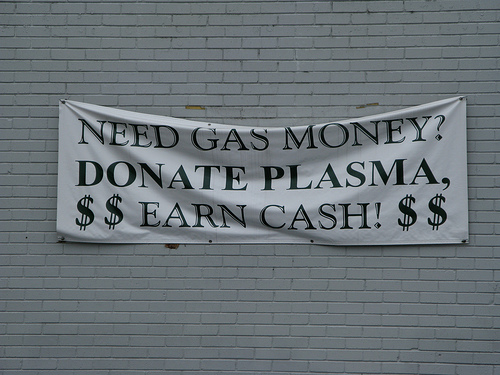
When I was in college, the stereotype of these plasma centers was that it was all junkies who sold their blood to get their next fix. Seems apropos.
The Crash is past, Comes now Inflation
So, essentially, what we’ve done over the past 30 years of deregulating banking and finance is create incentives for speculating and arbitrage, while creating disincentives for actual investment of capital in the real economy. We have shifted from industrial capitalism to financial capitalism. Rather than building a new economy of alternative energies and green technologies, Wall Street, U.S. elites, and the oilarchies have dug in to defend what they have. They have dug in to defend the past.
Texas poised to become regional hub for ethanol
...Texas is poised to emerge as a key regional hub for ethanol production — now centered in the corn-rich Midwest — as U.S. demand rises for the renewable fuel.But even the companies behind the projects acknowledge this isn't the best time to be opening new corn ethanol plants.
U.S. raises bar on Energy Star label
WASHINGTON — The Energy Department is beefing up standards for washing machines sold with the Energy Star label, which identifies less-energy hungry appliances.The department said Friday the change is projected to save $92.4 million on water and utility bills in the first year, based on a projection that 1.9 million washers will be sold under the new Energy Star requirements beginning July 1, 2009.
TOP 10: Ways to deal with $4-a-gallon gasoline
10. Take second job -- have paycheck deposited directly with oil companies.9. Get interest-free credit card -- a siphon hose.
8. Run red lights so you don't waste gas idling in traffic.
Contact
- Content: editors at theoildrum dot com
- Tech support: support at theoildrum dot com
License

This work is licensed under a Creative Commons Attribution-Share Alike 3.0 United States License.
Who would have believed that the world could shoulder an oil price that reached a record high in New York last week of $105 a barrel?
I think those shoulders are sagging a bit.
Those shoulders are not only sagging, those shoulders may be about to collapse. J.P. Morgan stated yesterday that Banks face "systemic margin call," $325 billion hit. This was discussed yesterday over at The Automatic Earth's March 8th Debt Rattle.
Put very simply, last week we saw 6 publicly visible margin calls. In at least 2 of those margin calls, companies were destroyed inside 24 hours. Peloton Funds ($3 billion hedge fund) and Focus Capital ($1 billion hedge fund) ceased to exist last week after margin calls. There are at least 4 other institutions who are staring bankruptcy in the face, ranging from Thornburg Mortgage ($21.7 billion) to Jefferson County, Alabama (unknown size but indications are perhaps $1-$2 billion).
J.P. Morgan above indicates that we are of the verge of a systemic margin call. The margin calls last week demonstrated that financial instruments sold right now, last week, were delivering between 10%-12% of their original booked value. In order to raise $325 billion in capital to cover themselves, the banks will likely have to call in over $3 trillion in loans.
This means your home loan may be called in if you are underwater (and large numbers are) even if you are a good credit risk, pay on time, and still have a job. The banks need capitalization, right now, if J.P. Morgan is correct. Liquidity from the Fed does not help here. They need capital assets to act as collateral in order to borrow from the Fed in the first place and right now they don't have sufficient collateral.
If J.P. Morgan is correct, those shoulders are about to collapse sometime very soon, Robert, perhaps within the next few months. I certainly hope that J.P. Morgan is very wrong or we stand on the verge of a depression that could make the 1930s look like a walk in the park. On this matter I still agree with Westexas - the credit bubble itself was doomed to burst one way or another but I firmly believe that the soaring costs of energy acted as the pinprick that started the unwinding of the largest credit bubble in human history.
isn't it possible that eventually thousands of empty McMansions will be bought for pennies on the dollar by someone with the means. This person will then go about turning the land back into farm land by hiring people (perhaps only paying them in food, which will be enough at that point, other employment being unavailable) to take the houses away, perhaps without machines, oil being also unavailable. These people will then stay and work the land they cleared and the cycle back to medieval serfdom is completed. I was just reading about the "contadini" (work someone else's land in return for half of the yield) in Italy, basically this sytem lasted for hundreds of years up until WW2. It seems viable in that no commuting costs are incurred-- the contadini lived on the land they worked.
isn't it possible that eventually thousands of empty McMansions will be bought for pennies on the dollar by someone with the means.
Yes, but there are 'external costs' that are not controllable.
This person will then go about turning the land back into farm land by hiring people
Here is a partial list of external costs:
Taxes (So you are going to take something of value (a building) then DEVALUING via destruction?
Permits for destruction/waste disposal/even the workers
The locations where the farm topsoil was mostly removed and sold off
Oh, and the population that needs housing - just because a McMansion becomes empty does not remove the housing demand that home used to satisfy.
The home builders treated the topsoil on the lot as a salable asset. You find a sprinkle of dirt under what came with the sod. The destruction of such a place is quite endothermic ... unless you throw a match.
The McMansions are a one way investment and a very poor one. Squatters, salvagers, vandalism, and fires are their lot. Shouldn't be all that long before you'll see folks moving into a title free house and the neighbors welcoming them as long as they get heat, lights, and keep the place up a bit. Eric's assessment of this is dead on.
Well, they are growing grass, and many of those lots are fenced in. A garage could work as a barn/stable with relatively minor modifications. That's a pretty good scenario for small-scale livestock production. Fruit trees can also be planted - a little bit of compost & organic matter right in the planting hole will go a long ways. Once there is a good population of livestock in the area, composting can go into high gear, and then the topsoil built up to turn some of those lawns into productive gardens.
Do you have any idea how useless modern lawns are for growing anything other than that monoculture green carpet? Rebuilding a real soil system of any depth takes years. It's one reason I use raised beds instead of trying to til nearly dead lawn with only an inch or two of soil under it anyway.
Likewise with planting fruit trees. Most of my fruit trees are a few years away yet from providing any serious harvest though the orange tree may give me a few oranges this year.
This is not something that can be done instantly, overnight or via mail order and a Fedex shipment for tens of millions of people. Then there is the problem of learning your local environment, its pests, its growing season(s) and the oddities thereof.
It would all be likely to happen over a long time-scale and very informally - deteriorating suburbs, dereliction and arson, and any would-be developer could simply arrange another 'accidental' fire to get rid of the remains of houses in the areas he was interested in, then buy the land as wasteland.
I doubt that they would or could go to the expense of bringing in topsoil, just work around the houses, or maybe rake the existing topsoil a bit thinner.
In reality though, I can't see the land even being used as farmland in the States, they would just be abandoned.
The only reason agricultural land is in relatively short supply in the States is because of high meat consumption and subsidies for the ethanol scam.
The money in the scenario drawn would not allow for either, so no development of waste land would likely take place as agricultural land would not be in short supply absent these.
It's a different matter in Europe with land in much shorter supply, but then again suburbs there are less extensive.
Is good land really so readily available? With fertilizer and herbicide inputs at risk maybe more land will be needed to feed people.
A brilliant summary. But not a realistic one. YOU know what is happening, ugly things, indeed. But you forget, that your central bank, your government and the whole elite in the US ALSO KNOW THIS! Do you really think, that those people/institutions act like sheep? Doing nothing?
- they will sacrifice the $
- they will dump interest rates towards 0%
- they will just forbid the banks to call in loans
- they will pump in massive amounts of money into the system
- there will be coordinated action of all important central banks in the world towards lowering interest rates, regardless of inflation. Add to this international coordinated huge money inflows.
Those steps are already underway, did you notice that? And you know what? These steps are allright.
i noticed the ECB did NOT lower rates last week & at least for now to see central banks not together is greyzone/largi's scenario probably here.
As interest rates near zero other factors come into play...Beyond this point lay dragons...
'In monetary economics, a liquidity trap occurs when the economy is stagnant, the nominal interest rate is close or equal to zero, and the monetary authority is unable to stimulate the economy with traditional monetary policy tools. In this kind of situation, people do not expect high returns on physical or financial investments, so they keep assets in short-term cash bank accounts or hoards rather than making long-term investments. This makes the recession even more severe, and can contribute to deflation.'
'The monetary authority can increase the overall quantity of money available to the economy, but traditional monetary policy tools do not inject new money directly into the economy. Rather, the new liquidity created must be injected into the real economy by way of financial intermediaries such as banks. In a liquidity trap environment, banks are unwilling to lend, so the central bank's newly-created liquidity is trapped behind unwilling lenders.'
http://en.wikipedia.org/wiki/Liquidity_trap
The rumour is that a giant taxpayer funded bailout (the first of many) is being worked on right now. The key is to make it look like it is helping the sheeple while actually taking their money (through increased government spending) and transferring it directly to the undercapitalized banking sector. The fly in the ointment is that the USA banking sector appears to have zero interest in prudent business operations, so the taxpayer money will likely be pissed away as fast as possible. IMHO, the main problem which is not being addressed is that the shareholders of North American financial institutions have little or no power to control the reckless and self serving actions of upper management and the board. This isn't capitalism at all-the owners of these companies are just chickens to be plucked-call it an "insider business model".
They will forbid banks to call in loans? When that same government is the one that requires them to have some tiny amount of capital and the only way to raise that capital now is to make margin calls?
You live in an odd world, sir. Let's hope the real world is as odd as yours.
"This means your home loan may be called in if you are underwater (and large numbers are) even if you are a good credit risk, pay on time, and still have a job."
I would think there are state laws against banks being able to recall mortgages at any time for any reason.
You would be mistaken. Your house is the collateral for the loan. If the value of your collateral falls below the value of the loan, the lender can demand that you put up additional collateral to match the value of the loan. This is what a margin call really is.
If you don't understand the potential severity of this, please review one of the triggers of the 1929 crash - margin calls, against real estate, no less.
If the lenders push too hard, they should not be surprised if at some point they discover that some people start pushing back. Foreclosing on people who have failed to make their payments is one thing - everyone understands that that might be tragic, but fair. Foreclosing on people that have kept current on their payments is another matter all together, and is sure to provoke not just universal outrage, but popular wrath.
It seems as if the banks would only be hurting themselves by doing that. They would be flooding the market with foreclosed homes when there is already an oversupply, and would get pennies on the dollar. How about car loans? A car loses 20+% in market value as soon as it's driven off the lot.
And I'm sure many consumer protection laws have been enacted since 1929.
Greyzone, you are incorrect. In the area of residential mortgages the lender has recourse only upon missed payments. The value of the home is irrelevant. Additionally, in many states, including California, mortgages foe residential RE are non-recourse; meaning the lender can do no more than take the property back.
Of course, calling in those home loans won't get any bank cash within the seventy-two hours Ilargi says they have. There is another link to an article at today's Automatic earth which mentions that ADM has margin calls of as much as $100 million on any given day.
British Administration to Set New Standards in Incompetence
On conservation:
http://business.timesonline.co.uk/tol/business/industry_sectors/utilitie...
Nice one!
On Making Sure we Only Buy the LNG Terminals We Need:
And:
http://business.timesonline.co.uk/tol/business/industry_sectors/natural_...
Many billions are being spent on these terminals, with no serious thought being given to where the gas for them will come from.
On Safeguarding Nuclear Waste:
http://www.independent.co.uk/environment/green-living/dirty-bomb-threat-...
OK, I support nuclear power, but only on the assumption that the people running it act in a sane manner.
My breakfast is spoilt by these three gems.
British Administration to Set New Standards in Incompetence
I am afraid that the Brits will have great difficulty in exceeding the all time records set by GWB & the neocons :-(
It would be better if they did not even try,
Best Hopes for Competence,
Alan
They usually miss their targets, but I think they may have better luck this time. :-(
At least they didn't actually build an LNG terminal on an island, as the name would suggest. Horse before the cart time. Although they have reopened an oil burning plant there, to supply 3% of UK electricity...
OK, I support nuclear power, but only on the assumption that the people running it act in a sane manner.
My breakfast is spoilt by these three gems.
Better just go back to not learning about the various failure modes of fission - otherwise you'll never eat again.
They dont even have to fail. Another few years, and the x000's of tonnes of glowing packaging, gloves, and 'moppings up' will start floating in the Atlantic at Drigg, Cumbria - next stop Blackpool/Belfast...
A lot of that secondary waste is from medicine. Are you advocating banning that?
As for the previous poster's point, that is what the containment vessel is for, and it did it's job at Three Mile Island.
Chernobyl had no containment vessel at all.
Of course like everything else, for instance the chemical industry, the nuclear industry needs proper administration and regulation, but we don't ban the chemical industry and should not ban the nuclear industry.
In retrospect it now seems clear that immense and possibly irreversible damage has already been caused to the climate by CO2 emissions, and perhaps so-called 'green' attitudes in their opposition to nuclear power have done more damage and contributed more to CO2 emissions than all the SUV owners put together.
That is maybe understandable for that time, but now seems like willful folly, usually supported by exaggerated expectations for what is currently possible from renewables.
If we are to have any hope of stopping climate change and providing power we need to use everything we have.
Risk is always relative, and the risks of famine and global warming are so great that any residual risk from nuclear power pales into insignificance, aside from the huge numbers of excess deaths the coal industry has already caused over the last 30 years, as that was in fact the practical fall-back in the absence of nuclear power.
The other force preventing the adoption of nuclear power was high interest rates in the 70's, and in the States this looks set to be replicated, so in practise it appears that little or no nuclear build will happen there, however desperately it is needed.
IMO those who feel that this is a good thing have simply not taken on board the great danger and deadly consequences of present circumstances.
Transit Porn
The Good (in French, two short films about the Reunion Island Tram-Train, pop. 780,000 for entire island)
http://www.tramtrain.fr/rubrique.php?id_rubrique=52
and the Bad (GWB speaking at the WIREC conference, language unspecified, I slept late that day @ the conference)
http://www.whitehouse.gov/news/releases/2008/03/print/20080305.html
Audio and Video to the right.
Best Hopes for more Good Transit "Porn",
Alan
I would recommend the second Reunion Tram-Train video for those that assume dense urban populations are required for Urban Rail service. They show the current and "Urbanisation Future" buildings.
Several of the stops are quite small towns.
Peak/Rush hour service will be every 5 minutes with service at other times every 15 to 20 minutes and freight trains at night.
Best Hopes for Widespread Urban Rail,
Alan
Thanks for the reference, Alan. Very interesting system they have planned for La Réunion. The plan is the fullest realization I have seen of Peter Calthorpe's Pedestrian Pocket model. (See also the Pedestrian Pocket diagrams on this page under "Major Design Issues")
Also interesting is the discussion of the reasons for constructing this €1.2 billion route through 41 kilometers of mountainous terrain similar to Hawaii. One of the reasons is "la flambée des prix du pétrole." That translates as "the blaze of oil prices," but it seems more apt in the original French.
Two shows that will be of interest to TOD readers coming to the National Geographic Channel. The first one is tonight and the one on oil is Wednesday night.
Aftermath: Population Zero
This is NOT the “Life After People” episode that was shown on the History Channel and on the Australian Broadcasting Network, and was rebroadcast on the History Channel just last night. This show deals with the problem of nuclear power plants left unattended. It is in one of the video trailers found on the link above.
Then on Wednesday night:
Explorer: Alaska's Last Oil
There are no video trailers for this show. Well, at least none that I could find.
Ron Patterson
Thanks for the heads up Ron. I really enjoyed "Life After People." I will set these up to record as well - through the magic of my Slingbox.
This show deals with the problem of nuclear power plants left unattended.
One of my fears(just one of them) is that we WILL build lots more nuc plants, and that in 30 years all the expertise needed to run/decommission them is gone.
Let's say the Grain/food problems do hit severly, No oil left for the normal functioning of society as we now have it. Fed Gov. not even answering the phones as JHK says.
Who will dismantle the plants? If the picture painted above has a 1 in 10 chance, how lucky do we(ie us/our children/grandchildren) feel living near or downstream from one?
I say this while watching my 3year old granddaughter playing on the floor.
I understand your fears, but you are postulating a situation so dire that the society is unlikely to be able to feed itself anyway, and if history is any guide then warfare would be endemic.
It would be ironic if we rejected an alternative which might help to prevent that collapse for fear of the comparatively small extra risk that we would incur in the event you are talking about.
In other words, cheer up! You and yours would likely be already dead before you encountered the danger you mention.
More directly, in an emergency the reactor building itself would not be a high risk - you basically don't go in there and leave it alone.
The used fuel you would have to put into water tanks, I believe they normally leave it there for around 20 years before putting it into dry cask storage, and again leaving it alone.
In the circumstances you are talking about you might get some leakage, above any level we would tolerate now, but it would still be pretty far removed from something which would automatically annihilate everything in the area.
I would worry about starvation and nuclear war a lot more than leaks from abandoned reactors.
A good read about this sort of issue is Larry Niven and Pournelle's 'Lucifer's Hammer', which is set in a world devastated by the impact of a comet.
In this work a lucky few are near enough to a nuclear reactor that they can get the energy to retain some element of civilisation.
Easy access to a nuclear reactor is likely to help survival rather than hinder it.
Thanks I feel so much better now.
:-)
Do check out 'Lucifer's Hammer' though - it is a cracking read anyway.
I meant to say that you missed my point completely.
My thoughts of the future did not include the devastation you paint of nuclear war etc.
My point was only a severe depression like 1930's x 5.
No Fuel, no infrastructure manintenance. Your recommendations only serve the future you painted. Not the one I envisioned.
Sorry for the misunderstanding.
In the scenario you suggest here it would seem to me that the resources would still exist to deal adequately with the plant and it's wastes - I live fairly near Hincley point nuclear power station, and if the lights start going out due to natural gas shortages that is much more of a comfort to me rather than a cause for additional concern.
Dave;
It surprises me that you find any comfort there, after linking the article on undefended shipping of Radioactive Weapons materials, earlier this morning. As prices balloon (in some, even milder hypothetical future than Samsara suggested), and pressures increase on the energy sector, how many of the layers of the already expensive and labor-intensive fuel cycle are going to be subject to 'cutting corners', and 'what they don't know won't hurt them' in the Actual operations of these businesses?
I find very little comfort in this system that consolidates too much energy, too much money and too much influence in one point source. It is the generating equivalent of a Dictatorship.
Bob
I don't aim for perfection, all I aim to do is struggle through in a very imperfect world.
I think we are going to need all the ways we can manage of generating energy, -and that the risks of not doing so are many orders of magnitude greater than the risks from nuclear energy.
It is already clear that France, at least is in a far better position to manage than just about any other major country, because so much of it's energy supply is secure.
It also seems clear that, partly from fear of these relatively small risks from nuclear energy, we discontinued a heavy nuclear build, and that in retrospect this was a mistake as carbon emissions to date could have been far lower.
Some seek to argue that climate change is already likely to be so severe that nothing should be done about building more nuclear reactors as the time scale is too long.
Maybe they are right, but there seems little point in acting on that assumption, and anyway it is surely right to mitigate the effects as much as possible.
Others seek to argue that we can do it all with renewables, or that fuel for reactors will run short.
The problem with renewables is that they are a very immature technology and we don't actually have experience of running a whole technological society on them.
Many of them are also very expensive, and it will take time to bring the costs down.
So even if we were to run out of uranium at some point within the next hundred years (we won't) then it's contribution would still have been invaluable in buying us time for renewables technology to mature.
The risks then of nuclear still appear to me to be tiny compared to our need for it's power.
I posted that link to the Independent story on poor nuclear safety because I would never seek to strengthen my argument by avoiding mention of problems in it - the facts, good and bad, need airing.
It is literally incredible to me though that some should still in the present desperate energy and climate crises seek to throw away the most developed tool we have to combat it, and I feel that they were wrong in the past and caused great damage and are even more wrong now, and appear to me nearly suicidal.
Again I would emphasise that I strongly support both renewables and conservation - it is just that I would seek to retain the extra option of deploying nuclear energy in addition to contributions from other resources.
The risks then of nuclear still appear to me to be tiny compared to our need for it's power.
Total Amount of energy == Energy per person times Number of people.
You *COULD* always adjust the 'energy per person' side of the equation. MontyQuest (at PO) argues for powerdown.....
I strongly support energy conservation as a priority over any form of generation.
The difficulty with it is that Jevon's paradox applies, and unless the price is raised the demand will spill out elsewhere.
I did not reference it as one of the sins of the UK government, as at least they were trying to help, even if entirely counter-productively, as they have recently announced after the recent stonking energy price rises that they intend to subsidise the 5 million or so of the energy poor, probably I would guess as a rebate, thereby decreasing the strength of the price signal, and incidentally acting in the same way as the Third World countries the government seems keen to join.
It is politically somewhere between very difficult and impossible for governments to pass on the full prices and avoid Jevon's paradox.
So yep, conserve as much as possible, but we still need ALL the other available options to have a prayer of avoiding economic meltdown and climate change.
On that note, even if it took some 15 years to build up to full-blown mass nuclear production, commencement would tend to put some kind of lid on prices, as ultra-expensive power then would clearly not last forever, and the financial markets behave much better if they have a little certainty.
The French nuclear build only took some 17 years, but we would have to inject some urgency.
I would also gratefully accept any help that solar and wind could provide at anything less than ruinous prices.
"It is already clear that France, at least is in a far better position to manage than just about any other major country, because so much of it's energy supply is secure."
We'll see how secure, once those plants are asked to operate in a time when there might be Petrol Shortages and Outages, supplies of critical repair parts are held up in a constrained manufacturing environment, or the combination of otherwise mundane factors. Labor, Security, Roadways, Weather, International Trade, Currency Values..
I appreciate that you aren't insisting on Perfect answers or conditions, my contention is that Nuclear has probably got fairly limited resilience to more turbulent conditions, and thus it DOES need a more perfect setup around it to continue.
France's big 'Ace in the Hole' might be a pretty heavy 'Ring in the Nose' if ground conditions bring out the worst side of complexity's nature.
Best,
Bob Fiske
So even under your scenario France would already have saved large amounts of carbon against that which it would have emitted if it had continued to generate most of it's electricity by FF, and the fact that no-one followed it's example and made a really serious dent on emissions is hardly it's fault.
It is hard too to see what they have lost if for some reason they could not maintain nuclear generation capacity.
At worst they could switch it off.
In reality of course maintaining their capacity will be the number one priority, and they will be enormously better placed than others to continue to generate electricity to do things like, for instance, make solar panels.
Solar panel production or mining the steel and the other resources for wind turbines are also vastly complex enterprises, and if we can't manage to continue to run nuclear power plants I fail to see how either of those could be done - in fact though the large power generation from nuclear in France is likely to enable allow all of those options to continue, albeit with great difficulty and with constrained living standards.
They will, for instance, be able to pay for the iron they need for windmills by building nuclear plants elsewhere, when it may be difficult to see what others who have foolishly run-down their engineering capacity can hope to trade.
Plenty of silicon from China for solar panels for France, as long as they can help them build more reactors.
What about the other countries?
It is the countries without that major energy resource who are far more likely to find themselves unable to produce the renewables they had been counting on.
It is already clear that France, at least is in a far better position to manage than just about any other major country, because so much of it's energy supply is secure
That s only one part of the French "story". Velib (rental bicycles, first 30 minutes free) requires no imported or grid energy to operate, yet provides a vital link in a Non-Oil Transportation System.
In summary form, the French are creating a Non-Oil Transportation System with
1) TGV for passengers. Phase I almost complete after 30 years of building, work on Phase II has started.
2) SCNF (French national railroad) will be completely electrified
3) Trams are already being built in French towns of 100,0000+ population. 1,500 km more tram lines to be built in the next decade. (See my transit porn today for what they are doing in Reunion, pop. 780,000).
4) Velib and related efforts to improve bicycling.
5) Modest efforts to improve and expand walkable neighborhoods around tram stations.
Not perfect, and not enough, soon enough, but significant none-the-less.
Best Hopes for the French,
Alan
That's all true, Alan, and it might be mentioned in addition to all that that they are rapidly building windmills, are installing 50,000 air heat pumps a year and plan to put in 5 million residential solar thermal collectors in the next few years.
Many French in addition to their apartment in town have houses in the countryside (NOT suburbs!) where they grow a considerable part of their food.
Solar resources are also fair in the southern part of the country, and a far cry from trying to power a house in Berlin in the winter with solar PV.
They are forging ahead with the development of the compressed air car (which, cynical old me, I will believe when I see) as well as plug-in hybrids.
The molten salt reactor which should generate 50 times the power for each unit of fuel whilst producing 1,000 times less waste, radioactive for far shorter periods, and which is capable of mass-production is also under development.
Errrr, just how long do you envision this depression lasting? How long before the world and its 6.6, (7 or 8) billion people get back to business as usual?
I agree that there is not likely to be a nuclear war. But the devastating effects of declining fossil fuels will be just as great. Imagine the fate of Japan who has no oil nor coal of its own. What will happen to 127 million people on an island smaller than California where only 12% of the land is arable? South Korea will be just as bad off with most of Africa and most of the rest of Asia in a similar shape? And all it will take for this to happen is for international commerce to break down and every nation thrown to the mercy of its own resources.
A severe depression? Naw, try a massive die-off. But it won't be like the show depicts tonight. The people will not simply disappear, they will not go quietly into that good night. They will rage, rage, and eat every animal they can catch. There will be no wild dogs as depicted in the show. All the dogs will be eaten.
Ron Patterson
Ron Patterson
Sure sounds like a recipe for war to me. Those who ain't got, try to take.
Australia would look pretty juicy.
Australia is under the gun due to climate change as we'll all recall. A resurgent, militaristic Japan can't just happen. Yes, its possible and we've got historical examples, but do they have the time to accomplish the transition? And can they do so in the face of the Russians and the Chinese?
Old models are starting places, but must factor in oil availability. If(when) we start fighting I think it makes troubles much, much worse. We tear up infrastructure we'll need and it will be difficult or impossible to replace. A stripper well doesn't get rebuilt if something happens, it gets capped. The same principle applies on a much larger scale to refineries. There are many operating today that simply wouldn't be rebuilt should disaster strike - there isn't enough oil left to justify their reconstruction, although there is enough to justify continued operation.
Rocking the lifeboat fighting over the last MRE? Not wise, but inevitable ...
SCT, I just quoted Japan because Ron referred to it.
But the same point would apply to most nations - if you are likely to loose half your population due to starvation, you don't worry so much about a war.
If mass starvation is your only other option you will try to take someone else's lunch, and hang the consequences.
If Asia (including the Middle East) were to form a union like the EU, wouldn't they be fairly self-sufficient for a while? The trend worldwide seems to be away from national sovereignty and towards regional cooperation and unity.
You mean someting like this...Shanghai Cooperation Organisation...
http://en.wikipedia.org/wiki/Shanghai_Cooperation_Organization
At their latest meeting the SCO invited Iran as an observer and it is believed that Iran will join the SCO in the future. The US requested observer status but was denied.
A severe depression? Naw, try a massive die-off. But it won't be like the show depicts tonight. The people will not simply disappear, they will not go quietly into that good night. They will rage, rage, and eat every animal they can catch. There will be no wild dogs as depicted in the show. All the dogs will be eaten.
I'm with you Ron, Exactly as you stated it. I gave the milder reply only to show that even if things were "Just Tough" we will have problems dealing with nucs.
300 million down to 50 maybe in 30-40 years max.
I'm only a few years younger than you. Born in '52.
People read Rawles "Patriots: Surviving the Comming Collapse"
Do your Preps.
BTW, If a dieoff were to happen, many things will NOT be scarce.
For every person that dies, 5-10 shirts/pants etc will be at the flea market(whatever they be) and at least 5 pairs of shoes. as an example.
Now if you want to stock up on something you can barter, Load up on 45 and 308 PRIMERS, I predict you will be able to trade them for lots of things. Ya can't make'em in your basement.
The 'pandemic disease' model of die off leaves materials intact, reduces demand on total materials consumed, and can be blamed on 'natural forces' VS evidence of man VS man violence that bullets or thermo nuclear weapons do, thus allowing the "no conspiracy" rule to be in effect.
Total Energy Consumed = Number of people times Energy Consumption per person
As a doomer, I am uninterested in "solutions" that contain the words "could" or "maybe" or "possible" or "when they realize...". I am uninterested in solutions that require probabilities to be considered or resource availabilities. I look at things from a black and white perspective, that is, they either will occur or they won't. I don't consider the "best" worst case but rather the "worst" worst case.
It isn't that I can't envision lesser catastrophic futures but rather that when one plans for an eventuality one must work from a position of strength.
Does anyone really believe (well a few do) that the following will be resolved in a timely manner:
Societal philosophy of life
Economic paradigm
Global warming
Geopolitical status
Financial system/debt
Governance
Replacements for FF
Population
Natural resources other than FF
Food production
Techonfix's
There are more but why beat it into the ground. The truth is that any one of these could be a show stopper all by itself. However, as a package, it strikes me as impossible that all of them will be totally resolved - much less in a timely manner.
Society is a gestalt where the total is more than the sum of its parts. For example, debating about agriculture to the exclusion of these other issues is mental masterbation in my opinion.
I fully recognize that I cannot 100% protect myself and family from a worst case. In fact, my actions are to buy sufficient time to see what the fallout (literally or figuratively) is and go from there.
I agree with John that people should read Patriots but they should also read The Encyclopedia of Country Living and a thousand other books. How about Deerskins to Buckskins about brain tanning or a really obscure one like How to Get Out of the Rat Race and Live on $10 a Month (I actually highly recommend this 1971 book - shows how long I've been at this)? But equally important is that they get the tools they need and actually practice this stuff. This is what is going to get people...All Hat and No Cows.
Finally, let's give one more plug for Jim Rawles' site http://www.survivalblog.com
Todd
Societal philosophy of life
Economic paradigm
Global warming
Geopolitical status
Financial system/debt
Governance
Replacements for FF
Population
Natural resources other than FF
Food production
Techonfix's
No society has ever gotten every item just right. We live in a world of partial failures and partial successes. "Muddling by" is a very human trait. OTOH, societies in panic (see war) are capable of extraordinary change and sacrifice for the "common good".
We are today quite complacent and BAU is the order of the day and, IMHO, the future is unknowable and will be heavily influenced by our actions, and inactions.
I do know that I will one day die and I need a society within which to live a decent life, even more so in my advancing years.
Best Hopes,
Alan
Alan,
Sorry I don't have time for a longer response; I just came in for a break from cutting firewood (for next year and the year after).
Society will not muddle through. This might have been true when most people were involved with agriculture and were generalists who produced. That simply isn't the case today. What we have now are a bunch of people who are in "service" jobs and don't know Shit-from-Shinola (to date myself). They don't have useful skills nor do they have the tools necessary to accomplish anything. By tools I mean real tools. Further, they have probably never had to deal with hard times.
Consider yourself; from what I know of you via your posts, it sounds like you are totally dependent upon others for your survival. I don't mean this in an angry or aggressive way but rather that I see you as typical of most people today.
Well, got to quit and buck some more wood up (Yea, with a gas chainsaw...but I do have a couple of misery whips, bowsaws and axes. You don't know how much I pray that the gas holds out.). Maybe more on another break.
Todd
Are you using a hydraulic splitter or do you have a manual method? We did it the hard way for a while, then dad rounded up a hydraulic unit we powered with our tractor. I've pondered this problem here and there - seems like a couple of poles 15' or so tall, a pulley system, and a nice wedge on the end of a great big weight would be just the thing ... take off walking with a rope that lifts the pulley, go until it stops, then come back and line up your victim in the "wood guillotine".
When its damned cold and you're young and frisky the small ones are fun - wind up with the splitting maul, swing, and you get a loud ploink and a couple of pieces flying.
Even at 71, cleanly splitting a billet with the maul is satisfying, I do it daily
First I cut the cords to size with a chainsaw or the circular saw.
I'm (mechanically speaking) a somewhat battered forty year old so this is not in my future. The temperature and wood type make a tremendous difference. Our wood supplies came from land clearing. People do that often enough around here there is a good supply, at least there was when only a handful burned wood - we'll see how that goes. Get some ash to split on a frosty day and life is good. Tearing into cottonwood on an early fall day getting your supply ready? Three wedges, two mauls, and lots and lots of driving words will come forth when you get to the piece that was taken closest from the ground. Ash is hard and straight, while cottonwood is all twisted internally. Many times I've had to fire up a chainsaw to extract a wedge from a piece of cottonwood when manual splitting methods failed.
I was thinking about a simple contraption that would be the manual version of a Hydraulic Splitter, using a really long lever (12'?), or even two, one returning towards the Cutting Area, so you can stay right next to the workpiece. I can think of a number of configurations, but imagine a great pair of pliers, lying on their side with an extra Lever that brings the user over to the jaws, which like a pair of wire cutters are set up with wedge(s)for the cutting.
'With a long enough pole and a place to stand, I could move the Earth' -??
Bob
Hydraulic pressed put out an amazing amount of force - better check what you can achieve with such a thing vs. the shock driven method. I'm not expert but I suspect a gravity assist splitter is going to get a lot more done than a mechanical force multiplier. Hopefully someone around here has some actual real world knowledge on the old methods ...
Ever used a "monster maul"? I was always impressed with the tool...
SCT,
It seemed easier to add a response to you down here. Yes, I use a 30 ton hydraulic splitter. I got it after I hurt my back at work about 15 years ago. FWIW, Bailey's (now baileysonline) has their headquarters in my burg. One day I was going in for a back manipulation (my chiropracter used their break room) and they had a demo out front for about a grand off. I bought it on the spot. I asked Bill B. about it and he said 100% guarantee.
But, I have monster mauls, regular mauls, wedges, sledges and everything else you need. However, I'll tell you, as long as the gas lasts I'll never give up the hydraulic splitter. The wood crushes if it doesn't split...no more "unsplitables." The stuff I was working on today was narley oak that I would have had to saw/rip to get usable pieces.
There are little ones with levers you pull but most are low "power." And, there are some that run on 110volts. They are small too. Bigger is better in this case.
Todd
Bob: it was Archimedes... "Give me a lever long enough and a fulcrum on which to place it, and I shall move the world."
Thanks.. I grapevine such quotes so far down, they become unsearchable. (Not that I bothered to search it out.)
To follow the above convo.. I love splitting with malls, axes, hatchets, but I know that Mom is not too eager to 'swing that thing' any more.. just thinking about wacky gadgets.
Bob
Yes ash is the greatest joy, and dont be too sure you wont be strong in your old age, you might be surprised
Well, got to quit and buck some more wood up (Yea, with a gas chainsaw...but I do have a couple of misery whips, bowsaws and axes. You don't know how much I pray that the gas holds out.)
You can buy AC chainsaws, and power it from PV/Batteries/inverter
As I am fond of saying, "There are no solutions, only strategies."
Antibiotics and primers----
When I lived in Micronesia, it was fish and marijuana--
Mono fishing line and hooks would not be a bad choice.
It is strange what life comes down to---
When and where were you in Micronesia? I did time in Palau...fun, but a little scary at times.
Like when the 'Formerly World's Richest per Capita' riot:
http://www.stuff.co.nz/4433454a12.html\
------------------------------------------
The main police station in the South Pacific nation of Nauru has been gutted by fire after rioters attacked it over the weekend, and authorities fear more violence ahead.
Rioters objecting to the export of phosphate burnt the station on Saturday......
-------------------------------
Our Westexas has talked before about what might happen here when our FWO-J6P cannot get gasoline to drive his blinged-out pickup to his suburban McMansion.
Imagine what might happen next if the Govt confiscates his wheelbarrow, compost pit, and I-NPK, seed, and food stockpile.
Horde all the prescription pain killers that come to hand. Asprin are cheap and will be great trading material...Same for .22 cal. ammo. Peanut butter, preserves, canned coffee, vinegar are items that have a long shelf life.
Asprin degrades with time and becomes toxic. If it has a vingar like smell its toxic.You have to be very careful with many medication that degrade or even become toxic. I advise you and others to apply rigorous research into any medications that you plan to store for long periods.
Seems to me that wine might be a good investment, if you don't live in a tiny little condo like me. I don't know anything about the good stuff, but if you get a few dozen or hundreds of crates of red wine, I assume that you'd be able to trade them down the road. Further, the nice thing about wine is that it actually improves with age. Unlike, say, gold.
Actually, given a deflationary environment, even a few wheels of cheese might be worthwhile. The benefit being that wine and cheese are expected to improve with age, so they'll keep their value [not a trivial thing given what's happening with TIPS these days].
ron
'I agree that there is not likely to be a nuclear war.'
why this thinking?
Hello Ron.
Actually Japan is in a significantly better position then some other countries. I'll skip renumeration of their advantages because I'm sure You already have seen them before on this site, from other posters.
Recently read L's H and the salvation of the nuke plant seemed more of a tacked-on happy ending. Also you notice it's those filthy tech hating hippies armed with their dogeared copies of Limits to Growth who want to to shut down the plant! Later they do their best to do so, in cohoots with their fellow cannibals - who are black, natch. Rather crayon sketch sophistication politically but still a nifty piece of doomer porn - loved the surfer who rides the ultimate wave until it slams him into a high rise apartment building.
A fun read, but not profound. There seemed to actually be paid product placements in it, as I recall from reading it when it originally came out... like "good thing we got a Chevy Blazer or we'd never have made it past the cannibals". So take it with a large grain of salt. They release a slightly different version (Footfall) where the asteroid is dropped by marauding space elephants, and (spoiler alert) save the world by using fission bombs for propulsion. Niven & Pournelle write a good yarn, but are 'way-silly technocornucopian. In "Inferno" they note that Hell is where environmentalists go.
Entertaining techno-wankery - in scifi, right where it belongs. They're simply writing about a quite different universe. They do it well but, gripping hand, it is a different universe than the one we're in.
Surely a nuclear plant left unattended it will just shut down when it's fuel runs out. Even a melt down would only have a transiant effect on the planet een if the containment vessel didn't work.
I can't see any reason for that sort of Marie Celeste scenario.
You would withdraw the fuel rods, and then have to keep them cool by immersion in water.
So, is anyone watching Population Zero?
Seems a lot darker to me than Life After People. And not just the nuclear plant.
I saw it. I did not see the point, the people just disappear. When the real thing happens the people will not just disappear they will struggle mightily to survive. And this struggle wreck havoc with the environment. Forests and animals will disappear, not retake the land like in the show.
Of course a couple of hundred years from now, after the population has settled out at a few million, then nature will return and there will be forest where the cities are today. But the first 50 years or so, there will be far more destruction of the natural world, rather than an immediate return as depicted in the show.
Ron Patterson
I watched it. Pretty light-weight stuff. I thought their time-lines for decay of various structures was ok, nuke plant melt-downs ok, aircraft falling from the sky ok, animals perishing while still confined ok...But who really cares how long it will take for the Statue of Liberty or the Eiffel Tower to fall apart? The show was western centric. Why were the Egyptian Pyramids and the Great Wall of China not considered as candidates for longevity? I liked the segment that delt with the time frame for the earth to heal itself. Gaia will stabilize itself.
Why should people use their brains when they have such huge egos?
'Airplanes falling from the Sky' ??
Was this a (wink, wink) Rapture film?
Bob
I don't think so. The Rapture leaves some people behind, after all. Most people, even. This just assumed that for whatever reason, every human on earth vanished, all at once. Even the sinners. ;-)
I was very interested to see the following in Deffeyes' essay:
Hah! Since I have been making comments along these same lines recently, I feel validated. :) I'm not sure how you'd prove that, maybe by taking the total inflation number, removing all the other known drivers for inflation and then seeing what's left?
'I'm not sure how you'd prove that...'
Bit of a sticky wicket, eh? I believe that just as important as inflation is the expectation of inflation. All economics are influenced by greed and fear. For instance, if OPEC thinks that the US intends to continue cutting interest rates, inducing more inflation, OPEC will not feel obliged to increase production, since prices are rising at current production levels abreast of or greater than inflation. How would you factor out the psychology of inflation expectation?
When GWB asks OPEC to increase production while the US Fed is inducing inflation GWB is in effect saying 'We want the same amount of oil for less money (purchasing power)...A freebe, IOW.
What is the meaning of an 'inflation-corrected' price? Economists seem to think that this is some sort of 'real' price, but I think this is wrong. I argue that it is just a relative price.
One way of going about understanding what these adjusted prices mean is to ask yourself whether 'inflation-adjusted' prices for consumer goods and services in general are currently high or low.
The answer is that they are exactly the same as they have ever been (assuming that the 'inflation rate' used in the calculations properly represents aggregate prices changes of goods and services). By definition of inflation-adjusted prices, overall inflation-adjusted prices are constant. At any given time, the inflation-adjusted price of some goods and services is going up, and that of others is going down.
So what do we mean when we say that the inflation-adjusted price of oil is at an all time high? We mean that relative to the prices of other goods and commodities, the price of oil is at its highest ever.
As you point out, increases in the price of oil contribute to increases in other prices. Nevertheless, the price of oil is still at is all time relative high.
Re: Require flex fuel to stop OPEC's hold
Looks like the folks in Alabama haven't learned about the evils of corn based ethanol. But then, being from Georgia, I always thought the folks over in Alabama were a little slow... :-)
Seriously, the notion that the Nissan company could kill the flex fuel requirement proposed for the 2005 Energy Bill sounds a little sushi to me. Nor to mention the implied reference to those wily Japanese messing with our god given right to drive our big Detroit SUV's till Death Do Us Part, so the Gooks could sell us more of their little bitty tin can econoboxes. Wouldn't ya think Old Detroit would be beating down the doors in Congress, if they thought flex fuel would bail them out? Maybe, with the price for oil above $100/bbl, the Neocon MSM has decided that Energy Independence is a great banner to fly in an election year, especially as their war machine has not produced gobs of oil from their conquest of Iraq.
E. Swanson
sounds a little sushi
Sounds like rice flavored with salt, sugar and vinegar?
Re: TOP 10: Ways to deal with $4-a-gallon gasoline
3. Find neighbor with hybrid car. Steal it.
Except this to be the first option people go for in the near future. And this one:
7. Push a shopping cart around town picking up recyclables.
The MEED article on Khursaniyah is subscriber only, but you can get it by going through Google first:
http://news.google.com/news?as_q=khursaniyah&svnum=10&as_scoring=r&hl=en...
There seems to be some consternation with the PHBs at Saudi Aramco.
The story on Khursaniyah is subscription only.
I am not a doomer really, but this article: Can We Survive? (Part 1) got me a little nervous. With the potential of a Democratic congress and President, the liberal fascism described in this article may come back into vogue. I want to be able to opt out. Can anyone recommend a good handgun or light rifle to defend myself in an urban combat situation. I have a little experience with guns, but if I am going to buy my own, I should know what I am doing.
If you aren't familiar with guns but want to go the gun route, sign up with a lot of big dudes who ARE familiar with guns and try to work in the kitchen feeding them. Please examine the recent history of the Balkans for a likely scenerio of what is around the next bend on the gun road.
Keith--
Liberals are incompetent and generally passive-- I would worry about right wing fascism , the direction we are headed full steam!
A 12 gauge pump is the ultimate defense weapon-- It is the weapon of choice for the cops.
Many would disagree, put that is my opinion.
Weapons are a lot like golf clubs. No one weapon will suit all situations. There is a good read by an Argentianian at link below that gives details of life in a partially collapsed economy. The writer details not only what weapons that he found useful but much more, specific information about how to go about daily life without becoming a stastic. I suspect that human nature in Argentina is the same as human nature everywhere so the information presented should apply in most cultures.
http://www.frugalsquirrels.com/cgi-bin/ubb/ultimatebb.cgi?ubb=get_topic;...
That's a very good read, River, if very sobering.
The time span of 6-12 months to realise that things have changed and aren't changing back is enlightening.
Thanks for the link.
You are welcome DaveMart. Leanan gave me the link sometime ago. What would we do without her?
Thanks River, that article is exactly what I was looking for.
In terms of violent crime, the USA isn't Argentina at this point-it is unlikely it ever will be. The USA is two countries overlaid (re violent crime). The safe areas (probably 75%+ of the land mass) are as safe as anywhere on the planet-the rough areas are like 3rd world dumps. Major increases in violent crime will prompt a migration toward the safer areas IMO rather than warfare between the potential victims and the thugs. IMO police forces would adopt a "fortress" mentality, effectively abandoning the worst areas to concentrate on the better areas. I do agree that the major risk of dramatically increased violent crime in the USA would be the public acceptance of overt fascism.
I think Ferfal exited that site - they turned out to be some sort of flavor of religious fanatic at the top and if I recall correctly he was going to hell because he was Catholic(?) I'm not sure where he went.
liberal fascism?
That'll be a marvelous relief after the thinly disguised would be theocratic fascism of the Bush administration.
With the potential of a Democratic congress and President,
Yea! Cuz things like smaller government and lower spending only happen under the OTHER party (team? Tribe?) is in charge!
Right Keithster100?
But hey, lets play define!
http://www.orwell.ru/library/articles/As_I_Please/english/efasc
Huh. Now does that sound like anything going on today? Anywhere?
Lets go futher:
Nope, no "liberal" listed there. But perhaps you have this endpoint in mind:
Thusly consider yourself spanked yet again Keitherster100. I look forward to your next post where you attempt to root 'for your tribe of "conservative"', and fail yet again.
(Meanwhile the mentally weak rally around labels of pseudo tribe things like political parties, sport teams et la and try to inflate their egos over the success of fake tribe using even more broad terms like, oh say 'liberal fascism'. )
You betray your leanings, sir. What value has small government? Ask someone who was caught in New Orleans with no way out. Give it a few more months and then ask someone who needed the SEC to be there doing their job. Ask a packing plant worker who has sat for four hours with a broken ankle filling out paperwork before they'll permit him to be treated, with not a meat inspector in sight.
We get the New New Deal, or we get four or eight more years of crappe en croisant from a unitary nitwit like we've had for the last eight. And yes, McCain't ain't my idea of leadership.
A weapon is a tool, and like any tool you need the right one for the right situation. You can't walk around the office carrying a shotgun all day, nor will they let you wander around Walmart's parking lot with one.
Long barrel rifles and shotguns are for hunting.
Short barrel rifles and shotguns are for battles.
Handguns are for everyday carry and personal defense.
Automatics jam, and revolvers are slow to reload.
For my personally defense, I keep a 9mm Beretta 92 with gold dot ammo. It is verrry reliable.
Another popular handgun would be a 40 caliber Glock.
Do not make the mistake of buying a 2nd tier manufacture. If you have to use it, you want it to be reliable.
I also recommend the frugal squirrels article. It and others I've read about Yugoslavia convinced me that the "lifeboat" approach would not work. Only a community can effectively survive.
Here is a link by combat vet talking about "What is a Combat Handgun?"
http://kitup.military.com/2008/02/what-is-a-comba.html
Also some manufacture links
http://en.wikipedia.org/wiki/Glock_17
http://en.wikipedia.org/wiki/Beretta_92
http://en.wikipedia.org/wiki/SIG_P226
Snort
Extreme Left = Communism
Extreme Right = Fascism
Liberal Fascism = Oxymoron
Consider the term "Conservative Communism". Sound dumb? That's because it is. Same with "Liberal Fascism".
What a bunch of crap - trying to define away a reality that is rampant today. Liberal Fascism is in every fabric of life in the US.
How much of the Rush cool-ade have you injested?
??? I would define fascism but a combination of the unification of government and corporations combined with nationalism and a certain virulent religiosity. Sound familiar? I see no evidence of "liberalism" in the the current political scene. Neo-liberalism, yes, and plenty of corporatism, and a few sops to socialism. Certainly very little liberalism.
I should add, what we seem to be drowning right now in is the results of "financialism". This is ostensibly a belief in free markets but is actually the belief that society can be organized like a giant casino in which every can win. Or at least, Wall Street can win.
Capitalism is the oppression of man by man.
Communism is the opposite.
- Joke going around Warsaw, ca. 1980.
Cos--
That was the Italian definition "the binding" (fascism) of the State, the Corporation and the Church.
Wow! BushCo succeeded where Mussolini achieved only partial success!
Please stop. You're confusing Fascism with Febreze.
Honestly, to call liberals fascists is like calling small-government conservatives anarchists.
What a bunch of crap
The same can be said of your post.
trying to define away a reality that is rampant today.
And what is this? Pointless handwaving while yelling 'danger'?
Liberal Fascism is in every fabric of life in the US.
Then define what you mean. VS handwaving.
Here is where someone does more than you have done - attempted to define Fascism.
http://www.orwell.ru/library/articles/As_I_Please/english/efasc
Concludes with
Which is where YOU are at.
But come on, take your best shot. Man up and show me wrong.
Eric - Your post does have some value. You cited an article, which is basically where I am at. [I highly recommend everyone to link to Eric's article] There is no satisfactory definition of Fascism. So, for those to define it as meaning a conservative, it is equally applicably to a liberal. But, perhaps we have a difference on who is what. For example, for me, a conservative, I consider the following to be an example of Liberal Fascism: If you are a certified meteorologist, and you do not believe in AGW, then your certification should be taken away. (Heidi Cullen, the Weather Channel)[I attribute that to Liberal thinking, and I would call such thinking Fascist.] I think that for the most part, AGW advocates are liberals who want to "control" the behavior of everyone - especially those with money. And, just to make a point in the extreme, at some point Heidi would probably want to put deniers into concentration camps. If my SUV is torched because of a gas shortage, somehow, I do not think that it will be my conservative friends doing it.
"If my SUV is torched because of a gas shortage, somehow, I do not think that it will be my conservative friends doing it."
Maybe you would torch it to collect on the insurance...
SubKommander Dred
I consider the following to be an example of Liberal Fascism: If you are a certified meteorologist, and you do not believe in AGW, then your certification should be taken away.
Your 'source' is part of the government? Somehow empowered? Or no better than a poster on some internet blog?
Looks to me like you are out harvesting straw to build your case.
my conservative friends
So then you are falling into the 'tribe' line of thinking. Using loaded wording to feel important/good about your chosen tribe, willing to slap your 'negative labels' on ideas that you happen not to like.
Just remember as YOU get 'tossed under the bus' by 'fellow conservatives' that you were told about tribe-thinking.
(Same goes for the tyre-side view most of us will have)
If you want to have a good laugh with your conservative buddies in which you blame teh liberals for all of society's ills then "Liberal Fascism" gets the job done. If you want to have a serious discussion critiquing society aimed at actually convincing people outside your immediate political circle then using transparently idiotic terms like "Liberal Fascism" isn't an optimal strategy.
The term was invented by Jonah Goldberg to snooker rubes on the right into buying his latest screed. For perspective, imagine if Michael Moore or Al Franken wrote a book titled "Conservative Communism".
I think conservative means the government spends more money than it can take in, lowers interest rates, then watches the currency collapse and blames it on "speculation." Conservative might mean claiming to have won war, then later get a party spokesman to say it might take 100 years to win the war. Con-servative.
The term was invented by Jonah Goldberg to snooker rubes on the right into buying his latest screed
Thanks for the explanation!
I find this particular oxymoron very disturbing. It smacks of orwellian newspeak. Tyranny wears many faces, and can come from the left or the right, but this one seems like an attempt to plant a destructive meme.
I don't know, I think it's just some jerkoff pandering to one subset of the political spectrum to sell books.
Quite correct; he's our nincompoop troll. I suspect most such work at AEI or RNC as interns.
I would characterize the Peronist movement in Argentina in the 50's as a liberal facsism.
He means Neo-Liberal Fascism. That's what most of the world calls Neo-Conservatism.
If you want a gun for personal or home protection stop talking about it. Now. No one knows you have a gun and you certainly do not gas about it on a public forum. Do not post BS here again.
Learn how to use your gun at a range. Keep your gun at the range. No one knows that is not your only gun.
When your fantasy bogeyman walks in the door and you display your weapon you just showed him one more thing he can take from you. And gave him a major reason for taking your life as well as whatever goods he came for.
If you win, better have a plan now for how you dispose of the body. If anyone at all knows you have killed, someone is going to view your carcass as a more tempting trophy. Once you're in, you're in. Think seriously how you quickly and quietly dispose of 200# of rapidly decomposing meat.
"Urban combat situation"? OMFG. How about be on the side that's winning but don't play with guns?
And please don't shoot yourself in the foot, it's so embarrassing.
Revenge fantasies get you dead. Talking about guns gets you dead. Don't do it.
While those are good ideas, I think you are being a bit too worried. Where I live, many/most people hunt and fish. That means they have guns. Writing about your armaments can't be such a dangerous undertaking as it is highly unlikely that anyone reading is going to drive 50 or 100 miles just to capture your weapon of choice, once the oil runs out. The first place they would hit would be the dealers, I would think. One must practice and there's not going to be ranges available for many locals. Practice with a .22 or black powder, since neither might be seen as likely to be a threat. Besides, with black powder, you ARE RELOADING from the start and you don't need an FFL to buy them (yet). Keeping quiet with your neighbors about your holdings is another matter and probably a good idea, especially as one's neighbors might not be so friendly after TSHTF.
One of my neighbor across the valley regularly blasts away at odd hours. Another neighbor (and his sister) used to empty his .357 to call his dogs. I hope they are the exception, but I am beginning to think not.
E. Swanson
There are in excess of two hundred million guns in the U.S. I sometimes wish for more than my break action Winchester Model 37 .410 and the kid's single shot .22, but I'm counting on a town of less than a thousand in the middle of nowhere to behave in a certain way even if things get really ugly. If the tooth fairy hits my pillow by mistake tonight I'd probably use the funds to round up a 9x19mm carbine and a pistol. I miss my Glock 19, but I don't think I'd get another - I'd prefer a carbine/pistol set that uses the same magazine. H&K MP5 + USP is the Rolls Royce(right?), but I'd settle for something reliable and sturdy.
The practice thing is key. When I was up on stuff I could tag a steel can with one shot from my Glock and then I'd have a pretty good chance of hitting it again while it was in the air from the first shot. That started happening somewhere between 2,000 and 3,000 rounds through the piece. It should be noted that marksmanship is about 5% of what one needs when handling weapons in dangerous situations with the rest being judgment and nerve.
I drew that Glock one time in self defense in the roughly twenty years of urban living I did and I had a couple of other situations arise where the thing was in the holster or the console of the car and there it stayed despite what was happening around me. Forget all of that crap you see in movies - you can't tag someone with a single shot at thirty yards with a pistol. You can't spray an entire magazine around an urban setting without causing some significant legal troubles for yourself. Suppressing fire is for military units and movie scenes. Even if you're in the right when you take it out you'd better be prepared to be cuffed, stuffed, and lose the piece for either a good long time or permanently, depending on the scenario.
I am going to pause and again give thanks for having grown up here and having the foresight to return and start getting established before the troubles really hit.
Another think they don't mention in the movies is the noise. Firing a pistol in a car or home will leave you stunned and deaf for a couple of minutes. Those cop shootouts are so fake. In reality everyone would be grasping their ears in pain and be unable to hear what anyone else was saying or doing.
Although I don't agree with most of what you posted, there is one grain of insight. Unless you're willing to take the shot, don't buy a gun.
Now for me, I was raised in a hunting culture. I started hunting at age 14 and have eaten a ton of small and large game. The day deer season opened was an unofficial holiday, everyone played hooky. In college I was the second highest ranked marksman in a class of about 300. I can also shoot a pistol equally well with either hand.
Now I live in Alabama, the hunting culture of my youth seems quite tame, when compared to local customs. There are many different subcultures in the USA. Not all are urban and helpless. Some are pretty damn violent. Y'all come down here, we'll show you how it's done.
My main motivation in writing the above was not to have to read any more gun threads.
Some here live in rural cultures where of course everybody has a gun or ten. You are no different than your neighbor so there's no added risk in owning a gun. Of course.
Keithster up top is not talking about huntin' and fishin'. He's urban. He's talking killing humans. Big game. Different set of risks. Different mindset.
If I were a bad mean liberal fascist one thing I'd want would be a program that trawled cyberspace looking for loose talk about guns and urban survival. In a paranoid mood I could convince myself that program is already here.
Us urbanites are not so helpless. Plenty of Alabamians get skinned in Chicago. If they act sensible, it's normally done without violence.
You are right, I think, about the difference between the hunting culture and the military culture which is so often associated with totalitarian (or otherwise repressive) governments. A hunter normally doesn't expect the hunted to shoot back. Take a kid who's a gun nut and put him in uniform and then into war and he must become a different person. Kill or be killed is not normal in today's U.S. world. sure, there are exceptions, but most of us don't feel the need to pack heat on the way to work or when stopping in at the supermarket. Dreaming of old Wild West movies and TV stories isn't the same as pointing the gun and pulling the trigger on another human. Will the big city gangs be the winners in Urban America after TSHTF? Or, will they slowly die out as the result of their excesses? Hitler's bullies in the SA soon found that they were a little over the top as Hitler began to consolidate his position. One night, they were arrested and killed.
That we have both military and police forces implies that at some level, control will be maintained. We know that the NSA monitors international traffic, they've been at that for a long tine. After all, the Internet began as a DARPA program, as I recall. Now, we've learned that the AF has an outfit that monitors the web for "cyber attacks". It wouldn't too far fetched to think that there are sites designed to pull in "bad guys" before they do something seriously deviant. Are you being paranoid about the web, or, are you being realistic? Personally, having had some experience inside the "system", I've long thought my communications were tapped...
E. Swanson
Re: "Winds of change" - $500 monthly electric bill in a 1500-sf home - how is that possible? That's about 7000 watts average power. Even if the heating is all-electric this seems impossible. It would take several fairly large residential-type windmills (about 20-40 KW total nameplate capacity) to produce that much power. By comparison, in my house (slightly larger) the average power use is about 250 watts.
She must've left the resistor farm on in the back 40?
Still, her monthly electricity bill was hitting $500... for her 1,500-square-foot house...
How does she use that much? The article says she has upgraded her windows, switched to CFLs, and installed efficient appliances. Our house is bigger and we're still in the process of making efficiency improvements, but we run about $80/month at this time of year. Are electricity prices in Pennsylvania staggeringly high? Our most recent bill, including the twenty or so fees and surcharges, worked out to 9.3 cents/kWh.
Clearly she is wasting a lot somehow. I'm in a bigger house with 5 people total. PG&E has pretty high rates -starting at about $.11, but rising to $.35 marginal rates for the many who are profligrate in their consumption. We probably average $80-100. But the average JoeSixpack is completely clueless about energy consumption. My neighbor complains about his $750 bill (thats summertime with AC) though. The biggies, are refrigerators -many people have a second -and they usually go to WallMart and buy the cheapest least efficient models. Then they insist on leaving 250watts of outdoor lighting on 24/7 cause they think someone will try to breakin. Add in other things, like having your AC fight against many square meters of sunlight pouring through windows, and you can begin to imagine how the 90%plus who are totally clueless end up consuming so much.
Might be a typo with electricity meaning utilities.
Electric rates vary a lot around the country. Places that use coal and nuclear have low rates. Hydroelectric with dams built years ago is probably pretty cheap also.
Rates are through the roof where natural gas is used. In some places, there can be surcharges for use during peak periods. Most of the facilities that were built in the last few years were natural gas. California, the Northeast, and Florida use a lot of natural gas.
Anyone know how easy/tough/impossible it is to convert natural gas plants to burn coal?
As I understand it most natural gas plants are built to run as "peakers", servicing need only when its extremely high. They're profitable if they run as little as three weeks out of every year.
Rather than horsing around trying to turn coal into methane its probably easier to use off peak excess generation to trickle charge hydrogen storage, so long as the excess is available right on top of where you want to later generate. Hydrogen is something like 85% efficient when used this way. If you've got excess generation at one point and a need somewhere else 40% efficient ammonia is the route to go as its more easily shipped and stored.
Hydrogen, being basically two protons with a couple of skittish electrons as chaperones, behaves quite a bit like free neutrons from a nuclear reaction when its stored under pressure, making the metals it comes into contact with quite brittle in certain situations. I think the hydrogen storage tanks are very specific alloys and they're never subjected to rapid pressure changes. Apparently piping hydrogen through steel is a devilish problem ... hence the desire for the less efficient, but far more friendly ammonia methods.
I was actually thinking of a scenario where natural gas is in short supply and/or very expensive, and whilst turning coal into methane is possible, what I really had in mind was converting the gas plant to a coal plant, following on from Gail's comments on the cost of natural gas already.
In case anyone thinks I am advocating this, that is not so due to GW concerns, but it seems if it is possible it might occur if NG prices carry on rising.
I am sure you are talking about molecular hydrogen and not the single hydrogen atom here Tipper, but you may mislead a lot of folks. Hydrogen has only one proton and one electron.
Ron
Oh, yes, sorry for being unclear. When we handle hydrogen for transport and whatnot its H2, its natural form. I'd never refer to an individual hydrogen atom unless it was in a chemical equation and I'm not so inclined to post such things.
Hydrogen, being basically two protons with a couple of skittish electrons as chaperones, behaves quite a bit like free neutrons from a nuclear reaction when its stored under pressure, making the metals it comes into contact with quite brittle in certain situations.
Er, It's only One Proton with a cloud of one electron and No Neutrons. Two isotopes, Deuterium has 1 of each(P,N,E). Tritium has 2 Neutrons and that is what is used in H bombs(fusion).
It is the small atomic size that makes it able to penetrate most containers(most things are hydrogen permiable). Brittleness is another issue.
about 25% of Electricity comes from Natural gas. Some plants are run as peakers, but there are a lot more that run as baseload plants 7/24/365. One the the advantages of Ngas fired plants is they the use signifcantly less water and required a much smaller foot print.
Gasified coal is convert into syngas which is a mixure of CO (Carbon Monoxide) H2 (hydrogen) and some CO2 (Carbon Dioxide). While liberating H2 from water maybe 85% percent efficient you forgetting some important factors. Converting Coal into electricity is less than 50%. Reacting coal with O2 to boil water to produce steam creates lots of wasted energy.
If you wanted to make NH3, you would want to use a chemical process from coal instead of using electricity. You would convert coal into syngas, and then use the "watergas shift" method to convert CO + H2O into CO2 and H2. The CO2 is seperated from H2 and the H2 is feed into a NH3 reactor. I believe there is a more efficient method to convert syngas directly into NH3 without using the "watergas shift" method.
Neutron embrittlement and H2 embrittlment are completely different processes. But the results are similar.
How do you convert a woodstove to an electic range?
You don't. Some duo phase generator's exist, but I don't think an average coal plant can feasibly be changed.
I assumed that you could use at least the turbines as well as the transmission lines, and maybe the cooling system, but possibly not.
Most gas plants use the combustion of the natural gas to power the turbine VS gas heating water that then drives the turbine.
So unless you have a process to take coal (with all its non H and C bits) and can convert it into a combustible gas - the answer is 'gonna be hard'.
Some more extreme weather. The UK Met Office has just issued a Hurricane Force Warning...
http://www.metoffice.gov.uk/weather/marine/shipping_forecast.html
Shannon is West Coast Ireland and the storm is heading for the UK.
Great - lots of wind power being generated...ah but wind turbines cut out at 25 m/s.
There's always a snag!
Thw way the BBC are talking about it, it probably won't matter because all the power lines will be down and most of the SW UK will be underwater!
Really good sat IR loop at http://www.sat24.com/frame.php?html=view&country=gb
Certainly looks like something you're more likely to see in the Gulf of Mexico.
RE: What If The MSM Simply Can't Cover Humanity's Self-Destrucion...
Interesting read but after detailing the reasons that the MSM can't cover the topic the author ends with the strange paragraph below, seemingly suggesting that there will be historians scribbling in the aftermath and that there will be enough readers with enough spare time to read accounts of history...Of course, finding a publisher, paper, ink, presses, or even a quill might be problems as well.
'So yes, it appears to me that the today's media simply can't cover humanity's self-destruction. When historians write about this time -- bitterly, no doubt, if we have forced them to suffer through Hell and High Water -- the media will get assigned plenty of blame for sins of omission, though obviously not as much blame as those who were actively working to spread disinformation and block action.'
How is it that this lady is spending $500/mo on electricity? That's absurd! Maybe she should turn off the TV when she's not in the room, or do something else like turn down the thermostat in the winter and turn it up in the summer. My house is the same size as hers, and my utility bills are never over $130. (She should spend some $$ blowing some additional insulation into the attic.)
Yesterday, I said at The Automatic Earth that The Game Is Over. Today, I explain why it is.
There's also this report:
ilargi, great post. I dont think many people with debt are aware that banks can call loans on homes, autos, credit lines, etc, at their convenience. Perhaps if you have not posted details about bank/loan regulations regarding loans to individuals you could do so? Thanks for your efforts, I read your site daily.
...snip...'We already have seen what this whole picture entails: the selling off of large amounts of assets. Since this happens in a market where buyers are rare, prices drop. Well, imagine the demise of Peloton, Carlyle and Thornburg, but multiplied a thousand times. It’s obvious where prices are headed, for all assets, including precious metals. And especially real estate. All assets will be marked to market, in a market without buyers. Pennies on the dollar is poised to become the next household term added to our daily vocabulary. It will be brutal. That means your home will lose value very fast, and that in turn will make that dreaded phone call come even sooner: your home will no longer suffice as collateral for your loan.'...snip...
That only goes so far before the invisible hand of a hundred and fifty million voters curls into a fist and lands firmly and repeatedly on the source of the problem. The subprime folks are toast, but when this starts getting into the affairs of people who've paid on time for their fixed rate note since the mid 1980s a few months before an election ... well, we live in interesting times, no?
You mean the 150,000,000 sheeple that are currently sitting on their very visible butts while this misadministration has destroyed about everything that someone born in the 1940s recognizes as American? I would like to see it happen but remain unconvinced. Before the people can 'batter the source of the problem' (paraphrased), first they must be well enough educated to identify the problem. From where will this education come? The MSM? The sheeple are getting bread and circus and, apparently, are quite happy with it. The sheeple are more likely to fall under the influence of a charismatic jackass than to form unified opposition capable of causing meaningful change.
Have you talked to any sheeple lately? The nonvoters ... sure ... they're oblivious. The half who actually turn out for elections are aware that something is up and they'll be taking some sort action in November. Oh, and I see Hastert's former seat is now in the hands of a Progressive who happens to be a physicist. There is some hope for reality based policy, after all ...
'Have you talked to any sheeple lately?'
Yes
'The half who actually turn out for elections are aware that somehting is up and they'll be taking some sort [of] action in November'
It is comforting that they know SOMETHING is up. It could be an airplane, a kite, or between their legs.
Leaves me wondering just what sort of ACTION the sheeple will take. They will go to the poles and vote for the Chevy or Ford of their choice, giving little thought to the consequences of their decisions. Or, if its too inconvenient to vote maybe they will watch tv...again.
I don't know what Hastert's seat has to do with this conversation.
'There is some hope for reality based policy, after all...'
I can only marvel that you came to such a conclusion based on the election of a single legislator. Since the legislative branch of government handed over its responsibilities to the executive branch long ago, what convinces you that the legislature is at all relevant? The legislative branch spends most of it's time and effort talking with lobbyists (acting as a rubber stamp for corporations) or campaigning for re-election. Since they are not doing the job they were elected to do, why do we need them? Fact is, they are just more of the bread and circus.
As long as they can do their best to ensure that professional baseball players are not using roids like the other 2 million USA users, they are earning every penny. We need clean baseball as we slide into the abyss.
Definitely one of the more annoying distractions we've seen from the spineless 110th Congress. It'll be interesting to hear the explanations as to why they didn't deal forcefully with Bush once he has safely left the building.
The SOMETHING is up line is very good.
River--Unfortunately, you seem entirely correct. Change will become meaningful, but only when forced by Nature. Animals, which includes humans, will be forced to adapt/evolve or die. That's the way it's always. Gilgamesh/Noah were supposedly forewarned, but escaped Cassandra's fate. The descriptive term for my personal project is Ark because of its aptness.
That only goes so far before the invisible hand of a hundred and fifty million voters curls into a fist and lands firmly and repeatedly on the source of the problem.
Adam Smith:
Errr, what does foreign industry have to do with things?
I would hope that my wording left it clear that I view the will of the voters to be another sort of "invisible hand" - I was not referring to the whole market forces thing ... except for the "market" for a decent government that benefits the people being governed.
I'm in the midst of a little remedial history lesson. I'm reading Shirer's classic, "The Rise and Fall of the Third Reich". I've just read thru the part where the German people have voted in Hitler and then voted to accept his dictatorship. They gave him about 90% of their votes by the time it was finally over. And, he was a guy that started by trying to overthrow the government in a coup. So, what will our sheeple in the U.S. do if the economy falls off a cliff? Have they even paid attention to things for the past 30 years or are they more interested in American Idol, the Super Bowl or NASCAR? Interesting times, indeed!
E. Swanson
David Schoenbaum, Hitler's Social Revolution
Fritz Reck-Malleczewen, Diary of a Man in Despair
River,
They differ from country to country, perhaps from bank to bank or per contract. What I try to convey is the dead-sure common denominator, independent of specifics: If your collateral is worth less than your loan, that call will come, sooner or later. If your lender has a gun to his head, it will come that much sooner.
Since this will take place all over, properties (like all other assets) will be fire-sold all over, into a market without buyers, and that'll drive down the "value" of your property faster than you can read the contract. I think perhaps that's the part that's hardest to grasp. Your home can lose 10-20-30% of its value in days, if and when sales forced by margin calls happen in your neighborhood.
A systemic margin call moves like a flesh eating bacterium: body parts have to be amputated, within days or even hours, or the body ceases to function
For more, please come over to The Automatic Earth.
tone
crywolf, this is the end,four horsemen,
history shows today is alot like the day before, half of me hopes your right half hopes your wrong. I don't have much credibility, nothing to lose. how bout you?
criptic/off.teh teh teh
'Not a lot of credibility'? I dont know. I do know that I have no specific agenda regarding economic outcomes, prices of commodities, housing, autos, etc,...For what ever that is worth. If you are unaware of what is going on with the US economy you might be in for a bit of a rude awakening.
Was 1932 a lot like 1928?
My thinking exactly, arranged in a slightly less tidy form than yours for those who mistakenly fall into the tar pit of the Stranded Wind FAQ ...
http://strandedwind.org/node/119
You know, I just don't understand this talk about lenders "calling" mortgages (and with this the implied threat of foreclosure and eviction) on people who are CURRENT on their payments, just because the theoretical market value of their home (never an exact science to determine, mind you) has temporarilly dropped below their loan balance due. As long as they keep making those payments (and if they are current, there is no good reason to assume that they won't), that is a secure cash flow coming to the lender - a cash flow that could be discounted and sold to someone else if they need to raise some quick cash. (They were all happy enough to do this with the high risk borrowers, why can't they do it with the low risk ones?) If they boot the people out, they have an empty, shuttered, unsellable house in a neighborhood of empty, shutered, unsellable houses -- all rapidly depreciating to zero value. So how does THAT help their precious balance sheets?
Talk about killing geese laying golden eggs. . .
America is on the move.
Not far, though.
Pretty much just down the block or around the corner. Gas prices being what they are and all, you know.
Here are some of Jeff's 200 sq ft houses, elegantly appointed and tastefully sited with good feng shui in a big box parking lot near you.
Some Americans really are on the move and not just around the block...
http://www.minyanville.com/articles/index.php?a=16172
'When I wrote an article for Barron's last September describing my firm's surveys (implemented by Zogby) of 115,000+ Americans over a two year period, I found that more than one out of every five American households were considering relocation outside the US (roughly 10%) or purchasing a property as an investment or second home outside the US (roughly 11%). I expected surprise. I got more than that. I found most people just couldn't come to grips with the idea that millions of Americans were ready to take an action that few would have considered even ten years ago. It was just so un-American.'
$3.228 per gallon today US national average
http://www.gasbuddy.com/
Is that not an all time high?
Marco.
Per the EIAs numbers, we are still a nickel short of last year's record (prices peaked in late May):
http://tonto.eia.doe.gov/dnav/pet/hist/mg_rt_usw.htm
If there had been inventory problems this spring, we would be sprinting toward $4/gal. As it stands, gas prices are being driven by oil prices. In the face of comfortable inventories, it isn't a certainty that we get there in the next couple of months, but we have a pretty good chance as we move to summer gasoline blends.
"Is that not an all time high?"
Measured against the amount of house that can be traded for a gallon of gas, it probably is.
Gasoline Prices Hit New High
I was shocked when passing a gas station tonight in Indianapolis -- $3.91 for diesel.
From up top I learned that the Energy Security Act of 2007 requires all new vehicles to be flex-fuel (E85) within 5 years. I presume that includes the Prius which is suppose to be a plug in by then if I'm not mistaken. Very interesting. It seems to me that a way out, at least temporarily, is opening up for those who can afford it and live in the ethanol flooded Midwest.
The Nikkei opens in about sixty seconds. Where does one go for detailed information on the Asian markets? It'll be interesting to see how all of the U.S. margin call stuff gets telegraphed to other exchanges.
http://finance.yahoo.com/q?s=^N225&d=t
My computer clock said 6:59PM as I posted that, the 6:00 PM siren blew (not yet reset for daylight savings time, yay for small town America), but TOD's clock says the post was at 7:35PM, presumably set to GMT-5 (Eastern). Is the server not using network time for syncing?
Well, I know stuff all about the markets, Asian or otherwise, but CNN have a Hong Kong office which broadcasts the news from there, so I would try their web site first - of course, it may not give you the expert stuff you are looking for.
The expert analysis I count on I find at http://theoildrum.com, http://theautomaticearth.blogspot.com, http://dailykos.com, and other similar places. The mainstream media are useful for raw data, such as a minute by minute Nikkei update, and comic relief as they attempt to dumb down and distract from the implications of things happening in the world today.
Here's how things opened.
Japanese Stocks Decline After U.S. Unexpectedly Loses Jobs
Looks like the Nikkei has recovered slightly in the last few minutes but it's early yet...
Did he say "It's hard" or did he say "It will be very difficult"? The latter is an extremely polite, Japanese way of saying "impossible".
Only time will tell, but this could be one of those adventure movie grade days, with market explosions, narrow escapes from rapacious margin calls, and timeframes that will cause the sheeple to engage and follow the story ... at least for a moment or two.
Nikkei now down 150 points. My preference for MSM financial coverage is Bloomberg tv - a lot of dark humour.
Its down 1.00% as of this moment - let it slide 2.00% today and they're setting a new 52 week low. Lovely ...
agree! in order for overnight business:
tv (streaming, satellite, cable), preferably one of each:
bloomberg tv
cnbc europe
FTA
bbc world -or- al jazeera (as needed)
internet:
http://www.bloomberg.com/news/worldwide/
http://www.reuters.com/finance/markets/asia
http://www.nni.nikkei.co.jp/CF/FR/MKJ/
It's amazing how much better cnbc europe is than cnbc us. The guests are good, the questions are harder, and Joe Kernen isn't there to sputter how much better republicans are.
Free to Air gets some interesting world channels, but it helps to speak Thai or Arabic.
Of course, skip cnn, faux, fauxb, abc/nbc/cbs unless you want to know what people are being distracted with so we can joke about it here :-)
One can be a serious news junkie in 2008, for sure.
I would suspect that we won't see anything really ugly until the JPM article on margin calls BECOMES real...as in, they start calling those loans en masse.
At this point, only a fraction of those calls appears to have happened.
But, it can't be emphasized enough...we HAVE been put on NOTICE.
And the smart, and attentive money, should exit the markets before the hammer falls. We may see this this week, a slow motion crash, before the cliff.
Since 2006, I just spectate from the sidelines holding cash and gold. So, grab some popcorn and watch the CNBC talking heads panic with new-never-been-seen-before expressions.
TIPS Show Fed Loses Control of Inflation as Yields Go Negative
http://www.bloomberg.com/apps/news?pid=20601087&sid=akJRTfj.dVGY&refer=home
Interesting combination...trying very hard to create the above situation (inflation), but still ending up with a liquidity crisis - ending (far to soon) with deflation.
Ugh!
Sacred, I have bookmarked the Yahoo Major World Indices page. It's convenient though there may be better spots to watch the overseas action. I believe Bloomberg has a similar setup.
Very nice - and the Nikkei 225 just scored a 52 week low, beating the previous record set right before the emergency rate cut in January. There is definitely a dead cat bounce there ... one has to wonder how many of the Fed's green helicopters are being serviced in prep for tomorrow's reality interdiction operation ...
Farmland Prices Continue To Jump
The UK short of Energy? No problem, burn more coal
http://www.independent.co.uk/news/uk/politics/back-to-black-return-to-co...
That's all right then!
haha! from the same article:
The way that the Tooth Fairy and purple ponies fill a gap in one's fantasy world.
No Tooth Fairy? :-(
Hey, I've got dibs! Per earlier posts the tooth fairy owes me enough loot for a proper arsenal before there is any fossil fuel foolishness in the British Isles.
Hello TODers,
Recall my prior sulphur postings on the skyrocketing price, and how it is required for activating phosphate, and other ag-uses. Are the shortages starting to delay the required synchronicity of NPK with optimal planting seasonality?
http://www.hindu.com/2008/03/10/stories/2008031056202100.htm
----------------------------
Shortage of fertilizers for kharif season
Reduced production of complex fertilizers by FACT
Little carryover stocks from previous season
Severe shortage of chemical fertilizers is staring at Kerala in the coming kharif season with little carryover stocks from the previous season and reduced production of complex fertilizers in plants like the public sector Fertilisers and Chemicals Travancore.
The spiralling price of inputs like sulphur forced FACT, key supplier of complex fertilizer factamfos in south India, to either entirely stop or reduce production over the last five months. While factamfos production came down by more than half, production of urea and ammonium sulphate had been entirely stopped at FACT.
--------------------------------------------------
Let's hope this doesn't become a Tainteresque Blowback problem worldwide. Recall the topdog of POT says we need bumper crop harvests worldwide if we wish to avert widespread famine.
Bob Shaw in Phx,Az Are Humans Smarter than Yeast?
I'm becoming more convinced that what we are seeing is the result of speculation rather than genuine shortages. Probably due to the financial turmoil we are seeing around the globe, as money flows into commodities from the deflating financial bubbles.
Industrial users are simply staging a buyers strike (as with FACT above) leaving the speculators to outbid each other. Recipe for a future crash in commodity prices.
That's not to say the rising prices are going to cause problems. Commodity bubbles go to extremes and last longer than most expect causing severe damage to the underlying economies.
Hello TODers,
http://www.guardian.co.uk/world/2008/mar/10/zimbabwe.inflation
------------------------------------
The true cost of living in Zimbabwe - no food, no job and no hope
As Mugabe heads into a presidential election, a mother's desperation sums up the reality of 100,000% inflation
--------------------------------------
A heart-breaking read. As ELM, Climate Change, Overshoot, and Peak Everything gain blowback power: will this be the conditions here in the US and much of Europe twenty years from now? Ten years from now? Even less time? Have you hugged your bag of NPK today?
Bob Shaw in Phx,Az Are Humans Smarter than Yeast?
80% unemployment? How in the world do they keep a lid on discontent? The only ones employed are the army and police?
Heartbreaking ... but we must steel ourselves to keep marching. Some will come through this thing, most will not, and there is no telling when it will start in a particular area - 25 hours? Or 25 years? Those with any hope of maneuvering through the impending choke point have to bend all of their will to getting things in order as best they can now.
I read something about margin calls for rural banks somewhere yesterday ... maybe at http://theautomaticearth.blogspot.com?
And here is a bit about fertilizer prices ... corn is sky high now, but you ain't seen nothin' yet if we've got guys planting with only fifty pounds an acre of anhydrous because that is all they can afford.
http://strandedwind.org/node/115
Cooperation, Punishment And Revenge In Economics & Society
This was quite the study - no shortage of cooperation among the scientists & governments of the 16 participating countries. I wonder why? ;)
The researchers chose to employ a positive-sum game. I don't think this is very realistic. The outcomes may have been quite different in the context of a negative-sum situation.