
 | Oil Rises, Gasoline Climbs to a Record, on U.S. Supply Decline | The Oil Drum | Maryland Legislation Taps Energy Efficiency as the "First Fuel" |  |
The Energy Scene in India
Posted by Robert Rapier on April 9, 2008 - 10:00am
As I traveled through India on a recent business trip, the topic of energy was constantly on my mind (as it is every time I travel). I found out some interesting things about jatropha, toured a sugarcane ethanol plant, found a wind farm in the middle of nowhere, and encountered a native ethanol skeptic. Here are my impressions.
Ethanol in India: Another Brazil
The highlight of my trip was definitely the tour of the Sanjivani sugar cane plant near Shirdi. This could be a model to the rest of the world (with some exceptions) regarding how sustainable ethanol should be produced, as they have the entire life cycle covered.

They take in the sugarcane from local farmers, and they produce sugar. Molasses is a by-product of sugar production, and they ferment that to make ethanol. Bagasse is also a by-product, and this is used to fire the boilers to provide power for the plant. The sludge waste that they produce is composted and mixed with the bagasse ash and given back to the farmers to put on their fields. As far as I can determine, this is an entirely sustainable process. But the bagasse is the key to the entire operation.
I quizzed them quite a lot about the bagasse boilers, and what I was told is that because the sugar extraction process produces very finely ground bagasse (I walked out of the plant covered with bagasse dust), and because the ash content in bagasse is very low - it is an ideal feed for the boilers. Very few sources of biomass fall into the category that 1). It is necessarily removed from the field as a by-product of the cultivation; 2). The resulting process pulverizes the biomass (not only does this make it easy to burn, but it dries easily as it passes through flue gas on the way into the boiler); and 3). The ash content is very low, minimizing maintenance of the boilers. This makes sugarcane ethanol a truly unique production method, and not something that is easily transferred to corn or cellulosic ethanol.
Not only were they making ethanol (95%; not fuel grade) but they had an entire chain of ethanol derivatives that originated from the sugarcane ethanol. These derivatives included important industrial chemicals such as acetic acid, acetic anhydride (very important in my current job), acetaldehyde, and ethyl acetate.
As mentioned above, the grade of ethanol that they primarily produce is industrial grade. This differs from fuel grade for blending in that the ethanol-water azeotrope isn't broken; the final product is 95% ethanol and 5% water. This greatly reduces the energy usage, as it takes a lot of effort to get out that last 5% water. This is in fact the concentration that Brazil primarily uses for fuel, and makes the energy balance much more favorable than using anhydrous ethanol. For blending with gasoline, it is not a good option as the water will phase out. But for dedicated ethanol vehicles, the 95% grade seems to be a reasonable option for partially supplying the energy demands of many tropical countries.
In Search of the Elusive Jatropha Plant
If you are like me, when someone mentions jatropha, India immediately comes to mind. Most jatropha stories that I have seen mention India as leading the way on jatropha development. For a while, I had no reason to question these reports, but recently I started developing some doubts.
The doubts started when I was contacted by a biodiesel company in Turkey. They had shut down operations because feedstock costs had gotten too high, and they asked if I could help them find an alternative source. I asked them if they have looked into jatropha. They said they had, but weren't able to locate anyone in India who could supply them. I thought this was odd given what I had heard about jatropha in India, so I agreed to look into it for them. I initially contacted a number of people with various Indian and biofuels connections, but nobody could point me to a concrete lead.
So one of the things I intended to do on my trip was track down that elusive jackalope, er jatropha. During my trip I asked practically everyone I met, which included a number of people involved in biofuels, and while almost everyone knew what it was, nobody could point to anyone who was actually producing it. I thought this increasingly odd, given the hype I had heard regarding jatropha and India.
Those who did know a little about jatropha in general, said that the problem is that the fertile land is being utilized to grow food (a billion people need a lot of land for food) and the marginal land typically has no roads or other infrastructure that could support a jatropha industry. While I did see a lot of seemingly marginal land as I drove around, it was pretty remote. Furthermore, I was told that jatropha requires about 3 years to produce, and not many farmers are likely to be willing to tie up their land for an extended period on an unproven crop.
So, while this doesn't mean that there is no potential for jatropha, I left the country feeling that the jatropha situation in India has been highly overstated.
Transport: Mostly by Foot
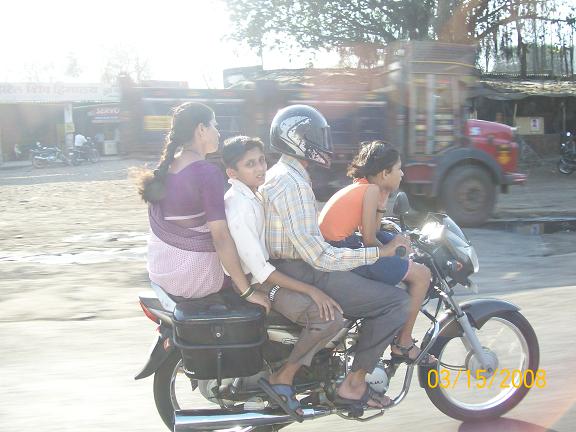
Based on my observations, the vast majority of transport in India is by foot. I traveled pretty deeply into rural India, and almost everywhere I went there were always vast numbers of people walking along the roads. Motorcycles are abundant, and almost always had multiple passengers. At one point, I saw seven people (five of them young children) all piled onto a single motorcycle.
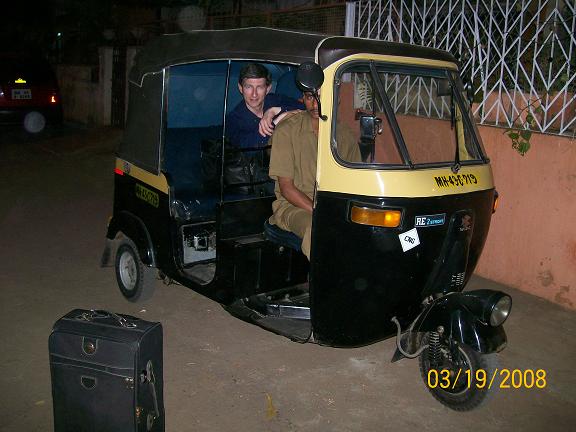
In cities like Bombay, auto-rickshaws were everywhere. I rode in one, and would describe it as essentially like a motorcycle with a light-weight body built around it. Interestingly, the one I rode in (maybe all of them are like this) ran off of compressed natural gas. Speaking of which, there were a lot of alternative fuel vehicles in Bombay. I saw many CNG vehicles, and a taxi I rode in once was fueled by a propane tank in the trunk.
A Wind Farm and an Ethanol Skeptic
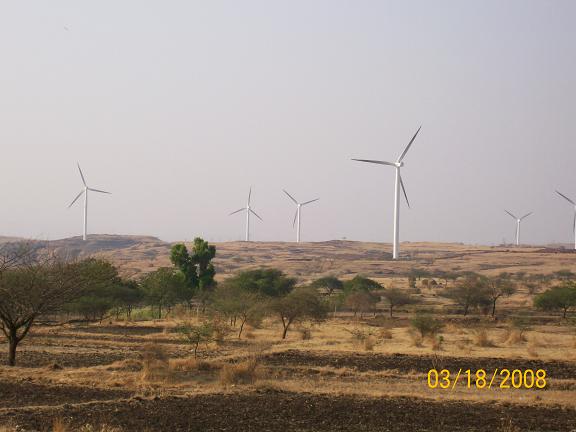
At one point we were driving through a very remote area, and suddenly a wind farm appeared. I took some photos. The farm appeared to be very distant from any cities, so I am not sure about how cost effective it was in that location.
One thing I didn't expect to encounter was an ethanol skeptic, but at one of the meetings we had, (following my questions about jatropha), our host told me that "ethanol for biofuel is India's greatest threat." I asked why, and he said he feared that 1). The demand in the West for biofuel will result in a food versus fuel competition that would devastate India's poor; and 2). That increased ethanol demand would exacerbate India's already serious water problem.
Food
During the week in India, I had meat twice. The total I had was about 3 ounces of chicken on a pizza. I would have guessed that I would be constantly starving, but the food is very filling, and very good. I haven't had vegetarian like that in the West. At a typical meal, I would have a carbohydrate (usually a flat bread), a vegetable, and a protein. Rice was always part of the meal. But the meals were very nutritious and healthy, so I plan to incorporate some of these meals into my normal diet.
My host (and Bombay native) Kapil Girotra informed me that India is self-sufficient in food. He also told me that 70% or so of the population is vegetarian, which means it requires less land to feed them. On the other hand, I saw a very large portion of the population that certainly is not getting enough to eat. So you might say that they are barely self-sufficient. They do produce enough food to feed their population, but I saw a lot of undernourished people.
The Poverty
The poverty in India is just stunning. We don't have anything to compare it to in the West. The people that would be considered very poor in the West have it far better than the poor in India. They are literally starving to death. I once asked what happens if someone has a medical emergency in the slums. "If they have money, they live. If not, they die." I just imagined a child getting hit with something incredibly painful like renal colic (and believe me, it is excruciating) and not being able to get help. I can't imagine the strain on a parent going through that. I would rather have a finger chopped off than stand by helplessly while my child screamed in pain for hours. Seriously.
I think in the West we just tune it out when we see it on TV. But you can't tune it out when you drive by mile after mile after mile of people living essentially in garbage dumps. I think we treat our unwanted pets in the West with more concern than we have for a starving 2-year-old half way around the world. I was frequently asked what I was thinking about, and once I replied "What it would be like to have everyone in India experience a little of America, and everyone in America come see this."
The Traffic
It really isn't accurate to call it traffic. It is chaos. It's just a free-for-all out there. I would highly caution a Westerner against renting a car and attempting to drive. You will spend all of your time in a state of confusion, and you will hold up traffic while you try to figure out what to do. The constant honking (in lieu of signaling) was unnerving, and I felt at all times as if I should be flipping someone off. For me, Hell would be having to be a cab driver in Bombay for all eternity.
The roads are shared by people, bikes, motorbikes, auto-rickshaws, and cars. I frequently observed traffic going the wrong direction, and it was quite normal to have someone turn directly across your path. We had drivers who took us from place to place, and they would pass people on blind curves and hills, and sometimes they even passed someone in the act of passing someone else. I don't think we have a proper frame of reference in the West for the "traffic" in India; especially in the big cities. And of course this means a constant haze hung over Bombay while I was there, which presumably gets scrubbed during the monsoon season.
The People
The population density is something else. I once wondered aloud just how many people I had seen on this trip. Kapil, the guy I was traveling with, said "Probably a good fraction of all the people you have ever seen in your life." That is not an exaggeration. We traveled around the country, and with very few exceptions there were people lining the streets everywhere. Several times I would observe a crowd and wonder what was going on, but there was nothing going on. It was just a crowd. But it looked like a constant stream coming out of a major sporting event.
Despite the crowded conditions, I only saw violence once – when a man tried to drag another out of a car after a wreck. The people seem to cope quite well. Crime doesn't seem to be nearly the problem you might expect in a city of that size and population density.
But with that many people comes a great deal of garbage. There was trash everywhere, and most of the time you could smell rotting garbage. One night we stayed well north of the city, but every once in a while my room would fill up with a garbage smell. I presumed the wind had shifted from Bombay.
Travel
It took forever to get anywhere. You look at a place, and think "It's only 100 miles." 3 hours later, you still aren't there. We spent 20 hours on the road over the course of 4 days. They don't have many rest stops and such with facilities that I could see. But the people I was traveling with never needed them. We would spend 7 hours in the car and never stop for a bathroom break. Needless to say, I limited my water intake on the trip, as I found that bathrooms were treated as a precious commodity. On a couple of occasions when I was in a meeting, I asked for the restroom and found someone standing outside of it, and a sign that said "VIPs and guests only."
I traveled by train as well, after Kapil asked if I was up for an adventure. I thought "What could be so adventurous about riding the train?" It isn't for everyone. If you like hot, sweaty bodies packed in like sardines (and that's in 1st Class), then go for it. It took us an hour to get to our destination, and during that ride there were constantly people hanging out of the open doors, and it was standing room only. I wondered whether the people in 2nd Class were stacked like cord wood.
Conclusions
India was an eye-opening experience for me. I managed not to get sick while I was there, and I credit my host Kapil for his constant advice on what I should and shouldn't eat and drink. (I don't recommend the buffalo milk, by the way). The contrasts were amazing. Outside a cluster of $400/night hotels was the worst poverty I have ever seen. I once saw a guy pulling a hand cart and talking on a cell phone. Houses in the slums had satellite dishes on top of them. A number of times we walked down hallways of buildings that looked to be 100 years old and decrepit, and then stepped into one of the most modern offices you have ever seen.
One of the things this trip has done for me is to highlight the importance of efforts to transition to a more sustainable lifestyle and avoid the kind of collapse that is often discussed in relation to Peak Oil. I think if more people understood just how far society could fall - and I saw that in the slums of India - we could get serious about our energy situation in a big hurry.
Note:
This essay is a summary of some key points. However, for most of my trips I keep a detailed journal for future reference. But I publish them, and the full boring blow-by-blow can be found in two entries:
Contact
- Content: editors at theoildrum dot com
- Tech support: support at theoildrum dot com
License

This work is licensed under a Creative Commons Attribution-Share Alike 3.0 United States License.
During the week in India, I had meat twice. The total I had was about 3 ounces of chicken on a pizza. I would have guessed that I would be constantly starving, but the food is very filling, and very good. I haven't had vegetarian like that in the West. At a typical meal, I would have a carbohydrate (usually a flat bread), a vegetable, and a protein. Rice was always part of the meal. But the meals were very nutritious and healthy, so I plan to incorporate some of these meals into my normal diet.
Look at the energy needed to cook the food. Lentils, rice, spices and a pressure cooker.
To ride the long curve down - looking at what and how the 'poor' eat then cherry pick from that list now strikes me as good long term planning. Ideas like this:
http://www.geocities.com/%7Edmdelaney/scheffler-precis/scheffler-precis....
Or slogging here
http://solarcooking.wikia.com/wiki/Main_Page
(and if anyone can provide the link to a design contest winner that was planned/deployed for South America, used oil in a trough for heating, and touted how it would work with pressure cookers, I'd greatly appreciate the link.)
Hi
Solar powered village:
http://www.sunvention.com/html/solar_power_village_english.html
What's missing from the descriptions is how the cooker works. The hot oil flows through to a hollow steel construction, providing heat for cooking. Temperature is regulated by adjusting the rate of flow. Originally think they used inbuilt double-walled pots, with the oil flowing between the walls. This cooked the food from below and the sides.
Also see these nifty solar ovens, which don't need to be moved as the sun moves:
http://www.sungravity.com/molded.html
Yes, I have one, and it works :-)
Cheers, Ian
Ian - I would really like to have one (or more). Do you know where I can order
a couple???
Thanks, Robert, both for the ethanol lifecycle investigation with sugar cane, as well as the insights into life in a developing country. We are incorporating many more lentil and rice vegetarian dishes into our culinary fare, and you are right; they are delicious and filling.
I was likewise surprised that jatropa was not more widespread, though the craze has just recently started, and it can take 2 1/2 years for the trees to start bearing, unlike sugar cane, corn, soybeans, switchgrass, etc. It is heavily hyped, and careful examination of agricultural trials have helped to quantify some of the claims. I had looked into the merits of planting them last spring, but they require a tropic or sub-tropic climate.
And yes, the developed nations take a lot for granted with their transportation system; motorcycles aren't the only overloaded transport in India...
Has anyone else looking at these pictures thought OVER POPULATION...
If this was any other species there would have been a cull years ago.
We had 2 choses birth control or death control, guess we aren't smarter than yeast.
It aint just India we are also in over shoot.
Has anyone else looking at these pictures thought OVER POPULATION...
It doesn't appear that the author has. He left it out of his conclusion. Or maybe, like many people, he is uncomfortable with the subject.
Of course you can't help but note the crowded conditions, and think about over-population. And I think I made the implication clear. But it's one thing to think that there are too many people. It's another to think that each one of those people is a parent to someone who cares about them, and has brothers, sisters, parents, friends who care about them. These things make it hard for me to think about things like reducing the population. That doesn't mean that I don't think there are too many people. But which lemming is ready to lead the charge over the cliff? Not me.
May I be the first one to call "Bullshit" here?
Is mass murder or Soylent Green really our only two choices as a species? How about instituting a China-style one-child per family policy? Or, if that's too "coercive" for you, how about the Indian government paying people *not* to have more children?
"But it's one thing to think that there are too many people. It's another to think that each one of those people is a parent to someone who cares about them, and has brothers, sisters, parents, friends who care about them."
Non sequitur and false dichotomy. Why can't a person empathize with other individuals *and* care about overpopulation at the same time? Are empathy and reason mutually exclusive?
I think there is good evidence to show that women's empowerment and literacy can yield good results in population control - check Kerala and Tamil Nadu in India.
I personally am not for a one child policy the China way. It's impact on society is probably not well understood yet. The current children are called "little emperors/empresses" - more the former. Go to any big hotel in Guangzhou and see the number of little girls (those lucky enough to be born), being given away for adoption. Having a society with a sex ratio of 850 may not be a bright idea. Social engineering by the government is a frightening idea.
How about having a vegetarian diet as a government policy? I doubt you would appreciate that being thrust down your throat.
Srivathsa
How about having a vegetarian diet as a government policy? I doubt you would appreciate that being thrust down your throat.
An ever increasing population will ultimately lead to a lot more being "thrust down the throats" of citizens than just a vegetarian diet. Population growth is unsustainable. Period. Wishful thinking cannot change that. Up until now passing the burden of stopping it could be passed on to future generations with not much consequence. Now, with oil peaking, and natural gas and coal soon to follow - paired with global warming, fresh water shortages and various other environmental problems and resource limits, population growth is causing real problems in the here and now. And it will continue to do so. It's astonishing that even on a board dedicated to worrying about a coming shortage of oil that the world is mostly blind to, the equation - (oil barrels produced)/(oil users) - only the numerator gets talked about.
I personally am not for a one child policy the China way.
India's population is huge and poor - and yet still growing! They can benefit immensely from a two-child policy. Same for the United States and many, many other countries around the world whose populations continue to climb. "One-child policy" admits you have too many people. We are a long way from that. "Two-child policy" merely states that it would be bad to have more people. We aren't there yet but that is what to shoot for at this point.
It's astonishing that even on a board dedicated to worrying about a coming shortage of oil that the world is mostly blind to, the equation - (oil barrels produced)/(oil users) - only the numerator gets talked about.
Amen to that.
Only the numerator is talked about because oil consumption does not match population very much.
Germany has 82 million people, and uses 2.6Mbbl/day.
India has 1,100 million people, and uses 2.5Mbbl/day.
So it has 13 times the population, but uses slightly less oil.
Greenhouse gas emissions are much the same.
Germany produces 838Mt of CO2e. India, 1,0080Mt CO2e. 13 times the people, but only 20% more emissions.
Imagine that there are two houses along a street. One has one European middle-classed guy in it, he puts out 8 rubbish bins every week. The next house has 13 people in it, all south Asian and working class, except for one middle-classed person, the boy they could afford to send to university, they put out 10 rubbish bins.
The rubbish collector tells the street, "there are too many for us to collect, you need to reduce to just 1 rubbish bin each on average. There are 203 houses on this street, I don't care if it's one house with 203 bins or 100 with 2 bins each and 3 between the other 103, or what. Just get the average down."
The European says, "Tell those darkies next door should stop having so many babies. That'll sort it out."
No disputing your numbers but you are confusing quantity with quality.
The goal of humans should not be to determine the maximum population the earth can sustain. The goal should be to maximize the quality of life of each individual. Yes, that will require more energy consumption per person, just as historically the human species invests more energy per offspring than other species via one child at a time, not a litter of 10.
The human species needs to come to grips that we can't sustain an ever expanding population and still retain the essence of what makes us human. The key is to think multi generational into the future, not fixate only on the current generation.
Much better to have fully activated humans at low population for centuries than an enormous population barely surviving that dies off in a few generations. The first case actually allows for more total humans to inhabit the Earth, they just do it over many, many generations rather than all at once just before the resources run out.
I agree.
And it turns out that if you reduce the quantity of people, you don't increase the quality of life; life was not better in the rubble of Europe, even if 30 million people had died. Whereas if you increase the quality of life - give relative prosperity and education to women - then they decrease the quantity of people themselves without any compulsion or genocide.
And it turns out that if you reduce the quantity of people, you don't increase the quality of life; life was not better in the rubble of Europe, even if 30 million people had died. Whereas if you increase the quality of life - give relative prosperity and education to women - then they decrease the quantity of people themselves without any compulsion or genocide.
You are using the aftermath of World War II to "prove" that less people is not better? Why don't you throw in the plagues of the Middle Ages while you are at it? If you really want to help your hypothesis, compare conditions before and after Noah's flood. Also, throw in Nagasaki and Hiroshima before and after a nuclear bomb was dropped on them - everyone would have to agree conditions were worse after the population declined...
If we only had 200 million people in this country - as we did in 1970 - think about how affordable housing would still be. Think about how much less oil, water, natural gas, coal, aluminum, phosphorus, etc. we would need. Think about how much better traffic would be. Think about how less congested our airports would be. Think about how much worse all of that will be when we make it to 450 million.
Why don't you throw in the plagues of the Middle Ages while you are at it?
Intersting aside: The Black Plague actually *did* drastically improve the quality of life for the serfs who survived it. They found themselves with an abundance of land and material resources and their (now scarce) labor highly in demand. As a result, the following decades were very prosperous for the serf class. It took a couple generations for the landed gentry to steal it all back.
Only the numerator is talked about because oil consumption does not match population very much.
Germany has 82 million people, and uses 2.6Mbbl/day.
India has 1,100 million people, and uses 2.5Mbbl/day.
So your hypothesis is that if the populations of those areas were doubled - no significant increase in oil consumption - if the population of those areas were halved - no significant decrease in oil consumption? You feel oil consumption does not change with changes in population?
So it has 13 times the population, but uses slightly less oil.
The rate at which various populations use oil is separate from whether or not they use more or less if their population grows or declines.
Greenhouse gas emissions are much the same.
Germany produces 838Mt of CO2e. India, 1,0080Mt CO2e. 13 times the people, but only 20% more emissions.
It's good to know that India has volunteered to maintain a much smaller amount of C02 emission from now until eternity.
Imagine that there are two houses along a street. One has one European middle-classed guy in it, he puts out 8 rubbish bins every week. The next house has 13 people in it, all south Asian and working class, except for one middle-classed person, the boy they could afford to send to university, they put out 10 rubbish bins.
The rubbish collector tells the street, "there are too many for us to collect, you need to reduce to just 1 rubbish bin each on average. There are 203 houses on this street, I don't care if it's one house with 203 bins or 100 with 2 bins each and 3 between the other 103, or what. Just get the average down."
The European says, "Tell those darkies next door should stop having so many babies. That'll sort it out."
Imagine there are two houses along a street. One has 35 Indians living in it and they are adding 1 more every 6 months. The other has 4 English living in it and they are at a stable household level. The English tell the Indians they should stop adding to their household size. Some American steps in and declares that the English have no right making suggestions to the Indians since they throw out so much more trash. Then he sanctimoniously adds that his household has been increasing in size for decades as well, and save for the lack of space, long lines, and limited resources, it hasn't been a problem.
Not at all. What I'm saying is that plainly lifestyle differ between countries, and these lifestyle differences are a more important factor than total population.
We with the prosperous and wasteful lifestyles prefer to focus on population, for obvious reasons.
The important thing is that, unless you commit genocide, population changes much more slowly than lifestyle. China's economic growth and growth in resource consumption and emissions is 9 or 10% annually; you're never going to get population rising that fast. The average Westerner could halve their energy consumption and impact tomorrow without pain, discomfort, or any expense, in fact saving money; but they find it inconvenient But absent nuclear war, the population is not going to halve tomorrow.
So if you want to deplete resources quickly, or reduce our impact on the Earth, the part to focus on is the part which can change quickly - and that's lifestyle.
Of course, we'd rather they changed their population than we changed our lifestyle.
I am most definitely not against empowering women and promoting literacy --never said I was. And, yes, much research by the U.N. and other groups have shown a strong correlation between women's literacy, political and reproductive rights, and smaller families.
However, China's one-child policy, despite all it's faults, is probably the main reason why China does not have a population of *two* billion today. Some types of social engineering by the government may seem "frightening", but governments do this sort of thing all the time: regulation, punitive "sin" taxes, targeted tax credits, subsidies, exclusive contracts, grants and many other incentives.
What is the cost of doing nothing and maintaining the status quo? What is India's current population vector, and where is it likely to lead in a generation? Two?
Population control is a sticky subject in India too. Back in the 1970s they tried to encourage a program of male vasectomies, with financial or material rewards. It resulted in a lot of coerced and unwanted vasectomies, and a lot of anger.
More recently, they tried an economic approach. They put up posters with two families. One with two kids and lots of consumer goods in rich clothes. The other with six kids in poor clothes. The message was 'if you have lots of kids you will always be poor'. When people saw the posters they said 'I feel sorry for that family, they were only blessed with two children, how sad. '
When people saw the posters they said I feel sorry for that family, they were only blessed with two children, how sad.
That is sad in itself. Both families are the problem.
What would be better would be small communities of couples and their elderly parents caring for and really cherishing a maximum of one child (or set of twins/triplets) per couple, and sharing the responsibility of raising them. Each child would have dozens of "siblings" in the community and be part of a large family, and population reduction would be relatively swift. It would probably reduce the amount of abuse to partners and children too (I suggest Shantaram, if you haven't read it, to see how communal families support each other in the slums of India).
Is mass murder or Soylent Green really our only two choices as a species?
My comments are aimed at the casual talk of a die-off. There is a disconnect between "there's too many people" and "my circle isn't a part of that." Too many people means too many "other" people. That's my point.
I am all for efforts to curb population growth. That's what you are talking about. I am commenting on "there's too many people, nature will cull the herd."
"there's too many people, nature will cull the herd."
Ok, so if that's what you meant, how is this fundamentally different than the "Soylent Green" scenario? My point was: I believe that we *do have* other options besides a human initiated mass die-off, or a nature-initiated mass die-off. If... IF the political will and public support can be summoned. Far from certain, yes, but not unthinkable either.
Reducing the population is easier to think of when you realise that the most effective method is increasing the wealth and education of the poorest and least educated women.
Of course, when we in the West speak of "population control", we're usually not thinking of interest-free loans to village women, and whatever the Hindi for "ABC" is. That might cost us money and effort, and pretty soon we'd have to start thinking of people in the Third World as human beings, and then where would we be?
Reducing the population is easier to think of when you realise that the most effective method is increasing the wealth and education of the poorest and least educated women.
Statistically, how does that compare to widespread birth control and birth control education?
Of course, when we in the West speak of "population control", we're usually not thinking of interest-free loans to village women, and whatever the Hindi for "ABC" is. That might cost us money and effort, and pretty soon we'd have to start thinking of people in the Third World as human beings, and then where would we be?
It's nice to see that the romantic form of population control - standard of living increase - can coexist on the same board where the prevailing sentiment is that the world's standard of living is getting ready to decrease.
Giving birth control to the village women and teaching them how to use it would treat them like human beings and help their plight. But that type of charity would run against the teachings of the major religions of the world (not to mention the current US administration). Right now, the religious leaders are all Cornucopians, even if their God isn't.
They're connected. If women are poor and illiterate, it doesn't matter how many condoms or contraceptive pills there are in local clinics, they just don't get used. If women are relatively prosperous and at least have basic literacy, then they seek out the contraception for themselves, a black market appears for it.
It's not romantic, it's realistic.
That the entire world cannot possibly live in McMansions, eat burgers and drive SUVs every day is not in doubt. But between that wasteful industrial lifestyle and the crushing poverty described in this article there's a wide spread of possible lifestyles. If you scroll down in this article, you can see a graph of per capita electricity availability and HDI (human development index - equal parts per capita GDP, longevity, and education).
What you find is that with no electricity at all, HDI is about 0.3. Bringing it to 1,000kWh moves HDI to 0.7, to 2,000kWh makes it 0.8, and 4,000kWh on up life doesn't improve much, it's over 0.9. Now, there's a big difference in people's quality of life between 0.3 and 0.7, between zero and 1,000kWh. Not really any from 4,000 to 16,000kWh. So if we can provide the world with 1,000kWh to 4,000kWh each, we're doing alright.
The world currently has 2,630kWh per person, but it's very unevenly distributed as you can see from that graph. Evenly distributed and you're looking at 0.8+ for HDI for everyone, which according to the UN is a "highly developed" country. So today the real problem with electricity, with energy in general, is just like food - really there's plenty for everyone, it's just that some have too much while others have too little.
So okay, we face an energy descent. But a descent how far? A 50% drop? 90%? 10%? Or what?
A 25% drop to 2,000+kWh gives us HDI0.8+, so we're like Belarus, Cuba, Malaysia and so on. Not awesome, but better than India is today (HDI 0.62), and better than a lot of people are telling us would happen.
A 40% drop to 1,500kWh gives us HDI0.75 or so, places like Turkey, Syria, Guyana, Belize.
A 60% drop to 1,000kWh gives us HDI0.70 or so, places like Egypt, Nicaragua, Mongolia.
An 80% drop to 500kWh is harder to judge, as you can see from the graph you get a lot of variation around here, with HDI of 0.50-0.75. At a guess I'd say the variation comes in because in some of those countries 500kWh per capita actually means 2,000kWh for a couple of million people in the capital, and zilch for several million people outside it - they're the low HDI ones. The higher HDI ones are those with the electricity spread a bit more.
Really what sort of quality of life we can expect depends on how far you think the energy descent will go. I think to drop below 1,000kWh each will take a real effort on our part to bugger things up. Something worse than business as usual, something like having a heap of resource wars, lots of coal-to-liquids and biofuels, that sort of thing. I think a stuff-up on that scale would take even more effort than ensuring a more fair worldwide spread of electricity availability.
Really, a decent standard of living doesn't take as much energy and money as you think. Once you hit about $20,000 per capita GDP and 4,000kWh as an average in your country, most of the quality of life indicators pretty much top out, adding more money and energy doesn't improve their lives much.
About $10,000 and 2,000kWh is pretty good, and various UN organisations will probably be asking you for help rather than offering you help.
$5,000 and 1,000kWh is more or less the minimum for a decent life. But it's remarkable how much difference there is between $0-$5,000 and 0-1,000kWh, compared to the next step up of the same size.
Again, the world's never going to be able to live with everyone eating burgers everyday at the drivethru in their SUV and then heading home to their McMansions. But I think the world can live with a range of countries having $5,000-$20,000 per capita GDP, and 1,000-4,000kWh available electricity, giving us HDI of 0.70-0.90, rather than having a few countries down around 0.3, lots in the 0.40s and 0.50s, etc.
I think you're focusing overly much on the US perspective. And as I noted earlier, you can get in the back door on this. Outside a few nutters like the Taliban, everyone in charge supports education for women, though lots of places at the village level oppose it. So, help build their wealth, educate them - and they'll find their own birth control, whatever the local leadership say.
They're connected. If women are poor and illiterate, it doesn't matter how many condoms or contraceptive pills there are in local clinics, they just don't get used. If women are relatively prosperous and at least have basic literacy, then they seek out the contraception for themselves, a black market appears for it.
You don't help your case by making extreme denials.
It's not romantic, it's realistic.
It's realistic to expect that as the standard of living of the developed nations declines from Peak Everything, that they are going to willfully give up even more of their standard of living so that the Third World can try your hypothesis that they will only lower the birth rate via an increase in the standard of living???? Have you queried anyone to see if they are willing to reduced their standard of living in the name of Third World birth control?
I think you're focusing overly much on the US perspective. And as I noted earlier, you can get in the back door on this. Outside a few nutters like the Taliban, everyone in charge supports education for women, though lots of places at the village level oppose it. So, help build their wealth, educate them - and they'll find their own birth control, whatever the local leadership say.
The Catholic Church is not a US institution and is still staunchly against birth control. I believe the Muslim religion is against it as well.
It's not an extreme denial, it's just an example to show the general trends. See: literacy vs total fertility rate, and gdp per capita vs total fertility rate. There's a reasonable spread to them, but basically as literacy and wealth go up, the number of children per woman goes down.
It's not clear that as resources deplete, our "standard of living" need decline. In the first place there's a tremendous amount of waste in the system. A lot of what we call "standard of living" is just about waste; you are not in any real sense better off with ten burgers a week instead of one, or a 3,000 sq ft house with a family of three instead of a 1,500 sq ft house with a family of five, or with an SUV rather than taking the train. It's just waste, and conspicuous waste is preferred by our culture. But it wasn't always so, this was something deliberately created in the 1950s.
"Our enormously productive economy…demands that we make consumption our way of life, that we convert the buying and use of goods into rituals, that we seek our spiritual satisfaction, our ego satisfaction, in consumption... we need things consumed, burned up, replaced and discarded at an ever-accelerating rate." – Victor LeBeau, retail analyst in the 1950s
It wasn't always so, and it need not be always so in the future.
The Catholic Church has not the influence it once had; Spain, for example, a most Catholic nation, recently legalised gay marriage, and has had legalised abortion for some years. "The Muslim religion" is not exactly monolithic in its views.
Certainly religion and local cultures have an effect on these things. But looking at things globally, as we are here, they're not as strong an effect as literacy and wealth.
"These things make it hard for me to think about things like reducing the population."
The appalling conditions, extreme overcrowding, pollution and grinding poverty in which most Indians live make it impossible for me to think of anything *but* "things like reducing the population".
Perhaps we should start "treating" obesity in the U.S. by promoting empathy and pursuading people that being overweight and eating huge amounts of crap is socially acceptable. Oh, wait... we're already doing that.
There's a moral conundrum here. We have the right of people to reproduce, and the right of people to not live in poverty. At this point, with our current world population, they are mutually exclusive. Personally, I have more of a problem with billions of people living in squalor than I do with China's one child policy. Just a personal thing.
I'm starting a low iodine diet for a cancer scan and lentils are one of the few things I can eat (it seems that iodine is in everything). While cooking them last night I was very surprised to see that in 120 calories there is 10 grams of protein and 10 grams of fiber. That's incredible dense nutritionally. Compare that to a large slice of whole wheat bread (about the same calories) and you'll see what I mean. You're lucky to get about a third of that. I mixed in some corn to try and provide a full suite of essential amino acids.
Welcome to the third world. :) I hope your experience has provided you with a different perspective, which may, (I hope), provide some insight into why I think peak oil is a relatively insignificant threat compared to climate change for a country like India.
Peak oil may turn out to be a blessing for India if, as Robert listed as his first impression, India: Another Brazil comes about. They could be one of many nations that follow Brazil's sugar lead as I just did a post on here in yesterday's EROI discussion. They are one of the "big two" bubbles on the chart I show population-wise (the other being China).
I very much doubt that our energy constrained future will be a blessing for anyone. My point is only that Indians get by with so little energy, I don't think they are going to be as seriously affected by a little less energy as compared to if there was a massive multi-year drought + crop failures caused by sudden climate changes. I think that people are going to die either way, but on very different scales.
Ah India. I think it is the best thing that ever happened to the British Empire. We pretend sometimes that we gave them civilisation, but the truth is the reverse. In 1943 the British engineered a famine in Bengal that killed a million people. Yet they still fought on our side to defeat Hitler. (A few fought for Hitler).
Indian food is the reason that being vegetarian in the UK is easy and tasty. Their belief in reincarnation and that your fate in this lifetime is pre-ordained by your behaviour in a previous lifetime, means that they are both tolerant and peaceable, yet easily exploited and resigned to great suffering and inequality.
When I travelled in India by train ten years ago , you knew when you were passing through a town at night by the indescribable smell, there were no lights.
Three weeks in a remote Himalayan village showed me how close to the edge their food production was, how you were on your own when you got sick, and that underneath they were still normal human beings, good , bad and indifferent.
I calculated that Indian road traffic is mile for mile, 40 times more dangerous than UK travel. It was quite common to read of entire buses being wiped out by falling down ravines, about one a week. One bus load was electrocuted by touching an illegal power tap. (I think about 40% of Indian electricity is 'reallocated').
I fear that India will suffer mass starvation in the next few decades. However, I doubt it will even register in a final write-up of their 3000 year history of culture.
Dude! Your pictures are like 500KB - 1MB each! They should only be one tenth of that. Learn to use photo editing software please, and stop maxing out everyones' bandwidth. Sheez!
Jump to conclusions ever?
I have been quite busy, and was fully aware of the size of the pictures. My intent was to downsize them - which I know how to do thank you very much - but the post went up before I had a chance to do that. My time is stretched pretty thin right now, so the choice for me was either to just let it go as is, or post it sometime next week.
Well, that took 10 minutes I really didn't have to spare, but I downsized them. Please enjoy.
I think that you should bill The Oil Drum twice what you were charging before, for downsizing the photos. In my line of work, I always notice that the ones who are getting the service free are the ones who complain the most.
It's every line of work, I assure you :)
I think that you should bill The Oil Drum twice what you were charging before, for downsizing the photos.
Twice zero is still zero. :-)
In fairness to the complaintant, I started thinking about people trying to download that page on dial-up or on a Blackberry, and I decided to go ahead and change it. To be honest, I had just been too busy and kind of blew it off for now. I was aware of the potential issue, but the page loaded quickly for me after I put the pictures in, so I hadn't worried too much about it.
I'm usually a harsh critic of RR, but I'm going to back him up on this one. I enjoyed his pictures and had no trouble downloading them. I liked to see what he looked like. A fellow worker I knew years ago was from India.
Not all of us use dial up. Why should we suffer because some can't get or refuse to pay for high speed? Let those who are behind the times suffer or change.
Hi,
Can somebody straighten me out here.
The more I read and hear the more I think "They" are feeding us a Crock about this CO2 thing. A watch the Birdie while I pinch your ass, thing.
It appears that Ambient CO2 is about 350PPm at present. I have read that in the primordial days when the forests which produced our coal, oil, and gas were growing they probably had higher CO2 counts, hence their massive bulk over most of the planet.
CO2 is heavier than Air, it tends to sink precisely to where the vegetation is growing. Not a very high "greenhouse", lots of room for regular convections and advections.
Vegetation will grow and prosper in direct proportion to the CO2 available.
METHANE, now that is a different problem, the cows don't seem to be mentioned much. Beef, Cattle, and Dairy farmers are getting a free ride. Termites are probably here to stay so we will have to factor them in. The CFC's and the other ozone depleters, these don't get mentioned anymore.
Are we being manipulated by a hidden agenda??
Being a global warming skeptic is a lonely business around the oil drum :). You can search some of my older posts for more information.
The most interesting thing I came across recently is that in the new global warming reports the anomaly in the Vostok ice core samples were temperature rise preceded CO2 increase that always puzzled everybody, and that global warming supporters had to tie themselves in knots to explain has been "fixed" to show the opposite in more recent reports.
The New FIXED data:
http://en.wikipedia.org/wiki/Image:Vostok-ice-core-petit.png
The old confounding data:
http://www.daviesand.com/Choices/Precautionary_Planning/New_Data/
http://icebubbles.ucsd.edu/Publications/CaillonTermIII.pdf
http://www.realclimate.org/index.php/archives/2007/04/the-lag-between-te...
http://www.realclimate.org/index.php/archives/2004/12/co2-in-ice-cores
So when, in the geologic past, volcanic outflows seem to have been closely correlated with rising atmospheric temperature..... by what mechanism do you think the warmer air caused the volcanoes to erupt?
reindeer - I believe that the bad gases, like methane, make composting a bad thing, unless you have one with a gas trap - which most people do not.
If you're making methane in your compost then you're doing it wrong.
I'm not sure who you mean by "we", but I suspect your paranoia is unfounded. Anybody is capable of being "manipulated" given the right circumstances and manipulator.
Put simply, many readers of (and most of the contributors to) TOD have strong science and engineering backgrounds, thus the discussions are not as easily persuaded by polemics on such matters.
For your other statements: on CO2 concentrations, there are measuring stations around the world at various elevations. The current readings fall in the ~385 region. The molecular weight of CO2 is not that different from N2 or O2 or H2O (and NO and CO and ...) and normal air movement mixes all three well. As elevations increase the H2O precipitates out.
On the effect of CO2 - straightforward physics, namely CO2 blocks the emitted (into space) infra-red light from the Earth surface (and all objects therein, including you and me); the emissions are how the Earth cools itself, but the CO2 reradiates the infrared light into no preferred direction (and thus about half the time down back towards the Earth.) Without an atmosphere that inhibited infrared emissions the Earth would be much cooler than it is now.
Oh, and for your amusement:
Cherry blossoms bloom earlier on average due to global warming
http://mdn.mainichi.jp/national/news/20080409p2a00m0na033000c.html
The CO2 isn't going to settle out on the bottom of the atmosphere due to molecular density differences. If that happened, then we should expect to see the water vapor (molecular weight 18) rise above the O2 (molecular weight 32) and N2 (molecular weight 28).
Yes, the huge rms speed of gas molecules in the atmosphere ensures that things get pretty well mixed around. (Although that's a bit of an oversimplification of course.)
Try straightening yourself out. If you believe that science can provide some decent version of "the truth," then learn to distinguish between science and something else that is not science. Scientists are skeptics within the rules of the epistemic game we call "science." What this means practically is that if a scientist makes an experimental claim (glaciers are shrinking) or puts forward a hypothesis (warming is CURRENTLY being caused by human-produced CO2 forcing), other scientists try to prove him/her wrong by a) pointing out flaws in the study (e.g. crappy control group), b) replication (can I replicate your findings), or c) conducting a testing experiment to disprove a hypothesis.
Learn to distinguish between someone who is pedaling either a) outright lies that contradict established scientific findings (generally few, if any citations, citations never link to peer-reviewed journals) b) flakey science (generally characterized by logical fallacies, missing control groups (e.g., 98% of prisoners are bread users, therefore bread is bad), over-generalizations or under-generalization), or c) the real stuff. Real science is (ideally, yes I know, ideally) a self-correcting system because scientists try to "shoot down" other scientists claims and results. That's why data gets corrected over time (temperature records for example), papers with mistakes get retracted from journals as other scientists try to replicate their studies etc... Generally, the screw-ups and cheats are weeded out. What is left is what we (as scientists) believe is the best version of the truth.
Likewise please try not to fall in to the trap of judging the truth of a scientific idea by its proponents. If large corporations have suddenly jumped on the "global warming" band-wagon and I hate big, nasty, evil, money-grubbing, capitalist corporations that doesn't mean the scientific theory is wrong. Anybody can use science for their own twisted ends. Doesn't negate the science.
Finally, if you don't think that science provides a decent version of the truth and you prefer to center your epistemological beliefs around faith or some other set of epistemic rules, then please, go ahead. But try to recognize anthropogenic global climate change for what it is: a scientific theory. It is currently the best scientific explanation for what is happening to the global climate.
Yes. The people who profit (or think they profit) by not controlling global climate change are trying to manipulate us into not controlling it.
Umm, no. According to NOAA http://www.esrl.noaa.gov/gmd/ccgg/trends/ and http://www.esrl.noaa.gov/gmd/ccgg/trends/index.html#global the current value is about 385PPM. The concentration of CO2 goes up and down on a yearly cycle, but each yearly minimum and each yearly maximum is higher than the year before.
Sorry, CO2 isn't ENOUGH heavier than air to sink to the bottom. Normal wind and convection keep it well mixed in the atmosphere. Even if it was concentrated at lower levels, there would still be a greenhouse effect. Every molecule of CO2, regardless of height, can intercept infrared radiation coming up from the surface. The molecule then re-radiates the infrared RANDOMLY up, down or sideways. This slows the progression of the heat to the top of the atmosphere where it radiates into space.
Sorry again. Vegetation needs more than CO2 to "grow and prosper". Land-based plants need dry land and appropriate rainfall. Land plants killed by rising seas, droughts, or floods will rot and add CO2 to the atmosphere rather than removing it. Freshwater plants can also be killed by drought as lakes and streams dry up. Ocean plants will have the best of it, but the oceans are becoming more acidic as CO2 dissolves and this may eventually reduce the plants' growth.
At least in North America, there are probably fewer cattle now than there were buffalo pre-Columbus. Methane from cattle is unlikely to be significant, because it's not increased from before. It might be useful to look at septic tanks, however.
Ozone depletion is an entirely different problem, AND since the world has almost completely stopped making CFCs, the ozone depletion problem has been solved as much as it can be, so it's no longer a big story.
The big question isn't, "Will there be life on Earth after global climate change?" The answer to that is "Absolutely yes."
The big questions about global climate change are:
"Will individual people die younger than normally because of famines, droughts, and floods caused by climate change?" That answer is YES.
"Will human civilization survive climate change?" Maybe not.
"Will the human species survive climate change?" Probably, but why risk it?
The one question that other commentors haven't answered -they did very good for all the others:
Ice cores show paleoclimate temperatures leading CO2 concentration changes:
Yes, they do. And contrary to simple minded intuition this is expected -and was indeed predicted by theorists before it was found. Most people like simple minded logic, A causes B. In climate we have A causes B to some degree with some sort of a time lag, and B causes C with a different strength and time lag, and say C causes (or inhibits A). You gotta resort to mathematical models to sort it out. But to make a long story short:
The three main drivers of natural climate variation are:
(1) Earth orbital variations.
(2) Greenhouse gas concentrations, primarily CO2, but methane and N2O are also important.
(3) Albedo (reflectivity) which varies with ice and vegetation cover.
Essentially (1) provides a small amount of temperature change all by itself. If we are starting a glacial cycle, (1) provides a bit of cooling (usually regionally because the main variations are to change the strength of the seasons, and the latitudinal distribution of the suns heat). The temperature change affects cause (3) and less obviously as the ocean cools/warms the amount it absorbs/releases CO2 from/to the atmosphere. The combined affect is that over long time scales (2) and (3) act as positive feedbacks greatly increasing the effect of (1).
Climatologists have pretty good estimates of the temperature changes from the glacial maximum to the warm interglacial. By plugging in the amount of ice/vegetation and greenhouse gas concentrations good guesses as to the overall change in the earths energy balance can be made. These are globally integrated, and referred to as a forcing. The forcings from (1) (2) and (3) can be summed, and the amount of temperature change observed divided by the total forcing is the climate sensitivity. This agrees to within the measurement error with the sensitivity from the climate models.
Now in our present context, (1) changes too slowly to be of any real influence over human relevant times (a couple of centuries say). But we are rapidly changing (2). Given a change only of (2) we get the short term climate sensitivity, which claims a doubling of CO2 causes 3 C of warming. Over longer time periods the warming will cause more CO2 to be released from the oceans, and ice cover to shrink, so over a sufficiently long period of time the warming will be greater -but we humans are primarily interested in the next hundred years or so, so we can stop there.
Two URLs to learn more about CO2 and global warming:
1) Spencer Weart at
http://www.aip.org/history/climate/index.html
is an interesting history of the science of climate change from its beginning in the mid 19th century. During most of the time since then the question that puzzled scientists was what caused the ice ages to come and go and come again? During most of that time, up until very recently, data was sparse, instrumentation was unreliable, and there were gross theoretical misunderstandings. Scientist were trying really hard, but 'mistakes were made'. Interesting reading about how science is really done. Prior to fairly recent times, the problem was referred to as 'climate change' because it was believed that the societal issue was a return of the ice age. In general if you find a document that refers to the problem as climate change, you can be pretty sure it is old and outdated. Don't rely in it to learn anything but historical background.
2) recent paper (2008-03-31) by James Hansen, et al. at
www.columbia.edu/~jeh1/2008/TargetCO2_20080331.pdf
Hansen is the climate scientist at NASA who won't suck the decider's cock. Well not *the* scientist, but one who has gotten his name in the news. Many on this list lack the scientific training to appreciate the full force of the Hansen, et al. paper, but it is powerful stuff. And it has lots of references to back up its claims.
Also, you can Google "Keeling curve" to find historical data on atmospheric CO2 data, and explanations of why it should be believed.
Hansen, et al. calls for a reduction of CO2 concentration to *less* *than* 350ppm, which is the concentration that existed, according to the Keeling curve, back in 1987.
"I think if more people understood just how far society could fall - and I saw that in the slums of India - we could get serious about our energy situation in a big hurry."
I have spent a lot of time in India in the last 25 years. We have a lot to learn from them in a positive and a negative sense.
I would love to make it necessary for every western policy maker do six months in India at street level with no guide but a Lonely Planet and $500/month (I'm being generous here).
That might get thru the unreality bubble that seems to surround our "leaders".
And while it is a cliche, often observed in the breach in India, I would trade a lot of our mean hard streets of the material west for a little of their spiritual kindness any day.
Seems like peak oil is going to give us that opportunity. Wonder how we will do?
-badly I suspect. I good proportion of todays youth has been encrusted with the ideological depth of a Paris Hilton night out. The latest shoes and handbags compete with a new 50" Plasma TV purchases on the shopping list of the average couple.
India is not all one big waste dump example of life at 11.59am in the Petri dish though. Kerela has high lteracy rates (>98%) and is a really lovely place to visit but even here the masses teem. And its communist with a small 'c'.
I think it unlikely that we will reach some sort of an Equilibrium 2/5 of the way between the Mumbai slum dweller and Joe Six pack though. I have to agree with another poster that poverty will probably kill hundreds of millions here while we watch it all play out in the latest high def. newscast. nails bitten to the quick as we stress over where next months mortgage payment is coming from...
Nick.
Paris who?
Oh, yeah, now I remember.
Yep, you're right about today's youth. Here are the latest Google stats ('Paris Hilton' versus 'peak oil'):
Paris Hilton: 60,900,000
peak oil: 2,350,000
or a ratio of approx. 25 to 1.
I wonder how expensive gas will have to become before that ratio is reversed.
jt,
Generous? Geeze guy, you are being magnanimous! Give the bastards that 500 dollars (or better, local welfare rates)and set them out on the streets of Vancouver, or any other NA city, and they wouldn't need a book to see a lonely planet!
--------------
Hey Robert,
I would like to get a handle on how many acres of farmland would be needed to produce the ethanol inequivalent of the fuel that powered your plane to India. This is not a criticism, merely an attempt to see the reality of our energy use in a way that is clearly visible. (Talking strictly in large numbers leaves me cold, I am one of the one, two, three, many crowd.)
BTW what happened to your mirrored sunglasses?:)
Vancouver? Try Detroit or Philly if you want to see the Third World up close and personal.
Philidelphia? That city can't be all that bad, didn't W.C. Fields say he would rather be there? So what if he wanted it said on his tombstone, right?
I would like to get a handle on how many acres of farmland would be needed to produce the ethanol inequivalent of the fuel that powered your plane to India.
Keep in mind 2 things. First, I don't like to travel. When I was approached about this job, I explained that the travel wasn't a selling point. I would much rather be home with my family. And I avoid travel when I can. If I let it happen, I could spend 3 times as much of my time traveling. But I don't let it happen.
But, consider the reason I went. We are building reactors that can sequester carbon. The output of one of our reactors can sequester the carbon emissions of some 15,000 cars per year. One reactor. So if in the course of my (required) travels, we build a few reactors, I view that as a net positive. It isn't fuel production, true. I am working on a separate project for that. And sometimes that requires me to travel as well.
I'm not sure that your comment about India being self-sufficient in food is true. As far as I remember from recent news articles, they're having the same problems of inflation due to rising food prices (particularly wheat, cooking oil and rice) that everyone else on the globe is seeing right now. Wouldn't that mean they have the same kind of exposure to/reliance on global food commodity markets?
And since such a large proportion of their population is food insecure and incredibly poor, that spells disaster for them. A person living on less than $1/day doesn't have 25 cents to spare when the price of their staple food goes up.
To simply say, oh they're self-sufficient in food seems a bit glib to me, if not entirely misleading.
To simply say, oh they're self-sufficient in food seems a bit glib to me, if not entirely misleading.
Read carefully what I wrote. I am reporting what my host said. And I said "you might say." I am not reporting this as fact. I am reporting as something that was said to me. I wondered myself how true it was, but again have been too busy to research it. However, if I had said "India is self-sufficient in food", I would have definitely referenced it. I knew that the collective brains at TOD could challenge Kapil's claim if it isn't accurate.
Speaking of which, that's about all the time I have right now.
Sorry, that wasn't meant as an accusation. I do realize that you were just repeating information that you had heard from your host, and you did make a point of saying that's where you got your information.
But that's what bothered me. It seems to me to be a pretty important point, especially in the context of a post on biofuels, in light of their impact on global food security. To make a quick comment about how India may be self-sufficient in terms of food and then conclude with "They do produce enough food to feed their population, but I saw a lot of undernourished people" seemed odd to me, or at very least incomplete. How can both of those statements be true? The term "self-sufficient" normally means that the country wouldn't need any outside help to feed their population, or that global shortages of staple foods (thanks in large part to biofuels production) wouldn't affect them. But it clearly does.
I know this isn't the focus of your post, and I have to add, I am grateful for all the time and energy that you put into your posts here. I really am. :)
So here are some links (mainly for other people reading this, I don't want to bother you more than necessary with this) on India's need to be self-sufficient in terms of food (note that these are from early 2007 and early 2008, respectively):
http://news.bbc.co.uk/2/hi/business/6403139.stm
http://www.commodityonline.com/news/topstory/newsdetails.php?id=6417
Your second link commodity online has it all wrong- and I am not an expert, Just India born
What utter nonsense, India has 1.1. Billion people, and produces almost as much wheat as the USA. The USA has a bigger surplus, because there are fewer people.
Grain procurement was like 152 million tonnes in the 1980's , now 212 million tonnes not 10 million and 4 million - Maybe the increase - not the total production -
It should have said Grow by not Grow to .
Here is some older info...
India is looking to a larger wheat production of 75 million tonnes this year compared to 72 million tonnes in 2004. Markfed is one of the largest wheat exporters in the country. In 2003-04, it had exported 2.65 million tonnes of wheat.
Country Metric Ton
1995 2000 2003
Argentina 9,542,315 16,146,620 14,530,000
Australia 16,504,000 22,108,000 24,900,000
Canada 24,989,400 26,519,200 23,552,000
France 30,880,000 37,353,400 30,582,000
Germany 17,763,000 21,621,548 19,296,100
India 65,767,400 76,368,896 65,129,300
Iran 11,227,540 8,087,756 12,900,000
Kazakhstan 6,490,000 9,073,500 11,518,500
Pakistan 17,002,400 21,078,600 19,210,200
Russia 30,118,660 34,455,488 34,062,260
Turkey 18,015,000 21,008,600 19,000,000
United Kingdom 14,312,000 16,704,000 14,288,000
United States of America 59,404,000 60,757,488 63,589,820
http://finance.indiamart.com/markets/commodity/wheat.html
considering India and food, go to http://data.un.org/Data.aspx?d=ComTrade&f=_l1Code:32 select India (or in fact any country you are interested in) from the first filter and apply.
Almost self sufficient in what??
Why? The world as a whole has 1,000 million overweight people, and has 800 million undernourished people. From that fact alone we can figure out that the world produces enough food to feed everyone... yet lots of people are undernourished.
Just because a country produces enough food to feed everyone well, does not mean that it does actually feed everyone.
Whether India in fact does produce enough food I've not looked into. But if the whole world can have one part obese and a smaller part hungry, I don't see why India couldn't.
Speaking of India and global warming and energy...
Green groups oppose World Bank's India coal plant
http://www.alertnet.org/thenews/newsdesk/N07396101.htm
What I don't understand is in the last paragraph I quoted. Sources say that India has large coal reserves, so why would they have to import coal from Indonesia?
Maybe coal is just like oil - it's not a problem of reserves but rate of supply - it has to come out of a hole in the ground and it can't all come out at once?
Indian coal is generally of low energy quality, high ash, and production is largely concentrated in the northeast. Like China, they have huge logistical problems moving it around the country to where it's needed (note train pictures). So for coastal power plants, it's cheaper to import Indonesia steam coal.
Andy Revkin is also taking comments on this at the NYT: http://dotearth.blogs.nytimes.com/2008/04/09/money-for-indias-ultra-mega...
Robert: India! Did you know that a paper has just come out in the Proceedings of the National Academy of Sciences saying that a nuclear war between India and Pakistan would destroy 50 to 70% of the stratospheric ozone over the US?
http://www.pnas.org/cgi/content/short/105/14/5307
Your timing seems to leave no can of worms left unopened....
Chris
Indian interests are buying up coal mines in Australia
http://www.smh.com.au/news/Business/BHP-sells-Elouera-to-Gujarat/2007/05...
I don't suppose they have dedicated coal shipments going to India rather they earn offsetting revenues. I've argued that Australia's long awaited emissions trading scheme (if it ever happens) should include coal exports in a cap. Perhaps it could be regarded as dynamically 'fair' in the sense both countries have to cut back at same rate, albeit Australia starts with a higher per capita usage than India.
Robert, extremely interesting. Thanks.
Robert I'm glad you saw the poverty first hand. When I lived in Vietnam what got me was not the poverty but the needless polio victims.
I think your seen what demand destruction will look like at some time in the future in the US we will have a new large desperately poor class of people.
Your observations on India are quite useful. India is a society of great longevity which has survived many disasters. Even so, it seems like there is little safety margin and starvation is not so far away.
Civilizations, like communities and individuals, are dependent on climate, adaptability, food production and a host of other factors for survival. Yesterday I watched a National Geographic Channel program on a pre-Columbian Peruvian civilization which collapsed in approximately 700 AD. The society had thrived for several hundred years, had great art and architecture. The religion involved human sacrifice to appease rain and sun gods. Unfortunately, climate appeared to behave independently of the religous acts of the kings and people. Thirty years of intensive rain followed by thirty years of intensive drought threw the civilization into panic and turmoil. Human sacrifice became less acceptable when it became apparent there was no relationship between the pronouncements of kings and the behavior of El Nino. After another fifty years of civil war, the civilization was no more.
Many civilizations have come and gone before us, many times the demise has been related to war or famine linked to climate change. Typically, the kinds of climate changes which have affected previous civilization have been regional. Climate change is a part of the story of our planet even before we existed. We humans have injected ourselves into the story by releasing additional greenhouse gases into the atmosphere, thereby accelerating natural processes and making the issues global.
Like others before us, we believe ourselves invincible and try not to notice the signs of the times, and the fragility of our civilizations. Give the converging crises of peak oil, climate change, overpopulation, water shortages, which civilizations will prove to be most adaptable?
Nice post RR.
As your topic is on India, I'll mention that I saw an ad in the Economist recently put out by Indian Railways that was basically a call for bids for an outside firm to set up and operate an electric locomotive factory that could produce 1,000 'heavy' electric locomotives.
Does this mean they are electrifying their system? Or am I misreading the ad?
Back to lurkerdom I go.
Maybe he meant Diesel/Electric. Almost all modern large locomotives are actually electric with a diesel engine driving the generator. Hmmm... come to think of seems like just about anything on the ground or water when it reaches a certain size uses electric motors for propulsion.
Since the laws of thermodynamics dicatate that there will be some energy loss when energy is converted, why a diesel-electric locomotive, where you lose energy converting the diesel to electricity, which is then used to run the train? Wouldn't it be more efficient just to have a straight-up diesel locomotive, and power the train directly from the energy in the diesel?
Antoinetta III
Alan from Big Easy has described this before, but I don't remember the benefit of the Hybrid System.
It seems clear though, that they wouldn't go to the trouble of adding such a significant second stage if there wasn't an advantage to it. Seems that it could also set up an easier conversion to an electrified system as well, so I've got no reason to naysay it..
Bob
With steel rails and steel wheels weight is an asset for locomotives, they are traction limited, roughly .33 to .45 of their weight is the available tractive force which varies greatly with rail conditions and weather, they have sanding units to spray sand in front of the wheels to help with wheelspin/traction issues. The big reason for the diesel electric combo is control, electric is much easier to control and acts as a clutch. A Dash-9 loco has 4400hp IIRC and 6 axles with A/C electric motors driving each axle, that is a big big load to be using a mechanical clutch and still be able to smoothly control a whole train of cars behind it. A clutch would tend to turn into rice chex very quickly and make traction control difficult. The latest diesels have had electronic traction control as well to help modulate the power taking that chore away from the engineer. Control wise they have a throttle with like 7 forward detents, neutral, and several reverse detents. Also they have dynamic braking which uses the motors as generators and the output gets shunted and that too is adjustable by th engineer to provide controllable and smooth braking. Lastly they have air brakes, loco and the cars behind. Even with all that many 6 axle locos end up being ballasted to make their max allowable weight which is 70,000lbs per axle. Trains can really screw themselves up quickly driven without restraint, simply going to full throttle quickly would rip the tracks to pieces, plus you have other laws of physics to deal with, max drawbar pull is up around 330,000lbs I think or it will snap in two, and they break them from time to time. Electric motors also have benefit of making max torque at stall with torque tapering off as rpm increases, exactly what you want when brute force is the name of the game, lots of low end torque that bleeds off slowly as rpm climbs giving a relatively linear power band vs an internal combustion engine. Those big diesels they use have a very small rpm range.
pedex, bike courier and train nut :)
In the case of some of the ships I've been involved with, it seems to be a matter of fine control of output with electric motors versus not-so-much with direct drive. On the other hand, we drastically reduced the fuel requirements of a good-sized ship by stripped out the big engines and electric propulsion motors and replacing them with a single high-efficiency direct-drive motor, and my guess is this will be done more in the future. (as well as adding sails, which we also did).
They mean electric locomotives, 125 a year, not diesel-electrics. They have a really big, heavily used railroad system, hard to imagine from most places in the USA.
Thanks for clarifying! This is a big move by a major rail power, no? A canary-in-the-coal-mine sort of moment for the viability of future fossil fuel supplies for developing countries....
Your comments about water problems in India are correct. For example there has been a long and well known campaign against Coca Cola who uses up very large volumes of water in their industrial plants there which is causing severe water problems for those in surrounding areas.
Also in recent years, tourist resorts have been built in places like Goa for example along with golf courses -all for those who can afford it, because these are a voracious waste of precious water and farmers in these regions are finding their land and water tables dried out.
Whilst in India a few years ago, I was very surprised by the rapidly increasing number of cars, especially 4x4s which the top layer of Indian society is spending it's new found wealth on. I found this disconcerting, because clearly the Govt should be upgrading the rail networks and capacity. They have also gone headlong into the car+suburban sprawl part in the newer parts of Mumbai. For example New Mumbai, is a sprawl of towers that demand driving. These of course are only affordable by the new rich...
There is also the well known problem of the huge number of suicides by Indian farmers in the past decade as the "free trade" markets have been opened up and the big push by big Agri to grow GM crops.
Regarding the traffic, I recall hearing a figure of around 2500 deaths per year in Mumbai alone (approx 20m pop). I would guess many of these are pedestrians. Also a death or serious accident can result in a whole family being plunged into absolute poverty when the main bread winner is gone.
India is clearly growing and 'developing' rapidly but it is down the fossil fuel dependency path and this will leave them a lot worse off after Peak Oil. Ideally and everyone else too, should be using whatever wealth they have to build resources that can be shared by all -public transport, water services, sewage etc and of course going for renewables in a big way. I didn't see this happening over there. All I saw was the wealth gap growing even more. And another thing that I noticed is that newspapers catering to the wealthy, like the Indian Times had a lot of coverage on things like celebrities and lifestyle just like here in the West. I know from articles analysing media, in previous decades the media did cover social issues and problems of the country but like in all the mainstream media, they have dropped all this and the reporters covering this topics and moved much more towards the topics of distraction and mundane.
One thing that I came away with is that assuming this (India) is something like what things looked like during the Industrial Revolution in Europe, it makes me realize the enormous achievements made by unions and their leaders at that time to rally the masses around and get them behind the fight for better wages and conditions, holidays, sick pay etc etc. Yet whilst there, I noticed my fellow India workers in comparative high paid jobs and a long way up from the bottom seemed to not notice the huge differences that simply existed right outside the door. Yet we are actually the same here in other ways too.
Actually, Robert, the ash content of bagasse is fairly high compared to other biomass fuels. Probably 5 times that of most wood chips. Ash levels are not normally a problem for biomass burners.
The reason that bagasse works well as a fuel while most grasses do not, is that bagasse is a product that has already been washed to remove the sugar. That washing process also removes the high levels of water soluble potassium found in most grasses. If this "alkali" is not removed it will rapidly foul heat exchangers, dramatically reducing efficiency.
Horror stories abound of operators having to shoot off the fouling alkali buildup from heat exchanges, with shotguns, when they inadvertedly started burning a high alkali fuel.
Now you could wash other grasses, to allow them to also be used, but then you would have to dry them again. No free lunch.
The reason that bagasse works well as a fuel while most grasses do not, is that bagasse is a product that has already been washed to remove the sugar.
That's very interesting, and something I had not heard. Makes sense, I suppose, in that bagasse has been thoroughly washed. Perhaps they just generally referred to the alkali as ash.
You seem to know a bit about this. What is your experience with biomass boilers? I may have some questions.
Weather talking about the energy scene in India, peak oil, ethanol or related issues here in the oil drum we are touching directly on the subject of energy security. I would like therefore to briefly discuss some theoretical changes that have happened in the post-Cold War era that relate to what is being done here in this web site. Here are some thoughts on the current security debate:
Since the end of the Cold War there has been a consistent attempt by scholars, the media and others to enlarge the international security agenda. Security studies during the Cold War by and large revolved around the issue of state security understood in military terms. Issues such as the bipolar distribution of power and the constant threat of nuclear war dominated the international security discourse. With the end of the Cold War, however, much of the old themes that defined what security studies were all about either disappeared or lost significance, which gave space to the discussion of an enlarged security agenda, including discussions of environmental, humanitarian, migration and terrorism issues, among others. As a result of this enlargement of the security agenda, the focus of security studies has shifted away from the state as interest in the local and global levels of organization has increased. This shift in focus is demonstrated for instance by looking at the international environmental security discourse and its tendency to prioritize the entire planet (as opposed to separate states) as the object to be securitized (Dalby, 2002: 1-19).
Writing in this context of constant redefinition of security studies in the post-Cold War era, Buzan et al. (1998:1-27) set out to present a new framework of security studies that incorporates both the traditional and the enlarged, post-Cold War security agenda. Conceptual coherence in theorizing about security in these different areas is achieved though the application of criteria that separates security issues from merely political concerns. The securitization process is understood as the designation (by an actor) of an existential threat (real or imagined) to a referent object requiring emergency action or special measures that would not otherwise be taken. An object is only successfully securitized, however, when a significant audience accepts this securitization claim. The units of analysis in this securitization framework are three: the referent objects, the securitizing actors and the functional actors (Buzan et al., 1998:36). The referent objects are the ones having their existence threatened and are seen as having the right to survival. The securitizing actors are the ones who actually set the securitization process in motion by pointing out an existential threat to a referent object that has the right to survive. Lastly, functional actors do not securitize issues but they nonetheless have influence the securitization process.
The environment is one of the “new” referent objects that started being increasingly securitized after the end of the Cold War. Energy problems are one of the various issues on which the environment is securitized. Some energy problems include issues of natural resources depletion, several forms of pollution, uneven distribution and scarcity (Buzan et al, 1998: 74-75). Crucial to the issue of energy problems and the concept of energy security is the centrality that actors (whoever they may be) attribute to having access to a safe and continuous source of energy gained at as reasonable cost. Although in the face of it the environmental security debate seems to prioritize the environment as the referent object, this is quite often the case. The main objective of achieving environmental security, and this is clearly the case in energy security discourses, is to take care of the environment in order to protect achieved civilization levels. People and communities, not the environment or energy sources themselves, are the objects to be secured (Buzan et al. 1998: 76).
Fascinating stuff -- thanks.
Just one additional piece of gloom:
According to the latest CIA factbook, India's population growth rate is 1.606% (2007 estimate), and the total fertility rate is 2.81 children born per woman.
Has anybody calculated how far past peak the world is in terms of PER CAPITA oil consumption?
More here:
https://www.cia.gov/library/publications/the-world-factbook/print/in.html
From memory the peak was 1979-might be wrong.
India has just anounced a ban on rice exports.
The principal reasons cited:
Increasing cost of Oil.
Increasing pressure on price due to the Biofuels market.
Bad weather and the resulting drop in world production of rice.
This info was carried in an item run on the main one hour
Channel 4 news program in the UK. (7.00pm local time).
It's starting to look as though someone's finally noticed that
elephant in the living room.
This is really it, isn't it?
And not just visit it, but live it and understand it, get beyond the initial "gee, they have no toilets, wow, they are vegetarians" level of cultural shock, which we the westerners go through in the 1st stage.
Now, I must admit, that I was partially shocked myself to notice that most of this isn't common knowledge.
This is how much of the world lives.
Is this NOT covered in basic education in the United States?
In the daily media?
It is everywhere in Europe. I think most would be hard pressed to find a European that doesn't understand these things about India (or Africa or most of the developing or underdeveloped world).
Not that it changes anything. Europeans do diddly squat with that knowledge, except perhaps express pity and shock at tea parties.
Of course, it is always a different thing to experience it first hand, I grant you that.
As for energy way of life, I think Indians might be showing the way forward (even if we are seeing it as backward):
- low fossil intensity agriculture (we call it lack of efficiency, funnily enough)
- muscle driven mobility for the most (we call it lack of cars)
- very tightly packed mega cities (we call them slums)
- micro-loans (we call them lack of access to large capital)
- tight communities and strong family support (we call it poor service sector)
- shared ownership (we call it socialism, being poor)
- mostly vegetarian diet with calorie restriction (I'm not referring to those who starve, which is of course unfortunate)
- low energy use per capita (we call it being poor again)
- low intensity housing (we call it underdeveloped construction sector)
- walkable communities (we call it lack of proper six-lane interstate highways)
The only problem is that most people in India do not understand they are the way forward, but think that we the westerners are.
That's the dilemma.
However, in an energy and physical mobility starved world, Indians are much better off, because they can manage with very little energy compared to us.
Our system is based on excess consumption, throwaway mentality, drive-everywhere, dependency on big institutions and constant whining at the loss of any comforts or basic amenities, and very little skill to survive without them.
Now who is 'better off'?
It's all very relative, although being a spoiled western slob, I wouldn't trade places at this moment, knowing the harsh realities, but I do think that India has in many ways an edge. Both now and in terms of going forward by building something new and better we never had, whereas we are losing precious time by pickering over whether we should give up the benefits and infrastructure we have amassed, when we should be going aggressively forward and exchanging them for better ones.
It's like Hamel and Prahalad said in "Competing for the Future":
"For those who built the past, the temptation to preserve it can be overwhelming."
Let's hope India is able to preserve a lot of their past, and we the west are able to shed it.
We both are going to need it.
It is not so much that India is the way forward, as it is that most Indians are living the same life they have done for the last 5000 years, and if it wasn't for climate change and modern technology destroying the environment for short term gain then they would continue living the same life for another 5000 years. Yes there is inequality, suffering, malnutrition, short life expectancy. Periodic famines. The ruling classes may change every couple of centuries, but for all practical purposes life for the masses goes on.
The current oil and gas based technologies has allowed a large middle class to build up, and the total population to rise to unsustainable levels, but that just means that the next famine will be a big one, and the suffering even more widespread than usual. Then the survivors will get on with their lives again, and a new ruling class will eventually emerge.
I think climate change will drastically reduce the sustainable population in India, to at most a few hundred million.
Robert:
Thanks for your report. I am surprised that you said nothing about biogas, India has been a real pioneer in this and has a lot of installed capacity already.
Since this piece briefly touches on the issue of biofuels I would like to provide just a quick reminder of the potential adverse effects of the use of biofuels in a large scale as a viable alternative to fossil fuels. First of all, many fear that increased prices for grains and sugar cane (due to greater demand) will increase the price of foodstuffs in the supermarkets. Actually there are some authors who argue that it is already the case that foodstuffs in supermarkets in some parts of the world have already become more expensive as a result of better prices for corn say. This may not not be such a big deal for the ones who can pay for the new prices, but this is most definitely a big issue for the poorer sections of society. This is of course particularly true in the “developing world.”
Another problem with large scale production of biofuels is that it would take too much land. Many fear that incentives for farmers to produce food for fuel instead of producing food for people, combined with price hikes for food in supermarkets, can seriously aggravate the problem of famine in some parts of the world.
Also, some argue that it is a mistake to consider ethanol production an environmentally friendly process. Large-scale production of corn, sugar cane and the like require large quantities of pesticides, chemical fertilizers, nitrogen and so on. The consequences of a sharp increase in the use of such substances would undoubtedly contribute to the further degradation of rivers, lakes arable soils and the like.
Yet another concern is the amount of energy consumed (much of it in the form of fossil fuels) in biofuel production. Some studies suggest that biofuels actually consume more energy than tehy produce, which is something that cannot be left out of any calculation of the cost-benefit equation of biofuel production. This is crucial to determine weather biofuels are economically viable or mustbe maintained on costly subsidies. This energy deficit is also in part due to the fact that biofuels produce less energy per unit than say fossil fuels.
In regards to your post...
I would highly recommend that you go back and search through the TOD archives as the points you bring up have been thoroughly vetted in this forum - and then some.
From your research, however, you should also discover that the salient point of any biofuel or biofuel production path (especially as it pertains to energy security vis-a-vis Peak Oil) is its Petroluem Input Ratio or PIR.
The PIR must be low.
This statement holds true for any mitigation strategy we should choose to implement and is the one critical element of the biofuel discussion, that you will never, ever see addressed in the MSM.
I read a few years ago that Britain and India have about the same number of cars. Deaths from auto accidents for that year were under 10,000 in Britain, while deaths in India were 66,000. It's hard to conjure up an image from statistics alone how that plays out, but I was startled at the difference. The author relayed that Indians have a deep fatalistic streak, so they feel that there's no need to take precautions. If they die, then it was their time to go.
Firstly, thanks for an interesting report. It mirrors many of my observations from my first visit to India a few years ago. While I have seen poverty in many other countries in Africa, I had not seen quite such dense populations. On traffic the UK road deaths currently run at just over 3000 per year. Generally one of the lowest rates in the world - some attribute it to the general better standard of driving - others say that the traffic congestion prevents fatal speeds being reached (average driving speeds in London are allegedly the same as when we had horse drawn traffic over a century ago...).
R2, about Jatropha:
Another name for Jatropha is physic nut. Stuff that I have read makes it out to be the ultimate medicine for 'irregularity'. Using 'physic nut' in a Google search strips out recent documents that are mostly hype about 'energy solutions' and India, and leaves some hits that are of historical interest. In the early 20th century, and perhaps as early as the late 19th century, there were commercial Jatropha plantations on Cape Verde. The oil was used for soap making and candles. For many years it was the only significant export from Cape Verde. My recollection is that the investment capital came from Portugal and the operation was managed from Portugal. When it failed commercially it was a serious blow to Cape Verde economy. If it was actually managed from Portugal, there might be archives of the operation still in Portugal. If those archives could be found, I'm sure they would contain valuable agronomical information and lessons learned. Again my recollection is that the operation lasted long enough that the must have been a succession of plantation overseers, and a bunch of production and expense data.
Maybe a TOD reader who lives in Portugal can do some local searching of local libraries of business news and come up with some clues as to where records of Jatropha plantations might be stored. They must have learned a lot. It would be nice if the knowledge could be resurrected.
Reading Robert's impressions of India Traffic and Travel reminded me of my experiences traveling there in 1991, from which I wrote up the following tongue-in-cheek yet semi-realistic Travel Rules of India:
1) Avoid traveling here at all.
2) If you must, expect the worst and allow plenty of time getting nowhere to go anywhere.
3) Traveling by jet is worse than going by train which is worse than going by bus which is worse than going by taxi which is worse than going by rickshaw which is safer than any of the above but won't get you anywhere.
4) Three people in line at any ticket counter constitutes an unruly mob and as a simple foreigner you are completely disadvantaged at getting out the non-existent line and joining the mob.
5) All travel agents and ticket clerks are miserable people who wish you would go away but not with their help.
6) Nothing departs on time, runs on time, or arrives on time, except tea break time which occurs just as you get to the front of the ticket line.
7) If in India, stay where you are, unless already enroute somewhere, which means you are stuck elsewhere or in line someplace getting nowhere.
8) Get out as soon as possible by rickshaw.
9) If all else fails, pray to be reincarnated as a cow, which move about freely everywhere.
Still, despite all the hassle of traveling in India the memories are priceless!
This exactly describes my experience. It took me three days to buy a railway ticket. The ticket system had recently been computerised, but there was only electricity for two hours a day. The queue was three hours long. It took two hours to change dollars to Rupees in a bank. And they got the exchange rate wrong. It took an hour to buy something in a tourist shop.
There were a German couple in the queue who said loudly 'We wouldn't allow this level of chaos in our country'. They were welcome to go back there :)
This exactly describes my experience. It took me three days to buy a railway ticket. The ticket system had recently been computerised, but there was only electricity for two hours a day. The queue was three hours long. It took two hours to change dollars to Rupees in a bank. And they got the exchange rate wrong. It took an hour to buy something in a tourist shop.
There were a German couple in the queue who said loudly 'We wouldn't allow this level of chaos in our country'. They were welcome to go back there :)
When looking at alternative solutions to our dependency on energy ressource we have to keep in mind the requirements and pace at which we "live" so as to be able to draw acurate and realistic assesments. Before getting into the details of the article, the climate in India allows the growth of biofuels on a yearly basis, which is not the case for the eastern America. Furthermore the trade off between growing biofuels or food is a big concern, more even for India than America, how should we allocate our fertile land? The biggest question in my opinion is whether our tight rules and regulations concerning safety issue will allow us to interact in a way that is not "safe" (4 on a motorcycle, 50 on a bus that permits 30), the author noticed the chaos in the traffic system, but it is not chaos it is more organized than it appears to be, there are so many poeple that lights and traffic regulations cannot be the acme of behavior, it is done on a person to person basis on the moment, and if it was not so then it would be chaos.
Western society is a society that thrives in the city, the key to using less energy for movement within that city is to make our dwelling and surroundings more accessible. People in India have to walk to go to work, to do the groceries and so on....in an American city one solution could be to have people work more out of their homes, which is especially interesting given the advances in telecommunication. As for groceries and the delivery of essential goods we are already seeing these delivery services, why noy expand on "pipelines" that could deliver goods without the use of motor vehicules(HOw would we power it?), this idea sounds like it was taken from Futurama and it was, unrealistic at the moment but the idea that our cities have to change to accomodate the future is not farfetched. A sustainable development is a development that allows us to keep living the way we do not one were we have to sacrifice, that is a sacrifice development. India does offer some eye opening experiences but it does not offer the slightest clue of how we should go about to achieve a sustainable development in a western society.
Huh! That is exactly the delusion that TOD has been trying to change. That is some twisted logic,almost like what I heard O'Reilly say, Iraq must pay for the war because look now it is costing so damn much.
Meanwhile back at a Doctor's office parking lot,saw a Lexus GX470 idle away for 10 minutes while lone driver inside was attending to some paperwork.Even if Gas goes to $5 or 8 a gallon, "these people" will keep on doing it because they can still afford it.
How does one approach this, without bringing up irrelevant 'Oh you cannot afford my Lexus so you must be envious ' charges. Meanwhile the Prius types pay premium to 'save' the planet.
Now the "typical" cop wasting gas in a cruiser, would be easier to approach, except that they are armed.
BTW, that picture with a zillion people is from an old issue of the Economist, surely taken when the train was stopped on a bridge. Trains are extremely crowded, a) in Mumbai's suburban trains, some b)North eastern states. Elsewhere the people do not have to take to the roofs.
Infact 1st AC, and 2nd A/c had to reduce prices, to make them compete with Deccan air and Kingfisher air, who are so good that they send passengers text messages of delays etc.
State owned Railways is now probably the world's largest employer with 1.5 million employees, and huge profit maker lately.
Laloo Prasad the colorful Railway minister in his Railway Budget presented to Parliament raised concessions for seniors, students and a whole lot of people. Rail reservations are computerized and have come into the current century in the last ten years.
Here is a Laloo Prasad joke to lighten up the mood.
LP visits the USA, talks to Dick Cheyney . DC points to some bridge over Potomac, and says my cut - 10%. LP is very impressed.
DC visits Bihar LP's home state. LP points to River - See Bridge?
DC says what Bridge
LP - 100 % !.
Thanks for your tour notes Robert. Your focussed enquiries on fuel systems was interesting and revealing.
My daughter spent three months in India; she didn't eat meat at all while there, although she is a moderate meat-eater the rest of the time. She toured north and south, although the scenary in the mountains was obviously dominant in the pictures she took. Once upon a time people took a few tens of photos on a journey... now you have to restrain yourself to keep it under a thousand.
Repeat post, deleted.
Robert,
Good for you that you managed to visit India and see and experience for yourself how 1/6 of the world's population gets by. I returned to India after 6 years in Singapore (the Disneyland with the death penalty) and sometimes find it hard to cope with the chaos, and so can imagine what you must have felt.
I would suggest that, the next time you do come here, you visit a village called Ralegaon Siddhi (Ahmednagar district) in Maharashtra - very close to Shirdi, relatively speaking. Anna Hazare (an ex-serviceman) changed the whole vilage through afforestation and a watershed program in what was a drought prone area. It just goes to show what personal leadership and responsiblity can do.
http://en.wikipedia.org/wiki/Ralegaon_Siddhi
Indian Railways has improved its service over the years. Trains (especially in South India) run more or less on time (a 10-15 min delay could happen). In terms of speed they are slow, but people who take them are not in a great hurry to get anywhere. Someone was surprised at a factory to build electric locomotives. As of about 4 years back IR had electrified about 17000km or 30% of its route kilometers (not track km). Electric traction hauls about 62% of freight and 50% of passenger traffic. http://www.core.railnet.gov.in/RE%20MAGAZINE/PROGRESS_OF_RE.HTM
Sadly, we in urban India are treading the path of unbridled consumerism and wasteful behaviour. When I visited the US in 2002, I was shocked at the wastefulness of society there. I was also amazed at the overall beauty of the country (or at least Michigan).
On an aggregate basis India is self sufficient in food grains. Distribution leaves a lot to be desired. Starvation deaths occur even today (http://www.indiatogether.org/2006/jan/ajo-hunger.htm). Chronic malnutrition is a real issue. Literacy rates remain pathetic (65-66%). Infant mortality rates are some of the highest in the world.
I am as surprised as Robert is that given the desperation in India, crime is as low as it is. Over my travels and hotel stays, I have never been robbed of a bag kept unchained in a train or in a hotel room. When it rained 90 cm in Bombay a couple of years back, people in apartments helped those in the streets by throwing them water bottles and food packets from their windows. The same people would not hesitate to behave like brutes in a traffic jam. As someone else said, it ought to be mandatory for all aspiring politicians in the US to spend some time here.
Srivathsa
Hi Folks,
I wish to redeem myself.
I am scientifically trained. I REALLY believe in Global warming and always have. I was always amazed when for 8 years George W Bush and his fellow Industrialists kept fudging it.
I thank you for the Answers that you have presented. I accept I sounded like an idiot. You have indeed put to rest some of my very minor details.
One last detail, if there is an answer.
If we are burning all these billions of BThU's into our thermos bottle earth every second of the day is this not a major cause of Global warming, because this is extra to what the planet is normally shedding. Nature stored this heat equivalent over millions of years and we release it in less than a hundred.
In the Hansen, et al. paper, they quote the radiation imbalance of the Earth under various model assumptions. This imbalance is the difference between incoming radiation from the Sun plus the locally generated heat from decay of radioactive elements in the Earth, minus the outgoing radiation from the Earth into outer space. In the ideal, sustainable case the long-term average of this difference should be zero. CO2 and other GHG reduce to outgoing radiation. The difference becomes approx. 4 W/m2. Hansen calls this difference the thermal forcing. The actual heat from burning the oil when spread out over the whole surface of the Earth, it vastly less than 1 W/m2. In outer space, the incoming radiation from the Sun, before any is absorbed in the atmosphere is 1.4 kW/m2 (note k is for kilo ).
Note that in the recent past, it was widely assumed that a 2degC rise was OK and this lead to an estimate that 450ppmCO2 was OK. Hansen's new estimate is less than 350ppm. The leading digit '3' in my earlier post was NOT a typo. The situation is bad and getting worse.
Read the history of climate science. Hansen is the latest in a series of improved approximations. Not so long ago, scientists thought there was a danger of global *cooling*. They also thought that humans couldn't possibly cause a global change in *anything*. The Earth is so very big compared to any one of us. Having misunderstood the nature of the problem, you are in good company. A lot of other intelligent people made similar mistakes.
http://www.iloveindia.com/population-of-india/index.html
http://en.wikipedia.org/wiki/Demographics_of_India
The wiki page is pretty good. Although the population has tripled since 1950 the poverty rate has halved. Literacy rates seem relatively good on the map.
I read a history of the Arabs(covered 1300 year time frame) once and they said that usually cities (say in Northern Africa) once they reached a certain density would get thinned out by disease due to bad hygiene and close contact.
It seems the explanation for 20th century massive and abnormal population growth is mostly reliably growing food supply, immunization and disease suppression.
With peak food and peak energy any sort of health care and food security should be gone and then the four horsemen should return with a vengeance. If people are weakened due to hunger and some new disease comes along it could kill billions of us especially in such a densely populated place with so little resources. We all certainly recall the pictures on the news of Hong Kong residents with masks on their faces at any hint of bird flu.
The food and fuel problems
Siwmae (Hiya) Robert, Welcome to the Third World! Now you understand viscerally what we mean when loons like me rant on in web fora about the Pampered Twenty Percent (PTP) and the Abused and Deprived Eighty Percent (ADEP). Calcutta and Mumbai cauterised my rich-world innocence too, years back. But Indian food is just the most satisfying and tasty in the world -- for me. No-one actually NEEDS lots of animal protein in their diet to stay healthy and satisfied -- as we of the PTP are about to start relearning now.
You are all busy people, so here are some quick visuals
Census maps.
There has been a lot of discussion on population, India has had an official Family planning program for 50 years or more, It is not coercive like China’s but it is more through education etc. So it is not as if it is some helpless country without a clue.
Child sex ratios are horribly skewed in a couple of northern states, where high tech and lack of women’s empowerment creates a new problem.
http://www.censusindia.gov.in/maps/Theme_based_maps/Map_links/map4.htm
Not only that there is Sex differential in survival rates between male and female child of about 14/1000. (Since infant mortality is high)
Density – Robert did not even go to the densely populated Ganges plain
http://www.censusindia.gov.in/maps/Theme_based_maps/Map_links/map2.htm
In the southern states a more balanced approach leads to near 0 population growth.
Female literacy > 50%
http://www.censusindia.gov.in/maps/Theme_based_maps/Map_links/map9e.htm
> 80 % - Only Kerala.
http://www.censusindia.gov.in/maps/Theme_based_maps/Map_links/map9b.htm
There is a hell of a lot more government speak like ‘houseless households’ – so everyone is counted at this site.
Interestingly only 194 million households fro 1028 million people, In the US it is something like 120 million for 300 million - so more cars /houses etc. Something that Sharon Astyk the ‘Jewish farmer’ has alluded to on TOD
Demographic change happens very slowly, so it is quite possible that India and the world have already collapsed, but we do not know it yet, or it has already turned the corner and we do not know it yet.