


Last Week's EIA Conference
Posted by Gail the Actuary on April 18, 2008 - 10:00am
Last week, the EIA held a special conference, celebrating the 30th anniversary of their founding. They have held smaller one-day conferences in the past, but this was an expanded conference for the occasion.
I decided to attend because we use a lot of EIA data, and I thought I might learn more about the behind the scenes process. I also thought I might learn something from the presentations, and meet a few new people.
The conference was held in the Washington Conference Center in Washington DC. We were told that there were 1,600 registrants. The conference was free, so it was "sold out" shortly after registration opened.
The website for the conference can be found here. It now includes links to presentations from quite a few presenters. Below the fold are a few of my take-aways, including some graphs from the session on peak oil and a session on electrical issues.
EIA Itself
Some of the sessions were about EIA itself. I also learned some things at other sessions. These are a few things I learned:
1. Funding for the EIA has been declining in real terms over the years, and is getting to be a concern. The frequency of surveys has had to be cut back, because of inadequate funds. It is not possible to do as much work on investigating how data collection should be changed, to adapt to the way the industry is changing. EIA would like it if its customers would put in a plug for them, to get funds to do the job the way they feel it needs to be done.
2. The EIA prides itself on its independence. In the early days, the EIA had problems with other governmental agencies (like the IRS and those investigating price fixing) wanting to look over its shoulder. It took steps to make certain this could not happen, since this would compromise the integrity of the data. Even with forecasts, I got the impression that the agency is fairly separate from outside influence.
3. A disproportionate share of the staff is approaching retirement age. With the gradual cutback in funding over the years, there has not been a great need to hire new staff. Now, after thirty years of operation, quite a few of the staff are approaching retirement age, and some have retired. One of the purposes of the conference was to try to find people who might be interested in working for the EIA. This is a list of current staff openings.
Presentations
There were presentations on a variety of topics:
Peak Oil. Although not the main focus of the conference, there was one session on peak oil. Presenters included Matt Simmons, who is well-known for his peak oil talks; Peter Jackson of CERA, and Glen Sweetnam of EIA.
Matt Simmons talk was pretty similar to others he has given recently.
The main graph in Peter Jackson's (of Cambridge Energy Research Associates) presentation was this one:

This graph seems to show decline in conventional oil beginning around 2035 or 2040, and decline in total liquids beginning not much later. Total all year production is shown as 1.92 trillion for peak oil forecasts; 2.93 trillion barrels for what appears to be CERA's forecast of conventional oil; and 3.61 trillion barrels for conventional plus unconventional. ( I have seen higher CERA amounts quoted in the press. This article claims the CERA's amounts are 3.74 trillion barrels remaining for conventional, and 4.82 trillion barrels remaining on a combined basis.)
The third presentation was by Glen Sweetnam of EIA. He presented a forecast that went out beyond 2030. The forecast was characterized as “preliminary”, so probably has not at this point been used for official purposes. The model uses three candidate paths for demand:
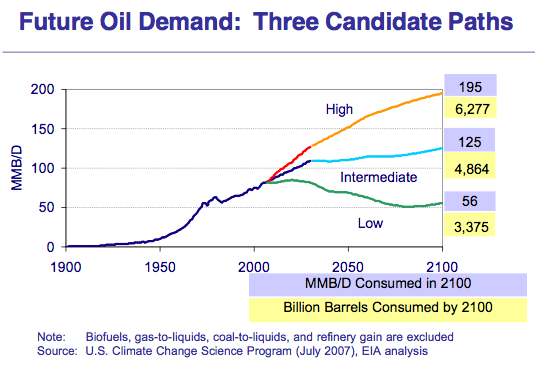
It might be noted that all of these three demand curves use far more oil than the peak oil estimates would suggest is available. The amount of oil required until 2100 is shown in the boxes to the right, in billions of barrels. Peak oil estimates would suggest something like 1,900 to 2,200 billion barrels of oil are available for all years, not just to 2100 (see Figure 1 above). All of these demand curves require considerably more oil than that - as much as 6,277 billion barrels, for the high demand curve. The low demand curve is more or less in line with CERA's supply forecast shown in Figure 1, if the timing is right.
EIA then put together various forecasts for supply. There are four supply forecasts for the intermediate demand case:

In Figure 3, the amount shown as "IIP" is oil initially in place. In the scenarios used, these range from 16 trillion to 21 trillion, and the recovery factors are as shown. The oil IIP estimates are very high; Nansen Saleri, a former officer of Saudi Aramco, only assumes a base of 12 to 16 trillion barrels, in his Wall Street Journal Editorial, The World Has Plenty of Oil, and he was clearly looking for as high a number as he could justify. The discussion indicated the recovery percentages applied to the oil IIP are based on the assumption that technology would be improving, and lead to higher recoveries.
When one sees the results of the simulations, it becomes clear the supply models generate a lot of expected future oil. When supply in the base case is matched up with intermediate demand, the model indicates that there will be enough oil to last until 2190, before demand outstrips supply:
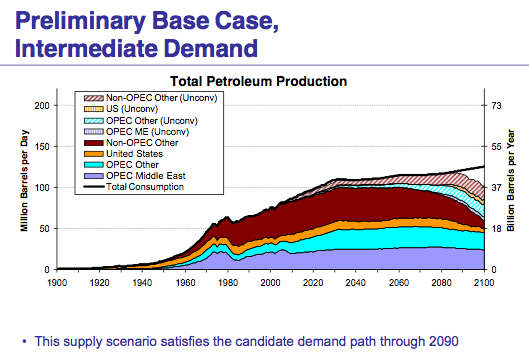
It would be nice if the world were really like this! If you want to learn more, the full presentation is at this link. Fortunately, the EIA forecast is still at a preliminary stage, and there is at least some possibility that it will be revised before the final version is developed.
Electrical Supply. Quite a few of the conference participants were from the electrical industry. I would characterize the electrical supply folks as being very concerned about the future of electricity -- more so than the people from the oil side of things, who often thought speculators were the main source of problems. This is one presentation that summarizes some of the electrical supply issues.
One graph from that presentation shows the projected year when margins are expected to fall below minimum target levels:

From this map, It does not look good for RFC (MISO) which I believe is Michgan and Indiana and the Rocky Mountain Region. New England, California, the great plains, and Texas are not much farther away in time when electrical capacity is expected to be bumping up against limits.
Another graph shows trends in electrical transmission congestion:
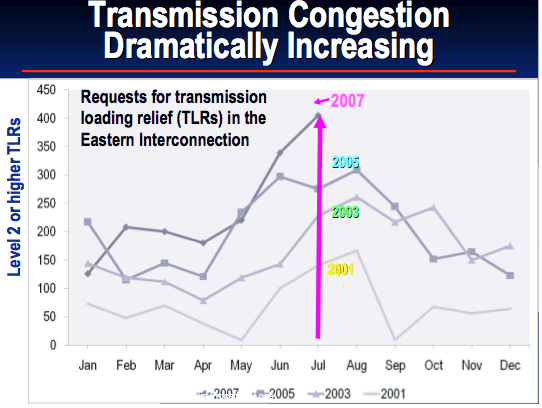
If you expect that plug in cars will save the day, you may want to check out what the electricity people are saying about the current state of electrical supply.
Climate Change Legislation. The major session the second day was devoted to climate change legislation. It was pretty clear from the discussion that nothing is likely to pass this year. It was also clear from electrical discussions that no utility would be able to get funding for coal fired power plants, until it was clear what type of carbon legislation would be passed in the future. Thus, it looks like coal is off the table as on option until climate change legislation is passed.
There is not a lot on the internet about the content of this session. This is a link to the remarks by John Dingell.
Energy and the Macroeconomy Model. We got to hear from Steven Brown of the Federal Reserve Bank of Dallas talk about their oil shock model. Oil shocks are modeled as temporary events in a model of the economy. Lucia Guerrieri of the Federal Reserve Board observed that Steven Brown's model likely overstated the impact of oil shocks, because we now have experience with oil price spikes, and know how to deal with the situation better. High oil prices wouldn't cause a recession this time.
I'm afraid I couldn't agree with these folks. I thought it was sad that the people in the Federal Reserve are this far removed from what is really going on in the world - haven't considered the fact that oil price shocks might be more than temporary and that learning from experience isn't really sufficient.
Summer Transportation Fuels. If you are interested in the summer fuel situation, there were several presentations on this subject.
This list is not exhaustive. There are a number of other topics covered by the presentations given. Check out the EIA Conference Website!
Contact
- Content: editors at theoildrum dot com
- Tech support: support at theoildrum dot com
License

This work is licensed under a Creative Commons Attribution-Share Alike 3.0 United States License.
After the Titanic hit the iceberg, the first person to realize that the ship would sink was Thomas Andrews, whose company built the ship. Within a couple of hours or so, everyone realized that the ship would sink (some realized it as they were drowning, or dying from hypothermia). So, it was a continuum from one person to everyone.
In a sense, when we started consuming fossil fuels, especially at an exponential rate of increase, we "hit the iceberg," and King Hubbert was one of the first to realize what was happening. We are basically on the continuum from virtually one person, Hubbert, to everyone.
My current opinion is that one should generally refrain from arguing with Yerginites, and instead offer to sell them your rapidly depreciating suburban home.
LOL! There were a few peak oil believers at the conference, but not a huge number. I ran into about six that identified themselves as TOD readers.
A lot of EIA people I talked to (often working in areas having nothing to do with oil) were interested when I mentioned the TOD site, and wanted my business card. Quite a lot of the people there were from EIA.
Sell it to them in Yergins.
< / Chuckles off>
Jeff, some of your ELM predictions are for pretty severe declines which will very shortly be undeniable. In fact, if your plausible model is correct, within the next 5 years or so there will be a "Black Swan" event (The 2013 'UN Nations Energy Crisis Report' perhaps?) which will be the equivalant of The Titanics Captain broadcasting Mr Andrews realisation over the ships tannoy...
Assuming that most TOD readers consider themselves as the equivalent of the small clique crowded around the table as Mr Andrews unscrolls his architecture charts and declares the ship has "but a few hours" what are we to do?
Any breakaway from that small group would either not be believed -"The Titanic is unsinkable"- or perhaps save just a few... The majority still drowned after all...
Nick.
Noutram, we can at least try to save ourselves. Buy gold and silver, bicycles, some arable land, solar panels, literature on organic farming and poultry farming, and anything else you can think may be useful when the 18-wheelers stop rolling and the container ships thin out. Even small things, for example a straight razor, sharpening stone and strop so you can shave when the plastic razors become too expensive or rare.
Gail,
I think you want trillion not billion when you first introduce estimates of remaining reserves.
Thanks for reporting on the conference.
Chris
fixed. thanks.
The total all year production appears to be the production until 2070. At least thats what I estimate from the area under the curve.
Good information to have. Then my comparison of EIA to CERA is not right, if omits the numbers past 2070. The CERA graph is not well labeled.
The USGS 2000 estimate for conventional oil are given in this Table.
The P50 number they give is 2,659 oil + 324 NGL billion barrels = 2,983 billion barrels of ultimately recoverable conventional oil and natural gas liquids.
They do not give totals for P5 and P95. It is not quite theoretically correct to sum up the various amounts in the table, but it is fairly close. Summing the amounts, we get
P5 = 3,536 oil + 524 NGL = 4,060 billion barrels
P95 = 1,924 oil + 183 NGL = 2,107 billion barrels
If CERA expects a lot more beyond 2070, they would be up in the P5 range or higher, relative to USGS 2000.
Gail,
Is there a trend in historical USGS ultimate yield estimates? Are they revising down over time? I am thinking of Dave Rutledge's graph of U.K. recoverable coal. The estimates began to converge with real production several decades ago, but prior to that had been orders of magnitude high.
The USGS has a long history of producing inflated estimates of available oil. This is an article by David Strahan about this problem.
My impression is that their view of what is available is generally trending higher. At one point, I had a link to some data showing the figures over time - I don't see it right now.
Gail and I had an intersting conversation (if not surreal) after the "Conversation with the EIA Administrators."
In his view, all resources (and used the word "resources") including those not yet discovered (they are "out there, like the X-files, we just don't know when they'll show up) about 8 TRILLION barrels of oil and we've only used about 1.1 trillion barrels of that so far.
He also tried to make an argument as to why there is still so much oil left in the KSA. Basically, he was saying We've seen the data and have been doing this longer than anyone else.
I don't know whether he was surprised when I could recite, chapter and verse, the production numbers from Prudhoe Bay and the North Slope, but he was trying to prove that recovery numbers (as percentages were getting better and better) were going to provide more oil. I reminded him that initial (wild) estimates were on the order of 100 billion barrels and that there was talk of a second pipeline because the volume was thought to be so large.
And I think he was decidely taken back when I pointed out that peak oil was not about the size of the reserves, it was about the rate at which the oil can be supplied. It apparent that a number of people think in terms of resources (if only we could get to them) and not flow rates.
Hi Star,
I wish I could have been there when you and Gail were conversing.
What does "he" imagine would happen to other resources were the 8 trillion to really exist? (and come online at approximately current flow rates, as you so correctly point out - ?)
Have they not heard about water scarcity, collapsing fisheries, lack of arable land, overcrowding, etc.? A rhetorical question, I realize.
Well, I was quite stunned by this statement. Earlier we had seen similar numbers in a different presentation that would have no problem and continuing growth out to nearly the 22nd century.
I can't account for why this is so. As an engineer, I tend to ask a simple question: "and you are going to accomplish that how?"
Now, I would point out that this is exactly the same thinking that got the EIA into trouble with the IEO documents. If you want an example (and there are quite a few) go back and read the International Energy Outlook on oil production. Pick the North Sea in particular. Now in the earliest version I think you can find online it seems like they correctly projected the peaking in 1999-2000 (might be a previous version hardcopy). Then notice that all of a sudden they are pushing the peak date well into the first decade of the 21st century.
It wasn't until the IEO 2006 that they finally got around to admitting that the North Sea might be in decline. The UK peaked in 1999 (the second peak with ~110 fields in service compared to the first peak with ~30 in service) and Norway peaked in 2000.
Nor do they seem to get that an "undulating plateau" is death to a system that is entorely dependent upon growth for it's own self-defined "health."
I'll be looking at my notes this weekend and putting some thoughts together for a Forum I manage. I place some additional thought here, as well. I recorded some of the presentations (audio and video) for accuracy.
Hi Star,
Thanks for responding and for the example. I hope you can write this up as an article for TOD, perhaps.
Your point about future oil supply not being about reserves and being mostly about flow rate is the thing most people can't seem to grasp about peak oil. The beauty of Hubbert's analysis method is that it cuts straight through the bull and confusion about politicized reserve estimates and how oil should flow out of rock and gets to the heart of the matter, which is the real life flows produced considering all the complex factors. By doing this, it solves the riddle of who's lying about reserves and how certain rocks will behave.
In an earlier post of mine, this is the way I define peak oil:
I have never in my life witnessed a greater disparity between two sides of a story than this one. Global warming is close, but the magnitude of differing opinions on a topic that is going to impact the very near future is so vast that its obvious one camp has to be missing something enormous. I think the cornucopians (16-21 trillion OIP, 75% recovery factor, etc.) are completely ignoring costs and flow rates. What is the cost in energy, water, ecosystem, and dollar terms to get 75% recovery on 16+trillion barrels? Its as if these oil analyses are done in isolation and ignore all other aspects of the system we live in.
And the other camp thinks we see mandatory rationing, resource wars, starvation, etc in under 10 years, and maybe considerably sooner
Cognitive biases seem to be at the root of these opinion disparities. Otherwise, people would just differ at the margins. But here the margins are monumental. Here is another list of our cognitive biases - #25 - the Plank Problem of particular relevance here...where intelligent people are more likely to be able to debate their point of views and also less likely to consider alternative viewpoints to their own.
I really believe that people will believe what they feel comfortable believing - new facts rarely change the corpus of their fundamental beliefs. Given such disparate opinions of generally smart people, the discrepancy has to be rooted in how we (humans) process and believe in information, how its presented, how it impacts our own future trajectory (threatening or helpful) and who is presenting it (someone respected in our 'tribe' or someone fringe.) At least thats my belief...'-)
Yes. I am new to this whole PO thing. After reading
a book or 2 on it, my entire world view / life view changed.
But I still don't understand how there can be 2 hugely
different outlooks on the amount of oil the world can
produce over the next 20-30 years. I mean, we're not
talking "religious faith stuff" here - this is supposed
to be science, and it's not rocket science. Is there
any idea of what it would take to get EIA people to
change their view and "adopt" PO (i.e. 5-yr peak)?
And what would it take to get POilers to change theirs ?
I think in general the economists have had a big influence on thinking. (I don't know of this is true at the EIA, but it is in general.) The view is that if the economic stimulus is there, suddenly the oil will appear. Technology can fix anything. Scientific American and other science publications have encouraged this thinking as well. The apparent unanimity in the press has lead a lot of people astray.
With respect to the EIA changing their minds, we are talking about a relatively small number of people - I would guess less than 10 - making the decision. I am not sure what would change their thinking. My impression is that they honestly want to be correct, and might be more open to reviewing additional information than most people expect. It might be that they would change their forecasts gradually - a step down in the 2009 forecasts, and another step in 2010 forecasts. If the IEA made a big change in their forecast, this might affect the EIA.
Gail the problem with this view point and one I will soon make a key post on is that technology itself is not created via magic. It takes time persistence and money to develop. The technical cornucopian's base their faith on past technical advances. But these same past achievements have enhanced our ability to extract oil for decades. This the argument has a fatal flaw in that its own premise destroys its conclusion by making some simple assumptions like technology works with the physical limits of the system thats being refined. No amount of technical advances will make water boil at a different temperature than 100 C at atmospheric pressure.
The fallacy of the techno magic argument is thus twofold you ignore the benefits and effects of past technical advances and you ignore simple physical constraints. This is the difference between technology and magic. Of course the techno-magicians call it economics.
Hi, memmel.
Everything you say is true. So where does the techno-magic line of thinking come from, then?
Perhaps it is part of a very long-lived conversation that started long before you and I arrived. When we were born into the world, there were many conversations already being spoken in the human network of conversations. Some conversations extended over the entire network, some were local to where we lived. Some already had very long lives, some were spoken only for a brief time. The techno-magic thinking seems to be a conversation that started several centuries ago.
The following is from a previous post in response to the adverse reaction the authors of the Limits to Growth received when it was published:
It is clear to me that we are about to transition to the next episteme.
-André
Hinson, I think much of the huge disparity between future production views is simply the difference between those who understand Hubbert and those who don't. The Hubbert model has been proven to be remarkably accurate in the past in a variety of large producing areas. But I would guess few in the EIA or CERA have a good understanding of the model; and if they do, they think that technology will make it different in the future. However, in the U.S. peak case, the decline transpired while one of the greatest tech revolutions of all time was raging - the computer age. And it did nothing to do away with the Hubbert model U.S. peak calculated in the stone age of 1956!
Gail is right, economists are responsible for a LOT of this mess. Their belief system is at the root of this whole problem and it is a discussion that has been going on for 300 years. Galileo irritated the Roman Catholic church for having the audacity to suggest that the earth went around the sun. The church only eventually conceded Galileo was right in the 20th century. This episode marked the beginning of a debate about God, Man and nature and who was supreme. It was carried out by people such as Descartes and Francis Bacon. The upshot of the discussion was that they decided that Man ruled supreme over nature and that nature was unbounded, there simply to serve man, as man saw fit.
This view, fundamental to classical economics, and eargerly endorsd by all modern economics inlcuding both marxist and neo-classical economics, holds that the resources of the earth, including oil, are for all intents and purposes infinite. It is this fundamental article of faith that lies behind the 8 trillion barrels of oil "resources". All of a sudden, as if by magic, all of the unconventional "sources" of oil (tar, shale etc) suddently become oil, "because technology will make it so". Note that it is an article of faith. It is deeply embedded in their belief systems; and it represents an inability to consider any other opinion. As with faith generally, such beliefs are hard to change. One economist actually told me that geologists such as Colin Campbell do not understand the situation (oil production)!
The view that resources are unbounded may have been effectively true in the time of Francis Bacon when the worlds population was less that 1bn people. It is no longer true now, but that invites a discussion about limits, economic growth and population control. And this is all in an area that is uncertain and hard to define. Also, until the sub-prime mess, the worlds economy was in great shape, even with high oil prices. Because this drama is playing out over several years, various psychological mechanisms, such as the recency effect (today is like yesterday; and tomorrow will be much the same) act to limit the acceptance of paradigm shifting information.
Most people cannot absorb new information, however uncomfortable in makes them. Passengers on the Estonia sat, waiting for crew to instruct them, even as the ship went down. The thought that the ship would sink was outside their terms of reference, so they were frozen, unable to act to save themselves. If people are listening to anybody, it is to the people who are saying what they want to hear, the ones who are reinforcing their existing belief systems.
And that is that resources are infinite, including oil. This is perhaps my favourite quote:
Thanks for the quote. There are a lot of people that really believe this stuff.
The impression I got during the EIA presentation was that all we needed to do is figure out how much oil we would need, make the appropriate (presumably not too large) investments, and the oil would appear.
Paradigms,
Paradigm Paralysis,
&
Groupthink
http://en.wikipedia.org/wiki/Paradigm
hinson,
2 world views? There are more like 20!
After much study and ready over the last 3 years, I have decided that there is no useful information to work with.
The needed information to make projections is slanted by the source of said information, everyone has an agenda, and even those who believe they are in the know are most certainly NOT.
The only possible option is to attempt to case harden your energy consumption and economic situation to be as prepared as possible for any turn, but to do so without destroying your current lifestyle (accepting that you like your current lifestyle!) You want to avoid the risk of selling a home you like, giving up retirement investments you have, or destroying your children's educational possibilities, but at the same time, look for ways to reduce outstanding risk, debt and energy consumption to as low a level as possible.
Whatever you do, TAKE EVERY SCENARIO, CATASTROPHIST OR CORNUCOPIAN WITH A HUGE GRAIN OF SALT. Most of them are nothing but nightmare projections or wishful thinking, depending on the source.
RC
Is there any idea of what it would take to get EIA people to
change their view and "adopt" PO (i.e. 5-yr peak)?
And what would it take to get POilers to change theirs ?
M. King Hubbert predicted a US peak in something like 1965 to 1971. Some US agency (USGS I think) was predicting it would peak in the early 1990's (still soon enough that the government should hvae been taking steps in preparation). After oil peaked in 1970, it only took two years - - 1972 - till Morris Udall issued the public an apology on behalf of the government on how they had gotten the oil peak wrong.
The EIA, CERA, oil company suits, etc., can only go so long after a peak before having to admit it. "Market speculation", "lack of investment", "lack of REFINING capacity", and "political instability" have a limited shelf life.
I would change my view on Peak Oil if oil discoveries started increasing and in significant amounts. A decade of discoveries like the 1960's would make it look like Peak Oil was not emminent. Or if all the countries in decline (the majority) started plateauing or increasing in production I would change my view on Peak Oil being emminent.
While I agree this is not rocket science, it is more difficult. Regardless of how you cut it, the damn problem is that all this black stuff is under ground.
That is a perceived problem. It is only hard if people think it is hard.
Weird that the asshats at the fed reserve swiped my 'oil shock model' name and likely replaced a simple model with some demand driven monstrosity.
If you have the same person or group of people working on the issue for 30 years, you will tend to get some perpetuation of whatever was believed to be true in the past. This is even true if it is different people are working on the project.
I have done enough consulting work to know that the bias is always toward making this year's analysis look not look too different from last year's. For one thing, the model you use this year is likely to be similar to the one used last year. For another, you don't want to look like you got it wrong last year. I think studies have shown that forecasters often miss turning points.
I'm not sure about the Federal Reserve folks. I suspect they went to school in Economics, and skipped the science courses.
'I'm not sure about the Federal Reserve folks. I suspect they went to school in Economics, and skipped the science courses.'
Actually, they all go to Hogwart's. They take courses such as 'Advanced Muggle Bamboozelment' and 'How to Make your Hand Invisible' in preparation for their careers at the Ministry of Central Banking Magic
There have been at least some Fed discussions recently about resource scarcity due to its impact on global inflationary factors that cannot be directly addressed by any one nation's monetary policy. I believe that the Fed is becoming more peak lots-of-things aware. A little oil demand destruction is not perceived as such a bad thing, but prices going parabolic without demand destruction is a policy dead end - they would have to let it go if the economy in general is weak.
For one thing, the model you use this year is likely to be similar to the one used last year. For another, you don't want to look like you got it wrong last year. I think studies have shown that forecasters often miss turning points.
This is the type of thinking and behavior that doomed the USSR.
And after reading Nate above - I'm having another one of those moments, when I consider how widely people were prepared to believe in fairies, or a flat earth, or even today that the Apollo missions were faked, etc etc... Pick your 'conspiracy' - And I have a moment where I just need to recheck that I'm really NOT one of those people... Am I? Are we? Ummm... moment over... oil at over $116 a few minutes ago <sarconal>bad speculators - must call my broker...</sarconal>
I posted a link to an article yesterday that predicted that Middle Eastern oil exports would double by 2030. Our (Khebab/Brown) middle case is that the top Middle Eastern oil exporters will be approaching zero net oil exports in the same time frame.
In a WSJ article on cognitive dissonance a couple of years ago, the writer described the research on space alien cults. When the aliens failed to arrive at the predicted time, frequently the cultists tried even harder to convince people that they were right.
Of course, Peak Oilers--who believe that a finite world has finite limits--are the ones who are generally considered to be the equivalent of space alien cultists, while people like Peter Huber--who believes that the sum of the output of a group of depleting energy sources will show increasing energy production forever--are considered mainstream.
So, as noted above, I am leaning toward the "Let natural selection take its course" option, and let's encourage the Yerginites to buy up all of the SUV's, McMansions and stocks of financial companies.
For once, the people that think that "the sum of the output of a group of depleting energy sources will show increasing energy production forever" ARE mainstream.
If only they weren't...
You are exactly right to think:
Only the school of hard knocks will wake people from the dream. I figure the dream will die around $5/gallon oil. At that point Congresscritters will start holding hearings where they parade various Panglossian predictors from USGS, EIA, Exxon, etc before committees and ask them how they can be such fools. We are within a year or two of the end of the denial period.
Hi Future,
Well...a little bit different slant on
re: "Only the school of hard knocks will wake people from the dream."
A lot of people are in the hard school right now.
Many in prison.
Many in foster care or just out of same.
Many with substandard education. Or addictions (and I include kids hooked on TV/Games, etc.) Or mental illness. Or under-employed. Or...
The hard knocks do not awaken people.
Emotional support, education and open conversation are the liberating factors. (That's my VHO.)
I would just say:
Remember that when people are awoken to bad news that's been ignored, they have a tendency to shoot the messenger.
Now where was that tax on oil companies bill I had in my hand ...
I was at a closed door workshop on the outlook of world oil supplies a few weeks ago, and one session put EIA up against a very well-known oil consultancy presenting their outlooks for future supply. EIA was as shown here, and the consultancy was very pessimistic, with our current plateau ending within years. After the two talks, the two guys got into an argument with each other while the rest of us sat and watched. The upshot? They both use the same data sources for reserve volumes and yet come to diametrically opposite conclusions. EIA's "trick" is to pump up recovery factors, and they argued it strongly despite not being able to point to any technology or physical reason why it should be so.
My other takeaway is that most so-called "energy experts" are really just "energy market experts" who really don't understand energy. And yet these are the folks that are called to these government workshops for their "expert" opinions. I was rather appalled.
One person I talked to said he had been doing this for 30 years; he was an expert. Some of the things he claimed to know seemed really strange. He couldn't possibly have been talking to people in the real world for 30 years.
Hi Spraxis,
This is interesting. I'm curious...
1) How did it end? (if it did.) Did the parties - I mean, esp. the EIA - realize the exact nature of the disagreement? The way you describe it here, for eg. Did anyone say "OK, here is exactly where we differ." (Question mark?)
2) What did everyone do then?
3) I'm also curious...if one grants, for the sake of argument...any recovery factors the other side wishes to use, and then applies "ELM", doesn't that move the date of peak panic forward by a considerable amount?
4) Also, how can anyone apply "pumped up" recovery factors to existing fields already in decline? Or, do they not look at this?
Aniya,
It ended where it started, and no minds were changed. The "official" position that crude supply will keep growing stays on the books and there was plenty of grumbling about how unrealistic EIA is. One very well known peak oil person just threw up his hands and bemoaned how our energy policy is hostage to such enormous uncertainty in the data, yet government action is assuming only the possibility that EIA is correct. I brought up the importance of looking at exportable volumes and not gross world production, and what surprised me is that only one other person there had even considered that. So ELM is not even on their radar screen as an issue right now. I spent some time offsetting the presented outlook for alternative liquids, using a thermodynamics perspective, and they all looked at me like I was from outer space. When one "energy expert" noted that the reason the 20th century led to such wealth was because of contract law and the free market, and that oil "just happened to be the cheapest thing around", that's when I knew that we have a serious education and communications gap...
Agreed. And that chart of Peter Jackson's is a collector's item. What will CERA's story be in 2010 assuming production is essentially flat for the next two years (I'm trying to be optimistic)? Will they move their red line?
If they are only modeling capacity, I think they still have an out. The countries had the capacity, but chose to save the oil for their grandchildren. They are good at making up stories. They will think up something.
I am like hinson and am new to PO. Learning mostly from TOD about it and other internet sources and Matt Simmons youtube videos and presentations. And I search for the denier viewpoints as well. And anything in between. I can even discount abiotic oil now! What seems clear...is that my kids will live in an very different world than the one I grew up in. So this revelation (for me) about the facts of the energy world has changed my viewpoint in signficant ways. I feel almost imbalanced and dizzy from it.
Nansen Saleri seemed to buoy me with some optimism. Then Nate's reaction brought me back the other way somewhat. My question for Nate is...as it seems that Nansen Saleri view is that techonology will help with the recovery factor..and even if it is modest..will make a significant difference. Are you saying that the EROEI (another important study I am trying to grasp) will invalidate that claim?
The main problem is that no one speaks the same language or uses the same boundaries. For example, on this site, we realize that the peak in available energy (oil and gas) is of central importance as opposed to the CERA/EIA camp that focus on the amount of total resource and if pressed, the date of peak liquids. So we will never agree because we differ on what the central terms are - and on the thing we do agree on - that a 'peak' in oil production will occur - we care about the net and they report the gross (and a moving target to boot, continually adding things that are not oil, into the definition of oil).
The difference between gross liquids reported by EIA has to be reduced by: a)increasing amounts of energy used by energy sector, b)lower BTU (and therefore less ability to do work) of many of the 'other liquids' components such as ethanol, NGPL, etc. c)the higher costs of getting out the marginal barrel, d)the higher usage by exporting countries, e)the depletion rate is causing more exporters to become importers (Indonesia is a member of OPEC but is now an oil importer - 60% of Mexicos oil comes from Cantarell which has just entered 15%+ decline stage, meaning Mexico will soon not be exporting oil but importing, f)environmental, non-energy limitations to production, g)maximum power principle suggesting that technology is borrowing from second half of oil at cost of higher future decline rates, rather than continually increasing the flow rate with promise of more to come.
So we are talking about net flow rates and CERA/EIA are talking about something else. What amazes me is after what we have been writing for 3+ years and what CERA/EIA have been projecting, why more people haven't woken up to the facts that are really impacting the oil situation - productive capacity is not one of them.
Declining net energy will first be seen as higher prices, as non-energy sector has to bid for more of the BTUs in oil and gas to do economic work, as was detailed in this post. At some point there is a 'cliff' where accelerated drilling/alt energy, etc. uses more and more of our surplus energy squeezing out the other sectors completely. But once this happens it will be too late to impact it in anything less than a command economy, likely without the economy.
Actually, Nate, there isn't any clear cliff, it's more like a gradual decline. And I'm indebted to Jon Friese for making suggestions that led to that conclusion. To satisfy yourself of this, work a numerical example, taking into consideration that for every high quality concentration of a resource there is usually equal or greater amounts of lower quality concentrations. i.e. There is a gradient.
Generally as net energy available declines, prices rise and quantity demanded decreases. There is no drilling frenzy unless society can afford it. And it can't unless it is bringing other unrelated energy resources on stream that are not declining EROI-wise or utilizing dramatically better technology in order to 'subsidize' the frenzy.
Anyhow, I'd love to see this famous energy cliff modeled. I strongly expect that the attempt would tease out assumptions that are very different from what make sense in our world.
Nate said:
"Its as if these oil analyses are done in isolation and ignore all other aspects of the system we live in."
This has been my experience over and over again...people exist in their silos. Shocking recent example. My wife was doing some research for the Teach In Dan Bednarz helped organize and came across a report about mitigation for climate change in the state of California from a Public Health perspective.
Big worry...if it gets hotter people will suffer from heat stress.
Big solution...make sure everyone has an air conditioner.
Results...10% more electricity usage in the state FOR AIR CONDITIONING ALONE than is currently used for EVERYTHING TODAY.
Unbelievable! The laws of unintended consquences are going to start springing up all over the place...
I really think the climate folks are well behind the curve on the energy situation.
We evolved to be warriors, shaman, and storytellers, not systems thinkers...;-(
"Its as if these oil analyses are done in isolation and ignore all other aspects of the system we live in."
I got to wondering the same thing about Global Warming the other night. I got my set of DVDs on the Peak Oil Conference in Houston and have been watching them every night.
Two nights ago I watched the presentation by Pushker Kharecha of NASA on Global Warming and it go me to wondering a couple of things.
First, the only sources of CO2 that are being considered and listed are fossil fuels. Yet, each of us sucks in oxygen and exhales CO2 24 hours a day, 365 days a year until we die. Individually it doesn't amount to much, but multiplied by 6.6 billion people it must be a considerable amount. And that annual total times the 40 and 90 year time frame in the presentation (2050 and 2100) would surely be a lot of CO2 (and therefore a lot of carbon). And then all of our domestic animals are exhaling CO2 and that total would - as a guess - be 3 to 4 times the total for people. And then there are all the wild animals (???). Every living thing on the land, in the air and in the water is taking in oxygen and expelling CO2. Then there is all the vegetative matter on the planet. As an average guess I would think the total turnover rate must be around 50 years and what percent of that total turn around mass is given off as CO2 from decomposition??????
I know Global Warming is taking place (I live in Minnesota and have seen the changes in animal life - we never used to have o'possums living here and are now overrun with the darn things - I used to have to plow snow every two weeks at least in winter and now plow only once or twice a year - and we used to have 6 foot drifts and now only get maybe a foot at most), but I am wondering if maybe Homo Sapiens is causing the problem not just by burning fossil fuels but by the simple act of breathing and raising breathing animals for food? And going from 6.6 billion people to 9 billion even if we stopped burning coal might still cause the effect of signifact CO2 Global Warming problems?
Second, In the above referenced talk one slide stated that of the CO2 put into the atmosphere over 50% stays in the atmosphere for over 1000 years? If that is true I have to wonder if 1/2 or more of all the CO2 produced by Homo Sapiens and his domestic animals stays in the atmosphere for 1000 years at our current and projected populations would not our species be doomed to extinction from excess CO2 in the atmosphere even if all fossil fuel burning were to be completely banned tomorrow? CO2 exhaling Homo Sapiens numbers have risen just as fast or faster than the burning of fossil fuels.
Are WE the direct problem?
I regret that my scientific knowledge is not sufficient to figure out the exact numbers for the above questions but hope that perhaps someone here can supply them. Even if they turn out to not be too dramatic or significant in the big picture, they should be included in presentations on Global Warming so people don't get the suspicion that people might be cooking the numbers when they are not included?
Jon Kutz
There's no question that animal husbandry for meat consumption is a major source of methane, which is something like 23 times as powerful(as a green house gas) as CO2 - I have the vague memory of it being 25% of AGW. Further, meat takes something like 7 times as much agricultural production as does direct consumption (beef more, poultry less).
We could probably reduce our agricultural impact by 50% (or feed twice as many people), and our GHG emissions substantially, by going vegetarian.
All of a sudden, I just had a really really crazy idea!
If you took a thousand people of all ages and put them all in a big sealed room and gave them all the food and water they wanted or needed but they couldn't leave the room, what would be the die off scenario?
Would they die off all together or spaced over a period of time from excess CO2 over decades, years, months, weeks or days?
So let's go back to the age of Dinosaurs. They were all in a sealed room (the planet). They had plenty of water and food and their numbers grew and grew. One half or more of their exhaled CO2 stayed in the atmosphere for 1000's of years. Could the CO2 concentration of the atmosphere have reached a tipping point where 80%-90% of all life would die off over a short period of time due to suffocation? Maybe it was not an astroid hit that wiped them out, but their own exhaled CO2 building up in the atmosphere?
Like I said, it's a crazy crazy idea - But then that is about the only thing I have ever been really good at is coming up with crazy ideas - If only I could have found someone who would have paid me a good wage to do that - Sigh -------
Jon Kutz
Very crazy idea. Atmospheric CO2 concentrations are in the range of 385 parts per million today. Large increases in the CO2 concentration will kill off species through climate change long before anything comes anywhere near suffocation.
In your scenario, people would soon be wallowing in their wastes and at some point die of suffocation. Think of the recent coal mine collapses. For your other idea, James Lovelock of Gaia Theory put together a simple model called Daisy World to show how a planet's biota would respond to changes in its environment to maintain itself. (This is a very simplified explanation; please read his work to get the full implications. Also along this line, I would suggest reading Catton's Overshoot and the 30 year update to Limits to Growth.) Also, there's zero evidence that dinosaurs overshot their ecosystem the way humans have, which is why I suggested the latter two books. Another work I tout highly is Lynn Margulis's Microcosmos as it provides a wealth of knowledge of how life and its ecosystem have evolved over time.
Are we the problem?
Heh Heh
Black Death Caused Little Ice Age...discuss....
Researchers from Utrecht University, Netherlands were trying to tie the black death into the cooling period known as the little ice age. They said with the depleted human population that a lot of cleared farm land reverted back to forests. With the sudden increase in forested land the carbon dioxide levels dropped causing the cooling period.
Full article is here http://news.bbc.co.uk/1/hi/sci/tech/4755328.stm
Bill Ruddiman makes a fairly good case for plagues -> lower CO2 -> cooling in his well-written 2005 book Plows, Plagues, and Petroleum. Still an early hypothesis, but makes reasonable sense.
I grew up on a farm that had been in the family for 120 years, and a large pasture had been in place since ~1940. 20 years after Dad stopped farming, it was covered with dense woods.
Things are a bit more complicated than that. We eat plants (or animals that eat plants, or animals that eat animals that eat plants...), and plants get CO2 out of the air. Every atom of carbon that we eat was sequestrated from the air recently.
The problem really lies with fossil fuels, deflorestation and other nonciclic fenomena.
Funny you should ask that question because before the EIA Conference I had been asked a similar question and did a set of calculations using standard human activity factors. It's really straight forward math and material balances. It's the same numbers we use for risk assessment.
The answer is this: humans (all 6.6 billion of them) just doing nothing but living and breathing would produce the equivalent CO2 as the consumption of 19.8 million barrels of oil equivalent per day. Note that humans are using the equivalent of more than 85 million barrels per day (oil equivalent) of petroleum products to maintain the ability to release that personal level of CO2. Add to that the use of gas, coal and the removal of land area from productive, though temporary, sequestration for things like food production, etc., and you get a very large number that dwarfs human exhalation, but the aggregate number is a nonzero value.
In a 70 year lifetime, for a personal perspective, you turn out the same CO2 quantity as the consumption of 3000 GALLONS of crude oil (in round numbers) or just under 3700 gallons of gasoline, 600 cubic feet of natural gas, 14.6 tons of bituminous coal, or 19.4 tons of subbituminous coal.
As for the persistence of CO2...about half of the CO2 emitted today would be taken up in about 25 years, two-thirds by about 100 years and 80-90 percent by 1000 years. It is a highly nonlinear uptake but plotted on log-log scale looks linear. I have the formula for the estimated uptake somewhere in addition to the breakout from seawater, plants, etc.
It is startling how much people are willing to believe and defer to authority. Before the Iraq invasion there was a team of WMD inspectors in Iraq. They inspected hundreds of sites and found nothing. The US couldn't point them to a single location anywhere in the country where they could find WMDs, and yet the world didn't raise a single objection (to the claim) when Collin Powell told the UN there was no question that they had them and even showing pictures of buildings where they had "from 5 to 100 tons" of them. To this day virtually no one sees how ludicrous it was to have US politicians telling the world there was no doubt Iraq had WMDs while inspection teams could find nothing. Nothing. The US politicians should be on trial at The Hague as the former Yugoslavian premier was. But instead, they were reelected.
Now we have a situation where a government agency can actually make a presentation showing oil production increasing for another 20 years or so and then holding steady for another 50 or 60. And yet, oil discoveries peaked in the decade of the 1960s and have declined every decade since. How can they be so confident there is all this oil out there when no one is finding it???? With most countries in decline, how can they be optimistic??? I wouldn't try these guys at The Hague, but whoever is responsible for the EIA presentation should see some jail time.
The optimism of people is also quite astonishing. If I mention peak oil to people, most will quickly and *emphatically* dismiss it by saying
a) we still have used only a small amount of the oil out there, we just have to drill for it. Like off the coast, in Alaska, reopen old wells...
b) big deal, we will just transition to (liqified coal, hydrogen, ethanol)
c) People have been saying for years that we would "run out of" oil. "They" were wrong then, therefore, they are wrong now.
Finite: The majority of the first world population outside the USA didn't buy all that crap for two seconds, so your history lesson isn't even close to being accurate. The "world" didn't raise a single objection but giant crowds of demonstrators worldwide did.
Were they objecting to the claims of the US government about WMDs - or objecting to the invasion? I don't remember anyone saying anything like "If they have them why can't anyone find them?". Although they no doubt could have been saying it, as I would only have heard about it if the US media reported it, and they were closely following the government story on the issue.
The US also had demonstrations against the invasion, but I believe it was based on the carnage that would result to the Iraqi people, and not on the fact that the government was delivering a pack of lies about WMDs.
That is exactly what "everyone" was saying. At the time, IMO most Canadians were shocked that anyone could believe such nonsense-I would assume the feeling was the same in Europe.
We, the marchers, objected to everything being said by BushCo. Indeed, many of us objected to Bush being installed illegally as president by the USSC.
I was literally wide-eyed at your first post above... Just want to back up the other responders - in London, this question or variant of it seemed to be talked about constantly. People were objecting for many reasons, but the lack of ANY WMD evidence, and stuff around that including the 'handling' of the inspectors was perhaps the most talked about.
It doesn't seem like all of London could have shared those views, as Tony Blair and company were fully on board with the Bush Regime and their lies. The UK was in the #2 position in the Coalition of the Willing, so they had to have some support from the people.
In the USA I don't think there was a single TV spokesman, newspaper reporter/columnist, or radio personality who made note of the fact that there were no WMDs being found by the inspectors - who were told to leave by the Bush Regime so they could begin raining bombs. If any did they did it in passing. The one exception may have been Phil Donahue who had some negative discussions about the coming invasion. MSNBC canceled his show despite what was said to have been very good ratings for that network.
As far as discussions among peers, I remember less people in the USA being upset at the coming invasion than are worried now about peak oil. If someone was against the invasion, my recollection was that it was because Iraq was not a threat, not because the Bush Regime was delivering a pack of lies. But I do think that if someone was alert and informed enough to realize the goverment was lying about WMDs, they also now are aware of peak oil.
Hi Finite,
From an example of one - even though it seemed unlikely on the surface (to me), I looked into the WMD claim (when literally no one I knew was doing so). On the part of many people, I noticed a distinct desire to either 1)believe authority or 2) to believe that "we cannot know the truth", which is another version of (1). And some who were opposed and afraid to let others know.
No - not everyone - just most people - polls established that. Remember, feelings were high enough that somewhere around one in every thirty people in the entire country turned up to march in London on one day. The feelings were strong, loud, and dominante, and ineffective and utterly irrelevant to Blair and co.
The core of the UK government was #2 in coalition with the Bush Regime - it's an accident of politics that the UK is seen as more willing that say some of the small Eastern European countries - I remain utterly flabbagasted to this day that the will of the people couldn't stop the UK involvement from proceeding - but for a long time we were convinced that without an authorising UN resolution there was no way Blair would go... Suffice to say my perspective on the value of democracy has been __severely__ dented as a result - I have no better alternatives though - can see no way to prevent the progression of power to the tight executive core... Not without, hmm, bad things.
Anyway, off topic for TOD...
But damn it, we are running out of money. Even if all the oil producing countries could increase production,how would we pay for it? Oh yeh, the Chinese do that. Thanks. And how much leverage do we have over those countries that fund terrorism? None.
The argument that we should become independent made sense 35 years ago. And it makes sense now except for the fact that it is now virtually impossible. And the EIA is not helping.
Well, the cornocupians are not alone while ignoring reality. Doomers also have plenty of unconvincing arguments.
For one thing you are right, cornocupians tend to ignore fact about how much oil is there. Doomers tend to ignore other kind of things (like several moments of history, what technology is already doing, etc).
Doomers tend to ignore other kind of things (like several moments of history, what technology is already doing, etc).
Can you elaborate on what you are referring to?
yes, I am curious what "moments of history" and "what technology is already doing" are going to do about declines in finite resources, coupled with rising demand and growing populations...
"Doomers tend to ignore other kind of things (like several moments of history, what technology is already doing, etc).
FiniteQuantity asked, "Can you elaborate on what you are referring to?"
Since Marcosdumay did not come back and snap at the bait I can't guess what he was referring to, but let me give a thought or two on what I am referring to...
Many "doomer" scenarios are based around a core set of assumptions that set the framework for any debate concerning the human races ability to cope with upcoming changes involving energy. We are accepting for the sake of this discussion that changes will indeed be needed, pushed forward by the twin drivers of (a)climate change or the risk of it and (b)declining energy resources, in particular the non renewable fossil fuel oil, natural gas and eventually coal. We accept that these fuels are by definition non-renewable and therefore depletable.
The core set of assumptions that indicate a coming catastrophic failure of human designed systems are human beings (a)lack of ability or willingness to change at the systems level fast enough to scale possible alternatives in time to avoid catastrophe (b)the "finiteness of the Earth and (c)growing population.
Two of these assumptions are not new, and in fact should have been able to have been read from any actuarial table and science textbook, these being population growth and the "finiteness" of the Earth. These could not have been a major surprise to any educated person. However, it is very easy to make false assumptions based on past trends and on too narrow of a definition.
The population curve has indeed been up, and worldwide it is still climbing. But in the most developed, i.e. energy consumptive nations it is flattening surprisingly fast. Future population trends seem to have as much to do with economics, sociology and education as they do with biology. Despite the question of Bob Shaw, humans are not yeast. When yeast invent a birth control pill, then I will accept his question as valid. (for you newbies, that's an inside TOD argument! :-)
The other issue that seems to be a given is that the Earth is finite. And indeed it is. It's weight and volume is relatively easily measured. The absolute fixation with the word "finite" is noticable here as you will usually see that word used more often in a day on TOD than you will hear the word "fries" at a local McDonalds in that same day.
But while the Earth is indeed finite, it is NOT a closed system. Billions of BTU's are poured on to the Earth every single day. And billions of biological processes occur on Earth every day, driven by those billions of BTU's. Billions more inorganic chemical processes are driven by this energy, and at least millions of weather events are driven by it (wind, lightning, tides and waves, etc.) The Earth is ANYTHING BUT a closed system. When it comes to energy (as opposed to the narrow discussion of fossil fuels) the Earth is finite only insofar as the Sun is finite, which for our purposes, it is infinite.
Some dismiss Solar energy as having no possibility, and seem to feel that the amount of power that can be extracted from it is tiny and a fringe amount. But the potential is staggering:
http://upload.wikimedia.org/wikipedia/commons/3/35/Available_Energy-2.jpg
So if we properly use the energy available to us, a case can be made that we suffer no energy crisis, but a crisis of liquid fuel, that is to say, transportation fuel. Energy we should have the ability to produce vast amounts of. And indeed, there are already systems in the world producing power with PV solar panels, and other systems producing power with Concentrating Mirror Solar systems.
It will take materials to build solar collecting systems. But the world is using millions of tons of steel, aluminum, glass, copper and other materials everyday to build cars, trucks, motorcycles, powerboats and luxury airplanes, all of which consume oil, and produce no energy. There seems to be huge amounts of materials to build huge skyscrapers.
It seems like it might be a good idea to get underway building renewable energy facilities while the material is still easily available. Many solar systems that were built in the energy crisis days of the 1970's are still producing power today, a third of a century later!
So we have accepted that the human population may continue to grow, but almost certainly not as fast as many had predicted. The population growth rate can be slowed IF we can continue prosperity and educational growth around the world. {we will call that a moment in history that breaks all historical pattern}
We have accepted that while the Earth is finite, it is not closed, and for purposes of energy, it is not finite at all. {call that a great conceptual breakthrough}
We have accepted that we already have technology that can take advantage of the infinitie sea of energy, but that we are still facing a problem with liquid transportation fuel. The goal then would seem to be a transition away from liquid fuel for transportation and to a more diverse energy platform {we will call that our action step}
This leaves us the most unpredictable factor:
(a)lack of ability or willingness to change at the systems level fast enough to scale possible alternatives in time to avoid catastrophe.
We know that physics is on our side. We know that science is on our side. We know that population growth can be withstrained with education and technology.
But, we do not know that humans are willing or able to change. We have allowed our educational systems to decay horribly in the last 30 years or so. We were warned again and again that we would pay a price for our laziness and lack of will. With the need to completely alter our energy system, we may now be paying the bill for our long years of complacency. "Peak oil" is not a crisis of physics or science or geology. It is a crisis of will and intellectual ability. We have allowed ourselves to be convinced by the lowest element that we are yeast or screaming monkeys. Thus we have educated our young to be no more than screaming monkeys, no more than yeast with only biological processes and no sense of mission or destiny. We are paying the price for our nihlist philosophy and it may be a very heavy one.
We can only hope and pray that there are still a few of those who choose will, action and life over slavery, decline and cultural suicide. THIS DEBATE IS NOT ABOUT SCIENCE. It is about choices. This is an aesthetic, philosophical debate between those who want to slither back into the caves, and those who want to stand up tall, as humans are designed to do, and to reach upward into space rather than downward into the hole. The effort to succeed as real beings of destiny, beings with a future is being mocked daily. It is now hip to give up and accept defeat.
But the reward will be so great for those who reach upward, the sounds of the mocking losers slithering down in the dirt will soon be inaudible.
At least some percentage of the human race are preparing to enter an age filled with glory, a moment in time which will be celebrated in books, film and song in years to come. This is what is meant by "a moment in history." It will be worth being alive at this time in history just to watch the age unfolding. But if you are wise, you will teach your children not to simply watch this great age, but to participate in it. Your children should not be slithering backward into serfdom at such a moment in history. They should be learning to be ready to take part, to lead it. Could you really face yourself in your old age if you caused them to miss this opportunity, the birth of a new age, because you taught them the nightmare ramblings of a dying age, the histrionic occultism of a cult of declining oil worshippers?
Would you drag them down to that level?
THAT, FiniteQuantity, is what I am referring to.
RC
This might go down as the post of the year. "Antidoomer stands claps, tears in his eyes"
Hi Nate,
Thanks. Of course,
re: "And the other camp thinks we see mandatory rationing, resource wars, starvation, etc in under 10 years, and maybe considerably sooner"
These things are already happening. It's a matter of looking up the references. The "starvation" and what we might call "starvation's malnutrition equivalents" are perhaps easier to document than what actually constitutes a "resource war" (as opposed to a war by greedy people, say).
Rationing is mandatory if food and energy are allocated by price and one has no money with which to pay.
Many thanks for the very useful post.
Totally frightening in terms of the light it shines on the disconnect from reality by some very influential players.
What I find so stunning, is the way that economic theory of 'market forces'is so selectively applied - allowing for a moment the hypothesis that the world could eventually find ways of recovering lots more oil from known places and new oil from difficult places, if the price remained in the $100-$300 per barrel range indefinitely, this hypothesis ignores comptely that 'market forces' would ensure that eventually (well wthin the time frames of their forecasts) expensive oil would be replaced by much cheaper electricity.
Mike
Homo semi-sapiens
I don't think it would be replaced by electricity, if what the people are saying about electricity is true. The electricity system is in terrible shape, thanks to deregulation, lack of grid upkeep, and a whole host of other problems. The same economists who chose to ignore oil problems came up with approaches to handling electricity that make it much less stable than it would have been if it had been left alone.
Our grid system was set up with the idea of transmission being mostly local. Now it is being used in a way that it was never intended to be used. We sit and look at oil problems, but if we sat down and looked at electric problems, I think they would be close to tied in severity to the oil problems.
Gail,
I know that where I live, there is an application for a natural gas plant to be completed within the time frame where there are anticipated shortages. But, at the same time, Maryland just declared conservation the first fuel and one expects moderated demand if California's model can be emulated. I think that the grid: generation and transmision and distribution are always facing a crisis that is about as far off as the amount of time it takes to build whatever component is thought to be lacking. If there isn't a crisis, it is hard to get the regulators motivated.
On the other hand, I think it would be possible for oil prices to get people to switch to electricity for heating pretty quickly, and if there are weak elements of the grid that have not been thought through, we could see some surprises. But, I think that will be the crisis that you don't hear about at such a conference rather than the type of constant crisis the grid always has that you did hear about.
Chris
I think you hit on one part of the problem. If we suddenly have a downturn in natural gas availability, we will have some interesting times - I am not sure which buyers don't get what they want. If there is a drought, and some big plants have to be taken off-line during the summer months, this could trigger a different kind of crisis.
I am not sure how California limits demand. I thought part of their low utilization was due to mild climate.
"I am not sure how California limits demand. I thought part of their low utilization was due to mild climate."
CA has limited demand growth tightly in the last 30 years. I believe this is primarily through pricing: residential prices are tiered, and go higher than $.35/KWH.
I believe California has also been very innovative in their pricing structures, so that it is to the advantage of the utilities to reduce use, not provide ever-increasing amounts of power.
For this reason they have done things like provide high-efficiency light bulbs to customers FOC.
A full article on what measures they have taken and what lessons that can provide for other States in the US would be a fine resource.
1) CA per-capita electricity use has stayed flat for 30 years, whereas US average has gone up ~40%, but it isn't just climate. if you look at the lowest energy/person states, many are further North. Some is climate, some is industry differences. A big chunk is just paying attention and putting policies in place, knowing that changing installed base takes a long time.
2) The CA PUC incents *efficiency* at utilities, resulting in oddities like giveaways of CFLs, since they understand that negawatts are the cheapest megawatts. The local utility is PG&E, whose website shows what they're thinking about.
I heard their (impressive) CEO Peter Darbee talk a few months ago.
he said that no one should expect utilities to push efficiency unless the rules changed. Also, he said that utilities tend to be pretty conservative in their thinking. Finally, he said that replacing 28 of 35 senior executives helped a lot.
" The electricity system is in terrible shape, thanks to deregulation, lack of grid upkeep, and a whole host of other problems."
This exaggerates the problem. The US grid certainly needs substantial investment, particularly for transmission, but it's much more reliable than that would suggest. Keep in mind that the need for new generation is exaggerated by utilities, whose regulatory model demands new generation for profit growth.
"The same economists who chose to ignore oil problems came up with approaches to handling electricity"
This is simplistic and unrealistic. It wasn't economists, it was utilities and investors, who saw a profit opportunity (at the expense of the public).
"that make it much less stable than it would have been if it had been left alone."
I agree.
"We sit and look at oil problems, but if we sat down and looked at electric problems, I think they would be close to tied in severity to the oil problems."
Please, let's encourage someone to do this analysis, and stop relying on anecdote and impressions.
Nick, Alan from Big Easy posted recently giving a cost for DC power transmission lines.
Stupidly, I can't find where I bookmarked it, but the costs were surprisingly modest, of the order of a couple of million dollars a mile if my memory serves me.
If that figure is in the right ball-park even in a very cash-constrained environment building a bigger and hence more stable grid would not seem to present insuperable obstacles.
Under those circumstances a rapid build of wind-power would seem to be a good option, as intermittency is it's main shortcoming in the States with it's excellent wind resources.
"cost for DC power transmission lines....the costs were surprisingly modest"
Yes, recent CA and TX long-distance wind transmission projects are being planned on the basis of about $.25/watt, which is very, very roughly 12-15% of the wind farm costs. I don't think they are DC, either.
Gail,
I agree entirely about the shape of the electricity system, particularly in the US, for the next ten to twenty years or so. But the issue is a global one, and I think the imminent possibility of Peak Gas is already mobilising government thinking in some countries - In the UK the government has decided to try and have new nuclear power stations built flat out. Once the lights start going out as in South Africa, the pressure to build more nukes, or concentrated solar thermal, or whatever, will be overwhelming, and will eventually deliver. So in 20 years or so, I can see no reason that expensive oil and gas will have much of a future, for transportation and heating or electricity generation. As we get to that point, hugely expensive investment in oil development will itself be inhibited by the emerging visibility of electricity much cheaper than oil. What happens in some parts of the world will change the views in other parts. By 2050 it looks to me as if electricity will dominate.
Mike
The EIA would piss on your leg and tell you it is raining, if they thought you were stupid enough to believe it.
"If you expect that plug in cars will save the day, you may want to check out what the electricity people are saying about the current state of electrical supply."
When they refer to margin, they're discussing peak periods (and using utility projections that are sales presentations for more generation, and therefore ignore the effect of alternatives such as time-of-day pricing).
Plug-in cars (PHEVs) will be primarily charged off-peak.
Further, utilities (such as PG&E, as well as related entities such as EPRI, Comverge, GM, etc) are aggressively pursuing two-way integration of PHEVs into the grid, such that they will increase grid stability. Utilities can't wait to see PHEVs - the more the better.
I live in the green MRO area of the electricity map with a 2009 date on it. This is a cold region of North America.
I'm currently in the process of replacing my LPG heater backup for my corn stoves with electric space heaters. Eventually I think I will have to replace my gas clothes dryer and tank-less gas water heater also. When I bought them the local rate was about 13 cents/kWh. It is now 9.2 cents/kWh after a rate adjustment that gave the local company a higher monthly set fee. At the time I was on a kick to save electricity because of the high rate and LP was much cheaper.
I have to pay the $30/month fee regardless of how little I use. I originally switched to LP before I knew about Peak Oil. But LP has gotten so expensive that electricity is about the same cost and doesn't have the fuss and expense of buying tankfuls that can cost close to $1000 per.
If I have figured this out, no doubt many others are coming to the same conclusion. It seems to me this as implications for electricity production in this area. While we are slowly adding wind farms, I doubt they are being put up fast enough. The switch to electricity from LP could be rather fast since it is easy to do especially with space heaters. The nice thing about them is you can spot them around the house and only turn on the one near you.
I think what you are talking about is a problem. I have heard about it before with people replacing some form of gas with electric. I know here in Georgia, when I went to replace my gas clothes dryer, the sales person pointed out that electric was cheaper both initially and for annual operating costs.
We haven't been adding electric capacity to any significant extent in recent years, so this higher utilization bumps us up against the capacity of the system. This is especially a problem when it is very hot or very cold. If there are outages, or limitations on the amount of electricity people can use, are most likely when heating or cooling needs are greatest.
"We haven't been adding electric capacity to any significant extent in recent years, so this higher utilization bumps us up against the capacity of the system. "
Again, capacity problems are for peak. Total US generating capacity is about 1,000MW, and average consumption is about 450GW, for an average capacity factor of about 45%. The US has very substantial unused capacity at night.
Peak problems would be relatively easily solved by time-of-day metering, but utilities resist this, as it doesn't fit their regulatory profit structure. This regulatory obstacle could, of course, be easily and quickly fixed.
You might want to actually analyze this, in quantitative terms.
There is a whole learning curve on electricity similar to the learning curve on oil.
It would seem like unused capacity on nuclear would present a real opportunity. Unused natural gas capacity would be of limited benefit, especially if we are bumping up against limits of how much natural gas we actually have to burn. Coal is probably more like nuclear. One would have to look at the detail, to understand the situation.
"There is a whole learning curve on electricity similar to the learning curve on oil."
Yes.
"It would seem like unused capacity on nuclear would present a real opportunity."
Yes, although one wouldn't use that terminology. In the US, nuclear (like wind and solar power) always runs at 100% of available, due to very low marginal costs, and displaces other things. In part due to this (and partly due to excess coal generation) night time electricity is very, very cheap. Significant electricity is wasted at night.
"Unused natural gas capacity would be of limited benefit, especially if we are bumping up against limits of how much natural gas we actually have to burn."
Even if limited, it's extremely useful for load following and balancing (especially at peak), because it's relatively agile. It's terrible for baseload, and not so good for mid-load.
"Coal is probably more like nuclear."
Coal is the base-load swing producer. It's not ideal for load-following (not nearly as good as gas), but nevertheless average coal utilization is about 73%, due to load following.
"One would have to look at the detail, to understand the situation."
Yes. It would be nice to see a good treatment on TOD.
You will have seen that there are no projected electricity troubles in the Northwest. We have a very modern, passive solar 2100 sqft house on the Oregon coast that's all electric, with two wood stoves for when it gets too cold. Our annual electric bill is under $800, and we burn about $100 worth of cordwood. The stories of folks paying more in 3 months to heat their homes than we pay for a whole years worth of energy astound us. I wonder what the reaction would be if the EIA projections were shown to folks unable to fill their heating oil tanks for lack of money or supply? Next winter will surely be worse for them. And if many go to buy electric space heaters and the grid goes down, what will happen then?
"The stories of folks paying more in 3 months to heat their homes than we pay for a whole years worth of energy astound us."
You've done well.
"if many go to buy electric space heaters and the grid goes down, what will happen then?"
Space heaters are unlikely to crash the grid. First, electricity is you don't need nearly as many electric btu's to spot heat the room you're in. 2nd, some people will choose much more efficient heat pumps. 3rd, there aren't enough space heaters in inventory to do raise electricity demand very quickly. 4th, space heaters shouldn't be used during the day, when people are at work and can't monitor them for safety, and so such use should be skewed to night time.
Now, it's certainly possible to have winter evening peak demand - Florida US and the UK both have that. The sensible solution is time of day meters to smooth out peak demand.
Following your remarks on the US grid I am wondering if the numbers would not work out to switch to electric heating, but using the latest air heat pumps which can operate down to very low temperatures, and if this supplemented by some improvements in insulation and residential solar thermal for hot water might not be able to be run without significant expansion of the US grid.
With around 40% of energy(electricity?) use going on space heating savings should be significant.
I wonder if you have any numbers you could put on it?
For a retrofit rather than a new build you should get a co-efficient from the heat pumps of around 2.9 - for new builds it is over 4 as you can install more suitable under-floor heating, where you can use large bore adapted to the lower temperature water.
The air heat pumps would only run at a couple of thousand dollars or so, and solar thermal can even be constructed on a DIY basis - current costs in the hardware stores, at least in the UK, are vastly inflated.
"the latest air heat pumps...improvements in insulation and residential solar thermal for hot water might not be able to be run without significant expansion of the US grid."
I'm pretty sure you'd have to expand the grid, I just don't think the pace of expansion would crash it. After all, the % of homeowners who would make such changes in any given year wouldn't be that high.
Efficiency, in the form of insulation, is a wild card. For instance, I don't have to turn on the heat until it's below freezing, due to 5-ply windows.
Hi Nick, thanks for the reply. We have an electric underfloor/carpet/tile radient heat system that uses very low wattage and does a very nice job. Plus it's in zones where we can turn it on/off and individually regulate the amount of heat/electricity generated/used. I'm considering building again (I designed our current house) incorporating a heat pump, fresh water cistern, solar hot water, gray water, and composting toilet systems (water and sewer cost more than elec. and wood annually) together with passive solar techniques. These should bring the annual house operating expense below $500. The property I'm planning to build on has microhydro and wind capacity that could easilly make the property a net energy seller, thus eliminating all annual operating cost. Because there're more systems, I expect repair and maintenence costs to increase, but hopefully paid for by the electricity generated.
I think what I plan to do can be done by many, and the US Architectural Association thinks so too, whose proposals I posted about back in February. Throughout history, cultures have built new houses on top of the ruins of those prior. They've also built communities in the most amazing places--witness Mesa Verde. I like to think we'd dismantle, recycle and rebuild the new model where the old once was. The materials cost would be small, and everyone seems to think we'll have lots of surplus labor to put to work. New building codes could easilly start this move toward zero net energy, resource gathering and recycling houses. We cannot continue BAU, but it is possible to parachute instead of plunge into the abyss.
You've done great!
One thought: most people won't be able to use microhydro and wind. OTOH, PV is going to come down dramatically in price in the next few years.
Nick,
5-ply windows
Do you have a link for these ?
Google returned one name I'm familiar with Pella but that's the extent of my familiarity.
We have standard thermopane windows (that's 2 layers), combined with laminated glass (3 layers: 2 glass and 1 plastic). The thermopane was original construction, and we added the laminated glass for additional sound insulation (the thermal insulation was a bonus!).
We identified the windows as the primary problem (using an acoustical consultant), and laminated glass as a superior insulator.
You can get laminated glass from any glass supply house.
We chose 3/8" and 1/2" thicknesses for moveable and stationary windows, respectively, and had a good general carpenter put it on the windows.
deleted
I like your windows, but are you able to open them for ventilation?
"I like your windows, but are you able to open them for ventilation?"
Sure. The moveable windows got lighter laminated glass (3/8", or about 9mm), and they still move (they're a horizontal crank style - I imagine a vertically moving window would present problems for this approach, and might require a storm window concept). They have a bit of a tendency to sag (they weren't designed for the weight), but minor adjustments and shims have solved any problems - they're Pella, and the Pella techs have been very helpful.
After doing extensive research, I went with fiberglass framed windows from this company. Had them shipped from Toronto, Canada to California. The closest price I could find for an American source was about $6k more -- not including the exchange rate. All I could think of that may have made the price difference was that the U.S. companies had higher labor costs and more extensive distribution networks that cost more to maintain.
If you want zero maintenance, fiberglass frames are ideal. I got them manufactured with white on the inside and brown on the outside.
-André
Westtexas:
"The future is here. It's just not evenly distributed yet." as William Gibson is supposed to have said
I think this EIA is a great example of how information gets accepted - or not - and how it spreads. Someone should do a "tipping point" analysis of this, and see what it will take to start the stampede for the exits. at what price point will that occur. This is classic herd mentality we see in the stock market every day
One point that I've been trying to muddle thru is the apparent global market supply/demand elasticity ratio. That is, how much does price increase for every 1M decline in supply (or conversely, how much does price increase, with constant supply, for every 1M increase in demand)
So if you go back to 2004/5 where supply leveled off, I think demand has increased 4M bbd since then, and price has increased $80 (please correct me)
this implies a 20:1 ratio
So if in 2009 we get a 4M DECLINE in supply (export supply available to non OPEC)
then that implies $195 price point?
is the 20:1 ratio correct and will it hold?
this holds the dollar as constant, which obviously it is not
Here is a copy of my Drumbeat post:
In this 10/07 article, Saif Lalani warned of rapid increases in oil prices, possibly $1,000 oil within 10 years:
http://www.financialsense.com/fsu/editorials/lalani/2007/1028.html
What I find interesting is that the rate of increase in oil prices is accelerating. It was about 50%/year, since 10/1/07, but based on current oil prices it is closer to 60%/year.
As I have previously noted, in addition to dollar considerations, one would expect to see accelerating price increases as forced energy conservation moves up the income ladder, in response to an accelerating decline in net oil exports, because energy costs as a percentage of income tend to fall, as we look at higher income groups. Thus, in order to balance supply and demand, we need an accelerating rate of increase in oil prices.
As available imports start to drop, it seem reasonable that the percentage price rise would accelerate. Once we are post-peak, it seems like imports will drop more and more, making things worse. This is likely to be especially the case, if producers decide to hoard their oil.
I think we (by which I mean those people that blog on TOD) need to seriously consider as many factors as possible when 'speculating' regarding future prices. For example I have no doubt that oil will one day reach $1000, if Fiat currencies still exist in a hundred years I expect to be paying such sums for a roll of toilet paper...
The main consideration should be over what timeframe and what would that mean a barrel would be in todays prices. I expect $1000 oil could occurr within 10 or 15 years if the dollar devalues at its current rate (I read somewhere that the US dollar would be devalued by 40% this year alone if Helicopter Bernankes rescue efforts where to be annulised).
IMO it is innevitable that Fiat currencies devalue within the current monetary framework, anything else would cause a deflationary collapse.
What we need to consider is the fraction of personal wealth that is attributed to activities -such as transport or gas purchase. In the 70s when this hit levels around 8-10%+ demand destruction kicked in. Here in the UK we pay $8.50 / gallon and we are still driving SUVs, although on the motorway home tonight I noticed how many small cars there where as I zoomed by in my 3.0 litre BMW Z3 @110mph :o)
Nick.
Thank you Gail for another fine piece.
The rosy scenario painted by the "experts" is indeed scary when decision makers rely on these folks for information. Cheap energy has kept conservation in check in the past but much higher energy costs will be the driver of conservation in the days ahead. Finding ways to do more with less, far more expensive energy is the next growth industry.
These forecasts are just outrageous! don't they have any capacity to criticize or question the available reserve numbers? some of them are scientists, right?
The corner stone of all these forecasts is that the official figures for the Middle-East reserves are correct and we know they are inflated by at least 75%. In addition, the USGS has predicted that we should discover around 27 Gb every year until 2030 but so far the discovery rate has been around 11Gb/year! It is also unlikely that reserve growth will change the peak position and amplitude. Canada tar sands production is below target by 15% for 2007.
....
so...
No wonder they can't get enough staff. Who wants to work in a place where the boss insists you pop acid tabs?
Did he care to define what is that "demand" that his organization keep talking about, that is independent of supply?
It's not independent of supply and not independent of price and other factors.
For instance, the IEA has been revising demand growth down like mad lately in response to changing conditions. Some of the scenarios in Sweetnam's presentation imply rather exacting constraints that severely limit demand growth and force it down significantly.
Here's a diagram from the Wall Street Journal a couple of days back showing how their demand projections have fallen.
http://online.wsj.com/article/SB120790256122707647.html?mod=googlenews_wsj
I think you guys have somehow overlooked the really good stuff in Sweetnam's presentation.
It includes what are essentially peak oil scenarios.
The Low Demand case in figure 2 maxes out at 80 mmb/d (current levels). And on page 3 of the presentation is introduced a High Price scenario in which C & C is only 60 mmb/d in 2030!
You have been assimilated!!
Gail,
Great analysis. I found it interesting (and worrisome).
Thanks for reporting on it.
I looked at the EIA job postings-- it seems odd that there are no geologist listings, mainly statisticians, economists & engineers (as in modeling engineer).
I'd expect that a statistician, etc. would view oil production, demand, etc. as an extrapolation exercise-- if it went up by X% in the past then it will go up by X% in the future-- i.e., rear view mirror analysis of a black box system. A geologist would at least, be able to poke at the innards of the black box and acknowledge resource depletion when he/she saw it.
Maybe they have some geologists on staff already?
The EIA should just report what has been produced and forget the whole forecasting bit entirely. Their projections are clearly worthless and we shouldn't, as taxpayers, be paying for them.
It would probably be just as useful to base our projections on a futures market in projections. In fact, it might be much more accurate and much less expensive. A market based approach to future oil projections would make a great deal more sense than continuing to fund these clowns.
I noticed the lack of geologists, too. In fact, I started to write about it, but lost what I wrote when TOD lost what I was trying to write - site down or slow or something.
I don't think EIA has geologist on their staff, either. The booklet I found advertising positions did not mention that as a possibility, and I never head mention of anyone with that type of background. I expect that a lot of these people spend a lot of time talking to each other, and reinforcing a standard belief system. Without much solid to base one's beliefs on, it is easy to use the black box approach you refer to.
Thanks for clarifying that. Scary to think of, but I can well believe it. With the exception of a couple of oil shocks, in an era of growing oil supply all that was needed to forecast future production was to extrapolate from the past. No surprises. No geologists required. It worked for decades, so why consider that things might change in very fundamental (& geological) ways?
Perhaps too it's not just a reinforced standard belief system within the EIA, it's as if all the key forecasting agencies have been drinking the same forecast methodology "Kool-Aid" and they all have the same blind spots.
It is likely that the EIA gets all their geological information from the USGS. If the EIA had geologists on their staff it might create problems because the USGS would say that the EIA was infringing on its territory. And it might create a stink by some saying that two different government agencies were covering duplicate positions, a waste of taxpayers money.
Ron Patterson
What is strange is that the new forecasts seem to be even higher than those of USGS.
Upthread I say:
The P50 number they give is 2,659 oil + 324 NGL billion barrels = 2,983 billion barrels of ultimately recoverable conventional oil and natural gas liquids.
They do not give totals for P5 and P95. It is not quite theoretically correct to sum up the various amounts in the table, but it is fairly close. Summing the amounts, we get
P5 = 3,536 oil + 524 NGL = 4,060 billion barrels
P95 = 1,924 oil + 183 NGL = 2,107 billion barrels
It seems like they would at least pay attention to what the other agency is saying.
Duplicate deleted.
The US Federal government has an entire agency, the USGS, to hire geologists and do geology.
The EIA functions as the US bean counters, for being part of the OECD, to keep track of the use of energy, not to try and research or investigate it. The EIA is part of the DoE, which does know quite a bit about energy.
So, I don't see why the need to criticize the EIA for something that is not their mission.
Now, you could say that the Secretary of Energy, as head of the DoE, ought to tell his agencies to work together better... but having been part of a labyrinthian bureaucracy before I can tell you it is a most difficult thing.
Hi In,
This is a good point
re: "So, I don't see why the need to criticize the EIA for something that is not their mission."
The problem is...the EIA *does* publish projections or predictions (or whatever one wants to call it).
Since the EIA is a gov. agency, many people attribute validity to these projections. They, in fact, assume that there are qualitative reasons for the quantitative results.
That people are being de facto lied to never crosses their minds.
Many of the people who assume this validity in turn teach others.
This is the scary part.
The problem is...the EIA *does* publish projections or predictions (or whatever one wants to call it).
Indeed they do. And historically, the best predictor of oil production, ignoring unpredictable "above ground" considerations like the OPEC embargo, has been economic growth. When the world economy grows, oil production increases. When the world economy shrinks, oil production falls. Nor has there been any question about which way the "causality arrow" pointed; with those few exceptions, changes in economic output lead changes in oil production. Given this, it is not surprising that forecasts for oil production look a lot like the mainstream predictions for the world economy. Even the USGS, with plenty of geologists on staff, admits that their forecasts basically start from mainstream economic forecasts, then estimate the total petroleum production that forecast would require based on the historical trends, then estimate what sources might produce that flow of oil.
Peak oil implies that the same model won't work in the future: there are physical constraints on the flow of oil that can be produced that are independent of the state of the rest of the global economy. I spent a large part of my career working for giant corporations, and without fear of error, say that large organizations are extremely conservative and resistant to assertions that things that have never been true in the past will be true in the future. So it's very unsurprising that peak oil is advocated by individuals and small groups. The EIA will be among the last to change their predictions. If we have reached a turning point -- and I believe we have -- the government statistics will eventually show it, but they certainly won't predict it.
Thanks for that review.
Recently I read an article in "The New Scientist" 5April issue about the collapse of civilisations both past and present. I am unable to publish it here for copyright reasons, so I will give a very brief summary.
The article is about how civilisations are doomed from the day they start, as they begin to complicate things from day one. As the level of complexity increases it becomes impossible for any one person to get their head around it all. At this point hierarchies give way to networks. Networks are great at being able to level out shockwaves but they also transmit them faster as the network becomes tighter. That is when we start looking for the new technology that will save us!
Joseph Tainter from Utah university is quoted saying " I think of this as a faith based approach to the future". I wrote a little piece about this in my blog www.frenemy.co.nz
The article also talks about an absolute no-no to modern business. The concept of built in slack. Using the Nth Eastern electricity grid failure as an example, it explains how the industry is beginning to put spare capacity back into the hubs on that grid. Economists will be appalled at the thought of unused capacity, but I think it is time to relegate most economists to the back pages along with the horoscopes.
Pique Oil
The key is correlations and induced feedbacks. Networks allow some fairly strange correlations to happen that would not exist without the extensive network. A example from financials is the US housing bubble bursting takes out the finances of some small town in Norway. The number of potential ways that things can get correlated today are effectively infinite. Once events become correlated then feedbacks that increase the amplitude are possible.
The only thing I've seen proposed that correctly addresses this is WT ELP ( Economize, Localize, Produce ) Which could be called the decorrelation protocol if you will. By limiting the interactions between regions and making them more self sufficient they ties become critical resources and luxury items.
That's why the "Battlestar Galactica" was not affected by the Cylons attack. They weren't networked...old ship and old technology. Sometimes it's better to be low tech and off grid.
I liked John Michael Greer's Specialization Trap from earlier this week. He talks about the book, "The Fall of Rome and the End of Civilization". An excerpt:
Pique Oil, thanks for the reference.
The full text of the 'New Scientist' article you mention can be found here at Richard Dawkins's website:
http://www.richarddawkins.net/forum/viewtopic.php?f=5&t=21687&p=789084#p...
Thanks!
The EIA foils seem to capture possible solutions EXCEPT not addressing new constuction ... which may wreck the economy.
PNM identified the most important problems of
limiting new construction.
Energy is not among my areas of expertise but in an area of interest.
New Mexico may be having coal supply problems for electical generation in the near [2017?] future.
We are investigating while fighting crime, of course.
This is a great site from the standpoint of content and from the standpoint of active participation from knowledgeable readers. Having said a couple of positive things, I must unload a few negatives.
1) There seems to be a lack of understanding about how much greater the recoverable reserves at $116 per barrel compared to those recoverable at lower prices. We know of trillions of barrels that are deposited in difficult spots such as sands and rocks that are unrecoverable at $35 per barrel but are easily recoverable at $100.
2) There seems to be a lack of understanding about the relative size of man to other life on the planet. There is talk about such things as the methane given off by animals without an appreciation for the fact that there are in the neighborhood of 5 x 10 to the 30 methanogens on the planet. These tiny bugs constitute more carbon than is held in all the plants, coal, oil and gas combined! The top few inches of dirt and the depths of the oceans see a few trillion times the amount of processing of renewable fuels than all the stuff man has done so far.
3) There seems to be little appreciation for the economics law of substitution. In the same way that houses went from being built of logs, to wood panels and then to sheet rock held in place by widely spaced two by fours, people will find the way to use dramatically lower quantities of oil.
4) The power and role of technology seems to be extremely discounted. With trillions and trillions of cubic feet of gas now recoverable due to the advent of horizontal drilling techniques, it is clear that the huge reserves from North Dakota, to Pennsylvania, to Texas will soon be the equivalent of gushers. Who knows what other technology will develop. One promising avenue is to "encourage" the bugs to eat faster. Just like we have "encouraged" the rice plant to produce 25 times as much grain. Genetically improved corn produces great quantities of food, why will it not be that genetically improved bugs will chew up trillions of tons of coal and spit out clean burning methane (it already is happening but can it be enhanced?).
Again, I love the site and read it daily. Great information but one where a lot of the comments show an unwillingness to consider the whole picture.
You may have missed the point about EROI [energy returned on investment- btu out/$] and EROEI [energy returned on energy invested - btu out/btu in ]?
No, the point is that the returns are fantastic at the higher price. The tar sands in Canada are producing profits above the $35 price. At the current price, the profits are huge.
I confess I haven't been a TOD reader for as long or as regularly as I should have, but even I can find possible flaws in your arguments.
That is, profits probably are not as huge as you suppose, inasmuch as major costs are shooting skywards at the same time (although there may be some delay built into the system - time for some short-term profits, until you need to replace equipment, or expand production, or whatever). This aspect is contained in what is usually called "receding horizons".
You are right about human adaptability and efficiency, and that aspect has been much discussed. It gives us some hope of delaying or mitigating, but not altogether avoiding, the consequences of declining production and increasing prices. The argument "who knows what technology may devise" is obviously cornucopian, but, even if true, is probably not relevant, at least in the short term. Something that you can pray for but can't count on. (Sort of like a farmer praying for rain, after not having dug any well or irrigation ditch when he had the chance.)
Hello, jackafus.
I think you've done a good job delineating where the peakists differ from the mainstream thinking.
However, I also think that you'll find that all those have been accounted for over time. Perhaps you haven't been reading very long? (Honest question.)
I recommend using the Best of The Oil Drum Index where you will find articles that cover each of the points you raise:
www.inspiringgreenleadership.com/blog/aangel/oil-drum-best-index
Truly, every point you raise has explanations that lead to me think that we are in the midst of experiencing a fundamental energy transition.
As for the Index, I've got the next update almost ready, but it is only a month or so out of date so it should be up to the job.
-André
Actually, I've been around for almost 2 years and I'd say they definitely have not been accounted for here.
Thanks for your suggestions.
While I have been reading about oil for the past three years, I must admit that my background and interest is in economics. I believe Don Boudreaux of the site Cafe Hayek is correct about economist being optimist. This is interesting because the science has been called the dismal science since the days of Thomas Malthus, who predicted food famines maybe 150 or so years ago.
I continue to believe that one of the least appreciated laws is the law of substitution. When a wife picks up a cell phone and request that the husband buy a loaf of bread on the way home from work, the cost of that loaf of bread is a tiny fraction of what it would have cost including the extra trip to the store. When the average person talks about inflation, he talks about the price of x going up by y amount. He often ignores the time and place utility of the product.
Today, we have soaring productivity rates around the globe primarily because we send trillions of messages daily that result in more production with less work. Many a text message becomes the substitute for an action that would have cost many dollars (sometimes hundreds or even thousands of dollars). And, the possibilities have only just begun. Much more work can be done without leaving the home.
Thanks again. In any event, we all should be very interested in gaining more knowledge while oil is over $116 and while people are starving due to the run in in the price of food.
I understand your enthusiasm for technology solving many of the energy supply problems, but as a practicing engineer that has worked for both transportation companies and an energy company, I respectfully disagree.
As the cost of oil has risen, so has the development cost for new oil, even in the tar sands. Royal Dutch Shell a year ago raised their cost of producing tar sands in their new development (can't find the link but was on www.energybulletin.net ) from around $26 to around $55 per barrel. And the cost of refining this Bitumen (its not oil) cost more because higher priced natural gas is required to break the long H-C chain molecules into shorter usable chains (chemistry knowlegde helps here) in making the product we call petroleum, which is then further upgraded into gasoline, jet fuel, diesel fuel, etc. The law of receding horizons takes effect, such that as energy cost go up so do the costs of extracting, refining, and transporting the new found energy sources. This was taught to me by the chairman of the Nuclear Engineering Department at the U. of Missouri in 1980.
Also the idea that subsitution will provide some respite from high oil prices does not work in many applications unless new expensive technology is bought. How do you get the auto fleet to convert to 45 mpg cars in just a few years? Usual turnover is 15 years, much longer during prolonged recessions. Demand destruction is more likely to come from higher oil prices, as example more Americans are now planning short vacations by car in the US rather than expensive trips by air to Europe. Thus air travel demand will be destroyed, probably permanently.
It is true that higher prices will spur some new production of harder to extract oil. But the bottom line is that the higher prices will not bring on production soon enough to solve the problem of declines in major oil fields and currently declining world net exports. And if oil prices are to decline below a certain level, some of these new oil sources will be shut off, as their marginal production cost will be below the profitable level. Either way higher oil prices will persist and we are likely at or near (two to five years) peak world oi production.
"Also the idea that subsitution will provide some respite from high oil prices does not work in many applications unless new expensive technology is bought."
A Prius is less expensive than the average new light vehicle sold ($24K, vs $28K average).
"How do you get the auto fleet to convert to 45 mpg cars in just a few years? Usual turnover is 15 years"
Light vehicles less than 6 years old account for 50% of miles traveled. In an emergency, carpooling and car-sharing ( www.zipcar.com )could allow 4-20 people to use one high-efficiency vehicle.
It does take a few years for projects to produce oil but the costs are certainly high enough now to encourage the huge investments that are being made, billions in Canada alone.
As far as the air travel, you have that upside down. Think of an airplane as a big bus. A big and old and non-hybrid bus gets about 170 miles to the gallon per passenger. Hybrid technology can bump the rate to 300 or so. The typical airplane passenger consumes 12 cents worth of fuel per mile but most cars consume 17 cents worth of fuel per mile. The higher the price of fuel, the more sense it makes for a single passenger to fly. Another huge substitution that will be made, if the price of fuel stays at or above current levels, is that cars will become small city cars and buses will be used to travel between cities.
The destruction of only 2% of demand would dramatically alter the price given the same supply. City cars, at 60 to 90 miles per gallon, would destroy many times as much demand.
Hayek and Freidman were returning from a successful economic policy initiation in which the poor were made to suffer for their own good, and the rich were rewarded for teaching the poor the value of pain in economic production. Upon toasting to the poor pulling themselves up by their bootstraps, the pilot comes on and informs everyone that the plane has lost a engine, but because they have 2, it will just take a bit longer. Hayek turns to Friedman and states " I hope we don't lose the other one, we will never get down".
Economics is superstition based, and the neos are even using 19th century pseudo science.
I would say that the 'Law of Substitution' is only applicable when the energy exchange is balanced. You have to give consideration to the fact that the average microchip consumes 637 times it weight in oil during its construction. The average cell phone contains 18 microchips.
Additionally,the cell phone system is supported by a massive network which is operated and maintained by the continual input of large amounts of energy; oil, gas, coal, etc. The ongoing support by administrative and technical personnel consumes even more energy. You must also consider that the savings afforded by the text message in your example was offset a million times over by unnecessary and/or frivolous voice and text messages.
The marginal cost of the cell phone call is still practically zero.
" the average microchip consumes 637 times it weight in oil during its construction. The average cell phone contains 18 microchips"
On that basis,if each microchip weighs 1 gram, that's 18x637 grams of oil, or about 12 kilos, or roughly 14 liters, or about 7 euros worth of oil. If one sends 5,000 messages over the life of the phone (5 per day, for 3 years), that's .14 cents per message.
Not too bad.
I expect that the average microchip doesn't cost much more than seven Euros to produce and the average cell phone certainly does cost 126 Euro in energy alone to produce, so the statistic sounds very dubious.
jackafuss,
I'd suggest that all of your points have been addressed in one way or another, but I want to pick up on your point 4.
I think you will find that many of the readers and contributors here have a science and engineering background (I know I do). You can tell when the calculations or concepts get hairy - there are often quite a few who can keep up with what is often university level argument.
The main reason many of these have a more considered view about the scope for new technology is because many are involved in the creation of it originally. To economists technology is often viewed as some kind of magic wand, waved over a problem to make it go away. Despite this the are often wrong footed when a technology development takes off and upsets some financial cherished theory.
To the S&T crowd however, its less magic and more sweat, fights and long hours. You get to understand the lifecycle of ideas, where those new concepts are coming from, and what's possible within what timeframe.
To the Scientist or engineer there are big roped off areas labelled 'its not going to happen'. These are usually connected to basic physical laws, principles or understanding. They define the art of the possible and if you're wise you look elsewhere and don't waste your time. Getting to realise when something goes against the second law of thermodynamics, or requires a complexity level greater than the reliability available, is a core tacit skill of those that succeed.
The reason why many from S&T and in particular S&T R&D who become aware of peak oil get worried is because we see and understand the limits of technology development. We also see how funding for R&D has been reduced and time horizons shortened. We know how bare the cupboard is - usually as a result of an economist suggesting that basic research time horizons are beyond economic payback periods.
Frankly we are more likely to see viable fusion power within the next ten years than see the magnitude of R&D 'magic' that would be required to appreciably change the peak oil circumstances. Neither are something I would put money on, or stake my life.
All well and good and appreciated, but, the huge investments that have been made over the past few years and that are planned over the next few years are in "working technology". The horizontal drilling techniques are currently being used for significant effect. Of course, horizontal drilling is just one of thousands of new technologies that are currently being implemented to increase supplies or to increase efficiency of use.
Inserting DNA into "bugs" is way down the list of things that will make a difference in the near future but, not on the list of the impossible. It has been done! It works in the lab.
It seems that we need to buy time with a long list of technologies until we make the big break through.
From the Lehman Bros. Summer Fuels Outlook:
- Possibly the peak oil price comes this summer at $110-$120
– Prices afterward could decline for 3 years or more
– Oil may drop to $70-$80 by end-year
I thought his entire presentation was way too optimistic when I attended it. His target peak price was hit a few months early.
I didn't attend any of the Lehman Bros. sessions. I suppose if you think that the higher oil price is a temporary disruption or caused by speculators, then you expect that it will go away quickly.
NASA climatologist James Hansen has not included that much oil in his carbon calculations. The EIA's scenario will mean we are going to burn up our planet.
http://arxiv.org/abs/0804.1126
This is my first post, although I have been addicted to TOD for several months. I am constantly amazed at the inconsistencies in the views expressed by contributors, but also have been pleased by the high quality of the articles submitted by the main authors.
Now for my beefs:
First, the global warming potential (GWP)for methane should be reported as about 60 (relative to carbon dioxide = 1). This is the value used for methane by the IPCC for a '20 year time horizon' (the GWP value of approx. 20 being used for the 100 year time horizon). The IPCC states in "Climate Change 1994" that "the appropriate time horizon should be selected for the application being considered". It is my opinion that the 20 year time horizon should be used for methane because its 'lifetime' (which has a complicated definition) in the atmosphere is listed as approx. 10 years. I think that this implies that most of the global warming caused by a release of methane into the atmosphere will have occurred in the first 20 years after the release, and therefore the 20 year time horizon should be used.
Secondly, I am dismayed by the frequent references to new oil discoveries with the implication that we can exploit them, even though that would increase the total amount of carbon dioxide in the atmosphere. Following an earlier recommendation from a TODer, I downloaded "Climate Code Red" - a 90 page report written by Australians and released in Feb.08. This report points out that there may not be ice in late summer at the North Pole by 2010; by 2013 it is reasonably certain that there will be no ice. The resultant change in albedo in the Arctic ocean will increase the rate of global warming, with the result that the Greenland Ice Plateau will likely disintegrate with resultant sea level rises of about 5 m - possible by the end of the present century. This report states (based on recommendations by James Hansen)that we should try to limit global temperature rises to 0.5 deg.C., which is about equal to 325 ppm carbon dioxide in the atmosphere. We are now at 385 ppm! (The 3 to 4 deg.C. limit agreed by the nations at the 2007 Bali Conference will more likely be 4 to 6 or possibly 10 deg. C (because no-one knows the extent of the possible positive feedbacks.).) The conclusion is that we have to stop carbon emissions now. You have a choice - stop carbon dioxide emissions now, or die (as predicted by James Lovelock ("The Revenge of Gaia")
My last comment is that the idea that we can keep on growing our use of energy is patently ridiculous. We must ration energy use by everyone, and by all industries. We do not need to keep building fossil fueled or nuclear generating stations. We just say "enough" Use what you are allowed efficiently, or do without! However I see no need to limit the construction of new renewable facilities - we will need these as the existing generating stations wear out. Also people should be encouraged to build their own solar thermal collectors to extend their allocation of (electrical) energy. (Those people with SUV's can use them as chicken tractors!)
Whether we like it or not we have to change or lifestyles to sustainable lifestyles - which means getting by with much, much less than we currently use.
Dul: The climate change might be disastrous, and it might not make a difference, but there is a strong possibility that there will be very little left of anything to burn by the end of the present century (re 5 m sea level rise quoted above).I personally think we are going pedal to the metal, first oil, then NG, then coal. I would expect that by 2045 global fossil fuel use will be way down-that might be too late for the climate, but I think that is where we are heading in any event.
Let me preface this remark with the caveat that I am a PO believer. But I generally don't get too worked up over TEOTWAWKI (the-end-of-the-world-as-we-know-it) predictions, because I've lived through enough them to realize they mostly stem from some innate pessimism in the human psyche, rather than from any rational understanding of historical processes. I've lived the prediction that nuclear war and nuclear winter would wipe us out. I've lived through the prediction that the AIDs epidemic would wipe out 20 to 30 percent of humanity. I've lived through the Club of Rome's initial prediction that we'd run out of fossil fuels and the mass starvation of the World's 11 billion people by Y2K (weren't they predicting that world pop would be 11 billion by 2000?). Heck, I've lived through the Y2K crisis (even though I was forced to work that New Year's Eve to make sure our systems stayed UP!). And evidently I've also lived through the End Times that my fundamentalist Christian neighbor was predicting would happen in 1999. So I haven't been getting all that hot-and-bothered about global warming. Oh, I think it's happening, and I think our automobiles and farting livestock are contributing to the upward curve of world temps.
Having said that, I think we're going to run out of hydrocarbons to feed our economies long before we reach TEOTWAWKI from global warming. After all, the average global temperatures have only gone up 0.75 degrees C in past century. And we were already in a warming phase when that happened (I suspect that less than 0.5 degree C of that rise is dependent on increased atmospheric CO2 and Methane levels). Having done graduate work in glacial and Quarternary geology, I imbibed of the climate modeling liquor. Back in those dark ages of computing, it was very difficult to make any models that matched the actual geological record. I've noticed that the current models being promulgated show a wide divergence in their predictions for global warming in the next century. So again I can only fall back on my personal experience with TEOTWAWKI and wonder at the accuracy of the current models. I suspect that the effects of PO will kick in much sooner (i.e. right now, if the current rise in inflation and world food prices is any indication). So the last thing my great grandchildren will have to worry about is a (geologically) modest rise in sea levels of 5 meters. There will be a lot more room -- when the oil-based Green Revolution sputters to a halt -- and people start starving to death.
Just a couple of factoids to rile up the GW faithful...
1. Shutting down the gas flares in Nigeria and Russia would prevent 75 billion cubic meters of greenhouse gasses (methane mostly) from being pumped into the atmosphere each year. Correct me if I'm wrong, irrespective of whether we're talking a 23x or 60x warming ratio of methane to CO2, just shutting down these flares would significantly slow the greenhouse process. I don't have enough data to do the calculation -- because some percentage of this methane is burned and becomes CO2 -- and I don't know what percentage of the flare is made up of other gaseous hydrocarbons (ethane, propane, etc) -- and I don't know the greenhouse properties of those other gaseous hydrocarbons. But bottom line, there's a lot greenhouse gas emissions that we could prevent without tightening our hydrocarbon budget.
2. We could easily induce Carbon sinks by stimulating phytoplankton growth by seeding iron oxide into the "desert" areas of the Oceans. This would also have the beneficial effect of increasing the base of the food chain in our over-fished Oceans. http://www.cem.msu.edu/~cem181h/projects/96/iron/cem.html.
Or we could all do without as Dulittle suggests. But doing this would immediately cause an economic depression by magnifying the already downward trend in the economy. Ultimately, a lot of us could get by on a lot less, but the shockwaves from reducing US economic output would have adverse ripple effects worldwide. Fewer dollars in circulation -- or whatever fiat currency you're using -- will spell hard times and starvation for the developing world's population.
In the meantime, because I really believe in the predictions of the peak oil hypothesis, I am going to see as much of the world as I can while airfare is still cheap (perversely wasting precious jet fuel), invest in big oil (because the money I'm losing in inflation will be offset by their growing profits), and continue to take long hot showers because it relaxes me in the morning before I have go out and face the impending TEOTWAWKI. I only regret taht I hadn't wasted some gas to have attended that conference on global warming that was held in Bali! Talk about cognitive dissonance!
Civilizations collapse. Humanity will survive, though. And our great to the Nth grandchildren will probably regard the 20th Century as a Golden Age. How deliciously ironic.
--Beo
There ought to be a law against such ignorance. The Club of Rome made no such predictions. We have went over this dozens of times on TOD. Matt Simmons has discussed it many times. The Club of Rome, published "The Limits to Growth" in 1972. It gave models of what would happen in 100 years if we continued on the current path. On page 44 they wrote:
In 2002, 30 years after the book was published, the world had a population 6.3 billion. That is pretty damn close, one hell of a lot closer than anyone could probably come predicting the population thirty years from now. And they made no predictions about running out of fossil fuels. I have read the book, severa times, and you don't have a clue as to what the hell you are talking about.
Ron Patterson
The amount of methane that bubbles out of the ocean is to the 28th power! It is not how much methane there is but how much is left after being recycled by natural processes. Same with CO2.
I think we should give the EIA guys a break. They work for oil men, and have for 20 of the last 28 years (There's been a Bush in the Whitehouse ever since 1980, except for the Clinton years, and is there any question about Reagan's support for the oil industry?). They're not interested in losing their jobs (as happened to the lawyers in the Justice Dept.), especially those who have been there for decades, would have a hard time finding comparable jobs elsewhere, and don't have portable 401-K's.
They know that there are real limits to what they can say. They frame it in terms of "not being policy makers", or "avoiding partisanship" and try not to think too much about it. They specifically acknowledge this in their "reference case" which explicitly projects historical experience and assumes no changes in "policy" (which really includes any recognition
of limits to resource availability/PO, or AGW). Is there any question that everyone working for this administration knows that "policy" comes before scientific fact?
They are not going to publicly admit these limits - that would be a direct challenge to their superiors.
Yes, it does take courage to say something outside of the existing discourse. Once the immune response is triggered, there is ample evidence that those who say something different suffer negative impacts along the spectrum of ridicule on one side to assassination on the other. The world is generally not kind to people who have a different view of things.
Courage is definitely needed to speak up. That's what often distinguishes people who lead from those who follow. The people at the EIA aren't wrong, in my view, to operate the way they are. They are just being human doing human-like things. Not knowing them at all, I have no idea whether they can even "see" peak oil at all.
Our job is to create enough people around them speaking a different conversation so that they eventually become the minority. This unfortunately takes a great deal of time and effort and events may outpace the rate at which we can accomplish that.
-André
"it does take courage to say something outside of the existing discourse."
It takes more than courage to throw away a good job that you need to support your family, especially when you're likely to be fired before you can make a substantive difference.
"Our job is to create enough people around them speaking a different conversation so that they eventually become the minority."
True, but perhaps the more important job is to take control of our government, and restore and expand democracy. We in the US have suffered an astonishing paralysis in the last 7 years due to aggressive special interests - the rest of the world can see it, and is amazed that US voters have put up with it.
Although (just to inject a more complex note), I would note that it's pretty understandable that all of the people in the oil, car, etc industries have fought for their livelihoods. There's no guarantee that they would get new jobs anywhere near as good as their old ones, if their careers and skills become obsolete. It's our job as a society to do the right thing for the society as a whole, and the best way may be to take care of the people hurt on the way, so that they don't have to fight so desperately to protect themselves.
Of course, another part of taking care of legacy industries is probably to plan ahead sufficiently far ahead that change doesn't have to be so wrenching...
Thanks very much to Gail for reporting openly on a visit to Wonderland. If I attended an EIA conference and heard the things that you heard, Gail, I would have to keep pinching myself to decide whether I was actually awake or just dreaming.
I've been astonished by the Annual Energy Outlooks since I looked at one in 2004, which predicted the price of petroleum was going to drop next year. Of course, it rose instead. Then in 2005, the EO predicted a drop in petroleum prices again. I started wondering what planet these guys were on. Of course, they were on Planet Exxon all this time. Or maybe Planet KSA.
So it comes as a surprise to me that you can actually meet the people at the EIA and they can actually speak with straight faces when they say such ridiculous things about the supply and price of petroleum, things that are shown to be patently false the following year, year after year. I figured there was nobody working in the projections department of the EIA but a marketing agency.
So I think Nick made a good point when he said
Since 2004 or so, that's the only explanation for the behavior of the EIA that's made sense to me. I remain astonished that so many people will continue to believe the EIA's projections.
I'm astonished even after reading Jeff Schmidt's book, Disciplined Minds. But the ideas in this book can explain quite a bit of what is happening at the EIA and everywhere else. The full title of the book is "Disciplined Minds - A Critical Look at Salaried Professionals and the Soul- Battering System that Shapes Their Lives". Schmidt explains in this book how academia selects and trains professionals to have certain special characteristics - primarily, the hallmark of a professional is ideological subservience to the authorities in the field. Graduate schools select for candidates who are likely to accept the ideas and belief systems of the field, and Schmidt calls graduate school training "ideological boot camp". This sounds wierd at first, but anyone who has been through graduate school and then reads this book is likely to have many flashes of recognition about the process they went through. Or at least I did.
A professional is someone who the bosses can trust to do the job "right" (meaning "in line with the expectations of the dominant view"). Clearly the people at the EIA are professionals, and so there may be no explicit requirement that they must say what the emperor wants them to say, they will say it anyway because they've already been trained to do so.
Nevertheless, I still wonder where their brains are.
Thanks for the insights!
It is hard to understand how so many people follow the thought-leaders. It seems like all my life, I have been questioning other people's assumptions, and quite often have been proved right. It may be partly my parents' influence. My parents were very independent minded, and I may have learned some of it from them.
Sometimes it is interesting to think what a historian, 500 years from now, would say about today's world, if he/she were writing about it.
Perhaps they will tell stories to their grandchildren about what actuaries were.