
 | Forties - Grangemouth: the failure of a complex tightly coupled system | The Oil Drum | Thoughts on Demand Destruction: Where Is It? |  |
DrumBeat: April 28, 2008
Posted by Leanan on April 28, 2008 - 9:16am
High fuel prices force Californians into hybrids, or off the road
LOS ANGELES (AFP) - Faced with surging gasoline prices, a growing number of car-crazy Californians are ditching gas-guzzlers for hybrids and avoiding the road in a state known for its traffic jams and scenic routes.Like many Americans, Jorge Montijo and his wife once had two cars in their Los Angeles garage.
But with gas prices between 3.8 dollars and 4.3 dollars a gallon -- four times the cost a few years ago -- the environmentally-conscious couple recently sold their two vehicles and replaced them with one hybrid car in February.
ANALYSIS - Nigeria may lose top Africa oil exporter status to Angola
LONDON (Reuters) - Nigeria, which has been forced to shut in more than half of its oil output following rebel attacks and a workers' strike, could lose its position as Africa's top oil exporter, analysts and trading sources said.Nigeria's lifeblood industry, besieged by insurgents fighting to gain control of oil pumped in their backyard and criminals who break into pipelines and steal crude for illegal export, is losing more than half its output at a time when oil prices are at their peak.
The cumulative oil production outage for Africa's most populous nation now amounts to more than 1.3 million barrels per day from its most recent output of about 2 million bpd.
Curious About Oil Prices? Watch The Fed
LONDON - Although supply worries pushed oil prices close to a record of $120 per barrel on Monday, the real guide to crude for the rest of the week could be the United States Federal Reserve.The American central bank is due to meet on Tuesday and Wednesday to decide its next move on monetary policy, which could have an impact on oil prices. The Fed's attempts to revive the flagging American economy over the past six months--including cutting interest rates down to 2.25%--have pushed the dollar down to historically weak levels against the euro and other major currencies. With equity markets in turmoil, the investments currently benefiting from dollar desertion are commodities like crude oil.
Venezuela sells $4 billion international bonds
CARACAS: Venezuela sold $4 billion in international bonds in an expanded issue that was launched last week and aimed mainly at importers, the oil-exporting country's Economy Ministry said on Monday.The government of socialist President Hugo Chavez originally offered $3 billion in bonds, evenly split between paper maturing in 2020 and 2028.
But demand from Venezuelan investors seeking access to dollar-denominated assets amid tight currency controls far outstripped the offer, prompting the ministry to expand the issue last week.
Spokesmen for all three of Ontario's major political parties have come out in support of Energy Minister Gerry Phillips' plan for clothesline liberation. Talk to homeowners about the subject, though, and you find nothing like such unanimity. In fact, it can arouse some surprisingly strong feelings. It seems that almost no one is neutral on the core issue; you're either clothesline-friendly, or you're not.
Russia says has no plans to cap carbon emissions
MOSCOW, April 28 (Reuters) - Russia will not accept binding caps on its greenhouse gas emissions under a new climate regime, currently being negotiated to succeed the Kyoto Protocol after 2012, top officials said on Monday.
Gas hits $3.60 a gallon, crude nears $120 on supply outages
While prices are 66 cents higher than a year ago, their rate of increase has slowed some since last week, when prices jumped more than 2 cents a day several times.That could suggest that a price peak is near, analysts said.
"I've got to think we're close to the end on increases," said Michael Lynch, president of Strategic Energy & Economic Research Inc. in Cambridge, Mass.
If you want to dream about oil prices long term, the go-to guy is Matt Simmons, chairman of Simmons and Company International. Simmons' thesis called "the Peak Oil Thesis" is awesomely simplistic: The elephantine oil fields of Saudi Arabia peak out in a few years. Unfortunately, this is only a working hypothesis.Saudi Aramco technocrats won't let Simmons near their reservoirs or seismic research data. They claim a reserve margin of several million barrels a day. Simmons' competition, Cambridge Energy Research Associates in Massachusetts takes the Saudi side of the argument, but the market these days is siding with the bears on net worldwide incremental production possibilities.
The next five years will tell the story. I'm leaving out the demand side of the U.S. equation. If you believe our next president and the Congress will draft a cohesive energy policy that curbs demand and successfully encourages new energy sources, you don't want to play in this game. Just be mindful that we have over 100 million cars on the road, gas guzzlers, and they're going to hold the road over the next 10 years.
Brazil Oil Trapped by 500-Degree Heat, Salt Barrier
(Bloomberg) -- Brazil's plan to become one of the world's biggest oil exporters hinges on exploiting crude six miles below the ocean surface in deposits so hot they can melt the metal used to carry uranium to nuclear plants.Tapping what may be the biggest oil finds in the Western Hemisphere in three decades will require equipment that can withstand 18,000 pounds per square inch of pressure, enough to crush a pickup truck, pipes that can carry oil at temperatures above 500 degrees Fahrenheit (260 Celsius) and drill bits that can penetrate layers of salt more than one mile thick.
China fuel import surge may vanish after Olympics
SINGAPORE (Reuters) - The surge in China's gasoline and diesel imports this year has given an unexpected fillip to world oil prices, but that extra demand may vanish this autumn as Beijing unwinds a series of pre-Olympic measures.To ensure its summer Olympics in August run smoothly, China has invoked national duty to spur its big oil companies to stock up fuel supplies, causing a short-term blip in imports that has turned it into a net gasoline importer for the first time.
Yemen: Government denies diesel crisis
SANA’A — Yemen’s capital and other main cities, including Aden, Taiz and Hadramout, are experiencing a notable shortage in diesel fuel these days, and the crisis became sharper over the past two days when crowds of citizens lined up for hours at fuel stations to get diesel.Many citizens, who use diesel for agricultural and transportation purposes, complained that several fuel stations were closed over the past two days due to a lack of diesel supplies, while other stations faced long queues of vehicles and trucks. Owners of agricultural machinery and bakeries suffered the most, which is why security personnel were forced to patrol at fuel stations, particularly those affiliated with the Yemeni Petroleum Company, to organize citizens lining up to get diesel.
Are high oil prices here to stay?
Take shortage in supply, add geo-political tensions to that, season it with loads of liquidity in commodity markets, and you have the perfect recipe of a bull run in one of the most indispensable inputs used by industry and consumers alike.
Surefire gas cost-cutter: Drive slower
While gas prices at or near $4 a gallon have persuaded some Bay Area motorists to take public transit, join carpools or curse the oil companies, the high cost of fuel has moved few drivers to practice a proven gas-saver - driving slower.
Inflation Dominates the Age of Peak Finance
Different week, same three "Fs". Food, fuel, and finance. We mentioned a few weeks ago that these three investment themes intersect, interconnect, and generally get all tangled up. Expect more tangling this week. Let's try to untangle them a bit for you today.
Running on empty: EU plans emergency oil stock revision
As oil prices paused within sight of USD 120, the European Commission said it had opened a public consultation on its plans to revise the emergency oil stock regime.
Philippines to distribute rice cards to help poor cope with rocketing prices
MANILA, Philippines: The Philippine government plans to introduce "rice access cards" for the poor to use to buy cheaper subsidized grain to help stave off a wider food crisis, officials said Monday.The rice cards are supposed to benefit the bottom third of the poorest families in the capital, Manila. Outside the capital, the government said it will distribute separate bank cash cards to help families in the poorest 20 of the country's 81 provinces with quick money transfers.
Agriculture experts: Food costs could keep rising for years
The current rise in food prices is the most serious in the last century and shows no sign of slowing down any time soon, according to agricultural economist Prof. Yakir Plessner of the Hebrew University's Faculty of Agriculture in Rehovot. A colleague, Professor Ayal Kimhi, foresees the crisis causing political shock waves in sensitive areas of the world. These will in turn lead to higher oil prices and further increases in food prices.
Here in Massachusetts, where the shelves of food stores are well stocked, it may seem that hunger is a phenomenon of the distant poor, but that is wrong. Government studies suggested in 2007 that nearly half a million residents of this state do not have enough to eat. In a place where the income gap between the richest and the poorest is vast, the high cost of living puts the supply of basic nutritional needs beyond the reach of many. If a silent tsunami has struck the globe, a quiet Katrina rolls in on Massachusetts families every day. In many households, three meals have become two.
Shoppers in Solomon Islands Face High Prices
People in Honiara, Solomon Islands, are now feeling the pinch of what seems to be a general rise in the price of goods due to the dual effects of high fuel prices and a global food shortage.In less then a month the price of food has jumped quite significantly, a 20 kilo bag of rice now cost SBD$138, up from SBD$115, the price for a loaf of bread is now SBD$7, up from SBD$5.50, a small packet of sugar, which was then SBD$5.00, is now SBD$6.00.
Food prices rising, but no shortage in U.S.
Hurt, the agricultural economist, believes that higher food prices, like higher fuel prices, may become a fact of life for Americans in coming years. But it’s not clear how much more money Americans will have to allocate to food. Currently, Americans spend about 8 percent of their disposable income on food, or about 10 percent if beverages are factored in, Hurt said.If price increases continue, Hurt expects to see Americans make dietary changes.
At first, that might be similar to what we’re already seeing — more families choosing to cook steak at home rather than eat it in a restaurant, for example. But further down the road, we might see Americans in general consume more fruits and vegetables, which require fewer resources to produce, and rely less on meat. Americans also may find themselves substituting cheaper foods, such as potatoes, for rice or bread.
Sticks and stones can break the bank
“China began building its modern infrastructure and creating a strong consumer class simultaneously,” he said. “Now they are living with electric wiring, plumbing, modern appliances that they never had before.“All these things require copper and steel,” he said. “And there are only a few copper mines in the world and many of the steel and copper mines have been hit hard recently by strikes and earthquakes, pushing prices even higher.”
Government outlines measures to aid energy conservation in Jamaica
PRIME MINISTER Bruce Golding has outlined several measures aimed at reducing the country's high energy bill.In his maiden budget speech as prime minister last week Tuesday, Golding stressed that the cost of energy was the most immediate challenge facing the economy.
"It affects virtually everything - the cost of production, transportation, the cost of living. It is the biggest drain on our foreign exchange," Golding emphasised.
(Fortune Magazine) -- Now that milk and gasoline can cost $3.50 each, filling up your grocery cart or SUV has become an exercise in pain. Most people just wince, pay, and get along as best they can. But someone like me can't help but see these price spikes as a nasty side effect of America's ethanol program. How nasty? Think of the recent film starring Will Smith, "I Am Legend."You might ask what the connection is between a half-baked energy policy and overdone sci-fi. Answer: the unanticipated consequences of supposed miracle cures.
Lula to rich nations: 'Stop your hypocrisy,' buy Brazil biofuel
BRASILIA (AFP) — Brazilian President Luiz Inacio Lula da Silva blasted wealthy nations for their punitive agricultural tariffs and urged them Sunday to "stop your hypocrisy" and start buying Brazilian biofuel."We have said that if we want to achieve success in the Doha Round (of World Trade Organization negotiations), then rich countries must lower their agricultural tariffs for poor countries' products entering their markets," Lula told Correio do Brasil newspaper in an interview.
"So, stop your hypocrisy and start buying biofuels," he said.
Merkel Urges Germans To Buy Greener Cars
BERLIN - Germans should buy more fuel-efficient cars, Chancellor Angela Merkel said, even though her government is fighting European Union efforts to force down carbon dioxide emissions.Merkel, who regularly defends Germany's powerful luxury car industry against European Commission plans to clamp down on CO2 emissions, said more efficient cars could provide an answer for two problems: higher energy prices and climate change.
Extreme Ocean Storms On the Rise, Tremors Show
Extreme ocean storms have ramped up in frequency over the past 30 years, according to new research based on small tremors.
Wind power is great, but not a panacea
BC Hydro approves three clean projects, but needs more to meet electricity demand and deliver it in an evironmentally safe way.
Punjab reaps a poisoned harvest
The new strains of seed and chemical pesticides and fertilisers, certainly brought high yields.They called it the Green Revolution.
But today the food the cows eat and the milk they produce, along with the water the cows and Mr Singh's family drink, all show high levels of pesticide residue.
Record complaints over 'greenwashing'
Record numbers of complaints have been levelled at major businesses who "severely exaggerate" their environmental credentials, the advertising watchdog will say next week.
Iraq may have 350 bln barrels of oil - Deputy PM
BAGHDAD (Reuters) - Iraq may have oil reserves of 350 billion barrels, Deputy Prime Minister Barham Salih said on Monday, a massive figure that is triple the country's proven reserves and which even exceeds the oil in Saudi Arabia.Salih said he had seen estimates from "reputable sources, reputable companies" that put Iraq's reserves at up to 350 billion barrels. He declined to name the sources.
Iraq's current proven reserves are 115 billion barrels, already the world's third largest. The country produces around 2.3 million barrels of oil per day (bpd).
Rebels say cut 350,000 bpd of Shell Nigeria output
LAGOS (Reuters) - Niger Delta rebels said on Monday that an April 24 pipeline attack had shut down a further 350,000 barrels a day of production by Royal Dutch Shell in Nigeria, the world's eighth-biggest oil exporter.A Shell spokesman was unavailable for comment.
Americans should reduce their ceaseless come-and-go driving in large cars - and perhaps move closer to their jobs to shorten commuting - because the nightmarish price of gasoline will force a lifestyle change upon society. Already, fuel costs are damaging many businesses and bankrupting some airlines.
Barack Obama says Special Interests are Blocking Energy Reform
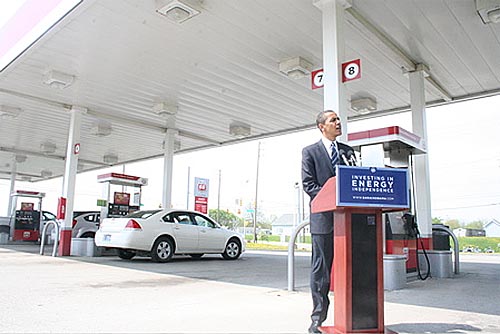
"It isn't right that oil companies are making record profits at a time when ordinary Americans are going into debt trying to pay rising energy costs. In the paper today, there was an article about how millions of Americans are falling behind on their energy bills, and a record number of Americans could face energy shut-offs over the next two months. That's why we'll put a windfall profits tax on oil companies and use it to help Indiana families pay their heating and cooling bills and reduce energy costs".
A call to Congress: Address high gas prices
First and most importantly, we must work to lessen the demand for oil. As for supply considerations, with the Strategic Petroleum Reserve filled to 96 percent capacity, I believe we should consider suspending shipments during the summer months, and we may also want to consider increasing refinery capacity in the United States. The United States should also work with other oil importing countries to require more transparency from oil producing countries to verify available oil reserves and production capacity.
Sanders: High Oil and Gas Prices a National Emergency
WASHINGTON – Senator Bernie Sanders (I-Vt.) said today that outrageously high oil and gas prices that Vermonters and Americans are paying constitute a national emergency that requires a bold response from the White House and Congress....“While energy prices are soaring,” Sanders said, “big oil companies are reporting record profits and speculators at hedge funds and financial institutions are making billions investing in energy futures.”
Chevy Chase to crack down on ‘mansionization’
Town resident Joan Glickman said the aesthetics of “homes that have gone wild in size” frustrate many residents, but others are also concerned about how oversized homes can affect the environment.“We’re in kind of an energy crisis right now,” Glickman said.
“The larger a house is, the more energy it uses, even if they are building more energy-efficient homes. Plus, when your neighbor builds big, it can mess up your natural lighting.”
Transparency: Pemex Best, PDVSA Worst
Venezuela's state oil giant PDVSA is the least transparent among leading oil companies in the region, according to a new report from Transparency International. In contrast, Mexican state oil firm Pemex is the best in the region, followed by Brazil's state oil company Petrobras. "Among national oil companies, both Petrobras and Pemex stand out," says Juanita Olaya, author of the report.
Michael T. Klare: The U.S. and China are over a barrel
Given that the United States and China are the world's two biggest users of petroleum -- a fuel whose worldwide availability is likely to peak at 100 million barrels or so per day in the next five years or so and then commence an irreversible decline -- it makes great sense for us to collaborate in the development of oil alternatives and energy-saving technologies.Such collaboration could take the form of joint ventures to develop advanced biofuels (not derived from food crops) and transportation fuels extracted from coal (without releasing heat-trapping carbon dioxide into the atmosphere). It could also include the development of super-light vehicles, advanced hybrid engines and other energy-saving systems. Such endeavors have been discussed on a preliminary basis by U.S. and Chinese officials, so it is hardly utopian to envision a more elaborate and constructive undertaking of this sort.
Oil aplenty, but investment needed
THE world is paying dearly for two lost decades in the oil industry - from the mid-1980s until the mid-2000s - when prices hovering around $US20 a barrel discouraged investment.There is a thick soup of factors contributing to the dizzying rise in oil prices - among them the fall in the US dollar, surging demand from China and the rise of commodities as an asset class - but the most important is the lack of investment.
Crude Oil Hits $119- Ways to Profit From Peak Oil
If oil prices stayed at $180 to $200 per barrel for more than a year or two, huge new oil supplies would come on line, causing crude prices to plummet and tipping the market decisively back towards consumers. The environmental cost of getting really large quantities of oil out of Athabasca and Colorado would be immense, particularly if we attempted to supply the needs of the entire U.S. market from these sources, but at $180 per barrel, I'm confident that the economic necessity would probably trump the environmental problems.
Here’s a bad idea: Gas from trees
Already, Weyerhaeuser and Chevron have joined forces to develop “treecell technology” to manufacture cellulosic ethanol. As you read this, ethanol factories are popping up across the United States like gaping mouths hungry for a constant supply of forest. And, conveniently, just when industry develops the technology to exploit even the smallest tree for profit, the Forest Service announces that “more than half of Oregon’s 29.7 million acres of forest lands” are overgrown and in need of “thinning” to keep down fire risk. What a coincidence!
In Baghdad, power supply may worsen
Last July and August, massive blackouts stretched across parts of Baghdad. This summer could be worse because drought has cut in half power generated by hydroelectric plants. Add war, attacks on transmission lines, antiquated equipment, overdue maintenance and local corruption or bureaucracy and reliable electricity remains out of reach for most Iraqis.
Photos in Oberlin illustrate our consumption numbers
The Allen Memorial Art Museum at Oberlin College is having a Malthusian moment. Thomas Malthus was the early 19th-century English economist who theorized that human populations always outgrow their food supplies, which leads to shortages followed by the four horsemen of war, pestilence, famine and plague.With oil prices hitting $117 a barrel and riots over high food prices occurring in poor countries around the world, the spirit of Malthus seems to hover over the Allen's exhibition of photographs by Seattle artist Chris Jordan.
Loss of fuel economy from ethanol-blended gasoline hits motorists in the wallet
Charles Kigar doesn’t think twice when he has a choice of buying a gallon of conventional gasoline or a gallon of gas that contains ethanol at the same price.He buys the gas without ethanol.
The reason is a simple matter of science. Conventional gas delivers more energy than a gallon that contains ethanol.
...If it’s E-85, a blend containing 85 percent ethanol that can be used in specially equipped vehicles, the energy loss soars and more than offsets its lower cost, even though E-85 is about 60 cents per gallon less at retail than conventional gas.
Oil majors fail to replace reserves
With the exception of BP, IOCs in 2007 failed to replace reserves, according to U.S. Securities and Exchange Commission definitions of proved reserves: ExxonMobil. ExxonMobil ended 2007 with proved reserves totalling 22.7 billion barrels of oil equivalent (boe, a unit of energy companies use to combine oil and natural gas reserves).
Exxon shuts nearly all Nigerian oil output
LONDON (Reuters) - Exxon Mobil has shut nearly all its Nigerian oil production, totalling around 770,000 barrels per day (bpd), due to a workers' strike, a senior oil official and industry sources said on Monday.The outage, which represents nearly 40 percent of total Nigerian output, comes after a series of attacks this month by militants in the Niger Delta which has shut-in an additional 169,000 bpd from Royal Dutch Shell.
PetroChina sees steady oil output at Liaohe heavy oil field over the next 10 yrs
BEIJING (XFN-ASIA) - PetroChina, the country's top oil and gas producer, aims to keep the output of the Liaohe field -- China's largest heavy oil field -- steady at 12 mln tons a year for the next 10 years, chairman Jiang Jiemin said.The company will increase exploration in the field's western onshore block and a shallow water area, Jiang said in a statement on the website of China National Petroleum Corp, the parent of PetroChina.
Indonesia to miss oil production target this year as subsidy threat looms
Already under threat of a fiscal calamity amid soaring oil prices and unrealistic government fuel subsidy spending, Indonesia is expected to miss this year's oil production target of 977,000 barrels per day (bpd), the Energy and Mineral Resources Ministry said.The ministry announced in a media statement over the weekend the country would only produce 965,000 bpd, 12,000 bpd short of its target, as some oil producing companies revised down their output targets.
Russian oil competes despite flat output
LONDON (Reuters) - Russian oil output may stay flat but offers a competitive return as global oil companies face the rising cost of developing tougher, less accessible fields, an owner of Russia's No. 3 oil company said on Friday."It's true production reached its peak. It's true we might not see the same rate of growth," said Viktor Vekselberg, a major shareholder in BP's Russian oil venture.
"But we will see production on the same level. Maybe it will decline a little, a few percent. But nothing catastrophic."
As production declines, state-run Pemex struggles to find new reserves under daunting restrictions on foreign involvement.
The need to rethink energy security
Much has been said about Asia's surging demand for energy, fuelled by its spectacular economic growth and an expanding middle class. Indeed, the total consumption of energy in Asia and the Pacific increased by 70% between 1992 and 2005.Yet, consumption per person is still relatively low by global standards: 749 kilogrammes of oil equivalent (kgoe) in 2005, compared with the global average of 1071 kgoe.
Japan's March Russian fuel oil imports almost double
TOKYO/SINGAPORE (Reuters) - Japan's imports of Russian fuel oil nearly doubled in March versus February to the highest in at least 16 months, as some refiners turn to cheaper alternative feedstocks due to record-high crude oil prices. The world's third-largest oil consumer imported a total 275,803 tonnes of the distillate-rich Russian fuel oil (M100) last month, up 135,803 tonnes from February's imports, data from Japan's Ministry of Finance showed showed on Monday.
Oil alternatives remain elusive: Could we not just try to use less?
While natural rock oil came along just in time to save the whales and light up Charles Dickens' writing desk, attempts at its displacement are proving futile.
Recession Diet Just One Way to Tighten Belt
Stung by rising gasoline and food prices, Americans are finding creative ways to cut costs on routine items like groceries and clothing, forcing retailers, restaurants and manufacturers to decode the tastes of a suddenly thrifty public.
Saudi Crown Prince in Geneva for medical tests
RIYADH (Reuters) - Crown Prince Sultan of Saudi Arabia, the world's largest oil exporter, has arrived in Switzerland for unspecified medical tests, the official Saudi Press Agency (SPA) reported on Monday.
Human warming hobbles ancient climate cycle
WASHINGTON (Reuters) - Before humans began burning fossil fuels, there was an eons-long balance between carbon dioxide emissions and Earth's ability to absorb them, but now the planet can't keep up, scientists said on Sunday.The finding, reported in the journal Nature Geoscience, relies on ancient Antarctic ice bubbles that contain air samples going back 610,000 years.
Contact
- Content: editors at theoildrum dot com
- Tech support: support at theoildrum dot com
License

This work is licensed under a Creative Commons Attribution-Share Alike 3.0 United States License.
It seems a lot of daily production has been removed just this weekend.
-BP shuts down their North sea field
-Exxon shuts down their Nigerian operations
I suppose the magnitude of the impact will be determined by the length of each shutdown.
Explosion at Indiana plant that turns coal into gas kills 2
http://news.yahoo.com/s/ap/20080428/ap_on_re_us/plant_explosion;_ylt=App...
Per Leanan:
"LONDON (Reuters) - Exxon Mobil has shut nearly all its Nigerian oil production, totalling around 770,000 barrels per day (bpd), due to a workers' strike, a senior oil official and industry sources said on Monday.
The outage, which represents nearly 40 percent of total Nigerian output, comes after a series of attacks this month by militants in the Niger Delta which has shut-in an additional 169,000 bpd from Royal Dutch Shell."
Is there now over 1 milion bbls per day Nigeria offline?
The Scottish Government said yesterday seven tankers with 65,000 tons of fuel were sailing for Scotland, the paper reported.
65 000 tons that won't be coming to the US.
"LONDON -(Dow Jones)- Roughly 58% of Nigeria's oil pumping capacity remained shut Saturday following an ongoing oil worker's strike and a series of recent militant attacks on energy infrastructure in Africa's biggest crude producing nation."
All this crude off line and the price falls. Boy, the PTB must be having a hayday. Next the dollar will be at 80 and gold at $500. Mercy. John
"Recession Diet Just One Way to Tighten Belt"
Screw tightening the belt Americans need Vertical Banded Gastroplasty (VBG), also known as Stomach stapling.
...and someone needs to come up with a FF version...
GAStankoplasty?
-Haha! v. funny.
-or:
* Sealing off the 2nd floor: McMansionoplasty
* Not eating the 3rd course: SetMenuoplasty
* Vacationing locally: ClubTropicanoplasty
Any more?
Nick.
Delusionectomy
Jeff
'Gettin' the Tubes Tied' (Gasectomy, or 'The Big 'G')
Denarisuction: thinning of the wallet.
Souperman a local barbecue place has a 5' by 6' banner in their window, announcing "DEPRESSION CHILI $2 BOWL" hehe. Cures depression? Causes it? Anyway it's easy to understand what they're driving at: sales are WAY down and they're trying to recover them by being candid.
And by and large, haha, most Americans are overweight or obese still.
Get used to high oil prices
Letter to Editor Toronto Star
Oil sets new record near $120 (U.S.)
I hope that oil hits $120 this week. Why? Well, if it hits any time in May or most weeks in June, it's likely I'll have to cough up that $100 for a gift card for the contest at my site. That's $100 I could spend on stockpiling rice or NPK! ;)
Honestly though, I was surprised we didn't see it last week, and I'm pretty sure we will see it this week.
~Durandal(http://www.wtdwtshtf.com)
For those who are interested, I'll be making my first TV appearance on the Fox Business channel at 4 & 7pm PST tonight (7 & 10 EST), on The Dave Asman Show, talking about high oil prices. If you have a full cable TV lineup or DirectTV, you should get the Fox Business channel.
So around 939,000 bpd offline from Nigeria and 700,000 bpd lost from UK North Sea production. So that is roughly just over 1.6 million bpd lost in a system that has routinely said to have a spare capacity of between .5-1 million bpd. At least the North Sea loss is temporary, but who knows about Nigeria. It's predicted to lose around 30% of its production due to geopolitical/investment issues. On top of this, Mexico continues its steep output decline and Russian production seems to have peaked. Looks like we might find out very soon just how reselient our global oil distribution system is (i.e. how markets are able to cope with accute shortages and how transportation systems can respond in alleviating systemic stress). Let's hope the response is much better than what we have witnessed regarding the credit crunch.
So that is roughly just over 1.6 million bpd lost in a system that has routinely said to have a spare capacity of between .5-1 million bpd.
One of the things that should come out of all of this - as long as these outages are protracted - is just how much spare capacity there really is in the system. Saudi has consistently said that they will only use their spare capacity in case of an emergency (and war is sometimes cited). I would think that the current situation would qualify, so I will be interested to see how they respond.
I doubt that the Saudis will take the bait as these are industrial disputes.
The UK outage is a short-term one that will take, max, 5 million barrels out of currently ample UK buffer stocks, so there is little reason to do do any shortfall coverage there.
As regard the Nigerian industrial dispute - the Saudis will, hypocritically, suggest that the world's largest company can easily afford to settle; and that if the dispute is protracted, the US can easily stop filling it's SPR and, if necessary, release stocks to cover the shortfall for a protracted period of time if necessary.
Well, if anyone at Aramco reads this site - and I suspect they do - they probably just wrote a note on PR strategy for the short term to their bosses. And they won't even have the courtesy to share their bonus with you ;-)
Well, if anyone at Aramco reads this site...
No doubt they do. I have seen hits from Aramco on my blog before via the Stat Counter. You can also keep up with who is visiting TOD by the Site Meter on the right.
They're sending the cash to my paypal account as we speak!!!
I suspect that they could probably think those things up all on their lonesome.
So far, Bloomberg's take on the Forties pipeline situation is that it's a three-day delay in May shipments. (http://www.bloomberg.com/apps/news?pid=20601072&sid=aP5SiFcFEtAM&refer=e...) They aren't calling it a supply loss, which of course is what it is.
And reporting on Nigeria, which was basically ignored all weekend, is just getting started. But the news gets worse every day for anyone making the effort to dig for it.
My gut feeling is that there was probably an inventory build last week, and we were probably headed back to slightly lower prices before these strikes hit. There is also reportedly new supply coming on from Saudi Arabia right now (Khursaniyah: http://www.upstreamonline.com/live/article152791.ece). So, the strikes have for now stabilized the price at a higher level. The entire question now is how long the strikes last. If the strikers in Nigeria hold out in full force for a week to 10 days, I don't see how the price can go down from here even with Khursaniyah and even if we built up some inventory. If the strikers in Nigeria hold out for longer, I don't see how prices can stay below $120. Right now, I just don't see the market believing that the strike in Nigeria will last very long.
Surely if we believe Forward oil prices are about to go into a Cantango due to PO any oil remaining in the ground is worth more in future than pumping it out now -so this 'supply loss' is not really a financial loss at all, the oil is not dissapearing and in future it will be worth much more as prices escalate...
In fact, why don't we shut down the whole North Sea output for -say- 10 years or until the oil price is way up in the 100s, UK Inc. could make a packet... (joke alert)
Nick.
Joke or not this is exactly what KSA did and what you would expect a country to do if its following a depletion protocol.
Behind a paywall, but free through Google News:
Rise of Nationalism Frays Global Ties
Sorry, Tom, I guess the world ain't flat after all.
"Tom" knows perfectly well the world ain't flat. But when you make your living selling clever books, you can imagine that the shortest distance between a Lexus and an olive tree is a straight line between the two arbitrary points.
Quick tip of the day. Install ref toolbar for firefox and use digg.com as the referer for wsj.com.
Bang! all content free.
Thanks SamuM--schwing!
On C-span one right now (10:20 am eastern)
Mary Peters, Transp Secretary -
Budget priorities on Surface Tranp. Policy. (She's already given lip-service to how this can be pro-'family values'.. but has also mentioned the need to evaluate the real benefits of spent transp dollars.
Bob
http://c-span.org/watch/cs_cspan_wm.asp?Cat=TV&Code=CS
Q&A
- She (Peters) has described 'time of day' lane charges for commuter routes on the DC beltway & 395 to act as a variant on 'congestion pricing'
- States that she knows of no plans for a 'North American Union' or any 'NAFTA-funded supercorridor' between Mexico and Canada.
- Gas Tax more 'user responsive' and 'market based'.
- "Smart Growth" question - (walk bike) 'Fed Govt should never ever get involved in land-use planning'.. only 'incentivize' such directions..
- Tysons Corner/ Dulles extensions- no final decision made.. must invest in 'Most Meritorious projects'
- Growing Sprawl yet declining population in Great Lakes? - 'can't speak to it, but again to take those decisions away from Federal, towards State and Local (ie, "Not our department- our department is to dismantle our departments")
- Should Congestion fees be used for alternate transp? > 'Virtuous Cycle' Skirted real answer.. endorsed pricing roadways for best roadway throughput.
Gingrich recommended she call 'Congestion Pricing' "Convenience Pricing" - Is this 'Turn the frown upside-down', or Newspeak?
More comments against Gas Taxes
OK, sorry for the abbrev. blurbs.. hope others watched this for better 'reading 'tween the lines'.
Bob
Final question, though, She 'took no position on McCain's "Gas Tax Summer Holiday", since the Admin. has stated no position on this yet'..
I don't think lack of investment is the problem, but the lack of increased production despite enormous investments.
Investment money (Peak Capital?) really may be the ultimate issue though. Consider all that is needed for exploration and development of all those expensive, hard to get FFs that are still out there, PLUS all that will be needed to develop solar and wind and geothermal and oceanic and hydro and other renewable energy resources, PLUS all that will be needed to build all those nukes supposedly needed, PLUS necessary maintenance and repairs to infrastructure, PLUS building sea walls or relocating entire coastal populations to cope with rising sea levels, PLUS covering the unfunded deficits in Social Security & Medicare, PLUS covering the wish list for universal health care and other goodies, PLUS covering the trade deficit, PLUS covering the continuing costs of the Iraq war, PLUS all the usual ongoing stuff. We can't do it, there isn't and cannot possibly be enough money for all of it. Demand for capital exceeds supply. This means that some of the above will remain undone. It is interesting and alarming that already, in spite of $120/bbl oil, people are noticing that investments are not being made in oil exploration and extraction at anything like the level that cornucopians like CERA figure we need and have assumed would be happening.
EROEI by another name.
For background on this effort, see last Monday's Drumbeat
#1 THE CORE OF ECONOMICS
First, an assertion: there is no way to get a handle on the effects of oil depletion without digging into economics.
And the reason is simple.....
Economics is the science of scarcity, at least where humans are concerned. And thus it turns out that we are lucky to possess a very large, detailed, well-tested body of knowledge -- originating two centuries ago -- which is quite applicable to our situation.
Some definitions from sources old and new:
From the Wikipedia definition:
http://en.wikipedia.org/wiki/Economics
"The economic problem" as used above is part the field's jargon and, as you might suspect, Wikipedia grants it a separate entry.
http://en.wikipedia.org/wiki/Economic_problem
One thing to note in the above is that the existence of unmet wants and needs is regarded as the normal state of affairs. In fact, who needs an economist to tell them that?! We know from our own experience that we are not spared from making difficult economic choices, even torturous ones, in the best of times.
And I think that is one reason why making use of standard economics is resisted in the peak oil community. It tends to make the whole problem a little less exotic.
But if we neglect economics, we won't understand the basic means our market system is using to adapt our society to scarcity: price.
We are all very price-aware when it comes to petroleum. Some of us obsess over it. Some are panicked by it. Others stake money on its behaviour. And The Oil Drum's web traffic is correlated to it!!
However, as you know, some of the models quite popular at TOD, make no use of price as a variable. Despite the existence of a very advanced global petroleum market, both Deffeyes's Hubbert Linearization and Brown & Foucher's Export Land Model omit it. These authors have made dramatic statements about our society spiraling out of control and crashing. Is it possible that such dark prophecies stem from having neglected to include price (the major control mechanism) in their models?
In any event, they are definitely working from an alternative set of assumptions about how our world works and about how we make economic decisions.
What are these assumptions? How can we test which are more accurate?
Oh sure -- price increases will fix supply concerns. The Old Gray Lady (up top) tells us how: http://www.nytimes.com/2008/04/27/business/27spend.html?em&ex=1209441600...
Such sacrifice we are called on to make!! People will survive just fine without oil -- once the population has thinned out enough. That much is clear from a study of economics.
Perhaps TOD should feature a dumbest article of the week or month contest. This has gotta be at least the dumbest article of the month. If only all we had to do was downsize from Lucky Charms. How about some good old fashioned hot oatmeal? Oh the horror!!! Staying in a Hampton!!!
Oh Shallow One, never underestimate the psychological impact of NOT being able to purchase your favourite brand of Heinz baked beans!
"The indignity of the Yellow Label"...
-Hords of neo-Prius owners shall descend upon Washington demanding the return of their Hummers.
Nick.
A predictable result of skyrocketing food prices. Remember the explosion of generic brands in the economic downturn of the early '80s? We could see them again.
It never failed to make me chuckle to see those white cans with "BEER" written on them.
Yes, and the fact that they taste the same and get you just as drunk -in fact they probably are the same sans brand identity- points to the fact that we are currently getting royally sh*fted by someone.
Like the supermarket scene in Repo Man.
I liked the last section of that article:
This is one way to approach the problem: start by making definitions and attempting to debate out what assumptions people are making in their logical arguments. And then I guess over future weeks see how the logic of the arguments would change when you incorporate these different assumptions.
Another approach would be to find situations in the past that look analogous to "peak oil" where we've got data and see what observations and conclusions economists have drawn from them, and then see if these empirically drawn ideas seem applicable to peak oil.
I'm just sayin'. :-)
Peak Whales? An entire culture was built on that. Of course, when the whales ran out, there was mineral oil, and the rest is history. Is economics a forward-looking discipline? I think not. That would be politics.
In case the gentle hint I was trying for is a bit too opaque: I'm entirely happy that economics is a forward looking discipline. I would welcome pertinent insights from economics. The problem I have about economics is that the typical approach is (exaggerating for effect): figure out some assumptions, make a model, do some mathematics, derive some consequences, argue hard why your model/theory is right, ARGUE EVEN HARDER WHY YOUR MODEL IS RIGHT, etc, until you've won the argument. I'm much more interested in ideas derived from data, even if you can't justify them from first principles. I hope George continues with his posts, but I hope it's based on data (historical data is fine) rather than the taking economic's definitions and then trying to build logical arguments about them.
(In fairness to George, he's wheeling out definitions this week to refute the idea that economics doesn't consider scarcity.)
I'm definitely into data. From what I've read on Dani Rodrik's blog, the field has become much more empirical over the years since I was taking econ courses. So much so that he has said it's quite hard to get a Phd without plowing into the numbers big time: historical data, current data and especially data from the developing world.
Sprott Asset Management, whose web site has a peak oil page, did just such a story a couple of years ago:
Of Oilsands and Caviar and Malthus (pdf warning)
George Asebius has it right when he talks about the price being an important variable that is not explicitly included in certain supply models. However, it does not follow that higher prices will elicit an effective supply response. It does follow that prices will adjust to a market-clearing equilibrium level, and that this will involve some combination of demand and supply responses.
This actually shows how increasing prices for a limited resource ensures that the resource becomes less available in the future. At no point did the producers of caviar treat it as a renewable resource instead they road the market down as their catches dwindled.
Also for all those people that think we are 50% depleted notice that the explosion in price happened well after sturgeon stocks dropped by 50%.
In fact sturgeons are 90% depleted and I'm asserting that oil is following exactly this pricing/depletion regime.
And maybe the most important and most ominous take-away of all is this: the rational action plan (coordinated intergovernmental enforcement of fishing regulations to assure maximum sustainable yield) was obvious to all, but not done. We can enjoy ourselves here spinning all manner of plans and identifying any number of solutions, and they all may make perfectly good sense. However, they will all come to naught, because governments are not going to do the right thing.
Hi WNC,
Thanks and WRT "the rational action plan" -
What is your favorite on the level of "intergovernmental" or even governmental?
As someone who actually eats caviar, I feel the need to point out that the demise of Russian caviar wasn't that bad of a thing. Caviar of comparable quality is now farmed in California and is available for less money than the Russian stuff cost before the ban. Here's a somewhat dated article on the ban:
http://www.sfgate.com/cgi-bin/article.cgi?file=/c/a/2006/01/07/MNGCRGJVO...
Also, here's a link to one of the companies in California that now produces sustainably raised caviar:
http://www.tsarnicoulai.com/
The lesson from this seems to be that people are pretty clever and are often able to create substitutes for goods that become unavailable. However, this is in no way excuses the Russians for destroying their Sturgeon fisheries. It's also worth noting that many years ago, the United States nearly destroyed its sturgeon fisheries and banned harvesting of sturgeon for many years to allow the species to recover.
No problem but its not done at 50% depletion most people believe we are near or will be near 50% oil depletion in the near future. If so we will probably not respond to peak oil for several decades. This move to substitution happens at the end of life of a market not during its midlife crisis.
Nothing is done when the market reaches its midlife crisis point. Although moved by above ground factors we could equate the midlife crisis point for oil with Jimmy Carters presidency. And the current situation to the end of the market and a move to real substitution.
All kinds of signals indicate we have used 70-80% of the oil we will ever use not 50%.
Figuring that the substitutes are abundant enough and of sufficient quality to satisfy most of those who could afford the original a 'caviar shock' was averted. Unfortunately with oil their aint no such thing.
In innumerable ways a pound of ethanol isn't even close to a pound of gasoline. If it had to be made in the absence of the crude oil economy who knows how much it would cost? 100 miles on a bicycle cannot equate to 100 miles in a luxury sedan because only a small part of the population can do one and soon very few will be able to afford the other leaving a 'transport gap'.
The real 'substitutes' like wind/solar/nuclear rail ,though probably sufficient, are yet to be exploited in favor of BAU. We are fishing the resource to extinction w/o any backup plan. There is a danger the needed new investment will be 'fished out' too as we flounder around with the boondoggles. (couldn't help it sorry)
Not saying this was your argument just that this is the area where the economists frequently go awry. They ,like so many, should be forced to sit in a room with their eyes wide open and be indoctrinated with the consequences of EROEI before telling us how classic economics will continue to provide in the new paradigm.
Didn't salmon fishging get banned in California this year?
Yes. The population of chinook salmon crashed this year - probably due to global warming affecting ocean currents and fishing is banned until the population recovers. The species has been under stress for many years due to water diversion and ag runoff, but those are unlikely to be the direct causes because they haven't been particularly bad recently. What has been bad is that the ocean circulation patterns which provided nutrient-rich water off the coast didn't work for a year and led to many of the young fish starving as the swam out to sea. It will be interesting to see how next year's salmon run goes.
Trying to just barely prevent the extinction of a fishery isn't even remotely close to managing it for maximum sustainable yield. We know how to manage fisheries for maximum sustainable yield, but we just don't do it.
Iceland claims that they do and the results seem to support the claim.
IMVHO, they are close to (90-95%) of the maximum sustainable yield from their waters.
Now if they could just harvest more of the fish eating minke whales...
Alan
our world works and about how we make economic decisions. What are these assumptions?
It would seem how the world works and the assumption turns out to be "You are gonna get the shaft".
http://cryptogon.com/?p=2477
Exactly how do such actions by a Government in Economic matters work out well for the citizens/consumers?
Our friends over at The Automatic Earth posted this article today as well.
I was immediately reminded of this occurrence last fall. The bank wanted to foreclose on some mortgages (which were in arrears) in one of its complicated debt instruments. Judge sided with homeowners, saying the bank couldn't actually prove ownership.
Hmm ... the bank says I owe it money, but can't cough up the documents and won't submit to an audit, so do I really owe it anything?
The British like their secrecy. The Official Secrets Act always covered the most ridiculously trivial things. I remember an episode of the series Yes, Minister which referred to 'open government', from the point of view of the civil service, as an oxymoron - "Either you can be open, or you can have government."
It's hardly surprising then that bank rescues would proceed in secret, when the alternative is probably more bank runs along the lines of Northern Rock. Such a dynamic would probably pick up momentum, with the market picking off apparently weak banks one by one and the public sector having to choose between full bailouts and banking chaos. Full bailouts are not an option once a banking crisis becomes systemic, just as deposit insurance in other jurisdictions wouldn't be worth the paper it's written on in a systemic banking collapse.
Unfortunately, that leaves depositors in the dark as to where the risks lie, without actually removing those risks. The bravado meant to buy time in the hope that confidence will return is a desperate gamble. If institutions and individuals can be convinced that the whole system will be bailed out if necessary, maybe they won't try to cash out and bring the system down in the process, or so the thinking goes.
It also creates a huge moral hazard problem, tempting the banks to play 'double or nothing' while the public sector carries the risk. Northern Rock made even riskier mortgages after they were handed a blank cheque than they had done before. This increases both the size and the likelihood of an eventual meltdown. Postponement is not prevention.
However, in the current climate, the Bank of England is probably 'damned if they do and damned if they don't'. Secrecy itself creates the appearance of heightened risk and reduces the very trust that must be restored if the credit crunch is to be resolved. As the issue is solvency rather than liquidity, resolution through hollow gestures is simply not realistic. At some point the Bank of England's bluff will be called and the systemic crisis will be triggered. Depositors and others will then be out of luck.
I had to sign the Official Secrets Act some years ago when I had a Christmas job sorting mail for the post office. A postman approached one of my colleagues and asked "have you read the Official Secrets Act?" to which he replied "No, I'm waiting til they make the film"
We've debased the currency beyond all bounds of sanity.
150 years ago it was precious metal coinage. Then some not-so-precious metals like nickel or brass. Paper currency could represent a store of the precious metal. Later it just represented 'faith and credit'. Computers came along and it became ephemeral blips in the memory of the machine.
Now it's secret ephemeral computer blips. All you can do is laugh.
I have more secret blips than you. No, I can't tell you how many that is ... wait, it's a negative number. A bigger negative number than yours. :)
Economics isn't a science, or even close.
Economics is a bunch of local, limited empirical rules of thumb - extended beyond breaking point.
Half the problem comes from people believing your statement, the other half from them ignoring mine.
Agreed. Economics is a SOCIAL science, meaning it has no predictive value at all. Economists should be ignored.
Asebius: Are you Roger Connor's evil twin?
Economist continue to make claims that are based on unexamined assumptions. For example:
[emphasis added]
Coordination through simple transactions is feasible in a steady-state system, but not in one such as our economy. It is simply too big and complex. There is insufficient information in the transactions for a mere price system to work. Coordination requires clear goal states for all interacters and sufficient information transfer for each actor to make reasonable decisions (don't even get me started on the rational utility maximizer theory put to rest by Kahneman!)
Then this, with respect to Deffeyes and Brown & Foucher:
While economists work from a set of bogus assumptions. Show me an economist who understands the physical nature of 'work' and I'll show you a former economist. Money and price are accouterments in an out-of-control system. Money is a baseless method for measurement (e.g. the GDP). See further comments below.
But the most egregious of all: the question "How do we satisfy unlimited wants with limited resources?" [emphasis added]. Therein lies the tale! Unlimited wants. The assumption of unbounded growth and desires for goods and services. In one sense, maybe economists are right in assuming humans are inherently greedy and will never be satisfied with a comfortable but relatively speaking static existence. The hubris of economics is that it attempts to answer that question! The answer suggested here is the magic of the price system. But there is an inherent flaw in this notion. The price system uses money that has no intrinsic meaning with respect to how the real physical world actually works (something we are now beginning to find out). Peg money to energy available to do useful work (technically 'free' energy in physics) and we will very soon see the distortions, lies (financial system!), and dislocations caused by lack of real understanding and a physical basis for knowing true costs.
I explore this idea at Question Everything, especially here.
George
We establish a religion.
We promise the people a better life in "the future".
Example: If you buy these pieces of mere paper (aka corporate stock) at price X today, they will be worth 1,000,000 times X in the near future and you will be rich beyond your wildest dreams. Hold back your present day complaints because Happy Times are just around the corner.
OOOH, I know - let's promise them that the riches will come in another life! The misery of this one will be only a temporary inconvenience. Then we'll never have to pay up, and we can never be proven wrong!
And don't forget, tell 'em the wealthy in this life will suffer in the next. So they don't get too resentful or anything.
Religion usually consists of ideas the rich feed the poor, so that the poor don't murder the rich.
And yet...poverty is widely depicted as holy, in religions around the world.
I tell you the truth, it is hard for a rich man to enter the kingdom of heaven. Again I tell you, it is easier for a camel to go through the eye of a needle than for a rich man to enter the kingdom of God.
And the rich Republican "Christian" will tell you that this verse just goes to show that "with god, all things are possible"! :)
My funny friend Robert says we only need to breed a race of nano-camels, and the problem is solved.
Nano-technology to the rescue of macro-economics. I knew there would be a way.
source
''You keep 'em poor, I'll keep 'em dumb''
Said the Priest to the Politician
"If God didn't want them fleeced, he wouldn't have made them sheep" (Jimmy Swaggart)
God has an infinite sense of humor.
And if they're men, tell them a bunch of virgins are waiting for them, They'll kill themselves getting there...
:-)
(Tongue now out of Cheek)
3 Jobs i am attracted to.
Meteorologist no one expects you to get it right.
Parachute packer only praise for a job well done.
Priest promise anything you like no one will complain.
Should add economist to the list. Great at being an expert after the event:)
Nuclear Missile Engineer.
No one too complain if you do your job.
This is very unclear. I work on computer algorithms with lots of individual elements interacting locally based on purely local criteria and heavily constrained direct information flow (eg, X only gets to know that Y's price is higher (direct information) although Y's price may be higher in response to other triggers that eventually correlate with to global criteria). Often a global system goal can be discerned to have emerged from the system. What's not clear is whether the kinds of evaluations human beings make lead to an emergent goal that is good for long term survival. A quick look at the data suggests it might: we haven't been destoyed by any major self-created problems in our history (ok, Easter Island, etc, but nothing on a huge scale) . But then you get reasonable arguments from, eg, Gail the Actuary, that we've concomitantly had increasing access to energy resources that allowed us (still acting individually) to deal with the problems of a growing and increasingly affluent population. Without those things might be different.
There's more to learn in this area I think.
Part of Gail's argument is also based on the complexity and interconnectedness of society.
However, compared to other societies which have crashed, in many respects present society is far less interconnected, for instance in Easter island they were all part of one society which exploited limited resources by one set of agricultural and gathering techniques, and the Maya were dependent on rainfall in just one limited geographic area.
Does this mean anything in practise?
It may do, as there are a large variety of societies on Earth now which are arranged in very different ways, from the great spaces of Australia to the crowded delta of the Ganges.
There are a large number of different agricultural practises from very labour intensive to the mechanised agriculture of the American midwest, and a whole variety of climates which will respond differently to climate change.
What this boils down to is that although we can access knowledge arrived at across the whole globe, there can be many different tries at coping, form which the rest of us can learn.
We have several ways of trying to get things right.
That argument has been highly influential here but I don't quite buy it and will likely take it up at some point. It cuts both ways.
Essentially, I suspect sudden access to new energy sources has been a big cause of instability. (Not unlike new technologies) People tend to fight when they are feeling vigourous and they know that some newly identified mother lode of all mother lodes is there for the taking. Think of siblings who usually get along squabbling over an inheritance. When empires clashed last century, in addition to paranoia and desperation over resource squeezes they thought there was a lot to be gained. Unimaginable riches. And they were right.
What happens when there is obviously not so much to fight over?
It's possible that combat becomes ritualized and self-contained because the parties don't want to risk major damage to themselves (repairs are expensive) and because the rewards are rather limited.
Rewards are relative.
In a world of scarcity even tiny differences can make the difference in survival.
If you borrow money, borrowing $50,000 from the bank is unlikely to get you killed if you don't repay it.
Go to a bail hostel and owe someone $5 and don't repay and your life is in peril.
Rewards are relative to risk.
But in that setting the occupants are likely already self-selected for their inability to make decent calculations!!!
.
G. Asebius,
It is (almost) always a pleasure to read your contributions. Even when I disagree with you, I generally know more after reading your comments than before. Insofar as there are weaknesses in the 'peak oil' hypothesis, you are one of the best at articulating them. A smart advocatus diaboli raises the quality of any debate.
And there does indeed seem to be a regrettable 'either-or' approach on the part of many peak oil theorists. Either you believe that geology rules absolutely, and you are among the anointed. Or you don't, you factor in Economics 101, and you are relegated to outer darkness along with Yergin, Odell, Lynch, Huber "and their ilk."
The truth isn't necessarily in the middle but one thing is certain: ignorance of basic economics is the main cause of mistaken peak oil predictions in the past. I don't understand why so many members of the peak oil community "don't just get it" and realize that while economics isn't everything, it certainly isn't nothing. Thanks for enlightening us.
OK. But then can we please ascribe the more numerous failed predictions by economists to ignorance of basic science?
George Asebius wrote:
Right! Don't these fools know that if the price of oil gets high enough then God will put more oil in the ground?
Ron Patterson
Ron,
You are creating a straw man. Your sarcasm here sounds more like a last resort than an argument. I think Deffeyes doesn't even mention the possible effect of price incentives in either 'Hubbert's Peak ' (2001) or 'Beyond Oil' (2003). That's G. Asebius's point -- that economics matters, that it is a driver that has to be factored in to the equation.
Otherwise you end up with such false predictions as the ex cathedra forecast that peak oil would occur in 1987, in 1999, in 2003 ...
The peak has been delayed longer than many of us back in the '60s & '70s thot it would be. Now, in hindsight, some attempt to identify the reason(s) for this delay. Asebius thinks that the reason is that price wasn't adequately represented in the models that sought to predict when the peak would occur. Maybe he's right. Or maybe there's simply more oil in the ground than we realized back then. In any case, no prediction is ever "false." If we knew beforehand the outcome we wouldn't need to "predict." Our "prediction" would be a certainty. Had the peak occurred in '87, '99, '03.. the point would be moot. If it doesn't come until 2020 we'll be wondering why we were once again wrong about it occurring in the vicinity of now. No model is very good at predicting things contingent upon non-linear dynamics with a stochastic distribution of initial conditions.
And in any event, it is pretty soon
Carolus, it was not meant to be an argument, it is what is normally called a self evident truth. That is, above ground cash cannot alter underground geology.
Actually I stole the line from Catton. Thumbing through "Overshoot" right now I cannot quickly locate the quote. But Catton says something to the effect that "the economists seem to believe that if they show up at the window with more money then God will put more oil in the ground".
Economics matters and dictates, in some cases, how fast the oil will be pulled from the ground, but economics cannot increase the amount of oil that can possibly be pulled from the ground. Of course some wags would point out that a lot more oil can be pulled from the ground at $200 a barrel than for $10 a barrel. Of course but it is taken as a given, in all models, that the scarcer oil gets the higher prices will rise. No one expects that when the world is starving for oil, it will still be as cheap as it was when oil was plentiful. Give me a break!
Higher prices are an indication that oil is getting harder to find and more expensive to produce. It is not an indication that more oil will be produced simply because prices are high. High prices are the result of scarcer oil. The availability of oil dictates the price of oil not the other way around!
Ron Patterson
That was Deffeyes.
http://en.wikipedia.org/wiki/Kenneth_S._Deffeyes
You are correct Joules, it was Deffeyes. Thanks for the correction.
I have read Catton and both of Deffeyes' books. I remembered the quote but couldn't remember who wrote it.
Thanks again,
Ron Patterson
that economics matters,
Economics (as implemented) matter only as long as people believe it matters.
If the masses opt out, Economics (as implemented and generally talked about) will matter just as much as the followers of Zeus/Jupiter and the might that is Rome.
Thanks, Darwinian! You said it better than most of the rest of us. :)
This graph shows the year over year change in net oil exports (from final peak to the last year of net oil exports), from our mathematical model (Export Land), the Uk and Indonesia. UK went to zero in 7 years, Indonesia in 8 years, Export Land in 9 years. Note that this graph shows accelerating net export decline rates, which is what we are currently seeing from the top five net oil exporters, in aggregate, for 2006 and 2007.
Front page story in the Dallas Morning News today: Expanding prices cause run on rice--cost doubles--export restrictions are blamed
We are seeing basically the same phenomenon regarding rice exports that we saw regarding natural gas in Iran this past winter. Iran, faced with a supply shortfall, cut off gas to Turkey (a much wealthier country on a per capita basis), causing Turkey to cut off gas to Greece. It wasn't a case of scarce supplies going to the highest bidder, it was a case of exporters taking care of the home team and delivering the middle finger salute to the export market.
Food & energy prices are being set at the margin as importers bid against each other for the volume of food & energy that "escape" into the export market. We may begin to see a lot of world trade consisting of food & energy exporters trading with each other. It is definitely not a good time to be both a net food and a net energy importer, such as Japan. And there was a story a few days ago about spot shortages of some food items such as butter already beginning to appear in Japan.
My prediction for oil prices: $50, $100, $200, $400. . .
IMO, the only question is the time period between the doublings.
At the current rate of increase, it's less than 18 months.
My humble attempt to incorporate simple economics into the logistic model of resource depletion:
http://peakoil.com/fortopic32777.html
Your effectively invoking the Maximum Power Principle.
http://en.wikipedia.org/wiki/Maximum_power_principle
Price is of course one of the drivers but your missing the concept of profitability. Lets say that the price of a barrel of crude is 10 dollars a barrel and my production costs are 1 dollar a barrel given this I'll pump the crude at the maximum rate or maximum power. Increases in prices may allow me to expand it depends. Certainly increase in prices will bring more marginal oil production on line which had not been profitable.
The point is your generally always going to pump as much oil as you can as long as its profitable increasing prices tend to bring more marginal fields on line or increase investment. So in effect they expand the reserve base being pumped but the reserve base is always pumped is fast as possible as long as its profitable.
So I think your on the right track but your conclusion has been true for all profitable sources. In many cases in the past the ability to profitably exploit a resource at maximum power is not constant because technical progress requires a incubation phase followed by deployment. What this means is the maximum profitable rate has increased as technology has gotten better and cheaper.
The finale if you will is this price driven increase which allows widespread use of technology to exploit the last readily accessible reserves profitably.
And as you note deplete them faster.
Economics is not a science. Assertions to the contrary ignore that economics is the only "science" that derives its positions from something other than the scientific method.
Economics is caveman superstition that deserves to be tossed wholly and completely back into the caves. It needs to be replaced with a real science but until that happens, economics is no more useful than alchemy in the 15th century. It occasionally hits on a correct result, more often hits on erroneous results, and has no idea why either occurs.
Yes economics is a social science - with all the baggage social science has.
Its the same case when someone it presented with the forces of life and death you have Theology and Philosophy - prayer and thinking. It ain't much but its the best we got. For economics I would hesitate to call it a predictive science, I think they should be a lot more like cultural anthropology.
Observe but think twice before you think you are Moses
The Hubbert Linearization is no more based on geology than on economics. It is empirical. It simply states that P/Q vs. Q is linear over time; that's all. It doesn't speculate as to why this is the case. It simply asserts (correctly) that this simple model does a very good job at fitting the historical data. Solving the resulting differential equation gives a logistic curve for P vs. time. To quote Deffeyes (Beyond Oil, p. 41)
Of course, the price of oil matters; it just doesn't matter very much.
In economists words, "The price elasticity of supply for oil is very small". Especially when EROEI is included and the price elasticity of "marginal NET oil supply" is calculated.
Alan
Gas flow to Britain slows despite high prices
http://www.guardian.co.uk/business/2008/apr/28/oil.energy
Gas flow to Britain slows despite high prices | Business | The Guardian
This bit in particular made grim reading to me:
Under-road radiators may beat the ice
http://www.guardian.co.uk/environment/2008/apr/25/solarpower.energy
I would have thought the economics would be much improved in areas with hot summers and very cold winters, as such a system should mean that less repairs would be needed after the freeze/thaw cycle.
Damnably expensive though.
I find the idea of storing heat from summer sunshine for use in the winter an intriguing idea. I believe the Germans have built large heat stores to do this for housing.
Inspired by the Guardian article, I did a quick internet search and found this company
http://www.icax.co.uk/
who have a system somewhat simpler that the German ones I've seen. Is this the future of heating/cooling?
Renewable Ali
Capital costs are the killer for this type of technology.
My guess is it would normally for most household heating applications be cheaper to put in a CO2 air-pump, which can now operate down to -15C, and provide the power for it by nuclear or renewables.
Fascinating technology though - I can also see this being used at busy junctions in harsh climates as it would greatly reduce maintenance.
In the practice run for peak oil (and peak everything) in the seventies there was a lot of interest in inter-seasonal heat storage both for solar and waste heat.
A quick google reveals that Tepidus, a Swedish initiative from that period based on hygroscopic salts, continues to evolve. It's worth checking out:
http://www.osti.gov/energycitations/product.biblio.jsp?osti_id=5813955
A lot of the focus the recent renewed interest in sustainable energy technologies is focussed on conversion technologies (viewed narrowly in first law EROEI terms, rather than more important second law terms). More attention should be paid to storage and distribution - and on an integrated systems view.
- Colin Moorcraft
It has been referenced here before, an example of seasonal thermal storage for residential.
Drake Landing Solar Community in Canada
http://www.dlsc.ca/
D00m at my doorstep! Pics of the Mississippi River flooding in Davenport, IA. Level when pictures were taken is 16 feet. Crest at 19.5 feet on Tuesday morning. =/
I'm curious what the reference point is for a river level of 16 and 19.5 feet. I live in a flood prone area along the Ohio River and it takes a crest of over 40 feet to cause any problems. The usual depth of the river is 16 to 18 feet, and if it gets below 15 feet, the plants along the river and the barges have trouble. Surely the Mississippi at Davenport is deeper than the Ohio. Maybe you mean 16/ 19.5 feet above the usual river level?
Sorry please let me clarify...
Flood stage begins at 15 feet at Lock & Dam 15 here in Davenport. So at 15 feet the water begins to spill into the parks down on the riverfront. So at 16 feet we have 1 foot of water in the area that is not supposed to be under water. 19 feet equals 4 feet of water and so on.
Every town has a different flood stage. It all depends on the depth of water required to cause damage to roads or structures near the river.
Flood Stage - Wikipedia
re: Michael T. Klare: The U.S. and China are over a barrel--
I would like to see TOD do a survey of how many TOD readers believe world oil production has NOT peaked, and that it will eventually reach 100 mbpd.
I don't know where this 'magic' number keeps coming from? Can someone please tell me where this figure of 100 comes from? Is there a source? I call this the 'triple digit dupe' and it seems to work on intelligent people like three-card Monte.
And the article "Oil aplenty, but investment needed" is also quite strange. So, the price of oil goes up and suddenly we have PLENTY of it.
I have a modest proposal: Professional economists, if wrong, should be the first to offer themselves up as human sacrifices to feed the world.
Errr do you really think there is a good number that read here that do not think oil has peaked?
Anybody who does not think oil has no peaked..

I'm on the fence. I think it's possible world oil production will increase a little.
I don't think the Saudis can open the taps like they used to, or they'd have done it already. But I think it's possible that they were simply caught flat-footed. That is, they can increase production, but it not quickly or cheaply. It will take them some time to gear up, that's all.
Whether the increase will be enough to offset the dying giants is another question, but I do think it's possible.
I also think that a transient blip as high as 89 or 90 mbpd might not be totally out of the realm of possibility for a while yet. I do very much doubt that we'll ever see 100 mbpd. If we had unlimited investment capital, the story might be different, but we don't. (See my post upthread.) We're not making the investments NOW that would be necessary to offset enough depletion to ever get us to 100 mbpd. It might have happened in theory, but lack of investment is guaranteeing that it will never happen in reality.
So in other words, we are certainly on a "peak plateau" right now. How long it will last is uncertain, but I suspect we have a few more years. I don't know exactly when we will actually register that final transient uptick that will establish the actual peak forever, but it can't be much longer in coming - if we haven't seen it already. I'm not sure that really matters all that much, except for "bragging rights" and maybe settling a few side bets. The important fact is that future growth in oil supplies is, for all practical purposes, over NOW.
What I find is interesting is that the amount of oil you can buy with an ounce of gold has dropped from the traditional 9 barrels down to 7.5 currently. If this continues, oil has become more valuable relative to other commodities and indicates a real shortage and subsequent price war.
First off I would like to say that is the scariest cat I have ever seen in my life and if you havn't digitally adjusted its eyes in some way I would like to hire it for a new 'Demon Cat From Hell' film I am just thinking of making...
On another note -why should the Saudies 'open the tap'? They are pretty much gauranteed to sell their oil at increasingly high prices. Let's not forget that $110 was 'The Shock Model' price not much more than a year ago.
We are like frogs in slowly heating water.
There is talk of £1.50 fuel here in the UK, that's $11.40 a US Gallon if my conversion is correct (Price/litre x litres/US gallon x US$:£ = 1.5 x 3.8 x 2)
YES $11.40 !! (We are already paying $8.96 / US Gallon for diesel...)
Just imagine what your US media would make of that... Gouging, Windfall profit taxes, Open the Arctic Reserve, invade another practically defenseless country to help 'open the taps'...?
Nick.
Noutram writes:
Just to be pedantic. Apparently scientists (somewhere) have put frogs to the test and, in fact, they do jump out before they boil. I read it somewhere.
On the other hand, it seems that snakes put on a hot plate will allow themselves to be roasted alive. Or so scientists say. I read it somewhere.
So perhaps we should in future use the analogy:
We are like snakes on a slowly heating hot plate.
The pursuit of knowledge is a never-ending task.
In Texas, the snakes lay on the hot asphalt until we run over then with our Ford 350's, then the buzzards have a quick and warmed snack. John
It's hard to tell. Part of the problem is that we have numbers only on delivered oil (in fact past consumption) and not production capacity. For instance, Iraq is not producing at full capacity since 2003, neither is Saudi Arabia.
Just looking at the megaproject list, it seems that production capacity could rise until at least 2012.
On the downside, Russia has probably peaked and Saudi Arabia will stay nearly flat and manage what's left.
They are just too many unknowable unknowns.
If a barrel of oil were a different size, would 100mbpd still be a meaningful threshold? :D
Hey, now there's an idea -I think your onto something...
Perhaps OPEC / NET exporters should adjust the size of the barrel to reflect constant dollars. Each year they take the Average expansion in the US dollar money supply and reduce the barrel by that amount -genius!
Since the US dollar has lost 90% of its real value since 1973 a barrel of oil should be 1/10th its original size... That's a small barrel but we would be pumping hundreds of millions of them by now and fast approaching the magic Billion!
Nick.
LOL!!! where is Baghdad bob dang it! We need him stat to start promoting this!
He's been hired by the White House - you've probably seen his work.
I just noticed last night that Thai beer comes in 11.2 ounce bottles!!
So does Stella Artois. I mean, what's the point of a Belgian lager? "The beer is terrible, and in such small bottles."
Seriously, though, 11.2oz is about 0.33l, a common unAmerican size.
'Who here thinks we've Peaked?'
It's a worthwhile question, in large part because it is on all our minds, but it's also the Wrong question to focus on... with all due respect.
I'd say..
"Who thinks Peak Oil is simply Inevitable and near enough in the future (or past) that we must be taking emergency measures regardless of 'when' - to reduce the intensity of the impact?"
Whether 2005 or 2012, we're in a very slim time-slot where we have still got enough of the 'old' energy available to quickly undertake any number of infrastructure changes in transportation, buildings, agricultural tools and grid energy sources that would give us some resilience within the (predicted) constrained energy situation to come.
Bob
edited for clarity
Good idea for a poll.
I think the results might surprise a few.
There is no single 'magic' number, but several forecasts.
However, at least De Margerie (Total) and Ghanem (Libya national oil co) have said that 100 Mbpd presents a 'ceiling'.
This discussion has gone on for a long time. IEA 2005 scenario was at 123 Mbpd for future production, then it came down to 115is, then down again, etc.
TOD is a very narrative place. It's hard to jump in, unless you've been following a year or two. It takes a lot of backlog reading and puzzle fitting to understand the big picture.
However, the oil production estimates are converging and they are almost all being corrected downwards.
100 Mbpd or not, we're probably close within a few years margin.
As with the Klare article, "oil" must be defined in some way so that a poll question has meaning. With total liquids including non-oil ethanol, I think it best to rely on the C+C measure as that's what reserves are booked as and what is trading on the exchanges and what the given price reflects.
"Iraq may have 350GB of oil". Is this what Bush and Cheney found when they were looking for WMDs?
Why stop at 350GB when you have the qualifier "may" in there?
Even I've read reports from unnamed sources and reputable companies that India may have 1000GB.
Srivathsa
Exactly.
Iraq may have more oil than we thought at one time.
Then again, Iraq may have less oil than we hope for.
Was the intent of the article simply to throw out the meme that there is plenty of oil, and it is just "those people" who keep us (the USA and "the West") from getting at it all fast, easily, and cheaply?
Those claims have been around for a while:
http://www.brookings.edu/papers/2003/0512globalenvironment_luft.aspx
The USGS is saying 78Gb of proven reserves + 50% chance of 45 Gb undiscovered (F50). But so far, the USGS F95 estimate has been the closest to the reality at the world level. For Iraq, the F95 is 14 Gb undiscovered.
Using Pickering relations and an URR at 114 Gb, we get 4.0-4.3 mbpd as a maximum flow rate. So, Iraq could potentially double they current production if they can ever find some stability.
I was probably optimistic:
It seems that Iraq proven reserves are overstated by 60 Gb! Discovery data indicates reserves around 87 - 32= 55 Gb.
Assuming 14Gb of yet-to-be-find, future production could be between 2.4 and 3.31 mbpd!
But wait... If Oil is a WMD, then they were right...
Aah... erm...right....
You know you were told that WMD means WEAPONS OF MASS DISTRUCTION?
err...
Sorry...
It actually stands for Weapons of Minor Distraction.
You remember when Powell was doing his powerpoint and saying that ''this (insert laser pointer here)is a fermenting tank for bio-weapons''.
- It was actually a hydrogen generator for weather balloons.
(Meteorology 101...)
You remember when Toady B. Liar said we (the UK) WERE 40 MINUTES AWAY FROM CHEMICAL / BIOLOGICAL ATTACK!!!!!!
err actually..err we were 40 minutes away from Saddam giving the order to fuse artillery shells with a range of 20 kilometres
At no point were British Lands or even bases on foreign soils ever at risk from WMD's from Saddam Hussein Esq.
Saddam was, almost certainly one of the leading advocates of a war against Terror (Tyrants dont like terror, unless they inflict it).
But the really terrible tradgedy is the mutilated minds and bodies of your working class young men and women returning from this war.
But hey, It helps pay for the Manhattan Apartments, Gold bath taps, Italian handbags and jewel encrusted wristwatches of the tax-reduced Super-Class.
Their dogs eat better than your working class and have better medical and dentistry plans than most middle class and yet you put your hand on your left breast, get all weepy-eyed whenever someone puts on the national anthem.
I think the phrase you are looking for is 'So long, Suckers'.
Next time the anthem comes on, sit it out. Pick your nose and flick it.
It aint much better here in the UK.
'cept the Army is really suffering. Bleeding away Junior Officers and experienced Non-coms, The furtive delivery of coffins, hiding the wounded on crappy NHS Wards, Army wives living in accomodation which would be illegal for a convicted criminal to live in, The abolition of the 10p tax rate will affect squaddies more than just about any group in the 5.3 million people affected.
I could go on.
The elite will not face justice.
At one point the FBI traced the anthrax used against two Democratic congressional leaders to a facility in Maryland called Ft. Dietrich.
It was alleged that a Dr. Steve Hatfill "“Middle-aged American” who “[w]orks for a CIA contractor in Washington, DC area” and [w]orked in USAMRIID laboratory in the past” and “[k]nows Bill Patrick and probably learned a thing or two about weaponization from him informally.” was responsible for the attacks. http://www.freerepublic.com/focus/f-news/2000927/posts Hatfill's girlfriend was born in Malaysia, a predominately Muslim country.
The FBI reported the anthrax DNA from the contaminated letters found on Capitol Hill matched the anthrax used at the Maryland U.S. Army bioweapons lab. False documents about Sadaam's alleged efforts to purchase uranium from Niger were proven to be counterfeit before Bush's people presented them as evidence to support a need to invade Iraq after U.N. weapons inspectors were unable to find any weapons of mass destruction at sites the United States suspected as being WMD sites.
The real drivers of food and oil prices: Corcoran
For all of those who're worried how we'll adapt to less oil ...
I've gone off to live in a Revolutionary War era house:
http://www.dailykos.com/story/2008/4/28/72927/8157/765/504702
I'm working a bit doing lumberjack duty to get the timbers needed to rebuild a barn that collapsed due to snow load:
http://www.dailykos.com/story/2008/4/27/9244/79388/154/504288
And whilst doing so I am steering a private placement investment for the farm owner's wood fired boiler business. He is heating two houses, neither of which is particularly tight, a milking parlor, a dairy, and the total cost is $150/year in diesel and chainsaw gas plus the depreciation on a $20k boiler and distribution system.
Professor Goose wanted to know about this stuff when there was an energy related component to what I was doing ... these seem applicable.
That operation sounds like it relies pretty heavily on forest resources. Plentiful in Revolutionary War times, more dicey these days. And definitely in equilibrium (or tension) with petroleum as a primary resource.
Human beings can certainly live on forest resources -- that is most of our pre-history and history. But forests won't sustain a huge, profligate population such as our own. There is a limited number of "not particularly tight" houses that can be heated with firewood before the firewood supply runs out.
Having failed to save the whole world with one wood fired boiler we should thusly all sit on our hands and contemplate a single (and thusly corporate ownership friendly) method of doing so?
If I'm doing the math correctly a five acre woodlot will drive the heating of a single home. The prices are such that a block could go together for a shared boiler and pay for it with a single season's savings.
Won't work everywhere, but I'm just trying to make things livable where I am at any given moment.
SacredCowTipper,
The problem is one of scaling up. What percentage of the US population could buy 5 acres of woodland at affordable prices? If the cost of fossil fuels continues to grow exponentially, so will the cost of renewables and the land they grow on. I think your experiment is fascinating (your DailyKos stuff had me glued to the flatscreen) but it is a boutique solution for high IQ single people without family commitments who can afford to play Waldon Pond, are willing to eat squirrels and don't have children to put through school.
Besides, if people start investing in trees for heating purposes we will have a replay of the ethanol saga: it sounded like a good idea at the time... . The Murcans are converting their crops into forests and pushing up the price of food crops as a result of which millions are dying in India etc. etc.
Blame SacredCowTipper. He started it. In hard times like this, the more scapegoats the better. :-)
but it is a boutique solution for high IQ single people without family commitments who can afford to play Waldon Pond, are willing to eat squirrels and don't have children to put through school.
VS the idea of pimp'n for fission power - a solution that is denied to many nation-states (where they have poor kids needing school'n and family commitments)
Not to mention how fission is so dangerous that the professional risk takers - Insurance companies - won't touch the idea.
(and you'd have done better to dig up the post where the cow tipper was proclaiming how he cares about himself)
Indeed it will. My entire property including house, driveway, garden & lawns is only 5 acres. Besides those areas the rest is wooded. Down along the river is native cottonwood bosque heavily invaded by Russian olive & Tamarix. Higher up is primarily Siberian elm with a few box elders, feral mulberries, fruit trees I've planted, etc. I don't cut the native cottonwoods but do harvest some fallen limbs. I husband the Russian olives, Tamarix and especially, Siberian elms, harvesting approximately five cords per year, which adequately supplies heat and cooking fuel. Woody biomass has increased over the 15 years I've been doing so. This property has alkaline soil and is located in a semi-arid region. I have irrigation water but don't purposefully water these "weed" trees. I'm sure some get unintended supplemental irrigation tho. Five acres (or even three) of trees should make a family fuelwood self-sufficient anywhere in the US besides the true deserts.
The Russian olives are coming in every where on my lot. I'm trying to get native hardwoods re-established in my previously logged woods, but all I see is the damn Russian olives and of course the poplars they left (I like poplar actually). I'm going to go your way - I'll heat with the crap and what falls, let the good stuff stand. Now I look at all those "weed trees" as heat.
Yes, I had to change my way of thinking. When I bought the property it was my intention to eliminate all invasive exotics. I gave up and learned to appreciate them. After all, as a displaced African ape, I'm an "invasive exotic" around here myself.
Darwinsdog writes:
How many families in the US can afford to buy five (or even three) acres of woodland today?
How many families could still afford to buy woodland after ther first ten million have done so and gas costs $50/gallon?
Again, I think this a boutique solution that sounds like a good idea only until a large number of people start to believe that it really is a good idea, in which case it is no longer such a good idea at all. Like ethanol. Or the homestead movement so convincingly castigated in Stegner's 'Beyond the Hundredth Meridian'. Or Ponzi schemes.
Well, me & my family did. The property was relatively expensive, too, since it came with water rights. I took out a 15 year fixed rate mortgage & paid it off in a little over 12 years by paying a little extra on the principal every month. I'm not rich; I'm basically just an old hippie biologist. We finished three kids & started a grandkid here. If we can do it, I suppose many families could.
If we can do it, I suppose many families could.
False assumption.
If we can do it, I suppose
manyvery few other families could.Alan
Many families could, but it would be a very different world.
For those wet blankets cast upthread ...
This is a silver BB and I'm detecting a lot of silver artillery shell thinking. This place's mode of operation is of great value for its leadership position alone, to say nothing of the fact that it is sustainable.
Oh, and this fellow, he is a community leader - there are a dozen more like him in their little coop and we're about to turn it into a rompin', big oil stompin' large coop :-) They want a hydro driven anhydrous plant for fuel and green house operations, and then, ummm, well, they're not sure, but they're going to build something. Before I fell into a Parathyroid Zone induced nap this afternoon Mr. Owner Guy and I were down at the coin operated laundry that runs on propane. It shares quarters with a fast food place - turns out with a little bit of HVAC/plumbing work they can ditch their $2,000/month propane bill and use the waste vegetable oil from the restaurant.
You want silver BBs? They're oozing up out of the ground here in Massachusetts Hilltown country ...
just curious if you care to divulge your general location? i've always been fascinated by riparian corridors in semi-arid and arid climates
Carol
You are smart enough to know that Nothing Scales up.
Millions are "Not Going To Make It" so to speak.
Wanna see them? Sit in front of walmart/Targets for a half hour or any busy street corner. Watch the people and really look at them.
We are in overshoot. Millions will die right here in river city.
The Wood stove and other ideas WILL work for a select few.
Same for turning your backyard into a garden to "Have enough to Eat"
You bring some good sober points of view, but the "Does it scale up" thing is just a pipe dream. Any form of it.
OVER SHOOT.
Nothing is going to save everybody, everywhere, everytime.
Of course not -- the point is not to save the world, and if it's any consolation, I think it is admirable that a man should live on his own wood lot.
My only point was that 6-8 billion people can't do that and also live in 6500 sq.ft. McMansions. Probably not even old 4-bedroom farmhouses.
Before about 1840, the world was wood-powered for the most part. Forests have been able to re-grow in certain parts of the world because of the replacement of wood energy by petroleum and coal.
Mature forest ecosystems simply don't reestablish in that time frame. It may require several millenia for all but the simplest (boreal primarily) forest systems to oscillate towards full recovery of biodiversity. Please don't mistake a depauperate tree farm or patch of weed trees for a forest.
I would be much more impressed with a super-insulated 3-plex house(s) that heated all three units off of 7/10 of an acre woodlot, with some hot water to supplement solar hot water and cooking besides.
Alan
Funny you should mention this - Mr. Owner Guy here likes to build things out of raw, peeled logs and elm pegs, using his chainsaw to shape the mortise & tenon construction, but that is just his personal twist.
If you have a house/community design this guy is the thermodynamics guru to make it all go on the cheap ... in fact, I think one day soon you'll be hearing his voice on a phone call :-)
and the total cost is $150/year in diesel and chainsaw gas plus the depreciation on a $20k boiler and distribution system.
This accounting ignores the land taxes and labor to process the trees.
I can ignore all sorts of things, Eric. The land pays for itself - goat pasture feeding goat dairy producing cheese and milk, both for profit. Wood getting is an hour a day at most - not such a big thing to avoid a very, very large bill.
Or for $20k one could have bought an evacuated glass tube solar hot water system and just heated water with sunlight, thus not needing to go and gather the energy - the gathering is done by the eq.
Re: Human warming hobbles ancient climate cycle
This is the final nail in the coffin. It is the anti-smoking gun. It is the inescapable conclusion... It is the end of the debate with regard to whether the current climate change is in excess of historic trends and caused by human activity.
I can guarantee you there will be postings here saying the same old crap, but this truly is the one piece of evidence no naysayer can stand against. You will know those who are to the AGW debate as some Christians are to Intelligent Design by their continued blind obsession with dogma vs. solid science.
A variance in CO2 of 22 ppm vs. a rise of over 100 ppm in just @ 150 years?
Finally, we can move on and give the zealots the attention they deserve: none. They can be dismissed without guilt and without prejudice. There simply is no longer any reason to indulge them, unless one wishes to save on of their dogmatic souls.
Here's to less and less dogma and more and more science. And to Exxon and BuCheney, et. al, being brought up on charges for crimes against humanity.
Cheers
If Salih, a PhD, is not lying, then Rumsfeld, Bush and Co. will look like geniuses for holding their ground in that country.
No PhD would lie. Mr. Bush has only a Masters' degree.
Mamba: Possibly you are lying about your obvious inability to comprehend that any Iraq oil wealth, gigantic or otherwise, is never to be shared with Americans at large. The invasion was "genius" in the sense that any outrageous crime resulting in outsize financial gain to the perpetrators is "genius". Enron, Worldcom, the whole subprime fiasco, etc. etc. it could all be labelled "genius".
Brian, I think you have missed the sarcanol! ;-)
I heard a radio report this morning on WAMU, a Washington, DC public radio station about a trucker protest in DC today. It is described a little here: http://bangornews.com/news/t/penobscot.aspx?articleid=163579&zoneid=183
The protest is over the cost of diesel fuel. The thing that I thought readers would like to know about it that one of the organizers was talking about blockading fuel terminals, dropping bricks from overpasses and shooting radiators as a further response, citing stuff that has happened in the past. One of the things they want is a cap on the price of fuel set at $2/gal. http://www.themilitant.com/2008/7218/721804.html
Chris
Feel free to bring that crap to a pump near me. I will shoot back. I will demand that the police do their job and arrest anyone engaging in such retarded shenanigans.
A cap on gas!! Geeze, the retaredness of humans never ceases to amaze me.
Perhaps, now is the time to look into another line of work. I hear the railroads are hiring.
I will shoot back. I will demand that the police do their job and arrest anyone engaging in such retarded shenanigans.
Which retarded things? The shooting back?
A cap on gas!! Geeze, the retaredness of humans never ceases to amaze me.
No, a gas cap makes sense. Because with out the gas being capped, it evaporates.
Plenty of aggressive desperation going on - one group wanting a shot a gas from an economic POV, another calling that desire retarded. One group thinking random property damage is an operative plan, another wanting to shoot back. Yup - this fuel shortage thing (regulated by price) is working out SO well.
If environmentalist activists do those types of things, they are declared "domestic terrorists" and the whole homeland security and law enforcement system comes down on them VERY HARD.
What's sauce for the goose is sauce for the gander.
Gasoline will be free, will be free....
Bloomberg on Brazil oil: http://www.bloomberg.com/apps/news?pid=20601109&sid=aOspOz2AMLLU&refer=home
Another stab at energy honesty from the U.S. gov't after the recent hoopla about Brazil replacing the Middle East.
Most people don't realize that not even one well has been drilled in this Carioca field. And since the salt interferes with the seismic waves, their guess as to how much oil is down there may be way off.
The first well drilled in this superheated field will be, by far, the most expensive well ever drilled. And that figure must be multiplied for every well drilled. At that depth and temperature there is likely to be far more gas than oil. And it could be 2020 or later before the field ever comes on line, if it ever comes on line at all. The technical difficulties may be too severe to overcome.
Ron Patterson
500 Deg F ?
You can nix measurement while drilling aids then.
And I would venture to guess that somewhere out there is some oil that is even more difficult to get than this. At some point, we will more than meet our match.
I came across this very interesting paragraph over at http://www.whiskeyandgunpowder.com/Archives/2006/20060913.html , actually looking for the "Jack 2 temperatures" which IMS was higher than those of the Braz find.
I mean have they actually found a gigantic oli-field or two (Jack 2) ...which may show not to be oil ... ? Anyone care to elaborate?
Condensate and Gas.
Like the HPHT stuff in the UKCS (Elgin, Franklin)
Regarded as 'barrels of oil equivalent'.
It is not light-sweet crude.
thanks Mudlogger.This is your field I assume.BTW I didn't believe "it" would turn into pudding :-)
@ Bloomberg they forgot to mention that this layer of salt is actually slowly flowing.
Demand destruction is likely to occur from the bottom up on the economic scale. The first to show signs of demand destruction in the US are going to be those who drive to work and are on a very tight budget and have little discretionary income. They are likely to hold on as long as they can and may choose debt before decreasing gas consumption. Those who are a bit wealthier have stopped dining out as much. Restaurants are feeling the pinch. Lots of the effects of increased petrol prices will be diffused by decreases in spending in other area. Demand destruction will be delayed until no other options exist.
In other words, just because oil prices are going up does not mean that demand for oil (and its products) is the first thing to be destroyed. It is the more highly elastic, discretionary items that will take the hit first.
It is this multi-dimensionality of the problem that is perhaps making it difficult for people to get their heads around it.
WT hit it on spot on, though, when he advised "Get thee to the non-discretionary side of the economy".
Hillary's just-released plan for dealing with high gas prices:
Hillary Clinton's Plan to Address Soaring Prices at the Pump
They are clueless on energy matters. All three remaining candidates. Absolutely clueless.
Holy cow. Clueless is right. Had you heard about the DOE's wanting to switch out the light oil in the SPR for heavy oil? Reasons given were that heavy oil is cheaper...and selling off the light oil reaps the high prices right now. Another comment made was the heavy oil allows the refineries to produce at higher capacity. I don't get the last reason...but maybe I heard it wrong.
Filing a complaint with the WTO will bring Saudi Arabia to it's knees! They will tremble before the awsome power that is the WTO!
They sure sound clueless. But I think it's just politicking.
Bill Clinton has read Heinberg and Simmons, and given speeches about peak oil and Ghawar. Surely he's mentioned it to his wife?
Obama used to hold coal up as the answer, but has backed off that. What's changed? Nothing - except that he now has to appeal to the whole nation, and not just one coal-producing state.
And surely McCain realizes that suspending the federal gas tax is a short-term fix at best.
But what else are they supposed to say? "My fellow Americans, it's time to prepare for a permanently lower standard of living" isn't going to get you elected.
FWIW, Pickens likes McCain. Though not his energy policy.
They could say "let's tax oil instead of income". That would be a start.
I think that would be only slightly less suicidal that suggesting we all just get used to being poorer.
The problem with taxing oil instead of income is that the people who don't have income are going to scream. That includes retirees and the AARP. Seniors vote at high rates. No candidate wants to tick them off.
The election is one distraction that is not needed right now to deal with the oil/gas situation. Straight talk (Mr. Obama) and 3am in the morning thinking (Mrs. Clinton) or just thinking (Mr Bush and McCain) on this topic is what is needed from our government. The EIA at least welcomed the PO debate in its recent conference...these words need to be uttered - "Peak Oil" - and thoughts given by each candidate.
No need. We all know what the responses will be. They'll offer technocopian answers. McCain will probably be in favor of drilling our own hydrocarbons in ANWR, etc. Clinbama will want to tax oil companies to pay for renewables. But their long term solution will be good ol' American ingenuity. We'll invent our way out of this fix. A Manhattan project for energy. We did it before, we'll do it again. Etc.
Oddly, the politician that has the best chance of dealing with peak oil realistically is the one currently in the Oval Office. Dubya is a lame duck now. He can tell the truth, because he has nothing left to lose.
Even after the election, the winner won't have that freedom, because he or she will be looking to his or her second term.
Sigh...you are right of course. Here's hoping Dubya takes a stab at it...didn't Simmons council him at one time at least!
One of them IS going to elected. Now assuming they are truly aware of PO and it's effects one has to wonder why anyone would want to be POTUS in the next 4-8 years as the "S really starts to HTF".
Pete
ptoemmes - My thoughts exactly. I am a lifelong (66 yr) Republican. But, I would rather see Hilary or Obama President for 4 years so that everyone can see how nuts their ideas are. If McCain wins, he - and all Republicans - will just be demonized for everything that is bound to go wrong (especially with a democrat Congress). So, I might just sit this one out.
jbunt, perhaps you, a lifelong republican, can tell me why the republicans like running up the debt so much.
I'm more interested in hearing how 'the other guys' ideas are 'nuts' - and be able to point out how these 'nut' ideas get support from "his side" too.
But Direct questions never work with hand-waving-emotive-word using crowd.
Sounds like both sides have folks trotting out the Gas Vacation idea.
Dorgan on the house floor today was running hot and cold.. but I'm a little curious who you'd find to blame McCain's notions on. He's a train wreck.
The (es)steamed (sic) Mr. Kunstler had this to say at:
http://jameshowardkunstler.typepad.com/clusterfuck_nation/
Hey, no need to wait for McCain to win. Let's talk about the past 8 years.
Hi Leanan,
Good point about the effect (of any policy, really) on fixed incomes.
Does the "carbon tax and eliminate payroll tax" address this sufficiently?
re: "poorer" - well, yes. The thing is, there's "poor" and "poorer". This thing is coming, no matter what is done between now and "then". (Or "now" and "more of now".)
At the same time, it seems like a candidate could address the existence of better (and worse) paths. If one believes these exist.
And even if one does not, then there's (by def. I suppose) no harm in taking what appears to be a better path.
This is why a revenue neutral gas tax is IMO a wise idea, which is actually politically achievable.
Hand every adult taxpayer a $2000 check ("Fuel Price Relief Plan of 2009"), then pay it back by taxing the oil companies a certain amount(A "windfall profits tax") per barrel. The account needs to be fully repaid by the next year, so adjust tax to fit (At 21mbpd, that's about $52/barrel assuming 200 million taxpayers). The next few years, do the same thing, but with $3000/taxpayer, $4000/taxpayer, et cetera.
Fuel prices, naturally, rise commensurately with the pressure we put on the oil companies.
This attacks illegal immigration by simply not giving them the check. We attack fuel wastage significantly by raising the price of oil, without hurting any of the working poor & fixed income - who gain, because they weren't able to afford a median fuel consumption in the first place. We encourage every form of alternative energy and hybridization and high-MPG cars through a natural, market-based incentive.
Properly directed, the markets and rational self interest are a hell of a lot faster at picking out *what works* than Congress is. We encourage lifestyle changes in a manner that's virtually impossible any other way: we give people the tools to cut down on home heating oil by giving them the money to insulate their house better and buy solar heating, while at the same time naturally incentivizing them to move somewhere with less transportation expenditure involved in living their lives. All this is done without explicitly attacking any of these unsustainable lifestyles - but by attacking the oil companies, and letting people choose paths that are less dependent on them.
The actual energy difference between E10 and regular gasoline is 3% less energy; .9+.1 x.7=.97 So on $3.50 per gallon E10 regular gas should cost about 10 cents a gallon less($3.395). On an energy basis E85 has to be 25.5% less; .15 + .85 x .7= .745.
The current national average is 15.6%.
http://e85prices.com/
It seems that temporary high world food prices are hurting US E85. However in countries where gasoline prices are high things would be different, so exports of US ethanol would be more profitable than domestic consumption.
http://www.ethanolproducer.com/article.jsp?article_id=2003
Record corn prices are raising the price of ethanol to about $3.50 per gallon; $6+$1 corn crush/2=$3.50 per gallon EtOH, while gasoline is only a couple cents higher.
As crude prices rise the situation will change; $200 per barrel/42 x 1.2 +.20 tax= $5.91.
If corn remains the same at $6 a bushel then E85 becomes economical; $5.91 x .15 +$3.5 x .85=$3.86 per gallon E85
$3.86/$5.91=.65<.75.
Majorian, that article from 2006 is a bit behind the times. The RFS for 2008 is, now, 9 Billion Gallons.
As for costs: Ethanol is selling Cash Price for about $2.30, today (this is Before Tax Credit is given for blending.) At this price everyone in the chain makes money (including the drivers that are Not using ethanol, quite likely, since it's been estimated that the availability of 550,000 bbl/day of ethanol is reducing gasoline prices by as much as 15%.)
E85 is selling anywhere from $2.33/gal (look on your e85prices linkd to Colorado) to $3.70 depending on the location.
When calculating the cost of producing ethanol don't forget to figure in the fact that for every bushel of corn they get about 17.5 pounds of Distillers Grains worth, at present, about $1.75, or so.
500 Degree Oil
Here's a question for all the people here who are way better at physics than I am.
If you pump 500 degree oil from a well could you use that heat to drive turbines at the surface and pump the oil right back down in an open loop system and get more energy than you use?
Following that thought, can you use oil drilling tech to put an economical geothermal system nearly anywhere in the world?
The Economist recently had an article about this:
"Dig deep enough and geothermal energy is everywhere, since the temperature increases by 25-30°C for every kilometre you go down. Generating electricity requires a temperature above 150°C to be viable. In the case of the rocks under Gross Schönebeck, that means digging to a depth of 4.4km (2.8 miles)—and then doing so all over again."
http://www.economist.com/printedition/displaystory.cfm?story_id=10789290
Why would you want to get a half- billion dollar rig, drill to depths of 18000 psi / 500deg F and then just circulate to obtain a low energy density such as electricity from some kind of weight heavy turbine on a rig?
It may well be 500deg F at the drill-bit. But the temperature at the sea bed is about 4 dec C .
Oil rigs have one purpose. Looking for and Acquiring oil.
Not in Iceland.
Geothermal is an underrated and underutilized resource IMO.
Alan
Thanks for the link Calgarydude!
So you have a pool of oil at 500 degrees F.
It takes 8.3 BTUs to raise a Gallon of water 1 degree F
If you capture 300 degrees difference (returning 200 degree oil) you get 2,490 BTUs per gallon.
That's 104,000 BTU per barrel. Not Bad.
Also not great when compared to the over 5 million BTUs you get if you just burn that barrel of oil.
Of course the downside of burning the oil is depletion. :)
"It takes 8.3 BTUs to raise a Gallon of water 1 degree F'
the specific heat of oil is about 0.5 that of water, but no matter, just use water.
a typical geothermal gradient is about 1 degree f per 100 ft, much higher in some areas. a geothermal gradient of 2 deg f /100ft. would give 210 deg f at 7500'.
that would supply about (210-70)*8.3*42=48k btu/barrel.
what to with the heat?
If one has a heat sink, a minimum of 140 F delta (between geothermal source & heat sink) is required to generate useful power using a geothermal turbines that uses a working fluid other than water. Thinks 1/2 MW for low temperature deltas.
Best Hopes for Geothermal,
Alan
And one has to drill 4.4 Km in iceland?
(I'm shocked that no one has tried pitching using geothermal in the yellowstone claderia as a way to stop the supervolcano)
They are planning some very deep (at least in Icelandic eyes) geothermal wells "just to see" as research/production wells. 3 to 3.5 km deep from vague memory.
Alan
I posted this in the Grangemouth thread but it probably deserves to reach a wider audience in the drumbeat.
A taste of the future? This from the Scottish Daily Record
Crisis Threat To 100 Construction Jobs
A wind-farm construction project brought to a standstill because of a lack of fossil fuel. I hope the powers that be are taking note...
Good catch Undertow
- this is an in your face illustration of where many heavy-duty renewable- and mining-operations (for silicon/PV) are headed some decades downhill from PO.... will society be able to give these op's priority, or ...?
This article on CNN would be sort of humorous, if it were not pushing coal to liquid (without calling it that). It never talks about peak oil, only about all the oil we import from unfriendly countries.
Glenn Beck: U.S. is a suicidal superpower
How weird is this MTV commercial depicting a police state?
http://www.vloggingtheapocalypse.com/viewVideo.php?video_id=490&title=MT...
Is this the new "I want my MTV" add campaign?
Jad Mouawad seems to be catching on fast:
Even Amid High Oil Prices, Troubling Signs in Production
Interesting. He's dancing closer and closer to the idea of peak oil.
The Invisible Hand saves only those who truly truly believe.
Obviously some of us do not believe hard enough.
__________________________
"If you demand it, the market will supply" --Field of Dreams
Of course, as I have pointed out several times, rising prices did not lead to higher supplies in numerous post peak regions such as Texas & the North Sea. Saudi Arabia and the world are at about the same stage of depletion at which Texas & the North Sea peaked.
http://gazettextra.com/news/2008/apr/28/gm-hits-brakes/
GM plant making SUVs here in Janesville WI cutting number of employees in half, 1250 cut and plenty of knock on in other support industries.
Patrick
Jackafus was seeking to argue in a recent post that major new oil discoveries will counter the depletion rates of oil:
http://anz.theoildrum.com/node/3903#comment-335720
I replied that many posts by people like west texas, memmel kebab and ace, not to mention articles by people here like Gail gave detailed breakdowns field by field of oil production and depletion rates and indicated that this was not possible.
He is basing his figures, he says, on the Wiki entry.
On seeking to substantiate the point that much detailed fieeld by field analysis has been done and is available here I discovered to my surprise that I have not bookmarked or referenced any of the data, as it was so overwhelming, and nor is it easy to readily reference such detailed analysis.
Has anyone got good links, not just for the purpose of the debate with jackafus, but also as a ready reference of the detailed substantiation of the figures behind peak oil?
With thanks.
Hello TODers,
http://www.cattlenetwork.com/Content.asp?ContentID=216917
-------------------------------
Nebraska Corn Farmers Face Rising Input Costs
Overall planting expenses are up seventeen to eighteen percent, led by sharp price increases for fuel and fertilizer.
“Diesel fuel prices are up this spring by over thirty percent, phosphorus prices are one-hundred eighty to two hundred percent higher compared to last year and anhydrous has continued its steady rise, up sixty to seventy percent since 2006. Anhydrous ammonia was over $700 per ton this spring, phosphorus was over $1,000 per ton and diesel is over $4.00 a gallon,” said Kelly Brunkhorst, Ag Program Manager of the Nebraska Corn Board.
One positive aspect for some Nebraska producers has been the usage of livestock manure.
“With the large increases we have seen in fertilizer prices, the usage of manure continues to be very economical for the corn producer, and gives an economic boost to the livestock producer,” said Brunkhorst. “That is another one of the reasons to continue to have a strong livestock industry here in Nebraska.”
--------------------------------------------------
Since pigs and cows cannot fly to poop on the corn fields below, hopefully SpiderWebRising will be seen as a cost effective way to increase the total geo-dispersive area and amounts of O-NPK back to the fields. Then when harvest times comes: to move the grains the other way to the storage elevators or towards the urbanized areas.
Bob Shaw in Phx,Az Are Humans Smarter than Yeast?
It is true that most of our pigs and cows here in Nebraska cannot fly. But again, the food vs. fuel debate rears its head:
http://www.azom.com/news.asp?newsID=6216
"...there may be more value in using manure as a fuel source than a fertilizer source..."
36 gallons of ethanol from a ton of trash. How many tons of trash do we generate, daily?
http://www.greencarcongress.com/2008/04/indiana-to-buil.html#more
That is simply because the price of flying pigs and cows has not risen to a sufficient level to call forth supply.
Rest assured, when the correct price signal is given, they will be in such good supply that those beneath had better duck for cover!
Monsanto are probably working on it ;-)
The next step will be to recognize that they don't have to cart all this animal feed and poop all over creation, but merely raise the animals locally to where the plants are grown. Duh...
But, as we've discussed here before, the "economy of scale" advocates will not give up easily. It will take a generation before "profligacies of scale" are recognized. I mean, who wants to be mayor of a smaller town, or CEO of a smaller industry? Or warlord of a smaller province?
Smart Energy Districts (and cogeneration).
My daughter works for a private planning company on the West Coast of Florida and is "envrionmentally" aware trying to bring some of the ideas we talk about here at TOD into her work. I'm working on her PO awareness ;-)
She asked me about Smart Energy Districts and congeneration and a search only showed one reference to the term "smart energy district" here at TOD.
Anyway..does anyone have any thoughts or references...
We can discuss here - if approproate - or just email me at: ptoemmes 1t bellsouth dot net
Thanks,
Pete
Likely the Smart Energy District comment came from me - email me at rkaiser at paretoenergy dot com.
PS I live in Southwest Florida and may know your daughter.
Here is an experiment in Germany
http://www.treehugger.com/files/2008/02/germany_gets_cr.php
Germany Gets Creative with Renewables : TreeHugger
I've e-mailed you the technical details in a rdf, as I can't see them anymore on the web.
And here are Nanosolar's proposals for local power generation:
http://www.nanosolar.com/blog3/2008/04/16/municipal-solar-power-plants/
Nanosolar Blog » Municipal Solar Power Plants
This is cool and needs to start happening everywhere.
Actually ... this seems similar to an Indiana towns attempt at self providing through renewables. I don't think the hoosiers fared as well.
http://earthdaynetwork.spaces.live.com/blog/cns!FE94E768F855775C!272.entry
That seems to be pretty heavily ties in with the Ethanol scam - er, I mean project:
http://www.msnbc.msn.com/id/13770834/
Could she have meant a smart electric grid?
Cellulose from forest thinnings.
This idea needs to be trialled instead of dismissed out of hand. Ideally some fire resistant plant trash needs to be left behind, the bulk needs to be rendered on portable equipment and it all needs to run on its own fuel. That fuel would ideally be more energy dense than ethanol. Monitoring needs to assess net energy, net CO2, savings in fire control costs and the effects on forest ecology. For example tweetie birds in the understorey may control insects. This is ten years work but we don't have ten years.
Unfortunately in the current economic / political climate, "thinning" is just a euphemism for clear cutting.
Put a size limit on the machines.

Has this been posted yet? Just the headline is a bit scary, although they are still holding out that the rise of prices is mostly due to the falling dollar.
Opec warns oil could reach $200
http://news.bbc.co.uk/1/hi/business/7370441.stm
I think we all have to look at the positive side of peak oil. Instead of the barrel being half empty, I choose to view it as half full.
Tonight at the gas station (that also sells pizza and beer), I consoled stunned gasoline patrons by noting that now you can buy a six-pack of beer for the mere cost of a gallon of unleaded! (I live in a resort town, where prices are slightly more inflated)
When I started driving in 1975, you couldn't buy a six-pack for 53 cents.
Yes-10 fillups of a large SUV buys you a large Plasma HD TV.
Here's a current news article with Bush explaining the high price of oil as a failure of production meeting demand.
http://news.yahoo.com/s/nm/20080429/ts_nm/bush_oil_dc_1
That's a very interesting admission, since we've heard every other form of excuse, such as speculators, Mortgage crisis, dollar drop in value, failure by OPEC, US Debt and the list goes on.
Anyone want to respond to Bush's position?