


DrumBeat: May 1, 2008
Posted by Leanan on May 1, 2008 - 9:14am
Gold isn't buying as much oil as it used to
A talking head on television this weekend was discussing the worldwide price of rice, and noted that its relationship to gold had changed little. Over the past several months, she said, the amount of rice that an ounce of gold would buy had not changed significantly.This, of course, led The Barrel to check what had happened to the relationship between gold and oil these last few months. The numbers are sobering.
NEW YORK (CNNMoney.com) -- Reports released Thursday by top automakers affirmed the continuing shift in vehicle sales: Record high gasoline prices are prompting more consumers to switch to smaller cars.
Greer: Not the end of the world
You know that things are beginning to heat up when both sides of a controversy declare victory at the same time. Over the last week or so, that’s happened in the peak oil scene. On the one hand, quite a number of cornucopians – those enthusiastic souls who believe that we can get ourselves out of the hole we’re in by digging faster and paying less attention to where the dirt lands – have trumpeted the discovery of a few new oil fields as proof that peak oil is a myth.
National Security Requires Pragmatic Oil Security Plan
In the Oil ShockWave exercise referred to by Allison and Diamond, the crisis began with a terrorist attack that forced the closure of the Bosporus Strait of Turkey. Without this vital shipping lane, more than two million barrels of oil a day were cut off from the world market during peak winter demand. The situation grew worse as terrorists in the Persian Gulf began to target oil infrastructure and Western workers there. As a result of these attacks, oil prices shot up to $160 a barrel, and gasoline in the United States topped $5 a gallon."Tonight's simulation made clear the importance of getting beyond sound bites and parochial interests and taking comprehensive action to limit our energy security vulnerabilities," said Diamond following the Oil ShockWave exercise. "There are no short-term solutions; once a crisis occurs, America's hands are tied."
Union ends strike that slashed Nigeria's oil production
ABUJA, Nigeria - A workers' strike that slashed Nigeria's oil output ended Thursday and regular production will resume, the union behind the strike said.The head of the workers' bloc at an Exxon Mobil Corp. unit in Nigeria said members would return to their stations after negotiators reached a broad accord with management.
Shell Says in Talks to Export Iraqi Gas Via Turkey
(Bloomberg) -- Royal Dutch Shell Plc is in talks with Turkiye Petrolleri AO, Turkey's state oil company, to build a pipeline to export Iraqi natural gas via Turkey.
Investors' Influence on Commodity Prices Signaled by Soaring Index Funds
(Bloomberg) -- Money in funds tracking the two most popular commodity indexes jumped 48 percent so far this year, showing investors have may have influenced record energy, food and metals prices, according to Sanford C. Bernstein & Co.
In spite of the monumental failures of Soviet agriculture, the overall structure of Soviet-style food delivery proved to be paradoxically resilient in the face of economic collapse and disruption. The combination of local food stockpiles administered by politicians conditioned to treat bread riots as career-ending calamities, the prevalence of government institutions that attended to the sustenance of their employees and plenty of kitchen gardens, meant that there was no starvation and very little malnutrition. But will fate be as kind to the United States?
Could the global food crisis impact America?
Officials at the commodity trading house, Bower Trading say the USDA report sets the stage for a wild ride in the marketplace for the rest of 2008. “Our stockpiles are down so low here in the United States, we really don’t have much room for error,” a trading official said.“It’s hard for most Americans to even conceive of the idea that food could become scarce in this country,” said Raj Patel, a writer, activist and former policy analyst with the advocacy group Food First and analyst for the World Bank, World Trade Organization and the United Nations. “Few of us are paying attention to the close relationship between bio-fuel, grain crops and price inflation,” Mr. Patel told Democracy Now’s Amy Goodman. He was appearing on her Pacifica Radio show, to push his new book, “Stuffed & Starved: The Hidden Battle for the World Food System.” The book is due out April 25. Competition between corn and other crops for planting acres has driven up the price of food in the U.S., as the government mandates more acreage for corn, wheat and soybeans, ingredients needed for ethanol production.
Wheat, Corn and Ethanol Fight for Acres
Economics professor Bruce Babcock, director of the Center for Agriculture and Rural Development at Iowa State University, was online Wednesday, April 30 at noon ET to explain how high ethanol prices are impacting farmers individually and the world as a whole as less and less of the nation's farmland is used for growing food crops.
Farmers blamed for rising cost of food
Congressmen form both sides of the aisle point the finger at farmers for skyrocketing grocery prices, but oil prices are 'main culprit' says leader of National Farmers Union.
Big Plans for Biodiesel Stall in Southeast Asia
JAKARTA, Indonesia -- Plans to invest billions of dollars in biodiesel refineries across Southeast Asia have been put on hold as the prices of key raw ingredients -- particularly palm oil -- have shot up amid surging food demand in China and India.
New York: Thruway Authority out of control
The toll hike comes at the worst possible time, with worries about a faltering economy and rising gas and food prices. People are beginning to make major cutbacks in spending to make up for the rising prices. The word “recession” is being tossed around by government officials and don’t forget the mortgage crisis.Thruway managers say the hikes were unavoidable because traffic volume hasn’t been high enough to cover the cost of a $2.1 billion highway and bridge repair plan.
Rising energy costs and the future of hospital work
My intent is to give you a realistic take on the future of your profession by explaining why healthcare and nursing will be transformed by rising energy costs. Is there danger ahead? You bet. It’s going to be difficult, probably life-changing for all Americans. Here’s why: the scale of our energy predicament is enormous, unprecedented and grossly misunderstood by institutional leaders and most of the media.
Arctic Getting "Wetter" Due to Human-Driven Warming
In addition to heating up faster than almost anywhere else on the planet, the Arctic has gotten wetter and snowier because of global warming, according to a new study.The extra precipitation could freshen ocean water in the Arctic and North Atlantic, researchers say, which might disrupt the so-called ocean conveyor belt, a current that runs through the Atlantic and carries warm water northward from the Equator.
As the sea ice melts, a toxic stew of mercury and synthetic chemicals is seeping into the Arctic food web, harming the area's people. We may be next.
Potent greenhouse-gas methane has been rising
Methane levels in the atmosphere rose in 2007 after 10 years. Scientists are trying to find out why.
"Years ago we came to the conclusion that global warming was a problem, it was an urgent problem and the need for action is now. The problem appears to be worse and more imminent today, and the need to take action sooner and take more significant action is greater than ever before" – PG&E Chairman and CEO Peter Darbee
Zimbabwe floats currency, vows to fight hyperinflation
HARARE (AFP) — Zimbabwe decided to float its currency on Wednesday in an attempt to eliminate speculation on the black market as hyperinflation continued to ravage the economy....Zimbabwe has long been experiencing a shortage of foreign currency which means the government has failed to import sufficient vital commodities such as fuel, electricity, food and medicines.
Permanent wars for oil and permanent terrorism
When the Bush-Cheney administration took over in January 2001, the international price of oil was about $22 a barrel. Now, nearly eight years later, the price of oil is hovering around $120 a barrel, a more than 500 percent increase.
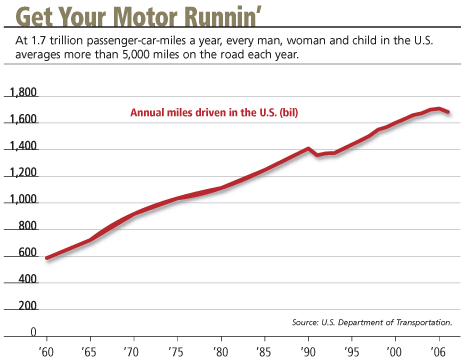
We've all heard the reasons why the price of oil is soaring. Pipeline attacks in Nigeria, mischief in Iran, the plunging value of the dollar, those pesky hedge funds. The real reason, if there is one, isn't as important as the impact. At $120 a barrel, the world's oil bill will account for 8% of global economic output, twice what it was in 2006. Yet the market and consumers' habits don't seem to be changing all that much (the spike in Prius sales notwithstanding). Global demand, at 86 million barrels of oil a day, hasn't wavered. Motorists are driving almost as much as they always have. And politicians are still blocking development of America's untapped oil wealth in coastal waters, the Alaskan wilderness and the massive oil shale deposits of Colorado. Maybe everyone thinks the price of oil is going to drop, and drop big, in a few years. But other rational things explain our seemingly irrational behavior.
Ford’s April vehicle sales down 12 percent
DETROIT - Ford Motor Co. says its U.S. sales dropped 12 percent in April as high gas prices accelerated the trend away from trucks and sport utility vehicles.It was a pattern expected throughout the industry as gas prices rose to record highs. Other automakers are scheduled to report their April sales later Thursday.
Global fertiliser shortage looming
Farmers are just about managing to survive with higher fuel costs which have seen "red diesel," now priced at over 60p per litre. But the same cannot be said for the cost of chemical fertilisers where demand and supply are currently miles out of balance.
Energy costs top concern -- until food costs soar
"We are supportive of biofuels with caveats. We want safety measures built into it so we don't cause harm to the environment or food prices. What's the panic if we don't have the legislation out next week?"Fair point and unusual for the New Democrats, given their chest-thumping demands for instant environmental policy.
But there's plenty of counter-argument showing corn crops, often singled out as the main fuel-displacing-food culprit, are experiencing dramatic production increases and surplus capacity in North America.
If food prices continue their rapid ascent, and if hording or rationing result, the social climate may deteriorate rapidly. It is hard to imagine two more potent causes of insurrection than economic hardship accompanied by a denial of access to food. In some countries food shortages already are causing riots. The situation is so grave that many major food producing countries such as Argentina, China and Russia are restricting food exports, driving prices even higher.Raising the political temperature still more is the fact that the U.S. government is encouraging farmers to grow crops (corn, wheat and soybean) to burn as fuel, while refusing to even consider cuts in generous subsidies to wealthy farmers reaping windfall profits.
Could oil mania be coming to an end?
Speculation has driven up prices - but things could be about to change, some analysts say,
Why oil prices are at a record high
REUTERS, London- US crude oil hit an all-time high of $119.93 a barrel on Monday. Robust demand for crude and a weak dollar have fuelled the rally from a dip below $50 at the start of 2007.Adjusted for inflation, oil is now above the $101.70 peak hit in April 1980, according to the International Energy Agency, a year after the Iranian revolution.
Malaysia: Emergency supply of diesel sent to Miri
Asked what had actually happened that caused the April quota to run out so fast, he said it was due to technical issues.There was a surge in demand for diesel the past few days, possibly due to concerns that the fuel might run out and due to rumours of a fuel price hike.
Pakistan: Safety nets needed to protect poor from food-fuel inflation
KARACHI: The government must devise immediate policies to insulate the most vulnerable social groups from the perils of runaway food inflation moving in tandem with soaring fuel prices.The government’s decision of passing on the burden of rising oil prices to consumers would surely compound miseries of the poorest sections of the society.
Relatively low taxes have kept pump prices far below most other developed nations, which some say is precisely why the current runup is so painful.
NEW YORK (CNNMoney.com) -- Despite daily headlines bemoaning record gas prices, the U.S. is actually one of the cheaper places to fill up in the world.
Out of 155 countries surveyed, U.S. gas prices were the 45th cheapest, according to a recent study from AIRINC, a research firm that tracks cost of living data.
The difference is staggering. As of late March, U.S. gas prices averaged $3.45 a gallon. That compares to over $8 a gallon across much of Europe, $12.03 in Aruba and $18.42 in Sierra Leone.
The U.S. has always fought to keep gas prices low, and the current debate among presidential candidates on how to keep them that way has been fierce.
But those cheap gas prices - which Americans have gotten used to - mean they feel price spikes like the ones we're experiencing now more acutely than citizens from other nations which have had historically more expensive fuel.
Pemex Refining Unit Operates at Loss on Higher Prices
(Bloomberg) -- Petroleos Mexicanos, the state- owned oil company, said it had a loss at its crude oil refining unit during the first quarter because of higher crude prices.The loss of 7 cents a barrel this quarter compares with profit of about $6.90 per barrel a year earlier, said Chief Financial Officer Esteban Levin in a conference call with analysts today. It was the only loss for the unit since 2003, the earliest data available from Pemex.
China's Meat Consumption Causing Global Grain Shortage, Study Finds
A change in Chinese meat consumption habits since 1995 is diverting eight billion bushels of grain per year to livestock feed and could empty global grain stocks by September 2010, according to a new study from Biofuels Digest.
The culprit is energy, not corn
A new Texas A & M University study and other analyses are instructive. The reasons for high food prices include:- High oil prices. The energy components in all aspects of food shipping and production are huge.
- Speculative trading in commodity markets, which has little to do with the actual supply-and-demand situation.
- Changing diets in China and India, where more animal protein is in demand, which has resulted in more exports of grain, meat and processed foods.
- Short global stocks of wheat brought about in part by the 1996 Freedom to Farm bill which eliminated grain reserves.
How African country folk hit back at urban snobs
Urbanites don’t like to hear this said, but the truth is that most people in cities, particularly in developing countries, are able to live a decent life because they parasite on, and impoverish the peasants.
Americans are being slapped in the face with a new reality. We are living in a recession. Yes, I said the “R” word. I am no economist but if this is not a recession, I don’t know what is.I paid more than $55 to fill up my 4-cylinder Toyota Camry this week. We’re not talking about a gas-guzzling SUV here, this is a mid-size sedan with relatively good gas mileage. But with gas prices ranging between $3.68 and $3.75, it adds up quick.
Armenia on shaky ground with nuclear plant: EU
Armenia is facing a power crisis as it is due to replace its only nuclear power station by 2016. Metsamor nuclear plant is vital to the country's power needs. EU officials, though, consider it not only obsolete, but also dangerous due to its location in an active earthquake zone.
Australia: Transport crisis turns west into wasteland
IT MAY be home to a booming population, but lack of public transport means Sydney's west is in danger of becoming a Mad Max-style urban wasteland.Its dependence on cars could prove its death knell, with rising petrol prices forcing many families to abandon their vehicles and become locked in their local communities.
Gas prices have race fans rethinking trip to the track
Auto racing is the ultimate in gas-guzzling entertainment. But the prospect of paying $4 a gallon to get to the track has some fans reluctant to start their engines.Ticket sales have slipped just as May, the biggest month in motorsports, approaches. So track promoters are shifting into high gear to keep the grandstands full, offering all-you-can-eat packages and staging rock concerts.
Are US Inflationary Concerns Inflated?
Is it possible that inflationary fears are inflated? Consider that:1. Food inflation fell in both February and March 2008.
2. Energy inflation fell in both February and March, and is lower in 2008 than in 11 months in 2005 and 2006.
3. Inflation for all items less food and energy is lower in 2008 than in 10 months in 2006 and 2007.
World Energy Crunch Is Here To Stay
Fossil fuels - as in petroleum and its by-product, gasoline - are what drives the country th a fact that has not changed in the last 125 years and won't change any time soon, contends John Moroney, an economist at Texas A&M University who has studied oil prices for 30 years and whose upcoming book Power Struggle: World Energy in the 21st Century takes a detailed look at the subject.
Short-term thinking has put Egypt in the unsustainable position of buying at high cost energy resources while it exports the same at low prices.
Ducks in the muck won't amount to much
Perhaps consumers will be sufficiently moved by the premature deaths of a passel of poultry that they’d be willing to weather an intensified energy crisis to spare further victims. But this is Syncrude’s first incident of this nature in 30 years. And, whether we like it or not, considering that the energy industry has taken its moderate toll on wildlife, from the days of whale oil to California’s raptor-shredding wind turbines, it would certainly be something if a few hundred more ducks, martyred in the name of industrial progress, made all that much of a difference now.
Nigeria: Senate Orders Oil Exploration in the North
The Senate yesterday urged President Umaru Musa Yar'adua to direct the Nigeria National Petroleum Corporation (NNPC), to resume exploration of crude oil on the Nigerian side of the Chad Basin and the Benue Trough.Moving a motion on behalf of 54 other senators, Senator Bala Mohammed told the apex lawmaking body that huge volumes of hydrocarbons have been discovered in Niger and Chad Republics due to persistent exploration activities on their side of the river basins.
Juneau considers partnership with nonprofits
Juneau Mayor Bruce Botelho wants the city to consider pairing up with nonprofit organizations in an effort to target residents who need the most help with skyrocketing electric bills.
In some quarters of state, sympathy for Juneau lacking
While Juneau struggles with high power prices, not everyone in Alaska is sympathetic."As much as I feel Juneau's pain, Juneau residents need to understand that there are thousands of us rural Alaskans who would love to pay only 50 cents per kilowatt for electricity," wrote Dan Klaes, mayor of Bettles, in an opinion piece in the state's largest newspapers.
Residents of Bettles, a city of 25 located 35 miles north of the Arctic Circle, would save almost 30 cents per kilowatt-hour if its power rates were as low as Juneau's.
Klaes said Juneau residents are now facing the same fuel and electricity crisis as other parts of rural Alaska.
Alaska: Borough mayor will ask for state of emergency
Mayor Jim Whitaker will ask the Fairbanks North Star Borough Assembly to declare a state of emergency at its May 8 meeting....The purpose of the Town Hall Meeting was to figure out what resources are available specifically in Alaska and how Alaska can regain its self-sufficiency when it comes to energy.
"All is not lost simply by living in suburbia," said Alan Belensz, a committee member and resident whose day job is chief of the Climate Science and Technology Bureau at the state Department of Environmental Conservation.Not everyone feels that suburbs, based on expansive, car-centric development, can ever be "green" in any meaningful way.
After all, most residents must still drive to the new Clifton Park-Halfmoon Library even though it includes numerous environmentally friendly features.
Once we started hearing about the books that brought these authors to the table, though, James Howard Kunstler (left) told the audience how his new novel, World Made By Hand, extrapolated from the themes of his last nonfiction book, The Long Emergency. When he turned the novel in to his editor, Kunstler recalled, "he behaved as if I had handed him a basket of garlic and crosses," and then tried to dissuade him with a lowball offer. (That was before he got a new agent, though.) He conceded that, in writing about a world a few years into the future where the depleted oil supply leads to the collapse of our technological infrastructure, "I was very conscious of The Road being out there... I knew what it was about, and I wanted [my book] to be the antidote to that, to suggest that this isn't the worst thing that could happen."
Can Climate Campaigns Withstand a Cooling Test?
If the new forecast of a decade of cooler temperatures in North America and Europe pans out, it will pose a substantial challenge to climate campaigners, politicians, and citizens: Can they produce meaningful action to limit the long-term warming that scientists still say is clearly ahead under a building greenhouse blanket even when it’s cooling outside?
LONDON, England (CNN) -- Imagine a life where you cycle each morning to work, and come home at night to tend your allotment and eat a dinner of locally produced food.Maybe after your meal you take a walk down the car-free streets to the nearest bar where you buy a round of drinks with locally produced currency and settle down in a corner to watch a troupe of musicians play some local folk music.
It might sound like some kind of fairytale arcadia -- a return to the simple lives of our forefathers, before fossil fuels and consumer culture turned everything on its head. But in fact this is how many people are beginning to envision our future -- a world where we come to terms with inevitable fuel shortages and work towards a less energy-dependent lifestyle.
They don't just shop local in Totnes - they have their very own currency
If you were to nip down to Devon's Totnes market on a Saturday looking to buy some spelt flour pancakes, crêpes or falafels, then you might just encounter Lou Brown, who is a remarkably fine cook. But she has another, non-culinary distinction. Unlike most businesses in the country, Brown does not deal in currency with a picture of the Queen's head on it. No, instead, her change features an image much closer to home. The town where she lives.Brown, along with thousands of her fellow residents in this colourful south-west retreat, uses Totnes pounds: notes printed and traded locally (and decorated with a sepia depiction of the town's main thoroughfare). The idea for the pound – used in 70 businesses round these parts – was introduced a year ago, to promote links between local businesses while reducing reliance on big business. The aim is to keep money circulating within the town's local economy. If people are encouraged to buy local produce, the thinking goes, it will help to cut down on food – and trade – miles and also help to strengthen community relations and links with local producers.
Raise the Hammer was born in part from the imminent Peak Oil crisis and the necessary paradigm shift in living and city planning to mitigate the crisis. The City of Hamilton was 'planning' for a future based on cheap oil/gasoline and to some extent still is.Almost four years have passed and the denial of an energy crisis is still steering the city planning, even with surmounting evidence of present a $120 barrel of oil.
The City of Hamilton still believes that box retail centres with supply chains and business models based on cheap oil will be the employment opportunities that keep the next generation in the City.
Peak Everything: Learn About Peak Oil
The first in a series where we look at why those basic things that we take for granted, like water, food and fuel are getting expensive and scarce, all at once.
Both Qatar's oil minister and the head of OPEC can see oil hitting $200 a barrel before the end of the year and one analyst says gas could reach $7 a gallon within four years. That could mean cataclysm for the global economy.
Nigerian oil strike against Exxon to press onward
A Nigerian oil workers' strike that has halted production at Exxon Mobil Corp.'s local unit entered its eighth day with talks between union leaders and management scheduled to resume at noon local time, a union official said.The industrial action has cut crude output by 860,000 barrels a day, according to the Petroleum & Natural Gas Senior Staff Association of Nigeria union, also known as Pengassan. Gloria Essien-Danner, a spokeswoman for Irving-based Exxon, also confirmed today that the strike had not ended.
Iraq: U.S. has no claim to oil boom
BAGHDAD — As Congress gears up to debate the Bush administration's latest request for an additional $108 billion in war funding for Iraq and Afghanistan, Iraqis are fuming at suggestions being floated by lawmakers that Baghdad should start paying a share of the war's costs by providing cheap fuel to the U.S. military."America has hardly even begun to repay its debt to Iraq," said Abdul Basit, the head of Iraq's Supreme Board of Audit, an independent body that oversees Iraqi government spending. "This is an immoral request because we didn't ask them to come to Iraq, and before they came in 2003 we didn't have all these needs."
Myanmar: Junta's horribly misguided energy experiment
Biofuels have long been hailed as a solution in the fight against global warming and increasing scarcity of petroleum. But recently it is becoming increasingly clear that unless sufficient precautions are taken, biofuels can snatch food from the mouths of the poor and can be a human rights disaster.Nowhere is this truer now than in Burma. In its typical brutal, heavy-handed fashion, the Burmese junta has combined forced labour, ham-fisted implementation and superstition in a disastrously misguided nationwide biofuel project that is creating yet more suffering for this desperate country.
Arctic sea ice forecast: another record low in 2008
WASHINGTON (Reuters) - Arctic sea ice, sometimes billed as Earth's air conditioner for its moderating effects on world climate, will probably shrink to a record low level this year, scientists predicted on Wednesday.In releasing the forecast, climate researcher Sheldon Drobot of the University of Colorado at Boulder called the changes in Arctic sea ice "one of the more compelling and obvious signs of climate change."
Lake With 20% of Earth's Fresh Water Is Warming Faster Than Air
Bloomberg) -- The world's largest lake is warming faster than the atmosphere, challenging the idea that large bodies of water can withstand global warming, according to U.S. and Russian scientists.
Is Desert Solar Power the Solution to Europe's Energy Crisis?
A tiny fraction of the sun's energy that shines upon the deserts of North Africa and the Middle East could meet all of Europe's electricity demands. The technology to harness the energy already exists. So why is hardly anyone investing in it?
Rising costs reshaping air travel across the USA
Record-high oil prices are threatening to ground millions of travelers who have grown accustomed to flying for fun and business during the past 30 years.Air travel in the USA has grown at a rate five times faster than the population since 1978, when deregulation first allowed airlines to compete by setting their own prices and routes without government approval. Last year, 769 million passengers boarded U.S. airline flights.
But with today's unprecedented jet fuel prices, airline executives and aviation analysts are warning that only extreme fare increases and dramatic cutbacks in flights will enable the industry to cover a 2008 jet fuel bill the airlines' trade group projects will be 44% higher than last year's.
Non-OPEC oil producers unable to boost output
Oil producers outside the OPEC cartel are unable to pump enough oil to reduce crude prices, hampered by robust domestic demand, weak investment and exhausted oil fields, analysts say.In the short term, "no non-OPEC member is in a position to produce more," said Francis Perrin of the publication Petrole et Gaz arabes.
"They are selling all the oil they can."
There is a puzzle over oil prices - and it is not what is driving them up. That particular question can be answered quickly enough: demand for oil has increased, especially in booming China, and that lift to prices has been intensified by that old culprit, market speculation.So far, so simple. The real mystery, however, is this: why is expensive oil not changing the way we behave?
Companies cut corners to save on fuel as gas prices rise
Along with altering shipping routes, companies have slowed trucks to boost gas mileage, stepped up tire-pressure checks for the same reason, combined deliveries and deployed technology to improve routes — to the point of avoiding left turns because waiting for lights or for traffic to pass can consume more fuel than driving alternate routes.
UK: Petrol prices reach £5 a gallon
Petrol prices have reached £5 a gallon for the first time, figures confirmed on Wednesday.The average motorist could soon be paying more than £2,600 a year to fill up their car, swallowing almost 15 per cent of the average take-home pay, a survey predicted.
Cut fuel tax by 9p a litre, Brown is urged
Gordon Brown could afford to cut fuel tax by 9p a litre, City analysts believe.Motoring groups say ministers should scrap a 2p-a-litre tax rise planned for October - and reduce the current duty by a further 2p.
What to do about oil? First it went from $60 to $80 a barrel, then from $80 to $100 and now to $120. Perhaps we can persuade OPEC to raise production, as some senators suggest; but this seems unlikely. The truth is that we're almost powerless to influence today's prices. We are because we didn't take sensible actions 10 or 20 years ago. If we persist, we will be even worse off in a decade or two. The first thing to do: Start drilling.
Mexico rebel talks may spur investment
MEXICO CITY - President Felipe Calderon's decision to talk with guerrillas linked to gas pipeline explosions could encourage foreign investment in Mexico at a time when the government is pushing to open the oil industry to private partnerships, experts said Wednesday.
Iraq Oil Revenue May Top Outlook
WASHINGTON -- A new U.S. government report projects Iraq's oil revenue will top a record $70 billion this year, adding fuel to a congressional push to force the Iraqi government to assume more responsibility for rebuilding the country.
Candidates' plans to cut gas prices
High gas prices can prompt political hysteria in the best of times, but when they soar during an election year, the fumes rising from candidate stump speeches can make a person sick. Of the three candidates and the president they're out to replace, only one is telling the truth about oil -- and he may suffer for his political courage.
Exxon’s earnings rise on record oil prices
HOUSTON - Exxon Mobil Corp., the world’s largest publicly traded oil company, says record crude prices helped its net income grow 17 percent in the first quarter.Exxon Mobil said Thursday its earnings for the first three months of the year rose to $10.9 billion, or $2.03 per share, up from $9.3 billion, or $1.62 per share, a year ago.
Analysts polled by Thomson Financial were looking for a slightly larger profit of $2.13 per share.
Shell to withdraw from UK's flagship wind project
LONDON (Thomson Financial) - Royal Dutch Shell Plc has decided to withdraw from a 1,000-megawatt wind farm project in Britain, a Shell spokeswoman confirmed.
Shell lambasted as it seeks exit from offshore wind farm
Royal Dutch Shell yesterday provoked a storm of anger among its partners in the world's largest offshore wind proposal when it revealed plans to sell its stake.
The statement from British Airways last night that it is "exploring opportunities" with American Airlines and Continental is confirmation of just how worried these carriers are by rising oil prices. AA and Continental announced huge first-quarter losses recently and BA is widely expected to reveal its second profit warning of the year next month as oil prices show no sign of dropping significantly in the near future.
Asia tourism, airlines 'complacent' on climate change
BANGKOK (AFP) - Asian airlines and tourist firms are too complacent about the urgent need to address global warming, industry leaders warned at a conference on climate change.Westerners rather than Asians dominated the first Pacific Asia Travel Association (PATA) conference on climate change, held in the Thai capital, organisers said.
Global warming? Next decade could be cooler, says study
PARIS (AFP) - Global warming could take a break in the next decade thanks to a natural shift in ocean circulations, although Earth's temperature will rise as previously expected over the longer term, according to a study published on Thursday in the British journal Nature.
Contact
- Content: editors at theoildrum dot com
- Tech support: support at theoildrum dot com
License

This work is licensed under a Creative Commons Attribution-Share Alike 3.0 United States License.
California Gasoline Consumption Declining
http://www.greencarcongress.com/2008/04/california-gaso.html
Is demand destruction what is causing the cost of oil to crash or something else? Seems like it has gone from 120 to 112 more rapidly than it went from 112 to 120. Geopolitically, there doesn't seem to be any reason that explains this. Nigeria is still in chaos, Cantarell still crashing, and we are even closer to war with Iran.
I am neither a geologist nor an economist, just a layman fan of this site who depends on the Drum Beat and the Automatic Earth for his news and is perplexed by these radical fluctuations.
Thanks.
The UK refinery dispute is settled. North Sea back up to full flow. The dollar is gaining and that weakens oil as commodity of last resort.
This week's US inventory report exceeded expectations.
Some posters on TOD have been predicting a price fallback the last few days. There is some marginal evidence of reduced US demand.
Increased volatility is to be expected. In a few months $120 will be a distant memory.
Sadly not true!
The union completed it's planned two day stoppage, but there is no resolution to the dispute!
Prices rise and fall a few percent over short periods in any free market. For oil, each peak in the price is higher than the previous one, this is nothing new, it's been going on for ten years or so now - IMO, at the very least, it signifies 'peak lite'.
http://www.guardian.co.uk/commentisfree/2008/may/01/tradeunions.oil
Yes - as you can see the boss has backed down, for now, as long as the Union is willing to negotiate, ie:compromise - it isn't clear that they are.
Keep in mind that all commodities, including oil, will fluctuate short term. The thing is that while oil might occasionally go down, it will go up more often than it will go down, and the ups will be up more than the downs will be down.
This site graphically shows the recent ups and downs in the oil price. What is happening now fits the pattern.
http://www.oilnergy.com/1onymex.htm
SO now is good time to buy...i think Moe Gamble said wait till it goes to 109
Paging moe_gamble - thoughts on the selloff?
Just a few days ago, Moe was looking for a selloff to act as his new buy in point. I suspect he may have found it. Of course as I recall, Moe got in back aroung $99-$105 per barrel anyway.
Regular Gas is $4.07/gallon in Humboldt County. It cost $35 to fill up my Prius yesterday.
Peanuts.
It costs me around $100, or £50, to fill my Porsche in the UK. On the other hand, I only fill it up around 10 times each year.
'Snuthin'. My wife's friend gets through £50 / $100 a week just taking her five-year-old to school in a Mercedes 4x4. It's not such a long trip either.
Most of the other mums drive similar monuments to a bygone age of cheap oil but are desperately holding out not to be the first to downsize to something more in tune with the times.
Here in BC it only cost me $100 to get 2/3 of a tank for my Tahoe. They have a cut off at $100 on the gas pumps which I'm not sure if it is annoying or not. But I only fill up every two or three weeks as work is about 12 km with no traffic jams.
C'mon, living in northern BC has to have some benefits! And we will be playing golf at 10:30 pm in a month or so.
Consumption declining? ... that's what we expect after peak oil, caused initially by massively rising prices then by economic decline (since historically the world needs to consume around 2% more each year for BAU.)
Here's 'real world' evidence of peak oil from a rich part of the world, just like the real world evidence of declining 'net exports' after peaking in 2005 that shows up in EIA data.
So far it's just 2 years in a row of <1% decline, wait until it's twenty years in a row and >5% annual decline rate, it will be a different California for sure!
Time to draw a line in the oil sands
I wish so-called learned people would quit calling it "oil-sands".
"Asphalt pavement" might be more helpful. At least it will get people starting to realize where the NEXT FF resource will be after these are depleted.
Now I take this a little personally as I used to do work in the Sarnia Shell refinery. I did work in all the refineries in "Chemical Valley". They were a great bunch of guys at Shell and very professional!
The real story behind this is eastern Canada has to import oil because there isn't sufficient pipeline from western Canada. This could very well be a commercial manifestation of a strategic oil plan for Canada. None exists now which is tragic.
Concerns about pollution in Sarnia? That in itself is a joke. They should be far more concerned about the Air Products liquid hydrogen storage tank sitting to the east of Shell that can level the whole town.
And here's a trivia tidbit that gets lost in the great American propaganda machine, the first commercial oil well was just to the north of Sarnia in Petrolia predating Col. Drake by three years. Along with the true invention of the light bulb, (which I just learned last night which occurred in Canada and Edison BOUGHT the patent), starts to redraw the mythos of 'Murika. (Pay attention JHK).
There were a number of "light bulbs" before Edison, creating a glowing hot light source was an establshed idea.
What Edison did was work long and hard to find a suitable filament material, tungsten. And the Edison base is still a "good idea" as well.
Alan
For all the Jevon's Paradox True believers.....
Beating the Energy Efficiency Paradox (Part I)
http://www.treehugger.com/files/2008/05/beating-energy-efficiency-parado...
Just to refresh you on the paradox here is a bit snipped from Wikipedia:
In economics, the Jevons Paradox is an observation made by William Stanley Jevons, that as technological improvements increase the efficiency with which a resource is used, total consumption of that resource tends to increase, rather than decrease. It is historically called the Jevons Paradox as it ran counter to popular intuition. However, the situation is well understood in modern economics. In addition to reducing the amount needed for a given output, improved efficiency lowers the cost of using a resource – which increases demand. Overall resource use increases or decreases depending on which effect predominates.
http://en.wikipedia.org/wiki/Jevons_paradox
It isn't that the owner of the Prius will drive more but that there will be more and cheaper gasoline available so others will be able to afford to drive more or at least not reduce their consumption as much.
In light of peak sea-food it is good to see the red-herring harvest is still strong. :-)
Old Jevons might have it right when there's more of a resource to be used, but when there's a declining amount available, like on the downslope of peak oil, and every bit available is going to be used regardless, what changes with energy efficiency is the level of activity the energy will support--like eating and stuff. We're going to need every bit of efficiency we can muster--and more.
folsomman good observation, its a little bit like them later stages of a yeast-culture gobbling the last of sugar .... and then ...
Jevon's won't work beyond peak
Don't forget the psychology of scarcity. I suspect there are plenty of people waiting to snatch up what they can as more is available by conservation. I feel that way somedays. F&%k 'em, get what I can while I can.
Its there and just waiting for all the idealists to feed the maw.
Antidoomer,
Thanks for the link – I'm a believer in Jevons' paradox but not a true one, and am always happy to read material that might prove I am wrong, since I would very much like to be wrong.
The data you quote is a bit on the soft side:
That's what I would weasel talk in full flow. What's 'very small'? What does the author mean by 'if any at all'? Either the effects exist, or they don't. Perhaps the author means the effects are so small you can't measure them – but that's ridiculous. Compare the size of houses built today with those built thirty years ago. Compare even the size of double beds. Jevons' paradox may not be all it is made out to be by some proponents, but to claim there is no rebound effect of energy efficiency at all simply beggars belief. It is an extraordinary claim and demands extraordinary evidence – not just a couple of selected statistics.
Besides, the source is hardly very authoritative. Amory Lovins is notorious for his bubbly can-do salesman philosophy. His data always require double-checking.
Still, thanks anyhow. It's often stimulating to read the other guy's side.
Question to Antidoomer: what did the hybrid drivers and green building owners do with the money they save? Do you have any data on whether the additional goods purchased/consumed with the savings are more or less energy intensive than spending that same money on driving or heating a building? Bottom line: no decrease in energy consumption, just a shift in where and how the energy is being consumed. See: Shadow Rebound Effect
Right Jeffvail! Even if they put the "saved" money in a bank, that money is then lent out presumably for something that consumes energy. The beauty of the paradox is its simplicity.
Hear, hear!
The only way effectively to reduce your energy consumption IS TO BURN YOUR MONEY and live in poverty.
But why is it so difficult to explain?
C.O.
Why on earth would you burn it! Have you learned nothing here? We should shred it, compost it, then try to make a mash and ferment it to make cash-ahol. With some luck and lobbying we may even get a federal subsidy.
Best hopes for a sane fiscal policy
EJ
Can you even PROVE that they used more energy? Who says they purchased /consumed anything else? What did they do with the money they save? Paid off debts? Perhaps they spent the money on something even less energy intensive than they would have had they not had the savings before. In the case of cars, the user is using less gasoline (liquid fuel) and maybe using something that requires electricity (renewable fuel through wind or solar)with a even greater efficiency.
That's the point: no data and methodology currently exists to EITHER prove that the use of the saved money is more energy consumption or less energy consumption. Or whether it's more CO2 producing coal consumption in China or more sustainable solar-thermal being built in Nevada. One thing is known, however--the effect will be similar if they spend the money (whatever they spend it on ultimately uses some energy, either more or less than the gas would have), if they save the money (as another comment pointed out, that facilitates additional lending that will drive consumption, and due to fractional reserve banking seems quite likely to be MORE energy intensive), or if they just burn the cash or shove it in their mattress (aggregate effect is to deflate currency which makes value of money available to spend/lend elsewhere capable of purchasing more energy).
So, while I think that driving a hybrid is a good deal because it decreases individuals' structural dependence on gasoline consumption and the improved efficiency facilitates energy uses that may provide added economic benefit, I think there is zero evidence to support the position that hybrids or green buildings actually decrease aggregate energy consumption. Normally this would be a good thing--proper tax and accounting policy could ensure that the only result of this is an improved economic standard of living for the world. However, IF one accepts an impending decline in global energy production (reasonable minds can differ--I think it is more likely than not that we will not be able to boostrap sufficient truly renewable energy sources in time, and further that the precautionary principle demands that I accept this as a near certainty, not merely as a possibility), then driving a hybrid or building a green building does not prepare society for energy descent.
It seems logical to conclude (from observation, but no data) that all available energy will be used somehow. Energy can't be saved, and once produced, something has to be done with it.
Jevon's paradox is no paradox at all-- just a description, like "water flows downhill". And hybrids will make no difference in the long run -- when there is no available petroleum energy, something else will be used.
Not to worry, though. People are resourceful.
Money is fungible. It really is impossible to say what we used the savings from our Prius on. However, my geothermal HVAC unit is being installed some tim in the next week, and my solar hot water heater probably later this month.
Would we have done that without the savings from the Prius? It's hard to say. But I think it is proably true that someone who is likely to buy a Prius is also more likely to install a geothermal HVAC unit and a solar hot water heater than someone driving an SUV.
I started with insulation and CFL's and invested the cumulative savings in a high efficiency boiler. I then took these savings and bought a solar water heating system that supplies 70% of my domestic hot water. I am subsequently investing in two community based wind farms. I am also investing in my small garden to deliver a range of fruit and veg. other projects including water harvesting and composting
End result:
Energy consumption reduced by 65-70%
10% of food requirements from the garden
Steady income from wind farms
Insurance for the future perhaps?
In one sense, that question is irrelevant. One should buy a hybrid car or build a green building to improve one's own financial situation, not to reduce aggregate energy consumption. It may be true that the saved energy will be consumed somewhere else, but so what? At least you personally are in a better situation than you were before, and you have improved your competitive standing among your peers as you compete for food and other resources.
Jeff, always on the mark. That's why I refer your blog and book. A singular intelligence. If it gives you any comfort, when I read your material I gain a little hope for your nation and despair a little less for the species.
Lets take this a step further and explore a Grand Unifying Theory (GUT). What Jeff et al says is most likely true even from a statistical point as it is probable given the market options available that the money would be used in a much less efficient manner. Unless the money saved is specifically directed, one must assume that Jevon's Paradox has the upper hand in the odds.
Connecting the dots reveals that all these peak events and principles are symptomatic of Peak Entropy Rate (PER, I guess...). Take an examined look at all the events occurring through the thermodynamic lens and this may well be the defining principle. PER is a function of population and technology. We have seen historical examples of this. It is a ratcheting effect in evolution. If "homo hydrocarbonis" had a thermodynamic credit card, its credit limit would be maxed out.
This does not portend the end of the species, but indicates an evolutionary cycle. There will be contraction and technological regression, and then the new age will come forth.
This is the gift to the TOD community, analyze PER, contemplate, tear it apart, substantiate it and make it your own. I have no priority in any journal other than TOD. This is all part of the evolve or die a few have been saying. We share a consciousness on some levels, and now I invite you to evolve and explore.
what is your opinion,if you have one, on the demise of the dinosaurs ? PER sounds plausible, at least more plausible than an asteroid strike, imo.
1. The United States is not the world.
2. Jevon's Paradox works because there is more stuff to take and because it is easy to take.
Jevon's Paradox is actually born out of our inability to understand, plan, and react to an unmanageably complex system.
When we can't grow anymore, Jevon's Paradox will fail. It will fail, because we will crash.
The above article Non-OPEC oil producers unable to boost output states:
But is that the case? Can Saudi Arabia Boost Oil Production?
I find Jumah's comments extremely interesting. Looks for all the world to me that they are preparing their future excuses for not producing more oil.
Ron Patterson
Michael Moore gets it. He was on Larry King Live last night.
I wish he would make a docu-movie dammit.
http://www.youtube.com/watch?v=Or4wRf-jmvM
and more at www.michaelmoore.com
Pete
Good clip, but Sacred Cow Tipper, if you're out there, you should send him an email, though.
"You can't make fertilizer from a Windmill"
'splain it up!
Bob
The problem is phosphorous (one-time use in current intensive agriculture), not nitrogen.
*Ding*
We have a winner!
Now, go pee on some plants.
LoL I once performed an informal experiment where I peed on knotweed growing thru cracks in a concrete sidewalk. The knotweed was plasmolyzed by my concentrated hypertonic morning pee, but it thrived from being watered and fertilized by my dilute afternoon beer pee! Dilute your pee, folks! ;)
If Tipper thinks you can make fertilizer from a Windmill then he is sadly mistaken. I know there may be some Rube Goldberg scheme where he may explain the process but from a windmill you get electricity. Converting electricity into feedstock is an impossibility unless you run it through the earth via photosynthesis, which of course requires a lot of fertilizer. And a lot of land, and a lot of water and a lot of energy.
You cannot produce synthetic rubber from a windmill or a solar panel, you cannot produce plastics from solar or wind. You cannot produce polyester fabrics or any other petroleum based fabric from wind or solar. You use petroleum based products in a thousand ways every day. These cannot be produced from wind or solar.
Synthetic rubber was invented in 1927 and saw widespread use beginning in the 1930s. Today we use many fold the rubber we used when only natural rubber was available. Rubber trees grow only in the wetter tropics, area covered today by rain forest. I don't know what you would produce plastics from as I don't believe there is any such thing as natural plastic. And cotton, wool and flax production would have to perhaps double if petroleum based fabrics were to disappear. That would require a lot more arable land, irrigation and fertilizer.
And of course, if all this land was converted into producing feedstock for products then food production would drop dramatically.
People who think wind and solar can replace petroleum are living in never-never land.
Today's production
Ron, I know there is one company that is doing just that, producing a natural biodegradable plastic that can be returned to the earth:
http://www.cereplast.com/homepage.php
I have been using biodegradable plastic utensils and trash bags for 3 + years.
Three of my sources have gone out of business due to sourcing problems, couldn’t make a buck.
Prices have gone up constantly even though they all say soon as demand gets big enough price will come down. Demand goes up and they all cry about sourcing inputs.
I have used potato starch plastics, cornstarch plastics, soy based plastics, one company who would not be specific and just said cellulose, (out of business).
Currently using Stalkmarket;
“StalkMarket’s core line of products are made from a sugarcane fiber-based paperboard called bagasse.”
P.S. They are made in china and rumor has it that there are some contaminants found in some of their products but I can’t get confirmation.
You ain’t never going to make a million cars out of the stuff
RE 'natural' plastics. Hoo boy! From the antidoomer link:
Anyone see a problem here???? Anyone......
Yeah, it'll inevitably drive up the price of my tapioca pudding.
Plastics made from food. Imagine that! If you ask me this "Antidoomer" is turning into a real doomer. His posts are gloomier than mine.
Ron Patterson
If you ask me this "Antidoomer" is turning into a real doomer.
He now talks about riding a bike. Used to be he talked about how cars were gonna be saved and OK.
It might be an interesting and useful exercise to consider just what we would/will do without plastics. This is a real possibilities, given that the vast majority of plastics come from petrochemical feedstocks.
A good place to start is to look back and consider what people did before there were plastics.
Clothing? Without plastics (nylon, polyester, etc.), there were only natural fibers. Clothing was consequently relatively expensive, people had less of it, and it was made to last (and to be repaired). Ditto for carpeting, drapes, bedding, and other domestic textiles.
Food storage? Without plastic wrap, all one had was good old waxed paper (or maybe aluminum foil in the years just before Saran Wrap). Without plastic containers, all one had were glass jars and bottles, ceramic crocks, and metal tins. Most foodstuffs were shipped, stored & displayed in bulk (crates, barrels, etc.) - one would generally bring one's own containers, or perhaps the merchant would provide a paper bag.
Building materials? Forget Pergo or vinyl, all flooring was hardwood, or maybe ceramic, or linoleum (ground cork + linseed oil). Forget Formica, and those granite countertops would have been quite rare in the past; generally, what people had were wood countertops and table tops, or maybe metal. Forget those vinyl or fiberglass shower surrounds, reacquaint yourself with tile and grout.
Electronics & Appliances? Before plastic, things would be made out of wood, or metal, with maybe a little bakelite (which is made with non-petrochemical feedstocks).
No time to finish, but you get the idea
For some purposes, plastic may be preferable to natural fibers. I bought a fleece jacket in 1992 and it is still going strong with no loose fibers. On the other hand, I bought a Smart Wool shirt just a few years ago and it is already falling apart. Polyester seems like it lasts forever at least in the fleece form. Arguably, fleece is made to last even though that might not be the intent.
So, plastic is both a curse and a blessing depending upon the intended use.
Thanks WNC Observer, yours is the typical post of folks who just don't get it.
Yes, all that was in a world with about one third the present population. Sure we could do just fine with cotton, wool, flax or other natural fibers. But millions of acres of land that now produces food would need to be turned over to the production of fiber.
Ditto for building materials and furniture. Make them all from wood. Cut down millions of acres of forest. After all they are only trees. Then we could clear the land and plant cotton. And the next time we need some timber we can use cotton stalks. Yea Right.
And as another poster asked why do we need all those tires? Sure, we could do without tires. Those fortunate enough to have jobs could walk to work. Local food and everything else could be delivered by push-cart with wooden wheels over dirt roads. (No oil to make asphalt roads.)
Everyone would have to do with a lot less. But the millions who produced all those luxuries, like tires, cars, lawn mowers, lawn furniture and thousands of other items would be out of work. These people would.....would....hell, I have no idea what these people would do.
Of course there would be a lot less food. Oh there would be lots of food for those with lots of money. But for the masses of people food would likely be priced way out of reach, just as it is today in some areas of the world. Rising prices are causing food riots today! Try to imagine what it will be like when the supply of oil is less than half what it is today.
Ron Patterson
Hmmm, maybe it could help solve the obesity problems in western cultures?
You can't eat what's not there...
But when can run out of food, we can then eat our shopping bags!
That's all true. But not too many years ago the human race got along just fine without all that "plastic" which is now being used one time before being dumped in a land fill. My life would be enhanced, not degraded by the absence of all that crap, although I understand that only consumption is capable of being turned into profit, which in turn is crucial to the non-negotiable "American Way of Life."
And rubber? Who needs so many tires? Drive slower and put more on steel rails and the "need" goes down dramatically.
Etc., on and on....
I guess that in the end the economists are correct. The only signal we really pay attention to is price The "market" will adjust our wants and needs, but not necessarily in a nice way.
And rubber? Who needs so many tires?
You can use alcohol to make tires....
Laphroaig is a better use for alcohol.
Just a little, and not while you drive.
If Tipper thinks you can make fertilizer from a Windmill then he is sadly mistaken. I know there may be some Rube Goldberg scheme where he may explain the process but from a windmill you get electricity.
Ron, I make no claims about actual viability - to my knowledge nobody has actually demonstrated this - but I posted a guest essay in 2006 that explained the concept:
Ammonia and Biofuels
It's pretty light on details, and I don't know enough about the Haber process to know if there is a killer knockout lurking in the details.
Just talking about the Ammonia portion. Getting a pile of NG out of the loop IS going in the right direction, no?
Ron, Wind and solar can do a lot of things. Let's find them and get some going, eh? Any time you want to read that as my advocacy for them 'fully replacing' petroleum, then you are willfully ignoring my countless disclaimers to the contrary.
Just because I think a lifeboat is 'cute', doesn't mean I'm confusing it with the Liner that it's dangling from.
Bob
If Tipper thinks you can make fertilizer from a Windmill then he is sadly mistaken
Just add air and water. They're not expected to be in short supply any time soon. Right now it's not commercially competitive with conversion of natural gas. But that's the whole point, isn't it?
http://en.wikipedia.org/wiki/Norsk_Hydro#The_first_steps_with_fertilizer
(Edited for extra sarcanol after first posting)
Robert, Bob and Plucky, okay so you can produce nitrogen fertilizer from water and air with the aid of lots and lots of energy. Have you, or anyone done any calculations as to how much energy it would take to fertilize one acre of....say....corn?
Every so often someone comes up with the brilliant idea that they can use desalinated water to make the desert bloom and produce all the food the world needs. They walk around on this cloud until someone asks them how much energy it would required to desalinate that much water. It would multiply the cost to produce food many fold.
So what's your cost? Figure that into the cost of food, cotton or whatever you produce from this "out of thin air and water" fertilizer and then try to figure out how many people would die of starvation because they could no longer afford to buy food.
But that still doesn't answer my point. With massive amounts of energy you can produce fertilizer. How about rubber, asphalt, plastics for the thousands of products used daily, pesticides, synthetic fabrics, and the list goes on and on? How can you produce feedstock from wind and sunshine? I know, with the aid of agriculture. (With the exception of plastics of course.) But this massive increase in land use further drives up the price of food, destroys more land and rain forest, uses more declining water and drives more species into extinction.
Ron Patterson
Darwinian -
While I don't have any specific information on the relative economics of manufacturing ammonia via the Haber process using wind power to produce the requisite hydrogen versus producing the hydrogen from natural gas, I don't think you are justified in dismissing the whole concept out of hand simply 'by inspection'.
You speak in terms of 'massive amounts of energy', but when you get right down to it, once you've made the hydrogen, then the energy consumption associated with making the ammonia via the Haber process would be largely the same in both cases. That being the case, the correct basis of comparison should be the energy content of the natural gas consumed per ton of ammonia produced with amount of wind-generated electrical energy required for the production of the requisite amount of hydrogen to produce a ton of ammonia. I suspect that if one were to make that comparision the energy inputs would not be all that different.
Now, economics is another and far more complicated matter. Assuming that the ammonia production facility on the tail end is the same in both cases, we would then need to compare the life-cycle cost of the wind farm/electrolysis facility with the facility used to produce the hydrogen from natural gas. To a large extent, this will get down to a comparison of a high capital/low operating cost system (the wind route ) with a low capital cost/high operating cost system (the natural gas route). And in any such comparison, assumptions made about the cost of capital will weigh heavily. Another consideration is whether making ammonia would be more profitable than selling the wind-generated electricity outright.
Actually, scientists have REdiscovered a classic and totally natural Fertilizer source now from a particularly Rapacious Breed of Insect that likes Bourbon called the PissAnt. I think that'll save us. What's a picnic without a few PissAnts?
"How about rubber, asphalt, plastics for the thousands of products used daily, pesticides, synthetic fabrics, and the list goes on and on?"
- well clearly, as I noted in an earlier post today, I don't actually endorse the continuation of producing the mountains of crap to which you refer. But plastics are useful and there ARE products that are worth making out of them. It 'seems' as if we can make NH3 from Stranded windmills, which might be a better use of them than stringing extra miles of copper to each one.. etc.
It is pointlessly hyperbolic of you to keep taking a suggestion and poking at it with your little dagger because it 'can't solve ALL our problems'. Sometimes you seem smarter than this.
Your glass is more than half empty, Ron. Time for a refill.
Bob
edited to embellish rant.
Excuse me for interjecting on behalf of Darwinian but I think his point is that BAU cannot continue under such scenarios. Yes, we may be able to make fertilizers from windmills and natural plastics from cellulose. But what sort of world would we be living in if that is how we produced those things? I strongly suspect that such a world would not be the high-tech go-go craziness we see today, nor would it entail 6.7 billion people and still growing.
In other words, to get from here to there (if we can even get there) entails some sort of collapse of the existing system and the rise of a new system with new values, new goals, etc.
Yes, that is exactly the point, with the slight addition of the OVER-REPEATED disclaimer that we're talking about BB's here, and with the possible exception of John15 and a couple others, NOBODY would be at this site if they expected BAU.
This is not about making 'More Windmills for more Walmarts' or 'Electric Cars to Subsidize Drive-thru McDonalds' .. so what does it add to the discussion to constantly dismiss a proposed tool or technique with the challenge that it can't keep our 'Consumer Wasteland' running as if nothing was going to change, as if that is what is being offered? It clearly is NOT what the suggestion is proposing to do.
As far as collapse goes, just as with population predictions, I will suggest that since I can't do much about either of those, what I will do is work on tools that seem like they'd be helpful in either today's or tomorrow's world. We'll still use wheels. Windmills could help shoulder any number of burdens, with or without electricity, etc etc..
Getting caught up in the predicting business is a fine ticket to paralysis and nihilism, which are not for me. I build stuff, I use tools, I draw, I like to work, I collect scraps and combine them in interesting ways to see if they'll do something. I'm making a Treadle Sewing Machine into a Table-JigSaw, and an Exercise Bike into a 'Lathe/Milling Machine' ... could also sport a flourmill or a generator, and will have a Power Take-off for just such uses.
I just spent an hour with Mom (70) shoveling heavy, muddy soil onto our Community garden plot, and entertained myself designing ways to use the Exercise bike and a chain of buckets to use more of my muscles and balance the load. Got a nice blister on my thumb now, and my brain is still smoking a little. Great working with Mom in the garden, though.
Peace. It's a good day to die.
Bob
Bob, I really think there is a larger segment here who want or hope for BAU than you seem to think. And the "cascading blowbacks" that Bob Shaw often mentions are almost never even brought into discussion here, largely because we probably cannot quantify them. But that does not mean they will not occur. It just means we cannot predict them or control them.
Blister on the thumb, eh? Reminds me of the one I got two weeks ago shoveling new soil and compost into my expanded garden with assistance from my granddaughter. Those are precious and useful moments. Enjoy your time in that garden!
Thanks, GZ.
Yeah, who knows what folks secretly want, think they want, are willing to fight for, are not willing to look at.. big heavy stuff, and we're going into this war 'with the Army we haven't got', so to speak.
It's good to remember that these discussions aren't even 'the battle'.. This is just the mess hall!
'Strive Mightily, as Lawyers do in Law; but eat and drink as Friends..' -Shakespeare
(Food Fight!)
Best,
Bob
You're changing the subject. I didn't say that fertilizer manufacture from electricity, air and water would scale - I just refuted your rude (to Tipper) assertion that it was impossible (though I'm quite sure he is capable of defending himself).
If you read the Wikipedia article, it sounds like Norsk Hydro got up to a pretty large scale before they were supplanted by the Bosch-Haber process. As someone pointed out elsewhere on this thread, just because you know where the lifeboats are doesn't mean you wouldn't prefer to stay on the ship.
If you need some help with elementary energy-balance calculations, I can fax you my current consultancy rates and terms sheet.
Plucky, now you are getting a little absurd. With enough money almost anything can be done. Like I pointed out with irrigating the desert with desalinated water, it is possible but impossible to do it economically. And I would suggest that you check out your energy-balance sheets yourself.
Ron Patterson
Good book called 'Green Plastics' (E.S. Stevens, Princeton U Press) http://press.princeton.edu/titles/7228.html
goes into the chemistry on the Petroleum and NonPetrol sides of polymers.
I'm not a chemist, and look forward to re-reading it a few times to catch a bit more of the science of it. But starches have been made into Plastics over the years, lately from corn starches/sugars. Also from milk (caseine?) .. Cellophane is a bio-plastic.
Bob
If Tipper thinks you can make fertilizer from a Windmill then he is sadly mistaken. I know there may be some Rube Goldberg scheme where he may explain the process but from a windmill you get electricity. Converting electricity into feedstock is an impossibility unless you run it through the earth via photosynthesis,
All a windmill can do is help you process material.
http://www.magicsoil.com Use wind to drive organic compost processing as a simple example.
In the bad old days - one would use grazing animals over a large area to process the topsoil and move it to a central collection space. The collection was then placed on the garden. Along sea-coasts, humans gathered fish bones (part of the fish gathering process) and green manure as kelp to place on the land.
Today - man can use electrical power VS human/animal power for some (perhaps most) processing. Who knows - perhaps jellyfish are great fertilizer!
People who think wind and solar can replace petroleum are living in never-never land.
If one is able to adjust the population variable and admit that petroleum was abnormally cheap - then yes - via solar collected in the 'now' can replace petroleum. But if one wants the replacement to be as cheap as present petroleum and levels of production is to be at the same kinds of levels - nope.
Eric,
As to Darwinian's
I think it is clear enough from the context that Darwinian means something like:
He didn't say because it really goes without saying, I suppose.
I reckon wind and solar would work (for a time) if you knock off one or two zeros.
I reckon wind and solar would work (for a time) if you knock off one or two zeros.
Yup. I've said for a long time on this site:
Energy To Be Used = people X rate of use per person
'The Peak' is all about a shrinkage in the left side. One has to balance the the equation.
Given how man treats man - what will change 1st? The number of people or the rate of use per person?
Thank you USA for Michael More and his equals ...
If he took on a Peak Oil movie (energy) the world would wake up … faster at least
Michael Moore has been "Peak Oil Aware" for longer than a lot of us, myself included: read chapter 3 of "Dude, Where's My Country", published in 2003. It's about a "dream" he has: it's 50 years in the future, and he's trying to explain to his great-granddaughter, Anne Coulter Moore, about the oil. Part of his explanation is that oil started running out in 2005 but hardly anyone noticed.
This chapter actually served as my introduction to Peak Oil, although he doesn't use the term, and I didn't realize at the time just how important this all is. Like the rest of us, I sure wish he'd make it the subject of one of his documentaries, Maybe next time...
I hope everyone here reads this chapter, I promise, you'll be amazed!
Thank you.
Not that I've ever gotten a reply ;-), but he can be emailed at
mike at michaelmoore dot com
Maybe if enough/all of his asked hiom to make a documentary on Peak Oil.
It does not take much effort - on our part - to ask.
Pete
Hi Pete,
re: "It does not take much effort - on our part - to ask."
In fact, it wouldn't take all that much effort to script...and act...and...
I can see it now. WT and RR, soon to be joined by FractionalFlow and his "quick study", SS,(we stayed up so many nights back then). Eric and someone to read (from offstage) some of the more eloquent of Airdale's posts. Noizette's poetic passage on child development (I know I saved it somewhere). Leanan. Nate. Followed by the Hawaii chapter - "Who is there? Will they stay?" - Then, the stalwart Ron. Chimp (pedaling furiously on a bicycle made to resemble a car.) Bob/Toto, scribbling while paper flies from his hands, as the rest of the cast scrambles to pick it up. While in the background, the train whistle blows...that lonesome sound perhaps more cheerful than we might imagine.
The Michael Moore Theatre in Traverse City will be screening What a Way to Go: Life at the End of Empire, in early June. I'm not sure exactly what direct involvement MM himself has with the theatre's screenings, but I do believe he will be meeting with the makers of WAWTG. Perhaps this will lead to a wider audience for this film, which 'gets it' better than anything I've seen out there. It pulls together peak oil, climate change, population overshoot and species extinction, and includes experts such as Richard Heinberg, William Catton, Paul Roberts and many others.
Food Crisis Proceeds Apace:
Crisis entirely predictable says Ban Ki-Moon: http://africa.reuters.com/world/news/usnL30531153.html
Food crisis reverbating through Egypt: http://www.usatoday.com/money/world/2008-04-29-egypt-food-shortage_N.htm
Substitutes sought for rice in the memory of WWII hunger: http://www.abs-cbnnews.com/storypage.aspx?StoryId=116587
Food paradox - Rising fertilizer prices constraining responses:
http://www.theglobeandmail.com/servlet/story/RTGAM.20080501.wvietnamfood...
Sharon
And Sharon, as I went through a business lunch at a good old fashion Chinese restaurant today and all of us couldn't finish our meals the global food situation was on my mind. This brings back past food crises, "Eat your dinner, don't you know people are dying in Ethiopia!?"
(I did eat mostly vegetarian today though - pat on back [sic])
I guess Twain was right that history does rhyme.
There are two ways to go with this awareness folks and I am glad I have the moral compass to chose. No, we can't bundle up the food and ship it off to Africa. I can however, acknowledge my blessings and be thankful. I can chose to do more the next day and that is all that is required.
Have no illusions my fellow TODers, we can decry the food shortages and illuminate the injustices and inbalances, but we will not effect the systemic inequities of our present food production and distribution system. Not over night anyway.
Although I get a kick out of reading and responding to the global like-minded intelligent people on this site, in the end it is sometimes (as a friend was so kind to state) mental masturbation. Perhaps I should suggest a basic management style here which seems to work well in my engineering environment. Keep this simple directive in mind when posting, I don't mind you coming to me with a problem, but it better be followed with a solution.
Information is great, but make it work.
I am working on real solutions to energy system changes and producing organic carbon neutral fertilizer products. (I hope, I really hope as we have so many more hurdles to cross). I do have the benefit of being in a bio-diverse, plentiful and energy rich location. I expect to leverage this to the best of our collective ability. It is a trans-national effort because we must realize that a "fortress national" is no longer a sound working principle.
We could face the possibility of 10's of millions Americans coming across our border. (Should we build a fence? The poll is open.) In the end we know we have the capacity and ability to accept our neighbors to the south. They will not be forsaken.
So we face the dichotomy of our age. With the reduction of energy the world is once again becoming large and round; and yet as we face the crises the world is becoming immediate and intimate.
Hey, at least if you're engaging in it with all of us, and vice versa, then it's 'Global Mental Mutual Masturbation' .. or is it easier just calling it 'Phone Sex'? And also, there's even buckets of BOE getting tossed around, and a lot of Masochists, too!
From the LATimes article about the proposed gas tax cuts this summer:
Well, if the bridges fall down and the roads are in disarray, that would certainly cut demand and then the prices would fall. Of courses, there's one or two other "secondary effects" from that.
It's all hot air, anyway. There is no way Congress will agree to it. Certainly not in time for it to be enacted this summer.
Re-regionalization.
If the goal is to privatize those parts of the national road system that are profitable, what happens to the parts that are not profitable? What if the foreign operators and Halliburtons toll-booth the loops and suburb-to-city links, while the Interstate Highway system is allowed to decay? Is there enough money to be had by hitting up interstate truckers to make it worthwhile to privatize the great empty stretches?
My guess is "no." The profitable parts will be cherry-picked, kinda like UPS did to the postal service.
Whoa. Cheap shot, Leanan. UPS created it's own business model, infrastructure, distribution system, and market. I'm as anti-capitalist as anybody, but credit where credit is due.
It's not a cheap shot. It's an accurate description. I'm not expecting UPS to do anything else. Any more than I expect HMOs to accept the old and sick if they can avoid it. (And I confess, I benefit, being relatively young and healthy, and a member of an HMO.)
You often hear calls to abolish the postal service. We have UPS, Fedex, etc., who needs the post office? People who live in rural areas, that's who. I have lived in towns too small for UPS delivery. No profit in delivering to those places, so they don't.
If roads become privatized, the same thing will happen: the profitable ones will be maintained, the rest will not. I don't see how it's a cheap shot to say so. It's just the way it is.
Of course it's a cheap shot, you are saying that UPS 'cherry-picked' a profitable aspect to a market that the post office had developed. Nonsense. The post office was floundering at package delivery prior to the development of competition in that market, and losing money to boot, in spite (or because?) of having monopolistic powers. And I am familiar with many small communities (in WA St) that received regular UPS deliveries years before they were able to get mail delivered to their street addresses.
I do accept the point you make about the effect of privatization on roads and public transportation, however. My illustrative example, however would be to contrast coastal communities that depend on private ferry systems vs. ones serviced by state systems.
I said they "cherry-picked" the most profitable routes. I said nothing at all about whether the post office had developed the market. I happen to think they did, but that doesn't matter. Cherry-picking means picking out only the best. It doesn't say anything about who developed the market.
FWIW, the term was originally used in retail sales, referring to customers who only bought items that were on sale.
Well, even there you're factually incorrect, but that dispute would entail an arid digression into the history of UPS and after 30 years of toil for Big Brown I have no appetite for it.
However, the origin of the term "cherry-picker" is of much greater interest to me.
Local legend has it that in the early days of logging the foothills of the Cascades, in the area where I now live, there was a Cherry Valley Logging Co. (named for a guy named Cherry, as this climate is not really suitable for cherry orchards-too damp & cold). When the early steam donkeys were being developed and introduced into the woods, someone adapted an arm with a grapple that would enable the steam donkey to load logs right up onto the rail car, and this became known as a 'cherry-picker'.
This doesn't sound so implausible an origin to people familiar with loggers penchant for adapting language in a colorful manner.
This chart demonstrates that the USPS is a pretty good deal. They handle 703 million pieces per year, where Fedex, UPS and DHL handle only 23 million. They do it for cheaper cost and with less employees. Admittedly, the private companies are the way to go when it "absolutely positively has to be there overnight" but the USPS is certainly doing the heavy lifting in our mail delivery.
I'd say no too, those interstate truckers are required to keep the "consumers" consuming which ensures the profits of a large number of corporations. My guess is if the Republicans were in charge there would be a shot at this being a dodge for privatization of the roadways, but Leanan's right this is all good old-fashioned vote buying (remember GW's checks for $300?).
The good news here is that this ploy looks like it's falling on its face: I have yet to see a report about this that didn't mention how those funds go directly to maintenance of transportation infrastucture, etc. Of course, the only TV news I watch is the NewHour on PBS so I'm not getting a good statistical sample. (I bet fox didn't mention it for example.)
CNN had an online poll and invited viewers to e-mail comments. It was something like 80% "no, a gas tax holiday is a dumb idea." Not scientific, of course.
And some of the e-mails were very much in favor of a gas tax holiday. One accused those who were opposed of being "elitist." Just because 18 cents a gallon wouldn't make a difference for you doesn't mean it wouldn't make a difference for those who are really struggling.
Yeah that's true, but my guess is that it's probable that this tax holiday won't help much if any because the prices will rebound quickly like in the past when this was tried on the state level. Maybe not, maybe it will work, but I'd be more interested in seeing policies that would help people in the long term or are demonstrated to work, like increasing the slope on tax rate as a function of income (progressive tax rate), earmarking funds to build mass transit or even maybe a tax on sales of new non-professional use SUVs.
It's the same old quick fix being offered by a politician when reality is that there are no quick fixes to the situation that we find ourselves in. I think the only hope we could really have is for a politician who can appreciate that and act on it. What I'm thinking of is a new New Deal. Of course, getting that person elected saying these things might be difficult, the last person who did this was Gore. He was going to do something about suburban sprawl when he ran in 2000, the only politician on the national level who I've heard talk about that. But we all know what happened to him, he got railroaded by the conservatives and since he refused to cozy up to the media he was painted in a bad light by them.
Personally, I think gas should be more expensive. That it's been kept so cheap is a big part of our problem. We should have taxed the heck out of it.
It's too late now.
And I think almost everyone knows that talk of a "gas tax holiday" is just campaign BS. Honestly, I think voters just like knowing that candidates "feel their pain," even if they can't do anything about it.
I'm still pushing conservation now even though I totally agree that it is too late. Any slack in US demand will be picked up by someone else in the world. I used to argue that using less gasoline was patriotic because it meant less dollars were going to our enemies overseas. Today I argue that pricing will force people to live with less energy and they might as well figure out how to do it before it becomes desperate.
Yesterday, I was talking with a friend of mine who works for the postal service. He is a marine veteran of the first gulf war. His world view is simple. Gasoline is way too expensive. Riding a bike is too dangerous. Waiting for a bus is for chumps. Saudi Arabia and Kuwait have plenty of oil. They owe us for saving them from Saddam so they should cut the price of oil to help us out.
I patiently explained the geological limits to fossil fuel production in the face of ever growing demand. I pointed out that the Saudis put their oil onto the market just like every other producer to be sold to the highest bidder. The only way the Saudis could lower prices would be to increase production. They already told the POTUS earlier this year that they were unwilling to do this. I explained the ELM concept and the effect of a reduction of exports will have on price.
To demonstrate that gasoline is still cheap relative to the amount of work it produces, I used the $4.00/Gallon = .25$/cup = 1 mile in 16 MPG vehicle analogy. "What would it cost you to pay someone to push your vehicle 1 mile and how long would it take?" I asked him. He protested that the cost of towing is becoming more expensive because of higher fuel prices. I pointed out that I was talking about physically pushing the vehicle he got a stunned look on his face. For a moment he was silent and then he said, "No!No!No! You can't use economics like that!"
When I pointed out the weakness of our current typical car-centric sprawl in the face of exponentially growing oil, he basically said I was unpatriotic and hated America. When I said that industrial agriculture which provides much of our food is utterly dependent on fossil fuels for everything from tilling, planting, and harvesting to creating the fertilizer, pesticides and transporting it around the planet, he told me I spent too much time thinking about this stuff. Tomorrow he's cooking dinner my wife and I.
I've developed a pretty good patter. I've read enough books to have a pretty good grasp on facts. I'm usually able to debunk most people's energy misconceptions. The thing is, I rarely convince anyone that PO is a problem. The only people whom I've found to be open to the idea of PO, are ones who already believe in the concept of biological limits and overshoot. Most other people that I talked to about PO have their arguments devastated but resolutely finish with a some magical dismissal.
Those great empty stretches will all eventually be lined with orange barrels and cones, down to one lane each direction, with the little traffic that remains crawling at 35mph. Most long distance freight will have moved to rail, of course.
http://www.youtube.com/watch?v=Or4wRf-jmvM
Morgellons Disease May Be Linked to Genetically Modified Food.
Other than the title I see nothing in the linked story to support this claim. On the contrary the suggestion that this condition is geographically localized in and around a few American west coast cities , whereas GMO consumption is not, would suggest just the opposite at first glance IMO
From the article itself, since you apparently just skimmed the first few paragraphs:
Please excuse the extensive quote, Leanan, but some people appear incapable of reading entire articles.
And in case john milton cannot still make the connection, here is a PDF on Genetically Modified Food Crops that explains the linkage between Agrobacterium and genetic modification of crops and how Agrobacterium is used to act as the modifying agent of plant DNA. Note that Agrobacterium does occur naturally but its presence is far higher in GMO crops than not. Please note that this PDF is very pro-GMO crops, not a position I take, but even they acknowledge the use of Agrobacterium as an agent for modifying target plant DNA.
Now, Mr. milton, I hope that this clarifies the linkage that you apparently cannot see but which researchers from the University of Oklahoma clearly saw.
Who knows if it is true? But since so many reported cases come from Northern California
it is sure to be written off by sensible commentators (a.k.a. MSM) as another "granola" delusion. Like Peak Oil and Global Warming. Genetically modified foods are supposed to be our ticket to plenty.
Genetically Modified Crops Produce 10 Percent Less Food.
Don't always believe Monsanto's
propagandaadvertising.Monsanto et. al. will be the death of many, if not all of us. And much of the natural world along with us.
It is fascinating how they can put that stuff out there without any real testing, and how any challenge or questioning is immediately consigned to the category of "wacko environmentalist" or "elitist".
there terminator gene is one of those i rank up near the top of 'human kind commits suicide and takes the planet with them'.
it's right below the ethonal making bacteria leaving the non-cdc style bio protection lab's and having a field day turning /everything/ cellulose into fuel as the world literally starves to death.
U.K. readers. Noticed any changes in vehicle use?
The last time I filled up I paid 109.9 pence per litre which is a fiver a gallon. I have not seen any lessening in the traffic jams where I live (Winchester - which is a pretty affluent area)
Each litre of petrol in the UK carries 50.4 pence excise duty, and then 17.5% VAT is levied on the post duty price, so only about 43 pence relates to the cost of the fuel itself. Double this to 86 pence and the per litre price only goes to 160 pence. Most people in the UK will just moan and pay up. Of course a different story for hauliers etc.
U.K. readers. Noticed any changes in vehicle use?
Don't know about the UK but no visible change in Germany, where gas now costs $9/gallon.
An anecdote. My maternal grandfather was a national school teacher in the West of Ireland (from approx. 1922 to 1958). He lived with his growing family in a house without running water and without electricity. Outside chemical toilet (he belonged to the local elite). Bread and butter for breakfast -- jam only on Sundays.
But even before World War 2 he somehow managed to purchase an old Ford. Then came the war – goodbye to the Ford. Then again in the early fifties he purchased a small UK car (can't remember what -- Morris Minor or somethin similar). No running water or electricity until approx. 1955. Priorities: car first, then lighting, then hot water.
Play the film backwards and you'll see what I mean. Hot water goes. Lighting goes. But car stays jusqu'au bout -- until the final curtain.
Five quid per gallon? That's still peanuts.
Five quid buys me 1 watt in solar generation capability. For the amount some people spend on their gasoline bills, I can buy enough solar panels to power my whole house! (And coming this July, my house WILL be solar powered!)
'Solar generation capability' @ 5 quid/watt -- does that mean rated output of 1 Watt in full sun or does it mean probable de facto output (which I suppose might just be a small percentage of rated output, depending on whether you live in Cornwall or Northern Scotland)?
Yes, it means 1 watt of rated output, which likely means around 5 watt hours per day.
That means for $250, I can purchase enough panels to run my laptop for 5 hours each day. (50 watt draw on my laptop.)
However, I'm not in the UK, or anywhere near there.. Arkansas is a bit closer to the equator. :)
RE: Arctic sea ice forecast: another record low in 2008
On the Drum Beat yesterday, there was a note that the latest study on Abrupt Climate Change from the U.S. Government is now available in draft form for public comment. I'm reading the part about the Atlantic Meridional Overturning Circulation (AMOC), of which the THC is a part. So far, I've not noticed any mention of the impact of reduced sea-ice. One would need to spend a lot of effort to go back thru the referenced papers to see what the real story might be. So far, I disagree with the conclusions in the Executive Summary.
Is anyone else in TOD Land interested in the Abrupt Climate Change problem?
E. Swanson
Yes...the fact that scientist are seeing possibilities of large wells of methane gas escaping the ground...scares the hell out of me. Also, I listened to 4 female scientist describe what they are seeing happening to the ocean...was on CSPAN...have a watch:
http://www.c-span.org/Topics/Energy.aspx
I'm interested in biogeochemical cycling dynamics and the interactions of the biosphere with abiotic aspects of the atmosphere, hydrosphere & lithosphere. "Abrupt" has to be taken in context. Decadal & century scale change is "abrupt," in the context of ecological & evolutionary time.
In the recent past, the Conveyor has been affected when huge proglacial lakes in Canada have floated or eroded thru their ice dams, pouring massive amounts of fresh water into the North Atlantic. Since the continental ice sheet is gone, I haven't been too concerned with this happening anymore. I had assumed that the East Antarctic and Greenland Ice Sheets are stable, and it's been the WAIS that has worried me. But now I'm not so sure, especially about Greenland. Were the GIS to begin significant discharge, the Conveyor could be affected. Let's keep an eye on ice thickness & mobility data. I don't think that reduction in summer sea ice area will affect the Conveyor but large scale freshwater influx could.
Darwinsdog,
I'm too scared to be interested, so to speak. What good is knowledge when the doctor tells you that you have six months to live?
What's to be scared of? We're all going to die, with or without PO, the collapse of ice sheets, or anything else. I find it fascinating & exciting to be living during times of human demographic transition and mass extinction. Biodiversity will recover following human extinction. Take the long view & be happy. :)
That's going to be my quote of the year. In fact, I think I'll start plagiarising it (subtly, with minor variations, of course, so that nobody can catch me at it).
I'm going to put it on my email signature. Maybe now I can get people to sit up and take notice. Mass extinction just rocks!!
excellent advice. i often speak of PO in these terms when talking to my children and friends. i tell them as long as i got this here machine i got a front row seat to one of the most interesting events in the history of man. We are indeed all going to die and most of us on the earth today are going to die of famine, war, or some disease. Thats been the primary means for thousands of years. Who the hell do we think we are.
I agree with you rube - seeing our species downsize a little doesn't bother me at all in the abstract. Of course I'm saddened by all the suffering, but that's happening now. It's good to think of all the wildlife that will get a reprieve when the pressure is reduced on our natural systems. Maybe the tigers, elephants, gorillas,sequoias, etc will just squeak by. I hope.
What good is knowledge when the doctor tells you that you have six months to live?
Because you might just take the time and do something useful VS just awaiting your fate.
Something useful for whom, if we're all done for anyhow? But I take your point.
I reckon most people will just go for broke, buy luxury goods and dancing girls, and point out that there's no point in rearranging the deckchairs on the Titanic. Eat, drink and be merry etc.
Useful for whom..
for your kids, neighbors, species, I would say. While DD can glibly pick a seat to be an enthused and detached spectator at the Great Extinction Show, I personally feel that there is some chance that Humans COULD continue on in Post Petroleum Earth, and I would try to A) be one of them and B) set things up as much as possible for our written history and our other tools and knowledge to be available to whomever follows us so they can move on.
Even for yourself, when you get that 6-month prognosis, I would say it's just as common for people to look up out of the slumber of normal life and spend the rest of your days as an active participant, not taking your loved ones for granted, not putting your own wishes and expression on hold just to pay the bills, etc.
"Every man dies.. Not every man really lives." Eric the Bruce the Mel the Road Warrior
Bob
Jokuhl,
I wrote: I reckon most people will go for broke ..., not most people should go for broke.
I wasn't making a value judgment – I was just trying to predict what people are likely to do. Of course I agree with you, eric, etc. that the world would be a better place if people behaved differently.
I believe 6 months is ample time to have your painted self-portrait finished up ….
Eric - another excellent post, except that I would replace the word "useful" with the word "enjoyable." Maybe the person spent his/her entire life only doing useful things. PS: responded to your 4/30 post as requested.
The large flows over a short period of time which were thought to have caused the Younger Dryas and the 8,200 BP event can't happen again any time soon, as there's no glacier lakes to provide the melt water. But, the water in the Sub Polar Gyre of the North Atlantic (aka, the Nordic Seas) has been shown to be freshening recently. A slower buildup of fresh water in these seas might result in the same sort of shutdown of the THC (or AMOC, as it's more generally called) as seen due to a catastrophic flooding event.
We know that the THC in the Greenland Sea weakened considerably in the early part of the decade of the 1980's. There's also been an indication of transient weakening in the THC since. There's thought to be natural variability in the system and adding ever more fresh water may push one of these natural cycles into another shutdown "event" IMHO. The report mentioned above from this week's NATURE (although I haven't seen it) appears to address this possibility, or some version of it. I think the collapse of the Arctic sea-ice cap might also cause such a result, as a large fraction of that fresh water in the form of ice transported into the Nordic Seas would tend to stay around. Now, think of adding the water from a faster melting of the GIS to the mix. Such a result may appear sooner than anyone thinks possible.
E. Swanson
This is interesting, if true. I would expect surface warming & increased evaporation to be having the opposite effect. Scandian mountain glaciers are certainly melting precipitantly, but this input is insignificant. The freshwater would have to be coming from the GIS.
There is a considerable transfer of fresh water from the mid latitudes toward the North Pole by way of the atmospheric circulation. It's not just melting of the GIS, but increased precipitation into the basins which drain into the Arctic Ocean and also into the North Atlantic, via Hudson's Bay and the St. Lawrence. There's also rain from storms which pass over the N Atlantic. As for whether the water is freshening, here's 2 recent references:
Curry, R., B. Dickson, and I. Yashayaev, 2003: A change in the freshwater balance of the Atlantic Ocean over the past four decades. Nature, 426, 826-829.
Curry, R., C. Mauritzen, Dilution of the Northern North Atlantic Ocean in Recent Decades, Science 17 June 2005 308: 1772-1774 [DOI: 10.1126/science.1109477]
Note also today's news article, Arctic Getting "Wetter" Due to Human-Driven Warming.
E. Swanson
I am but I have not seen many other comments about abrupt climate change at TOD. The consensus here seems to be where climatology was in about 1985 - still believing in long, slow climate shifts. In the past when I've pointed to information from organizations such as NASA that demonstrate full climate flips in under a decade, that evidence has largely been ignored. Climatology in the 1990s and the early 21st century finally came to grips with the data right in front of their noses and realized that climate shifts tend to be sudden and abrupt. This is part of what drives Hansen's view that sea level rise by 2100 could be measured in meters rather than centimeters. Of course, there is also the question the THC plays in keeping Europe and parts of North America moderate in temperature and what happens if that flow fails.
The West Antarctic Ice Sheet (WAIS) rests on unconsolidated glacial till on the seabed. It has collapsed and reformed repeatedly over the course of the Cenozoic. As sea level rises & the surface ocean warms, the WAIS could become infiltrated by liquid water, break up, float free and melt, on a decadal time scale. I first became aware of this potential about a decade ago when I received an email asking what I thot the impact of the WAIS's collapse would be on the Peruvian anchoveta fishery. At the time, I regarded this scenario as highly unlikely but the more I read the more I came to realize that collapse of the WAIS was a very real possibility. If or when it happens, there will be more to worry about than the collapse of a fishery. The world's great coastal cities will be innundated, peninsular Florida will be lost, and great low lying rice growing regions of Southeast Asia will be flooded with salt water.
The Coriolis effect drives warm (and thereby less dense) surface currents northeastwardly across the Pacific and Atlantic, from the warm tropics to the cooler high latitudes of North America and Europe. (Contrast the climate of the Alaskan Panhandle with that of Kamchatka or that of Ireland with Labrador.) As these warm surface waters cool they sink and return southward along the seafloor as a deep countervalent current. This entire system is termed a "Conveyor." Conveyors operate in the Southern Hemisphere too, of course. Since fresh water is less dense, the melting of the Greenland Ice Sheet (GIS) and/or WAIS could interfere with Northern and Southern Hemisphere, respectively, Conveyor systems, causing abrupt regional climate change. Needless to say, societies in chaos due to Peak Oil related issues are in no position to deal with rapidly rising sea levels and abrupt climate change caused by the collapse of the GIS or WAIS and subsequent disruption of oceanic circulation systems. Such potentiating concatenations of catastrophes, and their concomitant impacts on social orders, could very well result in human extinction within the lifetimes of those already born.
Yes, I am somewhat interested in the topic, however don't have a lot of time know to discuss. However, note that TOD is not really a CC blog per se, though the two issues are related.
The decision making process of individuals and governments will always be biased for the near term, so CC concerns will take second place to more immediate needs.
It is unclear to me why the quicker than expected melt of the Arctic sea ice would necessarily change the expectations for the Atlantic overturning.
Me either, since it is floating sea water ice. It's melting will reduce albedo, but not necessarily impact the Conveyor. There may be a slight effect if sea ice melting allows coastal glaciers to surge but I wouldn't expect this to be significant.
The conveyor's behavior is at least in part dependent upon salinity (though wind and other factors also plays a part). Thus a loss of salinity impacts the "sinking" of the extra dense, highly saline water from the upper levels of the ocean to the deeper parts for the return trip to the Pacific.
Indeed. The saltier & colder, the more it sinks. This is why floating fresh meltwater interferes with sinking and disrupts the conveyor, as you say.
It'a a complex system, so there are multiple possible effects. But the main one is that as the ice sheet shrinks, the albedo declines, and solar radiation that would have been reflected by white ice (perhaps 90%) is instead absorbed by blue water (again, about 90%). So it's a postive feedback that rapidly accelerates. This is why I expect to see an ice-free arctic within the next 3 years - perhaps even this year. That allows the arctic in general to warm very rapidly, which of course is already happening. That puts additional pressure on Greenland's ice sheet. As that melts (again, already happening) massive amounts of fresh water are infused into the North Atlantic. This dilutes the salt water, making it less dense, and less apt to sink. It is the sinking of dense, saline water in the far north that drives the system. So anything that affects sinking, could slow or stop the circulation.
Not mentioned nearly as often is the latent heat of fusion. It takes 160x(!) more energy to melt a given volume of ice than it does to raise the temp of the same volume of ice by one degree C. So once that ice is no longer there to be melted, that 160x energy is free to go about warming the arctic waters and surrounding air, rather than breaking the bonds that hold ice in its solid form. This seems huge to me. Not only will there be less energy reflected by the ice that is no longer there, but that same energy will be doing vastly more heating of the environment when the amount previously absorbed by the phase change from ice to water is reduced.
Heat Numbers for H20
Ice to ice: 0.50 cal/g-C (half a calorie to raise a gram of ice by 1C)
Ice to water: 80 cal/g (80 calories to melt ice to water)
Water to water: 1.0 cal/g-C (1 calorie to raise a gram of water by 1C)
Water to steam: 540 cal/g (well, at least we'll have to wait awhile to boil the seas)
Steam to steam: 0.48 cal/g-C (whew)
So for every gram of ice that melts the next equivalent amount of incoming solar energy can heat 80 grams of water by 1 degree C. We've already lost about 80% of the ice mass of the Arctic. Not only the shrinking area matters - what used to average 10 ft thick now averages about 3 (or less) feet. IMHO, it's the combination of albedo reduction and the latent heat effect that is causing the Arctic to warm so much more rapidly than the globe as a whole, and I believe plays a key role in abrupt climate change. It's like a heat cancer. And Greenland is next in its sights.
Good post clifman. You understand the dynamics and express your understanding succinctly.
Yes, thank you. (I leave off my expressions of dismay.)
Okay, everyone, we're heading into a trading range. If you look at the trading range that started 3/14/08 and ended with a break out of the range on 4/7/08, you'll have a good idea what to expect. The low will probably be at $109ish, or just below (on panic selling overshoot), but the Nigerian strike may affect that a bit. Best to wait for a clear buy signal though, rather than trying to catch the bottom.
I made a final table and am off to play poker all day.
Thank you, Moe!
TONIGHT on the Colbert Report: James Kunstler, author of World Made By Hand
Comedy Channel, 11:30 pm eastern, 10:30 pm central
Transition towns, cnn... Imagine a life where you cycle each morning to work, and come home at night to tend your allotment and eat a dinner of locally produced food. (...) Other initiatives trialed in Totnes include planting nut trees to provide emergency food supplies and the setting up of locally-run energy and construction companies to increase self-reliance. (..)
Upper class fantasies, harking back to lords and their domain. With all the pleasant infrastructure about them, including the now invisible servants, not to mention the guns in the gulf.
How many calories do the British consume each day? In any case, they throw one third of them into the garbage.
This article, NY times 1916, about Germany and its food problem, made quite a splash.
It is tough to read (scan of old paper, **PDF**) is hard-headed, and mentions...the Central Bureau of Small Vegetable Growers. Every spare piece of land will be used (see article.)
The title tells all: HOW GERMANY'S FOOD PROBLEM WAS MET; Group of Scientists Took the Actual Requirements of the People and Against This Set Down Just What the Country Could Be Made to Produce. link
(checking links I now see one gets a 'log in to the NY times' blurb. such a shame, but maybe the link will open for many .. it did for me)
This kind of analysis, innovative and striking at the time, is no longer performed. Because of the ‘free market' ‘globalization’, etc. it is considered old hat, unnecessary, irrelevant. Also, the complications are tremendous.
The result is that no one knows anything at all - not even the FAO, or experts in the sci journals. Or ?
You have to be logged in, but it's free. Almost all the NYT's archives are free now.
There was an article from about the same era, also a NY Times PDF, about an American Navy officer who got in trouble for hoarding food. His wife had come into an inheritance, and they had invested it in food. Canned goods and such, I guess. But it was illegal to own so much food, and they were arrested.
More correctly you must register! I registered years ago and only had to re-register when I got another computer. The cookie was gone so I had to register again and create another one. But once you do that you never have to register again. You can simply click on the NY Times article URL and the article comes up. Same for the Washington Post and most other major newspapers.
Noizette,
Thanks for that absolutely fascinating link. No problem logging in.
And yes, some of that stuff about transition towns reads like satire writing itself. Your hatchet job was magnificent, I can't really add to it except to mention the problem of scaling up. Transition towns -- fine, perhaps, for the first 1% of the population. Tolerable for the next 2%. Then shit hits fan ....
What's really amazing is not how hard the wartime powers interfered in markets to keep people fed, but how long the people tolerated their militarist governments once the food ran out anyway. I guess Bush and the neocons have recognized this illogic as an "opportunity" and will eschew any responsibility to ration food in a deepening crisis. But the stories of hardship from Germany, Japan and even Britain are heartbreaking, and these were people who mingled their national egos with a faith in progress. Even when all the benefits of the progress were stolen by scarcity, they redoubled their labor. Then came the bombers, and they took to living next to their machine tools, and taking streetcars to the sticks to bargain with farmers, and, well, just plain dying without dissent.
I'm mighty excited to see how much weaker modern people will turn out to be.
I'm not sure if this counts, but in 1998 the Japanese government published a study as to what the Japanese diet would look like as a result of total cessation of food imports. This supposed that food production could be increased very quickly, basically by planting potatoes everywhere.
As you might expect, the consequences of this in Japan, which imports 61% of its food, would be dire. Tony Boys analysed this study as part of his excellent peak-oil aware 2000 paper "Food and Energy in Japan":
Freddy Greaves
This is a fascinating article.

However, it must be borne in mind that Germany now has a population of 82 million (versus 68 million in 1916). Germany is now a fraction of the size of Bismark's Empire. Below are pictures with various levels of detail that should astound people not familiar with Europe's history (i.e. most Anglo-Saxons for starters).
Germany covered areas that are now in Denmark, France, Poland, Latvia, Lithuania, Estonia and Russia!
Yes, they have always been very keen to expand their empire:-(
I must say, I found "Rising costs reshaping air travel across the USA" pretty striking, considering that it appeared in the McPaper.
They're talking about a permanent change, one where people who used to fly no longer can.
I used to fly, for business & pleasure, but no longer want to. I may need to fly again but as far as I can see, I most likely never will fly in a plane the rest of my life. At least I don't intend to barring emergency. I'd like nothing better than to see an end to engines pumping CO2 & water vapor into the high troposphere. Planes are noisy & ugly, & they mar the sky with their contrails.
I still fly occasionally, but much less than I used to. For me, it's more the convenience than the cost. Since 9/11, it's become such a huge pain to fly. Show up two hours early, get charged $50 if your bag is over the weight limit, wait in line forever at security, take off your shoes (and maybe get strip-searched), no nailclippers, no liquids, sit on the tarmac for hours, miss your connecting flight and wait days, get anything remotely valuable stolen from your luggage by the TSA (if the airlines don't lose it altogether).
On my recent trip to Florida, I drove because flying would have cost more than $600, and I wanted the freedom to leave when I wanted to leave. I don't drive much, and I found sitting behind the wheel 10 hours a day or more very unpleasant. The weather was nasty, terrible for driving. And I probably ended up paying just as much, taking into account the hotel rooms and gasoline. But I'm glad I drove. Many airline passengers ended up sleeping in the airport for days the week of my trip, because of the thousands of cancelled flights (due to inspection problems). What would have been my airport and my airline were among the most affected.
I'd rather drive for days than sit on the floor of the airport for days. At least you have some control over your own destiny if you drive.
I can envision a circular area around every commercial airport that represents the distance one can drive for equal or less 'hassle' than taking the plane. The 'hassle' would be a composite of time, trouble, convenience, cost, etc. This circle is growing larger and larger. For some of us, it grows faster.
Last November, my younger daughter and I drove from Oregon to southern Los Angeles to see my older daughter. A two day trip -- as opposed to basically blowing one whole day on Flying Hassle Factor (FHF)-- but worth it by my reckoning, partly because I had never seen those parts of California. And also somewhat cheaper than flying since my Honda Insight gets 60+ mpg and we spent the night in Oroville at my younger daughter's house.
The hassle factor, I believe, is an exponentially rising curve and will screen out all but the relatively wealthy in another few years.
For me, if I can't drive there in about a day or get there by Amtrak, I'm just not interested in going there any more. Actually, I'm consciously cultivating an attitude of being content with staying put. It will be a good attitude to have in the future.
Amtrak is a wonderful option, and could be much better. Now that commercial aviation is becoming a near impossibility, it will be interesting to see if either trains or busses will improve to levels we used to expect in 1960.
My son, his girlfriend, and his niece (my granddaughter) are planning a trip from Arizona to Illinois this summer. I suggested that they take Amtrak rather than drive. My son informed me that he had already checked into it and that even with gas @ $4 gal^-1 it would cost less to drive than the price of three round trip tickets between Flagstaff and Effingham, IL, on Amtrak. I take his word for it and think it's sad..
It does matter how many people travel in the car. It's not cheaper for one, and marginally for two. Price of gas is going up faster than Amtrak fares, however.
I've looked at the round-trip cost from DC to Atlanta for 6/7 - 6/21
Amtrak: $281
Delta: $182
Car: $140
“….that even with gas @ $4 gal^-1 it would cost less to drive than the price of three round trip tickets between Flagstaff and Effingham, IL, on Amtrak.” Posted by Darwin dog
But going roundtrip is generally NOT the cheapest way to go on Amtrak. You need to ask for the “Explore America Fare”, which is sort of like a general purpose rail pass, although there are restrictions; you can’t just jump on any train you want.
You buy the Explore America fare for either a 15 Day or one month period. You have to make your reservations in the usual way, and you can travel all you want in this time period, with the following restrictions: You are allowed three full stopovers, where you depart the train and stay in a location for a time before continuing. Simply getting off one train and transferring to another train only counts as one third of a stopover. The other restriction is that you can’t go over the same tracks twice.
I am in San Francisco. If I had, say, a conference in Chicago, I would NOT buy a roundtrip ticket for SF-Chicago. I would specifically ask the reservations clerk for the Explore America fare, then book a circular trip, heading directly to Chicago aboard the California Zephyr, then when I departed Chicago, I would be on the Southwest Chief, bound for Los Angeles, where I would transfer to the northbound Coast Starlight for the last leg of the voyage. This is substantially less expensive; I would probably save from $100-$150 by going the circular route.
Antoinetta III
Wow. Good trick.
My Mom and her Fella were happy to discover that Seniors go 2 for 1, also. Doing a Maine/DC Trip next week. She can also get the same rate for an upcoming Chicago trip.
Bob
Good grief - the cost of operating a car is not just the gas!!!
Don't forget Oil, Tires, Insurance, Depreciation. Wear & tear, etc, etc.
Yeah, but that's not much. It's not like he's buying a car just for the trip. He'll be paying the insurance whether he drives it to Illinois or leaves it parked in the lot while he's on the train. There will be some extra mileage and depreciation if he drives halfway across the country, but it's tiny over the lifetime of the car (or his ownership of same).
Amtrak + car rental in FL might have been a good option for you
I considered it, but it was pretty much the worst of both worlds. The strict scheduling of flying, but less convenient. I'd have to switch trains and get on a bus. The cost of the train tickets, parking, and rental car would cost about the same as a plane ticket, and it would take longer.
Driving, I got to make my own schedule, and bring everything I wanted to bring (including a cooler full of food), without worrying about carrying it on a bus.
I added an extra day to my vacation at the last minute, to see a couple of games I really wanted to see. (I waited until it was close enough that the weather forecast would be reasonably accurate to make my decision.) And I stopped off for a short bit in Raleigh, NC on the way down. I spent part of my childhood there, and wanted to see the old neighborhood.
Sweet Jeebus, I hate flying. I used to really enjoy it too.
I have go to Orlando in June for a conference. I can drive, but it will take me 2 days (or one really long day) each way. I had just checked Amtrak before reading your post. It would only be about $250 round trip, but it would mean 22 hours in an airline seat. Or I can upgrade to some kind of sleeper for about $700 more. Yuck.
Yes, but you can get up and walk around and stretch your legs on the train. And you can eat an approximately real meal in the dining car. And maybe even get to meet a few interesting people.
It's far from being an airliner seat. And the bathrooms work.
"Or I can upgrade to some kind of sleeper for about $700 more. Yuck." Posted by Shargash
Your sleeper would have been $700 if you had reserved it. This is NOT the way to get a sleeper on Amtrak.
When you make your reservations, just get straight-up coach tickets. Then, after you are ensconced in your coach seat, and the train has just eased out of the station where you got on, catch the Conductor's eye, and ask about an "upgrade" to a sleeper. The Conductor will book you a room on the spot, and you will get your $700 sleeper for probably $180-$200.
Antoinetta III
And in that belief lies a large part of the overall problem, yes?
(I avoid flying too, but even out of context, that's such a statement....)
Over here in Yoorupland there are no flights between Brussels and Paris, the Brussels airline check-in is at the station (Alan come over and try it). High speed electric trains 200 mph/320kmh city centre to centre make it quicker for journey up to about 800 miles when you consider the time to get to the airport, security, passport... plus no weight limits for luggage. On the downside prices can be very high if booking at short notice, e.g. Brussels to London return = $600 so still cheaper to by car:-(
best hopes for more high speed electric trains.
Chances are that Amtrak ridership is going to go through the roof this year, with all the airlines cutting flights, raising fares, etc, particularly on short-haul routs. Maybe enough to justify more routs/better service, etc.
IMO they should expand medium-high speed rail like Acela in select corridors. It might make sense to expand Acela down to North Carolina, or make a spur to the the empire corridor (NYC-Albany-Buffalo) or Adirondac corridor (Albany-Montreal), but particularly expanding Acela-like service to California in the state-sponsored lines that have been growing dramatically for the last several years. It seems it would make a lot more sense than to do full high-speed rail. You'd probably get 1/2 the railroad for 1/4 the cost (just guesstimating).
They really need to focus on more interurban links in the 100-250 mile range. That is where the hassle factor of taking the plane or driving starts to make the train look like an attractive alternative. What they need are more short daytime runs between nearby cities rather that these cross-continental trains that pull into a city in the middle of the night.
Strange how there is no reference to turboprop aircraft in the article. It seems that it must be turbojet or nothing.
You can read all about the resurgence of turboprops here:
Airlines Give Propellers Another Spin
Gawd I hate those things. Teensy little narrow seats, deafening noise from the props, and the whole thing bounces around in the clouds, since they fly at a lower altitude.
On the other hand it does give a real sensation of flying, if you like such things.
We flew to PHX last week to see my Mom for her birthday. It cost us around $600 for the two of us. Driving the Prius would take about 40 gallons r/t or ~160.00 so I think our flying days are past as well. It is interesting to consider we may never travel by air again.
When we checked into the airport (which is undergoing a HUGE expansion), I asked the agent why they were doing the expansion? She exclaimed that there was not enough room and people were having to stand while waiting to board. I said, haven't you seen what is going with fuel prices? In five years nearly no one would be flying. She just looked back with this blank stare.
Most people (including the county officials that approved this airport expansion) seem to have no clue that business as usual is rapidly coming to an end.
Todd
War protests halt West Coast port traffic
Anti-war protests??? Is it the 1960s again?
I find it hard to get up any enthusiasm for anti-war protesting since today's military is all volunteer compared to the 60's.
well, the Iraqis certainly didn't volunteer for it....
The war in Iraq is fought by volunteers funded by $500 billion of your money, and that's just so far. We're talking a cool $1 trillion probably before we pull out of there, at the very least. Wars are not just about who fights them but also about who pays for them.
That makes it all the easier for a government to wage war for profit. There was a reason the Founding Fathers feared professional armies - the news they were hearing from Europe was about endless "limited" wars waged by professional armies to advance the greed of despotic kings - who always had the option of using those armies against their own citizens. Consider the American Revolution to be the anti-war protest of the era of mercenary armies.
Leanan -
While anti-war protests are SO Sixties, the important (and to me, surprising) difference in this particular case is that it is now the 'hard hats' doing the protesting rather than the college kids, which a 180-degree flip-flop from the situation during the Vietnam era.
To me this is totally unexpected and highly significant. Clearly, the reason you don't hear much noise on the college campuses is that there isn't any draft for the kids and their parents to worry about. However, as in Vietnam, the white working class and the minorities are still doing a disproportionate amount of the fighting and dying. It is essentially an 'economic draft', and perhaps the West Coast dockworkers have many kids and relatives in the armed forces and are therefore more directly impacted by the occupation of Iraq.
Anyway, that's my take on the matter. I think it's well worth watching, for if other groups follow suit, then the issue of Iraq might FINALLY start being addessed at a grass roots level.
When Nixon killed the draft, he also effectively killed the anti-war movement. Much of the protest was from kids and young adults that faced the prospect of becoming cannon fodder if being called up. Many of us youngsters did not have a strong nationalistic sense, especially those living in cities where many cultures existed side-by-side. Sure, there were many who thought honor and patriotism was important, especially the sons of the WW II generation. After all, didn't the WW II generation make great sacrifices to save the world from the possibility of tyrannical dictatorships? And, yes, the college kids could find a way out of the war (I certainly did). Maybe that was part of the plan, as the Government was influenced by what happened to an entire generation of French youth during WW I. There was (is?) still a considerable amount of eugenics thought out there, as in "Lets breed better humans...by culling the less intelligent".
As the economy falters under the strains of recession, the U.S. may not be able to continue to spend vast amount of money on our military. We may need to go back to a draft, if only to save money. Actually, I think that would be a grand idea, as it would make it much more difficult for our Fearless Leader(s) to start idiotic wars.
E. Swanson
Black_Dog -
The truth of the matter is that the majority of the vaunted 'WW II Generation' were draftees who were forced to serve in the military under the threat of disgrace and long prison sentences. Whilst in combat, their main objective (as has been the main objective of all soldiers since Roman times) was merely to stay alive and to get back home in one piece. The notion of a 'noble cause' was the furthest thing from their minds.
LBJ was shrewd enough to realize that in order to fight the Vietnam War for a prolonged period of time he had to bribe the American middle class. Hence the draft deferment for college students and young professionals. I graduated from an engineering school in 1967, and one of the main criteria for any job offer under consideration at the time was whether it could provide the new employee with a draft deferment. Mine did (at least for a while). My less fortunate best friend, who did not attend college, was drafted in 1966 and was killed in Nam a year later. As Vonnegut said, so it goes.
All this has convinced me that one of the biggest (and cruelest) myths is that life is precious. Your life may be infinitely precious to you and mine to me, but to the people running the show the 'little people' are as expendable as confetti.
Yeah, sounds like what I went thru. I got my engineering degree in 1966 and continued on to graduate school receiving a Masters in 1967. At the time, I had 8 job offers, all with deferments available. So, I went into the satellite business, which was a great job, except that the company was also building nuclear missiles. After the Pentagon Papers were leaked, I quit, having passed the age limit for the draft.
I think it's true that the enlisted men are treated as pawns and frequently sacrificed for no apparent reason. I just read "an American Caesar", the book about the life of Douglas MacArthur. There were many instances in the book where soldiers died for no apparent gain. The invasion of Peleliu Island, Palau, cost some 9,000 Marines their lives, yet, the planning for the invasion of the Philippines had already been changed and the attack was unnecessary. The airfield on the island was not needed for the invasion of the Philippines.
http://en.wikipedia.org/wiki/Battle_of_Peleliu
Of course, we've all heard stories about bloody battles in Vietnam, where a patch of territory was taken at great cost in lives, then later abandoned. And, what were we fighting for in Vietnam, anyway? At least, in Iraq, we knew FOR SURE that Saddam had those nasty WMD's and was planning to build nukes, right? Our Fearless Leader(s) wouldn't LIE to us, would they??
{sarcanol off}
E. Swanson
Sadly this is the longest article i have seen on it. Even npr did a shorter blurb word wise on this.
Quick story before I head off to work: I was chatting with the overnight guy at a Cumberland Farms mini-mart gas station, and I asked him if business has dropped off lately. "Drop-off" would be an understatement - according to him, until about a month ago he'd average $2000 a night. Lately it's been more like $200-$300. Ouch!
(edited to add one more...) they just mentioned GM sales figures on CNBC: down 22%. Cars down 9%, trucks down something like 32%. Ouchouchouch...
Hello TODers,
Glad to see the upthread discussion on NPK.
http://www.canada.com/ottawacitizen/news/bustech/story.html?id=5dd8ae69-...
-----------------------------------------
Why commodity investors better watch their potash
------------------------------------------
http://money.cnn.com/2008/04/28/news/companies/mosaic.fortune/?postversi...
-------------------------
Top Fortune 500 stock: Why it's up 342%
As food prices rise, fertilizer producer Mosaic Co. is cashing in. And despite the massive runup in its shares, they actually look underpriced.
(Fortune) -- How deep do you have to dig to find last year's best-performing FORTUNE 500 stock? Try a mile underground.
---------------------------
Like FF-reservoirs: what is important is not the size of the depleting reserves, but the very long, very involved, total supply-chain global flow-rate of I-NPK.
Remember, this 'special P or K dirt' is basically free, but it is the massive energy, infrastructure, and chemical inputs, like sulphur, that determine the global distribution flowrates.
Recall the earlier link that compared pick & shovel miners to massive draglines: 15 acres/year to 15 acres/month; a 12-fold difference in flowrate. Thus, rising FF prices directly impact I-NPK quantities or flowrates. Recall earlier link that suggested there was 3 gallons of 'energy-slave' gasoline equivalent energy-embedded in a 40 lb bag of retail lawn fertilizer, then compare to 'human-slave' or Nuahtl Tlameme backpacking a hand-pounded 40 lb boulder from a mile underground then foothiking it to a farm at the tip of South America.
IMO, eventually a flucuating wildly I-NPK price-equilibrium will be reached when FF prices = equivalent human labor effort at recycling O-NPK + using whatever I-NPK they can afford because there are NO SUBSTITUTES for the ELEMENTS NPK.
Remember the $14,500 price/ton back in 1914?
Bob Shaw in Phx,Az Are Humans Smarter than Yeast?
Hello TODers,
http://www.glassonweb.com/news/index/7636/
--------------------
Solvay Chemicals, Inc. announces sulfur surchange on its sulfite products
..According to Mike Wood, Business Manager Sulfite Products, “Due to the unprecedented rise in the cost of sulfur, a key building block of all our sulfite products, this surcharge must be passed on to our customers in the most fair and rapid way possible, to ensure continued supply.”
---------------------
Makes sense to me! Recall from the USGS link that most of our global sulfur now comes from depleting sour oil and natgas extraction. As the price rises: more sulfur mining will be restarted, of course, but this is more energy-intensive than extracting it from FFs; a cascading blowback effect. Such is life.
Hello TODers,
http://business.scotsman.com/fooddrinkagriculture/Global-fertiliser-shor...
----------------------------
Global fertiliser shortage looming
..Another problem is that virtually no fertiliser is manufactured in the UK: not so many years ago the now defunct Scottish Agricultural Industries (SAI) has a massive plant in Edinburgh close to Leith docks. That site is now derelict and destined for commercial and rural development.
Total world demand for fertilisers is reckoned at close to 550 million tonnes, but the harsh fact is that the UK now accounts for less than 2 per cent of that market. There appears to be little prospect of a change and that may cause British farmers to reappraise their farming policies, according to Findlay.
----------------------------
IMO, this should be the top national security issue for the British Isles--sitting in the dark with a full belly is much better than starvation. I would suggest they rapidly ramp 'Royal Crown Banks of I-NPK' and O-NPK recycling. Or else go back to the earlier model of importing massive deadweight tons of 'immigrants'.
Bob, did you notice that the first article was highly cautious about prospects for potash in particular? It implied that prices are shooting skywards mainly owing to rapid demand increases, not owing to any fundamental shortage, and that prices could fall just as rapidly. Potash fertilizer has historically been in oversupply, so that only the lowest cost producers remained in business. They're minting money currently, before competitors can open new salt mines and ramp up production, but how long this cornucopia will last is an open question.
K, in contrast to N and P, is not particularly energy-intensive to produce (in its usual form it's just a salt formed by extreme evaporation of sea water) and I understand it can be obtained by solution mining of underground salt deposits coupled with solar evaporation ponds on the surface. The main difficulty lies in separating the valuable potassium chloride from the less valuable sodium chloride with which it's mixed.
I realize that this is the usual economist argument about temporary shortages, but it is probably still a valid one with regard to many commodities (if not petroleum). Boom and bust?
Hello Metalman,
Thxs for responding with additional analysis--good points--I am certainly not the expert [and I welcome any elaboration or refutation].
Currently, there are two potash consortia: Canpotex and Uralkali that set the global pricing trends. Thus, it remains to be seen if they can be politically effective in throttling back any potential extreme growth in supply and the resultant plunging prices that will drive newcomers or poorly run mining operations to the sidelines.
Alternatively: it might already be that rising costs to start new greenfield mines may preclude any further competition; the horizon might be receding so fast because of FF-depletion that the fixed overhead for new infrastructure will severely limit any newcomers.
As far as the historical supply viewpoint: much of the 20th century global land was farmed with bare soil or O-NPK; in other words, before the green revolution and the advent of cheap and conveniently packaged I-NPK. Now, our topsoil is dependent upon I-NPK to provide sufficient harvest yields to feed the teeming billions. Thus, IMO, much of the old I-NPK pricing and supply data does not transfer to our modern problem.
Recall this following UN FAO link from an earlier posting of mine. I don't think they took depleting FF-generated sulphur, and Peak Oil energy effects into their fertilizer predictions, but I could be wrong.
http://www.fao.org/newsroom/en/news/2008/1000792/index.html
------------------------------
Global fertilizer supply expected to outstrip demand
New FAO fertilizer outlook to 2011/12 published
...Africa will remain a major phosphate exporter and increase nitrogen exports while importing all of its potash. Fertilizer consumption in Africa continues to be largely restricted to 10 countries, main consumers are Egypt, South Africa and Morocco.
It is expected that North America will continue to be a net importer of nitrogen and that the region will move into increasing phosphate deficit while remaining a primary supplier of potash.
Asia is expected to produce a rapidly increasing surplus of nitrogen, but will continue to import phosphate and potash.
----------------------------------
You can readily see that multi-million tons need to be mined [plus Haber-Bosch natgas generated for N], beneficiated and/or blended, then moved oceanic distances multiple directions--not an easy task if crude oil supply becomes severely constrained in the next four years, or a black swan event occurs.
I have no doubt that I-NPK prices will fluctuate wildly as O-NPK gets ramped, but my gut-feel is that prices will oscillate up more often than down because moving bulky, recycled O-NPK is cost-prohibitive relative to I-NPK.
Lastly, I have no idea as far as to what the future profits and prices of the common shares of fertilizer companies will be or should be. I do not have the financial analysis skills--I leave that to the authors of the links in my postings. Caveat Emptor. I just try to point out the possible trends that I can discern from a 'Peak Everything' perspective--which I think a lot of these authors have overlooked.
Bob Shaw in Phx,Az Are Humans Smarter than Yeast?
Some more info:
http://www.stackyard.com/agriservices/arable/new/080501.html
----------------------------------------------
Global Phosphate supply remains tight and production costs high, this is under-pinning a stable but firm market.
Record high prices have been witnessed in the Sulphur market again this week against a backdrop of tight supply. Expect problems with new season supplies.
All European Potash prices have been increased with immediate effect until further notice. Even at these new price levels Potash still appears to be a "buy".
Granular Urea prices have surged for a third week, the 25% appreciation in prices stunning all buyers in all markets worldwide.
Urea prices will remain firm in the near and medium term with all the price strengthening factors already in the market place continuing to outweigh the negative ones.
The prospect for all fertiliser markets is to remain firm for all products as start-ups of new production capacity are currently running at lower rates than demand growth.
--------------------------------------------
Bob,
Thanks for your comments. I'm not a financier or agronomist either - just a geologist, and as such I know that it might be a mistake to equate K with N and P, because K is geologically relatively abundant, soluble in water, and can be recovered with minimal energy expenditure, compared to the other two. The fertilizer cartels that operate low-cost salt mines might temporarily control the price, but this does not indicate any fundamental present or future shortage.
Many natural soils should not require much K application, because K is naturally present in easily-weathered minerals such as K-feldspar (a principal component of common rocks like granite and rhyolite). For example, the gravel (decayed granite) that many people in Phoenix have in their desert-landscaped front yards is K-rich. Much volcanic ash or glass is likewise K-rich - one reason why areas of recent volcanism are naturally fertile. The "mature" soils that need application of K are those that from which all the K has been removed by plants or leached by excessive rain. The geologically ancient continents of Africa and Australia are covered largely by such K-deficient "barren" soils (as discussed in Jared Diamond's book "Collapse"). Equatorial jungles also contain thoroughly K-leached soils, owing to extremely high rainfall.
P, in contrast, is geochemically comparatively rare (naturally found abundantly in only one insoluble mineral, apatite, the same one that vertebrates like us utilize to make bones and teeth), and making it biologically available (water-soluble) requires energy and sulfuric acid, as you like to point out. Inorganic N-fertilizers are derived almost solely from the atmosphere, at an even higher cost in energy.
K is different - naturally water soluble and relatively abundant. Pulverize (e.g. with a sledge hammer) some granite or rhyolite, add it to your soil, and, in principle at least, you've got K that should last for years. Super-soluble K-chlorides from salt mines might work better and faster, but then you have to reapply fertilizer often and are tied down to whoever mines and markets it.
Like you Bob, I'd welcome corrections or enlightenment. I know far more about rocks and minerals than about agriculture.
My thread from earlier (In response to JRWakefied has disappeared).
It was an article from Nature about parts of Antartica 16M years ago being ice free:
http://www.nature.com/news/2008/080430//full/453013a.html
I also linked in the prehistoric chart for C02 (turns out to be about 500ppm eyeballing the chart at 16M ybp):
http://en.wikipedia.org/wiki/Image:Phanerozoic_Carbon_Dioxide.png
Marco.
There's an article up top about the Nature study. "Global warming? Next decade could be cooler"
Yes, that was originallly the article I was trying to find when i stumbled upon the other article that I have posted! The article you posted seems to be the press 2nd hand comment so I went to the nature website but could not find the article about the next decade being cooler.
It's probably behind a paywall. Most of Nature's stuff is.
Well I read some details elsewhere. Cooler isn't really cooler, about the same as the last decade. But they did say they expected 5 of the ten years to be at least as warm as 2005 (which is roughly tied with 1998 as warmest ever). Its just supposedly to be "cooler" than the increasing warm trendline.
Yeah, a slight flattening of the trendline might be a better description. That's not global warming stopping, just apparently pausing a bit. I'll believe we've got a reversal when I see several years of steadily declining numbers coupled with other data.
That sounds eerily like what the peak oil sceptics are saying!
ELM in action
http://www.youtube.com/watch?v=PJupNDIKkEk
Nah, they were just having some problem with their brakes.
Hello TODers,
Disclosure: I am not an engineer or farmer, but 'Wild & Crazy' thoughts ahead! I would appreciate any expert elaboration or refutation.
I was thinking about the company making huge kites to pull big ships across the seas when I suddenly visualized these kites pulling plows [or other farming implements] across the 'amber waves of grain from sea to shining sea'.
Imagine the tractor as the ship and the plow functions basically as the keel. If a farmer can use a kite-assist as he basically tacks to and fro across his land--could he save a bunch of energy? Even if the prevailing wind is parallel to the direction he needs to plow-- he would burn diesel going upwind, but then could fly a 'spinnaker' for the downwind leg to save lots of fuel.
Obviously, this would only work for large plots of land; you don't want the Charlie Brown problem of the kite getting caught in trees or powerlines, but it could also drastically help the spreading of O-NPK manures across these large farming plots.
I was thinking about the problem of getting I/O-NPK to the center acreage if the SpiderWebRiding Networks was a mile or two away. The railbiker would pedal up the NPK, then dump it on a giant 'surfboard' that the kite could pull to where it was needed. Then the surfboard would be staked down, and a NPK spreader powered by letting more kitestring out would then spray this NPK over a 360 degree area. Wouldn't this be much better than a bunch of people with wheelbarrows pushing I/O-NPK a half mile or more to this center section, then having to spread it with shovels?
I have no idea how to design these 'Farming WindJammers' and ClipperSh*TS'--engineer/inventors get going! Suggestion: picture a larger version of these guys with 2,000 lbs of manure sailkiting a mile to the farmland center:
http://youtube.com/watch?v=7PYRJKLTJaw
Could be a pretty cool postPeak job for sail-kiting experts: Fly sail-plows and sail-manure sleds when required, then take time off to go back to the ocean to further hone your skills!
Bob Shaw in Phx,Az Are Humans Smarter than Yeast?
I love your out-of-the-box ideas, Bob. Keep posting 'em. Thar's gold in them thar notions, even if only 5% of 'em fly.
And this one idly reminds me of this for some reason: http://disneyshorts.org/years/1961/sagaofwindwagonsmith.html
Hello Greenish,
Thxs for responding. Yep, when Haber-Bosch N goes kaput from lack of natgas: we will have large sections lying fallow or growing nitrogen-fixing crops to replenish the topsoil for the next mining/harvesting cycle--so timing will not be so critical--we can use the wind as available to spread the manures and compost, and/or mulching the entire crop back into the soil for the max benefit of when we plant another extractive crop.
For small gardens and orchards: I would like to see someone invent some kind of 'flutter-kite' that could somehow ease the pitchfork task of turning the soil, or when hooked to a tree--it rapidly shakes the nuts or fruit to the ground for easy pickup. No climbing a ladder required!
Hi Bob and all,
In the post above you mentioned "turning the soil" - this is the easist and best farm operation to simply eliminate. Moldboard plowing (turning over the soil) is a bad habit developed in the days of farming virgin prairie.
To truly think out of the box it is often good to look again at the tasks we do to see if we need do them at all (rather than with a different energy source). Read through the old book "Plowman's Folly" by Edward H Faulkner. My copy was printed in 1943...
For a more current out-of-box look at raising grain crops with little to no mechanization see the short book "The One-Straw Revolution" by Masanobu Fukuoka.
I did like your idea of using kites to shake nuts out of trees though :o) One of these days I'm going to sketch up my mental pictures of your 'spider web bike' system. Maybe you should open a Wiki page to let people submit their scanned sketches of the bike system, cargo wheelbarrows, kits machines, etc. We humans are very visual people...
Greg
The Weds inventory report is a market mover no doubt. My question is on the following;
“There have been significant oil inventory build-ups but much of that is held by large institutional investors hedging against violatility in equities markets, and not short-term speculators more liable to respond to demand upticks, says Taylor.”
I got this about a third of the way down this article;
http://www.cnbc.com/id/24372774
Folks rant about high inventories. Is it really commercial if it belongs to a pension fund? Should it be counted? Do we know how much of the commercial inventory belongs to pension funds? Are inventories tighter than folks think?
Thank you,
Bryan
Massachusetts Governor says: We're "at the end of the age of fossil fuels"
NPR just reported that Massachusetts Governor Duval Patrick declared, in a speech today before the Boston Chamber of Commerce, "We're at the end of the age of fossil fuels" [approximate quote]. The Boston Globe carries a preview of the speech here:
http://www.boston.com/news/local/articles/2008/05/01/patrick_to_press_fo...
I organized a meeting at the State House on March 31 to present the Peak Oil story, and consequences for Massachusetts, to the Massachusetts legislature. Roger Bezdek (co-author of The Hirsch Report), John Kaufmann from Portland, OR, and the two Connecticut legislators who started that state's Peak Oil Caucus, all agreed to come and present at the State House. We had about 20 legislators and staff and another 50 interested citizens, so it was standing-room-only.
Following our presentations, two Representatives agreed to launch an initiative in the Massachusetts legislature, and a key Senator (who chairs the Senate Climate Change Committee) is likely to join them in starting the group. He and his staff spent more than an hour on Tuesday talking to Richard Heinberg, who was in New England on a 10-day tour.
Later on Tuesday I had dinner with Richard and a group of New Hampshire energy activists prior to his talk there at Keene State College. Nancy Lee Wood (who organized his tour of New England) told me that Richard apparently made a deep impression on the Senator.
The Governor's presentation today with its tacit acknowledgement of Peak Oil should be hugely beneficial in helping us develop policies that begin to prepare Massachusetts for rising energy costs, potential severe price spikes, and eventual shortages.
If you're interested in our Massachusetts project with the legislature, please contact me:
dlawrence (at) aspo-usa (dot) com
We also invited our New Hampshire hosts to consider launching a similar effort in their state. TOD readers should be aware that these state-level efforts are part of a rising tide which started in Connecticut and now has spread to Massachusetts, Virginia, Minnesota, Oregon, Colorado, and probably more states by now. You will hear more about it soon.
Dick Lawrence
ASPO-USA
Sent you mail just a bit ago.
Maine too. Time to redoubledouble our efforts. I'm making this a full-time job now (after my garden, that is).
cfm [at] dryki dont-include-this [dot] net.
cfm in Gray, ME
Congress was having hearings about the high prices of food today.
SEE C-SPAN VIDEO LIBRARY:
http://www.c-spanarchives.org/library/index.php?main_page=product_video_...
Ethanol was one of the culprits causing the food price increases mentioned by some of the representatives.
Over 3 billion bushels of corn will be used this year and over 4 billion bushels of corn to produce ethanol planned for next year. This may contribute to the higher costs of meat, dairy products, eggs, and corn flour.
Canada had Federal ethanol-gasoline mixing requirements on the books also. These laws require oil companies to use ethanol in blending or else not sell gasoline. Since there is no major cellulosic ethanol production projected for the next five years, the situation may worsen. Europe, India, and China have made some attempts towards ethanol and/or biodiesel use in response to America's lead. This is compounding the current problem.
It is not likley that farm production can expand fast enough to fill the void.
Energy costs are also blamed as diesel and fertilizer costs were linked to the rising costs of oil.
The fall of the dollar was also indicated as a probable cause of rising prices.
The use of corn for ethanol is more directly affecting the livestock feed, corn flour, and soybean indsutries as much of the United States wheat production was in areas drier than what is normally required for corn production, although the high cost of corn has caused some farmers to switch from wheat to corn or soybeans in areas outside of Kansas and neighboring wheat producing states.
Wow. Right wingers can be scary in how deluded they are. Here's a real choice specimen:
So this fellow, who is "rooted in facts" has an almight fit if anyone mentions to him that oil is finite, that future generations might exist, or that there are concrete steps we could take to get off oil.
The US is in deep trouble.
Jeez, reading that email gives me flashbacks of telling a friends father who happens to have a picture of Ronald Reagan on his wall about peak oil. Needless to say he just considers me a "fringe" left wing nut job now.
You have to admit, this...
human shields in the form of “the children”
...is a real zinger
"Rightwingus Distractus Americanus", usually the product of too many hours of am talk radio. Easily distracted by his own personal fears and prejudices. A carefully crafted psyche, perfected after years of manipulation. A brilliantly developed tool to shield the true criminal nature of our governmental-economic conundrum we have allowed to develop.