
 | A protein possibility for the "oil we eat:" the in-vitro meat beast! | The Oil Drum | The ASPO-Italy conference in Torino |  |
DrumBeat: May 9, 2008
Posted by Leanan on May 9, 2008 - 9:12am
What does it mean that crude oil is peaking? Essentially it means that the world has used half the oil available to extract and will enter a permanent decline, even as world energy demand is rising, with new economic powerhouses China and India growing at an alarming rate. Peak oil does not mean we are on the verge of running out of oil; the overriding implication is that we are entering a period of relentlessly rising prices and ultimate shortfalls. This is ominous for economies and for individuals facing a seeming perfect storm of hardships financial and otherwise. Talk to a poor mother trying to fill her oil tank through a northern winter, or to a fisherman paying $6,000 in diesel fuel costs to get to and from Georges Bank, to a South American peasant thrown off his land to make room for “palm oil for biofuel” plantations, or to a native Athabascan woman watching as Alberta tar sands operations lay waste to formerly pristine ecosystems over an area the size of Florida.
State of Connecticut Begins Planning for Peak Oil
State Rep. Terry Backer (D-Stratford) announced passage of a bill he authored, House Bill#5724, An Act Concerning Energy Scarcity And Security, that will take steps to ensure Connecticut's energy planning is in place and alternative strategies have been designed to address the ever increasing cost and potential supply disruption in the face of global oil supply constrictions.Representative Backer, co-founder of the Connecticut Legislative Peak Oil and Natural Gas Caucus said, "We are standing at the doorstep of a sea change in energy and our consumption of it. The world's oil supply so critical to every aspect of modern life and is not keeping pace with demand globally. It is unlikely that enough supply and flow will ever be generated to satisfy the global economy and demand –everything changes from here in and we must be prepared"
Oil prices may hang above $100 a barrel for the rest of this year but will fall as low as $80 next year as world demand slackens and Saudi Arabia tries to buy influence with the incoming president by pumping more crude oil, an influential Lehman Brothers analyst said in a report issued today.Saudi engineers have been working on several big projects that could boost the nation's output by 1.3 million barrels a day--more than the expected increase in global demand next year--but the secretive nation is "likely to keep its political tool, excess production capacity, close to its chest until it has a new U.S. president to win over," Morse writes.
A surge in the number of icebergs off Newfoundland has imperilled marine traffic and added work for the flight crews who monitor offshore.About 600 icebergs are currently on the Grand Banks, roughly double the total all last year, according to the U.S. Coast Guard. Two years ago, the area had virtually none.
And the "sheer number" of bergs this spring in the area near the oil rigs has left spotters "very busy," Luc Desjardins, senior ice and iceberg forecaster with the Canadian Ice Service, said from Ottawa in a telephone interview this week.
Sea changes could warn of Day After Tomorrow scenario
In the movie The Day After Tomorrow, the world froze pretty quickly when a major ocean current, dubbed the "ocean conveyor belt", turned off.While that was a work of fiction, slowdowns of the conveyor are possible and researchers have now found a way of giving us a few years' advance notice.
Although even 10 years' warning would be too late to do anything about preventing such an event, it could help people plan ahead to adapt, they say.
A big price to pay beyond the pump
Gas prices are on the rise and the effects are being seen throughout the county.Transportation plays a major role in all aspects of life including those that help Fulton County function efficiently. With gas prices rising regularly and the future of the increases unknown, many people are wondering what will have to change for Fulton County to stay financially stable.
Carolyn Baker: 12 Stepping Our Way To Armageddon
I recently received an email from a reader, frustrated with my insistence on holding a vision of what is possible alongside the dismal, inevitable current realities of civilization's collapse. Admonishing me to bear in mind America's Oprah and NASCAR world view and therefore abdicate any sense of optimism I might have, this reader accused me of suggesting that we should 12 Step our way through Armageddon. Rather than being offended, however, I was overcome with gratitude for this reader's image, frustrated with me as he may be, because in spite of the regular "wordsmithing" that I do as a writer, I always feel a sense of relief and validation when someone else gives words that I may not yet have for what I've been thinking, feeling, or doing.
G-7 Central Bankers Stymied By 'Crude Oil Vigilantes'
The “Group of Seven” central bankers, who control the money spigots in two-thirds of the world’s economy, huddled with their colleagues from China and Russia behind closed doors in Basel, Switzerland this week, haunted by the “Crude Oil Vigilantes” who threaten to unravel G-7 schemes to rescue troubled global banks. Yesterday, the price of West Texas Sweet traded as high as $124 /barrel, doubling from a year ago and guiding Chicago Corn futures to all-time highs.
Oil stockpile a drop in the bucket
Congress is calling for a freeze in shipments to the government's Strategic Petroleum Reserve. But analysts say that would do little to lower prices.
Oil addiction to drive US election
WITH Wall Street suddenly abuzz with talk of crude oil prices reaching $US200 a barrel and the three remaining presidential candidates apparently vying with one another to present the most politically opportunistic (and economically absurd) energy "plan", it is becoming increasingly clear that America's addiction to cheap oil is likely to be a major issue this November.Unfortunately, if the recent level of discourse is any indication, there is little likelihood of anything useful emerging from the political debate. For that to happen, there would have to be an acknowledgment by politicians that the forces of supply and demand prevail in the global oil market, just like other markets, and are at the root of US dependence on imported oil.
High energy costs a boon in disguise for candidates
WASHINGTON (MarketWatch) -- Across the country, nobody is happy about high and rising oil and gasoline prices. But there are at least three people who should be delighted by them (in addition to the well-paid oil company executives): Hillary Clinton, John McCain and Barack Obama.
Alberta to look at exporting oil overseas: Stelmach
If the United States follows through with a boycott of oil from Alberta's tarsands, the province will build a pipeline to the West Coast so it can sell to other countries, Premier Ed Stelmach said Thursday.
Serbian govt approves oil and gas agreement with Russia
BELGRADE (Itar-Tass) -- The Serbian government has unanimously approved the oil and gas agreement with Russia and recommended the parliament to ratify it, the government press office said on Friday.
Slow death everywhere: Israel's continued siege is taking Gaza back to the Stone Age
Armed with a sharp axe, Jihad Abu Hamam creeps about once a week into the woods on the eastern border of Al-Qarara village in the southern Gaza Strip. He cuts tree branches there and pulls them to his house two kilometres away. Jamila, his wife, uses these branches as kindling that she lights to cook their food each day, ever since the family's store of gas for cooking ran out a month ago due to the Israeli decision to bar the entry of gas to the Gaza Strip.
Tanzania: Kerosene prices skyrocket
Both the government and oil dealers in the city`s three municipalities of Kinondoni, Ilala and Temeke, have admitted in separate interviews that the country is experiencing an acute shortage of kerosene.In same vein, environmentalists describe the situation as too pathetic.
They fear further depletion of already degraded forests, as five million plus people in Dar es Salaam alone will definitely substitute kerosene for charcoal.
The Philippines: Amid crisis, birth spacing pushed
The time has come to practice birth spacing as a long-term solution to the threat posed by population growth outstripping food production.President Arroyo issued the call, noting that population reached 88.57 million at a census in August last year.
But the President declined to elaborate on birth spacing. Her administration has adopted a conservative stance on the use of contraceptives to control the population, espousing instead the Church-backed natural family planning method.
South Carolina: House plan will run out of gas
Maintenance at S.C. State University will have to wait, and school buses will run out of fuel by spring, under a tighter House budget passed Thursday.Lower-than-expected state revenues forced some tough budget decisions and a revised $7 billion state spending plan.
Centrica warns on wind farm costs
Centrica, one of the UK's biggest energy generators, has warned that the prospect of making money from wind farms is looking "marginal".The company says that the rising cost of off-shore wind farms could end up ruining the government's renewable energy targets.
The comments come a week after Shell withdrew from a project that was set to become the world's largest wind farm.
U.S. consumers rank last in world survey of green habits
WASHINGTON — Americans rank last in a new National Geographic-sponsored survey released Wednesday that compares environmental consumption habits in 14 countries.Americans were least likely to choose the greener option in three out of four categories — housing, transportation and consumer goods_ according to the assessment. In the fourth category, food, Americans ranked ahead of Japanese consumers, who eat more meat and seafood.
At Dollar Foods on Commercial Drive, manager Quoc On is busy in the back supervising the arrival of a food shipment. The aisles are jammed with hungry customers, the lineup at the cashier is deep, and outside the front door boxes of fresh fruit and vegetables are piled high on the sidewalk, the fresh produce sparkling in the warm springtime sun. The scene is one of affluence and abundance, yet behind this façade a crisis is brewing that may signal the end of the Age of Endless Abundance. At the very least, the days of cheap food imported from all around the world at very low prices may be about to end.
Ending state monopoly of oil in Mexico could remake Latin America
It could be said that Latin America will come of age politically the day that Pemex, Mexico's oil behemoth, ceases to be a state monopoly. Until that happens, the psyche of many Latin Americans will be beholden to the mythical notion that government-owned natural resources are the custodians of national identity.That is why President Felipe Calderón's efforts to open up the oil sector to private investment in Mexico have profound cultural implications.
Tasmania poised for oil, gas bonanza
TASMANIA may be on the verge of a multi-billion-dollar onshore oil and gas boom.US exploration company Empire Energy Corporation yesterday unveiled a $31 million program to drill up to eight test wells at key locations in an exploration lease covering 23 per cent of the state.
It also released an independent expert's prediction that the lease could hold between 67million and 145million barrels of oil and between 344billion and 799billion cubic feet of natural gas.
Production of more oil can’t be taken off the table
The answer to energy problems should have been addressed a decade ago or longer. A bipartisan group of 20 experts in energy met for over three years to come up with a plan to help alleviate the impending energy crisis. They completed their work in 2004 with recommendations that encompass the issues of oil security, the environment, fuel efficiency, renewable fuels, etc.Yes, the commission recommended environmental controls, expanding renewable fuel sources and fuel efficiency standards. Also among those suggestions, however, were to expand and develop nuclear energy, explore and develop the fields in the Arctic National Wildlife Refuge (ANWR), build more refineries and increase mandatory fuel efficiency standards for automobiles, trucks and utility vehicles.
The far left, including Barack Hussen Obama, and their shills in the dinosaur media are moaning about, and disparaging McCain and Clinton’s proposal for a temporary suspension of the federal gasoline tax. The elites don’t care that gas prices will keep many working Americans from taking any vacation this summer. Nor do they care that the price of gas is forcing Americans to pay more for everything from food to clothing. They’re just outraged that anyone would expect the government to get by with a little less even while the citizens are suffering.
These days, the price of oil seems ever on the rise. A barrel of crude broke another barrier Wednesday -- $123 -- on international markets, and the talk is now of the sort of "superspike" in pricing (only yesterday unimaginable) that might break the $200 a barrel ceiling "within two years." And that would be without a full-scale American air assault on Iran, after which all bets would be off.Considering that, in the wake of the September 11, 2001 attacks, oil was still in the $20 a barrel price range, this is no small measure of what the Bush administration years have really accomplished.
Democrats' Windfall Tax — On You
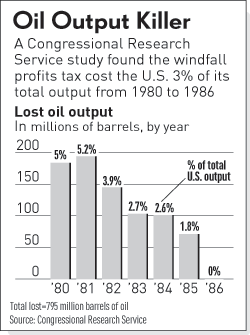
As any student who's taken Econ 101 at the local junior college can tell you, higher taxes don't encourage production; they discourage it. But Senate Democrats apparently played hooky the day taxes were discussed. They should at least have read the report from their own nonpartisan Congressional Research Service in 2006.It shows that from 1980 to 1986, the last time the U.S. had a windfall profits tax on oil companies, the results were disappointing. As the chart shows, oil companies were hit hard by the tax. And in line with basic economic theory, they produced less oil, not more.
Welch says his plan to suspend shipments to the national reserve is gaining support
Democratic Congressman Peter Welch says he's encouraged that a number of prominent Republicans are now backing his plan to suspend shipments to the national Strategic Petroleum Reserve.Welch says the proposal is part of a larger plan that's designed to reduce gasoline prices by as much as 75 cents a gallon.
A food security expert at UB says the worldwide food crisis is a direct result of the choices made by policy-makers and the lack of attention paid to the food system and its relationship to global warming and fossil fuels.
Germany Warns Of Economic Risks From Species Loss
BERLIN - Nations must act to slow extinction rates, German Environment Minister Sigmar Gabriel said on Thursday, arguing the loss of species threatened food supplies for billions of people.
Go Easy On Biofuels Until More Clarity - World Bank
WASHINGTON - A senior World Bank official said on Thursday that countries should not greatly increase biofuels production until there is more clarity about how much they have contributed to the global food price crisis.Juergen Voegele, director for agriculture and rural development department at the World Bank, cautioned against shifting a lot of the blame to biofuels but also said massive subsidies for the biofuel industry was not helping the crisis.
Salt water tested as fuel source
SEATTLE – For more than a year, it's been widely circulated on the Internet as a scientific oddity.Now a process that converts sea water into a possible fuel source is gaining legitimacy.
For Sale: Machine To Make Home-Made Ethanol
NEW YORK - A new company hopes drivers will kick the oil habit by brewing ethanol at home that won't spike food prices.E-Fuel Corp unveiled on Thursday the "MicroFueler" touting it as the world's first machine that allows homeowners to make their own ethanol and pump the brew directly into their cars.
Niagara Summit told of brave new globally warmed world
Niagara's future isn't as dependent on the mid-peninsula corridor and selling wine to Germany as it is on containing urban sprawl, improving public transportation and developing policies that will help the elderly and the poor cope with heat waves that push the mercury above 40øC for days on end, a renowned political scientist and bestselling author says.Thomas Homer-Dixon said municipal politicians have to start planning now for a world where extreme storms, prolonged droughts and oppressive heat waves are common. Where the increased cost of shipping food halfway across the world makes eating locally grown food more feasible.
Climate, Culture, and Collapse: Responding to Rapid Change
Recent and emerging observations of the severity of human-induced climate change have led to a feverish burst of publications imploring radical and immediate action. Many of the world’s most eminent scientists are now joining NGOs in calling for drastic halts in greenhouse gas emissions and societal changes on an unprecedented and global scale. The Climate Code Red Call for a Sustainability Emergency, for instance, likens our current position to that of the astronauts in the Apollo 13 crisis: a desperate time-crunch necessitating quick thinking, rapid response, and radical action.However, the magnitude of the climate issue is profound and the mainstream has not responded to the scale of the threat. We are at the cusp of a global crisis that is still only perceived by relatively few individuals and groups. The voices of these authorities – our leading global change scientists and organizations – are often muffled, suppressed, or diminished by the influence of media and mass culture.
Gas jumps above $3.67, oil passes $126 on Venezuela concerns
NEW YORK - Oil rose above $126 a barrel for the first time Friday, bringing its advance this week to nearly $10, as investors questioned whether a possible confrontation between the U.S. and Venezuela could cut exports from the OPEC member. Gas prices, meanwhile, rose above an average $3.67 a gallon at the pump, following oil's recent path higher.On Friday, The Wall Street Journal published a report that suggested closer ties between Venezuelan President Hugo Chavez and rebels attempting to overthrow Colombia's government. Chavez has been linked to Colombian rebels previously, but the paper reported it had reviewed computer files indicating concrete offers by Venezuela's leader to arm guerillas. That appears to heighten the chances that the U.S. could impose sanctions on one of its biggest oil suppliers.
"If we put on sanctions, I'm sure Chavez would threaten to cut off our oil supply," said Phil Flynn, an analyst at Alaron Trading Corp. "Obviously that would have a major impact on oil prices."
Light, sweet crude for June delivery vaulted to a new record of $126.20 in morning trading on the New York Mercantile Exchange before retreating to trade up $1.09 at $124.78 a barrel.
OTC: "There is plenty oil in the world" - Sandrea
There is no oil scarcity in the world, "there is plenty of oil in the world", Dr. Rafael Sandrea, president of IPC Petroleum Consultants Inc., a Tulsa base International consulting firm, speaking at a press conference at the OTC energy conference in Houston, on Wednesday, insisted.... Contrary to the case of scarcity of oil reserves, Sandrea proves with his model that global crude oil and natural gas reserves are still strong and only 20% of the discovered reserves have been used.
Even do some experts for see a crucial inflection point ahead, base in historic discovery rates, and their estimates of decline, in the world hydrocarbons reserves, claiming that a peak oil and gas production is looming and a collapse in in the horizon, Sandrea, said that until now, nobody has made a credible attempt to quantify future potential oil and gas supply in detail, ands on a global basis.
Sandrea concludes that, contrary to the well publicize "Peak Oil theory" that oil & gas reserves are in imminent danger of "falling from cliff", there is in fact spare capacity available with the demand and supply remaining in balance for decades to come.
Real Networks CEO Rob Glaser: He Got Game
Real Networks (RNWK) CEO Rob Glaser says his company so far is feeling few effects from the economic downturn. And in fact, the company today reported better-than-expected Q1 results.In an interview this afternoon with Tech Trader Daily, Glaser does say that the one area where he sees some “clouds” going forward is advertising, which affects several of the company’s businesses, but which overall is less than 10% of Real’s revenues. Ask Glaser about the economy, and he’ll say that while he’s bullish on his own company, he’s not quite as optimistic about the broad picture. Glaser says he’s a “peak-oil believer” who is on his third hybrid. Oil, he says, is not going back to $60 anytime soon, “if ever.”
Conversion to a symmetrical or parallel system for our world’s electricity generation will require a combination of small, locally-generated power supplies, coupled with individual home generation, in addition to the regular power grid supply. Conversion to a new world, not in geography, but in power generation will need to be developed as a hybrid of generation sources comprised of: Concentrating Solar Power (CSP), Hydroelectric, Geothermal, Wind, PV Panel, Tidal Current and Magnetic Linear Generator Buoys, plus Bio-Mass and Biogas in addition to coal and natural gas.
ANALYSIS - World begins to smart from oil's too rapid rise
LONDON, May 9 (Reuters) - From the poorest of Africa to the United States and big business, a breakneck rally that could take oil to $200 a barrel is likely to inflict pain on everyone.The world was remarkably resilient to a series of record prices in 2007, but a roughly 30 percent rise since the end of last year, with predictions of more to come, is harder to absorb.
"The key issue is the rate of change. The recent exponential rise is unhealthy for everyone," a senior executive from a major oil company said. He declined to be named.
Russia foreign investors unfazed by rows with West
LONDON (Reuters) - With oil at more than $125 per barrel and growth booming, foreign investors in Russia are finding it easy to turn a blind eye to disputes with the West and increasingly bellicose rhetoric over Georgia.
Record oil prices bring fresh interest in L.A.'s wells
LOS ANGELES — Record prices are prompting oil prospectors to renew interest in drilling in Los Angeles, where urban sprawl, environmental opponents and decades of production make for one of the world's toughest oil fields."We're more active than ever," says Tim Marquez, CEO and founder of Venoco, which is running wells and reviving old ones in the city and elsewhere in California.
March trade surplus widens on energy prices
OTTAWA (Reuters) - Rising prices for oil and natural gas exports boosted Canada's trade surplus to C$5.53 billion ($5.48 billion) in March, above expectations for a third straight month and the highest level since May of last year, Statistics Canada said on Friday.Analysts in a Reuters poll had forecast, on average, a trade surplus of C$4.5 billion. Statscan revised the February surplus to C$4.79 billion from C$4.94 billion previously.
Ensuring the Future of the Oil and Gas Industry
Despite the rising price of oil, experts predict that the oil and gas industry will experience a void in employees in the coming years. In addition to the "Graying Workforce" phenomenon, there simply are not as many young people joining the industry.
Chevron: 1,100 employees eliminated within reorganization
NEW YORK - Chevron Corp. said about 1,100 employees were eligible for severance payments at the end of the first quarter, after the nation's second largest oil company eliminated the positions as part of a restructuring and reorganization plan.
India: Coal situation worsens at thermal stations: Chinese demand eating into imports
Coal reserves at power stations have hit a record low.Nearly a third of the country’s thermal stations are now reported to be facing “critical stocks”, where coal stocks are expected to last less than seven days.
Planes fly more, emit less greenhouse gas
WASHINGTON — The U.S. aviation industry has cut its greenhouse gas emissions by 13% since 2000, even as the amount of flying has reached record levels, government data show.
Conservationists make most of real estate crisis
Plummeting real estate values and demand for new housing are hammering developers but helping conservationists, enabling land trusts to buy thousands of acres that were slated for development and preserve them as open space.
Michael T. Klare: Portrait of an Oil-Addicted Former Superpower
Nineteen years ago, the fall of the Berlin Wall effectively eliminated the Soviet Union as the world's other superpower. Yes, the USSR as a political entity stumbled on for another two years, but it was clearly an ex-superpower from the moment it lost control over its satellites in Eastern Europe.Less than a month ago, the United States similarly lost its claim to superpower status when a barrel crude oil roared past $110 on the international market, gasoline prices crossed the $3.50 threshold at American pumps, and diesel fuel topped $4.00. As was true of the USSR following the dismantling of the Berlin Wall, the USA will no doubt continue to stumble on like the superpower it once was; but as the nation's economy continues to be eviscerated to pay for its daily oil fix, it, too, will be seen by increasing numbers of savvy observers as an ex-superpower-in-the-making.
Oil price vaults to record 125.98 dollars
LONDON (AFP) - The price of New York crude oil surged past 125 dollars per barrel on Friday, lifted by speculative demand amid concerns about tight global energy supplies, analysts said.New York's main oil futures contract, light sweet crude for June delivery, spiked as high as 125.98 dollars in early afternoon London trading.
And London's Brent crude contract hit an all-time pinnacle of 125.68 dollars.
"Oil futures hit fresh record highs, continuing gains from yesterday," said Sucden analyst Michael Davies on Friday.
Prices have rocketed to fresh records every day this week on the back of unrest in key producer Nigeria, other ongoing supply worries and the weak dollar which stimulates demand.
The price of oil has soared by 25 percent since the start of 2008 and has doubled since the same stage last year -- when it stood at about 62 dollars.
Oil execs see $100-or-less cost by year’s end
HOUSTON - Even as oil prices ascended to new highs of more than $124 a barrel this week, many oil and gas industry executives say they expect the price to fall significantly by year’s end, a new survey shows.Fifty-five percent of 372 petroleum industry executives surveyed by KPMG LLP said they think the price of a barrel of crude will drop below $100 by the end of the year. Twenty-one percent of respondents predicted a barrel of oil will end the year between $101 and $110, while 15 percent forecast the year-end price to be between $111 and $120 a barrel.
UK: Thefts of heating oil rise
THE soaring price of fuel has prompted a surge in thefts of domestic heating oil from tanks outside homes and farms across the region....The oil thefts follows a trend of thieves taking items containing metals such as lead, copper and even platinum, which have all been soaring in value.
Scores of churches and schools have had lead stolen from their roofs, copper wiring has been stolen from alongside railway tracks. Catalytic converters have been stolen from vehicles parked outside garages and homes for the platinum they contain.
NYMEX: Speculators Aren't Driving Oil Market
Democrats in the U.S. Senate are looking beyond a summer gasoline tax holiday to focus on broader oil market fundamentals. Yesterday, Senate Majority leader Harry Reid [D-Nev.] unveiled the Consumer-First Energy Act, which calls for a revocation of tax breaks to big oil companies, a windfall profit tax and a cap on additions to the government's Strategic Petroleum Reserve.Included in the bill is a diktat to the Commodity Futures Trading Commission [CFTC] to substantially raise margin requirements for oil futures. That measure, say the bill's sponsors, would discourage excessive speculation which is blamed for fueling oil's meteoric price trajectory.
Gas prices hit 2nd straight daily record
The high price of gas has burdened motorists and truckers.It's also put the squeeze on thousands of farmers.
They drive tractors up and down row after row of field after field to plow, seed and tend to their crops. That means they shell out big bucks for gas and diesel, which set its own record Friday at $4.269 a gallon - and there's no end in sight.
Bill Olthoff, a farmer and member of the board of directors of the Illinois Farm Bureau, says a tanker of diesel cost him $4,000 about 10 years ago. Now he pays $30,000 for a tanker, which lasts him through the year at his farm in Bourbonnais, Ill.
Delta, American, United raise prices
NEW YORK (AP) -- The three biggest U.S. carriers said Thursday they have again raised ticket prices, this time by $20 roundtrip, to recoup rapidly rising fuel costs.
The Peak Oil Crisis: Transiting to Transit
With crude oil now above $120 a barrel and threatening to go higher, it is clear that our preferred and convenient means of going places, our car, the airplane and the rental car soon are going to be parked because they will be too expensive to operate.Like it or not, most of us are going to be riding some form of mass transit or multiple passenger vehicle – trains, buses, trolleys, car pools, van pools etc.- while waiting for our cars to be replaced with electric or higher mileage vehicles. As there are currently about 220 million cars and light trucks registered in the U.S. and 700 million or so elsewhere, the replacement process is going to be lengthy one.
GAS PRICES HIT USA HARD - special report by USA Today
Record high gas prices are prompting Americans to drive less for the first time in nearly three decades, squeezing family budgets and causing major shifts in driving habits, federal data and a USA TODAY/Gallup Poll show.See also:
● Interest in mass transit, carpools, scooters jumps
● Some rethink where to call home
Return of the population timebomb
It has become taboo over recent years, but population, not consumption, really is the key to managing our use of the world's resources, says John Feeney,Only since 1800, in the last 0.01 per cent of the history of Homo sapiens, has the human population shot into the billions. Now at nearly 6.7 billion, with 9 billion looming 40 years away, few environmentalists seem to care.
Yet the population-environment link is clear. Our environmental impact, as gauged by total resource consumption for a country or the world, is the product of population size and the average person's consumption.
Peru's Tribal Land Protected From Gas Concessions
LIMA - Indigenous rights groups praised Peru's petroleum agency on Thursday for excluding areas where isolated tribes live from an auction of oil and gas concessions.Rights groups say the decision is a turnaround for Perupetro, which previously had indicated it might open up the protected areas for bidding.
A Gulf in Giving: Oil-Rich States Starve the World Food Program
WFP internal documents show that the major oil producing nations of the Organization of Petroleum Exporting Countries (OPEC) gives almost nothing to the food organization, even as skyrocketing oil prices and swollen oil revenues contribute to the very crisis that the U.N. claims could soon add 100 million more people to the world’s starving masses.
Food banks urge passage of farm bill; critical shortage of food as clients increase
All of the participating food banks said their agencies are seeing families and faces they haven't seen before — working people who never thought they would have trouble making ends meet. One food banker in Minneola, N.Y., noted, "The middle class is accessing food from our agencies." Another relayed the story of a professional consultant that asked about emergency food assistance, "because her clients had not paid her yet and she was concerned that she may possibly be in need."
 |
On Saturday May 10th, letter carriers in more than 10,000 communities will collect food items and deliver them to local food banks to help some of the millions of Americans, including an estimated 13 million children, who face hunger every day. |
Contact
- Content: editors at theoildrum dot com
- Tech support: support at theoildrum dot com
License

This work is licensed under a Creative Commons Attribution-Share Alike 3.0 United States License.
They had a piece on the morning news on TV about how gas prices might hit 7$/gallon by the end of the year. Apparently in reaction to the Goldman Sachs thing that came out earlier about 200$/bbl oil. And then they did the obligatory interviews with folks at the gas station to get their reactions, which were quite predictable.
Note that the story on TV said "by the end of the year" - my recollection is that Goldman Sachs said that it could be in a couple of years...
At $125 it doesn't matter.
Seen everything that the FedRes has been trying to cover up since
Summer 2005?
Housing, food, credit cards, stuck with gas guzzlers?
Add $2 the gallon on top of that.
Kaiser Family Foundation Poll:
The poll listed gas prices as the number one economic concern for people living below the median household income in the U.S.
Problems Experienced as a Result of Changes in the Economy,
by Household Income
Percent saying each was a “serious problem”
Problems paying for gas:
<$30k, 63%
$30-$75k, 43%
>$75k, 27%
If you ask me, the number one use of George Bush's stimulus check for people living at or below the median is going to be filling the gas tank. The stimulus check will fill up people's gas tanks through the summer, with the caveat that it will also drive up gas prices even further.
The stimulus check was a brilliant plan to promote summer driving and increase the trade deficit.
"If you ask me, the number one use of George Bush's stimulus check for people living at or below the median is going to be filling the gas tank."
A poll just done (can't source it off hand, saying exactly that).
All utility bills. Which gives exactly zero stimulus.
Casaubon’s Book
Sharon Astyk’s Ruminations on an Ambiguous Future. ... Looking at my 2K oil bill, I can forsee what is going to happen to large numbers of my neighbors ...
sharonastyk.com/
It is amazing. George Bush has about a 20% approval rating. But it is "his" check that is going out. I thought that in about 3rd grade I learned that Congress (currently democrat controlled in both houses) had to pass any bill for the president to sign. Details are so troublesome.
We need to stop conforming and calling the stimulus check. This just validates it. Let's call it what it is: The Congressional Incumbent Protection Act.
I can't claim credit for that, I heard it somewhere (talk radio I think).
I call it HUSH MONEY.
That guy had a 10% approval rating when he stolled the chair. How'ed he gain so much?
And I live in the most corrupt state in the union (OH) [with pride], hell, we'd of laughed that rookie right on outa here. Guyz a f*cking ameture, or armeture, or whatever. My spell checker's taking a dip, sorry folks. As vice-president for the last 8 years, I'm not impressed. President Darth shoulda kicked his ass out long time ago.
F*ckin" *ssholes. Eeerrrggghhhh!!!
Perhaps that meme is what is needed to boost small car sales by more than the rather pathetic 18.9% recently reported. And "other adjustments".
Best Hopes for Both Smaller and Fewer Cars,
Alan
I'm hoping all of this leads to more motorcycle buddies to ride alongside when I'm going places on my motorcycle instead of my car. :)
I got my first motorcycle this year, at age 55. A 225cc Yamaha. Never been on one before. I can't wait till the speed limits get lowered. Another motive for conservation: fear.
I'm in about the same situation (55, never ridden before). I'm thinking about getting an electric motorcycle and completely cutting off from oil. I haven't done anything yet though.
I decided to learn on something I didn't mind crashing (which has happened). Used small motorcycles are trivially cheap compared to anything electric - and their range is much better (and can easily be extended by strapping on an extra cannister). I know the "purity" feeling - but I decided I needed to get started one way or another before I got any older. I forced myself to learn by signing up for a MSF class. I just wish the cars wouldn't tailgate while I'm still getting used to getting bashed around by wind at 40 mph.
I drive about 5-15 miles a day within a 5-mile radius of my home and get tailgated most days by some big SUV. That tells me a very large percentage of people tailgate out of habit and that would scare the crap out of me were I on a motorcycle.
You should see the file on my computer for gas prices that SUV drivers will soon face, for instance, at $4.00/gallon it would cost them $120 to fill up, at $5.75 or $200/bbl oil, it would cost them $175.50. I don't think that SUV's will be on the road much longer.
Wish that were true. In actual fact if your job is secure or somehow Fed government funded (e.g. medical related, or aid worker in NOLA or ...) and you live close enough to work that $7/gallon will not be enough. The folks who put on a lot of miles, or are facing income pressures will be the first to fold and get something smaller.
Driving every SUV and pick-up off the road could take 10 years. Still a lot of time to get hit by one.
Given a large SUV with a tank of 30 gallons, a fillup would be $210 at $7 per gallon. If one lives in the suburbs and fills up every two weeks, thats $420 per month. Double that if one lives in a busy metro like northern Virginia or Los Angeles which has atrocious traffic. Furthermore, many of these SUVs were purchased when gas was around $2.50 a gallon, meaning that the mortgages and finances of these people are not prepared for the price rises that are coming. In addition, $7 per gallon would force us further down into the permanent recession that comes with peak oil and that would likely mean job losses for many people. Also I can foresee huge federal penalties being assessed against SUV drivers when gas prices rise above $7 per gallon due to the ignorant public looking for a scapegoat after an attack on the oil industry didn't make prices go down.
What, you mean incessantly talking about how much Exxon made won't bring prices down? Shucks!
Hi Berkely and Shargash,
Now you have me worried about you!
Are bicycles safer, maybe? Especially once the dedicated lanes are installed?
http://local.theoildrum.com/node/3061
There's a lot of debate about this. The problem with bike lanes is that then there is this expectation that bikes not use normal traffic lanes. For example, to make a left-hand turn, you need to come out of the bike lane and get in the left-hand turn lane.
Another problem is that frequently right-turn lanes are to the left of the bike lane, so if you want to go straight on the bike lane, you have people trying to turn right in front of you.
Thus on many streets bicyclists prefer to take the lane. Get into the turn lane if you are turning, otherwise get into the thru lane. Otherwise you get sideswiped by a driver who doesn't see you in their mirror or some such.
Another point I can make here. People are worried about driving smaller vehicles (scooters, bicycles, motorcycles) - I guess mainly they are worried that people with big SUVs will run them off the road or something. My experience on a bicycle is that it is really all in your mind - the reality is nowhere nearly as bad as you think. Even when I drive my Jetta on the highway, if I take the right hand lane and drive the speed limit, I never feel threatened at all. Yet lots of people I know locally insist that they have to speed or otherwise someone run them over, but in reality they only intimidate you if you let them.
Hi ericy,
Thanks. I didn't realize it was quite this complicated. Perhaps in urban settings some combination of the "slow" dedicated lane and regular use of roads for faster cyclists might be the best combination. Or, what's your conclusion?
My original question was based on my personal observations. From my pool of acquaintances/friends, every commuter I've known who rode a motorcycle or motor scooter (Note: past tense) has had a collision, w. serious injuries. Whereas only one cyclist I know has. Though I do know of a cyclist on a road trip from Austin to Brownsville, TX, who was deliberately "scared off the road", i.e., attempted sideswipe by an SUV. A hopefully rare anecdote.
Bicycle boxes seem a good solution to the turning problem. They are used a lot in Cambridge, England, and seemed to work well in my experience when I was last there:
http://www.mtc.ca.gov/planning/bicyclespedestrians/tools/bicycleBox/inde...
It looks interesting - I would want to see how it works in practice.
Some people really like bike lanes. Along major arterials, it probably works better - places where the traffic volume or the traffic speed is high enough that it gets harder for a bicycle to take the lane. As you say, the box may help in such situations..
Take an AARP driving course. Your vision and reflexes are about half of what they were when you were 18. So, at 55, I would say (personnal opinion only) that it is NOT the time to switch to a motorcycle.
In my garage is a 300cc Honda scooter that does 90mpg and 95mph ( though probably not at the same time ), a 125cc Honda scooter ( 110 mpg and 65 mph ) and a folding electric bike that sits at 15mph with no pedalling for 20 miles. Outside is a rarely used 1600cc car.
I used to have a 1300cc bike, a 2500cc V6 and the 1600cc ... bikes rule as far as I can see. No traffic queues and almost free to run.
It will be a terrible day when I can't afford the 6 gallons a month for commuting. The rest is pure discretion and whilst I have a serious nett worth I still choose not to waste it.
Thinking of chickens ... do Bassetts eat chickens ?
Size of Market for Motor Scooters
The motor scooter market is the fastest growing motorcycle segment in the U.S.
From Aug 2005.
Would be interesting to know how many scooters/motorcycles the auto industry could produce yearly under mandate/subsidy.
"The motor scooter market is the fastest growing motorcycle segment in the U.S."
Do they come with extra-wide seats and beefy suspension ? I would be interested to know the cultural differences between, say, southern Italy/Spain and the sunnier climes of the USA. One chooses scooters en-masse the other not.
Is it down to aspiration ? Safety ? Cheap petrol ?
http://www.youtube.com/watch?v=-PmuHWPZSkY
I choose a motorcycle over a scooter for the many 4WD roads here in southern Colorado. No reason to cut yourself off from the majority of roads. A dual-sport motorcycle is a high-clearance SUV with 80mpg. A scooter is a low-clearance Prius with 120mpg.
I gave up on the car culture 3 years ago. I bought a Piaggio BV500, yes a 500 CC scooter. I weight 300 lbs and am 6'4" tall. I have no problems using this as my main commuting source. If I need a car I use ZIP Car. I used to scoot around DC and now I scoot around San Francisco. Even with the hills the bike has plenty of power and has a top speed of 100 MPH. I have been on the 101 and 280 with no problems.
Once I did the math it made no sense to own a car when I can rent a car by the hour and not have to pay gas or insurance. Plus I have lots of great cars to choose from. ZIP Car is an awesome service. If you live in a large metropolitan area chances are there are ZIP Cars near you or soon will be.
Along this line of thinking...the Scout signs (city electronic message boards) around the Kansas City Metro area having been displaying many messages like "Watch out for motorcycles", "This week is Motorcycle Awareness Week", and "Share the road with motorcycles".
This started happening about a month ago and never noticed them saying that before.
Perhaps KC city officials are expecting more motorcycle riders than usual this spring and summer.
Interesting. I'd love to be riding a motorcycle in KC, but the drivers here are so clueless I feel like I'd be taking my life in my hands...
I ride a motorcycle all over the country and rarely have any issues with other vehicles. In fact, most cars seem to give me extra room.
This week was the first time I saw those messages also. But, Kansas has been on a motorcycle awareness campaign for at least a couple of years. It was a big deal when I got my license renewed last year (posters at DMV and questions on the test).
Durandal - Where do you live?
i have bought a basic honda rebel and have been teaching myself to ride it.
i have to say it's interesting experience.
I'm tellin' ya, go have a look at the Japanese Kei vehicles, that's where we are heading. 660 cc (most turbo charged) and can fulfill most of what we do for every day personal transportation.
Unfortunately, the U.S. can't import anything less than 25 years old, so it is impracticable. In Canada the limit is 15 years and we can buy some very good condition used imported cars. 4 wd, funky stereos, what more do you need?
And if you want to reply about the safety with regards to the heavier passenger vehicles out there, don't. I will rip your head off!
I know most of us have been waiting for this...wait no longer!
http://www.autoblog.com/2008/05/08/its-happened-boy-hit-by-hybrid-mom-bl...
I was walking down the middle of a dirt country road when a hybrid came up behind me. I never heard it. He was nice enough to slow down though. I don't walk in the middle anymore.
Rick
One of the things that I found interesting about this is that the car did its job. These 2nd generation Prii were built according to a newer (not yet implemented, I believe) regulatory style that's supposed to protect pedestrians from collisions. Cow catcher, if you will. Rather than knocking them down to the ground and then proceeding to run them over, it scoops them and funnels them across the hood (with no sharp edges, and enough space between the sheet metal and underlying structure to absorb the impact).
Why don't they just add some device to the car, giving off engine imitating sound at low speeds? This should cost a buck or two and will end this stupidity once and for all.
How about people look where the hell they're going ? Seriously we have to ADD noise to our environment ??!
So, 800k Priuseses on the road and 1 no-injury accident and we all start panicking. Jeeeeeez. I bet more people caught Salmonella from organic eggs on the day of this 'news story'.
Fewer cars and Silent cars, please. And guide dogs for blind people. Stupid people should just avoid the streets altogether.
Don't forget the giant SUVs running over children in the drive way.
You could always drive with the window open and go "b-b-bbbbph-b-b-b-bbbbb-bbbphph". Don't forget to shift gears.
Really, sorry someone got hit, but knocking vehicles because they don't make enough noise? What a sad lot we have become.
Did you read the comments? One of the commenters said he/she would use a recording of a herd of buffalo to fulfill the "noise requirement" being proposed in congress. LMAO.
HR 5734 made me so mad I decided if I see a white cane I'm gonna honk the heck out of my horn and yell "Hey! watch out - it's a hybrid!"
Seriously, don't know about the driver of the Prius in the article, but I know my car is quiet and am extra careful when in electric mode and pedestrians are around.
Probably, the kid rode out into the street and in front of the Prius. I'll bet lack of noise had nothing to do with it.
There have been silent electric cars around for decades, and a lot of conventional cars are very quiet at low speeds. This is more "hassle the hybrids" stuff.
PHEVs and BEVs will be quiet at much higher speeds. Even the Prius can be in electric up to 30MPH IIRC, and this is not exactly a safe speed. A device producing low not-irritating warning sound can be helpful to pedestrians... I have been a "100% pedestrian" long enough to know this is important.
Robert Heinlein foresaw this problem years ago - his solution was to broadcast the sound of a Model T Ford from the electric vehicle!
I think legislation will happen, to set minimum audible sound from vehicles - let's' hope they are not as annoying as the various ring tones!
This is terrible. one great thing about electric cars is the prospect of the end of traffic noise. You could live next to a main road without bieng driven mad. The insane regulators strike again.
This is unjustified. ICE noise is proportional to engine speed, so a vehicle traveling with 60mph will produce roughly 6 times the noise of one driving with 10Mph (also with higher frequency and more irritating).
There is no reason this to be made the case for electric vehicles; they can set the sound output to be the same at all speeds, just to alert the nearby passengers. All vehicles may just be "humming" like a 10Mph car at all speeds.
The Prius can be silent at any speed. It's called gliding: ease off the gas and the ICE shuts off.
So long as it is slightly downhill, or you are OK with decelerating, as in pulse-and-glide driving or coming up to a stop.
At higher speeds (>42mph) it is harder to keep the electric motor off (as indicated by the display) but the mpg indicated is 99.9mpg, which is as high as my 2004 display will read.
I love it when there is little traffic on HWY 17 in the Santa Cruz Mtns (my old commute) and my battery fills partway down and I can glide all the way past the reservoir into Los Gatos. Would sure like to add more battery capacity for a longer glide!
Best vehicle I have ever had.
An SUV requires more braking distance than a smaller car. Those driving light trucks, SUV's, and minivans were more likely to kill others in crashes.
http://www.net-monster.com/blather_suvs_part1.html
The large vehicle concept may have caused more fatalities than would have been prevented if people were driving smaller cars. Due to poor handling of SUV's (rolling, greater stopping distances, etc.) the SUV driver was more likely to be in an accident.
$126 crude = $3 per gallon add 75 cents and you have the avg price of gas.
$180 crude = $4.28 per gallon add 75 cents and you have the avg price for $5 gas.
Remember though that crack margins have been crushed in the last year.
See Tesoro, Valero for details.
By $180, there will be riots.
Montreal is currently at $5.11 US a gallon and small scale riots have only occurred because of the performance of the Habs-the gasoline price hasn't been able to motivate the mob. Here in Toronto we are at $4.73 and there are zero signs of price effects on demand.
Here in Vancouver, I paid $4.96/gal for regular grade two days ago. At about $3.85/gal just across the border in Bellingham, WA, it's a steal.
-best,
Wolf
Except you will burn off the difference driving from Vancouver to Blaine, and burn even more in the Peace Arch border crossing line ups. Then, you'll have to put up with the storm trooper wanna-be DHS guards that are protecting the nation from rampant Canadian produce entering the country.
No guff, I saw a customs agent giving a Canadian truck driver grief over two bananas and an orange. "It's my lunch he exclaimed!" I'm sure Osama was hiding in one of those bananas. It's f&^ked up I can tell you, real bonkers.
Ah yes, we must protect ourselves from the import of Canadian oranges, lest we upset citrus growers in Florida. ;-)
LOL. So true. I especially enjoy the guards who walk up and down the lines of cars with their dogs and little pry bars, banging on cars, climbing in pickup beds, searching trunks, and so on. I've been in those Peace Arch parking lots wayyy too many times.
-best,
Wolf
75 cents = 45 cents for taxes, 10 cents for retail and transport, and 20 cents for crack margin.
One thought which just occurred to me is this: Many of the gasoline retailers also sell other stuff in mini-marts. They have been able to sell gasoline at rock bottom prices then make a profit on the inside sales. But, with gas prices rising ever higher, the mini-marts may not be able to sell enough higher stuff to make that profit. As a result, they may actually need to raise their gas prices above their costs to turn a profit. The result? Even higher gasoline prices.
One of my usual gas stops used to be the lowest price source for gasoline. Yesterday, they were the highest I saw, although local prices had just been bumped yet again, after declining a bit over the past couple of weeks. They set the price at $3.69 for regular. I would expect that we will soon think this price to be cheap, as $4/gallon is within spitting distance.
E. Swanson
Then the state police get involved.
As in, who authorized this "unreasonable" price increase.
http://www.cbc.ca/news/background/energy/gas-prices.html
What goes into the price of gasoline?
Last Updated April 24, 2008
All four Atlantic provinces regulate retail gasoline prices. In Nova Scotia, New Brunswick, and Newfoundland and Labrador, regulatory boards set maximum prices every two weeks in response to market conditions. In P.E.I., retailers must justify proposed gas price increases.
The increasingly underfunded state police might not have the manpower to get involved. In Oregon, at least on the county level, the public safety budget is the most vulnerable to being cut. I wouldn't be surprised if this is also the case at state level.
This is actually a lynch pin in my thinking for post peak. Seriously reduced law enforcement will enable a number of things. The "back forty crop" or the still, even just the ability to put anything on the road that's left that I want. It's actually why I like Maine, we're almost there already. I see an actual police car maybe once every 6 months. Some lucrative possibilities out there.
Doing security at the UofA graduation yesterday.
I commented that my Grandmother always carried a 1/2 pint
of Wild Turkey and a gun in her purse.
"It's actually why I like Maine, we're almost there already. I see an actual police car maybe once every 6 months. Some lucrative possibilities out there."
The above was the reason.
This may not be the best site for this question but what are people doing, if anything to cut back on their gas consumption? We drive as little as possible and when we do drive, we drive a Prius. We also have most of our food delivered.
We combine trips to the max so we would never just go into town for one errand unless it was an emergency. About the only thing left for us would be to move as we do live in the mountains. We are looking but it is going to take awhile because my wife is chemically sensitive and must minimize noxious fumes. In the mean time, there is not much else we can do to cut gas use so we will just have to eat whatever increases occur.
We don't have to commute so that is an obvious plus.
We also simply refuse to take a long distance trip by car and although this limits us as we plan to take all future long distance trips by AMTRAK. Our next trip will be from Denver to San Francisco, starting Monday.
Maybe there could be some kind of poll although, no doubt, the group that reads this site is probably not representative.
Carpool into town with neighbors and/or friends?
I bought a smaller car. Even though I liked having a bigger one, I didn't really need it.
I am staying in my small apartment in walking distance of work, stores, etc., even though most of my friends have bought houses in the suburbs or exburbs.
I never drove a lot in the first place, so I haven't really had to cut back. I do go on a road trip maybe twice a year, and I'm still doing that.
One thing I have changed: I try not to keep a lot of junk in the car. Just to keep the weight down.
If weather permits, I ride my motorcycle instead of taking the car. 80mpg is pretty good. Better than a Prius, even! (My Civic will get 44mpg on an average day.)
We are trying to plan and limit the household to one trip to town (50 mile round trip) a week, since we are retired.
I just threw down on an EV conversion kit for a Chevy S-10. My employer appears receptive to allowing me to charge at work at the already installed charging station. I'll keep you all posted on the project as it develops.
May you all have peace during the coming chaos.
Here in the UK the choice of cars that will do 60 mile per UK gallon (50mpg US) or more is growing fast. They are mainly diesels but the number of gas models is growing. They're ultra ultra compact by US standards and a squish for four adults but they do make fuel go a long way. Prices for basic variants in the UK start at around £7,000.
Look for simpler variants with small steel wheels - tyres/tires are mostly made from you-guessed-it and are just one of the thousands of everyday components whose cost will be going up along with the oil price.
I have expanded my "walkable distance" to about 1.25 miles. My cobbler is about 1.25 miles away and not along the streetcar line (there is a bus line with erratic service) and I need to half sole another pair of shoes#.
My goal this year is <60 gallons of diesel (excluding hurricane evacs) and <3,000 kWh. I am trending towards <40 gallons (and <2,000 kWh). By far the lowest in my adult life.
Best Hopes for Fuel Efficiency,
Alan
# I wonder if my cobbler bill will exceed my fuel bill ?
I find 2,000kWh per annum amazing - can you really run a household pulling only 228 watts every hour of the year? Don't you even run an electric refrigerator? Impressive Alan.
I think this is the replacement refrigerator for the model I bought (417 kWh/year, best 387 kWh/year)
http://www.sears.com/shc/s/p_10153_12605_04677922000P?vName=Appliances&c...
I also have a Friedrich window heat pump. Replacement version is YS09L10 EER (lower than SEER) of 12.
http://www.friedrich.com/products/LineModels.php?line=TTHP
A Mac Mini computer (31 watts when Airport is turned off) with LED screen, CFL & LED lighting (different roles for each), and more.
Best Hopes for Energy Efficiency,
Alan
Since I went to visit my brother in Paris about 4 years ago, I bought a bike shortly thereafter. Started walking anywhere within 1/4 mile or so, biking anything within 2 or 3 miles at least (if not more). Installed a white metal roof and some insulation... It finally looks like the state of FL is refilling the subsidy money pot for PV systems so that is my next step.
Although I have PV on my roof, a Prius, and a Hymotion kit on order, my last two purchases were a giant diesel motorhome and a large Sprinter van which I pull behind it. The whole thing is 63' long with a GCVW of 34,000 which with two wheelchair lifts, I'm hugging pretty closely.
I don't see conserving most of the year and splurging on very comfortable vacations as being mutually exclusive or immoral. As long as there is diesel, which is the real question, I plan on buying it at whatever price and continue to enjoy those 3 weeks a year when I'm not plugging my prius into my roof.
Here is the thing to consider. With supplies at peak, it is a zero sum game. Meaning if I don't use the diesel, someone else will. It's not my fault I was born in suburbia and have a good job and money in savings, and I'm not about to apologize for it.
I also use bicycles as transportation. I have four, including one I'm converting to electric.
There will be plenty of time in the future to sit around worrying about what to do with all these vehicles and no fuel to run them. I suspect a long fun vehicle free bike ride will be the order of the day.
LOL.
I remember how airdale reacted last time you wrote that you had a RV and $3/gallon was no big deal to you. His post was so violent and abusive that Leanan had to delete it. You are lucky airdale is not posting here anymore.
Yeah, lots of fun until their is no gas for you to buy. Then, at least you'll have a shoddy home to live in.
Made the biggest change in 2001 by buying a Honda Insight (I call is my Honda 'Foresight').
Plan trips.
Ride bike to town whenever possible. Especially to local pub (s'alright ossifer, my bike knows the way home...)
Stay at home and tend garden.
Carpool to entertainment events.
Bitch unendingly about the %&#@ 10% ethanol which has reduced my mileage by 15% !!!
When weather permits, I try to ride my bicycle to work 3 days a week. I find I need my car at least once a week to run errands and buy groceries and at least one day a week I'm either running late or need a car to go out to meetings. I've even started leaving earlier for work when I take my bike and taking a longer route that goes through some parks just to enjoy the morning. I'm lucky though, there is a shower at work so I don't have worry about getting all sweaty.
I like to do frequent road trips during the summer. I'm now trying to team up with friends so that we double our gas mileage. This has also allowed us to rent vacation homes in nice area vs. staying at a hotel or motel. Finding friends willing to fill up a car for a long car trip has gotten much easier with the big jump in gas prices vs. last summer. But if gas prices keep this pace, we'll be needing bus for our road trips.
Like the idea of going by rail but here in Canada, taking the train is comparable in cost to flying. Not sure why it's so much more expensive here vs. the US or Europe.
You don't need a shower at work. When I worked in Intel cubicle-land, I would bring a clean shirt and wash up in the men's room, took all of 2 minutes. Note that in more civilized parts of the world, men and women cycle to work at moderate speeds in full business regalia, i.e. suits, ties, and skirts respectively, and nobody thinks twice about it. When you're in shape a moderately-paced cycle ride will not make you sweat.
- Dick Lawrence
When you're in shape a moderately-paced cycle ride will not make you sweat
Not universally true.
The suit & tie bicyclists are disappearing about now in New Orleans. High 88F Dewpoint 72F today.
Best Hopes for Seasonal Bicycling,
Alan
Yeah, I know, you can, but we have showers as well, and it feels good after a long ride to the office. In our county, new commercial buildings are required to have showers installed. It it little things like this that don't cost all that much, and can become important.
If you shower before the ride and change into clean dry clothes at work, the BO bacteria don't really have time to grow. I've done this lots. Don't try it a second day without a shower though.
I recycle my dental floss.
searching for titles like "soylent green, the recipes" or "preparing the neighbors for dinner"
The Economist is reporting Renault-Nissan thinks electric (may be behind a paywall)
"Speaking at a media event in Portugal this week, Mr Ghosn said that the time for the mass-market zero-emission car has come. Nissan plans to launch a battery-powered car in America in 2010 and by 2012 the Renault-Nissan alliance will offer a complete range of electric vehicles in every large car-market. And these new battery-powered cars, it claims, will work out less expensive than equivalent petrol models."
The article also describes the project to fit out Denmark and Israel with 500,000 charging/battery replacement points and to sell EVs on the same pattern as mobile phones. Buyers will subscribe to a monthly payment plan that includes rental on the car and swapping exhausted batteries for fully charged ones at the charge points.
Oil at $125.98/barrel!!?? What's going on -- is peak oil here now?
I've been telling people it'll probably happen sometime around 2012-17.
I don't know if peak oil is her now, but does it matter? Peak or not, the pain is here and shows no signs of letting up. You may want to contact those people and tell them not to plan based on what you told them. Plan the worst; assume the peak is here now for all practical purposes.
I don't know if peak oil is her now, but does it matter? Peak or not, the pain is here and shows no signs of letting up.
That was precisely the idea behind "Peak Lite." The pain will come before the peak, so you are effectively at peak prior to peak.
Peak Lite
The price rise has been even sharper than I envisioned in Figure 3, though. I showed us hitting $100 oil in 2008, but we are now about a year ahead of schedule based on that figure (although the exponential function I used was mostly arbitrary).
Agreed. But only so far as pain is concerned. This also means that when the real peak comes, society will likely be well along the adjustment path. That's a good thing.
This also means that when the real peak comes, society will likely be well along the adjustment path.
What I have said before, is the best thing that can happen before peak oil is several years of escalating prices caused by supply/demand imbalances. If we peaked and fell off a cliff, it would be bad news. If oil gets very expensive for then next 3 years, then we peak, we will be better-prepared. Not well-prepared, but better-prepared.
Agreed. It is one of the reasons why I'm worried about all the complaining about "speculators" driving up the price of oil. Speculators are doing what they are supposed to be doing -- giving us an early price signal so everyone can react appropriately. If (and that's a big if) TPTB can derail speculation, all that will happen is we'll go back to some semblance of BAU until TSHTF and we fall off a cliff. Early high oil prices are a necessity for us to be even marginally prepared.
Actually, we're about two years ahead of schedule. The 2010 point on the green line looks to be about $126.
BTW, I remember that post Robert. I also remember the $100 oil bet of 2007. Doesn't that seem quaint, just 4 and a bit months into 2008.
How about a $200 oil bet by the end of 2008?
$126.20 so far today. I've been recording the price since 1/2/08 when it 1st hit $100. I wonder how many people with long commutes &/or low paying jobs have decided that it's just not worth it to go to work anymore, with the price of gas taking most of their wages. What's the point of working just to afford to drive to work, after all? I wonder how many people decide to forego needed prescription meds in order to be able to afford gasoline to get to work. This coming winter I bet that quite a few people, primarily the elderly & young children, will die from a combination of malnutrition, cold, & lack of medical attention, due to being unable to afford basic necessities. Die here in the USA I'm talking about. People won't be able to afford adequate food, heating fuel, medical care AND gasoline. Real hunger & deprivation are at hand for millions. The Great Unraveling we've been expecting since the late '60s has finally begun! \:D/
and there is always Tapis spot at $ 131.43 leading the pack http://www.upstreamonline.com/market_data/?id=markets_oil
Uh, boy. Check out this guy.
He wants to know what the "replenishment rate" is for an oil well.
Answer's at worldnet I'm sure.
... is he taking the looooooooong view (?) or perhaps he was the very first in line when the concept of IQ was announced to be implemented , but unluckily for him was slammed behind the door when God opened it ….
...when they were handing out brains, he thought they said trains, and he asked for a locomotive:)
I really can't remember where I heard this, but I think it was a reputable source: The replenishment rate is about 100,000 bpd. I believe that was a global figure.
We should do just fine on 0.1 mbpd.
I don't know where you got that figure Consumer but it was NOT a reliable source. Your figure is about a thousand times too high.
If we assume oil has been forming since 150 million years ago. (I know, a lot of oil formed before that but I had to pick some date.) And if we assume about 6 trillion barrels of OOIP is accurate then the correct figure would be 109 barrels per day.
Of those 6 trillion barrels of OOIP, only about 2 trillion barrels is recoverable. So recoverable oil has been forming at the rate of about 37 barrels per day.
Of course this is really an academic exercise as oil is not formed continuously but in spurts after prolonged periods of global warming. So it would really be more correct to say NO oil is being formed right now.
Ron Patterson
I remember the problem. The 100,000 figure was the number of barrels that we use for for each barrel that was created.
That would put replenishment at 850 barrels per day. Think we can get by on this?
So we only have to wait until we finish off that runaway global warming thing we've started, plus a few million years, and we could have our oil back? Never thought of it this way... gives some kind of perspective about the ultimate boom and bust cycles :)
Actually we may be creating an anaerobic dead zone in the Gulf, Ron. In the death throes of our civilization, we may create the conditions for some large oil fields a few hundred million years from now.
We need to put up a sign so that the intelligent raccoons that replace us know where to drill.
Hi Ron,
Just a thank you for this example of a question answered/corrected sincerely and with facts.
It comes in handy.
I think you're thinking about the paper mentioned in this Yahoo! message board posting. The paper itself is paywalled. That's a pity, because it's fascinating.
http://messages.finance.yahoo.com/Stocks_%28A_to_Z%29/Stocks_B/threadvie...
The number quoted in the paper for global oil generation in mature source rocks is about 2.7 million barrels per year, i.e. about 7500 barrels per day. It mentions an upper limit on oil generation about 3 times that figure, i.e. the equivalent of one good well.
About 20% of that generated oil eventually gets trapped in reservoirs. The rest migrates to the surface through permeable beds and fault planes and gets oxidized in the atmosphere. Reservoirs themselves apparently get destroyed by erosion or tectonic processes with a half-life of some 30 million years.
Darwinian - your approach is broadly correct, but 150 million years is too long, leading to an underestimate of accumulation rate. That 30 million year half-life is quite well substantiated by the geochemical evidence cited in the paper. Remember, just because a reservoir was deposited in the Cretaceous, doesn't mean it was filled in the Cretaceous (or whenever). Of course, 7500 barrels, 800 barrels or 100,000 barrels per day are equally irrelevant in economic terms.
The author goes on to use his model of global generation, migration, trapping and trap destruction to estimate ultimate conventional oil recovery of 4 trillion barrels. He freely admits that this is twice the currently known remaining reserves plus cumulative production to date, that he has no idea where the "missing" oil might be reservoired, if anywhere, and that 2 trillion just about fits into the error bars of his model. He also notes that "conventional" is a function of psychology, not geology, and urges his fellow geoscientists to be more imaginative in their search for oil.
Leanan - "He wants to know what the "replenishment rate" is for an oil well."
Apparently there is an important element of survival built into denial or "a certain level of self-deception". This morning on NPR there was a story about a questionaire titled "Personally Embarrasing Questions". They were:
1. Do you enjoy your bowel movements?
2. Have you ever wanted to rape someone or be raped by someone?
3. Have you ever considered suicide?
According to psychological research the correct answer to all of these questions is Yes. However the telling part was that those people that anwered No to the above questions have a far greater likelihood of being successful or highly satisfied in their lives and careers. Those resopondents who answered truthfully were more likely to be depressed and dysfunctional.
There is a price for the truth.
This answers a lot of questions. I actually AM from a different species.
Does this tell us more about ourselves, or about psychological research?
He should be concerned about the replenishment rate for brain cells.....
LOL, man I love this site.
In my case its depletion rate. Getting older + home brewed beer takes its toll.
I'm well past peak neurons myself....
For what it's worth, everyone's peak neuron level is just prior to being born. The birthing process culls off a bunch (in a normal birth), and you steadily lose neurons from that point forward. A toddler has about twice the nunber of neurons as his/her pediatrician.
Go running. It works off the calories from the beer (I happen to love homebrew as well) and it's supposed to promote the growth of new brain cells. Win win.
So how many quarts of 10W30 do I need to plant???
[ok ok this is my last username change. Finally got it the way I want it]
The market doing its thing.....
Gas costs deflate prices on used SUVs
How much copper in one of those babies? Or platinum in the CC's catalyst?
Dunno about copper in particular but that does raise an important point.
People fear that post-peak we will not have the resources to build new infrastructure.
That fear is overdone. And the reason why is that much of the resources we currently use to build bad infrastructure will be freed up for good infrastructure. Electric street cars are made from roughly the same materials as SUVs.
The primary resource that will be in short supply will be energy, and that fear, if anything, may be underdone.
Certainly agree that transportation fuels could be very expensive post peak. But the entire energy picture is more murky. A deep recession in the States could easily lead to excess electricity generating capacity. (Which is the reason I haven't sunk much into wind or solar power lately. We need that bridge)
The portion of the cost of new infrastructure directly linked to oil doesn't seem likely to be overwhelming to me. And a deep recession would put something of a lid on those costs, too.
This argument may seem hand-wavey but it won't be if oil stays at current levels. If it does, I would expect to see costs rise generally but not nearly at the rate oil has risen. And some of those rising costs are attributable to a world economy that is still growing nicely.
"Certainly agree that transportation fuels could be very expensive post peak. But the entire energy picture is more murky. A deep recession in the States could easily lead to excess electricity generating capacity."
Huh? You must be joking.
Around here fuel oil/kerosene for winter heating/hot water are so expensive people are switching to plug in electric heaters or heat pumps. And you think somehow a recession is going to easily lead to an excess in electrical generating capacity?? Recession or not, people will need to heat their homes to keep the pipes from freezing, and the energy choice now is cheap electricity.
Todd
not to mention it's also a race against time. the second people can't maintain that stuff is the second nature starts chipping away. within a few years paint chips as wax is washed away by weather, a few more years and the steel(putting aside the valid point that most steel will not be re-usable) will turn to rust. a few years after that other metal's corrode and degrade into uselessness. the age of salvaging will be done well within a person's lifetime.
if you want to get a good idea on this look up the book 'the world without us' which can easily be applied to a situation when we can't keep up the needed maintenance.
Are we at peak stupidity or peak "just kidding"?
Let's try working some figures... the Chrysler deal only gives you 36k miles of fuel (2400 gallons at 15 MPG) and you need to use it within 3 years. So, even if gasoline goes to $8/gallon at some point in time during those three years AND you stand at the station during that price period and sell gasoline to everyone who pulls in so that you maximize your benefit (no use buying gas now when you only save $0.65), you still only make 2400 * ($8-$3) = $12000. If you require premium fuel you only get subsidized beyond $3.30, so knock $720 off that savings right there.
The sales tax and registration (in my state) on the new vehicle will cost you nearly $4000. If you lose $10k in the trade-in you are well below the savings you could get at $8/gallon. If we do see $8/gallon, I assume the government will step in and do something such that you won't be driving much anyway.
I've heard this argument about mercury in the cfl bulbs; because of the higher mercury content incandescents are better - more environmentally friendly. I think XCel Energy sums it up pretty well:
http://www.xcelenergy.com/XLWEB/CDA/0,3080,1-1-2_738_9850-363-5_406_676-...
I would assume that equation only works for coal (probably more specifically: XCel Energy's coal usage).
The problem is one of local concentration and dosing. Overall output into the environment is important too, but if you happen to be the one that broke it then you've gotten more than your fair share.
Got another Megaprojects question: is there a database of declines? An Anti-Megaproject, if you will.
Will of course be the production equivalent of 20/120 vision...
EIA is the one I use - there are others - all are in error to some extent, but in my experience historical data is more accurate than future predictions.
I was thinking more of a public domain version of the IHS database - don't they charge big $$$$ for that, though? Would probably be overkill for the layman anyway I suppose.
Would be nice to have something graphical you could mess about with in a simple fashion. I'm always envisioning some way of presenting data in novel ways, but I'm anything but a coder.
The first of the ~7000 giant windmills the UK government wants to see installed in the North Sea by 2020 are being built now.
Watch the video and see if you think this is good news or bad.
Notice that, as with nearly all so called 'renewables', substantial amounts of Fossil Fuels are needed to build the windmills and operate, manage and maintain them on an ongoing daily basis - in twenty years or so there will likely be little or no 'net exports' of oil available to power the boats or build replacement windmills when these wear out! Is this form of power sustainable?
http://news.bbc.co.uk/1/hi/business/7390996.stm
Exactly, fuel costs for maintenance of the windmills will be enormous, unless they decide to use sailboats, which sounds like a joke but it may become reality someday.
The build costs are horrendous.
Around three times the equivalent cost per watt generated compared to nuclear power.
It is a totally different kettle of fish to on-shore wind in the States, and only an idiot would consider it.
That means the British Government and EU commission are very keen! ;-)
I've seen ideas for floating offshore platforms that combine wind, solar, ocean thermal gradient, ocean current, & wave all in one. This would make a certain amount of sense. If you are going to build something offshore, then really get a lot out of it.
Yeah, other ideas may make sense - the straight economics of off-shore wind using conventional turbines look very poor though, and as was mentioned it would use up loads of fuel to service.
I can see genuine renewables alternatives in the States, but for northerly, crowded Europe resources which won't bankrupt the country are hard to find, and the UK government seems to think we have all the time in the world to fiddle about.
Still, they have constructed plenty of LNG import terminals for just a few billion.
It is just a shame that so far they haven't got any tankers at all coming in, as LNG is in short supply.
DaveMart -
You have to be careful about your basis of comparison. Essentially, wind and solar power both inherently have a very high capital investment but a very low operating cost in comparison to both fossil fuel-based and nuclear electrical generating plants. That point is not in question.
However, what is less clear is how the live-cycle costs compare. In other words, over the projected life of the generating system, what is the total amount of money spent divided by the total amount of electrical energy generated. And once you get into life-cycle cost comparisons, then the cost of capital plays a very large role, as does projected future fuel costs. This is where the guessing game begins.
One thing that can be said about both wind and solar power systems is that their life-cycle costs are probably far more predictable and stable than that of fossil fuel and nuclear. Once the capital investment is made, then the remaining operating and maintenance costs for wind and solar are highly predictable. On the other hand, attempting to project what the cost of coal, natural gas, or enriched uranium will be 20 to 25 years out becomes an exercise in pure fiction.
Yes, offshore and on-shore wind are different kettle of fish. Offshore wind is almost always more powerful and steady, yet costs more to build. In the US at least, most of the really good on-shore wind sites are in the central portion of the country. On the East Coast good accessible onshore wind sites are few an far between, which makes offshore more practicable in many ways, particularly in the crowded Northeast.
I wasn't entirely serious in saying that supporters were idiotic - the temptation to put the words 'idiot' and British Government together in the same sentence was too much for me!
I don't know why I bother, as most of their actions link the terms so effectively anyway!
However, the costs In have seen for off-shore wind are quite staggering, around £66bn for 33GW nameplate, about 10GW average output per hour according to Government and industry figures - the plan is to build them quite close to the shore, so winds are not much stronger than on-shore, and wind resources here are not so good as in some places in the States, so the Government gives 30% as the capacity figure.
On the downside that figure does not include much of the linking needed, so you can add several billions for that, and maintenance will be costly and fossil-fuel intensive.
On the bright side it tracks use in the UK very well, being around two and a half times more powerful in the winter when demand is around four times as high as in midsummer.
I just can't see it being built though, not at that cost, I think they will build a few at high cost then give up.
And no-one is more concerned about that than I - we have a massive energy gap opening in the UK, and no sensible or coherent plans to fill it - the nuclear build will take some time to get going in quantity, and the Government is sleep-walking there, imagining that it has all the time in the world to consider it's options.
Unlike in the US, with our country mostly being at latitude 50degrees north or worse, other than residential solar thermal any thought of utilising solar power at anything less than financially suicidal prices make no sense for the foreseeable future - it just doesn't produce enough power in the winter when it is really needed - even off-shore wind makes more financial sense.
Basically, we are stuffed, far more so than the US - not as far as getting to work, as most people can manage by public transport, however inconvenient, but in basic power generation, where we will have massive shortfalls when we can't import the LNG the Government has counted on.
They will probably build more coal plants.
That's not so much higher than the alternatives.
Nuclear is apt to come in at £4.8bn per 1.5GW (1.6GW plant @ 90% capacity factor), or about £32bn for 10GW excluding fuel and decomissioning costs. (Although I suspect the wind estimate excludes the costs required to deal with its intermittency - pumped storage plants in Scotland, most likely - so both are somewhat low.)
£66bn is a lot of money, but 10GW is a lot of power, and there's no way you'll ever get it without spending tens of billions of pounds. Wind is, roughly, twice the cost of nuclear, but has the added benefit that it lowers the reliance of the UK on imported fuel (uranium).
EDIT:
That is completely false.
Here are stats from the UK government regarding monthly electricity consumption. There has not been a single month in the last ten years that deviated by more than 30% from the average that year.
Please, go look at the data for yourself. Demand is not four times higher in the winter; it's one-fourth higher.
Actually, the reference you quoted gives the cost at £4.5bn, not £4.8 - still a lot of money, I would agree.
However, as you will be aware, fuel costs for nuclear are tiny, and in fact according to the recently retired Chief Scientific Officer of the UK, could be fuelled with the wastes already held in the UK for many years.
You will also be aware that de-commissioning costs due to the way compound interest works is a fully costed component of nuclear power, and is relatively trivial - around £0.50/MW if memory serves.
Running and maintaining the reactor would, however cost considerable amounts of money, but so would maintaining off-shore turbines, so that is pretty much of a wash.
Life-span is a different matter though, as you would be lucky to get 25 years out of an off-shore turbine, although to be sure the base would still be there, and some of the cables and so on to reduce the cost of replacements.
So you are building a facility that will last around 60 years as against 25 years, for £3bn/GW, as against £6.6GWbn plus transmission costs plus back up.
My real concern though is that these costs for nuclear are based on the very latest figures, and are way up on what they were.
As far as I can see, the estimates for off-shore wind are based on Government DOE estimates from 2006, since when costs are likely to have gone up, perhaps by as much as the inflation in nuclear costs.
Don't get me wrong, an off-shore wind build would in any case fit in very well with a nuclear build, in particular because of it's peak in winter, so it is not either/or, and nuclear will take years to get on line.
I just can't see any way that the costs can be got down to anything affordable, or I would be all over it.
Wind power in the American great plains is half the cost, and maintenance does not give problems - a totally different ball game.
I largely agree with you, but not that £66bn is unaffordable. Based on budget projections, that's less than 1% of what the UK government will be spending between now and 2020.
It might be a poor spending choice, of course, and it doesn't seem like it's the cheapest option, but the amount spent by major governments is so massive that even £66bn is hardly a bank-breaker.
(As an aside, the link giving the £4.8bn figure notes it's "excluding the cost of decommissioning ageing reactors or dealing with nuclear waste.")
The UK budget is just about to fall off a cliff.
The deficit is far worse than the US, and the housing market and the pound far more overvalued.
No efforts have been made to secure natural gas supplies, instead they rely on dealing on the spot market, so fuel costs will rise much more than most places.
I'd love off-shore to be viable, as it can be built far more rapidly than nuclear, but I simply don't think it will happen.
They have painted themselves into a corner and will build coal plants, and hope that they can import supplies for them, which may be doubtful.
Apologies, I have mis-stated the case - thank you for the correction.
The point I was trying to make is that base-load in the UK is around 20GW, and maximum peak around 75GW, with the minimum happening in a hot day in June, say, and the maximum on a cold winter day or evening.
The variation in wind power is in fact a strong point, as it is most powerful when most useful.
The figures you quote would indicate that nuclear power would be a good choice for a higher proportion of power than I was aware of - average use is around 45GW/hour, I believe, so a build up to something like that value sounds a lot more economical using your figures than building substantial off-shore wind - but the high cost of the wind-power alternative gives me no pleasure.
Unfortunately UK coal output peaked in ~1913, currently UK coal production is just ~6% of peak - just like oil, gas, uranium and windmills (to name but a few) we are dependent on the 'net exports' of other counries. Sigh! Is this sustainable?
BTW, the UK is in a better energy position than most of the other 27 European States.
Has anybody explored the geotherml option for the UK? With new drilling technology its potential is vast.
http://space.newscientist.com/article/mg12917564.900-technology-britain-...
They tried it, but gave up, partly due to technical problems, and partly because FF were so cheap
And here is the news bit to confirm your points:
http://news.bbc.co.uk/2/hi/business/7391056.stm
The price of gasoline is slowly changing commuting patterns in Los Angeles of all places. More people are taking public transit and using alternative means to get around.
http://www.latimes.com/business/la-fi-pennywise9-2008may09,0,5598202.story
LA is so vast that eventually activity will have to be limited to 5-10 miles radius areas. In fact, in LA County you already have several business/commercial hubs with their own high rises etc such as Downtown LA/Mid-Wilshire; Century City/Beverly Hills; Hollywood; the Ventura Blvd corridor including Sherman Oaks/Encino and Woodland Hills; Glendale/Burbank; Pasadena; LAX/Westchester; Long Beach/LA Harbor; not to mention the burgeoning Irvine/Costa Mesa metroplex in South Orange County. The LA Metro area has 15 million people. It will become more and more "fractionalized" as car mobility decreases in the future.
Yup - and the only way forward is to link up all of the mini hubs by rail or busway. The most ironic thing ever is now the Westside of LA now wants to have connections with the Red Line. Traffic is so bad at the side of town that average commute time within the Westside is 45 min just to get across town during rush hour.
Hummp - it was the wealthy Westside that fought the subway to the sea for years.
If you want to have a good cry go to Philip's in Chinatown. In the back there is a history of rail display (Philips was originally next door to the Grand Central train station) and see the above ground Red Line that was torn down in the 1950's.
I've noticed this too, definitely more and more cyclists all the time, although our numbers are still small...
I have people asking me all the time where I got my cool Dahon bike!
I agree that activity in LA will tend to become more localized as time goes on and center around the various subcenters, this has been a trend for awhile already...the areas of town that already have the rail infrastructure in place (downtown/Wilshire and Hollywood especially) are going to densify and centralize more and more I believe, while Culver City and the Westside wait years for the Expo Line and Red Line Extension...it is a delicious irony to read about Westside traffic tho I agree!
How long before we start drilling in Anwar and off the coasts of the US? I'd give it 3 years. Not that it's going to matter at all.
Maybe legislation to drill in Anwar and off the coasts of US in the next year or two. Actual drilling will take a lot longer.
That's probably right, and if Obama is president which seems likely and he vetos this he could be impeached.
That ANWAR oil should stay in the ground until the US government has understood how serious global warming is. All projects to mitigate the impact of peak oil (e.g. rail electrification) and to decarbonize the economy need freely flowing diesel. If the ANWAR oil is used for consumption now instead of reserving it for these projects, we may not be able to get them off the ground.
Few have understood that:
(1) during the warm periods of the last 400 K years CO2 concentrations in the atmosphere were never higher than around 300 ppm. We are now at 385 and rising
(2) with our current CO2 concentrations we are on the quickest way to go back to a period 2-3 million years ago in which planet Earth was much hotter and sea levels much higher than now
(3) There is 0.5 degrees warming in the pipeline from PAST emissions, that is even if the whole world stopped burning of fossil fuels tomorrow that would be the new temperature
(4) We have no idea what that 0.5 degrees warming will bring us: melting polar ice caps, more and bigger storms and cyclones etc. If during that trip to higher temperatures we pass one or more of the tipping points - after which climate change can get out of control - we are really stuffed
Read from NASA's James Hansen here:
Target atmospheric CO2: Where should humanity aim?
http://arxiv.org/abs/0804.1126
By the way, Jim wrote this:
http://www.columbia.edu/~jeh1/2006/NewSchool_20060210.pdf
Exactly that happened in Burma.
Eye catching headline.....
Great tits cope well with warming
From article...
...The research uses a long record of great tits in a breeding site at Wytham Woods near Oxford, where observations began in 1947.
"We think it’s the longest running population study of wild animals anywhere in the world where animals are marked (ringed)," said Ben Sheldon of Oxford University, who led the new research...
Anyone want HIS job?
I thought the same thing.
And I was even joking to myself that bigger breasts help radiate heat :).
Hello TODers,
Head of UN urging creation of global fertilizer bank. Will my speculative 'Federal Reserve Banks of I-NPK' soon be created too?
http://www.ajc.com/opinion/content/opinion/stories/2008/05/09/fooded.html
-------------------------------
GLOBAL FOOD CRISIS: Nations, farmers need our help
By Ban Ki-Moon
...It might be tempting to let the markets work their magic. If prices go up, the thinking goes, supply will too.
But we live in the real world, not the world of economic theory. In Kenya's Rift Valley, the bread basket of East Africa, farmers are planting only a third of what they did last year.
Why, when you would think higher prices would prompt them to plant more? Because they cannot afford fertilizer, which is also skyrocketing in price.
We see the same in Mali, Laos and Ethiopia. This is a prescription for disaster.
... That is why the Food and Agriculture Organization has called for $1.7 billion to support an emergency initiative to provide low-income countries with seed, fertilizer and other agricultural inputs required to boost production. The International Fund for Agricultural Development will make $200 million available to poor farmers in the most affected countries. The World Bank is considering the establishment of a global crisis-response facility for this purpose.
---------------------------------------------
IMO, the biosolar mission-critical investor helping the farmer afford I/O-NPK will be a critical theme going forward if we wish to continue eating. I have many postings in the archives further detailing this topic. Hopefully, the 'Murkan public will soon wake up, then jumpstart this idea before a crisis erupts in North America.
Have you hugged your bag of NPK today?
Bob Shaw in Phx,Az Are Humans Smarter than Yeast?
Could this be the initial North American nucleus?
http://www.canadiancattlemen.ca/issues/ISArticle.asp?id=84040&issue=0507...
--------------------------------------------
UAP takeover complete
Calgary fertilizer and ag retail firm Agrium has officially wrapped up its US$2.65 billion friendly takeover of UAP.
...The deal is expected to make Agrium the largest North American retailer of crop inputs and services. The FTC had noted Agrium is already the largest retail farm store operator in the U.S., with 433 locations in 31 states.
UAP runs about 370 distribution and storage facilities in the U.S. and three formulation plants, selling chemicals, fertilizer and seed to farmers, commercial growers and regional-level dealers.
UAP's Canadian wing, based at Dorchester, Ont., includes warehouses in B.C., Quebec and Ontario and product lines of herbicides, fungicides, insecticides, nutrients, adjuvants, inoculants, growth regulators and other specialty products.
-----------------------------------------------
The penny dropped for me this morning regarding supply and demand in the economic sense.
Economic supply and demand are not measured in material units, but in currency units.
Thus you have demand for XXXX dollars of crude oil, not demand for XXXX barrels of oil. Once this is resolved out the current situation begins to look a lot more like the optimistic forecasts. Of course, since those forecasters didn't realise that they were modelling dollar demand instead of volume demand they made all sorts of unwarranted conclusions from their numbers (like oil prices dropping back to $20/barrel realsoonnowhonest).
Also, in the sense of dollars of oil production, we are at all-time record highs. (85Mbd*$125/b -> $10.6 Billion of oil per day)
For those in the marketplace that still think the price of oil is due to manipulaters, it should be clear now just how steady the incline of the price of oil has been. If it had been due to manipulaters then as the price of oil dropped back from close to 120 to a little over 115 that would have been the bubble that would have sent all those manipulaters to sell, sell, sell! But instead the price steadied and today hovers around 124-125 a barrel.
I remember the Hunt Bros. manipulating the silver market in the late 70's and it spiked at 48 bucks an oz. The bubble burst and it fell to grace. The Hunt Bros. were prosecuted for price fixing and paid a hefty fine. They had so much money they could maniplate the price of silver upward. I doubt that on a global scale of oil futures there are speculaters wealthy enough to run this illegal gambit.
It would be great it if was a bubble that could burst then prices at the pump would drop back down, but instead its probably supply failing to meet demand. I'd be curious to know if any of the stat people on this site have a mbd figure that would provide enough supply to reduce the price. Would 91 or 93 mbd do it?
Another inconvienient truth from a new satellite -
http://www.enterstageright.com/archive/articles/0508/0508globalcooling.htm
wow, that is shocking
some shill for a right wing think tank doesn't think AGW is happening
The Hudson Institute: "The Institute promotes public policy change in accordance with its stated values of a "commitment to free markets and individual responsibility, confidence in the power of technology to assist progress, respect for the importance of culture and religion in human affairs, and determination to preserve America's national security."
"Corporate contributors include Eli Lilly and Company, Monsanto, DuPont, Dow-Elanco, Sandoz, Ciba-Geigy, ConAgra, Cargill, and Procter & Gamble."
yep, no surprises there at all
and how is it possibly "Gore's"? - Gore is hardly a leading climate scientist - it amazes me how much the right wingers hate that man for making a documentary film and actually winning the 2000 election
Posting about global cooling in reply to a completely unrelated post just makes you look like a trolling moron, so you know. If you posted it as a new comment at least it wouldn't get dismissed milliseconds after I started reading.
yep.
Global Cooling
Inconveniently coming to a civilisation near us.
Get used to fluctuations .
Our entire civilisation developed and lives in an Inter-Glacial Period. (thats the short warm bit between the long cold bits)
Wait for it...Wait for it...
KILL THE UNBELIEVER!
CHASTISE THE HERETIC!
SUFFER NOT THE WITCH TO LIVE!
Dennis T. Avery is one of the better known climate change denialist. He has paired with Fred Singer, perhaps the leader of the denialist efforts, in writing a book.
Singer (and the Heartland Institute) just released the "Not IPCC" report, which has all the usual lies and disinformation. Singer claims that "models are not evidence", yet, at the very beginning of his NIPCC report, he presents in Figure 2 what he calls "Temperature values from the GRIP ice-core borehole in Greenland". Funny thing, those graphs are the output of a series of model runs which attempted to reproduce the actual temperature profile, as measured down the borehole. It's almost as Singer didn't bother to read the report from which he lifted the graph.
Then, in Figure 3b, Singer shows a "temperature reconstruction" that was so bad that it had already been corrected by the time Singer used it. Even that corrected result is flawed, as I have written about and hope to see published in the near future.
Another often repeated piece of disinformation is the statement that the Earth has not warmed since 1998. Well, 1998 was certainly a very warm year, however there have been several years since which were warmer than all previous years in the record ACCEPT 1998! Their comparison is completely bogus, because data from one year doesn't prove a trend in climate. Of course, all those comments regarding temperatures ignore the fact that the Arctic Sea-ice exhibited an unprecedented minimum extent at the end of last summer's melt season.
These denialist liars deserve to be thrown in jail, IMHO.
E. Swanson
What is a climate change denialist? This term needs more definition I think.
Marco.
Perhaps I should have used the term "Anthropogenic Global Warming denialist", but that's a little deep for the average reader to grasp. By "denialist", I an referring to those who are actively spreading disinformation and anti-science propaganda which oppose the current understanding of the problem of AGW. They have a rather loose knit connection thru various conservative think tanks. They spread their press releases widely thru conservative news organizations and web pages. They tend to repeat the same old claims, even after these claims have been thoroughly debunked by other scientists. They are political operatives, not scientists, IMHO.
E. Swanson
Would you put the denialists in cells adjacent to or opposite from the cells that contain the 70's gurus who claimed another Ice Age was imminent and that we would all die from cold and being buried under a mile of ice by 2020?
On geological time scales, another "Ice Age" is "imminent", that is to say, another 120 thousand year period of ice is likely to begin within a few tens of thousands of years. Fixing an exact time is not possible. There were a few researchers that concluded that "imminent" meant "within a few decades", but that was not the thinking of most scientists of the time. Of course, there were sensational reports in the MSM, just as we see today on other subjects.
http://en.wikipedia.org/wiki/Global_cooling
E. Swanson
Read on......
http://www.giss.nasa.gov/research/features/temptracker/
Matt - thanks for drawing attention to this very important event for "climate science" which is the eruption of Mt Agung on May 16 1963.
You are right that Sato, Hansen, McCormick and Pollack (JGR 98, 1993) built a model that forecast global cooling as a result of this event - but they were pretty careful to emphasise this was a model subject to debate and revision. However, Stott, Tett, Jones, Allen, Mitchell and Jenkins (Science 290, 2000) simply took this volcanic aerosol cooling theory and built it into their climate model to poduce the result below:
Ever since this theory has been adopted as fact by "climate science" and is regularly trucked out as a cornerstone of the proof for AGW. The simulated cooling from 1963 departs from the observed warming trend. You say that the predicted cooling associated with Agung matches the observed data - WHERE DO YOU SEE ACTUAL COOLING FOLLOWING THE AGUNG ERUPTION?
To help you through this heres an annotated chart:
You'll see that Stott et al model cooling following Krakatau, Agung, El Chinon and Pinatubo. The worrying thing here for "climate science" is that there is no observed cooling after any of these eruptions - especially Krakatau - which suggests to me that the theory of global cooling following volcanic eruptions is just plain wrong and much of the evidence for AGW hangs on this theory!
I wrote to Peter Stott asking him to comment - his reply was that volcanic cooling was coincidentally masked by el Nino warming. To my mind that is flimsy bordering on pathetic.
To drive the point home, heres a chart of measured reduced optical transmission at Mauna Loa associated with these eruptions. There was virtually zero reduced transmission following Agung. Unfortunately I don't have the source reference for this work and so reserve the right to modify my view here should this be proven wrong.
To summarise, as far as I can see there is no physical justification for modeling cooling post-Agung and using this model to amplify / exaggerate the AGW effect 1980-1998 is unsound.
One final point. You claim the Earth is warming when it is a matter of fact that 1998 was the warmest year - the consequence of a super el Nino event. The sooner all "climate scientists" fully acknowledge this fact the better for all concerned. To simply gloss over this is dishonest.
I'd say that there is only a very, very remote possibility that CO2 in the atmosphere caused this super el Nino - and it is whatever did cause this super el Nino to happen that is the cause of much of the post 1998 warm period in the Pacific which has led to anomalous warm water flowing into the Bering Strait and accelerating the melt of Arctic Sea Ice as you rightly point out.
For the record I do accept that GHGs lead to some warming of the atmosphere - but not on the panic ridden scale we are being led to believe. There is a huge amount of natural variance in the atmosphere - ocean - solar system, system that current climate models do not capture and attributing virtually all 1980 - 1998 warming to GHGs is a major mistake IMO. The grand solar maximum in 1986 (Lockwood and Frohlich 1987, Phil Trans of Roy Soc), the PDO (Pacific Decadal Oscillation) set in warm mode for that period and the super el Nino of 1998 are all culpable IMO.
Hi Euan,
I'm curious - did you post this at www.realclimate.org, and if so, what was the response?
I have trouble understanding the theory that speculators are responsible for the runup in oil prices. I can see how a deep pocketed speculator could run up say silver if they had a place to store it. What I don't see is how speculators could control the front month future contract for WTI which is what gets quoted in the press. At the end of every month the front month contract expires and buyers of that contract must take delivery or sell the contract. A speculator who held a large volume would need to close out the position if they did not have storage capacity. I would expect the resulting sales to bring the price back down if there was really more oil than actual users needed that month.
My broker assures me that the speculation effect is real but they cannot explain how the speculators are getting past the expiration without taking delivery.
BTW I see how speculation could bid up multi year contracts but they are not the ones everybody is complaining about. (In fact they are still below the 1 month contract.)
Anybody out there who can explain this. I think the most obvious answer is that the speculation theory is dead wrong and the shortage is real.
There have been several excellent posts by Moe-Gamble and a couple of others who know the trading world. The conclusion is that the speculation theory is bunk.
It seems to me that in a market with as great a volatility as crude oil, traders would be extremely skittish about going out on a limb either long or short. I would expect traders to play the short term trends but not risk anything far out. This is a totally uninformed opinion, partially born of my own cautious nature.
Well if we believe in peak oil then far out long contracts are a good investment. (Until and unless the financial markets collapse.)
I have been very successful with investments in long contracts.
The unsung joys of mass transit...
Canadian train quarantined after woman dies on board
Of course the lesson to be gleaned is not to be afraid of Transit, but of Human Beings in general..
or the food served more likely
doesn't this happen fairly often on cruise ships?
I don't think anyone's ever died of those cruise ship norovirus outbreaks. I think that's why there's a quarantine. It's the fatality that has them worried.
Well, there's certainly good reason to be afraid of human beings. Indeed, it's not peak oil most of us are worried about, but our fellow humans' reaction to peak oil.
But I think this is a real drawback with public transportation. Not just trains, but planes, buses, etc. It's a very unnatural situation. You're crammed into a small space at high density with often inadequate ventilation. Remember the panic there was over SARS, when it came to riding trains and planes?
Anecdotes: my son (age 36) came down with acute bronchitis OVERNIGHT. Diagnosed at clinic and immediately put on antibiotics. A friend told the story of one of his friend's 13 year old daughter who caught the respiratory bug, was taken to emergency room and told to go home...where she died (assume she should have been on antibiotics and wasn't). In November I came down with a horrid norovirus where I literally passed out on the bathroom floor. Also my husband and I had a horrid bout with a respiratory bug in February which lasted for at least two weeks...he went on antibiotics as well. And I got another norovirus just a couple of weeks ago which struck out of the blue. (Others here got it as well.) AND, while having blood drawn two days ago (routine) the phlebotomist was sick (with a mask on her face) and related that she had the respiratory bug a couple months ago...for a month, and now she's caught it again. Anecdotal observations of this past "sick season" indicate to me that diseases are getting more virulent. I've taken to traveling with "wipes" in the car.
My wife had some respiratory bug that lasted about a month and at one point, she coughed so hard, she cracked a rib bone. That, in turn, took about a month of recovery.
Those bugs have been going round the UK since Xmas and have taken down victims at all levels of fitness.
The unsung joys of "car driving"
http://www.nola.com/news/t-p/metro/index.ssf?/base/news-28/1210051290253...
Best Hopes for Fewer and Smaller Cars,
Alan
That sounds like the unsung joys of walking, to me.
Some WTI Spot Price Graphs
Here's the monthly spot price for WTI, EIA data, no inflation adjustment:
The escalation of price since about 2002 looks pretty shocking these days. Wow!
A 3rd-order polynomial has been fitted to the noisy monthly data. From that line, a set of prices can be taken to measure the rate of increase in WTI spot price since the last low point in roughly 1998. Here's a graph that outlines the results:
Looks like, since 2002, oil prices have been increasing approximately 20% each year (compounded) in a fairly steady progression.
-best,
Wolf in YVR BC
Which means that those saying that the price might be due to drop back to $80-ish might be technically correct -- FOR A SHORT WHILE. Only for a few weeks, though.
Yep. I guess that's when we all need to buy our futures contracts. Options are now priced ridiculously and nobody's crazy enough to sell 'em past 2012 or so.
Be there or be square.
buying (or selling) an option past 2012 has nothing to do with market makers being unwilling to sell them - at a certain volatility they will add or subtract from their option book and hedge with underlying. An option is just a partial exposure to a future, with time premium and implied volatility. The reason there aren't many trades is that the underlying doesn't trade often out that far. But its starting to - long dated futures went up as much as front month this past week - 2012 and beyond all around $120
I have been thinking about methane hydrates, from a GW point of view would it be better to aggressively pursue the extraction and combustion of the methane to turn it into CO2, or let the methane itself escape into the atmosphere.
I understand that methane has a much shorter lifetime in the atmosphere, but is 13 times as potent as a greenhouse gas
I think we have to phase out coal with nuclear and large scale CSP, then wind and PV at point of use. Natgas and possibly a small amount of IGCC to fill in the gaps. Of course we should be drilling the ANWR of conservation.
Jeovans paradox is dead if you can't afford to spend any more on energy.
http://www.nuclearoil.com/
Worth a read, idea to replace coal burners with pebble bed reactors.
It would be much better to extract and burn, but this is not easy to do. People (like the Japanese) are trying very hard.
My understanding of hydrates is that the problems are twofold:
1) Flow. You can heat them up and get some out, but you have to heat a huge area because they don't flow. Or you can apply a vacuum, but you have the same problem.
2) Refreezing. You have to keep the lines warm to keep the clathrates from freezing again while moving up the line. This is especially a problem for the vacuum technique.
Brilliant idea! Now all you need to do is come up with a method by which we could extract these methane hydrates. It was rumored that Japan had found a way but this proved to be unfounded. No one has even come close to figuring out how to extract these hydrates which lie scattered about, all over the world, under hundreds of feet of silt on the sea floor, or which lie scattered over thousands of square miles underneath the permafrost of the arctic tundra.
Digging them up, either under the sea floor or deep in the arctic tundra would create an environmental disaster of biblical proportions. And at any rate only a very tiny fraction of them could ever be harvest. Best leave them where they are and hope for the best.
Ron Patterson
Hi, perhaps you could expand some of your abbreviations?
Some like PV are common enough, but for people who are not in the field the others could do with being laid out.
The chief hassle of nuclear power is that by the time our beloved and wise leaders have figured out that we need to do something, we won't be able to afford the long lead times involved in bringing nuclear power on line.
These long construction times put up the cost a lot through interest payments, and the builds are still fairly one off.
The size of the reactors also means that transmission costs to remote locations can be high.
What would be nice is a much smaller reactor, producible in a factory and burning up a lot more of the fuel - something like this, in fact:
http://nextbigfuture.com/2007/11/nuclear-battery-can-be-used-to-help.html
Next Big Future: Nuclear battery can be used to help blunt peak oil
This would not be so good as a thorium fuelled molten salt reactor, but that would take a while to get ready for production as it was killed because it was no good for weapons production and the builder's could not make money by processing the fuel.
This sort of design should be mass producible by the thousand, w0ould alleviate the alleged concerns about uranium resources, would enable the cheap extraction of oil from tar sands and possibly oil shales, and could be installed at point of use, minimising load on the grid.
Nuclear power is all good, but you still have to go through the steam cycle and play by the rules of thermodynamics. You could make use of the waste heat for food production (greenhouse, fish and insects) and also assist in aerobic composting.
Food and energy production are a national security issue, and should have much more attention paid to it.
Perhaps this will be usefull if there is a die-off:
New idea in mortuary science: Dissolving bodies with lye
http://news.yahoo.com/s/ap/20080509/ap_on_sc/dissolving_bodies_6;_ylt=An...
Yikes! you could do almost the same thing at room temperature and pressure in a reusable plastic, glass or stainless tub using protein dissolving enzymes + detergents in water, if you were willing to wait a little longer. The bones would be left intact, so you would have to break them up mechanically , or, I suppose, you could bleach and mount them, set up grand dad in the hall just like in the high school biology lab :)
Perhaps instead a new eco-friendly building material.
Then he dug up her grave and built a cage with her bones
Excitable boy, they all said
Warren Zevon
And it looks neat , too.
"Russian oil production will never reach 10 million barrels per day." Leonid Fedun
http://www.economist.com/business/displaystory.cfm?story_id=11332313
This might be the wrong place to ask this question, but I will pose it here nonetheless.
I was discussing energy supply issues with a colleague (we are applied mathematicians studying digital signal and image processing, not at all energy experts), and my friend mentioned that he thought it should be plausible to extract a significant amount of electricity through accessing heat from the mantle of the earth. I.E. dig a hole deep enough so that the ground temperature is very high, push in water, pull out steam and use it to generate electricity. (I also remember reading an Isaac Asimov story that had one planet that used this idea... not that science fiction is a good guide to properly dealing with our energy crisis :)
There has been a lot of discussion on this site of many different alternative energy sources, but I haven't seen this type discussed (other than "standard" geothermal which involves essentially mining steam vents that exist naturally). I sort of assumed that what my friend proposed couldn't be that simple, otherwise it would have been done before.
Could anyone with better knowledge than myself comment on what the problems with the described scheme would be?
For info on this resource see here:
http://en.wikipedia.org/wiki/Hot-Dry-Rock
The resource base is large - see the MIT report.
Difficulties include the rock not fractioning well - this is occurring in one of the present experimental set-ups - they drilled one hole to pump the water down, and two for it to come up from - one isn't working so they are only getting half the power they counted on.
There was also an earthquake in Basel referenced by Wiki, which may have been due to the water injection.
They put one too close to a small town in Germany, and it is causing subsidence:
http://www.telegraph.co.uk/earth/main.jhtml?xml=/earth/2008/03/31/eager1...
Germans get sinking feeling over energy plan - Telegraph
Not quite the same, but The Geysers in Northern California - the largest geothermal development in the world was running out of steam a few years back.
They now inject wastewater to recharge it.
http://geoheat.oit.edu/bulletin/bull18-1/art37.htm
http://www.geysers.com/renewable.htm
I know this belongs somewhere else too, but for entertainment value: has anyone looked at pumping water into the yellowstone supervolcano magma chamber? Seems like it could have potential to produce a lot of electricity or destroy civilization with a massive eruption (depending on execution), either of which might be desirable for the planet if done in a timely manner.
Eighty-nine percent of the houses in Iceland were heated with geothermal heat.
http://iceland.ednet.ns.ca/schedule.htm
I know I have suggested it before. It may also prevent an erruption if it drew enough heat out and solidified the magma plume a bit more.
I bet it would solve all your US electrical needs for 100s of years
Not sure if people saw this, I didn't see it posted above:
http://www.nytimes.com/2008/05/10/business/worldbusiness/10oil.html?hp
Poor article IMO:
Is this actual production or "quotas"? The writer doesn't examine this question.
Besides being poor English, who is this said "analyst"?
They really ought to print a graph of the dollar (vs. a basket of currencies) in the same article if this claim were indeed true...
JAD MOUAWAD, the author, gets written about here every so often. Overall I think this article shows that he needs a really good editor to ride him, but alas with the NYT going downhill and all they probably don't have any editor to spare.
Did anyone notice that the oil futures market is now in contango? Well, for the first month anyway.
The front month, June, settled at $125.96 and the next contract, July, settled at $126 even.
The front month settled up $2.27 but all of the following contracts closed up far more. Many of them over a dollar more. I noticed the same phenomena yesterday. The far out months are moving more close, in price, to the front month. The December 2015 contract is $119.80.
http://futures.tradingcharts.com/marketquotes/quickquote.php3?sel=Crude+Oil
Ron Patterson
Yeah according to one of the news stories that means that this is a supply side issue.
There is some sense to that. As you approach the expiration, there will be many traders selling the June and buying following contracts. So anybody buying a new position today (an up day) might feel safer buying July. But the shape has really changed in the last few months, even in the last couple of weeks there have been a couple of times where I've noticed the far out months moving up significantly more than the near months.
I think it was the fall where I picked up a 2010 contract at a $20 discount to the front month. I figured if the price didn't move I would still do pretty well. That trade isn't there any more. (They say there are few small players in the futures markets, I'm in the ultra tiny end of the range, certainly not an expert.)
I heard this old tears for fears song, mad world and thought about peak oil during this line: "I find it kind of funny, I find it kind of sad, the dreams in which I'm dying are the best I've ever had." That can apply to the world today if you change some words around: "I find it kind of funny, I find it kind of sad, the dreams in which we're dying are the best we've ever had."
http://www.youtube.com/watch?v=9ZRib_aAQFQ
How about another great song of theirs---"Everybody Wants to Rule the World"??? Maybe someone should email the link from YouTube to Dick Cheney and the neocons!
In the video two men are dancing next to a defunct gasoline pump!!!
I'd like to see cheney dance next to a defunct gasoline pump.
China and Oil-Exporting Nations Buying Farmland Around the World
Here is a big development that deserves its own article, if it hasn't been covered already. NPR tipped me off about an hour ago; the Saudi Arabia story began on Monday but didn't hit mainstream press that I'm aware of. Read the following and put the big picture together. What will the U.S. government do when prime farmland in Iowa, Indiana, and Illinois is being sold to Saudi Arabia, Qatar, and the UAE? From the oil-exporting nations' point of view, farmland is a damn good investment. They already have the fertilizer plants.
- Dick Lawrence
ASPO-USA
http://chinalawpracticeblog.com/?p=57
http://www.arabianbusiness.com/518778-qatar-seeks-to-stake-claim-on-camb...
http://www.arabianbusiness.com/518499-saudi-eyes-food-investments-overse...
Ya, but here's the catch. Once countries start "nationalizing" all their natural resources (and I'm convinced this will happen) all contracts will be broken. So, unless the Chinese, Qatarians (sp?), and Saudis are going to occupy those lands they are buying and producing food upon, they may have to forfeit them when things get desparate.
I remember a similar panic during the 1970's when oil, land and grain prices were rising. At the time the villain was Saudi Arabia who was supposedly going to buy up farm land. Some wanted laws passed to stop it.
Of course it makes no sense to try to stop it. The land can not be moved to Saudi Arabia even if they own it. They will have to hire Americans to farm it or rent it out to Americans to reap any gain off it. They will have to pay property taxes on it just like American farmers do. And I would expect they would have to pay American income taxes also.
The clincher is that to buy the land the Saudi's would have to pay the market price to the current owner who is presumably an American. No one gains or loses in a fair market value transaction. The seller gets the money the buyer gets the land.
If land prices are rising American landowners are benefiting from the increased foreign buying. Be sure that property taxes will rise to reflect the higher prices and the government will collect more money.
There is no downside to increased foreign purchases of farm land except for those who want to buy land on the cheap. They seldom ever buy any because of that attitude.
I can see a lot of downsides for countries selling their land to foreign owners.
Although America would be safe from armed intervention, I can easily imagine China intervening in, say, Cambodia if supplies were interrupted in any way, so at an extreme in food-stressed situations it could mean the locals staving whilst food was exported.
There are upsides too, as this re-invention of colonialism could greatly increase African productivity - not much chance of Chinese ownership being expropriated a la Zimbabwe, or the Chinese army would certainly take action.
For those who dislike agribusiness, then foreign ownership of land even in America would make it more difficult to convert to small, organic models of agriculture, and one may also wonder if China would have even the same marginal interest in maintaining the water table by good practises as the present farmers, or avoiding stripping the soil.
If food was short in China, it would seem to me that the land abroad would be pillaged quite ruthlessly.
The Chinese seem to be going for 'pseudo equity' in foreign mining firms. When all the next 10 years output is locked in and the plant is paid with soft loans that is better than shareholding.
I'll say something I'm sure that others have thought about. The next step is for China to bring in their own nationals as workers. Something like this seems to be happening with copper in Zambia and nickel in Papua New Guinea though not so far in Australia.
except for those who want to buy land on the cheap. They seldom ever buy any because of that attitude
My grandfather bought and sold about 1,700 acres of Kentucky Bluegrass with that attitude (while farming it) and ended up with 804 acres in 4 farms.
Cheap land comes and goes, and comes back again.
Alan
Hello DickLawrence,
Thxs for these links--I speculated on Sovereign Investment Funds [SIFs] pursuing this exact course in a series of posting months ago. I simplified this topic down to the basic analogy that an 'owner of a hen is entitled to the eggs'.
If we could figure out the investment percentages of biosolar mission-critical resource companies already owned by these SIFs--> I think most people would be shocked, especially if this new topsoil acreage is added to the equation.
For example: if KSA's SIF owned 25% of the shares of P & K mining/fertilizer companies [the Hen], then they could powerfully argue that they should be given first right to buy 25% of their output [the eggs]. As you already mentioned in your posting: they certainly have a very large position in the Haber-Bosch natgas N-fertilizer market, thus further I-NPK resource integration is a logical course of action right on through to the farmland.
As posted before: farmland is like an SUV. It is fundamentally non-productive [Liebig Minimum] unless the [topsoil] engine can get both oxygen [energy and/or labor inputs] and fuel [I/O-NPK and other trace Elements]. The planted seeds are the 'sparkplugs' to make this photosynthesis machine go.
Bob Shaw in Phx,Az Are Humans Smarter than Yeast?
Several people on TOD have mentioned the possibility of (in transition) possibly converting existing ICE vehicles into PHEVs.
Just ran across this (not endorsing it):
http://orangehues.com/blog/2008/05/our-inefficient-cars-poulsen-hybrid.html
The torsion bars seem a tad weird.
Pete
"The torsion bars seem a tad weird."
Don't underestimate torsion bars. They can be easily adjusted by a few turns of a large nut and the car can be raised or lowered to make up for added weight, i.e, the batteries. It is a very good solution. I remember that torsion bar cars were well thought of for electric car conversions in the 1970's. Given the weight of the old lead acid batteries in those days, it worked.
RC
"Oil prices may hang above $100 a barrel for the rest of this year but will fall as low as $80 next year as world demand slackens and Saudi Arabia tries to buy influence with the incoming president by pumping more crude oil, an influential Lehman Brothers analyst said in a report issued today. "
What bullsh*t. There isn't going to be a next year. Next year was last year. WestTexas nailed it with the ELM. We continue to disregaurd the rest of the up and coming world to our well deserved peril. "World demand slackening"? Hah!!
"...an influential Lehman Brothers analyst"??? What the F*ck? C'mon already. What a bunch-a-hooey. Made me spill my beer. Going to the store, be right back. I got yer influential analyst right here palzy.
Jeff Pissed
I wonder if this influential f&ck has anything with this statement from the article:
"There's a history of output increases, not exactly coinciding with the election but a few months afterwards," says Crandell.
Can anyone confirm/repute that statement?
A quick check of the IEA data doesn't support the statement. Looking at Jun93 and Jun01, Saudi production in Q1 and in May is a fair amount lower than Q4 of the year before.
So I'd take that statement with a grain of salt.
Superspike...nah, can't happen...can it?
Well, well, it likes like the full blown hysteria has hit the old proverbial MSM! So long the co-conspirators in the "Iron Triangle" hello panic prone nits racing around like chicken little on uppers!
In the last couple of days I have heard that oil is soon to be $200 a barrel. $200 my arse, said another wise "investment advisor", we'll see $400, maybe $500!
It started to look like some were doubting the endless forever run up in commodity prices, but no more! Everyone is hunting for a way into this goldmine! This is going to be easy pickings, and if you missed the run up to $120, don't fear, there is no where to go but higher, this is great, it's a market that you simply cannot get into too late!
Reminds me of the glory days of the housing boom! You simply COULD NOT LOSE!
In the meantime, SUV sales are essentially dead, with one dealer on the national news showing the only one that he had even been willing to take as a trade in for a tiny car...it was from his mother, and no one has test driven it in the month since it has been on his lot, and people are on longer waiting lists than ever for hybrids! But we all know that consumption CANNOT DROP.
In the meantime, even per TOD analysts, the production of oil, while flat, has so far shown no "falling off the cliff" as of yet. But we all know it's over, we are soon to see rapid and increasingly fast production drops while at the same time, consumption just keeps rising.
Who knows. It could happen. In fact, it better happen. More and more people and institutions are betting their money, their retirement and their future quality of life on the absolute assurance by the experts that it WILL HAPPEN, and NOW.
All I can say is, this time, finally, they had better be right. If not, there are going to be people who suffer some serious financial pain. And they will remember to blame the "experts" who led them down this path, and ignore them from then on.
Oh, by the way, someone pointed out the other day that Yergin and CERA had seemed to change sides recently, and were now talking in terms of $150 per barrel oil. For all those who have been saying for a long time that the best bet in the world is to listen to Yergin and bet the other direction....think about it.
RC
Roger: OTOH you have been an excellent contrary indicator yourself. I remember your unique conspiracy theory wherein KSA is just waiting to flood the global market, killing competitors in the process. Re current prices, it is only recently that the reality that KSA has no ability to raise supply has been widely accepted.
Where intellect meets reality is where the rubber meets the road with diesel selling in rural Middletown, California for 4.70 a gallon! Four seventy!! Diesel use to be much less than regular, but not with Europe and Chindia using ever more the price is skyrocketing.
Even though I agree with the many concepts surrounding peak oil, I'd still like to think prices will come back down, even if they don't come all the way back down. Please tell me this is a blip on the radar screen.
I find it interesting that economists and marketplace pundits chalk up a lot of what oil trades for to the lowering of the dollar, almost as if to say oil really isn't going up that much, its just the dollar that's tanking. But what's causing the dollar to tank? Well count them, 1. Rising debt from 5.4 trillion to 9.4 trillion during Bush's two terms due to 3 huge tax cuts for the super wealthy and two wars, one of which is unnecessary, 2. Lowering the interest rate to a historic low 3. Hundreds of billions in bad home loans 4. Bailing out weak banking system due to bad loans 5. Loss of more U.S. manufacturing and 6. Continued huge trade deficits.
In other words we are paying more for oil for a very good reason, because our currency isn't worth as much as compared with other world currencies due to fiscal mismanagement. So when someone tosses salt over their shoulder with a whimsical, half hearted, "Oil is just more because the dollar has devalued", you let them know we are paying the correct price for a gallon of gas based on the valuation of our currency. So those bucks we all bring home aren't worth what they use to just a few months ago. Food and fuel are more. Bush/Congress' incompetence cost us a lot more than we could have ever anticipated.
Don't get me wrong we're all facing increased oil prices due to increased demand from Chindia, i.e. peak oil, but a hefty percentage is due to the tanking dollar.
I think the last figure I saw in regards to that was $25, can't find link. If so we will blow through that in about 2 months at the rate we are going. Also, the dollar has been stable for like a month.
So your source is estimating a 25 dollar increase in the cost per barrel of oil from the tanking dollar. It's amazing how many different opinions there are on the subject. I'm sure 10 different sources would each estimate different amounts.
Talking about tanking currencies, expect the Euro to no longer exist fairly soon.
Strains between the various parts were always high, as the different economies have different growth, inflation, balance of payments and deficit characteristics and not so much common taxation as is normal in a single currency zone.
High oil and gas prices will blow it apart, with the southern countries being the first to fall out.
You think you have dropping real estate prices in America?
In some parts of Barcelona prices have halved.
How much of the Greek tourist trade is going to survive high air fares?
Italy is a fiscal disaster waiting for the blue touchpaper to be lit.
I doubt it will help America much, as the dollar should remain weak against the Yen and renminbi, but at should strenghten against the coming turmoil in European markets.
And the pound should sink like a stone, as all the fundamentals are worse than in the US.
Those pundits and 'economists'? are short of some basic economics. All the world’s currencies are fiat currencies based on the growth of debt and economic activity. Their current value is a subjective judgement of the short term investment market that has little to do with medium or long term reality, whereas their real value (eventual value) is hugely inflated by the diminishing limited resources which are now starting to peak out, of which above all else is oil. If we look past peak oil, and really past peak everything, we can start to appreciate just how ridiculous our currency systems are.
Now, coming back to today we see a complex interrelationship with currency and commodity prices, hence the confusion amongst the pundits and even the economists. The driving force in the market is the increasing demand of everything by the growing economies, mainly China and India. At the same time the world economy has reached a peak in supplying ever-increasing amounts of resources at ever increasing rates. Here at TOD we are analysing the peak in the rate crude oil production but we could just as well look at the rates of steel, copper or rice production struggling to keep at pace with this growth of demand. This is the basic root and cause where one should start.
However, the price dynamics in the market cannot be directly derived from the isolated analysis of each commodity's supply and demand because of the interrelationships between them. The price of oil being the price of the most versatile of our energy sources, and the one we are most dependent on with the systems we have built, is the most important. In its role it directly guides a large proportion of the prices of all other commodities in our economy. For example in food production we talk about 'the oil we eat' and so on.
Thus the currencies themselves are dysfunctional. Really, we should use oil as the currency of our civilization just as past civilizations have used salt. As fiat currencies based on debt, the paper monies of the world can change value due to government policies, runaway banking and speculation. They are dysfunctional because they are dislocated from the real everyday economy of energy, food, materials, etc. However we know that sooner than later the market will catch up and realize their true value, because after all, at the end of the day currency as a promise to pay is only worth something if you can back it up, and the day will come when the people will want to be paid - not in paper money, but real tangible things. You cannot eat paper money for food, nor burn it for much energy. And in a world with ever diminishing amounts of resources per capita, growth of economies (growth of money supply) will eventual lead to such a day.
Now, as said in the beginning, this is just some basics and the complexity comes in analysing the details of this dysfunctional system: for example how the pump price is derived from the crude price, the complexity of the chains interlinking such relationships with refining and transportation economies, speculation and government tax and regulation all coming to the mix, its no wonder that we see confusion amongst even so called experts. However none of these details really change the fundamentals: the peak oil, and eventual peak everything.
As a side note, I've been carefully following the day to day commodity and currency markets because of some (bad) investments I've made and it seems to me that the dollar hasn't really 'tanked' as much as it should. I can only assume that the large dollar reserve holders like China and the middle east are quietly backing up the value of the dollar to maintain the value of their reserves, although I can find no real evidence of this?
- Ransu
Currently All Liquids is about 86-87mbpd.
What production level would be required today to have the price back at $40 ?
My estimate is 92mbpd for All Liquids. Meaning we are (assuming zero useful spare capacity currently) 6mbpd short.
This is based on extrapolating the World production curve from 2002-2005 (where price was below $40) and ignoring the plateau that has actually happened since.
This explains why price is currently well over $100, and why I believe that any large price pullback that occurs in the next few months (due to bad bad financial news) will be short lived. World oil supplies are extremely tight. All this 'plenty of supply' by OPEC and others is utterly misleading. There is always plenty of supply at the current price isn't there?
Hello TODers,
http://news.morningstar.com/articlenet/article.aspx?id=237835
---------------------------
The Saudi Arabia of Fertilizer?
---------------------------
Also consider my earlier posting where Saudi Arabia gave $500 million to Morocco-- speculatively building a future economic moat for Phosphate? The double whammy combo of KSA's sulfur [extracted from their sour crude and natgas] and FF-energy to mine, then beneficiate Morocco's phosphorus rock--could they ultimately become the dominant low-cost producer?
Bob Shaw in Phx,Az Are Humans Smarter than Yeast?
Hello TODers,
Is Africa the Land of the Liebig Minimum?
http://allafrica.com/stories/200805091057.html
---------------------------------------------
Africa: 'Political Will' Needed to Address Food Crisis
..."In the short run we need soil fertility," said Dennis Garrity, director general of the World Agroforestry Centre, headquartered in the Kenyan capital, Nairobi.
"Farmers in Africa desperately need nutrients in all forms to replenish their depleted soils. The continent is the lowest user of nutrients, as farmers use less than 10 percent of the fertilizer required per crop."
---------------------------------------------
In the long run they need maximum O-NPK recycling to restore soil fertility and to help offset I-NPK rising costs.
Bob Shaw in Phx,Az Are Humans Smarter than Yeast?