
 | Why oil costs over $130 per barrel: the decline of North Sea Oil | The Oil Drum | Energy Export Databrowser |  |
DrumBeat: June 10, 2008
Posted by Leanan on June 10, 2008 - 9:19am
U.S. raises oil price forecast 12 pct on tight supply
WASHINGTON (Reuters) - The U.S. government's top energy forecaster on Tuesday raised its projections for 2008 oil prices by nearly 12 percent as oil supplies from key projects in Russia, Norway, Mexico and Brazil failed to relieve tight supplies despite a slowdown in demand growth....The agency said it is still calling for non-OPEC supply to jump 820,000 bpd later this year as big fields in Brazil and Azerbaijan come online. But given recent delays, the EIA hedged its bets on the probability of such supplies materializing as planned.
"Given recent history, EIA believes that the pace and timing of non-OPEC supply growth will continue to be subject to possible delays in key projects and accelerating production declines in some older fields," the agency said.
Watch closely, and you could see cities grow
We've all got or heard similar stories. Take a small village I know in the south of France. Thirty years ago there were no street names and just a handful of houses. Now the town has grown so much that the sign signalling the entrance had to be moved further down the hill so the "suburbs" felt included.In itself, not much to worry about. But if you add up all the expanding villages, towns and cities around the world things look a bit different. According to research in Biological Conservation, humans are building the equivalent of a city the size of Vancouver every week. Yes, every week.
U.S. expects to attend Saudi oil meeting
WASHINGTON — The United States expects to participate in a June 22 meeting on oil supply in Saudi Arabia, the White House said Tuesday.“It's a positive sign that Saudi Arabia wants to take a leadership role on this issue. As one of the world's largest producers and consumers, we expect to participate,” White House spokesman Tony Fratto said.
Parties Point Fingers on Gas Prices Legislation

With the average price of gas in the United States now above $4, Senate Republicans today rejected a plan by Democrats to give the president the authority to declare an "energy emergency" and sue OPEC nations, prosecute price gouging, assess a "windfall profits tax" on oil companies and cut down on speculation in the energy markets.The Democratic proposal, called the "Consumer-First Energy Act," was a grab bag of measures that Democrats cobbled together a month ago as gas prices were rising. At the time, the plan was meant as a counter-measure to a Republican plan that sought to encourage domestic oil exploration. Democrats in May voted down the Republican oil exploration plan, which would have done little for gas prices in the short term.
Gas Prices Skyrocket for Most, Stay Low for Some
In the United States, the average gas price has surpassed $4 a gallon; but in Norway, the cost is more than double that price. Meanwhile, Venezuela consumers are paying just pennies at the pump. Lasse Fridstrom, the managing director of the Institute of Transport Economics in Olso and Miguel Octavia, an economic blogger in Venezuela, discuss the impact of some of the world's highest and lowest gas prices.
At $135 Oil… Are You Starting to Worry Yet?
The world keeps turning and the resources get used up. It’s really quite simple.Despite that fact, the debates rage over Peak Oil, Peak Food and peak everything else. It’s about as sensible as rearranging deck chairs on the Titanic. So the “experts” continue to debate whether or not resources are running low. But the evidence is pretty clear, at least to this trader.
New Zealand: Political games over energy
For some time, National Party energy spokesman Gerry Brownlee has been keen to contrive an energy crisis. It is an obvious means of further discomforting a Government that is reeling on a number of fronts. A fortnight ago, Mr Brownlee accused Energy Minister David Parker of having "his fingers firmly crossed behind his back" and ignoring the reality of emptying hydro lakes. This week, he saw the announcement of an energy-savings campaign as the chance to ram home the message. "So there is a power crisis after all," he proclaimed. Never mind that there was scant support for such a notion. Mr Brownlee's somewhat constrained view of the world meant politicking must take precedence, even if that meant panicking people unnecessarily.
Eating only what grows around you
Once the purview of foodies and hippies, 'locavorism' is going mainstream.
Poll shows that more drivers are afraid of rationing and long lines at the station than of high prices.NEW YORK (CNNMoney.com) -- As much as Americans fret over the rising price of gas, one thing worries them more: the possibility of having to wait in long lines to buy rationed gas.
A CNN/Opinion Research poll released Tuesday shows that 55% of those surveyed are more worried about long lines at gas stations and rationing than about the high prices that drivers have paid in recent months. The poll shows 40% of the respondents are more concerned about the high prices.
Saudi to host oil-producer-consumer meeting June 22-Badri
LONDON (Reuters) - Saudi Arabia will host a meeting of oil producers and consumers in Jeddah on June 22 to discuss oil prices, OPEC Secretary General Abdullah al-Badri told Reuters on Tuesday.
Eni to declare force majeure on Nigeria oil-trade
LONDON (Reuters) - Italian energy firm Eni (ENI.MI: Quote, Profile, Research) is expected to declare a force majeure on Nigerian Brass River crude exports, trading sources said on Tuesday.Traders said about 45,000 barrels of Brass River production was lost at the weekend. But they did not elaborate further as to why the company is taking such action.
U.S. gasoline to peak at $4.15/gallon in August
WASHINGTON (Reuters) - Regular-grade gasoline in the United States is expected to peak in August at $4.15 a gallon, with the full year price averaging $3.78 a gallon, the Energy Information Administration said on Tuesday.
SD: Settlements in pipeline eminent domain trials
PIERRE, S.D. - Settlements were reached in the first trials scheduled in TransCanada Keystone's use of eminent domain to gain access to private land along the route of its oil pipeline in eastern South Dakota.
Miami lawyer sues OPEC, claims price fixing
On the same day that the price of the Organization of Petroleum Exporting Countries' (OPEC) basket of 13 crude oils hit $130.87 a barrel, a Miami lawyer filed a lawsuit alleging the group is fixing oil prices.Attorney Larry Klayman filed a suit in Miami federal court, on behalf of nonprofit group Freedom Watch, alleging that OPEC violated American antitrust laws.
New threat to food system: pricey fertilizer
WASHINGTON/WINNIPEG (Reuters) - It powered the Green Revolution and helped save millions from starvation, but now one of the most important tools on the farm is being priced out of reach for many of the world's growers.With food prices soaring and stocks thinning, the world is in need of bumper harvests but once one of most bountiful of commodities, fertilizer, is becoming scarce and expensive.
Monbiot: These objects of contempt are now our best chance of feeding the world
Peasants are detested by both communists and capitalists - but when it comes to productivity a small farm is unbeatable.
Gas prices run Victoria's meals off their wheels
Soaring gas prices have helped to kill Meals on Wheels in Victoria, and are threatening the program in other major Canadian cities.Last week, Meals on Wheels in Victoria announced it would be shutting down after 35 years of service, citing gas prices as one of the main reasons. Yesterday, prices in Greater Victoria soared as high as $1.49.9 a litre, among the most expensive in the country.
North Anoka Meals on Wheels to fold, citing funding shortfall
North Anoka Meals on Wheels will make its last delivery June 30.Because of funding cuts, fundraising shortages and steep gas prices, the program will end after 27 years, said Maggi Novak, who heads the program.
Food banks ask gardeners to grow extra for hungry
LANGDON, N.H. (AP) — Sharon Crossman hadn't tasted fresh fruits or vegetables in a week. Since her husband had two heart attacks and stopped working, she has relied on disability checks and the free food provided by a food pantry.But lately, the only fresh produce available at the Fall Mountain Foodshelf where she volunteers has been shriveled potatoes and sprouting onions.
Pantry director Mary Lou Huffling expects that to change soon, as she has begun asking local gardeners and farmers to grow extra rows of produce to donate.
New forces fraying U.S.-Saudi oil ties
WASHINGTON -- For decades, Saudi Arabia worked with its dominant customer, the United States, to keep world oil markets stable and advance common political goals.But the surging price of oil, which soared more than $10 a barrel Friday to a record-high $138.54, has made it plain that those days are over. New forces, including a weak dollar and an oil-thirsty Asia, have blunted the United States' leverage and helped sour the two countries' relationship.
Petrobras to test Tupi oilfield in Q1 2009
NEW YORK (Reuters) - Brazilian oil company Petrobras plans to test production at the Tupi oil field in the first quarter of 2009, Chief Executive Jose Sergio Gabrielli said on Tuesday.If the tests are successful, the company plans to add a 100,000 barrels per day (bpd) capacity early production unit to Tupi by the end of 2010.
Petrobras: oil price to stay high, fleet will grow
The head of Petroleo Brasileiro SA -- Petrobras -- suggested Tuesday that global oil prices are likely to stay high for the time being, and said the Brazilian state-run oil giant plans to significantly expand its fleet of drilling rigs and other vessels in the coming years.
Iraq Eying First Field Tenders in June or Early July
The Iraqi oil ministry is planning to announce the first round of tenders to develop its vast oil fields, which are among the world's largest, at the end of June or the beginning of July, an Iraqi oil official said Monday."Iraq is going to announce the first round of tenders to develop super giant oil fields in southern and northern Iraq either at the end of June or the beginning of July," the official told Dow Jones Newswires by telephone from Baghdad.
Barents Sea Dispute on Agenda at Norway-Russia Talks
An almost 40-year conflict over Barents Sea borders and Arctic issues were high on the agenda Monday for talks between the foreign ministers of Norway and Russia in northern Norway, officials in Oslo said.
Oil Rises Amid a Slower-Than-Expected Non-OPEC Supply Increase
(Bloomberg) -- Crude oil rose more than $1 a barrel after the International Energy Agency lowered its estimate of supply from non-OPEC producers.The IEA cut its projection by 300,000 barrels to 50.04 million barrels a day.
Oil rebounds, gas hits another record
NEW YORK (CNNMoney.com) -- Crude prices rebounded Tuesday on renewed concern about global demand, particularly in earthquake-ravaged China, while gasoline reached another record high average above $4 a gallon.
As if record gasoline prices weren’t causing enough consumer pain, Americans are expected to face skyrocketing electric utility bills this summer that may force as many as six million low- and middle-income families to seek government and utility assistance, twice as many as historically seek aid. Some could even die.
Fearing $5 gas, Americans cut back
NEW YORK (CNNMoney.com) -- As more Americans become resigned to the possibility of paying $5 for a gallon for gas, they are driving less and seriously considering chucking their gas guzzlers, according to a poll released Monday.
Gas taxes set to rise in some states
ATLANTA (AP) — All of the talk among political candidates about a federal gas tax holiday to offset soaring prices at the pump misses a critical fact: state taxes are, for the most part, even more costly for drivers.And in some states, gas taxes are rising even higher, with a handful set to jump at the height of the summer driving season.
Effort to tax oil profits blocked
Senate Democrats fail to overcome filibuster of a 25% windfall profits tax on the top five oil companies.
Peak & Prices As Drivers Of Change
Today it is difficult to believe that $138 a barrel oil, with $150 coming soon to a theatre near you, and the accompanying travails of the big three car makers, and the airline, and trucking industries, not to mention consumer anger, won’t be enough to focus our media and our society’s collective mind on the issue of fossil fuel depletion. Given that our original aim at PCT was to highlight the issue of peak we have in that sense become redundant. With that said there is still important work to do as it is essential that the narrative is properly framed if we are not to move from the frying pan only to land in the fire.
High fuel prices spark protests in Asia and Europe
MADRID (Reuters) - Protesters marched in India, Hong Kong and Nepal over soaring oil prices on Tuesday and Spaniards stockpiled fuel and food, fearing shortages because of a truck drivers' strike that has halted deliveries.South Korean truck drivers also threatened to strike, increasing pressure on Asian governments struggling to prevent rising prices from breaking their budgets and avoid making the burden on the public so heavy it threatens political stability.
Shortages bite in Spanish strike
A growing number of petrol stations in Spain are running out of fuel, as lorry drivers continue to blockade major cities in a protest over diesel prices.With the strike in its second day, worried motorists cleaned garages out of fuel, and some food markets have also started running out of produce.
Malaysia: Hundreds of fishing boats stranded due to fuel shortage
Hundreds of deep-sea fishing boats have been stranded in Tok Bali here for the past 10 days due to shortage of fuel for the boats.
Fuel price hike triggers protest in Nepal capital
KATHMANDU (Reuters) - Student activists burned tires on roads and blocked traffic in Kathmandu on Tuesday to protest against a hefty increase in fuel prices, but many Nepalis hope the unpopular hike will at least mean smoother supplies.Nepal Oil Corporation (NOC) on Monday increased petrol and diesel prices by about a 25 percent to stem losses at the state-run oil company and help overcome a domestic fuel shortage.
What will our roads and transportation infrastructure look like 2 to 5 years from now? Will there no longer be SUV’s? Will we be driving moped’s like they do in Asia? Will these prices for gasoline, heating oil, fuel and electricity cause us to make the biggest shift in consumer habits and transportation in our lifetime away from the invention of the automobile?
Gov’t warned on reopening nuclear plant
MANILA, Philippines — A lawmaker Monday cautioned Energy Secretary Angelo Reyes against rushing to reopen the mothballed Bataan Nuclear Power Plant (BNPP), saying that the country lacks a “culture of safety.”
Oil and the 'Bad News Principle'
Let’s start this short paper by getting the peak oil issue off the table. Peak oil is not about the future – it’s about the past! It’s about a (generally unspoken) strategy formulated many years ago by the most important countries in OPEC, which features a decrease in the production of their invaluable oil (and probably also gas) when they get the opportunity. The present high oil price has given them the opportunity!
Alaska drilling is no quick fix, but it needs to happen
Surging gasoline prices have prompted renewed calls for drilling in environmentally sensitive areas, particularly Alaska's potentially oil-rich Arctic National Wildlife Refuge.We supported drilling in ANWR long before gas topped $4 a gallon and continue to do so. But let's be clear about what it would and wouldn't do.
Gas prices.. just how high is too high?
ike I'll never have my wedding, it's pretty horrible."Her situation is devastating for the young couple, but not surprising to Matthew Simmons. As founder of Simmons & Company International, an energy investment banking company. He's been writing and talking about a worldwide oil shortage for years and says we could be on the cusp of a major crises. "We are right on the bubble of having the lowest amount of usable gas and diesel in the United States," he said. "All we need is the threat of shortages and everyone will top of their tanks, and we'll drain the gasoline supply."
Kunstler's lecture at the Marlboro College Graduate Center on Saturday was well-attended, mostly by people who already have a good idea that something is not right with the American way of life as we now know it.His thesis, which he has been writing about for the past few years, is simple: our economy, totally dependent on cheap energy, is unsustainable in its present form and steps must be taken now to do something about it.
Unfortunately, most Americans haven't figured this out yet.
Nation needs more engineers, scientists
It's hard to be an optimist when you're living in a nation with a crumbling infrastructure and a world on the brink of an energy crisis. But she sees those as opportunities for the nation's new scientists and engineers to tackle. "Energy security," she says, "is the space race of the new millennium.
Workers, economy can reap the benefits of green jobs
Americans are worried about the economy - prices are rising, and workers are losing their jobs. In Wisconsin, the paper industry is threatened by rising energy costs and General Motors plans to shutter the Janesville plant, resulting in the loss of 2,400 good jobs. The United States is facing an energy crisis, and global warming poses a serious threat. Now more than ever, Americans realize that building a clean energy economy is the way to put Americans back to work and to fight global warming.
Gazprom sees $250 oil next year
DEAUVILLE, France — Russia's Gazprom, the supplier of a quarter of Europe's natural gas, expects the price of crude oil to almost double within 18 months and to take gas prices higher with it."We think it will reach $250 a barrel in the foreseeable future," chief executive Alexei Miller told reporters at a presentation in France, adding high demand rather than speculation was the primary factor for high hydrocarbon prices.
A spokesman said the company, which is also one of Russia's largest crude producers, expected the price to hit the $250 (U.S.) a barrel level sometime in 2009.
Bernanke: Energy prices increase risk of inflation
Federal Reserve Chairman Ben Bernanke on Monday said the danger of the economy entering a "substantial downturn" had eased in the past month or so despite last week's unexpected jump in unemployment. But he cautioned that soaring energy prices are creating new inflation risks that the Fed will "strongly resist."
A couple of heavy comments came in over the weekend expressing concern about what might be coming around the bend, not so much in the stock market but bigger pictured items that could impact the stock market--well all capital markets really.One reader questions whether the the current state of the energy market represents a paradigm shift in that "we are an oil-based economy and the supply of oil is finite."
New Zealand: Extracting people from their cars no mean feat
On any weekday cars loiter, looking for parking spaces in the main shopping streets. Supermarket carparks are invariably at capacity, their client vehicles spilling into adjacent streets. Traffic congestion, though short of gridlock, is now only an incident or accident away from a logjam on Cambridge's historic high bridge several times a day.Schools have a car parking problem. Perhaps most telling, many of these cars are second and third vehicles within the household. Every working day a stream of other vehicles can be seen leaving homes to make a daily commute to work. Few have more than one occupant. The problem that leaves Cambridge in the morning arrives somewhere, probably Hamilton, within the hour only to return to Cambridge eight hours later.
New Zealand: Peak oil strategy would help Kyoto response
The massive 9% spike in crude oil, along with the falling New Zealand dollar, has led to renewed calls from the Māori Party for a cross-party Parliamentary Commission to look sensibly and collaboratively at addressing the challenge of Peak Oil.“It’s too late to prevaricate about whether world oil production is peaking now or next year,” said Dr Sharples, Finance spokesperson for the Māori Party.“The discovery of new fields and new extraction technology is not offsetting falling production from existing fields, while the global demand for oil continues to increase” said Dr Sharples.
Australia: You should pay more for fuel
So listen up Kevin (and Anna Bligh), because here's a solution.Ditch the FuelWatch scheme, abandon Queensland's petrol subsidy, and increase – yes increase – taxes on fuel. Then hypothecate the extra revenue directly to public transport (and freight) solutions – not more roads that no one will be able to afford to drive on soon – but real, bums-on-seats bus and rail projects.
UK economy is hostage to oil, warns expert
The UK's economy cannot make a sustainable recovery until it breaks free of its dependence on oil, an expert at the University of Liverpool is warning.Simon Snowden, a lecturer in Operations Management who recently addressed the All-Party Parliamentary Group on Peak Oil and Gas, believes the accelerating cost of oil heralds the beginning of a supply ‘plateau’ where oil production peaks and demand for the commodity outstrips supply to such an extent that world economies begin to fail because of their dependence on it.
Peter Botten: For the first time ever, you see a significant decline in production out of Russia for this year and you see the Middle East, frankly, struggling to maintain, let alone increase its production. Put that against the backdrop of an average decline rate across the world of the world’s oilfields of about 11 per cent and there is no doubt that the fundamentals of supply and demand will remain tight.Robert Gottliebsen: So you believe that the reason OPEC is refusing to lift production is simply that they can’t do it?
Peter Botten: I genuinely believe they have no capacity to do it.
U.S. has grown past its ability to meet its oil needs
With oil prices spiraling up into very disconcerting levels, we need to come to terms on some dire oil market fundamentals.Due mainly to excessive fuel consumption, we have grown past the ability of the system to supply us.
Peak oil is not a contrived shortage or a conspiracy. We are going deeper for smaller oil deposits. We aren’t discovering giant new fields like we did back in the 1950s and ’60s. And many of those are now starting to deplete.
COLONIE -- Clifford Wirth's view of the future in the United States is pretty grim.The retired University of New Hampshire political science professor is in the Capital Region this week talking about the impending "peak oil" crisis.
Police taking steps to save gas
WASHINGTON — Rising gas prices are prompting some police departments to curb their cruisers for parts of their daily shifts and walk the beat instead — a change that shrinks coverage areas and increases emergency response times.
The Failure of the Energy Markets
While I hate to admit it, I believe that increased supervision and regulation of the commodities market may be in order to ensure that they function properly. If nothing else, it would allow a suspicious public to sleep easier at night knowing that their suffering is not resulting in exorbitant amounts of money being made by people on Wall Street. What it comes down to I believe is making the market more transparent and eliminating many of the speculative aspects of the market.
BP chief bets 'peak oil' backer ouput will keep rising
BP Chief Executive Officer Tony Hayward is putting money on the line to dispute the theory of peak oil, according to his counterparty in the wager Kjell Aleklett, a professor at Sweden's Uppsala University.Hayward bet Aleklett the price of one barrel of oil in 2018 that global crude production will be greater than the current daily output of 85.5 million barrels, the professor said during his speech at the Asia Oil and Gas Conference in Kuala Lumpur. Total supply was 86.8 million barrels a day, including natural gas liquids such as propane.
OPEC chief appeals for calm over oil
LONDON - OPEC Secretary General Abdullah al-Badri on Tuesday appealed for calm, saying the record-high oil price was unbearable and did not reflect any shortage of supply in the market.Oil jumped over $10 on Friday to over $139 a barrel, its biggest-ever one day rise. The Organization of the Petroleum Exporting Countries has blamed factors other than supply for oil's record run.
"I ask through you, through Reuters, really we need some calm. We are panicking too much," Badri told the Reuters Global Energy Summit.
"The situation is unbearable as far as we are concerned. I want to say, there is no shortage now and in the future."
Kuwait backs Saudi call for oil consumer talks
KUWAIT CITY - Kuwait said on Tuesday it supports a call by Saudi Arabia for talks with oil consuming nations but reiterated its position that high prices were not driven by market fundamentals."Yes, we do support it... and we think that the issue is related to consumers and producers as well," Oil Minister Mohammad al-Olaim told reporters.
Energy Agency cuts oil demand forecasts
PARIS - The International Energy Agency lowered its forecast for global oil demand this year amid surging prices, but said Tuesday that global hunger for oil is knocking markets out of kilter."Supply growth so far this year has been poor and higher prices are needed to choke off demand to balance the market," the Paris-based watchdog said in a monthly report.
Natural gas prices at an all-time high
In a normal year, now is the time when natural gas prices dip between seasons — and consumers lock in favorable contracts for the winter.This is not that year.
Natural gas prices posted for June are not only the highest of the year, they're the highest in history — higher even than in the record-breaking months that followed Hurricane Katrina in 2005.
Speculators caught short by crude price
Speculators lost money in last week’s oil price jump as they were forced to cover previous bets on falling prices, data from the New York Mercantile Exchange show.Traders said many speculators had been betting on falling oil prices ahead of last week’s jump of $16.24 in less than 36 hours to a record $139.12 a barrel by Friday. Caught in a wrong bet, they had to buy back their positions on Monday.
UK: Strike talk activates emergency oil plans
Ministers have activated emergency procedures with the oil industry ahead of a threatened four-day strike by tanker drivers, amid fears that filling stations across Britain could start running out of fuel from this weekend.John Hutton, business secretary, fears the strike could prompt much more widespread fuel shortages than those caused by the strike at the Grangemouth oil refinery in April, and has ordered officials to draw up contingency plans. Industry executives believe these fears are well founded and said they were working with the government to implement measures to minimise disruption.
Oil prices: Europe threatened with summer of discontent over rising cost of fuel
Concerns were growing last night over a summer of coordinated European fuel protests after tens of thousands of Spanish truckers blocked roads and the French border, sparking similar action in Portugal and France, while unions across Europe prepared fresh action over the rising price of petrol and diesel.Spanish hauliers began an indefinite strike, demanding a government aid package to offset the effect of record oil prices. Lorry drivers blocked motorways at the border with France and caused 12-mile tailbacks around Madrid and Barcelona. Long queues formed at Spanish and Portuguese supermarkets after truckers said shops could run out of fresh food in days. Even before the strike began thousands of people formed long lines outside petrol stations and supermarkets.
U.S. trade gaps widens in April to $60.9 billion
WASHINGTON (Reuters) - The U.S. trade deficit widened more than expected in April as the average price for imported oil jumped to a record $96.81 per barrel and U.S. exports and imports also set records, a Commerce Department report showed on Tuesday.
Top Car Dealer Says High Gas Prices Are Good for the U.S. Auto Industry
Detroit's big auto makers are slashing jobs, closing factories and undertaking costly revamps of their product strategies to cope with $4 a gallon gas. What's the worst thing that could happen now? Gas could get cheap again, says the man who runs America's biggest auto retailer."For once we actually have viable alternatives and exciting technology that are really game changers" in the effort to wean transportation from petroleum, says Mike Jackson, chairman and chief executive officer of AutoNation Inc. "However, if the price of petroleum goes down … it undercuts the viability of new technology."
Hybrid Vehicles Fly Off Dealer Lots, Supply Challenges Mount
Toyota Motor Corp.'s (TM) popular Prius hybrid may not be known as a sports car, but it certainly has been speeding off dealership lots in the era of $4-a- gallon gasoline.Demand for gas-electric hybrids has been surging overall as consumers increasingly opt for fuel-sipping cars to combat high gasoline prices. The Prius, the first mass-market hybrid and the most iconic hybrid name, is at the vanguard of the trend, with U.S. dealerships recently measuring their Prius inventories in hours, not days.
At the end of May, a new Prius averaged just under 17 hours on a dealership lot before being sold, compared with an average 3.5 days at the end of April. For comparison, Toyota's average passenger car spends about 25 days at the dealership, according to the company.
Iran to scale down production of gasoline-powered cars
TEHRAN (Xinhua) -- Iran will scale down production of gasoline-powered vehicles and increase cars with dual-fuel and natural gas engines, Iran's English-language Press TV reported on Tuesday."Sixty percent of passenger cars produced this year will use natural gas as fuel or dual-fuel, and the remaining 40 percent will run on regular gasoline," said a statement released by the Cabinet of President Mahmoud Ahmadinejad.
FRYER grease bandits? Have people really begun pilfering waste oil from behind restaurants around the country to use as biodiesel, as I’ve been reading? I certainly hope so. Not that I’m condoning such an act. In addition to its illegality, waste oil banditry makes my own fuel search — in my grease-powered 1985 Mercedes diesel station wagon — more difficult. But at least the $4-a-gallon times are leading more drivers to find fossil fuel alternatives, just as I did when I converted my car a couple of years ago.
Nigerian gunmen attack Canadian oil facility
LAGOS -- Gunmen in southern Nigeria attacked an oil facility belonging to Canada's Addax Petroleum on Tuesday, killing at least one person, in the second such attack on the firm in as many days, the Nigerian navy said.
Nigeria's oil unions to meet Chevron to avert strike
LAGOS (AFP) — Nigeria's oil workers' unions are to hold talks on Tuesday with local senior officials of the US giant Chevron to avoid a strike that could paralyse production, a labour leader said.
Bulgaria minister wants lower power price increase
SOFIA (Reuters) - Bulgaria's Economy and Energy Minister Petar Dimitrov urged the energy regulator on Tuesday to cut a planned 18 percent hike in electricity prices for households by 7 percent due to high inflation."We are aware about the record high jump in global fuel prices but we have to find all the possibilities to reduce the planned price increase to protect the Bulgarian people and ease pressure on inflation," Dimitrov said in a statement.
China braces for leap in gas prices
The nation, which subsidizes fuel costs, is expected to boost prices as the cost of crude oil soars.
As gas costs climb, driving dwindles
Gasoline prices this week reached a new record average of $4.02 per gallon, according to the AAA Fuel Gauge Report.Two-thirds of Americans have already changed how much they drive due to high prices at the pump, according to a poll commissioned by Access America Travel Insurance and Assistance.
Personal carbon trading goes real time
Drivers filling up with fuel will, from today, be able to participate in a trial for the world's first real-time personal carbon trading scheme. Up to 1,000 volunteers will be able to use their Nectar shopping loyalty cards at any BP garage to record how much fuel they have purchased – and, as a result, create an electronic record of how much carbon dioxide they will consequently be emitting into the atmosphere.
Finnish PM urges rich nations to take lead on climate change
TOKYO (AFP) - Finland's Prime Minister Matti Vanhanen on Monday urged developed countries to take the lead in reducing greenhouse gas emissions while helping emerging economies with clean energy technologies."Competition for vital natural resources, in particular water, may further intensify in many parts of the world as a result of changing weather patterns. This is likely to lead to increasing local and regional strife," he said.
Scientists warn G8 of climate peril to food
PARIS (AFP) - Scientists from Group of Eight countries and the five biggest emerging nations urged next month's G8 summit to ratchet up action against global warming, warning that climate change threatened food and water supplies.
Contact
- Content: editors at theoildrum dot com
- Tech support: support at theoildrum dot com
License

This work is licensed under a Creative Commons Attribution-Share Alike 3.0 United States License.
The new IEA Oil Market Report is out this morning. Here is what they said about world oil supply:
And they are not kidding about those extensive downward revisions because here is what they said last month:
So let’s do the math. If in April oil production had fallen by 400 kb/d to 86.8 that means that the previous month oil production averaged 87.2 mb/d. However 86.6 less 490 is 86.11. That means that in April, oil production fell by a whopping 1.09 mb/d not 400 kb/d. The EIA missed their guess by a whopping 690 kb/d.
And I say guess because that is all it really is. The IEA comes out with their estimate way before the vast majority of countries report their production. So they can do nothing but guess. And like the EIA their guesses are, far more often than not, too high.
All that being said, let’s not overlook, what is in my opinion, the most important part of that report: extensive downward revisions to 1Q08 non-OPEC production… Non-OPEC production reached its current plateau in November of 2003, 4.5 years ago. (Though we only have EIA data thru March 2008.) But for the last 52 months, thru March, non-OPEC production has averaged 40.98 mb/d. In march non-OPEC production was 40.99 mb/d, almost right on top of that 52 month average.
It has been dramatic increases from Russia, Azerbaijan that has kept non-OPEC on this very long plateau. Their combined increase in production, since November 2003, has been about 1.5 mb/d. But now Azerbaijan’s increase has been dramatically slowed and Russia is actually in decline. With these two crutches now removed it looks like non-OPEC production is about to fall off that over 4 year plateau, big time.
Note: The really big gainer in production, during that 52 month period, was been OPEC’s Angola. Their production increased by 1.08 mb/d during that period.
Ron Patterson
I don't know why anyone pays attention to the preliminary IEA numbers. Why not just wait until the EIA data come out and then at least compare apples to apples?
What's really rich about this kind of reporting & revision cycle is that it leads the mainstream media to headlines such as "Global Oil Production Up 490,000 Barrels per Day in May" instead of "Despite May Increases, Global Oil Supply Still 200,000 Barrels Per Day Less Than Previously Thought." I wonder which of those two will get more coverage?
The EIA data for March is out, too.
http://www.eia.doe.gov/ipm/supply.html
-801K total revisions to previous months, March 08 at 85,730kbpd, Feb08 still top month at 85,827kbpd (revised down from 85,921).
The plateau continues with a slight step up for 2008.
Query: (to any and all)
Is Feb 08 still the top month if the data is averaged over 6 months?
I ask because I recall that a 6 month average was part of the recognition criteria for peak oil by one geologist (Perhaps Deffeyes?)
J.
Peak total liquids month is also forecast to be Feb 2008 at 87.3 mbd (IEA includes biofuels, which will probably be revised downwards once the full IEA OMR June Report is released later this month). Peak total liquids year is also forecast to be 2008 at 86.6 mbd.
Colin Campbell has also revised his forecast peak total liquids year to 2008 at 85.3 mbd (excludes biofuels) in his June newsletter.
http://www.aspo-ireland.org/index.cfm?page=viewNewsletterArticle&id=49
Peak crude and condensate (C&C) month is forecast to be Feb 2008 at 74.6 mbd (EIA). Peak C&C year is forecast to be 2008 at 74.2 mbd. However, if there are any supply shortages this year then the peak C&C year might be 2005 at 73.8 mbd.
The charts below have been updated for the recent IEA and EIA data releases.
Supply, Demand and Price to 2012 - click to enlarge
Crude and Condensate Production to 2100 - click to enlarge
Crude and Condensate Production to 2012 - click to enlarge
Thank you.
As per EIA, the world Crude and other liquids production is estimated at 82.5 MBD in the year 2007 as compared to current figure of 74.3 MBD projected in the graph. Isn't the gap between the two figures too high and why?
An example might help to answer your question.
For 2007, total world oil supply was 84.5 mbd
http://www.eia.doe.gov/emeu/ipsr/t14.xls
2007 world crude & condensate production was 73.2 mbd.
http://www.eia.doe.gov/emeu/ipsr/t11d.xls
2007 world natural gas liquids production was 7.9 mbd
http://www.eia.doe.gov/emeu/ipsr/t13.xls
That gives 2007 total world C&C&NGL of 81.1 mbd.
World biofuels production for 2007 was about 1.2 mbd.
World coal to liquids and gas to liquids for 2007 was about 0.2 mbd.
That gives a total of 82.5 mbd for 2007 which is still less than 84.5 mbd. The difference of 2 mbd is assumed to be refinery processing gains - "Processing gain: The volumetric amount by which total output is greater than input for a given period of time. This difference is due to the processing of crude oil into products which, in total, have a lower specific gravity than the crude oil processed."
http://www.eia.doe.gov/glossary/glossary_p.htm
Must be the fog.
Europe's deep rift exposed over ECB's interest rate policy
http://www.telegraph.co.uk/money/main.jhtml?xml=/money/2008/06/10/cnecb1...
Interesting that Madrid is included when it appears that Spain is about to go bust.
That's why everyone is ganging up on Germany to substitute funny money...
They must miss their deutschmark ....
Hmm...It appears the only financially strong country of the three is France. How likely is it for the Eurozone to breaak up and return to individual state currencies? Or would a political crisis strong enough to atomize the EU have to happen first? And could the energy crisis be strong enough to do so?
I think that given the specter of the euro turning into a currency with high inflation, especially when remembering the high price paid by Germany as a result of the hyperinflation of the Weimar republic, Germany just might return to the mark if need be to control inflation.
The same conditions have been experienced recently by USA and UK ;
In the US, last august/september, the Federal Reserve decided between two broad approaches to deal with the crisis. Interestingly, the UK seems to be going somewhat in the opposite direction.
The choices available are roughly:
The ECB wants to avoid inflation at all costs (that is it's sole raison d'etre).
Spain and Italy OTOH want to avoid mass bank failures and want to follow the american route to currency devaluation and inflation.
Note that neoliberal economists and american commercial interests both would prefer the american approach, as this tends to concentrate wealth in the hands of the few, at the expense of the many.
Any Eurozone country secceding from the eurozone would only do so because it wanted to lower rates; this would risk hyperinflation --
keynsian economists think that this would cause a political crisis followed by a lurch to some form of populist extremism.
Basically secceding from the eurozone risks argentina-style collapse,
and the taking of this position by politicians is likely just some posturing to help their overall bargaining position.
Finally, note that the UK is also talking up thier rates.
Re the bet: what really matters will be the demand in 2018. Even so, I'd take the BP bet.
Has global warming research misinterpreted cloud behavior?
http://www.physorg.com/news132251958.html
Oh dear. Here we go (yet again). I could attack Spencer for his qualifications (meteorology, not climatology), his funding/interest groups from which he draws legitimacy (take a guess) etc etc... But I'm not a fan of ad hominem attacks. You know, you should smell a rat when a "climatologist" claims that the climatologists are getting it wrong because they are not thinking about "cause and effect" properly. If it wasn't so sad, I might laugh.
The question I'd put to his basic premise is whether the Anthro- contribution to these Climate Equations are working cooperatively with these inherent 'Negative Feedbacks', or are adamantly 'Positive' in their effect.
We have a justly-earned reputation for defying and defeating the natural flows of the world, to satisfy our own notions.
Just to even the scales a bit: Regardless of the validity of the findings of this paper, there have also been a number of papers recently showing that some of the climate models are underestimating climate change. Just off the top of my head, there this one on the capacity of the southern ocean to absorb CO2. Short answer is that the models called for the southern ocean to keep absorbing CO2 for the next 40 years and it's not. Yes, climate models ARE wrong, anyone who spends any significant amount of time with them knows this. BUT, they are the best predictor we have right now and they are getting better as time goes on. It's very easy to poke holes in someone else's model, it's less easy to build your own.
In any case, you can tell this guy has an agenda because he's extrapolating his findings on cloud-sea surface temperature relationships to the climate system as a whole. This is a pretty stupid thing to do, the climate system is a complicated beast and different parts respond differently.
I was just looking at his wikipedia page and I found this interesting tidbit:
Wow! If he thinks that evolution and intelligent design are the same level of science then I'm beginning to wonder why he's got such trouble with the climate models since it's obvious he has such low standards for what constitutes good science. Grade "A" crackpot!
More importantly, if there's an Intelligent Designer, surely we can rest assured that He(?) will not allow His creations to screw up Creation. Otherwise, not much point worshipping Him is there?
Praise the Lord and pass the consumption.
Or if we do screw up then God steps in with the Rapture, Armageddon, End-Times, First Coming, Second Coming etc (pick your variant). So lets rush towards it. And yes, I do believe that some of the "global elite" genuinely think this way.
See http://www.raptureready.com/ for your daily countdown.
Let's hope GWB does not think he is - also - the Designer.
I am pretty sure the self proclaimed Decider believes he communicates with the Designer though and, after all, he figuratively if not in reality, has his finger on the button - that would make him - also - the Destroyer.
Pete
I have enjoyed reading this site over the last few months. Thank you all for your contributions.
I do have one suggestion. If you want this site to be about peak oil, a site to educate others on your peak oil views, then leave the political ideas and religious ideas for another site. Being a Christian or a republican does not automatically mean that you do not and will not consider peak oil. It actually fits in very nicely with the end times as laid out in the bible. What better reason for army after army to invade the Middle East?
The tribulation will be seven years. Seven years of death and destruction. Sadly most Americans believe the rapture will come before this. I hope they are right, but I don’t believe it. Hopefully they stay true during this time. Almost all other Christians, and all Americans, until about 1890 believed it would come at the end of the seven years. Only time will tell. Peak oil could easily be the catalyst for this.
That will be the extent of my political and religious postings on this site. If anyone wishes to talk more; post your email and I will talk with you in private.
If you truly want to reach a wide audience, it will be yours as well.
Realclimate tackled Spencer recently "How to cook a graph in three easy lessons"
http://www.realclimate.org/index.php/archives/2008/05/how-to-cook-a-grap...
When you want lessons in how to cook a graph go to the experts.
Thanks for the interesting tidbit on Climate Change Dave.
Yet another example demonstrating We Do NOT Understand the Climate well enough to make any reliable models or predictions for any future timeframe at this time.
It's a good thing the article included the sentence "the paper's two peer reviewers, both climate model experts, agreed that the issue is a legitimate one." Otherwise the AlGorians on board who are "not a fan of ad hominem attacks" would post nothing but ad homs and ignore the content of the article completely.
And others so worried about the author's "agenda" would add to the ad homs but inadvertently compliment the author's point by admiting the mdels can error grossly in any direction.
It is really pretty simple guys. As the author says, "We really won't know until much more work is done...Unfortunately, in the process it also makes the whole global warming problem much more difficult to figure out."
I think that is why people like Matt Simmons and Ken Deffeyes get so frustrated with the AlGorian Climate Changerz and their Agenda (heart's are in the right place but heads up azz).
Yeah yeah, we've heard it all before. Let's apply your reasoning to the peak oil situation, eh? I think most people here agree that if you sit around and wait for the peak, it'll be ten years past by the time you can determine where the peak was without uncertainty. Does that stop us from trying to make informed decisions right now? NO. Does that stop us from trying to predict when the peak will be (was)? NO. So quite crying that we need more research. Of course we do.
The problem is that we only get one world and can't run time backwards and forwards and repeat the experiments and refine our model so we're stuck with the imperfect ones we have. Climate change is real, and there's a substantial probability that there will be a significant cost and degradation of quality of both human life and ecosystem health associated with it. The sooner that we adhere to a reasonable policy to deal with it, the greater our chances of avoiding further catastrophic consequences.
Read the item I refenced above from Realclimate, a dissection of how Spencer distorts the facts to give the results he is after.
I don' care about Spencer-the-goof. I care about the data. As long as it is published in a peer reviewed journal.
The data says the Earth is warming. The data says the sea-ice is melting at an alarming rate. The data says Australia and the SE U.S. had seriously bad droughts last year and California is in a drought this summer. The U.S. temperature data has shown record extremes, including some yesterday along the Atlantic Coast. Do you really care about the data? Then, maybe you should be worried about Climate Change.
BTW, peer review is no guarantee of accuracy, especially when models are concerned. Notice the comments from the article:
E. Swanson
I remember we had a problem with the definition of the word IS. We also have a problem with the use of IS. There are two ways to approach a topic like Global Warming. One could start with the premise "CO2 is causing Global Warming", or "Is CO2 causing Global Warming".
Unfortunately Al Gore and Michael Moore prefer the later.
The real problem is our education system. We are taught to believe not to question.
We were taught relentlessly since the late 1970s to believe that the greed of American businessmen can never cause harm. Anything that didn't fit that premise was ignored or stigmatized, just as it was before the Great Depression. Well here we are.
In the vid below science historian Naomi Oreskes talks about the links between the campaign to plant doubt about whether cigarettes cause cancer, and the campaign to plant doubts about global warming.
http://www.youtube.com/watch?v=oXzKprnW0WM
Please take the climate-change denialism to another forum where magical thinking dominates. Like ClimateAudit...or the Discovery Institute.
Hear, hear! Well said!
Debate on CNBC Regarding Oil Prices Between Two Clueless Politicians, Senators Dodd & Shelby
Of course, I have an explanation for rising oil prices: importers bidding for declining net oil exports. It’s not like the reporters and politicians have look that hard. The recent WSJ story was not exactly subtle: “Net oil exporters unable to keep with demand.” What we need to be doing is implementing Alan Drake's Electrification of Transportation (EOT) plans, combined with a crash wind/solar/nuclear power program and with multifamily housing, more flexible zoning and tiny houses along electric mass transit lines.
http://seattlepi.nwsource.com/athome/366118_small07.html
Empty nesters, greens and first-time buyers are finding tiny houses a good fit
By CECELIA GOODNOW P-I REPORTER
Frankly, I wouldn't mind if both Dodd and Shelby were put out on a drill-rig for awhile. I think it would be doing the country a service to get these clueless people out of the government.
Down here in Georgia, no one particularly likes Senator Shelby because he blocked a renegotiation of the water distribution rights during drought conditions in Lake Lanier last year. (Lake Lanier is Atlanta's main water supply has rights to only "incidental" access to the water in it. This came about partly through some colossal misgovernance by the state of Georgia that allowed growth with no secure water rights and a continuing failure to secure those rights through legal action. Shelby is doing his best to protect the current water rights distribution in Lanier, which favors Alabama.)
I agree completely with the crash course. Let's hope that with the election this fall, there will be a change in priorities in congress' budget.
Simple rule: business as usual will not save us.
Some more "wow" numbers:
http://online.wsj.com/article/SB121304736426558641.html?mod=hps_us_insid...
Flying Stinks -- Especially for the Airlines
Travelers' Mounting Woes
Reflect Carriers' Attempts
To Deal With High Fuel Costs
June 10, 2008
IATA Price Analysis has a time lag of one week, and shows the world average at 382.6 cents/gallon, up 90%Y/Y.
If only the airlines would stop bleeding like stuck pigs and raise prices enough to cover fuel! It's just like the blooming truckers who complain about fuel prices. Raise your rates! I know, it's "not that simple" because then they'll lose customers to companies who don't raise their rates. Rates will have to rise eventually, otherwise all profits will bleed out through the fuel. In business just like nature, you must adapt or die! (Or just kill off all of your competitors. haha)
This is precisely what is happening. It's a waiting game and only the most financially savvy will survive. Raise your rates now, loose business and income falls to zero - you're out of business. Keep your rates low enough to keep business and you bleed slowly. Wait until enough of your competitors go out of business so that raising rates does not equate to a lose of business and you just might see a profit again.
Same's happening with truckers.
And who will be next?
I understand that it is now cheaper to rent an SUV than an economy car.
Of course, this basic model has defined industrial agriculture for decades (with the proviso that if you're connected you can get the government to subsidize some of your losses).
This is not yet the case with Hertz. The weekday daily rate for a Ford Explorer is still 25% more than a Prius and 35% more than a Corolla/Focus.
"...Wait until enough of your competitors go out of business so that raising rates does not equate to a lose of business and you just might see a profit again."
Whether it is a conscious decision or not, I think this is exactly the way many industryies will go... bleeding slowly - enough to stay alive and slowly enough to out-live competitors...
You can bleed slowly for only so long before the body abruptly shuts down, the system collapses, and dies.
Many Truckers have long term contracts with fixed pricing. They are stuck. They should have used good contract lawyer to include terms for rising fuel prices.
As soon as they can no longer make a profit, they simply go bankrupt. Consumers are going to be cutting back on consumption so demand for trucking will fall anyway.
Like the Airlines, it time that Truckers look for new careers. But because consumers are spending less and construction is tanking, there is little opportunity for new jobs.
Its highly probable that the US will be in a bad recession by the late fall. Just in time for the election. The candidate that promises the most Gov't handouts will almost certainly win.
Not only may it be hard for the truckers to find new jobs, but many are stuck with debt on their trucks. Yet another example of how the widespread acceptance of rosy price forcasts from CERA, and IEA, have led to zillions of dollars in "stranded" investment. I can imagine that trucking can be made more fuel efficient, by a combination of slowing down, adding aerodynamic farings, and pulling double (rather than single) trailers. But with fewer good to be trucked, and more capacity per truck (asuming we do the double trailering bit), we won't need as many truckers. Depending upon how deep consumption has to be cut (perhaps as measured by years since peak), a certain amount of economic traige will have to be performed. The best way to do this, is to eliminate the jobs that require the greatest amount of oil per job.
legally actionable? CERA predictions I mean?
"i listened to the experts and got this loan and now i am bust and i want someone to pay" kinda actionable?
Not to mention the megamillions that are still being budgeted to build and expand more soon-to-be empty highways, instead of on electrified rail transport.
Can you say "Trans Texas Corridor?" Shure you can.
And my hometown's response to this is to spend $600 million on aviation...
http://www.mysanantonio.com/news/metro/stories/MYSA.060608.METROCouncil....
'Man-made' Water Has Different Chemistry
http://www.physorg.com/news132247694.html
When it comes to nitrogen, the 'fix' is in
http://www.physorg.com/news132244251.html
Stumbling Blocks Still Exist for Wind Energy but the Future Looks Bright
http://www.renewableenergyworld.com/rea/news/story?id=52707
Racing principles' role in cutting emissions
http://news.bbc.co.uk/1/hi/business/7387432.stm
Toyota-Hybrid, A New Car With Zero Pollution
http://www.econewz.info/index.php/2008/06/toyota-hybrid-a-new-car-with-z...
New Washing Machine uses a single cup of water to clean clothes
http://dvice.com/archives/2008/06/new_washing_mac.php
How are the beavers doing?
Damn fine, I would think...
They're 7.8% less eager due to a perceived decline in living standards (relative to beavers in 1960).
I love the way the US didn't have a oil crisis yesterday on CNBC,
but today we do.
In orange at top of screen.
...oh, come on now...I don't think the commentators on CNBC can spell 'oil', and they would be sent to the green room to cool down if they used the words 'peak' and 'oil' in the same paragraph. There are lies, damn lies, and CNBC...
I am tired of everyone blaming the speculators for oil prices so I thought I would share some thoughts on it. comments will be appreciated.
Check the CFTC report on oil Speculators we have addressed before but here is more
http://www.cftc.gov/dea/futures/deanymesf.htm
go down this and see Crude oil Light Sweet. Figures change every week. For the current week
216,388 long contracts for speculators and 188,092 short contracts for speculators. That is a net long position of about 28,300 contracts. That is the amount the world uses in 8 hours. Do you really believe we can influence prices with that?
Also that is about the least the Speculators have been long in recent history and we have the highest oil prices ever.
A few more examples
Trivia qt number 1: Which market has the largest net short position of Speculators in 2008?
Answer:Natural gas
What happened to natural Gas prices?
Went up by 70%. Outperformed even oil
Largest short position and went up 70%. How do you explain that?
Trivia qt number 2:
Since 2006 which commodity has had a very large net long speculator position and gone down by 40%?
Sugar. you know why? Because production always trumps speculation. World production increased creaming the speculators who were long.
Not convinced?
Trivia qt number 3.
which commodity has outperformed all others since 2002?
rhodium...up 2400%... and guess what no commodity futures market for Rhodium.
Till a year back Uranium was outperforming oil with a price increase of 2000% or 20 fold from $7 to as high as $150 a pound and they did not even have a futures market for it till recently. In fact the price peaked about 4 weeks after the futures were introduced by Nymex!
I wish you would quit trying to confuse us with facts.
Of course, to a large degree, ExxonMobil is reaping what they have sowed, i.e., if they are correct about Peak Oil being--worst case--decades away, high oil prices must be a result of some sort of conspiracy.
LOL. I'm gonna start using that one. Thanks.
LOL. Jeffery what do you make of this Saudi meeting of consumers and producers?
I am somehow reminded of a Council Of Bacteria getting together and trying to decide what to do about their food supply.
I think that it is Al Bartlett that used the petri dish example. If it took 32 doublings for a bacteria colony to consume all of the food in a petri dish, and if the bacteria suddenly had an "Oh Crap!" revelation after the 31st doubling, that they were running out of space, let's assume that the Council of Bacteria found another petri dish and doubled their food supply, it would only increase the number of doublings by 3%, from 32 to 33.
As noted down the thread, I think that we are basically seeing widespread examples of CPSR--Corncucopian Primal Scream Response, that there must be some way, somehow that we can maintain an infinite rate of increase in our consumption of a finite energy resource base.
Consumer countries: Is this water getting HOT? Should we jump out of this pot?
OPEC: No everything is just fine. It's your imagination.
I "speculate" that oil goes to $250 by 2010. oops someone knocking on my door. Sounds like a politician. I swear I thought my speculations weren't 'excessive".
I just want to hear the justifications the Council of Bacteria give for invading the other petri dish.
"We will be greeted as liberators!"
Paul Weyrich makes the case for rail transit instead of Bus Rapid Transit. Here's the part that's relevant to energy:
N.B. Alan - Ed Tennyson even gets a mention.
Situation: Drivers deserting their cars in droves to public transit where no rail line exists or are planned. Does the local transit board say "Sorry, but you'll have to wait for us to build a rail line" or do they rapidly expand and electrify their bus fleet in order to meet ridership demand and deal with the rapid rise in diesel cost? Are cities/transit authorities going to be allowed to issue the bonds needed to finance rail in the current and likely future financial/economic environment and will voters approve them when they see their future income prospects as dismal?
For those cities and regions that haven't started or have a very limited rail system, it makes more sense to meet the rapidly rising demand through electrified bus lines. For intra- and interstate travel, rail would be the better solution as the state(s) plus feds have greater resources and powers of implementation to facilitate their build out.
What I most see here is the need for timely response to citizen's needs for public transit to be met in the fastest most efficient manner.
The French plan to build 1,500 km of new tram (Light Rail) lines in the next decade. Adjust for population and workweek and that is more than 5,000 miles for the USA.
When road wear is included (per New Orleans Public Works, city streets with bus lines wear out MUCH faster), electric trolley buses life cycle costs (they use x3 to x5 the electricity per pax-mile, wear out in 12 to 15 years, require two wires and not one trolley wire) are not cheaper than rail.
The proper use of buses is short buses, running as feeders to Urban Rail and as light duty connectors. And special cases where rail cannot be installed.
Best Hopes for Urban Rail,
Alan
Cities might be able to issue municipal bonds but the interest rates at this time are very high and if Bernanke/Paulson actually raise interest rates to strengthen the dollar ( I doubt they will) interest rates will go much higher. Rates on munis are going higher anyway because credit is tightening daily.
Meanwhile municipal tax revenues are falling in many areas due to job losses, taxes on homes are dropping because of falling home values, taxes from businesses are falling because of falling retail sales, etc.
I have been trying to get this point across for a long time. Where are the cities, counties, states going to see an increase in their tax revenue streams? Where will the money come from to fund new projects?
Alan and River--I don't quibble about the need for rail, but as River shows, how is the traditional method of financing going to function in a future of declining revenues? That and the issue of response time to rapid increase in ridership demand. I know how we can lay our hands on hundreds of billions of dollars to pay for a rapid expansion of electrified bus fleets and rail construction, and we wouldn't need to raise taxes, just shift monetary allocation.
Here in the UK most public transport is only subsidised in a very limited way. Of course it is nowhere near as good as continental systems, and we live much more densely than in the US, but perhaps in the likely financial situation of the US shortly that would provide a more realistic model of likely events in the US.
A critical parameter for light rail would appear to me to be whether ridership is likely to increase or decrease.
The upshot of this would be that further out regions would be even more abandoned, as a light rail system nearby in the event of high fuel prices would be a real draw, whilst the less dense regions already suffering from substantial population loss would have another strike against them.
In those areas I would see electric or biofuel bikes, with a shared truck for the occasional shopping trip to town, as the likely outcome.
Traditional methods of financing where ?
The USA system is designed to "Ration by Queue", not to build anything.
The French system (local payroll taxes on employers with more than 9 employees with national matching) seems to work well. So does the Swiss systems (it varies by canton), etc. etc.
Alan
One of the things I am seeing here down South FL is new and and increased business fees, licenses, etc.
The family owns a small car service and now Port of Miami wants to charge for permits and backgound checks on drivers. Gotta pay for that tunnel boondoggle from I-95 to the Port of Miami.
We already pay dearly to go to MIA - and get nothign for it.
Pete
"Cities might be able to issue municipal bonds but the interest rates at this time are very high "
really? like double-digit highs?
"I have been trying to get this point across for a long time. Where are the cities, counties, states going to see an increase in their tax revenue streams? Where will the money come from to fund new projects?"
not every municipality is broke. some will raise taxes. some will just offer debt which will probably be purchased. the bus riders themselves will eventually pay.
'really? like double-digit highs?'
Yes, like double digit highs in some cases:
'Feb. 20 (Bloomberg) -- Interest rates on $100 million of bonds issued by the Port Authority of New York and New Jersey were set at 8 percent in a weekly auction after surging to 20 PERCENT on Feb. 12.
Rates had soared from 4.3 percent when too few buyers bid for the so-called auction-rate debt and Goldman Sachs Group Inc., which handled the auction, refused to put up its own capital to buy unwanted securities. That caused the yield to be set at a level predetermined in bond documents. Rates fell yesterday as the prospect of high yields enticed investors, according to data compiled by Bloomberg.'
'Yesterday, a Citigroup-run auction of $25 million of federally taxable debt issued by Vermont's student loan agency failed, causing the rate to remain at 18 percent for the second week in a row.'
'Drivers on the Massachusetts Turnpike may face higher tolls after the state was forced to delay refinancing $126.7 million of bonds because of the turmoil in the auction-rate market, according to state officials. The turnpike, whose debt is rated BBB+ by Fitch Ratings, the third-lowest investment grade, is now trying to buy a letter of credit from State Street Bank and Trust Co. and KBC Group NV so it can sell variable-rate demand obligations by mid-March instead of auction-rate securities, an advisor for the Turnpike told the agency's board yesterday.'
'Rising Average
The average rate for seven-day municipal auction bonds rose to a record 6.59 percent on Feb. 13 from 4.03 percent the previous week, according to indexes compiled by the Securities Industry and Financial Markets Association.'
http://www.bloomberg.com/apps/news?pid=20601087&sid=aopTME3wiZlg&refer=home
100 Muni-Bond Auctions Fail
http://www.minyanville.com/articles/RATE-retail-bonds-auction-securities...
'not every municipality is broke. some will raise taxes. some will just offer debt which will probably be purchased. the bus riders themselves will eventually pay.'
As West Texas said, there are a lot of cornucopian primal screams issuing from posts on TOD. I see not a shred of evidence to back up your claims that not every municipality is broke. Of course they are not all broke but a lot of them are in dire financial straits...and your comment' some will just offer debt which will probably be purchased.' is quite a display of economic ignorance. What sort of debt will be offered? What rate of interest will the cities have to pay to sell the (debt) bonds? Really, too much...and 'the bus riders themselves will eventually pay.' ...In the meantime who is going to purchase the buses, maintain them, drive them, schedule routes, and cut paychecks for the workers?
It matters not if we like capitalisim, it is what we have as an economic system to work with at the present time. All US Governments, excepting the Federal Gov, raise revenue from taxes, fees, etc. All state and local Govs must have balanced budgets. Try to recall that before posting nonsensical blather. BTW, I doubt that many bus riders will be in the market to purchase municipal bonds.
"Yes, like double digit highs in some cases:"
if I am not mistaken that is a different segment of the market than muni bond. those are auction rate securities which are different than muni bonds.
http://en.wikipedia.org/wiki/Auction_rate_security
"All state and local Govs must have balanced budgets."
and you call what I said nosensical blather? as for you paragraph about that one, I have no idea what you're talking about and please quite with this new primal scream meme.
As a temporary measure they could legalize jitney services using Neighborhood Electric Vehicles. Question is, can those operate safely in the bus lane?
Assuming you have a dedicated right-of-way, a very long bus would give similar economies of scale:
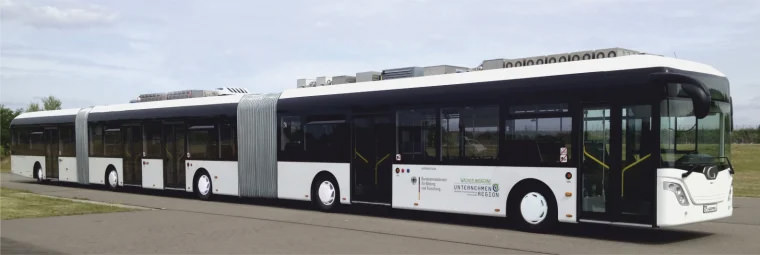
Electric trams are efficient, but so is electric Bus Rapid Transit (BRT). The city of Quito, Ecuador, installed a trolleybus rapid transit system in 1995. There is a dedicated right-of-way with fixed stations and overhead wires along the route. Network maps are displayed clearly at all stations. The articulated buses (accordion-style) have rubber tires and a backup diesel engine. This flexibility makes fleet management easier: buses can drive around the depot or to the cleaning area because they aren't tied to fixed rails or wires. When one bus breaks down, it doesn't block the entire line - buses behind can pass just like regular buses. Rubber tires can accelerate and brake faster than steel wheels, and of course they offer a smoother ride. The buses are significantly cheaper than light rail vehicles too (not sure about lifespan or TCO).
The system in Quito has been so popular that they are now considering upgrading to tram. This solution could be applied in many places, using trolley-buses as a first step and upgrading to trams later. Don't let the perfect (tram) be the enemy of the good (BRT).
Rubber tires can accelerate and brake faster than steel wheels, and of course they offer a smoother ride
Steel rails do not have potholes. With welded rail, smoothness goes to rail.
Rubber tires CANNOT "accelerate and brake faster". There are safety limits (basically how much jerk (rate of increasing acceleration) will NOT knock an elderly person off their feet) and steel wheels reach that limit easily. No need for faster acceleration.
For emergency braking, our new streetcars drop sand automatically as needed and have four 1 meter electromagnetic bars covered with high friction material that drops and clamps (with electromagnetic force) to the steel rails. Plus regenerative braking, disk brakes and sand. Beats rubber tires (I have been aboard "unofficially" during tests) with the possible exception of Formula 1 race cars.
Best Hopes for Urban Rail,
Alan
I think rubber tires have a rolling resistance of around 1%, which is pretty substantial. Of course, since virtually noone has been planning for the era of expensive oil to begin as early as it has, the ability to respond quickly to a changed environment (oil price) may trump long term efficiency.
My opinion on it, which I must confess isn't terribly educated, is that urban rail works great in high population density areas and is a misallocation of scarce resources in low density areas.
France today is building tram lines in towns down to population 100,000. I often use Mulhouse as an example, pop 110,900 (metro 237,000) got their first tram in 2005/6 and will have 58 km by 2012 (along with a High Speed Rail stop).
The USA in 1920s had a interurbans all over and streetcars in towns as small as 25,000.
Not terribly dense urban areas are required.
Best Hopes,
Alan
The reason this is unfeasible in the U.S. is our safety regulations which require slow, overweight rail transit equipment. Change the regulations and rail transit will be a better option.
Sure, once no one is able to afford to drive...
obvious path for development:
existing bus line => right of way with overhead wire, to be shared by buses and trolley buses => add tram rails (buses can still drive there, rail are in the pavement
This system would have optimal flexibility and speed of implementation (adding an overhead wire is fast and easy)
The LRT (Light Rail Transit) system runs through downtown Calgary. LRT tracks are embedded in the pavement and the streets are also shared by buses (cars are excluded). Outside of the downtown, LRT tracks look like ordinary railroad tracks.
Seattle tried to do just that for their downtown trolley bus tunnel.
They built in rails when they built the tunnel decades before Light Rail came in. Unfortunately, they did not electrically isolate the rails (electric trolley buses use a second trolley wire, rail uses the rails), the switches were all in the wrong place, Seattle Light Rail is going to operate on a different voltage (long story there, unsure of resolution), etc. SNAFU !! Two year retrofit.
http://transit.metrokc.gov/tops/tunnel/tunnel.html
Best Hopes for getting the details right,
Alan
The problem with rail and buses is that they carry groups of people, not individuals. This puts a whole series of limitations on their ability to take people out of their cars.
In short. The replacement for the car will be some sort of individual transport system, group based transport systems will remain marginal even after oil has peaked. The deficiencies are simply too great.
Our town will not have light rail (prohibitively expensive and many, many people live in rural areas and must commute in to work) but the bus routes are seeing more riders and there are many, many more bicycles around.
Here, where rain is infrequent but heat is a worry for about half the year, a bicycle beats standing at a bus stop for many people. They make pretty good individual transport systems. Won't necessarily help folks that have to drive thirty miles (or more) to work now; maybe they can work from home most days?
Clearly we need better accomodations for people who want/need to do a mixed commute, bicycle for a short distance of one or both ends, but take a bus/trolley/train inbetween.
I disagree about the ride quality.
This morning I rode from Upland (in the inland empire) to downtown Los Angeles on Metrolink, which uses bi-level rail cars from Bombardier. The line is very well maintained, and except for going over switches it was very smooth, sometimes so smooth you could barely even feel the movement.
However, I did the return trip on the Foothill Transit Silver Streak, which uses NABI BRT60 60' CNG powered articulated buses mostly running down the 10 freeway. Granted, road conditions varied along the route, but even on the newer sections of pavement, the ride was much rougher and louder versus the train.
I could imagine hybrid buses that have little recharge stations at each bus stop using two wires above the bus stop, similar to what rail cars use. The wires are energized after the bus is in front of the stop using a radio transponder. Each time the bus stops, the batteries are topped off, or at least charged a bit. The bus would have regenerative braking (lots of starts and stops in city driving) and have a diesel powered generator that would kick on if the batteries got too low.
Even so, rail will always have an advantage over buses in regards to personel efficiency and energy efficiency.
Lab drives car to 100 mpg
Can Joe Blow afford one? If not, this is an academic excercise.
Kunstler has pointed out that the whole driving thing has been supported by the working classes because they could afford to participate. If driving becomes unaffordable for the masses, the entire model falls apart.
I don't see why the support of the working classes is held to be essential.
In Britain substantial working class ownership of cars did not start until around 1960, but that did not stop the middle classes buying plenty of cars or building roads.
It was very different in America of course, with the Model T.
What America needs is an electric 'Hog!'
Us Europeans have never understood American cars, as the handling etc have traditionally been lousy!
They did have a certain sense of style though, and the only thing which is cooler than the pick-up truck is a Harley.
I can see a lot who can't afford gas feeling pretty good about a Harley-style bike.
Since the Harley doesn't actually perform very well, I believe, neither would the electric version have to.
No need for fancy, expensive lithium batteries, any more than American cars bothered with fancy suspension that allowed you to corner or absorbed bumps.
Just load up the cheapest, heavy batteries, and get lousy range, but with chutzpah.
Providing you can cruise in to work, plug in and cruise back, then the Rebel Without a Car look might catch on!
What do you think? :-)
Are you going to include loudspeakers to make noise?
I ride a VFR750. I don't get the Harley thing either.
Have you ever owned a Harley? Have you ever ridden a Harley?
How do you know that a Harley 'doesn't really perform very well'?
'What do you think?'... I think you don't know what you are rambling on about. But that doesn't surprise me for many of your posts strike me that way.
Now it's your turn. Become petulant and defensive...as you usually do when someone points out that you don't have a clue about the subject that you are commenting on. After you put a few hundred thousand miles on Harleys then you will be qualified to comment on their capabilities...or, their weaknesses.
If you want to discuss Triumphs I have had three of them...also, a Norton Commando. None of them would make a patch on a Harley. Of course you must know that because it took Japan only a couple of years to bankrupt all the Brit bike manufacturers.
I am still riding Harleys and still averaging 45 mpg. Not the greatest mileage but far from the worst.
I think you missed the smileys, River.
A lead-acid battery Harley?
I wouldn't have credited that anyone would take it seriously, but there is always one....
:-)
And in other news: DaveMart has sense of humour. Video after the break.
:-) :-) :-)
No intended offence honest!
A Harley from the factory is well tuned and performs well.
Unfortunately just about every a-hole on a Hog takes off the muffler and replaces it with straight pipes. The result is a very badly tuned bike that performs horribly.
The problem isn't the motorcycle, its the idiots that ride them.
Dave, it's different here. As Kunstler has pointed out, America was built around the automobile and we have an enormous system of roads, bridges, etc. to maintain -- some of them by federal dollars, some with state and local funds. Effectively deny a large segment of the population use of the road system and see how long it takes for the system to start collapsing at the margins.
The car of the future will have wings. And only the well-heeled will "drive."
Presumably with much lighter traffic economies on expenditure on roads could be made, with 8 lanes becoming 2 lanes and so on.
Of course, the system is very much underfunded, but that is perhaps a different issue, and down to the vagaries of the financial system.
I would see the roads of America as remaining relatively well populated anyway, as electric bikes and trikes would likely be affordable and needed precisely because of the larger distances and more spread out lifestyle in America compared to Europe - the suburbs will contract, but surely not totally.
As far as I can see hybrid and EV cars, although not likely to be produced in anything like the quantities of present day ICE cars for sometime, will likely have a substantial and growing presence.
One of the great challenges that we in the US will face is the systematic dismantling of road network that was built for 39 cent gasoline (or even $1.00 gasoline but never $5.00 gasoline). This will be a huge political challenge as the pain will not be spread evenly.
Personally, I would like to see the entire road system auctioned off to private companies who would manage them for profit -- no profit, no road. It sounds heartless, I know. I'm no Reaganite/Thatcherite ideologue, but I can't see any way in which sufficent public funds are going to be available to keep the entire US road system going.
Can you explain a little more what the "challenge" will be? I would guess that if someone can figure out how to make a buck digging up the tar and recycling it somehow, then they will. Otherwise, roads not maintained will just be left to deteriorate. Do you see something different?
One example - bridges.
Just last summer an interstate bridge fell in Minneapolis, killing and wounding many.
In the year since then, just about every local TV news station has run some kind of "are our bridges safe? Who's checking them?" type of story, and in a lot of cases there are problems of some kind.
It isn't as easy to replace a failed (or failing) bridge as it is to repave a section of road that is weathered or worn. Are we going to pay for it by suspending the fuel tax?
Well, I'm just trying to imagine what will ensue when someone shows up on your road (or my road) and just starts peeling up the pavement. We understand that what we have is unsustainable. So how do we get to something more manageable? Do we simply let things fall apart with all the choas (and possible violence) that this will spawn or do we try to manage a dismantling of that portion of the road system that is not "paying for itself?"
I'm imagining that our road system will shrink through attrition.
First, funding for new roads is cut back. Eventually maintenance schedules are modified (instead of patching potholes every month, it's every six months, or every two years, etc) If roads get really bad, private groups may try and get them repaired - business associations or town groups.
This would take years, but it isn't too much of a stretch to think that somebody would come up with the idea of "recycling" the asphalt from a road that isn't essential to patch one that is.
I don't think it will be a willful "let's let our roads fall apart" as much as everyone will be focused on other things - keeping the schools and hospitals funded, for instance - and the road system will start to suffer from neglect. You can see that in any "older" section of town, where businesses have moved out but there are still lots of residents, there isn't the tax base or the screaming from employers to patch roads, maintain street signs, pavement striping, etc.
If these assumptions are right and the economy deteriorates so much that the roads cannot be kept up, and it should be pointed out that if asphalt grows too expensive concrete can be used, then I would have thought that they would have more utility as the remains of a road than in any other alternative use.
In such a scenario the ability to re-use it would be limited to whatever processes could be set up locally, by definition.
Just like the Roman roads a few bits might be pinched, but much of it would likely stay right where it was.
I think we agree on this; all I'm saying is that roads (bridges, stoplights, etc) can be neglected and gradually fall into disrepair, and eventually some roads may be abandoned. Out of necessity, the powers that be will have to focus their resources on only high priority projects.
I'm trying to imagine twenty or thirty years down the road, I don't imagine municipal budgets will be much better off than they are now. I predict many more potholes in our future.
Here in Texas, about the only highways being built are toll roads, so there will be future income to help pay for the road. Of course, here in Texas, they love to build frontage roads on all highways, which makes them more expensive and take longer to build, but give us poor folks an alternative to paying the toll (just have to hit all the intersections and have a lower speed limit)
FWIW, we use concrete a lot, because we don't have the frost problems (I think that's part of it) that other parts of the country have.
This all depends on what you mean by "roads". There is the interstate system of limited access highways, and then there is the network of just about everything else.
We will need the network of just about everything else to remain passable, even if just for horse-pulled wagons and bicycles. That does not mean that it will all be very well maintained. Much of it will gradually have to revert back to gravel or macadam. When vehicles are only going <35mph, solid paved surfaces will not matter as much.
The interstates are another matter. All of them are doomed. What will happen is that repairs that used to take a few days or weeks will stretch out longer and longer, meaning that more and more stretches will be down to single lane, lower traffic. As governments come under more fiscal stress, some of the repairs will simply remain undone. Eventually the bridges and over/underpasses will have to be closed off too, and traffic detoured. These detors also will become more or less permanent. It will gradually come to the point where there is no advantage in even trying to take the interstates, so most traffic will prefer to take the paralel US highways. Governments will prioritize their very limited funds to maintaining these. Ultimately, the interstates will have to just be shut down completely. It is at this point that someone will get the bright idea that they could be an ideal location for erecting massive solar and wind farms.
In the situation you suggest where the transport infrastructure had declined to that degree it would not be possible to mine, transport the raw materials, manufacture the wind or solar equipment, transport them to the site or connect them.
Either a substantial fraction, but not necessarily all, of the transport infrastructure would have to be maintained or a high-tech renewables future is impossible.
Concrete is very energy intensive to produce. Cement plants burn just about every imaginable fuel (including things like ground up tires) to drive the carbon dioxide from the lime.
Well, its useful in that cement kilns are efficient industrial incinerators. Someday we may find cement kilns very useful not only as industrial incinerators but also as feedstock for CO2 for synthetic fuels.
Sounds a lot like Leanan's catabolic collapse.
I think you mean John Michael Greer's catabolic collapse: http://www.xs4all.nl/~wtv/powerdown/greer.htm
Can roads ever be mined as a source of oil? They seem about like oil shale to me.
Last time i checked you would get more oil out of the roads then the oil shale.
Estonia has been mining oil shale by open pit or shaft-adit mining since the 1920's. Oil shale was crushed and put through floatation tanks in order to enrich the mixture. The enriched oil shale was retorted to obtain fuel oil or burned directly to produce electric power. The process continues to this day.
http://www.kirj.ee/public/oilshale/Est-OS.htm
Estonia was far enough north as to not have a problem with global warming. The bitter Arctic winters were more of a problem.
it still is that far north :-)
Estonia borders the Baltic Sea and will have big problems with global warming induced sea level rise and its inundation.
I pity those fools. Sorry, wrong one.
"Kunstler has pointed out"
and we know he's always right.
You're right. He's always wrong. America was not built around the automobile. We do not have an enormous system of roads. I'm glad you're always there to point out how worthless Kunstler is.
"America was not built around the automobile. We do not have an enormous system of roads."
well not really. first of all, america was built on ships. that's how the first european americans got here. the rivers and then canals really built american. we then moved to rail and finally to the highway system. so was america built by road? no. is part of america built on roads today? absolutely. but we also have shipping and rail and etc.
EDIT: you could probably say the horse and the airplane also built america.
Why are so many here wrong about their history?
The first national public works project was the Cumberland Pike, beating out the Erie Canal by 2 years. Yes, the continent was explored and settled by extensive use of water craft--primarily canoes and flat boats, not ships. Yes, ship-bourne commerce consisting of platation grown slavery fueled monocrops was vital to the growth of the Colonies. Yes, there was a Continental Navy during the Revolutionary War that consisted mostly of Privateers, with the Continental Congress authorizing the building of 50 odd ships. This contracting for naval ship building might be considered the first national public works act, but the nation wasn't yet a nation. The great majority of Standard US History textbooks recognize the building of the Cumberland Pike as the first national public works project, and the first step toward the formation of Henry Clay's American System, which still lives today as the Military Industrial Complex.
Those wishing further enlightenment will greatly enjoy Bernard DeVoto's The Course of Empire, a riviting, entertaining and highly informative book. It can be found in every library in the US and probably in those of major cities worldwide.
Whenever someone says that, I just know that my library isn't going to have it. So, I just checked the online catelog. My public library does not have a copy of that book. The certainly can get it through interlibrary loan. But it isn't correct to say every library. (And yes, the local library here is pretty lousy)
--
JimFive
"Kunstler has pointed out"
and we know he's always right.
Com'on John15, You're slipping, where's the Y2K reference?
don't tell theantidoomer but over 70% of stuff made in a lab, never makes it out of the lab.
CNBC says..
Oil falls after CNBC says Saudis hike output
except for the fact that it's up $2 in the last hour.
I estimate that the Saudis would have to boost their C+C production rate to the vicinity of 10 mbpd (average annual production) in 2008, if they wanted to just match their 2005 net export rate.
Oops. Got their cause and effect messages reversed again and issued at the wrong time.
This is happening more often as of late. THey really should pay more attention to this creating reality thing.
Francois.
Gas price spike threatens fresh rise in energy bills
http://business.timesonline.co.uk/tol/business/industry_sectors/natural_...
Britain has squandered its North Sea inheritance. Now we are paying the price
http://www.independent.co.uk/news/business/comment/jeremy-warner/jeremy-...
British Energy auction plunged into doubt as EDF refuses to increase offer
http://www.independent.co.uk/news/business/news/british-energy-auction-p...
Britain's climate target 'impossible'
http://www.guardian.co.uk/environment/2008/jun/08/climatechange.greenpol...
Climate change: Carbon capture from power stations must start soon, say scientists
http://www.guardian.co.uk/environment/2008/jun/10/carboncapturestorage.c...
Stephen King: The mounting dangers of central banks' high-wire act
http://www.independent.co.uk/news/business/comment/stephen-king/stephen-...
Is it just me, or does Stephen King somehow sound a weirdly appropriate name for an economics correspondent at the moment? :-)
UK economy: Recession fears grow as house buyers vanish
http://www.guardian.co.uk/business/2008/jun/10/economics.houseprices
Inflation flashes red for the Bank
http://www.guardian.co.uk/business/2008/jun/09/inflation.economics
In the US, the feds have been fibbing about the inflation rate for years: it's often been higher than officially reported. Does the UK have the same inflation rate data problem?
To placate economists: I'm talking about consumer price index/retail price index, which is about price increases not the monetary inflation.
I understand it's a bit stranger than a straightforward "they're lying". Apparently there are "volatile" things like mortgages [1] and fuel are deliberately excluded from various inflation measures on the ground that they make the numbers very volatile, and economists would rather have a stable number that they can argue about the effect of government policies upon than something that accurately represents what people need to spend. So there's a tendency to include only items with slowly varying price, including many one-off purchases.
So my understanding is not so much lying as sleight-of-hand: everything is as defined but the definition isn't particularly related to what people think it is.
[1] Edit: apparently mortgages are in the RPI but not included in the RPIX and CPI, which are most commonly used.
Yeah, in Britain it's called a 'fiddling Gordon' issue, and means that all the data which impoverishes normal people, like wage earners, pensioners, parents and so on is excluded, whilst all the things important to the elite like more toys on their BMW and better flat screen TV's are shown as reducing the inflation rate.
This reduces inflation linked government payouts on pensions and social security and gives a lower base to argue about wage increases from.
So if you used to eat meat but now eat bread your standard of living has not fallen as the basket is re-normalised, I believe - I find the subject so irritating and depressing that I do not follow the details.
Likewise rising house prices did not count as inflation.
http://www.statistics.gov.uk/downloads/theme_economy/CP_Brief_Guide_2004...
Frequently just believing and repeating the social mantra is even more depressing.
Believing and repeating the Government mantra is far more depressing.
Back in the real world:
Also:
http://www.thisismoney.co.uk/news/article.html?in_article_id=440527&in_p...
So if you don't eat, drive, cook, heat your house or indeed live in one Government statistics are fine.
Otherwise they have blatantly been adjusted in accordance with the pressures on the government to hold down payments and wage increases.
I will charitably assume that you are resident elsewhere and so have no idea that your statements and the government figures do not connect with reality.
[sigh]
EDIT: The housing cost component is about 20% of the Retail Price Index btw.
Just like the peak oil message, people are prone to stick with the beliefs that appeal to their world-view, regardless of evidence. Feel free to have the last word...
Just out of interest, do you live in the UK, or are you basing your statements on some government document you have read?
If you live in the UK, you are the first person I have met who gives any credence to these government cost of living figures.
This WILL be my final post on this - as you asked:
I was born in the UK and have lived in the UK for the past decade, several of which spent working alongside the civil service. I understand well the difference between 'government' (ie: politicians with an agenda) and 'government' (ie: a bureaucracy from hell) - something the generalised UK public seems to willfully miscontrue.
In many circles, it would be hard to find people who give credence to peak oil. Your straw-man argument about me being the 'first person' proves nothing - except that the people you talk to about things like this either (a) share and reinforce your world-view; or (b) conform to the common norms of choosing ignorance over being well informed.
Also, FWIW, I'm neither a fan of GB, nor of UK government (of both descriptions). I'm fairly socialist-leaning in my beliefs about ideal economic politics. I just care about getting my facts from reasonably factual sources - and this is an excellent example of what most people believe, being bollocks.
The economist you quote is no more or less reliable a source than one from CERA, but one can always find a quotable economist to back up and reassure ones perspective, no matter the validity.
Right, I'm done - final last word is yours for the taking.
I have no idea what you are so offended about.
My straw man argument, as you choose to call it, that you are the first person I have met who believes government cost of living statistics, is not an argument but a statement of fact.
You have not actually addressed the substantial points raised, such as the low weight given to food and dubious treatment of housing.
Your reply boils down to not fancying one of the economists who challenges the government stats.
Since you have actually just linked to one document from the very people who have turned out the dodgy figures and have not provided any actual argument, I am duly grateful that you say that is the last we will hear of on the matter from you.
Hmmm. As they say everyone has one. Yes, the CPI is correct in that the methods it uses add upp 2 and 2 to make 5. It's just that they aren't counting the same things that 90% of us do.
So the 'factual sources' must be goverment massaged statistics ? Why not just take a walk around with a notebook and pen and then go to the library and pick out a local paper from 2, 5 and 10 years ago and compare prices ?
Or is that too in-yer-face ? Or ignorant or self-reinforcing ? Oh, and my shopping basket 10 years ago wasn't overly stuffed with Plasma TVs, iPods or memory chips either, if I recall.
2% pay rise for you, then.
Technology is what makes calculating inflation so difficult.
1. Is an Walkman in 1990 (lets say $40) a Walkman now ($10) or an Ipod ($150)
2. Is the New York Times in 1995 ($1)? the NYT now, or NYT.com (free).
3. Is a 1985 Honda Civic a 2008 Honda Civic (larger, more powerful) or a Honda Fit (probably still larger, more features) or a Kia (cheapest car on the market).
Housing is the other difficulty. It is so different for everyone. I think they do it by assuming that everyone rents at current rental rates. Of course this overstates inflation for many people.
Let's "Join The Dots":
http://www.megatrends2020.com/Peak_Oil__Joining_The_Dots.doc
Nick.
You missed this:
http://www.dailymail.co.uk/news/article-1025204/Life-Mars-Back-70s-stand...
Were going back to the Seventies already...
Thanks, Mudlogger.
I hope of course that you are aware that you do not exist, nor does that article in the Daily Mail online, nor does TOD and that, hopefully in the near future, I will open my eyes and see those kindly brain surgeons looking down and me and telling me it was all the result of that frightful accident I had four years ago just after reading some newspaper scare story about oil depletion … typical instantiation of the Cassandra Syndrome, doom and gloom psychosis, TEOTWAWKI delusion, can happen to the nicest people, don't forget to take your medication ...
Phew! Do I look forward to waking up.
:-)
"Britain has squandered its North Sea inheritance. Now we are paying the price"
We all squandered our inheritance, for an entire century, and around the world. Only now are the biggest surviving producers beginning to wake up and say, "Wait a minute..."
could you expand on this? how did we squander it? how could we have not squandered it? how did china, who consumes much less oil, squander their oil as opposed to the US who consumes much more.
Simple -- the UK squandered their oil inheritance by selling it off at bargain basement rates at little gain -- and now that the crisis is hitting there is little left.
"the UK squandered their oil inheritance"
and the rest of us?
Nuclear energy down 1.9 percent in 2007 (compared to 2006): World Nuclear News
http://www.npr.org/templates/story/story.php?storyId=91342960
I heard this interview this morning on NPR. The Bush Administration's Secretary of Agriculture is dismissing ethanol as a cause of the food crisis. And he's pushing 'increased yields' in third world countries as the answer to the global food crisis.
The increased yields of the past are a direct result of more fossil fuel inputs. Aren't those same third world countries being priced out of the oil market? Can you say shill for the Big Agra and Big Fertilizer corporations? @#$%^&*!!!!
here's a peak oil peripheral(pop):
"bush says strong dollar in us interest"
http://www.reuters.com/article/marketsNews/idUSN0945218720080609
this after running up the debt by over $ 4,000,000,000,000
Couple of hopes regarding the election of a new US President:
1) I hope we elect one that that can string words together to make comprehensible sentences.
2) I hope we elect one that understands that strengthening the dollar is not as difficult as rocket science.
3) I hope we elect one that realizes that the foreign policy goals of Israel and US are not necessarily the same.
4) I hope we elect one that understands that FFs are finite resources.
5) I hope we elect one that does not choose Cheney for a vice president.
I realize that I am hoping for a lot...best hopes for a president with a brain.
The election cycle;
2 years of HOPE for change with the new prez
Then,
2 years of disillusionment/anger
Then,
2 years of HOPE…
Rinse & repeat.
Best hopes for hopelessness leading to realization then real change!
Hope has always been the palliative, the content-free substitute, for thinking and feeling and then using thoughts and feelings to inform action.
Best hopes for becoming completely hopeless -- it's our only hope.
I am hoping that after I move to my new land this summer, I can become involved in local politics to make changes on a local level. That's the only level it seems that any positive change can be made.
Best Hopes for change on a local level.
"I don't have to change the world, I just have to change my world"
I'm one of those who believe that you can also make a difference if you create useful technology/expertise that you can persuade people to take up. Indeed, I believe that technology will have a much bigger impact than anything done by politicians, whether for good or ill depends on the type and aims (efficient adaptive building heating: good, pointlessly big urban SUV: bad). My disagreement with most technofix people is that you've got to actually create the technology (to the point that it's working at the necessary scale), not just enthusiastically point at press releases or present to graphs of exponential growth that other people are apparently preordained to produce.
i have come to a realization.
Douglas's adam's was right, for recent history the president's job was not one with power. his job is to distract the populace from those with the power.
It appears that the notion that America's oil supply problem can be solved simply by opening up heretofore restricted domestic areas such as ANWR to exploration and production has been steadily gaining traction to the point where it is becoming a full-blown meme.
Over the last two weeks there have been no less than six letters to the editor in our local newspaper to that effect, and just this morning I saw a Chevy Suburban SUV with a bumper sticker: DRILL HERE DRILL NOW!
I fear that this widespread denial is so deeply embedded that the majority of Åmericans will blame anyone else, e.g., those liberals, those pinko enviro-nazis, those rotten Ay-rabs, those greedy speculators, you name it, rather than face the reality staring us right in the face.
I started the day in a moderately bad mood, but seeing that DRILL HERE DRILL NOW bumper sticker has really bummed me out.
Just watched Senate Democrats oil briefing.
To sum it up. All speculators will be shipped to Guantanamo Bay no matter where they attempt to trade oil. Extradition will be used. This will reduce oil to below $100/barrel.
That's roughly it.
CPSR--Cornucopian Primal Scream Response, i.e., they are basically screaming that there must be some way, somehow, that we can maintain an infinite rate of increase in our consumption of a finite energy resource base.
I was chatting with a couple living in Detroit a couple of weeks ago. He is a senior petrochemical executive, and I gathered that they had a McMansion in a Detroit suburb. I advised them to sell now, take their losses, and rent. The wife almost screamed (I am not exaggerating) that "House prices will recover!" Selling is a twofold problem: (1) They would have to take a loss and probably more importantly (2) They would be moving into housing that would be below what their peers have.
We're going to have to go through the Cornucopian Primal Scream Response phase, there is simply no avoiding it. Everything possible will be done to maintain BAU, all hints of oil will be exploited. Even if serious economic hard times hit (like very soon), it may only delay it. We will still ultimately drill ANWR and everywhere else that we can. There is simply too much energy in oil, and energy = political power.
Given how far into the process we are without having prepared at all, and the looming climate change consequences of having burned all the fossil fuels we already have, this is going to be one very rough ride. I am very sad for all the environmental damage that we will do in desperation, but suffering, angry people will not be stopped.
I think you're trying to set up a straw man with the infinite stuff I just think people don't want to spend $4 gallon.
You are probably correct. To be more accurate, people want an infinite supply of cheap energy.
Then they and their peers will suffer together. Misery loves company.
I agree, unfortunately that "suburban driver" is probably one of the least informed people on the subject, it's sad that s/he feels that s/he should be educating every one else, when the majority of the educated already know s/he's wrong
If you live in an area with a lot of Republican voters, you hear them blaming environmentalists and liberals for the nation's energy woes. "They blocked the drilling in Alaska, they blocked the building of nuclear power plants, they blocked the building of more oil refineries" etc etc. They get their news from TV infotainers and right wing pundits who also blame muslims for our problems. My extended family is full of these so-ill-informed folks. When you try to explain the geological and consumption reasons behind the problem they resort to personal attacks on the messenger.
Things don't look good for a peaceful transition out of the fossil fuel era.
The way Americans are casting about for scapegoats right now is definitely alarming. When our electricity generating capacity hits a wall, this quest for people to blame will intensify and, yes, the environmentalists will take even more heat for our "failure" to build new coal-fired generating capacity quickly enough.
You two mean to say that environmentalists are NOT blocking new nuclear and coal power plants, or drilling in ANWR?
If this is the case I'd like to see some evidence, because all I have seen shows exactly the opposite.
If these guys that call themselves environmentalists, are up to defend that cause of theirs, they must take responsibility for the consequences of their actions. A system where one has only rights, but without responsibility for the consequences of exercising them will lead us to anarchy. It would be like driving with immunity against lawsuits in case you cause an accident... where is such system going to lead us?
Back to the environmentalists - once shortages start they will be blamed and people will be right to blame them. If they didn't want nukes, coal, oil (now even wind is falling out out favor), then they had to propose sensible alternatives, not pies-in-the-sky. I wish that at least they had the guts to admit that what they really want is no energy at all, and this has been the plan all along - to bring us "back to the land". I have a suggestion - why not start now with "going back to the land", and send them to some isolated island to taste it first hand?
So what you are saying is that pesky environmentalists have had the ability through Bush I, Clinton I & II, Bush 2 I & II - many of those years with Republican majorities in Congress, managed to block new Nukes?
wow - I had NO idea they were so powerful! perhaps you could point out to me all the anti-nuke legislation that these enviros were able to pass? could you show me all those new nuke plants that were denied permits to begin building?
you LOVE to talk about environmentalists as being the ones to blame - I have yet to see anything that could remotely considered "evidence" to support this view of yours
I don't suppose you would consider the reason that new nukes haven't been built being something as simple as (gasp!) - cost? Electricity generated from coal and natural gas has been very very cheap for many years - as was oil since the end of the last price shock - you don't suppose nobody wanted to build new nukes (especially after 3 mile Island and Chernobyl) simply because it wasn't profitable?
and if you are looking for scapegoats, you wouldn't want to throw Oil company execs who have been telling us that oil will never go away? or economists telling us the same? or the Fed creating a (largely suburban) housing bubble by offering such low rates and no oversight on loans? Seems like there is plenty of blame to go around if you want to point fingers - how about those that lied to get us into Iraq and wasted 3 trillion $? that $ could have built a lot of infrastructure.....
but no, it's environmentalists I'm sure - I mean, they can't even get anybody elected in this country, but somehow they are to blame for this mess....
Tool
MacDuff,
What you don't seem to understand about LevinK's point of view is really quite simple - it is based on a belief that all can be just as it was (which is unquestionably accepted as "good")if only ....
I am not concerned of changes. I am more concerned of self-proclaimed demiurges that claim to know what it should be.
Enough of revolutions.
And by declaring that change (or revolution) should not occur, have you not yourself claimed to know what should be?
If you want to defend the growth based economic system, that's fine, you can make all sorts of arguments for that arrangement. Just don't pretend that it's the "natural order."
What's so bad about growth? Growth means that people are generally living better. What we are lacking is sensible growth that does not deplete our resources and ruin our environment... among other things.
It is a false dichotomy to suggest that growth always causes these problems. It's just a matter of how we organize society and what are its priorities. I predict certain societies are going to grow and do fairly well even as FFs deplete. Not so sure once GW hits in.
Nothing, except that it has to end eventually.
That, or we need to start spreading to other petri dishes.
This has always made me laugh. Not all growth depends on expanding the use of natural resources, and far from all natural resources are non-renewable, or at worst some of them could last hundreds or thousands of years.
But even if growth one day is to end, so what? Everyone's life will also end, but that's not a reason to jump off the bridge right now. It's a menaingless discussion looking at the Earth from 1mln.miles distance... a perspective which we don't have. I prefer to accept the fact as long as humans exist they will strive for growth, and concentrate on preventing/mitigating the negative consequences from it.
What do you mean by "growth"? What resources, even renewable ones, are not right now at the breaking point? Is the planet not finite?
What, we'll all die, so f**k it? Is that your "philosophy"?
Don't we have any responsibility to generations to come?
The discussion is about looking at Earth from a distance of 10 years.
You can prefer to accept whatever you want. You are entitled to your beliefs, but not the facts. Fact is, it's a finite planet.
So, what do we do?
Strive for "growth" as an abstract good in itself - what's that? The ideology of a cancer.
Solar (we use less than 1/1000th even including biomass)
Wind (global capacity of near 100 terawatts, some 10 times what civilization is using)
Nuclear (120 trillion tons of uranium and thorium in the crust)
Iron, Steel, Nickel, Titanium, etc...
Wrong question. We aren't even close to the limit of its resources and there are other planets.
Sure if it was just more of the same homogenous civilization around in a stagnant fasion forever. Growth brings change, knowledge, and power to understand more of the universe.
Other planets, yes. And hydrogen is the most abundant element in the universe.
You think its a clever snark, do you?
When we're actually using the 10^16 watts of solar energy per day and are pushing the heat dissapation envelope of the earth for nuclear power, one might very well assume that a significant fraction of the economy would support interplanetary economies. After all it would be at least 10000 times bigger than the economy today.
Clever snark indeed - yes, I like that hydrogen line a lot! It sums up what some people think in a nice little trope.
But OK, interplanetary economies if you say so. It sounds like madness to me, but OK. 10,000 times bigger than the economy today sounds fine. This is based on what? Fusion power?
But we're already challenging the heat dissipation envelope of the Earth, in case you haven't noticed.
Meanwhile, we have the next decade or 10 to make it through in some semblance of civility.
Alas, I must head off to work now, so I can't discuss this further...
No it doesn't. Its a trite strawman.
Oh I'm sure we'll do controlled fusion someday, just not this century. In the meantime there are 120 trillion tons of thorium and uranium in the crust and 10^16 watts of solar power hitting the earth.
No we're not. Industrial civilization consumes 1.5 x 10^13 watts. The solar constant (and the equivelant heat dissapation capacity of earth) is some 10^17 watts. We're not even within 1/1000th of the heat dissapation capacity.
Dezakin, human society is not a machine. Its a messy, increasingly unmanageable cat fight. We'll never begin to even approach the theoretical limits of "available" energy that you are tossing around. Not even close.
As for colonizing other planets -- hey, maybe someone will someday do it. But it won't be possible in my lifetime (nor in yours) and if I had to venture a guess, I'd wager that the human chapter will be largely over by century's end.
A fine assertion. And entirely unsupportable opinion, especially given with the context of avaliable nuclear fuel. We probably wont burn 120 trillion tons over the next 16 million years, or build solar collectors over every inch of the earths surface. But then, we don't have to.
Obviously not. We'll need a global economy at least ten times larger than it is today, and I'll be lucky to see it get three times larger, especially since much of the global economic growth may be curtailed by inflationary infrastructure adjustment from fossil fuels to nuclear, wind, and solar.
But I think its obvious thats where we're heading.
You have some mysterious new definition of "growth" if it doesn't depend on expending ever more resources.
Perhaps it's video-game growth in which the points count up eternally, measuring nothing?
The problem with growth ending is it tends to be absolutely horrid times to live in for most people involved.
If I read a book or go to a movie I am consuming negligible amounts of natural resources. Does a movie make my life better? I guess so (if it's not some Holywood crp). A person really can eat or dress only that much... Aside from population growth there is no fundamental reason to consume more natural resources with time, and even then some of the resources are renewable and others are virtually limitless. There is no fundamental problem with growth, there is a fundamental problem with our growth.
When it comes to growth we are a classic predator species.
Wolf populations grow until they outstrip the deer and rabbits, then they collapse.
Our population will grow until we cannot spare the energy to rescue people from natural disasters or other causes of mortality. Consider the Katrina disaster a model of post-peak disaster response: lots of pointed fingers and a definite lack of big, no-holds barred rescue and recovery efforts. Years later I'm hearing about finger pointing efforts getting in the way of local recovery projects.
As such, the consequences of growth past locally sustainable levels are human suffering in various degrees.
Entertainment consumption, especially passive entertainment, is exactly what I was referring to as "video game growth". Time and energy are spent, and nothing is accomplished. I fail to see what it has to do with real growth.
My whole point is that most of the growth in developed countries is what you call "entertainment" growth - one that does not consume a lot of additional natural resources.
And it makes sense - a person in the 1970s and a person in the 2000s need the same amount of food, clothes, shelter; the basic, most resource consuming things.
However GDP per capita now is times higher than it was back then, adjusted for inflation. At the same time oil and other resource consumption per capita was even higher in the 1970s than it is now.
How to explain all of that? Mostly because of additional low-resource consuming, discretionary products that become available to people in the meantime. Increased productivity in the production of basic goods allowed more economic activity to be transferred to entertainment parks and iPods - things of value but consuming negligible amounts of resources. Another process that allowed this to go further is globalisation and outsourcing, but this is another topic.
You can argue that population growth is stressing resources regardless, but just take a look - where does our population growth come from? Undeveloped countries. Developed countries with the notable exception of US have effectively zero population growth.
The bottom line - if you want to save the world and the resources, give everybody on this planet the decent standard of living we have in the West. It's not necessary to give them our excesses, just the basics.
This thesis is popular for the soylent green dystopian vision, but theres no evidence that it will be any different than any of the vast majority of human history where growth was curtailed by simple increased mortality.
You don't say? Gee, how about you lead the way on that increased mortality thing and demonstrate how it's not so bad, eh?
You normally don't write such stupid stuff. I'm surprised to see it now.
Its bad, but its no different than the vast majority of history.
Right, no different than the times in history when we were shrinking. Absolutely horrid times to be alive. People lived through those times, obviously, and barring catastrophe on a scale like that which killed the dinosaurs people will live through the future bad times.
That doesn't mean that it will be pleasant.
But this is not true. There have been sustainable - that is, no-growth - societies that lasted thousands of years.
In terms of world population, the trend has always been upward:
http://www.census.gov/ipc/www/idb/worldpopinfo.html
Some countries decline ... others expand. but in the end, the human race overall expands
I think that's misleading. We are currently in a massive population spike - the greatest we have ever experienced as a species. So, looking at the big picture, it looks like "the trend has always been upward." It couldn't look any other way, given the current population.
But if you look at shorter periods, before the fossil-fueled spike, population has been stable, and even decreased at times. (Dieoff, if you will.)
And if you look at specific areas, some have been stable or falling in population, even now.
Is stabilizing population worldwide a far more difficult issue? Of course. But individual societies have done it in the past, and are doing it now. So the idea that growth is inevitable is simply incorrect.
Jared Diamond's Collapse is not just about collapse. It's also about societies that have successfully avoided collapse. Such societies value zero population the way we value life, liberty, and pursuit of happiness.
"It couldn't look any other way, given the current population."
Well, it could look another way if the growth rate (2nd graph) were to drop below zero. Unfortunately, it doesn't which means we are still striving to grow - albeit at a slower rate.
I don't disagree. What I'm saying is that it's not inevitable.
Bah, somehow I failed to read that. I read that successful societies dont mismanage resources, not that they dont grow.
The fact that some societies did not grow does not prove that they did not 'strive for growth', it just shows that if they did they weren't very good at it.
If your theory is true, they must have differed very much from other animal populations which grow as much as they can when they can, or they would die out.
What you are defining as a society also appears to be one which it's members would not recognise - the 'primitive' societies with which we are familiar suffered endemic warfare and such stasis as was attained was through a balance of power rather than some harmony with nature.
Perhaps you are talking about the wider society, say the polynesian society rather than the constituent several parts of it, but this is an anachronistic reading.
The appearance of stasis is mainly a result of poor records and distant perspective.
Wrong. But we're so entrenched in the growth paradigm, we have a hard time seeing outside of it.
In Collapse, Diamond describes several societies that were stable for thousands of years. Population control was their number #1 priority. And no, it wasn't just killing each other off or dying of starvation to stay within Malthusian limits. It was a conscious choice. In one society, the king set a pre-determined limit to the population, and any surplus had to leave. Voluntarily or not. They also used suicide, infanticide, late marriage, and many other such strategies to prevent population growth.
One example I found striking was an island where the people decided to eliminate domestic pigs. Pigs eat food people can eat (probably why they are considered "unclean" by Jews and Muslims - they're too expensive). Only a few rich people benefited from keeping pigs, so they decided the cost to the society outweighed the benefits. And they killed every pig on the island.
Serious question...Is this society you speak of still in existence? If not, what was the cause of their demise?
You will get no argument from me that population control (through education rather than killing/starvation/governance/etc...) is NOT a good thing.
Yes, I believe they are still in existence. Most of them were, IIRC. Some had since industrialized, like Japan, but most were still living more or less as their ancestors had.
I think you have misread the statement you say is wrong:
It was that 'IF they did they weren't very good at it' which is hardly contestable.
Since the written records from these ancient societies are so sparse I find it difficult to determine how Diamond has determined that population control was their number 1 priority for thousands of years.
If the discussion is confined to the more easily checkable societies which are current or have been recently current, a far less pastoral picture emerges, where the limitations of the environment are indeed recognised, as they live to close to losing their lives to it, but one of endemic conflict and a far more human desire to take advantage of opportunity whilst not getting caught out - in essence the same greed and fear that motivates the stockbroker.
Margaret Meade went to Polynesia, and used it as a kind of Rosarch test, finding her idyll's there, in her interpretations of the joking responses of the interviewees, which painted a sexually liberated Eden.
The reality of the society was rather different.
If the records are poor and the distance in time great then all sorts of interpretations become less falsifiable.
Some societies some of the time were doubtless static, but my guess would be that the situation was inherently more dynamic than that sounds.
After all, one good drought and the whole society was in danger of oblivion - and countless of them no doubt vanished.
They aren't all ancient societies. Most were societies that currently exist.
I recommend that you read the book, if you haven't. It's rather long for me to explain it all to you. Things have come a long way since Coming of Age in Samoa, and Diamond certainly understands that. Indeed, he starts the book out by arguing, in great detail, that "primitive" societies are neither worse nor better than we are when it comes to the environment, but exactly the same.
Diamond is the one who has chronicled the collapse of Polynesian societies like Easter Island and Pitcairn Island, as well as those that have proved sustainable for thousands of years. He's hardly the type to succumb to "noble savage" fantasies.
What I found most interesting about the book was his description of research on which societies can successfully transition to sustainability, and which cannot. (In some circumstances, it is simply impossible.)
You have piqued my interest Leanan, and I will try to have a look at it - it sounds like an good read - you argue it's case well.
Absolutely! Indeed, the development of growth oriented societies is relegated to the last 6000 or so years of human history - and even at that, the growth ethic didn't go global until about 400 years ago - and probably didn't include the majority of the planets population until even more recently.
Not by choice.
Well what happened to those "sustainable" societies? AFAIK there were two options: they disappered (a sustainable society that disappeared... makes you pause, doesn't it? :), or they turned into pro-growth societies.
It is natural for any living organism to try to live better and expand... the fact these societies didn't do it means they couldn't, not that they didn't want to. Of course there are limits, and society has imposed certain limits in the forms of law or moral codes. What we should be doing in TOD is indeed discussing the limits we should self-impose to prevent ourselves from crashing; the growth issue is misplaced - we will always at least try to grow. We just have to think carefully how to do it.
In all cases they were conquered by "pro-growth" societies, meaning the West. Either by its brutal armies or by its lying dogmas. But might does not make right, or even sustainable. If the West leads mankind over a cliff worse than the Roman collapse, what makes it better than the societies it conquered?
That's like claiming the Green Revolution would save a billion lives, only to cause population to rise by 3 billion, who all die when the fertilizer runs out. Did our system save a billion, or kill 3 billion?
You're seriously worried about fertilizer running out?
Dezakin, it simply does not matter, modern agriculture will run out, or run down. Modern agriculture simply cannot survive the demise of fossil fuels. And yes, if our population increases by three billion then that will simply increase the die-off by three billion.
Ron Patterson
Thats silly. We've got enough coal to supply agriculture for at least seventy-five years. Get you're ammonia from hydrogen from coal. Get your ag equipment fuel from coal.
And you can do the same thing with hydrogen produced from nuclear power plants.
That is short-term thinking.
75 years? I hope my kids are visiting with their great-grandkids in 75 years.
I don't want my progeny suffering because people didn't want to plan that far ahead.
Thats not short term. You need that time buffer to rebuild infrastructure because it doesn't build itself overnight.
In seventy five years I'd hope the world has at least 2000 gigawatts of high temperature liquid fluoride reactors operating for hydrogen production to replace the coal and oil based infrastructure, and another several terawatts of increased electric production as an increased percentage of the global economy.
My point was simply that agriculture wont collapse anytime over the next century.
You don't read much do ya? Agriculture is already in the first phases of collapse due to soil infertility and climate change induced flooding and droughts, not to mention the growing inability of farmers to obtain the credit they need to finance their operations, and it's happening on a planetary scale.
No, most of them still exist.
No doubt they would have been conquered, if they were living on top of Ghawar or something, but since they aren't, they've been left alone.
Care to list some?
New Guinea highlands, Tikopia, Iceland.
And the biggie: 17th Century Japan
I'm not sure that counts. Since Japan has been conquered.
However, I do think Edo-period Japan is probably the best model we have for non-disastrous future.
Yeah. An oppressive state which ground the last grain of rice from the peasants and would torture their families if they failed to come up with enough whatever the harvest had been like.
This was to support a ritual edifice designed to keep the Samurai in check by ceremonial duties such that they lived entirely pointless lives.
Check out the Christian rebellion there, which was suppressed with massacre.
I'll take my chances with a more dynamic societal model thanks.
You might just as well cut straight to the glorious People's Democratic Republic of North Korea or whatever it calls itself and save yourself the time travel.
I think that's going to be the least of our worries.
Who was it who said 'Give me Liberty or give me Death'?
Somehow all these ideas of stasis and perpetual harmony, not to mention Millenialism, always seem to end up as particularly nasty tyranies.
There is always an enforcer.
I'll stick with Blake and Henry, and be freer in Hell than in some tyranic heaven.
in reality given the options DEATH or life in a far more restrictive society than exists in the West today, people aren't going to be choosing death... it sounds good to say but it just doesn't fit reality... people kinda like the whole life thing, regardless of restrictions
We are not talking about 'far more restrictive societies' - we are talking about a brutal fascism - read about some of these wonderful Polynesian societies charming little rituals of human sacrifice of enslaved lower castes, which were used as a method of total control and to instil fear.
And actually, people often make choices which are against some social Darwinist sense of rationality.
I think many here, for instance, would much sooner die than use nuclear power to provide energy - on the ostensible rationale that it is too dangerous!
So a few billion people die - 'we should not go above the [alleged] carrying capacity of the planet, and a die-off is inevitable anyway' rather than take any risk!
People are weird.
Yup. Some historians actually doubt even Patrick Henry said, "Give me liberty or give me death." Since they would've given him death.
I always favored the Trobriand Islanders. Much of Melanesia remains unchanged too, along with those parts of Oceania thankfully neglected by tourism.
Iceland?
Otherwise I agree - if all of us agree to Guinea highland lifestyle, we could achieve "sustainability". But somehow I doubt many of us would volunteer. Oh, I forgot, it will happen regardless what we do... what can I tell to that? I guess it's my personal choice not to accept it.
«Over one hundred tribes around the world choose to reject contact with outsiders. They are the most vulnerable peoples on the planet.
Many of them are living on the run, fleeing invasions of their land by colonists, loggers, oil crews and cattle ranchers. They have often seen their friends and families die at the hands of outsiders, in unreported massacres or epidemics.
This is their story.»
http://www.survival-international.org/campaigns/uncontactedtribes
Sure we do:

Actually this photo was taken from 34 million miles by Mars "Rover", but I think it makes the same "point", or in this case pixel. (right click and "view image" for full size)
i think a sense of perspective is definitely worthwhile
as a Physicist by training you get a completely different feel bred into you, deep down, of the sheer scale of the universe and our place in it... it lets you appreciate just how fragile things really are
but it reminds me of the Hitch-Hiker's Guide To The Galaxy and the Total Perspective Vortex...
the TPV is the most horrible torture device to which a sentient being can be subjected. It shows its victim the entire unimaginable scale of the universe with a very tiny marker that says "You Are Here" which points to a microscopic dot on a microscopic dot... it literally blows the mind of the victim who sees their significance in relation to the vastness of the universe... of course it didn't work on Zaphod Beeblebrox whose supreme ego meant he came out the other side realizing he's a pretty cool dude... but that's why you read the book...
Good. Now that you have that perspective, I'll let you worry about the long-term prospect of the Universe collapsing into the primary egg.
I'll stick to worrying about my chances to survive on that tiny piece of space dust called Earth. I know I'm just an insignificant piece of carbon based chemicals, but I still can have my own worries, right? Thanks for the understanding.
As I said, you can make that argument - just don't assume that it is somehow the "natural order."
As for me, the problem with "growth" has to do not with the concept, but with the form of economic growth that we currently have. Their are physical limits to growth in consumption of resources. Perhaps we will change our idea of "growth," but an economic system based on consuming more and more has no long term future. (We can argue when that limit will be reached, but you can't argue that the limit exists).
I predict that your prediction will not come true. The current economic system is global and the idea that some "societies" (slippery, isn't it, you meant "economies") can continue to grow while the whole system is shrinking is suspect. Maybe some can do it short term, but eventually the overall shrinkage will catch up to them.
It is true that our economies are growth oriented. And so what?
The economy is set to grow, and they are trying to tune it to grow, but it can very well adapt to less growth conditions if needed - this has been demonstrated multiple times through history. It's a matter of political will if we need to restrict growth because of some other issue (say climate change or resource depletion). The problem is there is no political will to do it, it is not the economic system which is at fault. The fact is that it has always been politico-economical system, with the political system taking care of the common good independently - by restricting/regulating the economy as needed. However our political system has become so corrupt that it is indeed just economy which is driving our daily lives. You can argue that a capitalistic system always corrupts, but well then, we don't know any better, so we have to do with what we have.
We do know better, and have plenty of examples of alternative ways of living which provide community and mutual support.
What we consider to be "growth" is actually appropriation, and the appropriation is always temporary. Growth ends at complex collapse, when the system cannot support itself. This model is followed by every living thing, including human societies.
Growth, the creation of something from nothing, does not exist.
As opposed to the market, whose definition of change always concentrates wealth in the hands of a few, who then use that wealth to control and corrupt the media, the elections, the church, and our very perception of reality in order to concentrate even more wealth, regardless of the damage.
That is the natural order of property systems, and proceeds until enough resources are exhausted to bring about collapse. The evil of the environmentalists was that they tried to get us to notice. Which would mean revolution.
You are ascribing environmentalists credits that very few deserve. With the exception of Club of Rome and few others, the rest on this board are just NIMBYsts undercover or simply political opportunists. Most of them have no idea what they are fighting for, they are just fighting it for the fight itself.
Otherwise I completely agree with you about the problem you stated. The solution is a different story, and if the idea of the ones we are refering as "environmentalists" is to bring the crash faster I have to completely disagree. A crash does not bring necessarily any good, and a change is not necessarily for good either - collapse of the Roman empire brought the dark ages, and the Great Depression brought us Hitler. If they want to make things better, let them work within the system and try to make it better, not just hope that is collapses altogether... besides how inhuman it is, I think that it grossly miscalculates what will follow. Hint - it won't be an ecoutpoia, you can take that for granted.
Hitler was not brought by the Great Depression. He was brought by the manner of Germany's WW1 defeat and the Versailles Treaty, along with several other allied variables.
True, these were some of the reasons for his support. But the real enabler was the economic crisis and the failure of the Weimar republic, which added injury to the insult.
If the ordinary people of Germany were living well, they would have never elected a chauvinistic and militaristic nationalist, that promises them to rule the world. If you live OK you would never support to send your own people to die for somebody else's resources. Likewise I fear that if US ever fails economically, something similar will happen here.
The Versailles Treaty enabled the economic crisis, and the Great Depression. Your second paragraph fails also as Bush was re-elected and Blair's government never was put to a vote of confidence, while both populaces's "were living well."
Come on... Bush is not Hitler. He's not even qualified to do this job. Bush is just a normal US president who, like all US presidents wanted his war. What he did has been going on and off the whole 20th century. And he never neither wanted nor needed to start WWIII, it's in noone's interest.
I'm not concerned by Bush and the neocons, I'm far more concerned into what all they started will evolve once the going gets tough.
In this country a handful of people have the power to stop the construction of say a nuclear power plant, or protract it for years if they can persuade some county court that it is not in the public interest. Either way this would costs billions, because while someone is complaining that he's worried about the vapour that comes out of the cooling tower or about that wind turbine blocking his view, there will be interest on those loans, the people that were hired have to get salaries or they will leave etc.etc. And even if somehow you manage to build it there is still no guarantee - they can shut it down later for whatever reason they think of. All of this has already happened numerous times, do you need a list?
And yes - the reason comes down to cost - an equal nuke is costing $4 bln. in Japan and is projected for up to $7bln in USA. Care to know the reason why there is such difference? How about (gasp!) NIMBY? NIMBY masked as environmentalism... that's what our "environmental" movement really is.
Yeah, all those NIMBYs in Alaska living on the edge of ANWR are blocking drilling there.
There are good reasons for slowing down the construction of new coal-burning power plants. It does no good to deal with peak oil by roasting the earth and acidifying the oceans.
Nuclear plants were largely blocked as a result of movements that existed decades ago. I think people in the 70s could be cut some slack about peak oil. But that old movement has little influence any more, and we're seeing new nuclear permits requested for the first time in many years, and they are likely to be approved.
As for ANWR, we should not drill there now, period. Only an idiot opens up his last good reserve of oil when people are still wasting gasoline in SUVs. Of course, in the end, I'm convinced the US will be proved idiots. After all, we do haave only 2% of th world's oil reserves, but 9% of its production.
Blaming environmentalists for our current problems is little moe than scapegoating people you disagree with. IMO, there are many better candidates.
You don't seem to realize one thing - drilling in ANWAR and building those coal power plants will occur no matter what. We are way past the point when we had options on this, and I partially blame environmentalists for it... on par with our short-sighted politicians and the oil and coal lobby.
We are simply going to have some tough choices to make during the next years and decide what to sacrifice... I am for quick ramp up of nuclear and wind, electric transportation etc. But I fear these simply won't be enough and I dare to predict that we are going to fall in the situation of drilling and burning everything we can as fast as we can. This could have been easily predicted way back at the days before the BANANA* thinking became prevailing.
BANANA = Build Absolutely Nothing Absolutely Nowhere near Anywhere
BANANA? America? Surely that's BAEANA - Build Absolutely Everything Nowhere Near Anywhere (with apologies to James Kunstler).
No new refinery is built in this country for ~20 years. No new nuke plant for about the same. Drilling is restricted to certain areas.
On the other hand coal mining and burning, and road and airport building is flourishing. I think it comes down to public perceptions... coal mining is out of sight out of mind, no matter how disastrous it is. Road building is also consuming land and encouraging FF use and pollution but it also receives little attention because people are used to it and actually want it for their convenience. It has never been what really is environmentally friendly or not, it has always been what we want in our backyard and what not... environment has been used just as a justification.
> You mean to say that environmentalists are NOT blocking new nuclear ... power plants ?
Yes.
The nuclear industry is why the USA is not building new nuclear power plants and has not (except Watts Bar 1 & 2 & repairing burned Brown's Ferry 1) for over 20 years.
Zimmer did as much damage as Three Mile Island (both completed plants scrapped).
MASSIVE cost overruns and delays killed new USA nukes. TVA and WHOOPS alone canceled 15 under construction nukes !
The US nuclear industry committed hari kari, they did it to themselves.
Alan
Care to ask the question why the nuclear industry suffered so huge cost overruns and is so cautious about new builds? This technology is mature, they know perfectly well how to build it. Same goes for refineries or coal power plants.
Very poor project management (due to a lack of enough experienced people), not enough good experienced engineers, the arrogance of designed each reactor almost from scratch (and typically not designing them very well). Overloaded industrial capacity.
The contra example is the 3 reactors @ Palo Verde, one of the last reactors started (but completed ahead of several of them). From memory, series built on time, on budget. So evil regulators that insist on safety (NOT environmentalists, but safety minded regulators) need not cause problems for a well designed, well built, well managed series of reactors.
If Palo Verde was the norm for 90% of reactors, the USA would never have stopped building them. The pace may have slowed with cheap natural gas aand CCGT efficiency, but not stopped.
Alan
Actually most of the cost overruns in the 80s were due to plant redesigns, some of which had to be applied during construction (which is particularly expensive). Some plants were never allowed to operate by local authorities and this is where so called greens had significant contribution.
Now the next reason back - redesigns and additional safety systems were mandated because the politicos were spooked by the Three Miles Island incident, which was turned into a scary movie by the media, despite that nobody was hurt. The new mandated features added little to nothing to the plant safety, but were mandated due to the government psychology of ass-covering. All of this coincided with gaining speed environmental movement which at some point decided nuclear was it's enemy #1 and simply put oil in the fire. It is very easy to think of stories and demonize something, which people don't really understand. The result is - a negative public perception, and it is very hard to fight that. Utilities know very well that this can cost them fortunes due to legal and regulatory delays and have been avoiding nuclear for almost 3 decades now - the result - 50% coal, and rising.
I agree that Greens do not bear the entire responsibility for this situation, but let's say they are one of the enablers. Greens in Germany, Sweden, Italy have had much more and direct success. In serving the FF industry I mean.
Correcting safety oversights and flaws was a good thing. Good designs would not have required ANY redesign.
The three Palo Verde nukes prove it was *NOT* the "fault" of the regulators, but of the nuke building industry. It was possible to build new nukes on time, on budget and safely, *IF* properly managed and designed from the beginning. Most "boom time" nukes were not.
Zimmer was 100% the nuke industry's fault.
The fault lies with the nuke building industry and they are just looking for scapegoats elsewhere.
Alan
Some of it yes, and some of it no. Much of the in the middle redesign of over budget nukes at the time wasn't to correct any real safety concern but to meet beurocratic requirements or would have had minimum safety impact. Sure there were genuine problems, which made additional beurocratic busywork that much easier to sell.
I can accept that.
Regulatory agencies rarely get it "just right".
Best Hopes for Good Regulations,
Alan
I would argue that most of the new regulations were impractical and unnecessary. Regulators chose the path of adding redundant safety-related systems - and you can always decide you need a backup of the backup of the backup etc. It is doubtful whether adding so much additional complexity (and cost!) improved plant safety in any meaningful way, it was all due to plain old beurocratic thinking.
Should it be engineers taking this job they would have relied on much simpler and inherently safe solutions, a path the industry has been on for decades and is now visible in new designs like AP1000 or PBMR.
like what? cleaner water, air, land and food? those consequences?
If this was really the result I would welcome it. But last time I looked 70% of US electricity was powered with fossil fuels, and 50% is coal. Virtually 100% of transportation is powered with oil. You never achieved anything in there simply because you didn't show or accept any viable alternatives.
Okay LevinK, lets have it your way and burn up every morsel of fossil fuel. Where will that get us? What will provide power for the last half of the 21st Century? How will you deal with the nasty externality known as Climate Change?
The Blame Game solves nothing, but it seems to titilate certain people. Some very perceptive people warned us all about the eventuality of our current state of affairs. Are you going to blame them for being correct, or are you going to blame people for not heeding their advice?
First and most importantly there are sensible alternatives to fossil fuels: nuclear power, hydro power (also often opposed), wind and solar power can also help. But most of them get opposition based on "enviromental" grounds... how exactly emission free nuclear power should be opposed on environmental grounds? The so called nuclear waste does no more harm sitting in the dry casks than your old car sitting in the junk yard. You know what I often hear - that nuclear is a fossil fuel too... I can't believe the level some people are discussing this.
It's true that the blame game solves nothing, but then you should have been more foresight on what are going to be consequences of your actions all through those years. When shortages start the public will opt out for the dirtiest and fastest to build energy sources, not for the cleanest and most expensive ones. What bugs me is that this self-delusional thinking is continuing long after we have already realized we are deep into the an energy crisis. It's too late, and there is no use from the blame game, but it seems some people will never learn.
so you are of the belief that every project that has an effect on the environment should not have an environmental advocate? We give murderers and rapists advocates, but you think the earth that sustains all of us should be left to be ransacked by corporate greed?
the consequences of environmentalists actions ARE cleaner air, cleaner water, and a "somewhat" enviromentally conscious government (just think what kind of decisions they would be making without environmental advocacy).
Yes the concerns environmentalists raised did limit the expansion of power generation, but this limit was required to keep the ecological system from being torn apart.
I guess nuclear power is emission free as long as a radioactive cloud that posions the earth and kills thousands (chernobyl) isn't considered to be an emission.
good discussion though....
A reactor like the Chernobyl reactor could never be built in America or Europe.
Carbon-moderated fusion reactors have been known to be susceptible to conflagratory failure since the '50's and were ruled out by common sense and regulation long ago. The Soviets were immune to common sense wherever personnel and environmental safety was concerned and built many reactors of dubious to downright dangerous design. (Much like capitalists working outside their own backyards, I might add)
Clean, safe nuclear power is generated every day.
On the other claw, the radioactive and heavy metal bearing waste of the coal industry that is dumped into the air and who knows where else is barely given a second glance unless statues start melting in town square.
Well, I believe you when you say carbon moderated fusion reactors might be conflagatory. But, a carbon moderated fission reactor was designed and built since the 1950's in the US. The N-Reactor was started up in 1963 at Hanford Washington and produced approximately 800 MW power (I don't remember the actual power rating).
Ooops, I meant fission. I've been eyeballing a lot of fusion research lately.
Yes, we built carbon moderated, sodium moderated and several other designs while trying things out.
They spotted the failure modes of the various types pretty quickly and settled on water moderated as the safest option in pretty short order. Pressurised water reactors aren't without failure modes, but due to some very favorable characteristics of water they can be designed with both active and passive fail-safe characteristics.
Carbon or sodium reactor overheats and you can get a nasty radioactive fire where you once had a productive power plant. The Soviets had several accidents associated with sodium reactors, also.
I don't understand why environmentalists aren't more pushing dangerous RBMK reactors with zero safety culture as in Ukraine at the time. First theres a small explosion, then a radioiodine release, and then all the people leave and the environment flourishes. It sounds like a great policy for the anarcho-primitive destroy civilization types. I don't know where the 'poisons the earth' canard comes from because the earth seems to be doing very fine there.
Of course, the problem with that policy is Chernobyl style disasters wont ever happen again.
No, my opinion is that one has to use common sense when assessing projects. And one has to look into the bigger picture and the trade-offs. You can not just oppose everything because it's imperfect - there is nothing which is absolutely perfect.
For example if the enviros are opposing a nuke at some place, the utilities will build a coal power plant in another. The utility can not afford a shortage to occur. If they oppose the CPP too, the utility will go for natural gas, and will raise the rates because this is the most expensive option (see energy mix and prices in California). But natural gas also emits GHGs, and then if they oppose that too or it gets too expensive, the result may really be shortages or/and much higher prices. What they usually suggest in such cases is "conservation and renewables". From the point of view of utilities this is equivalent to "let them eat cake". Why? Because they never explain just how could an utility enforce conservation to its customers, spare much higher prices? And they never explain how an utility could meet the rising baseload demand with intermittent and even more expensive energy sources. It's simply impossible, or just too expensive.
They simply offer no solutions, just demand their perfect and zero impact energy source, which in reality doesn't exist. And this movie keeps on repeating on and on through the years.
During the 34 years I earned a paycheck, I owned an ICE form of transport for 10 years and used public transit and my legs for the other 24 years. I sired one child. I read The Limits to Growth when it was first published and have acted on its conclusions since. I now own a Prius and use it sparingly. I designed the very energy efficient house I now live in.
The "Conservative" mantra is to hold poeple responsible for the choices they make. At the end of Indiana Jones and the Last Crusade, the one choosing poorly is a good proxy for the US Lifestyle and immediately enjoys the consequences.
I can only admire people that are sending out the conservation message. Even more, showing that by example.
However, as with everything one has to be careful with such messages... the majority of people on this planet simply don't have that much room to conserve. It must be a common sense to suggest conservation only where there are excesses to address. And unfortunately not everyone can afford hybrid cars.
But otherwise I agree that we are simply wasting too much in the West.
Too bad folks like thatsitimout and Cheney think conservation a fool's errand.
You have a big bug up your ass about environmental issues, don't you.
"I wish that at least they had the guts to admit that what they really want is no energy at all"
Oh bullshit.
"If they didn't want nukes, coal, oil (now even wind is falling out out favor), then they had to propose sensible alternatives, not pies-in-the-sky."
Ah, the old "if you don't have a 'solution' all wrapped up with a bow you have no right to point out the idiocy of the 'conventional wisdom'" ploy.
"that cause of theirs"
Think 'this cause of ours' - you live on this planet too.
You seem to be exhibiting a marked case of CPSR--Corncucopian Primal Scream Response, manifested by scapegoating environmentalists.
Ignoring the rest of the ad hominem crap:
"Think 'this cause of ours' - you live on this planet too."
No, you think you defend the cause of this planet. That's the sad part. And no, you don't have the solution - if you had the solution, why don't you go ahead and build it yourself instead of prescribing it to the others?
There was no "ad hominem crap" in my posting. You are the one positing that people with environmental concerns want "no energy" and so forth. Your bile comes through loud and clear.
"And no, you don't have the solution - if you had the solution, why don't you go ahead and build it yourself instead of prescribing it to the others?"
That was my point - I don't have the solution, but I don't think that precludes me from pointing out the idiocy of a mass buildout of coal and nuke plants.
Insisting that people who criticize what seems to them to be impossible "solutions" must therefore have an alternative "solution" ready to roll is not a valid argument.
That's not a solution, that's BAU, a distraction, and ecocide.
And the power you impute to environmentalists is absurd - look at the world today.
"Insisting that people who criticize what seems to them to be impossible "solutions" must therefore have an alternative "solution" ready to roll is not a valid argument."
If you truly believe that there is no point to lead this discussion with you.
Well now you've got me angry.
So if, say, the United States made a living stealing Indian land and killing any Indian who fought back - as it did for about its first 120 years - and I were an Indian saying this is immoral and evil, you would demand that I come up with an alternative form of economic activity for you to replace land theft dollar for dollar, OR you would call me an idiot and go on committing mass murder?
Is there any way of making a living that you would consider too evil to allow? Not economically ill-advised, but actually evil?
My God, what would our lives be like if Thalidomide, DDT, cyclamates, fluorocarbons, PCBs, leaded gasoline, and tobacco had just gone on unimpeded by the people you hate - with genetically engineered time-bombs warming up on the deck?
The Americans could have simply co-existed with Indians. There is enough room for everyone in this country. It was a pure greed they wanted it all. Use your common sense a little bit.
Actually, it was racial and religious as proven by the own words of the Puritans, not greed as proven by the Spanish who were greedy but allowed the natives to live and modified their religious thought to call them human.
It wasn't only greed.
It was also because our society is too complex in its current state to be sustainably managed. We require growth to solve our problems.
Both of you are also right.
However this doesn't really matter; what matters is that if they wanted to find a peaceful solution, they would have found one. But they didn't want peaceful solution - and that's what this is all about. If you simply don't want something, no amount of arguments would make you want it, no matter how reasonable and good for everyone it would be.
Never appeal to a man's 'better nature'. He may not have one. Invoking his self-interest gives you more leverage.
-- Ambrose Bierce
In the tribal environment, altruism or enlightened self-interest resulted in the much the same thing. You either help other people because it's a Good Thing, or you help other people so that they will help you.
The complexity of civilization broke this relationship.
This was possible in tribal environments because there were very few people in a constant interaction with one another.
In more complex societies it is always possible to externalize the negative consequences of what you are doing to some (usually weaker) group. However in the long term weaker groups always seem to find a way to revenge; while stronger groups become too spoiled and corrupted by their own success. So it should be in our enlightened self-interest to help the weaker too.
Reading this thread with a dispationate attitude (i.e. just reading the comments for good points, not rooting for one side), I think it is a very god one. Levin does pretty well, being that he is heavily outnumbered. Although it is a bit irritating that he equates his interlocators with the radical environmentalists, (I doubt few of them are). For many years, I've shared many of the same concerns. Too often envirnmentalism has been narrowly focused on local issues ( I don't want this damn, because of a local fish -say), while ignoring the effect on global problems, such as global warming. I think a lot of thoughtful people share some of his concerns. Too often environmental activists have appeared to derive their sense of self worth, simply from the act of stopping things. It has made them an easy target for the rightwing.
Now I happen to agree with him about ANWR. It will very likely get built over the (figurative) bodies of the environmental movement. What a tragedy that the environmentalists can't see they will ultimately lose this one, and instead demand a high price (in terms of good envirnmental and energy policies), for the concession. We live in a complex society, and you can never entirely get what you want. But the temptation to make the perfect become the enemy of the merely good seems to be overwhelming.
ANWR is funny to me. Oil companies go in some godforsaken tundra hellhole and stick straws and pumps in the ground and largely dont impact anything at all... mostly because oil extraction is rather benign compared to other forms of resource extracting and also because no one really wants to live there.
Compare that to mountaintop removal mining, but since its not a wildlife refuge, no one really cares.
I think it a shame ANWR wasn't drilled at the same time as the rest of the North Slope. It would now be almost depleted and a non-issue. I have stated elsewhere that Congress ought to open it for leasing. Little Oil will bid in competition with Sinopec and other NOCs. With the melting of the permafrost, it will take 15-20 years, somewhat longer than the DOE's estimate of 11-13, before a drop reaches a refinery. By then it will be worth a fortune and the royalties will help finance Social Security.
I agree, this argument is one of the more intriguing I've read, LevinK does do a good job of debating against a greater number.
I do believe he is correct about some of the foolish environmental concerns, sometimes people do focus on the local aspects and don't figure in the global ones, and environmentalists do provide a necessary function in politics, but to go about generalising envirnomentalists into people that are in some way responsible for the energy crisis is misinformation.
We may have stopped some projects from going through, but we've been lauding renewables (LevinK has even mentioned he thinks these will be the future) for a lot longer than everyone else, we're also the ones promoting peak oil fact (as opposed to theory) trying to save the world again, LevinK I fear is actually part of the environmentalism that he dismisses as the root of the problem, although, like I said, I do agree that some environmentalists have the right ideas but apply them to the wrong issues.
First, thanks for the support and for the constructive criticism. This is my response to that:
"Although it is a bit irritating that he equates his interlocators with the radical environmentalists,"
Somehow it turns out that the radical enviros are those that get equated with the environmental movement in the public consciousness, and get their saying in the media. And this is what really matters - who can affect the public. The dispassionate and cool-headed ones among this movement have long been outnumbered and outspoken. The media also shares a good deal of the responsibility, as it is much better seller to stand by idealistic but impractical causes, than the ones that involve heavy discussions, trade-offs and tough choices.
I think you're being too hard on environmentalists. Let's postulate that over the last few decades enviros are quite cornucopian, just like every other American. In this world view, things are good and are likely to get even better!
What has been clear for a hundred years or so is that the Fontier is largely gone. In order to preserve anything from human development and defilement, it needs to be protected. "Progress" will just have to go around, which arguably it has done handsomely. We have huge cities, huge lifestyles, and also huge National Parks.
Thus environmentalists who don't want to develop a National Wildlife Refuge aren't saying they advocate "no energy", "back to the land" or whatever. They basically figure they can have their cake and eat it too. And this has worked for a while.
In retrospect it's easy to say this lack of development has led to our current shortages, but I don't think this was on many people's mind ten or more years ago.
I also agree with other sentiments here that, even now, it is not time yet to drill our last oil reserves dry. Whatever it's worth now, I think it will be worth much, much more in the future. If somehow the economy tanks to the point that we are unable to develop these fields, well, 1) It's not clear to me that this small amount of oil would have changed the outcome, and 2) As far as global warming is concerned, maybe it will have helped to leave some carbon under ground.
It was on my mind by 35 years ago, never mind 10.
It was also on the minds of the early pioneers of nuclear energy, and on that of Fred Hoyle who wrote the book 'Energy or extinction' which postulated that you could never run an entire civilisation on solar and wind as they were too dispersed and had too low an EROI.
He advocated thorium burning reactors, just as all the people who think we need nuclear do on this forum today.
Well, some poeple are smarter than others and some are way ahead of their time. Most people have average intellegence and live firmly IN their time. In the moment, even.
I think the Environmental Movement sprang from the clearly visible dirty air, dirty water, DDT accumulations, species extinctions and landscape destruction that was showing up mid-century. If you're looking at that on one hand, and seeing people on the moon on the other, you have to be thinking "We ought to be able to preserve and restore nature and leave our offspring not only a strong economy, but a better world too." (You old-timers chime in here. I wasn't born until 1968 so I wasn't really there). Some were thinking ahead, but many were re-acting, not pro-acting.
Heck, if they were really focused on the future they would have spent a lot more effort on population.
WW--Actually, the rationale you speak of was formed by those advising Teddy Roosevelt 100+ years ago. Conservation became hip. A good book to read that informs one about the period and the goals of elites is Gabriel Kolko's The Triumph of Conservatism, which ought to be found in most libraries. Another outstanding work is Wallace Stegner's Beyond The Hundredth Meridian, which eventually illustrates how a better set of ideas about development in the western US were ignored in favor of those designed to enrich and ignore externalities. The rationale you cite has existed for millenia, but learning that is often difficult.
I think we can run an entire global civilization on solar and wind. I sure wouldn't want to bet our survival on it.
I don't.
http://geocities.com/rethin/
Depends on the population and cultural behavior of the civilization. The great majority of people currently alive on the planet could live on solar, wind, wave, etc. The ultra complex peoples will struggle and have to radically lower their per capita energy use, probably in a short period of time, thus cracking the structure of their economies and cultural behavior. The great challenge for all in the longrun is accomodating Climate Change and its impact on already stressed agricultural systems.
All other living things apart from "civilized" humans on the planet have survived, evolved, and thrived for billions of years within the solar budget.
I wonder what all those people that drilled and sold oil at $8 a barrel are thinking this year...
I can not escape being hard on the people that call themselves environmentalists, because I consider myself to be environmentalist too. I think the vast majority of people that are decorating themselves with that name either have some hidden agenda or are simply unable to see beyond their noses. Those people have long took over the environmental movement and have swapped the whole message. While the fact of the matter is, that the environmental movement is, or more precisely should be one of our last hopes we can get out of this mess.
To put it simple - a fake/ineffective enviromental movement is much worse than no movement at all. These people have swapped the message and now, after they get rightfully blamed for what will follow, will further discredit the whole idea. They have long turned into a part of the problem, not of the solution. I'm putting their responsibility higher than for example oil companies; oil executives have shareholders to respond to, so they don't really have much choice. While those people are not responsible to anyone and should have used their own heads much better than this. It's too late for that of course.
It's really getting scary.... And I'm not even talking oil!
I'm basically running into two different types of people. One admits that the economy is getting bad; the other says that things are fine... or shortly will be... without any explanation. Talking with the latter group gives me a surreal buzz... if there's such a thing. It's like being stuck in a Picasso painting.
An engineer was at my house today (here in France), checking details for a wood fired boiler, and he confidently said to me that oil would be $150 by year end, petrol would be 2€/ltr.
I'm not sure whether that's like the shoe-shine boy giving stockmarket tips? Are we getting near a top in oil prices?
As far as prices, I have no idea. In (Peak Oil) theory we're on a ride that will keep going up. Personally, I feel like I'm taking a roller-coaster ride in the dark... I have no idea what's going to happen next.
8-))
"Gazprom sees $250 oil next year "
this article makes it sound like the Russians have got it figured out, $250 sounds bad, but I really like that they are planning for probably the worst case scenario. They don't mention a timeline, but when he says that Gazprom will become a trillion dollar company in 7-10 years I think that this $250 estimate could be linked to the same time frame.
Even if they're wrong, they'll still be in better shape than all the countries who didn't take it seriously enough.
Great work by Russia becoming a global leader in acknowledging the situation, does anyone know what sort of steps they have already taken domestically for peak oil? i.e. investment in renewables, I think they also just decreased their gasoline subsidy?
$250 is a continuation of the 72%/year rate of increase that we saw from May, 2007 to May, 2008--$63 to $125 (monthly average WTI spot). Rule of 72 at work. To hit $1,000 by 2017, the current rate of increase would have to fall to about 23%/year.
Westexas,
The power of the exponential function to shock is great isn't it -especially when put to use in calculating a future price!
I calculated that the average yearly increase throughout the 10 year period 1972-82 was about 40% / year... Of course some years it might have fallen and others it went up 200%+...
My speculative timeline shows oil hitting $1000 just shy of 2020...
http://www.flickr.com/photos/8745365@N04/2504887199/sizes/o
Dunno what Gas price this would be? Maybe $25-$30 / Gallon?
($1000: to get this in 'todays dollars' you would have to deflate it by the money supply increase to 2020 -given PO I still think we are looking at somewhere between 3 and 4x todays price)
Regards, Nick.
A 72%/year annual rate would produce something like the following monthly average numbers:
May: $125
June: $133
July: $141
Aug: $150
Sept: $159
Oct: $169
Nov: $179
Dec: $190
Jan: $201
The timeline is mentioned.
But some people here do not think this is possible without total collapse.
thanks for the correction, that's a lot less than the 7-10 years i mistakenly assumed... still $250 a barrel in two years is what I told my grandmother I thought the price would be last weekend...
My favorite bit is this:
Could be, wabbit, could be!
They are not being super-realistic, just saying what the Russian government wants to hear.
That would give the government fantastic revenues as they export oil.
The fly in the ointment is that there is no way I can see the world economy being able to support $250/barrel.
There will be the mother of all crashes, so they are going to get a lot less revenue than they imagine.
IMO, it's just a question when the economy as we know it crashes (and of course it's beginning to happen right now), but as Matt Simmons has pointed out, prices have been quite high in Europe for quite a while. I was recently in Italy, and the road were choked with small cars and scooters, with fuel pushing the equivalent of $9 per gallon.
Currently, the spread between retail gasoline and light/sweet crude is about $30 per barrel in the US. So, $250 crude would presumably translate to about $280 per barrel for gasoline, or about $6.70 per gallon.
Well, we still don't have shortages. That is when things will change. I think we'll find clever ways around high prices. It is when we can't get our medicine (gasoline) that we start to go through violent withdrawals.
Peak, there is no shortage of $135 dollar oil. But there is one god-awful shortage of $70 oil. Likewise there is a tremendous shortage of $2.00 a gallon gasoline but no shortage of gasoline above $4.00 a gallon. And when oil is $250 a barrel there will still be no shortage of $10.00 a gallon gasoline. Higher prices drive down demand and prevent shortages from happening. And there will likewise be no shortage of groceries in stores at double today's prices.
The word "shortage" needs to be put in perspective when you use it.
Ron Patterson
Yes, thanks for that. You are right I think. Can the majority of us schmucks live in this world? And can the minority that can afford to live in it...get along with the majority that cannot? I see rioting in our near future.
The way around high prices is already found - print money. Ok, not exactly print, but borrow. And not found exactly for everyone, just for those that can borrow practically indefinitely.
The result is that oil exporters and just about everyone else is experiencing tremendous inflation pressures by the paper which the financial system of the developed countries is flooding it with. The standard of living of everyone from Russia to China to Indonesia is deteoriating sharply while the rich guys are having one last party before this whole ships sinks.
Sure its mostly compacts here in Europe rather than SUVs but I still see people driving big cars all the time. The roads here ARE choked with this type of 'legacy user'.
I hear a lot of people on TOD say "The sky will fall in at $6, $7, $8 Gas" but I don't think it will at all -wait and see the next few years, I think its going to cause people to THINK. People are going to start treating Gas/energy with a bit of respect, not something that you can just flush down your gas hog toilet without a care. In the short/medium term those that have made sensible choices will be showcase examples of the new paradigm. Already Priusus are flying off the forecourts in 17 hours even as the economy slides into a recession (GM/Ford/Chrysler take a big note of this sales fact and get your act together on PHEVs ASAP).
Nick.
The more expensive the vehicle, in general the less impact that higher fuel costs have on total driving costs (of course this is probably not true for urban assault vehicles like H2 Hummers, but even here the depreciation is a key number). Of course, the older and more depreciated the vehicle, the higher the impact on total driving costs.
Let's assume a vehicle with total driving costs of 50¢ per mile at $2.70 gasoline, driven 12,000 miles per year, at about 25 mpg--so about 500 gallons per year.
At $6.70 per gallon gasoline (roughly $250 per barrel crude), it appears that the fuel costs would go up by $2,000 per year, or $166 per month, or about 17¢ per mile, roughly a one-third increase in total costs per mile.
WT - With SUV's and other gas guzzlers being discounted heavily don't you think the people who are purchasing gas guzzlers are the very people who will least be able to afford $6.00 gas? I suppose they can sleep in them.
Joe
While that may be technically true, individuals don't calculate Total cost of ownership or depreciation. Individuals calculate monthly payments, fuel costs and incidentals. All other maintenance and repairs are an extra, unbudgeted cost.
--
JimFive
Well, even if we look at a car payment (which is primarily depreciation) and just fuel costs, it would look something like this for monthly costs, assuming a $500 per month car payment:
At $2.70 per gallon: $500 + $108 = $608
At $4.70 per gallon: $500 + $188 = $688
At $6.70 per gallon: $500 + $268 = $768
$6.70 is a 26% increase, again assuming $250 oil.
A car payment is not primarily depreciation, it's price and interest. Depreciation is an accounting line calculating the loss of asset value. Individuals don't care about the loss of asset value until they go to sell the vehicle. They do not calculate that as a cost.
I don't dispute that the cost of fuel is not the primary expense of a car. What I dispute is that people care. Once a person has budgeted (whether formally or informally) for the price of the car and the cost of the loan and the incidental costs (insurance, etc) of owning the car. The big variable cost is fuel and occasionally repairs.
However, since I think your point is that the actual cost of fuel isn't that big compared to all of the other costs of living and therefore people aren't going to change their driving habits until it becomes truly unweildly, I agree.
--
JimFive
Actually, the poor suckers trying to unload large SUV's and trucks are realizing just how real a cost depreciation is.
Sure, Nick, but the problem is that it takes time to adjust. Give us 5 years and Americans will adjust to $6/gal just fine. It will take that long for people to save money to buy more efficient cars/motorcycles/scooters or rearrange their commute. Give us 10 years and we could handle $8 just fine. In 10 years we can expand most transit systems and put in some more rail. Give us 20 years and we could handle $10-12 per gallon OK, with lots more rail and many people moving for shorter commutes.
However, give us a year for $6/gallon?? Two more for $8? $10-12 in five years??? People making the median income are starting to buckle at $4/gal, and it's only been in that range for a month or so. The exurbs are already getting plastered. That's a lot of "wealth" disappearing.
Remember, light trucks (read "huge pickups and SUVs") have been more than half of new auto sales for nearly a decade in the US. We really do have wider spaces than Europe, and we don't have anywhere near the transit usage. People here have grown up thinking of bikes and scooters as toys and people that use them as children. This situation will take time to correct. If we don't have the time (and we probably don't), there's going to be a lot of pieces of sky laying around in the US.
It takes a long time to replace the nation's vehicle fleet but large consumers will switch first. The "super-commuter" who drives 200 miles a day will buy a Prius and give the SUV to his wife who only does 10 miles a day. The wife will give her SUV to the son, who only uses the car at weekends. That way the whole family cuts down.
Going by the Pareto Principle, if 20% of drivers drive 80% of miles, then just getting those 20% into more efficient cars will have a big impact on total US consumption.
I'm tired of this overfocus on cars. Cars take just about a quarter of world oil consumption. Even in car-centric USA the number is about 45%.
It's not going to be cars that bring us down guys... the potential for conservation and alternatives is so huge with them. Think about how the trucking and airline industry will survive 10$/gallon and and how we are going to live without them and then come back.
Airlines: RIP, possibly morphing back into dirigible service.
Trucking: Goes back to short-haul (mostly electric), with rail and river barges taking the long haul service back due to costs.
Solar-drive dirigibles, sailing cargo ships, rail and river barges.
If (mighty big IF) we get a reliable break-even fusion technology out we might be able to keep up our energy consumption rate, but I expect we'll be more likely to trade time back for energy and just slow the world down a bit.
I don't think the airline industry is as important as they think they are. We can get along fine without flying around. Business will have to adapt to doing things on the phone or on the internet instead of in person, but that isn't going to be a showstopper for most businesses.
--
JimFive
We are going to live mostly without airlines and largely without cars - except for the wealthy. When push comes to shove, society will prioritise road fuels for tractors and trucks and shipping, without which we won't be able to grow and distribute food or keep some kind of functioning economy running.
As for now, Spain may provide some clues as to how tens of thousands of truckers and farmers will fare when it comes to asserting their interests against those of millions of car drivers. Empty supermarket shelves are central to the issue.
Tax dollars or pounds stay in the host economy, they just transfer money within it.
Money paid for oil imports floes straight out with very different effects.
Of course, in theory the oil exporting nations could increase demand for goods in a smooth way and oil importers could switch to exporting other goods.
In practise the balance of payments deficit alone will sink the US and UK, together with most of the rest of the world, and even the great non-oil exporters like Germany and Japan will hit the rocks when most of their major export markets are in deep recession.
I have two problems with the various cries in the media that "the economy can't support $X gas":
First, we've been hearing these cries for several years, first at $3/gallon, then at $4/gallon, now at $5/gallon. They've been wrong so far, though that doesn't necessarily mean they will continue to be wrong.
Second, it's my opinion that high oil prices in an environment where total available energy is not yet declining will not reduce overall economic activity, but will rather only reallocate where and how that economic activity takes place. High gas prices might shift economic activity from the Ohio factory workers buying trucks to Saudi princes buying Gulfstreams, but there is a big difference between reduced economic activity and shifted economic activity. The former represents a reduction in opportunity, the latter only a change in who has that opportunity. So, while high gas prices may cause localized demand destruction (e.g. in American suburbia), it's not entirely clear to me that the maintenance of overall global economic activity will permit demand destruction on a global level...
In the UK at least the other part of the article on Russian predictions is even more important, natural gas at $1,500/1000cu meters.
That is broadly in line with some recent spot prices of up to 100p/therm.
Most houses here are heated with NG, and in the winter costs are really going to bite.
In the US those who use oil to heat their houses will suffer a similar effect.
As you say, $250/barrel could likely be coped with - but it takes time, and the adjustment is painful.
But we won''t have time, due to wt's ELP, and the screws will keep getting tighter.
Economics teaches that adjustments are always made - what it is much more silent on are the transition pains.
For a start, huge amounts of capital are stranded, as they were built on the assumption of cheap oil and cheap gas.
The exurbs of America are a good example, and the LNG terminals recently constructed for tankers that are not going to arrive are another.
With much of the productive capital rendered useless, adjustment consists of much less productivity, as there is less useful capital to employ.
What are the returns going to be on recent airport expansions? (Terminal 5, for UK readers)
I have a north west facing conservatory with 20m2 of double glazed roof and warm water underfloor heating. I have no intention of throwing cash away so am considering this stuff :
http://www.simplycontrol.com/catalogue/insulation/default.asp
Dave I know you mentioned bubble wrap recently ... this is the stuff to get. It will slip between the glass and the blinds so won't be noticeable in winter and have an R of about 2 or better if taped into place.
R(window) = 0.5, R(bubble) = 2 so ignoring bridges (!) comes to roughly 0.4
Could also be used to make a removeable transparent plug for windows.
Whatever the practicalities it should make a cheap improvement with a low payback time. That and the 270mm caulked loft, insulation under the suspended floors, secondary glazing to the old leaded windows, ultra-modern heating and controls and extensive draught proofing should keep the bills down.
And I still have 5 ope fires to unseal if we need to burn coal in the future :)
I have a pact with the wife - if gas prices triple then the AGA goes for scrap ( 700kg pf iron !! ) :)
It's a cute house but no reason to be chilly. My new garden office is super insulated and designed to heat off the PC and my body heat only.
Sounds as though you are set.
Thanks for the link, the insulation sounds just the ticket.
I wonder if you have any idea of what could do a similar service on walls? It seems perhaps worthwhile to me to have some system available to put on insulation, perhaps in a spray, but ideally non-flammable and resistant to condensation.
If you have any info, perhaps you would contact me on brittanicone2007 at yahoo dot co dot uk, or post here.
Thanks for the great info!
An analyst quoted by Bloomberg yesterday said "About 43 percent of the world's gasoline is consumed in the U.S.," which tells me we have a long way to go price-hike-wise for that figure to reach 20%, especially given the EU example. However, as myself and others have noted, the service-based US economy is unlikely to handle such an increase, the signs of which are already occuring. There just isn't enough public transit available to allow enough people to save enough money to maintain the demand for what are mostly unessential services. IMO, it is the structure of the US economy that will be its undoing.
Prices at the pump are higher, but that's because of taxes.
Where do the taxes go? Do they go for things that the govt pays for that others have to pay for individually out of their own pockets?
Comparing the price at the pump between two different countries, with different societal mores, with different governmental infrastructures, with different ways of life, with different market penetrations of cars, trucks, buses, ships, planes, and trains, with different geographical layouts, with different climates, is, well, maybe dubious.
Because as the US is paying $4 at the pump, Europe is paying $8-$9 at the pump. That's not to say that the US can handle $8 gas. Because when the US is paying $8 at the pump, the prices in Europe will be ... what? $12 to $25, depending on tax structures?
The market price for gas around the world is the market price for gas, then you add taxes and subtract subsidies to get the price at the pump. Where do the taxes go, where do the subsidies come from? That part is usually missing from the system equation.
Energy efficiency mainly. The Soviet Union had dismal energy efficiency and low domestic prices for all forms of energy have not helped since then.
Also major subway upgrades outside Moscow and continued electrification of railroads.
Alan
The problem is, Putin can manage his authoritarian system by giving the voters easy comforts relative to their past. And Russians seem to be more like Americans than current western Europeans in their love of conspicuous consumption at the first sign of prosperity. It's a structurally energy-inefficient society, it uses coal, it has vast distances to travel, and any ethos of shared sacrifice seems to be considered a joke now. Doesn't give him much to work with.
However, the strategy seems to be to sell as much oil right away, use the cash and strong-arming to take over the entire energy complex of the EU, and then make a living off of rents after the peak. This is not necessarily more evil than what the US has done to Latin America, or what Saudi Arabia has done to the US. It's just not going to improve mankind's prospects.
This is so one sided. It could be very well said that it is Europeans and Americans that are trying to privatise Russia's natural resources at firesale prices and live off the rent post peak. If you have a golden goose are you going to give it to your neighbour just because he can repeat "free market" and other crap like that forever?
It's just a game who will leverage his position better. Europeans think it's unfair because Russians are not following rules created by them, but at that Russians can only laugh I guess.
You are right if you are saying that's exactly what American and European vulture capitalists tried to do to Russia in the 1990s. And Putin was right to stop them. The damage American carpetbaggers did was vast. But as a practical matter about the only thing you can do with oil wealth is figure out a strategy to exchange it for something sustainable, because the oil will inevitably run out. Putin is choosing to turn it into control of his neighbors and even Europe, and that will be used by US warmongerers to disastrous effect.
Given Russia's strategic vulnerability, control looked like a good investment, but the march to World War One was characterized by each great power trying to strongarm control to cover what it believed was its vulnerability. I think Putin is a patriot, but he chose the wrong kind of sustainability. I fear there might be no right kind of sustainability under the current world order.
I have said for a long time I think that it's easy to see Putin through the filter of Western media and Western interests, but I think in Russia he'll go down as Putin the great...
(and that's to make no value judgment on his actions or methods personally)
Russian goverment does not subsidies gasoline directly. It just tries to keep cost of energy low in general to benefit industry (a.k.a capitalists that own factories) in order to encourage even faster development of these industries. Oil is much cheaper in Russia (because goverment imposes export duties), but gasoline cost about same as in US. Refiners make huge profit. Gasoline is so expensive because of very fast demand growth. Refineries are growing, but not fast enough to match growth in consumption.
http://www.latimes.com/news/printedition/front/la-fi-gas10-2008jun10,0,2...
Losing 20c per gallon on every gallon that gets pumped is one hell of a business model - maybe they can make it up on volume?
If this weren't an election year, prices for gasoline would be a good 40-50c higher.
I think this is just inertia... individual gas stations are unable to raise prices before their competitors accross the street do so and vice versa, and collectively everyone is taking some loss because they have no other choice. Eventually it will be sorted out, but it will take some time.
No need to bring elections here.
Some found a video clip of the famous Jimmy Carter Sweater Speech
Take a look
http://downstreamventures.yuku.com/topic/1768
Just over half way in:
"I realise that many of you have not believed that we have an energy problem..."
Stunning.
In 1977 there are still enough deniers the President has to make a point of it, even given all the sh*t that was going on...
I don't see it being any other way this time either...
Nick.
For an even more dramatic Carter energy speech from 1979 see this
http://www.youtube.com/watch?v=gwzyvkc1tb4
"What I have to say to you now about energy is simple and vitally important."
Click to play in new window
Full text of speech (longer version than video extract)
McCain Compares Obama to Jimmy Carter
http://blogs.abcnews.com/politicalradar/2008/06/mccain-compares.html
I wonder what if anything JC has said about P.O. his take on this would be very interesting. Should he be interviewed on this I hope he gives out a very big "I told you so".
Something like this?
http://www.theonion.com/content/opinion/i_got_what_america_needs_right
:)
Carter as Obama's VP. The campaign starts here!
:-)
http://en.wikipedia.org/wiki/Jimmy_Carter
Well you can't argue he doesn't know how the system works now.
Best President Ever...
I agree.
Also one of the most dissed presidents ever. Tells you something about our "nation".
McLame likens Obama to Carter, as if it were a serious negative.
And 50% of the American public still thinks that Saddam Hussein organized 9/11.
Oh well. I give up.
I think it is a serious negative, and an apt comparison.
Carter was a good man, smart and well-educated and right.
But he was not an effective president. They elected him because he was an outsider, not one of the corrupt "inside the Beltway" types. But that also meant he was inexperienced in dealing with Congress.
I think Obama's lack of experience is his most serious drawback. There was an article the other day, pointing out that Obama, should he win, would be one of the most inexperienced presidents we ever elected. Along with Carter and Bush the Younger. I don't consider either of their presidencies a success.
I sure as heck don't think Carter was a particularly "successful" president. I do think he was one of the best.
He was, as you say, a good man, smart and well-educated, and right.
My point is that a good, smart, well-educated, right-minded person will never have "success" in this benighted country, and no fault of theirs.
To be successful, you play the game. To play the game is to be, well, not so good. I don't blame Carter for "inexperience" in manipulating the system. I blame the crap system for vindictively thwarting him at every turn. I remember it well.
And that's why I don't get hopeful any more. Well, that and "we" "elected" GWB twice.
Okay, I'll buy that. However, the converse is not true. Failure is not evidence of goodness.
And I think the jury's still out on whether Obama is Carter, good but inexperienced, or Bush, corrupt and inexperienced.
On success and failure - remember that it is your "crap system," sgage, that determines what constitutes success and failure.
On goodness and badness (evilness) - it is the same set up, Leanan. Like it or not, Bush the 2nd is not corrupt by the standards of the "system" that put him in place.
And I don't have a problem with that. Hey, I'm a cultural relativist. I don't believe in good and evil.
So I think McCain is right: inexperience is a serious flaw. I value competence over righteousness.
What worries me is that other voters don't agree. If it turns out Obama is just another politician on the make, the backlash will be brutal, because he's supposed to be different.
I have no doubt that Obama is just another politician. But I don't know about a brutal backlash. My expectation is that he will be a one term president, that's all. Not much else will change. The role of government in our society (not saying this is always so, nor necessarily so) is to provide the polity structure for the maintenance of the global capital economy. Anyone who seriously questions that purpose can not be elected to any significant office, much less to the presidency of the U.S.. If anyone needs that to be demonstrated for Obama all they need to do is go look up the identity of his biggest money contributors.
I'll admit I'd never vote for him, inexperience is one reason, philosophy is another. That being said, it really shocked me to see the difference when he has access to a teleprompter and when he adlibs or uses index cards. His speeches sound much more like Hillary ie bitter/hateful than his normal hopeful uplifting stuff. He is a great speaker, but it makes me wonder who his speechwriter is. I'll see if can dig up the links.
If he is elected and things go downhill, I agree with Leanan....it will be brutal because he'll have upset all sides, not just his supporters.
It's a real shame that Obama lacks sufficient inexperience to be a convincing outsider candidate.
I mean it isn't like he hasn't been a legislator for years at the state level, as opposed to Carter who jumped straight from the state house to the White House.
Legislators learn compromise well or they are ineffective.
As such I expect Obama to be a Carter redux about as much as I expect McCain to be a continuation of Bush.
Here's hoping that whichever one of them gets in doesn't muck things up any worse than the current batch has...
The issues that the two remaining major candidates are running on will soon be all overshadowed by the energy crises that is just now starting to assert itself, when the wheels come off of production and imports from overseas and there is a precipitous drop off of energy available to energy importing nations the political agenda of whom ever is elected will have to dramatically change.
The problem is that we now winnow down the candidates to two 6 months before the election and we do not even swear in the new President until January. We pick our future leader, a person who will be president for 4 years based on issues, problems and agendas that may be valid at the time we are choosing the President but that may become outdated before or early in the term of the new president.
If our soon to be new President does not have the ability to adjust to the new reality of a world that is getting energy poorer and is not able to lead the country down a very different economic path than we have been going down for most of the post WWII era then no amount of previous government or life experience and no amount of flowery rhetoric will shield the country from unprecedented economic turmoil and upheaval.
"I value competence over righteousness."
Nice slogan, but somewhat abstract to the point of un-usefulness. Competence at what? Getting the country into an unecessary war that will cost trillions? Competence at class warfare?
Depends on your job. A competent engineer or accountant is judged by different standards than a competent politician.
And, in my view, a politician's Job #1 is to appear competent. If you can't maintain that, you're incompetent.
As for the actual details, like wars and class warfare...I tend to think of those as "baked in the cake." One person won't change what happens (though they may change when it happens).
"And, in my view, a politician's Job #1 is to appear competent. If you can't maintain that, you're incompetent."
OK, I'll agree totally with that. And that is precisely why we're screwed, up one side, and down the other.
That's true of royalty as well. Kings and Queens should give the *appearance* of being in charge when, if fact, they have little or no power. It seems to work well for Japan, Sweden, Holland, Britain, etc.
With a monarch as the titular head of state, replacing incompetant "prime ministers" and governments doesn't have as traumatic an impact on the national psyche as a presidential system, with the president wearing the mantle of head of state as well as head of government.
Suppose the US is headed on the wrong track. Economically, socially, politically, etc. And further suppose that it doesn't matter who gets elected, the US will still be headed in the wrong direction.
Do we want someone who is more competent at the helm, so we can head off the cliff even faster and more efficiently?
Yes, as I define competent. People need to have faith in their leaders. That matters more than how fast we go over the cliff. (Many think a fast crash is better in the long run, after all.)
No, people don't need to have faith in their leaders, that's part of the problem that got us here.
People need to question their leaders. Always question authority.
That is, if people are informed enough to ask relevant questions. But if people aren't informed enough, then the leader's elected position is a sham, the result of manipulation.
What's that old saying about freedom and eternal vigilance? Which is beside the point now, in a system in which our lack of freedom, due to babysitting, leads to lack of vigilance, which increases our dependence on being babysat, which reduces our freedom. Wash, rinse, repeat.
And what happens if you do well on your own and don't need to be led? Then I guess you get exterminated like the Native Americans.
So what was it you said again about people needing faith in their leaders?
Eh, I'm with Shaman. We don't have freedom. We just fool ourselves into thinking we do.
And it's probably a necessary illusion. It's been downhill ever since agriculture. It would be just too depressing if we all admitted it, though.
We are born free except for the laws of nature that bind us, sustain us, and enable us. When we get hungry, we eat, when we are thirsty, we drink, and when we bang our thumb with a hammer, it swells and we yell obscenities.
All else is made-up. Sometimes it's a functional fantasy, and sometimes it's a dysfunctional nightmare. And sometimes the line between fantasy and nightmare is an illusion itself, with ignorance and awareness being the only difference between them.
Which is why we should be careful about waking people up to finite resources, climate change, and mass extinctions, what with us already being in severe overshoot.
there is nothing in McCain's record that suggests competence... time served and experience of how things were is no use for what's coming
Amen.
A leader does not really need any personal competence. A leader needs to surround himself with competent people, to be a good judge of character, and to personally have good character. Then, when some trustworthy dorky genius worries about something, the leader will do something about it, because he trusts the dorky genius. The best leader is the one who can read people, not the one who can read books.
Bush proves this--on one side, look at FEMA's "Brownie", Putin, Paul Bremer, and the other, look at Shinseki (not trusted).
Does anyone have a good grasp of McCain or Obama's judgement of character? What sort of people do they surround themselves with? Quick web searches don't seem to tell me anything unbiased.
[I don't have need-to-know here, as a non-American, it's not my vote]
You will notice, shaman, that I put "successful" in quotes.
Nor did I ever say that failure is evidence of goodness, and of course I agree that it is not. For example the aforementioned GWB.
I wonder how many people know that Jimmy Carter was a member of the Trilateral Commission? While Carter wasn't a "Washington insider", he had experience in the military and as a state governor, thus he knew the ropes, so to speak. Also, his Vice President, Walter Mondale, WAS a "Washington insider" of the liberal sort. Remember too, Zbigniew Brzezinski, Carter's National Security Adviser, was the founding Director of the Trilateral Commission, put together by David Rockefeller.
As it happens, I worked in Carter's campaign HQ in 1976. I was there after the Convention when the Mondale machine showed up and began to take the reins. I didn't last very long, being the only guy around who wore hiking boots, carried things in a day pack and rode a bicycle to the HQ. In short, I think we experienced the Mondale Presidency with Carter as the "front man", perhaps similar to Gee Dubyah and Cheney.
E. Swanson
Interesting. If so, my esteem for Mondale has plummeted (like sheep that roost in trees!). If he was in charge, I'd have expected him to do a better job of not plecking off Congress.
The Presidency is like a corporation, a very big corporation. The guy up front is in a bubble and his efforts are the result of the people behind him. Brzezinski was just one of the crew brought directly in from the Trilateral Commission. Here's a bit of Brzezinski's history, which includes his later work for Reagan/Bush41:
http://en.wikipedia.org/wiki/Zbigniew_Brzezinski
Take a look at the membership of the Trilateral Commission and see if you recognize anyone on the list:
http://en.wikipedia.org/wiki/Trilateral_Commission#Membership
It's difficult to deny those who would claim there was (is?) conspiracy afoot. Here's a list of people who have attended the Bilderberg Group meetings, with some noted as attending in 2008...
http://en.wikipedia.org/wiki/List_of_Bilderberg_attendees
E. Swanson
Don't forget Teddy Roosevelt, with 1 year as Assistant Secretary of the Navy followed by two years as Governor of New York and 6 months as Vice President (until McKinley was assassinated). He was the youngest person to ever assume the office of President of the United States.
Then there was Woodrow Wilson, who went from President of Princeton University to Governor of New Jersey for two years before election as President.
Grover Cleveland progressed from Sheriff of Erie County, NY for 2 years to Mayor of Buffalo for one year to Governor of New York for two years before election to President.
Abe Lincoln served one two year stint in the U.S. Congress from 1846 to 1848.
Roosevelt, Cleveland and Lincoln were active for years in state and national level politics outside of the few elected and/or high offices they held. Wilson was a prominent "thinker" and "policy wonk" in the national Democratic Party scene. All of them had one or two core beliefs that fueled their political drive and informed their actions. All of them were smart enough to make use of the knowledge and talents of others, even when those others sometimes challenged their goals and decisions.
Not saying Obama is in the class of a Roosevelt or Lincoln, or even a Wilson or Cleveland. Just saying that lack of experience in political office can often be overcome.
I'll see if I can find the article, if there's that much interest.
It ended by pointing to Lincoln as pretty much the only success, at least in the author's view.
re: Obama, you say he is "inexperienced dealing with Congress"? So, being a member of Congress for the past four years doesn't count?
http://www.dailykos.com/story/2008/2/21/164117/783
http://www.dailykos.com/story/2008/6/10/10532/8283/610/533309
Yup. He's still a newb.
Timing is everything.
The assumption back then was that unions would always be strong, workers would always get decent wages, pollution would have to be addressed by a sane society, and America would no longer be able to monopolize military or economic power. The consequences left Carter with inflation, foreign humiliation, and angry white men.
Reagan (and the extremist movement that groomed him) destroyed all these sensible beliefs and made us grateful for it. Though it's not worth discussing here, consider how Reagan did this, and fear for the future.
One of the most interesting things about Carter is that he was alot more right wing than anyone gave him credit for. Alot of Reagan's staff started under Carter, including our current DOD Sec Gates and the ideas behind Centcom were put together. I don't remember the name exactly but I think it was called the RDF, or Rapid Deployment Force. Of course, "the Carter Doctrine" says it all, "you will sell us or we will bomb you". Every president since has adopted it happily.
The "Carter Doctrine" is often taken out of context. It was a warning, in response to the Soviet invasion of Afghanistan, that if the Soviet Union moved further and invaded the Gulf area then the USA would respond. It should probably be called "The Brzezinski Doctrine" anyway.
The Doctrine did not say "sell us oil or we'll bomb you"
The Carter Doctrine wasn't used out of context, because the context changed. Once the USSR fell, US Imperialists jumped at the chance to use it, which brings us to our current dilemma. I find it ironic that a Democrat president was in office during the first Imperial crisis--Buchanan in 1859-60--and that it's likely another--Obama--will be in office during the second. By Imperial crisis, I mean the dissolution of the Union/Empire.
"...consider how Reagan did this, and fear for the future."
Reagan was a master of symbolism and emotional language. That being said, from what I've read of his biography, he was a very warm and genuine person to the people who knew him.
There was something on television last night that I found disturbing. I just have the visual image in my head, since I was on the phone and had the TV sound turned off. Bush was at some meeting in a rather large room and I was struck by the *scale* of the flag in the background - it was *enormous* and made the people look tiny. And their were densly packed flags down both sides of the room.
I have no idea where they were or what was being discussed. But my *emotional* reaction to the visual image was that it reminded me of Germany in the 1930's. Let's hope that we aren't going down that road when times get tough.
Saved! We all be saved I tell 'ee. Have y'all seen these?
AMAZING AIR CAR!
The Compressed Air Car developed by Motor Development International (MDI) Founder Guy Negre might be the best thing to have happened to the motor engine in years.
The $12,700 CityCAT, one of the planned Air Car models, can hit 68 mph and has a range of 125 miles. It will take only a few minutes for the CityCAT to refuel at gas stations equipped with custom air compressor units. MDI says it should cost only around $2 to fill the car up with 340 liters of air!
The Air Car will be starting production relatively soon, thanks to India's TATA Motors. Forget corn! There's fuel, there's renewable fuel, and then there's user-renewable fuel! What can be better than air?
Look at on: http://www.popularmechanics.com/automotive/new_cars/4217016.html
Are they air cooled (guffaw, guffaw)? A'course, what will happen is; in a 100 yrs we'll have used up all the easy to get air, and we'll have to start mining the upper atmosphere, with long pipes going 5 miles up into the sky. I predict peak air. Also the air we breathe will have gone thru many cars, some of which will be owned by people with problematical personal habits, and our environment will start to smell oily, or worse. Are u sure u want that? Then again, they're gonny blow away in strong winds. Nah! It'll never work. Anyway, it'll nip the bicycle renaissance in the bud, and man's ingenuity will ensure his demise. Doomed! We all be doomed I tell 'ee. The ony good thing I see here, is that we'll still be able to use power mowers.
Basically tho, they're steam engines ain't they? They'll be bringing back Walschaerts valve gear next but, on the plus side, we'll all be able to wear those, long peaked, cotton ticking, railroad engineer's hats. Do u thimk we can have an air powered internet?
F/eye.
That air car has been floating round the newswires for at least a decade now. Just Google for "1998 air car" and you'll find stories from back then. Production is always "next year". Seems to be a load of hot air....
I've been trying to figure out what the main drawbacks of the air car are. As far as I can tell, it's space. The tanks just take up a lot of space for the amount of energy they hold. Everything else seems good - tanks cheaper than batteries, energy can come from anywhere, easy to standardize, engines are relatively simple etc.
Wiki gives a good overview:
http://en.wikipedia.org/wiki/Air_vehicle
Compressed-air car - Wikipedia, the free encyclopedia
What I like is that the basic technology is well understood, as is has been used for years as a start up motor for Formula 1
It would be a lot cheaper than an electric car, and quicker to charge.
The two main disadvantages, apart from range which it has in common with EV's, are that it uses three times the power of an EV and might have a hard time passing US safety standards.
I don't think that you can dismiss engineering that Tata is involved in:
http://news.bbc.co.uk/1/hi/sci/tech/7241909.stm
This could be the answer to what India will do when oil is too expensive to use.
France too would have no difficulty turning out the needed power from it's nuclear reactors on off-peak
Here's the video:
http://www.autobloggreen.com/2008/01/05/bbc-news-video-air-car-out-by-en...
Not bad if it comes in at Euros 3500!
1. Thank you for hanging out. Thanks for adding to this community. You folks make this worth doing.
2. Just a reminder, thanks for clicking the "SHARE THIS" buttons (which are available on all our posts) and vote for our work on various sites like reddit and digg. Those link farms help us get a lot more eyes, which means more ad revenue to support the site--it's worth ten seconds to do it, I hope.
3. TOD is on twitter now with our RSS feed: http://twitter.com/theoildrum. If you are a tweeter, erm twitterer, erm, give us a follow...and tweet your friends about our posts now and again. Already 150 followers!
4. If you have a blog, or are a member of a messageboard, or play at a link farm like metafilter or anything else, the more you plant links to our stuff that you like, the more eyes it gets...it's that simple. Every little bit helps. Submit our stuff to those link farms or use the ShareThis buttons found around each post, they're simple (as long as you are logged in to the respective sites).
5. Tell your friends! :) We really do need and appreciate your support. That and educating folks about the problems we face is what keeps us all going.
Thanks a lot!
A tidbit about intercity passenger rail in California:
It's worth noting that Amtrak California has already started rebuilding damaged Amtrak Superliners to meet the demand and will have to go back to using much older equipment if the growth in use continues.
Those are good numbers. But the state must get a line into LA from the north and a line between SF and SAC. It would be of interest to see CalTrain and MetroLink numbers. The NorthBay NIMBY's must be shoved aside as anyone driving 101 north from SF to Santa Rosa well knows.
I think that Oakland-Sac is all you're going to get for some time, but the bus connection between the San Francisco and Capitols at Emeryville works pretty well as does the transfer at the Richmond BART station. As for a line from LA to points north, people keep talking about bringing back the Coast Daylight, but to do it right, California really needs to vote for high speed rail this November.
Caltrain is up 9.1% vs. last year and Metrolink is up 9.8%.
Latest CalTrain stats[PDF}:
The total AWR [average weekday ridership] per day has increased 9.3 percent as compared to February 2007, with a total of 36,993 boardings. Since 1992, Caltrain AWR has increased by more than 75 percent, as shown in Figure 1. The 2008 AWR also has surpassed the previous highest AWR, which was seen in 2001. Starting in 2001, ridership was in a steady decline until the implementation of Baby Bullet service in 2004 and the reinvention of the service in 2005. Since the summer of 2004, ridership has been steadily increasing. This year, with no added service, ridership
continued to grow and at a higher rate than was seen from 2006 to 2007.
MetroLink for Southern California provides a Media Fact Sheet [PDF] that shows its ridership up 4% Y/Y, but the overall number (43,737) is small compared to the region's population.
Your Caltrain numbers are newer than mine, so they're probably better. Here's the source for my Metrolink info which is a couple months newer. http://www.glendalenewspress.com/articles/2008/06/07/news/gnp-gas07.txt:
Wow!! Look at that diesel price! Time to electrify.
I must admit, though, I was rather disappointed in the MetroLink numbers, certainly the small Y/Y increase.
Hopefully, CalTrain will extend to Monterry. Likewise, a route north from Sac to Redding with a spur to Chico.
Ed Tennyson was hired a few years ago (2003 ?) to review the consultants plans to electrify soem Northern California commuter lines.
He found them gold-plated and a bit excessive, but workable (if oo expensive).
Alan
Was this Caltrain's proposal or something else?
For Caltrain, not sure who sponsored study (CaDOT ?)
Good Q & A for anyone interested in RR electrification. Remember my generic 15% time savings for commuter rail electrification ?
http://sonic.net/~mly/Caltrain-Electrification/electrification-qa.html
Best Hopes,
Alan
"The NorthBay NIMBY's must be shoved aside as anyone driving 101 north from SF to Santa Rosa well knows."--
This truly a crazy situation--
The tracks are there (Clovedale even has a relatively new station), but with a 2/3 majority needed for approval, it just takes a few people to block this from happening.
Almost did it last time, but fell a few % short.
Will the issue be on the November ballot?
No, not on the ballot this year----
They are widening the road to Santa Rosa (101), but with half of Sonoma County for sale, and increased energy costs, the times are getting interesting.
Yeah, I know about the 101 widening as my sister lives in Cloverdale. When we were visiting 3 weeks ago, the only thing different was more CHP enforcing the speedlimit. On the leg to and from Modesto to visit daughter, traffic did seem to move slower than the previously normal 75-80, but didn't ease the number of wrecks (2). Since tolls over Golden Gate are free during rush hour to carpools of 3 or more, knowing any increase in that stat. would be of interest. Transit ridership is up and total cars going south is down. Some evidence here regarding Bay Bridge carpooling increase of 5.3%, which notes that other area bridges experienced similar increases, so a simlar number for the GG is presumable. BART ridership is also up.
This is all good, but how much more can be done? Will these numbers increase? Time and increasing gas price will tell.
Great! Now, NCDOT, can you PLEASE extend passenger rail service to Asheville, while we still have time?
Request for help from knowledgeable TOD readers:
My parents plan to install a Solar PV system on their house, but are having difficulty finding a contractor who can meet the following requirements:
- 5 KW PV roof-mounted system in well-oriented home outside McMinnville, Oregon
- Ability to shift between grid-tied (net metering) and off-grid operation (batteries)
It's the last requirement that seems to be the sticking point. All contractors they've found can only provide a pure net-metered solution, and they don't want to put out that much money to get a system that can't provide self-sufficiency if necessary.
Any ideas about how to address the grid/off-grid requirement, experience with specific contractors in the area, etc? Thanks-
Outback and many other systems are available
http://www.realgoods.com/product/solar+power/inverters/grid-tie/outback+...
Google grid tie with battery back up
Jeff;
One thought is to start by setting up the 5kw grid-tied system, but get the Dual-Mode (Battery+GridTie) Inverter with the package, so it can be completed later without having to replace that ($$!!) component.
Here is a site (East Coast) with some of these inverters.. http://store.altenergystore.com/Inverters/On-Grid-Off-Grid-Capable-Inver...
I wonder if installers are just so busy that they want to just take the easier jobs (Grid Tied Only), and not bother with the backup, with potential headaches from battery-care and durability issues with less-responsible customers..?
Bob
It's mostly a cost issue. Batteries are expensive, and large ones to support the loads that people have become accustomed to are VERY expensive! The installers know that as soon as they give a price on that kind of system (after a significant amount of effort designing the system in the first place), there is no sale (99% of the time).
How do I know this? I'm an installer.
I like the idea of using an inverter/power controller that can work with either grid-tie or batteries. I assume that it's possible to start with a very small (and thereby less expensive) battery bank that would last for a few hours, and expand that bank later if necessary.
I'd suggest that, from a marketing standpoint, PV needs to be looked at from a return on investment perspective. At least this is what I'm arguing to my parents. An investment in a 5KW PV system with a small battery backup will provide them a ROI of about 1%. Not very good. However, that's 1% tax free, 1% above inflation (so, if you guess real inflation of electricity prices is ONLY 5%, then that's 6% tax free, which is getting very good), and has the added value (due to the battery backup) of providing a degree of independence and self-sufficiency. Ultimately, the question seems to be what is the cost of this investment compared to the opportunity cost. A relatively secure 6% tax-free that also meets fundamental energy needs (e.g. heating) seems a much better use of $50k to me than putting that money in an index fund, but that's just my opinion, but I can certainly see how it could be a tough sales pitch if people don't share my view of the future!
They will also need gen-sets to keep the batteries from draining too deeply, as has been discussedd here often. Oregon's grid will only be a good back up until it becomes overwhelmed by immigrants fleeing other parts of the country because the immensity of this influx isn't being properly recognized and planned for. I would also plan for less insolation as the increase in atmospheric water vapor due to climate change will increase the number of cloudy days and their density, which is already happening--especially the robustness of the marine layer which definately effects McMinville. Having a wind-driven back up for winters is also something to consider.
I don't want to discourage you, but it is not a good idea to mix new batteries with older ones.
Batteries are consumable items with a limited lifespan. They degrade over time and mixing old batteries with new tends to make the new batteries perform the same as the older ones.
You don't want to pay new battery prices for old batteries do you? :(
There are other technical reasons why you don't want to have complex battery combinations. For example: Battery inverters run at a particular battery voltage (12, 24, 48 volts, etc.). You must start with that voltage. Adding batteries later means adding parallel strings - not a good idea for long term performance.
As for ROI... How many factors do you include in the analysis and why? How many do you exclude and why? I am in agreement with you overall (my solar system, for my off grid home, was the best investment I have ever made!), but ROI discussions (like EROEI discussions) should happen with everything on the table. Let those who are making a decision pick and choose what they wish to include/exclude from the analysis. After all they are the ones that have to live with it.
Jeff,
I've been working with an install company in the DC Metro Area for the past few months and 20% or so of our residential systems are installed with a 10k 245 Amp/h battery back-up system add-on. Finance the system and you'll get a heck of a system for $200 per month or so depending on the terms. WTSHTF, you'll have electricity.
Go to FindSolar.com for a list of pre-screened installers in your area.
I have ordered a Xantrex SWPlus5548 that can do that. It can run off of batteries, or do grid-tie, with AC passthrough. If the contractor says it cannot be done, it's because they're either lazy or they have no experience with it.
http://store.altenergystore.com/Inverters/Off-Grid-No-Utility-Needs-Batt...
~Durandal (http://www.wtdwtshtf.com)
Outback is a good inverter for this project. It will go Grid Tie and battery. If the installers will put in a transfer Switch for the house then your parents can pick and choose where they get their power at will.
FYI...grid tie inverters w/battery need the batteries from the get go for operation. You will need to install a small bank and then you can grow that as funds allow.
The sizes of the PV panels and the battery bank should be related. If your PV panels can recharge your batteries in one hour, it does not hurt, but the system is not much more useful than one with the same batteries and a smaller PV setup that takes a day to recharge. As I see it there are two ways to go, if you want both net metering and backup power:
* A huge battery bank, and a large PV setup. You can then run largish loads and still not pay anything to the utility. You can also run the same loads if/when the grid is down. Cons: expensive. For the per-year price you need to include the batteries, which will need to be replaced after something like 7 or 10 or 12 years. A good quality lead-acid battery is about $200 for a 6V, 225 AH model, i.e. about 1 KWH. If you size the system for 5KW PV charging it in one day of full sunshine, about the equivalent of, say, 5 hours of full direct sunshine, that's 25 KWH. I.e., about 25 of those batteries. Cost: $5000. Per year, that's about $500. If you use 10,000 KWH/year (and that's NOT frugal living) that's 5 cents per KWH for the batteries alone, which is quite significant. Yes, the KWH price will go up in the future, but so will the price of batteries.
* Alternatively, you can build a small backup system, and set up (physically and psychologically) to live with a lot less electricity if/when the grid is down: LED (and some CFL) lamps, efficient chest freezer, etc. A heating system that does not require electricity (wood stove). Small battery system can be recharged from the grid when it is on (simple charger, not a "grid tie" thing) or from the PV panels (directly). If you want, you can also set up a SEPARATE, larger, PV system for net-metering, if you are lucky enough to live in an area where the net metering rules are so favorable that it makes sense. This larger PV system would NOT have batteries, and also can use a cheaper inverter, saving perhaps $10K total.
I have opted for a small backup-power-only system, 360W-peak PV and about 4KWH of storage. My average electric usage when the grid is operating, about 2400 KWH/year, does not justify any "net metering", since what they have here in Vermont is really "zero-plus metering". (They never pay you for excess power, they only reduce your payment to them, and they don't pay extra for peak-demand-time power.)
We investigated both solar water heating and PV for our home (northern VA inside the beltway).
Before you spend a cent on either, realize the vastly superior ROI of reducing the house's demand for electricity. Some things we did that reduced our electricity consumption by nearly 40%: new EnergyStar windows (about 8k), additional insulation (about 1k), solar attic fans ($400 apiece). The refrigerator is next (it will run about $2500 since our 1970s kitchen layout condemns us to a counter-depth side-by-side) and will consume less than 1/4 the electricity of our vintage built-in.
We had already done the CFL switch a few years ago, and we are working more aggresively on behavioral changes (chothesline drying when weather permits, reducing flushing (saving water though not electricity), shorter showers, etc.
It's not that hard to reduce a household's electric consumption by 50%--I remember my household going through the exercise in the seventies during that energy crisis. At that point you can size your PV system to your reduced usage and spend less money.
My folks had a 9 hour power out yesterday. They live in East Bay Area Cali. and called last night to say they have been without power since noon, asked if I would check online to see what I could find out.
Spent over an hour hitting TV and breaking news local papers. NOTHING!
Learned about their heat wave, 100 deg. In the shade.
BART bay area rapid transit was experiencing system wide failures. The head of BART interviewed on TV said the system is just too old and worn out and simply “can’t take the heat” chuckles.
Bart is what, maybe 20 years old. I guess they don’t build things like they used to.
P.S. I have been encouraging them to put in a battery bank / inverter system, even typed up a parts list based on their appliances, but my Mom dismissed the idea as too doomerish. I think I can push it through now. Next is the PV panels.
Cheers!
Hmmm. I live in the eastbay and didn't even know. It was damn hot yesterday. No power outages in my town.
BBC now has video coverage of the truckers convoy to protest fuel prices n Scotland.
Fuel protesters arrive in capital
Click above for story and video
The fuel of the future...
Demand hotting up for wood stoves
Lovely, and how long will it take for the islands of GB to be deforested?
I'd guess that when fuel prices really bite in the next few years most of the woodland will be chopped down, by people informally as they get cold.
In the longer term coppicing may make a comeback, but of course as a major fuel source it would only make sense for a couple of million or so people, not 60 million.
I think you're probably right, DaveMart, although how many homes in the UK have the necessary setup to be heated by solid fuel at the moment? I don't know the figures but I suspect a large proportion of the country's more modern houses, certainly since the era of central heating, have no suitable fireplaces/stoves at present (prices for new stoves seem to start around £300). Plus many of the older properties have had their fireplaces and chimney flues blocked up.
Will we see an increase in the number of fire/smoke casualties as people attempt various ways to solve their heating problems?
Buying a stove would be a mug move here, as the wood will disappear in short order.
There are still plenty enough fireplaces which can be got working to dispose of our remaining woodland in short order.
Laws won't be tough enough to stop that, as in previous time of severe shortage the establishment was used to it, and the laws matched, so for instance in the 17th century a woman was convicted of stealing clothes off of a washing line, and was sentenced to be pressed to death, being given a morsel of bread or a swig of water on alternate days to prolong the execution.
It will take a while to get back to similar forthright justice, but if we don't find one of the widely despised techno-fixes, that is what will come.
Tough times breed tough justice.
In desperate attempts to stay warm anything wooden will be stolen, and fires will be numerous.
Too right. I live opposite woodland on the edge of town and I can see myself sniping wood thieves from my upstairs windows.
Thought about having a bloody huge hole dug in my gardens, lining it and putting enough coal in there to last us a few years in case things go progressively wonky and until we can organise migration to warmer climes.
Things like domestic PV, solar hot water, passive solar and wind are starting less to look like return on invesment decisions and more like a question of how much you would pay for energy security ?
Relatives in Joburg had gensets installed regardless of cost straight away when the load shedding looked like it was settling in. No point in having an electric fence with no juice, the buggers get in too easily.
You are right, of course. Wood is simply not a reasonable "alternative" for anywhere near our current populations (everywhere, not just GB).
The question which is then begged, is there ANY alternative for anywhere near our current population? How you answer that question will tell a lot about what you envision as a possible future.
IMO, yes.
Renewable plus nuke (plus HV DC & pumped storage) plus heat pumps.
Alan
Well, Shaman, you know my feelings about renewables. I do not feel that at present they can cope, although they can help.
America with relatively low population densities could do relatively well, but we just don't know how to stick the bits together to run everything on them.
In crowded old, northerly Britain it is much more clear cut.
Excellent postings by Jerome a Paris have indicted that I might be too pessimistic about off-shore wind, and now I just don't know what to think about it's economics as I can't see any way of reconciling the different estimates.
For storage and powering everything with renewables though the answer is clear cut - we don't know how to engineer it at the moment.
For Britain and Northern Europe at least however hard I squint at the figures if we are to provide for anything like the present population the only answer I can see is a large and swift nuclear build.
Not as many as might be thought would be needed as air heat pumps are getting to be seriously good pieces of kit, and make a little electricity go a long way for heating.
Similarly for electric delivery vehicles etc surprisingly little power is needed - rapid progress is being made there:
http://www.j-sainsbury.co.uk/cr/index.asp?pageid=63&caseid=vans
J Sainsbury plc : Responsibility : Case studies : Case studies - Environment
To stick to the place I am most familiar with, you might need 100 or so reactors, which might take 25 or so years to build, during which time insulation etc could also be increased to a reasonably high standard - Denmark and Germany need 3 times less heat in their houses to stay warm!
We would not be down to zero energy at any point whilst the build was taking place though, as coal plants and the remaining nuclear won't disappear overnight - it will just be more than tight.
Of course, if at any stage something else becomes practical, we could switch emphasis and do better.
Possibilities would include solar thermal, but we are hardly the best place to develop that, as in addition to the present unproven on a large scale technology we would have to transmit it thousands of kilometres, and even in the northern Sahara it is not that sunny in winter;or we might find it practical to use high altitude wind, which is my personal tip; or perhaps factory built mass-produced nuclear batteries or small plants.
In the interim a lot of people are going to get very cold indeed here, although if Jerome's figures work here off-shore wind with it's quicker build could help a lot - the question is whether we will be able to finance it.
The States are in a much more favourable position, with excellent wind resources and very good prospects of getting a lot of power from solar energy.
If Gail is right though then financial collapse will preclude this, and then the only option would be die off.
I think we just about have the technology to pull through, with a fair few excess deaths amongst the old and vulnerable but hopefully not multi-million deaths.
In practical terms I am trying to look into putting emergency insulation into houses, so perhaps a spray of some non-flammable material on to inside walls might not be aesthetically wonderful but might be practical, and similarly I am wondering if glazed, perhaps hexagonal, sealed glass units around 6" in diameter might not be practicable as a clip-on insulation for windows.
At a larger scale, I would hope that we could move to a system where all new builds had to avoid convering over any land, and so it would be a greenroof environment, perhaps built with mud walls which provide wonderful insulation and use little energy.
Some of the more pastoral amongst this forum have assured me that as long as not too much meat is required then enough food could be grown, with perhaps large scale farms only for grains.
So there you have it, I would see a mix of high tech and organic solutions as sufficient, just about, and with a great deal of luck.
Might be a good time to buy enough 50mm sheets of Celotex to line the interior plus plasterboard, battens, coving, skirting and skim plaster. About £1000 for a large detached house - you would lose a good 80mm off the inside and it's not something I want to do now.
BUT give me natural gas prices of 5 times now and it's going on. Trouble is, wait until that time and Celotex will be like rocking horse poo and just as expensive.
That and my 20 tonnes of coal in the garden and I'll be toasty. Hungry but toasty.
I've had a good look around your Celotex link - that would do the job.
I am hoping that I can find an easier solution which won't involve having to cover the chosen insulation material with plasterboard - I am not quite as young as I was for jobs like that!
Move enough people into a single room and it won't take much fuel to keep them warm. I picture longhouses filled with smelly unhappy people. People can survive as long as they give up "business as usual".
You are the sunny one, aren't you? :-)
If we had any sense we would have been building houses for the last 30 years where it would be virtually impossible to freeze in.
We haven't, but a couple of thousand pounds look like it will go a long way - maybe not pretty, and a bit of a botch job, but effective just the same.
You are right though - it is inertia which is the enemy.
The Viking settlers in Greenland died out when they did not change their ways when the climate got colder - they knew how to as they were in contact with the Eskimos, but the Viking way of life was non-negotiable!
They are already deforested, then we went to coal and then.... well I guess you know the rest.
It's a silver BB. I live in New Hampshire. There's 4 million people in northern New England. I'd swag that half of them could heat with wood without deforestation, and there'd still be extra growth in the far north that would be better shipped south as electricity than cordwood. Britain has fewer trees and more people, but every bit helps.
If I lived in New England I would look at a wood stove too.
If I lived in France I would.
But not in England.
The little wood we have will go in no time, when the power shortages strike, and that will be soon.
We don't have the resources in natural gas or coal that the US has.
The normal heating arrangement in rural Quebec is to use electric baseboard heating (Hydro electricity) with a wood stove as a backup. There don't seem to be any problems with sustainable wood supply.
The EIA is out with the latest Short-Term Energy Outlook. They are predicting non-OPEC production to rise every year from now on. Of course they quote all liquids not C+C. But I found very interesting their predictions for Mexico. They have Mexico holding steady thru June then dropping only slightly the rest of the year. But the problem is, their figures don't match anything Mexico says they are producing. Here is what the EIA says Mexico has produced followed by what Mexico actually produced. (All Liquids)
.....EIA....Mexico's figures
Jan 3.35 .. 3.323
Feb 3.32 .. 3.298
Mar 3.24 .. 3.215
Apr 3.16 .. 3.137
May 3.20 .. ?
Jun 3.23 .. ?
They seem to have the same problem with Russia. They show Russia turning things around, starting in June, and producing 10.09 mb/d in December of this year. The EIA is eternally optimistic.
Ron Patterson
Matt Mushalik asked me to post a few of his updated graphs using EIA data. According to him:
Saudi Arabia and Iraq are for now holding up. Places which one would like production out of, like Brazil and Russia, are not doing well.
With a bit of care, it should last another 94 years...
Rebuilt 1914 street car headed for a Muni line
http://www.sfgate.com/cgi-bin/article.cgi?f=/c/a/2008/06/10/BAPV113EF7.DTL
This:
is too thick. The very same PM just recently admitted that his favourite model for living is – wait for it – the suburb. He wants more of those in Finland. He lives in one himself and commutes to work in downtown Helsinki by – yes, you guessed it
1 bicyclist dies, another injured in separate crashes
This is the first time I've heard of such a law. Is Chicago the first?
I don't know about specific laws, but my understanding is that there is a general legal responsibility everywhere (in the US, at least) that you verify that you are not opening your car door into the path of an oncoming vehicle. That is, the responsibility lies with those in the car, not the bicyclist.
That notwithstanding, as a practical matter, the onus is on the bicyclist, as their lives simply aren't a priority for the drivers of internal combustion vehicles.
Pan Yue ,
Vice Minister of the Ministry of Environmental Protection.
"The model of economic development that we are currently pursuing
is unsustainable." [...]
"China's environment is unsustainable." [...]
"China's current supplies of energy and natural resources
are unsustainable." [...]
"Our current society is unsustainable." [...]
"In the 25 years since the reforms, China has followed an exclusively
economic model. We are widely recognised as having achieved an
economic miracle, but we have paid an enormous price."
"There has been a flaw in our thinking: the belief that the economy
decides everything. If the economy is booming, we thought, political
stability will follow; if the economy is booming, we hoped, people
will have enough to eat and live contented lives; if the economy is
booming, we believed, there will be money everywhere and materialism
will be enough to stave off the looming crises posed by our
population, resources, environment, society, economy and culture. But
now it seems this will not be enough. When these crises really hit
us, a little economic success will not be nearly enough to deal with them."
"In theory, the value of all resources is determined by the market
price, but the latent value of scarce resources such as land, water,
the environment, and biodiversity has been ignored. Many social
resources have been absorbed by projects designed to help people 'get
rich quick'."
http://www.onlineopinion.com.au/view.asp?article=6143
Two killed in hauliers' strike in Spain and Portugal
Origin of the name "Exxon"
My post yesterday regarding the change of the name "Esso" to "Exxon" contained some errors. "Enco" (not Esso) in Japanese means "stalled car" (not "clunker"). Here is the Time Magazine story from 1971.
"The search team considered thousands of possibilities, including meaningless letter combinations clacked out by computers. Because the new trademark might eventually become global, one of the company's existing brand names, Enco, was quickly discarded. In Japanese it means "stalled car." At last, after polling 7,000 consumers and testing names in 55 languages, the company chose the computer-produced name of Exxon. Its basic appeal, explains one oil executive, is that "it says nothing and it means nothing."
Farewell to Esso?
Enco means stalled car in Japanese? I'm certainly no expert in the language, but at one time I was conversational and this doesn't quite sit right. The usual word used for car in Japan is "karuma." If I recall correctly this was a carry forward of a word used for a wheeled cart. Also, there is no use of the letter "c" in the romanization of Japanese words.
Of course, there are many catchphrases in Japanese, and it follows it's own internal rules about as well as English (which is to say, not well at all). Anyone here have a better command of the language than me?
Agree that it doesn't sound correct. "sha" is the generic (from the Chinese) word for a wheeled vehicle. As far as I know "enko" is not a common Japanese word. Note that "en" normally is used as a word for circle (as in the monetary unit), and "ko" as a suffix can mean a piece of something, so I guess "enko" could mean a piece of a circle, i.e., a broken wheel. However, that is only a guess.
Geez guys, is it that hard to use a dictionary?
http://dictionary.goo.ne.jp/search.php?MT=%A4%A8%A4%F3%A4%B3&kind=je&mod...
Thanks... I did try my dictionaries (electronic and paper) and couldn't find it. I guess I should try the online dictionaries.
Thanks,
That makes much more sense.
Just heard a CNN news reader talking about opening up drilling in "Anwar Province" (i.e., ANWR). Heh.
Has a nice Arabic ring to it, 'Anwar', doesnt' it? :-)
ANBAR Province:
Ironically, there might be oil there too...
I know it may sound odd to you the ANWR nas been pronounced as "Anwar" by the industry for quite some time. Probably went that route to avoid spitting out 4 syllables instead of 2. All industries have acronyms and odd verbal short hand. "Anwar" happens to be one of ours.
Yes, but I'm pretty sure it's not a "province". Obviously the news reader has been reading reports from Iraq for too long...
Worth some of your time IMHO even though it may not lead to anything.
http://rawstory.com/news/2008/Kucinich_presents_Bush_impeachment_article...
Pete
CNN asks their views how they are adapting to high food prices
Perhaps the most astonishing:
Along with the news that farmers in Afghanistan are giving up poppies to grow food...kinda makes me wonder if narcotics will hold their value as well as some expect.
Also interesting is the argument in the comments of the article, about whether it's selfish to have nine kids.
The WSJ has a story today about support groups for heavily indebted people, trying to get out of debt. One of the stories that they described was a single woman, with a good salary, but in debt with no cash reserves. She kept track of her expenses, and in addition to her expensive shoe habit, it turned out that her boyfriend was eating her out of house and home. After some failed negotiations regarding food costs, she dumped him.
So she choose shoes over her boyfriend.
Kind of reminds me of this
http://www.flickr.com/photos/wesaturtle/2563481112/in/pool-consumerist
Hardly. From the article, I would guess she gave up shoes and boyfriend.
And it does sound like he was a little gluttonous:
18 mangoes in two days is a bit excessive, IMO.
I stand corrected.
And the article also features a guy who chose his budget over his girlfriend...
I think he's right. Especially with peak oil looming...you need to be with people who share your priorities.
LOL - but you are talking about people who still have hope. Once the hope is gone, the narcotic's value will return.
BBC uncovers lost Iraq billions
For the love of money...
I don't know much about Bob Barr, the Libertarian presidential candidate...and he hasn't a snowball's chance in hell....but I agree with his view on the two-party system being at the root of the problem.
Here is the idiot Glen Beck inteviewing him on his stand on energy independence:
http://blog.bobbarr2008.com/2008/06/06/bob-on-with-glenn-beck/
China Ethanol
In 2004 China had 3.7 billion liters of ethanol production.
By the summer of 2007 China had passed a new law preventing the building of new facilities that use food stocks to make ethanol as their grain stockpiles had dropped precipitously. The new law allows for the use of casava, yams, sorghum, and sugar cane in ethanol production. There is a gradual effort to phase out the use of grains in the five year interval after June of 2007.
China's ambition is to increase the use of ethanol by billions of gallons.
Peak Corn Exports?
In June of 2007 the United States DOE issued a forecast that 31% of the United States corn crop would be consumed for ethanol production by 2014. This is greater than the amount of corn exports the United States shipped abroad. The United States provided about 2/3 of the world's corn available for export. That was about 2.25 billion bushels of a 13-14 billion bushel crop that is expected to drop below 12 billion bushels this year (USDA).
The problem is aggravated by a number of nations trying to increase ethanol production exponentially using corn, sugar, wheat, rice, yams and other food stocks.
For those interested, in addition to the interesting stories here, there are quite a few additional stories today at:
http://www.energyshortage.org/
Thanks.
a new 'crude' bet covered on bloomberg:
they gave it a few seconds, just describing it & i missed the names [what a teaser- referred to it well before; i was hoping for matt simmons ].
the bet was between head of BP with [i think] an ASPO expert? re no. of barrels in 2018 being less than 2010. they quoted the 2010 as predicted peak. like i said a few sentences.
the bet does a good job of framing the 'peak'.
there is a reason i don't frequently turn tv on!
Look up. The story is posted up top.
thanks. getting hard to take them all in.
After a couple of years of "getting round to it" i am about to put up my own personal website, with a Peak Oil theme... and of course I know the usual suspects in the Peak Oil website universe...
...but it got me thinking... I know some other people who post here have their own - can anyone who wants to point to theirs, so I can add it to my list of Peak Oil websites?
Better hurry--there are rumors that effective July 1, 2008, it will be a federal felony to start a new blog.
that's funny...
mine is less a blog, and more a case of I have come up with my own plan to face Peak Oil... I am executing on it... and hopefully I'll find other people who share interests and want to talk about it and possibly even work together (as the more people working together the more likely of making it through)... i am a hard fast crash doomer so probably on the more extreme end of things...
i think there are a lot of people open to working together but no-one has really nailed bringing them together yet
whether that is along the lines of some Asimov Foundation approach i have seen touted on here (and heck, would be great but i am not sure we'll ever see enough resources committed to something like that) or whether it's just a way to share ideas and resources and agree on ways to keep in touch and help each other out as the chaos rages around us, i don't know
i am not holding out for a friendly billionaire - instead just working on what i can do for myself, my family, and possibly some of those of my friends who just don't get it but will come knocking later
A peak oil contact site specifically aimed at allowing people to contact others locally would be a good idea... are there any?
Here's one:
The Relocalization Network
BBC Energy Crisis Analysis Video
http://news.bbc.co.uk/1/hi/programmes/hardtalk/7446670.stm
Do NOT miss this one!
All participants talk sense, and this is when realisation of peak can be said to be in the establishment!
Lord Oxbugh: 'Oil prices are on a saw-toothed pattern, which is going to tend upwards.At around $120-140 alternatives become practicable'
Apparently there are problems viewing it for some - likely those outside the UK - how are people doing seeing it?
Here's a video and audio stream capture which you can get worldwide.
Hardtalk: Energy Crisis (Download Link)
It's in RealMedia format so you'll need RealPlayer (or anything else capable of playing the format such as mplayer, realalternative, total media player etc). It's also low bandwidth and just a 6mb download for a 25min program
Great to see a full Oil Crisis discussion on Al Beeb.
They more or less announced the end of cheap oil on national tv.
I wonder if the 'blame the speculators' spin is designed to give people a kind of hope totem, an attempt to prevent 60 million people going OMGWTF!.
M'Lud Oxbugh is well aware of the situation, I can't imagine him accepting that excuse.
Here's a little graph that I started making in March, it speaks for itself.
It shows $12/gallon of unleaded gas by 2010.
Drill Here, Drill Now, you too can sign the petition!
http://www.hannity.com/goout.asp?u=http://www.newt.org
"The United States has the resources to create its own fuel. For example, the largest domestic resource is oil shale, found in parts of Colorado, Utah, and Wyoming in the Green River Formation. According to estimates, this reserve has over a trillion barrels of oil, with 800 billion barrels fully recoverable, or three times the current oil reserves as Saudi Arabia."
"Existing technology and current oil prices prove that extracting domestic oil from shale is both feasible and cost effective, but the Left is blocking attempts to take advantage of this resource."
go jump
I'll give Newt this much credit: his comment facilities are not censoring counterpoints.
The irony of it all is that the US does produce a lot of its own fuel but uses it so unwisely. I do think it wise to use Hannity's head as a drill bit.
Here is the link that I intended to post which has the quotes I placed above, BTW, it was kind of a joke about signing. I actually might not object to some more oil drilling on the US OCS, the main question is though, how are we going to use it?
http://newt.org/tabid/193/articleType/ArticleView/articleId/3453/Default...
"but the Left is blocking attempts to take advantage of this resource."
and we know this because the left has the patent on baked potatos.
This is being past around Congress, it doesnt seem to make sense but since there is no real citation of facts as to the production abilities of the leased land i cant confirm or refute it. sadly tho, this is what is currently running the democrats decision making.
http://resourcescommittee.house.gov/images/stories/Documents/truth_about...
June 10, 2008
The Truth About America’s Energy
House Natural Resources Committee Report Lays Out Facts About
Oil and Gas Drilling on Public Lands
Dear Democratic Colleague:
For weeks now, the Republicans have taken to the House Floor to call for opening up more of America’s public lands and waters to oil and gas drilling, as if this is the solution to high gas prices. But the truth is that we cannot drill our way to lower gas prices – since 1999, the number of drilling permits issued has gone up 361%, yet gas prices keep skyrocketing. Meanwhile, oil and gas companies already have access to vast swaths of federal land, including those parts of the Outer Continental Shelf that hold roughly 80% of the oil and gas offshore. There is no shortage of land being leased, despite what the Republicans may say.
To help present the facts about oil and gas drilling on public lands, the majority staff of the House Natural Resources Committee has compiled a report, The Truth About America’s Energy, which is available on our website or at the following link:
http://resourcescommittee.house.gov/images/stories/Documents/truth_about...
I invite you to download this report and read the facts for yourself.
If you have questions about the data in the report, or have any other questions relating to energy production from federal lands, please contact the Energy and Mineral Resources Subcommittee at 5-9297.
Sincerely,
/s
Nick J. Rahall, II
Chairman
House Natural Resources Committee
mikedolan03,
Regarding the Democrate Report: I've been in the oil biz for over 30 years and I can see nothing factually incorrect in their statements. But misleading for those that don't understand oil and gas exploration. Yes...there are millions of acres of federal land available to lease. And most of it has been leased and drilled over the last 60 years. I work in the Gulf of Mexico and have seen every major potential area drilled in the shallow offshore arena. The Deep Water play is the only area with significant potential. See the Thunderhorse announcement in this thread. The question is how many prospects of significant size are there in the off limit areas? I can tell you for a fact the oil industry doesn't have well defined idea. Technology has greatly improved exploration especially offshore. But it's very expensive. The industry did not imploy this technology in areas that were not leaseable. If all the unavalable areas were opened up tomorrow it would take many years before industry would begin a significant amount of drilling and then many more years after that before actual production of significant size would began. This effort wouldn't change peak oil's arrival to any great degree. But it would help the economy.
And yes...thousands of wells have been successfully drilled in the last 20 years. Imagine the price of oil had they not been drilled. Many of those wells found natural gas which did help reduce oil demand to some degree.
It is very odd that any politician would down play the potential role of federal lands in the overall picture. The largest seller of oil in 2007 in the US was the federal government. They sold 780 million BO of oil that year. This was the royalty oil from federal leases. The second largest seller of oil in the US was BP Petroleum at 580 million BO. The next 5 biggest oil sellers in the US (including ExxonMobil, Shell Oil and Chevron) sold a COMBINED volume of 280 million BO. It may be hard for many to believe but the federal government made more money from selling high priced oil then the next 6 biggest oil producers in the US. Makes it all the more surreal watching the congress berate the oil execs for not reducing their prices considering the federal government could drop the price overnight if they sell theirs for less.
For those that find these numbers hard to believe I direct you to the federal web site (US Minerals Management Service). Not only does it detail oil sales but also the billions of $'s made from royalties from coal and natural gas.
250,000 BOD Thunder Horse Project due to start this week:
http://www.reuters.com/article/marketsNews/idUSN1038519620080610
Finally ... Peak Oil on Charlie Rose ......Tonight
Richard Berner, Jim Burkhard, Amy Myers Jaffe, Charles Maxwell
http://www.charlierose.com/shows/2008/06/10/1/a-discussion-about-the-pri...
Not a very uplifting film.
(My wife couldn't wait to shut it off for being unentertaining & same old doom and gloom stuff seen elsewhere.)
__________________
click here for Sundance schedule
Agree. Was preachy with unfocused messages, had far too many talking heads, and trended more towards ecodisasters associated with petroleum than peak oil. Finally mentioned peak oil more than an hour in. My wife couldn't stand it and went to bed early. "Crude Awakening" that Sundance showed last year is a far better film. It used a small subset of the same talking heads, plus a few more, far more cleverly and effectively.